
Goochland County Unincorporated
City Zoning Code
City Zoning Code
ARTICLE 23
- ROADS AND ACCESS MANAGEMENT2
Editor's note—Ord. No. 5970, § 1, adopted July 2, 2024, repealed the former art. 23, §§ 15-341—15-362, and enacted a new art. 23 as set out herein. The former art. 23 pertained to similar subject matter and derived from the original codification.
Sec. 15-341.- Statement of intent.
The intent of this article is to manage access to land development while preserving the regional flow of traffic in terms of safety, capacity, and speed. Roads serve as the primary network for moving people and goods, provide access to businesses and homes, and are a priority for safe, well-designed commercial and residential development. This article balances the right of reasonable access to private property with the right of the people to safe and efficient travel on public rights-of-way.
To achieve its purpose, roads are categorized by function and classified for access purposes on their level of importance, with highest priority given to the state highway system and second priority to the primary network of regional arterials. Access management regulations are applied to roads for the purpose of reducing traffic accidents, personal injury, and property damage attributed to poorly designed access systems; thereby improving the safety and operation of the road network. This protects the substantial public investment in the existing transportation system and reduces the need for expensive remedial measures. These regulations also further the orderly layout and use of land, protect community character, and conserve natural resources by promoting well-designed roads and access systems. Finally, these regulations support the goals of the major thoroughfare plan.
(Ord. No. 5970, § 2, 7-2-24)
Sec. 15-342. - Access management classifications.
The following access classifications may be assigned to major thoroughfares under state and local jurisdiction. Since different roads serve different purposes, a ranking system for roadways in the county has been developed to determine the appropriate application of designs and strategies. These categories are based on the future roadway travel characteristics and as presented on the major thoroughfare plan. The roadways are assigned to one of six access categories with access category 1 being the most restrictive and access category 6 being the least restrictive. If there is a difference in classification of a road between VDOT and the major thoroughfare plan, then the most restrictive classification applies. The access categories are as follows:
Access Category 1: Interstate and Limited Access
•
High speed
•
High traffic volume
•
Strong emphasis on mobility for through traffic
•
Long distance travel
•
No right to direct access
Access Category 2: Principal Arterials
•
Highways that supplement the federal interstate system
•
High speed
•
High traffic volume
•
Controlled access
•
Connect minor arterials and collectors to interstate or limited access roads
•
Serve regional traffic
•
Emphasis on mobility
Access Category 3: Minor Arterials
•
Emphasis on preserving safety and capacity of roadway
•
High speed
•
Moderate traffic volume
•
Rural areas
•
Emphasis on mobility
•
Serve regional and local traffic
Access Category 4: Major Collectors
•
High speed
•
Lower volume
•
Rural areas
•
Serve primarily local traffic
•
Distribute trips from arterials through large residential, industrial, or commercial areas, collect traffic from local streets, and channel it to the arterial system
Access Category 5: Minor Collectors
•
High traffic volume
•
Low speed
•
Focus on balancing mobility and access, but mostly access
•
Located in designated villages, planned developments, and large residential neighborhoods to serve as access and traffic circulation for residential units
Access Category 6: Local Roads
•
Provide access to arterials and collectors
•
Focus on mobility and access, but mostly direct access to adjacent land
•
Serve local traffic with through traffic discouraged in high volume areas
•
Low to moderate traffic volumes
•
Within designated villages, serve as access to minimize volume and encourage multiple connections
•
Low speed
(Ord. No. 5970, § 2, 7-2-24)
Sec. 15-343. - Roads generally.
A.
Right-of-way width. Unless otherwise provided in this chapter, all roads, public or private, are required to have right-of-way widths that are the greater of 50 feet or the ultimate right-of-way. The required right-of-way must be dedicated to the county or state, as applicable, prior to plan of development approval for nonresidential or mixed-use development, or at time of final plat approval for a residential subdivision. Related easements for drainage, water quality, traffic devices, and all others necessary to support the proposed roadway are required to be dedicated for public use in a form acceptable to the county attorney and VDOT. If a proposed development abuts an existing road that does not have the ultimate right-of-way width, the developer or subdivider is required to dedicate additional right-of-way along the property frontage to allow for future road widening.
B.
Access to certain roads. Good transportation planning requires limited access to arterial and collector roads; accordingly, vehicular access to arterial or collector roads must be approved by the director of community development at either plan or plat review, whichever first occurs.
C.
Roads to be public.
(1)
Except as provided herein, roads must be designed and constructed to be public roads and accepted into the state system for road maintenance;
(2)
Private roads may be utilized where:
a.
A road in a townhouse, multifamily, or mixed use development is determined at the plan of development to not provide general traffic circulation;
b.
A road in a minor subdivision provides access to an arterial or collector road for no more than 4 lots, or where a family subdivision provides access for not more than 6 lots; or
c.
Approved by the board of supervisors at the time of zoning.
Private roads must be designed and constructed to the minimum standard established by the subdivision street requirements of the Virginia Department of Transportation, or, if more restrictive, then to the standard prescribed by the zoning ordinance, except that roads in C.2.b. must only comply with applicable provisions of the subdivision ordinance.
D.
Required improvements. The developer must provide road and related improvements necessary to meet the need generated by the development.
E.
Road design and construction.
(1)
Unless a higher standard is required by this chapter, the subdivision ordinance, or the Goochland county Fire Prevention Code, road design and construction standards must comply with VDOT standards.
(2)
In addition to minimum side, front, and rear yard setbacks and building spacing requirements, all buildings and other improvements, such as landscaping, must be arranged to provide safe and convenient access for emergency vehicles.
(3)
For residential developments, where two fire apparatus access roads are required, they must be placed a distance apart equal to not less than one-half of the length of the maximum overall diagonal dimension of the property or area to be served, measured in a straight line between accesses. Where compliance with the required distance between the two roads is technically infeasible due to site conditions or other unusual circumstances, the distance may be reduced, by the fire code official, to achieve compliance to the maximum extent technically feasible.
(4)
Bonding and plan submittal requirements for road design and construction are covered in the applicable plan review processes of this Code.
(5)
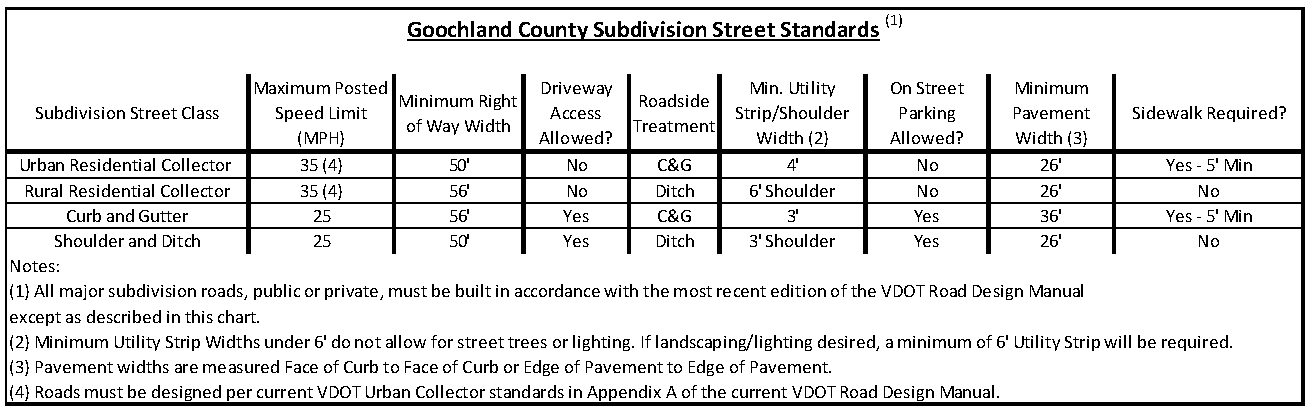
In addition to this section, subdivision road design and construction must be done in accordance with the subdivision ordinance, the typical road sections in Section 15-512, and the following:
(Ord. No. 5970, § 2, 7-2-24)
Sec. 15-344. - Connection spacing requirements for roads.
Road access connections, public or private, must comply with VDOT standards for public roads unless a higher standard is imposed by this chapter or under conditions of zoning.
(Ord. No. 5970, § 2, 7-2-24)
Sec. 15-345. - Joint and cross access.
A.
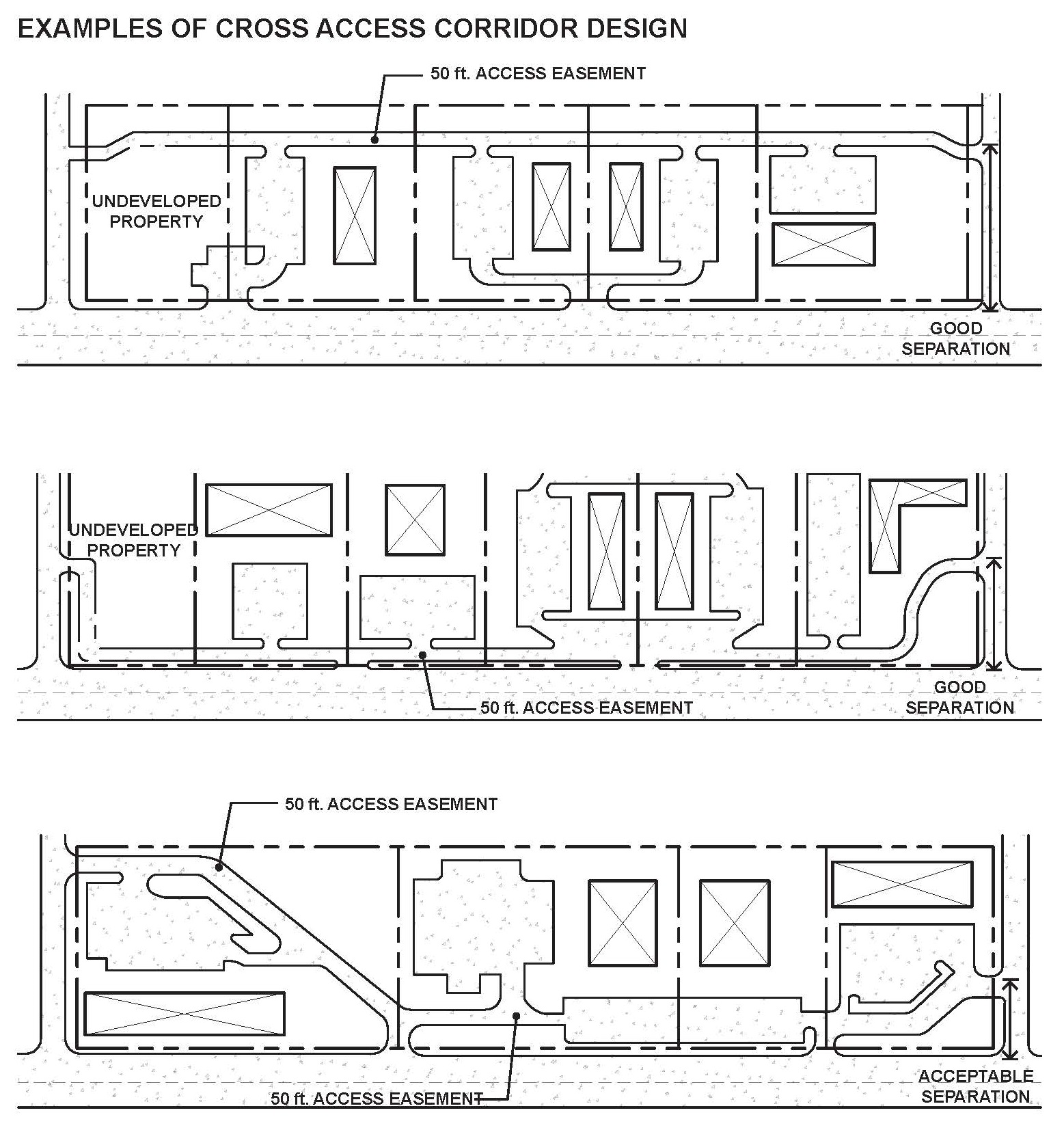
Adjacent commercial or office properties classified as major traffic generators (e.g., shopping centers, office parks) must provide a cross-access drive and pedestrian access to allow circulation between premises. Figure 1 below illustrates examples of cross-access corridor design. An access plan must be provided at time of plan of development review.
B.
A system of joint use driveways and cross-access easements must be established wherever feasible and the property must incorporate the following:
(1)
A continuous service drive or cross-access corridor extending the entire length of each block served, to provide for driveway separation consistent with the access management classification system and standards.
(2)
A design speed of 10 mph and 24-foot roadway width to accommodate two-way travel aisles designed to accommodate vehicles, service vehicles, and loading vehicles, unless a greater width is required by the Goochland County Fire Prevention Code.
(3)
Stub-outs and other design features to make it visually obvious that the abutting properties may be tied in to provide cross-access via a service drive.
(4)
A unified access and circulation system plan that includes coordinated or shared parking areas, wherever feasible.
C.
The following actions are required:
(1)
For plat approval, record an easement with the deed allowing cross-access to and from other properties served by the joint use driveways and cross-access or service drive; and
(2)
Record a joint maintenance agreement or covenants and restrictions with the deed defining maintenance responsibilities of property owners.
D.
Required separation distance of access points may be reduced by the POD administrator where they prove impractical, provided all of the following requirements are met:
(1)
Joint access driveways and cross-access easements are provided wherever feasible in accordance with this section;
(2)
The site plan incorporates a unified access and circulation system in accordance with this section; and
(3)
The property owners enter into a written agreement with the county, recorded with the deed, that pre-existing connections on the property will be closed and eliminated after construction of each side of the joint use driveway.
E.
The POD administrator may modify or waive the requirements of this section where the physical characteristics or layout of abutting properties would make development of a unified or shared access and circulation system impractical.
Figure 1. Examples of cross-access corridor design
(Ord. No. 5970, § 2, 7-2-24)
Sec. 15-346. - Commercial driveway design.
A.
Commercial driveway width must meet the following guidelines:
(1)
If the driveway is one-way-in or one-way-out, then the driveway must be at least 20 feet wide and have appropriate signage designating the driveway as a one-way connection.
(2)
For two-way access, each lane must have a width of 15 feet; a maximum of five lanes will be allowed.
(3)
Driveways that enter a major thoroughfare at traffic signals must have at least two outbound lanes (one for each turning direction) at least 12 feet wide and one inbound lane at least 15 feet wide.
B.
Driveway grades must conform to the requirements of the Virginia Department of Transportation subdivision street requirements.
C.
Driveway approaches must be designed and located to provide an exiting vehicle with an unobstructed view. Construction of driveways along acceleration or deceleration lanes and tapers is discouraged due to the potential for vehicular weaving conflicts.
D.
Driveway width and flair must be adequate to serve the volume of traffic and provide for rapid movement of vehicles off of the major thoroughfare, but cannot be so excessive as to pose safety hazards for pedestrians, bicycles, or other vehicles.
E.
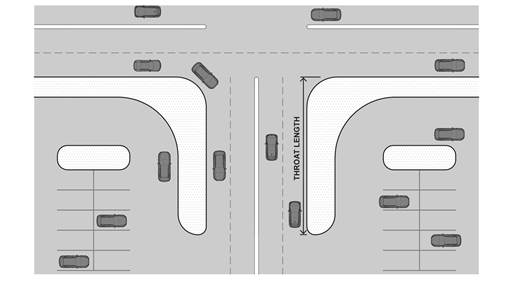
The length of driveways or "throat length" (see Figure 2) must be designed in accordance with the anticipated storage length for entering and exiting vehicles to prevent vehicles from backing into the flow of traffic on the public street or causing unsafe conflicts with on-site circulation. Variation from these can be permitted for good cause, upon approval of the POD administrator.
Figure 2. Driveway throat layout
(Ord. No. 5970, § 2, 7-2-24)
Sec. 15-347. - Requirements for outparcels and phased development plans.
A.
In the interest of promoting unified access and circulation systems, developments under the same ownership or consolidated for the purposes of development, and comprised of more than one building site, or phased development plans will not be considered separate properties in relation to access standards. The number of connections permitted will be the minimum number necessary to provide reasonable access to these properties, not the maximum available for that frontage. All necessary easements, agreements, and stipulations must be met. The owner and all lessees within the affected area are responsible for compliance with the requirements of this article and can be cited for any violation.
B.
All access to outparcels must be internalized using the shared circulation system of the principal development or retail center. Access to outparcels must be designed to avoid excessive movement across parking aisles and queuing across surrounding parking and driving aisles. Right-of-way for direct access to the road must be dedicated to the county and access dedication must be recorded with the deed.
(Ord. No. 5970, § 2, 7-2-24)
Sec. 15-348. - Non-conforming access features.
Existing access connections that do not conform with these standards are non-conforming features and must be brought into compliance with applicable standards under the following conditions:
A.
When new access connection is requested;
B.
When there are substantial enlargements or improvements;
C.
With significant change in trip generation; or
D.
As road improvements allow.
(Ord. No. 5970, § 2, 7-2-24)
Sec. 15-349. - Additional requirements for classified roads.
A.
The minimum lot frontage on all public roads (except residential subdivision streets) cannot be less than the minimum connection spacing standards of that road, except as otherwise provided in this section. Flag lots cannot have direct access to any private road. Interior parcels must have access via a public or private road in accordance with this article. Flag lot driveways must be separated by at least twice the minimum frontage requirement of that zoning district.
B.
Every tax map parcel fronting on a public road is entitled to one driveway, except as noted in subsection (2) below. When subsequently subdivided, either as metes and bounds parcels or as a recorded plat, these parcels must provide access to all newly created lots via the permitted access connection. This may be achieved through subdivision roads, joint and cross access, service drives, and other reasonable means of ingress and egress in accordance with the requirements of this article. The following standards apply:
(1)
Parcels with long road frontages may be permitted additional connections or driveways provided they are consistent with the applicable driveway spacing standards.
(2)
Existing parcels with road frontage less than the applicable minimum connection spacing may not be permitted a direct connection to the public road where the POD administrator determines alternative reasonable access is available.
(3)
Additional access connections may be allowed if the safety and efficiency of travel on the public road will be improved by providing more than one, based on the POD administrator's determination.
(Ord. No. 5970, § 2, 7-2-24)
Sec. 15-350. - Double frontage and residential subdivision lot access.
A.
Access to double frontage lots is required on the road with the lower access classification. Access should be designated on the plan of development or, for residential development, the final plat.
B.
When a residential subdivision is proposed that would abut an arterial or collector road, it must be designed to provide abutting lots with access from an internal subdivision road. For major subdivisions that abut an arterial or collector road, a buffer is required to protect homes from traffic and to preclude direct lot access onto the arterial or collector road. Buffers must be located in open space dedicated to the homeowners' association. Buffers are required to be located outside of ultimate right-of-way and existing easements. Buffers along collector roads must have a minimum width of 50 feet. Buffers along arterial roads must have a minimum width of 100 feet. However, specific exceptions to these requirements may be granted at time of rezoning. Future easements located parallel to the buffers can encroach into the buffers up to 10 feet along collector roads and up to 15 feet along arterial roads.
(Ord. No. 5970, § 2, 7-2-24)
Sec. 15-351. - Shared access.
Developments with frontage on a public road, excluding interstate or limited access roads, must be designed to share public road access points.
(Ord. No. 5970, § 2, 7-2-24)
Sec. 15-352. - Connectivity.
A.
A proposed residential subdivision must be designed to coordinate with existing, proposed, and planned streets outside of the subdivision.
B.
Wherever a proposed development abuts land suitable for future development or a future development phase of the same development, stub-outs must be provided as deemed necessary by the county to provide access to abutting properties or to logically extend the road network into the surrounding area. All stub-outs greater than 150 feet must have temporary turn-arounds unless specifically exempted. The restoration and extension of the road is the responsibility of any future developer of the abutting land.
C.
Collector roads must intersect with collector or arterial roads at safe and convenient locations.
D.
Local residential access roads must connect with surrounding roads to permit the convenient movement of traffic between residential neighborhoods and facilitate emergency access and evacuation, but such connections are not permitted if it would encourage substantial through traffic.
E.
Proposed developments must connect to stub-outs on abutting properties. The POD administrator may waive this requirement for non-residential development proposed to abut single family residential development.
(Ord. No. 5970, § 2, 7-2-24)
Sec. 15-353. - Turn lanes.
Auxiliary lanes (right and left turn lanes, and acceleration lanes) reduce the slowing and stopping of traffic that is caused by turning vehicles. The purpose of the auxiliary lane is to enhance motorist safety and to prolong the intended through function of the road. The lanes are needed wherever the anticipated volume of traffic turning at a site would be high enough in relation to the existing or anticipated future through traffic, the safety of motorists or residents may be at risk without the lanes, or other road or site-specific conditions exist that suggest that the health, safety, and welfare of residents or travelers on the road would best be served with auxiliary lanes. This determination will be based on characteristics of the particular development and the road under consideration.
A.
Commercial and industrial development. Turn lanes will be provided as required by the Virginia Department of Transportation.
B.
Major subdivisions.
(1)
All entrances onto major and minor arterial and collector roads must provide right turn lanes.
(2)
Developments that exit onto major and minor arterial or collector roads, and that have 10 or more lots must provide a left turn lane at each entrance. Developments with fewer than 10 lots must install a left turn lane if warranted by VDOT.
(3)
Developments that exit onto a local road, not internal to development (i.e., another section of same development) and that have more than 30 lots must provide a right turn lane.
(4)
Developments with more than 40 lots which are located on an existing local road where the speed limit is 45 mph or greater must provide a left turn lane in addition to the right turn lane.
C.
Major subdivision with entrances onto a road with a median.
(1)
The primary entrance must be designed to align with an existing median break or be located pursuant to the Virginia Department of Transportation criteria for median break spacing.
(2)
In cases where, due to the location of the proposed development, the proposed entrance cannot align with an existing or proposed median break, the left turn lane requirement may be waived by the community development director.
D.
Board of supervisors waiver. In conjunction with a rezoning request, including amendment, the board of supervisors may waive any requirements of this section. The following factors should be considered as part of the waiver request:
(1)
Sight distance, road alignment, and grade changes.
(2)
Frequency of rear-end crashes along roadway.
(3)
Traffic volume.
(4)
Speed limit.
(5)
Capacity analysis of receiving roadway.
(Ord. No. 5970, § 2, 7-2-24)
Sec. 15-354. - Traffic impact analysis.
Traffic impact analyses (TIAs) are studies of the transportation needs and traffic impacts of a development on the surrounding road network and must be an integral part of the development review process. An analysis must be performed for each of the following situations:
A.
All major residential subdivisions with 20 or more lots.
B.
All commercial and industrial developments.
C.
All developments and redevelopments that are expected to generate more than 100 new peak-hour vehicle trips on the adjacent road.
D.
Development that generates fewer than 100 new peak-hour trips, if it affects local problem areas, including high accident locations, currently congested areas, areas of critical local concern, or when a review of the plan of development indicates the need for additional data.
E.
Any change in the land use or density that will increase the traffic generation on the adjacent street by more than 15%.
F.
When the original TIA is more than two years old, access decisions are still outstanding, and changes in development have occurred within the surrounding area.
(Ord. No. 5970, § 2, 7-2-24)
Sec. 15-355. - Variations.
Variation from the standards is permitted at the discretion of the POD administrator if the granting of the variation is in harmony with the purpose and intent of these regulations and if every feasible option for meeting access standards has been explored. The applicant must provide proof of unique or special conditions that make strict application of the provisions impractical. Under no circumstances will a variance be granted, unless not granting the variation would deny all reasonable access, endanger public health, welfare or safety, or cause an exceptional and undue hardship on the applicant. No variance will be granted if the hardship is self-created. In exercising discretion, the POD administrator should consider the following:
A.
Indirect or restricted access cannot be obtained;
B.
No engineering or construction solutions can be applied to mitigate the condition; and
C.
No alternative access is available from a street with a lower functional classification than the primary roadway.
(Ord. No. 5970, § 2, 7-2-24)

