Goochland County Unincorporated
City Zoning Code
City Zoning Code
ARTICLE 25
- OUTDOOR LIGHTING
Sec. 15-391.- Statement of intent.
The purpose of outdoor lighting regulation is to reduce light pollution, thereby preserving dark night skies, maintaining the county's rural character, and promoting quality development.
Sec. 15-392. - Applicability.
This article applies to all uses in business districts, industrial districts, and multi-family housing development. This article also governs lighting regulations for all uses not classified as single-family residential or agricultural; however, it is intended to regulate religious, educational, athletic fields, recreation areas, locations for public assembly, and similar uses in residential and agricultural zoning districts. The article also applies to streetlights, sign illumination, and lighting in common areas in residential districts.
Outdoor light fixtures must be installed in compliance with this article. Where there is a conflict between provisions of this article and other applicable provisions of this chapter, the most restrictive provision governs. All government agencies, federal, state, and county, are encouraged to comply with these provisions.
Sec. 15-393. - Definitions.
Footcandle. Unit of measurement used to measure the total amount of light cast on a surface (luminance). One footcandle is equivalent to the luminance produced by one candle at a distance of one foot.
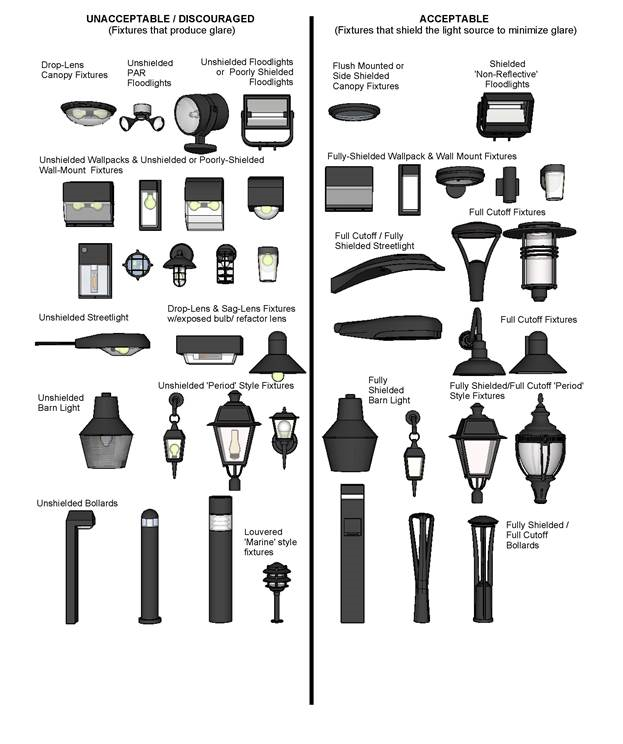
Fully shielded fixture. A light fixture that conceals the light source and allows no light to shine at or above the horizontal plane located at the lowest point of the fixture (for example, the light fixture features a flat lens and no tilt). Shielding must be permanently affixed and permit no light to escape through it.
Glare. Light with an intensity great enough to result in (a) a "nuisance glare" such as light shining into a window; (b) a "discomfort glare" such as bright light causing squinting of the eyes; or (c) a "disabling glare" such as bright light reducing the ability of the eyes to see into shadows.
Lamp (or bulb). The component of a light fixture that produces light, commonly referred to as a bulb.
Light pollution. Any adverse effect of manmade light, including, but not limited to, discomfort to the eye, distraction, diminished vision due to glare, light trespass, or diminished ability to view the night sky.
Light trespass. Light from an outdoor light fixture which shines onto an adjacent property or public right-of-way.
Light fixture (or luminaire). A complete lighting unit assembly consisting of a lamp or lamps (bulbs) together with the components designed to distribute the light, to position and protect the lamps, and to connect the lamps to the power supply. Typically, it means the complete lighting assembly, but not the support assembly.
Lumen. A standard unit of measurement used to quantify a lamp's brightness, or the amount of light energy produced by a fixture at the lamp. One footcandle equals one lumen per square foot. Lumen output is often listed on the lamp packaging. For example, a 60-watt incandescent lamp produces 950 lumens while a 55-watt low-pressure sodium lamp produces 8,000 lumens.
Outdoor light fixture. Permanent light fixture or other device used for outdoor illumination, including, but not limited to, light fixtures for:
A.
Buildings and structures, including canopies and overhangs;
B.
Recreational areas;
C.
Parking lots;
D.
Landscaping;
E.
External lighting for signs; and
F.
Product display and service areas.
Photometric plan. A point-by-point plan depicting the intensity, luminance, and location of lighting on the property.
Uplighting. Lighting which is directed to shine light above the horizonal plane.
Sec. 15-394. - General requirements.
The following general standards apply to outdoor light fixtures:
A.
Light direction. Outdoor light fixtures must be aimed downward, unless otherwise permitted in this article.
B.
Shielding. Outdoor light fixtures must be fully shielded.
C.
Lighting design. Outdoor light fixtures must be designed, installed, located, and maintained to minimize light trespass onto adjacent properties or roadways, and to keep illumination within the boundaries of the property containing the outdoor light fixture.
D.
Height. Maximum mounting height is 20 feet, measured from the ground to the bottom of the outdoor lighting fixture.
E.
Security lighting. For security purposes, lighting should be reduced to a level necessary for security, and/or sensor activated lights should be utilized when use is closed.
F.
Light measurement. Light measurements are taken at the property line of the property from which the light is being generated and measured in footcandles.
G.
Light trespass. Light trespass cannot exceed ½ footcandle at the property line.
Sec. 15-395. - Specific requirements for certain uses.
The following requirements apply to specific uses identified in the zoning ordinance:
A.
Multi-lot development. For developments approved with multiple lots (e.g., townhouse development, shopping center), lighting is measured at the perimeter of the entire development.
B.
Canopies (e.g., fuel pump). Lamps in canopies must be recessed into the canopy ceiling so that the bottom of the fixture is flush with the ceiling. Light fixtures cannot be mounted on the top or sides (fascia) of the canopy, and the sides of the canopy cannot be illuminated.
As an alternative to canopies, indirect lighting may be used where light is directed upward and then reflected downward from the underside of the canopy; with this method, light fixtures must be shielded so illumination is directed exclusively on the underside of the canopy.
C.
Outdoor recreation facilities. Outdoor lighting fixtures must be designed and installed to direct light onto the primary playing area and to minimize light pollution and light trespass. Fields must be lighted only while in use. Direct illumination is confined to within the property lines of the recreational use. Illumination must cease within one hour of the event conclusion.
D.
Buildings, signs, flags, and landscapes. In order to minimize glare, sky glow, and light trespass, spotlighting or floodlighting to illuminate buildings or signs, or used to accentuate landscaping, must consist of full cut-off or directionally shielded light fixtures aimed and controlled so that light is directed and confined to the object intended to be illuminated. Lighting cannot shine directly into a residence or onto a public road.
Sec. 15-396. - Prohibited lighting.
The following lighting is prohibited:
A.
Light fixtures that imitate an official highway or traffic control light or sign;
B.
Light fixtures in the direct line of vision with any traffic control light or sign;
C.
Light fixtures that have flashing or intermittent patterns of illumination;
D.
Searchlights, except when used by federal, state, or local authorities;
E.
Mercury and sodium vapor light fixtures; and
F.
Light fixtures equipped with adjustable mounting devices altering the light direction.
Sec. 15-397. - Exemptions.
The following uses are exempted from the outdoor lighting standards of this article:
A.
Lighting within a public street right-of-way or easement that is used principally for illuminating a roadway, but not lighting within a street right-of-way or easement that is designed to illuminate areas outside the right-of-way or easement;
B.
Lighting exempt under state or federal law;
C.
Federal Aviation Administration-mandated lighting associated with a utility tower or airport;
D.
Lighting for public monuments and statuary;
E.
Lighting to illuminate federal, state, or local government flags, and other non-commercial flags expressing constitutionally protected speech;
F.
Temporary lighting for circuses, fairs, carnivals, theatrical and other performance areas, provided that it is discontinued within one hour of completion of the performance;
G.
Temporary lighting of construction sites, provided that it is discontinued within one hour of the construction activity stopping;
H.
Temporary lighting for emergency situations, provided that it is discontinued after the emergency situation concludes;
I.
Underwater lighting in swimming pools, fountains, and other water features; and
J.
Holiday or festive lighting, provided that it does not create unsafe glare on roads.
Sec. 15-398. - Lighting plan requirements.
A lighting plan must be submitted with a plan of development or certificate of approval. The lighting plan must include at least the following:
A.
A site plan drawn to scale, showing building footprint(s), landscaping areas, parking areas, and location of proposed outdoor lighting fixtures.
B.
Locations of all outdoor light fixtures, pole mounted and building mounted, and a numerical (typically 10 ft. by 10 ft.) grid of lighting levels, in footcandles, that the fixtures will produce on the ground (photometric report).
C.
Specifications of the light fixtures, which may include designation as illuminating engineering society of North America "cut-off" fixtures, manufacturers' catalog cuts, or other product information. Refer to Figure 3 at the end of this article for examples of acceptable fixtures.
D.
The photometric report indicating the maximum footcandle levels within the lighted area of the property and at the perimeter.
Sec. 15-399. - Alternatives and appeals of approved material and methods of installation.
A.
Alternatives. Outdoor lighting requirements are not intended to prevent the use of equipment, material, or installation methods not specifically prescribed, but the alternative must be approved by the zoning administrator. The zoning administrator may approve an alternative so long as it does not produce light pollution or light trespass.
B.
Appeals. An appeal of the zoning administrator's decision may be made to the board of zoning appeals.
Figure 3. Examples of acceptable and unacceptable outdoor light fixtures