
Goochland County Unincorporated
City Zoning Code
City Zoning Code
ARTICLE 27
- ENTRANCE CORRIDOR AND VILLAGE CENTER OVERLAY DISTRICTS
Sec. 15-431.- Statement of intent.
The entrance corridor and village center overlay districts are intended to implement the comprehensive plan objective of preserving the unique character of our villages, rural crossroads, and major roadways and historic resources, through architectural control of development; to stabilize and improve property values; to protect and enhance the county's attractiveness to residents, tourists, and other visitors; to support and stimulate complementary development and future growth appropriate to the prominence afforded properties of historic, architectural and cultural significance. An overlay district is created for the purpose of providing special regulations in designated areas; accordingly, these regulations are in addition to and modify the requirements of the zoning districts, especially with respect to architecture and landscaping.
Entrance corridor and village center overlay district regulations apply to both modifications of existing structures and new construction. However, in order to provide for a transition for existing structures, to alleviate hardship, and to allow flexibility for existing small parcels, authority is provided for reasonable deviations which are consistent with good planning principles.
Sec. 15-432. - Applicability.
A.
Entrance Corridors. Entrance corridor overlay districts may be established along streets or highways designated as scenic highways if the board of supervisors finds they are significant routes of tourist access to the county.
The following entrance corridors are hereby established to a depth of 500 feet from both the north and south rights-of-way:
(1)
Patterson Avenue/River Road West. Defined as Patterson Avenue/River Road West (Route 6) from the Henrico County line to Maidens Road (Route 634).
(2)
River Road. Defined as River Road (Route 650) from the Henrico County line to its terminus at Patterson Avenue (Route 6).
B.
Village Centers. Village center overlay districts may be established in the vicinity of designated historic, architectural, or cultural landmarks, buildings, structures, or areas the board of supervisors finds to be worthy of additional protection.
The following village centers are hereby established:
(1)
Courthouse Village. The village is generally defined as being 1,000 feet wide (500 feet from the centerline of the roads on both sides) along Sandy Hook Road (Route 522) from 1200' north of Bulldog Way (Rt. 724) to its intersection with River Road West (Rt.6); along Fairground Road (Rt. 632) from Sandy Hook Road (Rt. 522) to 400' east of Maidens Road (Rt. 634); and along River Road West (Rt. 6) from Irwin Road (Rt. 607) to Maidens Road (Rt. 634)
(2)
Centerville Village (Broad Street Road). This district is generally comprised of the parcels on either side of Broad Street Road (Route 250) beginning from the Henrico County Line west to a point 1,500 feet west of the intersection of Broad Street Road and Manakin Road; parcels along Plaza Drive, St. Matthews Lane and Hockett Road, except for property zoned M-1 as of November 7, 2012; and the area generally comprised of the parcels on either side of Ashland Road (Route 623) from Broad Street Road (Route 250) to the Ashland Road/Interstate 64 interchange.
(3)
Oilville Village. This district is defined as being 1,000 feet wide (500 feet from the centerline) of the following roads as they extend through the Oilville Village: Broad Street Road, Oilville Road, Pony Farm Road, Hanover Road, Fairground Road, and Cardwell Road.
Sec. 15-433. - Overlay concept.
A.
The entrance corridor and village center overlay districts supplement the underlying zoning districts shown on the official zoning map.
B.
The uses permitted in the overlay districts, whether by right or through a conditional use permit, are as permitted in the underlying district.
C.
Where there is any conflict between the provisions or requirements of any of the overlay districts and those of any underlying district, the more restrictive provisions apply.
Sec. 15-434. - Design review committee.
A.
Appointments.
(1)
The design review committee consists of three members appointed by the board of supervisors. All members must be county residents and cannot serve on the planning commission while serving on the design review committee. All members should have a demonstrated interest, competence, or knowledge in architecture and/or site design, and in the preservation of natural, scenic and historic resources.
(2)
In addition to the three required members, the board of supervisors may appoint two alternates to serve on the DRC. The qualifications, terms, and compensation of alternates is the same as those of regular members. When a regular member knows he will be absent from or will have to abstain from any application at a meeting, he shall notify the DRC chairman as soon as possible prior to the meeting. The chairman may select an alternate to serve in the absent or abstaining member's place, and, if so, it will be included in the DRC records. The alternate member may vote on any proceeding in which a regular member abstains or is absent.
(3)
Design review committee members are appointed for two-year terms and serve at the pleasure of the board of supervisors, which may replace a member at any time. Design review committee members may serve four successive terms.
(4)
Design review committee members may receive compensation as authorized by the board of supervisors.
B.
Powers and duties.
(1)
Design review committee meetings will be held as necessary to consider applications that have been appealed or which staff or an applicant request to have heard by the design review committee.
(2)
The design review committee may, from time to time, recommend to the board of supervisors amendments to this article.
(3)
Meetings shall be held in compliance with the Virginia Freedom of Information Act. The design review committee shall choose annually from among its regular members a chair, and a vice chair who will act in the absence of the chair, and keep minutes of its proceedings, showing the presence and action of each member upon each question.
(4)
The design review committee is responsible to administer the provisions of the certificate of approval process and may recommend to the board of supervisors the promulgation of additional design standards as it believes appropriate which may include, but is not limited to, architectural standards, building and parking setback standards and landscaping standards.
(5)
The design review committee may be advisory to the planning commission, the board of supervisors, and the community development department in rezonings, conditional use permits, site development plans, subdivisions, variances, and other matters within overlay districts.
(6)
In order to allow for reasonable expansion of existing structures, and to allow flexibility in the application of the design and development standards applicable to overlay districts, the design review committee may grant reasonable deviations from the design standards if the site's topography, configuration, or other unique circumstances prevent full compliance with the requirements. In such cases, the design review committee may impose conditions that will accomplish the purpose of the requirements to the maximum extent practicable.
Sec. 15-435. - Application for certificate of approval.
A.
General provisions.
(1)
Except as otherwise provided in Sec. 15-440, no building permit can be issued for any structure or building to be located within an entrance corridor or village center overlay district until the plans for it have been issued an overlay district certificate of approval.
(2)
For purposes of this article, changing the exterior color or materials of a structure or building is an alteration and not regular maintenance, and a structure includes, but is not limited to, outbuildings, fences, walls, lamp posts, and light fixtures.
(3)
Applications for a certificate of approval will be approved administratively unless they are appealed by the applicant or referred to the design review committee by staff.
(4)
An application for a certificate of approval for buildings or structures must include three copies of the following:
a.
Architectural elevations (all sides) for the proposed improvements, drawn to scale;
b.
Site plan for the proposed improvements;
c.
Photographs, manufacture specifications, or samples of exterior building materials for the proposed improvements, including proposed colors;
d.
Lighting plan (if required); and
e.
Landscaping plan.
(i)
A landscaping plan for each parcel; provided that no landscaping plan is required for an application which is limited to a change in the exterior color, or change in materials of an existing structure, building or sign.
(ii)
The landscaping plan must be drawn to scale and provide landscape locations, description of all landscaping materials and irrigation systems required by this article.
(5)
Plant material specifications.
a.
Any healthy existing tree or shrub of sufficient size may be included for credit toward the applicable landscaping requirements. Plant materials used to satisfy the applicable requirements must conform to the standards of the most recent edition of the "American Standard for Nursery Stock", published by American Horticulture Industry Association d/b/a AmericanHort an ANSI-accredited Standards Developing Organization. In order to qualify for credit toward the minimum frontage landscaping requirements, plant materials must be of the size and type defined as small deciduous trees, large deciduous trees, evergreens and medium shrubs. These definitions are as follows:
(i)
Large deciduous trees. Trees having a minimum mature crown spread of at least 30 feet and a minimum caliper of two inches for new trees at the time of planting, or a minimum caliper of six inches measured 12 inches above ground for existing trees.
(ii)
Small deciduous trees. Trees having a minimum mature crown spread of at least 12 feet and a minimum height of 6 feet at the time of planting, or a minimum caliper of four inches measured 12 inches above ground for existing trees.
(iii)
Evergreen trees. Evergreen trees with a minimum height of six feet for new trees at the time of planting, or a minimum height of 10 feet for existing trees.
(iv)
Medium shrubs. Shrubs with a height of 18—24 inches at the time of planting.
b.
All landscaping must be installed according to accepted professional planting practices and procedures. Installation of the required landscaping must be completed by the end of the first planting season following completion of the improvements to be made pursuant to the certificate of approval. Landscaped areas must be protected from vehicular encroachment by such means as, but not limited to, wheel stops, concrete curbs, or treated timber.
c.
All plant materials must be maintained in a healthy, growing condition. All unhealthy, dying or dead plant materials must be replaced during the next planting season.
(6)
Upon the applicant's written request, the community development director may waive any of the above requirements deemed not to be necessary for review of the application.
(7)
Applications for certificates of approval must be made on forms provided by the community development department and submitted along with the required fee. Any alterations or modifications to the application delay the date it is considered complete.
Sec. 15-436. - Application review.
If an application meets all overlay district requirements, staff can administratively review the certificate of approval application. Staff has 10 working days from receipt of a completed application to approve, deny, or provide a list of necessary changes in writing to the applicant. If an application does not meet the overlay standards or requests a modification of them, the application will be heard by the design review committee. In addition, any applicant can appeal any staff decision to the design review committee.
Sec. 15-437. - Required elements for certificate of approval.
Staff or the design review committee will consider the following requirements in reviewing the certificate of approval application:
A.
The proposed structure or building complies with the entrance corridor or village center overlay district design and development standards.
B.
All exterior walls have the same or architecturally harmonious materials, color, texture and treatment.
C.
The combination of architectural elements proposed for a structure, building, or improvement, in terms of design, line, mass, dimension, color, material, texture, lighting, landscaping, roof line and height, conform to accepted architectural principles for permanent buildings reflecting the character of the applicable corridor overlay district, as contrasted with engineering standards designed to satisfy safety requirements only.
D.
The proposed structure, building, or improvement, in terms of design, material, texture, color, lighting, landscaping, dimension, line, mass, roofline and height, is not designed to serve primarily as an advertisement or commercial display, and does not exhibit exterior characteristics likely to deteriorate rapidly, be of temporary or short term architectural or aesthetic acceptability, or otherwise constitute a reasonable foreseeable detriment to the attractiveness and stability of the applicable entrance corridor district.
Sec. 15-438. - Design review committee approval process.
A.
The design review committee will meet as needed to consider applications for certificates of approval that have been appealed by the applicant or referred by staff.
B.
After consideration of a certificate of approval application, the design review committee may approve or deny the application or approve the application with conditions required for compliance with the applicable design criteria, including conditions that delegate approval authority to staff.
C.
All design review committee decisions on an application must be in writing and sent to the applicant. Any decision to deny will state the reasons for denial. The design review committee may, but is not required to, make suggestions that would assist the applicant in resubmitting an application.
D.
Before issuing permits for any work which has been approved by the design review committee, staff will require applicants to submit plans that accurately reflect any changes or conditions imposed by the design review committee.
Sec. 15-439. - Certificate of approval compliance.
A.
All work performed pursuant to a certificate of approval must conform to the approved plans and specifications, including any required modifications. In the event work is performed which is not in conformance with the certificate of approval, staff will notify the responsible person or firm in writing of the nonconformity and take any necessary steps to enforce compliance with the certificate of approval.
B.
No change in the approved plans may be made without modification of the certificate of approval. Changes which are not substantially different from the approved plans may be approved administratively by staff. Material changes will be reviewed as if a new certificate of approval application.
Sec. 15-440. - Exemptions.
A.
No certificate of approval is required for any of the following:
(1)
Single-family dwellings used exclusively for residential purposes, including accessory buildings such as tool houses, garages, and storage sheds. However, development signs and entrance features such as gatehouses which are generally located at the main entrance into a subdivision are required to have a certificate of approval;
(2)
Interior alterations to a building or structure having no effect on its exterior appearance;
(3)
Repair and maintenance activities, and authorized improvements to nonconforming uses;
(4)
General maintenance where no change in design or material is proposed; or
(5)
Wall signs and sign face changes for existing freestanding signs. Signs with new construction will be reviewed with the certificate of approval.
B.
For any certificate of approval which is limited to a change in the exterior color, or materials of an existing structure, building or sign, landscaping requirements in this article do not apply.
Sec. 15-441. - Appeals.
A.
The board of supervisors reserves unto itself the right to review all design review committee decisions.
B.
Any applicant aggrieved by any decision of the design review committee may appeal the decision to the board of supervisors. The appeal shall be made by filing a request in writing with the clerk of the board of supervisors within 30 days after the date of the decision being appealed. The board of supervisors may affirm, reverse, or modify, in whole or in part, the decision of the design review committee. In so doing, the board of supervisors may give due consideration to the design review committee recommendation and such other evidence as it deems necessary for a proper review.
C.
Any applicant aggrieved by any decision of the board of supervisors may appeal the decision to the Goochland County Circuit Court within 30 days after it was rendered. The filing of an appeal stays the decision of the board of supervisors pending the outcome of the appeal.
D.
For purposes of this article, the term "person aggrieved" is limited to the applicant, the design review committee, the board of supervisors, or any person having an immediate, pecuniary and substantial interest in the subject matter at issue, and not a remote or indirect interest. In order to be "aggrieved", a person must exhibit a substantial grievance and show a denial of some personal or property right, legal or equitable, or imposition of a burden or obligation upon himself or herself different from that suffered by the public generally.
Sec. 15-442. - Village centers—pedestrian scale.
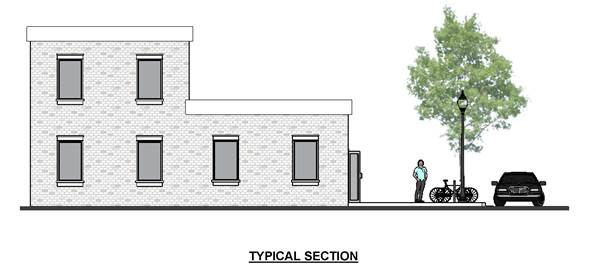
The Centerville, Courthouse, and Oilville villages encourage buildings to be built at a pedestrian scale.
Figure 8. Pedestrian scale design
Sec. 15-443. - Overlay district screening and signage.
All overlay districts require mechanical, electrical, heating, ventilation and air conditioning equipment to be screened.
Figure 9. Overlay district screening
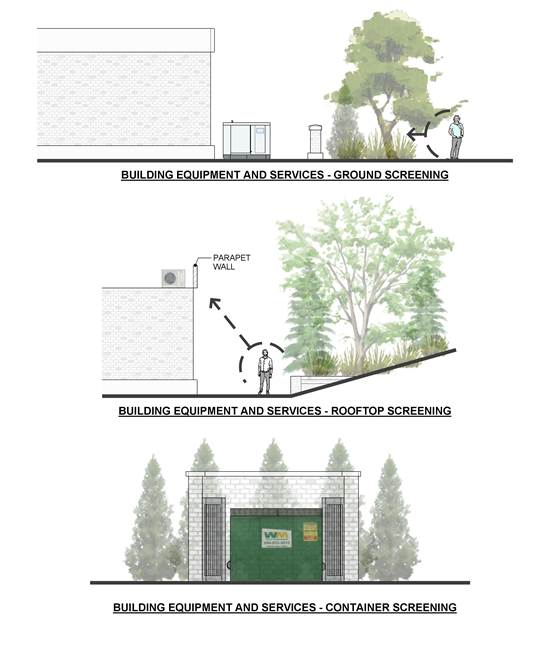
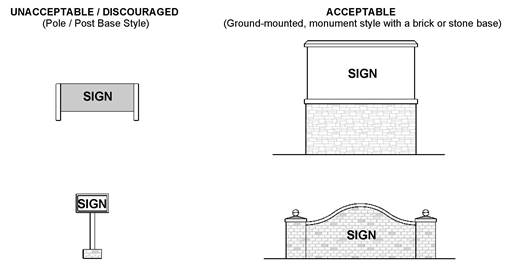
Figure 10. Examples of unacceptable and acceptable signs in overlay district
Sec. 15-444. - Route 6/650 entrance corridor overlay district development standards.
A.
Architectural standards. Architectural features such as arcades and colonnades must be used to unify groups of buildings within a development.
(1)
Building materials.
(2)
Fuel pump canopies.
a.
Fuel pump canopies may be required to provide customers with protection from the elements and to provide lighting levels required for dispensing fuel as they are functional elements of present-day gas/convenience stores; their character and appearance must reflect a minimalist design consistent with that function.
b.
The size of the canopy fascia and canopy support columns must be in proportion to the overall size of the canopy structure. The fascia cannot exceed 36 inches in height, including any accent bands.
c.
Canopy fascia and canopy signage cannot be illuminated.
d.
Lighting of fuel pump canopies must be of the lowest level that will provide safe fuel dispensing. All canopy lighting must be flush-mounted and shielded, downward directed, and cannot emit light above the horizontal plane.
e.
Canopy related elements, including fuel dispensers, support columns, spandrels, and planters must be compatible with the character of the building and site and not used for advertising.
f.
A building's architectural elements should not be altered to reflect trademark canopy design.
g.
Colors, materials, forms, and detailing may be used to coordinate canopies with a site, its building(s), and structures. Colors should be subdued and cannot advertise the business.
B.
Site design.
(1)
Landscape standards. Required landscaping materials may be clustered within the applicable areas. The listing of required plant materials below defines the total applicable planting requirements but does not require a uniform spacing of plantings. If public water lines are located on the parcel, within a public right-of-way, or within an easement located adjacent to the parcel, an irrigation system for all landscaped areas consisting of grass (excluding open fields of five acres or more) and formal landscaping must be designed, installed, and used to provide for proper watering of such areas.
* Measured from the existing right-of-way, and applicable to all structures.
(2)
Parking.
a.
Parking designs that enhance groundwater recharge capabilities are encouraged.
b.
All parking lot construction must be asphalt, concrete, pavers, or tar and gravel.
(3)
Pedestrian access. Pedestrian access between and within sites is required within the villages of Manakin and Crozier. Sidewalks may be within the streetscape buffer.
(4)
Storage areas and equipment (see also Sec. 15-443).
a.
All mechanical, electrical, heating, ventilation and air conditioning equipment, loading docks, and solid waste collection or handling facilities must be screened by one or more of the following:
(i)
Architectural elements of a building.
(ii)
The same materials used for buildings located on the parcel or other compatible approved materials.
(iii)
Landscaping materials.
b.
Uses that incorporate bay doors (garages or other similar uses including loading/unloading facilities) are required to orient the doors so that they do not face any primary roadway but are accessed from the side or rear of the structure.
Sec. 15-445. - Oilville village overlay district development standards.
A.
Architectural standards.
(1)
Character. Use compatible architectural features wherever possible to tie buildings into a cohesive district.
a.
Materials and patterns must complement the area's character in terms of color, scale, and texture. When possible, relate entries, windows, signage, and other architectural components to adjacent buildings.
b.
Architectural features, such as arcades and colonnades, must be used to unify groups of buildings within a development.
c.
Colors should be restrained and subdued. Color choice should complement surrounding buildings.
d.
The color of the structure cannot be an advertisement for the business. New franchise architecture (a general design that is repeated throughout different locations by a particular corporation without consideration of a specific site or environment) must follow these design guidelines and create color schemes that blend in with the existing environment and are sensitive to their surroundings.
(2)
Scale and building height. Design buildings to be human-scale and pedestrian-oriented at the street level (see Sec. 15-442). Design large buildings so that they appear small in scale when seen from the sidewalk. Avoid massive, monolithic facades. The facade of buildings typically should not exceed three stories.
(3)
Building materials.
(4)
Roof treatment.
a.
Roof type is flexible. Flat roofs are discouraged where practical.
b.
If the building facing the street is longer than 100 linear feet, then the building must require varying roof heights and other architectural features to disrupt the monotony of the façade.
(5)
Fuel pump canopies.
a.
Fuel pump canopies and related elements are functional elements of present-day gas/convenience stores and their character and appearance must reflect a minimalist design consistent with that function. Canopies and related elements should be coordinated with the overall site in terms of color, material, form, and detailing.
b.
Colors should be restrained and subdued. Color choice should complement surrounding buildings.
c.
The color of the canopy cannot be an advertisement for the business. New franchise architecture (a general design that is repeated throughout different locations by a particular corporation without consideration of a specific site or environment) must follow these design guidelines and create canopies that blend in with the existing environment and are sensitive to their surroundings.
B.
Site design. Site development should be sensitive to the existing natural landscape, preserve mature trees where possible, and contribute to the creation of an organized development plan.
(1)
Landscaping. Streetscape buffers are required to contain the landscaping materials required in the underlying zoning district as well as the following:
a.
One large deciduous tree per 100 linear feet one shrub (18—24 inches in height) per 10 linear feet. The entire buffer must be mulched or sodded.
b.
Native trees are encouraged.
c.
Vegetation planted in the streetscape buffer must be of a type and/or planted so as not to interfere with overhead or underground utility lines when fully grown. All landscaping must adhere to sight distance requirements as determined by the Virginia Department of Transportation.
d.
Streetscape buffers can also contain sidewalks, utility easements and signs, but cannot contain best management practice structures.
e.
Continuity within the design overlay corridor should be obtained by planting different types of plant materials that share similar characteristics. Such common elements allow for more flexibility in the design of structures because common landscape features will help to harmonize the appearance of development as seen from the street.
f.
All plant materials must be maintained in a healthy, growing condition and free from refuse and debris at all times. All unhealthy, dying or dead plant materials must be replaced during the next planting season.
(2)
Setbacks.
a.
Reduced setbacks that contribute to a pedestrian-friendly orientation are permitted in the village overlay districts. Setbacks are based on existing uses and road design speed and contribute to the design character of the village.
b.
Minimum building setback is 75 feet from the curb (50-foot setback is allowed if parking is to the structure's side or rear).
c.
Setbacks:
(3)
Exterior lighting fixtures.
a.
Dark brown, dark bronze, dark green, or black are appropriate colors for free-standing pole-mounted light fixtures.
b.
The height and scale of free-standing pole-mounted light fixtures should be compatible with the height and scale of the buildings and the sites they are illuminating, and with the use of the site. Free-standing pole-mounted light fixtures cannot exceed 18 feet in height.
c.
In determining the appropriateness of lighting fixtures for the corridor, the individual context of the site will be taken into consideration on a case-by-case basis.
d.
Underground utility installation is encouraged when possible.
(4)
Parking.
a.
Parking designs that enhance groundwater recharge capabilities are encouraged.
b.
All parking lot construction must consist of asphalt, concrete, pavers, or tar and gravel.
(5)
Pedestrian access. Pedestrian access between and within sites is required. Sidewalks along Route 250 should be incorporated into the streetscape buffer.
(6)
Storage areas and equipment.
a.
All mechanical, heating, ventilation and air-conditioning units, loading docks, and trash containers must be screened from view from the overlay corridors. Screening materials must be complementary to the building and landscaping of the site (see Sec. 15-443).
b.
Uses that incorporate bay doors (garages or other similar uses including loading/unloading facilities) must orient the doors so that they do not face the roadway but are accessed from the structure's side or rear.
Sec. 15-446. - Courthouse village overlay district development standards.
A.
Architectural standards.
(1)
Character. Design should be compatible with the existing character of neighboring properties. Buildings cannot serve as an advertisement.
a.
Architectural features such as arcades and colonnades must be used to unify groups of buildings within a development.
b.
Use a maximum of three colors on a single building. Muted or natural tones (earth tones) are attractive during all seasons of the year. Elements such as windows, trim, eaves, and cornices should be painted in colors that complement the main color of the building. Bright or brilliant colors should be used sparingly and only in limited instances for accents.
c.
Color should be compatible with that of neighboring buildings or storefronts. However, to avoid monotony, adjacent buildings should not be the same color.
(2)
Height.
a.
The building mass, scale and height are to be appropriate for the site and harmony with the mass, scale and height of adjacent buildings in order to remain visually pleasing.
b.
Rooflines should be compatible with existing roof lines in the village.
(3)
Building materials. Exterior materials should follow the list of recommended building materials:
(4)
Signs.
a.
Signs should be compatible with the architectural style and the proportions of the associated buildings, site and local character of the area. Ground-mounted and building-mounted signs which utilize a color and design that is complementary to the building are preferred. Ground-mounted signs cannot exceed 10 feet in height. Figure below demonstrates acceptable forms of signs.
b.
Pole-mounted signs a maximum of 10 feet in height and less than 10 square feet in size may be considered for approval. Appropriate landscaping is required at the base of all pole-mounted signs.
(5)
Fuel pump canopies.
a.
Fuel pump canopies may be required to provide customers with protection from the elements and to provide lighting levels required for dispensing fuel as they are functional elements of present-day gas/convenience stores and their character and appearance should reflect a minimalist design consistent with that function.
b.
The size of the canopy fascia and canopy support columns must be in proportion to the overall size of the canopy structure. The fascia cannot exceed 36 inches in total height, including any accent bands.
c.
Canopy fascia's and canopy signage cannot be illuminated.
d.
Lighting of fuel pump canopies should be of the lowest level that will provide safe dispensing of fuel. All canopy lighting must be flush-mounted and shielded, downward directed, and not emit light above the horizontal plane. All canopy lighting must meet a 0.9-foot candle spillover requirement.
e.
Canopy related elements, including fuel dispensers, support columns, spandrels, planters, etc. must be compatible with the character of the building and site and cannot be used for advertising.
f.
The building's architectural elements should not be altered to reflect trademark canopy design.
g.
Canopy fascias are limited to the use of one principal color.
h.
Colors, materials, forms, and detailing may be used to coordinate canopies with a site, its building(s), and structures.
B.
Site design.
(1)
Landscaping.
a.
Every effort must be made to preserve existing trees and shrubs during construction and renovations.
b.
New landscaping should blend with the established neighborhood.
c.
All plant materials must be maintained in a healthy, growing condition. All unhealthy, dying or dead plant materials must be replaced during the next planting season.
(2)
Parking.
a.
Parking designs that enhance groundwater recharge capabilities are encouraged.
b.
All parking lot construction must consist of asphalt, concrete, pavers, or tar and gravel.
(3)
Lighting. Exterior light fixtures must be of a size compatible to the building or existing lighting.
(4)
Sidewalk. On new construction or renovations, sidewalks are required in the site plan.
(5)
Setbacks.
a.
Reduced setbacks that contribute to a pedestrian-friendly orientation are permitted in the village overlay districts. Setbacks are based on existing uses and road design speed and contribute to the design character of the village.
b.
Buildings along Route 6, between Dickinson Road and Valley View Lane, will fall under different regulations than buildings on the outlying perimeter of village. Buildings may be closer to the road along Route 6, between the northern U.S. 522/Route 6 intersection and Valley View Lane with the following options:
(i)
Parking to the side, rear, or both on mixed use property; or
(ii)
Landscaped parking in front of business-zoned property.
c.
New buildings are allowed to line up with existing buildings and not be set back further than existing buildings.
d.
Parking lot entrances must meet commercial standards, but driveways are allowed to taper down once they leave the entrance.
(6)
Fencing.
a.
Fencing is discouraged. Trees, shrubs, and plants are preferred.
b.
Fencing in yards abutting public rights-of-way may be up to four feet high.
c.
Fence material fronting the roadway cannot be chain-link. Approved chain-link fence types may be incorporated if they are not visible from the roadway.
(7)
Screening equipment and services.
a.
Carefully locate building equipment and services to minimize their visual impact on public streets and neighboring properties. See Sec. 15-443 for ground, rooftop, and container screening examples.
b.
Trash containers and outdoor storage areas should be screened from view from public streets, pedestrian areas, and neighborhood properties. The screen for trash containers must be designed to be compatible with the architectural character of the development and be made of durable materials.
c.
Locate utility meters and other mechanical and electrical equipment in service, loading, or screened areas. Exterior surface-mounted utility conduit and boxes should be kept to a minimum. Where they do exist, they must be designed, painted, or screened to blend in with the design of the building to which they are attached.
d.
Mechanical equipment, solar collectors, satellite dishes, communication devices, and other equipment should be concealed from view from public streets, adjacent properties, and pedestrian-oriented areas to the extent technically practical.
e.
Roof-mounted equipment is discouraged. When such equipment is necessary, it must be screened from view from roads, adjacent properties, and pedestrian areas. Special attention should be given to changes in elevation, which may provide a view down to the roof. In this case, enclose the equipment in a screened shelter or design the layout of exposed equipment in an orderly fashion. Paint the equipment in a color similar to the rest of the roof.
f.
Screening devices (rooftop and at ground level) should incorporate the following elements:
(i)
Architectural screens should be an extension of the development's architectural style;
(ii)
Screen walls should be constructed of low maintenance and durable materials, which are consistent with the main building's materials; and
(iii)
Landscaping should be used in conjunction with building materials to compliment ground level screening devices.
g.
Uses that incorporate bay doors (garages or other similar uses including loading/unloading facilities) must orient the doors so that they do not face any primary roadway but are accessed from the structure's side or rear.
Sec. 15-447. - Centerville village (Broad Street Road) overlay district development standards.
A.
Architectural standards.
(1)
Character.
a.
Materials, colors, and the general style of buildings must be coordinated within a development.
b.
Building design must incorporate features used in the traditional villages of Centerville or Courthouse, such as, but not limited to, pitched roofs, limited height, porches, cupolas, columns, and smaller scaled windows. Larger developments should apply these design elements where practicable.
c.
Use compatible architectural features and relate components to adjacent buildings such as arcades and colonnades to unify groups of buildings within a development.
d.
Use building materials and patterns to complement the area's character in terms of color, scale, and texture.
e.
All sides of the building shall have a unified appearance, i.e., similar building materials and/or colors.
(2)
Scale.
a.
Buildings must be designed at a pedestrian scale with emphasis on pedestrian-oriented access, rather than automobile. See Sec. 15-442.
b.
Massive facades (greater than 100 feet in length) must use architectural treatments such as changes in color or materials, and modulation of width and depth to break up the monotony.
(3)
Building materials. Exterior materials must follow this list of recommended building materials:
(4)
Roof treatment. Designs with a residential style and scale are preferred. Massive rooflines should be broken up by mixing different roof types, dormers, and balconies. Flat roofs are discouraged where practical. If a flat roof is used, a parapet wall shall be used to the extent necessary to screen roof-top equipment.
(5)
Signs.
a.
Only ground-mounted and building-mounted signs which utilize a color and design that is complementary to the building are allowed. Ground-mounted signs cannot exceed 10 feet in height.
b.
Lighted signs must be turned off after business hours or dimmed to the extent possible to minimize light pollution.
(6)
Fuel pump canopies.
a.
Fuel pump canopies may be required to provide customers with protection from the elements and to provide lighting levels required for dispensing fuel, since they are functional elements of present-day gas/convenience stores; their character and appearance shall reflect a minimalist design consistent with that function.
b.
The size of the canopy fascia and canopy support columns must be in proportion to the overall size of the canopy structure. The fascia cannot exceed 36 inches in height, including any accent bands.
c.
Canopy-related elements, including fuel dispensers, support columns, spandrels, planters, etc. should be compatible with the character of the building and site, and cannot be used for advertising.
d.
The building's architectural elements should not be altered to reflect trademark canopy design.
e.
Colors, materials, forms, and detailing may be used to coordinate canopies with a site, its building(s), and structures. Colors should be subdued and cannot be an advertisement for the business.
f.
Fueling stations associated with other uses, such as a grocery store, cannot be located in the front yard.
B.
Site design.
(1)
General.
a.
Underground utilities are encouraged.
b.
Stormwater best management practices that serve multiple small acreage parcels are encouraged.
(2)
Landscape standards.
a.
A buffer must be planted at a minimum width of 35 feet for all new development within the designated Centerville village overlay district along Broad Street Road (Rt 250), Manakin Rd, Hockett Rd, Ashland Rd, Rockville Rd, and Wilkes Ridge Pkwy. The buffer begins at the private property line and extends into the property.
b.
The buffer must contain the landscaping materials required in the underlying zoning district as well as both of the following:
(i)
One large deciduous tree per 100 linear feet, and one shrub (18—24 inches) per 10 linear feet. The entire buffer must be mulched or sodded; and
(ii)
Vegetation planted in the streetscape buffer must be of a type and planted so as not to interfere with overhead or underground utility lines when fully grown. All landscaping must adhere to sight distance requirements as determined by the Virginia Department of Transportation.
c.
Design should be sensitive to the natural landscape, preserve mature trees when possible, and contribute to an organized development plan.
d.
If required by other provisions of the zoning ordinance, sidewalks, utility easements, signs, and certain stormwater best management structures that encourage infiltration such as, but not limited to, a bioretention pond, may be located in the streetscape buffer. Wet ponds are not allowed within the streetscape buffer.
(3)
Parking.
a.
Parking lot construction will consist of asphalt, concrete, pavers or surface treatment.
b.
Break up parking areas within a development by implementing one or more of the following concepts:
(i)
No more than a double row of parking along street frontage.
(ii)
Distribute parking areas on all sides (front, rear, side) of the building.
(iii)
Utilize low-impact development practices within the parking areas to address stormwater runoff.
c.
Encourage designs that enhance groundwater recharge.
(4)
Lighting. Exterior lighting must be compatible in height and scale with buildings and site design.
(5)
Fencing. No chain-link fencing or wood privacy fencing may be used within the village. Fencing must be constructed of durable, low maintenance materials.
(6)
Pedestrian access. Pedestrian access between and within sites is required. Incorporate sidewalks along Route 250 within the streetscape buffer and along other roads, where appropriate. A minimum of a two-foot buffer strip between the sidewalk and curb is required.
(7)
Storage areas and equipment.
a.
All mechanical, heating, ventilation and air-conditioning units, loading docks and trash containers must be screened from the property line view. See also Sec. 15-443.
b.
Uses that incorporate bay doors (garages or other similar uses including loading/unloading facilities) must orient the doors so that they do not face Broad Street Road; they may be accessed from the structure's side or rear.
(8)
Building and parking lot setbacks. Reduced setbacks that contribute to a pedestrian-friendly orientation are permitted in the village overlay districts. The following building setbacks supersede underlying zoning setback requirements.
a.
Building setbacks for arterial and collector roads (as listed in Sec. 15-344) are 35 feet (width of buffer) from the right-of-way.
b.
Building setbacks for all other local roads not listed as an arterial or collector are 20 feet from the right-of-way.
c.
Building setbacks from non-road frontage lot lines will be determined by the adjacent zoning district.
(i)
If the adjacent zoning district is commercial or industrial, the building setback is 10 feet from the right-of-way.
(ii)
If the adjacent zoning district is residential or agricultural, the building setback is 30 feet from the right-of-way. To adequately screen commercial uses, a minimum of a double row of six-foot evergreen trees must maintained, or an equivalent landscaping plan as approved by the community development department.

