
Grass Valley City Zoning Code
ARTICLE 10
GLOSSARY
Chapter 17.100 - DEFINITIONS
Sections:
17.100.010 - Purpose of chapter.
This chapter provides definitions of terms and phrases used in this development code that are technical or specialized, or that may not reflect common usage. If a definition in this chapter conflicts with a definition in another provision of the Municipal Code, these definitions shall control for the purposes of this development code. If a word is not defined in this chapter, or in other provisions of the City of Grass Valley Municipal Code, the director shall determine the correct definition, giving deference to common usage.
17.100.020 - Definitions of specialized terms and phrases.
As used in this development code, the following terms and phrases shall have the meaning given them in this section, unless the context in which they are used clearly requires otherwise:
A.
Definitions A.
"Abut." Having property lines, street lines, and/or zoning district lines in common.
"Accessory Dwelling Unit (ADU)" or "Carriage House." A second dwelling unit that is accessory to a primary dwelling on the same site. An ADU or carriage house provides complete, independent living facilities for one or more persons, including permanent provisions for living, sleeping, eating, cooking, sanitation, and parking, and if attached to the primary dwelling, is provided exterior access separate from the primary dwelling. A carriage house is an ADU located on an upper floor above the detached garage of a single dwelling, includes guest houses.
"Accessory Structure." A structure that is physically detached from, secondary and incidental to, and commonly associated with a primary structure on the same site. see also "agricultural accessory structure," and "residential accessory uses and structures."
"Accessory Use." A use customarily incidental to, related and clearly subordinate to a primary use on the same parcel, which does not alter the primary use nor serve property other than the parcel where the primary use is located.
"Adult Day Care." See "day care."
"Adult Oriented Business." The following terms and phrases are defined for the purposes of Chapter 17.40 (adult oriented business regulations):
1.
"Adult Arcade." Any business establishment or concern containing one or more coin or slug operated or manually or electronically controlled still or motion picture projectors, video machines, projector or similar image-producing devices, that are maintained to display images to an individual or group of individuals when those images are distinguished or characterized by an emphasis on matter depicting, describing, or relating to specified sexual activities or specified anatomical areas.
2.
"Adult Bookstore." Any establishment which as a regular and substantial course of conduct, displays and/or distributes sexually oriented merchandise, sexually oriented material, books, periodicals, magazines, or other printed materials, or photographs, drawings, sculptures, films, motion pictures, videos, discs, cassettes, slides, tapes, records, or other form of visual or audio representations which are distinguished or characterized by their emphasis on matter depicting, describing, or relating to specified sexual activities and/or specified anatomical areas (see "adult-oriented business" for definition of regular and substantial course of conduct).
3.
"Adult Cabaret." A nightclub, bar, lounge, restaurant, or similar business establishment or concern which features as a regular and substantial course of conduct, any type of live entertainment, films, motion pictures, computer generated images, videos, discs, slides, or other photographic reproductions, or other oral, written or visual representations which are distinguished or characterized by an emphasis upon matter depicting, describing, or relating to specified sexual activities or specified anatomical areas.
4.
"Adult Dance Studio." Any business establishment or concern which provides for members of the public a partner for dance where the partner, or the dance is distinguished or characterized by an emphasis upon matter depicting, describing, or relating to specified sexual activities or specified anatomical areas.
5.
"Adult Hotel/Motel." A hotel, motel, or other similar business establishment or concern offering public accommodations for any form of consideration which as a regular and substantial course of conduct provides to its patrons, through the provision of rooms equipped with closed-circuit television, films, computer generated images, motion pictures, videos, discs, slides, other photographic reproductions, or other medium, material which is distinguished or characterized by an emphasis on matter depicting, describing, or relating to specified sexual activities or specified anatomical areas and which rents, leases, or lets any room for less than a twelve-hour period, or rents, leases, or lets any single room more than once in a twenty-four-hour period.
6.
"Adult Modeling Studio." Any business or premises where there is furnished, provided, or procured, a figure model or models who pose in any manner which is characterized by its emphasis on matter depicting, describing, or relating to specified sexual activities or specified anatomical areas where the model(s) is being observed or viewed by any person for the purpose of being sketched, photographed, painted, drawn, sculpted, filmed, or videotaped or otherwise depicted for a fee, compensation, gratuity, or other thing of value as consideration for the right or opportunity to so observe the model or to remain on the premises. "Adult modeling studio" does not include any live art class or any studio or classroom which is operated by any public agency, or any private educational institution authorized to issue and confer a diploma or degree in compliance with standards set by the state board of education.
7.
"Adult-Oriented Business." Any business establishment or concern which as a regular and substantial course of conduct operates as an adult arcade, adult bookstore, adult cabaret, adult dance studio, adult hotel/motel, adult modeling studio, adult theater; any business establishment or concern which as a regular and substantial course of conduct sells or distributes or offers for sale or distribution sexually oriented merchandise or sexually oriented material; or any other business establishment or concern which as a regular and substantial course of conduct offers to its patrons products, merchandise, services, or entertainment characterized by an emphasis on matters depicting, describing, or relating to specified sexual activities or specified anatomical areas. "Adult-oriented business" does not include those uses or activities, the regulation of which is preempted by state law. For the purposes of this section, a business establishment or concern has established the provision of products, merchandise, services, or entertainment characterized by an emphasis on matters depicting describing, or relating to specified sexual activities or specified anatomical areas as a regular and substantial course of conduct when one or more of the following conditions exist:
a.
The area devoted to adult merchandise and/or sexually oriented material exceeds more than twenty percent of the total display or floor space area open to the public;
b.
The business establishment or concern presents any type of live entertainment which is characterized by an emphasis on specified sexual activity or specified anatomical areas at least four times in any month;
c.
The regular and substantial course of conduct of the business consists of or involves the sale, trade, display, or presentation of services, products, or entertainment which are characterized by an emphasis on matter depicting, describing, or relating to specified sexual activities or specified anatomical areas.
8.
"Adult Theater." A business establishment or concern which, as a regular and substantial course of conduct, presents live entertainment performances, motion pictures, videos, computer images, slide photographs, or other pictures or visual representations or reproductions which are distinguished or characterized by their emphasis on matter depicting, describing, or relating to specified sexual activities or specified anatomical areas.
9.
"Adult-Oriented Business Operator." A person who supervises, manages, inspects, directs, organizes, controls, or in any other way is responsible for or in charge of the premises of an adult-oriented business or the conduct or activities occurring on the premises thereof. This term shall hereinafter be referred to as "operator."
10.
"Applicant." A person who is required to file an application for a permit under this chapter, including an individual owner, managing partner, officer of a corporation, or any other operator, manager, employee, or agent of an adult-oriented business.
11.
"Bar." Any commercial establishment licensed by the state department of alcoholic beverage control to serve any alcoholic beverages on the premises.
12.
"Distinguished or Characterized by an Emphasis Upon." Shall mean and refer to the dominant or essential theme of the object described by the phrase. For instance, when the phrase refers to films "which are distinguished or characterized by an emphasis upon" the depiction or description of specified sexual activities or specified anatomical areas, the films so described are those whose dominant or predominant character or theme are the depiction of the enumerated sexual activities or anatomical areas. See Pringle v. City of Covina (1981) 115 Cal.App.3d 151.
13.
"Entertainer." Any person who dances, models, entertains, and/or performs specified sexual activities or displays specified anatomical areas in an adult-oriented business.
14.
"Establishment of an Adult-Oriented Business." Shall mean and include any of the following:
a.
The opening or commencement of any adult-oriented business as a new business;
b.
The conversion of an existing business, whether or not an adult-oriented business, to any adult-oriented business defined herein;
c.
The addition of any of the adult-oriented businesses defined herein to any other existing adult-oriented business; or
d.
The relocation of any adult-oriented business.
15.
"Figure Model." Any person who, for pecuniary compensation, consideration, hire, or reward, poses in a modeling studio to be observed, sketched, painted, drawn, sculptured, photographed, or otherwise depicted.
16.
"Live Art Class." Any premises on which all of the following occur: there is conducted a program of instruction involving the drawing, photographing, or sculpting of live models exposing specified anatomical areas; instruction is offered in a series of at least two classes; the instruction is offered indoors; an instructor is present in the classroom while any participants are present; and pre-registration is required at least twenty-four hours in advance of participation in the class.
17.
"Nudity" or a "State of Nudity." The showing of the human male or female genitals, pubic area, or buttocks with less than a fully opaque covering, the showing of the female breast with less than a fully opaque covering of any part of the areola.
18.
"Operate an Adult-Oriented Business." The supervising, managing, inspecting, directing, organizing, controlling, or in any way being responsible for or in charge of the conduct of activities of an adult-oriented business or activities within an adult-oriented business.
19.
"Permittee." The person to whom an adult-oriented business permit is issued.
20.
"Person." Any individual, partnership, co-partnership, firm, association, joint stock company, corporation, or combination of the above in whatever form or character.
21.
"School." Any child or day care facility, or an institution of learning for minors, whether public or private, offering instruction in those courses of study required by the California Education Code and maintained in compliance with standards set by the state board of education. This definition includes a nursery school, kindergarten, elementary school, middle or junior high school, senior high school, or any special institution of education or an institution of higher education, including a community or junior college, college, or university, but it does not include a vocational institution.
22.
"Semi-nude." A state of dress in which clothing covers no more than the genitals, pubic region, buttocks, areola of the female breast, as well as portions of the body covered by supporting straps or devices.
23.
"Sexual Encounter Center." Any business, agency, or person who, for any form of consideration or gratuity, provides a place where three or more persons, not all members of the same family, may congregate, assemble, or associate for the purpose of engaging in specified sexual activities or exposing specified anatomical areas.
24.
"Sexually Oriented Material." Any element of sexually oriented merchandise, or any book, periodical, magazine, photograph, drawing, sculpture, motion picture film, video, disc, computer generated image, or other written, oral or visual representation which, for purposes of sexual arousal, provides depictions which are characterized by an emphasis on matter depicting, describing, or relating to specified sexual activities or specified anatomical areas.
25.
"Sexually Oriented Merchandise." Sexually oriented implements and paraphernalia, including, but not limited to, dildos, auto sucks, sexually oriented vibrators, edible underwear, benwa balls, inflatable orifices, anatomical balloons with orifices, simulated and battery or electrically operated vaginas or penises, and similar sexually oriented devices which are designed or marketed primarily for the stimulation of human genital organs or sado-masochistic activity or which are distinguished or characterized by their emphasis on matter depicting, describing, or relating to specified sexual activities or specified anatomical areas.
26.
"Specified Anatomical Areas." Shall mean and include any of the following:
a.
Less than completely and opaquely covered human:
(1)
Genitals or pubic region;
(2)
Buttocks; and/or
(3)
Female breast below a point immediately above the top of the areola; or
b.
Human male genitals in a discernibly turgid state, even if completely and opaquely covered; or
c.
Any device, costume, or covering that simulates any of the body parts included in Subparagraphs a. or b., above.
27.
"Specified Sexual Activities." Shall mean and include any of the following, whether performed directly or indirectly through clothing or other covering;
a.
Actual or simulated sexual intercourse, oral copulation, anal intercourse, oral-anal copulation, bestiality, direct physical stimulation of genitals, flagellation or torture in the context of a sexual relationship, or the use of excretory function in the context of a sexual relationship, any of the following depicted sexually oriented acts or conduct: analingus, bestiality, buggery, coprophagy, coprophilia, cunnilingus, fellatio, necrophilia, pederasty, pedophilia, piquerism, sapphism, zooerastia; or
b.
Clearly depicted human genitals in a state of sexual stimulation, arousal, or tumescence; or
c.
Use of human or animal ejaculation, sodomy, oral copulation, coitus, or masturbation; or
d.
Fondling, or touching of nude human genitals, pubic region, buttocks, or female breast; or
e.
Masochism, erotic, or sexually oriented torture, beating, or the infliction of pain; or
f.
Erotic or lewd touching, fondling, or other sexually oriented contact with an animal by a human being; or human excretion, urination, menstruation, vaginal, or anal irrigation; or
g.
The presence of any person who performs, or appears in a state of nudity or semi-nude.
"Affordable and Inclusionary Housing." The following terms are defined for the purposes of Chapter 17.32 (affordable housing incentives):
1.
"Affordable Rent." Monthly housing expenses, including a reasonable allowance for utilities, for rental units reserved for very low- or low-income households, not exceeding the following calculations:
a.
Low-Income: Eighty percent of median income as defined by state law (Health and Safety Code Section 500717.5) and the HUD income limits.
b.
Very Low-Income: Fifty percent of median income as defined by state law (Health and Safety Code Section 50105) and the HUD income limits.
2.
"Affordable Sales Price." A sales price at which very low- and low-income households can qualify for the purchase of designated dwelling units, calculated on the basis of underwriting standards of mortgage financing available for the development.
"Agent." A person authorized in writing by the property owner to represent and act for a property owner in contacts with city employees, committees, commissions, and the council, regarding matters regulated by this development code.
"Agricultural Accessory Structure." A structure for sheltering animals, or agricultural equipment, hay, feed, etc. Examples of these structures include barns, non-commercial greenhouses, coops, corrals, and pens. Does not include pasture fencing, which requires no city approval when in compliance with Section 17.30.040 (fences, walls, and screening).
"Agricultural Product Processing." The processing of harvested crops to prepare them for on-site marketing or processing and packaging elsewhere. Examples of this land use include the following:
Alfalfa cubing.
Corn shelling.
Custom grist mills.
Custom milling of flour, feed and grain.
Dairies (but not feedlots, see instead "Livestock Operations, Sales Yards, Feedlots, Stockyards).
Drying of corn, rice, hay, fruits and vegetables.
Grain cleaning and custom grinding.
Hay baling and cubing.
Pre-cooling and packaging of fresh or farm-dried fruits and vegetables.
Sorting, grading and packing of fruits and vegetables.
Tree nut hulling and shelling.
Does not include wineries, which are separately defined.
"Alcoholic Beverage Sales." The retail sale of beer, wine, and/or distilled spirits for on-premise or off-premise consumption.
"Alley." A public or private roadway that provides vehicle access to the rear or side of parcels having other public street frontage, that is not intended for general traffic circulation.
"Allowed (Allowed Use)." A land use identified by Article 2 as a permitted or conditional use that may be established with planning permit and, where applicable, design review and/or building permit approval, subject to compliance with all applicable provisions of this development code.
"Altered." Physical change in the internal arrangement of rooms or the supporting members of a structure, or a change in the external appearance of any structure, not including painting.
"Ambulance, Taxi, or Limousine Storage." A base facility where multiple taxis and/or limousines are stored until dispatched, and/or where ambulance vehicles and crews not based at a hospital or fire department stand by for emergency calls. May also include dispatch services; but does not include dispatch services that have no on-site vehicle storage, which are instead included under "office—professional/administrative."
"Animal Keeping." The keeping of farm animals (cows, horses, goats, sheep, hogs and swine, etc., as determined by the director), fowl or poultry, excluding backyard chickens. Does not include the keeping of common household pets (birds, cats, dogs, fish, etc., as determined by the director).
"Antique or Collectible Store." A retail store that sells antiques, curios, gifts and souvenirs, and collectible items including sports cards and comic books. A store that primarily sells books is included under "general retail." Does not include stores selling other types of secondhand items (e.g., clothing), which are instead included in the definition of "secondhand store."
"Applicant." Any person who is filing an application requesting an action who is:
1.
The owner or lessee of property;
2.
A party who has contracted to purchase property contingent upon that party's ability to acquire the necessary approvals required for that action in compliance with this development code, and who presents written authorization from the property owner to file an application with the city; or
3.
The agent of either of the above who presents written authorization from the property owner to file an application with the city.
"Approval." Includes both approval and approval with conditions.
"Arborist."
1.
A person currently certified by the Western Chapter of the International Society of Arboriculture as an expert on the care of trees;
2.
A consulting arborist who satisfies the requirements of the American Society of Consulting Arborists; or
3.
Other qualified professional who the director determines has gained through experience the qualifications to identify, remove, or replace trees.
"Architectural Feature." An exterior building feature including roof, windows, doors, porches, etc.
"Artisan Shop." A retail store selling art glass, ceramics, jewelry, paintings, sculpture, and other handcrafted items, where the store includes an area for the crafting of the items being sold, but where the crafting activity is incidental to retail sales.
"Assessed Value." The value of a structure as shown in the records of the county assessor.
"Attic." The area located between the uppermost plate and the roof or ridge of a structure.
"Auto and Vehicle Sales and Rental." A retail or wholesale establishment selling and/or renting automobiles, trucks and vans, trailers, motorcycles, and bicycles (bicycle sales are also included under "general retail"). Vehicles for sale may be displayed outdoors or indoors, as authorized by the required use permit.
"Auto Parts Sales." Stores that sell new automobile parts, tires, and accessories. Establishments that provide installation services are instead included under "Vehicle services—Repair and maintenance—Minor." does not include tire recapping, which is found under "vehicle services" or businesses dealing exclusively in used parts, which are included under "Recycling—Scrap and dismantling yards."
"Auto Repair." See "vehicle services."
"Automated Teller Machine (ATM)." A computerized, self-service machine used by banking customers for financial transactions, including deposits, withdrawals and fund transfers, without face-to-face contact with financial institution personnel. The machines may be located at or within banks, or in other locations. Does not include drive-up ATMs; see "drive-through services."
"Awning." Awning is a movable shelter supported entirely from the exterior wall of a building and of a type which can be retracted, folded, or collapsed against the face of a supporting building.
B.
Definitions B.
"Bank, Financial Services." Financial institutions including:
Banks and trust companies.
Credit agencies.
Holding (but not primarily operating) companies.
Lending and thrift institutions.
Other investment companies.
Securities/commodity contract brokers and dealers.
Security and commodity exchanges.
Vehicle finance (equity) leasing agencies.
See also, "automated teller machine." does not include check cashing stores, which are instead defined under "personal services—restricted."
"Balcony." A platform that is cantilevered from a building wall and is enclosed by a parapet or railing.
"Bar/Tavern." A business where alcoholic beverages are sold for on-site consumption, which are not part of a larger restaurant. Includes bars, taverns, pubs, and similar establishments where any food service is subordinate to the sale of alcoholic beverages. May also include beer brewing as part of a microbrewery ("brew-pub"), and other beverage tasting facilities. Does not include adult oriented businesses.
"Bed and Breakfast Inn (B&B)." See "lodging."
"Beekeeping." Pollinator apiary means an apiary established for the pollination of commercial seed, fruit, nuts, or other commercial crops dependent upon bee pollination. Pollination apiaries are temporary in nature, and their longevity is determined by the specific crop to be pollinated.
"Broadcasting Studio." Commercial and public communications uses including radio and television broadcasting and receiving stations and studios, with facilities entirely within buildings. Does not include transmission and receiving apparatus, including antennas and towers, which are instead defined under "telecommunications facilities".
"Build-to Line." A line parallel to a property line where a structure is required to be located.
"Building and Landscape Materials Sales." A retail establishment selling hardware, tools, appliances, lumber and other building materials, plants and other landscaping materials. Includes paint, wallpaper, flooring, glass, fixtures, and similar products. Includes these types of stores selling to the general public, even if contractor sales account for a major proportion of total sales. Establishments primarily selling electrical, plumbing, heating, and air conditioning equipment and supplies are classified in "wholesaling and distribution."
"Building Frontage." A building wall adjacent to a parcel boundary that abuts a public rights-of-way. A primary building frontage provides the main pedestrian entrance to the building. A secondary building frontage abuts a side street, rear entrance, or has an entrance from other than a public right-of-way. See Figure 10-1.
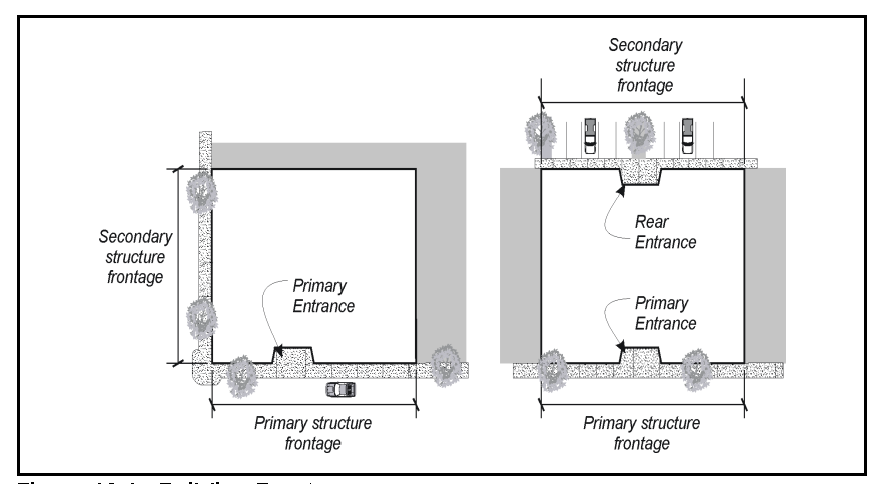
Figure 10-1 - Building Frontages
"Building Height." See Section 17.30.050 (height limits and exceptions).
"Building Official." Director of the city's building department who is responsible for enforcing federal, state, and local codes regarding grading, remodeling, and new construction.
"Business Support Service." An establishment within a building that provides services to other businesses. Examples of these services include:
Blueprinting.
Computer-related services (rental, repair) (see also "maintenance service - client site services").
Copying and quick printing services.
Film processing and photofinishing (retail).
Mailing and mailbox services.
C.
Definitions C.
"Cabinet Shop." See "furniture and fixtures manufacturing, cabinet shops."
"California Environmental Quality Act (CEQA)." State law (California Public Resources Code Sections 21000 et seq.) requiring public agencies to document and consider the environmental effects of a proposed action, prior to allowing the action to occur.
"California Public Utilities Commission (CPUC)." The governmental agency which regulates the terms and conditions of public utilities in the state.
"Canopy." Canopy is a permanent roofed structure supported in part by a wall of the building and by posts or stanchions.
"Caretaker Quarters." A permanent residence that is secondary or accessory to the primary use of the property, and used for housing a caretaker on the site of a nonresidential use where needed for security purposes or to provide twenty-four-hour care or monitoring of people, plants, animals, equipment, or other conditions on the site.
"Carriage House." See "Accessory Dwelling Unit or carriage house."
"Catering Service." A business that prepares food for consumption on the premises of a client.
"Change of Use." The replacement of an existing use on a lot or parcel, or any portion thereof, by a new use, or a change in the nature of an existing use; but does not include a change of ownership, tenancy, or management associated with a use for which the previous nature of the use will remain substantially unchanged.
"Child Day Care Center." See "day care."
"City." The City of Grass Valley, State of California, referred to in this development code as the "city."
"City Council." The Grass Valley City Council, referred to in this development code as the "council."
"City Engineer." Director of the city's engineering department who is responsible for water service distribution within the city's water service area.
"City Manager." The City of Grass Valley City Manager, or his or her designee.
"Commercial Recreation Facility—Indoor." Establishments providing indoor amusement and entertainment services for a fee or admission charge, including:
Bowling alleys.
Coin-operated amusement arcades.
Dance halls, clubs and ballrooms.
Electronic game arcades (video games, pinball, etc.)
Ice skating and roller skating.
Pool and billiard rooms as primary uses.
This use does not include adult oriented businesses, which are separately defined. Four or more electronic games or coin-operated amusements in any establishment, or a premises where fifty percent or more of the floor area is occupied by amusement devices, are considered an electronic game arcade as described above; three or fewer machines are not considered a land use separate from the primary use of the site.
"Commercial Recreation Facility—Outdoor." A facility for various outdoor recreational activities, where a fee is charged for use. Examples include:
Amusement and theme parks.
Go-cart tracks.
Golf driving ranges.
Miniature golf courses.
Skating parks.
Water slides.
May also include commercial facilities customarily associated with the above outdoor commercial recreational uses, including bars and restaurants, video game arcades, etc.
"Commercial Space." Any street-level portion of a structure within the town core zone that is vacant or occupied for nonresidential purposes including, without limitation, each separately demised space in a building accessible from a public right-of-way or public place.
"Communications Facility." See "telecommunications facilities."
"Community Center." A multi-purpose meeting and recreational facility typically consisting of one or more meeting or multi-purpose rooms, kitchen and/or outdoor barbecue facilities, that are available for use by various groups for such activities as meetings, parties, receptions, dances, etc.
"Community Garden." A site used for growing plants for food, fiber, herbs, flowers, and others, which is shared and maintained by community residents.
"Concrete, Gypsum, and Plaster Product Manufacturing." An establishment that produces bulk concrete, concrete building block, brick, and/or other types of precast and prefabricated concrete products. Also includes ready-mix concrete batch plants, lime manufacturing, and the manufacture of gypsum products, including plasterboard.
"Condominium." As defined by Civil Code Section 1351(f), a development where undivided interest in common in a portion of real property is coupled with a separate interest in space called a unit, the boundaries of which are described on a recorded final map or parcel map.
"Conference/Convention Facility." One or more structures accommodating multiple assembly, meeting, and/or exhibit rooms, and related support facilities (e.g., kitchens, offices, etc.).
"Construction, Farm, and Heavy Equipment Sales and Rental." Retail establishments selling or renting construction, farm, or other heavy equipment. Examples include cranes, earth moving equipment, tractors, combines, heavy trucks, etc.
"Construction Permit." A permit issued by the city that authorizes construction activities, including building permits, grading permits, etc.
"Contractor Storage Yard." See "Storage—Contractor storage yard."
"Cottage Food Operation." An enterprise that has more than the amount in gross annual sales that is specified in this subdivision, is operated by a cottage food operator, and has not more than one full-time equivalent cottage food employee, not including a family member or household member of the cottage food operator, within the registered or permitted area of a private home where the cottage food operator resides and where cottage food products are prepared or packaged for direct or indirect sale to consumers pursuant to this part. Commencing in 2015, and each subsequent year thereafter, the enterprise shall not have more than fifty thousand dollars in gross annual sales in the calendar year. A cottage food operation includes both of the following:
1.
A "Class A" cottage food operation, which is a cottage food operation that may engage only in direct sales of cottage food products from the cottage food operation or other direct sales revenues described in paragraph (4) of subdivision (b) of H&S Code 110460.
Direct sales means a transaction between the CFO operator and a consumer where the consumer purchases the cottage food product directly from the CFO. Direct sales include, but are not limited to, transactions at holiday bazaars or other temporary events, such as bake sales or food swaps, transactions at permitted farm stands and certified farmers' markets, through community-supported agriculture subscriptions and transactions occurring in person in the cottage food operation.
2.
A "Class B" cottage food operation, which is a cottage food operation that may engage in both direct sales and indirect sales of cottage food products from the cottage food operation, from direct sales revenues described in paragraph (4) of subdivision (b), from offsite events, or from a third-party retail food facility described in paragraph (5) of subdivision (b) of H&S Code 110460.
Indirect sales means an interaction between a CFO, a third-party retailer, and a consumer, where the consumer purchases cottage food products made by the CFO from a third party retailer that holds a valid permit issued by the local environmental health department to their jurisdiction. Indirect sales include, but are not limited to, sales made to retail shops or to retail food facilities where food may be immediately consumed on the premises.
"Council." See "city council."
"County." The County of Nevada, State of California.
"Court." See "sport court."
"Crop Production, Horticulture, Orchard, Vineyard." Commercial agricultural production field and orchard uses, including the production of the following, primarily in the soil on the site and not in containers, other than for initial propagation prior to planting in the soil on the site:
Field crops.
Flowers and seeds.
Fruits.
Grains.
Melons.
Ornamental crops.
Tree nuts.
Trees and sod.
Vegetables.
Wine and table grapes.
Also includes associated crop preparation services and harvesting activities, such as mechanical soil preparation, irrigation system construction, spraying, crop processing and retail sales in the field, not including sales sheds, which are instead defined under "produce stand." does not include greenhouses which are instead defined under "plant nursery," and "residential accessory use or structure," or containerized crop production, which is instead defined under "plant nursery." does not include noncommercial home gardening, which is allowed as an accessory use in all zoning districts without city approval.
D.
Definitions D.
"Day Care, Adult." A state-licensed facility that provides non-medical care and supervision for adult clients for periods of less than twenty-four hours for any client.
"Day Care, Child." Facilities that provide non-medical care and supervision of minor children for periods of less than twenty-four hours. These facilities include the following, all of which are required to be licensed by the California State Department of Social Services.
1.
"Day Care Center." Commercial or non-profit child day care facilities designed and approved to accommodate fifteen or more children. Includes infant centers, preschools, sick-child centers, and school-age day care facilities. These may be operated in conjunction with a school or church facility, or as an independent land use.
2.
"Family Day Care Home." As defined by Health and Safety Code Section 1596.78, a home that regularly provides care, protection, and supervision for fourteen or fewer children, in the provider's own home, for periods of less than twenty-four hours per day, while the parents or guardians are away, and is either a large family day care home or a small family day care home.
3.
"Large Family Day Care Home." As defined by Health and Safety Code Section 1596.78, a day care facility in a single dwelling where an occupant of the residence provides family day care for seven to fourteen children, inclusive, including children under the age of ten years who reside in the home.
4.
"Small Family Day Care Home." As defined by Health and Safety Code Section 1596.78, a day care facility in a single residence where an occupant of the residence provides family day care for eight or fewer children, including children under the age of ten years who reside in the home.
"Deck." A platform attached to a house to provide outdoor living area that may be roofed, but is without walls on at least two sides, and which includes railings where required by the building code.
"Density." The number of housing units per gross acre, unless otherwise stated, for residential uses. see also "lot area."
"Density Bonus." As defined by Government Code Section 65915 et seq.
"Department." The City of Grass Valley Community Development Department, referred to in this development code as the "department."
"Development." On land, in or under water, the placement or erection of any solid material or structure; discharge or disposal of any dredged material or of any gaseous, liquid, solid, or thermal waste; grading, removing, dredging, mining, or extraction of any materials; change in the density or intensity of use of land, including subdivision in compliance with the Map Act; change in the intensity of use of water, or of access thereto; construction, reconstruction, demolition, or alteration of the size of any structure; and the removal or harvesting of major vegetation other than for agricultural purposes.
"Development Agreement." A contract between the city and an applicant for a development project, in compliance with the Municipal Code, and Government Code Sections 65864 et seq.
"Development Code." The City of Grass Valley Development Code, Title 17 of the Grass Valley Municipal Code, referred to herein as "this development code."
"Director." The City of Grass Valley Community Development Director, or designee of the director.
"Discretionary Permit." A city land use review and entitlement process where the review authority exercises discretion in deciding to approve or disapprove the permit. Includes minor use permits, use permits, minor variances, variances, development review approval, and subdivision maps.
"Drive-Through Retail or Service." A retail or service business (examples include an automated teller machine (ATM), bank, pharmacy dispensary, or restaurant) where services may be obtained by motorists without leaving their vehicles.
"Duplex." See "multi-family housing."
"Dwelling," "Dwelling Unit," or "Housing Unit." A room or group of internally connected rooms that have sleeping, cooking, eating, and sanitation facilities, but not more than one kitchen, which constitute an independent housekeeping unit, occupied by or intended for one household on a long-term basis.
E.
Definitions E.
"Easement." A grant of one or more of the property rights by the property owner to and/or for the use by the public, a corporation or another person or entity.
"Emergency Shelter." A facility for the temporary shelter and feeding of indigents, homeless or disaster victims, operated by a public or non-profit agency.
"Environmental Impact Report (EIR)." An informational document used to assess the physical characteristics of an area and to determine what effects will result if the area is altered by a proposed action, prepared in compliance with the California Environmental Quality Act (CEQA).
"Equestrian Facility." A commercial facility for horses, donkeys, and/or mules, examples of which include horse ranches, boarding stables, riding schools and academies, horse exhibition facilities (for shows or other competitive events), and barns, stables, corrals and paddocks accessory and incidental to these uses. Does not include the simple pasturing of horses, donkeys, and/or mules.
"Equipment Rental." A service establishment that may offer a wide variety of household and business equipment, furniture, and materials for rental. Does not include construction equipment rental, which is separately defined.
F.
Definitions F.
"Farm Supply and Feed Store." A retail business selling supplies for use in soil preparation and maintenance, the planting and harvesting of crops, the keeping and raising of farm animals, and other operations and processes pertaining to farming and ranching. Includes the sale of small animals such as chicks and/or other animals authorized by use permit approval. Does not include the sale, rental, or repair of farm machinery and equipment, which is instead included in the definition of "construction, farm, and heavy equipment sales and rental."
"Farmers' Market." The temporary use of a site for the outdoor sales of food and farm produce items, in compliance with California Food and Agriculture Code Sections 1392 et seq.
"Feasible." Capable of being accomplished in a successful manner within a reasonable period of time, taking into account economic, environmental, social, and technological factors.
"Fence." A constructed, un-roofed barrier of wood, metal, masonry, or other material as allowed by this development code, that is intended to enclose, separate, define, secure, protect, and/or screen one or more areas of a site. Includes masonry walls.
1.
"Open Wire Fence." A fence through which fenced areas remain visible because of the wire mesh used for the fence. Includes chain link fencing, deer fencing, etc.
2.
"Safety Fence." A fence constructed to prevent access to a hazard or hazardous area.
3.
"Razor or Concertina Wire." Sharp fencing materials that are designed to lacerate animals or unauthorized persons attempting to climb or cross the fence through other than a gate.
"Fitness/Health Facility." A fitness center, gymnasium, health and athletic club, which may include any of the following: sauna, spa or hot tub facilities; indoor tennis, handball, racquetball, archery and shooting ranges and other indoor sports activities. Does not include adult entertainment businesses.
"Flower Stand." See "news or flower stand."
"Freight Terminal." A transportation facility furnishing services incidental to air, motor freight, and rail transportation. Examples include:
Freight forwarding services.
Freight terminal facilities.
Joint terminal and service facilities.
Overnight mail processing facilities.
Packing, crating, inspection and weighing services.
Postal service bulk mailing distribution centers.
Transportation arrangement services.
Trucking facilities, including transfer and storage.
"Frontage Type." See Section 17.21.090 (frontage type standards).
"Fuel Dealer." A retail trade establishment that sells fuel oil, butane, propane and liquefied petroleum gas (LPG), bottled or in bulk, to consumers.
"Furniture and Fixtures Manufacturing, Cabinet Shop." A business that manufactures wood and metal household furniture and appliances; bedsprings and mattresses; all types of office furniture, and partitions, shelving, lockers and store furniture; and miscellaneous drapery hardware, window blinds and shades. Includes furniture re-upholstering businesses, wood and cabinet shops, but not sawmills or planing mills, which are instead included under "Manufacturing—Heavy.
"Furniture, Furnishings and Appliance Store." A store that primarily sells the following products and related services, that may also provide incidental repair services:
Computers and computer equipment.
Draperies.
Floor coverings.
Furniture.
Glass and chinaware.
Home appliances.
Home furnishings.
Home sound systems.
Interior decorating materials and services.
Large musical instruments.
Lawn furniture.
Movable spas and hot tubs.
Office furniture.
Other household electrical and gas appliances.
Outdoor furniture.
Refrigerators.
Stoves.
Televisions.
G.
Definitions G.
"Garage," or "Carport." Parking space and shelter for automobiles or other vehicles, where the size of the parking space complies with the provisions of Chapter 17.36 (parking and loading).
1.
A garage is a completely enclosed attached or detached accessory structure, with an operational door.
2.
A carport is an attached or detached accessory structure enclosed on no more than two sides.
"General Plan." The City of Grass Valley General Plan, including all its elements and all amendments, as adopted by the city council in compliance with Government Code Section 65300 et seq., and referred to in this development code as the "general plan."
"General Retail." Stores and shops selling many lines of merchandise. Examples of these stores and lines of merchandise include:
Art galleries, retail.
Art supplies, including framing services.
Bicycles.
Books, magazines, and newspapers.
Cameras and photographic supplies.
Clothing, shoes, and accessories.
Department stores.
Drug stores and pharmacies.
Dry goods.
Fabrics and sewing supplies.
Florists and houseplant stores (indoor sales only; outdoor sales are "building and landscape materials sales").
Hobby materials.
Jewelry.
Luggage and leather goods.
Musical instruments (small), parts and accessories (large instruments are under "furniture, furnishings, and appliance store").
Orthopedic supplies.
Pet stores.
Small wares.
Specialty shops.
Sporting goods and equipment.
Stationery.
Toys and games.
Variety stores.
Videos, DVDs, records, CDs, including rental stores.
Does not include adult oriented businesses, antique or collectible stores, furniture and appliance stores, or secondhand stores, which are separately defined.
"Grade." The ground surface immediately adjacent to the exterior base of a structure, typically used as the basis for measuring the height of the structure.
"Groceries, Specialty Foods." A retail business where the majority of the floor area open to the public is occupied by food products packaged for preparation and consumption away from the store. Includes retail bakeries, where any on-site baking is only for on-site sales. (See also "catering service".)
"Gross Lot Area." See "lot area."
"Ground Floor." The primary floor of a building to which pedestrian access is provided from the fronting street, either at the sidewalk level, or not more than six feet above or below the sidewalk.
"Guest House." A detached structure accessory to a single dwelling, accommodating living/sleeping quarters, but without kitchen or cooking facilities.
H.
Definitions H.
"Habitable Space." Space within a dwelling unit for living, sleeping, eating, cooking, bathing.
"Half-Story." A conditioned space that rests primarily underneath the slope of the roof, and usually has dormer windows. The finished floor must be a maximum of two feet below where the eave meets the wall. See Figure 10-2.
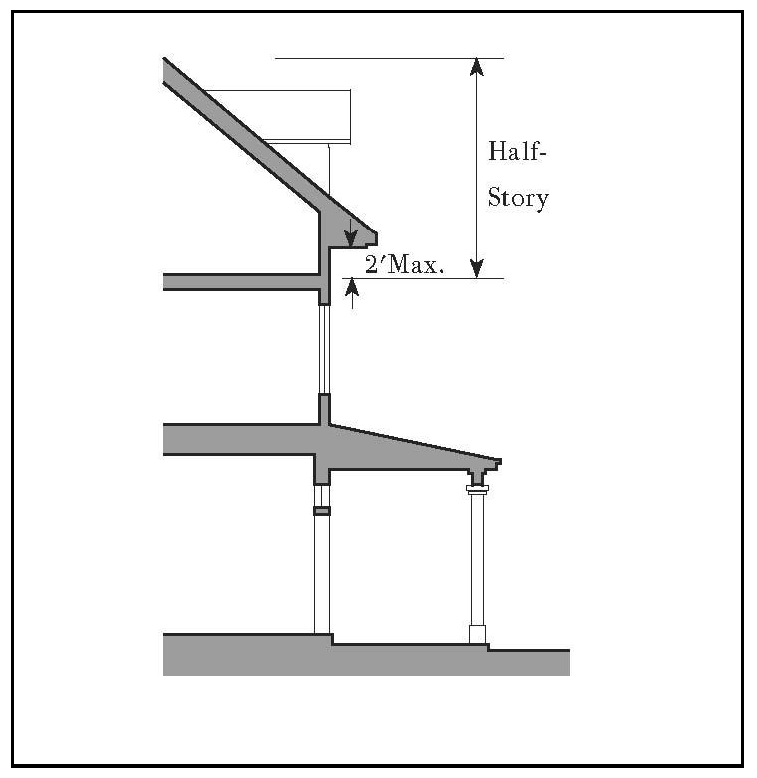
Figure 10-2 - Half-Story
"Height." See Section 17.30.050 (height limits and exceptions).
"Home Occupation." The conduct of a business within a dwelling unit or residential site, employing only the occupants of the dwelling, with the business activity being subordinate to the residential use of the property.
"Hotel" or "Motel." See "lodging."
"Household Pets." The keeping/raising of birds, cats, dogs, or other common household pets, as determined by the director, incidental to a residential use.
I.
Definitions I.
"Intensification of Use." A change in the use of a structure or site that generates more traffic or other level of activity on the site, for example: Where the new use is required by this development code to have more off-street parking spaces than the former use; or a change in the operating characteristics of a use (for example, hours of operation).
"Interior Property Line." See "lot features."
J.
Definitions J.
"Junior Accessory Dwelling Unit." A unit that is no more than five hundred square feet in size and contained entirely within a single-family residence. A Junior accessory dwelling unit may include separate sanitation facilities or may share sanitation facilities with the existing structure.
K.
Definitions K.
"Kennel, Animal Boarding." A commercial facility for the grooming, keeping, boarding or maintaining of four or more dogs (four months of age or older), or four or more cats except for dogs or cats for sale in pet shops, or in animal hospitals. Includes pet day care. See also "veterinary clinic, animal hospital."
"Key Lot." See "Lot, or parcel—Key lot."
"Kitchen." A room or space within a building used or intended to be used for the cooking or preparation of food, which includes any of the following: Stove, oven, range top, dishwasher, kitchen sink.
L.
Definitions L.
"Laboratory Medical, Analytical." A facility for testing, analysis, and/or research. Examples of this use include medical labs, soils and materials testing labs, and forensic labs.
"Land Use." The purpose for which land or a structure is designed, arranged, intended, occupied, or maintained.
"Landing." The level portion of a stairway.
"Landscaping." The following terms are defined for the purposes of Chapter 17.34 (landscaping standards):
1.
"Anti-drain Valve or Check Valve." A valve located under a sprinkler head to hold water in the system so it minimizes drainage from the lower elevation sprinkler heads.
2.
"Automatic Controller." A mechanical or solid state timer, capable of operating valve stations to set the days and length of time of a water application.
3.
"Backflow Prevention Device." A safety device used to prevent pollution or contamination of the water supply due to the reverse flow of water from the irrigation system.
4.
"Dripline." An area delineated by the projection of the periphery of the crown area of a tree down to the ground surface (e.g., a line drawn on the ground around a tree directly under its outermost branch tips).
5.
"Emitter." A drip irrigation fitting that delivers water slowly from the system to the soil.
6.
"Establishment period." The period at which the plant has established itself and can live without supplemental watering, usually within a period of one to two years of planting.
7.
"Irrigated Landscaping." An irrigated surface layer of soil containing landscaping composed of ground cover (e.g., shrubs, trees, and other plants).
8.
"Moisture sensor." A device that connects to the automatic controller, to signal irrigation only when the sensor detects low moisture in the plant root zone.
9.
"Mulch." Organic material (e.g., bark, leaves, or straw) that is applied to the soil surface to reduce evaporation and erosion.
10.
"Runoff." Water that is not absorbed by the soil or landscape to which it is applied and flows from the area and across property lines or into the public right-of-way.
11.
"Station". A planted area served by one valve or by a set of valves that operate simultaneously.
12.
"Turf." A surface layer of soil containing grass with its roots.
"Large Family Day Care Home." See "day care."
"Large-Scale Retail." See "warehouse retail."
"Laundry, Dry Cleaning Plant." A service establishment engaged primarily in high volume laundry and garment services, including: Carpet and upholstery cleaners; diaper services; dry cleaning and garment pressing; commercial laundries; linen supply. These facilities may include accessory customer pick-up facilities. These facilities do not include coin-operated laundries or laundry/dry cleaning pick-up stores without cleaning/processing equipment, which are instead under "personal services."
"Library, Museum, Art Gallery." Public or quasi-public facilities, examples of which include: Aquariums, arboretums, art galleries and exhibitions, botanical gardens, historic sites and exhibits, libraries, museums, planetariums, and zoos. May also include accessory retail uses such as a gift/book shop, restaurant, etc.
"Limited Term Permit." See Section 17.72.040 (limited term permit).
"Live/Work Unit." An integrated housing unit and working space, occupied and utilized by a single household in a structure, either single-family or multi-family, that has been designed or structurally modified to accommodate joint residential occupancy and work activity, and which includes:
1.
Complete kitchen space and sanitary facilities in compliance with the building code; and
2.
Working space reserved for and regularly used by one or more occupants of the unit.
"Lodging."
1.
"Bed and Breakfast Inn (B&B)." A residential structure with one or more bedrooms rented for overnight lodging, where meals may be provided subject to applicable Environmental Health Department regulations.
2.
"Hotel" or "Motel." A facility with guest rooms or suites, with or without kitchen facilities, rented to the general public for transient lodging. Hotels typically include a variety of services in addition to lodging; for example, restaurants, meeting facilities, personal services, etc. Also includes accessory guest facilities such as swimming pools, tennis courts, indoor athletic facilities, accessory retail uses, etc.
3.
"Hosted Short-Term Rental Units." The rental of no more than two bedrooms in a single-family dwelling for lodging purposes of less than thirty consecutive days that is occupied by the owner or full-time resident.
4.
"Manager." The owner or agent that manages the short-term rental.
5.
"Owner." The record owner of the single-family dwelling being used as the short-term rental.
6.
"Vacation Rental Home." The rental of a single-family dwelling for lodging of less than thirty consecutive days that may or may not be occupied by the owner or full-time resident.
"Lot Area." See Figure 10-4 (lot features).
1.
"Gross Area." Gross lot area is the total area included within the lot lines of a lot, exclusive of adjacent dedicated street rights-of-way.
2.
"Net Area." Net lot area is the gross lot area, not including of easements that are not for the exclusive use of the lot on which the easement is located.
"Lot", or "Parcel." A recorded lot or parcel of real property under single ownership, lawfully created as required by applicable Subdivision Map Act and city ordinance requirements, including this development code. Types of lots include the following. See Figure 10-3 (lot types).
1.
"Corner Lot." A lot located at the intersection of two or more streets, where they intersect at an interior angle of not more than one hundred seventy-five degrees. If the intersection angle is more than one hundred seventy-five degrees, the lot is considered an interior lot.
2.
"Double-Frontage Lot." A lot with frontage on two generally parallel streets (see Section 17.88.030.F.5.b regarding the limited circumstances where double-frontage lots are allowed.).
3.
"Flag Lot." A lot having access from the building site to a public street by means of private right-of-way strip that is owned in fee.
4.
"Interior Lot." A lot abutting only one street.
5.
"Key Lot." An interior lot, the front of which adjoins the side property line of a corner lot.
6.
"Reverse Corner Lot." A corner lot with its longest definition oriented perpendicular to the other lots on the longest block face, the rear of which abuts a key lot.
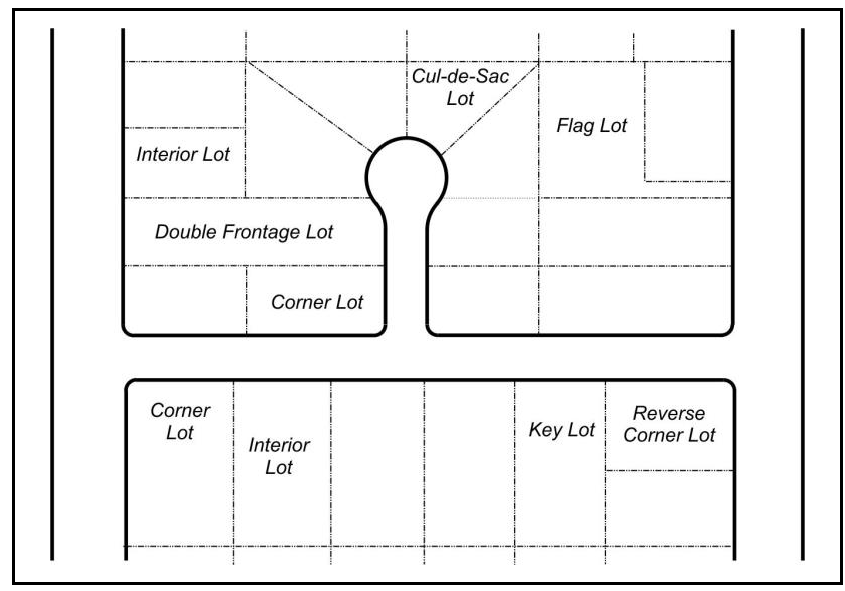
Figure 10-3 - Lot Types
"Lot Coverage." See "site coverage."
"Lot Depth." The average linear distance between the front and the rear lot lines or the intersection of the two side lot lines if there is no rear line. See Figure 10-4 (lot features). The director shall determine lot depth for parcels of irregular configuration.
"Lot Frontage." The boundary of a lot adjacent to a public street right-of-way. See Figure 10-4.
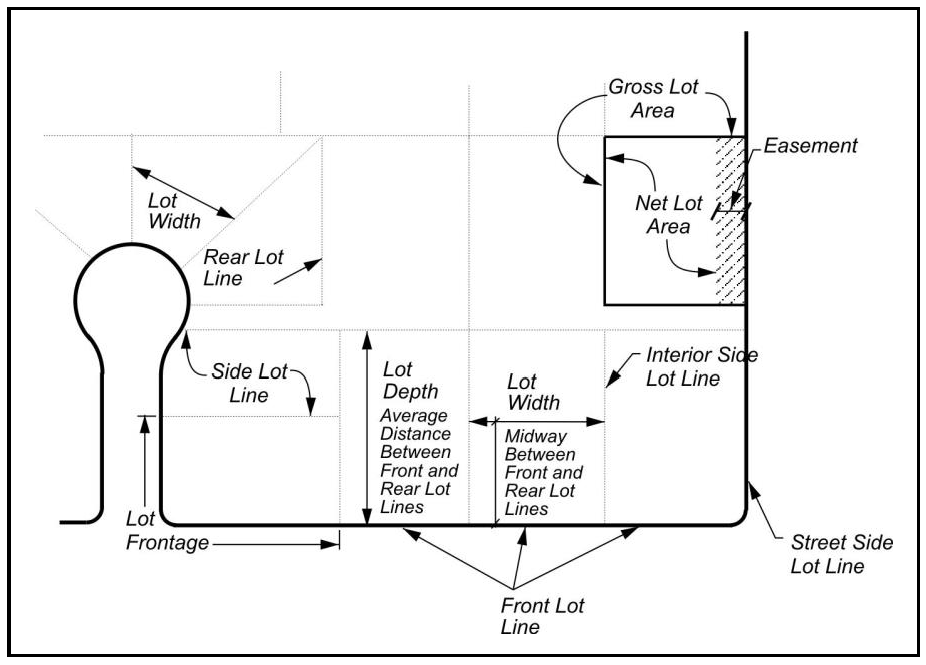
Figure 10-4 - Lot Features
"Lot Line" or "Property Line." Any recorded boundary of a lot. Types of lot lines are as follows (see Figure 10-4 (lot features)):
1.
"Front Lot Line." On an interior lot, the property line separating the parcel from the street.
a.
The front lot line on a corner lot is the line with the shortest frontage. If the street-fronting lot lines of a corner lot are equal in length, the front lot line shall be determined by the director.
b.
On a double-frontage lot, both lot lines are front lot lines and the lot is considered to have no rear lot line (see Section 17.78.030.F.5.b regarding the limited circumstances where double-frontage lots are allowed.).
2.
"Interior Lot Line." Any lot line not abutting a street.
3.
"Rear Lot Line." A property line that does not intersect the front lot line, which is most distant from and most closely parallel to the front lot line.
4.
"Side Lot Line." Any lot line that is not a front or rear lot line.
"Lot Width." The horizontal distance between the side lot lines, measured at right angles to the lot depth at a point midway between the front and rear lot lines. See Figure 10-4 (lot features). The director shall determine lot width for parcels of irregular shape.
"Lumber and Wood Product Manufacturing." Manufacturing, processing, and sales involving the milling of forest products to produce rough and finished lumber and other wood materials for use in other manufacturing, craft, or construction processes. Includes the following processes and products:
Containers, pallets and skids.
Manufactured and modular homes.
Matches (wood).
Milling operations.
Trusses and structural beams.
Turning and shaping of wood products.
Wholesaling of basic wood products.
Wood product assembly.
Does not include craft-type shops ("Manufacturing - Light - Handcraft industries and small-scale manufacturing"); other wood and cabinet shops ("furniture and fixture manufacturing, cabinet shops"); or the entirely indoor retail sale of building materials, construction tools and equipment ("building and landscape materials sales").
M.
Definitions M.
"Maintenance." See "repair and maintenance."
"Maintenance Service Client Site Services." Base facilities for various businesses that provide services on the premises of their clients. Includes gardening, janitorial, pest control, water and smoke damage recovery, and similar services; and appliance, computer, electronics, elevator, equipment, HVAC, instrument, plumbing, security systems, and other maintenance and repair services not operating from a retail establishment that sells the products being maintained or repaired. When these services operate from a retail establishment that sells the products being maintained or repaired, they are instead considered part of the retail use.
"Manufacturing/Processing Heavy." A facility accommodating manufacturing processes that involve and/or produce basic metals, building materials, chemicals, fabricated metals, paper products, machinery, textiles, and/or transportation equipment, where the intensity and/or scale of operations may cause significant impacts on surrounding land uses or the community. Examples of heavy manufacturing uses include the following:
1.
"Chemical Product Manufacturing." An establishment that produces or uses basic chemicals, and other establishments creating products predominantly by chemical processes. Examples of these products include: Basic chemicals, including acids, alkalies, salts, and organic chemicals; chemical products to be used in further manufacture, including synthetic fibers, plastic materials, dry colors, and pigments; and finished chemical products to be used for ultimate consumption, including drugs/pharmaceuticals, cosmetics, and soaps; or to be used as materials or supplies in other industries including paints, fertilizers, and explosives. Also includes sales and transportation establishments handling the chemicals described above, except as part of retail trade.
2.
"Glass Product Manufacturing." An establishment that manufactures glass and/or glass products by melting silica sand or cullet, including the production of flat glass and other glass products that are pressed, blown, or shaped from glass produced in the same establishment. Artisan and craftsman type operations of a larger scale than home occupations are instead included under ("Manufacturing—Light—Handcraft industries and small-scale manufacturing").
3.
"Paving and Roofing Materials Manufacturing." The manufacture of various common paving and petroleum-based roofing materials, including bulk asphalt, paving blocks made of asphalt, creosote wood, and various compositions of asphalt and tar. Does not include the manufacture of wood roofing materials (shingles, shakes, etc.) ("lumber and wood product manufacturing").
4.
"Petroleum Refining and Related Industries." Industrial plants for purifying petroleum, and the compounding of lubricating oils and greases from purchased materials. Also includes oil or gas processing facilities, liquified natural gas (LNG) facilities, the manufacture of petroleum coke and fuel briquettes, tank farms, and terminal facilities for pipelines. Does not include petroleum pipeline surge tanks and pump stations ("public utility facilities"), or petroleum product distributors ("petroleum product storage and distribution").
5.
"Plastics, other Synthetics, and Rubber Product Manufacturing." The manufacture of rubber products including: Tires, rubber footwear, mechanical rubber goods, heels and soles, flooring, and other rubber products from natural, synthetic, or reclaimed rubber. Also includes establishments engaged primarily in manufacturing tires; products from recycled or reclaimed plastics or styrofoam; molding primary plastics for other manufacturers, manufacturing miscellaneous finished plastics products, fiberglass manufacturing, and fiberglass application services. Does not include establishments engaged primarily in recapping and retreading automobile tires ("Vehicle services—Major repair/body work").
6.
"Primary Metal Industries." An establishment engaged in: The smelting and refining of ferrous and nonferrous metals from ore, pig, or scrap; the rolling, drawing, and alloying of metals; the manufacture of castings, forgings, stampings, extrusions, and other basic metal products; and the manufacturing of nails, spikes, and insulated wire and cable. Also includes merchant blast furnaces and by-product or beehive coke ovens.
7.
"Pulp and Pulp Product Manufacturing." An establishment that manufactures pulp, paper, or paperboard. Includes pulp, paper, and paperboard mills. Does not include establishments primarily engaged in converting paper or paperboard without manufacturing the paper or paperboard, including envelope manufacturing, converted paper products, paper coating and glazing, paper bags, assembly of paperboard boxes, wallpaper ("Manufacturing—Light" B Paper Product Manufacturing).
8.
"Textile and Leather Product Manufacturing." An establishment that converts basic fibers (natural or synthetic) into a product, including yarn or fabric, that can be further manufactured into usable items ("Manufacturing—Light—Clothing and fabric product manufacturing"), and industries that transform hides into leather by tanning or curing. Includes:
Coating, waterproofing, or otherwise treating fabric.
Dressed and dyed furs.
Dying and finishing fiber, yarn, fabric, and knit apparel.
Leather-tanned, curried, and finished.
Manufacture of knit apparel and other finished products from yarn.
Manufacture of felt goods, lace goods, non-woven fabrics and miscellaneous textiles.
Manufacturing of woven fabric, carpets, and rugs from yarn.
Preparation of fiber and subsequent manufacturing of yarn, threads, braids, twine cordage.
Scouring and combing plants.
Upholstery manufacturing.
Yarn and thread mills.
"Manufacturing/Processing Light." A facility accommodating manufacturing processes involving and/or producing: apparel; food and beverage products; electronic, optical, and instrumentation products; ice; jewelry; and musical instruments. Light manufacturing also includes other establishments engaged in the assembly, fabrication, and conversion of already processed raw materials into products, where the operational characteristics of the manufacturing processes and the materials used are unlikely to cause significant impacts on surrounding land uses or the community. Examples of light manufacturing uses include the following.
1.
"Artisan/Craft Product Manufacturing." An establishment that manufactures and/or assembles small products primarily by hand, including jewelry, pottery and other ceramics, as well as small glass and metal art and craft products, where any retail sales are incidental to the manufacturing activity.
2.
"Clothing and Fabric Product Manufacturing." An establishment that assembles clothing, draperies, and/or other products by cutting and sewing purchased textile fabrics, and related materials including leather, rubberized fabrics, plastics and furs. Does not include custom tailors and dressmakers not operating as a factory and not located on the site of a clothing store (see "personal services"). See also, "Manufacturing—Heavy—Textile and leather product manufacturing."
3.
"Electronics, Equipment, and Appliance Manufacturing." An establishment that manufactures equipment, apparatus, and/or supplies for the generation, storage, transmission, transformation and use of electrical energy, including:
Appliances including stoves/ovens, refrigerators, freezers, laundry equipment, fans, vacuum cleaners, sewing machines.
Aviation instruments.
Computers, computer components, peripherals.
Electronic components and accessories, semiconductors, integrated circuits, related devices.
Electrical welding apparatus.
Instruments for measurement, testing, analysis and control, associated sensors and accessories.
Lighting and wiring equipment such as lamps and fixtures, wiring devices, vehicle lighting.
Miscellaneous electrical machinery, equipment and supplies such as x-ray apparatus and tubes, electromedical and electrotherapeutic apparatus, electrical equipment for internal combustion engines.
Motors and generators.
Optical instruments and lenses.
Photographic equipment.
Radio and television receiving equipment.
Surgical, medical and dental instruments, equipment, and supplies.
Surveying and drafting instruments.
Switch gear and switchboards.
Storage media, blank and pre-recorded, including magnetic, magneto-optical, and optical products such as compact disks (CDs), computer diskettes and hard drives, digital versatile disks (DVDs), magnetic tape products, phonograph records, etc.
Telephone and telegraph apparatus.
Watches and clocks.
Does not include testing laboratories (soils, materials testing, etc.) (see "business support services"), or research and development facilities separate from manufacturing (see "research and development").
4.
"Handcraft Industries, Small-Scale Manufacturing." Establishments manufacturing and/or assembling small products primarily by hand, including jewelry, pottery and other ceramics, as well as small glass and metal art and craft products, and taxidermists. Also includes manufacturing establishments producing small products not classified in another major manufacturing group, including: Brooms and brushes; buttons, costume novelties; jewelry; musical instruments; pens, pencils, and other office and artists' materials; sporting and athletic goods; toys; etc.
5.
"Paper Product Manufacturing." An establishment that converts pre-manufactured paper or paperboard into boxes, envelopes, paper bags, wallpaper, etc., and/or that coats or glazes pre-manufactured paper. Does not include the manufacturing of pulp, paper, or paperboard (see "Manufacturing—Heavy—Pulp and pulp product manufacturing").
6.
"Photo/Film Processing Lab." A facility that provides high volume and/or custom processing services for photographic negative film, transparencies, and/or prints, where the processed products are delivered to off-site retail outlets for customer pick-up. Does not include small-scale photo processing machines accessory to other retail businesses.
"Manufacturing/Processing Medium Intensity." A facility accommodating manufacturing processes that involve and/or produce building materials, fabricated metal products, machinery, and/or transportation equipment, where the intensity and/or scale of operations is greater than those classified under "Manufacturing—Light," but where impacts on surrounding land uses or the community can typically be mitigated to acceptable levels. Examples of medium intensity manufacturing uses include the following"
1.
"Food and Beverage Product Manufacturing." Manufacturing establishments producing or processing foods and beverages for human consumption, and certain related products. Examples of these uses include:
Bottling plants.
Breweries.
Candy, sugar and confectionery products.
Manufacturing.
Catering services separate from stores or restaurants.
Coffee roasting.
Dairy products manufacturing.
Fats and oil product manufacturing (not animal rendering).
Fruit and vegetable canning, preserving, related processing.
Grain mill products and by-products.
Meat, poultry, and seafood canning, curing, byproduct processing.
Miscellaneous food item preparation from raw products.
Soft drink production.
Does not include: bakeries, which are separately defined; or beer brewing as part of a brew pub, bar or restaurant (see "bar/tavern," and "night club").
2.
"Machinery Manufacturing." An establishment that makes or processes raw materials into finished machines or parts for machines. Does not include the manufacture of electronics, equipment, or appliances ("electronics, equipment, and appliance manufacturing").
3.
"Motor Vehicles and Transportation Equipment." Manufacturers of equipment for transporting passengers and cargo by land, air and water, including motor vehicles, aircraft, spacecraft, ships, boats, railroad and other vehicles such as motorcycles, bicycles and snowmobiles. Includes manufacture of motor vehicle parts and accessories; trailers and campers for attachment to other vehicles; self-contained motor homes; and van conversions. Does not include mobile home and modular home assembly (listed under "lumber and wood products").
4.
"Stone and Cut Stone Product Manufacturing." An establishment that cuts, shapes, and/or finishes marble, granite, slate, and/or other stone for construction and miscellaneous uses. Does not include establishments engaged primarily in buying or selling partly finished monuments and tombstones ("handcraft industries, small-scale manufacturing").
5.
"Structural Clay and Pottery Product Manufacturing." An establishment that produces brick and structural clay products, including pipe, china plumbing fixtures, vitreous china articles, and/or fine earthenware and porcelain products. Does not include artist/craftsman uses (see "handcraft industries and small-scale manufacturing," "home occupations").
"Map Act." See "Subdivision Map Act."
"Marquee." Marquee is a permanent roofed structure attached to and supported by the building.
"Media Production." Facilities for motion picture, television, video, sound, computer, and other communications media production.
"Median Income." The annual, area median income applicable to the county, adjusted for family size in compliance with adjustment factors adopted by the United States Department of Housing and Urban Development (HUD). In the event that HUD no longer establishes median income levels at the time of conveyance of a unit, the city will determine by resolution, by any other recognized method of computing median income, the median income for purposes of this chapter. The determination by the city shall be final and non-appealable.
"Medical Services Clinic, Urgent Care." A facility other than a hospital where medical, mental health, surgical and other personal health services are provided on an outpatient basis. Examples of these uses include:
Medical offices with five or more licensed practitioners and/or medical specialties.
Out-patient care facilities.
Urgent care facilities.
Other allied health services.
These facilities may also include incidental medical laboratories. Counseling services by other than medical doctors or psychiatrists are included under "Offices—Professional/administrative."
"Medical Services Doctor Office." A facility other than a hospital where medical, dental, mental health, surgical, and/or other personal health care services are provided on an outpatient basis, and that accommodates no more than four licensed primary practitioners (for example, chiropractors, medical doctors, psychiatrists, etc., other than nursing staff) within an individual office suite. A facility with five or more licensed practitioners is instead classified under "Medical services—Clinic, urgent care." counseling services by other than medical doctors or psychiatrists are included under "Offices—Professional/administrative."
"Medical Services Extended Care." Residential facilities providing nursing and health-related care as a primary use with in-patient beds. Examples of these uses include: Board and care homes; convalescent and rest homes; extended care facilities; and skilled nursing facilities. Long-term personal care facilities that do not emphasize medical treatment are included under "residential care."
"Medical Services Hospital." Hospitals and similar facilities engaged primarily in providing diagnostic services, and extensive medical treatment, including surgical and other hospital services. These establishments have an organized medical staff, inpatient beds, and equipment and facilities to provide complete health care. May include on-site accessory clinics and laboratories, accessory retail uses (see the separate definition of "accessory retail uses"), and on-site ambulance dispatch facilities.
"Meeting Facility, Public or Private." A facility for public or private meetings, including community centers, religious assembly facilities (e.g., churches, mosques, synagogues, etc.), civic and private auditoriums, grange halls, union halls, meeting halls for clubs and other membership organizations, etc. Also includes functionally related internal facilities such as kitchens, multi-purpose rooms, and storage. Does not include conference and meeting rooms accessory and incidental to another primary use that are typically used only by on-site employees and clients, and occupy less floor area on the site than the offices they support (see "offices"). Does not include: sports or other commercial entertainment facilities (see "theater," and "sports and entertainment assembly"); or convention centers (see "conference/convention facility"). Related on-site facilities such as day care centers and schools are separately defined.
"Metal Products Fabrication, Machine or Welding Shop." An establishment engaged in the production and/or assembly of metal parts, including the production of metal cabinets and enclosures, cans and shipping containers, doors and gates, duct work, forgings and stampings, hardware and tools, plumbing fixtures and products, tanks, towers, and similar products. Examples of these uses include:
Blacksmith and welding shops.
Plating, stripping, and coating shops.
Sheet metal shops.
Machine shops and boiler shops.
"Minor Use Permit." See Section 17.72.060 (use permit and minor use permit).
"Minor Variance." See Section 17.72.070 (variance and minor variance).
"Mixed-Use Project." A project that combines both commercial and residential uses on the same site. See Section 17.44.130 (mixed-use projects).
"Mobile Home." A trailer, transportable in one or more sections, that is certified under the National Manufactured Housing Construction and Safety Standards Act of 1974, which is over eight feet in width and forty feet in length, with or without a permanent foundation and not including recreational vehicle, commercial coach or factory-built housing. A mobile home on a permanent foundation is included under the definition of "single dwellings."
"Mobile Home, Boat, or RV Sales." The retail sale of mobile homes, and/or various vehicles and watercraft for recreational uses. Includes the sales of boats, campers and camper shells, jet skis, motor homes, and travel trailers.
"Mobile Home Park." Any site that is planned and improved to accommodate two or more mobile homes used for residential purposes, or on which two or more mobile home lots are rented, leased, or held out for rent or lease, or were formerly held out for rent or lease and later converted to a subdivision, cooperative, condominium, or other form of resident ownership, to accommodate mobile homes used for residential purposes.
"Mortuary, Funeral Home." Funeral homes and parlors, where deceased are prepared for burial or cremation, and funeral services may be conducted. Does not include on-site cremation.
"Motel." See "lodging."
"Multi-Family Housing." A structure containing two or more dwelling units. Multi-family dwellings include: Duplexes, triplexes, fourplexes (buildings under one ownership with two, three or four dwelling units, respectively, in the same structure); apartments (five or more units under one ownership in a single building); townhouse development (three or more attached dwellings where no unit is located over another unit); rowhouses; and other building types containing multiple dwelling units (for example, condominiums, courtyard housing, stacked flats, etc.).
N.
Definitions N.
"Natural, or Existing Grade." The contour of the ground surface before grading.
"Negative Declaration." A Negative Declaration as defined by the California Environmental Quality Act (CEQA).
"Neighborhood Market." A neighborhood serving retail store of three thousand five hundred square feet or less in gross floor area, which carries a range of merchandise oriented to daily convenience shopping needs.
"Net Lot Area." See "lot area."
"News or Flower Stand." A structure for the retail sale of newspapers and magazines, or flowers and related products, that is either freestanding or between a building wall and a sidewalk, with a sales person operating the facility at all times when it is open for business.
"Night Club." A facility serving alcoholic beverages for on-site consumption, and providing entertainment, examples of which include live music and/or dancing, comedy, etc. Does not include "adult oriented business."
"Nonconforming Parcel." A parcel that was legally created prior to the adoption of this development code or amendment, but does not comply with the current area, width, depth, or other applicable requirements of this development code.
"Nonconforming Sign." A sign that lawfully existed prior to the effective date of this development code or amendment, but does not comply with the current sign regulations of this development code.
"Nonconforming Structure." A structure that was legally constructed prior to the adoption or amendment of this development code, but does not comply with the current setback, height limit, and/or other applicable requirements of this development code.
"Nonconforming Use." A use of land and/or a structure (either conforming or nonconforming) that was legally established and maintained prior to the adoption of this development code or amendment, but does not conform to the current development code requirements for allowable land uses within the applicable zoning district.
O.
Definitions O.
"Occupied." A commercial space is deemed to be "occupied" when a person is lawfully operating or doing business in that space for at least thirty days and which meets the criteria of Subsection 17.41.030(F) of this code.
"Off-Sale Liquor Establishment." Any establishment at which alcohol is sold, served, or given to patrons, to be consumed off-site, except food markets, supermarkets, drugstores, and other retail establishments in which the sale of alcohol for off-site use constitutes less than twenty percent of the total sales.
"Off-Site." An activity or accessory use that is related to a specific primary use, but is not located on the same site as the primary use.
"Office." This development code distinguishes between the following types of offices. These do not include medical offices (see "Medical service—Clinic, laboratory, urgent care," and "Medical service—Doctor office").
1.
"Accessory." An office facility for business administration, and/or on-site business and operations management, that is incidental and accessory to another business, sales, and/or service activity on the same site that is the primary use. These are permitted in all zones.
2.
"Business/Service." An establishment providing direct services to consumers. Examples of this use include employment agencies, insurance agent offices, real estate offices, travel agencies, utility company offices, elected official satellite offices, etc. This use does not include "bank, financial services," which are separately defined.
3.
"Government." An administrative, clerical, or public contact and/or service office of a local, state, or federal government agency or service facility. Includes post offices, but not bulk mailing distribution centers, which are under "truck or freight terminal."
4.
"Headquarters." An office for a single business with one hundred or more employees that serves as a corporate headquarters or a significant satellite facility.
5.
"Processing." An office-type facility characterized by high employee density, and occupied by businesses engaged in information processing, and other computer-dependent and/or telecommunications-based activities. Examples of these uses include:
Airline, lodging chain, and rental car company reservation centers.
Computer software and hardware design and development.
Consumer credit reporting.
Data processing services.
Health management organization (HMO) offices where no medical services are provided.
Insurance claim processing.
Mail order and electronic commerce transaction processing.
Telecommunications facility design and management.
Telemarketing.
6.
"Professional/Administrative." An office facility occupied by a business that provides professional services, or is engaged in the production of intellectual property. Examples of this use include:
Accounting, auditing and bookkeeping services.
Advertising agencies.
Attorneys.
Business associations, chambers of commerce.
Commercial art and design services.
Construction contractors (office facilities only).
Counseling services.
Court reporting services.
Detective agencies and similar services.
Design services including architecture, engineering, landscape architecture, urban planning.
Educational, scientific and research organizations.
Financial management and investment counseling.
Literary and talent agencies.
Management and public relations services.
Media postproduction services.
News services.
Photographers and photography studios.
Political campaign headquarters.
Psychologists.
Secretarial, stenographic, word processing, and temporary clerical employee services.
Security and commodity brokers.
Writers and artists offices.
7.
"Temporary." A mobile home, recreational vehicle or modular unit used as a temporary office facility. Temporary offices may include: Construction supervision offices on a construction site or off-site construction yard; a temporary on-site real estate office for a development project; or a temporary business office in advance of permanent facility construction.
8.
"Temporary Real Estate." The temporary use of a dwelling unit within a residential development project as a sales office for the units on the same site, which is converted to residential use at the conclusion of its office use.
"Office-Supporting Retail." A retail store that carries one or more types of merchandise that will typically be of frequent interest to and/or needed by the various businesses listed under the definition of "Office," and/or the employees of those businesses. Examples of these types of merchandise include:
Books.
Computer equipment.
Flowers.
Newspapers and magazines.
Office supplies, stationery.
Photographic supplies and cameras.
"On-Sale Liquor Establishment." Any establishment at which alcohol is sold, served, or given to patrons, to be consumed on-site.
"On-Site." An activity or accessory use that is related to a specific primary use, which is located on the same site as the primary use.
"On-site Production of Items Sold." Retail establishments, not defined as general retail, for the repurposing and reusing of products and sale of used goods primarily produced by hand, including, but not limited to: jewelry, pottery, and other ceramics, furniture, small glass, metal art, and craft products where no noise, dust, odor, or other nuisances occur and where the production activity is incidental to the retail sales and not defined as manufacturing/processing light.
"Open Fencing." A barrier constructed of materials including rails, pickets, wrought iron, or wire, with the materials spaced to that leaves at least fifty percent of the surface area open, allowing visibility through the fence.
"Ordinary Maintenance and Repair." Work for which a building permit is not required, the purpose and effect of which is to correct deterioration of, or damage to a structure, and to restore the structure to its condition before the deterioration or damage.
"Outdoor Display and Sales." The permanent outdoor display of merchandise incidental to an adjacent indoor retail use, and certain independent outdoor retail sales facilities. Includes news and flower stands, and outdoor dining areas. Does not include the sale of automobiles and recreational vehicles ("auto and vehicle sales and rental"), mobile homes ("mobile home, boat, or RV sales"), or building or landscape materials ("Building and landscape materials sales—Outdoor). Outdoor display and sales shall comply with the standards for outdoor display, sales, and storage in Section 17.44.170.
"Outdoor Storage." See "Storage - Outdoor."
P.
Definitions P.
"Parcel." See "lot, or parcel."
"Park." An outdoor recreation facility that may provide a variety of recreational opportunities including playground equipment, open space areas for passive recreation and picnicking, and sport and active recreation facilities.
"Parking Facility Public or Commercial." Parking lots or structures operated by the city, or a private entity providing parking for a fee. Does not include towing impound and storage facilities, which are instead defined under "Storage—Outdoor."
"Playground." An area occupied by children's play equipment, including climbing equipment, sandboxes, slides, swings, and/or similar equipment.
"Pedestrian Orientation." A physical structure or place with design qualities and elements that contribute to an active, inviting and pleasant place for pedestrians that typically includes most of the following elements:
1.
Building facades that are highly articulated at the street level, with interesting uses of material, color, and architectural detailing, located directly behind the sidewalk;
2.
Visibility into buildings at the street level;
3.
A continuous sidewalk, with a minimum of intrusions into pedestrian right-of-way;
4.
Continuity of building facades along the street with few interruptions in the progression of buildings and stores;
5.
Signs oriented and scaled to the pedestrian rather than the motorist.
Pedestrian orientation may also include: Design amenities related to the street level, such as awnings, paseos, and arcades; landscaping and street furniture.
"Pedestrian Oriented Use." A land use that is intended to encourage walk-in customers and that generally does not limit the number of customers by requiring appointments or otherwise excluding the general public. A pedestrian oriented use provides spontaneous draw from sidewalk and street due to visual interest, high customer turnover, and/or social interaction.
"Person." Any individual, firm, partnership, corporation, company, association, joint stock association; city, county, state, or district; and includes any trustee, receiver, assignee, or other similar representative thereof.
"Personal Services." Establishments providing non-medical services to individuals as a primary use. Examples of these uses include:
Barber and beauty shops.
Clothing rental.
Dry cleaning pick-up stores with limited equipment.
Home electronics and small appliance repair.
Laundromats (self-service laundries).
Locksmiths.
Massage (licensed, therapeutic, non-sexual).
Pet grooming with no boarding.
Shoe repair shops.
Tailors.
Tanning salons.
Tattoo and body piercing services (restrictions apply within T-Zone in historic district).
These uses may also include accessory retail sales of products related to the services provided.
"Personal Services Restricted." Personal services that may tend to have a blighting and/or deteriorating effect upon surrounding areas and which may need to be dispersed to minimize their adverse impacts. Examples of these uses include:
Check cashing services.
Fortune tellers.
Palm and card readers.
Pawnshops.
Psychics.
Spas and hot tubs for hourly rental.
"Planning Commission." The City of Grass Valley Planning Commission, appointed by the Grass Valley City Council in compliance with Government Code Section 65101, referred to throughout this development code as the "commission."
"Planning Permit." Authority granted by the city to use a specified site for a particular purpose. "Planning permit" includes use permits, minor use permits, limited term permits, variances, minor variances, design review, master development plans, and zoning clearances, as established by Article 7 (planning permit procedures) of this development code.
"Plant Nursery." A commercial agricultural establishment engaged in the production of ornamental plants and other nursery products, grown under cover either in containers or in the soil on the site, or outdoors in containers. The outdoor production of ornamental plants in the soil on the site is instead included under "crop production, horticulture, orchard, vineyard." Also includes establishments engaged in the sale of these products (e.g., wholesale and retail nurseries) and commercial-scale greenhouses (home greenhouses are included under "residential accessory use or structure"). The sale of house plants or other nursery products entirely within a building is also included under "general retail."
"Porch." A covered but otherwise open platform that provides a transition between the interior of a building and the public space of the street.
"Primary Street." A primary street is a street with the most prominent address within the framework of the town that a majority of buildings along the street front on to.
"Primary Structure." A structure that accommodates the primary use of the site.
"Primary Use." The main purpose for which a site is developed and occupied.
"Printing and Publishing." An establishment engaged in printing by letterpress, lithography, gravure, screen, offset, or electrostatic (xerographic) copying; and other establishments serving the printing trade such as bookbinding, typesetting, engraving, photoengraving and electrotyping. This use also includes establishments that publish newspapers, books and periodicals; establishments manufacturing business forms and binding devices. "Quick printing" services are included in the definition of "business support services."
"Private Residential Recreation Facility." A privately-owned, non-commercial outdoor recreation facility provided for residential project or neighborhood residents, including swimming pools, swim and tennis clubs, sport court facilities. Does not include golf courses and country clubs, which are separately defined.
"Produce Stand." A temporary business established and operated for a specific time, selling raw, unprocessed fruits, vegetables, nuts, and other produce in its raw or natural state, and that is accessory to an on-site or adjacent agricultural operation.
"Property Line." See "lot line or property line."
"Proposed Project." A proposed new structure, new addition to an existing structure, or area of other new site development; these do not include the alteration of any portion of an existing structure other than an addition.
"Public Safety Facility." A facility operated by a public agency including fire stations, other fire prevention and firefighting facilities, police and sheriff substations and headquarters, including interim incarceration facilities. May include ambulance dispatch facilities on the same site.
Q.
Definitions Q.
"Qualifying Resident." A senior citizen or other person eligible to reside in senior citizen housing.
R.
Definitions R.
"Recreational Vehicle (RV)." A motor home, travel trailer, truck camper, carryall, or camp trailer, house car, with or without motive power, originally designed for human habitation for recreational, emergency, or other occupancy, which:
1.
Contains less than three hundred twenty square feet of internal living room area, excluding built-in equipment, including wardrobe, closets, cabinets, kitchen units or fixtures, and bath or toilet rooms;
2.
Contains four hundred square feet or less of gross area measured at maximum horizontal projections;
3.
Is built on a single chassis; and
4.
Is either self-propelled, truck-mounted, or permanently towable on the highways without a towing permit.
Also includes boats, boat trailers, other types of trailers, golf carts, and busses.
"Recreational Vehicle Park." A site where one or more lots are used, or are intended to be used, by campers with recreational vehicles or tents. Recreational vehicle parks may include public restrooms, water, sewer, and electric hookups to each lot and are intended as a higher density, more intensively developed use than campgrounds. May include accessory retail uses where they are clearly incidental and intended to serve RV park patrons only.
"Recycling Facility." A center for the collection and/or processing of recyclable materials. A "certified" recycling or processing facility is certified by the California Department of Conservation as meeting the requirements of the California Beverage Container Recycling and Litter Reduction Act of 1986.
1.
"Small Collection Facility." A center where the public may donate, redeem or sell recyclable materials, which may include the following, where allowed by the applicable zoning district:
a.
Reverse vending machines; or
b.
Small collection facilities which occupy an area of three hundred fifty square feet or less and may include a mobile unit.
2.
"Large Collection Facility." Large collection facilities which occupy an area of more than three hundred fifty square feet and/or include permanent structures.
3.
"Mobile Recycling Unit." An automobile, truck, trailer, or van used for the collection of recyclable materials, carrying bins, boxes, or other containers.
4.
"Processing Facility." A structure or enclosed space used for the collection and processing of recyclable materials for shipment, or to an end-user's specifications, by such means as baling, briquetting, cleaning, compacting, crushing, flattening, grinding, mechanical sorting, re-manufacturing and shredding. Processing facilities include the following types, both of which are included under the definition of "scrap and dismantling yards," below:
a.
Light processing facility occupies an area of under forty-five thousand square feet of collection, processing and storage area, and averages two outbound truck shipments each day. Light processing facilities are limited to baling, briquetting, compacting, crushing, grinding, shredding and sorting of source separated recyclable materials sufficient to qualify as a certified processing facility. A light processing facility shall not shred, compact, or bale ferrous metals other than food and beverage containers; and
b.
A heavy processing facility is any processing facility other than a light processing facility.
5.
"Recycling or Recyclable Material." Reusable domestic containers and other materials which can be reconstituted, re-manufactured, or reused in an altered form, including glass, metals, paper and plastic. Recyclable material does not include refuse or hazardous materials.
6.
"Reverse Vending Machine." An automated mechanical device which accepts at least one or more types of empty beverage containers and issues a cash refund or a redeemable credit slip with a value not less than the container's redemption value, as determined by state law. These vending machines may accept aluminum cans, glass and plastic bottles, and other containers.
A bulk reverse vending machine is a reverse vending machine that is larger than fifty square feet, is designed to accept more than one container at a time, and issues a cash refund based on total weight instead of by container.
7.
"Scrap or Dismantling Yard." Outdoor establishments primarily engaged in assembling, breaking up, sorting, and the temporary storage and distribution of recyclable or reusable scrap and waste materials, including auto wreckers engaged in dismantling automobiles for scrap, and the incidental wholesale or retail sales of parts from those vehicles. Includes light and heavy processing facilities for recycling (see the definitions above). Does not include: Pawn shops, and other secondhand stores; the sale of operative used cars; or landfills or other waste disposal sites.
"Repair Service Equipment, Large Appliances, etc." A service facility where various types of electrical, electronic, and mechanical equipment, and home and business appliances are repaired and/or maintained away from the site of the equipment owner. Does not include vehicle repair or maintenance, which is included under "vehicle services", the repair of small home appliances and electronic equipment, which is included under "personal services", maintenance and repair activities that occur on the client's site, which are included under "Maintenance service—Client site services," or repair services provided on the site of a retail use that sells the products for which repair services are offered, which are incidental to the on-site sales.
"Repair and Maintenance." For the purposes of Section 17.20.040 (exemptions from planning permit requirements) and Chapter 17.90 (nonconforming uses, structures, and parcels), repair and maintenance includes work on a building or other structure involving: Cleaning; interior and exterior painting; re-roofing; the patching of cracks, holes, and other damage to interior and exterior walls; the replacement or repair of electrical or plumbing fixtures and lines; but does not include changes to any structural member.
"Research and Development (R&D)." A facility for scientific research, and the design, development and testing of electrical, electronic, magnetic, optical and computer and telecommunications components in advance of product manufacturing, and the assembly of related products from parts produced off-site, where the manufacturing activity is secondary to the research and development activities, and where no more than thirty percent of the total floor area is office. Includes pharmaceutical, chemical and biotechnology research and development. Does not include soils and other materials testing laboratories (see "laboratory"), or medical laboratories (see "Medical service—Clinic, laboratory, urgent care").
"Residential Accessory Use or Structure." Any use and/or structure that is customarily a part of, and clearly incidental and secondary to a residence, and does not change the character of the residential use. This definition includes the following detached accessory structures, and other similar structures normally associated with a residential use of property. See also "agricultural accessory structure."
Garage.
Gazebo.
Greenhouse (noncommercial).
Spa, hot tub.
Storage shed.
Studio.
Swimming pool.
Tennis and other on-site sport courts.
Workshop.
Also includes the indoor storage of automobiles, personal recreational vehicles and other personal property, accessory to a residential use. Does not include: Accessory dwelling units, which are separately defined; guest houses, which are included under the definition of accessory dwelling units; or home satellite dish and other receiving antennas for earth-based TV and radio broadcasts (see "telecommunications facilities").
"Residential Care." A single dwelling or multi-unit facility licensed or supervised by a federal, state, or local health/welfare agency that provides twenty-four-hour nonmedical care of unrelated persons who are handicapped and in need of personal services, supervision, or assistance essential for sustaining the activities of daily living or for the protection of the individual in a family-like environment. This use includes transitional housing or supportive housing. Does not include day care facilities, which are separately defined.
"Residential Care Facility for the Elderly (RCFE)." A housing arrangement chosen voluntarily by the residents, or the residents' guardians, conservators or other responsible persons; where seventy-five percent of the residents are at least sixty-two years of age, or, if younger, have needs compatible with other residents; and where varying levels of care and supervision are provided, as agreed to at the time of admission or as determined necessary at subsequent times of reappraisal (definition from California Code of Regulations Title 22, Division 6, Chapter 6, Residential Care Facilities for the Elderly). RCFE projects may include basic services and community space.
RCFE projects include assisted living facilities (board and care homes), congregate housing, independent living centers/senior apartments, and life care facilities as defined below.
1.
"Assisted Living Facility." A residential building or buildings that also provide housing, personal and health care, as permitted by the Department of Social Services, designed to respond to the daily, individual needs of the residents. Assisted living facilities may include kitchenettes (small refrigerator, sink and/or microwave oven) within individual rooms. Assisted living facilities are required to be licensed by the California Department of Social Services, and do not include skilled nursing services.
2.
"Independent Living Center/Senior Apartment." Independent living centers and senior apartments and are multi-family residential projects reserved for senior citizens, where common facilities may be provided (for example, recreation areas), but where each dwelling unit has individual living, sleeping, bathing, and kitchen facilities.
3.
"Life Care Facility." Sometimes called continuing care retirement communities, or senior continuum of care complex, these facilities provide a wide range of care and supervision, and also provide health care (skilled nursing) so that residents can receive medical care without leaving the facility. Residents can expect to remain, even if they become physically incapacitated later in life. Life care facilities require multiple licensing from the state department of social services, the state department of health services, and the state department of insurance.
"Responsible Party." As defined in Section 1.10.030 of this code, means any person, firm, association, club or organization (including informal clubs or organizations), corporation, partnership, trust(ee), or entity, and a parent or legal guardian of any person(s) under eighteen years of age, whose acts or omissions have caused or contributed to a violation of this code, and shall include any owner(s) or occupant(s) of the affected property.
"Restaurant, Café, Coffee Shop." A retail business selling ready-to-eat food and/or beverages for on- or off-premises consumption. These include eating establishments where customers are served from a walk-up ordering counter for either on- or off-premises consumption ("counter service"); and establishments where customers are served food at their tables for on-premises consumption ("table service"), that may also provide food for take-out.
"Restaurant Outdoor Dining." A restaurant, as defined above, where food is served for consumption by customers at seating located outdoors.
"Retail Complex." A primarily retail commercial site with three or more separate businesses sharing common pedestrian and parking areas.
"Review Authority." The individual or official city body (the community development director, planning commission, or city council) identified by this development code as having the responsibility and authority to review, and approve or disapprove the permit applications described in Article 7 (planning permit procedures).
"Rooming or Boarding House." A dwelling or part of a dwelling where lodging is furnished for compensation to five or more persons living independently from each other. Meals may also be included. Does not include fraternities, sororities, convents, or monasteries, which are separately defined under "organizational house."
"Rowhouse." Two or more attached two-story dwellings fronting a sidewalk that occupy the entire width of their parcels, without side setbacks.
S.
Definitions S.
"School." Includes the following facilities:
1.
"Elementary, Middle, Secondary." A public or private academic educational institution, including elementary (kindergarten through sixth grade), middle and junior high schools (seventh and eighth grades), secondary and high schools (ninth through twelfth grades). May also include any of these schools that also provide room and board.
2.
"Specialized Education/Training." A school that provides education and/or training, including vocational training, in limited subjects. Examples of these schools include:
Art school.
Ballet and other dance school.
Business, secretarial, and vocational school.
Computers and electronics school.
Drama school.
Driver education school.
Establishments providing courses by mail.
Language school.
Martial arts.
Music school.
Professional school (law, medicine, etc.).
Seminaries/religious ministry training facility.
Does not include pre-schools and child day care facilities (see "day care"). See also the definition of "Studio—Art, dance, martial arts, music, etc." for smaller-scale facilities offering specialized instruction.
"Secondhand Store." A retail store that buys and sells used products, including clothing, furniture and household goods, jewelry, appliances, musical instruments, business machines and office equipment, tools, motors, machines, instruments, or any similar secondhand articles or objects. Does not include bookstores ("general retail"); secondhand farm and construction equipment ("construction, farm, and heavy equipment sales and rental"); junk dealers, or scrap/dismantling yards (Recycling facilities—Scrap and dismantling yards"); the sale of antiques and collectibles ("antique or collectible store"); the sale of cars and other used vehicles ("auto and vehicle sales and rental"); or pawnshops ("Personal services—Restricted").
"Service Station." A retail business selling gasoline and/or other motor vehicle fuels, and related products. Where allowed by Article 2 (community and project design), a service station may also include "vehicle services," and/or trailer rental ("auto and vehicle sales or rental"), which are separately defined. Does not include convenience stores, which are separately defined, and regulated by this development code as a separate land use type.
"Setback." The distance by which a structure, parking area or other development feature must be separated from a lot line, other structure or development feature, or street centerline. See also "yard," and Section 17.30.020 (build-to line requirements and exceptions).
"Short-Term Rental." See "lodging".
"Sign." A structure, device, figure, display, message placard, or other contrivance, or any part thereof, situated outdoors or indoors, which is designed, constructed, intended, or used to advertise, or to provide information in the nature of advertising, to direct or attract attention to an object, person, institution, business, product, service, event, or location by any means, including words, letters, figures, designs, symbols, fixtures, colors, illumination, or projected images. Does not include murals, paintings and other works of art that are not intended to advertise or identify any business or product. Types of signs include the following, which are defined for the purposes of Chapter 17.38 (signs).
1.
"A-Board Sign." A portable "a-frame" or "sandwich board" sign.
2.
"Abandoned Sign." A sign that identifies a business, lessor, owner, product, service or activity that is no longer on the premises where the sign is displayed.
3.
"Animated or Moving Sign." A sign that uses movement, lighting, or special materials to depict action or create a special effect to imitate movement.
4.
"Awning Sign." A sign copy or logo attached to or painted on an awning.
5.
"Banner, Flag, or Pennant." Cloth, bunting, plastic, paper, or similar non-rigid material used for advertising purposes attached to a structure, staff, pole, line, framing, or vehicle, not including official flags of the United States, the State of California, and other states of the nation, counties, municipalities, official flags of foreign nations and nationally or internationally recognized organizations.
6.
"Bench Sign." Copy painted on a portion of a bench.
7.
"Cabinet Sign (Can Sign)." A sign with its text and/or logo symbols and artwork on a translucent face panel that is mounted within a metal frame or cabinet that contains the lighting fixtures which illuminate the sign face from behind.
8.
"Changeable Copy Sign." A sign designed to allow the changing of copy through manual, mechanical, or electrical means including time and temperature.
9.
"Directional Sign." A sign that is designed and erected solely for the purposes of directing vehicular and/or pedestrian traffic within a project.
10.
"Directory Sign." A sign for listing the tenants and their suite numbers of a multiple tenant structure or center.
11.
"Double-Faced Sign." A sign constructed to display its message on the outer surfaces of two identical and/or opposite parallel planes.
12.
"Electronic Reader Board Sign." A sign with a fixed or changing display composed of a series of lights, but not including time and temperature displays.
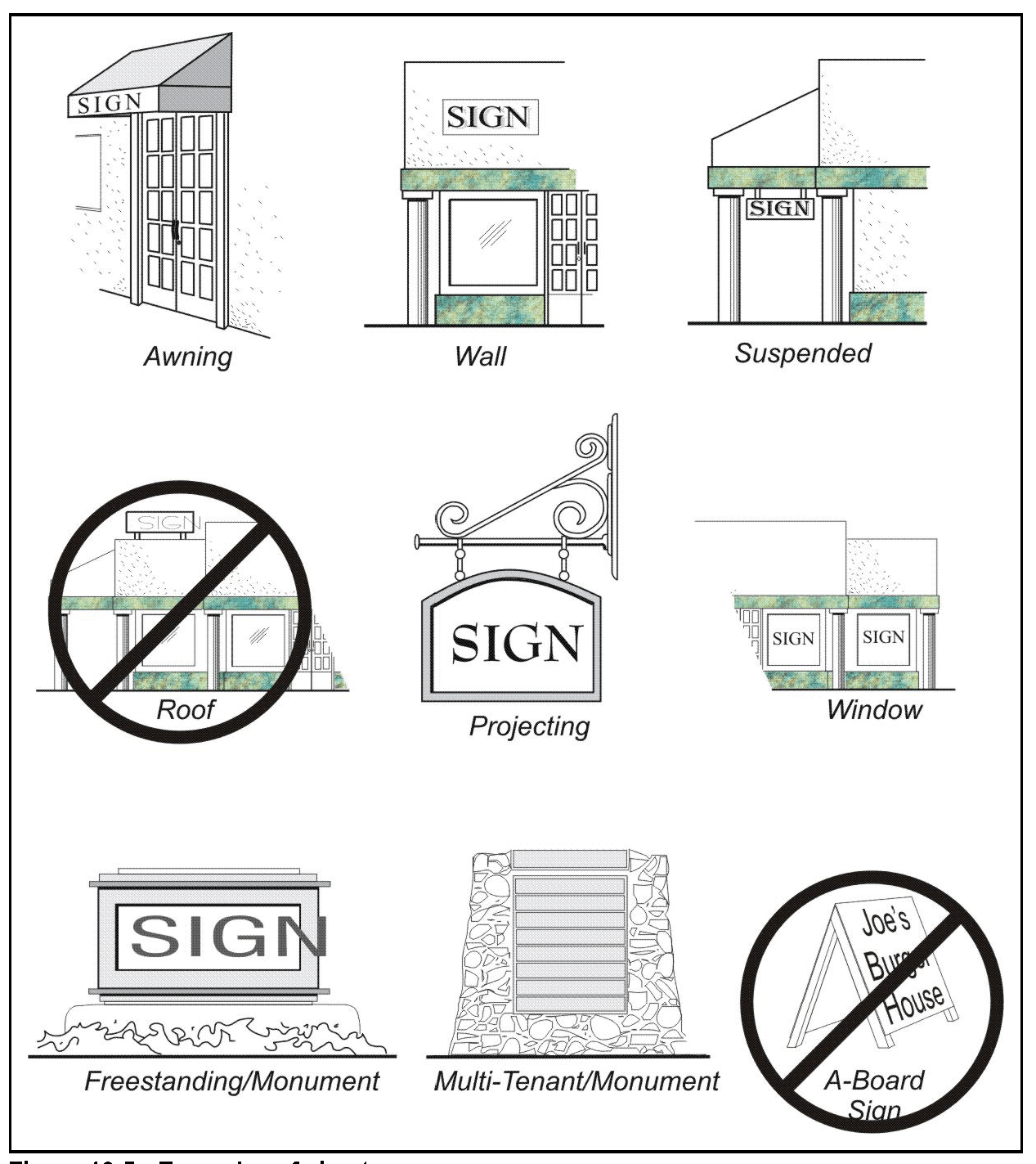
Figure 10-5 - Example of sign types
13.
"Flashing Sign." A sign that contains an intermittent or sequential flashing light source.
14.
"Freestanding Sign." A sign fixed in an upright position on the ground not attached to a structure other than a framework, pole or device, erected primarily to support the sign.
15.
"Freeway Oriented Sign." A sign which is intentionally directed towards a highway or freeway to provide and intended to provide commercial advertising of the on-site business.
16.
"Illegal Sign." A sign that includes any of the following:
a.
A sign erected without complying with all regulations in effect at the time of its construction or use;
b.
A sign that was legally erected, but whose use has ceased, the structure upon which the display is placed has been abandoned by its owner, or the sign is not being used to identify or advertise an ongoing business for a period of not less than ninety days;
c.
A sign that was legally erected which later became nonconforming as a result of the adoption of an ordinance, the amortization period for the display provided by the ordinance rending the display conforming has expired, and conformance has not been accomplished;
d.
A sign that was legally erected which later became nonconforming and then was damaged to the extent of fifty percent or more of its current replacement value;
e.
A sign which is a danger to the public or is unsafe;
f.
A sign which is a traffic hazard not created by relocation of streets or highways or by acts of the city; or
g.
A sign that pertains to a specific event, and five days have elapsed since the occurrence of the event.
17.
"Indirectly Illuminated Sign." A sign whose light source is external to the sign and which casts its light onto the sign from some distance.
18.
"Internally Illuminated Sign." A sign whose light source is located in the interior of the sign so that the rays go through the face of the sign, or light source which is attached to the face of the sign and is perceived as a design element of the sign.
19.
"Marquee (Canopy) Sign." A sign which is attached to or otherwise made a part of a permanent roof-like structure which projects beyond the building wall in the form of a large canopy to provide protection from the weather.
20.
"Monument Sign." An independent, freestanding structure supported on the ground having a solid base as opposed to being supported by poles or open braces.
21.
"Multi-Tenant Sign." An identification sign for a commercial site with multiple tenants, displaying the names of each tenant on the site.
22.
"Neon Signs/Neon Lighting." A sign/lighting containing continuous hollow tubing bent in the shape of letters or images, filled with gases that glow when electrical current is passed through the tubing.
23.
"Nonconforming Sign." An advertising structure or sign which was lawfully erected and maintained prior to the adoption of this development code, but does not now completely comply with current regulations.
24.
"Off-Site Directional Sign." A sign identifying a publicly owned facility, emergency facility, or a temporary subdivision sign, but excluding real estate signs.
25.
"Off-Premises" or "Off-Site Sign." A sign identifying a use, facility, service, or product that is not located, sold, or manufactured on the same premises as the sign, or that identifies a use, service, or product by a brand name which, although sold or manufactured on the premise, is not a principal item for sale or manufactured on the premise.
26.
"Pedestal Sign." A temporary and/or moveable sign supported by a column(s) and a base so as to allow the sign to stand upright.
27.
"Permanent Sign." A sign constructed of durable materials and intended to exist for the duration of time that the use or occupant is located on the premises.
28.
"Political or Social Issue Sign." A sign that addresses:
a.
The passage or defeat of a measure appearing on the ballot in any national, state, or local election;
b.
The election or defeat of any candidate for any public office in any national, state, or local election; or
c.
An international, national, state, or local political or social issue.
29.
"Pole/Pylon Sign." An elevated freestanding sign, typically supported by one or two poles or columns.
30.
"Portable Sign." A sign that is not permanently affixed to a structure or the ground.
31.
"Projecting Sign." A sign other than a wall sign suspending from, or supported by, a structure and projecting outward.
32.
"Real Estate Sign." A sign indicating that a property or any portion thereof is available for inspection, sale, lease, rent, or directing people to a property, but not including temporary subdivision signs.
33.
"Roof Sign." A sign constructed upon or over a roof, or placed so as to extend above the edge of the roof.
34.
"Sign Exception." An application for a sign not meeting the criteria listed in the development code.
35.
"Temporary Sign." A sign intended to be displayed for a limited period of time and capable of being viewed from a public right-of-way, parking area or neighboring property.
36.
"Vehicle Sign." A sign which is attached to or painted on a vehicle which is parked on or adjacent to any property, the principal purpose of which is to attract attention to a product sold or business located on the property.
37.
"Wall Sign." A sign which is attached to or painted on the exterior wall of a structure with the display surface of the sign approximately parallel to the building wall.
38.
"Window Sign." A sign posted, painted, placed, or affixed in or on a window exposed to public view. An interior sign which faces a window exposed to public view and is located within three feet of the window.
"Sign Area". See Section 17.38.060.A (General requirements for all signs—Sign area measurement).
"Sign Height." See Section 17.38.060.B (General requirements for all signs—Sign height measurement).
"Single Dwelling." A building designed for and/or occupied exclusively by one housekeeping unit. Also includes factory-built, modular housing units, constructed in compliance with the Uniform Building Code (UBC), and mobile homes/manufactured housing units that comply with the National Manufactured Housing Construction and Safety Standards Act of 1974, placed on permanent foundation systems.
"Site." A parcel or adjoining parcels under single ownership or single control, considered a unit for the purposes of development or other use.
"Site Coverage." The percentage of total site area occupied by structures and all impervious surfaces. Structure/building coverage is measured from exterior wall to exterior wall.
"Small Family Day Care Home." See "day care."
"Social Service Organization." A public or quasi-public establishment providing social and/or rehabilitation services, serving persons with social or personal problems requiring special services, the handicapped, and the otherwise disadvantaged. Examples of this land use include: Counseling centers, welfare offices, job counseling and training centers, or vocational rehabilitation agencies. Includes organizations soliciting funds to be used directly for these and related services, and establishments engaged in community improvement and neighborhood development. Does not include day-care services, emergency shelters and "residential care," which are separately defined.
"Sport Court." A basketball, handball, squash, tennis, volleyball, or similar outdoor facility for playing a participant sport. Does not include a basketball hoop on the front of a garage.
"Sports and Entertainment Assembly." A large-scale indoor or outdoor facility accommodating spectator-oriented sports, concerts, and other entertainment activities. Examples of this land use include amphitheaters, race tracks, stadiums and coliseums.
"Sports and Active Recreation Facility." Public and private facilities for various outdoor sports and other types of recreation, where the facilities are oriented more toward participants than spectators. Examples include:
Athletic/sport fields (e.g., baseball, football, softball, soccer).
Health and athletic club outdoor facilities.
Skateboard parks.
Swimming pools.
Tennis and other sport courts (e.g., handball, squash).
"Stockyard." A site where cattle or other animals are held or maintained for the purposes of feeding and/or marketing, including feed lots and sales yards.
"Storage Accessory." The indoor storage of materials accessory and incidental to a primary use is not considered a land use separate from the primary use.
"Storage Contractor Storage Yard." Outdoor storage facilities operated by, or on behalf of a contractor licensed by the State of California for storage of large equipment, vehicles, and/or other materials commonly used in the individual contractor's type of business; storage of scrap materials used for repair and maintenance of contractor's own equipment; and buildings or structures for uses such as repair facilities. May include an accessory office. A contractor's office located away from a storage facility is included under the definition of "Office—Business, service."
"Storage Outdoor." The storage of various materials outside of a structure other than fencing, either as an accessory or primary use.
"Storage Personal Storage Facility." A structure containing generally small, individual compartments, stalls or lockers rented as individual storage spaces and characterized by low parking demand.
"Storage Vehicle." See "vehicle storage."
"Storage Warehouse, Indoor Storage." Facilities for the storage of furniture, household goods, or other commercial goods of any nature. Includes cold storage. Does not include: Warehouse, storage or mini-storage facilities offered for rent or lease to the general public ("Storage—Personal storage facility"); warehouse facilities primarily used for wholesaling and distribution (see "wholesaling and distribution"); or terminal facilities for handling freight (see "truck or freight terminal").
"Story." The portion of a building included between the surface of any floor and the surface of the next floor above it, or if there is no floor above, the space between the floor and the ceiling above.
"Street." A public thoroughfare accepted by the city, which affords principal means of access to abutting property, including avenue, place, way, drive, lane, boulevard, highway, road, and any other thoroughfare except an alley as defined in this subsection.
"Structure." Anything constructed or erected, the use of which requires attachment to the ground, attachment to something located on the ground, or placement on the ground. For the purposes of this development code, the term "structure" includes "buildings," and tents, but does not include swimming pools.
"Structure, Primary." See "primary structure."
"Studio Art, Dance, Martial Arts, Music, etc." Small scale facilities, typically accommodating one group of students at a time, in no more than one instructional space. Larger facilities are included under the definition of "Schools—Specialized education and training." Examples of these facilities include: Individual and group instruction and training in the arts; production rehearsal; photography, and the processing of photographs produced only by users of the studio facilities; martial arts training studios; gymnastics instruction, and aerobics and gymnastics studios with no other fitness facilities or equipment. Also includes production studios for individual musicians, painters, sculptors, photographers, and other artists.
"Studio Unit." A residential unit where living and sleeping space is combined in a single room.
"Subdivision." The division, by any subdivider, of any unit or portion of land shown on the latest equalized Nevada County assessment roll as a unit or contiguous units, for the purpose of sale, lease or financing, whether immediate or future. Property shall be considered as contiguous units, even if it is separated by roads, streets, utility easement or railroad rights-of-way. Subdivision includes the following, as defined in Civil Code Section 1715: a condominium project; a community apartment project; or the conversion of five or more existing dwelling units to a stock cooperative.
1.
"Common Interest Development." A development that is created whenever a separate interest coupled with an interest in the common area or membership in the association is, or has been, conveyed. It includes a condominium, community apartment project, planned development, or stock cooperative, in compliance with Civil Code 1351.
2.
"Community Apartment Project." A development in which an undivided interest in land is coupled with the right of exclusive occupancy of any apartment on the land, as defined in Business and Professions Code Section 11004, and Civil Code 1351(d).
3.
"Final Map." A subdivision map prepared in compliance with Map Act, Article 2, Chapter 2, and approved in compliance with Map Act, Article 4, Chapter 3, that is used to complete the subdivision of five or more parcels.
4.
"Lot Line Adjustment." As provided by Map Act Section 66412(d), a Lot Line Adjustment relocates one or more lot lines between two or more existing adjacent parcels, where land taken from one parcel is added to an adjacent parcel and where no more parcels are created than originally existed.
5.
"Parcel Map." The subdivision map described by the Map Act, Article 3, Chapter 2, which is required to complete a subdivision of four or fewer lots.
6.
"Planned Development." As defined by Civil Code Section 1351(k), a development (other than a community apartment project, condominium, or stock cooperative) having either or both of the following features:
a.
The common area is owned either by an association or in common by the owners of the separate interests who possess appurtenant rights to the beneficial use and enjoyment of the common area; and/or
b.
A power exists in the association to enforce an obligation of an owner of a separate interest with respect to the beneficial use and enjoyment of the common area by means of an assessment which may become a lien upon the separately owned parcel, or area in compliance with Civil Code Section 1367.
7.
"Stock Cooperative." A development defined by Business and Professions Code 11003.2 and Civil Code Section 1351(m), where a corporation is formed to hold title to improved real property and the shareholders in the corporation receive a right of exclusive occupancy in a portion of the real property.
8.
"Subdivider." A person, firm, corporation, partnership or association who proposes to divide, or causes to be divided real property into a subdivision for oneself or for others; except that employees and consultants of persons or entities, acting in this capacity, are not "subdividers." See "developer."
9.
"Subdivision Improvements." Subdivision improvements include streets, storm drainage facilities, sanitary sewers, water supply facilities, electric and gas lines.
10.
"Subdivision Map Act, or Map Act." Division 2, Title 7 of the California Government Code, commencing with Section 66410 as presently constituted, and any amendments to those provisions.
11.
"Tentative Map." A map made for the purpose of showing the design and improvement of a proposed subdivision and the existing conditions in and around it.
12.
"Vesting Tentative Map." A map that is filed and processed in the same manner as a tentative map except as otherwise provided by Section 17.81.120 (vesting tentative maps) or the Map Act.
T.
Definitions T.
"Tasting Room." A retail sales facility where customers may taste and purchase beverage and food products grown and/or processed on the site, or when allowed by Article 2 in a district, corridor, or the CR overlay, grown and processed elsewhere. Products offered for tasting and sale may include wine, olive oil, cheese, and/or other food and beverage products. May include a restaurant as an incidental use.
"Telecommunications Facility: Public, commercial and private electromagnetic and photoelectrical transmission, broadcast, repeater and receiving stations for radio, television, telegraph, telephone, data network, and wireless communications, including commercial earth stations for satellite-based communications. Includes antennas, commercial satellite dish antennas, and equipment buildings. Does not include telephone, telegraph and cable television transmission facilities utilizing hard-wired or direct cable connections. The following terms and phrases are defined for the purposes of Chapter 17.44 (Telecommunications Facilities).
1.
Antenna. Any system of poles, panels, rods, reflecting discs or similar devices used for the transmission or reception of electromagnetic waves or radio frequency signals.
2.
Collocation. The location of two or more wireless, hard wire, or cable communication facilities on a single support structure or otherwise sharing a common location. Collocation shall also include the location of communication facilities with other facilities (e.g., water tanks, light standards, and other utility facilities and structures).
3.
Communication Facility. An unstaffed facility, generally consisting of antennas, and equipment cabinet or structure, and related equipment, which receives and/or transmits electromagnetic waves, light waves, radio frequencies or other types of signals. Communication facility includes small wireless facility, as defined in this section.
4.
Equipment Cabinet. A cabinet or structure used to house equipment associated with a wireless, hard wire, or cable communication facility.
5.
Monopole. A single freestanding pole, post, or similar structure, used to support equipment associated with a single communication facility.
6.
Multipoint Distribution Service. A microwave communication service that delivers video programming, data and/or voice communication directly to subscribers, including multi-channel multipoint distribution series, instructional television fixed services, and local multipoint distribution services, or as defined by the Section 207 of the Telecommunications Act of 1996, Section 1.4000 of Title 47 of the Code of Federal Regulations and any interpretative decisions thereof issued by the Federal Communications Commission.
7.
Service Provider. Any authorized provider of telecommunications services.
8.
Shot Clock. The timeframe within which the city shall act on a wireless application, as defined by the FCC and applicable state law and as may be amended from time to time.
9.
Small Wireless Facility. A small wireless facility as defined by the FCC and that meets the following requirements:
a.
The small wireless facilities:
1.
Are mounted on structures fifty feet or less in height including their antennas, or
ii.
Are mounted on structures no more than ten percent taller than other adjacent structures, or
iii.
Do not extend existing structures on which they are located to a height of more than fifty feet or by more than ten percent, whichever is greater;
b.
Each antenna associated with the deployment, excluding associated antenna equipment, is no more than three cubic feet in volume;
c.
All other wireless equipment associated with the structure, including the wireless equipment associated with the antenna and any pre-existing associated equipment, is no more than twenty-eight cubic feet in volume;
d.
The facilities do not require antenna structure registration under part 17 of 47 C.F.R.;
e.
The facilities are not located on Tribal lands; and
f.
The facilities do not result in human exposure to radiofrequency radiation in excess of the applicable safety standards specified in 47 C.F.R. section 1.1307(b).
10.
Tower. Any ground or roof mounted pole, spire, structure, or combination thereof taller than fifteen feet, including supporting lines, cables, wires, braces, and masts, intended primarily for the purpose of mounting an antenna or similar apparatus above grade.
"Temporary Structure." A structure without any foundation or footings, and which is removed when the designated time period, activity, or use for which the temporary structure was erected has ceased.
"Temporary Use." A land use that is designed, operated and occupies a site for a limited time, typically less than twelve months.
"Theater, Cinema or Performing Arts." An indoor facility for group entertainment, other than sporting events. Examples of these facilities include:
Civic theaters, and facilities for "live" theater and concerts.
Movie theaters.
See also "sports and entertainment assembly."
"Top of Creek Bank." The uppermost ground elevation paralleling a creek or watercourse where the gradient changes from a more defined vertical component to more horizontal.
"Town Core Zone." Defined in Subsection 17.12.020(A) of this code.
"Trail, Multi-Use." A trail that may be used by hikers, bicyclists, and/or equestrians.
"Transit Station or Terminal." A passenger station for vehicular, and rail mass transit systems; also terminal facilities providing maintenance and service for the vehicles operated in the transit system. Includes buses terminals, taxi stands, railway stations, etc.
"Transitional and Supportive Housing." Transitional housing is defined in Section 50675.2 of the Health and Safety Code as rental housing for stays of at least six months but where the units are re-circulated to another program recipient after a set period. Transitional housing may be designed for homeless individuals or family transitioning to permanent housing. Supportive housing is defined in Section 50675.14 of the Health and Safety Code and has no limit on the length of stay, is linked to onsite or offsite services, and is occupied by a target population as defined in the Health and Safety Code.
U.
Definitions U.
"Unit Owner," or "Owner." The holder of record fee title to an affordable unit. "unit owner" includes a contract purchaser ("vendee") under an installment land contract.
"Unroofed Porch." A marquee or canopy used as a landing or porch.
"Use." See "land use."
"Use Permit." See Section 17.72.060 (use permit and minor use permit).
"Use, Primary." See "primary use."
"Utility Facility." A fixed-base structure or facility serving as a junction point for transferring electric utility services from one transmission voltage to another or to local distribution and service voltages, and similar facilities for water supply and natural gas distribution. These uses include any of the following facilities that are not exempted from land use permit requirements by Government Code Section 53091:
Electrical substations and switching stations.
Natural gas regulating and distribution facilities.
Public water system wells, treatment plants and storage.
Telephone switching facilities.
Wastewater treatment plants, settling ponds and disposal fields.
These uses do not include office or customer service centers (classified in "offices").
"Utility Infrastructure." Pipelines for water, natural gas, and sewage collection and disposal; and facilities for the transmission of electrical energy for sale, including transmission lines for a public utility company. Also includes telephone, telegraph, cable television and other communications transmission facilities utilizing direct physical conduits. Does not include offices or service centers (see "Offices—Business and service"), or distribution substations (see "utility facility").
V.
Definitions V.
"Vacant Commercial Space." Any commercial space that has not been occupied, leased, or rented for thirty days or more on the date the ordinance codified in Chapter 17.41 takes effect or at any time thereafter.
"Variance." See Section 17.72.070 (variance and minor variance).
"Vehicle Services." The repair, servicing, alteration, restoration, towing, painting, cleaning, or finishing of automobiles, trucks, recreational vehicles, boats and other vehicles as a primary use, including the incidental wholesale and retail sale of vehicle parts as an accessory use. This use includes the following categories:
1.
"Major Repair/Body Work." These establishments include towing, collision repair, other body work, and painting services; muffler and radiator shops; tire recapping.
2.
"Minor Maintenance/Repair." Minor facilities providing limited repair and maintenance services. Examples include: General automotive repair, attended and self-service car washes; detailing services; quick-lube services; tire and battery sales and installation (not including recapping).
Does not include automobile parking (see "parking facilities"), repair shops that are part of a vehicle dealership on the same site (see "auto and vehicle sales and rental," and "mobile home, RV, and boat sales and rental"); gas stations, which are separately defined; or dismantling yards, which are included under "Recycling—Scrap and dismantling yards."
"Vehicle Storage." A facility for the storage of operative cars and other fleet vehicles, trucks, buses, recreational vehicles, and other motor vehicles. Includes facilities for the storage and/or servicing of fleet vehicles. Also includes the parking of a vehicle on private property for more than seventy-two hours without operation. Does not include commercial parking lots, or dismantling yards (classified in "Recycling—Scrap and dismantling yards").
"Vesting Tentative Map." See "subdivision."
"Veterinary Clinic, Animal Hospital." Office and indoor medical treatment facilities used by veterinarians, including large and small animal veterinary clinics, and animal hospitals. See also "kennel, animal boarding."
"Video Rental." See "general retail," and "adult oriented business."
"Visual Art." Original creations of art including, but not limited to, murals, paintings, drawings, carvings, mosaics, fountains, sculptures, and other artwork that are not intended to advertise or identify business or product.
W.
Definitions W.
"Warehouse." See "Storage—Warehouse, indoor storage."
"Warehouse Retail." A retail store that emphasizes the packaging and sale of products in large quantities or volumes, some at discounted prices, where products are typically displayed in their original shipping containers. Sites and buildings are usually large and industrial in character. Patrons may be required to pay membership fees.
"Waterway" or "Watercourse." A creek, stream, or other natural channel that conveys water through the city.
"Wholesaling and Distribution." An establishment engaged in selling merchandise to retailers; to contractors, industrial, commercial, institutional, farm, or professional business users; to other wholesalers; or acting as agents or brokers in buying merchandise for or selling merchandise to such persons or companies. Examples of these establishments include:
Agents, merchandise or commodity brokers, and commission merchants.
Assemblers, buyers and associations engaged in the cooperative marketing of farm products.
Merchant wholesalers.
Stores primarily selling electrical, plumbing, heating and air conditioning supplies and equipment.
Also includes storage, processing, packaging, and shipping facilities for mail order and electronic-commerce retail establishments.
"Windmill." A tower and propeller assembly used to transform wind energy into mechanical energy for generating electricity or pumping water.
"Wine Tasting." A facility, or area within a winery where wine and related products are offered for retail sale, where wine may be tasted for a fee, or without charge.
"Winery." A manufacturing facility where wine grapes are crushed, and their juice is fermented, aged, bottled, and sold at wholesale as finished wine. May include tasting and accessory retail sales of wine produced on site.
X.
Definitions X.
No specialized terms beginning with the letter "X" are defined at this time.
Y.
Definitions Y.
"Yard." An area between a lot line and a structure, unobstructed and unoccupied from the ground upward, except as otherwise permitted by this development code. A yard area includes any setback required by the applicable zoning district. See also "setback," and Section 17.30.020 (build-to-line requirements and exceptions).
1.
"Front Yard." An area extending across the full width of the lot between the front lot line and the primary structure.
2.
"Rear Yard." An area extending the full width of the lot between a rear lot line and the primary structure.
3.
"Side Yard." An area between a side lot line and the primary structure extending between the front and rear yards.
Z.
Definitions Z.
"Zero Lot Line." The location of a building on a lot in such a manner that one or more building sides rests directly on a lot line.
"Zoning District." Any district established by Section 17.20.020 (zoning map), within which certain land uses are allowed or prohibited, and certain site planning and development standards are established (e.g., setbacks, height limits, site coverage requirements, etc.).
(Ord. No. 793-B, § 3, 4-9-2019; Ord. No. 794-B, § 3, 5-14-2019; Ord. No. 816, § 13, 6-28-2022; Ord. No. 818, § 3(Exh. A), 9-13-2022; Ord. No. 828, § 3, 5-28-2024; Ord. No. 837, § 2, 9-23-2025)

