
Grass Valley City Zoning Code
ARTICLE 3
SITE PLANNING AND PROJECT DESIGN STANDARDS
Chapter 17.30 - STANDARDS FOR ALL DEVELOPMENT AND LAND USES
Sections:
Chapter 17.32 - AFFORDABLE HOUSING DENSITY BONUSES AND INCENTIVES
Sections:
Chapter 17.34 - LANDSCAPING STANDARDS
Sections:
Chapter 17.36 - PARKING AND LOADING
Sections:
Chapter 17.38 - SIGNS
Sections:
17.30.010 - Purpose and applicability.
A.
Purpose. This chapter expands upon the zone standards of Article 2 by addressing additional details of site planning, project design, and the operation of land uses. These standards are intended to ensure that proposed development is compatible with existing and future development on neighboring properties, and produces an environment of desirable character, consistent with the general plan and any applicable specific plan.
B.
Applicability. The requirements of this chapter shall apply to all proposed development and new land uses, except as specified in Chapter 17.90 (nonconforming uses, structures, and parcels), and shall be considered in combination with the standards for the applicable zone in Article 2 (zones, allowable land uses, and zone standards) and those in Articles 4 (standards for specific land uses), and 5 (resource management). If there is a conflict between any standards, the provisions of Article 3 control over Article 2, the provisions of Article 4 control over Articles 2 and 3, and the provisions of Article 5 control over Articles 2, 3, and 4.
17.30.020 - Building site and minimum lot area requirements.
Proposed development shall occur only on a lot that complies with the minimum lot size requirements of the applicable zone, and no subdivision shall be approved except in compliance with the minimum lot size requirements of the applicable zone, except that any lot of record existing prior to the date of first publication of the Grass Valley Zoning Ordinance shall be considered a building site.
17.30.030 - Build-to-line and setback requirements and exceptions.
A.
Purpose. This section explains the applicability of build-to-line requirements established by certain zones in Article 2; and provides standards for the location, required size and allowable uses of setbacks.
1.
Build-to-Lines. A build-to-line specifies the required location of a new structure in relation to the street frontages of a site, so that a proposed building will effectively assist in shaping the public space of streets, to enhance the comfort and convenience of the pedestrian experience.
2.
Setbacks. Setback standards provide open areas around structures for: visibility and traffic safety; access to and around structures; access to natural light, ventilation and direct sunlight; separation between potentially conflicting activities; and space for privacy, landscaping and recreation.
B.
Build-to-Line Requirements. Each proposed structure shall comply with any build-to-line requirement established by the applicable zone by having the minimum percentage of the length of its street-facing facade required by the zone abutting the build-to-line. The review authority may waive build-to-line requirements for a project with more than one building, where the project street frontage is occupied by one or more buildings in compliance with applicable build-to-line requirements, and secondary buildings are placed on the site to the rear of the front buildings.
C.
Setback Requirements.
1.
Minimum Setbacks for All Structures. Each structure shall comply with the front, interior side, street side, and rear setback requirements of the applicable zone, except:
a.
Where a front or street-side build-to-line requirement is established by the applicable zone, in which case a proposed structure shall instead comply with the build-to-line requirement;
b.
Additions to nonconforming structures that maintain the existing setbacks and comply with applicable building and fire codes.
c.
Where a setback requirement is established for a specific land use by Article 4;
d.
In the case of development near a waterway, which shall comply with the setback requirements established by Chapter 17.50 (creek and riparian resource protection); and
e.
As otherwise provided by this section.
No portion of any structure, including eaves or roof overhangs, shall extend beyond a property line, or into an access easement or street right-of-way, except as provided by this section.
2.
Exemptions from Setback Requirements. The minimum setback requirements of this Development Code do not apply to the following:
a.
A building feature that encroaches into a required setback as allowed by Article 2 or Subsection F;
b.
Additions to nonconforming structures that maintain the building's existing setbacks and comply with applicable building and fire codes;
c.
A fence or wall six feet or less in height, when located outside of a required front or street side setback;
d.
A deck, earthwork, step, patio, free-standing solar device in other than a front setback, or other site design element that is placed directly upon grade and does not exceed a height of eighteen inches above the surrounding grade at any point;
e.
A sign in compliance with Chapter 17.38 (signs); or
f.
A retaining wall less than thirty inches in height above finished grade.
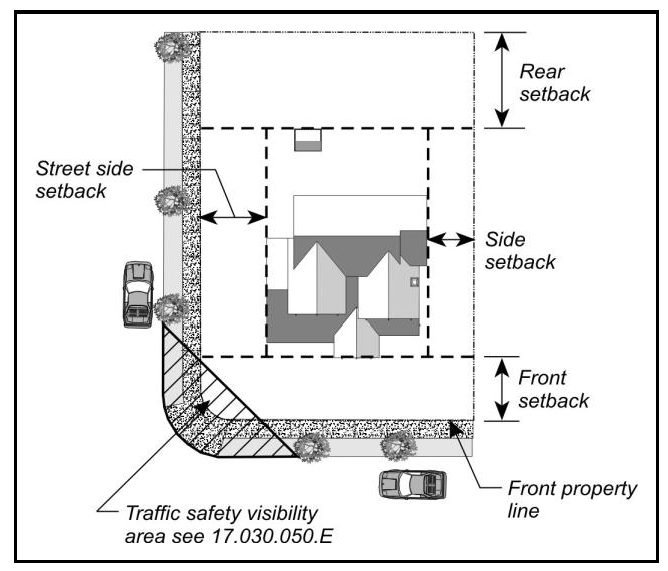
Figure 3-1 - Locations and Measurements of Setbacks
D.
Measurement of Setbacks. Setbacks shall be measured as follows, except that the director may require different setback measurement methods where the director determines that unusual parcel configuration makes the following infeasible or ineffective. See Figure 3-1.
1.
Front Setback. A front setback shall be measured at right angles from the nearest point on the public right-of-way at the front of the parcel (or edge of access easement on a private street) to the nearest point of the wall of the structure, except as follows. The front property line is the most narrow dimension of a lot adjacent to a street.
a.
Developed Residential Block. In a block where forty percent or more of the parcels along the block face (the street frontage between two intersecting streets or the end of a dead-end street) within two hundred feet of the site have been improved with residential buildings, the required front setback for a new building may be the average of the actual front setbacks of the existing buildings along the same block face within two hundred feet of the site, instead of the setback required by the applicable zone, but not less than ten feet.
b.
Mapped Street with Future Improvements. If the city has established a plan that identifies a right-of-way for the future construction of a new street or the widening of an existing street, a required front or street side setback shall be measured from the line shown on the plan.
c.
Infill Development on a Parcel Within a Previously Approved Project. Where the city has established specific setback requirements for individual single-dwelling parcels through the approval of a specific plan, subdivision map, or other entitlement, prior to the effective date of this development code, those setbacks shall apply to infill development within the approved project instead of the setbacks required by this development code.
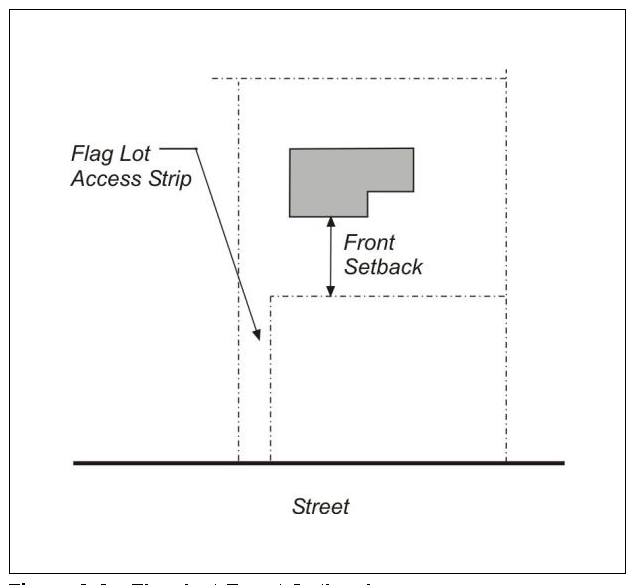
Figure 3-2 - Flag Lot Front Setback
d.
Flag Lot. The front setback on a flag lot (a parcel with a fee ownership strip extending from a street or right-of-way to the building area of the parcel) shall be measured from the nearest point of the wall of the structure to the point where the access strip meets the bulk of the parcel; establishing a setback line parallel to the lot line nearest to the public street or right-of-way. See Figure 3-2. Standards for new flag lots are in Subsection 17.88.030.F.5.d (subdivision layout standards - flag lots).
e.
Corner Lot. The front setback shall be measured from the nearest point of the wall of the structure to the nearest point of the most narrow street frontage property line. If the property lines on both street frontages are of the same length, the property line to be used for front setback measurement shall be determined by the Director.
f.
Double-Frontage Lots. A double-frontage lot is considered to have two front lot lines, and a required front setback shall be provided from both front lot lines.
(1)
Vehicular access onto a double frontage lot shall generally be from the street with the lowest existing and projected traffic volumes, but with each proposed building designed so that its primary facade faces the higher volume street.
(2)
The review authority may authorize alternative access locations where appropriate because of localized traffic conditions, and/or nearby residential areas that would be adversely affected by increased traffic.
See Subsection 17.88.030.F.5.b regarding the limited circumstances where new double-frontage lots are allowed.
2.
Side Setback. The side setback shall be measured at right angles from the nearest point on the side property line of the parcel to the nearest point of the wall of the structure; establishing a setback line parallel to the side property line, which extends between the front and rear setbacks. See Figure 3-1.
3.
Street Side Setback. The side setback on the street side of a corner parcel shall be measured from whichever of the following points results in the greatest setback from an existing or future roadway:
a.
The nearest point on the side property line bounding the street;
b.
The edge of an easement for a private road;
c.
The inside edge of the sidewalk; or
d.
The boundary of a planned future right-of-way established as described in Subsection D.1.b.
4.
Rear Setback. The rear setback shall be measured at right angles from the nearest point on the rear property line to the nearest part of the structure, establishing a setback line parallel to the rear property line. See Figure 3-1.
a.
In the case of a double-frontage lot, the director shall determine which frontage is the front and which is the rear, for the purpose of measuring front and rear setbacks.
b.
Where a parcel has no rear lot line because its side lot lines converge to a point, an assumed line ten feet long within the parcel, parallel to, and at a maximum distance from the front lot line, shall be deemed to be the rear lot line for the purpose of determining the depth of the required rear setback. See Figure 3-3.
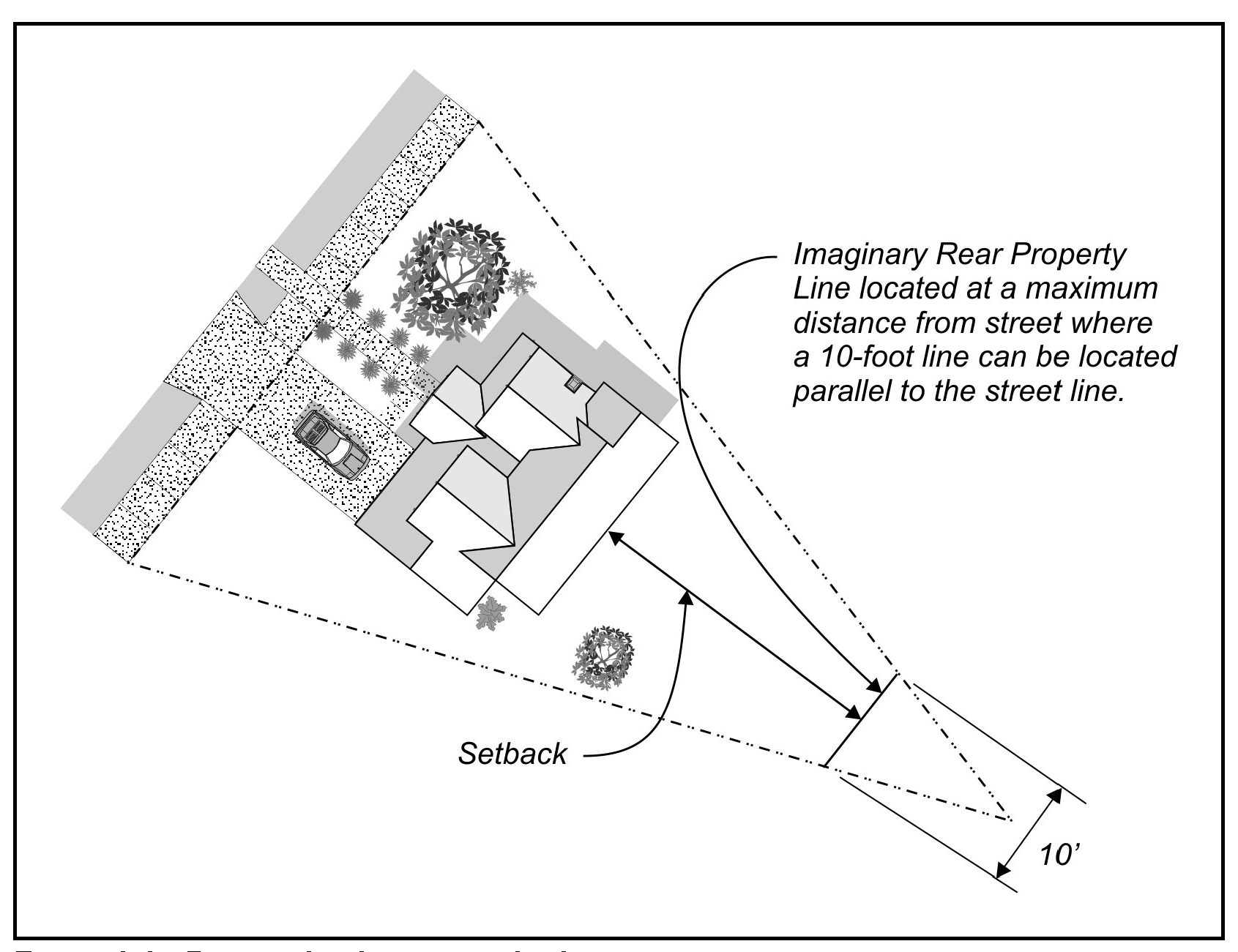
Figure 3-3 - Rear setbak on irregular lot
E.
Limitations on the Use of Setbacks.
1.
Structures. A required setback area shall not be occupied by structures other than:
a.
The fences and walls permitted by Section 17.30.040 (fences, walls, and screening); and
b.
The projections into setbacks allowed by Subsection F. and the applicable zone.
2.
Storage of Materials. No front or street side setback shall be used for the storage of building materials, scrap, junk, machinery, indoor furniture, or similar materials, except for building materials required during an on-site construction project with a valid Building Permit.
3.
Vehicle Parking and Storage. No required parking space shall be located within a required setback, except as provided by Section 17.36.090.C (location of parking). No front or side setback shall be used for parking a motor vehicle, recreational vehicle (RV), boat, trailer, farm equipment, or other vehicle, except that an operable automobile or truck of one-ton capacity or less, in regular use, may be parked within a paved driveway. A garage, carport, or any other structure for sheltering parking space within a residential or neighborhood zone shall comply with the setback requirements of the applicable zone, and the requirements of Section 17.44.020.F.2 (accessory structures and uses - garages).
F.
Allowed Encroachments into Setbacks. An architectural feature attached to a primary structure may extend beyond the wall of the structure and into a required front, side, or rear setback in compliance with Table 3-1. See also Figure 3-4. These requirements do not apply to accessory structures, which are instead subject to Section 17.44.020 (accessory structures and uses).
TABLE 3-1 ALLOWED PROJECTIONS INTO SETBACKS
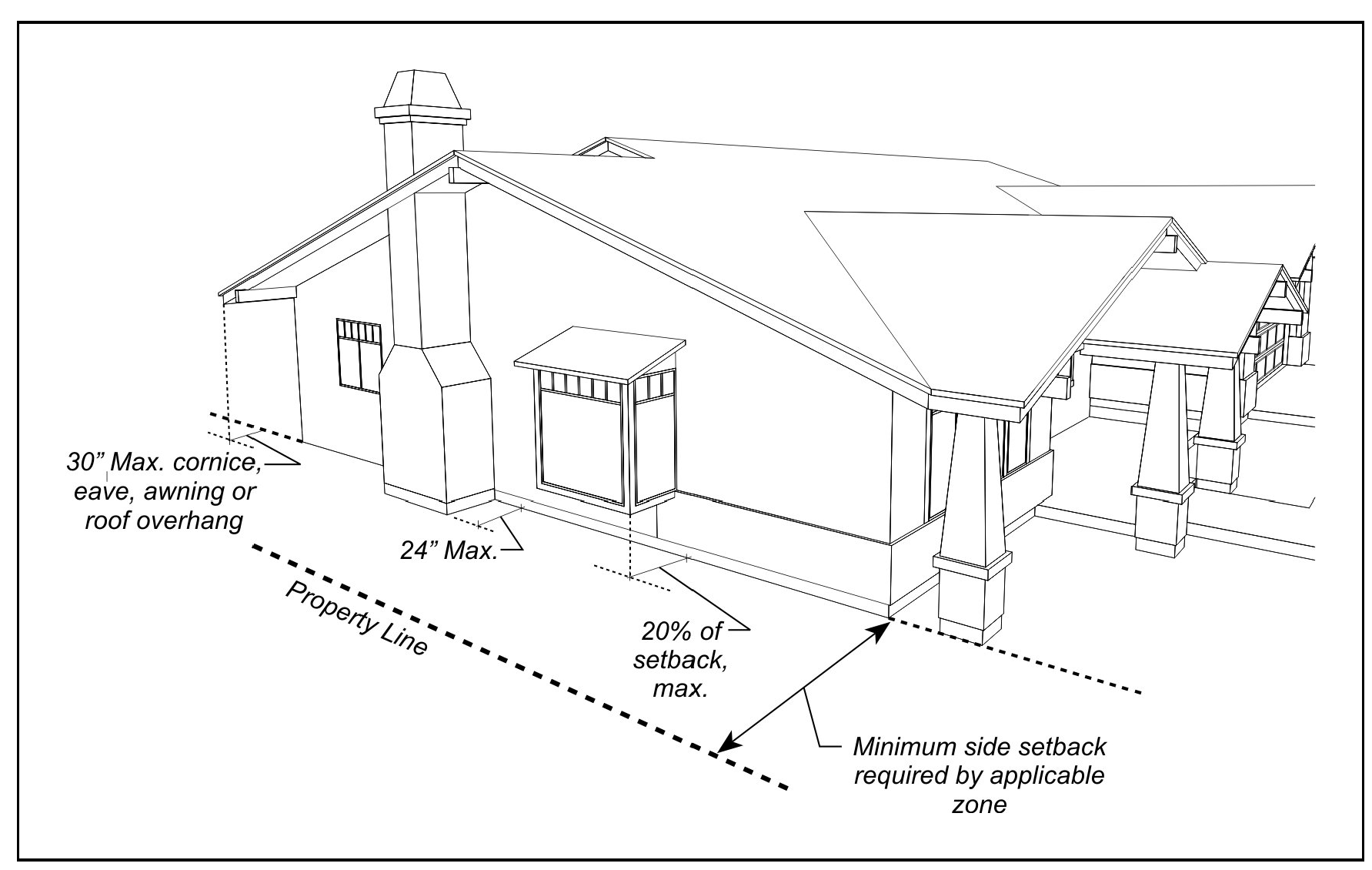
Figure 3-4 - Examples of allowed projections into side setback
G.
Setback Requirements for Specific Structures.
1.
Accessory Structures. See Section 17.44.020 (accessory structures and uses).
2.
Fences. See Section 17.30.040 (fences, walls, and screening).
3.
Detached Decks and Other Site Design Elements. A detached deck, freestanding solar device, steps, terrace, or other site design element that is placed directly upon the grade, and that exceeds a height of eighteen inches above the surrounding grade at any point, shall comply with the setback requirements of this Development Code for detached accessory structures in Section 17.44.020 (accessory structures and uses).
4.
Swimming Pool, Hot Tub, etc. A swimming pool, hot tub, or spa shall be set back a minimum of five feet from side and rear property lines, and shall not be located within a front setback.
5.
Mechanical Equipment. Outdoor ground-mounted mechanical equipment shall comply with the setback requirements of the applicable zone. Examples of this equipment include: swimming pool pumps and filters, heating, ventilation, and air conditioning, and similar equipment; and transformers, cable television distribution boxes, and similar equipment that is allowed to be installed above ground.
17.30.040 - Fences, walls, and screening.
A.
Applicability. The requirements of this section apply to all fences and walls unless otherwise stated.
1.
Fences or Wall in Flood Hazard Area. A fence or wall in an area subject to flooding identified on a federal flood insurance rate map (FIRM) on file in the department shall require a building permit, and shall comply with all requirements of the city engineer in addition to the requirements of this section.
2.
Exemptions. These regulations do not apply to fences or walls required by regulations of a state or federal agency, or by the city for reasons of public safety.
B.
Height Limits. Each fence or wall shall comply with the height limits shown in Table 3-2.
TABLE 3-2 MAXIMUM HEIGHT OF FENCES OR WALLS
C.
Measurement of Fence and Wall Height. Fence height shall be measured as the vertical distance between the finished grade at the base of the fence and the top edge of the fence material.
D.
Specific Fence and Wall Requirements.
1.
Fencing Between Different Land Uses. Fencing between different land uses shall be provided in compliance with Subsection F (screening).
2.
Outdoor Equipment, Storage, and Work Areas. Nonresidential outdoor uses and equipment adjacent to a residential use shall be fenced and/or screened in compliance with Subsection F (screening).
3.
Retaining Walls. An embankment to be retained on the site of a multi-unit residential project or nonresidential use that is over forty-eight inches high shall be benched so that no individual retaining wall exceeds a height of six feet except where the review authority determines that topography requires a wall of greater height, and each bench is a minimum width of thirty-six inches.
4.
Swimming Pools, Spas, and Similar Features. Swimming pools/spas and other similar water features shall be fenced in compliance with Uniform Building Code (UBC) requirements, regardless of the other requirements of this section.
5.
Temporary Fencing. Temporary fencing may be necessary to protect archaeological or historic resources, trees, or other similar sensitive features during site preparation and construction. This fencing shall be approved by the director.
E.
Prohibited Materials. The following fencing materials are prohibited in all zones except where they are required by a state or federal law or regulation, and except as noted.
1.
Razor or concertina wire in conjunction with a fence or wall, or by itself, and chain link fencing within a front or street side setback; and
2.
Barbed wire, or electrified fence; except where approved by the director for animal control.
F.
Screening. This subsection establishes standards for the screening and separation of adjoining residential and nonresidential land uses, equipment and outdoor storage areas, and surface parking areas.
1.
Screening Between Different Land Uses. A commercial or industrial land use proposed on a site adjacent to a zone that allows single dwellings shall provide screening at the parcel boundary as follows. Other nonresidential uses adjacent to a residential use may also be required by the review authority to comply with these requirements.
a.
The screen shall consist of plant materials and a solid, decorative wall of masonry or similar durable material, six feet in height (up to eight feet may be allowed in compliance with Subsection B (height limits). Openings or pedestrian connections may be required at the discretion of the review authority.
b.
The decorative wall shall be architecturally treated on both sides, subject to the approval of the review authority.
c.
A landscaping strip with a minimum width of five feet shall be installed adjacent to a screening wall, except that ten feet of landscaping shall be provided between a parking lot and a screening wall, in compliance with Chapter 17.34 (landscaping standards).
d.
The review authority may waive or approve a substitute for the requirements of this Subsection F.1 if the review authority first determines that:
(1)
The relationship of the proposed uses make the required screening unnecessary;
(2)
The intent of this section can be successfully met by means of alternative screening methods;
(3)
Physical constraints on the site make the required screening infeasible; or
(4)
The physical characteristics of the site or adjoining parcels make the required screening unnecessary.
2.
Mechanical Equipment, Loading Docks, and Refuse Areas.
a.
Roof- or ground-mounted mechanical equipment shall be screened from public view from adjoining public streets and rights-of-way and adjoining areas zoned for residential uses. This equipment includes air conditioning, heating, ventilation ducts, and exhaust vents, loading docks, refuse storage areas, and utility services, electrical transformers, gas meters, etc.
b.
The colors, materials, and architectural style of screening shall be architecturally compatible with other on-site development.
3.
Outdoor Storage and Work Areas. See Section 17.44.170 (outdoor displays, sales, and storage).
(Ord. No. 818, § 3(Exh. A), 9-13-2022)
17.30.050 - Height limits and exceptions.
A.
Purpose. This section describes the required methods for measuring the height of structures in compliance with the height limits established by this development code, and exceptions to those height limits.
B.
Maximum Height of Structures. The height of each structure shall not exceed the height limit established for the applicable zone by Article 2 (zones, allowable land uses, and zone standards), except as otherwise provided by this section, and by Section 17.54.040.E (hillside and ridgeline protection - height limits) for sloping lots.
C.
Height Measurement. The maximum allowable height shall be measured as the vertical distance from the eave or bottom of parapet of the structure to the finished grade. The finished grade shall not be artificially raised to gain additional building height.
D.
Exceptions to Height Limits. The following structures and structural features may exceed the height limits of this development code as noted:
1.
Architectural Features. A chimney, cupola, monument, mechanical equipment, or vent may exceed the height limit by a maximum of three feet. A spire, theater scenery loft, or tower, may exceed the height limit by twenty-five feet.
2.
Telecommunications Facilities. The height of telecommunications facilities, including antennas, poles, towers, and necessary mechanical appurtenances shall comply with Chapter 17.46 (telecommunications facilities).
E.
Height Limit at Street Corners. Development proposed adjacent to any public or private street or alley intersection in other than the TC, NC, and NC-Flex zones shall be designed to provide a traffic safety visibility area for pedestrian and traffic safety. See Figure 3-6.
1.
Measurement of Visibility Area. A traffic safety visibility area is a triangle measured as follows, and may include private property and/or public right-of-way.
The visibility area shall be defined by measuring thirty-five feet from the intersection of the extension of the front and street side curb lines (or the right-of-way lines where there is no curb) and connecting the lines across the property. The review authority may reduce the thirty-five-foot requirement where it determines a narrow parcel frontage would excessively reduce buildable area.
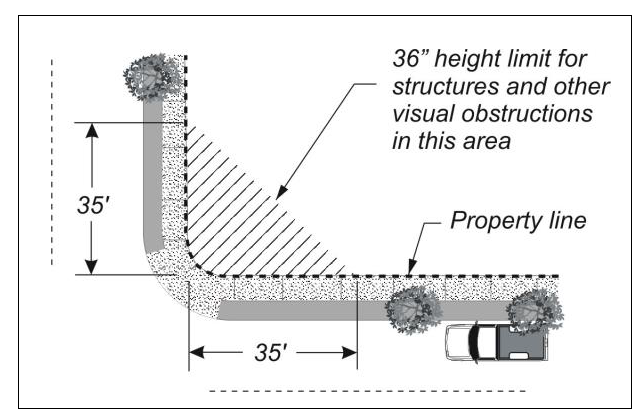
Figure 3-6 - Required traffic safety visibility area
2.
Height Limit. No structure, sign, or landscape element shall exceed thirty-six inches in height within the traffic safety visibility area, unless approved by the city engineer, except for trees with their canopy trimmed to a minimum of eight feet above grade.
(Ord. No. 818, § 3(Exh. A), 9-13-2022)
17.30.060 - Outdoor lighting.
New outdoor lighting on private property other than the site of a single dwelling or duplex shall comply with the following requirements. It is the policy of the city and the intent of these standards that outdoor lighting be limited to the minimum necessary for safety and security.
A.
An outdoor light fixture shall be limited to a maximum height of fourteen feet or the height of the nearest building, whichever is less except adjacent to or within a residential area where the height shall be reduced to eight feet. A fixture between fourteen and twenty feet in height may be approved by the development review committee where it first determines that the additional height will provide lighting that still complies with all other requirements of this section.
B.
Outdoor lighting shall utilize energy-efficient (high pressure sodium, low pressure sodium, hard-wired compact florescent, or other lighting technology that is of equal or greater energy efficiency) fixtures/lamps.
C.
Lighting fixtures shall be shielded or recessed to minimize light bleed to adjoining properties, by:
1.
Ensuring that the light source (e.g., bulb, etc.) is not visible from off the site; and
2.
Confining glare and reflections within the boundaries of the site to the maximum extent feasible.
Each light fixture shall be directed downward and away from adjoining properties and public rights-of-way, so that no on-site light fixture directly illuminates an area off the site.
D.
No lighting on private property shall produce an illumination level greater than one footcandle on any property within a residential or neighborhood zone, except on the site of the light source.
E.
No permanently installed lighting shall blink, flash, or be of unusually high intensity or brightness, as determined by the director.
17.30.070 - Performance standards.
A.
Purpose. This section provides performance standards that are intended to minimize various potential operational impacts of land uses and development within the city, and promote compatibility with adjoining areas and land uses.
B.
Applicability. The provisions of this section apply to all new and existing land uses, including permanent and temporary uses in all zones, unless an exemption is specifically provided. Uses existing on the effective date of this section shall not be altered or modified thereafter to conflict with these standards.
C.
Air Emissions. No visible dust, gasses, or smoke shall be emitted, except as necessary for the heating or cooling of structures, and the operation of motor vehicles on the site.
D.
Combustibles and Explosives. The use, handling, storage, and transportation of combustibles and explosives shall comply with the Uniform Fire Code, and California Code of Regulations Title 19.
E.
Dust. Activities that may generate dust emissions (e.g., construction, grading, commercial gardening, and similar operations) shall be conducted to limit the emissions beyond the site boundary to the maximum extent feasible. Appropriate methods of dust management shall include the following, subject to approval by the city engineer.
1.
Scheduling. Grading shall be designed and grading activities shall be scheduled to ensure that repeat grading will not be required, and that completion of the dust-generating activity (e.g., construction, paving or planting) will occur as soon as possible.
2.
Operations During High Winds. Clearing, earth-moving, excavation operations or grading activities shall cease when the wind speed exceeds twenty-five miles per hour averaged over one hour.
3.
Limiting the Area of Disturbance. The area disturbed by clearing, demolition, earth-moving, excavation operations or grading shall be minimized at all times.
4.
Dust Control. Fugitive dust emissions shall be controlled by watering a minimum of two times each day, paving or other treatment of permanent on-site roads and construction roads, the covering of trucks carrying loads with dust content, and/or other dust-preventive measures (e.g., hydroseeding, etc.).
5.
Revegetation. Graded areas shall be revegetated as soon as possible, but within no longer than thirty days, to minimize dust and erosion. Disturbed areas of the construction site that are to remain inactive longer than three months shall be seeded and watered until grass cover is grown and maintained; and
6.
Fencing. Appropriate fences or walls shall be constructed to contain dust within the site as required by the city engineer.
F.
Ground Vibration. No ground vibration shall be generated that is perceptible without instruments by a reasonable person at the property lines of the site, except for vibrations from temporary construction or demolition activities, and motor vehicle operations.
G.
Light and Glare. Outdoor lighting shall comply with the requirements of Section 17.30.060 (outdoor lighting).
H.
Liquid Waste. No liquid shall be discharged into a public or private body of water, sewage system, watercourse, or into the ground, except in compliance with applicable regulations of the Regional Water Quality Control Board.
I.
Noise. The city's noise standards are in Municipal Code Chapter 8.28.
J.
Odor. No obnoxious odor or fumes shall be emitted that are perceptible without instruments by a reasonable person at the property line of the site.
K.
Radioactivity, Electrical Disturbance or Electromagnetic Interference. None of the following shall be emitted:
1.
Radioactivity, in a manner that does not comply with all applicable state and federal regulations; or
2.
Electrical disturbance or electromagnetic interference that interferes with normal radio or television reception, or with the function of other electronic equipment beyond the property line of the site; or that does not comply with all applicable Federal Communications Commission (FCC) and other applicable state and federal regulations.
17.30.080 - Public improvement requirements.
The development of an approved project shall include the construction of improvements to each public street frontage of the site if required by the review authority and city public improvement standards. These on-site and/or off-site improvements may include the widening of an existing street, and/or the installation or reinstallation of curb, gutter, and sidewalk; the installation of street trees and other landscaping within the public right-of-way; the installation of drainage facilities as required by the city engineer, and/or other improvements determined by the review authority to be reasonably related to the needs for pedestrian and vehicle circulation, and community infrastructure demands created by the project. See also Municipal Code Chapter 12.44.
17.30.090 - Solid waste/recyclable materials storage.
A.
Purpose. This section provides standards which recognize the city's support for and compliance with the California Solid Waste Reuse and Recycling Access Act (Public Resources Code Sections 42900 through 42911).
B.
Applicability. These requirements apply to new multi-family residential development, nonresidential development, and changes to existing multifamily residential or nonresidential development that increase gross floor area by twenty-five percent or more.
C.
Extent of Storage Area Required. Solid waste and recyclables storage areas shall be provided in the number, dimensions, and types required by the department or review authority. Additional storage areas may be required, as deemed necessary by the director.
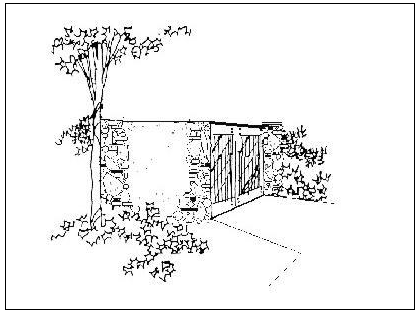
Figure 3-7 - Solid waste enclosure
D.
Enclosure Requirements. Storage areas shall be fully enclosed by a six-foot high decorative masonry wall or other solid enclosure that is architecturally compatible with adjacent structures. Gates shall be solid and continuously maintained in working order. A concrete apron shall be installed. Landscaping shall be provided to soften and screen the enclosure in compliance with Chapter 17.34 (landscaping standards). See Figure 3-7.
17.30.100 - Standards for visual art.
A.
Applicability. The provisions of this section apply to any proposed installation of visual art on publicly or privately-owned property in all nonresidential zoning districts.
B.
Visual Art on Privately-owned Property. Visual art may be allowed in any commercial, industrial, and other nonresidential zone subject to the following requirements. All visual art shall be subject to the review and recommendation by the development review committee (DRC) and approval by the planning commission.
1.
Visual art without text visible from a public right-of-way may be approved in addition to (not counted as part of) the sign area allowed by Section 17.38.070 (zone sign standards), above; visual art with text shall comply with the sign area limitations applicable to the site.
2.
Visual art that illustrates the local setting, history, or cultural significance as sources of inspiration are encouraged.
3.
Historic District: Visual art that is proposed within the historic district shall be reviewed by the historical commission who shall provide a recommendation to the planning commission.
4.
Review Authority and Finding: The approval of visual art shall require that the planning commission first find that the colors, placement, and size of the artwork are visually compatible with the structure's architecture, and that the art will serve to enhance the aesthetics of the city.
C.
Visual Art on Publicly-owned Property. The following standards apply to visual art placed on publicly-owned property in all zones. All visual art in public spaces shall be subject to the review and recommendation by the DRC and Planning Commission and approval by City Council.
1.
Visual art on publicly-owned property without visible text may be approved in addition to (not counted as part of) the sign area allowed by Section 17.38.070 (zone sign standards), above; visual art with text shall comply with the sign area limitations applicable to the site.
2.
The composition of the artwork shall be of a permanent type of materials to be durable against vandalism, theft, and weather, and in order to require a low level of maintenance. Paintings and murals shall be treated with a protectant to prevent vandalism, fading, and wear.
3.
Illumination of artwork shall comply with requirements of Section 17.30.060 (Outdoor lighting).
4.
Artwork that illustrates the local setting, history, or cultural significance as sources of inspiration is encouraged.
5.
Historic District: Visual art that is proposed within the historic district shall be reviewed by the historical commission who shall provide a recommendation to the planning commission.
6.
Planning Commission: All visual art proposals shall be reviewed by the DRC and planning commission who will provide a recommendation to City Council.
7.
Review Authority and Finding: The approval of visual arts shall require that the City Council first find that the colors, placement, and size of the artwork are visually compatible with the surrounding character of the area, and that the artwork will serve to enhance the aesthetics of the city.
(Ord. No. 837, § 2, 9-23-2025)
17.32.010 - Purpose.
As required by Government Code Section 65915, this chapter offers density bonuses, and incentives or concessions for the development of housing that is affordable to the types of households and qualifying residents identified in Section 17.32.020 (eligibility for bonus, incentives, or concessions), below. This chapter is intended to implement the requirements of Government Code Section 65915, et seq., and the housing element of the general plan.
17.32.020 - Eligibility for bonus, incentives, or concessions.
In order to be eligible for a density bonus and other incentives or concessions as provided by this chapter, a proposed housing development shall comply with the following requirements, and satisfy all other applicable provisions of this development code, except as provided by Section 17.32.040 (allowed incentives or concessions).
A.
Resident Requirements. A housing development proposed to qualify for a density bonus shall be designed and constructed so that it includes at least any one of the following:
1.
Ten percent of the total number of proposed units are for lower income households, as defined in Health and Safety Code Section 50079.5;
2.
Five percent of the total number of proposed units are for very low-income households, as defined in Health and Safety Code Section 50105;
3.
The project is a senior citizen housing development as defined in Civil Code Sections 51.3 and 51.12, or is a mobile home park that limits residency based on age requirements for housing older persons in compliance with Civil Code Sections 798.76 or 799.5;
4.
Ten percent of the total dwelling units in a common interest development as defined in Civil Code Section 4100 are for persons and families of moderate income, as defined in Health and Safety Code Section 50093, provided that all units in the development are offered to the public for purchase;
5.
Ten percent of the total units of a housing development for transitional foster youth, as defined in Section 66025.9 of the Education Code, disabled veterans, as defined in Section 18541, or homeless persons, as defined in the Federal McKinney-Vento Homeless Assistance Act (42 U.S. C. Sec. 11301 et seq.). The units described in this subparagraph shall be subject to a recorded affordability restriction of fifty-five years and shall be provided at the same affordability level as very low-income units;
6.
Twenty percent of the total units for lower income students in a student housing development in accordance with Government Code Section 65915(F)(I—IV); or
7.
One hundred percent of all units in the development, including total units and density bonus units, but exclusive of a manager's unit or units, are for lower income households as defined by Section 50079.5 of the Health and Safety Code, except that up to twenty percent of the units in the development, including total units and density bonus units, may be for moderate-income households, as defined in Section 50053 of the Health and Safety Code.
B.
Applicant Selection of Basis for Bonus. For purposes of calculating the amount of the density bonus in compliance with Section 17.32.030 (allowed density bonuses), below, the applicant who requests a density bonus shall elect whether the bonus shall be awarded on the basis of Subsections A.1, 2, 3, 4, 5, 6, or 7 above.
C.
Bonus Units Shall Not Qualify a Project. A density bonus granted in compliance with Section 17.32.030 (allowed density bonuses), below, shall not be included when determining the number of housing units that is equal to the percentages required by Subsection A.
D.
Minimum Project Size to Qualify for Density Bonus. The density bonus provided by this chapter shall be available only to a housing development of five or more dwelling units.
E.
Condominium Conversion Projects. A condominium conversion project for which a density bonus is requested shall comply with the eligibility and other requirements in Government Code Section 65915.5.
(Ord. No. 818, § 3(Exh. A), 9-13-2022)
17.32.030 - Allowed density bonuses.
The amount of a density bonus allowed in a housing development shall be determined by the council in compliance with this section. For the purposes of this chapter, "density bonus" means a density increase over the otherwise maximum allowable residential density under the applicable zone and designation of the land use element of the general plan as of the date of application by the applicant to the city.
A.
Density Bonus. A housing project that complies with the eligibility requirements in Subparagraphs 17.32.020.A.1, 2, 3, 4, 5, 6, or 7, shall be entitled to density bonuses as follows, unless a lesser percentage is proposed by the applicant.
1.
Bonus for Units for Lower Income Households. A housing development that is eligible for a bonus in compliance with the criteria in Section 17.32.020.A.1 (ten percent of units for lower income households) shall be entitled to a density bonus calculated as follows.
2.
Bonus for Units for Very Low Income Households. A housing development that is eligible for a bonus in compliance with the criteria in Section 17.32.020.A.2 (five percent of units for very low income households) shall be entitled to a density bonus calculated as follows.
3.
Bonus for Senior Citizen Development. A housing development that is eligible for a bonus in compliance with the criteria in Section 17.32.020.A.3 (senior citizen development or mobile home park) shall be entitled to a density bonus of twenty percent.
4.
Bonus for Moderate Income Units in Common Interest Development. A housing development that is eligible for a bonus in compliance with the criteria in Section 17.32.020.A.4 (ten percent of units in a common interest development for persons and families of moderate income) shall be entitled to a density bonus calculated as follows.
5.
Density Bonus for Land Donation. When an applicant for a tentative map, parcel map, or other residential development approval donates land to the city in compliance with this subsection, the applicant shall be entitled to a density bonus for the entire development, as follows; provided that nothing in this subsection shall be construed to affect the authority of the city to require a developer to donate land as a condition of development.
a.
Basic Bonus. The applicant shall be entitled to a fifteen-percent increase above the otherwise maximum allowable residential density under the applicable general plan land use element designation and zoning for the entire development, and an additional increase as follows.
b.
Increased Bonus. The increase in the table above shall be in addition to any increase in density required by Subsections A.1 through A.7, up to a maximum combined mandated density increase of thirty-five percent if an applicant seeks both the increase required in compliance with this Subsection A.5, as well as the bonuses provided by Subsections A.1 through A.7.
c.
Eligibility for Increased Bonus. An applicant shall be eligible for the increased density bonus provided by this subsection if all of the following conditions are met.
(1)
The applicant donates and transfers the land no later than the date of approval of the final subdivision map, parcel map, or residential development application.
(2)
The developable acreage and zoning classification of the land being transferred are sufficient to permit construction of units affordable to very low income households in an amount not less than ten percent of the number of residential units of the proposed development.
(3)
The transferred land is at least one acre, or of sufficient size to permit development of at least forty units, has the appropriate general plan designation, is appropriately zoned for development as affordable housing, and is or will be served by adequate public facilities and infrastructure. The land shall have appropriate zoning and development standards to make the development of the affordable units feasible.
(4)
No later than the date of approval of the final subdivision map, parcel map, or of the residential development, the transferred land shall have all of the permits and approvals, other than building permits, necessary for the development of the very low income housing units on the transferred land, except that the city may subject the proposed development to subsequent design review to the extent authorized by Government Code Section 65583.2(I) if the design is not reviewed by the city before the time of transfer.
(5)
The transferred land and the affordable units shall be subject to a deed restriction ensuring continued affordability of the units consistent with Section 17.32.070 (continued availability), below, which shall be recorded on the property at the time of dedication.
(6)
The land is transferred to the city or to a housing developer approved by the city. The city may require the applicant to identify and transfer the land to the approved housing developer.
(7)
The transferred land shall be within the boundary of the proposed development or, if the city agrees, within one-quarter mile of the boundary of the proposed development.
(8)
A proposed source of funding for the very low-income units shall be identified not later than the date of approval of the final subdivision map, parcel map, or residential development application.
B.
Greater or Lesser Bonuses. The city may choose to grant a density bonus greater than provided by this section for a development that meets the requirements of this section, or grant a proportionately lower density bonus than required by this section for a development that does not comply with the requirements of this section.
C.
Density Bonus Calculations. The calculation of a density bonus in compliance with this section that results in fractional units shall be rounded up to the next whole number, as required by state law. For the purpose of calculating a density bonus, the residential units do not have to be based upon individual subdivision maps or parcels.
D.
Requirements for Amendments or Discretionary Approval. The granting of a density bonus shall not be interpreted, in and of itself, to require a general plan amendment, zoning map amendment, or other discretionary approval.
E.
Location of Bonus Units. The developer may locate density bonus units in the housing project in other than the areas where the units for the lower income households are located.
(Ord. No. 818, § 3(Exh. A), 9-13-2022)
17.32.040 - Allowed incentives or concessions.
A.
Applicant Request and City Approval.
1.
An applicant for a density bonus in compliance with this chapter may submit to the city a proposal for the specific incentives or concessions listed in Subsection C. (Type of incentives), below, that the applicant requests in compliance with this section, and may request a meeting with the director. The applicant may file their request either before an application for city approval of the proposed project, or concurrently with the application for project approval. The council shall grant an incentive or concession request that complies with this section unless the council makes either of the following findings in writing, based upon substantial evidence:
a.
The incentive or concession is not required to provide for affordable housing costs, as defined in Health and Safety Code Section 50052.5, or for rents for the targeted units to be set as specified in Section 17.32.070.B. (unit cost requirements); or
b.
The incentive or concession would have a specific adverse impact, as defined in Government Code Section 65589.5(d)(2), upon public health and safety or the physical environment, or on any real property listed in the California Register of Historical Resources and for which there is no feasible method to satisfactorily mitigate or avoid the specific adverse impact without rendering the development unaffordable to low- and moderate-income households.
c.
The incentive or concession would be contrary to state or federal law.
2.
The applicant shall show that a waiver or modification of development standards is necessary to make the housing units economically feasible.
B.
Number of Incentives. The applicant shall receive the following number of incentives or concessions.
1.
One Incentive or Concession. One incentive or concession for a project that includes at least ten percent of the total units for lower income households, at least five percent for very low-income households, or at least ten percent for persons and families of moderate income in a common interest development.
2.
Two Incentives or Concessions. Two incentives or concessions for a project that includes at least seventeen percent of the total units for lower income households, at least ten percent for very low-income households, or at least twenty percent for persons and families of moderate income in a common interest development.
3.
Three Incentives or Concessions. Three incentives or concessions for a project that includes at least twenty-four percent of the total units for lower income households, at least fifteen percent for very low-income households, or at least thirty percent for persons and families of moderate income in a common interest development.
4.
Four Incentives or Concessions. Four incentives or concessions for projects meeting the criteria of subparagraph (G) of paragraph (1) of subdivision (b). If the project is located within one-half mile of a major transit stop, the applicant shall also receive a height increase of up to three additional stories or thirty-three feet.
C.
Type of Incentives. For the purposes of this chapter, concession or incentive means any of the following:
1.
A reduction in the site development standards of this development code (e.g., site coverage limitations, setbacks, reduced parcel sizes, and/or parking requirements (see also Section 17.32.050 [parking requirements in density bonus projects]), or architectural design requirements that exceed the minimum building standards approved by the California Building Standards Commission in compliance with Health and Safety Code Section 18901 et seq., that would otherwise be required, that results in identifiable, financially sufficient, and actual cost reductions;
2.
Approval of mixed-use zoning not otherwise allowed by this development code in conjunction with the housing development, if nonresidential land uses will reduce the cost of the housing development, and the nonresidential land uses are compatible with the housing project and the existing or planned development in the area where the project will be located;
3.
Other regulatory incentives proposed by the applicant or the city that will result in identifiable, financially sufficient, and actual cost reductions; and/or
4.
In its sole and absolute discretion, a direct financial contribution granted by the council, including writing-down land costs, subsidizing the cost of construction, or participating in the cost of infrastructure.
D.
Effect of Incentive or Concession. The granting of a concession or incentive shall not be interpreted, in and of itself, to require a general plan amendment, zoning map amendment, or other discretionary approval.
(Ord. No. 818, § 3(Exh. A), 9-13-2022)
17.32.050 - Parking requirements in density bonus projects.
A.
Applicability. This section applies to a development that meets the requirements of Section 17.32.020 (eligibility for bonus, incentives, or concessions), above, but only at the request of the applicant. An applicant may request additional parking incentives or concessions beyond those provided in this section in compliance with Section 17.32.040 (allowed incentives or concessions), above.
B.
Number of Parking Spaces Required.
1.
At the request of the applicant, the city shall require the following vehicular parking ratios for a project that complies with the requirements of Section 17.32.020 (eligibility for bonus, incentives, or concessions), above, inclusive of handicapped and guest parking.
a.
Zero to one bedrooms: One on-site parking space.
b.
Two to three bedrooms: One and one-half on-site parking spaces.
c.
Four and more bedrooms: Two and one-half on-site parking spaces.
d.
If the development includes at least twenty percent low-income units for housing developments or at least eleven percent very lot-income units, is located one-half mile of a major transit stop, and there is unobstructed access to the major transit stop from the development, then upon the request of the developer, the city shall not impose a vehicular parking ratio, inclusive of parking for person with a disability and guests, that exceeds one-half space per unit.
i.
For purposes of this subdivision, a development shall have unobstructed access to a major transit stop if a resident is able to access the major transit stop without encountering natural or constructed impediments. For the purposes of this subparagraph, "natural or constructed impediments" includes, but is not limited to, freeways, rivers, mountains, and bodies of water, but does not include residential structures, shopping centers, parking lots, or rails used for transit.
e.
If a development consists solely of rental units, exclusive of a manager's unit, with an affordable housing cost to lower income families, then, upon request to the developer, the city shall not impose vehicular parking standards if the development meets either of the following criteria:
i.
The development is located within one-half mile of a major transit stop and there is unobstructed access to the major transit stop from the development.
ii.
The development is a for-rent housing development for individuals who are sixty-two years of age or older that complies with Sections 51.2 and 51.3 of the Civil Code, and the development has either paratransit service or unobstructed access, within one-half mile, to fixed bus route service that operates at least eight times per day.
f.
If a development consists solely of rental units, exclusive of a manager's unit, with an affordable housing cost to lower income families, as provided in Section 50052.5 of the Health and Safety Code, and the development is either a special needs housing development, as defined in Section 51312 of the Health and Safety code, or a supportive housing development, as defined in Section 50675.14 of the Health and Safety Code, then, upon the request of the developer, the city shall not impose any minimum vehicular parking requirement. A developer shall have either paratransit service or unobstructed access, within one-half mile, to fixed bus route service that operates at least eight times per day.
2.
If the total number of parking spaces required for a development is other than a whole number, the number shall be rounded up to the next whole number.
C.
Location of Parking. For purposes of this section, a development may provide on-site parking through uncovered parking, but not through on-street parking.
(Ord. No. 818, § 3(Exh. A), 9-13-2022)
17.32.060 - Bonus and incentives for housing with childcare facilities.
A housing development that complies with the resident and project size requirements of Subsections 17.32.020.A., and B., above, and also includes as part of that development a child are facility other than a large or small family day care home, that will be located on the site of, as part of, or adjacent to the development, shall be subject to the following additional bonus, incentives, and requirements.
A.
Additional Bonus and Incentives. The city shall grant a housing development that includes a childcare facility in compliance with this section either of the following:
1.
An additional density bonus that is an amount of floor area in square feet of residential space that is equal to or greater than the floor area of the childcare facility; or
2.
An additional incentive that contributes significantly to the economic feasibility of the construction of the childcare facility.
B.
Requirements to Qualify for Additional Bonus and Incentives.
1.
The city shall require, as a condition of approving the housing development, that:
a.
The childcare facility shall remain in operation for a period of time that is as long as or longer than the period of time during which the density bonus units are required to remain affordable in compliance with Section 17.32.070 (continued availability), below; and
b.
Of the children who attend the childcare facility, the children of very low-income households, lower income households, or families of moderate income shall equal a percentage that is equal to or greater than the percentage of dwelling units that are required for very low income households, lower income households, or families of moderate income in compliance with Subsection 17.32.020.A (resident requirements), above.
2.
The city shall not be required to provide a density bonus for a childcare facility in compliance with this section if it finds, based upon substantial evidence, that the community has adequate childcare facilities.
(Ord. No. 818, § 3(Exh. A), 9-13-2022)
17.32.070 - Continued availability.
The units that qualified the housing development for a density bonus and other incentives and concessions shall continue to be available as affordable units in compliance with the following requirements, as required by Government Code Section 65915(c). See also Section 17.32.110 (control of resale).
A.
Duration of Affordability. The applicant shall agree to, and the city shall ensure the continued availability of the units that qualified the housing development for a density bonus and other incentives and concessions, as follows.
1.
Low- and Very Low-Income Units. The continued affordability of all low- and very low-income qualifying units shall be maintained for fifty-five years, or a longer time if required by the construction or mortgage financing assistance program, mortgage insurance program, rental subsidy program, or by city policy or ordinance.
2.
Moderate Income Units in Common Interest Development. The continued availability of moderate-income units in a common interest development shall be maintained for a minimum of ten years, or a longer time if required by city policy or ordinance.
B.
Unit Cost Requirements. The rents and owner-occupied costs charged for the housing units in the development that qualify the project for a density bonus and other incentives and concessions, shall not exceed the following amounts during the period of continued availability required by this section:
1.
Lower Income Units. Rents for the lower income density bonus units shall be set at an affordable rent as defined in Health and Safety Code Section 50053; and
2.
Owner-Occupied Units. Owner-occupied units shall be available at an affordable housing cost as defined in Health and Safety Code Section 50052.5.
C.
Occupancy and Resale of Moderate-Income Common Interest Development Units. An applicant shall agree to, and the city shall ensure that the initial occupant of moderate-income units that are directly related to the receipt of the density bonus in a common interest development as defined in Civil Code Section 1351, are persons and families of moderate income, as defined in Health and Safety Code Section 50093, and that the units are offered at an affordable housing cost, as defined in Health and Safety Code Section 50052.5. The city shall enforce an equity sharing agreement unless it is in conflict with the requirements of another public funding source or law. The following requirements apply to the equity sharing agreement.
1.
Upon resale, the seller of the unit shall retain the value of any improvements, the down payment, and the seller's proportionate share of appreciation.
2.
The city shall recapture any additional subsidy and its proportionate share of appreciation, which shall then be used within three years for any of the purposes described in Health and Safety Code Section 33334.2(e) that promote home ownership. For the purposes of this section:
a.
The city's initial subsidy shall be equal to the fair market value of the home at the time of initial sale, minus the initial sale price to the moderate-income household, plus the amount of any down payment assistance or mortgage assistance. If upon resale the market value is lower than the initial market value, then the value at the time of the resale shall be used as the initial market value; and
b.
The city's proportionate share of appreciation shall be equal to the ratio of the initial subsidy to the fair market value of the home at the time of initial sale.
(Ord. No. 818, § 3(Exh. A), 9-13-2022)
17.32.080 - Location and type of designated units.
A.
Location/Dispersal of Units. As required by the council in compliance with Section 17.32.090 (processing of bonus request), below, designated units shall be reasonably dispersed throughout the project where feasible, shall contain on average the same number of bedrooms as the non-designated units in the project, and shall be compatible with the design or use of remaining units in terms of appearance, materials, and finished quality.
B.
Phasing. If a project is to be phased, the density bonus units shall be phased in the same proportion as the non-density bonus units, or phased in another sequence acceptable to the city.
17.32.090 - Processing of bonus request.
A.
Permit Requirement. A request for a density bonus and other incentives and concessions shall be evaluated and decided through use permit approval in compliance with Section 17.72.060 (use permits and minor use permits).
B.
Findings for Approval. In addition to the findings required by Section 17.72.060 for the approval of a use permit, the approval of a density bonus and other incentives and concessions shall require that the review authority first make all of the following additional findings:
1.
The residential development will be consistent with the general plan, except as provided by this chapter for density bonuses, and other incentives and concessions;
2.
The approved number of dwellings can be accommodated by existing and planned infrastructure capacities;
3.
Adequate evidence exists to indicate that the project will provide affordable housing in a manner consistent with the purpose and intent of this chapter; and
4.
There are sufficient provisions to guarantee that the units will remain affordable for the required time period.
17.32.100 - Density bonus agreement.
A.
Agreement Required. An applicant requesting a density bonus shall agree to enter into a density bonus agreement (referred to as the "agreement") with the city in the city's standard form of agreement.
B.
Agreement Provisions.
1.
Project Information. The agreement shall include at least the following information about the project:
a.
The total number of units approved for the housing development, including the number of designated dwelling units;
b.
A description of the household income group to be accommodated by the housing development, and the standards and methodology for determining the corresponding affordable rent or affordable sales price and housing cost consistent with HUD Guidelines;
c.
The marketing plan for the affordable units;
d.
The location, unit sizes (square feet), and number of bedrooms of the designated dwelling units;
e.
Tenure of the use restrictions for designated dwelling units of the time periods required by Section 17.32.070 (continued availability);
f.
A schedule for completion and occupancy of the designated dwelling units;
g.
A description of the additional incentives and concessions being provided by the city;
h.
A description of the remedies for breach of the agreement by the owners, developers, and/or successors-in-interest of the project;
i.
Other provisions to ensure successful implementation and compliance with this chapter; and
j.
An audit of the developer's financial information or proforma of the project to substantiate that the requested concessions and incentives are required in order to make the dwelling units economically feasible in compliance with this chapter.
2.
Minimum Requirements. The agreement shall provide, at minimum, that:
a.
The developer shall give the city the continuing right-of-first-refusal to lease or purchase any or all of the designated dwelling units at the appraised value;
b.
The deeds to the designated dwelling units shall contain a covenant stating that the developer or successors-in-interest shall not assign, lease, rent, sell, sublet, or otherwise transfer any interests for designated units without the written approval of the city;
c.
When providing the written approval, the city shall confirm that the price (rent or sale) of the designated dwelling unit is consistent with the limits established for low and very low-income households, as published by HUD;
d.
The city shall have the authority to enter into other agreements with the developer, or purchasers of the designated dwelling units, to ensure that the required dwelling units are continuously occupied by eligible households;
e.
Applicable deed restrictions, in a form satisfactory to the city attorney, shall contain provisions for the enforcement of owner or developer compliance. Any default or failure to comply may result in foreclosure, specific performance, or withdrawal of the certificate of occupancy;
f.
In any action taken to enforce compliance with the deed restrictions, the city attorney shall, if compliance is ordered by a court of competent jurisdiction, take all action that may be allowed by law to recover all of the city's costs of action including legal services; and
g.
Compliance with the agreement will be monitored and enforced in compliance with the measures included in the agreement.
3.
For-sale Housing Conditions. In the case of for-sale housing developments, the agreement shall provide for the following conditions governing the initial sale and use of designated dwelling units during the applicable restriction period:
a.
Designated dwelling units shall be owner-occupied by eligible households, or by qualified residents in the case of senior housing; and
b.
The initial purchaser of each designated dwelling unit shall execute an instrument or agreement approved by the city which:
(1)
Restricts the sale of the unit in compliance with this chapter, or other applicable city policy or ordinance, during the applicable use restriction period;
(2)
Contains provisions as the city may require to ensure continued compliance with this chapter and state law; and
(3)
Shall be recorded against the parcel containing the designated dwelling unit.
4.
Rental Housing Conditions. In the case of a rental housing development, the agreement shall provide for the following conditions governing the use of designated dwelling units during the use restriction period:
a.
The rules and procedures for qualifying tenants, establishing affordable rent, filling vacancies, and maintaining the designated dwelling units for qualified tenants;
b.
Provisions requiring owners to annually verify tenant incomes and maintain books and records to demonstrate compliance with this chapter;
c.
Provisions requiring owners to submit an annual report to the city, which includes the name, address, and income of each person occupying the designated dwelling units, and which identifies the bedroom size and monthly rent or cost of each unit; and
d.
The applicable use restriction period shall comply with the time limits for continued availability in Section 17.32.070 (continued availability), above.
C.
Execution of Agreement.
1.
Following council approval of the agreement, and execution of the agreement by all parties, the city shall record the completed agreement on the parcels designated for the construction of designated dwelling units, at the county recorder's office.
2.
The approval and recordation shall take place at the same time as the final map or, where a map is not being processed, before issuance of building permits for the designated dwelling units.
3.
The agreement shall be binding on all future owners, developers, and/or successors-in-interest.
17.32.110 - Control of resale.
In order to maintain the availability of for-sale affordable housing units constructed in compliance with this chapter, the following resale conditions shall apply:
A.
Limits on Resale Price. The price received by the seller of an affordable unit shall be limited to the purchase price plus an increase based on the Sacramento Metropolitan Area Consumer Price Index, an amount consistent with the increase in the median income since the date of purchase, or the fair market value, whichever is less. Before offering an affordable housing unit for sale, the seller shall provide written notice to the city of their intent to sell. The notice shall be provided by certified mail to the director.
B.
Units to Be Offered to the City. Home ownership affordable units constructed, offered for sale, or sold under the requirements of this section shall be offered to the city or its assignee for a period of at least ninety days from the date of the notice of intent to sell is delivered to the city by the first purchaser or subsequent purchasers. Home ownership affordable units shall be sold and resold from the date of the original sale only to households as determined to be eligible for affordable units by the city in compliance with this section. The seller shall not levy or charge any additional fees nor shall any "finders fee" or other monetary consideration be allowed other than customary real estate commissions and closing costs.
C.
Declaration of Restrictions. The owners of any affordable unit shall attach and legally reference in the grant deed conveying title of the affordable ownership unit a declaration of restrictions provided by the city, stating the restrictions imposed in compliance with this section. The grant deed shall afford the grantor and the city the right to enforce the declaration of restrictions. The declaration of restrictions shall include all applicable resale controls, occupancy restrictions, and prohibitions required by this section.
D.
City to Monitor Resale of Units. The city shall monitor the resale of ownership affordable units. The city or its designee shall have a ninety-day option to commence purchase of ownership affordable units after the owner gives notification of intent to sell. Any abuse in the resale provisions shall be referred to the city for appropriate action.
17.32.120 - Judicial relief, waiver of standards.
A.
Judicial Relief. As provided by Government Code Section 65915(d)(3), the applicant may initiate judicial proceedings if the city refuses to grant a requested density bonus, incentive, or concession.
B.
Waiver of Standards Preventing the Use of Bonuses, Incentives, or Concessions.
1.
As required by Government Code Section 65915(e), the city will not apply a development standard that will have the effect of precluding the construction of a development meeting the criteria of Subsection 17.32.020.A (resident requirements), above, at the densities or with the concessions or incentives allowed by this chapter.
2.
An applicant may submit to the city a proposal for the waiver or reduction of development and zoning standards that would otherwise inhibit the utilization of a density bonus on a specific site, including minimum parcel size, side setbacks, and placement of public works improvements.
3.
The applicant shall show that the waiver or modification is necessary to make the housing units economically feasible.
C.
City Exemption. Notwithstanding the provisions of Subsections A. and B., above, nothing in this section shall be interpreted to require the city to:
1.
Grant a density bonus, incentive, or concession, or waive or reduce development standards, if the bonus, incentive, concession, waiver, or reduction, would have a specific, adverse impact, as defined in Government Code Section 65589.5(d)(2), upon health, safety, or the physical environment, and for which there is no feasible method to satisfactorily mitigate or avoid the specific adverse impact; or
2.
Grant a density bonus, incentive or concession, or waive or reduce development standards, that would have an adverse impact on any real property that is listed in the California Register of Historical Resources.
17.34.010 - Purpose.
California Government Code Section 65590 et seq. requires that the city take the proper steps to ensure that water conservation methods are incorporated in landscape standards. Therefore, the purposes of this chapter are to:
A.
Establish water efficiency standards for the design, installation, and maintenance of landscaping and irrigation systems to ensure avoidance of excessive water use and to maintain healthy plant growth in new development projects; and
B.
Improve the physical appearance of property within the city, and to provide appropriate landscape buffers where necessary.
17.34.020 - Landscaping required.
For purposes of this chapter, landscaping shall mean the placement of materials (e.g., berms, decorative fences and walls, flowers, grass, ground cover, hedges, shrubs, and trees) within a designated area.
A.
Where Required. All parts of a site not devoted to decks, patios, structures, and similar improvements, driveway and/or parking improvements, lighting, sidewalks, signs, and solid waste/recyclable materials collection and storage shall be landscaped in compliance with this chapter and this development code.
B.
Native Plant Materials Encouraged. To conserve water, the installation of native and/or drought-tolerant landscape materials is strongly encouraged.
C.
Native Vegetation Restoration. Steep slope areas (those in excess of twenty-five percent slope) shall be landscaped to maximize opportunities for native vegetation restoration in compliance with this chapter and this development code.
17.34.030 - Parking lot landscaping.
Each required parking area of more than six spaces shall be landscaped as follows whenever there is an expansion of a structure (e.g., enlargement or increase in capacity by adding floor area or seats), or a change in use (e.g., a higher use is proposed) related to an existing parking lot, or the establishment of a new structure and/or use.
A.
Required Landscape Materials. Landscaping shall be provided throughout the parking lot as a combination of ground cover, shrubs, and trees.
B.
Curbing Required. Areas containing plant materials shall be bordered by a concrete curb in compliance with Subsection 17.34.040.B (protective curbing), below.
C.
Perimeter Landscaping Required. All surface parking areas shall be screened from streets and adjoining properties, and the open areas between the property line and the public street right-of-way shall be landscaped.
1.
Adjacent to Streets.
a.
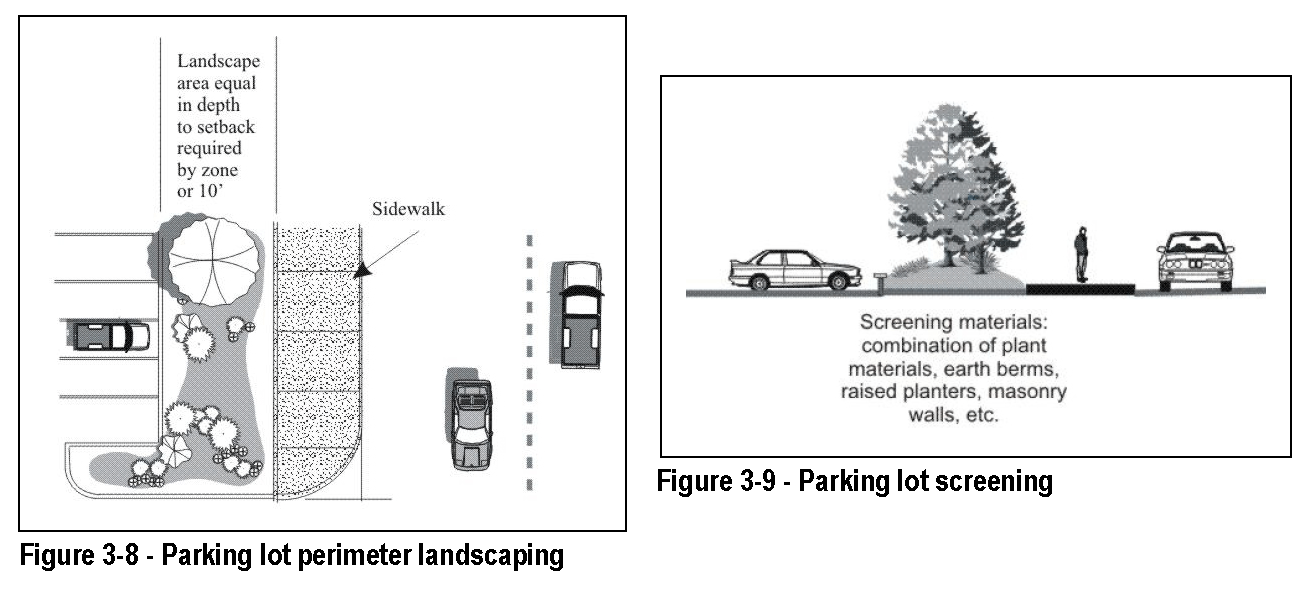
A parking area for a non-residential use adjoining a public street shall be designed to provide a landscaped planting strip between the street right-of-way and parking area equal in depth to the setback required by the applicable zone or ten feet, whichever is greater; except that the required width of the landscape strip may be reduced by the review authority where it determines that overall site area is insufficient to accommodate allowable structures and required parking along with a landscape strip of the otherwise required width.
b.
A parking area for a residential use, except for a single dwelling, shall be designed to provide a landscaped planting strip between the street right-of-way and parking area equal in depth to the setback required by the applicable zone.
c.
The landscaping shall be designed and maintained to screen cars from view from the street to a minimum height of thirty-six inches, but shall not exceed any applicable height limit for landscaping within a setback.
d.
Screening materials may include a combination of plant materials, earth berms, raised planters, solid decorative masonry walls, or other screening devices which meet the intent of this requirement.
e.
Shade trees shall be provided at a minimum rate of one for every twenty-five linear feet of landscaped area, or other spacing as determined by the review authority to be appropriate to the site and surrounding development.
f.
Plant materials, signs, or structures within a traffic safety sight area of a driveway shall comply with Section 17.30.040 (fences, walls, and screening).
2.
Adjacent to Side or Rear Property Lines. Parking areas for nonresidential uses shall provide a perimeter landscape strip at least six feet wide (inside dimension) where the parking area adjoins a side or rear property line. The required width of the landscape strip may be reduced by the review authority where it first determines that certain factors would justify the reduction (e.g., the overall site area is insufficient to accommodate the allowable structures and required parking along with a landscape strip of the otherwise required width or that the otherwise required width would be inconsistent with the existing development patterns on adjacent properties). The requirement for a landscape strip may be satisfied by a setback or buffer area that is otherwise required. Trees shall be provided at the rate of one for each twenty-five linear feet of landscaped area, or other spacing as determined by the review authority to be appropriate to the site and surrounding development.
3.
Adjacent to Structures. When a parking area is located adjacent to a nonresidential structure, a minimum six-foot wide (inside dimension) landscape strip shall be provided adjacent to the structure, exclusive of any building entries, or areas immediately adjacent to the wall of the structure that serve as pedestrian access ways. The required width of the landscape strip may be reduced by the review authority where it first determines that certain factors would justify the reduction (e.g., the overall site area is insufficient to accommodate the allowable structures and required parking along with a landscape strip of the otherwise required width or that the otherwise required width would be inconsistent with the existing development patterns on adjacent properties).
4.
Adjacent to Residential Use. A nonresidential parking area abutting a residential use shall provide a landscaped buffer setback with a minimum of ten-foot between the parking area and the property line of the residential use; provided that the review authority may reduce this requirement where it determines that site area is severely constrained.
a.
A six-foot high solid decorative masonry wall or fence, except for approved pedestrian access, and landscape buffer shall be provided along the property line to address land use compatibility issues (e.g., light/glare and nuisance noise) as determined by the review authority.
b.
Trees shall be provided at the rate of one for each twenty-five linear feet of landscaped area, or other spacing as determined by the review authority to be appropriate to the site and surrounding development.
D.
Interior Parking Lot Landscaping.
1.
Amount of Landscaping. Multifamily, commercial, and industrial uses shall provide landscaping within each outdoor parking area at a minimum ratio of ten percent of the gross area of the parking lot (including all drive and parking aisles). The review authority may grant an exception for small, infill parking lots where compliance with this standard is not feasible without significantly reducing the number of parking spaces. Trees not less than five feet in height and fifteen-gallon container in size shall be planted throughout the parcel and along any street frontage. At a minimum, one shade tree shall be provided for every five parking spaces.
2.
Location of Landscaping. Landscaping shall be evenly dispersed throughout the parking area, as follows.
a.
Orchard-style planting (the placement of trees in uniformly spaced rows) is encouraged for larger parking areas.
b.
Parking lots with more than fifty spaces shall provide a concentration of landscape elements at primary entrances, including, at a minimum, specimen trees, flowering plants, enhanced paving, and project identification.
c.
Landscaping shall be located so that pedestrians are not required to cross unpaved landscaped areas to reach building entrances from parked cars. This shall be achieved through proper orientation of the landscaped fingers and islands, and by providing pedestrian access through landscaped areas that would otherwise block direct pedestrian routes.
3.
Groundwater Recharge. The design of parking lot landscape areas shall consider, and may, where appropriate, be required to include provisions for the on-site detention of stormwater runoff, pollutant cleansing, and groundwater recharge.
17.34.040 - Landscaping standards.
A.
Minimum Dimensions. Each area of landscaping shall have a minimum interior width of six feet within the residential and commercial zones, and five feet in the industrial zones. These dimensions may be reduced where the review authority determines they are infeasible because of limited site area. Wherever this development code requires a landscaped area of a specified width, the width shall be measured within any curb or wall bordering the landscaping area.
B.
Protective Curbing. Required landscaping shall be protected with a minimum six-inch high concrete curb, except adjacent to bicycle paths, or where otherwise deemed unnecessary by the director.
C.
Safety Requirements. Landscape materials shall be located so that at maturity they do not:
1.
Interfere with safe sight distances for bicycle, pedestrian, or vehicular traffic;
2.
Conflict with overhead lights, utility lines, or walkway lights; or
3.
Block bicycle or pedestrian ways.
D.
Use of Lawns or Turf. Lawns or turf shall be limited to twenty percent of the total landscaped area on the site and only where the applicant provides calculations approved by the director that demonstrate that the irrigation requirements will not exceed standard low water usage. No lawns or turf shall be allowed:
1.
In any area of ten feet or less in width. Lawns or turf may be allowed on narrower areas where the review authority first determines that certain factors would justify the reduction (e.g., the ability to achieve a specified theme); or
2.
On any slope exceeding fifteen percent (twenty-five percent, where other project water-saving techniques compensate for the increased runoff). A level buffer zone of eighteen inches shall be provided between bermed lawn or turf areas and any hardscape (e.g., any street, walkway, or similar feature).
E.
Water Features. Decorative water features (e.g., fountains, ponds, waterfalls) shall have recirculating water systems.
F.
Maximum Amount of Single Dwelling Paving Allowed.
1.
Paving shall be limited to no more than fifty percent of the front or street side setback areas in order to limit the amount of hardscape paving in these areas; except that the review authority may reduce this requirement where it determines that an irregularly shaped or small lot lacks sufficient area for adequate driveway and pedestrian access.
2.
Increases in the maximum amount of allowable hardscape paving may be approved by the director if necessary to provide safe ingress and egress for the site.
3.
No parking shall be allowed in the landscaped areas.
4.
Single dwelling front and street side setback areas shall only be used for the temporary parking of motor vehicles. Storage of vehicles in these areas shall not be allowed.
5.
No vehicles shall be parked in the front and/or street side setback areas other than on a paved driveway.
G.
Community Design Guidelines. Landscaping and irrigation system design shall consider the community design guidelines water conservation landscape and irrigation provisions.
17.34.050 - Screening.
See Section 17.30.040 (fences, walls, and screening).
17.34.060 - Visual obstructions.
A.
Obstruction of Clear Vision Prohibited. When placed within or immediately adjacent to a dedicated public right-of-way, no landscape material shall be allowed to obstruct the vision of motorists or pedestrians so as create a potential traffic hazard.
B.
Landscaping Designed for Screening. Landscaping that is primarily intended or designed for fencing and screening purposes shall not be allowed to exceed three feet in height within a required front setback area.
C.
Landscaping Within the Traffic Safety Visibility Area. On the street sides of a corner parcel, no landscaping shall be allowed to exceed three feet in height above the top of the existing or proposed street curb within the traffic safety visibility area required by Section 17.30.040 (fences, walls, and screening), above.
17.34.070 - Trees.
A.
Five-Gallon or Larger Size Containers Required. In order to achieve a more immediate effect, all trees planted on the street sides of a newly developed parcel shall be transplanted from five-gallon or larger size containers.
B.
Tree Proposed to Replace Mature Specimen Trees. A tree proposed to replace an existing mature specimen tree shall be transplanted from a minimum twenty-four-gallon size container in compliance with the city's tree preservation and protection ordinance.
C.
Street Trees Required. At least one street tree shall be properly installed for each thirty-foot length of right-of-way and shall be maintained in compliance with Section 17.34.140 (maintenance of landscape areas), below. The review authority may modify this requirement depending on the chosen tree species and its typical spread at maturity.
D.
Tree Supports Required. All trees shall be adequately supported when planted. The supports shall be maintained until the trees are capable of withstanding the force of wind on their own.
E.
Trees Required to be Preserved. Where existing trees are required to be preserved, all new development shall be designed in a manner which respects the current drip lines in compliance with the city's tree preservation and protection ordinance.
17.34.080 - Solar access.
When trees are incorporated into an approved landscaping plan, they shall be planted in a manner which maximizes the provision of sunlight to nearby windows and/or solar collectors situated on-site or on an adjoining property.
17.34.090 - Irrigation system requirements.
All landscaped areas, except those approved for maintenance with intentionally unirrigated native plants, shall include an automatic irrigation system designed and installed in compliance with the following.
A.
Water-Efficient Systems Required. Water-efficient systems (e.g., bubbler-type, drip, mini-spray, or similar system) shall be used unless infeasible. Low-flow sprinkler heads with matched precipitation rates shall be used when spray or rotor-type heads are specified for watering shrubs and ground cover areas. Lawn or turf areas shall be sized and shaped so they can be efficiently irrigated. Spray or run-off onto paved areas shall be avoided.
B.
Dual or Multi-Program Controllers Required. Dual or multi-program controllers with separated valves and circuits shall be used when the project contains more than one type of landscape treatment (e.g., ground cover, lawn or turf, shrub, tree areas), or a variety of solar aspects. Soil moisture-sensing devices and rain sensors shall be used on larger projects (fifteen thousand plus square feet of landscaped area) to minimize or eliminate over-watering.
C.
Minimal Wind Conflict and Evaporation Loss. Watering shall be scheduled at times of minimal wind conflict and evaporation loss.
D.
Matched Precipitation Rates Required. Sprinkler heads shall have matched precipitation rates within each valve zone.
E.
Check Valves Required. Check valves are required where elevation differential may cause low head drainage.
17.34.100 - Plan review responsibilities.
A.
Review and Approval of Conceptual Plans. The review authority shall be primarily responsible for the review and approval of the conceptual landscape plans and related improvements within the city.
B.
Prior Approval Required. All new construction shall receive prior approval of all landscape plans from the development review committee (DRC).
C.
Review and Approval of Final Plans. The final landscape plans and related improvements shall be reviewed and approved by the department, unless review and approval has been requested by the review authority.
17.34.110 - Changes to approved landscape plans.
The director may authorize minor changes from the requirements of this chapter.
A.
Definition of Minor Change. For purposes of this section, minor changes shall be defined as changes to the landscaping plans that are not visible and do not affect the theme or character established for the subject development project.
B.
Failure to Comply with Definition of Minor. If the director determines that a requested change does not comply with the definition of minor specified in Subsection A., above, the requested change may only be approved by the review authority that originally approved the landscaping plans.
17.34.120 - Statement of surety.
When required by the director, surety in the form of cash, letter of credit, performance bond, or instrument of credit, in an amount equal to one hundred fifty percent of the total value of all plant materials, irrigation, installation, and maintenance shall be posted with the city for a two-year period in compliance with Section 17.74.050 (performance guarantees). The director may require statements of surety for phased development projects, a legitimate delay in landscape installation due to seasonal requirements (including adverse weather conditions), and similar circumstances where it may not be advisable or desirable to install all approved landscaping and irrigation before occupancy of the site.
17.34.130 - Installation.
A.
Professional Oversight Required. Each landscaping and irrigation system shall be installed under the supervision and inspection of a qualified professional.
B.
Timing of Installation. Landscaping and irrigation systems shall be installed in compliance with the approved plans before final building inspection.
C.
Extensions of Time. An extension of time for the completion of landscaping and irrigation system installation may be granted by the building official if implementation is secured by an agreement or posting of adequate bond or cash deposit to guarantee performance under the agreement as required by the building official, in compliance with Section 17.34.120 (statement of surety).
D.
Certification of Landscaping and Irrigation Installation. Before final inspection or issuance of a certificate of occupancy by the building official, a letter signed by a licensed landscape architect, or the landscape contractor who performed the installation shall be submitted to the department and the building official certifying that the landscaping and irrigation for the project has been installed in compliance with the approved plans.
17.34.140 - Maintenance of landscape areas.
A.
Maintenance Required.
1.
All landscaping (e.g., ground cover, hedges, lawns, shrubs, and trees) shall be maintained in a healthful and thriving condition at all times.
2.
Irrigation systems and their components shall be maintained in a fully functional manner consistent with the originally approved design and the provisions of this chapter.
3.
Regular maintenance shall include checking, adjusting, and repairing irrigation equipment; resetting automatic controllers; aerating and dethatching lawn or turf areas; adding/replenishing mulch, fertilizer, and soil amendments; mowing, pruning, and trimming, in compliance with acceptable horticultural practices; and watering all landscaped areas.
4.
The landscaping shall regularly be kept clean and free of debris, litter, and weeds.
5.
All dead or decaying material shall be replaced with new material within thirty days upon notice of the department.
6.
All fences and walls which have been incorporated into an approved landscaping plan shall regularly be maintained in an attractive and safe manner.
B.
Maintenance Agreement Required. If required by the review authority, and before final inspection or occupancy, and before the recordation of a final subdivision map where applicable, the applicant shall enter into a landscape maintenance agreement with the city to guarantee proper maintenance in compliance with Subsection A (maintenance required), above. The form and content of the agreement shall be approved by the city attorney and the director.
C.
Water Waste Prohibited. Water waste in existing developments resulting from inefficient landscape irrigation leading to excessive runoff, low head drainage, overspray, and other similar conditions where water flows onto adjacent property, non-irrigated areas, walks, roadways, or structures is prohibited.
D.
Enforcement. Failure to maintain landscape areas in compliance with this section shall be deemed a public nuisance, and shall be subject to abatement in compliance with Chapter 9.28 of the Municipal Code, and/or the applicable planning permit may be revoked in compliance with Chapter 17.98 (enforcement).
17.36.010 - Purpose.
The requirements of this chapter are intended to ensure that suitable off-street parking and loading facilities are provided for all uses and developments, and that the facilities are properly designed, attractive, and located to be unobtrusive while meeting the needs of the specific use.
17.36.020 - Applicability.
A.
Off-Street Parking and Loading Required. Each land use and structure, including a change or expansion of a land use or structure, shall provide suitable off-street parking and loading facilities in compliance with this chapter.
B.
Timing of Improvements. A land use shall not be commenced, and a structure shall not be occupied until the parking and loading improvements required by this chapter are completed and approved by the director.
C.
Common, Shared, or Municipal Parking. Where common or shared parking has been duly authorized or where parking can be provided through a municipal parking lot, the parking requirements required by this chapter shall not apply.
D.
Parking District. The parking requirements required by this chapter shall not apply in those areas where a parking district has been duly established.
17.36.030 - General parking regulations.
A.
Parking and Loading Spaces to Be Permanent. Each parking and loading space shall be permanently available, marked, and maintained for parking or loading purposes for the use it is intended to serve; provided, that the approval of a limited term permit (Section 17.72.040) may allow the temporary use of a parking or loading space for other purposes.
B.
Parking and Loading to Be Unrestricted. A lessee, owner, tenant, or other person having control of the operation of a premises for which parking or loading spaces are required by this chapter shall not prevent, prohibit, or restrict authorized persons from using the spaces without the prior approval of the director.
C.
Vehicles for Sale. No vehicle, trailer, or other personal property shall be parked on private property for the purpose of displaying the vehicle, trailer, or other personal property for hire, rental, or sale, unless the applicable zone allows the use, and the person or business at that location is licensed to sell vehicles, trailers, or other personal property.
D.
Recreational Vehicle (RV) Parking.
1.
The storage (parking for any period longer than seventy-two hours) of a recreational vehicle (RV) and/or boat in a residential zone shall be allowed only when all portions of the vehicle or boat are located entirely within the property boundaries and do not extend into the public right-of-way.
2.
Parking within setback areas shall also comply with Section 17.30.030 (build-to line and setback requirements and exceptions).
17.36.040 - Number of parking spaces required.
Each land use shall be provided the number of off-street parking spaces required by this section. See Sections 17.36.060 and 17.36.070 for off-street parking requirements for bicycles and motorcycles, respectively.
A.
Parking Requirements by Land Use.
1.
Each land use shall provide the number of off-street parking spaces required by Table 3-3, except where a greater number of spaces is authorized through minor use permit or use permit approval in compliance with Section 17.72.060.
2.
A land use not specifically listed in Table 3-3 shall provide parking as required by the director. The director shall use the requirements in Table 3-3 as a guide in determining the appropriate number of off-street parking spaces required for the use (e.g., similar uses, similar parking demands, with or without specific parking studies). The director may refer the determination to the commission.
3.
In any case where Table 3-3 expresses a parking requirement based on floor area in square feet (for example: one space for each one thousand sf), "sf" shall mean square feet of gross interior leasable floor area, unless stated otherwise (e.g., ground area).
4.
A single use with accessory components shall provide parking for each component. For example, a hotel with a gift shop shall provide the parking spaces required by Table 3-3 for a hotel (e.g., the guest rooms), and for a gift shop.
B.
Requirements for Traditional Community Development Zones. See Chapter 17.21 (traditional community development zones) for off-street parking and drive requirements applicable to the TC, NC, NC-Flex, NG-1, NG-2, and NG3 zones.
C.
Expansion of Structure, Change in Use. See Subsection M. (nonconforming parking), below.
D.
Multi-Tenant Sites.
1.
A site with multiple tenants (e.g., two or more) shall provide the aggregate number of parking spaces required for each separate use (e.g., sum of the separate requirements for each use), except where the site is developed as an integrated shopping center with shared parking and no spaces reserved for a particular use. In this instance, the parking shall be provided as required by Table 3-3 for a shopping center.
2.
When a multi-tenant center includes one or more uses that will need more parking than retail uses (e.g., a health/fitness facility, restaurant, or theater) additional parking shall be required for the non-retail use unless a parking reduction is approved in compliance with [Section] 17.36.080 (reduction of parking requirements), below.
E.
Alternate Use of Parking Areas Prohibited. Off-street parking areas shall not be used for the repair, servicing, or storage of vehicles or materials, or any other work area. Use of off-street parking areas for the sale of any goods or services may only be allowed with the approval of a limited term permit in compliance with Section 17.72.040.
F.
No Reduction of Parking Facility Allowed. No off-street parking facility shall be reduced in capacity or in area without sufficient additional capacity or additional area being provided in order to comply with the parking regulations of this chapter, subject to the approval of the director.
G.
Recreational Vehicle (RV) Parking Spaces. Off-street recreational vehicle (RV) parking spaces shall be provided as follows for retail uses, shopping centers, and visitor attractions that are required by this chapter to provide one hundred or more off-street parking spaces.
1.
Number of RV Spaces Required. RV parking spaces shall be provided at a minimum ratio of one RV space for each one hundred off-street vehicle parking spaces, or fraction thereof, required by this chapter.
2.
RV Stall Dimensions. Each RV parking space shall be designed as a pull-through space with a minimum width of twelve feet and a minimum length of forty feet, with fourteen feet of vertical clearance.
3.
Modifications by Director. The director may modify the provisions of this subsection through a minor variance granted in compliance with Section 17.72.070.
H.
Excessive Parking.
1.
The city discourages a land use being provided more off-street parking spaces than required by this chapter in order to avoid the inefficient use of land, unnecessary pavement, and excessive storm water runoff from paved surfaces.
2.
The provision of off-street parking spaces in excess of twenty percent of the requirements in Table 3-3 is allowed only with minor use permit approval in compliance with Section 17.72.060, and only when additional landscaping, pedestrian amenities, and necessary storm drain improvements are provided to the satisfaction of the review authority.
I.
Rounding of Calculations. If a fractional number is obtained in calculations performed in compliance with this chapter, one additional parking space shall be required for a fractional unit of one-half or above, and no additional space shall be required for a fractional unit of less than one half.
J.
Bench or Bleacher Seating. Where fixed seating is provided as benches, bleachers, pews, or similar seating, a seat shall be defined as twenty-four inches of bench space for the purpose of calculating the number of parking spaces required by Table 3-3.
K.
Parking Based on Employees. Whenever parking requirements are based on the number of employees, calculations shall be based on the largest number of employees on duty at any one time.
L.
Use of On-Street Parking—Exception. Available on-street parking spaces cannot be used to meet the off-street parking requirements identified in this chapter. An exception to this provision may be granted for a large family day care home, subject to the same minor use permit required for the facility in compliance with Section 17.72.060.
1.
The minor use permit may be issued if it meets all of the following criteria, in addition to the findings identified in Section 17.72.060:
a.
The exception shall be granted only for uses in an existing structure. It shall not be granted for any expansion of gross floor area to a structure, for new construction, or where the use of an existing structure has been intensified by subletting portions of the structure for additional uses;
b.
The maximum amount of parking which is feasible shall be provided on-site; and
c.
The exception shall only be granted in situations where the city engineer has determined that the exception will not result in potentially unsafe conditions for vehicles or pedestrians.
2.
Each minor use permit that grants an exception to off-street parking requirements shall be reviewed on an annual basis and, if it is found that the use of on-street parking spaces by the facility is creating a nuisance, the city may initiate proceedings to revoke the minor use permit in compliance with Section 17.98.030 (revocations and modifications).
M.
Nonconforming Parking. A use or structure with nonconforming off-street parking (e.g., insufficient off-street parking to meet the current land use requirements in compliance with Table 3-3 [parking requirements by land use], below) may be physically enlarged (e.g., expansion of structure or outdoor land use) or undergo a change in use in compliance with the following provisions.
1.
Residential Uses. No additional parking spaces shall be required; provided, the change does not increase the number of dwelling units, nor eliminate the only portion of the site that can be used for the required or existing parking or access.
2.
Nonresidential Uses.
a.
The number of existing parking spaces shall be maintained on the site and additional parking spaces shall be provided in compliance with this chapter and subparagraph.
b.
If the use is enlarged (e.g., expansion of structure or outdoor land use) so that it requires more parking than the previous use, only the number of parking spaces required for the enlargement shall be required to be added to the existing parking spaces.
c.
If the use of the structure is changed to one that requires more parking than the previous use, only the difference between the number of parking spaces required for the previous use and those required for the new use shall be required to be added to the existing parking spaces.
d.
The change shall not eliminate the only portion of the site that can be used for the required or existing parking or access.
3.
Waiver by Director. The director may waive parking requirements when a nonconforming structure is proposed for rehabilitation (e.g., no enlargement or change/intensification of the land use) if the director determines that the existing structure location, parcel size, or topography renders the requirement unreasonable.
N.
Parking Requirements for Density Bonus Projects. A residential development project that complies with the requirements of Section 17.32.020 (eligibility for bonus, incentives, or concessions) may have parking requirements approved in compliance with Section 17.32.050 (parking requirements in density bonus projects).
TABLE 3-3 - PARKING REQUIREMENTS BY LAND USE
(Ord. No. 818, § 3(Exh. A), 9-13-2022)
17.36.050 - Parking for the disabled.
Parking spaces required for the disabled shall be provided in compliance with all applicable state and federal requirements. All spaces for the disabled shall be located so that:
A.
The spaces provide easy access from the closest parking area to the major entrances of the use for which they are provided;
B.
The disabled individual is not compelled to wheel or walk behind parked cars other than his or her own; and
C.
A pedestrian way accessible to physically disabled persons shall be provided from each parking space to related facilities including curb cuts and/or ramps.
17.36.060 - Bicycle parking.
Each use or development which requires off street parking spaces in compliance with this chapter may substitute bicycle spaces for vehicle spaces at the rate of eight bicycle spaces for one vehicle space, up to a maximum of ten percent of the required vehicle spaces, subject to development review committee (DRC) approval.
17.36.070 - Motorcycle parking.
A commercial or other nonresidential development may substitute motorcycle spaces for required auto spaces at the rate of one motorcycle space for each twenty-five auto spaces, up to a maximum of ten percent of the required vehicle spaces, subject to development review committee (DRC) approval.
17.36.080 - Reduction of parking requirements.
A.
Shared On-Site Parking.
1.
Where two or more uses on the same site or adjacent parcels have distinct and differing peak parking usage periods (e.g., a theater and a bank), a reduction in the required number of parking spaces may be allowed in the following manner:
a.
Upon approval of a minor use permit, in compliance with Section 17.72.060, the director may reduce the total parking space requirement by up to a maximum of twenty percent; or
b.
Upon approval of a use permit, in compliance with Section 17.72.060, the commission may reduce the total parking space requirement by twenty percent or more.
2.
Approval shall also require a recorded covenant running with the land, recorded by the owner of the parking lot, guaranteeing that the required parking will be maintained exclusively for the use served for the duration of the use.
B.
Reduction of Required ParkIng. The review authority may reduce the number of parking spaces required by Section 17.36.040 (number of parking spaces required), above, through the granting of a use permit or minor use permit (depending on the amount of reduction requested) in compliance with Section 17.72.060, based on quantitative information provided by the applicant that documents the need for fewer spaces (e.g., sales receipts, documentation of customer frequency, information on parking standards required for the proposed land use by other cities, etc.).
17.36.090 - Parking design and development standards.
Required parking areas shall be designed, constructed, and properly maintained in compliance with the following requirements. Except where noted, the director may modify the requirements of this section through minor use permit approval (Section 17.72.060).
A.
Access to Parking. Access to parking areas shall be provided as follows for all parking areas other than garages for individual dwelling units.
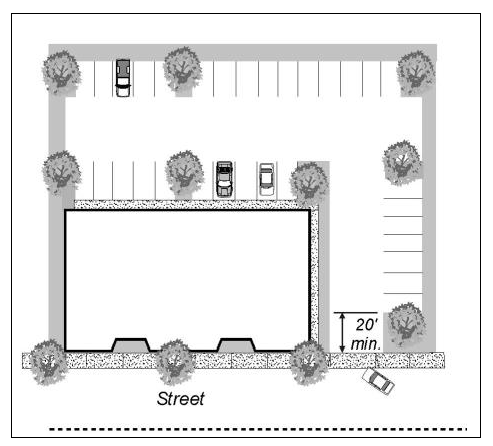
Figure 3-10 - Queuing area
1.
Parking areas shall provide suitable maneuvering area so that vehicles enter from and exit to a public street in a forward direction only.
a.
Parking lots shall be designed to prevent access at any point other than at designated access drives.
b.
Single dwellings and multi-family dwellings units (up to a maximum of four units) are exempt from this requirement, unless specifically required by conditions of a discretionary permit.
c.
This requirement does not apply to alleys, unless so specified in a specific zone.
2.
A nonresidential development that provides fifty or more parking spaces shall have access driveways that are not intersected by a parking aisle, parking space, or another access driveway for a minimum distance of twenty feet from the street right-of-way, to provide a queuing or stacking area for vehicles entering and exiting the parking area. See Figure 3-10.
3.
A minimum unobstructed clearance height of fourteen feet shall be maintained above areas accessible to vehicles within nonresidential developments.
B.
Access to Adjacent Sites.
1.
Nonresidential Developments.
a.
Applicants for nonresidential developments are encouraged to provide on-site vehicle access to parking areas on adjacent nonresidential properties to provide for convenience, safety, and efficient circulation.
b.
A joint access agreement running with the land shall be recorded by the owners of the abutting properties, as approved by the director, guaranteeing the continued availability of the shared access between the properties.
2.
Residential Developments. Shared pedestrian access between adjacent residential developments is also strongly encouraged.
C.
Location of Parking. Parking areas shall be located as follows:
1.
Residential. Residential parking shall be located on the same parcel as the uses served.
2.
Nonresidential.
a.
Nonresidential parking shall be located on the same parcel as the uses served, except in the case of shared parking approved in compliance with Section 17.36.080 (reduction of parking requirements).
b.
Upon approval of a minor use permit in compliance with Section 17.72.060, the director may allow the parking to be located within three hundred feet of the parcel if shared parking, in compliance with Subsection 17.36.080.A (shared on-site parking), above, or public parking facilities are used to meet the parking requirements.
3.
Within Required Setbacks.
a.
Nonresidential parking shall not be located within a required front setback.
b.
Parking may be located within a required side or rear setback; provided that it is separated from the side or rear property line by a minimum five-foot wide landscaped area.
D.
Parking Space and Lot Dimensions.
1.
Minimum Parking Space and Driveway Dimensions. Each parking space, driveway, and other parking lot features shall comply with the minimum dimension requirements in Tables 3-4 and 3-5, below, and as illustrated in Figures 3-11 and 3-12. The director shall not reduce these requirements.
TABLE 3-4 MINIMUM STANDARD PARKING SPACE CONFIGURATION
TABLE 3-5 STANDARD VEHICLE SPACE REQUIREMENTS
2.
Space Width Abutting a Column, Fence, or Wall. When the length of a parking space abuts a column, fence, wall, or other obstruction, the required width of the entire parking space shall be increased by at least one foot.
3.
Vehicle Overhanging Landscaped Area or Walkway Prohibited. The required length of a parking space shall not provide for a vehicle overhanging a landscaped area (other than landscaped areas planted with grass or groundcover), sidewalk or walkway. The entire length shall be composed of a surfacing material in compliance with Subsection H (proper grading, surfacing, and maintenance of parking lots required), below.
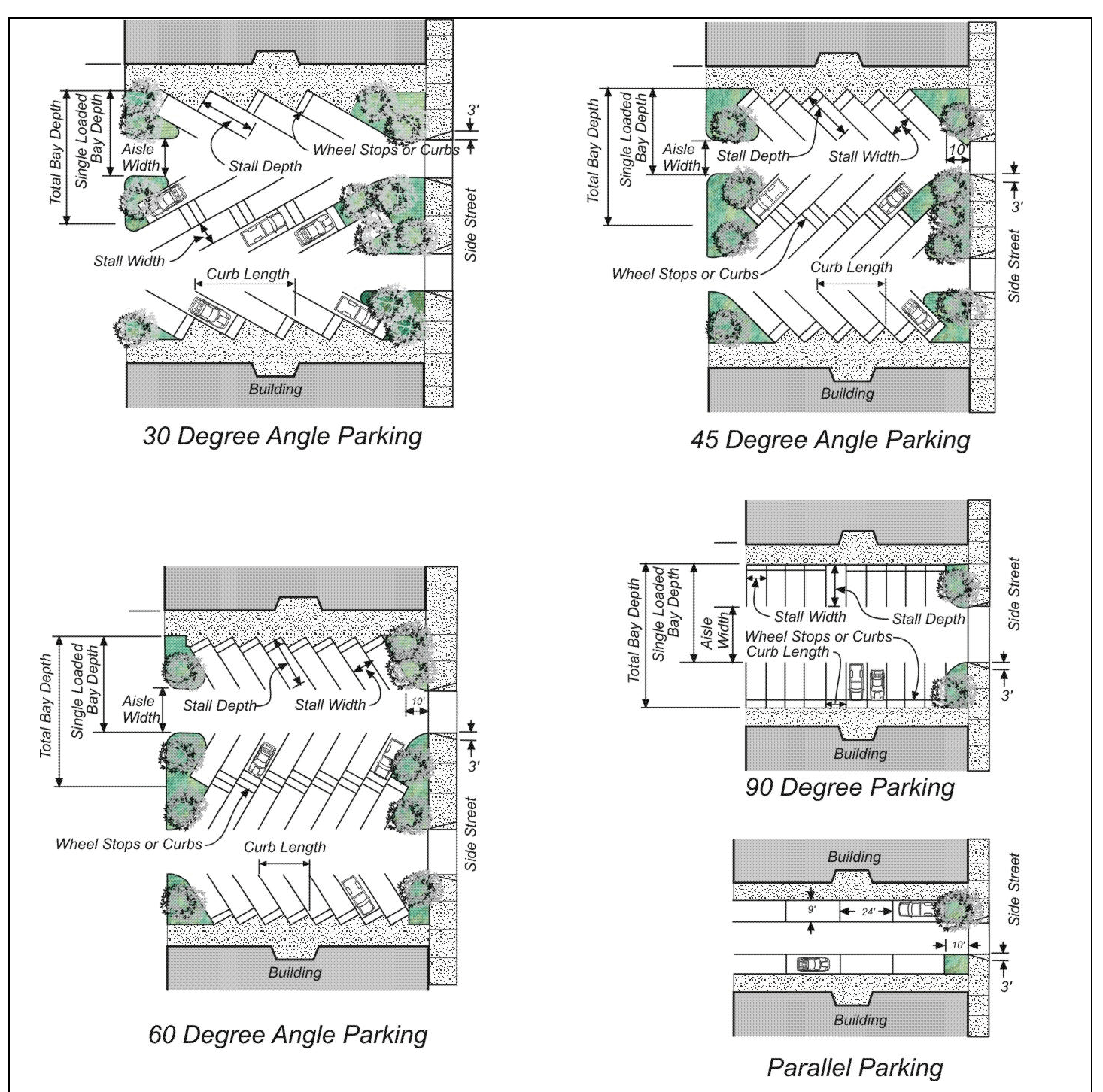
Figure 3-11 - Parking lot dimensions
4.
Use of Compact Vehicle Spaces.
a.
Allowable use of compact vehicle spaces.
(1)
The first ten spaces of any project shall be standard sized spaces.
(2)
In multifamily residential projects, up to twenty percent of the required uncovered parking spaces may be compact spaces.
(3)
For nonresidential projects, up to twenty percent of the required parking spaces may be compact spaces.
b.
Compact spaces shall be clearly labeled for "Compact cars" in compliance with the sign standards established by Chapter 17.38 (signs), and grouped together in one or more locations or at regular intervals so that only compact vehicles can easily maneuver into the space.
c.
Existing nonresidential developments that wish to utilize this subparagraph to create additional parking spaces (e.g., either by adding land area to an existing parking lot or modifying an existing parking lot to gain more spaces) shall first apply for minor use permit approval in compliance with Section 17.72.060.
d.
For each compact vehicle space provided as allowed by this subparagraph, thirty-five square feet of additional landscaped area shall be provided within the parking lot area.
e.
Design techniques (e.g., use of lampposts and/or extra landscaped areas at the front of compact spaces) shall be incorporated into the parking lot plan to preclude the parking of standard size vehicles in compact vehicle spaces, subject to the approval of the director.
f.
The minimum off-street parking dimensions for compact vehicle spaces shall be as identified in Table 3-6 (minimum compact parking space configuration), below.
TABLE 3-6 MINIMUM COMPACT PARKING SPACE CONFIGURATION
TABLE 3-7 COMPACT VEHICLE SPACE REQUIREMENTS
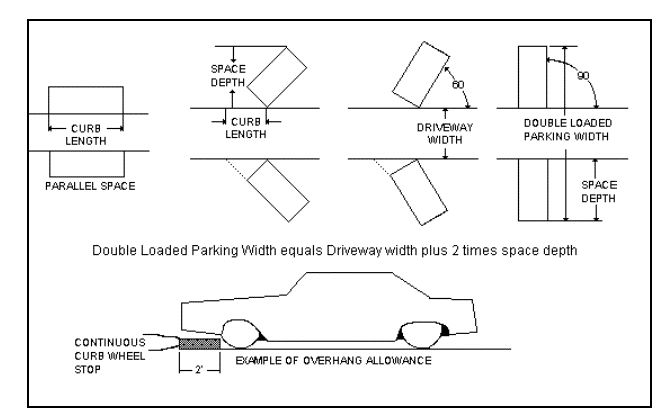
Figure 3-12 - Parking space dimensions
g.
When the length of a compact parking space abuts a column, fence, wall, or other obstruction, the required width of the entire parking space shall be increased by at least one foot.
E.
Landscaping. Landscaping shall be provided in compliance with Section 17.34.040 (landscaping standards).
F.
Lighting. Lighting shall be provided in compliance with Section 17.30.060 (outdoor lighting).
G.
Striping and Identification.
1.
Parking spaces shall be clearly outlined with four-inch wide lines painted on the parking surface.
2.
The striping shall be continuously maintained in a clear and visible manner in compliance with the approved plans.
H.
Proper Grading, Surfacing, and Maintenance of Parking Lots Required.
1.
All grading plans relating to the parking facilities shall be reviewed and approved by the city engineer before any work can commence.
a.
All off-street parking facilities shall be properly graded and drained so as to dispose of all surface water accumulated within the area of the parking lot.
b.
In no instance shall a storm drainage facility be designed to allow the flow of water into abutting property.
2.
All parking spaces and maneuvering areas shall be properly surfaced with not less than two inches of asphaltic concrete, or three and one-half inches of Portland cement concrete, or comparable material (e.g., pervious surfaces) as determined by the city engineer, and shall be continually maintained in a clean and orderly manner and kept in good repair at all times.
I.
Tandem Parking Prohibited. Use of tandem parking (when one space is located directly behind another) shall not be allowed to satisfy the off-street parking requirements of this chapter. The director may not modify this prohibition.
J.
Wheel Stops/Curbing.
1.
Continuous concrete curbing at least six inches high and six inches wide shall be provided for parking spaces located adjacent to fences, walls, property lines, landscaped areas, and structures.
2.
Individual wheel stops may be provided in lieu of continuous curbing only when the parking is adjacent to a landscaped area, and the drainage is directed to the landscaped area.
3.
When provided, wheel stops shall be placed to allow for two feet of vehicle overhang area within the dimension of the parking space.
K.
Continuous Curb Cuts Prohibited. Access to an off-street parking lot shall not be allowed to occur through the use of a continuous curb cut (e.g., where most or all of the street frontage is provided as a curb cut for access purposes).
L.
Parking Areas Within a Commercial Structure. No parking area located within the interior of a non-residential structure shall be counted in meeting the off-street parking requirements of this Chapter, except when located within a parking garage available to employees and/or the general public.
M.
Entrance or Exit Adjacent to Side Properly Line Prohibited. No entrance or exit, including driveways, to off-street parking areas shall be situated closer than three feet from a side property line, except in the case of a driveway serving more than one parking lot (e.g., a shared driveway), which shall be subject to the approval of the director.
N.
Deviation from Standards Requires a Detailed Study. No proposed parking layout which deviates from the standards identified in this section and which could create a safety hazard(s) shall be allowed unless the developer provides a detailed, stamped report or study prepared by a registered transportation engineer which demonstrates to the satisfaction of the city engineer, the director, and the commission that the parking layout is a viable alternative and is consistent with the purpose of this chapter.
17.36.100 - Driveways and site access.
A.
Compliance with the City Improvement Standards Required. Each driveway providing site access from a street, alley, or other public right-of-way shall be designed, constructed, and properly maintained in compliance with the city improvement standards.
B.
Clearance from Obstructions.
1.
The nearest edge of a driveway curb cut shall be at least three feet from the nearest property line, the centerline of a fire hydrant, light standard, traffic signal, utility pole, or other similar facility.
2.
Street trees shall be a minimum of ten feet from the driveway access, measured at the trunk.
3.
A driveway shall have an overhead clearance of fourteen feet in height except within a parking structure, which may be reduced to seven feet, six inches.
C.
Traffic Safety Visibility Areas. Structures or landscaping over three feet in height shall not be allowed within a traffic safety visibility area, with the exception of trees with the canopy trimmed to a minimum of six feet in height. See Section 17.30.050.E (height limit at street corners).
D.
Surfacing.
1.
Within all zones, driveways shall be paved and permanently maintained with asphalt, concrete, or approved paving units.
2.
Within other zones (e.g., single dwelling), driveways may be constructed with the use of other all-weather surfacing as determined to be appropriate by the city engineer, where it is first determined that a surface other than asphalt or concrete is consistent with the driveways of similar properties in the vicinity, and that the alternate surface will not impair accessibility for emergency vehicles.
3.
A driveway with a slope of ten percent or more shall be paved with rough surface concrete in all cases.
17.36.110 - Loading space requirements.
Off-street loading spaces shall be provided as required by this section. The director may modify these requirements through minor use permit approval (Section 17.72.060), where the director first determines that the operating, shipping, and delivery characteristics of the use do not require the number or type of loading spaces required by this section.
A.
Number of Loading Spaces Required. Nonresidential uses shall provide off-street loading spaces in compliance with Table 3-8 (required off-street loading spaces), below.
1.
Where Table 3-8 expresses a loading requirement based on floor area in square feet (for example: Five thousand to ten thousand sf), "sf" means square feet of gross interior leaseable floor area, unless stated otherwise.
2.
Loading docks instead of loading spaces shall be required at large retail stores, home improvement centers, and large shopping centers, as determined by the director.
3.
Loading spaces, rather than loading docks, shall be required for convenience stores, offices, restaurants, small shopping centers where truck deliveries occur on a regular basis, but where the director determines that a loading dock is not necessary.
4.
Interior loading facilities are strongly encouraged wherever determined to be feasible.
TABLE 3-8 REQUIRED OFF-STREET LOADING SPACES
B.
Standards for Off-Street Loading Areas. Off-street loading areas shall comply with the following standards:
1.
Minimum Dimensions. The dimensions of off-street loading spaces shall comply with Table 3-9 (minimum loading space configuration), below.
TABLE 3-9 MINIMUM LOADING SPACE CONFIGURATION
2.
Lighting. Loading areas shall have lighting capable of providing adequate illumination for security and safety; lighting shall also comply with the requirements of Section 17.30.060 (outdoor lighting).
3.
Location. Loading spaces shall be:
a.
As near as possible to the main structure and limited to the rear two-thirds of the parcel, if feasible;
b.
Situated to ensure that the loading facility is screened from adjacent streets;
c.
Situated to ensure that loading and unloading takes place on-site and in no case faces a public street, or is located within a required front or street side setback, adjacent public right-of-way, or other on-site traffic circulation areas;
d.
Situated to ensure that all vehicular maneuvers occur on-site. The loading areas shall allow vehicles to enter from and exit to a public street in a forward motion only;
e.
Situated so that trucks parking in them will not encroach onto the public right-of-way or into required parking spaces or driveways. Loading spaces designed for larger trucks shall have appropriately larger access to allow maneuvering without encroaching into landscaped areas; and
f.
Situated to avoid adverse impacts upon neighboring residential properties. The review authority may restrict times allowed for loading and deliveries for loading spaces that are located closer than one hundred feet to a residential zone.
4.
Loading Ramps. Plans for loading ramps or truck wells shall be accompanied by a profile drawing showing the ramp, ramp transitions, and overhead clearances.
5.
Screening. Loading areas shall be screened from abutting parcels and streets with a combination of dense landscaping and solid masonry walls with a minimum height of six feet.
6.
Striping.
a.
Loading spaces shall be striped, and identified for "loading only."
b.
The striping and "loading only" notations shall be continuously maintained in a clear and visible manner in compliance with the approved plans.
7.
Surfacing.
a.
All loading areas shall be surfaced with asphalt, concrete pavement, or comparable material as determined by the city engineer and shall be graded to dispose of all surface water to the satisfaction of the city engineer.
b.
All grading plans relating to the loading facilities shall be reviewed and approved by the city engineer before any work can commence.
17.36.120 - Parking in-lieu fees.
A.
Compliance with Ordinance No. 350. In compliance with Ordinance No. 350, any person who applies for a permit for the alteration or construction of a nonresidential structure or proposes to change the use of an existing nonresidential structure within the city's downtown area and environs shall provide the number of off-street parking spaces required by Section 17.36.040 (number of parking spaces required), above, or pay to the city an in-lieu fee for parking improvements in compliance with Council Resolution No. 84-276, as that resolution may be amended from time to time.
B.
Criteria for Determining Amount of Payment. In addition to the costs associated with land acquisition, the projected costs of providing all of the following services and improvements, based upon three hundred fifty square feet of site area for each parking space, shall be used in determining the amount of the required in-lieu payment:
1.
Asphalt surfacing;
2.
Drainage;
3.
Engineering, inspection, and contingencies;
4.
Grading;
5.
Landscaping/screening;
6.
Sand and grease traps;
7.
Striping and wheel stops; and
8.
The cost of maintaining the space for ten years.
C.
Establishment of Value of Off-Street Parking Facilities. In compliance with Council Resolution No. 84-276, as that resolution may be amended from time to time, the council shall establish the value of off-street parking facilities in the city's downtown area and environs on a per-parking-space basis. Initially, the in-lieu fee shall be two thousand dollars for each parking space. Funds collected by the city from the payments shall be deposited into a special fund and shall be used by the city only for the purpose of acquiring and/or developing future off-street parking facilities.
D.
Municipal Parking Lot Plan. A parking in-lieu fee may be accepted by the city only after it has been determined that payment of a fee will lead to the provision of conveniently located off-street parking facilities which are consistent with a currently adopted municipal parking lot plan. The plan shall determine, at a minimum, areas of need, potential parking lot locations, and proposed parking capacities.
E.
Parking Facilities Which Are Provided by the City. All off-street parking facilities which are provided by the city shall, in addition to benefitting the employees, guests, and/or patrons of the subject property, be made available for use by members of the general public. In no instance shall a publicly developed parking facility provide parking for less than eight to ten vehicles.
F.
Optional Forms of Financing. When it has been determined that parking in-lieu fees are unable to generate the revenues necessary to provide adequate off-street parking facilities in both a timely fashion and in a manner which contributes to the alleviation of traffic congestion, the city may choose to sell bonds or provide other forms of financing as an added means of providing the required moneys.
G.
Five-year Capital Improvements Program. The city shall provide for the establishment of parking lot facilities through the adoption and/or amendment of a five-year capital improvements program.
17.38.010 - Purpose.
A.
Purpose of Chapter. The regulations established by this chapter are intended to appropriately limit the number, placement, size, and type of signs allowed within the city, and to require the proper maintenance of signs.
B.
Purpose of Limitations. The purposes of these limitations and requirements are to:
1.
Avoid traffic safety hazards to bicyclists, motorists, and pedestrians, caused by visual distractions and obstructions;
2.
Promote the aesthetic and environmental values of the community by providing for signs that do not impair the attractiveness of the city as a place to live, work, and shop;
3.
Provide for signs as an effective channel of communication, while ensuring that signs are aesthetically proportioned in relation to adjacent structures and the structures to which they are attached;
4.
Safeguard and protect the public health, safety, and general welfare; and
5.
Advance the community design standards and safety standards identified in the general plan.
17.38.020 - Applicability.
A.
Signs Regulated. The requirements of this chapter shall apply to all signs in all zones.
B.
Applicability to Sign Content. The provisions of this chapter do not regulate the message content of signs (sign copy), regardless of whether the message content is commercial or noncommercial.
C.
Definitions. Definitions of the specialized terms and phrases used in this chapter may be found in Article 10 (glossary) under the term "sign."
17.38.030 - Sign permit requirements.
A.
Sign Permit Required.
1.
Approval Required. No sign shall be constructed, installed, or modified, unless a sign permit is first obtained in compliance with this section, or the sign is allowed without a sign permit by Section 17.38.040 (exemptions from sign permit requirements), below.
2.
Sign Permit Application Required with Development Application. All sign permit applications associated with a proposed development shall be submitted and reviewed concurrently with the development permit application. Both applications shall be reviewed and approved or denied by the review authority.
3.
Compliance with Standards Required. No sign permit shall be approved for an existing or proposed sign unless the sign is in compliance with all applicable requirements of this chapter.
4.
Need for Building Permits. Sign permit applications shall be routed to the building official. When, in the building official's determination, a separate electrical, plumbing, or structure permit is required, the applicant shall be notified and the sign permit shall not be issued until all other required permits are first obtained from the building department.
5.
Temporary Signs. Temporary signs shall comply with Sections 17.38.040.C (temporary signs), and Section 17.38.080 (standards for specific sign types), below.
B.
Master Sign Program required. A master sign program reviewed and recommended by the development review committee (DRC) and approved by the commission shall be required for any site with two or more tenants or five or more total signs. As part of master sign program approval, the commission may grant exceptions to the standards of this chapter for the maximum number and size of signs, based on design features including architectural style, building mass, proportion to landscaping, and site visibility.
C.
Review Authority. Table 3-9 (sign permit review authority) identifies the responsible review authority for each type of sign approval.
TABLE 3-9 SIGN PERMIT REVIEW AUTHORITY
D.
Application Requirements. An application for a sign permit shall be filed and processed in compliance with Chapter 17.70 (permit application filing and processing). The application shall be accompanied by detailed and fully dimensioned plans, architectural drawings and sketches, and data/materials identified in the department application for sign permits, and any applicable fees. It is the responsibility of the applicant to establish evidence in support of the findings required by Subsection E (findings for approval), below.
E.
Findings for Approval. The approval of a sign permit shall require that the review authority first make all the following findings, as relevant to the specific application.
1.
The proposed sign complies with the standards of Sections 17.38.070 (zone sign standards) and 17.38.080 (standards for specific sign types), and are of the minimum height and size necessary to enable pedestrians and motorists to readily identify the facility or site from a sufficient distance to safely and conveniently access the facility or site;
2.
The placement of the sign on the site is appropriate to its height, whether the sign is a freestanding or projecting;
3.
A proposed flush or projecting sign relates to the architectural design of the structure. Signs that cover windows, or that spill over and/or cover architectural features shall be prohibited;
4.
The proposed sign does not unreasonably block the sight lines of existing signs on adjacent properties;
5.
The placement and size of the sign will not impair pedestrian or vehicular safety;
6.
The design, height, location, and size of the sign is visually complementary and compatible with the scale, and architectural style of the primary structures on the site, any prominent natural features on the site, and structures and prominent natural features on adjacent properties on the same street; and
7.
The proposed sign is in substantial compliance with the design criteria in Subsection 17.38.060.F (sign design criteria and guidelines), below and the city's design guidelines.
F.
Expiration and Extension of Sign Permit Approval.
1.
A sign permit shall expire twelve months from the date of approval unless the sign has been installed, or a different expiration date is stipulated at the time of approval. Before the expiration of a sign permit, the applicant may apply to the department for an extension of up to an additional twelve months from the original date of expiration.
2.
The expiration date of the sign permit shall be automatically extended to concur with the expiration date of the companion building permit or other applicable permits for the project.
(Ord. No. 818, § 3(Exh. A), 9-13-2022)
17.38.040 - Exemptions from sign permit requirements.
The following signs, and sign-related maintenance and modification activities, are allowed without sign permit approval; provided, they comply with Section 17.38.060 (general requirements for all signs), below, and any required building permit is obtained.
A.
Nonstructural Modifications and Maintenance.
1.
Modifications to sign copy on conforming signs, or changes to the face or copy of conforming changeable copy signs; and
2.
The normal maintenance of conforming signs, except as identified in Subsection 17.38.060.I (sign maintenance), below.
B.
Identification Signs. Street identification and house identification signs not exceeding two square feet.
C.
Temporary Signs. The following temporary signs are allowed without a sign permit.
1.
Real Estate Signs. Real estate signs are allowed without a sign permit in compliance with California Civil Code Section 713, and subject to the following requirements:
a.
Commercial, Industrial, and Other Nonresidential Zones. Properties within commercial, industrial, and other nonresidential zones shall be allowed one real estate sign of no more than sixteen square feet, with a maximum height for freestanding signs of six feet, for each parcel street frontage.
b.
Residential Zones. One non-illuminated real estate sign not more than four square feet in area, including riders, advertising the lease, rent, or sale of a parcel or structure, may be located on the property it advertises.
2.
Political Signs. Political signs are allowed in compliance with the following requirements.
a.
No political sign shall be erected prior to ninety days before the election to which the sign pertains.
b.
In commercial, industrial, and other nonresidential zones, each political sign and the total of all political signs on a parcel shall not exceed thirty-two square feet in total sign area.
c.
In residential zones, no political sign shall exceed four square feet in total sign area.
d.
No political sign shall be located within a public right-of-way.
e.
All political signs shall be removed within five days after the election to which the signs pertain.
3.
Window Signs. Temporary window signs are allowed without a sign permit in compliance with Section 17.38.080.J (window signs), below, and the area of the signs shall not count towards the maximum allowable sign area.
D.
Governmental Signs. Signs installed by the city, county, or a federal or state governmental agency, because of their responsibilities for the protection of public health, safety, and general welfare, include the following:
1.
Emergency and warning signs necessary for public safety or civil defense;
2.
Traffic signs erected and maintained by an authorized public agency;
3.
Legal notices, licenses, permits, and other signs required to be displayed by law;
4.
Signs showing the location of public facilities (e.g., public telephones, restrooms, and underground utilities); and
5.
Any sign, posting, notice, or similar sign placed by or required by a governmental agency in carrying out its responsibility to protect the public health, safety, and general welfare.
E.
Miscellaneous Signs.
1.
Address numbers not exceeding twelve inches in height.
2.
Directional signs less than four square feet in size.
3.
Official flags of national, state, or local governments, or nationally recognized fraternal, public service, or religious organizations; provided, the length of the flag shall not exceed one-fourth the height of the flag pole, and the flag is not used for commercial advertising.
4.
Illumination, patterns, pictures, and/or symbols approved as architectural ornamentation or decoration by the review authority.
5.
Historical plaques erected and maintained by non-profit organizations, memorials, building cornerstones, and date-constructed stones; provided, that none of these exceed four square feet in area.
6.
Service station price signs required by state law, not exceeding the number and area required by state law. The signs shall not be internally illuminated.
7.
Signs or displays located entirely inside of a structure and not clearly visible from public view.
8.
Signs created by landscaping (e.g., all of the letters and/or symbols are composed entirely of approved landscape elements).
9.
Small, temporary signs, otherwise in compliance with the duration, number, and size requirements of this chapter, that address noncommercial issues.
17.38.050 - Prohibited signs.
A.
Types of Prohibited Signs. All signs not expressly allowed by this chapter shall be prohibited.
B.
Examples of Prohibited Signs. Examples of prohibited signs include the following:
1.
A board and other portable sidewalk signs within the public right-of-way (ROW), except A-Board and pedestal signage in compliance with Subsection 17.38.080.N;
2.
Abandoned signs;
3.
Animated signs, including electronic message display signs, and variable intensity, blinking, or flashing signs, or signs that emit a varying intensity of light or color, including time and temperature displays;
4.
Billboards and any other off-premises signs, except as allowed by Civil Code Section 713 (See Section 17.38.080.I, tourist-oriented directional signs, above);
5.
Digital monument signs and internally illuminated canopy signs in the Historical Combining Zone (H);
6.
Flags, except as specifically allowed by Subparagraph 17.38.040.E.2 (official flags), above;
7.
Freeway oriented signs, unless the sign meets the criteria listed in Subsection 17.38.080.D;
8.
Illegal signs;
9.
Inflatable or tethered signs or devices;
10.
Internally illuminated signs, except where authorized by a sign exception permit, and determined by the review authority to constitute a design element that is integrated with and enhances building architecture;
11.
Moving signs, and other similar signs that are stationary but contain moving parts;
12.
Obscene signs;
13.
Pennants and streamers, except in conjunction with an athletic event, carnival, circus, or fair, or as allowed in Subsection 17.38.080.H (temporary signs), below;
14.
Pole signs, unless the sign meets the criteria listed in Subsection 17.38.080.C;
15.
Reader board signs;
16.
Roof signs;
17.
Because of the city's compelling interest in ensuring traffic safety, signs that simulate in color, size, or design, any traffic control sign or signal, or that make use of characters, symbols, or words in a manner that interferes with, misleads, or confuses pedestrian or vehicular traffic;
18.
Second story or higher awning and window signs;
19.
Signs in the form or shape of a directional arrow, or otherwise displaying a directional arrow, except as may be approved by the review authority, or as may be required for safety and convenience and for control of pedestrian or vehicular traffic within the premises of the subject use;
20.
Signs attached to or suspended from a boat, float, vehicle, or other movable objects parked within a public right-of-way, or in a location on private property that is visible from a public right-of-way, except a sign painted directly upon, magnetically affixed to, or permanently affixed to the body or other integral part of the vehicle;
21.
Signs burned, cut, or otherwise marked on or otherwise affixed to a hillside or tree;
22.
Signs with reflective material;
23.
Signs within the public right-of-way ROW, except for signs installed or maintained by a government agency for traffic safety and directional purposes, in compliance with Subsection 17.38.060.E (signs placed within the public right-of-way), or A-Board and pedestal signage in compliance with Subsection 17.38.080.N;
24.
Signs in residential zones, except as specifically allowed in this chapter;
25.
Signs held or supported by human beings; except for noncommercial signs;
26.
Signs in storage or in the process of assembly or repair, located outside on premises other than that advertised in the signs, that are visible from a public right-of-way; and
27.
Temporary and portable signs, except as specifically allowed by Subsection 17.38.080.M (temporary signs), below.
(Ord. No. 828, § 1, 5-28-2024)
17.38.060 - General requirements for all signs.
The following rules shall govern the computation of sign area and height measurements:
A.
Sign Area Measurement. Measurements to determine compliance with the sign area limitations of this chapter shall occur as follows.
1.
Surface Area. The surface area of a sign shall be calculated by enclosing the extreme limits of all emblem, framing, logo, representation, writing, or other display within a single continuous perimeter composed of squares or rectangles with no more than eight perimeter lines. See Figure 3-13.
2.
Sign Structure. Supporting bracing or framework that is determined by the director to be clearly incidental to the display itself shall not be included in the calculation of total sign area.
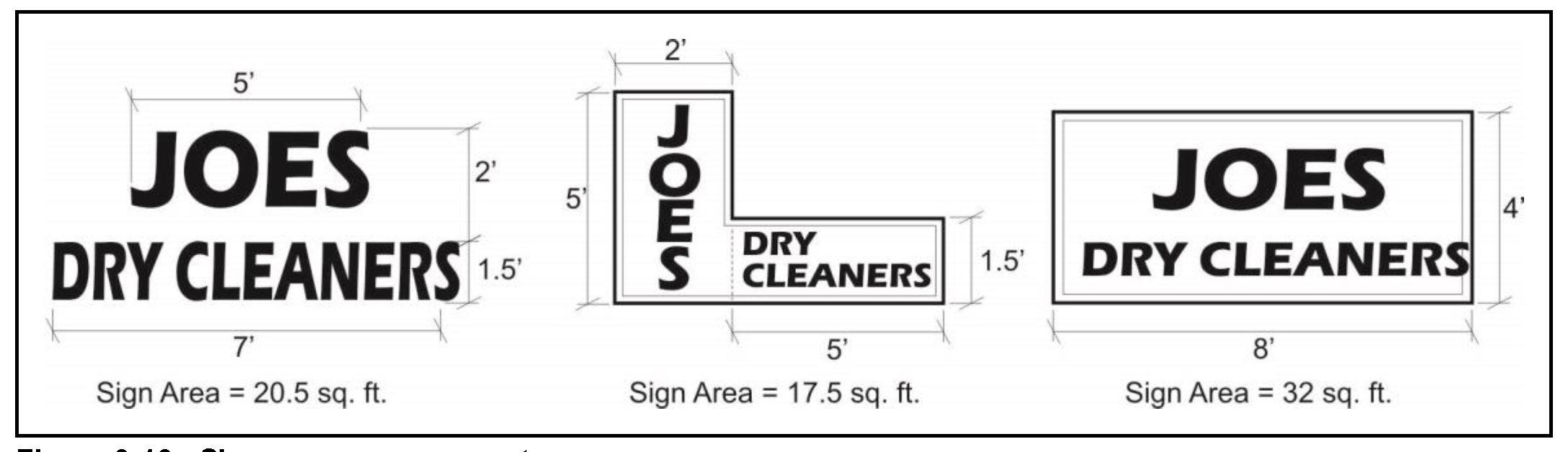
Figure 3-13 - Sign area measurement
3.
Multi-Faced Signs. The area of a double-faced sign shall be calculated for one face only, unless the two faces are not back-to-back, parallel, and/or are separated by more than twelve inches.
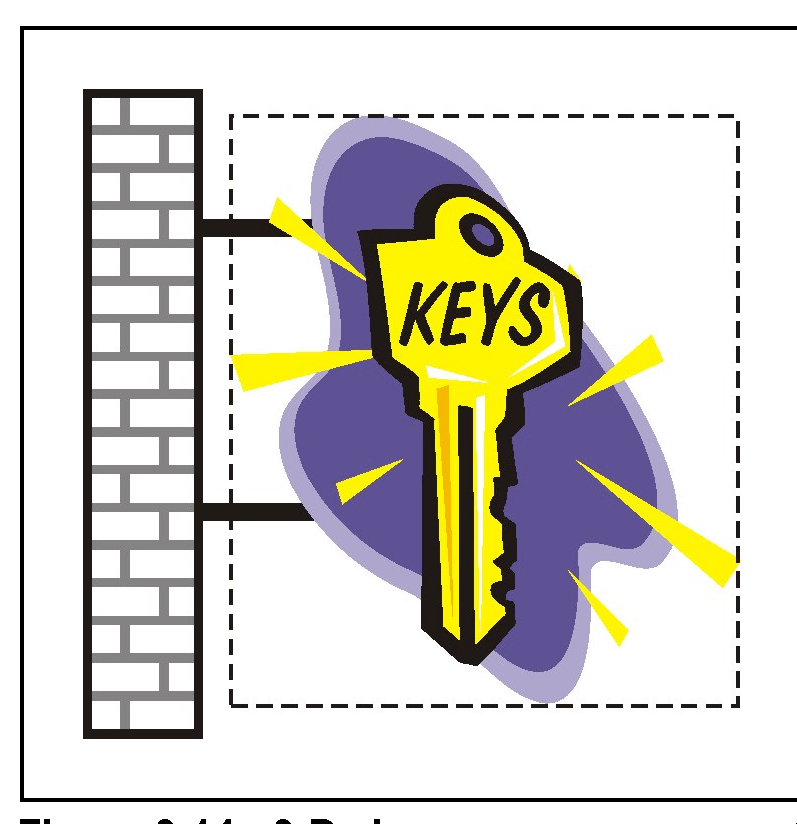
Figure 3-13 - 3-D sign area measurement
4.
Three-Dimensional Objects. The area of a sign consisting of one or more three-dimensional objects (e.g., balls, cubes, clusters of objects, sculpture, or statue-like trademarks), shall be measured as their maximum projection upon a vertical plane. See Figure 3-14.
B.
Sign Height Measurement. The height of a sign shall be computed as the vertical distance from the lowest point of the base of the sign at normal grade, to the top of the highest attached component of the sign. See Figure 3-15. Normal grade shall be construed to be the lower of either the:
1.
Existing grade before construction; or
2.
Newly established grade after construction, exclusive of any berming, filling, mounding, or excavating solely for the purpose of locating the sign.
C.
Sign Height Limitations.
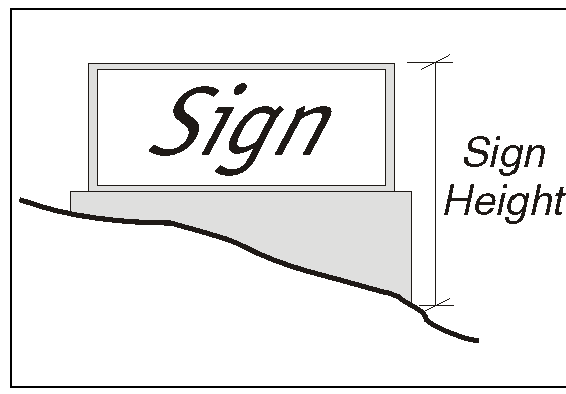
Figure 3-15 - Sign height
1.
Maximum Height for Freestanding Monument Style Signs.
a.
A freestanding sign shall not exceed a height of six feet above normal grade in all zones. Sloped sites may allow for a height of eight feet with a six-foot average height.
b.
Normal grade shall be construed in compliance with Subsection B, (sign height measurement), above.
2.
Maximum Height for Signs on Structures. The top of a sign mounted on a structure shall not extend higher than the lesser of:
a.
The top of the wall to which the sign is attached, in the case of a one-story structure;
b.
The window sills of the second floor, in the case of a multi-story structure; or
c.
Twenty feet above normal grade.
D.
Sign Location Requirements. Each sign shall be located in compliance with the following requirements, and all other applicable provisions of this chapter.
1.
Each sign shall be located on the same site as the subject of the sign, except as otherwise allowed by this chapter.
2.
No sign shall project over public property or into the public right-of-way, except where the city has granted an encroachment permit in addition to a sign permit. Any sign within the public right-of-way shall be in compliance with Subsection E (signs placed within the public right-of-way), below.
3.
No sign shall be placed so as to interfere with the operation of a door, fire escape, or window.
E.
Signs Placed Within the Public Right-of-Way.
1.
No sign shall be allowed within the public right-of-way, except for the following:
a.
Bus stop signs installed by a public transit company;
b.
Emergency warning signs erected by a governmental agency, a public utility company, or a contractor doing authorized work within the public right-of-way;
c.
Informational signs of a public utility regarding its lines, pipes, poles, or other facilities;
d.
Projecting signs, including marquee signs and suspended signs, which shall comply with the following requirements:
(1)
The minimum clearance between the lowest point of a sign and the grade immediately below shall be eight feet;
(2)
The minimum horizontal clearance between a sign and the curb line shall be two feet. The maximum projection over a public sidewalk shall be two-thirds the width of the sidewalk or six feet, whichever is less; and
(3)
The top of a projecting sign shall not exceed the height of the face of the structure by which it is supported nor be located above the top of the second floor of the structure.
e.
Public signs erected by or on behalf of a governmental agency to convey public information, identify public property, post legal notices, or direct or regulate pedestrian or vehicular traffic; or
f.
Tourist oriented directional signs, when erected and/or installed in compliance with Subsection 17.38.080.I (tourist oriented directional signs), below.
F.
Sign Design Criteria and Guidelines. The following design criteria, as well as the city's design guidelines, as they may be amended from time to time, shall be used in reviewing the design of individual signs. Substantial compliance with each of the following design criteria and the adopted design guidelines shall be required before a sign permit or building permit can be approved.
1.
Color. Colors on signs and structural members should be harmonious with one another and relate to the dominant colors of the other structures on the site. Contrasting colors may be utilized if the overall effect of the sign is still compatible with the structure colors and prevailing colors in the surrounding neighborhood (where a theme can be identified).
2.
Design and Construction. The intent of this Subsection is to ensure public safety, achieve signs of careful construction, neat and readable copy, and durability, to reduce maintenance costs, and to prevent dilapidation.
a.
Each sign shall be designed by a professional (e.g., architect, artist, building designer, landscape architect, interior designer, or another whose principal business is the design, manufacture, or sale of signs), or others who are capable of producing professional results.
b.
Each permanent sign shall be constructed by persons whose principal business is building construction or a related trade including sign manufacturing and installation businesses, or others capable of producing professional results.
3.
Materials and Structure.
a.
Sign materials (including framing and supports) shall be representative of the type and scale of materials used on the primary on-site structure and on other on-site signs.
b.
The materials of a permanent sign shall be durable and capable of withstanding weathering over the life of the sign with reasonable maintenance.
c.
The size of the structural members (e.g., braces, columns, and crossbeams) shall be proportional to the sign panel they are supporting. In general, fewer larger supporting members are preferable to many smaller supports.
d.
The use of individual letters incorporated into the design of a structure is encouraged, rather than signs with background and framing other than the structure wall.
4.
Street Address. The review authority may require that a sign include the site street address, where it determines that public safety and emergency vehicle response would be more effectively served than if the street address were displayed solely on one or more structures on the site.
G.
Copy Design Guidelines. The city does not regulate the message content (copy) of signs; however, the following are principles of good copy design and layout that can enhance the readability and attractiveness of signs. Copy design and layout consistent with these principles is encouraged, but not required.
1.
Sign copy should relate only to the name and/or nature of the business or commercial center.
2.
Permanent signs that advertise continuous sales, special prices, or include phone numbers, etc. should be avoided.
3.
Information should be conveyed briefly or by logo, symbol, or other graphic manner. The intent should be to increase the readability of the sign and thereby enhance the identity of the business.
4.
The area of letters or symbols should not exceed forty percent of the background area in commercial, industrial, and other nonresidential zones or sixty percent in residential zones.
5.
Freestanding signs should contain the street address of the parcel or the range of addresses for a multi-tenant center.
H.
Sign Lighting. Sign lighting shall be designed to minimize light and glare on surrounding rights-of-way and properties in compliance with Section 17.30.060 (outdoor lighting) and the following:
1.
External light sources shall be directed and shielded so they do not produce glare on any object other than the sign, and/or off the site of the sign.
2.
The light illuminating a sign shall not be of a brightness or intensity that will interfere with the reasonable enjoyment of residential properties.
3.
Sign illumination shall not blink, flash, flutter, or change light brightness, color, or intensity.
4.
Colored lights shall not be used at a location or in a manner so as to be confused or construed as traffic control devices.
5.
Neither the direct nor reflected light from primary light sources shall create hazards for pedestrians or operators of motor vehicles.
6.
Reflective-type bulbs and incandescent lamps that exceed fifteen watts shall not be used so as to expose the face of the bulb or lamp to a public right-of-way or adjacent property.
7.
Light sources shall utilize hard-wired fluorescent or compact fluorescent lamps, or other lighting technology that is of equal or greater energy efficiency.
8.
Permanently installed illuminated panels, visible tubing, and strings of lights outlining all or a portion of a structure, other than lighting that is primarily for indirectly illuminating architectural features, signs, or landscaping, shall be deemed "signs" subject to this chapter and shall be counted as part of the allowed maximum sign area. Each line of tubing or lights shall be deemed to have a minimum width of at least six inches for the purpose of calculating sign area.
I.
Sign Maintenance.
1.
Each sign and supporting hardware, including temporary signs, shall be maintained in good repair and functioning properly at all times.
2.
A repair to a sign shall be of equal or better quality of materials and design as the original sign.
3.
A sign that is not properly maintained and is dilapidated shall be deemed a public nuisance, and may be abated in compliance with the Municipal Code.
4.
When an existing sign is removed or replaced, all brackets, poles, and other supports that are no longer required shall be removed.
5.
Unpainted areas shall be painted to match the adjacent portion of the structure or the sign support structure.
17.38.070 - Zone sign standards.
Each sign shall comply with the sign area, height, number, type, and other requirements of this section, except as otherwise provided in Section 17.38.080 (standards for specific sign types).
A.
Residential Zones. Each sign in a residential zone shall comply with the following requirements.
TABLE 3-10 SIGN STANDARDS FOR RESIDENTIAL ZONES
B.
Commercial and Industrial Zones. Each sign in the commercial, office, industrial, and other nonresidential zones established by Section 17.12.020 (zoning map and zones) shall comply with the requirements in Table 3-11, in addition to the provisions of Section 17.38.080 (standards for specific sign types), below, as applicable.
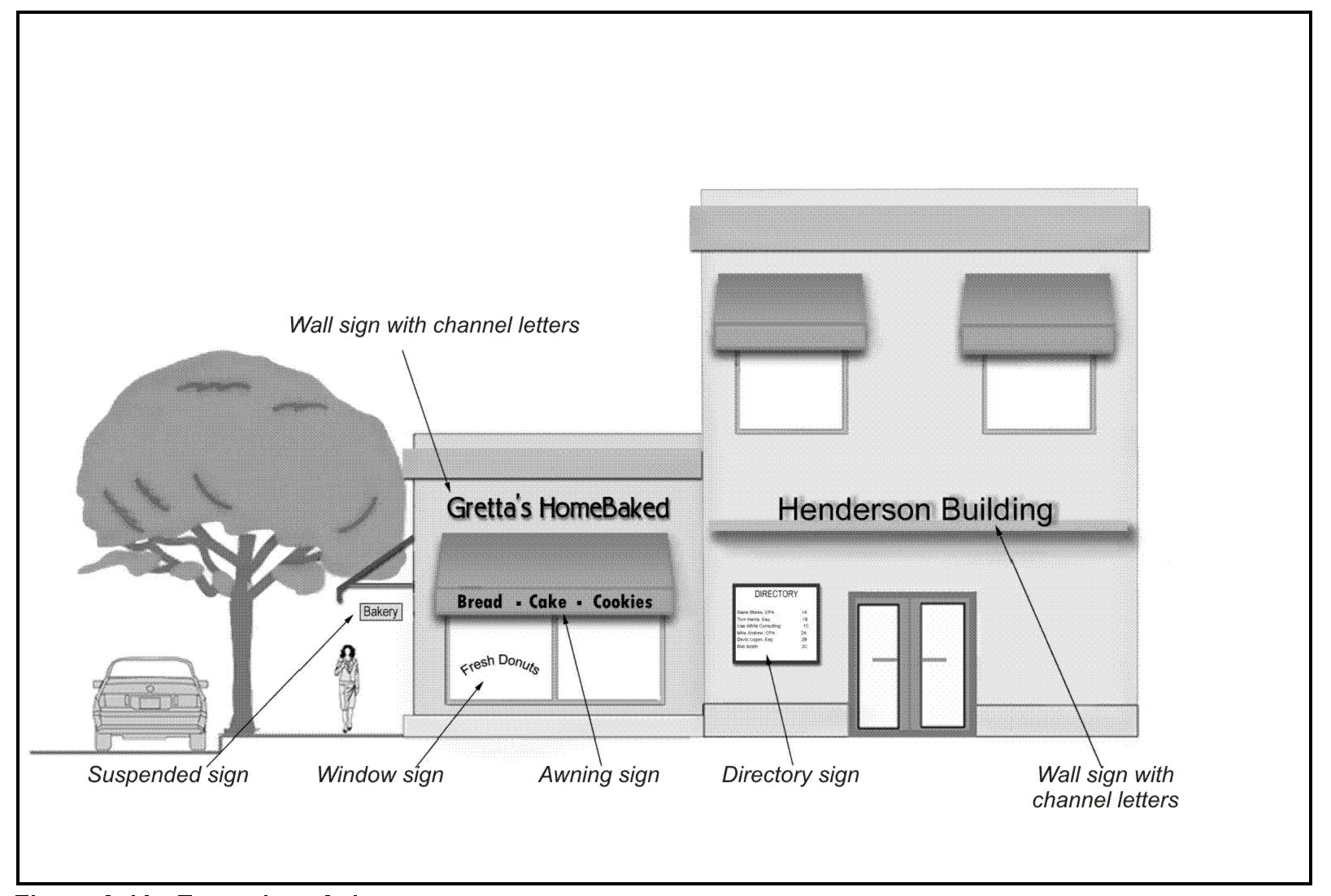
Figure 3-16 - Examples of sign types
TABLE 3-11 SIGN STANDARDS FOR COMMERCIAL AND INDUSTRIAL ZONES
17.38.080 - Standards for specific sign types.
Proposed signs shall comply with the following standards applicable to the specific sign type. Each sign type listed in this section shall be included in the calculation of the total sign area allowed on a parcel by Section 17.38.070 (zone sign standards), above, unless this section explicitly provides otherwise. Each sign shall also comply with the sign area, height, and other requirements of Section 17.38.060 (general requirements for all signs) above, and all other applicable provisions of this chapter. Any noncommercial message may be substituted for the copy on any commercial sign allowed by this chapter.
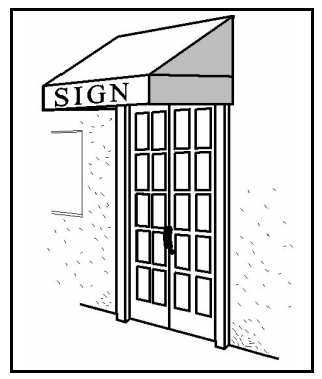
Figure 3-17 - Awning sign
A.
Awning Signs. The following standards apply to awning signs in all zones where allowed by Section 17.38.070 (zone sign standards), above. See Figure 3-17.
1.
Signs on awnings are limited to ground level or second story occupancies only.
2.
Awnings shall not be internally illuminated. Direct exterior lighting may be allowed.
3.
Translucent awning materials are prohibited.
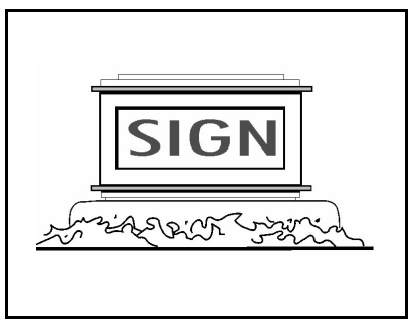
Figure 3-18 - Freestanding monument sign
B.
Freestanding Monument Signs. The following standards apply to freestanding monument style signs in all zones where allowed by Section 17.38.070 (zone sign standards), above. See Figure 3-18.
1.
Multiple signs shall be separated by a minimum of seventy-five feet to ensure adequate visibility for all signs. The review authority may modify this requirement where the locations of existing signs on adjacent properties would make the seventy-five-foot separation impractical.
2.
A sign shall not project over public property, vehicular easements, or rights-of-way, and shall not obstruct a traffic safety sight area, as determined by the review authority.
3.
To assist emergency response personnel in locating the site, freestanding signs shall contain an externally illuminated street address plate. Numbers shall be a minimum of six inches in height. Street address numbers not exceeding twelve inches in height shall not be included in calculations of allowed maximum sign area.
4.
The sign shall be set back a minimum of five feet from a street or interior property line and a minimum of ten feet from the edge of a driveway.
5.
To ensure the readability of the sign, the minimum letter size allowed shall be four inches. Sign copy shall not be located closer than one half-letter height to the sign edge or other line of copy.
6.
The design of each sign shall be compatible with and enhance the architectural design of the structures on the site.
7.
Landscaping with automatic irrigation shall be provided at the base of the supporting structure equal to twice the area of one face of the monument style sign or seventy-five square feet, whichever is greater. For example, forty square feet of sign area equals eighty square feet of landscaped area. The review authority may waive or modify this requirement on a case-by-case basis to take into account existing site conditions.
C.
Freestanding Pole Signs. Freestanding pole signs shall be permitted if the following criteria are met:
1.
Allowed only in NC-Flex (neighborhood center-flex) zoning district.
2.
Must match character and style of the primary building.
3.
Sign area shall not exceed twelve square feet.
4.
Sign support posts shall be a minimum of two inches in diameter.
5.
Sign height shall not exceed five feet.
6.
Sign shall be set back a minimum of five feet from rear of sidewalk.
D.
Freeway Oriented Signs. Freeway oriented signs shall only be permitted if all the following criteria are met:
1.
The property shall be zoned for, and used as, commercial/retail use.
2.
The property contains at least three hundred feet of freeway frontage.
3.
The property abuts Highways 20 and/or 49.
4.
There can be only one freeway sign per tenant.
5.
The sign shall be either a freestanding sign or a wall sign.
6.
Multiple tenants must share the freestanding sign, or each tenant can have a separate wall sign.
7.
A freestanding monument style sign can be up to ten feet in height, but no higher than six feet above the immediately adjacent freeway travel lane.
8.
A freestanding sign shall incorporate the architectural style and features of the building.
9.
The freestanding sign shall have a minimum setback of fifteen feet from the highway right-of-way.
10.
The signs shall be externally illuminated.
11.
The maximum number of signs and sign area are still limited to the standards in Table 3-11.
E.
Historic Signs.
1.
Signs within the Historic (H) Zone. All signs within the historic (H) zone shall require review and approval by the director in compliance with Section 17.28.040.C.2. Signs within this zone shall contribute to the historical theme and design character of their setting. The DRC may allow types of signs other than those allowed in the zone standards within this special district when the signs are part of a unified design plan which furthers the purpose and intent of this chapter.
2.
Designation of Historic Signs. The designation of a sign as a historic sign is intended to allow nonconforming signs that otherwise would be required to be removed in compliance with Section 17.38.090 (nonconforming signs), below, to remain if the sign or the establishment associated with the sign are determined to have historical or local identity significance to the city in compliance with the standards established in this section.
3.
Application and Review Authority. Application for historic sign status may be submitted by the business owner, property owner, or the city. All applications for historic status shall be reviewed and recommended by the historic commission and approved or denied by the DRC in compliance with this section.
4.
Historic Sign Criteria. The DRC may designate a sign as a historic sign if the sign is the type of sign that would be subject to removal as a nonconforming sign and the sign meets both of the following criteria:
a.
Historically Significant. A sign is historically significant if the sign was created or erected at least thirty-five years ago and is either representative of a significant sign-making technique or style of a historic era or represents entities or establishments that are an important part of the city's history; and
b.
Visually Significant. The sign is visually significant in at least two of the following regards:
(1)
The sign possesses a uniqueness and charm because it has aged gracefully;
(2)
The sign remains a classic example of craftsmanship or style of the period when it was constructed and uses materials in an exemplary way;
(3)
The sign compliments its architectural surroundings or is particularly well integrated into the structure; and/or
(4)
The sign is an inventive representation of the use, name, or logo of the business or structure.
5.
Procedure for Designation of Historic Signs.
a.
The director shall review each application for historic sign status on a case-by-case basis to assess whether the sign meets the criteria for designation as a historic sign.
b.
Based on this review, the director shall prepare findings and recommendations to the DRC regarding their assessment and the application's merit regarding the designation.
c.
The DRC shall review the findings and recommendations at a noticed public hearing.
d.
The DRC may ask the director to undertake additional analysis to assess whether a sign should receive historic sign status.
e.
The DRC may also ask the director to undertake additional analysis of any sign already designated as a historic sign.
f.
The director's additional analyses and recommendations shall be available for public review and comment before the DRC's subsequent meeting for review and action on a historic sign.
g.
Upon due consideration of the findings and recommendations plus all public testimony and comment, the DRC may approve or deny designation of historic sign status.
6.
Alteration of Historic Signs.
a.
Designated historic signs may not be physically altered, except for routine cleaning and general maintenance.
b.
Cleaning and maintenance shall be consistent with the preservation of the character or defining features of the sign in all respects.
c.
A designated historic sign may be removed if desired.
d.
If a designated historic sign is removed, its historic status shall be revoked.
e.
If the character or defining features of a designated historic sign are altered, its designation as a historic sign shall be revoked and the sign shall be removed.
f.
Where applicable, the sign may be modified to conform to the requirements of this chapter.
7.
Maintenance in a Functioning Condition Required. All parts of the exempted historic sign including neon tubes, incandescent lights and shields, and sign faces, shall be maintained in a functioning condition as historically intended for the sign to the greatest degree possible.
8.
Signs Originally Designed to Flash or Move. Parts of historic signs originally designed to flash or move may be allowed to continue to flash or move. There shall be no alterations to the historic pattern, speed, or direction of flashing or moving elements.
9.
Alteration of Wording or Image. The wording or image of a historic sign may be altered only if the alterations do not substantially change the historic dimensions, height, scale, style, or type of materials of the historic sign.
10.
Failure to Maintain. Failure to maintain a historic sign as required above shall be grounds for disallowing an exemption from the requirements of this chapter. The sign shall thereafter be brought into compliance with the requirements of this chapter subject to a determination by the director.
F.
Murals. A mural painted on the wall of a structure may be allowed in any commercial, industrial, and other nonresidential zone subject to the following requirements:
1.
Murals on privately-owned property shall comply with requirements of Section 17.30.100(B) (standards for visual art).
2.
Murals on publicly-owned property shall comply with requirements of Section 17.30.100(C) (standards for visual art).
3.
A mural without text visible from a public right-of-way may be approved in addition to (not counted as part of) the sign area allowed by Section 17.38.070 (zone sign standards), above; a mural with text shall comply with the sign area limitations applicable to the site.
G.
Neon Signs and Architectural Lighting. The use of neon tubes for signs or architectural elements shall be allowed in commercial zones only subject to the following requirements:
1.
Neon lighting, if used, should be limited in application to proper architectural period and/or building styling.
2.
Neon signage in the historical district combining zone (H) should be limited to replacements, maintenance and/or enhancement to existing signs. Neon on historical buildings is generally prohibited unless the building period and/or styling are designed to accommodate neon features.
3.
Any new neon signage or neon building features shall be subject to separate review and approval by the development review committee.
4.
The use of neon window signs in the historical district combining zone (H) is prohibited.
5.
Neon signage or neon building features should be used as an enhancement to the building and related architecture.
6.
The use of red, yellow or green neon is discouraged where these colors could be confused with traffic signals.

Figure 3-19 - Projecting Sign
H.
Projecting, Overhead, or Suspended Signs. The following standards apply to projecting, overhead, or suspended signs in all zones where allowed by Section 17.38.070 (zone sign standards), above. See Figure 3-19.
1.
The minimum horizontal clearance between a sign and the curb line shall be two feet. The maximum projection over a public sidewalk shall be two-thirds the width of the public sidewalk below or six feet, whichever is less. Any projection over a public right-of way shall require an encroachment permit.
2.
The top of a projecting sign shall not exceed the lesser of fourteen feet, eave height, parapet height, or sill height of a second-floor window. No portion of the sign shall project above the eave line of a sloped roof or the top of the parapet on a flat roof.
3.
A projecting sign shall maintain a minimum clearance of eight feet from the bottom of the sign to the finished grade immediately below.
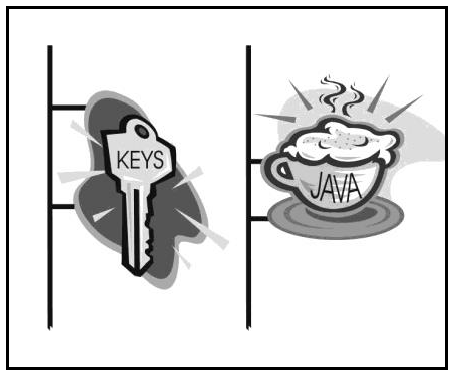
Figure 3-20 - Use of icons/symbols
4.
Icon signs using shapes or symbols uniquely suited to the business, creative shapes, and three-dimensional signs are encouraged. See Figure 3-20.
5.
Each sign shall be graphically designed for pedestrians, with a maximum area of eight square feet on each sign face, regardless of the length of the building frontage.
6.
Sign supports shall be well-designed and compatible with the design of the sign.
I.
Shopping Center Identification Signs. In addition to the signs allowed for individual tenants or businesses, a shopping center with five or more tenants and a minimum of fifty thousand square feet of gross floor area may have one overall identification sign as follows.
1.
One identification sign may be approved for each frontage, not to exceed one hundred square feet in total sign area or twenty feet in height.
2.
An identification sign shall not be included in the maximum sign area or size calculations for the individual tenants or businesses.
J.
Temporary Signs. Temporary signs are allowed subject to the following requirements.
1.
Banners and Pennants. Temporary banners and pennants on private property shall comply with the following requirements.
a.
The use of a banner or pennants may be allowed only for a licensed business for a period not to exceed thirty days per year. A temporary sign permit may be issued for not less than two consecutive days, up to thirty days. A business can secure multiple temporary sign permits but the combined time period cannot exceed thirty days per year. This is in addition to the thirty days allowed for a business grand opening banner. The maximum size of the banner is twenty-four square feet.
b.
The application for a temporary sign permit for banners or pennants shall include the dates proposed by the applicant for scheduled banner use.
c.
A bond may be required by the director for a temporary sign permit for banners or pennants. The bond may be revoked if the temporary banner or pennants are not removed within two days following their scheduled use.
2.
Subdivision Signs. Signs advertising land subdivisions in any zone shall be limited to one two-sided sign of thirty-two square feet in area placed at a right angle to the street, or two one-sided signs of thirty-two square feet in area each facing the street. The signs shall be at least two hundred feet apart and shall be placed only on the subdivision site, or on land leased by the subdivider. The signs shall be removed within thirty days after the final lot of the subdivision is sold. The signs shall be non-illuminated.
3.
Construction Signs. Construction identification signs may be allowed in all zones in compliance with the following standards.
a.
The number, placement, size, and type of signs shall comply with the sign requirements of Section 17.38.070 (zone sign standards), above, for the applicable zone.
b.
The signs shall be removed before final building inspection or the issuance of a certificate of occupancy.
4.
Other Temporary Signs. Temporary signs may be authorized by the director, upon submittal of a sign application, plan for removal, and the fees required by the city's planning fee schedule.
a.
Maximum Sign Area. In a residential zone, the combined area of temporary signs shall not exceed four square feet. In a commercial, industrial, and other nonresidential zone, the combined area of temporary signs shall not exceed that allowed for the non-corner lots in the zone in which the sign will be placed.
b.
Maximum Number of Signs. No more than one temporary sign shall be erected on a premise at a time.
c.
Sign Placement. Temporary signs shall be subject to the same placement and height restrictions as permanent signs for the applicable zone.
d.
Time Limits. Temporary signs shall not be allowed for more than thirty consecutive days. Temporary signs shall not be allowed for a combined total of more than sixty days in a twelve-month period. Signs advertising a particular event shall be removed within ten days after the event.
K.
Tourist Oriented Directional Signs. The following standards apply to tourist oriented off-site directional signs (e.g., providing directions to local wineries and other locations of interest) in all zones where allowed by Section 17.38.070 (zone sign standards), above.
1.
The signs shall be smaller in size, each not exceeding four square feet in sign area.
2.
The signs shall be non-illuminated in order to be compatible with their generally rural surroundings.
3.
The signs shall be hand crafted, generally made of wood or other natural materials.
4.
The signs shall be subject to the issuance of an encroachment permit.
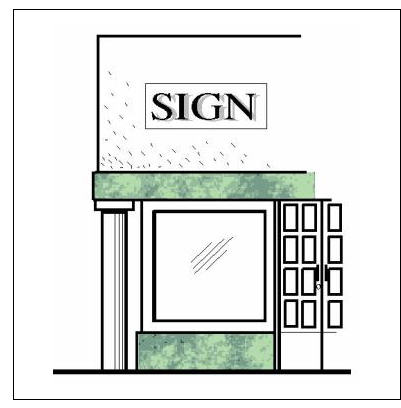
Figure 3-21 - Wall sign
L.
Wall Signs. The following standards apply to wall signs in all zones where allowed by Section 17.38.070 (zone sign standards), above. See Figure 3-21.
1.
One wall sign may be located on a primary structure frontage, and on one secondary structure frontage.
2.
The area of a wall sign shall not exceed one square foot for each linear foot of primary tenant frontage and one-half additional square foot for each linear foot of secondary tenant frontage or ten percent of the area of the building facade on which the sign is mounted or painted, including the area of windows, doors, and recesses, whichever is less. The total area of all signs on a primary frontage shall not exceed one hundred square feet and the total area of all signs on a secondary frontage shall not exceed fifty square feet.
3.
A wall sign shall not project more than twelve inches from the surface to which it is attached.
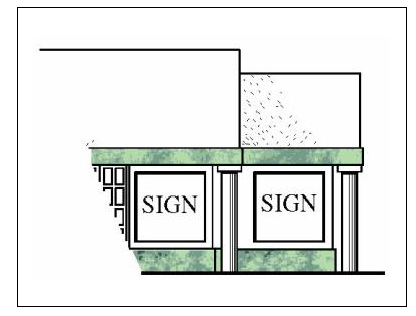
Figure 3-22 - Window sign
M.
Window Signs. The following standards apply to permanent window signs where allowed by Section 17.38.070 (zone sign standards), above. See Figure 3-22.
1.
Maximum Sign Area. Permanent window signs shall not occupy more than fifteen percent of the total window area. The window sign area shall count towards the maximum allowable sign area.
2.
Sign Location. Signs shall be allowed only on windows located on the ground level and second story of a structure frontage.
3.
Sign Materials. Signs shall consist of individual letters, logos, or symbols applied to, stenciled on, or etched into the glass surface; however, neon signs with transparent backgrounds may be hung inside the window glass.
4.
Unobstructed Observation. The lowermost portion of the entire window (a minimum of twenty-four inches) shall be clear of any signs in order to allow for unobstructed observation by security personal (e.g., city police, private security, etc.).
N.
Notwithstanding the sign standards set forth in Table 3-11, each retail or restaurant tenant located in a commercial or industrial zone shall be allowed A-Board or pedestal signage within the public right-of-way (ROW) subject to the following standards:
1.
Each retail or restaurant tenant located within a Traditional Community Zone shall be allowed one A-Board sign or one pedestal sign, but not both.
2.
A-Board or pedestal signs shall be located no further than ten feet from a main customer entrance of the business advertised on the sign.
3.
Signs shall be limited to size limitations of six square feet for each side and shall be no taller than four feet in height.
4.
Signs shall not be placed so as to obstruct any door or fire escape of any building nor impede an accessible path of travel within the ROW in violation of the Americans with Disability Act (ADA) standards. A minimum four-foot-wide clear path of travel in the ROW shall be maintained.
5.
Signs shall be maintained in a good and safe structural condition.
6.
Signs shall be removed from the ROW and placed indoors outside business hours.
7.
Signs shall be stabilized to withstand wind gusts or shall be removed during windy conditions.
8.
No lighting, flags, balloons, or other such features shall be attached to signs.
9.
Any violation of this section may result in removal and temporary storage of signage by the city.
10.
Any business entity that places signage within city right-of-way or on city property shall be required to maintain liability insurance that meets limits outlined in Section 12.48.310 of the Grass Valley City Municipal Code and shall be required to demonstrate such coverage at any time, and without prior notice, at the request of a city official.
11.
In addition to the standards above and elsewhere in this code, the following additional standards shall apply to all a-board and pedestal signs within the historical district:
a.
Signage material shall be wood or chalkboard and shall feature wood framing. The signage and framing may be unfinished or may be painted in colors consistent with a manufacturer's historic color palette.
b.
Whiteboard and/or plastic signage materials shall not be permitted.
(Ord. No. 828, § 2, 5-28-2024; Ord. No. 837, § 2, 9-23-2025)
17.38.090 - Nonconforming signs.
A nonconforming sign is any permanent or temporary sign that was legally established and maintained in compliance with the provisions of all applicable laws in effect at the time of original installation, but does not now comply with the requirements of this development code. A nonconforming sign shall not be altered, moved, or replaced except in compliance with this development code, or as exempt in compliance with this section.
A.
General Requirements.
1.
A nonconforming sign shall not be:
a.
Changed to another nonconforming sign;
b.
Structurally altered to extend its useful life;
c.
Enlarged;
d.
Re-established after a business is discontinued for ninety days;
e.
Re-established after damage or destruction exceeding fifty percent of the replacement cost of the sign immediately before the damage or destruction, or its components, as determined by the building official; or
f.
Re-installed after facade improvements that required the removal of the sign during construction.
2.
An interruption in the use of a nonconforming sign that continues for ninety days or more shall be deemed to be an abandonment of the sign. Subsequent use shall comply with this chapter. Non-occupation or non-operation of the building or business advertised on the sign shall be deemed an interruption of the use of the sign.
B.
Exemptions. The following signs shall be exempt from the requirements and limitations of this section:
1.
Any sign covered by a master sign program previously approved by the city, or by the county prior to annexation; and
2.
Any sign within a shopping center previously approved by the city or county, except for:
a.
Pole signs; and
b.
Shopping center identification signs that exceed the allowable sign area allowed by this chapter.
C.
Historic sign exemptions. A sign granted historic sign status in compliance with Subsection 17.38.080.C (historic signs), above, is exempt from the requirements of this section.
D.
Exceptions. The commission may grant an exception to the requirements of Subsection A (general requirements) provided that the commission first finds that:
1.
The new proposed sign is significantly more conforming in area and/or height than the existing sign; and
2.
The approval and installation of the new sign will eliminate the existing nonconforming sign.
E.
Removal of Certain Types of Nonconforming Signs. The following nonconforming signs shall be removed or altered to be conforming within fifteen years of the effective date of this chapter, unless an earlier removal is required by Subsection F (removal of nonconforming signs).
1.
Oversized awning signs, building signs, freestanding signs, projecting signs, wall signs, and window signs that exceed the maximum sign area allowed by this chapter.
2.
Billboards and other off-premises signs.
3.
Freeway oriented signs.
4.
Internally illuminated signs with a translucent face.
5.
Moving signs.
6.
Pole signs.
7.
Roof signs, where no other opportunity for a sign exists.
F.
Removal of Nonconforming Signs. A nonconforming sign shall be removed if the sign is:
1.
More than fifty percent destroyed, and the destruction is other than facial copy replacement. A nonconforming sign shall be deemed to be more than fifty percent destroyed if the estimated cost of reconstruction or repair exceeds fifty percent of the replacement cost as determined by the building official;
2.
Remodeled, unless the sign is remodeled to comply with this chapter;
3.
Located on a structure that is enlarged or expanded, if the nonconforming sign is affected by the construction, enlargement, expansion, or remodel. An enlargement, expansion, or remodel of the portion of the structure upon which the nonconforming sign is located or that is more than fifty percent of the building area shall be deemed to affect the nonconforming sign; or
4.
The nonconforming sign is temporary.
G.
Deactivation of Flashing Features. The owner of a sign that contains flashing features shall permanently deactivate the flashing features.
H.
Continuance of Nonconforming Signs. Except as provided in Subsections E. and F., above, a nonconforming sign may be continued and shall be maintained in good condition as required by these regulations, but it shall not be:
1.
Structurally changed to another nonconforming sign, although its copy and pictorial content may be changed;
2.
Structurally altered to prolong the life of the sign, except to meet safety requirements; or
3.
Altered or expanded in any manner that increases the degree of nonconformity.
I.
Repairing and Repainting. Nonconforming signs shall only be painted and repaired in place and shall not be removed from their existing location, except for building remodeling, unless removal of the sign for painting or repair is part of the sign's customary maintenance and repair.
J.
Change of Business Ownership. Upon a change of ownership, the new owner of a nonconforming sign may change sign copy so long as there is no change in the structure or configuration of the sign.
K.
Maintenance and Allowed Changes. Sign copy and face changes, non-structural modifications, and non-structural maintenance (e.g., painting, rust removal) are allowed without a sign permit up to a maximum of fifty percent of the replacement cost of the sign, as determined by the building official. Face changes not including copy, and any non-structural modifications exceeding fifty percent of the replacement cost of the sign, and any structural changes shall comply with all applicable standards of this chapter and shall require a sign permit.
17.38.100 - Public nuisance, abatement, and violation.
A.
Signs on Vacated Buildings.
1.
Any sign located on a site that has been vacated for ninety days or more, and any sign located on a multi-tenant building advertising a business that has been vacated for ninety days or more shall be immediately removed by the owner after the expiration of the ninety-day period.
2.
The director may issue a notice to remove the sign after the expiration of the ninety-day period.
3.
The notice to remove shall specify a fifteen-day period during which the sign shall be removed.
4.
If the owner does not remove the sign during the fifteen-day period, the director may have the sign removed at costs borne by the city.
5.
The city will bill the property owner for all costs related to removal and storage. Costs not paid to the city shall be recovered in compliance with Chapter 17.98 (enforcement).
B.
Abatement or Conformance when Required. A sign that does not comply with this chapter, but lawfully existed and was maintained before the effective date of this development code, shall be removed or made to conform within sixty days after written notice by the director, when:
1.
The use of the premises changes and/or the exterior of the structure or other site conditions are to be altered; or
2.
The sign is damaged by any cause resulting in replacement or repair costs equal to or greater than fifty percent of its replacement value at the time the damage occurs, as determined by the building official.
C.
Violation, Abatement, and Penalties. A sign within the city that fails to comply with the requirements of this chapter, other applicable state statutes or city ordinances, or for which a sign permit has not been obtained in compliance with this chapter, shall be subject to abatement in compliance with Chapter 17.98 (enforcement).
17.38.110 - Judicial review.
Any permit issued or denied in compliance with this chapter shall be subject to expedited judicial review to the extent provided by the time limits identified in Code of Civil Procedure Section 1094.6 et seq.

