
Grass Valley City Zoning Code
ARTICLE 6
SITE DEVELOPMENT REGULATIONS
Chapter 17.60 - GRADING PERMIT REQUIREMENTS AND PROCEDURES
Sections:
Chapter 17.62 - GRADING, EROSION, AND SEDIMENT CONTROL STANDARDS
Sections:
17.60.010 - Title and purpose.
This chapter and Chapter 17.62 (grading, erosion, and sediment control standards) are and may be cited as the City of Grass Valley Grading Ordinance. These provisions supplement the city's improvement standards, and are enacted to regulate grading within the city, and establish standards for grading, including filling and excavation activities, to:
A.
Minimize hazards to life and property;
B.
Protect against soil erosion, and the pollution of watercourses with nutrients, sediments, or other earthen materials generated on or caused by surface runoff on or across an area of approved grading;
C.
Protect the safety, use and stability of public rights-of-way and drainage channels;
D.
Protect fish and wildlife habitats, and promote the retention and restoration of riparian vegetation;
E.
Protect the scenic character and value of the city; and
F.
Ensure that the intended use of a graded site is consistent with the general plan and any applicable specific plan.
17.60.020 - Applicability of grading regulations.
A.
Compliance Required. The provisions of this chapter and Chapter 17.62 (grading, erosion, and sediment control standards) apply to all excavation, fill, or other grading activities occurring within the city, unless exempted from permit requirements by Section 17.60.030 (grading permit requirements). The grading standards in Chapter 17.62 apply to all grading activities regardless of whether a permit is required. It shall be unlawful and a violation of this development code for any person to:
1.
Cause, conduct, allow, or furnish equipment or any labor for any grading activities without first obtaining any planning permit required by this development code, and a grading permit when required by Section 17.60.030 (grading permit requirements), and without complying with all applicable grading standards of Chapter 17.62 (grading, erosion, and sediment control standards); or
2.
Violate or fail to comply with any term or condition of the approval of any grading permit issued in compliance with this chapter.
B.
Prior Project Approval Required. No grading permit shall be issued and no grading shall occur unless a development project has been first authorized on the site in compliance with Article 7 (planning permit procedures), or Article 8 (subdivision regulations and procedures).
C.
Liability. Nothing in this chapter, or the issuance of a grading permit, compliance with the provisions of this chapter or with any permit conditions shall relieve any person from responsibility for damage to other persons or property, nor impose any liability upon the city, its officers, agents or employees, for damage to other persons or property.
D.
Hazards. Whenever the building official or designee determines that excavations, embankments, or fills on private property constitute a hazard to public safety, endanger property, or adversely affect the safety, use or stability of adjacent property, an overhead or underground utility, or a public way, watercourse, or drainage channel, or could adversely affect the water quality or any water body or watercourse, the owner or other person in control of the site shall be contacted and advised of the problem.
1.
Upon receipt of written notice from the building official or designee, the property owner shall repair or eliminate the excavation, embankment or fill so as to eliminate the hazard and conform with the requirements of this chapter and Chapter 17.62 (grading, erosion, and sediment control standards) within a reasonably prescribed time period.
2.
Any grading performed in violation of this section shall be deemed a public nuisance and a misdemeanor, and full abatement and restoration may be required and an assessment of cost may be levied in compliance with Chapter 17.98 (enforcement).
17.60.030 - Grading permit requirements.
A.
Permit Required. A grading permit shall be required for any of the following grading activities, except where exempted from permit requirements by Subsection C.
1.
Any excavation or fill;
2.
Dredging activities involving wetlands or riparian areas;
3.
Earthwork, paving, surfacing or other construction that alters an existing drainage pattern of surface water leaving the site, including any change in the direction, velocity or volume of flow;
4.
Any other grading activity that causes quantities of dirt, soil, rock, debris, or other material substantially in excess of natural levels to be washed, eroded, or otherwise moved from the site, except in compliance with a grading permit.
B.
Grading Designation. Grading in excess of five thousand cubic yards shall be performed in compliance with an approved grading plan prepared by a California-registered civil engineer, and shall be designated "engineered grading." Grading involving less than five thousand cubic yards shall be designated "regular grading" unless the permittee chooses to have the grading performed as engineered grading, or the city engineer determines that special conditions or unusual hazards exist, in which case grading shall conform to the requirements for engineered grading.
C.
Exemptions from Permit Requirements. The following grading activities are exempt from the provisions of this section and may be conducted without first obtaining a grading permit; provided that all grading shall still be subject to the grading standards of Chapter 17.62 (grading, erosion, and sediment control standards), and no exempt grading shall occur until the property owner has obtained a written exemption from the department.
1.
Basements and Footings. Where authorized by a valid building permit, excavations below existing or finish grade for basements, and footings of a building, retaining walls or other structures; provided that this shall not exempt any fill using material from the excavation, nor exempt any excavation where the natural slope of the site exceeds twenty percent, or any excavation with an unsupported height greater than five feet after the completion of the structure.
2.
Cemeteries. Routine excavations and fills for graves.
3.
Conservation Project. Grading that is a soil or water conservation project regulated by the U.S. Department of Agriculture, Natural Resource Conservation Service, or the California Department of Water Resources.
4.
Cultivation. Agricultural cultivation activities where allowed by Article 2 (zones, allowable uses, and zone standards) including preparation of land for cultivation, other than grading for roadwork or pads for structures, and not including any tree removal, where the cultivation activities do not create an excavation greater than two feet in depth, or more than one foot of fill.
5.
Exploratory Excavation. An exploratory excavation for the purpose of investigating subsurface geology, soil bearing capacity, etc., affecting or disturbing an area on a single parcel of less than ten thousand square feet and involving the movement of less than fifty cubic yards, under the direction of a soil engineer or engineering geologist.
6.
Isolated Grading. Grading in an isolated, self-contained area if there is no danger to public or private property, only when approved by the building official or designee.
7.
Minor Excavation. An excavation less than two feet in total depth; or that does not create a cut slope greater than five feet in height and steeper than one and one-half horizontal to one vertical, and is:
a.
Not proposed where the natural slope of the site exceeds twenty percent;
b.
Less than fifty cubic yards; and
c.
Not less than one hundred feet from any drainage course.
8.
Minor Fill. A fill less than one foot in total depth and placed on natural terrain with a slope flatter than five horizontal to one vertical, or less than three feet in depth, not intended to support structures, which does not exceed fifty cubic yards, and is not less than one hundred feet from any drainage course.
9.
Public Project. Excavations or fill for a public project conducted, or approved and inspected by the building official or designee.
10.
Road Maintenance. The grading or resurfacing of an existing, approved road for maintenance purposes, where neither the width nor length of the road, nor the height of cuts or the depth of fills is increased.
11.
Wells, Pipelines and Utilities. Excavations for wells and tunnels; routine pipeline maintenance practices disturbing areas less than one thousand square feet; or installation, testing, placement in service, or the replacement of any necessary utility connection between an existing facility and an individual customer or approved development, for utilities regulated by the public utilities commission, including electrical, water, sewage disposal or natural gas lines, on a single site or within a public right-of-way.
D.
Other Permits May be Required. Nothing in this chapter shall eliminate the need for activities involving grading to also obtain any other planning or construction permits, subdivision approvals, or permits or authorizations required by the Municipal Code, other provisions of this development code, or required by state or federal agencies.
E.
Issuance of Other City Permits. All city departments, officials and employees that are vested with the duty or responsibility to issue permits or licenses shall conform to the provisions of this chapter and shall issue no permit or license for uses, structures or purposes where they would be in conflict with the provisions of this chapter, or for a site where a violation of this chapter exists.
F.
Underground Service Alert Required. Any excavation or grading requires notification of Underground Service Alert (USA) forty-eight hours prior to commencement of work or documentation that which verifies all underground utility locations in the project area.
17.60.040 - Grading permit application filing and processing.
A.
Preparation and Filing. Grading permit applications shall be filed with the community development department on a city application form, together with all fees, plans, maps, reports, and other information prepared as required by the city's improvement standards. The plans and reports submitted with the application shall include, but not be limited to, the following, where required by the building official or designee:
1.
A grading plan;
2.
A drainage plan with hydrology and hydraulic calculations;
3.
A soils and/or geotechnical report;
4.
An erosion control plan may be incorporated into a grading plan; and/or
5.
Any special reports (e.g., sewer, water, etc.) required by the building official or designee.
The preparation of a grading permit application shall also comply with the provisions of Sections 17.70.040 (application preparation and filing), and 17.70.050 (application fees).
B.
Environmental Review. As required by the California Environmental Quality Act (CEQA), all grading permit applications shall be subject to environmental review in compliance with this section and Chapter 17.72, except the following types of applications:
1.
Categorically Exempt Projects. As provided by Section 15304, Title 14, California Code of Regulations, for Class 4 categorical exemptions, any grading on land with a slope of less than ten percent, that is not within one hundred feet of a watercourse, wetland or environmentally sensitive habitat, or is not visible from Highway 1.
2.
Ministerial Projects. It is the intent of the council that the issuance of a permit for grading (Section 17.60.050, grading permit approval and issuance) that would be categorically exempt as provided by Subsection B.1, and which also involves less than one thousand five hundred cubic yards of earth moving on slopes less than ten percent, shall be a ministerial act in compliance with Section 15268, Title 14, California Code of Regulations, and for these applications this chapter shall be interpreted, administered and construed in light of this legislative intent.
3.
Previously Reviewed Projects. Proposed grading that has already been reviewed in compliance with CEQA as part of the approval of a planning permit required by this development code or a subdivision in compliance with Article 8 of this Development Code, shall not require environmental review.
Measures needed to mitigate potentially significant adverse environmental impacts shall be incorporated into the grading permit as conditions of approval.
C.
Referral to Other Agencies. Before approval of a grading permit application in compliance with Section 17.60.050 (grading permit approval and issuance) the building official or designee may refer an application to other interested public agencies for their comments and recommendations.
17.60.050 - Grading permit approval and issuance.
The approval of a grading permit application and issuance of a grading permit by the building official or designee shall occur as follows:
A.
Criteria for Approval. The building official or designee may approve a grading permit application and issue a permit only when the following requirements are first satisfied:
1.
Ministerial Projects. Ministerial grading projects as described in Section 17.60.040B shall be approved when the building official or designee determines that proposed grading will comply with the following:
a.
The proposed grading shall comply with all applicable provisions of Chapter 17.62 (grading, erosion, and sediment control standards), all other applicable provisions of this development code;
b.
The project for which the grading is intended shall first be authorized a planning permit as required for the proposed use by Article 2 (zones, allowable land uses, and development standards);
c.
Any permits required by state or federal agencies for the proposed grading have been obtained (including streambed alteration permits from the California Department of Fish and Game and "Section 404" permits for grading within wetlands and certain watercourses from the U.S. Army Corps of Engineers), or are required by conditions of approval to be obtained before grading work is started; and
d.
The proposed grading either will not adversely impact an existing public or private easement, or the applicant has obtained the written consent of the easement holder to perform the grading within the easement; and
e.
Proposed grading that will disturb a surface area of one acre or more of soil shall require the filing of a notice of intent (NOI) with the state water resources control board for coverage under the state NPDES Construction Permit. A copy of the NOI and the receipt of notice from the state with a waste discharge identification number (WDID) shall be filed with the department.
2.
Discretionary Projects. Grading projects that are not ministerial or categorically exempt as provided by Section 17.60.040.B (environmental review) may be approved only when the building official or designee first makes the following findings, in addition to determining that the proposed grading will satisfy the requirements of Subsection A.1, above:
a.
The proposed grading conforms with all applicable provisions of the general plan, any applicable specific plan, and this development code;
b.
The extent and nature of proposed grading is appropriate to the use proposed, and will not create site disturbance to an extent greater than that required for the use;
c.
Proposed grading will not result in erosion, stream sediment, or other adverse off-site effects or hazards to life or property; and
d.
The proposed grading will not create substantial adverse long-term visual effects visible from off-site.
B.
Permit Conditions. In granting a grading permit for a discretionary grading project, the building official or designee may impose any condition determined to be necessary to protect public health, safety and welfare, to prevent the creation of hazards to property, and to ensure proper completion of grading. These conditions may include, but shall not be limited to requirements for:
1.
Bringing proposed grading into conformity with the provisions of this development code, including the findings required by Subsection A.;
2.
Mitigation of adverse environmental impacts identified through the environmental review process;
3.
Improvement of any existing grading on the site to comply with the standards of this chapter;
4.
Fencing or other protection of grading that would otherwise be hazardous;
5.
The control of dust, erosion, sediment, noise, hours of operation and season of work, weather conditions, sequence of work, access roads and haul routes;
6.
Safeguarding both natural and constructed watercourses from excessive deposition of sediment or debris in quantities exceeding natural levels, and from the removal of riparian vegetation or the destruction of animal habitats or other sensitive environmental features;
7.
Safeguarding or abandoning any areas reserved for on-site sewage disposal;
8.
Assurance that any area of proposed grading where habitable structures are proposed is not subject to hazards of landslide, significant settlement or erosion, and that the hazards of flooding can be eliminated or adequately reduced;
9.
Safeguarding or abandoning existing water wells;
10.
Limitations on the commencement of grading until any permits required by state or federal agencies are first obtained and copies are submitted to the building official or designee;
11.
The stockpiling and re-use of topsoil;
12.
An encroachment permit prior to any grading being performed within a public easement; and/or
13.
Written notice to all easement holders in the event of grading within a private easement.
C.
Effect of Permit and Approved Plans:
1.
Compliance with Plans Required. All work shall be done in compliance with the approved plans. The grading plans and specifications approved by the issuance of a grading permit shall not be changed without the written approval of the building official or designee.
2.
Modifications. Proposed modifications shall be submitted to the building official or designee in writing, together with all necessary soils and geotechnical information and design details. A proposed modification shall be approved only if the building official or designee first determines that the modification is in compliance with all applicable subdivision and/or planning permit requirements.
D.
Distribution and Use of Approved Plans. Two sets of approved plans and specifications shall be retained by the building official or designee and one or more sets of approved and dated plan and specifications shall be provided to the applicant or their engineer. One set of approved plans and the permit shall be retained on the site at all times during the work.
17.60.060 - Grading permit time limits and extensions.
A.
Grading Permit Time Limits. Approved grading shall be completed in compliance with an issued grading permit within twelve months from the effective date of the permit, or the permit shall expire, unless an extension has been granted in writing in compliance with Subsection B., below.
B.
Extension of Grading Permit. Any permittee holding an unexpired grading permit may apply for an extension of the time within which grading operations are to be begun or completed. The building official or designee may extend the expiration date of the permit for a period not exceeding one hundred eighty days per extension request, where the permittee has requested the extension in writing and has shown that circumstances beyond the control of the permittee have prevented grading from being started or completed, and any applicable permit has not expired.
17.60.070 - Security for performance.
Prior to issuance of a grading permit, the applicant shall provide erosion control security and, if needed, tree preservation security, in an amount identified in the conditions of approval. Security will be required and administered in compliance with Section 17.74.050 (performance guarantees).
17.60.080 - Grading operations and inspections.
All grading operations for which a permit is required shall be subject to inspection as required by the building official or designee to ensure compliance with the approved plans and any permit conditions.
A.
Preconstruction Consultation. The building official or designee may require a preconstruction consultation meeting between the permittee and designated city staff to review the construction schedule and procedures before the commencement of work, where the building official or designee determines that the type or scale or grading operations necessitates this coordination.
B.
Site Access. The permittee shall provide adequate access to the site for inspection by inspectors designated by the building official or designee during the performance of all work and for a minimum of one year after final inspection.
C.
Special Inspections and Certifications. The building official or designee may require special inspections or certifications as deemed necessary to ensure proper completion of grading work, and/or to mitigate or avoid environmental impacts, or hazards to property or the public.
1.
Type of Inspections and Certifications. Special inspections and certifications may include, but shall not be limited to requiring: the permittee to provide a private geotechnical engineer and/or other consultants approved by the building official or designee to perform continuous inspection of work in progress and to certify the proper completion of work; inspection and testing by an approved testing agency; and/or the submittal of periodic progress reports.
2.
Notification of Noncompliance. Where the use of special inspectors, engineers or consultants is required, these personnel shall immediately report in writing to the building official or designee and permittee any instance of work not being done in compliance with this development code, other applicable codes, or the approved grading plans, and shall also provide recommendations for corrective measures, if determined by the inspector to be necessary.
3.
Transfer of Responsibility for Approval. If a required special inspector, engineer or consultant is changed during the course of work, the work shall be stopped until the replacement individual has notified the building official or designee in writing of their agreement to accept responsibility for approval of the completed work within the area of their technical competence.
D.
Inclement Weather. The building official or designee may require that grading operations and project designs be modified if delays occur that result in weather-generated problems not considered at the time the permit was issued.
E.
Field Changes. After the commencement of grading operations, no change to the extent, volume, or type of proposed grading shall occur without the prior written approval of the building official or designee, or the planning commission or city council in the case of a project which received planning permit approval from the planning commission or city council. In the event a permittee wishes to change the volume (cubic yards), cut or fill height of grading in the approved permit, an amendment to the permit shall be obtained. If the building official or designee determines that the changes are significant, the building official or designee may require that work shall stop, and an amendment to the approved permit shall be filed and approved before work is resumed.
F.
Stop Work Orders. The building official or designee may order that any grading operations performed contrary to the requirements of this development code, other applicable codes, the approved plans and specifications, or any permit conditions, or any grading operations that have otherwise become hazardous to property or the public, be immediately stopped. It shall be unlawful and a violation of this development code for any person to resume grading operations that were ordered to be stopped by the building official or designee, unless the building official or designee has first required and the permittee has agreed to any necessary corrective measures, and the building official or designee has authorized resumption of work in writing. A violation of a stop work order shall be punishable in compliance with Chapter 17.98 (enforcement).
G.
Other Responsibilities of Permittee. The permittee shall also be responsible for the following:
1.
Protection of Utilities. The prevention of damage to any public utility facilities. As required by Government Code Section 4216.2, each permittee shall contact the Underground Service Alert (USA) prior to starting work. Contact shall occur at least two working days, but not more than fourteen calendar days before work starts. If feasible, the excavator shall delineate with white paint, or other suitable markings, the area to be excavated.
2.
Protection of Adjacent Property. The prevention of damage to adjacent property. No person shall excavate on land close enough to a property line to endanger any adjacent public street, sidewalk, alley, other public or private property, or easement, without supporting and protecting the property from any damage that might result from grading operations.
3.
Advance Notice. The permittee shall notify the building official or designee at least forty-eight hours before starting any work under an approved permit where no preconstruction consultation was required in compliance with Subsection A. above.
4.
Erosion and Sediment Control. The permittee shall prevent discharge of sediment from the site in quantities greater than before the grading occurred, to any watercourse, drainage system, or adjacent property and to protect watercourses and adjacent properties from damage by erosion, flooding, or deposition that may result from the permitted grading.
17.60.090 - Completion of work.
A.
Final Reports. Upon completion of rough grading and at the completion of finish grading work as determined by the building official or designee, the building official or designee may require the following plans and reports, supplements thereto, or other documentation deemed necessary by the building official or designee, prepared by the appropriate professionals in the format required by the building official or designee.
1.
As-Built Grading Plan. A plan including original ground surface elevations, as-graded ground surface elevations, lot drainage patterns with directional arrows, and locations and elevations of all surface and subsurface drainage facilities.
2.
Testing Records. A complete record of all field and laboratory tests, including the location and elevation of all field tests.
3.
Professional Opinions. Professional opinions regarding slope stability, soil bearing capacity, and any other information pertinent to the adequacy of the site for its intended use.
4.
Development Recommendations. Recommendations regarding foundation design, including soil bearing potential, and building restrictions or setbacks from the top or toe of slopes.
5.
Declarations About Completed Work. Declarations by the special inspectors, a civil engineer, geotechnical engineer, geologist, soils engineer, and other consultants required by the building official or designee in compliance with Section 17.60.080.C, that all work was done in substantial compliance with the recommendations contained in the soil or geology reports as approved, and in compliance with the approved plans and specifications.
B.
Final Inspection. No permittee shall be deemed to have complied with the provisions of this chapter until a final inspection of the work has been completed and approved by the building official or designee. The permittee shall notify the building official or designee when the grading operation is ready for final inspection. Final approval shall not be given until all work, including the installation of all drainage facilities and their protective devices, and all erosion and sediment control measures, have been completed in compliance with the approved plans and specifications, and all reports required by Subsection A. have been submitted.
17.62.010 - Purpose and applicability.
This chapter provides standards for the proper conduct of grading operations, as well as site development activities not involving grading permits. All grading operations, regardless of size, shall be conducted in a manner consistent with the requirements of this chapter, regardless of whether a grading permit is required by Section 17.60.030 (grading permit requirements).
17.62.020 - Dust prevention and control.
A.
Applicability. To protect the health, safety, and general welfare, the permittee shall make all reasonable efforts to prevent or control blowing dust and debris from the construction site.
1.
Property owners shall be responsible for maintaining their property in such a manner that dust and other wind-borne debris transported to adjacent properties are kept to reasonable minimal levels.
2.
In the case of site grading and other construction operations, it will also be the responsibility of the permittee to make all reasonable efforts to control blowing dust and debris onto adjacent properties.
3.
When grading operations involve the hauling of dirt from one site to another, it is also the permittee's responsibility to maintain the public streets in a clean condition and limit any spillage which would generate dust or other blowing debris.
B.
Dust Prevention and Control Plan. A dust prevention and control plan shall be submitted in conjunction with a grading plan or other plan involving the movement of dirt. The city engineer may also require the submittal of a dust prevention and control plan for other development deemed necessary.
1.
Plan Content. The plan shall demonstrate that the discharge of dust from the construction site will not occur, or can be controlled to an acceptable level depending on the particular site conditions and circumstances.
a.
The plan shall address site conditions during construction operations, after normal working hours, and during various phases of construction.
b.
The plan shall include the name and the twenty-four-hour phone number of a responsible party in case of emergency.
c.
If the importing or exporting of dirt is necessary as demonstrated by the cut and fill quantities on the grading plan, the plan shall also include the procedures necessary to keep the public streets and private properties along the haul route free of dirt, dust, and other debris.
d.
When an entire project is to be graded and the subsequent construction on the site is to be completed in phases, the portion of the site not under construction shall be treated with dust preventive substance or plant materials and an irrigation system.
e.
All phased projects shall submit a plan demonstrating that dust will not be generated from future phase areas.
2.
Review and Use of Plan. The city engineer shall be responsible for the review and approval of the dust prevention and control plan. The plan shall be incorporated into the grading plan and constructive notice shall be placed on the grading plan to notify the owner and contractors of the need to comply with the dust prevention and control plan.
C.
Inadequate Dust Prevention and Control Measures. In the event that inadequate dust prevention and control measures are provided by the permittee, the city may respond as follows:
1.
Site Investigation. If an investigation of the project site indicates that dust prevention and control measures are inadequate, the city engineer may limit or halt all activities on the site until adequate dust prevention and control measures are achieved. The city engineer may charge the property owner and/or contractor for reasonable costs related to providing the necessary site inspections to determine the adequacy of the dust control plan.
2.
Time for Compliance, Enforcement. If it is determined that a property is in violation of this section, the property owner and/or contractor will have twenty-four hours to bring the site into compliance. If after twenty-four hours, the site is not brought into compliance or an extension of time has not been granted by the city engineer, the building official may, at any time thereafter, determine the site to be a public nuisance and serve a written notice of violation. The city engineer may then enter the property for the purposes of installing, by city forces or by other means, adequate dust prevention and control measures (the cost of which shall be borne by the property owner), or the city engineer may cause the owner of the site to be prosecuted as a violator of this development code, or the city engineer may take both actions.
3.
Responsibility for Adequate Dust Prevention and Control. The approval of a dust prevention and control plan does not relieve the owner or contractors of the responsibility to implement whatever additional measures may be required by the city engineer to properly prevent and control dust.
D.
Compliance with NPDES Stormwater Regulations. The dust prevention and control plan and any additional measures that may be necessary for the adequate prevention and control of dust shall comply with the NPDES stormwater regulations as adopted by the city.
17.62.030 - Erosion and sediment control.
Drainage improvements for site runoff, including runoff from all roadways and other impervious surfaces, shall be engineered to minimize erosion through the appropriate use of rocked culvert inlets and outfalls, energy dissipaters, check dams, riprap, proper location of culverts, revegetation of exposed slopes (see Section 17.62.070), and minimizing the use of artificial slopes. Erosion and sediment shall be controlled as provided by this section.
A.
Best Management Practices for Projects Under Construction. The following best management practices which address the problem of urban runoff shall apply to all development and proposed land uses. The following requirements shall apply at all times during construction:
1.
Grading During the Rainy Season. Should grading be permitted during the rainy season (see Section 17.62.050), the smallest practicable area of erodible land shall be exposed at any one time during grading operations and the time of exposure shall be minimized.
2.
Slope Surface Stabilization. Temporary mulching, seeding or other suitable stabilization measures approved by the city engineer shall be used to protect exposed erodible areas during construction. Earth or paved interceptors and diversions shall be installed at the top of cut or fill slopes where there is a potential for erosive surface runoff.
3.
Use of Plastic Covering. Plastic covering may be utilized to prevent erosion of an otherwise unprotected area, along with runoff devices to intercept and safely convey the runoff.
4.
Placement of Excavated Soil. Excavated soil shall be located on the site in a manner that eliminates the possibility of sediments running into the street, adjoining properties, and/or storm drain facilities and waterways. Soil piles shall be covered and contained until the soil is either used or removed.
5.
Removal of Off-Site Sediments. Any sediment or other materials which are tracked off the site shall be removed the same day as they are tracked off the site. Where determined necessary by the city engineer, a temporary sediment barrier shall be installed. Removal shall be by scraping and/or sweeping, collecting, and properly disposing of debris. Street washing is prohibited unless performed in the presence of a city inspector.
6.
Prohibition Against Washing Construction Vehicles. No washing of construction or other industrial vehicles shall be allowed adjacent to a construction site. No runoff from washing vehicles on the construction site shall be allowed to leave the site.
7.
Erosion Control Devices. In order to prevent polluting sediment discharges, erosion and sediment control devices shall be installed as required by the city engineer for all grading and filling. Control devices and measures that may be required include, but are not limited to, energy absorbing structures or devices to reduce the velocity of runoff water, detention ponds, sediment ponds, or infiltration pits, or downdrains, chutes or flumes.
B.
Final Erosion Control Measures. Within thirty days after completion of grading, and no later than October 15, all surfaces disturbed by vegetation removal, grading, haul roads, or other construction activity that alters natural vegetative cover, shall be revegetated to control erosion as provided by Section 17.62.070 (revegetation and slope surface stabilization) unless covered with impervious or other improved surfaces authorized by approved plans. Erosion controls may include any combination of mechanical, chemical, or vegetative measures, including those described in USDA Soil Conservation Service Bulletin 347.
17.62.040 - Excavations and fills.
A.
General Standards. All excavations and fills shall be designed and constructed in compliance with the following standards:
1.
Area of Cuts and Fills. Cuts and fills shall be limited to the minimum amount necessary to provide stable embankments for required parking areas or street rights-of-way, structural foundations, and adequate residential yard area or outdoor storage or sales area incidental to a non-residential use.
2.
Retention of Natural Features. Grading operations shall be designed and conducted to maximize retention of natural landforms and features (e.g., rolling hills, ridge tops, areas of extensive vegetation, watercourses, etc.).
3.
Final Contours. Contours, elevations and shapes of finished surfaces shall be blended with adjacent natural terrain to achieve a consistent grade and natural appearance.
a.
Borders of cut slopes and fills shall be rounded off to a minimum radius of five feet to blend with the natural terrain. Large flat planes or sharp angles at intersections with natural terrain shall be prohibited.
b.
Manufactured slopes in excess of five feet in height and/or two hundred feet in length, shall be landform graded, with a variety of slope ratios applied to the cut or fill slopes.
c.
For individually developed lots, all cut or fill slopes shall be landform graded when a building pad area is more than four thousand five hundred square feet, or when the total graded area of the lot is more than nine thousand square feet. The maximum allowed slope shall be determined for cuts and fills by Subsections B. and C. of this section.
4.
Archeological Resources. In the event archeological resources are unearthed or discovered during any construction activities, construction activities shall cease, the engineering department shall be notified, and the proper disposition of resources shall be accomplished as required by Section 17.52 (cultural and historic resource preservation).
B.
Standards for Excavations. Cuts shall be designed and constructed consistent with the following provisions, except where approved soils engineering and/or engineering geology reports recommend other standards, and except where the city engineer waives these standards for minor cuts not intended to support structures.
1.
Slope. The slope of permanent cut surfaces shall be no steeper than is safe for the intended use, but in no event more than two feet horizontal to one vertical.
2.
Drainage and Terracing. Drainage and terracing of cuts shall be provided as required by Subsection D.
C.
Standards for Fills. Fills shall be designed and constructed consistent with the following provisions, except where an approved soils engineering report recommends other standards, and except where the city engineer waives these standards for minor fills not intended to support structures.
1.
Fill Location. Fill slopes shall not be constructed on natural slopes steeper than two feet horizontal to one foot vertical.
2.
Preparation of Ground. The ground surface shall be prepared to receive fill by removing vegetation, noncomplying fill, topsoil and other unsuitable materials, scarifying to provide a bond with the new fill, and where slopes are steeper than five to one and the height is greater than five feet, by benching into sound bedrock or other competent material as determined by a soils engineer. The bench under the toe of a fill slope steeper than five to one shall be at least ten feet wide. The area beyond the toe of fill shall be sloped for sheet overflow or a paved drain shall be provided. When fill is to be placed over a cut, the bench under the toe of fill shall be at least ten feet wide but the cut shall be made before placing the fill and acceptance by the soils engineer or engineering geologist or both as a suitable foundation for fill.
3.
Fill Material. Detrimental amounts of organic material shall not be permitted in fills. No rock or similar irreducible material with a maximum dimension greater than twelve inches shall be buried or placed in fills, except where the city engineer allows the placement of larger rock when the soils engineer devises a proper method of placement, continuously inspects its placement, and approves fill stability, subject also to the following requirements:
a.
Potential rock disposal areas shall be shown on the grading plan.
b.
Rock sizes greater than twelve inches in maximum dimension shall be placed ten feet or more below grade, measured vertically.
c.
Rocks shall be placed so as to ensure filling all voids with fines.
4.
Fill Placement. Fills shall be constructed in layers. The loose thickness of each layer of fill material before compaction shall not exceed eight inches. Completed fills shall be stable masses of well-integrated material bonded to adjacent materials and to the materials on which they rest. Fills shall be competent to support anticipated loads and be stable at the design slopes shown on the plans.
5.
Depth of Fill. The depth of fill from the substructure to finished grade across a building pad shall not exceed that specifically recommended by the geotechnical engineer.
6.
Compaction. All fills shall be compacted to a minimum of ninety percent of maximum density in compliance with the Uniform Building Code, or as determined by a soils or geotechnical engineer or the city engineer. In-place density shall be determined in compliance with the Uniform Building Code.
7.
Slope. The slope of permanent fill surfaces shall be no steeper than is safe for the intended use, but not more than two feet horizontal to one vertical unless recommended by a soils/geotechnical engineer and approved by the city engineer.
8.
Drainage and Terracing. Drainage and terracing of fills shall be provided as required by Subsection D. of this section.
D.
Drainage and Terracing of Cuts and Fills. Proper drainage and terracing of cuts and fills shall be constructed as follows, to ensure the continuing integrity of fills. The following requirements apply only to cuts and fills with surface slopes steeper than three feet horizontal to one vertical, except where otherwise required on approved grading plans by the city engineer. Additional standards applicable to the provision of storm drainage facilities as part of grading projects are established by Section 17.62.100 (storm drainage and runoff).
1.
Terraces. Terraces at least six feet in width shall be established at not more than thirty-foot vertical intervals on all cut or fill slopes to control surface drainage and debris, except that where only one terrace is required, it shall be at mid-height.
a.
For all cut or fill slopes greater than sixty feet and up to one hundred twenty feet in vertical height, one terrace at approximately mid-height shall be twelve feet in width. Terrace widths and spacing for cut and fill slopes greater than one hundred twenty feet in height shall be designed by the civil engineer and approved by the city engineer. Suitable access shall be provided to permit proper cleaning and maintenance.
b.
Swales or ditches on terraces shall:
(1)
Have a minimum gradient of two percent;
(2)
Be paved with reinforced concrete not less than three inches in thickness or an approved equal paving or reinforcement; and
(3)
Have a minimum depth at the deepest point of one foot and a minimum paved width of five feet.
c.
A single run of swale or ditch shall not collect runoff from a tributary area without discharging into a down drain or other approved device.
2.
Subsurface Drainage. Cut and fill slopes shall be provided with subsurface drainage as necessary for stability.
3.
Disposal. All drainage facilities shall be designed to carry waters to the nearest practicable drainage way approved by the city engineer and/or other appropriate jurisdiction as a safe place to deposit the waters. Erosion of ground in the area of discharge shall be prevented by installation of non-erosive downdrains or other approved devices.
4.
Building Pad Drainage. Building pads shall have a drainage gradient of two percent toward approved drainage facilities.
5.
Interceptor Drains. Paved interceptor drains shall be installed along the top of all cut slopes where the tributary drainage area above slopes towards the cut and has a drainage path greater than forty feet measured horizontally. Interceptor drains shall be paved with a minimum of three inches of concrete or gunite and reinforced. They shall have a minimum depth of twelve inches and a minimum paved width of thirty inches measured horizontally across the drain. The slope of the drain shall be approved by the city engineer.
6.
Drainage Facility Design. Non-undergrounded drainage facilities shall be designed with integral color (e.g., muted earth tones, etc.) and materials (e.g., rock, landscaping, etc.) to minimize visibility. Downdrains on highly visible slopes shall be installed underground.
E.
Protection of Adjacent Property. Footings that may be affected by any excavation shall be underpinned or otherwise protected against settlement and shall be protected against lateral movement. Fills or other surcharge loads shall not be placed adjacent to any building or structure unless the building or structure is capable of withstanding the additional loads caused by the fill or surcharge. The rights of adjacent affected property owners shall be as set forth in Section 832 of the California Civil Code.
17.62.050 - Grading during the rainy season.
Grading may only be permitted during the period from October 15 through April 15 if the city engineer determines that soil conditions at the site are suitable, and adequate and effective erosion and sediment control measures will be in place during all grading operations.
17.62.060 - Removal of native vegetation.
Grading shall be designed and grading operations shall be conducted to minimize the removal or disturbance of native vegetation to the maximum extent feasible.
A.
Trees not approved for removal in the grading permit shall be protected from damage by proper grading techniques, and by fencing, and conducting no grading or heavy equipment operations within the protected zone of the tree.
B.
The limits of grading shall be clearly defined and marked to prevent damage to native vegetation by grading or construction equipment.
C.
All trees to be removed and retained, and all markings and protective devices shall be inspected and approved by the engineering, public works, and planning departments prior to the commencement of grading operations.
17.62.070 - Revegetation and slope surface stabilization.
Where natural vegetation has been removed through grading in areas that are not to be occupied by structures, the areas shall be replanted in compliance with the approved revegetation plan and this section to prevent erosion after construction is completed.
A.
Preparation for Revegetation. Topsoil removed from the surface in preparation for grading and construction shall be stored on or near the site and protected from erosion while grading operations are underway, provided that topsoil storage shall not be located where it would cause suffocation of root systems of trees intended to be preserved. After completion of grading, topsoil shall be restored to exposed cut and fill embankments or areas around building pads to provide a suitable base for seeding and planting.
B.
Methods of Revegetation. Acceptable methods of revegetation include hydro- mulching, or the planting of native plant materials with equivalent germination rates. Where lawn or turf grass is to be established, lawn grass seed or other appropriate landscape cover shall be sown at not less than four pounds to each one thousand square feet of land area. Other revegetation methods offering equivalent protection may be approved by the city engineer. Plant materials shall be watered at intervals sufficient to ensure survival and growth. The use of drought tolerant, fire resistive native plant materials is encouraged.
C.
Timing of Revegetation Measures. Revegetation for the purpose of erosion and sediment control (Section 17.62.030) shall be installed within thirty days after completion of grading on all surfaces disturbed by vegetation removal, grading, haul roads, or other construction activity that alters natural vegetative cover, or immediately if between October 15 and April 15. Other permanent revegetation or landscaping should begin on the construction site as soon as practical and shall begin no later than six months after achieving final grades and utility emplacements. All revegetation shall occur prior to October 15, to provide sufficient time for seed germination prior to the rainy season.
17.62.080 - Protection of watercourses.
Grading, dredging or diking shall not alter any intermittent or perennial stream, or natural body of water, except as permitted through approval of a grading permit in compliance with this article, any planning permits required by this development code, and any necessary permits from the California Department of Fish and Game, Army Corps of Engineers, and Regional Water Quality Control Board (for example, a Section 1601-1603 permit from the Department of Fish and Game, a Section 404 permit from the Army Corps, and/or a Notice of Intent and Waste Discharge Permit from the Water Quality Control Board, etc.).
A.
Protection Standards. Grading operations within, adjacent to or involving the alteration of watercourses shall be conducted as follows:
1.
The flood-carrying capacity of any altered or relocated portion of a watercourse shall be maintained.
2.
Watercourses shall not be obstructed unless an alternate drainage facility is approved.
3.
Fills placed within watercourses shall have suitable protection against erosion during flooding.
4.
Grading equipment shall not cross or disturb channels containing live streams without silt and sediment control measures approved by the city engineer in place.
5.
Excavated materials shall not be deposited or stored in or adjacent to a watercourse where the materials can be washed away by high water or storm runoff.
B.
Required Agency Notification. Where the alteration of a watercourse is proposed or allowed within an area determined by the city engineer to be subject to flooding, any responsible agency shall be notified prior to any alteration or relocation of a watercourse, and evidence of the notification shall be submitted to the Federal Insurance Administration.
17.62.090 - Setbacks for cut and fill slopes.
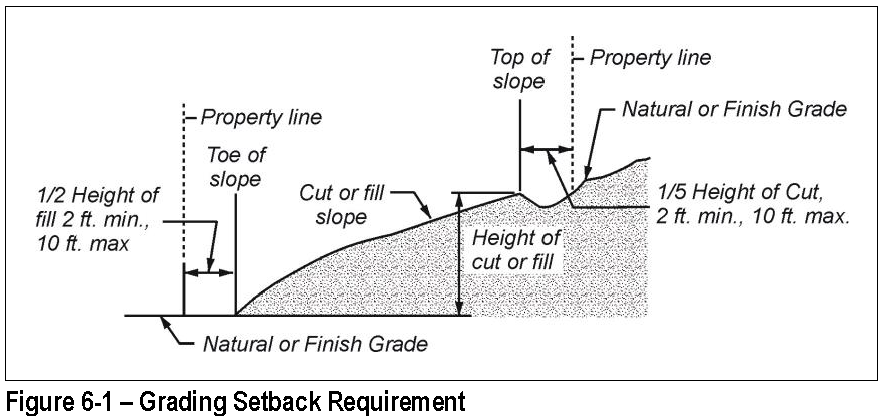
Cut and fill slopes shall be set back from property lines as provided by this section. The required setback dimensions shall be as shown in Figure 6-1.
A.
Top of Cut Slope. Except where otherwise provided by this section, the top of cut slopes shall be set back from adjacent property lines a distance of at least one-fifth of the vertical height of the cut, with a minimum of two feet and a maximum of ten feet. Greater distances may be required to accommodate any necessary interceptor drains.
B.
Toe of Fill Slope. Except where otherwise provided by this section, the toe of a fill slope shall be set back from adjacent property lines a distance of at least one-half the height of the slope, with a minimum of two feet and a maximum of ten feet. Where a fill slope is to be located near a property line and the adjacent property is developed, the city engineer may require additional precautions to protect the adjacent property from damage as a result of grading. The precautions may include the measures specified in Section 17.62.040.E (protection of adjacent property), additional setbacks, provisions for retaining or slough walls, mechanical or chemical treatment of the fill slope surface to minimize erosion, or additional provisions for the control of surface waters.
C.
Setback Exceptions. The city engineer may approve alternatives to the setbacks required by Subsections A. and B. above, based on investigations and recommendations from a qualified engineer or engineering geologist.
D.
Buffers from Watercourses and Environmentally Sensitive Habitats. No grading shall be allowed within one hundred feet of any area determined by the city engineer to be an environmentally sensitive habitat area, or from the top of the bank of a watercourse as determined by the city engineer, unless the grading is approved as a discretionary project in compliance with Section 17.60.050A.2, and is subject to environmental review in compliance with Section 17.60.040B.
17.62.100 - Storm drainage and runoff.
A.
Design and Construction. Drainage systems and facilities shall be designed and constructed in compliance with the city's stormwater management plan, the city improvement standards, and all other applicable city drainage requirements. The design and construction of drainage facilities required for cuts and fills are subject to Section 17.62.040.D above.
B.
Natural Channels and Runoff. Proposed grading projects shall include design provisions to retain off-site natural drainage patterns, and limit the quantities and velocities of peak runoff to predevelopment levels.
C.
Areas Subject to Flooding. Grading or structures are not permitted in an area determined by the city engineer to be subject to flood hazard by reason of inundation, overflow, high velocity or erosion, except where the grading or structures are in conformity with the standards of Section 17.62.030 (erosion and sediment control), and the following provisions:
1.
Hazard Elimination. The grading and/or structures shall be designed and constructed to incorporate provisions to eliminate identified hazards to the satisfaction of the city engineer. These provisions may include providing adequate drainage facilities, protective walls, suitable fill, and/or raising the floor level of buildings or by other means. In the application of this standard the city shall enforce as a minimum the current federal floodplain management regulations as defined in the National Flood Insurance Program authorized by United States Code Sections 4001—4128 and contained in Title 44 of the Code of Federal Regulations, Part 59 et seq., which are hereby adopted and incorporated into this chapter by reference as though they were fully set forth here.
2.
Letter of Map Revision (LOMR). Where the city engineer approves grading and/or structures within an area subject to flooding on the basis of proposed protective measures to eliminate flooding hazards, the applicant shall file a letter of map revision (LOMR) for the applicable flood insurance rate map (FIRM) with the Federal Emergency Management Agency (FEMA) prior to the issuance of a certificate of occupancy or the approval of a final building inspection by the city.

