
Green Bay City Zoning Code
ARTICLE XVIII
OFF-STREET PARKING, DRIVES, AND LOADING
Sec. 44-1689. - Purpose.
Access, parking and loading facility regulations are established to alleviate or prevent congestion of the public right-of-way, provide for the parking and loading needs of uses and structures, and enhance the compatibility between parking and loading areas and their surroundings. Parking facilities include but are not limited to all driveways, drive aisles, parking spaces, loading areas, and other items associated with access to the site, vehicle parking and loading/unloading operations.
(Ord. No. 19-19, § 1, 9-17-2019)
Sec. 44-1690. - Submission of site plan.
Any application for a building permit or zoning certificate requiring or including the provision of off-street parking or loading shall include a site plan. Said plan shall be drawn to scale and fully dimensioned depicting access, parking and loading facilities in compliance with this article.
(Ord. No. 19-19, § 1, 9-17-2019)
Sec. 44-1691. - Nonconforming facilities.
Existing access, parking and loading facilities that were lawfully constructed but are nonconforming to current requirements of this article may be maintained and repaired subject to the following:
(1)
Maintenance and repair of nonconforming facilities is limited to patching and resurfacing where the base is not exposed. Maintenance and repair that exposes the base material (typically crushed stone/gravel) is considered reconstruction and must meet the requirements of this article with the following exception: Minor rehabilitation items like replacing catchbasins, replacing damaged landscaped islands, repairing cracks/small sinkholes, etc., is permitted. Minor rehabilitation is limited to no greater than 500 square feet or ten percent of the surface area annually, whichever is less.
(2)
Shared driveways (driveways located on multiple lots and typically situated over lot lines) that existed prior to the adoption of the ordinance from which this chapter is derived may remain legal driveways. No new or reconstructed shared driveways may be established unless cross-access easements are recorded with the Register of Deeds.
(3)
Existing nonconforming access, parking and loading facilities shall not be reconstructed, expanded or increased in an area unless the entire facility is brought into compliance with requirements of this Code.
(4)
Existing access, parking and loading facilities shall not be reduced below the requirements for a similar new use or, if currently nonconforming, they shall not be reduced further.
(Ord. No. 19-19, § 1, 9-17-2019)
Sec. 44-1692. - Change of use.
When the use of a building or site is changed or the intensity of use is increased through the addition of dwelling units, floor area, capacity, or other unit of measurement used for determining parking and loading requirements, parking and loading facilities shall be provided for such change or intensification of use as specified in Section 44-1726. Figure 2: Number of Off-Street Parking Spaces Required by Land Use.
(Ord. No. 19-19, § 1, 9-17-2019)
Sec. 44-1693. - Use limitations.
Access, parking and loading facilities shall be used for their intended purposes.
(1)
Access, parking and loading facilities shall not be used for storage, display, sales, rental, or repair of motor vehicles or other goods nor for the storage of inoperable vehicles or snow. Equipment specifically designed for snow removal may be temporarily parked/stored in parking facilities of multiple family or nonresidential uses between the beginning of November through the end of April.
(2)
All vehicles shall be in condition for safe and legal performance on public rights-of-way.
(3)
No vehicle or equipment shall be used as living quarters.
(4)
Single- and two-family uses are permitted to temporarily use required access and parking areas for recreation and social activities, maintenance such as washing, changing fluids, rotating tires, etc., of operable vehicles, as described in this section, owned/operated by residents of the unit, and other activities accessory to the principal single- or two-family use. All such activities/uses shall be limited so that they are discontinued between the hours of 10:00 p.m. and 7:00 a.m.
(Ord. No. 19-19, § 1, 9-17-2019; Ord. No. 25-21, § 2, 12-7-2021)
Sec. 44-1694. - Surfacing.
(a)
All off-street parking facilities and driveways leading to such parking facilities, and all other areas upon which motor vehicles may traverse or be parked shall be graded and surfaced with a dust-free all-weather hard surface material capable of carrying a wheel load of 4,000 pounds.
(1)
Acceptable surfacing materials include asphalt, concrete, brick, cement pavers, permeable pavement as defined in Section 44-249, or similar material approved by the City and installed and maintained per industry standards.
(b)
Residential drives serving single- and two-family dwellings may contain a grass or permeable center, provided that the areas on which the vehicle's wheels touch are a minimum of 12 to 18 inches in width.
(Ord. No. 19-19, § 1, 9-17-2019; Ord. No. 25-21, § 3, 12-7-2021; Ord. No. 14-22, § 1, 6-7-2022)
Sec. 44-1695. - General maintenance.
Access, parking and loading facilities shall be kept free of dirt, dust, debris, and waste. In winter months, required access, parking and loading facilities that are available to the public shall be cleared of snow within a reasonable time as required in Section 34-14.
(Ord. No. 19-19, § 1, 9-17-2019)
Sec. 44-1696. - Abandoned facilities.
(a)
Parking facilities which have been abandoned, no longer provide access to legal parking areas, no longer service an approved principal or accessory use, and/or are not included on the approved site plan shall be removed, in their entirety, to the curb/pavement line at the owner's expense.
(b)
Removed parking facilities shall be replaced with curb, sidewalk (where applicable) and vegetated ground cover.
(Ord. No. 19-19, § 1, 9-17-2019)
Sec. 44-1697. - Access limitation.
(a)
Single-family and two-family dwelling units shall not have driveways or other access points onto a collector or arterial street that is not primarily residential unless such street has the only available frontage.
(b)
Driveway access existing prior to the adoption of the ordinance from which this article is derived is exempt from the access limitation and may be reconstructed at its present size and location unless the property or development site is fully reconstructed, in which case the driveway access limitations of this article shall be in full effect.
(c)
Exception to this limitation is permitted if determined by the Department of Public Works based on findings of a traffic impact analysis or traffic study.
(Ord. No. 19-19, § 1, 9-17-2019; Ord. No. 25-21, § 4, 12-7-2021)
Sec. 44-1698. - Access distance from intersections.
(a)
Driveway approaches measured along the property line shall be a minimum distance from the intersection of the street right-of-way lines on a corner lot based on roadway design speed/speed limit, as specified in the table below.
(b)
Should the property being accessed by the driveway not have sufficient frontage to comply with the minimum distance specified in these regulations, the driveway will be placed the furthest distance possible with the understanding that code required setbacks, transitional yards, etc. must be established/maintained.
(Ord. No. 19-19, § 1, 9-17-2019; Ord. No. 25-21, § 5, 12-7-2021)
Sec. 44-1699. - Angle of intersection with right-of-way.
All driveways and other access points shall intersect with any public right-of-way at an angle of 90 degrees wherever possible but in no case shall the angle be less than 75 degrees.
(Ord. No. 19-19, § 1, 9-17-2019)
Sec. 44-1700. - Visibility standards.
All driveways and other access points shall comply with the visibility standards of Section 44-359.
(Ord. No. 19-19, § 1, 9-17-2019)
Sec. 44-1701. - Traffic control.
(a)
Traffic generated by any use shall be channelized and controlled in a manner that avoids congestion on public streets and other safety hazards.
(b)
All parking and loading areas except those serving single- and two-family dwellings shall be designed so that vehicles enter and exit property in a forward motion so as not to back onto public streets. If deemed necessary for traffic safety, turnaround areas may be required.
(c)
Each required off-street parking space except those serving single- and two-family dwellings shall open directly onto a driveway or drive aisle of such width and design as to provide safe and efficient means of vehicular access, as regulated in Section 44-1774 and Figure 9: Parking Space Design Standards.
(Ord. No. 19-19, § 1, 9-17-2019)
Sec. 44-1726. - Minimum number of required off-street parking spaces.
(a)
Calculation. Off-street parking requirements for each land use are generally tied to capacity, net floor area, or the number of employees at the subject property during the largest work shift.
(1)
The term "capacity" means the maximum number of persons that may be accommodated by the use as determined by its design or by building code regulations, whichever is greater. Both indoor and outdoor uses are included in maximum capacity.
(2)
The term "employees on the largest work shift" means the maximum number of employees working at the facility during a single given day, regardless of the time period and whether any such person is a full-time versus part-time employee.
(3)
The term "net floor area" shall mean the total floor area inside the building envelope on all levels of a building excluding mechanical rooms, permanent accessory storage/freezers/coolers, stairwells/elevators, uninhabitable attics or basements, underground parking and other areas deemed appropriate by the Zoning Administrator.
(4)
When calculating the number of off-street parking spaces resulting in a fraction, each fraction of one-half or more shall be considered a space.
(5)
Where future potential uses of a building may generate additional parking demand, the City may require a parking plan for the site showing how the anticipated parking demand will be met. The City may require the additional land area identified as anticipated parking to be placed in reserve as landscaped open space until needed.
(b)
Parking spaces for uses with multiple components, such as hotels with dining and conference facilities, shall be based on the sum of the parking requirements of the separate components.
(c)
Buildings built on speculation or not initially occupied (unknown use) shall be required to provide one stall per 300 square feet of net floor area.
(d)
In addition to the requirements in Figure 2: Number of Off-Street Parking Spaces Required by Land Use, one parking space shall be provided for each commercial vehicle or vehicle necessary for the operation of the use that is maintained on the premises.
(e)
See Figure 2: Number of Off-Street Parking Spaces Required by Land Use for a list of the number of parking spaces required by land use.
(f)
Parking requirement exceptions in the Downtown Zoning District (D).
(1)
Within the Downtown Zoning District (D), the minimum required parking space requirements for nonresidential uses are waived.
(2)
Residential uses within the Downtown Zoning District (D) need only provide evidence of the availability of off-street public or private parking within the district in the amount of one parking space per dwelling unit.
(3)
When off-street parking facilities are provided, such facilities shall meet all requirements of this chapter, except in respect to the required number of spaces.
Figure 2. Number of Off-Street Parking Spaces Required by Land Use
(g)
Limit on the number of off-street parking spaces provided. No site plan may be approved for a multiple-family or nonresidential use which contains more than two times the development's minimum number of required parking spaces, except as granted through a conditional use permit. Where no minimum parking requirement is established, the calculation for the maximum number shall be two times what the developments minimum would be if not exempt. Parking facilities containing 40 stalls or fewer are exempt from this regulation. The following criteria shall be reviewed in considering a conditional use permit request:
(1)
The proposed development has unique or unusual characteristics (such as high sales volume or low parking turnover) which creates a parking demand that exceeds the maximum ratio and does not typically apply to comparable uses.
(2)
The lot is designed to allow for more intensive future site development that will create and utilize the additional parking demand.
(3)
The need for additional parking cannot be reasonably met through provision of shared parking with nearby uses.
(h)
Parking studies. Where a parking study is required, the study shall be performed by a qualified transportation engineer or transportation planner. The study shall contain information on the anticipated number of employees, customers, visitors, clients, shifts, events, or deliveries to the use, and may refer to other studies or similar situations elsewhere.
(Ord. No. 19-19, § 1, 9-17-2019; Ord. No. 05-21, § 3, 4-20-2021; Ord. No. 25-21, § 6, 12-7-2021; Ord. No. 25-25, § 1, 11-11-2025)
Sec. 44-1746. - Single-family, two-family, and multiple-family dwelling (three or four units) residential driveways.
Driveways shall lead from the public right-of-way directly to a garage door opening plus 24 inches on either side of said door or to a legal surface parking space. Driveways are regulated as follows:
(1)
Number of driveways. Single-family uses are permitted one driveway per lot unless otherwise regulated in this chapter, subject to the design regulations specified herein. Two-family and multiple-family dwelling (three or four units) uses are permitted two driveways per lot unless otherwise regulated in this chapter, subject to the design regulations specified herein.
(2)
Minimum driveway setback from property lines.
a.
Narrow lots. On lots with less than 60 feet of lot width/frontage, driveways shall be set back a minimum of one foot from the side lot line. On lots where the available side yard area prohibits the ability to create/maintain an eight-foot-wide driveway and the required setback as listed below, the setback may be administratively reduced or eliminated.
b.
Detached garages. Driveways leading to detached garages shall meet the applicable side or rear setbacks for accessory structures established in the district in which it is situated or shall meet the side setback of an existing detached garage, whichever is less.
c.
Attached garages. Driveways leading to attached garages shall meet the applicable side or rear setbacks for principal structures established in the district in which it is situated or shall meet the side setback of the existing attached garage, whichever is less.
d.
Uncovered parking. Driveways leading to uncovered parking areas shall meet the applicable side or rear setbacks established within the parking section or shall meet the side setback of the existing legal uncovered parking area, whichever is less.
(3)
Driveway width.
a.
Driveways shall be a minimum width of eight feet. Driveways leading to garages are limited to a maximum width of 25 feet at the property line and 30 at the curb/pavement line (2½ foot apron flares), but may increase to the width of the garage. See Figure 3.A: Single-Family and Two-Family Drive Width and 3.B: Single-Family and Two-Family Drive Width-Enlarged with Taper.
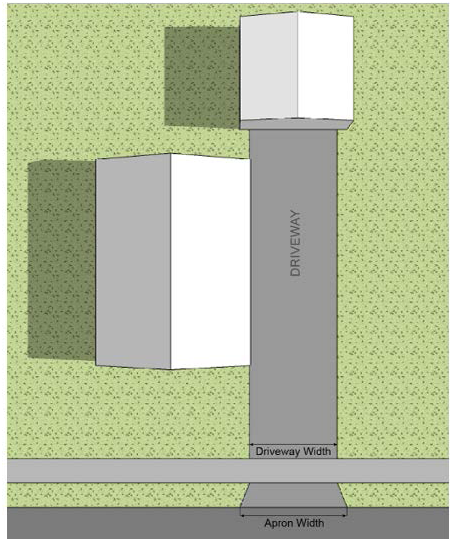
Fig. 3.A: Single, Two-Family &, Multiple-Family Dwelling (Three or Four Units) Drive
Width—Standard
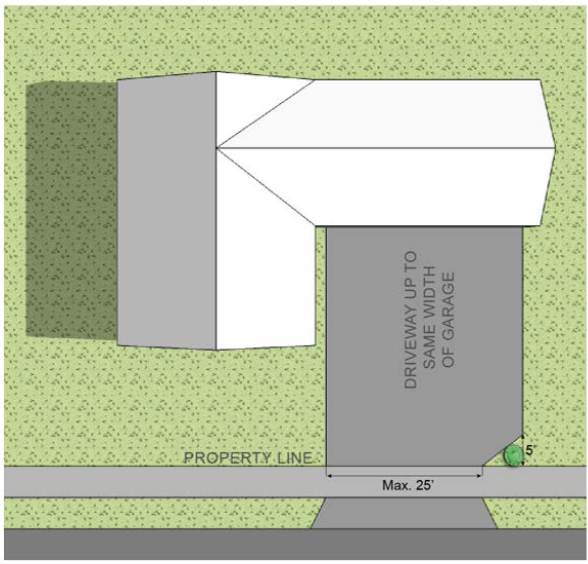
Fig. 3.B: Single, Two-Family &, Multiple-Family Dwelling (Three or Four Units) Family
Drive Width—Enlarged with Taper
b.
Where no garage exists, the maximum driveway width shall be 12 feet.
c.
Where the width of the driveway at the garage or other legal parking space exceeds the maximum width of the driveway at the property line, the driveway shall be tapered between the garage or the edge of a legal uncovered space and the property line starting a minimum of five feet inside the parcel. If said taper "triangle" is found to be driven over and in a deteriorated state, the City may require the installation of vegetation or other item designed to prohibit vehicular trespass. See Figure 3.C: Single-Family and Two-Family Drive Width-Taper Detail. When leading to a legal uncovered space, the driveway width shall be the least possible needed and shall not exceed 25 feet in width at the property line.
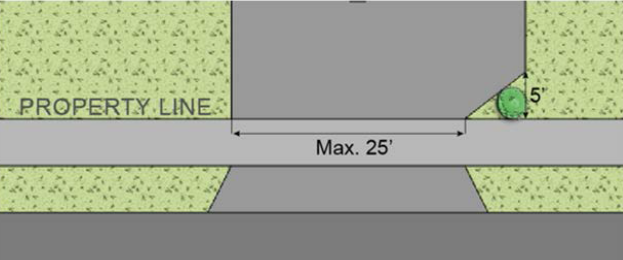
Fig. 3.C: Single, Two-Family &, Multiple-Family Dwelling (Three or Four Units) Drive
Width—Taper Detail
When leading to a legal uncovered space, the driveway width shall be the least possible needed and shall not exceed 25 feet in width at the property line.
d.
Driveways for two-family dwellings with adjacent garages are limited to the 25 feet maximum width at the property line for each individual driveway. Each individual driveway must be separated by a minimum of a two-foot green area extending the full length from the property line to the garage/uncovered parking space. Separation area shall contain vegetation or other item designed to limit vehicular trespass. See Figure 4: Two-Family Drive Separation.
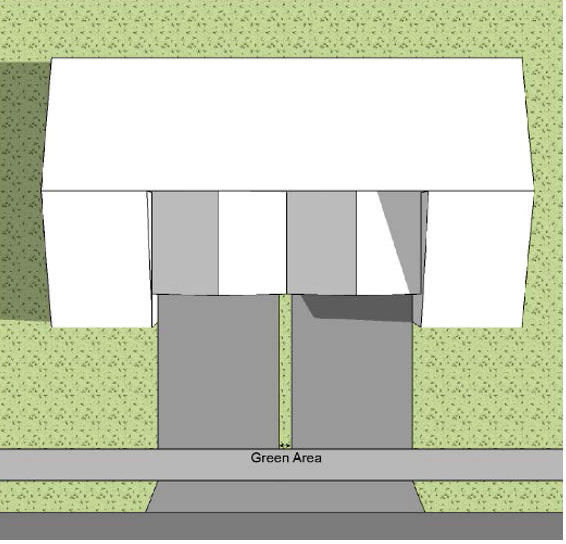
Fig. 4: Two-Family Drive Separation
e.
Side-loading drives. The maximum width of driveway leading to a side-loaded garage shall not exceed 12 feet, except for the area directly leading of the garage, where it can be increased to the width of the garage. See Figure 5.A: Alternative Single-Family and Two-Family Drives-Side Loading. The driveway shall not be located within the side yard setback.
f.
Circular drives. The maximum width of circular, horseshoe, and similar type driveways shall not exceed 12 feet, except for the area directly leading of the garage, where it can be increased to the width of the garage. See Figure 5.B: Alternative Single-Family and Two-Family Drives-Circular.
1.
The driveway shall not be located within the side yard setback.
2.
The inside edge of the arc of the driveway shall be at least 15 feet from the lot line.
3.
The interior area between the drive and the street must be landscaped.
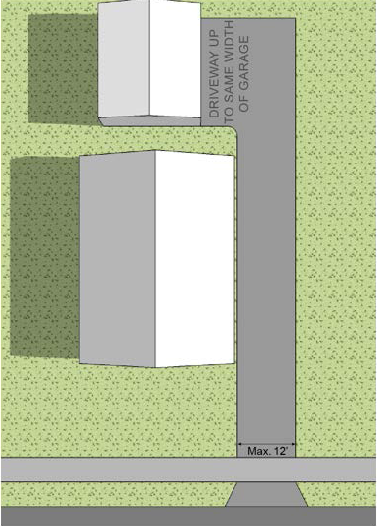
Fig. 5.A: Alternative Single, Two-Family &, Multiple-Family Dwelling (Three or Four
Units) Drives—Side Loading
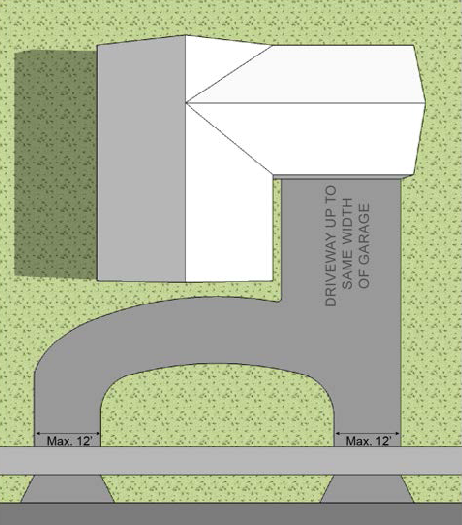
Fig. 5.B: Alternative Single, Two-Family &, Multiple-Family Dwelling (Three or Four
Units) Drives—Circular
g.
Alley drives. The driveway may extend to the garage opening or may extend into the lot for 30 feet in width and 40 feet in depth but shall not extend into the side yard setbacks. See Figure 5.C: Alternative Single-Family and Two-Family Drives-Alley.
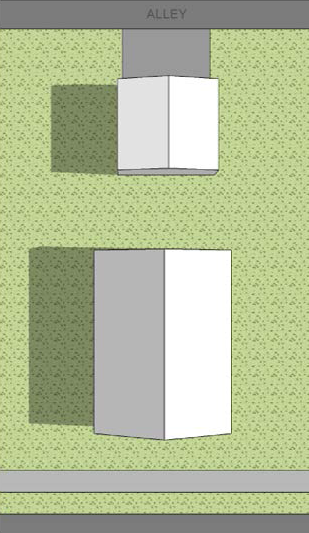
Fig. 5.C: Alternative Single, Two-Family &, Multiple-Family Dwelling (Three or Four
Units) Drives—Alleys
h.
In no case shall the maximum driveway width be cumulatively greater than 50 percent of the lot frontage.
(Ord. No. 19-19, § 1, 9-17-2019; Ord. No. 25-21, § 7, 12-7-2021; Ord. No. 32-25, § 1, 11-11-2025)
Sec. 44-1747. - Parking for single-family, two-family uses, and multiple-family dwellings (three and four units).
(a)
A minimum number of legal parking spaces shall be provided in conformance with Section 44-1726 and Figure 2: Number of Off-Street Parking Spaces Required by Land Use.
(b)
On a lot containing a single-family or two-family dwelling unit, off-street parking shall not be located between the principal structure and a street right-of-way, except within residential driveways leading to a legal parking space or as otherwise permitted in this chapter.
(1)
Parking spaces a minimum of eight feet wide by 15 feet deep must be provided either within a garage, in a driveway, or uncovered parking space(s) on the same lot of the use it is serving and shall meet the requirements of this section. See Figure 6.A: Single-Family and Two-Family Parking Space-Garage or 6.B: Single-Family and Two-Family Parking Space-Uncovered.
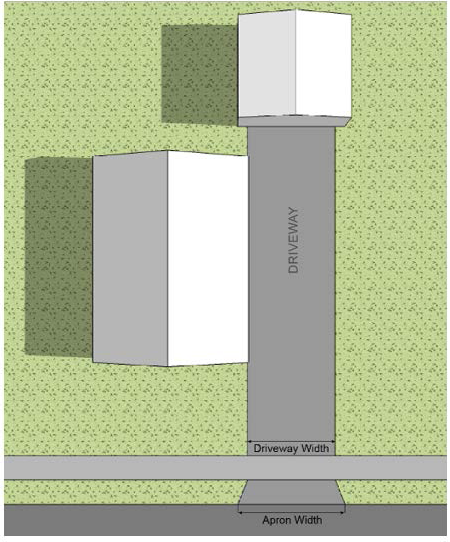
Fig. 6.A: Single, Two-Family &, Multiple-Family Dwelling (Three or Four Units) Parking
Space—Garage
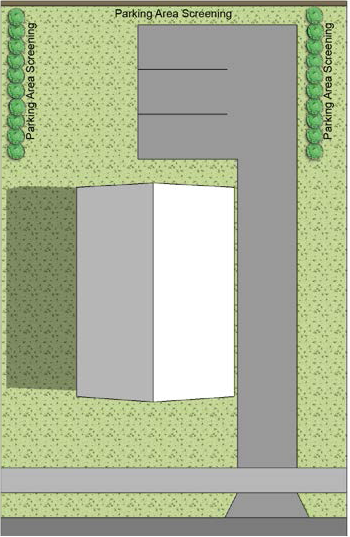
Fig. 6.B: Single, Two-Family Single, Two-Family &, Multiple-Family Dwelling (Three
or Four Units) Parking Space—Uncovered
(2)
Driveway parking. Driveways shall not count towards minimum parking stall requirement except as provided for narrow lots in subsection (c) of this section.
(3)
Uncovered parking spaces (not located in driveways).
a.
No more than four uncovered parking spaces are permitted per unit per lot.
b.
Uncovered parking spaces may be located in the rear yard and shall be set back from the side and rear lot lines by no fewer than 2.5 feet. Said spaces shall be screened from view per section 44-1549. See Figure 6.B: Single & Two-Family Parking Space-Uncovered.
c.
One uncovered parking space is permitted in the side yard alongside a garage provided said space is not located between the building and the street and is set back from the side and rear lot lines by no fewer than 2.5 feet. Said space shall be screened from view per section 44-1549. See Figure 7: Single & Two-Family Parking Space Beside Garage.
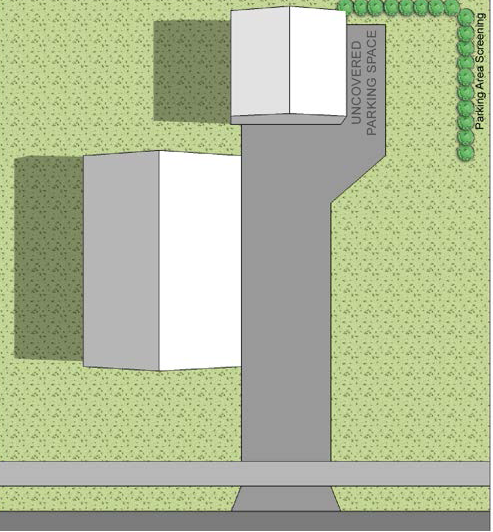
Fig. 7: Single, Two-Family, & Multiple-Family Dwelling (Three or Four Units) Parking
Space Beside Garage
d.
Front yard parking space exception. For single-family or two-family lots with attached single stall garages that are unable to provide parking as regulated in this article, a single parking space may be established next to the driveway between the front facade of the residence and the public right-of-way as regulated below. Multiple-Family Dwelling (Three or Four Units) with attached single stall garages that are unable to provide parking as regulated in this article are not permitted a front yard parking space exception.
e.
Front yard space is limited to no greater than eight feet in width beyond the garage door opening but shall not be located in front of the primary entrance to the residence.
f.
Lots shall not exceed the maximum impervious surface ratio for the applicable zoning district.
(c)
Driveway as legal parking space for single-family and two-family uses on narrow lots. Driveways may be considered legal "stacked" (meaning in front of one another) parking spaces for required stalls. A driveway parking space need not lead to a legal parking space but must be a minimum of eight feet wide and 15 feet deep. Driveway stacking is permitted for multi-family dwellings (three or four units) provide individual tandem parking is dedicated to a single unit. Access to individual unit parking stalls via the driveway shall remain clear and not used as a parking space for any one unit or visitor. See Section 44-1580(e).
(d)
Except for driveways leading to legal parking spaces or otherwise regulated in this article, parking is not permitted in the front yard.
(e)
Parking of commercial vehicles and trailers in residential districts.
(1)
The intent of this section is to preserve the orderly appearance and quiet enjoyment of residential neighborhoods while allowing reasonable flexibility for parking business-related vehicles. Specifically, this applies to motor vehicles that are driven off-site by a resident but are kept on the premises when not in use. This section shall apply to the following types of vehicles:
a.
Commercial trucks, tractors, vans, pick-ups, or other motor vehicles not exceeding 10,000 pounds gross vehicle weight; and
b.
Commercial trailers capable of being trailed behind a commercial motor vehicle that is allowed to be parked on the premises by this section.
(2)
Engines of commercial vehicles may not run continuously. A 30-minute engine warm-up time shall be permitted immediately prior to the commercial vehicle and/or any other motorized equipment leaving the premises. The warm-up period shall begin no earlier than 7:00 a.m. and end no later than 10:00 p.m.
(3)
Commercial trailers parked outside in residential districts shall be fully enclosed or be empty when not in transport.
(4)
Commercial trailers parked in residential districts shall be actually trailed and transported from the property no less than once per week.
(Ord. No. 19-19, § 1(13-1716), 9-17-2019; Ord. No. 40-20, § 1, 12-1-2020; Ord. No. 25-21, § 8, 12-7-2021; Ord. No. 19-22, § 1, 8-30-2022; Ord. No. 32-25, § 2, 11-11-2025)
Sec. 44-1748. - Game day parking.
The Director of Community and Economic Development and/or Director of Public Works may permit vehicles to be parked on the front, side, and rear yards of residential, mixed-use, commercial, and industrial zoned parcels, on the days games are played in the City of Green Bay by professional football teams of the National Football League and/or during the day of a special event held at Lambeau Field when the event is expected to exceed an estimated attendance of 20,000 individuals, provided, however, that all parking shall occur outside the vision triangle as required in Section 44-359.
(Ord. No. 32-20, § 1, 9-15-2020)
Sec. 44-1773. - Multifamily residential, mixed-use, institutional, commercial, and industrial use driveways.
(a)
Number of driveways. A maximum of one two-way driveway or two one-way driveways shall be permitted from each street right-of-way to which a lot or parcel has frontage, except under the following circumstances:
(1)
Multiple two-way driveways may be permitted on one street frontage, provided the distance between the driveway centerlines is no less than 200 feet.
(2)
Mixed two-way and one-way driveways may be permitted on one street frontage, provided the distance between the driveway centerlines is no less than 200 feet.
(3)
One three-lane driveway consisting of a one 12-foot ingress lane, a three-foot mountable rumble strip dividing island, and two ten-foot egress lanes may be administratively permitted per street frontage with concurrence of the Zoning Administrator and Traffic Engineer. This option should be limited to sites on streets with high traffic volumes and speeds and/or unique timeframes of mass ingress/egress, or other conditions making a standard driveway operate less than optimally.
(4)
If the property or development site is unable to meet the access limitations regulations of Section 44-1698, then only one two-way driveway or two one-way driveways shall be permitted.
(5)
Additional driveways may be permitted, if necessary, for the public safety and sufficient level of traffic circulation with approval of the Director of Public Works.
(b)
Minimum driveway setback.
(1)
Driveways shall be set back as established for buildings in the zoning district for which the property they service is situated. Driveway access through the front yard setback area should be designed to minimize its presence within the front yard to the greatest extent practical.
(2)
Parking facility perimeter buffers. Parking facilities accessing parking areas abutting residential uses in residential districts shall be separated by a perimeter landscape buffer meeting the requirements of Section 44-1964.
(c)
Distances between curb openings.
(1)
On the same parcel. The minimum distance between one-way driveways at the curbline shall be no less than 15 feet. Minimum distance between two-way drives at the curbline shall be 200 feet from center.
(2)
On adjoining parcels. Where two adjoining driveways abut, the maximum opening at the curb shall be the maximum for a single driveway, as listed in subsection (d) of this section. Both parcels must share the curb opening.
(d)
Driveway width. Driveway sizes are regulated at the property/right-of-way line and the curb/road pavement line as follows (See Figure 8: Three-Lane, Full Access Drive Detail):
(1)
One-lane, one-way access drives.
(2)
Two-lane, full access drives.
(3)
Three-lane, full access drive (consisting of one 12-foot ingress lane, a three-foot mountable "rumble strip" dividing island, and two ten-foot egress lanes).
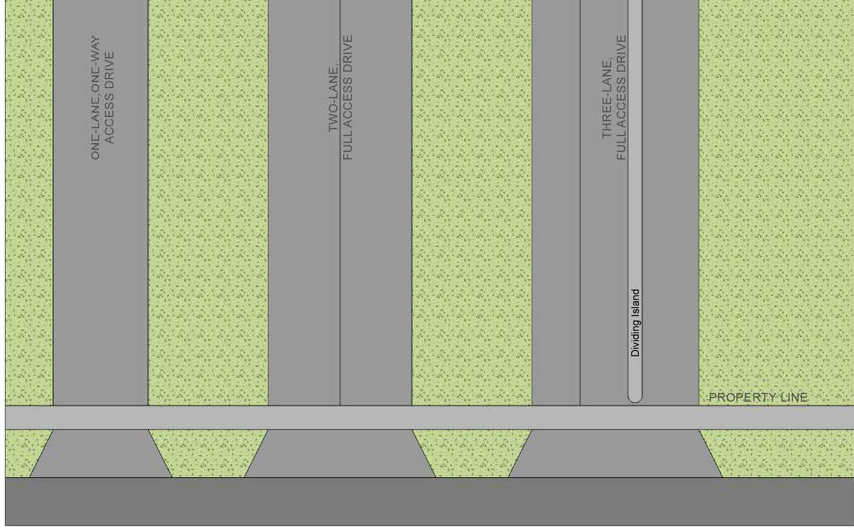
Fig. 8: One-Lane, Two-Lane & Three-Lane Access Drive Detail
(e)
Flow. Traffic may be restricted as to direction of flow.
(1)
Driveways approved for one-way movement only or three-lane drives shall be equipped with signage and pavement markings indicating its direction to motorists.
(2)
Signs for directional movement of traffic shall be constructed and installed in accordance with City of Green Bay Standard Specifications and Construction Standards for Public Works.
(Ord. No. 19-19, § 1, 9-17-2019; Ord. No. 25-21, § 9, 12-7-2021)
Sec. 44-1774. - Off-street parking and traffic circulation standards for multiple-family and nonresidential uses.
(a)
Location.
(1)
Required parking and loading spaces shall be located on the same lot or development site as the use served unless otherwise regulated in this chapter.
(2)
Off-site parking may be located up to 1,000 feet from the lot containing the use being served if the under common ownership or protected by a recorded instrument acceptable to the City.
(b)
Setbacks.
(1)
Parking areas shall be set back as established for buildings in the zoning district for which the property it services is situated.
(2)
Special provisions for nonconforming parking facilities. Legally established parking facilities constructed prior to the effective date of the ordinance from which this article is derived which do not meet the minimum setbacks required by this article shall be permitted to be reconstructed with reduced setbacks, subject to approval of a parking plan by the Zoning Administrator. Said parking lot layout shall be designed in accordance with the dimensions identified in Figure 9: Parking Space Design Standards. Parking lot setback reductions shall only be permitted in the following instances:
a.
To prevent the loss of legal parking spaces required by this article.
b.
To prevent the loss of required internal circulation aisles.
(c)
Circulation. Parking facilities shall be designed to provide for the safe and efficient movement of all traffic entering, exiting, and circulating on the site. Circulation patterns shall conform to the general rules of the road. All traffic control measures shall meet the requirements of the Manual of Uniform Traffic Control Devices.
(d)
Marking. All off-street parking and traffic circulation areas shall be marked, striped, and maintained in a clear and visible manner which clearly indicates parking spaces, pedestrian walkways, and other designated areas.
(e)
Curbing. A minimum six-inch high curb shall be installed within parking areas where parking surface is adjacent to pedestrian and/or bicycle ways and internal landscape islands, except: Where bio-filtration or bio-retention methods of stormwater management are utilized as part of an approved grading and drainage plan, alternatives to the installation of curbing may be considered by the Department of Public Works, provided that measures are taken to protect landscaping from vehicular circulation damage.
(f)
Access. Each off-street parking space shall open directly upon a drive aisle or driveway that is wide enough to provide a safe and efficient means of vehicular access without directly maneuvering a vehicle into any pedestrian way or public right-of-way.
(g)
Driveway throat length. The minimum permitted throat length of access drives serving parking lots is 18 feet, as measured from the right-of-way/property line along the centerline of the access drive to the access point of any parking stall within the parking facility, as depicted below. In no case shall the driveway throat length be less than the required setback.
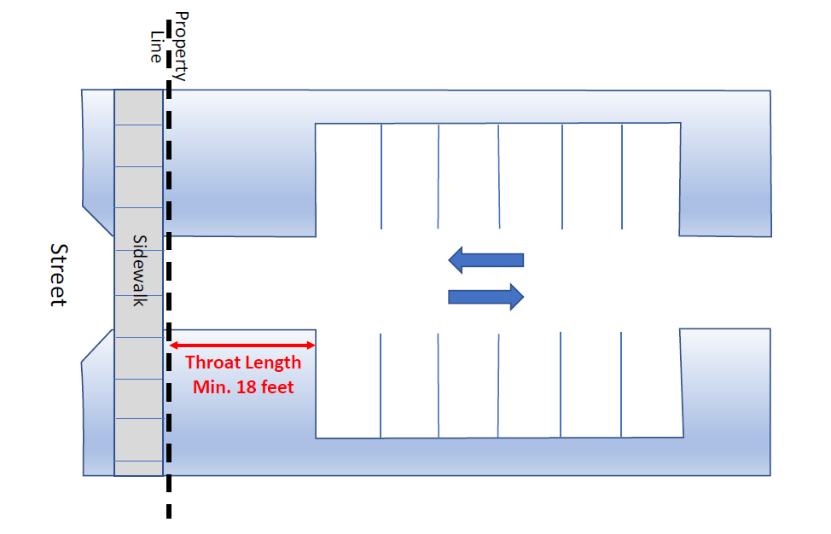
(h)
Lighting. All off-street parking and traffic circulation areas shall be lit to ensure their safe and efficient use during evening hours. An illumination level shall meet the standards of Article V of this chapter.
(i)
Landscaping and screening. Parking lots shall meet the landscaping requirements of Sections 44-1964 through 44-1969.
(j)
Parking space design standards. Other than handicapped parking and permitted parking in residential driveways, each off-street parking space shall comply with the minimum requirements in the following table, as shown in Figure 9: Parking Space Design Standards.
Parking Space Design Standards
* Subcompact spaces may account for up to 20 percent of the total parking area required. They may be reduced in size to a width of eight feet and a stall depth of 12 percent less than (D) in the table above and must be grouped and signed appropriately.
** Parking spaces that use an appropriately sized curb overhang over a landscaped island or buffer may be reduced in depth by 1½ feet. A concrete curb or other means shall be provided to prevent parked vehicles from damaging plant materials.
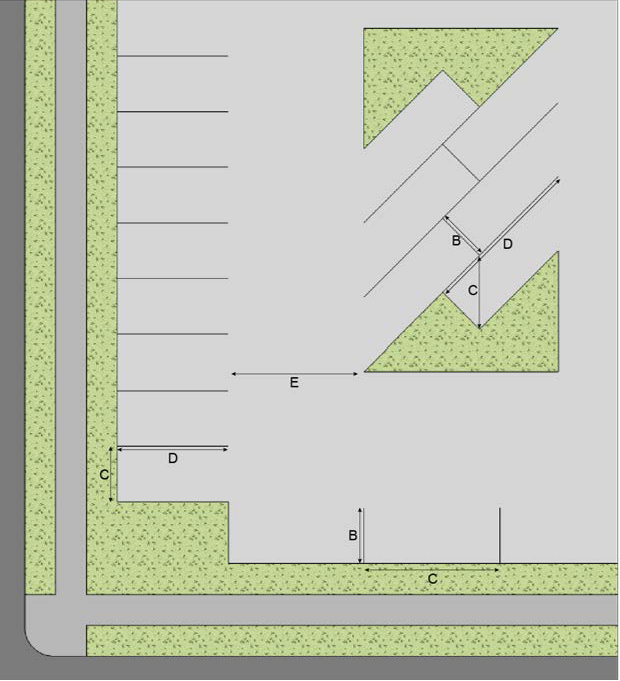
Fig. 9: Parking Space Design Standards
(Ord. No. 19-19, § 1, 9-17-2019; Ord. No. 25-21, § 10, 12-7-2021)
Sec. 44-1797. - Shared parking facilities.
(a)
Joint parking facilities which provide required parking for two or more uses are allowed a reduction in required number of parking spaces as specified below. Up to a 15 percent reduction in the number of required parking spaces for four or more separate uses, ten percent for three separate uses, and five percent for two separate uses may be utilized for a collective parking facility.
(b)
Day-night use parking facility. Shared day-night use parking facilities may provide a reduction in required number of parking spaces as specified below:
(1)
Up to 70 percent of the parking facilities of nighttime/Sunday uses may be supplied by off-street parking facilities of daytime uses. Up to 70 percent of the parking facilities of daytime uses may be supplied by the off-street parking facilities of nighttime/Sunday uses.
(2)
Daytime uses. For the purpose of this section, the following uses are considered as primarily daytime uses: banks, offices, certain retail stores and personal service shops, service and repair shops, wholesale, and similar uses as determined by the Zoning Administrator.
(3)
Nighttime and Sunday uses. For the purpose of this section, the following uses are considered as primarily nighttime and weekend uses: theater, bowling alley, tavern/nightclub, auditorium incidental to a public or parochial schools, churches, and similar uses as determined by the Zoning Administrator.
(4)
The applicant shall show that there is no substantial conflict in the principal operating hours of the buildings or uses for which shared parking is proposed.
(5)
The use for which application is being made for shared parking shall be located within 1,000 feet of the use providing the parking facilities.
(c)
A legally binding instrument, executed by the parties concerned, for joint use of off-street parking facilities shall be approved by the City Attorney and filed with the City within 60 days after City approval of the joint parking use. Said agreement shall cover a period of no less than 20 years. Shared use parking privileges shall continue in effect only so long as such an instrument remains in effect, and if such instrument becomes legally ineffective, parking shall be provided as otherwise required in this article.
(Ord. No. 19-19, § 1, 9-17-2019)
Sec. 44-1798. - Valet parking.
(a)
Up to 50 percent of the off-street parking for restaurants, hotels, theaters, and similar uses may be fulfilled by maintaining a valet parking service for customers.
(b)
The valet service shall provide service to and from the main entrance with a passenger loading area, as approved by the Department of Public Works.
(c)
The parking area shall be located no farther than 1,000 feet from the main entrance.
(Ord. No. 19-19, § 1, 9-17-2019)
Sec. 44-1799. - Employee off-site parking.
(a)
Retail, service businesses, large employers, major institutions and similar uses are encouraged to provide designated employee parking.
(b)
If a shuttle service is provided, such parking may be off-site in a remote location.
(Ord. No. 19-19, § 1, 9-17-2019)
Sec. 44-1800. - Ride-sharing and autonomous vehicles.
The intent of this section is to encourage the installation of passenger loading zone spaces to meet demand for passenger pick-up/drop-off generated by ride-sharing and/or autonomous vehicles on all land uses except single-family and two-family residential dwellings.
(1)
Reduction to required parking spaces. The number of required parking spaces for a use may be reduced by ten percent for each passenger loading zone space provided up to a maximum of 30 percent. The Zoning Administrator is authorized, at their discretion, to require the submission of a parking study per Section 44-1726(g) upon making the determination that such a reduction will result in a shortage of parking spaces needed for the subject land-use.
(2)
Passenger loading zone space standards.
a.
Location. Each passenger loading zone space shall be located within 100 feet of the primary entrance/exit of a stand-alone use. Passenger loading zone spaces located in shopping centers and other multiple use developments may be located more than 100 feet from the primary entrance/exit of a tenant when placed in a centralized location, provided that a minimum of five-foot-wide pedestrian access to all tenants of the development is present.
b.
Passenger loading zone spaces shall be separate and distinct from parking facility drive aisles, fire lanes, off-street loading areas, or other uses not explicitly dedicated to passenger loading/unloading.
c.
Dimensions. Minimum of eight feet wide by 22 feet long with appropriate taper for safe ingress/egress.
d.
Design. All vehicular ingress/egress to and from passenger loading zone spaces shall be in forward motion only. All passenger loading zone spaces shall be clearly marked and signed to signify that they are for loading and unloading of passengers and shall not be used for other purposes.
e.
Amenities. Amenities such as sitting areas, shade structures, and landscaping are encouraged to be provided adjacent to the passenger loading zone spaces.
f.
Accessibility. Passenger loading zone spaces shall be compliant with the Americans with Disability Act (ADA).
(Ord. No. 19-19, § 1, 9-17-2019)
Sec. 44-1819. - Pedestrian and bicycle access.
(a)
Quantity. For all multifamily, commercial, institutional, and industrial uses, a minimum of one pedestrian/bicycle access way is required to at least one street frontage.
(b)
Off-site connections. Pedestrian/bicycle access shall include appropriate connections to existing and planned public pedestrian and bicycle facilities. If none exist, the connection is unnecessary; however, the site plan must depict a location such access can be installed should public pedestrian and bicycle facilities be installed in the right-of-way in the future.
(c)
On-site connections. The entire development shall provide walkways for full and safe pedestrian and bicycle circulation within the development.
(1)
Walkways shall provide pedestrian access through or around off-street parking areas from public walks and/or bicycle facilities to building entries which directly and continuously connect areas of pedestrian origin and destination.
(2)
Design requirements.
a.
Walkways shall have an acceptable dust-free surface not less than five feet in width, be separate from the parking lot drive aisle and delineated with pavement markings or alternate paving materials.
b.
The entirety of the on-site pedestrian walkway system shall be consistent with the Americans with Disabilities Act.
c.
The material and layout of the pedestrian walkway shall be continuous as the pedestrian access crosses a driveway or internal drive.
(Ord. No. 19-19, § 1, 9-17-2019)
Sec. 44-1820. - Bicycle parking standards for multiple-family and nonresidential uses.
(a)
Required provision of bicycle parking areas.
(1)
For all multifamily, commercial, institutional, and industrial uses, a minimum of four bicycle spaces shall be provided if off-street parking for vehicles is provided.
(2)
For parking lots containing more than 40 automobile parking spaces, off-street bicycle parking spaces shall be provided equal to five percent of the automobile parking space requirement, or 20 bicycle parking spaces, whichever is less.
(3)
A nonresidential use's automobile parking requirement may be reduced by providing additional bicycle parking. After the bicycle parking requirement has been met, a minimum of four bicycle parking spaces may be provided in lieu of one required automobile parking space, with a maximum reduction of up to five automobile parking spaces.
(b)
Specifications for bicycle parking spaces.
(1)
All bicycle parking provided shall be on a hard-surfaced area and be set back from walls and other objects so as to be functional. Freestanding bicycle parking racks shall be securely fastened to the ground.
(2)
Bicycle parking spaces and racks shall be located in a convenient and visible area no farther from the principal entrance to the building served than the closest automobile parking space. With the permission of the Department of Public Works, bicycle parking may be located in the public right-of-way.
(3)
Bicycle parking spaces shall be installed in conformance with setback requirements applicable to automobile parking lots. The placement of the racks shall not conflict with pedestrians and motorized traffic movements.
(4)
Covered spaces. If accessory automobile parking spaces are covered, bicycle parking spaces shall also be covered.
(Ord. No. 19-19, § 1, 9-17-2019)
Sec. 44-1844. - Off-street loading requirements.
Off-street loading space shall be provided for any nonresidential use which requires the receipt or distribution of materials or merchandise by trucks or similar vehicles and which will have a gross floor area of 5,000 square feet or more, subject to following minimum standards:
(1)
The off-street loading requirement for buildings with less than 20,000 square feet of gross floor area may be satisfied by the designation of a loading zone area on the site. This loading zone area shall be separate from any required off-street parking area, and access to it shall not conflict with automobile or pedestrian circulation within the site.
(2)
Buildings with 20,001 to 50,000 square feet of gross floor shall provide one loading space.
(3)
Buildings with 50,001 to 100,000 square feet of gross floor shall provide two loading spaces.
(4)
Buildings with 101,000 or more square feet of gross floor shall provide one additional loading space per additional 300,000 square feet.
(Ord. No. 19-19, § 1, 9-17-2019)
Sec. 44-1845. - Size and location.
(a)
Semi-trailer spaces shall be at least 55 feet in length, ten feet in width, and 14 feet in height, plus necessary additional maneuvering space.
(b)
No loading space shall be located in a front yard or at the front of a building. Loading spaces shall not be located between any building and a public street unless provided with adequate screening and landscaping, in compliance with Article XIX of this chapter.
(c)
Spaces shall be at least 50 feet from the property line of any residential property or residentially zoned property.
(d)
All loading spaces and driveways shall be surfaced with a dustless all-weather material meeting the standards for off-street parking areas and driveways and subject to the approval of the City Engineer.
(Ord. No. 19-19, § 1, 9-17-2019)

