
Green Bay City Zoning Code
ARTICLE V
- GENERAL REGULATIONS
Sec. 44-304. - Purpose.
The purpose of this article is to provide regulations of general applicability for property throughout the City, to promote the orderly development of use of land, to protect the natural environment, and to minimize conflicts among land uses.
(Code 1984, § 13.501)
Sec. 44-305. - Applicability.
The regulations set forth in this chapter apply to all structures and all land uses, except as otherwise provided in this chapter.
(Code 1984, § 13.502)
Sec. 44-306. - Essential uses.
The following uses, being essential for the operation of any zoning district, are permitted in any district: wires, cables, conduits, vaults, pipelines, or any other similar equipment of a public utility, except as otherwise provided in this chapter or other federal, state, or local regulations.
(Code 1984, § 13.503)
Sec. 44-331. - Minimum lot area.
Lot area requirements shall be as specified in the applicable zoning district in which a zoning lot is located. No yard or lot existing at the time of passage of the ordinance from which this chapter is derived shall be reduced in size or area below the minimum requirements identified within this chapter.
(Code 1984, § 13.504)
Sec. 44-332. - Street frontage.
Each lot shall have frontage on a public street at a width satisfying the requirements specified for each zoning district. In the case of a condominium, unified shopping center, cluster development or Planned Unit Development, the entire site shall be considered one zoning lot.
(Code 1984, § 13.505)
Sec. 44-333. - Limit of one principal residential structure per zoning lot.
Except in the case of cluster developments, condominium developments, Planned Unit Developments or Traditional Neighborhood Developments, no more than one principal building shall be located on a zoning lot in any residential district.
(Code 1984, § 13.506)
Sec. 44-334. - Lots containing two or more zoning classifications.
Where a lot is bisected by one or more zoning district boundary lines, land in the more restrictive district shall not be included as part of the required yards or minimum lot area for any structures or uses not allowed in that district.
(Code 1984, § 13.507)
Sec. 44-335. - Corner lots.
On a corner lot, one of the lot lines that abuts the street shall be considered a front lot line, and the other shall be considered a corner side lot line. Establishment of the front lot line shall be based on the orientation of the existing or proposed building.
(Code 1984, § 13.511)
Sec. 44-336. - Through lots.
On a through lot, both lot lines that abut the street shall be considered front lot lines. The required front setback shall be provided and maintained along each front lot line.
(Code 1984, § 13.512)
Sec. 44-357. - Required setbacks.
Setback requirements shall be as specified in the applicable zoning district, except as otherwise provided in Article IV of this chapter, Nonconformities.
(Code 1984, § 13.508)
Sec. 44-358. - Permitted setback encroachments.
All required setbacks shall remain open and unobstructed, except for the following permitted obstructions. In no case, however, shall the identified permitted obstructions be located closer than one foot to a property line, except for fences. The vision triangle shall be regulated by the standards in Section 44-359.
(1)
Air conditioning, heating, ventilation or other mechanical equipment, subject to the screening requirements in Section 44-1919, located only within rear or side yards and no closer than one-half the applicable setback to a side or rear property line.
(2)
Awnings, cornices, canopies, eaves, and other ornamental features, projecting not more than three feet into a yard.
(3)
Chimneys, fire escapes, uncovered stairs, ramps and necessary landings, bay windows no closer than one-half the applicable setback to a side or rear property line.
(4)
Containers for the storage of household refuse, compost, or firewood if screened from view.
(5)
Fences in compliance with Section 44-450.
(6)
Light fixtures, lampposts, and flagpoles.
(7)
Recreational playground equipment.
(8)
Signs in compliance with the provisions of Chapter 30, Signs.
(9)
Walkways and steps not exceeding four feet in width.
(10)
Landscaping as not to infringe on the vision triangle as regulated in Section 44-359.
(11)
Covered porches are permitted in the front setback compliant with the conditional use permit requirements found in Section 44-83.
(12)
Ramps that provide access to a principal building compliant with ADA requirements.
(13)
A cistern or cisterns with a maximum combined capacity of 300 gallons. Cisterns exceeding 300 gallons in capacity shall be located within rear or side yards and no closer than one-half the applicable setback to a side or rear property line.
(14)
Planter boxes for stormwater management projecting not more than three feet into a yard.
(15)
Any other similar item as those listed above, as determined by the Zoning Administrator.
(Code 1984, § 13.509; Ord. No. 16-19, § 1, 7-16-2019; Ord. No. 13-22, § 1, 6-7-2022)
Sec. 44-359. - Vision triangle clearance.
Within the vision triangle, defined as the triangular area defined by two 15-foot legs extending from intersecting street and alley or driveway, and the triangular area, defined as the triangular area defined by two 25-foot legs extending from two intersecting streets, the following clearances shall be observed:
(1)
No obstructions shall be permitted except for landscape materials and fences as regulated in this section.
(2)
Shrubs and other under-story vegetation shall not exceed three feet in height and shall be largely see-through, defined as no more than ten percent solid.
(3)
All new trees and existing deciduous trees shall be kept free of branches up to a height of at least eight feet above the ground or 60 percent of their overall height, whichever is less, provided that trees are located so as not to create a traffic hazard. Coniferous (evergreen) trees shall be avoided
(4)
Fences shall not exceed three feet in height and shall be largely see-through, defined as no more than ten percent solid.
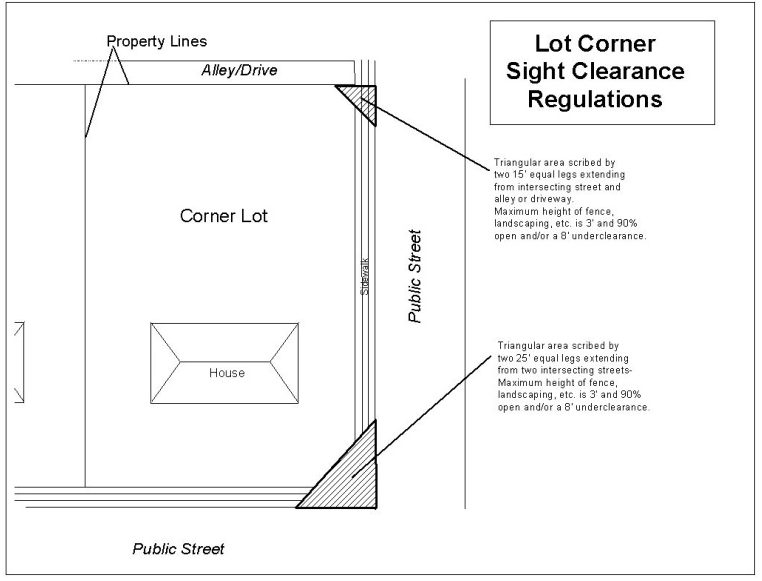
Vision Traiangle Clearance
(Code 1984, § 13.510)
Sec. 44-360. - Transitional yard setback requirements.
(a)
Front yards. Where the front yard of a nonresidential district adjoins or is opposite to a residential district, the minimum front yard setback of the residential district shall apply to the nonresidential district. The setback area shall be landscaped as specified in Sections 44-1964 through 44-1969.
(b)
Side or rear yards. Where the interior side yard or rear yard of a nonresidential district adjoins the side or rear yard of a residential district, the minimum side or rear yard setback within the nonresidential district shall be ten feet. The setback area shall be landscaped as specified in Sections 44-1964 through 44-1969.
(Code 1984, § 13.513)
Sec. 44-361. - Building height.
(a)
In general. The building height limitations established in each separate zoning district shall apply to all buildings and structures, with the exception of the following:
(1)
Church steeples, spires, or belfries.
(2)
Chimneys or flues.
(3)
Cupolas and domes which do not contain useable space.
(4)
Flagpoles.
(5)
Mechanical or electrical equipment.
(6)
Monuments.
(7)
Parapet walls extending not more than three feet above the limiting height of the building.
(8)
Television antennas not exceeding 20 feet.
(9)
Towers, poles, or other structures for essential services.
(10)
Water towers.
(b)
Measurement. Building height shall be measured from the average elevation of the finished lot grade at the front of the building to the mid-height of the structure on a flat or shed roof, the deck line of a mansard roof, or the average distance between the eaves and the ridge level for gable, hip, and gambrel roofs.
(c)
Limits. No excluded roof equipment or structural element extending beyond the defined height of a building may occupy more than 25 percent of the roof area.
(Code 1984, § 13.514)
Sec. 44-385. - General requirements.
(a)
In general. All developments shall be located so as to preserve the natural features of the site, to avoid areas of environmental sensitivity, to minimize the creation of impervious surface area, and to minimize negative impacts on the alteration of the natural environment.
(b)
Unbuildable area. The following natural features when present within a parcel constitute unbuildable area. No development, grading or filling, alteration of the natural character of the land, or construction of buildings, structures, or parking shall occur within these areas.
(1)
Floodways, as defined in this chapter.
(2)
Navigable waters, as defined in this chapter.
(3)
Slopes of 20 percent or greater. Gradients between 20 percent and 30 percent may be used for construction if acceptable engineering solutions acceptable to a Professional Engineer and the Zoning Administrator.
(4)
Wetlands, as defined in this chapter and in Section 404, Clear Water Act.
(c)
Preservation areas. The following areas shall be preserved as undeveloped open space to the extent consistent with the reasonable utilization of land and in accordance with applicable federal, state, or local regulations:
(1)
Vegetated areas. Significant trees or plant communities, including remnant stands of native trees or plant communities that are rare to the area or of particular landscape significance.
(2)
Steep slope areas. Development on slopes of 12 percent and less than 20 percent shall be subject to the following conditions:
a.
The foundation and underlying material of any structure shall be adequate for the slope condition and soil type.
b.
The proposed development will not result in soil erosion, flooding, severe scarring, reduced water quality, inadequate drainage control, or other problems.
c.
The proposed development will not cause erosion or slope instability to neighboring property or cause structural damage to neighboring structures.
d.
The proposed development will preserve significant natural features by minimizing disturbance to existing topographical forms.
e.
The City may require that a property be rezoned and developed as a Planned Unit Development to utilize flexible development standards to preserve steep slopes.
(3)
Habitats of threatened or endangered wildlife as identified on federal or state lists, including, but not limited to, the Federal Endangered Species Act and the Natural Heritage Inventory.
(d)
Mitigation. Where preservation is not consistent with the reasonable utilization of land, the City may require mitigation through replacement of the resource or similar resource on the site, restoration of former natural amenities to the site, or other reasonable measures to protect or enhance the natural features of the land.
(e)
Waterway setback. There shall be a building setback of 50 feet from the bulkhead line or ordinary high water mark, whichever provides the greater landward distance, of all waterways within the City of Green Bay, as described on Map C of Section 30-58. There shall be no building, or alteration of existing buildings, within such setback area. These areas shall include, but are not limited to:
(1)
Green Bay shore and islands.
(2)
Fox River.
(3)
East River.
(4)
Baird Creek, including South Branch.
(5)
Beaver Dam Creek.
(6)
Duck Creek.
(7)
Ellis Creek.
(8)
Mahon Creek.
(9)
Willow Creek, including North Branch.
(10)
All other navigable waterways not listed above.
(Code 1984, § 13.515; Ord. No. 16-10)
Sec. 44-414. - General requirements.
Accessory uses and structures shall comply with the following standards and all other applicable regulations of this chapter:
(1)
No accessory use or structure shall be constructed or established on any lot prior to the time of construction of the principal use to which it is accessory.
(2)
The accessory use or structure shall be incidental to and customarily associated with the principal use or structure.
(3)
The accessory use or structure shall be subordinate in area, extent, and purpose to the principal use or structure served.
(4)
The accessory use or structure shall contribute to the comfort, convenience, or necessity of the occupants of the principal use or structure served.
(5)
The accessory use or structure shall be located on the same zoning lot as the principal use or structure, except for accessory off-street parking and loading facilities, subject to the provisions of Article XVIII of this chapter, Off-Street Parking, Drives and Loading.
(6)
The accessory use or structure shall not be injurious to the use and enjoyment of the surrounding properties.
(Code 1984, § 13.516)
Sec. 44-415. - Accessory buildings.
In all districts, the design and construction of any accessory building, such as garages, carports, or storage buildings, shall be similar to or compatible with the design and construction of the principal building. The exterior building materials, roof style, and colors shall be similar to the main building.
(Code 1984, § 13.517)
Sec. 44-416. - Private outdoor recreation courts.
All private outdoor recreation courts, such as tennis or basketball courts, are subject to the following standards:
(1)
The court is not operated as a business or private club except when allowed as a permitted home occupation.
(2)
The court shall not be located in any required front yard or side yard and must be set back at least five feet from any property line, including any walks, paved areas, or related structures.
(Code 1984, § 13.518)
Sec. 44-417. - Recreational vehicle parking.
Recreational vehicles may be parked on any property within the City only under the following conditions:
(1)
Recreational vehicles may be located to the front, side, and rear of a principal structure and shall not be located in a required setback, in accordance with this chapter.
(2)
Recreational vehicles shall be parked upon a paved off-street parking area, in accordance with this chapter.
(3)
A maximum of two recreational vehicles may be permitted to park per residential tax parcel.
(4)
Recreational vehicles are permitted to be parked in a garage as part of a primary structure and/or a permitted accessory building.
(5)
Recreational vehicles shall not be utilized for living, sleeping, or housekeeping.
(6)
Recreational vehicles shall not be parked for a period to exceed one year.
(7)
Recreational vehicles must be operational and owned by and registered to the owner or the legal tenant of the property and must bear current license registrations as applicable.
(8)
Recreational vehicles shall not interfere with vehicular line of sight, the public right-of-way, or interfere with pedestrian traffic.
(9)
Recreational vehicles may be used as on-site offices in conjunction with construction work, provided they shall be removed upon completion of construction. Such vehicles may be occupied 24 hours a day for on-site security but shall not be used as a residence.
(Code 1984, § 13.519; Ord. No. 14-11; Ord. No. 27-15)
Sec. 44-418. - Antennas and meteorological equipment.
(a)
In general. Radio and television transmitting and receiving antennas, dish-type antennas, and meteorological sensing equipment is permitted on the roof of a permitted building or may be ground-mounted under the conditions provided in this section.
(b)
Installation and placement requirements. In addition to applicable building and electrical code requirements, all such equipment shall meet the following standards:
(1)
Equipment may be constructed to a maximum height of 20 feet above the allowable height limitations of the district.
(2)
Not more than one antenna exceeding the allowable height limit of the district shall be allowed on any residentially zoned property.
(3)
Antennas shall be located with at least five feet of vertical and horizontal clearance from the nearest overhead electrical power line that serves other properties.
(4)
Mechanical equipment on a roof shall not take up more than 25 percent of the roof area.
(5)
Antennas shall be set back from any public right-of-way or easement line a distance equal to or greater than the height above ground of the antenna.
(6)
Necessary guy wires and other supportive devices shall be located at least six feet from any property line.
(7)
Placement of antennas at nonresidential properties is allowed, subject to the screening requirements identified in Sections 44-1964 through 44-1969, Landscaping.
(8)
Mechanical equipment shall be screened from view with suitable fencing or screening.
(9)
Antennas shall also be subject to the provisions of Section 8-331, Television and radio receiving and transmitting antennas, covering construction, setbacks, etc.
(c)
Regulation of residential satellite dishes.
(1)
All residential facilities shall be designed to minimize the visual impact to the largest extent feasible, considering technological requirements, by means of placement and screening to be compatible with existing architectural elements and building materials and other site characteristics.
a.
To the extent feasible, antennas and satellite dishes shall not be installed in a location where they are in clear view from the public right-of-way.
b.
Such facilities shall be located to the largest extent possible in areas where the adverse impacts on the community are minimal.
c.
Support facilities shall be constructed out of non-reflective materials and shall be screened from view by using landscaping or materials and colors consistent with the surrounding site.
d.
Attached antennas shall be painted and/or textured to match the existing support structure.
(2)
This division shall not apply to satellite dishes less than one meter (39 inches) in diameter.
(Code 1984, § 13.520; Ord. No. 3-08)
Sec. 44-450. - Fence location and height.
Fences may be erected, placed, or maintained in any yard along or adjacent to a lot line in accordance with the requirements identified in this section. The owner shall be responsible for properly locating all property lines before construction of any fence.
(1)
Height.
a.
Residential zoning districts. The maximum height of a fence or wall within required side and rear setbacks in a residential zoning district shall not exceed six feet. Fences around pools shall not exceed eight feet. The maximum height of a solid fence or wall within a required front yard or corner side yard setback shall not exceed three feet. Such front yard or corner side yard fences may be increased to a maximum height of four feet if open, decorative, ornamental fencing materials that are less than 50 percent opaque are used or to a maximum height of five feet if open, decorative, ornamental fencing materials that are less than 20 percent opaque are used. When the fence extends beyond at least half the distance of the primary building's side facade, the fence height may increase to six feet provided the fence is constructed not closer than one-half the applicable corner side yard setback.
b.
Nonresidential zoning districts. The maximum height of a fence or wall shall not exceed eight feet except in required front or corner side yard setbacks where the maximum height of a solid fence or wall shall not exceed three feet.
c.
In the case of grade separation, such as the division of properties by a retaining wall, fence height shall be determined based on measurement from the average point between highest and lowest grade.
d.
Fences or walls shall comply with the vision triangle requirements of Section 44-359.
Fence Regulations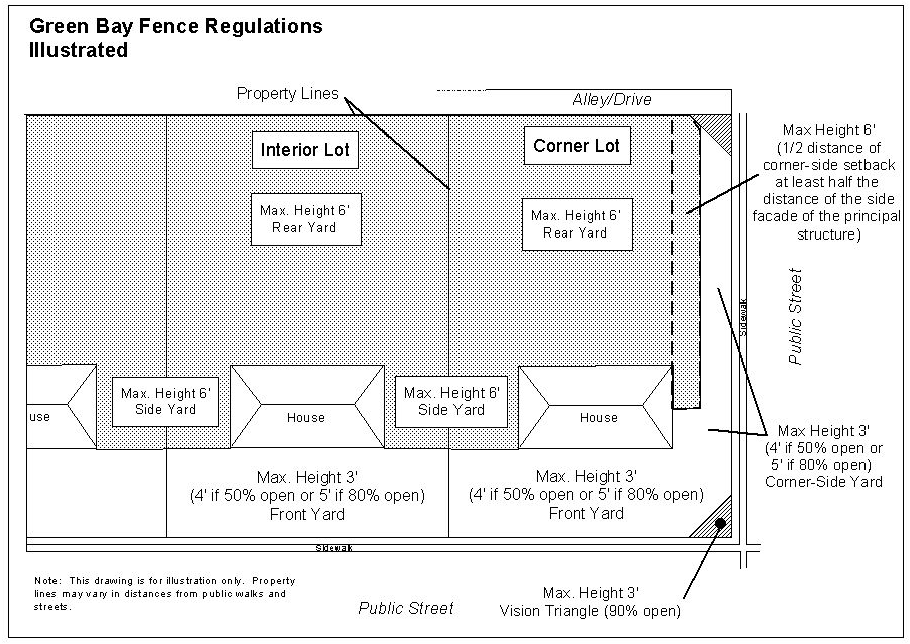
(2)
Materials and construction.
a.
Walls and fences shall be constructed of high quality materials, such as decorative blocks, brick, stone, treated wood, wrought iron, chain link and plastic.
b.
No fence shall have sharp or pointed pickets dangerous to life or limb.
c.
Hedges shall be trimmed or confined to the property on which they are planted.
d.
No fence or other structure containing barbed wire or other dangerous material shall be placed on residentially zoned property or within four feet of any public street, sidewalk, or alley.
e.
Fences shall be constructed so that the structural supporting elements are located on the side which is visible to the fence owner (inside) so that the structure/supporting elements of the fence are less visible to adjoining properties and public rights-of-way.
(3)
Breaks for connections. Breaks in the length of a perimeter wall shall be made to provide for required pedestrian connections to the perimeter of a site or to adjacent development.
(Code 1984, § 13.521; Ord. No. 35-10)
Sec. 44-469. - Permitted temporary uses and structures.
The following temporary uses and structures shall be permitted in all zoning districts, except as otherwise specified below, provided such temporary use or structure shall receive a temporary use permit designating that it complies with the regulations of the zoning district in which it is located and all other applicable regulations of this chapter:
(1)
Rummage sales. Rummage sales shall be limited to a total of no more than four events for a total of 16 days of operation per calendar year at any residential location.
(2)
Construction sites. Storage of building materials and equipment or temporary buildings for construction purposes may be located on the site under construction for the duration of the construction or for a period of one year, whichever is less. Planning and zoning staff may grant extensions to this time limit for good cause shown.
(3)
Amusement events. Temporary amusement events, including the erection of tents for such events, may be allowed as a temporary use for a maximum of 15 days per calendar year.
(4)
Outdoor dining. Outdoor dining shall be permitted as a temporary accessory use to a primary use of a restaurant provided said use it conducted wholly on private property. In no case, however, shall the public right-of-way or any public property be utilized for outdoor dining without the appropriate agency or Common Council approval.
(5)
Promotional activities involving outdoor sales and display. Promotional activities, including outdoor sales and display, may be allowed as a temporary use in nonresidential districts for a maximum of 30 days per calendar year. Such sales and display may also be conducted within a tent or other temporary structure.
(6)
Seasonal outdoor sale of agricultural products. The seasonal outdoor sale of agricultural products, including, but not limited to, produce, plants, and Christmas trees, may be allowed as a temporary use. In no case, however, shall the public right-of-way or any public property be utilized for the sale and display of such items without the appropriate agency or Common Council approval.
(7)
Stay of recreational camping vehicles during professional/collegiate games. On the days games are played in the City of Green Bay by professional football teams of the National Football League and/or by collegiate teams at Lambeau Field, areas zoned commercial and industrial may permit the temporary stay of recreational camping vehicles, not to exceed two days prior to nor two days after the game, provided that a site plan is filed by the property owner in accordance with Article XIX of this chapter and all of the following requirements are met:
a.
Each individual camp site is located and identified by a site number.
b.
Each camp site has direct access to a minimum 20-foot aisle space.
c.
The plan for electrical hook-ups for guests is code compliant.
d.
The site plan identifies the availability of restrooms for guests.
e.
Fire pits and open flames shall be regulated by the City Fire Department.
f.
The site plan designates refuse and recycling areas.
(8)
Mobile food rally. An event where three or more mobile food establishments, as defined in Chapter 10, may assemble but is not a permanent use. Mobile food rallies can establish on private property via temporary use permit (a special events permit is required for public property or right-of-way). Rallies accomplished via temporary use permit can last no more than three consecutive days, with 36 total days allowed in a calendar year.
(9)
Additional temporary uses. All other temporary uses are prohibited unless application is made to the Planning Department, which may allow other temporary uses for a maximum of 90 days per calendar year, with one possible 90-day extension. Such temporary uses may be substantially similar to the temporary uses listed in this section, or as otherwise approved by the Zoning Administrator. A site plan shall be submitted with the temporary use application, in accordance with Article XIX of this chapter. Any substantiated complaints or violations related to the temporary use shall be grounds for revocation of the site plan and termination of the temporary use authorization.
(Code 1984, § 13.522; Ord. No. 28-20, § 1, 8-18-2020; Ord. No. 31-20, § 1, 9-15-2020; Ord. No. 03-25, § 1, 5-6-2025; Ord. No. 07-26, § 2, 3-17-2026)
Sec. 44-492. - Exterior site lighting.
(a)
In general. These regulations recognize the benefits of site lighting as it increases safety, enhances nighttime character, and helps provide security. However, inappropriate and poorly designed or installed lighting often causes unsafe and unpleasant conditions and may infringe on the rights of private property owners. This exterior site lighting regulation is designed to eliminate problems associated with glare, as well as to minimize light trespass and spillover on adjacent properties and streets.
(b)
Applicability. The regulations of this section shall apply to all exterior lighting, be it residential or nonresidential in nature, within the City of Green Bay.
(c)
Exceptions. The following lighting types shall be exempt from these regulations:
(1)
Public street lighting which shall conform to the standards established by the State Department of Transportation, Brown County Highway Department, and the City of Green Bay Department of Public Works.
(2)
Residential uses are permitted to use low-intensity (1100 lumens or less per bulb) incandescent, fluorescent, or light emitting diode (LED) lighting mounted on the buildings or as landscape accents. Any high-intensity (more than 1100 lumens per bulb) incandescent, fluorescent, LED, or high-intensity discharge lighting shall be prohibited unless a lighting plan is submitted and approved, per Section 44-493.
(3)
Aviation lighting used exclusively for aviation purposes per Federal Aviation Administration. Heliport lighting shall be turned off when the heliport is not in use.
(4)
Holiday lighting at or below 45 lumens per bulb.
(5)
Approved historic light fixtures consistent with the character of the historic district or structure and with the approval of the Historic Preservation Commission.
(6)
Residential lights at a light level of 0.25 foot-candles or less at the property line.
(7)
Lighting associated with or considered to be signage.
(8)
Existing exterior lighting that does not meet the standards of this section shall be considered legal nonconforming until such time as it is replaced or altered.
(Code 1984, § 13.523; Ord. No. 23-22, § 1, 12-6-2022)
Sec. 44-493. - Exterior lighting plan required.
Whenever exterior lighting is installed or modified and whenever a site undergoes site plan review, a lighting plan may be required at the discretion of the Inspection Superintendent. An exterior lighting plan may be required if the Zoning Administrator believes lighting from structures like tennis courts, swimming pools, sheds may encroach on neighboring single-family and two-family properties. This plan may be required to include the following information:
(1)
Proposed light fixture details which depict the height, design, method of shielding, and proposed candlepower of the light source.
(2)
Photometric plan which shows proposed intensity of illumination in foot-candle values distributed across the site in a grid-like fashion. This grid should be overlaid on the site plan or, at a minimum, be the same scale as the site plan.
(Code 1984, § 13.524)
Sec. 44-494. - Lighting standards applying to all light sources.
The following standards are required for all exterior lighting:
(1)
All cutoff light fixtures shall be designed with a hood that shields the light source and shall be directed downwards at all times.
(2)
No flickering or flashing lights shall be permitted, other than holiday lighting exempted in Section 44-492(c)(4).
(3)
Flood lights are not permitted in front yards, except as permitted by Chapter 30, Sign.
(4)
Flashing, flickering, moving, and/or other lighting which is a nuisance or which may distract motorists, such as red, amber, or green lights closer than 300 feet from a traffic signal, is prohibited.
(5)
Lighting levels shall be measured in foot-candles with a direct reading portable light meter. Readings shall be taken at heights between six inches to six feet above ground level at a position facing the light source. Measurements shall be made after dark with the light sources in operation and then again with the light sources off. The difference between these two readings shall be compared to the maximum permitted illumination. This procedure will eliminate the effects of moonlight and other ambient light.
(Code 1984, § 13.525)
Sec. 44-495. - Standards for building-mounted lights.
Building-mounted lights shall be of the cutoff variety. The light sources shall be hooded and directed downward at all times. Non-shielded light sources shall only be permitted for security purposes provided the illumination at the nearest property line does not exceed the maximum permitted under Section 44-496.
(Code 1984, § 13.526)
Sec. 44-496. - Standards for pole lights.
The maximum permitted light pole height is dependent upon the amount of cutoff provided in order to minimize glare onto adjacent properties and the public right-of-way.
(1)
When the light source is non-cutoff:
a.
Maximum permitted illumination as measured at property lines abutting residential districts shall be 0.25 foot-candle.
b.
Maximum permitted illumination as measured at the property lines abutting nonresidential districts or the public right-of-way shall be one-half foot-candle.
c.
Maximum permitted pole height shall be 15 feet as measured to the bottom of the light fixture. (See the following graphic.)
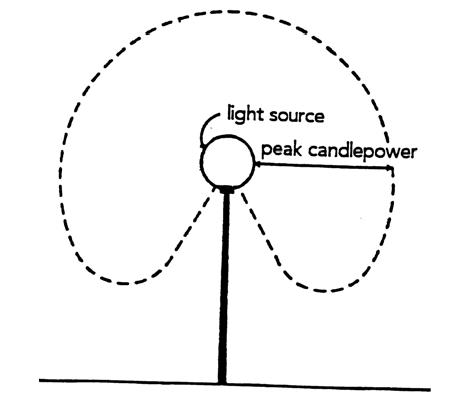
Non-Cutoff Light Source
(2)
When the light source has semi-cutoff of an angle greater than or equal to 90 degrees:
a.
Maximum permitted illumination as measured at property lines abutting residential districts shall be one-half foot-candle.
b.
Maximum permitted illumination as measured at the property lines abutting nonresidential districts or the public right-of-way shall be one foot-candle.
c.
Maximum permitted pole height shall be 25 feet as measured to the bottom of the light fixture. (See the following graphic.)
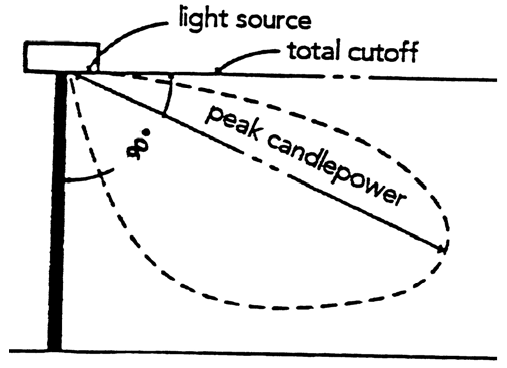
Semi-Cutoff Light Source (Angle ≥ 90°)
(3)
When the light source has full cutoff of an angle less than 90 degrees and the light source is completely shielded from the direct view of an observer at five feet above the ground, at the point where the cutoff angle intersects the ground:
a.
Maximum permitted illumination as measured at property lines abutting residential and nonresidential districts or the public right-of-way shall be one foot-candle.
b.
Maximum permitted pole height shall be 40 feet as measured to the bottom of the light fixture. (See the following graphic.)
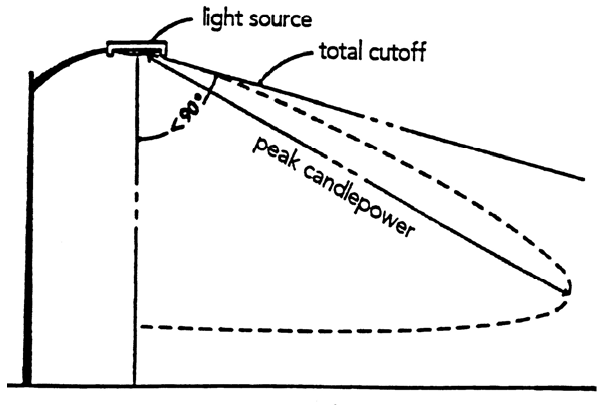
Full Cutoff Light Source (Angle < 90°)
(Code 1984, § 13.527)
Sec. 44-497. - Lighting requiring a conditional use permit.
The following lighting types shall require a conditional use permit as regulated in Section 44-83, Conditional uses:
(1)
Temporary special event lighting.
(2)
Outdoor recreation lighting.
a.
A pole and pole supports used in the lighting of an outdoor recreational/stadium lighting facility shall not be placed closer to a private property line than the mounting height of the lights.
b.
All poles and pole supports shall meet the standards as specified in Section 8-331.
c.
All lighting shall meet the requirements of this division.
d.
All unused outdoor recreation/stadium lighting facilities and/or support structures shall be removed within 12 months of the cessation of operations at the site unless the Plan Commission approves a time extension. In the event that an outdoor recreation/stadium lighting facilities and/or support structures is not removed within 12 months of the cessation of operations at a site, the outdoor recreation/stadium lighting facilities and/or support structures may be removed by the City and the costs assessed against the property.
e.
Stadium facilities within the park system are exempt from this requirement.
(3)
Other lighting as deemed appropriate by the Zoning Administrator or their designee.
(Code 1984, § 13.528; Ord. No. 16-08; Ord. No. 23-22, § 2, 12-6-2022)
Sec. 44-518. - Purpose.
Regulation of pools, ponds, and spas are established to ensure that the establishment of pools, ponds, and spas do not affect the safety, health, or welfare of the residents or the community and do not annoy, disturb, injure, or endanger the comfort, repose, health, peace, or safety of others.
(Code 1984, § 13.529)
Sec. 44-519. - Permit required.
No construction of a pool intended as a permanent installation, a pond, or spa shall begin unless a permit has been obtained and the fee paid in accordance with the fee provisions of this chapter. The application for such permit shall be accompanied by a site plan showing the size, location, and description of the property.
(Code 1984, § 13.530)
Sec. 44-520. - Requirements.
(a)
Setback. Permanent aboveground or in-ground pools, ponds, or spas shall maintain a minimum front yard setback of 25 feet and a rear and side yard setback of ten feet from adjoining property, subject to properly granted variance under Article II of this chapter, Administration. In determining this setback for aboveground pools, ponds, or spas with permanent fencing or decks, any deck or similar structure shall be considered part of the pool, pond, or spa.
(b)
Fencing. All pools, ponds, or spas requiring a permit shall be encompassed by fencing as provided under this subsection. A variance to maximum fence height may be granted under the procedures of Article II of this chapter. However, under no circumstance may the minimum fence height requirements of this subsection be varied.
(1)
Structural requirements. All fences under this subsection shall be constructed in such a manner as to comply with the requirements of Section 44-450 or variance and the requirements of this subsection.
a.
The fence must be able to withstand 200 pounds of force in any direction.
b.
The fence shall be so constructed and designed so as to prevent penetration of an object greater than six inches in diameter.
c.
All such fences shall be constructed with a locking door or gate which complies with all other height and structural requirements of this section.
(2)
Permanent in-ground pools, ponds, or spas. Permanent in-ground pools, ponds, or spas, subject to Section 44-450, shall be encompassed by a freestanding fence not less than 48 inches nor more than 96 inches from the ground level. Such fence shall be no less than three feet from the pool, pond, or spa at its nearest point. The fence shall comply with subsection (b)(1) of this section.
(3)
Aboveground pools, ponds and spas.
a.
Generally. Aboveground pools, ponds, or spas shall be encompassed by fencing which complies with one or any combination of options listed below and complies with subsection (b)(1) of this section.
1.
A fence in compliance with subsection (b) of this section.
2.
A fence within three feet of the pool, pond, or spa and not less than 48 inches nor more than 96 inches from ground level.
3.
A fence attached to a deck or walkway, provided such fence is at least 36 inches above the surface of the deck or walkway and complies with this section.
4.
A pool wall not less than 48 inches from ground level, provided steps, ladders, or other means of pool access are removed when the pool is not in use.
b.
Exceptions. Fencing shall not be required if the following are provided:
1.
Pools, ponds, or spas with locking and solid structural covers. Such covers shall be in place whenever the pool, pond, or spa is not in use and/or unsupervised by an adult.
2.
Pools, ponds, or spas completely enclosed within a building.
3.
As determined by the Zoning Administrator that the pool, pond, or spa does not affect the safety, health, or welfare of the residents or the community and does not annoy, disturb, injure, or endanger the comfort, repose, health, peace, or safety of others.
(Code 1984, § 13.531)
Sec. 44-521. - Operation of residential pools.
(a)
Public swimming pools, ponds, or spas prohibited in residential areas. No person shall operate a public pool, pond, or spa on any premises zoned residential. The operation of a public pool, pond, or spa on residential premises is declared to be a public nuisance.
(b)
Interference with enjoyment of property rights prohibited. No pool, pond, or spa shall be so located, designed, operated, or maintained as to interfere unduly with the enjoyment of property rights of owners of property adjoining the pool, pond, or spa or located in the neighborhood.
(Code 1984, § 13.532)

