
Green Bay City Zoning Code
ARTICLE VI
RESIDENTIAL DISTRICTS
Sec. 44-551. - Purpose.
The residential districts are established to preserve and enhance the quality of living in residential neighborhoods, to regulate structures and uses which may affect the character or desirability of residential areas, to encourage a variety of dwelling types and locations and a range of population densities consistent with the City's comprehensive plan, and to ensure adequate light, air, privacy, and open space. The residential districts and their purposes are as follows:
(1)
R-1 Low-Density Residential District provides an environment of predominantly single-family dwellings on moderately sized lots. Infill development is encouraged on lots that are consistent in size and dimensions with the predominant lot size and type on adjacent parcels. Two-family and small lower density multifamily dwellings are permitted in limited numbers, consistent with the goals of promoting affordable housing and encouraging a variety of housing sizes and types in each neighborhood.
(2)
R-2 Medium-Density Residential District is established to provide an environment of moderate-density single- and two-family dwellings, townhouses, and small lower density multifamily dwellings that are designed to be compatible with their neighbors.
(3)
R-3 Varied Density Residential District is established to provide for an environment of moderate- to high-density attached and multifamily housing designed to present an attractive appearance to neighboring streets and adjacent uses, to include sufficient private and semi-private outdoor space, and to be well integrated into their surroundings.
(4)
RR Rural Residential District is established to provide for limited large-lot development in areas of the City not yet served by public utilities, as defined by the Urban Reserve District (a municipal service district). In these areas, the intent is to facilitate future urban development in a cost-effective manner that allows for logical street connections and open space protection. In areas served by public utilities, the RR district provides a low-density residential environment and allows for the option of conservation subdivision design.
(Code 1984, § 13.601; Ord. No. 29-25, § 1, 12-2-2025)
Sec. 44-552. - Principal uses for the residential districts.
(a)
In general. Table 44-1, Principal Uses in the Residential Districts, lists all permitted and conditional uses allowed in the residential districts.
(b)
Permitted uses. Uses specified with a "P" are permitted in the district or districts where designated, provided that the use complies with all other applicable provisions of this chapter. Persons wishing to establish or modify a permitted use, excluding single-family residential uses, shall obtain a zoning certificate for such use as specified in Article II of this chapter, Administration.
(c)
Conditional uses. Uses specified with a "C" are allowed as a conditional use in the district or districts where designated, provided that the use complies with all other applicable provisions of this chapter. Persons wishing to establish or expand a conditional use shall obtain a conditional use permit for such use as specified in Article II of this chapter, Administration. Condominiums are permitted in all residential districts per Wis. Stats. Ch. 703.
(d)
Prohibited uses. Any use not listed as either "P" (permitted) or "C" (conditional) in a particular district or any use not determined by the Zoning Administrator to be substantially similar to a use listed as permitted or conditional shall be prohibited in that district. Such determination shall be made in the manner provided for in Article II of this chapter, Administration, governing determination of substantially similar uses.
(e)
Specific development standards. Permitted and conditional uses specified with an "x" under the Specific development standards column shall be subject to the standards identified in Article XVI of this chapter, Land Use Development Standards.
Table 44-1. Principal Uses in the Residential Districts
Note: P = Permitted Use; C = Conditional Use.
(Code 1984, § 13.602; Ord. No. 23-06; Ord. No. 34-09; Ord. No. 1-10; Ord. No. 10-15; Ord. No. 20-16; Ord. No. 10-18, § 4, 6-19-2018; Ord. No. 29-25, § 1, 12-2-2025)
Sec. 44-553. - Site design considerations.
Development of land within the residential districts shall follow established standards for traffic circulation, landscape design, and other considerations as specified in Article XVI of this chapter, Land Use Development Standards, and Article XIX of this chapter, Site Plan Review.
(Code 1984, § 13.603; Ord. No. 29-25, § 1, 12-2-2025)
Sec. 44-554. - Lot dimension and building bulk requirements.
Lot area and setback requirements shall be as specified in Table 44-2, Lot Dimension and Setback Requirements.
Table 44-2. Lot Dimension and Setback Requirements, Residential Districts
Notes to Table 44-2:
a For lots in the RR district without City services, minimum lot area shall be ten acres. Other lot dimensions shall be as specified in Table 44-2. See Section 44-555.
b Where at least 50 percent of the front footage of any block is built up with principal structures, the front yard setback for new structures shall be equal to the average of the existing structures, except that any structure which is set back 20 percent more or less than the average may be discounted from the formula.
c If townhouses are developed on parcels where only the land immediately beneath each dwelling unit constitutes an individually-described lot and all other land constitutes common properties, the density requirement rather than the minimum lot size shall apply to the entire parcel.
d Side yards: Setbacks shall apply to the ends of attached or semi-detached dwellings.
e Corner properties: The side facade of a corner building adjoining a public street shall maintain the front setback of the adjacent property fronting upon the same public street. If no structure exists on the adjacent property, the setback shall be a minimum of one-half the required front yard setback of the subject property's zoning district.
f Heights of structures may be increased with a conditional use permit as permitted in Section 44-83.
g Covered porches are permitted in the front setback compliant with the conditional use permit requirements found in Section 44-83. A porch proposed for a designated historic property or a contributing building within a historic district may be constructed within a front and/or side yard setback provided the porch is historically appropriate or a restoration of a significant architectural feature of the original structure.
h Note that screening / buffer yard setbacks located in Article XIX, Division 5 of this code may supersede the setback requirements.
(Code 1984, § 13.604; Ord. No. 11-14; Ord. No. 15-14; Ord. No. 16-21, § 1, 6-29-2021; Ord. No. 29-25, § 1, 12-2-2025)
Sec. 44-555. - Unserviced lots, RR District.
All lots developed without City sewer and public water service shall meet the following standards:
(1)
Lots, houses, and other structures, driveways, and any new streets shall be located in compliance with the comprehensive plan and any more detailed area plans for future roads, utilities, and drainage.
(2)
The Plan Commission may require a sketch plan showing how the entire tract could be divided when City services become available. Lots and buildings shall be sited and streets shall be laid out to facilitate future subdivision.
(3)
The ten-acre limit in the RR District may be reduced subject to the following development standards:
a.
It is relatively similar to other existing parcels in the area.
b.
An area development plan is submitted and approved for the remaining property and the parcel being created.
c.
All efforts should be taken to ensure that the existing home and lot will:
1.
Comply with future setbacks.
2.
Fit with the surrounding future development and the parcels future development.
3.
Provide for existing utilities, septic and well currently servicing the home.
d.
Lot size will be determined by the Plan Commission based on a reasonable determination of the area development plan and future lot lines.
e.
Remnant parcel shall not be less than ten acres, except in cases where a remnant parcel is part of a division of land for the purposes of acquisition of public property and/or public use.
f.
The maximum lot to be created should not be greater than 2½ acres.
g.
The land division should meet all remaining standards of Chapter 36, Subdivisions.
(Code 1984, § 13.605; Ord. No. 38-08; Ord. No. 10-14; Ord. No. 08-21, § 1, 5-4-2021; Ord. No. 29-25, § 1, 12-2-2025)
Sec. 44-556. - Lot area requirement, R-1 and R-2 Districts.
The lot area requirement for multifamily uses in the R-1 and R-2 Districts is 2,000 square feet per unit. In the case of boarding homes, dormitories, hospitals, and other residential facilities, the area requirement shall be 1,000 square feet for each resident occupancy of the structure.
(Code 1984, § 13.606; Ord. No. 29-25, § 1, 12-2-2025)
Sec. 44-557. - Lot area requirement, R-3 District.
The lot area requirement for multifamily uses in the R-3 District is 1,500 square feet per unit. In the case of boarding homes, dormitories, hospitals, and other residential facilities, the area requirement shall be 1,000 square feet for each resident occupancy of the structure.
(Code 1984, § 13.607; Ord. No. 29-25, § 1, 12-2-2025)
Sec. 44-558. - Housing density bonus, R-3 District.
In the R-3 District, sites of three acres or more should include at least two of the following housing types: multifamily apartments of three or four units, multifamily apartments of five or more units, senior apartments, townhouses, duplexes, and semi-detached dwellings. For such developments, the number of units permitted may be increased by up to ten percent above the maximum number of units specified in Section 44-557, if the following requirements are met:
(1)
Two or more of the above-listed housing types are provided.
(2)
Each housing type may comprise no less than ten percent of the total number of units.
(Code 1984, § 13.608; Ord. No. 29-25, § 1, 12-2-2025)
Sec. 44-559. - Maximum impervious surface coverage.
Impervious surface, including all buildings, drives, and other paved areas, shall not cover more than 40 percent of any zoning lot located in the RR District, 50 percent of any zoning lot located in the R1, 60 percent of any zoning lot in the R2 Districts, or 70 percent of any zoning lot in the R3 District. For lots developed or created prior to December 3, 2015 which contain 7500 square feet or less in area; the impervious surface including all buildings, driveways, and other paved areas, shall not contain more than 40 percent of any zoning lot located in the RR District, 60 percent of any zoning lot located in the R1, 70 percent of any zoning lot in the R2 Districts, or 80 percent of any zoning lot in the R3 District. See the following graphic:
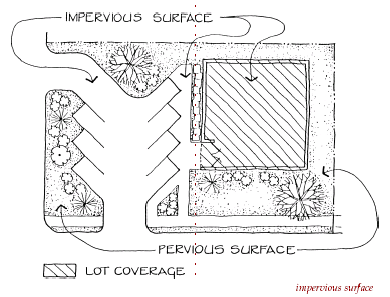
Impervious Surface Coverage
(Code 1984, § 13.609; Ord. No. 29-25, § 1, 12-2-2025)
Sec. 44-560. - Planned unit developments and traditional neighborhood developments.
A planned unit development or traditional neighborhood development plan may be submitted for consideration within any residential district, subject to the requirements and standards established in Article XX of this chapter, Planned Unit Development Standards, and Article XIV of this chapter, Traditional Neighborhood District.
(Code 1984, § 13.610; Ord. No. 29-25, § 1, 12-2-2025)
Sec. 44-561. - Parking and loading requirements.
Parking and loading requirements for uses in the residential districts shall be as set forth in Article XVIII of this chapter, Off-Street Parking, Drives, and Loading.
(Code 1984, § 13.611; Ord. No. 29-25, § 1, 12-2-2025)
Sec. 44-562. - Signs.
Sign requirements for uses in the residential districts shall be as specified in Chapter 30, Signs.
(Code 1984, § 13.612; Ord. No. 29-25, § 1, 12-2-2025)
Sec. 44-588. - General requirements.
Accessory uses and structures in the residential districts shall comply with the following standards and all other applicable regulations of this chapter:
(1)
No accessory use or structure shall be constructed or established on any lot prior to the time of construction of the principal use to which it is accessory.
(2)
The accessory use or structure shall be incidental to and customarily associated with the principal use or structure served.
(3)
The accessory use or structure shall be subordinate in area, extent, and purpose to the principal use or structure served.
(4)
The accessory use or structure shall contribute to the comfort, convenience, or necessity of the occupants of the principal use or structure served.
(5)
The accessory use or structure shall be located on the same zoning lot as the principal use or structure.
(Code 1984, § 13.613; Ord. No. 29-25, § 2, 12-2-2025)
Sec. 44-589. - Permitted accessory uses.
Table 44-3. Permitted Nonresidential Accessory Uses in the Residential Districts
Note: P = Permitted Use; C = Conditional Use.
(Code 1984, § 13.614; Ord. No. 36-09; Ord. No. 1-11; Ord. No. 9-12; Ord. No. 13-14; Ord. No. 29-25, § 2, 12-2-2025)
Sec. 44-590. - Residential accessory buildings.
(a)
In general. In all residential districts, the design and construction of any garage, carport, or storage building shall be similar to or compatible with the design and construction of the main building. The exterior building materials, roof style, and colors shall be similar to the main building or shall be commonly associated with residential construction.
(b)
Attached structures. An accessory structure shall be considered attached and an integral part of the principal structure when it is connected by an enclosed passageway. Such structures shall be subject to the following requirements:
(1)
The structure shall meet the required yard setbacks for a principal structure, as established for the zoning district in which it is located.
(2)
No more than 60% of the principal structures ground floor front façade length may be made of attached accessory structure façade.
a.
Exception to the maximum front façade length will be made for side-loaded accessory structures where entry doors are not street facing.
(3)
In no case shall the total floor area of an attached garage, carport, or other accessory structure exceed the ground floor area of the principal building located on the same lot.
(4)
Attached garages may not exceed the height of the principal structure.
(c)
Detached structures. Detached accessory structures shall be permitted in residential districts in accordance with the requirements shown in Table 44-4 and as follows:
(1)
Detached accessory structures shall be located to the side or rear of the principal building and are not permitted in front of the principal structures front or corner side façade and the abutting a street.
(2)
The maximum size may be increased upon approval of a conditional use permit, provided that lot coverage requirements are satisfied.
(3)
Structures with a metal exterior finish exceeding 120 square feet shall be permitted only by conditional use permit.
(4)
Distance between structures shall be measured from wall to wall.
Table 44-4. Requirements for Detached Accessory Structures, Residential Districts
Notes to Table 44-4:
a One- and two-family lots less than 61feet in width only require a 2½-foot side yard for detached accessory structures.
b One- and two-family lots less than 91 feet in depth only require a 2½-foot rear yard for detached accessory structures.
c Maximum height and maximum side wall height may be increased to a height no greater than that of the principal structure located on the same lot.
d Heights of structures may be increased with a conditional use permit as permitted in Section 44-83.
e A corner yard setback may be reduced where at least 50 percent of the front footage of any block is built up with principal structures, the corner yard setback for new structures shall be equal to the average of the existing structures, except that any structure which is setback 20 percent more or less than the average may be discounted from the formula. In no case shall the setback be less than 15 feet and shall only apply to corner lots of two intersection rights-of-way.
f May not be between the principal structures front or corner side yard façade and the right-of-way.
g Additional accessory structures shall be permitted with a CUP.
h Note that screening/buffer yard setbacks located in Article XIX, Division 5 of this code may supersede the setback requirement.
i One accessory dwelling unit with an approved CUP does not count as additional accessory structure.
(Code 1984, § 13.615; Ord. No. 25-09; Ord. No. 29-25, § 2, 12-2-2025)

