
Green Bay City Zoning Code
ARTICLE III
DEFINITIONS
Sec. 44-220. - Rules of construction.
In the construction of this chapter, the following rules shall be observed and applied, except where the context clearly indicates otherwise:
(1)
The present tense shall include the future.
(2)
The singular number shall include the plural and the plural the singular.
(3)
The word "shall" is mandatory and not discretionary.
(4)
The word "may" is permissive.
(5)
The word "building" includes the word "structure."
(6)
The words "used for" shall include the phrases "arranged for," "designed for," "intended for," "maintained for," and "occupied for."
(7)
The word "lot" shall mean "zoning lot" unless otherwise specified in this chapter.
(8)
The words "lot," "parcel," or "premises" may be used interchangeably.
(9)
All stated and measured distances shall be taken to the nearest integral foot. If a fraction is one-half foot or less, the integral foot next below shall be taken.
(Code 1984, § 13.301)
Sec. 44-249. - General definitions.
Unless otherwise expressly stated or unless the context clearly indicates a different meaning, the words and phrases in the following list of definitions shall, for the purposes of this chapter, have the meanings indicated. All words and phrases not defined shall have their common meaning. Definitions of land uses listed in this chapter are listed in Section 44-250. Definitions of signs are listed in Section 30-3.
ADT means average daily traffic volumes of vehicles on a street.
Accessory building means a subordinate building or a portion of the main building, the use of which is clearly incidental to that of the main building and which is located on the same lot as the main building. See the following graphic.
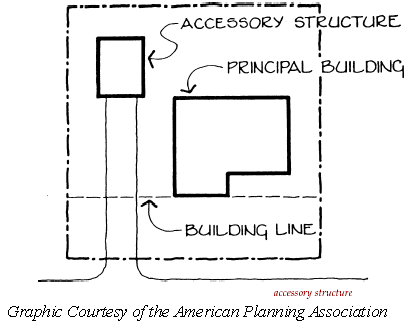
Accessory Building
Accessory use means a use on the same lot with and of a nature customarily incidental and subordinate to the principal use or structure.
Adaptive re-use means a change in use from that for which a structure was originally intended. Such a change provides for the continued utility of the structure without significantly altering the form and character of the original structure.
Affordable housing means housing in which mortgage, amortization, taxes, insurance, and condominium and association fees, if any, constitute no more than 30 percent of gross annual household income for a family earning 80 percent of the region's median income. In the case of dwelling units for rent, housing that is affordable means housing for which the rent and utilities constitute no more than 30 percent of gross annual household income for a family earning 80 percent of the region's median income.
Alley means a public or private way typically less than 20 feet wide and permanently reserved as a means of access to abutting property.
Annexation means the act or process of adding land to a governmental unit, usually an incorporated place, by an ordinance, court order, or other legal action.
Antenna means any structure or device used for the purpose of collecting or transmitting electromagnetic waves, including, but not limited to, directional antennas, such as panels, microwave dishes, and satellite dishes, and omni-directional antennas, such as whip antennas.
Apartment. See Multiple-family dwelling.
Area, building. See Building coverage.
Area, lot, means the total horizontal area within the lot lines of a lot.
Basement means that portion of a dwelling below the first floor or ground floor with its entire floor below grade.
Bioretention area means excavated area that is back-filled with a prepared or amended soil mixture, which may or may not be covered with a mulch layer and planted with a diversity of woody or herbaceous vegetation, to which stormwater is directed to promote infiltration or evapotranspiration. Such an area may also be known as a "rain garden."
Boathouse means a permanent structure used for the storage of watercraft and associated materials, including all structures which are totally enclosed and have roofs or walls or any combination of structural parts.
Building means a structure having a roof supported by columns or walls for shelter, support, or enclosure of persons, animals, or chattels. When separated by division walls from the ground up and without openings, each portion of such structure shall be deemed a separate building.
Building alteration means changes to structural parts, mechanical equipment, or location of openings, but does not increase the overall area of the building.
Building coverage means the horizontal area measured within the outside of the exterior walls of the ground floor of all principal and accessory buildings on a lot, generally expressed as a percentage of lot area.
Building entry means the doorway into a building along with the architectural treatments that accompany it.
Building facade means the entire area of a building facing or side extending from the roof or parapet to the ground and from one corner of the building to another.
Building height means the vertical distance measured from the curb level to the mid-height of the roof surface on a flat roof, to the deck line of mansard roofs, and to the mean height level between eaves and ridge for gable, hip, and gambrel roofs. For buildings set back from the street line, the height of the building may be measured from the average elevation of the finished grade along the front of the building, provided its distance from the street line is not less than the height of such grade above the established curb level. See the following graphic example.
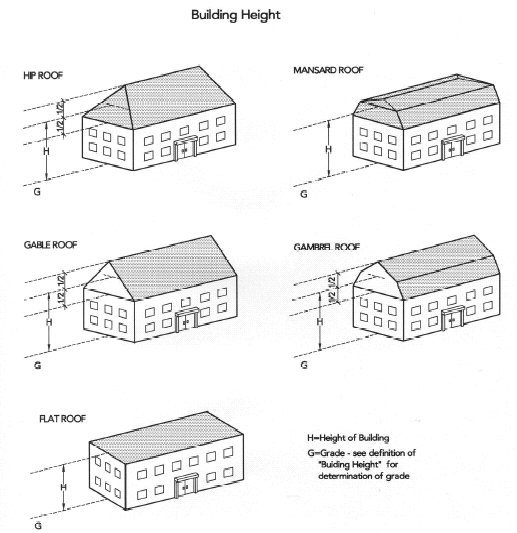
Building Height
Building scale means the relationship between the mass of a building and its surroundings, including the width of street, open space, and mass of surrounding buildings. Mass is determined by the three-dimensional bulk of a structure: height, width, and depth.
Canopy tree means a woody perennial usually having one dominant trunk and a mature height greater than five meters (16 feet).
Certificate of zoning means a document that acknowledges that a use, structure, building, or lot either complies with or is nonconforming to the provisions of this chapter or is an authorized variance or modification therefrom.
Channel means natural or artificial watercourse of perceptible extent with definite bed and banks to confine and conduct continuously or periodically flowing water.
Channel flow means that water which is flowing within the limits of the defined channel.
Cistern means a collection system that does not exceed 5,050 gallons and detains rainwater or stormwater runoff in above-ground or underground storage tanks for later outdoor use. A cistern of under 120 gallons in capacity typically is known as a "rain barrel."
Class II public notice means publication of a public hearing notice pursuant to Wis. Stats. Ch. 985.
Co-location means location of multiple antennas of more than one commercial wireless communication service provider or governmental entity on a single tower or structure.
Columbarium means a building for the entombment of the cremated remains of human bodies as a part of a cemetery.
Commercial motor vehicle means a truck, van, or commercial vehicle with less than 10,000 pounds gross vehicle weight rating.
Community Development Review Team (CDRT) means a group of professionals who conduct the administrative review of all site plan approval requests.
Community gardens means sectioned plots of land for individual or group use for the planting, growing and cultivation of fruits, vegetables, plants, flowers, and herbs. Personal gardens on private property used as an accessory use do not apply.
Conditional use means uses which, because of their unique characteristics, cannot be properly classified in a particular district or districts without consideration in each case of the impact of those uses upon neighboring land and of the public need for the particular use at the particular location.
Corporate retreat means a single-family dwelling unit which is provided with or without monetary compensation by a business, company or corporation, including a nonprofit corporation, to transient occupants, including, but not limited to, agents, customers, clients, consultants, employees, directors, executives or shareholders of the business, company or corporation.
Crematorium means a facility within either a funeral home or a cemetery for the cremation of bodies.
Curb cut means a curb break or a place or way provided for the purpose of gaining vehicular access between a street and abutting property.
Curb level means the mean level of the established curb in front of the building. Where no such curb has been established, the City Engineer shall establish such curb level for the purpose of these regulations.
Density means the number of dwelling units permitted on a site, customarily expressed as dwelling units per acre of buildable area.
Development means any artificial change to improved or unimproved real estate, including, but not limited to, the construction of buildings, structures, or accessory structures; the construction of additions or substantial improvements to buildings, structures, or accessory structures; the placement of buildings or structures; mining, dredging, filling, grading, paving, excavation, or drilling operations; and the storage, deposition, or extraction of materials.
Development standard means supplemental regulations that address the unique characteristics of certain land uses.
Drainage system means one or more artificial ditches, tile drains, or similar devices which collect surface runoff or groundwater and convey it to a point of discharge. The term "drainage system" shall include storm water conveyance systems as defined in Section 30.04(75), Green Bay Municipal Code.
Driveway means an access for vehicles between a roadway and a parking space, garage, dwelling, or other structure.
Dwelling unit means one or more rooms physically arranged so as to create an independent housekeeping establishment for occupancy by one family, with separate toilets and facilities for cooking and sleeping from any other dwelling unit.
Eagle III Rescue means critical care trained personnel prepared for all types of medical emergencies comprised of ground, fixed wing, and helicopter unit transportation.
Environmental control facility means any facility, temporary or permanent, which is reasonably expected to abate, reduce, or aid in the prevention, measurement, control, or monitoring of noise, air, or water pollutants, solid waste, and thermal pollution, radiation, or other pollutants, including facilities installed principally to supplement or to replace existing property or equipment not meeting or allegedly not meeting acceptance pollution control standards or which are to be supplemented or replaced by other pollution control facilities.
Equalized assessed value means the value of the real property therein as determined by the Department of Revenue under Wis. Stats. § 70.57.
Erosion means the detachment and movement of soil, sediment, or rock fragments by water, wind, ice, or gravity.
Erosion control measure means a practice or combination of practices to control erosion and attendant pollution.
Erosion control plan means a written description of the number, locations, sizes, and other pertinent information of erosion control measures designed to meet the requirements of this chapter, submitted by the applicant for review and approval by the Director of Public Works or Building Inspection Superintendent.
Family means a group of two or more persons related by blood, marriage, adoption, or foster care arrangement living together as a single housekeeping unit or a group of not more than three adults not so related maintaining a common household.
Federal Aviation Administration (FAA) means an agency of the United States Department of Transportation with authority to regulate and oversee all aspects of civil aviation in the U.S.
Fence means an enclosure or barrier, such as wooden posts, wire, iron, masonry or other manufactured material or combination of materials, erected to enclose, screen, or separate areas.
Fixed houseboat means a structure not actually used for navigation which extends beyond the ordinary high water mark of a navigable waterway and is retained in place either by cables to the shoreline or by anchors or spud poles attached to the bed of the waterway.
Flood means a temporary rise in stream flow or stage that results in water overtopping its banks and inundating areas adjacent to the channel.
Flood, regional, means a flood determined by the State Department of Natural Resources and the Federal Insurance Administration in the flood insurance study for the City dated May 2, 1977, which is representative of large floods known to have occurred generally in Wisconsin and reasonably characteristic of what can be expected to occur on a particular stream. The regional flood generally has an average frequency on the order of the 100-year recurrence interval flood determined from an analysis of floods on a particular stream and other streams in the same general region.
Flood, standard project, means a hypothetical flood projected by the U.S. Army Corps of Engineers, Division of Environmental Protection, or the City Engineering Office representing the critical flood runoff volume and peak discharge that may be expected from the most severe combination of meteorological and hydrologic conditions that are considered reasonably characteristic of the geographical region involved, excluding extremely rare combinations.
Flood delineation means based on the channel of the river or stream and those portions of the adjoining floodplains which are reasonably required to carry and discharge the regional flood without any measurable increases in flood heights.
Flood frequency means a means of expressing the probability of flood occurrences as determined from statistical analysis of representative stream flow records. The frequency of a particular stage of discharge is usually expressed as occurring once in a specified number of years.
Flood profile means a graph of a longitudinal profile showing the relationship of the water surface elevation of a flood event to a location that generally is expressed as a distance upstream from a designated point on a stream or river.
Flood protection elevations means that elevation which corresponds to a point not less than two feet above the water surface profile associated with the regional flood plus any increases attributable to encroachments in the floodway.
Floodplain means land adjacent to a body of water which has been or may hereafter be covered by floodwater, including, but not limited to, the regional flood.
Floodplain storage capacity means the volume of space above an area of floodplain land that can be occupied by floodwater of a given stage at a given time regardless of whether the water is moving.
Floodproofing means a combination of structural provisions, changes, or adjustments to properties and structures subject to flooding, primarily for the reduction or elimination of flood damages to properties, water, and sanitary facilities and structures and contents of buildings in a flood hazard area.
Floodway means the channel of a stream and those portions of the floodplain adjoining the channel that are required to carry and discharge the floodwater or flood flows of any river or stream, including, but not limited to, flood flows associated with the regional flood.
Floor area ratio (FAR) means the gross floor area of all buildings or structures on a lot divided by the total lot area. See the following graphic example.
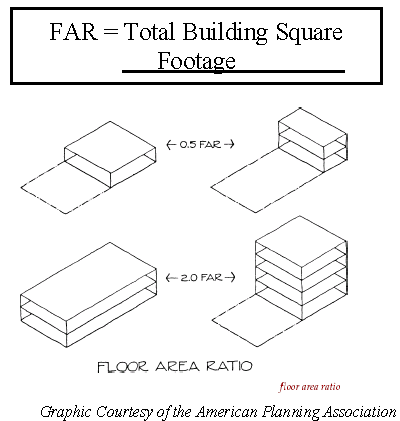
Floor Area Ratio
Garage, private. See Accessory uses.
Green infrastructure means any combination of landscaping, facilities, or equipment that captures rain at or near the site where it falls through infiltration, evapotranspiration, or storage for beneficial use or delayed discharge. Green infrastructure includes but is not limited to amended soil areas, bioretention areas, rain gardens, green roofs, vegetated swales, landscaping with deeply-rooted plants in amended soil, cisterns, rain barrels, stormwater trees, permeable pavements, planter boxes, and vegetated buffer strips, as well as the removal of structures or pavements to allow revegetation.
Green roof means an engineered roofing system that includes vegetation planted into a growing medium above an underlying waterproof membrane material which is designed to reduce the volume or peak flow of stormwater runoff from a building roof.
Green wall means the use of a supporting structure or wall panel installed to enable plants to grow vertically along the façade of a building or structure in order to provide air and water quality improvement as well as aesthetic enhancement.
Grid-intertie solar system means a photovoltaic solar system that is connected to an electric circuit served by an electric utility company.
Gross acre means an acre of land (43,560 sq. ft.) that includes street rights-of-way and other publicly-dedicated improvements, such as parks, open space, and stormwater management measures.
Gross floor area means the sum of the gross horizontal area of a floor or several floors of a building or structure measured from the exterior face of exterior walls or the centerline of a wall separating two buildings or structures, not including uninhabitable attics or basements, underground parking, uncovered steps or decks, and exterior balconies.
Ground floor means that level of a dwelling below the first floor located on a site with a sloping or multi-level grade and which has a portion of its floor line at grade.
Height of building. See Building height.
Historic Preservation Commission means a City commission empowered to enforce the regulations of Article XV of this chapter.
Home-based occupation means the use of a home in a residential zoning district that is clearly incidental to and secondary to the use of a dwelling unit by only persons residing in said home.
Home occupation certificate. See License for home occupation.
Homeless family means a group of two or more related individuals who are homeless individuals.
Homeless individual means an individual who lacks a fixed, regular, and adequate nighttime residence (without regard to whether the individual is a member of a family) or an individual whose primary nighttime residence is a supervised public or privately operated shelter designed to provide temporary living accommodations. Temporary living accommodations include welfare hotels, congregate shelters, dormitories, and transitional housing.
Impervious surface means an area that releases as runoff all or a large portion of the precipitation that falls on it, except for frozen soil. Rooftops, swimming pools, ponds, decks, sidewalks, driveways, gravel, and paved parking lots and streets are examples of areas that typically are impervious. See graphic example. Green infrastructure, gardens, forests, or other similar vegetated areas are examples of surfaces that typically are permeable.
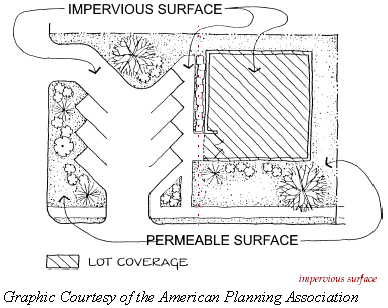
Impervious Surface
In-fill lot means any vacant lot or parcel within developed areas of the City where at least 80 percent of the land within a 1,000-foot radius of the site has been developed, and where water, sewer, streets, schools and fire protection have already been provided. Lots that have private restrictions or housing covenants that outline a general style of housing are not considered infill lots.
Land development activity means the construction of buildings, roads, parking lots, paved storage areas, and similar facilities.
Land-disturbing construction activity means any human-made alteration of the land surface resulting in a change in the topography or existing vegetative or non-vegetative soil cover that may result in runoff and lead to an increase in soil erosion and movement of sediment into waters of the state, including clearing and grubbing, demolition, excavating, pit trench dewatering, filling and grading activities, and soil stockpiling.
Landowner means any person holding title to or having interest in land.
License of home occupation means a certificate (renewed annually) certifying that a use within a residential structure is in compliance with the regulations of the Municipal Code.
Local representative means a property owner or their designee who permanently resides within the City of Green Bay or a licensed property management company with a physically staffed office within the City of Green Bay who manages a short-term rental.
Lot means land occupied or to be occupied by a building and its accessory building, including such open spaces as are required under this chapter, having its principal frontage upon a public street or officially approved place. See the following graphic.
Lot, corner, means a lot abutting two or more streets at their intersection or two parts of the same street forming an interior angle of less than 135 degrees. See the following graphic.
Lot, interior, means a lot other than a corner lot. See the following graphic.
Lot, through, means an interior lot having frontage on two streets. See the following graphic.
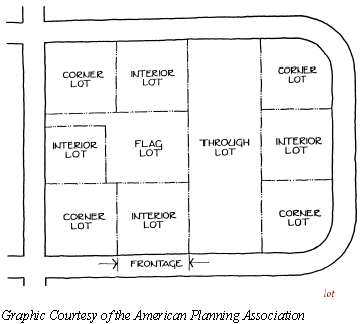
Lot Types
Lot line means a line dividing one lot from an adjoining lot, public place, or public right-of-way, including any of the following:
(1)
Front lot line. The street frontage shall be the front lot line. On a corner lot, the front lot line shall be along the same street as the front lot line of the immediately adjacent interior lot or, if adjacent to two or more interior lots, the street frontage with the smallest dimension. See the following graphic.
(2)
Rear lot line. The lot line most closely opposite the front lot line. A triangular lot has two side lot lines but no rear lot line. For any other irregularly shaped lot, the rear lot line is any lot line that is nearly opposite the front lot line. See the following graphic.
(3)
Side lot line. Any lot line that is neither a front nor a rear lot line. See the following graphic.
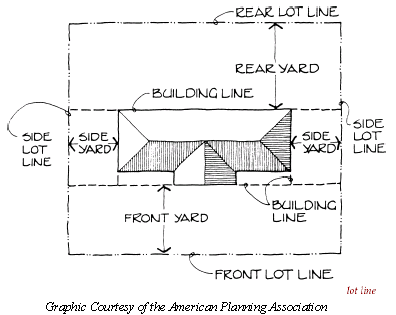
Lot Lines
Lot width means the distance between a side lot line and another side lot line or a side street lot line, measured at the front setback.
Meteorological tower (met tower) is defined to include the tower, base plate, anchors, and hardware, anemometers (wind speed indicators), wind direction vanes, booms to hold equipment anemometers and vanes, data logger, instrument wiring, and any telemetry devices that are used to monitor or transmit wind speed and wind flow characteristics over a period of time for either instantaneous wind information or to characterize the wind resource at a given location.
Monument means a structure erected to commemorate and/or a memorial perpetuating the memory of a person or event.
Motor vehicle, commercial, means a vehicle, which is intended to be self-propelled, including, but not limited to, automobiles, trucks, recreational vehicles, watercraft, and all-terrain vehicles greater than 10,000 pounds.
Motor vehicle, residential, means a vehicle, which is intended to be self-propelled, including, but not limited to, automobiles, vans, trucks, and motorcycles as listed below:
(1)
Passenger vehicle, compact. Any passenger vehicle that does not exceed six feet in width and/or 15 feet in length.
(2)
Passenger vehicle. Private passenger vehicle properly licensed and operable of less than 10,000 pounds gross vehicle weight rating.
(3)
Trucks and commercial vehicles. A truck, van, or commercial vehicle with less than 10,000 pounds gross vehicle weight rating.
(4)
Recreational vehicle. An operable vehicle primarily used for leisure activities, including, but not limited to, motor home, camper trailers, boats with or without trailers, utility trailers, all-terrain vehicles, snowmobiles and like motorized and non-motorized vehicles.
Navigable waters means a Lake Superior, Lake Michigan, all natural inland lakes within Wisconsin, and all streams, ponds, sloughs, flowages, and other waters within the territorial limits of this state, including the Wisconsin portion of boundary waters, which are navigable under state law. Under Wis. Stats. § 14.26(2)(d), notwithstanding any other provision of law or administrative rule promulgated thereunder, shoreland ordinances required under Wis. Stats. § 61.351 or 62.221 and Wis. Admin. Code Ch. NR 117 do not apply to lands adjacent to farm drainage ditches if:
(1)
Such lands are not adjacent to a natural navigable stream or river;
(2)
Those parts of such drainage ditches adjacent to such lands were not navigable streams before ditching; and
(3)
Such lands are maintained in nonstructural agricultural use.
Net acre means an acre of land excluding street rights-of-way and other publicly-dedicated improvements, such as parks, open space, and stormwater detention and retention facilities.
Net floor area means the horizontal area of a floor or several floors of a building or structure, excluding those areas not directly devoted to the principal or accessory use of the building or structure, such as restroom, permanent storage areas, stairwells and ramps, loading facilities, mechanical rooms, and vents or shafts devoted to elevators, wiring, or mechanical equipment.
Nonconforming lot means a lot which does not comply with lot width or lot area requirements of the Municipal Code.
Nonconforming structure means buildings and structures that do not meet the setback, height, or other dimensional or density requirements of this chapter for permitted uses in the zoning district in which they are located.
Nonconforming use means a use lawfully in existence on the effective date of the adoption of the ordinance from which this chapter is derived and not conforming to the regulations of the zoning district in which it is situated.
Nonstructural alteration means ordinary repairs that include, but are not limited to, external painting; decorating; paneling; the repair or replacement of doors, windows, nonbearing walls, fixtures, heating and cooling components, wiring, plumbing, roofing, and other nonstructural components.
Off-grid solar system means a photovoltaic solar system in which the circuits energized by the solar system are not electrically connected in any way to electric circuits that are served by an electric utility company.
Open space, common, means squares, greens, neighborhood parks, community parks, greenways, and other open space owned and maintained by the City, by a homeowners' association, or by other organizations for recreation or natural resource protection and generally accessible to the public.
Ordinary high water mark means the point on the bank or shore up to which the presence and action of surface water is so continuous as to leave a distinctive mark such as by erosion, destruction, or prevention of terrestrial vegetation, predominance of aquatic vegetation, or other easily recognized characteristic.
Ornamental refers to trees that are grown primarily for blooms, fruit, foliage, or other seasonal interest. Ornamental trees may be small to medium size at maturity.
Overlay district means a zoning district that restricts or modifies uses permitted in the underlying zoning district.
Parking lot alteration means modifications to parking areas that do not increase the limits of the existing parking lot and include the following:
(1)
Patch means re-striping, crack filling, seal coating as general maintenance of existing parking areas, including filling in, removal and replacement of up to 500 square feet of pavement.
(2)
Resurfacing means existing surfaces that are removed above the base course and repaved with no expansion of the parking area.
(3)
Rehabilitation means existing parking areas are pulverized and compacted in place with pavement being added on top of the new base material with no expansion of the parking area.
(4)
Reconstruction means existing pavement and base course are removed with the sub-base being re-compacted to allow for pavement or base course and pavement being placed with no expansion of the parking area.
(5)
New construction means virgin soil or exposed soil is modified to allow for the construction of a parking area.
Permeable surfacing means material(s) and accompanying subsurface treatments designed and installed specifically to allow stormwater to penetrate into the material, thereby reducing the volume of stormwater runoff from the surfaced area. Permeable surfacing may include, without limitation, paver blocks, "grasscrete," or similar structural support materials, and permeable concrete or asphalt.
Permitted use means any use which is or may be lawfully established in a particular district, provided it conforms to all the regulations and requirements applicable to that district or any use determined by the Zoning Administrator to be substantially similar to a permitted use.
Photovoltaic system means an active solar energy system that converts solar energy directly into electricity or another energy form.
Plan Commission means a City commission established to promote and administer all planning functions required by Wis. Stats. § 62.23.
Pond means any naturally occurring or constructed body of water that retains or detains the natural flow of water. This definition does not include ponds used for or part of a stormwater management plan, as regulated in Chapter 30 of the Green Bay Municipal Code.
Pool means any constructed or prefabricated structure either temporary (installed for a duration of less than seven days) or permanent (installed for a duration of seven days or more), either aboveground or in-ground and containing or normally capable of containing water that is primarily for the purpose of wading, swimming, or other recreation use. This definition excludes hot tubs, spas, and ponds.
Prohibited use means any use in a particular district that does not conform to the regulations and requirements applicable to that district or any use determined by the Zoning Administrator to not be substantially similar to a permitted use.
Queuing means the use of one travel lane on local streets with parking (usually an intermittent parking pattern) on both sides.
Rain barrel has the same meaning as "cistern."
Rain garden has the same meaning as "bioretention area."
Right-of-way means a public or private area that allows for the passage of people or goods. Rights-of-way include, but are not limited to, passageways, such as waterways, freeways, streets, bike paths, alleys, and walkways. A public right-of-way is a right-of-way dedicated or deeded to the public or condemned by the public for public use under the control of a public agency.
Rotor diameter means the cross-sectional dimension of the circle swept by the rotating blades.
Runoff means the rainfall, snowmelt, or irrigation water flowing over the ground surface.
Setback, front yard and corner side yard, means the space between the setback line of the building or use and the street right-of-way line. See the following graphic.
Setback, rear yard, means the space between the rear yard setback line of the building or use and the rear lot line. Where an alley exists, minimum horizontal distance may be measured from the centerline of the alley. A rear yard adjoining a public street is considered a corner side yard. See the following graphic.
Setback, side yard, means the space between the side line of the building or use and the side lot lines unless the side line of the building or use is on a corner lot, in which case it shall be a corner side yard setback. See the following graphic.
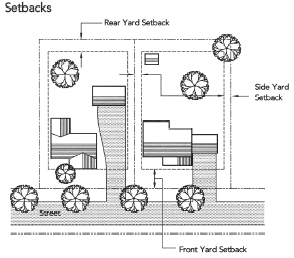
Setbacks
Shadow flicker means the visible flicker of light when rotating blades of the small wind energy system cast shadows on the ground and nearby structures causing a repeating pattern of light and shadow.
Shorelands means lands with the following distances from the ordinary high water mark of navigable waters: 1,000 feet from a lake, pond, or flowage and 300 feet from a river or stream or to the landward side of the floodplain, whichever distance is greater.
Short-term rental (STR) means a dwelling unit in which paying guests are entitled to occupancy for a period less than 28 calendar days.
Short-term rental permit (STRP) means a permit issued by the City of Green Bay Department of Community and Economic Development to the local representative for compliance with a short-term rental.
Short-term vacation unit means a dwelling unit which is provided for compensation to an occupant for less than 28 consecutive calendar days, other than a bed and breakfast. For the purposes of this definition, compensation includes, but is not limited to, monetary payment, services or labor of employees.
Sidewalk means that portion of a public street right-of-way or public easement that is paved or otherwise surfaced and intended for pedestrian use.
Site means the entire area included in the legal description of the land on which a land-disturbing or land-development activity is proposed.
Site area means the total horizontal area included within the property lines of a site devoted to or intended for a use or occupied by a structure or a group of structures.
Small wind energy system means a wind energy system that:
(1)
Is used to generate electricity;
(2)
Has a nameplate capacity of 100 kilowatts or less; and
(3)
Has a total height of 170 feet or less.
Small wind energy system owner means the individual or entity that intends to own and operate the small wind energy system in accordance with this chapter.
Solar energy means active radiant energy (direct, diffuse, and reflected) received from the sun.
Spa (hot tub) means any hydro-massage pool or tub for recreational or therapeutic use designed for immersion of users that may or may not be equipped with a filter, heater, and motor driven blower.
Specified anatomical areas (see Adult entertainment establishment under commercial recreation and entertainment) means:
(1)
Less than completely and opaquely covered: human genitals, pubic region; buttock; female breast below a point immediately above the top of the areola.
(2)
Human male genitals in a discernibly turgid state, even if completely and opaquely covered.
Stadium means a permanent or semi-permanent facility that conducts events and has designated seating for spectators.
Stormwater management plan means a comprehensive plan that identifies and designs what actions will be taken to reduce storm water quantity and pollutant loadings from the post-development land use condition to levels meeting the requirements of Chapter 30.
Stormwater planter box means a structure with vertical walls and an open or closed bottom, which may be attached to a building or structure, that is planted with a soil medium and vegetation intended to collect, absorb, and filter runoff from impervious surfaces.
Story means that portion of a building included between the surface of any floor and the surface of the next floor above it or, if there is no floor above it, the space between the floor and the ceiling next above it.
Story, half, means that portion of a building between the eaves and ridge lines of a pitched roof which may or may not be used for tenant purposes.
Street means a strip of land including the entire right-of-way, publicly- or privately-owned, serving as a means of vehicular travel and furnishing access to abutting properties which may also be used to provide space for sewers, public utilities, shade trees, and sidewalks. A street is typically more than 20 feet wide.
Structural alteration means any change which would alter the supporting structures or members of a building or structures, such as bearing walls, columns, beams or girders.
Terrace area means the space between the street pavement and the sidewalk, if any, excluding the driveway apron, often landscaped with grass and street trees.
The Austin Straubel International Airport Zoning Ordinance means Brown County Code of Ordinances, Chapter 24, Airport Zoning Districts.
Total height (small wind energy systems) means the vertical distance from ground level to the tip of a wind generator blade when the tip is at its highest point.
Tower means any pole, spire, structure, or combination thereof, including supporting lines, cables, wires, braces, and masts, intended primarily for the purpose of mounting an antenna, meteorological device, or similar apparatus above grade.
Traditional neighborhood means a compact, mixed-use neighborhood where residential, commercial, and civic buildings are within close proximity to each other.
Transient residential occupant means a person who is entitled to occupancy at any Transient Residential Use.
Transient residential permit (TRP) means a permit issued by the City of Green Bay Clerk to the Local Representative for compliance with a conditional use permit for a transient residential use.
Transient residential use means a single-family dwelling unit in which a private homeowner's paying guests or a corporate retreat's guests are entitled to occupancy for a period less than 28 consecutive calendar days.
Transient room tax means a fee based on the current hotel room tax for Brown County.
Transient vacation unit means a dwelling unit which is provided for compensation to transient occupants for less than 28 consecutive calendar days, other than a bed and breakfast. For the purposes of this definition, compensation includes, but is not limited to, monetary payment, services or labor of employees.
Transitional yard means an area used as a visual and noise separation/buffer of intensive uses from less intensive uses. See the following graphic.
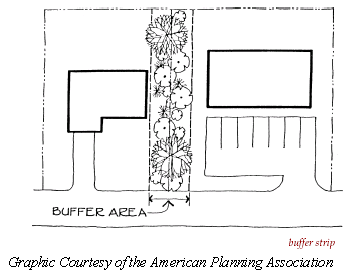
Transitional Yard
Unbuildable area means the area of a property upon which structures or parking are not permitted due to natural features and required setbacks. The following natural features, when present within a parcel, constitute unbuildable area:
(1)
Floodways, as defined.
(2)
Navigable waters.
(3)
Slopes of 20 percent or greater. (Gradients between 20 percent and 30 percent may be used for construction if acceptable engineering solutions are presented to and accepted by the Department of Public Works.)
(4)
Wetlands.
(5)
Required setback areas.
Underlying zoning means that district existing at the time the overlay zoning is adopted or as subsequently amended.
Unnecessary hardship means circumstances where special conditions which were not self-created affect a particular property and make strict conformity with restrictions governing area, setbacks, frontage height, or density unnecessarily burdensome or unreasonable in light of the purposes of this chapter.
Variance means an authorization granted by the Zoning Board of Appeals to construct or alter a building or structure in a manner that deviates from the dimensional standards of this chapter.
Vegetative buffer strip means a vegetated area designed, constructed, and planted as an integral and intentional component of a stormwater management or landscape plan, in a manner specifically intended to collect and slow stormwater runoff and promote uptake by plants and soils. A vegetated filter strip also may be designed in a manner that provides visual and noise buffering between uses. A "vegetated buffer strip" also may be known as a "vegetated filter strip."
Vision triangle (sight clearance) means triangular area enclosing an isosceles triangle scribed by two 25-foot equal legs extended each way from the vertex of two intersecting streets, such corner determined by projecting the curblines out to where they meet, or the triangular area enclosing an isosceles triangle scribed by two 15-foot equal legs extended each way from the vertex of an intersecting street and alley or two alleys, such corner determined by projecting the curblines out to where they meet. See the following graphic.
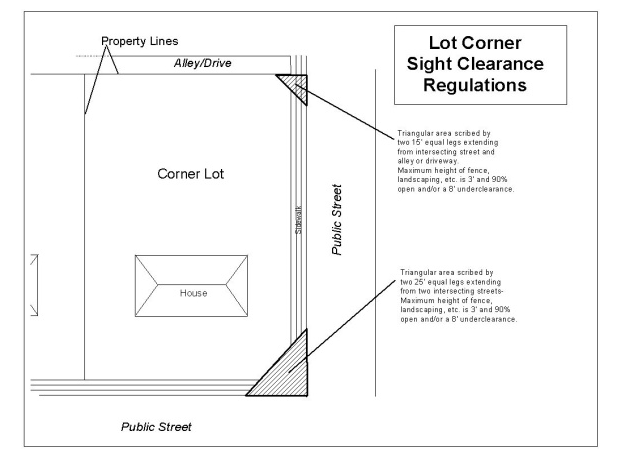
Vision Triangle (Sight Clearance)
Waste collection area means facilities or areas intended for the temporary retention of garbage, recyclable materials, and other refuse awaiting collection. Waste collection areas consist of dumpsters, bins, and/or trash cans, visually screened from horizontal view from a public street or an adjoining property with fencing or vegetation, and not located within the minimum front or side yards of a property.
Wetland alteration means any filling, flooding, draining, dredging, ditching, tiling, excavating, temporary water level stabilization measures, or dike and dam construction in a wetland area.
Wetlands means those areas where water is at, near, or above the land surface long enough to support aquatic or hydrophytic vegetation and which have soils indicative of wet conditions.
Wind energy system means equipment that converts and then stores or transfers energy from the wind into usable forms of energy (as defined by Wis. Stats. § 66.0403(1)(m)). This equipment includes any base, blade, foundation, generator, nacelle, rotor, tower, transformer, vane, inverter, batteries or other component used in the system, including freestanding and roof-mounted systems.
Wind generator means blades and associated mechanical and electrical conversion components mounted on top of the tower.
Zoning Administrator means that person designated to and responsible for interpreting and administering this chapter.
(Code 1984, § 13.302; Ord. No. 5-08; Ord. No. 16-08; Ord. No. 9-09; Ord. No. 36-09; Ord. No. 42-10; Ord. No. 1-11; Ord. No. 14-11; Ord. No. 9-12; Ord. No. 10-15; Ord. No. 20-16; Ord. No. 16-22, §§ 1, 2, 6-7-2022)
Sec. 44-250. - Land use definitions.
This section defines each land use listed in the use tables of the various zoning districts in the order they appear in the tables. General definitions are listed in Section 44-249. Definitions of signs are listed in Section 30-3.
(1)
Residential uses.
Single-family detached dwelling means a separate and detached one-family residence on a single lot designed and arranged for use by one family or household. See the following graphic.
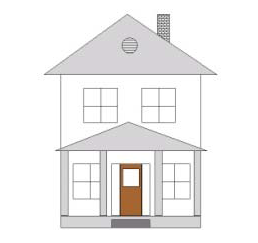
Single-Family Detached Dwelling
Two-family dwelling, duplex means a separate or detached two-family residence on a single lot, the first and second floors of which are each designed and arranged for use by one family. This type of dwelling is commonly referred to as an upper/lower duplex. See the following graphic.
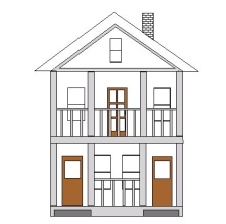
Two-Family Dwelling, Duplex
Two-family dwelling, semi-detached, means a dwelling within a building containing two attached dwelling units which share a common wall. The dwelling units may be located on the same lot or on separate lots, with the common wall at the lot line. See the following graphic.
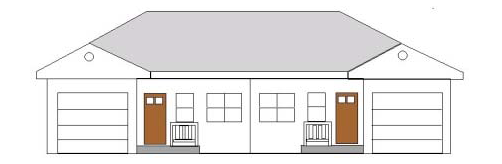
Two-Family Dwelling, Semi-Detached
Single-family attached dwelling, townhouse means a one-family dwelling unit with an individual private entrance which is part of a structure containing more than two dwelling units attached horizontally in a linear arrangement and having a totally exposed front and rear wall to be used for access, light, and ventilation. See the following graphic.
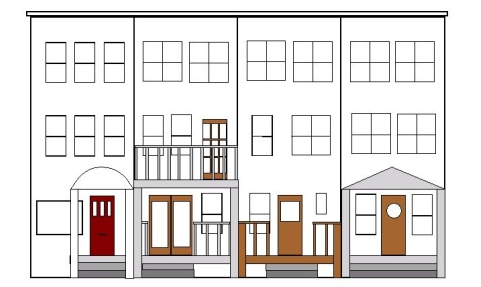
Single-Family Attached Dwelling, Townhouse
Multiple-family dwelling means a building containing three or more dwelling units; also known as apartment house/apartment building. This type of dwelling typically, but not always, has a common/shared entrance. See the following graphic.
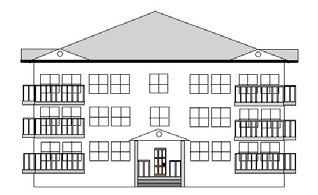
Multiple-Family Dwelling
Accessory Dwelling Unit (ADU) means a residential dwelling unit on the same parcel as a single-family, two-family duplex or a two-family semi-detached dwelling. The ADU provides complete independent living facilities for one family per Wisconsin's Unified Dwelling Code. It may take various forms: a detached unit; a unit that is part of an accessory structure, such as a detached garage; or a unit that is part of an expanded or remodeled principal/primary dwelling.
Live-work unit means a dwelling unit in combination with a shop, office, studio, or other workspace within the same unit where the resident occupant both lives and works.
(2)
Congregate living uses.
Rooming house, boarding house means a building that provides a dwelling space to be occupied by four or more individuals who are unrelated and do not constitute a family or by a family and two or more unrelated individuals. A fee is paid to the leaseholder or owner for occupancy for usually longer than one night, and common facilities may be shared, including toilet and kitchen. If, in addition to a room, the leaseholder or owner, as part of the fee for services, provides meals, then the building is considered a boarding house. A rooming house/boarding house may be considered a dormitory as defined and regulated within this Code.
Community living arrangement means a facility licensed, operated, or permitted by the State of Wisconsin that is either:
a.
A facility where four or more children reside and are provided with care and maintenance by persons other than a relative or guardian. This definition includes foster homes, treatment foster homes, community living arrangements for children, and residential childcare centers as defined by Wisconsin State Statute, but does not include educational institutions, public agencies, hospitals, maternity homes, nursing homes, or sanitariums.
b.
A facility where three or more adults not related to the operator reside and are typically provided with care, treatment, or services above the level of room service, which may include prescribed personal care. This definition includes Community Living Arrangements (CLAs), Community Based Residential Facilities (CBRFs), and Adult Family Homes (AFHs) as defined by Wisconsin State Statutes, but does not include transitional housing, nursing homes, prisons, jails, correctional facilities, convents, monasteries/seminaries, or educational institutions and related student housing.
Shelter facility means a temporary place of lodging for homeless individuals or homeless families. A shelter facility may be considered a dormitory as defined and regulated within this Code.
Transitional housing means a premises, other than a community living arrangement or community based residential facility, for the temporary placement of persons on parole, extended supervision, or probation in a controlled environment, including supervision or monitoring. A transitional housing facility may be considered a dormitory as defined and regulated within this Code.
Dormitory means a communal-type living arrangement of four or more persons not related by blood, adoption, or marriage who share common sleeping areas, kitchen, bath, or restroom facilities. This definition includes, but is not limited to, shelter facilities, educational facility housing, rooming houses, boarding houses or lodging houses, community living arrangements, community-based residential facilities, migrant housing, seminary, or similar institution.
Fraternity, sorority means a building used as group living quarters for students of a college, university, or seminary who are members of a fraternity, sorority, or other group that has been officially recognized by the college, university, or seminary. A fraternity/sorority may be considered a dormitory as defined and regulated within this Code.
Convent, monastery, seminary, and religious retreat mean a building or group of buildings that serves as the primary dwelling and place of work and worship for members of a religious order. A convent, monastery, seminary, and religious retreat may be considered a dormitory as defined and regulated within this Code.
Nursing home, assisted living facility means a building or complex of buildings where four or more persons who are not related to the operator or administrator reside, receive care or treatment and, because of their mental or physical condition, require access to 24-hour nursing services, including limited nursing care, intermediate level nursing care, and skilled nursing services, as defined in Wis. Stats. § 50.01. A nursing home/assisted living facility may be considered a dormitory as defined and regulated within this Code.
(3)
Educational uses.
School, elementary or secondary, means a public, parochial, or private school which provides an educational program for one or more grades between kindergarten and grade 12 and which is commonly known as an elementary school, grade school, middle school, junior high school, or high school.
College, university, means an educational institution authorized by the state to award associate, baccalaureate, or higher degrees or any campus of the state vocational, technical, or adult education system.
School, specialty or personal instruction, means a business, professional, trade, or other specialty school, including, but not limited to, a school offering instruction in music, art, dance, martial arts, GED preparation, computer use or programming, or cosmetology.
Daycare home/daycare center, preschool means a facility that provides supervision and care of preschool age children on a regular basis for periods less than 12 hours per day. Daycare or preschool facilities are licensed by the State of Wisconsin Department of Health and Family Services and classified as one of the following:
a.
Family daycare home means a dwelling unit licensed as a daycare center by the Wisconsin Department of Health and Family Services where care is provided for up to eight children at one time.
b.
Group daycare center, preschool means a program licensed to provide care for nine or more children at one time.
Adult daycare home means a residential dwelling where services are provided for part of a day in a group setting to adults who need assistance with activities of daily living, supervision, or protection. Services may include personal care and supervision, provision of meals, medical care, medication administration, transportation, and activities designed to meet physical, social, and leisure time needs. Such facilities are not licensed by the State of Wisconsin, but may be certified by the State.
(4)
Institutional and civic uses.
Cemetery means a place for the internment of the dead, divided into burial lots subdivided in a cemetery plat in accordance with Wis. Stats. § 157.07, and may also include mausoleum or columbarium and also allow a crematorium as an associated use.
Community center orneighborhood center means a building used as a place of meeting, recreation, or social activity catering primarily to the surrounding area or neighborhood. The center may be owned or leased by a public agency or nonprofit organization and is generally open to the public for daily use or scheduled events.
Cultural institution means an institution that displays or preserves objects of interest of the arts or sciences. This term includes, but is not limited to, a museum, gallery, or planetarium.
Hospital means a state-licensed institution providing primary health services and medical, psychiatric, or surgical care to persons, primarily inpatients, suffering from illness, disease, injury, deformity, and other physical or mental conditions. Also included are related accessory uses or facilities, such as laboratories, outpatient facilities, and training, research, and administrative services for patients and employees.
Clinic orhealthcare facility means a facility providing medical, psychiatric, or surgical service for sick or injured persons exclusively on an outpatient basis. Also included are related accessory uses, such as emergency treatment facilities, diagnostic services, training, administration, and other services to outpatients, employees, or visitors.
Library means a public, nonprofit facility in which books, manuscripts, computers, films, or similar materials are kept for use by or loan to patrons but not normally offered for sale.
Park, playground orrecreational center means a public, noncommercial park, playground, or open space, including any park buildings or other structures. This term does not include commercial recreation facilities.
Religious institution orplace of worship means a facility where people regularly assemble for religious worship and any incidental religious education which is maintained and controlled by a religious body. This term does not include an elementary, secondary, or specialty school or college.
(5)
Office uses.
General office means use of a building for administrative, executive, professional, research, or similar organizations having only limited contact with the public. A general office is characterized by a low proportion of vehicle trips attributable to visitors or clients in relationship to employees. Examples include, but are not limited to, firms providing architectural, computer software consulting, data management, engineering, interior design, graphic design, real estate, insurance, investment, or legal services.
Government office means an administrative, clerical, or public contact office of a government agency, including a postal facility, together with incidental storage and maintenance of the agency's vehicles.
Bank or financial institution means a financial institution that is open to the public and engaged in deposit banking and that performs the related functions of making loans, investments, and fiduciary activities. The bank may be in a freestanding building or contained in an office building with other uses and with or without a drive-up window.
Medical office or clinic means an establishment providing diagnostic and outpatient medical, dental, chiropractic, or similar therapeutic care on a routine basis. Such facility may be staffed by physical or mental healthcare professionals who provide specialized diagnostic, testing, physical therapy, or treatment services, including clerical and administrative services, to persons for periods of less than 24 hours.
Artist's studio means workspace for artists, artisans, or craftspersons who are engaged in the creation, teaching, or performance of the fine and applied arts and also allows the sale of fine and applied art products as an associated use.
(6)
Commercial uses; accommodation and food service uses.
Bed and breakfast means a lodging establishment that rents rooms for short periods of time to the public, provides meals to renters, and is the operator's place of residence.
Hotel orinn means a building containing rooming units providing temporary lodging accommodations to the general public, with rooms having access to the outside through an interior hallway connected to the main lobby of the building and which may provide additional services, such as restaurants, meeting rooms, entertainment, and recreational facilities. A hotel shall not include any use which could be defined as a motel.
Mobile food congregation means an accessory use for the assembly of one to two mobile food establishments, as defined in Chapter 10. Mobile food congregations can establish on public property, as regulated in Chapter 10. They can establish on private property as an accessory use, as regulated in this chapter. A principal use must be established on private property in order for this to be considered an accessory use. Surface parking lots are not considered an eligible principal use as related to this use.
Mobile food court means a permanent location for the assembly for three or more mobile food establishments, as defined in Chapter 10. Mobile food courts can establish on public or private property.
Mobile food rally means an event where three or more mobile food establishments, as defined in Chapter 10, may assemble but is not permanent. Mobile food rallies can establish via special event permit (for public property or right-of-way) or temporary use permit (for private property).
Motel means a building containing rooming units designed primarily for providing sleeping accommodations for transient lodgers, with rooms having a separate entrance providing direct access to the outside and with automobile parking located adjacent to or near sleeping rooms.
Restaurant means a commercial establishment open to the public where food and beverages are prepared, served, and consumed and where food sales constitute the majority of gross sales. A restaurant may include a drive-through lane for food pick-up by vehicle only where specified in a specific zoning district as "restaurant with drive-through."
Tavern orbar means an establishment serving alcohol beverages primarily for consumption on the premises and where food or packaged alcohol beverages may be served or sold only as accessory to the primary use.
(7)
Service businesses.
Personal service business means an establishment providing services which are of a recurring and personal nature to individuals that produce minimal off-site impacts. This term includes, but is not limited to, the following uses:
a.
Barbershops and beauty shops.
b.
Dry cleaning pick-up station.
c.
Interior decorating/upholstery.
d.
Locksmith.
e.
Shoe repair.
f.
Tanning salon.
g.
Tailor shop.
h.
Tattoo or body piercing establishment.
i.
Watch repair and other small goods repair.
Business service means an establishment primarily providing services to businesses or individual businesspeople on a fee or contract basis, including, but not limited to:
a.
Business equipment and furniture sales or rental.
b.
Copy center, excluding offset printing and publishing.
c.
Commercial photography studio.
d.
Mailing and packaging service.
Building maintenance orjanitorial service means an establishment providing routine maintenance of buildings, including, but not limited to, window washing, building cleaning, pest extermination, or disinfecting service.
Catering service means a business that prepares food and beverages to be delivered off-premises for consumption at a social, business, or civic function and may also provide service at the function.
Commercial business with dog area means a commercial facility with an accessory use allowing an area for customers to bring their dog(s).
Commercial dog day care means a commercial facility occupied by dogs for the purpose of exercise and socialization during daytime business hours. No animal will be kept overnight or on weekends. These facilities can include indoor and outdoor spaces.
Day labor agency means an establishment engaged in the temporary employment of persons on a daily basis where persons wait on the premises for work assignments.
Funeral home means a building used for funeral services, including display of the deceased at a wake for family and friends; embalming and other services in preparation for burial; cremation; storage and sale of caskets, urns, and other funeral supplies for burial or cremation. A funeral home may also include a funeral chapel.
Furniture and appliance rental and leasing means an establishment that rents or leases furniture, electronics, small appliances, major appliances, or other household items, including incidental storage and maintenance of such items.
Laundromat means a facility that provides washing and drying machines, usually coin-operated, to patrons for cleaning clothes and other fabrics.
Material recovery facility (minor) means an establishment for the collection and processing (separation and/or recovery) of materials on-site from products that include, but are not limited to, electronics, computers, televisions, household appliances, monitors, printers, CD/DVD players to be distributed for future re-use.
Printing and publishing establishment means an establishment providing custom reproduction of written or graphic materials for individuals or businesses. Typical processes include, but are not limited to, photocopying, blueprint and facsimile sending and receiving, pre-press services and offset printing, binding, and packaging.
Small appliance repair service means an establishment that repairs or services household goods, furniture, appliances, or lawn and garden equipment but not motor vehicles.
Tool/equipment rental facility means an establishment that rents tools, lawn and garden equipment, party supplies, and similar goods and equipment, including incidental storage and maintenance of such items.
Animal hospital orveterinary clinic means an establishment providing medical and surgical treatment of domestic animals, including grooming and boarding for not more than 30 days if incidental to the medical care.
Animal grooming facility means an establishment where domestic animals are bathed, clipped, or combed, including boarding for not more than 48 hours incidental to the grooming services.
Animal boarding facility, kennel, oranimal shelter means an establishment in which more than two dogs or three cats or any combination thereof may be kept for boarding, breeding, safekeeping, convalescence, placement, sale, or humane disposal.
(8)
Retail sales.
Auto title loan business means any person licensed pursuant to Wis. Stats. §§ 138.09 and 218.05, who makes a loan that is secured by an interest, other than a purchase money security interest, where the title of an automobile, motorcycle, any motor vehicle or titled vehicle is used as collateral.
General retail means the retail sale of products, sometimes with provision of related services, to the general public that produce minimal off-site impacts. General retail sales include, but are not limited to, the following:
a.
Antiques and collectibles store.
b.
Art gallery.
c.
Bicycle sales and repair.
d.
Book store, music store.
e.
Clothing and accessories.
f.
Drugstore, pharmacy.
g.
Electronics and appliance sales and repair.
h.
Florists.
i.
Food store, including grocery, bakery, butcher shop, and delicatessen.
j.
Jewelry store.
k.
Hardware store.
l.
Liquor store.
m.
Newsstands, magazine sales.
n.
Photographic equipment and supplies.
o.
Picture framing.
p.
Sporting goods store.
q.
Stationery store.
r.
Tobacco store.
s.
Video rental or sales.
Antiques and collectibles store means a retail establishment that displays and sells cultural or collectible objects, such as stamps, coins, sports memorabilia, and art works.
Building material sales means an establishment that sells or rents building supplies, construction equipment, or home decorating fixtures and accessories. The term "building material sales" includes a lumberyard or home improvement center and may include outdoor storage or tool and equipment sales or rental.
Contractor showroom or workshop means an office of a contractor, builder, painter, etc., that includes an enclosed showroom for display of samples, appliances, supplies, and other materials used in the business and/or an enclosed workshop for limited assembly or preparation of building materials.
Currency exchange means an establishment, other than a bank, trust company, savings bank, savings and loan association, credit union, or other financial institution, that exchanges common currencies, sells money orders or cashier's checks, and cashes checks as its principal business activity.
Firearms sales and service means any business that sells or services firearms and ammunition as its primary sale item.
Garden supply store means an establishment for outdoor retail sale of plants, lawn furniture, playground equipment, and garden supplies.
Garden supply store orgreenhouse means a retail business whose principal activity is the selling of plants and garden supplies, which may have outside storage, growing, or display, and which may include sales of lawn furniture and playground equipment.
Pawnshop means any business that loans or advances money on deposit of personal property or deals in the purchase or possession of personal property on condition of selling the same back again to the depositor, while also selling such items to the public by acting as a consignment or secondhand store.
Payday loan business means a payday loan business is any person licensed pursuant to Wis. Stats. § 218.05, or a person licensed pursuant to Wis. Stats. § 138.09, who accepts a check, holds the check for a period of time before negotiating or presenting the check for payment, and pays to the issuer an agreed-upon amount of cash or who refinances or consolidated such a transaction.
Secondhand store or consignment store means a retail establishment that sells used merchandise, such as clothing, furniture, books, shoes, or household appliances, on consignment or a retail store that sells used merchandise donated to a charitable, tax exempt organization that also sorts, cleans, and marks goods for resale.
(9)
Commercial recreation and entertainment.
Adult entertainment establishment means an establishment providing nude dancing or other live or recorded performances that depict, describe, or relate to specified sexual activities: human genitals in a state of sexual stimulation or arousal; acts of human masturbation, sexual intercourse, oral copulation, or sodomy; fondling or other erotic touching of specified anatomical areas. Adult entertainment establishments include, but are not limited to, the following uses:
a.
Adult bookstore. An establishment having as a substantial or significant portion of its stock and trade in books, magazines, other periodicals, videotapes, compact disks, and/or other electronic media which are distinguished or characterized by their emphasis on matter depicting, describing, or relating to "specified sexual activities" or "specified anatomical areas" as defined herein.
b.
Adult motion picture theater. An enclosed building or outdoor land area used for the viewing of films or videos at which a significant or substantial portion of the material presented is distinguished or characterized by an emphasis on matter depicting, describing, or relating to "specified sexual activities" or "specified anatomical areas" as defined herein for observation by patrons therein.
c.
Adult bath house. An establishment or business which provides the service of baths of all kinds, including all forms and methods of hydrotherapy, that is not operated by a medical practitioner or a professional physical therapist licensed by the State of Wisconsin and which establishment provides to its patrons an opportunity for engaging in specified sexual activities as defined in this chapter.
d.
Adult motel. A hotel, motel, or similar commercial establishment which:
1.
Offers accommodations to the public for any form of consideration; provides patrons with closed-circuit television transmissions, films, motion pictures, video cassettes, slides, or other photographic reproductions which are characterized by the depiction or description of "specified sexual activities" or "specified anatomical areas"; and has a sign visible from the public right-of-way which advertises the availability of this adult type of photographic reproductions; or
2.
Offers a sleeping room for rent for a period of time that is less than ten hours; or
3.
Allows a tenant or occupant of a sleeping room to sub-rent the room for a period of time that is less than ten hours.
e.
Adult modeling studio. An establishment or business which provides the services of modeling for the purpose of reproducing the human body wholly or partially in the nude by means of photography, painting, sketching, drawing, or otherwise.
f.
Adult body painting studio. An establishment or business wherein patrons are afforded an opportunity to paint images on a body which is wholly or partially nude. For purposes of this chapter, the adult body painting studio shall not be deemed to include a tattoo parlor.
g.
Adult cabaret. An establishment or business which features male and/or female topless and/or bottomless dancers, go-go dancers, exotic dancers, strippers, or similar entertainers.
h.
Adult novelty shop. An establishment or business having as a substantial or significant portion of its stock and trade in novelty or other items which are distinguished or characterized by their emphasis on or designed for specified sexual activities as defined herein or stimulating such activity.
Boat landing means a facility providing space for the launching and landing of watercraft.
Convention center means a commercial facility used for assemblies or meetings of the members or representatives of groups, including exhibition space and catering and food service facilities.
Health club orfitness center means an establishment for the conduct of indoor sports and exercise activities, along with related locker and shower rooms, offices and classrooms, and where use is offered on a membership basis.
Indoor recreation facility means a facility for the indoor conduct, viewing, or participation in recreational activities. This term includes, but is not limited to, an indoor driving range, volleyball court, tennis court, bowling alley, ice or roller skating rink, swimming pool, billiard hall, or basketball court.
Marina means a facility providing mooring of recreational boats, including piers, anchorage areas, launching facilities, boat storage areas, boat sales, service and rentals, and accessory facilities, such as sale of accessories, food, fuel, and fishing supplies for boating patrons. This term does not include a ship terminal used for freight.
Nightclub means an establishment dispensing alcohol beverages for consumption on the premises and in which dancing and musical entertainment are permitted and may also include sales of food. This use does not include adult entertainment facilities.
Outdoor commercial recreation facility means a facility for outdoor conduct, viewing, or participation in recreational activities, which may include one or more structures. This term includes, but is not limited to, a golf facility, tennis, basketball or volleyball court, soccer, baseball or football field, sporting club, amusement park, miniature golf course, or water park.
Campground means an area to be used for transient occupancy by camping in tents, camp trailers, travel trailers, motor homes, or similar movable or temporary sleeping quarters of any kind.
Theater orassembly hall means a facility for presenting motion pictures or live performances for patrons. This term includes an outdoor stage, band shell, or amphitheater but does not include an adult entertainment establishment.
(10)
Vehicle services.
Automobile rental means an establishment where contracts are prepared or reservations accepted for the rental or leasing of automobiles and other motor vehicles, including incidental storage.
Automobile sales means an establishment providing wholesale and retail sales or leasing of new or used automobiles, motorcycles, trucks, trailers, boats, or outdoor recreational vehicles, including outdoor sales area, incidental storage and maintenance and warranty repair work, or other repair service conducted as an accessory use.
Carwash means an establishment where washing, drying, polishing, or vacuuming of an automobile is done by service personnel, the driver, or by automated machinery.
Convenience store means an establishment where motor fuel products or other minor accessories are retailed directly to the public on the premises, in combination with sale of items typically found in a convenience market or supermarket.
Drive-through facility means a facility consisting of a dedicated drive aisle that leads to and from a service area for the sale and dispensation of food, beverages, or other consumer items to patrons in motor vehicles. Such facilities may include but are not limited to restaurants, pharmacies, and financial institutions.
Fueling/gas/service station means an establishment where the primary use is the sale of gasoline or any other motor fuel, motor oil, or other minor accessories directly to the public on the premises.
Motor vehicle repair, major, means an establishment that performs major repairs to motor vehicles, engines, or trailers, including all services found in a minor repair establishment, as well as rebuilding or reconditioning of whole vehicles, body frame and fender straightening and painting, and rustproofing.
Motor vehicle repair, minor, means an establishment that may or may not include fuel sales and convenience market, while also performing minor repairs to motor vehicles. Such minor repairs may include muffler replacement, oil changing, lubrication, tire repair and replacement, wheel alignment, brake repair, suspension repair, minor engine repair, transmission repair, radiator flushing and repair, and other activities except rebuilding or reconditioning of whole vehicles, body frame and fender straightening, or painting.
Parking lot means an off-street open area used for parking of operable motor vehicles for limited periods of time. A parking lot can be the principal use of the lot or accessory to a commercial, office, residential, or other use. It may be available to the public or reserved for employees, residents, or visitors.
Parking structure means a structure of one or more levels or floors used for the parking or storage of motor vehicles. A parking structure may be totally below grade (as in an underground parking garage) or partially or totally above grade. The structure can be the principal use of the lot or accessory to a commercial, office, multiple-family residential, or other use.
(11)
Production, processing, and storage uses.
Agriculture means the use of land for the production of plants, animals, or horticultural products, including farming, dairying, pasturage agriculture, horticulture, floriculture, and animal and poultry husbandry, and the necessary accessory uses for storing the products. Agriculture shall not include animal feedlot operations.
Limited production and processing means small-scale activities that are compatible with retail sales and services. These uses produce minimal off-site impacts due to their limited nature and scale. Limited production and processing includes, but is not limited to, the following uses:
a.
Apparel and other finished products made from fabrics.
b.
Boat building and repair.
c.
Computers and accessories, including circuit boards and software.
d.
Electronic components and accessories.
e.
Film, video, and audio production.
f.
Food and beverage products, not including live slaughter, grain milling, cereal, vegetable oil, or vinegar production.
g.
Precision medical and optical goods.
h.
Signs, including electric and neon signs.
i.
Watches and clocks.
j.
Wood crafting and carving.
k.
Wood furniture and upholstery.
Light industrial uses means low impact uses which produce little or no noise, odor, vibration, glare, or other objectionable influences and which have little or no adverse effect on surrounding properties. Light industrial uses generally do not include processing of raw materials or production of primary materials. This term includes, but is not limited to, the production or processing of the following:
a.
Apparel and other finished products made from fabrics.
b.
Computers and accessories, including circuit boards and software.
c.
Electronic components and accessories.
d.
Food and beverage products, not including live slaughter, grain milling, cereal, vegetable oil, or vinegar production.
e.
Furniture and fixtures, not including metal working.
f.
Household appliances and components, not including metal working.
g.
Measuring, analyzing, and controlling instruments.
h.
Musical instruments.
i.
Office and commercial equipment.
j.
Pharmaceuticals, health and beauty products.
k.
Precision machined products, including jewelry.
l.
Printing and publishing, including distribution.
m.
Signs, including electric and neon signs.
n.
Sporting and athletic goods.
o.
Telecommunications products.
General industrial uses means general industrial uses include metal working and other uses which have the potential to produce greater amounts of noise, odor, vibration, glare, or other objectionable influences than light industrial uses and which may have an adverse effect on surrounding properties. General industrial uses may include processing of raw materials or production of primary materials. This term includes, but is not limited to, the production or processing of the following:
a.
Electrical equipment, such as motors and generators, lighting, wiring and transmission, and distribution equipment.
b.
Fabricated metal products, such as cans and shipping containers, cutlery, hand tools, and general hardware.
c.
Fabricated plastic and rubber products, except tires and inner tubes.
d.
Glass and glass products, ceramics, china and earthenware, such as dishes and kitchenware.
e.
Gypsum, drywall, and plaster products.
f.
Latex paints.
g.
Lumber and wood products, including plywood.
h.
Machinery and equipment, such as engines and turbines, farm, lawn, and garden equipment, heating, cooling, and refrigeration equipment, and machine tools.
i.
Metal-working, such as stamping, welding, machining, extruding, engraving, plating, grinding, polishing, cleaning, and heat treating.
j.
Textiles and fabrics.
Heavy industrial uses include high impact and outdoor uses which are likely to have a substantial adverse effect on the environment or on surrounding properties and which require careful site selection to ensure compatibility with the surrounding area. These uses often include processing of extracted or raw materials and production of primary materials. The term "heavy industrial uses" includes, but is not limited to, the production or processing of the following:
a.
Animals or poultry (slaughter or processing).
b.
Asphalt, paving, and roofing materials.
c.
Battery manufacture and reprocessing.
d.
Chemicals and chemical products, including ammonia, chlorine, household cleaners, detergent, and fertilizer.
e.
Oil-based paints, varnishes, lacquers, and enamels.
f.
Petroleum and coal products, not including mining or extraction.
g.
Plastics and synthetic resins and fibers.
h.
Primary metals, including steelworks, rolling and finishing mills, foundries.
i.
Pulp or paper products.
j.
Sand and gravel, not including mining or extraction.
k.
Tanned hides and leather.
l.
Tires and inner tubes.
Concrete, asphalt, and rock crushing facility means a use in which the principal activity is the processing, handling, sale and transport of concrete, asphalt, rock, brick, cement, or other similar paving or building materials.
Contractor yard means an establishment providing general contracting or building construction services, including outdoor storage of machinery or equipment.
Dry cleaning establishment orcommercial laundry means an establishment that launders or dry cleans fabric, textiles, wearing apparel, or similar articles, including drop-off of articles by customers or cleaning of articles dropped off at other locations.
Research and development facility means an establishment which conducts research, development, or controlled production of high-technology electronic, industrial, or scientific products or commodities for sale or laboratories conducting educational or medical research or testing.
Material recovery facility (major) means a facility for the deposit, sorting, or batching, but not processing, of post-consumer recyclable materials, including limited compacting or crushing of recyclable materials.
Auto salvage yard orscrap yard means a facility where scrap or salvage materials, including used motor vehicles, are sorted, stored, dismantled, assembled, and distributed, including wholesale and retail sales of such materials. Scrap or salvage materials include, but are not limited to, scrap iron and other metals, paper, rags, rubber tires, bottles, plastics, and aluminum cans.
Self-service storage facility means a facility consisting of individual self-contained storage units or spaces leased to individuals, organizations, or businesses for storage of personal or business property.
Wholesale and distribution facility means an establishment providing storage, movement, or sale of merchandise and bulk goods, including mail order and catalog sales, importing, wholesale or retail sales of goods received by the establishment but not sale of goods for individual consumption.
(12)
Transportation uses.
Ground transportation service means an establishment that stores, maintains, or dispatches public transit vehicles, human service vehicles used for the transportation of elderly or handicapped persons, school buses, taxis, or tow trucks.
Mail distribution facility means an establishment designated for receiving, processing, and distributing mail and packages for the purposes of delivery.
Motor freight terminal means a facility for truck-based freight service and operations, including, but not limited to, local pick-up, local sorting and terminal operations, line-haul loading and unloading, destination sorting, terminal operations, and local delivery.
Package delivery service means a facility which transports individual packages for expedited delivery in single rear axle straight trucks or smaller vehicles where no single item weighs over 150 pounds.
Railroad switching yard and freight terminal means a facility for the operation of a line-haul or short-line freight railroad.
Ship terminal or docking facility means a facility for the docking, loading, or unloading of ships, barges, or boats that primarily transport freight.
(13)
Public service and utility uses.
Public safety/service facility means a government facility for public safety, service, and emergency services, including a facility that provides police or fire protection and public-related services.
Sewage treatment plant means a facility which collects, treats, and disposes of water-borne sewage generated within a given service area.
Wireless communications facilities means any system of antennas, wires, poles, rods, reflecting discs, or similar devices used for the transmission or reception of electronic waves external to or attached to the exterior of any structure. This definition also includes all accessory equipment and/or structures which contribute to and are subordinate and secondary to the transmission or reception of electronic waves.
a.
Wireless communications facilities, attached. Wireless communication facilities that are affixed to existing support structures, such as existing buildings, towers, water tanks, utility poles, and the like. A wireless communication support structure proposed to be newly established shall not be included within this definition. See also "Wireless communication support structures."
b.
Wireless communications facilities, freestanding. Wireless communication facilities that are not affixed to existing support structures but are mounted on the ground and not supported in any way by a structure.
Wireless communication support structure means any exterior structure whether freestanding or mounted on a building or structure that facilitates the broadcast transmission of commercial radio, telephone, or television communication signals. Support structures within this definition include, but are not limited to, monopole towers, lattice towers, light poles, wood poles, guyed towers, or other structures whether or not they appear to be something other than a support structure.
Solid waste disposal facility means a facility for the disposal or storage of solid waste material, including garbage, trash, construction debris, and other kinds of organic or inorganic refuse by dumping, burial, incineration, or any other similar means.
Substation/distribution equipment means a facility other than a transmission tower enclosed or outdoor that aids in the distribution of a utility, including, but not limited to, electric power or telephone service or in the transmission of voice, data, text, internet, sound, or video between network termination points.
Yard waste site, municipal, means a facility for collection, storage, and composting of vegetative matter resulting from landscape maintenance.
(14)
Accessory and temporary uses.
Home-based occupation means an occupation that is conducted by a person on the same lot (in a residential district) where such person resides and is limited in extent, secondary, and incidental to the residential use of the lot.
Garage, private, means a detached accessory building or portion of a main building housing not more than four motor vehicles of the occupants of the premises, including no more than one commercial vehicle with a capacity of no more than two tons.
Garage means a building or portion of a main building designed or used for parking, storage, service, repair, or sale of motor vehicles. See also Parking structure under subsection (10) of this section, "Vehicle Services."
Outdoor display means the display of goods for sale or rental outside of an enclosed building.
Seasonal market means a temporary facility used to conduct retail trade for a period not exceeding 90 days in a calendar year.
Concrete/batch plant, temporary, means a facility that produces or processes concrete or asphalt only for use in a particular construction project and only for the duration of that project.
(Code 1984, § 13.303; Ord. No. 11-06; Ord. No. 8-09; Ord. No. 20-09; Ord. No. 36-09; Ord. No. 1-10; Ord. No. 05-21, § 1, 4-20-2021; Ord. No. 09-23, § 1, 5-16-2023; Ord. No. 16-25, § 1, 7-15-2025; Ord. No. 28-25, § 1, 11-11-2025; Ord. No. 07-26, § 1, 3-17-2026)

