
Green Bay City Zoning Code
ARTICLE XIX
SITE PLAN REVIEW
Sec. 44-1864. - Purpose.
The purpose of the site plan review process is to encourage quality development in the City of Green Bay that reflects the goals set forth in the City of Green Bay Comprehensive Plan, while allowing flexibility in the design process. The comprehensive plan recommends better integration of diverse land uses and transportation modes through improved standards for site planning and design, including standards for building and parking placement, pedestrian connections, signage, and landscape improvements.
(Code 1984, § 13.1801)
Sec. 44-1865. - Applicability.
Site plan review shall apply to all new construction, remodeling, or expansion or change of uses, with the following exceptions:
(1)
The use is established in an existing building that has received site plan approval, and the establishment of the use does not alter the approved site plan for the property.
(2)
Proposed modifications are strictly related to the interior of the building.
(3)
Modifications, additions, or enlargements to a building which do not increase the gross floor area by more than 500 square feet or ten percent, whichever is less, and which do not require a variance from the provisions of this chapter.
(4)
Existing parking areas that are patched and/or resurfaced are not required to file a site plan. Existing parking areas up to 500 square feet may be rehabilitated or reconstructed in a one-year period without a site plan.
(5)
Grading or site preparation that results in minor modifications to the existing site, as approved by the City Engineer.
(6)
Construction, alteration of expansion of a public right-of-way, or any part thereof.
(Code 1984, § 13.1802; Ord. No. 42-10)
Sec. 44-1889. - Site plan requirements.
(a)
In general. Except in those instances specified in Section 44-1865, site plan approval is required prior to issuance of a building permit for any proposed construction or issuance of a zoning certificate for any proposed use. When a site plan is required in support of a request for conditional use permit or variance approval, the plan shall also be subject to the requirements of this article.
(b)
Required information. All site plans shall be drawn to scale and shall contain the following information, unless otherwise specifically waived by the Zoning Administrator or their designated representative:
(1)
Project name, location, developer, and designer of the project.
(2)
Date of plan preparation, scale, and north arrow.
(3)
A map showing the location of any railroads, major streams or rivers, wetlands, environmentally sensitive areas, and public streets in the vicinity of the site.
(4)
Property dimensions and boundaries.
(5)
Location, identification, and dimensions of existing and proposed:
a.
Topography of the site and adjacent areas within 50 feet by contour lines at intervals of not more than five feet.
b.
Public rights-of-way and easements.
c.
On-site parking facilities, drives, and walkways, including direction of traffic flow, excludes one- and two-family developments.
d.
Buildings and structures, including gross and useable floor area (categorized as interior or exterior uses).
e.
Service areas and loading docks, excludes one- and two-family developments.
f.
Freestanding signs, light fixtures, fences, and other site furnishings, excludes one- and two-family developments.
g.
Stormwater management facilities, including ponds, drainageways, and drainage patterns, with directional arrows showing the proposed flow of stormwater runoff from the site.
h.
Landscaping materials, including sizes and locations.
i.
Renderings of all building elevations, including colors to be used, signage, and listing of finish materials (samples of exterior finish materials may be required). This requirement shall only apply under the in-fill lot definition.
j.
Site statistics, including gross square footage of both site and buildings, floor area ratio, percentage of impervious surface, and parking calculations.
k.
All other information deemed necessary by the Zoning Administrator, but will not include additional restrictions or information that is not already specified in this chapter.
(6)
When a site is to be developed in stages, the plan should indicate the ultimate development of the site and proposed developmental phases.
(Code 1984, § 13.1803)
Sec. 44-1890. - Administrative site plan review.
(a)
In general. The Community Development Review Team (CDRT) shall conduct the administrative review of all site plan approval requests. All findings and decisions of the CDRT shall be final, subject to appeal to the Zoning Board of Appeals or Plan Commission and Common Council, as specified in Chapter 2, Administration.
(b)
Required findings. The Community Development Review Team shall make each of the following findings before approving a site plan approval request:
(1)
The site plan conforms to all applicable standards within this chapter.
(2)
The site plan conforms to all applicable regulations of this article and is consistent with the applicable policies of the comprehensive plan.
(3)
The site plan is consistent with any applicable functional or special area plans or development objectives adopted by the Common Council.
(4)
The site plan minimizes any adverse effects of property in the immediate vicinity and minimizes congestion of the public streets.
(c)
Conditions of site plan approval. The CDRT may impose conditions on any proposed site plan and require such guarantees as it deems necessary for the protection of the public interest and to ensure compliance with the standards and purposes of this article, the applicable policies of the Land Use Plan, and any special land use plans adopted by the Common Council.
(d)
Changes to approved site plan. An approved site plan may not be changed, modified, or altered in any manner without the approval of the City. If the Zoning Administrator determines that such changes are minor in nature, a revised site plan may not be required. In all other cases, a revised site plan shall be re-submitted for consideration by the CDRT.
(e)
Expiration of approved site plan. Unless a written extension request is submitted to and approved by the Zoning Administrator, an approved site plan shall expire upon either of the following conditions:
(1)
A new site plan for the property is submitted to and approved by the Community Development Review Team.
(2)
A building permit has not been issued within two years from the date of site plan approval.
(f)
Inspection and enforcement. Before issuing a certificate of occupancy and/or zoning certificate for any use not exempted under Section 44-1865, the Zoning Administrator shall conduct an inspection to determine compliance with the conditions set forth on the approved site plan for the project. A temporary certificate of occupancy may be issued without completion of all elements on the site plan, provided written assurance is given that all improvements will be completed when feasible.
(Code 1984, § 13.1804)
Sec. 44-1909. - Purposes and applicability.
The guidelines set forth in this division shall be used in site plan review, as applicable. Alternative methods may be proposed for achieving the intent of the guidelines.
(Code 1984, § 13.1805)
Sec. 44-1910. - Building context.
New development in the Mixed-Use and R1 Districts should relate to the design of adjacent historic or traditional buildings in scale and character where these are present. This can be achieved by maintaining similar setbacks, facade divisions, roof lines, massing, rhythm and proportions of openings, and compatible building materials and colors. Historic architectural styles need not be replicated. Rather, a sensitivity to context is encouraged.
(Code 1984, § 13.1806)
Sec. 44-1911. - Building entries.
Primary building entries shall be oriented to create a visually attractive streetscape and to reinforce and support pedestrian access. Building entrances shall be clearly defined and highly visible by featuring elements, such as canopies or porticos, overhangs, arches, recesses or projections, peaked roof forms, outdoor patios, or other distinguishing features. Entrances shall be located as follows:
(1)
Primary building entrances on all buildings should face the primary abutting public street or walkway or be linked to that street by a clearly defined and visible walkway or courtyard. Additional secondary entrances may be oriented to a secondary street or parking area. Entries should be clearly visible and identifiable from the street.
(2)
Multi-tenant building. At least 50 percent of a building's "active" wall shall be oriented toward the primary abutting street. The "active" wall shall be the side of the building containing the majority of storefronts, customer entrances, and windows.
(3)
Exceptions. Industrial uses or buildings which have only vehicle bays and/or service doors with infrequent nonpublic access to equipment, storage, or similar rooms (e.g., self-serve carwashes) shall be exempt from this standard.
(Code 1984, § 13.1807)
Sec. 44-1912. - Building placement.
In the mixed-use districts, pedestrian-oriented commercial district buildings should be placed as close to the sidewalk as practical. At intersections, buildings should hold the corner. That is, have street facades at or near the sidewalks of both streets, while maintaining the established vision triangle, as specified in Section 44-359.
(Code 1984, § 13.1808)
Sec. 44-1913. - Building facades.
Facades shall provide architectural interest and variety to a building, while avoiding the effect of single, long, or massive walls. The following guidelines should be followed in designing facades:
(1)
Ground floor facades that face public streets or pedestrian walkways shall have features, such as arcades, display windows, entry areas, awnings, or other such features for no less than 40 percent of the horizontal length of the facade.
(2)
Wall articulation. No wall that faces a street or connecting walkway shall have a blank, uninterrupted length exceeding 30 feet without including at least one of the following: change in plane, change in texture or masonry pattern, windows, or an equivalent element that subdivides the wall into human scale proportions.
(3)
Four-sided design. All sides of the building shall include materials and design characteristics similar to and compatible with those on the front.
(4)
Windows. Building facades shall contain windows at the ground floor or first floor in order to create visual interest.
(5)
Building materials. All building facades shall be designed with architecturally-finished materials. Durable materials, such as masonry or stucco, shall be used on all street-facing facades. All subsequent additions and outbuildings constructed after the erection of an original building or buildings shall be constructed of comparable materials and designed in a manner consistent with the original design, unless the entire building is being renovated.
(6)
Exceptions. Industrial uses or buildings which have only vehicle bays and/or service doors with infrequent nonpublic access to equipment, storage, or similar rooms (e.g., self-serve carwashes) shall be exempt from standards in Sections 44-1911 and this section.
(Code 1984, § 13.1809)
Sec. 44-1914. - Parking structures.
The exterior design of parking structures shall ensure that sloped floors do not dominate the appearance of the facade and that vehicles are screened from view.
(Code 1984, § 13.1810)
Sec. 44-1915. - Signage.
Signage should be integrated as an architectural element with attention given to the color, materials, scale, and orientation of all proposed signs in relation to the overall design of the building and to each other, as well as complying with the sign regulations specified in Chapter 30.
(Code 1984, § 13.1811)
Sec. 44-1916. - Site layout guidelines.
(a)
Existing site features. Site design should respect and incorporate existing topography and natural features, such as hillsides, wooded areas, and greenways. Important vistas and viewpoints, both from the site and into the site, should be protected and enhanced.
(b)
Crime prevention through environmental design. Site plans should employ best practices to increase natural surveillance and visibility, to control and guide movement on the site, and to distinguish between public and nonpublic spaces.
(c)
Shadowing and wind. Buildings shall be located and arranged to minimize shadowing on public spaces and adjacent properties and to minimize the generation of wind currents at ground level.
(Code 1984, § 13.1812)
Sec. 44-1917. - Service, loading, and storage areas.
(a)
Placement and orientation. Loading, delivery, and service bays should be oriented away from existing residences and public streets to the extent feasible.
(b)
Setback from street. No areas for outdoor storage, trash collection or compaction, loading, or other such uses shall be located within 20 feet of any public street or public sidewalk.
(c)
Screening.Trash receptacles and dumpsters, trash recycling containers, and loading docks shall be fully enclosed and screened with walls and/or fences at least six feet in height and 90 percent impervious to sight. All receptables and dumpsters shall have secure, fully closing lids or covers that prevent rainfall or snowmelt from coming into contact with the refuse being stored. All enclosure gates and receptable and dumpster lids shall remain closed when not in use.
(d)
Design. Architectural elements, materials, colors and design of screening walls, coverings, and/or fences shall be compatible with those used as predominant materials, colors, and elements on the building or landscaping.
(e)
Drainage. All outdoor storage and trash collection or compaction areas shall be graded, curbed, or drained to prevent the discharge of storm water runoff directly to storm drains or surface waters. Runoff shall be directed through a grassed or vegetated area prior to reaching a storm drain or surface water or, where approved by the Director of Public Works or their designee, to a properly designed sanitary sewer inlet.
(1)
Rehabilitation, reconstruction, and new construction Parking Lot Alterations, as defined in Section 44-249, Green Bay Municipal Code, are subject to the drainage requirements for outdoor storage and trash collection in this section.
(Code 1984, § 13.1813; Ord. No. 12-22, § 1, 6-7-2022)
Sec. 44-1918. - Outdoor sales and display areas.
Outdoor sales and display areas shall be separated from any adjacent street, sidewalk, or public walkway by a landscaped frontage strip at least five feet wide.
(Code 1984, § 13.1814)
Sec. 44-1919. - Mechanical/utility equipment for all uses except single-family or two-family homes.
(a)
In general. For all uses except single-family or two-family homes, mechanical/utility screening shall be an integral part of the building structure and architecture and shall not give the appearance of being "tacked on" to exterior surfaces.
(b)
Roof-mounted equipment. Roof-mounted equipment shall be screened, preferably by parapet walls. Building materials for screening roof-mounted equipment shall be identical to or substantially similar to the facade of the building on which such items are located. Screening shall be an integral part of the building's architectural design.
(c)
Ground-mounted equipment. Ground-mounted equipment shall be screened by a decorative wall constructed of materials compatible with the overall architectural design of the development and softened with landscaping.
(Code 1984, § 13.1815)
Sec. 44-1937. - Vehicular access.
(a)
In general. Site plans should create a roadway system that provides for safe, convenient, and efficient vehicular access and minimizes conflicts with pedestrians. For nonresidential developments, primary access should be from streets designed to handle higher traffic volumes, rather than from streets whose primary purpose is to serve residential areas.
(b)
Entrances and exits. All entrances and exits should be designed to facilitate efficient and safe traffic flow for both in-bound and out-bound traffic. Except for single-family and two-family uses, all vehicular traffic must enter and exit in a forward motion. See the figure in this section illustrating a site with efficient separation between access drives and parking areas.
(c)
Internal traffic circulation. Internal traffic circulation patterns should be easily understood, allow for efficient movement of traffic, and be designed so as to reduce the potential for traffic accidents or conflicts with pedestrians. Parking spaces that require backing into an entrance or exit drive are discouraged. Where multiple parcels are sharing access, private access easements shall be recorded.
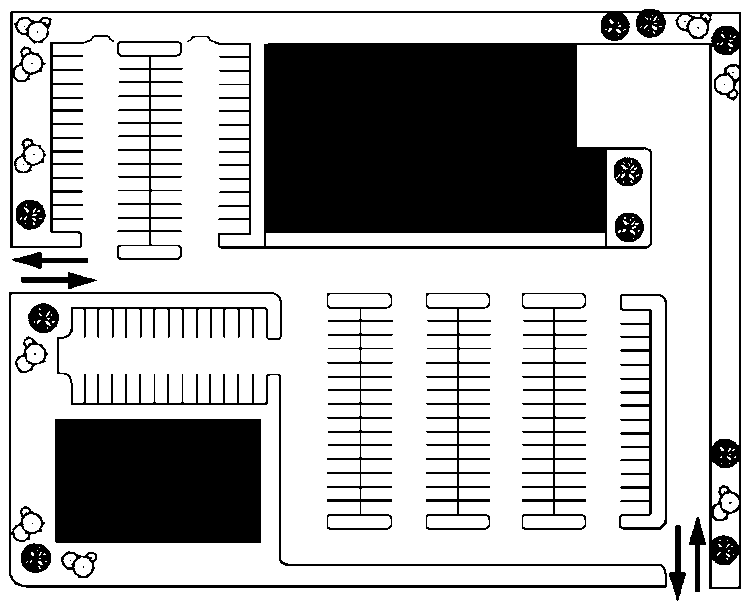
Internal Traffic Circulation
(d)
Traffic control. Appropriate traffic control devices shall be installed for all public and private developments before, during, and after construction. Fabrication and installation of traffic control devices shall conform to the standards of the Federal Manual on Unified Traffic Control Devices (MUTCD).
(e)
Snow storage and removal. Adequate areas for snow storage should be provided on-site in order to eliminate the utilization of access drives and parking areas for such purposes. Snow storage should not interfere with access drives, parking areas, or adjacent property.
(f)
Service and delivery access. Access for service and delivery vehicles should be provided and should not conflict with pedestrian or general vehicle use of the site. Access points for such vehicles should be as direct a route as possible to service and loading areas while avoiding movement through parking areas.
(Code 1984, § 13.1816)
Sec. 44-1938. - Pedestrians.
(a)
In general. Site plans should create a safe, continuous pedestrian network, as required by federal and state code, which offers clear circulation paths from the street and parking areas to building entries.
(b)
Walkway connections. Continuous pedestrian walkways shall be provided from building entries to the public sidewalk or right-of-way, parking areas, transit stops, and adjacent properties, as appropriate.
(c)
Walkway width. On-site pedestrian walkways and sidewalks shall be a minimum of five feet wide, except that walkways adjacent to a parking area where cars may overhang the walkway shall be a minimum of seven feet wide.
(d)
Clearly marked walkways. At each point that the on-site pedestrian walkway system crosses a parking lot or internal street or driveway, the walkway or crosswalk shall be clearly marked through the use of a change in color, texture, or height.
(Code 1984, § 13.1817)
Sec. 44-1939. - Transit.
Vehicular and pedestrian connections shall be provided to any transit points, existing or planned, within or adjacent to a development.
(Code 1984, § 13.1818)
Sec. 44-1940. - Parking location.
In the residential districts and mixed-use districts, except for permitted driveways, off-street parking areas shall not be located in front yard areas or between the front facade of the principal building and the abutting street. Parking areas are encouraged to be located to the rear of the building and may be located in side yards with appropriate screening.
(Code 1984, § 13.1819)
Sec. 44-1964. - Perimeter landscape buffers.
Buffers shall be used to provide visual and noise separation between uses, and to improve water quality and stormwater runoff management. Buffer landscaping shall be provided as follows:
(1)
For non-residential or multifamily (five or more units) uses when adjacent to residentially zoned property or property used for residential purposes, buffers shall be at least 20 feet wide. If the non-residential or multifamily use (five or more units) is located adjacent to residentially zoned property or property used for residential purposes and is both an in-fill property (as defined in Article III-Definitions) and the parcel is located in a mixed use zoned district, thence buffers shall be 8 feet wide. In the following situations, the buffer yard shall be at least 25 feet wide:
a.
Buffers for non-residential or multifamily buildings (five or more units) of three or more stories when adjacent to residentially zoned property or property used for residential purposes.
b.
Buffers for non-residential or multi-family buildings of 25,000 square feet of floor area or more when adjacent to residentially zoned property or property used for residential purposes.
c.
Buffers along loading docks, service areas, or outdoor mechanical systems when adjacent to residentially zoned property or property used for residential purposes.
(2)
Buffer design.
a.
Buffer areas shall consist of either a masonry wall, fence, berm, plantings, or a combination thereof that forms a screen a minimum of four feet in height and not less than 90 percent opaque on a year-round basis. Screening located along front and corner side yards is limited to four feet in height and not less than 90 percent opaque on a year-round basis and shall effectually block automobile headlights from trespass on roads or adjacent property.
b.
Buffers shall be landscaped with at least one tree and five shrubs for every 50 linear feet. Soil volumes and depths associated per tree type (small, medium or large) shall be determined by the Director of Community Development or their designee, in consultation with the City Forester, but shall not be greater than 1,200 cubic feet of volume or three feet of depth.
c.
Buffers may be interrupted for necessary pedestrian and vehicle access.
d.
Buffer designs included in an approved stormwater management plan under Chapter 16 of this Code shall be constructed in accordance with said plan. Any combination of fencing and plantings may be used, provided the degree of opacity and screening required in this section is achieved.
(Code 1984, § 13.1820; Ord. No. 15-22, § 1, 12-6-2022; Ord. No. 35-25, § 1, 12-2-2025)
Sec. 44-1965. - Interior parking lot landscaping.
The purpose of interior parking lot landscaping is to minimize the expansive appearance of parking lots, to provide shaded parking areas, and to provide water quality and stormwater management benefits where appropriate. Landscaping shall consist of planting islands and/or medians comprising the required planting area specified under item (1) below.
(1)
Planting area.
a.
At least ten percent of the interior area of parking lots with 25 or more spaces shall be devoted to landscape planting areas.
b.
Canopy trees shall be provided within the interior of parking lots of 25 or more parking spaces at the minimum rate of one tree per 15 spaces. Trees required to be planted in landscape islands, landscape medians, and perimeter areas shall count toward this requirement.
c.
Parking lot landscape areas shall be protected with concrete curbing, wheel stops, or other suitable barriers to protect plant function and ensure survivability, with breaks as required to allow storm water inflow where the landscape areas have been designed to provide storm water treatment and control or to provide pedestrian access.
(2)
Landscape islands.
a.
Landscape islands shall be provided at the end of each parking row and within the row of parking spaces so that there are no more than 15 consecutive parking spaces without a landscape island. An alternative to landscape islands at the end of each parking row and within rows is the incorporation of a landscaped median as described in Section 44-1965(c).
b.
Landscape islands shall have minimum interior dimensions of at least ten feet in width and 18 feet in length. Double rows of parking shall provide parking lot islands opposite one another to form continuous double islands. Where islands include a sidewalk, their width shall be increased to provide a planting area of at least ten feet in width.
c.
Each landscape island shall be planted with a mix of herbaceous or woody ground cover, shrubs, mulch, or other decorative ground cover sufficient to fully cover the ground surface and prevent the growth of weeds. A minimum soil depth of three feet shall be provided unless this provision is specifically waived due to on-site conditions.
d.
Required tree planting in landscape islands.
1.
A minimum of one canopy tree shall be planted per 180 square feet of landscape island on the site.
2.
Except where the Director of Community and Economic Development or their designee determines that the requirements for soil volume and depth in this section cannot be met due to dimensional or site conditions, or where an individual landscape island is designed as part of an approved stormwater management plan described herein, at least one tree shall be planted in each ten- by 18-foot landscape island. Where tree planting is not possible, the required tree(s) shall be planted in another interior or perimeter parking lot landscape area.
3.
Soil volumes and depths associated per tree type (small, medium or large) shall be determined by the Director of Community Development or designee, in consultation with the City Forester, but shall not be greater than 1,200 cubic feet of volume or three feet of depth.
e.
Landscape island designs included in an approved stormwater management plan under Chapter 16 of this Code shall be constructed in accordance with said plan.
(3)
Landscape medians. As an alternative to the required landscaped islands, parking lot landscape medians may be utilized between every other bay of parking in any lot with more than two parallel bays and more than 40 parking spaces. A parking bay shall be defined as one or two rows of spaces accessed from a single drive aisle.
a.
Landscape medians shall be a minimum of ten feet wide. Where medians include a sidewalk running lengthwise, their width shall be increased to provide a planting area of at least ten feet in width.
b.
Landscape medians shall be planted with a mix of herbaceous or woody ground cover, shrubs, mulch, or other decorative ground cover sufficient to fully cover the ground surface and prevent the growth of weeds.
c.
Required tree planting in landscape medians.
1.
Landscape medians shall have a minimum of one canopy tree per 50 lineal feet along the length of the median.
2.
Except where the Director of Community and Economic Development or their designee determines that the requirements for soil volume and depth described in this section cannot be met due to dimensional or site conditions, or where an individual landscape median is designed as part of an approved stormwater management plan described herein, at least one tree shall be planted in each landscape median. Where tree planting is not possible, the required tree(s) shall be planted in another interior or perimeter parking lot landscape area.
3.
Soil volumes and depths associated per tree type (small, medium or large) shall be determined by the Director of Community Development or designee, in consultation with the City Forester, but shall not be greater than 1,200 cubic feet of volume or three feet of depth.
d.
Landscape median designs included in an approved stormwater management plan under Chapter 16 of this Code shall be constructed in accordance with said plan.
(Code 1984, § 13.1821; Ord. No. 42-10; Ord. No. 15-22, § 2, 12-6-2022)
Sec. 44-1966. - Perimeter parking lot landscaping.
Parking area edges shall be screened from public streets and sidewalks, public open space, and adjacent properties. The perimeter of parking areas shall be screened by means of:
(1)
A landscaped area meeting the following standards:
a.
Landscaped areas shall be at least 15 feet wide along each frontage of a public street or sidewalk.
b.
If a parking area adjacent to a public street or sidewalk contains over 100 parking spaces, the minimum required landscaped area shall be increased to 20 feet in width.
c.
Where parking lots border property lines, setbacks from the property line to the edge of the parking lot pavement shall meet the buffer requirements of Section 44-1964.
d.
Exception. In Downtown One and Downtown Two zoning districts, the landscaped area shall be at least five feet wide along each frontage of a public street or sidewalk.
(2)
Screening consisting of either a masonry wall, fence, berm, plantings, or a combination thereof that forms a screen a minimum of three feet in height, and not less than 90 percent opaque on a year-round basis. Screening located along front and corner side yards is limited to three feet in height and must be at least 90 percent opaque on a year-round basis and effectually block automobile headlights from trespass on adjacent property.
(3)
Tree planting. A minimum of one canopy tree per 40 lineal feet shall be planted within the perimeter parking lot landscape area.
a.
Except where the Director of Community Development or their designee determines that the requirements for soil volume and depth in this section cannot be met due to dimensional or site conditions, or where the perimeter parking lot landscape area is designed as part of an approved stormwater management plan described herein, at least one tree shall be planted per 40 lineal feet within each perimeter parking lot landscaping area. Where tree planting is not possible, the required tree(s) shall be planted in another interior or perimeter parking lot landscape area.
b.
Soil volumes and depths associated per tree type (small, medium or large) shall be determined by the Director of Community Development or designee, in consultation with the City Forester, but shall not be greater than 1,200 cubic feet of volume or three feet of depth.
c.
Perimeter parking lot landscaping designs included in an approved stormwater management plan under Chapter 16 of this Code shall be constructed in accordance with said plan.
d.
The number of trees required to be planted pursuant to this Section may be varied or waived upon finding that site conditions or planting area sizes are not likely to lead to successful establishment and growth of a canopy tree.
e.
Exception. Where the Director of Community and Economic Development or their designee determines that full compliance with this Section would not be possible due to site dimensions or the location of existing buildings; or where full compliance would result in the number of existing parking spaces being reduced by more than ten percent or in a manner that would result in non-compliance of the proposed use(s) with the provisions of this ordinance, the Director or their designee may approve a substitute landscaping plan for the perimeter area which shall consist at a minimum of any combination of a three-foot masonry wall, three-foot ornamental metal fence, and plantings of low shrubs, perennials, or ornamental grasses.
(Code 1984, § 13.1822; Ord. No. 15-22, § 3, 12-6-2022)
Sec. 44-1967. - Building foundation landscaping.
Building foundations adjoining parking areas, walkways, or open space shall be planted with plant material such as trees, shrubs, perennials, annuals, and ground covers, with the exception of buildings that have facades flush with the sidewalk, i.e., downtown or storefronts.
(1)
Foundation plantings shall be installed across 80 percent of the length of the facade of the building, except where walkways and driveways are located.
(2)
Foundation plantings shall include trees planted at the rate of one tree per 50 lineal feet of building facade, and may also include shrubs, herbaceous perennials, bioretention or rain garden plantings, and groundcover. Tree planting requirements may be varied, or required trees located on another portion of the site, if a minimum distance of five feet from the building cannot be maintained.
(3)
Where the area between the building and parking or street curb is entirely paved for pedestrian use, landscaping may consist of canopy trees planted in structural soils beneath tree grates or permeable pavement. Soil volumes and depths associated per tree type (small, medium or large) shall be determined by the Director of Community Development or their designee, in consultation with the City Forester, but shall not be greater than 600 cubic feet of volume per tree.
(4)
Above-ground planter boxes along building facades may be substituted for foundation plantings.
(Code 1984, § 13.1823; Ord. No. 15-22, § 4, 12-6-2022)
Sec. 44-1968. - Plant materials.
(a)
In general. A reasonable attempt shall be made to preserve as many existing trees with a diameter of six inches diameter at breast height or greater as is practicable, and to incorporate them into the site plan.
(1)
A minimum of 50 percent of each area required to be landscaped shall be covered in live material. Live material includes trees, shrubs, perennials, ground cover, and sod. Areas not covered in live material may be covered by mulch, rock, or other natural materials. Exposed gravel, aggregate rock, or concrete shall only be used where drainage or soil conditions require a hard surface pan at finished grade adjoining a building foundation.
(2)
Plants indigenous to Wisconsin shall comprise no fewer than two-thirds of the proposed trees and 60 percent of proposed shrubs and shall be species proven adaptable to the climate and site conditions.
(3)
Plant species mix. Where 20 or more trees are proposed, at least three species of tree shall be utilized, and no single species of tree shall make up more than 50 percent of the total tree plantings for the property. Where 30 or more shrubs are proposed, no single species of shrub shall comprise more than one-third of shrub plantings.
(4)
Minimum sizes. All required trees shall meet the following minimum size requirements:
(5)
Any plant materials used to meet the requirements of this ordinance shall not include any species identified as a Regulated Invasive Plant by the Wisconsin Department of Natural Resources pursuant to Wis. Admin. Code Ch. NR 40.
(Code 1984, § 13.1824; Ord. No. 15-22, § 5, 12-6-2022)
44-1969. - Maintenance and installation of materials.
Installation and maintenance of all landscape materials shall comply with the following standards:
(1)
All installed landscape shall conform to the most recently approved American Standard for Nursery Stock, published by the American National Standards Institute.
(2)
An adequate water supply shall be indicated in the site plan.
(3)
All required landscaping and screening features shall be kept free of refuse and debris.
(4)
Maintenance and replacement of landscape materials, including the maintenance of any trees planted in the public right-of-way, shall be the responsibility of the applicant or property owner. All plantings required under this ordinance shall be maintained perpetually and replaced if they die or are substantially weakened or damaged. If plantings succumb due to site conditions to which they are ill adapted, they shall be replaced with more suitable species of the same type (tree, shrub, ground cover, etc.).
(Code 1984, § 13.1825; Ord. No. 15-22, § 6, 12-6-2022)
Sec. 44-1992. - Exterior site lighting.
Exterior site lighting shall be regulated as set forth in Article V of this chapter, General Regulations.
(Code 1984, § 13.1826)

