
Greenacres City Zoning Code
ARTICLE III
- DISTRICT REGULATIONS
DIVISION 3. - RESIDENTIAL ESTATE (RE)[12]
Editor's note— Ord. No. 99-41, § 1, adopted September 21, 1999, renumbered Ch. 16, Art. III, Div. 2, as Div. 3. See the Code Comparative Table.
Cross reference— Sign regulations in the residential estate district, § 16-981 et seq.; landscape regulations, § 16-1241.
DIVISION 4. - RESIDENTIAL LOW DENSITY (RL)[13]
Editor's note— Ord. No. 99-41, § 1, adopted September 21, 1999, renumbered Ch. 16, Art. III, Div. 3, as Div. 4. See the Code Comparative Table.
Cross reference— Sign regulations in the residential low density district, § 16-1001 et seq.; landscaping regulations, § 16-1241.
DIVISION 5. - RESIDENTIAL MEDIUM DENSITY (RM)[14]
Editor's note— Ord. No. 99-41, § 1, adopted September 21, 1999, renumbered Ch. 16, Art. III, Div. 4, as Div. 5. See the Code Comparative Table.
Cross reference— Sign regulations in the residential medium density district, § 16-1026 et seq.; landscape regulations, § 16-1241.
DIVISION 6. - RESIDENTIAL HIGH DENSITY (RH)[15]
Editor's note— Ord. No. 99-41, § 1, adopted September 21, 1999, renumbered Ch. 16, Art. III, Div. 5, as Div. 6. See the Code Comparative Table.
Cross reference— Residential high density district sign regulations, § 16-1051 et seq.; landscape regulations, § 16-1241 et seq.
DIVISION 7. - RESIDENTIAL MOBILE HOME (RMH)[16]
Editor's note— Ord. No. 99-41, § 1, adopted September 21, 1999, renumbered Ch. 16, Art. III, Div. 6, as Div. 7. See the Code Comparative Table.
Cross reference— Sign regulations in the residential mobile home district, § 16-117 et seq.; landscape regulations, § 16-1241 et seq.
DIVISION 8. - OFFICE, PROFESSIONAL AND INSTITUTIONAL (OPI)[17]
Editor's note— Ord. No. 99-41, § 1, adopted September 21, 1999, renumbered Ch. 16, Art. III, Div. 7, as Div. 8. See the Code Comparative Table.
Cross reference— Sign regulations in the office, professional and institutional district, § 16-1096 et seq.; landscape regulations, § 16-1241 et seq.
DIVISION 9. - COMMERCIAL NEIGHBORHOOD (CN)[18]
Editor's note— Ord. No. 99-41, § 1, adopted September 21, 1999, renumbered Ch. 16, Art. III, Div. 8, as Div. 9. See the Code Comparative Table.
Cross reference— Sign regulations in the commercial neighborhood district, § 16-1121 et seq.; landscape regulations, § 16-1241 et seq.
DIVISION 10. - COMMERCIAL GENERAL (CG)[19]
Editor's note— Ord. No. 99-41, § 1, adopted September 21, 1999, renumbered Ch. 16, Art. III, Div. 9, as Div. 10. See the Code Comparative Table.
Cross reference— Sign regulations in the commercial general district, § 16-1146 et seq.; landscape regulations, § 16-1241 et seq.
DIVISION 11. - COMMERCIAL INTENSIVE (CI)[20]
Editor's note— Ord. No. 99-41, § 1, adopted September 21, 1999, renumbered Ch. 16, Art. III, Div. 10, as Div. 11. See the Code Comparative Table.
Cross reference— Sign regulations in the commercial intensive district, § 16-1171 et seq.; landscape regulations, § 16-1241 et seq.
DIVISION 12. - GOVERNMENT USE (GU)[21]
Editor's note— Ord. No. 2003-16, § 1, adopted October 7, 2003, renumbered Ch. 16, Art. III, Div. 12 to read as herein set out. See the Code Comparative Table for a detailed analysis of the renumbering.
DIVISION 13. - STUDY AREA ZONE (SAZ)[22]
Editor's note— Ord. No. 2003-16, § 1, adopted October 7, 2003, renumbered Ch. 16, Art. III, Div. 13 to read as herein set out. See the Code Comparative Table for a detailed analysis of renumbering.
DIVISION 14. - MIXED DEVELOPMENT (MXD)[23]
Editor's note— Ord. No. 2003-16, § 1, adopted October 7, 2003, renumbered Ch. 16, Art. III, Div. 15, as Div. 14. See the Code Comparative Table for a detailed analysis of renumbering.
DIVISION 15. - MIXED USE DEVELOPMENT-OFFICE (MXD-O)[24]
Editor's note— Ord. No. 2003-16, § 1, adopted October 7, 2003, renumbered ch. 16, art. III, div. 14 and div. 15. See the Code Comparative Table for a detailed analysis of renumbering.
Sec. 16-251.- Establishment of districts.
In order to carry out the purpose and provisions of this chapter, the city is hereby divided into the following districts:
(Code 1966, § 32-9; Ord. No. 89-25, § 1, 1-8-90; Ord. No. 2001-04, § 1, 5-7-01)
Sec. 16-252. - Official zoning map.
The location and boundaries of the zoning districts established by this chapter are set forth on the Official Zoning Map of Greenacres City which accompanies this chapter, and which map, with all notations, references and other information as shown thereon, is incorporated herein and is as much a part of this chapter as if fully described and set forth herein.
(Code 1966, § 32-10)
Sec. 16-253. - Interpretation of the zoning map.
Where, due to the scale, lack of detail or illegibility of the official zoning map, there is any uncertainty, contradiction or conflict as to the intended location of any zoning district boundary as shown thereon, the city planner shall make an interpretation of the map upon request of any person. Any person aggrieved by such interpretation may appeal such interpretation to the planning and zoning board of appeals. The city planner, and the planning and zoning board of appeals, in interpreting the zoning map or deciding any appeal shall apply the following standards:
(1)
Zoning district boundary lines are intended to follow lot lines or be parallel or perpendicular thereto; or, along the center lines of alleys, streets, rights-of-way or watercourses, unless such boundary lines are fixed by dimensions shown on the zoning map.
(2)
Where zoning district boundary lines are so indicated that they approximately follow lot lines, such lot lines shall be construed to be such boundary lines.
(3)
Where a zoning district boundary line divides a lot, the location of any such zoning district boundary line, unless indicated by dimensions shown on the zoning map, shall be determined by the use of the map scale shown thereon.
(4)
If, after the application of the foregoing rules, uncertainty still exists as to the exact location of a zoning district boundary line, the boundary line shall be determined in a reasonable manner, considering the history of uses of property and the history of zoning ordinances and amendments in the city as well as all other relevant facts.
(Code 1966, § 32-11; Ord. No. 2021-016, § 2, 12-13-21)
Sec. 16-254.- Purpose and intent.
The provisions of the agricultural residential (AR) zoning district are primarily intended to provide for both very low density residential development and limited agricultural activities within close proximity to each other, and in a manner that will not adversely impact adjacent land uses while allowing for a semi-rural residential lifestyle within the municipal boundaries.
(Ord. No. 99-41, § 2, 9-21-99; Ord. No. 2001-04, § 1, 5-7-01)
Sec. 16-255. - Principal uses.
The following are permitted principal uses in the Agricultural Residential (AR) district:
(1)
Single-family dwellings.
(2)
Public elementary, middle, and high schools.
(Ord. No. 99-41, § 2, 9-21-99; Ord. No. 2001-04, § 1, 5-7-01)
Sec. 16-256. - Accessory uses.
The following are the permitted accessory uses and structures in the agricultural residential (AR) district:
(1)
Uses, buildings and structures which:
a.
Shall be customary accessory and clearly incidental and subordinate to permitted or special exception uses and structures.
b.
Shall be located on the same lot as the permitted or special exception principal use or structure, or on a contiguous lot in the same ownership.
c.
Shall not be of a nature likely to attract visitors in large numbers than would normally be expected in residential districts.
d.
Shall not involve operations or structures not in keeping with the purpose and intent of the zoning district that such use or structure is located in.
e.
Shall not be rented or used as a separate dwelling unit.
(2)
Private gardens and nurseries, garages swimming pools, tennis courts, basketball courts, toy houses and garden sheds, children's play areas and play equipment and the like (subject to subsection (1) above).
(3)
Home occupations subject to the provisions of section 16-742 et seq.
(4)
Private dog kennels or horse stable facilities.
a.
No private kennel or stable for animals shall be located within one hundred (100) feet of any residentially zoned property.
b.
Such private kennels or stables shall have a fence enclosure.
c.
Horses or ponies shall be kept to the rear of the main building on the property in a fenced enclosure at least six (6) feet in height above grade.
(Ord. No. 99-41, § 2, 9-21-99)
Sec. 16-257. - Special exceptions.
The following are special exceptions (subject to the provisions of section 16-171 et seq.) in the agricultural residential (AR) district:
(1)
Commercial nurseries.
a.
Sales shall be limited to wholesale operations only to exporters, distributors, landscape contractors, and retailers.
b.
All nursery operations, including storage, shall be set back a minimum of twenty-five (25) feet.
c.
Shade houses are permitted as accessory structures subject to the following:
1.
Such structures shall consist solely of a screened enclosure with a screened roof.
2.
Shade houses will not exceed twelve (12) feet in height.
3.
Shade houses shall maintain a minimum setback of fifty (50) feet from all property lines.
d.
All operations of heavy equipment and trucks shall be limited to daytime operations only, and shall not encroach into any easements, rights-of-way, or setbacks.
e.
No aerial application of pesticides, fungicides, fertilizers, or any other chemical shall be permitted.
f.
South Florida Water Management District shall be notified of the existence of any agricultural operation established onsite.
g.
One residential dwelling unit may be permitted per agricultural operation to function as an office.
(2)
Commercial kennels and horse stables.
a.
No dog kennel or stable for animals shall be located within one hundred (100) feet of any residentially zoned property.
b.
Dog kennels or stables shall have a fence enclosure. Horses or ponies shall be kept to the rear of the main building on the property in a fenced enclosure at least six (6) feet in height above grade.
c.
One (1) residential dwelling unit may be permitted per kennel or stables operation to function as an office.
d.
Training ovals may be permitted as an accessory use as part of a commercial horse stable operation.
(Ord. No. 99-41, § 2, 9-21-99)
Sec. 16-258. - Prohibited uses.
The following are the prohibited uses and structures in the agricultural residential (AR) district.
(1)
Any use or structure not specifically, or by reasonable implication permitted herein, or permissible by special exception.
(2)
Mobile homes.
(Ord. No. 99-41, § 2, 9-21-99)
Sec. 16-259. - Maximum residential density.
The maximum density shall be one (1) residential dwelling units per two and one-half (2½) acres in the agricultural residential (AR) district.
(Ord. No. 99-41, § 2, 9-21-99)
Sec. 16-260. - Minimum lot requirements.
The following are the minimum lot requirements in the agricultural residential (AR) district:
(1)
Lot or site area—Two and one-half (2½) acres.
(2)
Lot width—Two hundred and fifty (250) feet.
(3)
Lot depth—Two hundred and fifty (250) feet.
(Ord. No. 99-41, § 2, 9-21-99)
Sec. 16-261. - Maximum building coverage and impervious surface area requirements.
(a)
The maximum building coverage shall be as follows:
(1)
Permitted principal and accessory uses, twenty-five (25) percent.
(2)
Other permissible uses including accessory building, twenty (20) percent.
(b)
The maximum impervious surface area requirements shall be as follows:
(1)
The overall maximum impervious surface area shall not exceed forty (40) percent.
(2)
For the front yard, the maximum impervious surface area shall not exceed forty (40) percent.
(Ord. No. 2025-06, § 2, 12-1-25)
Editor's note— Ord. No. 2025-06, § 2, adopted Dec. 1, 2025, repealed the former § 16-261, and enacted a new § 16-261 as set out herein. The former § 16-261 pertained to maximum lot coverage and derived from Ord. No. 99-41, § 2, 9-21-99; Ord. No. 2001-04, § 1, 5-7-01.
Sec. 16-262. - Minimum yard requirements.
The following are the minimum yard requirements in the agricultural residential (AR) district:
(1)
Single-family dwellings:
a.
Front—Fifty (50) feet.
b.
Side—Fifty (50) feet.
c.
Rear—Fifty (50) feet.
(2)
Other permissible structures, same as single-family dwellings unless otherwise specified.
(Ord. No. 99-41, § 2, 9-21-99)
Sec. 16-263. - Height restrictions.
The maximum height of all buildings and structures in the agricultural residential (AR) district shall be thirty-five (35) feet.
(Ord. No. 2025-14, § 2, 1- 5-26)
Sec. 16-264. - Minimum living area.
The minimum required living area for single-family dwellings in the agricultural residential (AR) district shall be one thousand two hundred (1,200) square feet for a one-bedroom dwelling unit, plus two hundred (200) square feet for each additional bedroom. These provisions shall only apply to the construction of new units and shall not apply to existing dwelling units undergoing alterations or that are altered in the future.
(Ord. No. 99-41, § 2, 9-21-99)
Sec. 16-271.- Purpose and intent.
The residential estate district (RE) is intended to be a low density highly restricted large lot, estate type development. It is the intention of this chapter that such lands not be rezoned to a more intensive district without a clear showing of proven need in the public interest and a clear showing of conformity with the Comprehensive Plan of the city.
(Code 1966, § 32-20(a); Ord. No. 99-41, § 1, 9-21-99)
Sec. 16-272. - Principal uses.
The following are the permitted principal uses in the residential estate (RE) district:
(1)
Single-family dwellings.
(2)
Public elementary, middle, and high schools.
(Code 1966, § 32-20(b); Ord. No. 99-41, § 1, 9-21-99; Ord. No. 2001-04, § 1, 5-7-01)
Sec. 16-273. - Accessory uses.
The following are the permitted accessory uses and structures in the residential estate (RE) district:
(1)
Uses, buildings and structures which:
a.
Shall be customarily accessory and clearly incidental and subordinate to permitted or special exception uses and structures.
b.
Shall be located on the same lot as the permitted or special exception principal use or structure, or on a contiguous lot in the same ownership.
c.
Shall not be of a nature likely to attract visitors in larger numbers than would normally be expected in residential districts.
d.
Shall not involve operations or structures not in keeping with the purpose and intent of the zoning district that such use or structure is located in.
e.
Shall not be rented or used as a separate dwelling unit.
(2)
Private gardens and nurseries, garages, swimming pools, tool houses and garden sheds, children's play areas and play equipment and the like (subject to the provision of subsection (1) above).
(3)
Home occupations subject to the provision of section 16-742 et seq.
(Code 1966, § 32-20(c); Ord. No. 99-41, § 1, 9-21-99)
Sec. 16-274. - Special exceptions.
The following are special exceptions (subject to the provisions of section 16-171 et seq.) in the residential estate (RE) district:
(1)
Private kennels or stable facilities:
a.
No private kennel or stable for the animals shall be located within one hundred (100) feet of any other residentially zoned property.
b.
Such private kennel or stable shall have a fenced enclosure for the animals.
(2)
The noncommercial keeping of horses or ponies for private use.
a.
No private stable or shelter for the animals shall be located within one hundred (100) feet of any other residentially zoned property.
b.
Such horses or ponies shall be kept to the rear of the main building on the property in a fenced enclosure of at least six (6) feet in height above grade.
(3)
Publicly owned parks, playgrounds and playfields.
(4)
One (1) guest house, provided the total lot area shall not be less than two (2) times the minimum lot area required for a single-family dwelling.
(5)
House of worship. The minimum site size for a house of worship shall be two (2) acres.
(6)
Government services and accessory buildings and structures:
a.
The public need for the particular facility in the proposed location must be clearly demonstrated by the applicant to the satisfaction of city council.
b.
The minimum site size for governmental services and accessory buildings shall be two (2) acres.
(7)
Public and private utility services and accessory buildings (but not to include sanitary landfill, incinerator, refuse and trash dumps):
a.
The public need for the particular facility in the proposed location must be clearly demonstrated by the applicant to city council.
b.
There shall be no garaging or storage of motor vehicles nor shall there be any storage of materials outside the building.
(8)
Private clubs:
a.
All buildings shall be setback at least fifty (50) feet from any street and one hundred (100) feet from all other lot lines.
b.
Such use shall be operated for the benefit of members only and not as a business concern.
c.
Sleeping facilities shall be prohibited.
d.
The minimum site size for a private club shall be three (3) acres.
(Code 1966, § 32-20(d); Ord. No. 90-43, § 1, 3-18-91; Ord. No. 99-41, § 1, 9-21-99)
Sec. 16-275. - Prohibited uses.
The following are the prohibited uses and structures in the residential estate (RE) district:
(1)
Any use or structure not specifically, or by reasonable implication permitted herein, or permissible by special exception.
(2)
Mobile homes.
(Code 1966, § 32-20(e); Ord. No. 99-41, § 1, 9-21-99)
Sec. 16-276. - Maximum residential density.
The maximum number of residential dwelling units per acre in the residential estate (RE) district shall be one (1) unit per net acre.
(Code 1966, § 32-20(f); Ord. No. 99-41, § 1, 9-21-99)
Sec. 16-277. - Minimum lot requirements.
The following are the minimum lot requirements in the residential estate (RE) district:
(1)
Lot or site area, one (1) acre.
(2)
Lot width, one hundred eighty (180) feet.
(Code 1966, § 32-20(g); Ord. No. 99-41, § 1, 9-21-99)
Sec. 16-278. - Maximum building coverage and impervious surface area requirements.
(a)
The maximum building coverage shall be as follows:
(1)
Permitted principal and accessory uses, twenty-five (25) percent.
(2)
Other permissible uses including accessory building, twenty (20) percent.
(b)
The maximum impervious surface area requirements shall be as follows:
(1)
The overall maximum impervious surface area shall not exceed forty (40) percent.
(2)
For the front yard, the maximum impervious surface area shall not exceed forty (40) percent.
(Ord. No. 2025-06, § 2, 12-1-25)
Editor's note— Ord. No. 2025-06, § 2, adopted Dec. 1, 2025, repealed the former § 16-278, and enacted a new § 16-278 as set out herein. The former § 16-278 pertained to maximum lot coverage and derived from Code 1966, § 32-20(h); Ord. No. 99-41, § 1, 9-21-99; Ord. No. 2001-04, § 1, 5-7-01.
Sec. 16-279. - Minimum yard requirements.
The following shall be the minimum yard requirements in the residential estate (RE) district:
(1)
Single-family dwellings:
a.
Front, fifty (50) feet.
b.
Side: Interior lot, fifty (50) feet.
c.
Side: Corner lot, fifty (50) feet.
d.
Rear, fifty (50) feet.
(2)
Other permissible structures, same as single-family dwellings unless otherwise specified.
(Code 1966, § 32-20(i); Ord. No. 99-41, § 1, 9-21-99)
Sec. 16-280. - Height restriction.
The maximum height of all buildings and structures in the residential estate (RE) district shall be thirty-five (35) feet.
(Code 1966, § 32-20(j); Ord. No. 99-41, § 1, 9-21-99)
Sec. 16-281. - Minimum living area.
(a)
The minimum required living area for single-family dwellings in the residential estate (RE) district shall be one thousand two hundred (1,200) square feet for a one-bedroom dwelling unit, plus two hundred (200) square feet for each additional bedroom.
(b)
The provisions contained in subsection (a) above shall only apply to the construction of new units and shall not apply to existing dwellings undergoing alterations or that are altered in the future.
(Code 1966, § 32-20; Ord. No. 95-02, § 1, 2-21-95; Ord. No. 99-41, § 1, 9-21-99)
Sec. 16-282. - Sign regulations.
The regulations regarding signs in the residential estate district are in article VI, div. 4, sign standards.
(Ord. No. 99-41, § 1, 9-21-99; Ord. No. 00-04, § 2, 5-15-00)
Sec. 16-283. - Reserved.
Editor's note— Ord. No. 00-07, § 1, adopted April 3, 2000, repealed § 16-283 in its entirety. Formerly said section pertained to off-street parking and loading requirements. See the Code Comparative Table.
Sec. 16-301.- Purpose and intent.
The residential low density (RL) district is established as a designation whereby the principal use of land is single-family dwellings of low density. Uses and structures designed to serve governmental, educational, religious, noncommercial and recreational uses that are compatible with residential development of this density are permitted or are permissible as special exceptions within such district, subject to restrictions and requirements necessary to preserve and protect the single-family residential character. Variation among RL-1, RL-2, and RL-3 is limited to requirements for density, lot area, width and certain yards.
(Code 1966, § 32-21(a); Ord. No. 99-41, § 1, 9-21-99)
Sec. 16-302. - Permitted principal uses.
The following are the permitted principal uses in the residential low density (RL) district:
(1)
Single-family dwellings.
(2)
Publicly-owned and operated parks and recreation areas.
(3)
Public elementary, middle, and high schools.
(Code 1966, § 32-21(b); Ord. No. 99-41, § 1, 9-21-99; Ord. No. 2001-04, § 1, 5-7-01)
Sec. 16-303. - Accessory uses.
The following are the permitted accessory uses and structures in the residential low density (RL) district:
(1)
Uses, buildings and structures which:
a.
Shall be customarily accessory and clearly incidental and subordinate to permitted or special exception uses and structures.
b.
Shall be located on the same lot as the permitted or special exception principal use or structure, or on a contiguous lot in the same ownership.
c.
Shall not be of a nature likely to attract visitors in larger numbers than would normally be expected in residential districts.
d.
Shall not involve operations or structures not in keeping with the purpose and intent of the zoning district that such use or structure is located in.
e.
Shall not be rented or used as a separate dwelling unit.
(2)
Private gardens and nurseries, garages, swimming pools, tool houses and garden sheds, children's play areas and play equipment and the like, subject to the provisions of subsection (1) above.
(3)
Home occupations, subject to the provisions of (1) above and section 16-742 et seq.
(Code 1966, § 32-21(c); Ord. No. 99-41, § 1, 9-21-99)
Sec. 16-304. - Special exceptions.
The following are special exceptions, subject to the provisions of section 16-171 et seq. in the residential low density (RL) district:
(1)
House of worship. The minimum site size for a house of worship shall be two (2) acres.
(2)
Government services, including accessory buildings and structures:
a.
The public need for the particular facility in the proposed location must be clearly demonstrated by the applicant to the satisfaction of city council.
b.
The minimum site size for government services and accessory buildings shall be two (2) acres.
(3)
Public and private utility services and accessory buildings (but not to include sanitary landfill, incinerator, refuse and trash dumps):
a.
The public need for the particular facility in the proposed location must be clearly demonstrated by the applicant to the city council.
b.
There shall be no garaging or storage of motor vehicles nor shall there be any storage of materials outside the building.
(4)
Cluster development, subject to the provisions of section 16-836 et seq.:
a.
Minimum area for development shall be two (2) acres.
(5)
Private schools:
a.
Private schools shall have conventional academic curriculums similar to those in public elementary, middle, and high schools.
(6)
Planned unit development, subject to the provisions contained in article V, division 2 of this chapter.
(7)
Private clubs:
a.
All buildings shall be setback at least fifty (50) feet from any street and one hundred (100) feet from all other lot lines.
b.
Such use shall be operated for the benefit of members only and not as a business concern.
c.
Sleeping facilities shall be prohibited.
d.
The minimum site size for a private club shall be three (3) acres.
(Code 1966, § 32-21(d); Ord. No. 90-43, § 1, 3-18-91; Ord. No. 99-41, § 1, 9-21-99; Ord. No. 2001-04, § 1, 5-7-01)
Sec. 16-305. - Prohibited uses.
The following are the prohibited uses and structures in the residential low density (RL) district:
(1)
Any use or structure not specifically, or by reasonable implication permitted herein, or permissible by special exception.
(2)
Mobile homes.
(Code 1966, § 32-21(e); Ord. No. 99-41, § 1, 9-21-99)
Sec. 16-306. - Maximum residential density.
The maximum number of residential dwelling units per acre in the residential low density (RL) district shall be:
(1)
RL-1: Three (3) units per net acre.
(2)
RL-2: Four (4) units per net acre.
(3)
RL-3: Five (5) units per net acre.
(Code 1966, § 32-21(f); Ord. No. 99-41, § 1, 9-21-99)
Sec. 16-307. - Minimum lot requirements.
All subdivided lots recorded as of November 1, 1925, that were usable as single-family lots at the time of recording, may be used and occupied as single-family residential low density (RL), provided that the lot meets the minimum requirements of the RL-3 district.
(1)
Single-family dwellings:
a.
RL-1:
1.
Width, one hundred (100) feet.
2.
Area, thirteen thousand five hundred (13,500) square feet.
b.
RL-2:
1.
Width, eighty-five (85) feet.
2.
Area, ten thousand (10,000) square feet.
c.
RL-3:
1.
Width, fifty (50) feet.
2.
Area, six thousand five hundred (6,500) square feet.
(2)
Other permitted or permissible uses and structures: Same as single-family dwellings except as needed to meet specific requirements set forth in this chapter.
(Code 1966, § 32-21(g); Ord. No. 99-41, § 1, 9-21-99)
Sec. 16-308. - Maximum building coverage and impervious surface area requirements.
(a)
The maximum building coverage shall be as follows:
(1)
Single-family dwellings and their accessory buildings:
a.
RL-1: Thirty (30) percent.
b.
RL-2: Thirty (30) percent.
c.
RL-3: Thirty-five (35) percent.
(2)
Other permissible uses including accessory building, thirty (30) percent.
(b)
The maximum impervious surface area requirements shall be as follows:
(1)
The overall maximum impervious surface area shall not exceed sixty (60) percent.
(2)
For the front yard, the maximum impervious surface area shall not exceed sixty (60) percent.
(Ord. No. 2025-06, § 2, 12-1-25)
Editor's note— Ord. No. 2025-06, § 2, adopted Dec. 1, 2025, repealed the former § 16-308, and enacted a new § 16-308 as set out herein. The former § 16-308 pertained to maximum lot coverage and derived from Code 1966, § 32-21(h); Ord. No. 99-41, § 1, 9-21-99.
Sec. 16-309. - Minimum yard requirements.
The following shall be the minimum yard requirements in the residential low density (RL) district:
(1)
Single-family dwellings:
a.
RL-1:
1.
Front, thirty (30) feet.
2.
Rear, twenty-five (25) feet.
3.
Side, fifteen (15) feet.
4.
Side corner, twenty (20) feet.
b.
RL-2:
1.
Front, thirty (30) feet.
2.
Rear, twenty (20) feet.
3.
Side, fifteen (15) feet.
4.
Side corner, twenty (20) feet.
c.
RL-3:
1.
Front, twenty-five (25) feet.
2.
Rear, twenty (20) feet.
3.
Side, seven and one-half (7.5) feet.
4.
Side corner, ten (10) feet.
(2)
Other permissible structures, same as single-family dwellings unless otherwise specified.
(Code 1966, § 32-21(i); Ord. No. 99-41, § 1, 9-21-99)
Sec. 16-310. - Height restriction.
The maximum height of all buildings and structures in the residential low density (RL) district shall be thirty-five (35) feet.
(Code 1966, § 32-21(j); Ord. No. 99-41, § 1, 9-21-99; Ord. No. 2025-06, § 2, 12-1-25)
Sec. 16-311. - Minimum living area.
(a)
The minimum required living area requirements in the residential low density (RL) district shall be:
(1)
Single-family dwellings, one thousand (1,000) square feet for a one-bedroom dwelling unit, plus two hundred (200) square feet for each additional bedroom.
(2)
All subdivided lots recorded as of November 1, 1925:
a.
One-bedroom, seven hundred fifty (750) square feet.
b.
Two-bedroom, nine hundred (900) square feet.
c.
Three-bedroom, one thousand (1,000) square feet. (A minimum lot size of ten thousand one hundred sixty-four (10,164) square feet must meet in accordance with the county department of health and rehabilitative services regulations.)
(b)
The provisions contained in subsection (a) above shall only apply to the construction of new units and shall not apply to existing dwellings undergoing alterations or that are altered in the future.
(Code 1966, § 32-21(k); Ord. No. 95-02, § 2, 2-21-95; Ord. No. 99-41, § 1, 9-21-99)
Sec. 16-312. - Sign regulations.
The regulations regarding signs in the residential low density district are in article VI, div. 4, sign standards.
(Ord. No. 99-41, § 1, 9-21-99; Ord. No. 00-04, § 2, 5-15-00)
Sec. 16-313. - Reserved.
Editor's note— Ord. No 00-07, § 1, adopted April 3, 2000, repealed § 16-313 in its entirety. Formerly said section pertained to off-street parking and loading requirements. See the Code Comparative Table.
Sec. 16-331.- Purpose and intent.
The residential medium density (RM) district is intended to be a low to medium density district with an emphasis on multiple-family use. Due to the transitional character of these areas, governmental, educational, religious, noncommercial and recreational uses compatible with residential development are permitted or permissible by special exception. The provisions of this district are intended to protect and preserve the residential character and promote a desirable environment for the inhabitants. Variation among RM-1 and RM-2 is limited to density, lot area, width, certain yards and lot coverage.
(Code 1966, § 32-22(a); Ord. No. 99-41, § 1, 9-21-99)
Sec. 16-332. - Permitted principal uses.
The following are the permitted principal uses in the residential medium density (RM) district:
(1)
Single-family dwellings.
(2)
Two-family dwellings.
(3)
Townhouse development, subject to the provisions of section 16-856 et seq.
(4)
Multiple-family dwellings.
(5)
Publicly owned and operated parks and recreation areas.
(6)
Public elementary, middle, and high schools.
(Code 1966, § 32-22(b); Ord. No. 99-41, § 1, 9-21-99; Ord. No. 2001-04, § 1, 5-7-01)
Sec. 16-333. - Accessory uses.
The following are the permitted accessory uses and structures in the residential medium density (RM) district:
(1)
Uses, buildings and structures which:
a.
Shall be customarily accessory and clearly incidental and subordinate to permitted or special exception uses and structures.
b.
Shall be located on the same lot as the permitted or special exception principal use or structure, or on a contiguous lot in the same ownership.
c.
Shall not be of a nature likely to attract visitors in larger numbers than would normally be expected in residential districts.
d.
Shall not involve operations or structures not in keeping with the purpose and intent of the zoning district that such use or structure is located in.
e.
Shall not be rented or used as a separate dwelling unit.
(2)
Private gardens and nurseries, garages, swimming pools, tool houses and garden sheds, children's play areas and play equipment and the like, subject to the provisions of subsection (1) above.
(3)
Home occupations, subject to the provisions of (1) above and section 16-742 et seq.
(Code 1966, § 32-22(c); Ord. No. 99-41, § 1, 9-21-99)
Sec. 16-334. - Special exception.
The following are special exceptions, subject to the provisions of section 16-171 et seq. in the residential medium density (RM) district:
(1)
House of worship. The minimum site size for a house of worship shall be two (2) acres.
(2)
Government services including accessory buildings and structures:
a.
The public need for the particular facility in the proposed location must be clearly demonstrated by the applicant to the satisfaction of city council.
b.
The minimum site size for government services and accessory buildings shall be three (3) acres.
(3)
Public and private utility services and accessory buildings (but not to include sanitary landfill, incinerator, refuse and trash dumps):
a.
The public need for the particular facility in the proposed location must be clearly demonstrated by the applicant to city council.
b.
There shall be no garaging or storage of motor vehicles nor shall there be any storage of materials outside the building.
(4)
Private schools:
a.
Private schools shall have conventional academic curriculums similar to those in public elementary, middle, and high schools.
(5)
Cluster development subject to the provisions of section 16-836 et seq.:
a.
Minimum area for development shall be two (2) acres.
(6)
Child care center/preschool facilities:
a.
No zoning permit or certificate of occupancy shall be issued unless a license has first been obtained from the state department of health and rehabilitative services and any other permitting agency as required by law including the provision of this chapter.
b.
The minimum site area shall be ten thousand (10,000) square feet and the entire site shall be fenced in accordance with other provisions of this chapter if located on an arterial street.
c.
Outdoor play areas shall consist of one hundred (100) square feet of play area per child and in no case shall the area be less than four hundred (400) square feet. All play areas shall be fenced in accordance with provisions of this chapter.
d.
Such facility shall provide a passenger drop-off zone adjacent to the building providing clear ingress and egress.
e.
A landscaped buffer may be required on nonstreet property lines.
(7)
Adult congregate living facility:
a.
A life care retirement facility shall contain an extended care facility or an adult congregate living facility as a component of the development in order to be deemed an adult congregate living facility.
b.
Minimum site size for an adult congregate living facility shall be four (4) acres.
c.
The storage and preparation of food shall be accomplished at a central kitchen. Each separate room or group of rooms shall not be designed, altered, maintained or used for this purpose.
d.
All adult congregate living facilities shall provide sufficient staff to operate the facility in a proper manner as required by the minimum standards of the state department of health and rehabilitative services.
e.
All facilities containing more than one (1) story, shall have an elevator large enough to carry a stretcher.
f.
No portable heaters or other dangerous appliance may be used in such facilities.
g.
All facilities shall conform to applicable city codes and ordinances including building, electric, plumbing, fire prevention and state department of insurance minimum fire safety standards for adult congregate living facilities.
h.
No zoning permit or certificate of occupancy shall be issued unless a license has first been obtained from the state department of health and rehabilitative services, and any other permitting agency as required by law including the provisions of this chapter.
i.
All facilities shall be served by public transportation. In the event that public transportation service is not available, the applicant shall provide transportation to the facility in a form and manner acceptable to city council.
j.
Dumpsters shall be in a sealed container or an enclosed building with a wash down tap and drain.
k.
When an extended care facility is included as a component of the entire ACLF development, the following setback requirements shall be applicable for all yards within the entire development:
1.
Front, fifty (50) feet.
2.
Side corner, twenty-five (25) feet.
3.
Side interior, twenty (20) feet.
4.
Rear, thirty (30) feet.
(8)
Planned unit development, subject to the provisions contained in article V, division 2 of this chapter.
(9)
Zero lot line development, subject to the provisions of section 16-876 et seq.
(10)
Rooming and boarding houses.
a.
The maximum occupancy shall not exceed one (1) person per one thousand (1,000) square feet of ground area.
b.
City council may require additional screening and buffering above requirements contained in this chapter if deemed necessary to prohibit noise or disturbance to adjoining and adjacent uses.
(11)
Private clubs:
a.
All buildings shall be setback at least fifty (50) feet from any street and one hundred (100) feet from all other lot lines.
b.
Such use shall be operated for the benefit of members only and not as a business concern.
c.
Sleeping facilities shall be prohibited.
d.
The minimum site size for a private club shall be three (3) acres.
(12)
Arts and cultural centers.;
a.
The minimum parcel size for arts and cultural centers shall be one (1) acre.
b.
One (1) dwelling for a caretaker may be permitted on site subject to district regulations for single-family residential. At least one (1) occupant of this dwelling shall be an employee of the center and the occupants shall consist of one (1) family.
c.
Off-street parking and loading spaces shall be provided as required by section 16-1336, based upon the specific component uses of the center.
(Code 1966, § 32-22(d); Ord. No. 90-43, § 1, 3-18-91; Ord. No. 99-41, § 1, 9-21-99; Ord. No. 2001-04, § 1, 5-7-01; Ord. No. 2002-01, § 2, 3-18-02)
Sec. 16-335. - Prohibited uses.
The following are the prohibited uses and structures in the residential medium density (RM) district:
(1)
Any use or structure not specifically, or by reasonable implication permitted herein, or permissible by special exception.
(2)
Mobile homes.
(Code 1966, § 32-22(e); Ord. No. 99-41, § 1, 9-21-99)
Sec. 16-336. - Maximum residential density.
The maximum number of residential dwelling units per acre in the residential medium density (RM) district shall be:
(1)
RM-1: Six (6) units per net acre.
(2)
RM-2: Seven (7) units per net acre.
(3)
Adult congregate living facility (ACLF): These facilities shall be categorized as residential uses and for the purpose of determining the allowable density in such facilities, the following shall apply, but only to such facilities:
a.
Life care retirement facilities: Facilities wherein each separate room or group of rooms designed or intended for use as a residence by an individual or family and having kitchen facilities shall be equal to one (1) dwelling unit.
b.
Adult congregate living facilities: Facilities wherein each separate room or group of rooms designed or intended for use as a residence by an individual or family and not having kitchen facilities, but having access to a common dining area, shall be equal to one-half dwelling unit.
c.
Extended care facilities: Facilities wherein beds are provided for residents in the nature of a nursing or convalescent home. Each bed shall be equal to one-quarter dwelling unit.
Where this chapter permits adult congregate living facilities, these facilities shall be used only for this purpose. If the ACLF is changed to multiple-family use, then the full provisions of this chapter including provision of off-street parking shall be met for such multiple-family use and prior to any occupancy on a multiple-family basis.
(Code 1966, § 32-22(f); Ord. No. 99-41, § 1, 9-21-99)
Sec. 16-337. - Minimum lot requirements.
The following are the minimum lot requirements in the residential medium density (RM) district:
(1)
Single-family dwellings:
a.
RM-1:
1.
Width, fifty-five (55) feet.
2.
Area, five thousand five hundred (5,500) square feet.
b.
RM-2:
1.
Width, fifty (50) feet.
2.
Area, five thousand (5,000) square feet.
(2)
Two-family dwellings:
a.
RM-1 & 2:
1.
Width, seventy-five (75) feet.
2.
Area, seven thousand five hundred (7,500) square feet.
(3)
Townhouses:
a.
RM-1 & 2:
1.
Width, sixty (60) feet.
2.
Area, six thousand (6,000) square feet.
(4)
Cluster development:
a.
None, see section 16-836.
(5)
Multiple-family dwellings:
a.
RM-1:
1.
Width, seventy-five (75) feet.
2.
Area per dwelling unit, seven thousand (7,000) square feet.
b.
RM-2:
1.
Width, eighty (80) feet.
2.
Area per dwelling unit, six thousand (6,000) square feet.
(6)
Other permitted or permissible uses and structures: Same as single-family dwellings except as needed to meet specific requirements set forth in this chapter.
(Code 1966, § 32-22(g); Ord. No. 99-41, § 1, 9-21-99; Ord. No. 2002-08, § 1, 6-17-02)
Sec. 16-338. - Maximum building coverage and impervious surface area requirements.
(a)
The maximum building coverage shall be as follows:
(1)
Single-family dwellings and their accessory buildings:
a.
RM-1: Thirty-five (35) percent.
b.
RM-2: Thirty-five (35) percent.
(2)
Two-family dwellings, townhouses, cluster developments and their accessory buildings:
a.
RM-1: Thirty-five (35) percent.
b.
RM-2: Thirty-five (35) percent.
(3)
Multiple-family dwellings and their accessory buildings:
a.
RM-1: Thirty-five (35) percent.
b.
RM-2: Thirty-five (35) percent.
(4)
Other permitted or permissible uses and structures and their accessory buildings:
a.
RM-1: Thirty (30) percent.
b.
RM-2: Thirty (30) percent.
(b)
The maximum impervious surface area requirements shall be as follows:
(1)
For properties with single- and two-family dwellings, the overall maximum impervious surface area shall not exceed sixty (60) percent.
(2)
For the front yard of all single- and two-family properties, the maximum impervious surface area shall not exceed sixty (60) percent.
(3)
For properties with townhouses, the overall maximum impervious surface area shall not exceed eighty-five (85) percent.
(Ord. No. 2025-06, § 2, 12-1-25)
Editor's note— Ord. No. 2025-06, § 2, adopted Dec. 1, 2025, repealed the former § 16-338, and enacted a new § 16-338 as set out herein. The former § 16-338 pertained to maximum lot coverage and derived from Code 1966, § 32-22(h); Ord. No. 99-41, § 1, 9-21-99; Ord. No. 2002-08, § 1, 6-17-02.
Sec. 16-339. - Minimum yard requirements.
The following shall be the minimum yard requirements in the residential medium density (RM) district:
(1)
Single-family dwellings:
a.
RM-1 & 2:
1.
Front, twenty-five (25) feet.
2.
Rear, fifteen (15) feet.
3.
Side, seven and one-half (7.5) feet.
4.
Side corner, fifteen (15) feet.
(2)
Two-family dwellings:
a.
RM-1 & 2:
1.
Front, twenty-five (25) feet.
2.
Rear, fifteen (15) feet.
3.
Side, ten (10) feet.
4.
Side corner, fifteen (15) feet.
(3)
Multiple-family dwellings, and other permitted or permissible uses and structures:
a.
RM-1 & 2:
1.
Front, twenty-five (25) feet.
2.
Rear, fifteen (15) feet.
3.
Side, ten (10) feet.
4.
Side corner, fifteen (15) feet.
(Code 1966, § 32-22(i); Ord. No. 99-41, § 1, 9-21-99; Ord. No. 2002-08, § 1, 6-17-02)
Sec. 16-340. - Height restrictions.
The maximum height of all structures in the residential medium density (RM) district shall be thirty-five (35) feet.
(Code 1966, § 32-22(j); Ord. No. 99-41, § 1, 9-21-99)
Sec. 16-341. - Minimum living area.
(a)
The minimum required living area requirements in the residential medium density (RM) district shall be:
(1)
Single-family dwellings, one thousand (1,000) square feet for a one-bedroom dwelling unit, plus two hundred (200) square feet for each additional bedroom.
(2)
All other permitted residential types:
a.
Efficiency, six hundred eighty (680) square feet.
b.
One-bedroom, seven hundred (700) square feet.
c.
Two-bedroom, nine hundred (900) square feet.
d.
Three-bedroom, one thousand one hundred (1,100) square feet.
(b)
The provisions contained in subsection (a) above shall only apply to the construction of new units and shall not apply to existing dwellings undergoing alterations or that are altered in the future.
(Code 1966, § 32-22(k); Ord. No. 95-02, § 3, 2-21-95; Ord. No. 99-41, § 1, 9-21-99)
Sec. 16-342. - Sign regulations.
The regulations regarding signs in the residential medium density district are in article VI, div. 4, sign standards.
(Ord. No. 99-41, § 1, 9-21-99; Ord. No. 00-04, § 2, 5-15-00)
Sec. 16-343. - Reserved.
Editor's note— Ord. No. 00-07, § 1, adopted April 3, 2000, repealed § 16-343 in its entirety. Formerly said section pertained to off-street parking and loading requirements. See the Code Comparative Table.
Sec. 16-361.- Purpose and intent.
The residential high density (RH) district is intended to fulfill the need for a high concentration of population through a variety of housing types, residential high density (RH) districts are situated so that they are well served by public and commercial services in close proximity and have convenient access to arterial streets. Governmental, educational, religious, noncommercial and recreational uses that may serve this district as well as other districts are permitted or permissible by special exception.
(Code 1966, § 32-23(a); Ord. No. 99-41, § 1, 9-21-99)
Sec. 16-362. - Permitted principal uses.
The following are the permitted principal uses in the residential high density (RH) district:
(1)
Single-family dwelling.
(2)
Two-family dwellings.
(3)
Townhouse developments, subject to the provisions of section 16-856 et seq.
(4)
Multiple-family dwellings.
(5)
Publicly owned and operated parks and recreation areas.
(6)
Cluster development, subject to the provisions of section 16-836 et seq.
(7)
Apartment projects, subject to the provisions of section 16-871 et seq.
(8)
Public elementary, middle, and high schools.
(Code 1966, § 32-23(b); Ord. No. 99-41, § 1, 9-21-99; Ord. No. 2001-04, § 1, 5-7-01)
Sec. 16-363. - Accessory uses.
The following are the permitted accessory uses and structures in the residential high density (RH) district:
(1)
Uses, buildings and structures which:
a.
Shall be customarily accessory and clearly incidental and subordinate to permitted or special exception uses and structures.
b.
Shall be located on the same lot as the permitted or special exception principal use or structure, or on a contiguous lot in the same ownership.
c.
Shall not be of a nature likely to attract visitors in larger numbers than would normally be expected in residential districts.
d.
Shall not involve operations or structures not in keeping with the purpose and intent of the zoning district that such use or structure is located in.
e.
Shall not be rented or used as a separate dwelling unit.
(2)
Private gardens and nurseries, garages, swimming pools, tool houses and garden sheds, children's play areas and play equipment and the like (subject to the provisions of (1) above).
(3)
Home occupations, subject to the provisions of (1) above and section 16-742 et seq.
(Code 1966, § 32-23(c); Ord. No. 99-41, § 1, 9-21-99)
Sec. 16-364. - Special exception.
The following are special exceptions, subject to the provisions of section 16-171 et seq. in the residential high density (RH) district:
(1)
House of worship. The minimum site size for a house of worship shall be two (2) acres.
(2)
Government services including accessory buildings and structures:
a.
The public need for the particular facility in the proposed location must be clearly demonstrated by the applicant to the satisfaction of city council.
b.
The minimum site size for governmental services and accessory buildings shall be three (3) acres.
(3)
Public and private utility services and accessory buildings (but not to include sanitary landfill(s), incinerators, refuse and trash dumps).
a.
The public need for the particular facility in the proposed location must be clearly demonstrated by the applicant to city council.
b.
There shall be no garaging or storage of motor vehicles nor shall there by any storage of materials outside the building.
(4)
Private clubs:
a.
All buildings shall be set back at least fifty (50) feet from any street and one hundred (100) feet from all other lot lines.
b.
Such use shall be operated for the benefit of members only and not as a business concern.
c.
Sleeping facilities shall be prohibited.
d.
The minimum site size for a private club shall be two (2) acres.
(5)
Private schools:
a.
Private schools shall have conventional academic curriculums similar to those in public elementary, middle, and high schools.
(6)
Child care center/preschool facilities:
a.
No zoning permit or certificate of occupancy shall be issued unless a license has first been obtained from the state department of health and rehabilitative services and any other permitting agency as required by law including the provisions of this chapter.
b.
The minimum site area shall be ten thousand (10,000) square feet and the entire site shall be fenced in accordance with the provisions of this chapter if located on an arterial street.
c.
Outdoor play areas shall consist of one hundred (100) square feet of play area per child and in no case shall the area be less than four hundred (400) square feet. All play areas shall be fenced in accordance with provisions of this chapter.
d.
Such facility shall provide a passenger drop-off zone adjacent to the building providing clear ingress and egress.
e.
A landscaped buffer may be required on nonstreet property lines.
(7)
Nursing and convalescent facilities:
a.
The minimum site size for a nursing and convalescent facility shall be two (2) acres.
b.
No building in connection with such facilities shall be closer than fifty (50) feet from all other lot lines.
c.
No zoning permit or certificate of occupancy shall be issued unless a license has first been obtained from the state department of health and rehabilitative services and any other permitting agency as required by law including the provisions of this chapter.
d.
Sleeping rooms shall not be less than one hundred (100) square feet per patient.
e.
A minimum of ten (10) percent of the total floor area shall be devoted to a common area exclusive of halls, corridors, stairs, elevator shafts wherein a variety of recreational or therapeutic activities may occur.
(8)
Adult congregate living facilities:
a.
A life care retirement facility shall contain an extended care facility or an adult congregate living facility as a component of the development in order to be deemed an adult congregate living facility.
b.
The minimum site size for an adult congregate living facility shall be four (4) acres.
c.
The storage and preparation of food shall be accomplished at a central kitchen. Each separate room or group of rooms shall not be designed, altered, maintained or used for this purpose.
d.
All adult congregate living facilities shall provide sufficient staff to operate the facility in a proper manner as required by the minimum standards of the state department of health and rehabilitative services.
e.
All facilities containing more than one (1) story, shall have an elevator large enough to carry a stretcher.
f.
No portable heaters or other dangerous appliance may be used in such facilities.
g.
All facilities shall conform to applicable city codes and ordinances including building, electric, plumbing, fire prevention and state department of insurance minimum fire safety standards for adult congregate living facilities.
h.
No zoning permit or certificate of occupancy shall be issued unless a license has first been obtained from the state department of health and rehabilitative services, and any other permitting agency as required by law including the provisions of this chapter.
i.
All facilities shall be served by public transportation. In the event that public transportation service is not available, the applicant shall provide transportation to the facility in a form and manner acceptable to city council.
j.
Dumpsters shall be in a sealed container or a closed building with a wash down tap and drain.
k.
When an extended care facility is included as a component of the entire ACLF development, the following setback requirements shall be applicable for all yards within the entire development:
1.
Front, fifty (50) feet.
2.
Side corner, twenty-five (25) feet.
3.
Side interior, twenty (20) feet.
4.
Rear, thirty (30) feet.
(9)
Zero lot line development, subject to the provisions of section 16-876 et seq.
(10)
Planned unit development, subject to the provisions contained in article V, division 2 of this chapter.
(Code 1966, § 32-23(d); Ord. No. 90-43, § 1, 3-18-91; Ord. No. 99-41, § 1, 9-21-99; Ord. No. 2001-04, § 1, 5-7-01)
Sec. 16-365. - Prohibited uses.
The following are the prohibited uses and structures in the residential high density (RH) district:
(1)
Any use or structure not specifically or by reasonable implication permitted herein or permissible by special exception.
(2)
Mobile homes.
(Code 1966, § 32-23(e); Ord. No. 99-41, § 1, 9-21-99)
Sec. 16-366. - Maximum residential density.
The maximum number of residential dwelling units per acre in the residential high density (RH) district shall be:
(1)
Ten (10) units per net acre.
(2)
Adult congregate living facility (ACLF): These facilities shall be categorized as residential uses and for the purpose of determining the allowable density in such facilities, the following shall apply, but only to such facilities:
a.
Life care retirement facilities: Facilities wherein each separate room or group of rooms designed or intended for use as a residence by an individual or family and having kitchen facilities shall be equal to one (1) dwelling unit.
b.
Adult congregate living facilities: Facilities wherein each separate room or group of rooms designed or intended for use as a residence by an individual or family and not having kitchen facilities, but having access to a common dining area, shall be equal to one-half dwelling unit.
c.
Extended care facilities: Facilities wherein beds are provided for residents in the nature of a nursing or convalescent home. Each bed shall be equal to one-quarter dwelling unit.
Where these zoning regulations permit adult congregate living facilities, these facilities shall be used only for this purpose. If the ACLF is changed to multiple-family use, then the full provisions of this chapter including provision of off-street parking shall be met for such multiple-family use and prior to any occupancy in a multiple-family basis.
(Code 1966, § 32-23(f); Ord. No. 99-41, § 1, 9-21-99)
Sec. 16-367. - Minimum lot requirements.
The following are the minimum lot requirements in the residential high density (RH) district:
(1)
Single-family and two-family dwellings:
a.
Width, seventy (70) feet.
b.
Area, seven thousand (7,000) square feet.
(2)
Townhouses, (see section 16-856 et seq.)
a.
Width, fifty (50) feet.
b.
Area, six thousand (6,000) square feet.
(3)
Cluster development:
a.
None, see section 16-836 et seq.
(4)
Multiple-family dwellings:
a.
Width, one hundred (100) feet.
b.
Area, four thousand (4,000) square feet per dwelling unit.
(5)
Other permitted or permissible uses and structures, same as single-family dwellings except as needed to meet specific requirements set forth in this chapter.
(Code 1966, § 32-23(g); Ord. No. 99-41, § 1, 9-21-99)
Sec. 16-368. - Maximum building coverage and impervious surface area requirements.
(a)
The maximum building coverage shall be as follows:
(1)
Single- and two-family dwellings, townhouses, cluster development and their accessory buildings, thirty-five (35) percent.
(2)
Multiple-family dwellings, thirty-five (35) percent.
(3)
Other permitted or permissible uses and structures including accessory buildings thirty (30) percent.
(b)
The maximum impervious surface area requirements shall be as follows:
(1)
For properties with single- and two-family dwellings, the overall maximum impervious surface area shall not exceed sixty (60) percent.
(2)
For the front yard of all single- and two-family properties, the maximum impervious surface area shall not exceed sixty (60) percent.
(3)
For properties with townhouses, the overall maximum impervious surface area shall not exceed eighty-five (85) percent.
(Ord. No. 2025-06, § 2, 12-1-25)
Editor's note— Ord. No. 2025-06, § 2, adopted Dec. 1, 2025, repealed the former § 16-368, and enacted a new § 16-368 as set out herein. The former § 16-338 pertained to maximum lot coverage and derived from Code 1966, § 32-23(h); Ord. No. 99-41, § 1, 9-21-99.
Sec. 16-369. - Minimum yard requirements.
The following shall be the minimum yard requirements in the residential high density (RH) district:
(1)
Single- and two-family dwellings:
a.
Front, twenty-five (25) feet.
b.
Rear, twenty (20) feet.
c.
Side, ten (10) feet.
d.
Side corner, fifteen (15) feet.
(2)
Multiple-family dwellings and other permitted or permissible uses and structures, except as needed to meet specific requirements set forth in this chapter:
a.
Front, twenty (20) feet.
b.
Rear, fifteen (15) feet.
c.
Side, ten (10) feet.
d.
Side corner, fifteen (15) feet.
(Code 1966, § 32-23(i); Ord. No. 99-41, § 1, 9-21-99)
Sec. 16-370. - Height restrictions.
The maximum height of all buildings and structures in the residential high density (RH) district shall be thirty-five (35) feet.
(Code 1966, § 32-23(j); Ord. No. 99-41, § 1, 9-21-99)
Sec. 16-371. - Minimum living area.
(a)
The minimum required living area requirements in the residential high density (RH) district shall be:
(1)
Single-family dwellings, one thousand (1,000) square feet for a one-bedroom dwelling unit, plus two hundred (200) square feet for each additional bedroom.
(2)
All other permitted residential types:
a.
Efficiency, six hundred eighty (680) square feet.
b.
One-bedroom, seven hundred (700) square feet.
c.
Two-bedroom, nine hundred (900) square feet.
d.
Three-bedroom, one thousand one hundred (1,100) square feet.
(b)
The provisions contained in subsection (a) above shall only apply to the construction of new units and shall not apply to existing dwellings undergoing alterations or that are altered in the future.
(Code 1966, § 32-23(k); Ord. No. 95-02, § 4, 2-21-95; Ord. No. 99-41, § 1, 9-21-99)
Sec. 16-372. - Sign regulations.
The regulations regarding signs in the residential high density district are in article VI, div. 4, sign standards.
(Ord. No. 99-41, § 1, 9-21-99; Ord. No. 00-04, § 2, 5-15-00)
Sec. 16-373. - Reserved.
Editor's note— Ord. No. 00-07, § 1, adopted April 3, 2000, repealed § 16-373 in its entirety. Formerly said section pertained to off-street parking and loading requirements. See the Code Comparative Table.
Sec. 16-391.- Purpose and intent.
The residential mobile home (RMH) district is intended to provide adequate provision for mobile home housing in the city. Mobile home communities shall be located, designed and improved to provide a desirable residential environment, protection from potentially adverse neighboring influences, protection for adjacent residential properties and access for vehicular traffic without traversing minor streets in adjoining residential neighborhoods. The mixing of mobile homes and conventional dwellings in the same development produces mutual incompatibility for both types of dwellings. Therefore, it is further the intent to declare that the use of mobile homes for dwelling purposes be in a mobile home development.
(Code 1966, § 32-24(a); Ord. No. 99-41, § 1, 9-21-99)
Sec. 16-392. - Permitted principal uses.
The permitted principal use and structure in the residential mobile home (RMH) district shall be mobile home parks, including the following:
(1)
One (1) mobile home per mobile home site.
(2)
Park recreation facilities and areas including tennis courts, playgrounds and the like.
(3)
Park offices, maintenance facilities and laundry facilities.
(Code 1966, § 32-24(b); Ord. No. 99-41, § 1, 9-21-99)
Sec. 16-393. - Accessory uses.
The following are the permitted accessory uses and structures in the residential mobile home (RMH) district:
(1)
Uses, buildings and structures which:
a.
Shall be customarily accessory and clearly incidental and subordinate to permitted or special exception uses and structures.
b.
Shall be located on the same lot as the permitted or special exception principal use or structure, or on a contiguous lot in the same ownership.
c.
Shall not be of a nature likely to attract visitors in larger numbers than would normally be expected in residential districts.
d.
Shall not involve operations or structures not in keeping with the purpose and intent of the zoning district that such use or structure is located in.
e.
Shall not be rented or used as a separate dwelling unit.
(2)
Private gardens and nurseries, private garages, swimming pools, tool houses and garden sheds, children's play areas and play equipment and the like, subject to the provisions of subsection (1) above.
(3)
Home occupations, subject to the provisions of subsection (1) above and section 16-742 et seq.
(Code 1966, § 32-24(c); Ord. No. 99-41, § 1, 9-21-99)
Sec. 16-394. - Special exceptions.
The following are special exceptions, subject to the provisions of section 16-171 et seq., in the residential mobile home (RMH) district:
(1)
Child care center/preschool facilities:
a.
No zoning permit or certificate of occupancy shall be issued unless a license has first been obtained from the state department of health and rehabilitative services and any other permitting agency as required by law including the provisions of this chapter.
b.
The minimum site area shall be ten thousand (10,000) square feet and the entire site shall be fenced in accordance with the provisions of this chapter if located on an arterial street.
c.
Outdoor play areas shall consist of one hundred (100) square feet of play area per child and in no case shall the area be less than four hundred (400) square feet. All play areas shall be fenced in accordance with provisions of this chapter.
d.
Such facility shall provide a passenger drop-off zone adjacent to the building providing clear ingress and egress.
e.
A landscaped buffer may be required on nonstreet property lines.
(2)
Mobile home subdivisions shall meet all regulations as set forth in section 16-800.
(3)
Recreation vehicle park shall meet all regulations as set forth in section 16-801.
(Code 1966, § 32-24(d); Ord. No. 90-43, § 1, 3-18-91; Ord. No. 99-41, § 1, 9-21-99)
Sec. 16-395. - Prohibited uses.
The following are the prohibited uses and structures in the residential mobile home (RMH) district:
(1)
Any use or structure not specifically, or by reasonable implication permitted herein or permissible by special exception.
(2)
Conventionally built single-family dwellings.
(Code 1966, § 32-24(e); Ord. No. 99-41, § 1, 9-21-99)
Sec. 16-396. - Maximum residential density.
The maximum number of residential dwelling units per acre in the residential mobile home (RMH) district shall be six (6) units per acre.
(Code 1966, § 32-24(f); Ord. No. 99-41, § 1, 9-21-99)
Sec. 16-397. - Minimum lot requirements.
The minimum lot requirements for the residential mobile home (RMH) district shall be as provided in section 16-799.
(Code 1966, § 32-24(g); Ord. No. 99-41, § 1, 9-21-99)
Sec. 16-398. - Maximum lot coverage.
The maximum lot coverage by all buildings in the residential mobile home (RMH) district shall be as provided in section 16-799.
(Code 1966, § 32-24(h); Ord. No. 99-41, § 1, 9-21-99)
Sec. 16-399. - Minimum yard requirements.
The minimum yard requirements in the residential mobile home (RMH) district shall be as provided in section 16-799.
(Code 1966, § 32-24(i); Ord. No. 99-41, § 1, 9-21-99)
Sec. 16-400. - Height restriction.
The maximum height of all buildings and structures in the residential mobile home (RMH) district shall be twenty-five (25) feet.
(Code 1966, § 32-24(j); Ord. No. 99-41, § 1, 9-21-99)
Sec. 16-401. - Sign regulations.
The regulations regarding signs in the residential mobile home district are in article VI, division 4, sign standards.
(Ord. No. 99-41, § 1, 9-21-99; Ord. No. 00-04, § 2, 5-15-00)
Sec. 16-402. - Reserved.
Editor's note— Ord. No. 00-07, § 1, adopted April 3, 2000, repealed § 16-402 in its entirety. Formerly said section pertained to off-street parking and loading requirements. See the Code Comparative Table.
Sec. 16-421.- Purpose and intent.
The office, professional and institutional (OPI) district is intended to accommodate professional, and business offices and institutional, cultural and allied uses. This district is not commercial in character, however, certain limited commercial uses are permissible by special exception in demonstrated support of office and institutional uses in the specific OPI district. Large scale office, cultural and institutional uses are encouraged to develop in a park-like setting. As the OPI district is designed to be compatible with residential uses, it is partially intended as a buffer or transitional area between residential and more intense development.
(Code 1966, § 32-25(a); Ord. No. 99-41, § 1, 9-21-99)
Sec. 16-422. - Permitted principal uses.
The permitted principal uses and structures in the office, professional and institutional (OPI) district shall be:
(1)
Professional offices and services.
(2)
Business offices and services.
(3)
Medical and dental offices, subject to the requirements section 16-764.
(4)
Financial, insurance and real estate offices.
(5)
Travel agencies.
(6)
Banks and financial institutions without drive-in facilities.
(7)
Funeral homes without cremation services.
(8)
Vocational, trade and business schools, provided all activities are conducted in a completely enclosed building.
(9)
Libraries.
(10)
Broadcast studios and communications activities.
(Code 1966, § 32-25(b); Ord. No. 99-41, § 1, 9-21-99; Ord. No. 2011-04, § 2, 3-7-11)
Sec. 16-423. - Accessory uses.
The following are the permitted accessory uses and structures in the office, professional and institutional (OPI) district:
(1)
Uses and structures which are on the same lot with and of a nature customarily incidental and subordinate to the principal building, structure or use.
(2)
[Reserved.]
(Code 1966, § 32-25(c); Ord. No. 99-41, § 1, 9-21-99; Ord. No. 2013-16, § 1, 11-18-13)
Sec. 16-424. - Special exceptions.
The following are special exceptions, subject to the provisions of section 16-171 et seq., in the office, professional and institutional (OPI) district:
(1)
Houses of worship.
(2)
Government services, including accessory buildings and structures:
a.
The public need for the particular facility in the proposed location must be clearly demonstrated by the applicant to the satisfaction of city council.
(3)
Private clubs:
a.
All buildings shall be set back at least fifty (50) feet from any street and one hundred (100) feet from all other lot lines.
b.
Such use shall be operated for the benefit of members only and not as a business concern.
c.
Sleeping facilities shall be prohibited.
d.
The minimum site size for a private club shall be two (2) acres.
(4)
Public and private elementary and high schools:
a.
Private schools shall have conventional academic curriculum similar to those in public elementary and high schools.
(5)
Child care center/preschool facilities:
a.
No zoning permit or certificate of occupancy shall be issued unless a license has first been obtained from the state department of health and rehabilitative services and any other permitting agency as required by law including the provisions of this chapter.
b.
The minimum site area shall be fifteen thousand (15,000) square feet and the entire site shall be fenced in accordance with the provisions of this chapter if located on an arterial street.
c.
Outdoor play areas shall consist of one hundred (100) square feet of play area per child and in no case shall the area be less than four hundred (400) square feet. All play areas shall be fenced in accordance with provisions of this chapter.
d.
Such facility shall provide a passenger drop-off zone adjacent to the building providing clear ingress and egress.
e.
A landscaped buffer may be required on nonstreet property lines.
(6)
Off-street parking lots in association with other permitted uses and special exceptions in this district:
a.
No source of illumination for such lots shall be directly visible from any window in any residence in the residential district.
b.
There shall be no movement of vehicles on such lots between the hours of 10:00 p.m. and 7:00 a.m., and greater limitations may be imposed by city council where so required.
c.
There shall be no sales, sales display or service activity of any kind.
d.
There shall be no parking of automobiles for periods of longer than twenty-four (24) hours.
(7)
Nursing and convalescent facilities, subject to the requirements of section 16-764:
a.
The minimum site size for a nursing and convalescent facility shall be two (2) acres.
b.
No building in connection with such facilities shall be closer than fifty (50) feet from all other lot lines.
c.
No zoning permit or certificate of occupancy shall be issued unless a license has first been obtained from the state department of health and rehabilitative services and any other permitting agency as required by law including the provisions of this chapter.
d.
Sleeping rooms shall not be less than one hundred (100) square feet per patient.
e.
A minimum of ten (10) percent of the total floor area shall be devoted to a common area exclusive of halls, corridors, stairs, elevator shafts wherein a variety of recreational or therapeutic activities may occur.
(8)
Hospital and full service medical facilities:
a.
The minimum site area shall be two and one-half (2.5) acres plus one thousand (1,000) square feet for each bed in excess of twenty-five.
b.
The minimum frontage for the parcel shall be three hundred (300) feet.
c.
No building in connection with such facility shall be closer than fifty (50) feet to the lot line of any adjoining property.
d.
Rooms or suites of rooms shall not be designed, altered or maintained for housekeeping or family living purposes.
e.
No zoning permit or certificate of occupancy shall be issued unless a license has first been obtained from the state department of health and rehabilitative services, and any other permitting agency as required by law including the provisions of this chapter.
(9)
Planned office park, subject to the provisions contained in section 16-901.
(Code 1966, § 32-25(d); Ord. No. 90-42, § 1, 3-18-91; Ord. No. 99-41, § 1, 9-21-99; Ord. No. 2011-04, § 2, 3-7-11)
Sec. 16-425. - Prohibited uses.
The following are the prohibited uses in the office, professional and institutional (OPI) district:
(1)
Any use or structure not specifically, or by reasonable implication permitted herein or permissible by special exception.
(2)
Medical marijuana treatment center dispensing facilities and any general medical marijuana retailers.
a.
Medical marijuana treatment center dispensing facilities, including medical marijuana retail centers, are prohibited, as authorized by F.S. § 381.986(11), et seq.
b.
In addition to the prohibition set forth in subsection a., marijuana remains a Schedule 1 drug and is illegal pursuant to federal law; therefore, any facilities related to the cultivation, processing, distribution, storage, sales, or other wholesale or retail transaction of marijuana, whether for compensation or otherwise, including medical marijuana treatment center dispensing facilities, are prohibited.
(Code 1966, § 32-25(e); Ord. No. 99-41, § 1, 9-21-99; Ord. No. 2001-04, § 1, 5-7-01; Ord. No. 2019-02, § 2, 4-15-19; Ord. No. 2020-02, § 1, 9-10-20; Ord. No. 2023-10, § 2, 11-6-23)
Sec. 16-426. - Residential density.
No residential density shall be permitted in the office, professional and institutional (OPI) district.
(Code 1966, § 32-25(f); Ord. No. 99-41, § 1, 9-21-99)
Sec. 16-427. - Minimum lot requirements.
The minimum lot requirements for the office, professional and institutional (OPI) district shall be:
(1)
Lot or site area, thirteen thousand (13,000) square feet.
(2)
Lot width, one hundred (100) feet.
(Code 1966, § 32-25(g); Ord. No. 99-41, § 1, 9-21-99)
Sec. 16-428. - Maximum building coverage and floor-area-ratio (FAR).
The maximum building coverage in the office, professional and institutional (OPI) district shall be twenty-five (25) percent. The maximum FAR shall be 0.35.
(Ord. No. 2025-06, § 2, 12-1-25)
Editor's note— Ord. No. 2025-06, § 2, adopted Dec. 1, 2025, repealed the former § 16-428, and enacted a new § 16-428 as set out herein. The former § 16-428 pertained to maximum lot coverage/floor-area-ratio (FAR) and derived from Code 1966, § 32-25(g); Ord. No. 99-41, § 1, 9-21-99; Ord. No. 2001-04, § 1, 5-7-01.
Sec. 16-429. - Minimum yard requirements.
The minimum yard requirements in the office, professional and institutional (OPI) district shall be:
(1)
Front, twenty-five (25) feet.
(2)
Side corner, fifteen (15) feet.
(3)
Side interior, ten (10) feet.
(4)
Rear, fifteen (15) feet.
(Code 1966, § 32-25(i); Ord. No. 99-41, § 1, 9-21-99)
Sec. 16-430. - Height restrictions.
The maximum height of buildings and structures in the office, professional and institutional (OPI) district shall be thirty-five (35) feet, limited to two (2) stories.
(Code 1966, § 32-25(j); Ord. No. 99-41, § 1, 9-21-99)
Sec. 16-431. - Sign regulations.
The regulations regarding signs in the office, professional and institutional district are in article VI, division 4, sign standards.
(Ord. No. 99-41, § 1, 9-21-99; Ord. No. 00-04, § 2, 5-15-00)
Sec. 16-432. - Reserved.
Editor's note— Ord. No. 00-07, § 1, adopted April 3, 2000, repealed § 16-432 in its entirety. Formerly said section pertained to off-street parking and loading requirements. See the Code Comparative Table.
Sec. 16-446.- Purpose and intent.
The commercial neighborhood (CN) district is intended to provide a number of selected establishments that will serve one or several neighborhoods within one-half to one and one-half (1½) mile radius. The district is not intended for use by major or large scale commercial or service concerns. Professional and business offices and service establishments and uses that specifically address the needs of surrounding residents are encouraged. Orientation to and compatibility with the neighborhoods to be served are critical. The district shall be designed and regulated to eliminate potential land use conflicts that may impact surrounding residential areas.
(Code 1966, § 32-26(a); Ord. No. 99-41, § 1, 9-21-99)
Sec. 16-447. - Permitted principal uses.
The permitted principal uses and structures in the commercial neighborhood (CN) district shall be:
(1)
Service establishments including barber shops, beauty shops, shoe repair, laundromats, and dry cleaning pick-up stations.
(2)
Fruit and vegetable market.
(3)
Retail outlets including bookstores, card and gift shops, hardware stores, arts and craft stores, television and radio (including repair incident to sales), jewelry stores (including watch repair but not pawn shop), clothing stores, shoe stores and camera shops and supplies (including repair incident to sales).
(4)
Retail variety store.
(5)
Retail food markets and supermarkets.
(6)
Food services including restaurants and carry-out-restaurant (but not drive-in or fast food restaurants), delicatessen, ice cream parlors and similar food establishments.
(7)
Professional offices and services.
(8)
Business offices and services.
(9)
Medical and dental offices, subject to the requirements of section 16-764.
(10)
Financial, insurance and real estate offices.
(11)
Travel agencies.
(12)
Banks and financial institutions without drive-in facilities.
(13)
Retail newsstands.
(14)
Retail video and video accessories.
(15)
Copy centers.
a.
Hours of operation. The hours of operation shall be limited to between 8:00 a.m. and 10:00 p.m. daily.
(Code 1966, § 32-26(b); Ord. No. 99-41, § 1, 9-21-99; Ord. No. 2003-26, § 2, 10-20-03; Ord. No. 2011-04, § 2, 3-7-11; Ord. No. 2020-02, § 1, 9-10-20)
Sec. 16-448. - Accessory uses.
The following are the permitted accessory uses and structures in the commercial neighborhood (CN) district:
(1)
Uses and structures which are on the same lot with, and of a nature customarily incidental and subordinate to the principal building, structure or use.
(2)
[Reserved.]
(Code 1966, § 32-26(c); Ord. No. 99-41, § 1, 9-21-99; Ord. No. 2013-16, § 2, 11-18-13)
Sec. 16-449. - Special exceptions.
The following are special exceptions, subject to the provisions of section 16-171 et seq., in the commercial neighborhood (CN) district:
(1)
House of worship.
(2)
Private clubs:
a.
All buildings shall be set back at least fifty (50) feet from any street and one hundred (100) feet from all other lot lines.
b.
Such use shall be operated for the benefit of members only and not as a business concern.
c.
Sleeping facilities shall be prohibited.
d.
The minimum site size for a private club shall be two (2) acres.
(3)
Child care center/preschool facilities:
a.
No zoning permit or certificate of occupancy shall be issued unless a license has first been obtained from the department of health and rehabilitative services and any other permitting agency as required by law including the provisions of this chapter.
b.
The minimum site area shall be ten thousand (10,000) square feet and the entire site shall be fenced in accordance with the provisions of this chapter if located in an arterial street.
c.
Outdoor play areas shall consist of one hundred (100) square feet of play area per child and in no case shall the area be less than four hundred (400) square feet. All play areas shall be fenced in accordance with provisions of this chapter.
d.
Such facility shall provide a passenger drop-off zone adjacent to the building providing clear ingress and egress.
e.
A landscaped buffer may be required on nonstreet property lines.
(4)
Off-street parking lots in association with other permitted uses and special exceptions in this district:
a.
No source of illumination for such lots shall be directly visible from any window in any residence in the residential district.
b.
There shall be no movement of vehicles on such lots between the hours of 10:00 p.m. and 7:00 a.m., and greater limitations may be imposed by city council where so required.
c.
There shall be no sales, sales display or service activity of any kind.
d.
There shall be no parking of automobiles for periods of longer than twenty-four (24) hours.
(5)
Drive-in/fast food restaurants:
a.
Each drive-in queuing area must be clearly defined and designed so as not to conflict or interfere with other traffic utilizing the site.
b.
A by-pass lane shall be provided if one-way traffic flow pattern is utilized in the parking lot.
(6)
Banks and financial institutions with drive-in facilities:
a.
Each drive-in stacking lane must be clearly defined and designed as so not to conflict or interfere with other traffic utilizing the site.
b.
A by-pass lane shall be provided if one-way traffic flow pattern is utilized.
(7)
Convenience stores:
a.
The proposed site shall meet or exceed the required landscaping found in the landscaping section of this chapter.
b.
The proposed store shall incorporate into its construction and operation fire protection devices as (required by the city fire code).
c.
The proposed store shall have adequate on-site lighting that illuminates all parking and loading areas.
d.
No convenience store shall be located within one thousand five hundred (1,500) feet of any other convenience store. For the purposes of this section, all measurements of distances shall be along a straight airline route from the nearest point on any property line to the nearest point on any property line of any property used as a convenience store.
e.
The proposed convenience store shall have appropriate security systems to include, but not be limited to, the following: convenience store uses shall be equipped with cameras with video retrieval capabilities.
1.
This requirement shall be exempted if the convenience store employs two (2) or more employees at the same time between the hours of 11:00 p.m. and 7:00 a.m.
2.
This requirement shall also be exempted if the convenience store closes on a permanent basis by 11:00 p.m. or does not sell beer or wine for consumption off premises.
f.
The proposed convenience store shall not have as a part of its operation coin-operated amusement devices.
g.
Off-street loading spaces which are provided for the delivery of materials, merchandise, or any similar accessory or product, shall be located in such a manner on the site such that they are completely separate from customer parking areas and access drives and aisles thereto.
(8)
Retail drugstore with drive-thru pharmacy, subject to the requirements of section 16-764.
a.
Each drive-thru queuing area must be clearly defined and designed so as not to conflict or interfere with other traffic utilizing the site.
b.
A by-pass lane shall be provided.
(Code 1966, § 32-26(d); Ord. No. 90-43, § 1, 3-18-91; Ord. No. 99-41, § 1, 9-21-99; Ord. No. 2011-04, § 2, 3-7-11)
Sec. 16-450. - Prohibited uses.
The following are the prohibited uses in the commercial neighborhood (CN) district:
(1)
Any use, accessory use or component of use, or structure not specifically, or by reasonable implication permitted herein, or permissible by special exception.
(2)
Notwithstanding the foregoing prohibitions, all shopping centers either completely developed or partially developed and having site and development plans that were approved on or before January 1, 1994 shall not be classified as prohibited uses as established herein.
(3)
Medical marijuana treatment center dispensing facilities and any general medical marijuana retailers.
a.
Medical marijuana treatment center dispensing facilities, including medical marijuana retail centers, are prohibited, as authorized by F.S. § 381.986(11), et seq.
b.
In addition to the prohibition set forth in subsection a., marijuana remains a Schedule 1 drug and is illegal pursuant to federal law; therefore, any facilities related to the cultivation, processing, distribution, storage, sales, or other wholesale or retail transaction of marijuana, whether for compensation or otherwise, including medical marijuana treatment center dispensing facilities, are prohibited.
(Code 1966, § 32-26(e); Ord. No. 94-03, § 2, 7-25-94; Ord. No. 99-41, § 1, 9-21-99; Ord. No. 2001-04, § 1, 5-7-01; Ord. No. 2019-02, § 2, 4-15-19; Ord. No. 2020-02, § 1, 9-10-20; Ord. No. 2023-10, § 2, 11-6-23)
Sec. 16-451. - Residential density.
No residential density shall be permitted in the commercial neighborhood (CN) district.
(Code 1966, § 32-26(f); Ord. No. 99-41, § 1, 9-21-99)
Sec. 16-452. - Minimum lot requirements.
The minimum lot requirements for the commercial neighborhood (CN) district shall be:
(1)
Lot or site area, ten thousand (10,000) square feet.
(2)
Lot width, one hundred (100) feet.
(Code 1966, § 32-26(g); Ord. No. 99-41, § 1, 9-21-99)
Sec. 16-453. - Maximum building coverage and floor-area-ratio (FAR).
The maximum building coverage in the commercial neighborhood (CN) district shall be twenty (20) percent. The maximum FAR shall be 0.30.
(Ord. No. 2025-06, § 2, 12-1-25)
Editor's note— Ord. No. 2025-06, § 2, adopted Dec. 1, 2025, repealed the former § 16-453, and enacted a new § 16-453 as set out herein. The former § 16-453 pertained to maximum lot coverage/floor-area-ratio (FAR) and derived from Code 1966, § 32-26(h); Ord. No. 99-41, § 1, 9-21-99; Ord. No. 2001-04, § 1, 5-7-01.
Sec. 16-454. - Minimum yard requirements.
The minimum yard requirements in the commercial neighborhood (CN) district shall be:
(1)
Front, twenty-five (25) feet.
(2)
Side corner, fifteen (15) feet.
(3)
Side interior, ten (10) feet.
(4)
Rear, fifteen (15) feet.
(Code 1966, § 32-26(i); Ord. No. 99-41, § 1, 9-21-99)
Sec. 16-455. - Height restrictions.
The maximum height of buildings and structures in the commercial neighborhood (CN) district shall be twenty-five (25) feet.
(Code 1966, § 32-26(j); Ord. No. 99-41, § 1, 9-21-99)
Sec. 16-456. - Sign regulations.
The regulations regarding signs in the commercial neighborhood district are in article VI, div. 4, sign standards.
(Ord. No. 99-41, § 1, 9-21-99; Ord. No. 00-04, § 2, 5-15-00)
Sec. 16-457. - Reserved.
Editor's note— Ord. No. 00-07, § 1, adopted April 3, 2000, repealed § 16-457 in its entirety. Formerly said section pertained to off-street parking and loading requirements. See the Code Comparative Table.
Sec. 16-471.- Purpose and intent.
The commercial general (CG) district is intended for general commercial activity. Permitted uses and special exceptions within this designation require land areas and location convenient to automotive traffic. This district will serve a group of neighborhoods and provide goods and services for a consumer market within a three-mile radius. This district will be found primarily along thoroughfares designated as a regional collector or minor arterials in the Comprehensive Plan. In some instances, this district may also be found along major arterials. It is not the intent of this district that it shall be used to encourage the extension of strip commercial areas.
(Code 1966, § 32-27(a); Ord. No. 99-41, § 1, 9-21-99)
Sec. 16-472. - Permitted principal uses.
The permitted principal uses and structures in the commercial general (CG) district shall be:
(1)
Service establishments including barber shops, beauty shops, shoe repair, laundromats, and dry cleaning pick-up stations.
(2)
Retail drugstores, subject to the requirements of section 16-764.
(3)
Retail outlets including bookstores, card and gift shops, hardware stores, arts and crafts stores, television and radio (including repair incident to sales), jewelry stores (including watch repair but not pawn shop), clothing stores, shoe stores, camera shops and supplies (including repair incident to sales), toy stores, sporting goods stores, leather goods and luggage stores and record and video tape stores.
(4)
Retail variety store.
(5)
Retail department store.
(6)
Retail package liquors, liquor store.
(7)
Retail food markets and supermarkets.
(8)
Retail bakeries and confectioneries.
(9)
Food service including restaurants, carry-out restaurants, (but not drive-in or fast food restaurants), delicatessens, ice cream parlors and similar food establishments.
(10)
Professional offices and services.
(11)
Business offices and services.
(12)
Financial, insurance and real estate offices.
(13)
Medical and dental offices, subject to the requirements of section 16-764.
(14)
Travel agencies.
(15)
Banks and financial institutions without drive-in facilities.
(16)
Service establishments for repair of small items including but not limited to apparel, small business machines, furniture, household appliances and similar uses. The establishment as a whole shall not occupy more than one thousand five hundred (1,500) square feet of gross floor area.
(17)
Florists.
(18)
Retail newsstands.
(19)
Golf car dealerships (excluding maintenance or repair done on the site).
(20)
Retail automotive parts stores (no manufacturing or refurbishment and excluding the occurrence of on-site automotive maintenance, repairs, and changing or replacement of automotive parts). All property owners, their lessees, sublessees, agents or assigns shall enforce the exclusion noted above and shall have signage placed on the property which sets forth the above exclusions. Said signage shall be of the size and type as authorized by applicable zoning regulations.
(21)
Retail furniture, appliances, and furnishings stores, with no repairs or manufacturing.
(22)
Copy centers.
(23)
Therapeutic adult day care center.
a.
Use standards. The following requirements shall apply to the use:
1.
A registered nurse or physician shall be on duty supervising medical care in accordance with the minimum Florida Agency for Health Care Administration (AHCA) operating requirements.
2.
A clinical staff trained in therapy shall be on duty.
3.
There shall be daily structured therapeutic activities for all patients.
4.
All patients shall have an individualized care plan.
5.
A regular physician shall have on hand a report detailing the patient's condition.
6.
A current, valid license from AHCA or successor agency as an "adult day care center" shall be maintained and, operations kept in compliance with their requirements.
7.
Hours of operation shall be limited to 8:00 a.m. to 6:00 p.m.
8.
There shall be no overnight sleeping quarters and no overnight stays.
9.
Maximum occupancy shall be limited to the maximum occupant load as established by the applicable Florida codes, including the Florida Fire Prevention Code, Life Safety Plan requirements, and the Florida Building Code.
10.
Subject to the requirements of section 16-764.
b.
Site circulation. The following requirements shall apply to site circulation:
1.
To minimize traffic conflicts, vehicular and pedestrian traffic shall not intersect within the site unless devices are provided at such intersection in compliance with code section 12-67, as amended.
2.
Pick-up and drop-off areas shall not impede with the internal circulation or take place in restricted parking areas, including but not limited to fire lanes, drive aisles, "no parking" zones, or loading areas. Vehicles must not interfere with the ingress or egress of abutting property owners or tenants, create hazards to traffic, life, or property, obstruct emergency access, or encroach on sidewalks or ADA-accessible ramps.
3.
Parking areas and drive aisles shall not be utilized for vehicular stacking.
(24)
Prescribed Pediatric Extended Care (PPEC) Center.
a.
Use standards. The following requirements shall apply to the use:
1.
A registered nurse or physician shall be on duty supervising medical care in accordance with the minimum Florida Agency for Health Care Administration (AHCA) operating requirements.
2.
A clinical staff trained in therapy shall be on duty.
3.
A regular physician shall have on hand a report detailing the patient's condition.
4.
Hours of operation shall be limited to 7:00 a.m. to 7:00 p.m., not to exceed a maximum of twelve (12) hours.
5.
There shall be no overnight sleeping quarters.
6.
A current, valid license from AHCA or successor agency shall be obtained. Separate licenses are required for PPEC centers maintained on separate premises, even though they are operated under the same management pursuant to F.S. § 400.905 as amended.
7.
Maximum occupancy shall be limited to the maximum occupant load as established by the applicable Florida codes, including the Florida Fire Prevention Code, Life Safety Plan requirements, and the Florida Building Code.
8.
Subject to the requirements of section 16-764.
b.
Site circulation. The following requirements shall apply to site circulation:
1.
To minimize traffic conflicts, vehicular and pedestrian traffic shall not intersect within the site unless devices are provided at such intersection in compliance with code section 12-67, as amended.
2.
Pick-up and drop-off areas shall not impede with the internal circulation or take place in restricted parking areas, including but not limited to fire lanes, drive aisles, "no parking" zones, or loading areas. Vehicles must not interfere with the ingress or egress of abutting property owners or tenants, create hazards to traffic, life, or property, obstruct emergency access, or encroach on sidewalks or ADA-accessible ramps.
3.
Parking areas and drive aisles shall not be utilized for vehicular stacking.
(Code 1966, § 32-27(b); Ord. No. 93-13, § 1, 8-2-93; Ord. No. 95-22, § 1, 2-5-96; Ord. No. 96-07, § 1, 3-4-96; Ord. No. 99-41, § 1, 9-21-99; Ord. No. 2003-26, § 3, 10-20-03; Ord. No. 2010-09, § 2, 6-7-10; Ord. No. 2011-04, § 2, 3-7-11; Ord. No. 2025-04, § 2, 6-16-25; Ord. No. 2025-03, § 2, 3-17-25)
Sec. 16-473. - Accessory uses.
The following are the permitted accessory uses and structures in the commercial general (CG) district:
(1)
Uses and structures which are on the same lot with and of a nature customarily incidental and subordinate to the principal building, structure or use.
(2)
[Reserved.]
(Code 1966, § 32-27(c); Ord. No. 99-41, § 1, 9-21-99; Ord. No. 2013-16, § 3, 11-18-13)
Sec. 16-474. - Special exceptions.
The following are special exceptions, subject to the provisions of section 16-171 et seq., in the commercial general (CG) district:
(1)
House of worship.
(2)
Private clubs:
a.
All buildings shall be set back at least fifty (50) feet from any street and one hundred (100) feet from all other lot lines.
b.
Such use shall be operated for the benefit of members only and not as a business concern.
c.
Sleeping facilities shall be prohibited.
d.
The minimum site size for a private club shall be two (2) acres.
(3)
Child care center/preschool facilities:
a.
No zoning permit or certificate of occupancy shall be issued unless a license has first been obtained from the state department of health and rehabilitative services and any other permitting agency as required by law including the provisions of this chapter.
b.
The minimum site area shall be one (1) acre and the entire site shall be fenced in accordance with the provisions of this chapter if located on an arterial street.
c.
Outdoor play areas shall consist of one hundred (100) square feet of play area per child and in no case shall the area be less than four hundred (400) square feet. All play areas shall be fenced in accordance with provisions of this chapter.
d.
Such facility shall provide a passenger drop-off zone adjacent to the building providing clear ingress and egress.
e.
A landscaped buffer may be required on nonstreet property lines.
(4)
Nursing and convalescent facilities, subject to the requirements of section 16-764:
a.
The minimum site size for a nursing and convalescent facility shall be two (2) acres.
b.
No building in connection with such facilities shall be closer than fifty (50) feet from all other lot lines.
c.
No zoning permit or certificate of occupancy shall be issued unless a license has first been obtained from the state department of health and rehabilitative services and any other permitting agency as required by law including the provisions of this chapter.
d.
Sleeping rooms shall not be less than one hundred (100) square feet per patient.
e.
A minimum of ten (10) percent of the total floor area shall be devoted to a common area exclusive of halls, corridors, stairs, elevator shafts wherein a variety of recreational or therapeutic activities may occur.
(5)
Drive-in/fast food restaurants:
a.
Each drive-in queuing area must be clearly defined and designed so as not to conflict or interfere with other traffic utilizing the site.
b.
A by-pass lane shall be provided if one-way traffic flow pattern is utilized in the parking lot.
(6)
Banks and financial institutions with drive-in facilities:
a.
Each drive-in queuing area must be clearly defined and designed as so not to conflict or interfere with other traffic utilizing the site.
b.
A by-pass lane shall be provided if one-way traffic flow pattern is utilized.
(7)
Convenience stores:
a.
The proposed site shall meet or exceed the required landscaping found in the landscaping section of this chapter.
b.
The proposed store shall incorporate into its construction and operation fire protection devices as (required by the city fire code).
c.
The proposed store shall have adequate on-site lighting that illuminates all parking and loading areas.
d.
No convenience store shall be located within one thousand five hundred (1,500) feet of any other convenience store. For the purposes of this section, all measurements of distances shall be along a straight airline route from the nearest point on any property line to the nearest point on any property line of any property used as a convenience store.
e.
The proposed convenience store shall have appropriate security systems to include, but not be limited to, the following: convenience store uses shall be equipped with cameras with video retrieval capabilities.
1.
This requirement shall be exempted if the convenience store employs two (2) or more employees at the same time between the hours of 11:00 p.m. and 7:00 a.m.
2.
This requirement shall also be exempted if the convenience store closes on a permanent basis by 11:00 p.m. or does not sell beer or wine for consumption off premises.
f.
The proposed convenience store shall not have as a part of its operation coin-operated amusement devices.
g.
Off-street loading spaces which are provided for the delivery of materials, merchandise, or any similar accessory or product, shall be located in such a manner on the site such that they are completely separate from customer parking areas and access drives and aisles thereto.
(8)
Commercial tourist attraction.
(9)
Planned office park subject to the provisions contained in section 16-901 et seq.
(10)
Indoor recreational amusements.
(11)
Motels and hotels:
a.
The number of hotel or motel units on a site shall not exceed the number obtained by dividing the total square footage of the site by one thousand five hundred (1,500).
b.
A distance of at least twenty-five (25) feet shall be measured between buildings on the site.
c.
There shall be no installation of kitchen facilities in a hotel or motel room.
d.
Each motel or hotel unit shall have a minimum enclosed floor area of two hundred (200) square feet.
e.
Motels and hotels shall be designed to accommodate the auto tourist or transient. Any time share or interval occupancy is prohibited.
f.
Minimum frontage for a motel lot shall be three hundred (300) feet and the establishment shall have a front setback of one hundred fifty (150) feet.
(12)
Outdoor recreational amusements (miniature golf, garden golf, pitch and putt, tennis facility, driving ranges, and batting cages).
(13)
Wholesale and retail nursery.
(14)
Golf car dealerships (with maintenance, repair or body shop work, done on the site within the primary facility).
(15)
Off-street parking lots in association with other permitted uses and special exceptions in this district:
a.
The applicant shall demonstrate that it is not feasible to physically locate all of the required off-street parking on the same lot or parcel of land as the use it is intended to serve.
b.
Off-site parking shall not be used to satisfy the off-street parking requirements for adult entertainment establishments, convenience stores and other convenience-oriented uses. Required handicapped parking spaces shall not be located in an off-site parking facility. Off-site parking shall not account for more than thirty (30) percent of the required number of parking spaces when its location is not contiguous to the use it is intended to serve.
c.
There shall be no noncontiguous off-site parking facility located further than two hundred fifty (250) feet from the use it is intended to serve, and the distance shall be measured by the shortest airline measurement between the two (2) closest perimeter property lines.
(16)
Planned commercial development, subject to the provisions of section 16-912.
(17)
Retail drugstore with drive-thru pharmacy, subject to the requirements of section 16-764.
a.
Each drive-thru queuing area must be clearly defined and designed so as not to conflict or interfere with other traffic utilizing the site.
b.
A by-pass lane shall be provided.
(Code 1966, § 32-27(d); Ord. No. 89-07, § 1, 5-1-89; Ord. No. 90-43, § 1, 3-18-91; Ord. No. 93-13, § 2, 8-2-93; Ord. No. 94-03, § 8, 7-25-94; Ord. No. 99-02, § 1, 3-15-99; Ord. No. 99-41, § 1, 9-21-99; Ord. No. 2010-09, § 1, 6-7-10; Ord. No. 2011-04, § 2, 3-7-11)
Sec. 16-475. - Prohibited uses.
The following are the prohibited uses in the commercial general (CG) district:
(1)
Any use, accessory use or component of use, or structure not specifically, or by reasonable implication permitted herein, or permissible by special exception.
(2)
Notwithstanding the foregoing prohibitions, all shopping centers either completely developed or partially developed and having site and development plans that were approved on or before January 1, 1994 shall not be classified as prohibited uses as established herein.
(3)
Medical marijuana treatment center dispensing facilities and any general medical marijuana retailers.
a.
Medical marijuana treatment center dispensing facilities, including medical marijuana retail centers, are prohibited, as authorized by F.S. § 381.986(11), et seq.
b.
In addition to the prohibition set forth in subsection a., marijuana remains a Schedule 1 drug and is illegal pursuant to federal law; therefore, any facilities related to the cultivation, processing, distribution, storage, sales, or other wholesale or retail transaction of marijuana, whether for compensation or otherwise, including medical marijuana treatment center dispensing facilities, are prohibited.
(Code 1966, § 32-27(e); Ord. No. 94-03, § 3, 7-25-94; Ord. No. 99-41, § 1, 9-21-99; Ord. No. 2001-04, § 1, 5-7-01; Ord. No. 2019-02, § 2, 4-15-19; Ord. No. 2020-02, § 1, 9-10-20; Ord. No. 2023-10, § 2, 11-6-23)
Sec. 16-476. - Residential density.
No residential density shall be permitted in the commercial general (CG) district.
(Code 1966, § 32-27(f); Ord. No. 99-41, § 1, 9-21-99)
Sec. 16-477. - Minimum lot requirements.
The minimum lot requirements for the commercial general (CG) district shall be:
(1)
Lot or site area, one (1) acre.
(2)
Lot width, one hundred fifty (150) feet.
(Code 1966, § 32-27(g); Ord. No. 99-41, § 1, 9-21-99)
Sec. 16-478. - Maximum building coverage and floor-area-ratio (FAR).
The maximum building coverage in the commercial general (CG) district shall be thirty (30) percent. The maximum FAR shall be 0.35.
(Ord. No. 2025-06, § 2, 12-1-25)
Editor's note— Ord. No. 2025-06, § 2, adopted Dec. 1, 2025, repealed the former § 16-478, and enacted a new § 16-478 as set out herein. The former § 16-478 pertained to maximum lot coverage/floor-area-ratio (FAR) and derived from Code 1966, § 32-27(h); Ord. No. 99-41, § 1, 9-21-99; Ord. No. 2001-04, § 1, 5-7-01.
Sec. 16-479. - Minimum yard requirements.
The minimum yard requirements in the commercial general (CG) district shall be:
(1)
Front, fifty (50) feet.
(2)
Side corner, twenty (20) feet.
(3)
Side interior, fifteen (15) feet.
(4)
Rear, twenty-five (25) feet.
(Code 1966, § 32-27(i); Ord. No. 99-41, § 1, 9-21-99)
Sec. 16-480. - Height restrictions.
The maximum height of buildings and structures in the commercial general (CG) district shall be thirty-five (35) feet.
(Code 1966, § 32-27(j); Ord. No. 99-41, § 1, 9-21-99)
Sec. 16-481. - Sign regulations.
The regulations regarding signs in the commercial general district are in article VI, div. 4, sign standards.
(Ord. No. 99-41, § 1, 9-21-99; Ord. No. 00-04, § 2, 5-15-00)
Sec. 16-482. - Reserved.
Editor's note— Ord. No. 00-07, § 1, adopted April 3, 2000, repealed § 16-482 in its entirety. Formerly said section pertained to off-street parking and loading requirements. See the Code Comparative Table.
Sec. 16-496.- Purpose and intent.
The commercial intensive (CI) district is intended for intensive, highly automotive oriented uses that require a conspicuous and accessible location along thoroughfares designated as major arterials in the Comprehensive Plan. Permitted uses and special exceptions within this designation require larger land areas with ample off-street parking and off-street loading space. This district provides the greatest variety of uses among commercial districts and serves a geographical area that extends beyond the city limits. This district may accommodate certain light manufacturing, processing, wholesaling and storage and warehousing uses when it is clearly demonstrated that such uses are compatible with other uses in the district. It is not the intent of this district that it shall be used to encourage the extension of strip commercial areas.
(Code 1966, § 32-28(a); Ord. No. 99-41, § 1, 9-21-99)
Sec. 16-497. - Permitted principal uses.
The permitted principal uses and structures in the commercial intensive (CI) district shall be:
(1)
Service establishments including barber shops, beauty shops, shoe repair, laundromats and dry cleaning pick up stations.
(2)
Retail drugstore, subject to the requirements of section 16-764.
(3)
Retail outlets including bookstores, card and gift shops, hardware store, arts and crafts store, television and radio (including repair incident to sales), jewelry stores (including watch repair but not pawn shop), clothing stores, shoe stores, camera shops and supplies (including repair incident to sales), toy stores, sporting goods store, leather goods and luggage stores, record and video tape store, musical instrument store, home furnishing and appliance stores (including repair incident to sales), office equipment supplies and furniture, pet shop, auto parts store (no manufacturing or refurbishment of automobile parts), antique store and similar establishments.
(4)
Retail variety store.
(5)
Retail department store.
(6)
Retail package liquors, liquor store.
(7)
Retail food markets and supermarkets.
(8)
Retail bakeries and confectioneries.
(9)
Food services including restaurants, carry out restaurants (but not drive-in or fast food restaurants), delicatessens, ice cream parlors and similar food establishments.
(10)
Professional offices and services.
(11)
Business offices and services.
(12)
Financial, insurance and real estate offices.
(13)
Medical and dental offices, subject to the requirements of section 16-764.
(14)
Travel agencies.
(15)
Banks and financial institutes with or without drive-in facilities. For banks with drive-in facilities:
a.
Each drive-in queuing area must be clearly defined and designed so as not to conflict or interfere with other traffic utilizing the site.
b.
A by-pass lane shall be provided if one-way traffic flow pattern is utilized in the parking lot.
(16)
Service establishments for repair of small items including but not limited to apparel, small business machines, furniture, household appliances and similar uses. The establishment as a whole shall not occupy more than one thousand five hundred (1,500) square feet of gross floor area.
(17)
Service establishments, such as funeral home (without crematory service), interior decorator, printing establishments, and similar uses.
(18)
Veterinary hospital in completely enclosed structure.
(19)
Retail building supply outlet.
(20)
Retail establishments manufacturing goods for sale only at retail on the premises.
(21)
Broadcasting studios and communications activities.
(22)
Vocational, trade and business schools, provided all activities are conducted in completely enclosed buildings.
(23)
Florists.
(24)
Retail newsstands.
(25)
Libraries.
(26)
Botanical gardens.
(27)
Government services and accessory buildings and structures.
(28)
Golf car dealerships (excluding maintenance or repair done on the site).
(29)
Copy centers.
(30)
Therapeutic adult day care center.
a.
Use standards. The following requirements shall apply to the use:
1.
A registered nurse or physician shall be on duty supervising medical care in accordance with the minimum Florida Agency for Health Care Administration (AHCA) operating requirements.
2.
A clinical staff trained in therapy shall be on duty.
3.
There shall be daily structured therapeutic activities for all patients.
4.
All patients shall have an individualized care plan.
5.
A regular physician shall have on hand a report detailing the patient's condition.
6.
A current, valid license from AHCA or successor agency as an "adult day care center" shall be maintained and, operations kept in compliance with their requirements.
7.
Hours of operation shall be limited to 8:00 a.m. to 6:00 p.m.
8.
There shall be no overnight sleeping quarters and no overnight stays.
9.
Maximum occupancy shall be limited to the maximum occupant load as established by the applicable Florida codes, including the Florida Fire Prevention Code, Life Safety Plan requirements, and the Florida Building Code.
10.
Subject to the requirements of section 16-764.
b.
Site circulation. The following requirements shall apply to site circulation:
1.
To minimize traffic conflicts, vehicular and pedestrian traffic shall not intersect within the site unless devices are provided at such intersection in compliance with code section 12-67, as amended.
2.
Pick-up and drop-off areas shall not impede with the internal circulation or take place in restricted parking areas, including but not limited to fire lanes, drive aisles, "no parking" zones, or loading areas. Vehicles must not interfere with the ingress or egress of abutting property owners or tenants, create hazards to traffic, life, or property, obstruct emergency access, or encroach on sidewalks or ADA-accessible ramps.
3.
Parking areas and drive aisles shall not be utilized for vehicular stacking.
(31)
Prescribed Pediatric Extended Care (PPEC) Center.
a.
Use standards. The following requirements shall apply to the use:
1.
A registered nurse or physician shall be on duty supervising medical care in accordance with the minimum Florida Agency for Health Care Administration (AHCA) operating requirements.
2.
A clinical staff trained in therapy shall be on duty.
3.
A regular physician shall have on hand a report detailing the patient's condition.
4.
Hours of operation shall be limited to 7:00 a.m. to 7:00 p.m., not to exceed a maximum of twelve (12) hours.
5.
There shall be no overnight sleeping quarters.
6.
A current, valid license from AHCA or successor agency shall be obtained. Separate licenses are required for PPEC centers maintained on separate premises, even though they are operated under the same management pursuant to F.S. § 400.905, as amended.
7.
Maximum occupancy shall be limited to the maximum occupant load as established by the applicable Florida codes, including the Florida Fire Prevention Code, Life Safety Plan requirements, and the Florida Building Code.
8.
Subject to the requirements of section 16-764.
b.
Site circulation. The following requirements shall apply to site circulation:
1.
To minimize traffic conflicts, vehicular and pedestrian traffic shall not intersect within the site unless devices are provided at such intersection in compliance with code section 12-67, as amended.
2.
Pick-up and drop-off areas shall not impede with the internal circulation or take place in restricted parking areas, including but not limited to fire lanes, drive aisles, "no parking" zones, or loading areas. Vehicles must not interfere with the ingress or egress of abutting property owners or tenants, create hazards to traffic, life, or property, obstruct emergency access, or encroach on sidewalks or ADA-accessible ramps.
3.
Parking areas and drive aisles shall not be utilized for vehicular stacking.
(31)
Bar and/or cocktail lounges.
(Code 1966, § 32-28(b); Ord. No. 90-43, § 1, 3-18-91; Ord. No. 93-13, § 4, 8-2-93; Ord. No. 99-41, § 1, 9-21-99; Ord. No. 2003-26, § 4, 10-20-03; Ord. No. 2010-09, § 2, 6-7-10; Ord. No. 2011-04, § 2, 3-7-11; Ord. No. 2025-03, § 2, 3-17-25; Ord. No. 2025-04, § 2, 6-16-25)
Sec. 16-498. - Accessory uses.
The following are the permitted accessory uses and structures in the commercial intensive (CI) district:
(1)
Uses and structures which are on the same lot with and of a nature customarily incidental and subordinate to the principal building, structure or use.
(2)
Warehousing as accessory to retail use on the same property.
(Code 1966, § 32-28(c); Ord. No. 99-41, § 1, 9-21-99; Ord. No. 2013-16, § 4, 11-18-13)
Sec. 16-499. - Special exceptions.
The following are special exceptions, subject to the provisions of section 16-171, et seq., in the commercial intensive (CI) district:
(1)
House of worship.
(2)
Private clubs:
a.
All buildings shall be set back at least fifty (50) feet from any street and one hundred (100) feet from all other lot lines.
b.
Such use shall be operated for the benefit of members only and not as a business concern.
c.
Sleeping facilities shall be prohibited.
d.
The minimum site size for a private club shall be two (2) acres.
(3)
Indoor movie theaters and amphitheater:
a.
All presentations, shows and events shall be conducted entirely within a building.
b.
No presentations, show or events shall be started after 11:00 p.m.
(4)
Tire stores:
a.
Repair services as part of a tire store or minor auto repair establishments shall be limited to those repairs which can be effected within one (1) working day, such as brake repair, engine tune-ups, oil changes and front end alignments.
b.
No outdoor sales, repair or service work shall be allowed.
c.
Repair services of a major nature, including but not limited to engine overhauls, transmission overhauls, or body work shall be prohibited.
d.
Outdoor storage or display of vehicles, parts, equipment or tires, shall be prohibited.
e.
The service or repair of trucks or other similar vehicles which exceed a one-ton rated capacity shall be prohibited.
(5)
Minor auto repair establishments:
a.
Repair services as part of a tire store or minor auto repair establishments shall be limited to those repairs which can be effected within one (1) working day, such as brake repair, engine tune-ups, oil changes and front end alignments.
b.
No outdoor sales, repair or service work shall be allowed.
c.
Repair services of a major nature, including but not limited to engine overhauls, transmission overhauls, or body work shall be prohibited.
d.
Outdoor storage or display of vehicles, parts, equipment or tires, shall be prohibited.
e.
The service or repair of trucks or other similar vehicles which exceed a one-ton rated capacity shall be prohibited.
(6)
Adult entertainment establishments, subject to the provisions of section 16-221, et seq.
(7)
Planned office park, subject to the provisions of section 16-901, et seq.
(8)
Retail plant nursery and accessory sales.
(9)
Mini-warehouses:
a.
General. All mini-warehouse uses shall comply with the following:
(1)
Office. A maximum of two thousand (2,000) square feet of the rental office may be devoted to the rental and sale of retail items used for moving and storage including but not limited to hand trucks, cartons, tape, and packing materials.
(2)
Storage units. Use of storage units shall be limited to storage of goods, however, the storage of any hazardous goods shall be prohibited. No business may be conducted from any individual storage unit.
(3)
Vehicle rentals. Accessory vehicle rentals may be permitted on-site, subject to the following provisions. The accessory use shall be limited to the rental of trucks and trailers used for moving; and the installation of hitch and towing packages. Rental vehicles shall only be located within designated parking areas, and in no case be stored or parked adjacent to any public rights-of-way at any time. Specific criteria are as follows:
a.
Rental trucks shall be limited to a maximum bed length of twenty-six (26) feet. In no case shall any vehicles be allowed on-site for rental purposes which require a commercial driver's license (Classes A, B, or C).
b.
Two (2) vehicle drop-off spaces shall be provided within the interior of the site.
c.
Rental vehicle parking shall be shown on the special exception concept plan as being located within the interior of the site, and shall not exceed twenty (20) vehicles or trailers. These spaces shall be clearly marked as being for rental vehicle parking and shall be sized to accommodate the largest vehicle or trailer to be rented on-site.
d.
The rental vehicle parking area shall be entirely screened from view from all adjacent properties and public roads by a building, or by the installation of an eight-foot high masonry wall.
e.
Truck display area shall conform to the following:
i.
A maximum of three (3) truck display spaces may be permitted.
ii.
This display area shall not be elevated any higher than the finished floor elevation of the building(s) located on-site.
iii.
Display spaces shall be constructed between forty-five (45) to ninety (90) degrees from the roadway.
iv.
The dimension of the spaces shall be based on the largest truck size rented by the company.
v.
The display spaces shall be deducted from the maximum number of trucks allowed on-site.
vi.
Display area shall maintain a fifteen-foot setback from the right-of-way line.
vii.
Display area shall be surrounded on all sides (except rear) by forty-eight (48) inches high hedge, planted twenty-four (24) inches on center, and incorporating trees between fourteen (14) feet through sixteen (16) feet high. A masonry wall forty-eight (48) inches high and including thirty-six (36) inches tall hedges planted twenty-four (24) inches on center may be substituted.
viii.
Display trucks shall be required to be fully operable, clean, freshly painted and free of graffiti.
ix.
Display area shall utilize either brick pavers or colored and stamped concrete to distinguish display area from standard parking areas.
x.
Site and development plan applications which incorporate a truck display area shall not be permitted a building identification sign.
f.
All maintenance, washing or repair of rental vehicles on-site is prohibited.
(4)
Security quarters. A security or caretaker quarters use may be permitted, subject to the supplemental requirements listed below.
(5)
Outside storage prohibition. All property stored on-site shall be located entirely within enclosed buildings. In no case shall open storage of any materials, property vehicles, trailers, or boats be permitted.
(6)
Landscaping and buffering.
a.
A six-foot high masonry wall shall be located along all property lines abutting residential uses.
b.
Separate storage structures on the same site shall be connected by an eight-foot high masonry wall constructed of materials and colors similar to that used for the buildings, in order to give the appearance of structural and architectural consistency.
c.
No vehicular accessways shall be placed between any storage building and any adjacent parcels.
d.
Landscaping of all buffers shall include the use of berms, hedges, and trees.
e.
Dumpsters and trash receptacles shall be screened from view of adjacent lots and streets.
(7)
Loudspeakers. Exterior loudspeakers or paging equipment shall be prohibited.
(8)
Door orientation. No bay doors shall be visible from any residential property, or public rights-of-way.
(9)
Barbed wire. The use of barbed or similar wire shall not be permitted.
(10)
Architecture. The exterior facades of all structures shall receive uniform architectural treatment, including stucco and painting of surfaces. The colors selected shall be compatible with the general character of the area. Elevations showing architectural details and colors shall be submitted as part of the site and development plan application.
(11)
Transitional zone. All structures shall be subject to the requirements of section 16-736 et al.
(12)
Public safety access. Keys or other means of access for all storage facilities shall be provided to the city prior to the issuance of a certificate of occupancy.
(13)
Parking areas. In no case shall any parking, loading, or drop-off spaces for either truck rentals, or employee or customer parking, be located between any right-of-way and any portion of any building or wall. All parking, loading, or drop-off spaces shall be located on the interior of the site.
b.
Supplemental standards for multi-access facilities. In addition to the general standards, multi-access facilities shall comply with the following:
(1)
Separation between buildings. Separation between buildings within the facility shall be a minimum of thirty-five (35) feet.
(2)
Maximum bay size. The maximum size of a storage bay shall be four hundred fifty (450) square feet.
(3)
Height. The maximum height of the facility shall not exceed fifteen (15) feet and be restricted to a single floor. In addition, a parapet wall shall be constructed to screen roof-mounted air conditioning units and any other equipment. The combined height of the building and the parapet wall shall not exceed twenty (20) feet.
(4)
Traffic circulation and parking. The following standards shall apply:
a.
Parking shall be provided at the rate of one (1) space per twenty (20) storage cubicles, and two (2) spaces for the manager's quarters. One (1) additional space per twenty-five (25) storage cubicles shall be provided for customers. Interior parking shall be provided in the form of aisle ways adjacent to the storage bays. These aisle ways shall be used both for circulation and temporary customer parking while using storage bays. The minimum width of these aisle ways shall be twenty-one (21) feet if only one-way traffic is permitted, and thirty-five (35) feet if two-way traffic is permitted.
b.
The one- or two-way traffic flow patterns in aisle ways shall be clearly marked. Marking shall consist at a minimum of use of standard directional signage and painted lane markings with arrows.
c.
Appropriate access and circulation by vehicles and emergency equipment shall be ensured through the design of internal mining radii of aisle ways.
(5)
Security quarters. A security or caretaker quarters shall be provided onsite.
c.
Supplemental standards for limited access facilities. In addition to the general standards above, limited-access facilities shall comply with the following:
(1)
Height. A parapet wall shall be constructed to screen roof-mounted air conditioning units and any other equipment. The combined height of the building and the parapet wall shall not exceed thirty-five (35) feet.
(2)
Architectural compatibility. Architectural treatment shall be required to ensure that all structures are compatible with surrounding land uses and do not appear as an industrial warehousing structure. Architectural treatment may include, but is not limited to:
a.
Roof. Use of varying roof heights, pitches and overhangs;
b.
Windows. Use of windows, or window-like appearances, on all floors, in proportion to the overall facade, and the horizontal or vertical emphasis of major building elements; and,
c.
Materials. Use of building materials to create visual details to provide relief in the building facade.
(3)
Loading. Each entry point used to access hallways leading to the storage bays shall accommodate a minimum of two (2) loading berths and related maneuvering area. The loading areas shall not interfere with the primary circulation system on-site. If a minimum twenty-five-foot access way is provided adjacent to the building and serves no other use except the self-service storage facility, then the loading area may be established parallel and adjacent to the building.
(4)
Parking. Parking shall be provided at the rate of one (1) space per seventy-five (75) storage cubicles, and two (2) spaces for employee parking. Two (2) additional spaces shall be provided for customers. Parking allocated for the storage bays shall be distributed among and conveniently located to the loading areas of the buildings.
(5)
Signage. Signage for the storage facility shall be subject to the provisions of article VI, div. 4.
(6)
Vehicular access. Vehicular access shall be provided only from arterial and collector roadways.
(7)
Internal vehicular circulation. Customer/clientele circulation around the building shall not be permitted.
(8)
Hours of operation. The hours of operation shall be limited to 7:00 a.m. to 10:00 p.m., seven (7) days a week.
(9)
Outdoor lighting. Outdoor lighting shall comply with the standards in section 16-1335(15).
d.
Multi-access and limited-access combinations. A combination of multi-access and limited-access storage uses may be permitted on the same site pursuant to the supplemental standards for both uses as indicated above.
(10)
Child care center/preschool facilities:
a.
No zoning permit or certificate of occupancy shall be issued unless a license has first been obtained from the state department of health and rehabilitative services and any other permitting agency as required by law including the provisions of this chapter.
b.
The minimum site area shall be two (2) acres and the entire site shall be fenced in accordance with the provisions of this chapter if located on an arterial street.
c.
Outdoor play areas shall consist of one hundred (100) square feet of play area per child and in no case shall the area be less than four hundred (400) square feet. All play areas shall be fenced in accordance with provisions of this chapter.
d.
Such facility shall provide a passenger drop-off zone adjacent to the building providing clear ingress and egress.
e.
A landscaped buffer may be required on non-street property lines.
(11)
Public and private elementary and high schools:
a.
Private schools shall have conventional academic curriculum similar to those in public elementary and high schools.
(12)
Wholesale, warehouse or storage use:
a.
No facility shall contain bulk storage, or flammable liquids.
b.
No outdoor display or storage is permitted.
(13)
Nursing and convalescent facilities, subject to the requirements of section 16-764:
a.
The minimum site size for a nursing and convalescent facility shall be two (2) acres.
b.
No building in connection with such facilities shall be closer than fifty (50) feet from all other lot lines.
c.
No zoning permit or certificate of occupancy shall be issued unless a license has first been obtained from the state department of health and rehabilitative services and any other permitting agency as required by law including the provisions of this chapter.
d.
Sleeping rooms shall not be less than one hundred (100) square feet per patient.
e.
A minimum of ten (10) percent of the total floor area shall be devoted to a common area exclusive of halls, corridors, stairs, elevator shafts wherein a variety of recreational or therapeutic activities may occur.
(14)
Drive-in/fast food restaurants:
a.
Each drive-in stacking lane must be clearly defined and designed so as not to conflict or interfere with other traffic utilizing the site.
b.
A by-pass lane shall be provided if one-way traffic flow pattern is utilized in the parking lot.
(15)
Motels and hotels:
a.
The number of hotel or motel units on a site shall not exceed the number obtained by dividing the total square footage of the site by one thousand five hundred (1,500).
b.
A distance of at least twenty-five (25) feet shall be measured between buildings on the site.
c.
There shall be no installation of kitchen facilities in a hotel or motel room.
d.
Each motel or hotel unit shall have a minimum enclosed floor area of two hundred (200) square feet.
e.
Motels and hotels shall be designed to accommodate the auto tourist or transient. Any time share or interval occupancy is prohibited.
f.
Minimum frontage for a motel lot shall be three hundred (300) feet and the establishment shall have a front setback of one hundred fifty (150) feet.
(16)
Hospital and full-service medical facilities:
a.
The minimum site area shall be two and one-half (2.5) acres plus one thousand (1,000) square feet for each bed in excess of twenty-five (25).
b.
The minimum frontage for the parcel shall be three hundred (300) feet.
c.
No building in connection with such facility shall be closer than fifty (50) feet to the lot line of any adjacent property.
d.
Rooms or suites of rooms shall not be designed, altered or maintained for housekeeping or family living purposes.
e.
No zoning permit or certificate of occupancy shall be issued unless a license has first been obtained from the state department of health and rehabilitative services and any other permitting agency as required by law including the provisions of this chapter.
(17)
Convenience stores:
a.
The proposed convenience store shall be subject to all special requirements for gasoline dispensing businesses if the proposed store is to include such use.
b.
The proposed site shall meet or exceed the landscaping found in the landscaping section of this chapter.
c.
The proposed store shall be free of all obstructions of view from the adjacent street to the main store windows giving a clear and unobstructed view of the cashier's station, including obstructions of landscaping and gasoline service islands.
d.
The proposed store shall incorporate into its construction and operation fire protection devices as (required by the city fire code).
e.
The proposed store shall have adequate on-site lighting that illuminates all parking, loading and gasoline service islands.
f.
No convenience store shall be located within one thousand five hundred (1,500) feet of any other convenience store. For the purposes of this section, all measurements of distances shall be along a straight airline route from the nearest point on any property line to the nearest point on any property line of any property used as a convenience store.
g.
The proposed convenience store shall have appropriate security systems to include, but not be limited to, the following: convenience store uses shall be equipped with cameras with video retrieval capabilities.
1.
This requirement shall be exempted if the convenience store employs two (2) or more employees at the same time between the hours of 11:00 p.m. and 7:00 a.m.
2.
This requirement shall also be exempted if the convenience store closes on a permanent basis by 11:00 p.m. or does not sell beer or wine for consumption off premises.
h.
The proposed convenience store shall not have as a part of its operation coin-operated amusement devices.
(18)
Commercial tourist attraction.
(19)
Full service fuel station:
a.
There shall be a minimum distance of one thousand five hundred (1,500) feet shortest airline measurement between the nearest points of any two (2) parcels of land occupied or to be occupied for service stations.
b.
There shall be a minimum distance of five hundred (500) feet shortest airline measurement between the nearest point of land occupied for service station purposes and the nearest point of a building area occupied by these uses: house of worship, school, hospital, theatre, auditorium, stadium, assembly hall, or public playground or playfield.
c.
Full service fuel stations shall also be limited to major thoroughfares fronting on Forest Hill Boulevard and Lake Worth Road.
d.
All outdoor display of merchandise is prohibited.
e.
A raised curb of at least six (6) inches in height shall be erected along all street property lines, except for driveway openings.
f.
Curb breaks are limited to two (2) per street frontage.
g.
All gasoline pumps, tanks, vents, pump islands and pump island canopies shall conform setback requirements for the district except that no such pumps, tanks, vents, pump islands or pump island canopies shall be located closer than twenty-five (25) feet to any side property line.
h.
Off-street loading spaces which are provided for the delivery of materials, merchandise, fuel oils, or any similar accessory or product, shall be located in such a manner on the site such that they are completely separate from customer parking areas and access drives and aisles thereto.
(20)
Indoor recreational amusements.
(21)
Laboratories (clinical and testing).
(22)
Funeral home with crematory services.
(23)
Motor vehicle dealers:
a.
The minimum site size for motor vehicle dealers shall be seven (7) acres.
b.
The minimum frontage for the parcel shall be five hundred (500) feet.
c.
All servicing (excluding washing, cleaning and waxing) and repair of vehicles shall be conducted in a completely enclosed building.
d.
All parts and supplies shall be located within a completely enclosed building.
e.
Where deemed necessary by city council to protect the general public, safety fences of up to a height of six (6) feet may be required. City council may also require screening of at least seventy-five (75) percent opaqueness to protect neighboring properties in accordance with section 16-1241 et seq.
f.
Artificial lighting used to illuminate the premises shall be directed away from adjacent properties and streets, shining only on the subject site.
(24)
Outdoor recreational amusements (miniature golf, garden golf, pitch and putt, tennis facility, driving ranges, and batting cages).
(25)
Wholesale and retail nursery.
(26)
Golf car dealerships (with maintenance or repair done on the site).
(27)
Off-street parking lots in association with other permitted uses and special exceptions in this district:
a.
The applicant shall demonstrate that it is not feasible to physically locate all of the required off-street parking on the same lot or parcel of land as the use it is intended to serve.
b.
Off-site parking shall not be used to satisfy the off-street parking requirements for adult entertainment establishments, convenience stores and other convenience-oriented uses. Required handicapped parking spaces shall not be located in an off-site parking facility. Off-site parking shall not account for more than thirty (30) percent of the required number of parking spaces when its location is not contiguous to the use it is intended to serve.
c.
There shall be no noncontiguous off-site parking facility located further than two hundred fifty (250) feet from the use it is intended to serve, and the distance shall be measured by the shortest airline measurement between the two (2) closest perimeter property lines.
(28)
Planned commercial development, subject to the provisions of section 16-912.
(29)
Lawn and garden equipment sales and service:
a.
All servicing and repair shall be conducted in a completely enclosed building and shall be limited to those repairs which can be effected within one (1) working day.
b.
Outdoor storage is prohibited. All merchandise, parts and supplies shall be located within a completely enclosed building.
c.
Outdoor display is permitted and shall conform to the following:
i.
A maximum of three (3) items may be displayed.
ii.
The display area shall be no larger than five hundred (500) square feet in size.
iii.
This display area may be elevated or raised, but shall be no higher than three (3′) feet above the finished floor elevation of the building(s) located on-site.
iv.
Display area shall maintain a fifty-foot setback from all road right-of-way lines.
v.
The display area shall be surrounded on all sides (except rear) by a thirty-six (36) inch high hedge, planted twenty-four (24) inches on center. If elevated or raised, the display area shall be surrounded on all sides (except rear) by a minimum thirty-six-inch high hedge, planted twenty-four (24) inches on center. The hedge height is to be measured from grade.
vi.
Display area shall utilize either brick pavers or colored and stamped concrete to distinguish the display area.
d.
Temporary outdoor storage is permitted with the following conditions:
i.
The items shall be limited to customer equipment being repaired on-site.
ii.
The storage area shall be no larger than twenty (20) percent of the enclosed ground floor area of the building.
iii.
The storage area shall be shown on the special exception concept plan and shall be covered, attached to the principal structure, located at the rear of the building and entirely screened from view from all adjacent properties and public roads by the installation of decorative fencing.
e.
Hours of operation may be limited through conditions of approval to promote compatibility with surrounding uses.
(30)
Therapeutic adult day care center.
a.
Use standards. The following requirements shall apply to the use:
1.
A registered nurse or physician shall be on duty supervising medical care in accordance with the minimum Florida Agency for Health Care Administration (AHCA) operating requirements.
2.
A clinical staff trained in therapy shall be on duty.
3.
There shall be daily structured therapeutic activities for all patients.
4.
All patients shall have an individualized care plan.
5.
A regular physician shall have on hand a report detailing the patient's condition.
6.
A current, valid license from AHCA or successor agency as an "adult day care center" shall be maintained and, operations kept in compliance with their requirements.
7.
Hours of operation shall be limited to 8:00 a.m. to 6:00 p.m.
8.
There shall be no overnight sleeping quarters and no overnight stays.
9.
Maximum occupancy shall be limited to the maximum occupant load as established by the applicable Florida codes, including the Florida Fire Prevention Code, Life Safety Plan requirements, and the Florida Building Code.
10.
Subject to the requirements of section 16-764.
b.
Site circulation. The following requirements shall apply to site circulation:
1.
To minimize traffic conflicts, vehicular and pedestrian traffic shall not intersect within the site unless devices are provided at such intersection in compliance with Code Section 12-67, as amended.
2.
Pick-up and drop-off areas shall not impede with the internal circulation or take place in restricted parking areas, including but not limited to fire lanes, drive aisles, "no parking" zones, or loading areas. Vehicles must not interfere with the ingress or egress of abutting property owners or tenants, create hazards to traffic, life, or property, obstruct emergency access, or encroach on sidewalks or ADA-accessible ramps.
3.
Parking areas and drive aisles shall not be utilized for vehicular stacking.
(31)
Prescribed Pediatric Extended Care (PPEC) Center.
a.
Use standards. The following requirements shall apply to the use:
1.
A registered nurse or physician shall be on duty supervising medical care in accordance with the minimum Florida Agency for Health Care Administration (AHCA) operating requirements.
2.
A clinical staff trained in therapy shall be on duty.
3.
A regular physician shall have on hand a report detailing the patient's condition.
4.
Hours of operation shall be limited to 7:00 a.m. to 7:00 p.m., not to exceed a maximum of twelve (12) hours.
5.
There shall be no overnight sleeping quarters.
6.
A current, valid license from AHCA or successor agency shall be obtained. Separate licenses are required for PPEC centers maintained on separate premises, even though they are operated under the same management pursuant to § 400.905, Florida Statutes, as amended.
7.
Maximum occupancy shall be limited to the maximum occupant load as established by the applicable Florida codes, including the Florida Fire Prevention Code, Life Safety Plan requirements, and the Florida Building Code.
8.
Subject to the requirements of section 16-764.
b.
Site circulation. The following requirements shall apply to site circulation:
1.
To minimize traffic conflicts, vehicular and pedestrian traffic shall not intersect within the site unless devices are provided at such intersection in compliance with Code Section 12-67, as amended.
2.
Pick-up and drop-off areas shall not impede with the internal circulation or take place in restricted parking areas, including but not limited to fire lanes, drive aisles, "no parking" zones, or loading areas. Vehicles must not interfere with the ingress or egress of abutting property owners or tenants, create hazards to traffic, life, or property, obstruct emergency access, or encroach on sidewalks or ADA-accessible ramps.
3.
Parking areas and drive aisles shall not be utilized for vehicular stacking.
(Code 1966, § 32-28(d); Ord. No. 89-07, § 2, 5-1-89; Ord. No. 90-43, § 1, 3-18-91; Ord. No. 93-13, § 5, 8-2-93; Ord. No. 94-03, § 9, 7-25-94; Ord. No. 99-02, § 2, 3-15-99; Ord. No. 99-41, § 1, 9-21-99; Ord. No. 00-09, § 2, 5-15-00; Ord. No. 2003-35, § 2, 2-2-04; Ord. No. 2008-02, § 2, 9-15-08; Ord. No. 2010-09, § 2, 6-7-10; Ord. No. 2011-04, § 2, 3-7-11; Ord. No. 2022-07, § 1, 5-2-22; Ord. No. 2022-35, § 2, 3-6-23; Ord. No. 2025-03, § 2, 3-17-25)
Sec. 16-500. - Prohibited uses.
The following are the prohibited uses in the commercial intensive (CI) district:
(1)
Any use or structure not specifically, or by reasonable implication permitted herein or permissible by special exception.
(2)
Notwithstanding the foregoing prohibitions, all shopping centers either completely developed or partially developed and having site and development plans that were approved on or before January 1, 1994 shall not be classified as prohibited uses as established herein.
(3)
Medical marijuana treatment center dispensing facilities and any general medical marijuana retailers.
a.
Medical marijuana treatment center dispensing facilities, including medical marijuana retail centers, are prohibited, as authorized by F.S. § 381.986(11), et seq.
b.
In addition to the prohibition set forth in subsection a., marijuana remains a Schedule 1 drug and is illegal pursuant to federal law; therefore, any facilities related to the cultivation, processing, distribution, storage, sales, or other wholesale or retail transaction of marijuana, whether for compensation or otherwise, including medical marijuana treatment center dispensing facilities, are prohibited.
(Code 1966, § 32-28(e); Ord. No. 94-03, § 4, 7-25-94; Ord. No. 99-41, § 1, 9-21-99; Ord. No. 2001-04, § 1, 5-7-01; Ord. No. 2019-02, § 2, 4-15-19; Ord. No. 2020-02, § 1, 9-10-20; Ord. No. 2023-10, § 2, 11-6-23)
Sec. 16-501. - Residential density.
No residential density shall be permitted in the commercial intensive (CI) district.
(Code 1966, § 32-28(f); Ord. No. 99-41, § 1, 9-21-99)
Sec. 16-502. - Minimum lot requirements.
The minimum lot requirements for the commercial intensive (CI) district shall be:
(1)
Lot or site area, two (2) acres.
(2)
Lot width, two hundred (200) feet.
(3)
For existing and approved shopping centers prior to the adoption date of this section, July 14, 1986, any out parcel which is less than two (2) acres or less than two hundred (200) feet may be developed pursuant to this section provided:
a.
A minimum of forty thousand (40,000) square feet (exclusive of rights-of-way) is maintained; and
b.
Said parcel does not have direct external access fronting on a public street.
(Code 1966, § 32-28(g); Ord. No. 99-41, § 1, 9-21-99)
Sec. 16-503. - Maximum building coverage and floor-area-ratio (FAR).
The maximum building coverage in the commercial intensive (CI) district shall be thirty (30) percent. The maximum FAR shall be 0.35.
(Ord. No. 2025-06, § 2, 12-1-25)
Editor's note— Ord. No. 2025-06, § 2, adopted Dec. 1, 2025, repealed the former § 16-503, and enacted a new § 16-503 as set out herein. The former § 16-503 pertained to maximum lot coverage/floor-area-ratio (FAR) and derived from Code 1966, § 32-28(h); Ord. No. 99-41, § 1, 9-21-99; Ord. No. 2001-04, § 1, 5-7-01.
Sec. 16-504. - Minimum lot requirements.
The minimum lot requirements in the commercial intensive (CI) district shall be:
(1)
Front, fifty (50) feet.
(2)
Side corner, twenty-five (25) feet.
(3)
Side interior, twenty (20) feet.
(4)
Rear, thirty (30) feet.
(Code 1966, § 32-28(i); Ord. No. 99-41, § 1, 9-21-99)
Sec. 16-505. - Height restrictions.
The maximum height of buildings and structures in the commercial intensive (CI) district shall be thirty-five (35) feet.
(Code 1966, § 32-28(j); Ord. No. 99-41, § 1, 9-21-99)
Sec. 16-506. - Sign regulations.
The regulations regarding signs in the commercial intensive district are in article VI, div. 4, sign standards.
(Ord. No. 99-41, § 1, 9-21-99; Ord. No. 00-04, § 2, 5-15-00)
Sec. 16-507. - Reserved.
Editor's note— Ord. No. 00-07, § 1, adopted April 3, 2000, repealed § 16-507 in its entirety. Formerly said section pertained to off-street parking and loading requirements. See the Code Comparative Table.
Sec. 16-525.- Purpose and intent.
The government use (GU) district is intended to provide a district essentially for mapping purposes which will identify real property presently owned and used by any governmental entity, including local, state or federal government units. This district is not intended to be applied to land that is used by governmental entities on an easement or leased basis if title to the land is in private ownership. It is not the intent to classify all lands owned by government into this district but only those lands particularly and peculiarly related to the public welfare.
(Code 1966, § 32-30(a); Ord. No. 99-41, § 1, 9-21-99; Ord. No. 2003-16, § 1, 10-7-03)
Sec. 16-526. - Permitted principal uses.
The permitted principal uses and structures in the government use (GU) district shall be:
(1)
Parks, playgrounds and recreation areas.
(2)
Government administrative, public safety and judicial buildings.
(3)
Public elementary, middle, and high schools.
(4)
Libraries.
(Code 1966, § 32-30(b); Ord. No. 99-41, § 1, 9-21-99; Ord. No. 2001-04, 5-7-01; Ord. No. 2003-16, § 1, 10-7-03)
Sec. 16-527. - Accessory uses.
The permitted accessory uses and structures in the government use (GU) district are those uses and structures which are customarily accessory and clearly incidental and subordinate to permitted uses and structures.
(Code 1966, § 32-30(c); Ord. No. 99-41, § 1, 9-21-99; Ord. No. 2003-16, § 1, 10-7-03)
Sec. 16-528. - Special exceptions.
The following are special exceptions, subject to the provisions of section 16-171 et seq., in the government use (GU) district:
(1)
Government maintenance facilities.
(2)
Public utility and accessory buildings (but not to include landfills, incinerators, refuse and trash dumps).
a.
The public need for the particular facility in the proposed location must be clearly demonstrated by the applicant to city council.
b.
There shall be no garaging or storage of motor vehicles nor shall there be only storage of materials outside the building.
(3)
Hospital:
a.
The minimum site area shall be two and one-half (2.5) acres plus one thousand (1,000) square feet of land area for each bed in excess of twenty-five (25).
b.
The minimum frontage for the parcel shall be three hundred (300) feet.
c.
No building in connection with such facility shall be closer than fifty (50) feet to the lot line of any adjoining property.
d.
Rooms or suites of rooms shall not be designed, altered or maintained as dwelling units within the hospital facility.
e.
No zoning permit or certificate of occupancy shall be issued unless a license has first been obtained from the state department of health and rehabilitative services and any other permitting agency as required by law including the provision of this chapter.
(4)
Commercial communication towers.
a.
Subject to the provisions of section 16-629 Height modification.
(Code 1966, § 32-30(d); Ord. No. 90-43, § 1, 3-18-91; Ord. No. 97-32, § 1, 11-3-97; Ord. No. 99-41, § 1, 9-21-99; Ord. No. 2003-16, § 1, 10-7-03)
Sec. 16-529. - Prohibited uses.
All uses other than government uses are prohibited in the government use (GU) district.
(Code 1966, § 32-30(e); Ord. No. 99-41, § 1, 9-21-99; Ord. No. 2003-16, § 1, 10-7-03)
Sec. 16-530. - Residential density.
No residential density shall be permitted in the government use (GU) district.
(Code 1966, § 32-30(f); Ord. No. 99-41, § 1, 9-21-99; Ord. No. 2003-16, § 1, 10-7-03)
Sec. 16-531. - Minimum lot requirements.
The minimum lot requirements in the government use (GU) district shall be subject to staff review and determination on the basis of good planning and design and published safety standards.
(Code 1966, § 32-30(g); Ord. No. 99-41, § 1, 9-21-99; Ord. No. 2003-16, § 1, 10-7-03)
Sec. 16-532. - Maximum building coverage and floor-area-ratio (FAR).
The maximum building coverage in the government use (GU) district shall be subject to staff review and determination on the basis of good planning and design and published safety standards. The maximum FAR shall not exceed a range from 0.10 to 0.35, with the actual maximum FAR for a particular property to be determined during the site plan approval process on the basis of compatibility with adjacent land uses, service capacity availability, current and future traffic capacity and safety.
(Ord. No. 2025-06, § 2, 12-1-25)
Editor's note— Ord. No. 2025-06, § 2, adopted Dec. 1, 2025, repealed the former § 16-532, and enacted a new § 16-532 as set out herein. The former § 16-532 pertained to maximum lot coverage/floor-area-ratio (FAR) and derived from Code 1966, § 32-30(h); Ord. No. 99-41, § 1, 9-21-99; Ord. No. 2001-04, § 1, 5-7-01; Ord. No. 2003-07, § 1, 4-7-03; Ord. No. 2003-16, § 1, 10-7-03.
Sec. 16-533. - Minimum yard requirements.
The minimum yard requirements in the government use (GU) district shall be subject to staff review and determination on the basis of good planning and design and published safety standards.
(Code 1966, § 32-30(i); Ord. No. 99-41, § 1, 9-21-99; Ord. No. 2003-16, § 1, 10-7-03)
Sec. 16-534. - Height restrictions.
The maximum height of buildings and structures in the government use (GU) district shall be thirty-five (35) feet.
(Code 1966, § 32-30(j); Ord. No. 99-41, § 1, 9-21-99; Ord. No. 2003-16, § 1, 10-7-03)
Sec. 16-535. - Sign regulations.
The regulations regarding signs in the government use district are in article VI, div. 4, sign standards.
(Ord. No. 99-41, § 1, 9-21-99; Ord. No. 00-04, § 2, 5-15-00; Ord. No. 2003-16, § 1, 10-7-03)
Sec. 16-537.- Purpose and intent.
The study area zone (SAZ) is a zoning district designed as a holding zone and to apply to lands on temporary basis awaiting a rezoning to another district provided in this chapter. This zoning designation shall be appropriate in instances when land is being studied for a proper future zoning designation or in instances when annexed lands are awaiting the application for rezoning.
(Code 1966, § 32-31(a); Ord. No. 88-27, § 1, 8-15-88; Ord. No. 99-41, § 1, 9-21-99; Ord. No. 2003-16, § 1, 10-7-03)
Sec. 16-538. - Development.
There shall be no development permitted within a study area zone except for limited minor site improvements determined to be necessary to protect public health, safety, or welfare; to prevent site degradation; or to remedy conditions that constitute a violation of applicable codes or regulations. Such minor improvements may include, but are not limited to, landscaping or fencing.
All such activities are subject to approval by the Development and Neighborhood Services Director or designee, who shall determine whether the proposed improvement qualifies as minor in nature and is consistent with the intent of this section. Development beyond such minor improvements shall only occur upon a rezoning to another district contained in this chapter. This restriction shall not apply to any improvements that are clearly depicted or contemplated as part of an approved and valid site plan, development order, or annexation agreement issued for the property.
(Ord. No. 2025-15, § 1, 9-17-25)
Sec. 16-539. - Application.
Study area zones shall be applied in the manner set out below:
(1)
Annexed property. Property annexed into the city shall immediately be designated as a study area zone. During the deliberation on annexation, the city council shall make a finding that the property be declared a study area zone until a formal zoning district is approved.
(2)
Other property. The study area zone may also be applied during a city-initiated rezoning identified as planning efforts for large-scale developments, corridor plans, or special area studies.
(Ord. No. 2025-15, § 1, 9-17-25)
Sec. 16-540. - Time limits.
For the purposes of this chapter, an area may not be zoned as a study area zone for a period exceeding two (2) years. In the event of such an occurrence, the city council shall initiate a rezoning to an appropriate zoning district that serves the public interest.
(Ord. No. 2025-15, § 1, 9-17-25)
Sec. 16-542.- Purpose and intent.
The mixed development district (MXD) constitutes a community activity center for the city. It is intended to accommodate single-family residential, retail, service specialty shops, institutional and recreational uses that are characteristic of the traditional central community area. This district has two (2) variations which are MXD-R and MXD-C. The district and its variations promotes the continued development of single family units and commercial concerns to both function and satisfy the basic residential and commercial needs within the original section of the city.
(Ord. No. 89-25, § 1(A), 1-8-90; Ord. No. 99-41, § 1, 9-21-99; Ord. No. 2003-16, § 1, 10-7-03)
Sec. 16-543. - Permitted principal uses and structures.
(a)
The permitted principal uses and structures in the mixed development district MXD-R are as follows:
(1)
Single-family dwellings.
(2)
Publicly owned and operated parks and recreation areas.
(3)
Professional offices.
(4)
Medical and dental offices.
(b)
The permitted principal uses and structures in the mixed development district MXD-C are as follows:
(1)
Single-family dwellings.
(2)
Publicly owned and operated parks and recreation areas.
(3)
Service establishments including barber shops, beauty shops, shoe repair, dry cleaning pickup stations and laundromats (sewer connection required).
(4)
Reserved.
(5)
Retail outlets, including bookstores, card and gift shops, hardware stores, arts and craft stores, television and radio, including repair incidental to sales, jewelry stores, including watch repair but not pawnshop, clothing stores, shoe stores and camera shops and supplies, including repair incidental to sales.
(6)
Retail variety store.
(7)
Retail food markets.
(8)
Food services, including restaurants and carry-out restaurant but not drive-in restaurants, delicatessen, ice cream parlors and similar food establishments, and sewer connections are required.
(9)
Professional offices and services.
(10)
Business offices and services.
(11)
Medical and dental offices, subject to the requirements of section 16-764.
(12)
Travel agencies.
(13)
Banks and financial institutions without drive-in facilities.
(14)
Retail newsstands.
(15)
Retail video store, excluding a video arcade.
(16)
Antique and florist shops.
(17)
Bakery store where the manufacture of bakery goods is limited to quantity goods sold on the premises only and sewer connections are required.
(18)
Bicycle sales, rental and repairs.
(19)
Office supply stores.
(20)
Paint and wallpaper stores.
(Ord. No. 89-25, § 1(B), 1-8-90; Ord. No. 99-41, § 1, 9-21-99; Ord. No. 2003-16, § 1, 10-7-03; Ord. No. 2011-04, § 2, 3-7-11; Ord. No. 2020-02, § 1, 9-10-20)
Sec. 16-544. - Permitted accessory uses and structures.
The permitted accessory uses and structures in the mixed development districts MXD-R and MXD-C are as follows:
(1)
Uses, buildings and structures which:
a.
Shall be customarily accessory and clearly incidental and subordinate to permitted or special exception uses and structures.
b.
Shall be located on the same lot as the permitted or special exception principal use or structure, or on a contiguous lot in the same ownership.
c.
Shall not involve operations or structures not in keeping with the purpose and intent of the zoning district that such use or structure is located in.
d.
Shall not be rented or used as a separate dwelling unit.
(2)
Private gardens and nurseries, garages, swimming pools, tool houses and garden sheds, children's play areas and play equipment and the like subject to the provisions of (1) above.
(3)
Home occupations subject to the provisions of (1) above and section 16-742 et seq. regarding home occupations.
(Ord. No. 89-25, § 1(C), 1-8-90; Ord. No. 99-41, § 1, 9-21-99; Ord. No. 2003-16, § 1, 10-7-03)
Sec. 16-545. - Special exceptions.
(a)
The special exceptions in the mixed development district MXD-R which are subject to the provisions of section 16-71 et seq. are as follows:
(1)
Government services, including accessory buildings and structures. The public need for the particular facility in the proposed location must be clearly demonstrated by the applicant to the satisfaction of city council.
(2)
Public and private utility services and accessory buildings, but not to include sanitary landfill, incinerator, refuse, and trash dumps.
a.
The public need for the particular facility in the proposed location must be clearly demonstrated by the applicant to city council.
b.
There shall be no outside storage of motor vehicles nor shall there be any storage of materials outside the building.
(3)
Child care center/preschool facilities.
a.
No zoning permit or certificate of occupancy shall be issued unless a license has first been obtained from the state department of health and rehabilitative services and any other permitting agency as required by law including the provisions of this division.
b.
Outdoor play areas shall consist of one hundred (100) square feet of play area per child and in no case shall the area be less than four hundred (400) square feet. All play areas shall be fenced in accordance with provisions of this division.
(b)
The special exceptions in the mixed development district MXD-C which are subject to the provisions of section 16-171 et seq. are as follows:
(1)
Houses of worship. The minimum site size for a house of worship shall be nineteen thousand five hundred (19,500) square feet.
(2)
Government services, including accessory buildings and structures. The public need for the particular facility in the proposed location must be clearly demonstrated by the applicant to the satisfaction of city council.
(3)
Public and private utility services and accessory buildings, but not to include sanitary landfill, incinerator, refuse, and trash dumps.
a.
The public need for the particular facility in the proposed location must be clearly demonstrated by the applicant to city council.
b.
There shall be no outside storage of motor vehicles nor shall there be any storage of materials outside the building.
(4)
Private clubs.
a.
Such use shall be operated for the benefit of members only and not as a business concern.
b.
Sleeping facilities shall be prohibited.
c.
The minimum site size for private clubs shall be nineteen thousand five hundred (19,500) square feet.
(5)
Public and private elementary schools. Private schools shall have conventional academic curriculums similar to those in public elementary schools.
(6)
Child care center/preschool facilities.
a.
No zoning permit or certificate of occupancy shall be issued unless a license has first been obtained from the state department of health and rehabilitative services and any other permitting agency as required by law including the provisions of this division.
b.
Outdoor play areas shall consist of one hundred (100) square feet of play area per child and in no case shall the area be less than four hundred (400) square feet. All play areas shall be fenced in accordance with provisions of this division.
c.
The minimum site size for a child care center/preschool facility shall be nineteen thousand five hundred (19,500) square feet.
(7)
Off-street parking lots in association with other permitted uses and special exceptions in this district.
a.
No source of illumination for such lots shall be directly visible from any window in any residence in the residential district.
b.
There shall be no movement of vehicles on such lots between the hours of 10:00 p.m. and 7:00 a.m.
c.
There shall be no sales, sales display or service activity of any kind.
d.
There shall be no parking of automobiles, recreational vehicles and/or boats for periods of longer than twenty-four (24) hours.
(Ord. No. 89-25, § 1(D), 1-8-90; Ord. No. 90-43, § 1, 3-18-91; Ord. No. 99-41, § 1, 9-21-99; Ord. No. 2003-16, § 1, 10-7-03)
Sec. 16-546. - Prohibited uses and structures.
The prohibited uses and structures in the mixed development districts MXD-R and MXD-C are as follows:
(1)
Any use, accessory use or component of use or structure not specifically or by reasonable implication permitted herein or permissible by special exception.
(2)
All outdoor storage and display of commercial materials.
(3)
Mobile homes.
(4)
Shopping centers.
(5)
Adult entertainment establishments.
(6)
Medical marijuana treatment center dispensing facilities and any general medical marijuana retailers.
a.
Medical marijuana treatment center dispensing facilities, including medical marijuana retail centers, are prohibited, as authorized by F.S. § 381.986(11), et seq.
b.
In addition to the prohibition set forth in subsection a., marijuana remains a Schedule 1 drug and is illegal pursuant to federal law; therefore, any facilities related to the cultivation, processing, distribution, storage, sales, or other wholesale or retail transaction of marijuana, whether for compensation or otherwise, including medical marijuana treatment center dispensing facilities, are prohibited.
(Ord. No. 89-25, § 1(E), 1-8-90; Ord. No. 99-41, § 1, 9-21-99; Ord. No. 2003-16, § 1, 10-7-03; Ord. No. 2019-02, § 2, 4-15-19; Ord. No. 2020-02, § 1, 9-10-20; Ord. No. 2023-10, § 2, 11-6-23)
Sec. 16-547. - Maximum residential density.
The maximum residential density in the mixed development districts MXD-R and MXD-C are as follows:
For dwelling units per acre, see section 16-1 definition of "Density."
(1)
MXD-R, units per net acre ..... 5
(2)
MXD-C, units per net acre ..... 5
(Ord. No. 89-25, § 1(F), 1-8-90; Ord. No. 99-41, § 1, 9-21-99; Ord. No. 2003-16, § 1, 10-7-03)
Sec. 16-548. - Minimum lot requirements.
The minimum lot requirements in the mixed development districts MXD-R and MXD-C are as follows:
(1)
Single-family dwellings:
a.
Width ..... 50 feet
b.
Area ..... 6,500 square feet
(2)
Commercial uses:
a.
Width ..... 100 feet
b.
Area ..... 13,000 square feet
(3)
Other permitted or permissible uses and structures. Same as single-family dwellings as needed to meet specific requirements set forth in this division.
All subdivided lots recorded as of November 1, 1925, that were usable as single-family lots at the time of recording, may be used and occupied as single-family residential provided that the lot meets the minimum requirements of the MXD-R district.
(Ord. No. 89-25, § 1(G), 1-8-90; Ord. No. 99-41, § 1, 9-21-99; Ord. No. 2003-16, § 1, 10-7-03)
Sec. 16-549. - Maximum building coverage and floor-area-ratio (FAR).
The maximum building coverage in the in the mixed use development districts MXD-R and MXD-C are as follows:
(Ord. No. 2025-06, § 2, 12-1-25)
Editor's note— Ord. No. 2025-06, § 2, adopted Dec. 1, 2025, repealed the former § 16-549, and enacted a new § 16-549 as set out herein. The former § 16-549 pertained to maximum lot coverage/floor-area-ratio (FAR) and derived from Ord. No. 89-25, § 1(H), 1-8-90; Ord. No. 99-41, § 1, 9-21-99; Ord. No. 2001-04, § 1, 5-7-01; Ord. No. 2003-16, § 1, 10-7-03.
Sec. 16-550. - Minimum yard requirements.
The minimum yard requirements in the mixed development districts MXD-R and MXD-C are as follows:
(1)
MXD-R:
a.
Front ..... 20 feet
b.
Rear ..... 20 feet
c.
Side, residential uses ..... 5 feet
d.
Side, nonresidential uses ..... 7.5 feet
e.
Side corner ..... 10 feet
(2)
MXD-C:
a.
Front ..... 10 feet
b.
Rear ..... 20 feet
c.
Side, residential uses ..... 5 feet
d.
Side, nonresidential uses ..... 7.5 feet
e.
Side corner ..... 10 feet
f.
Zero side setbacks shall be permissible for developments in the MXD-C district subject to the following conditions:
1.
Minimum width shall be one hundred fifty (150) feet.
2.
Minimum lot size shall be nineteen thousand five hundred (19,500) square feet.
3.
Single zero lot line only.
4.
The zero side cannot be along the front property line.
5.
Maintenance use easements. A minimum of a perpetual four-foot maintenance use easement shall be provided along that portion of the zero lot line property line. Responsibility for the maintenance of any building or structure within or abutting the easement shall be resolved to the city's satisfaction.
(Ord. No. 89-25, § 1(I), 1-8-90; Ord. No. 99-41, § 1, 9-21-99; Ord. No. 2003-16, § 1, 10-7-03)
Sec. 16-551. - Maximum height of structures.
The maximum height of structures in the mixed development districts MXD-R and MXD-C are as follows:
(1)
Residential, MXD-R ..... 35 feet
(2)
Commercial, MXD-R ..... 25 feet
(3)
All structures, MXD-C ..... 35 feet
(4)
Other permitted or permissible use and structures. Subject to staff review and determination on the basis of good planning and design. In no case shall any building or structure exceed thirty-five (35) feet in height.
(Ord. No. 89-25, § 1(J), 1-8-90; Ord. No. 99-41, § 1, 9-21-99; Ord. No. 2003-16, § 1, 10-7-03)
Sec. 16-552. - Minimum living area.
The minimum required living area in the mixed development districts MXD-R and MXD-C for all subdivided lots recorded as of November 1, 1925 are as follows:
(1)
One-bedroom ..... 750 square feet
(2)
Two-bedroom ..... 900 square feet
(3)
Three-bedroom ..... 1000 square feet
(Ord. No. 89-25, § 1(K), 1-8-90; Ord. No. 99-41, § 1, 9-21-99; Ord. No. 2003-16, § 1, 10-7-03)
Sec. 16-553. - Building design.
The building design in the mixed developments are as follows:
(1)
Building design shall be provided in accordance with section 16-51 et seq.
(2)
All buildings in both the MXD-R and MXD-C districts shall provide architectural style including pitched roofs to retain the residential theme currently present.
(3)
Architectural style is restricted by characteristics of the surrounding residential structures, including, but not limited to, pitched roofs, color schemes and exterior glass-to-wall ratios, shall be incorporated into each development. Flat roofs are prohibited.
(4)
Mechanical equipment or other utility features on roof, ground or buildings shall be screened from public view with material harmonious with the building or shall be so located as not to be visible from any public way.
(Ord. No. 89-25, § 1(M), 1-8-90; Ord. No. 99-41, § 1, 9-21-99; Ord. No. 2003-16, § 1, 10-7-03)
Sec. 16-554. - Sign regulations.
The regulations regarding signs in the mixed development district are in article VI, div. 4, sign standards.
(Ord. No. 99-41, § 1, 9-21-99; Ord. No. 00-04, § 2, 5-15-00; Ord. No. 2003-16, § 1, 10-7-03)
Sec. 16-556. - Landscaping and screening.
The landscaping and screening requirements set forth in section 16-1241 et seq. shall apply throughout the mixed development district with the following exceptions:
(1)
One (1) tree at a minimum of twelve (12) feet in height shall be provided for each twenty (20) lineal feet within any perimeter landscaping strip which abuts a private property.
(2)
All required perimeter landscaping strips shall be a minimum width of ten (10) feet where adjacent to a public roadway and five (5) feet elsewhere.
(Ord. No. 89-25, § 1(O), 1-8-90; Ord. No. 90-42, § 1, 5-4-91; Ord. No. 99-41, § 1, 9-21-99; Ord. No. 2003-16, § 1, 10-7-03)
Sec. 16-558.- Purpose and intent.
The mixed use development-office (MXD-O) district is intended to provide opportunities for a mixed use activity district that will accommodate a variety of residential housing types and densities, and professional office uses to be located within close proximity to each other. This district will be located only along major roadways, and will provide a transitional buffer between commercial and residential land uses. This district recognizes that all requested uses will be integrated both vertically and horizontally throughout the entire site.
(Ord. No. 99-40, 1, 9-21-99; Ord. No. 2003-16, § 1, 10-7-03)
Sec. 16-559. - Permitted principal uses and structures.
The permitted principal uses and structures in the mixed development district MXD-O are as follows:
(1)
[Reserved.]
(2)
[Reserved.]
(3)
Townhouse development, subject to the provisions of section 16-856 et seq.
(4)
Cluster development, subject to the provisions of section 16-836 et seq.
(5)
Multi-family dwellings.
(6)
Apartment projects, subject to the provisions of section 16-871 et seq.
(7)
Publicly owned and operated parks and recreation areas.
(8)
Professional offices and services.
(9)
Medical and dental offices, subject to the requirements of section 16-764.
(10)
Business offices and services.
(11)
Financial, insurance and real estate offices.
(12)
Travel agencies.
(13)
Banks and financial institutions without drive-in facilities.
(14)
[Reserved.]
(Ord. No. 99-40, 1, 9-21-99; Ord. No. 2003-16, § 1, 10-7-03; Ord. No. 2011-04, § 2, 3-7-11; Ord. No. 2014-02, § 1, 3-17-14)
Sec. 16-560. - Accessory uses.
The permitted accessory uses and structures in the MXD-O mixed use development district are as follows:
(1)
Uses, buildings and structures which:
a.
Shall be customarily accessory and clearly incidental and subordinate to permitted or special exception uses and structures.
b.
Shall be located on the same lot as the permitted or special exception principal use or structure.
c.
Shall not involve operations or structures not in keeping with the purpose and intent of the zoning district that such use or structure is located in.
d.
Shall not be rented or used as a separate dwelling unit.
(2)
Private gardens and nurseries, garages, swimming pools, tool houses and garden sheds, children's play areas and play equipment and the like subject to the provisions of (1) above.
(3)
Home occupations subject to the provisions of (1) above and section 16-740 et seq. regarding home occupations.
(4)
[Reserved.]
(Ord. No. 99-40, 1, 9-21-99; Ord. No. 2003-16, § 1, 10-7-03; Ord. No. 2013-16, § 5, 11-18-13; Ord. No. 2014-02, § 1, 3-17-14)
Sec. 16-561. - Special exceptions.
The special exceptions in the MXD-O mixed use development district which are subject to the provisions of section 16-171 et seq. are as follows:
(1)
Government services, including accessory buildings and structures. The public need for the particular facility in the proposed location must be clearly demonstrated by the applicant to the satisfaction of the city council.
(2)
Off-street parking lots in association with other permitted uses and special exceptions in this district:
a.
The applicant shall demonstrate that it is not feasible to physically locate all of the required off-street parking on the same parcel of land as the primary use.
b.
Required handicapped parking spaces shall not be located in an off-site parking facility. Off-site parking shall not account for more than thirty (30) percent of the required number of parking spaces when its location is not contiguous to the use it is intended to serve.
c.
Off-site parking shall not be located further than two hundred fifty (250) feet from the use it is intended to serve, as measured by the shortest distance between the two (2) closest property lines, and must be located on the same side of the street as the use it is intended to serve.
d.
There shall be no parking of recreational vehicles and/or boats for periods longer than twenty-four (24) hours.
e.
There shall be no sales, sales displays or other service activities of any kind.
(Ord. No. 99-40, 1, 9-21-99; Ord. No. 2003-16, § 1, 10-7-03; Ord. No. 2014-02, § 1, 3-17-14)
Sec. 16-562. - Prohibited uses and structures.
The prohibited uses and structures in the MXD-O mixed use development district are as follows:
(1)
Any use, accessory use or component of use or structure not specifically or by reasonable implication permitted herein or permissible by special exception.
(2)
All outdoor storage and display of commercial goods and materials.
(3)
Mobile homes.
(4)
Adult entertainment establishments.
(5)
Medical marijuana treatment center dispensing facilities and any general medical marijuana retailers.
a.
Medical marijuana treatment center dispensing facilities, including medical marijuana retail centers, are prohibited, as authorized by F.S. § 381.986(11), et seq.
b.
In addition to the prohibition set forth in subsection a., marijuana remains a Schedule 1 drug and is illegal pursuant to federal law; therefore, any facilities related to the cultivation, processing, distribution, storage, sales, or other wholesale or retail transaction of marijuana, whether for compensation or otherwise, including medical marijuana treatment center dispensing facilities, are prohibited.
(Ord. No. 99-40, 1, 9-21-99; Ord. No. 2003-16, § 1, 10-7-03; Ord. No. 2019-02, § 2, 4-15-19; Ord. No. 2020-02, § 1, 9-10-20; Ord. No. 2023-10, § 2, 11-6-23)
Sec. 16-563. - Maximum residential density and commercial intensity.
The intent of the MXD-O district is to provide an incremental scale of development options based on acreage. This district recognizes that it is in the best interest of the city and sound planning principles to provide incentives to encourage consolidation of smaller parcels. The maximum residential density and commercial intensity in the MXD-O mixed development district shall be based on the following minimum lot sizes:
All development under the MXD-O district must be exclusively nonresidential (i.e. "commercial only") or must be a combination of residential and nonresidential components (i.e. "mixed use"). For the residential component, a minimum of fifty (50) percent of any residential units proposed as apartments shall be integrated into the commercial structures. Exclusively residential projects are not allowed.
(Ord. No. 99-40, 1, 9-21-99; Ord. No. 2003-16, § 1, 10-7-03; Ord. No. 2008-04, § 1, 8-18-08; Ord. No. 2014-02, § 2, 3-17-14; Ord. No. 2025-06, § 2, 12-1-25)
Sec. 16-564. - Minimum lot requirements.
The minimum lot requirements in the mixed use development office (MXD-O) district is as follows:
a.
Width: One hundred (100) feet.
b.
Area: One (1) acre (forty-three thousand five hundred sixty (43,560) square feet.
(Ord. No. 99-40, 1, 9-21-99; Ord. No. 2003-16, § 1, 10-7-03)
_____
Sec. 16-565. - Minimum yard and building separation requirements.
(1)
The overall minimum yard requirements in the mixed use development MXD-O district are as follows:
(2)
The distance between any two (2) multi-family buildings shall be twenty (20) feet for one-story buildings; twenty-five (25) feet for two-story buildings and thirty (30) feet for three-story buildings.
(Ord. No. 99-40, 1, 9-21-99; Ord. No. 2003-16, § 1, 10-7-03; Ord. No. 2008-04, § 1, 8-18-08)
_____
Sec. 16-566. - Maximum height of structures.
The maximum height of structures in the MXD-O mixed use development district is thirty-five (35) feet and limited to three (3) stories.
The maximum height of other permitted or permissible use[s] and structures shall be subject to staff review and determination on the basis of good planning and design. In no case shall any building or structure exceed thirty-five (35) feet in height.
(Ord. No. 99-40, 1, 9-21-99; Ord. No. 2003-16, § 1, 10-7-03)
Sec. 16-567. - Minimum living area.
The minimum required living area in the mixed use development MXD-O district is as follows:
(1)
One-bedroom (square feet) .....750
(2)
Two-bedroom (square feet) .....900
(3)
Three-bedroom (square feet) .....1,000
(Ord. No. 99-40, 1, 9-21-99; Ord. No. 2003-16, § 1, 10-7-03)
Sec. 16-568. - Building and site design.
The building and site design requirements in the mixed use development office district are as follows:
(1)
Building design shall be provided in accordance with section 16-51 et seq.
(2)
All buildings proposed as part of a development within an MXD-O development shall be constructed in a similar architectural style and using similar materials. Architectural details shall be included addressing window and wall treatments, articulated roof lines, other architectural details as deemed appropriate by the department.
(3)
No entrance doors for any residential apartment units will face any public right-of-way.
(4)
Flat roofs are strictly prohibited.
(5)
Mechanical equipment or other utility features on roof, ground or buildings shall be screened from view with material harmonious with the building or shall be so located as not to be visible from any adjacent property.
(6)
So that the majority of the on-site parking ends up in the rear of the site, the building located closest to the major street frontage shall be oriented with its long dimension side parallel with the major street or otherwise oriented so that parking and vehicle circulation occupy no more than forty (40) percent of the frontage width of the site.
(7)
At least fifty (50) percent of the parking spaces shall be located further back on the site than the front wall of the building facing the major street.
(Ord. No. 99-40, 1, 9-21-99; Ord. No. 2003-16, § 1, 10-7-03; Ord. No. 2008-04, § 1, 8-18-08)
Sec. 16-569. - Sign regulations.
The regulations regarding signs in the mixed use development-office district are in article VI, div. 4, sign standards.
(Ord. No. 99-40, 1, 9-21-99; Ord. No. 00-04, § 2, 5-15-00; Ord. No. 2003-16, § 1, 10-7-03)
Sec. 16-570. - Parking regulations.
The parking regulations in the mixed development districts is as follows:
(1)
Compact parking spaces:
a.
Limited to a maximum of ten (10) percent of the aggregate parking spaces provided.
b.
The dimensions of compact stalls are defined within subsection 16-1337(5).
c.
Developer shall provide a plan showing how such spaces will be regulated and controlled.
(2)
Off-street parking shall be provided in accordance with subsection 16-1331.
(3)
Parking area lighting units shall be provided in accordance with subsection 16-1335(15).
(4)
Commercial service and delivery vehicle drop-off areas shall be screened from street view and adjacent residential uses so that no such operation is visible.
(5)
Shared parking may be utilized subject to the provisions of subsection 16-1335(20).
(Ord. No. 99-40, 1, 9-21-99; Ord. No. 00-07, § 1, 4-3-00; Ord. No. 2003-16, § 1, 10-7-03)
Sec. 16-571. - Landscaping and screening.
The landscaping and screening requirements set forth in section 16-1286 et seq. shall apply throughout the mixed development district with the following exceptions:
(1)
One (1) tree at a minimum of twelve (12) feet in height shall be provided for each twenty (20) lineal feet within any perimeter landscaping strip which abuts a residential zoning district or existing residential development.
(2)
All required perimeter landscaping strips shall be a minimum width of twenty (20) feet where adjacent to a major roadway, fifteen (15) feet where adjacent to a minor roadway and in the rear, and seven (7) feet on the sides and elsewhere.
(3)
Adjacent sites shall be designed with a similar compatible palette or landscape materials in the front landscape buffer.
(Ord. No. 99-40, 1, 9-21-99; Ord. No. 2003-16, § 1, 10-7-03; Ord. No. 2008-04, § 1, 8-18-08)
Sec. 16-572. - Supplemental standards for nonresidential projects.
The following requirements must be met for projects featuring only nonresidential uses (i.e. projects without a residential component):
(1)
The minimum rear setback shall be one hundred (100) feet or twenty-five (25) percent of the site depth, whichever is less, when adjacent to a residential zoning district or existing residential development and twenty-five (25) feet in all other cases.
(2)
A six-foot high masonry wall shall be provided as part of the landscape buffer along all sides adjacent to residential zoning districts or existing residential development.
(Ord. No. 2008-04, § 1, 8-18-08)
Sec. 16-573.- Purpose and intent.
The mixed use development-original section (MXD-OS) district is intended to provide a mix of commercial and residential uses to be located along 10th Avenue North, between Haverhill Road and the Lake Worth Drainage District E-3 Canal, that will serve the residents of the original section of the city, as well as provide for specific commercial uses with minimal adverse impacts to serve a greater area. The district is not intended for use by major or large scale commercial or service concerns. Professional and business offices and service establishments and uses that specifically address the needs of surrounding residents are encouraged. Orientation to, and compatibility with, the neighborhoods to be served are critical.
The district shall be designed and regulated to eliminate potential land use conflicts that may impact surrounding residential areas.
(Ord. No. 2003-16, § 2, 10-7-03)
Sec. 16-574. - Applicability.
The mixed use development-original section (MXD-OS) district shall be applicable for a distance of approximately three hundred (300) feet north and south of 10th Avenue North, between Haverhill Road and the Lake Worth Drainage District (LWDD) E-3 Canal. More specifically, this district is further subdivided into the primary commercial zone, and the secondary transitional zone. The commercial zone shall be located up to approximately two hundred (200) feet both north and south from 10th Avenue North. The transitional zone shall be located between two hundred (200) and three hundred (300) feet both north and south from 10th Avenue North. (See Figure 16-574).
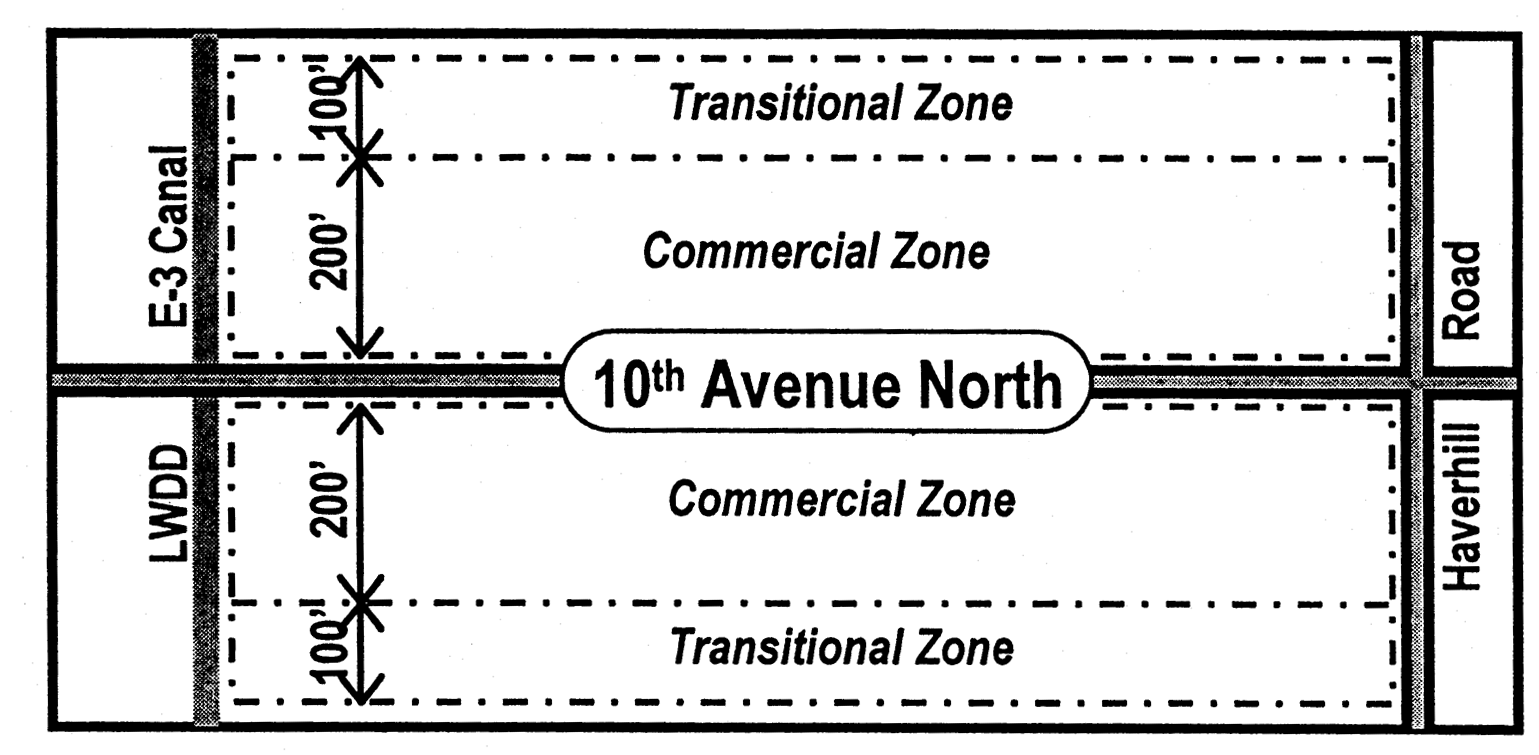
Figure 16-574
Projects in the commercial zone may utilize standard development techniques, or use traditional neighborhood development (TND) standards as described in section 16-581.
(Ord. No. 2003-16, § 2, 10-7-03)
Sec. 16-575. - Permitted principal uses.
The permitted uses, and special exception uses subject to the provisions of section 16-171 et seq., for the commercial and transitional zones within the mixed use development-original section (MXD-OS) zoning district shall be as follows (see section 16-588 regarding nonconforming uses):
Notes:
1
Residential units shall meet the following criteria:
A.
In the commercial zone, multifamily residential units shall only be permitted as accessory to a commercial use and must be physically integrated into the commercial structure. In the transitional zone, any multi-family residential structure shall be physically integrated with another permitted or special exception use. In both zones detached single-family units, including mobile homes, and two-family residential units, are not allowed.
B.
Minimum living area:
2
Service establishments including barber shops; beauty shops; shoe repair; laundromats; dry cleaning pick up stations; establishments for repair of small items such as apparel, small business machines and similar items; interior decorators; and similar uses.
3
Retail outlets including bookstores; card and gift shops; arts and crafts stores; television, radio, and video equipment sales (including repair incident to sales); jewelry stores (including watch repair but not pawn shop); clothing stores; camera shops and supplies (including repair incident to sales); toy stores; sporting goods stores; leather goods and luggage stores; record and video tape stores; musical instrument stores; home furnishing and appliance stores (without repair incident to sales); office equipment supplies and furniture; pet shops; antique stores; and similar establishments.
4
Food services including restaurants (without drive-in or drive-through facilities), delicatessens, ice cream parlors and similar food establishments.
5
Banks and financial institutions (without drive-in or drive-through facilities).
6
Vocational, trade and business schools.
A.
All activities shall be conducted in completely enclosed buildings.
7
Hotels:
A.
The number of hotel units on a site shall not exceed the number obtained by dividing the total square footage of the site by one thousand five hundred (1,500).
B.
Each hotel unit shall have a minimum enclosed floor area of two hundred (200) square feet.
8
Child care center/preschool facilities:
A.
No city occupational license shall be issued until a license has been obtained from the state department of health and rehabilitative services and any other permitting agency as required by law including the provisions of this chapter.
B.
The minimum site area shall be one and one-half (1½) acres.
C.
Outdoor play areas shall consist of one hundred (100) square feet of play area per child and in no case shall the area be less than four hundred (400) square feet. All play areas shall be fenced in accordance with the provisions of this chapter.
D.
Such facility shall provide a passenger drop-off zone adjacent to the building providing clear ingress and egress and sufficient off-street stacking.
9
Copy centers shall be permitted subject to the following:
A.
Hours of operation shall be limited to between 8:00 a.m. and 10:00 p.m. daily.
10
Nursing and convalescent facilities, subject to the requirements of section 16-764:
A.
The minimum site area shall be twenty-six thousand (26,000) square feet.
B.
No building in connection with such facilities shall be closer than fifty (50) feet from any residentially zoned property.
C.
No city occupational license shall be issued unless a license has been obtained from the state department of health and rehabilitative services and any other permitting agency as required by law including the provisions of this chapter.
D.
Sleeping rooms shall not be less than one hundred (100) square feet per patient.
E.
A minimum of ten (10) percent of the total floor area shall be devoted to a common area exclusive of halls, corridors, stairs, or elevator shafts, where a variety of recreational or therapeutic activities may occur.
11
Convenience stores:
A.
The site, as determined by the city, shall exceed the landscaping material requirements of this chapter by at least ten (10) percent.
B.
The store shall be free of all obstructions of view from the adjacent street to the main store windows giving a clear and unobstructed view of the cashier's station, including obstructions of signage and landscaping.
C.
Shall not be located within one thousand five hundred (1,500) feet of any other convenience store. For the purposes of this section, all measurements of distances shall be along a straight airline route from the nearest point on any subject property line to the nearest point on any property line of any other property used as a convenience store.
D.
The store shall have appropriate security systems to include, but not be limited to, cameras with video retrieval capabilities. This requirement shall be exempted if the store:
1.
Employs two (2) or more employees at the same time between the hours of 11:00 p.m. and 7:00 a.m.; or
2.
Closes on a daily basis by 11:00 p.m.
E.
Coin-operated amusement devices shall not be permitted on site.
F.
Gasoline sales shall not be permitted on site.
12
Off-street parking areas in association with other uses in this district:
A.
The applicant shall demonstrate that it is not feasible to physically locate all of the required off-street parking on the same parcel of land as the primary use.
B.
Off-site parking shall not be used to satisfy the off-street parking requirements for convenience stores and other convenience-oriented uses. Required handicapped parking spaces shall not be located in an off-site parking facility. Off-site parking shall not account for more than thirty (30) percent of the required number of parking spaces when its location is not contiguous to the use it is intended to serve.
C.
Off-site parking shall not be located further than two hundred fifty (250) feet from the use it is intended to serve, as measured by the shortest distance between the two (2) closest property lines, and must be located on the same side of 10th Avenue North as the use it is intended to serve.
D.
Landscape buffers shall be provided consistent with the provisions of the Zoning Code.
13
Reserved.
14
Medical and dental offices are subject to the requirements of section 16-764.
(Ord. No. 2003-16, § 2, 10-7-03; Ord. No. 2011-04, § 2, 3-7-11; Ord. No. 2014-07, § 1, 9-9-14; Ord. No. 2020-02, § 1, 9-10-20)
_____
Sec. 16-576. - Accessory uses.
The following are the permitted accessory uses and structures in the mixed use development-original section (MXD-OS) district:
(1)
Uses and structures which are on the same lot with, and of a nature customarily incidental and subordinate to, the principal building, structure or use.
(2)
[Reserved.]
(Ord. No. 2003-16, § 2, 10-7-03; Ord. No. 2013-16, § 6, 11-18-13)
Sec. 16-577. - Prohibited uses.
The following are the prohibited uses in the mixed use development-original section (MXD-OS) district:
(1)
Any use, accessory use or component of use, or structure not specifically, or by reasonable implication, permitted herein or permissible by special exception.
(2)
All outdoor storage and outdoor display of commercial goods and materials.
(3)
Medical marijuana treatment center dispensing facilities and any general medical marijuana retailers.
a.
Medical marijuana treatment center dispensing facilities, including medical marijuana retail centers, are prohibited, as authorized by F.S. § 381.986(11), et seq.
b.
In addition to the prohibition set forth in subsection a., marijuana remains a Schedule 1 drug and is illegal pursuant to federal law; therefore, any facilities related to the cultivation, processing, distribution, storage, sales, or other wholesale or retail transaction of marijuana, whether for compensation or otherwise, including medical marijuana treatment center dispensing facilities, are prohibited.
(Ord. No. 2003-16, § 2, 10-7-03; Ord. No. 2014-07, § 1, 9-9-14; Ord. No. 2019-02, § 2, 4-15-19; Ord. No. 2020-02, § 1, 9-10-20; Ord. No. 2023-10, § 2, 11-6-23)
Sec. 16-578. - Minimum lot size requirements.
The minimum lot requirements for the mixed use development-original section (MXD-OS) district shall be as follows, unless otherwise required for a specific use:
Table 16-578: Minimum Lot Size
(Ord. No. 2003-16, § 2, 10-7-03; Ord. No. 2014-07, § 1, 9-9-14)
Sec. 16-579. - Maximum lot coverage, floor-area-ratio (FAR) and residential density.
The intent of the MXD-OS district is to provide an incremental scale of development based on the square footage of the project site. This district recognizes that it is in the best interest of the city and sound planning principles to provide incentives to encourage consolidation of smaller parcels. The intent of the MXD-OS district is also to provide for an integrated mixture of commercial, office and residential uses. The maximum commercial intensity in the MXD-OS district shall be based on the site area ranges shown in Table 16-579.
Table 16-579: Maximum Building Coverage
and Floor-Area-Ratio (FAR)
The maximum residential density shall be calculated as one (1) dwelling unit per lot platted October 27, 1925 for lots depicted on Greenacres Plat 2 and December 31, 1928 for lots depicted on Greenacres Plat 2 Replat, or six (6) dwelling units per net acre, whichever is greater. Residential density and commercial intensity may both be developed on a property, subject to the maximum building coverage and floor area ratio of Table 16-579. Residential uses are subject to the restrictions of Table 16-575, Note 1.
(Ord. No. 2003-16, § 2, 10-7-03; Ord. No. 2014-07, § 1, 9-9-14; Ord. No. 2025-06, § 2, 12-1-25)
_____
Sec. 16-580. - Minimum setback requirements.
The minimum setback requirements in the mixed use development-original section (MXD-OS) district are as follows:
Table 16-580: Setback Requirements
Notes:
1.
TND = Traditional Neighborhood Development as described in section 16-581.
2.
All new driveways shall access the lot from a side street.
3.
Side streets are Fleming, Jennings, Perry, Martin, Swain, Broward, Walker and Jackson.
4.
North/south property line applies along the north and/or south property line unless said north or south property line is 10th Avenue North, then the standards for 10th Avenue North shall apply.
(Ord. No. 2003-16, § 2, 10-7-03)
_____
Sec. 16-581. - Supplemental standards.
(1)
Commercial zone (TND): For development in the commercial zone opting to utilize traditional neighborhood development (TND) standards, the following shall apply:
(a)
Pedestrian pathways to the building(s) shall be provided from 10th Avenue North and all side streets.
(b)
Vehicular access is to be provided from the side streets and not 10th Avenue North or Haverhill Road.
(c)
Parking shall be behind the building(s) and not along 10th Avenue North.
(2)
Transitional zone: Development in the transitional zone shall be limited to the permitted and special exception uses listed in Table 16-575 for the transitional zone. Property in the transitional zone may also be incorporated into a project within the commercial zone. Under these circumstances, the property within the transitional zone may be used for uses allowed in the transitional zone and/or for landscaping, parking and water retention in support of the commercial area; it shall not be used for those uses allowed only in the commercial zone.
(Ord. No. 2003-16, § 2, 10-7-03)
Sec. 16-582. - Building design.
All buildings in this district shall comply with the following standards:
(1)
Building design shall be provided in accordance with section 16-58 et seq.
(2)
Mechanical equipment or other utility features on roof, ground or building shall be screened from public view with material harmonious with the building or shall be so located as to not be visible from any public way.
(3)
No overhead doors shall face 10th Avenue North or Haverhill Road.
(4)
All structures shall provide visible pitched roofs with a slope equal to or greater than 4:12.
(5)
Architectural features including, but not limited to, color schemes, exterior wall treatments, and decorative features shall be incorporated in order to be compatible with the character of the original section of the city and any design guidelines produced by the city's planning department. Architectural design of equal quality shall be provided on all sides of all structures.
(6)
Building wall signage and freestanding signs shall be compatible with the character of the original section of the city and any design guidelines produced by the city's planning department.
(Ord. No. 2003-16, § 2, 10-7-03)
Sec. 16-583. - Abandonment of alleys.
Existing alleys may be abandoned, subject to the following criteria:
(1)
The proposed project must have a minimum site area of twenty-six thousand (26,000) square feet.
(2)
The applicant must secure approval from all affected service providers and make provisions for the continuation of those services.
(3)
Easements for affected utilities and/or the City of Greenacres may be required as a condition of abandonment.
(4)
The city's right-of-way abandonment procedures shall be followed.
(Ord. No. 2003-16, § 2, 10-7-03)
Sec. 16-584. - Height restrictions.
The maximum height of buildings and structures in the mixed use development-original section (MXD-OS) district shall be two (2) stories and thirty-five (35) feet.
(Ord. No. 2003-16, § 2, 10-7-03)
Sec. 16-585. - Sign regulations.
The regulations regarding signs in the mixed use development-original section (MXD-OS) district are in Article VI (Sign Regulations). Signage shall be in accord with any design guidelines produced by the city's planning department.
(Ord. No. 2003-16, § 2, 10-7-03)
Sec. 16-586. - Landscaping and screening.
The regulations regarding landscaping in the mixed use development-original section (MXD-OS) district are set forth in Article VII (Landscaping). All development within the MXD-OS district shall use the non-residential category in the landscaping regulations, however the six-foot high masonry wall is not required between the commercial zone and the transitional zone of the district unless required to buffer detached single-family dwellings. Landscaping shall be in accord with any design guidelines produced by the city's planning department.
(Ord. No. 2003-16, § 2, 10-7-03; Ord. No. 2011-06, § 4, 5-16-11)
Sec. 16-587. - Off-street parking.
The regulations regarding off-street parking for all permitted and special exception uses in the mixed use development-original section (MXD-OS) district are set forth in Article VIII (Off-Street Parking). Permitted uses in the commercial zone developed within the TND parameters of section 16-581 may provide parking at a rate of one (1) space per two hundred fifty (250) square feet.
(Ord. No. 2003-16, § 2, 10-7-03)
Sec. 16-588. - Nonconformities.
The following requirements shall govern nonconformities in this district:
(1)
Existing uses and components of use established prior to the adoption date of the division establishing the MXD-OS district; and existing buildings, structures and signs constructed prior to the adoption date of the division establishing the MXD-OS district; which do not conform to the requirements of the MXD-OS district are to be regulated and limited in accord with Article IX, sections 16-1356 through 16-1362 except as otherwise stated below.
(2)
Nonconforming uses or components of use which are abandoned or discontinued shall immediately render the protections of the nonconforming use sections of the Code null and void. The continuance of such use or component of use is specifically prohibited, and any subsequent use shall conform to the requirements of this district. Sufficient documentation shall be provided by the property owner to establish that the use has not been abandoned or discontinued; affidavits alone are not sufficient to establish the maintenance of the use's nonconforming status.
(3)
Existing buildings and structures which do not comply with the building design criteria of section 16-582 shall not be considered nonconforming for the purposes of this Code except that upon the occurrence of the any of the events listed below, the building or structure shall be required to comply with the building design criteria to the extent indicated below:
(a)
In the event of the damage of such building or structure by any means, including but not limited to fire, flood, wind, explosion, act of God, or act of a public enemy, to an extent of fifty (50) percent or more of the appraised value of the building or structure as shown in the records of the Property Appraiser of Palm Beach County or to an extent of more than fifty (50) percent of the square footage of the physical building or structure, it shall not be replaced, restored, or reconstructed unless it is brought into full compliance with the building design criteria of this district. These requirements apply equally to residentially and nonresidentially used buildings and structures and structures accessory to said uses.
(b)
In the event of a change in the use or occupancy of the building or structure, the exterior paint colors of the building or structure shall be modified to be in accord with the building design criteria.
(c)
In the event of renovation, remodeling, or reconstruction of a cost greater than or equal to twenty-five (25) percent of the appraised value of the building or structure as shown in the records of the Property Appraiser of Palm Beach County, the building or structure shall be modified to provide decorative exterior wall lights, building signage, and freestanding signage in accord with the building design criteria. In addition, any overhead bay doors facing 10th Avenue North or Haverhill Road shall be eliminated, a covered entry porch in a style consistent with the Building Design criteria shall be provided, and the requirements of [section] 16-588(3)(b) above shall be satisfied.
(d)
In the event of a change in use to a special exception use or from one (1) special exception use to another special exception use; renovation or remodeling of a cost greater than or equal to fifty (50) percent of the appraised value of the building or structure as shown in the records of the Property Appraiser of Palm Beach County; any expansion of the building or structure; or a change which triggers the site plan approval requirements of section 16-196 for a new site and development plan or major site plan amendment the building or structure shall be modified to provide the pitched roof, exterior materials and landscaping of the building design criteria as well as satisfying the requirements of [section] 16-588(3)(b) and (c) above.
(Ord. No. 2003-16, § 2, 10-7-03; Ord. No. 2014-07, § 2, 9-9-14; Ord. No. 2021-20, § 2, 1-3-22)
Sec. 16-590.- Purpose and intent.
The purpose and intent of the Lake Worth Road Urban Corridor overlay zoning district is to encourage redevelopment and provide enhanced property development standards and patterns within the Lake Worth Road commercial corridor. This overlay district will help implement the city's vision for the area and create solutions for land development along Lake Worth Road. These objectives include:
(1)
Redevelopment of the corridor in order to build community pride, retain and attract commercial activity, and improve the area's economic condition.
(2)
Reinforcement of the unique opportunities and long-term stability of the corridor by the implementation of urban design guidelines for future development.
(3)
Create vibrant commercial corridors with high levels of foot traffic along Lake Worth Road Corridor.
(4)
Improvement of signage along the corridor.
(5)
Manage over time the transition from residential uses to commercial uses in the original section area of the corridor.
(6)
Protect adjacent residential uses, and encourage adequate pedestrian access and efficient vehicular movement along the corridor.
(7)
Development of a unifying community design and development theme to work in conjunction with a proposed corridor streetscaping.
(8)
Preparation of development regulations to enable refurbishment of properties within the corridor.
(9)
Creation of the opportunity for new development to respect existing scale, style, and character, while preserving the positive aspects of the corridor.
(Ord. No. 2010-13, § 1, 12-20-10; Ord. No. 2019-19, § 1, 12-16-19)
Sec. 16-591. - Applicability.
The Lake Worth Road Urban Corridor (UC) overlay district shall be applicable for a distance of up to approximately seven hundred fifty (750) feet north and south of Lake Worth Road, between Via Poinciana Drive and Military Trail for those properties with a Commercial (CM) future land use designation. More specifically, this district is further subdivided into location specific sub-districts that account for the difference in the layout and physical characteristics of the area since the corridor was developed at different times and under varying jurisdictions. The corridor has two (2) major arterial intersections, as well as mid-block commercial development, and an area originally platted as single-family lots.
The UC overlay district designation appearing after the zone classification on the official zoning map shall mean that the property so classified is subject to the requirements and restrictions set forth in this division in addition to those in the underlying zoning designation, unless otherwise specified.
Any site and development plan approved prior to the establishment of the overlay district shall not be affected by these regulations. However, any amendment to an approved plan shall adhere to the provisions of this division to the extent of the amendments.
(Ord. No. 2010-13, § 1, 12-20-10; Ord. No. 2019-19, § 1, 12-16-19)
Sec. 16-592. - Location specific sub-districts.
Within the district there shall be location specific sub-districts created:
(1)
Greenacres original section district. The area bounded by the E-3 Canal to the west, Haverhill Road to the east, Lake Worth Road to the south, and First Street to the north.
(2)
(Reserved).
(Ord. No. 2010-13, § 1, 12-20-10)
Sec. 16-593. - Greenacres original section sub-district regulations.
The Greenacres Original Section Sub-District includes many small lots originally platted as single-family lots. In order to redevelop as commercial, the following requirements shall apply:
(1)
Required rezoning. In order to develop, redevelop, or reconstruct, properties with a non-residential development, the property shall be required to rezone to the commercial intensive zoning district. Such rezoning must comply with the requirements contained within section 16-593.
(2)
Access to Lake Worth Road. In order to avoid hopscotch redevelopment, no parcel shall receive a commercial zoning designation unless it is abutting Lake Worth Road or has a unity of title (in favor of the City of Greenacres) with a parcel which abuts Lake Worth Road.
(3)
Access.
a.
West of Swain Boulevard: Use of Lake Worth Road for project access for those properties west of Swain Boulevard shall be coordinated to avoid unnecessary openings. Shared driveways shall be encouraged.
b.
To the maximum extent possible, projects shall be linked by cross-access connections for vehicles and pedestrians.
c.
Pedestrian pathways to the building(s) shall be provided from Lake Worth Road and from all other adjacent streets.
(4)
Off-street parking. All off-street parking shall be governed by article VIII (Off-Street Parking) of the zoning code. In addition, the parking lot shall be designed such that not more than one (1) parking bay consisting of two (2) rows of parking spaces and one (1) access aisle shall be located between the face of the building and Lake Worth Road.
(5)
Building design. All building exterior design shall be in accordance with the design guidelines established for the overlay district by the city's planning and engineering department.
(6)
Landscaping requirements. Regulations regarding landscaping are set forth in article VII (Landscaping) of the zoning code. All development shall use the "commercial" category in the landscaping regulations, subject to the following additional criteria:
a.
The six-foot high masonry wall and twenty-five-foot transition zone buffer are not required in order to buffer adjacent properties that are located within the sub-district from proposed development within the sub-district. In lieu of the wall, the following shall be provided:
1.
A minimum of fifteen-foot wide landscape buffer.
2.
A minimum of one (1) tree for every twenty (20) lineal feet of buffer.
3.
A minimum of one (1) shrub shall be installed every eighteen (18) inches on-center, a minimum of twenty-four (24) inches in height with a twenty-four (24) inches spread at installation, planted in two (2) parallel rows staggered.
b.
If a fence or wall is erected adjoining a public street, a minimum fifteen (15) foot wide landscaped and irrigated area composed of trees and groundcover, vines, and shrubs is required along the base of that portion of the wall or fence that fronts the public street. The planting area shall be located between the public street and the fence or wall.
c.
Landscaping shall be in accordance with the design guidelines for the overlay district established by the city's planning and engineering department.
(7)
Right-of-way abandonment. Requests to abandon the city's alley and road rights-of-way shall not be granted unless there is an associated redevelopment project that has been granted site plan approval. Abandonment of the southern portion of Jackson Avenue shall be encouraged in conjunction with unified redevelopment of the area between Walker Avenue and Haverhill Road. If an east-west alley in the area east of Swain Boulevard is to be abandoned, it shall be re-established and rededicated at the north end of the redevelopment site in order to maintain utility and maintenance access and to serve as a buffer from adjacent residential uses. The following criteria must also be met for any abandonment:
a.
The applicant must secure approval from all affected service providers and make provisions for the continuation of those services.
b.
Easements for affected utilities and/or the City of Greenacres may be required as a condition of abandonment.
c.
The city's right-of-way abandonment procedures shall be followed.
(8)
Nonconformities. Nonconformities shall be regulated and limited in accordance with article VI, division 4, section 16-997 and article IX, sections 16-1356 through 16-1362.
(Ord. No. 2010-13, § 1, 12-20-10; Ord. No. 2019-19, § 1, 12-16-19)

