
Greenacres City Zoning Code
ARTICLE VI
SIGN REGULATIONS32
Editor's note—Ord. No. 2022-25, §§ 2, 3, adopted September 28, 2022, repealed art. VI, divs. 1—15, §§ 16-931—16-936, 16-946, 16-947, 16-966, 16-967, 16-981—16-997 and enacted a new art. VI as set out herein. Former art. VI pertained to similar subject matter and derived from Ord. No. 88-14, §§ 32-43(a)—(h), (l), adopted June 27, 1988; Ord. No. 00-04, §§ 3, 4, 7, adopted May 15, 2000; Ord. No. 2003-16, § 4, adopted October 7, 2003; Ord. No. 2007-04, adopted February 5, 2007; Ord. No. 2010-14, §§ 3—7, adopted December 6, 2010; Ord. No. 2017-02, § 1, adopted March 20, 2017; Ord. No. 2018-03, §§ 2, 3, adopted June 18, 2018; Ord. No. 2021-016, § 2, adopted December 13, 2021; and Ord. No. 2021-20, § 2, adopted January 3, 2022
Cross reference— Buildings and building regulations, Ch. 4; health, sanitation and nuisances, Ch. 7; licenses and business regulations, Ch. 8; streets, sidewalks and other public places, Ch. 11; subdivision regulations, Ch. 12; traffic and vehicles, Ch. 14.
DIVISION 5. - SIGN REGULATION BY ZONING DISTRICT[33]
Editor's note—Ord. No. 2025-10, § 6, adopted Aug. 4, 2025, amended Div. 5 in its entirety to read as herein set out. Former Div. 5, §§ 16-981—16-996, pertained to similar material, and derived from Ord. No. 2022-25, § 3, adopted Sept. 28, 2022; Ord. No. 2023-01, § 2, adopted March 6, 2023; Ord. No. 2024-13, §§ 12, 13, 14, adopted May 20, 2024.
Sec. 16-931. - Scope, intent, purpose.
(a)
Scope. The provisions of this article shall regulate the location, number, size, use, appearance, construction and maintenance of all signs permitted in each zoning district. This chapter is not intended to and does not apply to signs constructed, maintained, or otherwise posted, owned, or leased by the City of Greenacres, Palm Beach County, the State of Florida, or the federal government, and does not regulate official traffic control devices.
(b)
Intent. Increased numbers and size of signs, as well as certain types of lighting, distract the attention of motorists and interfere with traffic safety. In addition, the indiscriminate construction and maintenance of signs detract from the appearance of the city. It is therefore the intent of these regulations to promote and protect the public health, safety, general welfare, convenience and enjoyment of the citizens of the city. More specifically, the sign regulations are intended to:
(1)
Classify and categorize signs by type and zoning district;
(2)
Permit, regulate and encourage the use of signs with a scale, graphic character, and type of lighting compatible with buildings and uses in the area, so as to support and complement the goals, objectives and policies set forth in the city's comprehensive plan;
(3)
Allow signs that are compatible with their surroundings and aid orientation, while precluding the placement of signs that contribute to sign clutter or that conceal or obstruct adjacent land uses or signs;
(4)
Encourage and allow signs that are appropriate to the zoning district in which they are located consistent with and serving the needs of the land uses, activities and functions to which they pertain;
(5)
Establish regulations affecting the design, construction, and maintenance of signs for the purpose of ensuring equitable means of graphic communication, while maintaining a harmonious and aesthetically pleasing visual environment within the city. It is recognized that signs form an integral part of architectural building and site design and require equal attention in their design, placement and construction;
(6)
Regulate the appearance and design of signs in a manner that promotes and enhances the beautification of the city and that complements the natural surroundings in recognition of this city's reliance on its natural surroundings and beautification efforts as a source of economic advantage as an attractive place to live and work;
(7)
Preclude signs from conflicting with the principal permitted use of the lot and adjoining lots;
(8)
Establish dimensional limits and placement criteria for signs that are legible and proportional to the size of the lot and structure on which the sign is to be placed, or to which it pertains;
(9)
Maintain and enhance the scenic beauty of the aesthetic environment and the city's ability to attract sources of economic development and growth;
(10)
Preserve, conserve, protect, and enhance the aesthetic quality and scenic beauty of all zoning districts in the city;
(11)
Encourage the effective use of signs as a means of communication in the city;
(12)
Ensure pedestrian safety and traffic safety;
(13)
Regulate signs so as to not interfere with, obstruct the vision of, or distract motorists, bicyclists or pedestrians;
(14)
Regulate signs so that they are effective in performing the function of identifying and safely directing pedestrian and vehicular traffic to a destination;
(15)
Curtail the size and number of signs to the minimum reasonably necessary to identify a residential or business location, and the nature of such use, and to allow smooth navigation to these locations;
(16)
Lessen the visual clutter that may otherwise be caused by the proliferation, improper placement, illumination, animation, excessive height, and excessive area of signs which compete for the attention of pedestrian and vehicular traffic and are not necessary to aid in wayfinding;
(17)
Allow for traffic control devices without city regulation consistent with national standards because they promote highway safety and efficiency by providing for the orderly movement of road users on streets and highways, and by notifying road users of regulations and providing nationally consistent warnings and guidance needed for the safe, uniform and efficient operation of all elements of the traffic stream and modes of travel, while regulating private signs to ensure that their size, location and other attributes do not impair the effectiveness of such traffic control devices;
(18)
Minimize the possible adverse effect of signs on nearby public and private property;
(19)
Protect property values by precluding, to the maximum extent possible, signs that create a nuisance to the occupancy or use of other properties as a result of their size, height, illumination, brightness, or movement;
(20)
Protect property values by ensuring that the size, number, and appearance of signs are in harmony with buildings, neighborhoods, structures, and conforming signs in the area;
(21)
Except to the extent expressly preempted by Palm Beach County, state, or federal law, ensure that signs are constructed, installed and maintained in a safe and satisfactory manner, and protect the public from unsafe signs;
(22)
Foster the integration of signage with architectural and landscape designs;
(23)
Not regulate signs more than necessary to accomplish the compelling and important governmental objectives described herein;
(24)
Enable the fair and consistent enforcement of these sign regulations; and
(25)
Be considered the maximum standards allowed for signage.
(c)
Purpose. The regulations in this chapter are not intended to regulate or censor speech based on its content or viewpoint, but rather to regulate the secondary effects of speech that may adversely affect the City of Greenacres' substantial and compelling governmental interests in preserving scenic beauty and community aesthetics, and in vehicular and pedestrian safety in conformance with the First Amendment. It is therefore the purpose of this article to promote aesthetics and the public health, safety, and general welfare, and assure the adequate provision of light and air within the City of Greenacres through reasonable, consistent, and nondiscriminatory standards for the posting, displaying, construction, use, and maintenance of signs and sign structures that are no more restrictive than necessary to achieve these governmental interests.
(d)
Findings. In addition and supplemental to the findings and determinations contained in the "Whereas" provisions, which are incorporated by reference into this section, the city council acting in its legislative capacity for the purpose of regulating signage, hereby makes the following findings of fact:
The reasonable regulation of the location, number, size, use, appearance, construction and maintenance of signs within the city serves a compelling governmental interest, for the following reasons:
(1)
Florida Constitution. Article II, Section 7 of the Florida Constitution provides that "[i]t shall be the policy of the state to conserve and protect its natural resources and scenic beauty…" A beautiful environment preserves and enhances the desirability of Greenacres as a place to live and to do business. Implementing the Florida Constitution is a compelling governmental interest.
(2)
Florida Statutes. Florida law requires cities to adopt comprehensive plans and implement them through land development regulations (also known as zoning regulations) and approval of development orders that are consistent with the comprehensive plan. See F.S. pt. II ch. 163. Florida law specifically requires that municipalities adopt sign regulations. See F.S. § 163.3202(2)(f). Complying with state law is a compelling governmental interest.
(3)
Greenacres Code of Ordinances.Chapter 16 of the Greenacres Code of Ordinances provides in section 16-2 that the chapter's purpose is to "promote, protect and improve in accordance with present and future needs, the public health, safety, comfort, good order, appearance, convenience, morals and general welfare of the citizens of the city; to conserve the value of land, buildings, and resources; to protect the character and maintain the stability of residential, agricultural, business and industrial areas; and to provide for efficiency and economy in the process of development, for the appropriate and best use of the land, for preservation, protection, development, and conservation of the natural resources of land, water, and air, for convenience of traffic and circulation of people and goods, for the use and occupancy of buildings, for healthful and convenient distribution of population, for adequate public utilities and facilities, for promotion of the civic amenities of beauty and visual interest, and for promotion of developments as a means of achieving unified civic design by establishing zoning districts and by regulating the location and use of buildings, signs, and other structures, and land or water for trade, agriculture, industry, and residence, by regulating and limiting or determining the height, bulk, and access to light and air of buildings and structures, the area of yards, and other open spaces, and the density of use."
The city council specifically finds that these sign regulations are narrowly tailored to achieve the compelling and substantial governmental interests of traffic safety and aesthetics, and that there is no less restrictive way for the city to further these interests.
(Ord. No. 2022-25, § 3, 9-28-22)
Sec. 16-932. - Severability; substitution.
(a)
Severability. If any provision of this chapter is found by a court of competent jurisdiction to be invalid, such finding must not affect the validity of the other provisions of this chapter that can be given effect without the invalid provision.
(1)
Generally. If any part, section, subsection, paragraph, sentence, phrase, clause, term, or word of this chapter is declared unconstitutional by the valid judgment or decree of any court of competent jurisdiction, the declaration of such unconstitutionality shall not affect any other part, section, subsection, graph, subparagraph, sentence, phrase, clause, term, or word of this chapter. Should any section, paragraph, sentence, clause, phrase, or other part of this chapter or the adopting ordinance be declared by a court of competent jurisdiction to be invalid, such decision shall not affect the validity of this chapter or the adopting ordinance as a whole or any portion or part thereof, other than the part so declared to be invalid.
(2)
Severability where less speech results. Without diminishing or limiting in any way the declaration of severability set forth in subsection (a)(1) above, or elsewhere in this chapter or the adopting ordinance, if any part, section, subsection, paragraph, subparagraph, sentence, phrase, clause, term, or word of this chapter is declared unconstitutional by the valid judgment or decree of any court of competent jurisdiction, the declaration of such unconstitutionality shall not affect any other part, section, subsection, paragraph, subparagraph, sentence, phrase, clause, term, or word of this chapter or the adopting ordinance, even if such severability would result in a situation in which there would be less speech, whether by subjecting previously exempt signs to permitting or otherwise.
(3)
Severability of provisions pertaining to prohibited signs. Without diminishing or limiting in any way the declaration of severability set forth in subsection (a)(1), or elsewhere in this chapter or the adopting ordinance, if any part, section, subsection, paragraph, subparagraph, sentence, phrase, clause, term, or word of this chapter or the adopting ordinance or any other law is declared unconstitutional by the valid judgment or decree of any court of competent jurisdiction, the declaration of such unconstitutionality shall not affect any other part, section, subsection, paragraph, subparagraph, sentence, phrase, clause, term, or word of this chapter or the adopting ordinance that pertains to prohibited signs.
(4)
Severability of prohibition on off-premises signs. If any part, section, subsection, paragraph, subparagraph, sentence, phrase, clause, term, or word of this chapter or any other code provisions or laws are declared invalid or unconstitutional by the valid judgment or decree of any court of competent jurisdiction, the declaration of such unconstitutionality shall not affect the prohibition of off-premises signs as contained herein.
(b)
Substitution. Notwithstanding any provisions of this chapter to the contrary, to the extent that this chapter permits a sign containing commercial content, it shall permit a noncommercial sign to the same extent. The noncommercial message may occupy the entire sign area or any portion thereof, and may substitute for or be combined with the commercial message. The sign message may be changed from commercial to noncommercial, or from one (1) noncommercial message to another, as frequently as desired by the sign's owner, provided that the sign is not prohibited and the sign continues to comply with all requirements of this chapter.
(Ord. No. 2022-25, § 3, 9-28-22)
Sec. 16-933. - Definitions.
Abandoned sign. A building, freestanding, or off premises sign that. (a) for a period of thirty (30) or more consecutive days, (1) no longer correctly advertises, identifies, displays, directs, or attracts attention to an object, institution, organization, business, product, service, or event on the premises upon which the sign is located; (2) identifies a time, event or purpose that has passed or no longer applies; (3) contains missing letters or other components of the sign, rendering the sign indecipherable or (b) for a period of six (6) consecutive months, includes a sign structure that bears no sign or a sign face that bears no copy.
Address sign. A sign indicating only the common street address. For the purposes of this definition, a nameplate shall be construed to be an address sign.
"A" frame sign. A freestanding sign which is ordinarily in the shape of an "A" or some variation thereof, which is readily moveable, and is not permanently attached to the ground or any structure thereof.
Animated sign. A building, freestanding, or off-premises sign which may flash, revolve, rotate, swing, undulate, or otherwise attract attention through the movement or flashing of any part of the sign or advertising structure.
Awning sign. A sign painted upon a cloth, plastic or metal surface supported by a metal frame fastened to the wall of a building.
Banner flag. A tall, narrow banner, attached to a vertical pole, with a straight body shape that is curved at then ends to resemble the tips of feathers, commonly used to draw attention to an event or business location (also known as afeather flag).
Banner sign. Any sign (that cannot be considered a flag), intended to be suspended for display, either with or without frames, having characters, letters, illustrations, or ornamentations applied to cloth, paper, plastic, balloons, or fabric of any kind with such material acting as a backing.
Billboard sign. A large off-premises permanent sign structure that may be freestanding or affixed to a building.
Bulletin board sign. A building or free-standing sign constructed by or for a charitable, educational, governmental, or religious institution, or a public body, which is constructed on the same property as said institution.
Canopy. A roof-like structure generally self-supporting that may be freestanding or attached to a principal structure, providing shade and weather protection, typically utilized in locations such as over drive-thru lanes, walkways, entrances, and gasoline pumps.
Changeable copy sign. A sign on which the copy is changed manually, through the utilization of attachable letters, numbers, symbols and other similar characters.
Copy. Written or graphic material that is placed, displayed, or depicted or otherwise indicated on a sign.
Clearance (of a sign). The smallest vertical distance between the established grade of the site upon which the sign is to be located and the lowest point of the sign, including framework and any ornamentation attached thereon, extending over that grade.
Construction sign. A freestanding sign erected on the premises on which development is taking place during the period of such development, commonly used to indicate the names of architects, engineers, landscape architects, contractors, owners, or others having a role or interest in the structure project.
Copycat signs. Signs that resemble any official sign or markers and that because of design, location, position, shape, or color may be reasonably confused with or construed as traffic-control devices or regulatory signs.
Copy area. The entire face of a sign including the advertising surface of any framing, trim or molding but not including the supporting structure.
Directory sign. A building or freestanding sign which may indicate the name, address, or direction to, the occupants or businesses which are located on the premises, that is intended to be viewed only from within the development where it is located.
Electronic changeable copy sign. A sign that utilizes an electronic display including, but not limited to, liquid crystal display or light emitting diodes (LCD or LED), plasma display, or projected images, on which the copy is changed electronically The following definitions pertain to electronic signs.
(1)
Dwell time means the minimum amount of time that a message must be static on an electronic sign. The dwell times shall not include any transition time.
(2)
Static means a display that is fixed, and unchanging with no portion of the display being in motion, flashing or changing in color or light intensity.
(3)
Transition means a visual effect used on an electronic sign to change from one (1) message to another.
Emitting signs. Signs that emit audible sound, odor, or visible matter such as smoke or steam.
Entry feature signs. An architectural feature or element with signage that is typically located at the entrance to a development project but is not attached to a perimeter wall.
Entry wall sign. A sign attached to a wall near the entrance of a site as part of a continuous perimeter wall or fence.
Façade.The entire face of a building (front, side, and rear) including the parapet.
Façade projection. A structural projection from a façade, such as a gallery, arcade or marquee, which serves as a design element or overhead shelter from sun and rain that is also designed to accommodate signage. Protruding balconies are specifically excluded from this definition. Façade projections are finished with aluminum, stucco, stone, glass, or other construction material that exceeds industry standard quality.
Flag. Any fabric, plastic, canvas, material or bunting containing distinctive color(s), pattern(s), symbol(s), emblem(s) or insignia(s) that represents a noncommercial idea or institution, or entity, such as a government or civic club.
Freestanding sign. A sign supported by a sign structure secured in the ground and which is wholly independent of any building, fence, or object other than the sign structure for support.
Frontage. The property line or building façade parallel with and facing the public road right-of-way abutting the subject property.
Frontage wall face. The building façade, excluding parapet, fascia, soffit, mansard and roof, which faces a frontage of the premises.
Grade. A reference plane representing the highest point of the crown of any public or private street or roadway which lies contiguous to the property or building site. In the event that the abutting streets or roadways are unimproved, grade shall be measured from the nearest paved roadway.
Gas station price sign. A sign utilized to indicate the price of fuel available for sale on the premises. A gas station price sign may be a free-standing sign or a portion thereof, or may be affixed to the gas tank structure.
Home occupation sign. A building sign, erected flat against the dwelling in which the home occupation is operated, indicating the name of the individual or business operated within the dwelling.
Human sign (or living sign). A sign or a form of commercial message held by or attached to a human or character (animated or otherwise) for the purposes of advertising or otherwise drawing attention to an individual, business, commodity, service or product. This can also include a person or a live or animated character dressed in costume or wearing a commercial message for the purpose of advertising or drawing attention to an individual business commodity service or product.
Identification sign. A wall sign or freestanding sign used to identify the building, development or establishment of the premises on which it is located
Illegal sign. A sign which has been constructed and is being maintained in violation of the provisions of this chapter.
Illuminated Sign.A sign that is internally or externally illuminated by artificial means.
Master sign plan. A comprehensive document that contains a set of sign criteria unique to a specific shopping center, commercial property, building or development. It includes drawings and plans that illustrate the sign program for the overall development, including, but not limited to, size, location, type, architectural design, dimensions, and other design standards including materials, color, and sign illumination.
Memorial sign. A building or free-standing sign, tablet, or plaque memorializing a person, structure, site or event.
Monument sign. A free-standing sign with a solid base located on or close to the ground typically incorporating materials that complement the architecture and landscaping of the principal structure on the site.
Multi-panel monument sign. A monument sign that contains multiple panels and areas for the display of graphics or lettering for multiple tenants.
Neon sign. A sign that contains an exposed neon tube or is treated in such a manner as to appear to be a sign containing an exposed neon tube or unshielded light.
Nonconforming sign. A sign existing at the time of the passage of this chapter or amendment thereto, which does not conform to the regulations of the zoning district in which it is located, or other applicable sections of this chapter.
Obstructing sign. a sign that obstructs the vision of pedestrians, cyclists, or motorists traveling on or entering public streets.
Off-premises sign. A sign utilized for advertising an establishment, activity, product, service or entertainment which is sold, produced, manufactured, available or furnished at a place other than on the property on which said sign is located. For purposes of this chapter noncommercial messages are never allowed as off-premises signs.
Painted wall sign. A sign painted directly on any exterior building wall or door surface, exclusive of window and door glass areas.
Parapet. A vertical false front or wall extension above the roof line.
Portable sign. A free-standing or off-premises sign which is not permanently affixed to the ground, building, or other structure, which may be mounted on wheels or affixed to a vehicle, and can easily be transported from place to place.
Post and panel sign. A sign made of wood, metal, similar rigid materials, or durable weatherproof fabric attached to one (1) or more ground mounted posts utilized as a panel to display copy.
Primary façade. The façade that has the principal entrance, often referred to as the principal façade or storefront.
Projecting sign. A building sign which projects outward, either perpendicular or at an angle to the wall or building on which it is mounted more than twelve (12) inches.
Real estate sign. A sign erected by the owner, or the owner's agent, on real property which is for rent, sale or lease.
Right-of-way. A strip of land, dedicated or deeded to the perpetual use of the public, occupied or intended to be occupied by a street, crosswalk, railroad, canal, road, electric transmission line, oil or gas pipeline, water supply main, sanitary sewer, storm drain, or for any other special use.
Roof sign. A sign constructed or visible over or on, and wholly or partially dependent upon, the roof, parapet or mansard of any building for support, or attached to the roof, parapet or mansard in any way.
Sign. Any device or representation for visual communication that is used for the purpose of bringing the subject thereof to the attention of others, excluding signage wholly within the interior of a building or structure, and not visible from the exterior of such building or structure. The term is inclusive of the sign structure.
Sign area. The square foot area of a single rectangle enclosing the entire sign face (as distinguished from copy area), unless otherwise provided in this chapter for a particular sign type.
Sign face. The part of the sign that is or can be used to identify, advertise, or communicate information, or for visual representation, which attracts the attention of the public for any purpose. "Sign face" includes the extreme limits of the copy, together with any background material, panel, trim, color and direct or self-illumination used that differentiates the sign from the building, structure, backdrop surface or object upon which or against which it is placed.
Sign structure. A structure or device designed or used for the support of a sign, with or without a sign thereon, which is considered to be an integral part of a sign. This definition does not include fences, buildings, or other structures having another permitted primary function (if no sign is located thereon).
Snipe sign. A sign constructed of any material that is attached to a utility pole, tree, fence, light post, stake or similar object located or situated on public or private property.
Storefront. The façade of a store or commercial tenant space typically on the ground floor or street level.
Temporary sign. A sign that is not permanently affixed or installed, or is displayed for a limited period of time.
Time and temperature sign. A building or free-standing sign which is solely utilized to indicate the time and/or temperature with a sequence span of four (4) to eight (8) seconds.
Traffic control device. A sign, signal, marking, or other device used to regulate, warn, guide traffic, placed on, over or adjacent to a street, highway, private road open to public travel, pedestrian facility, or shared use path by authority of a public agency or official having jurisdiction placed by a public body or, in the case of a private road open to public transit, by authority of the private owner or private official having jurisdiction.
Traffic-control sign. A sign constructed or approved by a government entity used to direct and assist vehicle operators and pedestrians in the guidance and navigational tasks required to traverse safely any facility open to public travel.
Under canopy sign. A building sign which is mounted, attached or suspended perpendicular to the building, beneath an awning, canopy or marquee.
Vee-shaped sign. A building, free-standing, or off-premises sign which has two (2) faces that are not parallel to one (1) another.
Vehicular sign. Any sign or banner which is attached to or placed upon a parked motor vehicle or trailer and placed in a position or location for the sole purpose of displaying the same to the public.
Wall. An exterior vertical structure encompassing the area between the grade and the eaves of a building that encloses the building or that is an enclosure for the perimeter of a property.
Wall sign. A sign constructed parallel to, and extending not more than 24 inches from the building façade to which it is affixed. A sign that is projected onto a building façade (e.g. video projection, 3D projection mapping and other methods of casting images) is also a wall sign.
Window pane area. The glass area of a single window or door pane used for calculation of permitted sign area.
Window sign. Any sign which is painted on, applied to, attached to or projected upon or within the exterior or interior of a building glass area, including doors, or located within fifteen (15) feet of the interior of a building glass area, including doors, or any interior illuminated signs or exposed unshielded light source.
Yard sign. A small temporary sign placed upon or supported by the ground independent of another structure but is not an A-frame sign.
(Ord. No. 2022-25, § 3, 9-28-22)
Sec. 16-934. - Applicability of other requirements.
Signs or other advertising structures shall be constructed and maintained in strict conformity with city building and electrical codes and all other applicable city regulations.
(Ord. No. 2022-25, § 3, 9-28-22)
Sec. 16-935. - Prohibited signs.
It shall be a violation of this chapter to construct, install, place, or maintain the following signs or advertising structures in this city, unless otherwise approved by the city:
(1)
Any signs or advertising structures which are not specifically permitted under this chapter or signs that exceed the sign allowance for the district.
(2)
Traffic or pedestrian hazard. Any sign or advertising structure which constitutes a traffic hazard or a detriment to traffic safety by reason of its size, location, movement, content, coloring, or method of illumination, or by obstructing the vision of drivers, or signs that obstruct or detract from the visibility of traffic-control devices or emergency vehicles. The use of flashing lights or revolving lights is prohibited as part of any sign as it constitutes a traffic hazard. Any sign which by glare or method of illumination constitutes a hazard to either vehicular or non-vehicular traffic is prohibited. Also prohibited is any sign which may be confused with or purports to be a governmental, traffic direction or safety sign, or any other sign or group of signs which create a traffic hazard as determined by the city.
(3)
Obscenities. Any sign or advertising structure with words, scenes or graphics which are obscene, indecent and prurient or which exhibit obscene or illegal written messages or materials.
(4)
Right-of-way. Any sign or advertising structure (other than those constructed by a governmental agency or required to be constructed by a governmental agency for a public purpose) constructed, installed or placed on the right-of-way of any street, road or public way, or signs overhanging or infringing upon the right-of-way of any street, road or public way, except as specifically permitted by this chapter.
(5)
Public property. Any sign or advertising structure constructed on city property or other governmental property other than signs constructed by any governmental entity for public purposes, except as specifically authorized by this chapter.
(6)
Ingress and egress to buildings. Any sign or advertising structure which is constructed, installed or maintained that obstructs any fire escape, required exit, window or door opening intended as a means of ingress or egress.
(7)
Rear of a building. Any sign or advertising structure which is constructed, installed or maintained upon the rear of a building, with the exception of signs to identify the business address on a rear exit door with no greater than six (6) inch non-illuminated letters with a minimum stroke width of one-half inch (½") located directly above the rear door, or as required by applicable fire safety regulations.
(8)
"A" frame signs.
(9)
Animated signs.
(10)
Banner signs. Any banner sign, with the exception of those banner signs that are granted a temporary use permit by the city.
(11)
Banner flag signs.
(12)
Off-premises signs.
(13)
Portable signs.
(14)
Projecting signs.
(15)
Snipe signs.
(16)
Temporary signs, except as allowed under division 4 of this article.
(17)
Vehicular signs.
(18)
Vee-shaped signs.
(19)
Abandoned signs.
(20)
Signs placed upon benches, bus shelters, or waste receptacles, except as may be authorized by the City of Greenacres or superseded by state statutes.
(21)
Under canopy signs, except as allowed as a part of an approved Master Sign Plan.
(22)
Exposed neon tubing, neon signs, and LED signs that emulate the general appearance of traditional neon signs.
(23)
Emitting signs.
(24)
Roof signs.
(25)
Any sign with an exposed unshielded light source which does not comply with the terms, conditions and provisions contained in this chapter.
(26)
Painted wall signs, except as specifically allowed by this chapter.
(27)
Hot or cold-air balloons, with the exception of those cold air balloons that are granted a temporary use permit. Inflatable shapes or figures with or without words or pictures.
(28)
Copycat signs.
(29)
Awning signs.
(30)
Trademarked signs or brand signs that do not meet the requirements of this article.
(31)
Any sign not specifically permitted herein.
(Ord. No. 2022-25, § 3, 9-28-22; Ord. No. 2024-13, § 2, 5-20-24; Ord. No. 2025-10, § 4, 8-4-25)
Sec. 16-936. - Mandatory signs—No permit required.
(a)
Address signs. All residential and non-residential structures shall post the building address in a location viewable, readable, and unobstructed from the adjacent public or private right-of-way. The size of residential address numbers shall not be less than four (4) inches, or exceed six (6) inches in height, or as otherwise approved based on the setback from or width of the right-of-way. The size of non-residential address numbers shall not be less than eight (8) inches or exceed twelve (12) inches in height, or as otherwise approved by the master sign plan based upon the specific height of the building to which the numbers and letters are attached, or setback from or width of the right-of-way. In cases where the building is not located within view from the public street or right-of-way, the address identifier (numerals) must be located on the mailbox or other suitable device such that it is visible from the street or right-of-way. Additionally, each tenant space shall have the address displayed directly above the entry door utilizing six (6) inch letters on contrasting background.
(b)
Required posting. Where a federal, state, or local law requires a property owner to post a sign on the owner's property to warn of a danger or to prohibit access to the property either generally or specifically, the owner must comply with the federal, state, or local law to exercise that authority by posting a sign on the property. If the federal, state, or local regulation describes the form and dimensions of the sign, the property owner must comply with those requirements; otherwise, when not defined, the sign shall be no larger than two (2) square feet and located in a place on the property to provide access to the notice that is required to be made.
(c)
Official notice. Official notices posted or displayed by or under the direction of any public or court officer in the performance of official or directed duties; provided, that all such signs must be removed by the property owner no more than ten (10) days after their purpose has been accomplished or as otherwise required by law.
(Ord. No. 2022-25, § 3, 9-28-22)
Sec. 16-937. - Window signs—Permit not required.
(a)
Window signs may be installed in each window or glass door area, so long as each sign area does not exceed twenty-five (25) percent of the total window pane area.
(b)
Flashing, moving and strobe illumination, as well as the illuminated outlining of windows, are prohibited.
(c)
One (1) illuminated sign up to a maximum size of three (3) square feet and otherwise included in the overall window sign calculations may be permitted per occupied business premise. The sign may be illuminated only during the hours when the establishment is open for business. Illuminated window signs that are not battery operated must have a permanent power source that has been professionally installed and permitted by the Greenacres Building Division.
(d)
Cloth, canvas, fabric, paper, plywood, or other like material which is not intended or designed for permanent display are prohibited.
(e)
Window signs are allowed in ground floor windows only.
(f)
Sunscreening material, such as tint or film, may be applied to non-residential windows and glass doors, subject to the following limitations:
(1)
No sunscreening material may be applied to windows and glass doors at any business premises that has the effect of making said windows or glass doors nontransparent. Suncreening material(s) shall be limited to the solar reflectance and light transmittance limitations provided in F.S. § 316.2953, as amended such that the material has a total solar reflectance of visible light of not more than twenty-five (25) percent as measured on the nonfilm side and a light transmittance of at least twenty-eight (28) percent in the visible light range; and
(2)
Sunscreening material shall not count toward window sign coverage, unless said material is colored or the material displays lettering or images.
(Ord. No. 2022-25, § 3, 9-28-22; Ord. No. 2024-13, § 3, 5-20-24)
Sec. 16-938. - Signs requiring sign permits.
All signs, other than mandatory signs as provided in section 16-936, window signs as defined in section 16-933(68) and temporary signs as provided in division 4 of this article shall require sign permits issued under this article and are subject to the district sign allowances and other regulations hereunder. Additionally, the following regulations apply to all signs requiring a sign permit:
(a)
Every sign for which a sign permit is required must be clearly marked with the corresponding permit number. This permit number should be displayed on a permanent material in a contrasting color, with numbers at least one-inch in height.
(b)
Tags displaying the permit number must be positioned on the sign or at the base of the structure in a location that is clearly visible. For freestanding signs, tags must be placed on the structure between one (1) and three (3) feet above grade.
(c)
The absence of a required tag on a sign will be considered evidence of a violation of this article, indicating non-compliance with the permit and tagging requirements.
(Ord. No. 2022-25, § 3, 9-28-22; Ord. No. 2024-13, § 4, 5-20-24)
Sec. 16-939. - Permit procedure.
The development and neighborhood services department shall establish procedures for the submission and processing of sign permit applications. Application forms and information concerning required supporting materials shall be made available on the department's website. The development and neighborhood services director, or his/her designee, may approve the application with or without conditions, or deny the application. No permit shall be issued until compliance with the requirements of this Article and all other applicable codes and regulations has been demonstrated. The decision of the director to approve or deny the permit shall be final.
(Ord. No. 2022-25, § 3, 9-28-22)
Sec. 16-940. - Maintenance, alteration and removal of signs.
(a)
Any sign or sign structure constructed or installed under the provisions of this article shall be maintained in a safe, functional and sound structural condition at all times. General maintenance of such sign shall include the replacement of nonfunctioning, broken, or defective parts, painting, cleaning, and upkeep of the premises immediately surrounding the sign or advertising structure and any other action required for the maintenance of such sign or advertising structure. All signs and supporting structures shall be kept painted or treated in some manner to prevent rust, decay or deterioration.
(b)
Any sign or advertising structure, existing on or constructed after the effective date of the ordinance from which this article was derived, shall be removed within thirty (30) days upon the discontinuance of such business or sale of such product or service or shall be deemed abandoned.
(c)
If any sign or advertising structure is identified by the building official and/or zoning administrator as being unsafe, insecure, abandoned, a menace to the public, or has been constructed, installed or is being maintained in violation of the provisions of this article or any other applicable city code, the code enforcement division shall issue a written notice of the violation to the violator and/or to the owner of the property upon which the sign or advertising structure is located. The violation shall be enforced through the provisions of section 2-72 and 2-72.1. Nonconforming signs shall be governed by the provisions of sections 16-942 and 16-943. Appeals of this subsection shall be to the special magistrate.
(Ord. No. 2022-25, § 3, 9-28-22)
Sec. 16-941. - Nonconforming signs.
(a)
Generally. Nonconforming signs are declared by this chapter to be incompatible to, and inconsistent with, land development and other permitted signs set forth within any particular zoning district. It is the intent of this section to allow those nonconforming signs to continue until they are removed under the terms of this chapter but not to encourage their survival.
(b)
Registration of nonconforming signs. The development and neighborhood services department shall establish a registry of nonconforming signs and an application process for nonconforming sign determination. Any person who wishes to establish the status of a nonconforming sign shall submit an application for determination of nonconforming sign status, together with supporting evidence demonstrating that the sign was a legally existing sign that became non-conforming as of the effective date of this ordinance. The nonconforming status of the sign shall be determined by the development and neighborhood services director or his/her designee.
(c)
Expansion or relocation of nonconforming signs. No nonconforming sign or advertising structure shall be expanded or relocated unless such sign or advertising structure is brought into conformance with the provisions of this article or any other applicable City Code requirement.
(d)
Repairs and maintenance. Repairs and maintenance of nonconforming signs necessary to maintain health and safety only if the total amount expended for such repairs or maintenance over a one-year period does not exceed fifty (50) percent of the value of the sign. If the costs of repair or maintenance exceed fifty (50) percent of the value of the sign, a permit must be obtained and the sign brought into compliance.
(e)
Alteration of nonconforming signs. Only alterations involving message changes or changes in the information on the face(s) of existing nonconforming signs may be allowed, provided that a sign permit for the alterations is obtained. The issuance of a permit to change the message or information on a nonconforming sign shall not affect the nonconforming status or extend the amortization period for the sign.
(Ord. No. 2022-25, § 3, 9-28-22)
Sec. 16-942. - Amortization of non-conformities.
Except as provided in paragraph (c) below, all non-conforming signs shall be brought into compliance within five (5) years, as follows:
(a)
Legally existing signs that become non-conforming as of the effective date of this ordinance shall maintain legally non-conforming status for a period of five (5) years from the effective date of this ordinance, with exceptions as herein contained. At the end of the five (5) year period, all signs not in compliance shall become illegal signs. It shall be unlawful for any sign owner to fail to comply with the following amortization provisions, with exceptions as herein contained.
(b)
Within two (2) years of the effective date of this ordinance, all owners of legally nonconforming signs are required to prepare and submit to the city a proposed master sign plan in accordance to regulations herein.
(c)
Within three (3) years of the effective date of this ordinance, all owners of legally nonconforming signs are required to have an approved master sign plan in compliance with this schedule. The master sign plan shall address the amortization of nonconforming signs according to the time frames provided herein. The approval of the master sign plan shall not extend the amortization period.
(d)
Within five (5) years of the effective date of this ordinance, all legally nonconforming signs and their supporting structures shall be altered, and/or removed from the property.
(e)
Special amortization requirements for temporary signs, billboards.
(1)
Temporary signs. All legally existing temporary signs shall be in compliance with the provisions of this schedule within ninety (90) days of the effective date of this ordinance.
(2)
Billboards. The amortization period shall not apply to billboard signs that were lawfully constructed prior to the date of adoption of this Code. These signs shall be permitted as legally nonconforming signs. Said signs shall be subject to below provisions regarding maintenance and repair of nonconforming signs.
(f)
Annexation. All nonconforming signs or sign structures within an area annexed into the city after the effective date of the ordinance which do not conform to city code shall, within five (5) years of the effective date of annexation, be removed or rebuilt into a conforming configuration in the event of any renovation, remodeling, or reconstruction of an existing building or site requiring a special exception, Major Site Plan Amendment, or where the value of the construction work is equal to or more than twenty-five (25) percent of the value of the building as indicated by the Palm Beach County Property Appraiser.
(g)
Unpermitted signs. Any sign for which a required sign permit is not obtained shall be deemed an illegal sign and subject to immediate removal. Such sign shall not be afforded nonconforming status.
(h)
Exception for certain legally nonconforming monument signs. A monument sign that is legally permitted and is nonconforming solely due to height shall not be considered a nonconforming sign for purposes of this section that is subject to amortization, and may remain, unless and until there is any renovation, remodeling, or reconstruction of the existing building or site requiring a special exception, Major Site Plan Amendment, or where the value of the construction work is equal to or greater than twenty-five (25) percent of the value of the building or site, as indicated by the Palm Beach County Property Appraiser. At such time, the monument sign shall be brought into compliance with all applicable sign regulations.
(Ord. No. 2022-25, § 3, 9-28-22; Ord. No. 2025-10, § 4, 8-4-25)
Sec. 16-943. - Appeals procedure.
(a)
Any final decision concerning the interpretation or administration of this article IV except for citations issued by the code enforcement division, may be appealed to the planning & zoning board of appeals as provided in article II, division 3, section 16-85 of this chapter.
(b)
Citations issued by the code enforcement division for a sign or sign structure that is unsafe, insecure, abandoned, a menace to the public, or has been constructed, installed or is being maintained in violation of the provisions of this article or any other applicable city code may be appealed to the special magistrate as provided in chapter 2, article III, division 2.
(Ord. No. 2022-25, § 3, 9-28-22)
Sec. 16-947. - Computation of sign number and sign area.
(a)
In determining the copy area of a sign, the entire face of the sign, including the advertising surface of any framing, trim or molding, shall be included. Should the sign structure or supports become part of the sign due to the design of the structure or supports in relation to the sign, such structure or supports shall be included in the determination of copy area.
(b)
In the instance where a sign is composed of letters only with no connection by the advertising structure between the letters, the copy area shall be determined by measuring the distance from the outside edges of the outside letters and from the top of the largest letter to the bottom of the lowest letter. Should one (1) letter be unequally large or small in comparison to the other letters composing the sign, the unequal letter shall be squared off, the remaining letters shall be measured from the outside edges, and the two (2) added for a total copy area determination.
(c)
Unless determined by the zoning district regulations, the allowable copy area of a sign shall be based on one (1) side of the sign. Double-faced signs may use up to the full amount of allowable copy area on each side, provided that both sides of the sign are parallel to one another and that the applicable zoning district regulations are not conflicting.
(d)
The minimum clearance of a sign shall be based upon the lowest point of any sign and the established grade of the site.
(e)
The utilization of natural berming, in order to increase the height of a sign, is permitted so long as such berming does not exceed two (2) feet in height above the grade of the site upon which the sign is to be located and the overall height of the sign, measured from the top of the berm does not exceed the maximum height permitted for a pedestal sign in the applicable zoning district regulations.
(f)
For the purpose of computing the number and area of signs, the frontages of lots shall be established by orientation of the main entrances of the buildings. If this method is not determinative, the planning, engineering and GIS division shall determine frontages on the basis of traffic flow and access from adjacent streets. As defined herein, "frontage" faces the abutting public right-of-way; thus, internal shopping center roads are not frontage.
(Ord. No. 2022-25, § 3, 9-28-22; Ord. No. 2024-13, § 5, 5-20-24)
Sec. 16-948. - Visibility triangle.
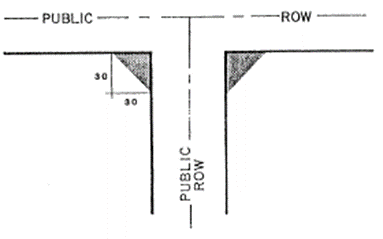
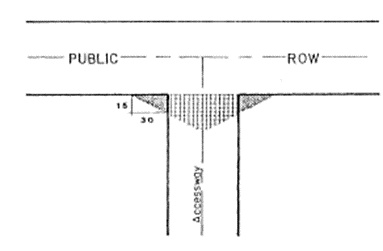
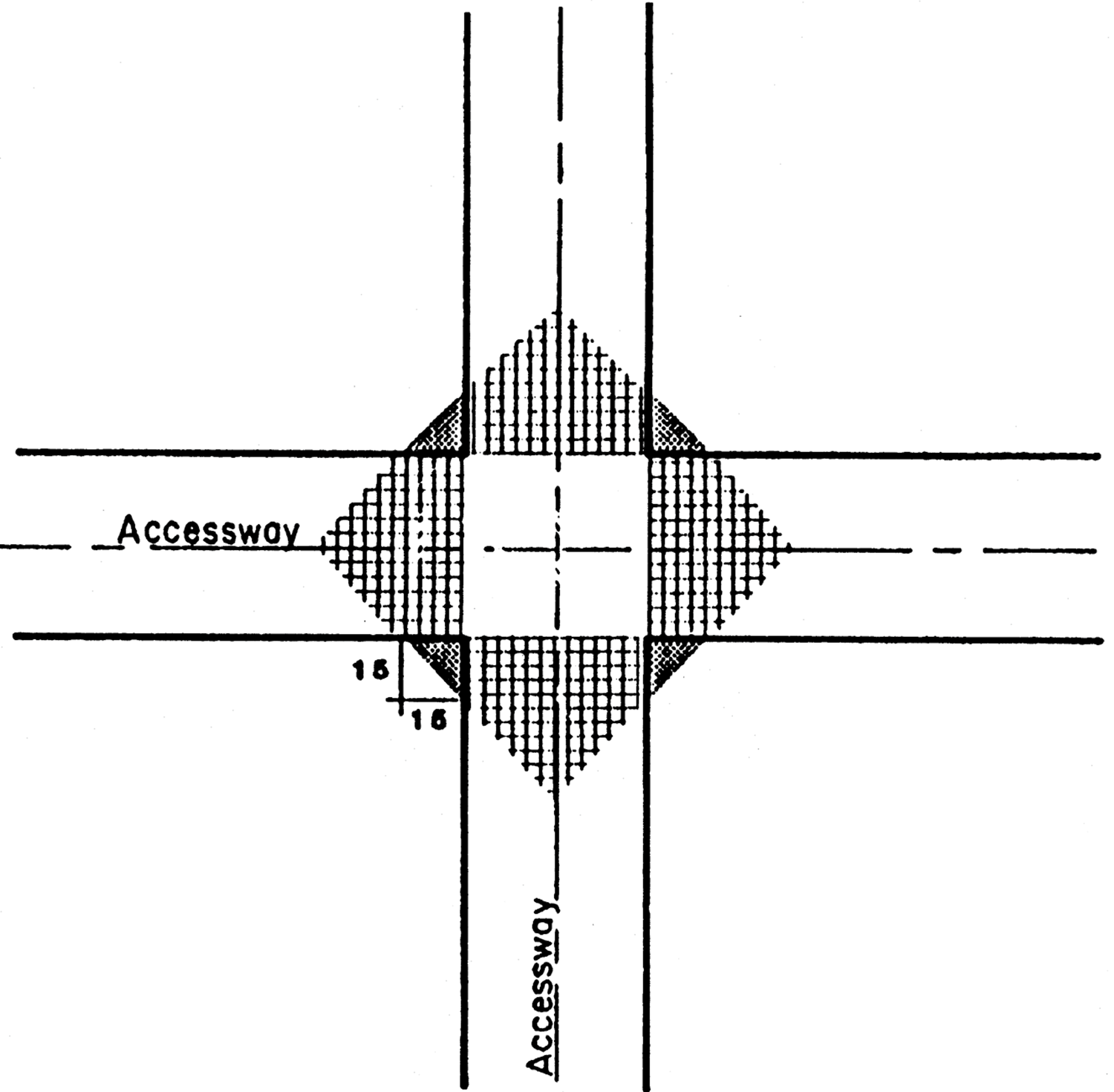
No sign or advertising structure shall be placed, constructed or maintained upon property in any visibility triangle area as described below:
(a)
The area of property located at a corner formed by the intersection of two (2) public rights-of-way with two (2) sides of the triangular area, being a minimum of thirty (30) feet in length along the abutting public right-of-way lines, measured from their point of intersection, and the third side being a line connecting the ends of the other two (2) sides.
(b)
The area of property formed by the intersection of an accessway and a public right-of-way with one (1) side of the triangular area being thirty (30) feet in length along the public road right-of-way line measured from the edge of the accessway pavement and one (1) side of the triangle being fifteen (15) feet in length along the accessway pavement measured from the public road right-of-way line, and the third side being a line connecting the ends of the other two (2) sides.
(c)
The area of property formed by the intersection of two (2) accessways with two (2) sides of the triangular area being a minimum of fifteen (15) feet in length along the accessway pavement, measured from their point of intersection, and the third side being line connecting the ends of the other two (2) sides.
(d)
Traffic-control signs are exempt from the provisions of the visibility triangle.
(Ord. No. 2022-25, § 3, 9-28-22; Ord. No. 2024-13, § 6, 5-20-24)
Sec. 16-949. - Hazard.
A sign shall not directly or indirectly create a traffic or fire hazard, interfere with the free and unobstructed use of streets, sidewalks or building entrances or obstruct clear vision at the intersection of any streets, drives, or public or private vehicular access ways or so that it may be confused with authorized traffic signs or devices.
(Ord. No. 2022-25, § 3, 9-28-22)
Sec. 16-950. - Setback.
All signs shall be set back a minimum of ten (10) feet from the property line, unless otherwise specified in this section, and shall provide a minimum clearance of two (2) feet from rights-of-way, curbs, and sidewalks, or a larger clearance if deemed necessary by the planning, GIS and engineering division.
(Ord. No. 2022-25, § 3, 9-28-22)
Sec. 16-951. - Separation.
All signs not mounted to a building shall be separated from another sign on the same parcel by two hundred (200) feet.
(Ord. No. 2022-25, § 3, 9-28-22)
Sec. 16-952. - Lighting.
Lighting of permanent signs shall be white, non-glaring, directed away from adjoining properties, and shall be designed to avoid affecting the vision of drivers on adjacent roadways.
(Ord. No. 2022-25, § 3, 9-28-22)
Sec. 16-953. - Screening.
All mechanical and electrical elements of a sign shall be fully screened or concealed.
(Ord. No. 2022-25, § 3, 9-28-22)
Sec. 16-954. - Landscaping.
All sign structures shall be landscaped to ensure that the base or foundation of the sign at the ground adjacent to the sign is properly screened. Landscaping shall be installed and maintained in a manner not to interfere with visibility of a sign and shall be installed prior to approval of a sign permit.
(Ord. No. 2022-25, § 3, 9-28-22)
Sec. 16-955. - Sign height.
Sign height shall be measured from the average grade of surrounding property. Grades raised solely to increase sign height shall not be used to determine allowable height. Grade elevations raised as part of landscaping, berms, and approved entry features may be utilized to determine height.
(Ord. No. 2022-25, § 3, 9-28-22)
Sec. 16-956. - Mounting.
(a)
Wall signs shall not be mounted to extend more than twenty-four (24) inches from the face of the building, including wireways and other mounting structures.
(b)
Wall signs shall not be mounted to, or extend above or below, the edge of any wall or above the parapet.
(c)
Monument and ground signs shall be on a foundation or footing.
(Ord. No. 2022-25, § 3, 9-28-22)
Sec. 16-959. - Master sign plan required.
(a)
Purpose. The master sign plan (MSP) serves as the governing document for reviewing all sign permit applications within a designated development. The MSP shall establish specifications for sign types, colors, materials, placement, and other design elements to ensure that all signs are harmonious and aesthetically compatible with the site's architecture. All signs must comply with the approved MSP and the applicable signage requirements in this chapter.
(b)
Applicability. All non-residential multi-tenant buildings, and planned commercial or residential developments, to include all out parcels sharing common driveways and parking located within the city are required to submit and obtain approval for a master sign plan:
(1)
The approval of a MSP is required prior to the issuance of a sign building permit to install, alter, construct, construct, post, paint, maintain, or relocate any sign. All proposed signs or sign modifications shall comply with the approved MSP. Anything not specifically addressed in an approved MSP will revert to the city sign code.
(c)
Existing developments. Signage criteria for developments approved prior to September 28, 2022, shall have the same force and effect as an approved MSP. Any request to amend the existing signage criteria will be processed as an application for an amended MSP.
(Ord. No. 2022-25, § 3, 9-28-22; Ord. No. 2025-10, § 5, 8-4-25)
Sec. 16-960. - Master sign plan approval process.
(a)
Approval. A written application for a master sign plan (MSP) shall be submitted on forms provided by the Development and Neighborhood Services department, and shall include the application fee as established by the city council. It shall be the applicant's burden of proof to satisfy all applicable requirements for the proposed request. Once deemed complete, the application shall be reviewed by the development and neighborhood services department which may solicit comments from members of the Development Review Committee (DRC). Upon completion of the departmental review, the application will be scheduled for consideration by the City Council, where it will be subject to approval, approval with conditions, or denial.
(b)
Master sign plan requirements. The MSP shall provide a comprehensive set of standards and details for all signs within the development, including any out parcels to be and/or developed sharing common driveways and parking, and shall indicate, but not limited to, the following:
(1)
Site plan and elevations depicting the proposed location/placement of all monument signs, freestanding directional/information signs, wall signs, and window signs. These plans must include setback dimensions from property lines, spacing between signs, and any other relevant placement considerations;
(2)
Details of all proposed signs, including, but not limited to the maximum size, height, dimensions, and area, including identification of changeable copy areas. For signs accommodating multiple occupants, the amount of sign area allocated for each occupant shall be indicated;
(3)
Standards for the use of registered logos, trademarks, or similar elements, as applicable;
(4)
Type of sign, including, but not limited to, the type of lettering i.e. channel letters or cabinet style, color, materials of such signs, as applicable;
(5)
Type and manner of illumination must be specified, if applicable;
(6)
Landscape plans indicating plant material and ground cover; and
(7)
Such additional data, plans, or statements may be required by city officials or as listed on the applicable checklist.
(c)
Master sign plan criteria. In reviewing the master sign plan (MSP), the following criteria shall be met:
(1)
The proposed signage is in keeping with the overall architecture and character of the development;
(2)
The proposed signage is designed to meet the directional needs of the development, including communication, identification, wayfinding, regulatory, and informational messages;
(3)
The proposed signage is legible, conspicuous, and easily readable;
(4)
The visibility and impact of the type of sign, number of signs, design, size, method of, construction, illumination and location of the proposed signs are in compliance with the minimum standards of this section, and does not adversely impact adjoining properties, or create a hazard of health risk;
(5)
The proposed signage is consistent with the intent and interests of the City of Greenacres, as stated in the policy adopting this Code.
(d)
Conditional approval. In approving a MSP, the approving authority may impose reasonable conditions related to design, materials, locations, placements, orientations, and sign specifications; provided such conditions are consistent with the purpose and criteria of this section, and focus on time, place, and manner, and does not attempt to regulate sign content.
(Ord. No. 2022-25, § 3, 9-28-22; Ord. No. 2025-10, § 5, 8-4-25)
Sec. 16-961. - Master sign plan waiver.
(a)
In approving a master sign plan, the approving authority may authorize waivers from applicable Code of Ordinance provisions as follows:
(1)
The maximum sign height may be increased up to twenty (20) percent above the permitted height for the zoning district;
(2)
An increase of up to twenty-five (25) percent in the number of signs allowed;
(3)
Reasonable modification of the location of signs to accommodate unusual lot configurations or site conditions;
(4)
Inclusion of multiple multi-tenant signs; wall signs; and monument signs; and
(5)
The maximum sign area may be increased up to twenty (20) percent above the permitted sign copy area for the zoning district; and
(6)
An increase in the maximum height and/or sign area for the zoning district for a sign that is:
a.
Affixed to a storefront window;
b.
Not affixed to a door; and
c.
Necessary for the purpose of concealing a commercial fixture that, due to the peculiar configuration of the structure or building involved, cannot be placed away from a storefront.
(b)
Any request for a waiver shall be evaluated based upon the following findings:
(1)
The waiver is necessary because of practical difficulty peculiar to the land, structure or building involved and which is not applicable to other lands, structures and buildings in the same zoning district; or
(2)
The waiver is necessary and appropriate due to unique architectural features of the proposed signage or structure, and enhances the overall aesthetic or mitigates a specific physical or contextual challenge; and
(3)
The waiver is the minimum waiver necessary to alleviate the practical difficulty; and
(4)
The waiver is in harmony with the general intent and purpose of this chapter, does not permit any sign type prohibited by this code, and will not result in adverse impacts to adjacent tenants, properties, or to the public welfare.
(Ord. No. 2025-10, § 5, 8-4-25)
Editor's note— Ord. No. 2025-10, § 5, adopted Aug. 4, 2025, repealed the former § 16-691 and enacted a new § 16-691 as set out herein. The former § 16-691 pertained to master sign plan criteria and derived from Ord. No. 2022-25, § 3, 9-28-22.
Sec. 16-962. - Amendment.
(a)
An approved master sign plan (MSP) may be amended upon application by the property owner and approval by the zoning administrator. An amendment application may seek to alter the design, materials, locations, placements, orientations, and specifications of a sign or signs designated within an approved MSP; provided the amendment does not attempt to increase the area or height of any freestanding or wall sign subject to the original MSP by more than ten (10) percent.
(b)
To request an amendment the property owner shall submit a completed MSP amendment application, on such form as provided by the development and neighborhood services department, indicating what changes are desired, and shall include all supporting documents necessary to evaluate the request, similar to that which is required for a new approval.
(c)
The development and neighborhood services department shall review the proposed changes in comparison to the original approval, original conditions of approval and the MSP approval criteria set forth in section 16-960(b).
(Ord. No. 2025-10, § 5, 8-4-25)
Editor's note— Ord. No. 2025-10, § 5, adopted Aug. 4, 2025, repealed the former § 16-962, and enacted a new § 16-962 as set out herein. The former § 16-962 pertained to administrative variances from master sign plan requirements and derived from Ord. No. 2022-25, § 3, 9-28-22; Ord. No. 2024-13, § 7, 5-20-24.
Sec. 16-963. - Reserved.
Editor's note— Ord. No. 2025-10, § 5, adopted Aug. 4, 2025, repealed § 16-963, which pertained to conditional approval and derived from Ord. No. 2022-25, § 3, 9-28-22; Ord. No. 2024-13, § 8, 5-20-24.
Sec. 16-964. - Reserved.
Editor's note— Ord. No. 2025-10, § 5, adopted Aug. 4, 2025, repealed § 16-694, which pertained to amendment and derived from Ord. No. 2022-25, § 3, 9-28-22.
Sec. 16-967. - General standards
The following general standards apply to all temporary signs, unless otherwise specified in this chapter:
(a)
Materials. Temporary signs shall be constructed of durable, weatherproof material.
(b)
Safety standards. A temporary sign shall not directly or indirectly create a traffic or fire hazard, interfere with the free and unobstructed use of streets, sidewalks, or building entrances, or obstruct clear vision at the intersection of any streets, drives, or public or private vehicular access ways or so that it may be confused with authorized traffic signs or devices.
(c)
Condition and appearance. All temporary signs shall be kept in good condition, present a neat appearance, and be maintained free of debris, stains, mold, discoloration, or deterioration.
(d)
Setbacks. All temporary signs shall be set back a minimum of five (5) feet from the right-of-way line and side property lines, unless a greater distance is required to meet the requirements of section 16-948 (Visibility triangle), in which case the latter section shall apply.
(e)
Removal—Generally. Temporary signs posted in connection with an event shall be removed no later than one (1) business day after the event has concluded.
(f)
Failure to remove event signs after event has concluded. Temporary signs posted in connection with a specific event that remain in place after the applicable deadline for their removal are subject to removal and disposal.
(g)
Removal—Hurricane watch. Any temporary sign installed within the city shall be removed by the owner when a hurricane watch is posted. In the event that the owner does not remove the sign, the city is permitted to remove the sign and cite the owner as listed on the temporary use permit application. The city shall not be responsible for the replacement of such signage after a hurricane watch is discontinued.
(h)
Public property. Temporary signs shall not be placed on public property or in public rights-of-way.
(i)
Maximum sign area per temporary sign. Temporary signs shall not be larger than three (3) square feet in residential districts and four (4) square feet in all other districts.
(j)
Violations. The city shall have the right to remove any temporary signage in violation of this chapter. In addition, a violation of this chapter may be subject to a civil citation pursuant to section 2-313 and fines pursuant to section 2-314. Notwithstanding the foregoing, the city may also pursue any remedy available under the law and administrative remedies including, but not limited to, the suspension or revocation of a sign permit.
(Ord. No. 2022-25, § 3, 9-28-22; Ord. No. 2024-13, § 9, 5-20-24)
Sec. 16-968. - Temporary signs—Permit not required.
The following types of temporary signs are allowed without a permit, provided they meet the requirements of this section:
(a)
Temporary noncommercial signs before an election. For the period beginning forty-five (45) days prior to a local, state or federal election, temporary signs will be allowed as follows:
(1)
Number and location—Private property. A maximum of one (1) sign per candidate or issue is permitted with property owner consent.
(2)
Number and location—Public property. A maximum of one (1) sign per candidate or issue is permitted with property owner consent. The city may designate specific areas for the display of temporary signs on city property.
(3)
(Relocated) Installation. Nothing in this subsection shall be construed to allow the placement of any temporary sign in public rights-of-way or to allow the placement of any temporary sign in violation of the safety and setback requirements in sections 16-967 and 16-948.
(4)
Size. All temporary signs posted or installed pursuant to this subsection must not be larger than three (3) square feet in residential districts, unless they are situated along a major arterial, in which case the size limit is increased to sixteen (16) square feet. In all other districts, and in residential districts located along a major arterial roadway, temporary signs may be up to sixteen (16) square feet.
(5)
Removal. All signs installed or posted under this subsection must be removed within twenty-four (24) hours of the event or poll closure on election day, failing which they will be subject to removal by the city pursuant to section 16-967.
(b)
Temporary signs when property is being offered for sale or lease. One (1) temporary sign may be located on a property:
(1)
When that property is being offered for sale or lease through a licensed real estate agent.
(2)
If not offered for sale or lease through a licensed real estate agent, when the sign is owned by the property owner and that property is offered for sale by the owner.
(3)
All signs posted under this subsection shall be removed no later than one (1) business day after the property ceases to be offered for lease or sale.
(4)
All temporary signs posted or installed pursuant to this subsection must not be larger than three (3) square feet in residential districts and sixteen (16) square feet in all other districts. Additionally, these signs may not have more than two (2) sign faces.
(5)
Sign copy may include the applicable language, for example, "For Sale," "For Rent," "For Lease," and may contain the name of the owner or representative and a contact phone number.
(c)
Temporary sign when a property being offered for sale or lease is open to the public. One (1) temporary sign, totaling no more than three (3) square feet, may be located on the owner's property on the day prior to and on the day(s) when a property owner is opening the property to the public.
(Ord. No. 2022-25, § 3, 9-28-22; Ord. No. 2024-13, § 10, 5-20-24; Ord. No. 2025-07, § 1, 6-2-25)
Sec. 16-969. - Temporary signs—Temporary use permit required.
The following temporary signs require a city temporary use permit as set forth in article IV, division 6:
(a)
Freestanding banner sign.
(1)
Upon application of the building owner, at any one (1) time, a maximum of one (1) banner may be permitted for each commercial building and shall be secured in the ground at least five (5) feet from the property line. In no event shall the banner obstruct pedestrian walkways or be located within landscaping or vehicular circulation areas.
(2)
Signs shall not exceed ten (10) feet horizontally, eighteen (18) inches vertically, and a maximum sign area of fifteen (15) square feet.
(3)
Sign placement is limited to a maximum of fourteen (14) consecutive calendar days, three (3) times per year per subject property.
(b)
Building banner sign.
(1)
A maximum of one (1) banner per commercial building with a maximum sign area of thirty-two (32) square feet. Signs shall be securely fastened to the building façade and shall not extend above the roofline or parapet.
(2)
Banner placement is limited in duration to no more than twenty (20) days, which shall run consecutively and include the date of the event or activity to which they relate, or the first twenty (20) days after an opening of a new business, commencing on the date of business tax receipt issuance.
(3)
When a banner sign cannot be affixed to a façade, a temporary window sign, no larger than thirty-two (32) square feet, may be allowed.
(c)
Human signs (living signs). Upon the issuance of a permit, a human sign may be allowed on the premises of the property that is being advertised, set back at least eight (8) feet interior of the property line, along the right-of-way immediately adjacent to the property. A business is permitted a living or human sign for a maximum of three (3) times per calendar year for no more than seven (7) consecutive days for each instance. The sign area shall not exceed three (3) square feet in size, and the living or human sign shall not be permitted off site, within the right-of-way, or closer than eight (8) feet from the right-of-way immediately adjacent to the property being advertised. Any failure to comply with these regulations will result in the administrative suspension or revocation of the sign permit and/or enforcement proceedings pursuant to F.S. ch. 162. Notwithstanding the foregoing, the city may also pursue any remedy available under the law.
(d)
Construction signs. A maximum of one (1) construction sign per development street frontage may be constructed as a free-standing sign with a maximum height of eight (8) feet and set back at least ten (10) feet from all property lines.
(1)
All construction signs shall be removed within seven (7) days from the issuance of a certificate of occupancy (CO) or certificate of completion (CC).
(2)
In residential districts, the maximum sign area for construction signs shall be sixteen (16) square feet. In all other districts, the maximum sign area shall thirty-two (32) square feet.
(e)
Freestanding temporary signs.
(1)
Upon application of the property owner, at any one time, a maximum of one (1) temporary free-standing commercial sign may be permitted for each parcel and shall be secured in the ground at least five (5) feet from the property line. In no event shall the sign obstruct pedestrian walkways or be located within landscaping or vehicular circulation areas.
(2)
Signs shall not exceed three (3) square feet in residential districts and four (4) square feet in all other districts.
(3)
Sign placement is limited to a maximum of fourteen (14) consecutive calendar days, three (3) times per year per subject property.
(Ord. No. 2022-25, § 3, 9-28-22; Ord. No. 2024-13, § 11, 5-20-24)
Sec. 16-981. - Generally.
Signs requiring sign permits are subject to the regulations of this article governing the number of signs, maximum sign area, placement, and other standards according to zoning district and/or use.
(a)
Design. All signage shall be architecturally integrated into or complimentary to the design of the buildings and character of the site, and shall use similar and coordinated design features, materials, and colors.
(b)
Logos. Logos or any federally registered trademark may be permitted as part of a sign as follows:
(1)
If designed as an integral part of the sign copy;
(2)
If consistent with an approved color scheme of the MSP;
(3)
If displayed as registered; and
(4)
If consistent with the other requirements of this division, including, but not limited to, requirements for sign location, sign materials, and sign area.
(Ord. No. 2025-10, § 6, 8-4-25)
Sec. 16-982. - Identification signs.
(a)
Residential districts.
(1)
In residential districts, non-residential uses are allowed one (1) identification wall sign.
(2)
For planned residential developments and subdivisions, one (1) free-standing sign per major access is allowed. Two (2) signs with one (1) copy side each may be permitted in place of a single sign with two (2) copy areas.
(3)
The maximum copy area per sign face shall be thirty-two (32) square feet.
(4)
In residential districts, one (1) home occupation identification sign not exceeding two (2) square feet may be placed on the wall next to the primary entrance of any single family or two-family dwelling unit in which a home occupation is lawfully conducted.
(b)
Non-residential districts. Except as provided in subsections (1), (2) and (3) below, in commercial and other non-residential districts, one (1) free standing sign and one (1) wall sign shall be allowed per frontage, provided that the signs are not located within two hundred (200) feet of each other on the same lot as measured along the frontage line.
(1)
For single-use stores with over forty thousand (40,000) square feet of floor area, three (3) wall signs with copy area not to exceed the maximum copy area allowed.
(2)
Multi-tenant commercial properties are allowed one (1) freestanding sign per frontage with a maximum height of fifteen (15) feet, maximum copy area subject to zoning district, and one (1) wall sign per tenant space except as otherwise provided in this chapter.
(3)
Outparcels and outbuildings within a unified development are allowed one (1) free-standing sign with a maximum height of eight (8) feet and with a maximum copy area of forty (40) square feet per sign face, and one (1) wall sign per tenant space.
(4)
Time and temperature signs not exceeding two (2) feet in height, located in the bottom portion of the sign, may be included as an integral part of the identification sign copy area in CG districts for banks and financial institutions with drive-thrus.
(5)
For gas stations located in the CG and CI zoning districts, electronic changeable copy gas station price signs not exceeding twelve (12) square feet may be included as an integral part of the freestanding sign copy area, provided they are LED style and the sign copy is exclusively for fuel prices. Additionally, one (1) identification sign per frontage is permitted on the fuel canopy, provided that the sign does not extend above or below the horizontal edges of the canopy face. The maximum size of the canopy sign shall be eight (8) square feet and must be deducted from the maximum copy area allowable for wall signs.
(6)
Electronic changeable copy signs for government users are limited to messages that serve a public purpose and are not permitted to promote commercial messages of any kind. No advertising for off-site businesses is permitted in any form.
(7)
Except as provided elsewhere in this chapter, electronic changeable copy signs are allowed in the CI zoning district only and shall be regulated by the following restrictions:
a.
Electronic changeable copy area shall not exceed twelve (12) square feet and may be included as an integral part of the freestanding sign copy area, provided they are LED style.
b.
Digital copy shall have a minimum dwell time cycle of sixty (60) seconds.
c.
Digital copy shall be limited to one (1) message per cycle for a total of three (3) individual total cycles.
d.
Individual digital changeable copy messages may only be changed once in an eight (8) hour period.
e.
The content of the sign must transition instantly (e.g., no fade-out or fade-in). No flashing, blinking, animated, moving video, scrolling copy, or similar shall be allowed.
f.
The maximum brightness shall be 0.3 foot-candles above ambient light. Digital copy signs shall have a light sensing device that automatically adjusts brightness as ambient light conditions change to ensure that the message meets the standard for maximum brightness.
g.
The sign shall be equipped with a default setting that causes it to turn off or display a full black screen in the event of a visible malfunction or failure. If the sign malfunctions, fails, or ceases to operate as programmed, the sign must be repaired or disconnected within thirty-six (36) hours by the owner/operator of the sign.
(c)
General provisions—Wall signs.
(1)
There shall be a minimum separation of three (3) feet between wall signs.
(2)
Where a use or structure has frontage on two (2) streets, then each frontage shall be permitted one (1) wall sign. One (1) additional wall sign may be permitted on a side or rear wall, provided that such wall abuts a spine road or parking area and the sign does not detract from the architectural features of the structure. This additional wall sign shall not exceed twenty-five (25) percent of the maximum allowable wall sign copy area for the building. In the instance of a Planned Commercial Development (PCD), each use or structure within the PCD shall be permitted one (1) wall sign. However, if the PCD has frontage on two (2) streets, then each use or structure shall be permitted two (2) wall signs, with one (1) sign for each frontage.
(3)
All wall signs shall be no closer than twelve (12) inches from the side lines of the premises storefront and six (6) inches to the top and bottom of the premises sign area. The height of any wall sign cannot exceed the top elevation of the structure.
(4)
Wall signs shall be consistent in color with those of the freestanding sign. The trim cap and returns of the wall sign shall be the same color as the letters.
(5)
Wall signs shall be internally illuminated with individual channel letters or reverse channel letters. The illumination shall be with clear neon or LED tubing. No raceways or box signs shall be permitted unless otherwise approved as part of a master sign plan.
(6)
A maximum of fifty (50) percent of the area of each wall sign may incorporate a logo, the logos shall not exceed the total height of the sign on the building and shall meet the requirements of distance from the premises area.
(7)
The allowable copy area per sign face for each wall sign shall be one and one-half (1½) square feet per linear foot of building or tenant frontage, not to exceed the following maximum copy area by zoning district:
(d)
General provisions—Free-standing signs.
(1)
Free-standing signs shall be designed as monument signs and must include the name of the development prominently displayed.
(2)
Free-standing signs must be located within the general area of the major vehicular access points, and oriented perpendicularly to the frontage on which they are situated. Free-standing identification signs for commercial developments must also include the full range of street addresses located onsite (this is not calculated as part of the copy area) that are visible from the street or right-of-way, and not obstructed by any landscaping.
(3)
Free-standing signs shall be designed with an opaque background, with the exception of through the letters and logo associated with said sign.
(4)
Free-standing signs may include a leasing sign not exceeding twelve (12) square feet incorporated into the base of the monument sign. Letter size shall be no less than five (5) inches using no more than two (2) colors and consistent with the design of the rest of the sign.
(5)
The allowable copy area per sign face for each free-standing sign shall not exceed the following maximum copy area by zoning district:
(Ord. No. 2025-10, § 6, 8-4-25)
Sec. 16-983. - General sign types.
(a)
Bulletin board signs. Educational, governmental, religious, or institutional uses in all zoning districts may construct a maximum of one (1) free-standing sign per subject property, with a maximum of twelve (12) square feet of sign area, to serve as a bulletin board. Bulletin board signs shall not exceed six (6) feet in height.
(b)
Memorial signs. In the AR, RE, RL, RM, RH, and GU districts, each parcel may have one (1) memorial sign with a maximum of five (5) square feet of sign area and not exceeding six (6) feet in height may be constructed. These signs shall be set back no less than twenty (20) feet from any property line.
(c)
Traffic-control signs. Free-standing signs for traffic control purposes may be placed in all zoning districts subject to the following:
(1)
Traffic-control signs designating parking area entrances and exits are limited to two (2) signs not exceeding three (3) feet in height for each entrance and exit abutting a street, and each sign shall not exceed four (4) square feet of copy area and may include the following language, for example, "enter," "exit," "one-way," or a directional arrow.
(2)
Traffic-control signs shall be reviewed for location placement by the development and neighborhood services department and shall be in general conformance with the Manual on Uniform Traffic-control Devices for Streets and Highways.
(d)
Directory signs. One (1) directory sign per major vehicular access may be constructed as either a wall sign or a free-standing sign with a maximum height of six (6) feet. Directory signs shall be set back at least twenty (20) feet from the front and ten (10) feet from the side-corner property line. The maximum sign area for directory signs in mixed use districts shall be twelve (12) square feet. In all other districts the maximum sign area shall be sixteen (16) square feet, except for planned commercial developments which may have directory signs with a sign area of up to a maximum of thirty-two (32) square feet.
(e)
Under canopy signs. Under canopy signs shall be permitted as a part of an approved master sign plan. One (1) sign with a maximum copy area of six (6) square feet is allowed per tenant. All signs must have a minimum vertical clearance of nine (9) feet.
(f)
Menu board signs. In the CG and CI districts, one (1) menu board sign per fast-food restaurant drive-thru lane with a maximum of thirty-eight (38) square feet of copy area, no more than six (6) feet in height, may be constructed, subject to the following conditions:
(1)
Menu boards shall only be internally back-lit.
(2)
Menu boards shall not contain more than one (1) square foot of copy area of corporate or company identification.
(3)
No additional add-ons to the menu board shall be permitted.
(4)
Menu boards shall not be visible from any public right-of-way.
(5)
An additional six (6) square feet of copy area may be permitted for use as an LCD screen.
(g)
Automatic teller machine (ATM) signs. Where ATMs are allowed, an ATM sign shall identify the applicable financial institution and be consistent and compatible with the architectural elements and design of the building to which it is attached or to which it is an accessory. ATM signs shall not exceed three (3) square feet.
(Ord. No. 2025-10, § 6, 8-4-25)

