
Greenacres City Zoning Code
ARTICLE IV
SUPPLEMENTARY DISTRICT REGULATIONS25
Cross reference— Buildings and building regulations, Ch. 4; health, sanitation and nuisances, Ch. 7; licenses and business regulations, Ch. 8; streets, sidewalks and other public places, Ch. 11; subdivision regulations, Ch. 12; traffic and vehicles, Ch. 14; stopping, standing, parking, § 14-26 et seq.; utilities, Ch. 15.
DIVISION 2. - AREA AND HEIGHT LIMITATIONS[26]
Cross reference— Buildings and building regulations, Ch. 4.
DIVISION 3. - PUBLIC PLACES[27]
Editor's note— Ord. No. 2019-03, § 2, adopted August 19, 2019, repealed art. IV, div. 3, §§ 16-651—16-659 and enacted a new div. 3 as set out herein. Former div. 3 pertained to fences and walls and derived from § 32-36(a)—(h), (j) of the Code of 1966; Ord. No. 2010-09, § 4, adopted June 7, 2010; Ord. No. 95-01, § 1, adopted February 21, 1995; and Ord. No. 2010-09, § 4, adopted June 7, 2010.
DIVISION 4. - BUS SHELTERS[28]
Cross reference— Buildings and building regulations, Ch. 4; health, sanitation and nuisances, Ch. 7.
DIVISION 5. - ACCESS REQUIREMENTS[29]
Cross reference— Buildings and building regulations, Ch. 4; streets, sidewalks and other public places, Ch. 11; streets, § 11-26 et seq.; private roads, § 11-46 et seq.; subdivision regulations, Ch. 12.
DIVISION 8. - HOME OCCUPATIONS[30]
Cross reference— Health, sanitation and nuisances, Ch. 7; licenses and business regulations, Ch. 8; business tax receipts, § 8-46 et seq.
Sec. 16-606. - Application of article.
Unless otherwise specified, the provisions of this article shall apply in districts within the corporate limits of the city.
(Code 1966, § 32-32)
Sec. 16-607. - Lot clearing.
Vacant lots shall be maintained by the owner of record clear of minor vegetation more than eighteen (18) inches above the grade of the lot and will not be allowed to become unsightly. No dumping on vacant lots will be permitted.
(Code 1966, § 32-42)
Sec. 16-608. - Special requirements for the sale of alcoholic beverages near a house of worship or a school.
(a)
No establishment selling alcoholic beverages within the corporate limits of the city shall be operated or maintained within five hundred (500) feet of any established school or house of worship. The distance requirements within this section shall not apply in instances where houses of worship or schools are established within commercial intensive, commercial general and commercial neighborhood zoning districts. In no case shall the establishment of a new house of worship or school in any of the zoning districts specified above cause an existing business to be in violation of the provisions herein. The distance of five hundred (500) feet shall be measured as follows:
(1)
Established schools and houses of worship where applicable: five hundred (500) feet from the closest perimeter property line of the overall site containing the establishment selling alcoholic beverages to the closest perimeter property line of the school facility or house of worship building.
(2)
The distance of five hundred (500) feet shall be measured by the shortest airline measurement between the two closest perimeter property lines.
(b)
The above and foregoing subsection (a) shall not apply to:
(1)
Restaurants having at least two thousand five hundred (2,500) square feet of service area and equipped to serve at least one hundred fifty (150) persons full-course meals at one (1) time, and deriving at least fifty-one (51) percent of their gross revenue from the sale of food and nonalcoholic beverages.
(2)
A restaurant licensed under the Florida Statutes with full kitchen facilities which contain no public bar facilities, and which serve beer, ale and/or wine solely with food served at tables.
(3)
Retail sales establishments having at least seven thousand five hundred (7,500) square feet of gross leasable area where the sale of beer and wine in packages for off-site consumption is incidental and subordinate to the principal use.
(4)
An establishment that sells beer, ale and/or wine for on-premises consumption and has been approved by the city council to operate within five hundred (500) feet of a school. Such approval shall include the necessary findings and meet the procedural requirements set forth in F.S. § 562.45(2). The approval of a distance waiver under this subsection shall be on a site-specific basis and may be conditioned upon such requirements as the city council deems necessary to protect the public health, safety, and general welfare.
(Code 1966, § 32-44; Ord. No. 92-03, § 1, 3-16-92; Ord. No. 95-03, § 1, 6-19-95; Ord. No. 2024-09, § 1, 3-18-24)
Cross reference— Alcoholic beverages, § 8-26 et seq.
Sec. 16-609. - Live entertainment permit.
(a)
Purpose. The purpose of this section is to provide regulations which govern the provision of live entertainment at commercial establishments while protecting the quiet enjoyment of adjacent properties.
(b)
Applicability of permit.
(1)
A live entertainment permit is required for all new and existing restaurants, bars, cocktail lounges, or other permitted commercial establishments to provide indoor live entertainment with or without amplified sound.
(2)
A live entertainment permit is valid only for the specific establishment, location, and operator of establishment to whom it is issued.
(3)
A live entertainment permit is not required for conducting a special event in accordance with section 16-718, which requires a permit for temporary uses.
(4)
Live entertainment is accessory to the principal use of the establishment and shall not operate as a principal use for all or portion of the establishment, nor shall it be conducted in a manner that transforms the establishment into a concert or nightclub use.
(c)
Permit requirements. Applications for a permit and renewal of a permit under this section shall be made to the building division on a form provided for such purpose by the city, and shall include, along with any other such information deemed reasonably necessary by the reviewers to implement and enforce the provisions of this section, the following:
(1)
The applicant shall submit the application for live entertainment with an application fee as set forth in the city's fee schedule;
(2)
The name, location, and mailing address of the property owner and tenant (if applicable) proposing to use or provide live entertainment;
(3)
The name, mailing address, and telephone contact information of the applicant and the written authorization of the property owner(s);
(4)
A detailed summary of the proposed live entertainment, including the days and hours of operation, a description of the entertainment type, a description of the designated area within the premises where the live entertainment will take place, the number of entertainers, noise control and compliance with the Sound Management Plan, and any other relevant details. The submission shall also include labeled photos of the existing setup within all interior patron areas, including the designated live entertainment area, demonstrating that they align with the approved Life Safety Plan;
(5)
The name, mailing address, email address, and telephone contact information of a designated contact person, available 24/7, who shall serve as the primary point of contact for compliance, enforcement, and any other live entertainment permit-related matters;
(6)
A location plan indicating, at a minimum, the location of the live entertainment, stage/area for entertainment, speakers, and/or location of any other equipment/facilities that will be used as a part of the live entertainment activities;
(7)
A Life Safety Plan consistent with the most stringent standards of the latest version of the Florida Fire Prevention Code, NFPA 101, and the Florida Building Code, detailing, at a minimum, all relevant and required safety features including but not limited to occupancy type, occupant load, fire-rated walls, exit signs, emergency lighting, travel distances, common path of travel, and the designated area dedicated to the live entertainment use; and
(8)
A sound management plan which sets forth the methods to be utilized to ensure compliance with the noise limitations set forth in this Code and any other requirements set forth in this Code or the city's Standard Operating Procedures (SOP) for live entertainment permitting (if adopted by the development and neighborhood services department).
(d)
Standards for review. When considering applications for a live entertainment permit, the city shall consider the following criteria, all of which must be satisfied in order for a live entertainment permit to be issued:
(1)
The amount and type of screening, buffering, and separation between the subject establishment and adjacent establishments and properties, including type, dimensions, and character, shall be clearly depicted on the submitted plans and must be sufficient to mitigate sound impacts on adjacent establishments and properties;
(2)
The land and buildings which are the subject of the application must be of sufficient size, shape, type of building, and the like to ensure the proposed live entertainment can be accommodated without negative impact on adjacent establishments and properties;
(3)
The proposed live entertainment shall be compatible with adjacent establishments, properties, and the surrounding area and shall not cause a nuisance. Compatibility shall be assessed based on hours of operation, noise levels, and other potential nuisance factors, including but not limited to odor, smoke, glare, electrical interference, and mechanical vibrations;
(4)
Off-street parking and loading for the existing use must be adequate and designed to meet operational needs and parking regulations for the property the use is located on. The proposed live entertainment shall not generate an additional parking demand for the use;
(5)
The establishment shall have adequate space to accommodate the proposed live entertainment to ensure compliance with the approved Life Safety Plan and to prevent any deviations from the approved Life Safety Plan;
(6)
If an establishment has a documented history of activities that negatively impacts public safety or well-being, or is identified as a public nuisance; and
(7)
The applicant shall not have had a live entertainment permit denied or revoked within the past twelve (12) months.
(e)
Standard conditions of approval for all permits. The following are standard conditions of approval for all live entertainment permits:
(1)
Sound generated by or emanating from establishments that are using or providing live entertainment shall comply with the noise limitations set forth in this Code;
(2)
The establishment shall remain in compliance with the approved Life Safety Plan and all applicable fire and life safety regulations during all hours of operations;
(3)
All windows and doors shall remain closed at all times during live entertainment activities, except as necessary for patron and staff momentary ingress and egress;
(4)
A platform, staging area, or similar feature shall not be used for any purpose other than the approved live entertainment;
(5)
Establishments must comply with all applicable hours of operation. Once the establishment has closed for business, patrons must immediately vacate the premises and the property to prevent loitering or disturbances; and
(6)
Such other conditions of approval to ensure the live entertainment does not negatively impact the quiet enjoyment of adjacent properties.
(f)
Transferability. A live entertainment permit may be transferred in accordance with the following provisions:
(1)
When a sale or change in ownership occurs to an establishment that has an existing valid live entertainment permit, a request to transfer the permit may be made with the new business tax receipt to the planning, engineering, and GIS division. Failure to submit a transfer request at that time shall render the live entertainment permit null and void;
(2)
The transfer request shall not include any proposed changes to the conditions, safeguards, or stipulations imposed during live entertainment permit approval. If changes are proposed, the applicant shall apply for a new live entertainment permit; and
(3)
Upon the issuance of a transferred live entertainment permit, the permit shall remain valid through September 30 of that year, at which point it must be renewed concurrently with the Business Tax Receipt renewal process, in accordance with subsection (g) below.
(g)
Issuance, renewal and revocation.
(1)
The live entertainment permit may be issued or renewed by the development and neighborhood services director or designee. Live entertainment permits shall expire on September 30 of each year and must be renewed annually in conjunction with the Business Tax Receipt renewal, which becomes effective on October 1, unless revoked earlier as provided herein.
(2)
A live entertainment permit must be renewed prior to its expiration on September 30 each year. The commercial establishment must apply for a renewal of the existing permit before the expiration date. A renewed permit may be granted by the city if there are no changes to the conditions of the original permit including without limitation no changes in the sound management plan. Establishments that have been the subject of complaints resulting in an order issued by the city's special magistrate, or that have been found by a civil or criminal court to be in violation of the city code or other applicable law(s), shall require city council approval prior to the renewal of the permit. If city council denies renewal, the establishment shall be prohibited from reapplying for a period of one (1) year from the date of such denial.
(3)
The city may revoke a live entertainment permit if the commercial establishment violates any terms and conditions of the permit, the sound management plan, this section, or is found in violation of other provisions of this Code which relate to the operation of the commercial establishment. If the city revokes a live entertainment permit, it shall send written notice to the commercial establishment of the revocation. The commercial establishment may appeal the revocation to the city's special magistrate within twenty (20) days of receipt of the notice of revocation. Such appeal will then be heard within thirty (30) days of the city's receipt of the appeal and notice of the hearing will be sent to the commercial establishment by regular first-class mail. A commercial establishment whose live entertainment permit has been revoked (and such revocation upheld if appealed) may apply for a new live entertainment permit only after the passage of twelve (12) months from the date of revocation with sufficient showing that all grounds for the revocation have been corrected.
(h)
Enforcement. The provisions of this section, and any conditions of approval imposed on a live entertainment permit, may be enforced through standard code enforcement procedures and the alternative citation procedures provided in chapter 2. If an establishment provides live entertainment without a permit or in violation of an establishment's permit or in violation of the requirements of this section, the violation is deemed irreparable in nature and the violator may be required to pay a fine not to exceed five thousand dollars ($5,000.00) per violation. Each day such a violation continues to exist shall be deemed a new violation, subject to additional fines and enforcement action.
(Ord. No. 2022-23, § 3, 12-5-22; Ord. No. 2025-04, § 3, 6-16-25)
Sec. 16-610. - Outdoor storage, display, sales, cooking and sales of propane tanks.
(a)
Outdoor storage, display, and sales.
(1)
Enclosed activities. Commercial sales, displays, retail activities, and all other similar commercial business activities including, but not limited to, the storage of goods and materials, shall be conducted within a completely enclosed building. No outdoor commercial sales, display, retail activities, or other similar commercial business activities including, but not limited to, the storage of goods and materials, shall be permitted at any time unless authorized by this section, other specific provision of this Code, or by special event or temporary use permit.
(2)
Outdoor storage, display, and/or sales may be permitted in the Commercial Intensive (CI) zoning district where such outdoor storage, display, and/or sales are customarily incidental to the principal use of the permitted commercial business and the outdoor storage, display, and/or sales are permitted by existing special exception criteria governing the principal use. There shall be no outdoor storage, display, or sales by any person operating or conducting a commercial business which is different or distinct from the permitted principal use at such location.
(3)
Outdoor storage and display of loose materials such as sand, gravel, lumber, cardboard boxes, pallets, or other similar materials which are subject to being scattered or blown about the premises by normal weather conditions is prohibited.
(4)
Unless specifically authorized by this section, by other specific provision of this Code or by special event or temporary use permit, outdoor storage, display, and sales is prohibited within all zoning districts.
(b)
Outdoor cooking. Commercial establishments are prohibited from cooking outdoors of an enclosed and properly permitted building or structure including, but not limited to, grilling, smoking, frying or other heating or preparation of food, unless specifically approved through the issuance of a special event or temporary use permit.
(c)
Propane tanks for retail sales. Notwithstanding the other provisions of this section, propane tanks offered for retail sales will be permitted by right for certain uses in zoning districts which allow retail sales. No additional business tax receipt will be required for permitted propane tank retail sales; however, the public service tax for the propane tank sales is applicable. A retailer will be considered eligible for propane tank retail sales for the purposes of this Code if the following criteria are met:
(1)
Retail sales must be a permitted use in the applicable zoning district.
(2)
Only retail drugstores, retail hardware stores, supermarkets, convenience stores, and existing licensed LP Gas retailers shall be permitted to sell propane tanks for retail sales.
(3)
Food markets shall not be permitted to sell propane tanks for retail sales.
(4)
A building permit clearly indicating the dimensions and setbacks of the location of the proposed metal case or propane locker shall be required prior to installation. The maximum capacity of the metal case or propane locker will be used to determine the number of propane tanks which may be offered for sale at a given time.
(5)
The metal case or propane locker shall be located under an overhang and on an accessible route. Installation shall not obstruct the accessible route.
(6)
The fire marshall shall review and approve the location of the metal case or propane locker in accordance with NFPA Storage Requirements for LP Gas Cylinders.
(Ord. No. 2022-23, § 3, 12-5-22)
Sec. 16-611. - Placement and use of portable storage units.
(a)
Purpose. The purpose of this section is to provide for uniform guidelines for the placement and use of portable storage units.
(b)
Time limitation. For residentially zoned districts or zoning districts where residential uses are permitted or legally grandfathered in, portable storage units may be located and utilized for no more than fourteen (14) consecutive days. The development and neighborhood services director or designee may grant one (1) extension not to exceed fourteen (14) additional consecutive days for good cause. Only one (1) portable storage unit per residential dwelling is permitted in any twelve-month period unless there is a change of ownership of the residential dwelling during such twelve-month period.
(c)
Placement. The placement of the portable storage unit shall be on a paved driveway or other approved parking area surface and shall be accomplished in such a manner that no landscaping is damaged as a result of the placement. Portable storage units shall not be located in the street or any portion of the public right-of-way or any easement and shall be placed on in such a manner as to not create a visibility obstruction for any adjacent public right-of-way, driveway or sidewalk.
(d)
Removal of portable storage units during tropical storm watch or warning and hurricane warning or watch required. In the event the National Weather Service, National Hurricane Center, or appropriate weather agency declares a tropical storm watch or warning or a hurricane watch or warning that may impact the city, all portable storage units located within the city shall be immediately removed from the residential property so as not to create a safety hazard because of hurricane or tropical storm force winds. The removal and replacement of any portable storage unit pursuant to this subsection shall not count toward the twelve-month limitation period as set forth in subsection (b) above nor shall compliance with this subsection diminish the total number of days allowed.
(e)
A commercial establishment may be permitted by temporary use permit to locate and utilize a portable storage unit at the commercial establishment's premises. Placement and location shall be addressed through the temporary use permitting process.
(Ord. No. 2022-23, § 3, 12-5-22)
Sec. 16-612. - Outdoor seating.
(a)
For the purposes of this section, serve or service shall mean the act of a waiter, waitress, server, or other employee or agent of a restaurant, establishment, or institution taking food and/or beverage orders from customers in a seated area and/or providing food and/or beverages to customers in a seated area.
(b)
Authorization. Outdoor seating shall be permitted as an accessory use to a restaurant, establishment, or institution serving food and/or beverages in an enclosed area, subject to the following requirements:
(1)
Access. The outdoor seating area is adjacent to, and has direct access through, a doorway to that portion of the restaurant, establishment, or institution which is enclosed.
(2)
Location. The outdoor seating area is located adjacent to the restaurant, establishment, or institution and is owned or leased for this purpose.
(3)
General circulation. The outdoor seating area can be accommodated without impeding the access of the general public to one (1) or more of the following:
a.
The enclosed portion of the restaurant, establishment, or institution selling food and/or beverages;
b.
Any other use located within the same building or structure; or
c.
Any unauthorized common elements shared by the restaurant, business, or institution and any other users of the same building or structure.
(4)
Safety. Outdoor seating shall comply with all building, fire, and applicable safety code requirements.
(5)
Parking. Parking for areas utilized for outdoor seating, with or without service, shall be calculated and provided as outlined below. Outdoor seating shall not be established if required parking cannot be provided on site or if a nonconformity is created.
a.
Outdoor seating area, without service, which constitutes no more than twenty-five (25) percent of the gross floor area (GFA) of the restaurant, establishment, or institution serving food and/or beverages, shall be exempt from the parking requirements set forth in this Code. Outdoor seating area, without service, consisting of more than twenty-five (25) percent of the GFA shall provide parking for the entire outdoor seating area at a rate of one (1) space per two hundred fifty (250) square feet of GFA of the outdoor seating area.
b.
Outdoor seating area, with service, shall provide parking at a rate of one (1) space per two hundred fifty (250) square feet of GFA of the outdoor seating area.
c.
An indoor seating area may be restricted to be replaced by an outdoor seating area on a per-square-foot basis without increasing the required number of parking spaces as originally approved in the development order.
(6)
Outdoor furniture. Only furniture that is designed as outdoor furniture, which can withstand the elements, rain, and intense sun, shall be utilized in the outdoor seating area.
(c)
Review. Outdoor seating may be included as an element of an overall application for development order approval or as an amendment to an existing development order through a minor site plan amendment application. In addition to any other requirements contained herein, each application for approval of outdoor seating shall include the following information:
(1)
Site plan. A site plan, at a scale acceptable to the city, illustrating how the outdoor seating may be reasonably accommodated and indicating the following:
a.
The building or structure for which the outdoor seating area is proposed as an accessory use and whether service will be provided in the outdoor seating area;
b.
The location of the restaurant, establishment, or institution and its permitted primary use;
c.
The proposed location of the outdoor seating area, including number of tables and chairs, any fencing, required screening, or materials to separate the seating area from adjacent areas and/or properties with approximate distances shown;
d.
The location of any sidewalks or other pedestrian walkways or passageways adjacent to or affected by the proposed outdoor seating area, and the location of all existing or additional parking to be provided for the outdoor seating area;
e.
If applicable, a copy of a valid and current state alcoholic beverage license to serve alcohol where the proposed outdoor seating area will be, or any other license or permit required by the city for operation; and
f.
The location of any indoor seating area that is being restricted and replaced by an outdoor seating area.
(2)
Consent. A copy of the written consent of the individual, corporation, or other entity that owns the property upon which the outdoor seating will be located.
(3)
Indemnification. The applicant shall provide, in a form acceptable to the city attorney, indemnification of the city for any liability for personal injury and property damage due to the approval and use of the outdoor seating area.
(4)
Renderings. Photographs, renderings, elevations, samples, and other materials as may be required by the city which illustrate the following: the style and color of all furnishings and menu boards, and the color, style, and materials used for storage, fencing, screening, or otherwise separating the outdoor seating area from other areas and adjacent properties.
(5)
Alcohol. Alcoholic beverages may be consumed in the outdoor seating area provided the primary use is licensed to serve alcoholic beverages in accordance with chapter 8, article II of this Code and all alcoholic beverages are furnished from an enclosed area. Outdoor bars are prohibited.
(d)
Minimum standards. Outdoor seating shall, at a minimum, comply with the following requirements:
(1)
Walkways. Outdoor seating shall be arranged, when in use, in a manner that provides pedestrian accessibility, maintains compliance with the Americans with Disabilities Act (ADA), and meets all building codes.
(2)
Multiple tenants. Outdoor seating located on a pedestrian walkway which provides access to more than one (1) occupant of a building shall provide an unobstructed passageway of at least six (6) feet in width. The unobstructed passageway shall be located adjacent to, but not through, the outdoor seating area.
(3)
Location. Outdoor seating shall be located only adjacent to the principal use provided by the restaurant, establishment, or institution, and shall not be located in front of or adjacent to any other use, user, or tenant, unless otherwise approved by the development and neighborhood services director or designee.
(4)
Prohibited location. Outdoor seating shall not be located within any area designated and required for parking.
(5)
Fencing or screening. Fencing or screening may be required as a means to physically separate such use from any adjacent public passageway, street, or community as a means for public safety and to avoid nuisances. When outdoor seating is proposed adjacent to parking spaces or drive aisles, safety elements such as bollards or reinforced planters shall be utilized to prevent vehicle intrusion. In areas located within a courtyard or developments that are designed to accommodate the outdoor seating in a safe manner, fencing or screening may not be necessary.
(6)
Compatibility. Outdoor seating, including fencing and screening materials, shall be compatible in color and style with the exterior of the building. Signs, lettering, or advertising, shall not be attached to outdoor seating areas or fencing or screening of such areas. Small labels may be permanently attached to the furnishing to identify ownership for security purposes.
(7)
Storage. Outdoor seating and furnishings shall be stored in a secure manner when not in use. If seating and furnishings are stored outside, solid colored tarps shall be used to cover. Heaters and other seasonal equipment shall not be visible from the public right-of-way when not in use. If a hurricane or tropical storm watch or warning is issued for the city, all unaffixed outdoor seating and furnishings shall be stored inside a secure building or structure.
(8)
Hours of operation. Excluding outdoor seating located in inner courtyards, outdoor seating, with or without service, shall comply with the following hours of operation:
a.
Sunday through Wednesday. Use of the outdoor seating is prohibited between the hours of 10:30 p.m. and 7:00 a.m.
b.
Thursday through Saturday. Use of the outdoor seating is prohibited between the hours of 11:30 p.m. and 7:00 a.m.
(9)
Live entertainment. Live entertainment in outdoor seating areas is prohibited unless approved under a live entertainment permit.
(e)
Exemptions. The following are exempt from formal review of outdoor seating but shall comply with all other applicable requirements of this section and this Code:
(1)
Casual seating without service. Restaurants, establishments, and institutions, or other permitted uses that serve food and/or beverages in an enclosed building or structure may have outdoor casual seating, such as a bench or tables and chairs, and shall meet all accessibility standards.
(2)
De minimus standard. Restaurants, establishments, and institutions, or other permitted uses that serve food and/or beverages in an enclosed building or structure may be approved for outdoor seating without service for a maximum of three (3) tables (twelve (12) seats) or no more than two hundred (200) square feet, whichever is less, provided the outdoor seating meets all accessibility standards.
(Ord. No. 2022-23, § 3, 12-5-22)
Sec. 16-613. - Electric substation siting and development standards.
(a)
Purpose and intent.
The purpose and intent of this section is to regulate the siting, construction, and expansion of electric substations, ensuring that such facilities are compatible with surrounding land uses while maintaining the reliability and efficiency of the electric infrastructure, as required by F.S. 163.3208. The regulations herein are designed to balance the need for electric substations with the aesthetic and land use concerns of the community. The city shall, in a manner consistent with state law, avoid locating substations where they would be incompatible with adjacent land uses.
(b)
Definitions.
For the purposes of this section, the following definitions apply:
(1)
Electric substation: An electric substation, including accessory administration or maintenance buildings and related accessory uses and structures, which takes electricity from the transmission grid and converts it to another voltage or lower voltage for distribution to customers through one or more lines.
(2)
Residential areas: Future land use categories where a primary function is to provide dwellings for individuals and families. These areas are characterized by various densities and types of residential development, including accessory buildings and open land used by dwelling occupants. The following future land use categories are considered residential areas:
a.
RS-LD (residential low density): Residential future land uses providing dwellings for one family or household in low-density developments. This includes single-family homes and associated accessory buildings and open land.
b.
RS-MD (residential medium density): Residential future land uses providing dwellings for one or more families or households in low to medium-density developments. This includes single-family homes, duplexes, townhomes, multi-family units, and associated accessory buildings and open land.
c.
RS-HD (residential high density): Residential future land uses providing dwellings for one or more families or households in medium to high-density developments. This includes single-family homes, duplexes, townhomes, multi-family units, mobile homes, apartment projects, and associated accessory buildings and open land.
d.
MU (mixed use): Future land uses that provide diversified residential options alongside amenities, enhancing the residential experience. These developments may include a combination of residential, professional, business, and retail uses within an individual development.
(3)
Nonresidential areas: Future land use categories where the primary function is to support commercial, public, institutional, or recreational activities, and not primarily for residential living. These areas include various types of future land uses that provide services, commodities, and amenities to the public or serve specific non-residential purposes. The following future land use categories are considered nonresidential areas:
a.
CM (commercial): Future land uses that promote the supply of commodities and services to the general public, including retail, professional business and personal services, restaurants, and necessary storage and parking ancillary to these uses.
b.
PI (public/institutional): Future land uses owned, leased, or operated by government agencies, including civic community centers, libraries, police and fire stations, public schools, and other similar public institutions.
c.
RO (recreation/open space): Future land uses concerned with either active or passive recreational uses or the enhancement of the surrounding area through publicly owned open space. Areas assigned the RO future land use category are designated for preservation and conservation. This designation serves multiple critical functions including but not limited to: it protects natural habitats and biodiversity, provides essential recreational spaces for the community, helps mitigate flooding by preserving natural landscapes, enhances community aesthetics and quality of life, and helps combat the urban heat island effect.
(c)
Permitted locations.
Electric substations are not permitted on land that has been designated for preservation, conservation, or historic preservation in the city's comprehensive plan or zoning regulations. Electric substations are permitted in all other areas of the city, subject to the restrictions and requirements outlined in this section.
(d)
Siting and development standards.
The following siting and development standards shall apply to electric substations:
(1)
Setback requirements:
a.
Residential areas: A minimum setback of 100 feet is required from the substation property boundary to any permanent equipment structures. An open green space with native landscaping, including trees and shrubs, and an 8-foot-high opaque buffer wall, must be installed, consistent with section 16-1286.
b.
Nonresidential areas: Substations must comply with the setback and landscaped buffer criteria applicable to other similar uses in the district, consistent with section 16-1286.
(2)
Landscaping and buffering:
a.
A vegetated buffer or screening is required to enhance aesthetic compatibility. Such buffers must be maintained at a height not exceeding 14 feet beneath aerial access points to substation equipment.
b.
Florida-friendly landscaping materials and techniques must be used for all required buffers and screening.
c.
To the extent feasible, the site shall be designed with a compatible palette of landscape materials in the front landscape buffer that harmonizes with those of the adjacent property.
(3)
Lighting:
a.
Lighting for substations must be designed, in accordance with section 16-1335(15) (Lighting). All lighting shall either be shielded or screened in a manner that limits spillover of lighting onto adjacent property and rights-of-way.
(4)
Screening:
a.
Substation equipment and structures must be screened from view using landscaping and decorative walls. Screening methods must be consistent with the aesthetic character of the surrounding area.
(5)
Noise mitigation:
a.
Substations must employ noise mitigation measures to ensure compliance with any applicable City Code of Ordinances. Sound barriers, baffles, or other noise-reducing technologies must be utilized as necessary to minimize noise impact on adjacent properties.
(e)
Application and review process.
(1)
Review of proposed placement of new electric substations in residential areas.
a.
This subsection shall apply to applications for the proposed placement of new electric substations in residential areas.
b.
Pre-application meeting. Prior to submitting an application under this subsection, a utility proposing to place a new electric substation within a residential area must schedule a pre-application meeting to consult with the city to discuss potential sites.
c.
Application. After the preapplication meeting, the utility shall submit an application for site approval on a form provided by the city. The utility shall provide information regarding the utility's preferred site within Palm Beach County and as many as three alternative available sites, including sites within nonresidential areas, that are technically and electrically reasonable for the load to be served.
d.
Siting determination. The final determination as to the preferred and alternative sites shall be made solely by the city, within 90 days of presentation of all the necessary and required information on the preferred site and on the alternative sites. If the utility and the city cannot agree on an appropriate site, the disagreement will be resolved in accordance with the dispute resolution procedure set forth in F.S. 163.3208(6)(a), including any amendments thereto.
e.
Review of development standards. Once a site has been determined pursuant to this subsection, the utility shall submit an application for development review. The application development review shall be submitted and processed in accordance with subsection 16-613(e)(2).
(2)
Development review.
a.
This subsection shall apply to the following: applications for development review of new electric substations to be located in nonresidential areas; applications for changes to existing electric substations in all areas; and to applications for development review of electric substations at residential sites approved pursuant to subsection 16-613(e)(1).
b.
A utility seeking to install a new electric substation or to make changes to an existing substation shall submit a written application for development review on a form provided by the city. The application shall include all of the following: a detailed site plan; a landscaping plan; a lighting plan; noise mitigation strategies; and any other relevant information to demonstrate compliance with the standards in section 16-613(d).
c.
The city will review each application for compliance with all applicable standards. A decision to approve or deny the application will be made within 90 days of the application being declared complete.
d.
The city will notify the applicant within 30 days whether the application is complete. Additional completeness determinations will be provided within 15 days after receipt of further information.
e.
The city shall review applications for compliance with the criteria in section 16-613(d).
(f)
Compliance and enforcement.
(1)
Electric substations must be maintained in accordance with the approved application, including any related site and development and/or landscaping requirements. Any change to an approved application for an electric substation shall be made only after the city has reviewed the change and approved it in accordance with section 16-613(e). Approval for the substation may be revoked if it is found that the substation is not in compliance with the approved plans.
(2)
The location or maintenance of any electric substation in violation of this article is subject to the enforcement provisions of Chapter 2, division 2 (Code Enforcement). In addition, the city reserves the right to pursue any and all legal remedies to ensure or obtain compliance with this section.
(Ord. No. 2024-17, § 1, 8-19-24)
Sec. 16-614. - Reasonable accommodations.
(a)
Purpose and applicability. This section implements the city's policy for processing requests for reasonable accommodation for the establishment of certified recovery residences and in the application of the City's ordinances, rules, policies, practices, and procedures for persons with disabilities as provided by the Federal Fair Housing Amendments Act (FHA), 42 U.S.C. §3601 et seq., and Title II of the Americans with Disabilities Act (ADA), 42 U.S.C. §12131 et seq., as amended from time to time. For purposes of this section, a "disabled individual" or "disabled person" means an individual that qualifies as disabled and/or handicapped under the FHA and/or ADA; a "qualifying entity" means a licensed service provider of the State of Florida as defined by F.S. §397.311(26), as amended. Any disabled individual or qualifying entity may request reasonable accommodation from the city's land use or applicable zoning laws, rules, policies, practices and/or procedures as provided by the FHA and the ADA by applying for a reasonable accommodation in accordance with this section. All qualifying entities must provide proof of the licensable service component the qualifying entity hold pursuant to F.S. Ch. 397, as amended. All applications for a reasonable accommodation must submit proof that he/she requires a reasonable accommodation because he/she is disabled and/or handicapped under the FHA and/or ADA, including the person's legal name and documentation demonstrating that the individual qualifies under FHA/ADA.
(b)
Application requirements. A request by a disabled person or individual ("applicant") for a reasonable accommodation under this section, shall be made in writing by completing an application which is available from the city's development and neighborhood services department. An application for reasonable accommodation shall, at a minimum, include:
(1)
The name, address, telephone number, and e-mail of the property owner, the applicant and, if applicable, the authorized representative;
(2)
The applicable property information of the subject property including property address and parcel identification number; and
(3)
A description of the accommodation requested and identification of the specific regulation(s), standard(s), or procedure(s) from which relief is sought.
(4)
A description of why the requested accommodation is necessary. A certification stating the following: I CERTIFY UNDER PENALTY OF PERJURY THAT THE INFORMATION PROVIDED IN THIS REQUEST IS TRUE AND CORRECT. I UNDERSTAND THAT IF I KNOWINGLY PROVIDE FALSE INFORMATION WITH THIS REQUEST, MY REQUEST SHALL BECOME NULL AND VOID.
(5)
Applicants may include any additional information they wish the city to consider; however, the city shall not require disclosure of medical records or personal information beyond what is necessary to establish eligibility under applicable federal law.
(c)
Confidentiality of medical information. If the information required to be provided by the applicant to the city, includes medical information and/or records, including records relating to the medical condition, diagnosis or medical history of the applicant, the applicant at the time of the submission of the medical information, may request that the city treat the medical information as confidential information of the applicant. In such case, the city shall endeavor to keep the applicant's medical information confidential to the extent permitted by law. The city shall thereafter use its best efforts to provide written notice to the applicant and/or the applicant's authorized agent, attorney or representative, of any request received by the city for disclosure of the medical information or documentation which the applicant has previously requested be treated as confidential by the city. The city will cooperate with the applicant to the extent allowed by law, in actions initiated by persons or entities that challenge or oppose the city's nondisclosure of medical information or records of the applicant. However, the city shall have no obligation to defend against any other action seeking to compel the production of public records or to incur any legal or other expenses in connection therewith, and may produce the records to the extent the city determines the records are not exempt from the Public Records Act, or to comply with any judicial or administrative order without prior notice to the applicant.
(d)
Processing. When a reasonable accommodation request form has been completed and submitted to the development and neighborhood services department, the application shall be date-stamped and within thirty (30) days of receipt of the application, the department shall determine whether the application is complete. If incomplete, the department must notify the applicant in writing, identifying the specific additional information required. The applicant shall be provided with no less than thirty (30) days to submit the requested information. The review period is tolled until the city receives the additional information.
Within sixty (60) days after the city receives a complete application, the department shall issue a final written determination to approve, approve with conditions, or deny the request.
The development and neighborhood services director or designee may:
(1)
Grant the reasonable accommodation request; or
(2)
Grant the reasonable accommodation request in part and deny the remainder, with or without conditions; or
(3)
Deny the request, in accordance with state and federal law.
The determination shall be in writing and sent to the applicant by regular mail to the address specified on the application form. If the determination is for denial, the reasons for the denial are required to be stated. The final determination shall give notice of the right and method to appeal. If the final written determination is not issued within 60 days after receipt of the completed application, the request is deemed approved unless the parties agree in writing to a reasonable extension of time.
(e)
Evaluation criteria. In determining whether a reasonable accommodation request should be granted or denied, the applicant, or, if applicable, the qualifying entity, must establish that the applicant is protected under the provisions of the FHA and/or ADA by demonstrating that the applicant is handicapped or disabled, as defined in the FHA and/or ADA. Although the definition of disability is subject to judicial interpretation, for purposes of this section, the disabled individual who is the subject of the reasonable accommodation request must show:
(1)
A physical or mental impairment which substantially limits one or more major life activities;
(2)
A record of having such impairment; and
(3)
That the disabled individual is regarded as having such impairment.
After satisfying the foregoing three (3) criteria, the applicant must demonstrate that the proposed accommodation being sought is reasonable and necessary to afford him/her an equal opportunity to use and enjoy a dwelling.
(f)
Appeals. Whenever an applicant disagrees with the decision of the development and neighborhood services director, or designee, or any of the conditions imposed as part of the terms under which the reasonable accommodation is approved, they may elect to appeal the application to the planning and zoning board within thirty (30) days of the written decision date.
(g)
Fees. No fee shall be imposed by the development and neighborhood services department in connection with a request for reasonable accommodation under this section, or for an appeal of a decision of the development and neighborhood services director or their designee. The city shall have no liability for or legal obligation to pay an applicant's attorney's fees or costs, including the attorney's fees and costs incurred in any appeal at any appellate level.
(h)
General provisions. The following general provisions shall be applicable:
(1)
The city shall display a notice in the city's public notice bulletin board (and shall maintain copies available for review in the development and neighborhood services department and the city clerk's office), advising the public that disabled individuals (and qualifying entities, if applicable) may request a reasonable accommodation as provided in this section.
(2)
A disabled individual, or if applicable a qualifying entity who has applied for a reasonable accommodation or may be represented at all stages of the reasonable accommodation process by a person designated by the disabled individual as their authorized agent, attorney, or representative. If any attorney, authorized agent, or other representative is representing the individual, or, if applicable, a qualifying entity, a written authorization designating the attorney, authorized agent, or representative shall be submitted together with the application.
(3)
The city shall provide assistance and accommodation as is required pursuant to FHA and ADA in connection with a disabled person's request for reasonable accommodation, including without limitation, assistance with interpreting the reasonable accommodation application form and responding to the questions contained therein, completing the form, filing an appeal, and appearing at hearings to ensure the process is accessible.
(4)
A reasonable accommodation is specific to the individual with a disability and/or handicap, does not run with the land, and does not alter an individual's obligation to comply with other applicable federal, state, county, or city requirements, rules, regulations, or laws.
(i)
Revocation. The development and neighborhood services director or their designee shall have the authority to revoke or modify a reasonable accommodation if the applicant or the property upon which the accommodation is granted is found in violation of any condition of approval, the City Code, or any applicable state or federal law or regulation, as determined by a court of law or the special magistrate.
(Ord. No. 2025-14, § 1, 1-5-26)
Sec. 16-626. - Lot size and occupancy.
No lot, even though it may consist of one (1) or more adjacent lots in the same ownership at the time of passage of this chapter, shall be reduced in size so that lot width or size of yards or lot area per family or any other requirements of this chapter is not maintained. This section shall not apply when a portion of a lot is acquired for a public purpose.
(Code 1966, § 32-33)
Sec. 16-627. - Limitation on number of principal buildings on lots in residential areas.
Except as otherwise provided, only one (1) principal residential building may be erected on any lot.
(Code 1966, § 32-34)
Sec. 16-628. - Maximum building height.
No building or structure shall exceed a height of thirty-five (35) feet.
(Code 1966, § 32-35)
Sec. 16-629. - Height modification.
(a)
The height limitation of thirty-five (35) feet as stated in this chapter shall not apply to church spires; monuments; flag poles; antennae; domes not used for human occupancy; chimneys; water tanks; and necessary mechanical appurtenances usually carried above the roof level. Such features, however, shall be erected only to such height as is necessary to accomplish the purpose they are to serve and shall, in no case, exceed a height of one hundred (100) feet, except for monopole communication towers which height shall be as follows:
(1)
Monopole communication towers may be constructed to a height of one hundred and twenty-five (125) feet to accommodate a minimum of two (2) carriers, or one (1) carrier and one (1) governmental purpose and to a height of one hundred and fifty (150) feet to accommodate a minimum of three (3) carriers, or two (2) carriers and one (1) governmental purpose.
(2)
In no instance shall a monopole communication tower exceed a total height of one hundred and fifty (150) feet.
(b)
All commercial communication towers, including monopole, self supportive lattice and guyed structures, commercial AM/FM radio, television, microwave, transmission and relay towers and accessory equipment buildings shall conform to the Government Use (GU) zoning district standards, including additional conditions that may be imposed under the Special Exception process in the GU zoning district and the following standards as outlined in this section.
(1)
Tower location. Towers shall be located on the site so as to provide a minimum distance equal to one hundred ten (110) percent of the height of the tower from all property lines or shall be certified by a registered engineer in the state, who shall submit calculations substantiating the position of the one hundred ten (110) percent break point.
(2)
Anchor location. All tower supports and peripheral anchors shall be located entirely within the boundaries of the tower property and in no case less than five (5) feet from the tower property line.
(3)
Setbacks, accessory buildings. All accessory buildings and structures shall conform to the setback requirements for the district in which the use is located.
(4)
Fencing. A chain-link fence or wall not less than eight (8) feet in height from finished grade shall be provided around each tower. Access to the tower(s) shall be through a locked gate.
(5)
Signs, high voltage. If high voltage is necessary for the operation of the facility and is present in a ground grid or in the tower, signs located every twenty (20) feet and attached to the fence or wall shall display in large bold letters the following: "HIGH VOLTAGE—DANGER."
(6)
Equipment storage. No equipment, mobile or immobile, not used in direct support of the transmission or relay facilities shall be stored or parked on the site unless repairs to the facility are being made.
(7)
Aircraft hazard. No tower shall be permitted to encroach into or through any established public or private airport approach plane as established by the Federal Aviation Administration.
(8)
Operation of use. The scale, intensity and operation of the use shall not generate unreasonable noise, traffic, congestion, or other potential nuisances or hazards to contiguous residential properties.
(9)
Tower marking. In accordance with OSHA and FCC regulations, the tower owner and/or users shall post in a prominent location the tower registration number and name, address and telephone number of tower owner and users.
(c)
All obstructions as defined by the Civil Aeronautics Board publication "Obstruction Marking and Lighting" shall be marked and lighted as specified by such publication at the owner's expense.
(d)
Removal of obsolete facilities. All obsolete and unused communication towers shall be removed within twelve (12) months of cessation of use. To accomplish such removal all service providers utilizing communications towers on city property shall execute an agreement with the city which shall set forth the terms and conditions for use of the tower as well as conditions for removal of same upon cessation of use. All other communications towers located on governmental property other than city property, shall take all steps necessary to ensure compliance with the regulations set forth herein.
(e)
Shared use. To discourage the proliferation of communications towers, shared use of tower structures is both permitted and encouraged.
(f)
Dedication of tower use to the City of Greenacres. For towers over one hundred (100) feet, as a condition of approval, the city may request the dedication of space on the tower for communication equipment as required for city use.
(Code 1966, § 32-35(a); Ord. No. 97-32, § 2, 11-3-97)
Sec. 16-630. - Yards.
(a)
Projecting architectural and anchored mechanical features. The space in any required yard shall be open and unobstructed except for the ordinary architectural projections of windowsills, belt course, cornices, eaves and other architectural features provided that such features shall not project more than four (4) feet into any required yard.
(1)
The following structures, projections and improvements may be allowed within the required setbacks for single family residential properties located in the residential zoning districts.
a.
Arbors and trellises less than ten (10) feet in height, subject to a minimum three (3) feet setback in the rear yard.
b.
Balconies with support structures projecting a maximum of four (4) feet into the rear yard setback.
c.
Bay windows projecting a maximum of three (3) feet into a rear yard setback, measured at the point at which the face of the building or structure touches the ground.
d.
Chimneys projecting a maximum of three (3) feet into a rear yard setback.
e.
Fountains, subject to a minimum three (3) feet setback in the rear yard.
f.
Heating, ventilation and air conditioning units, including compressors and condensers in the side yard setback. Visual screening from the right-of-way and adjacent property shall be provided. Screening shall be opaque in nature, blends in with the architecture of the building, and be constructed in conformity with materials approved by the Florida Building Code, or shall be composed of vegetation.
g.
Pool equipment, pumps, heating units and related mechanical equipment in the side yard setback. Visual screening from the right-of-way and adjacent property shall be provided. Screening shall be opaque in nature, blends in with the architecture of the building, and be constructed in conformity with materials approved by the Florida Building Code, or shall be composed of vegetation.
h.
Permanent standby generators consistent with the building, electrical and manufacturer's installation and maintenance requirements in the side yard setback. Visual screening from the right-of-way and adjacent property shall be provided on single family lots with a seven and one-half (7.5) foot side yard setback. Visual screening from the adjacent property shall be provided on single family residential lots with a five (5.0) foot side yard setback where space is available and safety permits installation of plant materials. Screening shall be opaque in nature, blends in with the architecture of the building, and be constructed in conformity with materials approved by the Florida Building Code, or shall be composed of vegetation.
i.
Moveable recreational equipment and structures in the rear yard setback, subject to a minimum three (3) feet setback in the rear yard.
j.
Sculptures and other similar objects of art in the rear yard, subject to a three (3) feet minimum.
k.
Landscape planted in the ground or in planters in the rear and side yard.
l.
Basketball goals provided there is a minimum of three-foot setback from the rear and side property lines, and a minimum of ten (10) foot setback from the front and side street property lines.
m.
Utility, electric and gas, cable and similar transmission lines, distribution lines, meters and associated structures.
(b)
Porches. A porch having a roof shall be considered a part of the building for the determination of building coverage and zoning setbacks.
(c)
Pools, terraces, and patios/decks. A pool, terrace or patio/deck shall not project into any yard to a point closer than five (5) feet from any lot line. In no instance shall there be less than five (5) feet of pervious area sodded or otherwise landscaped with plant material between the pool, terrace or patio/deck and the property line(s). However, when located within a zero lot line development a patio may extend up to the subject property's zero side property line provided a six-foot high solid opaque fence and/or wall is constructed on the zero lot line and it does not conflict with a previously approved development order. Townhouse developments with approved site plans providing specific yard requirements are exempt from this sub-section.
(d)
Fire escapes and stairways. Fire escapes and outside stairways shall not project into any front or side yard setback nor more than five (5) feet into any rear yard setback.
(e)
Residential accessory buildings. Accessory buildings, structures or uses shall be compatible with the principal building and shall not be established prior to the completion of the construction of a principal building. Buildings, structures or uses accessory to dwelling units or a principal use must observe the following standards:
(1)
A maximum of two (2) detached accessory buildings shall be permitted on any residential lot and in total shall not exceed the size established in subsection 16-630(e)(5).
(2)
No detached accessory building, structure or use shall be erected within the front and side yards of the zoning lot.
(3)
No accessory building, structure or use shall encroach on a drainage or utility easement. Accessory buildings shall be located completely within the rear yard and shall be located not less than five (5) feet from the property line.
(4)
No detached accessory building, structure or use shall exceed a height of fifteen (15) feet.
(5)
An accessory building, structure or use shall be no greater than two hundred (200) square feet. Single-family lots which do not have attached garages are exempted from the above two hundred-square foot maximum and shall be allowed to construct up to a maximum six hundred (600) square feet of detached garage structure within all residential zoning districts except Agricultural Residential (AR), Residential Low—1 (RL-1) and Residential Estate (RE).
(6)
No detached accessory building, structure or use shall be erected, altered or moved within five (5) feet of the nearest wall of an accessory or principal building except where the proposed accessory structure meets or exceeds the required yard setbacks for the zoning district.
(7)
No detached or attached accessory building may be rented or used as a separate dwelling unit.
(8)
Accessory buildings located within mobile home parks shall adhere to the following guidelines:
a.
Shall not be erected within the front yard of the individual mobile home site.
b.
Must be located five (5) feet from any lot line of the individual mobile home site.
(9)
Accessory structures on a corner lot shall not be erected nearer to the side street than the minimum front setback line of the adjoining lot to the rear of the corner lot.
(10)
Accessory buildings located within Agricultural Residential (AR), Residential Estate (RE) and Residential Low—1 (RL-1) zoning districts shall be separated from the main structure by not less than five (5) feet and are of a nature customarily incidental and clearly subordinate to a permitted or permissible principal use or structure. Unless otherwise provided herein, accessory structures shall be located on the same lot as the principal structure. Accessory structures or uses shall be compatible with the zoning district where located and shall comply with the standards listed below:
a.
Shall not be erected in the front or side yard.
b.
Shall be located five (5) feet from any lot line of the rear yard, both sides and rear property lines.
c.
A detached accessory building, structure or use on lots less than 0.5 acres shall be no greater than six hundred (600) square feet of detached garage/shed structure and structure or use on lots greater than 0.5 acres shall be no greater than one thousand two hundred (1,200) square feet of detached garage/shed structure within the RL-1, AR, and RE zoning district.
d.
Shall not be erected in the front or side yard.
e.
Shall be located five (5) feet from any lot line of the rear yard, both sides and rear property lines.
f.
A detached accessory building, structure or use shall be no greater than six hundred (600) square feet of detached garage/shed structure within the RL-1, AR, and RE zoning district.
(f)
Screened enclosure. Screened enclosures shall not project into any side or rear yard to a point closer than five (5) feet from any lot line, nor closer than one (1) foot from any easement. In no instance shall there be less than five (5) feet of pervious area sodded or otherwise landscaped with plant material between the screened enclosure and the property line(s). However, when located within a zero lot line development a screened enclosure may extend up to the subject property's zero side property line provided a six-foot high solid opaque fence and/or wall is constructed on the zero lot line and it does not conflict with a previously approved development order. Townhouse developments with approved site plans providing specific screen enclosure setback requirements are exempt from this sub-section.
(g)
Residential driveways. Residential driveways shall comply with the following requirements:
(1)
Single- and two-family dwellings, and townhouses, access shall be limited to one (1) driveway.
(2)
A semi-circular driveway is permitted on lots with a minimum width of 100-feet for all single- and two-family dwellings. For corner lots, one (1) access point may be permitted along each abutting street frontage.
(3)
The maximum cumulative width for all driveways shall not exceed thirty (30) feet.
(4)
All single- and two-family dwellings shall maintain the following minimum setbacks for driveways:
a.
Interior side lot line: five (5) feet.
b.
Corner side lot line: fifteen (15) feet.
(5)
All individual townhouse lots, the driveway shall maintain a minimum one (1) foot setback from the side property lines.
(6)
In zero lot line developments, the driveway shall maintain a minimum two (2) foot setback from the zero-lot line side. Otherwise, a five (5) foot setback must be provided.
(7)
All driveway connections to roads under state or county jurisdiction shall comply with all applicable city, state, and county standards.
(8)
All driveways shall not be located within the sight visibility triangle.
(9)
In all instances the required yard setback shall be sodded or otherwise landscaped pervious area.
(h)
Fences and walls. The provisions contained herein shall apply to all walls, fences, and hedges on property within the city:
(1)
Permit required. Any person proposing to erect, install, relocate, reconstruct or alter a wall or fence within the city shall make application to the development and neighborhood services department for a permit. The application shall contain a plan showing the location and type of construction proposed for such wall or fence.
(2)
Location restricted. All walls and fences are to be erected inside the property lines.
(3)
Materials generally. All fences and walls shall be adequately secured and designed to withstand stresses to which they may reasonably be subjected and shall be constructed of materials as reasonably determined by the development and neighborhood services department. Both sides of any wall shall be properly finished with paint, stucco, or other commonly accepted materials. Slats or added materials used in fences shall match the color of the fence.
(4)
Prohibited materials. No wall or fence shall be constructed of any of the following:
a.
Electrically charged materials.
b.
Barbed wire for residential uses in residential zoning districts. Barbed wire shall be permitted for nonresidential uses located in a residential district and in all commercial districts, provided the barbed wire is installed on a masonry wall that is a minimum of six (6) feet in height. The barbed wire shall consist of three (3) strands at a forty-five (45) degree angle pointed towards the property and shall be a maximum two (2) feet in height.
c.
Except for the barbed wire provisions noted in subsection (b) above, walls, fences or similar structures shall not contain any substance such as broken glass, spikes, nails, or similar materials which may inflict pain or injury to any person or animal.
(5)
Maintenance. All walls and fences shall be maintained by the owner or owners thereof, and all supports and bracing shall be placed toward the interior of the property on all portions in which the wall or fence faces road right-of-way.
(6)
Residential zoning districts. Fences, walls and hedges shall be limited in height as follows:
a.
Yard, front: Fences located in the yard, front shall not exceed four (4) feet in height. Fences taller than four (4) feet in height shall meet the established build to line of the existing residential structure. Fences on vacant lots shall be permitted to meet the required front setback of the existing zoning district, but are required to be moved to meet the build to line upon development of the property.
b.
Yard, side and rear: Not to exceed six (6) feet in height. Within a visibility triangle as defined in section 16-948, no fence, wall, or hedge shall exceed three (3) feet in height, except chain link fences which are permitted up to a maximum height of four (4) feet, provided they are not covered with vines, plants, or any opaque material so as to obstruct vision.
c.
Corner lots and rear of lots on street: All fences and walls shall be located a minimum of one and one-half (1.5) feet inside the property lines for parcels abutting the right-of-way on the side, corner. For parcels abutting the right-of-way on the side or rear, within a visibility triangle as defined in section 16-948, no fence, wall, or hedge shall exceed three (3) feet in height, except chain link fences which are permitted up to a maximum height of four (4) feet, provided they are not covered with vines, plants, or any opaque material so as to obstruct vision. Fences located outside of the visibility triangle can be erected at the permitted maximum height for the yard area.
d.
Fences for recreational and athletic facilities (excluding swimming pools) in all yards: Not to exceed eight (8) feet in height. However, chain link fences, without slats, may be constructed up to a maximum of ten (10) feet in height. Within a visibility triangle as defined in section 16-948, no fence, wall, or hedge shall exceed three (3) feet in height, except chain link fences which are permitted up to a maximum height of four (4) feet, provided they are not covered with vines, plants, or any opaque material so as to obstruct vision. This subsection applies to residential and non-residential uses in residential zoning districts.
e.
Non-residential uses in residential zoning districts. Side and rear setback areas and in rear setback areas of lots facing streets in both front and rear, chain link security fencing, without slats, may be constructed to a maximum of eight (8) feet in height.
(7)
Nonresidential zoning districts. Fences and walls in nonresidential zoning districts may be erected or maintained to a height not exceeding eight (8) feet.
a.
Fences or walls shall not be erected forward of the required front build to line.
b.
Athletic facilities. Fences for tennis, racquetball, baseball, and softball facilities shall not exceed a height of fifteen (15) feet. Fences for all other athletic facilities shall not exceed a height of ten (10) feet. Backstops are exempt from fence height requirements.
(8)
Zero lot line development. Fences located within zero lot line developments shall adhere to the following additional requirements:
a.
A four-foot wide gate must be provided if the roof drainage and wall maintenance easement is crossed by the fence. The gate must be located in this easement or as otherwise provided by the home owners association documents.
b.
In general, fencing shall not be located parallel to, and more than six (6) inches inside of, the roof drainage and wall maintenance easement since this would obstruct firefighting operations. The fence may, however, be located directly along the property line. In the rear yard, the fence shall be located either at least five (5) feet from the neighbor's zero lot line or not more than six (6) inches from the neighbor's zero lot line.
c.
In any case, where parallel to the neighbor's house wall along the neighbor's zero lot line, the fence shall be either omitted or located at least ten (10) feet from the neighbor's house wall to allow the neighbor to maintain the house and also so as to not obstruct firefighting operations.
(9)
Chain link fences. Chain-link fences shall be vinyl coated, utilizing black or dark green colors.
(10)
Measurement of height. The height of fences and walls, including landscape berms and other means of increasing elevation, shall be measured from the average elevation of the property line where the improvements are to be installed.
(11)
Fence height exemptions. Fences located within the city's athletic facilities are exempt from the fence height limitations of this section. Fences for schools, public and private, are also exempt from the height limitations of this section, but shall be no taller than eight (8) feet in height along each perimeter, unless exempted by state law.
(12)
Screening and security for certain occupancies. Uses creating negative off-site visual impacts as determined by the city council shall be surrounded by a decorated solid block wall a minimum six (6) feet in height to completely block a view thereof from outside such wall. All security fences shall be of chain link construction with a minimum height of six (6) feet and a maximum height of eight (8) feet.
(13)
Protection of drainage easements. Construction of any type, or the planting of trees or shrubs, on drainage easements is prohibited.
(14)
Fences along public rights-of-way.
a.
For all fences, walls and hedges, a visibility triangle shall be provided at all intersections of driveways and public or private roads. Fences, walls and hedges installed pursuant to this section shall be subject to the visibility triangle requirements. The planning and engineering department shall establish minimum standards for visibility triangles.
b.
Additional materials shall not be permitted to be attached or placed on the top of any fence or wall to extend the height taller than six (6) feet.
c.
Fences along rights-of-way shall not be in condition of ill-repair or lack of maintenance, such condition is deemed to be unsafe and creates a safety hazard.
(Code 1966, § 32-35(b); Ord. No. 90-23, § 2, 9-10-90; Ord. No. 2010-09, § 3, 6-7-10; Ord. No. 2019-03, § 2, 8-19-19; Ord. No. 2022-04, § 1, 4-4-22; Ord. No. 2024-11, § 1, 3-18-24; Ord. No. 2024-19, § 2, 12-16-24; Ord. No. 2025-06, § 3, 12-1-25)
Sec. 16-631. - Utility poles.
Utility poles required by public utility companies shall not be required to meet setback requirements.
(Code 1966, § 32-37)
Sec. 16-677. - Requirement.
In order to promote convenient and safe bus transportation, bus shelters are preferred in order to protect bus patrons from the elements while waiting. The following requirements shall be adhered to:
(1)
All new development of vacant land, or redevelopment of developed land, served by existing Palm Tran stop(s) shall provide an easement to Palm Tran sufficient in size to accommodate placement of the standard shelter and trash can at each stop.
(2)
The location of the easement and shelter shall be coordinated with the City of Greenacres and Palm Tran to ensure that the stop is in a suitable location and will continue to meet all applicable Palm Tran requirements.
(3)
A standard shelter shall be acquired by the owner of the project and installed at each existing stop adjacent to the project and shall be the permanent maintenance obligation of the owner of the project and his successors, including removal of trash and litter and electricity for the shelter security light.
(4)
All new development of vacant land, or redevelopment of developed land, whether currently served or not currently served by existing Palm Tran stop(s) shall provide an easement to Palm Tran sufficient in size to accommodate placement of the standard shelter and trash can if required by Palm Tran based on planned future route expansion. The location shall be coordinated with the City of Greenacres and Palm Tran.
(5)
All new shelters installed in the city shall meet the specifications for standardized shelters as established by the Planning and Engineering Department.
(Code 1966, § 32-36(i)(1); Ord. No. 91-09, § 1, 8-19-91; Ord. No. 2010-09, § 5, 6-7-10)
Editor's note— Ord. No. 2010-09, § 5, adopted June 7, 2010, changed the title of section 16-677 from "fence, wall required" to "requirement."
Sec. 16-678. - Easement agreements.
Easement agreements for existing and future bus stops shall be approved by the city attorney and shall be executed and recorded in the Public Records of Palm Beach County prior to issuance of any building permits for the associated project.
(Code 1966, § 32-36(i)(2), (3); Ord. No. 00-29, § 1, 9-25-00; Ord. No. 2010-09, § 5, 6-7-10)
Editor's note— Ord. No. 2010-09, § 5, adopted June 7, 2010, changed the title of section 16-657 from "specifications" to "easement agreements."
Sec. 16-696. - Public street access.
No building shall be erected on a lot which does not have direct vehicular access to a public street.
(Code 1966, § 32-38(a))
Sec. 16-697. - Corner lots.
Access to corner lots shall be located a minimum of thirty (30) feet from intersecting right-of-way lines on local streets, a minimum of sixty (60) feet from intersecting right-of-way lines on collector streets, and a minimum of one hundred eighty (180) feet from intersecting right-of-way lines of all other streets of higher classification.
(Code 1966, § 32-38(b))
Sec. 16-698. - Access for commercial uses.
The number of driveways (curb-cuts) for all commercial uses shall not exceed two (2) per hundred (100) feet of street frontage, or fraction thereof each having a maximum width of not more than thirty (30) feet. Two (2) driveways along the same street shall be separated by a minimum of twenty-five (25) feet. In no case, however, shall there be more than three (3) driveways along any single street frontage for a commercial development.
(Code 1966, § 32-38(c))
Sec. 16-716. - Purpose and intent.
Certain uses are temporary in character. They vary in type and degree, as well as length of time involved. Such uses may have little impact on surrounding and nearby properties or they may present questions involving potential incompatibility of the temporary use with existing uses. Unless otherwise specified in this chapter, this division shall govern temporary uses.
(Code 1966, § 32-51(a))
Sec. 16-717. - In connection with development projects.
A developer may request a temporary use permit in any zoning district for necessary promotional or storage activities at the development site which occur during construction of the project. The following activities in connection with such a project require a temporary use permit:
(1)
Offices for sale of real estate or for persons engaged in the development.
(2)
Construction materials storage and processing.
(3)
Equipment storage.
(4)
Model homes or sample apartments.
(5)
Activities of a religious, institutional, or governmental entity under construction, reconstruction, renovation or enlargement.
(Code 1966, § 32-51(b))
Sec. 16-718. - Permit required.
Certain other temporary uses shall require permits as shown in Table 16-718:
(Code 1966, § 32-51(c); Ord. No. 2010-09, § 6, 6-7-10; Ord. No. 2010-14, § 2, 12-6-10; Ord. No. 2018-03, § 1, 6-18-18; Ord. No. 2024-12, § 1, 5-6-24)
Sec. 16-719. - Procedures in securing permit.
Temporary use permit applications for uses set out in sections 16-717 and 16-718, except for pavilion and field rentals, shall be submitted to the development and neighborhood services department. The director of development and neighborhood services or designee may grant a temporary use permit subject to suitable conditions, safeguards and stipulations, upon the advice and consent of the development review committee.
(1)
Prior to granting a temporary use permit, the director of development and neighborhood services or designee shall ensure that:
a.
Any nuisance or hazardous feature involved is suitably separated from adjacent uses;
b.
Excessive vehicular traffic will not be generated on minor residential streets; and
c.
A vehicular parking problem will not be created.
(2)
All applications for temporary use permits shall contain a site plan indicating the precise area where the temporary use is to be conducted, the nature of the activities that will occur and the period of time for which the temporary use permit is requested.
(Code 1966, § 32-51(d); Ord. No. 2010-09, § 6, 6-7-10; Ord. No. 2021-19, § 2, 1-3-22; Ord. No. 2024-12, § 2, 5-6-24)
Sec. 16-720. - Acceptance of permit.
Any temporary use authorized by the development review committee shall be approved and accepted as to all terms and conditions by the applicant in writing within ten (10) days of the date such temporary use is authorized.
(Code 1966, § 32-51(e); Ord. No. 2010-09, § 6, 6-7-10; Ord. No. 2021-19, § 2, 1-3-22)
Sec. 16-721. - Mobile food dispensing vehicles and mobile vendors.
(a)
No person, natural or corporate, including but not limited to mobile vendors, shall conduct any business or otherwise operate from within or on the public rights-of-way within the municipal limits of the city. Specifically prohibited under this section is the sale of food of any kind, goods, wares, or merchandise from a vehicle or cart whether motorized or not, regardless of the number of wheels affixed thereto, or on foot.
(b)
Except as authorized in subsection (d), (e) and (f) of this section, mobile vendors are prohibited from operating in any capacity on private or public property in the city. The foregoing prohibition shall not apply to a mobile vendor who has voluntarily executed a vendor agreement with the city for operation in a public area which is incidental to a city special event with the terms and conditions of the vendor agreement governing the operation of the mobile vendor.
(c)
Prior to operating within the city, all mobile food dispensing vehicles must receive an annual city fire department safety inspection at a location determined by the fire department. The fire department safety inspection is for the safety of the general public to ensure the mobile food dispensing vehicle complies with all applicable federal, state, and local fire safety statutes, regulations, ordinances, and codes. There shall be no charge for the safety inspection; however, each mobile food dispensing vehicle must receive a safety inspection on an annual basis from the fire department. Failure to obtain a safety inspection prior to operating a mobile food dispensing vehicle in the city may result in an irreparable code compliance violation, which may result in fine of up to five thousand dollars ($5,000.00) per violation.
(d)
Active construction site requirements. Mobile food dispensing vehicles, which possess an active license under F.S. § 509.241, and pass the annual city fire department safety inspection, are authorized to operate on all active construction sites within the city on a temporary basis, irrespective of the zoning category, subject to the following requirements:
(1)
Written permission shall be obtained from the developer, or property owner, for the mobile food dispensing vehicle to operate on the construction site prior to the mobile food dispensing vehicle commencing operations on the construction site. A copy shall be provided to the city upon request.
(2)
The mobile food dispensing vehicle's food and beverage service shall only be offered to persons engaged in the construction project on site.
(3)
The mobile food dispensing vehicle shall provide for the collection and removal of all waste related to the mobile food dispensing vehicle's operation.
(4)
The mobile food dispensing vehicle shall be removed from the construction site when not in operation and shall not be permitted to operate on site outside the authorized hours of construction as set forth in section 7-56 of this Code.
(5)
No operation of the mobile food dispensing vehicle may occur off the property on which the construction site is located.
(6)
No alcohol may be sold, dispensed or provided by the mobile food dispensing vehicle.
(7)
The mobile food dispensing vehicle shall be parked in such a way as to avoid parking in the public right-of-way; in a fire lane; blocking fire hydrant(s); blocking or parking in Americans with Disabilities Act (ADA) accessible parking spaces and/or accessible ramps; parking in drive aisles, loading areas or "no parking" zones; and, parking in such a manner that impeded on-site circulation.
(8)
To be an "active construction site" under this provision, the parcel or property must have an active building permit for the pending construction project.
(e)
Mobile food dispensing vehicles, which possess an active license under F.S. § 509.241, and pass the annual city fire department safety inspection, are authorized to operate in commercial general (CG), commercial intensive (CI) zoning districts and common areas of properties owned or operated by a Homeowners Association (HOA) or Property Owners Association (POA) within Residential Low Density (RL), Residential Medium (RM), Residential High (RH), Residential Mobile Home (RMH) zoning districts subject to the following requirements:
(1)
Written permission from the property owner for the mobile food dispensing vehicle to operate at the property shall be obtained prior to the mobile food dispensing vehicle commencing operations on the property. A copy shall be provided to the city upon request.
(2)
Only one (1) mobile food dispensing vehicle shall operate per parcel, including any property consisting of multiple parcels joined under a unity of title or governed by a single city approved site plan, except as may be permitted by a temporary use permit obtained by the property owner and issued by the city.
(3)
Mobile food dispensing vehicles shall not operate earlier or later than those of the principal business on the property; however, in no event shall a mobile food dispensing vehicle be allowed to operate or remain on the property after 9:00 p.m. or before 7:00 a.m., unless operating during the approved hours of a temporary use permit issued for the property pursuant to section 16-718.
(4)
A mobile food dispensing vehicle shall be removed from the property when not in operation. The property where the mobile food dispensing vehicle is located shall be thoroughly cleaned at the time of removal and all waste related to the mobile food dispensing vehicle operation shall be promptly removed from the property.
(5)
No fluids or toxic pollutants shall be discharged from a mobile food dispensing vehicle at any time.
(6)
Public restrooms shall be available on the property for customers of mobile food dispensing vehicle.
(7)
A mobile food dispensing vehicle shall not be placed upon or operate from any required parking spaces. This provision shall be construed to mean that if a parcel includes a greater number of parking spaces than required pursuant to the approved site plan, or this chapter, a mobile food dispensing vehicle may be placed upon or operate from designated parking spaces equal to or lesser than the number of parking spaces that exceed those required. Provided, however, in no event shall a mobile food dispensing vehicle be parked in or operate from any restricted parking zones such as but not limited to fire lanes; blocking fire hydrants; in Americans with Disabilities Act (ADA) accessible parking spaces and/or accessible ramps; on an unimproved surface (e.g., dirt, sand, vacant lot, etc.); or, in any drive aisles, "no parking" zones, or loading areas.
(8)
No mobile food dispensing vehicle shall operate within five hundred (500) feet of the grounds of any childcare center/preschool facility or elementary, middle or high school between one (1) hour prior to the start of the school day and one (1) hour after dismissal at the end of the school day.
(9)
No mobile food dispensing vehicle shall operate in such a way as would restrict or interfere with the ingress or egress of the abutting property owner or tenant; create or become a public nuisance; increase traffic congestion or delay or constitute a hazard to traffic; constitute a hazard to life or property; or, obstruct adequate access by fire/medic, police or sanitation vehicles.
(10)
Mobile food dispensing vehicles shall not display its products off of the mobile food dispensing vehicle.
(11)
Mobile food dispensing vehicles shall not provide or make use of tables, seats, umbrellas or similar furnishings for customers, with exception of waste receptacles.
(12)
All mobile food dispensing vehicles must provide for their own waste collection and removal such that no waste remains on the property upon which the vehicle operated. Mobile food dispensing vehicles are prohibited from utilizing city-owned receptacles for collection or disposal of waste.
(13)
Mobile food dispensing vehicles shall not post or utilize any advertising, except that the prices, product descriptions and name of the mobile food dispensing vehicle may be posted on the vehicle. Mobile food dispensing vehicles shall not post or utilize any freestanding advertisements, flags, balloons, streamers, flashing lights, banners, or other similar attraction devices or utilize a person(s) to advertise the mobile food dispensing vehicle. Mobile food dispensing vehicles shall not use a public address system(s) or amplified music.
(14)
Mobile food dispensing vehicles shall not sell or dispense food to customers in a moving vehicle or otherwise engaging in drive-up sales.
(15)
No alcohol may be sold, dispensed or provided by the mobile food dispensing vehicle.
(16)
Mobile food dispensing vehicles operating within residential zoning districts shall only operate within designated common areas of properties owned or operated by a Homeowners Association (HOA) or Property Owners Association (POA) as defined and depicted on the approved site and development plan, for a maximum of one (1) calendar day per month within a 12-month period.
(f)
Mobile vendors, who do not utilize a mobile food dispensing vehicle, may operate within the city upon obtaining a temporary use permit pursuant to section 16-718 from the city; however, the mobile vendor shall be subject to the same requirements of subsection (c) annual fire department safety inspection, subsection (e) operational criteria for mobile food dispensing vehicles (as applicable), and any other terms and conditions of the temporary use permit.
(Ord. No. 2020-07, § 3, 9-10-20; Ord. No. 2025-04, § 3, 6-16-25)
Sec. 16-722. - Rental of pavilions or fields within city parks.
Applications for the rental of park pavilions or fields shall be submitted to and processed by the community and recreation services department. In approving an application under this section, the director of community and recreation services or designee may require any conditions reasonably necessary to ensure the safe use of the city's property.
(Ord. No. 2024-12, § 3, 5-6-24)
Sec. 16-736. - Purpose and intent.
Transitional areas shall be provided in all CI and CG zoned areas which are contiguous to residentially zoned areas in order to adequately screen, buffer and separate objectionable commercial uses from residential uses. The transitional area is not intended to preclude the use of commercial intensive (CI) and commercial general (CG) zoned lands, but to provide reasonable alternatives to commercial development next to residentially-zoned areas.
(Code 1966, § 32-45(a))
Sec. 16-737. - Development standards.
The transitional area is hereby established as a one-hundred-foot wide area from the zoning district boundary line between residentially zoned areas into commercial intensive (CI) and/or commercial general (CG) zoned area.
(1)
Within the one-hundred-feet transitional area, no building or structure other than a fence or wall shall be built within fifty (50) feet of the zoning district boundary line between commercial intensive (CI) and commercial general (CG) districts and residentially zoned properties (see Figure I for an illustration of the transitional area).
(2)
The following uses are prohibited in the transitional area:
a.
Cocktail lounges and bars.
b.
Retail package liquors.
c.
Full service fuel stations.
d.
Adult entertainment establishments.
e.
Convenience stores.
f.
Certain indoor recreational amusements to include only bowling alleys, pool halls, billiard halls, video/game arcades, roller skating rinks, ice skating rinks, sports arenas/gymnasiums, shooting arcades, firing ranges, dance halls and other uses deemed to be of similar intensity by the planning and development director.
g.
Motor vehicle dealers.
(3)
Within the transitional area, all structures shall be limited to one story in height not exceeding twenty-five (25) feet as established in Figure I.
(Code 1966, § 32-45(b); Ord. No. 93-22, § 1, 1-24-94)
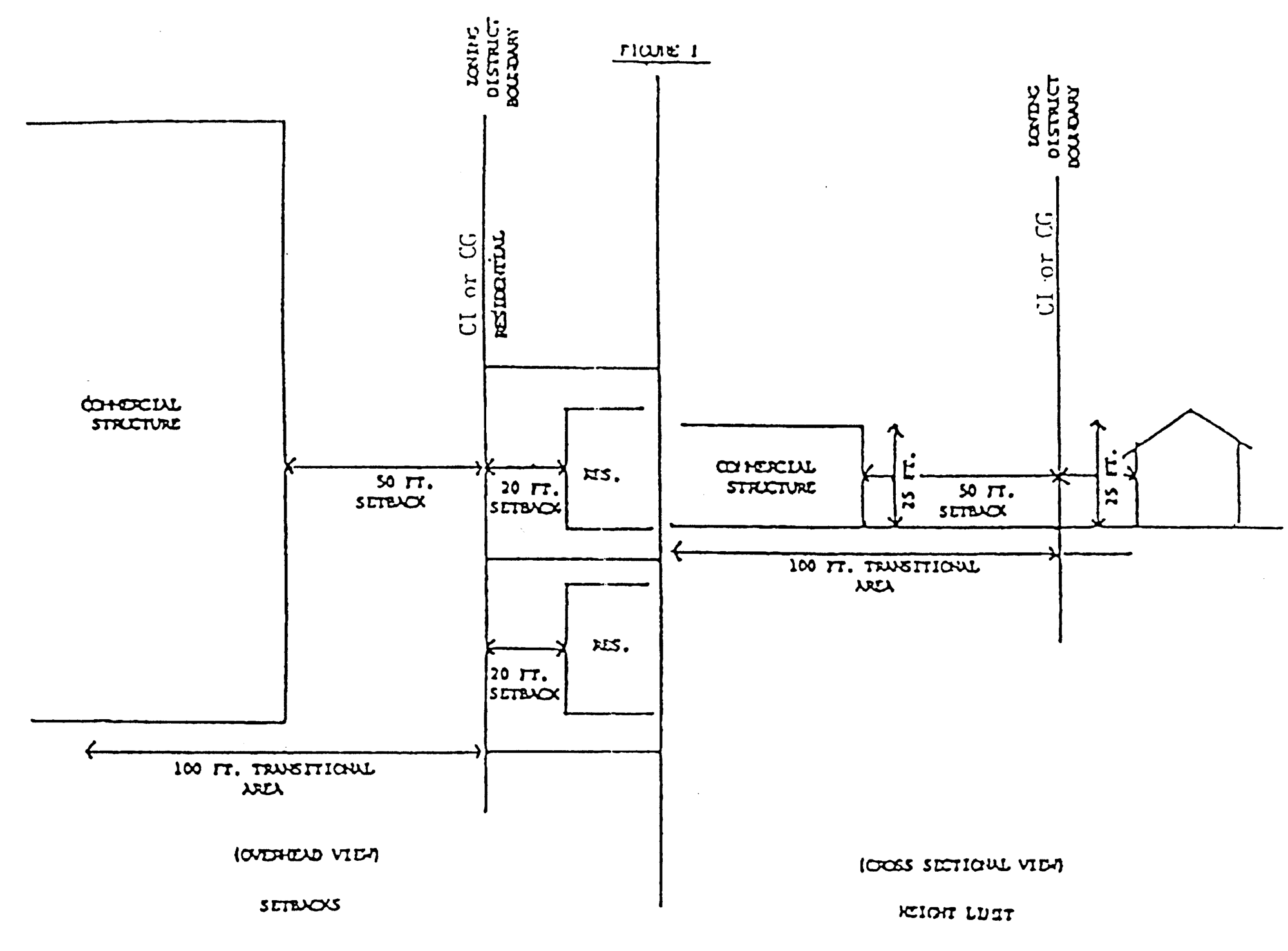
Figure 1
Sec. 16-740. - Purpose.
The regulations of this section are designed to protect and maintain the residential character of established neighborhoods while recognizing that particular professional and limited business activities are traditionally carried on in the home and are compatible with the long term integrity of a residential neighborhood.
(Ord. No. 97-31, § 1, 2-2-98)
Sec. 16-741. - Use limitations.
Home occupation(s) are allowed in residences in accord with the requirements of this division.
(Ord. No. 97-31, § 1, 2-2-98; Ord. No. 2010-09, § 7, 6-7-10)
Sec. 16-742. - Use restricted.
The use of the dwelling unit for the home occupation shall be clearly incidental and subordinate to its use for residential purposes by its occupants and shall under no circumstances change the residential character thereof.
(Code 1966, § 32-49(a))
Sec. 16-743. - Employees restricted.
No person other than those legally residing on the premises shall be engaged in such home occupation.
(Code 1966, § 32-49(b); Ord. No. 2010-09, § 7, 6-7-10)
Sec. 16-744. - Percentage of floor space.
Home occupations shall not occupy more than fifteen (15) percent of the first floor area of the residence, exclusive of the area of any open porch or attached garage or similar space not suited or intended for occupancy as living quarters or two hundred fifty (250) square feet, whichever is less.
(Code 1966, § 32-49(c); Ord. No. 97-31, § 1, 2-2-98; Ord. No. 2010-09, § 7, 6-7-10)
Sec. 16-745. - Outside appearance.
There shall be no change in the outside appearance of the building or premises, or other visible evidence of the conduct of such home occupation except for a home occupation sign as specified under section 16-752.
(Code 1966, § 32-49(d); Ord. No. 97-31, § 1, 2-2-98)
Sec. 16-746. - Traffic restricted.
No traffic, including, but not limited to, deliveries, shall be generated by such home occupation in greater volumes than would normally be expected in a residential neighborhood, and any additional need for parking generated by such home occupation shall be met off the street.
(Code 1966, § 32-49(e); Ord. No. 2010-09, § 7, 6-7-10)
Sec. 16-747. - Nuisances prohibited.
No equipment or process shall be used in such home occupation which creates noise, vibration, glare, fumes, odors or electrical interference detectable to the normal senses off the lot. In the case of electrical interference, no equipment or process shall be used which creates visual or audible interference in any radio or television receivers off the premises. There shall be no storage of hazardous or noxious materials on the site of the home occupation.
(Code 1966, § 32-49(f); Ord. No. 97-31, § 1, 2-2-98)
Cross reference— Health, sanitation and nuisances, Ch. 7.
Sec. 16-748. - Storage, display of goods.
No activity of a home occupation involving the storage, and/or outdoor storage, or window display of merchandise is permitted. No stock involved in the trade shall be displayed or maintained on the premises.
(Code 1966, § 32-49(g); Ord. No. 97-31, § 1, 2-2-98)
Sec. 16-749. - Use of accessory buildings.
No home occupation shall be conducted in any accessory building.
(Code 1966, § 32-49(h))
Sec. 16-750. - Business tax receipts and permits.
A home occupation shall be subject to all applicable city local business tax receipts and other permits and approvals as necessary.
(Code 1966, § 32-49(i); Ord. No. 2007-04, § 2, 2-5-07)
Sec. 16-751. - Retail and wholesale sales prohibited.
No retail or wholesale sales shall be conducted on premises used in a home occupation.
(Code 1966, § 32-49(j); Ord. No. 97-31, § 1, 2-2-98)
Sec. 16-752. - Home occupation sign.
The home occupation signs shall be erected as a wall sign that is parallel to the frontage street. There shall be a maximum of one (1) home occupation sign per dwelling. The maximum size of such sign shall be two (2) square feet in copy area.
(Ord. No. 97-31, § 1, 2-2-98; Ord. No. 2025-10, § 2, 8-4-25)
Sec. 16-753. - Examples of permitted home occupations.
The following are examples of permitted home occupations subject to the criteria outlined in division 8, home occupations:
(1)
Office facilities for salespersons, manufacturers' representatives, insurance agents, realtors and members of similar professions where no retail or wholesale sales are made or transacted on the premises and the traffic generated would not exceed that normally expected in a residential neighborhood.
(2)
Facilities for a seamstress or a similar person involved in the making of articles that are commonly classified under the terms of arts and handicrafts, may be deemed a home occupation subject to the other terms and conditions of this division.
(3)
Family day care facilities provided that no more than five (5) children are on the premises at any time, inclusive of all children residing in the home. All family day care facilities shall possess all licenses and/or approvals as required by federal, state and/or local laws and ordinances.
(4)
Internet and/or telephone based businesses where sales or other transactions do not take place on the premises.
(Ord. No. 97-31, § 1, 2-2-98; Ord. No. 2010-09, § 7, 6-7-10)
Sec. 16-754. - Examples of nonpermitted home occupations.
Home occupations shall exclude physicians, dentists, welding or machine shops, minor or major auto repair, painting of vehicles, trailers, or boats, as well as barbershops, beauty parlors, dining facilities, animal hospitals, group dancing and singing, band instructions, retail stores, and clairvoyants.
(Ord. No. 2010-09, § 7, 6-7-10)
Sec. 16-757. - Dumpsters.
(a)
Applicability. The requirements pertaining to the location and screening of dumpsters established in this section shall apply to all non-residential zoning districts and all residential developments, not served by curbside pickup, within the city having or using dumpsters (ninety (90) gallons or greater in size) for sanitation or recycling service. Temporary dumpsters, such as those which are placed on job sites during construction activity, are not subject to this section. Recycling containers within city parks are exempt from this section. These provisions shall be required for all new construction and in the event of any renovation, remodeling, or reconstruction of an existing building requiring a special exception, Major Site Plan Amendment or where the value of the construction work is equal to or more than twenty-five (25) percent of the value of the building as indicated by the county property appraiser.
(b)
Minimum requirements and specifications. The location and use of dumpsters shall comply with the standards below:
(1)
Dumpster enclosure(s) size shall be a minimum ten (10) feet (interior width) by eight (8) feet (interior depth) and recycle enclosure size shall be a minimum four (4) feet (interior width) by eight (8) feet (interior depth). Larger enclosures shall be provided as necessary to house larger proposed or required containers such as multiple dumpsters or a compactor.
(2)
Maximum gate width for each gate on the dumpster enclosure(s) is five (5) feet. Gates are required on both the dumpster and recycle enclosure(s).
(3)
Enclosure(s) walls shall be a minimum six (6) feet high stucco finished masonry wall and shall match the building elevation in all aspects (i.e. color, material, etc.).
(4)
The enclosure(s) gates shall be solid opaque galvanized steel gates on angle frame, color to match enclosure(s) walls. Each gate shall have wheels to prevent sagging and shall have self-closing hinges.
(5)
The enclosure walls and gates shall effectively screen the dumpster from view on all sides, and shall be taller than the above minimum height if necessary to satisfy this screening requirement.
(6)
Commercial properties served by curbside pickup may provide refuse enclosures smaller than the above at the discretion of the public works department and the city's franchise garbage collection company.
(7)
The minimum quantity of dumpsters required shall be determined by the public works department and the city's franchise garbage collection company.
(Ord. No. 2010-09, § 8, 6-7-10; Ord. No. 2018-04, § 1, 5-7-18; Ord. No. 2021-20, § 2, 1-3-22)
Editor's note— Ord. No. Ord. No. 2018-04, § 1, adopted May 7, 2018, renamed § 15-575 from "requirements and specifications" to "dumpsters."
Sec. 16-758. - Textile recycling, textile recycling collection bins.
(a)
Purpose and intent. Unlike other recyclables, such as bottles, cans and paper, textiles have not typically been collected through regularly scheduled household pick-ups but instead have been collected through donations to thrift stores (both for-profit and not-for-profit) or to charitable organizations, often by way of unsupervised textile recycling collection bins placed throughout the community. If not properly regulated, textile recycling operations and textile recycling collection bins can conflict with parking, traffic circulation, tree preservation, and can lead to nuisance situations such as abandoned property and graffiti. When properly regulated, textile recycling collection bins can provide a cost-effective and convenient method of textile recycling, thereby reducing waste. The purpose of this paragraph is to set forth the conditions under which textile recycling collection bins may be placed on public and private property and to provide minimum standards as to how they are operated and maintained, as necessary to protect the public health, safety and welfare.
(b)
In general.
(1)
Authorized textile recycling collection bins. No person shall place or maintain a textile recycling collection bin within the city except in conformance with section 16-758 and as authorized through a franchise agreement in accordance with the City Charter.
(2)
Collection from stationary vehicles. Collection of textiles for recycling from a stationary vehicle, truck, wagon, trailer or similar vehicle is prohibited within the city except as authorized through a franchise agreement in accordance with the City Charter. This is not intended to prohibit textile recycling collections taken directly from homes, businesses or institutions, whether through regularly scheduled or pick-ups or through pick-ups based on special request of the donor.
(3)
Placement, operation and maintenance of textile recycling collection bins. Unless otherwise provided by the city through a franchise agreement, textile recycling collection bins (bins) shall be governed as follows:
a.
Bins shall be placed only on:
(i)
City-owned property, excluding public rights-of-way, on parcels approved by the city either though a franchise agreement or by resolution; or
(ii)
Developed non-residential parcels zoned and approved for commercial or education use, with the written permission of the property owner.
b.
Bins shall be placed in a manner which does not to impair traffic circulation, pedestrian or emergency service vehicle movement within the site and which does not negatively affect protected trees or utility services or block required parking spaces. The placement of textile recycling collection bins shall not require site plan approval unless such placement would be inconsistent with site plan conditions imposed by the city council.
c.
Bins shall be no larger than seven (7) feet in any dimension.
d.
Bins shall be placed no less than five hundred (500) feet from any other bin unless located at least two hundred (200) feet from any public street right-of-way and not readily visible from any residential use. In no case shall more than two (2) bins be placed on a single parcel.
e.
Bins shall not be located within twenty-five (25) feet of any a public street right-of-way.
f.
Bins shall be constructed of steel with a rust-resistant coating and weigh at least five hundred (500) pounds empty.
g.
Each bin shall provide the name, address and telephone number of the franchisee in weather-resistant lettering no smaller than one (1) inch high and provide other information as may be required by Florida Statutes. Bins shall contain no advertising other than as related to the city or the franchised textile recycling collection organization or business.
h.
Bins shall be painted a uniform, approved color, maintained in good appearance, and be emptied no less than once per fourteen (14) days.
i.
The franchisee shall be responsible for ensuring that the area within twenty (20) feet of any bin shall be kept free of trash, debris and discarded items.
(c)
Implementation. The provisions of section 16-758 shall take effect on April 21, 2018. Bins, stationary vehicles, trucks, wagons, trailers or similar vehicles/bins placed, operated or maintained in violation of subsection section 16-758 prior to April 21, 2018, shall be removed or brought into compliance no later than May 21, 2018.
(Ord. No. 2018-04, § 1, 5-7-18)
Sec. 16-760. - Requirement and specifications.
All commercial developments and developments located within residential districts with non-residential uses shall provide screening around all rooftop equipment. These provisions shall be required for all new construction and in the event of any renovation, remodeling, or reconstruction of an existing building requiring a special exception, Major Site Plan Amendment or where the value of the construction work is equal to or more than twenty-five (25) percent of the value of the building as indicated by the Palm Beach County Property Appraiser. The following design requirements and standards shall be adhered to for all new and existing rooftop equipment:
(1)
All rooftop equipment shall be screened on all four (4) sides.
(2)
All four (4) sides of the screen must be consistent with the architecture of the building (i.e. color, material, etc.).
(3)
The use of parapet walls is encouraged.
(4)
No rooftop equipment shall be taller than the proposed screening.
(Ord. No. 2010-09, § 8, 6-7-10; Ord. No. 2021-20, § 2, 1-3-22)
Sec. 16-763. - Purpose and intent.
These regulations are in conjunction with efforts within the county and state to discourage the misuse and abuse of narcotics and other controlled substances such as pain medications, and reduce the impacts of land uses that are associated with businesses that would operate principally to dispense pain medications for chronic pain but without the services of typical medical offices that provide thorough on-site examinations, medical treatments or procedures, and continued medical oversight. Such businesses have been determined to be associated with the excessive use of, addictions to, and illegal sales and/or diversion and distribution of controlled substances.
(Ord. No. 2011-04, § 3, 3-7-11)
Sec. 16-764. - Requirements for specific uses.
(1)
Medical and dental offices. On-site dispensing of controlled substances that are identified in Schedule II, III or IV in F.S. § 893.03, and as further amended by F.S. §§ 893.035, 893.0355, or 893.0356 is prohibited, unless otherwise expressly permitted by statutory or general law. The following are exempt from this prohibition:
a.
A healthcare practitioner when administering a controlled substance directly to a patient if the amount of the controlled substance is adequate to treat the patient during that particular treatment session.
b.
A pharmacist or healthcare practitioner when administering a controlled substance to a patient or resident receiving care as a patient at a hospital, nursing home, ambulatory surgical center, hospice, or intermediate care facility for the developmentally disabled which is licensed in this state.
c.
A healthcare practitioner when administering a controlled substance in the emergency room of a licensed hospital.
d.
A healthcare practitioner when administering or dispensing a controlled substance to a person under the age of sixteen (16).
e.
A healthcare practitioner when dispensing a one-time, seventy-two-hour emergency resupply of a controlled substance to a patient.
(2)
Nursing and convalescent facilities. On-site dispensing of controlled substances that are identified in Schedule II, III, or IV in F.S. § 893.03, and as further amended by F.S. §§ 893.035, 893.0355, or 893.0356 shall be limited to that administered directly to a patient in an amount adequate to treat the patient during that particular treatment session.
(3)
Retail drugstores and retail drugstores with drive-thru pharmacies:
(a)
No more than fifteen (15) percent of the total number of prescriptions filled within a thirty-day period can be derived from the sale of controlled substances that are identified in Schedule II in F.S. § 893.03, and as further amended by F.S. §§ 893.035, 893.0355, or 893.0356 as determined by audits or information provided through the Florida Department of Health or any other government agency having the legal right to view such records.
(b)
All retail drugstores and retail drugstores with drive-thru pharmacies shall be staffed by a state licensed pharmacist who shall be present during all hours the pharmacy function of the retail drugstore is open for business.
(4)
Therapeutic adult day care center. On-site dispensing of controlled substances that are identified in Schedule II, III, or IV in F.S. § 893.03, and as further amended by F.S. §§ 893.035, 893.0355, or 893.0356 shall be limited to that administered directly to a patient in an amount adequate to treat the patient during that particular treatment session.
(5)
Prescribed Pediatric Extended Care (PPEC) Center. On-site dispensing of controlled substances that are identified in Schedule II, III, or IV in F.S. § 893.03, and as further amended by F.S. §§ 893.035, 893.0355, or 893.0356 shall be limited to that administered directly to a patient in an amount adequate to treat the patient during that particular treatment session.
(Ord. No. 2011-04, § 3, 3-7-11; Ord. No. 2025-03, § 3, 3-17-25)
Sec. 16-765. - Prohibited.
Other than those listed in section 16-764, no use, occupancy, or business, however named or defined, shall sell, dispense, or otherwise provide controlled substances that are identified in Schedule II, III, or IV in § 893.03, and as further amended by F.S. §§ 893.035, 893.0355 or 893.0356.
(Ord. No. 2011-04, § 3, 3-7-11)
Sec. 16-767. - Outdoor lighting.
(a)
Purpose and intent. The purpose of this section is to regulate outdoor lighting to ensure the safety of pedestrians, motorists, and cyclists while minimizing adverse impacts on adjacent properties. This section is designed to preserve, protect, and enhance the nighttime use and enjoyment of all properties through appropriate lighting practices and systems. These lighting requirements shall be applicable to all installations of site and building lighting, including those installed by local government entities or utility service providers in areas outside of public rights-of-way. More specifically, this section is intended to:
(1)
Ensure that all site lighting is designed and installed to maintain safe and adequate lighting levels on site while limiting negative lighting impacts on adjacent lands;
(2)
Prevent excessive light spillage and glare directed at adjacent properties and motorists; and
(3)
Implement energy-efficient lighting practices that conserve energy and resources while maintaining safety, security, and productivity.
(b)
Photometric plan requirements.
(1)
All site and development plan and building permit applications that include the use of external luminaries, or luminaries visible from the exterior of a structure shall include a photometric plan with the footcandle output of all proposed and existing luminaries on-site. On-site lighting to be included in the calculations shall include, but is not limited to, lighting for the parking lot, canopies, recessed lighting along the building and/or overhang. Each plan shall include any calculations or modifications required to comply with federal, state, and local laws and/or regulations that may apply. The photometric plans shall be consistent with the requirements for site and development plans and include the following:
a.
The location and height above grade of all proposed and existing light fixtures on the subject property.
b.
A table showing the average, minimum, and maximum foot-candles, average to minimum ratio, and maximum to minimum ratio on the site, and maximum luminaire heights.
c.
Manufacturer's catalog cuts that provide a description of the luminaries, including wattage, lumen output, correlated color temperature, lamps, and mounting devices.
d.
Control descriptions including type of controls (timer, motion sensor, time clock, etc.), the light fixtures to be controlled by each type, and control schedule when required.
e.
All photometric plans must be signed and sealed by a registered design professional per Florida Statutes.
f.
A certificate of compliance signed and sealed by a registered design professional per Florida Statutes, must be submitted prior to the issuance of a certificate of occupancy/finalizing of the permit.
(c)
Standards.
(1)
Measurement. All lighting levels shall be measured at grade level except for the purpose of measuring light spillage where the light meter shall be placed seven (7) feet above the grade level at the property line. Lighting levels shall be certified prior to the issuance of a certificate of occupancy. Minimum intensity shall be measured within any area of the property intended for pedestrians, site activity, and vehicular use by using measurement equipment built for this purpose.
(2)
Light confinement. All outdoor lighting shall be dark sky certified and utilize full cutoff luminaries, as defined by the Illuminating Engineering Society of North America (IESNA), ensuring no light is directed skyward. Parking lot lighting shall be installed at a 90-degree angle. Only lighting used to accent architectural features, landscaping or art may be directed upward, provided that such accent lighting fixture is shielded and directs the light only onto the surface to be illuminated.
(3)
Design. Lighting shall be used to provide safety while accenting key architectural elements and emphasizing landscape features. Light fixtures should be thoughtfully integrated into the overall design, serving as complementary elements that enhance the project's aesthetic. This may be accomplished through careful selection of style, material, or color. All light fixtures located within 50 feet of any residential use or residential property boundary shall not exceed 20 feet in height.
(4)
The following lights are prohibited:
a.
Lights that present a safety hazard through the creation of observable glare or movement.
b.
Unshielded lights, which are visible within the normal range of vision from any street right-of-way or adjacent property.
c.
Any search, beacon, or strobe light.
d.
Lights which resemble any type of authorized traffic control sign, signal, or device, or that may mislead or confuse vehicular traffic.
(5)
At no time shall 0.3 footcandles intensity be exceeded at the residential property line.
(6)
The term "Open" in Table 16-1335(15)(b) shall mean from ½-hour before uses on site are operating until dawn and from dusk until ½-hour after uses on site are operating. The term "closed" shall mean all other times between dusk and dawn when uses onsite are not operating.
(7)
The use of sensor technologies, timers, or other methods to activate lighting when needed is required to conserve energy, ensure safety, and promote compatibility between different land uses.
(d)
Illumination levels and luminaire heights. For their respective uses and districts, Table 16-767(d)(1) and Table 16-767(d)(2), specifies the minimum and maximum illumination levels, average ratios, and maximum height for any freestanding or structure-mounted luminaires.
(Ord. No. 2024-19, § 3, 12-16-24)
Sec. 16-651. - Definitions.
For the purposes of this subdivision, the following definitions shall apply:
City park and recreational facilities means the following city parks and recreation facility has been identified as the location of any proposed memorials and monuments: Freedom Park, Samuel J. Ferreri Community Park, Bowman Park, Burrowing Owl Park, Friends Park, Ira Van Bullock Park, and Veteran's Memorial Park.
Memorial means an object or landscape feature designed to honor the memory of a person, event, or place of historical significance as set forth in the criteria of this subdivision.
Monument means a physical object erected to commemorate or remember a person, event, or place of historical significance as set forth in the criteria of this subdivision.
(Ord. No. 2019-03, § 2, 8-19-19)
Sec. 16-652. - Criteria.
All memorials and monuments shall demonstrate a historical significance by meeting the following criteria:
(1)
The person, event, or place to be honored has made an outstanding contribution to the cultural, political, or social development of the city, the State of Florida, the United States of America, or the international community.
(2)
The person, event, or place to be honored is historically or culturally significant and/or represents an important and unique city or civic anniversary.
The city reserves the right to deny any request for a memorial or monument that commemorates a person, event, or place that is already memorialized elsewhere in the city or a memorial or monument that will be extraordinarily divisive to the community.
(Ord. No. 2019-03, § 2, 8-19-19)
Sec. 16-653. - Memorials and monuments application and review process.
(a)
Application. Any individual or organization that desires to install a memorial or monument within a city park and recreational facility shall submit a written application as approved by the city, including a conceptual plan, to the planning and engineering department. The planning and engineering department shall review the application and conceptual plan for sufficiency and shall transmit the application and conceptual plan to the development review committee for review.
(b)
Development review committee. The development review committee shall review the application and take into consideration, including, but not limited to, the proposed materials, size, scale, design, layout, and location of the memorial or monument. The development review committee shall provide comments, if applicable, to the applicant regarding the application and conceptual plan. Following review and comment by the development review committee, the application and conceptual plan shall be transmitted to the city council for review.
(c)
City council review and final determination. After receipt of a recommendation from staff, the city council shall consider the comments and recommendations from the development review committee, as applicable. The city council shall approve, deny, or approve with conditions all applications for memorials and monuments. If an application is approved or approved with conditions, the applicant shall enter into an agreement with the city for the payment of all costs for the installation and maintenance of the memorial or monument.
(Ord. No. 2019-03, § 2, 8-19-19; Ord. No. 2021-19, § 2, 1-3-22)
Sec. 16-654. - Financing of memorials and monuments.
The individual or organization proposing the memorial or monument shall bear all costs associated with the design and construction of the memorial and monument.
(Ord. No. 2019-03, § 2, 8-19-19)
Sec. 16-655. - Installation of memorials and monuments.
The city shall determine the final location of the approved memorial or monument. The individual or organization shall pay for and shall install the memorial or monument at the approved location. The individual or organization proposing the memorial or monument shall also bear all costs associated with the installation of the memorial or monument and shall enter into an agreement with the city for the payment of the associated costs. The city shall have the right to relocate the memorial or monument at the city's sole discretion.
(1)
Ownership. All memorials and monuments installed pursuant to this subdivision shall be the property of the city and shall be under the control of the city and managed in accordance with the standards established by the city.
(2)
Maintenance. The individual or organization proposing the memorial or monument shall bear all costs associated with the maintenance of the memorial or monument and shall enter into an agreement with the city for the payment of all associated costs. If the individual or organization proposing the memorial or monument fails to pay for the maintenance of the memorial or monument, the city, at its sole discretion, may determine the future of the memorial or monument, including its relocation, removal, disassembly or take down and disposition of, or return of the memorial or monument to the individual or organization at the sole expense of the individual or organization proposing the memorial or monument.
(Ord. No. 2019-03, § 2, 8-19-19)
Sec. 16-660. - Purpose.
The city recognizes the importance of public art to enhance our public spaces, promote creativity, enhance community vibrancy, and provide the public with more opportunities to experience public art. The purpose of the public art program is to establish a program for the integration of public art into both public and private spaces throughout the city. Public art will add enormous value to the cultural, aesthetic, and economic vitality of our community. It is a well-accepted principle of urban design that public art contributes to a community's identity, fosters community pride and a sense of belonging, and enhances the quality of life for its residents and visitors. The public art fund is accounted separately from other city monies to support the public art program.
(Ord. No. 2022-16, § 1, 6-6-22)
Sec. 16-661. - Establishment of public art fee.
(a)
All development, redevelopment, reconstruction or remodeling projects commenced after the adoption of this article which have a construction value of two hundred fifty thousand dollars ($250,000.00) or greater, shall participate in the Art in Public Places Program by paying a public art fee. For the purpose of this section, a project will be considered "commenced" when an application for review is first submitted to the city's development and neighborhood services department. The public art fee shall be equal to one (1) percent of construction value of the project. The building division/finance department shall administer the billing and collection of the thirty (30) percent or (.03) of the one (1) percent of the public art fee at the time of building permit issuance and the seventy (70) percent or (.07) of the one (1) percent prior to and as a condition of issuance of the certificate of occupancy that includes the public art. One hundred (100) percent of the public art fees collected are to be allocated to the Public art fee. All distributions for the public art fee require the recommendation of the development review committee prior to city council approval.
(b)
The following types of projects are exempt from the payment of the public art fee:
(1)
Remodeling, repair or reconstruction of structures damaged by fire, flood, wind, earthquake or other calamity determined by the City of Greenacres Building Official.
(2)
Single-family and two-family in-fill housing.
(3)
Normal, routine maintenance including replacement of existing damaged or failing structural or non-structural elements, HVAC, plumbing, electric, or fire detection/suppression equipment of a project not associated with an addition, renovation or new construction.
(4)
Remodeling, repair, reconstruction, or additions made after June 6, 2022 to any existing amenity, clubhouse, building, pool, park, playground and/or common area element located within an existing private residential development. This specific exemption applies retroactively to June 6, 2022.
(c)
Project owners required to participate in the Art in Public Places Program may obtain reimbursement up to seventy (70) percent of collected art fee if the following conditions are met:
(1)
The owner of a development agrees to follow the city council's recommendations to develop the art in the project; and
(2)
Prior to placement on the development site, has the artwork approved by the city council to ensure that the artwork will be accessible and readily visible to the public based on location of artwork and normal traffic of vehicles/pedestrians in the proposed location; and
(3)
Select an artist directly to execute a project that meets specific criteria outlined by the recommendations and guidelines document provided by the city or hire a professional consultant to select artists to commission site-specific, architecturally integrated artworks that meet specific art guidelines; or purchase artworks for permanent installation recommended by the city council; or elect to purchase an existing artwork or commission an original artwork for donation as a gift to the City of Greenacres' public art collection.
(Ord. No. 2022-16, § 1, 6-6-22)
Sec. 16-662. - Art in public places requirements.
(a)
Application requirements. The applicant shall provide the information described below and any additional information requested by the development and neighborhood services department necessary to review the application pursuant to the standards of the Code.
(1)
Application forms. The application shall be made on forms provided by the development and neighborhood services department.
(2)
Artist information. Portfolio containing photographs of the artist's existing work, exhibition and sales history, and biography.
(3)
Miscellaneous plans, renderings, and details. Artist's color renderings and/or photographs of proposed artwork; materials sample board; site plan depicting the proposed location of the artwork; landscape plan, if necessary, depicting additional landscaping or modifications to existing landscaping; architectural elevations, if necessary, depicting structures associated with the artwork; lighting location plan and light fixture details; or other information requested by staff, the art in public places advisory board, or the city council. All submittals shall be required to provide an accurate representation of the proposed artwork.
(b)
Violations. Violation of this subdivision shall be subject to enforcement as provided in chapter 2, article VIII.
(c)
Requirements for art or fee in lieu of art. All development activities, except city projects, where total construction costs of all buildings on a project site are equal to or greater than two hundred fifty thousand dollars ($250,000.00) shall provide art valued in an amount of seventy (70) percent of the one (1) percent of the total construction costs, as provided in this section and section 16-663, thirty (30) percent of the one (1) percent shall be deposited in the city's public art fee. All buildings within planned developments shall be assessed cumulatively towards the art in public places requirement, even if they are permitted or owned separately. If the aggregate cost of the entire project exceeds the two hundred fifty dollars ($250,000.00) threshold, each phase of development shall contribute the required one (1) percent of construction cost towards art in public places for the building project. The art fee for redevelopment of an existing building shall be calculated based on the construction costs of the new development.
(1)
Private development. A private developer may choose either to provide artwork on the project site with a budget of seventy (70) percent of the one (1) percent fee for art or to contribute one (1) percent of the total construction costs to the city's public art fee. The city's public art fee shall be interest bearing with all interest to be retained by the city.
a.
Contribution of art. If the developer chooses to provide artwork, the art advisory board shall review the proposed artwork and shall recommend to the city council whether to approve, deny, or approve with conditions the selection and location of the artwork according to the standards of this division. The artwork shall be provided as follows:
1.
Deposit of funds. The building division/finance department shall administer the billing and collection of the thirty (30) percent of the one (1) percent of the public art fee at the time of building permit issuance to the public art fee. The developer shall submit documentation to the city showing that a deposit was made in the amount of the seventy (70) percent of the one (1) percent fee with the developer's attorney into an escrow account in an amount of money equal to seventy (70) percent of the one (1) percent art fee prior to the issuance of the first building permit. The developer's attorney will furnish the city documentation of the withdrawals for payment of art fees in accordance with the terms of the contract between the developer and the artist or artists, or the developer's arts consultants. The developer and/or the developer's attorney will provide the city a final written certification and accounting of the payment of art and consulting fees at the conclusion of the placement of artwork. This certification shall be provided in a manner acceptable to the city.
2.
Surplus balance. Any surplus balance existing in the escrow accounts after the developer has installed the required artwork shall be collected by the city. The surplus balance shall be held in a segregated, interest-bearing fund (the "public art fee"), and shall be used for the provision of additional art work at the construction site or another site within the city. Use of such funds shall be determined by the city council, following a recommendation by the city staff, and shall be in accordance with further provisions of this division.
3.
Artist selection. The selection and commissions of the artists shall be by written contract between the developer and artists.
4.
Art consultant. The developer may utilize up to twelve (12) percent of the required fee to retain an art consultant to assist in the selection and procurement of required artwork; an additional three (3) percent of the required fee shall be used to pay the city for administering the art in public places program. The art consultant shall have no financial relationship with the artist, nor any ownership in artwork purchased by the developer. The artist shall be allowed to act as the art consultant for the art petition but shall be precluded from receiving the art consultant fee.
5.
Construction cost overruns. Prior to the issuance of the final certificate of occupancy for a project, the developer shall submit a revised construction cost certification. If the final cost of the vertical construction for the entire project is higher than the cost figure used to calculate the preliminary art budget, the art budget shall be increased as necessary to equal one (1) percent of the actual defined total vertical construction cost for the project. The art budget shall be revised within thirty (30) calendar days of any such changes. The increase in the art budget due to the final increase of the vertical construction cost for the entire project shall be placed in the city public art fee or shall be used for the provision of art on site, at the option of the developer.
6.
Appraisal. To establish the value of art submitted to comply with this division, the city may employ an independent art appraiser to provide a written appraisal of the art submitted. Such appraisal will be paid for by the developer as part of the overall art contribution.
7.
Artwork purchased pursuant to the requirements of this section belongs to the property owner and shall be insured and maintained in good condition at all times as determined by the city's code enforcement official. Maintenance shall include any associated landscaping or related improvements. The city has the right to maintain any art it deems improperly maintained and charge the owner the cost of such maintenance, including cost of collection, interest, and attorney's fees.
8.
Unless an alternative deadline is established in a development order, or a time extension is granted by the director of development and neighborhood services, no certificate of occupancy for the project shall be issued until the artwork is installed and the final certification and accounting of the payment of the escrow fees has been provided. Artwork installed in accordance with this division cannot be altered or removed from the site without approval of the city council.
9.
The artist of approved artwork shall grant to the City of Greenacres an unlimited, perpetual, non-exclusive, royalty-free, irrevocable license to reproduce and distribute two-dimensional reproductions of the artwork for city-related purposes, and grant to the city the exclusive irrevocable ownership rights in any trademark, service mark, or trade dress rights regarding the artwork, pursuant to a license that shall be approved by the city attorney. City approval of the artwork shall be deemed to be a grant of the artist for authorization by third parties to review and reproduce documents provided by the artist to the city which are deemed to be public records pursuant to public record laws of the state. The city shall also have the option of referring to the name and title of the artist and artwork in reproductions.
10.
Review by the development review committee.
A.
Workshop. The applicant shall appear before the art advisory board in order to receive guidance in the initial stages of the review. In this case, the applicant shall choose between two (2) types of review described below:
i.
The applicant may appear before the committee in order to receive more detailed direction, if the applicant does not have a set direction, prior to receiving a final recommendation by the committee. The applicant is strongly encouraged to submit the portfolios of up to three (3) artists. The portfolios shall contain photographs of the artists' existing works, as well as the artists' biographies; or
ii.
The applicant may have a set direction regarding the artwork and may appear before the committee for preliminary comments prior to receiving the committee's final recommendation. The applicant shall submit the portfolio of the proposed artist which shall contain photographs of the artist's existing works, as well as the artist's biography.
B.
Criteria for review of artwork by the committee. In making its recommendation to the city council, the committee shall consider the quality of the artwork; the exhibition and sales history of the artist; the artist's works in public collections and previous public art purchases or commissions; the ability of the artist to complete the project within a specified schedule; and the compliance with the standards of this division.
C.
Guidelines. The development review committee may adopt art in public places implementation guidelines to assist both the public and private sector planning activities.
11.
Review by staff. In making recommendations to the art advisory board and to the city council, staff shall consider the standards of this division in association with sound planning principles.
12.
In the case of redevelopment of a property which has contributed artwork on the site pursuant to this article, the artwork may be replaced, at the option of the developer, with new artwork pursuant to this article, or the existing artwork may remain on the site. In the latter case, the value of the existing artwork and its placement must comply with this article as if it were new artwork.
b.
Fee in lieu of artwork. Instead of providing artwork on the project site, a developer may choose to contribute one (1) percent of the total construction costs as the required art fee. If the contribution is made, the contribution shall be divided into two (2) payments as follows:
1.
Prior to building permit issuance, the developer shall submit to the building division/finance department a preliminary certification of total construction costs. The preliminary certification shall be used to calculate developer's initial payment of thirty (30) percent of the contribution. The developer shall make the initial payment to the building division/finance department prior to building permit issuance.
2.
Prior to issuance of the final certificate of occupancy for the project, the developer shall submit to the building division/finance department a final certification of the total construction costs. The final certification shall be used to calculate the outstanding portion of the contribution. The developer shall pay the outstanding portion of the contribution prior to issuance of the final certificate of occupancy for the project.
3.
The contribution shall be placed in the city's public art fee fund and used as provided in subsection 16-662(c)(2). The contributor shall have no input in the use of such funds.
(2)
Public art fee fund. When the developer provides a fee in lieu of artwork pursuant to subsection 16-662(c)(1)b. or pays the thirty (30) percent of the one (1) percent when providing art on site, the following shall apply to the use of the funds:
a.
The fee shall be placed in the city's public art fee fund. Funds from the public art fee fund may be spent anywhere in the city, and such funds may be spent on any art or art-related costs such as, but not limited to, lighting, consulting, landscaping, aesthetic features or enhancements, maintenance of art work, and to promote public art and the public art process in the city. In addition, funds generated from the public art fee may be used for the limited reimbursement program established in subsection 16-665(j).
b.
Artist selection. The city council may choose either to select an artist through a call-to-artist process or to procure works of art through commission via written contract with a specific artist for a specific work of art.
i.
Call to artists. If a preferred artist has not been determined, the city may issue a call to artists to procure a work or works of art. A selection committee will review the submitted proposals and shall select at least two (2) finalists for consideration by the city council. The city council shall review the finalists' proposals and make a final determination on the selection and commission of the artist and the artwork. The selection and commission of the artist and artwork shall be by written contract between the city and the artist. Final decision-making authority regarding the artwork and artist shall be at the sole discretion of the city council.
ii.
Artist/artwork selection. The city may utilize funds allocated from the public art fee to retain a specific artist for a specific artwork on city-owned land, a city-owned building, a facility that is leased or rented by the city or on any property where the city has granted permission by the property owner. The selection and commission of the artist and artwork shall be by written contract between the city and artist. Final decision-making authority regarding the artwork and artist shall be at the sole discretion of the city council.
iii.
Contracts for artwork. Artists, as a part of any commission or contract with the city for the provision of artwork, shall be required to submit to the city a "maintenance and inventory sheet," which shall include an annual cost estimate for the annual maintenance necessary in order to properly preserve and maintain the artwork in substantially the same condition that it was in when accepted by the city.
iv.
Use of purchased art. Except as provided in section 16-665(j), all artwork purchased by the city-required art fee contribution shall be displayed on city-owned land, a city-owned building, or a city-leased or rented facility unless otherwise approved by the city. The artwork shall be displayed in a visually accessible location, which shall be suitable to the design of the site, in order for the public to receive the most enjoyment and benefit from the art.
c.
Art consultant. The city may utilize funds allocated from the art account to retain an art consultant. The artist shall be allowed to act as the art consultant but shall be precluded from receiving the art consultant fee.
d.
Proper insurance coverage shall be maintained by the city on artwork purchased with funds generated by this article or on artwork whose ownership has been transferred to the city. The artwork owned by the city shall be maintained by the city.
e.
Maintenance of artwork. The public art fee fund shall be utilized to cover the costs of acquiring and maintaining public works of art purchased for display on city-owned, -leased, or -rented property/buildings, or on any property where the city has been granted permission by the property owner.
i.
Public art maintenance fund. The city council shall designate portions of the public art fee fund in order to provide for the maintenance and upkeep of all publicly-owned works of art in order to ensure that proper preservation and maintenance is provided.
ii.
Art maintenance requirement. When the city council approves the acquisition of a public work of art, the city council shall designate funds from the public art fund dedicated to the continual maintenance and preservation of the subject work of art for a period of no less than twenty-five (25) years.
iii.
Maintenance funds. Maintenance funds may be expended to cover any and all expenses reasonably associated with the maintenance and preservation of public works of art.
(Ord. No. 2022-16, § 1, 6-6-22; Ord. No. 2024-14, § 1, 5-20-24; Ord. No. 2024-18, § 1, 8-19-24)
Sec. 16-663. - Standards for artwork.
(a)
Maintenance of the public art shall be the sole responsibility of the current property owner in perpetuity, and this obligation shall be deemed to run with the land. Failure to maintain public art in compliance with the public art plan shall be considered a violation of this chapter. Artwork shall be displayed in a visually accessible location, which shall be suitable to the design of the site, in order for the public to receive the most enjoyment and benefit from the art.
(b)
Consideration shall be given to the appropriateness of the project's proposed materials and construction for questions of durability, maintenance, appropriateness, safety, and security.
(c)
Artwork shall be integrated into the overall planning and design for a structure or project, ensuring compatibility with the intent and purpose of the structure at which the work or works are located. Additionally, all artwork shall align with the four (4) general principles of section 16-198, Site and building design which aims to stimulate creative design and planning solutions that directly enhance the visual appearance of the city, and promote public health, safety, and welfare.
(d)
Artwork shall be integrated into the overall landscaping plan, and landscaping shall be utilized to enhance the visibility of such works.
(e)
Artwork shall be lighted at a minimum from dusk until midnight. The lighting shall be designed and located in order to prevent excessive lighting, energy waste, glare, light trespass, and sky glow.
(f)
Artwork installed pursuant to the division cannot be altered or removed from the site without approval of the city council.
(g)
Maintenance. Artwork shall be maintained in good condition at all times, including any associated landscaping or related improvements. Maintenance of the public art shall be the sole responsibility of the property owner, and this obligation shall be deemed to run with the land. Failure to maintain public art in compliance with the plan shall be considered a violation of this subdivision.
(h)
Except as provided in section 16-665(j), all artwork purchased from the public art fund shall be displayed on city-owned land, a city-owned building, or a city-leased or -rented facility.
(i)
Zoning and building consideration. Consideration shall be given to project zoning. Permits and building approval shall be obtained, when necessary, and shall be in compliance with the Florida Building Code, the National Electric Code, and the previously-approved plans by city council.
(Ord. No. 2022-16, § 1, 6-6-22; Ord. No. 2024-14, § 2, 5-20-24; Ord. No. 2024-18, § 2, 8-19-24)
Sec. 16-664. - Definitions.
The following words, terms, and phrases, when used in this subsection, shall have the meanings ascribed herein except where the context clearly indicates a different meaning:
Art, artwork, or works of art means all tangible creations by artists exhibiting the highest quality of skill and aesthetic principles, and includes all forms of the visual arts conceived in any medium, material, or combination thereof, including, but not limited to, painting, sculpture, fountains, engraving, carving, frescos, mobiles, murals, collages, mosaics, bas-reliefs, tapestries, photographs, drawings, artist-designed seating, or other functional art pieces and collaborative design projects between architects and/or landscape architects and artists, together with all hard costs and soft costs such as, but not limited to, lighting, landscaping, or other aesthetic effects or enhancements integrated with the art and approved by the city council. The city council shall not consider for approval art objects which are mass-produced in unlimited quantities. Artwork may include, but is not limited to:
(1)
Sculpture: Free-standing, wall supported or suspended; kinetic, electronic; in any material or combination of materials.
(2)
Murals or portable paintings: In any material or variety of materials.
(3)
Fiber works, neon, glass, mosaics, photographs, prints, calligraphy, earthworks, any combination of forms of media, including: Light, sound, literary elements, film, holographic images, and video systems; hybrids of any media and new genres.
(4)
Furnishings or fixtures, including, but not limited to: gates, railings, lighting, street lights, signage, seating, if created by artists as unique elements or limited editions.
(5)
Culturally significant elements.
(6)
Temporary artwork or installations, that serve the purpose of providing community and educational outreach.
Ineligible artwork. The following shall not be considered artwork:
(1)
Art objects which are mass produced or of standard manufacture, such as playground equipment, fountains, statuary elements, signage, maps, corporate logos or other functional elements, unless incorporated into an artwork by an artist commissioned for that purpose.
(2)
Reproductions, by mechanical or other means, of original artwork, except in the cases of limited editions controlled by the artist, cast sculpture, film, video, photography, printmaking, or other media arts.
(3)
Decorative, ornamental, architectural, or functional elements of the architecture or landscape design which are designed by the building architect, as opposed to elements created by an artist commissioned for that purpose. Such elements may be considered artwork when commissioned from an artist as an integral aspect of the structure or site.
(4)
Commercial expression, including design elements related to the visual identity of a developer or occupant of a building such as a logo, trademark iconography, color scheme or theme, even if created by an artist.
(5)
Services or utilities necessary to operate and maintain an artwork over time.
Development, as it pertains to art means any project to construct or remodel any private or public development or any portion thereof within the limits of the city, where total construction costs equal or exceed two hundred and fifty thousand dollars ($250,000.00).
Remodeling or conversion, as it pertains to art means alterations made to a building within any twelve-month period, including, but not limited to, changes to the façade of a building, changes to the interior of a building, increases or decreases in the floor area of a building and changes to exterior improvements.
Total construction costs means the total cost of the improvements, excluding demolition costs and real property acquisition costs, approved for a development project, as indicated on the construction contract(s) for the subject improvements. For purposes of calculating the public art fee, total construction costs shall include, but not be limited to, all building, engineering, landscaping, plumbing, mechanical, and electrical permit applications for the project.
(Ord. No. 2022-16, § 1, 6-6-22; Ord. No. 2024-14, § 3, 5-20-24; Ord. No. 2024-18, § 3, 8-19-24)
Sec. 16-665. - Murals.
(a)
Applicability. All proposed murals that are not approved pursuant to the Art in Public Places Program shall be reviewed and approved in accordance with this section. The city is exempt from the requirements of this section.
(b)
Definition of mural. For purposes of this section, the term mural means any drawing, artwork, inscription, or marking that is marked, etched, drawn or painted on the exterior walls of a nonresidential building, a nonresidential structure, or an electrical box if the electrical box is installed on nonresidential property. Items or works that are excluded from the definition of artwork in Sec. 16-664 shall not be considered murals, and they are not permitted on the roof of a nonresidential building or structure.
(c)
Review criteria. Prior to installation, all proposed murals shall be reviewed by the art advisory board and approved by the city council pursuant to the following criteria:
(1)
In all districts, murals shall be evaluated on a case-by-case basis in relation to their surroundings and environment.
(2)
Murals may co-exist with all types of on premises signs.
(3)
Murals shall be integrated into the overall planning and design for a structure or project and shall be compatible with the intent and purpose of the proposed structure.
(4)
Additionally, the city council may adopt reasonable guidelines and policies consistent with these regulations to assist the city in the review of proposed murals. After ratification, the adopted administrative policies shall be applied by the art advisory board and the city council in reviewing applications for permits to install murals. Copies of adopted administrative policies shall be provided to all property owners considering the placement of murals.
(5)
When reviewing an application for a mural under this section, the art advisory board may recommend that the city council approve an application, approve an application with conditions, or deny an application. The recommendation of the art advisory board shall not be binding on the city council.
(d)
Application requirements. A written application for mural approval shall be submitted to the development and neighborhood services department using forms which shall be provided. The application shall include the following information:
(1)
The name and address of the applicant.
(2)
The name and address of the property owner.
(3)
The street address and location of the proposed mural.
(4)
The written consent of the building owner.
(5)
Renderings and sketches prepared in a professional manner clearly indicating the intended appearance of the proposed mural. A sketch of the mural shall be sufficiently detailed and depicted on a scaled elevation of the wall(s) on which it will be applied. Colored photographs of the building shall accompany the mural sketch, showing the wall to be painted in relation to adjacent streets and buildings.
(6)
Color samples shall be precisely identified.
(7)
Such other reasonable and relevant information as the development and neighborhood services department may require.
(e)
Installation and maintenance. Murals shall be:
(1)
Installed in strict conformity with their approved plans and any conditions of approval.
(2)
Installed by professional artists or licensed painters, or under their direct supervision.
(3)
Properly and safely applied to building surfaces, using proper exterior paint or other materials.
(4)
Suitably weatherproofed and protected against deterioration.
(5)
Maintained in their original condition.
(f)
Removal of murals. If an applicant begins work on an approved mural and fails to complete it, or if an approved mural at any time enters into a deteriorated condition and no longer satisfies the terms of the approval as determined by the development and neighborhood services department, the following procedure may be used to abate the mural:
(1)
Notice to owner. Notice to the owner shall conform to the provisions set forth in F.S. § 162.12.
(2)
Appeal by owner. The owner shall have thirty (30) days from the date of service to remove the mural or to request an appearance before the art advisory board to seek reversal of the decision of the development and neighborhood services department. If the appellate board affirms the department's decision, the owner shall have fifteen (15) days from the date of the appellate board meeting to remove the mural. The appellate board may, in its own discretion, impose conditions on the owner for the restoration of the mural.
(3)
City's right to enter and abate. If the owner fails to remove the mural after thirty (30) days or the time limit imposed by the appellate board, the city may, at its own discretion, take such reasonable action as necessary to enter the property and remove the mural from the property, or restore the mural to a condition which is in compliance with the original terms of the approval.
(4)
Costs of abatement by the city.
a.
Upon the city's abatement of the mural, the costs thereof, including the administrative costs incurred by the city, shall be assessed against the real property from which the mural was removed. Mural abatement assessments shall be levied by resolution of the city council and the date of levy shall be the date of adoption of such resolution. The resolution shall be filed in the office of the finance director as a lien against the land where the mural was abated, and shall be recorded in the public records of Palm Beach County, Florida, to afford notice to the public.
b.
Such assessment shall be a lien against the land which the same is made effective as of the date of levy by the city council. Such lien shall be prior, and prior in dignity, to all other liens against such property, save and except a lien for taxes. Liens shall be payable on the date of levy, and shall, from the date of delinquency (thirty (30) days after the date of levy), bear interest at a rate determined by the city council.
c.
The lien shall be subject to foreclosure as provided by law if not completely paid within three (3) years after date of delinquency. Three (3) years after the date of delinquency the interest on the unpaid principal shall be at a rate determined by the city council.
d.
Nothing in this subsection shall in any way limit the city to the remedy listed above. This remedy shall be in addition to any other remedy which the city can legally pursue.
(5)
Removal by owner. Any mural may be removed by the property owner at any time.
(g)
Removal agreement. Approved murals shall not be installed until the city receives a written removal agreement properly executed by the applicant and building owner. Such agreement shall be furnished by the city. The mural approval and agreement to remove shall be recorded in the records of the city, and may be recorded in the official records of Palm Beach County and shall be binding upon the heirs, personal representatives, grantees, successors in interest, or assigns of the parties.
(h)
Art consultant. The city may engage one (1) or more art consultants to assist in the development of review criteria, to assist the art advisory board and the city council in reviewing applications submitted pursuant to this section, and for any other purpose to effectuate this section.
(i)
Violations; enforcement. In addition to the remedies set forth in subsection 16-665(f), the city may enforce violations of this section as provided in chapter 2, article VIII.
(j)
Limited reimbursement grant program. Funds from the public art fee established in Section 16-662 may be used to pay for grants that reimburse the cost of installing murals on nonresidential property approved under this section. The criteria and procedure for the award of such grants shall be established by resolution of the city council. Each grant shall be limited to fifty (50) percent of the total cost of installation of the mural or ten thousand dollars ($10,000.00), whichever amount is lower.
(Ord. No. 2024-14, § 4, 5-20-24; Ord. No. 2024-18, § 4, 8-19-24)

