
Greenacres City Zoning Code
ARTICLE VIII
OFF-STREET PARKING AND LOADING REGULATIONS35
Editor's note— Ord. No. 90-43, § 1, adopted March 18, 1991, amended the Code by adding provisions to be designated as §§ 16-1331—16-1339. Prior to inclusion of said ordinance, former provisions designated as §§ 16-1331—16-1338 pertained to similar subject matter and derived from the Code of 1966, §§ 2-39(a)—(g).
Cross reference— Buildings and building regulations, Ch. 4; health, sanitation and nuisances, Ch. 7; licenses and business regulations, Ch. 8; streets, sidewalks and other public places, Ch. 11; streets, § 11-26 et seq.; private roads, § 11-46 et seq.; subdivision regulations, Ch. 12; traffic and vehicles, Ch. 14; stopping, standing, parking, § 14-26 et seq.; utilities, Ch. 15.
Sec. 16-1331.- Purpose and intent.
The purpose and intent of this article is to set forth regulations regarding the location, number, size, orientation, and maintenance of all off-street parking spaces, loading spaces, aisles, driveways, areas and accessways required to be provided within the city. Regulations for off-street parking and loading areas are designed to promote the public health, safety, and general welfare of the citizens of the City of Greenacres by ensuring the orderly, efficient, and safe design and construction of parking areas. In addition, this article ensures the provision of adequate parking, prevents traffic hazards, and encourages innovative site designs which allow for the retention of open space and improved traffic and pedestrian flow.
(Ord. No. 90-43, § 1, 3-18-91; Ord. No. 00-07, § 3, 4-3-00; Ord. No. 2013-05, § 6, 1-6-14; Ord. No. 2024-19, § 4, 12-16-24)
Sec. 16-1332. - Applicability.
The provisions set forth herein shall apply to the following:
(1)
New construction and development. Every building or structure and its associated use or uses, instituted or erected after the effective date of this chapter's off-street parking and loading regulations, shall be provided with adequate off-street parking and loading areas in accordance with the provisions of this chapter for use by the occupants, employees, visitors and patrons of said use or structure.
(2)
Expansion of existing structure or use. Whenever an existing building or structure and its associated use or uses is expanded or enlarged in floor area or capacity, off-street parking and loading spaces shall be provided in accordance with the provisions of this chapter for the newly added floor area or capacity of the building or structure. Whenever the expansion affects or provides additional floor area equal to or greater than thirty-three (33) percent of the existing approved floor area, the entire parking and loading area serving the structure, both old and new, shall be brought into conformance with the provisions of this chapter. If the expansion results in the loss of any parking spaces, then the expansion shall be required to provide a replacement parking space in addition to the required parking.
(3)
New parking spaces, driveways or accessways. Any new parking spaces, loading spaces, aisles, driveways or accessways proposed after the effective date of this chapter's off-street parking and loading regulations shall be constructed in conformance with the provisions of this chapter.
(4)
Change in use. When the use of a portion or all of an existing building or structure which is not a shopping center, as defined in this chapter, is changed, additional off-street parking and loading shall be provided as specified in this chapter, to the extent that the off-street parking required for the new use exceeds the off-street parking required for the previous use.
(5)
Exemptions for previously approved site and development plans for shopping centers. The off-street parking and loading regulations of section 16-1336 do not apply to shopping centers completely developed and built and having site and development plans that were approved on or before January 1, 1994. Moreover, the off-street parking and loading regulations shall not apply to partially developed shopping centers where, at a minimum, building foundations have been installed and site and development plans have been approved on or before January 1, 1994. However, any expansion or enlargement in floor area or capacity of any existing or proposed building shall meet the requirements of subsection (2) above. The restriping of existing parking areas which result in a loss of no more than two (2) percent of the approved parking spaces due to complying with the requirements of the Florida Accessibility Code, shall not be considered nonconforming. In addition, existing commercial developments may convert one (1) parking space for use as a dumpster location without becoming nonconforming.
(6)
Restriping and sealcoating. A permit is required for all striping. Work which consists only of the application of new striping paint directly on top of existing striping paint is exempt from subsection 16-1335(19) but a single four-inch stripe on each side to delineate the spaces must be provided at a minimum. New replacement striping in conjunction with sealcoating, asphalt overlay or reconfiguration of parking spaces must comply with subsection 16-1335(19). Single-family residences and duplex units are exempt from this requirement.
(Ord. No. 90-43, § 1, 3-18-91; Ord. No. 94-03, § 10, 7-25-94; Ord. No. 00-07, § 3, 4-3-00; Ord. No. 2010-09, § 9, 6-7-10; Ord. No. 2013-05, § 6, 1-6-14; Ord. No. 2024-19, § 4, 12-16-24)
Sec. 16-1333. - Applicability of other code and regulatory requirements.
All parking spaces, loading spaces, aisles, driveways and accessways shall be designed and constructed in strict conformance with the latest adopted version of the general provisions of the zoning code, subdivision code, building code, the Manual on Uniform Traffic Control Devices (MUTCD), the Florida Accessibility Code, and any other applicable codes and regulations. If any conflict exists, the strictest requirements of all applicable codes and standards will be in effect.
(Ord. No. 90-43, § 1, 3-18-91; Ord. No. 00-07, § 3, 4-3-00; Ord. No. 2013-05, § 6, 1-6-14)
Sec. 16-1334. - General requirements.
The following requirements and standards shall be adhered to for all parking and loading areas within the city:
(1)
Continuance of parking and loading areas. Off-street parking and loading areas shall be maintained and continued as an accessory use provided the principal use on the premises is continued. In the event the principal use is removed from the premises, accessory off-street parking and loading areas shall not be converted to the principal use.
(2)
Renovation of existing buildings. Where a building, structure or use existed on the effective date of this article, such building, structure or use may be renovated, altered, or repaired, provided there is no increase in overall floor area, or capacity, or change in use of the building, or structure, without providing additional off-street parking and/or loading spaces as required by this article.
(3)
Parking required on same lot or parcel. All required off-street parking and loading areas shall be located on the same plot or parcel of land they are intended to serve, except as permitted by this chapter to provide parking and loading areas on an adjacent or proximate site.
(4)
Use of loading area for parking. No required off-street loading area shall be used to satisfy the space requirement for any off-street parking spaces, except as permitted by this chapter.
(5)
Use of required parking by another building or structure. No part of any off-street parking or loading space required for any building, structure or use by this article shall be utilized or included as meeting the requirements for another building, structure or use, except as permitted by this article. On-street parking located in the public right-of-way shall not be used to satisfy off-street parking requirements.
(6)
Use of parking area. Required parking or loading areas shall be made available for parking of vehicles by owners, residents, customers, patrons, visitors, and employees. Required parking and loading areas shall not be used in the following manner:
a.
To store operative or inoperative vehicles, except as permitted by the limitations as shown in section 16-1335(22);
b.
To store any goods, materials or inventory used in conjunction with any business or use on or off the premises;
c.
For the sale, repair, or servicing of vehicles;
d.
For any advertising purposes, including the use of banners or signs attached to vehicles; or
e.
For temporary events, except as permitted by issuance of a temporary use permit subject to the limitations as shown in section 16-718 and Table 16-718.
(7)
Calculation based on number of seats. When the calculation of the required number of parking spaces is based upon the number of seats, an area of twenty-four (24) inches of space on a bench, pew, floor or similar seating facility shall be considered to be one (1) seat.
(8)
Fractional requirements. When the calculation for the required number of parking or loading spaces results in a fractional number, a fraction of one-half (½) or greater shall require one (1) full additional parking or loading space.
(9)
Multiple uses. When more than one (1) use occupies a structure or lot, the total number of required parking spaces shall be based upon the sum of all individual uses, unless the uses are subject to an approved shared parking plan (section 16-1335(21)).
(10)
Uncertainty of required parking. If there is uncertainty about the number of parking or loading spaces required for a particular use, the maximum number of parking spaces required for the closest comparable use shall apply.
(11)
Construction and maintenance.
a.
All required parking spaces, loading spaces, aisles, driveways and accessways shall be constructed with a hard surface using concrete asphalt, or other paving material approved for use within the city, unless permitted pursuant to section 16-1335(13). All construction work shall be completed in conformance with the subdivision code, building code, and all other applicable city codes and regulations.
b.
Every parking and loading area required by this article shall be continually maintained in satisfactory condition so as to be safe, attractive, and free of any hazard, nuisance, accumulation of debris or other unsafe condition. It shall be the responsibility of the owner of the property to ensure that the parking facilities are kept in good working order.
(Ord. No. 90-43, § 1, 3-18-91; Ord. No. 94-03, § 11, 7-25-94; Ord. No. 00-07, § 3, 4-3-00; Ord. No. 2013-05, § 6, 1-6-14; Ord. No. 2024-19, § 4, 12-16-24)
Sec. 16-1335. - Location and design requirements.
The following location and design requirements and standards shall be adhered to for all parking and loading areas required to be constructed within the city:
(1)
General access.
a.
Access directly from a public street, road or alley into a parking space shall only be permitted for a single-family residence.
b.
All parking and loading spaces shall be accessible at all times, from a street, road, driveway or aisle. Each parking space shall be accessible without having to drive over or through any other parking or loading space, except for single-family residences wherein one (1) space may be located behind another space.
c.
Loading areas shall be located and designed so that the vehicles intended to use them can maneuver safely and conveniently to and from a public right-of-way, and complete the loading or unloading without conflicting or interfering with any public right-of-way, accessway, parking aisle or parking space.
d.
No loading space shall be located within forty (40) feet of the nearest point of intersection of the edges of the right-of-way of any two (2) streets.
(2)
Pedestrian access.
a.
All properties shall provide safe, adequate, and direct pedestrian access between buildings, structures, or uses and their associated parking areas. Where provided, pedestrian accessways shall be a minimum of five (5) feet wide and meet ADA standards as applicable.
b.
The maximum walking distance from an off-street parking space to a building, structure or use intended to be served by the parking space shall be six hundred (600) feet.
c.
Developments shall provide clearly marked pedestrian crossings from the parking areas to the building. Whenever feasible, the pedestrian crossing shall be raised a minimum of four (4) inches above the final grade of the pavement.
(3)
Internal circulation.
a.
Site and development plan applications shall include a circulation plan that demonstrates the safety and connectivity of vehicular, bicycle, and pedestrian facilities within the development, including how conflict points between different users (vehicles, pedestrians, cyclists) will be managed to ensure the safety of all users. The plan must address conflict zones, such as crosswalks, driveway entrances, and intersections within the development.
b.
All parking areas shall be designed to provide internal circulation so that each parking space within a parking area is accessible to all other parking spaces without using a public street, road, or alley.
c.
All parking and loading areas shall be designed so that sanitation, maintenance, emergency, and other public safety vehicles can serve the parking area and adjacent buildings or structures without the necessity of having to backup an unreasonable distance or make other dangerous or hazardous turning movements.
d.
Internal circulation areas shall be designed so as to not interfere with or pose a hazard to any parking spaces, loading spaces, or pedestrian movements.
e.
Required parking and loading areas shall not be located so as to interfere with normal traffic flow, queuing, and backup movements.
f.
The maximum length of any parking aisle, without a break in circulation, shall be three hundred (300) feet. Should the city determine, based on the site design and circulation pattern, that an increased aisle length would not create a traffic or pedestrian hazard, said aisle length may extend beyond three hundred (300) feet as shown in Figure 16-1335(3).
FIGURE 16-1335(3): MAXIMUM PARKING AISLE LENGTH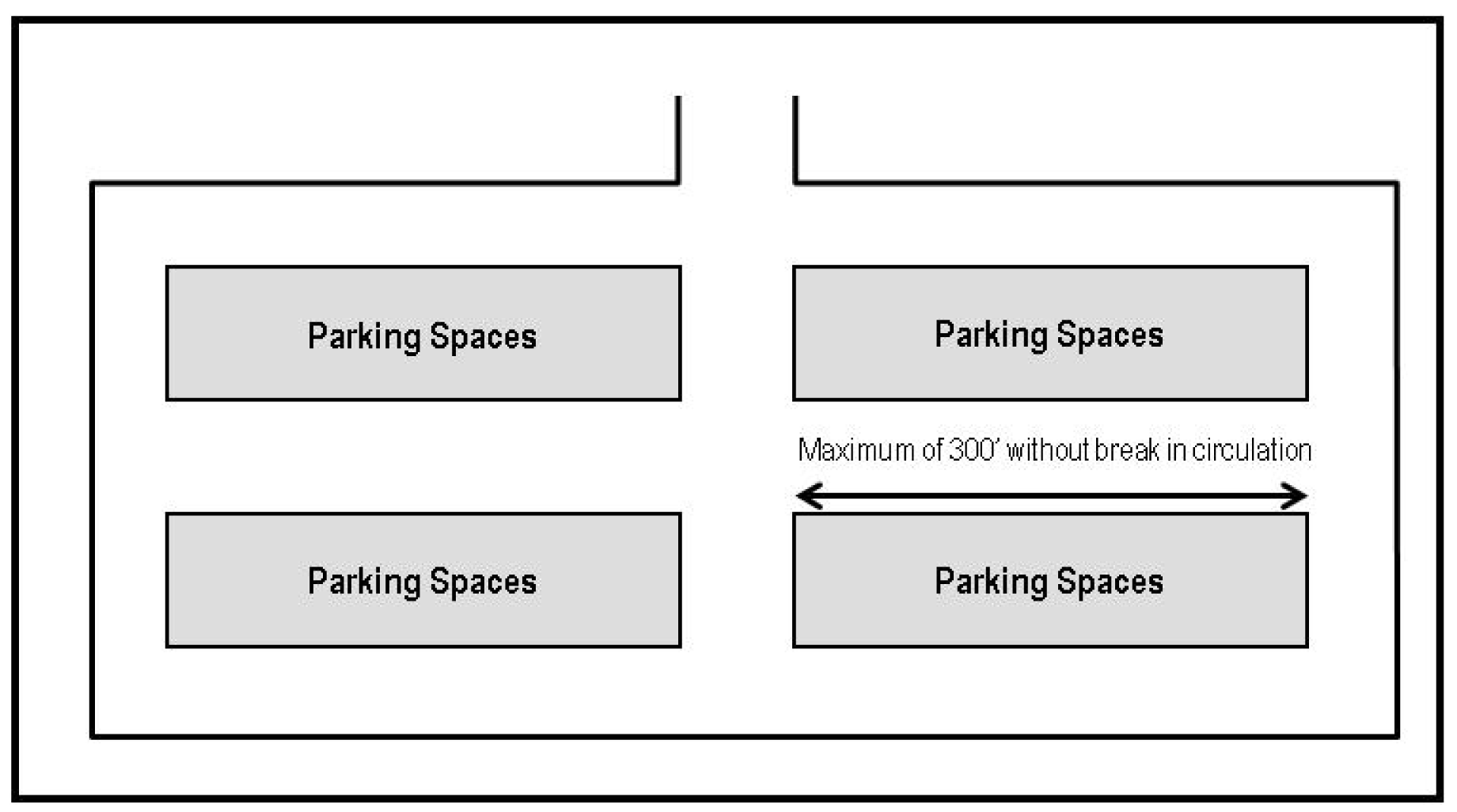
(4)
Orientation of parking.
a.
To the maximum extent possible, and in accordance with the recommendations of the development and neighborhood services department, parking bays within primary parking areas for any building, structure or use shall be perpendicular to the building or structure.
(5)
Internal landscape areas.
a.
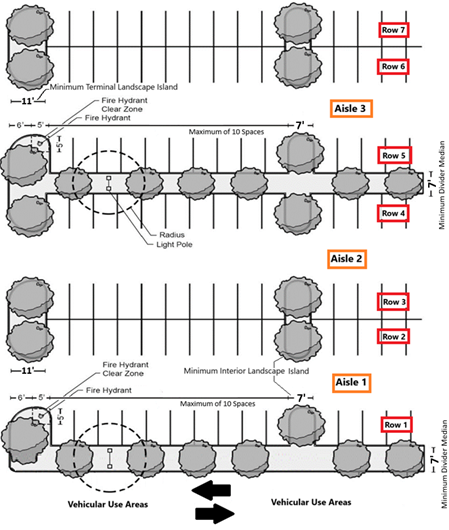
Interior landscape islands. Interior landscape islands, with a dimension of no less than seven (7) feet in net plantable width, shall be placed at intervals of no more than ten (10) parking spaces.
b.
Terminal landscape islands. Terminal landscape islands shall be placed at the end of all rows of parking. Terminal landscape islands shall contain a minimum net plantable width of eleven (11) feet.
c.
Divider landscape medians. Divider landscape medians with a minimum net plantable width of seven (7) feet shall be installed after every fourth row of parking spaces or the second parking aisle, and between all parking spaces and adjacent vehicular use areas as shown in Figure 16-1335(5).
FIGURE 16-1335(5): INTERNAL PARKING AREAS
(6)
Parking and loading adjacent to building.
a.
When parking is permitted directly adjacent to a building or structure, there shall be a minimum separation of four (4) feet between the outside wall of the building or structure and any parking space, except for single-family residential units.
b.
Loading spaces required by this article shall be located directly adjacent to the building which requires the designated loading space. However, no loading space shall be located within a required fire lane.
c.
Alternative loading options. In certain cases, an alternative loading area may be utilized in lieu of a designated loading space as required per section 16-1336 and section 16-1337. Parking spaces and the drive aisles may be utilized during non-business hours for this purpose, provided the development and neighborhood services department determines, that based upon the proposed traffic generation of a particular site, site design, as well as other available technical data and information, that a reduction in the number of loading spaces would not adversely affect traffic circulation, or create a traffic hazard. The alternative loading option must be clearly reflected on the approved site and development plan.
(7)
Use of right-of-way.
a.
No parking or loading space required by this article shall be located within the right-of-way of any street, roadway, or alley.
b.
There shall be no parking or storing of vehicles in landscaped buffers or the ultimate right-of-way. Parking and loading areas shall be designed so that no portion of a vehicle will extend into or over any public right-of-way area, sidewalk, landscaped area or adjacent property.
(8)
Parking in rear of commercial building.
a.
There shall be no parking in the rear of any building or structure unless a pedestrian accessway with a minimum width of five (5) feet is provided connecting the rear parking area to the public entrance in the front of the building, exclusive of whether or not a rear entrance is provided.
b.
In no instance shall any parking space located in the rear of the building interfere or conflict with access to a required off-street loading space, or with any fire lane or fire suppression devices.
(9)
Dumpster location and access.
a.
Required dumpster or trash compactor areas shall be located in a manner which permits safe and direct access to the dumpster for any maintenance or sanitation vehicle.
b.
The location of a dumpster and access thereto shall not interfere with the internal circulation pattern of the site, nor shall the location require a maintenance or sanitation vehicle to traverse any parking space to gain access to the dumpster area.
c.
A minimum area of twelve (12) feet in width by twenty-five (25) feet in depth shall be provided in front of any dumpster area to allow access to the dumpster area while not interfering with the normal circulation pattern.
d.
The minimum dumpster or compactor size shall be determined by the city's solid waste franchisee, and the site shall be surrounded by a concrete wall and locking gate in accord with section 16-757.
(10)
Drop-off zone. The following provisions shall be adhered to when providing a designated drop-off zone adjacent to any building or structure:
a.
The drop-off zone shall be clearly separated from the main flow of traffic;
b.
Bollards may be used to demarcate the limits of the zone, but no chains or other horizontal obstructions shall be used;
c.
When a curb is eliminated from a segment of the zone, the pavement shall be clearly demarcated indicating the ramp location.
(11)
Fire lane required.
a.
A fire lane shall be provided when determined by the city fire marshal to be necessary to protect the public health, safety, and general welfare.
b.
Fire lanes shall be in accordance with the current edition of the Florida Fire Prevention Code, Section 18.2.3 (Fire Department Access Roads) and Exhibit A, Greenacres Amendments to the Florida Fire Prevention Code. The minimum width of a fire lane shall be twenty (20) feet, unless otherwise required by the Fire Prevention Code and Amendments.
c.
The fire lane shall provide clear, unobstructed access for emergency vehicles and apparatus at all times.
d.
Each fire lane shall be clearly marked and identified through signage and painted markings on the pavement surface. The design, location and markings of each fire lane shall be in conformance with the Florida Fire Prevention Code, recommendations of the city fire marshal, and all applicable city codes and regulations.
(12)
Parking for the disabled.
a.
All parking areas shall provide parking spaces, ramps, and accessway for the disabled in accordance with the Florida Accessibility Code, State Uniform Traffic Control Code, city building code, and amendments thereto, and all other applicable city codes and regulations. parking areas shall be provided in accordance with FDOT Index 17346; however, the width of the blue stripe shall be four (4) inches.
b.
The minimum number of disabled parking spaces shall be provided as shown in Table 16-1335(12):
c.
Each disabled parking space shall be striped in accordance with the Florida Accessibility Code and posted with a permanent above grade type FTP55, FDOT Index 17355, sign of a color and design as approved by the Florida Department of Transportation, bearing the international symbol of accessibility and the caption "Parking by Disabled Permit Only Fine of $250" or such fine amount as is currently in effect. The international symbol for accessibility shall also be painted on the surface of the parking space.
d.
All disabled spaces provided as a requirement of this section shall have accessibility to a curb ramp or curb cut, when necessary to allow access to the building served, and shall be located so that users will not be compelled to walk or otherwise move behind parked vehicles. Such ramps shall be located at a minimum of one (1) every one-hundred-thirty (130) feet along the sides of the building which face the parking areas which contain disabled parking spaces. Required ramps shall be designed and constructed in accordance with the Florida Accessibility Code, State Uniform Traffic Control Code, city building code, and all other applicable city codes and regulations.
e.
Disabled parking spaces shall not be in addition to, but shall substitute for required parking spaces.
f.
All disabled parking spaces shall be those parking spaces located to the nearest accessible entrance of the building that the spaces are intended to serve.
(13)
Grassed parking.
a.
Where permitted by this Code, grassed parking spaces may be utilized provided the following requirements and conditions are adhered to:
1.
The minimum size of any grassed parking space shall be determined by section 16-1336.
2.
Grassed parking spaces may not be used to satisfy handicap requirements.
3.
Each grassed parking space shall be provided with a wheelstop or FDOT Type D curbing, constructed of concrete or similar material to demarcate the location of each parking space.
4.
A statement documenting that the parking area proposed for grassed parking will be used for parking on an irregular, intermittent or part-time basis shall be provided. Such statement shall include the proposed hours and days grassed parking is expected to be used and the expected average daily traffic and peak hour traffic counts as calculated by a registered engineer. Plans shall be submitted which ensure that the grassed parking surface will be maintained in its entirety with a viable turf cover.
5.
A permit shall be obtained for the construction of any grassed parking area. The city may require the restoration of the grassed parking area or the permanent paving of the parking area if it is determined that the grassed parking area is not being maintained in accordance with the code.
6.
Any area proposed for grassed parking shall be constructed in conformance with the provisions of this article and any applicable city codes and regulations and the requirements of the development and neighborhood services department.
(14)
Landscaping.
a.
All off-street parking and loading areas shall be landscaped in accordance with Article VII Landscaping and Screening Requirements.
(15)
Lighting. The minimum and maximum permitted illumination and maximum permitted height of each luminaire shall be as shown in Table 16-767(d)(1) and Table 16-767(d)(2). All lighting of off-street parking and loading areas shall be in accordance with Article IV, Division 12, Outdoor Lighting.
(16)
Drainage.
a.
Runoff from parking areas shall be stored and managed in accordance with the rules of the South Florida Water Management District and city regulations applicable at the time, including Chapter 12 (Subdivision Code), as amended. Stormwater runoff should be diverted from impervious areas into permeable landscaping areas as part of the overall stormwater management plan to minimize off-site runoff and maximize on-site water infiltration. Low Impact Development (LID) practices shall be incorporated unless specific site constraints make such measures infeasible. Examples of LID practices include rain gardens, bio-swales, and pervious paving materials and surfaces.
(17)
Traffic signage.
a.
Traffic control signs and other pavement markings shall be used as necessary to ensure safe and efficient traffic operation of parking and loading areas. Such signing and marking shall conform with the Manual on Uniform Traffic Control Devices (MUTCD), city sign regulations, and regulations from all applicable entities.
(18)
Curbs and wheel-stops.
a.
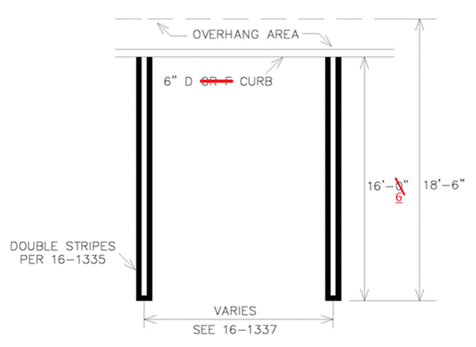
Landscaping and landscaped areas, including intermediate and terminal islands, shall be protected from the encroachment of vehicles by a continuous raised Florida Department of Transportation (FDOT) Type "D" curb appropriate for the location as determined by the Development and Neighborhood Services department. Curbs separating landscaped areas from parking areas may use curb breaks or gaps to allow stormwater runoff to pass through them.
b.
In order to protect landscape areas from encroachment and to enhance the amount of pervious area in parking lots, each parking stall may be 16'-6" deep with an additional 2' overhang when abutting a landscape area. In such cases, the parking stall shall include a continuous raised FDOT Type "D" curb at the far end, with the near face of the curb set 16'-6" into the stall. In lieu of asphalt, the resulting overhang area (2' for a typical 18'-6" deep 90-degree parking stall per Table 16-1337(a)) shall be sod and groundcover when abutting a landscape area. The overhang area does not count toward the minimum required perimeter landscape buffer. (See Figure 16-1335(18))
c.
Alternative designs which address unusual situations but provide the same degree of landscape protection, enhanced pervious area, and pedestrian safety may be approved by the Development and Neighborhood Services department.
d.
Wheel-stops shall be properly anchored and shall be continuously maintained in good unbroken condition.
FIGURE 16-1335(18): CURBING
(19)
Striping of parking and loading spaces.
a.
Every parking space, with the exception of those required for single-family dwelling and two-family dwelling driveways, and for parallel parking spaces, shall be marked with double, hairpin stripes on each side of the parking space. The width of the stripe shall be four (4) inches, the separation between the two (2) stripes shall be between twelve (12) and eighteen (18) inches and the separation shall be centered on the assumed dividing line between the parking spaces. The ends of the stripes at the driving aisle shall be connected by a curved (i.e. hairpin) or straight (i.e. perpendicular) four-inch stripe. Striping is required adjacent to curbing and shall be marked with a single four (4) inch stripe.
b.
Parallel parking spaces shall be marked with a single four (4) inch stripe, twenty-four (24) feet on center.
c.
All stripes for handicapped spaces shall be blue. Striping adjacent to curbing shall be marked with a single width four (4) inch stripe.
d.
Loading spaces shall be marked with a single four (4) inch stripe and shall be designated as a "loading area only" through proper signage and pavement markings.
e.
Parking and loading striping may be paint or thermoplastic. Paint, especially on new asphalt, shall be applied in two (2) coats or as otherwise necessary to assure an opaque finish. Stop bars shall be thermoplastic.
(20)
Shared parking. In mixed-use and commercial zoning districts, an applicant may request to use a shared parking option based on the following criteria. All requests for shared parking shall be incorporated into a separate parking analysis and must be approved by the Development and Neighborhood Services department.
a.
Location: All uses included in a shared parking analysis must be located on the same property. The parking lot must be developed as though the uses onsite were a single unit.
b.
Shared parking study: The shared parking analysis must establish that all approved uses onsite will use the shared parking spaces at different times of the day, week, month, or year. The analysis shall:
1.
Be based on the Urban Land Institute's methodology for determining shared parking or other method approved by the city traffic engineer.
2.
Address the size and type of activity, the composition of the tenants, the rate of vehicular turnover for shared parking spaces, and the anticipated peak parking and traffic loads.
3.
Provide for no reduction in the number of handicapped spaces.
4.
Provide a plan for increasing the number of parking spaces to accommodate all uses based on the standard parking ratios.
5.
The study shall be submitted and approved by the city traffic engineer prior to the application being submitted to the city.
c.
Applicable findings. Shared parking may be approved by the city upon finding that:
1.
The shared parking spaces are in close proximity and readily accessible to the uses served thereby; and,
2.
The uses served thereby have different peak parking demands and operating hours; and,
3.
There will be a reduction in vehicle movements by the users of the shared parking spaces; and,
4.
The design of the parking area in terms of traffic circulation, vehicular and pedestrian access, stormwater management, landscaping, open space preservation and public safety will be improved.
d.
In the event that any of the shared parking uses are changed, or if there is a determination made by the city that the conditions of the original shared parking study have changed, the applicant will either:
1.
Submit a revised parking study, or
2.
Revise the site plan to reflect additional parking spaces based on the number of spaces needed for each use.
(21)
Bicycle parking. Bicycle parking facilities shall be provided in a designated area and by a fixed or stationary bike rack for non-residential uses, residential recreation facilities, residential units without an accompanying individual dedicated enclosed garage, and/or any use which the city determines generates a demand for bicycle parking and shall be provided at a ratio of one (1) bicycle parking space for every twenty (20) parking spaces, but in no case shall be less than a minimum of five (5) bicycle spaces. Bicycle racks shall be located near building entries and distributed across multiple entries or buildings if present.
a.
Bicycle racks placed on private property to meet the minimum requirements for bicycle parking shall follow the form identified as a typical bicycle rack in Figure 16-1335(21) Typical Bicycle Racks; unless a variation is approved by the Development and Neighborhood Services department. Variations from a typical bicycle rack may be approved if the rack meets all of the following requirements:
i.
Supports bicycle by making two points of contact with the bicycle, preventing it from falling over;
ii.
Provides adequate theft protection and security; and
iii.
Allows two bicycles to be parked per rack.
b.
Bicycle parking shall be placed in a manner to avoid conflicts between vehicles, buildings, landscaping, and pedestrian clear zones or sidewalks.
FIGURE 16-1335(21): TYPICAL BICYCLE RACKS

(22)
Commercial business or service vehicles.
a.
Commercial vehicles, excluding all towed trailers regardless of size and weight, may be parked in commercial zoning districts and mixed-use zoning districts developed with a nonresidential use in designated parking spaces on the same property as an associated business with an active business tax Receipt. Commercial vehicle parking shall be depicted on an approved site and development plan or if not depicted on the approved site and development plan then a major site and development plan amendment would be required. Commercial vehicle parking shall not exceed fifteen (15) percent of required parking on-site.
b.
Location.
i.
The applicant must demonstrate that off street parking in front of the business accommodates both customer and employee parking and provide a parking plan on the site and development plan that designates the specific areas for the parking of commercial vehicles as well as the parking for employees.
ii.
Commercial vehicles must not restrict or interfere with the ingress or egress of the abutting property owner or tenant; constitute a hazard to traffic, life, or property; obstruct adequate access by fire, medic, police or sanitation vehicles; encroach on sidewalks, Americans with Disabilities Act (ADA) accessible parking spaces and/or accessible ramps; park on unimproved surfaces (e.g., dirt, sand, vacant lot, etc.); or park in any driveway aisles, "no parking" zones, or loading areas.
c.
Screening. The commercial vehicle parking shall be effectively screened from all public rights-of-way behind a structure, recognizing that occasional visibility may occur.
d.
Registration. The commercial vehicles cannot be inoperative, wrecked, junked, partially dismantled, or abandoned, and must be licensed and registered as required by state law.
e.
Size. The commercial vehicle must be of a size that allows it to park within designated standard parking spaces safely, without creating or becoming a public nuisance.
(Ord. No. 90-43, § 1, 3-18-91; Ord. No. 94-03, § 12, 7-25-94; Ord. No. 99-12, § 6, 3-15-99; Ord. No. 99-20, § 2, 6-21-99; Ord. No. 00-07, § 3, 4-3-00; Ord. No. 2003-16, § 3, 10-7-03; Ord. No. 2010-09, § 9, 6-7-10; Ord. No. 2013-05, § 6, 1-6-14; Ord. No. 2024-19, § 4, 12-16-24)
Sec. 16-1336. - Parking and loading requirements.
The minimum number of parking and loading spaces shall be determined by the following tables. For mixed uses or single uses with two (2) or more integrated uses, each use shall provide its proportional share of the required parking.
Notes:
1. GFA, Gross Floor Area
2. GLA, Gross Land Area
(Ord. No. 90-43, § 1, 3-18-91; Res. No. 92-18, §§ 1,2, 7-6-92; Ord. No. 00-07, § 3, 4-3-00; Ord. No. 2008-02, § 3, 9-15-08; Ord. No. 2013-05, § 6, 1-6-14; Ord. No. 2022-07, § 2, 5-2-22; Ord. No. 2024-19, § 4, 12-16-24)
Sec. 16-1337. - Parking and loading space dimensions.
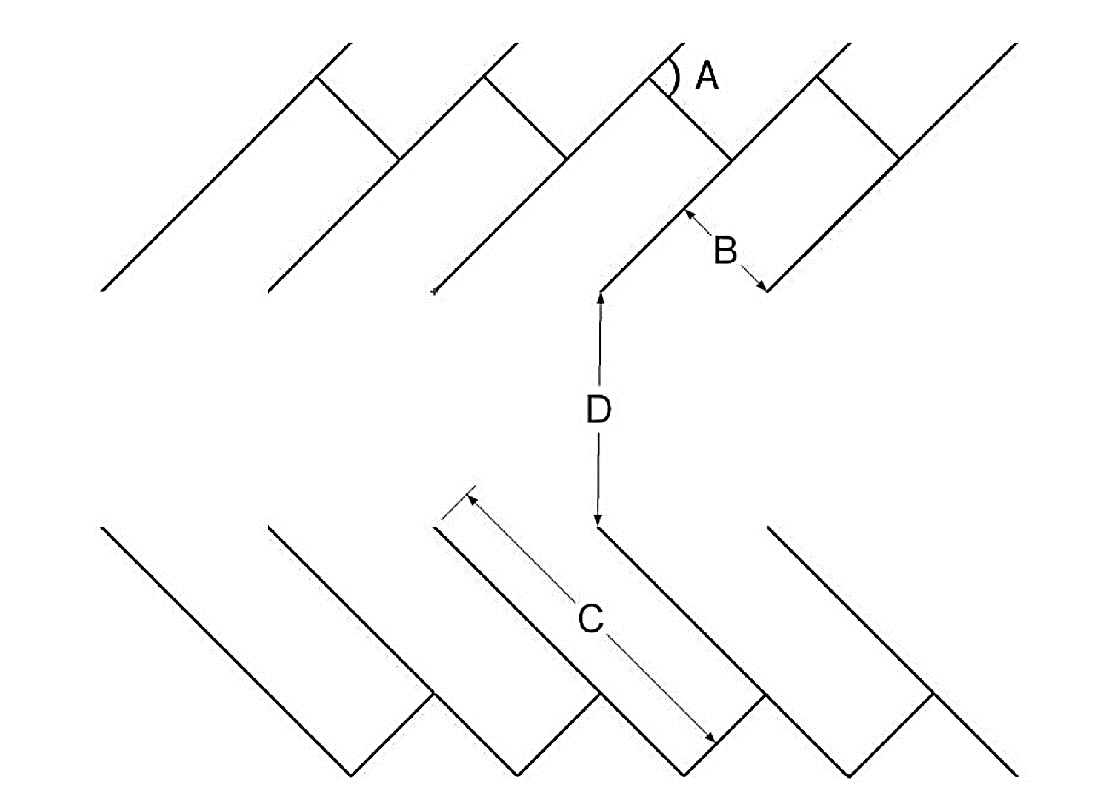
The minimum size of any parking and loading space shall be in accord with the following Tables 16-1337(a), 16-1337(b), and Figure 16-1337:
Notes:
1. Compact spaces only are allowed where permitted by this Code. Each space shall be clearly marked through the use of signage and pavement markings that the space is for compact vehicles only.
2. The minimum width of any designated loading space may be reduced to twelve (12) feet as long as the loading area provided is a minimum of 525 square feet. Additional loading spaces contiguous to and not separated from the first loading space may be a minimum of twelve (12) feet in width. An area equal to the width and length of the loading space shall be provided for vehicular maneuvering directly behind the loading space it is intended to serve.
3. A minimum twelve (12) foot wide stall width is required for parking spaces for the disabled.
4. A minimum twelve (12) feet in net width of parking space clear of obstructions is required for any single vehicle garage and a minimum nineteen (19) feet in net width of parking space clear of obstructions is required for any two (2) vehicle garage. A minimum nineteen (19) feet in net depth of parking space clear of obstructions is required for all vehicle garages.
5. Bicycle parking shall be provided for development in accordance with section 16-1335(21).
FIGURE 16-1337: PARKING DIMENSIONS
(Ord. No. 90-43, § 1, 3-18-91; Res. No. 92-18, §§ 1, 2, 7-6-92; Ord. No. 00-07, § 3, 4-3-00; Ord. No. 2013-05, § 6, 1-6-14; Ord. No. 2024-19, § 4, 12-16-24)
Sec. 16-1338. - Queuing requirements.
Requirements for drive-thru establishments are as follows:
(1)
Each queuing lane must be clearly designed and constructed so as not to conflict or interfere with ingress or egress from the site or with other traffic using the site. A queuing lane shall not share circulation with an access aisle.
(2)
Bypass lanes shall be provided as follows:
a.
Drive thru uses, excluding automated stand-alone car wash facilities, shall provide a continuous bypass lane with a minimum width of ten (10) feet, allowing vehicles to navigate around the drive-through facility without entering the drive-through lane, as illustrated in Figure 16-1338. The bypass lane may share space with a drive aisle.
b.
Automated stand-alone car wash facilities shall provide a point of bypass with a minimum width of ten (10) feet between the pay station and automated car wash tunnel.
(3)
Each queuing space shall be a minimum of ten (10) feet in width and twenty (20) feet in depth.
(4)
The minimum number of queuing spaces, including the vehicle being served, shall be provided in accordance with Table 16-1338 and Figure 16-1338.
FIGURE 16-1338: DRIVE-THRU QUEUING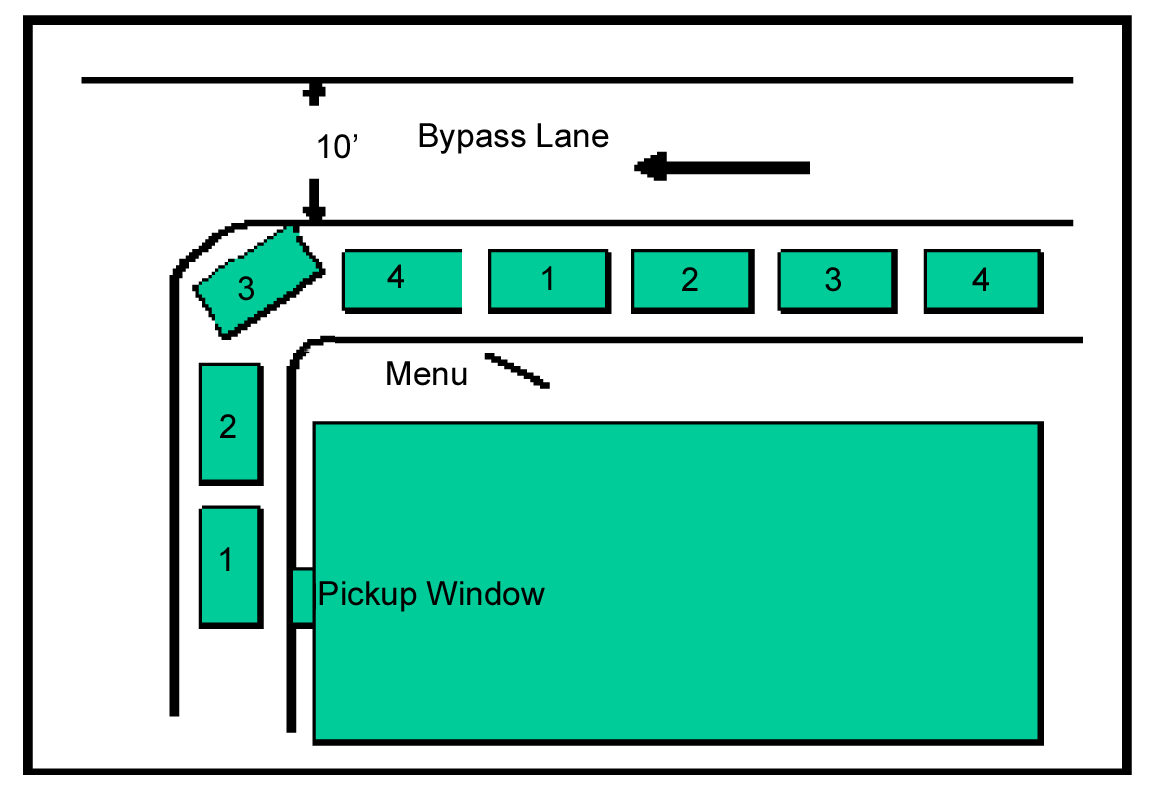
(5)
If the development and neighborhood services department should determine, based upon the proposed traffic generation of a particular site, site design, or site location that additional queuing spaces are necessary, such additional spaces shall be provided in accordance with this Code.
(6)
If the development and neighborhood services department should determine, based upon the proposed traffic generation of a particular site, site design, or site location that a reduction in the number of queuing spaces would not adversely affect traffic circulation, or create a traffic hazard, the number of spaces may be reduced accordingly.
(Ord. No. 90-43, § 1, 3-18-91; Ord. No. 00-07, § 3, 4-3-00; Ord. No. 2010-09, § 9, 6-7-10; Ord. No. 2013-05, § 6, 1-6-14; Ord. No. 2022-07, § 2, 5-2-22; Ord. No. 2024-19, § 4, 12-16-24)
_____
Sec. 16-1339. - Vehicular ingress and egress requirements.
(1)
Entrances and exits connecting parking areas with public streets shall be located in such a manner as to limit any interference with the traffic flow on any adjacent street and adequately serve the site. The number, location, and size of all entrances and exits shall be provided in accordance with these provisions, the recommendations of the appropriate city officials including the city engineer, and all regulations from the applicable entities.
(2)
The minimum width of any accessway shall be fifteen (15) feet for one-way traffic flow and twenty-five (25) feet for two-way traffic flow.
(3)
New entry gates installed in the city, whether for new developments or as a retrofit in existing developments, shall comply with the following requirements:
a.
At a minimum, the entry gate area shall provide adequate turnaround space as depicted in both Layouts 1 and 2, Figure 16-1339(3)(a) and Figure 16-1339(3)(b), respectively.
b.
The attached drawings do not depict medians or other separators between the inbound traffic lanes. If such separators exist or are proposed, one (1) of the inbound lanes shall be a minimum of twenty (20) feet wide and shall have an unobstructed vertical clearance of not less than fourteen (14) feet to provide adequate entry for emergency vehicles.
c.
An entry gate configuration different from that depicted in Layouts 1 or 2, Figure 16-1339(3)(a) and Figure 16-1339(3)(b), respectively, may be allowed if it provides equivalent maneuvering and safety and has been approved by the city's traffic engineering consultant. This includes the use of gates that open automatically using a pavement loop or other sensor and do not require any action by the driver to achieve entry.
d.
A Knox key switch keyed to the City of Greenacres system shall be provided on the driver's side of the widest inbound lane. This switch shall activate the gates to provide the widest opening possible. If double gates block the inbound lane, it shall open both gates. If gates are in series, it shall open all gates in the series to provide rapid access.
FIGURE 16-1339(3)(a): SECURITY GATE SINGLE LANE LAYOUT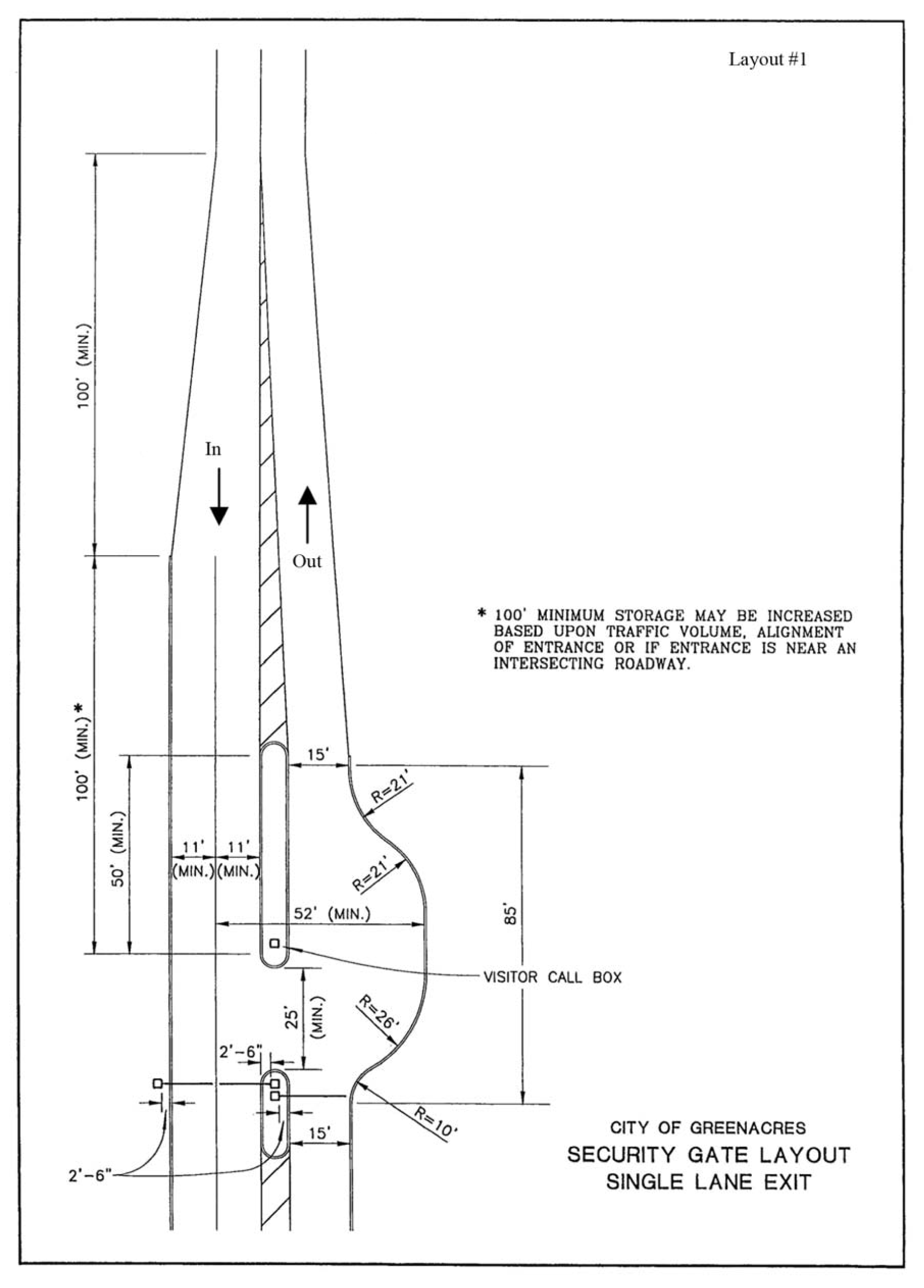
FIGURE 16-1339(3)(b): SECURITY GATE TWO LANE LAYOUT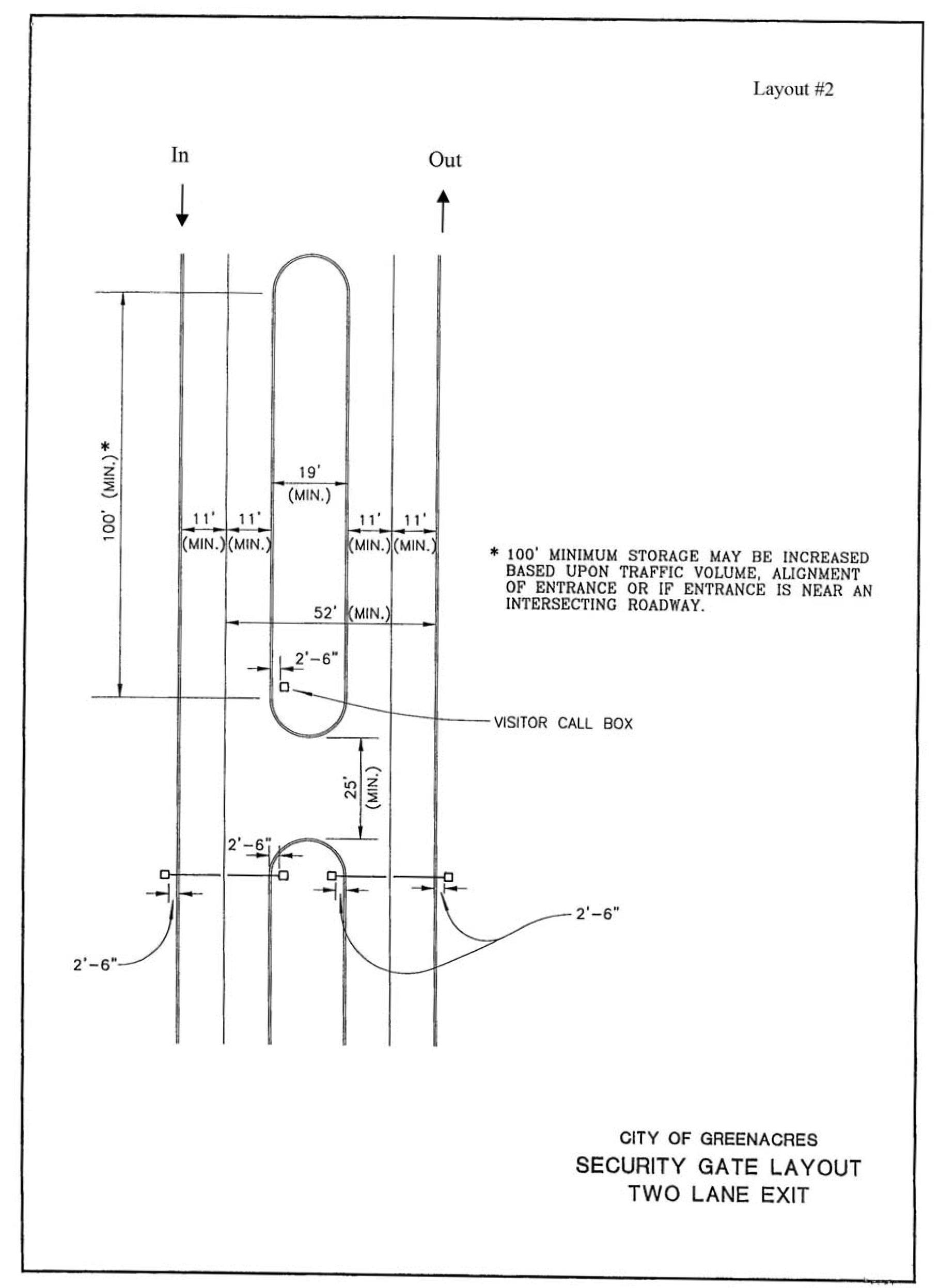
(Ord. No. 90-43, § 1, 3-18-91; Ord. No. 94-03, § 13, 7-25-94; Ord. No. 00-07, § 3, 4-3-00; Ord. No. 2010-09, § 9, 6-7-10; Ord. No. 2013-05, § 6, 1-6-14; Ord. No. 2024-19, § 4, 12-16-24)
Sec. 16-1340. - Enforcement and penalty.
(1)
It shall be unlawful for an owner, operator, or tenant of any building, structure or use to discontinue, change, limit the use of, or dispense with required parking or loading spaces for any building, structure or use in business or operation at the time of said discontinuance or reduction of parking or loading spaces without providing alternative parking facilities which meet the requirements of this article and which are approved by the city. It shall be unlawful for any person, firm or corporation to utilize such building, structure or use without providing the off-street parking or loading spaces to meet the requirements and be in compliance with this article.
(2)
It shall be unlawful for an owner, operator or tenant of a building, structure or use to change, alter, or remove any required landscaping or landscaped area in order to obtain additional area for parking or loading facilities without the approval of the city.
(3)
All parking and loading area projects requiring official action shall require that the owner (or authorized agent) notify the city to perform a final inspection of the project. The city shall inspect all parking and loading areas to determine if the provisions and requirements of this section and all other applicable codes have been met.
(Ord. No. 90-43, § 1, 3-18-91; Ord. No. 00-07, § 3, 4-3-00; Ord. No. 2013-05, § 6, 1-6-14)

