
Greenacres City Zoning Code
ARTICLE VII
LANDSCAPING34
Editor's note— Ord. No. 00-06, § 1, adopted Oct. 16, 2000, deleted and replaced §§ 16-1241—16-1330 in their entirety. Formerly, said section pertained to similar subject matter. See the Code Comparative Table.
Sec. 16-1241. - Purpose and intent.
This article establishes regulations for the proper installation and maintenance of landscaping that will contribute to enhanced visual aesthetics, air purification, absorption of water, regeneration of oxygen, abatement of noise, glare, and heat, and control erosion while improving the appearance of setback and yard areas, and including off-street vehicular parking and open lot sales and service areas in the city. It is also the intent to preserve and protect the appearance, character and value of surrounding neighborhoods and thereby promote the general welfare. The provisions of this of this article are minimum standards for properties in the city, and may be increased in accordance with the requirements established in this Code.
(Ord. No. 00-06, § 1, 10-16-00; Ord. No. 2011-06, § 5, 5-16-11)
Sec. 16-1242. - Applicability.
The provisions in this article shall apply to all new development in all zoning districts, expansion or modification of an existing development, and the installation, disturbance and/or removal of existing vegetation on developed, undeveloped, or vacant land. The provisions in sections 16-1244 and 16-1245 shall apply to all property within the city. In addition, if an off-street parking or loading area existed as the effective date of these landscape regulations, and such off-street parking area is enlarged in area, capacity, or number of spaces, the entire parking area or loading area, old and new, shall comply with the city landscape code.
(Ord. No. 00-06, § 1, 10-16-00; Ord. No. 2011-06, § 5, 5-16-11)
Sec. 16-1243. - Installation.
All landscaping shall be installed according to ANSI 300, as amended, planting procedures, with the quality of plant material as described in this Code. The city shall inspect all landscaping and issue a certificate of occupancy only after all landscaping requirements have been met.
(a)
Landscaping materials shall not be located within any dedicated easement without the written consent from the easement holder authorizing the planting of landscaping within the easement. The consent form shall indicate that if the landscaping is damaged due to the actions of the easement holder, the landscaping shall be replaced with landscaping in accordance with the provisions of this Code by the property owner.
(b)
Planting of any trees within the vicinity of any above-ground power or utility lines shall conform to the criteria shown in "Plant the Right Tree in the Right Place" document issued by Florida Power & Light, or any successor document. This document shall be maintained on file with the planning and engineering department.
(c)
No vegetation other than sod shall be planted within five (5) feet of a fire hydrant and mature growth shall be considered when planting any vegetation near a hydrant to ensure that the five-foot clear area around the hydrant can be maintained in the future.
(d)
If an easement exists along the perimeter of the property proposed for development, and the property owner is unable to obtain the consent from the easement holder to locate landscaping within the easement, a five-foot tree planting strip, located outside the utility easement, shall be provided parallel to the easement to allow for the planting of required perimeter trees and landscaping. The easement shall remain in its natural state or be sodded as appropriate and shall be maintained in accordance with section 16-1245.
(e)
Prior to the commencement of construction, a protective barrier shall be installed and maintained around any tree, stand of trees, ecological community, native habitat or natural feature which are to be preserved until the completion of construction activities on site. The following guidelines shall be maintained at all times:
(1)
A barrier shall be constructed outside of the drip line of the tree(s) to be preserved using either metal rods, or nominal two by four wooden stakes at least six (6) feet long, spaced a maximum of ten (10) feet apart, and connected with brightly colored ribbon or temporary fencing from stake to stake at a height of at least four (4) feet.
(2)
During site development, no soil shall be added or removed or otherwise disturbed, nor shall any construction equipment, liquids, debris or materials, be located within the preserve area.
(3)
No attachments or wires shall be attached to any vegetation during the site development process.
(4)
The protective barrier shall remain in place until all construction activity is completed on site; until a final landscaping inspection is made; or until authorization is granted by the city to remove the protective barrier.
(f)
All newly planted trees shall be properly guyed and staked at the time of planting to insure establishment and vertical growth. Trees shall be re-staked after being toppled or other failure of the staking and guying. Staking and guying shall comply with the specifications as set forth in the tree planting document issued by the Roots Plus Field Growers Association of Florida as amended, ANSI 300 as amended, any successor document maintained on file with the planning and engineering department, or at the discretion of planning and engineering department staff. All stakes shall be removed no later than twelve (12) months after installation.
(Ord. No. 00-06, § 1, 10-16-00; Ord. No. 2011-06, § 5, 5-16-11)
Sec. 16-1244. - Site visibility triangle requirements.
All landscaping within the site visibility triangular areas described below shall provide unobstructed sight visibility at a level between two and one-half (2½) and eight (8) feet in height; provided that trees, palms and shrubs are trimmed so that no limbs or foliage extends into the sight visibility areas. Landscaping, except required solid sod or ground cover, shall be located no closer than three (3) feet from the edge of any accessway pavement unless the trees or species are known to cause root damage. In such case, they shall not be located closer than fourteen (14) feet from the edge of pavement or closer than four (4) feet from the face of curb where it exists, unless the tree or species root system is completely contained within an appropriate root barrier system. Site visibility triangles are defined as follows:
(1)
The area of property located at a corner formed by the intersection of two (2) sides of the triangular area, being a minimum of thirty (30) feet in length along the abutting public right-of-way lines, measured from their point of intersection, and the third side being a line connecting the ends of the other two (2) lines.
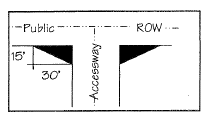
Figure 16-1244(1)
(2)
The area of property formed by the intersection of the accessway, and the public right-of-way line with one side of the triangular area being thirty (30) feet in length along the public road right-of-way line measured from the edge of accessway pavement and one side of the triangle being fifteen (15) feet along the accessway pavement measured from the public road right-of-way line, and the third side being a line connecting the ends of the other two (2) sides.
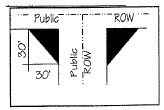
Figure 16-1244(2)
(3)
The area of property formed by the intersection of two (2) private alleys or roadways, with one side of the triangular area being fifteen (15) feet in length along the edge of the private alley or roadway measured from the edge of the private alley pavement and one side of the triangle being fifteen (15) feet along the private alley measured from the edge of the private alley or roadway line; and the third side being a line connecting the ends of the other two (2) sides.
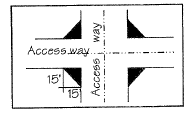
Figure 16-1244(3)
(4)
All proposed development which access onto any roadways which are under the jurisdiction of Palm Beach County shall adhere to the requirements of the most recent version of the "Palm Beach County Streetscape Standards" manual.
(5)
If, due to the unique configuration of a given site, the standards stated above have to be deviated from, then sound engineering principles shall be applied to create the necessary site visibility triangle. In no instance shall the site visibility triangle area be less than those stated above, and shall be subject to city approval.
(6)
In addition to the requirements above, the placement of landscaping shall also comply with the Florida Department of Transportation requirements for road side clear zones and clear site distance.
(Ord. No. 00-06, § 1, 10-16-00; Ord. No. 2011-06, § 5, 5-16-11)
Sec. 16-1245. - General maintenance standards.
(a)
Property owners shall be responsible for maintenance of all landscaping and irrigation equipment. Landscaping shall be maintained in good condition so as to present a healthy, orderly and neat appearance and shall be kept free of refuse and debris. All dead and diseased shrubs and ground cover must be replaced with landscape materials equivalent to that originally planted unless a deviation is approved by the city.
(b)
Periodically, at the discretion of the city, (generally every two (2) years), the city shall inspect each commercial and residential development property to ensure that all required landscaping areas are being maintained in accordance with this section; that no deviations have been made to the landscaping which are not permitted by this article; and to ensure conformance is maintained with the site and development plan, landscape plan, and development order requirements for the site.
(1)
Specifically, these inspections shall ensure that:
a.
All plant materials are, at a minimum, consistent with those shown on the approved landscape plan. A non-residential property which predates the site plan approval process, and/or when there is no clear minimum tree inventory on an approved landscape or other approved plan, a minimum of one (1) tree for every thirty (30) lineal feet and one (1) shrub for every twenty-four (24) lineal inches, consisting of species from Table 16-1307 and 16-1308, shall be provided in planting areas along all perimeter property lines.
b.
The irrigation system is properly functioning and that all landscaping is periodically being watered;
c.
Walls, fences, curbing, pavement and striping is in good order and that any required wheel stops are present and correctly located.
d.
Shrubs and hedges are trimmed, and all grassed areas mowed;
e.
Roadways, curbs and sidewalks are edged; and
f.
No invasive, non-native exotic species or prohibited plant species as listed in section 16-1312(a) within landscaping or preservation areas have been re-established on site.
g.
All preserve and natural areas are maintained with the original number of trees and shrubs as approved and shown on the landscape plans.
1.
For a landscape or a vegetation area designated as "preserve", "reserve", "existing vegetation", "natural areas", or similar designation, with no documented species type and count of native vegetation or tree inventory allocated on the approved landscape or other approved plan, a minimum of one (1) tree and three (3) shrubs, consisting solely of species from Table 16-1307 and 16-1308, shall be required for each two thousand five hundred (2,500) square feet of designated native landscape or vegetation area.
2.
A residential subdivision or development which predates the residential subdivision site plan approval process, and/or when there is no clear minimum tree inventory on an approved landscape or other approved plan, a minimum of one (1) tree and three (3) shrubs, for which at least fifty (50) percent shall be species from Table 16-1307 and 16-1308, shall be required for each two thousand five hundred (2,500) square feet of indicated or historically utilized shared landscape or open common area.
(2)
If the inspection indicates a violation, the property owner shall correct the violation within twenty (20) working days. All replacement landscape materials must, at a minimum, be consistent with the provisions of this article. Any necessary repairs to walls, fences, curbing, pavement or striping must meet city requirements. Failure to correct violations will result in the violator being ordered to appear before the code enforcement board.
(c)
Trees shall be allowed to grow in a shape natural to their species, and shall only be pruned in accordance with the standards established herein to remove limbs or foliage which presents a hazard to power lines or structures, to remove co-dominant leaders or multiple trunks to encourage the growth of one (1) main trunk, or to remove dead, damaged or diseased limbs. In no case shall pruning result in trees which are smaller than the minimum Code requirements for spread or height at planting, or are unnaturally shaped.
(d)
Pruning shall be in accord with the latest edition of the American National Standards Institute (ANSI) Publications (with the exception of Section 2.3.1 of the ANSI A300 Standards, which requires that pruning be performed only by arborists or arborist trainees). Trees shall not be severely pruned, hat racked, "hacked" or "headed back". A maximum of one-fourth of a tree canopy may be removed from a tree within a one-year period, provided that the removal conforms to the standards of crown cleaning, crown thinning, crown raising, vista pruning, and crown restoration techniques. Lifting of branches in excess of one-half (fifty (50) percent) of the height of the tree is prohibited. Palms shall only be pruned to remove lower fronds that are chlorotic or dead, and there shall be no pruning of live green fronds above the horizon line.
(e)
At the discretion of the planning and engineering department and based on the severity of the violation, a tree which is pruned in excess of or in violation of the requirements of this section shall either be replaced or shall be subject to corrective pruning by a certified arborist. Prohibited species as identified in this article shall be exempt from the pruning requirements of this chapter.
(f)
Shaping or topiary pruning of trees, as approved by the city, may be allowed when one (1) or more of the following exist:
(1)
Shaping or topiary pruning when:
a.
The trees are located on owner-occupied property developed for detached single-family or duplex residences; and
b.
The trees were not installed to meet minimum landscape requirements and are identified on an approved site plan or landscape plan or accepted by the city as appropriate for topiary pruning;
(2)
Shaping to alleviate a dangerous condition posing an imminent threat to the public or property, provided that the threat cannot be remedied by measures that are not defined as tree abuse;
(3)
Shaping to protect property such as buildings and infrastructure; or
(4)
There is adequate evidence accepted by the city that prior to the effective date of May 16, 2011, shaping has occurred historically on the subject tree(s).
(g)
Trees shall be properly maintained through irrigation and fertilization, and the following practices which constitute tree abuse are prohibited:
(1)
Destroying/ effectively destroying and cutting upon a tree which destroys its natural habit of growth as defined by City Code;
(2)
Pruning that leaves stubs larger than one (1) inch in diameter, results in a flush cut, or that results in splitting of limb ends;
(3)
Shaping, except as otherwise permitted herein;
(4)
Removing bark to the extent that if a line is drawn at any height around the circumference of the tree, over one-third (⅓) the length of the line falls on portions of the tree where bark no longer remains;
(5)
Tearing and splitting of limb ends or peeling and stripping of bark;
(6)
Severely neglecting tree nutrition and/or irrigation adequate for continued growth;
(7)
Damage inflicted upon any part of a tree, including the root system, by girdling, excavation, chemical application, changes to the natural grade, or storing or using equipment within the drip line of the tree;
(8)
Damage inflicted by cutting a tree which: permits infection or pest infestation, allows stubs larger than one (1) inch in diameter, results in a flush cut, or results in overlifting;
(9)
Pruning of live palm fronds which initiate above the horizontal plane;
(10)
Land clearing without first having barricades up around the drip line of the tree, and/or land clearing without first obtaining a tree removal permit;
(11)
Driving nails or other pointed objects into any portion of a tree;
(12)
Improper guying, bracing or staking of newly planted trees by nailing or other methods which cause cosmetic or biological damage;
(13)
The use of climbing spikes, nails, or hooks, except for the purpose of total tree removal or as specifically permitted by the American National Standards Institute; and/ or
(14)
Pruning in violation of the standards established herein.
(h)
Shrubs used as hedges shall be trimmed to maintain a minimum height of thirty-six (36) inches and may be maintained up to a maximum height of eight (8) feet, unless shrubs are located in a safe sight triangle in accordance with section 16-1244. In the event a hedge is within a residential development approved prior to December 15, 1986, and is within a landscape buffer that does not meet current code requirements for width and abuts property in a non-residential zoning district or a roadway with a classification of "collector" or higher, than such hedge may be maintained up to a maximum height of twelve (12) feet. Any portion of such hedge within a safe site triangle shall be maintained in accordance with section 16-1244.
(i)
Unobstructed passage through road and alley rights-of-way shall be provided. The canopy of trees on private property may overhang road and alley rights-of-way, however it shall be the responsibility of the property owner to trim the tree as necessary to provide a clear passage beneath the canopy at least fifteen (15) feet high within the right-of-way. Shrubs and hedges on private property shall be trimmed by the property owner to ensure they do not encroach any sidewalk or road surface within the road right-of-way or obstruct passage through the alley right-of-way.
(j)
No landscaped areas, including landscaped areas located in the public or private right-of-way or ultimate right-of-way in accordance with section 16-1292 and section 16-1311 of this Code shall be used for the following purpose:
(1)
Storage of any goods, materials, or inventory;
(2)
Sale of any products or services, except at the discretion of the city as permitted by section 16-718 of this Code (temporary use permits); or
(3)
Storage or parking of any vehicles, except parking in those areas which have been approved as grassed parking spaces on private property and except parking on grass swales in accord with Chapter 14.
(Ord. No. 00-06, § 1, 10-16-00; Ord. No. 2011-06, § 5, 5-16-11)
Sec. 16-1246. - Irrigation.
(1)
All landscaped areas shall be provided with an automatically operated irrigation system that will adequately cover all living plant material, or in special cases manually operated systems if approved by the city, between the hours of 5:00 p.m. to 8:00 a.m. All well water systems must be designed and maintained in such a manner that staining of buildings, walls, walks, plants and the like does not occur.
(2)
No permanent irrigation system is permitted within an area designated on a landscape plan for tree preservation or preservation of existing native vegetation.
(3)
Whenever practical, irrigation systems shall be designed in zones to apply water onto lawn areas or a less frequent schedule than those irrigating shrub and tree areas. A rain sensor switch shall be installed on systems with automatic controllers.
(4)
Irrigation systems shall be designed so that watering of impervious areas is eliminated.
(Ord. No. 00-06, § 1, 10-16-00)
Sec. 16-1247. - Landscape plan approval.
No building permit shall be issued for such building or paving until the landscape plan has been approved by the city.
(Ord. No. 00-06, § 1, 10-16-00)
Sec. 16-1248. - Building permit for landscaping and inspections.
(a)
No certificate of occupancy shall be issued for a building until a building permit for landscaping is obtained and a final inspection of the landscaped project has been performed and all landscaping requirements have been met.
(b)
In accordance with the landscape permit requirements, the owner (or authorized agent) shall schedule a final landscaping inspection no earlier than three (3) weeks prior to the final building inspection and ending at the time the final building inspection is made. The city shall inspect all landscaping to determine if all requirements have been met.
(c)
If special conditions exist which prevent the developer of a site from complying with the requirements of the landscape plan, the developer may provide a bond in an amount equal to one hundred ten (110) percent of the cost of materials and labor of the installation of the required landscaping guaranteeing the completion of the Code requirements as part of a temporary certificate of occupancy request. This bond shall run to the city; be in a form approved by and acceptable to the city; and specify the time for the completion of the landscaping. Acceptance of this bond shall be at the sole discretion of the city.
(Ord. No. 00-06, § 1, 10-16-00; Ord. No. 2011-06, § 5, 5-16-11)
Sec. 16-1249. - Building permit for vegetation removal required.
(a)
Applicability. Unless otherwise provided in this article, no person, firm, corporation, association, public agency, or agent or employee, shall destroy, remove, or relocate acceptable vegetation not listed in Table 16-1312(a) from any property without first obtaining a building permit for vegetation removal from the city.
(1)
For residential developments and subdivisions with approved landscape plans and homeowners associations, a building permit is required for vegetation removal. A homeowners association letter of approval must be included in the application. Each tree removed must be replaced with a new tree that meets City Code requirements, located in accord with the approved landscape plan.
(2)
For residential developments and subdivisions without approved landscape plans and with a homeowners association, a building permit is required for vegetation removal. A homeowners association letter of approval must be included in the application. Each tree removed must be replaced with a new tree that meets City Code requirements if removal reduces the number of trees on the lot below Code minimums for quantity. Replacements shall be located on the affected lot.
(3)
For residential developments and subdivisions without approved landscape plans and without a homeowners association, a building permit is required for vegetation removal. Each tree removed must be replaced with a new tree that meets current City Code requirements if removal reduces the number of trees on the lot below Code minimums for quantity. Replacements shall be located on the affected lot.
(b)
Exemptions.
(1)
Prohibited trees listed in Table 16-1312(a) may be removed for any reason without a permit for vegetation removal.
(2)
Other than for trees, the permit requirement for vegetation removal at single-family and duplex residential lots may be waived at the discretion of the planning and engineering director or designee if the vegetation to be removed is replaced at a 1:1 ratio.
(3)
Trees with a trunk less than one (1) inch in diameter, measured at a point which is at least four and one-half (4½) feet above finished grade, may be removed without a permit.
(4)
Removal of dead trees requires a permit, and may require replacement trees to be planted as provided elsewhere in this article, however the permit shall be issued at no charge.
(5)
In the event that a replacement tree is not required as a result of an approved removal (such as if the lot will meet or exceed the minimum tree count requirement after removal), the permit for removal shall be issued at no charge.
(6)
Residential property. As referenced in F.S. § 163.045, residential property shall be defined as a single-family, detached building located on a lot that is actively used for single-family residential purposes and that is either a confirming use or a legally recognized nonconforming use in accordance with the city's zoning regulations. Those parcels or lots that comprise the common elements or community property, in whole or in part, within a PCD, PUD, and or MXD shall not be defined as or deemed to be "residential property" for the purposes of F.S. § 163.045. Residential properties that utilize the state statute exemption are required to possess the required documentation from an arborist certified by the International Society of Arboriculture or a Florida licensed landscape architect that the tree being removed poses an unacceptable risk to persons or property. A tree poses an unacceptable risk if removal is the only means of practically mitigating its risk below moderate, as determined by the tree risk assessment procedures outlined in Best Management Practices - Tree Risk Assessment, Second Edition (2017). If the residential property meets this requirement, then the tree may be removed without a permit.
(c)
Requirements. Each permit application for vegetation removal shall include the following:
(1)
A survey showing the vegetation to be removed; and
(2)
A statement indicating why the removal of vegetation is necessary, as well as the methods to be utilized in removing the vegetation; what steps will be taken to ensure all vegetation required to be preserved will not be damaged or destroyed; and that all work will be conducted in accordance with the provisions of this article and any other applicable city codes or requirements; and any additional information required by the city.
(3)
Fees as established by the city council unless exempted in [section] 16-1249(b) above.
(d)
Any trees being removed which were installed as part of an approved landscape plan will be required to be replaced with the same number of trees which meet the minimum specifications of this article.
(e)
The city shall be notified at least twenty-four (24) hours prior to the commencement of any vegetation removal approved through the issuance of a building permit for vegetation removal. The city shall inspect the site to determine if the vegetation to be preserved is properly identified and protected and if conformance is maintained with the landscape plan and development order for the site. Failure to notify the city at least twenty-four (24) hours prior to commencing the removal process shall result in the immediate issuance of a stop work order and the processing of a violation notice. Any violation of this article is subject to the enforcement provisions of chapter 2, division 2 (code enforcement).
(f)
A permit for tree removal may be issued when the required application data is supplied and the following conditions exist, as applicable:
(1)
The tree constitutes an unreasonable impediment to continuance or development of a permitted use of the property by virtue of its location in a buildable area or yard area where structures or improvements are to be placed and, at the determination of the city, suitable alternatives do not exist;
(2)
The tree is diseased, injured, in danger of falling, is too close to an existing or proposed structure so as to endanger the structure, interferes with utility services, creates unsafe vision clearances, or conflicts with other ordinances or regulations;
(3)
The tree is in excess of the tree requirements for a property containing a single family residence or duplex and is not listed as a preferred native tree or palm in Table 16-1307;
(4)
The tree has been destroyed or died;
(5)
The city requires the tree to be removed;
(6)
The tree proposed to be removed is growing too close in proximity to another tree to permit normal growth and development of the affected tree;
(7)
The tree is not considered a designated historic or specimen tree:
a.
Older than fifteen (15) years;
b.
Very large size for its species; and/or
c.
Of a rare variety.
(8)
The tree cannot be relocated on or off the site;
(9)
The planning and engineering director or designee has determined that removal will be in the public interest.
(g)
If a prohibited tree species listed in Table 16-1312(a) is present on the property, a permit for tree removal in conjunction with (f) above will be issued conditioned upon removal of the prohibited tree species prior to final inspection of the permit.
(Ord. No. 00-06, § 1, 10-16-00; Ord. No. 2011-06, § 5, 5-16-11; Ord. No. 2019-17, § 1, 12-16-19; Ord. No. 2022-21, § 1, 9-14-22)
Sec. 16-1250. - Violations and enforcement.
(a)
Failure to install or maintain landscaping according to the terms of this article shall constitute a violation of this Code. Also, failure to plant, preserve, or maintain each individual tree shall be considered to be a separate violation of this Code. Each day in which either landscaping or individual trees are not installed or maintained according to the terms of this article shall constitute a continuing and separate violation of this Code.
(b)
If an inspection for compliance with the requirements of this article indicates a violation, the property owner shall correct the violation within twenty (20) working days. All replacement landscape materials must, at a minimum, be consistent with the provisions of this article. Any necessary repairs to walls, fences, curbing, pavement or striping must meet city requirements. Failure to correct violations will subject the property owner to code enforcement action in accord with sections 2-72 or 2-72.1.
(c)
Failure to obtain a permit for clearing, grubbing and/ or removing trees from developed property constitutes a violation of this code. If the site has been cleared or grubbed and/ or trees have been removed from the site so that it cannot be determined with reasonable certainty the number of trees removed, the violation shall be corrected by paying a fine of up to one dollar ($1.00) per square foot of land cleared or grubbed. The fine shall be enforced by code enforcement procedures in accord with section 2-72. The fines assessed under this subsection shall be payable to the city within seven (7) days after assessment. All amounts received by the city pursuant to this subsection shall be deposited in the tree dedication program.
(d)
Failure to obtain a permit for clearing, grubbing and/ or removing trees from undeveloped property or property in an undisturbed natural state constitutes a violation of this code. If the site has been cleared or grubbed and/ or trees have been removed so that it cannot be determined with reasonable certainty the number of trees removed, the violation shall be corrected by paying a fine of up to two dollars ($2.00) per square foot of land cleared or grubbed. The fine may be reduced by planting trees in accord with a plan approved by the city. The fine shall be enforced by code enforcement procedures in accord with section 2-72. The fines assessed under this subsection shall be payable to the city within seven (7) days after assessment. All amounts received by the city pursuant to this subsection shall be deposited in the tree dedication program.
(Ord. No. 2011-06, § 5, 5-16-11)
Sec. 16-1266. - General concept and design.
Landscape plans for new developments or modifications to existing developments shall be simultaneously submitted to the city as part of the site and development plan application. Proposed landscaping designs will be reviewed and evaluated with their relationship to the existing landscape areas, developed sites, or other proposed landscaped areas including those on adjacent properties and street right-of-way, and the building existing or proposed on the site and development plan.
(1)
Creative site development concepts shall be used in order to promote water conservation. Water requirements may be reduced by providing for and incorporating the following concepts within the landscaping plan:
A.
The preservation of existing plant communities;
B.
The reestablishment of native plant communities;
C.
Limiting the amount of lawn grass areas;
D.
The use of plant materials which are particularly well suited to withstand the physical growing conditions which are normal for that location;
E.
The use of shade trees to reduce transpiration rates of lower story plant materials;
F.
Site development that retains stormwater runoff on site;
G.
Where permitted and feasible, the use of pervious paving materials;
H.
Site development that addresses the carrying capacity of the land in its present and future form; and
I.
Other environmentally sensitive site design concepts, including the use of xeriscape principles (see section 16-1305).
(2)
Landscape plans which do not meet the requirements of this article may be approved if it contains specific features which meets the purpose and intent of this article through the use of creative and unique landscaping techniques. Requests to deviate from the requirement of this article shall be provided indicating the reason for the deviation, an explanation as to how the deviation meets the purpose and intent of this article, and how the deviation enhances the overall landscape plan. Any proposed deviation from the requirements of this article shall be reviewed by the city prior to the submittal of the landscape plan to city staff. No deviation shall be permitted unless specifically authorized by the city.
(Ord. No. 00-06, § 1, 10-16-00)
Sec. 16-1267. - Site data.
(1)
The landscape plan shall be drawn to the same scale as the site and development plan and shall:
A.
Delineate existing and proposed parking spaces, aisles, building and impervious areas, accessways, and other vehicular use areas;
B.
Indicate by diagram, the proposed location of water supply, sprinklers, and any proposed sprinkler zones;
C.
Designate by name, number, and location, all landscape materials to be used;
D.
Show all landscape features, including areas of native vegetation required to be preserved, in context with the location and outline of existing and proposed buildings and other improvements upon the site;
E.
Indicate the condition of soils and the method of installation of all plant materials;
F.
Include a tabular display of the relevant statistical information necessary for the city to evaluate compliance with the provisions of this article, including total site area, total pervious area of the site, total impervious area of the site (excluding sidewalks and the foundation of any building on site), required and provided landscape areas, required and provided trees and shrubs; square footage of preservation areas; the number, type, and size of trees to be planted, preserved and relocated; and any other information required by the city;
G.
Indicate property boundaries, easements, rights-of-way, existing or proposed buildings, structures or other improvements, existing or proposed utility services, bodies of surface water, and the nature of adjacent land uses;
H.
Indicate the number, location and species of trees to be removed; and
I.
Any additional information that is required by the city to adequately review the proposed landscape plan.
(2)
All plant materials shown on the landscape plan shall be selected for their functional, as well as aesthetic value.
(3)
Plant species indicated on the approved landscape plan shall not be changed without prior approval of the city.
(4)
The landscape plan shall be prepared by a professional licensed in the State of Florida, who is authorized to sign and seal landscape plans.
(Ord. No. 00-06, § 1, 10-16-00)
Sec. 16-1268. - Environmental assessment report.
As part of the landscape plan submittal, the applicant shall provide a written assessment of the current environmental conditions found on site, including any endangered or threaten flora or fauna, or ecological communities.
(Ord. No. 00-06, § 1, 10-16-00)
Sec. 16-1269. - Existing tree survey.
A survey of existing trees on the site and a topographic survey shall be required as part of the landscape plan application and submittal, either as part of the landscape plan or on a separate tree survey map. All existing trees must be identified and labeled.
(Ord. No. 00-06, § 1, 10-16-00)
Sec. 16-1270. - Preservation of existing plant material.
The natural landscape character shall be preserved, whenever possible. In instances where living, native plant material exists on a site prior to its development, in part or in whole, for purposes of off-street parking or other vehicular use areas, the city may provide credit, pursuant to section 16-1270, for preserving or relocating the natural landscape on site against the requirements of this article.
(1)
Historic, valuable, endangered or threatened trees.
Upon submittal of a landscape plan, the city shall determine if any existing trees are historic, valuable, endangered or threatened and therefore, required to be preserved. This determination shall be based on the following:
A.
Any tree(s) listed on the endangered, threatened, or commercially exploited plant lists as set forth in Chapter 581.185, Florida Statutes.
B.
Any tree(s) which, due to its location within the city or individual site, age, specie type, rarity, unique size or shape, health or viability, and similar irreplaceable assets which identifies it as historically significant.
C.
Said tree or stand of trees consist of one (1) or more of the drought and freeze tolerant native species identified in section 16-1307.
D.
Notification from any local, regional or state agency having jurisdiction or regulatory authority over the preservation of historic, valuable, endangered or threatened trees, indicating the tree(s) should be preserved.
(2)
Ecological communities, native habitats and natural features.
A.
Existing environmentally suitable native vegetation and plant communities shall be protected and incorporated into the site development and landscape plan wherever feasible. Certain natural plant communities shall be given special protection appropriate to the geographical area as determined by the city and shall be protected and preserved as total entities, including under stories.
B.
Upon the submittal of the landscape plan, the city shall complete an evaluation to determine whether any significant ecological communities, native habitats or unique natural features exist on site which should be preserved. This evaluation may be conducted by the city in conjunction with other appropriate local, regional and state agencies.
C.
The determination of whether a site proposed for development contains an ecological community, native habitat, or unique natural features worthy of preservation shall be based upon the following criteria:
1.
Notification from any applicable local, regional or state agency having jurisdiction or regulatory authority over the preservation of ecological communities, native habitats or unique natural features.
2.
Any site which includes such features as groves, watercourses, wetlands, historic sites, native tree stands, habitat areas, endangered or threatened animal and wildlife species, and similar irreplaceable assets.
3.
Any site which contains any endangered or threatened animal or plant species as identified in Chapters 372 and 581 of the Florida State Statutes.
D.
Ecological communities, native habitats and natural features required to be preserved shall be provided protection from damage or destruction throughout the development process in accordance with the provisions of section 16-1243(4) and as required by government agencies having jurisdiction.
(3)
Relocation of trees.
A.
Wherever and whenever possible, existing native, drought tolerant plant materials and trees which would otherwise be removed or destroyed by the development of the site shall be relocated on the site under development.
B.
The following shall be considered in determining an appropriate relocation area:
1.
Existing vegetative coverage on site and in the immediate area;
2.
Quantity of vegetation to be removed from the entire site;
3.
The type, size and condition of the vegetation;
4.
Feasibility of relocating the particular vegetation;
5.
The topography and drainage of the site; and
6.
The compatibility of the receiving location on site.
C.
One (1) tree credit shall be granted for the relocation of each native, drought tolerant tree species with a six (6) inch diameter or less at a point which is at least four and one-half (4½) feet above grade, provided the tree to be relocated is determined by the city to be worthy of preserving and relocating according to the standards in section 16-1270. Credit for trees with diameters greater than six (6) inches may be granted provided documentation is provided indicating the process to be utilized to relocate the tree ensuring its continued survival. An analysis shall be made by the city, taking into account the tree species, relocation procedures, and rate of survival, to determine if credit shall be granted.
D.
If the receiving site for relocated trees is not yet prepared, a suitable storage site shall be maintained for the trees which will allow for their safekeeping and continual maintenance until the receiving site is prepared to accept the trees.
(Ord. No. 00-06, § 1, 10-16-00)
Sec. 16-1271. - Credit for preserved plant material.
(1)
To encourage plant preservation and relocation, credit may be granted by the city against the requirements of this article, based on Table 16-1271:
Table 16-1271: TREE CREDITS
(2)
Tree species which are defined as prohibited species by this Code, or which are dead, dying, diseased or infested with harmful insects, are not eligible to receive tree credits.
(3)
Trees for which credit is granted shall be protected from damage or destruction throughout the development process in accordance with section 16-1243(e).
(4)
If any of the preserved or relocated trees for which credit is given, become damaged, diseased, or die, each tree shall be replaced by the number of living trees required according to the standards established in Table 16-1271.
(Ord. No. 00-06, § 1, 10-16-00; Ord. No. 2011-06, § 6, 5-16-11)
Sec. 16-1272. - Eradication of prohibited plant species.
Each landscape plan required to be submitted in accordance with section 16-1266 shall include a program to eradicate and prevent the reestablishment of prohibited plant species listed in section 16-1312.
(Ord. No. 00-06, § 1, 10-16-00)
Sec. 16-1286. - Perimeter landscape requirements.
(1)
Perimeter landscape buffer types are established for all development, in accordance with Table 16-1286(1) and Figure 16-1286(1) except as otherwise required in mixed-use zoning districts.
Notes:
1 Major roadways are defined as Urban Principal Arterial, Urban Minor Arterial, and County Collector roadways as shown in Table 1 of the Transportation Element of the Comprehensive Plan.
2 Minor roadways are defined as city collector and local streets.
3 Development in transition zones (Art. IV, Div. 7) shall conform to these landscape regulations except that the required planting strip shall be a minimum twenty-five (25) feet in width and that one (1) tree shall be provided each twenty-five (25) lineal feet within the perimeter landscape strip area, except for parcels with total depth of less than one hundred fifty (150) feet where the required landscape strip shall be a minimum of fifteen (15) feet.
4 Unless otherwise provided in regulations for the specific use, special exception uses in residential districts shall utilize the standards shown for non-residential development.
5 Public schools, parks, and government uses shall utilize the standards shown for non-residential development except that a six (6) foot high wall is not required.
6 Private schools shall utilize the standards shown for non-residential development except that a six (6) foot high wall is not required for sites which are a minimum of two (2) acres in size and on which a rear setback of at least fifty (50) feet and a side interior setback of at least twenty-five (25) feet are provided to playgrounds and primary buildings.
Figure 16-1286(1)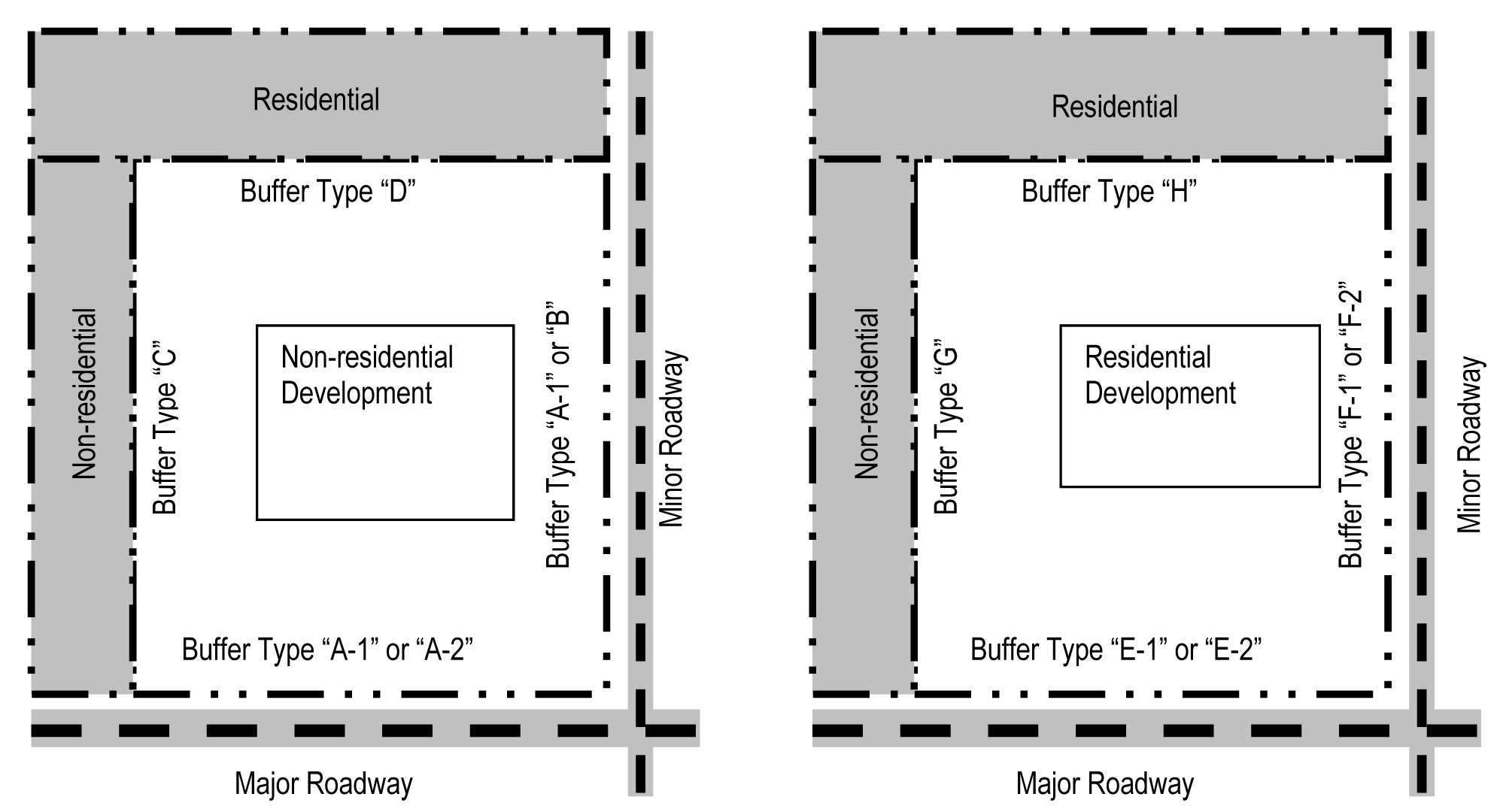
(2)
Requirements are established for each buffer type in accordance with Table 16-1286(2)(a) and 16-1286(2)(b).
Notes for Table 16-1286(2)(a) and Table 16-1286(2)(b):
1 Trees shall be a minimum of twelve (12) feet in height, with a minimum diameter of two (2) inches, a minimum of five (5) feet of clear trunk, and a minimum five-foot canopy spread immediately after planting. Palms with a minimum height of twelve (12) feet of clear trunk may be substituted for up to thirty (30) percent of the required number of trees. A grouping of three (3) palms will be the equivalent of one (1) canopy tree.
2 Shrubs and hedges shall be installed at a minimum of twenty-four (24) inches in height and eighteen (18) inches in spread immediately upon planting, and spaced at a maximum of twenty-four (24) inches on center. If a hedge is being planted in conjunction with a wall or fence, the hedge shall be located between the street and the wall or fence. If a hedge is planted in conjunction with a berm, the hedge shall be located on top of the berm.
3 A landscape berm which will not incorporate a wall shall be constructed in a non-linear (meandering and undulating) manner. All berms shall have a maximum slope of a 3:1 ratio.
4 If a Type H buffer is to be located adjacent to an existing residential buffer greater than ten (10) feet in width, then the required buffer may be reduced so that the total buffer width equals twenty (20) feet. In any event, all landscape materials listed in Table 16-1286(2)(b) shall be installed.
5 All interior landscaped areas not dedicated to trees or to preservation of existing vegetation shall be landscaped with ground cover, shrubs, grass, or other appropriate landscape treatment.
6 Where single family residential is proposed adjacent to an existing non-residential development which has no fence or wall, a six (6) foot high opaque fence, constructed with materials approved by the planning and engineering, and building departments, shall be installed on the property line.
(Ord. No. 00-06, § 1, 10-16-00; Ord. No. 2011-06, § 7, 5-16-11)
Sec. 16-1287. - Interior landscape requirements for non-residential developments and districts and residential shared parking areas.
In addition to the perimeter plantings required in section 16-1286, all non-residential and mixed-use developments and all shared parking areas in residential developments shall provide the following:
(1)
A minimum of ten (10) percent of the area devoted to parking or other vehicular uses shall be landscaped. This shall include all impervious surfaces except the building footprint and any sidewalk areas. Each separate landscaped area shall contain a minimum of fifty (50) square feet of net planting area, with a minimum clear interior planting dimension of seven (7) feet. These landscaped areas shall include at least one (1) canopy tree or equivalent grouping of palms. The total number of trees shall be no less than one (1) for each one hundred (100) square feet, or fraction thereof, of required interior landscaped area. The remaining area shall be adequately landscaped with shrubs, ground cover or other authorized landscape treatment, not to exceed three (3) feet in height.
(2)
Between five (5) and ten (10) percent of the required interior landscaping shall be located around the foundation area of any buildings or structures on site. The foundation landscaping shall include a proportionate number of trees as required for the interior landscaping area. Foundation landscaping shall be located between the building and the sidewalk servicing the building, between the building and any accessway or parking aisle, or between the sidewalk servicing the building and any accessway or parking aisle.
(3)
Up to fifty (50) percent of the total requirement of landscaping for interior parking spaces may be relocated to emphasize major vehicular accessways to parking areas.
(4)
All planting materials shall be installed in such a manner as to preclude any vehicular encroachment or overhang into any required landscape areas or pedestrian pathways.
(5)
All interior landscaped areas not dedicated to trees or to preservation of existing vegetation shall be landscaped with ground cover, shrubs, grass, or other appropriate landscape treatment.
(Ord. No. 00-06, § 1, 10-16-00; Ord. No. 2011-06, § 7, 5-16-11)
Sec. 16-1288. - Interior landscape requirements for residential developments and districts.
In addition to the required perimeter plantings stated in section 16-1286, all interior residential parcels and uses for residential developments shall provide the following:
(1)
A minimum of one (1) tree and three (3) shrubs shall be installed or preserved per one thousand five hundred (1,500) square feet of area per residential parcel. A minimum of one (1) tree, or equivalent grouping of palms, of the cumulative tree requirement shall be planted within the front yard.
(2)
A minimum of one (1) tree and three (3) shrubs shall be installed or preserved per two thousand five hundred (2,500) square feet of areas designated as open space, excluding water management tracts or preserve areas designated under the provisions of section 16-1270.
(3)
All recreation or civic areas shall be landscaped, at a minimum, according to the provisions of section 16-1287.
(4)
All vegetation being installed or preserved must meet the criteria of this article for consideration as having met the internal landscape requirements.
(5)
The minimum number of trees for single family parcels which are served by septic tanks may be reduced by the city if it can be shown that the required number of trees cannot be accommodated on site in a manner that will allow for the healthy growth of these trees, while ensuring the proper functioning of the septic system.
(6)
All landscaped areas not dedicated to trees or to preservation of existing vegetation shall be landscaped with ground cover, shrubs, grass, or other appropriate landscape treatment. Non-living materials, such as rocks and pebbles, excluding synthetic turf, may be incorporated, provided they do not exceed ten (10) percent of the total landscape area.
(7)
Synthetic turf that complies with Florida Department of Environmental Protection (DEP) standards adopted pursuant to F.S. §125.572, as amended, may be installed on single family residential properties that are one (1) acre or less in size.
(8)
Single family subdivisions containing roadway easements for access in lieu of platted roadway tracts shall not have said easement considered as part of the lot area when calculating the minimum landscape requirements. This applies to the following subdivisions:
a.
Buttonwood.
b.
Buttonwood West (aka Buttonwood Plat 2).
c.
Lucerne Homes East.
d.
Mil-Lake Estates Plat 1 (aka Mil Lake Court, Mil Pond Court, Mil Stream Court).
e.
Mil-Lake Estates Addition No. 1 (aka Mil Race Court).
f.
Mil Lake Estates Plat 3 (aka Mil Run Court).
g.
Sunland Estates.
(Ord. No. 00-06, § 1, 10-16-00; Ord. No. 2011-06, § 7, 5-16-11; Ord. No. 2025-06, § 4, 12-1-25)
Sec. 16-1289. - Mix of tree types.
When more than ten (10) trees are required to be planted to meet the requirements of this article, a mix of species shall be provided as follows:
Table 16-1289: TREE SPECIES MIX
(Ord. No. 00-06, § 1, 10-16-00)
Sec. 16-1290. - Planting around signs and dumpster enclosures.
The following planting requirements for all free-standing signs and dumpster enclosures shall apply:
(1)
Shrubs at least twenty-four (24) inches in height and with a spread of eighteen (18) inches, and spaced at a maximum of twenty-four (24) inches on center, shall be installed around the outside base of the dumpster enclosure.
(2)
Shrubs at least twenty-four (24) inches in height and with a spread of eighteen (18) inches, and spaced at a maximum of twenty-four (24) inches on center, in a planting bed no less than three (3) feet in width, shall be installed around all free-standing identification and internal directory signs.
(Ord. No. 00-06, § 1, 10-16-00; Ord. No. 2011-06, § 7, 5-16-11)
Sec. 16-1291. - Littoral planting areas.
In order to enhance overall water quality, littoral areas of retention ponds shall be required to be landscaped with appropriate wetland vegetation. Littoral plantings shall be provided between one (1) foot above the Ordinary Water Low (OWL) line to two (2) feet below the OWL. Plantings shall be provided at a rate of eight (8) square feet per lineal foot of shoreline, with individual plants located no further than two (2) feet on center. Littoral planting areas shall include at least five (5) types of appropriate wetland vegetation, including water plants and wetland trees.
(Ord. No. 00-06, § 1, 10-16-00)
Sec. 16-1292. - Landscaping of rights-of-way.
All right-of-way abutting a site shall be sodded and subject to the maintenance responsibility provisions as stated in section 11-68. Any adjacent median shall be landscaped utilizing high planting schemes in accordance with Palm Beach County streetscape standards.
(Ord. No. 00-06, § 1, 10-16-00; Ord. No. 2011-06, § 7, 5-16-11)
Sec. 16-1293. - Tree dedication requirement.
All new commercial developments approved in the city shall participate in the city's tree dedication program. One (1) Florida grade #1 container grown Live Oak tree with minimum dimensions of twelve (12) feet in height; two (2) inches in diameter trunk at four (4) feet, and with a five-foot spread shall be dedicated at a rate one (1) tree per one thousand (1,000) square feet of building coverage or a fraction thereof.
(Ord. No. 00-06, § 1, 10-16-00; Ord. No. 2025-06, § 4, 12-1-25)
Sec. 16-1304. - Plant selection.
During the preparation of a landscape plan, it is recommended that only drought and freeze tolerant species be specified. Tree, hedge, and shrub species which do not meet the required dimensions shall be subject to approval by the city.
(Ord. No. 00-06, § 1, 10-16-00)
Sec. 16-1305. - Xeriscape principles.
(1)
Use of xeriscape principles in the design of landscaping areas within the city is strongly encouraged in order to promote the use of native, drought tolerant plants; reduce demand on water resources; and to encourage the use of plants which does not require special attention or maintenance in order to grow properly.
(2)
The following xeriscape principles should be followed on all landscape plans required to be submitted in accordance with section 16-1266:
(A)
Appropriate planning and design of all landscaping areas;
(B)
Limiting turf areas to only those locations where it provides functional benefits;
(C)
Using efficient irrigation systems;
(D)
Using soil amendments to improve the water holding capacity of the soil;
(E)
Using mulches where appropriate;
(F)
Using drought tolerant plants as identified in section 16-1307; and
(G)
Assurance of appropriate and timely maintenance.
(Ord. No. 00-06, § 1, 10-16-00)
Sec. 16-1306. - Quality of plant materials.
Plant materials used shall conform to the Standards for Florida No. 1 or better, as shown in "Grades and Standards for Nursery Plants," Parts I and II, State of Florida, Department of Agriculture. All plant materials shall be clean and free of weeds, noxious pests, or disease, and have full foliage to the plant base at time of installation. Plants that are known to be injurious to pavement or the public, or which produces a quantity and quality of debris so as to present maintenance difficulties shall not be specified for use under these regulations. Synthetic plant materials shall not be used in lieu of the plant requirements stated herein.
(Ord. No. 00-06, § 1, 10-16-00)
Sec. 16-1307. - Trees.
All trees used as part of an approved landscape plan shall incorporate the following standards:
(1)
Trees shall be a minimum of twelve (12) feet in height, with a minimum diameter of two (2) inches at a point which is at least four and one-half (4½) feet above finished grade, have a minimum of five (5) feet of clear trunk, and have a minimum of a five (5) foot canopy spread immediately after planting.
(2)
Trees having an average mature spread of less than fifteen (15) feet may be substituted by grouping the same, so as to create an equivalent of a 15-foot crown spread.
(3)
Palms may be substituted for up to thirty (30) percent of the required number of trees. Trees or palms susceptible to lethal yellowing, as identified by the state department of agriculture shall not be used. A grouping of three (3) palms will be the equivalent of one (1) canopy tree. Palm species shall have a minimum height of twelve (12) feet of clear trunk immediately after planting.
(4)
Fifty (50) percent or more of the required trees for a project shall consist of one (1) or more of the following drought and freeze tolerant native species shown in Table 16-1307:
1 These species shall be located near water sources such as ponds or swales.
(Ord. No. 00-06, § 1, 10-16-00; Ord. No. 2011-06, § 8, 5-16-11)
Sec. 16-1308. - Small trees, shrubs and hedges.
(a)
Where required, hedges shall be installed in a non-linear (meandering and undulating) manner at a minimum of twenty-four (24) inches in height and eighteen (18) inches in spread immediately upon planting, and spaced at a maximum of twenty-four (24) inches on center.
(b)
If a hedge is being planted in conjunction with a wall or fence, the hedge shall be located between the street and the wall or fence.
(c)
If a hedge is being planted in conjunction with a berm, the hedge shall be located on top of the berm.
1 These species shall be located near water sources such as ponds or swales.
(Ord. No. 00-06, § 1, 10-16-00; Ord. No. 2011-06, § 8, 5-16-11)
Sec. 16-1309. - Vines.
Vines, though not necessarily required, if used shall be a minimum of eighteen (18) inches in length immediately after planting, when used in conjunction with fences, screens or walls to meet physical barrier requirements as specified.
(Ord. No. 00-06, § 1, 10-16-00)
Sec. 16-1310. - Ground cover.
(1)
Ground covers, other than grass, shall be planted in such a manner as to present a finished appearance and reasonably complete coverage within nine (9) months after planting, which usually grow no higher than two (2) feet.
(2)
Mulch may be used as a permanent ground cover in those areas where ground cover or grass is inappropriate. Where mulch is intended to be installed permanently, it shall be replenished and maintained at a minimum depth of two (2) inches.
(Ord. No. 00-06, § 1, 10-16-00)
Sec. 16-1311. - Lawn grass.
Grass areas including abutting rights-of-way which have been set aside in an approved landscaping plan for growing grass, shall be planted in solid sod, unless otherwise authorized. In such instances, the city shall determine when plugging, sprigging or seeding will be allowed. If seeding, sprigging or plugging is allowed but fails to establish a complete ground cover within ninety (90) days, sod shall be required to be installed.
(Ord. No. 00-06, § 1, 10-16-00)
Sec. 16-1312. - Prohibited and unacceptable species.
The following tree, hedge, and shrub species shall be prohibited from use in the City of Greenacres to satisfy any landscaping requirement as set forth by this Article. The species listed in Table 16-1312(a) are considered invasive species and will overtake other plant habitats, including native preserve areas within the city and Palm Beach County, and are therefore prohibited in the city. The species listed in Table 16-1312(b) have been determined to be susceptible to freeze or drought, have weak structures, or cause property damage due to root growth, seed drop, etc. and are considered unacceptable for use as required landscaping.
1 Use of these species shall require the approval of the city.
(Ord. No. 00-06, § 1, 10-16-00; Ord. No. 2011-06, § 8, 5-16-11)

