
Greenville City Zoning Code
ARTICLE II
ADMINISTRATION AND ENFORCEMENT
Sec. 46-35.- Zoning administrator; authority.
(a)
Except where herein otherwise stated, the provisions of this chapter shall be administered by the zoning administrator, or such other official or officials as may be designated by the city council.
(b)
The zoning administrator shall have the power to:
(1)
Grant certificates of occupancy;
(2)
Make inspections of buildings and premises necessary to carry out the duties of administration and enforcement of this chapter;
(3)
Issue and serve appearance tickets on any person with respect to any violation of this chapter where there is reasonable cause to believe that the person has committed such an offense;
(4)
Maintain and safely keep copies of all plans, other than for single-family dwellings, and copies of documents proving payment of fees submitted with such application, and the same shall form a part of the records of his office and shall be available to the council and all other officials of the city;
(5)
Perform such other functions necessary and proper to enforce and administer the provisions of this chapter.
(Prior Code, § 15.2201; Ord. No. 150, § 22.01, 11-1-1997)
State Law reference— Mandatory that zoning ordinance provide for enforcement officer, MCL 125.3407.
Sec. 46-36. - Zoning board of appeals; membership; meetings, powers, procedures, standards, and fees.
(a)
Membership and meetings.
(1)
Composition and terms. The zoning board of appeals shall consist of five members appointed by the city council who shall be residents of the City of Greenville. A member of the planning commission shall be a member of the zoning board of appeals. Members are appointed for three-year staggered terms. An employee or contractor of the city council may not serve as a member of the zoning board of appeals.
(2)
Alternate members.
a.
A member of the city council may serve as an alternate to the zoning board of appeals.
b.
Up to two alternate members may be appointed by the city council for three-year terms. If two alternate members have been appointed, they may be called on a rotating basis, as they are available to sit as regular members of the zoning board of appeals in the absence of a regular member. An alternate member may also be called to serve in the place of a regular member for the purpose of reaching a decision on a case in which the regular member has abstained for reasons of conflict of interest.
c.
The alternate member having been appointed shall serve in the case until a final decision has been made. The alternate member shall have the same voting rights as a regular member of the zoning board of appeals.
(3)
Vacancies. Any vacancies in the zoning board of appeals shall be filled by appointment by the council. The appointed member shall serve out the term of the vacated position.
(4)
Officers. The zoning board of appeals shall annually elect its own chairperson, vice-chairperson, and secretary.
(5)
Meetings.
a.
The zoning board of appeals shall meet once each month at dates specified in January of each year unless no applications for board actions are pending for the scheduled meeting. Special meetings may be held at the call of and at such time as the chairperson may determine. The full costs of all special meetings shall be borne by the applicant.
b.
The zoning administrator or his representatives shall keep minutes of its proceedings showing the vote of each member upon each question, or if absent or failing to vote, indicating such fact, and shall also keep records of its hearings and other official actions.
c.
Three members of the zoning board of appeals shall constitute a quorum for the conduct of its business.
d.
The zoning board of appeals shall have the power to subpoena and require the attendance of witnesses, administer oaths, compel testimony and the production of books, papers, files and other evidence pertinent to the matters before it.
(6)
Public hearings.
a.
The zoning board of appeals shall make no decision regarding any application except after a public hearing is conducted.
b.
All public hearings conducted by the zoning board of appeals shall be held after normal business hours for the convenience of the public.
c.
Notification of public hearings shall be made in accordance with the requirements of section 46-43, herein.
d.
For a request seeking an interpretation of the zoning ordinance or an appeal of an administrative decision, a notice of a public hearing shall be published in a newspaper of general circulation within the city and shall be sent to the person seeking the interpretation or appeal not less than 15 days before the public hearing.
e.
In addition to the newspaper notice required by the above paragraph, if the request for an interpretation or appeal of an administrative decision involves a specific parcel, written notice stating the nature of the interpretation request and notice of the public hearing on the interpretation request shall also be sent by first-class mail or personal delivery to all persons to whom real property is assessed within 300 feet of the boundary of the property in question and to the occupants of all structures within 300 feet of the boundary of the property in question.
(7)
General rules.
a.
The city council representative on the zoning board of appeals shall not serve as the chair of the zoning board of appeals.
b.
A member of the zoning board of appeals who is also a member of the planning commission or the city council shall not participate in a public hearing on or vote on the same matter that the member voted on as a member of the planning commission or the city council. The member may consider and vote on the other unrelated matters involving the same property.
(b)
Jurisdiction and powers.
(1)
The zoning board of appeals shall not have the power to make any change in the terms of this chapter, but does have the power to act on those matters where this chapter provides for an administrative review or interpretation and to authorize a variance as defined in this section and the laws of the state.
(2)
The powers of the zoning board of appeals include:
a.
Appeals. To hear and decide appeals where it is alleged by the appellant that there is an error in any order, requirement, permit, decision or refusal made by the building inspector or any other administrative official in carrying out or enforcing any provisions of this chapter.
b.
Variances. A variance from the strict requirements of this chapter may be granted by the zoning board of appeals in accordance with the standards, requirements and procedures of this chapter.
c.
Chapter interpretation. The zoning board of appeals may interpret the provisions of this chapter to carry out the intent and purposes of this chapter where the meaning of the provisions is uncertain.
d.
Other matters. Any other matters referred to them or upon which they are required to consider under the terms of this chapter.
(3)
The zoning board of appeals shall not be permitted to consider any requests for variances from the approvals, requirements, or conditions of planned unit developments, as noted in section 46-164.
(4)
Variances to the specific requirements of special land uses:
a.
The zoning board of appeals may grant a variance from the requirements set forth for the specific standards for special land uses, in division 2 of article VI of this chapter, provided the zoning board of appeals finds that the request meets all of the standards noted in subsection 46-36(d).
b.
The zoning board of appeals shall not be empowered to hear appeals from the final decision made by the planning commission with respect to special land uses.
c.
Decisions by the zoning board of appeals on requests for variances from the specific standards for special land uses shall be made prior to the planning commission's consideration of the special land use.
(c)
Application and review procedures.
(1)
Applications.
a.
An application for an appeal may be submitted by a person aggrieved, or by an officer, department, or board of the city. Such application shall be submitted within ten days of the action being appealed. The application shall be filed with the zoning board of appeals and shall specify the grounds for the appeal.
b.
Variances, and other actions requiring a decision of the zoning board of appeals shall be submitted to the city on a form provided for that purpose and shall include a fee, as may be determined by the city council from time to time.
c.
Applications shall immediately be transmitted to the zoning board of appeals, along with all the papers constituting the record upon which the action appealed was taken, and a hearing scheduled in accordance with the procedures of this chapter.
d.
Applications shall not be accepted unless all of the following information is submitted:
1.
A completed application form (provided by the city);
2.
An accurate, scaled site plan with enough information to clearly indicate the nature of the issue being considered. The zoning administrator shall determine the completeness of such plans.
3.
An application fee as may be determined by the city council from time to time.
4.
A written explanation from the applicant indicating why the application meets the standards of subsection (d) of this section.
(2)
An application for an appeal or variance, or any other action requiring board approval shall stay all proceedings in furtherance of the matter to which the application applies unless the zoning administrator certifies to the zoning board of appeals, after the application of appeal is filed, that by reason of facts present a stay would, in the opinion of the zoning administrator, cause imminent peril to life or property, in which case proceedings shall not be stayed otherwise than by a restraining order. This restraining order may be granted by the zoning board of appeals or circuit court on application and with due cause shown.
(3)
The zoning board of appeals shall render its decision upon any appeal or application submitted to it within 60 days after the hearing thereon, and in any event, within 90 days after the date of filing of the appeal or application unless the applicant and board of appeals mutually agree to an extension.
(4)
All decisions of the zoning board of appeals shall become final five days after the date of entry of an order, unless the zoning board of appeals shall find, and so certify on the record, that it is necessary to cause such order to have immediate effect, in order to preserve property or personal rights.
(5)
No request which has been denied by the zoning board of appeals shall be submitted for reconsideration within a six-month period from the date of the original application unless the zoning board of appeals finds that at least one of the following conditions exist:
a.
That the conditions involving all of the reasons for the original denial have been significantly altered; or
b.
That new conditions or circumstances exist which change the nature of the original request.
(6)
For each decision of the zoning board of appeals, a record shall be prepared. Such record shall include, at a minimum, the following items:
a.
Description of the applicant's request;
b.
The zoning board of appeals' motion and vote, including written justification for the decision, in accordance with each of the standards of subsection (d) of this section;
c.
A summary or transcription of all competent material and evidence presented at hearing; and
d.
Any conditions attached to an affirmative decision.
(7)
The decision of the zoning board of appeals shall be final. However, any party aggrieved by any such decision may appeal to the Circuit Court for Montcalm County, as provided under PA 110 of 2006 as amended. The records of the zoning board of appeals shall be made available for the court's review. Such appeal shall be filed within 30 days after the zoning board of appeals certifies its decision in writing signed by the chairperson, or 21 days after the zoning board of appeals approves the minutes of the decision.
(d)
Variance review standards.
(1)
Authority of zoning board of appeals to grant variances. The zoning board of appeals, after public hearing, shall have the power to grant requests for variances from the provisions of this chapter where it is proved by the applicant that there are practical difficulties in the way of carrying out the strict letter of this chapter relating to the construction, equipment, or alteration of buildings or structures so that the spirit of this chapter shall be observed, public safety secured and substantial justice done.
(2)
Non-use variance. A non-use variance may be allowed by the zoning board of appeals only in cases where there is reasonable evidence of practical difficulty in the official record of the hearing and that all of the following conditions are met:
a.
That there are exceptional or extraordinary circumstances or conditions applying to the property in question that do not apply generally to other properties in the same zoning district. Exceptional or extraordinary circumstances or conditions include:
1.
Exceptional narrowness, shallowness or shape of a specific property on November 1, 1997;
2.
By reason of exceptional topographic conditions or other extraordinary situation on the land, building or structure; or
3.
By reason of the use or development of the property immediately adjoining the property in question; whereby the literal enforcement of the requirements of this chapter would involve practical difficulties;
b.
That the condition or situation of the specific piece of property for which the variance is sought is not of so general or recurrent a nature as to make reasonably practical the formulation of a general regulation for such conditions or situations.
c.
That such variance is necessary for the preservation and enjoyment of a substantial property right similar to that possessed by other properties in the same zoning district and in the vicinity. The possibility of increased financial return shall not of itself be deemed sufficient to warrant a variance.
d.
The variance will not be significantly detrimental to adjacent property and the surrounding neighborhood.
e.
The variance will not impair the intent and purpose of this chapter.
f.
That the immediate practical difficulty causing the need for the variance request was not created by any affirmative action of the applicant.
(3)
Use variances. A use variance may be allowed by the zoning board of appeals only in cases where there is reasonable evidence of unnecessary hardship in the official record of the hearing that all of the following conditions are met:
a.
That the building, structure, or land cannot yield a reasonable return if required to be used for a use allowed in the zone district in which it is located;
b.
That the condition or situation of the specific piece of property or the intended use of such property for which the variance is sought is unique to that property and not of so general or recurrent a nature as to make reasonably practical the formulation of a general regulation for such conditions or situations. Such unique conditions or situations may include:
1.
Exceptional narrowness, shallowness or shape of a specific property on November 1, 1997;
2.
Exceptional topographic conditions or other extraordinary situation on the land, building or structure;
3.
The use or development of the property immediately adjoining the property in question;
c.
That the proposed use will not alter the essential character of the neighborhood or the intent of the master plan.
(4)
Planning commission consideration and report. Prior to zoning board of appeals decision on a request for a use variance, the board of appeals may request that the planning commission, upon presentation of the application by the applicant, consider such request and forward a report to the zoning board of appeals. If requested by the board of appeals, such report shall be limited to the planning commission's review of the effect of the proposal on the existing or intended character of the neighborhood and the ability of the property owner to use the property for a use already permitted under the existing zoning classification.
(5)
Period of validity. No variance granted by the zoning board of appeals shall be valid for a period longer than 12 months from the date of its issuance. However, the applicant may, request, at no cost, up to one six-month extension of said variance from the zoning board of appeals. The zoning board of appeals may grant such extension provided that the original circumstances authorizing the variance have not changed and that the circumstances creating the need for the extension were beyond the control of the applicant.
(e)
Conditions of approval.
(1)
The zoning board of appeals may impose reasonable conditions in conjunction with approval of an appeal, variance, or any other decision which they are required to make.
(2)
Conditions imposed shall be those necessary to ensure that the decision meets the standards of subsection (d) of this section and, therefore, shall be directly related to those standards. Conditions shall also meet the requirements of the Michigan Zoning Enabling Act (MCL 125.3101 et seq.).
(f)
Fees. The city council may prescribe and amend a reasonable schedule of fees to be charged to applicants for applications to the zoning board of appeals. The fee shall be paid to the city treasurer at the time the application is filed. No actions regarding the application shall be undertaken until such fee is submitted.
(g)
Voting requirements.
(1)
Except as noted in subsection (g)(2) of this section, a majority of the membership of the zoning board of appeals shall be necessary to: Reverse an order, requirement, decision, or determination of an administrative official or body;
a.
Decide in favor of an applicant on any matter upon which they are required to pass under this chapter; or
b.
Effect a non-use variance.
(2)
A concurring vote of two-thirds of the membership of the zoning board of appeals shall be necessary to grant a use variance.
(Prior Code, §§ 15.2101—15.2107; Ord. No. 150, §§ 21.01—21.07, 11-1-1997; Ord. No. 150-D, 11-19-2002; Ord. No. 150-R, §§ 1—6, 9-20-2011; Ord. No. 21-04, § 1, 12-7-2021)
Sec. 46-37. - Withholding of approval.
The planning commission or city council may withhold granting of approval of any approval required by this chapter pending approvals, which may be required by county, state or federal agencies or departments.
(Prior Code, § 15.0326; Ord. No. 150, § 3.26, 11-1-1997; Ord. No. 150-B, 4-16-2002)
Sec. 46-38. - Amendments.
(a)
Written applications for the adoption of a zoning change or amendment to this chapter may be initiated by:
(1)
Any public agency;
(2)
Any interested person;
(3)
The planning commission; or
(4)
The city council.
(b)
If said application is for a zoning change, the term "interested person" shall either be the owner of the property which will be considered for the zoning change or, if not the owner of the property, the applicant shall submit a written statement from the property owner indicating his permission to submit such application.
(c)
An application for a zoning change shall consist of:
(1)
A written statement from the property owner indicating his permission to submit such application, if applicable.
(2)
Payment of a fee, as established from time to time by the city council.
(3)
A map clearly showing the property to be considered for the zoning change, including all properties within one-quarter mile of the subject property and the current zoning of all such properties.
(4)
A legal description of the property to be considered for the zoning change.
(d)
The planning commission, after public hearing conducted in accordance with the requirements of the Michigan Zoning Enabling Act (MCL 125.3101 et seq.) shall forward said application, with its recommendation and report, to the city council for its consideration.
(e)
Upon receipt of the recommendation of the planning commission, the city council shall either approve or deny the requested rezoning in accordance with the procedures adopted by the council.
(Prior Code, § 15.2204; Ord. No. 150, § 22.04, 11-1-1997)
State Law reference— Amendments, MCL 125.3403.
Sec. 46-39. - Permits.
(a)
Building permits.
(1)
No building, structure, or commercial sign shall be erected, altered, moved, or substantially repaired unless a building permit shall have been first issued for such work.
(2)
No building permit shall be issued for the erection, alteration, or use of any building or structure or for the use of any land, which is not in accordance with all provisions of this chapter.
(3)
The holder of every building permit for the construction, erection, alteration, repair, or moving of any building or structure shall notify the building inspector immediately upon completion of the work authorized by the permit for a final inspection.
(b)
Certificate of occupancy.
(1)
No vacant land shall be used and no existing use of land shall be changed to a different class of use unless a certificate of occupancy is first obtained for the new or different use.
(2)
No building or structure which is hereafter erected or altered shall be occupied or used unless and until a certificate of occupancy shall have been issued for such building or structure.
(3)
Certificates of occupancy, as required by the currently adopted building code for the city, shall also constitute certification of compliance with this chapter.
(4)
A record of all certificates of occupancy issued shall be kept on file in the office of the zoning administrator and copies shall be furnished upon request to any person owning or renting the property, which is the subject of the certificate.
(5)
Applications for certificates of occupancy shall be made in writing to the building inspector on a form furnished by the city. Certificates shall be issued within ten days after receipt of such application if the building or structure or use of land is in accordance with the provisions of this chapter and the other applicable ordinances of the city.
(c)
Fees for the inspection and issuance of building permits or certificates of occupancy, or copies required or issued under the provisions of this chapter, may be collected by the city in advance of issuance. The amount of such fees shall be as established by the city and shall cover the cost of inspection and supervision resulting from the enforcement of this chapter.
(Prior Code, § 15.2202; Ord. No. 150, § 22.02, 11-1-1997)
State Law reference— Permit fees, MCL 125.3406.
Sec. 46-40. - Performance guarantees.
(a)
As a condition of approval of a site plan review, special land use, or planned unit development, the planning commission, city council, or zoning administrator, whichever is designated as the approving authority, or the zoning board of appeals, may require a financial guarantee of sufficient sum to ensure the installation of those features or components of the approved activity or construction which are considered necessary to protect the health, safety, and welfare of the public and of users or inhabitants of the proposed development. Such features or components, hereafter referred to as "improvements," may include, but shall not be limited to, roadways, curbing, landscaping, fencing, walls, screening, lighting, drainage facilities, sidewalks, driveways, utilities, and similar items.
(b)
Performance guarantees shall be processed in the following manner:
(1)
Prior to the issuance of a certificate of occupancy, the applicant shall submit an itemized estimate of the cost of the required improvements which are subject to the performance guarantee, which shall then be reviewed by the zoning administrator. The amount of the performance guarantee shall be 100 percent of the cost of purchasing of materials and installation of the required improvements, plus the cost of necessary engineering and a reasonable amount for contingencies.
(2)
The required performance guarantee may be in the form of a cash deposit, certified check, irrevocable bank letter of credit, or surety bond acceptable to the city.
(3)
Upon receipt of the required performance guarantee, the zoning administrator shall issue a building permit for the subject development or activity, provided it is in compliance with all other applicable provisions of this chapter and other applicable ordinances of the city.
(4)
The zoning administrator, upon the written request of the obligor, shall rebate portions of the performance guarantee upon determination that the improvements for which the rebate has been requested have been satisfactorily completed. The portion of the performance guarantee to be rebated shall be in the same amount as stated in the itemized cost estimate for the applicable improvements.
(5)
When all of the required improvements have been completed, the obligor shall send written notice to the zoning administrator of completion of said improvements. Thereupon, the zoning administrator shall inspect all of the improvements and approve, partially approve, or reject the improvements with a statement of the reasons for any rejections. If partial approval is granted, the cost of the improvement rejected shall be stated. Where partial approval is granted, the obligor shall be released from liability pursuant to relevant portions of the performance guarantee, except for that portion sufficient to secure completion of the improvements not yet approved.
(6)
A record of required performance guarantees shall be maintained by the zoning administrator.
(Prior Code, § 15.2203(B); Ord. No. 150, § 22.03(B), 11-1-1997)
State Law reference— Performance guarantees authorized, MCL 125.3505.
Sec. 46-41. - Site plan review.
(a)
Purpose. The purpose of this section is to provide for consultation between the applicant and the planning commission or city staff to review an applicant's planned objectives in the utilization of land within the regulations of this chapter.
(b)
Uses subject to site plan review. A building permit for any proposed use or building requiring a site plan shall not be issued until a final site plan has been reviewed and approved in accordance with the requirements of this chapter.
(1)
The following uses shall be subject to site plan review by the planning commission:
a.
All uses proposed on a parcel or lot or combination of parcels or lots which total three acres or more, except the following:
1.
Single- and two-family dwellings.
2.
Adult foster care family homes and adult foster care small group homes.
3.
Family day care homes.
4.
Farms.
5.
Accessory uses or structures.
6.
Properties located in the Industrial Park District.
b.
Site condominium developments.
c.
Special land uses within any zone district.
(2)
All site plans not reviewed by the planning commission shall be subject to site plan review by the zoning administrator. Such review shall be limited to ensuring that the setbacks, yards, parking, and other requirements of this chapter are met.
(c)
Application and review procedures for site plans reviewed by the planning commission.
(1)
Application procedures.
a.
An application for site plan review by the planning commission shall be submitted at least 30 days prior to the next scheduled planning commission meeting through the zoning administrator, who will review the application materials to ensure that the requirements of subsection (1)b. of this section are met, and then transmit it to the planning commission.
b.
An application for either a preliminary or final site plan review shall consist of the following:
1.
A completed application form, as provided by the city.
2.
Fifteen copies of the preliminary or final site plan.
3.
Payment of a fee, in accordance with the fee schedule as determined by the city council.
4.
A legal description, including the permanent parcel number, of the subject property.
5.
Other materials as may be required by this chapter, the zoning administrator, or the planning commission.
c.
Incomplete applications shall be returned to the applicant with an indication of the items necessary to make up a complete application.
(2)
Site plan review procedures.
a.
Preliminary site plan review.
1.
A preliminary site plan may be submitted to the planning commission for review prior to final site plan review. The purpose of the preliminary site plan review is to allow discussion between the applicant and the commission to inform the applicant of the general acceptability of the proposed plans prior to incurring extensive engineering and other costs, which may be necessary for the review of the final site plan.
2.
Preliminary site plans shall include the following, unless deemed unnecessary by the zoning administrator:
i.
Small-scale sketch of properties, streets and use of land within one-quarter mile of the subject property.
ii.
Fifteen copies of a site plan at a scale of not more than inch equals 100 feet (1"=100') showing any existing or proposed arrangement of:
A.
Existing adjacent streets, proposed streets, and existing curb cuts within 100 feet of the property.
B.
All lot lines with dimensions.
C.
Parking lots and access points.
D.
Proposed buffer strips or screening.
E.
Significant natural features and other natural characteristics, including, but not limited to, open space, stands of trees, brooks, ponds, floodplains, hills, and other significant natural features.
F.
Location of any signs not attached to the building.
G.
Existing and proposed buildings, including existing buildings or structures within 100 feet of the boundaries of the property.
H.
General topographical features, including contour intervals no greater than ten feet.
I.
Number of acres allocated to each proposed use and gross area in building, structures, parking, public and/or private streets and drives, and open space.
J.
Dwelling unit densities by type, if applicable.
K.
Proposed method of providing sewer and water service, as well as other public and private utilities.
L.
Proposed method of providing storm drainage.
M.
Written description of the computation for required parking.
3.
The commission shall review the preliminary site plan and make such recommendations to the applicant that will cause the plan to be in conformance with the review standards required by this section and this chapter.
i.
To this end, the commission may request from the applicant any additional graphics or written materials, prepared by a qualified person or persons, to assist in determining the appropriateness of the site plan.
ii.
Such material may include, but need not be limited to, aerial photography; photographs; traffic impacts; impact on significant natural features and drainage; soil tests and other pertinent information.
b.
Final site plan review.
1.
A final site plan shall be reviewed by the planning commission. Final site plans shall include the following information, unless deemed unnecessary by the zoning administrator:
i.
Small scale sketch of properties, streets and use of land within one-quarter mile of the area.
ii.
Fifteen copies of a site plan at a scale not to exceed one inch equals 100 feet. The following items shall be shown on the plan:
A.
Date of preparation/revision.
B.
Name and address of the preparer.
C.
The topography of the site at a minimum of five-foot intervals and its relationship to adjoining land.
D.
Existing manmade features.
E.
Dimensions of setbacks, locations, heights and size of buildings and structures, including the locations of existing buildings or structures within 100 feet of the boundaries of the property.
F.
Street rights-of-way, indicating proposed access routes, internal circulation, relationship to existing rights-of-way, and curb cuts within 100 feet of the property.
G.
Proposed grading.
H.
Location, sizes, and type of drainage, sanitary sewers, water services, storm sewers, and fire hydrants.
I.
Location, sizes, and type of fences, landscaping, buffer strips, and screening.
J.
Location, sizes, and type of signs and on-site lighting.
K.
Proposed parking areas and drives. Parking areas shall be designated by lines showing individual spaces and shall conform with the provisions of section 46-258.
L.
Easements, if any.
M.
Dimensions and number of proposed lots.
N.
Significant natural features and other natural characteristics, including, but not limited to, open space, stands of trees, brooks, ponds, floodplains, hills, and other significant natural features.
2.
The planning commission may request from the applicant any additional graphics or written materials, prepared by a qualified person or persons, to assist in determining the appropriateness of the site plan. Such material may include, but need not be limited to, aerial photography photographs; traffic impacts; impact on significant natural features and drainage; soil tests and other pertinent information.
3.
The planning commission shall approve, deny, or approve with conditions the final site plan based on the requirements of this chapter, and specifically, the standards of subsection (c)(3) of this section.
(3)
Site plan review standards. All final site plans reviewed by the planning commission shall be approved, approved with conditions, or denied, based on the purposes, objectives and requirements of this chapter, and, specifically, the following considerations when applicable:
a.
The proposed site plan will not adversely affect the public health, safety, or welfare. The relationship of proposed uses and structures located on the site shall be planned to take into account topography, size of the property, the uses on adjoining property and the relationship and size of buildings to the site. The site shall be developed so as not to impede the normal and orderly development or improvement of surrounding property for uses permitted in this chapter.
b.
Safe, convenient, uncongested, and well-defined vehicular and pedestrian circulation shall be provided for ingress/egress points and within the site. Drives, streets and other circulation routes shall be designed to promote safe and efficient traffic operations within the site and at ingress/egress points.
c.
The arrangement of public or private vehicular and pedestrian connections to existing or planned streets in the area shall be planned to provide a safe and efficient circulation system for traffic within the city.
d.
Removal or alteration of significant natural features shall be restricted to those areas which are reasonably necessary to develop the site in accordance with the requirements of this chapter. The planning commission or zoning administrator may require that landscaping, buffers, and/or greenbelts be preserved and/or provided to ensure that proposed uses will be adequately buffered from one another and from surrounding public and private property.
e.
Satisfactory assurance shall be provided that the requirements of all other applicable ordinances, codes, and requirements of the city will be met.
f.
The general purposes and spirit of this chapter and the master plan shall be maintained.
(d)
Approved plans and amendments.
(1)
Upon approval of the final site plan, the chairperson of the planning commission shall sign three copies thereof. One signed copy shall be made a part of the city's files; one copy of the final site plan shall be forwarded to the building official for issuance of a building permit; and one copy shall be returned to the applicant.
(2)
Each development shall be under construction within one year after the date of approval of the final site plan, except as noted in this subsection.
a.
The planning commission may grant one six-month extension if the applicant applies for such extension prior to the date of the expiration of the final site plan. The commission may grant an extension provided that:
1.
The applicant presents reasonable evidence that said development has encountered unforeseen difficulties beyond the control of the applicant; and
2.
The site plan requirements and standards, including those of this chapter and master plan, that are reasonably related to said development have not changed.
b.
Should neither of the provisions of section 46-41(d)(2)a be fulfilled, or a six-month extension has expired without construction underway, the final site plan approval shall be null and void.
c.
In no case shall such extension be granted for a forfeited municipal license for a medical marihuana facility or marihuana establishment as required by section 10-204(i) of division I, article V of chapter 10 and section 10-226(j) of division II, article V of chapter 10 of the Code of the City of Greenville respectively.
d.
Amendments to an approved final site plan may occur only under the following circumstances:
1.
The holder of a valid final site plan approval shall notify the zoning administrator of any proposed amendment to such approved site plan.
2.
Minor changes may be approved by the zoning administrator upon certification in writing to the planning commission that the proposed revision does not alter the basic design nor any specified conditions of the plan as agreed upon by the planning commission. In considering such a determination, the zoning administrator shall consider the following to be a minor change:
i.
Reduction of the size of any building and/or sign.
ii.
Movement of buildings and/or signs by no more than ten feet.
iii.
Landscaping approved in the site plan that is replaced by similar landscaping to an equal or greater extent.
iv.
Changes in floor plans, which do not alter the character of the use or increase the amount of required parking.
v.
Internal rearrangement of a parking lot which does not affect the number of parking spaces or alter access locations or design.
vi.
Changes required or requested by the city for safety reasons.
3.
Should the zoning administrator determine that the requested modification to the approved site plan is not minor; a new site plan shall be submitted and reviewed as required by this chapter.
(Prior Code, §§ 15.1701—15.1704; Ord. No. 150, §§ 17.01—17.04, 11-1-1997; Ord. No. 22-01, §§ 6, 9, 2-1-2022; Ord. No. 23-06, § 1, 10-24-2023; Ord. No. 24-01, § 3, 1-16-2024)
State Law reference— Site plans, MCL 125.3501.
Sec. 46-42. - Site condominiums.
(a)
Purpose and scope.
(1)
Site condominiums are condominium developments in which each condominium unit consists of an area of vacant land and a volume of vacant air space within which a building or other improvements may be constructed. Each site condominium unit may also have an appurtenant limited common element reserved for the exclusive use of the owner of the condominium unit. Either the condominium unit by itself, or the condominium unit taken together with any contiguous, appurtenant limited common element, shall be considered to constitute a building site, which is the functional equivalent of a "lot" for purposes of determining compliance with the requirement of this chapter and other applicable laws, ordinances and regulations. Site condominiums may also include general common elements consisting of common open space, recreational areas, streets, and other areas and amenities available for use by all owners of condominium units within the development.
(2)
This chapter requires preliminary review by the Planning Commission followed by final review and approval by the City Council of site condominium plans to ensure that site condominiums comply with this chapter and other applicable city ordinances.
(b)
Definitions.
(1)
Except as otherwise provided by this chapter, the following words and phrases, as well as any other words or phrases used in this chapter which are specifically defined in the Condominium Act, shall conform to the meaning given to them in the Condominium Act (MCL 559.101 et seq.): "Common elements," "condominium documents," "condominium unit," "contractible condominium," "general common elements," and "master deed."
(2)
The following words, terms and phrases, when used in this section, shall have the meanings ascribed to them in this subsection, except where the context clearly indicates a different meaning:
Building envelope. Means the area of a condominium unit within which the principal building or structure may be constructed, together with any accessory structures, as described in the master deed for the site condominium. In a single-family residential site condominium project, the building envelope refers to the area of each condominium unit within which the dwelling and any accessory structures may be built.
Building site means either:
1.
The area within the site condominium unit by itself, exclusive of any appurtenant limited common element, including the area under the building envelope; or
2.
The area within the condominium unit, taken together with any contiguous and appurtenant limited common element.
3.
For purposes of determining compliance with the applicable requirements of this chapter (including, without limitation, height, area, yard, and density requirements) or with other applicable laws, ordinances or regulations, the term "building site" shall be considered to be the equivalent of the term "lot".
Condominium Act means Public Act No. 59 of 1978 (MCL 559.101 et seq.).
Convertible area means a unit or a portion of the common elements of the condominium project referred to in the condominium documents within which additional condominium units or general or limited common elements may be created in accordance with the Condominium Act.
Expandable condominium means a condominium project to which additional land may be added in accordance with the Condominium Act.
General common element means the common elements other than the limited common elements.
Limited common element means an area which is appurtenant to a site condominium unit and which is reserved in the master deed for the site condominium development for the exclusive use of the owner of the site condominium unit.
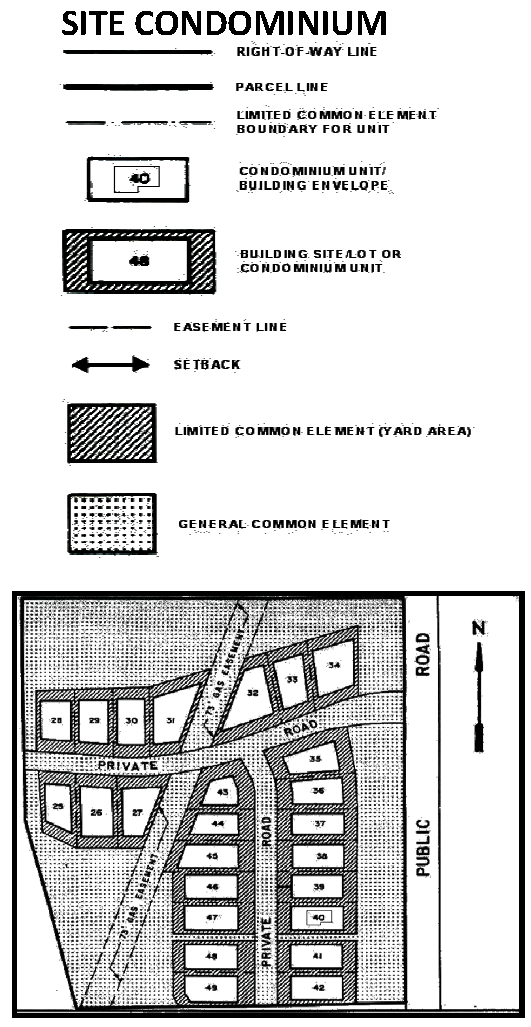
Site condominium development means a plan or development consisting of not less than two site condominium units established in compliance with the Condominium Act.
Site condominium development plan means the plans, drawings and information prepared for a site condominium development as required by section 66 of the Condominium Act (MCL 559.166) and as required by this chapter for review of the development by the planning commission and the city council.
Site condominium unit means a condominium unit established in compliance with the Condominium Act which consists of an area of vacant land and a volume of vacant air space, designed and intended for separate ownership and use as described in the site condominium master deed, and within which a building or other improvements may be constructed by the condominium unit owner.
(c)
Review of preliminary plans by the planning commission.
(1)
Prior to final review and approval of a site condominium development plan by the city council, a preliminary site condominium development plan shall be reviewed by the planning commission in accordance with the procedures, standards and requirements provided by this chapter. As part of the review, the planning commission shall hold a public hearing on the preliminary plan. The commission, however, may review the plan prior to the public hearing in order to provide direction to the applicant in preparing the plan for the hearing. Notification of the hearing shall be in accordance with the notification requirements for a special land use as set forth in this chapter.
(2)
Application for review and approval of a site condominium development plan shall be initiated by submitting to the city clerk. The application shall include a minimum of 15 copies of a preliminary site condominium development plan which complies with the requirements of subsection 38-33(b).
(3)
The planning commission shall review the preliminary site condominium development plan in accordance with the standards and requirements contained in section 38-35 and article III of chapter 38, pertaining to subdivisions. All of the requirements for plats, as set forth in section 38-35 and article III of chapter 38, shall be requirements for site condominium developments. In addition, a condominium development plan shall include the documents and information required by section 66 of the Condominium Act (MCL 559.166) and by section 38-33 and shall also include the following:
a.
The use and occupancy restrictions and maintenance provisions for all general and limited common elements that will be included in the master deed.
b.
A narrative describing the overall objectives of the proposed site condominium development.
c.
A street construction, paving and maintenance plan for all private streets within the proposed condominium development. Private streets shall be constructed according to the requirements of section 46-98.
(4)
In its review of a site condominium development plan, the planning commission may consult with the zoning administrator, city attorney, engineer, fire chief, planner or other appropriate persons regarding the adequacy of the proposed common elements and maintenance provisions, use and occupancy restrictions, utility systems and streets, development layout and design, or other aspects of the proposed development.
(5)
The building site for each site condominium unit shall comply with all applicable provisions of this chapter, including minimum lot area, minimum lot width, required front, side and rear yards, and maximum building height.
(6)
If a site condominium development is proposed to have public streets, the streets shall be paved and developed to the minimum design, construction, inspection, approval and maintenance requirements for platted public streets as required by the city. All private streets in a site condominium development shall be developed as required by section 46-98.
(7)
The planning commission shall require that portions of the plan relevant to the reviewing authority in question be submitted to the county health department, county road commission, county drain commissioner, state department of natural resources, state department of public health and other appropriate state and county review and enforcement agencies having direct approval or permitting authority over any aspect of the proposed site condominium development.
(d)
Planning commission recommendation. After reviewing the preliminary site condominium development plan, the planning commission shall prepare a written statement of recommendations regarding the proposed site condominium development, including any suggested or required changes in the plan. The planning commission shall provide a copy of its written recommendations to the applicant and to the city council.
(e)
Review and approval of final plans by city council.
(1)
After receiving the planning commission's recommendations on the preliminary plan, the applicant shall submit to the city clerk a minimum of 15 copies of a final site condominium development plan which complies with the requirements of this section and of subsection 38-33(b). All of the requirements for plats, as set forth in article III of chapter 38, shall be requirements for site condominium developments. The city clerk shall forward the copies of the final plan to the city council.
(2)
The final site condominium plan submitted by the applicant shall incorporate all of the recommendations, if any, made by the planning commission based on its prior review of the preliminary plan. If any of the planning commission's recommendations are not incorporated in the final plan, the applicant shall clearly specify in writing which recommendations have not been incorporated and the reasons why these recommendations have not been incorporated. Except for changes made to the plan as necessary to incorporate the recommendations of the planning commission, the final plan shall otherwise be identical to the preliminary plan which was reviewed by the planning commission. Changes made to the plan other than those necessary to incorporate the recommendations of the planning commission shall be reviewed by the planning commission prior to approval of the plan by the city council.
(3)
After receiving the planning commission's recommendations on the preliminary plan and a final site condominium development plan from the applicant, the city council shall proceed to review and may approve, deny or approve with conditions the plan in accordance with the standards and requirements provided by subsection 38-35(b) and article III of chapter 38, and other applicable procedures, standards and requirements provided by this chapter.
(4)
As a condition of approval of a final site condominium development plan the city council may require that a cash deposit, certified check, irrevocable bank letter of credit, or surety bond acceptable to the board covering the estimated cost of improvements associated with the site condominium development for which approval is sought to be deposited with the city as provided by subsection 38-34(d)(5).
(f)
Construction in compliance with approved final site condominium development plan. No buildings or structures shall be constructed nor shall any other site improvements or changes be made on the property in connection with a proposed site condominium development except in compliance with a final site condominium development plan as approved by the city council, including any conditions of approval.
(g)
Commencement of construction.
(1)
No construction, grading, soil striping, tree removal or other site improvements or changes shall be commenced by any person until:
a.
A final preliminary site condominium plan has been approved by the city council;
b.
All conditions to commencement of construction imposed by the city council have been met;
c.
Documentation is provided to the city council that all pertinent and applicable approvals of detailed construction plans or permits from appropriate county and state review and enforcement agencies have been obtained for the project;
d.
A construction schedule is submitted to the city indicating the general schedule of the timing and sequence for the installations of required improvements. The schedule must satisfy the needs of the city, county and state inspection agencies.
(2)
The developer shall supply the city with an electronic copy of the as-built plans of all installed improvements and/or final plans for all required improvements not installed in the final site condominium.
(3)
Construction of an approved site condominium development shall commence within two years after such approval and be diligently pursued to completion in accordance with the terms and conditions of the approval. Such two-year period may be extended by the city council in its discretion for additional periods of time as determined appropriate by the city council. Any such extension shall be applied for by the applicant within such two-year period.
(h)
Issuance of permits. No building permit shall be issued, and no public sewer or public water service shall be provided for any dwelling or other structure located on a parcel established or sold in violation of this chapter. The sale, or the reservation for sale, of site condominium units shall be as regulated by the Condominium Act. No building in a site condominium development may be occupied or used until all required improvements have been completed and all necessary utilities installed.
(i)
Expandable or convertible condominium developments. Approval of a final site condominium development plan shall not constitute approval of expandable or convertible portions of a site condominium development unless the expandable or convertible areas were specifically reviewed and approved by the planning commission and city council in compliance with the procedures, standards and requirements of this chapter.
(j)
Changes in condominium developments. Any change proposed in connection with a development for which a final site condominium plan has previously been approved shall be regulated by this section. The following words, terms and phrases, when used in this section, shall have the meanings ascribed to them in this subsection, except where the context clearly indicates a different meaning:
Exempt change means a change to a site condominium project (other than a major or minor change) that is exempt from review and approval as required for major or minor changes under this chapter. Exempt changes shall be limited to the following:
(1)
A change in the name of the development, in the name of a street within the development, or in the name of the developer;
(2)
A change in the voting rights of co-owners or mortgagees; or
(3)
Any other change in the site condominium development which, as determined by the zoning administrator, does not constitute a major or minor change or will not otherwise change the site configuration, design, layout, topography or any other aspect of a development which is subject to regulation under this chapter.
Major change means a major change in the site configuration, design, layout or topography of a site condominium development (or any portion thereof), including any change that could result in:
(1)
An increase in the number of site condominium units;
(2)
Any other change in the site configuration, design, layout, topography, or other aspect of the project which is subject to regulation under this chapter, including, without limitation, a change in the location of streets and utilities, or in the size, location, area, horizontal boundaries or vertical boundaries of a site condominium unit, and which is determined by the zoning administrator to constitute a major change to the site condominium project.
Minor change means a minor change in the site configuration, design, layout or topography of a site condominium development (or any portion thereof), including any change that will result in:
(1)
A decrease in the number of site condominium units;
(2)
A reduction in the area of the building site for any site condominium unit;
(3)
A reduction of less than ten percent in the total combined area of the general common elements of the site condominium;
(4)
A reduction in the total combined area of all limited common elements of the site condominium;
(5)
Any other minor variation in the site configuration, design, layout, topography or other aspect of the development which is subject to regulation under this chapter, and which, as determined by the zoning administrator, does not constitute a major change;
(6)
Any change which constitutes a major change shall be reviewed by the planning commission at a public hearing and with the notice required for an original approval of a site condominium development, and shall also be reviewed and approved by the city council as provided in this chapter for the original review and approval of preliminary and final plans;
(7)
Any change, which constitutes a minor change, shall be reviewed and approved by the zoning administrator who shall notify the planning commission of such action. In the discretion of the administrator, any such minor change may be reviewed and approved by the planning commission at a public meeting, but without the public hearing or mailed notice requirement otherwise provided in this chapter for an original approval;
(8)
Any change, which constitutes an exempt change, shall not be subject to review by the city under this chapter, but a copy of the exempt changes shall be filed with the city clerk.
(k)
Incorporation of approved provisions in master deed. All provisions of a final site condominium development plan which are approved by the city council as provided by this chapter shall be incorporated by reference in the master deed for the site condominium project. Further, all major changes to a development shall be incorporated by reference in the master deed. A copy of the master deed as recorded with the county register of deeds shall be provided to the city within ten days after recording.
(l)
Variances.
(1)
A variance from the applicable provisions of chapter 38, may be granted if the applicant demonstrates that literal enforcement of any of the provisions of the subdivisions chapter is impractical, or will impose undue hardship in the use of the land because of special or peculiar conditions pertaining to the land. Upon application, the city council, after recommendation by the planning commission, may permit a variance or variances which are reasonable and within the general policies and purposes of this chapter. The planning commission and city council may attach conditions to the variance.
(2)
Any other variances from applicable section of this chapter, including those required by subsection (c)(5) of this section, shall be subject to the requirements of section 46-36.
(Prior Code, §§ 15.1701A—15.1713S; Ord. No. 150F, §§ 17A.01—17A.13, 7-6-2004)
State Law reference— Condominiums, MCL 559.101 et seq.
Sec. 46-43. - Public notice and requirements.
(a)
[Compliance of application.] All applications for development approval requiring a public hearing shall comply with the Michigan Zoning Enabling Act, PA 110 of 2006 as amended and the other provisions of this section with regard to the public notification.
(b)
Responsibility for public notification. The clerk or their agent shall be responsible for preparing the content of the notice, having it published in a newspaper of general circulation in the City of Greenville and mailed or delivered as provided in this section.
(c)
Notice requirements. Notice of a public hearing for a rezoning, special land use, text amendment, planned unit development, variance, appeal, or ordinance interpretation shall be given not less than 15 days before the date of the public hearing. The notice shall be given as follows.
(1)
Newspaper notice: The notice shall be published in a newspaper that circulates in the City of Greenville.
(2)
Mail and personal notice: Except for rezoning requests that are proposed for 11 or more adjacent parcels, the notice shall be sent by first class mail or personal delivery to:
a.
The owner of the property for which approval is being considered, and the applicant, if different than the owner(s) of the property.
b.
To all persons to whom property is assessed within 300 feet of the boundary of the property, regardless of whether the property or occupant is located within the boundaries of the City of Greenville. In structures containing four or fewer dwelling units, only one occupant of each unit must be given notice for a public hearing.
c.
If the name of the occupant is not known, the term "occupant" may used in making the notification. In the case of a single structure containing more than four dwelling units or other distinct spatial areas owned or leased by different individuals, partnerships, businesses or organizations, notice may be given to the manager or owner of the structure who shall be requested to post the notice at the primary entrance of the structure.
d.
All neighborhood organizations, public utility companies, airports, railroads, and other persons, which have requested to receive notice pursuant to subsection (c) of this section, registration to receive notice by mail.
(3)
Record of mailing: The clerk shall prepare an affidavit of mailing which shall include those to whom the public notice was mailed and the date of mailing.
(4)
Content of notice: The public notice shall:
a.
Describe nature of request. Identify whether the request is for a rezoning, text amendment, special land use, planned unit development, variance, appeal, ordinance interpretation or other purpose.
b.
Indicate the property that is the subject of the request. The notice shall include a listing of all existing street addresses within the subject property. Street addresses do not need to be created and listed if no such addresses currently exist within the property. If there are no street addresses, other means of identification may be used, such as a tax parcel identification number, identifying the nearest cross street, or including a map showing the location of the property. No street addresses must be listed when 11 or more adjacent properties are proposed for rezoning, or when the request is for an ordinance interpretation not involving a specific property.
c.
Indicate the date, time and place of the public hearing(s).
d.
Include a statement describing when and where written comments will be received concerning the request and a statement that the public may appear at the public hearing in person or by council.
(d)
Registration to receive notice by mail. Any neighborhood organization, public utility, company, railroad or any other person may register with the clerk to receive written notice of all applicants for development approval pursuant to subsection (c)(2)c. of this section.
Sec. 46-44. - Effective date.
Public hearing having been held hereon, the provisions of this chapter are hereby adopted, and this chapter shall take effect on the first day November, 1997.

