


Greenville City Zoning Code
Sec. 46-258
Off-street parking and loading.
(a)
General provisions.
(1)
There shall be provided by the owner, lessee, and occupant of any property in all districts prior to the issuance of a certificate of occupancy for the erection or enlargement of any building or structure, or the commencement or expansion of any use, off-street parking spaces meeting the requirements of this chapter.
(2)
The zoning administrator may require a performance guarantee prior to the issuance of the certificate of occupancy where full completion of a parking area would not be possible due to adverse weather conditions or similar reasonable circumstances beyond the control of the applicant.
(3)
Required off-street parking spaces shall not be removed unless an equal number of parking spaces as required by this section are provided elsewhere on the premises.
(4)
Parking facilities required by this section shall be used for the convenience of patrons, occupants, and employees of the use intended to be served and shall not be used for storage of goods, merchandise, unrelated commercial vehicles, or the repair or sale of vehicles.
(5)
No signs other than signs designating entrances, exits and conditions of use shall be erected within the parking lot, except as otherwise permitted by this chapter.
(6)
In the C-3 district the provisions of this section may be met by participation in a city or community parking program designed to serve a larger area, provided plans for such parking have been approved by the planning commission.
(7)
In the case of mixed uses on the same premises, the total requirements for off-street parking facilities shall be the sum of the requirements of the individual uses computed separately, provided that this provision shall not apply where a use is accessory to the main use and is not intended to serve additional patrons or employees.
(8)
Off-street parking facilities for any use shall not be considered as providing required parking facilities for any other, separate use.
(9)
If fewer spaces are available to serve a use than the minimum requirement of this section, the extent and occupancy of the use shall be restricted proportionately to the number of parking spaces available.
(10)
Where not specifically listed, the zoning administrator shall use the parking requirements most similar to the use not listed.
(11)
When units or measurements determining the number of required parking spaces result in the requirement of a fractional space, any fraction up to and including one-half shall be disregarded and fractions over one-half shall require one parking space.
(b)
Existing nonconforming parking and loading areas.
(1)
Any building or use, which fully or partially meets the off-street parking or loading requirements, shall continue to comply with these requirements at the highest degree of compliance reached.
(2)
Existing off-street parking and loading areas, stall sizes, and number of spaces either installed or part of an approved construction project for which a permit has been issued by November 1, 1997, in excess of that required by this section shall not be reduced unless and until all other requirements in this chapter and all landscaping requirements in this chapter have been met.
(3)
Whenever there is any change in use or an increase in number of employees, or an increase in floor area, or in any other unit of measurement specified in this chapter, additional off-street parking and loading facilities shall be provided on the basis of the resultant change.
(c)
Single and two-family residential parking requirements.
(1)
Required residential off-street parking spaces shall consist of a clearly defined parking strip, parking bay, driveway, or combination thereof and shall be located on the premises they are intended to serve. Parking spaces provided within a carport or enclosed garage shall be counted toward meeting the minimum parking space requirement.
(2)
The amount of paving for the parking strip, parking bay, or driveway shall not cover more than 25 percent of the front yard area.
(3)
The minimum driveway width shall be eight feet. A driveway shall only be located in a side yard with a minimum width of ten feet. Not more than one parking space shall be provided in the front yard.
(4)
Maximum driveway entrance width shall be 20 feet; maximum driveway opening at the street line or curb shall be 24 feet on a flared opening.
(5)
A maximum of one driveway opening shall be permitted per each single-family or two-family residential lot frontage per each 150 feet of each street frontage.
(6)
All driveways and parking areas shall be improved with concrete with a minimum thickness of six inches, asphalt with a minimum thickness of 2½ inches over a six-inch gravel base, or brick pavers manufactured for use as a driving course.
(7)
For the purpose of this chapter, tandem parking is the authorized parking of one vehicle behind another parked vehicle to meet the parking requirements of this chapter. (Tandem parking is not intended to include a parallel parking arrangement.) Tandem parking is permitted only to provide parking space for single-family and two-family residential use and may be a part of the driveway, provided no parking space extends into a public or private right-of-way.
(8)
The parking regulations set forth in this section for single-family residential neighborhoods are to maintain an orderly appearance, contribute to neighborhood stability, maintain property values, and prevent aesthetic nuisances. In addition, in single-family residential neighborhoods:
a.
Vehicles may not be parked on unpaved portions of the front yard.
b.
Parking bays, which are additions onto driveways to provide additional parking space, may not be located directly between the house and the street.
c.
Vehicles may be parked in driveways in side yards, provided the side yard is wider than ten feet.
d.
The maximum width of a driveway may not be larger than the garage it serves, or 24 feet, whichever is larger.
e.
All driveways and parking bays shall be paved with a minimum of six inches of thickness. For pre-existing gravel driveways, the parking bay may also be gravel.
f.
Vehicles may be parked in the rear yard, provided they comply with all other city regulations.
(d)
Nonresidential and multiple-family residential parking requirements.
(1)
Parking facilities for nonresidential and multiple-family residential uses shall be on the premises or within 300 feet thereof, as measured from the closest building entrance to the nearest portion of the lot.
(2)
Adequate radius shall be provided to permit the turning of all vehicles, including trucks and emergency vehicles, intended to use the site such that any vehicle may enter the street facing forward.
(3)
All entrances and exits for off-street parking lots located in a nonresidential district shall be not less than 25 feet from any residential district property line.
(4)
The minimum driveway width shall be 16 feet for one-way traffic and 24 feet for two-way traffic, or any greater dimension as may be required by any agency having jurisdiction.
(5)
All driveways, aisles and parking and loading areas shall be improved with concrete with a minimum thickness of six inches, asphalt with a minimum thickness of two and one-half inches over a six-inch gravel base, or brick pavers manufactured for use as a driving course.
(6)
All parking spaces, except parking lots with less than four spaces, shall be delineated by single or double striping. A single stripe is required along the front of each space perpendicular to the side striping.
(7)
Vehicle backing or maneuvering directly into a street, alley or service drive intended for travel by the general public or patrons is prohibited. Maneuvering area shall be provided on the premises for any delivery or other similar vehicles.
(8)
Vehicles shall enter and leave the parking area only at clearly marked and established driveways.
(9)
Ingress and egress to a parking lot located in a nonresidential district shall not be across land in a residential district.
(10)
Covered parking such as parking ramps, parking garages, and basement parking may serve as required parking areas.
(11)
Waste dumpsters:
a.
Waste dumpster pads in parking areas shall be located so as to not interfere with the general public/patron normal traffic flow and shall be in addition to parking stall and aisle requirements.
b.
Waste dumpsters shall be screened by a continuous opaque screen at least six feet high. The screen may be comprised of berming, plant material, screen walls or fences or any combination of these elements.
(12)
It shall be unlawful for any person to park or store any vehicle on any lot or parcel without the express written consent of the owner, holder, occupant, lessee, agent, or trustee of such property.
(13)
Parking lot landscaping shall be provided in accordance with the requirements of section 46-257.
(14)
Parking lots shall be adequately lit to ensure security and safety and shall meet the following requirements:
a.
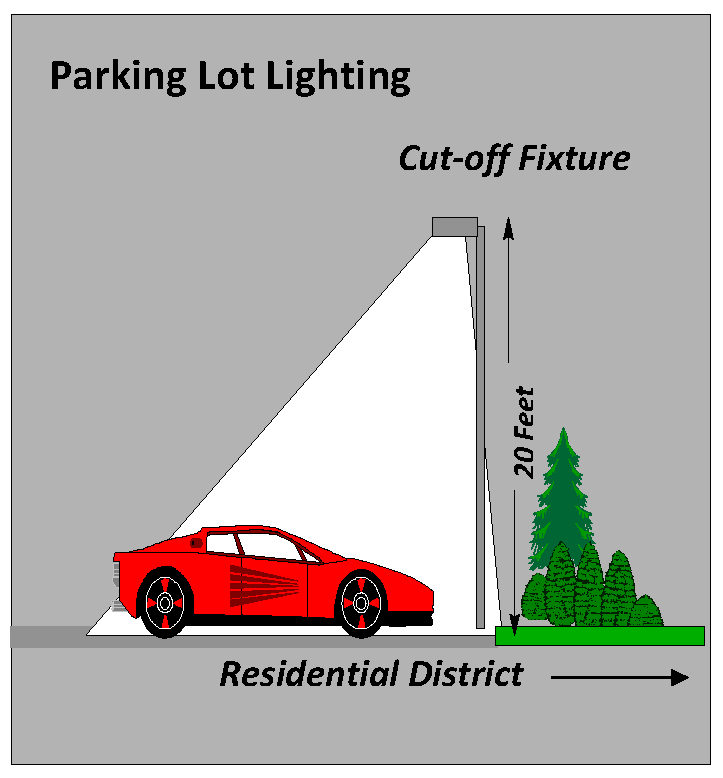
Light fixtures shall be no higher than 20 feet and shall be provided with light cut-off fixtures that direct light downward.
b.
For parking lots serving a single building or groups of related commercial, industrial, or office buildings in excess of 500 spaces, the planning commission may permit a higher light fixture in selected locations within the parking lot where existing or planned residential areas will not be affected. Lighting shall not be attached to buildings or other structures that permit light to be directed horizontally.
(e)
Handicapped parking requirements. Off-street parking areas shall include spaces for persons with disabilities in accordance with the provisions of Public Act No. 230 of 1972 (MCL 125.1501 et seq.) and shall be included in the count of required spaces.
(f)
Construction, layout and maintenance standards.
(1)
No parking lot shall be constructed, altered, or enlarged unless and until a permit therefore is issued by the city. Applications for a permit shall be submitted to the city and shall be accompanied by not less than three sets of site plans for the development and construction of the parking lot showing that the project will fully comply with all provisions of this chapter.
(2)
All parking areas shall meet the minimum standards contained in the parking space dimensions table.
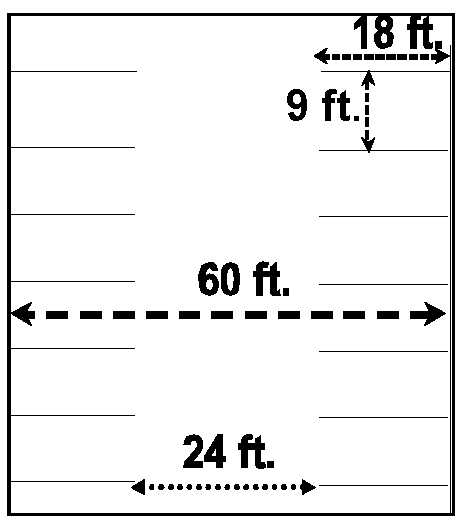
Parking Space Dimensions
(3)
Off-street parking areas and loading areas shall be drained so as to dispose of all surface water accumulated in the parking area in such a way as to preclude drainage of water onto adjacent property or toward buildings. No off-street parking area or loading area drainage systems may be connected to a sanitary sewer system.
(4)
The exterior of all parking lots for nonresidential uses and multiple-family parking areas shall be provided with a rolled, or standard, six-inch, concrete curb. Bumper stops, curbing or wheel chocks shall not be required within the parking area, but if provided to prevent a vehicle from extending beyond the parking space outline, shall be placed two feet back from the front of each space and shall be perpendicular to the sides of the space.
(5)
All driveway approaches between the curb and the property line shall be paved with asphalt or concrete.
(6)
A rolled or standard six-inch concrete curb, shall be provided in all parking and maneuvering areas within the front yard of the IND, industrial district. Where two front yards exist, curbing shall be required within the lesser of the two yards.
(g)
Off-street truck and equipment parking. The owner, tenant, or lessee of any lot, parcel, or tract of land in a residential district or on a lot used for residential purposes shall not permit or allow the storage or parking, at any time thereon, of trucks, semi-trucks and tractor trailers, manufactured homes, tractors, bulldozers, earth carriers, drag lines, cranes, steam shovels and/or any other heavy equipment or machinery. It is provided, however, that the owner, tenant, or lessee of a farm may openly store the machinery and equipment used on the farm; and it is further provided that equipment necessary to be parked on a lot or parcel during the construction work thereon shall be excepted from this restriction. This restriction shall not apply to pickup or panel trucks.
(h)
Off-street loading and unloading.
(1)
On the same premises with every building, structure or part thereof, erected and occupied for manufacturing, storage, warehousing, retailing, display or other uses involving the receipt or distribution of vehicles or materials or merchandise, there shall be provided and maintained on the lot adequate space for standing, loading and unloading services, adjacent to the opening used for loading and unloading. Loading and unloading space shall be provided according to the following table:
Off-Street Loading and Unloading Space
(2)
General loading/unloading requirements.
a.
Loading/unloading spaces shall not use any portion of any street, alley or service drive or other space intended for general public/patron travel.
b.
Vehicle backing or maneuvering directly into a street, alley or service drive intended for travel by the general public or patrons is prohibited. Maneuvering area shall be provided on the premises for any delivery or other similar vehicles.
c.
Loading/unloading spaces shall be a minimum of 12 feet in width, 55 feet in length, and have clearance of at least 14 feet in height.
d.
If truck wells are to be used, a protective railing or wall shall be provided along the sides of the well.
e.
Loading/unloading spaces or truck wells shall not be located within the required front yard.
f.
Loading/unloading spaces facing a residential district shall be screened from view by a wall and/or landscaping.
g.
Required loading/unloading spaces shall not be included in calculations for parking spaces needed to meet general parking requirements.
(i)
Off-street parking requirements for individual uses.
(1)
The planning commission may defer construction of a portion of the required number of parking spaces for nonresidential uses if the following conditions are met:
a.
Areas shown for deferred parking shall be shown on a site plan and shall be of sufficient area to permit the construction of the total number of parking spaces required by this section. Such areas shall not be used for any other purpose required by this chapter (such as landscaped buffers, etc.) and shall be kept open.
b.
Alterations to the deferred parking area to add parking spaces may be initiated by the owner or required by the zoning administrator based on parking needs and shall require the submission and approval of an amended site plan, as required by section 46-41.
(2)
The following parking tables contain the minimum required parking spaces for the uses listed. Parking requirements for any use not listed shall be determined by the zoning administrator using the requirements for the use, which is most similar in characteristics to the unlisted use.
(Prior Code, §§ 15.1901—15.1909; Ord. No. 150, §§ 19.01—19.09, 11-1-1997; Ord. No. 150-K, 5-7-2007; Ord. No. 24-01, § 16, 1-16-2024)