
Greenville City Zoning Code
ARTICLE VII
MISCELLANEOUS REQUIREMENTS AND USES
Sec. 46-257.- Landscaping and screening.
(a)
Purpose. It is the intent of this article to require buffer zones, landscaping, and screening to reduce the negative impacts between incompatible land uses. It is further intended to preserve and enhance the aesthetic qualities, character, privacy, and environment of the city.
(b)
Required buffer zones.
(1)
A buffer shall be required on any parcel proposed for development which borders a different zone district, as indicated in subsection (b)(5) of this section. Where the adjacent zone district is more intensive, e.g., C-1 bordering R-1, the required buffer shall be installed only on the property which is in the more intensive district.
(2)
The specified buffer shall be required on the subject parcel even if the adjacent parcel is unimproved land. A performance bond may be submitted in lieu of the required buffer where adjacent land is unimproved. The buffer shall be installed when the adjacent property begins development and completed prior to any occupancy of the adjoining use.
(3)
When any developed parcel existing as of the date of this chapter, or amendment thereto, is changed to a less restrictive zone district, for example, R-2 to R-3, any required buffer shall be installed in compliance with this section within six months of the effective date of the rezoning. This provision shall not apply to rezonings initiated by the city.
(4)
If two zoning districts requiring a buffer zone are separated by a street, the design of the required buffer zone shall be reduced by one level; for example, a required major buffer shall be reduced to a moderate buffer. Notwithstanding the foregoing, the minimum buffer installed shall be a minor buffer.
(5)
The following chart defines the required buffers between adjacent zone districts:
Required Buffers Between Adjacent Zone Districts
For planned unit development (PUD) districts the buffer zone requirements set forth in the above chart shall be based on the type of land use proposed or existing in the PUD as follows:
a.
For a PUD containing single-family detached dwellings or two-family dwellings the PUD shall be considered the equivalent of an R-1 or R-2 zone.
b.
For a PUD containing multifamily dwellings including town homes, attached condominiums with more than two dwellings the PUD shall be considered the equivalent of an R-3 zone.
c.
For a PUD containing any other land use the buffer zone requirement in the above chart shall be based on that zoning district (O-1, C-1, C-2, C-3 or Industrial) which permits those land uses comprising the majority of the actual land uses in the PUD. For example a PUD containing commercial uses shall be considered the equivalent of a C-1 or C-2 zone and the buffer zone requirement for a C-1 or C-2 zone shall apply although the modifications permitted by subsection (c)(1)c. of this section may be considered.
(6)
Buffer zone development standards.
a.
Required buffer zones shall comply with and be maintained to the following standards:
Required Buffer Zone Development Standards
b.
The required six-foot-high continuous obscuring screen may be comprised of plant material, berming, screen walls or fences, or any combination of these elements in addition to the required plant materials.
c.
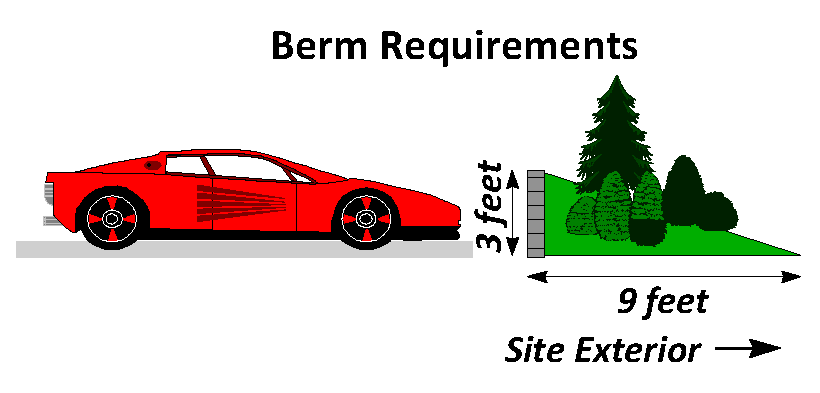
If berming is used for all or part of the obscuring screen, all required plant materials shall be placed on the top and both sides of the slope. Where necessary the minimum buffer width shall be increased to accommodate side slopes of a maximum of three feet in width to one foot in height.
d.
If a screen wall or fence is used for all or part of the obscuring screen, the equivalent of four shrubs is required per 20 linear feet on each side of the wall or fence.
e.
The balance of the required buffer shall be covered with grass or approved ground cover in accordance with this section.
f.
Any plant material, berm, obscuring screen or other landscape feature shall be installed in such a manner so as not to alter drainage patterns on the site or on adjacent properties; obstruct vision for reasons of safety, ingress or egress; or cause damage to utility lines (above and below ground) and public roadways.
(c)
General landscape development standards.
(1)
Minimum plant material standards.
a.
All plant materials shall be certified to be hardy to the county, free of disease and insects, and conform to the standards of the American Association of Nurserymen. All landscaping shall be maintained in a healthy, neat and orderly state, free from refuse and debris. Any dead or diseased plants shall be replaced within a reasonable period of time, but no longer than one growing season.
b.
Minimum plant sizes at time of installation:
Minimum Plant Sizes at Time of Installation
c.
Should the zoning administrator determine, upon inspection, that adequate landscaping screen on a site already exists or that a landscaping screen is not required, the applicable provisions of this section may be waived in whole or in part. Criteria which shall be used when considering a landscaping screen waiver shall include, but shall not be limited to:
1.
Topography variations.
2.
Existence of natural vegetation.
3.
Existing and proposed building placement.
4.
Sight distances.
5.
Adjacent land uses.
6.
Existence of floodplain and areas of poor soils.
d.
Plant materials shall not consist or more than 33 percent of any one plant species.
e.
The following trees are not permitted as they split easily; their wood is brittle and breaks easily; their roots clog drains and sewers; and they are unusually susceptible to disease or insect pests:
Trees Not Permitted
(2)
Minimum standards for berms.
a.
Berms shall maintain a side slope not to exceed a one-foot rise to a three-foot in width ratio.
b.
Berm areas not containing planting beds shall be covered with grass or living ground cover maintained in a healthy growing condition.
c.
If a berm is constructed with a retaining wall or by terracing, the earthen slope shall face the exterior of the site.
(3)
Minimum standards for obscuring screen walls and fences.
a.
All obscuring screen walls and fences shall be constructed with new, durable, weather-resistant and easily maintained materials. Chain link and barbed wire fences are not permitted.
b.
The obscuring screen wall or fence may be constructed with openings that do not exceed 20 percent of the wall surface. The openings shall not reduce the intended obscuring effect of the wall.
(4)
Detention/retention areas. Detention/retention areas shall be permitted within buffer zones provided they do not hamper the screening intent of the buffer or jeopardize the survival of the plant materials.
(5)
Screening for outdoor solid waste dumpsters. Outdoor solid waste dumpsters shall be screened by a continuous opaque screen at least six feet high. The screen may be comprised of berming, plant material, screen walls or fences or any combination of these elements. Dumpsters may be installed within buffer zones.
(6)
Phasing. If a project is constructed in phases, the landscape screen may also be constructed in phases. The zoning administrator shall determine the extent of landscaping required for each phase based on:
a.
Adjacent land uses.
b.
Distance between land uses.
c.
Operational characteristic both on- and off-site.
d.
Building heights.
e.
Physical characteristics of the site such as topography, existing vegetation, etc.
(7)
Performance guarantee. If weather conditions or other factors determined by the zoning administrator sufficient enough to warrant a delay in installing landscaping occur, a performance guarantee of a sufficient amount to ensure the installation of all required landscaping shall be required in compliance with the requirements of section 46-40 to ensure that landscaping is installed within a reasonable period of time.
(8)
Modification of required landscaping. For existing and proposed uses that require site plan approval to either expand or be built, landscaping should be installed insofar as practical. The planning commission or zoning administrator in his review of the site plan has the authority to increase, decrease or otherwise modify the landscaping and screening requirements of this section. In doing so, the commission or zoning administrator shall consider the following criteria:
a.
Topography variations.
b.
Existence of natural vegetation.
c.
Existing and proposed building placement.
d.
Sight distances.
e.
Adjacent land uses.
f.
Existence of floodplain and areas of poor soils.
g.
The effect the required landscaping would have on the operation of the existing or proposed land use.
h.
Trees shall be of a type or be planted to avoid conflicts with any overhead utility lines.
(d)
Parking lot landscaping.
(1)
Applicability. This section is applicable to parking lots serving any nonresidential or multiple-family use in any district. A parking lot landscape plan shall be submitted with any application for a building permit or when otherwise required by this chapter.
(2)
Existing parking areas.
a.
These requirements shall be met for any existing parking lot which is expanded more than 25 percent of its original existing area after November 1, 1991, or when any parking area is substantially altered (e.g., removal and replacement of existing pavement).
b.
Any landscaping existing within or bordering any existing parking area shall not be removed unless replaced with landscaping meeting the requirements of this section.
(3)
General requirements.
a.
Landscaping shall be planned and installed such that, when mature, it does not obscure traffic signs, fire hydrants, or lighting, and does not alter drainage patterns on the site or on adjacent properties; obstruct vision for reasons of safety, ingress or egress; or cause damage to utility lines (above and below ground) and public roadways.
b.
Any landscaped area required by this section shall be constructed outside any public street right-of-way.
c.
All landscaped areas, including perimeter areas, shall be protected by a raised or rolled concrete curb.
(4)
Frontage landscaping.
a.
Where any parking area directly abuts or faces a public street, a screen shall be required between the parking area and the road right-of-way. Such screen shall consist of, at a minimum, one of the following:
1.
A strip of land at least five feet in width and a solid screen comprised of a hedge or decorative wall, or any combination thereof, which measures at least three feet in height; or
2.
A strip of land at least ten feet in width, containing landscaping equivalent to a minor buffer, as described in subsection (b) of this section, except that the obscuring screen need not be provided.
b.
The required strip of land shall also be covered with grass or other approved ground cover.
(5)
Interior landscaping.
a.
Interior landscaping shall be provided for any parking area containing six or more parking spaces.
b.
The interior of the parking lot shall begin at the outside boundary of the parking area.
c.
The interior area of any parking lot shall incorporate one planting island per each 12 parking spaces, or part thereof.
d.
Each planting island shall be at least 90 square feet in area with a minimum single dimension of nine feet.
e.
Landscaped islands shall be dispersed evenly throughout the parking lot and may be used to separate pedestrian areas, maneuvering areas, and drives.
f.
At least one approved canopy tree shall be included in each planting island, with the balance of the island covered with grass or approved shrubs or ground cover.
g.
For that portion of a parking lot which abuts a required buffer zone and where, in the opinion of the planning commission or zoning administrator, depending upon the reviewing authority, the landscaping in the buffer zone provides shade for vehicles or otherwise improves the appearance of the parking lot, the number of parking spaces abutting the buffer zone shall be deducted from the number of parking spaces used to determine the number of planting islands required by subsection (d)(5)c. of this section.
(e)
Additional landscaping and screening.
(1)
Where deemed appropriate by the planning commission or other approving authority for site plans where screening is needed to minimize visual, noise, or other impacts from the proposed development, or where there may be some other adverse effect caused by the use being reviewed, or where otherwise required by this chapter, additional landscaping or screening may be required. Such adverse effect may include, but shall not be limited to, noise, lighting, hazard, traffic conflict, or other such effect.
(2)
The nature of such landscaping or screening shall be that required by subsection (b) of this section. The planning commission or other approving authority for site plans may designate which buffer is appropriate for the required landscaping or screening.
(3)
All other provisions of this chapter shall be met.
(4)
If landscaping is not required along the street frontage by subsection (d)(4) of this section, then the front yard shall be landscaped according to the following requirements:
a.
For each 50 feet in length of road frontage two trees shall be planted within the front yard. A mixture of evergreen, canopy and ornamental trees is encouraged to provide a variety of plantings along the street. Driveways shall not be counted in the determination of road frontage.
b.
Shrubs at a rate of one per each tree required.
c.
Earthen berms may be permitted within the required front yard landscape area. Credit of up to 25 percent may be received against providing the required plantings through the use of berms three feet in height or greater.
(f)
Residential landscaping; installation.
(1)
Any site on which a use permitted by this chapter is established shall install a lawn or other type of living ground cover for all land areas not covered by impervious surfaces within six months following the issuance of a certificate of occupancy. A performance guarantee may be required by the city to ensure that landscaping is installed within the six-month period. No landscape materials other than lawn and street trees approved by the zoning administrator shall be planted within any public road right-of-way.
(2)
Residential landscaping shall comply with the applicable provisions of this chapter.
(3)
No landscaping, other than ground cover, shall be provided or extend into a public right-of-way without specific written approval from the zoning administrator, or as may be approved by the planning commission or city council as part of other approvals.
(Prior Code, §§ 15.1801—15.1806; Ord. No. 150, §§ 18.01—18.06, 11-1-1997; Ord. No. 150-Q, §§ 1—5, 9-20-2011)
Sec. 46-258. - Off-street parking and loading.
(a)
General provisions.
(1)
There shall be provided by the owner, lessee, and occupant of any property in all districts prior to the issuance of a certificate of occupancy for the erection or enlargement of any building or structure, or the commencement or expansion of any use, off-street parking spaces meeting the requirements of this chapter.
(2)
The zoning administrator may require a performance guarantee prior to the issuance of the certificate of occupancy where full completion of a parking area would not be possible due to adverse weather conditions or similar reasonable circumstances beyond the control of the applicant.
(3)
Required off-street parking spaces shall not be removed unless an equal number of parking spaces as required by this section are provided elsewhere on the premises.
(4)
Parking facilities required by this section shall be used for the convenience of patrons, occupants, and employees of the use intended to be served and shall not be used for storage of goods, merchandise, unrelated commercial vehicles, or the repair or sale of vehicles.
(5)
No signs other than signs designating entrances, exits and conditions of use shall be erected within the parking lot, except as otherwise permitted by this chapter.
(6)
In the C-3 district the provisions of this section may be met by participation in a city or community parking program designed to serve a larger area, provided plans for such parking have been approved by the planning commission.
(7)
In the case of mixed uses on the same premises, the total requirements for off-street parking facilities shall be the sum of the requirements of the individual uses computed separately, provided that this provision shall not apply where a use is accessory to the main use and is not intended to serve additional patrons or employees.
(8)
Off-street parking facilities for any use shall not be considered as providing required parking facilities for any other, separate use.
(9)
If fewer spaces are available to serve a use than the minimum requirement of this section, the extent and occupancy of the use shall be restricted proportionately to the number of parking spaces available.
(10)
Where not specifically listed, the zoning administrator shall use the parking requirements most similar to the use not listed.
(11)
When units or measurements determining the number of required parking spaces result in the requirement of a fractional space, any fraction up to and including one-half shall be disregarded and fractions over one-half shall require one parking space.
(b)
Existing nonconforming parking and loading areas.
(1)
Any building or use, which fully or partially meets the off-street parking or loading requirements, shall continue to comply with these requirements at the highest degree of compliance reached.
(2)
Existing off-street parking and loading areas, stall sizes, and number of spaces either installed or part of an approved construction project for which a permit has been issued by November 1, 1997, in excess of that required by this section shall not be reduced unless and until all other requirements in this chapter and all landscaping requirements in this chapter have been met.
(3)
Whenever there is any change in use or an increase in number of employees, or an increase in floor area, or in any other unit of measurement specified in this chapter, additional off-street parking and loading facilities shall be provided on the basis of the resultant change.
(c)
Single and two-family residential parking requirements.
(1)
Required residential off-street parking spaces shall consist of a clearly defined parking strip, parking bay, driveway, or combination thereof and shall be located on the premises they are intended to serve. Parking spaces provided within a carport or enclosed garage shall be counted toward meeting the minimum parking space requirement.
(2)
The amount of paving for the parking strip, parking bay, or driveway shall not cover more than 25 percent of the front yard area.
(3)
The minimum driveway width shall be eight feet. A driveway shall only be located in a side yard with a minimum width of ten feet. Not more than one parking space shall be provided in the front yard.
(4)
Maximum driveway entrance width shall be 20 feet; maximum driveway opening at the street line or curb shall be 24 feet on a flared opening.
(5)
A maximum of one driveway opening shall be permitted per each single-family or two-family residential lot frontage per each 150 feet of each street frontage.
(6)
All driveways and parking areas shall be improved with concrete with a minimum thickness of six inches, asphalt with a minimum thickness of 2½ inches over a six-inch gravel base, or brick pavers manufactured for use as a driving course.
(7)
For the purpose of this chapter, tandem parking is the authorized parking of one vehicle behind another parked vehicle to meet the parking requirements of this chapter. (Tandem parking is not intended to include a parallel parking arrangement.) Tandem parking is permitted only to provide parking space for single-family and two-family residential use and may be a part of the driveway, provided no parking space extends into a public or private right-of-way.
(8)
The parking regulations set forth in this section for single-family residential neighborhoods are to maintain an orderly appearance, contribute to neighborhood stability, maintain property values, and prevent aesthetic nuisances. In addition, in single-family residential neighborhoods:
a.
Vehicles may not be parked on unpaved portions of the front yard.
b.
Parking bays, which are additions onto driveways to provide additional parking space, may not be located directly between the house and the street.
c.
Vehicles may be parked in driveways in side yards, provided the side yard is wider than ten feet.
d.
The maximum width of a driveway may not be larger than the garage it serves, or 24 feet, whichever is larger.
e.
All driveways and parking bays shall be paved with a minimum of six inches of thickness. For pre-existing gravel driveways, the parking bay may also be gravel.
f.
Vehicles may be parked in the rear yard, provided they comply with all other city regulations.
(d)
Nonresidential and multiple-family residential parking requirements.
(1)
Parking facilities for nonresidential and multiple-family residential uses shall be on the premises or within 300 feet thereof, as measured from the closest building entrance to the nearest portion of the lot.
(2)
Adequate radius shall be provided to permit the turning of all vehicles, including trucks and emergency vehicles, intended to use the site such that any vehicle may enter the street facing forward.
(3)
All entrances and exits for off-street parking lots located in a nonresidential district shall be not less than 25 feet from any residential district property line.
(4)
The minimum driveway width shall be 16 feet for one-way traffic and 24 feet for two-way traffic, or any greater dimension as may be required by any agency having jurisdiction.
(5)
All driveways, aisles and parking and loading areas shall be improved with concrete with a minimum thickness of six inches, asphalt with a minimum thickness of two and one-half inches over a six-inch gravel base, or brick pavers manufactured for use as a driving course.
(6)
All parking spaces, except parking lots with less than four spaces, shall be delineated by single or double striping. A single stripe is required along the front of each space perpendicular to the side striping.
(7)
Vehicle backing or maneuvering directly into a street, alley or service drive intended for travel by the general public or patrons is prohibited. Maneuvering area shall be provided on the premises for any delivery or other similar vehicles.
(8)
Vehicles shall enter and leave the parking area only at clearly marked and established driveways.
(9)
Ingress and egress to a parking lot located in a nonresidential district shall not be across land in a residential district.
(10)
Covered parking such as parking ramps, parking garages, and basement parking may serve as required parking areas.
(11)
Waste dumpsters:
a.
Waste dumpster pads in parking areas shall be located so as to not interfere with the general public/patron normal traffic flow and shall be in addition to parking stall and aisle requirements.
b.
Waste dumpsters shall be screened by a continuous opaque screen at least six feet high. The screen may be comprised of berming, plant material, screen walls or fences or any combination of these elements.
(12)
It shall be unlawful for any person to park or store any vehicle on any lot or parcel without the express written consent of the owner, holder, occupant, lessee, agent, or trustee of such property.
(13)
Parking lot landscaping shall be provided in accordance with the requirements of section 46-257.
(14)
Parking lots shall be adequately lit to ensure security and safety and shall meet the following requirements:
a.
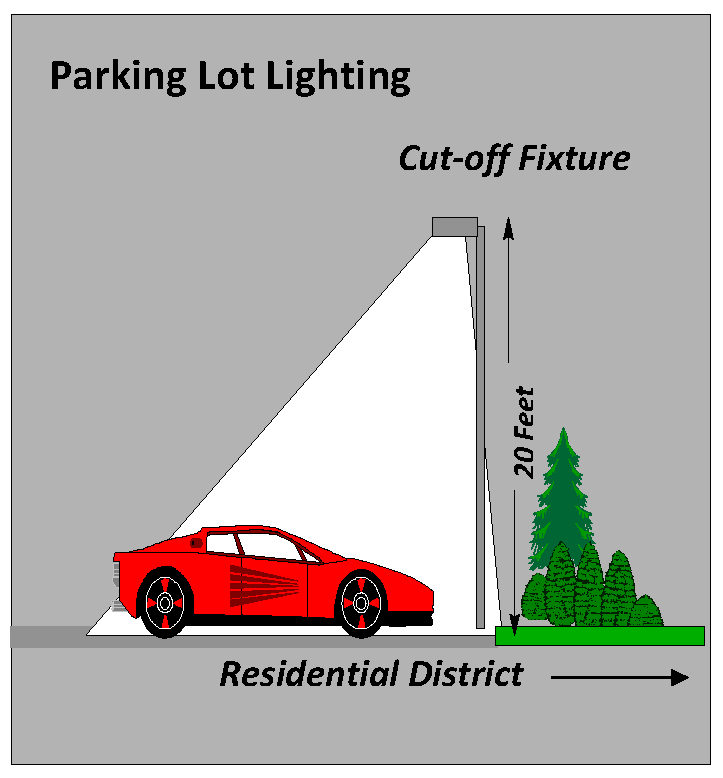
Light fixtures shall be no higher than 20 feet and shall be provided with light cut-off fixtures that direct light downward.
b.
For parking lots serving a single building or groups of related commercial, industrial, or office buildings in excess of 500 spaces, the planning commission may permit a higher light fixture in selected locations within the parking lot where existing or planned residential areas will not be affected. Lighting shall not be attached to buildings or other structures that permit light to be directed horizontally.
(e)
Handicapped parking requirements. Off-street parking areas shall include spaces for persons with disabilities in accordance with the provisions of Public Act No. 230 of 1972 (MCL 125.1501 et seq.) and shall be included in the count of required spaces.
(f)
Construction, layout and maintenance standards.
(1)
No parking lot shall be constructed, altered, or enlarged unless and until a permit therefore is issued by the city. Applications for a permit shall be submitted to the city and shall be accompanied by not less than three sets of site plans for the development and construction of the parking lot showing that the project will fully comply with all provisions of this chapter.
(2)
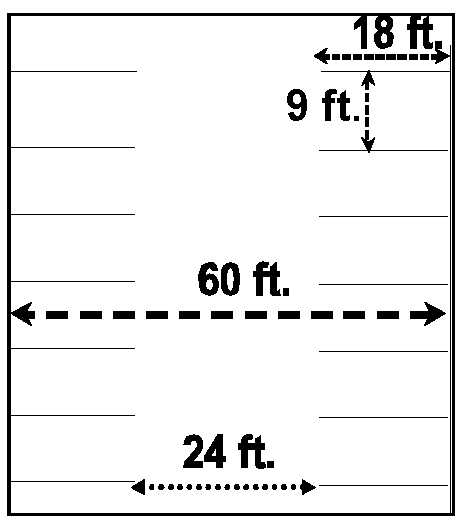
All parking areas shall meet the minimum standards contained in the parking space dimensions table.
Parking Space Dimensions
(3)
Off-street parking areas and loading areas shall be drained so as to dispose of all surface water accumulated in the parking area in such a way as to preclude drainage of water onto adjacent property or toward buildings. No off-street parking area or loading area drainage systems may be connected to a sanitary sewer system.
(4)
The exterior of all parking lots for nonresidential uses and multiple-family parking areas shall be provided with a rolled, or standard, six-inch, concrete curb. Bumper stops, curbing or wheel chocks shall not be required within the parking area, but if provided to prevent a vehicle from extending beyond the parking space outline, shall be placed two feet back from the front of each space and shall be perpendicular to the sides of the space.
(5)
All driveway approaches between the curb and the property line shall be paved with asphalt or concrete.
(6)
A rolled or standard six-inch concrete curb, shall be provided in all parking and maneuvering areas within the front yard of the IND, industrial district. Where two front yards exist, curbing shall be required within the lesser of the two yards.
(g)
Off-street truck and equipment parking. The owner, tenant, or lessee of any lot, parcel, or tract of land in a residential district or on a lot used for residential purposes shall not permit or allow the storage or parking, at any time thereon, of trucks, semi-trucks and tractor trailers, manufactured homes, tractors, bulldozers, earth carriers, drag lines, cranes, steam shovels and/or any other heavy equipment or machinery. It is provided, however, that the owner, tenant, or lessee of a farm may openly store the machinery and equipment used on the farm; and it is further provided that equipment necessary to be parked on a lot or parcel during the construction work thereon shall be excepted from this restriction. This restriction shall not apply to pickup or panel trucks.
(h)
Off-street loading and unloading.
(1)
On the same premises with every building, structure or part thereof, erected and occupied for manufacturing, storage, warehousing, retailing, display or other uses involving the receipt or distribution of vehicles or materials or merchandise, there shall be provided and maintained on the lot adequate space for standing, loading and unloading services, adjacent to the opening used for loading and unloading. Loading and unloading space shall be provided according to the following table:
Off-Street Loading and Unloading Space
(2)
General loading/unloading requirements.
a.
Loading/unloading spaces shall not use any portion of any street, alley or service drive or other space intended for general public/patron travel.
b.
Vehicle backing or maneuvering directly into a street, alley or service drive intended for travel by the general public or patrons is prohibited. Maneuvering area shall be provided on the premises for any delivery or other similar vehicles.
c.
Loading/unloading spaces shall be a minimum of 12 feet in width, 55 feet in length, and have clearance of at least 14 feet in height.
d.
If truck wells are to be used, a protective railing or wall shall be provided along the sides of the well.
e.
Loading/unloading spaces or truck wells shall not be located within the required front yard.
f.
Loading/unloading spaces facing a residential district shall be screened from view by a wall and/or landscaping.
g.
Required loading/unloading spaces shall not be included in calculations for parking spaces needed to meet general parking requirements.
(i)
Off-street parking requirements for individual uses.
(1)
The planning commission may defer construction of a portion of the required number of parking spaces for nonresidential uses if the following conditions are met:
a.
Areas shown for deferred parking shall be shown on a site plan and shall be of sufficient area to permit the construction of the total number of parking spaces required by this section. Such areas shall not be used for any other purpose required by this chapter (such as landscaped buffers, etc.) and shall be kept open.
b.
Alterations to the deferred parking area to add parking spaces may be initiated by the owner or required by the zoning administrator based on parking needs and shall require the submission and approval of an amended site plan, as required by section 46-41.
(2)
The following parking tables contain the minimum required parking spaces for the uses listed. Parking requirements for any use not listed shall be determined by the zoning administrator using the requirements for the use, which is most similar in characteristics to the unlisted use.
(Prior Code, §§ 15.1901—15.1909; Ord. No. 150, §§ 19.01—19.09, 11-1-1997; Ord. No. 150-K, 5-7-2007; Ord. No. 24-01, § 16, 1-16-2024)
Sec. 46-259. - Signs.
(a)
Scope. This section is intended to regulate and limit the construction or reconstruction of signs in order to protect the public health, safety, aesthetics and general welfare. Such signs as will not, by reason of their size, location, construction, or manner of display, endanger life and limb, confuse or mislead traffic, obstruct vision necessary for vehicular and pedestrian traffic safety, or otherwise endanger public welfare shall be permitted except as may be otherwise provided for herein.
(b)
Definitions. The following words, terms and phrases, when used in this section, shall have the meanings ascribed to them in this subsection, except where the context clearly indicates a different meaning:
Banner sign means a temporary sign, constructed of canvas, paper, cloth, nylon or other similar non-rigid fabric-like material without an enclosing structural framework which is not permanently affixed to a supporting structure. A banner sign is not a feather flag or a flutter flag sign.
Business center means any two or more businesses which:
(1)
Are located on a single parcel;
(2)
Are under one common ownership or management and have a common arrangement for the maintenance of the grounds;
(3)
Are connected by common walls, partitions, canopies, other structural members, or walkways to form a continuous building or group of buildings;
(4)
Share a common parking area; or
(5)
Otherwise present the appearance of single continuous business area.
Directional sign means a sign used primarily to give information about the location of either the driver of motorized vehicles or possible destinations. Although this is a content-based distinction, these signs are important to prevent public confusion and facilitate collision-free flow of traffic.
Festoons means a temporary sign consisting of a string of ribbons, tinsel, pennants or pinwheels.
Flag sign, permanent means a sign made of cloth, nylon or other similar non-rigid fabric-like material attached to or hung from a single pole installed in the ground in a permanent fashion.
Flag sign, temporary. Also called "feather flags" or "flutter flags." A sign made of cloth, nylon or other similar non-rigid fabric like material attached to a single pole positioned in the ground in a non-permanent fashion or hung from a building or structure. A banner sign is not a temporary flag sign.
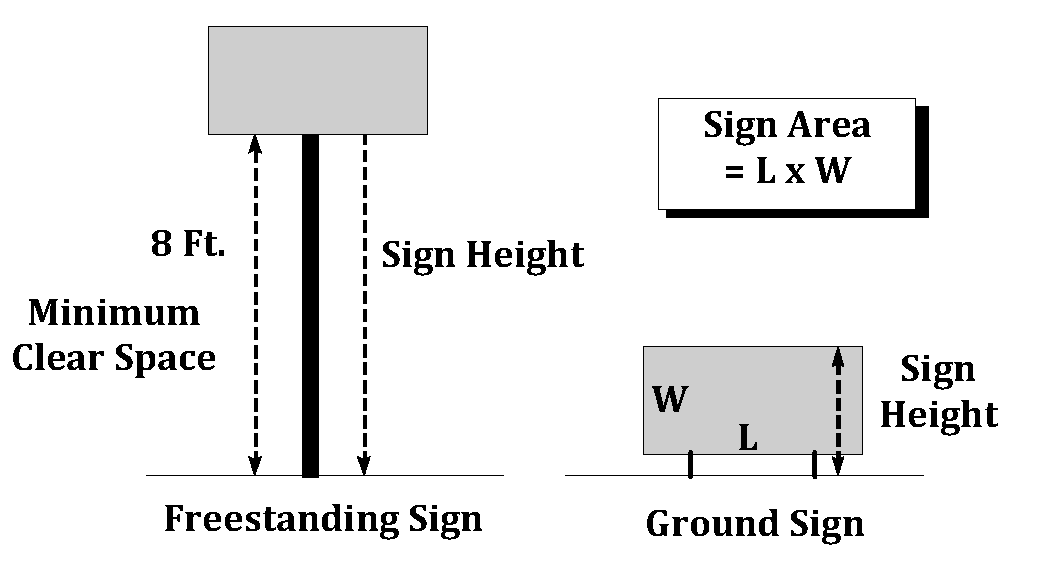
Freestanding sign means a sign supported by one or more uprights, poles or braces placed in or upon the ground and not attached to any building and having clear space of at least eight feet from the ground to the bottom of the sign.
Government sign means a temporary or permanent sign erected by the City of Greenville, Montcalm County, state, or federal government.
Ground sign means a sign resting directly on the ground or supported by short poles and not attached to a building or wall.
Illuminated sign means a sign that provides artificial light directly (or through any transparent or translucent material) from a source of light within such sign, or a sign illuminated by a light so shielded that no direct rays from it are visible from any public right-of-way or from the abutting property.
Inflatable sign/balloon sign means a portable sign which is a three-dimensional object capable of being filled with air or gas depicting a container, figure, product or product trademark, whether or not such object contains a message or lettering.
Marquee means a permanent structure that projects from the exterior wall of a building.
Marquee sign means a sign attached to a marquee, canopy or awning projecting from and supported by the building.
Mean grade means a reference plane representing that arithmetic mean of the lowest and highest grade elevations in an area within five feet of the foundation line of a sign structure, or in the area between the sign structure foundation lien and the lot line, in the case where the sign structure foundation line is less than five feet from the lot line.
Nit means a unit of illuminative brightness equal to one candela (12.5 lumens or 1.16 foot candles) per square meter, measured perpendicular to the rays of the source.
Noncommercial sign means a sign either portable or non-portable not advertising commerce, trade, or location and not otherwise defined herein.
Pennant means a flag or cloth that tapers to a point.
Permanent sign means a sign installed on a support structure which is not intended or designed to be moved or removed, but to remain for an indefinite period of time.
Projecting sign means a sign which projects from and is supported by a wall of a building and does not extend beyond, into, or over the street right-of-way.
Reader board means a portion of a sign on which copy is changed manually.
(1)
Manual: A sign on which the letters or pictorials are changed manually; or
(2)
Electronic reader board/digital display sign: A sign or portion thereof that displays electronic, pictorial or text information in which each alphanumeric character, graphic, or symbol is defined by a small number of matrix elements using different combinations of light-emitting diodes (LEDs), fiber optics, light bulbs or other illumination devices within the display area. Such signs include computer programmable, microprocessor controlled electronic displays; or
(3)
Multi-vision sign: Any sign composed in whole or in part of a series of vertical or horizontal slats or cylinders that are capable of being rotated at intervals so that partial rotation of the group of slats or cylinders produces a different image or images.
Right-of-way signs means signs erected by the city, county, state, federal and other public/quasi-public agencies and located within the public right-of-way.
Roof line means that line which represents the highest portion of any part of the roof structure, excepting gables, chimneys or other incidental architectural features.
Roof sign means any sign erected, constructed and maintained wholly upon or over the roof of any building with its principal support on the roof structure.
Sidewalk sign means a temporary sign typically of A-Frame construction designed to be placed on the sidewalk in front of a building, structure or use. Also called a "sandwich board sign."
Sign means an exterior device, structure, fixture, object or placard using graphics, symbols, written copy and/or itself, visible to the general public and designed to advertise, attract, identify or inform the public.
Street frontage means the width of a lot or parcel meeting the minimum requirements of this chapter for the district in which it is located.
Temporary sign means a sign not permanently attached to the ground, a structure, or a building displayed for a limited period of time. Temporary signs may include banners, festoons, pennant, and any other signs displayed for a limited period of time.
Traffic warning sign means a sign that indicates a hazard ahead on a road that may not be readily apparent to a driver, bicyclist, or pedestrian. Although this is a content-based distinction, these signs are important to prevent public confusion and facilitate collision-free flow of traffic.
Video display sign means a sign that changes its message or background in a manner or method of display characterized by motion or pictorial imagery of a television quality which may or may not include text and depicts action or a special effect to imitate movement, the presentation of pictorials or graphics displayed in a progression of frames which give the illusion of motion, including, but not limited to, the illusion of moving objects, moving patterns or bands of light, or expanding or contracting shapes. Video display signs include projected images or messages with these characteristics onto buildings or other.
Wall sign means a sign which is attached directly to or painted upon a building wall and which does not extend more than 18 inches therefrom with the exposed face of the sign in a plane parallel to the building wall.
Window sign means a sign installed or placed inside of a building, close to and facing a window so it is clearly visible from outside of the building.
(c)
Permits required.
(1)
A sign permit shall be required for the erection and construction of all permanent signs exceeding 20 square feet except those exempted by subsections (c)(5) and (e).
(2)
A sign permit is not required for ordinary maintenance of signs such as painting, cleaning and light replacement and alteration of sign message.
(3)
An application for a sign permit shall be made to the city zoning administrator or their agent along with a fee as required by council resolution. The application, at a minimum, shall include the following:
a.
Name, address, and telephone number of applicant and the person, firm or corporation erecting the sign.
b.
Address or permanent parcel number of the property where the sign will be located.
c.
A sketch showing the location of the building, structure, or lot upon which the sign is to be attached or erected, and showing the proposed sign in relation to buildings and structures along with setback from lot lines.
d.
An accurate drawing to scale of the plans and specifications, method of construction and attachment to structures or ground. If required by the zoning administrator, the applicant shall provide engineered stress sheets (sealed plans) and calculations showing that the structure is designed according to the requirements of the city building code for wind load restrictions.
e.
Any required electrical permit shall be attached to the application.
f.
The zoning district in which the sign is to be located.
g.
Any other information which the zoning administrator may require in order to demonstrate compliance with this article.
h.
Signature of applicant or person, firm, or corporation erecting the sign.
i.
For temporary signs which require a permit the permit shall designate the days on which the sign may be displayed.
(4)
The zoning administrator shall issue a sign permit if all provisions of this article and other applicable city regulations are met. A sign authorized by a permit shall be installed within six months of the date of issuance of the sign permit or else the permit shall expire. In the case of an expired permit, a new permit may be issued upon filing of a new application and fee.
(5)
Signs not requiring permit. The following signs shall not require a sign permit but shall be subject to the other requirements of subsection (d) and other applicable provisions of this section.
a.
Directional signs of six square feet in size or less.
b.
Government signs.
c.
Window signs.
d.
Right-of-way signs.
e.
Ordinary maintenance of signs such as painting, cleaning and light replacement.
f.
Alteration of sign message.
g.
Reserved.
h.
Temporary signs as permitted and regulated by the zoning district within which the sign is located.
(d)
General sign provisions.
(1)
A sign not expressly permitted by this section is prohibited.
(2)
All signs including signs which do not require a permit are subject to the requirements of subsections (d), (f) and all other applicable requirements of this section.
(3)
Signs, except for home occupation signs, may be internally illuminated or, if externally illuminated, the source of the light shall be enclosed and directed to prevent the source of light from shining directly onto traffic or any residential district or property.
(4)
Signs shall not be placed in, upon or over any public right-of-way, or alley, except as may be otherwise permitted by the city council or Michigan Department of Transportation.
(5)
No light pole, utility pole, publicly-owned landscaping, fire hydrant, or other supporting member shall be used for the placement of any sign unless specifically designed and approved for such use.
(6)
A sign shall not, by reason of its position, shape, color, or other characteristic, interfere with, obstruct the view of, or be confused with any authorized traffic sign, signal, or device, or constitute a nuisance per se.
(7)
A sign shall not, in the opinion of the zoning administrator, interfere with or obstruct the view of drivers or those on foot or bicycle, or create any type of safety hazard or distraction to vehicle drivers.
(8)
No commercial vehicles or trailers, which in the opinion of the zoning administrator have the intended function of acting as a sign, shall be parked in any area abutting the street, unless no other parking area is available.
(9)
All outside signs shall not have any flashing, blinking, scrolling, alternating, sequentially lighted, animated, rolling, shimmering, sparkling, bursting, dissolving, twinkling, fade-in/fade-out, oscillating, moving text or moving images or simulated movement of text or images except for traditional barber pole signs.
(10)
No sign shall contain any moving or animated parts nor have the appearance of having any moving or animated parts.
(11)
No wall sign shall extend beyond the edge of the wall to which it is affixed, and no wall sign shall extend above the roof line of a building.
(12)
All ground, wall, and freestanding signs may include reader boards as permitted by subsection (g)(2) herein.
(13)
Signs maintained by or for services, businesses, attractions, activities, lessors, owners that are no longer in operation shall not be permitted. A sign that remains after the operation ceases shall be considered abandoned and the sign face shall be removed or replaced with a blank face within 90 days after written notification from the city to the sign owner, the property owner where the sign is located, or any other party having control over the sign.
(14)
Signs shall not obstruct sidewalk passage of pedestrians.
(e)
Exempted signs. The following signs shall be exempt from the provisions of this section, except for the provisions of subsection (d):
(1)
Government signs.
(2)
Signs two square feet or less in size.
(3)
Window signs which are electronic reader board signs shall also be subject to subsection (g)(2) herein.
(4)
Reserved.
(5)
Murals.
(6)
Signs not visible from any street.
(7)
Reserved.
(8)
Reserved.
(9)
Reserved.
(10)
Flags or insignia of any nation, state, city, township, government or government authorized agency. Such flags shall only be displayed on a flag pole.
(11)
Right-of-way signs.
(f)
Measurement of area and height of a sign.
(1)
The measurement of the area of a sign shall include the entire area within a circle, triangle or parallelogram enclosing the extreme limits of writing, representation, emblem, or any figure of similar character, together with any frame or other material forming an integral part of the display or used to differentiate such sign from the background against which it is placed; excluding the necessary supports or uprights on which such sign is placed.
(2)
Where a sign has two or more faces, the areas of all faces shall be included in determining the area of the sign, except that where two such faces are placed back to back and are at no point more than two feet apart from one another, the area of the sign shall be taken as the area of one face if the two faces are of equal area, or the area of the larger face if the two faces are of unequal area. In the case of a circle or sphere, the total area of the circle or sphere is divided by two for purposes of determining the maximum permitted sign area.
(3)
The height of a sign shall be measured as the vertical distance from the highest point of the sign to the grade of the adjacent street or the mean grade of the ground immediately beneath the sign, whichever is less.
(4)
Any sign, including any awning to which a sign is affixed or displayed, not resting directly on the ground shall maintain a minimum clear space of eight feet from the bottom of the sign to the ground.
(5)
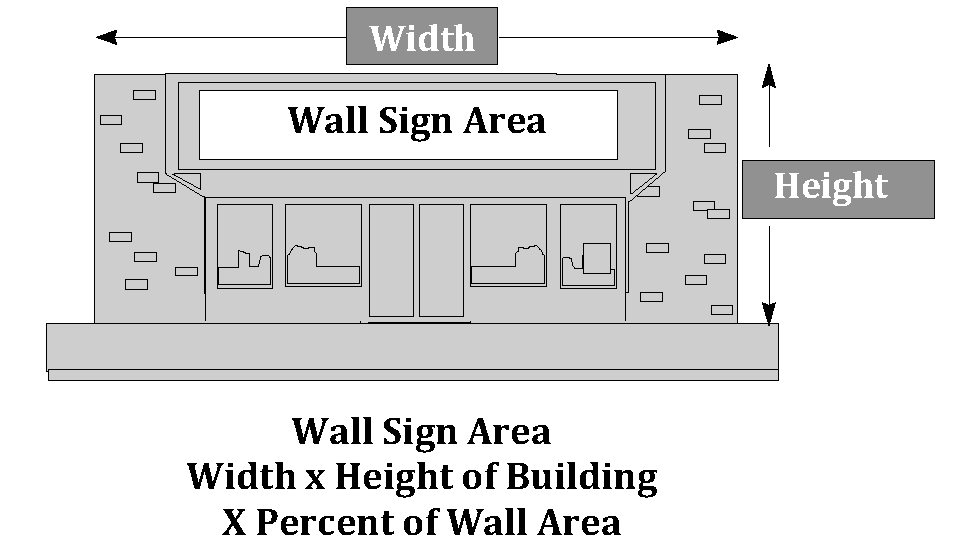
For buildings with multiple tenants, sign areas for wall signs, projecting signs, and awning signs shall be determined by taking that portion of the front wall of the building applicable to each tenant and computing sign limits for that portion of the total wall.
(g)
Signs permitted in all districts. The following signs are permitted in all zone districts:
(1)
Directional, identification, traffic warning, or government signs, provided the size of each sign does not exceed six square feet and four feet in height and each sign is located at least five feet from any lot line.
(2)
Reader boards. All wall and freestanding signs in all zoning districts may include reader boards subject to the following regulations:
a.
A reader board shall not consist of more than 50 percent of the allowable sign area except for signs, which are 32 square feet, or less in area.
b.
The dwell time, defined as the interval of change between each individual message, shall be at least five seconds and a change of message must be accomplished within one second or less. The dwell time shall not include the one second or less to change the message.
c.
An electronic reader board sign shall not exceed a maximum illumination of 6,500 nits (candelas per square meter) during daylight hours and a maximum illumination of 325 nits (candelas per square meter) between dusk to dawn as measured at the sign's face at maximum brightness.
However, even if such signs comply with the nit requirements above such signs shall not, in the opinion of the zoning administrator: be brighter than is necessary for clear and adequate visibility; be of such intensity or brilliance as to impair the vision of or be a distraction to a motor vehicle driver with average eyesight or to otherwise interfere with the driver's operation of a motor vehicle or; be of such intensity or brilliance that it interferes with the effectiveness of an official traffic sign, device, or signal.
Prior to the issuance of a sign permit for an electronic message board the applicant shall provide to the zoning administrator certification from the manufacturer of the sign that the illumination settings for the sign comply with the maximum illumination requirements of this subsection (g)(2).
d.
An electronic reader board shall be equipped with a brightness control sensor that allows for the brightness to automatically adjust to the surrounding light conditions.
e.
An electronic reader board shall not have any flashing, blinking, scrolling, alternating, sequentially lighted, animated, rolling, shimmering, sparkling, bursting, dissolving, twinkling, fade-in/fade-out, oscillating, moving text or moving images or simulated movement of text or images.
f.
Electronic message board signs legally in existence upon the effective date of this subsection (g)(2) shall be required to comply with the illumination and message display requirements of this section within 60 days from the effective date of this section.
g.
Electronic reader board signs which do not face a public street or land zoned or used for residential purposes and when such signs are used for drive-through restaurants, gas stations and similar establishments serving motorists then such signs are exempt from the requirements of this subsection (g)(2).
(3)
Window signs.
a.
A window sign may consist of illuminated letters including neon lights.
b.
An electronic reader board is allowed as a window sign and may utilize continuous scrolling letters but a window sign shall otherwise comply with the requirements for electronic reader boards as set forth in subsections (g)(2) and (g)(2)d. herein. Any flashing or strobe type lights within a building or structure which are visible from the exterior of the building or structure are prohibited.
(h)
Construction and maintenance of signs.
(1)
All signs shall be constructed and maintained in accordance with the current Michigan Construction Code.
(2)
Signs shall be maintained free of peeling paint or paper, fading, staining, rust, or other conditions which impair legibility.
(3)
All signs, sign supports, frames, braces, wiring, guys and anchors shall be maintained in such a manner that they do not create a hazard for pedestrians and vehicles.
(4)
Signs shall not be allowed to become unsightly through disrepair or action of the elements.
(5)
In the event the applicant fails to maintain any sign properly or fails to remove the sign at the time of expiration of the permit, the applicant shall be required to remove such sign. An inspection fee, as determined by the city council, shall be paid to the zoning administrator for each such sign at the time of the original permit and at each renewal thereof.
(6)
All signs shall be designed to ensure a dead load and wind pressure in any direction of not less than 30 pounds per square foot of area. All signs shall be securely anchored or otherwise made immobile.
(i)
Regulations for temporary signs.
(1)
A temporary sign may be installed concurrent with the event and removed upon the end of the event. The zoning administrator shall have the discretion to determine the beginning and end date of the event.
(2)
The zoning administrator shall have the discretion to determine when a temporary sign is a permanent sign and subject to the rules for permanent signs.
(3)
Permits are required for temporary signs that exceed 20 square feet in size. The permit shall designate the days on which the sign may be displayed. Display of the sign on any day other than those days designated on the permit shall be a violation of this section.
(4)
A temporary sign permit may be issued as part of and in conjunction with a building permit. The sign permit issuance shall be noted on the building permit.
(5)
The size and number of temporary signs allowed shall be as specified within each zoning district provided in subsection (j).
(6)
Signs shall be anchored in a safe and secure manner. The anchoring of signs by tying or attaching weighted objects (such as cinder blocks or tires) is prohibited.
(7)
The sign shall be located a minimum of five feet from the edge of any road or street right-of-way or public or private sidewalk except for sandwich board signs as regulated herein.
(8)
A sign shall not be displayed if it is torn, bent, faded, not upright, unreadable, or otherwise unsightly.
(9)
Temporary signs held by a person shall not be displayed in the road right-of-way and shall not hamper the visibility of a driver on or off the site.
(10)
Temporary signs shall only be internally illuminated.
(11)
An electronic reader board/digital display sign may serve as a temporary sign and shall comply with the requirements of subsection (g)(2).
(j)
Zone district signs. The following signs are permitted within the zone districts indicated:
See zone district tables below for:
•
Residential districts (R-1, R-2, R-3, and MHP) permitted signs
•
O-1 and C-1, commercial—Permitted signs
•
C-2 general commercial district—Permitted signs
•
C-3 central business district—Permitted signs
•
IND industrial district—Permitted signs
(k)
Nonconforming signs.
(1)
Signs lawfully erected prior to November 1, 1991, or applicable amendment thereto which do not meet the standards of this section may be continued, except as hereinafter provided. No nonconforming sign shall:
a.
Have any changes made in the words or symbols used or the message displayed on the sign, unless the sign is specifically designed for periodic change of message;
b.
Be structurally altered so as to change the shape, size, type or design of the sign; or
c.
Be reestablished or continued after the activity, business, or use to which it applied has been discontinued for 90 days or longer.
(2)
Signs lawfully erected prior to the adoption of this chapter or applicable amendment thereto which do not meet the size limitations of this section may be changed to another nonconforming sign, provided that the sign replacing the original nonconforming sign is at least 30 percent smaller in area than the original nonconforming sign.
(3)
No sign shall be required to be removed which was erected in compliance with this section if such sign becomes nonconforming due to a change occurring after the adoption of this chapter or applicable amendment thereto in the location of a building, streets, or other signs, and which change is beyond the control of the owner of the premises on which the sign is located.
(4)
If the owner of the premises on which a sign is located changes the use of the building, or changes the location of any property line or sign, so that any sign is rendered nonconforming, such sign must be removed or made to conform to this section.
(l)
Discontinuance or abandonment. Whenever the activity, business or use of a primary premises to which a sign is attached or related has been discontinued for a period of 90 days or longer, such discontinuance shall be considered conclusive evidence of an intention to abandon the sign attached or related thereto. At the end of this period of abandonment, the sign shall either be removed or altered to conform with the provisions of this section. All costs of removal shall be at the property owner's expense.
(Prior Code, §§ 15.2001—15.2011; Ord. No. 150, §§ 20.01—20.22, 11-1-1997; Ord. No. 150-A, 4-16-2002; Ord. No. 150-J, §§ 1—5, 5-1-2007; Ord. No. 150-S, §§ 1—15, 12-7-2010; Ord. No. 17-01, § 1, 1-3-2017; Ord. No. 22-01, § 10, 2-1-2022)

