
Greenville City Zoning Code
ARTICLE III
GENERAL AND SUPPLEMENTAL REGULATIONS
Sec. 46-73.- Required accesses and frontage.
(a)
Any lot created shall have a minimum lot width equal to that required by the zone district in which it is located. In no case shall a lot have less than 80 percent of the required lot width as measured at the front lot line, except as may be otherwise specifically permitted in this chapter.
(b)
Any lot created shall have direct access to a public or private street.
(Prior Code, § 15.0302; Ord. No. 150, § 3.02, 11-1-1997; Ord. No. 150-B, 4-16-2002)
Sec. 46-74. - Required areas or space.
(a)
No lot, adjacent lots in common ownership, required yard, parking area or other required open space shall be created, divided or reduced in dimensions or area below the minimum requirements of this chapter.
(b)
If already less than the minimum requirements of this chapter, a required yard, parking area or other open space shall not be divided or reduced in dimensions or area so as to increase its noncompliance with the minimum requirements of this chapter.
(c)
Lots or yards created after November 1, 1997, shall comply with the requirements of this chapter.
(d)
A lot which is platted, or otherwise lawfully of record as on November 1, 1997, may be used as specified in the district in which it is located. The main building on such lot shall be located so that it meets at least 80 percent of the side yard requirements of this chapter. In all cases, the minimum front and rear yard requirements of this chapter shall be met.
(e)
If two or more lots of record or combination of lots and portions of lots of record in existence on November 1, 1997, or the effective date of an amendment to this chapter, are:
(1)
In common ownership;
(2)
Adjacent to each other or have continuous frontage; and
(3)
Individually do not meet the lot width or lot area requirements of this chapter;
Then the lands involved shall be considered to be an undivided parcel for the purposes of this chapter. Such parcels shall be combined into such lot or lots meeting the lot width and lot size requirements of this chapter. No portion of such parcel shall be used or divided in a manner which diminishes compliance with lot width and area requirements of this chapter.
(Prior Code, § 15.0303; Ord. No. 150, § 3.03, 11-1-1997; Ord. No. 150-B, 4-16-2002)
Sec. 46-75. - Cul-de-sac lots.
(a)
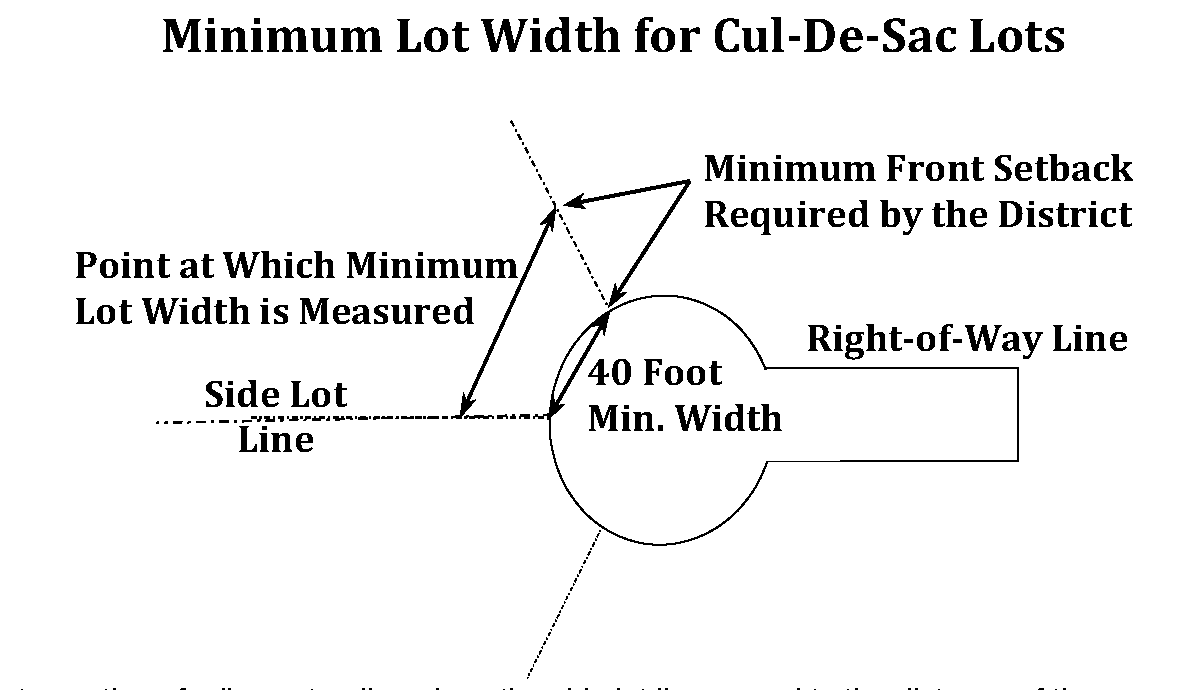
The cul-de-sac shall be determined to commence at the intersection of the radius of the cul-de-sac with the street right-of-way line.
(b)
A lot on a cul-de-sac shall have frontage, which is not less than 80 percent of the minimum lot frontage required for the zoning district in which it is located.
(c)
The minimum lot width shall be measured at a line drawn between the two points located at the intersection of a line extending along the side lot lines equal to the distance of the required front setback.
(Prior Code, § 15.0304; Ord. No. 150, § 3.04, 11-1-1997; Ord. No. 150-B, 4-16-2002)
Sec. 46-76. - Corner lots.
(a)
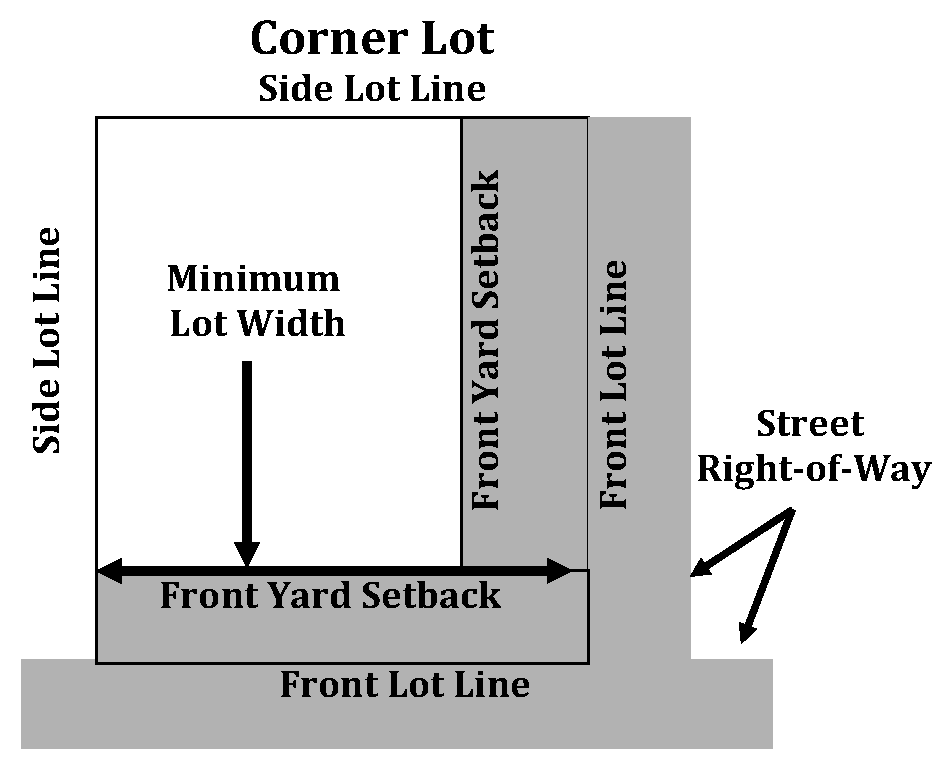
A corner lot shall have two (2) front lot lines, two (2) side lot lines, and no rear lot line.
(b)
Required front yard setbacks shall be measured from both front lot lines.
(c)
For a corner lot with three (3) front lot lines, the remaining lot line shall be a rear lot line.
(d)
The minimum lot width of a corner lot shall be determined at the shorter of the two (2) front lot lines.
(Prior Code, § 15.0305; Ord. No. 150, § 3.05, 11-1-1997; Ord. No. 150-B, 4-16-2002)
Sec. 46-77. - Clear vision areas.
(a)
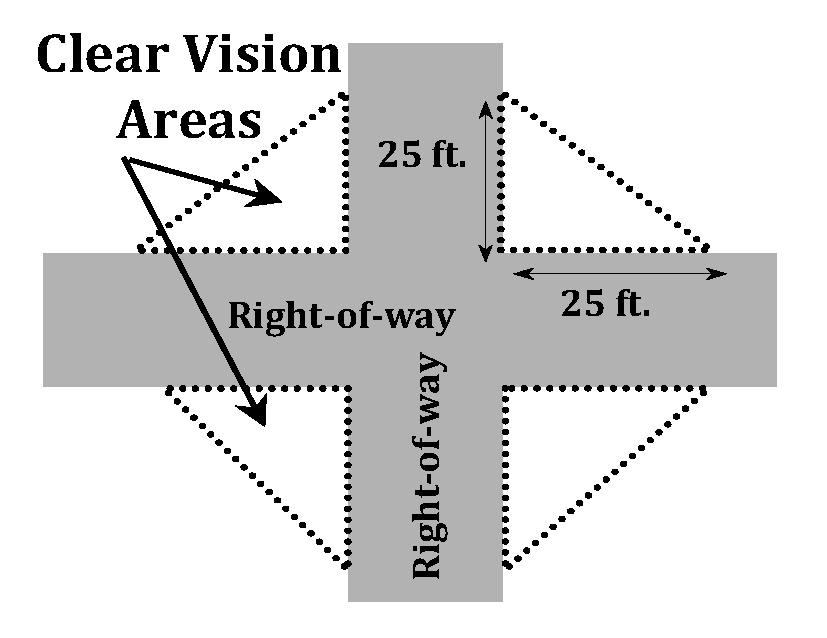
No plantings shall be established or maintained on any lot, which will obstruct the view of a vehicle driver approaching a street intersection. There shall be maintained an unobstructed triangular area formed by the street property lines and a line connecting them at points 15 feet from the intersection of the street lines, or, in the case of a rounded property corner, from the intersection of the street property lines extended. This provision shall not prohibit the planting of landscaping which will be less than 30 inches in height at maturity and maintained at that height or lower.
(b)
No vegetation shall be maintained in any yard, which in the opinion of the zoning administrator, will obstruct the view from or of vehicles entering or leaving the site from driveways or adjacent roadways.
(Prior Code, § 15.0306; Ord. No. 150, § 3.06, 11-1-1997; Ord. No. 150-B, 4-16-2002)
Sec. 46-78. - Projections into yards.
(a)
Certain architectural features, such as cornices, bay windows, or windows without foundations, gutters, chimneys, pilasters, and similar features may project no further than four feet into a required front, rear, or side yard.
(b)
An open, unenclosed, and uncovered porch, paved terrace, deck, balcony or window awning may project no further than:
(1)
Five feet into a required front yard; provided, however, a barrier-free access ramp may extend seven feet into a required front yard. Said ramp shall be removed within a reasonable period of time when no longer required by the occupants or patrons of the facility to which the ramp is attached;
(2)
Fifteen feet into a required rear yard; and
(3)
Shall not project into a required side yard.
(c)
In no case shall a open, unenclosed, and uncovered porch, paved terrace, deck, balcony or window awning be placed closer than five feet to any front or rear lot line, with the exception of the C-3 district where such structures may extend to any lot line except where a lot line abuts a residential district, in which case a five-foot setback shall be maintained from such lot line.
(Prior Code, § 15.0307; Ord. No. 150, § 3.07, 11-1-1997; Ord. No. 150-B, 4-16-2002)
Sec. 46-79. - Permitted front setback reductions.
(a)
Where the front setbacks for existing main buildings entirely or partially within 200 feet of the side lot lines, on the same side of the street and in the same zoning district of the subject lot are less than the required front setbacks for the zoning district of the subject lot, the required front setback for the subject lot shall be the average of the front setbacks of existing main buildings within the two hundred-foot distance, subject to subsection (b) and (c) of this section.
(b)
The permitted front setback reduction shall only be permitted if there are two or more lots occupied by main buildings within the 200-foot distance.
(c)
In no case shall the required front setback resulting from the application of this section be less than 15 feet.
(Prior Code, § 15.0308; Ord. No. 150, § 3.08, 11-1-1997; Ord. No. 150-B, 4-16-2002)
Sec. 46-80. - Main building or principal use.
Each parcel shall contain only one main building or principal use, except for groups of related commercial, industrial, and office buildings, and multiple-family dwellings contained within a single, integrated complex, sharing parking, signs, access, and other similar features, which together form a unified function and appearance.
(Prior Code, § 15.0309; Ord. No. 150, § 3.09, 11-1-1997; Ord. No. 150-B, 4-16-2002)
Sec. 46-81. - Accessory buildings, structures, and uses.
(a)
Accessory buildings generally.
(1)
Where accessory buildings or structures, including but not limited to, enclosed porches or garages, are attached to a main building in a substantial manner, such as by a wall or roof, they shall conform to all regulations of this chapter applicable to a main building.
(2)
Accessory buildings shall not be permitted in the required front yard.
(3)
Accessory buildings shall not be permitted on a lot or parcel which does not have a principal use or main building.
(b)
Accessory uses generally.
(1)
Accessory uses are permitted only in connection with, incidental to, and on the same lot with a principal use, which is permitted in the particular zoning district.
(2)
An accessory use must be in the same zoning district as the principal use on a lot.
(3)
No accessory use shall be occupied or utilized unless the main building to which it is accessory is occupied or utilized. No accessory use may be placed on a lot without a principal use.
(4)
Unless otherwise specifically permitted by this chapter, accessory uses shall not be permitted in the required front yard.
(c)
Residential accessory buildings and structures. Accessory buildings shall be permitted within the R-1, R-2, R-3, MHP, and PUD districts or with any residential use provided that the following restrictions are met:
(1)
The total area of all detached accessory buildings shall not exceed the following:
a.
For lots of 10,000 square feet in area or less: 674 square feet.
b.
For lots greater than 10,000 square feet in area, up to one acre: 850 square feet.
c.
For lots greater than one acre: 960 square feet.
(2)
An accessory building located in the rear yard shall not occupy more than 25 percent of the required rear yard area.
(3)
Accessory buildings in excess of 120 square feet must be designed, constructed, and finished such that the exterior appearance is compatible in terms of materials, color, and general construction with that of the main building.
(4)
No detached accessory building shall be located closer than ten feet to any main building. The drip edge of any detached accessory building shall not be located closer than three feet to any side or rear lot line.
(5)
No detached accessory building shall exceed 15 feet in height.
(d)
Other district accessory buildings and structures. Accessory buildings shall be permitted within the O-1, C-1, C-2, and IND districts provided that the following restrictions are met:
(1)
No more than two detached accessory buildings shall be permitted on any lot.
(2)
The total area of all accessory buildings shall not exceed 25 percent of the floor area of the main building.
(3)
Detached accessory buildings shall meet all setback requirements for the zone district in which it is located.
(4)
No detached accessory building shall be located nearer than ten feet to any main building.
(5)
No detached accessory building shall exceed the permitted height for main buildings in the district in which it is located.
(Prior Code, § 15.0310; Ord. No. 150, § 3.10, 11-1-1997; Ord. No. 150-B, 4-16-2002)
Sec. 46-82. - Fences.
(a)
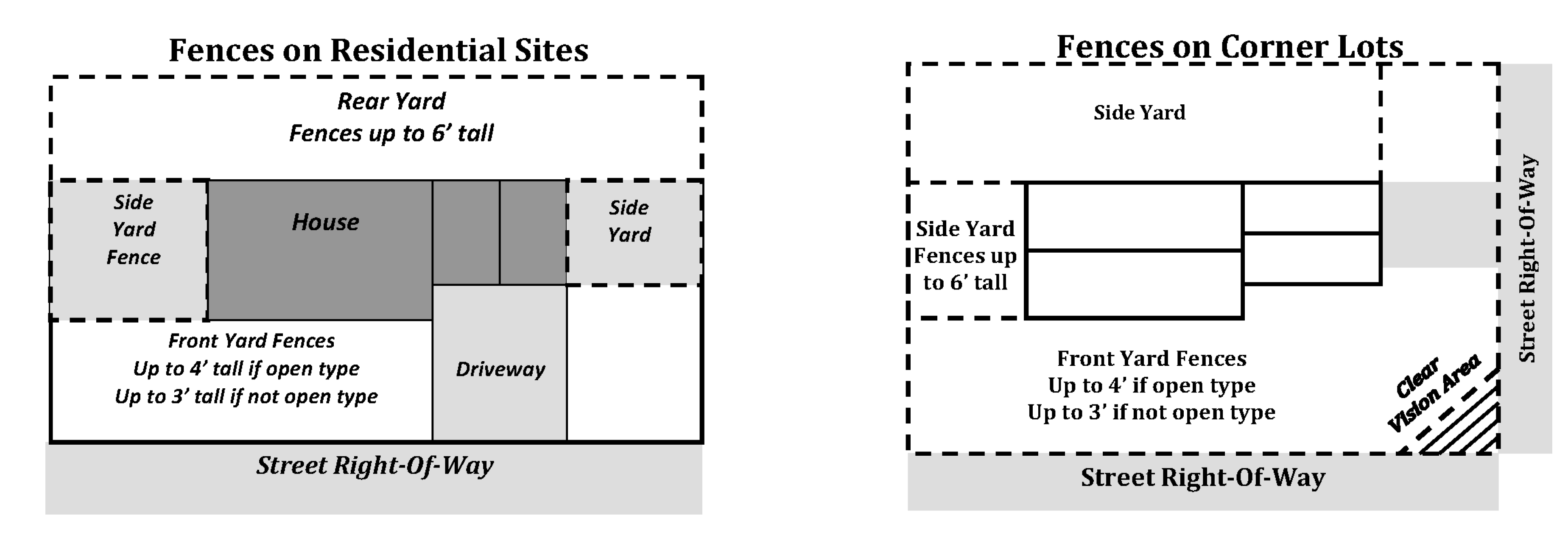
Fences in residential districts shall not exceed six feet in height in rear and side yards.
(b)
Fences within front yards of all zoning districts shall not exceed three feet in height if solid and shall not exceed four feet in height if of an open type. Open type fencing shall include chain link fences, split rail fencing and other fencing types that are not more than 40 percent solid.
(c)
Fences in residential district or enclosing residential uses shall not contain barbed wire or be electrified.
(d)
Fences in the C-2, and IND districts, which enclose storage lots or other areas requiring security, may contain barbed wire, provided that the barbed portion of the fence not be nearer than six feet from the surface of the ground. The total height of fences in the C-2, and IND districts shall not exceed eight feet, including the barbed portion.
(e)
Fences shall not be erected within any public right-of-way in any district.
(f)
Fences shall not be erected or maintained in a clear vision area, as described in section 46-77.
(g)
Fences shall not be erected within two feet from a sidewalk, where the sidewalk is within the public right-of-way.
(h)
Fences shall be erected with the finished side facing adjacent properties and streets. Support poles shall be placed so that they face the inside of the owner's lot.
(i)
Fences shall be constructed of conventional fencing materials. The use of scrap materials, shipping containers, storage units, pallets, and similar materials or detritus as fencing is prohibited. For the purposes of this provision, "conventional fencing materials" shall mean materials commonly utilized and arranged in a way that is customary in the construction industry such as chain link fences, split rail fences, plastic/vinyl fences, wood privacy fences, wrought iron, etc. However, the foregoing shall not be construed to prohibit the use of alternative materials when, in the opinion of the zoning administrator, such materials are arranged in creative, innovative, or artistic manner or display.
(Prior Code, § 15.0311; Ord. No. 150, § 3.11, 11-1-1997; Ord. No. 150-B, 4-16-2002; Ord. No. 150-C, 11-19-2002; Ord. No. 24-13, § 1, 9-3-2024)
Sec. 46-83. - Swimming pools.
(a)
Any swimming pool, spa, hot tub and other similar apparatus, which is below ground or above ground and which is either portable or permanent, which has a capacity in excess of 50 gallons and is capable of holding a depth of two feet or more of water at any one point, shall comply with the requirements of article II of chapter 8. Fencing of such swimming pools and similar apparatus shall comply with the requirements of section 46-82.
(b)
Pools shall not be closer than six feet to any side or rear lot line. Pools shall not be located within a front yard and shall not be closer than six feet to any building.
(Prior Code, § 15.0312; Ord. No. 150, § 3.12, 11-1-1997; Ord. No. 150-B, 4-16-2002; Ord. No. 150-L, § 1, 4-21-2009; Ord. No. 24-07, § 1, 4-16-2024)
Sec. 46-84. - Satellite dish antennas.
(a)
Placement.
(1)
In residential districts a satellite dish antenna shall be permitted only in a rear yard or mounted or attached to a building.
(2)
In the O-1, C-1, C-2, and IND districts, a satellite dish antenna shall be located only in the side or rear yard or mounted on top of a building.
(3)
A satellite dish antenna shall comply with the side and rear yard setback requirements applicable to main buildings in the district in which it is located.
(4)
In nonresidential districts no more than three satellite dish antennas shall be located on the same lot as a main building. Satellite dish antennas are permitted only in connection with, incidental to, and on the same lot as, a principal use or main building.
(b)
Height.
(1)
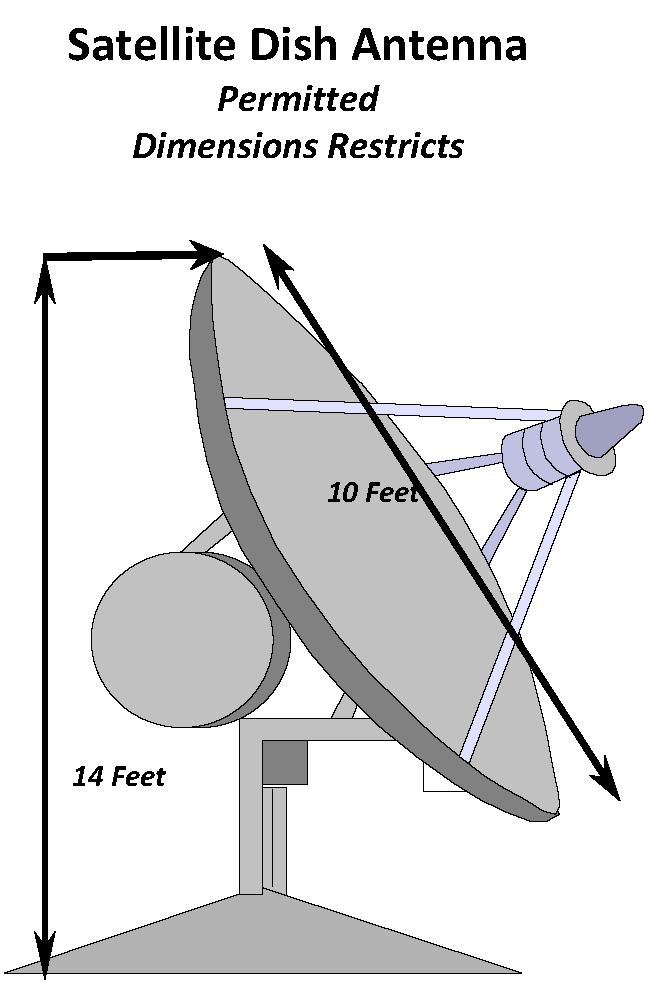
In residential districts, a ground-mounted satellite dish antenna, including any platform or structure upon which the antenna is mounted, shall not exceed 14 feet in height, or ten feet in diameter.
(2)
In the O-1, C-1, C-2, and IND districts, a satellite dish antenna, including any platform or structure upon which the antenna is mounted, shall not exceed the maximum height permitted for main buildings in the district in which it is located.
(c)
General provisions.
(1)
No portion of a satellite dish antenna shall contain any name, message, symbol, or other graphic representation visible from adjoining properties, except as required by the manufacturer or federal regulations for safety purposes.
(2)
A satellite dish antenna shall be anchored in a manner approved by the building inspector as being adequate to secure the satellite dish antenna during high winds.
(3)
A satellite dish antenna shall not be erected, constructed, or installed until a building permit has been obtained from the building inspector.
(4)
These regulations shall not apply to dish antennas that are one meter (39.37 inches) or less in diameter in residential districts or two meters (78.74 inches) or less in diameter in nonresidential districts.
(5)
The building inspector may waive any provision of this section if its enforcement inhibits or prevents the proper operation of the satellite dish antenna.
(6)
These regulations are formulated to ensure that adequate protection measures are provided in this chapter for ensuring that sight distance is not impaired, that such dish antennas are located and constructed in a manner, which will not afford the potential for injury, and to ensure that the intent and purposes of this chapter are met.
(Prior Code, § 15.0313; Ord. No. 150, § 3.13, 11-1-1997; Ord. No. 150-B, 4-16-2002)
Sec. 46-85. - Storage of recreation equipment.
Recreational equipment may be located outside of an enclosed building on any lot within a residential district provided that the following requirements are met:
(1)
Recreational equipment shall not be located within the required front yard or nearer than three feet to a side or rear lot line.
(2)
Notwithstanding the provisions of this section, recreational equipment may be parked within any yard, but not within the required yard, for cleaning, loading, or unloading purposes for not more than 48 hours within any seven-day period.
(3)
Recreational equipment may be used for living or housekeeping purposes for a period not exceeding 14 days in any calendar year, provided that running water or indoor sewage facilities within such equipment is not utilized.
(4)
Where physical features of a property, such as, but not limited to, immovable structures, or a tree with a diameter of four inches or greater, prohibit a recreational vehicle from being parked in compliance with this section, the owner may apply to the zoning administrator for permission to park the recreational vehicle on the lot. This permission shall be granted, provided that the following requirements are met:
a.
A 20-foot setback shall be maintained from the recreational vehicle to the edge of the street pavement or curb, or, if a sidewalk exists, the 20-foot setback shall be measured from the inside edge of the sidewalk.
b.
Parking approval, if granted by the zoning administrator, shall be effective for five years following the date of issuance. Additional approvals may be granted by the zoning administrator in accordance with this section.
(Prior Code, § 15.0314; Ord. No. 150, § 3.14, 11-1-1997; Ord. No. 150-B, 4-16-2002)
Sec. 46-86. - Storage and repair of vehicles.
(a)
The carrying out of repair, restoration and maintenance procedures or projects on vehicles in any residential district, when such work is not conducted entirely within the interior of a building, shall be subject to the following limitations:
(1)
Procedures or projects exceeding 48 hours in duration or which require the vehicle to be immobile or inoperable in excess of 48 hours shall be carried out within a garage.
(2)
Inoperable or unlicensed vehicles and vehicle parts shall be stored inside a building.
(b)
It shall be unlawful for the owner, tenant or lessee of any lot in any residential district to permit the open storage or parking outside of a building of semi-tractor trucks and/or semi-trailers, bulldozers, earth carriers, cranes or any other similar equipment or machinery, unless parked thereon while in use in construction being conducted on such lot.
(Prior Code, § 15.0315; Ord. No. 150, § 3.15, 11-1-1997; Ord. No. 150-B, 4-16-2002)
Sec. 46-87. - Seasonal uses.
(a)
The zoning administrator, upon receiving an application, may issue a permit for the temporary sale of merchandise in any nonresidential district, related to a seasonal or periodic event. Such seasonal uses shall include the sale of Christmas trees, fireworks, and similar activities, but shall not include roadside stands.
(b)
In considering a request for a temporary permit, the zoning administrator must determine that the operation of such a use is seasonal in nature and will not be established as a permanent use. The zoning administrator will also determine that:
(1)
The use does not have an unreasonable detrimental effect upon adjacent properties;
(2)
The use does not impact the nature of the surrounding neighborhood;
(3)
Access to the area will not constitute a traffic hazard due to ingress or egress; and
(4)
Adequate off-street parking is available to accommodate the use.
(c)
Each permit shall be valid for a period of not more than 90 days and may be renewed by the zoning administrator for up to one additional 30-day period, provided the season or event to which the use relates is continued.
(Prior Code, § 15.0316; Ord. No. 150, § 3.16, 11-1-1997; Ord. No. 150-B, 4-16-2002)
Sec. 46-88. - Construction buildings and structures.
Construction buildings and structures, including trailers, incidental to construction work on a lot, may be placed on such lot, subject to the following restrictions:
(1)
Construction buildings and structures may only be used for the storage of construction materials, tools, supplies and equipment, for construction management and supervision offices, and for temporary on-site sanitation facilities, related to construction activity on the same lot.
(2)
No construction building or structure shall be used as a dwelling unit.
(3)
A building permit shall be issued by the building inspector prior to installation of a construction building or structure.
(4)
Construction buildings and structures shall be removed from the lot within 15 days after an occupancy permit is issued by the building inspector for the permanent structure on such lot, or within 15 days after the expiration of a building permit issued for construction on such lot.
(Prior Code, § 15.0317; Ord. No. 150, § 3.17, 11-1-1997; Ord. No. 150-B, 4-16-2002)
Sec. 46-89. - Regulations applicable to single-family dwellings outside manufactured home parks.
Any single-family dwelling, whether one constructed and erected on a lot or a manufactured home, shall be permitted outside a manufactured home park only if it complies with all of the following requirements:
(1)
If the dwelling unit is a manufactured home, the manufactured home must either be new and certified by the manufacturer and/or appropriate inspection agency as meeting the Mobile Home Construction and Safety Standards of the U.S. Department of Housing and Urban Development, as amended, or any similar successor or replacement standards which may be promulgated, or used and certified by the manufacturer and/or appropriate inspection agency as meeting the standards referenced above, and found, on inspection by the building inspector or his designee, to be in excellent condition and safe and fit for residential occupancy.
(2)
The dwelling unit shall comply with all applicable building, electrical, plumbing, fire, energy and other similar codes which are or may be adopted by the city; provided, however, that where a dwelling unit is required by law to comply with any federal or state standards or regulations for construction, and where such standards or regulations for construction are different than those imposed by city codes, then and in such event such federal or state standard or regulation shall apply. Appropriate evidence of compliance with such standards or regulations shall be provided to the building inspector.
(3)
The dwelling unit and the lot on which it is placed shall comply with all restrictions and requirements of this chapter, including, without limitation, the minimum lot area, minimum lot width, minimum residential floor area, required yards and maximum building height requirements of the zoning district in which it is located.
(4)
If the dwelling unit is a manufactured home, the manufactured home shall be installed with the wheels removed.
(5)
The dwelling unit shall be firmly attached to a permanent and continuous foundation constructed on the building site, such foundation to have a wall of the same perimeter dimensions as the dwelling unit and to be constructed of such materials and type as required by the building code for on-site constructed single-family dwellings. If the dwelling unit is a manufactured home, its foundation shall fully enclose the chassis, undercarriage and towing mechanism.
(6)
If the dwelling unit is a manufactured home, it shall be installed pursuant to the manufacturer's setup instructions and shall be secured to the building site by an anchoring system or device complying with the rules and regulations, as amended, of the state mobile home commission, or any similar or successor agency having regulatory responsibility for manufactured home parks.
(7)
The dwelling unit shall have a minimum horizontal dimension across any front, side, or rear elevation of 20 feet.
(8)
A storage area of not less than 120 square feet shall be provided in conjunction with the single-family dwelling. This storage area may consist of a basement, closet area, attic, or in a garage attached to a main building, or in a detached accessory building which is in compliance with all other applicable provisions of section 46-81.
(9)
Permanently attached steps or porch areas at least three feet in width shall be provided where there is an elevation difference greater than eight inches between the first floor entry of the dwelling unit and the adjacent grade.
(10)
The pitch of the main roof of the dwelling unit shall not be less than three feet of rise for each 12 feet of horizontal run, and shall have not less than a 12-inch overhang.
(11)
The exterior finish of the dwelling unit shall not cause reflection that is greater than that from siding coated with clean, white, gloss exterior enamel.
(12)
The dwelling unit shall be so placed on the lot that the portions nearest the street frontage are at least 30 feet in dimension parallel to the street.
(13)
The dwelling unit shall have at least two exterior doors, with one being in either the rear or the side of the dwelling unit.
(Prior Code, § 15.0318; Ord. No. 150, § 3.18, 11-1-1997; Ord. No. 150-B, 4-16-2002)
Sec. 46-90. - Illegal dwellings.
The use of any portion of the basement of a partially completed building, or any garage or accessory building for dwelling or sleeping purposes in any zoning district is prohibited.
(Prior Code, § 15.0319; Ord. No. 150, § 3.19, 11-1-1997; Ord. No. 150-B, 4-16-2002)
Sec. 46-91. - Home occupations.
The regulations of this section are intended to ensure that home occupations remain subordinate to the residential use, that the residential viability of the dwelling is maintained, and that home occupations shall not be a detriment to the character and livability of the surrounding neighborhood.
(1)
Home occupations shall be approved by the zoning administrator, who shall issue a permit upon receipt of a letter from the applicant stating his intent to comply with the requirements of this section and a determination that the requirements of this section have been met. As part of the review process the applicant for a home occupation shall submit an accurate drawing illustrating the property, the dwelling on the property, the dimensions and square footage of the dwelling, the dimensions and square footage within the dwelling to be devoted to the home occupation and the area proposed for on-site parking.
(2)
The dwelling unit used for the home occupation shall conform to all applicable zoning district requirements.
(3)
No persons other than members of the immediate family residing on the premises shall be engaged in such occupation.
(4)
The use of the dwelling unit for the home occupation shall be clearly incidental and subordinate to its use for residential purposes by its occupants, and not more than 25 percent of the gross floor area of the dwelling unit shall be used in the conduct of the home occupation. For purposes of this section, the term "gross floor area" means the total floor area of the dwelling as measured from the interior faces of the exterior walls, excluding the attic, porch, breezeway, patio, deck, attached garage and an unfinished or uninhabitable basement as defined by the city building code. No part of an accessory building, either attached or detached, shall be used.
(5)
No more than two customers, clients, students or patients shall be on the premises in which a home occupation is located at any one time.
(6)
There shall be no change in the outside appearance of the building or premises, or other visible evidence of the conduct of such home occupation, other than one sign, not exceeding four square feet in area, non-illuminated, and mounted flat against the wall of the main building facing the street.
(7)
The home occupation shall be operated entirely within the main building.
(8)
No retail or other sales of merchandise or products shall be conducted upon the premises except for incidental products related to the home occupation or those goods actually produced on the premises.
(9)
No traffic shall be generated by such home occupation in greater volumes than would normally be expected in a residential neighborhood, and any need for parking generated by the conduct of such home occupation shall be met off the street and other than in the required front yard. The home occupation shall not require any additional parking.
(10)
No equipment or process shall be used in such a home occupation, which creates noise, vibration, glare, light, fumes, odors, or electrical interference detectable to the normal senses outside the dwelling unit. In case of electrical interference, no equipment or process shall be used which creates visual or audible interference in any radio or television receivers off the premises, or cause fluctuation in line voltage off the premises.
(11)
Visits by customers, clients, students or patients to a dwelling unit in which a home occupation is located shall be limited to between the hours of 7:00 a.m. to 9:00 p.m., local time.
(12)
No home occupation shall be permitted which would increase traffic, create fire and safety hazards, noise, dirt, odor, dust, gas, glare, fumes, vibration or other nuisance elements.
(13)
All building, housing, fire and other local or state codes and ordinances shall be adhered to for home occupations.
(14)
A registered primary caregiver, as defined by and in compliance with the General Rules of the Michigan Department of Community Health, Mich. Admin. Code, R 333.101 through R 333.133 (the General Rule), the Michigan Medical Marihuana Act (MCL 333.26421 et seq.) (the Act), and the requirements of this section, shall be allowed as a home occupation.
a.
Nothing in this section, or in any companion regulatory section adopted in any other provision of this chapter, is intended to grant, nor shall they be construed as granting immunity from prosecution for growing, sale, consumption, use, distribution or possession of marihuana not in strict compliance with the Act and the General Rules.
b.
Also, since federal law is not affected by the Act or the General Rules, nothing in this section, or in any companion regulatory section adopted in any other provision of this chapter, is intended to grant, nor shall they be construed as granting immunity from criminal prosecution under federal law. The Act does not protect users, caregivers or the owners of properties on which medical use of marihuana is occurring from federal prosecution, or from having their property seized by federal authorities under the Federal Controlled Substances Act. The following requirements for a registered primary caregiver shall apply:
1.
The medical use of marihuana shall comply at all times and in all circumstances with the Michigan Medical Marihuana Act (MCL 333.26421 et seq.) and the General Rules of the Michigan Department of Community Health, as they may be amended from time to time.
2.
A registered primary caregiver must be located outside of a 1,000-foot radius from any school or library.
3.
Not more than one primary caregiver shall be permitted to service qualifying patients per dwelling unit.
4.
All medical marihuana shall be contained within the main building in an enclosed, locked facility inaccessible on all sides and equipped with locks or other security devices that permit access only by the registered primary caregiver or qualifying patient, as reviewed and approved by the city's building official and the city's department of public safety.
(Prior Code, § 15.0320; Ord. No. 150, § 3.20, 11-1-1997; Ord. No. 150-B, 4-16-2002; Ord. No. 150-O, § 1, 8-17-2010; Ord. No. 22-01, § 7, 2-1-2022)
State Law reference— Certain uses to be permitted home occupations, MCL 125.3204.
Sec. 46-92. - Keeping of animals.
(a)
The keeping of household pets, including dogs, cats, fish, birds, hamsters and other animals generally regarded as household pets is permitted as an accessory use in any residential district. However, any land, building, or structure where five or more cats and/or dogs six months of age or older are boarded, housed, or bred for commercial purposes shall be considered a kennel. Kennels shall only be permitted in the C-2 general commercial district after approval as a special land use as the principal use of the lot or parcel on which it is located.
(b)
The keeping of animals not normally considered household pets, including, but not limited to, horses, pigs, sheep, cattle, and poultry is prohibited in all zoning districts, unless kept in conjunction with an existing farm or on a lot in a residential district with an area of at least five acres.
(Prior Code, § 15.0321; Ord. No. 150, § 3.21, 11-1-1997; Ord. No. 150-B, 4-16-2002)
Sec. 46-93. - Water and sanitary sewer service.
(a)
No structure for human occupancy shall be erected, altered or moved upon any lot and used in whole or part for dwelling, business, industrial, or recreation purposes unless provided with a safe, sanitary and potable water supply and with a safe and effective means of collection, treatment and disposal of human, domestic, commercial and industrial waste.
(b)
Such installations and facilities shall conform with the minimum requirements for such facilities set forth by the state health department, the county health department, and the subdivision regulations, building code and water and sewer ordinances of the city.
(Prior Code, § 15.0322; Ord. No. 150, § 3.22, 11-1-1997; Ord. No. 150-B, 4-16-2002)
Sec. 46-94. - Mechanical appurtenances.
(a)
Except in the C-3 central business district, mechanical appurtenances, such as blowers, ventilating fans and air conditioning units, shall be placed not closer than 12 feet to any lot line. In the O-1, C-1, C-2, and IND districts ground-mounted mechanical appurtenances shall be screened by landscaping or other materials compatible in appearance with the main building with which it is associated.
(b)
Any mechanical appurtenances in the O-1, C-1, C-2, and IND districts, including elevator housings, stairways, tanks, heating, ventilation and air conditioning equipment, and other similar apparatus located on the roof of any building shall comply with the following standards:
(1)
Such apparatus shall be enclosed in a screening structure having walls constructed of material compatible in appearance with the main building to which it is attached.
(2)
The apparatus and enclosure shall not exceed a height of ten feet above the surrounding roof surface, and shall not occupy greater than 15 percent of the total area of the roof of the building on which it is placed.
(Prior Code, § 15.0323; Ord. No. 150, § 3.23, 11-1-1997; Ord. No. 150-B, 4-16-2002)
Sec. 46-95. - Essential public services.
The erection, construction, alteration or maintenance of essential public services shall be permitted in any zoning district; it being the intention thereof to exempt such erection, construction, alteration or maintenance from the application of this chapter.
(Prior Code, § 15.0324; Ord. No. 150, § 3.24, 11-1-1997; Ord. No. 150-B, 4-16-2002)
Sec. 46-96. - Building and structure height exceptions.
(a)
Height requirements may be exceeded by the following: parapet walls not exceeding four feet in height, chimneys, cooling towers, elevator bulkheads, fire towers, gas tanks, grain elevators, silos, stacks, stage towers and scenery lofts, water tanks, public monuments, church spires, radio and television antennas and towers, and penthouses or roof structures housing necessary mechanical appurtenances.
(b)
Height exceptions are not permitted for towers and structures for commercial wireless telecommunication services in excess of 50 feet in height (as measured from the ground level nearest the tower to the top of the tower), but such towers 50 feet or lower in height may be excepted from the height limitations of the district in which they are located.
(Prior Code, § 15.0325; Ord. No. 150, § 3.25, 11-1-1997; Ord. No. 150-B, 4-16-2002)
Sec. 46-97. - Timely completion of construction required.
Following the initiation of the construction, erection, reconstruction, modification, expansion or enlargement of any building or other structure authorized under the provisions of this chapter, completion of such work shall be diligently pursued and completed in a timely manner. Unless otherwise specified as a condition of approval of a site plan or special land use by the planning commission, any construction authorized under the provisions of this chapter shall be completed or be diligently pursued within one year from the date of issuance of a building permit for such construction.
(Prior Code, § 15.0327; Ord. No. 150, § 3.27, 11-1-1997; Ord. No. 150-B, 4-16-2002)
Sec. 46-98. - Private streets.
(a)
Purpose. The city determines that it is in the best interest of the public health, safety, and welfare to regulate the construction, improvement, extension, relocation, and use of private streets. These provisions have been enacted to ensure that private streets:
(1)
Will not be detrimental to the public health, safety, or general welfare;
(2)
Will not adversely affect the long-term development policies of the city;
(3)
Will be designed and constructed with width, surface, and grade to ensure safe passage and maneuverability of private vehicles, police, fire, ambulance, and other safety vehicles;
(4)
Will be constructed so as to protect against or minimize soil erosion and prevent damage to the lakes, streams, wetlands, and natural environment of the city.
(b)
Definitions. The following words, terms and phrases, when used in this section, shall have the meanings ascribed to them in this subsection, except where the context clearly indicates a different meaning:
Parcel means a tract of land, which can be legally described with certainty and is capable of being located by survey.
Safe and unimpeded route of travel means a roadway of adequate width to accommodate the safe, two-way passage of vehicles, and of sufficient construction to accommodate any fire, police, rescue, or other emergency vehicle which may be utilized by the city.
(c)
Frontage and access.
(1)
Any lot not having frontage on a public street shall have frontage upon a private street.
(2)
All parcels utilizing a private street shall have frontage on the private street for at least the minimum lot width required for the district in which the parcel is located.
(3)
All private streets shall have direct access to a public street.
(d)
Permits.
(1)
No individual, association, corporation, or entity, either public or private, shall construct a private street without first having obtained a private street permit from the city council.
(2)
The building inspector shall not issue building permits for construction of any building or structure on lots served solely by a private street until a permit for the private street has been approved by the city council and a safe and unimpeded route of travel is available for any such structure requiring a building permit.
(3)
A driveway permit shall be obtained from the state department of transportation, where applicable, or from the city.
(4)
A soil erosion and sedimentation control permit shall be obtained, as may be required by part 91 of the Natural Resources and Environmental Protection Act (MCL 324.9101 et seq.).
(5)
All other required state permits shall be obtained.
(6)
The city council may elect to have all design and construction plans reviewed by the city's attorney, engineer, or planner prior to consideration of the application for the private street permit.
(e)
Application. An application for a private street permit shall contain the following:
(1)
A completed private street permit application, provided by the city.
(2)
A detailed written description of the development to be served by the private street.
(3)
Seven copies of a plan, drawn to scale, prepared by a registered engineer, showing the precise location, grade, route, elevation, dimensions, and design of the private street and any proposed extensions thereto, existing and proposed curb cuts, and the location and distance to any public streets which the private street is to intersect. However, the plan may be prepared by a registered surveyor, rather than a registered engineer, if the proposed private street is to serve five or fewer parcels or main buildings, and if the zoning administrator waives in writing the requirement for the plan to be prepared by a registered engineer.
(4)
A survey of the right-of-way by a registered land surveyor, together with surveys for each parcel to be served by the private street.
(5)
The location of all public utilities, including, but not limited to, water, sewer telephone, gas, electricity, and television cable to be located within the private street right-of-way or within 20 feet of either side thereof. Copies of the instruments describing and granting such easements shall be submitted with the application.
(6)
The location of any lakes, streams, wetlands, and drains within the proposed right-of-way or within 100 feet thereof.
(7)
The location of any other buildings and structures located, or to be located, within 100 feet of the private street right-of-way.
(f)
Design requirements.
(1)
Construction specifications. Construction specifications for width, surface and base materials, curbing, drainage, utility locations, and method of construction shall conform to the city standards for public streets.
(2)
Length of private streets.
a.
No private street shall extend for a distance of more than 1,240 feet in length from the nearest public street right-of-way from which access is gained, as measured along the centerline of the private street to the furthest point of any private street, except as otherwise noted, without a private street access complying with this section being provided to another public street.
b.
The maximum length of a proposed private street may be exceeded if the city council, after recommendation of the planning commission, finds that at least one of the following conditions exists:
1.
That topography or other significant natural features preclude access to any other public street or adjoining property on which a public street may be constructed. Such significant natural features shall be clearly identified and marked on the proposed private street plans.
2.
That not allowing a longer private street would result in inefficient use of land. Alternate development plans demonstrating that no other development is feasible shall be submitted by the applicant and reviewed by the city council prior to confirming this finding.
3.
That other methods of access are available such that emergency vehicles are ensured a safe and unimpeded route of travel to the properties served by the private street. Such access shall be reviewed by the fire chief and the recommendation forwarded to the planning commission.
c.
The city council, upon a finding that at least one of the above conditions exists, shall establish the maximum length of the proposed private street.
(3)
Right-of-way/easement width.
a.
All private streets constructed after November 1, 1997, chapter shall have a recorded permanent right-of-way and easement with a minimum width of at least 66 feet. The right-of-way shall also expressly permit public or private utilities to be installed within the right-of-way.
b.
Private streets in existence as of November 1, 1997, whose right-of-way or easement width is less than 66 feet need not provide additional right-of-way or easement width, but such width shall not be subsequently reduced so as to increase its noncompliance with these requirements.
(4)
Other requirements. The layout of the private street and the intersection of the private street with either a public or private street shall be such that clear vision, safe turning and travel in all directions at the posted speed limit is ensured, as determined by the city engineer. The minimum distance between intersection of public and/or private street rights-of-way shall not be less than 150 feet, as measured along the right-of-way line thereof.
(5)
Existing private streets.
a.
A private street existing on November 1, 1997, continue in existence and be maintained and used, though it may not comply with the provisions of this section. Such private streets shall be continuously maintained so as to provide a safe and unimpeded route of travel for motor vehicle traffic, pedestrians, and emergency vehicles in all weather conditions.
b.
Any private street existing on November 1, 1997, to which one or more additional lots or parcels are created or otherwise permitted access, shall have the entire length of the existing private street upgraded to comply with the applicable requirements of this subsection (f).
c.
If a private street existing on November 1, 1997, is extended by the construction and use of an additional length of private street, the entire private street, including the existing portion and the additional portion, shall comply with the applicable requirements of this subsection (f).
(g)
Review standards; modification of certain requirements.
(1)
Prior to approving a private street permit application, the city council shall determine the following:
a.
The proposed private street will not be detrimental to the public health, safety, or general welfare.
b.
The proposed private street will not adversely affect the use of land.
c.
The private street is constructed to ensure a safe and unimpeded route of travel for motor vehicle traffic, pedestrians, and emergency vehicles in all weather conditions.
d.
The private street is constructed so as to protect against or minimize soil erosion and prevent damage to the lakes, streams, wetlands, and natural environment of the city.
e.
The construction of the private street will conform to the requirements of this section.
(2)
The city council may require that the applicant comply with reasonable conditions relative to the design and construction of the private street.
(3)
Upon application the city council may modify any of the private street requirements of this section after finding that all of the following conditions exist:
a.
Topography, soils, and/or other significant natural features physically preclude or prevent compliance with the requirements of this section without substantial alteration of such natural features. Such natural features shall be clearly identified and described in the application for any such modification.
b.
The justification of any modification is not due solely to financial considerations which, upon approval of the requested modification would provide a financial benefit.
c.
That no other reasonable private street design alternatives are available that would comply with the requirements of this section.
d.
That the request for modification was reviewed by the fire chief or city engineer, or any other person or official designated by the city council and a recommendation submitted to the council.
(h)
Maintenance and repairs.
(1)
Private streets shall be maintained in a manner that complies with the provisions of this section.
(2)
All private streets shall be continuously maintained in such a way that they will not constitute a danger to the health, safety, and welfare of the inhabitants of the city. All private streets shall be continuously maintained in such a way that they ensure a safe and unimpeded route of travel for motor vehicle traffic, pedestrians, and emergency vehicles in all weather conditions.
(3)
All costs for maintenance and repair of the private street shall be the responsibility of the property owners or any property owners association served by the private street.
(4)
Private street maintenance or restrictive covenant agreements.
a.
The applicants/owners of the proposed private street right-of-way or private street shall provide the city council with a recordable private street maintenance or restrictive covenant agreement between the owner of the private street right-of-way and any other parties having any interest therein, or other documentation satisfactory to the city council which shall provide for and ensure that the private street shall be regularly maintained, repaired, and snow-plowed so as to ensure that the private street is safe for travel at all times and the cost thereof paid.
b.
The applicants agrees, by filing an application for and receiving a permit under this chapter, that they will ensure that any buildings or parcels thereafter created or constructed on the private street shall also be subject to the street maintenance or restrictive covenant agreement and that said agreement shall be recorded and shall run with the land. A copy of said agreement shall be furnished to the city council prior to the issuance of the permit.
(i)
Performance guarantee. The city council may, as a condition of the private street construction permit, require that the applicant provide a performance guarantee, in accordance with the provisions of subsection 46-40(b).
(j)
Inspections/certificate of compliance.
(1)
Upon completion of construction of the private street, the city engineer shall inspect the completed construction to determine whether it complies with the approved plans, specifications, permit, and this chapter.
(2)
The applicants, at the applicants' expense, shall provide the city with a set of "as built" drawings bearing a certificate and statement from a registered engineer certifying that the private street has been completed in accordance with the requirements of the permit and the city.
(3)
If the completed private street does not satisfy the requirements of the permit or this chapter, the applicants shall be notified of the noncompliance in writing and shall be given a reasonable period of time within which to correct the deficiencies. Failure to correct the deficiencies within the time provided shall be unlawful.
(k)
Fees for the permits required hereunder shall be set by the city council. Additionally, the city council may require that the applicants put sufficient funds in escrow to cover the costs of having the city attorney, engineer, planner, or other professional review the private street plans, specifications, and maintenance agreements, and to do the necessary inspections.
(l)
[Indemnification of city.] The applicants/owners of the private street agree that by applying for or securing a permit to construct the private street that they shall indemnify and hold the city harmless from any and all claims for personal injury and/or property damage arising out of the use of the private street or of the failure to properly construct, maintain, use, repair, and replace the private street.
(Prior Code, § 15.0328; Ord. No. 150, § 3.28, 11-1-1997; Ord. No. 150-B, 4-16-2002)
Sec. 46-99. - Lighting requirements.
(a)
Parking lot lighting shall be as required in section 46-258.
(b)
Lighting provided for security or visibility on any site shall be shielded to reduce glare and shall be so arranged and maintained as to direct the light away from any residential district or use, which adjoins the site.
(c)
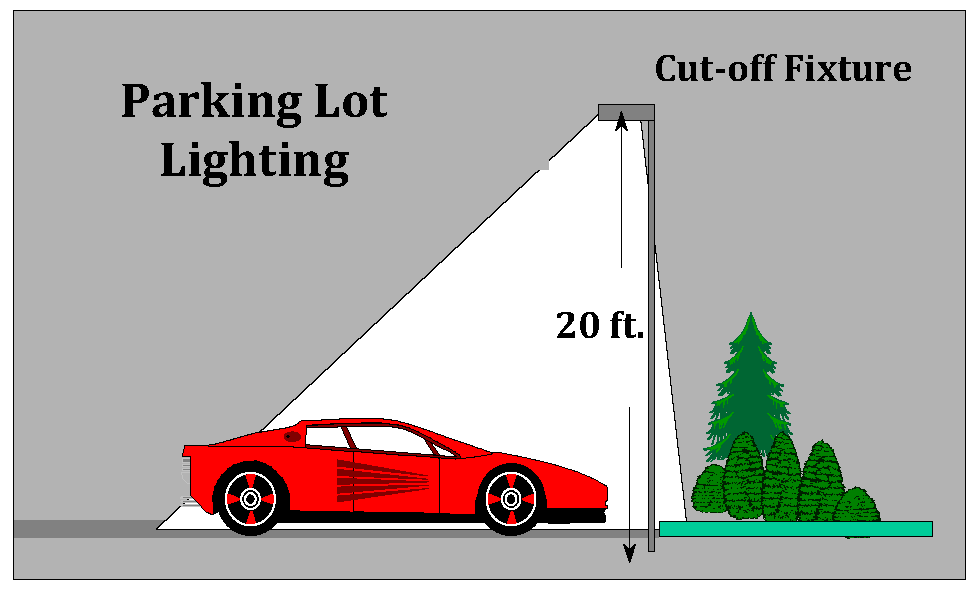
Light fixtures shall be no higher than 20 feet and shall be provided with light cut-off fixtures that direct light downward. For parking lots serving a single building or groups of related commercial, industrial, or office buildings in excess of 500 spaces the planning commission may permit a higher light fixture in selected locations within the parking lot where existing or planned residential areas will not be affected.
(d)
Lighting shall not be attached to buildings or other structures that permit light to be directed horizontally.
(Prior Code, § 15.0329; Ord. No. 150, § 3.29, 11-1-1997; Ord. No. 150-B, 4-16-2002)
Sec. 46-100. - Community gardens.
(a)
Definition and applicability.
(1)
For purposes of this section, the term "community garden" is defined as a parcel or parcels of primarily vacant land managed and maintained by an organized group of individuals consisting of more than one person or family for the purpose of growing and harvesting food crops and/or non-food ornamental crops such as flowers for personal or group use, consumption or donation. A community garden may be divided into separate plots for cultivation by one or more individuals or may be utilized collectively by members of the group and may include common areas maintained and used by group members.
(2)
Except as stipulated by subsection (e)(1) of this section, gardens which are established and operated on land which contains a principal use are considered an accessory use and shall not be subject to this section.
(b)
Special use permit required. A community garden is permitted in all zoning districts as a special land use according to the requirements of article VI of this chapter and this section.
(c)
Application requirements. A person seeking a permit for a community garden shall file an application with the city zoning administrator. Such application shall contain at a minimum the following information:
(1)
Name of the applicant and/or organization, which is applying, for the permit.
(2)
Address, phone number, and e-mail address of the applicant and property owner.
(3)
Written permission from the property owner.
(4)
Location and/or address of the proposed use.
(5)
Size of the parcel containing the proposed use.
(6)
A brief description of the use including:
a.
The number and size of individual gardening plots;
b.
The maximum number of persons anticipated to become members of or to utilize the community garden;
c.
Any buildings to be erected including the size and proposed use;
d.
Dates and hours of operation of the proposed activity.
(7)
A copy of the community garden rules, operating and maintenance procedures and person or persons responsible for the community garden operation.
(8)
Description of pesticides, herbicides and fertilizers to be used and method of application.
(9)
An accurate site plan sketch with dimensions which illustrate the lot lines, garden plot layout, access aisles, setback from lot lines, on-site parking, fencing, location of buildings and other physical improvements or structures necessary to conduct the use. For purposes of this section, the site plan review requirements of section 46-41 shall be superseded by this subsection (c)(9).
(10)
A fee as established by the city council for a community garden permit shall be provided with the application.
(d)
Validity of permit. Any permit issued under this section shall be valid for the duration of the community garden use. Should the use cease for one growing season the permit shall be voided and a new permit shall be needed to resume operation.
(e)
Development and operating requirements for community gardens.
(1)
A community garden shall only be established on a vacant parcel or parcels, except that in the R-1, R-2 and R-3 zones a community garden may be established on a parcel containing a dwelling unit or units if the parcel contains a minimum of 15,000 square feet and has a minimum of 130 feet of lot width.
(2)
Garden use shall be limited to the hours of 7:00 a.m. and 9:00 p.m., but no activities shall occur on the site after dark.
(3)
Accessory buildings shall be permitted subject to the accessory building size and setback regulations of the zoning district in which the community garden is located.
(4)
The establishment of a community garden shall not alter the drainage pattern of stormwater runoff, nor shall water flow off the site of a community garden from on-site watering activity by the members of the community garden.
(5)
The edge of a garden plot shall be a minimum of three feet from all lot lines.
(6)
Fencing shall comply with section 46-82.
(7)
Composting is permitted provided it is properly maintained so as to not emit excessive odors and the area does not become unsightly.
(8)
The following activities and uses are prohibited on the site of a community garden: Lighting and the sale of any item.
(9)
Vehicle access to the site shall only be by way of a driveway constructed to city standards to avoid vehicle damage to the curb, sidewalk and any lawn area in the right-of-way.
(10)
Vehicles accessing the site shall not be parked on or over the public sidewalk.
(11)
One freestanding sign consisting of no more than 12 square feet shall be allowed. Such sign shall otherwise comply with the applicable regulations of the zoning district in which it is located.
(12)
The community garden shall be maintained in a neat and orderly manner. Trash, weed and dirt piles and debris of any sort shall not be allowed to accumulate on site. Fences shall be maintained in good working order so they do not pose a safety hazard or become unsightly. Trash containers may be provided on site.
(13)
Gardening activities shall be conducted in a manner which is consistent with the activities and noise levels of the neighborhood in which they are located.
(14)
If the community garden activity ceases completely (meaning that the site will no longer be used for a community garden) any raised planting beds, accessory buildings, and other above ground remains of the garden shall be promptly removed and the ground leveled and restored so it can be utilized for uses permitted in that zoning district.
(Ord. No. 150-M, § 1(3.31), 3-2-2010)
Sec. 46-101. - Reserved.
Editor's note— Ord. No. 22-01, § 1, adopted Feb. 1, 2022, repealed § 46-101, which pertained to prohibition of marihuana dispensaries, collectives and cooperatives and derived from Ord. No. 150-O, § 1(3.32), adopted Aug. 17, 2010.
Sec. 46-102. - Solar energy systems.
(a)
Purpose. The purpose of this section is to establish standards and procedures by which the installation and operation of solar energy systems shall be regulated within the City of Greenville in order to promote the safe, effective, and efficient use of solar energy and to protect adjoining properties from any incompatible effects of such systems and to conserve and enhance property values.
(b)
Definitions.
(1)
Solar energy system (SES): A system which converts solar energy for electricity generation, space heating, space cooling or water heating primarily for on site use and which consists of solar panels, photovoltaic laminates, electrical lines, pipes, batteries, mounting brackets, frames, foundation and other appurtenances or devices necessary for the operation of the system. This definition does not include small devices or equipment such as solar powered lawn or building lights which house both the solar energy generation system and the system which uses that energy to operate.
(2)
Solar access: The right of a property owner to have sunlight shine onto the property owner's land.
(c)
General requirements.
(1)
Solar energy systems shall be a permitted accessory use in all zoning districts subject to the requirements of this section 46-102. A solar energy system shall not be allowed as principal use.
(2)
This section applies to solar energy systems to be installed and constructed after the effective date of the ordinance [adopting this section].
(3)
Solar energy systems constructed prior to the effective date of this section shall not be required to meet the requirements of this section; provided that any structural change, upgrade or modification to an existing solar energy system that materially alters the size or placement of such system shall comply with the provisions of this section.
(4)
Multiple solar panels and supporting equipment shall be considered as one system.
(5)
The granting of any permit for a solar energy system does not constitute solar access rights.
(6)
A solar energy system shall be constructed and placed so it does not create a glare for persons off site.
(7)
A solar energy system shall be properly maintained at all times.
(8)
A solar energy system, which is no longer used for its intended purpose, shall be removed within 60 days of notification by the zoning administrator.
(d)
Permit required.
(1)
An electrical permit to install a solar energy system, which generates electricity, must be obtained before the installation of such system.
(2)
For solar energy systems, which heat water no permit, is required unless used for potable water.
(e)
Standards.
(1)
A SES may be installed on the ground or on a wall or roof of a principal or accessory building.
(2)
Roof-mounted systems shall not extend more than two feet above the roof line.
(3)
A wall-mounted solar energy system shall only be located on that portion of the wall, which faces a side, or rear lot line.
(4)
A ground-mounted solar energy system installed in the side or rear yard shall not exceed six feet in height in residential, office and commercial zones and ten feet in an industrial zone. The height shall be measured from the highest point of the solar energy system to the ground.
(5)
A roof-mounted solar energy system shall not exceed 42 inches in height as measured from the point of attachment to the roof to the top of the system.
(6)
A ground-mounted solar energy system and a solar energy system attached to an accessory building shall comply with the following requirements:
a.
A solar energy system shall not be erected in any front yard.
b.
Setbacks.
1.
In all residential zones a solar energy system when placed in a side or rear yard shall be no closer than three feet to any lot line.
2.
In a nonresidential zone a solar energy system when placed in a side or rear yard, shall be set back a minimum of ten feet from any lot line.
3.
When a solar energy system is located on a corner lot, which is considered to have two front yards and two side yards for the purposes of this section, the system shall not be located in either front yard.
c.
In the R1, R2, and R3 zoning districts a ground-mounted solar energy system shall be considered the equivalent of an accessory building for purposes of determining compliance with the maximum lot coverage regulations of that district. For all other zoning districts a solar energy system shall not be subject to the maximum lot coverage regulations.
(Ord. No. 2012-02, § 1, 5-15-2012)
Sec. 46-103. - Open space neighborhoods (OSN) within plats and site condominiums.
(a)
Intent. To require dedicated open space within any new residential plat or site condominium development, while allowing the applicant to achieve a greater number of lots than would otherwise be possible under conventional plat or site condominium development. Further, this section seeks to promote principals of neo-traditional design which accomplish the following:
(1)
Identify and preserve natural features of the site proposed for development.
(2)
Provide for recreational areas and civic open space within new neighborhoods that are usable, centrally located and accessible to all residents of the neighborhood and which can promote a sense of community and opportunities for interaction among neighbors.
(3)
Provide for neighborhood design which has a definable center and an edge, and which provides pedestrian links throughout the development.
(b)
Authorization. An open space neighborhood shall be a use permitted by right within the R-1, single-family district and the R-2, single- and two-family residential district, when developed according to the regulations set forth in the City of Greenville Subdivision Control Ordinance or site condominium regulations, and the requirements of this section.
(c)
Development requirements. The following regulations, shall apply to an open space neighborhood:
(1)
The site shall be developed subject to the regulations of the City of Greenville Plat Development Ordinance or subject to the City of Greenville Site Condominium Regulations.
(2)
Public water and sewer shall be available to serve the site.
(3)
Lot sizes within an OSN shall be permitted a 25-percent reduction in lot area from the requirements of the zoning district in which an OSN is located according to the following requirements:
a.
Lots located within the "R-1" district shall be an average of 8,000 square feet in area and no lot shall be less then 7,500 square feet in area with a minimum lot width of 65 feet;
b.
Lots located within the "R-2" district shall be an average of 7,000 square feet in area and no lot shall be less then 6,500 square feet in area with a minimum lot width of 60 feet.
(4)
Front, side, and rear yard setbacks for all structures and buildings in an OSN may be varied as follows:
a.
R-1 district:
1.
Front: Minimum of 20 feet.
2.
Side: Minimum of seven feet on one side provided that the sum of the dimensions of both side yards shall be no less than 18 feet.
3.
Rear: Minimum of 30 feet.
b.
R-2 district:
1.
Front: Minimum of 20 feet.
2.
Side: Minimum of six feet on one side provided that the sum of the dimensions of both side yards shall be no less than 15 feet.
3.
Rear: Minimum of 30 feet.
(d)
Open space requirements.
(1)
An OSN shall provide and maintain a minimum of ten percent of the gross site acreage as preserved dedicated open space.
(2)
A portion of the dedicated open space may consist of woods, wetlands, steep slopes, existing ponds, creeks, or floodplain areas but shall not exceed five percent of the gross site acreage.
(3)
Dedicated open spaces shall also consist of play areas with play structures, open grass covered fields, ball fields, tennis courts, swimming pools and related buildings, community buildings, and similar recreational facilities as well as natural areas such as fields and woods.
(4)
It is the intent of this section to provide for recreational areas and civic open spaces within an OSN project that are usable, centrally located and accessible to all residents of the neighborhood and to preserve natural site features such as woods, stands of trees, wetlands, ravines, steep hills and similar areas which provide for wildlife habitat, shade, walking trails and pleasing views.
(5)
At least one contiguous area of open space shall be centrally located within the development, and shall be maintained as a village square, playground, or park.
(6)
The planning commission may require that specific natural features of the site be preserved as part of the dedicated open space. Such features may include stands of trees or woods, specimen trees, wetlands, steep slopes, natural drainage courses or open fields.
(7)
Except for those natural site feature areas noted above, an individual open space area shall not be more than 60,000 square feet or less than 10,000 square feet. An OSN project shall contain at least one individual open space area of at least 30,000 square feet.
(8)
Narrow bands of open space around the perimeters of sites will generally not qualify as usable dedicated open space, unless those areas are portions of walking trails that connect to larger areas of open space.
(9)
Open space areas shall be located so as to be reasonably accessible to all residents of the OSN. Pedestrian access points to the dedicated open space areas from the interior of the OSN shall be provided and shall be clearly identifiable by a sign or improved pathway.
(10)
Dedicated open space within the OSN shall be linked, if possible, with any adjacent existing public spaces or walkways.
(11)
The planning commission and the city council may, at their discretion, consider variations from the open space requirements contained in subsections (d) and (e) herein, provided that the applicant can demonstrate that the intent of the Open Space Neighborhood Ordinance is met. However, the amount of dedicated open space shall not be reduced below the requirement in subsection (d)(1) herein.
(12)
Areas not counted as open space.
a.
The area within all public or private road rights-of-way.
b.
The area within a platted lot, or site condominium unit occupied or to be occupied by a building or structure.
c.
Off street parking areas.
d.
Detention and retention ponds created to serve the project.
e.
Sidewalks, excepting those walkways that are a portion of a dedicated trail system. However, trail systems alone may not constitute the entire percentage of the dedicated open space.
(13)
Guarantee of open space. The applicant shall provide an open space preservation and maintenance agreement to the city council stating that all dedicated open space portions of the development shall be maintained in the manner approved. Documents shall be presented that bind all successors and future owners in title to commitments made as part of the proposal. This provision shall not prohibit a transfer of ownership or control, provided notice of such transfer is provided to the City of Greenville and the land uses continue as approved in the plat or site condominium, unless an amendment is approved by the city council.
The agreement must be acceptable to the city council and may consist of a dedicated city park, a recorded deed restriction, covenants that run perpetually with the land or a conservation easement established according to the Michigan Conservation and Historic Preservation Act, Public Act 197 of 1980 as amended.
The agreement shall:
a.
Indicate the allowable use(s) of the dedicated open space.
b.
Require that the dedicated open space be maintained by parties who have an ownership interest in the open space, whether those parties are of a private or municipal nature.
c.
Provide standards for scheduled maintenance of the dedicated open space including necessary maintenance of vegetation, and repair, maintenance or management of site amenities and facilities.
d.
Provide for maintenance to be undertaken by the City of Greenville in its discretion in the event that the dedicated open space is inadequately maintained, or is determined by the city to be a public nuisance. Any costs incurred by the city shall be assessed to the owners of the property within the OSN.
(e)
Design standards for open space neighborhoods.
(1)
Within an OSN lots shall be located to face upon the centrally located village green or play area so as to promote visibility, monitoring, and safety of the area.
(2)
This central green or play area shall be adjacent to the public or private roadway. Ideally, the central green or play area should be encircled by the roadway or by a sidewalk.
(3)
Within the OSN, the edge of any central green or play area shall be located no more than 1,320 feet (one-quarter mile) from another green, play area, or other dedicated open space. In addition, no lot within an OSN shall be located further than 1,320 feet (one-quarter mile) from any central green, play area, or natural area.
(4)
Stormwater shall be substantially managed with green infrastructure such as vegetated swales, rain gardens, stone weirs or dikes, sediment basins and shallow stormwater areas. Stormwater shall be minimally managed with conventional storm water management structures such as gutters, catch basins, underground pipes, detention ponds, and retention ponds.
(5)
Stormwater detention ponds shall be required if necessary for the containment of estimated surface water run-off. Such ponds shall be placed at locations that will not detract from visual amenities along the streetscape or result in a hazard to pedestrians in the immediate area.
(Prior Code, § 15.0330; Ord. No. 150, § 3.30, 11-1-1997; Amend: March 2005)
Sec. 46-104. - Wind energy system (WES).
(a)
Purpose. The purpose of this section is to establish standards and procedures by which the installation and operation of a WES shall be regulated within the City of Greenville, in order to promote the safe, effective, and efficient use of wind energy.
(b)
Definitions.
Ambient sound level. The amount of background noise at a given location prior to the installation of a WES(s), which may include, but not be limited to, traffic, machinery, lawnmowers, human activity, and the interaction of wind with the landscape. The ambient sound level is measured on the db(A) weighted scale as defined by the American National Standards Institute.
Applicant. The person, firm, corporation, company, limited liability corporation or other entity which applies for city approval under this section, as well as the applicant's successor(s), assign(s), and/or transferee(s) to any approved WES. An applicant must have the legal authority to represent and bind the landowner or lessee who will construct, own and operate the WES. The obligations regarding a zoning approval for any approved WES shall be with the landowner and the owner(s) of the WES and jointly and severally with the owner and operator or lessee of the WES if different than the owner.
Building-mounted WES. A WES mounted or attached to a building.
Interconnected WES. A WES which is electrically connected to the local electrical power utility system and can provide power to the local electrical power utility system.
Nacelle. In a wind turbine, the nacelle refers to the structure, which houses all of the generating components, gearbox, drive train, and other components.
Rotor diameter. The cross-sectional dimension of the circle swept by the rotating blades of a WES.
Shadow flicker. The moving shadow, created by the sun shining through the rotating blades of a wind energy system (WES). The amount of shadow flicker created by a WES is calculated by a computer model that takes into consideration turbine location, elevation, tree cover, location of all structures, wind activity, and sunlight.
Total WES height. The vertical distance measured from the ground or roof level at the base of the WES mounting system tower or similar mounting system to the uppermost vertical extension of any blade, or to the maximum height reached by any part of the wind energy system.
Tower-mounted WES. A WES mounted or attached to a tower, pole, or similar structure, which is not a building.
Utility grid wind energy systems. A WES designed and constructed to provide electricity to the electric utility grid.
WES setback. The distance from the base of the tower or structure upon which the WES is mounted to the nearest lot line. In the case of multiple parcels utilized for multiple or single WES, the setbacks shall be taken from the outside boundary of the parcels utilized for the WES project.
Wind energy system (WES). "Wind energy system" means equipment that converts and then stores or transfers energy from the wind into usable forms of energy and includes any base, blade, foundation, generator, nacelle, rotor, tower, transformer, turbine, vane, wire, or other component used in the system.
(c)
Wind energy systems 50 feet or less in height allowed as a permitted use. Any tower-mounted wind energy system that is 50 feet or less in total height and any roof-mounted wind energy system shall be a permitted use in all zoning districts, subject to the following:
(1)
Permit required. A permit shall be required to be obtained from the City of Greenville to construct and operate any tower-mounted WES 50 feet or less in total height or any building mounted WES. A permit shall be issued after an inspection of the WES by the City of Greenville or an authorized agent of the city, and where the inspection finds that the WES complies with the requirements of this section, all applicable state construction, and electrical codes, local building permit requirements, and all manufacturers' installation instructions. The following information is required for a WES permit.
a.
Name of property owner(s) and address.
b.
An accurate drawing showing the proposed location of the WES, property lines, existing building(s), proposed WES setback lines, right-of-way lines, public easements, and overhead utility lines.
c.
The proposed type and height of the WES to be constructed; including the manufacturer and model, product specifications including maximum noise output (measured in decibels), total rated generating capacity, dimensions, rotor diameter, and a description of ancillary facilities.
d.
Evidence that the utility company has been informed of the customer's intent to install an interconnected, customer-owned generator and that such connection has been approved. Off-grid systems shall be exempt from this requirement.
e.
Other relevant information as may be reasonably requested by the building inspector.
(2)
Height for tower-mounted WES. The total WES height of a tower-mounted WES shall not exceed 50 feet.
(3)
Height for building-mounted WES. The total WES height of a building-mounted WES shall not exceed 15 feet as measured from the highest point of the roof, excluding chimneys, antennas, and other similar protuberances.
(4)
Setback for tower-mounted WES. The setback for a tower-mounted WES shall be a distance, which is at least equal to one-half the height of the WES from a property line, public right-of-way, public easement, or overhead utility lines. Guy wires and anchors shall not be located within or above the front yard.
(5)
Setback for building-mounted WES. The setback for a building-mounted WES shall be a minimum of 15 feet from the property line, public right-of-way, public easement, or overhead utility lines if mounted directly on a roof or other elevated surface of the building. If the WES is affixed by any extension to the side, roof, or other elevated surface, then the setback from the property line or public right-of-way shall be a minimum of 15 feet. The setback shall be measured from the furthest outward extension of all moving parts. The 15 feet minimum setback requirement may be reduced by the building inspector under either or both of the following circumstances:
a.
If the applicant provides a registered engineer's certification that the WES is designed to collapse, fall, curl, or bend within a distance less than the required setback of the WES.
b.
If the building inspector determines that a lesser setback will not be detrimental to adjoining properties. In making this determination the building inspector shall, at a minimum, take into consideration the type and location of the building containing the WES, the type of WES proposed, the installation requirements of the WES and the location of buildings or uses on the adjacent properties.
(6)
[Location of tower-mounted WES.] A tower-mounted WES shall only be located in the rear yard and must be on the same lot as the principal use.
(7)
Rotor or blade clearance.
a.
Blade or rotor arcs created by a tower mounted WES shall have a minimum of 20 feet of clearance over and from any structure, adjoining property or tree.
b.
The blade or rotor arcs created by a building-mounted WES shall have a minimum clearance of eight feet above the roof or be designed in the opinion of the building inspector so the blade or other moving parts do not present a safety hazard to any person on the roof.
(8)
Shared WES usage. A WES may provide electrical power to more than one dwelling unit or building, provided the dwelling units or buildings are located on property or properties that are adjacent to the property or properties on which the WES is located.
(d)
Wind energy systems which require a special use permit. Any tower-mounted WES which is greater than 50 feet in total height, may be allowed as a special use in all zoning districts subject to the following regulations and requirements of this section and the general special land use review procedures and standards of article 6 of this Zoning Ordinance:
(1)
Site plan requirements. A WES for which a special use is required shall be included in the following items with or on the site plan:
a.
All requirements for a site plan contained section 46-41 herein.
b.
Dimensions of the area purchased or leased which is to contain the WES.
c.
Location and height of all existing and proposed buildings, structures, electrical lines, towers, guy wires, guy wire anchors, security fencing, and any other above-ground structures proposed or existing for the parcel or parcels containing the WES.
d.
Specific distances from the WES structures to all other buildings, structures, and above ground utilities including on the parcel or parcels upon which the WES is proposed to be located.
e.
Land uses within 300 feet of the parcel.
f.
Access drives to the WES including dimensions and composition, with a narrative describing proposed maintenance of the drives.
g.
All lighting proposed for the site, including diagrams of lighting fixtures proposed if requested by the planning commission.
h.
Security measures proposed to prevent unauthorized trespass and access.
i.
Standard drawings of the structural components of the WES, including structures, towers, bases, and footings. A registered engineer shall certify drawings and any necessary calculations that show that the system complies with all applicable local, state, and federal building, structural and electrical codes.
j.
Additional information as required by article 6, special land uses of this chapter, or as may be required by the planning commission.
k.
The planning commission may waive or modify the above requirements at the request of the applicant if it is determined that those items would not be needed to properly review the project.
(2)
Height. The height of a WES for which a special use is required shall be determined by compliance with the setback requirements of this section.
(3)
Setbacks. The setback for a WES shall be at least equal to 1.1 times the height of the WES. Guy wires and anchors shall not be located within or above the front yard.
(4)
Rotor or blade clearance. Blade arcs created by a tower mounted WES shall have a minimum of 20 feet of clearance over and from any structure, adjoining property or tree.
(5)
Maintenance program required. The applicant shall provide a written description of the maintenance program to be used to maintain the WES, including a maintenance schedule of types of maintenance tasks to be performed.
(6)
Decommissioning plan required. The applicant shall provide a written description of the anticipated life of the system and facility; the estimated cost of decommissioning; the method of ensuring that funds will be available for decommissioning and restoration of the site; and removal and restoration procedures and schedules that will be employed if the WES becomes obsolete or abandoned.
(7)
Siting standards and visual impact.
a.
A WES shall be designed and placed in such a manner to minimize adverse visual and noise impacts on neighboring areas.
b.
A WES project with more than one WES structure or tower shall utilize similar design, size, color, operation, and appearance throughout the project as is practicable.
(8)
Performance guarantee. If a special use is approved pursuant to this section, the planning commission may require a security in the form of a cash deposit, surety bond, or irrevocable letter of credit in a form, amount, time duration and with a financial institution deemed acceptable to the city, which will be furnished by the applicant to the city in order to ensure full compliance with this section and any conditions of approval.
(e)
Standards for all wind energy systems. All WES shall comply with the following:
(1)
Sound pressure level.
a.
Wind energy systems shall not exceed 55 dB(A) at the property line closest to the WES. This sound pressure level may be exceeded during short-term events such as severe wind storms. If the ambient sound pressure level exceeds 55 dB(A), the standard shall be ambient dB(A) plus 5 dB(A).
b.
Utility grid systems or wind energy systems which are under single ownership or control and which involve more than one property shall be subject to the requirements of subsection (e)(1)a. above, but the sound pressure level shall be measured at the property line closest to the WES at the outside boundary of all property used for the utility grid or wind energy system. In addition, the applicant shall provide modeling and analysis that will demonstrate that the utility grid system or wind energy system will not exceed the maximum permitted sound pressure.
c.
A baseline noise emission study of the proposed site and impact upon all areas within one quarter mile of the proposed WES location may be required for a WES which requires a special land use permit (at the applicant's cost) prior to any placement of a WES and submitted to the city. The applicant must also provide estimated noise levels which the WES will produce at the nearest property lines at the time of a special use application.
(2)
Shadow flicker. The planning commission or building inspector may request that the applicant perform an analysis of potential shadow flicker. The analysis shall identify locations of shadow flicker that may occur, and shall describe measures such as screening that shall be taken to eliminate or minimize the shadow flicker.
(3)
Lighting. A WES shall only provide or contain lighting as may be required by the FAA.
(4)
Construction codes and interconnection standards.
a.
All applicable state construction and electrical codes and local building permit requirements;
b.
Federal Aviation Administration requirements;
c.
The Michigan Airport Zoning Act, Pubic Act 23 of 1950, as amended;
d.
The Michigan Tall Structures Act, Public Act 259 of 1959, as amended;
e.
The Michigan Public Service Commission and Federal Energy Regulatory Commission if the WES is an interconnected system.
(5)
Safety.
a.
Each WES shall be equipped with both a manual and automatic braking device capable of stopping the WES operation in high winds or must be designed so that the rotational speed of the rotor blade does not exceed the design limits of the rotor.
b.
To prevent unauthorized access, each tower mounted WES must comply with at least one of the following provisions, and more than one if required by the planning commission or the building inspector:
1.
Tower climbing apparatus shall not be located within 12 feet of the ground.
2.
A locked anti-climb device shall be installed and maintained.
3.
A tower capable of being climbed shall be enclosed by a locked, protective fence at least six feet high.
c.
All WES shall have lightning protection.
d.
If a tower is supported by guy wires, the wires shall be clearly visible to height of at least ten feet above the guy wire anchors.
(6)
Signs.
a.
Each tower mounted WES shall have one sign not to exceed two square feet posted at the base of the tower, or, if the structure is fenced, on the fence. The sign shall include the following information:
1.
The words "Warning: High Voltage".
2.
Emergency phone numbers.
b.
A WES shall not include any advertising of any kind, except the nacelle and blades may have lettering that exhibits the manufacturer's identification.
(7)
Electromagnetic interference. WES shall be designed, constructed and operated so as not to cause radio and television interference.
(8)
Maintenance. WES must be kept and maintained in good repair and condition at all times and shall not pose a potential safety hazard.
(9)
Inspection. The city shall have the right upon approving any WES to inspect the premises on which the WES is located at all reasonable times with permission of the property owner. The city may hire a consultant to assist with any such inspections at the applicant's cost.
(10)
Insurance. The WES operator shall maintain a current liability insurance policy for the WES. The amount of the policy shall be a condition of approval.
(11)
[Location of distribution lines.] All distribution lines from the WES shall be located and maintained underground, both on the property where the WES will be located and off-site. The planning commission may waive the requirement that distribution lines for the WES which are located off-site (i.e. are not located on or above the property where the WES will be located) be located and maintained underground if the planning commission determines that to install, place, or maintain such distribution lines underground would be impractical or unreasonably expensive.
(12)
[Location of WES on lawful parcel.] A WES, except for building-mounted WES, may be located on a lawful parcel or parcels which do not have frontage on a public or private road.
(13)
Color. A WES shall be painted a non-obtrusive color such as black, beige, white or gray color that is non-reflective. A WES shall not be painted or contain any bright or fluorescent color. No striping of color or advertisement shall be visible on the blades or tower.
(Prior Code, § 15.0331; Ord. No. 150, § 3.31, 11-1-1997; Amend: June 2009)
Sec. 46-105. - Personal use of marihuana allowed by the Michigan Regulation and Taxation of Marihuana Act.
(a)
The use of marihuana, as defined by the Michigan Regulation and Taxation of Marihuana Act, MCL 333.27951 et seq. (MRTMA), as amended is permitted in accordance with all requirements of the MRTMA and any rules promulgated by the Department of Licensing and Regulatory Affairs of the State of Michigan.
(b)
The following shall apply to the use of marihuana as permitted and regulated by the MRTMA:
(1)
No person under the age of 21 shall possess, consume, purchase or otherwise obtain, cultivate, process, transport, or sell marihuana.
(2)
No person shall operate, navigate, or be in control of any motor vehicle, aircraft, snowmobile, off-road recreational vehicle, or motorboat while under the influence of marihuana or while consuming marihuana; and no passenger in any area of a vehicle upon a public way or public road shall smoke marihuana while a passenger in a vehicle.
(3)
No person shall consume marihuana in a public place or smoke marihuana where prohibited by the person who owns, occupies, or manages the property, except for purposes of this section 46-105 a public place does not include an area designated for consumption when such consumption is authorized by a license issued under the Michigan Regulation and Taxation of Marihuana Act, MCL 333.27951 et seq., as amended within a municipality that has authorized consumption in designated areas that are not accessible to persons under 21 years of age. Additionally, no consumption of marihuana in a public place shall be permitted unless a municipal license is issued according to the regulations of Greenville City Code.
(4)
No person shall cultivate marihuana plants if the marihuana plants are visible from a public place without the use of binoculars, aircraft, or other optical aids or outside of an enclosed area equipped with locks or other security devices that restrict access to the area.
(5)
No person shall possess marihuana accessories, or possess or consume marihuana on the grounds of a public or private school where children attend classes in preschool programs, kindergarten programs, or grades 1 through 12, or where students of any age attend an educational facility for non-traditional or special needs learners, in a school bus, or on the grounds of any correctional facility.
(6)
The requirements herein shall not limit the rights of persons as provided by the Michigan Medical Marihuana Act, 2008 IL 1, MCL 333.26421 et seq. as amended, or the Medical Marihuana Facilities Licensing Act, 2016 PA 281, MCL 333.27201 et. seq., as amended.
(7)
A person may prohibit or otherwise regulate the consumption, cultivation, distribution, processing, sale, or display of marihuana and marihuana accessories on property the person owns, occupies, or manages, except that a lease agreement may not prohibit a tenant from lawfully possessing and consuming marihuana by means other than smoking.
(8)
A person age 21 years or older may possess, use, consume, purchase, transport or process two and one-half ounces or less of marihuana, except that not more than 15 grams of marihuana may be in the form of marihuana concentrate. In addition, a person age 21 years or older may give away or otherwise transfer without remuneration up to two and one-half ounces of marihuana, except that not more than 15 grams of marihuana may be in the form of marihuana concentrate, to a person 21 years of age or older, as long as the transfer is not advertised or promoted to the public.
(9)
No person shall possess more than two and one-half ounces of marihuana within a person's place of residence unless the excess marihuana is stored in a container or area equipped with locks or other functioning security devices that restrict access to the contents of the container or area.
(10)
Within a person's residence, a person may possess, store, and process not more than ten ounces of marihuana which includes any marihuana produced by marihuana plants cultivated on the premises, and may cultivate not more than 12 marihuana plants on the premises at once for personal use.
(Ord. No. 22-01, § 8, 2-1-2022)
Editor's note— Ord. No. 22-01, § 8, adopted Feb. 1, 2022, repealed the former § 46-105 and enacted a new § 46-105 as set out herein. The former § 46-105 pertained to prohibition of marihuana establishments and derived from Ord. No. 19-01, § 1, adopted Jan. 15, 2019.
Sec. 46-106. - Portable storage units and shipping containers.
(a)
Portable storage units and shipping containers may only be used in the City of Greenville in compliance with the following requirements:
(1)
Portable storage units or shipping containers may be placed on lots and used for storage within the C-1, C-2, C-3, NLZD, IND, or IPD zoning districts. Units or containers must be located in the rear yard and effectively screened from adjacent properties with fencing, landscaping, or other acceptable screening.
(2)
In a residential district, no more than one portable storage unit may be placed on a lot and used for no longer than 30 consecutive days per calendar year. This timeframe may be extended if the unit is used for the storage of goods and items during the remodeling or reconstruction of a building on the lot and the zoning administrator is provided evidence of such construction, and that the construction is proceeding diligently toward completion in a timely manner.
(3)
Shipping containers shall not be permitted in a residential district.
(4)
No more than one storage unit or shipping container may be placed on a lot or parcel. If placed on a parcel containing multiple businesses, not more than one unit shall be permitted per business.
(5)
Portable storage units and shipping containers shall not exceed nine feet in height, eight feet in width, and 16 feet in length.
(6)
Portable storage units or shipping containers shall not be placed within any public or private street right-of-way.
(7)
Any signage on a portable storage unit or shipping container shall be limited to the name, address, and telephone number of the provider or manufacturer, but shall not include any other advertising, slogan, or reference to any other service or product.
(8)
A storage unit or shipping container shall be used only for the storage of goods and property. It shall not be used for the storage of goods or items not associated with the land use conducted on the lot or parcel on which the unit is placed.
(9)
A storage unit or shipping container shall be secured in a manner that does not endanger the safety of persons or property in the vicinity.
(10)
A storage unit or shipping container shall be maintained in good condition, free from evidence of deterioration, weathering, discoloration, graffiti, rust, ripping, tearing, or other holes or breaks at all times.
(11)
A storage unit or shipping container shall not be used for human occupancy or for the storage of any toxic or hazardous materials, trash, junk, solid waste, construction debris, or demolition debris.
(Ord. No. 24-13, § 2, 9-3-2024)

