
Groveland Township City Zoning Code
ARTICLE III
ZONING DISTRICTS
DIVISION 6. - RMH RESIDENTIAL MANUFACTURED HOUSING DISTRICT[2]
State Law reference— Mobile home commission act, MCL 125.2301 et seq.
DIVISION 16. - PD PLANNED DEVELOPMENT OVERLAY DISTRICT[3]
State Law reference— Planned unit development, MCL 125.3503.
Sec. 54-42. - Districts established.
For the purpose of this chapter, the township is hereby divided into the following zoning districts:
(1)
Residential.
a.
RE/F rural estate/farm.
b.
R-1 one-family residential.
c.
R-2 one-family residential.
d.
RM multiple-family residential.
e.
RMH mobile home residential.
(2)
Nonresidential.
a.
RC recreation.
b.
OS-1 office service.
c.
B-1 neighborhood business.
d.
B-2 community business.
e.
B-3 general business.
f.
TR technical research.
g.
I-1 light industrial.
h.
I-2 general industrial.
i.
E-1 extractive.
(Code 2004, § 54-71; Zoning Ord. 1999, § 300)
Sec. 54-43. - District boundaries—Zoning map adopted.
The boundaries of these districts or zones are shown on the map attached to the Zoning Ordinance of 1999 and designated as the township zoning map. The zoning map and all notations, references and other information appearing thereon are hereby declared to be a part of this chapter and shall be as much a part of this chapter as if fully described in this chapter.
(Code 2004, § 54-72; Zoning Ord. 1999, § 301)
Sec. 54-44. - Same—Interpretation.
Where uncertainty exists with respect to the boundaries of the various districts, as shown on the zoning map, the following rules shall apply:
(1)
Boundaries indicated as approximately following the centerlines of streets or highways shall be construed to follow such centerlines.
(2)
Boundaries indicated as approximately following platted lot lines shall be construed as following such lot lines.
(3)
Boundaries indicated as approximately following township limits shall be construed as following township limits.
(4)
Boundaries indicated as following railroad lines shall be construed to be the midway between the rail tracks.
(5)
Boundaries indicated as following shorelines shall be construed to follow such shorelines and, in the event of change in the shoreline, shall be construed as moving with the actual shoreline; boundaries indicated as approximately following the centerline of streams, rivers, canals, lakes or other bodies of water shall be construed to follow such centerlines.
(6)
Boundaries indicated as parallel to or extensions of features indicated in subsections (1) through (5) of this section shall be so construed. Distances not specifically indicated on the official zoning map shall be determined by the scale of the map.
(7)
Some or all of the various districts are indicated on the zoning map. It is intended, where shown on the map, that such district boundaries extend to the center of any public right-of-way.
(8)
Where physical or natural features existing on the ground are at variance with those shown on the official zoning map, or in other circumstances not covered by subsections (1) through (7) of this section, the board of zoning appeals shall interpret the district boundaries.
(Code 2004, § 54-73; Zoning Ord. 1999, § 302)
Sec. 54-45. - Text interpreted.
Where uncertainty exists with respect to use or uses permitted in any district, or under any other condition or conditions set forth in this chapter, the following rules shall apply:
(1)
No use of land shall be permitted in any use district except those uses specifically set forth in the district.
(2)
Uses not specifically permitted in a zoning district shall not be permitted uses of land and shall be prohibited in that district.
(3)
Unless otherwise provided for in this chapter, where uses of yard areas are indicated as being permitted, the use of any other yard or yard area for such use shall be prohibited.
(Code 2004, § 54-74; Zoning Ord. 1999, § 303)
Sec. 54-46. - Zoning of vacated areas.
Whenever any street, alley or other public way within the township shall be vacated, such street, alley or other public way, or portion thereof, shall automatically be classified in the same zone district as the property to which it attaches.
(Code 2004, § 54-75; Zoning Ord. 1999, § 304)
Sec. 54-47. - Encumbering of required land area.
If a portion of a lot or parcel used in connection with an existing or proposed building, structure or use, and is necessary for compliance with the area, height, bulk, density, placement and other related provisions of this chapter, such portion shall not through sale or otherwise, be used again as part of a lot or parcel required in connection with any other building, structure, or use existing or intended to exist at the same time.
(Code 2004, § 54-76; Zoning Ord. 1999, § 305)
Sec. 54-48. - Use restrictions.
All buildings and uses in any district shall be subject to the following applicable provisions:
(1)
Those set forth for the use in its particular use district.
(2)
Those set forth elsewhere in this chapter.
(Code 2004, § 54-77; Zoning Ord. 1999, § 306)
Sec. 54-70. - Purpose and intent.
The purpose of the RE/F rural estate/farm districts are to provide open land area for future orderly residential growth, continued agricultural use and residential activities of a rural character that are presently without public water and sewer facilities and are likely to remain without such services into the foreseeable future. It is further the intent of this district to protect and stabilize the essential characteristics of these areas in order to promote and encourage suitable environments for low-density family life, and to maintain and to preserve the rural character of the township wherever possible.
(Code 2004, § 54-111; Zoning Ord. 1999, § 400; Ord. No. 143, § 400, 3-9-2004; Ord. No. 191, 12-10-2012)
Sec. 54-71. - Principal uses permitted.
In the RE/F districts, unless otherwise provided in this chapter, no building or land shall be used and no building shall be erected except for one or more of the following specified uses:
(1)
One-family detached dwellings.
(2)
Family child care home, registered by the state for the care and keeping fewer than seven minor children.
(3)
Foster family home, registered by the state for the care and keeping of up to four minor children.
(4)
Adult foster care family home, registered by the state for the care and keeping of up to six adults.
(5)
Foster family group home, registered by the state for the care and keeping of more than four but fewer than seven minor children.
(6)
Publicly owned and operated parkways.
(7)
Public elementary schools and parochial schools offering elementary school level education only.
(8)
Cemeteries lawfully existing at the time of adoption of the ordinance from which this section is derived.
(9)
Accessory buildings and structures customarily incident to the permitted principal uses set forth in this section.
(Code 2004, § 54-112; Zoning Ord. 1999, § 401; Ord. No. 143, § 401, 3-9-2004; Ord. No. 191, 12-10-2012)
Sec. 54-72. - Principal agricultural uses permitted.
The following uses shall be permitted subject to the conditions hereinafter imposed for each use and subject further to review and approval by a township official designated to do so by the township board:
(1)
Agriculture, when such operations occur on land containing at least ten contiguous acres under single ownership. Agricultural buildings and structures shall also be regarded as principal permitted uses, provided they directly relate to and are actively used in the bona fide agricultural enterprise being conducted on the property. All such agricultural activity shall be limited to the raising of crops and/or animals grown and/or raised on the premises, and shall conform to generally accepted agricultural and management practices (GAAMPs) as adopted by the state department of agriculture and rural development (or equivalent successor standards). When agricultural property contains any animals, including, but not limited to, livestock, a horse or horses, a residential dwelling shall be located on the premises and shall be permanently occupied by the owner farmer, or farm manager or tenant. No agricultural operation shall be operated as a feed lot or for the disposal of garbage, rubbish, offal or rendering plants or for the slaughtering of animals except such animals raised on the premises for the use and consumption by those persons residing on the premises.
(2)
Forestry operations, when such operations occur on land containing at least ten contiguous acres under single ownership. Forestry buildings and structures shall also be regarded as principal permitted uses, provided they directly relate to and are actively used in the bona fide forestry operation enterprise being conducted on the property. Forestry operations shall conform to the best management practices (BMPs) as adopted by the state department of natural resources and state department of environmental quality in the publication "Sustainable Soil and Water Quality Practices on Forest Land" (or its equivalent successor publication).
(3)
Building and structures customarily incident to the above permitted uses, and subject to the following:
a.
Agricultural buildings may be exempt from the requirements of the state construction code per the Stille-DeRossett-Hale single state construction code act, Public Act No. 230 of 1972 (MCL 125.1501 et seq.) and the Michigan right to farm act, Public Act No. 93 of 1981 (MCL 286.471 et seq.), however such buildings shall be subject to the dimensional requirements (setback, height, bulk, etc.) of this division.
b.
Forestry operation buildings are offered no exemption from the requirements of the state construction code per the right to forest act, Public Act No. 676 of 2002 (MCL 320.2031 et seq.) and are therefore subject to the requirements of that code as well as the dimensional requirements (setback, height, bulk, etc.) of this division.
(4)
A person who keeps or houses chickens (hens) on his property, having less than ten acres, shall comply with all of the following requirements:
a.
The consumption of eggs shall be for residents of the property where the chickens are located.
b.
Keep no more than ten chickens.
c.
No person shall keep any rooster.
d.
A person shall not keep chickens in any location on the property other than in the backyard. For purposes of this section, the term "backyard" means that portion of the lot inside the rear and side yard setbacks behind the primary residential structure as defined in section 54-506. The rear setback is 50 feet and the side yard setback is a total of 80 feet with one side being 40 feet in width.
e.
Chickens shall be confined/housed within a fenced area.
f.
The confined fenced area can be moved within the backyard at the owner's discretion.
g.
All feed and other items associated with the keeping of chickens that are likely to attract or to become infested with or infected by rats, mice, or other rodents shall be protected so as to prevent rats, mice or other rodents from gaining access to or coming into contact with them.
h.
Private restrictions on the use of property shall remain enforceable and take precedence over this provision. Private restrictions include, but are not limited to, deed restrictions, condominium master deed restrictions, neighborhood association bylaws, and covenant deeds.
i.
Any person keeping hens shall remain subject to applicable public nuisance provisions enforced by the township and/or the county.
(Code 2004, § 54-113; Ord. No. 143, § 402, 3-9-2004; Ord. No. 179, 6-13-2011; Ord. No. 191, 12-10-2012)
Sec. 54-73. - Principal uses permitted subject to special conditions.
The following uses shall be permitted, subject to the conditions hereinafter imposed for each use and where so specified shall be subject to review and approval by the planning commission or by a township official designated by the township board. Whenever review by the planning commission is required it shall do so in accordance with the applicable requirements of section 54-951.
(1)
One or more horses, provided:
a.
The property contains not less than five acres and two acres are provided for each horse;
b.
The horse or horses are owned and/or cared for by the occupant of the property;
c.
The applicable standards of article V, division 4 of this chapter, notwithstanding, any building used to stable a horse or horses on the property shall comply with the setback requirements of the district assigned to a principal building;
d.
The stables are designed to protect its occupants from the weather;
e.
The stables and confined paddock areas shall be maintained in a clean and attractive manner, neat and orderly in appearance; and
f.
The storage of manure shall be located at least 100 feet from any well and from any existing or future dwelling building, and no less than 50 feet from any property line. All manure so stored or kept, shall be maintained so as to control odor and flies. Manure management shall conform to generally accepted agricultural and management practices (GAAMPs) for manure management and utilization as adopted by the state department of agriculture and rural development (or equivalent successor standards).
Animal care shall conform to generally accepted agricultural and management practices (GAAMPs) for the care of farm animals as adopted by the state department of agriculture and rural development (or equivalent successor standards).
(2)
Stables for the keeping of horses for boarding, pasturing and/or training but not for rent, provided:
a.
The property contains at least ten acres and two acres are provided for each horse;
b.
No stable shall be located closer than the minimum applicable setback requirement of the zoning district for a principal building in the RE/F district, except horses may be pastured to the property line provided it is properly fenced;
c.
A place of permanent residence on the same property with the stables which shall be occupied by the owner or manager or keeper of the stables and who shall be responsible for the care and keeping of all animals stabled on the property;
d.
The stables are designed to protect its occupants from the weather;
e.
All stables and confined paddock areas are maintained in a clean and attractive manner, neat and orderly in appearance; and
f.
The storage of manure shall be located at least 100 feet from any well and from any existing or future dwelling building, and no less than 50 feet from any property line. All manure so stored or kept, shall be maintained so as to control odor and flies. Manure management shall conform to generally accepted agricultural and management practices (GAAMPs) for manure management and utilization as adopted by the state department of agriculture and rural development (or equivalent successor standards).
Animal care shall conform to generally accepted agricultural and management practices (GAAMPs) for the care of farm animals as adopted by the state department of agriculture and rural development (or equivalent successor standards).
(3)
Livery stables for the renting of trail and/or riding horses for riding on the premises, subject to review and approval by the planning commission, provided:
a.
The minimum site area required shall be not less than 30 acres.
b.
Two acres of pasture area shall be provided for each horse for the first 30 acres and one acre for each horse thereafter.
c.
A place of permanent residence is maintained on the same property with the stable and which the owner or manager, or keeper of the stables shall occupy and who shall be responsible for the care and keeping of all animals stabled on the property.
d.
No stable used for instruction or confinement of horses, or necessary buildings or structures intended to house horses, are located closer than 300 feet from any abutting residential district nor closer than 100 feet to any nonresidential district.
e.
Persons renting horses shall be instructed and supervised so as to avoid conflicts with other property owners in the area.
f.
All stables and confined paddock areas shall be maintained in a manner that will comply with applicable county health and maintenance standards.
g.
The storage of manure shall be located at least 100 feet from any well and from any existing or future dwelling building, and no less than 50 feet from any property line. All manure so stored or kept, shall be maintained so as to control odor and flies. Manure management shall conform to generally accepted agricultural and management practices (GAAMPs) for manure management and utilization as adopted by the state department of agriculture and rural development (or equivalent successor standards).
Animal care shall conform to generally accepted agricultural and management practices (GAAMPs) for the care of farm animals as adopted by the state department of agriculture and rural development (or equivalent successor standards).
(4)
Sale of seasonal products produced on the premises or on contiguous land, subject to approval by a designated township official, provided:
a.
The sale of all products sold on the premises shall take place only on the property where the product was grown or made and not within any road right-of-way;
b.
Agricultural buildings shall be subject to the requirements of the state construction code if the building is used in the business of retail trade or is otherwise visited by the public for commercial purposes;
c.
A temporary building or structure for the sale of products so produced shall be permitted and shall observe all applicable requirements of the district for a principal use; and
d.
Off-street parking shall be provided on the premises and shall consist of a graveled surface treated to diminish dust. It shall be of sufficient area to satisfy the applicable numerical off-street parking requirements of section 54-1020.
(5)
Home occupations, provided the following conditions are met.
a.
They are conducted wholly and entirely within the principal dwelling.
b.
They are located either in the basement of the principal dwelling, or when they are not located in the basement, they shall not occupy more than 25 percent of the floor area of the principal dwelling, excluding the basement.
c.
They are conducted only by the inhabitants thereof as defined in this chapter, there being no other employees or assistants employed in connection with a home occupation.
d.
No article shall be made or sold or offered for sale except such as may be produced or provided by the inhabitants thereof.
e.
Except as permitted in section 54-639(1), there shall be no equipment or machinery used in connection with a home occupation which is industrial in nature, or which will have a negative impact on adjacent residential property.
f.
They do not change the character of the appearance, or the orientation of the dwelling.
g.
They will not require internal or external alterations or construction other than that which may be required to meet local or state safety or construction code standards, as authorized by the township.
h.
No home occupation shall be carried on to an extent that will require parking in excess of that required for a residential building by this chapter.
i.
They have no signs, advertising devices or other manifestation located on the exterior of the dwelling structure or within any yard area that suggests or implies the existence of a home occupation.
j.
The home occupation does not include clinics, hospitals, barber or beauty shops, tea rooms, tourist homes, kennels, millinery shops or any other use similar to the above use, or which does not meet the requirements of this section.
k.
Once established, no home occupation shall deviate from the required conditions of this section. Upon filing of a complaint by a neighbor or by the township, no home occupation shall be continued when the same shall be found by a designated township official to be a nuisance or to be in violation of the conditions of this section due to noise, electrical interference, dust, smoke, odor, vibration, traffic congestion, reduction of parking, or reduction in the overall living environment of the dwelling or the surrounding area, or other causes for which a reasonable complaint is brought.
(6)
Churches. Church buildings of greater height than the maximum building height limitation of the district may be allowed provided one additional foot of building setback shall be provided for each foot the building exceeds the maximum building height limitation of the district.
(7)
Cemeteries, provided:
a.
Not more than 51 percent of the land in a residential unit in which the cemetery is to be located shall be in recorded plats or condominium sites; and
b.
All access shall be from a major thoroughfare as designated on the township master plan map.
(8)
Public buildings, public, parochial and private intermediate, or secondary schools, or colleges, universities and other such institutions of higher learning, provided:
a.
They shall be located on and have direct frontage along a hard-surfaced major thoroughfare as designated on the township master plan map; and
b.
Buildings of greater height than the maximum building height limitations of the district shall set back one additional foot of building setback for each foot the building exceeds the maximum building height limitations of the district.
(9)
Golf courses, except golf driving ranges, so called "par 3 courses" or, miniature golf facilities. Golf courses may include related clubhouses and ancillary recreational facilities such as swimming pools, practice greens and golf driving ranges, tennis, racquetball and shuffleboard courts, provided the following conditions are met.
a.
It shall be developed only on sites containing 50 or more contiguous acres of land.
b.
All site access shall be directly from a hard-surfaced road that shall be a major or secondary thoroughfare as designated on the township's master plan of future land use map. The hard-surfaced roadway shall directly connect with at least two other designated major thoroughfares with existing hard surfaces.
c.
No principal or accessory use, building or structure shall be located closer than 100 feet to any abutting residential district.
d.
Wherever an outdoor swimming pool is located on the land, it shall be placed and secured in strict accordance with applicable local and state regulatory standards.
e.
All outdoor storage, off-street parking lots, loading or unloading areas or any other service or maintenance areas visible from any abutting residential district shall be obscured from view from the abutting residential district by means of an architectural masonry screen wall, landscaped earth berm, heavy screen plantings or a combination thereof. The height of the screening device shall be of sufficient height to effectively screen the area from view at the time of installation.
(10)
Private recreational facilities such as a clubhouse, swimming pool, or tennis courts when made an integral part of a one-family subdivision or site condominium development project, provided:
a.
Use of the facilities shall be limited to the residents of the development in which the facility is located and their guests;
b.
All building, structures and accessory uses incidental to a private recreation facility shall observe all minimum setback requirements of the district for principal permitted uses, except no part of any such facility shall be located closer than 200 feet to any residential lot or home site;
c.
Off-street parking shall not be located in any required setback and shall be provided in accordance with the applicable requirements of sections 54-1020 and 54-1021;
d.
All off-street parking associated with the facility shall be landscaped and screened to the extent necessary to shield vehicle headlights from shining into any residential dwelling lot or home site;
e.
All outdoor lighting associated with the facility shall be effectively shielded to reduce glare and shall be positioned so as to direct light away from any residential lot or home site; and
f.
Swimming pools included in the facility shall be provided with a six-foot-high protective fence and entry to the pool shall be through a controlled gate.
(11)
Oil and gas wells, provided:
a.
Any gas or oil well, storage facility or pumping facility shall be set back at least 500 feet from any property line, or a distance equal to that required by applicable state or federal standards, whichever results in the greater setback;
b.
Any facility permitted in subsection (9)a. of this section, which shall remain on the site for more than 120 days shall be enclosed by an obscuring greenbelt of plant materials such as privet, gray dogwood, honeysuckle, evergreens, forsythia or a like or similar plant material acceptable to the planning commission; and
c.
Access drives shall be so located as to provide proper sight distances with the abutting major thoroughfare and to minimize conflicts with neighboring properties.
(12)
Public utility buildings including telephone exchange buildings and repeater stations, electric transformer substations and gas regulator stations (all without storage yards) provided:
a.
It can be shown that operational requirements of the utility necessitate their location within the district in order to serve the immediate area.
b.
A minimum site of not less than two acres is provided.
c.
The site has access to a secondary or major thoroughfare as designated on the township master plan map.
(13)
Child care homes licensed by the state for more than six and not more than 12 minor children, provided:
a.
The facility is located on a major thoroughfare as designated on the township's master plan of future land use map.
b.
Off-street parking and off-street parking and drop off area are provided as set forth in sections 54-1020 and 54-1021.
c.
Outdoor play is provided in accordance with applicable state requirements.
d.
When outdoor play area shall be located on the same property with the use, any play area that lies adjacent to an existing residential dwelling on an abutting property shall be fenced and screened.
(14)
Accessory buildings and structures customarily incident to the permitted principal uses stated in this section.
(Code 2004, § 54-114; Zoning Ord. 1999, § 402; Ord. No. 143, § 403, 3-9-2004; Ord. No. 191, 12-10-2012)
Sec. 54-74. - Required conditions.
The following conditions, where applicable, shall apply to all buildings and uses permitted in the district:
(1)
No building or structure shall be permitted except in conjunction with a principal permitted use.
(2)
All new one-family detached dwelling structures shall comply with the following standards:
a.
All dwellings shall conform to all applicable township, county and state codes and ordinances.
b.
All dwellings shall be permanently attached to an approved foundation which shall be, or shall include, a perimeter foundation in addition to any other required supporting foundation, the minimum width of which shall be six inches and the depth of which shall be at least 42 inches deep. In no instance shall concrete piers, cement blocks without a proper footing, or the like, be permitted as a foundation or system of foundations.
c.
All dwellings shall meet the minimum floor area requirements of this section as well as the proportional requirements of this section. Any subsequent structural additions to any dwelling shall fully comply with the applicable standards set forth in this section.
d.
All dwellings shall be compatible with nearby housing by demonstrating a similarity in at least the following features:
1.
Total square footage of floor area.
2.
Width to length proportions as set forth in section 54-951.
3.
The value and overall quality of the construction.
4.
The use of exterior materials.
5.
The style and design of the dwelling.
6.
The provision of storage space such as, but not limited to, attic, basement, utility room or similar areas, but not including a garage for the parking of motor vehicles.
e.
For the purpose of this section, nearby housing shall mean all one-family detached dwellings within 500 feet of the new dwelling. When no homes are located within that distance, nearby housing shall mean the nearest homes in all directions from the subject parcel boundaries.
f.
The review and approval of plans pertaining to the above requirements shall be the responsibility of the township building inspector and no building permit shall be issued by the same until or unless the above standards are, in the opinion of the building inspector, met. In those instances where the building inspector is uncertain of the application of the above standards with respect to a particular dwelling unit, the inspector may forward the drawings and pertinent information to the planning commission.
When reviewing one-family detached dwellings under these standards, the building inspector or the planning commission shall not seek to discourage architectural design variation, but shall seek to promote reasonable compatibility of the character of one-family detached dwellings, in a manner set forth in this section, so as to protect the economic welfare and property value of nearby residential uses and the township at large. The building inspector or the planning commission may require submittal of plans, elevation drawings and similar drawings and documents as deemed necessary to carry out the requirements of this section.
(3)
A permanent place of residence shall be provided on the same property where any animals, including, but not limited to, livestock, or one or more horses are permitted as regulated in the RE/F District. The residence shall be occupied by the property owner, or manager or keeper who is responsible for the care and keeping of all animals housed on the property.
(4)
Buildings and structures accessory to a farm or farm operation as defined by the Michigan right to farm act, Public Act No. 93 of 1981 (MCL 286.471 et seq.) may be exempt from the requirements of the state construction code, but are subject to the dimensional requirements (setback, height, bulk, etc.) of this division. Buildings and structures accessory to a forestry operation as defined by the right to forest act, Public Act No. 676 of 2002 (MCL 320.2031 et seq.) are subject to both the state construction code and the dimensional requirements of this division.
(5)
For regulations controlling the division of land, see section 54-506 et seq.
(6)
Except where otherwise regulated in this article, see section 54-506 limiting the height and bulk of buildings, the minimum size of lot by permitted land use, the maximum dwelling unit density permitted, and building setbacks and development options.
(7)
Consult article V of this chapter regarding compliance with the requirements of these sections as they may apply to various uses permitted in the district:
a.
Section 54-548, Averaging existing front setback lines.
b.
Article V, division 4 of this chapter, Accessory Buildings and Structures.
c.
Article V, division 5 of this chapter, Recreation and Commercial Rated Vehicle Parking and Storage.
d.
Section 54-1020, Off-street parking requirements.
e.
Section 54-1021, Off-street parking space layout standards, construction and maintenance.
f.
Section 54-1022, Off-street loading, unloading.
g.
Article V, division 6 of this chapter, Exterior Lighting.
h.
Article V, division 7 of this chapter, Residential Entranceway.
i.
Article V, division 8 of this chapter, Corner Clearance.
j.
Article VI of this chapter, Site Plans Review.
k.
Article VII of this chapter, Site Improvement Guarantees.
l.
Article X, division 1 of this chapter, Screen Walls and Earth Berms.
m.
Article X, division 2 of this chapter, Landscape Planting Standards.
n.
Article X, division 3 of this chapter, Exterior Equipment and Trash Receptacle Screens.
o.
Section 54-744, Residential building length to width proportion.
p.
Section 54-745, Property length to width proportions.
q.
Section 54-774, Access to a major or secondary thoroughfare.
r.
Section 54-775, Access through residential zoning districts.
s.
Article V, division 11 of this chapter, Water Supply for Fire Protection.
t.
Article V, division 12 of this chapter, Temporary Buildings and Uses.
u.
Article V, division 13 of this chapter, Fences.
v.
Article IX of this chapter, Signs.
(8)
Consult article XIII of this chapter, General Exceptions, regarding exceptions to certain regulations of this chapter as they may apply to certain uses permitted in the district:
a.
Section 54-1294, Essential services.
b.
Section 54-1296, Height limits.
c.
Section 54-1297, Projections into yards.
d.
Section 54-1298, Access through yards.
e.
Section 54-1299, Basement dwellings.
(9)
Consult article XIV of this chapter, Administration and Enforcement, regarding compliance with the requirements of these sections as they may apply to various uses permitted in the district:
a.
Section 54-1327, Conformance with chapter provisions.
b.
Section 54-1329, Plot plan.
c.
Section 54-1330, Permits.
d.
Section 54-1331, Certificates of occupancy.
(Code 2004, § 54-115; Zoning Ord. 1999, § 403; Ord. No. 143, § 403, 3-9-2004; Ord. No. 145, § 2326, 7-12-2004; Ord. No. 146, 11-14-2005; Ord. No. 191, 12-10-2012)
State Law reference— Special land uses, MCL 125.3502 et seq.
Sec. 54-111. - Intent.
The R-1 and R-2 one-family residential districts are designed to be the most restrictive of the residential districts. The intent is to provide for an environment of predominately low-density, one-family detached dwellings along with other residentially related facilities which serve the residents in the district.
(Code 2004, § 54-191; Zoning Ord. 1999, § 600)
Sec. 54-112. - Principal permitted uses.
In the R-1 and R-2 one-family residential districts, no building or land shall be used and no building shall be erected, except for one or more of the following specified uses, unless otherwise provided in this chapter:
(1)
One-family detached dwellings.
(2)
Principal permitted uses set forth in section 54-71; except general and specialized agricultural uses of any kind are expressly prohibited.
(3)
Accessory buildings and structures customarily incident to the permitted uses set forth in this subsection.
(Code 2004, § 54-192; Zoning Ord. 1999, § 601)
Sec. 54-113. - Principal uses permitted subject to special conditions.
The following uses shall be permitted, subject to the conditions imposed for each use and subject further to the review and approval by the planning commission, or by a township official designated by the township board. The planning commission, in making its review, shall do so in accordance with the applicable requirements set forth in section 54-416 et seq.
(1)
Group child care homes permitted by the state.
(2)
Home occupations, subject to the requirements of section 54-73(5).
(3)
Churches, subject to the requirements of section 54-73(6).
(4)
Public buildings; public, parochial and private intermediate or secondary schools, offering courses in general education, subject to the requirements of section 54-73(8).
(5)
Colleges, universities and other such institutions of higher learning, public or private, offering courses in general, technical, or religious education, provided:
a.
Such uses shall be placed on sites containing at least 40 acres of land, that are not part of any recorded subdivision plat or approved one-family site condominium development;
b.
All access shall be located on and have direct frontage along a hard-surfaced major thoroughfare, as designated on the township master plan map; and
c.
No building shall be located closer than 100 feet to any property line.
(6)
Golf courses, except golf driving ranges, so-called "par 3 courses" or miniature golf facilities. Golf courses may include related clubhouses and ancillary recreational facilities, such as swimming pools, practice greens, tennis courts, racquetball courts and shuffleboard courts, subject to the requirements of section 54-73(9).
(7)
Private recreational facilities, such as a clubhouse, swimming pool, or tennis court, when made an integral part of a residential development, provided the conditions set forth in section 54-73(10) are met.
(8)
Cemeteries, subject to the requirements of section 54-73(7).
(9)
Public utility buildings, including telephone exchange buildings and repeater stations, electric transformer substations and gas regulator stations (all without storage yards), subject to the requirements of section 54-73(12).
(10)
Accessory buildings and uses customarily incident to any of the permitted uses set forth in this subsection.
(Code 2004, § 54-193; Zoning Ord. 1999, § 602)
State Law reference— Special land uses, MCL 125.3502 et seq.
Sec. 54-114. - Required conditions.
For regulations regarding local street standards see section 54-115(4).
(Code 2004, § 54-194; Zoning Ord. 1999, § 603; Ord. No. 127, 6-10-2002)
Sec. 54-142. - Intent.
The RM multiple-family residential district is designed to provide sites for multiple-family dwelling structures and related uses which will generally serve as zones of transition between the nonresidential districts and lower-density one-family districts. The multiple-family district is further provided to serve the limited needs for apartment type of living units in an otherwise low-density, rural-oriented community of one-family homes.
(Code 2004, § 54-231; Zoning Ord. 1999, § 800)
Sec. 54-143. - Principal permitted uses.
In the RM multiple-family residential district, no building or land shall be used and no building shall be erected, except for one or more of the following specified uses, unless otherwise provided in this chapter:
(1)
All uses permitted and as regulated in the R-1 and R-2 one-family residential districts.
(2)
Multiple-family dwellings.
(3)
Accessory buildings and uses customarily incident to any of the permitted uses set forth in this subsection.
(Code 2004, § 54-232; Zoning Ord. 1999, § 801)
Sec. 54-144. - Principal uses permitted subject to special conditions.
The following uses shall be permitted, subject to the conditions imposed for each use and subject further to the review and approval by the planning commission of a site plan prepared and submitted in accordance with requirements set forth in section 54-955 et seq.:
(1)
Group child care homes permitted by the state.
(2)
Housing for the elderly (senior citizen housing) when the following conditions are met:
a.
All dwellings shall consist of at least 350 square feet per unit, not including kitchen and sanitary facilities;
b.
All housing for the elderly shall be provided as a planned development consisting of at least five acres of land;
c.
Dwelling unit density shall not be less than 1,000 square feet of land area per dwelling unit;
d.
Housing for the elderly may consist of cottage type living quarters, apartment dwelling units, rooming units, or a mix of all of these, but such developments shall include central dining, indoor and outdoor recreation facilities, a central lounge and workshops;
e.
Elderly housing developments may also contain service-oriented uses, such as central laundry facilities, a drugstore, barbershops and beauty shops, so long as all such facilities are located within the interior of a central building, have no direct access to a major thoroughfare, have no outdoor signs or advertising and are oriented strictly to use by the inhabitants of the elderly housing complex; and
f.
Total coverage of all buildings, including dwelling units and related service buildings, shall not exceed 25 percent of the total site exclusive of any dedicated public rights-of-way.
(3)
Convalescent homes, when the following conditions are met:
a.
The use shall be located on a site having at least five acres of land; and
b.
No building shall be located closer than 50 feet to any property line.
(4)
Adult foster congregate care facility registered by the state department of licensing and regulatory affairs and approved to house more than 20 adults receiving foster care, provided the following conditions are met:
a.
Off-street parking shall be provided in accordance with the applicable requirements of sections 54-1020 and 54-1021;
b.
All standards of section 54-506(b)(5), applicable to a multiple-family residential dwelling building;
c.
If an outdoor trash receptacle is used for the disposal of refuse, it shall be located in the rear yard and screened in accordance with the requirements of section 54-1169;
d.
Off-street parking shall be located in the rear yard or within a nonrequired area of an interior side yard;
e.
Loading and unloading of supplies and materials shall take place in the rear yard or within a nonrequired interior side yard; and
f.
All applicable requirements Public Act No. 218 of 1979 (MCL 400.701 et seq.) shall be met.
(5)
Adult foster care large group home registered by the state department of licensing and regulatory affairs and approved to house at least 13 but not more than 20 foster care adults, provided the requirements of section 54-955 et seq., are met.
(6)
Adult foster care small group home, registered by the state department of licensing and regulatory affairs and approved to house not more than 12 foster care adults, provided the requirements of section 54-955 et seq., are met.
(7)
General hospitals, provided the following conditions are met:
a.
The site shall contain at least 20 acres of land;
b.
The minimum distance of any main or accessory building from any peripheral property line shall be not less than 100 feet;
c.
All site access shall be in accordance with the requirement of section 54-744; and
d.
Ambulance and delivery areas shall be obscured from view from residential areas with an obscuring wall or landscaped screening, as set forth in section 54-1108(3).
(Code 2004, § 54-233; Zoning Ord. 1999, § 802)
State Law reference— Special land uses, MCL 125.3502 et seq.
Sec. 54-145. - Applicable conditions.
The following conditions, where applicable, shall apply to all uses permitted in the district:
(1)
All one-family detached dwellings shall comply with the requirement of section 54-74(2).
(2)
For regulations controlling the division of land, see section 38-291 et seq., pertaining to procedures and standards for land division and land combination parcels.
(3)
Except where otherwise regulated in this section, see section 54-506 et seq., limiting the height and bulk of buildings, the minimum size of lot by permitted land use, the maximum dwelling unit density permitted and building setbacks and development options.
(Code 2004, § 54-234; Zoning Ord. 1999, §§ 800—803)
State Law reference— Mandatory residential uses, MCL 125.286a; special land uses, MCL 125.286b, 125.286d.
Sec. 54-174. - Intent.
The RMH residential manufactured housing districts are intended to provide a suitable environment for the placement of manufactured one-family detached homes with adequate space for each dwelling unit and with proper supporting facilities.
(Code 2004, § 54-271; Zoning Ord. 1999, § 900)
Sec. 54-175. - Principal permitted uses.
In the manufactured housing districts, no building or land shall be used and no building shall be erected or placed, except for one or more of the following specified uses, unless otherwise provided in this chapter:
(1)
Family child care home, registered by the state for the care and keeping fewer than seven minor children.
(2)
Foster family home, registered by the state for the care and keeping of up to four minor children.
(3)
Adult foster care family home, registered by the state for the care and keeping of up to six adults.
(4)
Foster family group home, registered by the state for the care and keeping of more than four but fewer than seven minor children.
(5)
Manufactured one-family detached homes.
(6)
One office building, to be used exclusively for conducting the business operations of the manufactured housing development.
(7)
Buildings for laundry facilities and for the limited indoor storage of resident possessions.
(8)
A community building for use by the residents of the manufactured housing development.
(9)
Accessory buildings and structures directly related to the manufactured housing development and to individual home sites within the development.
(Code 2004, § 54-272; Zoning Ord. 1999, § 901)
Sec. 54-176. - Principal uses permitted subject to special conditions.
The following uses shall be permitted, subject to the specific conditions imposed in this subsection for each use and subject further to review and approval of a site plan by the planning commission and by the state manufactured housing commission:
(1)
Group child care homes permitted by the state.
(2)
The sale of manufactured one-family detached homes, when such activities:
a.
Are clearly accessory to the occupancy of individual sites within a manufactured housing development and shall not include the sale of recreational vehicles or any other new or used vehicles or products not directly accessory to the occupancy of a manufactured home in the development;
b.
Only involve homes offered for sale that can be located in a licensed manufactured housing development;
c.
Are limited to the display of not more than one accessory sign per sales building and which will not exceed 16 square feet in display area; and
d.
Do not include the display of banners, streamers or pennants of any kind.
(3)
Home occupations, subject to the requirements of section 54-73(5).
(4)
Public utility buildings, including telephone exchange buildings and repeater stations, electric transformer substations and gas regulator substations, provided no outdoor storage yards shall be a part of any such facility.
(Code 2004, § 54-273; Zoning Ord. 1999, § 902)
State Law reference— Special land uses, MCL 125.3502 et seq.
Sec. 54-177. - Applicable conditions.
The following conditions, where applicable, shall apply to all uses permitted in the district:
(1)
No manufactured home shall occupy any individual site within a manufactured housing development that does not fully comply with all of the applicable requirements of this section.
(2)
All manufactured housing developments shall further comply with the applicable requirements and associated guidelines set forth in the mobile home commission act, Public Act No. 96 of 1987 (MCL 125.2301 et seq.).
(3)
The following standards shall apply to all manufactured home sites in a manufactured housing development:
a.
No personal property, including tires, shall be stored outside or under any manufactured home, or within carports which are open on any side, except for motor vehicles and bicycles.
b.
Personal property, such as, but not necessarily limited to, motor vehicles, bicycles, lawn and patio furniture, lawn and garden maintenance equipment, outdoor cooking grills and tires may be stored in a fully enclosed garage on the home site.
c.
Seasonal outdoor storage of cooking grills shall be permitted so long as they are kept on a finished wood deck, a hard-surfaced patio, or on an equivalent type of surface associated with the home.
d.
Nothing in this subsection (3) of this section shall prevent the erection or placement of a storage shed for the storage of personal property on any individual manufactured home site. No storage shed so placed or erected shall exceed 144 square feet in total floor area.
(4)
If a central television antenna system, cable television, or other such service is provided, the distribution system shall be placed underground and shall be constructed and installed to state and local codes and ordinances.
(5)
All telephone, electric and other utility lines within a mobile home park shall be placed underground, including service to each mobile home site.
(6)
Should a manufactured housing development permit the keeping and storage of recreational equipment, such as, but not necessarily limited to, boats, including jet skis, snowmobiles and utility trailers, adequate area for the parking and storage of such equipment shall be provided in accordance with the following guidelines:
a.
They shall be restricted to a central or collective parking area.
b.
The area so provided shall be in addition to the minimum motor vehicle parking standards of the RMH district.
c.
The area shall be adequately secured within a fenced area consisting of a woven wire (chainlink) fence, and which shall be locked.
d.
In conjunction with the security fence, the area shall be buffered with a screening device provided in accordance with the screening guidelines set forth in subsection (11)g of this section.
(7)
All manufactured home pads or supporting piers, as well as all anchoring devices, shall be designed to, and shall comply with, the applicable standards of the mobile home commission act, Public Act No. 96 of 1987 (MCL 125.2301 et seq.).
(8)
Each manufactured home shall be provided with a skirt, which shall extend downward in a vertical line perpendicular to the bottom of the home, to the manufactured home pad, or to the surface of the ground directly under the outside edge of the home. The skirt shall extend completely around the home structure in a uniformly continuous manner and shall consist of material approved by the state manufactured housing commission. All skirting shall be securely anchored in place in a manner acceptable to the state manufactured housing commission.
(9)
A manufactured housing development shall provide the equivalent of one deciduous tree for every other home site within the development; except an existing tree on a home site may count towards this requirement, provided the tree is in a healthy, growing condition. An existing tree's state of health shall be determined after site construction and final grading of the area around the site has been completed. Deciduous trees planted to fulfill this requirement shall have a caliper (diameter) of not less than two inches at a point ten inches above the ground at the base of the tree, and no such tree shall be less than ten feet in height at the time of planting. A general rule to follow would place such trees no closer than 40 feet on center from any other tree.
(10)
General lighting within a manufactured housing development shall follow the guidelines set forth and regulated in Rule 929 of the Michigan Manufactured Housing Code, as amended.
(11)
In addition to the foregoing requirements of this subsection, the following standards shall also apply:
a.
Dwelling density. A manufactured housing development shall contain sites averaging 5,500 square feet per home site; except, when averaging lot area, no home site shall be reduced in size by more than 20 percent, or result in any lot containing less than 4,400 square feet. For each square foot of land area gained through the reduction of lot area below 5,500 square feet, at least an equal amount of land shall be dedicated as open space area within the manufactured housing development. Any open space gained through lot averaging shall be in addition to that required under R125.1946, Rule 946 and R125.1941 and R125.1944, Rules 941 and 944 of the Michigan Administrative Code, as amended.
b.
Dwelling setbacks. Each individual manufactured home shall be placed on a home site of sufficient width and area so that the site will permit the home to comply with the minimum required front, sides and rear yard setback requirements set forth in Rules 941 and 944 of the Michigan Manufactured Housing Code, as amended.
c.
Building height. The maximum height of a building designed to serve as a community center or similar use in a manufactured housing development shall not exceed two stories or 35 feet in height, whichever results in the lesser building height. Storage or service buildings shall not exceed 15 feet in height.
d.
Floor area. In a manufactured housing development, no manufactured home shall contain less than 720 square feet of floor area, measured from the outside walls of the structure.
e.
Parking. Motor vehicle parking spaces within a manufactured housing development shall be provided in accordance with the applicable requirements of Rule 925 and Rule 926 of the Michigan Manufactured Housing Code, as amended.
f.
Site plan review. A site plan shall be submitted to the township for review by the township planning commission. The site plan shall be a general plan view drawing containing all applicable information set forth in the township's Site Plan Review Procedures Manual, as amended. Ten copies of the site plan, along with a copy of the site plan review application form, shall be submitted. When the planning commission finds the site plan to be in order and in compliance with the applicable requirements of this chapter, it shall approve the site plan. Upon granting site plan approval, the township shall forward a copy of the approved site plan and all correspondence pertaining to the site plan to the state manufactured housing commission. During its review of the site plan, should the manufactured housing commission cause significant revisions to be made to the approved site plan, ten copies of the revised site plan shall be forwarded to the township planning commission for revised site plan approval. Upon granting revised site plan approval, the township shall forward the approved site plan and all correspondence pertaining to the site plan to the manufactured housing commission. For purposes of this subsection, minor revisions to a site plan approval by the township shall not warrant subsequent review and approval by the township. The manufactured housing commission staff may, at its discretion, determine if the revisions to an approved site plan are significant enough to warrant resubmitting a revised site plan to the township for further review and approval.
g.
Screening. Whenever a manufactured housing development shall provide an area for the storage of recreational equipment, as set forth in subsection (6) of this section, or wherever a peripheral property line of a manufactured housing development abuts a one-family residential zoning district, or fronts on a public road right-of-way, the following screening requirements shall apply:
1.
On-site storage areas. When included as part of a manufactured housing development, the storage area shall provide, in addition to the required security fence, landscape screening in the form of planting materials composed of evergreen trees or shrubs, or combinations thereof, which shall not be less than three feet in height at the time of planting and which shall be spaced so as to create a continuous screen at maturity. The screen shall be of a uniform nature and shall be required on all sides of the storage area that abut home sites within the manufactured housing development, or abut a one-family residential zoning district along a peripheral property line.
2.
Abutting one-family zoning districts. Except as otherwise permitted in this section, abutting one-family zoning districts shall be screened with either six-foot-high landscaped earth berm, as set forth and regulated in section 54-1107, 54-1108, or by a six-foot-high woven wire (chainlink) fence in combination with evergreen planting materials, as set forth in subsection (11)g.1. of this section; except, if the abutting one-family zoning district consists of vacant land upon which no residential development is underway, or which contains a natural buffer that may serve as an effective buffer screen, the planning commission may waive this screening requirement along the abutting one-family zoning district.
3.
Abutting public road rights-of-way. A screening buffer shall be provided. The buffer screen shall be placed between the road right-of-way line and the development, and may consist of a landscaped earth berm, or evergreen trees or shrubs, or combinations thereof. When evergreen planting materials are used, they shall follow the spacing and height guidelines set forth in subsection g.1 of this section.
4.
Exterior equipment screens. The applicable requirements of article X, division 3 of this chapter, pertaining to exterior equipment and trash receptacle screening, may apply to all site-built buildings erected in a manufactured housing development.
h.
Loading and unloading. A site-built building erected within a manufactured housing development may be subject to the applicable requirements of section 54-1022, pertaining to off-street loading and unloading.
i.
Residential entranceways. Any entranceway structure erected in conjunction with a manufactured housing development, including, but not limited to, walls, columns and gates, and which is designed and intended to mark an entrance to a manufactured housing development, may be erected in any required yard, provided the restricted clear corner vision requirements of subsection (11)j of this section are observed.
j.
Clear corner restriction. No fence, wall, shrubbery, sign or decorative entranceway structure, or other obstruction to vision over two feet in height, measured from the established street grade, shall be placed within a triangle formed at the intersection of two public street rights-of-way lines, or within a triangle formed at the intersection of a public street right-of-way line and the nearest edge of an intersecting private drive entrance into a manufactured housing development. The clear vision triangle shall be formed by a straight line drawn between such right-of-way lines, or right-of-way line and driveway edge, from a point 25 feet back from their point of intersection.
k.
Permits. In regard to any manufactured housing unit in the township, the township building department shall conduct inspections for a fee, as currently established or as hereafter adopted by resolution of the township board from time to time, to determine if a manufactured home in a manufactured housing development has been installed in accordance with the manufacturer's setup instruction or the applicable requirements of the Michigan Manufactured Housing Code, particularly part 6 of the code, and shall conduct inspections when the township has reason to believe that the manufactured housing act or code has been violated, as set forth in sections 17(2) (MCL 125.2317) and 36 (MCL 125.2336) of the mobile home commission act. The township shall review and act on plans and inspect and issue building and occupancy permits for any site-built building in a manufactured housing development, and enforce the standards of this chapter, construction codes and all other ordinances of the township.
(Code 2004, § 54-274; Zoning Ord. 1999, § 903)
Sec. 54-208. - Intent.
Historically, the township has long been recognized for the natural beauty of its rolling topography, its significant stands of timber, and its extensive network of wetlands, streams and lakes. It has also been long recognized that one of the most effective ways to preserve areas of environmental significance is to remove these lands from private ownership and place them under public or quasi-public ownership. For this reason, over time, nearly one-quarter of the land area in the township has come under such ownership and is maintained as public and semipublic parks, campsites and land reserves. The RC recreational district is intended to permit the limited use of these lands in ways that will encourage their preservation and maintenance while at the same time offering full utilization of the township's recreational potential.
(Code 2004, § 54-311; Zoning Ord. 1999, § 1100)
Sec. 54-209. - Principal permitted uses.
In the RC recreational districts, no building or land shall be used and no building shall be erected, except for one or more of the following specified uses, unless otherwise provided in this chapter:
(1)
Federal, state, regional, county or local public-owned, operated and maintained parks or land preserves.
(2)
One-family detached dwellings existing as of September 13, 1999.
(3)
One-family detached dwellings, when such dwellings are made an integral part of a use permitted in the district and will be occupied only by staff or other officials employed at the particular facility in which the dwelling is located.
(4)
Accessory buildings and uses customarily and traditionally incident to the permitted uses set forth in this subsection.
(Code 2004, § 54-312; Zoning Ord. 1999, § 1101)
Sec. 54-210. - Principal uses permitted subject to special conditions.
The following uses shall be permitted, subject to the specific conditions imposed for each use and subject further to review and approval by the planning commission of a site plan prepared and submitted in accordance with the applicable requirements of section 54-955 et seq.:
(1)
Golf courses (but not including golf driving ranges, so-called par 3 courses or miniature golf facilities), related clubhouses and ancillary recreational facilities, such as swimming pools, practice greens, and tennis, racquetball and shuffleboard courts, provided the following conditions are met:
a.
The use shall be developed only on sites containing at least 50 contiguous acres of land;
b.
All site access shall be directly from a hard-surfaced road which shall be a major or secondary thoroughfare, as designated on the township's master plan of future land use map. The hard-surfaced roadway shall directly connect with at least two other designated major thoroughfares with existing hard surfaces;
c.
No principal or accessory use, building or structure shall be located closer than 100 feet to any abutting residential district;
d.
Wherever an outdoor swimming pool is located on the land, it shall be placed and secured in strict accordance with applicable local and state regulatory standards; and
e.
All outdoor storage, off-street parking lots, loading/unloading areas or any other service or maintenance areas visible from any abutting residential district shall be obscured from view from the abutting residential district by means of an architectural masonry screen wall, landscaped earth berm, heavy screen planting, or a combination thereof, placed in accordance with the regulations of section 54-1107 et seq.
(2)
Public riding and boarding stables, provided the following conditions are met:
a.
All such uses shall be located on not less than 30 acres of land.
b.
All stables and paddock areas for instruction or confinement of horses and their accessory uses, buildings or structures shall be located at least 300 feet from any abutting residential zoning district and at least 100 feet from any abutting nonresidential district.
c.
The storage of manure shall be located at least 100 feet from any well and from any existing or future dwelling building. All manure so stored or kept shall be maintained so as to control odor and flies.
d.
Riding trails shall extend no closer to property lines than the minimum applicable setback requirements of the RC recreational district for a principal permitted use.
e.
The owner, manager or keeper of the stables, who is responsible for the care and keeping of all animals so stabled, shall permanently reside in a residence on the same property with the stables.
f.
The stables and confined paddock areas shall be maintained in a clean and attractive manner, neat and orderly in appearance.
(3)
Private or quasi-public noncommercial recreational areas, institutional or community recreational centers or facilities, and nonprofit swimming pools, provided the following conditions are met:
a.
When any permitted use is intended for use by persons residing beyond the immediate neighborhood, access shall comply with the requirements of subsection (1)b of this section.
b.
No building shall exceed one story or 25 feet in height.
c.
Whenever an outdoor swimming pool is located on the land, it shall be placed and secured in strict accordance with all applicable local and state regulatory standards.
(4)
Seasonal recreation facilities, such as ski resorts and cross country ski parks, provided the following conditions are met:
a.
Any such facility or site shall contain at least 30 contiguous acres of land;
b.
Site access shall be in accordance with the guidelines set forth in subsection (1)b of this section;
c.
Ski slopes shall observe setbacks alongside and rear parcel lines equal to 150 feet and a front setback of 400 feet. These setbacks shall be measured from the base of the slope to the property line. Within these setbacks, the land shall be sloped so that stormwater and snowmelt runoff shall not flow across property lines onto other properties but shall, instead, be channeled in a manner that will satisfy county drainage requirements and the requirements of the township engineer;
d.
Downhill ski runs and cross country ski trails shall observe the minimum setback requirements of the RC recreational district;
e.
Within the ski slope setbacks set forth in subsection (4)c of this section, accessory uses and structures customarily incident to ski slopes shall be permitted, including ski lodges, dining, shopping, sleeping and living quarters, administrative and emergency facilities. Maintenance facilities shall be located within an interior side or rear yard and all outdoor storage areas associated with a maintenance facility shall be effectively screened from view;
f.
Irrespective of the setback requirements of section 54-615 et seq., all such accessory buildings and structures shall be provided with a side and rear yard setback of not less than 50 feet and a front yard setback of 100 feet; and
g.
Off-street parking shall be provided in accordance with the applicable requirements of section 54-1020. Off-street parking shall not be placed closer than ten feet to any residential district, nor closer than 25 feet to the projected right-of-way line of a public street or road, as established in the township master plan. Wherever off-street parking is located near a peripheral property line that abuts a residential district, the parking area shall be effectively screened from view from the adjoining residential district in accordance with the applicable guidelines set forth in sections 54-1020 et seq. and 54-1139—54-1145.
(5)
A seasonal recreational, educational use with a historic preservation theme, provided:
a.
It shall be located on at least 30 contiguous acres of land;
b.
Site access is in accordance with the requirements set forth in subsection (1)b of this section; and
c.
The facility is of a historic nature reflecting an agricultural theme reminiscent of the community's rural past. Seasonal recreational uses of this nature may include:
1.
The sale of produce, half of which is grown on the property; the preparation and sale of products containing produce, half of which is grown on the property, such as jams, jellies, and beverages, baked goods and candies; and
2.
The seasonal display and demonstration of farm equipment of an antique or historical nature; activities such as hay rides, square dancing, fiddler's competitions, equestrian events and demonstrations, including plowing, pulling and riding contests (but not including racing); and the seasonal display of farm animals and poultry (but not for sale or auction).
d.
All buildings and activity areas shall meet the setback requirements of the RC recreational district.
e.
No building shall exceed the building height limitations of the RC recreational district.
f.
Since seasonal recreational uses are not permanent land uses, an annual operating permit shall be required. Application for an annual permit, the review of the application, and the approval of permits shall be conducted by the township in the same manner as required for a seasonal outdoor festival, as set forth and regulated in section 54-1429.
(6)
Cemeteries, subject to the following conditions:
a.
The cemetery shall be located on unplatted land on a site of at least ten acres;
b.
All access to the site shall be from a major or secondary thoroughfare having a projected right-of-way width of 86 feet or greater, as indicated in the township's adopted master plan;
c.
All sides of the cemetery shall be screened from view as set forth and regulated in sections 54-1107—54-1114 and 54-1137 et seq., except in the case of the requirements of section 54-1137 et seq., a six-foot-high chainlink fence shall be required in conjunction with a landscaped planting screen;
d.
Approval shall be contingent upon review of a drainage plan by the township engineer and approval of such drainage plan by the township; and
e.
Adequate on-site, off-street waiting space shall be provided for funeral processions so that no vehicle shall have to stand or wait within any dedicated public right-of-way.
(Code 2004, § 54-313; Zoning Ord. 1999, § 1102)
State Law reference— Special land uses, MCL 125.3502 et seq.
Sec. 54-211. - Applicable conditions.
The following conditions, where applicable, shall apply to all uses permitted in the district:
(1)
All one-family detached dwellings shall comply with the requirement of section 54-671.
(2)
Any public or quasi-public use of land in this district, whether a principal permitted use or a conditional use, shall, upon the sale of the property to private interests, whether the use is to be continued or not, cause the property to be rezoned to an RE/F rural estate/farm district in the manner prescribed by law. The rezoning of the property shall be initiated by the purchaser within 30 days from the date of outright purchase, or within 30 days from the date an offer to purchase is accepted. Upon rezoning of the property to an RE/F district by the township board, if the purchaser of the property wishes to continue the existing public or quasi-public use on the property, the purchaser may do so, but only in strict accordance with the requirements of section 54-836.
(3)
For regulations controlling the division of land, see 38-291 et seq. pertaining to procedures and standards for land division and land combination.
(4)
Except where otherwise regulated in this section, see section 54-506 et seq., limiting the height and bulk of buildings, the minimum size of lot by permitted land use, the maximum dwelling unit density permitted and building setbacks and development options.
(Code 2004, § 54-314; Zoning Ord. 1999, §§ 1100—1103; Ord. No. 143, § 403, 3-9-2004)
Sec. 54-231. - Intent.
The OS-1 office service districts are designed to provide for limited types of office and restricted office-related uses which may serve a particular need in an area where minimal impact on nearby residential homes will be ensured. The district may, therefore, also serve as an effective district of land use transition while recognizing a limited need for such land use.
(Code 2004, § 54-351; Zoning Ord. 1999, § 1200)
Sec. 54-232. - Principal permitted uses.
In an OS-1 office service district, no building or land shall be used and no building shall be erected, except for one or more of the following specified uses, unless otherwise provided in this chapter:
(1)
Office buildings for any of the following occupations: executive, administrative, professional, accounting, writing, clerical, stenographic, drafting and sales.
(2)
Offices of a doctor, dentist or allied services, but not including a medical clinic.
(3)
Banks, credit unions, savings and loan, with drive-through facilities when such facilities are clearly accessory to the principal use of the site.
(4)
Personal service uses, such as barbershops, beauty shops and health salons.
(5)
Churches.
(6)
Accessory structures customarily incident to the permitted uses set forth in this subsection.
(Code 2004, § 54-352; Zoning Ord. 1999, § 1201)
Sec. 54-233. - Principal uses permitted subject to special conditions.
The following uses shall be permitted, subject to the specific conditions imposed for each use and subject further to review and approval by the planning commission of a site plan prepared and submitted in accordance with the applicable requirements of section 54-951 et seq.:
(1)
Day care center, subject to the following conditions:
a.
Off-street parking shall be provided as set forth and regulated in sections 54-1020 and 54-1021;
b.
All applicable state construction codes and public safety codes shall be met; and
c.
An occupancy permit shall be obtained from the township prior to occupying the building.
(2)
Convalescent homes, subject to the conditions set forth in section 54-144(2).
(3)
Medical clinics providing outpatient medical services.
(4)
General hospitals and sanitariums, subject to the conditions set forth in section 54-144(6).
(5)
Veterinary office or clinic providing medical or surgical care only, provided:
a.
All facilities shall be contained fully within the principal building and shall be related to the treatment of animals only, there being no commercial kennel operation permitted.
b.
An adequate, enclosed method of refuse storage and disposal shall be maintained so that no public nuisance, including offensive odors, shall be created at any time.
(6)
Funeral home and related caretaker residence, provided adequate drive area is made available off-street for motor vehicle assembly for funeral processions. The vehicle assembly area shall not consume more than 50 percent of the required off-street parking area.
(Code 2004, § 54-353; Zoning Ord. 1999, § 1202)
State Law reference— Special land uses, MCL 125.3502 et seq.
Sec. 54-234. - Applicable conditions.
The following conditions, where applicable, shall apply to all uses permitted in this district:
(1)
No interior display area shall be visible from the exterior of the building and the total area devoted to display shall not exceed ten percent of the usable floor area of the establishment.
(2)
The outdoor storage of goods or materials of any kind shall be expressly prohibited.
(3)
Warehousing or indoor storage of goods or material, beyond that normally incident to the permitted uses set forth in this subsection, shall be prohibited.
(4)
Except where otherwise regulated in this section, see section 54-506 et seq., limiting the height and bulk of buildings, the minimum size of lot by permitted land use, the maximum dwelling unit density permitted and building setbacks and development options.
(Code 2004, § 54-354; Zoning Ord. 1999, § 1203)
Sec. 54-262. - Intent.
The B-1 districts are intended to meet the limited day-to-day convenience commercial shopping and service needs of persons residing in nearby residential areas and to provide convenient access to the neighborhoods they serve. These noncenter-oriented districts should therefore be provided in limited concentration at strategic locations in the township.
(Code 2004, § 54-391; Zoning Ord. 1999, § 1300)
Sec. 54-263. - Principal permitted uses.
In the B-1 neighborhood business district, no building or land shall be used and no building shall be erected, except for one or more of the following specified uses, unless otherwise specified in this chapter:
(1)
Any office or professional use permitted in the OS-1 office service district, but subject to the standards applicable to this district.
(2)
Generally recognized retail convenience commercial businesses which supply commodities on the premises, including, but not limited to, groceries, meats, dairy products, baked goods or other foods, drugs, dry goods, clothing and small hardware stores.
(3)
Personal service establishments which perform services on the premises, such as, but not limited to, repair shops (watches, radio, televisions, shoes, etc.), tailor shops, beauty salons, barbershops, photographic studios and self-service laundries and dry cleaning establishments, but not central dry cleaning plants.
(4)
General service establishments involving an office, showroom or workshop or an electrician, plumber, decorator, baker, printer, upholsterer, or an establishment doing radio or home appliance repair, or a similar type of service requiring a retail adjunct.
(5)
Post office or similar governmental office building, serving persons living in the nearby residential area.
(6)
Other uses directly similar to the permitted uses set forth in this subsection.
(7)
Accessory uses and structures customarily incident to the permitted uses set forth in this subsection.
(Code 2004, § 54-392; Zoning Ord. 1999, § 1301)
Sec. 54-264. - Principal uses permitted subject to special conditions.
The following uses shall be permitted, subject to the conditions imposed for each use and subject further to the review and approval by the planning commission of a site plan prepared and submitted in accordance with the applicable requirements of section 54-951 et seq.:
(1)
Publicly owned buildings, public utility buildings, telephone exchange buildings, electric transformer stations and substations, gas regulator stations with service yards, but without storage yards, water and sewage pumping stations.
(2)
Funeral homes, including the residence of a caretaker, subject to the requirements of section 54-233(6).
(Code 2004, § 54-393; Zoning Ord. 1999, § 1302)
State Law reference— Special land uses, MCL 125.3502 et seq.
Sec. 54-265. - Applicable conditions.
The following conditions, where applicable, shall apply to all uses permitted in the district:
(1)
All business establishments shall be retail or service establishments dealing directly with consumers, and all goods provided on the premises shall be sold at retail on the premises where produced.
(2)
All business, servicing or processing, except off-street parking and loading/unloading, shall be conducted within completely enclosed buildings.
(3)
Except where expressly permitted elsewhere in this district, the outdoor storage of goods or materials or motor vehicles of any kind shall be expressly prohibited.
(4)
Commercial-rated vehicles belonging to the business on the premises and which are daily used as an integral part of the business operation may be parked overnight, over weekends and during holidays, in a designated area in the rear yard or interior side yard area of the off-street parking lot of the business when the yard abuts a nonresidential district, and in a nonrequired rear or interior side yard when the yard abuts a residential district. No such parking of a commercial-rated vehicle shall be permitted in any front or exterior side yard and no such vehicle not belonging directly to the business shall be so parked on the premises.
(5)
For regulations controlling the division of land, see section 38-291 et seq., pertaining to procedures and standards for land division and land combination.
(6)
Except where otherwise regulated in this section, see section 54-506 et seq., limiting the height and bulk of buildings, the minimum size of lot by permitted land use, the maximum dwelling unit density permitted and building setbacks and development options.
(Code 2004, § 54-394; Zoning Ord. 1999, § 1303)
Sec. 54-294. - Intent.
The B-2 community business district is a center-oriented district, designed and intended to provide retail commercial areas that will be typically served by more intense commercial uses in larger planned commercial centers or large freestanding commercial buildings, with extensive off-street parking and greater building setbacks. The type of retail commercial uses oriented to this district will serve a community-wide market and beyond.
(Code 2004, § 54-431; Zoning Ord. 1999, § 1400)
Sec. 54-295. - Principal permitted uses.
In the community business districts, no building or land shall be used and no building shall be erected, except for one or more of the following specified uses, unless otherwise provided in this chapter:
(1)
Any retail commercial use permitted in the B-1 districts but subject to the requirements of this district.
(2)
Uses of a retail business, service or processing nature, including:
a.
Retail businesses whose principal activity is the sale of merchandise in a completely enclosed building;
b.
General service establishments involving an office, showroom, or workshop of an electrician, plumber, decorator, baker, printer, upholsterer, or an establishment doing radio or home appliance repair, or a similar type of service requiring a retail or showroom adjunct;
c.
Meeting or social halls of fraternal orders, clubs, lodges, societies or recreational organizations, including fraternities;
d.
Sit-down restaurants;
e.
Carryout restaurants;
f.
Theaters, assembly halls, concert halls, or similar places of assembly, when conducted wholly within a completely enclosed building;
g.
Business schools and colleges or private technical schools operated for profit;
h.
Bus transit passenger stations;
i.
Other commercial or service uses directly similar to the permitted uses set forth in this subsection; and
j.
Accessory structures and uses customarily incident to the permitted uses set forth in this subsection.
(Code 2004, § 54-432; Zoning Ord. 1999, § 1401)
Sec. 54-296. - Principal uses permitted subject to special conditions.
The following uses shall be permitted, subject to the conditions imposed for each use and subject further to the review and approval by the planning commission of a site plan prepared and submitted in accordance with the requirements of section 54-951 et seq.:
(1)
The uses permitted subject to special conditions in the B-1 districts, including those conditions specifically enumerated thereto for each use; except the standards of this district relating to building height and setbacks shall apply.
(2)
Arcades and similar uses that are not adult-oriented entertainment, provided:
a.
They are located within a planned commercial center building containing other commercial uses;
b.
Each mechanical amusement device shall have a minimum of 200 square feet of floor area within the store bay in the planned commercial center in which the use is located; and
c.
No such use shall contain more than 25 mechanical amusement devices.
(3)
Mechanical amusement devices other than those contained within an arcade, when they are clearly accessory to a principal permitted use in the district, and provided further that:
a.
Two hundred square feet of floor area is provided for each mechanical amusement device;
b.
Not more than five mechanical amusement devices shall be provided in the establishment; and
c.
When a mechanical amusement device is located in a freestanding building containing one principal permitted use, two off-street parking spaces in addition to those required for the principal use shall be provided.
(4)
Partially enclosed outdoor sales area, when directly associated with and physically attached to a principal permitted use and when used exclusively for the seasonal retail sale of plant material not grown on the site and for the sale of lawn furnishings, playground equipment, seasonal ornamentations, garden supplies, landscaping materials, including precast decorative materials and decorative wood fencing, and lawn maintenance equipment, provided:
a.
Such sales areas are located within a nonrequired rear or interior side yard when that yard abuts a residential or office district, and in a rear or interior side yard when that yard abuts any other nonresidential district; and
b.
They are completely enclosed by a chainlink fence not less than eight feet in height.
(5)
Automobile service center for the servicing and installation of automotive products purchased directly from the principal use and when the service center is developed as an integral part of the principal permitted use it is serving and does not require issuance of a separate building permit.
(6)
Gasoline filling station with or without a food adjunct, may be located within the development area of a planned commercial center, as defined in the code, provided the following conditions are met.
a.
No part of the facility, including any part of the filling station apron, pump islands, pump island canopy or canopies, any principal building or any building or structure accessory to the principal building, except flagpoles and freestanding signs, shall extend closer than 90 feet to any major thoroughfare right-of-way, as designated on the township master land use plan map, or any closer than 70 feet to any other public road right-of-way, and no closer than 25 feet to any interior ring road, service drive, or vehicle maneuvering lane of a parking lot serving the planned commercial center.
b.
All ingress and egress to a freestanding gasoline filling station shall be via an interior ring road system within the planned commercial center, or via a service drive or vehicle-maneuvering lane serving the center, or the parking lot of the center. No direct driveway access to any public road is permitted.
c.
The design of the canopies, the principal building and all other buildings or structures associated with the gasoline filling station shall be composed of the same exterior building wall materials as the planned commercial center of which it is a part.
d.
A food adjunct commonly associated with a gasoline filling station is permitted. Any such use shall comply with all of the applicable requirements of this subsection and this Code. Drive-through food service or drive-through facilities for the sale of convenience items offered in the food adjunct building is not permitted. Providing enclosed or outdoor service areas for the mechanical servicing of vehicles is also prohibited.
e.
The unloading of fuel may take place within a front, or within an interior or exterior side yard, so long as it is not located in the 25-foot minimum setback requirement set forth in subsection (6)a of this section, and provided further that the space allocated on the site for the unloading of fuel shall not interfere with or block the general movement of vehicle traffic on the apron of the station.
f.
Off-street parking may be placed in the front, interior or exterior side yard of the use, so long as it is not located in the 25-foot minimum setback requirement set forth in subsection (6)a of this section. All off-street parking areas shall comply with the applicable numerical off-street parking, vehicle stacking space, and parking layout standards of this Code.
g.
Except as may be otherwise permitted in this subsection, the trash receptacle shall be located in the interior side yard, and shall be screened as required in this Code. After review and approval by the planning commission, the trash receptacle may be located in an exterior side yard when the planning commission is satisfied that location in the interior side yard is not physically possible due to topographic limitations of the site, or due to the particular shape of the site.
h.
Exterior site lighting for a gasoline filling station shall be subject to the applicable requirements of this Code.
i.
Landscaping for the site shall be provided in all lawn areas, in accordance with the applicable requirements of this Code. All landscaping, including lawn panels shall be maintained by use of an automated in-ground irrigation system.
j.
All signs shall be subject to all of the applicable sign regulatory requirements of this Code.
(Code 2004, § 54-433; Zoning Ord. 1999, § 1402; Ord. No. 161, 12-12-2007)
State Law reference— Special land uses, MCL 125.3502 et seq.
Sec. 54-297. - Applicable conditions.
The following conditions, where applicable, shall apply to all uses permitted in this district:
(1)
All business establishments shall be retail or service establishments dealing directly with consumers, and all goods provided on the premises shall be sold at retail on the premises where produced.
(2)
All business, servicing or processing, except off-street parking, loading, unloading and seasonal outdoor sales areas as permitted and regulated in this district, shall be conducted within completely enclosed buildings.
(3)
Commercial-rated vehicles belonging to the business on the premises and which are daily used as an integral part of the business operation may be parked overnight, over weekends and during holidays in a designated area in the rear yard or interior side yard area of the off-street parking lot of the business when the yard abuts a nonresidential district, and in a nonrequired rear or interior side yard when adjacent to a residential or office district. No such parking of a commercial-rated vehicle shall be permitted in any front or exterior side yard, and no such vehicle not belonging directly to the business on the premises shall be so parked on the premises.
(4)
Except where expressly permitted elsewhere in this district, the outdoor storage of goods or materials or motor vehicles of any kind is expressly prohibited.
(5)
For regulations controlling the division of land, see section 38-291 et seq., pertaining to procedures and standards for land division and land combination.
(6)
Except where otherwise regulated in this section, see section 54-506 et seq., limiting the height and bulk of buildings, the minimum size of a lot by permitted land use, the maximum dwelling unit density permitted and building setbacks and development options.
(Code 2004, § 54-434; Zoning Ord. 1999, § 1403)
Sec. 54-328. - Intent.
The B-3 general business district is a noncenter-oriented commercial district designed and intended to provide areas typically served by a more intense variety of thoroughfare-oriented commercial uses, some of which may be convenience-oriented but, due to their intense nature, are incompatible with uses permitted in the local business districts or even in the community business districts. The general business districts are characterized by more diversified business types that are often located so as to serve passerby traffic.
(Code 2004, § 54-471; Zoning Ord. 1999, § 1500)
Sec. 54-329. - Principal permitted uses.
In the B-3 general business district, no building or land shall be used and no building shall be erected, except for one or more of the following specified uses, unless otherwise specified in this chapter:
(1)
All principal permitted uses in the B-1 neighborhood business district.
(2)
Principal permitted uses in the B-2 community business district not specifically permitted in this district and subject to the building setback requirements of the B-2 district.
(3)
Automatic pull-through automobile car wash when all wash and wash-related services are contained within a completely enclosed building.
(4)
Veterinary offices providing medical and surgical care and grooming only.
(5)
Post office or other government buildings.
(6)
Motels and motor hotels.
(7)
Bus passenger stations.
(8)
Restaurants.
(9)
Bars or lounges.
(10)
Bowling alleys.
(11)
Other uses directly similar to the permitted uses set forth in this subsection.
(12)
Accessory uses customarily incident to the permitted uses set forth in this subsection.
(Code 2004, § 54-472; Zoning Ord. 1999, § 1501)
Sec. 54-330. - Principal uses permitted subject to special conditions.
The following uses shall be permitted, subject to the conditions imposed for each use and subject further to review and approval by the planning commission of a site plan prepared and submitted in accordance with the requirements of section 54-951 et seq.:
(1)
Dealerships for the sale, lease and service of new and used automobiles or recreation vehicles, including boats and camper trailers, provided:
a.
An open, unobscured, landscaped lawn panel not less than 30 feet in width is provided across the entire frontage of the site. This lawn panel may be interrupted by periodic driveways and may, at the owner's option, display one new product on a ground level concrete or other decorative hard-surfaced pad for every 35 feet of linear site frontage;
b.
Access to the site shall be at least 60 feet from any street intersection and from any residential district;
c.
Area, in addition to that provided for vehicle display or storage, shall be provided for customer off-street parking and shall comply with sections 54-1020 and 54-1021. The total number of off-street parking spaces required for the use shall not be used for any other purpose except for customer off-street parking, and unencumbered access to these parking spaces shall be provided at all times during hours of operation;
d.
Loudspeakers used for the purpose of paging shall be directed or sufficiently muffled so that the sound will not extend beyond the property lines into any residential district; and
e.
New vehicles received for sale by the dealer may be stored outdoors, provided they are stored within a rear yard or within an interior side yard only, there being no such storage permitted in any front or exterior side yard.
(2)
Sale or leasing of used automobiles, provided the following conditions are met.
a.
The conditions of subsection (1)a—c of this section are met.
b.
The minimum front yard setback requirement shall be provided as required and it shall be maintained as a landscaped open space area, neat and orderly in appearance, except it may contain shrubs and trees at the owner's option, and further, at the owner's option, when the minimum front yard setback is increased to at least 30 feet in depth, one automobile may be displayed on a ground level concrete or other decorative hard surfaced pad in the front yard. One such display area may be provided for every 35 feet of linear site frontage along a major thoroughfare as designated in the township master plan.
c.
The sales area where automobiles are displayed shall be hard surfaced and graded and drained so as to properly dispose of surface water into an approved drain.
d.
No major mechanical repair, body repair or refinishing shall be conducted on the premises.
e.
The standards of article IX of this chapter pertaining to signs, shall apply to all used motor vehicle sales establishments, particularly the prohibited use of banners, streamers, etc.; as set forth and regulated in section 54-1043(6), in the sign control standards.
(3)
Dealerships for the sale of mobile homes, provided:
a.
Except for driveways, an open and unobstructed landscaped lawn panel not less than 30 feet in width is provided across the entire frontage of the site;
b.
All access to the site shall be at least 60 feet from any street intersection and from any residential district; and
c.
Off-street parking shall be provided in accordance with the requirements of sections 54-1020 and 54-1021.
(4)
Golf driving ranges and miniature golf courses, provided:
a.
Access to the site is at least 60 feet from any street intersection or residential district;
b.
Outdoor lighting shall be directed away from any abutting residential district, including the point source of the light (the luminary itself);
c.
Loudspeakers used for broadcasting music or for paging shall be directed or sufficiently muffled so that the sound will not extend beyond the property lines into any abutting residential district; and
d.
Off-street parking shall be provided in accordance with the requirements of sections 54-1020 and 54-1021.
(5)
Commercial kennels providing grooming and boarding facilities for small non-farm animals, including those uses customarily accessory to the principal uses set forth in this subsection, such as fenced open yard areas and dog runs, subject to the following requirements:
a.
The kennel shall be located at least 150 feet from any residential district;
b.
Kenneled animals shall be kept in a completely enclosed building;
c.
An adequate, enclosed method of refuse storage and disposal shall be maintained so that no public nuisance, including offensive odors, shall be created at any time;
d.
Live-in quarters of a night watchperson, caretaker or staff person shall be permitted, provided such quarters are housed within the principal building and provided further that such quarters meet all state construction codes and all health and safety codes applicable to quarters intended for human habitation; and
e.
When outdoor dog runs are employed, they shall be:
1.
Located only within a nonrequired rear or interior side yard when located next to a residential or office district and shall be fenced and screened with walls, earth berms or landscape screen planting. They shall be used only during daylight hours but not after 5:00 p.m.;
2.
Located only within a rear or interior side yard when located next to any other nonresidential district and shall be fenced; and
3.
Separated one run from another by an opaque screening wall, or earth berm at least 3.5 feet in height, so as to block the vision of the animals from each other in the runs.
(6)
Arcades and similar uses that are not adult-oriented entertainment, subject to the requirements of section 54-296(2); except they may also be the principal use in a freestanding building when that building contains not less than 2,000 square feet of floor area.
(7)
Mechanical amusement devices other than those contained in an arcade, subject to the requirements of section 54-296(3).
(8)
Car washes, provided all vacuum machines are located in a nonrequired yard and site access is at least 60 feet from any street intersection, or any residential or office service district.
(9)
General motor vehicle repair, provided the following conditions are met:
a.
Vehicles awaiting same-day repairs and pickup may be parked within designated off-street parking spaces in accordance with the requirements of sections 54-1020 and 54-1021;
b.
Vehicles that must be kept overnight for service shall be kept inside the service stalls, there being no outside overnight parking or storage of motor vehicles awaiting repairs;
c.
All motor vehicle repairs, maintenance or service shall be performed inside a fully enclosed building;
d.
The outdoor storage of motor vehicle parts, partially disassembled motor vehicles, or wrecked or disabled motor vehicles is expressly prohibited; and
e.
If motor vehicle towing service is provided as an ancillary function of a general motor vehicle repair facility, the towing vehicles shall be kept overnight within a building or shall be parked in an orderly manner within the rear or interior side yard. A mechanically disabled motor vehicle may be towed to the facility, provided the applicable requirements of this subsection can be met. No wrecked or partially dismantled motor vehicle shall be towed to the site.
(10)
Motor vehicle gasoline or alternative fuels filling station, provided the following conditions are met.
a.
The property shall contain at least one acre of land and shall have not less than 200 lineal feet of street frontage along any abutting road frontage.
b.
Entrance and exit driveways shall be no closer than 50 feet from any street intersection, and 25 feet from any residential zoning district.
c.
A landscaped lawn panel shall be provided between the outside edges of any service apron area, excluding access driveways, and any abutting or proposed road right-of-way line, whichever shall result in the greater setback. The width of the landscaped lawn panel shall be 25 feet.
d.
The location of any pump islands and fuel dispensing pumps shall correspond to the applicable layout standards set forth in section 54-1020(16), gasoline service stations, in this zoning code, except a pump island and its fuel dispensing pumps, introduced by an applicant that is different from that displayed in section 54-1020(16), may be considered by the planning commission at the time of site plan review, provided that adequate vehicle fueling space, vehicle stacking space and vehicle maneuvering space is provided at each fuel dispensing pump.
e.
A detached accessory canopy structure erected in conjunction with the principal building on the site shall set back not less than 25 feet from all property lines.
f.
The principal building and any accessory building shall comply with the minimum applicable building height and building setback requirements of this zoning code.
g.
The applicable numerical off-street parking, vehicle stacking space and the off-street parking layout standards of this zoning code shall be met for each fueling pump as well as for the principal building, including any permitted retail adjunct and any permitted accessory uses.
h.
The applicable loading and unloading requirements of this zoning code shall be met.
i.
The applicable landscaping and screening requirements of this zoning code shall be met, and any freestanding signs or wall sign shall comply with the applicable requirements of this zoning code.
j.
All exterior site lighting shall comply with the applicable exterior site lighting requirements and limitations set forth in this zoning code.
(11)
Motor vehicle gasoline and alternative fuels filling and service station, provided the requirements set forth in subsection (10) of this section are met, and provided further that the following conditions are met.
a.
Steam cleaning, undercoating and major motor vehicle repair as defined in this zoning code shall be prohibited.
b.
Adequate space shall be provided on site for vehicles waiting to be serviced.
The outdoor storage of any motor vehicle to be kept on the premises for the purpose of repair or service on the premises shall be kept within an obscured compound, screen in accordance with the applicable requirements of article III, division 1 of this chapter, screen walls and earth berms in this zoning code. No more than five such motor vehicles shall be so stored at one time and no such vehicle shall be stored for more than six continuous days. A towing or hauling vehicle used by the business on the premises to bring vehicles to the premises for service, may be parked in the rear or interior side yard of the property and need not be screened from view.
(Code 2004, § 54-473; Zoning Ord. 1999, § 1503; Ord. No. 132, 2-10-2003; Ord. No. 147, 12-12-2005)
State Law reference— Special land uses, MCL 125.3502 et seq.
Sec. 54-331. - Applicable conditions.
The following conditions, where applicable, shall apply to all uses permitted in this district:
(1)
All business establishments shall be retail or service establishments dealing directly with consumers, and all goods provided on the premises shall be sold at retail on the premises where produced.
(2)
All business, servicing or processing, except off-street parking and loading/unloading shall be conducted within completely enclosed buildings.
(3)
Commercial-rated vehicles belonging to the business on the premises and which are daily used as an integral part of the business operation may be parked overnight, over weekends and during holidays in a designated area in the rear yard or interior side yard area of the off-street parking lot of the business when the yard abuts a nonresidential district, and in a nonrequired rear or interior side yard when the yard abuts a residential district. No such parking of a commercial-rated vehicle shall be permitted in any front or exterior side yard, and no such vehicle not belonging directly to the business shall be so parked on the premises.
(4)
Except where expressly permitted elsewhere in this district, the outdoor storage of goods or materials or motor vehicles of any kind shall be expressly prohibited.
(5)
For regulations controlling the division of land, see section 38-291 et seq., pertaining to procedures and standards for land division and land combination.
(6)
Except where otherwise regulated in this section, see section 54-506 et seq., limiting the height and bulk of buildings, the minimum size of lot by permitted land use, the maximum dwelling unit density permitted and building setbacks and development options.
(Code 2004, § 54-474; Zoning Ord. 1999, § 1504)
Sec. 54-351. - Intent.
The TR technical research district is intended to provide for particular types of uses which are technical or research-oriented and which will have no adverse impact on other uses beyond the building or buildings in which the use is located. The low-intensity, low-profile, nonmanufacturing nature of the uses permitted in the district will be such that the TR technical research district may abut a residential district with no noticeable impact. The district is further designed to encourage uses which have a high per-acre land value that will supplement and enhance the township's tax base. In spite of the restrictive nature of the district, select conditional uses which are compatible with and can supplement the principal uses permitted in the district are also permitted.
(Code 2004, § 54-511; Zoning Ord. 1999, § 1700)
Sec. 54-352. - Principal permitted uses.
In the TR technical research district, no building or land shall be used and no building shall be erected, except for one or more of the following specified uses, unless otherwise specified in this chapter:
(1)
Any use charged with the principal function of basic research, design, pilot or experimental product development, including transportation-related products, but excluding any basic research, design, pilot or experimental product development involving the use of extremely hazardous substances including acute concentrations of radioactive or nuclear materials.
(2)
Assembly-only and related packaging of small electronic appliances and electronic instruments, including computers and computer-related hardware and software products.
(3)
Pharmaceutical and medical laboratories, except those engaged in genetic research.
(4)
Medical clinics.
(5)
Office buildings for executive, administrative, professional, accounting, writing, clerical, stenographic, or drafting uses, or offices of a sales representative.
(6)
Banks, credit unions, and savings and loan associations.
(7)
Technical skills, training centers or adult vocational training schools, except those owned or managed by or related to any county, state or federal penal institution or facility.
(8)
Governmental buildings and uses not requiring the outdoor storage of vehicles or materials.
(9)
Other uses directly similar to the permitted uses set forth in this subsection.
(10)
Accessory uses customarily incident to any principal permitted use, except those uses involving any of the extremely hazardous materials prohibited in this district.
(Code 2004, § 54-512; Zoning Ord. 1999, § 1701)
Sec. 54-353. - Principal uses permitted subject to special conditions.
The following uses shall be permitted, subject to the conditions assigned to each use and subject further to review and approval by the planning commission of a site plan prepared and submitted in accordance with the requirements of section 54-951 et seq.:
(1)
Radio and television studios, including community cable television studios and necessary headend equipment. Such uses may include one tower for the exclusive use of the franchise, provided that on-premises horizontal ground area equal to the height of the tower, including any antennas attached thereto, is provided in all directions from the base of the tower.
(2)
Motels and motor hotels, provided they have direct frontage on a major thoroughfare, as designated on the township's master plan map.
(3)
Assembly halls, display halls or similar places of assembly when they have direct frontage on a major thoroughfare, as designated on the township's master plan map, and when conducted within a completely enclosed building.
(4)
Sit-down restaurants, provided they have direct frontage on a thoroughfare, as designated on the township's master plan map.
(5)
Personal service establishments, such as, but not limited to, repair shops (watches, radio, television, shoe, etc.), tailor shops, beauty parlors and barbershops, laundromats, dry cleaning dropoff and pickup stations only, printing or photographic reproduction, when all such uses are located in a building containing a principal permitted use or a conditional use permitted in subsections (2) and (3) of this section, and access to these uses are from the interior of the principal building.
(6)
Indoor tennis or racquetball clubs, provided they are located within a completely enclosed building; except a limited number of outdoor tennis courts and racquetball courts may be provided when they are located in a rear yard or nonrequired interior side yard, are properly fenced and screened, and are not located next to a residential district.
(7)
Health salons and physical fitness gymnasiums, provided they are located within a completely enclosed building; except that an in-ground, outdoor swimming pool intended solely for the use of members or patrons of the use may be located in a rear yard or nonrequired interior side yard, provided they are properly fenced and screened and are not located next to a residential district.
(Code 2004, § 54-513; Zoning Ord. 1999, § 1702)
State Law reference— Special land uses, MCL 125.3502 et seq.
Sec. 54-354. - Applicable conditions.
The following conditions, where applicable, shall apply to all uses permitted in this district:
(1)
All business establishments shall be retail or service establishments dealing directly with consumers, and all goods provided on the premises shall be sold at retail on the premises where produced.
(2)
All business, servicing or processing, except off-street parking and loading/unloading, shall be conducted within completely enclosed buildings.
(3)
Any use whose principal function is basic research, design, pilot or experimental product development, including transportation-related products, shall not involve the use of extremely hazardous substances including acute concentrations of radioactive or nuclear materials.
(4)
Commercial-rated vehicles belonging to the business on the premises and which are daily used as an integral part of the business operation may be parked overnight, over weekends and during holidays in a designated area in the rear yard or interior side yard area of the off-street parking lot of the business when the yard abuts a nonresidential district, and in a nonrequired rear or interior side yard when the yard abuts a residential district. No such parking of a commercial-rated vehicle shall be permitted in any front or exterior side yard, and no such vehicle not belonging directly to the business shall be so parked on the premises.
(5)
Except where expressly permitted elsewhere in this district, the outdoor storage of goods or materials or motor vehicles of any kind shall be expressly prohibited.
(6)
For regulations controlling the division of land, see section 38-291 et seq., pertaining to procedures and standards for land division and land combination
(7)
Except where otherwise regulated in this section, see section 54-506 et seq., limiting the height and bulk of buildings, the minimum size of lot by permitted land use, the maximum dwelling unit density permitted and building setbacks and development options.
(Code 2004, § 54-514; Zoning Ord. 1999, § 1703)
Sec. 54-382. - Intent.
The I-1 light industrial district is intended to accommodate certain industrial activities whose external effects are minimal and in no way detrimental to surrounding districts, including wholesale, warehousing and certain commercial-oriented uses, which, by the nature of the use, are better oriented for operation in an industrial use district. All uses permitted in the district are intended to be compatible with one another. Since limited industrial-zoned land is available for industrial use in the township, it is the township's intent to carefully conserve the land for manufacturing, those uses directly related to manufacturing, and for only certain limited commercial service uses designed to serve the needs of persons working in the industrial districts. In the I-1 districts, all uses permitted in this section shall comply with the strict performance standards of this chapter; therefore, all uses permitted in the district shall be so designed and operated as to produce no discernible glare, heat, odor, vibration, or toxic fumes including acute concentrations of radioactive or nuclear materials of any kind beyond the walls of the building or buildings on the property or, in the case of any outdoor operations permitted in this section, beyond the property lines of the premises on which the operation is located. Any sound generated by any use permitted in the district shall not exceed the recorded ambient pressure level of sound generated by land use on surrounding properties. It is further the intent of the I-1 light industrial district that any form of manufacturing, compounding, processing, packaging, assembly or treatment involve only finished or semi-finished products from previously prepared materials. The manufacture, compounding, assembly or treatment of any product that requires the processing of raw materials for shipment in bulk form for use in an industrial operation at another location is therefore specifically prohibited.
(Code 2004, § 54-551; Zoning Ord. 1999, § 1800)
Sec. 54-383. - Principal permitted uses.
In the I-1 light industrial districts, no building or land shall be used and no building shall be erected, except for one or more of the following specified uses, unless otherwise provided in this chapter:
(1)
The manufacture, compounding, processing, packaging, treatment, assembly or repair of the following products:
a.
Baked goods, candy and other food products, but excluding slaughterhouses or abattoirs;
b.
Cosmetics, pharmaceutical, biological and chemical products, and toiletries;
c.
Hardware and cutlery;
d.
Tools, dies, machine products, metalworking machinery and equipment, general industrial service machinery and equipment;
e.
Articles or merchandise from the following previously prepared materials: bone, canvas, cellophane, cloth, cork, feathers, felt, fiber, fur, glass, hair, horn, leather, paper, plastics, precious or semi-precious metals or stones, sheet metal (except large stamping such as motor vehicle body parts), shell, textiles, tobacco, wax, wire, wood (except saw and planing mills) and yarns;
f.
Pottery and figurines or other similar ceramic products using only previously pulverized clay, and kilns fired only by electricity or gas;
g.
Musical instruments, toys, novelties, sporting and athletic goods, and metal or rubber stamps, or other small molded rubber products;
h.
Electrical and electronic machinery, components and supplies, radios, phonographic and television sets, electrical appliances, office, computing and accounting machines;
i.
Professional and scientific instruments, photographic and optical goods; and
j.
Electric or neon signs, light sheet metal products, including heating and ventilation equipment, cornices, eaves and the like.
(2)
Industrial, scientific and business research, development and testing laboratories, except those whose principal function involves the use of, the manufacture of, or which results in the creation of byproducts that are of an extremely hazardous nature, including the use of, or the creation of, acute concentrations of radioactive or nuclear materials.
(3)
Printing, publishing or allied industries.
(4)
Warehouse and wholesale establishments.
(5)
Central dry cleaning plants or laundries, provided that such plants shall not deal directly with the consumer at retail.
(6)
All public utilities, including buildings, necessary structures, storage yards and other related uses.
(7)
Water supply and sewage disposal plants, water and gas holders and railroad transfer and storage tracks when accessory to the principal permitted use.
(8)
Building and construction materials wholesalers and contractors.
(9)
Other light industrial plants and uses similar to those in this section having performance characteristics which are consistent with those described in this section, including trade and industrial schools.
(Code 2004, § 54-552; Zoning Ord. 1999, § 1801)
Sec. 54-384. - Principal uses permitted subject to special conditions.
The following uses shall be permitted, subject to the conditions imposed for each use and subject further to review and approval by the planning commission of a site plan prepared and submitted in accordance with the requirements of section 54-951 et seq.:
(1)
Storage facilities for building materials, sand, gravel, lumber, and construction contractor's equipment; provided, the site shall abut only land within an industrial district and all such storage shall take place only in the rear yard or in an interior side yard and, wherever visible from a street or a commercial, office or residential district, shall be screened by a completely obscuring wall, landscaped earth berm or landscape planting screen, or combination thereof, as set forth and regulated in sections 54-1107—54-1114 or section 54-1138 et seq.
(2)
Major motor vehicle repair facilities, provided the following conditions are met:
a.
The site for any such use shall abut only industrial-zoned land on all sides;
b.
Devices and controls adequate to meet the standards enumerated in subsection (1) of this section shall be installed;
c.
Adequate means of sanitary disposal of any and all waste materials shall be provided as required by federal, state, or local statutes;
d.
Wrecked motor vehicles may be towed to the site only if they are to be repaired at the facility, or are to be removed from the premises within 48 hours from the time of arrival. No wrecked or partly dismantled motor vehicles shall be towed to the site or stored on the site for the purpose of salvaging at the site;
e.
Wrecked or disabled motor vehicles brought to the site for repair or for removal to another location shall be kept indoors in a fully enclosed building or outdoors within an enclosed compound. The compound shall be designed to fully secure the motor vehicles and to screen them from view from any abutting property or road. The outdoor storage compound shall be located in the rear yard or within an interior side yard and shall be screened in accordance with the applicable screening requirements of this chapter; and
f.
All motor vehicle parts, including all vehicle body and mechanical parts, shall be kept or stored indoors in a fully enclosed building, or outdoors in a trash receptacle, or within a completely screened enclosure. The enclosure shall fully screen its contents from view from any abutting property or road. Such enclosures shall be located in a rear yard or in an interior side yard and shall be screened in accordance with the applicable screening requirements of this chapter.
(3)
Indoor tennis or racquetball courts, roller skating rinks and ice skating arenas when, together with their related accessory uses including off-street parking, they are located at least 100 feet from any residential or office district.
(4)
Commercial kennels, subject to the requirements of section 54-330(5).
(5)
Industrial operations involving metal plating, buffing, and polishing, provided appropriate measures are taken to control the type of process involved in the operation so as to prevent toxic waste contamination or noxious odors, and provided further that all such operations are conducted within completely enclosed buildings that are located at least 100 feet from any office or residential district.
(6)
The sale and service of new heavy trucks, heavy off-road construction equipment, and large farm implement machinery. The outdoor storage of new products for sale or lease shall be limited to a nonrequired rear yard or nonrequired interior side yard when located next to an office or residential district, or in a rear yard or interior side yard when located next to any other district; except a new piece of equipment may be displayed in a nonrequired front yard or nonrequired exterior side yard at a ratio of one for every 100 feet, or fraction thereof, of frontage the property has along a public road right-of-way, provided the equipment is placed on a concrete display pad and made an integral part of the yard's landscaping.
(7)
Sexually oriented business (adult entertainment uses), subject to the requirements of section 54-1224 et seq.
(8)
Accessory uses customarily incident to the permitted uses set forth in this section.
(Code 2004, § 54-553; Zoning Ord. 1999, § 1802)
State Law reference— Special land uses, MCL 125.3502 et seq.
Sec. 54-385. - Applicable conditions.
The following conditions, where applicable, shall apply to all uses permitted in this district:
(1)
All wholesale establishments shall deal directly with wholesalers, and all goods provided on the premises shall be wholesaled on the premises where produced.
(2)
All business, servicing or processing, except off-street parking and loading/unloading, shall be conducted within completely enclosed buildings.
(3)
Commercial-rated vehicles belonging to the business on the premises and which are daily used as an integral part of the business operation may be parked overnight, over weekends and during holidays in a designated area in the rear yard or interior side yard area of the off-street parking lot of the business when the yard abuts a nonresidential district, and in a nonrequired rear or interior side yard when the yard abuts a residential district. No such parking of a commercial-rated vehicle shall be permitted in any front or exterior side yard and no such vehicle not belonging directly to the business shall be so parked on the premises.
(4)
Except where expressly permitted elsewhere in this district, the outdoor storage of goods or materials or motor vehicles of any kind shall be expressly prohibited.
(5)
For regulations controlling the division of land, see section 38-291 et seq., pertaining to procedures and standards for land division and land combination.
(6)
Except where otherwise regulated in this section, see section 54-506 et seq., limiting the height and bulk of buildings, the minimum size of lot by permitted land use, the maximum dwelling unit density permitted and building setbacks and development options.
(Code 2004, § 54-554; Zoning Ord. 1999, § 1803)
Sec. 54-414. - Intent.
The I-2 general industrial districts are intended to provide land for larger scale and more intense industrial land use which includes manufacturing, fabricating and assembling operations. While such uses may occasionally produce external physical effects noticeable to a limited degree beyond the boundaries of the site, nevertheless, every possible effort shall be made to minimize such effects.
(Code 2004, § 54-591; Zoning Ord. 1999, § 1900)
Sec. 54-415. - Principal permitted uses.
In the I-2 general industrial districts, no building or land shall be used and no building shall be erected, except for one or more of the following specified uses, unless otherwise specified in this section:
(1)
Any principal use permitted or principal use permitted subject to special conditions in the I-1 light industrial districts, subject to the specific conditions attached to each such use, but subject to the building height, bulk and setback requirements of this district.
(2)
Any manufacturing or other industrial type or related use, including the assembly, alteration, cleaning, fabrication, finishing, machining, processing, production, repair, servicing, storage, testing, or treating of materials, goods or products, which is not injurious or offensive to the occupants of adjacent premises by reason of the creation or emission of noise, vibration, smoke, dust, or other matter, toxic and noxious materials, odors, fire or explosive hazards, or glare or heat, including, but not necessarily limited to, the following:
a.
The manufacturing, fabrication or assembly of motor vehicles or motor vehicle equipment or parts, farm machinery and related equipment, heavy industrial machinery and related equipment.
b.
Manufacture of major appliances.
c.
Manufacture of brick or building block.
d.
Manufacturing operations that involve the functions of pressing, stamping or forming of major sheet metal parts.
e.
Manufacture or casting of iron, aluminum, bronze or other similar materials.
(Code 2004, § 54-592; Zoning Ord. 1999, § 1901)
Sec. 54-416. - Principal uses permitted subject to special conditions.
The following uses shall be permitted, subject to the conditions imposed for each use and subject further to review and approval by the planning commission of a site plan prepared and submitted in accordance with the requirements of section 54-667 et seq., at a public hearing held in accordance with section 54-1333:
(1)
Salvage yard, provided the following conditions are met:
a.
The premises shall abut I-2 zoning on all sides;
b.
The entire site shall be enclosed on all sides by an obscuring masonry wall at least ten feet in height and of sufficient structural strength to withstand the rigors of the operations of a salvage yard. No salvaged materials stored on the premises shall be stored to a height above the height of the screen wall;
c.
Adequate truck standing space shall be provided within the premises so that no loaded vehicle will be required to stand at any time on any public road right-of-way awaiting entrance to the site;
d.
Any recycling of motor vehicle body, mechanical parts or interior appointments by crushing or bailing or the salvaging of any parts of a motor vehicle shall be conducted within fully enclosed buildings. All such buildings shall be soundproof so that any vibration or noise emitted from the building shall not exceed the applicable performance standards set forth in section 54-415(2);
e.
The operation shall be conducted so as to protect the environment from any release of fluids from motor vehicles or any other materials brought to the site, or from any of their parts; and
f.
No burning of scrap products shall at any time be permitted, except in an incineration furnace located in a fully enclosed building which is located not less than 200 feet from any property line. The emission of smoke, dirt, dust, or fly ash shall be controlled through the use of sufficient filtration equipment which meets or exceeds federal, state, or local regulations, including occupational health and safety (OSHA) standards.
(2)
Recycling center, provided:
a.
The premises abuts only I-2 zoning on all sides;
b.
Only nonmotor vehicle parts or materials shall be recycled at a recycling center; and
c.
All recycling operations shall be conducted within completely enclosed buildings and all burning of materials being recycled shall take place in an incineration furnace designed and built for the specific purpose of recycling materials. The emission of smoke, dirt, dust, or fly ash shall be controlled through the use of sufficient filtration equipment which meets or exceeds federal, state, or local regulations, including occupational health and safety (OSHA) standards.
(3)
Household equivalent refuse and garbage incinerators, subject to the following:
a.
Such use shall be located on a site of not less than 20 acres of contiguous land, which shall abut only I-2 zoning on all sides.
b.
The facility shall have a maximum heat-generating capability of not more than 1,000 degrees Fahrenheit.
c.
All loaded vehicles entering the site shall be fully unloaded and their loads placed in an environmentally secured staging area within one hour after arriving on the premises, and all such materials so delivered shall be placed in an operating incinerator furnace within four hours thereafter.
d.
The use shall not generate or store any waste or byproduct created from any incineration process that is of a hazardous or toxic nature.
e.
No part of any structure in which any incinerator furnace is housed shall be located within 500 feet of any property line. Within the 500 feet of setback, a greenbelt shall be provided. The greenbelt shall consist of planting materials, including shrubs and trees, to a minimum depth of 50 feet and planted so as to effectively screen the use from view from any exterior property line. The greenbelt shall be located within the interior of the minimum required setback, and placed as near as practical to the operations it is intended to screen.
f.
Areas used for outdoor storage, including any environmentally secured storage areas, shall be located next to the incinerator furnace building and no outdoor storage facilities shall extend closer than 250 feet to any property line. The greenbelt requirement set forth in section 54-416(3)e. shall be placed between and next to the storage area and any property line.
g.
All roads and service drives within the premises shall be hard-surfaced with concrete or asphalt.
h.
Adequate area shall be provided outside of any public right-of-way and fully within the premises for the standing of any trucks bringing materials of any kind to the site, so that no such vehicle must stand within a public street right-of-way awaiting entrance to the site.
i.
The emission of smoke, dust, dirt, and fly ash shall be controlled through the use of sufficient filtration equipment which meets or exceeds all federal, state or local standards, including occupational health and safety (OSHA) standards.
j.
All proposed plans for any incinerator operations shall be reviewed and approved by the state department of environmental quality and the county health department prior to issuance of any permit by the township.
(4)
Truck terminals, provided the following conditions are met:
a.
Adequate ingress and egress shall be provided from a major thoroughfare, as designated on the township's master plan map.
b.
The facility shall not occupy more than 40 contiguous acres of land.
c.
Dispatching and business offices shall be subject to the requirements of this district.
d.
All maintenance and repair shall be conducted within fully enclosed buildings.
e.
No area on the premises shall contain, or be designated for the storage of, inoperative motor vehicles, trailers, or waste materials except those that may be contained within a maintenance building.
(5)
Landfills, provided they shall meet the following requirements:
a.
The minimum parcel size for landfills shall be 40 contiguous acres.
b.
Section 14-207 et seq., pertaining to landfills.
(6)
Concrete and asphalt batch plants, provided the following conditions are met:
a.
Any such use shall be located on a site containing at least 40 contiguous acres of land.
b.
Section 14-79 et seq., pertaining to mineral mining and asphalt plant licensing.
(7)
Minimum-security, community correctional facility, wherein nonresidential activities such as light manufacturing, assembly, vocational education training and related operations may be conducted, but in which permanent residency is not intended, shall be permitted, provided the following conditions are met:
a.
The facility shall be a minimum-security type of correctional facility, as licensed and operated by the state.
b.
The facility shall meet the requirements set forth in sections 54-1020 and 54-1021.
c.
The facility shall be provided with its own direct access system. No existing internal street system within the district shall have access to the facility or be accessed by the facility.
d.
Other applicable standards of this chapter notwithstanding, all buildings, including all structures, principal and accessory, shall be located at least 250 feet from an exterior property line.
e.
The facility will be secured by at least one perimeter fence, the height, material type and construction of which shall meet all state standards applicable to such uses.
f.
All buildings shall be architecturally attractive in their design and placed so as to have minimal impact on adjacent land use.
(Code 2004, § 54-593; Zoning Ord. 1999, § 1902)
State Law reference— Special land uses, MCL 125.3502 et seq.
Sec. 54-417. - Applicable conditions.
The following conditions, where applicable, shall apply to all uses permitted in this district:
(1)
All uses permitted in this section shall comply with all federal, state and local environmental controls, including regulations pertaining to occupational safety and health (OSHA) standards.
(2)
Commercial-rated vehicles belonging to the business on the premises and which are daily used as an integral part of the business operation may be parked overnight, over weekends and during holidays in a designated area in the rear yard or interior side yard of the off-street parking lot of the business when the yard abuts a nonresidential district, and in a nonrequired rear or interior side yard when the yard abuts an office or residential district. No such parking of commercial-rated vehicles shall be permitted in any front yard or exterior side yard and, except in the case of a truck terminal, no such vehicle not belonging directly to the business shall be so parked on the premises.
(3)
Uses which, by their very nature, would be dangerous in a community of extensive existing and proposed future residential neighborhoods are specifically prohibited from this district. Uses prohibited from the I-2 districts shall include, but not be necessarily limited to, the manufacture of explosives, the refining of combustible fuels and other crude oil byproducts, including the reprocessing of used motor oils, hydraulic fluids and other such products, as well as extremely hazardous substances, including acute concentrations of radioactive or nuclear materials.
(4)
All operations, servicing or processing, except for off-street parking, loading, unloading and outdoor storage as permitted and regulated in this district, shall be conducted within completely enclosed buildings.
(5)
For regulations controlling the division of land, see section 38-291 et seq., pertaining to procedures and standards for land division and land combination.
(6)
Except where otherwise regulated in this section, see section 54-506 et seq., limiting the height and bulk of buildings, the minimum size of lot by permitted land use, the maximum dwelling unit density permitted and building setbacks and development options.
(Code 2004, § 54-594; Zoning Ord. 1999, § 1903)
Sec. 54-448. - Intent.
The E-1 extractive district is established as a district in which the principal use of land is for the excavation and removal of sand and gravel deposits. Specifically, this district is designed and intended to allow the removal of valuable mineral deposits, to protect land surrounding excavation projects from the inherent nuisance effects of mineral mining operations, such as dirt, dust, noise, vibration and traffic, and to ensure that once the excavation operation is completed or otherwise abandoned, the land will be rehabilitated and restored in such a manner that it will not result in dangerous or unsightly conditions which could be detrimental to the general health, safety and welfare of residents and property owners in the township. Since the E-1 extractive district is tailored exclusively to mineral mining operations and those functions directly related to extractive operations, this district is considered a finite district which will someday be replaced by a more permanent zoning classification of the land.
(Code 2004, § 54-631; Zoning Ord. 1999, § 2000)
Sec. 54-449. - Principal permitted uses.
In the E-1 extractive district, no building or land shall be used and no building shall be erected, except for one or more of the following specified uses, unless otherwise specified in this chapter:
(1)
The excavation, mining, stockpiling or removal of sand or gravel deposits.
(2)
Processing plants used in connection with the washing, grading or other similar processing of materials excavated on the premises.
(3)
Stockpiles of sand or gravel as the product of an excavation operation being presently conducted on the premises.
(4)
Plants for the manufacture of concrete, commonly known as "ready-mix plants."
(5)
Accessory buildings and uses, including those customarily incidental to the uses permitted in this district.
(Code 2004, § 54-632; Zoning Ord. 1999, § 2001)
Sec. 54-450. - Applicable conditions.
The following conditions shall apply to all uses permitted in this district:
(1)
All mining, excavation, stockpiling or removal of sand or gravel deposits shall take place on not less than 40 contiguous acres of land.
(2)
All of the principal permitted uses set forth and regulated in this section shall also be subject to the provisions of section 14-79 et seq., pertaining to mineral mining and asphalt plant licensing, and no use permitted in this section shall be established in the E-1 district that does not fully comply with those provisions.
(3)
All processing equipment shall be located no closer than 250 feet to the nearest abutting zoning district other than an E-1 district. This setback provision does not apply to stockpiling or conveyors, which may be placed no closer than 100 feet from the nearest abutting zoning district other than an E-1 district.
(4)
For regulations controlling the division of land, see section 38-291 et seq., pertaining to procedures and standards for land division and land combination.
(5)
Except where otherwise regulated in this section, see section 54-506 et seq., limiting the height and bulk of buildings, the minimum size of lot by permitted land use, the maximum dwelling unit density permitted and building setbacks and development options.
(Code 2004, § 54-633; Zoning Ord. 1999, § 2002)
Sec. 54-469. - Location.
The PD planned development overlay district is designed to overlay conventional zoning districts. The standards of this division shall apply only to the following areas in the township:
(1)
Any former mineral mining site that is no longer being actively mined, and is available for development or redevelopment.
(2)
Property lying between the I-75 freeway corridor, the west township corporate limit line and Dixie Highway.
(3)
A site outside of the locations set forth subsections (1) and (2) of this section that after special consideration has been approved by the township board after planning commission recommendation as set forth in section 54-475.
(Code 2004, § 54-641; Ord. No. 164, 2-11-2008)
Sec. 54-470. - Intent.
(a)
The PD overlay district is intended to permit the development of a mix of land use types on a large tract, or tracts, of contiguous land containing at least 40 contiguous acres that is under single or corporate ownership. Development shall be in accord with the goals and objectives of the master plan for future land use for the township, and the standards set forth herein:
(1)
The use patterns of the area involved shall create a desirable living and/or working environment, which shall be in harmony with surrounding land use.
(2)
Encourage and permit a greater degree of flexibility in an overall mixed use development approach than may be achieved under conventional zoning district standards.
(3)
Ensure that adequate safeguards and standards will be employed to maintain public health, safety, convenience, and the general welfare of the community.
(4)
Ensure compatibility of design and function between various land use types on the site, and between the development site and neighboring properties.
(5)
Provide convenient and safe vehicle access to and throughout the development thereby minimizing adverse traffic impacts.
(6)
Provide complete nonmotorized circulation within the development that will be compatible with vehicle traffic patterns within the development.
(7)
Protect and preserve natural resources, natural features, open space, and buildings, structures, and places of historic or architectural significance.
(8)
Create and maintain the development of convenient open space and outdoor recreation areas as an integral part of a mixed use development, particularly in areas containing residential dwellings.
(9)
Promote the establishment of private or public sanitary and storm sewer systems that will serve the entire development.
(10)
Provide strategically placed pickup and drop-off facilities for any public transportation systems that serve the area.
(b)
It is further the intent of the PD district to encourage quality design innovation by minimizing certain building heights, building bulk, density and area requirements ordinarily associated with conventional zoning districts. The intent is to give the applicant more freedom to configure buildings, off-street parking and related site amenities in ways that might otherwise be curtailed by conventional zoning standards.
(c)
Freedom from compliance with some conventional zoning standards is intended to encourage utilization of a site in ways that will more fully satisfy the overall intent and purpose of the district and the township's adopted master land use plan. It is critically important, however, that the applicant clearly understands that the absence of such restrictions and other conventional regulatory standards in no way implies, or is to be interpreted to imply, that such critical site development and layout standards are excused, or may be ignored in the general layout and composure of the design plan for the site. To the contrary, proper building setbacks and the thoughtful location and the tasteful application of site amenities shall be considered and applied as crucial design elements of any development proposed in a PD district. Site development or redevelopment plans that minimize or demonstrate little regard for such amenities, or propose to intensify development on the site over providing such amenities, will be subject to rejection by the township. Particular attention is to be given to preserving and enhancing any and all areas of environmental significance that may exist on the site. Areas of environmental significance could include lakes, streams, wetlands, woodlands or wood lots, particularly those containing healthy, mature tree growth, areas of steep topography, and buildings, outbuildings, or structures and places of historic value.
(d)
Furthermore, the intent of the PD district is to encourage:
(1)
A somewhat more compact use of land that will result in less consumption of land and natural resources while at the same time enhancing the site's natural features by preserving and sustaining them through their careful integration into the site's overall development scheme.
(2)
Full utilization of local fire and police services.
(3)
A high level of quality development consisting of a land use mix that will have a positive functional and visual impact on the community, thereby contributing to sustaining the quality of life in the community by:
a.
Enhancing and diversifying the living quality of the community.
b.
Preserving, and sustaining the environmental qualities of the community.
c.
Enhancing and diversifying the economy of the community.
d.
The further restoration and reuse of previously impacted land such as former mineral mining sites.
e.
The optimum creation of interconnected open space areas throughout the development.
f.
Excellence in the use of land, the coordinated and orderly mixing of land use types that will lend to safe and pleasant pedestrian and vehicular traffic patterns throughout the development.
g.
Encouraging a large single development company, development team, or a consortium of developers to prepare and present their development proposals to the township for consideration.
(Code 2004, § 54-642; Ord. No. 164, 2-11-2008)
Sec. 54-471. - Principal uses permitted.
In the PD district, no building, or land shall be used and no building shall be erected except for one or more of the following specified uses, and only after review and recommendation by the planning commission to the township board for approval:
(1)
Any principal permitted use in the RE/F through RM, residential districts.
(2)
Any principal permitted use in the OS-1, office service district.
(3)
Any principal permitted use in the B-1, B-2, or B-3, commercial districts.
(4)
Any principal permitted use in the TR, technical research district.
(5)
Any principal permitted use in the I-1, light industrial district.
(Code 2004, § 54-643; Ord. No. 164, 2-11-2008; Ord. No. 185, 2-13-2012; Ord. No. 186, 4-9-2012)
Sec. 54-472. - Principal uses permitted, subject to special conditions.
In the PD district, the following uses may be permitted subject to the conditions imposed in this division for such uses, and only after review and recommendation by the planning commission to the township board for approval:
(1)
Any conditional use permitted in the RE/F through RM, residential districts.
(2)
Any conditional use permitted in the RC, recreational district.
(3)
Any conditional use permitted in the OS-1, office service district.
(4)
Any conditional use permitted in the B-1, B-2 or B-3, commercial districts.
(5)
Any conditional use permitted in the TR, technical research district.
(Code 2004, § 54-644; Ord. No. 164, 2-11-2008)
Sec. 54-473. - Procedure for application.
An applicant or applicants interested in developing land using the PD district approach may do so, but only in strict accord with the following procedures:
(1)
A pre-submittal meeting shall first be held between the applicant or applicants and the township to discuss the overall intent and purpose of the PD district and to learn of the applicant's proposal to develop land under the guidelines of the PD district. The intent of the pre-submittal meeting is to determine if development envisioned by the applicant for the site is in keeping with the intent and purpose of the PD district and conforms to the general development guidelines of the district. This meeting may be exploratory in nature, which means the applicant need not have a prepared concept plan.
(2)
If the applicant has not prepared a concept plan prior to the pre-submittal meeting, the applicant shall thereafter prepare and submit a general concept plan for review and comment by the township and its consultants involved in the site plan review process. The general concept plan shall reflect the outcome of the pre-submittal meeting.
(3)
If a concept plan was submitted for presentation and discussion purposes at the pre-submittal meeting, the plan, if needed, shall be revised to reflect the outcome of the pre-submittal meeting. Subsequent to commencement of a formal review of the plans submitted, the applicant shall pay all necessary application fees and properly and fully prepare and submit all necessary application forms.
(4)
At a minimum, the concept plan shall consist of the following plans and materials:
a.
An existing conditions drawing of the entire development site drawn to an appropriate engineering scale. At a minimum, the drawing shall include the following information:
1.
Topography at not less than ten-foot intervals and at two-foot intervals when such data is available, throughout the site, as well as to a distance of not less than 100 feet beyond the property boundaries.
2.
The location of all existing buildings and structures on the property and to a distance of not less than 100 feet beyond the boundary lines of the property.
3.
All lakes, ponds, streams and wetland areas within the boundaries of the property and within not less than 100 feet of the property.
4.
Any existing road rights-of-way and driveways within the boundaries of the property, along with any site access points from any road rights-of-way bordering any of the site's property lines, the intersection of all roads connecting with a bordering road, and all driveways on the opposite side of a bordering roadway along the full length of the property lines.
5.
The location of all existing utility or other easements crossing the property or along any of the property lines.
6.
Any areas on the property containing significant tree cover, including wood lots, or clumps of trees.
b.
A conceptual plan view drawing of the entire development site prepared at the same scale as the existing conditions drawing and depicting the general location of:
1.
All streets, drives, off-street parking and loading and unloading areas.
2.
All buildings and structures.
3.
Open spaces, the general location of any and all areas of environmental significance on the site including wetlands, extensive tree cover, and steep topographic conditions.
4.
General statistical information pertaining to the number of off-street parking spaces provided for the development, dwelling unit density, and the general square feet of floor area proposed for office and commercial uses. This information is necessary to provide some guidelines for the extent of surface site area that will be required for off-street parking. The numerical off-street parking requirements of the township zoning code may be used to determine general parking needs for the proposed development.
5.
Any other information considered vital to revealing the general design and function of the proposed development.
c.
Building floor plans, exterior building wall elevation drawings and landscape planting plans shall not be required at this point. If such plans and drawings are available, however, the applicant is encouraged to submit them as part of the concept plan. All buildings and structures, and all development areas will be identified on the conceptual plan view drawing as to their proposed use, i.e., residential, office, commercial, or combinations thereof, parking, loading and unloading, trash receptacle locations, landscaping areas, and freestanding signs.
d.
A site impact assessment report shall be submitted with the plan view drawings. The report shall provide, in sufficient detail, the following information at a minimum:
1.
The availability of suitable public or private utilities to serve the proposed development and any anticipated utility improvements that may be necessary to properly serve the development.
2.
The extent of motor vehicle traffic the development is expected to generate and the anticipated site access roadway improvements that may be necessary to adequately accommodate increased traffic. Any public roadway improvements will be subject to review and approval by the county road commission.
3.
If residential dwelling units are proposed as part of the development, a statement estimating the number of residents that will be living in the development when it is fully completed must be provided.
4.
A statement detailing resident site amenities that are to be provided, such as parks or open spaces, pedestrian oriented design concepts, walking areas including trails, or the provision of convenient onsite shopping and service facilities that will be pedestrian oriented to provide convenient resident access so as to serve their essential shopping and service needs.
5.
A statement detailing how any areas of natural environmental significance will be preserved outright, or maintained by integrating them into the general open space areas of the development. The statement will also describe the steps that will be taken to avoid disturbing, disrupting or destroying any such area during site development.
6.
How general on-site drainage will be accommodated in accordance with all applicable federal, state and county requirements, including soil and sedimentation controls, the prevention of site contamination during and after development, including stormwater pollution prevention, and if necessary, what performance standards will be observed during development to control dust, noise, fumes, smoke and vibration during development.
(Code 2004, § 54-645; Ord. No. 164, 2-11-2008)
Sec. 54-474. - Concept plan review procedure.
(a)
Conceptual plan. Township staff and its consultants shall review the concept plans for completeness as outlined in section 54-475. If the submittal package is complete and properly prepared, township staff and its consultants will review the plans and formulate their conclusions with regard to the overall concept of the proposed development conforming to the general development guidelines and requirements of the PD district and the decisions made during the pre-submittal meeting. Staff and consultant reviews shall observe the time limitations established in the site plan review section of the township zoning code for submitting their review comments. Upon completion of its review, the township shall promptly contact the applicant to inform them of any changes or modifications needed. The applicant thereafter shall submit a revised concept plan for review and comment by township staff and its consultants. When the concept plan is found to be in order the township shall so inform the applicant. Approval of the concept plan by the township staff, and its consultants shall authorize the applicant to proceed with preparation and submittal of a preliminary site plan.
(b)
Preliminary site plan. A complete site plan shall be prepared and submitted by the applicant for review and comment by the township. The site plan shall reflect the general layout and overall land use development concept depicted in the approved concept plan. The site plan shall be prepared and submitted in full accord with the applicable requirements of this division and all applicable requirements of article VI of this chapter, as amended in the township zoning code including the township's site plan review checklist. The site plan package shall include building floor plans, exterior building wall elevation drawings and a general overall site landscape plan.
(1)
It shall be the responsibility of the township staff and its consultants to review the preliminary site plan for completeness and for compliance with the general development concept plan and with the applicable requirements of this division. The township staff and its consultants shall review the preliminary site plan within the time limitations set forth in the site plan review section of the township zoning code. Upon completion of the review process the township shall contact the applicant to review any changes to the plan that may be needed to carry out the overall intent and purpose of the PD district.
(2)
When the township staff is satisfied that the site plan is in order, it shall submit the plans to the planning commission for preliminary site plan approval. The applicant shall submit the required number of sets of site plans for planning commission review. The planning commission shall schedule a duly authorized public hearing to be held in accordance with the requirements of section 54-1333, public hearings, in the township zoning code.
(3)
Any revisions or modifications required by the planning commission to be made to the site plan shall be made a part of the recommendation to the township board for preliminary site plan approval.
(4)
Upon receipt of a recommendation from the planning commission for preliminary site plan approval, the township board shall review the site plan, and if it finds the site plan to be in order, grant preliminary site plan approval, conditioned on any contingencies that may have accompanied the planning commission's recommendation, as well as any additional conditions the township board may attach to their approval.
(5)
The granting of preliminary site plan approval by the township board shall authorize the applicant to proceed with preparation and submittal of the final site plan.
(c)
Final site plan approval. A final site plan package shall be submitted to the township for review and recommendation to the planning commission for final site plan approval. The final site plan shall mirror the approved preliminary site plan, except the final site plan shall include all changes and modifications attached to the preliminary site plan as any condition of its approval.
(1)
When the planning commission finds the final site plan to be in order it shall grant final site plan approval and recommend final site plan approval to the township board.
(2)
Upon receipt of the final site plan from the planning commission, the township board shall grant final site plan approval when it is satisfied that the final site plan is in order.
(d)
Reclassification of the development site. The granting of final site plan approval by the township board shall establish the PD overlay district, which shall overlay the current zoning district classification of the land encompassed by the approved final site plan. Establishment of the overlay district shall rely upon the approved final site plan submitted and all supporting documentation, therefore being basic to establishing the overlay district. Adoption by the township board of the zoning amendment, the final approved site plan and all supporting documents shall be made an integral part of the zoning amendment to the PD overlay district, and for the purpose of recording, shall be referred to as "Planned Development No. ___," which number shall be the same as the number of the amending ordinance.
(e)
Annual progress review. One year after the date of final approval by the township board, and each year thereafter until the development project is completed, the applicant shall submit an annual written progress report to the planning commission. Upon review of the progress report, the planning commission shall forward the report to the township board. The board may utilize its annual review to determine and adjust the amounts reasonably necessary to ensure compliance with the applicant's or developer's monetary obligations for surety bonds, or the first priority security interest lien on the development site, as set forth in section 54-476(20).
(f)
Procedural flow chart. The flow chart on the accompanying page outlines the general procedure for processing a mixed use development in the township.
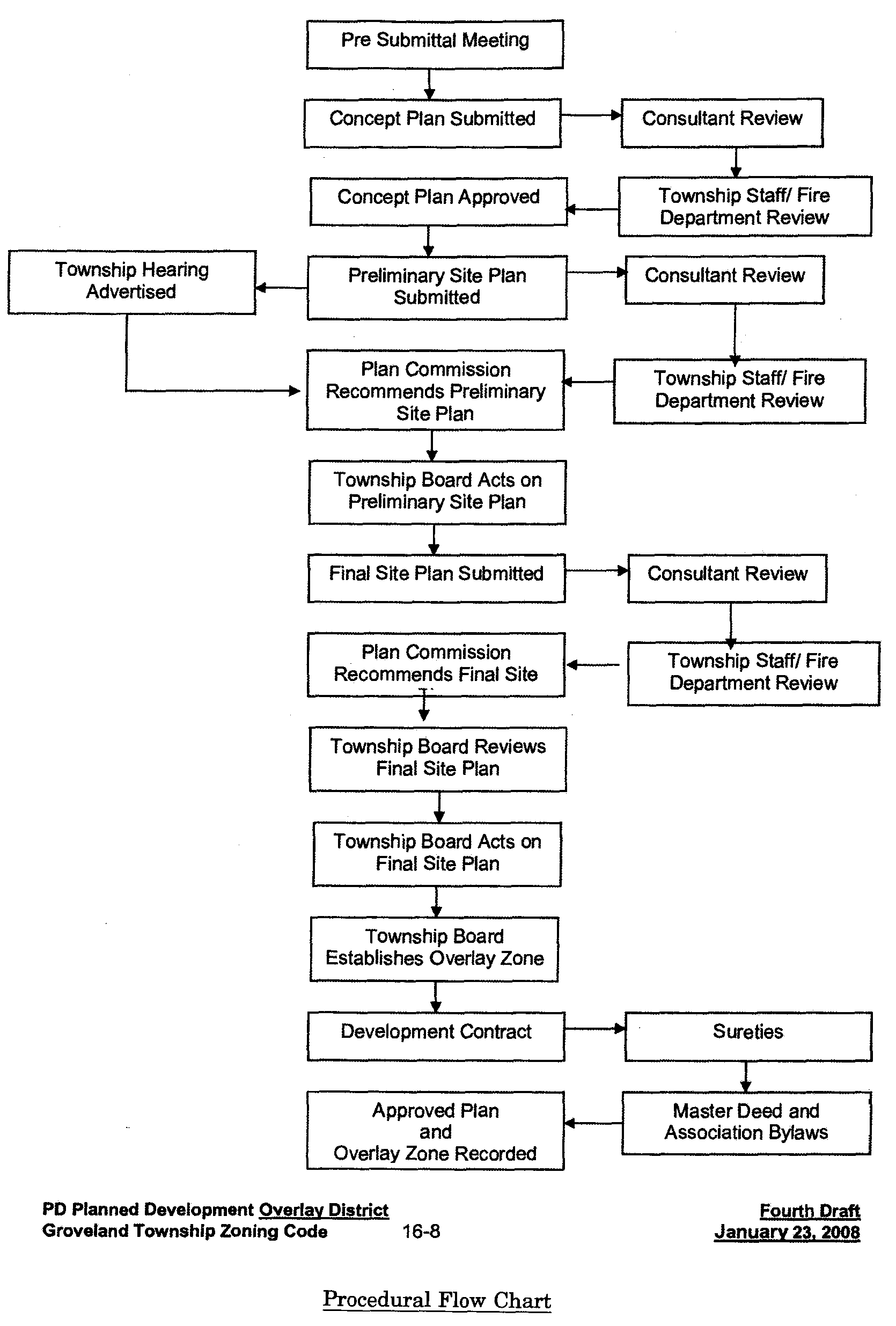
(g)
Development agreement. The applicant shall submit an agreement stating all of the conditions upon which approval has been based. The agreement shall be subject to review and recommendation by the planning commission to the township board for approval. The agreement shall be entered into between the township and the applicant and shall be recorded with the county register of deeds in the manner set forth in section 54-474(4). Approval shall become effective upon recording. At a minimum, the agreement shall provide the following information:
(1)
The approved existing conditions drawing, which shall include a complete legal description of all of the property involved in the development site, and the number of acres involved in the development site.
(2)
The manner of ownership of the development.
(3)
Provisions that will obligate the applicant or the development's owner to connect to any public sanitary and/or storm sewer system, or to any public water system should it ever become available to the development site.
(4)
The manner of ownership and the manner or mechanism for designating, dedicating and protecting all common areas and open spaces in the development.
(5)
Provision or provisions assuring that all open space areas shown on the approved final site plan for use by the public or by the residents of the development, or both, will be, or have been irrevocably committed for that purpose and that purpose only. The township board may require conveyances or other documents to accomplish this assurance.
(6)
Satisfactory provisions have been made to provide to finance any improvements shown on the final approved site plan for site improvements, open space areas and common areas, which are to be included within the development site, and that maintenance of such improvements is ensured by means satisfactory to the township board.
(7)
Provisions that will ensure adequate protection of natural features within the development site.
(8)
The approved final site plan has been incorporated by reference and attached to the development agreement as an exhibit.
(h)
Phased development. Should the applicant elect to develop the site in phases, each phase shall be clearly delineated on the final site plan by obvious phase development lines. Each such phase shall be clearly identified as phase 1, 2, or A, B, etc.; the type and extent of development in each phase shall be clearly identified, including the amount of commercial and office floor area to be developed in each phase as well as the number of dwelling units, if any, in each phase. Each development phase shall be able to fully stand on its own in terms of meeting all of the applicable requirements of this division and the township zoning code. Upon completing its review, the township board may, at its option, elect to grant final site plan approval only to the development phase to be first developed. In such case, each subsequent and unchanged development phase shall require final site plan approval by the township board.
(i)
Site plan revisions. Any subsequent changes, modifications or revisions beyond any modifications or changes attached to a preliminary site plan as a condition of approval by the planning commission or the township board that are made or requested by the applicant shall require submittal of a revised site plan for a recommendation of preliminary site plan approval by the planning commission to the township board.
(j)
Modifications to application procedure. At the time of the pre-submittal meeting, should the township staff and its consultants determine that a site plan package, including an impact assessment as required in section 54-475(4)(d), prepared by the applicant and submitted to the township prior to the meeting, is found by the township staff and its consultants to be in substantial order and to significantly reflect the overall intent and purpose of the PD district, the township, upon meeting with the applicant, may preclude the initial site plan concept stage set forth in section 54-475.
(k)
Modifications to the review process. Upon completion of its review, should the township staff and its consultants find the preliminary site plan to be in such substantial order that no additional modifications or revisions are necessary or desired, the township staff may recommend both preliminary and final site plan approval to the planning commission. The planning commission may concur with the recommendation of the township staff and recommend both preliminary and final site plan approval to the township board, provided all necessary information and data required for final approval appears on the site plan, and provided further that the site plan package is found to be in order by the planning commission, and the recommendation of the planning commission include no conditions or contingencies. Upon receipt of a recommendation from the planning commission for both preliminary and final site plan approval, the township board, at its discretion, may grant both preliminary and final site plan approval, provided it finds the site plan package to be in order and there are no conditions or contingencies to be attached.
(l)
Variations. The township board shall not have the authority to eliminate altogether, any procedural requirements of the PD district or any other required standards set forth in the district, but shall have the authority to review and grant, upon request by the developing authority, modifications to any of the technical standards of the district. When conducting its review of any such request, the board may seek the recommendation of the township planning commission, or its consultant.
(1)
Variances from the strict application of the technical or numerical provisions of the PD district where by reason of exceptional narrowness, shallowness, shape, or area of a specific piece of property at the time of enactment of the PD district or by reason of exceptional topographic conditions or other extraordinary or exceptional conditions of such property where the strict application of the regulations enacted would result in peculiar or exceptional practical difficulties to, or exceptional conditions of such property the strict application of the regulations enacted would result in a peculiar or exceptional practical difficulties to, or exceptional undue hardship upon the owner of such property, may be granted by the township board, provided such relief can be granted without substantial detriment to the public good and without substantially impairing the intent and purpose of the PD district. When granting a variance, the township board may attach to its action, conditions regarding the location, character, and other features of the proposed use as the township board may deem reasonable in furtherance of the purpose of the PD district.
(2)
A variance may be allowed by the township board only in cases where the applicant can show just cause by virtue of a true physical hardship on the property, which compels the request for the variance, or when the applicant can demonstrate that a true practical difficulty exists, thereby warranting the variance. A variance shall be considered only when it can be found that:
a.
The alleged hardship or practical difficulty, or both, are exceptional and peculiar to the property of the person requesting the variance, and result from conditions which do not exist generally throughout the township.
b.
The alleged hardship or practical difficulty, or both, which will result from a failure to grant the variance, include substantially more than mere inconvenience, inability to attain a higher financial return, or both.
c.
Allowing the variance will result in substantial justice being done, considering the public benefits intended to be secured by this article, the individual hardship that will be suffered by a failure of the township board to grant a variance, and the rights of others whose property would be affected by the allowance of the variance.
d.
The conditions and circumstances on which the variance request is based shall not be a self-imposed hardship or practical difficulty.
e.
A variance approved shall be the minimum variance that will make possible a reasonable use of the land or structure.
f.
The township board shall make the foregoing findings of fact, granting a variance only after making an affirmative finding of fact on the preceding categories.
(m)
Leadership in energy and environmental design. The Leadership in Energy and Environmental Design (LEED) Green Building Rating System (GBRS) represents the U.S. Green Building Council's (USGBC) effort to provide a national standard for what constitutes a so-called "green building". The intent of the LEED program is to improve occupant well-being, environmental performance and economic returns of buildings using established and innovative practices, standards and technologies. A developer choosing to implement the LEED, GBRS should follow the recently updated rating system available online from USGBC. In addition to creating what constitutes green buildings, the applicant should also utilize the other aspects of the LEED system program, as briefly outlined below:
(1)
Sustainable sites, including erosion and sedimentation controls, site selection, development density, alternative transportation, reduced site disturbance, stormwater management, heat island effects (particularly in parking lots), and light pollution reduction.
(2)
Water efficiency, including water efficient landscaping, innovative wastewater technologies and water use reduction.
(3)
Energy and atmosphere, including fundamental building systems, minimum energy performance, CFC reduction in HVAC and R equipment, renewable energy and reduction in ozone depletion.
(4)
Materials and resources, including storage and collection of recyclables, construction waste management, resource reuse, recycled content, and the possible use of local or regional materials.
(5)
Indoor environmental quality, including minimum IAQ performance, environmental tobacco and smoke (ETS) control, carbon dioxide monitoring, ventilation effectiveness, developing and implementing a construction IAQ management plan, use of low emitting materials, indoor chemical and pollutant source control, controllability of systems, thermal comfort and daylight and view.
(6)
Innovation and design process, including innovation in design and use of LEED accredited or certified LEED professional designers and technicians.
(n)
Federal Energy Star Program. This is a federal government program. New homes must be at least 15 percent more efficient than homes built to the state construction code standards.
(o)
Duration of approval.
(1)
The granting of preliminary site plan approval by the township board shall have duration of one year from date of approval by the board. Upon request by the applicant, and after review and recommendation of the township staff, the board may grant one, one-year extension.
(2)
The granting of final site plan approval by the township board shall have duration of two years from date of approval by the board. Upon request by the applicant, and after review of development progress to date, and upon the recommendation of the township staff, the board may grant one, one-year extension.
(p)
Termination of approval. Subsequent to granting final site plan approval by the township board, if substantial development is not evidenced by the township on the development site by the end of the initial two-year final approval period, commencing on the date of final site plan approval by the board, and a one-year extension has not been requested by the applicant and granted by the board, all site plan approvals may be terminated thereafter by the township board. For the purpose of this subsection, the word, "substantial" shall mean at least 25 percent of the total approved development is well underway and being actively constructed on the site at the end of the two-year final approval period. If developed in phases, 75 percent of an approved development phase must be completed before the next phase may be commenced, except if so stipulated in the township board's final approval, infrastructure (roads and utilities) may be installed simultaneously throughout the approved development site. Termination of final site plan approval by the township board shall cause the board to initiate the rezoning of the entire development site from its current PD overlay district, which action shall leave the property zoned as it was prior to establishment of the PD overlay district on the property; except, if development was approved by phases and any phase has become fully developed, and that phase contains a mix of multiple-family and one-family, or a mix of residential and nonresidential land use, that part of the development site may remain zoned PD.
(Code 2004, § 54-646; Ord. No. 164, 2-11-2008)
Sec. 54-475. - Mixed use developments beyond designated areas.
As noted in section 54-469, the primary intent of the PD district is to encourage the establishment of mixed use developments on former mineral mining sites, and on land located within the proposed development corridor between Dixie Highway, I-75 and the west township limit line. The township recognizes, however, that there may be other sites in the community that could possibly accept a mixed use development. Such an area may be brought before the township planning commission for consideration as a mixed use development site, using the PD planned development standards of this division. When determining if such a site is a proper location for a mixed use development and for establishing a planned development overlay district, the planning commission shall follow the general guidelines set forth in section 54-470.
(Code 2004, § 54-647; Ord. No. 164, 2-11-2008)
Sec. 54-476. - Required conditions.
(a)
Standards that shall apply to all development in the PD district are set forth in this section. Since it is the implied intent of the PD district to encourage innovative development, and redevelopment, such standards are limited to following specified development control standards. Proceeding with a planned development shall only be permitted if it is mutually agreeable to the township board and the administering developer.
(1)
Minimum land area requirement. The minimum land area required for development under the standards of the PD district shall be sufficient to fully support the type of development proposed for the site, or the minimum required in this division, or required by ordinance for any particular type of land use that may be proposed in a mixed use development. Over-intensification of development on a site will be subject to rejection by the township.
(2)
Development boundary. The development site shall have at least one boundary along a major thoroughfare as designated in the township master land use plan.
(3)
Mixing land use. The development shall consist of a land use mix, which may be a mix of one-family homes and multiple-family dwellings, a mix of commercial and technical research oriented land use, or a mix of residential and commercial land use, or a combination of any or all of these uses.
(4)
Land use alternative. The proposed mixed use development will achieve the overall intent of the township's master plan for future land use, or in the opinion of the planning commission, will consist of a land use mix that will not be incompatible with the overall land use recommendations of the master plan for the community, thereby serving as an acceptable land use alternative.
(5)
Compliance. The development shall comply with all of the applicable requirements and the application procedures of this division, the applicable site plan submittal requirements of the township zoning code, stated building bulk and density limitations, and the overall review process.
(6)
Distance between buildings. The minimum distance between nonresidential buildings, between nonresidential buildings and multiple-family residential buildings and between multiple-family residential buildings shall not be less than required by application of the building separation requirements (formula) that is set forth in section 54-506(b)(5), in the township zoning code, except these distance requirements may be modified by the township board after planning commission recommendation at the time of preliminary site plan review, if it is found that the height and/or bulk of a building or buildings is such that a greater or lesser setback would be warranted in the interest of promoting the general health, safety and common good of the community, or in the interests of improving the visual aesthetics of a building, or buildings on the site.
(7)
Multiple dwelling densities. Multiple-family residential dwelling density shall not exceed the maximum dwelling density requirements of the RM district, except if the mixed use development is to be fully served by public sewer or by an approved private sewer system, dwelling density for multiple dwellings as set forth in section 54-506(b)(5) may be doubled. Multiple dwelling density for dwelling units in the upper floors of a building containing nonresidential uses shall comply with the dwelling density limitations of section 54-506(b)(5) as well. Multiple dwelling densities for senior housing units shall be subject to the density limitations and the other requirements set forth in section 54-144(1), in the township zoning code.
(8)
Dwelling units in the upper floors of nonresidential buildings. When multiple-family residential dwellings shall be established in the upper floors of a building containing nonresidential uses, the following conditions shall apply:
a.
All retail commercial uses shall be located on sub-floors below grade, on the ground floor, or on the ground floor mezzanine only;
b.
No dwelling unit shall occupy any portion of any floor occupied by a nonresidential use; and
c.
No nonresidential use including an office shall occupy any area of the same floor as a residential use, unless all access to the nonresidential use, including an office, is physically separate from any access to a dwelling unit on the same floor, and no nonresidential use including an office, shall occupy any floor area above any floor used for residential purposes.
(9)
Location of buildings. The location and height of buildings, the location, nature and height of walls and fences, and the nature and extent of landscaping of the site shall be such that they will not hinder or discourage the proper development and use of adjacent land and buildings, or impair the value thereof.
(10)
Off-street parking. The numerical and the physical layout standards for off-street parking set forth in article VIII of this chapter, in the township zoning code shall apply to all uses in the PD district. Wherever possible, the surface land area required for off-street parking shall be minimized to the extent possible and landscaped in accordance with the applicable requirements of article X of this chapter, in the township zoning code. The number of off-street parking spaces and their convenience by location to pedestrian and vehicle traffic circulation, the amount and location of open spaces, and provision of other site amenities shall be at least in proportion to the anticipated needs and desirability of the proposed uses within the development.
(11)
Roads and streets. All public and private roads, streets, service drives and parking lanes, parking spaces, loading and unloading areas, drainage facilities, utility installations and other site improvements shall at least equal or surpass the applicable engineering standards of the township, the county, or the state. The dedication and acceptance of all public rights-of-way and any public open spaces shall be achieved prior to any construction taking place on the development site.
(12)
Business establishments. Any business establishment permitted in a planned development shall be retail or service-oriented establishments dealing directly with customers. Any goods produced on the premises shall be sold at retail on the premises.
(13)
Building height. Building height shall be limited to the ability of the township fire department to safely and effectively extinguish fire in a multiple story building, whether the building is a single or a mixed use structure. In no case shall any building be erected that may exceed the capability of the township's fire apparatus to safely and effectively extinguish a fire in the building, the fire department's capacity to do so, or in any way diminish the township's designated Insurance Services Organization (ISO) rating.
(14)
Development next to waterways or shorelines. Buildings next to any shoreline or water frontage shall provide an adequate setback to permit proper application of walkways, including boardwalks and other landscaping amenities, between the building and the shoreline or water frontage.
(15)
Business servicing and processing. All business, servicing or processing, except off-street parking, loading and unloading, and accessory outdoor eating and drinking facilities, shall be conducted within completely enclosed buildings.
(16)
Parking of commercial vehicles. The inconspicuous outdoor parking of commercially used or licensed vehicles will be permitted only when the vehicle is clearly incidental to a permitted use. The parking of any such vehicle shall be limited to operable vehicles that are moved off the site on a regular basis.
(17)
Disabled vehicles. The parking or storage of any disabled vehicle is prohibited.
(18)
Abutting land use. The development shall take into consideration the location and size, including building height, of the proposed uses with respect to surrounding land uses, the nature of the uses and the intensity of the uses, along with the overall site layout and its relationship to streets and roads providing access to the development. The overall design of the development will be such that traffic to and from the uses within the development will not be hazardous to general traffic circulation within the development or around it. Consideration shall be given to convenient and safe routes for pedestrian traffic, and the relationship of the proposed development to nearby traffic arteries and intersections.
(19)
Peripheral site screening. Whenever a peripheral site boundary of any development within a PD district shall abut existing residential development, development within the PD district shall be effectively screened along the abutting site line in accordance with the applicable requirements of article X of this chapter, in the township zoning code. Except, if the type of development in the PD district will consist of the same land use as exists on the abutting property, the township board, after planning commission recommendation, may vary the screening requirement.
(20)
Cost estimates and sureties. The applicant, in the course of preparing the final site plan for review by the township, shall submit a detailed cost estimate to the township for the installation of any public utilities, streets and any stormwater retention systems for the entire development. Detailed cost estimates shall also be required for any costs that may be incurred as the result of any mitigation measure or structure required to treat, retain, detain or remedy any environmental conditions on the property. If development is to occur in phases, cost estimates for each phase shall be submitted prior to that phase receiving final site plan approval. The township board may require submittal of surety in an amount equal to the costs estimated for each part of these improvements or measures, plus an additional ten percent.
(b)
As an alternative to requiring submittal of a surety performance bond to cover the cost of improvements, the applicant may pay to the township a fee intended to cover all of the costs of enforcing a first priority security interest lien on the entirety of the development site, or if approved in development phases, all of the costs of completing the approved development phase. The fee shall be in an amount as currently established or as hereafter adopted by resolution of the township board, determined annually by the township board based on amounts deemed reasonably necessary to ensure completion of the development site as approved by the township board, or of a development phase as approved by the township board. In the event that the applicant or developer elects to pay a fee to the township in lieu of posting a surety performance bond as provided herein, the applicant shall grant and convey to the township a first priority security interest lien on the entire development site that was approved by the township board, or on the entire development phase that was approved by the township board to secure payment of the fees and costs established by the township board under this subsection. The lien shall cover all lands involved in the approved development site or the approved development phase, including all related costs to build out and complete the development as approved by the township board. In fixing the amount of the fee to be paid to the township, the township board shall take into account the cost of foreclosing on the first security interest lien on the premises in order to cover the township's cost of completing the development it granted approval.
(Code 2004, § 54-648; Ord. No. 164, 2-11-2008)

