
Groveland Township City Zoning Code
ARTICLE VIII
OFF-STREET PARKING, LOADING AND UNLOADING
Sec. 54-1020.- Parking requirements.
There shall be provided in all districts, at the time of erection or enlargement of any main building or structure, automobile off-street parking with adequate access to all spaces. The number of off-street parking spaces, in conjunction with all land or building uses, shall be provided prior to issuance of a certificate of occupancy, as prescribed in this article.
(1)
Off-street parking or off-street parking lots shall not be permitted as the sole or principal permitted use in any zoning district.
(2)
Residential off-street parking of a motor vehicle or the storage of a motor vehicle or a nonmotorized vehicle, or machinery or implement shall be on the same lot or parcel as the principal use and shall be subject to the following conditions:
a.
Parking. Parking ordinance as defined in this Code, relating to a residential use in a residential district shall be off-street and shall meet the minimum numerical off-street parking space requirement set forth in subsection (16) of this section. Excluding visitor parking, up to a maximum of two additional motor vehicles per resident of driving age may be parked on residential zoned property provided they:
1.
Are owned by a resident living in the dwelling unit;
2.
Are maintained in running order; and
3.
Display a current license tag or plate.
b.
Storage. Except as permitted in section 54-638(2), the outdoor storage of a motor vehicle as defined in this chapter is prohibited, except the following vehicles, machinery or implements may be stored outdoors on the same lot or parcel as the principal use:
1.
Any farm related motor vehicle, farm machinery and implements that are maintained in running or working order and which are customarily used in a bona fide farming or agricultural operation as defined in this chapter, may be stored outdoors.
2.
Motor vehicles and motorized or nonmotorized machinery, including towed machinery or implements and walk behind implements which are used exclusively for the general maintenance of the property may be stored outdoors.
3.
Any number of motorized and nonmotorized vehicles, as well as machinery and implements regardless of their running order may be stored in a garage attached to the principal use, or in an accessory building that is located on the same parcel or property as the principal use, provided all applicable safety codes are met relative to the keeping of flammable materials, including fuel in vehicle tanks and any fuel that may be stored in other containers in the building.
4.
Except as otherwise permitted in section 54-638(2)g, all motor vehicles so kept shall be owned or leased by the property owner or occupant of the premises.
c.
Vehicle service or repair. Except as otherwise permitted in this subsection mechanical service, repair or body work of any kind shall be undertaken outdoors on the premises and only one vehicle shall be serviced outdoors on the property at a time and all work shall be completed on that vehicle before outdoor service on any other vehicle may commence. All necessary precautions shall be taken to place and keep all potential contaminants in appropriate containers so they may be safely stored and transported to an approved disposal facility.
(3)
Required off-street parking for one-family or two-family dwellings may be provided in a stacking configuration in a driveway or garage, or combination thereof. Required off-street parking for all other uses shall consist of an unencumbered parking stall or strip, parking bay, vehicle maneuvering space or driveway, garage, or combination thereof. Parking garages or parking structures shall be subject to the applicable standards of section 54-1020.
(4)
Off-street parking for other than residential use shall either be on the same lot as the principal use or off-site, but within 300 feet of the building it is intended to serve, measured from the nearest point of the building to the nearest point of the off-street parking lot.
(5)
No off-street parking intended for a use in a nonresidential district shall be permitted in a residential district.
(6)
For nonresidential uses permitted in residential districts, no off-street parking and accompanying maneuvering lanes shall be permitted in any front yard or exterior side yard. Off-street parking may be permitted in a rear yard or within an interior side yard.
(7)
In the RM district and nonresidential districts, no off-street parking and accompanying maneuvering lanes shall be permitted in a front yard or exterior side yard, except as otherwise permitted in section 54-506(b)(4), (5). Off-street parking and accompanying maneuvering lanes shall be permitted in any rear yard or interior side yard.
(8)
Any area once designated as required off-street parking shall not be changed to any other use, unless or until at least an equal number of off-street parking spaces are provided elsewhere.
(9)
Off-street parking existing as of October 19, 1999, in connection with the operation of an existing building or use shall not be reduced to an amount less than the minimum number of off-street parking spaces required for any new building or use.
(10)
Two or more buildings or uses may collectively provide the required off-street parking; in which case, the required number of parking spaces shall not be less than the sum of the requirements for the several individual uses computed separately.
(11)
In the instance of dual function of off-street parking spaces, where operating hours of buildings do not overlap, the planning commission may grant an exception.
(12)
Except as otherwise permitted and regulated by this chapter, the sale, renting, leasing, or storage of construction trailers, merchandise or motor vehicles; or trailers for rent, lease or sale; or the repair of vehicles is prohibited in any off-street parking lot; except further, where law permits, the sale of a vehicle may be permitted in an off-street parking lot which is owned by the same owner of the vehicle that is for sale.
(13)
For a use not specifically assigned a numerical off-street parking requirement as set forth in subsection (16) of this section, the numerical off-street parking requirements for that use shall be in accord with a use which is considered to be similar in type.
(14)
When units of measurement result in the requirement of a fractional space, any fraction up to and including one-half shall be disregarded and fractions over one-half shall require one parking space.
(15)
For the purpose of computing the number of off-street parking spaces required, the definition of the term "floor area, usable nonresidential," provided in section 54-19 shall govern.
(16)
The minimum number of off-street parking spaces by type of use shall be determined in accordance with the following schedule:
(17)
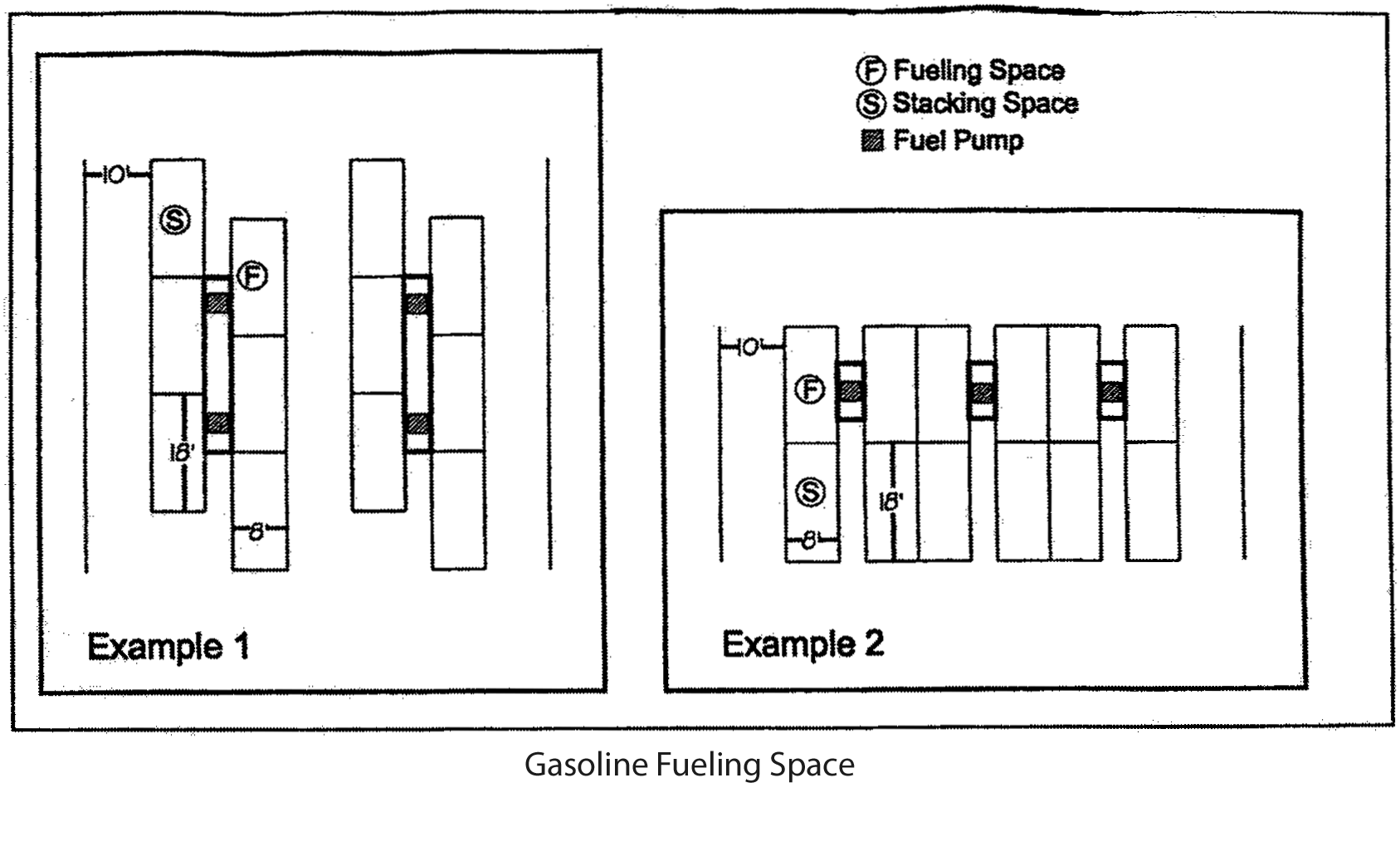
Vehicle stacking space. In addition to the requirements of subsection (16) of this section, wherever an accessory drive-through is utilized, the following vehicle stacking space standards shall apply:
Each vehicle stacking space shall be 18 feet long by eight feet wide and shall be located independently of any parking space, vehicle maneuvering lane, loading area, or trash pickup station.
(Code 2004, § 54-1191; Zoning Ord. 1999, § 2306; Ord. No. 133, 4-15-2000)
Sec. 54-1021. - Parking space layout standards, construction and maintenance.
Whenever the off-street parking requirements set forth in section 54-1020 shall require the establishment of an off-street parking lot, such off-street parking lots shall be laid out, constructed and maintained in strict accordance with the following standards and regulations:
(1)
No parking lot shall be constructed or an existing parking lot improved, unless and until a permit is first issued by an authorized township official. Applications for a permit shall be submitted to the township in such form as may be determined by the township.
(2)
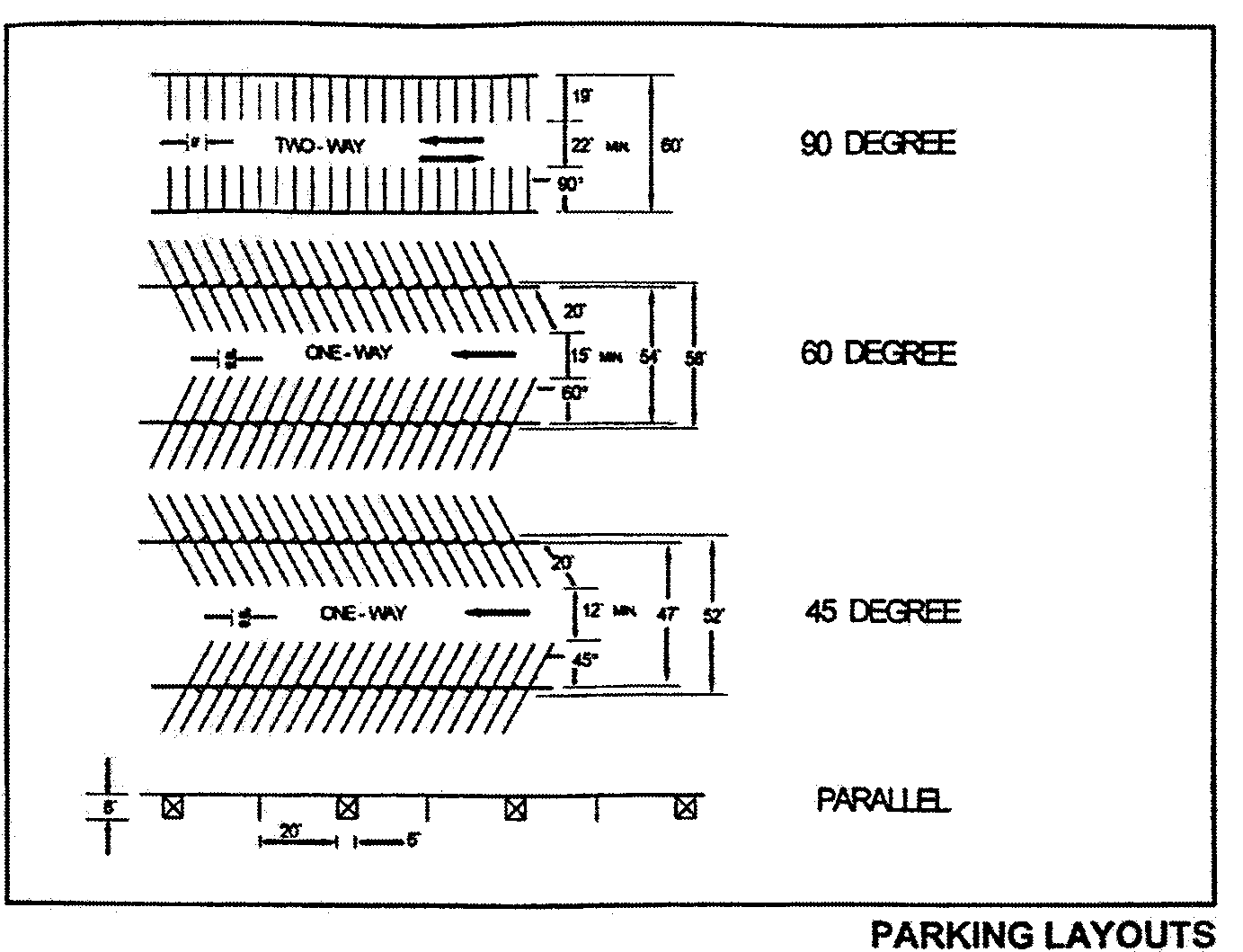
Plans for the layout of off-street parking facilities shall be in accordance with the minimum dimensional requirements depicted on the accompanying page.
(3)
Except for one-family and two-family residential uses, adequate lighting shall be provided throughout the hours when the parking area is in operation. All lighting shall conform to the requirements of section 54-667, pertaining to exterior lighting.
(4)
Adequate ingress and egress to the parking lot shall be provided and shall be designed in accordance with county road commission guidelines.
(5)
The planning commission may require the joining of parking lots in order to reduce the number of curb cuts into a public street and to facilitate movement between sites.
(6)
All parking spaces shall be clearly striped with lines at least four inches in width.
(7)
Except for parallel parking, when the front of a parking space abuts a raised (curbed) private sidewalk or other curbed on-site pavement that is not less than seven feet in width, two feet may be credited toward the total required parking space length.
(8)
Except for one-family and two-family uses, all parking lots shall have access from clearly limited and defined driveways not less than 12 feet wide for a one-way drive and 22 feet wide for a two-way drive.
(9)
The required number, size, spacing and layout of handicapped parking spaces shall be determined by state rules and regulations.
(10)
Parallel parking spaces shall be striped so as to show a space 20 feet in length with a six-foot maneuvering space for each two parking spaces.
(11)
Except for one-family dwellings and their accessory uses, all parking spaces shall have access from an aisle on the site.
(12)
Vehicle access to a parking lot shall not be across any zoning district that does not permit the principal use.
(13)
Bumper stops, curbing or wheel blocks shall be provided to prevent any vehicle from damaging or encroaching upon any required wall, fence or buffer strips or upon any building adjacent to the parking lot.
(14)
All required parking spaces, drives and aisles shall be hard-surfaced with concrete or asphalt, except for such seasonal and transient uses as public or private parks, golf courses, carnivals, stadiums and sports arenas and like uses.
(15)
Except for one-family residential uses, all hard-surfaced parking areas shall be constructed with concrete curbs.
(16)
All interior and abutting streets shall have rights-of-way of a sufficient width to accommodate the vehicular traffic generated by the uses permitted in the district or adequate provision shall be made at the time of the approval of the parking plan for such sufficient width of rights-of-way. The rights-of-way provided to satisfy this condition shall conform to the right-of-way standards set forth in the township master plan.
(17)
Each entrance and exit to and from any off-street parking lot located in an area zoned for other than one-family residential use shall be at least 25 feet distant from adjacent property.
(18)
Off-street parking areas shall be drained so as to dispose of all surface water accumulated in the parking area in such a way as to preclude drainage onto adjacent property or toward buildings.
(19)
Maneuvering lanes serving angle parking shall permit one-way traffic movements only. Lanes serving right-angle parking shall permit two-way movement. The mixing of one-way and two-way movements within a lot shall be permitted only in exceptional instances and with the approval of the planning commission.
(20)
Dead-end off-street parking aisles are discouraged, especially in connection with business uses. Such aisles shall be no more than eight spaces deep and should, in any case, be used only when there is no reasonable alternative. If more than eight spaces deep, the layout shall provide a means for vehicles to turn around.
(21)
Where required, walls and earth berms shall be provided in accordance with section 54-1107.
(22)
Parking lot trees shall be provided in accordance with section 54-1137 et seq.
(Code 2004, § 54-1192; Zoning Ord. 1999, § 2307)
Sec. 54-1022. - Loading and unloading.
On the same premises with every building, structure or part thereof involving the receipt or distribution of vehicles, materials or merchandise, there shall be provided and maintained on the lot adequate space for standing, loading, and unloading in order to avoid undue interference with public use of dedicated streets or alleys. Such space shall be provided as follows:
(1)
Unless otherwise indicated, all spaces shall be laid out in the dimensions of at least ten by 80 feet, with a clearance of at least 14 feet in height for uses in the B-2, B-3, TR, I-1 and I-2 districts.
(2)
Loading dock approaches shall be provided with a pavement having an asphaltic or cement binder so as to provide a permanent durable and dustless surface. Loading space may be enclosed.
(3)
Access to a loading space shall be provided directly from a public street or service drive and shall be arranged so as to provide sufficient off-street maneuvering space, as well as adequate ingress to and from a street or service drive.
(4)
Unless otherwise indicated, loading space is permitted in a rear yard only. In exceptional instances, loading space may be permitted in an interior side yard, with approval of the planning commission, when it can be shown that such location is necessitated by site conditions.
(5)
Loading space shall be distinct from, and shall not interfere with, parking aisles or spaces.
(6)
Loading and unloading spaces shall be effectively screened from view from any public street and from any office or residential zoning district.
(7)
In the OS-1, B-1, B-2, B-3 and TR districts, off-street loading and unloading shall be provided according to the following provisions:
a.
For office buildings of less than 20,000 square feet in gross floor area, at least one loading space with minimum dimensions of nine feet by 20 feet, separate from off-street parking, shall be provided and may be located in any yard.
b.
For office buildings greater than 20,000 square feet, loading shall be provided at the ratio of one space for each 40,000 square feet above 20,000 square feet.
c.
For commercial uses, loading shall be provided as set forth in subsection (1) of this section, or at a ratio of ten square feet per front foot of building, whichever is the lesser amount.
d.
For automobile service stations, required loading space may be located in any yard.
(8)
All spaces in I-1 or I-2 districts shall be provided in the following ratio of spaces to usable floor area:
a.
For uses with a gross floor area of less than 20,000 square feet, one loading space shall be provided.
b.
For uses with a gross floor area from 20,000 to 100,000 square feet, one loading space shall be provided, plus one space for each additional 50,000 square feet.
c.
For uses with a gross floor area from 100,000 to 500,000 square feet, three loading spaces shall be provided, plus one space for each 50,000 square feet in excess of 100,001 square feet.
(9)
Unless otherwise provided, within any zoning district, loading space shall be provided as follows for uses other than one-family or multiple-family dwellings:
a.
Funeral homes and mortuaries shall provide one loading space for each 5,000 square feet of gross floor area, plus one space for each additional 10,000 square feet.
b.
For hospitals and similar uses of less than 10,000 square feet in gross floor area, at least one loading space with minimum dimensions of nine feet by 20, separate from off-street parking, shall be provided and may be located in any yard.
c.
For hospitals and similar uses with a gross floor area of 10,000 square feet or greater, one loading space shall be provided, plus one space for each 50,000 square feet in excess of 10,000 square feet.
d.
For all other uses, one space shall be provided per building or use. The planning commission shall determine the appropriate size of such space.
(Code 2004, § 54-1193; Zoning Ord. 1999, § 2308)

