
Groveland Township City Zoning Code
ARTICLE X
- LANDSCAPING AND SCREENING
Sec. 54-1107. - Screen walls and earth berms—Where required.
Except as otherwise provided in this section, there shall be provided and maintained an obscuring wall or earth berm in accordance with this section between:
(1)
Any one-family residential district and any mobile home park district;
(2)
Any one-family residential district and any multiple-family residential district;
(3)
Any residential district and any office district;
(4)
Any residential district and any commercial district;
(5)
Any residential district, any technical research district, and any industrial district; or
(6)
Any off-street parking areas of nonresidential uses permitted in a residential district and any residential uses;
(7)
Any mineral mining operation and any other land use.
(Code 2004, § 54-1311; Zoning Ord. 1999, § 2312(1))
Sec. 54-1108. - Same—Height requirements.
The height of an obscuring screen wall or landscaped earth berm shall be in accordance with the following specified heights:
(1)
In the cases of section 54-1107(1) through (4), six feet.
(2)
In the case of section 54-1107(5), six feet, or to a height sufficient to effectively screen outdoor storage areas; except, in no case shall a screening device designed and intended to screen outdoor storage exceed a height of 12 feet, unless the screen consists of natural features, such as changes in topography or heavy natural foliage, all of which shall exist on the property of the use it is intended to screen.
(3)
In the case of section 54-1107(6), four feet six inches; except in the case of a hospital or medical clinic emergency entrance, or ambulance delivery area, and in the case of public utility buildings with outdoor substations, eight feet.
(4)
In the case of section 54-1107(7), as required in the E-1 district.
(Code 2004, § 54-1312; Zoning Ord. 1999, § 2312(2))
Sec. 54-1109. - Same—Location on property line.
Required screen walls and earth berms shall be located on the property line, except where underground utilities interfere and except in those instances where this chapter requires conformance with front yard setback lines in abutting residential districts. Any request or necessity for locating a screen wall or earth berm other than along a property line shall require review and approval of an alternate location by the planning commission. The planning commission, in making its review of alternate screen wall or earth berm locations, shall consider the following:
(1)
Ability of the screen wall to maintain continuity beyond the property line;
(2)
Effectiveness of the screen wall or earth berm to screen effectively in an alternate location; and
(3)
Impact an alternate location may have on site drainage, overall site appearance and the functional well-being of the development proposed for the property.
(Code 2004, § 54-1313; Zoning Ord. 1999, § 2312(3))
Sec. 54-1110. - Openings for vehicular traffic.
Screen walls and earth berms shall have no openings for vehicular traffic or for any other purpose, except as otherwise provided for in this chapter and except in the instance of providing for public safety, when recommended by the township building inspector.
(Code 2004, § 54-1314; Zoning Ord. 1999, § 2312(4))
Sec. 54-1111. - Construction materials for screen walls.
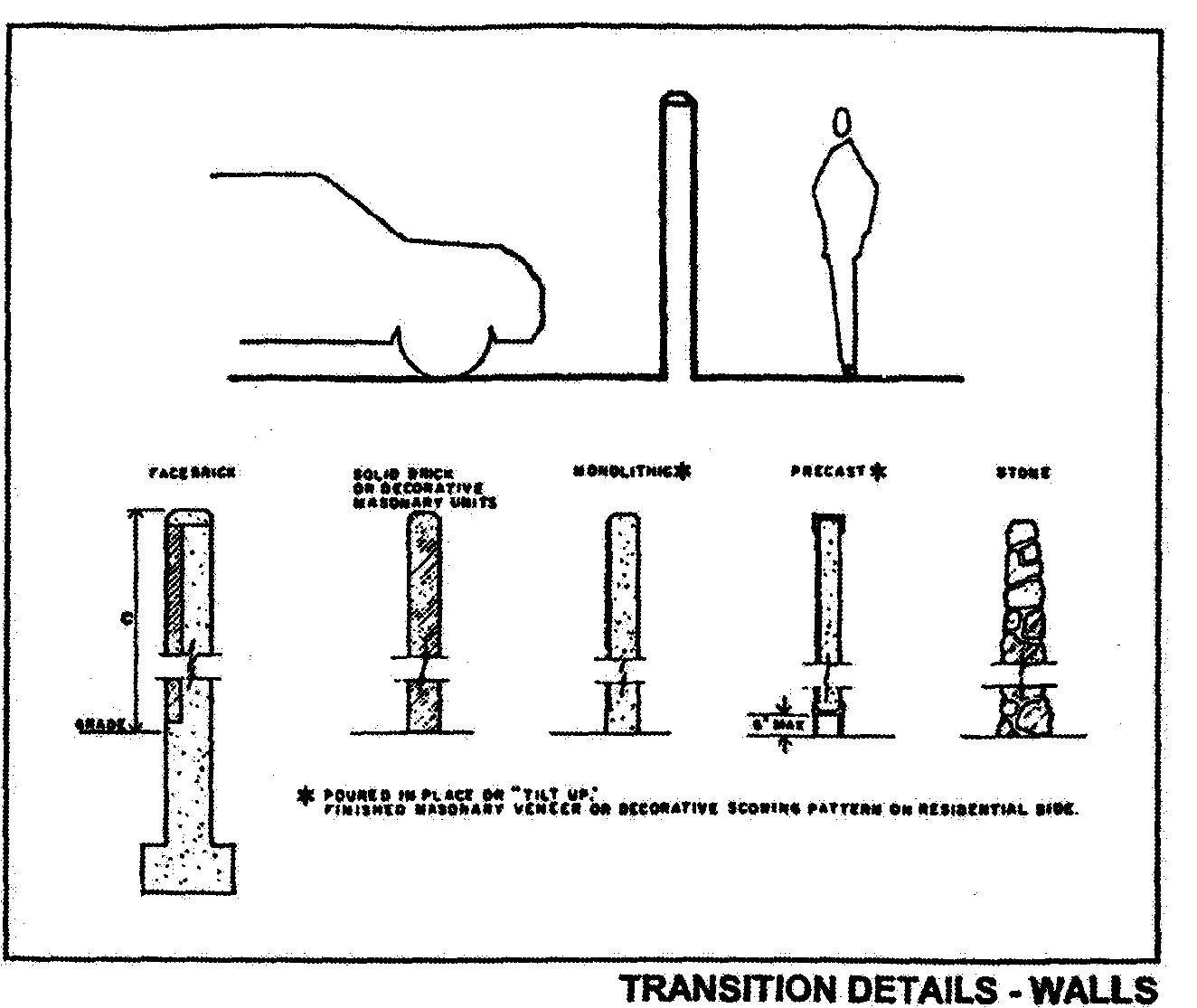
Where in this chapter, a screen wall shall be required, the screen wall shall be constructed of architectural masonry materials other than standard concrete masonry units (CMU). Architectural masonry materials may include decorative concrete panel walls, poured-in-place concrete walls scored to appear like brick or stone, brick as defined in this zoning code, stone (real or cultured), or reinforced concrete or treated heavy plank wood when the wall shall also serve as a retaining wall. No masonry screen wall shall be painted. Screen wall materials may be stained in earth tone colors or made colorfast by mixing the color into the material being prepared for use in the construction of the wall. A masonry screen wall structure shall include a masonry cap, which shall extend along the full length of the wall top. The cap shall be triangular shaped in the form of an inverted V, or shall be rounded, and shall project outward on both sides of the wall at least one inch. No attachments shall be made to the top of the cap on any screen wall structure that will contain or consist of sharp or pointed materials, including any kind of spikes, or sharp wire, or wire with barbs, or wire with an electric charge.
(Code 2004, § 54-1315; Zoning Ord. 1999, § 2312(5); Ord. No. 150, 12-12-2005)
Sec. 54-1112. - Earth berm may be permitted instead of screen wall; construction requirements.
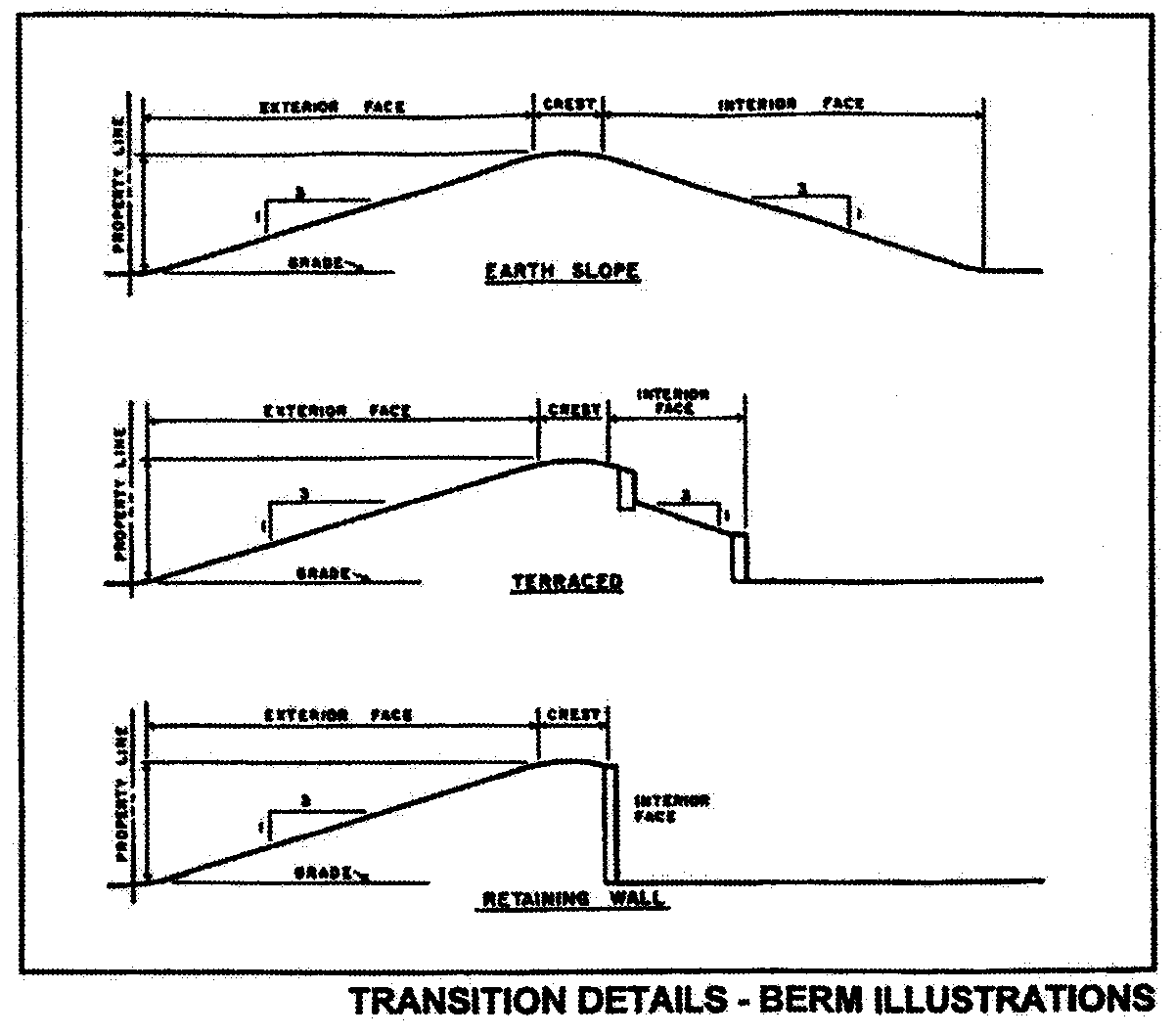
The planning commission may permit, in place of an architectural masonry screen wall, the erection of a landscaped earth berm, provided the earth berm shall have a minimum height of not less than that required for a screen wall. An earth berm shall:
(1)
Have a side slope of not greater than three on one (three feet of horizontal plane for each foot of vertical rise);
(2)
Consist of undulating top and side slopes;
(3)
Have a crest at the top of the earth berm of not less than two feet across;
(4)
Include an adequately designed drainage swale on the property line side of the berm to accommodate stormwater runoff. The drainage swale shall be subject to review and approval by the township engineer and the county drain commission; and
(5)
Be sodded or seeded so as to prevent erosion of the sides of the earth berm and be attractively landscaped with plant materials acceptable to the township. The township, in making its review of the landscape planting plan for the earth berm, may require installation of an automated irrigation system. All landscape materials approved by the township for the earth berm shall be maintained in a living, growing condition, neat and orderly in appearance.
(Code 2004, § 54-1316; Zoning Ord. 1999, § 2312(6))
Sec. 54-1113. - Landscape planting screen.
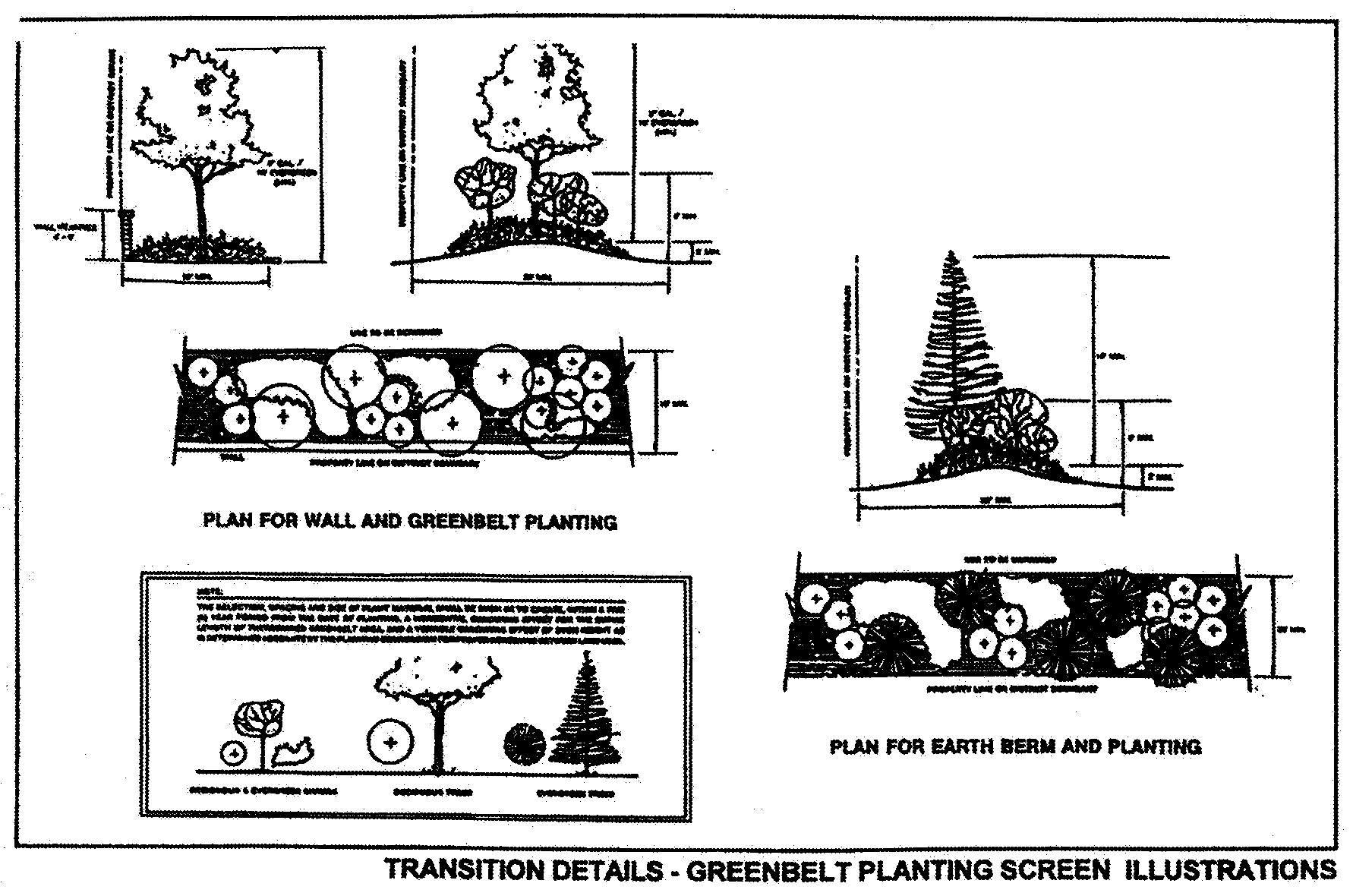
The planning commission may permit, in place of an architectural masonry screen wall or a landscaped earth berm, the placement of a dense landscape planting screen consisting of evergreen planting materials, the minimum height of which, at the time of planting, shall be not less than the minimum height required for a screen wall. When permitted by the planning commission, the landscape planting screen shall be planted and maintained in accordance with the landscape screening requirements of section 54-1137 et seq.
(Code 2004, § 54-1317; Zoning Ord. 1999, § 2312(7))
Sec. 54-1114. - Planning commission approval.
Except where this chapter requires action by the board of zoning appeals, the planning commission may approve one of the screening alternatives set forth in this chapter or a combination thereof. The planning commission may also waive the screening requirements of this section, provided it finds at least one of the following conditions to exist on the property:
(1)
The abutting residential district for which a screening device is required is determined to be an area in land use transition, which is likely to become a nonresidential district in the future. The planning commission shall rely on the land use recommendations of the township master plan map when evaluating the future use of the land abutting the subject property.
(2)
Changes in topographic conditions between the nonresidential and residential lands that are to be screened is such that a screen wall or alternative screening device, as set forth in this section, would not screen effectively and therefore would serve no useful purpose.
(3)
Sufficient natural vegetation exists along the common property line between the nonresidential district and the affected residential district to serve as an equally effective or better screen than the required screen wall or other permitted screening device would provide. The planning commission, in determining this alternative, shall:
a.
Find the existing foliage to be extensive enough to create an effective year-round screen; and
b.
Require documentation in writing from the landowner that the natural screen will be preserved and maintained as a natural screen for as long as a screening device shall be required for the property by the township. The planning commission, in reviewing the effectiveness of a natural screen, may require the placement of additional planting materials to augment the screening capability of the natural screen.
(4)
A building wall of an existing or proposed building may serve as a screen, or partial element of a screen wall, when the wall shall generally parallel the parcel line or district line for which a screen is required by this section; provided, the building wall shall be at least six feet in height along its entire length, shall consist of architectural masonry materials other than cinderblock, shall have no openings, and shall have no other accessory buildings, uses or functions located between the building wall and the property/zoning district line. This yard area shall consist of a landscaped lawn area that shall be maintained in a healthy growing condition, neat and orderly in appearance.
(Code 2004, § 54-1318; Zoning Ord. 1999, § 2312(8))
Sec. 54-1137. - Intent.
The purpose of this division is to establish minimum standards for the development, installation and maintenance of landscaped pervious areas within all multiple-family and all nonresidential districts and for all nonresidential uses permitted in a residential district. This division further recognizes that the proper management and use of trees, plants and other types of vegetation will improve the appearance, value, character and quality of the living environment in the township and promote resourceful site planning and creative design. To this end, the regulatory standards set forth in this division are established.
(Code 2004, § 54-1351; Zoning Ord. 1999, § 2313(1))
Sec. 54-1138. - Required conditions for screens and materials.
Wherever in this chapter a landscape planting screen or landscape planting materials are required, such landscape planting materials shall be subject to the following conditions:
(1)
All planting screens and landscape planting materials shall be planted in accordance with an approved planting plan and planted to completion prior to issuance of a certificate of occupancy by the township. If a use is ready for occupancy between April 1 and September 30, a certificate of occupancy may be issued. If a use is ready for occupancy between October 1 and March 31, a temporary certificate of occupancy may be issued; however, all required planting materials shall be placed to completion within 60 days after March 31. Failure to have such required planting material placed to completion within 60 days after March 31 shall be grounds for termination or revocation of a temporary certificate of occupancy. No additional certificate of occupancy, either temporary or final, shall be issued thereafter until all required landscape planting materials are placed to completion. A period of establishment shall start at the completion of all planting and shall continue through the succeeding summer growing season of June, July and August as set forth in this division.
(2)
Whenever any cosmetic planting areas or required planting screens approach a street or driveway intersection, the clear corner requirements of section 54-715 shall be observed; however, in all cases, care shall be taken relative to plant material, height and location so as not to create a traffic hazard.
(3)
Trees of a species whose roots are known to cause damage to public roadways or other public utilities shall not be planted closer than 12 feet to such roadway or public utility unless the tree root system is completely contained within a barrier, for which the minimum interior containing dimensions shall be five feet square and five feet deep, and for which the construction requirements shall be four-inch-thick concrete reinforced with No. 6 road mesh (six inches by six inches by six inches, or equivalent).
(4)
Ground covers used in lieu of grass shall be planted in such a manner that they will not exceed spacing of 18 inches, so as to provide reasonably complete coverage.
(5)
Grass areas shall be planted and grown as permanent lawns. Grass may be sodded or seeded and mulched, and shall be protected from erosion until the coverage is permanently established.
(6)
To prevent vehicular encroachment, including vehicle overhang, onto or into landscaped areas, planting materials in areas involving motor vehicles shall be protected by the use of wheel stops, raised concrete or asphalt curbing, or other satisfactory and acceptable methods of barrier.
(7)
All open ground areas on any site, including pervious surfaces used in the calculation of lot coverage requirements, yard areas, open ground areas disturbed by construction, and other similar areas where such landscaping is appropriate and feasible, shall be provided with coverage of grass, ground cover, shrubs, or other approved landscaping material. Materials that prevent or inhibit, to an unreasonable extent, the percolation of water into the soil shall be considered unacceptable materials for the treatment of these areas.
(8)
The trunks or main stems of trees and shrubs shall be provided with a minimum thickness of at least two inches of mulch no less than at least 24 inches beyond the trunks or stems of all newly planted trees and shrubs. Such mulch shall be provided at the time of planting and shall be maintained and resupplied as needed thereafter.
(9)
All landscaped areas shall be provided with an acceptable irrigation system or available water supply with at least one hose connection within 50 feet of all plant material to be maintained. Individual planters and isolated planting areas shall have appropriate irrigation sources provided within each separate planting area.
(10)
All irrigation systems shall be maintained in an operable condition capable of providing adequate irrigation to landscaped areas as required. All inoperable irrigation systems and components thereof shall be promptly repaired or replaced so that adequate coverage of landscaped areas is restored and maintained.
(11)
All planting materials shall be properly planted so as to be in a healthy, growing condition at the time of establishment. All planting material shall consist of permanent, living plant materials and, when planted to completion, shall thereafter be maintained in an attractive and presentable condition, free of weeds, refuse and debris, and shall be continuously maintained in a sound, healthy and vigorous growing condition, free of plant diseases and insect pests.
(12)
Top pruning or other severe pruning or maintenance practices of landscaping materials that results in stunted, abnormal, or other unreasonable deviation from the normal healthy growth of trees, shrubs, and other required landscaping components shall be considered as the destruction of these materials, and replacement shall be required as described in this division. Failure of the owner of the property to maintain the premises in good condition, as set forth in subsection (11) of this section, shall make him liable for the penalties set forth by this chapter.
(13)
All plant materials shall meet current American Association of Nurserymen standards.
(14)
No landscaped area may be abandoned, paved, encroached upon by vehicular traffic, or otherwise used without submission of a site plan and approval by the township pursuant to the procedures set forth in this division.
(Code 2004, § 54-1352; Zoning Ord. 1999, § 2313(2))
Sec. 54-1139. - Planting screens—Detailed planting plan.
Whenever a landscape planting screen is permitted under the provisions of this chapter, a detailed planting plan of such screen shall be submitted to and approved by the planning commission prior to issuance of a building permit. The planting plan shall indicate, to scale, the location, spacing, starting size and description for each unit of plant material proposed for use within the required screening area. Detailed plans shall be submitted in accordance with the following:
(1)
Minimum scale shall be one inch equals 30 feet, or same scale as the site plan involved, if a requirement for site plan approval.
(2)
Existing and proposed contours shall be depicted with contour intervals not to exceed two feet.
(3)
The planting plan shall indicate the location, size, spacing and root type (bare root, balled in burlap, balled and potted, or container-grown) of all plant materials.
(4)
Where earth berms are used in conjunction with a planting screen, the planting plan shall provide typical cross sections depicting the slope, height and width of the berms and the type of ground cover intended to be placed on them. If masonry walls are used in conjunction with earth berms, the height of the wall and the type of materials to be used in the construction of the wall, as well as the type of materials to be used in the wall footings, shall also be shown in cross section format.
(5)
The planting plan shall depict significant construction details, where applicable, to reflect specific site conditions; e.g., tree wells to preserve existing trees, culverts to maintain natural drainage patterns, etc.
(6)
The planting plan shall indicate existing tree cover that is to be used in conjunction with, or in place of, the screen planting requirements of this chapter, including types of trees and overall tree height.
(Code 2004, § 54-1353; Zoning Ord. 1999, § 2313(3))
Sec. 54-1140. - Same—Planting plan review.
The planting plan shall be reviewed for conformance with the following guidelines:
(1)
The proper types, spacing, height, placement and location of plant materials relative to the length and width of the screen so as to ensure that the required horizontal and vertical obscuring of the land use the screen is intended to obscure will be achieved.
(2)
The choice and selection of plant materials so as to ensure that root systems will not interfere with public utilities and so that fruit and other debris, except leaves, will not constitute a nuisance within public rights-of-way or to abutting property owners.
(3)
The choice and selection of plant materials so as to ensure that the type of planting materials selected will be of a type that will thrive in the area in which they are to be located.
(4)
The proper relationship between deciduous and evergreen plant materials exists so as to ensure that the desired obscuring effect will be accomplished.
(5)
The size of plant material (both starting and ultimate) to ensure adequate maturity and optimum screening effect of proposed plant materials.
(6)
Compliance with the applicable landscape design principles set forth in this division.
(Code 2004, § 54-1354; Zoning Ord. 1999, § 2313(4))
Sec. 54-1141. - Same—Layout standards.
(a)
Landscape planting screens, when permitted as an alternative to a masonry screening wall or earth berm, or in conjunction with either, shall be laid out in conformance with the following guidelines:
(1)
Plant materials, except creeping vine-type planting materials, shall not be located within four feet of the property line.
(2)
Where plant materials are placed in two or more rows, they shall be staggered in rows.
(3)
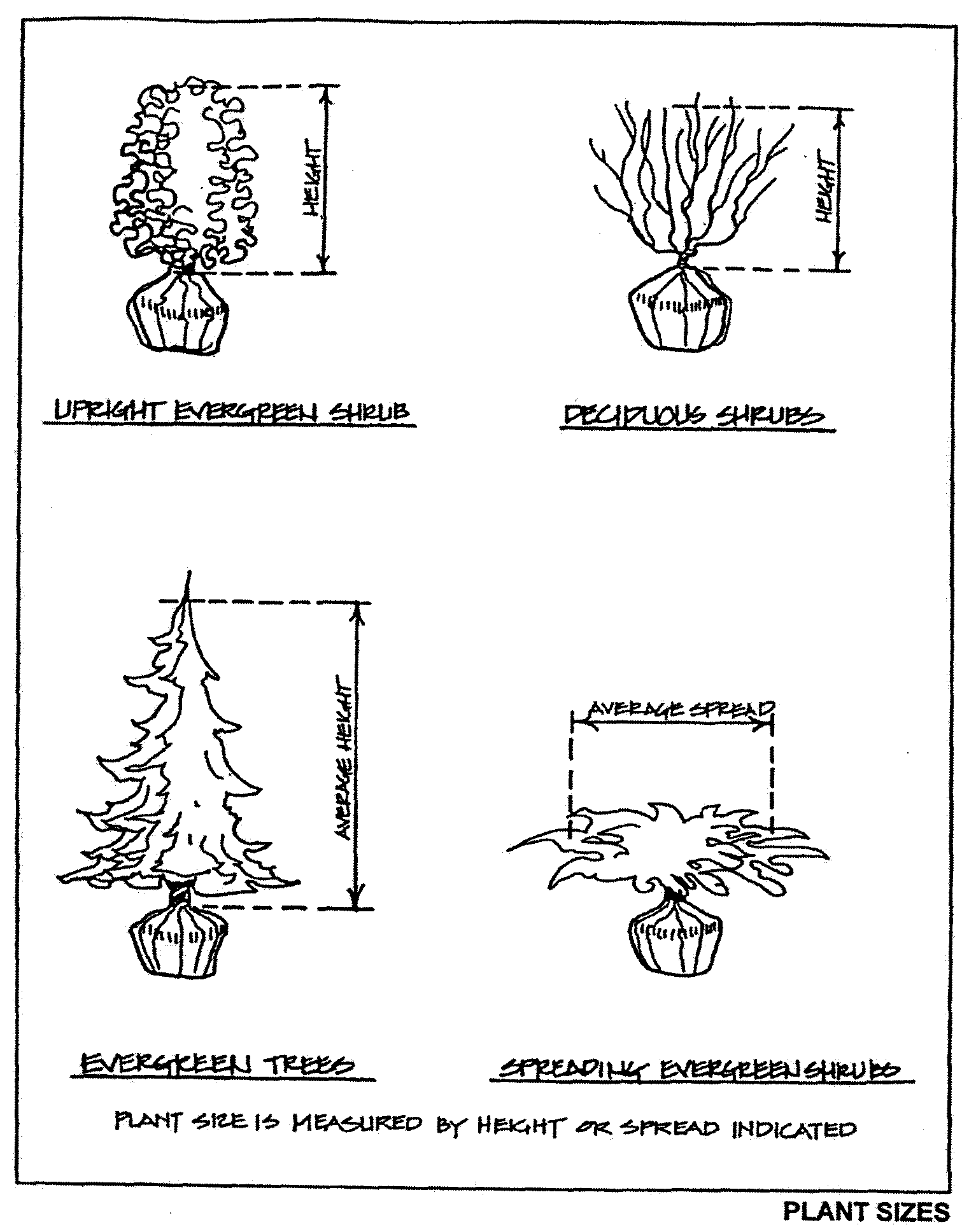
Evergreen trees shall not be less than six feet in height. When planted in informal groupings, they shall be spaced apart no less than ten feet on center. When spaced further apart, additional screen planting materials shall be used to achieve the desired screening effect intended by this division. When planted in rows, they shall be planted not less than ten feet apart on center.
(4)
Narrow evergreen trees shall not be less than five feet in height at the time of planting. When planted in informal groupings, they shall be spaced not more than ten feet apart on center. When planted in rows, they shall be planted not more than five feet apart on center.
(5)
Large shrubs shall not be less than 30 inches in height. When planted in informal groupings, they shall be spaced not more than six feet apart on center. When planted in single rows, they shall not be spaced more than four feet apart on center.
(6)
Small shrubs shall not have a spread of less than 18 inches, and shall not be planted more than four feet apart on center.
(7)
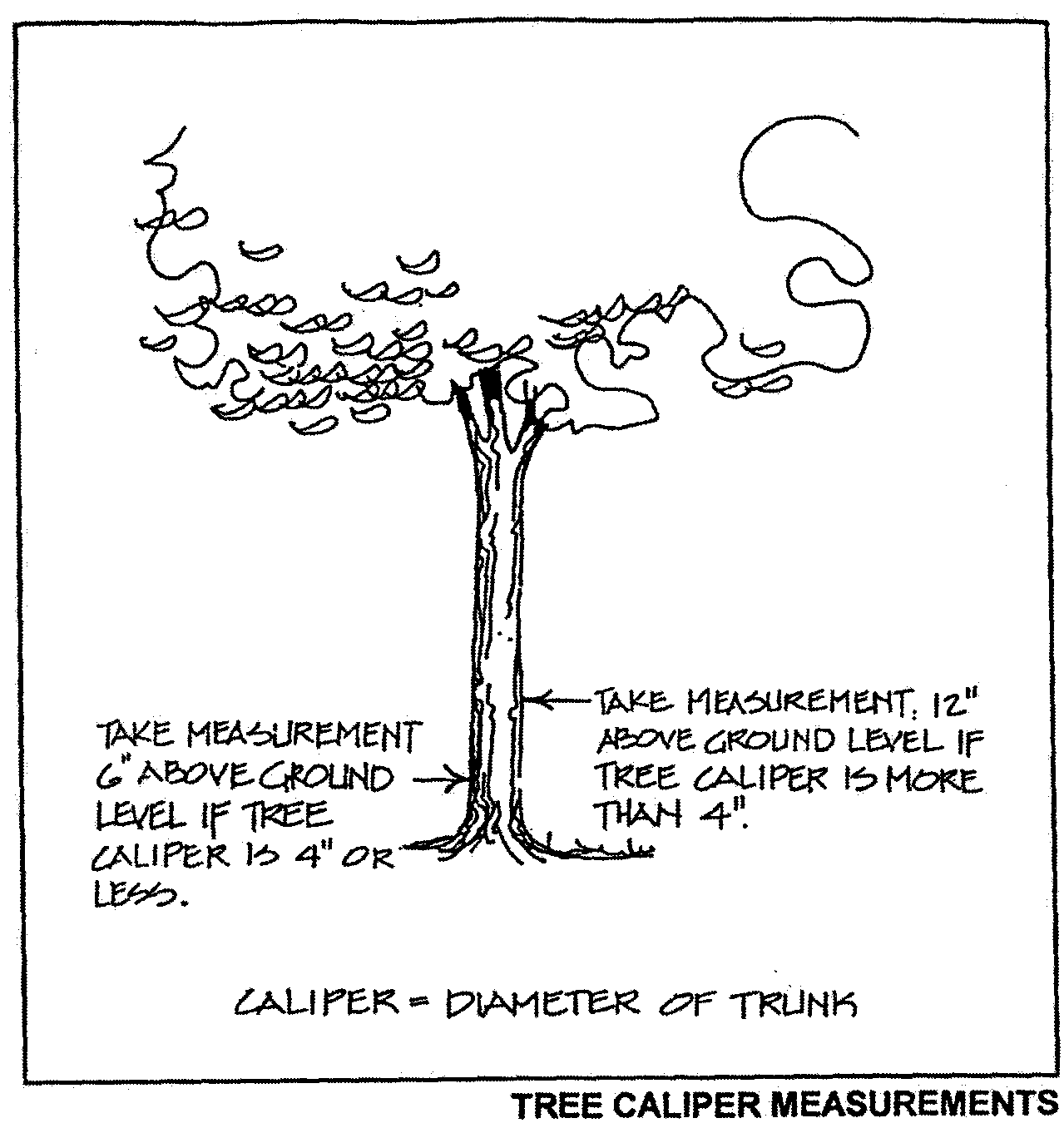
Large deciduous trees shall not be less than 2½ inches in trunk caliper. For the purpose of this division, the caliper of the trunk shall be taken six inches over ground level, up to and including four-inch caliper size, and 12 inches above the ground level for larger trees. When placed in informal groupings, they shall be planted not more than 30 feet apart on center.
(8)
Small deciduous trees shall not be less than two inches in trunk caliper, measured in the same manner as set forth in subsection (7) of this section. When planted in informal groupings, they shall be spaced not more than 15 feet apart on center.
RECOMMENDED DISTANCES BETWEEN LIKE AND UNLIKE PLANT MATERIALS
(b)
Suggested (not required) plant material:
(1)
Trees:
a.
Evergreen: Abies (fir), Picea (spruce), Pinus (pine), Psuedostuga (Douglas fir), and Tsuga (hemlock). Note: Exceptions are dwarf, globe, pendulous specie/cultivars.
b.
Narrow evergreen: Juniperus (juniper), and Thuja (arborvitae). Note: Exceptions are dwarf, globe, spreading specie/cultivars.
c.
Large deciduous: Acer (maple, except Japanese), Betula (birch), Fraxinus (ash), Gleditsia (honey locust, thornless cultivars only), Ginkgo (ginkgo), Platanus (sycamore, linden), and Quercus (oak).
d.
Small deciduous: Amelanchier (juneberry), Cercis (redbud), Cornus (dogwood, tree form), Crataegus (hawthorn), Malus (crabapple, disease-resistant cultivars), Prunus (flowering plum, tree form), Pyrus (flowering pear), Sorbus (mountain ash), and Syringa (lilac, tree form).
(2)
Large shrubs:
a.
Deciduous/broadleaf evergreen: Cornus (dogwood, shrub form), Cotoneaster (cotoneaster), Forsythia (forsythia), Lonicera (honeysuckle), Philadelphus (mock orange), Prunus (flowering plum), Rhamnus (buckthorn), Rhus (sumac), Spiraea (spirea), Syringa (lilac), Viburnum (viburnum), and Weigela (weigela). Note: Defined as plants maturing at five feet and up.
b.
Evergreen: Juniperus (hertz, pfitzer, savin juniper), and Taxus cuspidata 'Capitata' (pyramidal Japanese yew). Note: Defined as plants maturing at five feet and up.
(3)
Small shrubs:
a.
Deciduous/broadleaf evergreen: Berberis (barberry), Buxus (boxwood), Chaenomeles (quince), Cotoneaster (cotoneaster) Euonymus (euonymus), Forsythia (forsythia), Hydrangea (hydrangea), Llew (holly), Ligustrum (privet), Lonicera (honeysuckle), Potentilla (potentilla), Ribes (currant), (willow), Spiraea (spirea), Syringa (lilac), Viburnum (viburnum), and Weigela (weigela). Note: Defined as plants maturing under five feet.
b.
Evergreen: Abies (fir), Chamaecyparis (false cypress), Juniperus (low spreading juniper), Picea (spruce), Pinus (pine), Taxus (globe, spreading, upright yew), and Thuja (globe/dwarf arborvitae).
(c)
Trees not suggested: ailanthus (tree of heaven), Robinia (black locust), and Ulmus Americana (American elm).
(Code 2004, § 54-1355; Zoning Ord. 1999, § 2313(5))
Sec. 54-1142. - Same—Alternatives.
Where it can be shown that physical constraints on the land, such as shallow or narrow parcel size, adverse soil conditions, substantial changes in topography, or a similarly adverse physical condition, exist in the area of the screen, and which would make compliance with the conventional landscape screening requirements of this division, or erection of a masonry wall or earth berm, impractical or ineffective with respect to adequate visual screening, the following alternate planting screens may be permitted after review of site conditions by the planning commission:
(1)
The use of creeping-type deciduous or evergreen planting material, such as Boston ivy, big leaf winter creeper, Virginia creeper, etc., may be used. Wherever such planting material shall be permitted, it shall be extensively planted along a chainlink fence. When this type of planting screen is used, it shall be augmented by informal groupings of evergreen planting materials and with deciduous tree or shrub planting materials. Evergreen planting clusters or groupings shall be planted in accordance with the guidelines set forth in this division for such planting clusters. The chainlink fence shall consist of a horizontal top bar to which the chainlink fence shall be firmly secured as well as to the vertical posts. Vertical posts shall not be further than ten feet apart. When a chainlink fence shall be erected to a height of over six feet, the vertical posts shall be supported by diagonal braces attached to the vertical post and to the ground.
(2)
The planning commission may permit a four-foot, six-inch-high screening wall between off-street parking spaces in a front or exterior side yard, in lieu of the landscaped area as provided in subsection (1) of this section, when it determines that the parcel size and configuration are such as to make the provision of the minimum landscaped area impractical or overly restrictive as to the development of the site. Such screening walls shall be common face brick or of an architectural masonry or concrete material which is compatible with that of the principal building on the site. Such walls shall otherwise conform to the provisions of sections 54-1107 through 54-1114.
(3)
The planning commission may require any of the screening alternatives in subsections (1) and (2) of this section, singularly or in combination with the conventional screening requirements of this chapter, when such alternative planting materials will serve to augment the conventional screening requirements, resulting in a more effective visual screen.
(Code 2004, § 54-1356; Zoning Ord. 1999, § 2313(6))
Sec. 54-1143. - Selection, spacing and sizing of plant materials.
(a)
The selection, spacing and sizing of plant materials shall depend, in part, on the use the planting materials are to screen.
(b)
A mixture of plant materials (evergreen and deciduous trees and shrubs) is suggested in all landscape plans as a protective measure against disease and insect infestation. Plant materials used together in informal groupings shall meet the on-center spacing requirements as set forth in the table of recommended planting distances between like and unlike planting materials, which is set out in section 54-1141.
(1)
To determine the recommended distance between like planting material, read down the left-hand column or across the top of the table to be used. Then read down or across the table to the column identifying the same planting materials. The corresponding figure is the minimum and/or maximum recommended spacing between like planting material.
(2)
To find the minimum recommended distances between unlike plant material, the same procedure set forth in subsection (1) of this section is followed. By example, the minimum recommended distance between two like planting materials (evergreen trees) would be a minimum of ten feet and a maximum of 20 feet; and between unlike planting materials (narrow evergreen trees and small deciduous trees), a minimum of ten feet.
(Code 2004, § 54-1357; Zoning Ord. 1999, § 2313(7))
Sec. 54-1144. - Cosmetic landscape planting materials.
(a)
Landscape planting materials used for cosmetic purposes and not as required screen planting materials may be planted as desired throughout the site, but shall at least be planted within those minimum-required landscape planting areas set forth in this division.
(b)
Planting materials used for cosmetic purposes may consist of the suggested plant materials outlined in this division; except that red maple trees may be used within interior lawn or planting areas when they are located safely away from any building, driveway, street frontage, or off-street parking area.
(Code 2004, § 54-1358; Zoning Ord. 1999, § 2313(8))
Sec. 54-1145. - Cosmetic landscape areas.
Landscape planting materials shall be installed and maintained, wherever called for in this chapter, between public rights-of-way, existing or proposed, off-street parking lots, or vehicular use areas, according to the standards established as follows:
(1)
A strip of land, the minimum width of which shall be provided in accordance with the guidelines set forth in section 54-506(b)(4), shall be located between the abutting public right-of-way, existing or proposed; and any off-street parking or vehicular use areas shall be landscaped in grass, ground cover, shrubs or other living plant materials, or other specified nonliving durable materials. Low undulating earth berms may be utilized as a landscape feature within such landscape areas.
(2)
The land area which lies between the designated landscape strip and the edge of the pavement of the public street shall be landscaped and maintained with a minimum of grass or ground cover and select evergreen and/or deciduous trees.
(3)
Necessary access ways from public rights-of-way through such landscaped areas shall be permitted, but such access ways shall not be subtracted from the lineal dimension used to determine the minimum number of trees required.
(4)
Development.
a.
Development which occurs in the RC, OS-1, B-1, B-2 and B-3 districts shall provide, in addition to any required greenbelt buffer in the front and exterior side yards, further on-site landscaped areas. These additional landscaped areas shall be equal in area to at least eight percent of the total area of the site, or equal to a ratio of ten to one: ten square feet of landscaping for each off-street parking space provided on-site. These landscaped areas shall be distributed throughout the site and may include:
1.
Tree islands within the parking lot, preferably at parking row ends, but, in the case of large parking lots, such islands may be distributed throughout the lot at a ratio of not less than one planting island per every ten to 15 spaces. Wherever this landscape feature is used, the islands shall be located so as to offer not only a visually attractive and shading feature, but to help provide for improved traffic circulation.
2.
Pedestrian sidewalks, planters and other decorative features, such as plazas, when all are made an integral part of a site's overall landscaping.
b.
Development which occurs in the TR, I-1 and I-2 districts shall provide, in addition to any existing or proposed street rights-of-way, at least ten percent of the net site area (exclusive of buildings) as landscaped open space. Pedestrian walkways, plazas, planters and other decorative elements may be included in such landscape areas.
(Code 2004, § 54-1359; Zoning Ord. 1999, § 2313(9))
Sec. 54-1169. - Standards.
Wherever exterior equipment associated with a particular use on the property shall be placed on or next to the building, or in any permitted yard, the following standards shall apply:
(1)
All exterior climate control and other such mechanical equipment, including utility outlets; i.e., electrical and gas regulators and monitors, compressors, etc., shall be effectively screened from view and no such equipment shall be placed in any yard which abuts a residential district when such equipment may generate noise or vibration that would be annoying to residents in the abutting residential district. To ensure that annoying sounds or vibration shall not extend into an abutting residential district, the township may require an applicant to submit specifications concerning noise and vibration levels emitted from such equipment. The township may require devices designed to mute noise or vibration to be installed on or around equipment to effectively diminish an annoyance, or may require such equipment to be placed within a fully enclosed building or on a rooftop. Rooftop equipment shall be screened by material which shall extend at least one-eighth time higher than the object being screened.
(2)
Trash receptacles shall be screened by placing them in architectural masonry enclosures. The masonry materials shall consist of the same masonry materials used in the front exterior building wall of the principal building; except, the use of cinderblock or conventional concrete masonry units (SCMU) is prohibited. The minimum height of a trash receptacle screen wall shall be six feet. All such trash receptacle screening structures shall include a gate consisting of opaque materials. Wherever trash receptacle screens are erected, they shall be maintained in an ordinary and structurally sound condition and the interior shall be kept clean and free of refuse clutter.
(Code 2004, § 54-1391; Zoning Ord. 1999, § 2314)

