
Groveland Township City Zoning Code
ARTICLE IV
SCHEDULE OF REGULATIONS
Sec. 54-506.- Schedule of regulations.
(a)
Set forth in this section is the following schedule of regulations limiting height, bulk, density and area by zoning district:
(b)
Footnotes.
(1)
Except as otherwise set forth in this chapter, a lot, parcel or one-family condominium lot having direct frontage on a public road right-of-way or private road easement in existence as of September 13, 1999, may apply the land within the existing public road right-of-way or private road easement towards meeting the minimum applicable lot area requirement of the district; provided, the existing public road right-of-way or existing private road easement is part of the legal description of the property and has not been excused or excepted from the description; except the land area within an existing public road right-of-way or private road easement that may be applied towards meeting the minimum applicable lot area requirement of the district shall not include any area of the right-of-way or easement beyond the centerline of the existing public road right-of-way or private road easement in front of the property. In the case of a corner or double frontage lot, parcel or detached one-family condominium lot, the land area of either or both existing public road rights-of-way or existing private road easements may be applied towards meeting the minimum applicable lot area requirement of the district, so long as each is contained in the legal description of the property and is not excused or excepted there from.
a.
In the case of a lot, parcel or one-family detached condominium lot that has direct frontage on a public road right-of-way or private road easement created after October 19, 1999, or which may have direct frontage on a public road right-of-way or private road easement and which was in existence as of September 13, 1999, but which does not include any of the existing public right-of-way or existing private road easement in its legal description, or which description excuses either one, no part of any of the of the fronting public road right-of-way or private road easement shall be counted towards meeting the minimum applicable lot area requirement of the district.
b.
Except as may be otherwise permitted in this chapter, all roads constructed in the township after September 13, 1999, shall be pubic roads built to county road commission standards and located within public rights-of-way that meet all applicable county road commission requirements pertaining to public rights-of-way, and shall be fully dedicated to the county road commission as public road rights-of-way.
c.
If public sanitary and public water utility systems are available, or if an approved privately held sanitary and water utility system designed to serve the development is available, the minimum lot area and the minimum lot width requirement of each lot may be reduced to the following area and width.
d.
Both a sanitary sewer system and a water line system must be available to the developments simultaneously before the above noted lot area, lot width reductions and their resulting increased dwelling densities may be applied. In no instance shall the length of a parcel or lot exceed four times its width, as set forth and regulated in section 54-745.
(2)
For other than one one-family detached dwelling on one lot, see section 54-507, pertaining to the one-family cluster housing option; section 54-508, pertaining to the subdivision open space option, or section 54-509, pertaining to the one-family detached site condominium option, regarding one-family residential flexibility allowances.
(3)
Except as otherwise excused in section 54-1296, for all nonresidential uses permitted in the R residential districts, the setbacks shall be equal to the height of the main building or buildings, or the minimum setback requirement of the district, whichever is the greater setback.
(4)
Front yard and exterior side yard setbacks shall be measured from the projected road or street right-of-way line, as set forth in the township's adopted master plan text and depicted on the master land use plan map. The minimum required setback for an exterior side yard shall be the same as that required for the front yard.
a.
In the districts listed below, a portion of a front yard or exterior side yard may be used for off-street parking, but only in accordance with the following schedule. The required parking setback shall be located along the site's frontage, between the nearest off-street parking space, vehicle maneuvering lane or service drive, excluding any driveway entrance, and the projected road or street right-of-way line. The non-accessible greenbelt shall be maintained as a landscaped lawn panel, neat and orderly in appearance.
b.
In the TR, I-1, I-2 and E-1 districts, no off-street parking shall extend into any required front or exterior side yard setback; except, up to seven parking spaces in excess of the minimum number of parking spaces required for the use may extend into a required front or exterior side yard from the front or exterior side of the principal building, when such building is in compliance with the minimum setback requirement of the district and when the parking is to be used exclusively for visitor parking.
(5)
No multiple-family dwelling building or buildings shall be erected on property containing less than three net acres of usable land area, or which has a width at the minimum required building setback line of the district that is less than 150 feet wide. For the purpose of determining site area, the applicable guidelines set forth in footnote (b)(1) shall apply.
a.
In the RM district, the maximum overall length of any one building or group of buildings attached together over any portion of common party wall, or by any architectural feature that attaches buildings together, shall not exceed 200 feet, measured along the centerline of the buildings.
b.
In the RM district, the total number of rooms (excluding kitchen, dining rooms and bathrooms) permitted in the entire development shall not exceed the net usable area of the parcel in square feet, divided by 1,500. All dwelling units shall have at least one bedroom and one living room; except, up to ten percent of the total number of dwelling units permitted may be of an efficiency type of apartment dwelling. For the purpose of computing the permitted number of multiple-dwelling units per acre, the following room assignments shall control:
1.
Efficiency: One room.
2.
One bedroom: Two rooms.
3.
Two bedrooms: Three rooms.
4.
Three or more bedrooms: Four rooms.
c.
Floor plans for proposed multiple-dwelling buildings showing one-, two- or three-bedroom dwelling units and including a den or library, or any other extra room or rooms, shall count such rooms as a bedroom for the purpose of computing dwelling unit density. Land area used for computing density shall be the total site area exclusive of any dedicated public rights-of-way of either interior or exterior roads. All multiple-family developments shall have direct fronting access to a dedicated public road or street.
d.
In the RM districts, not more than 30 percent of any front or exterior side yard shall be devoted to off-street parking, vehicle maneuvering lanes or service drives, and no off-street parking space, vehicle maneuvering lane or service drive shall be located closer than:
1.
Twenty feet to any exterior wall containing openings involving any dwelling;
2.
Ten feet from any exterior dwelling wall which does not have openings; or
3.
Five feet to any peripheral interior side or rear property line.
e.
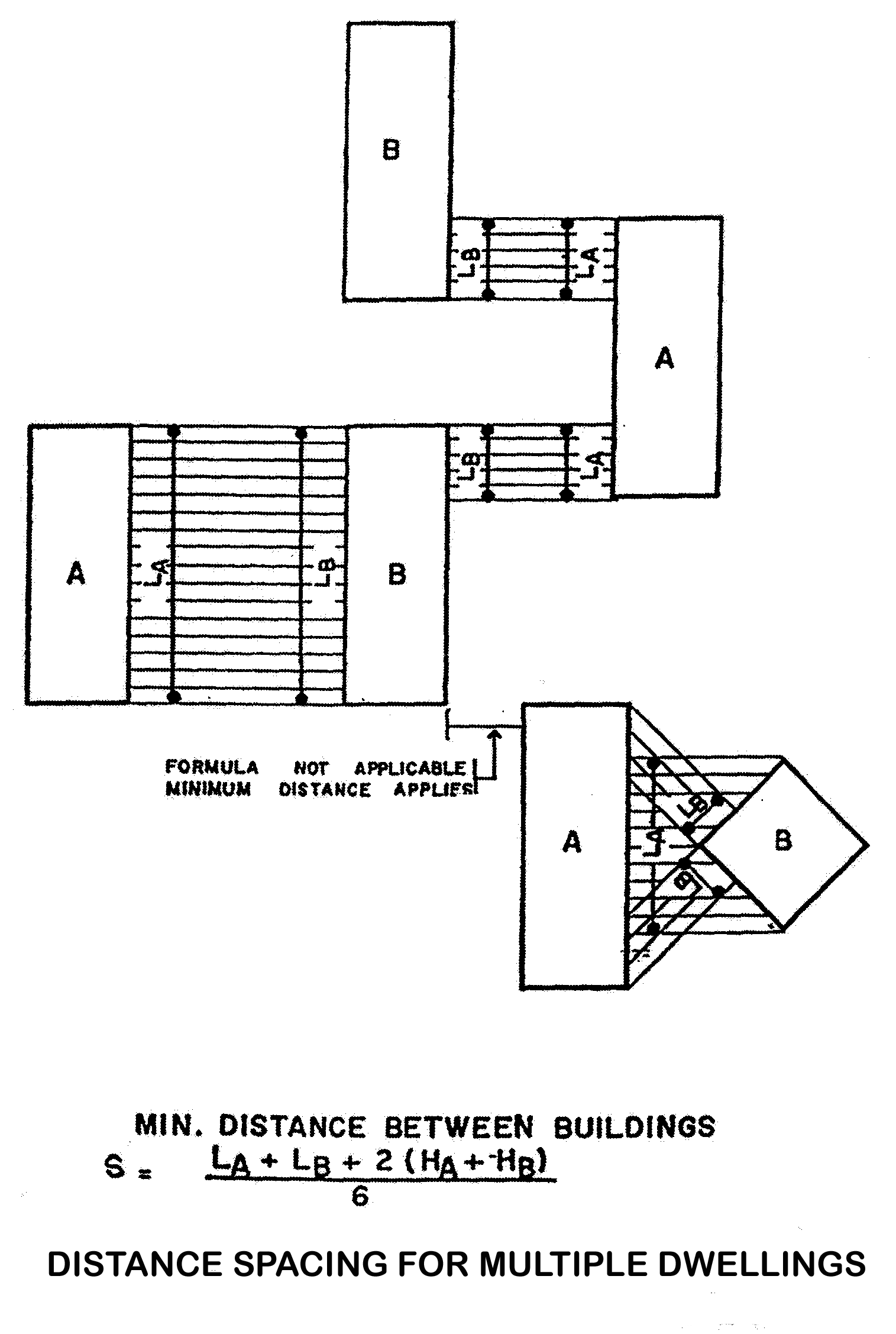
In the RM districts, the minimum distance between any two multiple-dwelling buildings shall be regulated according to the length and height of such buildings, except that in no instance shall this distance be less than 30 feet, unless the relationship between them is corner to corner, in which case the minimum distance between the two buildings shall be not less than 15 feet.
f.
In the RM districts, the formula for determining the minimum required distance between multiple-dwelling buildings is set forth as follows:
S = LA + LB + 2(HA + HB)/6
1.
S = Required minimum horizontal distance between any wall of building A and any wall of building B, or the vertical prolongation of either.
2.
LA = Length of building A.
The total length of building A is the length of that portion or portions of a wall or walls of building A from which, when viewed directly from above, lines drawn perpendicular to building A will intersect any wall of building B.
3.
LB = Length of building B.
The total length of building B is the length of that portion or portions of a wall or walls of building B from which, when viewed directly from above, lines drawn perpendicular to building B will intersect any wall of building A.
4.
HA = Height of building A.
The height of building A at any given level is the height above natural grade level or any portions or portions of a wall or walls along the length of building A. Natural grade level shall be the mean level of the ground immediately adjoining the portion or portions of the wall or walls along the total length of building A.
5.
HB = Height of building B.
The height of building B at any given level is the height above natural grade level or any portion or portions of a wall or walls along the length of building B. Natural grade level shall be the mean level of ground immediately adjoining the portion or portions of the wall or walls along the total length of building B.
(6)
The minimum amount of livable floor area to be provided for each multiple-family dwelling unit shall be in accordance with the following standards:
Livable floor area shall not include any exterior hallway or stairwell area, or any area within the unit devoted to climate control equipment or occupant storage area.
(7)
In the OS-1 district, required loading and unloading space shall be limited to the following locations:
a.
Buildings containing up to 20,000 square feet of gross floor area may provide required loading and unloading space next to the building in any interior side or rear yard and in any nonrequired front or exterior side yard.
b.
Buildings containing 20,001 to 100,000 square feet of gross floor area may provide required loading and unloading space next to the building in a nonrequired interior side yard or in the rear yard.
c.
Buildings containing over 100,000 square feet of gross floor area shall provide required loading and unloading space next to the building in the rear yard only; except, in the case of a double frontage parcel or a parcel whose rear yard area contains a lake shoreline, required loading and unloading may be provided next to the building in a nonrequired interior side yard.
(8)
In the B business districts, TR and I industrial districts, and for all nonresidential uses permitted in a residential district, required loading and unloading space shall be provided next to the building in the rear yard only; except, in the case of a double frontage parcel or a parcel whose rear yard area contains a lake shoreline, required loading and unloading may be provided next to the building in a nonrequired interior side yard. Area for all loading and unloading shall be provided in accordance with the applicable guidelines of section 54-1022.
(9)
The setback requirements in the schedule of regulations for buildings in the I-1 and I-2 districts shall not supersede any building setback requirements set forth in section 54-384 or section 54-416; except, if application of the building setback formula contained in this footnote results in a greater setback than stipulated in the above-referenced sections, the greater setback shall apply. In the I-1 and I-2 districts, when the overall length of a building wall exceeds 120 feet and 160 feet, respectively, along a rear yard or interior side yard that abuts an R residential district, the minimum building setback requirement for such yards shall be determined by applying the following formula:
A = L/4.0
where:
A = The required minimum horizontal distance from the rear or interior side yard property line to any wall of the building.
L = The overall length of the building wall.
(10)
See section 54-615 et seq., regarding maximum floor area allowances for accessory buildings.
(Code 2004, § 54-671; Zoning Ord. 1999, §§ 2200, 2201; Ord. No. 143, 3-9-2004; Ord. No. 148, 12-12-2005)
Sec. 54-507. - One-family cluster housing options.
(a)
Applicability. This section shall apply to all of the residential districts. It is intended to provide for the creation and preservation of open spaces in the township. This is to be achieved by allowing for a reduction in the minimum lot area and lot width requirements by residential district. This modification shall be accomplished without any attendant increase in the number of lots that would otherwise be permitted on the property.
(b)
Open space preservation standards. Section 506 of Public Act No. 110 of 2006 (MCL 125.3506), stipulates that open space preservation shall be offered as a development option in each zoning district that allows one-family dwellings as a permitted use. Act 110 also stipulates that the standards of Act 110 do not apply to a qualified township if certain conditions which are set forth in MCL 125.3506 are met. In May 2002, it was determined that the township met all of the above referenced conditions and is therefore exempted from strict compliance with the standards of Act 110. However, a later review raised questions about the exemption. The county is adopting the ordinance from which this amendment is derived, to ensure compliance with Act 110.
(1)
One reason why the township may be exempted from strict compliance with the standards of Act 110, is because the township has had in effect for some years, its own open space preservation standards. These standards were presented and regulated through its one-family cluster housing option and its subdivision open space option and its one-family site condo option, which have been supplemented by these standards.
(2)
The standards of subsection (b)(1) of this section, as the standards in Act 110, are offered as an option to conventional development, to be applied to land at the discretion of the property owner or developer.
a.
Residential development. A residential development may be developed in any one-family zoning district, at the option of the landowner, with the same number of dwelling units on 50 percent of the land that could otherwise be developed under existing ordinances, laws and rules on the entire land area, if the landowner commits that 50 percent or more of the land will remain perpetually in an undeveloped state by means of a conservation easement, plat dedication, restrictive covenant or other legal means that runs with the land.
b.
Land development. In the alternative to subsection (b)(1) of this section, a landowner may, at the landowner's option, develop a residential development on land zoned for one-family residential development on property that is not part of a recorded subdivision plat, with the same number of dwelling units on more than 50 percent of the land which could otherwise be developed under existing ordinances, laws and rules on the entire land area, if a percentage of the land area less than 50 percent will remain perpetually in an undeveloped state by means of a conservation easement, plat dedication, restrictive covenant or other legal means that runs with the land. A cluster development with open space consisting of less than 50 percent of the land that could otherwise be developed under existing ordinances, laws and rules on the entire land, shall be subject to the planning commission finding that at least one of the following characteristics exists on the land:
1.
The property, or a part of it, lies generally parallel to, and generally not exceeding 360 feet in depth, along a major thoroughfare of at least 120 feet in right-of-way width or along a limited access expressway, where cluster housing can serve as a desirable land use transition between the thoroughfare or expressway and a development of one-family homes.
2.
The property or part of it abuts nonresidential zoned land where cluster housing can serve as a desirable land use transition between the nonresidential zoned land and land zoned for one-family use.
3.
An unsubdivided parcel of land the shape and/or size of which is unsuitable or generally unbuildable under the conventional subdivision approach to one-family residential development.
4.
An unsubdivided parcel of land which the planning commission finds to contain generally unsuitable or unbuildable soil conditions, or which has unusually severe topographic conditions, or which is characterized by some other unusual physical characteristic which would make sound physical development of the parcel impractical under the conventional subdivision platting approach.
5.
An unsubdivided parcel of land which the planning commission finds to be characterized by major stands of trees, or to contain a stream or lake or other watercourse or wetland, or combinations thereof, which would be significantly diminished or destroyed under the conventional subdivision platting approach, and has significant natural assets which ought to be preserved.
6.
An unsubdivided parcel of land where road grades of less than six percent would be impossible to achieve unless the parcel were mass graded resulting in substantial changes to natural drainage courses on the property and in the general appearance of the land.
(3)
Area of open space. The area in open space, including recreation areas and water, created by application of the one-family cluster housing option under subsection (b)(2) of this section on the land, shall generally represent a significant horizontal land area of the parcel but in no instance shall less than 35 percent of the parcel be devoted to open space or undisturbed land area.
(4)
Maximum dwelling unit densities. Under the one-family cluster housing option, the following maximum dwelling unit densities by zoning district, shall be observed:
a.
RE/F—1.0 dwelling unit per 2.5 acres.
b.
R-1—1.0 dwelling unit per acre.
c.
R-2—1.4 dwelling units per acre.
The entire area of the open space of the parcel to be developed under the cluster housing option may be used in computing density, including all proposed street rights-of-way within the development, but not including any existing rights-of-way of peripheral roads.
(5)
Public streets. All streets shall be public streets in public rights-of-way and built to applicable county road commission standards.
(6)
Yards. Except as otherwise set forth, all detached one-family dwellings erected under the one-family cluster housing alternative shall be provided with the following yards:
a.
Each one-family detached dwelling unit shall be provided with a front yard and a rear yard equal to the minimum front and rear yard setback requirements of the district.
b.
The minimum distance from the side wall of any dwelling unit to the side wall of any other dwelling unit shall not be less than the total minimum side yard setback requirement of the district.
c.
Where it can be demonstrated that strict adherence to the setback requirements of this subsection will result in the loss of a natural amenity on the site that ought to be preserved, the planning commission may vary a minimum interior side or rear yard setback, but in no case more than 15 feet for an interior side or rear yard in the RE/F district, or more than ten feet to either yard in the R-1 or R-2 districts.
(7)
Rear yard or side yard. All detached cluster housing units that directly abut a major thoroughfare or a limited access expressway, shall have a rear yard or side yard relationship to the roadway.
(8)
Earth berm.
a.
Except where excused in this subsection, a landscaped earth berm not less than six feet in height shall be placed along the entire property line of a site of cluster housing units abutting a major thoroughfare or limited access expressway. Land area used for berming may be counted as open space. The earth berm shall be erected within its own easement which shall not extend into any required side or rear yard setback more than ten feet in the RE/F district, or more than five feet in the R-1 and R-2 districts.
b.
Where it can be shown that a grade change of at least six feet exists along the development's frontage with a major thoroughfare or expressway, the earth berm need not be erected, but a 20-foot wide easement for landscape screening shall be provided along the grade change. Where it can be shown that a natural screen barrier exists along a major thoroughfare or expressway that will effectively screen cluster housing units from such roadways, the planning commission may waive the earth berm screening requirements of this subsection (b)(8)b.
(9)
Land for recreation area. Within a cluster housing development a portion of the land area to be preserved shall consist of at least one open space area of not less than 2.5 acres, located within convenient walking distance of a majority of the dwelling units. This area will be set aside as an active recreation area for the residents of the development and will consist of sufficient flat land area to permit the informal playing of field sports.
(10)
Submittal to planning commission. The applicant shall submit a copy of the proposed bylaws of the homeowners association to the planning commission for review by the township attorney. Approval of a site plan under this section by the planning commission, may be conditioned on the township attorney's approval of the association bylaws.
(11)
Dwelling density limitations. Dwelling density shall be based on the number of dwellings permitted in each one-family district as outlined in this subsection. The area of the property that may be used to compute dwelling density shall be the area of the site, less any areas in public road rights-of-way or private road easements. The number of one-family dwellings by zoning district is set forth as follows:
(12)
Lot area, lot width and building setback requirements. The minimum lot area, lot width and building setback requirements of this section to the contrary notwithstanding, the following minimum lot area, lot width, and building setback requirements shall apply:
a.
Lot area. The minimum area of each lot shall be not less than the minimum requirements of the county for homes with individual well and septic systems. Homes for which sanitary sewers will be provided, either by an approved privately held sanitary collection and processing system, or by a public sanitary sewer system, shall be provided with a lot of sufficient size to meet the minimum building setback requirements of this subsection.
b.
Lot width. No minimum lot width shall be required, except that each lot shall have sufficient width to allow the requirements of this subsection (b)(12)b to be met, and except further, the overall length of a lot shall not be more than four times its width, as set forth and regulated in section 54-745.
c.
Building setbacks. The minimum building setback requirements of this section by zoning district shall be met, except the minimum side yard setback requirement in the RE/F district may be reduced to 25 feet for an interior side yard, but not less than the minimum front yard setback requirement of the district for an exterior (street side) side yard.
(13)
Open space preservation. Land to be placed in perpetuity as open space shall meet the following requirements.
a.
Under subsection (b)(1) of this section, land to be set aside as open space within the development shall comprise not less than 50 percent of the gross land area of the property, less any existing public road rights-of-way or private road easements that bound or extend through the property. Land so reserved shall not include any part of a lot or home site designated as a home site on the site plan, or lot on the subdivision plat.
b.
Under subsection (b)(2) of this section, land to be set aside as open space shall comprise not less than 35 percent of the gross land area of the property less any existing public road rights-of-way or private road easements that bound or extend through the property. Land so reserved shall not include any part of a lot or home site designated as a home site on the site plan, or lot on the subdivision plat.
c.
A portion of the property shall be set aside as an active recreation area for the residents of the development. This area shall contain sufficient flat land to permit the informal playing of field sports if reasonably possible. This land may be provided in addition to, or as part of the open space area stipulated in subsection (b)(12)a and b of this section. All land set aside as open space shall be set aside for that purpose and that purpose only. Once established and dedicated as open space, no part of any open space so established shall be converted to land for development or for any other use or purpose without the express approval of the township and the residents living within the development.
d.
In no event shall any reduction in open space area result in less than 50 percent of the net usable land area of the property being reserved as open space.
e.
The open space portion of the property may include any lakes, ponds or streams, wetlands, woodlands or stands of timber, or areas of steep topography, but such features shall not make up all the open space of the site at the exclusion of any open space recreation land required in subsection (b)(9) of this section.
f.
Open space shall extend to as many lots as feasible, but in all cases some open space shall extend to each peripheral property line. Such open space shall not be less in width along a peripheral property line than 60 feet. In those instances were open space of an existing or approved development extends to a property line of a proposed new development, open space in the new development shall meet the open space in the abutting development, or at least to the extent outlined in this subsection (b)(13)f. Such open space connections shall not be dead-end open space areas, but shall be designed to allow pedestrian, horseback and bicycle riding access from one such development to another. When a residential open space preservation development abuts a commercial nonresidential development, or land that is zoned for commercial use, open space of sufficient width to permit connecting the two sites together via a trail or pathway, shall be provided.
g.
All open space shall remain perpetually in an undeveloped state by means of a conservation easement, plat dedication, restrictive covenant, or other legal means that runs with the land.
(14)
Assurance of open space preservation. The area of the property to be preserved as open space as set forth in subsection (b)(12) of this section shall be subject to the following preservation assurances.
a.
One-family site condominiums. The location of all open space areas shall be described by legal description in the master deed. A general description of what the open space areas contain will be included. These areas shall be set forth as open space areas which are to be preserved as open space areas. Open space areas may be identified as common areas, as defined in this chapter. The area to be set aside for active recreation, as set forth in subsection (b)(9) of this section, shall also be detailed and described in the master deed. All areas of any open space or active recreation area that will require maintenance shall be so identified in the master deed and the manner in which these areas will be maintained shall be clearly spelled out in the association's bylaws.
b.
One-family subdivision plat. The location of all open space areas shall be described by legal description, along with a general description of what the open space areas will contain. These areas shall be set forth as open space areas to be preserved as open space in the form of protective covenants, or deed restrictions. The covenants shall also require the forming of an association of homeowners who shall be governed by association bylaws. The bylaws shall clearly spell out the responsibilities of the homeowners association, including how all open space and active recreation areas required in subsection (b)(9) of this section, that will require maintenance, will be maintained by the association.
c.
Township approval. A master deed, protective covenants or deed restrictions, and the bylaws of the association of homeowners, as required in this subsection, shall be subject to review and approval of the planning commission and the township attorney. Of particular importance to the township shall be assurance that all open space areas, including all active recreation areas, are properly set aside for such purposes and those elements of the open space areas that will require maintenance, will be properly cared for. The township may refer such documents to the township attorney for review and comment. The township, at its discretion, may require the assigning of a second party to partner with the development in securing these areas as open space areas only, other than the active recreation areas. A second party could be a land conservancy or similar land preservation organization.
(15)
Screening and lot orientation. On site screening and the location of certain lots shall be provided as follows:
a.
Screening. If dense natural screening exists along the property's thoroughfare road frontage, it shall be preserved and where deemed appropriate or necessary, augmented by new planting materials placed to enhance the natural screening capabilities of the existing foliage. The natural foliage screen shall be placed in a buffer area that shall be at least 50 feet wide, measured from the projected right-of-way line of the road, a minimum of 50 feet into the property. Any screening buffer so required, may count towards meeting the minimum open space requirement, as set forth in subsection (b)(9) of this section.
b.
Sharp change in topography. If an effective screen of natural foliage does not exist along a site's thoroughfare frontage, but a significant and pronounced change in elevation does exist between the surface of the road, upwards to the nearest lot, the change in elevation may substitute for any lack of heavy natural foliage.
c.
Artificial screen. In the event that dense foliage or pronounced changes in topography do not exist along the thoroughfare, an eight-foot-high densely landscaped earth berm shall be erected between the projected road right-of-way line of the thoroughfare and the nearest lot line. The berm shall be erected and screen planted in accordance with the applicable requirements of article X, divisions 1 and 2 of this chapter.
d.
Lot orientation. All lots shall be placed with a back lot or side lot orientation to any buffer area required in this subsection.
(Code 2004, § 54-672; Zoning Ord. 1999, § 2202; Ord. No. 137, § 2202, 12-9-2003; Ord. No. 143, 3-9-2004; Ord. No. 146, 11-14-2005)
Sec. 54-508. - Subdivision open space option.
The subdivision open space option is intended to promote preservation of the natural character of the land while at the same time providing for a desirable type of one-family living environment in areas of environmental significance.
(1)
Development under the subdivision open space approach is designed to:
a.
Provide a more desirable living environment by preserving the natural character of open fields, stands of trees, brooks, hills and similar natural assets.
b.
Encourage developers to use a more creative approach in the development of residential areas.
c.
Allow for the provision of open space within a reasonable distance to all lots within the subdivision and to further encourage the development of recreational facilities within the open space areas for the use and enjoyment of the residents of the development.
(2)
Under the subdivision open space option, certain modifications to the standards of the one-family residential districts outlined in section 54-506 may be made when the following conditions are met:
a.
The minimum lot area requirements of the one-family residential districts may be reduced in size as follows:
1.
In the RE/F districts, by up to 25 percent to a minimum lot area of not less than 80,600 square feet;
2.
In the R-1 districts, by up to 15 percent to a minimum lot area of not less than 37,000 square feet; and
3.
In the R-2 districts, by up to 15 percent to a minimum lot area of not less than 25,500 square feet.
b.
The reductions in minimum lot area per zoning district set forth in subsection (2)a of this section may be made, provided the overall dwelling unit density of the property will be no greater per district than the following ratios of dwelling unit to acre:
1.
In the RE/F districts, 1.0 dwelling unit per 2.5 acres.
2.
In the R-1 districts, 1.0 dwelling unit per acre.
3.
In the R-2 districts, 1.4 dwelling units per acre.
The area of the property to be developed under the subdivision open space option shall be the gross area of the site less all land in existing or proposed public street rights-of-way.
c.
Reduction of the minimum lot area requirements of the one-family residential districts outlined in this subsection (2) may be attained in part by reducing the minimum lot width requirement of the R-1 and R-2 districts, at the minimum required front yard setback line of each district, to the following minimum widths:
1.
In the R-1 districts, by up to 35 feet to a minimum width of 115 feet.
2.
In the R-2 districts, by up to 50 feet to a minimum width of 100 feet.
(3)
Under the provisions of subsection (2) of this section, for each square foot of land area gained through the reduction of lot size below the minimum lot area requirements of the district, as set forth in section 54-506, at least equal amounts of land shall be set aside as undisturbed open space in combination with area suitable for active recreational use by residents of the development.
(4)
The open space area to be reserved for active recreational purposes shall not be less than 2.5 acres in size and shall be conveniently located to a majority of the lots in the development.
(5)
Development under the subdivision open space option shall require the lawful establishment of a homeowners association. The bylaws of the association shall be prepared by the applicant and submitted to the township for review and evaluation by the township attorney.
(6)
Acceptance of the homeowners association bylaws by the township may be a condition of the preliminary plat approval process, but the bylaws shall be fully in order and accepted by the township before final plat approval is granted by the township board.
(7)
Development of a subdivision plat under the subdivision open space option shall commence within one year from the date of receiving final plat approval from the township board. Failure to commence within this time period will terminate all previous approvals. Prior to the termination date, the applicant may submit a written request to extend the date of commencement, explaining the reason for the delay. After review of the request by the township planning commission, the township board may grant a one-year extension.
(Code 2004, § 54-673; Zoning Ord. 1999, § 2203; Ord. No. 143, 3-9-2004)
Sec. 54-509. - One-family site condominium option.
The intent of this section is to permit the development of one-family detached dwellings by site planning the layout of the individual detached dwelling units, along with all streets, street rights-of-way, utility easements, open space, etc. In the one-family residential districts, the site planning of individual detached one-family dwellings shall be permitted after review of site plans submitted in accordance with article VI of this chapter, with the following additional requirements:
(1)
The total number of individual site condominium units (dwelling unit footprints) do not exceed the maximum number of dwelling units permitted per acre in the district.
(2)
Except where otherwise permitted in this section, each condominium unit is located within a limited common element and each limited common element contains land area at least equal to the minimum lot area requirement of the district in which the development is located.
(3)
Each condominium unit is provided with front, side and rear yard setbacks that are at least equal to the corresponding minimum building setback requirements of the district, as follows:
a.
A front yard setback, measured from the street right-of-way line to the front wall of the condominium unit.
b.
Side yard setbacks, measured from the side walls of the condominium unit to the corresponding defined edges of the condominium unit's limited common element line.
c.
A rear yard setback, measured from the rear wall of the condominium unit to the corresponding defined edge of the condominium unit's limited common element line.
(4)
All streets shall be public streets in public rights-of-way, designed and built to county road commission standards.
(5)
The maximum number of stories and maximum height of the principal building shall meet the standards of the district, as shall the minimum floor area requirements of the district.
(6)
Any detached accessory uses shall comply with the applicable standards of this chapter for such uses. Setbacks required for detached accessory uses shall be measured from the applicable limited common unit lines.
(7)
If development is proposed along the lines of an open space subdivision, the applicable requirements of section 54-508 shall apply and all information required in section 54-508 shall be provided.
(8)
The location of all utility easements for the installation of all utilities.
(9)
The location of all septic systems and wells, which shall be restricted to areas within the limited common element of the individual condominium unit the systems are intended to serve.
(10)
Septic systems and wells shall be installed to applicable township or county standards and subject to review and approval by the township engineer.
(11)
Drainage features for each one-family site condominium unit's limited common element shall be shown and shall be subject to review and approval by the township engineer.
(12)
Submittal of the condominium association bylaws for review by the township attorney.
(13)
Include a draft of the condominium association bylaws for review by the township attorney.
(Code 2004, § 54-674; Zoning Ord. 1999, § 2204; Ord. No. 146, 11-14-2005)
State Law reference— Condominium act, MCL 559.101 et seq.

