
Groveland Township City Zoning Code
ARTICLE V
- GENERAL PROVISIONS
DIVISION 3. - NONCONFORMING LOTS, USES OF LAND, STRUCTURES AND USES OF STRUCTURES AND PREMISES[4]
State Law reference— Nonconforming uses or structures, MCL 125.3208.
Sec. 54-527. - Scope of chapter.
No building or structure, or part thereof, shall hereafter be erected, constructed or altered and maintained, and no new use or change shall be made or maintained of any building, structure or land, or part thereof, except in conformity with the provisions of this chapter.
(Code 2004, § 54-701; Zoning Ord. 1999, § 2300)
Sec. 54-548. - Averaging existing front setback lines.
For any lot in a residential district where the average of the front setback for all adjacent lots which are located within 100 feet on either side of such lot, and on which there are existing buildings, is greater than the required setback specified in this chapter, a required setback shall be provided on the lot equal to this greater average depth. For the purpose of computing such average, an adjacent vacant lot shall be considered as having the minimum required front setback specified in the zoning district.
(Code 2004, § 54-731; Zoning Ord. 1999, § 2302)
Sec. 54-575. - Intent.
(a)
It is the intent of this division to permit legal nonconforming lots, structures, or uses to continue until they are removed and to provide for their gradual elimination.
(b)
It is recognized that there exists within the districts established by this chapter, and subsequent amendments, lots, structures, and uses of land and structures which were lawful before September 13, 1999, which would be prohibited, regulated, or restricted under the terms of this chapter or future amendments. Such uses are declared by this division to be incompatible with permitted uses in the districts involved. It is further the intent of this division that nonconforming uses shall not be enlarged upon, expanded or extended, nor be used as grounds for adding other structures or uses prohibited elsewhere in the same district.
(c)
Moreover, a nonconforming use of a structure, a nonconforming use of land, or a nonconforming use of a structure and land shall not be extended or enlarged after September 13, 1999, by attachment on a building or premises of additional signs intended to be seen from off the premises, or by addition of other uses of a nature which would not be permitted in the district involved.
(d)
To avoid undue hardship, nothing in this division shall be deemed to require a change in the plans, construction or designated use of any building on which actual construction was lawfully begun prior to September 13, 1999, or date of amendment to this chapter, and upon which actual building construction has been diligently carried on. Actual construction is hereby defined to include the placing of construction materials in permanent position and fastened in a permanent manner; except, where demolition or removal of an existing building has been substantially begun, preparatory to rebuilding, such demolition or removal shall be deemed to be actual construction, provided that work shall be diligently carried on until completion of the building involved.
(Code 2004, § 54-761; Zoning Ord. 1999, § 2303(1))
Sec. 54-576. - Lots.
(a)
If any lot or parcel of record on September 13, 1999, does not meet the minimum area and bulk requirements as stated in section 54-506 et seq., such lot may receive a building permit under hardship conditions; provided, that where contiguous vacant lots are commonly owned, no hardship conditions exist, and a proper combination of such lots, or portions thereof, must be made in order to create a building site or sites which meet the minimum area and bulk requirements for the district. If any lot or lots, or any portion or portions thereof, are included within the boundaries of a building site for the purpose of securing issuance of a building permit under this subsection, no portion thereof shall at any time thereafter be taken into consideration in the calculations of minimum area and bulk requirements under this chapter for any other building site.
(b)
Any variance to minimum setbacks for front, side or rear shall require the board of zoning appeals' approval.
(Code 2004, § 54-762; Zoning Ord. 1999, § 2303(2))
Sec. 54-577. - Uses of land.
Where, as of September 13, 1999, or date of amendment to this chapter, lawful use of land exists that is made no longer permissible under the terms of this chapter, as enacted or amended, such use may be continued, so long as it remains otherwise lawful, subject to the following:
(1)
No such nonconforming use shall be enlarged, increased or extended to occupy a greater area of land than was occupied as of September 13, 1999, or date of amendment to this chapter.
(2)
No such nonconforming use shall be moved, in whole or in part, to any other portion of the lot or parcel occupied by such use as of September 13, 1999, or date of amendment to this chapter.
(3)
If such nonconforming use of land ceases to exist for any reason for 12 consecutive months or for 18 months during any three-year period, any subsequent use of such land shall conform to the regulations specified by this chapter for the district in which such land is located.
(Code 2004, § 54-763; Zoning Ord. 1999, § 2303(3))
Sec. 54-578. - Structures.
Where a lawful structure exists as of September 13, 1999, or date of amendment to this chapter, that could not be built under the terms of this chapter by reason of restrictions on area, lot coverage, height, yards, or other characteristics of the structure or its location on the lot, such structure may be continued so long as it remains otherwise lawful, subject to the following:
(1)
No such structure may be enlarged or altered in a way which increases its nonconformity. Such structures may be enlarged or altered in a way which does not increase its nonconformity.
(2)
Should such structure be destroyed exclusive of the foundation, by any means, to an extent of more than 50 percent of its replacement costs, it shall be reconstructed only in conformity with this chapter.
(3)
Should such structure be moved for any reason for any distance whatever, it shall thereafter conform to the regulations for the district in which it is located after it is moved.
(Code 2004, § 54-764; Zoning Ord. 1999, § 2303(4))
Sec. 54-579. - Uses of structure and land.
If a lawful use of a structure, or of structure and land in combination, exists as of September 13, 1999, or date of amendment to this chapter, that would not be permitted in the district under the terms of this division, the lawful use may be continued so long as it remains otherwise lawful, subject to the following:
(1)
No existing structure devoted to a use not permitted by this division in the district in which it is located shall be enlarged, extended, constructed, reconstructed, moved or structurally altered except in changing the use of the structure to a use permitted in the district in which it is located.
(2)
Any nonconforming use may be extended throughout any parts of a building which were manifestly arranged or designed for such use, and which existed as of September 13, 1999, or date of amendment to this chapter; but no such use shall be extended to occupy any land outside such building.
(3)
If no structural alterations are made, any nonconforming use of a structure, or structure and land in combination, may be changed to another nonconforming use of the structure, or structure and land in combination, or more restricted classification; provided, that if the board of zoning appeals, either by general rule or by making findings in the specific case, shall find that the proposed use is equally appropriate or more appropriate to the district than the existing nonconforming permitting such change, the board of zoning appeals may require conditions and safeguards in accord with the purpose and intent of this division. Where a nonconforming use of a structure, land, or structure and land in combination is changed to a more conforming use, it shall not thereafter be changed to a less conforming use.
(4)
Any structure, or structure and land in combination, in or on which a nonconforming use is superseded by a permitted use, shall thereafter conform to the regulations for the district in which such structure is located, and the nonconforming use may not thereafter be resumed.
(5)
When a nonconforming use of a structure, or structure and land in combination, is discontinued or ceases to exist for 12 consecutive months or for 18 months during any three-year period, the structure, or structure and land in combinations, shall not thereafter be used except in conformance with the regulations of the district in which it is located. Structures occupied by seasonal uses shall be excepted from this subsection, unless such a uses are not utilized during a normal seasonal use period. Where nonconforming use status applies to a structure and land in combination, removal or destruction of the structure shall eliminate the nonconforming status of the land.
(Code 2004, § 54-765; Zoning Ord. 1999, § 2303(5))
Sec. 54-580. - Repairs and maintenance.
(a)
On any building devoted, in whole or in part, to any nonconforming use and/or structure, work may be done in any period of 12 consecutive months on ordinary repairs, or on repair or replacement of nonbearing walls, fixtures, wiring or plumbing, to an extent not exceeding 50 percent of the assessed value of the building, provided that the cubic content of the building as it existed as of September 13, 1999, or date of amendment to this chapter shall not be increased.
(b)
Nothing in this division shall be deemed to prevent the strengthening or restoring to a safe condition of any building or part thereof declared to be unsafe by any official charged with protecting the public safety, upon order of such official.
(Code 2004, § 54-766; Zoning Ord. 1999, § 2303(6))
Sec. 54-581. - Special exception uses.
Any use for which a special exception is permitted, as provided in this division, shall not be deemed a nonconforming use, but shall, without further action, be deemed a conforming use in such district.
(Code 2004, § 54-767; Zoning Ord. 1999, § 2303(7))
Sec. 54-582. - Change of tenancy or ownership.
There may be a change of tenancy, ownership, or management of any existing nonconforming use of land, of structures, or of structures and land in combination.
(Code 2004, § 54-768; Zoning Ord. 1999, § 2303(8))
Sec. 54-583. - Acquisition of private property to remove uses.
(a)
The township may acquire, by purchase, condemnation or otherwise, private property or an interest in private property for the removal of nonconforming uses. The cost and expense, or a portion thereof, of acquiring the private property may be paid from general funds or assessed to a special district in accordance with the applicable statutory provisions relating to the creation and operation of special assessment districts for public improvements in the township.
(b)
The elimination of the nonconforming uses and structures in a zoning district is declared to be for a public purpose and for a public use. The township board may institute and prosecute proceedings for condemnation of nonconforming uses and structures under the power of eminent domain in accordance with Public Act No. 149 of 1911 (MCL 213.21 et seq.) or other applicable statute.
(Code 2004, § 54-769; Zoning Ord. 1999, § 2303(9))
Sec. 54-615. - Attached accessory buildings.
Except as otherwise permitted in this chapter, accessory buildings shall be subject to the following regulations:
(1)
Where an accessory building is in any way structurally attached to a main or principal building, it shall be subject to, and must conform to, all regulations of this chapter applicable to the main or principal building.
a.
If that portion of an attached accessory building, that is used for the uses permitted in the applicable zoning district, is structurally and functionally an integral part of the main or principal building area, exclusive of any basement area of the home shall not exceed 50 percent of the gross floor area of the main or principal building, but in no case shall it exceed 900 square feet of gross floor area.
b.
All accessory buildings shall conform to the height requirements of the main or principal building to which it is attached.
c.
All accessory buildings shall conform to the setback requirements applicable to the zoning district it is in.
d.
All accessory buildings shall be comparable with the main or principal building to which it is attached in at least the following features:
1.
The value and overall quality of the construction.
2.
The use of exterior materials
3.
The style and design of the main or principal building.
e.
Compliance to d(1), d(2), and d(3) shall be subject to and reviewed by the building department. Appeals to the decision of the building department shall be made to the board of zoning appeals (BZA) pursuant to section 54-1264.
(2)
Accessory buildings that are intended to be attached to existing detached accessory buildings shall conform to the requirements of section 54-616, Detached accessory buildings.
(3)
Attached accessory buildings shall be subject to all applicable codes and ordinances regarding construction, installation and operation.
(Code 2004, § 54-801; Zoning Ord. 1999, § 2304(1); Ord. No. 181, 7-11-2011; Ord. of 9-10-2018(1) )
Sec. 54-616. - Detached accessory buildings.
Except as otherwise permitted in this chapter, detached accessory buildings shall be subject to the following regulations:
(1)
A detached accessory building may be erected on the property and in front of the principal or main building provided it meets the applicable conditions of this section pertaining to the regulation of detached accessory buildings and in conformance to the schedule of regulations specified section 54-506.
(2)
In the RE/F, R-1 and R-2 districts on parcels with 2.0 acres or less, no detached accessory buildings shall be erected in front of the principal or main building.
a.
The maximum total floor area permitted for an individual detached accessory building shall be 1,800 square feet.
b.
The maximum percent lot area covered by all bulldings shall not exceed ten percent.
c.
All setbacks must be met.
d.
All height restrictions must be met.
(3)
In the RE/F, R-1 and R-2 districts on parcels with greater than 2.0 acres but less than five acres, detached accessory buildings shall be erected in conformance to the following requirements:
a.
The maximum total floor area permitted for an individual detached accessory building shall be 3,200 square feet.
b.
The maximum percent lot area covered by all buildings shall not exceed ten percent.
c.
All setbacks must be met.
d.
All height restrictions must be met.
e.
A detached accessory building may be constructed in front of the main or principal building provided the following conditions are met:
1.
It must be comparable to the principal or main building in construction, design and exterior finish.
2.
A detached accessory building shall have no more than 50 percent of the square footage of the principal or main building.
3.
Only one detached accessory building shall be constructed in front of the principal or main building.
(4)
In the RE/F, R-1 and R-2 districts on parcels with greater than five acres, detached accessory buildings shall be erected in conformance to the following requirements:
a.
The maximum total floor area permitted for an individual detached accessory building shall be 4,000 square feet.
b.
The maximum percent lot area covered by all buildings shall not exceed ten percent.
c.
All setbacks must be met.
d.
All height restrictions must be met.
e.
A detached accessory building may be constructed in front of the main or principal building provided the following conditions are met:
1.
It must be comparable to the principal or main building in construction, design and exterior finish.
2.
A detached accessory building shall have no more than 50 percent of the square footage of the principal or main building.
3.
Only one detached accessory building shall be constructed in front of the principal or main building.
(5)
In the RE/F districts on parcels with greater than ten acres and with intended principal agricultural use, a detached accessory building shall conform to the requirements specified in division 2: RE/F Rural Estate/Farm District of this chapter.
(6)
In all zoning districts a detached accessory building shall be used for only those intended uses specified in the applicable zoning district. If a detached accessory building shall be used for a use not identified in the applicable zoning district the detached accessory building shall require review and approval by the township planning commission at a duly advertised public hearing.
(7)
No detached accessory building shall be located within an easement or within a dedicated right-of-way.
(8)
Detached accessory buildings shall be set back in accordance with the following applicable requirements:
a.
When a rear yard line abuts a street right-of-way line, the detached accessory building shall set back a distance at least equal to the minimum front yard setback requirement of the district.
b.
In the RE/F district, detached accessory farm buildings containing poultry or animal livestock shall be located at least 100 feet from any residential dwelling on the property, 50 feet from a potable well, and at least 100 feet from any property line.
c.
In an RE/F district, a detached non-farm-related accessory building shall be located at least ten feet from a principal building and, except as otherwise regulated in this subsection, no closer to an interior side or rear propertyline than one-half the setback required for a principal building in the district.
d.
In an R-1 and R-2 district, a detached accessory building shall be located at least ten feet from a principal building and, except as otherwise regulated in this subsection, at least ten feet from an interior side or rear property line.
e.
In an RE/F, R-1 and R-2 district, a detached accessory building located in front of the principal or main building shall be set back at least 100 feet from the front property line.
(9)
A detached non-farm-related accessory building in RE/F, R residential, and OS-1 districts shall not exceed a height of 25 feet. Detached accessory farm buildings in the RE/F district and detached accessory buildings in the nonresidential districts may be built to the maximum building height limitations of the district; provided, if the detached accessory building exceeds 15 feet in height, it shall set back one additional foot for each foot the building exceeds 15 feet in height.
(10)
Within all zoning districts, detached accessory buildings may be erected simultaneously with the principal building or after construction of the principal building is completed. Detached accessory buildings shall not be erected prior to commencement of the principal building; except, in extenuating circumstances, the township building inspector may permit the construction of a detached accessory building for parking or storage of mechanical equipment and/or building materials prior to erection of the principal building, provided:
a.
No living quarters are proposed as part of the accessory building;
b.
If the building is a temporary building, to be removed upon completion of construction on the site, it shall meet all building setback requirements of the district required for a main or principal building; or
c.
If the building is to be a permanent building, it shall be located on the property in accordance with all requirements of this section applicable to a detached accessory building, including its location with respect to the principal building on the property.
(Code 2004, § 54-802; Zoning Ord. 1999, § 2304(2); Ord. No. 143, 3-9-2004; Ord. of 9-10-2018(2) )
Sec. 54-617. - Accessory structures.
Except as otherwise permitted in this chapter, accessory structures shall be subject to the following regulations:
(1)
Accessory structures shall be restricted to a location in the rear yard or in an interior side yard.
(2)
Accessory structures shall be subject to the minimum applicable setback requirements of a detached accessory building.
(3)
Flagpoles may be erected in any yard, including any required yard, provided they shall be set back from any property line a distance equal to the height of the flagpole.
(4)
A detached canopy covering gasoline pump islands may extend into a required front or exterior side yard to a point 15 feet from the street right-of-way line.
(5)
Ground-mounted private communication antennas shall:
a.
Be restricted to a location in the rear yard; except, when the applicant submits documented evidence that restricting the antenna to a location in the rear yard will sufficiently diminish its ability to effectively send or receive a signal, the antenna may be located in a nonrequired interior side yard.
b.
Except as may otherwise be required in subsection (5)c of this section, observe all setbacks pertaining to a detached accessory building.
c.
Not exceed the height limitations of the district in which the antenna is located and shall be placed so that a horizontal distance at least equal to the vertical height of the antenna, measured from the ground at the base of the antenna to the top of the antenna, shall be provided to any property line; except, in those instances where an antenna extending upward from the ground is also secured elsewhere along its vertical length to a building, the required distance to the nearest property line may be equal in distance to the height of the tower measured from the highest point of its attachment to the building to the top of the antenna.
d.
Have all electrical wiring linking the antenna to the applicant's receiving or sending device placed underground to a depth of at least four inches.
e.
Not exceed a horizontal dimension of 14 feet by 14 feet or a vertical diameter of 14 feet.
(6)
An antenna may be attached to a monopole structure, a tower, or the rooftop of a principal or accessory building.
(7)
In residential districts, no roof-mounted, pole-mounted, or tower-mounted antenna shall exceed a horizontal dimension of ten feet by ten feet or a vertical diameter of three feet, and shall not project upwards more than four feet above the roof on which it is located or beyond the maximum building height limitation of the district, whichever is the lesser height.
(8)
In nonresidential districts, no roof-, pole-, or tower-mounted antenna shall exceed a horizontal dimension of 15 feet by 15 feet or a vertical diameter of ten feet.
(9)
All antennas, whether ground-mounted or mounted to a building or structure, shall comply with all applicable building, structural, and electrical codes.
(10)
Wind powered generators shall be permitted, provided:
a.
They are located in the rear yard only.
b.
They do not exceed the maximum building height limitation of the district.
c.
They are so located on the premises that the distance from the generator to any property line shall be at least equal to the height of the generator, measured from the ground at the base of the generator to the top (apogee) of the generator blades.
d.
All electrical wires on the premises extending to or from the generator shall be placed underground.
e.
They comply with all applicable building, structural, and electrical codes.
(11)
Solar energy panels, when located on the ground, shall observe all applicable requirements pertaining to a detached accessory building. When roof-mounted, they shall be mounted flat against the surface of the roof; except, in those instances where the applicant submits documented evidence that location of a solar energy panel flat against the surface of the roof will unduly restrict the effectiveness of the panel, they may extend upwards from the roof not more than four feet or to the maximum building height limitation of the district, whichever is the lesser height.
(12)
Private in-ground swimming pools shall be located in the rear yard or in a nonrequired interior side yard only, and shall be fenced with a decorative wood or woven wire (chainlink) fence of sufficient height to prevent trespass, and shall have a controlled access gate. All exterior lighting shall be placed so as not to impact adjacent properties, and all local and state building, structural, electrical, and health codes applicable to the installation and operation of a swimming pool shall apply.
(13)
Stormwater retention and detention ponds or basins shall be permitted in any district when required to best meet on-site and off-site drainage requirements. All such ponds or basins:
a.
Shall be located at least 50 feet from any property line and from any principal building.
b.
When located in a front or exterior side yard, shall maintain a maximum slope not to exceed five to one, five feet of horizontal plane for each foot of vertical rise, and shall be made an integral part of the landscaping of the property.
c.
When designed and intended to retain stormwater runoff, shall be designed to circulate or otherwise maintain a level of water quality acceptable to county or state health codes.
d.
When located in a rear or interior side yard, may have a side slope not to exceed three to one, three feet of horizontal plane for each foot of vertical rise; provided:
1.
When constructed with a side slope steeper than five to one, the pond or basin shall be fenced with a close-weave woven wire (chainlink) material not less than six feet in height with a controlled access gate.
2.
The pond or basin shall include a driveway access ramp that may be accessed by maintenance equipment needed to maintain and/or repair the basin.
e.
Shall be maintained in a functioning manner at all times, free from excessive silting and soil erosion, and shall be kept free of unsightly weeds, debris and trash.
f.
If private ponds for other than the required purpose of retaining or detaining stormwater runoff, shall be:
1.
Located at least 50 feet from any property line or beyond any minimum applicable yard setback line, whichever is the greater distance.
2.
Provided with a side slope no steeper than five to one, five feet of horizontal plane for each foot of vertical rise.
3.
Made and maintained as an integral part of the landscaping of the property.
4.
Designed to continuously circulate or otherwise maintain a level of water quality acceptable to public health standards.
g.
Shall be subject to review and approval by the township engineer and township building inspector before issuance of a permit. Plans submitted to the township for review and approval shall:
1.
Be prepared on the size of paper and to a scale set forth in section 54-951 et seq.;
2.
Include:
(i)
Elevation contours at two-foot intervals;
(ii)
A cross section drawing of the pond, including a vehicle access ramp, if necessary, and type and location of a fence, if required;
(iii)
Calculations of required capacity for stormwater detention or retention ponds and expected rate of drainage flow;
(iv)
Design and manner of engineered drainage system;
(v)
Detail of how water quality in a pond designed and intended to retain water will be maintained to public health standards;
(vi)
The location and type of structures or buildings to be built in conjunction with the pond; and
(vii)
Any additional information that the township engineer or township building inspector may require in carrying out the review of the proposed pond.
h.
Along with private ponds, if intended to store water for use by livestock, shall not be used for human recreation, such as swimming, diving, boating or fishing; and no such water impoundment intended for human recreation shall be used for the watering of livestock.
(Code 2004, § 54-803; Zoning Ord. 1999, § 2304(3))
Sec. 54-638. - Mobile homes and recreational vehicles.
In the RE/F agricultural and R residential districts, except the RM-H district, no mobile home, travel trailer, recreational vehicle, camper or other recreation-oriented vehicle shall be parked or stored, except in accordance with the following conditions:
(1)
No mobile home shall be parked, stored or occupied on any land in the township, unless:
a.
By a permit issued by the township authorizing placement and occupancy of a mobile home on the property; or
b.
That land is specifically zoned for a mobile home park.
(2)
Recreational vehicles and equipment may be parked or stored in a residential district, provided the following conditions are met:
a.
Such vehicles and equipment may be parked anywhere on a residential premises, not to exceed 72 hours, for the express purpose of loading and unloading.
b.
No such vehicles or equipment so parked or stored shall be connected to any sanitary facilities nor shall it be occupied.
c.
Recreational vehicles and equipment not exceeding six feet in height, measured from the ground beneath the equipment to the top of the main body or principal portion of the equipment, may be stored in the rear or interior side yard, including any minimum required rear or interior side yard setback; provided, they shall observe the setback requirements of a detached accessory building.
d.
Recreational vehicles and equipment exceeding six feet in height, measured from the ground beneath the equipment to the top of the main body of principal portion of the equipment, may be stored within any rear yard, including any required rear yard, but shall observe the minimum requirements applicable to a detached accessory building, or in any nonrequired interior side yard.
e.
Recreational vehicles and equipment parked or stored on any residential property shall be kept in good repair and carry a current license plate and/or registration certificate.
f.
At no time shall any recreational vehicle or equipment be used for living or housekeeping purposes, nor may it be connected to any water or sanitary service facilities.
g.
The outdoor storage of any recreational vehicle or equipment on any residential property shall be limited to only that recreational vehicle or equipment owned by and licensed or registered to, the occupant of the residential lot or premises on which the recreational vehicle or equipment is to be stored, except, not more than two additional recreational vehicles or equipment not owned by the property owner or resident, may be stored on the property with the express permission of the property owner or resident. Any additional vehicles or equipment so stored, shall be subject to all of the applicable requirements of article V, division 5 of this chapter.
h.
In the case of a multiple-family dwelling building or complex of multiple-family dwellings, or a mobile home park, the township shall require a fenced and screened area to be provided in the rear yard, in addition to any required off-street parking areas, for the storing of the resident's recreational vehicles and equipment.
(Code 2004, § 54-831; Zoning Ord. 1999, § 2305(1); Ord. No. 133, 4-15-2000; Ord. No. 143, 3-9-2004)
Sec. 54-639. - Commercial-rated motor vehicles.
The off-street parking or storing of a commercial-rated motor vehicle shall be subject to the following regulations:
(1)
Except as otherwise permitted in this chapter, no person shall store a commercial-rated motor vehicle on any off-street parking lot in any zoning district, nor shall the registered owner of a commercial-rated motor vehicle permit to be parked or stored any commercial-rated vehicle on any residential-zoned property for any purpose or for any length of time, except for the expeditious loading, delivery, pickup, or unloading of materials, goods, or merchandise, or when the parking or storage of such motor vehicle is a recognized and necessary function of a principal permitted use on the property.
(2)
The owner of a residential-zoned property shall not permit a commercial-rated vehicle to remain on the property in violation of this chapter; except, nothing in this chapter shall prevent a commercial-rated vehicle that is not a dump truck, stake truck, flatbed truck, or semitrailer tractor, and which is owned or registered to the occupant of the residential-zoned property, and which is that occupant's principal means of transportation in the conduct of that resident's employment, or is that resident's sole means of motor vehicle transportation, from being parked on the premises.
(3)
The owner and occupant of a residential-zoned property may keep a commercial-rated vehicle that is a dump truck, stake truck, flatbed truck, or semitrailer tractor which is owned or registered to the owner and occupant of the residential-zoned property, and which the occupant must consistently use in an occupation which is that resident's principle means of employment and income, so long as any such vehicle is kept in a fully enclosed building on the property, and in which building no mechanical maintenance or body repair of any kind is conducted.
(4)
In any proceeding for a violation of this section, where the owner of a motor vehicle alleged to be in violation of this section possesses a commercial vehicle registration for the vehicle, or the vehicle displays commercial license registration, either or both shall constitute prima facie presumption that it is a commercial vehicle at the time of any alleged violation.
(Code 2004, § 54-832; Zoning Ord. 1999, § 2305(2))
Sec. 54-667. - Standards.
(a)
The intent of this section is to encourage site lighting that will be attractive to the eye while at the same time adequately illuminating a site for safety and convenience. It is further the intent of this section to discourage excessively bright and harsh site illumination that creates undesirable halo effects on the property, projects a glare visible from adjacent streets and properties, diminishes the visual environment of nearby land uses, and presents a potential hazard to vehicle and pedestrian traffic on abutting streets and sidewalks.
(b)
All exterior site lighting designed and intended to light private property shall comply with the following applicable requirements.
(1)
Exterior lighting in all zoning districts. Exterior site lighting shall comply with the following applicable standards:
a.
Exterior light fixtures. Exterior light fixtures shall be subject to the following requirements:
1.
Freestanding fixtures and their vertical support structures (i.e., light poles) shall be constructed of metal, concrete, wood laminates or composite materials and shall be of an architectural nature.
2.
Fixtures for a nonresidential use in or adjacent to a residential zoning district, or adjacent to a residential use, shall not exceed 25 feet in height.
3.
Fixtures for a nonresidential use in a nonresidential zoning district not adjacent to a residential zoning district or residential use may extend to a maximum height of 25 feet or the maximum allowable building height for that zoning district, whichever is greater.
4.
Fixture height shall be measured from the surface (ground or pavement) at the base of the structure, including any supporting pedestal, to the base of the fixture. At the discretion of the planning commission, decorative elements such as caps or goosenecks that extend above the fixture may or may not be included in the height of the fixture.
5.
Fixtures and their support structures, including protective bollards, shall meet the minimum building setback requirements of the zoning district.
6.
All light fixtures shall be full-cutoff as described by the International Illuminating Engineering Society of North America (IES-NA).
7.
Fixture lamps contained within a permitted canopy structure, including the canopy for a fueling station, shall not extend beyond the ceiling surface of the canopy, and shall be either recessed within or flush with the ceiling surface of the canopy. No fixture lens shall extend more than one inch beyond the ceiling surface of the canopy.
8.
No flashing light shall be permitted.
b.
Wall-mounted exterior light fixtures. Wall-mounted exterior light fixtures, including those intended to illuminate service areas, shall be subject to the following requirements:
1.
Wall-mounted exterior light fixtures shall be full-cutoff as defined by IES-NA; unshielded "wall packs" shall not be permitted.
2.
The light emitted by wall-mounted exterior light fixtures is subject to the illumination requirements of this article with respect to intensity and uniformity and shall be accounted for in the required photometric plan.
3.
No wall-mounted exterior light fixture shall extend beyond the parapet or eave line of a roof.
4.
Wall-mounted exterior light fixtures shall comply with the minimum building setback requirements of the zoning district.
5.
No flashing light shall be permitted.
6.
Where deemed appropriate, the requirements of this article may be waived at the discretion of the planning commission for wall-mounted exterior light fixtures for the purposes of decorative lighting, accent lighting, and/or uplighting.
c.
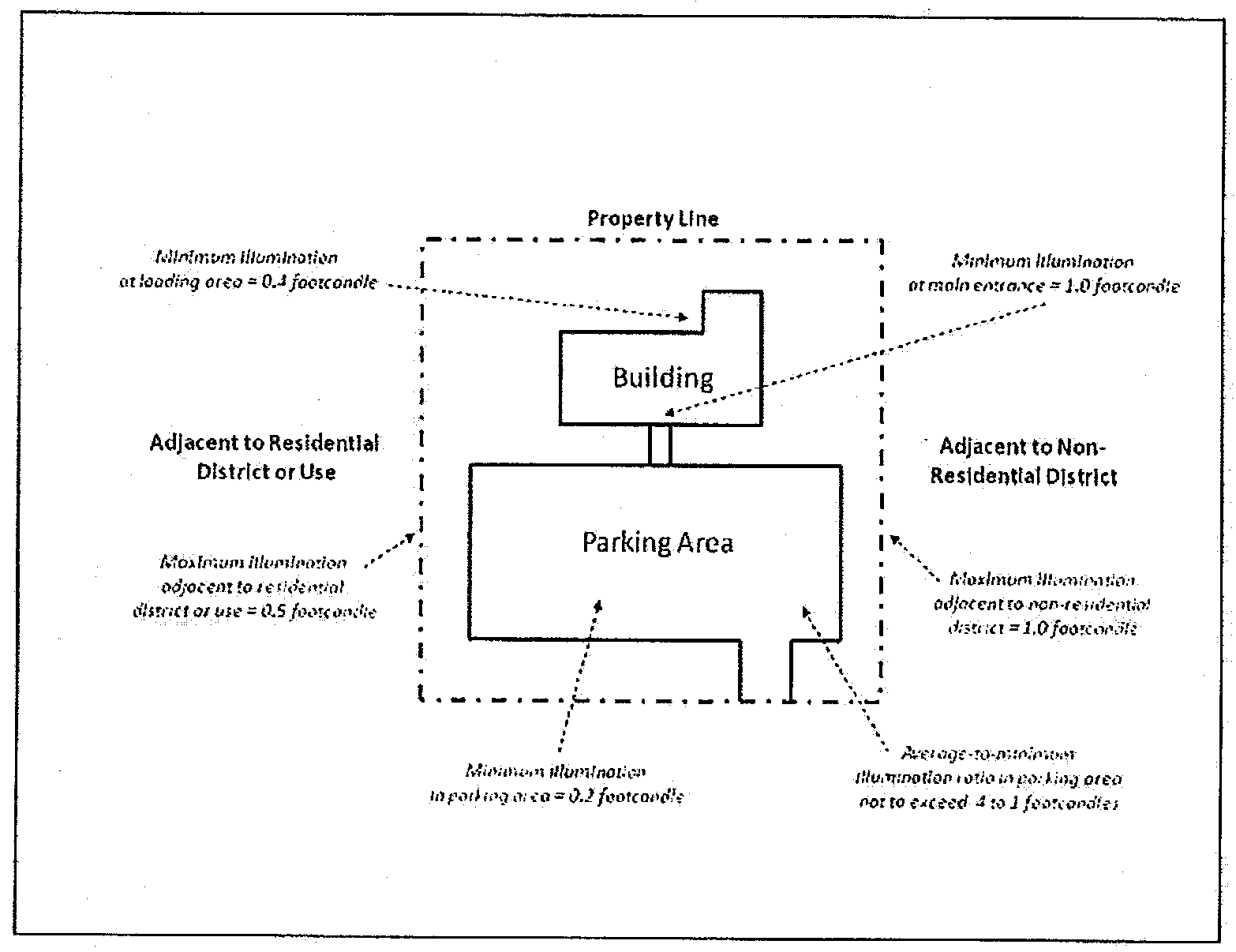
Photometric plan. A photometric plan prepared by a lighting professional shall be required for all developments that require site plan approval. The photometric plan shall illustrate the levels of illumination at ground level, accounting for all light sources that impact the subject site. The photometric plan shall demonstrate the following:
1.
In order to achieve uniform illumination levels, the ratio of the average light level of the surface being lit to the lowest light level of the surface being lit, measured in foot-candles, shall not exceed 4:1.
2.
The following illumination levels shall act as minimum standards for all exterior lighting, while maximum illumination levels shall be governed by the 4:1 ratio of average-to-minimum light level:
3.
Where a site abuts a residential zoning district or residential use, maximum illumination at the property line shall not exceed 0.5 foot-candle.
4.
Where a site abuts a nonresidential zoning district, maximum illumination at the property line shall not exceed 1.0 foot-candle.
d.
Exterior fixture lamps. All exterior fixture lamps shall meet the following requirements:
1.
All exterior fixture lamps shall be oriented so that their light is cast directly downward and only onto the property they are intended to light.
2.
Exterior fixture lamps shall be of a true color rending type such as metal halide. High and low pressure sodium lamps shall only be permitted at the discretion of the planning commission.
3.
Exterior fixture lamps shall be designed and oriented to minimize glare.
e.
Wiring requirements. All electrical service to any exterior light source shall be placed underground and within the interior of any canopy structure and shall meet all applicable electric codes and ordinances.
f.
Architectural exterior lighting. Designed to enhance the architectural appearance of a building or to highlight an architectural feature of a building shall consist of:
1.
A low wattage luminary designed to cast only a soft light on the subject; and
2.
A luminary that when directly visible from a fixture, shall not be an irritant to pedestrians, or vehicle traffic on adjacent streets, or to residents in any adjacent residential zoning district.
(2)
Exterior site lighting in multiple-family residential districts. Shall be subject to the following requirements:
a.
Exterior lighting may consist of a low wattage incandescent, LED, or compact fluorescent luminary contained in a decorative light fixture attached to the wall next to the door of each exterior entry to a dwelling unit.
b.
Exterior lighting may also consist of a low wattage incandescent, LED, or compact fluorescent luminary contained in a decorative light fixture attached to the top of a low profile yard type of light pole. All wiring to pole fixtures shall be underground and shall comply with all applicable electric codes and ordinances.
c.
Carports in a multiple dwelling complex may be lighted so long as all such lighting is limited to the underside of the carport roof. The fixtures shall be placed no closer to the front of the underside roof structure than half the distance from the rear roofline to the front roofline.
d.
Luminary shall be limited to not more than the illumination equivalent of a 100-watt incandescent lamp and shall be housed in fixtures.
(Code 2004, § 54-861; Zoning Ord. 1999, § 2315; Ord. No. 149, 12-12-2005; Ord. No. 190, 12-10-2012)
Sec. 54-693. - Structures.
In R residential districts, so-called entranceway structures, including, but not limited to, walls, columns, and gates, marking entrances to one-family subdivisions or multiple housing projects may be permitted and may be located in any required yard, except as provided in section 54-715, pertaining to corner clearance; provided that such entranceway structures shall comply with all codes and ordinances of the township and be approved by the building inspector, and that a permit shall be issued.
(Code 2004, § 54-891; Zoning Ord. 1999, § 2316)
Sec. 54-715. - Obstructions to vision.
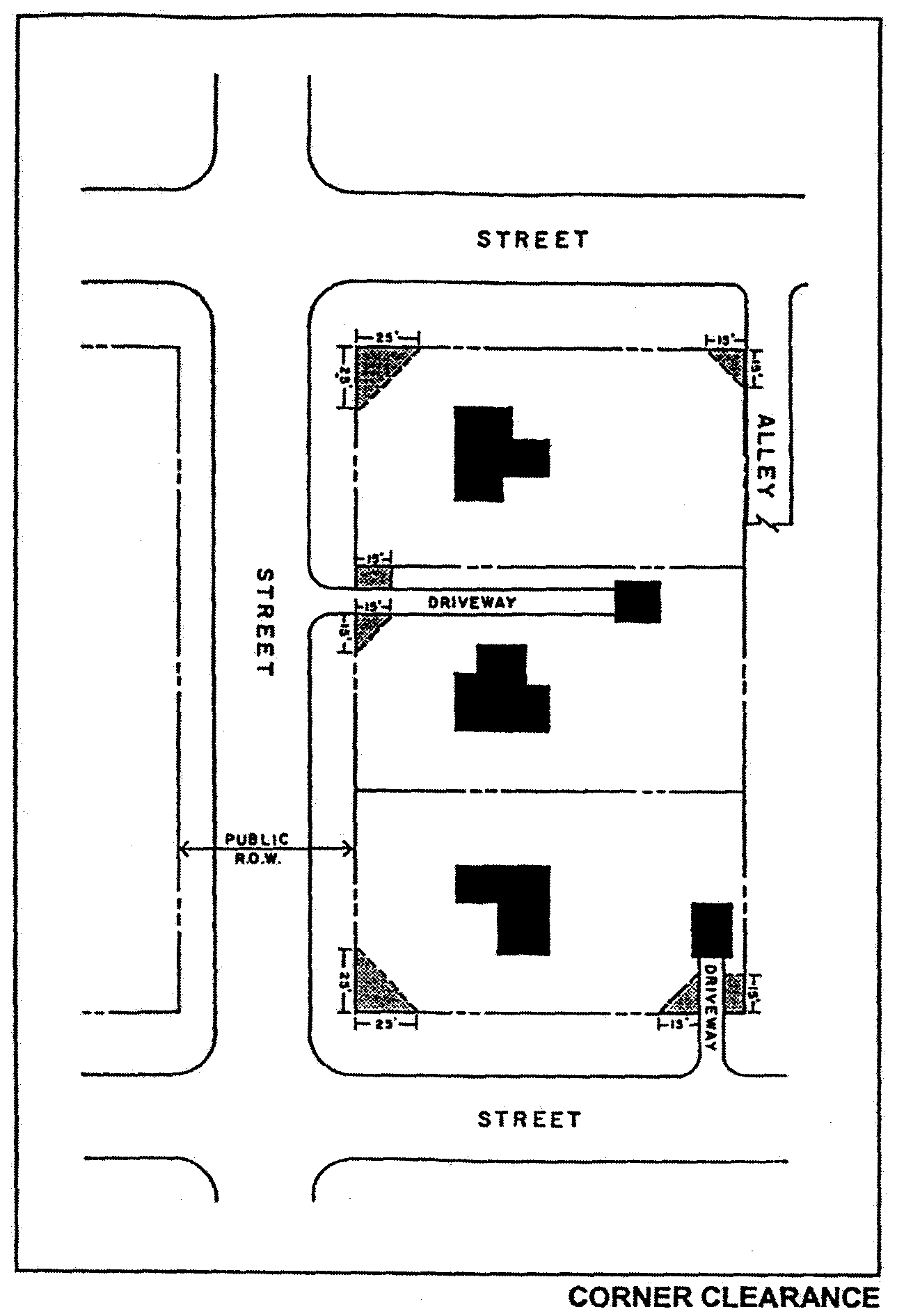
No fence, wall, shrubbery, sign, or other obstruction to vision above a height of 30 inches from the established street grades shall be permitted within the triangular area formed at the intersection of any street right-of-way lines by a straight line drawn between such right-of-way lines at a distance along each line of 25 feet from their point of intersection.
(Code 2004, § 54-921; Zoning Ord. 1999, § 2317)
Sec. 54-744. - Residential buildings.
The overall front to rear length of a residential building in the RE/F, R-1, R-2 and RM-H districts shall not exceed four times its width.
(Code 2004, § 54-951; Zoning Ord. 1999, § 2318; Ord. No. 143, 3-9-2004)
Sec. 54-745. - Property.
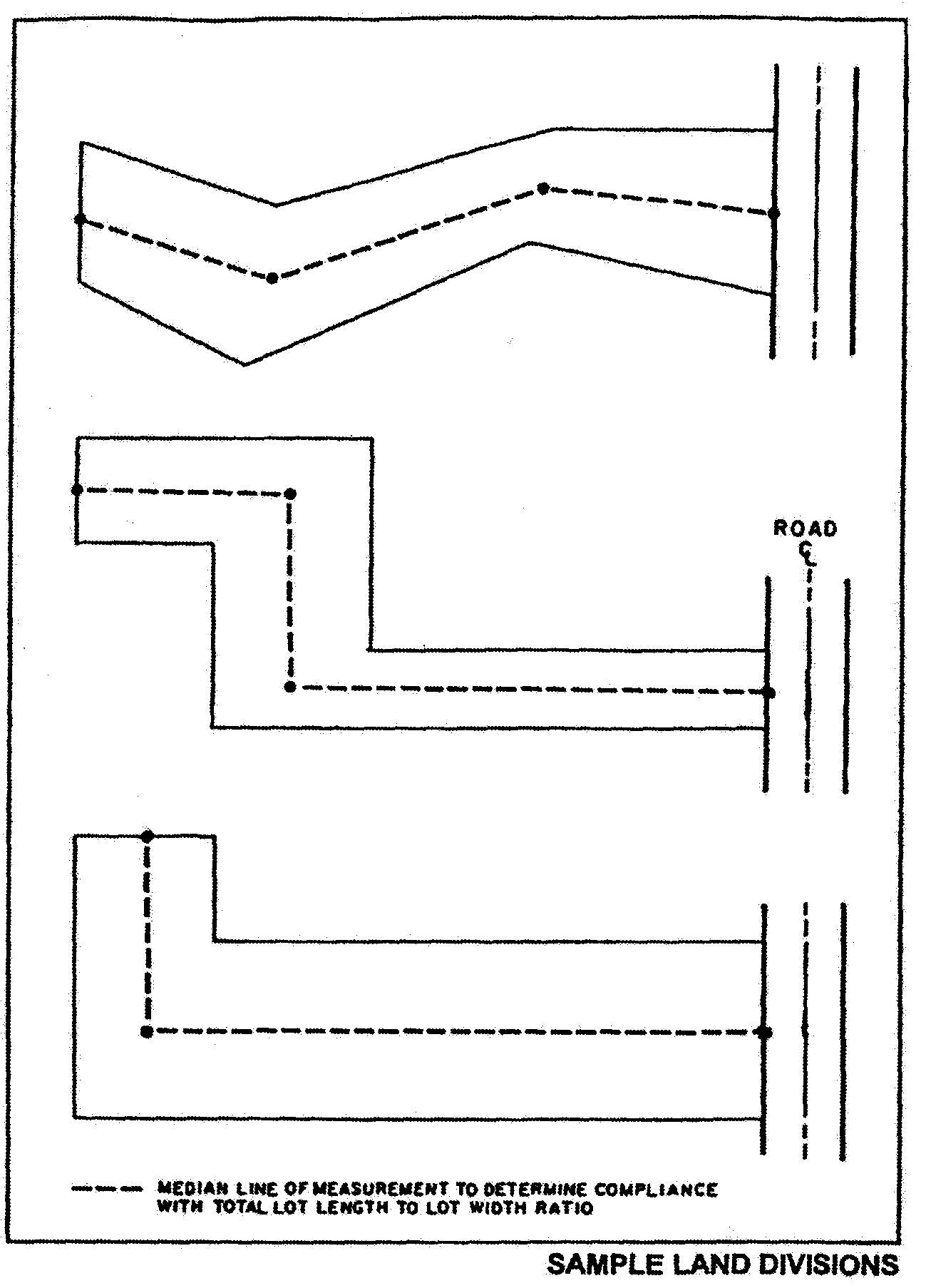
The overall length of a lot or parcel shall not exceed four times its width measured from the front property line, which shall also be the corresponding road right-of-way line, as depicted on the sample land divisions drawing.
(Code 2004, § 54-952; Zoning Ord. 1999, § 2319)
Sec. 54-774. - Major or secondary thoroughfare.
For uses making reference to this section, vehicular access shall be provided only to an existing or planned major or secondary thoroughfare, as depicted on the township master plan map, or freeway service drive; provided that access driveways may be permitted to a street or road other than a major or secondary thoroughfare, or freeway service drive, when it can be shown that such access will be:
(1)
Provided to a street where the property directly across the street from the driveway and the major or secondary thoroughfare, or freeway service drive, is zoned for multiple-family use or any nonresidential use;
(2)
Developed with permanent uses other than one-family residences; or
(3)
An area which, in the opinion of the planning commission, will be used for other than one-family purposes in the future. This exception shall apply only if the planning commission finds that there are special circumstances which indicate that there will be a substantial improvement in traffic safety by reducing the number of driveways to a major or secondary thoroughfare, or freeway service drive.
(Code 2004, § 54-981; Zoning Ord. 1999, § 2320)
Sec. 54-775. - Residential zoning districts.
Access to a nonresidential use in a nonresidential district shall not be through or across land zoned for residential use.
(Code 2004, § 54-982; Zoning Ord. 1999, § 2321)
Sec. 54-776. - Private streets.
All local streets shall comply with the following standards:
(1)
Except where otherwise permitted, all proposed divisions of land that necessitate construction of a local street to satisfy frontage requirements, shall front on a public street, built to county road commission (RCOC) standards and dedicated to the RCOC for public use.
(2)
Under clearly unique circumstances, the planning commission may permit construction of a private street within a designated private easement when the commission shall find at least one of the following characteristics clearly exists on the land:
a.
The topography of the site, such as excessively steep slopes which extend throughout the site, precludes extending any street, safely engineered to RCOC specifications, to any interior border of the site;
b.
Conditions such as soils, topography, wetlands, woodlands, etc., on lands surrounding the site, precludes any opportunity to extend a public street safely engineered to RCOC specifications, to any interior border of the site; and
c.
The extension of a street to an interior border of the site would in the opinion of the planning commission, unduly diminish or destroy a significant natural resource such as woodlands, wetlands, or where natural assets of environmental importance which should be preserved.
(3)
When the planning commission shall find that one or more of these conditions exist on the land, it may permit the construction of a private road in place of a public street; provided further, that when a private road shall be permitted, the following conditions shall apply:
a.
No private street shall be permitted within any development that shall require platting the land under the township and the state subdivision control act (Public Act No. 288 of 1967 (MCL 560.101 et seq.));
b
All private road easements shall be a minimum of 60 feet in width and shall be shown on the land division drawing as a perpetual easement for roadway purposes; and
c.
Written notice shall be given to each new owner of record of the divided parcel containing a legal description of any and all private roads abutting, traversing, and/or adjacent to the original parcel prior to division. The notice shall be attached to each transmitting instrument of interest in each successive division, and said legal description of the private road shall be recorded with the county register of deeds at the time of land division.
(Code 2004, § 54-983; Ord. No. 146, 11-14-2005)
Sec. 54-806. - Hydrants.
(a)
For the purposes of providing fire protection to the public, all buildings and structures shall have water supply for firefighting purposes, that will provide a reasonable degree of protection to life and property in accordance with the standards set forth in NFPA-1231, as amended, in accordance with the following requirements:
(1)
For residential protection, one hydrant for every 1,000 feet of road frontage for every eight conventional home sites and one hydrant for every 500 feet of road frontage for clustered home sites, which shall be supplied by a pressurized well guaranteeing 500 gallons per minute at 20 psi residual.
(2)
For nonresidential protection, one hydrant for every 200 feet of development frontage, capable of supplying water at sufficient volume and duration to satisfy applicable building and fire codes.
(b)
All hydrants so required by subsection (a) of this section shall be placed within public road rights-of-way or within private road easements not more than five feet from the road edge.
(Code 2004, § 54-1011; Zoning Ord. 1999, § 2322)
Sec. 54-836. - Conditions for permit.
Upon review and approval by the planning commission, the temporary continuation of an existing former publicly or quasi-publicly owned use of land as a use permitted in the RE/F district, or the temporary use of a building or use, shall be permitted in the township, subject to the following conditions:
(1)
Continuation of an existing use of land. Permit, upon proper application, the continued use of an existing former public or quasi-public use that was in an RC district as a permitted use of land in the RE/F district, provided:
a.
The purchaser has applied to the township for a temporary use permit to continue the existing facility as a temporary conforming use of land in an RE/F district;
b.
The use was a lawfully permitted use in the RC district at the time the property was purchased by the private entity;
c.
The property has been rezoned to an RE/F rural estate/farm district as stipulated in article III, division 2 of this chapter.
d.
A site plan prepared by the applicant, in accordance with the applicable requirements of section 54-951 et seq., has been reviewed and approved by the planning commission; and
e.
The requirements of subsection (3) of this section have been met.
(2)
Temporary buildings, structures and uses. Permit, upon proper application, a temporary use of a building or structure or a temporary use which does not require the erection of any capital improvement of a structural nature. In classifying a use as not requiring capital improvement, the planning commission shall determine that the use either consists of a demountable structure or structures related to the permitted use of land, or recreational uses, such as, but not limited to, outdoor archery ranges and golf driving ranges, or structures which do not require foundations, heating systems, or sanitary connections.
(3)
Conditions applicable to any temporary building structure or use. Before granting a temporary use permit for any temporary use outlined in subsection (1) or (2) of this section, the planning commission shall find that the following conditions are met:
a.
The granting of a temporary use permit shall in no way constitute a change in the basic uses permitted in the district or on the property wherein the temporary use will be located. For the purpose of this requirement, a use of the type set forth in subsection (1) of this section shall be considered as a permitted use in an RE/F district if approved on a temporary basis.
b.
The granting of a temporary use permit shall be given in writing and shall stipulate all conditions as to time, the nature of the use permitted, and the arrangements for removing the use at the termination of a temporary use permit. The planning commission may require the submittal of surety in an amount equal to the cost of removing the use once a temporary permit has expired, plus ten percent.
c.
A cost estimate for removing the use, and undertaking any site restoration deemed necessary by the township, shall be prepared by the owner and submitted to the township for review and approval of the cost estimate, and verification of the authenticity of the surety.
d.
All setbacks, off-street parking, lighting and other requirements to be considered in protecting the public health, safety, peace, morals, comfort, convenience and the general welfare of the inhabitants of the township, including land coverage limitations, shall comply with the applicable requirements of this chapter.
e.
The use shall be in harmony with the general character of the district in which it is located.
(4)
Time limitations for temporary use building or structure. A use of the type permitted in subsection (1) of this section may be granted a one-year temporary use permit. The life of a temporary use permit shall commence on the date of issuance of the permit and terminate on that date one year later. Additional one-year temporary use permits may be granted by the planning commission in accordance with the same procedures set forth in this chapter for the initial permit. A temporary use as outlined in subsection (2) of this section may be granted for a maximum period of up to six months in developed areas of the township and for up to a maximum of 12 months in undeveloped areas of the township.
(5)
Notice of public hearing. No temporary use permit for any use, building or structure outlined in this section shall be granted without notice first being given by the township to owners of adjacent property of the time and place of a public hearing to be held by the planning commission in the manner prescribed in this chapter.
(Code 2004, § 54-1041; Zoning Ord. 1999, § 2323; Ord. No. 143, 3-9-2004)
Sec. 54-866. - Zoning district regulations.
Fencing regulations shall apply to zoning districts as follows:
(1)
In the RE/F districts, farm fences designed and intended to enclose property may extend to any peripheral property line. All other fences and walls in the RE/F district shall observe the requirements of this section pertaining to one-family homes on metes-and-bounds properties.
(2)
In the RE/F, R-1 and R-2 districts, decorative fences or walls designed and intended to enclose yard area in a subdivision of platted lots, or one-family condominium sites, for detached one-family homes, unless otherwise prohibited by the development's residential bylaws or protective covenants, shall be restricted to locations along a rear yard or interior side yard line. No fence or wall shall extend towards the front of the lot or home site beyond the front wall of the principal building on the property; except, on a corner lot, a decorative fence or wall not exceeding three feet in height and observing the clear corner vision restrictions of section 54-715, and which is not designed or intended to enclose property, may extend on a diagonal line from the outside front corner of the principal building towards the front outside corner of the property. The sole intent of such a fence or wall shall be to discourage diagonal trespass across a front lawn area. A decorative fence or wall designed and intended to enclose a particular property shall not exceed six feet in height, measured from the ground at the base of the fence to the top of the fence; except decorative finials placed on top of a fence post may exceed the maximum permitted fence height.
(3)
Decorative fences or walls which are clearly an integral part of a landscaping feature of a residential lot or home site, and which are not designed or intended to enclose property, may be permitted in any yard, subject to the clear corner vision restrictions of section 54-715.
(4)
Nothing in this section shall prevent the erection of architectural wood or masonry retaining walls in any yard of a one-family residential lot or home site when such walls are made necessary due to the topography of the property; provided such walls are designed and intended to permit access or to prevent erosion, and are not designed or intended to enclose property.
(5)
Architectural fences, walls, or other wire fences on unplatted metes-and-bounds properties shall observe all the requirements of this section pertaining to the location and height of decorative fences and walls; except, a decorative fence or wall, or other wire fence, may extend forward into a front yard to the minimum required front yard setback line of the district.
(6)
Walls and screening barriers permitted in the multiple-family residential districts and in nonresidential districts shall be subject to the requirements of sections 54-1107 through 54-1113.
(Code 2004, § 54-1071; Zoning Ord. 1999, § 2324; Ord. No. 143, 3-9-2004)
Sec. 54-896. - Generally.
(a)
Except where otherwise permitted in this section, all proposed divisions of and that necessitate construction of a local street to satisfy frontage requirements, shall front on a public street in a public street right-of-way, built to the county road commission (RCOC) standards and dedicated to the RCOC for use as a public street.
(b)
Except as otherwise permitted in this section, no private street shall be permitted within any development that shall require subdividing land under local or state subdivision platting procedures, not within any one-family site condominium development as regulated under local and state requirements, nor within any land divisions as regulated under local or state land division procedures, that do not have direct frontage access to an existing public road or to an existing approved private street, or which cannot gain direct access to either via an approved deed strip.
(c)
Under clearly unique circumstances the planning commission may permit construction of a private street within a designated private street easement when the commission shall find at least one of the following characteristics clearly exists on the land:
(1)
The topography of the site such as excessively steep slopes which extends throughout the site, precludes extending any street, engineered to RCOC specifications, to any interior border of the site.
(2)
Conditions such as soils, wetlands, woodlands, or steep topographic conditions at the property lines of land abutting the site, precludes any opportunity to extend a public street across a common parcel line.
(3)
The extension of a street to a common property line would, in the opinion of the planning commission, unduly diminish or destroy a significant natural resource on the land such as a woodland, wetland or other natural asset of environmental importance which should be preserved.
(d)
When the planning commission shall find that one or more of the conditions outlined in subsection (c) of this section exists on the property, it may permit the construction of a private street in a private street easement in place of a public street in a public right-of-way, provided further, that the following conditions are met:
(1)
All private roads and private road easements will be built to the same RCOC standards that are required for public streets in public rights-of-way.
(2)
Written notice shall be given to each new owner of record of the divided parcel containing a legal description of any and all private roads and private road easements abutting, traversing, and/or adjacent to the original parcel prior to the division. The notice shall be attached to each transmitting instrument of interest in each successive division, and the legal description of the private street or private street easement shall be recorded with the county register of deeds at the time of the land division.
(3)
No existing private street or private street easement shall be extended to provide frontage access to any new land divisions without the express approval in writing from each landowner who abuts any part of the existing private street or private street easement.
(4)
All drawings for land divisions, legal descriptions, and private streets and private street easement specifications shall be drawn to an appropriate scale and sealed by a registered civil engineer or registered land surveyor.
(5)
Construction permits shall be obtained from the RCOC before an approved private road in an approved private road easement may be connected to any public road maintained by the RCOC.
(e)
Private streets and private street easements constructed under the provisions of this section shall not obligate the township or the RCOC to maintain the private street or private street easement in any way or at any time during the life of the street or the easement.
(f)
It shall be the sole responsibility and obligation of the property owner whose property abuts the private street or private street easement, whether or not that property owner accesses the private street or private street easement, to maintain their portion of the street and the easement.
(g)
Upon the effective date of adoption of the ordinance from which this section is derived, no building permits shall be issued by the township for any land fronting on any newly approved private street or private street easement until such street or easement is improved to the specifications and standards contained in this section. The township shall designate a registered professional engineer to inspect and approve all private street and private street easement improvements prior to issuing any building permits along the private street or private street easement. The township board may establish a fee to cover the cost of such inspections as currently established or as hereafter adopted by resolution of the township board from time to time, such fee to be paid by the developer.
(Code 2004, § 54-1101; Ord. No. 127, 6-10-2002)
Sec. 54-926. - Findings; statutory authority.
(a)
With the increasing residential population, number of private and public campsites, and public-owned land within the township, the residents of and domestic pets and/or livestock within the township must be protected from attack, the threat of injury and/or disease from dangerous, wild, or exotic animals harbored, possessed or maintained in the township.
(b)
Except as otherwise may be set forth herein, this division is intended to be consistent with all state law, including, but not limited to, Public Act No. 426 of 1988 (MCL 287.321 et seq. regarding dangerous animals); Public Act No. 466 of 1988 (MCL 287.701 et seq., the "animal industry act"); Public Act No. 339 of 1919 (MCL 287.261 et seq., the "dog law of 1919"); Public Act No. 246 of 2000 (MCL 287.1001 et seq., the "wolf-dog cross act"); and Public Act No. 274 of 2000 (MCL 287.1101 et seq., the "large carnivore act").
(Code 2004, § 54-1111; Ord. No. 168, § 54-1401, 11-9-2009)
Sec. 54-927. - Unlawful possession of dangerous, wild or exotic animal.
(a)
It is unlawful to and at no time shall any person, entity, organization, or agent thereof harbor, possess, keep, shelter, breed, sell, trade, barter and/or exchange any dangerous, wild or exotic animal within the township.
(b)
Notwithstanding subsection (a) of this section, any exotic animal or inherently dangerous exotic animal, to the extent allowed by county, state and federal laws, that is harbored, possessed or maintained in the township at the time that this division is adopted shall be grandfathered. Owners of grandfathered exotic animals shall be required to register such animals with the township clerk within 30 days from the date of adoption of the ordinance from which this division is derived, and shall have three months from the date of adoption of the ordinance from which this division is derived to have a microchip or similar device professionally imbedded in the grandfathered animal, at the owner's sole and exclusive expense, with all the typical and usual information as required by law and/or the then current practice of the professional performing the operation. The data in the microchip device shall be transcribed and promptly provided to the township clerk. Grandfathering only covers the existing and duly registered exotic animal until their death. Owners possessing or harboring an exotic animal at the date of adoption of the ordinance from which this division is derived who do not register their grandfathered animal as provided herein forfeit their grandfathered status.
(c)
After the effective date of the ordinance from which this division is derived, it will be unlawful for any person, entity, organization, and/or agent thereof, to possess, keep, shelter, breed, sell, trade, barter or exchange any inherently dangerous exotic animal within the township.
(Code 2004, § 54-1112; Ord. No. 168, § 54-1402, 11-9-2009)
Sec. 54-928. - Notification of escaped dangerous, wild or exotic animal.
The owner of an escaped dangerous, wild or exotic animal shall notify the township and the county animal control division within 24 hours from the time that the animal was discovered missing or escaped. Notification will be made during normal business hours.
(Code 2004, § 54-1113; Ord. No. 168, § 54-1403, 11-9-2009)
Sec. 54-929. - Exceptions.
This division does not apply to the following:
(1)
Veterinary clinics in possession of such animals for treatment or rehabilitation purposes;
(2)
Nonresident circuses for no longer than one seven-day period, per each separate location where such circus is held within the county per calendar year;
(3)
Nonresident carnivals or traveling fairs for no longer than one seven-day period, per each separate location where such carnival or traveling fair is held within the county, per calendar year;
(4)
Duly licensed persons or organizations transporting and displaying such animals for academic or educational purposes, provided such exhibitions shall not exceed 24 hours;
(5)
Persons temporarily transporting such animals through the township, provided that such transport time shall not be more than 24 hours; and
(6)
Duly licensed stores or places of business located within a commercial zoned district of the township that sells such animals, provided such sold animals shall not be kept or maintained within the township.
(Code 2004, § 54-1114; Ord. No. 168, § 54-1404, 11-9-2009)
Sec. 54-930. - Destruction or removal.
(a)
Upon a sworn complaint that an animal is one of a species of animals prohibited by this division and is currently being illegally possessed or maintained, a district court or district court magistrate or other court of competent jurisdiction shall issue a summons to the owner and/or possessor ordering such owner and/or possessor to appear to show cause why the animal should not be removed from the township.
(b)
Upon the filing of a sworn complaint as provided in this section, the court or magistrate may order the owner and/or possessor to immediately turn the animal over to the animal control officer, an incorporated humane society, a licensed veterinarian or other appropriately licensed facility, at the owner's option, to be retained by them until a hearing is held and a decision is made for the disposition of the animal. The expense of the boarding and retention of the prohibited animal is to be borne by the owner and/or possessor. After a hearing, the court or magistrate shall order the destruction of the animal at the expense of the owner and/or possessor, or in the alternative and at the court's discretion, order the animal removed from the township under terms and conditions which ensure such removal.
(Code 2004, § 54-1115; Ord. No. 168, § 54-1405, 11-9-2009)
Sec. 54-931. - Penalties.
A person, entity or organization found to be in violation of this division, including, but not limited to, being a harborer of a dangerous, wild, or inherently dangerous exotic animal, is subject to the court's discretion as outlined in section 54-930, and the general penalties as set forth in section 1-7.
(Code 2004, § 54-1116; Ord. No. 168, § 54-1406, 11-9-2009)

