
Gunnison City Zoning Code
CHAPTER 17
SUPPLEMENTARY DEVELOPMENT STANDARDS APPLICABLE TO CERTAIN PROPERTY AND LAND USES
Section 1701 Purpose
Adopted by Ord. 2010-2 on 11/17/2010
Section 1702 Home Occupations
All applications to establish a home occupation shall comply with the following requirements:
- The home occupation is clearly incidental to the use of the dwelling unit for residential purposes and does not change the character of the dwelling unit or any legal accessory building or structure.
- If the home occupation will be conducted within a dwelling the entrance to the home occupation from outside shall be the main entrance or the same entrance used by the residents of the dwelling unit, except when required to be otherwise by the Fire Authority, Board of Health, or other public agency with authority.
- The physical appearance, traffic, and other activities in connection with the home occupation are not contrary or in conflict with the purposes of the Zoning District in which the dwelling unit is located.
- If the home occupation will be conducted within a dwelling no more than twenty-five percent (25%) of the ground floor area of the dwelling unit is used for the home occupation.
- All activities associated with the home occupation shall be conducted entirely within the dwelling unit, or legal accessory building or structure, and shall be conducted by the residents of the dwelling only.
- All activities associated with the home occupation must be conducted within the dwelling unit or legal accessory building or structure.
- The home occupation contains no facilities for the display of goods or merchandise. Any sale of goods or services shall be an incidental part of the home occupation.
- No commercial vehicles are used except one (1) delivery vehicle which does not exceed three-fourth (¾) ton rated capacity.
- The home occupation shall maintain a valid Gunnison City business license.
Adopted by Ord. 2010-2 on 11/17/2010
Section 1703 Child Care
- All Child Care facilities shall comply with all Child Care licensure requirements of the State of Utah Department of Child and Family Services and business license regulations of the city.
- All Child Care facilities shall be inspected and provide a “Fire Clearance” issued by the Fire Authority prior to having a business license issued from the city.
- Child Care Facilities having more than eight [8] children at one time, not including an operator's own children, shall provide a transportation plan which demonstrates sufficient traffic flow, parking, drop off and pickup areas to assure the safety of children at the facility and limited impact on adjacent property owners.
- All Child Care Facilities shall have a fully fenced yard. The design standard for fencing shall be the same as provided by the State.
- The entrance to the facility shall be the main entrance visible from the street or the same entrance used by the residents of the dwelling unit, except when required to be otherwise by the Fire Authority, Board of Health, or other public agency with authority.
Adopted by Ord. 2010-2 on 11/17/2010
Amended by Ord. 2024-02 on 2/8/2024
Section 1704 Manufactured Homes
As required by the Act, and for the purposes of this Section, a manufactured home is the same as defined in Section 58-56-3, UCA, except that the manufactured home must be attached to a permanent foundation in accordance with plans providing for vertical loads, uplift, and lateral forces and frost protection in compliance with the applicable building code. All associated accessory buildings and structures shall be built in compliance with the applicable building code.
- A manufactured home may not be excluded from any Zoning District in which a single-family residence would be permitted, provided the manufactured home complies with all Land Use Ordinances, building codes, and any restrictive covenants, applicable to a single-family residence within the Zoning District.
- The City may not:
- Adopt or enforce an ordinance or regulation that treats a proposed development that includes manufactured homes differently than one that does not include manufactured homes; or
- Reject a development plan because the development is expected to contain manufactured homes.
- Adopt or enforce an ordinance or regulation that treats a proposed development that includes manufactured homes differently than one that does not include manufactured homes; or
Adopted by Ord. 2010-2 on 11/17/2010
Section 1705 Church
Adopted by Ord. 2010-2 on 11/17/2010
Section 1706 Accessory Buildings (See Also Section 1707)
- All accessory buildings or accessory uses shall only be permitted concurrently with, or following, the establishment of a primary building or primary use.
- Accessory buildings may be detached from the primary building, as provided by Appendix B-1 Standards for Detached Accessory Buildings and Structures.
- Any shipping or cargo container used as an accessory building shall only be permitted as an accessory building(detached), meeting the location standards as provided by Appendix B-1, Standards for Detached Accessory Buildings and Structures.
- Accessory buildings for the housing of animals or fowl shall be located as provided by Appendix B-1, Standards for Detached Accessory Buildings and Structures.
- An accessory building (attached) shall meet all development standards for the location of the primary building.
- No mobile home, travel trailer, or similar recreational vehicle shall be used as an accessory building.
- All accessory buildings shall comply with the requirements of the Building Codes, as adopted, and as applicable.
- No accessory building shall be used as a dwelling unit for human occupancy, unless such accessory building has been approved as an Accessory Dwelling Unit for an Owner or Employee, as provided by Section 1709.
- No separate utility connections or meters shall be allowed for any accessory building.
- Accessory buildings shall not be rented, leased, or sold separately from the rental, lease, or sale of the primary building located on the same lot.
- No portion of any accessory building shall be allowed to extend over any property line.
- No storm water runoff from any accessory building shall be allowed to run onto adjacent property.
Adopted by Ord. 2010-2 on 11/17/2010
Section 1707 Limitations On The Size And Location Of Accessory Buildings In Residential Zones
Adopted by Ord. 2010-2 on 11/17/2010
Section 1708 Smaller Detached Accessory Buildings-Exemption From Building Permit Requirements
Adopted by Ord. 2010-2 on 11/17/2010
Section 1709 Accessory Dwelling Unit
- An Accessory Dwelling Unit (ADU) shall not be rented, leased, or sold separately from the rental, lease, or sale of the primary building located on the same lot and any lease of the accessory dwelling unit shall be for a minimum of 30 consecutive days.
- An ADU is only permitted if the property or dwelling in which the ADU is located is also the primary residence of the property owner.
- The lot proposed for an Accessory Dwelling Unit shall already have an existing primary structure provided, or approved, prior to the consideration of an application to allow an accessory dwelling unit.
- An Accessory Dwelling Unit shall meet the required setbacks for attached or detached accessory buildings and uses as required by the Zoning District in which they are located.
- An Accessory Dwelling Unit shall be connected to, and served by, the same water, sewer, electrical, and gas meters that serve the primary building. No separate utility lines, connections, or meters shall be allowed for an Accessory Dwelling Unit for an Owner or Employee.
- An Accessory Dwelling Unit shall provide a minimum of one (1) off-street parking space, located as determined necessary and appropriate for approval of the Accessory Dwelling Unit.
- The construction of an Accessory Dwelling Unit shall meet all requirements of the adopted Building Code, as applicable.
- Mobile homes, travel trailers, boats, or similar recreational vehicles shall not be used as an Accessory Dwelling Unit.
- As a condition of approval required to establish an Accessory Dwelling Unit, the property owner shall record against the deed of the subject property, a deed restriction, in a form approved by the City, running in favor of the City, which shall prohibit the rental, lease or sale of the Accessory Dwelling Unit for an Owner or Employee separately from the rental, lease, or sale of the primary use or building. Proof that such deed restriction has been recorded shall be provided to the Zoning Administrator prior to the issuance of the Certificate of Occupancy for the Accessory Dwelling Unit for an Owner or Employee.
Adopted by Ord. 2010-2 on 11/17/2010
Amended by Ord. 2025-08 on 11/13/2025
Section 1710 Requirements For Landscaping In Nonresidential And Multiple Dwelling Developments
Site Landscaping and Screening Treatments. Landscape improvements should mitigate building and parking lot impact, add aesthetic interest, and character. Landscape designers shall recognize the following landscape design principles with Landscape Plan(s):
- Landscape Buffers. Landscape buffers between dissimilar or conflicting land uses and site elements shall be provided. Landscape buffers shall be provided for off-street parking and service areas and streetscape landscape buffer areas shall be provided on the site perimeter based on the following table.Table Notes: 1) Landscaping area requirements and material elements may be adjusted in accordance with Main Street overlay zone standards in Chapter 23. 2) This side yard requirement for the building can be waived when the associated building is constructed with 0 setback from a side property line and the adjoining building is or will be constructed to abut the 0 setback. 3) Landscaping yards are not required within storage or material yards unless adjacent to a residential zone. 4) Landscape yards are to be established from the outer walls of any attached unit structures.
Zone/Use Front To Building / To Parking or Garage
Street side to Building/To Parking or Garage Side Rear Historic Main Street (200 S to 100 N)(see table note 1)
4'-10' / 6' 4'-10'/6' 5' (see table note 2)
5' CC 20' / 10' 20' / 10' 6' 6' RC 20' / 10' 20' / 10' 8' 8' L-1 25' / 15' 25' / 15' 10' (see table note 3)
10' (see table note 3) Multiple-Unit Residential Dwelling (see table note 4) 25' / 30' 25' / 25'
20' 30' Nonresidential uses that may be appropriate in a residential zone 25' / 15' 25' / 15' 8' 8' - Parking Lot Landscaping. All off street parking areas shall be designed and constructed to meet the following minimum landscape requirements. Land Use Application approval by the Land Use Authority may require additional parking area landscaping to achieve the purposes of this Ordinance.
- Minimum Internal Parking Area Landscaping. All off street parking areas, providing twenty (20) or more off-street parking spaces shall provide a minimum of five percent (5%) of the total parking area as landscape treatments. Areas to be landscaped may include;
- Traffic islands.
- Peninsulas parallel to individual parking spaces.
- Planter areas located at the ends of parking rows or other planter areas located within the off-street parking area.
- Traffic islands.
- The area provided for off street parking shall be the greatest area defined by the distance from the curb-lines or edges of the outermost parking space, aisle, or driveways.
- No required buffer areas shall be included as meeting the required parking area landscaping required by this Section.
- All required landscaped areas shall be provided with a permanent and adequate means of irrigation and regularly maintained, including weed control.
- All parking lot hard surfacing shall provide a sufficient area around all trees and landscaping to permit water absorption and prevent soil compaction.
- Off-street parking areas shall be screened from the street by landscaping areas and/or screening walls of sufficient height and opacity to continuously block the lowest three feet (3') of the cross-section view of the parking area.
- Planter Islands and Peninsulas.
- Dimensions: Islands and peninsulas shall be a minimum of six feet wide as measured between curbing. The length of the island or peninsula shall be 95% of the adjacent parking stall(s)(E.g., an island would be 17’ long adjacent to an 18’ deep parking stall).
- Vegetation: Islands shall include one or more canopy shade trees and four (4) or more shrubs per eighty (80) square feet of planter area. Ground cover shall be provided over the entire landscape island or peninsula.
- Curbing: All landscape islands or peninsulas shall have raised curbs surrounding them. Curbing may be designed to allow storm water infiltration into the landscape island under low impact design principles.
- Dimensions: Islands and peninsulas shall be a minimum of six feet wide as measured between curbing. The length of the island or peninsula shall be 95% of the adjacent parking stall(s)(E.g., an island would be 17’ long adjacent to an 18’ deep parking stall).
- Minimum Internal Parking Area Landscaping. All off street parking areas, providing twenty (20) or more off-street parking spaces shall provide a minimum of five percent (5%) of the total parking area as landscape treatments. Areas to be landscaped may include;
- Landscape Materials. All proposed plants and landscape materials shall be consistent with (but not uniform) and of a similar scale with existing natural landscape, neighboring landscape, and adjacent areas where appropriate. Drought tolerant plant materials are encouraged. Developments should include a combination of evergreen trees in addition to deciduous trees and shrubs to achieve a nonbarren landscape design during winter months.
- Screening Walls, Fences, and Other Visual Barriers. Walls, fences, and barriers that create a continuous surface greater than twenty (20) feet in length shall be softened with landscaping.
- Non-vegetative Ground Cover. Non-vegetative ground cover treatments may include boulders, small stones less than ½ inch in diameter and bark and mulch. Areas of non-vegetative ground cover materials shall be broken up and interspersed with plant materials.
- Landscape Maintenance. All landscape plans shall include necessary irrigation plans and shall demonstrate that long-term landscape maintenance has been considered in the landscape design.
- Required Landscaping
- Landscape yards abutting residential zones shall include a minimum of one tree and five (5) shrubs for each thirty (30) linear feet or fraction thereof of the landscape yard area (as measured along the property line).
- Side and rear landscape yards abutting a nonresidential development or property zoned for such shall include a minimum of one tree and four (4) shrubs for each forty (40) linear feet or fraction thereof of the landscape yard area (as measured along the property line).
- Front and street side landscape areas shall include a minimum of one tree for each forty (40) linear feet or fraction thereof of the landscape yard area (as measured along the property line).
- Plant sizes. The following minimum plant sizes shall be required:
Type Minimum Size Canopy shade (deciduous) tree 2.0 inch caliper balled and burlapped equivalent Evergreen tree 6.0 foot height balled and burlapped equivalent Ornamental tree 1.5 inch caliper balled and burlapped equivalent Shrubs and ornamental grasses 5 gallon or adequate size consistent with design intent
- A landscaping plan shall be submitted for approval by the Technical Review Committee. All landscaping and maintenance systems shall be installed prior to a certificate of occupancy being granted. Where landscaping cannot be completed before October in the same year construction begins, a certificate of occupancy may be granted if a cash bond for completion of the landscaping is provided to the city. Bond amounts shall be determined by the city engineer consistent with the city development bonding regulations. Landscaping must be installed within six (6) months of bond posting.
Adopted by Ord. 2010-2 on 11/17/2010
Amended by Ord. 2023-06 on 11/16/2023
Section 1711 Uses In Residential And Commercial (R And C-1) District
In addition to the city's general development requirements and standards of this Ordinance, the following shall apply to multi-family and non-residential developments in the RC District:
- Architectural Design and Materials Requirements. All buildings shall possess a similar architectural theme and have common architectural elements creating a unifying development character and design theme. All sides of buildings shall receive equal design consideration, particularly where exposed to pedestrian and/or vehicular traffic and adjacent properties.
- Building Orientation. All buildings shall address the street and provide architectural and other design elements to create a presence and attractive and inviting building-street relationship.
- Signs. All uses proposed in a RC District shall provide a consistent and unified signage scheme, such signage complying with the site and building design requirements and approval procedures, as provided by the Ordinance.
- Nuisance. No use shall be designed or operated to expose adjoining properties and uses to offensive noise, odors, dust, electrical interference, and/or vibration, or create any other nuisance.
Adopted by Ord. 2010-2 on 11/17/2010
Amended by Ord. 2024-03 on 3/7/2024
Section 1712 Fences And Walls
- Before commencing construction, plans for all fences and walls shall first be submitted to and reviewed/approved by the Zoning Administrator.
- Height.
- Unless required for Land Use Application approval no fence, wall, hedge, or similar shall be erected on any rear or side yard property line to a height in excess of six (6) feet, except as follows;
- fences located on the front property line or on the side property line within the front yard shall not be higher than thirty-six (36) inches; or
- forty-eight (48) inches if the fence is an open fence as defined by this Ordinance (See Fence, Open).
- fences located on the front property line or on the side property line within the front yard shall not be higher than thirty-six (36) inches; or
- On corner lots all fences shall comply with this Section and Section 1625.
- All fences higher than six (6) feet, measured from finished grade, shall obtain an approved Building Permit.
- A fence or wall located along a property line with a grade difference, the fence or wall may be erected to the maximum height permitted by the highest grade at the property line. No ground shall be bermed to exceed the maximum allowed height for fences or walls.
- Pasture Fence. A fence surrounding a pasture and complying with the requirements for a Fence, Open.
- Unless required for Land Use Application approval no fence, wall, hedge, or similar shall be erected on any rear or side yard property line to a height in excess of six (6) feet, except as follows;
- Quality of Construction.
- All fences and walls shall be constructed in a workman-like manner according to industry standards.
- All fences and walls shall be constructed of substantial material and the design and construction shall be consistent with the quality of dwellings and other improvements within the surrounding area.
- All fences and walls shall be constructed in a workman-like manner according to industry standards.
Adopted by Ord. 2010-2 on 11/17/2010
Section 1713 Swimming Pools
- All swimming pools, or other artificially created pools more than eighteen (18) inches deep, shall be surrounded by a safety fence.
- The safety fence shall be no less than four feet six inches (4'6") high for pools situated on property used for a dwelling.
- The safety fence must be constructed of approved materials. The fence exterior shall be smooth (free of projections which would aid climbing) and shall have no opening which exceeds four (4) inches in horizontal dimension.
- Gates shall be constructed of approved materials, shall be self-closing, self-latching, and not over four (4) feet wide. Latching hardware shall be installed at a height of not less than fifty-two (52) inches.
- Space adjacent to the exterior of the fence, which falls within the area described by a radius equal in length to the height of the enclosure, and centered at the top of the enclosure fence, must be kept clear of all natural or man-made objects which could be used to gain access into the enclosure.
- Outdoor jacuzzi tubs, or other similar small pools, may be protected by a solid locking cover in lieu of a fence. In the absence of a solid locking cover, the requirements for a safety fence provided by this Section shall be provided.
- Access to indoor pools shall be restricted by the surrounding structure in a manner that is at least as secure as provided for outdoor pools, as provided by this Section.
Adopted by Ord. 2010-2 on 11/17/2010
Section 1714 Bed And Breakfast Inn
A Bed and Breakfast Inn shall be conducted only in a single-family dwelling and only by the owner of the dwelling that complies with the following requirements:
- The single-family dwelling proposed as a Bed & Breakfast Inn shall meet all applicable requirements of this Ordinance, other Land Use Ordinances, adopted Building Code, and Health Code, as applicable.
- The Fire Authority shall inspect the premises and be satisfied that the dwelling and premises comply with the applicable Fire Code, as adopted.
- A hard-surfaced off street parking area of one (1) parking space for each guest room, in addition to the parking requirements for the single-family dwelling shall be provided.
- No accessory structure, motor home, travel trailer, boat, or similar recreational vehicle or facility shall be used as guest rooms.
- A Bed and Breakfast Inn shall provide no more than four (4) guest rooms and shall meet all applicable requirements of the Land Use Ordinances and Building Codes, as adopted.
- Guest rooms shall have no kitchen facilities.
Adopted by Ord. 2010-2 on 11/17/2010
Amended by Ord. 2025-08 on 11/13/2025
Section 1715 Residential Facilities For Elderly Persons
The approval of a Residential Facility for Elderly Persons is nontransferable and terminates if the structure is devoted to a use other than a Residential Facility for Elderly Persons, or if the structure fails to comply with the requirements of this Section.
- No Residential Facility for Elderly Persons shall be established unless:
- It is proposed in a building that complies with all Land Use Ordinances and Building Code(s), as adopted, and as applicable to similar structures in the Zoning District in which the Residential Facility for Elderly Persons is proposed.
- The Residential Facility for Elderly Persons proposes no fundamental change in the character of the neighborhood.
- It is proposed in a building that complies with all Land Use Ordinances and Building Code(s), as adopted, and as applicable to similar structures in the Zoning District in which the Residential Facility for Elderly Persons is proposed.
- No Residential Facility for Elderly Persons shall be approved that would allow more than six (6) occupants.
- The Land Use Authority in reviewing an application to establish a Residential Facility for Elderly Persons may to the extent necessary modify the requirements of this Section if such modification is deemed necessary to make a reasonable accommodation to afford persons residing in such facilities equal opportunity in the use and enjoyment of the facility.
- Adequate off-street parking shall be provided for all residents and staff members.
- The facility must be capable of use as a residential facility for elderly persons without structural or landscaping alterations that would change the structure's residential character.
- No person being treated for alcoholism or drug abuse shall be placed in a residential facility for elderly persons;
- Residency in the facility shall be on a strictly voluntary basis and not a part of, or in lieu of, confinement, rehabilitation or treatment in a correctional facility.
For purposes of this section, Elderly Person means a person who is 60 years old or older, who desires or needs to live with other elderly persons in a group setting, but who is capable of living independently.
Adopted by Ord. 2010-2 on 11/17/2010
Amended by Ord. 2024-03 on 3/7/2024
Section 1716 Residential Facilities For Persons With A Disability (Ordinance 2013-6)
- Requirements Determined to Comply. The requirements of this Section are hereby found to comply with Title 57, Chapter 21, Utah Fair Housing Act, the Federal Fair Housing Amendments Act of 1988, 42 U.S.C. Section 3601 et seq., and Section 504, Rehabilitation Act of 1973, and all applicable jurisprudence.
- Applicant required to identify type of Residential Facility for Persons with a Disability proposed:
- The Applicant for a Land Use Permit to establish a Residential Facility for Persons with a Disability, and who is either the owner or provider, shall identify in writing, with the Land Use Application, the specific type of Residential Facility for Persons with a Disability to be licensed by the Utah Department of Human Services, Office of Licensing, under Title 62A, Chapter 2 or Utah Department of Health under Title 26, Chapter 21, Health Care Facility Licensing and Inspection Act.
- No action by a Land Use Authority, as applicable, shall be taken and no Application shall be scheduled for review until the Applicant has identified the type of Residential Facility for Persons with a Disability proposed to be licensed by the Utah Department of Human Services, Office of Licensing, under Title 62A, Chapter 2 or Utah Department of Health under Title 26, Chapter 21, Health Care Facility Licensing and Inspection Act.
- The Applicant for a Land Use Permit to establish a Residential Facility for Persons with a Disability, and who is either the owner or provider, shall identify in writing, with the Land Use Application, the specific type of Residential Facility for Persons with a Disability to be licensed by the Utah Department of Human Services, Office of Licensing, under Title 62A, Chapter 2 or Utah Department of Health under Title 26, Chapter 21, Health Care Facility Licensing and Inspection Act.
- Land Use Authority approval Limited. The approval of a permit or license to operate a Residential Facility for Persons with a Disability shall be limited to the type of Residential Facility for Persons with a Disability, as licensed by the Utah Department of Human Services, Office of Licensing under Title 62A, Chapter 2 or Utah Department of Health under Title 26, Chapter 21, Health Care Facility Licensing and Inspection Act.
- Residential Facility for Persons with a Disability licensed or certified by the Department of Human Services, Office of Licensing under Title 62A, Chapter 2, Licensure of Programs and Facilities or Utah Department of Health under Title 26, Chapter 21, Health Care Facility Licensing and Inspection Act – Minimum Standards for Land Use Permit Approval:
- All Land Use Applications to establish a Residential Facility for Persons with a Disability shall comply with all requirements for licensure, as required by the Utah Department of Human Services or Utah Department of Health and this Section.
- Physical Environment.
- Is proposed within a zoning district where similar residential dwellings that are not residential facilities for persons with a disability are allowed.
- As provided by R501 et. seq. Utah Administrative Code (“UAC”) as amended, no Residential Facility for Persons with a Disability shall be approved unless it complies with all Physical Facilities requirements as follows:
- It is proposed in a building, or buildings, that complies, or will comply with all Gunnison City Land Use Ordinances, as adopted, and as applicable to similar structures in the Zoning District in which the Residential Facility for Persons with a Disability is proposed, as evidenced in writing by the Zoning Administrator.
- It is proposed in a building, or buildings, that complies, or will comply, with all business license requirements, as evidenced in writing by the Zoning Administrator.
- It is proposed in a building, or buildings, that complies, or will comply with all Building Code(s), as adopted, and as applicable to similar structures in which the Residential Facility for Persons with a Disability is proposed, as evidenced in writing by the Building Official.
- It is proposed in a building, or buildings, that complies, or will comply with all state fire prevention laws and requirements, as evidenced in writing by a representative of the State of Utah Fire Marshall’s Office.
- It is proposed in a building, or buildings, that complies, or will comply with all state and local health codes and rules regarding sanitation and infectious disease control, as evidenced in writing by the Local Health Department.
- It is proposed in a building, or buildings, that complies, or will comply with all Gunnison City Land Use Ordinances, as adopted, and as applicable to similar structures in the Zoning District in which the Residential Facility for Persons with a Disability is proposed, as evidenced in writing by the Zoning Administrator.
- Is proposed within a zoning district where similar residential dwellings that are not residential facilities for persons with a disability are allowed.
- Buildings and Grounds.
- The appearance and cleanliness of the building(s) and grounds shall be adequately maintained.
- Reasonable measures shall be taken to ensure a safe physical environment for all clients and staff.
- The appearance and cleanliness of the building(s) and grounds shall be adequately maintained.
- All Land Use Applications to establish a Residential Facility for Persons with a Disability shall comply with all requirements for licensure, as required by the Utah Department of Human Services or Utah Department of Health and this Section.
- Maximum Number of Occupants (Clients and Staff) to be Established. Any building, or buildings, proposed to be used as a Residential Facility for Persons with a Disability shall be inspected or reviewed by the Gunnison City Building Official, considering the requirements of Physical Environment, as provided by UAC, as amended, and established for the type of Residential Facility for Persons with a Disability, as identified by the Applicant, as required by this Section. Following this inspection or review, the Building Official shall determine the maximum number of occupants (clients and staff) to be permitted for the type of Residential Facility for Persons with a Disability. This determination shall be provided in writing to the Land Use Authority, as applicable, and prior to any action by the Land Use Authority on the Land Use Application.
- Residential Facility for Persons with a Disability licensed or certified by the Department of Human Services – Office of Licensing under Title 62A, Chapter 2, Licensure of Programs and Facilities or Department of Health under Title 26, Chapter 21, Health Care Facility Licensing and Inspection Act – Zoning District Allowed Use provisions to Apply:
- The State of Utah Department of Human Services – Office of Licensing and Department of Health licenses or certifies various residential facilities. For the purposes of this Section, a Residential Facility for Persons with a Disability licensed or certified by the State of Utah Department of Human Services – Office of Licensing or the Department of Health shall be a permitted use within a zoning district where similar residential dwellings that are not residential facilities for persons with a disability are allowed (See Section 10-9a-520, UCA, as amended).
- No Residential Facility for Persons with a Disability shall be approved by the Land Use Authority unless and until all requirements for the necessary license or certification have been met and the facility has received the necessary approval from the State of Utah Department of Human Services – Office of Licensing or State of Utah Department of Health; or
- The Land Use Authority shall condition an approval of a Land Use Application on the presentation of written evidence that the State of Utah Department of Human Services – Office of Licensing or Department of Health Department of Health, as required by this Section, has licensed the Residential Facility for Persons with a Disability. Failure to provide written evidence of such license or certification within ninety (90) days following approval to the Land Use Authority shall automatically void any approval and invalidate any existing or pending land use permit or license.
- Continued Compliance with all Licensure Requirements of the Department of Human Services or Department of Health:
- The responsibility to license or certify programs, or owners or providers that operate a Residential Facility for Persons with a Disability, as well as require and monitor the provision of adequate services to clients shall rest with the State of Utah Department of Human Services or State of Utah Department of Health. All types of Residential Facilities for Persons with a Disability shall maintain the necessary license or certification as required by the Utah Department of Human Services or Utah Department of Health.
- Failure to maintain a valid license or certification with the Department of Human Services or Department of Health shall be cause for any approval, license or permit issued by a Land Use Authority to automatically terminate and be found to be void and invalid.
- The responsibility to license or certify programs, or owners or providers that operate a Residential Facility for Persons with a Disability, as well as require and monitor the provision of adequate services to clients shall rest with the State of Utah Department of Human Services or State of Utah Department of Health. All types of Residential Facilities for Persons with a Disability shall maintain the necessary license or certification as required by the Utah Department of Human Services or Utah Department of Health.
- Approval to Operate a Residence for Persons with a Disability Non-transferable.
- The Utah Department of Human Services, Office of Licensing and Utah Department of Health specifically issues the required license or certification to operate the type of Residential Facility for Persons with a Disability approved by the Utah Department of Human Services, Office of Licensing or Utah Department of Health to the owner or operator of the facility.
- An approval to operate a Residential Facility for Persons with a Disability, as authorized by this Section, is nontransferable and is only valid to the owner or provider identified on the Land Use Permit authorizing the operation of the Residential Facility for Persons with a Disability, and as identified as the owner or provider, licensed by the State of Utah Department of Human Services or State of Utah Department of Health. An approval to operate a Residential Facility for Persons with a Disability automatically terminates if the building, or buildings, are devoted to another use or if the facility fails to comply with any requirements of this Section or the requirements of the Utah Department of Human Services or Utah Department of Health.
- The Utah Department of Human Services, Office of Licensing and Utah Department of Health specifically issues the required license or certification to operate the type of Residential Facility for Persons with a Disability approved by the Utah Department of Human Services, Office of Licensing or Utah Department of Health to the owner or operator of the facility.
- Reasonable Accommodations. The Land Use Authority, in reviewing an Application to establish and operate a Residential Facility for Persons with a Disability, may to the extent necessary, modify the requirements of this Section, if such modification is necessary to make a reasonable accommodation to afford persons residing in such facility equal opportunity in the use and enjoyment of the facility and/or to comply with the requirements of Title 57, Chapter 21, Utah Fair Housing Act or the Federal Fair Housing Amendments Act of 1988, 42 U.S.C. Section 3601 et seq.
- Applicable Definitions. For purposes of this section, Disability means a physical or mental impairment that substantially limits one or more of a person’s major life activities, including a person having a record of such impairment or being regarded as having such impairment. (§57-21-2(9)(a) Utah Code Annotated, 1953, as amended). Disability does not include current illegal use of, or addiction to any Federally controlled substance, as defined in Section 102 of the Controlled Substances Act, 21 U.S.C. 802. (§57-21-2(9)(b) Utah Code Annotated, 1953, as amended). Disability does not include placement in lieu of confinement, rehabilitation, or treatment in a correctional facility.
Adopted by Ord. 2010-2 on 11/17/2010
Amended by Ord. 2024-03 on 3/7/2024
Section 1717 Residential Facilities For Persons With A Disability That Are Substance Abuse Facilities And Are Located Within Five Hundred (500) Feet Of A School (Ordinance 2013-6)
In addition to the requirements for a Residence for Persons with a Disability, as provided by Section 1716, the following requirements shall apply to all Residences for Persons with a Disability that are Substance Abuse Facilities and proposed to be located within five hundred (500) feet of a school:
- In accordance with the rules established by the Department of Human Services under Title 62A et. seq. Licensure of Programs and Facilities, U.C.A. shall provide;
- A security plan satisfactory to the Gunnison City Police Department.
- Twenty-four (24) hour supervision for all residents; and
- Other twenty-four (24) hour security measures.
- A security plan satisfactory to the Gunnison City Police Department.
Adopted by Ord. 2010-2 on 11/17/2010
Section 1718 Therapeutic School (ordinance 2013-6)
- Land Use Authority approval Limited. The approval of a permit or license to operate a Therapeutic School shall be limited by the standards established by the Utah Department of Human Services, Office of Licensing, and the City.
- Therapeutic School – Minimum Standards for Land Use Permit Approval:
- All Land Use Applications to establish a Therapeutic School shall comply with all requirements for licensure, as required by the Utah Department of Human Services and this Section.
- Physical Environment. A Therapeutic School shall comply with the following:
- Is proposed to be located within a zoning district where similar facilities that are not a therapeutic school are allowed.
- As provided by R501-14 et. seq. Utah Administrative Code (“UAC”) as amended, no Therapeutic School shall be approved unless it complies with all Physical Facilities requirements as follows:
- It is proposed in a building, or buildings, that complies, or will comply with Gunnison City’s Land Use Ordinances, as adopted, and as applicable to similar structures in the Zoning District in which the Therapeutic School is proposed, as evidenced in writing by the Zoning Administrator.
- It is proposed in a building, or buildings, that complies, or will comply, with all business license requirements, as evidenced in writing by the Zoning Administrator.
- It is proposed in a building, or buildings, that complies, or will comply with all Building Code(s), as adopted, and as applicable to similar structures in which the Therapeutic School is proposed, as evidenced in writing by the City’s Building Official.
- It is proposed in a building, or buildings, that complies, or will comply with all state fire prevention laws and requirements, as evidenced in writing by a representative of the State of Utah Fire Marshall’s Office.
- It is proposed in a building, or buildings, that complies, or will comply with all state and local health codes and rules regarding sanitation and infectious disease control, as evidenced in writing by the Local Health Department.
- It is proposed in a building, or buildings, that complies, or will comply with Gunnison City’s Land Use Ordinances, as adopted, and as applicable to similar structures in the Zoning District in which the Therapeutic School is proposed, as evidenced in writing by the Zoning Administrator.
- Is proposed to be located within a zoning district where similar facilities that are not a therapeutic school are allowed.
- Buildings and Grounds.
- The appearance and cleanliness of the building(s) and grounds shall be adequately maintained.
- The Therapeutic School shall maintain on-site offices.
- Reasonable measures shall be taken to ensure a safe physical environment for all clients and staff.
- The appearance and cleanliness of the building(s) and grounds shall be adequately maintained.
- All Land Use Applications to establish a Therapeutic School shall comply with all requirements for licensure, as required by the Utah Department of Human Services and this Section.
- Maximum Number of Occupants (Clients and Staff). Any building, or buildings, proposed to be used as a Therapeutic School shall be inspected or reviewed by the City Building Official, considering the requirements of Physical Environment, as provided by the UAC, as amended, and established for Therapeutic Schools. Following this inspection or review the Building Official shall determine the maximum number of occupants (clients and staff) to be permitted. This determination shall be provided in writing to the Land Use Authority, as applicable, and prior to any action by the Land Use Authority.
- Department of Human Services License Required:
- No Therapeutic School shall be approved by the Land Use Authority unless and until all requirements for the necessary license or certification have been met and the facility has received the necessary approval from the State of Utah Department of Human Services – Office of Licensing; or
- The Land Use Authority may condition an approval on the presentation of written evidence that the State of Utah Department of Human Services – Office of Licensing has licensed the Therapeutic School. Failure to provide written evidence of such license or certification within ninety (90) days following approval to the Land Use Authority shall automatically void any approval and invalidate any existing or pending land use permit or license.
- No Therapeutic School shall be approved by the Land Use Authority unless and until all requirements for the necessary license or certification have been met and the facility has received the necessary approval from the State of Utah Department of Human Services – Office of Licensing; or
- Continued Compliance with the Licensure Requirements of the Department of Human Services.
- The responsibility to license programs, or owners or providers that operate a Therapeutic School, as well as require and monitor the provision of adequate services to clients shall rest with the State of Utah Department of Human Services. A Therapeutic School shall maintain the necessary license with the Utah Department of Human Services.
- Failure to maintain a valid license with the Department of Human Services shall be cause for any approval, license or permit issued by a Land Use Authority to automatically terminate and be found to be void and invalid.
- The responsibility to license programs, or owners or providers that operate a Therapeutic School, as well as require and monitor the provision of adequate services to clients shall rest with the State of Utah Department of Human Services. A Therapeutic School shall maintain the necessary license with the Utah Department of Human Services.
- Approval to Operate a Therapeutic School Non-transferable. An approval to operate a Therapeutic School, as authorized by this Section, is nontransferable and shall only be valid to the owner or provider identified on the Application authorizing the operation of the Therapeutic School, and as identified as the owner or provider licensed by the State of Utah Department of Human Services. An approval to operate a Therapeutic School automatically terminates if the building, or buildings, are devoted to another use or if the facility fails to comply with any of requirements of this Section or the license requirements of the Utah Department of Human Services.
- Reasonable Accommodations. The Land Use Authority, in reviewing an Application to establish and operate a Therapeutic School, may to the extent necessary modify the requirements of this Section, if such modification is necessary to make a reasonable accommodation to afford persons residing in such facility equal opportunity in the use and enjoyment of the facility and/or to comply with the requirements of Title 57, Chapter 21, Utah Fair Housing Act or the Federal Fair Housing Amendments Act of 1988, 42 U.S.C. Section 3601 et seq.
Adopted by Ord. 2010-2 on 11/17/2010
Section 1719 Outdoor Youth Programs (Ordinance 2013-6)
- Land Use Authority approval Limited. The approval of a permit or license to operate an Outdoor Youth Program shall be limited, as licensed by the Utah Department of Human Services, Office of Licensing.
- Outdoor Youth Programs – Minimum Standards for Land Use Permit Approval:
- All Land Use Applications to establish an Outdoor Youth Program, as provided by Rule R501-8, Outdoor Youth Programs, UAC, as amended, shall comply with all requirements for licensure, as required by the Utah Department of Human Services and this Section.
- Minimum Local Requirements:
- As authorized by the UAC, including R501 et. seq., as amended, no Outdoor Youth Program shall be approved unless:
- A business license has been issued, and the Outdoor Youth Program remains in compliance with all business license requirements, as evidenced in writing by the Zoning Administrator.
- The maximum group size has been reviewed and approved, as evidenced in writing by the Gunnison City Police Department and the Local Health Department.
- An Emergency Evacuation Plan has been reviewed and approved, as evidenced in writing by the Gunnison City Police Department. Such Emergency Evacuation Plan shall identify all necessary arrangements with all local rescue services for possible emergency evacuation needs, which shall be reviewed and approved every six months by the Gunnison City Police Department.
- Written evidence that a copy of each expeditionary route has been provided to the Gunnison City Police Department, including schedule and itinerary.
- Written evidence is provided from the property owner or Federal land managers of approval to operate the Outdoor Youth Program on the property(ies) at the proposed location.
- All stationary Outdoor Youth Program camps shall be inspected by the Local Health Department before being occupied and on an annual basis thereafter. A copy of the inspection shall be maintained at the site of the camp and a copy provided to the Zoning Administrator. The inspection shall require the following:
- Food. Food be stored, prepared and served in a manner that is protected from contamination.
- Water Supply. The water supply shall be from a source that is accepted by the local health authority according to UAC R392-300 "Rules for Recreation Camp Sanitation," as amended, at the time of application and for annual renewal of such licenses.
- Sewage Disposal. Sewage shall be disposed of through a public system, or in absence of a public system, in a manner approved by the local health authority, according to UAC R392-300 "Rules for Recreation Camp Sanitation," as amended.
- As authorized by the UAC, including R501 et. seq., as amended, no Outdoor Youth Program shall be approved unless:
- Department of Human Services License Required:
- No Outdoor Youth Program shall be approved by the Land Use Authority unless and until all requirements for the necessary license or certification have been met and the facility has received the necessary approval from the State of Utah Department of Human Services – Office of Licensing; or
- The Land Use Authority may condition an approval on the presentation of written evidence that the State of Utah Department of Human Services – Office of Licensing has licensed the Outdoor Youth Program. Failure to provide written evidence of such license or certification within ninety (90) days following approval to the Land Use Authority shall automatically void any approval and invalidate any existing or pending land use permit or license.
- Continued Compliance with the Licensure Requirements of the Department of Human Services.
- The responsibility to license programs, or owners or providers that operate an Outdoor Youth Program, as well as require and monitor the provision of adequate services to clients shall rest with the State of Utah Department of Human Services. An Outdoor Youth Program shall maintain the necessary license with the Utah Department of Human Services.
- Failure to maintain a valid license with the Department of Human Services shall be cause for any approval, license or permit issued by a Land Use Authority to automatically terminate and be found to be void and invalid.
- Approval to Operate an Outdoor Youth Program Non-transferable.
- An approval to operate an Outdoor Youth Program, as authorized by this Section, is nontransferable and shall only be valid to the owner or provider identified on the Application authorizing the operation of the Outdoor Youth Program, and as identified as the owner or provider licensed by the State of Utah Department of Human Services. An approval to operate an Outdoor Youth Program automatically terminates if the Outdoor Youth Program fails to comply with any of requirements of this Section or the license requirements of the Utah Department of Human Services.
- Reasonable Accommodations. The Land Use Authority, in reviewing an Application to establish and operate an Outdoor Youth Program may to the extent necessary, modify the requirements of this Section, if such modification is necessary to make a reasonable accommodation to afford persons equal opportunity in the use and enjoyment of the Outdoor Youth Program. The approval of a Residential Facility for Persons with a Disability is nontransferable and terminates if the structure is devoted to a use other than a Residential Facility for Persons with a Disability, or if the structure fails to comply with the requirements of this Section.
Adopted by Ord. 2010-2 on 11/17/2010
Section 1720 Household Pets
The keeping of household pets for noncommercial purposes shall comply with the following requirements:
- All household pets shall be kept in a manner that they do not disturb the peace, comfort, or health of any person or animal.
- Yards, shelters, cages, areas, places, and premises where they are kept shall be maintained so that flies or odors do not disturb the peace, comfort, or health of any person or animal.
- “Household Pets” are identified as a P-1 Use in Appendix A, Table of Uses but shall be exempt from the requirement to receive a P-1 Use approval if household pets are kept in the manner required by this Section.
Adopted by Ord. 2010-2 on 11/17/2010
Section 1721 Keeping Of Domestic Livestock And Fowl
The raising, care and keeping of limited numbers of domestic animals and fowl by the owner may be allowed, subject to the following requirements:
- Each lot or parcel upon which domestic livestock or fowl are to be kept shall contain a designated Livestock Management Area as defined by this Section.
- Animal Unit Definition
- For purposes of this section, an animal unit shall be limited to one (1) or a proportionate combination of the following:
- One domesticated cow or one (1) domesticated horse
- Four (4) domesticated sheep or four (4) domesticated goats
- Twenty (20) domestic fowl
- Thirty (30) pigeons, or similar small, domesticated birds
- Thirty (30) rabbis, or similar small animals
- For animals not listed above, the LUHO shall determine the number of animals that would constitute an Animal Unit.
- For enforcement purposes, any non-weaned animal offspring that are less than six (6) months old shall not be included in the number of animals counted toward animal units on a property
- For purposes of this section, an animal unit shall be limited to one (1) or a proportionate combination of the following:
- Domesticated pigs (Suidae), mink, peacocks, guinea fowl, emus, ostriches, and inherently or potentially dangerous animals, fowl, reptiles, or exotic animals shall not be permitted except in the A-1 and RR Zones and so long as there is a minimum of 300 feet between any animal holding facilities on a property and a neighboring residential dwelling.
- The total number of domestic livestock or fowl kept on any lot shall not exceed one (1) Animal Unit for each four thousand five hundred (4,500) square feet of Livestock Management Area, provided that no bovine, equine or similar large animal shall be kept on any lot or parcel where the Livestock Management Area is less than nine thousand (9,000) square feet.
- On any lot which contains a dwelling unit the Livestock Management Area shall not include the area required to meet the minimum lot size requirement for the primary use. (For example, the first 10,000 square feet for a single family dwelling unit located in the R-2 District shall not be included in the area required to determine the Livestock Management Area.)
- All barns, corrals, stables, coops, pens or runs used for the feeding, housing, or confinement of domestic livestock or fowl shall not be located closer than seventy-five (75) feet to an existing dwelling or other occupied structure located on an adjacent lot or forty (40) feet to a dwelling located on the same lot.
- Where the Livestock Management Area includes a pasture the fence forming the boundary of the pasture shall be located not less than the required minimum side setback distance of the Zoning District from any dwelling located on the same or any adjacent lot. If at any time the enclosed area no longer functions as a pasture the setback provisions of Subsection 4 above shall apply.
- The parcel or any portion thereof proposed to be used for the keeping of domestic livestock or fowl shall be approved by the Zoning Administrator as a qualified Livestock Management Area.
Adopted by Ord. 2010-2 on 11/17/2010
Amended by Ord. 2025-08 on 11/13/2025
Section 1722 Prohibited Animals
Adopted by Ord. 2010-2 on 11/17/2010
Section 1723 Commercial Kennels
All Commercial Kennels shall comply with the following:
- Meet all State, County, and Local ordinances.
- Be kept in such a way as to not disturb the health and safety of any person or animal.
- All enclosed pens, shelters, cages, areas, and premises where animals are held or kept shall be completely soundproofed, so that at no noise is discernible from the kennel that could create a nuisance to adjoining properties.
- All pens, yards, shelters, cages, areas, and premises where animals are held or kept shall be maintained so that no flies, insects, vermin, rodent harborage, odors, ponded water, the accumulation of garbage or other materials do not disturb the health and safety of any person or animal.
- No pens, yards, shelters, cages, areas, and premises where animals are held or kept shall be closer than seventy-five (75) feet from any residential structure located on adjacent lots.
- The required side yard and rear yard setbacks for the zone in which the kennel is located shall be met or twenty (20) foot side and rear yard setbacks shall be provided, whichever is greater.
Adopted by Ord. 2010-2 on 11/17/2010
Section 1724 Wireless Telecommunications Site/Facility
This Section provides standards for wireless telecommunication facilities to promote compatibility with adjoining uses to the extent permitted by the Telecommunications Act of 1996, as amended.
- Scope. The requirements of this Section shall apply to all wireless telecommunications facilities such as “cellular” or “PCS” (Personal Communications System) communications and paging systems. This Section shall not apply to radio antennas complying with the ruling of the Federal Communications Commission in “Amateur Radio Preemption, 101 FCC 2nd 952 (1985)” or a regulation related to amateur radio service adopted under 47 C.F.R Part 97.
- Facility Types. The following types of wireless telecommunication facilities shall be governed by this Section:
- Stealth Design Antennas.
- Roof – Mounted Antennas.
- Wall – Mounted antennas.
- Monopoles – monopoles with antennas and antenna support.
- Stealth Design Antennas.
- Prohibited Facility Types. Unless a facility is a wireless telecommunication facility identified by (2) above, all other types of facilities are determined to be prohibited facilities within City, including the following facilities:
- All other types of wireless telecommunication facilities unless otherwise required to comply with State or Federal law.
- All other types of wireless telecommunication facilities unless otherwise required to comply with State or Federal law.
- Other Laws. The requirements of this Section shall not be construed to prohibit or limit other applicable provisions of this Ordinance or other laws, including regulations of the Federal Communications Commission and the Federal Aviation Administration.
- Existing Facility Plan Required. When a carrier applies for an approval under this Section, the carrier shall submit a plan showing by location and type of the carrier’s existing and planned facilities within the City and within one (1) mile of the City’s boundary.
- Screening. Any associated mechanical or electrical equipment shall be screened with a decorative screening fence, and/or landscaping.
- Location. The proposed facility, including associated mechanical and electrical equipment, shall not be located within any public right-of-way.
- Compliance Required. The proposed facility shall conform to the requirements of this Section and other applicable Federal, State, or Local laws, including regulations of the Federal Communications Commission and the Federal Aviation Administration.
- Permits Required. At the time of Application to establish a Wireless Telecommunications Site/Facility, or within forty-five (45) calendar days following approval, the owner or provider shall provide to the City Recorder evidence that the Site/Facility is licensed by the Federal and/or State agencies, as required. The Land Use Authority shall condition any approval on the presentation of evidence that the Site/Facility is licensed as required by this Section. Failure to provide such evidence shall be grounds for the City to invalidate any existing or pending approval.
- Stealth Design Antennas. The following provisions shall apply to all stealth-design antennas. The intent of this Section is to allow creativity in designing a proposed facility so that it will have limited visual impact.
- Stealth designs may include, but are not limited to, the use of one (1) or more of the following:
- Screening, structure, and/or antenna design which blend with the architecture of the existing structure upon which the antenna will be mounted.
- Screening, structure, antenna and/or location design which blend with and/or take advantage of existing vegetation and/or features of a site; and
- Color schemes that make the antenna less noticeable.
- Screening, structure, and/or antenna design which blend with the architecture of the existing structure upon which the antenna will be mounted.
- All Stealth Design Antennas shall comply with all other Sections, as applicable, including screening and location requirements. associated mechanical or electrical equipment shall be screened from view.
- Stealth designs may include, but are not limited to, the use of one (1) or more of the following:
- Roof-Mounted Antennas. The following provisions shall apply to roof-mounted antennas.
- Roof-mounted antennas may only be allowed if determined to be a stealth design as set forth in this Section.
- The maximum height of any roof-mounted antenna shall comply with the maximum building height allowed in the Zoning District in which the roof-mounted antenna is located.
- Roof-mounted antennas, equipment, and the supporting structure shall be painted to match the color of the building or structure or the background against which they are most commonly seen.
- The maximum number of roof-mounted antennas shall be one (1) roof-mounted antenna per building or structure.
- All wall-mounted antennas shall be approved stealth-design antennas as set forth in this Section.
- Roof-mounted antennas may only be allowed if determined to be a stealth design as set forth in this Section.
- Wall-Mounted Antennas. Wall-Mounted antennas may only be allowed if determined to be a stealth design as set forth in this Section. The following provisions shall apply to flush- and non-flush mounted wall antennas.
- Wall-mounted antennas shall not:
- Extend above the maximum building height allowed in the Zoning District in which the wall-mounted antenna is located.
- Extend more than one (1) foot horizontally from the wall surface.
- Extend above the maximum building height allowed in the Zoning District in which the wall-mounted antenna is located.
- Wall-mounted antennas, equipment, and the supporting structure shall be painted to match the color of the building or structure or the background against which they are most commonly seen.
- The maximum number of wall-mounted antennas shall be one (1) wall-mounted antenna per building or structure.
- All wall-mounted antennas shall be approved stealth-design antennas as set forth in this Section.
- Wall-mounted antennas shall not:
- Monopoles and Antenna Support Structures. Monopoles with antennas support structures shall only be allowed if determined to be a stealth design, as set forth in this Section. The following provisions shall apply to monopoles and antenna support structures.
- The maximum height of any monopole, including antennas and antenna support structures, shall comply with the maximum building height allowed in the Zoning District in which the monopole, including antennas and antenna support structures is located, measured from the natural grade at the base of the monopole to the highest point of the pole, antennas, or support structures.
- The location of a monopole, and its associated equipment and facilities, shall be as follows:
- All accessory equipment not located within an accessory building shall be screened with a decorative screening fence, and/or landscaping.
- A monopole, and associated equipment and facilities, shall be a stealth design, as provided by this Section.
- A monopole, and its associated equipment and facilities, shall comply with the minimum yard setback requirements of the Zoning District in which it is located.
- A monopole, and its associated equipment and facilities shall not be located within, four (4) feet for every one (1) foot of pole height, of any residential Zoning District boundary.
- A monopole, and its associated equipment and facilities, shall not be located within one thousand (1,000) linear feet from another monopole.
- All communication and power lines to or between any accessory building, accessory equipment, and antenna structures, shall be located underground.
- All accessory equipment not located within an accessory building shall be screened with a decorative screening fence, and/or landscaping.
- The maximum height of any monopole, including antennas and antenna support structures, shall comply with the maximum building height allowed in the Zoning District in which the monopole, including antennas and antenna support structures is located, measured from the natural grade at the base of the monopole to the highest point of the pole, antennas, or support structures.
- Alternative Locations. In considering applications to locate wireless telecommunications facilities, the Land Use Authority shall consider whether the location of the antenna on other existing structures in the same vicinity, such as other towers, buildings, athletic field lights, parking lot lights, etc., is possible without significantly affecting antenna transmission or reception.
- Non-Maintained and Abandoned Facilities—Letter Agreement. Prior to approval of an application for a wireless telecommunication facility, the Applicant shall provide the Land Use Authority a letter agreeing to the requirements of this Section. The letter agreement shall State that if technology renders the facility obsolete, the facility is not maintained, the facility is abandoned, or the facility is vacated, the carrier will provide the City Recorder with a copy of a "Notice to Abandon" to be filed with the Federal Communications Commission and will remove the facility.
- If the Zoning Administrator determines that a facility is not maintained, is abandoned, or is vacated, the Zoning Administrator shall send the owner a Notice of Non-Maintenance or Abandonment by certified mail. If a facility subject to the notice has not been repaired, put into use, or removed within thirty (30) calendar days of receipt of the notice, the Zoning Administrator shall send the owner a certified Notice to Remove, which shall give the owner thirty (30) calendar days from the receipt of the notice to remove the facility. In the event a facility is not removed as required, the City may undertake legal proceedings to enforce removal as set forth in this Section, or other applicable Ordinances of the City.
Adopted by Ord. 2010-2 on 11/17/2010
Section 1725 Amateur Radio Antennas
As required by the Act, the City may not enact or enforce an Ordinance that does not comply with the ruling of the Federal Communications Commission in "Amateur Radio Preemption, 101 FCC 2nd 952 (1985)" or a regulation related to amateur radio service adopted under 47 C.F.R. Part 97.
If the City adopts an Ordinance involving the placement, screening, or height of an amateur radio antenna based on health, safety, or aesthetic conditions, the Ordinance shall:
- Reasonably accommodate amateur radio communications; and
- Represent the minimal practicable regulation to accomplish the City's purpose.
Adopted by Ord. 2010-2 on 11/17/2010
Section 1726 Sale, Distribution, And Consumption Of Alcoholic Beverages And Alcoholic Products
Adopted by Ord. 2010-2 on 11/17/2010
Section 1727 Sexually Oriented Business
A sexually oriented business may be authorized as a Conditional Use, in the Zoning District identified by Appendix A, Table of Uses, subject to the following conditions:
- No sexually oriented business shall be located less than one thousand (1,000) feet of:
- A building which is used primarily for religious worship and related religious activities.
- A public or private educational facility, including, but not limited to, child daycare facilities, nursery schools, preschools, kindergartens, elementary schools, private schools, intermediate schools, junior high schools, middle schools, high schools, vocational schools, junior colleges and universities. "School" includes the school grounds, but does not include facilities used primarily for another purpose and only incidentally as a school.
- A public park or recreational area which has been designated for park or recreational activities, including, but not limited to, a park, playground, nature trail, swimming pool, reservoir, athletic field, basketball or tennis court, pedestrian/bicycle path, wilderness area, or other similar public land within the City which is under the control, operation or management of the City.
- An entertainment business which is oriented primarily towards children or family entertainment.
- Any private club or tavern;
- A boundary of a "residential district", as defined in this Ordinance; or
- The property line of a lot devoted to a residential use.
- A building which is used primarily for religious worship and related religious activities.
- For the purpose of this Section, measurements shall be made in a straight line, without regard to the intervening structures or objects from the nearest portion of the building or structure used as part of the premises where a sexually oriented business is conducted, to the nearest property line of the premises of a use listed in this Section. Presence of a City, County, or other political subdivision boundary shall not be considered for purposes of calculating and applying the distance requirements of this Section.
- For the purpose of this Section, the distance between any two (2) sexually oriented businesses shall be measured in a straight line, without regard to the intervening structures or objects or political boundaries, from the closest exterior wall of the structure in which each business is located.
- Signs for sexually oriented businesses shall be limited as follows:
- No more than one (1) exterior wall sign or awning sign shall be allowed.
- No sign shall be allowed to exceed eighteen (18) square feet.
- No animation shall be permitted on, or around any sign, or on the exterior walls or roof of such premises.
- No descriptive art or designs depicting any activity related to or inferring the nature of the business shall be allowed on any sign. Said signs shall contain alphanumeric copy only.
- Painted wall advertising shall not be allowed.
- No more than one (1) exterior wall sign or awning sign shall be allowed.
- Other than the signs specifically allowed by this Section, sexually oriented businesses shall not attach, construct, or allow to be attached or constructed, any temporary signs, banner, light, or other device designed to draw attention to the business location.
Adopted by Ord. 2010-2 on 11/17/2010
Section 1728 Wind Energy Systems
This Section provides the minimum standards for the placement, construction and modification of Wind Energy Systems while promoting the safe, effective and efficient use of such systems.
- Location. A Wind Energy System may be authorized as provided by Appendix A, Table of Uses.
- All Wind Energy Systems shall be set back from the nearest property line, public road right-of-way, communication and electrical line not less than 1.5 times the height of any Wind Energy System tower.
- No Wind Energy System shall be established on any parcel or lot less than one (1) acre in size.
- Maximum Height. The maximum height of any Wind Energy System shall comply with the maximum height requirements as provided by Table 17-3. Maximum Height of Wind Energy Systems.
Table 17-3
Maximum Height of Wind Energy SystemsPARCEL OR LOT SIZE MAXIMUM TOWER HEIGHT WIND ENERGY SYSTEM (FEET) Less than One (1) Acre Wind Energy System Not Allowed One (1) Acre to Less than Three (3) Acres 50 Three (3) Acres to Less than Five (5) Acres 65 Five (5) Acres to Less than Ten (10) Acres 80 Ten (10) Acres and More 100 - Design Standards. A Wind Energy System shall demonstrate that any structures, location and siting will not result in shadow flicker, noise, or ice throw on an adjacent property or structure, including a finding that the Wind Energy System can be approved complying with all requirements of this Section. In addition, the Land Use Authority shall require the following:
- Monopole or Freestanding Design. All Wind Energy Systems shall be of a monopole or freestanding design without guy wires.
- Minimum Blade Height. The minimum height of the lowest extent of a turbine blade shall be thirty (30) feet above natural or finished grade and thirty (30) feet above any structure or obstacle within one-hundred (100) feet of the tower.
- No tower shall have any climbing apparatus within fifteen (15) feet of the ground.
- Noise. No Wind Energy System shall exceed sixty decibels (60 dBA) measured at the property line or fifty decibels (50 dBA) measured at the nearest dwelling.
- No Wind Energy System shall be lighted unless required by the Federal Aviation Administration (FAA).
- All electrical connections shall comply with all Building Code, as applicable.
- All Wind Energy Systems shall be equipped with both manual and automatic over-speed controls.
Adopted by Ord. 2010-2 on 11/17/2010
Section 1729 Mobile Food Trucks And Mobile Food Trailers
This Section provides standards for the establishment and operation of Mobile Food Trucks and Mobile Food Trailers. The provisions of this Section do not apply to vending carts, seasonal produce standards, farmer's markets, or other temporary merchants or uses that are regulated by this Ordinance or by other City Ordinances.
- Location.
- A Mobile Food Truck or Mobile Food Trailer may be authorized in the Zoning Districts, as provided by Appendix A, Table of Uses.
- A Mobile Food Truck or Mobile Food Trailer shall only be established at the location(s) identified by a valid Land Use Permit approval.
- Mobile Food Trucks and Mobile Food Trailers shall comply with all set back requirements for the property and Zoning District in which the property is located.
- No Mobile Food Truck or Mobile Food Trailer shall be located within the required clear view area of any lot or parcel.
- No Mobile Food Truck or Mobile Food Trailer shall locate on any park strip or otherwise landscaped area.
- No Mobile Food Truck or Mobile Food Trailer shall be located to block or obstruct any driveways or property accesses or to create any anticipated traffic or pedestrian safety risk.
- Land Use Application.
- A separate Land Use Application shall be required to establish and operate each Mobile Food Truck or Mobile Food Trailer.
- In addition to all other application requirements, a Land Use Application to establish a Mobile Food Truck or Mobile Food Trailer shall provide the following:
- The proposed general location for the establishment and operation of the Mobile Food Truck or Mobile Food Trailer.
- Central Utah Public Health Department. A copy of all necessary written approvals, licenses, certificates, or permits required and issued by the Central Utah Public Health Department to operate a Mobile Food Truck or Mobile Food Trailer. If the necessary written approvals, licenses, certificates, or permits are not available from Central Utah Public Health Department at the time of Land Use Application then a copy of all required Central Utah Public Health Department Applications. Evidence of all necessary written approvals, licenses, certificates, or permits required and issued by the Central Utah Public Health Department to operate a Mobile Food Truck or Mobile Food Trailer shall be provided to the Land Use Authority prior to the establishment and operation of any Mobile Food Truck or Mobile Food Trailer.
- Property Owner Consent and Authorization. Written consent, signed by all property owners of record, authorizing the establishment and operation of a Mobile Food Truck or Mobile Food Trailer on the property and at the locations proposed, with any property owner(s) restrictions or limitations.
- Valid Registration. Evidence of valid Utah registration of the Mobile Food Truck or Mobile Food Trailer.
- Duration of Operation. Proposed months, days, and hours of operation of the Mobile Food Truck or Mobile Food Trailer.
- Land Use Application Approval Standards. All Land Use Permits and all Business Licenses required to authorize the establishment and operation of a Mobile Food Truck or Mobile Food Trailer shall comply with the following:
- Non-transferable. The approval shall be issued to the Mobile Food Truck and/or Mobile Food Trailer owner or operator identified on the Land Use Permit Application and is not transferable to any other persons.
- The approval to operate at the approved location is not transferable to another location. The location for the establishment and operation of the Mobile Food Truck or Mobile Food Trailer is specific to the property and location.
- No Mobile Food Truck or Mobile Food Trailer shall be located within any required minimum setback area for the lot or parcel.
- No Mobile Food Truck or Mobile Food Trailer shall provide any drive-through or dive up facilities.
- No signage shall be allowed except those painted or affixed directly to the Mobile Food Truck or Mobile Food Trailer
- Maintain valid Utah vehicle registration.
- Trash and recycling containers shall be provided.
- All utilities and services required to operate may be self-contained or may access public or private utilities and services upon providing written consent from the property owner and the public or provide utility and service providers.
- All property and areas used by a Mobile Food Truck or Mobile Food Trailer shall be maintained at all times in a clean and safe condition.
- Hours of Operation. All Mobile Food Trucks and Mobile Food Trailers approved to operate in the City shall not operate for more than fourteen (14) hours within a twenty four (24) hour period.
- Valid Land Use Permit and Business License Required.
- No Mobile Food Truck and no Mobile Food Trailer shall operate within the City without the necessary and valid Land Use Permit approval from the Land Use Authority, as applicable, and without a valid business license.
- No Business License Application shall be approved by the City to operate a Mobile Food Truck or Mobile Food Trailer until the Land Use Authority, as applicable, has approved the necessary Land Use Permit, such permit clearly identifying the location(s) to operate a Mobile Food truck or Mobile Food Trailer, and all other standards required for approval.
- A Business License approval shall only be valid for the location(s) and standards of approval required by the Land Use Authority. The Business License shall not superseded or conflict with any requirements of the Land Use Authority which shall be considered controlling.
- Continuing Validity. Failure to maintain the required Central Utah Public Health Department approval and permits, property owner authorized consent, and comply with all standards and requirements of the Land Use Permit and Business License shall be cause for a Mobile Food Truck or Mobile Food Trailer Land Use Permit approval by a Land Use Authority to automatically terminate and to be void and invalid.
- Annual Review.
- The Land Use Authority shall review the continuing validity to establish and operate a Mobile Food Truck or Mobile Food Truck within the City annually. If the Land Use Authority determines that the Land Use Application was inaccurate, misleading or incomplete or that a violation of any standard required for Land Use Permit approval has occurred the Land Use Authority shall commence proceedings to revoke or modify the Land Use Application approval as provided by Chapter 20 herein.
- Action by a Land Use Authority to revoke or modify a Land Use Permit approval to establish and operate a Mobile Food Truck or Mobile Food Trailer shall automatically terminate an associated Business License.
- Nuisance. The establishment and operation of a Mobile Food Truck or Mobile Food Trailer shall not constitute the creation of a "nuisance," as defined by the City or other Federal, State, or Local agency. Creation of a nuisance shall be grounds to commence Land Use Permit approval modification or revocation proceedings as provided by Chapter 20 herein.
Adopted by Ord. 2010-2 on 11/17/2010
Amended by Ord. 2016-2 on 7/13/2016
Section 1730 Multiple Unit Dwelling Standards
- General Standards. The standards of this part shall be in addition to those provided in applicable paragraph B or C of this section.
- If listed as conditional use in an applicable zone, a multiple-unit dwelling development shall obtain conditional use approval prior to final approval of any site plan or architectural review under these standards.
- Parking Standards: Parking shall meet the requirements described in Chapter 18.
- Landscaping Standards: All multiple-unit dwelling developments shall comply with the landscaping requirements of Chapter 1710.
- Architectural Standards: The following architectural requirements shall apply to all multiple-unit developments. Compliance with these standards shall be determined by the City's Architectural Review Committee (ARC) before an application is made for a building permit:
- Entrances: Where appropriate based on-site layout, entrances to buildings or ground floor units should be oriented toward the public right-of-way with entry sidewalks that connect directly to public sidewalks. Entrances should be identifiable by an architectural treatment such as a covered portico or a different roofline treatment.
- Fenestration: Each elevation shall have at least one window per unit on such elevation. Window openings shall be designed with three-dimensional relief, which may include a combination of pop outs, shutters, keystone features, etc. Appropriate use of three-dimensional relief around windows and doors.
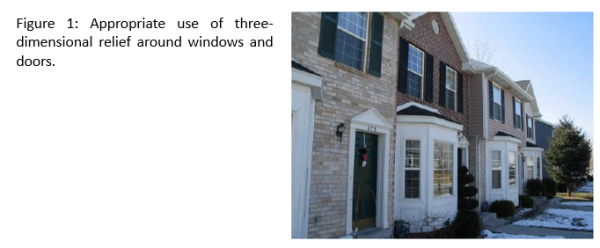
- Building Articulation: All exterior walls shall be articulated through combinations of the following techniques:
- Facade modulation: Stepping portions of the facade to create shadow lines and changes in volumetric spaces,
- Use of engaged columns or other expressions of the structural system, porch columns must be wrapped with an appropriate brick or stone or other substantial architectural features,
- Providing projections such as balconies, cornices, covered entrances, porte-cocheres, trellises, pergolas, arcades, and colonnades (providing such trellises and awnings extend outward from the underlying wall surface at least 24 inches),
- Variation in the rooflines by use of dormer windows, overhangs, arches, stepped roofs, gables, or other similar devices,
- Wraparound porches, particularly on corner lots,
- Rear and side elevations are not allowed to be flat wall expanses. They must be articulated by at least two (2) of the following means: change in wall plane of five feet (5') for every thirty feet (30'), covered deck or patios along at least forty percent (40%) of the rear elevation, bay or box windows, or chimneys, horizontal or vertical material changes (e.g., wainscot, gable finish, etc.), or sufficient plantings to create similar variation to the plane of the building elevations.
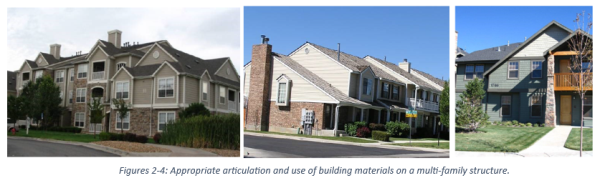
- Building Materials:
- Exterior Materials: Thirty percent (30%) of any elevation facing a street must contain masonry materials. For calculation purposes, this shall include windows and entry door areas. Examples of permitted materials include brick, stone, split faced block, or cut stone.
- Material Changes: Material types should wrap corners and terminate at interior corner locations. Multi-story buildings should provide materials, color changes, and/or design elements that distinguish building levels, especially the ground level from upper stories.
- Material Colors: Colors should consist of earth tones, e.g., natural shades of wood, stone, or brick.
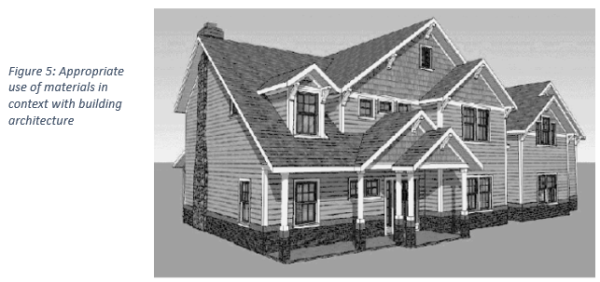
- Entrances: Where appropriate based on-site layout, entrances to buildings or ground floor units should be oriented toward the public right-of-way with entry sidewalks that connect directly to public sidewalks. Entrances should be identifiable by an architectural treatment such as a covered portico or a different roofline treatment.
- Minimum Floor Area: The minimum habitable floor area of each unit shall not be less than eight hundred (800) square feet. Multi-story dwellings should have a minimum floor area of one thousand two hundred (1,200) square feet.
- Accessory Dwellings: Dwelling units which are part of an approved multiple-unit development may not have accessory apartments.
- If listed as conditional use in an applicable zone, a multiple-unit dwelling development shall obtain conditional use approval prior to final approval of any site plan or architectural review under these standards.
- Three to Four-unit Dwellings. The following additional site requirements shall apply to developments having three (3) to four (4) units:
- Open Space. In addition to the required front yard setback at least seven hundred (700) square feet of usable recreation open space shall be provided per unit.
- Landscaping. The following standards shall be in addition to those found in Chapter 1710 Requirements for Landscaping.
- A maximum of thirty five percent (35%) of the area in the required front setback may be used for automotive parking or driving aisles. The remaining area may include landscaping, porch areas and/or walkways, as approved by the ARC.
- A maximum of thirty five percent (35%) of the area in the required front setback may be used for automotive parking or driving aisles. The remaining area may include landscaping, porch areas and/or walkways, as approved by the ARC.
- Building Design: In addition to the architectural standards in paragraph A, each dwelling unit shall be distinguishable from the adjoining unit by means of building articulation and/or roof design. The following shall also apply:
- Porches: Covered and open front porches should comprise at least fifty percent (50%) of the front elevation (not including the garage), in no case being less than ten feet (10') in width or six feet (6') in depth. Porches and porch overhangs may encroach into the required front setbacks up to five feet (5').
- Garages and carports: Garages and carports must meet all required setbacks. Garages should be subservient to the living area of the home. They should not be a dominant feature on the structure which could be accomplished by means of recessing the garage, having a side entry attached, or a combination of the above. Developments on corner lots should design the homes such that garage doors and/or carports face separate streets.
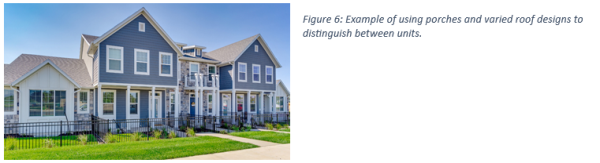
- Porches: Covered and open front porches should comprise at least fifty percent (50%) of the front elevation (not including the garage), in no case being less than ten feet (10') in width or six feet (6') in depth. Porches and porch overhangs may encroach into the required front setbacks up to five feet (5').
- Open Space. In addition to the required front yard setback at least seven hundred (700) square feet of usable recreation open space shall be provided per unit.
- Multiple Dwelling Developments with Five or More Dwellings. The following additional site requirements shall apply to developments with multiple-unit dwellings having five (5) or more units:
- Required Open Space:
- There shall be a minimum sixty (60) square foot private area attached to each unit, which may be a patio or balcony area, for the use and enjoyment of the associated tenant.
- For multi-story or condominium developments of five (5) or more units, an additional four hundred (400) square feet of usable recreation open space per unit shall be provided exclusive of the required front yards.
- Recreational Amenities: One tot lot area shall be provided for each development consisting of at least eight (8) residential units except when developments are located within a publicly traversable distance of one thousand (1,000) linear feet of a public park that has a tot lot. In such cases, a tot lot may be replaced with another amenity (e.g., barbeque pavilion, gazebo, sports court, etc.) as approved by the Planning Commission. An additional tot lot shall be provided for each additional twenty (20) units. When developments are large and require several tot lots, the Planning Commission may approve another amenity (e.g., barbeque pavilion, gazebo, sports court, etc.) as a replacement for the tot lot(s) to diversify the amenities for the development. The appropriate balance of tot lots and other amenities will be determined by the Planning Commission on a case-by-case basis.
Each tot lot or approved amenity shall be at least six hundred (600) square feet. and may be consolidated to create larger tot lots and/or amenities. The size of playground equipment in a tot lot should accommodate and be designed for five (5) to twelve (12) year old children. The required tot lots and approved amenities can count towards the open space requirement.
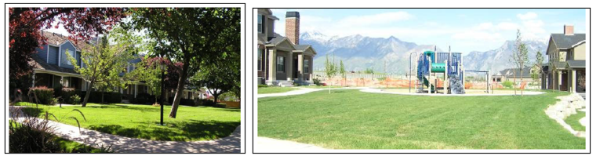
- Garages: Garages must meet all required setbacks. Garages should be subservient to the living area of the home. They should not be a dominant feature on the structure which could be accomplished by means of recessing the garage or having a side entry attached or a combination of the above.
- Storage Areas: Each unit shall be provided with a storage locker/unit having a minimum of 60 square feet of floor space, 8 feet of head room, and be accessible by a standard size door.
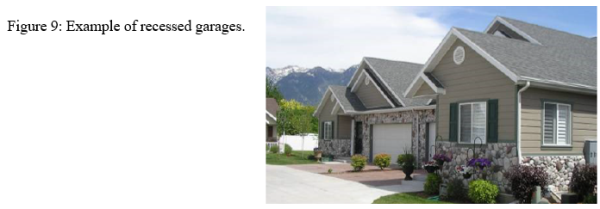
- Required Open Space:
Adopted by Ord. 2023-06 on 11/16/2023
Section 1731 Recycling Center Standards
- Recycling Collection Centers shall involve no more than 3 collection containers up to 40 cubic yards in total size on a property. Automated can recycling machines are limited to two (2) per site.
- Collection centers located in parking lots may not occupy required parking spaces for the primary use on the property.
- A collection center must be arranged so that patrons do not impede traffic flow of the property.
- Materials deposited at the collection center shall be removed from the site at least once a week.
- The operator of the collection center shall keep the collection center bins in proper repair and the exterior must have a neat and clean appearance.
Adopted by Ord. 2025-08 on 11/13/2025

