
Gunnison City Zoning Code
CHAPTER 23
MAIN STREET OVERLAY ZONE STANDARDS
Section 2301 Scope Of Development Standards
The Main Street Overlay zone consists of site and building development standards unique to properties along Main Street and which are in addition to standards of any underlying zone. The overlay zone provides standards for properties along Main Street in general and additional standards for properties in the historical downtown area between 200 South and 100 North.
Within this district, all underlying City ordinances, policies, regulations and plans shall apply. Where conflicts occur regarding development requirements in this zone, these standards shall supersede those of the underlying zone development standards.

Section 2302 Applicability
- New Development. The development standards of this zone shall apply to all new developments for office, commercial, multi-family, mixed use or service-oriented properties within the overlay zone.
- Redevelopment. These standards shall be applied to redevelopment, or exterior modifications including, but not limited to, building additions, facade alterations or changes to exterior materials or colors. When projects involve only a partial redevelopment such as a facade improvement, parking lot reconfiguration, or other rehabilitation, these standards shall apply to the portion of the property being changed. However, when a cumulative increase in development square footage (buildings or parking) as of the date of adoption of this section of at least fifty percent (50%) occurs, all the district standards shall apply.
- Maintenance. These standards shall not be applied when general maintenance and upkeep of existing buildings or properties is being performed and to the extent that the maintenance will result in materials and colors similar to pre-maintenance work.
Section 2303 Main Street Architectural Review Committee
- Authority. The Main Street Architectural Review Committee is hereby established and shall be the Land Use Authority for determining compliance with the architectural standards set forth below. The City Technical Review Committee (TRC) shall be the Land Use Authority for determining compliance with all site standards set forth in this and other city codes.
- Organization. The Main Street Architectural Review Committee shall be a five-member committee, that includes the Mayor, the City Zoning Administrator, one Planning Commissioner appointed by their peers, and two individuals appointed by the Mayor with the consent of the City Council. No sitting member of the City Council may be on the committee although a liaison from the Council may be designated to attend the architectural review meetings.
- Meetings. Meetings of the Architectural Review Committee shall be as needed with proper notice in accordance with the State of Utah Open Public Meetings laws.
- Actions. All actions of the Committee shall be by a supermajority vote (I.e., four person consensus).
- Appeals. Appeals of final decisions based upon these standards or the underlying zone shall be subject to City Council review as the Appeal Authority for these matters. Review of the Appeal shall be in accordance with the procedures of the Appeal Authority ordinances, as appropriate.
Section 2304 Site Layout Standards
- General Site Layout Standards.
- Setbacks. The setbacks of the underlying zone shall apply.
- Trash Enclosures. Trash enclosures shall be provided on site and to the rear of the building. Where limited space may be available on a property for a trash enclosure, businesses may partner with adjoining property owners to establish an off-site, communal waste collection location. Proof of off-site agreements shall be provided before a final site approval is granted.
- Setback Encroachments.
- Architectural elements such as pilasters, columns, cornices, box or bay windows, or other typical ornamentations may protrude into the required setback a maximum of 2 feet. However, primary building wall planes are not allowed to extend or be cantilevered into the required setbacks.
- Signage or other building attachments (e.g., awnings) may encroach on required setbacks. Such elements may also encroach upon the public right-of-way with City Council approval. Any overhanging elements must provide a minimum 9-foot clearance, shall not create visibility conflicts with traffic regulatory elements, not create an unreasonable distraction to motor vehicle operators, not conflict with utility systems, and must have UDOT authorization where required.
- Historical Area Site Layout Standards. Within the historic downtown area, the location and orientation of buildings, pedestrian walkways and parking areas helps define the street edge, promote a pedestrian oriented street environment for walking and shopping, and limits impacts of taller buildings on the adjacent residences.
- Building Locations and Setbacks:
- Buildings on corner parcels should be adjacent to both street fronts to help frame intersections. Architectural consideration should be given to corner visibility areas.
- Buildings fronting Main Street should utilize party walls or zero setbacks alongside property lines. Parking areas and drive access points should not disrupt the continuity of storefronts; however, plazas, green spaces or pedestrian connections may be appropriate.
- Setbacks:
Location Standard Distance Front along Main Street Minimum
Maximum
4 feet
10 feet
Front along side street Minimum
Maximum
4 feet
10 feet
Side property along Main Minimum
Maximum
0 feet if building will be adjoining to neighboring building or 20' if not adjoining
24 feet between buildings or 0 feet if no building on adjacent property.
- Build-to lines. Buildings must be constructed along a minimum of 75 percent of the build-to line (I.e., front setback).
- Building Locations and Setbacks:
Amended by Ord. 2026-03 on 6/17/2026
Section 2305 Main Street Parking Standards
- General Main Street Parking Standards.
- The number of parking stalls required for each use shall be the same as shown in Land Use Ordinance, Chapter 18.
- Barriers: Barriers that limit circulation between developments and parking lots are not permitted. Examples include fences, walls, curbing, topographic changes, or other similar types of obstructions. Property owners should work together to provide mutually beneficial parking areas and access.
- On-Street Parking. Commercial developments may count on street parking stalls toward the minimum number of required parking stalls. On-street parking may only be counted if adjacent to and within the width of the property being developed. On-street parking may not be counted toward residential uses.
- On-Site Parking.
- Reductions. Mixed use developments may reduce their overall minimum parking stalls upon demonstration that on-site shared parking is possible based on the diurnal parking demands of the land uses within the development.
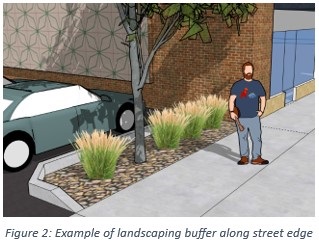
- Placement. On-site parking shall be set back from public walks a minimum of 6 feet to accommodate landscaping and screening options in accordance with landscaping standards below.
- Stall dimensions. Parking stall dimensions may be nine [9] feet wide and 18 feet deep.
- Drive Aisles. Two-way drive aisles shall be a minimum of 24-feet wide. One-way drive aisles shall be of sufficient width to accommodate 24 feet of back out distance by vehicles parking along the aisle.
- Main Street Historical Area Parking Standards
- Location Of Parking Areas: Parking for businesses fronting Main Street shall be located to the rear of buildings. Other development parcels should locate parking to the sides and/or rear of buildings. Parking areas shall be located to encourage shared use.
Section 2306 Main Street Landscape Standards
- General Main Street Landscaping Standards.
- Where part of the city’s approved street design, landscape parking strips between curb and sidewalks shall be improved and maintained by the adjacent property owner. All materials and plantings shall be approved by the Technical Review Committee.
- All parking areas shall be setback a minimum of 6 feet from the public right-of-way.
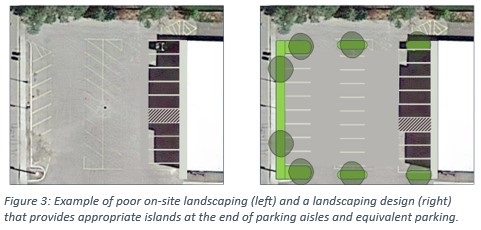
- Where possible, landscape islands should be provided at the end of parking aisles. These islands shall have a minimum planting area that is six feet wide and runs the length of the parking stalls.
- Landscape areas should utilize drought-wise plantings. At least one tree and three shrubs shall be planted per 100 square feet of required landscape area. Trees should not be crowded into spaces to meet this proportionality, but additional shrubs will be required in lieu of any tree (E.g., a 140 s.f. area would accommodate 1 tree and seven shrubs rather than 2 trees and six shrubs). Any shrubbery should have a mature height of 3 to 3.5 feet and may include ornamental grasses or perennial flowers.
- Where part of the city’s approved street design, landscape parking strips between curb and sidewalks shall be improved and maintained by the adjacent property owner. All materials and plantings shall be approved by the Technical Review Committee.
- Main Street Historical Area Landscaping Standards
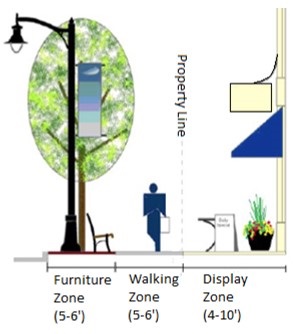
- New developments shall work with the city to proportionally improve their street frontage in accordance with the city’s adopted Main Street streetscape design, which includes 1) a minimum five foot, hardscape furniture zone with street trees in tree wells or other approved ground cover, street furniture, and street lighting, 2) a minimum 5’ wide sidewalk to be kept clear of obstructions, and 3) a business display zone which may include display areas, limited greenscapes or vegetation displays, business access at sidewalk grade, and outdoor seating areas as appropriate.
- Due to site limitations characteristic of the historical downtown area due to property dimensions and size, a majority of properties will functionally need to be paved to meet parking requirements and have limited planting areas. Properties having less than 100 feet of frontage may be granted a reduction of parking area landscaping by the architectural review committee to the minimum amount necessary to accommodate required on-site parking. Considerations for reduction of landscaping shall include potential alteration of landscaping locations, dimensions, or planting types and amounts.
- Property owners are encouraged to beautify hardscape areas with potted annuals, trellised flowering vines, etc. where such can be accommodated.
- New developments shall work with the city to proportionally improve their street frontage in accordance with the city’s adopted Main Street streetscape design, which includes 1) a minimum five foot, hardscape furniture zone with street trees in tree wells or other approved ground cover, street furniture, and street lighting, 2) a minimum 5’ wide sidewalk to be kept clear of obstructions, and 3) a business display zone which may include display areas, limited greenscapes or vegetation displays, business access at sidewalk grade, and outdoor seating areas as appropriate.
Section 2307 Building Materials
- Building Materials. Buildings shall be designed with consideration of the following elements: Glazing, Primary Materials, Secondary Materials, and Ornamentations.
- Glazing elements generally include the use of windows and doors. Buildings should be designed such that entrances and windows are more than functional penetrations, but also enhance and accentuate the overall design of buildings. Finish work around the windows and doors should accent the location and provide visual breaks to the facade of the building. Varying window designs, such as bay windows, corner windows, circle tops, or windows having grille patterns, shutters, etc., should be utilized to add visual interest and character to buildings.
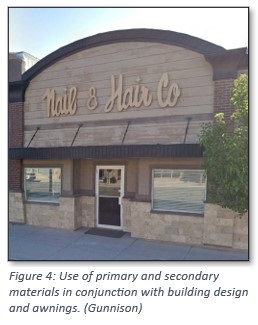
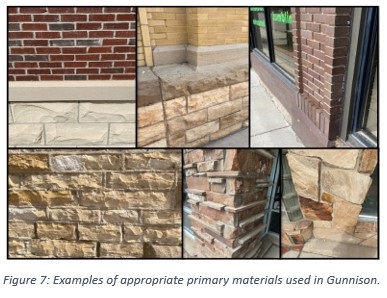
- Primary materials shall cover at least 1/3 of a building’s exterior directly visible from Main Street and, if the property is a corner lot, any abutting side street. This coverage standard excludes glazing areas. Primary materials include stone (cut, honed, polished or faux), and Brick (includes full brick, flat brick or split-face masonry units, but not flat/honed cinder blocks). Use of these materials shall include, where appropriate, elements of craft such as soldier coursing, reveals, recesses, or various methods of bonding to provide shadow lines and visual interest to the buildings.
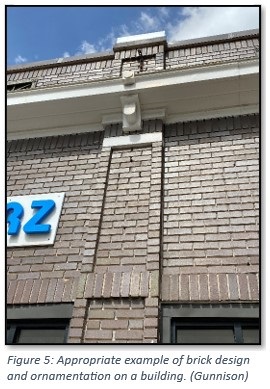
- Secondary materials, which may be used on up to 2/3 of the visible building faces, includes masonry siding products, long board materials, stucco, and decorative metal paneling.
- Ornamentation in architecture is the addition of attractive elements and features that blend into the building as a whole and beautify it. Ornamental elements may include the use of cast pieces, moldings, medallions, tile mosaics, cornice features, columns, pilasters, lintels, medallions, murals, etc.. Designers shall provide ornamental elements around windows, at material changes, to distinguish ground floors, and along roof lines.
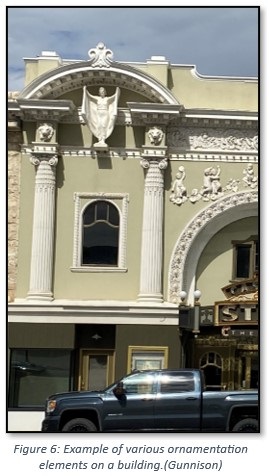
- Prohibited building materials include vinyl and metal siding products.
- Glazing elements generally include the use of windows and doors. Buildings should be designed such that entrances and windows are more than functional penetrations, but also enhance and accentuate the overall design of buildings. Finish work around the windows and doors should accent the location and provide visual breaks to the facade of the building. Varying window designs, such as bay windows, corner windows, circle tops, or windows having grille patterns, shutters, etc., should be utilized to add visual interest and character to buildings.
- Material Colors. Material colors should be indicative of and complement the natural building materials found in the Gunnison area. The use of high intensity colors, primary colors, metallic or fluorescent colors is not permitted for primary exterior materials. Secondary materials and trim materials shall complement the primary material colors.
- Accessory Structures: Accessory structures, such as gasoline pump canopies, utilities (gas, electric), trash enclosures and other accessory structures shall use the same architectural elements and types of materials and colors as the primary structure.
Section 2308 Historic Main Street Building Design
The following standards apply only within the Historical Main Street area of the Main Street Overlay Zone. Building designs should invoke a downtown reminiscent of late 1800 period architectural forms. This area should provide residents and visitors with an inviting and pleasing environment in which to shop, stroll, experience, and enjoy a small-town central business area. Careful attention to detail at a pedestrian viewing scale rather than an auto oriented application of simplistic design shall be utilized. The following standards should serve as the minimum to which new developments can adhere and designers are encouraged to incorporate other elements which may further the city's desires and intent.
- Building Height: The minimum and maximum building heights in this zone shall be guided by the following (Heights are measured from the average sidewalk elevation along the frontage to the midpoint of the roof on sloped roofs or to the highest point of a parapet. Roof midpoints shall be measured halfway between the highest ridgeline of the roof and the top of the fascia):
- The ground floor of any building shall have a minimum visual design height of 14 feet.
- Single story buildings shall have a minimum roof line height of 18 feet.
- Multi-story buildings shall have a maximum roof line height of 35 feet.
- Small architectural elements such as finials, cupolas, cornice ornamentation, etc., may exceed the heights listed in b or c.
- Building Facade: Facades should not be long expanses of blank walls. They should create a human scale at ground level and no less endearing for upper stories.
- Visual Breaks: Building facades and walls must have visual breaks every thirty feet (30') in width at a maximum. Examples of visual breaks include the use of three-dimensional architectural features such as columns, projecting windows, changes in plane or an equivalent element that articulates the wall.
- Distinct Ground Floor: The ground level of the primary structure shall be visually distinct from upper stories. This separation may be provided by a cornice above the ground level, an arcade, changes in material and texture or other means. Building foundations should terminate no more than thirty-six inches (36") above grade. Exposed foundation walls must be finished with appropriate brick, stone, or other primary materials noted in Section 2307.
- Building Entrances: By creating a clearly identified system of entry points, the pedestrian environment and the vehicular environment will be enhanced. Secondary entrances on the rear or side of buildings should be given architectural consideration equal to the primary entrances. Entrances must be well defined with one or more of the following:
- Canopy, awnings, overhang or arch above the entrance (columns and pillars),
- Recesses or projections in the building facade surrounding the entrance,
- Display windows surrounding the entrance,
- Coved entrances.
- Glazing.
- Glazing shall be present on 40 – 75% of any ground floor face.
- Glazing on upper floors should range between 25 – 50% of the upper floors and remaining building face. Windows above ground floors should be designed with three-dimensional relief.
- Shopping windows or other expanses of glass on the ground floor should begin no more than 2.5 feet above adjacent grade and should have a traditional kick plate under them.
- The ground floors should utilize transom windows above display windows and entrances.
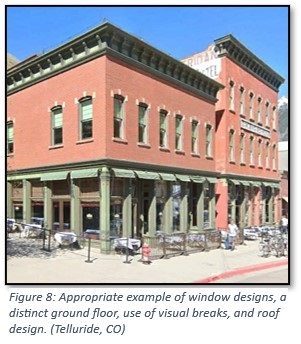
- Use Of Awnings And Canopies. Awnings and canopies shall be designed to fit within the architecture of the buildings to which they are attached and serve to enhance the exterior of the building as an articulation and aesthetic element, not as an advertising medium. The top of the framework may not extend above a vertical wall terminus nor cover any architectural elements.
- Roof Designs And Parapets:
- Flat roofs shall be screened with parapets on all sides of the building adjacent to or visible from the street. The parapet shall be of height sufficient to screen all rooftop mechanical equipment (e.g., HVAC units). If no rooftop mechanical equipment exists, the parapet shall be a minimum of thirty-six inches (36") in height.
- All parapets shall feature three-dimensional architrave, frieze and cornice treatments.
- Hipped roofs are not allowed. However, sloped roofs may be utilized and shall have a minimum of five to twelve (5:12) pitch with gabled ends facing adjacent public streets.
- Mansard roofs are only allowed with buildings having three (3) or more stories. Mansard roofs must contain fenestration with dormered or other window finishes appropriate to the architecture of the building.

