
Hainesville City Zoning Code
CHAPTER 17
04 - USE SPECIFIC PROVISIONS
17.04.010 - Farm stands.
A. Farm stands may only sell produce grown on the lot or parcel on which the farm stand is located.
(Ord. No. 21-8-316, § 2(Exh. A), 8-24-21)
17.04.020 - Places of worship and places of assembly.
A. Places of worship and places of assembly must be located on lots containing at least twelve thousand (12,000) square feet in area and a minimum of ninety (90) feet in width.
(Ord. No. 21-8-316, § 2(Exh. A), 8-24-21)
17.04.030 - Outdoor storage.
A. Outdoor storage shall not front Highway 120/West Belvidere Road or Highway 134/East Main Street.
B. Outdoor storage shall not be located within any required yard nor in any yard abutting a residential area.
C. A masonry wall with a height of eight feet shall completely surround the outdoor storage area. No outdoor storage shall be located outside of the enclosed area.
D. The foundation of the masonry wall shall be improved with a Type B Transition Area as detailed in Section 17.05.030.B.4.b.
(Ord. No. 21-8-316, § 2(Exh. A), 8-24-21)
17.04.040 - Accessory building or structure.
A. All accessory buildings and structures shall not be located in any front or corner side yard or in areas subject to a private, public, or utility easement.
B. Not more than one accessory building shall be located on any residential lot and shall not exceed seven hundred twenty (720) square feet in floor space and shall not exceed fifteen (15) feet in height.
C. Not more than one accessory structure shall be located on any residential lot and shall not exceed one hundred forty-four (144) square feet in floor space and shall not exceed twelve (12) feet in height.
D. No accessory building or structure shall be erected prior to the completion of the main structure, except when said accessory building or structure is being constructed contemporaneously with the main structure.
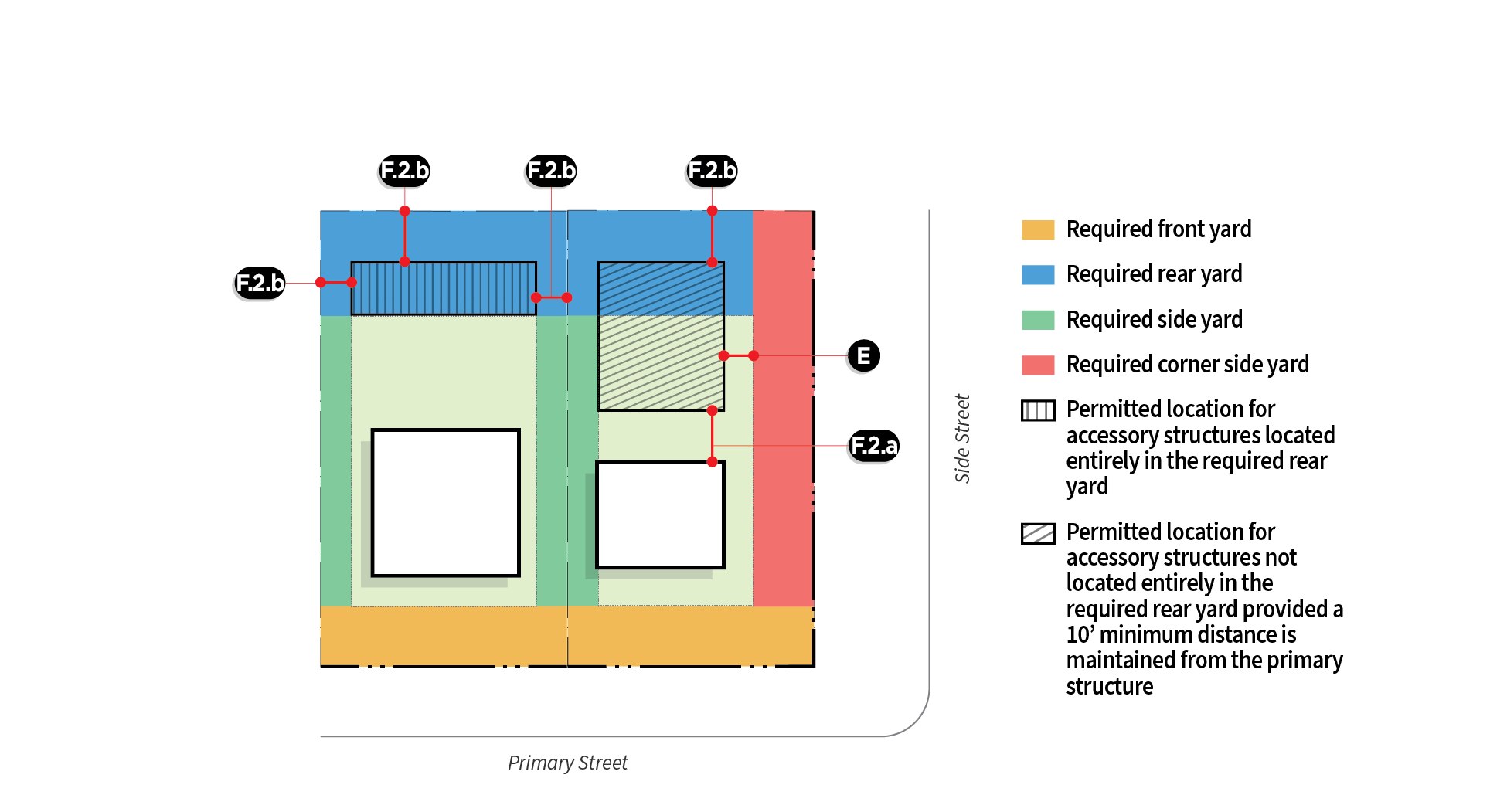
E. No accessory building or structure shall be located closer to the property line than the front or corner side elevation of the principal structure unless the accessory building or structure is located entirely within the required rear yard.
F. Accessory buildings and structures shall be located as follows:
1. In residential areas:
a. At least ten (10) feet from the main structure;
b. At least five feet from the rear and side property lines if located entirely within the required rear yard;
c. At least five feet from the rear property line and in compliance with all side yard setback requirements if not located entirely within the required rear yard;
2. In business, commercial, and industrial areas:
a. Only one accessory building or structure shall be allowed per site, and the building shall not exceed three hundred (300) square feet in floor space, nor exceed twenty (20) feet in height.
b. The accessory building or structure shall be located at least twenty (20) feet from the main structure, shall be set back at least twenty (20) feet from the rear property line, and shall comply with all side yard setback requirements.
G. All accessory buildings and structures, in business, commercial and industrial areas, and all accessory buildings in residential areas shall be set on a concrete floor and footings as provided for in appropriate village building codes.
H. All accessory structures, in residential areas, shall be set and securely anchored to the ground as provided for in appropriate village building codes or as determined by the village building official.
I. In addition to the requirements contained herein, the building official shall have the authority to enforce the requirements of all state and federal law, including but not limited to BOCA, ICC, and NEC.
Figure 4.1: Permitted Location
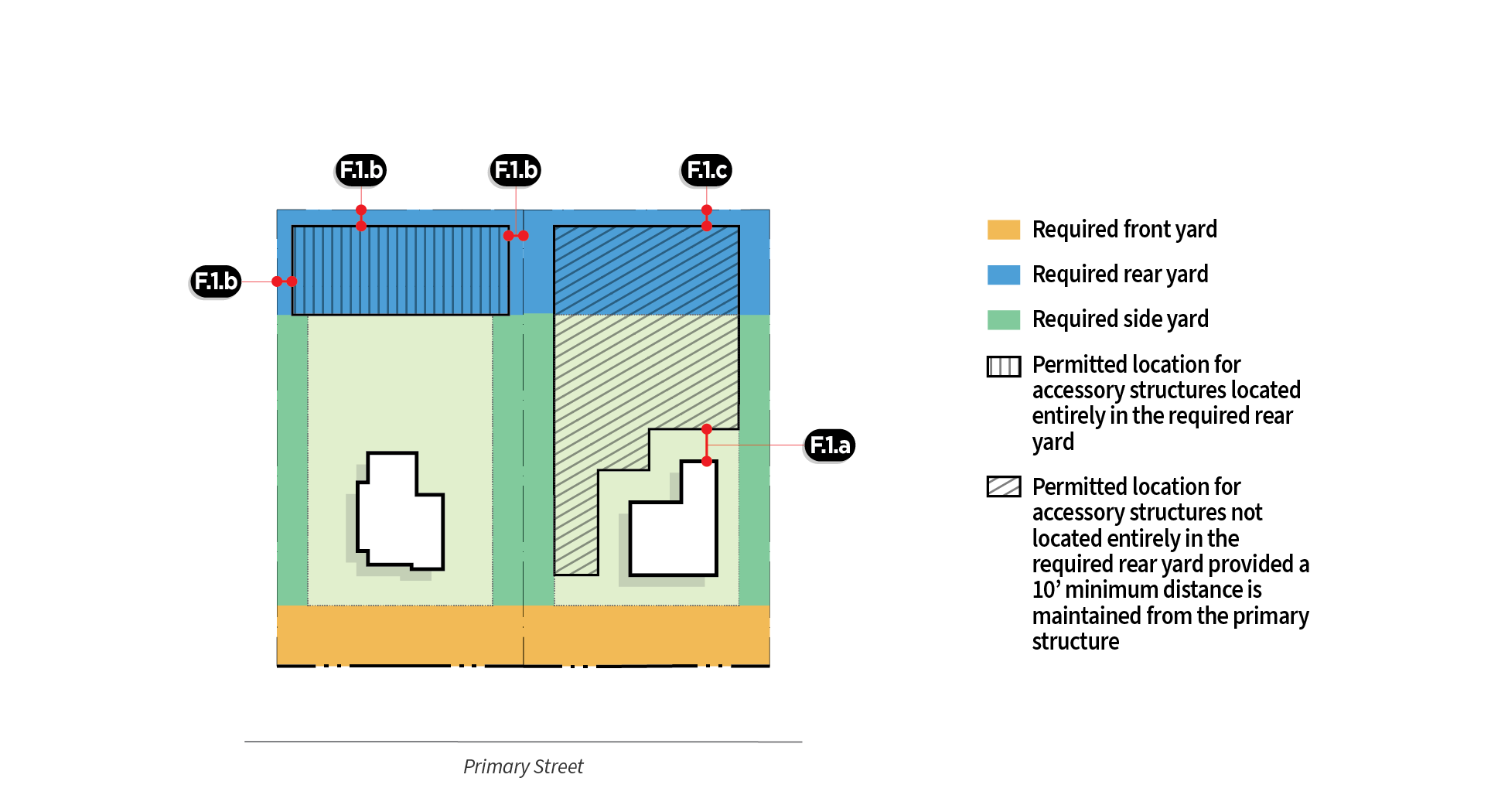
Figure 4.2: Permitted Location of Fences in Residential Areas—Corner Lots
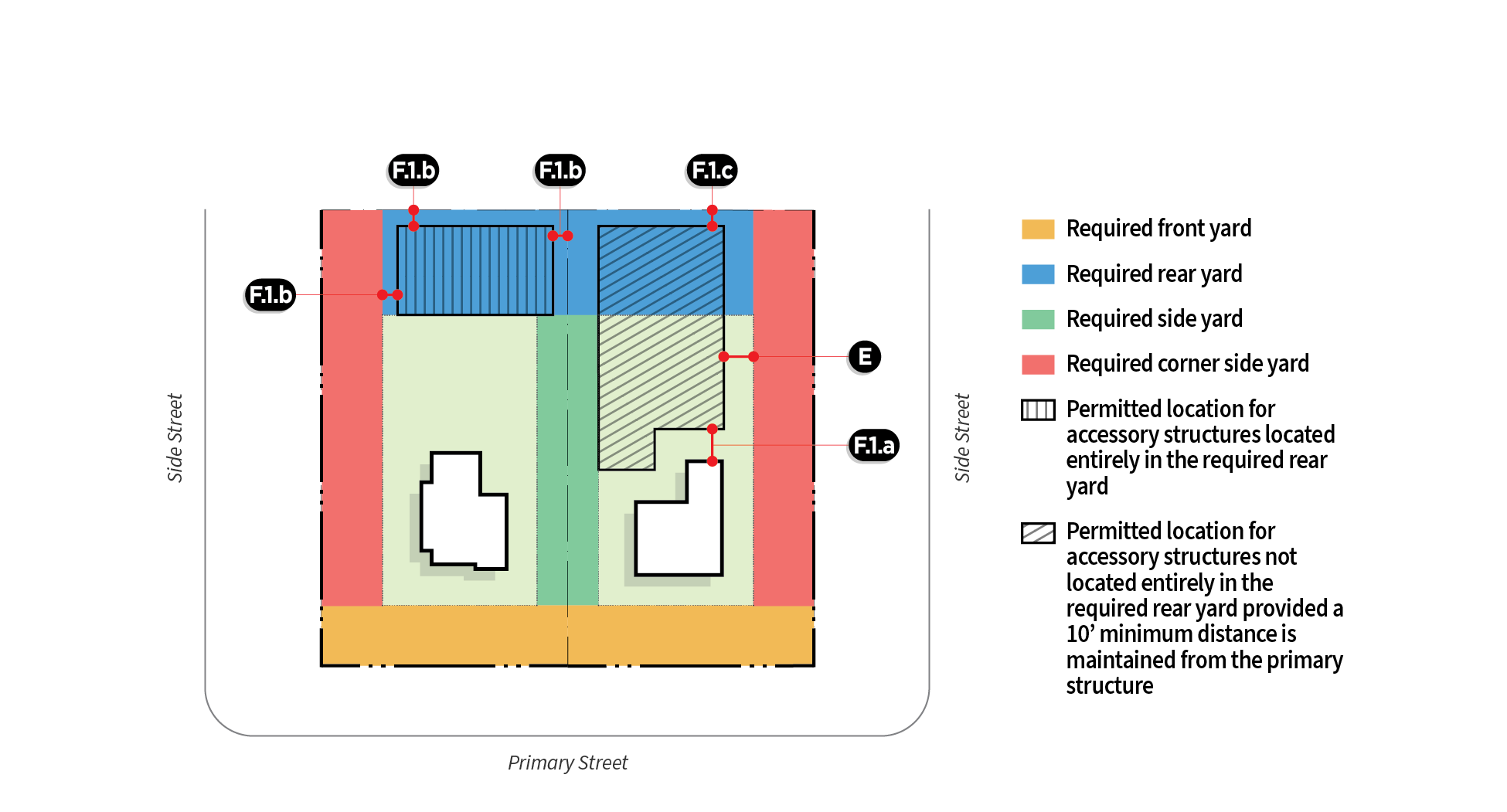
Figure 4.3: Permitted Location of Fences in Commercial Areas—All Lots
(Ord. No. 21-8-316, § 2(Exh. A), 8-24-21)
17.04.050 - Drive thrus.
A. Drive thrus shall be permitted a maximum of two menu boards with a combined maximum area of eighty (80) square feet. Each menu board shall not exceed sixty (60) square feet in area and ten (10) feet in height. Menu boards may utilize electronic message boards for one hundred (100) percent of the permitted menu board area.
B. Any speaker or intercom associated with a drive thru shall not be audible beyond the boundaries of the property.
C. Drive thru canopies shall maintain a uniform and consistent roofline with the building to which the drive thru is associated.
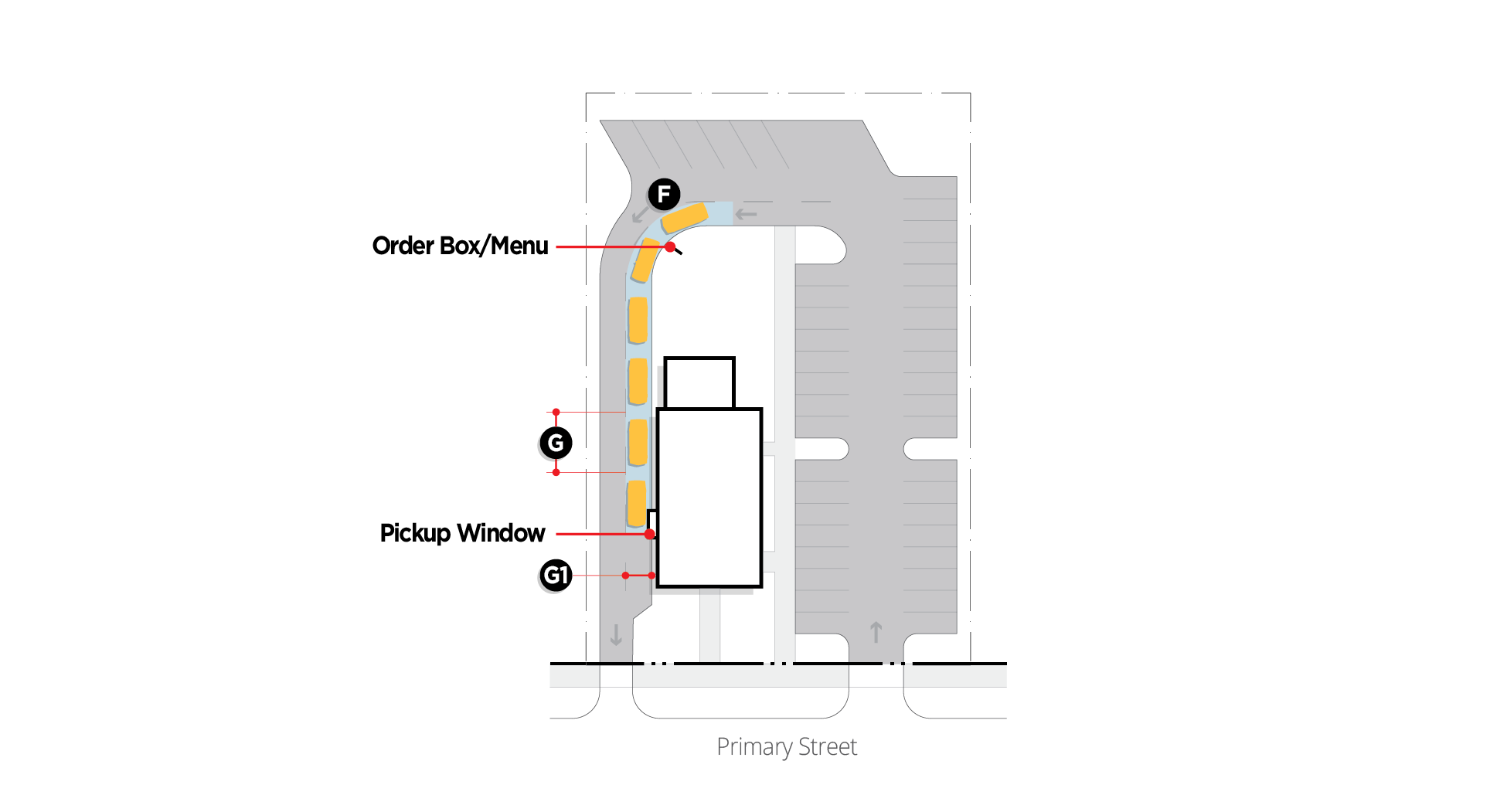
D. Stacking spaces and lanes for drive thru stations shall not impede on- and off-street traffic movement, are not to cross or pass through off-street parking areas or drive aisles and are not to impede pedestrian access to a public entrance of a building.
E. Drive-through lanes are to be separated from off-street parking areas. Individual lanes are to be striped, marked, or otherwise distinctly delineated.
F. Drive-through facilities shall be provided with a bypass lane with a minimum width of ten (10) feet.
G. Stacking lanes shall have a minimum depth of twenty (20) feet per stacking space and the following minimum lane widths:
1. One lane: twelve (12) feet,
2. Two or more lanes: ten (10) feet per lane.
H. Drive-through facilities shall be required to provide a minimum number of stacking spaces as detailed in Table 17.04.040.H.
Figure 4.4: Drive Thrus
(Ord. No. 21-8-316, § 2(Exh. A), 8-24-21)
17.04.060 - Home occupations.
A. No person other than members of the household residing on the premises shall be engaged in such occupation.
B. The use of the dwelling unit for the home occupation shall be clearly incidental and subordinate to its use for residential purposes by its occupants, and not more than twenty-five (25) percent of the floor area of the dwelling unit shall be used in the conduct of the home occupation.
C. There shall be no change in the outside appearance of the building or premises or other visible evidence of the conduct of such home occupation.
D. All activities and storage areas associated with home occupations must be conducted and located inside the principal dwelling unit, not in detached buildings or garages.
E. No traffic shall be generated by such home occupation in greater volume than would normally be expected in a residential neighborhood and the home occupation shall not displace or impede use of required parking spaces.
F. No equipment or process shall be used in such home occupation which creates noise, vibration, glare, fumes odors or electrical interference detectable to the normal senses off the lot, if the occupation is conducted in a single-family residence or outside the dwelling unit if conducted in other than a single-family residence. There shall be no storage of hazardous or toxic materials. In the case of electrical interference, no equipment or process shall be used which creates visual or audible interference in any radio or television receivers off the premises or causes fluctuations in line voltage off the premises.
G. No more than one commercial vehicle shall be parked or stored on the premises. However, no commercial vehicle or portion thereof with a license above a "B" plate or licensed for a gross weight, including vehicle and cargo of eight thousand one (8,001) pounds or more may be parked in or adjacent to a residential zone other than for loading/unloading purposes.
H. No motor vehicle repair work of any kind for compensation and no motor vehicle repair work not for compensation which, in total, for any one vehicle, lasts more than two days shall be allowed.
I. Retail sales and display.
1. No stock-in-trade shall be produced upon the premises, with the exception of the following:
a. The hand-assembly or hand-crafting of arts and crafts. For purposes of this subsection E.14., the kiln-firing of hand-wrought or hand-painted ceramics shall also be permitted.
b. The hand-wrapping or finishing of gift baskets, variety packs, or other similar multi-content stock, wherein the component items have been manufactured elsewhere.
2. No stock-in-trade shall be sold upon the premises, with the exception of the following:
a. The trans-shipment or pre-arranged pickup of items specifically pre-ordered or pre-purchased by a customer, with the exception of vehicles and large equipment.
b. The direct shipment of items to a customer that were specifically pre-ordered or pre-purchased by the customer.
(Ord. No. 21-8-316, § 2(Exh. A), 8-24-21)
17.04.070 - Outdoor displays of merchandise.
A. Only those goods and materials associated with the existing on-site use may be displayed or sold.
B. Outdoor displays of merchandise shall not be located within any required yard nor in any yard abutting a residential area.
C. Outdoor displays of merchandise shall be surfaced with an approved hard surface material. Partially paved or unpaved outdoor display or sales areas shall be prohibited.
D. Outdoor displays of merchandise shall not block a private or public sidewalk in a manner which reduces the width of that sidewalk to less than five feet.
E. Outdoor displays of merchandise shall not exceed ten (10) percent of the gross floor area of the principal building on the property unless approved as a conditional use.
F. Outdoor displays of merchandise larger than four hundred (400) square feet in size shall be enclosed with a solid fence or wall to screen views from public rights-of-way. The enclosure shall be a minimum height of four feet and a maximum height of eight feet. The design of the enclosure shall be compatible with the main building(s) and surrounding development.
(Ord. No. 21-8-316, § 2(Exh. A), 8-24-21)
17.04.080 - Outdoor storage, accessory.
A. Outdoor storage shall not be located within any required yard nor in any yard abutting a residential area.
B. An eight foot solid fence or wall shall completely surround the outdoor storage area.
C. No material or equipment stored outdoors may project higher than eight feet.
(Ord. No. 21-8-316, § 2(Exh. A), 8-24-21)
17.04.090 - Solar energy collection systems, ground mounted.
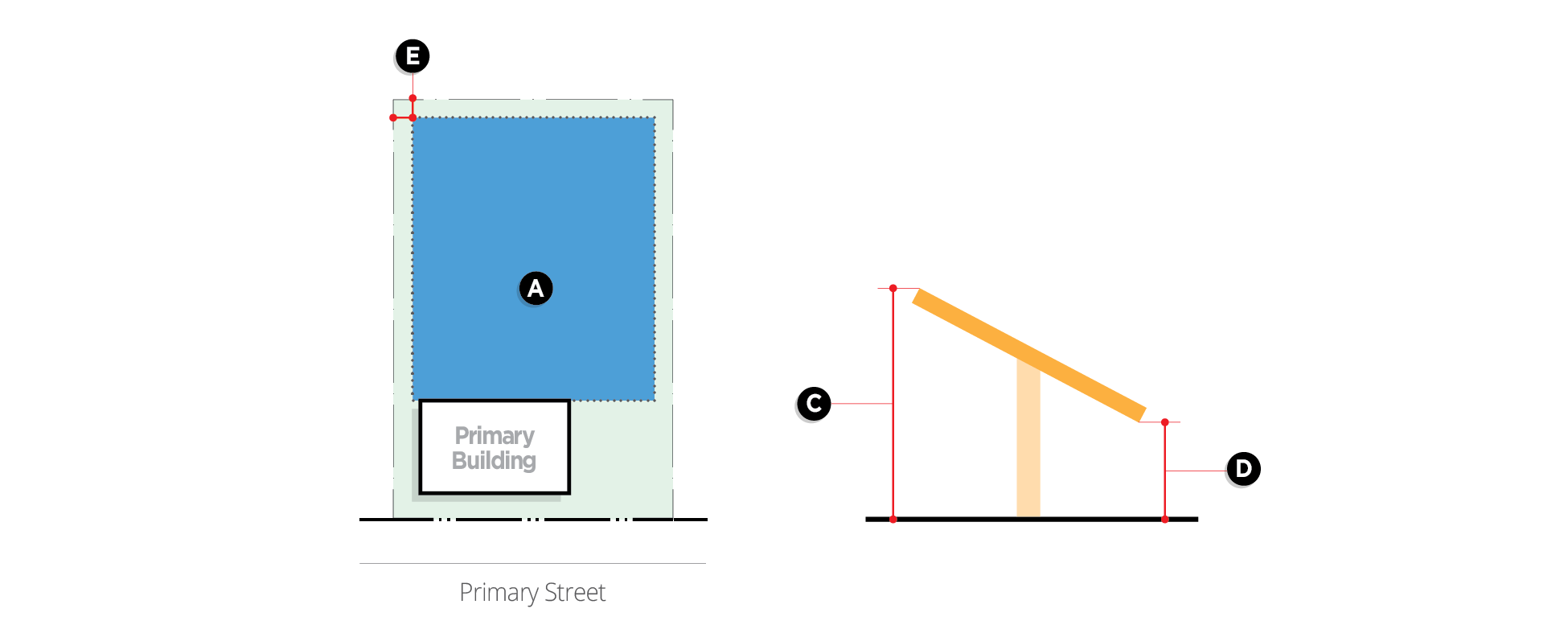
A. Ground mounted solar energy collection systems shall be permitted in the rear yard of nonresidential uses only.
B. An unlimited quantity of panels is permitted on all nonresidential zoning lots with the exception of any nonresidential zoning lot thirty thousand (30,000) square feet or less in size, which are limited to a total of one hundred (100) square feet in area of panels.
C. The maximum height of ground mounted solar energy collection systems shall be five feet in height, measured from the grade at the base of the pole to the highest edge of the system.
D. Minimum clearance between the lowest point of the system and the surface on which the system is mounted is twelve (12) inches.
E. All parts of the freestanding system shall be set back ten (10) feet from the side and rear lot lines and shall not be located in a public utility easement.
Figure 4.5: Solar Energy Collection Systems, Ground Mounted
(Ord. No. 21-8-316, § 2(Exh. A), 8-24-21)
17.04.100 - Solar energy collection systems, roof mounted.
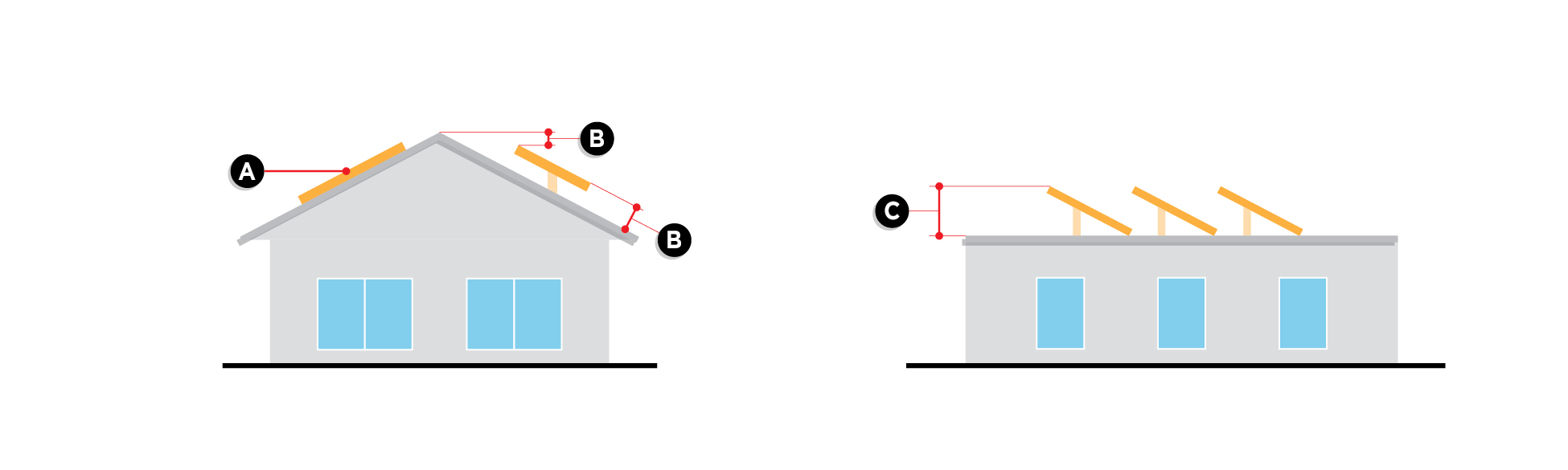
A. Roof mounted solar energy collection systems may be located on any roof face of principal or accessory buildings. Systems should be flush mounted when possible.
B. Systems on residential structures shall not extend beyond twelve (12) inches parallel to the roof surface of a pitched roof or flat roof. Systems on nonresidential structures shall not extend beyond thirty-six (36) inches parallel to the roof surface of a pitched roof or flat roof. Systems on all structures shall not extend above the highest peak of a pitched roof.
C. Height is measured from the roof surface on which the system is mounted to the highest edge of the system.
D. All materials used for racking, mounts, mounting clamps, and flashings shall be of a color consistent with the color of the roof surface to minimize visibility.
Figure 4.6: Solar Energy Collection Systems, Roof Mounted
(Ord. No. 21-8-316, § 2(Exh. A), 8-24-21)
17.04.110 - Water features.
A. All water features shall be located in rear yards only. No water feature shall be located in a front, corner side, or side yard.
B. All water features shall be located at least ten (10) feet from the main structure, at least ten (10) feet from the rear property line, within the sides of the main structure as an extended line, and at least ten (10) feet from any above-ground or below-ground utility line. Water features shall not be located in any area subject to a private, public, or utility easement.
C. All water features shall be surrounded by a barrier that complies with the current adoption of the International Swimming Pool and Spa Code.
D. Electrical circuits servicing water features, if any, shall be protected by ground fault interruption (GFI), either at the electrical panel to which the circuit is connected, or at every electrical outlet that connects to said electrical circuit.
E. Water features shall be maintained so as to prevent stagnation of water that may lead to the water feature becoming a breeding ground for mosquitoes, other pests, and diseases.
F. In addition to the requirements contained herein, the building official shall have the authority to enforce the requirements of all state and federal law, including but not limited to ICC, and NEC.
(Ord. No. 21-8-316, § 2(Exh. A), 8-24-21)
17.04.120 - Gun club.
A. No new competitive or recreational shooting courses or shooting ranges, whether temporary or permanent, shall be established or used at a gun club after March 26, 2024. Permanent competitive shooting courses and shooting ranges established and regularly used at a gun club as of March 26, 2024 may remain in use after that date. However, temporary competitive shooting courses or shooting ranges which were used intermittently and/or for special events prior to March 26, 2024 are not considered to be permanent and shall not be permitted to be used after March 26, 2024. Rifles or slugs may not be used during shooting activities at a gun club. Projectiles from a firearm, bow or crossbow (bullets, arrows, etc.) may not encroach, travel over or land on adjacent properties, roadways or rights-of-way.
(Ord. No. 24-3-357, § 3, 3-26-24)

