
Hainesville City Zoning Code
CHAPTER 17
05 - GENERAL DEVELOPMENT PROVISIONS
17.05.010 - Off-Street parking.
A. Any off-street parking space in connection with existing buildings or structures, on the effective date of the ordinance codified in this title, shall not be removed or altered, except in conformance with the requirements of said ordinance.
B. In connection with any building or structure which is to be erected or substantially altered and which requires off-street parking, there shall be provided off-street parking in accordance with regulations set forth in this title.
1. Use. Except as may otherwise be provided for shared parking, the parking of trucks, or for special uses, required accessory off-street parking facilities, shall be solely for the parking of vehicles of patrons, occupants, or employees of a specific establishment.
2. Computation. When determination of the number of off-street parking spaces required by this title results in a requirement of a fractional space, any fraction of one-half or less may be disregarded, while a fraction in excess of one-half shall be counted as one parking space.
a. When more than one use exists on a lot, the number of off-street parking spaces required shall be the sum of the number required for each use, with the exception of shared parking facilities as detailed in Section 17.05.010.B.4.
b. "Floor area" means gross floor area, unless otherwise designated.
3. Collective Provisions for Nonresidential Uses. Off-street parking facilities for separate uses may be provided collectively if the total number of spaces so provided is not less than the sum of the separate requirements of each such use, with the exception of shared parking facilities as detailed in Section 17.05.010.B.4., and if all regulations governing the location of accessory parking spaces in relation to the use served are observed.
4. Shared Parking Facilities. A parking space, or portion thereof, shall serve as the required space for more than one use only under the following circumstances:
a. The applicant(s) for approval of a shared parking facility shall demonstrate to the zoning administrator's satisfaction that there is not a substantial conflict in the demand for vehicle parking during the principal operating hours of the two or more uses that the shared parking facility is proposed to serve.
b. Shared parking facilities which have been approved by the zoning administrator to provide required vehicle parking for one or more uses, shall provide a number of vehicle parking spaces which accommodates the parking demand for all uses during any overlapping period of time in the principal operating hours of each use.
c. Each parking space designed to serve as shared parking shall not be located farther than five hundred (500) feet from the access to all of the various areas it is designated to serve.
d. A legally binding instrument, approved by the village, shall be executed by any and all parties to be served by a shared parking facility. This instrument shall be recorded with the register of deeds office and filed with the village clerk.
e. Adjacent lots that are subject to a shared parking agreement shall be interconnected by the provision of cross-access easement for vehicular passage.
5. Repair and Service. No motor vehicle repair work of any kind shall be permitted in parking lots. No gasoline or motor oil shall be sold in conjunction with any accessory parking facilities.
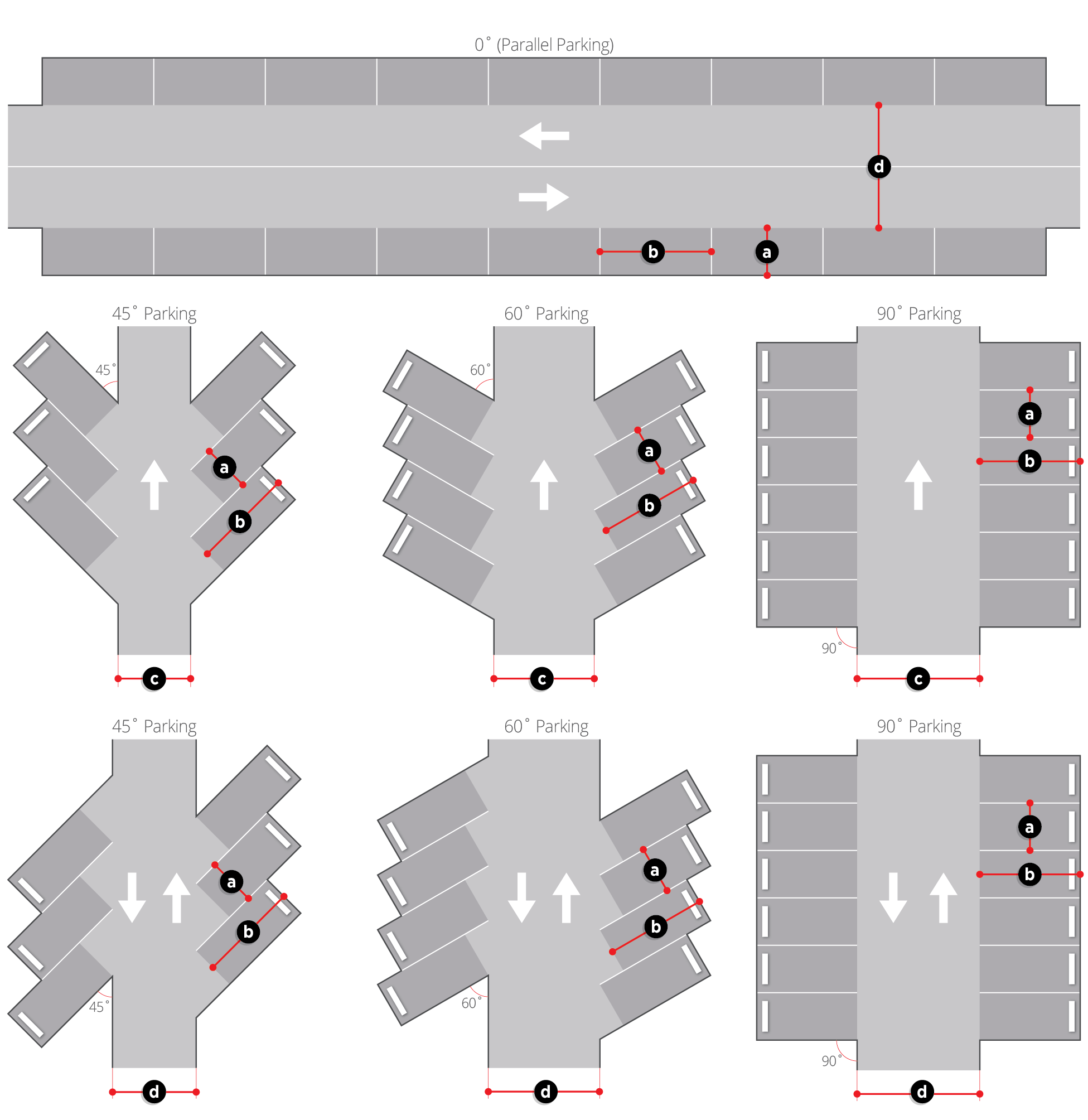
6. Parking Space and Drive Aisle Design Standards. Other than ADA accessible parking, every and all required parking spaces and maneuvering aisles shall comply with the minimum requirements of Table 17.05.010.B.6. All vehicle parking spaces shall have a minimum vertical clearance of at least seven feet. Compact vehicle parking spaces shall not satisfy minimum parking requirements.
7. Access. Each required off-street parking space shall open directly upon a drive aisle or a driveway of such width and design as detailed in Table 17.05.010.B.6.
Figure 5.1: Parking Space and Drive Aisle Design Standards
C. All off-street parking facilities shall be provided with appropriate means of vehicular access to a street, alley, or driveway in a manner which will least interfere with traffic movements.
D. All parking areas shall have vehicular access to it over a street, alley, or driveway containing all-weather, hard-surfaced pavement and the location and route of access to such a parking area shall be identified. No driveway across public property shall have a width exceeding twenty-four (24) feet, exclusive of curb returns.
E. In Yards. Off-street parking spaces may be located in yards, except required front yards and required side yards adjoining a street; provided, however, that parking is permitted in front yards in the business and office, research & development districts if in compliance with Section 17.02.020.D.
F. Residential Garages. Private garages in residential zones may be used subject to the following limitations:
1. Not more than one space is rented for parking to persons not resident on the premises; and
2. No more than one commercial vehicle per dwelling unit is parked or stored. However, no commercial vehicle or portion thereof with a license above a "B" plate or licensed for a gross weight, including vehicle and cargo of eight thousand one (8,001) pounds or more may be parked in or adjacent to a residential zone other than for loading/unloading purposes.
3. No motor vehicle repair work of any kind for compensation and no motor vehicle repair work not for compensation which, in total, for any one vehicle, lasts more than two days shall be allowed.
G. Design and Maintenance.
1. Open and Enclosed Parking Spaces. Accessory parking spaces, located on the same lot as occupied by the use served, may be open to the sky or enclosed in a building.
2. Surfacing. All open off-street parking areas shall be improved with a compacted macadam base, or equal, not less than four inches thick surfaced with asphaltic concrete or comparable hard-surfaced, all-weather, dustless material as approved by the village.
H. Required Off-Street Parking Spaces. Off-street parking spaces accessory to designated uses shall be provided as detailed in Table 17.05.010.H. To minimize excessive areas of pavement no parking lot shall exceed the required number of parking spaces by more than twenty (20) percent, except as approved by the village board. In granting additional spaces, the village board shall determine that the parking is needed based on documented evidence of actual use and demand provided by the applicant.
I.
Control of Off-Site Parking Facilities.
1. In cases where parking facilities are permitted on land other than the lot on which the building or use served is located, such parking facilities shall be within five hundred (500) feet of the lot occupied by the building or use to which the parking facilities are accessory. A covenant running with the land must be recorded in the office of the recorder of deeds of Cook County, Illinois on the lot upon which the accessory off-street parking is located which prohibits any other uses on that portion of the lot needed for accessory parking until such time as either one of the following conditions occurs:
a. The use on the lot containing the principal use is terminated or replaced with a use where there is enough parking on the lot containing that use; or
b. Another lot of the required size within the required distance is properly developed and used for the required accessory off-street parking in place of and in lieu of the initial lot used for accessory off-street parking with the same requirements, covenants and conditions attaching to such substitute accessory lot as required for the approval of such initial use lot.
J. ADA Accessible Parking Spaces. ADA accessible parking spaces shall be provided in the size, location and number required by the Illinois Accessibility Code or any other state or federal regulation.
K. Pedestrian Circulation Standards.
1. Off-street vehicle parking and traffic circulation areas shall include pedestrian circulation systems to ensure the safety of pedestrians, bicyclists, and motorists.
2. The on-site pedestrian circulation system shall be marked and must connect all buildings on the site to one another and provide connections to required parking spaces.
3. The on-site pedestrian circulation system must connect building entrances to adjacent public rights-of-way along direct routes that do not require significant out-of-direction travel.
4. The on-site pedestrian circulation system shall provide at least one connection to adjacent properties along a shared street frontage. Connections must provide access to existing walkways on adjacent properties, or to the likely future location of walkways on those properties. The village may waive this requirement upon determining that no walkway exists, a future walkway is unlikely to exist, or such connection would create a safety hazard.
(Ord. No. 21-8-316, § 2(Exh. A), 8-24-21)
17.05.020 - Off-street loading.
A. In connection with any building or structure which is to be erected or substantially altered and which requires the receipt or distribution of materials or merchandise by trucks or other similar vehicles, there shall be provided off-street loading berths in accordance with the provisions of this chapter.
B. Location. All required loading berths shall be located on the same lot as the use to be served and no portion of the vehicles shall project into a street or alley or interfere with any off-street parking area or pedestrian circulation area. No loading berth shall be located within twenty-five (25) feet of the nearest point of intersection of any two streets. A loading berth shall not be located in a required front or corner side yard, or be oriented toward a primary street.
C. Size. Adequate space for standing, turning, loading, and unloading services shall be provided in a manner that does not interfere with required off-street parking areas, pedestrian circulation areas, and with the public use of streets or alleys.
D. Access. Each off-street loading berth shall be designed with appropriate means of vehicular access to a street or alley in a manner which will least interfere with traffic movements.
E. Surfacing. All open off-street loading berths shall be improved with a compacted macadam base not less than seven inches thick, or equal, surfaced with not less than two inches of asphaltic-concrete or some comparable all-weather dustless material.
F. Repair and Service. No storage of any kind nor motor vehicle repair work or service of any kind shall be permitted within any required loading berth.
G. Space Allowed. Space allowed to any off-street loading berth shall not, while so allocated, be used to satisfy the space requirements for any off-street parking facilities or portions thereof.
H. Required Number and Dimensions of Loading Berths. The number and dimensions of loading berths shall be determined by the developer and shall provide for adequate space for standing, turning, loading, and unloading services. These spaces shall be provided in a manner that does not interfere with required off-street parking areas, pedestrian circulation areas, and with the public use of streets or alleys.
(Ord. No. 21-8-316, § 2(Exh. A), 8-24-21)
17.05.030 - Landscape.
Landscape improvements required by this section shall apply to all non-single-family development and consist of living plants in a combination of trees, shrubs, native grasses and/or groundcover. Unless otherwise stated in this section, all size specifications for plant materials shall be based upon the time of planting. When caliper is specified for tree planting, the caliper of the tree trunk shall be measured at six inches above the soil level. Any plant materials used to meet the requirements of this section shall not include any plant material identified as a Regulated Invasive Plant by the Illinois Department of Natural Resources.
A. Planting Types.
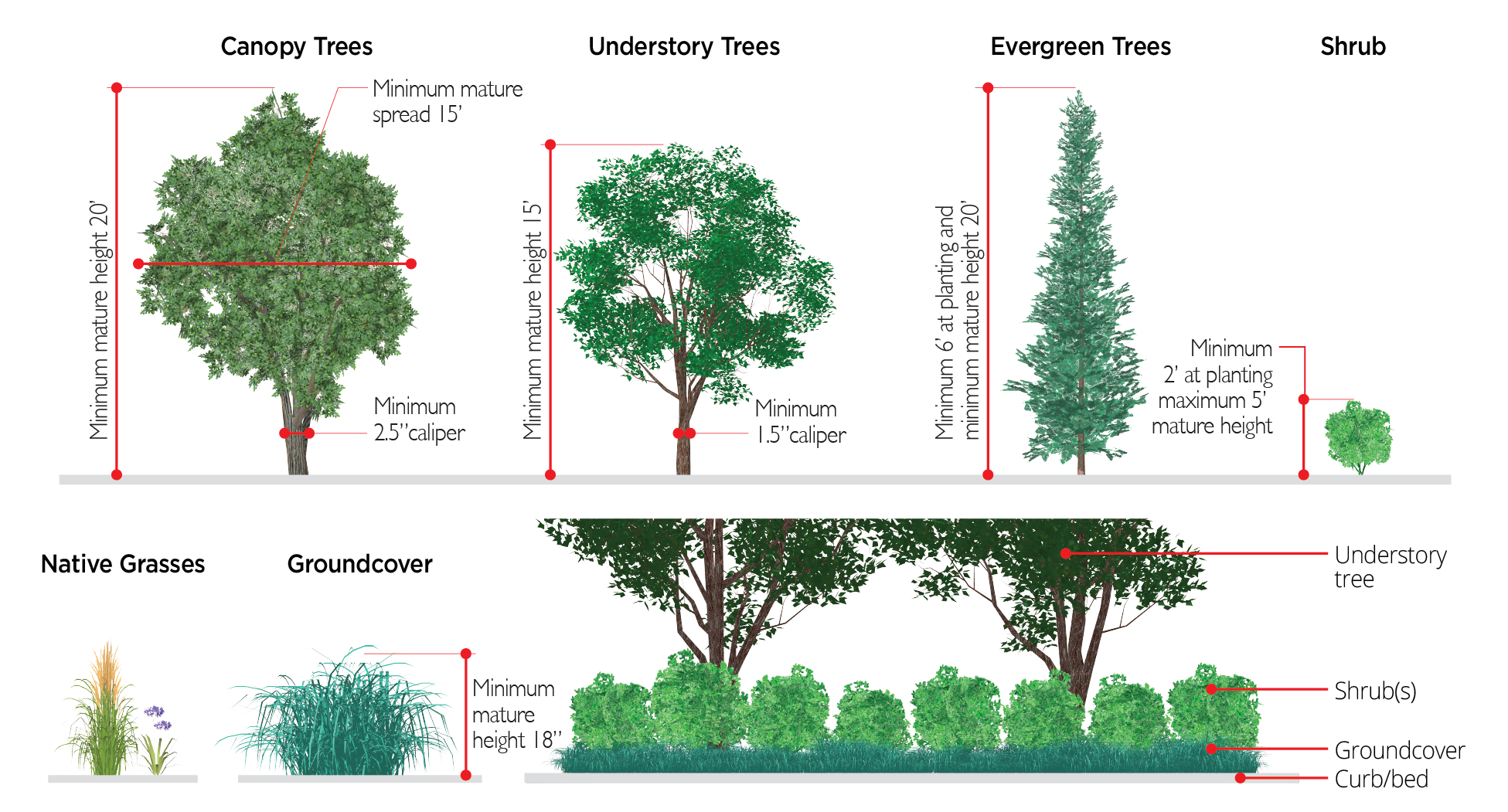
1. Canopy Trees. A woody plant (deciduous or evergreen) having not less than a two and one-half inch caliper with single central axis which typically reaches a mature height of not less than forty (40) feet and a mature spread of not less than fifteen (15) feet.
2. Understory Trees. A woody plant having not less than a one and one-half inch caliper, or six feet tall for multiple stem species, that normally attains a mature height of at least fifteen (15) feet.
3. Evergreen Trees. A tree having foliage that persists and remains green throughout the year and has a height of not less than six feet at installation and maturing to a height of not less than twenty (20) feet.
4. Shrub. A woody plant (deciduous or evergreen) of low to medium height characterized by multiple stems continuous from its base and having a height of not less than two feet.
5. Native Grasses. Grasses and flowering broad leaf plants that are native to, or adapted to, the State of Illinois, and that are commonly found in meadow and prairie plant communities, not including noxious weeds.
6. Groundcover. Herbaceous plants, other than turf grass, or prostrate shrubs normally reaching an average maximum height of eighteen (18) inches at maturity.
Figure 5.2: Planting Types
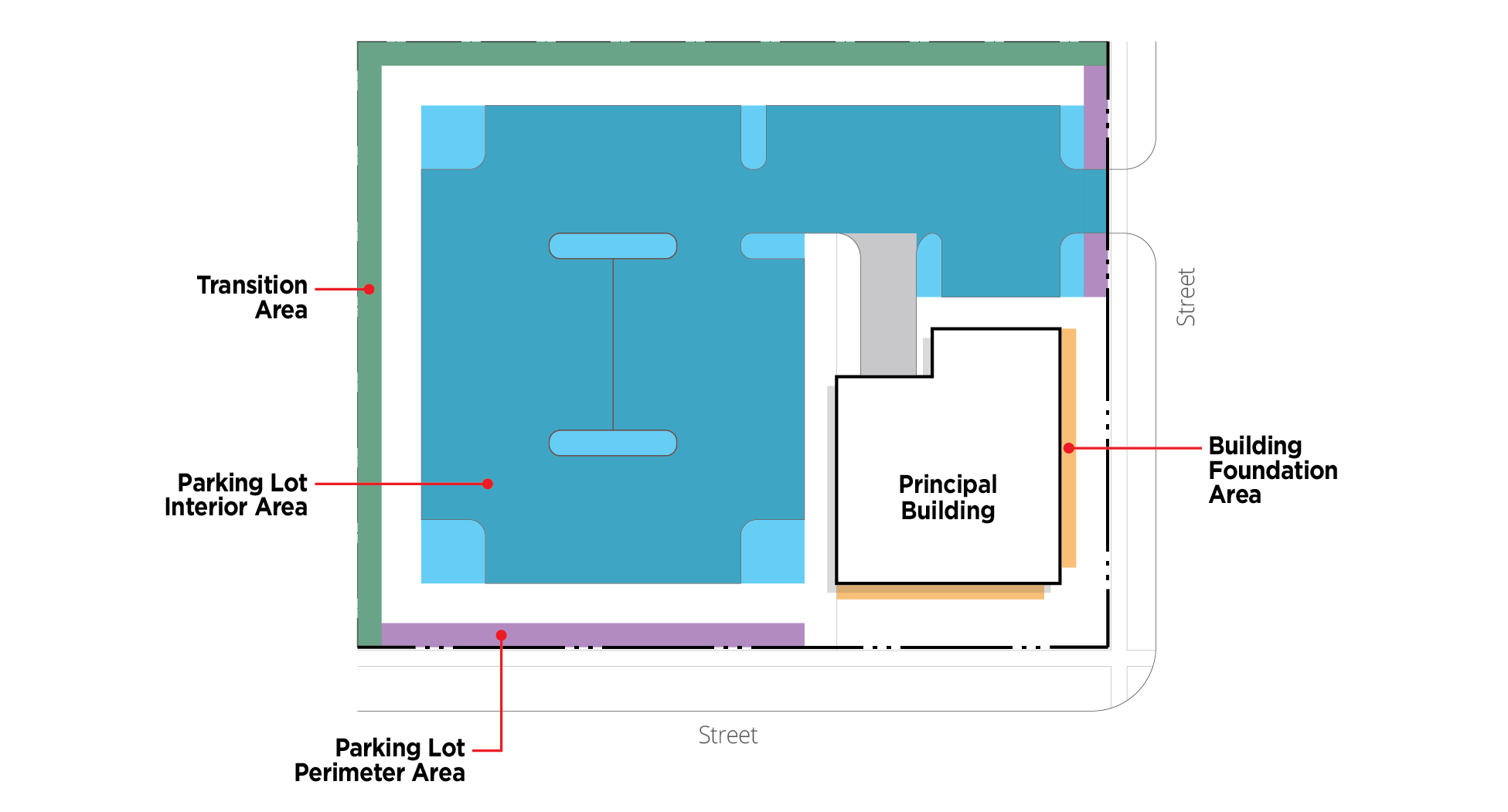
B. Required Landscape Areas. The following graphic illustrates the location of the landscape requirements detailed in this section.
Figure 5.3: Required Landscape Area
1. Parking Lot Perimeter Area. Trees and landscape required by this section shall be in addition to trees and landscape required under other sections of this ordinance. It is the objective of this section to provide screening between parking areas and right-of-way, and to provide for the integration of stormwater management with required landscaping.
a. Location. All surface parking lots which abut a public or private right-of-way, excluding alleys, shall include landscape and trees as required by this section located between the parking lot back of curb and the right-of-way.
b. Applicability. The parking lot perimeter landscape regulations of this section apply to the following:
i. The construction or installation of any new surface parking lot or vehicular use area; and
ii. The expansion of any existing surface parking lot or vehicular use area, in which case the requirements of this section apply only to the expanded area.
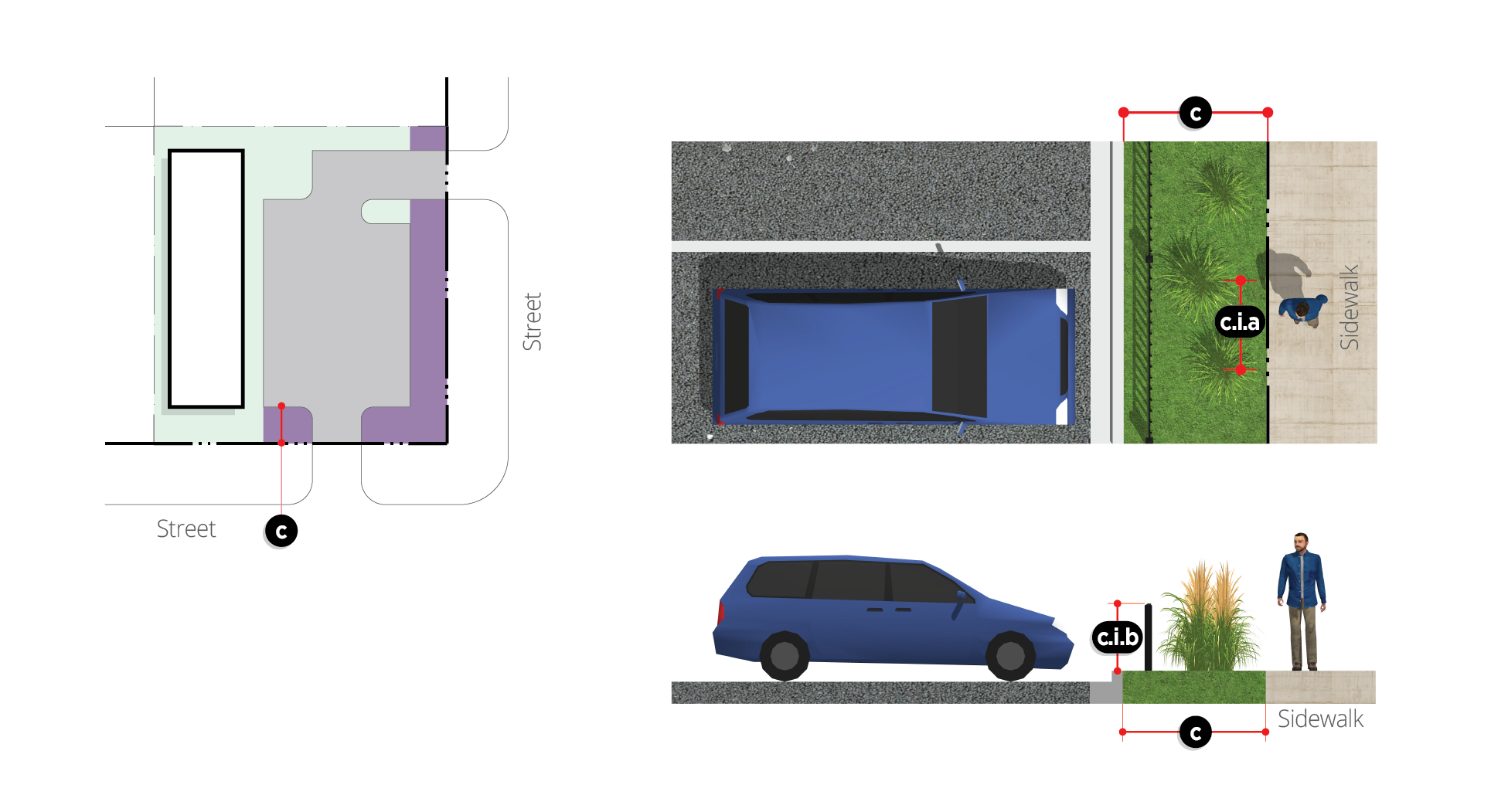
c. Requirements. Perimeter landscape shall be established along the edge of the parking lot with a minimum width of seven feet as measured from the parking lot back of curb, to accommodate vehicle bumper overhang and ensure planting areas that are adequate in size.
i. The landscape treatment shall run the full length of the parking lot and shall be located between the property line and the edge of the parking lot. Landscaped areas outside of shrub/native grasses and tree masses shall be planted in live groundcover. The landscaped area shall be improved as follows:
a) One shrub or native grasses the height of which shall not be less than three feet nor greater than five feet, shall be planted for every three feet of landscape area length, spaced to adequately screen vehicle bumpers.
b) A low masonry wall or fence the height of which provides effective screening to a maximum height of three feet may be used in conjunction with required landscaping as detailed in Section 17.05.030.B. above. Plant materials shall be installed between the sidewalk and the fence or wall to provide a softening effect.
Figure 5.4: Parking Lot Permieter Area
2. Parking Lot Interior Area. All parking lots shall include landscape and trees located within the parking area as required by this section. Trees and landscape required by this section shall be in addition to trees and landscape required under other sections of this ordinance. It is the objective of this section to provide shade within parking areas, break up large expanses of parking lot pavement, support stormwater management where appropriate, and provide a safe pedestrian environment.
a. Applicability. The parking lot interior landscape regulations of this section apply to the following:
i. The construction or installation of any new surface parking lot containing fifteen (15) or more parking stalls; and
ii. The expansion of any existing surface parking lot if the expansion would result in fifteen (15) or more new parking stalls, in which case the requirements of this section apply only to the expanded area.
b. Requirements. For parking lots consisting of fifteen (15) or more spaces, interior parking lot landscape shall be required. For parking lots consisting of fewer than fifteen (15) spaces, all rows of parking shall be terminated by a parking lot island.
c. Amount. Required parking lot interior landscape area shall be provided in the form of islands and medians.
i. Parking Lot Median Amount Requirement. Parking lot medians shall be placed between every third bay of parking.
ii. Parking Lot Island Amount Requirement. Parking lot islands shall be located on parking bays which are not required to have parking lot medians. Parking lot islands shall be spaced not more than one-hundred thirty-five (135) feet or more than fifteen (15) continuous spaces apart, and at the end of any bay of parking bordered by a drive aisle, public or private street, or pedestrian way.
Figure 5.5: Parking Lot Interior Area—Amount Required
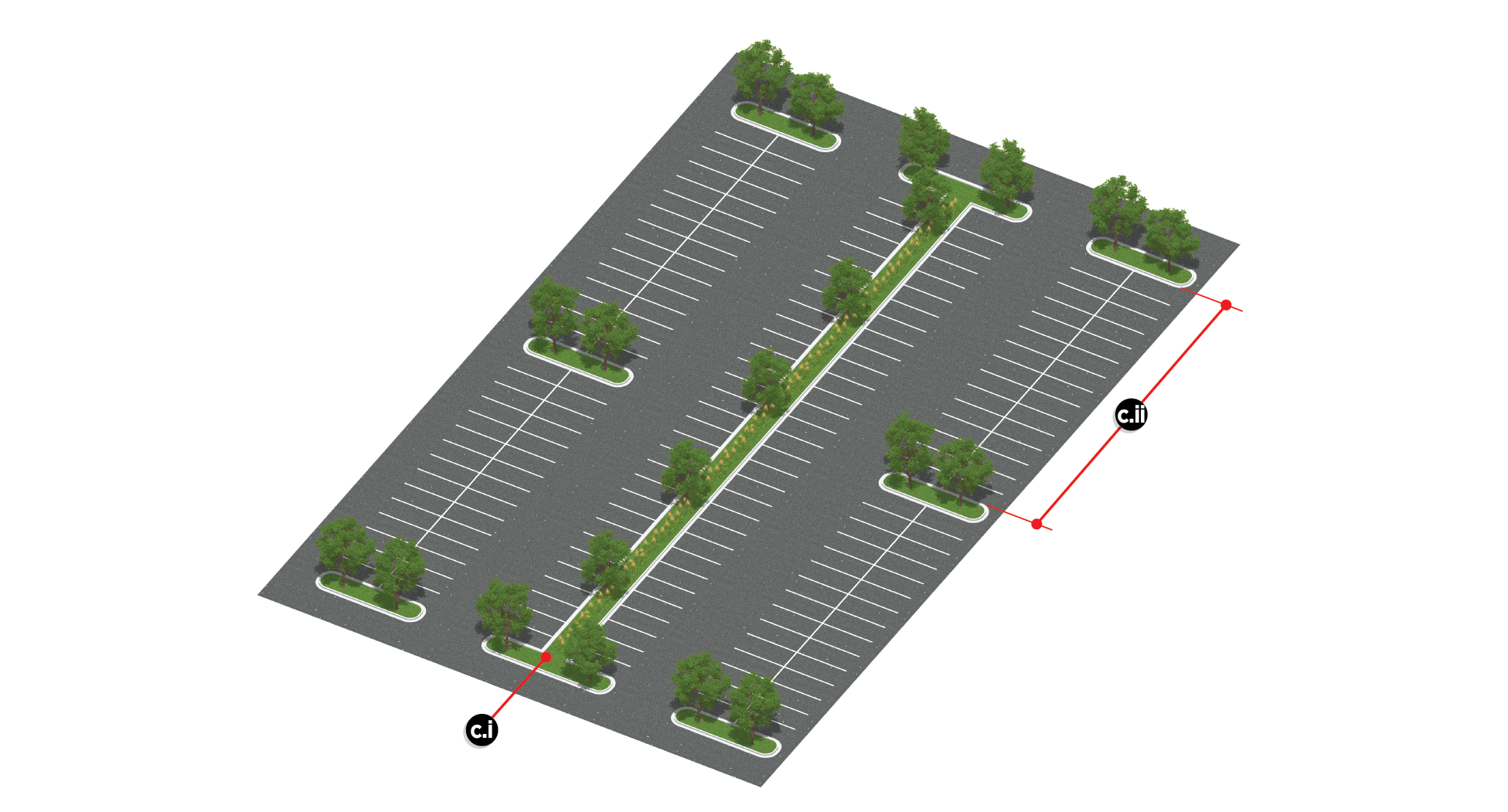
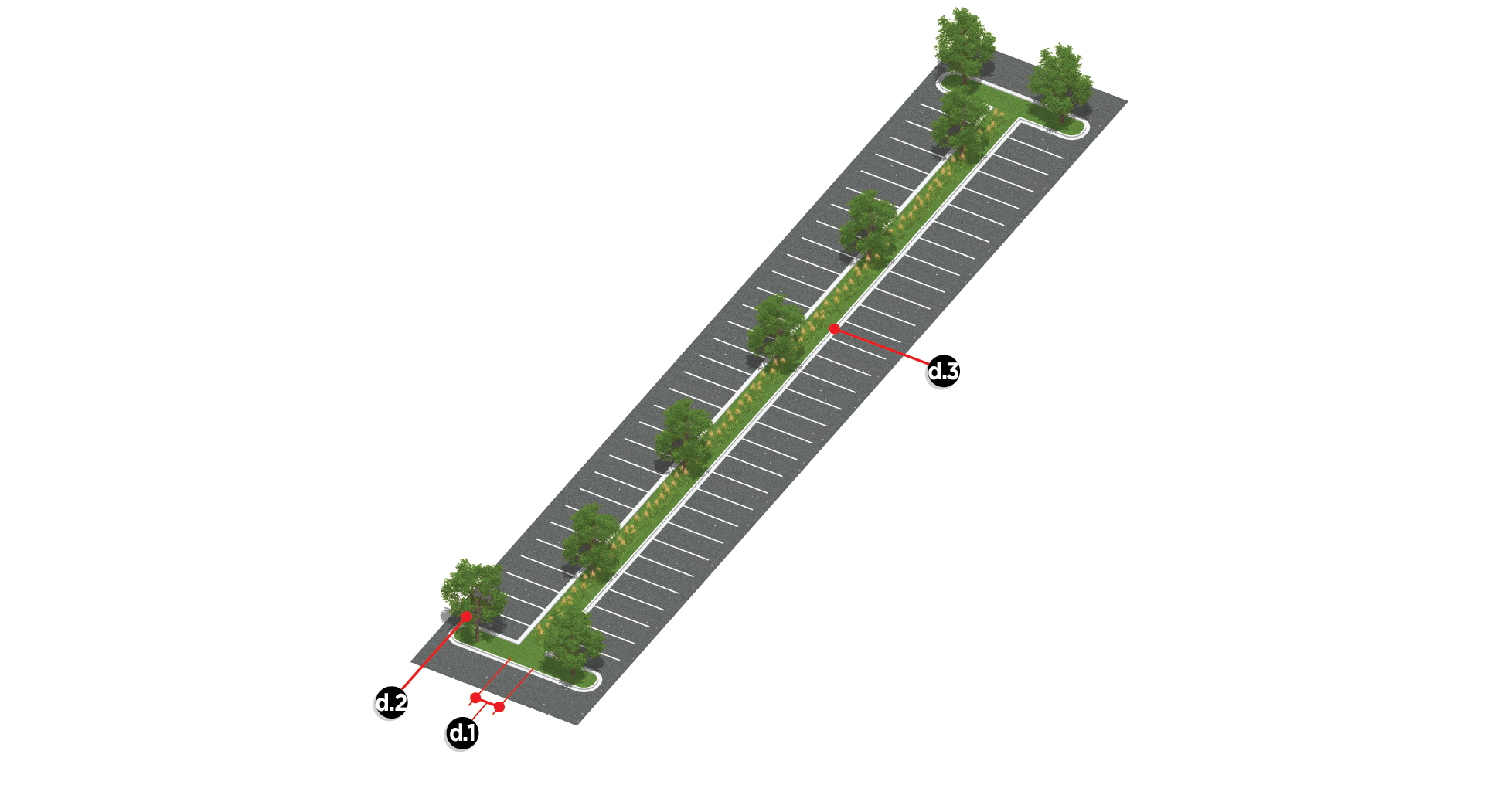
d. Parking Lot Median Standards.
i. Size. Parking lot medians shall have a minimum width of nine feet and minimum soil depth of thirty-six (36) inches.
ii. Planting. A minimum of one canopy tree and fifteen (15) shrubs or native grasses shall be planted for each fifty (50) linear feet of parking lot median.
iii. Design. Parking lot medians shall be protected with concrete curbing, wheel stops, or other suitable barriers. Such medians shall be properly drained or irrigated as appropriate to the site conditions to ensure survivability of plant materials and proper stormwater management function.
Figure 5.6: Parking Lot Median Standards
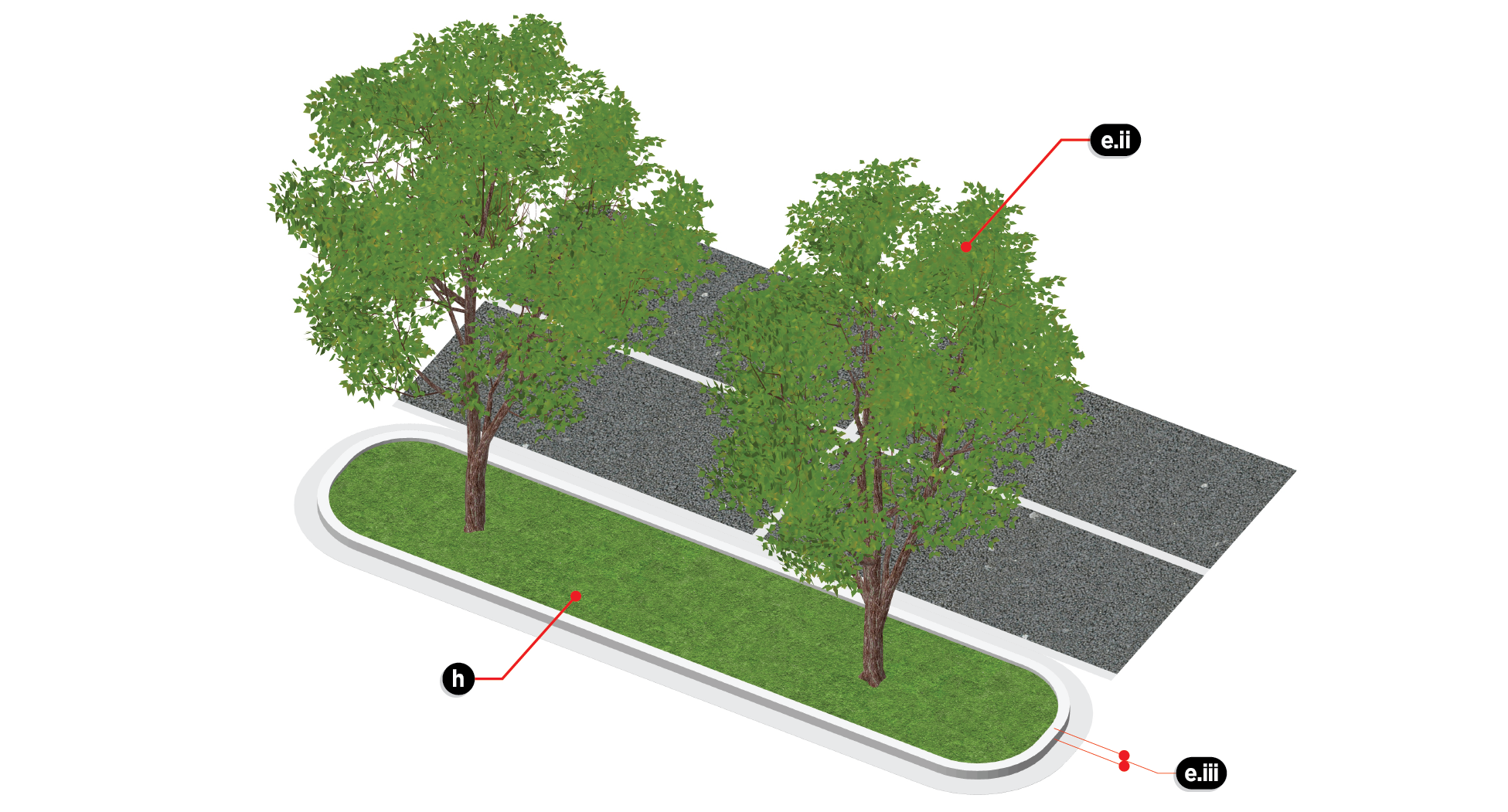
e. Parking Lot Island Standards.
i. Size. Parking lot islands shall be a minimum nine feet wide by eighteen (18) feet long and shall have a minimum soil depth of thirty-six (36) inches. Double rows of parking shall provide parking lot islands opposite one another to form continuous single islands.
ii. Planting. A minimum of one canopy tree shall be provided for every parking lot island. If the island extends the width of a double bay, then two canopy trees shall be provided.
iii. Design. Parking lot islands shall be protected with concrete curbing or other suitable barriers. Such islands shall be properly drained or irrigated as appropriate to the site conditions to ensure survivability of plant materials or proper stormwater management function.
Figure 5.7: Parking Lot Island Standards
f. Internal Pedestrian Walkways. Internal pedestrian walkways, as required by Section 17.05.030.B.2.d), shall be located along parking lot medians. The village may waive or modify this requirement on determining that locating internal pedestrian walkways along parking lot medians is impractical due to site conditions or undesirable because it would create unsafe conditions.
g. Type of Landscape Material. Except where areas are designed as vegetated stormwater management areas, canopy trees shall be the primary plant materials used in parking lot islands and canopy trees and shrubs or native grasses shall be the primary plant materials used in parking lot medians. Understory trees, evergreen trees, shrubs, native grasses, groundcover, and other plant materials may be used to supplement the required plantings but shall not create visibility concerns for automobiles and pedestrians. If medians or islands are designed as stormwater management areas, deviations from required plantings may be approved by the zoning administrator.
h. Groundcover. A minimum of seventy-five (75) percent of the surface area of every parking lot island and median shall be planted with living groundcover.
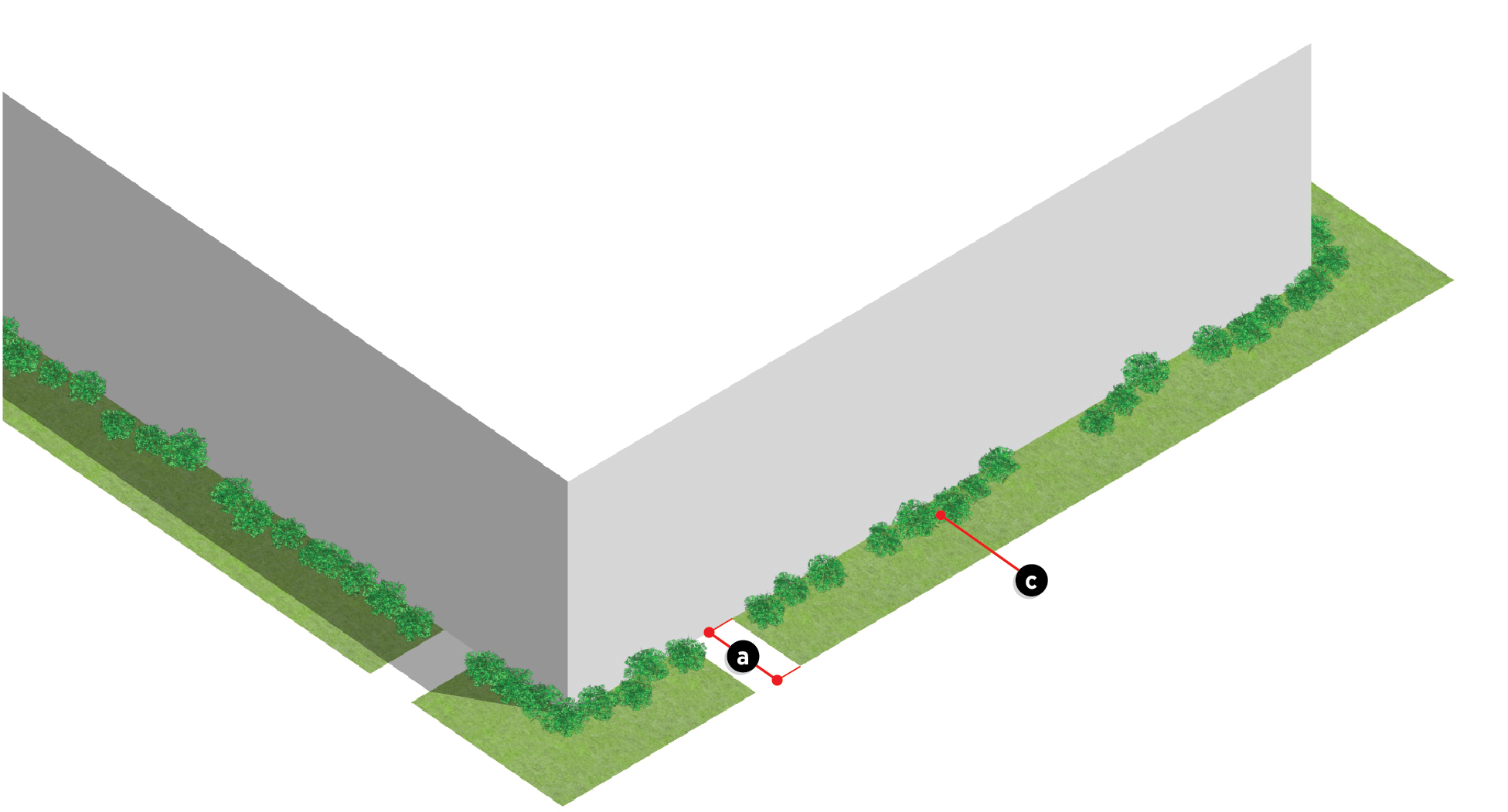
3. Building Foundation Area. All non-single family development shall include landscape located at the building foundation as required by this section. Landscape required by this section shall be in addition to landscape required under other sections of this ordinance. It is the objective of this section to provide a softening effect at the base of buildings.
a. A non-single family development is required to maintain a building foundation area at front and corner side yards of seven feet at a minimum.
b. Foundation plantings shall be designed to supplement buffer yard plantings to frame important views, while visually softening long expanses of walls.
c. Foundation plantings shall be installed across eighty (80) percent of the length of the façade of the building, except where walkways and driveways are located.
d. Foundation plantings may include trees, shrubs, native grasses, and groundcover.
e. Where the area between the building and parking lot or street curb is entirely paved for pedestrian use, landscaping may consist of canopy trees planted in structural soils beneath tree grates or permeable pavement, at the rate of one tree per fifty (50) linear feet of building facade. Minimum structural soil volume shall be six hundred (600) cubic feet.
f. Above-ground stormwater planter boxes along building facades may be substituted for foundation plantings.
Figure 5.8: Building Foundation Area
4. Transition Area. Transition area landscape shall be required along interior property lines of all multiunit residential, non-residential, or mixed-use development. It is not expected that the transition area will totally screen such uses but rather will minimize land use conflicts and enhance aesthetics. Landscape required by this section shall be in addition to landscape required under other sections of this ordinance.
a. Applicability. Transition area landscaping is required as follows:
i. The construction or installation of any new primary building or primary use; and
ii. The expansion of any existing primary building or primary use that results in an increase in gross floor area by more than five percent or one thousand (1,000) square feet, whichever is greater. In the case of expansions that trigger compliance with transition area requirements, transition area landscaping is required only in proportion to the degree of expansion. The zoning administrator is authorized to allow the transition area to be established adjacent to the area of expansion or to disperse transition area landscaping along the entire site transition area.
iii. Primary buildings or uses in the CC District shall be required to install transition area landscape in rear yards only.
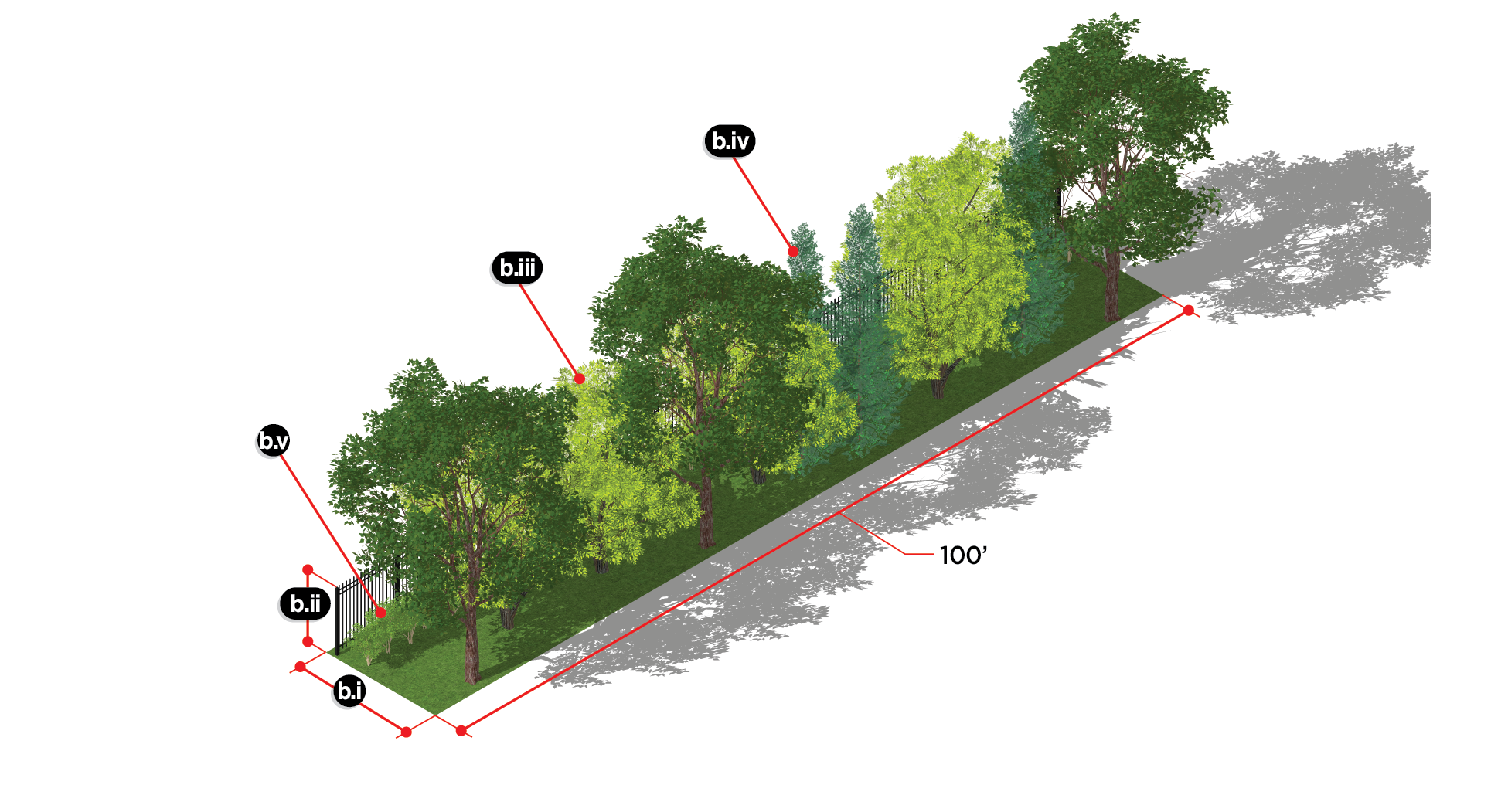
b. Transition Area Types. Four transition area types are established in recognition of the different contexts that may exist, as shown in Table 17.05.030.B.4.b. Transition areas may include a combination of elements including setback distances for separation, planting types, solid fencing, green walls, vegetated stormwater management areas, living groundcover, or turf.
Figure 5.9: Transition Area Type A
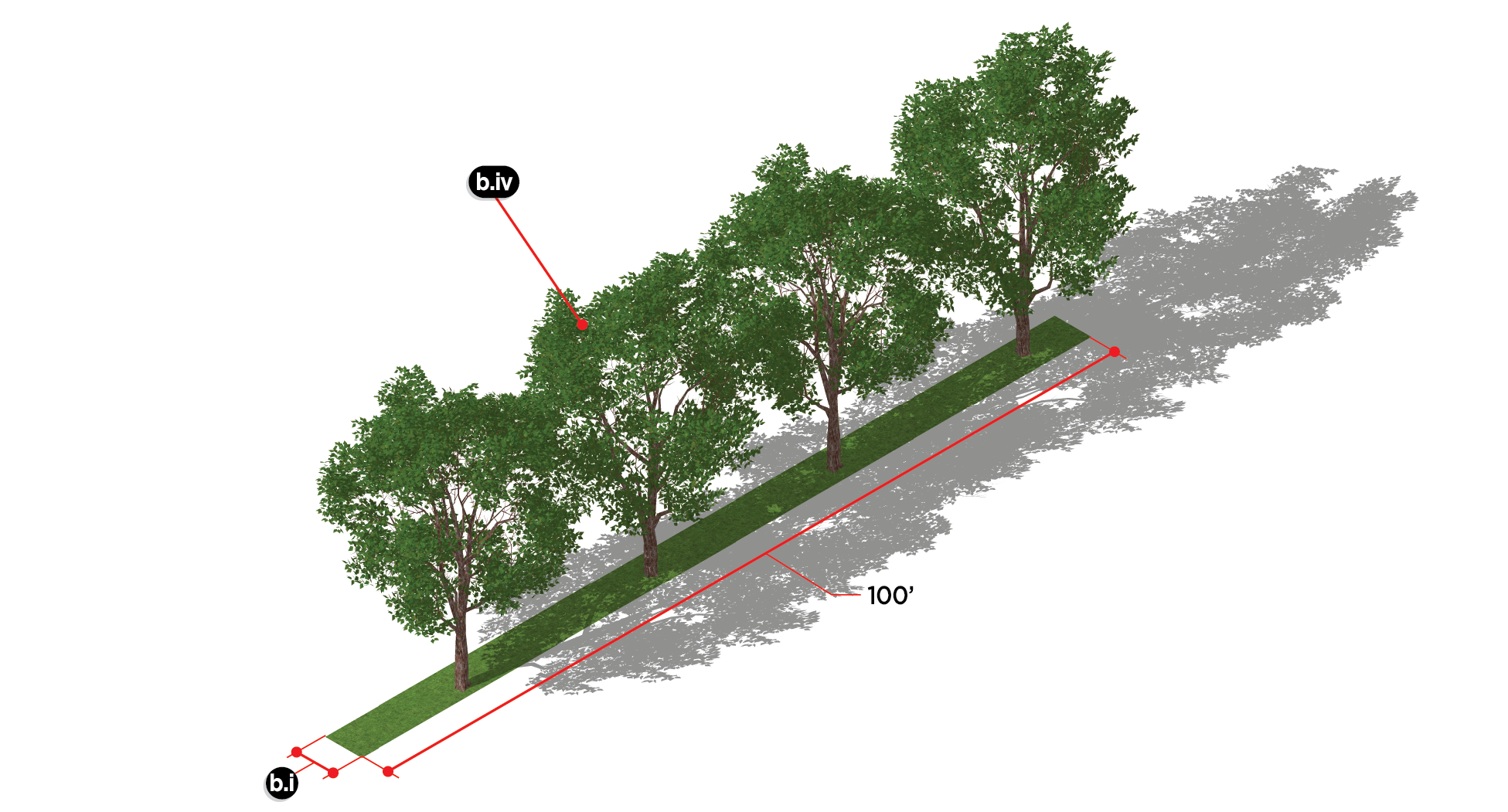
Figure 5.10: Transition Area Type B
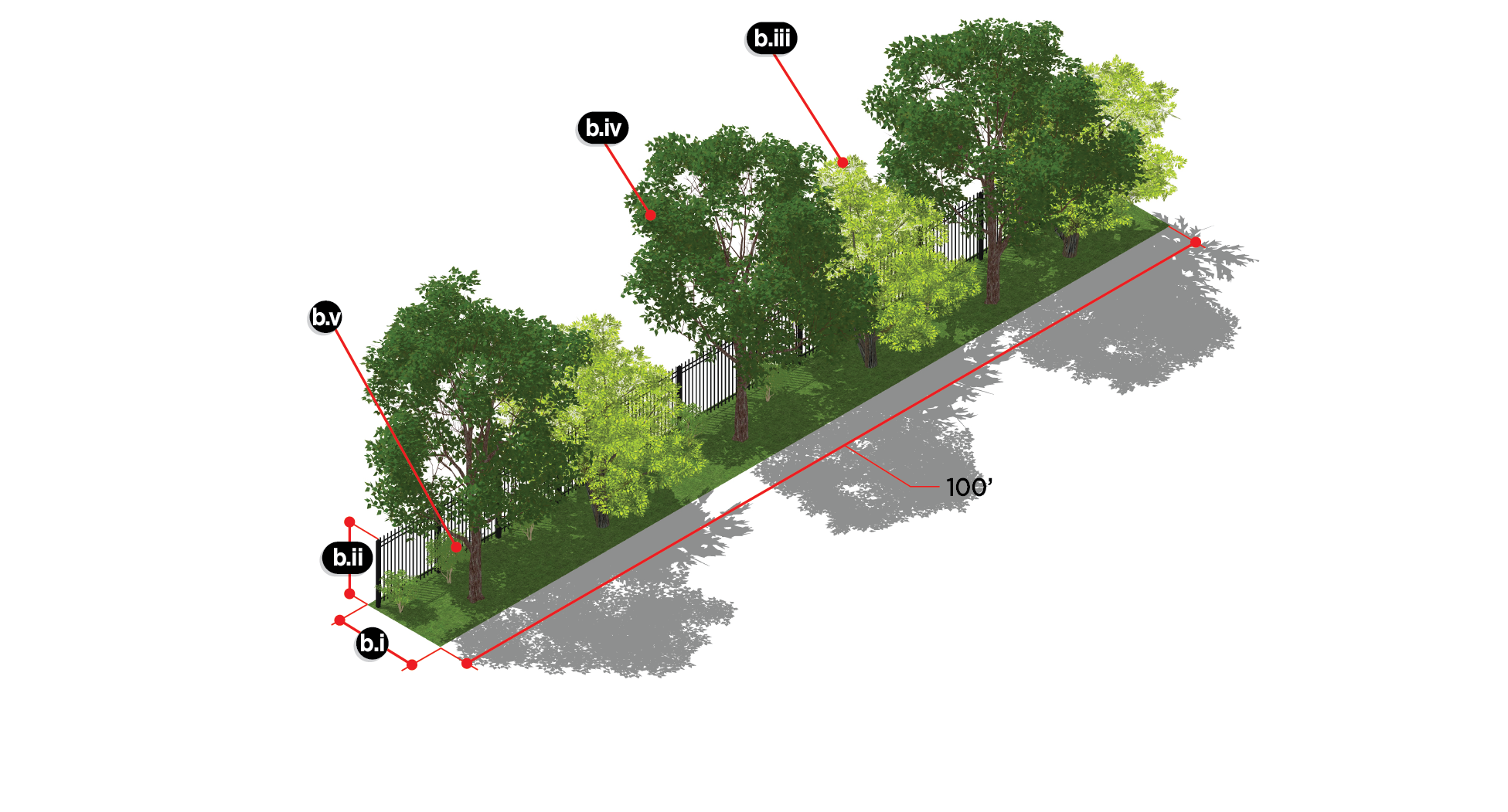
Figure 5.11: Transition Area Type C
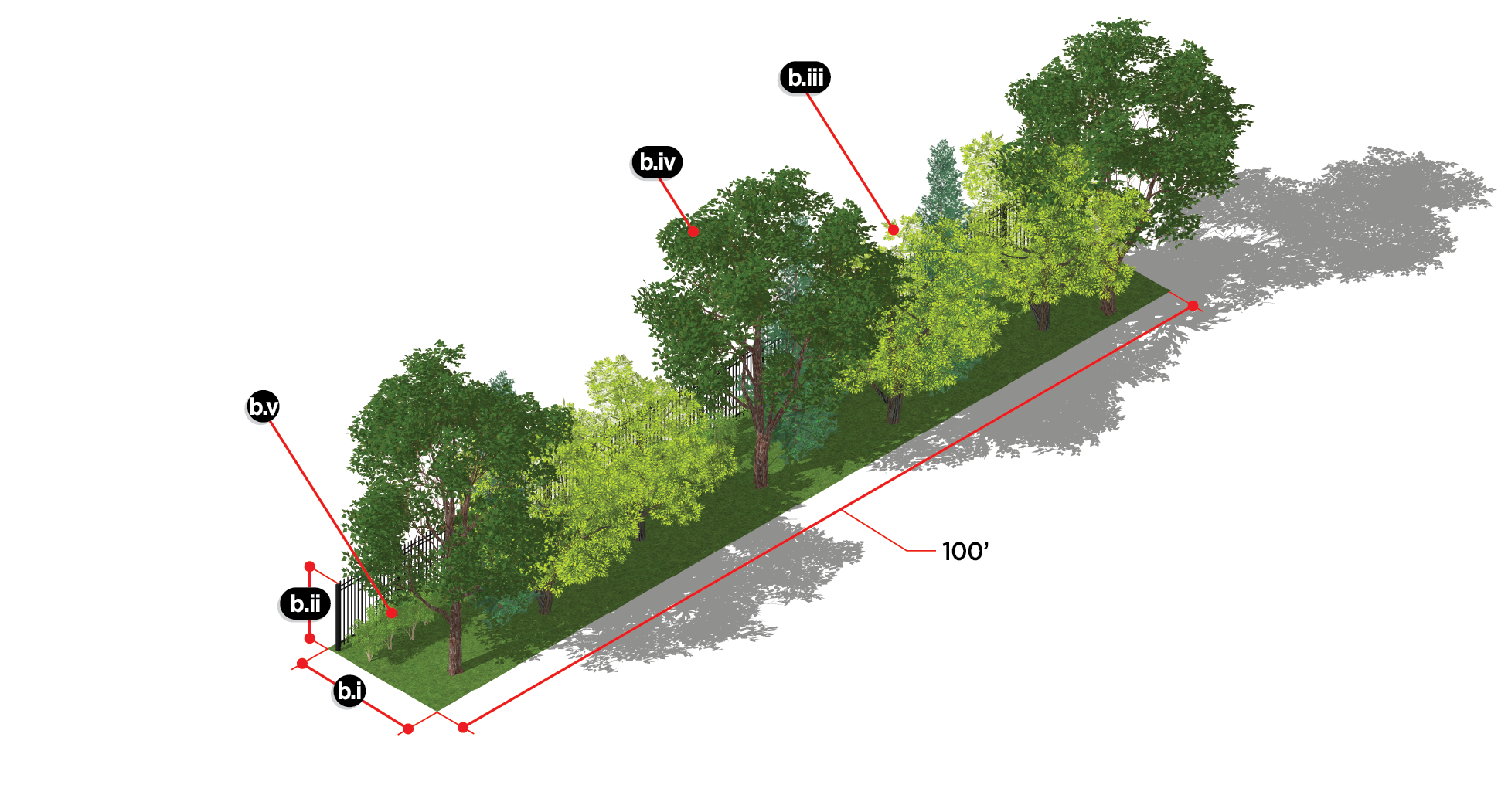
Figure 5.12: Transition Area Type D
c. Application of Transition Area Types. Transition areas shall be provided based on Table 17.05.030.B.4.c., except where adjacent uses are of a similar nature, scale, and intensity. As per Table 17.05.030.B.4.c., the type of required transition yard is dependent upon the land use type of the subject lot and the land use type of the adjacent lot(s).
C. Species Diversity Requirements.
1. A minimum of fifty (50) percent of the landscape elements utilized on a parcel that is less than one-half acre shall be drought and salt tolerant native species.
2. A minimum of sixty (60) percent of the landscape elements utilized on a parcel that is between one-half and five acres shall be drought and salt tolerant native species. Total landscape elements, excluding turf, shall not be comprised of more than thirty (30) percent of any single species or fifty (50) percent of any genus.
3. A minimum of seventy-five (75) percent of the landscape elements utilized on a parcel that is greater than five acres shall be drought and salt tolerant native species. Total landscape elements, excluding turf, shall not be comprised of more than twenty (20) percent of any single species or twenty-five (25) percent of any genus.
4. The percentage limits above may be varied in conjunction with approval of vegetated stormwater management areas.
D. Tree Preservation.
1. Existing viable trees of twelve (12) inches or greater DBH shall not be removed from lots within the village without a tree preservation and removal plan approved by the zoning administrator. DBH is diameter at breast height measured at four and a half feet off the ground or grade level.
2. The tree preservation and removal plan shall include an inventory of all trees of twelve (12) inches or greater DBH on a lot.
3. Every reasonable effort shall be made to incorporate trees identified in the inventory into the landscape required for the proposed development. The zoning administrator must determine that one of the following criteria apply prior to granting approval to remove a mature, high quality tree:
a. The tree is dead, dying, diseased, or a threat to public health or safety;
b. The tree interferes with the provision of public services or is a hazard to traffic;
c. The location of the tree prevents development or redevelopment that cannot be designed to protect the tree.
d. The tree is an identified invasive species.
4. Viable trees of twelve (12) inches or greater DBH to be removed shall be replaced in accordance with the following standards.
a. The tree to be removed shall be replaced within one year of the date of approval and guaranteed as detailed in Section 17.05.030.E.3.
b. Any tree designated for removal on an approved tree preservation and removal plan shall be replaced at the rate specified in Section 17.05.030.E.3.
c. In the event that a tree designated for preservation is destroyed, damaged, or removed during the construction process, such tree shall be replaced at three times the applicable rate specified in Section 17.05.030.E.3.
5. The value of a tree shall be determined by the zoning administrator in accordance with the methods developed by the council of tree and landscape appraisers in the most recent guide for plant appraisal.
E. Installation and Maintenance of Landscape Areas.
1. All installed landscape shall conform to the most recently approved American Standard for Nursery Stock (ANSI Z60.1), published by the American National Standards Institute.
2. All new landscape areas shall be installed prior to the occupancy or use of the building or premises, or substantial completion of the building to allow for occupancy; or if the time of the season or weather conditions is not conducive to planting, the developer shall apply to the zoning administrator for a delay in landscape installation. The delay in landscape installation request shall identify a date certain by which all required landscape materials shall be installed or the developer shall be subject to a fine as detailed in the agreement.
3. A total cost estimate of landscaping for the construction must be given on January 1 for the current calendar year. Twenty (20) percent of the total landscaping costs should be deposited in escrow with the village before building permits are granted. The twenty (20) percent landscaping deposit will be held in escrow for a period of one year past the time of planting and will be refunded on approval of the village.
4. Dead plant materials shall be replaced within sixty (60) days taking into consideration the season of the year and shall have at least the same quantity and quality of landscape elements as initially approved. If the particular project is constructed in more than one phase, the sixty (60) day timeframe shall apply to each individual phase.
5. All landscape shall be maintained in a healthy, neat, trimmed, clean, and weed-free condition. With the exception of surface areas in vegetated stormwater management areas where mulch is not specified, the ground surface of landscape areas shall be covered with either turf and/or other types of pervious groundcover located beneath and surrounding trees and shrubs.
6. For stormwater management areas where irrigation is not specified, all installed plantings shall be guaranteed for a period of eighteen (18) months following municipal approval of installation. During this guarantee period landowner shall supply water as necessary to promote successful establishment and growth.
7. Any required landscaped area not intended for stormwater management, greater than one hundred fifty (150) square feet in area, shall be provided with an underground irrigation system or be provided with a portable water supply within fifty (50) feet of said landscaped areas. No part of an irrigation system may be installed in village right-of-way.
8. All plantings required under this ordinance shall be maintained perpetually and replaced if they die or are substantially weakened or damaged. If plantings succumb due to cultural conditions, they shall be replaced with more culturally suitable species of the same type (e.g., tree, shrub, groundcover).
(Ord. No. 21-8-316, § 2(Exh. A), 8-24-21)
17.05.040 - Screening.
A. Trash and Recycling Receptacles. The following regulations shall apply to all apartment, condominium, mixed-use, and nonresidential development.
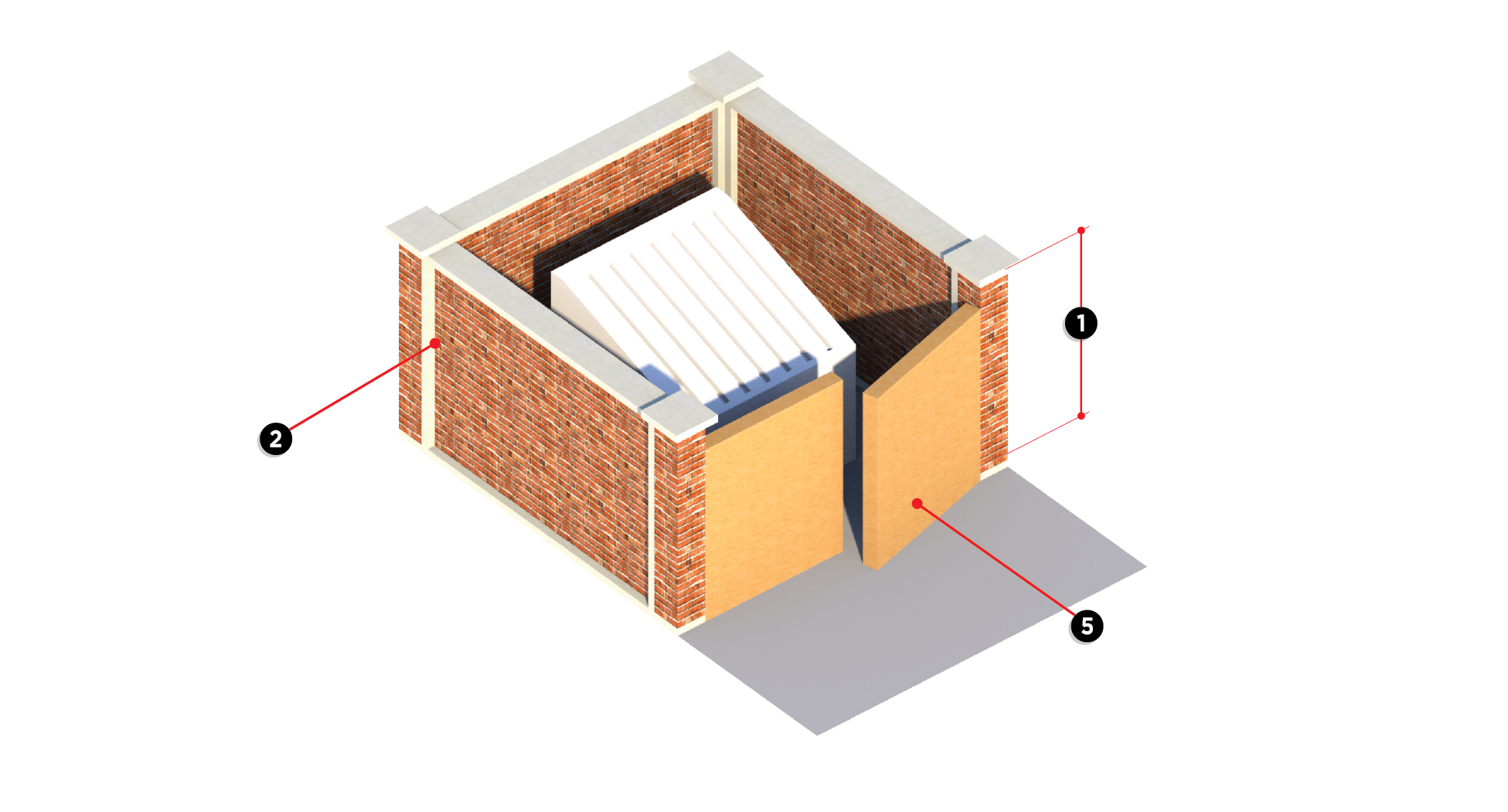
1. Trash and recycling receptacles shall be screened on three sides with a solid, opaque material with a minimum height of six feet and a maximum height of eight feet. The use of materials that are not solid, such as slats in chain-link, shall be prohibited.
2. Materials used for screening shall complement the architecture of the primary structure.
3. Materials and elevations for enclosures that are attached to buildings shall be designed to be integrated into the primary structure.
4. If enclosures are to be attached to buildings, they shall comply with applicable fire and building codes.
5. Enclosure openings shall be gated with an opaque material and shall not be directly visible from a public right-of-way and/or adjoining residential areas.
6. Enclosure openings shall be kept closed at all times except for when the receptacle is being accessed by a service truck.
7. Property owners shall be responsible for ensuring that trash and recycling receptacles be placed in the enclosure at all times other than when they are being emptied by a service truck.
8. Access drives shall be constructed of material and thickness to accommodate truck loading. Year-round access to the enclosure area for service trucks shall be maintained by the property owner or tenant.
9. Enclosures shall be of an adequate size to accommodate expected containers. It is recommended that the enclosure be designed to be expandable to accommodate future additional containers.
10. Enclosure structures shall be designed to protect the walls from damage by containers. Such protection may be provided by the use of barrier curbing, reinforced masonry walls, or other similar means.
11. Trash and recycling receptacle enclosures shall not occupy areas used for required parking spaces.
Figure 5.13: Trash and Recycling Receptacle Screening
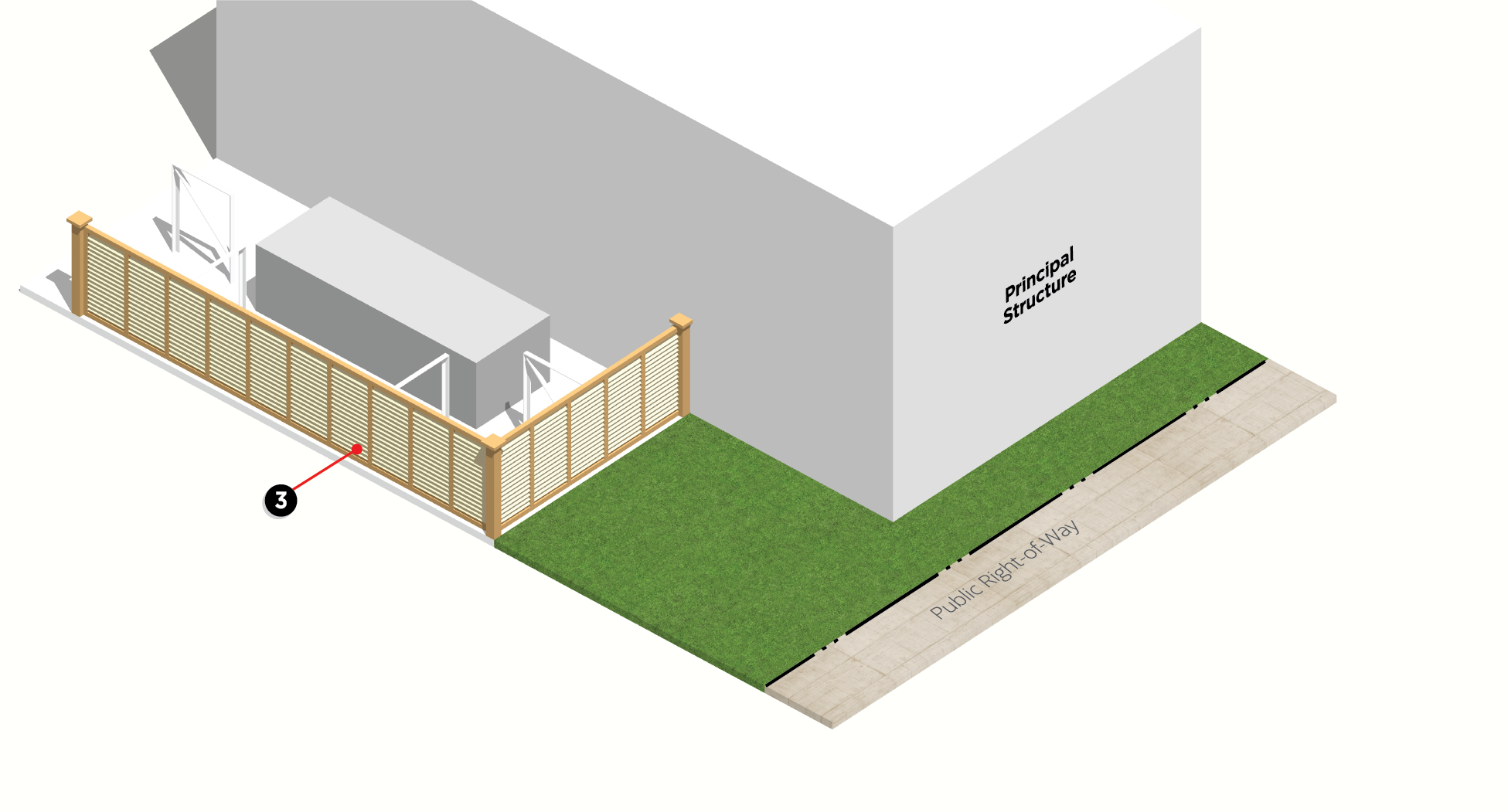
B. Ground Mounted Mechanical Units. The following regulations shall apply to all ground-mounted mechanical units, including but not limited to generators, air-conditioning condensers, heat pumps, ventilation units, computer cooling equipment, etc., and any related utility structures and equipment.
1. Locating mechanical units within the principal structure is strongly encouraged in order to minimize exterior visual impacts. Ground mounted mechanical units are prohibited within the front yard, regardless of whether screening is provided.
2. Ground mounted mechanical units that are visible from any public right-of-way or adjacent residential property shall be screened from public view.
3. Materials used for screening shall be designed and established so that the area or element being screened is no more than twenty (20) percent visible through the screen.
4. Chain-link fence or slats in chain-link fence shall not be used to meet this requirement.
Figure 5.14: Ground Mounted Mechanical Units Screening
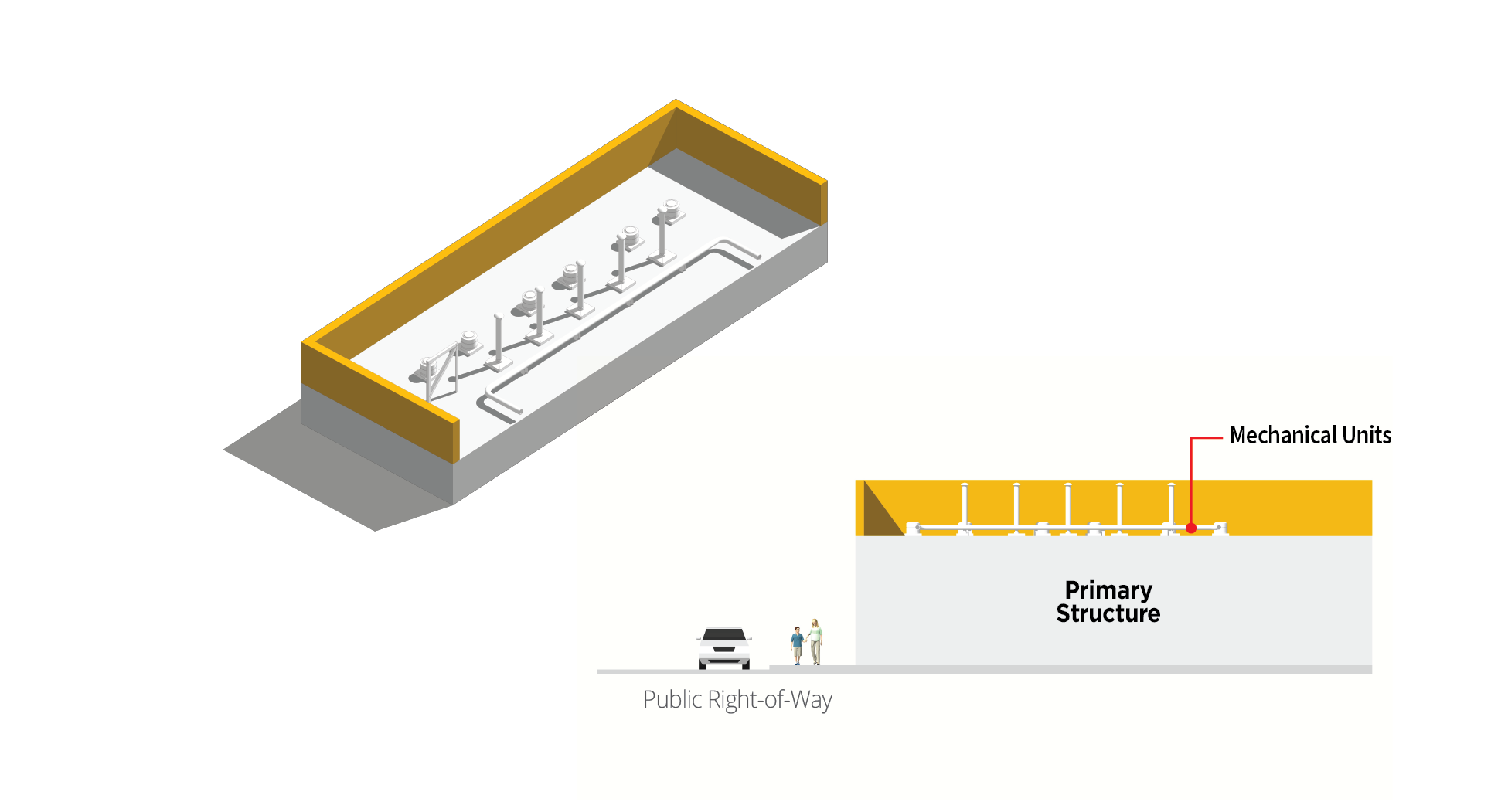
C. Roof Mounted Mechanical Units. The following regulations shall apply to all roof mounted mechanical units, including but not limited to air-conditioning condensers, heat pumps, ventilation units, computer cooling equipment, etc., and any related utility structures and equipment which service multiunit residential, non-residential, or mixed-use developments.
1. Locating mechanical units within the principal structure is strongly encouraged in order to minimize exterior visual impacts.
2. Roof mounted mechanical units that are visible from any public right-of-way or adjacent residential property shall be completely screened from public view.
3. Materials used for screening shall be architecturally integrated with the building in the form of a parapet wall and shall be continuous, permanent, sound attenuating, and noncombustible.
4. Screening shall be required when new equipment is installed and shall be provided around both new and existing roof mounted mechanical units in order to provide visual continuity. Normal maintenance of roof mounted mechanical units shall not mandate the screening requirements.
5. Additional screening may be required due to topographic differences in the adjoining properties.
Figure 5.15: Roof Mounted Mechanical Unit Screening
(Ord. No. 21-8-316, § 2(Exh. A), 8-24-21)
17.05.050 - Fences.
A. Compliance Required. No fence shall be constructed, installed, or maintained in the village, unless the same meets with the following requirements.
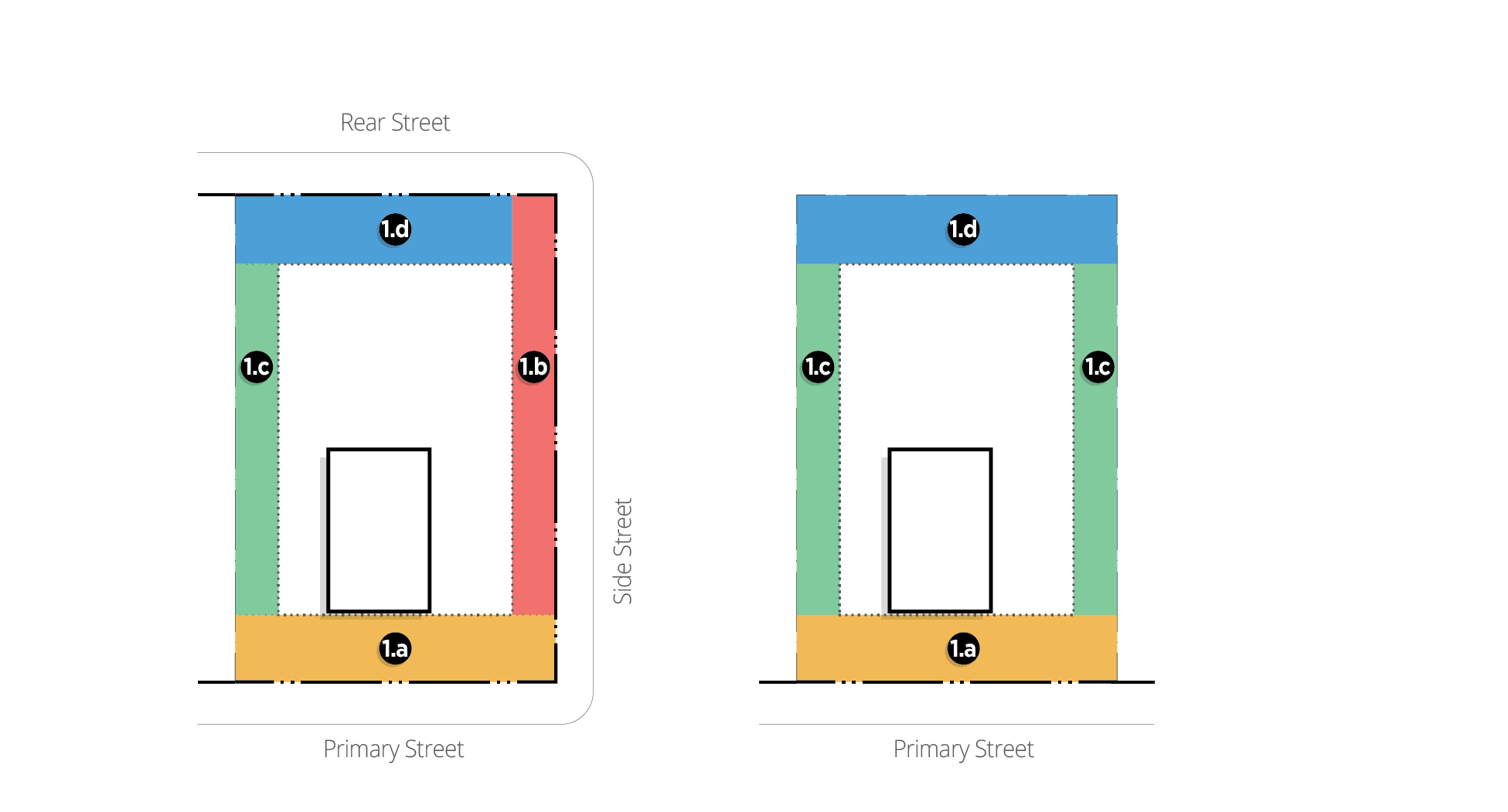
B. Height Restrictions. Fences shall not exceed the following heights:
1. Residential.
a. Front yard: four feet maximum height measured from ground level.
b. Corner side yard: Six feet maximum height measured from ground level if located a minimum of five-foot distance from the back of the curb and may not extend beyond the front elevation of the home.
c. Interior side yard: six feet maximum height measured from ground level.
d. Rear yard: six feet maximum height measured from ground level.
Figure 5.16: Residential Fence Restrictions by Yard
2. Business, Commercial and Industrial.
a. Front yard: fences not permitted in the front yard, except as otherwise required or permitted by this title.
b. Corner side yard: fences not permitted in the corner side yard, except as otherwise required or permitted by this title.
c. Interior side yard: eight feet maximum height measured from ground level.
d. Rear yard: eight feet maximum height measured from ground level.
Figure 5.17: Business, Commercial, and Industrial Fence Restrictions by Yard
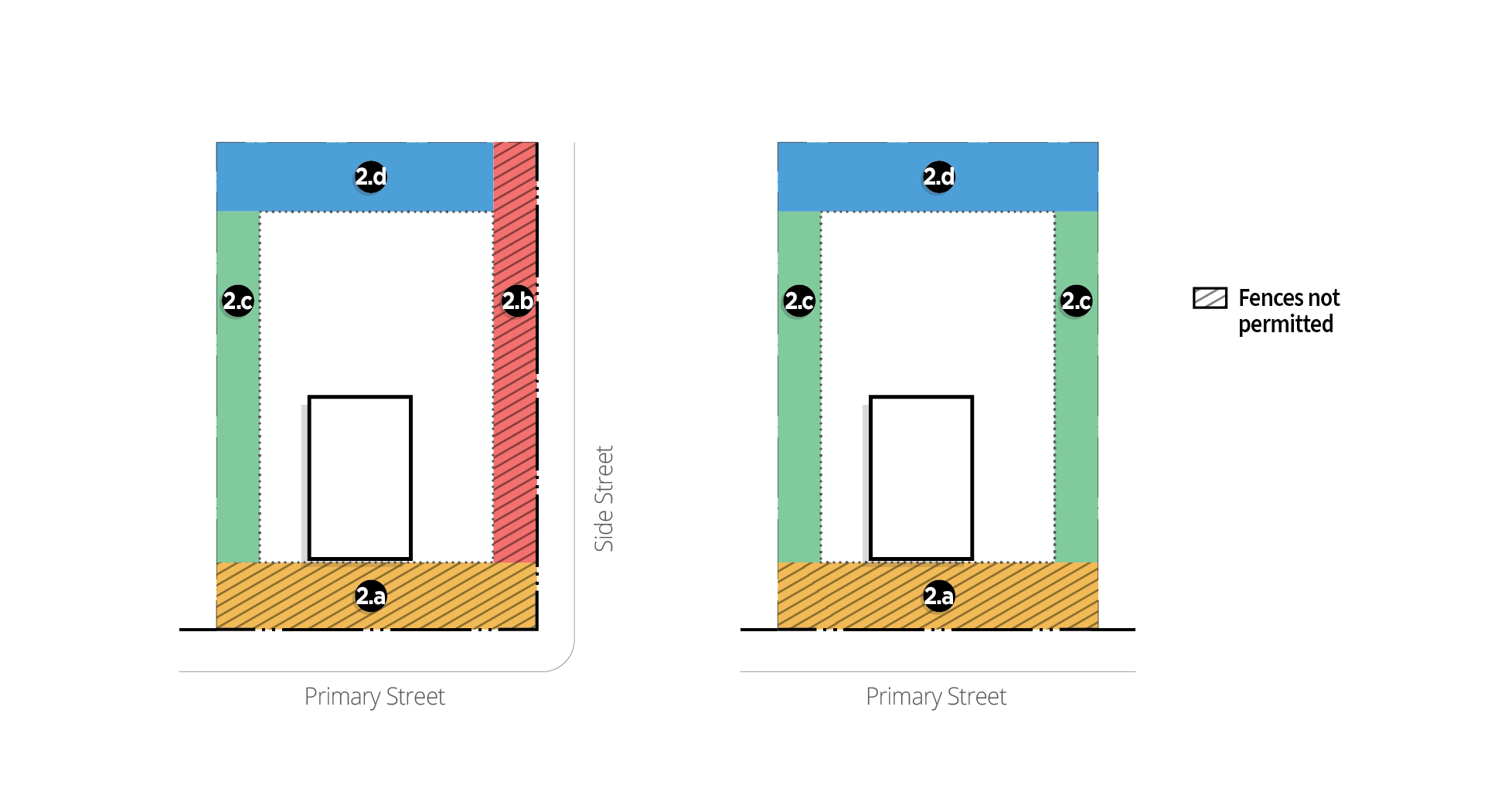
C. Location. No fence shall be constructed, installed, or maintained within two feet of any public sidewalk.
D. Materials and Installation.
1. Materials—Residential. Approved materials for fencing include wood, wood composites, stone, brick, wrought iron, aluminum, vinyl, PVC, or hedge row.
2. Materials—Business, Commercial and Industrial. Approved materials for fencing include wood, wood composites, stone, brick, wrought iron, aluminum, vinyl, PVC, or hedge row. Cyclone type or metal mesh may be utilized but shall not be visible from E Main Street, W Belvidere Road, or any residential property. Installation of Fences. Installation of fences shall be in compliance with the following:
a. Posts shall be installed with two inches of concrete surrounding them. The concrete shall be minimum mix of five bag, gravel mix.
b. Posts shall be spaced not more than eight feet centerline to centerline.
c. On cyclone fences, posts shall not extend higher than three inches over finished height; and on other fences, posts shall not extend higher than six inches over finished height.
d. Cyclone or metal mesh shall be installed so that the unfinished or protective edge of the wire is at the bottom or ground.
e. All fences shall be installed inside property lines.
f. Installation of fences will be allowed on utility easement property, but if necessary, will be removed at the owner's expense, and the utility company will not be held responsible for any damage.
g. The finish side of all fences shall face the exterior of the property on all sides.
h. All gates shall be installed with a proper catch and locking device.
E. Prohibitions.
1. No electric-type fences or any type of electrical devices installed to a fence will be allowed in the corporate limits of the village.
2. Any farm-type fences or portable-type fences shall not be used as permanent fences.
F. Dog Runs. The following requirements shall apply to dog runs:
1. Maximum height: six feet.
2. Cyclone-type fences or eleven (11) gauge wire.
3. Length and width shall be under the discretion of the building committee.
4. Dog runs must be installed, with the exception of corner lots, only at the rear of any properties, but no closer than fifteen (15) feet to a neighboring residence.
5. If dogs capable of jumping over the top of the fence are kept in a dog run, a top shall be installed on such dog run.
6. All dog runs must be maintained daily so as not to have an offensive odor.
7. Any dog left in a dog run over night, and causing a nuisance to the neighbors, will not be allowed.
8. Dog runs will not be allowed on utility easement property.
9. A permit is required for a dog run.
G. Hedges.
1. Hedges in a front yard or corner side yard of shall not be higher than four feet; when in rear and side yards, not higher than six feet.
2. Hedges must be maintained in an orderly manner so as not to allow an encroachment onto another person's property or public rights of way, and as not to obscure vision of traffic or cause a traffic hazard.
H. Barbed Wire Fences. It is unlawful to maintain or construct any fence composed in whole or part of barbed wire, or with any similar material designated to cause injury to any person, or any wire charged with electric current, anywhere within three feet of any public street, sidewalk, alley, park or other public way or place.
(Ord. No. 21-8-316, § 2(Exh. A), 8-24-21; Ord. No. 23-08-347, § 2, 8-22-23)
17.05.060 - Visibility standards.
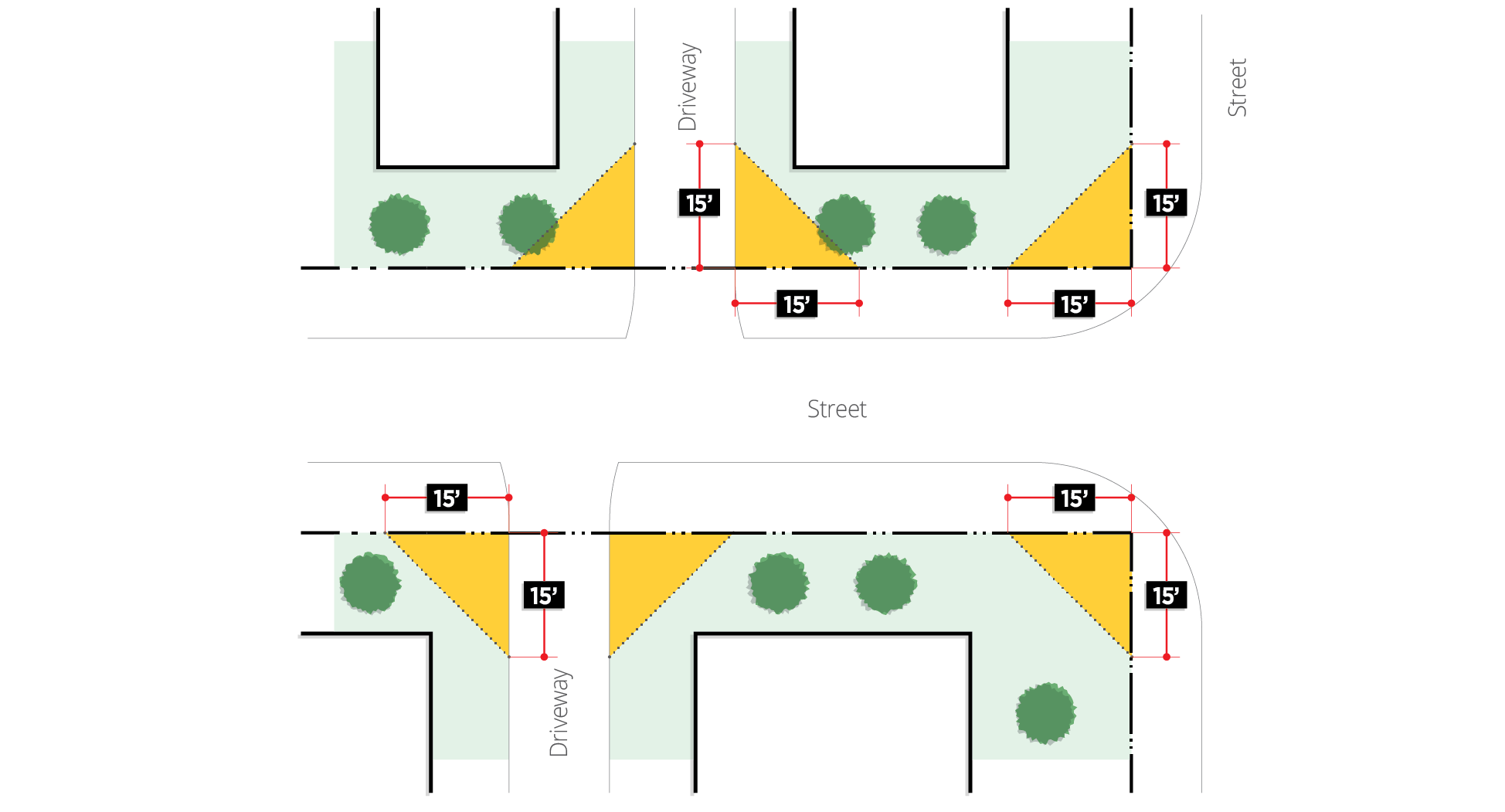
Clear sight distance shall be maintained at the intersection of a driveway and any right-of-way, and at the intersection of two or more streets. No building or structure shall be permitted that creates a visual obstruction taller than three feet in the area of the lot measured as a distance of fifteen (15) feet from the center of the intersection of the driveway and street, or from the center of the intersection of two or more streets.
Figure 5.18: Visibility Standards
(Ord. No. 21-8-316, § 2(Exh. A), 8-24-21)
17.05.070 - Performance standards.
A. Compliance. This title permits specific uses in specific districts; and these performance standards are designed to limit, restrict, and prohibit the effects of those uses outside their premises or district. All structures, land, air, and waters shall, hereafter, in addition to their use and site regulations, comply with the following performance standards.
B. Outdoor Lighting.
1. Shall be designed and installed with full cut-off fixtures to direct illumination onto the site and to prevent illumination from such fixtures on neighboring properties.
2. Shall have a color temperature less than or equal to five thousand (5,000) Kelvins.
3. Shall not be illuminated, as measured from the property line nearest the light source, in excess of 0.4 foot-candles above ambient lighting conditions on a cloudless night.
a. Foot candles shall be measured with a direct-reading, portable light meter. The meter shall read within an accuracy of plus or minus five percent. It shall have been tested, calibrated, and certified by an independent commercial photometric laboratory or the manufacturer within one year of the date of its use.
b. The meter sensor shall be mounted not more than six inches above ground level in a horizontal position at the property line. Readings shall be taken only after the cell has been exposed long enough to provide a constant reading. Measurements shall be made after dark with the light sources in question on, then with the same sources off. The difference between the two readings shall be compared to the maximum permitted illumination. This procedure eliminates the effects of moonlight and other ambient light.
C. Noise. The maximum permissible sound level of any continuous, regular, or frequent source of sound produced by an activity shall be 55 dBA in the R-1 and R-2 Districts, 60 dBA in the B-1 District, and 65 dBA in the ORD and AG Districts, as measured from the property line nearest the source of the sound.
D. Air Pollution. No person or activity shall emit any fly ash, dust, particulate matter, fumes, vapors, mists, or gases in such quantities that would constitute a nuisance to surrounding property owners. Dust and other types of pollution borne by the wind from such sources as storage areas, yards, and roads within lot boundaries shall be kept to a minimum by appropriate landscaping, paving, fencing, or other acceptable means.
E. Fire and Explosive Hazards. All activities involving the manufacturing, utilization, processing, or storage of flammable or explosive materials shall be provided with adequate safety devices against the hazard of fire and explosion and with adequate firefighting and fire-suppression equipment and devices that are standard in the industry and approved by the appropriate fire department building inspectors. All materials that range from active to intense burning shall be manufactured, utilized, processed, or stored only within completely enclosed buildings which have incombustible exterior walls and an automatic fire extinguishing systems. Storage of flammable and explosive material shall be in accordance with the requirements of Chapter NFPA 30 of the National Fire Protection Act and all applicable state requirements.
F. Glare and Heat. No activity shall emit glare or heat that is visible or measurable outside its premises except activities which may emit direct or sky reflected glare which shall not be visible outside their district. All operations producing intense glare or heat shall be conducted within a completely enclosed building. Exposed sources of light shall be shielded so as not to be visible outside their premises.
G. Water Quality Protection. No activity shall locate, store, discharge, or permit the discharge of any treated, untreated, or inadequately treated liquid, gaseous, or solid materials of such nature, quantity, obnoxiousness, toxicity, or temperature that might run off, seep, percolate, or wash into surface or subsurface waters so as to contaminate, pollute, or harm such waters or cause nuisances such as objectionable shore deposits, floating or submerged debris, oil or scum, color, odor, taste, or unsightliness or be harmful to human, animal, plant, or aquatic life. In addition, no activity shall withdraw water or discharge any liquid or solid materials so as to exceed, or contribute toward the exceeding of, the minimum standards set forth by the State of Illinois.
H. Radioactivity and Electrical Disturbances. No activity shall emit radioactivity or electrical disturbances outside its premises that affect the use of neighboring premises.
I. Vibration. No activity in any district shall emit vibrations, which are discernible by the administrator or a designee without instruments outside its premises.
(Ord. No. 21-8-316, § 2(Exh. A), 8-24-21)

