
Hainesville City Zoning Code
CHAPTER 17
08 - ADMINISTRATION AND ENFORCEMENT
17.08.010 - Administration.
A. Administrative Authority. The administration of this zoning code is vested in the following:
1. The zoning administrator;
2. The planning and zoning commission; and
3. The village board of trustees.
B. Zoning Administrator. The zoning administrator shall be that person charged by the mayor and board of trustees to enforce this zoning code and in addition to perform the following duties:
1. Issue all zoning certificates and occupancy certificates and make and maintain records thereof;
2. Direct inspections of buildings, structures and uses of land to determine compliance with the terms of this title;
3. Maintain permanent and current records of the zoning ordinance including but not limited to all maps, amendments, special uses, variations, appeals and applications therefor, and not conforming uses and records of all hearings on any of the aforementioned;
4. Receive file and forward for action all appeals and application for appeals, variations, amendments, and special uses;
5. Initiate, direct and review from time to time, a study of the provisions of this comprehensive amendment and submit a written report and recommendation to the planning and zoning commission or corporate authorities; and
6. Provide such clerical and technical assistance as may be required by the planning and zoning commission in the exercise of its duties.
C. Village Board of Trustees. The village board of trustees is the elected legislative authority of the village and has reserved unto itself the statutory duties of the planning and zoning commission and the final authority on variations, special uses, and amendments to be exercised pursuant to its legislative discretion.
(Ord. No. 21-8-316, § 2(Exh. A), 8-24-21)
17.08.020 - Administrative review and approval.
A. Administrative Authority.
1. The zoning administrator shall have the authority to receive applications and make determinations for the following administrative review procedures:
a. Administrative adjustment;
b. Occupancy certificate;
c. Sign permit;
2. Any applicant who receives a notice of denial as an outcome of an administrative review procedure may, within forty-five (45) days after the receipt of notice of such decision, appeal such decision to the village board of trustees in accordance with Section 17.08.030.F.
B. Administrative Adjustment.
1. Applicability. The zoning administrator, upon written request, shall have the authority to allow:
a. Up to a ten (10) percent reduction in the required side or rear yard setback.
b. Up to a five percent reduction in the required front or corner side yard setback.
c. An increase of the maximum lot coverage by not more than five percent.
d. An increase of the maximum height by not more than five percent.
2. Application. An application for an administrative adjustment shall include a brief description of the requirement to be adjusted and any other information necessary to ensure the review criteria are met.
3. Review Criteria. To approve an application for an administrative adjustment, the zoning administrator shall make an affirmative finding that the following review criteria are met:
a. That granting the administrative adjustment will ensure the same general level of land use compatibility as the otherwise applicable standards.
b. That granting the administrative adjustment will not materially and adversely affect adjacent land uses and the physical character of uses in the immediate vicinity of the proposed development because of inadequate buffering, screening, setbacks, and other land use considerations.
c. That granting the administrative adjustment will be generally consistent with the purposes and intent of this title.
d. That the administrative adjustment granted is the minimum amount necessary for the application and is not more than maximum adjustment allowed by administrative adjustment.
4. Review and Action. The zoning administrator shall review the application and approve, approve with conditions, or deny the application based on the review criteria. A written decision including the findings on the review criteria shall be rendered to the applicant.
C. Occupancy Certificates.
1. Applicability. No land shall be occupied or used and no building or structure that has been erected, altered or enlarged shall be occupied or used in whole or in part for any purpose until an occupancy certificate has been issued by the zoning administrator. No change of use shall be made in any building, structure, land improvement, or part thereof unless an occupancy certificate has been issued by the zoning administrator.
2. Application. An application for an occupancy certificate shall be submitted on the form established by the zoning administrator and shall be accompanied by a fee, as established by the board of trustees.
3. Review Criteria. An occupancy certificate shall be issued only after the zoning administrator has inspected the land, building or structure and finds:
a. It to be in compliance with all applicable regulations of the village, including, but not limited to, this title and the village building code; and
b. That the use is a permanent use or a special use in the zoning district where such land, building or structure is located. If the use is a special use, a special use permit shall have properly been granted prior to issuance of an occupancy permit.
4. Review and Action. The zoning administrator shall review the application and grant, grant with conditions, or deny the granting of the certificate based on the review criteria. A written decision including the findings on the review criteria shall be rendered to the applicant.
5. Temporary Occupancy Certificate. The zoning administrator may issue one temporary occupancy certificate for a period of six months with one extension of not more than three months if it is for the occupancy of a portion of land, building, or structure that has been completed and conforms with Section 17.08.020.C.3. and the remaining portion of the land, building or structure or improvement is in the process of completion.
D. Sign Permit.
1. Applicability. A sign permit shall be required prior to the display, construction, erection, or alteration of a sign, and its structural components, on any property. All signs must comply with Chapter 17.06, and the applicable sections of the building code as adopted by the village. All electrical installations associated with the erection and installation of a sign must be done in accordance with the adopted building and electrical codes.
2. Exemptions. A sign permit shall be required for all sign types with the exception of allowed temporary signs in residential districts.
3. Application. An application for a sign permit shall be submitted on either the permanent sign permit form established by the zoning administrator and shall be accompanied by a fee, as established by the board of trustees.
4. Review and Action. The zoning administrator shall review applications for permanent and temporary sign permits in accordance with all applicable regulations. The zoning administrator shall render an approval, approval with conditions, or denial of the application, with reasons included in writing to the applicant. An approval shall only be rendered when the zoning administrator is satisfied that the proposed sign complies with all applicable provisions of this title. The zoning administrator may grant approval with conditions only to the extent that such conditions specify the actions necessary to bring the application into compliance with this title.
(Ord. No. 21-8-316, § 2(Exh. A), 8-24-21)
17.08.030 - Petition review and approval.
A. Administrative Authority.
1. The zoning administrator shall have the authority to receive applications for the following petition requests to the village boards or commissions:
a. Variations;
b. Special use permits;
c. Amendments;
d. Appeals.
2. Reimbursement of Fees Agreement. A reimbursement of fees agreement shall be filed with the zoning administrator at the time of application submission acknowledging that the applicant is responsible for all costs for consultants and/or attorneys as may be necessary for the proper review and preparation of the report and/or opinion.
B. Notice Requirements for Petition Review and Approval.
1. All costs associated with mailed, published, and posted notice, as required by this title, shall be the responsibility of the applicant.
2. No public hearing shall be held before the board of trustees on any application for petition review and approval unless notice of the time and place of the hearing is published at least once not more than thirty (30) nor less than fifteen (15) days before the beginning of the hearing in one or more newspapers published within the village or if no newspaper is published within the village, then in one or more newspapers with a general circulation within the village which is published in Lake County.
3. Each application for petition review and approval shall be required to notify all taxpayers/property owners within two hundred fifty (250) feet of the development be notified of said development by certified, return receipt mail.
4. The zoning administrator shall cause notice of the public hearing to be published as required herein. The applicant shall mail notice to the property owners on the required list at least ten (10) days prior to the public hearing by certified or registered mail, return receipt requested.
5. A sign shall be placed on the property at least one week before the hearing stating "This Property Is Subject to A Zoning Hearing. For Information Call (847) 223-2032."
C. Variations.
1. Applicability. The board of trustees, after a hearing, may determine and vary the regulations of this title in harmony with their general purpose and intent in specific cases where there are practical difficulties or particular hardships in the way of carrying out the strict letter of the regulations of this title.
2. Use Variations Prohibited. No variation shall be granted authorizing the use of land, buildings, or structures which is not a permitted use or a special use in the district in which the land, building, or structures are located.
3. Application. An application for a variation shall be submitted on the form established by the zoning administrator and shall be accompanied by a fee, as established by the board of trustees.
4. Review Criteria. In determining whether there are practical difficulties or particular hardships in the way of carrying out the strict letter of the regulations of this title, the board of trustees acting as the planning and zoning commission shall make an affirmative finding that all of the following conditions exist:
a. That the particular physical surroundings, shape, or topographical conditions of the specific property involved would bring a particular hardship upon the owner as distinguished from a mere inconvenience if the strict letter of the regulation were to be carried out;
b. That the conditions upon which the petition for variation is based would not be applicable generally to other property within the same zoning district;
c. That the variation is not solely and exclusively for the purpose of enhancing the value of the property;
d. That the alleged difficulty or hardship has not been created by any person presently having an interest in the property;
e. That the granting of the variation will not be detrimental to the public welfare or injurious to other property or improvements in the neighborhood in which the property is located; and
f. That the proposed variation will not impair an adequate supply of light and air to adjacent property or substantially increase the danger of fire or otherwise endanger the public safety or substantially diminish or impair property values within the neighborhood.
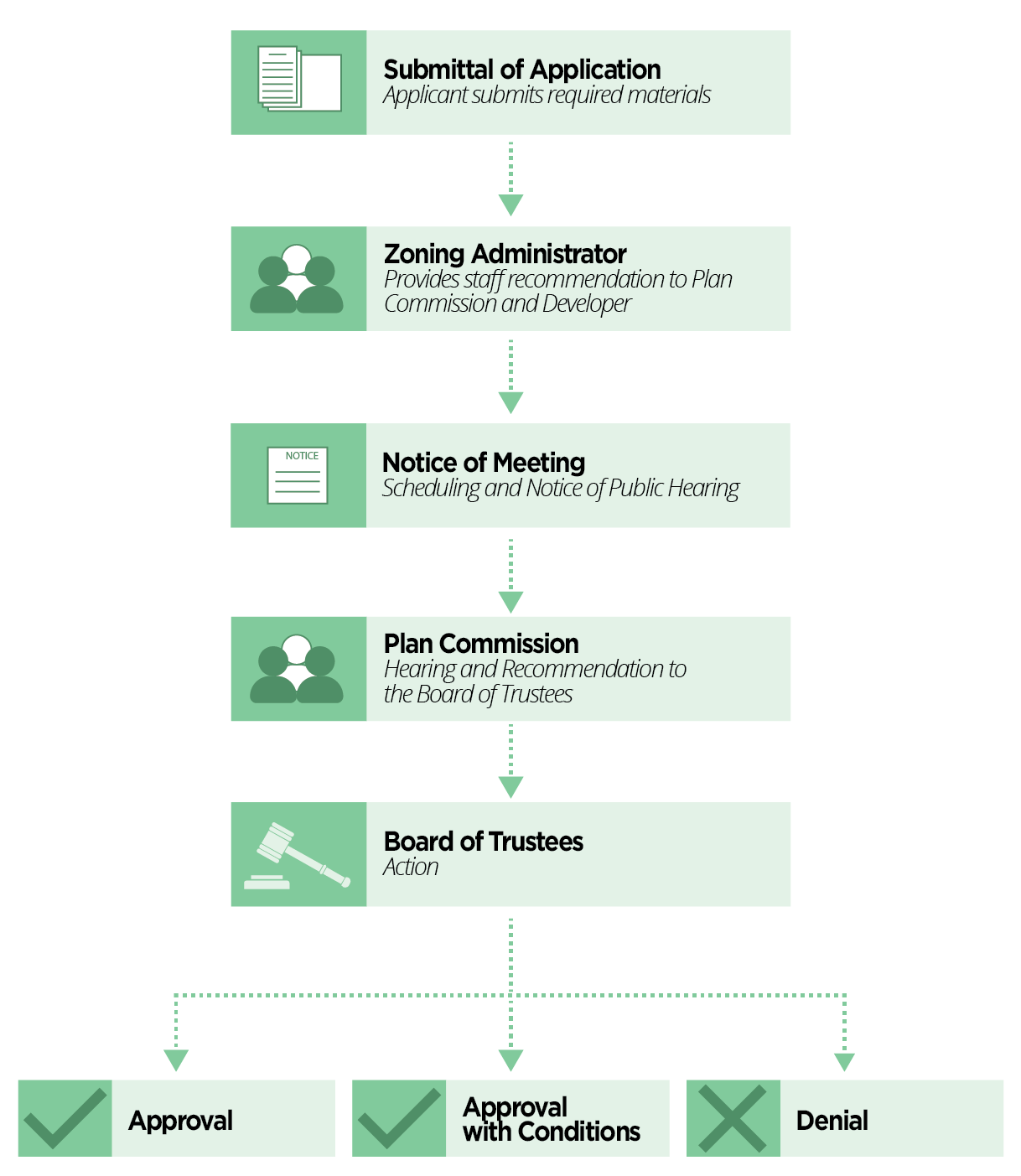
5. Hearing and Recommendation by the Planning and Zoning Commission. The zoning administrator shall forward the application to the board of trustees who shall act as the planning and zoning commission to conduct a public hearing. After the public hearing, the board of trustees, acting as the planning and zoning commission, shall make a determination on each of the review criteria and submit its findings of fact in the form of a written report. A negative finding of fact on any of the six review criteria shall require a denial of the application as a whole. The board of trustees acting as the planning and zoning commission may recommend certain conditions and restrictions.
6. Action by the Board of Trustees. Within thirty (30) days after the public hearing, the board of trustees, acting as the planning and zoning commission shall submit its findings of fact and recommendation in the form of a written report. Within sixty (60) days of receipt of the findings of fact and recommendations, the board of trustees, without further public hearing, may approve, approve with conditions, or deny an application for a variation in accordance with the Illinois statutes.
a. Approval shall be done by ordinance. Every ordinance granting a variation shall contain a statement of findings specifying the manner by which all review criteria have been met.
b. The board of trustees may impose such conditions and restrictions upon the property benefited by a variation as they deem necessary to assure compliance with other regulations of this title or to reduce or minimize the effect of the variation upon other property in the neighborhood or to implement the general purpose and intent of this title.
Figure 8.1: Variations
D. Special Use Permit.
1. Applicability. Certain uses, because of their unique character, cannot be properly classified in any particular district or districts without consideration in each case of the impact of those uses upon neighboring lands and upon the public need for the particular use at the particular location. Such uses fall into two categories:
a. Uses operated by a public agency or publicly regulated utilities or uses traditionally affected with a public interest; and
b. Uses entirely private in character but of such a nature that the operation may give rise to unique problems with respect to their impact upon neighboring property or public facilities.
2. Application. An application for a special use permit shall be submitted on the form established by the zoning administrator and shall be accompanied by a fee, as established by the board of trustees.
3. Review Criteria. In deciding whether or not to recommend granting the special use permit the board of trustees shall take into consideration the extent to which the proposed use:
a. Will be harmonious with and in accordance with the general objectives of the comprehensive plan and this title;
b. Will be designed, constructed, operated, and maintained so as to be harmonious and appropriate in appearance with the existing or intended character of the general vicinity;
c. Will not change the essential character of the general vicinity;
d. Will not be hazardous or disturbing to existing or future neighborhood uses; and
e. Will not cause substantial injury to the value of other property in the neighborhood in which it is located.
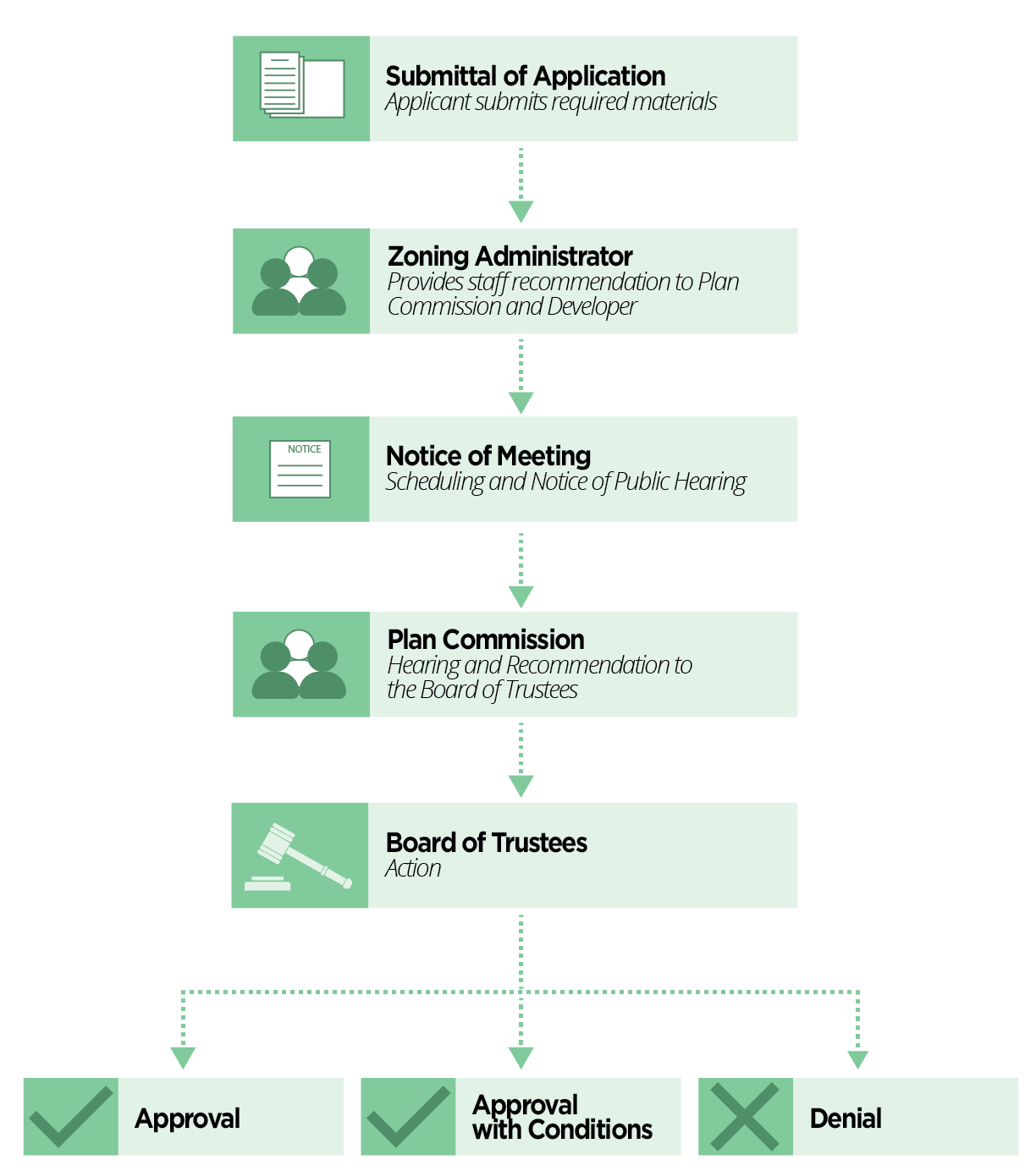
4. Hearing and Recommendation by the Planning and Zoning Commission. The zoning administrator shall forward the application to the board of trustees who shall act as the planning and zoning commission to conduct a public hearing. After the public hearing, the board of trustees, acting as the planning and zoning commission, shall make a determination on each of the review criteria and submit its findings of fact in the form of a written report. A negative finding of fact on any of the five review criteria shall require a denial of the application as a whole. The board of trustees acting as the planning and zoning commission may recommend certain conditions and restrictions, upon the property benefited by the special use permit as is deemed necessary to assure compliance with the provisions of this title, to reduce or minimize the effect of such special use upon other property in the neighborhood, or to implement the general purpose and intent of this title. Such conditions or restrictions may include variations from the bulk requirements of this title.
5. Action by the Board of Trustees. Within thirty (30) days after the public hearing, the board of trustees, acting as the planning and zoning commission shall submit its findings of fact and recommendation in the form of a written report. Within sixty (60) days of receipt of the findings of fact and recommendations, the board of trustees, without further public hearing, may approve, approve with conditions, or deny an application for a special use permit in accordance with the Illinois statutes.
6. Special Use Permits for Group Homes. Review and action on a special use permit for a group home need not take into consideration all of the review criteria established in subsection 3. Such review and action shall be based principally on whether the structure and facilities sought to be used for a group home are physically adequate for the number of proposed residents and their particular disability(ies) and whether the structure or facility meets subsection 3.b. of this section.
Figure 8.2: Special Use Permit
E. Amendments.
1. Applicability. The regulations imposed and the districts created under this title may be amended from time to time by ordinance in accordance with applicable Illinois Statutes.
2. Application. An application for a special use permit shall be submitted on the form established by the zoning administrator and shall be accompanied by a fee, as established by the board of trustees.
3. Review Criteria. In deciding whether or not to approve an amendment request, the board of trustees shall consider the following criteria.
a. The proposed amendment is consistent with the purpose and intent of this title.
b. The proposed amendment is consistent with the village's comprehensive plan and other adopted plans and policies.
c. The proposed amendment will not adversely impact the public health, safety, or welfare.
d. The proposed amendment is necessary because of changed or changing social values, new planning concepts, or other social, technological, or economic conditions in the areas affected.
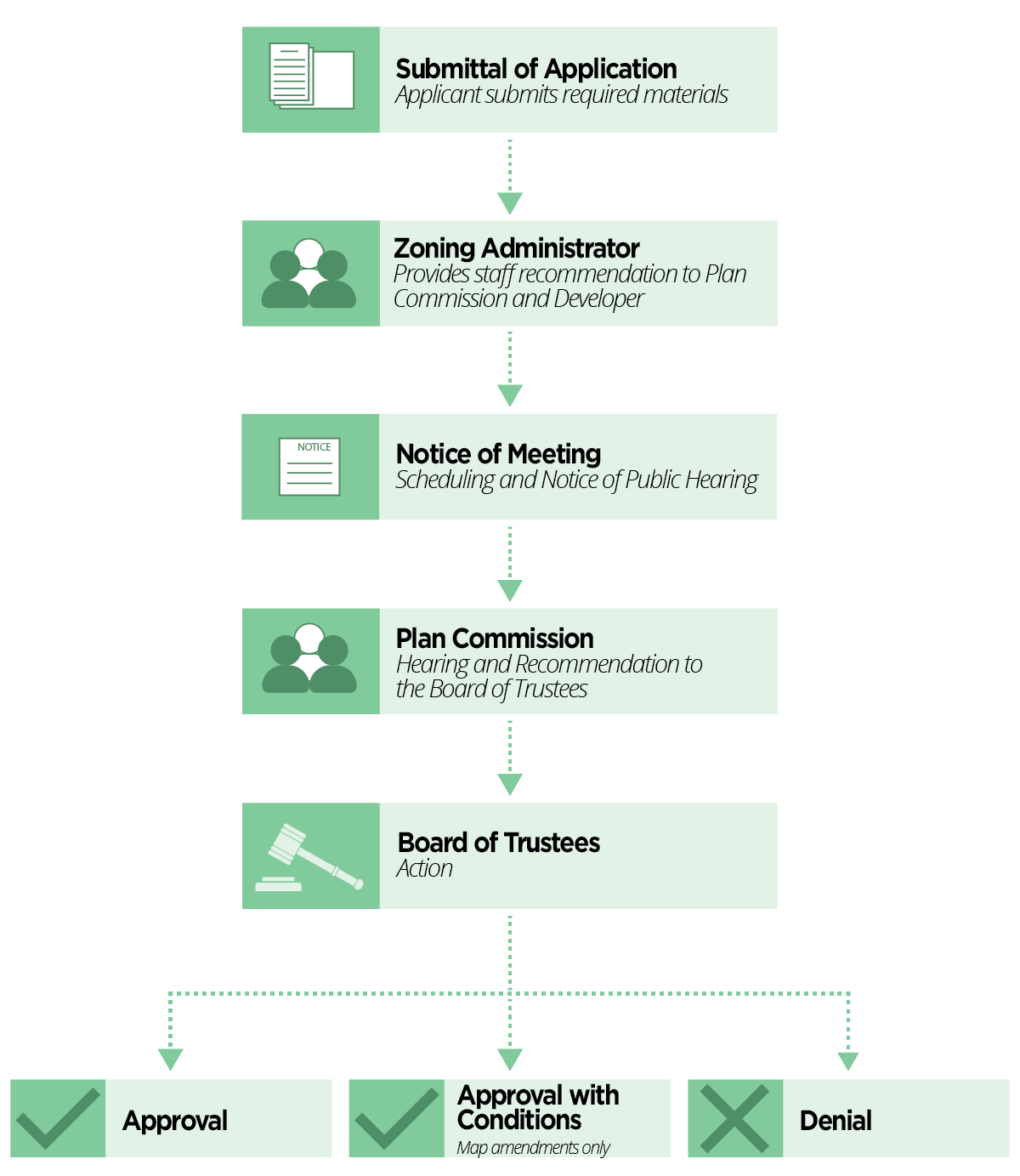
4. Hearing and Recommendation by the Planning and Zoning Commission. The zoning administrator shall forward the application to the board of trustees who shall act as the planning and zoning commission to conduct a public hearing. After the public hearing, the board of trustees, acting as the planning and zoning commission, shall make a determination on each of the review criteria and submit its findings of fact in the form of a written report. A negative finding of fact on any of the four review criteria shall require a denial of the application as a whole. The board of trustees acting as the planning and zoning commission may recommend certain conditions and restrictions upon the property benefited by a map amendment as they deem necessary to assure compliance with other provisions of this title or to reduce or minimize the effect of such map amendment upon other property in the neighborhood or to implement the general purpose and intent of this title. Such conditions or restrictions may include approval of a special site plan including variations from the bulk requirements of this title.
5. Action by the Board of Trustees. Within thirty (30) days after the public hearing, the board of trustees, acting as the planning and zoning commission shall submit its findings of fact and recommendation in the form of a written report. Within sixty (60) days of receipt of the findings of fact and recommendations, the board of trustees, by ordinance, without further public hearing, may approve, approve with conditions in the case of map amendments, or deny any proposed amendment.
6. Protest. In the event a written protest against any proposed amendment of the regulations or districts, signed and acknowledged by the owners of twenty (20) percent of the frontage proposed to be altered or by the owners of twenty (20) percent of the frontage immediately adjoining or across an alley therefrom or by the owners of twenty (20) percent of the frontage directly opposite the frontage proposed to be altered, is filed with the clerk of the village, the amendment shall not be passed except by a favorable vote of two-thirds of the trustees then holding office. In such cases, a copy of the written protest shall be served by the protestor or protestors on the applicant for the proposed amendment and a copy upon the applicant's attorney, if any, by certified mail at the address of such applicant and attorney shown in the application for the proposed amendment.
Figure 8.3: Amendments
F. Appeals.
1. Applicability. An appeal from a final order, requirement, decision, or determination to issue, not to issue, revoke, rescind, or extend a permit or certificate requiring compliance with the provisions of this zoning code may be taken to the board of trustees by any person aggrieved by any officer or department of the village.
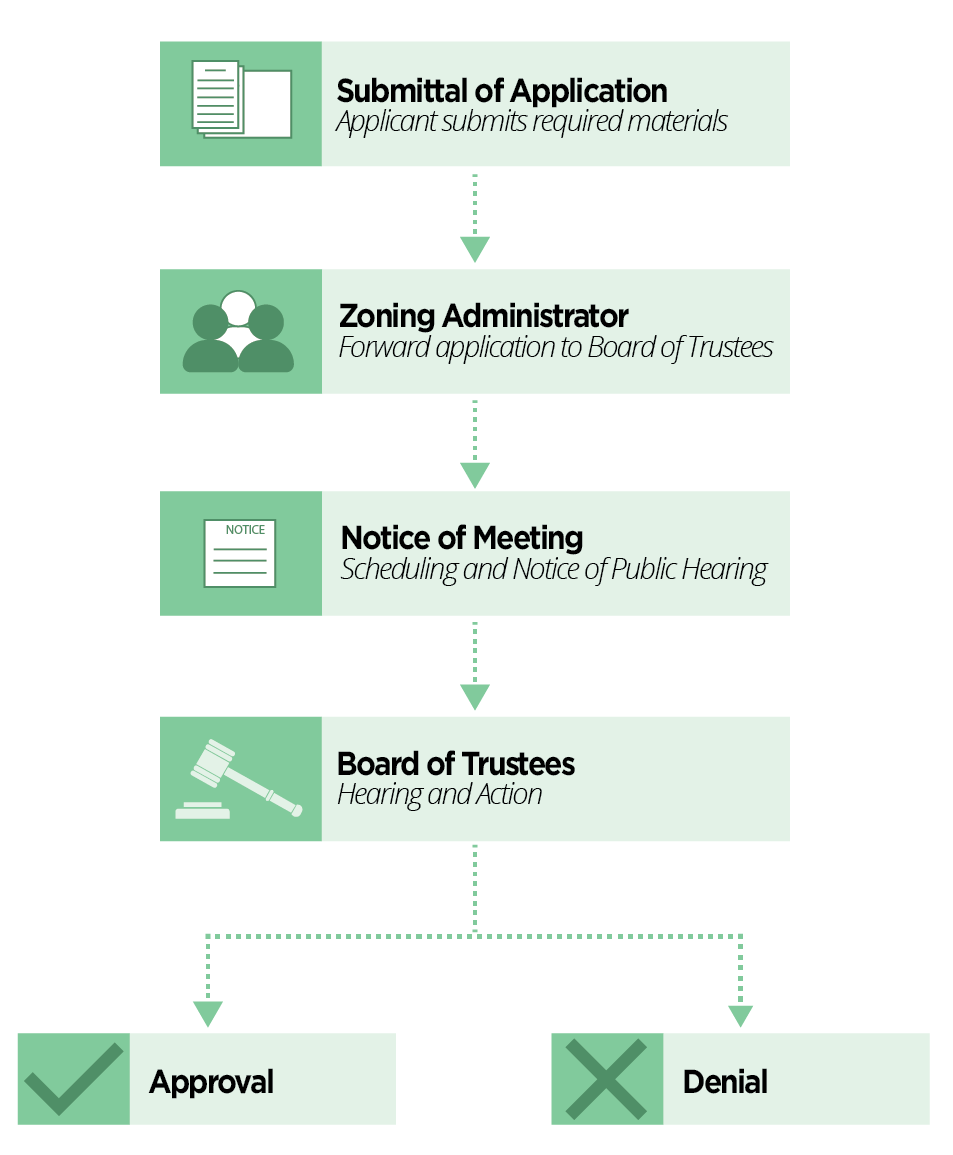
2. Application. An application for an appeal shall be filed with the zoning administrator within forty-five (45) days of the decision complained of. Such application shall be submitted on the form established by the zoning administrator and shall be accompanied by a fee, as established by the board of trustees. The zoning administrator shall transmit all papers constituting the record of his or her the decision to the board of trustees.
3. Actions Stayed. An appeal shall stay all proceedings in furtherance of the action appealed from unless the zoning administrator certifies to the board of trustees after notice of the appeal has been filed with the zoning administrator, that by reason of a fact stated in the zoning administrator's statement, to deny a stay would, in the zoning administrator's opinion, cause imminent peril to life or property, in which case the proceedings shall not be stayed unless determined otherwise by the board of trustees or as ordered by a court of competent jurisdiction for due cause shown.
4. Hearing and Action by the Board of Trustees. The zoning administrator shall forward the application to the board of trustees to conduct a public hearing. After the public hearing, the board of trustees, may affirm or may reverse wholly or in part or modify the order, requirement, decision, or determination and to that end shall have all the powers of the officer from whom the appeal was taken. The decision of the board of trustees shall be a final administrative decision based upon the evidence presented at the hearing of the appeal. Judicial review of the decision of the board of trustees on appeals shall be in accordance with the Administrative Review Act in the Illinois Compiled Statutes.
Figure 8.4: Appeals
G. Effective Period of Variations and Special Use Permits. No variation or special use shall be valid for a period longer than one hundred eighty (180) days from the date it was granted unless a building permit or certificate of occupancy is obtained, or the use is legally commenced, within such period. The board of trustees may grant one extension of this period, valid for no more than one hundred eighty (180) additional days, upon written application and good cause shown, without notice or hearing so long as the application is submitted prior to the expiration of the original one hundred eighty (180) days.
(Ord. No. 21-8-316, § 2(Exh. A), 8-24-21)
17.08.040 - Violations and penalties.
A. Violation and Penalty. Any person violating the terms and conditions of this title shall be subject to a penalty established by the board of trustees with each and every day that a violation of this title is allowed to remain in effect being deemed a complete and separate offense. In addition, the appropriate authorities of the village may take such other action as they deem proper to enforce the terms and conditions of this title including, without limitation, an action in equity to compel compliance with its terms. In addition, any person who refuses a request by the zoning administrator to abate a perceived violation of a performance standard set forth in this title will be subject, in addition to the foregoing penalties, to pay the costs of any professional testing required to prove a violation of the standard.
(Ord. No. 21-8-316, § 2(Exh. A), 8-24-21)

