
Hanahan City Zoning Code
7
TREE PROTECTION
7.1. - Intent.
Pursuant to authority conferred by the South Carolina Code of Laws, to promote the public health, safety and general welfare; to reduce noise, heat and glare; to reduce air pollution; to prevent soil erosion; to improve surface drainage and minimize flooding; to prevent excessive and unsightly clearing of wooded tracts of land and to promote tree conservation and preservation; to ensure that noise, glare and other distractions of movement on one (1) area not adversely affect activity within other adjacent areas; to beautify and enhance improved and undeveloped land; to provide a protective physical and psychological barrier between pedestrians and traffic; to create special places that are inviting; to create a civic identity; to counteract the heat stand effect; to encourage energy and water conservation; to protect the wildlife habitat and sensitive ecosystems; to enhance real estate and economic values; to ensure that excessive tree cutting does not reduce property values; to minimize the cost of construction and maintenance of drainage systems necessitated by the increased flow and diversion of surface waters; to encourage the proliferation and replacement of trees on public and private property; and to allow trees to attain their natural shape and size while growing to maturity, the city council does hereby ordain and enact into law this tree protection chapter. The provisions herein shall not be interpreted to prohibit or unduly inhibit development of private property.
7.2. - Business licensing.
It shall be unlawful for any person who is being paid a fee for the business of planting, cutting, trimming, pruning, removing, or otherwise modifying trees within the City of Hanahan to conduct such business without first signing an affidavit stating that he/she has received and read the Tree Protection Ordinance and 1995 ANSI A300 Standards. Such affidavit shall be completed and submitted when making application for or renewing a City of Hanahan business license.
7.3. - Protected Trees.
(A)
The following trees shall be considered "protected" by the City of Hanahan for the purposes of this ordinance:
(1)
Trees planted or retained to meet the requirements of the Hanahan Zoning and Land Development Ordinances.
(2)
All species of trees that are eight (8) inches or more in diameter at breast height (DBH).
(3)
All trees declared to be "landmark" trees per Section 7.4 below.
(B)
On a lot of a single-family detached, single-family attached, or individually sited manufactured home, the following trees shall be exempt from the tree mitigation requirements of this ordinance. A tree removal permit is required to remove exempt trees:
(1)
All trees in the proposed buildable area or driveway, excluding "landmark" trees.
(2)
Up to twenty-five (25) percent of "protected" trees, excluding landmark trees, outside of the proposed buildable area or driveway.
(3)
Pines (Pinus), sweet gums (Liquidambar styraciflua), wax myrtles (Myrica cerifera), water oak (Quercus nigra), Bradford pear (Pyrus calleryana), and crepe myrtles (Lagerstroemia indica).
(4)
Dead trees or trees badly damaged by accident, storm, fire, or infestation.
(C)
On a lot of multi-family residential and nonresidential uses, the following trees shall be exempt from tree mitigation requirements of this ordinance. A tree removal permit is required to remove exempt trees. In no instance shall there be fewer than twenty (20) trees per acre or less than twenty (20) trees per acre with a combined DBH greater than or equal to one hundred sixty (160) inches per acre retained.
(1)
All trees in the proposed buildable area, driveway, or other required site improvements, excluding "landmark" trees and those protected trees located within required setback or buffer areas whichever is greater, not to exceed sixty-five (65) percent of the entire site.
(2)
Pines (Pinus), sweet gums (Liquidambar styraciflua), wax myrtles (Myrica cerifera), water oak (Quercus nigra), Bradford pear (Pyrus calleryana), and crepe myrtles (Lagerstroemia indica).
(3)
Dead trees or trees badly damaged by accident, storm, fire, or infestation.
(Ord. No. 7-2012, § 1, 1-8-2013; Ord. No. 2-2022, § 1, 8-9-2022; Ord. No. 3-2023, § 1(Exh. A), 4-18-2023)
7.4. - Landmark trees.
(A)
The city hereby declares the following trees greater than or equal to the stated diameter at breast height to be "landmark trees" with the preservation standards provided above those for "protected trees."
(B)
All trees not listed above, but greater than thirty-six (36) inches in diameter at breast height and protected under Section 7.3 above, shall be considered "landmark" trees for the purposes of this ordinance.
7.5. - Preservation of protected and landmark trees.
(A)
It shall be unlawful to cut or otherwise destroy a protected tree or landmark tree without first obtaining a tree removal permit or, for property development, a zoning permit.
(B)
Unless specifically authorized by the zoning administrator, no person shall intentionally damage, cut, carve, transplant, or remove any protected or landmark tree; attach any signs with rope, wire, nails, or other contrivance to any protected or landmark tree; allow any substance which is harmful to such trees to come in contact with them or be placed within their drip line over pervious areas; or intentionally set fire or allow any fire to burn when such fire or the heat thereof will injure any portion of any protected tree or landmark tree.
(C)
The developer shall ensure, to the extent practical, that site and land developments are planned, designed, and constructed to maximize retention of existing trees. Protected trees and especially landmark trees shall be located in common areas and in required buffers and yards to the extent practical.
7.6. - Tree survey required for development.
7.6.1. General provisions.
(A)
The developer shall document protected and landmark trees on the property proposed for development. Two (2) survey methods are provided herein. The developer of property ten (10) acres or more in area shall have the option to utilize "standard" or "sampling" survey method for protected trees. Landmark trees shall always be surveyed using the standard method.
(B)
A required tree survey shall appear on all preliminary land development plans, site development plans, and any engineering and building site plans showing the installation and construction of improvements and structures.
(C)
Tree surveying shall not be required on tracts reserved for later phases or future development, on residual tracts of land, or in wetlands proposed to remain undisturbed.
7.6.2. Standard tree survey.
(A)
All protected and landmark trees shall be surveyed and graphically indicated on the appropriate development plan. The graphic indications shall be labeled by species and diameter at breast height.
(B)
Critical root zones and drip lines of protected and landmark trees should be surveyed and illustrated as well. In the absence of specific root zones and drip lines, the plan shall illustrate a graphical representation of the drip line, which shall be a circle centered at the trunk of the tree equal in feet to the diameter at breast height in inches. (e.g., a twenty-four-foot-diameter drip line shall encircle a tree labeled "twenty-four-inch live oak".)
(C)
The survey shall indicate those portions of critical root zones and drip lines of trees on abutting properties that overlap the subject property, to the extent that such drip lines and critical root zones can be determined from the vantage point of the property to be developed. This provision shall not authorize the trespass on other private property abutting the subject site.
(D)
The development plan shall graphically indicate which trees are proposed to be removed, retained, and retained with pruning.
7.6.3. Tree sampling survey.
(A)
The intent of the tree sampling survey of protected trees is to relieve the developer of the burden of a complete tree survey for all protected trees, which may be numerous, but to encourage the preservation of clusters of protected trees of greater value in a specific portion or section of a tract or in a natural state. Typically, those trees with greater value on a given site are mature, bottomland, and hardwood, while immature upland pines are of little value to the City of Hanahan. The planning commission will consider an immature upland pine forest a suitable site for development.
(B)
The tree sampling survey of protected trees shall supplement the standard survey of landmark trees. The sampling survey shall indicate the type of groundcover present on each acre of property required to be surveyed. Sampling shall therefore occur once per acre, evenly distributed throughout the property. Groundcover types to be documented on the appropriate development plan include, but are not limited to "cleared," "sandy area," "scrub/shrub," "bottomland hardwood forest," "upland hardwood forest," "bottomland mixed forest," "upland mixed forest," "bottomland pine forest," "upland pine forest," and "marshland."
(C)
Forests shall be surveyed for predominant species types, approximate average age, approximate average tree diameter at breast height, and frequency or density of trees. The sample shall consider all trees, from immature trees to landmark trees. These findings shall be documented per sample and indicated on the development plan.
(D)
Forested areas shall be indicated on the plan via hatching or other graphic method as whether they are proposed to be cleared or retained. The developer shall tabulate the approximate number of trees in proposed cleared forests, which shall be the basis for the tree removal mitigation strategy set forth in Section 7.7.
7.7. - Tree removal mitigation.
(A)
A developer shall propose a tree planting schedule to replace all protected and landmark trees cleared for property development as defined in Sections 7.3 and 7.4. Trees planted shall be proposed in landscaped buffers, common areas, road rights-of-way, and/or other portions of the developed site. To the extent practical, replacement trees shall be the same species and diversity as those removed, and shall be suitable for Botanical Zone 8B (as suggested in Appendix I). The number and size of mitigation trees shall be in accordance with the table below.
(B)
Existing trees, mitigation trees and/or planted buffer trees required in accord with Section 6.4 shall be applied towards the required minimum of twenty (20) trees per acre or less than twenty (20) trees with a combined DBH greater than or equal to one hundred sixty (160) inches per acre requirement.
(C)
If planting trees required for mitigation schedule or to meet the minimum in (B) above is not practical due to site constraints, the developer may opt to pay a fee in lieu of required trees, or, at the discretion of the zoning administrator, plant trees at an off-site location identified on the Community Tree Planting Plan adopted by city council. The amount of the fee shall be equivalent to the value of the required tree. The City of Hanahan Community Tree Planting Plan may provide alternate fees that secure adequate funds to plant required trees elsewhere in the city, as provided for in the plan.
(D)
All newly planted vegetative material shall be guaranteed to meet American Standards for Nursery Stock at time of planting and for one year thereafter. Maintenance and replacement of damaged, destroyed, or dead plant materials shall be the responsibility of the property owner, or in the case of mitigation trees planted off-site, the responsibility of the developer.
(Ord. No. 7-2012, § 1, 1-8-2013)
Editor's note— Appendix I has been set out at the end of this chapter.
7.8. - City of Hanahan Community Tree Planting Plan and Funding.
(A)
The Hanahan Planning Commission shall prepare and the Hanahan City Council shall adopt a community tree planting plan prior to the collection of any fees in lieu of required tree removal mitigation. At a minimum, the plan shall specify locations proposed for reforestation and aesthetic tree plantings, which may include public parks, schools and other community facilities and rights-of-way.
(B)
Fees in lieu of trees required in the mitigation plan, per Section 7.7, shall be recorded and maintained in a special account to be known as the City of Hanahan Tree Preservation Account. Monies maintained in this account may accrue interest at short-term rates prevailing in the market. All such funds and accrued interest shall be used, when appropriated by city council, only for the purpose of funding the installation and maintenance of trees within the City of Hanahan, according to the City of Hanahan Community Tree Planting Plan. Funds may be used to obtain trees, other landscaping associated with tree plantings, sprinklers and other items or materials necessary and proper for the preservation, maintenance, relocation, and restoration of tree ecosystems.
7.9. - Tree protection measures during development.
The developer shall take the following measures to protect retained trees during land disturbance, installation of improvements, construction, and other development activities.
(A)
Clear-cutting shall be prohibited. Clearing of a site for sale or development prior to application for preliminary land development plan approval or a zoning permit shall be prohibited.
(B)
Protected trees scheduled to remain shall be protected against:
(1)
Unnecessary cutting, breaking, or skinning of roots;
(2)
Skinning and bruising of bark;
(3)
Smothering of trees by stockpiling construction or excavation materials within drip line and critical root zone;
(4)
Burning of trash or debris within the drip line or critical root zone;
(5)
Excessive foot or vehicular traffic;
(6)
Parked vehicles within the drip line and critical root zone; and
(7)
Grading, filling, ditching, or trenching, except as specifically provided herein.
(C)
If trees are wounded or stressed during construction, any wounds to the bark should be cleaned to sound wood by removing loose bark and wood, leaving a smooth edge around the wound.
(D)
Topsoil disturbance in the critical root zone and drip line of each tree will be limited to six (6) inches removed or six (6) inches added. Any soil added shall be a loamy soil mix to ensure compaction is minimized.
(E)
The developer shall provide water and fertilizer to trees as required to maintain their health during construction work.
(F)
The developer shall designate one (1) corridor for construction access on the development plan, preferably where the driveway or parking area will be located, and shall limit construction equipment access, material storage, fuel tanks, chemical or cement rinsing, vehicle parking and construction office locations to non-forested areas to the greatest extent practical.
(G)
No more than thirty (30) percent of the area within the drip line and critical root zone of the tree shall be disturbed for access to the construction site, installation of improvements or other construction, except as specifically approved by the planning commission or the design control committee on a development plan under its purview.
(1)
The developer shall submit documentation from a professional landscape architect or arborist that any disturbance beyond thirty (30) percent can be mitigated and that the tree will survive and remain healthy despite the intrusion.
(2)
All segments of roots removed during development shall be severed clean and a two-inch layer of mulch shall be applied over the surface of remaining exposed roots during development.
(H)
The developer shall erect temporary barricades at the drip lines of all trees or groups of trees, except where approved development plans propose installation of improvements or other construction per subsection (G), above.
(1)
The barricade is to be at least three (3) feet high and shall be of adequate structure to prevent removal or failure by natural causes. Two-by-four lumber construction of barricades is recommended. Approval by the zoning administrator shall be required for alternate methods.
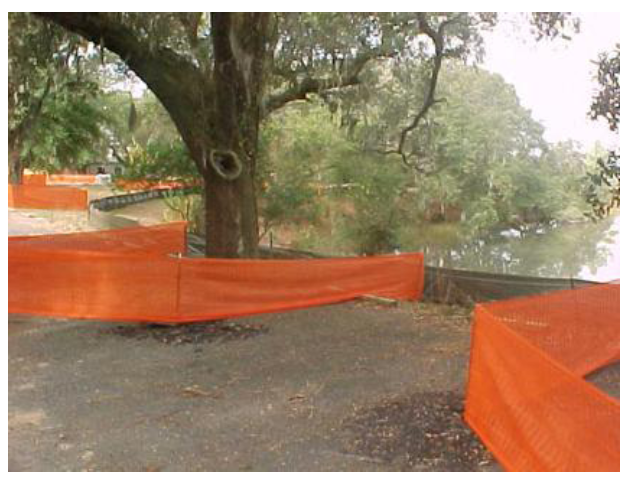
(2)
The barricade shall be posted as "tree protection zone" or similarly visibly designated. Orange fencing common to construction sites in the Lowcountry is recommended.
(3)
Nothing shall be stored within the barricades, including but not limited to construction material, machinery, chemical, or temporary soil deposits.
(I)
Any actions that cause the death or removal of trees during development for which approval was not received shall result in a violation of this ordinance AND shall necessitate mitigation for the loss of the tree, per Section 7.7.
7.10. - Issuance of tree removal permits.
7.10.1. General provisions.
A person who seeks to remove a tree outside the context of property development shall apply for a tree removal permit, which shall be required to authorize the removal of the tree. The permit shall be authorized only for the following trees or conditions.
(A)
Trees that may threaten health or property.
(B)
Diseased or infectious trees and trees in decline.
(C)
Trees or their root systems causing visible damage to structures or areas used for pedestrian and vehicular traffic.
(D)
Trees or their root systems causing damage to areas used for pedestrians, vehicular movement, or underground utility lines.
(E)
Trees within road and utility rights-of-way and easements that cannot be properly pruned by the local utility company.
(F)
Trees on land actively managed for forestry and/or harvesting.
7.10.2. Forest management.
(A)
Proper and routine forest management, including thinning and prescribed burns, is encouraged in Hanahan for those properties owned for the prospect of harvesting timber and/or for conservation. The forest manager shall comply with Section 7.2 of this ordinance and shall seek a tree removal permit.
(B)
The applicant in receipt of a tree removal permit for forest management shall not be eligible to apply for preliminary land development plan approval or a zoning permit within two (2) years of the authorization date of the tree removal permit.
7.10.3. Permit review.
(A)
The person seeking to remove a protected tree shall submit a completed application form available from the zoning administrator, together with the fee for review, to the zoning administrator no fewer than five (5) business days prior to removing the tree(s).
(1)
The completed application shall include the name of the applicant, the name of the property owner of the tree, if different from the applicant, the addresses of each, and the reason(s) for proposed removal of the tree. A professional certification may be used to substantiate the reason for removal, and may be submitted as part of the completed application.
(2)
One (1) permit covers all trees proposed for removal in the application.
(B)
The zoning administrator shall review the application and either approve or deny it within five (5) business days. The dated signature of the zoning administrator on the submitted application shall constitute the tree removal permit.
(1)
The zoning administrator shall be authorized by receipt of the application to visit the site as he deems necessary to inspect for compliance with this section of the Zoning Ordinance.
(2)
The zoning administrator shall state in writing the reason(s) for denial. A denied application shall be eligible for appeal to the Hanahan Board of Zoning Appeals, per Section 2.3.
(C)
The authorized permit shall be posted on the site at the road right-of-way during tree removal. The permit shall be valid for six (6) months after the date the zoning administrator signed the application.
(Ord. No. 7-2012, § 1, 1-8-2013)
7.11. - Tree pruning.
(A)
Maintenance pruning allows for the healthy uniform growth of a tree. Tree pruning promotes the health and natural growth of the tree. A tree's habit of growth must be considered ahead of time, and pruning must not interfere with any design intent or landscaping upon the tree's installation.
(B)
The use of unnatural pruning techniques will be considered an unauthorized removal of a tree unless the tree is designated on approved landscape plan to be shaped or formed in an unnatural pattern or to be maintained at a certain height. Examples of unnatural pruning are topping, stubbing, dehorning, or lopping.
(C)
In the situation where a protected tree or its limbs present a potential hazard to real property, minimal pruning shall be allowed in an effort to prevent negative impacts to public and private property and to provide for public safety. In the case of a hazardous tree, removal may be allowed, per Section 7.10.
(D)
No permit is necessary for pruning; however, improper pruning and pruning out of conformance with these provisions shall be a violation of this ordinance and shall necessitate mitigation of the tree's loss, per Section 7.7.
Appendix I. Suggested Mitigation Trees
(Ord. No. 7-2012, § 1, 1-8-2013; Ord. No. 2-2022, § 1, 8-9-2022)

