
Hanahan City Zoning Code
8
SIGNAGE
8.1. - Intent.
The purpose of this ordinance is to provide minimum standards to safeguard life, health, property, property values, and general public welfare and promote traffic safety by controlling the design, quality of materials, construction, illumination, size, location and maintenance of sign and sign structures. The City of Hanahan requires signs to have a quality design, to be pleasing in appearance, and to be appropriate in size, materials and illumination to the type of activity to which they pertain. Signs are to be designed and installed in a manner that complements both the building and the general streetscape. Unless located on a major highway, signs are to be designed to be pedestrian in scale. Signs are permitted on (a) workplace, storefront, civic, and live/work buildings, and (b) on attached residential building projects under common ownership with units for rent, and single-family residential developments.
8.2. - Sign review.
8.2.1. Zoning permit required for most signs.
A zoning permit is required for the erection, posting, reposting, placing, replacing or hanging of any sign except where specifically noted below. All signs in Design Control Districts for which a zoning permit is required shall be reviewed by the design control committee, per the requirements of Section 3 of this ordinance, for achievement of the design criteria and standards set forth in this ordinance before a permit for the sign will be issued. The zoning administrator must approve all other signs provided they comply with the requirements of this section before the issuance of a zoning permit. A permit shall not be required for routine maintenance and repair. Minor appearance changes limited to less than twenty (20) percent of the total sign area, including change in text, shall not require a zoning permit.
8.2.2. Sign documentation for zoning permit.
The zoning administrator may review signage for compliance with these standards during site development plan review, per Section 2.6, in which case the zoning permit issued for the development would cover the sign. The applicant shall submit ten (10) copies of a scaled illustration legibly depicting the size and content of the sign and its copy on bond or similar paper. The review process for sign erected independent of a site development for which a zoning permit is required shall nevertheless be that specified for the zoning permit, Section 2.6.
8.3. - Pedestrian-oriented signs.
The following regulations apply to signs proposed on property adjacent to all roads except intercity arterial highways with four (4) or more travel lanes, except where alternate standards for signs for certain purposes and land uses are specified.
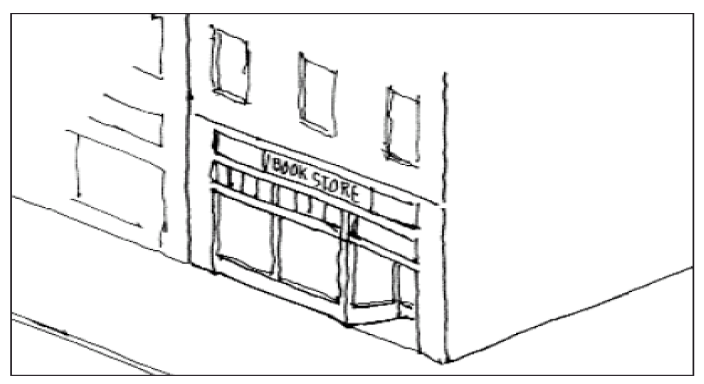
8.3.1. Wall signs.
Any sign directly attached to an exterior wall of a building or dependent upon a building for its support shall be considered a wall sign. Signs directly painted on wall shall be considered wall signs. Wall-mounted signs are subject to the standards below.
(A)
The size of the wall sign shall be no more than five (5) percent of the facade area on which the sign is located, or twenty-four (24) square feet, whichever is less.
(B)
The maximum wall sign area may be divided into two (2) separate signs on the same building facade as long as the total area of the two (2) signs does not exceed the maximum permitted.
(C)
Maximum height shall be eighteen (18) feet above finished grade on that facade.
(D)
Wall signs cannot be located on windows or doors. Standards for window signs appear elsewhere in this chapter.
(E)
Metal applied letter signs may substitute for wall signs. The sign size shall be calculated by drawing one (1) parallelogram around the text and images, adding a two-inch border on all sides, and calculating the area of the resulting box.
8.3.1.2 Murals.
Any sign directly attached or painted on to an exterior wall of a building shall be considered a mural. Nothing contained in this section shall circumscribe the display of artwork or a mural in interior locations. Murals are subject to the standards below.
(A)
Murals shall be permitted only in the following districts: Town Center (TC), Town Residential (TR), General Commercial (CG) and Industrial (ID).
(B)
Murals shall be a form or expression of art.
(C)
Murals shall not contain any obscene, explicit, or false or misleading content.
(D)
All murals are required to receive prior approval in writing from the Design Control Committee (DCC). As such, the following documentation will be required in order to considered.
a.
Written consent from the private property owner.
b.
At least two letters of support from the community is encouraged.
c.
A draft of the artwork, including the size, color and material specifications.
d.
A plan for who will be maintaining the mural as well as how long the mural will be displayed.
(E)
A combination of a wall sign and mural on one (1) wall is allowed. Wall signs will be reviewed on staff level according to Section 8.3.1, while murals will still be reviewed and approved by the DCC.
(F)
A person applying for approval of a mural may have an informal preapplication review to allow for a preliminary assessment of the project's compliance as well as suggestions for modifications.
(G)
In reviewing each submittal, the DCC should consider the government's interest in:
a.
Promotion of tourism;
b.
Economic growth;
c.
Aesthetic interests and compatibility with the building architecture surroundings;
d.
Preservation of property values;
e.
Historical preservation; and
f.
Maintaining harmony of design in Town Center (TC), Town Residential (TR), General Commercial (CG) and Industrial (ID) districts.
(H)
The board should consider the size and scale of the mural, the textures, materials and colors in relation to the government interests listed above.
(I)
The DCC may deny an application if the DCC determines that the mural would be detrimental to the government interests enumerated above. Any decision denying a mural submittal must be reduced to writing, with consideration given to at least one (1) of the above enumerated factors.
(Ord. No. 14-2020, 12-8-2020)
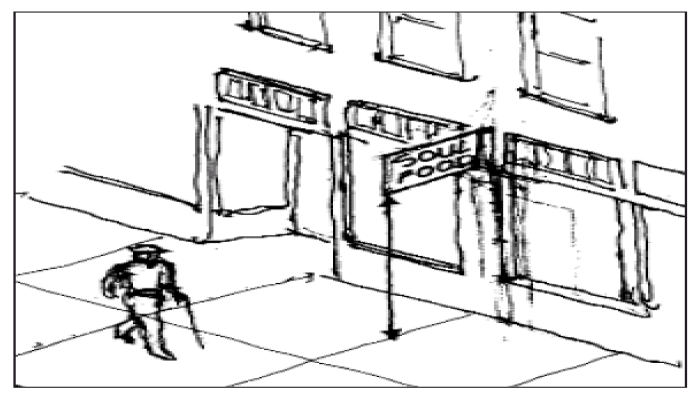
8.3.2. Projecting signs.
A sign affixed to a building and supported only by the wall on which it is mounted is a projecting sign. These signs shall be subject to the following regulations.
(A)
Maximum sign area is six (6) square feet per side.
(B)
Clearance from the lower edge of the signboard to the ground shall be seven (7) feet or greater.
(C)
Height of the top edge of the signboard shall not exceed the height of the wall from which it projects for single story buildings, or the height of the sill or bottom of any second story window for multi-storey buildings.
(D)
Distance from the building to the signboard shall not exceed two (2) feet.
(E)
Width of signboard shall not exceed three (3) feet.
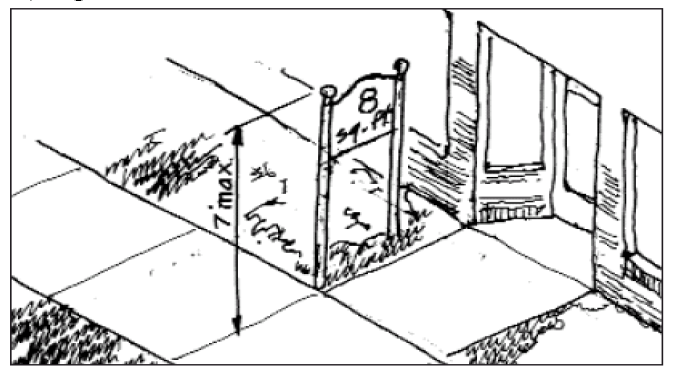
8.3.3. Freestanding (ground-mounted) signs.
A freestanding sign is that supported by a sign structure secured in the ground, wholly independent of any other support. Freestanding signs shall meet the following standards.
(A)
The building served by the freestanding sign shall be set back at least five (5) feet.
(B)
Maximum sign area is eight (8) square feet of copy area per side. If there are no other signs on the facade of the building for which the sign is erected, the copy area of the ground-mounted sign shall be a fifteen (15) square feet per side, maximum. The frame and/or structure of the sign shall not count toward maximum sign area, provided the structure is not more than one (1) foot thick.
(C)
Ground-mounted signs identifying institutions shall be a maximum of twenty (20) square feet of copy area per side. The frame and/or structure of the sign shall not count toward maximum sign area, provided the structure is not more than one (1) foot thick.
(D)
The height of the top of the signboard, or of any posts, brackets, or other supporting elements shall not exceed seven (7) feet.
(E)
In the case of a group of buildings or shops that act as a unit, one (1) freestanding sign may be erected to advertise all of the businesses.
(F)
No neon is allowed on freestanding signs.
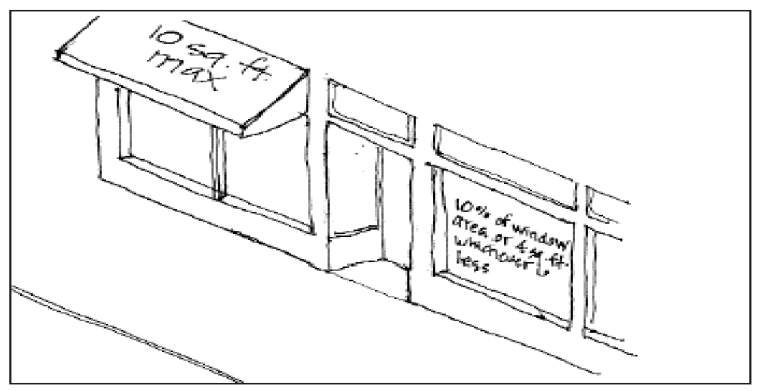
8.3.4. Awning signs.
An awning sign is made of flexible fabric or similar material covering a metal frame attached to a building over a window or door. The awning sign may be erected so that it can be raised to a position flat against the building when not in use. Awning signs shall meet the following standards.
(A)
Eight (8) square feet maximum signage area on an awning.
(B)
No backlit awnings shall be allowed.
(C)
No neon shall be allowed on awnings.
8.3.5. Window (and door) signs.
Any sign on a building, either exterior or interior, within two (2) feet of the window, which is intended to be viewed from the exterior of such building, shall be considered a window sign. On-site advisory signs, however, are not considered window signs for the purpose of this ordinance. Window signs shall meet the following standards.
(A)
Maximum size shall be ten (10) percent of the window or door area, or four (4) square feet, whichever is less.
(B)
The sign shall be silk-screened, hand-painted, vinyl, or etched onto the window. Alternatively, a neon sign hung inside the building in the window shall be allowed.
(C)
A window sign in a door shall be no more than two (2) square feet.
8.3.6. Sidewalk signs.
A sidewalk sign is an A-frame sign or easel sign, also known as a sandwich board, placed on the sidewalk in front of a business, sometimes posting a menu, or directing patrons to a business at the rear of a building. Sidewalk signs shall meet the following standards.
(A)
The sign location may be located in the right-of-way adjacent to the property served by the sign, but the sign shall not interfere with pedestrian or vehicular circulation or sightlines and shall leave at least four (4) feet of sidewalk clearance.
(B)
All sidewalk signs shall be located in front of a primary building, but may direct patrons to the rear of the building or to a neighboring building along an intersecting right-of-way.
(C)
The sign is constructed of durable materials.
(D)
The signboard does not exceed six (6) square feet per side and one (1) sign per building.
(E)
Letter height shall not exceed four (4) inches.
8.3.7 Changeable copy signs.
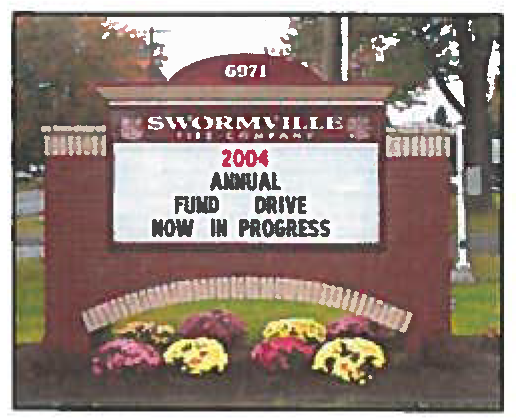
Any sign with a portion thereof constituting a readerboard with characters, letters, or illustrations that can be changed or rearranged by any means (manual, electronic, atmospheric, mechanical, remote, etc.) without altering the face or surface of the sign. Changeable copy signs, including time and temperature signs, shall meet the following standards to be permitted:
(A)
District limitations. Changeable copy signs shall not be allowed within any residential zoning district with the exception of changeable copy signs used in conjunction with an institutional use; e.g., schools, churches, or public uses.
(B)
Size. Maximum sign area is dictated by that for freestanding/ground mounted signs per subsection 8.3.3(B) and (C), unless the sign location falls under Section 8.4 for highway-oriented signs.
(C)
Integration. The changeable copy readerboard portion of the sign may comprise no more than fifty (50) percent of the total sign face area to which it is a part.
(D)
Illumination. If the message center portion of the sign is being utilized after sunset, the static portion of the sign must also be functioning, illuminated, and readable.
(E)
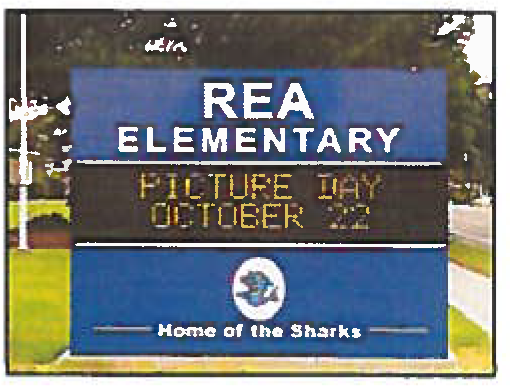
Electronic changeable copy signs:
(1)
District limitations. Electronic changeable copy signs shall be allowed for use by nonprofit and public agencies; e.g., schools, churches, or public uses.
(2)
Orientation. When located within one hundred fifty (150) feet of one (or more) residentially-used lot(s) in a residential zone, all parts of an electronic changeable copy sign shall be oriented so that no portion of the sign face is visible from existing or permitted principal structures on those lots;
(3)
Limited text. Changeable text of the sign shall be limited to a maximum of ten (10) words to allow passing motorists to read the entire copy with minimal distraction;
(4)
Duration. Any changeable portion of the message shall have a minimum duration of eight (8) seconds and shall be a static display.
(5)
Transitions. During transition from one sign face to another, messages may fade in, dissolve, or scroll or have limited animation provided they do not violate the prohibitions in Section 8.9.
(6)
Color. In residential districts, any portion of the changeable message shall use an amber color or a colored LED projection.
(7)
Brightness. Prior to issuance of a permit for an electronic changeable sign, the applicant shall provide a written certification from the sign manufacturer that the light intensity has been factory pre-set not to exceed a maximum illumination of five thousand (5,000) nits (candelas per square meter) during daylight hours, and five hundred (500) nits (candelas per square meter) between dusk to dawn as measured from the sign's face at maximum brightness in any district.
(8)
Dimmer control. The sign shall be equipped with an automatic dimmer control that will automatically dim the intensity of the light emitted by the sign during ambient low-light conditions and at night so the sign does not exceed the maximum brightness levels allowed in [subsection] (7) above.
(Ord. No. 1-2012, § 1, 3-13-2012; Ord. No. 14-2020, 12-8-2020)
8.3.8. Reserved.
8.3.9. Illuminated signs.
(A)
Signs may be illuminated by an external or internal source.
(B)
All illumination shall be provided by a steady stationary light source.
(C)
The intensity of light emitted to or from a sign shall not exceed two hundred twenty (220) lux at any point on the sign face.
(D)
Signs illuminated by an internal source must have permanent, nonilluminated framing.
(E)
The light source for any externally illuminated sign shall be shaded, shielded and directed such that the light intensity or brightness is not visible from adjacent properties or rights-of-way.
(F)
No exposed reflective type bulbs and no strobe/intermittent light or incandescent lamps shall be used to illuminate a sign.
(G)
Neither the direct, nor reflected, light from primary light sources - internal or external - shall create a traffic hazard to operators of motor vehicles on public thoroughfares.
(H)
The color of external light sources to illuminate signs shall be white.
(Ord. No. 1-2012, § 1, 3-13-2012)
8.4. - Highway-oriented signs.
The following regulations apply to signs proposed on property adjacent to intercity arterial highways with four (4) or more travel lanes, except where alternate standards for signs for certain purposes and land uses are specified.
8.4.1. On-premises commercial signs.
(A)
On-premises signs shall be permitted in all zones provided that the sign advertises the principal use of the lot.
(B)
Signs shall be located in such a way that they will maintain horizontal and vertical clearance of all overhead electrical conductors. No sign shall be installed closer than ten (10) feet horizontally or vertically from any conductor or public utility guy wire.
(C)
No sign shall be allowed to protrude into the front, side or rear setback. In the absence of required setbacks, no sign shall be located closer than ten (10) feet from the right-of-way or five (5) feet from the side property lines.
(D)
One (1) freestanding on-premises sign shall be allowed per parcel, unless the use is located within a complex, such as a business park or office complex, and shall not exceed three (3) square feet of copy area for each linear foot of road frontage (e.g., one hundred (100) feet of road frontage would justify a seventy-five-square-foot sign), or the maximum sign area permitted in a district, whichever is less.
(E)
Wall signs are allowed but shall not exceed more than thirty-five (35) percent of the wall area on which the sign is affixed.
(F)
The height of a freestanding on-premises sign shall not exceed twenty (20) feet from the surface elevation of the right-of-way, or surface grade beneath the sign, whichever is less.
(G)
The clearance of a freestanding on-premises sign shall comply with the table at right. Clearance shall be measured from finished grade beneath the sign and the surface elevation of the adjacent right-of-way to ensure adequate visual clearance for motorists.
(H)
Signs oriented parallel to the right-of-way shall be exempt from the requirement above and may be located at grade level.
(I)
No sign shall be erected at the intersections of streets, driveways, or alleys in such a manner as to obstruct clear vision.
(J)
On-premises signs may be illuminated by indirect or internal illumination.
(K)
In the event a business is located on a corner lot, two (2) on-premises freestanding signs shall be allowed per parcel. If the intersecting street is not an intercity arterial road with four (4) or more lanes, the second sign shall meet the requirements for pedestrian-oriented signs, Section 8.3.
(L)
No sign shall be placed within fifty (50) feet of conventional residential zoning district purposes unless the sign meets the requirements for pedestrian-oriented signs, per Section 8.3.
(M)
All pedestrian-oriented signs, per Section 8.3, shall be allowed on property adjacent to intercity arterial highways with four (4) or more travel lanes, except that sidewalk signs shall not be permitted in the right-of-way of the same intercity arterial highways.
(Ord. No. 14-2020, 12-8-2020)
8.4.2. Off-premises signs.
Any sign located, or proposed to be located, at any place other than within the same site or land development in which the specific business or activity being identified on the sign is itself located or conducted is an off-premises sign.
(A)
Off-premises signs shall be allowed only in the Industrial (ID) zoning district.
(B)
One (1) off-premise sign shall be allowed per lot.
(C)
Off-premises signs shall not be greater than twenty (20) feet in height above the surface elevation of the adjacent right-of-way of finished grade beneath the sign.
(D)
Off-premises signs shall not be greater than seventy-five (75) feet in copy area per side.
(E)
Off-premises signs shall be set back at least twenty (20) feet from the pavement edge of the nearest road surface.
(F)
Separation of off-premises signs greater than thirty-five (35) feet in sign area shall be at least one thousand (1,000) feet, measured along the nearest road, from any other off-premises sign.
(Ord. No. 14-2020, 12-8-2020)
8.5. - Signs for specific purposes and land uses.
Signs for the following specific purposes and land uses shall meet those standards provided herein, regardless of standards more broadly applied.
8.5.1. Neighborhood signs.
A sign that identifies a neighborhood, residential community, or other residential subdivision, name and logo shall not exceed twenty (20) square feet in area. Such signs shall be placed so as not to obstruct the view of traffic and shall be externally illuminated. The sign shall be set back a minimum of ten (10) feet from residential lot lines and road right-of-way.
8.5.2. Project construction signs.
Any sign erected and maintained on the premises temporarily during construction and displaying information, such as the name of the architect, contractor, developer, finance organization, subcontractor or materials vendor on property such individual is furnishing labor, services, or material shall meet these standards for project construction signs.
(A)
One (1) sign shall be allowed per land development or site development.
(B)
The sign shall not exceed thirty (32) square feet (one (1) side).
(C)
The sign is removed within fifteen (15) days of the completion of the project.
(D)
The sign location shall not interfere with pedestrian or vehicular circulation or sightlines.
8.5.3. Informational signs.
(A)
Building directory signs, identifying the occupants of a building, shall be wall-mounted, located next to the entrance, a maximum of three (3) square feet, and shall not project more than six (6) inches from the wall.
(B)
Service entrance signs shall not exceed two (2) square feet.
(C)
Parking directional signs may be either wall-mounted or freestanding and are limited to two (2) square feet.
8.6. - Maximum number of signs.
(A)
The following maximums shall apply for individual buildings. Standards for each sign type shall be found in Sections 8.3 and 8.4, above.
(1)
Three (3) total signs of the following types are allowed: wall, awning, freestanding, window, projecting. A sidewalk sign is allowed in addition.
(2)
One (1) additional sign is allowed per secondary entrance (located at the secondary entrance) of the following types: wall, awning, window.
(3)
One (1) service entrance sign is allowed.
(4)
One (1) parking directional sign per parking area is allowed.
(B)
The following maximums shall apply for multi-unit buildings, such as commercial strip malls. Standards for each sign type shall be found in Sections 8.3 and 8.4, above.
(1)
The following maximums apply to the entire property.
(a)
One (1) wall sign allowed on the primary facade.
(b)
One (1) building directory sign per entrance to the property.
(c)
One (1) service entrance sign.
(d)
One (1) parking directional sign per parking area.
(2)
The following maximums apply to each tenant space with a separate entrance.
(a)
Three (3) signs from the following list are allowed: wall, awning, window, projecting, sidewalk sign.
(b)
One (1) sign per unshared secondary entrance is allowed from the following types: wall, awning (on main face or valance), window.
(3)
The following maximums apply to each tenant space with a shared primary entrance.
(a)
One (1) sign is allowed from the following types: wall, awning, window.
(b)
One (1) sign per unshared secondary entrance from the following types: wall, awning, window.
(c)
One (1) sidewalk sign per entrance.
8.7. - Flags and banners.
(A)
Flags on residential property are exempt signs.
(B)
Street banners (those spanning roads) and flags in road rights-of-way shall be limited to noncommercial activities of local government, institutions (e.g., schools), and nonprofits and similar organizations.
(C)
A maximum of one (1) flag per corporation, institution, government, or other entity shall be allowed per building. Duplicate or identical flags shall not be allowed.
(D)
The pole from which said flags are flown shall not exceed the building height limit of the zoning district in which it is located.
8.8. - Exempt signs.
The following signs do not need a zoning permit and may be erected at the discretion of the landowner.
(A)
Signs erected for orderly traffic control and other municipal or governmental purposes will be permitted, including historical monuments, markers, and signs erected by a public authority.
(B)
Signs advertising agricultural products produced on the premises that do not exceed four (4) square feet in area. There shall be a limit of one (1) such sign along each street abutting the parcel. Such signs shall be taken down during the seasons the agricultural products are not being sold.
(C)
Temporary civic, cultural, and public service window posters.
(D)
Temporary promotional or special sales window signs no greater than six (6) feet in sign area, when posted inside commercial establishments, for not more than thirty (30) days.
(E)
Commercial copy signs on ball fields mounted on outfield fences, facing toward the infield.
(F)
Flags on residential property.
(G)
Political signs. Any sign erected for the purpose of advertising a candidate for public office, or stating a position on a public issue on which an election or referendum is pending with respect to a particular campaign, shall be exempt, provided the following standards are met.
(1)
It is unlawful to place, erect, or maintain any political sign so as to pose a visible hazard to pedestrian or vehicular traffic along streets, sidewalks, or at street corners.
(2)
No political signs are allowed to be illuminated or larger than sixteen (16) square feet.
(3)
Signs cannot be placed more than forty-five (45) days prior to official election date for the issue presented on the sign.
(4)
Signs must be removed no later than ten (10) days after the election.
(H)
Real estate signs. Any temporary sign pertaining to the sale, exchange, lease or rental of a building or real property, or other form of exchange shall be exempt, provided the following standards are met.
(1)
Real estate signs in residential zoning districts shall be not exceed eight (8) square feet. One (1) sign shall be allowed per road frontage.
(2)
Real estate signs in non-residential zoning districts shall appear as follows.
(a)
A sign not exceeding sixteen (16) square feet is allowed for the sale, lease, rental, or display of the property on which the sign is located.
(b)
Real estate signs in shopping and/or retail centers must be displayed within the tenant space window and/or in the tenant panel space of the freestanding sign.
(c)
Freestanding real estate signs shall be allowed on property adjacent to intercity arterial highways with four (4) or more travel lanes. Otherwise, the sign shall be posted on the building or in a window.
(d)
One (1) sign shall be allowed per road frontage.
(Ord. No. 3-2009, § 1, 5-12-2009; Ord. No. 13-2020, § 1, 10-6-2020)
8.9. - Prohibited signs
(A)
Signs that are dilapidated or in disrepair shall be prohibited.
(B)
Signs on roofs, chimneys and balconies shall be prohibited.
(C)
Signs programmed to flash, blink or fluctuate the intensity of lights or to operate intermittently so as to create a strobe effect shall be prohibited.
(D)
Mobile or portable signs shall be prohibited, except sidewalk signs.
(E)
Signs on parked vehicles shall be subject to the following standards.
(1)
Signs placed on, painted on, or affixed to vehicles and/or trailers that are parked on public right-of-way, public property so as to be visible from a public right-of-way, and where the apparent purpose is to advertise a product or business, or direct people to a business or activity located on the same or nearby property shall be prohibited except as temporary signage, meeting the requirements of Section 9.6.4.
(2)
This does not prohibit identification sign painted on or affixed to vehicles and trailers, such as small lettering on motor vehicles, where the sign is incidental to the primary use of the vehicle or trailer.
(F)
Any sign that emits a sound, odor, or visible matter such as smoke or vapor, including any form of pyrotechnics shall be prohibited.
(G)
Any sign or sign structure that obstructs the view of, or is operated in any way that could cause it to be confused with, a traffic/directional safety device or public safety vehicle shall be prohibited.
(H)
Any sign painted on or affixed to trees or other natural features, utility poles, or benches shall be prohibited.
(I)
Any sign exhibiting statements, words, or pictures that are of an obscene or pornographic nature shall be prohibited.
(Ord. No. 11-2011, § 1, 12-13-2011; Ord. No. 1-2012, § 1, 3-13-2012)

