
Henry County Unincorporated
City Zoning Code
City Zoning Code
APPENDICES
Appendix A. - Master list of acronyms and definitions.
Acronyms
BMP — Best management practices (BMP plan)
BTL — Build-to line
CLOMA — Conditional letter map of amendment
CLOMR — Conditional letter of map revision
CSD — Conservation subdivision development
DBH — Diameter at breast height
DCA — Department of community affairs
DHR — Department of human resources
DNR — Department of natural resources
FAA — Federal Aviation Administration
FCC — Federal Communications Commission
FEMA — Federal Emergency Management Agency
FHBM — Flood hazard boundary map
FIRM — Flood insurance rate map
FIS — Flood insurance study
GSMM — Georgia Stormwater Management Manual
HCWSA — Henry County Water and Sewer Authority
HPB — Historic preservation board
HVAC — Heating, ventilation, and air conditioning
ICWPA — Indian Creek Watershed Protection Area
LBCS — Land based classification standards
LBWPA — Long Branch Creek Watershed Protection Area
MNGWPD — Metropolitan North Georgia Water Planning District
NGVD — National Geodetic Vertical Datum
NWI — National Wetland Inventory
OCGA — Official Code of Georgia Annotated
PD — Planned development
RFN — Residential fly-in neighborhood
RNC — Rural neighborhood commercial
ROW — Right-of-way
RPZ — Runway protection zone
RV — Recreational vehicle
SCWPA — Shoal Creek Watershed Protection Area
TCWPA — Tussahaw Creek Watershed Protection Area
TND — Traditional neighborhood development
TRWPA — Towaliga River Watershed Protection Area
ULDC — Unified land development code
WCF — Wireless communication facility
WCWPA — Walnut Creek Watershed Protection Area
WPA — Watershed protection area
ZAB — Zoning advisory board
Definitions: For the purposes of this ULDC in addition to their common meanings certain words and terms used herein, unless the context otherwise requires, shall be defined and interpreted as follows. The use of the singular includes the plural and the plural the singular; the present tense includes the future; the use of "shall" means the action is mandatory, the use of "may" or "should" means the action is optional. Any masculine pronoun shall be deemed to refer to a person, whether male or female.
All terms not defined herein shall be defined as elsewhere in the Henry County Code. Terms not found in the Henry County Code shall be defined as in the Official Code of Georgia Annotated.
A
Abandoned cemetery means a cemetery which shows signs of neglect including, without limitation, the unchecked growth of vegetation, repeated and unchecked acts of vandalism, or the disintegration of grave markers or boundaries and for which no person can be found who is legally responsible and financially capable of the upkeep of such cemetery.
Accessory apartment (garage apartment). See accessory dwelling.
Accidental discharge means a discharge prohibited by this ordinance which occurs by chance and without planning or thought prior to occurrence.
Activity center means an area that includes office, retail, service, residential or civic uses that create a central focus for a larger area. An activity center also has generally recognizable boundaries.
Crossroads. A small node at a major intersection or crossroad in rural or estate residential community that provides local needs along with a sense of place. The crossroads activity center includes a nucleus comprised of one (1) or more of the following elements: a church, community center, cemetery or other civic/historic landmark, recreation center, restaurant, gas station, or small store with convenient commercial services used on a daily basis for local residents that frequently pass by. The design of the crossroads community center should take into consideration how it could be expanded as the population grows in the surrounding area. The node may be served by septic tanks.
School node. For many county residents, the local school and in particular the local school cluster where one (1) or more schools are co-located, serves as a major center and focus of activity. This type of center is designed to compliment this type of lifestyle. Being predominately residential in its composition, it will also include neighborhood oriented commercial areas as well as recreational areas ideally linked by a network of multiuse trails and sidewalks. The center should extend a reasonable walking or cycling distance from the schools or approximately a mile from the core.
Specialty use center. This type activity center is truly unique and unlike the other centers is usually dominated by one (1) major large-scale use. The best example in the county is the Atlanta International Motor Speedway. A specialty use center often has its own unique transportation needs, and in many ways serves a showcase for the community. Special attention should be given to preserving and enhancing the function of the focal point of this type of center.
Suburban employment center. An activity center located around one (1) or more of the county's interstate interchanges. The core of the center would be largely commercial and included a wide range of retail, commercial and service uses. This type of center would include such uses as office buildings, major commercial centers, large civic facilities, and a wide variety of housing types. Large-scale mixed-use developments are also appropriate here. The center should extend a half mile or more on one (1) or both sides of the interstate. Being located close to the interstate, the most prominent gateway to the county, the design of the center and the buildings within it should pay special attention to the viewshed from the interstate.
Village node. This type of center would have at its core a compact and well-organized commercial and civic core built along a formal gridded, interconnected street network. The center will include a full array of "life-cycle" housing choices and provide cultural and passive recreational opportunities. The village center will have its own unique identity, enforced by common design themes used for public facilities and spaces. The village center should also be relatively self-contained providing most of everyday services needed by village residents.
Accessory structure or facility means a structure which is on the same parcel of property as the principal structure and the use of which is incidental to the use of the primary structure.
Addition means any walled and roofed expansion to the perimeter or height of a building.
Addition to an existing building means any walled and roofed expansion to the perimeter of a building in which the addition is connected by a common load-bearing wall other than a fire wall. Any walled and roofed addition which is connected by a fire wall or is separated by an independent perimeter load-bearing wall shall be considered new construction.
Adjacent means an area located within the defined horizontal distance from the future-conditions floodplain boundary that are at, or lower, in elevation than either three (3) feet above the base flood elevation or one (1) foot above the future-conditions flood elevation, whichever is higher, unless the area is hydraulically independent (meaning absolutely no connection to the flooding source such as through pipes, sewer laterals, down drains, foundation drains, ground seepage, overland flow, gated or valved pipes, excavated and backfilled trenches, etc. with no fill or other manmade barriers creating the separation).
Administrative waiver means a grant of relief by the administrator from specified standards of the ULDC and where such a waiver will not be contrary to the public interest and where, owing to conditions peculiar to the property and not the result of the actions of the applicant, a literal enforcement of the chapter would result in unnecessary and undue hardship.
Administrator means the person, officer, official, or his authorized representative designated by the board of commissioners, Henry County, as its agent for the administration of the provisions of the ULDC.
Adult day care means a facility that provides support for elderly individuals (and their families, if present), who do not function fully independently, but who do not need twenty-four-hour nursing care.
Adult entertainment establishment means any establishment featuring live performances, films, still pictures, electronic reproductions, or video with graphic or other visual images distinguished or characterized by an emphasis on sexual conduct or sexual explicit nudity. Adult entertainment establishments include, but are not limited to, adult bookstores, adult dance establishments, adult motion picture arcades, adult movie theaters, and adult video stores.
Agriculture means cultivating the soil, producing crops and raising of livestock (farming, and associated activities) upon one (1) or more tracts of land containing not less than three (3) acres. Selling of products raised on the premises shall be considered a permissible activity; provided, that space for the off-county right-of-way parking is available to customers.
Aircraft means any vehicle used or designed for flight in the air.
Airport means any area of land or water designed and set aside for the landing and taking off of aircraft. The term may include facilities for refueling, repair, handling, and storage of aircraft or facilities for passengers and freight.
Amusement park (outdoor or indoor) means land designed to be used by the public for a fee that contains amusement facilities, such as merry-go-rounds, race car and bike tracks, outdoor motion picture theaters, paint ball courses, driving ranges, miniature golf courses, skateboard rinks, and similar uses for entertainment.
Animal sanctuary and rehabilitation facilities means a facility operated by a nonprofit or similar entity, established for the lifetime care, rehabilitation, or sheltering or domestic, wild, or exotic animals, where animals are not bred, sold, traded, or used for commercial entertainment purposes. Any animal sanctuary may provide education programming and limited public visitation as a secondary use, but the primary function is the long-term welfare and housing of animals. All sanctuaries must obtain and maintain applicable permits from the Georgia Department of Natural Resources, the U.S. Department of Agriculture (if required), and comply with county animal control inspection requirements for domestic animals.
Antenna means any structure or device used to collect or radiate electromagnetic waves for the provision of services including, but not limited to, cellular, paging, personal communications services (PCS) and microwave communications. Such structures and devices include, but are not limited to, directional antennas, such as panels, microwave dishes and satellite dishes, and omnidirectional antennas, such as whips. This definition does not apply to broadcast antennas, antennas designed for amateur radio use, or satellite dishes designed for residential or household purposes.
Apartment means a room or suite of rooms, with sleeping, bathroom, and kitchen accommodations, designed and used as a residence, physically separated from and located in a building containing a number of such rooms/suites of rooms, designed for occupancy by families living independently of each other and not owned in a fee simple title.
Studio apartment means an apartment unit containing only one (1) habitable room.
Applicant means for the purposes of section 8.04.00, a person submitting a post-development stormwater management application and plan for approval.
Appeal means a request for a review of the (article administrator)'s interpretation of any provision of this ULDC.
Approach surface means the area longitudinally centered on the extended runway centerline, extending outward and upward from the end of the primary surface and at the same slope as the approach zone height limitation slope.
Arcade means a roofed passageway, lane, or area supported by columns, piers, or pillars, either freestanding or attached to a wall to form a gallery contiguous to a street or plaza that is open provides public access to building entrances, retail space and/or public space and is accessible to the public. An arcade may be especially one with shops on one (1) or both sides or a commercial establishment featuring rows of coin-operated games.
Arch means a structure forming the curved, pointed, or flat upper edge of an open space and supporting the weight above it, as in a bridge or doorway.
Archeologist means any person who is:
(1)
A member of or who meets the criteria for membership in the Society of Professional Archaeologists and can demonstrate experience in the excavation and interpretation of human graves; or
(2)
Employed on July 1, 1991, by the state or by any county or municipal governing authority as an archeologist.
Archery range means a public or privately owned facility designed and operated for the purpose of archery practice at targets within a controlled setting.
Area of future-conditions flood hazard means the land area that would be inundated by the one-percent-annual-chance flood based on future-conditions hydrology (100-year future-conditions flood).
Area of shallow flooding means a designated AO or AH Zone on a community's flood insurance rate map (FIRM) with a one (1) percent or greater chance of flooding to an average depth of one (1) to three (3) feet where a clearly defined channel does not exist, where the path of flooding is unpredictable and indeterminate, and where velocity flow may be evident. Such flooding is characterized by ponding or sheet flow.
Area of special flood hazard means the land area subject to a one (1) percent or greater chance of flooding in any given year. This includes all floodplain and floodprone areas at or below the base flood elevation designated as zones A, A1-30, A-99, AE, AO, AH, and AR on a community's flood insurance rate map (FIRM).
As-built plans means detailed construction plans showing completed improvements as constructed.
Assisted living facility means a state-licensed use in which domiciliary care is provided to adults who are provided with food, shelter and personal services within independent living units which could include kitchen facilities in which residents have the option of preparing and serving some or all of their own meals. This use shall not include hospitals, convalescent centers, nursing homes, hospices, clinics, or similar institutions devoted primarily to the diagnosis and treatment of the sick or injured.
Athletic field means open land used for outdoor games such as baseball, football, soccer and other field sports.
Attached wireless communication facility (attached WCF). See wireless communication facility.
Automotive service, major means repair services to motor vehicles which require substantial replacement and/or repair of major components. Examples of major automotive repair services include, but are not limited to, transmission repairs/replacement, engine overhaul and radiator repair. Any repair services to construction equipment, agricultural equipment, commercial highway tractors, or dump trucks shall be considered major automotive services.
Automotive services, minor means repair and maintenance services which require only very brief adjustment and replacement of minor components. Examples of minor automotive services include, but are not limited to, tune-up, oil change, lubrication, brake repair, air conditioning system servicing, muffler replacement and alignment.
Automobile service station means a building or premises where products necessary for automobile service or maintenance are sold; provided, there is no storage or dismantling of automobiles and only minor services are rendered. An automobile service station is neither a repair nor a body shop.
Automobile wash. Establishments primarily engaged in washing, waxing, and polishing motor vehicles.
Authority. The use of the word "authority" shall mean the Henry County Water and Sewerage Authority or the Clayton County Water Authority.
B
Base flood means the flood having a one-percent chance of being equaled or exceeded in any given year, also known as the "100-year flood."
Base flood elevation means the highest water surface elevation anticipated at any given location during the base flood.
Basement means any area of a building having its floor subgrade below ground level on all sides.
Bed and breakfast facility means a private residence that offers sleeping accommodations to lodgers in six (6) or fewer rooms for rent, in the owner or operator's principal residence while renting rooms to lodgers, and serves breakfasts at no extra cost to its lodgers. For the purpose of this definition, a lodger means a person who rents a room in a bed-and-breakfast establishment for fewer than thirty (30) consecutive days.
Bedroom means a room that has a closet.
Berm means an earthen mound or embankment, usually two (2) to six (6) feet in height, designed to provide visual interest, screen views, reduce noise, or fulfill other such purposes.
Best management practices means a collection of structural practices and measures written by a state agency or other known authority which, when properly designed, installed and maintained, will prove effective in the areas of erosion and sedimentation control, silviculture, stormwater, etc. The term "properly designed" means designed in accordance with the hydraulic design specifications contained in the "Manual for Erosion and Sediment Control in Georgia" specified in O.C.G.A. § 12-7-6(b).
Best management practices plan (BMP plan) means a plan consisting of a wide range of management procedures, activities, and prohibitions or practices which control the quality and/or quantity of stormwater runoff and which are compatible with the planned land use.
Block means an area of land within a subdivision that is entirely surrounded by streets, public lands, rights-of-way, watercourses, or other well-defined and fixed boundaries. (Blocks are illustrated in figure A.1.)
Boarding and/or rooming house means a building dedicated to and used for the lodging and/or feeding, for compensation, of up to six (6) nontransient persons, unrelated by blood or marriage to the owner or operator of the house, and where renting individuals are also served with meals prepared in one (1) kitchen by the owner or operator of the house, as defined herein. Foster children placed in a family home, a community residential home with six (6) or fewer residents, a nursing home, or a personal care home shall not be established as a boarding and/or rooming house.
Board of commissioners means the board of commissioners of Henry County, Georgia.
Body shop means a building or location where motor vehicle repair and/or replacement are performed, including, but not limited to, painting and metal fabrication of motor vehicles bodies or structures. A body shop is a major automotive service.
Breezeway means a roofed, often open, passageway connecting two (2) buildings or halves of buildings. In residential zoning districts the maximum length of a breezeway that is used to incorporate a new structure as part of the principal building is not to exceed twenty (20) feet and the minimum width is to be four (4) feet. The breezeway is to connect each building at an exterior door.
Buffer means a natural and/or enhanced vegetated landscaped area of a lot located and/or established. A buffer is maintained and created with the intention to visibly separate different and possible incompatible types of uses, measured from the common property line of the different uses, to shield or block noise, light, glare, or other nuisances, or the area of land immediately adjacent to the banks of state waters in its natural state of vegetation, which facilitates the protection of water quality and aquatic habitat within a water supply watershed adjacent to reservoirs or perennial streams.
Buffer strip means land area located within the boundary of a lot required to be set aside and used for landscaping and upon which only limited encroachments are authorized.
Build-to line means the line at which construction of a building façade is to occur on a lot. A build-to line runs parallel to the front property line and is established to create an even (or more or less even) building façade line on a street.
Buildable area means the portion of a lot which is not located within any minimum required yard, landscape strip/area or buffer; that portion of a lot wherein a building or structure may be located.
Building has the same meaning as "Structure".
Building addition means any walled and roofed expansion to the perimeter of a building which is connected by a common load-bearing wall other than a firewall.
Building frontage means the linear feet of the exterior wall of a building that faces any road or street that provides a means of direct ingress and egress to the lot.
Building permit means the permit required for new construction, completion of construction, or an interior finish pursuant to the applicable building code. As used herein, the term shall not include permits required for remodeling, rehabilitation, or other improvements to an existing structure provided there is no increase in the demand placed on those public facilities as defined herein.
Building envelope means the area formed by the front, side, and rear building restriction or setback lines of a lot within which the principal buildings must be located.
Building official means the official designated by the board of commissioners of Henry County as being responsible for issuing construction permits and certificates of occupancy.
Building height means the vertical distance measured from average elevation of the proposed finished grade to the highest point of the coping of a flat roof or to the deck line of a mansard roof, or to the average height of the highest gable of a pitch or hip roof on a building. When referring to a tower, sign or other structure, the distance measured from ground level to the highest point on the tower, sign or other structure, even if said highest point is an antenna. When a building faces on more than one (1) street, the height shall be measured from the average of the grades at the center of each street front.
Built environment means the elements of the environment that are generally built or made by people as contrasted with natural processes.
Burial ground means an area dedicated to and used for interment of human remains. The term shall include privately owned burial plots, individually and collectively, once human remains have been buried therein. The fact that the area was used for burial purposes shall be evidence that it was set aside for burial purposes.
Burial object means any item reasonably believed to have been intentionally placed with the human remains at the time of burial or interment or any memorial, tombstone, grave marker, or shrine which may have been added subsequent to interment. Such term also means any inscribed or un-inscribed marker, coping, curbing, enclosure, fencing, pavement, shelter, wall, stoneware, pottery, or other grave object erected or deposited incident to or subsequent to interment.
Business subdivision. See subdivision.
C
Caliper means the diameter or thickness of the trunk of a nursery-grown tree as measured at four (4) inches above the top of the root mass.
Canopy roofed structure means a roofed structure that covers an area, or especially one that shelters a passageway between two (2) buildings.
Canopy tree (large tree or shade tree) means any tree, evergreen or deciduous, whose mature height can be expected to exceed thirty-five (35) feet and whose crown spread can be expected to exceed thirty (30) feet. Shade trees for landscaping industrial, commercial, office-institutional, multifamily residential and mobile home zoning developments, existing or planted, shall be at least eight (8) feet in height and two (2) inches in diameter, measured at six (6) inches above grade for new trees and measured at four and one-half (4½) feet above grade for existing trees. Examples include Red Maple, Sycamore, English Oak, Willow Oak, Loblolly Pine, or trees of similar stature.
Capital improvement means an improvement with a useful life of ten (10) years or more, by new construction or other action, which increases the service capacity of a public facility.
Capital improvements element means that portion of the Henry County Comprehensive Plan that sets out projected needs for system improvements during the planning horizon established therein, which provides a schedule that will meet the anticipated need for system improvements, and which provides a description of anticipated funding sources for each required improvement, as most recently adopted or amended by the board of commissioners.
Care home means a care facility where personal care services are provided to more than six (6) nonfamily adults. See "personal care home" definition for permitted services and other requirements.
Carport means any parking space(s) having a covered roof but not enclosed by walls and is an accessory structure to a dwelling unit. Carports shall not include any parking structures.
Cemetery or cemeteries means any land or structure in Henry County dedicated to and used, or intended to be used for interment of the dead. It may be either a burial park for earth interments, a mausoleum for vault or crypt interments, a columbarium or a combination of one (1) or more thereof, and including chapels or churches when operated in conjunction with and within the boundaries of such cemetery.
Central sanitary sewer system. See wastewater system.
Certificate of appropriateness means a document evidencing approval by the historic preservation board of an application to make a material change in the appearance of a designated historic property located within a designated historic district.
Certificate of occupancy means a document issued by the building official indicating the use of a particular building or land which conforms to the requirements of this ULDC.
Channel means a natural or artificial watercourse with a definite bed and banks that conducts continuously or periodically flowing water.
Channel bank means the sloping land bordering a channel. The bank has a steeper slope than the bottom of the channel and is normally steeper than upland areas adjacent to the channel.
Character means the image and perception of a community as defined by its built environment, landscaping, natural features and open space, types and style of housing, and number and size of roads and sidewalks.
Charette means public design workshop in which designers, property owners, developers, public officials, environmentalists, citizens, and other persons or group of people work in harmony to achieve an agreeable master plan.
Church or other place of worship means a building used for public worship including temples, synagogues and related Sunday school or church facilities.
Clean Water Act means the Federal Water Pollution Control Act (33 U.S.C. § 1251 et seq.), and any subsequent amendments thereto.
Clinic means an establishment where patients, who are not lodged overnight, are admitted for examination and treatment by one (1) physician or dentist or a group of physicians or dentists practicing medicine.
Club means a building or facilities owned or operated by and for special educational or recreational purposes, but not primarily for a profit or to render a service that is customarily carried on for a gain.
Cluster housing means a residential development which provides for the grouping of attached and/or detached single-family dwellings on lots that may be smaller than normally permitted in a certain zoning district for purposes of preserving open space and natural features of the terrain thereby allowing public facilities and services to be provided for more economically. Development shall be limited to not more than four (4) units occupying one (1) building.
Collector. See street: collector street.
Collocation/site sharing means collocation/site sharing shall mean use of:
(a)
A common WCF by two (2) or more wireless license holders or by one (1) wireless license holder for more than one (1) type of communications technology;
(b)
A common WCF-site by two (2) or more wireless license holders or by one (1) wireless license holder for more than one (1) type of communications technology; or
(c)
The placement of a WCF on a structure owned or operated by a utility or other public entity (i.e., water tower, billboard, etc.).
Commencement of construction, for private development means initiation of physical construction activities as authorized by a development permit and leading to completion of a foundation inspection or other initial inspection and approval by a public official charged with such duties; and for public projects, means expenditure or encumbrance of any funds, whether they be development impact fee funds or not, for a public facilities project, or advertising of bids to undertake a public facilities project.
Commercial vehicle means a vehicle whose gross vehicle weight rating (GVWR) is over twenty-six thousand (26,000) pounds, or a trailer with a gross vehicle weight rating of over ten thousand (10,000) pounds, including commercial tractor-trailers, dump trucks, wreckers, and earth-moving equipment. Agricultural vehicles and equipment and school buses shall be excluded from this definition.
Common area means land within a development, not individually owned or dedicated for public use, which is designed and intended for the common use or enjoyment of the residents of the development. Common area may include complementary structures and improvements.
Compatibility means the characteristics of different uses, activities or design which allow them to be located near or adjacent to each other in harmony. Some elements affecting compatibility include the following: height, scale, mass and bulk of structures, pedestrian or vehicular traffic, circulation, access and parking impacts, landscaping, lighting, noise, odor and architecture.
Completion of construction means the issuance of the final certificate of occupancy by the appropriate governmental jurisdiction. The date of completion is the date on which such certificate is issued.
Comprehensive plan means the Henry County Plan or planning elements as adopted or amended in accord with the State of Georgia Minimum Standards and Procedures for Local Comprehensive Planning.
Comprehensive Planning Act means the Official Code of Georgia Annotated, § 50-8-1 et seq. and the Minimum Standards and Procedures for Local Comprehensive Planning as adopted by the Georgia Board of Community Affairs.
Concealed telecommunications facility means any telecommunications facility that is integrated as an architectural feature of an existing structure or any new support structure designed so that the purpose of the facility or support structure for providing wireless services is not readily apparent to a casual observer. Examples may include, but are not limited to, architecturally screened roof-mounted antennas, building-mounted antennas painted to match the existing structure, antennas integrated into architectural elements, antenna structures designed to look like light poles and structures designed to resemble natural features such as trees and rock outcroppings. Concealed facilities are also sometimes known as alternative or stealth facilities.
Conditional use means a use within a certain zoning districts of this chapter which is not permitted as a matter of right, but may be permitted within these districts by the Henry County Zoning Advisory Board. A conditional use is permanent in nature.
Condemnation means the taking of private property by a government unit for public use, when the owner will not relinquish it through sale or other means; the owner is compensated by payment of market value. The power to take the property is based on the concept of eminent domain.
Condominium means the ownership in fee simple title of a single unit in a multi-unit structure and an undivided ownership interest, in common with other owners of the common elements of the structure, including the common areas of land and its appurtenances.
Confined animal feeding operation means a building or fenced enclosure designed and used for holding or fattening of animals in preparation for market. It does not include the pasturing of animals at densities recommended by the best management practices of the Georgia Department of Agriculture as follows: Horses—one (1) per forty-three thousand five hundred sixty (43,560) square feet (one (1) acre); cows—one (1) per forty-three thousand five hundred sixty (43,560) square feet; sheep or goats—one (1) per twenty thousand (20,000) square feet; fowl—twenty (20) per forty-three thousand five hundred sixty (43,560) square feet.
Conical surface means the surface that extends outward and upward from the periphery of the horizontal surface at a slope of twenty to one (20:1) for a horizontal distance of four thousand (4,000) feet.
Conservation easement means an agreement between a land owner and Henry County or other government agency or land trust that permanently protects open space or greenspace on the owners land by limiting the amount and type of development that can take place, but continues to leave the remainder of the fee interest in private ownership.
Construction means any site, preparation, assembly, erection, substantial repair, alteration or similar action but excluding demolition, for or of public or private right-of-way, structures, utilities or similar property.
Construction activity means activities subject to the Georgia Erosion and Sedimentation Control Act or NPDES General Construction Permits. These include construction projects resulting in land disturbance. Such activities include, but are not limited to, clearing and grubbing, grading, excavating, and demolition.
Construction standard drawing means the Henry County Construction Standards Manual and related drawings for public improvements.
Consumer goods sales and service. There are three (3) types of consumer goods sales and service; they are other, durable and heavy. These types group establishments by product, characteristic and intensity. The following outlines permitted uses/businesses within each consumer goods sales and service type:
Consumer goods sales and service, other.
(1)
Apparel stores.
(2)
Antique and art shops, provided there is no outdoor display area.
(3)
Banks, including drive-in banks, provided that both the teller's cage and vehicles awaiting service are located completely off the public right-of-way and provision is made to accommodate a minimum of five (5) waiting vehicles per service window.
(4)
Bakeries, whose entire products are sold at retail on the premises.
(5)
Books, stationery and card shops.
(6)
Clothes cleaning agencies, pressing establishment, laundry pickup stations.
(7)
Confectionery (candy) stores.
(8)
Custom dress making or millinery shops.
(9)
Drug stores and apothecary shops.
(10)
Electrical appliance repair shops.
(11)
Florist and gift shops.
(12)
Gift and card shops.
(13)
Hardware and appliance stores selling predominantly at retail.
(14)
Jewelry stores.
(15)
Laundromats.
(16)
Loan offices.
(17)
Music stores.
(18)
Neighborhood shopping centers.
(19)
News and tobacco shops.
(20)
Package (beer and wine) stores.
(21)
Paint and decorating stores.
(22)
Photographers (including the sale of supplies and equipment).
(23)
Quick copy print shops when employing not more than five (5) employees.
(24)
Radio/television repair (including the sale of supplies and equipment).
(25)
Shoe stores and shoe repair shops.
(26)
Tailors and clothing shops.
(27)
Automotive service, minor.
(28)
Other retail and service uses as may be determined by the planning staff to be similar and compatible with the above-listed permitted uses.
Durable consumer goods sales and service.
(1)
Auction gallery.
(2)
Automobile wash.
(3)
Community and regional shopping centers.
(4)
Department stores.
(5)
Furniture stores.
(6)
Professional type assembly and repair of such items as eyeglasses, custom jewelry, prosthetic devices and other similar services and manufacture.
(7)
Parking lots and structures.
(8)
Printing, job, when mechanical operation is not visible from a street, and employing not more than four (4) persons.
(9)
Stationery and office machines sales and service.
(10)
Upholstery shops.
(11)
Other uses as may be determined by the planning staff to be similar and compatible with the above-listed permitted uses.
Heavy consumer goods sales and services.
(1)
Boat sales.
(2)
Automotive service, major.
(3)
Feed and seed stores.
(4)
Heavy equipment sales and service.
(5)
Recreational vehicle sales and service.
(6)
Tire retreading.
(7)
Trade shops, including electrical, plumbing, gutter, machines, and HVAC contractors.
(8)
Other uses as may be determined by the planning staff to be similar and compatible with the above-listed permitted uses.
Cooking facilities means any device used in the preparation of food, including range, ovens, cook-top surface units, refrigerators, electric warming irons or hot plates, microwave ovens, coffee makers, toaster ovens, and other similar small electric appliances, freezers separate from or not included within a refrigeration unit are not included in this definition.
Cornice means the uppermost horizontal molded projection or other uppermost horizontal element located at the top of a building or portion of a building.
Corridor means a street, roadway, river or other linear element connecting major sources of trips that may contain a number of streets, highways, and transit route alignments. A corridor is also defined as all land within the buffer areas established adjacent to reservoirs or perennial streams within a water supply watershed.
County. The use of the word "county" shall mean the board of commissioners of Henry County.
County street means a street which is owned and/or maintained by Henry County.
Covenant, protective means a contract entered into between private parties which constitute a restriction on the use of a particular parcel of property.
Covenant, restrictive means private contracts entered into between the developer and purchaser(s) which constitute a restriction on the use of all private property within a development for the benefit of property owners, and provide a mutual protection against undesirable aspects of development which would tend to impair stability of values.
Critical root zone means an area on the ground around a tree that is equal to the reach of the farthest branches, containing sufficient root mass for survival.
Cross access easement means a limited right to make use of a property owned by another to gain access to another property; a right-of-way across the property.
Crosswalk means a public right-of-way used primarily for pedestrians' travel through or across any portion of a block.
Culvert means a pipe, conduit, or similar enclosed structure with appurtenant works which carries surface or stormwater under or through an embankment or fill, roadway, or pedestrian walk, or other structure.
Curb cut means the providing of vehicular ingress or egress between a property and an abutting public street.
Cupola means a roof or ceiling in the form of a dome or a small structure on a roof, sometimes made of glass and providing natural light inside.
Cut means a portion of land surface or area from which earth has been removed or will be removed by excavation; the depth below original ground surface to excavated surface. Also known as excavation.
Cutting (pertaining to tree protection) means the detaching or separating of any limb, branch, or root from a tree.
D
Day means a calendar day, unless otherwise specifically identified as a "work" day or other designation when used in the text.
Day care facility/center for children, day care center for youth, nursery schools and kindergarten schools; and a day care center for adults means a firm, partnership, corporation, individual, or other business entity providing care for more than six (6) children or adults, not related by blood or marriage, or not the legal wards or foster children of the attendant adult or adults when conducted in a principal structure or within a church or school. Child care centers must provide at least two hundred (200) square feet of outdoor play area and thirty-five (35) square feet of indoor play space is provided for each child. The outdoor play area shall be enclosed by a security chain link fence, at least four (4) feet in height. A state license and a county business license are required.
DBH—Diameter at breast height means a forestry term that takes the thickness measurement of a tree at four and one-half (4.5) feet above the ground.
Dead storage means the storage of goods not in use and not associated with any commercial or manufacturing business.
Dead tree means a tree that does not contain any live tissue, i.e., green leaves or live limbs.
Deciduous tree means any tree which naturally loses its leaves in the fall.
Decision date means the date upon which the director of the department or his designated representative makes the final decision on the approval or denial of a permit.
Density, gross means the total number of dwelling units divided by the total project area, expressed as gross dwelling units per acre.
Density, net means the number of dwelling units per acre of land when the average involved includes only the land devoted to residential uses and excludes such areas as street rights-of-way, parks, common open space, flood hazard areas, steep slopes (grater than twenty-five (25) percent) and public land. For mixed use and interchange activity center zoning districts net density can include open space in the calculation as long as open space is used for passive recreation.
Department of Community Affairs (DCA). The Georgia Department of Community Affairs (DCA) was created in 1977 to serve as an advocate for local governments. DCA operates a host of state and federal grant programs; serves as the state's lead agency in housing finance and development; promulgates building codes to be adopted by local governments; provides comprehensive planning, technical and research assistance to local governments; and serves as the lead agency for the state's solid waste reduction efforts.
Descendant means a person or group of persons related to a deceased human by blood or adoption in accordance with Title 19 of the Official Code of Georgia.
Detention means the temporary storage of stormwater runoff in a stormwater management facility for purposes of controlling the peak discharge.
Extended detention means the detention of stormwater runoff for an extended period, typically twenty-four (24) hours or greater.
Detention facility means a detention basin or structure designed for the detention of stormwater runoff and gradual release of stored water at controlled rates.
Developer means a person or legal entity who undertakes land development activities.
Development means any manmade change to improved or unimproved real estate including, but not limited to, buildings or other structures, mining, dredging, filling, clearing, grading, paving, any other installation of impervious cover, excavation or drilling operations or storage of equipment or materials.
Development approval means written authorization, such as issuance of a building permit, approval for grading or site development, or other forms of official action required by local law or regulation prior to commencement of construction.
Development impact fee means the payment of money imposed upon and paid by new development as a condition of development approval as its proportionate share of the cost of system improvements needed to serve it.
Development of regional impact (DRI) means a development project, regardless of the mix of land uses, which is likely to have impacts to the transportation network and environment beyond the limits of the jurisdiction in which it is being constructed.
Development or single development means any project or group of related projects constructed or planned for construction on a single parcel or on contiguous parcels under single ownership. Any manmade change to improved or unimproved real estate including, but not limited to, buildings or other structures, clearing, digging, filling, dredging, excavating, grading, grubbing, mining, paving, removal of vegetation, stripping, drilling operations, storage of equipment or materials, transportation and filling of land, and any other installation of impervious cover; land development or land development project.
New development. A land development activity on a previously undeveloped site.
Post-development. The time period, or the conditions that may reasonably be expected or anticipated to exist, after completion of the land development activity on a site as the context may require.
Pre-development. The time period, or the conditions that exist on a site, prior to the commencement of land alteration, clearing, construction, or other activity that constitutes development. Where phased development or plan approval occurs (preliminary grading, roads and utilities, etc.) the existing conditions at the time prior to the first item being approved or permitted shall establish pre-development conditions.
Development rights. A governmentally recognized entitlement to use or develop land at a certain density, or intensity, or for a particular purpose, which may be severed from the realty and placed on some other property.
Receiving area. The region or district where development rights may be affixed to property.
Receiving property. The lot or parcel where development rights are affixed, thereby increasing the permissible density or intensity of use on the property.
Sending area. The region or district where development rights may be removed for purposes of transfer to another location.
Sending property. The lot or parcel where development rights are removed, thereby eliminating permissible uses on the property.
Transfer of development rights. The process by which development rights from a sending property are affixed to one (1) or more receiving properties.
Diameter at breast height means a forestry term that takes the thickness measurement of a tree at four and one-half (4.5) feet above the ground.
Drainage easement means an easement appurtenant or attached to a tract or parcel of land allowing the owner of adjacent tracts or other persons to discharge stormwater runoff onto the tract or parcel of land subject to the drainage easement.
Drainage structure means a device composed of a virtually nonerodible material such as concrete, steel, plastic, or other such material that conveys water from one (1) place to another by intercepting the flow and carrying it to a release point for stormwater management, drainage control, or flood control purposes.
Roadway drainage structure. A device such as a bridge, culvert, or ditch, composed of a virtually nonerodible material such as concrete, steel, plastic, or other such material that conveys water under a roadway by intercepting the flow on one (1) side of a traveled way consisting of one (1) or more defined lanes, with or without shoulder areas, and carrying water to a release point on the other side.
Drive-in means a retail or service enterprise wherein service is provided to the customer on the outside of the principal building.
Drive-in restaurant means any place or premises used for sale, dispensing or servicing of food, refreshment or beverages in automobiles or other vehicles, including those establishments where customers may consume same on the premises.
Dwelling means a building or portion thereof which is designed or used exclusively for residential purposes, including single-family, two-family, multiple-family dwellings, rooming and boarding houses, fraternities, sororities and modular dwellings, but not including hotels or motels.
Accessory dwelling. A dwelling unit established within the principal building or in a separate structure, and on the same lot as the principal structure. It is an independent dwelling unit, but it may share an entrance, yard and parking with the principal unit.
Duplex or two-family. A building containing two (2) dwelling units, designed for occupancy by not more than two (2) families living independent of each other.
Multifamily. Three (3) or more dwelling units in one (1) building with the number of families in residence not exceeding the number of dwelling units provided.
Single-family. One (1) dwelling unit in one (1) building, other than a mobile home, hotel or motel, designed for and occupied by one (1) family, containing rooms for living, sleeping, toilet facilities and one (1) kitchen, that meets the standards set forth in section 4.01.07.
Townhouse. One (1) of a series of three (3) or more attached dwelling units on separate lots which are separated from each other by a coincidental property line and party wall partitions. The structure must meet all front, rear and side yard setback requirements in the zoning district in which it is located, except for the coincidental property line and wall. Each dwelling unit must be separately metered for all utilities, have access to a public street and the coincidental property line and wall must be fire-rated and extend from the foundation or ground (whichever is lower) to the roof decking of the structure. Each dwelling unit shall contain rooms for living, sleeping, toilet facilities and one (1) kitchen.
Dwelling unit means one (1) room, or rooms connected together, constituting a separate, independent housekeeping establishment for owner occupancy, for rental or lease on a weekly, monthly, or longer basis and physically separated from any other rooms or dwelling units which may be in the same structure, and containing independent living, sleeping, toilet and a single kitchen with cooking facilities.
E
Easement means a grant of one (1) or more property rights by a property owner to the general public, a public utility, a governmental unit, or a private individual or corporation for the use of a portion of the owner's land for a specific purpose, or use as a means of access to other property. Easements shall be designated "public" or "private" depending upon the nature of the usage.
Conservation easement. An agreement between a land owner and a governmental agency or land trust that permanently protects the land by limiting the amount and type of development that is permissible, while leaving the remainder of the fee interest in private ownership.
Drainage easement. An agreement allowing the owner of adjacent tracts or other persons to discharge stormwater runoff onto the tract or parcel of land subject to the drainage easement.
Eave means the projecting lower edges of a roof overhanging the wall of a building.
Elevated building means a non-basement building which has its lowest elevated floor raised above the ground level by foundation walls, shear walls, posts, piers, pilings, or columns.
Encumber means to legally obligate by contract or otherwise commit to use by appropriation or other official act of Henry County, Georgia.
Enforcer means the enforcer is defined as the administrator or his designee. The person, officer, official, or his authorized representative designated by the Board of Commissioners, Henry County, as its agent for the administration of the provisions of the ULDC.
Equipment facility means an equipment facility is any structure used to contain ancillary equipment for a WCF which included cabinets, shelters, a buildout of an existing structure, pedestals, and other similar structures.
Erect means to build, paint, construct, attach, hang, place, suspend, assemble or affix.
Erosion means the process by which land surface is worn away by the action of wind, water, ice or gravity.
Erosion and sedimentation control plan means a plan that is designed to minimize and control the accelerated soil erosion and sedimentation runoff resulting from a land disturbing activity. Also known as the "plan".
Essential public services means the components of potable water systems, sanitary sewer systems, drainage systems, gas, electricity, cable, television, telephone, and other utilities and services that deliver the service to individual properties. Included are cables, utility poles, pipes, mains, lift stations, switch boxes, culverts, and the like. Specifically excluded are high voltage towers, wireless communication towers, and electrical substations.
Evergreen tree means any tree that retains green leaves throughout the year. This includes magnolias and tree-type hollies, as well as pines and cedars.
Excess capacity means that portion of the capacity of a public facility or system of public facilities which is beyond that necessary to provide adequate service to existing development at the adopted level-of-service standard.
Exempt means a project which has been determined to have negligible impacts to emissions and air quality and, therefore, is not typically incorporated into travel demand modeling and emissions analyses. Typical exempt projects include bicycle and pedestrian facilities, facilities to support transit services (but not the services themselves), studies, minor intersection improvements and safety upgrades.
Extreme flood protection means measures taken to prevent adverse impacts from large low-frequency storm events with a return frequency of one hundred (100) years or more.
Existing construction means any structure for which the "start of construction" commenced before September 15, 2009.
Existing manufactured home park or subdivision means a manufactured home park or subdivision for which the construction of facilities for servicing the lots on which the manufactured homes are to be affixed (including, at a minimum, the installation of utilities, the construction of streets, and either final site grading or the pouring of concrete pads) is completed before September 15, 2009.
Expansion to an existing manufactured home park or subdivision means the preparation of additional sites by the construction of facilities for servicing the lots on which the manufactured homes are to be affixed (including the installation of utilities, the construction of streets, and either final site grading or the pouring of concrete pads).
Extended detention means the detention of stormwater runoff for an extended period, typically twenty-four (24) hours or greater.
Extreme flood protection means measures taken to prevent adverse impacts from large low-frequency storm events with a return frequency of one hundred (100) years or more.
F
Façade.
Primary (front) façade. The exterior wall surface(s) across the building front, extending from grade to top of the parapet, wall, gable, or eaves and from side corner to side corner that are visible from any location on the street or main parking area and includes the primary entrance into the building. If the building faces more than one (1) parking area or street, the largest exterior wall of the building with a primary entrance which is most nearly parallel to the widest street or largest parking area to which the building faces.
Secondary façade. Any exterior wall of a building, other than the primary façade.
Family means one (1) or more persons occupying a premises and living as a single housekeeping unit, as distinguished from a group occupying a boarding house, lodging house, hotel, fraternity or sorority house.
Farm means a farm includes all places of three (3) or more acres devoted to the raising of agricultural products regardless of the quantity or value of production.
Feepayor means that person or entity who pays a development impact fee, or his or her legal successor in interest when the right or entitlement to any refund of previously paid development impact fees required has been expressly transferred or assigned to the successor in interest.
Feedlot means land devoted to confinement feeding of livestock. A lot or building or combination lots and buildings intended for the confined feeding, breeding, raising or holding of livestock while being fattened for slaughter and where animal waste may accumulate, but not including barns, pens or similar structures not intended for the fattening of animals for slaughter.
FEMA means the Federal Emergency Management Agency.
Fill means a portion of land surface to which soil or other solid material has been added; the depth above the original ground.
Finished grade. See grade.
Firing range means a public or privately owned facility designed and operated for the purpose of discharge of rifles, shotguns and handguns at targets within a controlled setting.
Flag lot. See "lot" definition.
Flood or flooding means a general and temporary condition of partial or complete inundation of normally dry land areas from:
1.
The overflow of inland or tidal waters; or
2.
The unusual and rapid accumulation or runoff of surface waters from any source.
Flood hazard area means the area possibly threatened by periodic flooding as determined by various data, e.g., maps provided by the United States Department of Housing and Urban Development, United States Soil Conservation Service, Army Corps of Engineers, or hydrological studies utilizing generally accepted engineering practices. Flood hazard areas shall include all lands underneath a permanent body of water, e.g., a lake, pond, river, and stream, and all land within the limits of a flood hazard area having a one-hundred-year return frequency.
Flood hazard boundary map or FHBM means an official map of a community, issued by the Federal Insurance Administration, where the boundaries of areas of special flood hazard have been defined as zone A.
Flood insurance rate map or FIRM means an official map of a community, issued by FEMA, delineating the areas of special flood hazard and/or risk premium zones applicable to the community.
Flood insurance study or FIS means the official report by FEMA providing an examination, evaluation and determination of flood hazards and corresponding flood profiles and water surface elevations of the base flood.
Floodplain means any land area susceptible to flooding with at least a one-percent probability of flooding occurrence in any calendar year based on the basin being fully developed as shown on the current land use plan.
Floodproofing means any combination of structural and nonstructural additions, changes, or adjustments to structures which reduce or eliminate flood damage to real estate or improved real property, water and sanitary facilities, structures and their contents.
Floodway or egulatory floodway means the channel of a stream, river or other watercourse and the adjacent land areas of the floodplain which is necessary to contain and discharge the base flood without cumulatively increasing the water surface elevation more than one (1) foot.
Floor area means the total number of square feet of floor area in a building determined by horizontal measurements between the exterior faces of the outside walls, but excluding any attic, unfinished basement area, breezeway, cellar, porch, or verandah.
Floodplain or flood-prone area means any land area susceptible to flooding.
Floodproofing means any combination of structural and non-structural additions, changes, or adjustments to structures which reduce or eliminate flood damage to real estate or improved real property, water and sanitary facilities, structures and their contents.
Floodway or regulatory floodway means the channel of a stream, river, or other watercourse and the adjacent areas that must be reserved in order to discharge the base flood without cumulatively increasing the water surface elevation more than a designated height.
Floor area means the total number of square feet of floor area in a building determined by horizontal measurements between the exterior faces of the outside walls, but excluding any attic, unfinished basement area, breezeway, cellar, porch, or verandah.
Frontage or road frontage means the distance measured along a public street right-of-way, or the main street property line of a lot.
Functionally dependent use means a use which cannot perform its intended purpose unless it is located or carried out in close proximity to water. The term includes only docking facilities, port facilities that are necessary for the loading and unloading of cargo or passengers, and ship building and ship repair facilities, but does not include long-term storage or related manufacturing facilities.
Functional street classification. Streets provide two (2) distinct functions: Mobility (through movement) and access to land. Functional classification is a hierarchical ranking based on the degree of mobility and access that a street provides. Streets are generally classified as arterials, collectors and local streets. See streets.
Future-conditions flood means the flood having a one-percent chance of being equaled or exceeded in any given year based on future-conditions hydrology. Also known as the 100-year future-conditions flood.
Future-conditions flood elevation means the highest water surface elevation anticipated at any given location during the future-conditions flood.
Future-conditions floodplain means any land area susceptible to flooding by the future-conditions flood.
Future-conditions hydrology means the flood discharges associated with projected land-use conditions based on a community's zoning maps, comprehensive land-use plans, and/or watershed study projections, and without consideration of projected future construction of stormwater management (flood detention) structures or projected future hydraulic modifications within a stream or other waterway, such as bridge and culvert construction, fill, and excavation.
G
Garage, parking means a structure, lot or any portion thereof which is open to the public in which one (1) or more vehicles are housed or kept, not including exhibition, show rooms, storage of cars or cars for sale.
Garage, repair means a building or structure used to house, cover or protect automobiles or other vehicles from the elements while repairs are being made thereto.
Genealogist means a person who traces or studies the descent of persons or families and prepares a probative record of such descent.
Grade means the lowest point of elevation of the finished surface of the ground immediately surrounding the building or structure.
Finished grade. The final elevation and contour of the ground after cutting or filling and conforming to the proposed design.
Highest adjacent grade. The highest natural elevation of the ground surface adjacent to the proposed foundation walls of a structure prior to construction.
Grade (roadway) means the slope (ratio of change in elevation to change in distance) or a roadway typically given in percent. For example, a two-percent grade represents two (2) feet of elevation change over a one-hundred-foot distance.
Grading means altering the shape of ground surfaces to a predetermined condition; this includes stripping, cutting, filling, stockpiling and shaping or any combination thereof and shall include the land in its cut or filled condition.
Greenspace (or open space) means any area protected as permanently vegetated land.
Ground coverage means the area of a lot occupied by all buildings expressed as a percentage of the gross area of the lot.
Ground elevation means the original elevation of the ground surface prior to cutting or filling.
Group home means a residence where two (2) or more unrelated persons live that is under the supervision of a resident manager. Group homes are established to assist persons who have left highly structured institutions such as a hospital or prison, to adjust to and reenter society and live within its accepted norms. The purpose of a group home is to allow people to begin the process of reintegration with society, while still providing monitoring and support. Group homes shall not provide treatment of drug or alcohol dependency, or provide an alternative to incarceration.
H
Hardship means the presence of some unique or rare condition of land, different in type and extent from other land in the same location or in the same zoning district.
Hazardous material means any substance defined as "hazardous waste" by the Georgia Department of Natural Resources pursuant to O.C.G.A. § 12-8-60 et seq. as hereafter amended.
Hazard to air navigation means an obstruction determined to have a substantial adverse effect on the safe and efficient utilization of the navigable airspace.
Hazardous waste means any solid waste which has been defined as "hazardous waste" in regulations promulgated by the Administrator of the United States Environmental Protection Agency pursuant to the Federal Act which are in force and effect on February 1, 1991, codified as 40 C.F.R. Section 261.3 as hereafter amended and any designated hazardous waste. Also any substance defined as "hazardous waste" by the Georgia Department of Natural Resources pursuant to O.C.G.A. § 12-8-60 et seq. as hereafter amended.
Health and personal services means establishments providing nonmedically related services, including beauty and barber shops; clothing rental; dry cleaning pick-up stores; laundromats (self-service laundries); psychic readers; shoe repair shops; tanning salons. These uses may also include accessory retail sales of products related to the services provided.
Height means the vertical distance measured from average elevation of the proposed finished grade to the highest point of the coping of a flat roof or to the deck line of a mansard roof, or to the average height of the highest gable of a pitch or hip roof on a building. When referring to a tower, sign or other structure, the distance measured from ground level to the highest point on the tower, sign or other structure, even if said highest point is an antenna. When a building faces on more than one (1) street, the height shall be measured from the average of the grades at the center of each street front.
Height of building. See building height.
Heliport means a designated area for landing and takeoff of rotorcraft.
Henry County's separate storm sewer system means any facility designed or used for collecting and/or conveying stormwater, including, but not limited to, any roads with drainage systems, highways, Henry County streets, curbs, gutters, inlets, catch basins, piped storm drains, pumping facilities, structural stormwater controls, ditches, swales, natural and manmade or altered drainage channels, reservoirs, and other drainage structures, and which is:
(a)
Owned or maintained by unincorporated Henry County;
(b)
Not a combined sewer; and
(c)
Not a part of a publicly-owned treatment works.
Highest adjacent grade means the highest natural elevation of the ground surface prior to construction next to the proposed walls of a structure.
Historic district means a geographically definable area, possessing a significant concentration, linkage, or continuity of sites, buildings, structures or objects united by past events or aesthetically by plan or physical development. A district may also comprise individual elements separated geographically but linked by association or history. A historic district shall further mean an area designated by the board of commissioners as a historic district pursuant to the criteria established in section 10.05.04 of this ULDC.
Historic structure means any structure that is:
(1)
Listed individually in the National Register of Historic Places (a listing maintained by the U.S. Department of Interior) or preliminarily determined by the Secretary of the Interior as meeting the requirements for individual listing on the National Register;
(2)
Certified or preliminarily determined by the Secretary of the Interior as contributing to the historical significance of a registered historic district or a district preliminarily determined by the Secretary to qualify as a registered historic district;
(3)
Individually listed on a state inventory of historic places by states with historic preservation programs which have been approved by the Secretary of the Interior; or
(4)
Individually listed on a local inventory of historic places by communities with historic preservation programs that have been certified either:
a.
By an approved state program as determined by the Secretary of the Interior, or
b.
Directly by the Secretary of the Interior in states without approved programs.
Home occupation means an occupation for gain or support conducted on the premises or within a dwelling unit by a person or family residing thereon. The term "home occupation" shall not be deemed to include a tourist home.
Horizontal multifamily apartment means a residential development which provides for the clustering or grouping of attached and/or detached apartment units on a singular lot with an undivided ownership interest of the common areas of land and its appurtenances.
Horizontal multifamily condominium means a residential development which provides for the clustering or grouping of dwelling units, attached or detached, with each unit owned in fee simple title, on a multi-unit property with an undivided ownership interest in common with other owners of the common areas of land and its appurtenances.
Hospice care facility. Hospice care provides humane and compassionate care for people in the last phases of incurable disease so that they may live as fully and comfortably as possible. Hospice is to enable patients to continue an alert, pain-free life and to manage other symptoms so that their last days may be spent with dignity and quality, surrounded by their loved ones. Hospice affirms life and does not hasten or postpone death. Hospice care treats the person rather than the disease; it focuses on quality rather than length of life. It provides family-centered care; care is provided for the patient and family twenty-four (24) hours a day, seven (7) days a week. Hospice care can be given in the patient's home, a hospital, nursing home, or private hospice facility.
Hospital means an institution receiving in-patients, or a public institution receiving out-patients, and authorized under Georgia law to render medical, surgical and/or obstetrical care. The term "hospital" shall include a sanitarium for the treatment and care of mental patients, alcoholics or drug addicts, but shall not include office facilities for the private practice of medicine or dentistry.
Hotel means a building in which lodging, generally without in-room cooking facilities, is provided for guests. However, for hotels in C-3 or IAC zoning districts, cooking facilities are allowed within each room used for lodging. The term "hotel" includes the terms "motel", "extended stay" hotel or motel and "tourist court".
Hotspot means an area where the use of the land has the potential to generate highly contaminated runoff, with concentrations of pollutants in excess of those typically found in stormwater.
Human remains means the bodies of deceased human beings in any state of decomposition, including cremated remains.
Hydrologic soil group (HSG) means a Natural Resource Conservation Service classification system in which soils are categorized into four (4) runoff potential groups. The groups range from group A soils, with high permeability and little runoff produced, to group D soils, which have low permeability rates and produce much more runoff.
I
Illicit discharge means any direct or indirect nonstormwater discharge to Henry County's separate storm sewer system, except as exempted in section 3-6-118 of this ULDC.
Illegal connection means either of the following:
(a)
Any pipe, open channel, drain or conveyance, whether on the surface or subsurface, which allows an illicit discharge to enter the storm drain system including, but not limited to, any conveyances which allow any nonstormwater discharge including sewage, process wastewater, and wash water to enter the storm drain system, regardless of whether such pipe, open channel, drain or conveyance has been previously allowed, permitted, or approved by an authorized enforcement agency; or
(b)
Any pipe, open channel, drain or conveyance connected to Henry County's separate storm sewer system which has not been documented in plans, maps, or equivalent records and approved by an authorized enforcement agency.
Impervious surface (or impervious cover) means any manmade paved, hardened or structural surface composed of any material that significantly impedes or prevents the natural infiltration of water or stormwater into the ground below the structure or surface into soil. Impervious surfaces include, but are not limited to, rooftops, buildings, streets and roads, swimming pools and any concrete or asphalt surface.
Improvements means physical changes to the land which are necessary to create useable lots including (but not limited to) grading and paving streets, sewer and water facilities, hydrants, sidewalks, monuments, changes to existing utilities, and stormwater drainage and detention systems.
Individual assessment determination means a finding by the administrator that an individual assessment study does or does not meet the requirements for such a study as established by this article or, if the requirements are met, the fee calculated therefrom.
Individual assessment study means the engineering, financial, or economic documentation prepared by a feepayor or applicant to allow individual determination of a development impact fee other than by use of the applicable fee schedule.
Indoor play space means play space required inside the principal structure of child care centers set aside for children's recreation and play. The area provided must be at least thirty-five (35) square feet of indoor play space for each child.
Industrial activity means activities subject to NPDES industrial permits as defined in 40 CFR, Section 122.26(b)(14).
Industrialized building means any structure or component thereof which is wholly or in substantial part made, fabricated, formed, or assembled in manufacturing facilities for installation on a building site and has been manufactured in such a manner that all parts or processes cannot be inspected at the installation site without disassembly, damage to, or destruction thereof. Industrialized buildings are constructed and regulated in accordance with the "Industrialized Buildings Act", Georgia Law 1981 pp 1637—1643 (O.C.G.A., § 8-2-2(1)).
Industrial stormwater permit means a National Pollutant Discharge Elimination System (NPDES) permit issued to an industry or group of industries which regulates the pollutant levels associated with industrial stormwater discharges or specifies on-site pollution control strategies.
Inert construction waste means waste building materials and other waste resulting from the construction, remodeling or repair of houses, buildings and other structures which will not or are not likely to cause production of leachate of environmental concern. Such waste is limited to earth and earth-like products, concrete, cured asphalt, rock, bricks, yard trimmings, stumps, limbs and leaves. This definition excludes all waste not specifically listed above. (See Section 3-5-109(f) of the Henry County Code of Ordinances.)
Infill means development of vacant or remnant lands passed over by previous development in the area.
Infiltration means the process of percolating stormwater runoff into the subsoil.
Infrastructure means manmade structures and systems which serve the common needs of the population, such as: sewage disposal systems; potable water systems; potable water wells serving a system; solid waste disposal sites or retention areas; stormwater systems; utilities; piers; docks; wharves; breakwaters; bulkheads; seawalls; bulwarks; revetments; causeways; marinas; navigation channels; bridges; and roadways.
Inoperable vehicle means any motorized vehicle incapable of immediately being driven.
Inspection and maintenance agreement means a written agreement providing for the long-term inspection and maintenance of stormwater management facilities and practices on a site or with respect to a land development project, which when properly recorded in the deed records constitutes a restriction on the title to a site or other land involved in a land development project.
Institutional use means activities for civic, cultural, educational, social, or governmental purposes.
Interparcel connection means a vehicular and pedestrian road, street or lane connecting segment and or sidewalk access for public use to gain access to adjacent residential subdivisions, commercial, industrial and mixed use subdivisions and establishments where access to contiguous properties would otherwise require vehicle trips on frontage roads for access.
Interior landscape area means an area to be landscaped which is located in the interior area of a development or building site where vehicular parking spaces are to be provided or which is otherwise to be covered with impervious surface.
J
Junk/salvage yard means any use on public streets or private property involving the parking, storage or disassembly of vehicles and/or machinery; the storage, sale or resale of used auto parts, tires, scrap iron, metal; used plumbing fixtures, old stoves, refrigerators and other old household appliances; used brick, wood, or other building/structural materials, used paper, rags or other scrap materials. These uses shall be considered junk yards whether or not all or part of these operations are conducted inside a building or in conjunction with, or accessory to other uses of the premises.
Junked vehicle means any wrecked nonoperable, dismantled automobile, truck or other vehicle which does not bear a current state license plate.
Jurisdictional wetland means an area that is inundated or saturated by surface water or groundwater at a frequency and duration sufficient to support a prevalence of vegetation typically adapted for a life in saturated soil conditions, commonly known as hydrophytic vegetation.
K
Kennel. The following shall constitute a kennel:
(1)
Commercial kennel: Any location which provides boarding and care for dogs, cats, or other small animals for pecuniary gain.
(2)
Noncommercial kennel: Any single-family residence in the RA zoning district where no more than ten (10) adult dogs and/or cats are kept as pets for the noncommercial purpose of hunting, exhibition in shows, field trials or breeding. Surplus offspring bred at such kennels to enhance or perpetuate any given breed, recognized by the American Kennel Club, may be sold at such kennels and shall not be considered a commercial activity. All animals kept or maintained in said kennel must be owned by the individual or family residing upon the lot upon which the kennel is located.
Kindergarten means a state-approved institution for the education of pre-school aged children.
Kitchen means a room or interior area equipped for preparing and cooking food.
L
Ldnnoise contour means a line linking together a series of points of equal cumulative noise exposure, based upon airport flight patterns, number of daily operations by type of aircraft, and typical runway utilization patterns.
Land development. See development.
Land development activities means those actions or activities which comprise, facilitate or result in land development.
Land development project means a discrete land development undertaking.
Land disturbance means any land or vegetation change, including, but not limited to, clearing, grubbing, stripping, removal of vegetation, dredging, grading, excavating, transporting, and filling of land, that do not involve construction, paving or any other installation of impervious cover.
Land disturbing activity means any activity which may result in soil erosion from water or wind and the movement of sediments into state waters or onto lands within the state, including, but not limited to, clearing, dredging, grading, excavating, transporting, and filling of land but not including agricultural practices.
Landscape plan means a detailed plan depicting proposed landscaping which will accompany all site plans submitted for development approval when required by the ULDC.
Large quantity generator of hazardous waste means any person, corporation, partnership, association or other legal entity that is defined as a "large quantity generator" by the Georgia Department of Natural Resources pursuant to O.C.G.A. § 12-8-60 et seq. as hereafter amended and that is regulated by the State of Georgia under that section.
Larger common plan of development or sale means a contiguous area where multiple separate and distinct construction activities are occurring under one (1) plan of development or sale. For the purposes of this paragraph, "plan" means an announcement; piece of documentation such as a sign, public notice or hearing, sales pitch, advertisement, drawing, permit application, zoning request, or computer design; or physical demarcation such as boundary signs, lot stakes, or surveyor marking, indicating that construction activities may occur on a specific plot.
Level of service means a measure of the relationship between service capacity and service demand for specified public facilities as established by Henry County, Georgia in terms of demand to capacity ratios or the comfort and convenience of use or service of such public facilities or both.
Litter means any organic or inorganic waste material, rubbish, refuse, garbage, trash, hulls, peelings, debris, grass, weeds, ashes, sand, gravel, slag, brickbats, metal, plastic, and glass containers, broken glass, dead animals or intentionally or unintentionally discarded materials of every kind and description which are not "waste" as such terms defined on O.C.G.A., § 16-7-51(6).
Loading space, off-street means space logically and conveniently located for bulk pickups and deliveries, scaled to the size of delivery vehicles expected to be used.
Local issuing authority means the governing authority of any county or municipality which is certified pursuant to O.C.G.A § 12-7-8(a).
Lodge means a membership organization that holds regular meetings and that may, subject to other regulations controlling such uses, maintain dining facilities, serve alcohol, or engage professional entertainment for the enjoyment of dues-paying members and their guests. There are no sleeping facilities.
Lot means a portion or parcel of land separated from other portions or parcels by description, such as on a subdivision plat, survey map, or metes and bounds.
Corner lot. A lot abutting two (2) or more streets at their intersection, or bounded on two (2) or more adjacent sides by street right-of-way lines.
Double frontage lot (through lot).A lot, other than a corner lot, that has frontage upon two (2) or more streets that do not intersect at a point abutting the property.
Flag lot. A lot with uneven dimensions in which the portion fronting on a street is less than the required minimum width required for construction of a building or structure.
Interior. A lot other than a corner lot or a through lot.
Lot depth means the average horizontal distance between the front and rear lot lines. (Lot definitions are illustrated in figure A.1.)
Lot line (property line) means the property boundary, abutting a right-of-way line, or any line defining the exact location of a lot.
Lot width means the horizontal distance between the side lot lines measured along the street right-of-way lines.
Lot of record means an individual lot or a lot which is a part of a subdivision, the map of which has been recorded in the office of the clerk of superior court of Henry County, Georgia, or a parcel of land the deed of which has been recorded in the office of the clerk of superior court of Henry County.
Lowest floor means the lowest floor of the lowest enclosed area, including basement. An unfinished or flood resistant enclosure, usable solely for parking of vehicles, building access or storage in an area other than a basement area, is not considered a building's lowest floor, provided that such enclosure is not built so as to render the structure in violation of other provisions of this ULDC.
M
Malt beverages means a fermented drink in which the primary ingredient is the grain, or seed, of the barley plant, which has been allowed to sprout slightly in a traditional way called "malting" before it is processed.
Manufactured home means a structure, transportable in one (1) or more sections, which is built on a permanent chassis and is designed to be used with or without a permanent foundation when attached to the required utilities. The term includes any structure commonly referred to as a "mobile home" regardless of the date of manufacture. The term also includes parked trailers, travel trailers and similar transportable structures placed on a site for one hundred eighty (180) consecutive days or longer and intended to be improved property. The term does not include a "recreational vehicle."
Major recreational equipment means boats and boat trailers, travel trailers, pickup campers or coaches (designed to be mounted on automotive vehicles), motorized dwelling, motor coaches, tent trailers, and cases or boxes used for transporting recreational equipment, whether occupied by such equipment or not.
Master development plan means a written and graphic submission for a mixed-use development which represents a tract of land, proposed subdivision, the location and bulk of buildings and other structures, density of development, public and private streets, parking facilities, common open space, public facilities and all covenants relating to use thereof. The master development plan is submitted in conjunction with a rezoning application for the MU zoning district.
Material change in appearance means a change that will affect either the exterior architectural or environmental features of a historic property or any building, structure, site, object, or landscape feature within a historic district, such as:
(a)
A reconstruction or alteration of the size, shape or façade of a historic property, including relocation of any doors or windows or removal or alteration of any architectural features, details or elements;
(b)
Demolition or relocation of a historic structure;
(c)
Commencement of excavation for construction purposes;
(d)
A change in signage visible from the public right-of-way; or
(e)
The erection, alteration, restoration or removal or any buildings or other structure within a historic property or district, including walls, fences, steps and pavements, or other appurtenant features.
Mean sea level means the datum to which base flood elevations shown on a community's flood insurance rate map (FIRM) are referenced. For purposes of this ULDC the term is synonymous with National Geodetic Vertical Datum (NGVD) of 1929 or the North American Vertical Datum (NAVD) of 1988.
Metropolitan River Protection Act (MRPA) means a state law referenced as O.C.G.A. § 12-5-440 et seq., which addresses environmental and developmental matters in certain metropolitan river corridors and their drainage basins.
Mini-warehouse means a building or portion thereof used for dead storage, mainly of the excess personal property of an individual or family, but also of small amounts of goods or merchandise for businesses or individuals. Mini-warehouses shall not include retail sale on the premises, commercial repair or other services, manufacturing or any other commercial use.
Mixed use (development) means a development project that incorporates two (2) or more different types of land uses or activities, such as residential, commercial, office, and/or industrial. A mixed-use development has the different types of land uses in proximity, vertically or horizontally, planned as a unified complementary whole, and functionally integrated to the use of shared vehicular and pedestrian access and parking areas.
Mobile food services, portable restaurants, temporary outdoor and sales, and sidewalk sales means any temporary business selling goods or merchandise from a tent, truck, vending cart or other areas outside of a permanent structure on property owned or leased by the business. Temporary outdoor sales do not include sales conducted by charitable organizations incidental to the principal or permitted use or structure on the property.
Mobile home means a structure, transportable in one (1) or more sections, which, in the traveling mode, is eight (8) body feet or more in width or forty (40) body feet or more in length or, when erected on site, is three hundred twenty (320) or more square feet and which is built on a permanent chassis and designed to be used as a dwelling with or without a permanent foundation when connected to the required utilities and includes the plumbing, heating, air-conditioning, and electrical systems contained therein and manufactured prior to June 15, 1976. Documentation of compliance with the National Mobile Home Construction and Safety Standard Act (United States Department of Housing and Urban Development certification) shall be required.
Mobile home community means a mobile home development with continuing local general management and with special facilities for common use by the occupants, including such items as common recreational building and areas, common open space, laundries and the like.
Mobile home development means a mobile home development included mobile home parks, mobile home subdivisions and mobile home condominiums.
Mobile home park means a parcel of land that has been planned and improved for the placement of mobile homes for living or sleeping purposes, or where spaces or lots are set aside and offered for rent for use by mobile homes for living or sleeping purposes, including any land, building or structure or facility used by occupants of mobile homes on such premises. A mobile home park does not include an automobile or mobile home sales lot on which unoccupied mobile homes are parked for inspection or sale.
Mobile home or manufactured home subdivision means a tract of land that is used, designated, maintained or held out for sale of lots to accommodate mobile homes or manufactured housing. A mobile home or manufactured home subdivision shall meet the requirements of the zoning district in which it is located.
Monopole means a single, freestanding pole-type structure supporting one (1) or more antenna. For purposes of this ordinance, a monopole is not a tower.
Motel means an establishment where lodging without separate cooking facilities are provided to the public for compensation, in which ingress or egress to and from all rooms are made primarily directly from an exterior walkway rather than from an inside lobby. Includes a building or group of buildings intended for short-term use by transients or the travelers, and containing sleeping accommodations with sanitary facilities. Other synonymous terms include hotel, tourist court, motor court, motor inn, or motor lodge.
Extended stay motel or hotel means a motel providing sleeping accommodations, sanitary facilities, and kitchen facilities, intended for overnight or weekly use.
Move in house or structure means a pre-existing dwelling or structure relocated to another lot or on the same lot.
N
National Geodetic Vertical Datum, as corrected in 1929, means a vertical control used as a reference for establishing varying elevations within the floodplain.
National Pollutant Discharge Elimination System (NPDES) Stormwater Discharge Permit means a permit issued by the Georgia EPD under authority delegated pursuant to 33 USC § 1342(b) that authorizes the discharge of pollutants to waters of the United States, whether the permit is applicable on an individual, group, or general area-wide basis.
Natural area means an area of natural vegetation that is generally undisturbed, unmaintained, and is self-perpetuating. It includes not only trees, but also native shrubs, ground covers, wildflowers, vines, and grasses.
Natural vegetated area means an undeveloped area largely free from human disturbance where naturally occurring vegetation is allowed to remain undisturbed or is enhanced and maintained by human intervention. Activities specifically allowed in such an area include, but are not limited to: Conservation or preservation of soil, water, vegetation, fish, shellfish and other wildlife; outdoor recreational activities, including hunting, fishing, trapping, bird watching, hiking, boating, horseback riding, swimming, canoeing, skeet and trap shooting; education, scientific research and nature trails; maintenance or repair of lawfully located roads, structures and utilities used in the service of the public, provided that the work is conducted using best management practices to ensure that negative effects on the previous nature of the land shall be minimized; and limited excavating, filling and land disturbance necessary for the repair and maintenance of structures necessary to the uses permissible in the area as above.
Natural ground surface means the ground surface in its original state before any grading, excavation or filling.
Nephelometric turbidity units (NTU) means numerical units of measure based upon photometric analytical techniques for measuring the light scattered by finely divided particles of a substance in suspension. This technique is used to estimate the extent of turbidity in water in which colloidally dispersed particles are present.
Net acreage means the total acreage of any parcel or combined parcels of land to be developed as a single project, less the sum of the following: total number of acres contained in the 100-year flood hazard area, total number of acres contained in rights-of-ways and the total number of acres contained in detention or retention ponds to be constructed.
Net density. See density (net density).
New development. See development.
New construction means any structure (see definition) for which the "start of construction" commenced on or after September 15, 2009, and includes any subsequent improvements to the structure.
New manufactured home park or subdivision means a manufactured home park or subdivision for which the construction of facilities for servicing the lots on which the manufactured homes are to be affixed (including at a minimum, the installation of utilities, the construction of streets, and either final site grading or the pouring of concrete pads) is completed on or after September 15, 2009.
Noncombustible material means any material which will not ignite at or below a temperature of one thousand two hundred degrees Fahrenheit (1,200°F) and will not continue to burn or glow at that temperature.
Nonconformity or nonconforming use means a land use activity, building or structure legally established prior to adoption of this ULDC, or subsequent amendment to it, that would not otherwise be permissible under the provisions of this section.
Nonpoint source pollution means a form of water pollution that does not originate from a discrete point such as a sewage treatment plant or industrial discharge, but involves the transport of pollutants such as sediment, fertilizers, pesticides, heavy metals, oil, grease, bacteria, organic materials and other contaminants from land to surface water and groundwater via mechanisms such as precipitation, stormwater runoff, and leaching. Nonpoint source pollutions a by-product of land use practices such as agricultural, silvicultural, mining, construction, subsurface disposal and urban runoff sources.
Nonstormwater discharge means any discharge to the storm drain system that is not composed entirely of stormwater.
Nonstructural stormwater management practice (nonstructural practice) means any natural or planted vegetation or other nonstructural component of the stormwater management plan that provides for or enhances stormwater quantity and/or quality control or other stormwater management benefits, and includes, but is not limited to, riparian buffers, open and green space areas, overland flow filtration areas, natural depressions, and vegetated channels.
North American Vertical Datum (NAVD) of 1988 means a vertical control used as a reference for establishing varying elevations within the floodplain.
Nursery school, kindergarten schools. See day care definition.
Nursing home means a use in which domiciliary care is provided to one (1) or more convalescing, chronically or terminally ill non-family members who are provided with food, shelter and care. This use shall not include hospitals, clinics or similar institutions devoted primarily to the diagnosis and treatment of the sick or injured.
O
Object means a material thing of functional, aesthetic, cultural, historical or scientific value that may be, by nature or design, movable yet related to a specific setting or environment.
Off-site facility means a stormwater management facility located outside the boundaries of the site.
On-site facility means a stormwater management facility located within the boundaries of the site.
Open space means permanently protected areas that are preserved in a natural state and. undisturbed lands or otherwise properties set aside for recreational uses, buffers, common areas, landscape areas, as well as other uses defined under the "open space categories" described below. Buffers and wetlands, if located on lots to be conveyed to private property owners, shall not be considered as "open space." Land contained within the 100-year flood zone shall not be considered as "open space" if located on lots that are to be conveyed to private property owners. Land designated as "open space" is divided into five (5) categories (the "open space categories" or, singularly, an "open space category"):
• Category A wetland stream buffers; 100-year flood hazard areas, undisturbed buffers between various land uses, roadside buffers, wildlife sanctuaries, and other forms of buffers, if owned by the developer or a property owners association;
• Category B improved and revegetated areas utilized for active recreation, such as ball fields, parks and golf courses;
• Category C improved, active recreation areas, such as swimming pools, tennis courts and playgrounds;
• Category D state waters, including wetlands, ponds, lakes, if owned by a developer or a property owners association; and
• Category E land donated to a governmental entity for public use, provided such land is not located in a wetland or 100-year flood zone.
In order to calculate the total "open space," the total acreage contained within each open space category is multiplied by its respective factor, as set forth below:
• Category A factor = 1.0
• Category B factor = 0.7
• Category C factor = 0.2
• Category D factor = 0.5
• Category E factor = 2.0.
Open space, public means land dedicated or reserved for use by the general public. It includes parks, recreation facilities, school sites, community or public building sites and similar spaces for public use.
Operator means the party or parties that have:
(a)
Operational control of construction project plans and specifications, including the ability to make modifications to those plans and specifications; or
(b)
Day-to day operational control of those activities that are necessary to ensure compliance with a stormwater pollution prevention plan for the site of other permit conditions, such as a person authorized to direct workers at a site to carry out activities required by the stormwater pollution prevention plan or to comply with other permit conditions.
Orphanage means an institution devoted to the care of children whose parents are deceased or otherwise unable to care for them. Parents, and sometimes grandparents, are legally responsible for supporting children, but in the absence of these or other relatives willing to care for the children, they become a ward of the state, and orphanages are a way of providing for their care and housing.
Outdoor play area means an area outside the principal structure designed and set aside for recreation and play in the open air and sunshine and may contain some play equipment. See child care center definition.
Outside storage means the placement or containment of goods, materials, or equipment other than within a building, for purposes of keeping such goods, materials, or equipment for processing, use, sale, or transfer to other locations.
Overbank flood protection means measures taken to prevent an increase in the frequency and magnitude of out-of-bank flooding (i.e., flow events that exceed the capacity of the channel and enter the floodplain), and that are intended to protect downstream properties from flooding for the two-year through twenty-five-year frequency storm events.
Overhang means the edge of a roof that projects out over the space or wall beneath.
Overlay zoning district or overlay district means a defined geographic area that encompasses one (1) or more underlying zoning districts and that superimposes additional requirements above those required by the underlying zoning district. An overlay district can be coterminous with existing zoning districts or containing only parts of one (1) or more such districts. Permitted uses in the underlying zoning district shall continue subject to compliance with the regulations of the overlay zone or district where that use is expanded or enlarged after the adoption of this ULDC.
Owner means the legal or beneficial owner of a site, including, but not limited to, a mortgagee or vendee in possession, receiver, executor, trustee, lessee or other person, firm or corporation in control of the site.
P
Parcel means any plot, lot or acreage shown as a unit on the latest county tax assessment records.
Parking space, off-street means an off-street parking space consisting of a space adequate for parking an automobile with room for opening doors on both sides, together with properly related access to a public street or alley and maneuvering room, design standards for which are contained in the ULDC.
Patio cover means an attached structure with open, screened or glazed walls which is used only for recreational, outdoor living purposes associated with the dwelling unit and not as carports, garages, storage rooms or habitable rooms.
Pavement width means the cross section width of a paved road measured from edges of pavement.
Perennial stream means any stream which flows throughout the entire year, as shown as a solid blue line on a United States Geological Survey (USGS) 7-minute Topographic Series Maps (1:24,000).
Perimeter landscape area means an area to be landscaped which is located between the buffer area required by the ULDC and the interior landscape area, as defined in the ULDC.
Permit means the permit issued by the Henry County to the applicant which is required prior to undertaking any development activity.
Person means any individual, partnership, firm, association, joint venture, public or private corporation, trust, estate, commission, board, public or private institution, utility, cooperative, state agency, municipality or other political subdivision of this state, any interstate body or any other legal entity.
Personal care home means a personal care home is a single home where personal care services are provided to no more than six (6) nonfamily adults. Personal care services includes, but is not limited to, individual assistance with or supervision of self-administered medication and essential activities of daily living such as eating, bathing, grooming, dressing, and toileting. A care home cannot provide nursing or other medical services or admit and retain residents who need continuous medical or nursing care (see O.C.G.A. § 31-7-12 for state requirements for personal care homes). The term "personal care home" does not include buildings which are devoted to independent living units which include kitchen facilities in which residents have the option of preparing and serving some or all of their own meals, nor does it include halfway houses, residential treatment facilities, nursing homes, sanitariums, hospital or other institutional facilities, or rooming or boarding facilities which do not provide personal care.
Pet means a tame animal kept for companionship or pleasure. In all residential zoning districts the maximum number of pets allowed per residence is four (4).
Planned development means development which has both residential and nonresidential land uses according to a master development plan, with related covenants and restrictions. Developments within a PD project may have flexibility in the application of development standards when approved according to a master development plan, and to promote the conservation of natural resources, more efficient use of land, and, efficiency in the extension of streets and utilities.
Planning and zoning department means the professional planning staff of Henry County, Georgia, responsible for administering the zoning ordinance, subdivision regulations and comprehensive land use plan.
Pollutant means anything which causes or contributes to pollution. Pollutants may include, but are not limited to: Paints, varnishes, and solvents; petroleum hydrocarbons; automotive fluids; cooking grease; detergents (biodegradable or otherwise); degreasers; cleaning chemicals; nonhazardous liquid and solid wastes and yard wastes; refuse, rubbish, garbage, litter, or other discarded or abandoned objects and accumulations, so that same may cause or contribute to pollution; floatables; pesticides, herbicides, and fertilizers; liquid and solid wastes; sewage, fecal coliform and pathogens; dissolved and particulate metals; animal wastes; wastes and residues that result from constructing a building or structure; concrete and cement; and noxious or offensive matter or any kind.
Pollution means the contamination or other alteration of any water's physical, chemical or biological properties by the addition of any constituent and includes, but is not limited to, a change in temperature, taste, color, turbidity, or odor of such waters, or the discharge of any liquid, gaseous, solid, radioactive, or other substance into any such waters as will or is likely to create a nuisance or render such waters harmful, detrimental or injurious to the public health, safety, welfare, or environment, or to domestic, commercial, industrial, agricultural, recreational, or other legitimate beneficial uses, or to livestock, wild animals, birds, fish or other aquatic life.
Portico or porch means a covered entrance to a large building or a covered walkway, often leading to the main entrance of a building that consists of a roof supported by pillars.
Post-development refers to the time period, or the conditions that may reasonably be expected or anticipated to exist, after completion of the land development activity on a site as the context may require.
Pre-development refers to the time period, or the conditions that exist, on a site prior to the commencement of a land development project and at the time that plans for the land development of a site are approved by the plan approving authority. Where phased development or plan approval occurs (preliminary grading, roads and utilities, etc.) the existing conditions at the time prior to the first item being approved or permitted shall establish pre-development conditions.
Premises means any building, lot, parcel of land, or portion of land whether improved or unimproved including adjacent sidewalks and parking strips.
Present value means the current value of past, present, or future payments, contributions, or dedications of goods, services, materials, construction, or money, as calculated using accepted methods of financial analysis for determination of "net present value."
Preserve and protect means to keep from destruction, peril, or other adversity and may include the placement of signs, markers, fencing, or other such appropriate features so as to identify the site as a cemetery or burial ground and may also include the cleaning, maintenance, and upkeep of the site so as to aid in its preservation and protection.
Primary surface means an area longitudinally centered on a runway extending two hundred (200) feet beyond each end of the runway. The elevation of any point on the primary surface is the same as the elevation of the nearest point on the runway centerline.
Principal building means the building or structure in which the primary use permissible on the lot is conducted. In RA (less than two (2) acres or a platted subdivision), R-1, R-2, R-3, R-4, R-5, RD, RM, RS and RMH residential zoned districts a dwelling shall be deemed to be the principal building on the lot. A structurally independent garage, carport or other structure may be attached to the principal buildings by a roofed breezeway which shall cause the entire structure to be construed as part of the principal building and shall be subject to the sections applicable to the principal building or structure. A detached and structurally independent carport, garage or other structure shall conform to the requirements of any accessory building.
Principal permitted use means that use of a lot which is among the uses allowed as a matter of right under the zoning classifications. (Also see WCF principal or accessory use.)
Private deed restrictions or covenants means private deed restrictions or covenants imposed on land by private land owners. They bind and restrict the land in the hands of present owners and subsequent owners. They are enforceable only by the land owners involved and not by the county or other public agency.
Project means a single improvement or set of interrelated improvements undertaken together within a finite time period at a specific location. With regard to land development, a project may be identified as those construction activities authorized collectively by a building permit or other development approval, or for an interrelated collection of buildings and common public facilities such as a residential subdivision or an office park.
Project improvements means site specific improvements or facilities that are planned, designed, or built to provide service for a specific development project and that are necessary for the use and convenience of the occupants or users of that project only, and that are not "system" improvements. The character of the improvement shall control a determination of whether an improvement is a project improvement or a "system" improvement, and the physical location of the improvement on-site or off-site shall not be considered determinative of whether an improvement is a "project" improvement or a "system" improvement. A project improvement may provide no more than incidental service or facility capacity to persons other than users or occupants of the particular project they serve. No improvement or facility included in a plan for public facilities and approved for public funding by Henry County, Georgia, shall be considered a project improvement.
Property line. See lot line.
Property owner means that person or entity that holds legal title to property.
Proportionate share means that portion of the cost of system improvements that is reasonably and fairly related to the service demands and needs of a project.
Protection area or stream protection area means, with respect to a stream, the combined areas of all required buffers and setbacks applicable to such stream.
Public or private property means the right-of-way of any road or highway; any body of water or watercourse or the shores or beaches thereof; any park, playground, building, refuge, or conservation or recreation area; timberlands or forests; and residential, commercial, industrial, or farm properties.
Public facilities or public spaces means:
(a)
Parks, open space, and recreation areas and related facilities; and
(b)
Public safety facilities, including police, inmate housing, fire, animal control, emergency medical, and rescue facilities;
(c)
Libraries and related facilities; and
(d)
Roads, streets, and bridges, including rights-of-way, traffic signals, landscaping, and any other components of state or federal highways.
Public streets means right-of-way dedicated to the county or owned by the county for public street purpose.
Public utility means firms, corporations, or local government authorities providing gas, electricity, communications service, and similar essential services.
Public water facilities means mains and service lines owned and operated by the Henry County Water and Sewage Authority, or when approved by the board of commissioners, a private water system operating under the direct supervision of the DNR.
Q
Qualified personnel means any person who meets or exceeds the education and training requirements of O.C.G.A. § 12-7-19.
Quarters means a place of residence.
R
Recreational vehicle means a vehicle which is:
(a)
Built on a single chassis;
(b)
Four hundred (400) square feet or less when measured at the largest horizontal projection;
(c)
Designed to be self-propelled or permanently towable by light duty truck; and
(d)
Designed primarily not for use as a permanent dwelling but as temporary living quarters for recreational, camping, travel, or seasonal use.
Redevelopment means a land development project on a previously developed site, but excludes ordinary maintenance activities, remodeling of existing buildings, resurfacing of paved areas, and exterior changes or improvements which do not materially increase or concentrate stormwater runoff, or cause additional nonpoint source pollution.
Regional development centers (RDC) means State of Georgia regional agencies created to facilitate coordinated and comprehensive planning in conformity with state standards and procedures.
Regional stormwater management facility (regional facility) means stormwater management facilities designed to control stormwater runoff from multiple properties, where the owners or developers of the individual properties may assist in the financing of the facility, and the requirements for on-site controls is either eliminated or reduced.
Regulatory flood (regulatory flood elevation) means the flood standard equal to or higher than the base flood.
Repetitive loss means flood related damage sustained by a structure on two (2) separate occasions during a ten-year period for which the cost of repairs at the time of each such flood event, on the average, equals or exceeds twenty-five (25) percent of the market value of the structure before the damage occurred.
Reservoir boundary means the edge of a reservoir, defined by its normal pool level (elevation above mean sea level).
Residence means a home, abode, or place where an individual is actually living on a nontemporary basis.
Residential fly-in neighborhood means a subdivision designed to include a private airport or landing strip.
Retail establishment means an establishment that sells goods or merchandise from a fixed location directly to a consuming purchaser and includes establishments that prepare and sell meals or other edible products either for carry out or service within the establishment. The term "retail" means a sale made to the consuming purchaser or purchaser without a retail license.
Right-of-way means access over or across a particularly described property for a specific purpose. A strip of land intended to be occupied by a street, crosswalk, railroad, electric transmission line, oil or gas pipeline, water line, storm sewer, drainage structure, sewer line, or other similar use.
Riparian means belonging or related to the bank of a river, stream, lake, pond or impoundment.
Road frontage. See Frontage.
Roadway drainage structure means a device such as a bridge, culvert, or ditch, composed of a virtually nonerodible material such as concrete, steel, plastic, or other such material that conveys water under a roadway by intercepting the flow on one (1) side of a traveled way consisting of one (1) or more defined lanes, with or without shoulder areas, and carrying water to a release point on the other side.
Rotorcraft means a heavier-than-air aircraft that derives its support in flight principally from lift generated by one (1) or more rotors.
Runoff means stormwater runoff.
Runway means a defined area at the airport prepared for landing and takeoff of aircraft along its length.
Runway protection zone means a trapezoidal shaped, two-dimensional area located near each planned runway end.
S
Sediment means solid material, both organic and inorganic, that is in suspension, is being transported, or has been moved from its site of origin by air, water, ice, or gravity as a product of erosion.
Sedimentation means the process by which eroded material is transported and deposited by the action of water, wind, ice, or gravity.
Self-service storage facility means a fully enclosed facility containing independent bays and/or self contained units which are leased to or owned by individuals exclusively for dead storage of goods or personal property.
Service area means a geographically defined area as designated in the capital improvements element of the comprehensive plan in which a defined set of public facilities provide or are proposed to provide service to existing or future development.
Setback means the horizontal distance between a building or building line and a property line or a buffer line in which a structure cannot be erected or, with respect to a stream, the area established by the ULDC extending beyond any buffer applicable to the stream. (Setbacks are illustrated in figure A.2.)
Sewer line, lateral means sanitary sewer collection lines within a subdivision or development that transports effluent to larger trunk sewers for sewage treatment.
Sewer line, trunk means the main sanitary sewer lines which collect sewage from lateral sewer lines for transportation either directly to sewage treatment plants or to larger interceptor sewers entering a treatment plant.
Shopping center means a group of commercial establishments having a building composition that is a single architectural unit and is not a miscellaneous assemblage of stores. It is planned and developed as a unit, related in location, size and type of shops to the trade area that the unit serves, and provides on-site parking in definite relationship to the types and sizes of stores. Shopping centers are classified by type, each distinctive in its own function:
Neighborhood shopping center. Provides for the sale of convenience goods (foods, drugs, sundries, etc.) and personal services (laundry, dry cleaning, barbering, shoe repair, etc.) for the day-to-day living needs of the immediate neighborhood. It is generally built around a supermarket which is the major tenant. Neighborhood shopping centers may have an average gross leasable area (GLA) close to fifty thousand (50,000) square feet and range between thirty thousand (30,000) square feet and one hundred thousand (100,000) square feet in GLA. Typically, the lot size for a neighborhood shopping center is between four (4) and ten (10) acres, with a trade area population of five thousand (5,000) to forty thousand (40,000) people.
Community shopping center. Provides for the sale of a wide range of durable goods and other types of merchandise in addition to convenience goods and personal services found in a neighborhood shopping center and typically has a junior department store or specialty store as the major tenant. Community shopping centers may have an average GLA close to one hundred fifty thousand (150,000) square feet and range between one hundred thousand (100,000) square feet and three hundred thousand (300,000) square feet GLA. Typically, the lot size for a community shopping center is between ten (10) and thirty (30) or more acres, with a trade area population of forty thousand (40,000) to one hundred fifty thousand (150,000) people.
Regional shopping center. Provides for the sale of a wide range and variety of general merchandise, apparel, furniture, furnishings, novelties, personalized services and amusements in addition to those items found in neighborhood and community shopping centers. Typically, there are several major tenants which include nationally known department stores and grocery stores. Regional shopping centers may have an average GLA close to four hundred thousand (400,000) square feet and range between three hundred thousand (300,000) square feet and one million (1,000,000) square feet GLA. Typically, the lot size for a regional shopping center is thirty (30) to fifty (50) or more acres, with a trade area population in excess of one hundred fifty thousand (150,000) people.
Sign means every device, item, product, frame, letter, figure, character, mark, plane, point, design, picture, stroke, stripe, trademark, or reading matter, which is used or intended to be used to attract attention or convey information when the same is placed in view of the general public. For the purpose of determining number of signs, a single display surface or a single display device containing different elements that are organized, related, and composed to form a unit shall be considered to be one (1) sign. Where different elements are displayed in a random manner without an organized relationship to each other, or where there is reasonable doubt as to the relationship of different elements to each other, each element shall be considered to be a single separate sign.
Aerial view sign. Any sign which is designed primarily to be viewed from the sky from an airplane, helicopter, etc. This includes, but is not limited to, any sign horizontally affixed to a roof or attached to a roof such that the sign is not readily viewable from the surrounding ground.
Aggregate signable area. The sum total of the signable area of any and all signs, for a given lot. Street numbers assigned by the United States Postal Service shall not be considered in calculating the aggregate signable area.
Animated sign. See flashing sign.
Awning sign. Any sign on a cloth, metal, plastic or other cover designed to shade a window or entrances and attached to any structure.
Back-to-back sign. A sign with two (2) parallel sign faces oriented in opposite directions.
Banner sign. See temporary sign.
Beacon. See temporary sign.
Bench sign. See ground sign.
Billboard. An outdoor advertising sign, typically drawing attention to activities on premises other than the sign location.
Blade sign. See projecting sign or swinging sign.
Bracket sign. See projecting sign or swinging sign.
Canopy sign. See wall sign.
Changeable copy sign. See flashing sign.
Decal. A picture, design or label made to be transferred (as to glass, wood, metal or any other hard object) from specially prepared paper.
Detached sign. See ground sign.
Door sign. See wall sign or window sign.
Entrance sign. Any sign placed at the intersection of a public street and a public or private entryway into an apartment complex, condominium complex, office complex, industrial complex or other building or buildings with multifamily residential dwelling units or multiple commercial units.
Externally illuminated signs. Any sign illuminated by an external light source directed primarily toward such sign.
Fascia sign. See wall sign.
Flag. A usually rectangular piece of fabric of distinctive design that is used as a symbol as of a nation, as a signaling device or as a decoration.
Flashing sign. Any sign whose message or appearance scrolls, flashes, rotates or changes, or whose illumination changes in intensity more often than once every fifteen (15) seconds, including, but not limited to, reader boards.
Flat sign. See wall sign.
Ground sign. Any sign supported by uprights or braces which are permanently placed into the ground, and not supported by or suspended from any building.
Hand-held signs. Any sign larger than six (6) inches by six (6) inches carried by a human appendage or prosthesis including, but not limited to, picket signs, shields or sandwich boards.
Height, sign. The vertical distance measured from the lowest adjacent grade to the highest point of the sign or sign structure.
Internally illuminated signs. Any sign which has characters, letters, figures, designs or outlines illuminated by electric lights or luminous tubes located within the interior parts of the sign.
Mansard sign. See roof sign or wall sign.
Marquee sign. See flashing sign.
Mobile sign. See temporary sign.
Monument sign. See ground sign.
Moving sign. See flashing sign.
Multiple message sign. See flashing sign.
Nonconforming sign. Any sign which does not conform to the provisions of this ULDC at the date of adoption of same.
Painted wall sign. See wall sign.
Parapet sign. See wall sign.
Pennant. See temporary sign.
Pitched roof sign. See roof sign.
Pole sign. See ground sign.
Portable sign. See temporary sign.
Projecting sign. Any sign which is attached perpendicular to a building or other structure and extends more than twelve (12) inches horizontally from the plane of the building wall.
Pylon sign. See ground sign.
Readerboard. See flashing sign.
Reflectors. Any device created for the purpose of reflecting light directed at the device so as to render the device especially visible.
Revolving sign. See flashing sign.
Roof sign. A sign which is attached to a building or structure and is displayed above the lowest horizontal line of a building's roof.
Rotating sign. See flashing sign.
Sandwich sign. See temporary sign or hand-held sign.
Searchlight. See temporary sign.
Shingle sign. See projecting sign or swinging sign.
Sidewalk sign. See temporary sign.
Sign face. See signable area.
Signable area. The total area upon which a message is displayed on any sign. For double-face signs, the side with the largest signable area shall be used in computing signable area. If the two (2) faces of a double-face sign are of unequal area, the signable area shall be the area of the larger face. For wall signs consisting entirely of products shaped in the form of letters or other figures attached directly to a wall or roof, the signable area shall consist of the net geometric area measured by the smallest possible single square or rectangle enclosing the display surface of the sign including the outer extremities of all letters, characters and delineations.
Stake sign. Any temporary sign supported by at least one (1) upright placed into the ground, and not supported by or suspended from any building with signable area not greater than eight (8) square feet.
Streamer. See temporary sign.
Subdivision internal sign. Any sign placed at the intersection of two (2) public roads inside a residential subdivision.
Subdivision sign. Any sign placed at the intersection of two (2) public roads where one (1) of the roads is the main thoroughfare into and out of a single-family residential subdivision.
Suspended sign. See projecting sign or swinging sign.
Swinging sign. Any sign which is mounted such that the sign may freely move back and forth.
Temporary sign. Any sign or device which is not permanently attached to the ground or other permanent structure, which is designed to be mobile or is designed to remain in place for a limited time. This includes, but is not limited to, signs which are designed to be transported regularly from one (1) location to another, signs which are designed with wheels, regardless of whether the wheels remain attached to the sign, or signs tethered to an existing structure. These signs include, but are not limited to:
(1)
Sky lights;
(2)
Balloons;
(3)
Streamers;
(4)
Flag strings;
(5)
Inflatable displays;
(6)
Banners;
(7)
Beacons;
(8)
Searchlights;
(9)
Pennants; and
(10)
Mechanical or animated figures.
V-formation sign. A sign with two (2) sign faces, forming the shape of the letter "V" when viewed from above, with an angle between the two (2) faces of not more than sixty (60) degrees.
Wall sign. Any sign which is attached parallel to or painted on an exterior building wall, which may include a door.
Window sign. Any sign displayed to an outside observer on or through a window or covering a window, which may include a door.
Site means the parcel of land being developed, or the portion thereof on which the development project is located.
Small box discount store. A retail store:
(a)
With floor area less than fifteen thousand (15,000) square feet;
(b)
That primarily offers for sale a combination and variety of convenience shopping goods and consumer shopping goods; and
(c)
Continuously offers and advertises a majority of the items in their inventory for sale at a price less than ten dollars ($10.00) per item.
Small box discount stores shall not include the following: Drug stores or a convenience store.
Special event means a gathering or event for which the promoter or other person, firm, or corporation holding or producing the event must obtain a permit.
Soil and water conservation district approved plan means an erosion and sedimentation control plan approved in writing by the Henry County Soil and Water Conservation District.
Solid waste management facilities means public or private disposal facilities or transfer stations, operated for the purpose of recycling, reclaiming, treating, or disposal of garbage, sewage, rubbish, offal, oil field wastes, hazardous waste, or other waste material originating on or off the premises.
Stabilization means the process of establishing an enduring soil cover of vegetation by the installation of temporary or permanent structures for the purpose of reducing to a minimum the erosion process and the resultant transport of sediment by wind, water, ice or gravity.
Stable, private means a stable with a capacity of not more than four (4) horses, mules or other draught animals.
Stable, public means a stable other than a private stable with a capacity of more than four (4) horses, mules or other draught animals.
Start of construction includes substantial improvement, and means the date the permit was issued, provided the actual start of construction, repair, reconstruction, rehabilitation, addition placement, or other improvement was within one hundred eighty (180) days of the permit date. The actual start means either the first placement of permanent construction of the structure on a site, such as the pouring of slabs or footings, the installation of piles, the construction of columns, or any work beyond the stage of excavation; or the placement of a manufactured home on a foundation. Permanent construction does not include initial land preparation, such as clearing, grading and filling; nor does it include the installation of streets and/or walkways; nor does it include excavation for a basement, footings, piers or foundations or the erection of temporary forms; nor does it include the installation on the property of accessory buildings, such as garages or sheds not occupied as dwelling units or part of the main structure. For a substantial improvement, the actual start of construction means the first alteration of any wall, ceiling, floor, or other structural part of a building, whether or not that alteration affects the external dimensions of the building.
State general permit means the National Pollution Discharge Elimination System general permit or permits for stormwater runoff from construction activities as is now in effect or as may be amended or reissued in the future pursuant to the state's authority to implement the same through federal delegation under the Federal Water Pollution Control Act, as amended, 33 U.S.C. Section 1251, et seq., and O.C.G.A. § 12-5-30(f).
State waters means any and all rivers, streams, creeks, branches, lakes, reservoirs, ponds, drainage systems, springs, wells, and other bodies of surface or subsurface water, natural or artificial, lying within or forming a part of the boundaries of the state which are not entirely confined and retained completely upon the property of a single individual, partnership, or corporation, except any project involving less than one (1) acre of disturbed area and as may be defined in O.C.G.A. § 12-7-17(7).
Store front means the primary façade of a single, undivided unit.
Stormwater better site design means nonstructural site design approaches and techniques that can reduce a site's impact on the watershed and can provide for nonstructural stormwater management. "Stormwater better site design" includes conserving and protecting natural areas and green space, reducing impervious cover and using natural features for stormwater management.
Stormwater management means the collection, conveyance, storage, treatment and disposal of stormwater runoff in a manner intended to prevent increased flood damage, stream bank channel erosion, habitat degradation and water quality degradation, and to enhance and promote the public health, safety and general welfare.
Stormwater management facility means any infrastructure that controls or conveys stormwater runoff.
Off-site facility. A stormwater management facility located outside the boundaries of the property being developed.
On-site facility. A stormwater management facility located within the boundaries of the property being developed.
Regional stormwater management facility. Stormwater management facilities designed to control stormwater runoff from multiple properties, where the owners or developers of the individual properties may assist in the financing of the facility, and the requirement for on-site controls is either eliminated or reduced.
Stormwater management measure means any stormwater management facility or nonstructural stormwater practice.
Stormwater management plan means a document describing how existing runoff characteristics will be affected by a land development project and containing measures for complying with the provisions of this ordinance.
Stormwater management system means the entire set of structural and nonstructural stormwater management facilities and practices that are used to capture, convey and control the quantity and quality of the stormwater runoff from a site.
Stormwater retrofit means a stormwater management practice designed for a currently developed site that previously had either no stormwater management practice in place or a practice inadequate to meet the stormwater management requirements of the site.
Structural stormwater control means a structural stormwater management facility or device that controls stormwater runoff and changes the characteristics of that runoff including, but not limited to, the quantity and quality, the period of release or the velocity of flow of such runoff.
Stormwater runoff or stormwater means any surface flow, runoff, and drainage consisting entirely of water from any form of natural precipitation, and resulting from such precipitation.
Stream means any stream, beginning at:
(1)
The location of a spring, seep, or underground outflow that sustains streamflow; or
(2)
A point in the stream channel with a drainage area of twenty-five (25) acres or more; or
(3)
Where evidence indicates the presence of a stream in drainage area of other than twenty-five (25) acres, Henry County may require field studies to verify the existence of a stream.
Stream bank means the sloping land that contains the stream channel and the normal flows of the stream.
Stream channel means the portion of a watercourse that contains the base flow of the stream.
Stream protection area. See protection area.
Street means the land between the right-of-way lines, whether improved or unimproved, and may comprise pavement, shoulders, curb and gutter, sidewalks, drainage ditches and structures, and other areas within the right-of-way lines. (Types of streets are illustrated in figure A.3.)
Alley. A strip of land providing vehicular and pedestrian access to the rear of properties which abut and are served by a public street.
Boulevard. A street developed with two (2) one-way pavements separated by a landscaped median.
Collector street. A public street whose function is to collect traffic from local streets and neighborhoods and connects to another public street of equal or greater classification. A collector may also provide direct access to adjacent properties.
Cul-de-sac. A dead-end local street, of limited length, opened at one (1) end and closed at the other by a permanent turnaround.
Dead-end street. A local street open at one (1) end and closed at the other.
Expressway. The expressway system includes high volume limited access thoroughfares through the county and region beyond.
Frontage road. A street which is parallel to, and adjacent to major thoroughfare and which provides access to abutting properties and protection from through traffic.
Local street. A public street that serves a limited area and whose primary function is to provide direct access to adjoining properties.
Major arterial. A public street whose primary function is to connect two (2) highways of equal or greater classification or capacity, provide primary access to a large land area, provide access to a large traffic generator, or connect two (2) or more towns or communities. The secondary function is to provide local access.
Minor arterial. A public street that serves an intermediate function between collectors and major arterials, and also serves as a traffic feeder to major arterials and for cross-country and regional travel.
Stub street. A dead-end street at adjoining property lines intended for future extension to serve the development of adjoining areas.
Structural erosion and sedimentation control practices means practices for the stabilization of erodible or sediment producing areas by utilizing the mechanical properties of matter for the purpose of either changing the surface of the land or storing, regulating or disposing of runoff to prevent excessive sediment loss. Examples of structural erosion and sediment control practices are riprap, sediment basins, dikes, level spreaders, waterways or outlets, diversions, grade stabilization structures, sediment traps and land grading, etc. Such practices can be found in the publication Manual for Erosion and Sediment Control in Georgia.
Structural stormwater control means a structural stormwater management facility or device that controls stormwater runoff and changes the characteristics of that runoff including, but not limited to, the quantity and quality, the period of release or the velocity of flow of such runoff.
Structure means a walled and roofed building (including a gas or liquid storage tank), that is principally above ground, or a manufactured home.
Structure, principal. The building or structure in which the primary use permissible on the lot is conducted. In RA (less than two (2) acres or a platted subdivision), R-1, R-2, R-3, R-4, R-5, RD, RM, RS and RMH residential zoned districts a dwelling shall be deemed to be the principal building on the lot. A structurally independent garage, carport or other structure may be attached to the principal buildings by a roofed breezeway which shall cause the entire structure to be construed as part of the principal building and shall be subject to the sections applicable to the principal building or structure. A detached and structurally independent carport, garage or other structure shall conform to the requirements of any accessory building.
Structure, accessory or accessory use. A building subordinate to the principal building or use on a lot and used for purposes incidental to the principal building or use and located on the same lot therewith. An accessory structure shall not be erected on a lot prior to the time of construction of the principal structure to which it is accessory.
Subdivision means the division of a tract or parcel of land resulting in one (1) or more new lots or building sites for the purpose, whether immediately or in the future, of sale, other transfer of ownership or land development, and includes divisions of land resulting from or made in connection with the layout or development of a new street or roadway or a change in an existing street or roadway.
Business subdivision. A single parcel on which multiple businesses are located, or multiple connected parcels on which businesses are located and where the owners of the parcel share any common property.
Lot division. The division of a tract or parcel of land into no more than five (5) separate lots or building sites for the purpose, whether immediately or in the future, of sale, other transfer of ownership or land development, and does not create divisions of land resulting from or made in connection with the layout or development of a new street or roadway or a change in an existing street or roadway.
Major subdivision. A type of development not classified as lot division or a minor subdivision which includes the subdivision of land resulting in six (6) or more lots, or any size subdivision requiring the installation of any street, public or private, or utilities or other public improvements or infrastructure.
Minor subdivision. A type of development not classified as a lot division or a major subdivision which meets all of the requirements for minor subdivisions by ordinance. Generally, minor subdivisions include the subdivision of land resulting in a final plat of six (6) or more lots achieving the approval of the administrator to be recorded but which is not required by ordinance to meet all of the requirements of a major subdivision.
Submission date. The date stamped on a sign application indicating the date the application was actually received by the department.
Substantial damage means damage of any origin sustained by a structure whereby the cost of restoring the structure to it's before damaged condition would equal or exceed fifty (50) percent of the market value of the structure before the damage occurred. This term also includes repetitive loss.
Substantial improvement means any reconstruction, rehabilitation, addition, or other improvement to a structure, taking place during a ten-year period, in which the cumulative cost equals or exceeds fifty (50) percent of the market value of the structure prior to the improvement. The market value of the building means:
(1)
The appraised value of the structure prior to the start of the initial repair or improvement; or
(2)
In the case of damage, the value of the structure prior to the damage occurring.
This term includes structures which have incurred "substantial damage," regardless of the actual repair work performed. The term does not, however, include those improvements of a structure required to comply with existing state or local health, sanitary, or safety code specifications which are the minimum necessary to assure safe living conditions, which have been identified by the code enforcement official. The term does also not include any alteration of a historic structure, provided that the alteration will not preclude the structure's continued designation as a historic structure.
Substantially improved existing manufactured home park or subdivision means the repair, reconstruction, rehabilitation or improvement of the streets, utilities and pads equals or exceeds fifty (50) percent of the value of the streets, utilities and pads before the repair, reconstruction or improvement commenced.
Surface water includes any river, creek, stream, or body of water that is not manmade.
System improvement costs means costs incurred to provide public facilities capacity to serve new growth and development, including the costs of planning, design, engineering, construction, land acquisition, and land improvement for the construction or reconstruction of facility improvements or expansions. System improvement costs include the construction contract price, surveying and engineering fees, related land acquisition costs (including land purchases, court awards and costs, attorneys' fees, and expert witness fees), and expenses incurred for qualified staff or any qualified engineer, planner, architect, landscape architect, or financial consultant for preparing or updating the capital improvements element, and administrative costs of up to three (3) percent of the total of all other costs. Projected interest charges and other finance costs may be included if the impact fees are to be used for the payment of principal and interest on bonds, notes, or other financial obligations issued to finance system improvements, but such costs do not include routine and periodic maintenance expenditures, personnel training, and other operating costs.
System improvements means capital improvements that are public facilities designed to provide service to more than one (1) project or to the community at large, in contrast to "project" improvements.
T
Telecommunications means the transmission and reception of audio, video, data, and other information by wire, radio frequency, light, and other electronic or electromagnetic systems.
Temporary wireless communication facility (temporary WCF) means a WCF to be placed in use for ninety (90) or fewer days.
Transitional surface means an area extending outward and upward at right angles to the runway centerline, extended at a slope of seven to one (7:1) from the sides of the primary surface and from the sides of the approach surfaces.
Transportation facility means the means by which a transportation mode is provided. For example, sidewalks are a facility serving the walking mode, a roadway is a facility serving the driving mode and a heavy rail line is a facility serving the transit mode.
Tree means any living, self-supporting, woody perennial plant which has a trunk DBH of one and one-half (1½) inches and which normally attains a height of at least twelve (12) feet at maturity, usually with one (1) main stem or trunk and many branches.
Tree diameter means the widest cross-sectional dimension of a tree trunk measured at diameter breast height (dbh).
Tourist home means a dwelling in which sleeping accommodations are provided or offered to transient visitors for compensation.
Tower means a lattice-type structure, guyed or freestanding, that supports one (1) or more antennas.
Townhouse, fee simple. See dwelling.
Toxic means any chemical or substance that has been defined as toxic by the Environmental Protection Agency of the United States, Environmental Protection Department of the State of Georgia, or the Department of Agriculture of the State of Georgia.
Trailer (motor home) means a motorized vehicle, designed and/or maintained for use as a temporary dwelling or sleeping place for travel or recreation purposes exclusively, having no foundation other than for wheels or jacks.
Trailer (travel) means a nonmotorized vehicle, pulled by an automobile or truck designed and/or maintained for use as a temporary dwelling or sleeping place for travel or recreation purposes exclusively.
Trailer park means a parcel of land which is used solely for the rental or lease of lots for transient campers, trailers, motor homes or temporary parking of any other recreational vehicle that is not a mobile home.
Transportation means the movement of people and goods from one place to another.
Director of transportation planning. The director of transportation planning [or county engineer], or his or her designee.
Horizon year. The horizon year shall be twenty (20) years into the future from the year during which a traffic impact study is being prepared, unless otherwise specified or approved by the director of transportation planning.
Internal trips. Trips that are made within a multi-use or mixed-use development, by vehicle or by an alternate mode, such as walking.
Level of service (LOS). A quantitative and qualitative measure of how well traffic flows on a given street or highway. Level of service relates to such factors as highway width, number of lanes, percentage of trucks, total traffic volume, turning movements, lateral clearances, grades, sight distance, capacity in relation to volume, travel speed and other factors which affect the quality of flow. Level of service is typically summarized by letter grades described as follows:
Level "A" is a condition with low traffic volumes, high speeds and free-flow conditions.
Level "B" is a condition with light traffic volumes, minor speed restrictions and stable flow.
Level "C" is a condition with moderate traffic volumes, where speed and maneuvering are restricted to a limited degree by the amount of traffic.
Level "D" is a condition with heavy traffic operating at tolerable speeds, although temporary slowdowns in flow may occur.
Level "E" is a condition of very heavy flow and relatively low speeds. Under Level "E" the traffic is unstable and short stoppage may occur.
Level "F" is a condition of extremely heavy flow, with frequent stoppage and very slow speeds. It is an unstable traffic condition under which traffic often comes to a complete halt.
New trips. Total vehicle trips, minus pass-by trips, minus internal trips, if applicable.
Pass-by trips. Vehicle trips which are made by traffic already using the adjacent roadway and entering the site as an intermediate stop on the way to another destination.
Peak hour. From 7:00 a.m. to 8:00 a.m., or 8:00 a.m. to 9:00 a.m. or the highest four (4) fifteen-minute increments within such time period for the a.m. peak hour; 4:00 p.m. to 5:00 p.m., 5:00 p.m. to 6:00 p.m. or the highest four (4) fifteen-minute increments within such a time period for the p.m. peak hour.
Peak-hour trip generation study. A study by a qualified professional of one (1) or more actual developments of similar land use and development characteristics which provides empirical data on the actual number of trips entering and exiting said development(s) during the a.m. and p.m. peak hour. A peak-hour trip generation study shall consist of a.m. and p.m. peak hour traffic counts by direction (entering and exiting) on at least three (3) separate weekdays if the study is based on only one (1) similar development, or at least one (1) a.m. and p.m. traffic count for three (3) different actual developments. The results of actual traffic counts from peak-hour trip generation studies may be adjusted to discount pass-by trips as provided in this ordinance.
Professionally accepted. Published by the Institute of Transportation Engineers, or prepared by a qualified professional under work supervised by the county, or prepared by a qualified professional and accepted by the director of transportation planning.
Qualified professional. For purposes of conducting traffic impact studies as may be required by this ordinance, a qualified professional shall mean a registered professional engineer with experience in traffic engineering. For purposes of conducting peak-hour trip generation studies, a qualified professional shall mean a registered professional engineer with experience in traffic engineering, or another professional approved by the director of transportation planning based on education and experience to conduct such trip generation studies.
System improvements. Improvements that are public facilities designed to provide service to more than one (1) project or to the community at large, in contrast to "project" improvements.
Project improvements. Site specific improvements that are planned, designed or built to provide service for a specific development project and that are necessary for the use and convenience of the occupants or users of that project only, and that are not "system" improvements.
Traffic impact study. A traffic impact study (TIS) is an important tool in the overall development planning process (residential, commercial, industrial, institutional, etc.). It provides information which identifies impacts of proposed developments on the existing, short range and long range roadway/circulation networks. It also identifies mitigation measures for the impacts identified. Traffic impact studies shall be conducted by a qualified professional.
Trip. A single or one-directional travel movement with either the origin or destination of the trip inside the study site.
Trip generation. An estimate of the number of vehicle trips that will be generated due to the new development, which is calculated based on the type and amount of land uses in the proposed development and professionally accepted trip generation rates for each such land use. Trip generation may be expressed on an average daily basis or average peak hour (a.m., p.m. or both).
U
Understory tree (also medium or small tree) means a class of trees and large shrubs that do not attain the height of a canopy or shade tree, yet are large enough at maturity to provide shade for people, as well as many of the benefits of larger shade trees. Examples include Dogwood, Red Bud, Crabapple, Crepe Myrtle, Wax Myrtle, Ornamental Cherry, Hawthorne, and tree-type type hollies.
Undisturbed buffer means a buffer, either impervious or vegetated, in which no encroachment of buildings or structures is permitted.
Unit of development means the standard incremental measure of land development activity for a specific type of land use upon which the rate of demand for public service and facilities is based, such as a dwelling unit, square foot of floor area, motel room, etc.
Unused or excess impact fee means any individual impact fee payment from which no amount of money or only a portion thereof has been encumbered or expended according to requirements.
Use means the purpose or activity for which land or buildings are designed, arranged, intended, or occupied and maintained or leased.
Utility means public or private water or sewer piping systems, water or sewer pumping stations, electric power lines, fuel pipelines, telephone lines, roads, driveways, bridges, river/lake access facilities, stormwater systems and railroads.
V
Variance means a grant of relief from the requirements of this article.
Vegetative erosion and sedimentation control measures means measures for the stabilization of erodible or sediment-producing areas by covering the soil with:
(1)
Permanent seeding, sprigging or planting, producing long-term vegetative cover;
(2)
Temporary seeding, producing short-term vegetative cover; or
(3)
Sodding, covering areas with a turf of perennial sod-forming grass. Such measures can be found in the publication Manual for Erosion and Sediment Control in Georgia.
Vehicle, abandoned means a vehicle which does not bear a current state license plate, unless said vehicle is stored within a completely enclosed building or it is stored on a bona fide sales lot and is in satisfactory operating condition.
Vehicle use area means any area, paved or unpaved, used for egress or ingress, or to store or park motor vehicles.
Vineyard means a plantation of grape-bearing vines, grown mainly for winemaking, but also raisins, table grapes and non-alcoholic grape juice.
Violation means the failure of a structure or other development to be fully compliant with the requirements of this article. A structure or other development without the elevation certificate, other certifications, or other evidence of compliance required in this article is presumed to be in violation until such time as that documentation is provided.
W
Waiver. See administrative waiver.
Wastewater system means the collection, transportation and treatment of sanitary sewerage, via a pipe network, to a common collection point as required by the department of natural resources for the State of Georgia.
Stub-out service means sanitary sewer connection facilities within the street right-of-way provided from lateral sewer line to the private property line for connection to building sewer lines.
Water quality critical area means the water quality critical area is defined as follows:
(a)
All land that lies adjacent to the normal pool level of a reservoir and extending either to the ridge line boundary of the watershed or five hundred (500) feet whichever is shorter; and
(b)
All land extending a distance of three (3) miles upstream from the normal pool level of the reservoir that is adjacent to each perennial stream upstream from the reservoir and extending either to the ridge line boundary of the watershed on each side of the perennial stream or five hundred (500) feet, whichever is shorter.
Water supply watershed means the drainage area (watershed) of lands upstream of a governmentally owned public drinking water intake or water supply reservoir or a proposed public drinking water intake or water supply reservoir.
Watercourse means any natural or artificial stream, river, creek, channel, ditch, canal, conduit, culvert, drain, waterway, gully, ravine, or wash in which water flows either continuously or intermittently and which has a definite channel, bed, and banks, and including any area adjacent thereto subject to inundation by reason of overflow or floodwater.
Watershed means the land area that drains into a particular stream.
WCF principal or accessory use means antennas and towers may be considered either principal or accessory uses. A different existing use or an existing structure on the same lot shall not preclude the installation of existing antennas or towers on such lot. For purposes of determining whether the installation of an antenna or tower complies with district development regulation, including, but not limited to, setback requirements, lot coverage requirements, and other such requirements, the dimensions of the entire lot shall control, even though the antennas or towers may be located on leased parcels within such lots. Towers that are constructed and antennas that are installed in accordance with the provisions of this article shall not be deemed to constitute the expansion of a nonconforming use or structure.
Wetlands means those areas that are inundated or saturated by surface or groundwater at a frequency and duration sufficient to support, and that under normal circumstances do support, a prevalence of vegetation typically adapted for life in saturated soil conditions.
Wholesale establishment means an establishment or place of business primarily engaged in selling and/or distributing merchandise to retailers; to industrial, commercial, institutional, or professional business users, or to other wholesalers; or acting as agents or brokers and buying merchandise for, or selling merchandise to, such individuals or companies. The term "wholesale" means a sale made for the purpose of resale and not one made to the consuming purchaser. Retail sales may be permitted within a wholesale establishment and shall be limited to the elimination of wholesale stock due to damage, abandonment, or distribution to employees of the wholesale establishment, with occasional retail sales to the general public.
Winery means A winery which makes at least forty (40) percent of its annual production from agricultural produce grown in the state where the winery is located and; is located on the premises, a substantial portion of which is used for agricultural purposes, including the cultivation of grapes, berries, or fruits to be utilized in the manufacture or production of wine by the winery; or is owned and operated by persons who are engaged in the production of a substantial portion of the agricultural produce used in its annual production.
Wireless communications means any personal wireless services as defined in the Telecommunications Act of 1996, which includes FCC-licensed commercial wireless communications services, including cellular, digital communications (DCS), personal communications services (PCS), specialized mobile radio (SMR), enhanced specialized mobile radio (ESMR), paging, radio and television communications, and similar services that currently exist or that may in the future be developed.
Wireless telecommunications facility means a structure, facility or location designed, or intended to be used as, or used to support, antennas or other transmitting or receiving devices. This includes without limit, new and existing support structures, replacement support structures, collocations on existing support structures, attached wireless telecommunications facilities and concealed wireless telecommunications facilities.
Abandonment. The intent to abandon or discontinue operations as evidenced by voluntary conduct or failure to use a wireless telecommunications facility for a period of six (6) months or more.
Above ground level (AGL). A measurement of height from the natural grade of a site to the highest point of a structure.
Administrative approval. Zoning approval that the director of the planning and zoning department, or his designee, is authorized to grant after administrative review.
Attached wireless telecommunications facility. Antennas that are secured to an existing building or structure (except a monopole or tower) with any accompanying pole or device which attaches it to the building or structure, together with transmission cables, and an equipment cabinet, which may be located either on the roof or inside/outside of the building or structure. An attached wireless telecommunications facility is considered to be an accessory use to the existing principal use on a site.
Collocation. Where two (2) or more wireless personal service providers place a wireless telecommunications antenna on the same support structure without increasing the height of the tower or structure. Collocation also means locating telecommunications facilities on an existing structure (for example: buildings, water tanks, towers, utility poles, etc.) without the need to construct a new support structure.
Coverage. The geographic area reached by an individual wireless telecommunications facility installation.
Geographic search area (GSA). An area designated by a wireless provider or operator for a new base station, produced in accordance with generally accepted principles of wireless engineering.
Modification or modify. The improvement, upgrade, expansion, or replacement of existing wireless facilities on an existing wireless support structure or within an existing equipment compound, provided such improvement, upgrade, expansion, or replacement does not increase the height of the wireless support structure or increase the dimensions of the equipment compound.
Major modifications. The addition, removal or change of any of the physical and visually discernable components or aspects of an existing telecommunications facility or support structure that result in a substantial change to the facility or structure. Collocation of new telecommunications facilities to an existing support structure without replacement of the structure shall not constitute a major modification. "Major modifications" include, but are not limited to, extending the height of the support structure by more than twenty (20) feet or the replacement of the structure.
Minor modifications. The addition, removal or change of any of the physical and visually discernable components or aspects of an existing telecommunications facilities or support structures, that result in some material change to the facility or support structure but of a level, quality or intensity that is less than a "substantial" change. Such minor modifications include, but are not limited to, collocations of new telecommunications facilities, extending the height of the support structure by less than twenty (20) feet, and the expansion of the compound area for additional accessory equipment.
Provider. Any entity licensed by the FCC to provide subscriber-based personal wireless telecommunications services.
Radiofrequency engineer. An engineer specializing in electrical or microwave engineering, especially the study of radio frequencies.
Support structure. A structure, with or without a foundation designed to support or capable of supporting telecommunications facilities including, but not limited to, monopoles and towers.
Support structure replacement. Constructing a replacement support structure that is a new tower or monopole with related antennas of proportions and of equal height or lesser height to a pre-existing or nonconforming support structure in order to support a telecommunications facility(ies) or to accommodate collocation and removing the pre-existing support structure.
Telecommunications. The transmission and/or reception of audio, video, data, and other information by wire, radio frequency, light, and other electronic or electromagnetic systems.
Telecommunications facility(ies). Any unmanned facility established for the purpose of providing wireless transmission of voice, data, images or other information including, but not limited to, cellular telephone service, personal communications service, and paging service. A telecommunication facility can consist of one (1) or more antennas and accessory equipment or one (1) base station.
Wrecker service means the recovering or removing wrecked, junked, abandoned, disabled or repossessed vehicles by a person, vehicle, or piece of equipment employed, especially a truck with a hoist and towing apparatus. Vehicle storage areas are only allowed with an approved conditional use. Dismantling of stored vehicles for resale purposes shall be prohibited.
X
Y
Yard means a required open space located on the same lot as the principal building, unoccupied and unobstructed except for accessory uses, vegetation, and fences. (Types of yards are illustrated in figure A.2.)
Front yard. That area of a lot lying between the abutting street right-of-way line and the principal building of the lot and extending across the front of a lot from side lot line to side lot line. The front yard of a corner lot shall include the yard abutting the street with the least frontage, unless otherwise determined on a recorded plat or in a recorded deed. The front yard of a lot existing between two (2) streets not intersecting at a corner of the lot, shall be that yard abutting the street on which adjoining properties face, unless otherwise determined on a recorded plat or in a recorded deed.
Rear yard. That area of a lot extending across the rear of a lot from side lot line to side lot line and lying between the rear lot line and the principal building on the lot. The rear yard of a corner lot shall not include the yard abutting the street with the least frontage, unless otherwise determined on a recorded plat or in a recorded deed.
Side yard. The area of a lot between the side lot line and the principal building on the lot extending from the front yard to the rear yard.
Z
Zero lot line means the location of building on a lot in such a manner that one (1) or more building sides have no (zero) front, side or rear building setback (or yard requirements) and rests directly on a front, side, or rear lot line. A zero lot line development is one where houses in the development on a common street frontage are shifted to one (1) side of their lot.
Zoning district means the use classification of parcels of land as generally defined under this ULDC. The following zoning districts are further described in chapter 2:
Illustrations of Defined Terms:
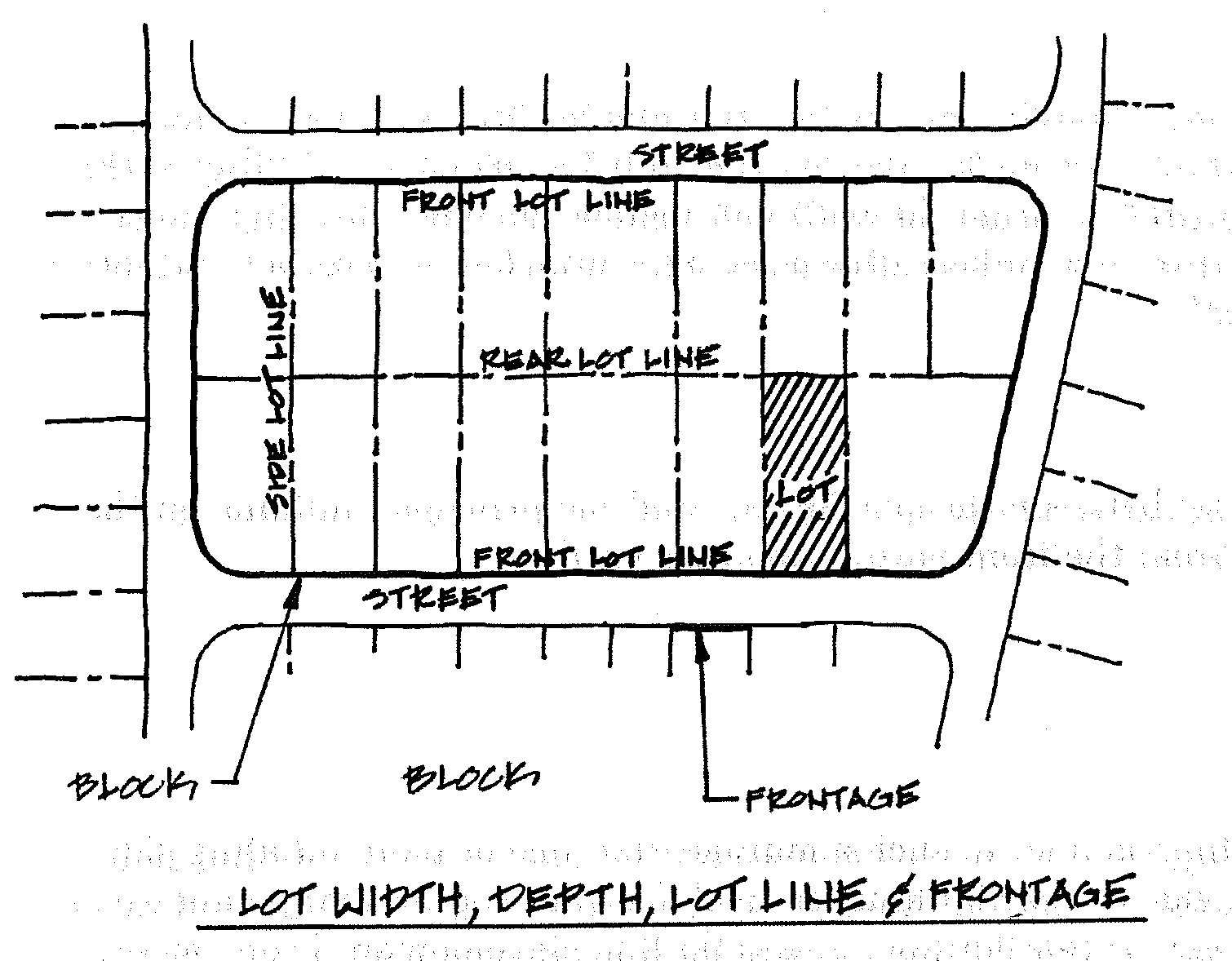
Figure A-1
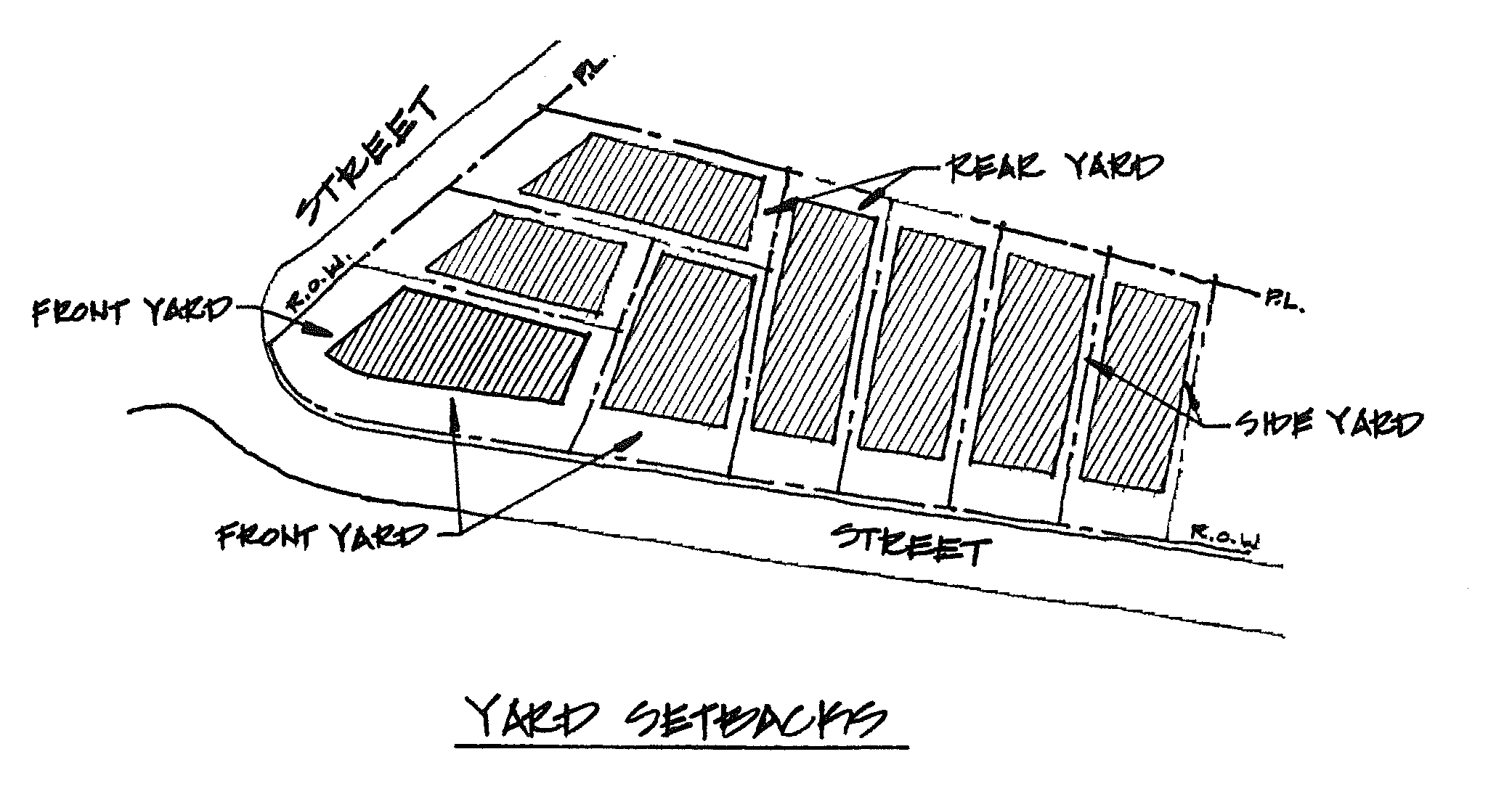
Figure A-2
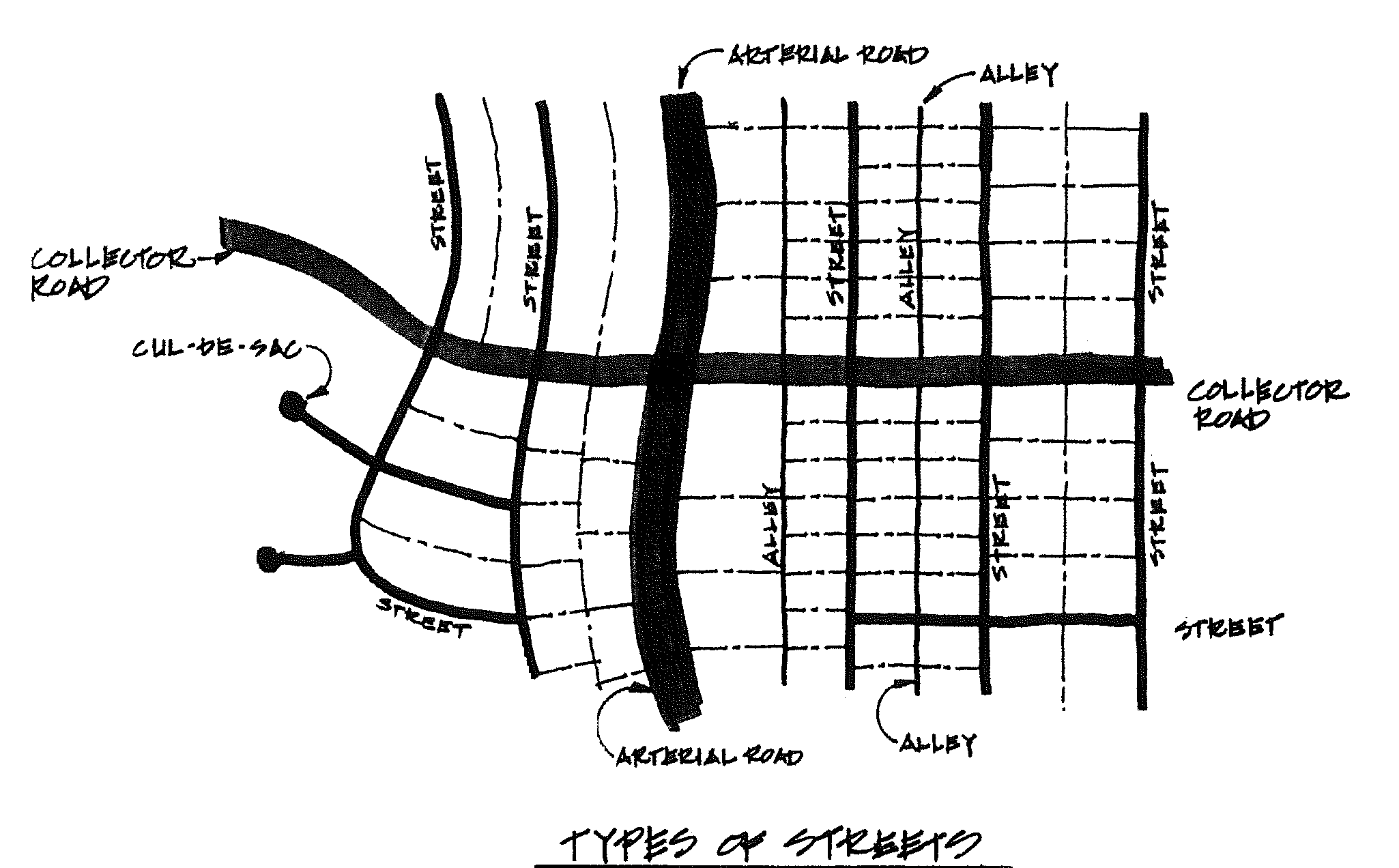
Figure A-3
(Ord. No. 09-07, 11-17-09; Ord. No. 10-20, § I(26), 6-15-10; Ord. No. 10-08, 8-17-10; Ord. No. 12-15, § II, 7-17-12; Ord. No. 14-02, § 3, 6-17-14; Ord. No. 14-06, § I(exh. A), 11-4-14; Ord. No. 15-04, 4-21-15; Ord. No. 16-01, § I, 7-19-16; Ord. No. 18-02, 6-19-18; Ord. No. 20-04, § I, 5-5-20; Ord. No. 22-03, § IV, 5-3-22; Ord. No. 23-04, § I, 4-18-23; Ord. No. 23-07, § II, 6-6-23; Ord. No. 23-08, § III, 6-20-23; Ord. No. 25-10, § II, 10-21-25)
Appendix B. - Administration of building and technical codes.
101.1.
Scope. The provisions of the chapter shall govern the administration and enforcement of the building, gas, mechanical plumbing, electrical and the one- and two-family dwelling code, as approved by the State of Georgia and adopted by the Henry County board of commissioners, hereinafter referred to as the "technical codes."
101.2.
Title. The provisions of this section shall constitute and be known as the "Appendix B, Administration" when used in conjunction with the technical codes as approved by the State of Georgia and adopted by the Henry County Board of Commissioners.
101.3.
Code remedial.
101.3.1. General. The technical codes are hereby declared to be remedial and shall be construed to secure the beneficial interests and purposes thereof, which are public safety, health and general welfare through structural strength, stability, sanitation, adequate light and ventilation and safety to life and property from fire and other hazards attributed to the built environment including alteration, repair, removal, demolition, use and occupancy of building, structures, or premises, and by regulating the installation and maintenance of all electrical, gas, mechanical and plumbing systems, which may be referred to as service systems.
101.3.2 Quality control. Quality control of materials and workmanship is not within the preview of the technical codes except as it relates to the purpose stated herein.
101.3.3 Permitting and inspections. The inspection or permitting of any building, system or plan by the Henry County Building Department, under the requirements of the technical codes, shall not be construed in any court as a warranty of the physical condition of such building, system or plan or their adequacy. Neither the Henry County Building Department nor any employee of same shall be liable in tort for damages for any defect or hazardous or illegal condition or inadequacy in such building, system or plan, nor for any failure of any component of such, which may occur subsequent to such inspection or permitting.
101.4.
Applicability.
101.4.1. General. Where, in any specific case, different sections of the technical codes specify different materials, methods of construction or other requirements, the most restrictive shall govern. Where there is a conflict between a general requirement and a specific requirement, the specific requirement shall be applicable.
101.4.2. Building. The provisions of the building code, as approved by the State of Georgia and adopted by the Henry County Board of Commissioners, shall apply to the construction, alteration, repair, equipment, use and occupancy, location, maintenance, removal and demolition, of every building or structure or any appurtenances connected or attached to such buildings or structures.
101.4.3. Electrical. The provisions of the electrical code, as approved by the State of Georgia and adopted by the Henry County Board of Commissioners, shall apply to the installation of electrical systems, including alterations, repairs, replacement, equipment, appliances, fixtures, fittings and appurtenances thereto.
101.4.4. Gas. The provisions of the gas code, as approved by the State of Georgia and adopted by the Henry County Board of Commissioners, shall apply to the installation of consumers' gas piping, gas appliances and related accessories as covered in this code. These requirements apply to gas piping systems extending from the point of delivery to the inlet connections of appliances, and the installation and operation of residential and commercial gas appliances and related accessories.
101.4.5. Mechanical. The provisions of the mechanical code, as approved by the State of Georgia and adopted by the Henry County Board of Commissioners, shall apply to the installation of mechanical systems, including alterations, repairs, replacement, equipment, appliances, fixtures, fittings and/or appurtenances, including ventilating, heating, cooling, air conditioning and refrigeration systems, incinerators, and other energy-related systems.
101.4.6. Plumbing. The provisions of the plumbing code, as approved by the State of Georgia and adopted by the Henry County Board of Commissioners, shall apply to every plumbing installation, including alterations, repairs, replacement, equipment, appliances, fixtures, fittings and appurtenances, when connected to a water or sewerage system and all aspects of a medical system.
101.4.7. One- and two-family dwelling code. The provisions of the one- and two-family dwelling code, as approved by the State of Georgia and adopted by the Henry County Board of Commissioners, shall apply to the construction, addition prefabrication, alteration, repair, use, occupancy and maintenance of detached one- and two-family dwellings and one-family townhouses not more than three (3) stories in height, and their accessory structures.
101.4.8. Federal and state authority. The provisions of the technical codes shall not be held to deprive any federal or state agency, or any applicable governing authority having jurisdiction, of any power or authority which it had on the effective date of the adoption of the technical code or of any remedy then existing for the enforcement of its orders, nor shall it deprive any individual or corporation of its legal rights as provided by law.
101.4.9. Appendices. To be enforceable, the appendices included in the technical codes must be referenced in the code text or specifically included in the adopting ordinance.
101.4.10. Referenced standards. Standards referenced in the technical codes shall be considered an integral part of the codes without separate adoption. If specific portions of a standard are denoted by code text, only those portions of the standard shall be enforced. Where code provisions conflict with a standard, the code provisions shall be enforced. Permissive and advisory provisions in a standard shall not be construed as mandatory.
101.4.11. Existing structures. The legal occupancy of any structure existing on the date of adoption of the technical codes shall be permitted to continue without change, except as is specifically covered in the technical code, the fire prevention code, property maintenance code or the existing building code, or as is deemed necessary by the building official for the general safety and welfare of the occupants and the public.
101.4.11.1.
Additions, alterations or repairs. Additions, alterations or repairs to any structure shall conform to that required for a new structure without requiring the existing structure to comply with all of the requirements of the Technical Codes, unless otherwise stated. Additions, alterations or repairs shall not cause an existing structure to become unsafe or adversely affect the performance of the building.
102.
Powers and duties of the building official.
102.1.
General. The building official is hereby authorized and directed to enforce the provisions of the technical codes. The building official is further authorized to render interpretations of the technical codes, which are consistent with its spirit and purposes.
102.2.
Right of entry.
102.2.1 Whenever necessary to make an inspection to enforce any of the provisions of the technical codes, or whenever the building official has reasonable cause to believe that there exists in any building or upon any premises any condition or code violation which makes such building, structure, premises, electrical, gas, mechanical or plumbing systems unsafe, dangerous or hazardous, the building official may enter such building, structure, or premises at all reasonable times to inspect the same or to perform any duty imposed upon the building official by the technical codes. If such building or premises are occupied, he shall first present proper credentials and request entry. If such building, structure, or premises are unoccupied, he shall first make reasonable effort to locate the owner or other persons having charge or control of such and request entry. If entry is refused, the building official shall have recourse to every remedy provided by law to secure entry.
102.2.2 When the building official shall have obtained a proper inspection warrant or other remedy provided by law to secure entry, no owner or occupant or any other persons having charge, care or control of any building, structure, or premises shall fail or neglect, after proper request is made as herein provided, to promptly permit entry therein by the building official for the purpose of inspection and examination pursuant to the technical codes.
102.3.
Stop work orders.
102.3.1 Upon notice from the building official, work on any building, structure, electrical, gas, mechanical or plumbing system that is being done contrary to the provisions of the technical codes or in a dangerous or unsafe manner, shall immediately cease. Such notice shall be in writing and shall be given to the owner of the property, or to his agent, or to the person doing the work, and shall state the conditions under which work may be resumed. Where an emergency exists, the building official shall not be required to give a written notice prior to stopping the work.
102.3.2 Unlawful continuance. Any person who shall continue any work after having been served with a stop work order, except such work as that person is directed to perform to remove a violation or unsafe condition, shall be subject to penalties as prescribed by law.
102.4.
Revocation of permits.
102.4.1 Misrepresentation of application. The building official may revoke a permit or approval, issued under the provisions of the technical codes, in case there has been any false statement or misrepresentation as to the material fact in the application or plans on which the permit or approval was based.
102.4.2 Violation of code provisions.
1.
The building official or his/her authorized representative may revoke a permit and/or issue a summons for violation of the building code or development code and require the responsible party to appear in the appropriate court of jurisdiction upon determination by the building official that the construction, erection, alteration, repair, moving, demolition, installation, or replacement of the building, structure, electrical, gas, mechanical or plumbing systems for which the permit was issued is in violation of, or not in conformity with, the provisions of the technical codes and the Code of Henry County.
2.
The building official may declare buildings, structures, electrical, gas, mechanical or plumbing systems unsafe as defined in subsection 103.5 and may issue a summons for the violation of the building or safety code and require the responsible party to appear in the appropriate court of jurisdiction to respond to such charges.
3.
The building official or his authorized representative may issue summons as provided for in subparagraph (a) of this section 103.4.2; "such building official or his representative may not nor shall this ordinance be construed to permit or empower any building official to make a physical arrest, carry a firearm or otherwise perform the duties of a sworn and certified/registered law enforcement official.
102.4.3 Violation of zoning provisions.
1.
The building official or his/her authorized representative may withhold a permit on any building or development project if it is determined that the zoning provisions associated with the project have not been fulfilled.
102.5.
Unsafe buildings or systems. All buildings, structures, electrical, gas, mechanical or plumbing systems which are unsafe, unsanitary, or do not provide adequate egress, or which constitute a fire hazard, or are otherwise dangerous to human life, or which in relation to existing use, constitute a hazard to safety or health, are considered unsafe buildings or service systems. All such unsafe buildings, structures or service systems are hereby declared illegal and shall be abated by repair and rehabilitation or by demolition in accordance with the provisions of the Unsafe Building Abatement Code as adopted by the Henry County Board of Commissioners and as approved by chapter 3-17, article V of the Henry County Code.
102.6.
Requirements not covered by code. Any requirements necessary for the strength, stability or proper operation of an existing or proposed building, structure, electrical, gas, mechanical or plumbing system, or for the public safety, health and general welfare, not specifically covered by the technical codes, shall be determined by the building official.
102.7.
Alternate materials and methods. The provisions of the technical codes are not intended to prevent the use of any material or method of construction not specifically prescribed by them, provided any such alternate has been reviewed by the building official. The building official shall approve any such alternate, provided the building official finds that the alternate for the purpose intended is at least the equivalent of that prescribed in the technical codes, in quality, strength, effectiveness, fire resistance, durability and safety. The building official shall require that sufficient evidence or proof be submitted to substantiate any claim made regarding the alternate.
102.8.
Modifications. Wherever there are practical difficulties involved in carrying out the provisions of the technical codes, the building official shall have the authority to grant modifications for individual cases, upon application of the owner or owner's representative, provided the building official shall first find that special individual reason makes the strict letter of the technical codes impractical and the modification is in compliance with the intent and purpose of the technical code and that such modification does not lessen health, accessibility, life and fire safety, or structural requirements. The details of action granting modifications shall be recorded and entered in the files of the department of building safety.
103.
Permits.
103.1.
Permit application.
103.1.1 When required. Any owner, authorized agent, or contractor who desires to construct, enlarge, alter, repair, move, demolish, or change the occupancy of a building or structure, or to erect, install, enlarge, alter, repair, remove, convert or replace any electrical, gas, mechanical or plumbing system, the installation of which is regulated by the technical codes, or to cause any such work to be done, shall first make application to the building official and obtain the required permit for the work.
EXCEPTION: Work exempt from permit. Exemptions from permit requirements of the technical codes shall not be deemed to grant authorization for any work to be done in any manner in violation of the provisions of the technical codes or any other laws or ordinances of this jurisdiction. Permits shall not be required for the following:
Building:
1.
One (1) story detached, portable accessory structures, or portable structures attached to a permitted and approved permanent foundation, located on a residentially zoned lot, used as tool sheds, playhouses and similar uses.
2.
One (1) story detached accessory structures, located on a residentially zoned lot, used as tool sheds, playhouses and similar uses, provided the floor area does not exceed one hundred twenty (120) square feet (11.15m2).
3.
Fences not over six (6) feet (1,829 mm) high.
4.
Retaining walls which are not over four (4) feet (1,219 mm) in height measured from the bottom of the footing to the top of the wall, unless supporting a surcharge or impounding Class I, II or III-A liquids.
5.
Water tanks supported directly upon grade if the capacity does not exceed five thousand (5,000) gallons (18,927 L) and the ratio of height to diameter or width does not exceed two to one (2:1).
6.
Sidewalks and driveways not more than thirty (30) inches (762 mm) above grade and not over any basement or story below and which are not part of an accessible route.
7.
Painting, papering, tiling, carpeting, cabinets, counter tops and similar finish work.
8.
Temporary motion picture, television and theater stage sets and scenery.
9.
Prefabricated swimming pools accessory to a Group R-3 occupancy, as application in section 101.2, which are less than twenty-four (24) inches (610 mm) deep, do not exceed five thousand (5,000) gallons (19,000 L) and are installed entirely above ground.
10.
Shade cloth structures constructed for nursery or agricultural purposes and not including services systems.
11.
Swings and other playground equipment accessory to one- and two-family dwellings.
12.
Window awnings supported by an exterior wall of Group R-3, as applicable in section 101.2, and Group U occupancies.
13.
Movable cases, counters and partitions not over five (5) feet nine (9) inches (1,753 mm) in height.
Electrical:
Repairs and maintenance: Minor repair work, including the replacement of lamps or the connection of approved portable electrical equipment to approve permanently installed receptacles.
Radio and television transmitting stations: The provisions of the technical codes shall not apply to electrical equipment used for radio and television transmissions, but does apply to equipment and wiring for power supply, the installation of towers and antennas.
Temporary testing systems: A permit shall not be required for the installation of any temporary system required for the testing or servicing of electrical equipment or apparatus.
Gas:
1.
Portable heating appliance.
2.
Replacement of any minor part that does not alter approval of equipment or make such equipment unsafe.
Mechanical:
1.
Portable heating appliance;
2.
Portable ventilation equipment;
3.
Portable cooling unit;
4.
Steam, hot or chilled water piping within any heating or cooling equipment regulated by this code;
5.
Replacement of any part which does not alter its approval or make it unsafe;
6.
Portable evaporative cooler;
7.
Self-contained refrigeration system containing ten (10) pounds (4.54 kg) or less of refrigerant and actuated by motors of one (1) horsepower (746 W) or less.
Plumbing:
The stopping of leaks in drains, water, soil, water or vent pipe; provided, however, that if any concealed trap, drain pipe, water, soil, waste or vent pipe becomes defective and it becomes necessary to remove and replace the same with new material, such work shall be considered as new work and a permit shall be obtained and inspections made as provided in the technical codes.
The clearing of stoppages or the repairing of leaks in pipes, valves or fixtures, and the removal and reinstallation of water closets, provided such repairs do not involve or repair the replacement or rearrangement of valves, pipes or fixtures.
103.1.2. Temporary structures. A special building permit for a limited time shall be obtained before the erection of temporary structures such as construction sheds, seats, canopies, tents and fences used in construction work or for temporary purposes such as reviewing stands. Such structures shall be completely removed upon the expiration of the time limit stated in the permit.
103.1.3. Work authorized. A building, electrical, gas, mechanical or plumbing permit shall carry with it the right to construct or install the work, provided the same are shown on the drawings and set forth in the specifications filed with the application for the permit. Where these are not shown on the drawings and covered by the specifications submitted with the application, separate permits shall be required.
103.1.4. Repairs.
103.1.4.1 Emergency repairs. Where equipment replacements and repairs must be performed in an emergency situation, the permit application shall be submitted within the next working business day to the building official.
103.1.4.2 Ordinary repairs. Application or notice to the building official is not required for ordinary repairs to structures, replacement of lamps or the connection of approved portable electrical equipment to approved permanently installed receptacles. Such repairs shall not include the cutting away of any wall, partition or portion thereof, the removal or cutting of any structural beam or load bearing support, or the removal or change of any required means of egress, or rearrangement of parts of a structure affecting the egress requirements; nor shall ordinary repairs include addition to, alteration of, replacement or relocation of any standpipe, water supply, sewer, drainage, drain leader, gas, soil, waste, vent or similar piping, electric wiring or mechanical or other work affecting public health or general safety.
103.1.5. Information required. Each application for a permit, with the required fee, shall be filed with the building official on a form furnished for that purpose. Such application shall:
1.
Identify and describe the work to be covered by the permit for which application is made.
2.
Describe the land on which the proposed work is to be done by legal description, street address or similar description that will readily identify and definitely locate the proposed building or work.
3.
Indicate the use and occupancy for which the proposed work is intended.
4.
Be accompanied by construction documents and other information as required in section 104.2.
5.
State the valuation of the proposed work.
6.
Be signed by the applicant, or the applicant's authorized agent.
7.
Give such other data and information as required by the building official.
103.1.6. Time limitations. An application for a permit for any proposed work shall be deemed to have been abandoned six (6) months after the date of filing for the permit, unless before then a permit has been issued. One or more extensions of time for periods of not more than ninety (90) days each may be allowed by the building official for the application, provided the extension is requested in writing and justifiable cause is demonstrated.
103.1.7. Health department approval.
1.
No building permit shall be issued by the building official until the Henry County Health Department shall have approved the proposed water supply and sewage disposal facilities required in connection with the proposed buildings; provided, that in an area served by a public utility for water or for sewage disposal, or both, the health department may elect to waive the requirement for approval. The Henry County Health Department shall either approve or disapprove said water and sewerage facilities within thirty (30) days after the receipt thereof.
2.
Nothing contained in these regulations shall be deemed to prevent the commissioner of health, after study of the site of a proposed use, from requiring for reason of health that all or any portion of such site not be used for the intended purpose or that the minimum lot sizes set forth for the zoning district in which the use will be located be increased with regard to the proposed use; provided that the commissioner of health shall define his decision in writing, with reasons therefor, within thirty (30) days upon being so requested by an applicant for the building permit.
103.2.
Drawings and specifications.
103.2.1 Requirements. When required by the building official, two (2) or more copies of specifications, and of drawings drawn to scale with sufficient clarity and detail to indicate the nature and character of the work, shall accompany the application for a permit. Such drawings and specifications shall contain information, in the form of notes or otherwise, as to the quality of materials, where quality is essential to conformity with the technical codes. Such information shall be specific, and the technical codes shall be cited as a whole or in part, nor shall the term "legal" or its equivalent be used as a substitute for specific information. All information, drawings, specifications and accompanying data shall bear the name and signature of the person responsible for the design.
103.2.2 Additional data. The building official may require details, computations, stress diagrams, and other data necessary to describe the construction or installation and the basis of calculations. All drawings, specifications and accompanying data required by the building official to be prepared by an architect or engineer shall be affixed with their official seal.
103.2.3 Fire protection system shop drawings. Shop drawings for the fire protection system(s) shall be submitted to indicate conformance with this code and the construction documents and shall be approved prior to the start of system installation. Shop drawings shall contain all information as required by the referenced installation standards in the technical codes.
103.2.4 Design professional. The design professional shall be an architect or engineer legally registered under the laws of this state regulating the practice of architecture or engineering and shall affix his official seal to said drawings, specifications and accompanying data, for the following:
1.
All Group A, E and I occupancies.
2.
Buildings and structures three (3) stories or more high.
3.
Buildings and structures five thousand (5,000) square feet (465m2) or more in area. For all other buildings and structures, the submittal shall bear the certification of the application that some specific state law exception permits its preparation by a person not so registered.
EXCEPTION: Group R3 buildings, regardless of size, shall require neither a registered architect or engineer, nor a certification that an architect or engineer is not required.
103.2.5. Structural and fire resistance integrity. Plans for all buildings shall indicate how required structural and fire resistance integrity will be maintained where a penetration of a required fire resistant wall, floor or partition will be made for electrical, gas, mechanical, plumbing and communication conduits, pipes and systems and also indicate in sufficient detail how the fire integrity will be maintained where required fire resistant floors intersect the exterior walls and where joints occur in required fire resistant construction assemblies.
103.2.6 Site drawings. All applications for a building permit shall be accompanied by a plot or site plan drawn to scale, showing the actual dimensions of the lot to be built upon, the right-of-way of existing roads, the location and size of the proposed building or structure to be erected and of every existing building or structure on the site or lot, the setback lines of the proposed buildings, the location of easements and other such information as may be essential for determining whether the provisions of the ULDC and all county ordinances are being observed. The building official may require a boundary line survey prepared by a qualified surveyor. The building official is authorized to waive or modify the requirements for a site plan when the application for a permit is for alterations or repair or when otherwise warranted. A record of such applications and plot or site plans shall be kept.
103.2.7 Hazardous occupancies. The building official may require the following:
1.
General site plan. A general site plan drawn at a legible scale which shall include, but not be limited to, the location of all buildings, exterior storage facilities, permanent accessways, evacuation routes, parking lots, internal roads, chemical loading areas, equipment cleaning areas, storm and sanitary sewer accesses, emergency equipment and adjacent property uses. The exterior storage areas shall be identified with the hazard classes and the maximum quantities per hazard class of hazardous materials stored.
2.
Building floor plan. A building floor plan drawn at a legible scale, which shall include, but not be limited to, all hazardous materials storage facilities within the building and shall indicate rooms, doorways, corridors, exits, fire rated assemblies with their hourly rating, location of liquid-tight rooms, and evacuation routes. Each hazardous materials storage facility shall be identified on the plan with the hazard classes and quantity range per hazard class of the hazardous materials stored.
103.3.
Examination of documents.
103.3.1 Plan review. The building official shall examine or cause to be examined each application for a permit and the accompanying documents, consisting of drawings, specifications, computations and additional data, and shall ascertain by such examinations whether the construction indicated and described is in accordance with the requirements of the technical codes and all other pertinent laws or ordinances.
103.3.2 Affidavits. The building official may accept a sworn affidavit from a registered architect or engineer stating that the plans submitted conform to the technical codes. For buildings and structures, the affidavit shall state that the plans conform to the laws as to egress, type of construction and general arrangement and, if accompanied by drawings, show the structural design and that the plans and design conform to the requirements of the technical codes as to strength, stresses, strains, loads and stability. The building official may without any examination or inspection accept such affidavit, provided the architect or engineer who made such affidavit agrees to submit to the building official copies of inspections reports as inspections are performed and upon completion of the structure, electrical, gas, mechanical, or plumbing systems a certification that the structure, electrical, gas, mechanical, or plumbing system has been erected in accordance with the requirements of the technical codes. Where the building official relies upon such affidavit, the architect or engineer shall assume full responsibility for the compliance with all provisions of the technical codes and other pertinent laws or ordinances.
103.4.
Issuing permits.
103.4.1 Action on permits. The building official shall act upon an application for a permit without unreasonable or unnecessary delay. If the building official is satisfied that the work described in an application for a permit and the contract documents filed therewith conform to the requirements of the technical codes and other pertinent laws and ordinances, and all license fees required by Henry County have been paid, he shall issue a permit to the applicant.
103.4.2 Refusal to issue permit. If the application for a permit and the accompanying contract documents describing the work do not conform to the requirements of the technical codes or other pertinent laws or ordinances, the building official shall not issue a permit, but shall return the contract documents to the applicant with his refusal to issue such permit. Such refusal shall, when requested, be in writing, shall contain the reason for refusal, and shall be issued within ten (10) days after said request.
103.4.3 Special foundation permit. When application for permit to erect or enlarge a building has been filed and pending issuance of such permit, the building official may, at his discretion, issue a special permit for the foundation only. The holder of such a special permit is proceeding at his own risk and without assurance that a permit for the remainder of the work will be granted nor that corrections will not be required in order to meet provisions of the technical codes.
103.4.4 Public right-of-way. A permit shall not be given by the building official for the construction of any building, or for the alteration of any building where said building is to be changed and such change will affect the exterior walls, bays, balconies, or other appendages or projections fronting on any street, alley or public lane, or for the placing on any lot or premises of any building or structure removed from another lot or premises, until the building official or his designee have confirmed that the structure does not encroach upon the public street on which he proposes to build, erect or locate said building; and it shall be the duty of the building official to see that the street lines are not encroached upon except as provided for in the building code or otherwise allowed by the Henry County Department of Transportation.
103.4.5 Amended construction documents. Work shall be installed in accordance with the reviewed construction documents, and any changes made during construction that are not in compliance with the approved construction documents shall be resubmitted for approval as an amended set of construction documents.
103.5.
Contractor's responsibilities. It shall be the duty of every contractor who shall make contracts for the installation or repairs of building, structure, electrical, gas, mechanical or plumbing systems, for which a permit is required, to comply with state or local rules and regulations concerning licensing and inspections which the applicable governing authority may have adopted.
103.6.
Conditions of the permit.
103.6.1 Permit intent. A permit issued shall be construed to be a license to proceed with the work and not as authority to violate, cancel, alter, or set aside any of the provisions of the technical codes, nor shall issuance of a permit prevent the building official from thereafter requiring a correction of errors in plans, construction, or violations of this Code. Every permit issued shall become invalid unless the work authorized by such permit is commenced within six (6) months after its issuance, or if the work authorized by such permit is suspended or abandoned for a period of six (6) months after the time the work is commenced. Construction is said to have commenced at the time when initial inspection is made prior to the installation of the foundation system. One (1) or more extensions of time, for periods not more than ninety (90) days each, may be allowed for the permit. The extensions shall be requested in writing and justifiable cause demonstrated. Extensions shall be in writing by the building official.
103.6.2 Permit issued on basis of an affidavit. Whenever a permit is issued in reliance upon an affidavit or whenever the work to be covered by a permit involves installation under conditions which, in the opinion of the building official, are hazardous or complex, the building official shall require that the architect or engineer who signed the affidavit or prepared the drawings or computations shall supervise such work. In addition, they shall be responsible for conformity with the permit, provide copies of inspection reports as inspections are performed, and upon completion make and file with the building official written affidavit that the work has been done in conformity with the reviewed plans and with the structural provisions of the technical codes. In the event such architect or engineer is not available, the owner shall employ in his stead a competent person or agency whose qualifications are reviewed by the building official.
103.6.3 Plans. When the building official issues a permit, he shall endorse, in writing or by stamp, both sets of plans "Reviewed for Code Compliance." One (1) set of drawings so reviewed shall be retained by the building official and the other set shall be returned to the applicant. The permit drawings shall be kept at the site of work and shall be open to inspection by the building official or his authorized representatives.
103.6.4 Construction and use to be as stated in application, plans, and permits. Building permits or certificates of occupancy issued on the basis of plans and applications approved by the building official authorize only the use, arrangement, and construction set forth in such approved plans and applications, and no other use, arrangement, or construction. Use, arrangement, or construction at variance with that authorized shall be deemed a violation of this chapter.
103.7.
Fees.
103.7.1 Prescribed fees. A permit shall not be issued until the fees prescribed by the board of commissioners have been paid. Nor shall an amendment to a permit be released until the additional fee, if any, due to an increase in the estimated cost of the building, structure, electrical, plumbing, mechanical or gas systems, has been paid.
103.7.2 Work commencing before permit issuance. Any person who commences any work on a building, structure, electrical, gas, mechanical or plumbing system before obtaining the necessary permits shall be subject to a penalty of one hundred (100) percent of the usual permit fee in addition to the required permit fee, at the discretion of the building official or his deputy.
103.7.3 Accounting. The building official shall keep a permanent and accurate accounting of all permit fees and other monies collected, the names of all persons upon whose account the same was paid, along with the date and amount thereof.
103.7.4 Schedule of permit fees. On all buildings, structures, electrical, plumbing, mechanical and gas systems or alterations requiring a permit, a fee for each permit shall be paid as required, in accordance with the schedule as established by the applicable governing authority.
103.7.5 Building permit valuations. If, in the opinion of the building official, the valuation of building, alteration, structure, electrical, gas, mechanical or plumbing systems appears to be underestimated on the application, permit shall be denied, unless the applicant can show detailed estimates to meet the approval of the building official. Permit valuations shall include total cost, such as electrical, gas, mechanical, plumbing equipment and other systems, including materials and labor.
103.7.6.
Procedure for contesting permit valuations relating to new construction.
1.
Building permits for new construction are determined by the square footage value established by the International Code Council for the group and type of construction as adopted by the Board of Commissioners.
2.
If an applicant contests the valuation data provided by the most current International Code Council Construction Costs table, the applicant may contest such valuation by submitting at least two of the following documents to the Building Official for consideration:
a.
A copy of the turn-key contract for the construction project, supported by an affidavit as sworn to and executed by the owner and the contractor that the contract accurately reflects the true cost of the completed project;
b.
A bank approved appraisal, prepared no later than twelve months prior to the building permit application, or if no bank appraisal is available, a self-contained appraisal prepared by an appraiser approved by the building official at the applicant's expense; or
c.
Another type of published National or International Valuation Data (other than the valuation data provided by the International Code Council) nationally recognized and used in other jurisdictions in the United States, supporting the value of the completed project.
3.
If the building official finds that the alternative documentation supports the applicant's valuation of the completed project, then, with the approval of the county manager, the building permit fee shall be recalculated based on the alternative valuation data as submitted by the applicant.
4.
If the building official finds that the alternative documentation does not support the applicant's valuation of the completed project, then the building official shall deny the applicant's request and the original permit valuation as initially determined shall prevail. Any applicant aggrieved by any such denial, shall have the right to appeal to the board of commissioners pursuant to the appeal provisions as set forth in U.L.D.C. Section 12.04.00, et seq.
5.
Any applicant who utilizes the procedure set forth herein to contest a permit valuation shall be ineligible to seek or receive building permit fee reductions or waivers under any other practice, policy or resolution of Henry County.
6.
This process shall not be applicable to the calculation or assessment of impact fees.
104.
Inspections.
104.1.
General. Construction or work for which a permit is required shall be subject to inspections by the building official and such construction or work shall remain accessible and exposed for inspection purposes until approved. Approval as a result of an inspection shall not be construed to be an approval of a violation of the provisions of the technical codes or of other ordinances of the jurisdiction. Inspections presuming to give authority to violate or cancel the provisions of the technical codes or of other ordinances of the jurisdiction shall not be valid. It shall be the duty of the permit applicant to cause the work to remain accessible and exposed for inspection purposes. Neither the building official nor the jurisdiction shall be liable for expense entailed in the removal or replacement of any material required to allow inspection.
104.2.
Existing building inspections. Before issuing a permit, the building official may examine or cause to be examined any building, electrical, gas, mechanical, or plumbing systems for which an application has been received for a permit to enlarge, alter, repair, move, demolish, install, or change the occupancy. He shall inspect all buildings, structures, electrical, gas, mechanical and plumbing systems, from time to time, during and upon completion of the work for which a permit was issued. He shall make a record of every such examination and inspection and of all violations of the technical codes.
104.3.
Manufacturers and fabrication. When deemed necessary by the building official, he shall make, or cause to be made, an inspection of materials or assemblies at the point of manufacture or fabrication. A record shall be made of every such examination and inspection and of all violations of the technical codes.
104.4.
Inspection service. The building official may make, or cause to be made, the inspections required by section 105. He may accept reports of inspections of recognized inspection services, provided that after investigation he is satisfied as to their qualifications and reliability. A certificate called for by any provision of the technical codes shall not be based on such reports unless the same are in writing and certified by a responsible officer of such service.
104.5.
Inspections prior to issuance of certificate of occupancy or completion. The building official shall inspect or cause to be inspected at various intervals all construction or work for which a permit is required, and a final inspection shall be made of every building, structure, electrical, gas, mechanical or plumbing system upon completion, prior to the issuance of the certificate of occupancy or completion.
104.6.
Posting of permit. Work requiring a permit shall not commence until the permit holder of his agent posts the permit card in a conspicuous place on the premises. The permit shall be protected from the weather and located in such position as to permit the building official or representative to conveniently make the required entries thereon. This permit card shall be maintained in such position by the permit holder until the certificate of occupancy or completion is issued by the building official.
104.7.
Required inspections. The building official upon notification from the permit holder of his agent shall make the following inspections and such other inspections as necessary, and shall either release that portion of the construction or shall notify the permit holder or his agent of any violations which must be corrected in order to comply with the technical codes:
Building:
1.
Foundation inspection: To be made after trenches are excavated and forms erected.
2.
Frame inspection: To be made after the roof, all framing, fire blocking and bracing are in place, all concealing wiring, all pipes, chimneys, ducts and vents are complete.
3.
Final inspection: To be made after the building is completed and ready for occupancy.
Electrical:
1.
Underground inspection: To be made after trenches or ditches are excavated, conduit or cable installed, and before any backfill is put in place.
2.
Rough-in inspection: To be made after the roof, framing, fire blocking and bracing is in place and prior to the installation of wall or ceiling membranes.
3.
Final inspection: To be made after the building is complete, all required electrical fixtures are in place and properly connected or protected, and the structure is ready for occupancy.
Plumbing:
1.
Underground inspection: To be made after trenches or ditches are excavated, piping installed, and before any backfill is put in place.
2.
Rough-in inspection: To be made after the roof, framing, fire blocking and bracing is in place and all soil, waste and vent piping is complete, and prior to the installation of wall or ceiling membranes.
3.
Final inspection: To be made after the building is complete, all plumbing fixtures are in place and properly connected, and the structure is ready for occupancy.
NOTE: See the plumbing code for required tests.
Mechanical:
1.
Underground inspection: To be made after trenches or ditches are excavated, underground duct and fuel piping installed, and before any backfill is put in place. When excavated soil contains rocks, broken concrete, frozen chunks and other rubble that would damage or break the piping or cause corrosive action, clean backfill shall be on the job site.
2.
Rough-in inspection: To be made after the roof, framing, fire blocking and bracing are in place and all ducting, and other concealed components are complete, and prior to the installation of wall or ceiling membranes.
3.
Final inspection: To be made after the building is complete, the mechanical system is in place and properly connected, and the structure is ready for occupancy.
Exception: Ground-source heat pump loop systems tested in accordance with the mechanical code, shall be permitted to be backfilled prior to inspection.
Gas:
1.
Underground inspection: To be made after trenches or ditches are excavated, underground duct and fuel piping installed, and before any backfill is put in place. When excavated soil contains rocks, broken concrete, frozen chunks and other rubble that would damage or break the piping or cause corrosive action, clean backfill shall be on the job site.
2.
Rough piping inspection: To be made after all new piping authorized by the permit has been installed, and before any such piping has been covered or concealed or any fixtures or gas appliances have been connected.
3.
Final piping inspection: To be made after all piping authorized by the permit has been installed and after all portions which are to be concealed by plastering or otherwise have been so concealed, and before any fixtures or gas appliances have been connected. This inspection shall include a pressure test.
4.
Final inspection: To be made on all new gas work authorized by the permit and such portions of existing systems as may be affected by new work or any changes, to insure compliance with all the requirements of this code and to assure that the installation and construction of the gas system is in accordance with reviewed plans.
104.8.
Written release. Work shall not be done on any part of a building, structure, electrical, gas, mechanical or plumbing system beyond the point indicated in each successive inspection without first obtaining a written release from the building official. Such written release shall be given only after an inspection has been made of each successive step in the construction or installation as indicated by each of the foregoing inspections.
104.9.
Reinforcing steel and structural frames. Reinforcing steel or structural framework of any part of any building or structure shall not be covered or concealed without first obtaining a release from the building official.
104.10.
Gypsum board or plaster fire protection. In all building where gypsum board or plaster is used for fire protection purposes, the permit holder or his agent shall notify the building official after all lathing and gypsum board, interior and exterior, is in place, but before any plastering is applied or before gypsum board joints and fasteners are taped and finished and shall not be applied until the release from the building official has been received.
104.11.
Fire-resistant joints and penetrations. The protection of joints and penetrations in required fire-resistant construction assemblies shall not be covered or concealed from view without first obtaining a release from the building official.
104.12.
Energy efficiency inspections. Inspections shall be made to determine compliance with the Georgia State Energy Code and shall include, but not be limited to, inspections for: envelope insulation R and U value, fenestration U value, duct system R value, and HVAC and water heating equipment efficiency.
104.13.
Other inspections. In addition to the inspections specified above, the building official is authorized to make or require other inspections of any construction work to ascertain compliance with the provisions of the technical codes and other laws that are enforced by the department of building safety.
104.14.
Inspection requests. It shall be the duty of the holder of the building permit or their duly authorized agent to notify the building official when work is ready for inspection. It shall be the duty of the permit holder to provide access to and means for inspection of such work for any inspections that are required by the technical codes.
105.
Certificates.
105.1.
Certificate of occupancy.
105.1.1 Building occupancy. A new building shall not be occupied or a change made in the occupancy, nature or use of a building or part of a building until after the building official has issued a certificate of occupancy. Said certificate shall not be issued until all required electrical, gas, mechanical, plumbing and fire protection systems have been inspected for compliance with the technical codes and other applicable laws and ordinances and released by the building official. Issuance of a certificate of occupancy shall not be construed as an approval of a violation of the provisions of the technical codes or of other ordinances of the jurisdiction.
Said certificate of occupancy may be applied for either coincidently with a building permit or at any time thereafter; provided, however, that no such occupancy, use or change of use shall take place until a certificate of occupancy shall have been issued by the building official.
A record of all certificates of occupancy shall be maintained and a copy shall be furnished upon request to any person. Failure to obtain a certificate of occupancy shall be a violation of this chapter.
105.1.2 Changes in use. Changes in the character or use of an existing structure shall not be made except as specified in the technical codes.
105.1.3 Issing certificate of occupancy. Upon satisfactory completion of construction of a building or structure and installation of electric, gas, mechanical and plumbing systems in accordance with the technical codes, reviewed plans and specifications, and after the final inspection, the building official shall issue a certificate of occupancy stating the nature of the occupancy permitted, the number of persons for each floor when limited by law, and any other information that is deemed necessary in accordance with the provisions of this code. A certificate of occupancy shall be required for any of the following:
1.
Occupancy and use of a building hereafter erected or enlarged.
2.
Change in use of existing buildings to use of a different classification.
3.
Occupancy and use of vacant land, except for raising of crops.
4.
Change in use of land to a different classification, except for the raising of crops.
5.
Any change in use of a nonconforming use.
6.
Development of a mobile home park.
Any final inspection report or a certificate of occupancy issued for any structure shall have noted thereon: "To the best of Henry County's knowledge and belief at the time of inspection, the structure has been erected in substantial compliance with the applicable Technical Codes. Any oversight by the Henry County building inspector shall not excuse violation of any ordinance of Henry County."
105.1.4 Temporary/partial occupancy. A temporary/partial certificate of occupancy may be issued for a period not exceeding six (6) months for a portion or portions of a building, which may safely be occupied prior to final completion of the building.
105.1.5 Correction of code violations after the issuance of the certification of occupancy.
1.
The requirement of a builder, electrical contractor, plumbing contractor, HVAC contractor, owner, individual or other entity who chooses to do business in Henry County shall comply with all technical codes and local ordinances.
2.
After issuance of the certificate of occupancy, the county reserves the right for a period of one (1) year to reinspect a dwelling for latent code violations which existed at the time of the final inspection but were not detected. Any inspection made after the issuance of the certificate of occupancy and before the termination of the one (1) year requirement by Henry County Building Department shall be in response to a written complaint by the owner.
3.
The builder, electrical contractor, plumbing contractor, HVAC contractor, owner, individual or other entity securing the permit shall be responsible for the correction of any code violations by him that are discovered during the period of construction and for a period of one (1) year from the issue date of the certificate of occupancy, excepting routine maintenance, abuse, modification and normal wear and tear.
4.
In responding to a written complaint and upon inspection of the dwelling, should the Henry County Building Official or his authorized representative determine that there exists in any structure covered by the codes, any violations of these codes, the builder, electrical contractor, plumbing contractor, HVAC contractor, owner, individual or other entity obtaining a permit for construction, shall be notified by certified mail of the violations and shall be allowed ten (10) working days from the receipt of the notification to respond to the charge of violations and to meet with the Henry County Building Official or his authorized representative regarding a remedy for the violations. It shall be the responsibility of said principal to ensure that the Henry County Building Department has a current mailing address for the principal on every permit issued. Unless the principal informs otherwise in writing, the address provided on the building permit shall be deemed to be the proper mailing address for notifications under this section. The principal shall have thirty (30) days from the date the notice of violations is received, refused, or returned to correct the violations cited in the notice. Should the principal not correct the violations in a manner satisfactory to the Henry County Building Official or his authorized representative, or, in the judgment of the building official or his authorized representative, have not made satisfactory progress in remedying the violations within this 30-day period, the principal shall be subject to the provisions of section 106.1.6.
5.
The principal may appeal the notice of violation to the Henry County Board of Commissioners to hear and rule on such complaints within twenty (20) days of the receipt of the notice of violation. The appeal must be in writing and filed with the Henry County Building Department. Should the Henry County Board of Commissioners, find the principal in violation of the code and in its judgment the violations are sufficiently serious as to affect the structural integrity or the expected normal service life of the structure or installed systems, or the safety and welfare of any occupants of the structure, the principal shall have thirty (30) days to remedy the violations to the satisfaction of the Henry County Building Official or his authorized representative. Should the principal not correct the violations in a manner satisfactory to the building official or his authorized representative, or, in the judgment of the building official or his authorized representative, have not made satisfactory progress in remedying the violations within this 30-day period, then the principal shall be notified in writing that further actions will be taken in remedying the violations.
105.1.6 Withholding of permits and inspections for previous violations. The building official is authorized to withhold the issuance of building permits or to refuse inspections to any building contractor, or any person authorized to do building under the laws of this Code, until such time as such contractor or person has resolved satisfactorily all outstanding violations from previously issued permits with the Henry County Building Department.
105.2.
Certificate of completion. Upon satisfactory completion of a building, structure, electrical, gas, mechanical or plumbing system, a certificate of completion may be issued. This certificate is proof that a structure or system is complete and for certain types of permits is released for use and may be connected to a utility system. This certificate does not grant authority to occupy or connect a building, such as a shell building, prior to the issuance of a certificate of occupancy.
105.3.
Revocation. The building official is authorized to, in writing, suspend or revoke a certificate of occupancy or completion issued under the provisions of the technical codes wherever the certificate is issued in error, or on the basis of incorrect information supplied, or where it is determined that the building or structure or portion thereof is in violation of any ordinance or regulation or any of the provisions of the technical codes.
105.4.
Service utilities.
105.4.1 Connecting of service utilities. No person shall make connections from a utility, source of energy, fuel or power to any building or system which is regulated by the technical codes for which a permit is required, until released by the building official and a certificate of occupancy or completion is issued.
105.4.2 Temporary connection. The building official may authorize the temporary connection of the building or system to the utility source of energy, fuel or power for the purpose of testing building service systems or for use under a temporary certificate of occupancy.
105.4.3 Authority to disconnect service utilities. The building official shall have the authority to authorize disconnection of utility service to the building, structure or system regulated by the technical codes, in case of emergency where necessary to eliminate an immediate hazard to life or property. The building official shall notify the serving utility, and whenever possible the owner and occupant of the building, structure or service system of the decision to disconnect prior to taking such action. If not notified prior to disconnecting, the owner or occupant of the building, structure or service system shall be notified in writing, as soon as practical thereafter.
105.5.
Posting floor loads.
105.5.1 Occupancy. An existing or new building shall not be occupied for any purpose, which will cause the floors thereof to be loaded beyond their safe capacity. The building official may permit occupancy of a building for mercantile, commercial or industrial purposes, by a specific business, when he is satisfied that such capacity will not thereby be exceeded.
105.5.2 Storage and factory-industrial occupancies. It shall be the responsibility of the owner, agent, proprietor or occupant of Group S and Group F occupancies, or any occupancy where excessive floor loading is likely to occur, to employ a competent architect or engineer in computing the safe load capacity. All such computations shall be accompanied by an affidavit from the architect or engineer stating the safe allowable floor load on each floor in pounds per square foot uniformly distributed. The computations and affidavit shall be filed as a permanent record of the building department.
105.5.3 Signs required. In every building or part of a building used for storage, industrial or hazardous purposes, the safe floor loads, as reviewed by the building official on the plan, shall be marked on plates of approved design which shall be supplied and securely affixed by the owner of the building in a conspicuous place in each story to which they relate. Such plates shall not be removed or defaced, and if lost, removed or defaced, shall be replaced by the owner of the building.
106.
Tests. The building official may require tests or test reports as proof of compliance. Required tests are to be made at the expense of the owner, or his agent, by an approved testing laboratory or other approved agency.
107.
Severability. In any section, subsection, sentence, clause or phrase of this code is for any reason held to be unlawful and or unconstitutional; such decision shall not affect the validity of the remaining portions of this code.
108.
Violations and penalties. Any person, firm, corporation or agent who shall violate a provision of the technical code, or fail to comply therewith, or with any of the requirements thereof, or who shall erect, construct, alter, install, demolish or move any structure, electrical, gas, mechanical or plumbing system, or has erected, constructed, altered, repaired, moved or demolished a building, structure, electrical, gas, mechanical or plumbing system, in violation of a detailed statement or drawing submitted and permitted hereunder, shall be guilty of a misdemeanor. Each such person shall be considered guilty of a separate offense for each and every day or portion thereof during which any violation of any of the provisions of the technical code is committed or continued, and upon conviction of any such violation such person shall be punished within the limits and as provided by section 12.07.00 of the ULDC.
(Ord. No. 10-11, § I, 10-5-10; Ord. No. 12-03, § I, 2-7-12; Ord. No. 13-07, 6-18-13; Ord. No. 13-08, 7-16-13)
Appendix B-1. - Additional requirements.
A.
Landscape requirements.
1.
All disturbed (disturbed shall mean areas other than natural areas) yard areas in residential zoning districts shall be landscaped with grass appropriate to the season and mulched as set forth in the standards for erosion and sedimentation control in section 8.05.00 prior to final inspection of the residential structure by the building department. Landscaping shall be made in all disturbed front, side and rear yards as defined by the zoning ordinance. All yard landscaping shall extend to the edge of pavement of the nearest public street. All drainage easements on the property shall be graded and landscaped for positive surface drainage, with consideration for avoidance of surface drainage problems and flooding of adjoining properties. The grading and landscaping of drainage easements shall be in conformance with drainage easement locations and design as indicated on the approved final plat of the subdivision.
2.
Inspections. The building inspector shall determine that the minimum landscaping requirements of subsection (a) are in compliance at the final inspection of the structure.
3.
When weather does not permit landscaping to be done before a final inspection of the structure is made, the builder may request in writing and the building inspector may grant up to a thirty-day extension for the completion of landscaping. Failure to complete the landscaping within the time granted shall constitute a violation of this section and shall be dealt with as provided for in section 12.07.00 of the ULDC.
B.
Sprinkler systems.
1.
The 1996 edition of National Fire Protection Association (NFPA) 13 and 13R of Sprinkler Systems for Residential and Commercial Occupancies is hereby approved and adopted as if the same appeared upon the pages herein;
2.
All amendments, updates and modifications of said publication, as approved by the State of Georgia, shall automatically become a part of this Code without further action by the governing authority;
3.
In addition to the NFPA Code any residential occupancies containing more than two (2) dwelling units must install NFPA 13R.
Exception No. 1, Townhouse — a single-family dwelling constructed in a series or group of attached units with property lines separating each unit.
4.
In addition to the NFPA Code, the fire department connection (FDC) must be placed at the main entrance (driveway) and out of the collapse zone of the building with no obstructions, and within fifty (50) feet of a fire hydrant. The FDC should stand between thirty-six (36) inches to forty-eight (48) inches above grade.
5.
In addition to the NFPA Code, all day care occupancies must install NFPA 13R.
6.
In addition to the NFPA Code, working plans shall be submitted for review and approval to the authority having jurisdiction before any equipment is installed or remodeled and must show the following items:
• Site plan with fire hydrant and FDC location must be submitted.
• Copy of state license.
• All sets of working plans shall be signed and a certified seal placed thereon.
• Hydraulic calculations. Information sheets (cut sheets) on materials.
7.
In addition to the NFPA Code, in business and/or mercantile occupancies each suite must have horn/strobe placed inside each unit for communication of water flow on the sprinkler system.
8.
Additional plan review and inspection fee will be charged by the fire department. This fee will be set and approved by the board of commissioners.
9.
Any person violating any provision of this section shall be subject to the enforcement and penalties set forth in sections 12.06.00 and 12.07.00 of the ULDC.

