
Henry County Unincorporated
City Zoning Code
City Zoning Code
CHAPTER 4
- SITE DESIGN STANDARDS
Sec. 4.00.00. - Generally.
4.00.01.
Purpose. The purpose of this chapter is to provide site design and development standards applicable to both public and private development activity within the county. More specifically, the purpose of the regulations set forth in chapter 4 is to ensure the proper location, height, bulk, and size of buildings and other structures; to ensure the proper size of yards and other features of a development site; to ensure the proper layout and design of subdivisions; and to provide for compatibility between proposed development and existing development.
4.00.02.
Principles of site design and development.
A.
Site design and development shall first take into account the protection of natural resources as set forth in chapter 3 of this ULDC. All development shall be designed to avoid unnecessary impervious surface cover; to provide adequate access to lots and sites; to ensure compatibility; and to ensure site design that is consistent with the standards set forth within chapter 4. Landscaping, buffering, and tree protection standards are applicable to site design and development, and are set forth in chapter 5. Property owners and applicants may elect to design a site according to the alternative standards that are provided in chapter 6.
B.
No building or other structure shall be constructed, installed, erected, or altered except in compliance with the site design and development standards set forth in this ULDC.
C.
No open space shall be encroached upon or reduced in any manner except in conformity to the yard, setback, off-street parking spaces, and such other regulations required by this ULDC for the zoning district and/or overlay district in which such open space is located.
D.
No part of any yard, other open space, off-street parking, or loading space required in connection with any building, structure, or use by this ULDC shall be considered to be part of a required yard, other open space, off-street parking, loading space, for any other building, structure, or use, except as explicitly provided in this ULDC.
4.00.03.
Applicability.
A.
The site design standards described for a base zoning district in sections 2.01.02 through 2.01.05 and section 4.01.00 shall apply to all development within that district.
B.
Where an overlay district applies to a site, the standards for that district, as set forth in section 4.02.00, shall apply.
C.
In addition to standards for all development within a zoning district, supplemental standards are provided for the MU zoning district and the IAC zoning district, as well as specified individual uses. These supplemental standards are set forth in section 4.03.00.
D.
Where conflict arises between standards required in a base zoning district, an overlay district, supplemental standards, or specific standards for specific situations, the following rules shall be used in the application of standards:
1.
Where a master plan, development agreement, or other legally binding document applies to the proposed development, the standards in the legally binding document shall apply.
2.
In all other situations, the stricter standard shall apply.
Sec. 4.01.00. - Site design standards for base zoning districts.
4.01.01.
Design standards for lots.
A.
Only one (1) principal residential building and its allowable accessory buildings may hereafter be erected on any one (1) lot in any single-family or two-family residential district. Where contiguous lots have been combined, the combined lot shall be considered one (1) lot.
B.
Except as specifically provided in this ULDC, no lot existing at the time of adoption of this ULDC shall be reduced, divided, or changed so as to produce a lot or tract of land which does not comply with the minimum dimensional standards for its appropriate zoning district.
C.
Land which is required, dedicated or donated and accepted for public use is exempt from the requirement of subsection 4.01.01.B.
D.
Measurement of lot width:
1.
Lot width shall be measured at the right-of-way, along the frontage of the lot, except for cul-de-sac lots.
2.
For cul-de-sac lots, lot width shall be measured at the right-of-way and shall be a minimum of fifty (50) percent of the required width of the zoning district requirement.
4.01.02.
Dimensional standards for building height and location.
A.
Applicability of height standards. The height limitations of this section shall not apply to church spires, belfries, flagpoles, monuments, cupolas, domes, ornamental towers, or observation towers not intended for human occupancy, water towers, transmission towers, radio or television towers or aerials.
B.
Measurement of setbacks. Setbacks shall be measured from the front, side, or rear property line to the nearest building or structure.
C.
Encroachments into required setbacks.
1.
Architectural features such as cornices, eaves, steps, gutters, and fire escapes may project up to three (3) feet beyond a required setback line, except where such projections would obstruct driveways which are used or may be used for access of service and/or emergency vehicles.
2.
In the case of automobile service stations, motels, and similar uses which serve the motoring public, canopies shall be allowed over a driveway or walkway within the front or side yard not to extend from the principal building to a point any closer than fifteen (15) feet from the street right-of-way line or future right-of-way line as designated by the comprehensive transportation plan.
D.
Setback requirements for corner lots for both the primary and secondary structures.
1.
Side yard setback requirements from the right-of-way of abutting streets shall be equal to seventy-five (75) percent of the front yard setback.
2.
It shall be permissible for purposes of this section, to construe a residence to be fronting on a street other than the street which the entrance (front door) faces. In this situation, development plans and plats shall clearly identify the front, side, and rear yards. Setbacks for side and rear yards shall be established according to the standards in the table below for the yards as indicated on the plan or plat.
E.
Property with a side lot line adjacent to a railroad right-of-way shall provide a ten-foot side yard setback.
F.
If a building is constructed on a through lot having frontage on two (2) roads (not at an intersection), a setback from each road shall be provided equal to the front yard requirement for the district in which the lot is located.
4.01.03.
Appearance standards for commercial and industrial buildings.
A.
All buildings constructed within the C-1, C-2, C-3, OI, MU, M-1 and M-2 zoning districts shall meet the development standards in subsection 2.01.03 or 2.01.04 or 2.01.05 and the appearance standards set forth in this section.
B.
Each commercial or industrial building shall maintain a decorative facing on that portion of the building which faces on all public streets. The decorative facing shall consist of brick, masonry, and/or wood. Glass may be used in combination with brick, masonry, and/or wood. All windows shall be consistent with the decorative façade design, considering materials and color.
C.
Mechanical equipment, electrical meter and service components, and similar utility devices, whether ground level, wall mounted, or roof mounted, shall be screened from public rights-of-way views through one (1) of the following methods:
1.
Where equipment is at ground level, screening may be provided through landscaping sufficient to block the view from public rights-of-way.
2.
Where brick, wood, or masonry materials are used to screen the equipment or devices, the materials shall be the same as the predominant exterior building materials for the principal building on the site.
D.
Street level retail uses with sidewalk frontage shall provide an entrance to the building from the sidewalk in addition to any other access that may be provided to the building.
E.
All entrance and exit driveways shall be paved with asphalt, concrete, or pavers.
4.01.04.
Standards for commercial or industrial infill development.
A.
Applicability. The standards of this section shall apply to proposed commercial or industrial development on a vacant or redeveloped lot in the OI, C-1, C-2, C-3, MU, IAC, M-1, and M-2 zoning districts, where the lots on the same street and in the surrounding adjacent area are undeveloped.
B.
Front yard setbacks. Where the actual front yard setbacks within the surrounding area are greater or less than the required front yard setback, as set forth in subsection 4.01.02, the required front yard setback shall be not less than the average front yard setback on the block where the property is located (See figure 4-3).
C.
[Materials.] Buildings shall be of similar materials, textures, and designs as the surrounding area, as determined by the administrator.
D.
[Building tops or cornices.] Building tops or first floor cornices shall be aligned.
E.
[Exceeding predominant height.] Where the height of proposed buildings exceeds the predominant height of buildings in the surrounding area, there shall be a transition in height. The transition shall occur in "step increases" of building height, such that adjacent buildings do not exceed one hundred fifty (150) percent of the height of existing buildings, to the maximum allowable for the zoning district.
F.
[New building widths.] New buildings shall be consistent with existing building widths, through one (1) of the following methods (See figure 4-3):
1.
The new building shall not exceed the average width of existing buildings in the surrounding area; or
2.
The new building shall provide a division of the façade into visible building increments that are no larger than the average width of existing buildings in the surrounding area.
4.01.05.
Additional standards for the mixed-use zoning district.
A.
In addition to the dimensional standards for the MU zoning district set forth in subsection 2.01.05, development in the MU zoning district shall meet the standards set forth in subsection 4.01.05.
B.
Where nonresidential uses are proposed, shared parking shall be required. The standards for shared parking are set forth in subsection 8.02.08.
C.
Development parcels in the MU zoning district shall provide vehicular access to adjacent parcels by means of connected parking lots, shared driveways, cross-access easements, or other interparcel connections. (See subsection 8.01.04 regarding standards for these types of shared access.)
D.
Development may be proposed on a single parcel, or two (2) or more parcels. Where a single development is proposed that includes two (2) or more parcels, the development shall be under unified control and/or management.
1.
The standards for setbacks in subsection 2.01.05 shall apply on the front, side, and rear of the development parcel. Setbacks or building separation on the interior of the development parcel shall be proposed by the applicant. Such internal setbacks or building separation shall be consistent with fire and building safety requirements.
2.
The standards for buffers in section 5.02.00 shall apply on the perimeter of the development parcel. Buffers shall not be required between uses on the interior of the development parcel. This does not relieve the applicant from meeting all landscaping requirements that may apply to the total site or parking areas within the site.
E.
Development proposed within the MU zoning district shall be integrated.
1.
For nonresidential uses: each use or building within a development shall be connected by direct and convenient sidewalks or pathways to provide pedestrian access from one use or building to another use or building. The walking distance between any two (2) uses shall not exceed 660 feet and shall be so stated on the final plat for the development.
2.
Parking lots shall be connected and cross-access easements provided as set forth in section 8.02.08 unless topographic constraints exist to prevent such connections.
3.
For a combination of residential and nonresidential uses: the residential portion of the site shall be connected by direct and convenient sidewalks or pathways to provide pedestrian or bicycle access from the residential development to the nonresidential development. The nonresidential portion of the site shall meet the connection standards in [subsection] E.1. above.
F.
Where residential uses are proposed within the same building as nonresidential uses, the residential uses shall be limited to upper floors.
G.
Residential dwellings that are not within the same building as a nonresidential use shall meet the appearance requirements applicable to commercial and industrial buildings in subsection 4.01.03.
H.
Development within the MU zoning district shall provide public spaces, subject to the following requirements:
1.
An area equal to one (1) percent of the total floor area within the development shall be provided as public space.
2.
The following types of spaces may be provided: transit stops, plazas, courtyards, atriums, pavilions, or other similar public spaces.
3.
Public spaces shall be within view of a street or public area and accessible by pedestrians.
I.
Development within the MU zoning district shall provide open space, subject to the following requirements:
1.
A minimum of five (5) percent of the total land area shall be devoted to open space. The required open space shall not be counted toward required landscaping, required buffers, stormwater management facilities, or required public space.
2.
The following types of open spaces may be provided: parks, playgrounds, picnic grounds, playing fields or courts, trails for jogging or biking, or passive open space.
3.
Open spaces shall be accessible to pedestrians and/or bicyclists.
4.
The type and design of open space shall be consistent with the type of development within the mixed use area. Passive open spaces are appropriate as a means of protecting views and natural features. Playgrounds, fields, and courts are appropriate in or near residential developments.
J.
Parking areas are required within each MU zoning district. The locations of parking areas are encouraged, to be located in the side and rear yards where such parking areas can be partially or wholly screened by buildings from the public right-of-way. (See subsection 8.02.07 for parking lot design requirements.)
K.
Exterior lighting for parking areas and building security shall be shielded and directed to avoid direct illumination of adjacent properties, as measured at the property line.
L.
Containers for solid waste collection shall not be located within twenty-five (25) feet of residentially zoned properties. Solid waste collection areas shall be fully enclosed, except for a gate, by a solid wall, solid fence, or landscaped buffer not less than ten (10) feet in width. Where a buffer is proposed, it shall contain shrubs selected from the lists of "large screening shrubs" and "small shrubs" in subsection 5.01.02. Large shrubs shall be planted every eight (8) feet, on center. Small shrubs shall be planted in a double staggered row to form a hedge.
M.
For those developments regulated in accordance with the provision of subsection 4.05.06.A, the following is required in addition to all of the other requirements of section 4.01.05.
1.
Purpose. The provision to develop a mixture of commercial and residential uses in accordance with subsection 4.05.06.A is established to provide development design criteria and standards for comprehensive and coordinated development of specific areas within the highway corridor overlay district as being appropriate for mixed-use development. This provision encourages site plans and building arrangements under a unified plan of development for residential and commercial uses for self-sufficient neighborhoods and to encourage and develop a sense of community. This provision is established to provide for a variety of development styles and community commercial services.
This provision encourages development of residences in areas surrounding and adjoining commercial property. The residential areas will consist of quality housing constructed in compliance with high construction standards which focus on aesthetic appearance and co-existence with nearby commercial property. This provision will encourage development of live/work units which consist of multi-storied structures with commercial uses and/or living space. The commercial areas shall be composed principally of neighborhood and community related commercial uses requiring less than thirty thousand (30,000) square feet. The commercial areas shall be developed in a manner consistent with adjoining residential properties.
This provision encourages pedestrian access to commercial properties from residences. Retail centers shall be designed to provide pedestrian access from all areas of residential development. The development benefits from better land utilization in the provision of roads, utilities, other infrastructure and overall site design. The development shall have direct ingress and egress from a road having a functional classification of collector or higher; otherwise, development is prohibited from developing under this section. All property shall be served by public water and sewer; otherwise, development is prohibited from developing under this section.
2.
Uses.
Those C-1 (neighborhood commercial) and C-2 (general commercial) uses that are not otherwise prohibited in the highway corridor overlay district shall be permitted provided that commercial uses shall not exceed thirty thousand (30,000) square feet per business and shall have no outside storage.
Single-family development is permitted provided that the net density of the residential portion of the development shall not exceed the limitation established by the future land use map. All single-family homes shall have a minimum two-car garage and a minimum of two thousand five hundred (2,500) square foot of heated space.
Townhome development is permitted provided that the net density of the residential portion of the development shall not exceed the limitation established by the future land use map. All townhomes shall have a minimum two-car garage and a minimum of two thousand (2,000) square feet of heated space.
Mixed-use structures that include both commercial and apartment or condominium units (including live/work units) are encouraged. Apartment or condominium units shall be limited to Class-A modern, luxury, resort-style, interior corridor access only. The average heated square footage of the apartment or condominium units within the mixed-use building shall be a minimum of one thousand five hundred (1,500) square feet.
Stand-alone apartment or condominium structures (without a commercial component) are prohibited, and duplexes are prohibited.
All developments with a residential component shall include at least three (3) of the following amenities or equivalent meeting the approval of the planning and zoning department:
•
Pool with minimum two thousand (2,000) square foot clubhouse.
•
Minimum two thousand (2,000) square foot pavilion with fire pit and grilling area.
•
Dog park.
•
Pocket parks.
•
Walking trails.
3.
Entrances. All developments shall have a grand-style monumental entrance comprised of a minimum of monument based signage, masonry columns, and boulevard entrances.
4.01.06.
Additional standards for the interchange activity center zoning district.
A.
In addition to the dimensional standards for the IAC zoning district set forth in subsection 2.01.05, development in the IAC zoning district shall meet the standards set forth in subsection 4.01.06.
B.
Development may be proposed on a single parcel, or two (2) or more parcels.
1.
Where a single development is proposed that includes two (2) or more parcels, the development shall be under unified control and management.
2.
The standards for setbacks in subsection 2.01.05 shall apply on the front, side, and rear of the development parcel. Setbacks or building separation on the interior of the development parcel shall be proposed by the applicant. Such internal setbacks or building separation shall be consistent with fire and building safety requirements, as set forth in the applicable building and technical codes. (See subsection 1.07.06 for a list of codes adopted by reference.)
3.
The standards for buffers in section 5.02.00 shall apply on the perimeter of the development parcel. Buffers shall not be required between uses on the interior of the development parcel. This does not relieve the applicant from meeting all landscaping requirements that may apply to the total site or parking areas within the site.
4.
Multiple uses or buildings within the development site shall be connected by sidewalks or pedestrian pathways.
5.
Shared parking shall be required and shall meet the standards of subsection 8.02.08.
C.
New curb cuts shall be minimized. New developments shall provide vehicular access to adjacent parcels by means of connected parking lots, shared driveways, cross-access easements, or other interparcel connections. (See subsection 8.01.04 for standards for these types of shared access.)
D.
Exterior lighting for parking areas and building security shall be shielded and directed to avoid direct illumination of adjacent properties.
E.
Containers for solid waste collection shall not be located within fifty (50) feet of residentially zoned properties. Solid waste collection areas shall be fully enclosed, except for a gate, by a solid wall, solid fence, or landscaped buffer not less than ten (10) feet in width. Where a buffer is proposed, it shall contain shrubs selected from the lists of "large screening shrubs" and "small shrubs" in subsection 5.01.02. Large shrubs shall be planted every eight (8) feet, on center. Small shrubs shall be planted in a double staggered row to form a hedge.
F.
Residential structures within the IAC zoning district shall be limited to multifamily buildings, such as apartments, town homes, row houses, or other attached dwellings.
4.01.07
Design standards for single-family dwellings within the RA, R-1, R-2, R-3, R-4, and R-5 zoning districts. All single-family dwellings, including mobile and manufactured homes shall meet the design standards set forth in subsections 4.01.07.A. through H. Mobile and Manufactured homes in the RMH zoning district shall meet the standards of the district and standards for manufactured home/mobile home parks set forth in subsection 4.03.16.
A.
The minimum width of the building shall exceed sixteen (16) feet.
B.
The minimum roof pitch shall be 4:12, with the exception of attached patio covers. The minimum roof pitch of an attached patio cover shall be as required by the current state minimum standard codes for construction as adopted by the Department of Community Affairs, along with their respective amendments.
1.
Requests to vary from the minimum roof pitch requirement for properties located outside of a platted subdivision shall be handled administratively through the administrative waiver process.
a.
An appeal to the decision of the administrator shall be in accordance with Section 12.04.00 of the ULDC.
2.
Requests to vary from the minimum roof pitch requirement for properties located within a platted subdivision shall be brought before the Board of Commissioners for a public hearing. The public hearing notice shall be in accordance with Section 12.03.00 of the ULDC.
C.
Roof materials shall include wood or cedar shakes, asphalt composition, wood shingles, concrete, fiberglass or metal tiles, slate, or built-up gravel materials. Other roof materials may be used where specifically approved by the building official.
D.
The dwelling shall be attached to a permanent foundation. The foundation shall be concrete or masonry blocks joined by mortar or both.
E.
Any building having its finished floor entirely above grade, except for a basement, as defined in the standard building codes, shall be enclosed by masonry blocks or bricks joined by mortar, or poured concrete walls having a height of at least eighteen (18) inches high and a minimum width of six (6) inches wide.
F.
The exterior siding material shall consist of wood, masonry, concrete, stucco, masonite, metal or vinyl lap or other materials of like appearance. Where metal or vinyl lap siding is used, the siding shall not have a shiny surface. Siding materials shall improve or reflect the existing character of the surrounding area.
G.
The building shall be constructed according to standards established either by the state minimum standard codes, the Standard Building Code, the National Manufactured Housing Construction and Safety Standards Act, or the State of Georgia Industrial Building Act.
H.
A compatibility review shall be conducted to verify that a proposed mobile or manufactured home meets the standards set forth in subsection 4.01.07. Requirements for review are set forth in subsection 12.02.08.
4.01.08.
Compatibility standards.
A.
The manufactured home shall be substantially similar or superior in size, siding material, roof material, foundation, and general aesthetic appearance to site-built or other forms of housing which may exist or be permitted under this ULDC in the same zoning district or general area.
B.
All towing devices, wheels, axles, and hitches shall be removed from the manufactured home.
C.
At each exit door there shall be a landing that is a minimum of thirty-six (36) inches by thirty-six (36) inches.
D.
Windows and doors shall be similar in material, design, and appearance to windows and doors on site-built homes in the surrounding area.
4.01.09
Outdoor lighting standards. The intent of this ordinance is to preserve, protect, and enhance the lawful nighttime use and enjoyment of any and all property through the use of appropriate lighting practices and systems. Such individual fixtures and lighting systems are designed, constructed, and installed to control glare, minimize obtrusive light, conserve energy and resources while maintaining safety, security and productivity, and curtail the degradation of the nighttime visual environment.
A.
[Establishing lighting:] Lighting in all districts shall be established in such a way that no direct light is cast upon or adversely affects adjacent properties and roadways. This section shall not apply to lighting established by governmental authority within public rights-of-way.
B.
Submittal requirements: The applicant for any permit of work involving outdoor lighting fixtures governed by this section shall submit, as part of the site plan, evidence that the proposed work will comply with this article. The following information must be included for all nonresidential site plan submissions and all plans for uses ancillary to residential uses such as club houses, amenity areas, etc.
1.
Location, type and height of all freestanding, building-mounted and canopy light fixtures, shall be shown on the site plan and building elevations.
2.
Photometric grid overlaid on the proposed site plan indicating the overall light for intensity throughout the site (in footcandles). No certificate of occupancy or certificate of completion shall be issued until the photometric grid has been approved by the inspector or administrator.
3.
Specifications and details for the type of fixture being proposed including the total lumen output, type of lamp and method of shielding.
4.
Use of fixture proposed; and
5.
Any other information deemed necessary by the administrator and/or building inspector.
C.
General provisions: The design and illumination standards of this ordinance shall apply to all exterior lighting sources and other light sources visible from the public right-of-way or adjacent parcels, except where specifically exempted herein.
1.
Shielding: Exterior lighting shall be fully shielded and directed downward, and shall utilize full cutoff housings, louvers, glare shields, optics, reflectors or other measures to prevent off-site glare and minimize light pollution.
2.
Intensity: The intensity of light within a site shall not exceed ten (10.0) footcandles within any site; however, the administrator or designee may permit a maximum intensity of twenty (20.0) footcandles provided that such lighting is otherwise in compliance with this ordinance and one (1.0) footcandle at any property line or street right-of-way line. Where the subject property abuts a residential district or existing residential use, the intensity shall not exceed one-half (0.5) footcandle at the property line.
3.
Measurement: Light intensity levels shall be measured on the horizontal plane at grade level within the site, and on the vertical plane of any property line or street right-of-way line at a height of five (5) feet above grade level.
4.
Decorative light fixtures: The administrator or designee may approve decorative light fixtures as an alternative to shielded fixtures, provided that such fixtures would enhance the aesthetics of the site and would not cause off-site glare or light pollution.
5.
[Wall-mounted lights:] Wall-mounted lights shall be cut-off, down directional with a maximum of two hundred fifty (250) watts per fixture. The administrator may approve wall-mounted lights to up to four hundred (400) watts when there are unique limitations and conflicts associated with a site.
D.
Exemptions: The following are exempt from the lighting requirements of this section:
1.
Roadway and airport lighting and lighting activated by motion sensor devices.
2.
Temporary circus, fair, carnival, or civic events.
3.
Construction or emergency lighting, provided such lighting is temporary and is discontinued immediately upon completion of the construction work or abatement of the emergency necessitating said lighting.
4.
Temporary lighting.
5.
Lighting associated with agricultural activities.
6.
Athletic fields.
7.
Swimming pools.
8.
Holiday decorations.
9.
Shielded pedestrian walkway lighting.
10.
Residential lighting with no-offsite glare.
11.
Street lights.
12.
Other uses deemed reasonable by the administrator.
(Ord. No. 12-02, 1-3-12; Ord. No. 12-16, § I, 10-15-12; Ord. No. 13-06, § I, 5-21-13; Ord. No. 14-02, § 1, 6-17-14; Ord. No. 21-03, 5-18-21; Ord. No. 22-07, § I, 9-7-22)
Sec. 4.02.00. - Site design standards for overlay districts.
All overlay districts are applied over underlying zoning districts. Development shall comply with the use and design standards applicable to the underlying zoning district and the design standards required in the overlay district. In any situation where design standards conflict, the stricter standard shall be required.
4.02.01.
Bruton Smith Parkway Overlay District (BSPOD).
A.
Generally.
1.
The Bruton Smith Parkway Overlay District (BSPOD) is established as a corridor overlay district (COD). This section sets BSPOD regulations for the development of tracts and parcels of land located therein.
This section provides for access management standards and aesthetic standards indicative of incremental growth and quality development. The standards contained herein compose an extension of orderly growth policies required to meet comprehensive plan objectives for Henry County.
2.
The BSPOD lies within unincorporated Henry County. BSPOD regulations, as provisions of the Unified Land Development Code, shall be administered according to all sections of the same.
All new development and redevelopment requiring a building permit must follow the BSPOD regulations. Internal renovations of properties that do not alter the exterior appearance of buildings are not required to seek approval under these regulations.
The following parcels shall not be subject to the provisions of this section:
a.
Lots zoned RA (residential-agricultural) until such time as such lot is zoned to another zoning classification.
b.
Lots zoned single-family residence not located within a platted subdivision.
c.
Lots zoned single-family residence located within a subdivision with a final plat approved prior to the enactment of this section.
3.
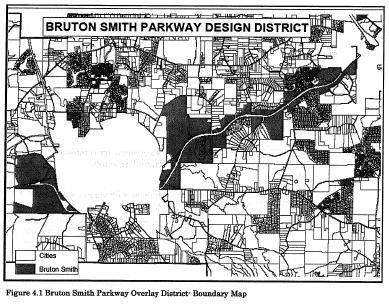
The provisions of this section apply to parcels in unincorporated Henry County abutting the realignment of that road now or formerly known as Richard Petty Boulevard as well as those abutting State Route 20 from Interstate 75 in the east to the Atlanta Motor Speedway (AMS) in the west and as shown on that certain map entitled "Bruton Smith Parkway Design District," Figure 4.1, Bruton Smith Parkway Overlay District Boundary Map, which map is adopted herewith and is an integral part of this section.
a.
Corridor district map. The map of the Bruton Smith Parkway Overlay District will be maintained by the county. The BSPOD map will overlay the official Henry County Zoning Map and said map is hereby incorporated herein and made a part of this section by reference.
b.
No changes in the boundaries of the BSPOD shall be authorized except by the board of commissioners. Dividing a lot will not change the designation of the divided land, except by board approval.
B.
Access management. BSPOD regulations set out herein shall apply to all subdivisions and projects requiring a land development permit where access is taken from a state or federal route or a road classified as a major or minor arterial or collector road in the Henry County Functional Road Plan. Access to any state or federal route shall comply with the traffic access requirements established by Henry County and the Georgia Department of Transportation. Future State Route 20 right-of-way, including that of any State Route 20 extension, as determined by the Georgia Department of Transportation shall be preserved from development.
Individual county standards shall apply unless a more restrictive conflicting standard is required by the Georgia Department of Transportation.
1.
Required joint driveways, cross access drives, and pedestrian access shall be provided to allow circulation between parcels.
2.
Cross access easements and pedestrian access shall be established along state or federal routes. Building sites having access to any state or federal route shall incorporate the following:
a.
Continuous interparcel connectivity extending the entire length of each block served to provide for driveway separation along any state or federal route of at least one thousand (1,000) feet of linear frontage and providing a two-way travel aisle width of a minimum of twenty-four (24) feet and other features as required herein.
b.
Stub-outs and other features indicating that abutting properties may be connected to provide cross access via a service drive.
3.
All developments shall have access to a public right-of-way. Regardless of the minimum number of access points, minimum spacing requirements as described in subsection 4. (below) shall be maintained. The number of access points shall be as follows:
4.
The separation of access points on any state or federal route shall be determined by the design speed of the road from which access is taken with the following minimum spacing requirements:
a.
The distance between access points shall be measured from the centerline of the proposed driveway or public or private street to the centerline of the nearest existing adjacent driveway or public or private street.
b.
Driveway and public or private street spacing at intersections and corners shall provide required sight distance, response time, and permit required queuing space.
c.
No driveway shall be allowed within one hundred (100) feet of the centerline of an intersecting state or federal route, arterial, or collector road.
d.
Nothing within this section shall be construed to mean that a single parcel may have more than the number of approved access points.
e.
Nothing within this section shall be construed to eliminate all access to a parcel of land that was legally subdivided prior to the enactment of this section.
5.
For access points along any state or federal route a deceleration lane, larger turning radius, traffic islands, and any other devices or designs may be required at the sole discretion of the development plan review department staff.
6.
Deceleration lanes are required for entrances of subdivisions consisting of twenty (20) or more units as specified below:
C.
Signage. Signage shall comply with all ULDC sign regulations. Should regulations conflict, the more strict regulation shall govern.
Interstate signs shall not be permitted.
Ground signs shall be limited to monument-based signs. Base and sign structure shall be constructed of brick or stone consistent with the architecture and exterior treatment of the primary structure. No more than one (1) ground sign per frontage on a public right-of-way shall be permitted, and it shall not exceed eight (8) feet in height above grade for subdivisions and single occupant development or fifteen (15) feet in height above grade for multi-occupant developments.
Any ground sign shall be a minimum of one (1) foot from the right-of-way and shall be no closer than ten (10) feet from the curb-line of a paved vehicular area.
Wall signs shall be limited to no more than ten (10) percent of the square footage of the façade of the tenant space. Two (2) wall signs are allowed on corner unit of a strip center. If lighted, lettering shall be individually formed and lighted. No spreader bar signage shall be allowed except as required by the state fire marshal.
Prohibited signs include, without limitation, exposed neon, portable, pennant, or any sign determined by the planning and zoning department to distract the traveling public.
D.
Transportation/infrastructure.
1.
Underground utilities. All utilities except for major electronic transmission lines and substations are required to be placed underground.
2.
Interparcel access. Interior roadways if constructed shall be continuous and aligned with existing, planned, or platted streets.
At least one (1) stub-out shall be provided between all contiguous parcels where feasible. One (1) such stub-out shall be provided to the adjacent property for each eight hundred (800) feet of shared property line.
3.
On-street parking. On-street parking is encouraged. The placement of on-street parking shall be subject to review, and approval shall be required.
4.
Multiuse pathways. Multiuse pathways are required to connect to multiuse pathways or sidewalks that have been provided on adjacent parcels and do so without abrupt changes in grade or direction. They shall have a paved width of ten (10) feet. The grade of the pathways shall not exceed a grade of six (6) percent. Intersections with streets shall require striping, appropriate signage, and a five-foot curb flare with bollards placed six (6) feet apart to block unauthorized vehicles. Multiuse pathways shall be located along the sites frontage along State Route 20.
5.
Sidewalks. Sidewalks are required to be provided on both sides of all interior roadways (public or private), and shall be a minimum of five (5) feet in width. Attractive, safe, and convenient pedestrian access from the sidewalk to the building frontage as well as other pedestrian connections to adjacent buildings within the same development shall be provided. Such pedestrian access shall minimize conflicts with automobiles by such means as walkways, ornamental pavers, striping, signs and painted crosswalks.
E.
Architectural design. Any accessories provided such as railings, benches, trash receptacles and/or bicycle racks shall complement the building design and style.
1.
Building placement. For any parcel or lot, the front setback shall be fifty (50) feet. Development plans shall record the zoning designation of each adjoining parcel. The side setback from the property line of an adjoining parcel with a residential zoning designation shall be twenty (20) feet. The rear setback from the property line of an adjoining parcel with a residential zoning designation shall be forty (40) feet.
2.
Residential design guidelines.
a.
Each subdivision shall provide at least one (1) entrance street. Entrance streets shall be designed as three-lane divided streets with a center median not less than eight (8) feet in width.
b.
Alleys where provided shall run continually through residential blocks. Alleys shall intersect streets no closer than one hundred fifty (150) feet from any street intersection.
c.
Architectural design of all residential buildings shall comply with the following performance guidelines:
i.
Architectural treatments of each building elevation shall be brick, stone or hard-coat stucco. Wood, wood shake or fiber cement-type siding may be used as architectural accents but may in no case make up more than fifty (50) percent of any elevation. The percentage of architectural accents shall be included on required elevation plans submitted to the building department for approval.
ii.
Roofs shall have a minimum of 5:12 pitch, with the exception of attached patio covers. The minimum roof pitch of an attached patio cover shall be as required by the current state minimum standard codes for construction as adopted by the Board of Community Affairs, along with their respective amendments. Roofing materials for pitched or mansard roofs shall be limited to the following:
• Metal standing seam.
• Tile, slate or stone.
• Wood shake.
• Architectural-style asphalt shingles.
• Shingles with a slate, tile or metal appearance.
iii.
All mechanical, HVAC and like systems shall be screened from street level view (within three hundred (300) feet) on all sides by an opaque wall or fence constructed of brick, stucco, split-faced block or wood.
3.
Commercial/retail design guidelines.
a.
Architectural design of all commercial/retail buildings shall comply with the following additional performance guidelines:
i.
Architectural treatments of each building elevation shall be brick, stone, hard-coat stucco, or glass. Cement fiber board may be used as an accent building material.
ii.
Within planned shopping centers, distinct architectural entry identity for individual tenants' entrances shall be provided for suites exceeding ten thousand (10,000) square feet of leasable area.
iii.
Walls visible from roadways or parking areas shall incorporate changes in building material/color or varying edifice detail such as trellises; false windows; recessed panels reminiscent of window, door, or colonnade openings; landscaping; or storefronts every one hundred fifty (150) linear feet.
iv.
Roof parapets when constructed shall be articulated to provide visual diversity. Parapets shall include articulations or architectural features at least every one hundred (100) linear feet.
v.
Building design shall include minimum one-foot deep cornices, extending along the entire front of buildings and the sides of buildings at least ten (10) feet.
vi.
Building design shall include a minimum one-foot high contrasting base, extending along the entire front of buildings and the sides of buildings at least ten (10) feet, excluding window and doors.
vii.
All mechanical, HVAC and like systems shall be screened from street level view (within three hundred (300) feet) on all sides by an opaque wall or fence constructed of brick, stucco, split-faced block or wood.
4.
Industrial design regulations.
a.
Architectural design of all industrial buildings shall comply with the following performance guidelines:
i.
Contrasting accent colors (other than dark green or brick red) of any wall, awning or other feature shall be limited to no more than fifteen (15) percent of the total area of any elevation. The percentage of contrasting accent colors shall be included on required elevation plans submitted to the building department for approval.
ii.
Buildings shall incorporate live plant material growing immediately in front of or on the building.
iii.
Roofing materials for pitched or mansard roofs shall be limited to the following:
• Metal standing seam.
• Tile, slate or stone.
• Wood shake.
• Architectural-style shingles.
iv.
All mechanical, HVAC and like systems shall be screened from street level view (within three hundred (300) feet) on all sides by an opaque wall or fence constructed of brick, stucco, split-faced block or wood.
F.
Dumpster screening. Dumpsters visible from adjacent properties or public parking lots shall be screened from view on all four (4) sides. Screening shall consist of three (3) solid walls of brick or stone construction, at least six (6) feet in height, with one hundred (100) percent solid metal or wooden gates.
G.
Landscaping and buffers.
1.
Planting strip. A ten-foot wide planting strip shall be provided along the perimeter of all commercial development. This strip shall be planted with approved ground cover and contain trees. Trees shall be a single species and planted at regular fifty-foot intervals. Trees shall not be planted within twenty-five (25) feet of the curb line of street intersections. All trees shall be a minimum two-inch caliper (dbh) at the time of planting. The height of the landscaping material shall be a minimum of five (5) feet at the time of planting. The planting strip requirement can be waived by the administrator if fifteen (15) percent of the site is landscaped.
2.
Off-street surface parking lot planting requirements. Off-street surface parking lots which are required to contain more than twenty (20) parking spaces shall contain landscaping and plantings as follows:
a.
Trees shall be provided and maintained adjacent to, and in the interior portions of, parking lots in a ratio of one (1) tree for each seven (7) parking spaces. In addition, every parking space shall be within sixty (60) feet of the trunk of a tree.
b.
Deciduous trees shall be a three-inch caliper (dbh), and evergreen trees shall be at least six (6) feet in height at the time of planting.
c.
The minimum planting area or island for each canopy tree shall be at least ten (10) feet by twenty (20) feet. If shared with other trees, eighty (80) square feet for each additional tree shall be added.
d.
The minimum planting area or island for each understory tree shall be one hundred (100) square feet. If shared with other trees, forty (40) square feet for each additional tree shall be added.
e.
Trees shall be planted in areas surrounding the perimeter of the parking lot and/or shall be planted in planting areas or islands internal to the parking lot as approved. Trees may be planted and spaced singly or in groups. Each planting area or island shall not be less than four (4) feet in width in any direction.
f.
Ground areas shall be sodded and/or planted with groundcover species, and/or provided with other landscaping material, or any combination thereof.
g.
Paved or striped islands greater than fifty (50) square feet shall not be allowed. These areas shall contain landscape plantings.
h.
Landscaping and other features shall be maintained to ensure adequate sight distance within parking lots at all times.
H.
Lighting.
1.
Street lighting. Any streetlights along public rights-of-way shall utilize decorative light poles/fixtures. Light sources shall be high-pressure sodium. Street lights shall be staggered, one hundred fifty (150) feet on-center. All street lighting shall be subject to review, and approval shall be required. The light fixture that shall be utilized is as follows:
2.
Parking lot lighting. Required lighting throughout all parking areas shall utilize decorative light poles/fixtures. Light sources shall be metal halide, not exceeding an average of 4.5 foot-candles of light output throughout the parking area. Other than pedestrian light fixtures that will be less than fourteen (14) feet tall, light fixtures shall be hooded. Lighting shall be directed to avoid intrusion on adjacent properties and away from adjacent thoroughfares. Light fixtures shall be as follows:
3.
Multiuse pathway lighting. Lighting for pedestrians and bicyclists along any multiuse pathway segments shall be of an approved design, a maximum of fifteen (15) feet in height with average spacing not to exceed forty (40) feet apart.
4.02.02.
Reserved.
(Ord. No. 14-02, § 2, 6-17-14; Ord. No. 14-03, 6-17-14; Ord. No. 15-02, § I, 2-17-15; Ord. No. 18-06, § I, 11-27-18)
Sec. 4.03.00. - Supplemental standards for specific uses. (Check chapter 2 for districts and defined uses.)
4.03.01.
Animal care facilities (kennels, animal hospitals, veterinary clinics, and stables).
A.
Animal care facilities, with the exception of stables and facilities for livestock are permissible in the RA zoning district with an approved conditional use and subject to the site design standards for the district. Stables and facilities for livestock are permissible in the RA zoning district and subject to the site design standards of subsection 4.03.01.G.
B.
Animal care facilities, with the exception of noncommercial kennels in the MU, C-2, C-3, IAC, and M-1 zoning districts are subject to the site design standards for the district and specific site design standards in this section.
C.
Design standards for an animal hospital or veterinary clinic in a freestanding building are shown in the following table:
Table 4.03.01.C. Standards for Freestanding Animal Hospital or Veterinary Clinic
D.
Design standards for an animal hospital or veterinary clinic in a shopping center are shown in the following table:
Table 4.03.01.D. Standards for Animal Hospital or Veterinary Clinic in a Shopping Center.
E.
Design standards for commercial kennels are shown in the following table:
Table 4.03.01.E. Standards for Commercial Kennels.
F.
Design standards for noncommercial kennels are shown in the following table:
Table 4.03.01(F). Standards for Noncommercial Kennels.
G.
Design standards for stables, including riding açademies, barns, and other facilities for farm animals and livestock are shown in the following table:
Table 4.03.01(G). Standards for Stables and Facilities for Livestock.
4.03.02.
Cemeteries.
A.
Cemeteries are permissible in all zoning districts, subject to the site design standards of the district and the specific supplemental standards in this section.
B.
A cemetery may include one (1) or more of the following: a burial park for earth interments, a mausoleum for vault or crypt interments, and a columbarium.
C.
A cemetery may include a chapel or church when operated in conjunction with and within the boundaries of such cemetery.
D.
Site design requirements are as follows:
Table 4.03.02(D). Standards for Cemeteries.
1 The buffer shall be designed to achieve a minimum height of six (6) feet within three (3) years after installation.
2 The required buffer shall be along the banks of all state bodies of water as measured horizontally from the point where vegetation has been wrested by normal stream flow or wave action.
E.
Location requirements.
1.
A cemetery shall not be located in a wetland, 100-year floodplain, floodway, or flood hazard area.
2.
All new cemeteries must be located not less than one hundred fifty (150) feet from a drinking water well.
3.
The cemetery shall be located below the elevation of known drinking water wells.
F.
[Off-street waiting.] Adequate off-street waiting space shall be provided for funeral processions so that no vehicle stands or waits in a dedicated right-of-way.
G.
[Access.] All cemetery access shall be provided from a county maintained roadway or state highway. The entrance and exits to the cemetery shall be only from the frontage street.
H.
[Mausoleums and columbaria.] Mausoleums and columbaria may be located only within the boundaries of approved cemeteries. Mausoleums and columbaria shall have façades of brick or stone.
I.
Review and approval procedures.
1.
A cemetery shall meet the requirements of chapter 12 for application, review, and approval. Upon approval, a final plat of the cemetery shall be recorded.
2.
A drainage plan must be submitted and approved by the development plan review department before cemetery approval may be granted.
3.
The owner of a cemetery shall notify the county health department of the intent to build a cemetery and shall submit a letter from the county health department identifying the cemetery's location in relation to any known drinking water wells as part of the application for approval.
4.03.03.
Centers for manufacturing, production, processing, or assembly.
A.
Purpose. Certain manufacturing, production, processing, or assembly uses are permissible in the M-1 and M-2 zoning districts, subject to the site design requirements of the zoning district. However, within this broad group of uses there are individual uses that are permissible within M-1 or M-2 only where supplemental site design standards are provided. This section sets forth those specific site design standards that are required in addition to the site design standards of the zoning district in which the use is proposed.
B.
[Supplemental standards.] Supplemental standards for asphalt and concrete batching plants, central mixing plants for cement, mortar, plaster, or housing materials; and food processing plants are provided in the following table:
Table 4.03.03.B. Standards for Asphalt and Concrete Batching Plants, Central Mixing Plants and Food Processing.
4.03.04
Adult and child day care facilities.
A.
Applicability. The requirements of this section apply to child and adult day care facilities, nursery schools, and preschools. These facilities are permissible in the MU, OI, C-1, C-2, C-3 and IAC zoning districts. In addition, these facilities are permissible with an approved conditional use in the RA, M-1 and M-2 zoning districts. Further, child and adult day care facilities are permissible as a home occupation in all residential zoning districts. Non-home occupation facilities subject to the requirements of this section shall meet the site design standards of the zoning district and the supplemental standards set forth in this section.
B.
All facilities regulated in this section shall comply with state regulations and require applicable state licenses for operation.
C.
Home occupation day care facilities shall be limited to the provision of care and supervision to not more than six (6) children or six (6) adults and shall comply with the standards set forth in section 7.01.00.
D.
Non-home occupation child day care facilities, nursery schools, and preschools shall comply with the following standards:
Table 4.03.04(D). Standards for Non-Home Occupation Child Day Care Centers, Nursery Schools, and Preschools.
E.
Adult day care centers.
Table 4.03.04(E). Standards for Adult Day Care Centers.
4.03.05.
Electrical substations.
A.
Electrical substations are permissible in any zoning district, subject to the dimensional standards for the district and the supplemental standards set forth in this section.
B.
An electrical substation shall be fully enclosed, except for a gate, on all sides with a solid fence or a landscaped buffer that meets the following standards:
Table 4.03.05(B). Standards for Electrical Substations
4.03.06.
Emergency response and public safety facilities.
A.
Emergency response facilities, such as fire stations, ambulance services, and police stations are permissible in any zoning district, subject to the dimensional standards for the district and the supplemental standards set forth in this section.
B.
Site design standards for emergency response facilities are as follows:
Table 4.03.06(B). Standards for Emergency Response Facilities
4.03.07.
Establishments over 40,000 square feet (large-scale retail centers).
A.
Purpose. This section is intended to provide design standards for uses located in large-scale buildings. The purpose is to ensure the compatibility of large buildings and their associated impacts with the surrounding area, and to avoid large, undifferentiated wall surfaces.
B.
Applicability. Establishments over forty thousand (40,000) square feet shall comply with the design standards contained in this section, in addition to the site design standards of the underlying zoning district. The size threshold refers to an individual establishment and its associated outdoor areas used for display and storage.
C.
[Building design standards.] Building design shall meet the standards in the following table (See figure 4.2).
Table 4.03.07(C) Building Design Standards for Establishments Over 40,000 Square Feet
* Architectural design shall be subject to approval by the architectural review committee.
4.03.08.
Funeral homes, mortuaries, and/or crematoriums.
A.
Funeral homes and mortuaries, with or without crematoriums, are permissible in the OI, C-2, C-3, MU, and IAC zoning districts, subject to site design standards of the zoning district and the supplemental standards set forth in this section.
B.
Adequate off-street waiting space shall be provided for funeral processions so that no vehicle stands or waits in a dedicated right-of-way. A minimum off-street stacking distance of one hundred (100) feet shall be provided.
4.03.09.
Gasoline service stations (with or without convenience stores).
A.
Gasoline service stations without a convenience store are permissible in the following zoning districts, subject to the site design standards for the district, and the specific site design standards in this section: C-1, C-2, C-2, MU, and IAC.
B.
Except as otherwise prohibited, gasoline service stations without a convenience store may include the following activities and uses: Sale of fuel, oil, lubricants, and similar products; minor automotive repair; sale of small automotive accessories; inspection stations for emissions; or car wash. Gasoline stations without a convenience store shall not include game rooms, game arcades, major automotive repair, body shops, paint shops, or paint booths.
C.
Design standards for gasoline stations without a convenience store are shown in the following table:
Table 4.03.09(C). Standards for Gasoline Service Stations (without a convenience store)
D.
Gasoline service stations with a convenience store are permissible in the following zoning districts, subject to the stie design standards for the district, and the specific site design standards in this section: C-1, C-2, C-3, MU, and IAC.
E.
Except as otherwise prohibited, gasoline service stations with a convenience store may include the following activities and uses: Sale of fuel, oil, lubricants, and similar products; minor automotive repair, sale of minor automotive accessories; sale of food and sundries; convenience store; inspection stations for emissions; truck wash; or car wash. Gasoline service stations with a convenience store shall not include game rooms, game arcades, major automotive repair, body shops, paint shops, or paint booths.
F.
Design standards for gasoline service stations with a convenience store are shown in the following table:
Table 4.03.09(F). Standards for Gasoline Service Stations (with a convenience store)
4.03.10.
Golf courses.
A.
Golf courses are permissible in RA, R-1, R-2, R-3, R-4, R-5, RD, RM, RS, and MU zoning districts, subject to the standards of the district and the supplemental standards in this section.
B.
A golf course may be public or private and may include the following buildings and accessory uses:
1.
A clubhouse with or without a pro shop, retail sales of golf supplies and accessories, and a restaurant or snack shop.
2.
An equipment building for maintenance, minor repairs, and storage. Storage may include fertilizers, herbicides, pesticides or golf carts.
3.
Driving range and/or putting greens.
4.
Restroom facilities.
C.
The types of golf courses may be par three (3), executive, private, semiprivate or regulation.
D.
The following are site design standards for golf courses:
Table 4.03.10(D) Standards for Golf Courses
4.03.11.
Commercial greenhouses and/or plant nurseries.
A.
Greenhouses and/or plant nurseries are permissible in the RA, C-2, and C-3 zoning districts subject to the site design standards of the district and the supplemental standards set forth in this section.
B.
Greenhouses and/or plant nurseries in the RA zoning district shall sell only plants grown on-site.
C.
The following are the site design requirements for greenhouses and plant nurseries:
Table 4.03.11(C) Standards for Greenhouses and Plant Nurseries
4.03.12.
Hospitals.
A.
Hospitals are permitted in the OI, C-2, C-3, MU, and IAC zoning districts, subject to the site design standards of the district. Hospitals are permissible in the RA zoning district with an approved conditional use and shall comply with the site design standards of the RA district and the supplemental standards set forth in this section.
B.
The following are site design standards for hospitals:
Table 4.03.12(B) Standards for Hospitals
4.03.13.
Radio and television stations. (Reserved)
4.03.14.
Mass assembly centers and grounds (fairgrounds, outdoor amusements, amphitheaters, convention centers, civic centers, rodeos, armories, churches and athletic fields).
A.
All fairgrounds, outdoor amusements, amphitheaters, civic centers, convention centers, rodeos and armories shall meet the site design requirements for zoning districts RA, MU, IAC, C-2, C-3, M-1 and M-2 in which they are located and the additional site design standards as set forth in this section. An approved conditional use is required in all aforementioned zoning districts.
B.
Fairgrounds and amphitheaters, where activities occur primarily out of doors, shall meet the following site design standards:
Table 4.03.14(B). Standards for Fairgrounds and Amphitheaters.
C.
Outdoor amusements include such activities as miniature golf, carnivals or midway rides, pony rides, climbing walls, tracks for go-carts and other similar vehicles, and other tourist-oriented rides and amusements. Temporary activities or special events that include outdoor amusements are regulated in section 7.03.03.
1.
Outdoor amusements may be freestanding, or two (2) or more amusements may be combined in a unified development site.
2.
Outdoor amusements may include accessory uses, such as snack shops or food stands, gift shops, ice cream stands, or similar uses, provided that such uses are not open to the general public without entrance to the outdoor amusement.
3.
The site design standards for outdoor amusements are shown in the following table:
Table 4.03.14(C) Standards for Outdoor Amusements
D.
Convention centers, civic centers, centers for performing arts, and armories (where activities occur primarily indoors) shall meet the site design standards in the following table:
Table 4.03.14(D) Standards for Convention, Civic and Performing Arts Centers and Armories
E.
Churches and similar religious facilities. Religious facilities, including churches and other places of worship, together with specified accessory uses and structures, are permissible in the MU, OI, C-1, C-2, C-3, and IAC zoning districts subject to the standards of the zoning district. An approved conditional use is required for churches and religious facilities within the M-1 and M-2 zoning districts, subject to the standards of the zoning district and in accordance with section 4.01.03, appearance standards for commercial and industrial buildings. Ancillary and accessory uses for churches and religious facilities are permitted within the M-1 and M-2 zoning districts, subject to supplemental standards. Religious facilities, including churches and other places of worship, together with specified accessory uses and structures, are permissible with an approved conditional use in the following zoning districts, subject to the standards of the district and the supplemental standards set forth in this section: RA, R-1, R-2, R-3, R-4, R-5, RS, RD, RM, and RMH.
Table 4.03.14(E) Site Design Standards for Churches and Similar Religious Facilities
1.
Uses and activities other than worship shall be considered accessory uses and shall be clearly ancillary to the primary use. Such uses and activities shall be limited to:
A.
Religious instruction or similar instruction or study typically associated with the religion;
B.
Offices to support the establishment;
C.
Child or adult day care;
D.
Private açademic school;
E.
A fellowship hall, with or without a kitchen (which may be known as a community center, activity hall, or life center);
F.
Recreation facilities, including athletic fields;
G.
Individual meeting spaces; and
H.
A parsonage.
2.
All accessory uses are subject to the following requirements:
A.
(Reserved.)
B.
The facility housing the accessory use shall meet all local, state, or federal standards.
C.
The operator of the accessory use shall obtain any licenses required to conduct the accessory use. Any approval of the accessory use shall be contingent upon receipt of all licenses.
D.
Loudspeaker or paging systems shall be located to ensure that they cannot be heard at the property line of adjacent properties.
E.
All outdoor activities shall occur no earlier than 7:00 a.m. and no later than 10:00 p.m.
F.
Exterior lighting shall be downcast of moderate brightness and shall not cause glare on any abutting property.
G.
Outdoor play or activity areas shall be no closer than fifty (50) feet from any residential property line.
3.
Child day care, adult day care, preschool, or child nursery uses are allowable accessory uses subject to the following standards:
A.
The total floor area allocated to the child day care, adult day care, preschool, or nursery uses shall not exceed fifty (50) percent of the total floor area on the site. The calculation of total floor area allocated to the uses shall be cumulative and shall include all child day care, adult day care, preschool, nursery facilities, and related mechanical and support facilities.
B.
An off-street drop-off area for persons served by the facility shall be provided. The entrance and vehicle drop-off points shall not be located on a street providing primary access to residences, unless such street is classified as a collector or arterial.
4.
Private açademic schools are allowable accessory uses subject to the following standards:
A.
The total floor area allocated to the school shall not exceed fifty (50) percent of the total floor area on the site. The calculation of total floor area allocated to the school shall include all components of the school: classrooms, school library, school offices, teacher work areas, and the like, including related mechanical and support facilities.
B.
Notwithstanding subsection 4.03.14.E.5.A., the total floor area allocated to the school may exceed twenty (20) percent of the total floor area on the site, provided that the area allocated to the school meets the requirements of section 4.03.22.
C.
The entrance and vehicle drop-off points for students shall not be located on a street providing primary access to residences, unless such street is classified as a collector or arterial.
5.
A fellowship hall is an allowable accessory use, provided that the total floor area allocated to the fellowship hall, including related mechanical and support facilities, shall not exceed thirty-five (35) percent of the total floor area on the site.
6.
One (1) residential dwelling unit is allowable to serve as a parsonage, subject to the following standards:
A.
A minimum lot area, within the parcel developed for religious uses and facilities, to be devoted to the dwelling unit ("parsonage lot") shall be eight thousand (8,000) square feet. The parsonage lot shall be used exclusively for the dwelling unit, and shall not include any primary or other accessory use allowable on the site. The parsonage lot shall not be used for any support activity to the primary or accessory uses, such as outdoor play areas, storage, or parking, other than as specifically provided in subsection 4.03.14.E.7.B. through F. and subsection 4.03.14.E.8. and 9., below.
B.
The maximum lot coverage for the parsonage lot shall be thirty-five (35) percent.
C.
Two (2) parking spaces shall be provided within the parsonage lot.
D.
The maximum building height on the parsonage lot shall be thirty-five (35) feet.
E.
The parsonage lot may contain children's outdoor play equipment, in a size and quantity typical of residential uses.
F.
The parsonage lot may contain a residential swimming pool, fully enclosed, and attached to the dwelling.
7.
A specific parking plan shall be provided. This plan shall identify the principal use and each accessory use proposed on the site. The parking plan shall indicate the hours of operation and peak times of use (parking demand) for the primary use and each accessory use on the site. The parking standards for the principal use and each accessory use shall be identified, based upon ULDC requirements, set forth in section 8.02.00. The parking plan may propose reduced or shared parking, as set forth in section 8.02.08. The parking plan shall indicate areas designated for overflow parking during times of extraordinary use (such as festival or holiday periods).
8.
For religious facilities that exceed ten thousand (10,000) square feet in total floor area, excluding the parsonage, if any, the minimum setback from any property line that is otherwise required shall increase five (5) feet for each two thousand (2,000) square feet, or portion thereof, over ten thousand (10,000) square feet.
F.
Athletic fields can be located in any zoning district and shall meet the site design standards in the following table:
Table 4.03.14(F) Standards for Athletic Fields
4.03.15.
Mines and quarries.
A.
The development of natural resources, including the removal of minerals and natural materials, together with necessary buildings and machinery, is allowable in the M-2 zoning district, subject to the standards of sections 4.01.01 and 4.01.02 and the supplemental standards of this section.
B.
Where an existing quarry is proposed for extension or expansion beyond the property lines of the quarry area, such extension or expansion shall be considered as a new operation, subject to the standards set forth in this section.
C.
The area where mining or quarrying operations are conducted shall be fully enclosed with a fence or wall.
1.
The fence or wall shall be located at least ten (10) feet from the edge of any excavation.
2.
The fence or wall shall be designed and installed to ensure safety and security of the site, and to prevent entrance to the site by animals and unauthorized persons.
D.
Product piles, spoil piles, or other accumulations of by-products shall not exceed thirty-five (35) feet in height above the original contour of the site.
E.
Roads within the excavation site shall be surfaced with a dust-free material.
F.
A mining land use plan, conforming to the requirements of federal and state law, shall be required prior to approval of any mining or quarrying activity.
G.
Applications for approval of new mines or quarries or the expansion or extension of mines or quarries shall comply with the procedures set forth in chapter 12. Applications shall demonstrate compliance with all state and federal laws and regulations applicable to mines and quarries.
4.03.16.
Mobile home or manufactured home parks.
A.
A mobile home or manufactured home subdivision shall comply with the dimensional standards set forth in tables 4.01.01(E) and 4.01.02(H), and with the subdivision design standards set forth in section 4.04.00. All mobile home or manufactured home developments that are not subdivisions shall be considered parks.
B.
A mobile home or manufactured home park ("park") is permissible in the RMH zoning district, and shall comply with the standards set forth in this section.
C.
A park shall be a unified development site.
D.
Certain accessory uses and structures may be contained in a park, provided such uses and structures are incidental to the principal use of the site for a park. The following standards are required for accessory uses and structures:
Table 4.03.16(D). Standards for Accessory Uses in Manufactured Home Parks.
E.
The site design standards for a park are set forth in the following table:
Table 4.03.16(E) Site Design Standards for Manufactured Home Parks
Standards for recreation or open space areas within parks
1.
Recreation or open space areas may be one (1) contiguous tract or several tracts.
2.
Individual tracts shall be no smaller than one-half (½) acre.
3.
Recreation areas shall be located for convenient access to all park residents.
4.
Street open space shall not be included in the required recreation or open space area.
5.
Up to twenty (20) percent of the required area may be located in the floodplain area.
6.
Recreational parks shall be located on land suitable for park development and shall contain a sufficient amount of play equipment designed for school-age children.
7.
If the park management fails to maintain open spaces, the county may provide this service and file a lien against the property owner.
F.
Standards applicable to manufactured homes and mobile homes within a park are set forth in the following table:
Table 4.03.16(F) Standards for Manufactured and Mobile Homes Within Parks
G.
Structural requirements for manufactured homes in parks.
1.
Each manufactured or mobile home unit shall be installed in compliance with the manufacturer installation requirements or with Chapter 120-3-7 of the Rules and Regulations of the Office of Commissioner of Insurance — Safety Fire Division.
2.
The manufactured or mobile home unit shall be installed true and plumb.
H.
Requirements for utilities in a park.
1.
Each park shall be served by central water, sanitary sewer, electricity, gas (if available), and a central television antenna system or cable.
2.
All utilities shall be located underground.
3.
Each manufactured or mobile home shall be connected with public water and sanitary sewer facilities which comply with county requirements.
4.
An electrical outlet supplying both sixty (60) and one hundred fifty (150) amperes of service shall be provided for each lot. All such outlets shall be weather-proof, and installations shall meet the requirements of the National Electrical Code.
I.
Requirements for streets within a park.
1.
Streets shall be a minimum of twenty-six (26) feet in width.
2.
All private streets, driveways and pedestrian walkways within the mobile home park shall be lighted between sunset and sunrise with electric lights emitting light at an intensity of at least five thousand (5,000) lumens.
3.
Light poles shall be no more than two hundred fifty (250) feet apart.
J.
Requirements for fire protection within a park.
1.
Every park shall be equipped at all times with fire equipment in good working order and of such type, size, number, and location as to satisfy applicable fire regulations of Henry County.
2.
No open fires or burning of leaves or other refuse shall be permitted within the boundaries of any park.
K.
Requirements for sanitation within a park.
1.
The area around and underneath each mobile home unit shall be kept clean and free from collections of refuse, rubbish, glass bottles, or other unsightly material.
2.
Garbage and refuse collection facilities shall be provided. Waste shall be removed from the premises and disposed of often enough to prevent creating a nuisance or health hazard and to insure that the garbage can shall not overflow.
4.03.17.
Recreational vehicle parks.
A.
Recreational vehicle (RV) parks are permissible in the RA, C-3, and IAC zoning districts, subject to the site design standards of the zoning district and the supplemental standards of this section.
B.
Recreational vehicle parks may include motor homes, travel trailers, pop-up trailers, tents, and other similar vehicles.
C.
The condition of soils, groundwater level, drainage, and topography shall not create hazards to the property or the health or safety of the occupants. The site shall not be exposed to objectionable smoke, noise, odors, or other adverse influences and no portion subject to unpredictable and/or sudden flooding, subsidence, or erosion shall be used for any purpose which would expose persons or property to hazards.
D.
Accessory uses and structures permissible in the recreational vehicle park include management headquarters, recreational facilities, showers, coin-operated laundry facilities, and other uses and structures customarily incidental to operation of a recreational vehicle park. Standards for accessory uses are in the following table:
Table 4.03.17(D) Standards for Accessory Uses in Recreational Vehicle Parks
E.
Site design standards for recreational vehicle parks are set forth in the following table:
Table 4.03.17(E) Site Design Standards for Recreational Vehicle Parks
F.
Garbage and refuse collection facilities shall be provided.
1.
Each lot shall be provided with an approved metal garbage container with a tight-fitting cover. The container shall be kept in sanitary condition and shall be stored at least three (3) inches off the ground, preferably on a metal rack or hanger for such purpose.
2.
Waste shall be removed from the premises and disposed of often enough to prevent creating a nuisance or health hazard and to insure that the garbage can shall not overflow.
4.03.18.
Group homes, nursing homes, assisted living and hospice care facilities.
A.
Group homes, nursing homes, assisted living and hospice care facilities are permissible in the following zoning districts: RA with an approved conditional use and subject to the standards of the district and the supplemental standards set forth in this section.
B.
The following site design standards are required for care homes, group homes, nursing homes, assisted living and hospice care facilities:
Table 4.03.18(B) Standards for Group Homes, Nursing Homes, Assisted Living Facilities and Hospice Care Facilities
4.03.19.
Personal care homes.
A.
Personal care homes are permissible in all residential zoning districts and subject to the standards of the district and the supplemental standards in this section. An approved conditional use is required for all non-home occupation care homes, except in the RA zoning district a four (4) client personal care home is permitted without an approved conditional use. An approved conditional use is required for more than four (4) clients in the RA zoning district.
B.
Home occupation personal care homes shall be limited to the provision of care and supervision to not more than three (3) persons and shall comply with the standards set forth in section 7.01.00.
C.
A state license is required for all personal care homes in accordance with O.C.G.A. § 31-7-12.
4.03.20.
Roadside produce stands.
A.
A roadside produce stand is permissible in the RA zoning district, subject to the site design standards of the district, and the standards of this section.
B.
Roadside stands are allowable for the sale of vegetables, fruit, produce, eggs, or other agricultural products grown on the premises. Agricultural products shall not include poultry or livestock.
C.
Roadside and produce stands shall meet the site design standards in the following table:
Table 4.03.20(C) Standards for Roadside Produce Stands
4.03.21.
Salvage yards or junkyards and wrecker services (with storage area).
A.
Salvage yards and junkyards are permissible in the M-1 and M-2 zoning districts, subject to the standards of the district and the supplemental standards in this section. An approved conditional use is required for all salvage yards and junkyards. In addition, salvage yards shall be required to have minimum lot size of two (2) acres for properties zoned M-1 and one (1) acre for properties zoned M-2.
B.
The site design standards for salvage yards and junkyards are set forth in the following table:
Table 4.03.21(B) Standards for Salvage Yards and Junkyards
C.
Sanitary landfills shall not be permitted.
D.
Wrecker services (with storage area) are permissible in the M-1 and M-2 zoning districts, subject to the standards of the district and the supplemental standards of this section. An approved conditional use is required in the aforementioned zoning districts.
E.
The site design standards for wrecker services (with storage area) are set forth in the following table:
Table 4.03.21(E) Standards for Wrecker Services (with storage area)
4.03.22.
Schools, açademic, public or private.
A.
Public or private açademic schools are permissible in the following zoning districts: OI, C-1, C-2 and IAC, subject to the standards of the zoning district, and the supplemental standards of this section: RA, R-1, R-2, R-3, R-4, R-5, RS, RD, RM, RMH, and MU.
B.
The following site design standards are required:
Table 4.03.22(B) Standards for Public and Private Schools
4.03.23.
Self-service storage facilities.
A.
Self-service storage facilities, also called mini-storage or self-storage, are permissible in the C-3, M-1, and M-2 zoning districts, subject to the standards of the zoning district and the supplemental standards set forth in this section. All new self-storage facilities shall be indoor storage designed to mirror class "A" commercial office space, and shall have architectural design elements consistent with Highway Corridor Overlay District.
B.
The following activities or uses are prohibited on the grounds or within the buildings of self-service storage facilities:
1.
Wholesale sales;
2.
Retail sales, including garage sales, or other commercial activities;
3.
Manufacturing, fabrication, processing, or other industrial activity;
4.
Service or repair of vehicles, engines, electronic equipment or similar activities;
5.
Rehearsal or practice of musical instruments;
6.
Residential and office uses.
C.
Notwithstanding the limitations described in subsection 4.03.23.B., above, the following activities may be conducted:
1.
Rental of storage bays.
2.
Truck rental business, limited to a maximum of twenty-five (25) percent of the gross site area.
3.
Sales of boxes or goods related directly to the operation of a self-service storage facility.
4.
Sales by the owner or manager of the facility of abandoned items for reclamation of rental costs.
D.
Except as specifically provided in this section, all property stored on the site shall be entirely within enclosed buildings.
E.
Storage of flammable liquids, highly combustible or explosive materials, or hazardous waste or chemicals is prohibited.
F.
As an accessory use, one (1) dwelling unit may be established for security personnel, management personnel, or the facility owner.
G.
The following site design requirements shall be met:
Table 4.03.23(G) Site Design Standards for Self-Service Storage Facilities
H.
The following design standards are required for the self-service storage buildings:
Table 4.03.23(H) Building Design Standards for Self-Service Storage Facilities
I.
Outdoor (open) storage is permissible, subject to the following standards:
Table 4.03.23(I) Standards for Outdoor Storage at Self-Service Storage Facilities
J.
Traffic circulation requirements.
1.
Traffic lane widths shall be established to provide for the adequate circulation, safety, and accessibility of trucks, cars, and individuals who utilize dead storage in such facilities.
2.
The minimum traffic lane width shall be twenty-five (25) feet.
3.
The maximum traffic lane width shall be forty (40) feet.
4.
Traffic flow patterns, directional signage, and painted land markings with arrows shall also be clearly marked.
5.
In order to ensure appropriate access and circulation by emergency vehicles and equipment, the turning radii of the aisle ways shall be approved by the county DOT and the fire marshal at the time of preliminary plan review.
6.
There shall be no aisle ways or other vehicular access ways located in the buffer area or within the designated rights-of-way.
K.
The following standards are required for landscaping:
Table 4.03.23(K) Landscaping Standards for Self-Service Storage Facilities
4.03.24.
(Reserved.)
4.03.25.
Airstrips, airports and helicopters [heliports]. Airstrips, airports and helicopters [heliports] (other than private airstrips and helicopters [heliports] within a residential fly-in neighborhood) are permissible in the M-1 and M-2 zoning districts. Those properties zoned RA (Residential Agricultural) outside of a subdivision, shall be required to obtain a Conditional Use [permit] and meet the following minimum standards:
1.
The minimum acreage shall be fifteen (15) acres.
2.
An undisturbed vegetative buffer shall be provided along all property lines which abut property with a residential zoning classification, except where prohibited to provide access or utility easements. The purpose of the buffer shall be to screen sight or sound of activities from adjacent and nearby residential neighborhoods. The buffer shall be a minimum of one hundred feet (100') in width. Should the property lack existing vegetation, a detailed landscaped plan shall be submitted and approved by the Development Plan Review Department, prior to the submittal of a Conditional Use Application, and shall conform to the plant material requirements and specifications set forth in Section 5.02.04. Existing vegetation within the buffer area should be preserved and enhanced where insufficient to provide adequate screening, but not in excess of that which is required under Section 5.02.00.
3.
The landing strip/runway shall not be paved. The use of permeable or pervious pavement materials shall be allowed.
4.
The private airstrips, airports and helicopters [heliports] shall adhere to all applicable laws and regulations of the Georgia Department of Transportation (GDOT) and Federal Aviation Administration (FAA).
5.
No commercial activities shall be allowed or permissible with any approved Conditional Use. The following uses are prohibited: flight instruction, aircraft storage (other than hangars for use by the property owner), aircraft maintenance (will be permissible as long as it's for use by the property owner), aircraft fueling (other than for use by the property owner), and other similar commercial airport activities.
6.
Only one (1) airstrip per Conditional Use shall be allowed.
7.
A maximum of two (2) airplane hangars may be allowed even in the absence of a primary structure to any approved Conditional Use. Any hangars in excess of two (2) shall be required to obtain separate approval from the Board of Commissioners, by the filing of a separate application.
8.
All hangars constructed shall be required to obtain a permit and approval from the Building Department and shall comply with any and all development and building regulations and standards.
4.03.26.
Livestock processing and feedlots. Livestock processing and feedlots shall meet applicable state and federal standards for confinement feeding operations. A buffer one hundred (100) feet in width is required on all side and rear property lines.
4.03.27.
Lodges and event facilities.
A.
Lodges and event facilities are permissible in the MU, OI, C-1, C-2, C-3 and IAC zoning districts, subject to the site design standards for that district. Lodges and event facilities are permissible with an approved conditional use within the M-1 and M-2 zoning districts, subject to the standards of the zoning district and in accordance with section 4.01.03, appearance standards for commercial and industrial buildings. An approved conditional use is also required within the RA zoning district, subject to the supplemental standards set forth in this section.
B.
Functions including luncheons, banquets, parties, weddings, meetings, charitable fundraising, commercial or advertising activities, or other gatherings for direct or indirect compensation are permissible.
C.
The following site design standards are required for lodges and event facilities:
Table 4.03.27(C) Standards for Lodges and Event Facilities
4.03.28.
Bed and breakfast facility (not in a subdivision). The regulations below are intended to allow for a more efficient use of large, older homes in residential areas if the neighborhood character is reserved to maintain both the residential neighborhood experience and the bed and breakfast experience. These regulations enable owners to maintain large residential structures in a manner which keeps them primarily in residential uses and provides an alternative form of lodging for visitors who prefer a residential setting. An approved conditional use is required for all bed and breakfast facilities within the RA zoning district.
A.
The house must be at least ten (10) years old before a bed and breakfast facility is allowed. The individual or family who operate the facility must occupy the house as their primary residence.
B.
Bed and breakfast facility may have nonresident employees for such activities as booking rooms and food preparation. Hired services for normal maintenance, repair and care of the residence such as yard maintenance are also permitted.
C.
The following functions are permissible: luncheons, banquets, parties, weddings, meetings, charitable fundraising, commercial or advertising activities, or other gatherings for direct or indirect compensation.
D.
The following site design standards are required for bed and breakfast facilities (not in a subdivision):
Table 4.03.28(D) Standards for Bed and Breakfast Facilities
4.03.29.
Boarding and rooming houses.
A.
Boarding or rooming houses are permissible in the following zoning districts RA with an approved conditional use, OI, C-1, C-2, and C-3 and subject to the standards of the district and the supplemental standards set forth in this section.
B.
The following site design standards are required for boarding and rooming house facilities:
Table 4.03.29(B) Standards for Boarding and Rooming Houses
4.03.30.
Senior adult housing. The purpose of this section is to determine where age-restricted adult housing may be located and to provide minimum standards. The intent of this section is to encourage age-appropriate housing for persons with mobility, sensory, and cognitive limitations. Though these regulations require that over-all developments feature a measure of accessibility, full accessibility is encouraged. Accessibility is defined by the Georgia Accessibility Code as amended, and any age-restricted adult housing development must meet the same standards required by Georgia Accessibility Code 120-3-20-.54 in order to be considered fully accessible.
Senior adult housing may be allowed in these zoning districts as a supplemental use: RA, R-1, R-2, R-3, R-4, R-5, RS, RD, RM, and MU provided that at minimum the following restrictions apply. Final plats and all required construction documents shall include a notation specifying "Age-Restricted Adult Housing: Shall Follow Section 4.03.30"
A.
Unit type allowed:
1.
Only single-family detached units may be allowed in RA, R-1, R-2, R-3, R-4, R-5, and RS districts;
2.
Only two-family units may be allowed in RD district;
3.
Only multifamily units may be allowed in RM district.
B.
The development shall have a minimum of twenty (20) dwelling units.
C.
The maximum net density shall meet the future land use plan requirements.
D.
At least forty (40) percent of the gross site area shall be open space. The open space shall provide amenities such as pathways, seating areas, and recreation areas for residents. The open space shall be protective of natural features.
E.
At least one (1) on-site community building or interior community space shall be provided which contains a minimum of:
1.
Twenty (20) square feet of heated floor area per dwelling unit for the first ninety nine (99) units with a minimum of five hundred (500) square feet, and
2.
Ten (10) square feet of heated floor area per additional dwelling unit.
F.
For phased development; open space, recreational facilities, and other accessory facilities shall be provided in each phase to meet the requirements as stated herein of the residents of each phase. The developer shall provide a schedule for the installation of facilities at the time of the first permit approval.
G.
At the time of the first permit application, the developer shall establish how the age restrictions will be implemented and maintained over time. If the development is anything other than a rental community under single ownership, a common entity such as a condominium association or a homeowners association shall be established to maintain and enforce the age restrictions in addition to the county enforcement of zoning regulations.
H.
All open space, common areas, and related improvements shall be fully accessible and shall be managed and maintained by the owner of the development or a common entity such as a condominium association, or a homeowners association.
I.
Any structure within the development may be fully accessible; however, the minimum standards of this section shall be met. The development shall incorporate universal design features as follows. The application shall include descriptions of the universal design features of proposed dwellings to demonstrate their appropriateness for the age-restricted population. The material submitted shall indicate how universal design features will be used to make individual dwellings adaptable to persons with mobility, sensory, or otherwise functional limitations; and how the design will provide accessible routes between parking areas, sidewalks, front door of the dwelling units, and common areas. These routes shall be a minimum of ten (10) feet, allowing mobility-enhancing devices to meet and pass safely.
1.
"No-step" (maximum vertical floor level change of one-quarter (¼) inch, except where a tapered threshold is used which has a maximum height of one-half (½) inch) access to the front door entrance to all dwelling units and community buildings is required. If a no-step front entrance is not feasible, an alternate no-step walkway to the front floor may be approved.
2.
A minimum thirty-six-inch wide front door with exterior lighting at the entrance is required. Exterior doors shall be provided with an artificial light source located in the immediate vicinity of the exterior door. The illumination of the exterior light shall be controlled from inside the dwelling except for lights that are continuously illuminated or automatically controlled.
3.
All interior doorways must have a minimum of thirty-two-inch clear width in the open position — typically a thirty-six-inch door.
4.
A thirty-six-inch fully accessible route must connect throughout the floor served by the front door of the dwelling unit. The maximum vertical floor level change is one-quarter (¼) inch, except where a tapered threshold is used which has a maximum height of one-half (½) inch.
5.
A complete living area including, but not limited to, kitchen, master bedroom, and bathroom shall be located on the floor served by the front door of the dwelling unit.
6.
Lever handles are required on all interior and exterior doors.
7.
Clear floor space of thirty (30) inches by forty-eight (48) inches shall be provided and centered on each appliance and fixture in the kitchen. Floor space can overlap.
8.
Walls shall be reinforced (blocked) to allow for the later installation of grab bars around the toilet, tub, and shower stall; and of wall-hung bench shower seat.
9.
Maneuvering space shall be provided within the bathroom to permit a person using a mobility aid to enter the room, close the door, and reopen the door with a clear floor space of thirty (30) inches by forty-eight (48) inches. Clear floor space of thirty (30) inches by forty-eight (48) inches shall be provided and centered on each fixture in the bathroom. Floor space can overlap.
10.
Wall-mounted electrical outlets, light switches, and environmental controls shall be mounted for a reaching range of a minimum of fifteen (15) inches to a maximum of forty-eight (48) inches above the floor. Such wall-mounted devices shall be of a contrasting color with the wall.
4.03.31.
Industrialized and modular buildings.
A.
Modular and industrialized buildings within nonresidential zoning districts: OI, C-1, C-2, C-3, MU, M-1 and M-2 are permissible subject to the standards of the district and the supplemental standards set forth in this section, and must receive architectural review approval from the architectural review committee.
B.
Industrialized and modular buildings shall not be utilized for residing in or any other residential purpose.
C.
The following site design standards are required for industrialized and modular buildings in all nonresidential zoning districts.
Table 4.03.31(C). Standards for Industrialized and Modular Buildings.
4.03.32.
Adult entertainment establishments.
A.
An adult entertainment establishment shall only be allowed in designated areas within the M-1 (light-manufacturing) zoning district, as listed below and depicted in figure 4.7: Adult Entertainment Development Areas, Unincorporated Henry County, GA, and shall be subject to the site design standards of the M-1 zoning district, unless otherwise stated in the M-1 supplemental standards (section 4.03.32).
B.
Adult entertainment establishments may only be located on:
1.
The south side of Highway 155, within one (1) mile of the Exit 216 Interchange, as measured from the traffic signal of each respective off ramp, or
2.
Any M-1 zoned parcel located on the west side of Business Center Drive, north of the Norfolk Southern Railroad line.
C.
In addition to meeting the requirements of all other applicable code provisions, including, but not limited to, the zoning code, the following standards apply to adult entertainment establishments (where the provisions of this section conflict with other provisions of the Code of Henry County, the most stringent provisions shall apply):
1.
Buildings and structures established in connection with an adult entertainment facility shall be separated at least forty (40) feet from the building and structure of any other business establishment, and a minimum of forty (40) feet from all property lines.
2.
No adult entertainment establishment shall be located in any strip shopping center, mall, or other group structures; and
3.
Adult entertainment establishments must be placed in a separate building on their own lots.
4.
No adult entertainment establishments may be located within three thousand (3,000) feet of any parcel of land containing another adult entertainment establishment.
D.
For the purpose of this section, distance shall be by straight line, airline measurement from property line to property line, using the closest points on the property lines of the parcels of land involved. The term "parcel" as applied to this section shall mean any quantity of land capable of being described by location and boundary, designated and used or to be used as a unit.
4.03.32.1.
Pawn shops.
A.
Pawn shops are permissible in the following zoning districts: C-2, C-3, and IAC and are subject to the supplemental standards set forth in this section:
1.
Pawn shop licenses shall be limited to one (1) per twenty-one thousand, one hundred eighty-two (21,182) population.
2.
Pawn shops shall not be [located] within one thousand (1,000) feet of a similar use.
3.
No application for license to do business as a pawn shop, shall be considered or approved or a license issued where the total number of pawn shop licenses issued and in effect at the time of such application numbers at least one (1) for each twenty-one thousand, one hundred eighty-two (21,182) residents according to the latest officially and finally published annual population estimates by the Atlanta Regional Commission (ARC).
4.
If, during this period, applications are received which exceed the number of newly available licenses, there shall be held a lottery, administered by the Henry County Business License Department, to determine the order in which applications shall be processed. Thereafter, the applications shall be processed in the order reflected in the results of the lottery. Once the proceeding of applications has resulted in the issuance of licenses up to the limit contained in this chapter, the remaining applications shall be returned to the applicants, unprocessed.
B.
The enforcement of the total number of pawnshops permitted in Henry County shall be maintained by the Henry County Business License Department in accordance with the process outlined in the licenses and taxation requirements in chapter 3-3, article VI of the Henry County Code of Ordinances.
4.03.33.
Private membership recreational facilities (not in a subdivision).
A.
It is the intent of this section to provide citizens with large residential properties the opportunity to operate types of businesses that are compatible within larger tracts of land. A private membership recreational activity is defined as a facility open only to members and guests of the private organization operating the facility.
B.
Private membership recreational facilities are permitted in all residential zoning districts outside of a platted subdivision with an approved Conditional Use subject to the standards of the zoning district and the supplemental standards of this section. The permitted uses are outdoor activities that include swimming, court sports, archery and similar outdoor uses. Prohibited uses include commercial recreation activities wherein the principal use is an indoor activity consisting of exercise and/or training rooms, equipment, etc. The regulations provided are to protect, maintain and preserve the agricultural and/or rural character of the area by not creating a nuisance in exceeding traffic, smoke, noise, dust or be a fire hazard.
C.
The following site design standards are required:
Table 4.03.32(C). Standards for Private Membership Recreational Facilities.
D.
The zoning advisory board may require additional requirements and restrictions as conditions of approval, such as, but not limited to, more restrictive hours of operation, number of classes per day and/or students per session.
4.03.34.
Small box discount store. To avoid over-concentration, a small box discount store must be separated from another small box discount store within or outside the zoning jurisdiction of Henry County by a minimum distance of twenty-six thousand four hundred (26,400) feet. The required separation distance must be measured in a straight line from the nearest point on the lot line of the property occupied by a small box discount store to the nearest point on a lot line of the other property occupied by a small box discount store.
4.03.35
Automobile wash establishment. To avoid over-concentration, an automobile wash establishment (as a primary use) shall be separated from all other automobile wash establishments either within or outside the zoning jurisdiction of Henry County by a minimum distance of five thousand, two hundred and eighty feet (5,280) feet. The separation distance shall be measured utilizing parcel boundaries as the center point at which the minimum separation distance shall extend in all directions. It shall be prohibited for any such minimum separation distance measurements to overlap. All automobile washes are required to meet the architectural standards of the highway corridor overlay district (ULDC, subsection 4.05.06.H.) and must receive approval from the Henry County Architectural Review Committee.
4.03.36.
Vineyards with or without wineries.
A.
Vineyards are permissible in the RA zoning district (not within a subdivision) subject to the site design standards for that district. Vineyards with Wineries are permissible with an approved conditional use within the RA zoning districts, subject to the standards of the zoning district and in accordance with section 4.01.03, appearance standards for commercial buildings, and subject to the supplemental standards set forth in this section.
B.
Functions for vineyards with wineries may include the following;
1.
Allowance of special events with a special event permit.
2.
Alcoholic beverage sales.
a.
Sales of flights of individual one and one-half (1.5) ounce servings of different wines of any other Georgia farm winery for consumption on premises;
b.
Sales by the glass for consumption on premises of:
(1)
Wine produced from grapes, berries or fruits grown on site;
(2)
Wine of any other winery;
(3)
Distilled spirits and malt beverages are expressly prohibited.
c.
Retail sales in closed packages for consumption off premises of:
(1)
Wine produced from grapes, berries or fruits grown on site;
(2)
Wine of any other winery.
3.
Sales of pre-prepared cold meat, cheese and bread platters typically associated with wine tasting;
4.
Install a full-service kitchen intended to support special events;
a.
Full-service restaurants are prohibited.
5.
Patron operating hours and activities (operation of winery tours, events, tastings, etc.) shall be allowed Wednesday through Sunday between the hours of 10:00 a.m. and 8:00 p.m. without a special event permit.
6.
The use of outdoor speakers. (When granted, such use must conform to provisions provided by the Henry County Noise Ordinance 3-17-40.)
C.
Vineyards with wineries shall meet all requirements for commercial developments as per Chapter 8.00.00 of the ULDC.
D.
The following site design standards are required for vineyards with or without wineries:
Table 4.03.36(D) Standards for Vineyards with Wineries
4.03.37.
Animal sanctuary and rehabilitation facilities.
A.
Animal sanctuary and rehabilitation facilities shall be permissible within the RA (residential agricultural) zoning district, excluding subdivisions, subject to the site design standards for that district. Such facilities may be permitted only through an approved conditional use in accordance with section 11.05.00 of the ULDC and the appearance standards of section 4.01.03 for commercial buildings, as well as the supplemental standards set forth in this section. Notwithstanding the provisions of section 11.05.0 or any other section delegating authority to the zoning advisory board, all applications for an animal sanctuary and rehabilitation facility shall be reviewed by the zoning advisory board for recommendation only and shall require final consideration and action by the Henry County Board of Commissioners.
B.
Minimum requirements include:
1.
Permitting. All facilities must maintain valid Georgis Department of Natural Resources wildlife rehabilitation or special use permit, as applicable, in addition to any federal permits required.
2.
Inspections. Ongoing animal control inspections and periodic check-ins shall be required to ensure continued compliance regarding domestic animals.
3.
Design standards. Facilities shall provide secure enclosures, adequate veterinary care facilities, and must comply with noise and environmental requirement under county Code.
4.
Fencing requirements. A solid six-foot privacy perimeter fence shall be installed and maintained along all property boundaries outside of the public right-of-way.
5.
[Additional requirements.] Animal sanctuaries and rehabilitation facilities shall meet all requirements for commercial developments as per chapter 8.00.00 of the ULDC.
6.
Soundproofing requirements. All animal housing, boarding, or rehabilitation structures shall be constructed with soundproofing measures sufficient to prevent noise from creating a nuisance to adjoining properties. At minimum, facilities shall incorporate insulated walls, acoustically rated doors/windows where applicable, and design techniques that limit noise transmission beyond property boundaries. Compliance shall be verified through plan review and may be subject to on-site inspection.
C.
The following site design standards are required for animal sanctuary and rehabilitation facilities:
Table 4.03.37(C) Standards for Animal Sanctuary and Rehabilitation Facilities
(Ord. No. 10-20, § I(9, 10), 6-15-10, Ord. No. 10-12, § I, 10-18-10; Ord. No. 10-14, § I, 10-18-10; Ord. No. 10-07, § I, 7-19-10; Ord. No. 11-04, § I, 7-19-11; Ord. No. 11-09, § I, 12-19-11; Ord. No. 12-04, § I, 2-7-12; Ord. No. 12-05, § I, 2-7-12; Ord. No. 12-10, §§ II, III, 5-1-12; Res. No. 13-05, 4-16-13; Ord. No. 15-05, § I, 7-7-15; Ord. No. 20-04, § II, 5-5-20; Ord. No. 22-02, §§ II, III, 3-1-22; Ord. No. 22-04, 6-7-22; Ord. No. 22-08, § I, 9-8-22; Ord. No. 23-04, § II, 4-18-23; Ord. No. 23-07, § III, 6-6-23; Ord. No. 25-10, § III, 10-21-25)
Sec. 4.04.00. - Conventional subdivision design standards.
4.04.01.
Generally.
A.
The purposes of subdivision design standards are:
1.
To provide for safe and efficient traffic circulation by development of a coordinated street system in relation to major streets, adjoining subdivisions, and public facilities;
2.
To achieve individual lots of reasonable utility and livability;
3.
To provide for the acceptance of land for public rights-of-way;
4.
To provide for the installation and construction of utilities, streets, stormwater management facilities, and other public improvements essential to service land being subdivided;
5.
To assure that public improvements will be constructed according to safe and durable standards;
6.
To enable the dedication or reservation of land for public schools, parks, and other public purposes;
7.
To assure that development will occur within an environmentally compatible setting and free of flood hazards;
8.
To provide for the subdivision of larger tracts into smaller parcels of land; and
9.
To establish the procedure for submittal, approval, and recording of subdivision plats within Henry County.
B.
The standards for design and layout of conventional subdivisions are contained in section 4.04.00. The standards for design and installation of public improvements and infrastructure for subdivisions and all other developments are contained in chapter 8.
C.
Alternative designs for subdivisions. At the discretion of the property owner and applicant, subdivision design may be proposed in compliance with alternative design standards. Clustering, through the application of conservation subdivision standards, is allowed. Design standards for these and other alternative arrangements are set forth in chapter 6.
D.
General requirements for subdivision design and layout. All subdivision design shall conform to the requirements of the zoning district in which the land is located. In addition, subdivisions which are proposed to contain commercial or industrial uses shall be designed to ensure consistency with the requirements for commercial buildings as set forth in section 4.01.03.
4.04.02.
Major and minor subdivisions and lot divisions.
A.
Approval required.
1.
No person shall subdivide or rearrange a lot line of any lot or parcel of land, grade or modify the contours of the land, install streets, install utilities, or make other improvements to the land without complying with the provisions of section 4.04.00.
2.
No building permits shall be issued and no public improvements or services shall be authorized or installed in any unapproved subdivision.
3.
Procedures for application, review, and approval of preliminary and final plats, and acceptance of public improvements, are set forth in chapter 12 of this ULDC.
B.
Minor subdivisions shall be the following:
1.
The minor subdivision shall total a minimum of 18 acres.
2.
Minor subdivisions shall be final platted meeting the requirements of subsection 12.02.03.C.
3.
The replat, lot line adjustment, or rearrangement of lots in a minor subdivision which has been final platted shall not create additional lots.
4.
Subdivisions requiring the installation of streets, utilities, or other public improvements and infrastructure shall not be approved as minor subdivisions.
5.
Flag lots shall have a minimum of 60 feet of road frontage per lot as measured at the right-of-way.
6.
Minor subdivisions shall only be approved for the following:
a.
Subdivisions zoned RA (residential agricultural) located within an area designated on the future land use map as rural residential.
b.
Subdivisions with a minimum lot size of three acres.
c.
Subdivisions with a minimum lot width of 200 feet.
7.
Minor subdivisions shall not be required to be located on a road meeting the minimum requirements of its functional road classification; unimproved (gravel) roads shall be acceptable.
8.
Notwithstanding any requirements to the contrary, a minor subdivision shall not be considered a "development" for the purpose of requiring tie-in with the public water system or the public sewer system.
C.
Subdivisions that are not minor subdivisions or lot divisions as defined herein are major subdivisions.
D.
Lot divisions as defined herein are exempted from the requirements specific to major subdivisions, but shall conform to all of the applicable requirements of the ULDC, including, but not limited to, minimum lot size requirements for the applicable zoning district. Any flag lots shall have a minimum of sixty (60) feet of road frontage per lot as measured at the right-of-way. The administrator (or their representative) shall have the authority to approve lot divisions. No building permit shall be issued for a tract of land created as the result of a lot division without it being approved.
E.
Periodic lot divisions. Notwithstanding anything to the contrary in this ULDC, any parcel may be subdivided into no more than five (5) tracts every five (5) years without regard to the requirement for paved roads and without the necessity of submitting development plans for review and approval. For the purposes of this Code section, the term "parcel" shall mean and refer to tracts or parcels of land that are identified by the Henry County Tax Parcel Map, prepared and maintained by the Henry County Tax Assessor's Office, which map is incorporated herein by this reference.
4.04.03.
General design standards for major subdivisions.
A.
General requirements for public improvements and infrastructure are set forth in this section. Technical standards for the design and construction of improvements are set forth in chapter 8.
B.
Subdivision entrance signs. Signs are permissible on the ground to identify the name and entrance of a residential, commercial, or industrial subdivision pursuant to the standards for signs, set forth in section 7.04.00.
C.
General requirements for potable water system. Water mains properly connected with the county water supply system or with an alternate supply system approved by the county health department shall be constructed in such a manner so as to adequately serve all lots shown on the subdivision plat for both residential use and fire protection. All materials, labor, equipment, and other items related to construction of the water distribution system shall be provided in accordance with policies and specifications of the Henry County Water and Sewerage Authority.
D.
General requirements for public sewer system. When the subdivision is located within the service area of a public sewerage system, sanitary sewers shall be installed to serve all lots with connection to the public system. Where sanitary sewer service is not feasible or available, all lots without connection to the public system shall be developed with a private on-site sewage disposal system approved by the Henry County Health Department, consistent with the minimum lot area requirements of section 4.01.01.
E.
General requirements for utilities. The subdivider shall make the necessary arrangements with the appropriate utility companies for the installation of utilities to assure that all lots have adequate gas, electrical and telephone communication services.
F.
General requirements for public lands. Where a site within a tract of land proposed for a subdivision is determined to be necessary for a public park, school, fire station, water or sewage treatment plant, water reservoir, public works yard, or other public facility, the necessary land area shall be reserved or dedicated to the appropriate county authority having jurisdiction over the operation and maintenance of the proposed facility. The preliminary and final plats for the subdivision shall show these sites as being reserved or dedicated.
4.04.04.
Design standards for blocks and lots.
A.
Subdivision blocks shall have sufficient width to provide for two (2) tiers of lots of appropriate depth and length. The length, widths, and shapes of block, shall be determined with regard to:
1.
Dimensional requirements for lots, as set forth in section 4.01.01;
2.
Provision of adequate building sites suitable to special needs of the type of use contemplated;
3.
Convenient access, circulation, control, and safety of street traffic; and
4.
Topographic condition.
B.
Blocks shall be not less than five hundred (500) feet or more than one thousand two hundred (1,200) feet in length, except where topographic or other conditions of the site make such dimensions impractical.
C.
Mid-block pedestrian easements: For blocks over eight hundred (800) feet in length, one (1) public crosswalk of not less than ten (10) feet wide near the center and entirely across the full width of the block shall be required, in order to provide access to schools, playgrounds, shopping centers, transportation, and other community facilities.
D.
Insofar as practical, side lot lines shall be at right angles to straight lines or radial to curved street right-of-way lines. Side lot lines shall be in line with cross drainpipes under streets where they are located.
E.
Through lots or double frontage lots shall be prohibited except where essential to provide separation of residential development from major traffic arterials or to overcome specific disadvantages of topography and orientation of the property to be subdivided. Access to through lots or double frontage lots shall be from the lower classification street.
F.
Flag lots shall be prohibited in subdivisions unless topographic conditions (certified by a professional engineer), or the shape and orientation of the property to be subdivided make the inclusion of some flag lots necessary.
1.
Flag lots are intended only to provide use of the rear portion of the extremely deep tracts of land for residential purposes.
2.
Where it is necessary to design flag lots, no more than five (5) percent of the lots in a subdivision shall be flag lots.
3.
The street frontage for a flag lot shall be at least fifty (50) percent of the lot width required for the zoning district in which the subdivision is located.
4.
Front setbacks for flag lots shall be measured from the first widest part of the lot. No structures shall be built on the access strip that provides access from the building site to the street.
G.
Easements.
1.
All lots within a subdivision shall provide easements for stormwater drainage and detention systems for future sanitary sewer installations, and for gas, electric, and telephone utilities five (5) feet from the ROW line.
2.
Rear lot line easements. Easements along all rear lot lines shall be a minimum of twenty (20) feet wide. Ten (10) feet shall be provided on the final plat from each adjoining lot. Wider easements may be required by the water and sewerage authority depending on the size, location, and depth of proposed or existing sewers.
3.
Side lot easements. Easements along side lot lines shall be a minimum of twenty (20) feet wide, ten (10) feet along each adjoining lot. Wider easements may be required by the water and sewerage authority depending on the size and depth of proposed or existing sewers.
4.
Easements along streams and drainageways. Where a subdivision is traversed by a watercourse, drainageway, channel or stream, there shall be provided a stormwater drainage easement and sanitary sewer easement or drainage easement or drainage right-of-way along each side of the watercourse for the purpose of widening, deepening, relocating, improving, or protecting such easement. The easement, an undisturbed buffer, shall not be less than twenty-five (25) feet wide. A wider easement may be required for large streams and drainageways and for future sanitary sewer installations.
5.
Stormwater detention facility easements. All stormwater detention facilities shall be accessible from a public street by a minimum twenty (20) feet wide easement and there shall be an easement for the detention facility including a minimum of twenty (20) feet around the outside perimeter of the facility.
6.
All easements shall be shown on final plats.
H.
Minimum lot area and easements. Proposed subdivision lots which are traversed by utility easements for gas, electric, telephone, and, water and sewer utilities shall contain the minimum buildable area defined by the zoning district, exclusive or outside of areas occupied by these easements.
Illustrations of Design Concepts and Requirements:
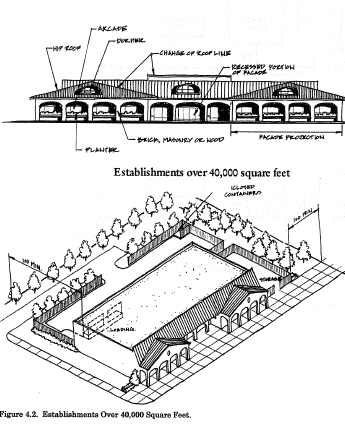
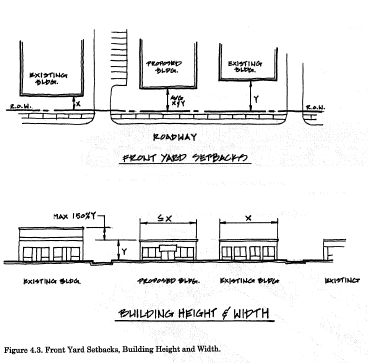
4.04.05.
Design standards for multifamily developments. The intent of this section is to provide aesthetic standards for exterior architectural design for all new multifamily residential developments.
A.
Variations. Administrative waivers permit a practice that is not consistent with a specific provision of this section, but is justified by its intent or purpose, or by hardship. The administrator or their designee shall have the authority to approve or disapprove administratively a request for an administrative waiver in accordance with section 11.03.00, administrative waiver, in addition to granting relief from the following:
1.
Development standards.
2.
Architectural standards.
3.
Site planning and amenities.
4.
Landscape and signage.
B.
townhome units and developments. To address the increasing density of units, the monotony of such developments, and life safety requirements involved with such concentrated developments, the standards below shall be applicable to all new townhome units and developments. The standards as described in this section shall apply to all townhome developments, regardless of the zoning district which the units and/or development is located. If there is a conflict between this section and any other code section within the ULDC, the Henry County Planning and Zoning Department Director is authorized to determine the appropriate applicability and interpretation.
1.
Definitions.
a.
Townhouse: One (1) of a series of three (3) or more attached dwelling units on separate lots which are separated from each other by a coincidental property line and party wall partitions. The structure must meet all front, rear and side yard setback requirements in the zoning district in which it is located, except for the coincidental property line and wall. Each dwelling unit must be separately metered for all utilities, have access to a public street and the coincidental property line and wall must be fire-rated and extend from the foundation or ground (whichever is lower) to the roof decking of the structure. Each dwelling unit shall contain rooms for living, sleeping, toilet facilities and one (1) kitchen.
2.
Development standards.
a.
All townhomes shall comply with the following minimum requirements:
i.
Minimum lot area shall be dependent on the zoning district development standards found in section 2.01.00 for the overall development.
ii.
Minimum lot width: Twenty-four (24) feet per dwelling unit for those with front entry garage and twenty (20) feet for feet per dwelling unit for those with rear entry garages.
iii.
Minimum setbacks:
1.
Front yard setback: Twenty (20) feet for front entry townhomes; ten (10) feet for rear entry townhomes.
2.
Side yard setback: Ten (10) feet or building separation of twenty (20) feet.
3.
Rear yard setback: Ten (10) feet for front entry townhomes; twenty (20) feet for rear entry townhomes.
iv.
Minimum square footage: One thousand two hundred (1,200) square feet of heated floor space.
v.
Townhomes shall have a two-car garage. Rear alley access shall be a minimum of twelve (12) feet in width and shall meet Henry County Department of Transportation (HCDOT) and Henry County Fire Department (HCFD) standards and requirements when rear entry garages are provided.
vi.
All dwelling units, including rear entry units, shall be located on a public or private right-of-way meeting HCDOT and HCFD standards and requirements.
vii.
The owner/developer shall coordinate with utility providers to determine utility placement along street corridor as well as placement of services. This may determine the need to avoid placing trees in front of the townhomes near driveways for front entry dwelling units. Developers shall ensure all utility placement and services are acceptable to all utility providers and coordinate with the HCDOT.
b.
The administrator or their designee shall provide final approval for all elevations and site plans before any permits are issued.
3.
Architectural standards. Unless otherwise approved by the board of commissioners at the time of zoning action, the following architectural standards shall apply:
a.
At least one-third (⅓) of the exterior front and rear façade of each dwelling unit shall be constructed of ornamental brick or stone and shall include a minimum three-foot masonry water table on all sides; the remainder of the front façade shall consist of a combination of two (2) or more of the following materials: brick, stone, cementitious fiberboard products, or board and batten, depending on the style/theme of the development.
b.
All end units shall consist of a combination of two (2) or more of the following materials: brick, stone, cementitious fiberboard products, and/or board and batten with a maximum of one-third (⅓) percent cementitious products permitted.
c.
No vinyl materials shall be permitted; including in the eaves and soffits. All eaves shall be at least one (1) foot in depth.
d.
Decorative gables, vents and dormers shall be required.
e.
No roof line shall be shared by more than two (2) individual units in a row of townhomes and shall be accomplished by height offsets of at least twenty-four (24) inches.
f.
Minimum roof pitch of 4/12 required; low slope roofs permitted subject to administrative waiver approval by the Henry County Planning and Zoning Department Director, or their designee.
g.
Adjoining dwelling units shall be constructed with staggered or offset front elevations by a minimum of one (1) foot.
h.
Adjoining dwelling units shall have differentiation in architecture for windows, entries, façades, and shall be constructed of complimentary building materials.
i.
There shall be no more than six (6) units in a row. Elevations may only be replicated once within a single unit set.
j.
All yards shall be sodded with exception of landscaped and buffer areas, including corner lots.
k.
The developer/builder shall be responsible for notating the percentage breakdown of materials on each building plan submitted for review and will be verified by the Henry County Building and Plan Review Department.
4.
Site planning and amenities.
a.
All rental townhome developments shall be gated. Gates shall be maintained and monitored at the developer/owner's expense.
b.
All new townhome developments shall install underground utilities and implement decorative pedestrian lights/streetlights consistent with the requirements of the Highway Corridor Overlay District, as per section 4.05.00.
c.
All townhome developments shall provide guest parking throughout the development at a rate of one (1) parking space per every four (4) units. Guest parking shall not be located in alleyways. Guest parking shall meet all HCDOT standards and requirements.
d.
There shall be in-ground and permanent trash receptacles distributed throughout the development, maintained and monitored at the developer/owner's expense, including along walking trails.
e.
A townhome development of fifty (50) units or fewer shall provide a minimum of the following:
i.
Children's playground(s) and a variety of pocket parks and dog parks with benches distributed throughout the development.
f.
A townhome development of fifty-one (51) to one hundred (100) units shall provide a minimum of the following:
i.
Children's playground(s) and a variety of pocket parks and dog parks with benches distributed throughout the development.
ii.
One thousand (1,000) square feet cabana with electric/natural gas fire pit and grilling areas.
g.
A townhome development in excess of one hundred (100) units shall provide a minimum of the following:
i.
Children's playground(s) and a variety of pocket parks and dog parks with benches distributed throughout the development.
ii.
One thousand five hundred (1,500) square feet clubhouse with fire pit and grilling areas.
iii.
Resort style pool.
iv.
Fitness facility, and/or sports recreation facilities.
h.
There shall be paved walking trails throughout the development connecting to residential areas, amenity areas, and sidewalks. Walking trails shall not be installed within any buffer areas. There shall be paved resting/meeting areas with benches located throughout and outside of the walking trail path.
i.
The developer/owner shall place a centralized covered mailbox unit, constructed in an architectural style consistent with that of the residential units it serves, with a drive thru outside of the public right-of-way for those homes that will not be served individually by the United States Postal Service. The mailbox unit shall be landscaped with shrubs and ground cover plant material meeting the standards of chapter 5.
C.
Horizontal multifamily.
1.
Definitions.
a.
Horizontal multifamily apartment: A residential development which provides for the clustering or grouping of attached and/or detached apartment units on a singular lot with an undivided ownership interest of the common areas of land and its appurtenances.
b.
Horizontal multifamily condominium: A residential development which provides for the clustering or grouping of dwelling units, attached or detached, with each unit owned in fee simple title, on a multi-unit property with an undivided ownership interest in common with other owners of the common areas of land and its appurtenances.
2.
Development standards.
a.
All developments shall comply with the following minimum requirements:
i.
Minimum lot area shall be dependent on the zoning district development standards found in section 2.01.00 for the overall development.
ii.
Minimum lot area per unit: Four thousand seven hundred fifty (4,750) square feet.
iii.
Minimum lot width: Forty-five (45) feet.
iv.
Minimum setbacks:
1.
Front setback: Twenty (20) feet.
2.
Side yard setback: Five (5) feet or building separation of ten (10) feet.
3.
Rear yard setback: Twenty (20) feet.
v.
Minimum square footage: One thousand two hundred (1,200) square feet of heated floor space.
vi.
All dwelling units shall have a two-car garage. Rear alley access shall be a minimum of twelve (12) feet of width and shall meet Henry County Department of Transportation (HCDOT) and Henry County Fire Department (HCFD) standards and requirements when rear entry garages are provided.
vii.
All dwelling units, including rear entry units, shall be located on a public or private right-of-way meeting HCDOT and HCFD standards and requirements.
viii.
The owner/developer shall coordinate with utility providers to determine utility placement along street corridor as well as placement of services. This may determine the need to avoid placing trees in front of the horizontal multifamily near driveways for front entry dwelling units. Developers shall ensure all utility placement and services are acceptable to all utility providers and coordinate with the HCDOT.
b.
The administrator or their designee shall provide final approval for all elevations and site plans before any permits are issued.
3.
Architectural standards. Unless otherwise approved by the board of commissioners at the time of zoning action, the following architectural standards shall apply:
a.
At least one-third (⅓) of the exterior front and rear façade of each dwelling unit shall be constructed of ornamental brick or stone and shall include a minimum three-foot masonry water table on all sides; the remainder of the front façade shall consist of a combination of two (2) or more of the following materials: brick, stone, cementitious fiberboard products, or board and batten, depending on the style/theme of the development.
b.
The owner/developer shall be responsible for notating the percentage breakdown of bedroom units on each building plan submitted for review and will be verified by the Henry County Building and Plan Review Department.
c.
Decorative gables, vents and dormers shall be required.
d.
Minimum roof pitch of 4/12 required; low slope roofs permitted subject to administrative waiver approval by the Henry County Planning and Zoning Department Director, or their designee.
e.
Adjacent dwellings shall have differentiation in architecture for windows, entries, facades, and shall be constructed of complimentary building materials.
f.
There shall be no more than six (6) attached units in a cluster. Elevations may only be replicated once within a single unit set.
g.
All yards shall be sodded with exception of landscaped and buffer areas, including corner lots.
h.
The developer/builder shall be responsible for notating the percentage breakdown of materials on each building plan submitted for review and will be verified by Henry County Building and Plan Review Department.
4.
Site planning and amenities.
a.
All rental horizontal multifamily developments shall be gated. Gates shall be maintained and monitored at the developer/owner's expense.
b.
All developments shall install underground utilities and implement decorative pedestrian lights/streetlights consistent with the requirements of the Highway Corridor Overlay District, as per section 4.05.00.
c.
All developments shall provide guest parking throughout the development at a rate of one (1) parking space per every four (4) units. Guest parking shall not be located in alleyways. Guest parking shall meet all HCDOT standards and requirements.
d.
There shall be in-ground and permanent trash receptacles distributed throughout the development, maintained and monitored at the developer/owner's expense, including along walking trails.
e.
A development of fifty (50) units or fewer shall provide a minimum of the following:
i.
Children's playground(s) and a variety of pocket parks and dog parks with benches distributed throughout the development.
f.
A development of fifty-one (51) to one hundred (100) units shall provide a minimum of the following:
i.
Children's playground(s) and a variety of pocket parks and dog parks with benches distributed throughout the development.
ii.
One thousand (1,000) square feet cabana with electric/natural gas fire pit and grilling areas.
g.
A development in excess of one hundred (100) units shall provide a minimum of the following:
i.
Children's playground(s) and a variety of pocket parks and dog parks with benches distributed throughout the development.
ii.
One thousand five hundred (1,500) square feet clubhouse with fire pit and grilling areas.
iii.
Resort style pool.
iv.
Fitness facility and/or sports recreation facilities.
h.
There shall be paved walking trails throughout the development connecting to residential areas, amenity areas, and sidewalks. Walking trails shall not be installed within any buffer areas. There shall be paved resting/meeting areas with benches located throughout and outside of the walking trail path.
i.
The developer/owner shall place a centralized covered mailbox unit, constructed in an architectural style consistent with that of the residential units it serves, with a drive thru outside of the public right-of-way for those homes that will not be served individually by the United States Postal Service. The mailbox unit shall be landscaped with shrubs and ground cover plant material meeting the standards of chapter 5 of the ULDC.
D.
Apartments/condominiums.
1.
Definitions.
a.
Apartment: a room or suite of rooms, with sleeping, bathroom, and kitchen accommodations, designed and used as a residence, physically separated from and located in a building containing a number of such rooms/suites of rooms, designed for occupancy by families living independently of each other and not owned in a fee simple title.
i.
Studio apartment: An apartment unit containing only one (1) habitable room.
b.
Condominium: The ownership in fee simple title of a single unity in a multi-unit structure and an undivided ownership interest, in common with other owners of the common elements of the structure, including the common areas of land and its appurtenances.
2.
Development standards.
a.
All apartment/condominium developments shall comply with the following minimum requirements:
i.
Studio apartment/condominium units: Minimum four hundred fifty (450) square feet of heated square footage.
ii.
One-bedroom apartment/condominium: Minimum six hundred (600) square feet of heated square footage.
iii.
Two-bedroom apartment/condominium: Minimum nine hundred (900) square feet of heated square footage.
iv.
Three-bedroom apartment/condominium: Minimum one thousand two hundred (1,200) square feet of heated square footage.
v.
Four-bedroom apartment/condominium: Minimum one thousand five hundred (1,500) square feet of heated square footage.
b.
The administrator or their designee shall provide final approval for all elevations and site plans before any permits are issued.
3.
Architectural standards. Unless otherwise approved by the board of commissioners at the time of zoning action, the following architectural standards shall apply:
a.
The exterior finish of all elevations for all new structures shall be constructed of brick, stone, and/or with a maximum of thirty-five (35) percent cementitious fiberboard products per façade. There shall be a minimum three-foot masonry water table on all sides.
b.
No vinyl materials permitted; including in the eaves and soffits.
c.
A minimum roof pitch of 4/12 required; low slope roofs permitted subject to administrative waiver approval by the Henry County Planning and Zoning Department Director, or their designee.
d.
There shall be a minimum of four (4) offsets on at least two (2) sides for each individual apartment/condominium building.
e.
The owner/developer shall be responsible for notating the percentage breakdown of bedroom units on each building plan submitted for review and will be verified by the Henry County Building and Plan Review Department.
f.
All new apartment/condominium developments' air conditioning units and HVAC systems shall be thoroughly screened from view from the public right-of-way and adjacent properties by utilizing walls, fencing, roof elements, or landscaping.
g.
All apartment/condominium development shall be interior access only.
4.
Site planning and amenities.
a.
All apartment/condominium developments shall be gated. Gates shall be maintained and monitored at the developer/owner's expense.
b.
All apartment developments are required to install underground utilities and implement decorative pedestrian lights/streetlights consistent with the requirements of the highway corridor overlay district, as per section 4.05.00.
c.
All apartment/condominium developments shall have a minimum of two (2) entrances meeting all Building and Fire/Life Safety codes.
d.
There shall be security cameras throughout the development and shall be registered with the Henry County RTCC (Real Time Crime Center).
e.
Parking requirements for apartment/condominium communities shall be as follows:
i.
One (1) space per studio unit.
ii.
One and one-half (1.5) spaces per one- to two-bedroom unit.
iii.
Two (2) spaces per three- to four-bedroom unit.
f.
Dumpsters and trash receptacles.
i.
Dumpsters shall be located where they are not visible from adjacent residentially zoned properties and shall be adequately screened from view from all other adjacent properties and streets.
ii.
Dumpsters shall be fully enclosed either within a building, by a solid brick or stone wall at least six (6) feet in height, or a landscaped buffer not less than ten (10) feet in width.
iii.
Dumpsters shall be set back a minimum of five (5) feet from all property lines and outside any buffers/landscape areas.
iv.
Dumpsters shall be placed on concrete pads of sufficient size and strength to support the weight of service vehicles.
v.
There shall be in-ground and permanent trash receptacles distributed throughout the development, maintained and monitored at the developer/owner's expense, including along walking trails.
g.
A centralized amenity area shall be provided and shall consist of, at a minimum, the following:
i.
A minimum one thousand (1,000) square feet cabana or one thousand five hundred (1,500) square foot clubhouse; and fire pit and grilling areas.
ii.
A resort style pool.
iii.
Fitness facility and/or sports recreation facilities.
iv.
Children's playground(s) with benches.
v.
Dog park(s).
h.
There shall be paved walking trails throughout the development connecting to residential areas, amenity areas, and sidewalks. Walking trails shall not be installed within any buffer areas. There shall be paved resting/meeting areas with benches located throughout and outside of the walking trail path.
i.
The developer/owner shall place a centralized covered mailbox unit, constructed in an architectural style consistent with that of the residential units it serves, with a drive thru outside of the public right-of-way for those homes that will not be served individually by the United States Postal Service. The mailbox unit shall be landscaped with shrubs and ground cover plant material meeting the standards of chapter 5 of the ULDC.
E.
Landscape and sign standards.
1.
A minimum fifty-foot-wide enhanced landscape strip and/or adequate undisturbed buffer shall be maintained along all exterior streets (not to prohibit access to the site). The landscape strip and/or buffer shall be planted with a combination of shrubs and trees where vegetation is disturbed, or non-existent, meeting the requirements listed in chapter 5 of the ULDC. The landscape strip and/or buffer shall be subject to planning and zoning approval prior to the issuance of a land disturbance permit.
2.
Except as provided in this subsection, signage shall comply with the regulations in chapter 7 of the ULDC, and/or section 4.05.00, where applicable. Ground signs and entrance signs shall be monument based, with bases constructed of brick or stone with accents consistent with the architecture and exterior composition of the development. The location for ground signs and entrance signs shall be approved as part of the development plan. Plans for the development shall include the location and ownership responsibility for all signs. All signs shall comply with all other requirements per the ULDC and shall obtain approved permits before installation.
3.
For any multifamily development located on MU (mixed use) zoned property, a master sign plan shall receive planning and zoning department approval prior to, and included on, development plans, per section 7.04.00.
4.
Stormwater management facilities shall meet the standards of section 8.04.00 of the ULDC.
5.
All driveways, access easements, emergency access easements shall be paved and dust free.
6.
Except as provided in this subsection, landscaping standards shall comply with the regulations of chapter 5 of the ULDC. Each development shall submit a substantial landscaping and buffer plan at the time of development plan submittal. Necessary screening and privacy vegetation shall be reviewed by the Henry County Planning and Zoning and Building and Plan Review Departments. The plan reviewer(s) shall be authorized to require the modification of proposed landscape strip and/or buffers in instances where the intent of this code has not been met.
(Ord. No. 16-01, § I, 7-19-16; Ord. No. 22-03, §§ I—III, 5-3-22; Ord. No. 23-08, § II, 6-20-23)
Sec. 4.05.00. - Highway corridor overlay district.
4.05.01.
Purpose of article.
A.
Purpose. The purpose of the Henry County Highway Corridor Overlay District is:
1.
To promote the general health, safety, and welfare of the community where residents and visitors can live, work, eat, and play.
2.
To promote economic development by diversifying the employment base for a stronger Henry County.
3.
To improve public health and provide safe and efficient movement within the overlay district by promoting development patterns that encourage physical activity such as walking and bicycling.
4.
To encourage a balanced mix of retail, professional, residential, civic, entertainment, and cultural uses.
5.
To improve the efficient operation of traffic around Henry County.
6.
To provide accessible, sufficient parking in an unobtrusive manner.
7.
To create an attractive gateway that is aesthetically appealing and environmentally responsible.
8.
To encourage innovative development projects that set standards for landscaping, open space, community design, and public amenities.
9.
To establish consistent and harmonious design standards for public improvements and private property development within the overlay district so as to unify the distinctive visual quality of Henry County.
B.
Definitions. As used in this section, unless specifically stated otherwise, the following terms shall be defined as indicated. Words used in this section but not defined herein shall be as defined by appendix A. Where any definition herein conflicts with a definition in appendix A, the definition contained herein shall prevail.
1.
Administrator: Director of the Henry County Planning and Zoning Department or their designee.
2.
Architectural review committee (ARC): A panel of Henry County staff which consists of the planning and zoning, building, environmental compliance/plan review and transportation departments.
3.
Civic use: "Social, institutional, or infrastructure-related activities; social, cultural, or religious assembly" as established in table 2.03.03, and hospitals.
4.
Commercial use: A term collectivity defining retail, office, and lodging uses.
5.
Existing street: A public street that is open, under construction, or completely funded, or approved at the date of application for review under this section.
6.
Front: To place an element, such as a building, along the front setback.
7.
Front yard: In addition to the definition established in appendix A, all yards abutting a street shall meet the setback requirement for front yards.
8.
Industrial use: "Industrial use, manufacturing, and waste-related activities" as established in table 2.03.03.
9.
Lodging use: Premises available for daily and weekly renting of bedrooms, including motels and hotels.
10.
Mixed-use building: A building containing at least two (2) different uses.
11.
Occupiable space: Covered and conditioned building area utilized for any use except parking, storage, or mechanical features.
12.
Office use: "Offices activities" as established in table 2.03.03 and medical and dental offices and related services.
13.
Overlay district: Henry County Highway Corridor Overlay District.
14.
Retail use: "Shopping, business, or trade activities" and "restaurants-type activity" as established in table 2.03.03 and fitness clubs, spaces, and gyms.
15.
Residential use: "Residential activities" as established in chapter 2, table 2.03.02.
16.
Sidewalk area: An area improved for walking along an existing street, primary grid, or secondary grid that begins at the street curb, or edge of pavement if no curb exists, and consists of a contiguous and continuous landscape zone and pedestrian zone.
a.
Sidewalk landscape zone: The paved or unpaved portion of the sidewalk area adjacent to the street and reserved for trees, groundcover, and street furniture including, waste receptacles, traffic signs, newspaper boxes, bicycle racks and similar elements in a manner that does not obstruct pedestrian access or motorist visibility.
b.
Sidewalk pedestrian zone: The paved portion of the sidewalk area reserved for pedestrian passage and unobstructed by any permanent objects to a height of eight (8) feet above the paved surface. The pedestrian zone shall be adjacent to the landscape zone and shall have a consistent cross-slope not exceeding two (2) percent.
17.
Use: A land use or function of classification category.
C.
Variations. There shall be two (2) types of variations from the requirements of this district: administrative waivers and variances. Whether a variation requires an administrative waiver or a variance shall be determined by the administrator.
1.
Administrative waivers permit a practice that is not consistent with a specific provision of this section, but is justified by its intent or purpose, or by hardship. The administrator or their designee shall have the authority to approve or disapprove administratively a request for an administrative waiver in accordance with section 11.03.00, administrative waiver, in addition to granting relief from the following:
a.
Site planning.
b.
Development standards.
c.
Sidewalks and streets.
d.
Frontages.
e.
Architecture.
2.
Variances permit a practice that is not consistent with a provision nor the purpose of this section. Variances shall be granted only in accordance with section 11.02.00, variances.
D.
Procedural requirements.
1.
Procedural requirements shall adhere to section 12.02.00.
F.
Site planning. All sites.
1.
Notwithstanding, the requirements of section 5.02.00, buffer requirements, there are no minimum buffers within this district other than the stream buffer protection requirements, according to section 3.03.00. Where this district abuts an area not within it, the requirements of section 5.02.00 shall apply.
2.
The requirements of section 8.01.04 shall apply to all sites regarding joint access driveways and cross access easements.
3.
The requirements of section 3.04.00 shall apply to all sites regarding watershed protection areas.
4.
Open space areas should be delineated on each conceptual plan, which shall receive approval from the building and plan review department.
4.05.02.
Boundaries. This ordinance section applies to land parcels of record within unincorporated Henry County as depicted on exhibit "A" which is attached hereto and incorporated herein by reference. These boundaries are further depicted on the Henry County official zoning map adopted as amended on the date of adoption of this ordinance, which is attached hereto as exhibit "B" and incorporated herein by reference. The Henry County Highway Corridor overlay district boundaries include all unincorporated parcels of land abutting Highway 138 East and West, Highway 155 North and South, Highway 20 East and West (excluding Bruton Smith Overlay District), Highway 81 East and West, Highway 42 North and South, Jonesboro Road, Jodeco Road, Eagles Landing Parkway, Hudson Bridge Road, East Lake Parkway, East Lake Road (between Highway 155 and Highway 20), Fairview Road, East Atlanta Road, West Village Parkway, Anvil Block Road, West Panola Road, Panola Road, Flakes Mill Road, North Henry Boulevard, Highway 19/41, and the Henry County Airport. All state routes and associated rights-of-way are within the jurisdiction of the Georgia Department of Transportation (GDOT) and any improvements within these respective rights-of-way are subject to GDOT. This Henry County Corridor Overlay District Boundaries also includes the Henry County Airport. All property contained within any parcel subject to this ordinance section on the date of adoption of this ordinance shall continue to be subject to this ordinance, even if the parcel is subdivided in the future.
4.05.03.
Effect of highway corridor overlay district provisions.
A.
Application. This overlay district is supplemental to the underlying zoning district classifications established in the Henry County Unified Land Development Code governing all properties and approvals within this overlay district. The provisions of this ordinance section shall be overlaid upon and shall be imposed in addition to said underlying zoning regulations and other Henry County ordinances. The planning and zoning director or their designee is authorized to promulgate and enforce such rules, regulations, guidelines, and standards as may be reasonably necessary or desirable to give effect to the provisions of this ordinance section.
B.
Relationship to underlying zoning district standards and other provisions of unified land development code. In any case where the standards and requirements of the overlay district conflict with those of the base-zoning district or with other provisions of the unified land development code, the standards and requirements of the overlay district shall govern.
C.
Exceptions. The provisions of this ordinance section shall not apply to the following:
1.
Completion of work subject to preliminary plats, site development plans, construction plans, building permits, or interior finish permits approved prior to the effective date of adoption of this ordinance section for those parcels not previously covered within the highway overlay district.
2.
Improvements and additions that are made to a single-family residence previously permitted and built on a lot of record prior to enactment of this ordinance section for those parcels not previously covered within the overlay district.
3.
Construction of a single-family dwelling on an existing lot of record within a single-family residential subdivision with final plat approved prior to enactment of this ordinance section, for those parcels not previously covered within the overlay district, provided that the new construction shall be of a similar floor area, materials and design as the single-family dwellings on adjacent lots in the same subdivision.
4.
Rehabilitation, restoration, repair of a nonresidential structure, interior renovations or interior finishes within an existing structure, or addition to an existing nonresidential structure that was permitted prior to the enactment of this ordinance section for those parcels not previously covered within the highway corridor overlay district shall not be subject to the provisions of the highway corridor overlay district, provided that such construction is on a lot of record.
5.
Development of a conventional single-family residential subdivision on property zoned RA (residential-agricultural) at the time of permit approval.
D.
Nonconforming uses.
1.
Within the overlay, there may exist lots, structures, or uses of both land and structures which were lawful prior to the adoption of this ordinance, but which would be prohibited, regulated, or restricted under the terms of this ordinance as adopted or subsequently amended. Nonconforming lots, uses, and structures may continue in their nonconforming status with the limitations and/or requirements of section 11.01.00, "nonconforming lots, structures, and uses" of the ULDC.
2.
Vested/grandfathered nonconforming uses. To avoid undue hardship, the lawful but nonconforming use of any structure or land at the time of the enactment of this overlay or any subsequent amendment may be continued even though the use does not conform to the provisions of this overlay, except that the nonconforming use:
a.
Shall not be changed to another nonconforming use.
b.
Shall not be re-established after abandonment or removal from the property for more than fifteen (15) days in the case of a nonconforming manufactured home, or its abandonment for six (6) months or more for all other uses, unless the premises are under a continuing lease but are unoccupied by the nonconforming use, regardless of the intent of the owner or occupier to resume the nonconforming use.
c.
Shall not be extended to occupy any area of land not contained within the current lot of record.
d.
Shall not be extended into any new building or structure unless such new building or structure is connected to existing buildings or structures and is contained wholly within the land currently utilized for the nonconforming use; however, where a new building or structure is not to be attached to an existing building or structure, the nonconforming use may be extended into such a new building [or] structure provided that any such new building or structure has a coverage area which does not exceed three (3) percent of the total square footage of the lot and is contained wholly within the land currently utilized for the nonconforming use.
e.
If an existing use was lawfully established in a zoning district that is subsequently amended to require conditional use approval for such use, the existing use shall not require a conditional use permit.
f.
Any intended but not yet existing nonconforming use for which a vested right was acquired prior to the adoption of this overlay or the adoption of an amendment to it shall be prohibited unless such intended nonconforming use for which a vested right was acquired is actually commenced within one (1) year of the adoption of this overlay district or the adoption of an amendment to it, regardless of the intent or expectation to commence or abandon such nonconforming use.
3.
Notwithstanding anything to the contrary herein, the vested/grandfathered status created herein may be transferred and assigned to a new owner of the real property to which such rights apply, provided, however, that the new owner, in order to avail himself of such rights, must put the property to the vested/grandfathered use within six (6) months of the date of the sale of the real property.
E.
Building plan application.
1.
All building plans submitted pursuant to an application for a building permit should clearly indicate all of the proposed building materials and colors for each façade as described in ordinance section.
2.
The plans should clearly show the location and calculate the amount/percentages of all building materials per façade.
3.
Groups of buildings on the same parcel of land may be reviewed and permitted as a single project rather than individual buildings.
4.05.04.
Network standards.
A.
Access management standards.
1.
Connectivity. Within all nonresidential or multifamily developments or any single-family residential development of five (5) or more acres, the following standards shall apply unless a variance is sought and obtained from the zoning advisory board pursuant to chapter 11 due to unusual topography or environmental constraints such as major streams and rivers that create a severe and unique hardship:
a.
No local street may be longer than six hundred (600) feet without an intersection with another local through street. Cul-de-sac streets shall not count as through streets.
b.
Continuous pedestrian walkways shall be provided to connect building entrances to required ten-foot wide sidewalks along street frontage.
c.
A cul-de-sac street that ends within two hundred (200) feet of the right-of-way of an adjacent collector or arterial street shall provide a five-foot wide sidewalk in a ten-foot wide easement connecting the sidewalk on the cul-de-sac to the sidewalk on the adjacent collector or arterial street.
d.
Dead-end streets, including cul-de-sac streets, shall not exceed three hundred (300) feet in length and shall not serve more than thirty (30) dwelling units.
2.
Vehicular access points. Minimum number of driveways or streets required per table 4.05.04.A.2 below.
Table 4.05.04.A.2: Minimum Vehicular Access Points
3.
Utilization and provision of connections to and from adjacent developments and developable parcels.
a.
All development plans shall incorporate and continue all sub-arterial streets stubbed to the boundary of the development plan by previously approved development plans or existing development.
b.
All development plans shall provide for future public street connections to adjacent developable parcels by providing a local street connection spaced at intervals not to exceed six hundred (600) feet along each development plan boundary that abuts potentially developable or redevelopable land.
4.
Interparcel access. For developments along an arterial or collector street, except where a variance is sought and obtained from the zoning advisory board pursuant to chapter 11 because of topographic or other site-specific constraints that create a unique and severe hardship, compatible developments, as determined by the planning director, shall provide a network of nonresidential access streets that meet the following:
a.
Access streets shall be constructed for a commercial or multifamily residential development that abuts another commercial or multifamily residential development, whether existing or planned. The development of the site shall incorporate the following:
i.
Continuous nonresidential access street, where necessary to connect adjacent parcels along the thoroughfare.
ii.
Driveway aprons, stub-outs and other design features to indicate that abutting properties may be connected to provide cross access.
b.
New commercial or multifamily property that abuts a planned, new or existing multifamily residential property shall provide for a five-foot wide sidewalk connecting the two (2) uses.
c.
New multifamily residential development that abuts a planned, new or existing commercial property shall provide for a five-foot wide sidewalk connecting the two (2) uses.
5.
Driveways. Driveway connections to public streets shall be consistent with the following standards:
a.
Driveway connections shall not be permitted within the controlled access zone of an intersection.
b.
Outparcels with less than two hundred (200) feet of road frontage are restricted to internal access only.
c.
Driveways that enter a major thoroughfare at traffic signals must have at least two (2) outbound lanes (one (1) for each turning direction) of at least eleven (11) feet in width, and one (1) inbound lane with a maximum width of eleven (11) feet. All lanes shall align with respective lanes on the opposite side of the intersection.
d.
No residentially developed property may have a curb cut in excess of thirty (30) feet in width, and no nonresidential property may have a curb cut in excess of forty (40) feet without approval of the Henry County Department of Transportation Director.
e.
Except for single-family and two-family residences, driveway grades shall conform to the requirements of the Georgia Department of Transportation Regulations for Driveway and Encroachment Control.
f.
Except where driveways are on opposite sides of a raised median, commercial or industrial driveways, or public roads, on opposite sides of a street shall either directly align or have offsets per ULDC section 8.01.03.D.3., as measured between the extended centerlines of such driveways. Along county roads, where property frontage width is such that the minimum offsets cannot be met, or intersection sight distance cannot be met with a driveway location that meets or exceeds the minimum spacing requirement, the Henry County DOT Director may allow placement of a driveway with a lesser offset distance. Where lack of frontage does not provide for the minimum spacing, the driveway may be required to be a joint use driveway with the adjoining owner.
g.
Whenever possible, driveways on undivided arterials, collector streets, or local streets should align with driveways (if any) on the opposite side of such street.
h.
On a divided arterial street that includes a median, driveways should align with median breaks whenever possible. Driveways not meeting this standard shall be limited to right turn access and right turn egress.
i.
Driveway throat length. The length of a driveway or "throat length" for a commercial or office development shall be designed in accordance with the vehicle storage required for entering and exiting vehicles to prevent vehicles from backing into the flow of traffic on the public street or causing unsafe conflicts with on-site vehicle circulation. The throat lengths specified in table 4.05.04.A.5 are generally acceptable guidelines intended for the major entrance driveway of a commercial development.
Table 4.05.04.A.5: Driveway Length for Commercial Centers
6.
Deceleration lanes.
a.
A major driveway entering a street classified as a collector or above with a regulated arterial speed thirty-five (35) miles per hour or greater shall be required to provide a deceleration lane consistent with the standards set in chapter 8.
b.
An acceleration or deceleration lane that would begin or end within seventy-five (75) feet of another driveway or intersecting street shall be lengthened so that it connects with the adjacent street or driveway.
7.
Crosswalks.
a.
All intersections on streets posted at twenty-five (25) mph or less shall contain crosswalks that connect to sidewalks in all quadrants. For streets posted at over twenty-five (25) mph, crosswalks shall be placed when determined as warranted by engineering study by a professional traffic operations engineer and such studies are subject to Henry County DOT's review and approval.
b.
Crosswalks shall be either demarcated with high-reflectivity thermoplastic paint or brick pavers, as determined by Henry County DOT.
B.
Parking requirements. Off-street parking shall be required as in chapter 8 of the Henry County Unified Land Development Code, except as provided in this subsection:
1.
Maximum number of parking spaces. The maximum number of parking spaces that may be constructed on impervious surfaces shall be no more than one hundred twenty-five (125) percent of the minimum number of required parking spaces. Parking spaces in excess of one hundred five (105) percent shall be constructed on pervious surfaces recommended in paragraph 3.b. of this subsection.
2.
Pedestrian circulation. Parking areas shall be designed to facilitate safe and convenient use by pedestrians. Commercial and multifamily developments shall provide designated pedestrian pathways or sidewalks connecting the front entrance of the principal building to the sidewalk along the abutting street, including marked crosswalks across interior driveways.
3.
Paving materials for parking lots.
a.
All parking areas shall be paved with asphalt, concrete, or pervious materials approved by the Henry County Department of Transportation Director.
b.
Pervious paving. Recommended pervious paving materials include those described in the current edition of the Georgia Stormwater Management Manual as the porous concrete or modular porous paver systems under the limited application stormwater structural controls.
c.
Paving areas shall be of sufficient size and strength to support the weight of service vehicles.
4.
Landscaped strip to screen parking lots and loading areas.
a.
Where a parking lot or loading area for a commercial, industrial, or institutional use is located adjacent to the public right-of-way, it shall be screened from the public right-of-way consistent with chapter 5 of the Henry County Unified Land Development Code.
b.
Setbacks for screening areas facing the highway corridor overlay district shall be based on future right-of-way consistent with chapter 8 Henry County DOT guidelines.
4.05.05.
Public improvement standards. Public rights-of-way (new and existing streets/roads) within the highway corridor overlay district shall be improved in accordance with the following standards:
A.
Street standards. Public rights-of-way located within the highway corridor overlay district shall be classified by type (i.e. arterial, collector, local, or nonresidential access) by the Henry County Department of Transportation and shall be consistent with section 4.05.03 design guidelines as follows:
1.
Arterial:
a.
Forty-five (45) mph design speed.
b.
Minimum one hundred twenty-foot right-of-way.
c.
Ten-foot (minimum) wide landscaped strip.
d.
Ten-foot (minimum) wide sidewalk.
e.
Pedestrian lights are required in landscaped strip.
f.
Street trees are required in landscaped strip.
g.
The location of required public improvements in the GDOT right-of-way is subject to GDOT permit approval. Any required public improvement not meeting GDOT permit approval is required to be located outside of planned right-of-way.
2.
Collector:
a.
Thirty-five (35) mph design speed.
b.
Minimum eighty-foot right-of-way.
c.
Depending on adjacent land use, lanes shall conform to one (1) of the following two (2) options:
i.
Two (2) travel lanes at twelve (12) feet with center turn lane at fourteen (14) feet in commercial areas.
ii.
Two (2) travel lanes at twelve (12) feet with turn lane at intersection provided between intersections for planned developments or residential areas.
d.
Twenty-four-inch wide curb and gutter.
e.
Eight-foot (minimum) wide landscaped strip along outside curb.
f.
Eight-foot (minimum) wide sidewalk outside landscaped strip.
g.
Pedestrian lights are required in landscaped strip. On roads posted at thirty (30) mph or greater, pedestrian lights shall be placed per chapter 5 of the GDOT Design Policy Manual.
h.
Street trees are required in landscaped strip. On roads posted at thirty (30) mph or greater, street trees shall be placed per chapter 5 of the GDOT Design Policy Manual and the GDOT Policy for Landscaping.
3.
Local streets: (See section 8.07.00, figure 8.8.)
a.
Twenty-five (25) mph design speed.
b.
Minimum fifty-foot right-of-way.
c.
Two (2) travel lanes at eleven (11) feet each.
d.
Twenty-four-inch wide curb and gutter.
e.
Seven-foot (minimum) wide landscaped strip along outside curb.
f.
Five-foot (minimum) wide sidewalk outside landscaped strip.
g.
Pedestrian lights are required in landscaped strip.
h.
Street trees are required in landscaped strip.
4.
Nonresidential access street:
a.
Twenty-five (25) mph design speed.
b.
Minimum fifty-foot right-of-way.
c.
Two (2) travel lanes at eleven (11) feet each.
d.
Eighteen-inch wide curb and gutter, twenty-four (24) inches if public right-of-way.
e.
Five-foot (minimum) wide landscaped strip along outside curb, eight-foot if public right-of-way.
f.
Eight-foot (minimum) wide sidewalk outside landscaped strip.
g.
Street trees are required in landscaped strip.
5.
Underground utilities are required for all street frontages: Upon written application pursuant to chapter 11, an exception may be granted by the zoning advisory board in cases where, due to unique topography or the presence of rock, the installation of underground utilities would present a severe and unique hardship.
B.
Street trees. Subject to Henry County DOT's review and approval, canopy trees shall be provided in street rights-of-way including medians and required landscaped strips adjacent to all streets. For roadways/streets either classified as collector or above, or posted at thirty (30) mph or greater, the tree types, sizes, and lateral offset to trees are to be governed by chapter 5 of the GDOT Design Policy Manual and the GDOT Policy for Landscaping. Trees and vegetation shall be located such that such vegetation shall not be located within the required sight lines necessary for intersection sight distance based on the road's posted speed limit.
1.
Appropriate street tree species include the following:
a.
Large trees—Average spacing forty (40) feet on center:
•
Sawtooth Oak
•
Gingko (Variety: President, Autumn Gold, male gender)
•
Princeton Elm
•
Chinese Elm (varieties Allee, Athena, Drake, Bosque)
•
Bald Cypress (variety: Shawnee Brave)
•
Zelkova (variety Green Vase or Village Green)
•
Northern Red Oak
•
Trident Maple
b.
Small trees—Average spacing twenty (20) feet on center:
•
Crepe Myrtle
•
Saucer Magnolia (variety: Butterflies)
•
Chinese Fringe Tree
•
Golden Rain Tree
•
Texas Redbud (Cercis reniformis)
•
Kousa Dogwood
•
Washington Hawthorn "Princeton Sentry"
•
Zelkova (variety: Wires)
2.
No more than twenty-five (25) (or twenty-five (25) percent of the total number, whichever is greater) of the trees installed may be of any one (1) genus.
3.
No more than twenty-five (25) percent of the street trees used in a single development shall be of the small tree species, unless limited by roadway classification or posted speed limit that affect tree type placement.
4.
Pedestrian lights meeting the standard of section 4.05.06.G may be considered when spacing street trees to allow forty (40) feet of separation between pedestrian lights and large trees, and twenty (20) feet of separation between pedestrian lights and small trees.
C.
Improvement guarantees. At the option of Henry County, the developer may be required to provide to the county financial security to guarantee the installation of project improvements required in this ordinance section. The developer's financial guarantee may be any of the following:
1.
An escrow of funds with the county;
2.
An escrow of funds with a bank upon which the county can draw;
3.
An irrevocable letter of credit or commitment upon which the county can draw;
4.
A performance bond for the benefit of the county upon which the county can collect; and
5.
Any other form of guarantee approved by the board of commissioners that will satisfy the objectives of this subsection.
The guarantee shall be in an amount sufficient to secure the full costs, as determined by the Henry County Department of Transportation Director, of the construction cost of the improvements, based on the most recent edition of Georgia Department of Transportation "Item Means Summary" or other comparable standardized cost estimation procedure.
4.05.06.
Property development standards.
A.
Additional uses. Parcels zoned for commercial uses shall be allowed to be developed with a mixture of commercial and residential uses according to the development standards of section 4.01.05 provided the future land use map provides a maximum density for the subject parcel.
B.
Prohibited uses.
1.
Self-service storage facilities and mini-warehouses.
2.
Warehousing and distribution not currently zoned for these uses (M-1 or M-2), as of adoption of this ordinance section.
3.
Salvage, junk, wrecking, recycling, waste, and scrap yards.
4.
Adult bookstore.
5.
Sexually oriented businesses or establishments.
6.
Pawnshop or loan brokers, other than mortgage loan brokers.
7.
Rooming and boarding houses.
8.
Automotive repair and maintenance, used vehicle sales as principal use, except car washes (car washes must be the principal use and be located within a commercial structure).
C.
Ground floor area limitation. New commercial buildings may not exceed one hundred fifty thousand (150,000) gross square feet in ground floor area. New commercial buildings greater than one hundred fifty thousand (150,000) gross square feet must obtain conditional use approval. In determining whether to grant an increase in ground floor size beyond one hundred fifty thousand (150,000) square feet, the zoning advisory board shall consider the following factors, in addition to those listed in chapter 11:
1.
The building site will provide convenient inter-connections with adjacent uses and properties that serve both pedestrians and automobiles.
2.
The floor area of the proposed building is the smallest feasible to serve the function of the proposed use.
3.
The architectural design of the building reduces the perceived size of the building by appropriate articulations and variations in the massing, façade, roofline, materials, colors, and textures of the building exterior.
4.
The building and site meets or exceeds all other standards set forth in this ordinance section and by the Henry County Unified Land Development Code.
D.
Lot standards.
1.
Minimum lot size shall be as follows:
a.
For outparcels or stand-alone commercial projects: One (1) acre.
b.
For commercial lots within a common development with shared parking and interconnectivity: One-half (½) acre.
2.
Minimum commercial lot frontage: One hundred seventy-five (175) feet along an arterial.
3.
Nonresidential lots shall be generally rectangular with a ratio of depth to frontage not greater than 4:1.
4.
Residential subdivisions shall comply with one (1) of the following two (2) requirements:
a.
Reverse-fronting lots are required for residential subdivisions along streets classified as arterials or collectors, subject to subparagraph b. below. Reverse-fronting residential lots shall be platted with a landscaped access easement restricting vehicular access placed adjacent to the public right-of-way. Such easement shall be a minimum of twenty (20) feet in depth and include one (1) of the following:
i.
A continuous four-foot-high solid wall constructed entirely of brick or stone masonry.
ii.
A four-foot-high fence constructed of a combination of brick or stone masonry pillars with iron pickets.
iii.
A vegetated strip of canopy trees, shrubs, and groundcover that provide a full landscape buffer.
b.
If a residential lot is separated from the arterial or collector street by a minimum twenty-foot-wide landscaped strip and a residential street, a residential lot may face an arterial or a collector street.
E.
Environmental controls.
1.
Stormwater management design shall comply in all respects with the current edition of the Georgia Stormwater Management Manual and ULDC.
2.
Parking lot landscaping. Parking areas shall incorporate landscaped areas as required in chapter 5. Such landscaped areas shall cover at least twelve (12) percent of the parking area.
F.
Dumpsters.
1.
Location.
a.
Dumpsters and trash receptacles shall be located where they are not visible from adjacent residentially zoned properties and shall be adequately screened from view from all other adjacent properties and streets.
b.
Dumpsters shall be enclosed either within a building or out of sight from public streets or located outside to the rear of the principal building.
c.
Dumpsters shall be set back a minimum of five (5) feet from all property lines. If a buffer is required on the subject property line, the dumpster shall not be located within the buffer.
2.
Pad.
a.
Dumpsters shall be placed on concrete pads of sufficient size and strength to support the weight of service vehicles.
b.
Restaurants and other food service establishments shall place dumpsters on concrete pads that are designed to slope into a drain that is equipped with a grease trap.
G.
Lighting.
1.
Parking lot, sidewalk, and building illumination.
a.
Lighting shall be designed to prevent light spillover on to adjacent properties. All lighting shall be fully shielded, have recessed luminaries, downcast, or be cut-off luminary fixtures mounted in such a manner that the cone of light is directed downward and does not cross any property line of the site.
b.
Only incandescent, florescent, metal halide, low-pressure sodium, LED, or color corrected, high-pressure sodium may be used. The same type of lighting must be used for the same or similar types of lighting on any one (1) site.
c.
Pedestrian lights shall be consistent with table 4.05.06.G.1 and chapter 8.
d.
Pedestrian light average spacing shall not exceed 120 feet.
e.
Parking light fixtures shall be the box head type, shall have a maximum height of thirty-five (35) feet, and shall employ a fluted pole. All parking light fixtures and poles shall be black.
f.
Individual pedestrian lights shall be maintained in good order and shall be illuminated between dusk and dawn each night.
Table 4.05.06.G.1: Lighting Specifications
2.
Security lighting restrictions.
a.
Full cutoff luminaries shall be used for all security lighting.
b.
The number of luminaires remaining on for security lighting shall not exceed one-fourth (¼) the total number of each type of luminaire number by four (4), any remainder is counted as a whole number.
3.
Drive-under canopies and pump islands at fueling stations. The luminaire shall be recessed into the canopy ceiling so that the bottom of the luminaire does not extend below the ceiling.
H.
Architectural standards. The following design guidelines and standards apply to all newly constructed buildings used for commercial, industrial, or residential purposes.
1.
General architectural requirements.
a.
The use of a common palette of building materials should be maintained for building façades to create a consistent and traditional architectural identity. Traditional architecture shall include, for example, the use of brick, pitched roofs, low-profile signage, and subdued colors. For large commercial/retail buildings and multifamily buildings, variations in façade, roofline and depth should be provided to lend the appearance of multitenant occupancy. All design and construction shall be subject to architectural review by the county or its designated architect to ensure adherence with this subsection K and the structures of traditional architecture.
b.
All ground or roof-mounted mechanical, HVAC, and like systems shall be screened from public street view (within three hundred (300) feet) on all sides by an opaque wall or fence made of brick, stucco, split face block, or landscaping.
c.
For all commercial buildings, roof-mounted mechanical, HVAC, and like systems shall be screened from public street view (within three hundred (300) feet) on all sides by a raised parapet or pitched roof along the edge of the roofline.
d.
Contrasting accent colors on any single façade shall be limited to no more than ten (10) percent of the total wall area for any single façade.
e.
Materials otherwise not permitted, may be used for an accent provided that a contrasting materials accent on any single façade shall be limited to no more than ten (10) percent of the total wall area for any single façade.
f.
Permanent mounted exterior neon lights shall not be allowed.
g.
Buildings that are located on outparcels and all accessory buildings shall be constructed of materials complementing the principal building with which they are associated.
h.
Back-lit awnings, roof-mounted lights, and/or roof mounted flag poles are not permitted. Satellite dishes shall be located and painted to blend with the background as much as practical.
2.
Building materials. Table 4.05.06.H.2 and this subsection outlines allowed building materials that are may be used and combined to create a consistent, attractive, interesting and long-lasting building design:
Table 4.05.06.H.2: Allowed Building Materials
a.
Allowed building materials.
i.
Brick, except that brick veneers that are intended to simulate brick exteriors are not acceptable;
ii.
Stone. Natural stone such as, but not limited to, granite, limestone, acid marble are allowed building materials. Terra cotta and/or cast stone, which simulate natural stone, are also acceptable. Painted stone is not allowed;
iii.
Split-face block/concrete masonry unit (CMU) is restricted to ten (10) percent of the surface area of the façade;
iv.
Tilt/architectural pre-cast concrete permitted for industrial developments only;
v.
Stucco is restricted to forty (40) percent of the surface area of a façade;
vi.
Natural wood and/or cementitious fiberboard siding are allowed only for residential buildings;
vii.
Glass;
viii.
Exposed concrete block, metal, and tile are not allowed as building materials on a façade.
b.
Ratios and amounts of allowed building materials.
i.
Accent/trim exterior building material. Small amounts of building materials such as wood, tile, etc., may be used to enhance the façade of the building or for decorative elements, but should not exceed ten (10) percent of total wall area per façade.
ii.
Façade calculations. With the exception of accent/trim materials, there shall be no more than two (2) primary building materials used. When stucco is used as a building material for a façade, it is restricted to 40 percent of the total. The allowed façade materials shall not apply to entry doors and/or roll-up doors.
c.
[Calculation.] The amount of permitted material shall be calculated using the gross square footage of wall area per façade.
For example, a building has a front façade with a gross façade area of one thousand two hundred (1,200) square feet with four hundred (400) square feet consisting of windows and doors. Begin with one thousand two hundred (1,200) square feet for required building material calculations. A wall area of one thousand two hundred (1,200) square feet shall have no more than four hundred eighty (480) square feet of stucco on the front façade [e.g. 1,200 square feet × 40 percent = 480 square feet]. The balance shall be brick or other allowed material. Trim or accent material may account for up to ten (10) percent or one hundred twenty (120) square feet.
3.
Roof requirements. Materials for pitched roofs shall be limited to architectural dimensional grade asphalt shingles, natural slate, natural terra cotta, natural wood shake, copper or factory finished sheet metal.
a.
Gabled/hipped roofs. All one-story buildings less than ten thousand (10,000) gross square feet must have a gabled/hipped roof (between 4:12 and 12:12).
b.
[Alternative.] If a gabled/hipped roof is not possible, a combination of flat roof and gabled/hipped roof is required. Provide a gabled/hipped roof on front and side of the building to screen view of any flat roof. Create arcades, porches, and other features with pitched roof.
c.
Flat roofs. Building materials for flat roofs shall meet local codes.
Exposed metal flashing shall be copper or factory finished sheet metal. If factory finished metal flashing is used, such as standing seam, the color must be subdued to blend with other materials or of a color to simulate weathered copper or bronze. All buildings with flat roofs should include parapet articulation on the front façade(s) of such building. There shall be roof articulations/offsets at a minimum of one (1) per each one hundred twenty-five (125) linear feet of length by a change in the top line of the parapet. Additional articulation may occur at any lesser distance. If the front façade is less than one hundred twenty-five (125) linear feet of length, then a minimum of one (1) roof articulation must occur.
d.
Other. Drive under canopies may have flat roof with vertical or factory formed facing of finished sheet metal or other material meeting the requirements of Section 4.05.06.H.2.
4.
Arcade/structural canopy for retail use. For any multitenant commercial development, a covered arcade/structural canopy shall be provided along the front façade of the building. Arcades are covered walkways connected to the principal building. They should be a minimum of five (5) feet in width and designed to provide covered areas for relief from the weather. Different arcade/structural canopy designs may be used for each individual tenant/business within a multitenant commercial development provided that they blend aesthetically with the front façade of the building and has the approval of the building owner and the planning director.
5.
Street orientation. Principal building entrances shall be oriented to public streets.
6.
Building height. Unlimited for new development.
7.
Building massing and modulation. The massing of building façades longer than one hundred fifty (150) feet that are approximately parallel to the right-of-way and oriented to a public street shall be modulated to increase visual interest, as follows:
a.
Building façades that are less than five hundred (500) feet long shall be modulated at intervals no greater than one hundred (100) feet in length.
b.
Building façades that are more than five hundred (500) feet long shall be modulated with intervals no greater than twenty (20) percent of the length of the façade.
8.
Minimum area. No nonresidential building shall have less than two thousand (2,000) square feet of heated floor space.
9.
Minimum cornice height. Building design shall include minimum one-foot high contrasting cornices along the entire front façade of buildings and extending for a distance of at least ten (10) feet along the sides of buildings.
10.
Minimum high-contrasting base. Building designs shall include a minimum two-foot high contrasting base, along the entire front façade of buildings and extending for a distance of at least ten (10) feet along the sides of buildings.
11.
Satellite dish antennae. No satellite dishes shall be permitted within view from public streets.
12.
Off-street loading areas. Off-street loading areas shall be located in the rear of buildings and screened from view from adjacent property or streets.
I.
Signage. Except as provided in this subsection, signage shall comply with the regulations in section 7.04.00 of the Henry County Unified Land Development Code.
1.
Ground signs and entrance signs shall be limited to a monument based signs with the monument base extending to the height and full width of the bottom of the signable area. The sign structure shall be constructed of materials consistent with the architecture and exterior treatment of the building.
2.
The maximum sign area of any ground sign, inclusive of any border and trim, but excluding the base, apron, supports and other structural members shall be:
a.
Ground signs on lots zoned commercial or industrial, including shared signs, on lots with more than one (1) tenant shall be no greater than fifty (50) square feet in sign area.
b.
Ground signs on lots zoned commercial or industrial with one (1) tenant shall be no greater than thirty-two (32) square feet in sign area.
c.
Ground signs on lots zoned O-I shall be no greater than thirty-two (32) square feet of sign area.
d.
Ground signs for single business premises shall be no greater than thirty-two (32) square feet in sign area.
3.
Sign illumination.
a.
Automatic changeable copy signs and neon signs are prohibited.
b.
Signs may be illuminated internally, subject to ULDC requirements. LED is acceptable. External lighting fixtures are acceptable provided that fixtures are directed downward and away from streets and adjacent property and public streets. All lighting shall be fully shielded, have recessed luminaries, or be full cut-off luminary fixtures.
(Ord. No. 17-04, § I, 3-21-17; Ord. No. 18-06, § I, 11-27-18; Ord. No. 20-06, § I, 11-14-20; Ord. No. 22-04, 6-7-22; Ord. No. 22-08, § II, 9-8-22)

