
Henry County Unincorporated
City Zoning Code
City Zoning Code
CHAPTER 7
- STANDARDS FOR ACCESSORY AND TEMPORARY USES
Sec. 7.00.00. - Generally.
The provisions of chapter 7 apply to accessory uses, accessory structures, and temporary uses. Home occupations are considered accessory uses to residential development. Standards for home occupations are set forth in section 7.01.00. Standards pertaining to accessory structures are set forth in section 7.02.00. Standards for temporary structures and uses are set for in section 7.03.00. Standards for signs, which may be either accessory structures, or the principal use on a parcel, are provided in section 7.04.00. Standards for wireless communication facilities, which may be located on a lot or parcel with a principal use, or which may be the principal use, are provided in section 7.05.00.
Sec. 7.01.00. - Home occupations.
7.01.01.
Generally.
A.
A home occupation is permissible in a lawfully established dwelling unit in any residential zoning district. Home occupations shall meet the standards set forth in this section.
B.
The following and similar uses shall be considered home occupations:
1.
Office for professionals, such as attorneys, drafters, realtors, insurance agents, engineers, architects, and other consultants;
2.
Instruction or teaching, such as açademic tutoring, performing arts, or fine arts;
3.
Administrative or clerical support services, such as transcription, court reporters, stenographers, notary republic, or addressing services;
4.
Personal services, such as beauty or barber shop, manicurists, dress-making or tailoring;
5.
Pet grooming;
6.
Child day care or nursery school for six (6) or fewer children;
7.
Adult day care for six (6) or fewer adults;
8.
Personal care home for three (3) or fewer persons;
9.
Medical practitioner (excluding veterinarians);
10.
Manufacturers' and internet sales representative;
11.
Studios for artists, or photographers;
C.
Agricultural activities associated with the raising of crops and farm animals on properties over three (3) acres in size shall not be subject to the requirements for home occupations.
D.
Activities not listed are prohibited as home occupations.
E.
Home occupations may employ up to two (2) persons, who work on the premises, but who do not reside in the dwelling located on the premises, satisfying the following criteria:
1.
Must be located within the RA (residential-agricultural) zoning district, outside of a subdivision.
2.
Must adhere to all other applicable standards for home occupations, set forth in sections 7.01.01, 7.01.02, 7.01.03, and 7.01.04.
7.01.02.
Standards for all home occupations.
A.
All home occupations shall obtain a business license from Henry County.
B.
Employees of the home occupation not meeting the requirements outlined in section 7.01.01.E. shall be limited to the residents of the dwelling. At least one (1) member residing on the premises must be the primary operator of the business.
C.
The home occupation shall be clearly incidental to the residential use of the dwelling.
1.
The use of the dwelling for a home occupation shall not change the residential character of the building.
2.
No internal or external alterations which are inconsistent with the residential use or character of the dwelling shall be permitted.
D.
Products for sale or use in the home occupation shall not be visible from the street.
E.
Use of a dwelling for a home occupation shall not exceed twenty-five (25) percent of the total square footage of one (1) floor, except for personal care homes and adult or child day care.
1.
Floor plans shall be provided to reflect the dimensions of the entire floor and room which will be utilized for the home occupation. Each floor plan shall be drawn to scale.
F.
The home occupation shall not constitute a nuisance to the surrounding neighborhood.
G.
Outside storage of materials used in connection with a home occupation is prohibited.
H.
A home occupation shall not use or be located in an accessory building.
I.
Only passenger vehicles shall be used in connection with the operation or management of a home occupation.
J.
No business shall be conducted between the hours of 8:00 p.m. and 7:00 a.m.
7.01.03.
Standards for specific home occupations.
A.
Instruction shall be limited to two (2) students at any one (1) given time.
B.
Beauty shops, barber shops, manicurists, pet grooming and similar services shall be limited to two (2) chairs or stations and one (1) shampoo chair or station. There shall be no more than two (2) clients on the property at any one (1) given time.
C.
Personal care homes and adult or child day care facilities shall provide an approved state license prior to the issuance of a county business license.
7.01.04.
Specific standards for agricultural home occupations in the RA zoning district.
A.
Agricultural product sales shall be allowable in the RA zoning district, provided that the lot or parcel is not part of a subdivision.
B.
Notwithstanding the provisions in section 7.01.02 above, agricultural products grown on the premises in the RA zoning districts may be visible from the street.
C.
Only agricultural products produced on the premises may be sold on the premises.
D.
Trucks and vehicles other than passenger vehicles may be used in connection with the operation of an agricultural home occupation.
E.
An accessory building may be used in connection with an agricultural home occupation, subject to compliance with the following standards:
1.
The accessory building shall maintain a residential appearance.
2.
No automotive painting, body work, salvage, major automotive or heavy equipment repairs are to be conducted.
3.
No machinery or equipment shall be used which generates noise detectable outside the accessory structure.
(Ord. No. 10-17, § I, 11-2-10)
Sec. 7.02.00. - Accessory structures.
7.02.01.
Generally.
A.
It is the intent of this section to regulate the installation, configuration, and use of accessory structures. Regulation is necessary in order to ensure that accessory structures are compatible with the surrounding neighborhood and are consistent with the character and intent of the zoning district in which the accessory structures are located.
B.
Permissible accessory uses and structures are identified in Table 2.03.04.
C.
Accessory structures shall be on the same lot and subordinate to the principal use or structure.
D.
Standards for specific accessory structures are set forth in sections 7.02.02 through 7.02.07. All accessory structures shall comply with the standards set forth below:
1.
Accessory structures shall be located within the side or rear yard, unless otherwise provided in sections 7.02.02 through 7.02.07 and except for buildings in RA zoning districts where the lots are a minimum of three (3) acres in area and are not part of a platted subdivision can be located in the front yard;
2.
Accessory structures shall not be erected on a lot prior to the construction of the principal structure, except for the agricultural purpose storage buildings in RA zoning districts where the lots are a minimum of three (3) acres in area and are not part of a platted subdivision;
3.
Accessory structures shall be included in all calculations for impervious surface ratio or lot coverage standards and for stormwater management standards;
4.
Accessory structures, other than fences located in compliance with the requirements of section 7.02.04, shall not be located within any required buffer or landscaping area, parking lot, protected resource area, or stormwater management area;
5.
Accessory structures located in any residential zoning district shall not be used for any type of commercial operation, except as provided in section 7.01.04;
6.
Accessory structures shall not be used as a dwelling unit, except as provided in section 7.02.02 which sets forth standards for accessory dwellings;
7.
Accessory structures shall comply with the dimensional standards set forth in the following table:
Table 7.02.01(D) Dimensional Standards for Accessory Structures
7.02.02.
Accessory dwellings (guest houses, caretaker houses).
A.
Accessory dwellings include basement apartments, garage apartments, caretaker or other employee quarters, guest houses, and other accessory dwellings.
B.
Accessory dwellings shall not be used as rental property.
C.
Accessory dwellings are permissible within the principal dwelling or as a freestanding dwelling in the following zoning districts: RA, R-1, R-2, R-3, R-4, R-5 and RS. Accessory dwellings are permissible within the following zoning districts as freestanding dwelling units: M-1 and M-2.
D.
Accessory dwellings contained within a principal dwelling in the RA, R-1, R-2, R-3, R-4, R-5 or RS zoning districts shall comply with the following standards:
1.
There shall be no more than one (1) accessory dwelling in a principal dwelling unit.
2.
One (1) additional parking space shall be provided to serve the accessory dwelling.
3.
The accessory dwelling shall comply with all building and health code standards.
E.
Freestanding accessory dwellings in the RA, R-1, R-2, and R-3 zoning districts shall comply with the following standards:
1.
There shall be no more than one (1) freestanding accessory dwelling unit per residential lot.
2.
The accessory dwelling unit may be located on the second floor over a detached garage or may be a separate structure.
3.
The accessory dwelling shall be located within the side or rear yard except in the RA zoning districts where the lots are a minimum of three (3) acres in area and are not part of a platted subdivision the accessory dwelling can be located in the front yard.
4.
Accessory structures shall comply with minimum setbacks set forth in [section] 2.01.02.
5.
The residential lot shall comply with the minimum lot area standards set forth in Table 2.01.01, except that in no case shall an accessory dwelling unit be located on a lot with less than eighteen thousand (18,000) square feet of lot area if the property is served by county sewer; lots must be thirty thousand (30,000) square feet if utilizing an on-site sewage management system.
6.
One (1) additional parking space shall be provided to serve the accessory dwelling unit.
F.
Freestanding accessory dwellings in the M-1 and M-2 zoning districts shall comply with the following standards:
1.
There shall be no more than one (1) accessory dwelling unit per development site;
2.
The accessory dwelling shall be intended for use by a caretaker or security person for the industrial development; and
3.
The accessory dwelling shall not exceed one thousand five hundred (1,500) square feet in floor area.
7.02.03.
Fall-out shelters.
A.
Fall-out shelters are permitted as an accessory use in any zoning district.
B.
Shelters shall be maintained so as not to become a hazard or blight to the community.
C.
One (1) fall-out shelter shall be permissible per lot.
D.
A fall-out shelter shall comply with the setback requirements pertaining to the zoning district.
E.
A joint shelter may be constructed to serve two (2) adjacent lots with an administrative waiver (see section 11.03.00).
7.02.04.
Fences and walls.
A.
Location of fences and walls.
1.
Fences and walls may be located on or inside property lines.
2.
Setback requirements applicable to buildings shall not prohibit or restrict any necessary retaining wall, below ground foundation, or fence which shall be necessary for the proper development of a site as required by the county.
3.
Fences and walls shall be located to avoid interference with the required clear visibility area designated in section 8.01.07.
4.
Fences and walls shall not obstruct, hinder, or impede the movement of pedestrian and vehicular traffic, and shall not present a nuisance, danger, or hazard to the general public.
5.
Fences and walls do not require a building permit, with the exception of walls exceeding four (4) feet in height.
B.
Types of fences.
Table 7.02.04(B) Types of Fences.
* All requests for a fence in the front yard shall be handled administratively, based on a justification and/or hardship. The request will be evaluated by the Architectural Review Committee.
C.
Electrical fencing shall meet the following standards:
1.
Electrical fencing shall be permissible only on residential lots that are not within a platted subdivision;
2.
Electrical fencing shall be limited to the side and rear yard, except on parcels that have more then three (3) acres and are not within a platted subdivision, which may have electric fencing anywhere on the property;
3.
Signs are required to provide a warning of the type of fence and the voltage of the fence;
4.
Warning signs in residential zoning districts shall be placed at each corner of an electrical fence;
5.
Warning signs in nonresidential zoning districts shall be placed fifteen (15) feet apart along the entire fence; and
6.
Warning signs shall not exceed four (4) square feet in area.
D.
Height standards.
1.
Heights of fences shall be measured from ground level at the base of the fence to the topmost part of the fence.
2.
Table of height standards.
Table 7.02.04(D)(2). Height Standards for Fences.
7.02.05.
Outside storage.
A.
Outside storage involving machinery and equipment, service areas for vehicles in need of major service or repair, materials for construction or distribution is permissible only in the C-3, M-1, and M-2 zoning districts.
B.
Outside storage involving machinery and equipment is permissible only in the RA zoning district (not within a subdivision) on a minimum lot size of two (2.0) acres, where the machinery or equipment is not visible from the public right-of-way.
C.
Outside storage shall be located within a rear yard or side yard.
D.
Outside storage shall be fully concealed with a solid fence, in addition to any buffer requirements set forth in section 5.02.00.
E.
Outside storage of parts and materials, service areas, refuse, or work activity areas shall be maintained in a neat and orderly manner.
F.
Materials shall not be stored within any required buffer area.
7.02.06.
Satellite dish antennas.
A.
Residential satellite dish antennas shall be permitted as an accessory use only in rear and side yards unless it can be documented that reception is impaired by such a location.
7.02.07.
Swimming pools and pool enclosures.
A.
Swimming pools, accessory to residences, shall be constructed in accordance with the Swimming Pool Code as adopted by Henry County and shall be approved by the Environmental Health Department prior to obtaining a building permit.
B.
All residential accessory swimming pools shall meet the following standards:
1.
A swimming pool shall comply with minimum side and rear yard requirements for accessory structures. Setbacks for accessory swimming pools shall be measured from the decking or closed part of the pool structure to the property line.
2.
A pool shall be enclosed by a security fence of not less than four (4) feet in height from ground level. All above ground pools which are greater than four (4) feet in height shall not be required to be enclosed by a fence, but the entrance to such pool shall be restricted with a gate. A gate shall be installed at all entrances to any deck structure attached to such pool and/or at all ladder structures accessing such pool.
3.
All gates attached to such security fences shall contain self-closing positive latch devices to ensure the pool is enclosed and secure at all times.
4.
The required security fence shall be installed prior to occupancy and/or any use of the swimming pool.
5.
No ladders shall be affixed to a pool for purposes of entry or exit while self-closing positive latch entrance gates are open.
6.
All security fences shall be installed with a solid and permanent foundation, which shall include fastening such materials a minimum of one (1) foot into the ground.
7.
A security fence may include decorative materials, such as brick, wrought iron, stone, wood, or masonry.
C.
Any constructed or prefabricated pool used other than in conjunction with a private single-family residence shall be deemed a public swimming pool.
1.
Public pools, including, but not limited to, those constructed and operated by a public agency, or as part of a multiple-family residential development, a subdivision association, a two-family residential development, a condominium association or a private club shall be enclosed by a security fence of not less than five (5) feet in height.
2.
Security fences shall be transparent and shall not include privacy fences or fences that obstruct the view of the pool from the outside.
3.
Security fencing and gates shall comply with the standards in subsection 7.02.07.B., above.
4.
Swimming pools shall comply with the standard setback requirements within its zoning district.
7.02.08.
Employee support facilities in the OI, C-1, C-2, C-3, IAC, M-1, and M-2 zoning districts.
A.
The following facilities may be allowed to serve employees of the establishment: Child day care facilities; cafeteria, restaurant, coffee shop, deli, or dining room; newsstand; fitness center or similar recreation facility; and banks.
B.
The facility shall be an integral part of a permitted principal use. It shall be located, oriented, and designed to serve the employees of the principal use.
C.
Employee support facilities may be located within the principal building on the site, and shall meet the following standards:
1.
Any individual facility listed in paragraph A., above shall be limited to ten (10) percent of the total floor area of the principal building(s) on the site.
2.
The cumulative total floor area for all employee support facilities shall not exceed twenty-five (25) percent of the total floor area of the principal building(s) on the site.
D.
Employee support facilities may be located in an accessory structure, and shall meet the following standards:
1.
The accessory structure shall meet the standards in subsections 7.02.01.D.1 through 4.
2.
Employee support facilities may be combined within one (1) accessory building. No more than two (2) accessory buildings shall be permissible for purposes of locating employee support facilities.
3.
Accessory buildings to contain employee support facilities may share the parking lot serving the principal building, provided that the accessory building is no more than six hundred sixty (660) feet from the principal building.
E.
Signs to identify employee support facilities shall be limited to wall signs, not to exceed four (4) square feet in sign area, or directional signs, not to exceed two (2) square feet in sign area.
F.
Employee support facilities shall not indicate availability to the public through signage, advertising, or other methods to attract the general public.
(Ord. No. 10-20, § I(11), 6-15-10; Ord. No. 12-23, § I, 7-17-12; Ord. No. 14-05, § I, 2-4-14)
Sec. 7.03.00. - Temporary structures and uses.
This section provides for temporary structures and uses during construction and for temporary uses and structures during special events.
7.03.01.
Temporary structures and uses during construction. A temporary building or use in connection with a construction project or land subdivision development shall be permitted on the land of the project during the construction period. The following standards shall be met by temporary uses established during construction or land subdivision:
A.
A building permit shall be required as set forth in appendix B [of this ULDC];
B.
Timeframe to utilize temporary structure.
1.
Temporary structures related to a subdivision development shall be removed when eighty (80) percent of all lots are occupied by completed homes or within four (4) years of the issuance of the permit, whichever occurs first.
2.
The Henry County Building Official or his/her authorized designee, upon written request by the owner including the reason for the request and an updated account of completed houses within the subdivision, may issue a one-time, one (1) year extension of completion time for cause beyond the original compliance/completion period, in accordance with section 7.03.01.B.1. Approval will be based upon, but not limited to, current maintenance and aesthetics of the temporary structure and property, and verification that all required erosion control measures are in place. Applicants shall apply for the one-time extension within thirty (30) business days of the expired date of the temporary structure permit. Granted or denied extensions of compliance/completion period shall be in writing and signed by the building official or his authorized designee, within ten (10) business days. All extension approvals will be subject to a fifty-dollar renewal fee. Permission for a greater extension of time beyond the one[-year] period may be granted only by the Henry County Board of Commissioners in regular public session. An application to appear before the board of commissioners shall be on forms provided by the Henry County Building Department and shall be accompanied by a fee of three hundred dollars ($300.00).
C.
Temporary offices may be located on a construction site to be used for administrative functions during construction. Temporary construction offices may have the name of the construction company printed on a permanently affixed sign on the outside of the building. Such sign shall be a maximum of four (4) feet by eight (8) feet. In addition, the proposed construction building shall meet tie-down requirements for mobile structures, and have a contract for sewage pump-out. Construction buildings shall be removed within thirty (30) days of completion of the construction site for which they are permitted;
D.
On-site outdoor storage of equipment and construction materials shall be allowed during the period of construction;
E.
Portable toilet facilities shall be allowed;
F.
Construction and demolition debris dumpsters are allowable and are not required to be screened;
G.
A temporary office which meets parking, handicapped and landscape requirements shall be allowed. A temporary office may be used for sales functions or sales offices, allowing for the sale, resale, or marketing of dwellings, structures, or property within the development in which it is located, or adjacent developments under the same control; and
H.
On-site temporary use of structures and equipment for the building of roads, public utilities, and government projects shall be allowed.
7.03.02.
Portable or mobile restaurants and food services, temporary outdoor sales (transient merchant), and sidewalk sales.
A.
Applicability. Mobile food services, portable restaurants, temporary outdoor sales, and sidewalk sales are permissible in the following zoning districts MU, C-1, C-2, C-3, IAC, M-1, M-2. Portable restaurants shall be inspected and approved by the Henry County Environmental Health Department prior to obtaining a business license. All structures pertaining to this section shall remain portable. These temporary uses are permissible on vacant lots or on lots containing a business in accordance with the standards of this section.
B.
The applicant shall have written permission of the property owner and all business owners on the lot to conduct retail sales.
C.
The applicant shall possess a valid occupational license.
D.
No temporary use shall be located within:
1.
The public right-of-way;
2.
Any required setback area, including required parking area, or required buffer area;
3.
Any driveway or access way, or in such a manner as to block a driveway or access way; or
4.
Any designated fire lane or in such a manner as to block a fire lane;
E.
Transient merchants shall provide parking spaces:
1.
Parking spaces shall be provided in addition to any required parking serving an established use on the lot.
2.
One (1) additional parking space shall be provided for every two hundred (200) square feet of display area.
3.
Handicapped parking and access shall be provided according to section 8.02.06.
F.
Roadside vendor signs shall only be permitted according to subsection 12.02.06.C., regarding temporary signs.
G.
Certificate of organization from the Secretary of State of Georgia shall be required.
H.
Electrical service from the primary structure only. Separate service is not allowed.
7.03.03.
Special events. Special events may include carnivals, fairs, festivals, seasonal sales, or other periodic events of a temporary nature. (Specific requirements for special events involving a seating capacity of at least ten thousand (10,000) persons are contained in the Henry County Code of Ordinances, section 3-15-1.) Such events are typically outdoors.
A.
The following standards apply to carnivals, fairs, festivals, and similar events and activities:
1.
A permit is required according to the procedures set forth in section 12.02.06 subject to state regulations and the county fire code;
2.
The applicant shall ensure the provision of adequate sanitation facilities, sewage disposal, garbage and refuse disposal, potable water supply, and food service during the special event;
3.
The site shall have floodlighting for the special event and parking areas, if any activities are to be offered during darkness. Lighting shall be shielded and directed to avoid direct illumination of adjacent properties;
4.
The site shall have adequate parking facilities. Parking may be on-site or off-site. Where off-site parking is provided, there shall be adequate plans for transporting or conducting patrons from the parking facilities to the special event area;
5.
The applicant shall provide an adequate plan for traffic control and security in and around the special event area; and
6.
All stages, booths, tents, scaffoldings, or structures of any nature on, under, or within which persons may congregate, shall conform to applicable building, health, and other construction codes.
B.
The following standards apply to seasonal sales:
1.
A temporary use permit is required according to the procedures set forth in section 12.02.06.
2.
The area devoted to seasonal sales shall not be located on any designated setbacks, buffers, parking spaces, parking lot aisles, driveways, fire lanes, or other traffic circulation areas.
3.
Goods, tents, equipment, or materials used for the seasonal sales activity shall not be located within any right-of-way.
4.
Designated parking spaces shall be provided to support the seasonal sales activity.
5.
The applicant shall ensure the provision of adequate garbage and refuse disposal.
6.
The applicant shall demonstrate conformance with all applicable building, health, and other federal, state, or local laws.
(Ord. No. 10-13, § I, 10-18-10)
Sec. 7.04.00. - Signs.
7.04.01.
Purpose. The purpose of the sign regulations set forth in section 7.04.00 are as follows:
A.
A comprehensive regulation is necessary because of the current burgeoning growth in Henry County and because a major interstate highway runs through the center of the county and attracts signs that are unrelated to business uses inside the county, leading to poor aesthetics and dropping property values.
B.
To ensure that the county remains an attractive residential area as well as a viable commercial area, it is necessary to maintain a visually satisfying environment. A plethora of signs of a certain size and nature, no matter how tasteful, can have an undesirable effect upon traffic safety and the well being of the entire community. The county is more likely to attract commercial enterprises and permanent residents if it improves and maintains its appearance. County residents will ultimately benefit from enhanced retail and commercial environments and improvements in the quality of life as a result of these regulations. It is a rational desire of the community, and most specifically of those who live therein from day to day, to plan their physical surroundings in such a way that unsightliness is minimized.
C.
Further, the county has an obligation and a right to protect the rights of adjoining landowners to adequate light and air, to promote desirable living conditions and sustain stability of neighborhoods, to protect property against blight and deprivation, and to encourage the most appropriate use of land, buildings and other structures throughout the county.
D.
Accordingly, in consideration of the county's rights and obligations to promote traffic safety, to preserve property values, to provide for the convenience and enjoyment of public travel, to eliminate annoyance to travelers, to attract tourists, residents and industry, to serve the public health, safety and morals, to advance the general prosperity of the community, and to serve the general welfare, the board of commissioners hereby imposes the regulation of signs contained in this section.
E.
The board of commissioners finds that signs provide an important medium through which individuals and entities may convey a variety of noncommercial and commercial messages. However, left completely unregulated, signs can become a threat to public safety as well as a traffic hazard. Such signs may also constitute an aesthetic nuisance and be a detriment to property values and the county's public welfare. The board of commissioners intends by enacting this section to:
1.
Balance the rights of individuals and entities to convey their message through signs and the right of the public to be protected against the unrestricted proliferation of signs;
2.
Protect the public health, safety, welfare, and aesthetics of the county;
3.
Reduce traffic and pedestrian hazards;
4.
Maintain the historical image of the county;
5.
Protect property values by minimizing the potentially adverse effects and visual blight caused by signs;
6.
Promote economic development; and
7.
Ensure the fair and consistent enforcement of sign regulations.
7.04.02.
Procedures. Procedures for sign permits and temporary sign permits are set forth in chapter 12. Procedures regarding nonconforming signs are set forth in chapter 11.
7.04.03.
Construction standards; all signs.
A.
Building code compliance. All signs shall be constructed and maintained in accordance with the provisions of the county building code.
B.
Materials required. All signs for which a permit is required by this ULDC, except those covered by section 7.04.05 of this ULDC and temporary signs, shall be constructed of noncombustible material.
C.
Reflectors. Reflectors and lights shall be permitted on ground signs, roof signs, and wall signs; provided, however, that the reflectors and lights shall be provided with proper glass lenses so that no light creates a hazardous or dangerous condition.
D.
Internal illumination. The illumination of internally illuminated signs shall not exceed twenty (20) foot-candles of incandescent light measured at a distance of ten (10) feet from such structure.
E.
External illumination. Externally illuminated signs shall be lighted so that no lights are positioned in such a manner that light glares or shines into the eyes of motorists or pedestrians so as to create a hazardous or dangerous condition. Additionally, illuminated devices (on- and off-premises) shall be placed and shielded so that light from the sign itself will not directly cast into any residential district, [or] sleeping rooms in any district.
F.
Other code compliance. All building, construction, setback, zoning or other relevant codes excluding permitting (other than that provided elsewhere herein) shall be applicable to the location, construction and siting of signs and shall be read in harmony with this ULDC.
7.04.04.
Sign setbacks and restrictions.
A.
All signs shall be required to be located within the required property lines, and shall not be permitted to extend beyond the property line into the right-of-way, easements or adjacent property. The location of signs shall not interfere with the view of a traffic signal or traffic vision in accordance with other county standards.
B.
Where the charts in section 7.04.10 make reference to this subsection, in order to erect a second sign a use shall have frontage on two (2) publicly dedicated streets when each street includes an existing legal curb cut or where property has both frontage on a publicly dedicated street and frontage along an interstate highway. In addition, there shall be a minimum lot area of one (1) acre to permit a second such sign to be erected. In those instances where one (1) of the street frontages is on a street serving a residential subdivision, a second sign shall be prohibited.
7.04.05.
Prohibited signs. It shall be unlawful for any person to erect flashing signs, or aerial view signs in the county.
7.04.06.
Exemptions.
A.
The following signs are exempt from the permitting requirements of this ULDC; provided, however, that such signs shall be subject to all other provisions of this ULDC:
1.
Wall signs: One (1) square foot and smaller.
2.
Stake signs: Eight (8) square feet and smaller.
3.
Memorial signs or tablets, names of buildings, and dates of erection when cut into any masonry surface or when constructed of bronze or other noncombustible materials.
4.
Any temporary sign that has less than or equal to thirty-two (32) square feet of maximum signable area per side, which sign is posted, erected or constructed during the period commencing upon the date which is ninety (90) days prior to the date of any primary election, general election or run-off election and ending twenty (20) days following the date on which the primary election or run-off election is conducted (such a period of time is hereinafter referred to as the "permit exempt season"). Unless permitted elsewhere in this article, no sign shall remain posted, erected or constructed after the conclusion of the permit exempt season unless all requirements of section 12.02.06 and all other requirements of this article have been and remain satisfied.
5.
Temporary ground or wall signs signifying the grand opening of an establishment, that are erected for a maximum of fifteen (15) days. A signed affidavit and photo, with sign dimensions must be submitted to the planning and zoning department, prior to erecting a sign.
B.
The following signs are exempt from all provisions of this ULDC:
1.
Signs that are not visible from any public right-of-way or any adjacent property;
2.
Directional signs used to move consumers through a lot;
3.
Temporary signs required to be posted by federal law, state law or by the ULDC; and
4.
Decals affixed to or signs painted on equipment, fuel pumps or other types of vending equipment used for dispensing retail products, provided that such decals or signs have a signable area not exceeding four (4) square feet on any single piece of equipment.
7.04.07.
Special limitations. In addition to the limitations set forth in the other sections of this ULDC, the following limitations shall apply to these specific types of signs:
A.
Wall signs. No wall sign shall cover wholly or partially any wall opening, nor project beyond the ends or top of the wall to which it is attached. Signs on the walls of a building (including signs attached flat against the wall, painted wall signs and projected signs) shall meet the following requirements:
1.
Wall signs attached flat against a wall may extend not more than twenty-four (24) inches from the wall.
2.
Signs attached at an angle to a wall may extend outward from the wall of a building not more than five (5) feet.
B.
Roof signs.
1.
Setback from roof edge. No roof sign shall be erected or maintained within five (5) feet of the outside wall toward which the sign faces.
2.
Prohibited obstructions. No roof sign shall be placed on the roof of any building or structure in such manner as to prevent free passage from one (1) part of the roof to any other part thereof or interfere with openings in the roof.
3.
Not more than one (1) roof sign structure off-premises or on-premises may be erected on the roof of any one (1) building. No roof sign structure shall extend more than twenty-five (25) feet above the elevation of the roof.
C.
Projecting signs.
1.
No projecting sign may be placed over streets, alleys, or ways available for vehicular traffic.
2.
All projecting signs shall be installed at a ninety-degree angle to the building façade.
D.
Temporary signs.
1.
Temporary signs are subject to the permitting process as described in this ULDC. Permits for temporary signs are valid for one hundred and twenty (120) days from the date the permit is issued, except for banners placed in county parks, which shall be removed within seventy-two (72) hours after placement on the lot. Stake signs are exempt from the application and permitting process.
2.
All temporary signs shall be securely installed, and shall meet all applicable safety standards as prescribed by the building code, electrical code, or as promulgated by the board of commissioners.
3.
Temporary subdivision signs, not exceeding thirty-two (32) square feet in area announcing a land subdivision development, are permitted on the premises of the land subdivision. Such signs shall be spaced no less than three hundred (300) feet apart. All signs shall be removed when seventy-five (75) percent of the lots are conveyed.
4.
Sites that are under construction are permitted to have one (1) nonilluminated sign not to exceed thirty-two (32) square feet in area, displaying the name of the building, contractors, the architects, the engineers, the owners, and the financial agencies. Such signs shall be removed from the site within thirty (30) days after the completion of the project.
5.
If any temporary sign is erected or maintained in such a manner so as to be in violation of this ULDC or any other ordinance or law of the county, the code enforcement department may give written notice to the owner thereof and to the owner of the property and premises upon which the sign is located that the sign shall be removed within three (3) days. If the sign is not thereafter removed, the board of commissioners may cause its removal and impose the cost of the removal as a lien upon the property upon which the sign sits.
E.
Awning signs.
1.
Awning signs shall be painted or installed directly on the valances of the awning.
2.
Awning signs shall not have lettering or graphics exceeding ten (10) inches in height.
3.
No awning sign may be internally illuminated.
4.
The signable area of any awning sign shall not exceed ten (10) percent of the surface area of the awning.
F.
Entrance sign and subdivision signs. All entrance and subdivision signs shall be placed on private property and may not be placed in the right-of-way.
Exception: A sign may be placed in the right-of-way in a center median if it meets the following.
1.
The sign has two (2) faces;
2.
The location has been approved in writing by the Henry County Department of Transportation; and
3.
The applicant agrees to be responsible for maintenance and repair of the entrance sign and ensures that the existence of the entrance sign is documented on the final plat for the development.
G.
Flags.
1.
In ground. A flag may be flown from a metal pole permanently placed in the ground. The flag flying from such pole shall not exceed three (3) feet in width and five (5) feet in length and the pole shall not exceed twenty (20) feet in height on a residentially zoned property. In a commercial or industrial zoned property the flag flying from such pole shall not exceed nine (9) feet in width and fifteen (15) feet in length and the pole shall not exceed thirty-five (35) feet in height or fifty (50) feet in height when located within five hundred (500) feet of an interstate highway.
2.
Projecting. A flag may be flown from a metal or wooden pole attached to a bracket projecting from the side of a building or door frame. The pole shall not exceed six (6) feet in length, nor one (1) inch in diameter. The flag flying from such pole shall not exceed three (3) feet in width and five (5) feet in length. Additionally, the flag displayed in such manner shall not impede pedestrian or vehicular traffic.
3.
Hanging. A flag may be hung in either the primary façade or secondary façade of a property appropriately zoned under this ULDC. The flag shall count against the percentage of window signage permitted for the zoned property as delineated in section 7.04.10.
4.
Limit. Only three (3) flags (either ground, projecting or hanging) shall be flown or displayed on each property. The flag shall count against the allocation of the ground, projecting or window signage permitted for each property in section 7.04.10.
H.
Banners in county parks.
1.
In accordance with subsection 7.04.07.A, county sponsored or operated events shall be exempt from sign regulation.
2.
Banners shall be considered temporary signs as defined in appendix A of this ULDC.
3.
In addition to the special limitations found in subsection 7.04.06.D. of this ULDC, banners placed in county parks shall be further regulated as follows:
a.
Banners in the county's parks can be displayed for no more than seventy-two (72) hours;
b.
No person shall be permitted to display more than one (1) banner on the premises, and only one (1) banner shall be displayed on the premises at any given time;
c.
Each person is responsible for erecting and removing its banner;
d.
No banner shall be any larger than sixty (60) square feet; and
e.
All banners shall be attached to poles provided by the county, and no banner shall at any time be attached to trees within the park.
I.
Home occupation signs.
1.
One (1) nonilluminated wall sign not exceeding two (2) square feet in area is permitted on the premises of a home occupation(s) in addition to a stake sign meeting the requirements of section 7.04.06.A.2.
2.
For those premises of a home occupation(s) zoned RA (residential-agricultural) located outside of a subdivision platted with internal streets and containing a minimum of one (1) acre and one hundred (100) feet of road frontage, one (1) nonilluminated ground sign not to exceed sixteen (16) square feet in area with a maximum height of six (6) feet is permitted provided that all the requirements of section 12.02.06 have been and remain satisfied.
7.04.08.
Special requirements for all signs.
A.
County property. All lots, buildings, structures or property owned or operated by Henry County shall be exempt from all requirements of this ULDC. No sign shall be placed in the public right-of-way, unless such sign was in place and subject to removal based upon county initiated action. In such instance the county may allow the owner to obtain a sign permit to replace the removed sign, one (1) foot outside of the clear zone and under conditions and stipulations required by the zoning administrator/public works director or their respective designee. However, in no event shall the replacement sign be enlarged or increased in number (i.e. no additional sign) or a different structure/character than the permitted original sign. The owner shall be required to complete and permit a new sign application, but all fees shall be waived.
B.
All signs shall be placed upon a lot. No sign may be placed on any lot, which lot does not meet the minimum requirements of this ULDC.
C.
Obstruction to doors, windows, or fire escapes. No sign shall be erected, relocated, or maintained so as to prevent free ingress to, or egress from, any door, window, or fire escape; nor shall any sign be attached to any stand pipe or fire escape.
D.
Sign not to constitute traffic hazard. No sign or other advertising structure as regulated by this ULDC shall be erected at the intersection of any streets in such a manner as to obstruct free and clear vision from vehicles thereupon; or be placed at any location where, by reason of the position, shape, or color, it may interfere with, obstruct the view of, or be confused with, any authorized traffic sign, signal, or device; or make use of the words "STOP", "DANGER", or any other word, phrase, symbol, or character in such manner as to interfere with, mislead, or confuse motorists.
E.
Posting on trees, poles, etc. No sign shall be allowed to be tacked, painted, posted, marked, or otherwise affixed on trees, utility poles, or other similar structures, or on rocks, the ground itself, or other natural features. Except for temporary pennants or streamers located in commercial shopping center parking lots.
F.
No posting on supports. No message or advertisement may be displayed on any portion of the structural supports of any sign.
G.
Maintenance. All signs regulated by this ULDC shall be kept clean, neatly painted, and free from all electrical and mechanical hazards, including, but not limited to, faulty wiring and loose connections, and the premises surrounding the signs shall be maintained by the owner in a sanitary and inoffensive condition, free and clear of all weeds, rubbish, and debris.
H.
Special situations. Those developments which include at least one (1) building of three (3) stories or more may be permitted to have a wall sign not exceeding one hundred (100) square feet per primary and secondary façade on such buildings three (3) stories or more. The sign allowance provided under this subsection shall be exempt from the aggregate signage allowed per lot.
I.
No simulation of public signal. No sign shall be erected which simulates an official traffic control, warning sign or public service signal.
7.04.09.
Special requirements by zoning classification. (See section 7.04.10, tables of sign standards, for additional requirements.)
A.
Entrance signs, subdivision signs, and signs on properties with a conditional use permit utilized for religious facilities may be illuminated.
B.
In any MU zoning district, in addition to those limitations found in section 7.04.10 of this ULDC, the following requirements shall be observed:
1.
A uniform design scheme of signs shall be established for the development as a whole and/or for each building in the development and approved as part of the development plan. Decals may be allowed provided they do not exceed four (4) inches in width and twelve (12) inches in length or forty-eight (48) square inches in size.
2.
Plans for the development shall include detailed descriptions of all signs, including, but not limited to, size, height, location, type, colors, and materials to be used, lighting and ownership responsibility.
3.
Plans for signs shall undergo the same review and approval process as is required of other aspects of the development; provided that the board of commissioners may make no modification of these regulations which would permit a sign otherwise prohibited under this ULDC.
4.
All signs shall be designed, erected, and maintained in accordance with an approved plan.
5.
In addition to the signage allowed in section 7.04.10, each individual unit with a store front may have one (1) wall sign with signable area not to exceed one (1) square foot for each horizontal linear foot of store front.
C.
A master sign plan shall be submitted for multiple-occupancy developments/subdivisions within zoning districts MU, IAC, RS, C-1, C-2, C-3, M-1, M-2 that are five (5.0) acres or more in area. The master sign plan shall establish standards and criteria for all signs in the complex, which require permits and shall address, at a minimum, the following:
1.
Proposed sign locations;
2.
Approved materials and colors;
3.
Type of illumination, including fixture specifications and wattage;
4.
Design of freestanding and wall sign structures;
5.
Size and quantity;
6.
Uniform standards for non-business signage, including directional and informational signs; and
7.
Identification of delivery.
Approval by the administrator or designee shall apply only to the architectural elements, uniformity of size, color and placement of the master sign plan. The review by the administrator shall not address the content of any sign within the master sign plan.
All applications for sign permits for signage within a multiple-occupancy development/subdivision shall comply to the master sign plan.
It shall be the responsibility of the owner or leasing agent of the property to provide the occupant with a copy of the approved master sign plan.
Any signage for new businesses within the existing projects shall comply with the provisions of this ULDC.
7.04.10.
Tables of sign standards. In addition to all other regulations in this ULDC, all signs shall conform with the requirements of the tables contained in this section.
A.
Lots zoned RA, R-1, R-2, R-3, R-4, R-5, RS, RD, and RMH (Where a residence is on the lot).
Table 7.04.10(A). Residential Lot Sign Standards (Where a residence is on the lot).
Note: Wall signs are prohibited where a residence is on the lot, with the exception of home occupations which are allowed a maximum 2-square foot plaque on the premises.
B.
Lots zoned RA, R-1, R-2, R-3, R-4, R-5, RS, RD, and RMH (Where no residence is on the lot).
Table 7.04.10(B). Residential Lot Sign Standards (Where a nonresidential use is on the lot).
Note: In addition to those regulations set forth in the above table, no person may maintain any sign or signs on a lot zoned RA, R-1, R-2, R-3, R-4, R-5, RS, RD, and RMH (where no residence is on the lot) so that the aggregate signable area exceeds three hundred (300) square feet, regardless of the construction, placement or type of sign or signs.
C.
Lots zoned RM.
Table 7.04.10(C). Multifamily Lot Sign Standards.
D.
Lots zoned C-1, C-2, C-3, and IAC (multiple businesses per lot or business subdivision).
Table 7.04.10(D). Commercial Lot Sign Standards (Multiple businesses).
Note: In addition to those regulations set forth in the above chart, no person may maintain any sign or signs on a lot zoned C-1, C-2, C-3, or IAC so that the aggregate signable area exceeds five hundred (500) square feet, regardless of the construction, placement or type of sign or signs. (Interstate signs, see section 7.04.12.)
* Ground signs shall not be permitted on nonresidential lots where there is no structure.
E.
Lots zoned C-1, C-2, C-3, and IAC (single business per lot).
7.04.10(E). Commercial Lot Sign Standards (Single business).
Note: In addition to those regulations set forth in the above chart, no person may maintain any sign or signs on a lot zoned C-1, C-2, or C-3 so that the aggregate signable area exceeds three hundred (300) square feet, regardless of the construction, placement or type of sign or signs. (Interstate signs, see section 7.04.12.)
* Ground signs shall not be permitted on nonresidential lots where there is no structure.
F.
Lots zoned M-1 and M-2 (Multiple businesses per lot).
Table 7.04.10(F). Industrial Lot Sign Standards (Multiple businesses).
Note: In addition to those regulations set forth in the above chart, no person may maintain any sign or signs on a lot zoned M-1 or M-2 so that the aggregate signable area exceeds five hundred (500) square feet, regardless of the construction, placement or type of sign or signs. (Interstate signs, see section 7.04.12.)
* Ground signs shall not be permitted on nonresidential lots where there is no structure.
G.
Lots zoned M-1 and M-2 (Single business per lot).
Table 7.04.10(G). Industrial Lot Sign Standards (Single business).
Note: In addition to those regulations set forth in the above chart, no person may maintain any sign or signs on a lot zoned M-1 or M-2 so that the aggregate signable area exceeds three hundred (300) square feet, regardless of the construction, placement or type of sign or signs, interstate signs, see section 7.04.12. Entrance and subdivision signs are prohibited.
* Ground signs shall not be permitted on nonresidential lots where there is no structure.
H.
Lots zoned MU and OI. The board of commissioners may further reduce the amount of signage where necessary to avoid conflict with the architectural design or physical features of the building.
Table 7.04.10(H). OI zoning district and Lot Sign Standards within MU.
Note: Entrance, roof and subdivision signs are prohibited for the OI zoning district and Lot Sign Standards within MU.
* Ground signs shall not be permitted on nonresidential lots where there is no structure.
7.04.11.
Unsafe and unlawful signs.
A.
If the administrator or designee shall find that any sign regulated herein is unsafe or unstable, or is a menace to the public health or safety, or is abandoned, or is maintained in a dilapidated condition, or has been constructed or erected or is being maintained in violation of the provisions of this ULDC, the administrator or designee shall notify the applicant, owner, or occupant of the property on which the sign is located by certified mail of such violation. Said notice shall include a brief and complete statement of the violations to be remedied. If the applicant, owner, or occupant of the property where the sign is located cannot be located, notice shall be given by the administrator or designee by affixing the notice to the sign or to the building on which the sign is erected.
B.
If the applicant or property owner fails to remove or alter the structure so as to comply with the standards herein set forth within ten (10) days after such notice, the permit for such sign shall be revoked and the applicant or property owner shall be subject to the penalties set forth in section 12.07.00.
C.
In any case in which a sign is an immediate threat to the physical safety of persons or adjoining property, the administrator or designee may cause such structure to be removed summarily and without notice and cause the cost of same to be placed as a lien on the property upon which the sign sits.
7.04.12.
Signs along interstate highways.
A.
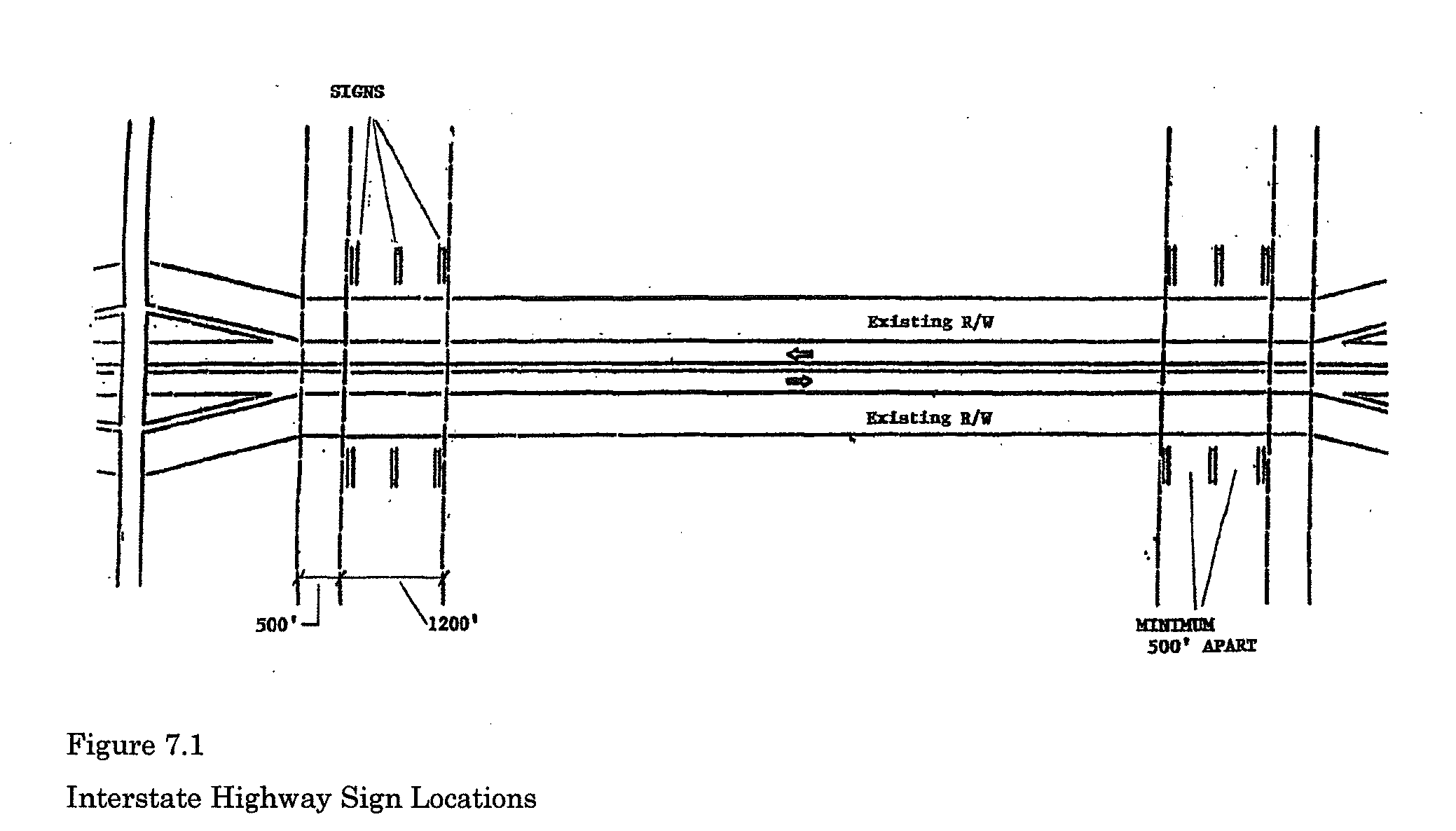
Section 7.04.12 shall apply to all signs visible from I-75 or I-675 and located within the following area: One thousand two hundred (1,200) feet long beginning five hundred (500) feet from the point where the pavement widens on the main traveled way to accommodate the longest entrance or exit ramp along I-75 and I-675. (See figure 7.1 interstate highway sign locations.)
B.
No new sign shall be erected unless it is in compliance with the regulations of this section. Signs shall be constructed of durable materials, maintained in good condition, and not permitted to become dilapidated.
C.
Nonconforming signs. Any legally erected sign which would become nonconforming as a result of this section may be allowed to remain until purchased by the GDOT provided that the sign meets the requirements of state laws, rules and regulations governing such signs or the sign can be replaced with a sign that would meet the provisions of this ULDC and any state laws, rules and regulations governing such signs.
D.
New signs. New signs shall meet the following requirements:
1.
The outside measurement of all new signs shall not exceed fourteen (14) feet in height and forty-eight (48) feet in length, with or without trim, except that existing factory manufactured metal signs, now located within the 1,200-foot zones set out previously and if holding a conforming state permit on December 7, 1982, are considered to be conforming with respect to size requirements until such time as the sign is moved, enlarged, raised or otherwise physically altered with respect to dimensions or changes from its present configuration or sign type;
2.
A fall zone area shall be provided equal to half the height of the supporting structure for the sign away from all residential dwelling units;
3.
Only one (1) sign shall be allowed to face the same direction per location. This allows back-to-back sign, but prohibits two (2) signs (side-by-side or stacked atop one another) facing the same direction;
4.
Sign locations shall be no less than five hundred (500) feet apart measuring from the two (2) closest points;
5.
Sign structures shall be no less than ten (10) feet from any property or right-of-way line; and
6.
Three (3) signs shall be allowed per quadrant of an interchange adjacent to the Interstate. This will allow a maximum of twelve (12) signs per interchange. These signs shall be within an area zoned commercial or industrial as specified in state law.
7.
Sign erection at historic area locations is prohibited. No sign shall by placed in or obstruct the view of an area of designated historic interest.
(Ord. No. 10-16, § I, 10-18-10; Ord. No. 10-20, § I(12—16), 6-15-10; Ord. No. 11-01, § I, 4-4-11; Ord. No. 11-07, § I, 12-5-11; Ord. No. 14-01, § I, 1-9-14; Ord. No. 17-07, 5-2-17)
Sec. 7.05.00. - Wireless communication facilities (WCF).
7.05.01.
Purpose. It is the purpose of these wireless telecommunication regulations to ensure that residents and businesses in Henry County have reliable access to wireless facility networks and state of the art communications services, while also ensuring that this objective is achieved in a fashion that preserves the character of the community, and is accomplished according to Henry County's zoning, planning, and design standards. The Telecommunications Act of 1996 preserved, with certain limitation, local government land use and zoning authority concerning the placement, construction, and modification of wireless communication facilities. Henry County recognizes that facilitating the development of wireless service technology can be an economic development asset to Henry County and a significant benefit to its residents. To accomplish the above-stated objectives and to ensure that the placement, construction, or modification of wireless telecommunication facilities complies with all applicable federal laws, and is consistent with Henry County's land use policies, Henry County is adopting comprehensive wireless communications regulations. These regulations are designed to meet the following:
A.
Promote the health, safety, and general welfare of the public by regulating the siting of and establishing development standards for WCFs and related equipment;
B.
Encourage the location of WCFs in nonresidential areas;
C.
Encourage the location of WCFs on existing structures, including utility poles, signs, water towers, buildings, and other WCFs where feasible;
D.
Encourage collocation and site sharing of new and existing WCFs;
E.
Facilitate the use of public property and structures for WCFs;
F.
Locate telecommunications support structures and antennas in areas where adverse impacts on the community are minimized;
G.
Encourage design and construction of support structures and antennas to harmonize the visual impact of support structures and antennas with the existing natural and/or built environment; and
H.
Encourage the siting of small cell technology consistent with the design and aesthetics of the existing streetscape. "Small Cell Technology" is defined as (1) individual small cell wireless antennas; or (2) networks of spatially separated small cell wireless antenna nodes connected to a common source via transport medium that provides wireless service within a geographic area.
7.05.02.
Applicability. The regulations set forth in section 7.05.00 apply to all wireless communication facilities, except as enumerated below:
A.
Antennas or support structures located on property owned, leased, or otherwise controlled by the county or one (1) of its agencies, divisions, or entities, with an approved license or lease authorizing such antenna or support structure.
B.
Small cell technology located in the right-of-way (ROW) adjacent to nonresidential zoning districts and not exceeding seventy (70) feet in height including antenna, lightning rod, etc.) provided that such facilities shall comply with the requirements of section 7.05.03.F as well as the requirements for utilities in the right-of-way including those of section 3-4-451.
C.
Ordinary maintenance of existing telecommunications facilities and support structures, as defined herein.
D.
Any support structure, or the installation of any antenna, that is under thirty-five (35) feet in height and is owned and operated by a federally licensed amateur radio operator or is used exclusively for receive-only antennas.
E.
A temporary, commercial WCF, upon the declaration of emergency by federal, state, or local government, or determination of public necessity by the county, and approval by the county manager, provided that such WCF complies with all federal and state requirements. The exemption may continue up to one hundred twenty (120) days after the duration of the state of emergency with the approval of the county manager.
7.05.03.
Administrative approval for WCFs.
A.
Minor modifications of existing WCFs shall be permitted in any zoning district after administrative approval in accordance with the standards set forth in section 7.05.04.
B.
Concealed attached or non-concealed attached WCFs and collocations shall be permitted in any zoning district after administrative approval in accordance with the standards set forth in section 7.05.04.
C.
Support structures, antennas, and/or antenna arrays for AM/FM/TV/HDTV broadcasting transmission facilities that are licensed by the FCC are permitted in any zoning district after administrative approval.
D.
Monopoles or attached WCFs located in utility easements or right-of-way shall be permitted in any zoning district after administrative approval in accordance with the standards set forth in this ULDC, provided that:
1.
The utility easement or right-of-way shall be a minimum of one hundred (100) feet in width.
2.
The easement or right-of-way shall contain overhead utility transmission and/or distribution structures that are eighty (80) feet or greater in height.
3.
The height of the monopole may not exceed by more than thirty (30) feet the height of existing utility support structures.
4.
Monopoles and its accessory equipment shall be set back a minimum of fifteen (15) feet from all boundaries of the easement or in accordance with clear zone requirements as established by the Henry County Department of Transportation for structures located within the right-of-way.
5.
Poles that use the structure of a utility tower for support are permitted under this section. Such poles may extend up to twenty (20) feet above the height of the utility tower.
E.
Support structure replacement. Support structure replacements are permitted in any zoning district after administrative approval in accordance with the standards set forth in section 7.05.04, and without regard to the requirements of sections 7.05.05 through 7.05.09, provided that:
1.
The support structure replacement is located within eight hundred fifty (850) feet of the existing WCF, irrespective of whether the support structure replacement and the existing support structure are on the same parcel.
2.
If the support structure replacement will be located on a different parcel from the existing support structure, then the underlying zoning district and the Future Land Use Map designation of the parcel on which the replacement WCF is to be located shall be the same or more intense than the zoning district and Future Land Use Map designation of the parcel on which the existing WCF is located.
3.
If the existing support structure is nonconforming, the applicant demonstrates that the proposed support structure replacement will mitigate the nonconformity. This demonstration shall meet at least two (2) of the following factors:
A.
Change of design that achieves a more preferred design (for example, from a lattice-style to a monopole-style support structure or a nonconcealed to a concealed support structure);
B.
At least a ten-percent height reduction;
C.
From a lighted support structure to a non-lighted support structure; and
D.
Exceeding the current wireless code requirements for setbacks on all sides.
4.
The existing support structure that is being replaced shall be removed within one hundred twenty (120) days after the support structure replacement is completely constructed and operational.
F.
Additional requirements.
1.
Wireless communication facilities in the public right-of-way are to be located outside of the clear zone as per AASHTO Roadside Design Guide as determined by HCDOT.
2.
The permittee of approval to install wireless communication facilities in the public right-of-way is to abandon or relocate the wireless communication facilities at its sole expense if required to do so by a government agency requiring relocation. Access to private property from the public right-of-way shall take precedence over the use of the public right-of-way for a utility facility/support structure. Should the location of a utility facility/ support structure prevent all access to a lot of record, that utility facility/support structure shall be removed or relocated by the utility facility/support structure owner at its sole expense within the same timeframe as otherwise required by section 3-5-451(c).
3.
The wireless communication facility permittee shall be a member of the GA 811, One Call Center, and shall be required to mark any underground facilities that the utility has when a locate request is made (or respond to the GA 811 call center that they have no conflicts if that is applicable). The marking shall be done within the industry standard timeframe when locate requests are made.
4.
Wireless communication facilities in the public right-of-way shall be required to meet the requirements of section 12.02.13 to provide a removal bond.
5.
The zoning administrator shall require any modification without limitation to reduce potential hazards within the fall zone of a wireless communication facility in the public right-of-way.
6.
Wireless communications facilities in the public right-of-way as well as associated conduit (pipes or tubes) shall be required to be a dark color/material meeting the same color requirement for streetlights in the same district in which the facility is located.
7.
Wireless communications facilities in the public right-of-way shall be located no closer than a distance equal to the height of the utility facility to be permitted from another utility facility in the public right-of-way unless the facility shares the support structure.
8.
Wireless communications facilities in the public right-of-way shall be required to obtain an approved utility permit. Applicants shall be required to provide the latitude and longitude of the proposed location of the utility facility. Permittees shall provide before and after photos of the work site to demonstrate site conditions. In the event that there is remaining damage to or deterioration of the conditions of the right-of-way after the installation of the utility facility, the indemnity bond or other acceptable security may be used to correct the situation as permitted by law including section 3-5-451(a).
7.05.04.
Administrative review process.
A.
All administrative review applications must contain the following:
1.
Administrative review application form signed by the applicant.
2.
All application requirements outlined in section 12.02.06.D. with the exception of Parts 14 through 18.
3.
Administrative review application fee as outlined on the department's most recently adopted fee schedule, and in accordance with O.C.G.A. 36-66B-7.
B.
Procedure.
1.
There shall be a pre-application meeting. The purpose of the pre-application meeting will be to address issues that will help to expedite the review and permitting process.
2.
Within thirty (30) calendar days of the date an administrative review application is filed, the administrator shall determine if it is a complete application, and if it determines the application is not a complete application, notify the applicant in writing of any information required to complete such application. If additional information is required to complete the application, the time required by the applicant to provide such information shall not be counted toward the thirty-calendar day review period set forth. Information requested to complete the application may only include the documents, information, and fees specifically enumerated in the county's existing wireless telecommunications regulations, ordinance, and forms pertaining to the location, construction, collocation, modification, or operation of wireless facilities.
3.
Once the application is complete, the administrator will issue a written decision granting or denying the request within thirty (30) days unless an extension of time is agreed to by the applicant. Failure to issue a written decision with thirty (30) days shall constitute an approval of the application.
4.
Should the administrator deny the application; the administrator shall provide written justification for the denial. The denial must be based on substantial evidence of inconsistencies between the application and the ULDC.
5.
The appeal of any decision of the administrator approving, approving with conditions, or denying an application or deeming an application incomplete, shall be in accordance with section 12.04.00 of this ULDC, except as set forth in subsection 6, below.
6.
Additional procedures for support structure replacements.
A.
The administrator shall provide notice of receipt of an application for support structure replacement in accordance with the provisions of ULDC section 12.03.04, except that the notices shall be mailed within fifteen (15) calendar days from the administrator's receipt of a complete application.
B.
After making a decision with respect to an application for a replacement tower or monopole, the administrator shall have ten (10) calendar days to post a sign on the subject property which reflects the decision of the administrator and includes the deadline for taking an appeal of the decision. Aggrieved person(s) shall have fifteen (15) calendar days from the posting of the sign to appeal the administrator's decision by filing an appeal to the zoning advisory board. A person shall be considered aggrieved for purposes of this section only if said person or said person's property was the subject of the action appealed from, or said person has a substantial interest in the action appealed from that is in danger of suffering special damage or injury not common to all property owners similarly situated.
7.05.05.
Administrative waiver. The administrator shall have the power to reduce specific site design and development standards of this ULDC where the intent of the ULDC can be achieved and equal performance obtained by granting a waiver of standards. The authority to grant a waiver shall be limited to the following:
A.
A reduction in the minimum width of utility easement or right-of-way provided the following standards are met:
1.
Clear zone requirements, as reviewed and approved by the Henry County Department of Transportation (DOT).
B.
A reduction in the minimum height of existing overhead utility transmission and/or distribution structures, provided the following standards are met:
1.
The proposed WCF is within a twenty-percent height variance of existing overhead utility transmission and/or distribution structures.
7.05.06.
WCF applications (non-administrative approval).
A.
Telecommunication facilities and support structures not permitted by administrative approval shall be permitted upon the granting of a conditional use from the zoning advisory board in accordance with the standards set forth in the ULDC.
B.
WCF applications shall contain the following:
1.
Conditional use application form signed by the applicant.
2.
All documents required by section 12.02.06.D.
3.
WCF conditional use application fee as outlined on the department's most recently adopted fee schedule, and in accordance with O.C.G.A 36-66B-7.
C.
Procedure. Procedures for conditional use applications are outlined in section 11.05.00 of the ULDC.
D.
Timing; application completeness.
1.
Within one hundred fifty (150) calendar days of the date a conditional use application is filed, unless another date is specified in a written agreement between the administrator and the applicant, the zoning advisory board shall:
A.
Make its final decision to approve or disapprove the application; and
B.
Advise the applicant in writing of it final decision.
2.
Within thirty (30) calendar days of the date a conditional use application is filed, the administrator shall determine if it is a complete application, and if it determines the application is not a complete application, notify the applicant in writing of any information required to complete such application. To the extent additional information is required to complete the application, the time required by the applicant to provide such information shall not be counted toward the calendar day review period set forth in subsection 1, above. Information requested to complete the application may only include the documents, information, and fees specifically enumerated in the county's existing wireless telecommunication regulations, ordinances, and forms pertaining to the location, construction, collocation, modification, or operation of wireless facilities.
7.05.07.
Siting hierarchy.
A.
Siting of WCFs shall be in accordance with the following hierarchy of facility alternatives, ranked from highest to lowest preference as follows:
1.
Concealed attached.
2.
Collocations o existing WCFs.
3.
Non-concealed attached.
4.
Concealed freestanding.
5.
Non-concealed freestanding monopole.
7.05.08.
Evidence of need report. For all conditional use applications for WCFs, a report certified by a radio frequency engineer shall be provided that demonstrates the need for the WCF at the proposed location. The following information shall be provided with the report:
A.
Identification of efforts to comply with the facility and location hierarchy in section 7.05.07. If a concealed freestanding or nonconcealed freestanding WCF is proposed, the applicant must demonstrate that existing facilities or the mitigation of existing facilities within the applicant's geographic search area (GSA) cannot be reasonably made to accommodate the applicant's need because:
1.
There are no existing WCFs in the GSA that meet the applicant's engineering requirements, and why.
2.
The existing WCFs, buildings and structures in the GSA are not of sufficient height and cannot be increased in height to meet the applicant's engineering requirements.
3.
The existing WCFs, buildings and structures in the GSA do not have sufficient structural strength and cannot be structurally improved to support the applicant's proposed WCF and related equipment. Such information shall be certified by a Georgia-licensed professional engineer.
4.
There are other limiting factors that render existing WCFs in the GSA unsuitable.
B.
A written report demonstrating applicant's meaningful efforts to secure shared use alternative buildings or other structures within the county. The applicant shall provide:
1.
A list of all existing structures that are potential alternatives to the proposed location.
2.
A written explanation why the alternatives considered were either unacceptable or infeasible due to technical or physical reasons.
3.
Copies of written requests and responses for shared use, along with any letters of rejection stating the reason for rejection.
C.
For all WCFs proposed in a residential district, a written report demonstrating applicant's meaningful efforts to secure alternative sites in nonresidential areas. The applicant shall provide:
1.
A list of all alternative sites that are potential alternatives to the proposed location.
2.
A written explanation why the alternatives considered were either unacceptable or infeasible due to technical or physical reasons.
3.
Copies of written requests and responses for shared use, along with any letters of rejection stating the reason for rejection.
D.
Graphics to be provided shall include:
1.
A map of the GSA to include the location of the proposed WCF and all existing WCFs (including those not owned by the applicant). The exact location (in longitude and latitude, to degrees, minutes and seconds to the nearest tenth), including the height of the WCFs, and height, type and number of existing antennas shall be provided.
2.
A map of the GSA and all existing structures that are potential alternatives to the proposed monopole.
3.
A color plot demonstrating the existing coverage of all WCFs owned and proposed by the applicant within the GSA.
4.
Additional maps and calculations as may be deemed necessary by the administrator to prove need for the proposed WCF.
7.05.09.
Visual impact assessment. All conditional use applications for WCFs shall furnish a visual impact assessment. All or a portion of the analysis shall be performed for administrative approval when, in the opinion of the administrator, the proposed type of WCF and its location requires additional assessment (i.e., within a residential district, recognized historic area, or scenic vista/landscape). The analysis shall include:
A.
Line-of-sight analysis. The applicant shall provide a line-of-sight analysis, including elevation views of the proposed facility. The analysis shall include a description of natural and manmade features that affect the buffering of the potential visual impact of the structure.
B.
Photo simulations. The applicant shall provide photo-simulated post-construction renderings of the completed proposed support structure, equipment compound and/or equipment cabinets, ancillary structures, and landscaping, if any, from locations determined at the pre-application conference.
1.
The views shall incorporate before and after scenarios, a scaled color image of the proposed type of facility, an aerial map with the location of the selected views, and a description of the technical approach used to create the photo simulations. The simulations shall include a minimum of four (4) vantage points (north, south, east, and west).
2.
At the pre-application meeting, the applicant may be required to provide other pictorial representations from other viewpoints, including, but not limited to, state highways and other major roads, state and local parks; other public lands; historic districts; preserves and historic sites normally open to the public, and from any other location where the site is visible to a large number of visitors, travelers or residents.
7.05.10.
Development standards. WCFs are allowed in all zoning districts, subject to the limitations set forth in this article. To ensure compatibility with surrounding land uses, protect public safety and natural, cultural and scenic resources and preserve and enhance the character of neighborhoods, all WCFs subject to section 7.05.00 shall be located, developed and operated in compliance with the following:
A.
Design.
1.
Attached WCFs shall have both antenna and supporting electrical and mechanical equipment that are of a neutral color identical to, or closely compatible with, the color of the supporting structure so as to make the antenna and related equipment as visually unobtrusive as possible.
2.
Monopoles shall consist of a galvanized steel finish that, subject to any applicable standards of the FAA, shall be painted a neutral color, so as to reduce visual obtrusiveness. The design of the accessory equipment compound shall, to the extent possible, use materials, colors, textures, screening, and landscaping that will blend to the natural setting and built environment. New wireless facilities that are not concealed or attached shall be monopoles except when providers can document and demonstrate need for the design to be a tower.
3.
Monopoles shall be subject to the following:
A.
Monopoles shall be designed to accommodate at least three (3) telecommunications providers.
B.
The compound area surrounding the monopole must be of sufficient size to accommodate accessory equipment for at least three (3) telecommunications providers.
C.
Unless otherwise required by the Federal Communications Commission, or the Federal Aviation Administration, monopoles shall have a galvanized silver or gray finish.
4.
Concealed telecommunications support structures shall be designed to accommodate the collocation of other antennas whenever economically and technically feasible or aesthetically appropriate, as determined by the zoning advisory board.
5.
Upon request of an applicant, the zoning advisory board may waive the requirement that new support structures accommodate the collocation of other service providers if it finds that collocation at the site is not essential to the public interest, or that the construction of a shorter support structure with fewer antennas will promote community compatibility.
B.
Aesthetics.
1.
Lighting and marking. Attached WCFs or WCF support structures shall not be lighted or marked unless required by the Federal Communications Commission, or the Federal Aviation Administration (FAA) or other governmental entity.
2.
Attached WCFs or WCF support structures shall contain a sign no larger than four (4) square feet in order to provide adequate notification to persons in the immediate area of the presence of an antenna that has transmission capabilities and shall contain the name(s) of the owner(s) and operator(s) of the antenna(s) as well as emergency phone number(s). The sign shall be on the equipment shelter or cabinet of the applicant and be visible from the access point of the site and must identify the equipment owner of the shelter or cabinet. The sign shall not be lighted, unless applicable law, rule or regulation requires lighting. Commercial advertising is strictly prohibited.
C.
Landscaping and buffer requirements.
1.
Attached WCFs or WCF support structures shall be landscaped in accordance with the landscape requirements contained in sections 5.00.00 through 5.03.00 of the Henry County ULDC, except for additional requirements stated herein.
2.
Landscaping and buffer requirements for attached WCFs or WCF support structures can be waived by the administrator where the WCF applicant makes other means of screening the support structure base and adjacent equipment faculties (i.e., opaque fencing, etc.) and if the applicant otherwise demonstrates consistency with the purposes and intent of this ordinance.
3.
Existing mature tree growth and natural land forms on the site shall be preserved to the extent feasible; provided, however, that vegetation that causes interference with the antennas or inhibits access to the equipment facility may be trimmed.
4.
Existing vegetation on site may be used in lieu of required landscaping where approved by the administrator.
5.
Additional landscaping and buffer requirements:
A.
The perimeter of concealed and non-concealed freestanding WCFs shall be at least fifteen (15) feet in width for landscaping and include the following:
1.
A row of evergreen trees a minimum of ten (10) feet in height at the time of planting with a minimum two-inch caliper, spaced a maximum of twelve (12) feet apart and a row of evergreen shrubs a minimum of two (2) feet tall at the time of planting, planted four (4) feet on center.
2.
Within a year of planting, the trees and shrubs shall achieve eighty (80) percent opacity of the security barrier and/or equipment enclosure. Existing trees and vegetation may be used as an alternative or in combination with new plantings to achieve the opacity requirement subject to approval of the administrator. An easement may be required to ensure that vegetation remains intact.
6.
Maintenance. It will be the responsibility of the owner/tenant to keep all landscaping material (as part of the landscaped area) free from disease and properly maintained in order to fulfill the purpose for which it was established. The owners of the property, and any tenant on the property where buffers and landscaping are required, shall be jointly and severally responsible for the maintenance of all landscaping materials. Such maintenance shall include all actions necessary to keep the buffer and landscape areas free from litter and debris, to keep plantings healthy, and to keep planting areas neat in appearance. Any vegetation that constitutes part of the buffer or landscaping shall be replaced in the event it dies.
D.
Setbacks.
1.
Attached WCFs. Attached WCFs are exempt from the setback standards of this section but are not exempt from the setbacks for the zoning districts in which they are located.
2.
Towers and monopoles. Towers and monopoles shall meet the following setbacks:
A.
From all property lines a distance equal to their height.
B.
Residential dwellings. From all off-site residential dwellings, a distance equal to the height plus ten (10) percent. There shall be no setback requirement from dwellings located on the same parcel as the proposed tower or monopole.
C.
Unless otherwise stated herein, all accessory equipment shall be setback from all property lines in accordance with the minimum setback requirements in the underlying zoning district.
D.
The zoning advisory board and the administrator may reduce or waive the setback requirements of subsection A. or B., above upon the request of the applicant if:
1.
The tower or monopole will be less visible as a result of the diminished setback; or
2.
The applicant demonstrates, by virtue of a letter or report from a licensed engineer, that the structural design or characteristics of the tower or monopole mitigate the need for the full setback.
E.
Height.
1.
Attached WCFs. Attached WCFs shall not add more than twenty (20) feet in height to the existing building or structure to which it is attached.
2.
WCFs with support structures.
A.
In any residential-agricultural zoning district (RA), the maximum height for a WCF shall be one hundred and fifty (150) feet.
B.
In all single-family residential (R-1, R-2, R-3, R4, R5) and two-family residential (RD) zoning districts the maximum height for a WCF shall be seventy-five (75) feet.
C.
In all multiple-family residential (RM), mobile home development (RMH), and residential suburban (RS) zoning districts, the maximum height for a WCF shall be ninety (90) feet.
D.
In any office and institutional zoning district (OI), the maximum height shall be one hundred and twenty (120) feet.
E.
In any neighborhood commercial (C-1), mixed-use (MU), and interchange activity center (IAC) zoning districts the maximum height shall be one hundred and twenty (120) feet.
F.
In any general commercial zoning district (C-2), the maximum height of a WCF shall be one hundred and fifty (150) feet.
G.
In any heavy commercial zoning district (C-3), the maximum height of a WCF shall be one hundred and eighty (180) feet.
H.
In any light manufacturing zoning district (M-1), the maximum height of a WCF shall be one hundred and ninety (190) feet.
I.
In any heavy manufacturing zoning district (M-2), the maximum height of a WCF shall be two hundred (200) feet.
F.
[Accessory equipment.] Accessory equipment, including any buildings, cabinets or shelters, shall be used only to house equipment and other supplies in support of the operation of the telecommunication facility or support structure. Any equipment not used in direct support of such operation shall not be stored on the site.
1.
An equipment building, shelter or cabinet must not exceed five hundred and sixty (560) square feet and twelve (12) feet in height, including the support structure for the equipment building.
A.
Exception to size restriction. A single equipment building or shelter may exceed five hundred and sixty (560) square feet, if it: is located at ground level; is used by more than one (1) telecommunication provider; and does not exceed one thousand five hundred (1,500) square feet.
B.
Exception to height restriction. Upon the applicant's request, the zoning advisory board may waive the height restriction to allow for the stacking of equipment on top of each other. The zoning advisory board must find that there is a practical necessity for the stacking of the equipment and that any resulting impact on adjoining properties is minimal or may be minimized by the requiring of appropriate screening.
2.
If the accessory equipment is at ground level in a residential zone, the zoning advisory board may require that the building or shelter be faced with brick or other suitable material on all sides. In the situation of stacked equipment buildings, additional screening/landscaping measures may be required by the zoning advisory board.
G.
Separation requirements.
1.
Freestanding wireless communication facilities located within residential zoning districts shall not be located within one (1) mile of another freestanding wireless communication facility.
2.
Except as stated in section 7.05.09.G.1., there shall be no separation requirement for wireless communication facilities.
7.05.11.
Adherence to state and/or federal rules and regulations.
A.
All administrative approvals and conditional use approvals shall adhere to, and comply with, all applicable rules, regulations, standards, and provisions of any state or federal agency, including, but not limited to, the FAA and the FCC. Specifically included in this requirement are any rules and regulations regarding height, lighting, security, electrical and RF emission standards.
B.
To the extent that applicable rules, regulations, standards, and provisions of any state or federal agency, including, but not limited to, the FAA and the FCC, and specifically including any rules and regulations regarding height, lighting, and security are changed and/or are modified, then the holder of such an administrative approval or WCF conditional use shall conform the WCF to the applicable changed and/or modified rule, regulation, standard, or provision within a maximum of twenty-four (24) months of the effective date of the applicable changed and/or modified rule, regulation, standard, or provision, or sooner as may be required by the issuing entity.
7.05.12.
Environmental standards. The following standards shall apply:
A.
Freestanding WCFs shall not be located in wetlands or wetlands buffers, whether federal or state designated.
B.
Freestanding WCFs shall not generate noise in excess of sixty (60) db at ground level at the property line.
C.
Attached WCFs shall not generate noise in excess of sixty (60) db at ground level at the base of a habitable building closest to or part of the facility.
7.05.13.
Removal of wireless telecommunications facilities.
A.
The county may determine that the health, safety, and welfare interests of the county warrant and require the removal of a WCF under the following circumstances:
1.
If it has been abandoned. A WCF has been abandoned if it has not been used as a telecommunications facility for a period of six (6) months or more;
2.
If it has fallen into such a state of disrepair that it creates a health or safety hazard;
3.
If it has been located, constructed, or modified without first obtaining, or in a manner not authorized by, the required building permit, or any other necessary authorization.
B.
If the county makes such a determination as noted in subsection (a) of this section, then the county attorney shall notify the holder of the WCF building permit within forty-eight (48) hours that said WCF is to be removed.
C.
The holder of the WCF building permit, or its successors or assigns, shall dismantle and remove such WCF, and all associated structures and facilities, from the site and restore the site to as close to its original condition as is possible, such restoration being limited only by physical or commercial impracticability, within ninety (90) days of receipt of written notice from the county.
D.
If the WCF is not removed or substantial progress has not been made to remove the WCF within ninety (90) days after the permit holder has received notice, then the county may order officials or representatives of the county to remove the WCF at the sole expense of the owner or WCF building permit holder.
E.
If, the county removes, or causes to be removed, a WCF, and the owner of the WCF does not claim and remove it from the site to a lawful location within ten (10) days, then the county may take steps to declare the WCF abandoned, and sell it and their components.
F.
Notwithstanding anything in this section to the contrary, the county may approve a temporary use permit/agreement for the WCF, for no more ninety (90) days, for the purpose of preparing a suitable plan for removal, conversion, or relocation of the affected WCF by the holder of the WCF building permit, subject to the approval of the county. An agreement to such plan shall be executed by the holder of the WCF building permit and the county. If such a plan is not developed, approved and executed within the ninety-day time period, then the county may take possession of and dispose of the affected WCF in the manner provided in this section.
7.05.14.
Prohibited conditions of approval. In regulating the placement or construction of any new wireless facility or wireless support structure, the administrator, the board or the zoning advisory board shall not:
A.
Condition the approval of any application for a new wireless support structure on a requirement that a modification or collocation to such structure be subject to a review that is inconsistent with the requirements of O.C.G.A. 36-66B-4;
B.
Require the removal of existing wireless support structures or wireless facilities as a condition to approval or an application for a new wireless facility or wireless support structure unless such existing wireless support facility is abandoned and owned by the applicant; or
C.
Require the applicant to place an antenna or other wireless communications equipment on publicly owned land or on a privately owned water tank, building or electric transmission tower as an alternative to the location proposed by the applicant.
7.05.15.
Conflict with other laws. Where this ordinance differs or conflicts with other laws, rules and regulations, unless the right to do so is preempted or prohibited by the county, state or federal government, this ordinance shall apply.
(Ord. No. 09-07, 11-17-09; Ord. No. 14-06, § I(exh. A), 11-4-14; Ord. No. 17-13, 5-16-17)

