
Hesperia City Zoning Code
CHAPTER 16
36 - SIGN REGULATIONS18
Prior ordinance history: Ord. 183 Exh. A; Ord. 209 Exh. A; Ord. 276 Exh. A; Ord. 288 Exh. A; Ord. 293 Exh. A.
16.36.010 - Purpose.
The purpose of this chapter is to:
A.
Encourage economic development by supporting the commercial communication needs of the business community;
B.
Enhance the quality of life by providing a visually pleasing environment;
C.
Promoting public health, safety and welfare.
(Ord. 296 § 4 (Exh. A (part)), 2000)
16.36.020 - Definitions.
Words and terms used in this chapter are defined as follows:
"Animated sign" means any sign that uses movement of the physical parts or extensions of the sign to depict action or create a special effect. These do not include reader boards, barber poles or similar signs where the sign structure itself is not in motion.
"Banner" means any sign of lightweight fabric of similar material that is permanently mounted to a pole or a building by a permanent frame at one or more edges. National flags, state or municipal flags, or the official flag of any institution or business shall not be considered banners.
"Beacon" means any light with one or more beams directed into the atmosphere or directed at one or more points not on the same lot as the light source; also, any light with one or more beams that rotate or move.
"Billboard" means any outdoor advertising structure or sign which has a flat surface sign space upon which advertising may be posted, painted, or affixed, and which is designed or made available for the rental or lease of such sign space for advertising billboards shall not mean any on-premises sign." Billboards may utilize digital advertising displays as part or all of their surface area.
"Bulletin board sign" means any sign located in a multi-tenant complex that lists businesses and addresses located therein.
"Changeable copy sign" means a sign or portion thereof with characters, letters or illustrations that can be changed or rearranged without altering the face or the surface of the sign. A sign on which the only copy that changes is an electronic or mechanical indication of time or temperature shall be considered a "time and temperature" portion of a sign and a changeable copy sign for purposes of this chapter.
"Club or organization sign" means any sign that exhibits an event or regularly scheduled meeting of a group, club, civic organization or similar use at the site.
"Commercial message" means any sign wording, logo or other representation that, directly or indirectly, names, advertises or calls attention to a business, product, service or other commercial activity.
"Construction or contractor sign" means a temporary sign, which states the names of the individuals and/or firms connected with the construction of a project. Such signs may include the name of the project, the address of the business and the emergency telephone number.
"Copy" means any words, letters, numbers, figures, designs, logos or other symbolic representations incorporated into a sign.
"Digital advertising display" means an advertising display of still, scrolling or moving images including video or animation, that may be changed remotely through electronic means and utilizes a series of grid lights, including but not limited to cathode ray, light-emitting diode (LED), plasma screen, liquid crystal display (LCD) fiber optic or other electronic media or technology. A digital advertising display may also be known as "Reader board." (See also "Billboard.")
"Directional sign" means a sign which contains words such as "entrance," "enter," "exit," "in," "out" or other similar words or a sign containing arrows or characters indicating traffic direction and used either in conjunction with such words or separately.
"Flag" means any fabric, banner or bunting containing distinctive colors, patterns or symbols, used as a symbol of a government, political subdivision or other entity.
"Future tenant identification sign" means a temporary sign which identifies a future use of a site or building.
"Grand opening" means a promotional activity used by newly established businesses, within thirty (30) days after occupancy, to inform the public of their location and contribution to the community. "Grand opening" does not mean an annual or occasional promotion of retail sales by a business.
"Height" shall be the vertical distance from the highest point of the sign to the highest point within five feet horizontally from the base of the sign.
"Inflatable sign" means any sign capable of being inflated with air or gas.
"Institutional use" means facilities which provide a service to the general public, including schools, churches, post offices, fire stations, hospitals, civic centers, and publicly owned land.
"Lot" means a parcel of land in single ownership that is of sufficient size to meet minimum zoning requirements for area, coverage and use, and that can provide such yards and other open spaces as required by the zoning regulations.
"Marquee" means any permanent roof-like structure projecting beyond a building or extending along and projecting beyond the wall of the building, generally designed and constructed to provide protection from the weather.
"Marquee sign" means any sign attached to, in any manner, or made a part of a marquee.
"Monument sign" means a freestanding sign generally supported by a solid base and less than ten feet in height. The base of a monument sign may include a hollow or opening as part of its design, so long as this area does not exceed more than twenty (20) percent of the sign's face.
"Nonconforming sign" means any sign that does not conform to the requirements of this chapter.
"Off-site sign" means a sign in accordance with this chapter which directs traffic to a business within the city but not located on the same site as the sign.
"Off-site subdivision sign" means a sign in accordance with this chapter which directs traffic to a subdivision within the city.
"On premises sign" A sign that is either of the following: (1) a sign that advertises the business conducted, services rendered, or goods produced or sold upon the property on which the sign is placed; or (2) a sign that is within six hundred sixty (660) feet of the edge of the right-of-way of the freeway and advertises business conducted, services rendered, or goods produced or sold within one thousand (1,000) feet of the sign and which meets the requirements of a freeway sign under Section 16.36.060(C)(9) and is taller than sixty (60) feet in height. On-premise signs shall not be considered "off-site signs" for purposes of Sections 16.36.050(A) or 16.36.080."
"Open house sign" means a temporary off-site directional sign advertising the sale or lease of residential, commercial or industrial property, and the identification of the firm handling such sale, lease or rent.
"Pennant" means any lightweight plastic, fabric or other material, whether or not containing a message of any kind, suspended from a rope, wire or string, usually in series, designed to move in the wind.
"Person" means any individual, association, company, corporation, firm, organization or partnership, singular or plural, of any kind.
"Political sign" means a sign erected prior to an election to advertise or identify a candidate, campaign issue, election proposition, or other related matters.
"Portable sign" means any sign not permanently attached to the ground or other permanent structure, or a sign designed to be transported, including, but not limited to, signs designed to be transported by means of wheels; signs converted to A- or T-frames; menu and sandwich board signs; balloons used as signs; umbrellas used for advertising; and signs attached to or painted on vehicles and visible from the public right-of-way, unless the vehicle is used in the normal day-to-day operations of the business, and parked both adjacent to and in the parking provided for said business.
"Principal building" means the building in which is conducted the principal use on the site on which it is located. Sites with multiple principal uses may have multiple principal buildings, but storage buildings, garages, and other clearly accessory uses shall not be considered principal buildings.
"Projecting sign" means any sign affixed to a building or wall in such a manner that its leading edge extends more than six inches beyond the surface of such building or wall.
"Reader board sign" means a sign utilizing a field of small lights or other devices to create the effect of letters, numbers or symbols on the sign face.
"Real estate sign" means a temporary sign advertising the sale or lease of the property upon which it is located, and the identification of the firm handling such sale, lease or rent.
"Regional uses" means uses, which have access from major highways or arterials, and area of a size and configuration to facilitate development of businesses attracting consumers from a regional market area. Such uses could include retail malls, auto malls, movie theaters, recreation or other similar uses as approved by the director.
"Relocation agreement" means an agreement entered into between the city and a billboard or property owner to relocate or replace an existing billboard to another property or to reconstruct it on the same property. Reconstruction may also include converting a billboard to a digital advertising display.
"Residential sign" means any sign located in a district zoned for residential uses that contains no commercial message except advertising for goods or services legally offered on the premises where the sign is located, if offering such service as such location conforms with all requirements of the municipal code and general plan.
"Revolving sign" means a sign which all or a portion of which may rotate either on an intermittent or constant basis.
"Roof sign" means a sign that is mounted on the roof of a building or which is wholly dependent upon a building for support and which projects above the point of a building with a flat roof, the eave line of a building with a gambrel, gable or hip roof or the deck line of a building with a mansard roof.
Roof sign, integral. "Integral roof sign" means a sign erected or constructed as an integral or essentially integral part of a normal roof structure of any design, such that no part of the sign extends vertically above the highest portion of the roof and such that no part of the sign is separated from the rest of the roof by a space of more than six inches.
"Secondary wall signs" are accessory to the business sign but advertises goods, products or services offered at the site.
"Sign" means any device, fixture, placard or structure that uses any color, form, graphic, illumination, symbol or writing to advertise, announce the purpose of, or identify the purpose of a person or entity, or to communicate information of any kind to the public.
"Sign area" means the smallest geometric shape that will encompass the limits of the writing or other display. The structure or backdrop shall not be included in the computation. Multifaced signs shall compute all faces if they can be viewed from any one point at the same time. Channel letters shall be measured in the same fashion.
"Site sign plan" means a plan showing the height, size, type, location and architecture of all signs on a particular property or development. Signs in addition to those in Sections 16.36.040, 16.36.060 and 16.36.070 may be permitted when found to be benefiting the purpose of this chapter.
"Sports facility" means any facility expressly designed for the conduct of sports or recreation activities, owned by the state, county, city or other public or private entity in which sports or sanctioned recreation activities are conducted which has a total square footage greater than fifty thousand (50,000) square feet or, or has a fixed designed seating capacity greater than five thousand (5,000) seats.
"Street" means the public right-of-way subject to vehicular traffic (as well as pedestrian traffic) that provides direct or indirect access to property, including, but not limited to, alleys, avenues, boulevards, courts, drives, highways, lanes, places, roads, streets, terraces, trails or other thoroughfare.
"Street frontage (building)" means the length of the building facing, or within forty-five (45) degrees of facing, the public right-of-way of thirty (30) feet in width or more.
"Street frontage (site)" means the length of the site that abuts dedicated public streets with thirty (30) feet or more of public right-of-way.
"Temporary sign" means any sign that is used only temporarily and is not permanently mounted.
"Tethered balloon" means a balloon inflated with air or gas, which is fastened or restrained so that it can range only within a set radius.
"Wall sign" means any sign attached parallel to, but within twelve (12) inches of a wall, painted on the wall surface of, or erected and confined within the limits of an outside wall of any building or structure, which is supported by such wall or building, and which displays only one sign surface.
"Window sign" means any sign, pictures, symbol, or combination thereof, designed to communicate information about an activity, business, commodity, event, sale or service, that is placed inside a windowor upon the window panes or glass and is visible from the exterior of the window.
(Ord. 296 § 4 (Exh. A (part)), 2000)
(Ord. No. 2009-02, § 3, 8-4-09; Ord. No. 2013-015, § 4(Exh. A), 11-5-13; Ord. No. 2017-01, § 4(Exh. A), 3-7-17)
16.36.030 - General provisions and administration.
A.
It is unlawful for any person to erect, alter, move, replace or relocate any sign except as provided by this chapter without first obtaining a sign permit.
B.
Application for a sign permit shall be made on a form provided by the city. No person shall install electrical wiring or lighting to a sign without first obtaining an electrical permit.
C.
It is the duty of the community development department to enforce all permitting and entitlement provisions of this chapter. The director may impose such conditions deemed necessary to secure the purpose of this chapter.
D.
The director may grant minor exceptions from the sign area requirements or other minor changes when determined to be in accordance with Section 16.12.220(7) or (8). Should a site sign plan contain requests for signs that exceed the requirements of Section 16.12.220(7) of the development code, then the sign plan shall be referred to the planning commission for review and approval.
E.
A permit shall be issued when the application is properly made, all fees are paid, the proposed sign complies with all city ordinances, and the sign is to be erected by an owner or licensed contractor.
F.
Fees for sign permits shall be set by resolution of the city council.
G.
No sign shall be erected upon any property without the written consent of the property owner or authorized representative.
H.
Signs and support structures shall be kept in a proper state of repair. Display surfaces on signs shall be kept neatly painted or posted at all times.
I.
No sign shall be installed, erected or maintained that prevents free ingress or egress from any door, window, fire escape, driveway, parking space, sidewalk or other area required for pedestrian, bicycle, motor vehicle or equestrian travel.
J.
Signs shall be designed to avoid undue glare or reflection of light. Signs shall not be erected that create a traffic hazard or that may be confused with any traffic lights or signs.
K.
Abatement and removal may be ordered for any sign when the director, or his designee, determines the sign to be unsafe, insecure or a public nuisance. Signs constructed, altered or maintained in violation with this chapter shall be determined to be a public nuisance and shall be subject to abatement and removal.
(Ord. 296 § 4 (Exh. A (part)), 2000)
16.36.040 - Exempt signs.
The following signs are exempt from the provisions of this chapter but may require electrical or building permits:
A.
Public notice signs or warning signs required by law;
B.
Signs inside a building not attached to the structure and not visible beyond the property line;
C.
Works of art not containing a commercial message;
D.
Real estate signs, contractor/construction signs, or future tenant signs for commercial or industrial properties not to exceed thirty-two (32) square feet in area, six feet in height, or spaced less than six hundred (600) feet apart on the same parcel. On residential or agricultural properties, real estate signs may be up to six square feet in area and five feet in height;
E.
Service station gasoline price signs otherwise regulated pursuant to state law;
F.
Community historical markers established by the city or park district;
G.
Time and temperature signs not exceeding twelve (12) square feet or ten feet in height. When time and temperature signs are incorporated as part of a sign, this area may be added to the sign area otherwise permitted by this code;
H.
Convenience signs not conveying commercial information, such as restrooms, no parking, pull forward, etc., not larger than six square feet or more than six feet in height;
I.
On-site safety and identification signs used to identify locations, buildings, units, safety hazards, or similar type information and not exceed two square feet;
J.
Club or organization signs similar in architecture to monument or wall signs not exceeding four feet in height and twenty (20) square feet in area;
K.
Displays or decorations not exceeding twenty (20) square feet in total area and located outside building setback areas, parking lots and drive aisles;
L.
Holiday decorations or banners not containing a commercial message;
M.
Window signs, whether painted on the window or as banners or posters hung inside the window.
(Ord. 2007-05 § 5 (Exh. A (part)), 2007; Ord. 296 § 4 (Exh. A (part)), 2000)
16.36.050 - Prohibited signs.
All signs not permitted by this chapter or exempt from regulation under Section 16.36.040 are prohibited and declared a public nuisance. Prohibited signs include:
A.
Off-site signs unless permitted in Section 16.36.080;
B.
Beacons, exposed light bulbs (except in reader board signs) or light bulb strings (except for temporary holiday use);
C.
Pennants and flags except as permitted for special events, promotional events, and model homes;
D.
Inflatable signs and tethered balloons except as permitted for special events;
E.
Roof signs are prohibited except when other signing alternatives are considered impractical or unreasonable by the director. Roof signs may then be permitted if architecturally designed into the roof system. Whenever possible, new buildings shall be designed with integral roof signs to preclude the necessity for roof signs;
F.
Animated or revolving signs where the physical structures or extensions of the sign structure are in motion. This does not include readerboards, barber poles or similar signs where motion may be depicted but where the sign structure itself is not in motion;
G.
Portable sign except as allowed in Section 16.36.090;
H.
Signs in the public right-of-way, except as approved by the city;
I.
Signs that make sounds, emit odors or produce smoke.
(Ord. 296 § 4 (Exh. A (part)), 2000)
(Ord. No. 2012-04, § 3(Exh. A), 4-3-12)
16.36.060 - Nonresidential signs (includes hotel and motel).
A.
The following signs shall be permitted for nonresidential uses. Deviations from the following standards and the sign menu in Section 16.36.130 shall be permitted subject to review and approval of a site sign plan to govern all signage on a site. Should the site plan contain requests for signs that exceed the requirements of Section 16.12.220(7) of the development code, then the sign plan shall be referred to the planning commission for review and approval.
B.
Total Sign Area. The total sign area for an individual use or combination of uses or buildings on a commercial or industrial site is computed as three-square feet of signage per one lineal foot of principal building(s) that fronts on a street, alley or parking lot with customer entrances. Institutional uses shall not be granted a cumulative total, but shall be allowed signs listed in the sign menu and described per this chapter.
C.
All signs must adhere to size, height and spacing limits per the type of sign as specified below:
1.
Attached (Wall or Integral Roof) Signs. Wall signs are permitted at two square feet of sign area per lineal foot of principal building(s) fronting the street(s) with a maximum area of one hundred fifty (150) square feet per sign. Wall signs must be attached to the building and may be designated as integral roof signs, but shall not extend above the roof. Wall signs shall be placed on the exterior wall of the tenant space. Any number of signs may be used but the maximum area allowed shall be the cumulative total of all wall signs.
2.
Monument Signs. Monument signs shall not exceed forty-eight (48) square feet in area or eight feet in height. Monument signs may be increased to nine feet in height and sixty (60) square feet if installed in a landscaped planter not exceeding three feet in height and at least six feet longer and wider than the sign. Any size site may have at least one monument sign. Multiple numbers of monument signs and freestanding signs allowed for a site shall not exceed one sign per one hundred fifty (150) feet of street frontage.
3.
Canopy and Pump Island Signs. Canopy signs are allowed ten square feet in area per side. Signs are to display logos or brand names only. Pump islands are allowed three square feet of sign area per pump.
4.
Banners. Banners used as permanent signs shall be attached to a principal building and shall be allowed in addition to attached, secondary, window or canopy signs. The area of these signs shall be counted against the site's allocation. Permanent banners shall not be permitted on separate stand-alone frames or structures, and shall not be attached or tied to perimeter walls, fences, monument signs or freestanding signs. Banners shall be made of canvas, vinyl or similar material of a minimum thickness of thirteen (13) ounces. The edges shall be folded, stitched or glued and equipped with eyelets or cords to facilitate mounting. Lettering, illustrations and logos shall be neat and professional in appearance. Banners shall be securely attached to buildings. Banners may be mounted inside windows. Any torn, faded, frayed or damaged banners shall be removed or replaced immediately.
5.
Secondary Signs. Secondary signs such as food menus on fast food businesses or event or meeting signs shall not exceed fifty (50) square feet for any single sign (thirty (30) square feet for industrial uses)—unless approved as part of a site sign plan.
6.
Secondary wall signs listing services offered such as nursery, pharmacy, tires, etc., with a maximum of fifty (50) square feet per sign.
7.
Freestanding Signs. Freestanding signs are permitted whenever the project site exceeds two and one-half acres of land or the street frontage where the freestanding sign is proposed exceeds one hundred seventy-five (175) lineal feet. A site with less street frontage may also be eligible for a single freestanding sign should it be combined with at least one other adjacent property by merger, or with a least two other properties through the recordation of a reciprocal access and signage agreement. Properties so merged or combined shall form a continuous street frontage. Freestanding signs for commercial or industrial uses shall not exceed twenty (20) feet in height or two hundred (200) square feet in area. Multiple numbers of monument signs and freestanding signs allowed for a site shall not exceed one sign per one hundred fifty (150) feet of street frontage.
8.
Bulletin or Directory Board. Bulletin board signs are monument style signs used to direct customers to tenants on a multiple tenant site. Bulletin boards shall not exceed thirty (30) square feet in area and six feet in height with one per entrance on the site.
9.
Freeway Signs. Freeways signs are signs located within six hundred sixty (660) feet of the freeway. Freeway signs may be forty (40) feet high and two hundred (200) square feet in area. When two or more uses record an agreement to share signage, a freeway sign with two signs may be up to three hundred (300) square feet in area and fifty (50) feet in height. A freeway sign with three or more signs may be up to four hundred fifty (450) square feet in area and sixty (60) feet in height. Notwithstanding the paragraph above, freeway signs between sixty (60) and one hundred (100) feet in height and up to one thousand (1,000) square feet in area may be permitted, subject to a study to determine the optimal location in relation to freeway off-ramps, overpasses, existing development, and topography. Such signs must be located on, or within one thousand (1,000) feet of the premises of a development project consisting of at least thirty-five (35) contiguous acres. No more than two signs may be permitted per development. Signs incorporating digital displays may not be closer than one thousand (1,000) feet from another digital display on the same side of the freeway. Such displays are subject to current Caltrans' specifications as to brightness, frequency of changeable copy and depiction of movement. The location and design of freeway signs must be included in an approved site sign plan for the development to ensure consistency with the design and architecture of the project.
10.
Institutional Uses in Commercial Designations. These uses, including schools, churches, hospitals and convalescent homes, shall be limited to a maximum of two square feet of attached sign area per principal building frontage. Monument signs shall be a maximum of forty-eight (48) square feet with one sign per driveway on public streets. Additional signage may be permitted when incorporated in a site sign plan.
11.
Digital Advertising Displays (Digital Signs). Unless otherwise listed below, digital advertising displays installed as a part of any monument, freestanding or freeway sign may only be allowed on lots that exceed five gross acres in size and that are a part of a multi-tenant center with a defined anchor tenant. Lots that are less than five gross acres may be allowed one digital wall sign. The following uses are not subject to the minimum lot size requirements for digital advertising displays: service stations (digital display limited to the portion of the sign conveying pricing information), churches and other religious centers, public and non-profit school facilities, movie theaters, public buildings, public recreational buildings, private clubs and lodges.
All digital advertising displays shall be located a minimum of 150 feet away from any residentially zoned property, as measured from the sign to the residential property line. The digital displays will be limited to the same size limitations currently allowed in Section 16.36.060 for the respective sign type (i.e. monument, freestanding, wall sign and/or freeway sign). All digital signs shall be subject to the following operational standards:
a.
Signs visible from the public right-of-way shall not change at a frequency in excess of one alternation per six seconds.
b.
Transition between slides shall not exceed one second.
c.
No digital display may depict or simulate any motion or video (i.e., video clips, flashing, etc.).
d.
All digital advertising displays shall be equipped with a light meter to automatically adjust the display brightness to ambient light conditions for daytime and nighttime viewing. The nighttime intensity shall be limited to 0.3 foot candles (over ambient levels) when measured at the recommended distance as set forth by International Sign Association (ISA) for Electronic Message Center Signs. The City may modify or further restrict the intensity of any digital advertising display should the lighting create a distraction to drivers.
e.
Digital advertising displays may not advertise off-site businesses.
f.
Digital advertising displays that are located within 660 feet of the I-15 Freeway shall be subject to current Caltrans' specifications as to brightness, frequency of changeable copy and depiction of movement.
g.
Digital advertising displays may not be added to legal non-conforming signs.
h.
All digital advertising displays must comply with the illumination provisions of this section.
(Ord. 296 § 4 (Exh. A (part)), 2000)
(Ord. No. 2017-01, § 4(Exh. A), 3-7-17; Ord. No. 2021-01, 3(Exh. A), 6-1-21; Ord. No. 2023-08, § 4(Exh. A), 6-6-23)
16.36.070 - Residential signs.
The following signs shall be permitted for residential uses:
A.
Single-family residential uses may have one identification sign not to exceed three square feet and four feet in height. Identification signs shall not be permitted for home occupations. Agricultural signs shall be unilluminated and limited to twenty-five (25) square feet in area. A wall sign shall be located below the roofline or a monument sign may be up to four feet in height. One monument sign per street frontage is permitted. The sign shall only indicate the name, address, and agricultural product or service provided at the site.
B.
Subdivision Signs. Subdivision signs shall be limited to thirty-two (32) square feet per street frontage and six feet in height. These are permanent signs incorporated in an entry statement or as part of a perimeter wall.
C.
Apartments, Condominiums and Mobile Home Park Signs. These signs are limited to one monument per street frontage not to exceed forty-eight (48) square feet. Window signs may cover twenty (20) percent of available area on community or office buildings only. Additional signage may be permitted when incorporated in a site sign plan.
D.
Institutional Uses in Residential Designations. Institutional uses including schools, churches, fraternal lodges and hospitals, shall be limited to a maximum of one sign per street frontage with a maximum of twenty-four (24) square feet in area. Monument signs are limited to one sign per street frontage, with a maximum of twenty-four (24) square feet and six feet in height. Additional signage may be permitted when incorporated in a site sign plan.
(Ord. 296 § 4 (Exh. A (part)), 2000)
16.36.080 - Off-site signs.
Signs may not be constructed on any parcel except that where the business is conducted unless approved as part of a sign program authorized by the city. Businesses not holding a city business license may not be advertised on off-site signs within the city. Prior to approval, the sign plan shall show as a minimum the following:
A.
Individual signs shall not be larger than nine square feet and attached to a city approved sign stand.
B.
Signs shall be located outside of clear sight triangles and generally three hundred (300) feet from other off-site signs.
C.
Signs shall not be placed in the public right-of-way unless specifically approved by the director.
D.
Requests for off-site sign locations shall be accompanied by proof of permission from the property owner and shall be approved by the director or his representative prior to installation.
E.
In addition to the off-site business program authorized above, off-site signs for new residential construction are permitted for model homes and subdivision developments as well as open houses to market individual homes for sale.
F.
For the purposes of this section, "subdivision" means a residential tract development with an active construction permit and a subdivision model home or complex holding a valid temporary occupancy permit. "Model home" means an individual home used to market the sale and construction of homes on scattered lots by an individual builder. "Open house" means the promotion of a single existing home for its individual sale.
G.
Up to four off-site promotional signs may be permitted per subdivision or model home. Such signs may be up to nine square feet in area, six feet in height and may be placed on vacant property out of the public right-of-way. Subdivision developments may have one of the four signs up to thirty-two (32) square feet in area and eight feet in height. Signs shall be placed on private property with the owner's permission. Signs must be at least three hundred (300) feet away from city approved off-site business directional signs or other residential promotional signs.
H.
Temporary weekend signs may be permitted for each subdivision or model home. Signs may be located along the streets extending from a major arterial roadway to the site of the model home or residential tract. These signs shall be located at least thirty (30) feet from an intersection and fifteen (15) feet from the edge of pavement. Signs must be spaced at least three hundred (300) feet apart and cannot be closer than one hundred (100) feet from any other weekend sign, promotional sign or city off-site sign. These signs may be up to twenty-four (24) inches by thirty-six (36) inches in size and are allowed on weekends or holidays only. These signs shall be erected no earlier than twelve midnight on Friday and removed no later than twelve midnight on Sunday. In the event of a three-day holiday, said signs can be erected no earlier than twelve midnight on Thursday if the holiday falls on a Friday, and must be removed no later than twelve midnight on Monday, if the holiday falls on Monday.
I.
Only subdivisions or model homes with a temporary occupancy permit may be advertised on off-site residential signs. These signs shall only be used during the active sales period for new homes and shall not be used to advertise the resale of older homes. All on and off-site signs related to a subdivision or model home shall be approved under the authority of the temporary occupancy permit issued to the developer of the subdivision or model home.
J.
Open house signs may be put up during daylight hours on the day of the open house. Up to three signs may be placed off-site from the location of the open house. These signs shall be located at least thirty (30) feet from an intersection and fifteen (15) feet from the edge of the pavement. They may be up to six square feet in area and three feet in height. Signs may be freestanding stick signs or A-frame in design. Only owners, salespersons or licensed real estate brokers holding a current city business license may place off-site open house signs. Owners, salespersons or licensed real estate brokers electing to hold a two or three day open house may keep their signs in place overnight during the event, however all signs must be removed before dusk on the final day.
K.
All signs shall feature consistent colors, lettering and logos, and shall be neat and professional in appearance. No flags, balloons, streamers or banners shall be attached to off-site real estate signs. Damaged, torn, defaced or faded signs shall be removed or replaced immediately. Failure to maintain signs or control litter caused by lost weekend signs or open house signs shall result in revocation of permits to place off-site signs.
(Ord. 296 § 4 (Exh. A (part)), 2000)
16.36.090 - Special uses.
Special uses include special events, promotional events and political signs.
A.
Special use signs advertise special events and activities such as grand openings, charitable events, seasonal sales and events. Special use signs shall be regulated as part of a temporary special event permit.
B.
Promotional events advertise new products, management, business hours, service or similar events and may include banners, flags, and similar signs with all other signs limited to fifty (50) square feet. Promotional event signs shall be limited to four display periods annually not to exceed fifteen (15) days per event.
C.
Political signs may be displayed up to sixty (60) days before a scheduled election and must be removed within fifteen (15) days after the election.
D.
Political signs may be placed in the public right-of-way, subject to certain exceptions to ensure safety:
1.
Political signs are not permitted in median strip areas.
2.
Political signs must be freestanding and are not permitted on traffic signs, trees, shrubs, bus stops, power poles, utility cabinets or other public appurtenances.
3.
Political signs may not be placed within fifty (50) feet of an intersection and no closer than six feet from the curb. Where no curb exists, signs shall be at least ten feet from the edge of pavement.
4.
Political signs may not be located within any clear-sight triangle and may not obstruct any regulatory sign or traffic signal. In no case shall any political sign be placed where it will obstruct or impede traffic visibility.
E.
Political signs may not be placed on city or other public property outside of city right-of-way, such as parks, buildings, facilities or appurtenant landscaped areas.
F.
Political signs may be up to thirty-two (32) square feet in area and six feet in height.
G.
All political signs on private property must be authorized by the property owner.
H.
Signs may not be affixed directly to buildings or other objects. Signs may not be illuminated, but may be placed where existing lighting may permit them to be seen at night.
I.
Promotional and special event signs shall include a-frame signs and flag poles as illustrated below. These signs are not permitted on any vehicle. Temporary signs are subject to approval of a temporary special event permit and may be permitted as follows:

A-Frame Signs
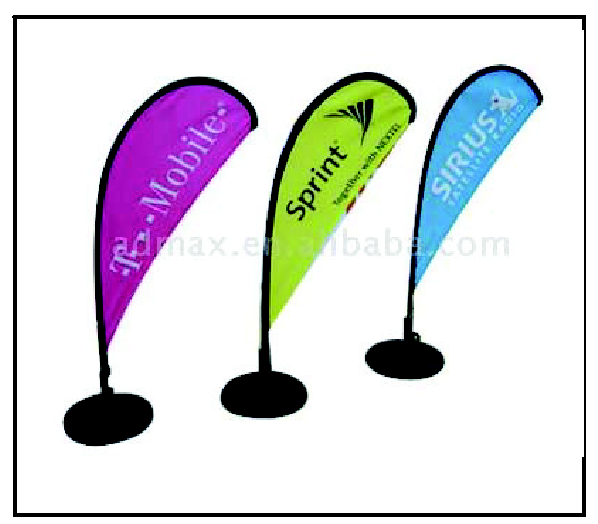
Flag Pole Signs
1.
a.
A-frame signs shall not exceed a sign area of twenty (20) square feet, and a height of four feet. A flag mounted on a pole shall not exceed a sign area of sixty-five (65) square feet and a height of twelve (12) feet.
b.
No temporary sign shall be placed within ten feet of another temporary sign. This separation requirement shall only apply to temporary signs allowed in Section 16.36.090(1). It shall be the responsibility of each tenant to coordinate the placement of the sign with other tenants.
c.
The signs may only be displayed during business hours of operation.
d.
The signs must be neatly and professionally constructed and all lettering done in a professional workmanlike manner.
i.
Flag pole signs shall mean any sign of lightweight fabric or similar material that is permanently mounted to a pole.
ii.
A-frame signs shall be constructed of durable materials that are weather and rust-resistant.
e.
The signs may not be illuminated or contain any electrical components.
f.
The signs must be installed in a manner preventing it from falling or blowing over.
g.
The temporary signs shall be placed on the privately owned property where the business is located.
h.
The temporary signs shall not be placed in the right-of-way, clear sight triangle, or handicap path of travel. A temporary signs shall not be hung from, or attached to, utility poles, light poles, or landscaping.
i.
The temporary signs shall be subject to the maintenance and abatement provisions in Chapters 8.32 and 16.36 of this Municipal Code. The installation or erection of any sign in violation of this section shall be, and is hereby declared to be, unlawful and a public nuisance.
(Ord. 2007-05 § 5 (Exh. A (part)), 2007: Ord. 296 § 4 (Exh. A (part)), 2000)
(Ord. No. 2009-09, § 3(Exh. A), 8-4-09; Ord. No. 2010-08, § 3(Exh. A), 9-7-10; Ord. No. 2011-16, § 3(Exh. A), 9-6-11; Ord. No. 2012-04, § 3(Exh. A), 4-3-12; Ord. No. 2013-003, § 3(Exh. A), 4-2-13; Ord. No. 2021-01, 3(Exh. A), 6-1-21)
16.36.092 - Reserved.
Editor's note— Ord. No. 2017-01, § 4(Exh. A), adopted March 7, 2017, repealed § 16.36.092, which pertained to city freeway pylon signs and derived from Ord. No. 2013-015, adopted November 5, 2013.
16.36.100 - Billboards.
A.
Purpose. For the purposes of regulating excess signage, encouraging the positive economic development of the city, promoting the safety of the traveling public, protecting existing property values in both residential and nonresidential areas, preventing the overcrowding of land, promoting a positive community appearance as part of a concerted city wide effort to protect and enhance the aesthetics of the city for the enjoyment of all citizens. The regulations are designed to prevent their overconcentration, improvement placement, and excessive height, bulk, number and area. It is recognized that, unlike on-premises identification signs, which are in actuality a part of a business, billboards are a separate and distinct use of the public thoroughfare. With a view to this distinction, billboards are regulated differently from on-premises signs. It is intended that billboards be located away from residential areas, and that such signs be regulated to protect the character of the area wherein billboards are located, and to conserve property values in these areas.
B.
Prohibition of New Billboards. New billboards are prohibited, and the erection, alteration, construction, replacement, use, installation or conversion of any billboard within the city is prohibited. No permit shall be issued for any billboard which violates this policy. This paragraph shall be construed liberally to broadly prohibit any new billboard of any kind within the city, unless a permit is issued pursuant to a relocation agreement described in paragraph C of this Section 16.36.100, below. With regard to any existing billboard lawfully constructed prior to the city's incorporation nothing in this paragraph shall be construed as prohibiting: (1) the ordinary maintenance, poster panel replacements, copy changes, or repair (excluding repairs involving structural, material, or electrical changes, which are prohibited) of such billboard, or (2) the replacement of a billboard by permit, consistent with Section 16.12.316(C) of the code.
C.
Relocation of Existing Billboards. Billboards or digital advertising displays may only be constructed, relocated, or upgraded upon the approval of a relocation agreement and site plan review by the city council, and consistent with the following criteria:
1.
No billboard may exceed six hundred seventy-two (672) square feet. The sign area is measured by finding the area of the minimum imaginary rectangle or square of vertical and horizontal lines that fully encloses all extremities of the sign, excluding supports, the base or apron unless such copy, message, announcement or decoration appears on the base or apron. The allowable sign area of signs with equal size and shape for both double-faced (back-to-back) and V-type signs is measured by computing the area of only one side of the sign. Both sides of a double-faced or V-type sign shall be of equal size. The sign area of signs with three or more sides (multiple-side signs) containing copy message, decoration or announcement visible from a street, highway or expressway is measured as the sum of the area of any two adjacent sides. The digital advertising display areas of the sign, if any, shall be calculated as part of the permitted sign area.
2.
No billboard or part thereof, including base or apron, supports, supporting structures and trim, may exceed thirty-five (35) feet in height. Any required solar or wind power devices shall not be counted as part of the billboard's height.
3.
All signs shall comply with the appropriate detailed provisions of the latest adopted edition of the California building codes.
4.
Billboards shall be located in such a way that they maintain horizontal and vertical clearance of all overhead electrical conductors in accordance with the California Electric Code and the development standards of any public or private electrical provider; provided, that in no case shall a billboard be erected closer than ten feet horizontally or vertically from a conductor or public utility guy wire.
5.
No part of a billboard may be located within a triangular area formed by the street right-of-way lines and a line connecting them at points thirty (30) feet from the right-of-way intersection.
6.
No part of any billboard shall be located less than one thousand (1,000) feet from any part of another billboard, measured in all directions.
7.
Billboards shall not be permitted in any historic, residential, or agricultural district. Billboards shall only be relocated within the regional commercial, office park or commercial industrial business park districts, on a parcel located within six hundred sixty (660) feet of the freeway.
8.
Billboards shall not be permitted on any designated scenic street, road, drive, parkway or highway.
9.
Billboards shall not be permitted within seven hundred fifty (750) feet of any residential district, historic district, park, school, church, hospital, retirement home, cemetery, convention center, or government building.
10.
Billboards shall not be permitted on or over the roofs of buildings.
11.
Billboards shall not be permitted at any bridge crossing or situated to impair any scenic vistas.
12.
Billboards shall not be permitted to be stacked over or placed next to any other billboard.
13.
Any billboards or digital advertising displays shall be required to provide for public service announcements, Amber Alerts and other community service announcements.
14.
Digital advertising displays may be approved as part of a sports facility as defined herein, subject to approval of a digital agreement with the owner to facilitate public service announcements and Amber Alerts. Digital displays may advertise products or services that are or will be available in the premises and/or products or services provided by the principal sponsors of the facility pursuant to an agreement of at least one year duration between the vendor or sponsor and the property owner, facility owner or facility operator.
15.
Nonconforming billboards owned by the same advertising company within the city boundaries shall be removed prior to issuance of permits for the new billboard or the conversion of an existing billboard to a digital advertising display at a ratio of three sign faces to one.
16.
Where removal is not possible, the city may consider other provisions in the relocation agreement, including, but not limited to, as increased public service announcements, construction of city entry monuments or payment to the city.
17.
No billboard or digital advertising display shall depict or simulate any motion or video (i.e., video clips, flashing, etc.). Any slide (image) shall be displayed for a minimum of six seconds and transitions between slides shall not exceed one second.
18.
Each billboard shall include a photometric sensor that will adjust the intensity of the sign for daytime and nighttime viewing. The nighttime intensity shall be limited to 0.3 foot candles (over ambient levels) as measured at a present distance as established by the Lewin Report as prepared for the Outdoor Advertising Association of America (OAAA). The city may modify or further restrict the intensity of any billboard or digital advertising display should the lighting create a distraction to drivers.
19.
Generators shall not be used to power any billboards. All relocated or reconstructed billboards, not including digital displays, shall incorporate solar or wind power to offset at least seventy-five (75) percent of their energy use.
(Ord. 296 § 4 (Exh. A (part)), 2000)
(Ord. No. 2009-02, § 4, 8-4-09)
16.36.110 - Design standards.
A.
Signs shall be designed and be constructed of materials that relate to the architectural style of the main or principal building(s) on the lot. When more than one sign is permitted on a site, the style of all signs on a parcel shall be coordinated architecturally.
B.
Illuminated signs shall be designed so that illumination shall be internal or if external shall be directed fully onto the sign face(s).
C.
When monument signs use planters to increase height or area, planters shall be three feet wider than the monument, not more than three feet high, and be landscaped with a permanent irrigation system.
D.
All signs shall be maintained in proper repair. All signs shall be kept clean and graffiti free. Any structural or electrical damage shall be repaired immediately.
E.
Signs are not permitted in the public right-of-way except signs erected by or on behalf of a governmental entity. This includes bus stop signs erected by a public transit authority and conveying a commercial message. Any other sign placed on public property, except in conformance with this section, shall be forfeited to the public or subject to summary abatement. In addition, the city shall have the right to recover the full costs of removal and disposal of any sign.
F.
No part of any freestanding sign, including the footing, shall be located closer than one foot from any property line.
G.
The leading edge or footing of a sign shall be located no closer than one foot from the existing right-of-way line. Where the planned right-of-way is greater than the existing right-of-way, the property owner shall enter into an agreement with the city to relocate the sign at the property owner's expense whenever such right-of-way is expanded.
H.
When a freestanding sign is within a front or street side yard setback area, or is located within the clear sight triangle, the sign face shall be at least eight feet above grade.
I.
The height of a projecting sign shall not exceed the height of the building to which it is attached.
J.
Banners used as permanent signs shall be regulated in size, location and proportion to a building face in accordance with the sign menu (Section 16.36.130). The area of banners shall not exceed fifty (50) percent of any building face's allocation.
(Ord. 296 § 4 (Exh. A (part)), 2000)
16.36.120 - Previously permitted signs and amortization.
A.
"Grandfathering" of Permitted Signs. Any sign previously approved or erected with permits in accordance with any prior code or this chapter in effect at the time of the approval or construction, may remain in place indefinitely. Permitted signs made nonconforming by this chapter are included in this provision, unless they subsequently become subject to subsection (D) of this section.
B.
Persons who cannot produce evidence of a prior approval or permit as required by subsection (A) of this section may appeal the abatement of their sign to the planning commission. The appeal fee shall be set by resolution of the city council. The committee shall hold a public hearing on the matter and may consider the following factors:
1.
Special topographic circumstances of the site, building or the sign;
2.
Special historical or cultural significance to the community;
3.
Special architectural significance or design limitations that would necessitate the type of sign requested;
4.
Other factors including, but not limited to, adjacent structures or signs, public improvements, specimen trees or existing landscaping that are relevant in the placement or design of the sign in relation to its location within the development.
C.
Amortization of Nonconforming Signs—General.
1.
Every sign not described in California Business and Professions Code Subsection 5490(b) and which does not comply with the provisions of the prior code or this chapter shall be amortized and abated in accordance with the following schedule:
2.
The city, in accordance with the latest material valuation schedules shall determine the value of a nonconforming sign unless a verified receipt or contract is produced to prove the value.
D.
Abatement of Existing Signs. Notwithstanding the status of any sign, whether previously permitted, grandfathered or approved by the planning commission, that fall within the criteria listed below, shall immediately be removed from the site, without compensation, under any of the criteria as follows:
1.
Any sign which has been more than fifty (50) percent destroyed or damaged (other than destruction of the facial copy) and the display cannot be repaired within thirty (30) days of the date of its damage or destruction;
2.
Any sign which is a danger to the public or is unsafe;
3.
Any sign that constitutes a traffic hazard, such as a sign that simulates or interferes with signs or signals, (not created by the relocation of any street or highway or by any other act of the city); and
4.
Any sign erected without a permit after the effective date of the ordinance codified in this chapter.
E.
Amortization and Abatement of Nonconforming Billboards.
1.
Nonconforming billboards located in an area designated on the general plan and zoned as either agricultural or residential and more than six hundred sixty (660) feet from the edge of the right-of-way of a freeway or primary highway, which have copy not visible or intended to be read from such freeway or primary highway, shall be removed from the site without compensation in accordance with the following schedule:
2.
This amortization period shall commence upon receipt of written notice of nonconformance.
(Ord. 296 § 4 (Exh. A (part)), 2000)
(Ord. No. 2017-01, § 4(Exh. A), 3-7-17)
16.36.130 - Sign menu.
Applicants may pick and choose any type of sign as it applies to each use listed in the left hand column.
Totals for all signage allowed on a site are cumulative and is based on the following formula: three square feet of signage allowed per one lineal foot of principal building(s) frontage that faces a street, alley or parking lot with customer entrances.
This matrix is intended to address permanent signs. For temporary, off-site and special event signs, refer to the sign regulations (Chapter 16.36 of the Municipal Code).
This matrix shows size and height limitations for each type of sign, as well as street frontage requirements for freestanding and monument signs.
Exceptions are subject to a site sign plan approved by the city planning division in conjunction with the project.
N/A = Not allowed.
(Ord. 288 § 4 (Exh. A (part)), 2000)

