
Hesperia City Zoning Code
CHAPTER 16
08 - DEFINITIONS
16.08.005 - Accessory building.
"Accessory building" means a subordinate building, the use of which is incidental to that of the main building or main use of the land. The use of an accessory building may be for either a primary or an accessory use allowed by the appropriate zone/land use district. An accessory building shall be located on either the same parcel as the main building or main use; or shall be located on a contiguous abutting parcel that is owned by the same owner who owns the parcel which has the main use. An accessory building shall always exist in conjunction with and never without a legally established main building or main use that has the same common owner. An accessory building is at least partially enclosed by walls and a roof. A covered patio, lattice patio, or partial patio enclosure whose sides are less than fifty (50) percent open to the elements shall be considered a building. The use of screen, cloth, netting or similar material shall be considered a wall and/or roofing material. A building shall not include machinery, equipment or appliances installed for manufacture or process purposes only, nor shall it include any construction installations which are not a part of a building, any tunnel, mine shaft, highway or bridge, or include any house trailer or vehicle which conforms to the vehicle code.
(Ord. 2001-13 Exh. A § 1, 2001: Ord. 250 (part), 1997; SBCC § 83.010112)
16.08.007 - Accessory structure.
"Accessory structure" means a subordinate structure, the use of which is incidental to that of the main building or main use of the land. The use of an accessory structure may be for either a primary or an accessory use allowed by the appropriate zone/land use district. An accessory structure shall be located on either the same parcel as the main building or main use; or shall be located on a contiguous abutting parcel that is owned by the same owner who owns the parcel which has the main use. An accessory structure shall always exist in conjunction with and never without a legally established main building or main use that has the same common owner. Accessory structures, as opposed to accessory buildings, are not completely enclosed by walls and a roof. A covered patio, lattice patio, or partial patio enclosure whose sides are fifty (50) percent or more open to the elements shall be considered a structure as opposed to a building. Any structure which is less than fifty (50) percent open to the elements shall be considered a building. The use of screen, cloth, netting or similar material shall be considered a wall and/or roofing material.
(Ord. 2001-13 Exh. A § 2, 2002)
16.08.010 - Accessory use.
"Accessory use" means a subordinate use, which may be permanent or temporary, that is incidental, ancillary and customarily associated with the principal, primary or main use of the land. An accessory use shall be located on the same parcel, or on a contiguous abutting parcel, that is owned by the same person who owns the parcel on which the main building or main use is located. An accessory use shall always exist in conjunction with, and never without, a legally established primary use that has the same common owner. Notwithstanding these provisions, the keeping of animals on a contiguous parcel is only allowed when the zone/land use district designation on the parcel with the principal, primary or main use allows the keeping of such animals and in the specified numbers.
(Ord. 250 (part), 1997; SBCC § 83.010115)
16.08.011 - Accessory vehicles.
"Accessory vehicles" include the following types: travel trailers, fifth-wheel trailers, motor homes, campers, camper shells, boats, and similar vehicles that could be stored on private property.
(Ord. 299 § 4 (Exh. A § 5), 2000)
16.08.015 - Adult businesses.
A.
"Adult businesses" are: (1) any business which is conducted exclusively for the patronage of adults and from which minors are specifically excluded by law; provided, that any business licensed by the State Department of Alcoholic Beverage Control shall not be an adult-oriented business unless it complies with another definition within this section; and/or (2) any business, where employees or patrons expose "specified anatomical areas" or engage in "specified sexual activities;" and/or (3) any business or establishment which offers its patrons services or entertainment characterized by an emphasis on matter depicting, exposing, describing, discussing or relating to "specified sexual activities" or "specified anatomical areas."
B.
These types of businesses shall not include the following: (1) any bona fide medical establishment operated by properly licensed and registered medical personnel with appropriate medical credentials for the treatment of patients; (2) any massage establishment, the clientele of which consists substantially of persons referred to the establishment in writing for massage therapy by physicians, surgeons, chiropractors or osteopaths duly licensed to practice their respective professions in the State of California; provided, that the massage establishment retains such written referrals in its records for a period of not less than three years, and makes such written references available for inspection by the county health officer or his designated representative at all times during the normal business hours of operation of the massage establishment; and (3) an athletic club, health club, school, gymnasium, state licensed cosmetology or barber establishment, reducing salon, spa or similar establishment where massage or similar manipulation of the human body is offered as an incidental or accessory service.
C.
Adult-oriented businesses shall include but shall not be limited to the following:
1.
Adult bookstore. "Adult bookstore" means an establishment having as a substantial portion of its stock-in-trade, and offering for sale for any form of consideration, any one or more of the following:
a.
Books, magazines, periodicals or other printed matter, or photographs, films, motion pictures, video cassettes, slides or other visual representations which are characterized by an emphasis upon the depiction or description of "specified anatomical areas;" or
b.
Instruments, devices or paraphernalia which are designed for use in connection with "specified sexual activities."
2.
Adult Cabaret. An "adult cabaret" means a cabaret which features topless and/or bottomless dancers, strippers, male or female impersonators, or similar entertainers.
3.
Adult Theater. An "adult theater" means any place, building, enclosure or structure partially or entirely, temporarily or permanently used for dramatic or operatic presentations, motion pictures, or any picture projected from slides or films, vaudeville show, performances, or any place of public entertainment which are used for presenting material distinguished or characterized by an emphasis on matter depicting, describing or relating to "specified sexual activities" or "specified anatomical areas," for observation by patrons therein. Adult theaters specifically include places to which the public is permitted or invited wherein coin or slug-operated or electronically, electrically or mechanically controlled still or motion picture machines, projectors or other image-producing devices are maintained, used or available for presenting material distinguished by an emphasis on matter depicting, describing or relating to "specified sexual activities" or "specified anatomical areas," for observation by patrons therein.
4.
Sexual Novelty Store. A "sexual novelty store" means an establishment having as a substantial portion of its stock-in-trade goods which are replicas of, or which simulate, "specified anatomical areas," or goods which are designed to be placed on "specified anatomical areas," or to be used in conjunction with "specified sexual activities" to cause sexual excitement.
5.
"Adult Video Store" means a commercial establishment which, as one of its principal business purposes, offers for sale or rental for any form of consideration any one or more of the following:
a.
Films, motion pictures, video cassettes or video reproductions, slides, or other visual representations which depict or describe "specified sexual activities" or "specified anatomical areas"; or
A commercial establishment may have other principal business purposes that do not involve the offering for sale or rental of material depicting or describing "specified sexual activities" or "specified anatomical areas" and still be categorized as adult bookstore or adult video store. Such other business purposes will not serve to exempt such commercial establishments from being categorized as an adult bookstore or adult video store so long as one of its principal business purposes is the offering for sale or rental for consideration the specified materials which depict or describe "specified sexual activities" or "specified anatomical areas."
6.
"Adult motel" means a hotel, motel or similar commercial establishment which:
a.
Offers accommodations to the public for any form of consideration; provides patrons with closed-circuit television transmissions, films, motion pictures, video cassettes, slides, or other photographic reproductions which are characterized by the depiction or description of "specified sexual activities" or "specified anatomical areas"; and has a sign visible from the public right-of-way which advertises the availability of this adult type of photographic reproductions; or
b.
Offers a sleeping room for rent for a period of time that is less than ten hours; or
c.
Allows a tenant or occupant of a sleeping room to sub-rent the room for a period of time that is less than ten hours.
d.
Evidence that a sleeping room in a hotel, motel, or similar commercial establishment has been rented and vacated two or more times in a period of time that is less than ten consecutive hours.
7.
"Adult motion picture theater" means a commercial establishment where, for any form of consideration, films, motion pictures, video cassettes, slides, or similar photographic reproductions are regularly shown which are characterized by the depiction of "specified sexual activities," "specified anatomical areas," or persons in a state of nudity.
8.
"Nude Dancing" means any dance, choreographed or not, in which the performers remove all or part of their clothing, a strip tease, lap dance, or individual dance. Nude dancing shall also mean a form of erotic entertainment in which a dancer gradually undresses with or without music. Nude dancing shall include fan dancing, defined as a solo dance in which large fans are manipulated to suggest or reveal nakedness, and bubble dancing, defined as a dance similar in nature to a fan dance but includes the use of bubbles instead of fans.
(Ord. 250 (part), 1997; SBCC § 83.010124)
(Ord. No. 2019-10, § 4(Exh. B), 8-20-19)
16.08.020 - Advertising structure.
"Advertising structure" means any structure of any kind or character erected or maintained for advertising purposes, upon which any advertising sign may be placed, including advertising statuary.
(Ord. 250 (part), 1997; SBCC § 83.010130)
16.08.025 - Agricultural use.
"Agricultural use" means the use of land for the cultivation of food or fiber or the grazing or pasturing of livestock, usually for commercial purposes.
(Ord. 250 (part), 1997; SBCC § 83.010148)
16.08.030 - Airport reference point (A.R.P.)
"A.R.P." means the point established as the approximate geographic center of the airport landing area and so designated.
(Ord. 250 (part), 1997; SBCC § 83.010157)
16.08.035 - Aliquot part.
"Aliquot part" means the division of sectionalized land, by a series of divisions by one quarter. Such divisions shall not be less than two and one-half (2 ½) acres or equivalent as allowed by Section 16.10.050.
(Ord. 250 (part), 1997; SBCC § 83.010163)
16.08.040 - Alley.
"Alley" means a public thoroughfare, not exceeding thirty (30) feet in width for the use of pedestrians or vehicles, which affords only a secondary means of access to the abutting property.
(Ord. 250 (part), 1997; SBCC § 83.010166)
16.08.045 - Anatomical areas, specified.
"Specified anatomical areas" shall include any of the following human anatomical areas:
A.
Less than completely and opaquely covered genitals, pubic regions, buttocks, anuses or female breasts below a point immediately above the top of the areolae; or
B.
Human male genitals in a discernibly turgid state, even if completely and opaquely covered.
(Ord. 250 (part), 1997; SBCC § 83.010172)
16.08.050 - Apartment.
"Apartment" means a room, or suite of rooms when combined constitute a single dwelling unit in a multiple-family dwelling, and which are designed for, intended for, suitable as a residence for, and/or occupied by one family.
(Ord. 250 (part), 1997; SBCC § 83.010175)
16.08.055 - Apartment hotel.
"Apartment hotel" means a building or any portion thereof, designed for or containing both individual guest rooms or suites of rooms and dwelling units.
(Ord. 250 (part), 1997; SBCC § 83.010178)
16.08.060 - Apartment house.
"Apartment house" means the same as "multiple-family dwelling," as defined in Section 16.08.190.
(Ord. 250 (part), 1997; SBCC § 83.010181)
16.08.065 - Applicant.
"Applicant" means the owner(s), or authorized agent of the owner(s) who is legally authorized to act for the owner(s) of record.
(Ord. 250 (part), 1997; SBCC § 83.010184)
16.08.070 - Approved access.
A.
Approved access. Access required to subdivisions for which a tentative and final map are not required shall mean one of the following:
1.
A dedicated right-of-way;
2.
An offer to dedicate to the city a width as established by the circulation element of the general plan or the city's right-of-way standards and an easement of a strip of land at least twenty (20) feet in width which expressly grants to the owner of the subdivision and any successors in interest the right to use the easement without limit as to the quantity of vehicular traffic from each lot created by the owners or successors in interest to improved roadways in the city street system, both of which abut or connect to a publicly maintained roadway or connect to existing traveled roads where a prescriptive right by user exists for public use.
3.
An offer to dedicate to the city and to the public in general, an easement for public road, county highway and public utility purposes, of a width as established by the circulation element of the general plan or to the public in general can be accepted by public use, but the easement or road constructed thereon shall not become a city street until and unless the city council, by appropriate resolution, has caused said road to be accepted into the city street system.
4.
An existing traveled way where a prescriptive right by user has been established for public use by a court decree.
5.
A traveled way which was in existence prior to 1967, as determined by the county surveyor. Such traveled way must connect to a publicly maintained roadway and must meet each of the following criteria:
a.
Have all-weather capability for normal passenger car use;
b.
Be of adequate width to provide two-way vehicular access;
c.
Be improved and maintained by the use of hand or power machinery or tools in order to allow relatively regular and continuous use. A traveled way maintained solely by the passage of vehicles does not constitute approved access.
B.
Approved access shall not be approved by the city engineer unless the access:
1.
Substantially conforms to the alignment shown in the circulation element where applicable; and
2.
May practically and feasibly be applied to road use.
(Ord. 250 (part), 1997; SBCC § 83.010187)
16.08.075 - Automobile and trailer sales area.
"Automobile and trailer sales area" means an open area used for the display and sale or rental of new or used automobiles or trailers, and where repair work is limited to minor incidental repair of those automobiles or trailers to be displayed, rented or sold on the premises.
(Ord. 250 (part), 1997; SBCC § 83.010195)
16.08.080 - Bed and breakfast use.
"Bed and breakfast use" means a special accessory use to a one-family residential dwelling where a limited or specified number of guest rooms are made available to transient guests for rent to provide overnight sleeping accommodations on a less than weekly basis. Bed and breakfast uses are subdivided into three basic categories as follows:
A.
"Host home" means a one-family dwelling containing one to two guest rooms which are made available for rent to transient guests to provide sleeping accommodations on a less than weekly basis where said dwelling is occupied by the owner of the property.
B.
"Bed and breakfast home" means a one-family-dwelling containing three to five guest rooms which are made available for rent to transient guests to provide sleeping accommodations on a less than weekly basis where the dwelling is occupied by the owner of the property.
C.
"Bed and breakfast inn/lodge" means an existing one-family dwelling which has been designated a historical structure containing a minimum of six and a maximum of ten guest rooms which are made available for rent to transient guests to provide sleeping accommodations on a less than weekly basis where the dwelling is occupied by the owner of the property.
(Ord. 250 (part), 1997; SBCC § 83.010213)
16.08.085 - Block.
"Block" means the property abutting on one side of a street between two nearest intersection streets, railroad right-of-way or other natural barrier; provided, however, that where a street curves so that any two chords thereof form an angle of one hundred twenty (120) degrees or less measured on the lot side, each curve shall be construed as an intersection street.
(Ord. 250 (part), 1997; SBCC § 83.010220)
16.08.090 - Boarding house.
"Boarding house" means a dwelling with not more than five guest rooms, with not more than one person per room, where lodging and meals are provided for compensation on a weekly or greater basis, not including those facilities defined as social care facilities.
(Ord. 250 (part), 1997; SBCC § 83.010230)
16.08.095 - Buffer.
"Buffer" means a strip of land established to separate incompatible or different land uses. Normally a buffer area is landscaped and retained as open space. The term may be used more broadly to describe any area or use that separates two unlike land uses, such as the use of multiple-family housing between single-family housing and commercial uses.
(Ord. 250 (part), 1997; SBCC § 83.010235)
16.08.100 - Building coverage.
"Building coverage" means the alterations of a lot by the creation of surface area upon which a building rests. The percentage surface coverage does not include roadways, swimming pools, tennis courts, solar collection devices or related apparatus.
(Ord. 250 (part), 1997; SBCC § 83.010245)
16.08.105 - Building envelope.
"Building envelope" means an area delineated on development plans in which all clearing and land disturbance for building construction must be confined. If not delineated, it is the area of a lot not included within any required front yard, rear yard, side yard or side street yard setback area, or any recorded easement, or offer of dedication.
(Ord. 250 (part), 1997; SBCC § 83.010250)
16.08.110 - Building height.
"Building height" means the vertical distance above a referenced datum measured to the highest point of the coping of a flat roof or to the deck line of a mansard roof or to the average height of the highest gable of a pitched or hipped roof. The reference datum shall be selected by either of the following, whichever yields a greater height of building:
A.
The elevation of the highest adjoining sidewalk or ground surface within a five foot horizontal distance of the exterior wall of the building when such sidewalk or ground surface is not more than ten feet above lowest grade;
B.
An elevation ten feet higher than the lowest grade when the sidewalk or ground surface described in subsection (A) of this section is more than ten feet above lowest grade.
The height of a stepped or terraced building is the maximum height of any segment of the building.
(Ord. 250 (part), 1997; SBCC § 83.010255)
16.08.115 - Carport.
"Carport" means a permanent roofed structure with no more than two enclosed sides, used or intended to be used for automobile shelter and storage.
(Ord. 250 (part), 1997; SBCC § 83.010311)
16.08.120 - Cemetery.
"Cemetery" means land used or intended to be used for the permanent internment of dead human bodies or the cremated remains thereof and dedicated for cemetery purposes. A cemetery is established and operated in compliance with the state Health and Safety Code and any mapping and site approval requirements of this title. Cemetery purposes include columbariums, crematoriums, mausoleums and mortuaries when operated in conjunction with and within the boundary of such a cemetery. "Pet cemetery" shall be a cemetery for domesticated animals and shall be in compliance with applicable state and county regulation, including mapping and applicable site approval requirements.
(Ord. 250 (part), 1997; SBCC § 83.010314)
16.08.125 - City standards.
"City standards" means any current improvement standards or design standards which have been adopted by the city council, and are described, delineated and on file for use and examination by the public in the office of the city clerk.
(Ord. 250 (part), 1997; SBCC § 83.010385)
16.08.130 - Composite development plan.
"Composite development plan" means a map or plan on file with the building and safety department which reflects additional information related to the development of lots created by a final or parcel map recorded after March 1, 1986. Notes on this plan or map are for informational purposes and indicate conditions and criteria that exist on the property that were known and identified as of the date of the recordation of the final or parcel map. Authority for this plan is derived from Government Code Section 66434.2.
(Ord. 250 (part), 1997; SBCC § 83.010338)
16.08.135 - Community apartment project.
"Community apartment project" means a common interest development in which an undivided interest in land is coupled with the right of exclusive occupancy of any apartment located thereon. This use includes apartment complexes that were convened to allow for individual ownership of units that were not constructed to condominium building standards.
(Ord. 250 (part), 1997; SBCC § 83.010342)
16.08.140 - Community noise equivalency level (CNEL).
"Community noise equivalency level (CNEL)" means a CNEL is a measure of the cumulative noise exposure level in the community. It results from a summation of average noise levels based on the average energy level of the sound over a twenty-four (24) hour period, with an increased weighting factor applied to the evening and night time period.
(Ord. 250 (part), 1997; SBCC § 83.010349)
16.08.142 - "Computerized sweepstakes device" defined.
"Computerized sweepstakes device" shall mean any computer, machine, game or apparatus which, upon insertion of a coin, token, access number, magnetic card or similar object, or upon payment of anything of value, may be operated by the public generally for use in a contest of skill, entertainment, amusement or chance whether or not registering a score, and which provides the user with a chance to win anything of value or any cash payout or anything that could be redeemed, directly or indirectly, for any cash payout and which is not otherwise permitted as gambling, a lottery or as a gaming device under state law.
(Ord. No. 2013-06, § 3, 6-18-13)
16.08.145 - Contiguous or contiguous property.
"Contiguous" in actual close contact; touching; bounded or traversed by. "Contiguous property" means those properties which touch property lines of any parcel including those properties which touch said property lines of a subject parcel when such lines are projected across public or private rights-of-way, easements, roads, streets, or railroad rights-of-way.
(Ord. 250 (part), 1997; SBCC § 83.010369)
16.08.150 - Cooling opportunities, passive or natural.
"Passive or natural cooling opportunities" means the ability to orient or site a structure, including a dwelling on its lot in order to take optimum advantage of prevailing breezes for cooling purposes.
(Ord. 250 (part), 1997; SBCC § 83.010372)
16.08.155 - County.
"County" means the county of San Bernardino, California.
(Ord. 250 (part), 1997; SBCC § 83.010375)
16.08.160 - Court.
"Court" means an open, unoccupied space, other than a yard, on the same lot with a building or buildings and which is bounded on two or more sides by such building or buildings.
(Ord. 250 (part), 1997; SBCC § 83.010390)
16.08.165 - Dairy.
"Dairy" means any premises where milk is produced for sale or distribution and where three or more cows or goats are in lactation.
(Ord. 250 (part), 1997; SBCC § 83.010405)
16.08.170 - Day care facility.
"Day care facility" means a facility which provides nonmedical care to children under eighteen (18) years of age in need of personal services, supervision or assistance essential for sustaining the activities of daily living or for the protection of the individual on less than a twenty-four (24) hours basis. Day care facility includes family day care homes, infant centers, preschools, and extended day care facilities. A "family day care home" means a day care facility located in a residence which regularly provides care, protection and supervision of twelve (12) or fewer children from more than one other family, in the provider's own home, for periods of less than twenty-four (24) hours per day, while the parents or guardians are away and includes the following:
A.
"Large family day care home" means those which provide family day care to seven to twelve (12) children, inclusive, including children who reside at the home.
B.
"Small family day care home" means those which provide family day care to six or fewer children, including children who reside at the home.
(Ord. 250 (part), 1997; SBCC § 83.010412)
16.08.175 - Development code.
"Development code" means a set of land use regulations adopted by the city council in conformance with the general plan.
(Ord. 250 (part), 1997; SBCC § 83.010432)
16.08.180 - Development permit, city.
"Development permit, city" means a permit issued by the building official for construction or land disturbance, including, but not limited to, building permits, mobile home set-down permits and grading permits.
(Ord. 250 (part), 1997; Ord. 75 § 2 (part), 1990; SBCC § 83.010438)
16.08.185 - Development plan (PUD).
"Development plan" means a detailed, comprehensive plan of development for a planned unit development. This development plan applies limits and parameters for development derived from a development suitability analysis to a specific development scheme. Development plans shall include a detailed description of the proposed development and its effects including, but not limited to, a written text, diagrams or maps describing the program for development and the functional arrangement of structures and uses, the effect of such arrangement upon the physical characteristics of the site, available public services, the capacity of the existing circulation system and the existing and planned land use of adjacent properties.
(Ord. 250 (part), 1997; SBCC § 83.010441)
16.08.187 - Drug paraphernalia.
"Drug paraphernalia" has the meaning set forth in California Health and Safety Code Section 11014.5, as that section may be amended from time to time.
(Ord. No. 2017-10, § 3(Exh. A), 6-6-17)
16.08.188 - Dude/guest ranch.
"Dude/guest ranch" means a working or guest ranch that provides equestrian and recreational activities, overnight accommodations for guests, and facilities related to a working ranch. The dude/guest ranch does not include a commercial restaurant, cafe or bar available to the general public.
(Ord. 2011-10, § 3(Exh. A), 8-16-11)
16.08.190 - Dwelling, multiple-family.
"Dwelling" means a building or portion thereof used and/or designed as a residence for two or more families living independently of each other in separate dwelling units.
(Ord. 250 (part), 1997; SBCC § 83.010484)
16.08.195 - Dwelling, one-family.
"One-family dwelling" means a detached building designed and/or used to house not more than one family, including all domestic employees of such family.
(Ord. 250 (part), 1997; SBCC § 83.010487)
16.08.200 - Dwelling, two-family.
"Two-family dwelling" means a building designed and/or used to house not more than two families living independently of each other.
(Ord. 250 (part), 1997; SBCC § 83.010490)
16.08.205 - Dwelling unit.
"Dwelling unit" means any building or portion thereof, including a mobile home or portion thereof, which contains living facilities, including provisions for sleeping, eating, cooking and sanitation as required by this code and the Building Code, for not more than one family.
(Ord. 250 (part), 1997; SBCC § 83.010493; Ord. No. 2021-01, 3(Exh. A), 6-1-21)
16.08.207 - Electrical generating stations.
"Electrical generating stations" means a facility that is operated by a power producer and whose primary function is the provision of electricity to the electrical distribution system or transmission grid. Electrical generating station does not include solar or wind farms.
(Ord. No. 2012-07, § 3(Exh. A), 6-19-12; Ord. No. 2017-10, § 3(Exh. A), 6-6-17)
Editor's note— Ord. No. 2017-10, § 3(Exh. A), adopted June 6, 2017, renumbered § 16.08.280 as § 16.08.270.
16.08.208 - Electrical substations.
"Electrical substations" means a facility that is operated by a public utility where electric energy is received at a sub-transmission voltage and transformed to a lower voltage for distribution for general consumer use. Electrical substations does not include solar or wind farms.
(Ord. No. 2012-07, § 3(Exh. A), 6-19-12; Ord. No. 2017-10, 3(Exh. A), 6-6-17)
Editor's note— Ord. No. 2017-10, § 3(Exh. A), adopted June 6, 2017, renumbered § 16.08.290 as § 16.08.280.
16.08.209 - Electronic smoking product and/or device.
"Electronic smoking product and/or device" (also known as "electronic cigarette," "e-cigarette," "electronic nicotine delivery system," "e-cigar," "e-cigarillo," "e-pipe," "e-hookah," "hookah pen," "vape pen," etc.) shall mean a battery operated device used to inhale a vaporized liquid solution that frequently, though not always, contains nicotine.
(Ord. No. 2017-10, 3(Exh. A), 6-6-17)
16.08.210 - Environmental impact report (EIR).
Environmental Impact Report (EIR). An "environmental impact report (EIR)" is the public document used by a governmental agency to analyze the significant environmental effects of a proposed project, to identify alternatives, and to disclose possible ways to reduce or avoid possible environmental damage.
(Ord. 250 (part), 1997; SBCC § 83.010525)
16.08.215 - Exotic animal.
"Exotic animal" means any warm or cold blooded animal of the biological family animalia generally considered as wild, exotic, dangerous, venomous or not normally domesticated.
(Ord. 250 (part), 1997; SBCC § 83.010550)
16.08.220 - Family.
"Family" means a person or persons living together as a single housekeeping unit in a dwelling unit.
(Ord. 250 (part), 1997; SBCC § 83.010605)
16.08.225 - Final map.
"Final map" means the same as California Government Code, Title 7, Division 2 definition.
(Ord. 250 (part), 1997; SBCC § 83.010610)
16.08.227 - Financial institution.
"Financial Institution" consists of an establishment, facility or institution, such as a bank and credit union, involved in financial transactions, including the custody, deposit, investment, loan, exchange, or issuance of money. A financial institution is also registered with and regulated by the Securities and Exchange Commission or the Commodity Futures Trading Commission.
(Ord. No. 2017-10, 3(Exh. A), 6-6-17)
16.08.230 - Findings.
"Findings" means a set of conclusions which are required before specified permits, deviations, ordinance changes or other entitlement may be granted.
(Ord. 250 (part), 1997; SBCC § 83.010615)
16.08.235 - Fire-resistive or fire-resistive construction.
"Fire-resistive" or "fire-resistive construction" means construction to resist the spread of fire, details of which may be specified in the building code of the jurisdiction.
(Ord. 250 (part), 1997; SBCC § 83.010625)
16.08.237 - Fish farming.
"Fish farming" involves raising fish commercially in tanks or enclosures, usually for food. A facility that releases young (juvenile) fish into the wild for recreational fishing or to supplement a species' natural numbers is generally referred to as a fish hatchery.
(Ord. 2011-13, § 3(Exh. A), 9-20-11)
16.08.238 - Floor-area ratio.
The "floor-area ratio" or "FAR" means the ratio of the total gross floor area of all buildings on a lot to the total gross area of the lot or parcel. Exhibit "A" provides examples of the calculation of the FAR on a specific piece of property.
Exhibit A
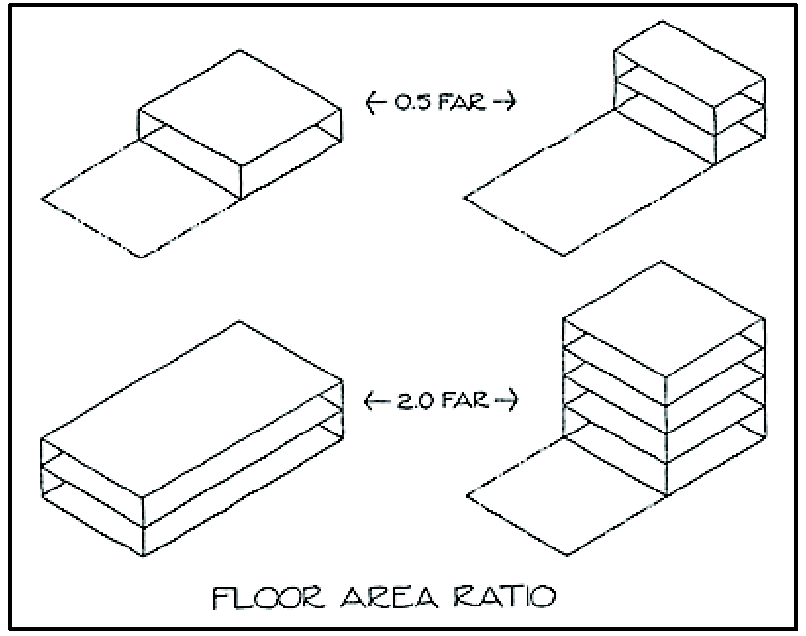
(Ord. No. 2012-02, § 3(Exh. A), 2-7-12)
Editor's note— Ord. No. 2012-02, § 3(Exh. A), adopted February 7, 2012, set out provisions intended for use as § 16.08.237. For purposes of classification, and at the editor's discretion, these provisions have been included as § 16.08.238.
16.08.240 - Fuel modified area.
"Fuel modified area" means an area where living and dead vegetation is managed regularly, usually by trimming, removal or substitution of natural vegetation, in order to reduce fire hazard, by use of mechanical, chemical and biological means and/or prescribed burning.
(Ord. 250 (part), 1997; SBCC § 83.010677)
16.08.245 - Future right-of-way.
"Future right-of-way" means future right-of-way of streets shown in the circulation element of the general plan assuming an equal dedication of right-of-way on both sides of the existing centerline, or shall otherwise be determined as shown on any adopted specific plan or community plan.
(Ord. 250 (part), 1997; SBCC § 83.010680)
16.08.250 - Garage, private.
"Private garage" means an accessory building or an accessory portion of the main building designed and/or used for the shelter or storage of up to four motor vehicles belonging to the occupants of the main building.
(Ord. 250 (part), 1997; SBCC § 83.010705)
16.08.255 - Garage, public.
"Public garage" means any building, other than a private or storage garage, used for the storage, care or repair of motor vehicles and where any such vehicles are equipped for operation or kept for hire or sale.
(Ord. 250 (part), 1997; SBCC § 83.010710)
16.08.260 - Garage, storage.
"Storage garage" means any building, other than a public or private garage, used exclusively for the storage of motor vehicles.
(Ord. 250 (part), 1997; SBCC § 83.010715)
16.08.265 - General plan.
"General plan" means an official or adopted general plan, or any element thereof, as defined in California Government Code, Title 7, Division 1, Chapter 3.
(Ord. 250 (part), 1997; SBCC § 83.010720)
16.08.270 - Grading.
"Grading" means excavating, filling, leveling or smoothing, or combination thereof, for which a grading permit is required by Chapter 15.06 of this code. "Major grading" is grading in excess of one hundred (100) cubic yards, whereas "minor grading" is one hundred (100) cubic yards or less.
(Ord. 250 (part), 1997; SBCC § 83.010740; Ord. No. 2021-01, 3(Exh. A), 6-1-21)
16.08.273 - Gross lot area.
"Gross lot area" means the total area of a parcel or lot, including any proposed public highways, streets or alleys, other public sites; and existing private streets, alleys or easements, and other areas where development is restricted.
(Ord. 2011-10, § 3(Exh. A), 8-16-11)
16.08.275 - Guest house.
"Guest house" means living quarters within a detached accessory building located on the same parcel with the main building or a contiguous parcel with the same common owner, for use by temporary guests of the occupants of the premises. Such quarters have no kitchen facilities, laundry facilities, a wet bar, or other plumbing fixtures, but may contain bathroom facilities. A guest house shall not be rented or otherwise used as a separate dwelling.
(Ord. 299 § 4 (Exh. A § 1), 2000: Ord. 250 (part), 1997; SBCC § 83.010760)
16.08.280 - Hazardous fire area.
"Hazardous fire area" means any land which is covered with grass, grain, brush or forest, whether privately or publicly owned, which is so situated or is of such inaccessible location that a fire originating upon such land would present an abnormally difficult job of suppression or would result in great and unusual damage through fire or resulting erosion.
(Ord. 250 (part), 1997; SBCC § 83.010815)
16.08.285 - Heating opportunities, passive or natural.
"Passive or natural heating opportunities" means the ability to orient or site any structure, including a dwelling on its lot in order to take optimum advantage of natural solar heating capabilities. Structures should wherever possible orient their longest/largest axis from east to west and include special treatment of the south facing wall.
(Ord. 250 (part), 1997; SBCC § 83.010825)
16.08.290 - Hog raising.
"Hog raising" means any premises used for the raising or keeping of more than six weaned hogs.
(Ord. 250 (part), 1997; SBCC § 83.010830)
16.08.295 - Home occupation.
"Home occupation" means any occupation customarily conducted entirely within a dwelling by its inhabitants, the purpose being incidental to the use of the dwelling for dwelling purposes and provided that no article is sold or offered for sale except that produced by the inhabitants, as stipulated in Chapter 5.44 of this code.
(Ord. 250 (part), 1997; SBCC § 83.010835)
16.08.300 - Hotel.
"Hotel" means any building or portion thereof containing six or more guest rooms, designed for and/or used by six or more guests for compensation on a daily basis, and with no provision for cooking in any individual room or suite, but not including those facilities defined as social care facilities. Such establishments provide lodging and usually meals, various personal services and sometimes entertainment and recreational opportunities.
(Ord. 250 (part), 1997; SBCC § 83.010840)
16.08.305 - Hotel, residential.
"Residential hotel" means a hotel which has seventy-five (75) percent or more of the available rooms occupied by permanent guests for compensation on a monthly or greater basis.
(Ord. 250 (part), 1997; SBCC § 83.010845)
16.08.310 - House, lodging or rooming.
"Lodging or rooming house" means a building having no more than five guest rooms and no more than one person per room, where lodging is provided for compensation on a weekly or greater basis; but not including those facilities defined as social care facilities.
(Ord. 250 (part), 1997; SBCC § 83.010865)
16.08.315 - Housing, caretaker.
"Caretaker housing" means residential occupancy of a permanent or temporary dwelling unit, by a caretaker hired to guard part or all of the property on which the caretaker's dwelling is located as an accessory use.
(Ord. 250 (part), 1997; Ord. 84 § 6(B), 1990; SBCC § 83.010850)
16.08.320 - Housing, dependent.
"Depending housing" means residential occupancy of a temporary accessory living unit located on the same parcel as the principal unit, which is occupied by one or two adults, who: (1) have reached the age of sixty (60), or (2) are dependents of the residents of the principal unit, or (3) are court-appointed conservatees of a resident of the principal unit. For the purposes of this section, "dependent" means a related individual who is dependent upon the resident of the principal unit for financial support or health care. An individual will be determined to be a financial dependent if claimed by the resident of the principal unit as a dependent on his or her federal or state income tax return. An individual will be determined to be a dependent for health care reasons if he or she is considered blind or disabled as defined in Section 1614(a) of Part A of Title XVI of the Social Security Act.
(Ord. 250 (part), 1997; SBCC § 82.01855)
16.08.325 - Housing, group.
"Group housing" means multi-residential living facilities, each of which contains group quarters in permanently fixed buildings or those portions thereof, which accommodate or are intended to accommodate residential land use types.
(Ord. 250 (part), 1997; SBCC § 83.010860)
16.08.330 - Housing, secondary.
"Secondary housing" means residential occupancy of a living unit located on the same parcel as the principal unit. In a commercial land use district, secondary housing may be located either above the first floor, or if on the ground floor not on the street frontage. In a residential land use district the parcel containing the principal unit and the secondary housing unit shall not be less than five acres.
(Ord. 250 (part), 1997; SBCC § 83.010875)
16.08.332 - Housing supportive.
"Housing supportive" means housing with no limit on length of stay, that is occupied by persons with low incomes who have one or more disabilities, including mental illness, HIV or AIDS, substance abuse, or other chronic health condition, or individuals eligible for services provided pursuant to the Lanterman Developmental Disabilities Services Act (Division 4.5 (commencing with Section 4500) of the Welfare and Institutions Code) and may include, among other populations, adults, emancipated minors, families with children, elderly persons, young adults aging out of the foster care system, individuals exiting from institutional settings, veterans, and homeless people; and that is linked to an onsite or offsite service that assists the supportive housing resident in retaining the housing, improving his or her health status, and maximizing his or her ability to live and, when possible, work in the community.
(Ord. No. 2014-02, § 3(Exh. A), 2-18-14; Ord. No. 2021-01, 3(Exh. A), 6-1-21)
Editor's note— Ord. No. 2014-02, § 3(Exh. A), adopted February 18, 2014, set out provisions intended for use as § 16.08.032. For purposes of classification, and at the editor's discretion, these provisions have been included as § 16.08.332.
16.08.333 - Housing transitional.
"Housing transitional" means housing configured as rental housing developments, with supportive services for up to twenty-four months but not less than six months. Transitional housing is designated and targeted for recently homeless persons and is intended to move recently homeless persons to permanent housing as quickly as possible and recirculate the assisted housing to another eligible program recipient. This type of housing includes self-sufficiency development services, and limits rents and service fees to an ability-to-pay formula reasonably consistent with the United States Department of Housing and Urban Development's requirements for subsidized housing for low-income persons. Rents and service fees paid for transitional housing may be reserved, in whole or in part, to assist residents in moving to permanent housing.
(Ord. No. 2014-02, § 3(Exh. A), 2-18-14; Ord. No. 2021-01, 3(Exh. A), 6-1-21)
Editor's note— Ord. No. 2014-02, § 3(Exh. A), adopted February 18, 2014, set out provisions intended for use as § 16.08.033. For purposes of classification, and at the editor's discretion, these provisions have been included as § 16.08.333.
16.08.334 - Hydroponic store.
"Hydroponic store" shall mean any business whose primary sales consist of product and apparatus used for growing plants without soil or in a non-soil medium such as water or other nutrient rich solutions; with or without an inert medium (i.e. gravel, perlite, etc.), and/or controlled conditions of light, temperature, and humidity. For the purpose of this Title, hydroponic stores also include businesses whose sales include grow lights (i.e. plant lights), artificial light sources, and other supplies typically used for hydroponics as the primary use. Hydroponics stores are also synonymous with aeroponics, aquaculture, fogponics, etc.
(Ord. No. 2017-10, 3(Exh. A), 6-6-17)
16.08.335 - Improvement, subdivision.
"Subdivision improvement" means any street work and utilities to be installed or agreed to be installed, by the subdivider on the land to be used for public or private streets, highways, ways, and easements, as are necessary for the general use of the lot owners in the subdivision and local neighborhood traffic, drainage and flood control needs as a condition precedent to the approval and acceptance of the final map thereof. "Improvement" also refers to any other specific improvements or types of improvements, the installation of which, either by the subdivider, by the city, by private utilities, by any other entity approved by the city or by a combination thereof, is necessary to ensure consistency with, or implementation of, the general plan, community plan, or any applicable specific plan.
(Ord. 250 (part), 1997; SBCC § 83.010910)
16.08.338 - Initial study.
"Initial study" means a preliminary analysis of a project subject to CEQA prepared by the lead agency to determine whether an EIR or a negative declaration shall be prepared.
(Ord. 2011-04, § 3(Exh. A), 5-3-11)
16.08.340 - Institutional use.
"Institutional use" means an organizational use of a public character including governmental, educational, religious, medical, scientific research, cultural, social, eleemosynary and sometimes, recreational or entertainment uses. Such organizations often utilize large structures and/or large grounds for public assembly purposes to education, treat, train, help or entertain groups of people on a regular or periodic basis.
(Ord. 250 (part), 1997; SBCC § 83.010930)
16.08.345 - Interim land uses.
"Interim land uses" means a provisional or temporary land use often used while studies are being conducted to evaluate the long-term use.
(Ord. 250 (part), 1997; SBCC § 83.010935)
16.08.347 - "Internet sweepstakes café" defined.
"Internet sweepstakes café" shall mean any premises upon which a computerized sweepstakes device is located for the use or entertainment of the public, whether or not such premises has other business purposes of any nature whatsoever.
(Ord. No. 2013-06, § 3, 6-18-13)
16.08.350 - Junk and salvage facility.
"Junk and salvage facility" means the primary or accessory use of a parcel of land for open storage, dismantling and/or selling of old cast-off, unused, scrap or salvage material of any sort. Such materials shall include but to be limited to:
A.
Copper, aluminum, brass, ferrous or nonferrous metals, whether fabricated or not;
B.
Rope, rags, paper, glass, rubber, plastic or other polymer material;
C.
Scrap lumber or other construction material;
D.
Appliances, batteries or junk, dismantled or wrecked motor vehicles or parts thereof;
E.
Trash, debris (organic and inorganic) or other waste material.
(Ord. 250 (part), 1997; SBCC § 83.011010)
16.08.353 - Keeping or kept.
"Keeping" or "kept" includes maintaining, grazing, riding, leading, exercising, tying, hitching, stabling and allowing animals to run at large. The foregoing, however, shall not preclude the riding or leading of horses or other animals generally recognized as suited to ride such as mules and donkeys to or from the premises in order to gain access to a bridle path, alley or street.
(Ord. 2011-13, § 3(Exh. A), 9-20-11)
16.08.355 - Kennel.
"Kennel" means any lot or premises on which five or more dogs over four months old are kept for boarding, breeding, training and/or marketing.
(Ord. 250 (part), 1997; SBCC § 83.011105)
16.08.360 - Kitchen.
"Kitchen" means any room, all or any part of which is designed or used for cooking and the preparation of food.
(Ord. 250 (part), 1997; SBCC § 83.011110)
16.08.365 - Labor camp.
"Labor camp" means premises used for residential purposes for temporary or seasonal periods by five or more persons employed to perform agricultural or industrial labor.
(Ord. 250 (part), 1997; SBCC § 83.011205)
16.08.370 - Labor quarters.
"Labor quarters" means residential occupancy of living units by farm, ranch, logging, mining, construction, testing and research lab employees, and employees of similar uses, and their families for any amount of time.
(Ord. 250 (part), 1997; SBCC § 83.011207)
16.08.375 - Land use.
"Land use" means the manner in which land is developed and used. The general categories of land use include: residential, commercial, industrial, public, quasi-public, agricultural and recreational.
(Ord. 250 (part), 1997; SBCC § 83.011220)
16.08.380 - Land use application.
An applicant initiated request for city approval of a discretionary permit that is subject to one of the review processes specified by the municipal code. Ministerial permit actions such as building permits and mobile home set-down permits are not land use applications.
(Ord. 250 (part), 1997; SBCC § 83.011222)
16.08.385 - Land use decision.
"Land use decision" means any decision to approve, deny or modify, or to recommend approval, denial, or modification of a request to develop, divide or otherwise utilize land or to alter or establish land use regulations.
(Ord. 250 (part), 1997; SBCC § 83.011226)
16.08.390 - Land use district.
"Land use district" means a land use regulatory district adopted in accordance with the provisions of Title 16, establishing all necessary rules and regulations necessary to guide development within the area affected by the district. Also see "zone district."
(Ord. 250 (part), 1997; SBCC § 83.011230)
16.08.395 - Land use intensity.
"Land use intensity" means the density of development versus open space of an area or property. For example, multiple-family residential is a higher land use intensity than single-family residential.
(Ord. 250 (part), 1997; SBCC § 83.011232)
16.08.397 - Lead agency.
"Lead agency" means the City of Hesperia, the Hesperia Community Redevelopment Agency, the Hesperia Water District, and/or the Hesperia Fire District. The lead agency has principal responsibility for carrying out or approving a project, and which shall prepare the environmental documents for a project.
(Ord. 2011-04, § 3(Exh. A), 5-3-11)
16.08.400 - Liveable floor area.
"Liveable floor area" means the living area as measured from the exterior of walls and excluding garages, carports, exterior courtyards, patios or balconies.
(Ord. 148 § 5(A), 1992)
16.08.405 - Loading space.
"Loading space" means an off-street space or berth on the same lot with a building or contiguous to a group of buildings for the temporary parking of a commercial vehicle while loading or unloading merchandise or materials, which abuts upon a street, alley or other appropriate means of access.
(Ord. 250 (part), 1997; SBCC § 83.011250)
16.08.410 - Local agency.
"Local agency" means the city of Hesperia.
(Ord. 250 (part), 1997; SBCC § 83.011252)
16.08.415 - Lot.
"Lot" means an area shown on and created by a final map, official map or parcel map recorded with the county recorder.
(Ord. 250 (part), 1997; SBCC § 83.011264)
16.08.420 - Lot areas.
"Lot areas" means the total horizontal area included within lot lines of a lot.
(Ord. 250 (part), 1997; SBCC § 83.011266)
16.08.425 - Lot, corner.
"Corner lot" means a lot situated at the intersection of two or more streets, or bounded on two or more adjacent sides by street lines; provided, that the angle of intersection does not exceed one hundred thirty-five (135) degrees.
(Ord. 250 (part), 1997; SBCC § 83.011268)
16.08.430 - Lot coverage.
"Lot coverage" means the percentage of a lot that has been altered to create a surface area that is either impervious or is covered by a structure. In zone districts only "building coverage" as specified will be calculated. Community plan land use districts may allow calculations to be based upon either "building coverage" or total impervious surface area. "Building coverage" shall mean the percentage of lot surface area occupied by any building, but does not include roadways, swimming pools, tennis courts or solar collection devices which are on top of, enclosed, or covered by a building.
(Ord. 250 (part), 1997; SBCC § 83.011270)
16.08.435 - Lot depth.
"Lot depth" means the horizontal distance between the front and rear lot lines measured in the mean direction of the side lot lines.
(Ord. 250 (part), 1997; SBCC § 83.011272)
16.08.440 - Lot dimension ratio.
"Lot dimension ratio" means a land area ratio of width to depth which determines the shape of a lot.
(Ord. 250 (part), 1997; SBCC § 83.011274)
16.08.445 - Lot, frontage.
"Frontage lot" means the dimension of a lot or portion of a lot which abuts a street or an approved road easement, except the side of a corner lot.
(Ord. 250 (part), 1997; SBCC § 83.011276)
16.08.450 - Lot, interior.
"Interior lot" means a lot other than a corner lot.
(Ord. 250 (part), 1997; SBCC § 83.011278)
16.08.455 - Lot, key.
"Key lot" means the first interior lot to the rear of a reversed corner lot, the front line of which is a continuation of the side line of the reversed corner lot, exclusive of the width of an alley, and fronting on the street which intersects or intercepts the street upon which the corner lot fronts.
(Ord. 250 (part), 1997; SBCC § 83.011280)
16.08.460 - Lot line adjustment.
"Lot line adjustment" means the adjustment of a lot line between two or more adjacent parcels, where the land taken from one parcel is added to an adjacent parcel, and where no additional parcels are thereby created or the number of parcels reduced.
(Ord. 250 (part), 1997; SBCC § 83.011284)
16.08.465 - Lot line, front.
"Front lot line" means, in the case of an interior lot, a line separating the lot from the street; and in the case of a corner lot, a line separating the narrowest street frontage of the lot from the street. Based on the position of the residence and other factors, which may include the topography of the site, development on adjacent parcels, and legally located structures and utilities, the director of development services or his designee may determine that the widest street frontage is the front lot line, except in those cases where the latest tract deed restrictions or the recorded map specify another line as the front lot line.
(Ord. 250 (part), 1997; SBCC § 83.011286)
(Ord. No. 2009-10, § 3(Exh. A), 10-20-09)
16.08.470 - Lot line, rear.
"Rear lot line" means a line which is opposite and most distant from the front lot line, and in the case of a triangular or other irregularly shaped lot, a line within the lot ten feet in length, parallel to and at the maximum distance from the front lot line.
(Ord. 250 (part), 1997; SBCC § 83.011288)
16.08.475 - Lot line, side.
"Side lot line" means any lot line other than the front or rear lot lines.
(Ord. 250 (part), 1997; SBCC § 83.011290)
16.08.480 - Lot merger.
"Lot merger" means a process by which contiguous lots are merged into one land holding. In order to be merged, such lots must be held by the same owner and the lots must have a common lot line. This process is subject to all of the requirements of the municipal code and may be initiated by either the owner(s) of the lots or the city.
(Ord. 250 (part), 1997; SBCC § 83.011291)
16.08.485 - Lot, mobile home park.
"Mobile home park lot" means a portion of a mobile home park designated or used for the occupancy of one trailer coach or camping party.
(Ord. 250 (part), 1997; SBCC § 83.011292)
16.08.490 - Lot, reversed corner.
"Reversed corner lot" means a corner lot which rears upon the side of another lot, whether or not across an alley.
(Ord. 250 (part), 1997; SBCC § 83.011294)
16.08.495 - Lot, through.
"Through lot" means a lot having frontage on two parallel or approximately parallel streets.
(Ord. 250 (part), 1997; SBCC § 83.011296)
16.08.500 - Lot width.
Lot width. The following methods which yields the smallest dimension shall be chosen to measure lot width: (1) the distance measured at the building setback line (BSL) along a line or arc which is parallel or concentric to the right-of-way; or (2) the average horizontal distance between the side lot lines measured at right angles to the lot depth.
(Ord. 250 (part), 1997; SBCC § 83.011282)
16.08.505 - Maintained public street.
"Maintained public street" means any roadway maintained by a public agency for public use.
(Ord. 250 (part), 1997; SBCC § 83.011305)
16.08.510 - Manufactured home.
"Manufactured home" means a dwelling unit fabricated in an off-site manufacturing facility for installation or assembly at the building site that has been built in compliance with the Federal Manufactured Housing Construction and Safety Standards and bears certification of said compliance.
(Ord. 84 § 5(A), 1990)
16.08.513 - Reserved.
Editor's note— Ord. No. 2017-15, § 4(Exh. A), adopted December 5, 2017, repealed § 16.08.513, which pertained to medical marijuana dispensary and derived from Ord. No. 2005-12, § 4, 11-16-05.
16.08.515 - Minimum parcel size.
"Minimum parcel size" means the smallest unit of land permitted through subdivision within a specific land use designation, as outlined in the municipal code or an adopted community plan.
(Ord. 250 (part), 1997; SBCC § 83.011326)
16.08.520 - Mining and reclamation plan.
"Mining and reclamation plan" means a plan required by the city for all surface mining operations. The plan requires measures to be taken which provide for reclamation of mined lands to a usable condition that is readily adaptable for alternate land uses and creates no danger to public health or safety.
(Ord. 250 (part), 1997; SBCC § 83.011330)
16.08.525 - Mining waste.
"Mining waste" means and includes the residual of soil, rock, mineral, liquid, vegetation, equipment, machines, tools, or other materials or property directly resulting from, or displaced by, surface mining operations.
(Ord. 250 (part), 1997; SBCC § 83.011334)
16.08.527 - Mitigation or mitigation measures.
"Mitigation" of environmental effect may include avoiding an impact by not taking a certain action, limiting an impact, repairing or restoring the affected environment, reducing impacts by preservation and maintenance operations during the life of the project, and compensating for an impact by replacing or providing substitute resources or environments.
(Ord. 2011-04, § 3(Exh. A), 5-3-11)
16.08.530 - Mobile home.
"Mobile home" means a transportable, factory-built home, designed to be used as a year-round residential dwelling and built prior to enactment of the Federal Manufactured Housing Construction and Safety Standards Act of 1974, which became effective June 15, 1976.
(Ord. 84 § 5(B), 1990)
16.08.532 - Mobile food vehicle.
"Mobile food vehicle" means any vehicle or facility that falls within the definition of a mobile food facility under the California Retail Food Code (Part 7 of Division 104 of the Health & Safety Code), upon which food is sold or distributed at retail.
(Ord. No. 2013-01, § 3(Exh. A), 2-5-13)
16.08.535 - Mobile home park.
"Mobile home park" means an area or tract of land designed as a single unit where spaces for two or more mobile homes used for human habitation are rented or leased on a monthly or greater basis, or owned separately.
(Ord. 250 (part), 1997; SBCC § 83.011358)
16.08.537 - Money service business.
"Money service business" consists of a business whose primary function is to provide cash to patrons in exchange for personal and business checks and money orders and to perform similar financial transactions for a service fee or commission. This term also applies to a business that offers a short-term loan in which the borrower's car title, or other personal asset, is used as collateral. Money service businesses include, but are not limited to, payday loan, check cashing and car title loan businesses. "Money service business" does not include a state or federally chartered bank, savings association, credit union or industrial loan company. This term also does not apply to a retail seller engaged primarily in the business of selling consumer goods, including consumables, to retail buyers that cash checks or issues money orders for a minimum flat fee not exceeding two dollars ($2.00) per transaction as a service to its customer that is incidental to its main purpose or business.
(Ord. No. 2017-10, 3(Exh. A), 6-6-17)
16.08.540 - Motel.
"Motel" means a building or group of two or more detached, semi-detached or attached buildings containing guest rooms for compensation on a daily basis. These establishments provide lodging and parking for automobile travelers and the rooms are usually accessible from an outdoor parking area. These establishments may include guest rooms with food preparation areas (kitchenettes) and are designed, intended or used primarily for the accommodation of automobile travelers. Included are lodging establishments designated as cabins, motor courts, and similar designations; not including those facilities defined as social care facilities.
(Ord. 250 (part), 1997; SBCC § 83.011366)
16.08.542 - Negative declaration.
"Negative declaration" means a written statement by the lead agency which briefly presents reasons why a proposed project will not have a significant effect on the environment and therefore does not require the preparation of an EIR.
(Ord. 2011-04, § 3(Exh. A), 5-3-11)
16.08.543 - Net lot area.
"Net lot area" means the area of a parcel or lot, excluding any proposed public highways, streets or alleys or other public sites.
(Ord. 2011-10, § 3(Exh. A), 8-16-11)
16.08.545 - Noise contour.
"Noise contour" means a mapped line connecting points where the same sound pressure level prevails. Contours form bands of width emanating from a noise source, and approximate true ambient noise levels.
(Ord. 250 (part), 1997; SBCC § 83.011420)
16.08.550 - Nonaccess.
"Nonaccess" means access rights that have been relinquished by appropriate dedication certificate and labeled on a recorded final map and/or parcel map.
(Ord. 250 (part), 1997; SBCC § 83.011425)
16.08.555 - Nonconforming building.
"Nonconforming building" means any building, or portion thereof, which does not conform to the regulations of the municipal code, applicable community plan and/or specific plan and which lawfully existed at the time the regulations, or an amendment thereto, with which it does not conform became effective.
(Ord. 250 (part), 1997; SBCC § 83.011435)
(Ord. No. 2010-09, § 3(Exh. A), 9-7-10)
16.08.556 - Nonconforming structure.
"Nonconforming structure" means any structure or portion thereof, which does not conform to the regulations of the municipal code, applicable community plan and/or specific plan and which lawfully existed at the time the regulations, or an amendment thereto, with which it does not conform became effective. In Article IX, a nonconforming structure shall also refer to walls and fences that no longer comply with regulations.
(Ord. No. 2010-09, § 3(Exh. A), 9-7-10)
16.08.557 - Nonconforming use.
"Nonconforming use" means any use of building or land which does not conform to the regulations of the municipal code, applicable community plan and/or specific plan and which lawfully existed at the time the regulations, or an amendment thereto, with which it does not conform became effective.
(Ord. No. 2010-09, § 3(Exh. A), 9-7-10)
16.08.560 - Nonvehicular access.
"Nonvehicular access" means vehicular access rights to abutting lots have been relinquished by appropriate dedication certificate and labeled on a recorded final map and/or parcel map.
(Ord. 250 (part), 1997; SBCC § 83.011430)
16.08.565 - On-site detention.
"On-site detention" means temporary storage of runoff on the site.
(Ord. 250 (part), 1997; SBCC § 83.011510)
16.08.570 - On-site retention.
"On-site retention" means the permanent holding of runoff on the site through percolation to the ground.
(Ord. 250 (part), 1997; SBCC § 83.011515)
16.08.575 - Open space.
"Open space" means land where basic natural values have been retained. Open space can include wilderness areas, a small park in the middle of a city, pastures, forested areas, agricultural groves, vineyards, golf courses, flood washes, etc. The function of open space may differ, depending upon the location. It may have a protective function, as in the case of open space in flood plain areas, where it serves to protect health and safety. It can have a structural or buffer function to space and separate conflicting land uses. It may serve a recreational function, or a scenic function to provide aesthetic views of forests or mountains.
(Ord. 250 (part), 1997; SBCC § 83.011520)
16.08.580 - Open space, common.
"Common open space" means open space within a single unified development owned, designed and set aside for all occupants of the development or by occupants of a designated portion of the development. Common open space is not dedicated to the public and is owned and maintained by a private organization made up of the open space users.
(Ord. 250 (part), 1997; SBCC § 83.011525)
16.08.585 - Open space, private.
"Private open space" means open space directly adjoining the living areas of dwelling units, which is intended for all private enjoyment of the residents of the dwelling unit. Private open space shall in some manner be defined such that its boundaries are evident.
(Ord. 250 (part), 1997; SBCC § 83.011530)
16.08.590 - Outdoor advertising.
"Outdoor advertising" means a structure, of any kind or character, erected or maintained for outdoor advertising purposes, upon which any poster, bill, printing, painting or other advertisement of any kind whatsoever may be placed, including statuary, for advertising purposes.
(Ord. 250 (part), 1997; SBCC § 83.011545)
16.08.595 - Overburden.
"Overburden" means soil, rock, or other materials that lie above a natural mineral deposit or in between deposits, before or after their removal by surface mining operations.
(Ord. 250 (part), 1997; SBCC § 83.011555)
16.08.600 - Owner.
"Owner" means a person or persons shown by the most current legally prepared document that has been recorded by the county recorder's office that transfers, grants or imports total or partial ownership of a parcel.
(Ord. 250 (part), 1997; SBCC § 83.011570)
16.08.605 - Parcel.
"Parcel" means any real property described or created by map or deed. "Parcel" shall also refer to a legally defined lot, or contiguous group of lots in single ownership or under single control, and considered a unit for purposes of development.
(Ord. 250 (part), 1997; SBCC § 83.011605)
16.08.610 - Parcel map.
"Parcel map" means parcel map as defined in California Government Code, Title 7, Division 2, Chapter 2, Article 3.
(Ord. 250 (part), 1997; SBCC § 83.011610)
16.08.615 - Parcel, original.
"Parcel, original" means any improved or unimproved land shown on the latest county equalized assessment roll as a unit or contiguous units.
(Ord. 250 (part), 1997; SBCC § 83.011613)
16.08.620 - Parcel, remainder.
"Remainder parcel" means that portion of an original lot or parcel which is not a part of the subdivision but, after recordation of the final or parcel map may be sold subject to the recordation of a certificate of compliance or a conditional certificate of compliance. The designated remainder shall not be counted as a parcel for the purposes of determining whether a parcel map or final map is required.
(Ord. 250 (part), 1997; SBCC § 83.011615)
16.08.625 - Parcel, reserve.
"Reserve parcel" refers to that strip of land not less than one foot wide for the purpose of regulating access to part width and dead-end streets until such time as the streets may be completed or extended.
(Ord. 250 (part), 1997; SBCC § 83.011620)
16.08.630 - Park and ride.
"Park and ride" means a voluntary system where participants drive to a central location in order to carpool or gain access to public transportation to another location.
(Ord. 250 (part), 1997; SBCC § 83.011625)
16.08.635 - Parking area, public.
"Public parking area" means an open area, other than a street, used for the temporary parking of five or more automobiles and available for public use, whether free, for compensation or as an accommodation for clients, customers or employees.
(Ord. 250 (part), 1997; SBCC § 83.011630)
16.08.640 - Parking space, automobile.
"Automobile parking space" means space within a public or private parking area or a building for the temporary parking or storage of one automobile.
(Ord. 250 (part), 1997; SBCC § 83.011635)
16.08.642 - Pawnshop.
"Pawnshop" means any business whose primary operations include lending money on the security of pledged goods left in pawn, or in the business of purchasing tangible personal property to be left in pawn on the condition that it may be redeemed or repurchased by the seller for a fixed price within a fixed period of time. This definition shall also include businesses that purchase tangible personal property such as precious metals with the intent to resell items in bulk and/or deconstructed, establishments known variously as gold buying, gold exchange, etc., as determined by planning department.
(Ord. No. 2017-10, 3(Exh. A), 6-6-17)
16.08.645 - Permittee.
"Permittee" means any person undertaking development activities upon a site pursuant to a permit granted by the city.
(Ord. 250 (part), 1997; SBCC § 83.011640)

