
Hesperia City Zoning Code
CHAPTER 16
16 - LAND USE DESIGNATIONS
Sections:
ARTICLE I. - GENERAL PROVISIONS[6]
Editor's note— Ord. No. 2011-10, § 3(Exh. A), adopted Aug. 16, 2011, amended Article I in its entirety to read as herein set out. Former Art. I, §§ 16.16.010—16.16.040, pertained to general provisions and derived from the 1997 codification, SBCC §§ 86.0105—86.0130.
ARTICLE IV. - RESIDENTIAL LAND USE DESIGNATIONS[7]
Editor's note— Ord. No. 2011-10, § 3(Exh. A), adopted Aug. 16, 2011, amended Article IV in its entirety to read as herein set out. Former Art. IV, §§ 16.16.075—16.16.135, pertained to single-family residence districts. See the ordinance list and disposition tables for full derivation.
ARTICLE V. - RESIDENTIAL DEVELOPMENT STANDARDS[8]
Editor's note— Ord. No. 2011-10, § 3(Exh. A), adopted Aug. 16, 2011, amended Article V in its entirety to read as herein set out. Former Art. V, §§ 16.16.140—16.16.205, pertained to the multiple-family residence district. See the ordinance list and disposition tables for full derivation.
ARTICLE VI. - SINGLE-FAMILY RESIDENTIAL DESIGN GUIDELINES[9]
Editor's note— Ord. No. 2011-10, § 3(Exh. A), adopted Aug. 16, 2011, amended Article VI in its entirety to read as herein set out. Former Art. VI, §§ 16.16.210—16.16.270, pertained to the rural residential district. See the ordinance list and disposition tables for full derivation.
ARTICLE VII. - MULTIPLE-FAMILY RESIDENTIAL DESIGN GUIDELINES[10]
Editor's note— Ord. No. 2011-10, § 3(Exh. A), adopted Aug. 16, 2011, amended Article VII in its entirety to read as herein set out. Former Art. VII, §§ 16.16.275—16.16.300, pertained to the limited agricultural district. See the ordinance list and disposition tables for full derivation.
ARTICLE VIII. - MIXED-USE DESIGN GUIDELINES[11]
Editor's note—Ord. No. 2025-06, § 3(Exh. A), adopted November 4, 2025, added provisions for Article VIII, §§ 16.16.170-16.16.180, related to mixed-use design guidelines, as herein set out. Formerly, Ord. No. 2011-10, § 3(Exh. A), adopted Aug. 16, 2011, deleted Article VIII. Former Art. VIII, §§ 16.16.310—16.16.340, pertained to the general agricultural district. See the ordinance list and disposition tables for full derivation.
ARTICLE IX. - COMMERCIAL AND INDUSTRIAL LAND USE DESIGNATIONS[12]
Editor's note— Ord. No. 2012-02, § 3(Exh. A), adopted February 7, 2012, repealed the former Article IX, §§ 16.16.345—16.16.380, and enacted a new Article IX as set out herein. The former Article IX pertained to the administrative and professional office (AP) district and derived from SBCC § 86.0240 and Ord. No. 250, 1997.
ARTICLE XI. - COMMERCIAL DESIGN GUIDELINES[13]
Editor's note—Ord. No. 2012-02, § 3(Exh. A), 2-7-12, repealed the former Article XI, §§ 16.16.460—16.16.475 and §§ 16.16.485—16.16.535 and renumbered § 16.16.480 as § 16.16.365 and enacted a new Article XI as set out herein. The former Article XI pertained to commercial districts and derived from Ord. No. 193, 1994; Ord. No. 2004-05, 2004 and Ord. No. 278, 1999.
ARTICLE XII. - INDUSTRIAL DESIGN GUIDELINES[14]
Editor's note—Ord. No. 2012-02, § 3(Exh. A), 2-7-12, repealed the former Article XI, §§ 16.16.540—16.16.605 and renumbered § 16.16.610 as § 16.16.430 and enacted a new Article XII as set out herein. The former Article XII pertained to industrial districts and derived from Ord. No. 194, 1994 and Ord. No. 278, 1999.
16.16.010 - Establishment of land use designations.
Any zone or land use designations previously existing under county standards prior to any annexation shall be determined under the standards most applicable to the existing general plan land use designation.
The provisions of the development code are applied to the following land use designations:
Note:
;b1;
1
Same as P-1.
(Ord. No. 2011-10, § 3(Exh. A), 8-16-11)
16.16.020 - Designation boundaries on land use map.
A.
The boundaries of established designations are shown and delineated on the map entitled "official general plan land use map," as amended and as certified by the city clerk and on file with the city, which are adopted as the official general plan land use map. In addition, the official general plan land use map incorporates specific plans, including the Main Street and Freeway Corridor Specific Plan. These specific plans are identified on the general plan land use map by name or number.
B.
Changes, additions and amendments to the official general plan land use map shall be determined and defined from time to time by resolution adopting a land use map which shall become, upon final adoption and certification by the city clerk, a part of the official general plan map.
C.
Unless otherwise noted, general plan land use designation boundaries shall extend to street right-of-way centerlines.
(Ord. No. 2011-10, § 3(Exh. A), 8-16-11)
16.16.025 - Land use maps as part of code.
The land use map showing the official general plan land use map, classifications and boundaries of land use designations and all notations, references and other information shown thereon, after final adoption in the manner required by law, shall thereafter be as much a part of the development code as if all the matters and information set forth by the map were fully described herein.
(Ord. No. 2011-10, § 3(Exh. A), 8-16-11)
16.16.030 - Designation boundary uncertainties.
Where uncertainty exists as to the boundaries of any designations shown on the land use map, the following rules shall apply:
A.
Where such boundaries are indicated as approximately following street and alley lines or lot lines, such lines shall be construed to be such boundaries.
B.
In unsubdivided property and where a designation boundary divides a lot, the locations of such boundaries, unless indicated by dimensions, shall be determined by use of the scale appearing on the map.
C.
Where any uncertainty exists, the planning commission shall determine the location of boundaries.
D.
Where a public street or alley is officially vacated or abandoned, the regulations applicable to the property to which it reverts shall apply to such vacated or abandoned street or alley.
(Ord. No. 2011-10, § 3(Exh. A), 8-16-11)
16.16.035 - General plan land use designations.
The boundaries of such designations are shown on the general plan land use map. The regulations of the development code governing the uses of land, buildings, structures, the height of buildings and structures, the sizes of yards about buildings and structures and other matters as hereinafter set forth, are established and declared to be in effect upon all land included within the boundaries of each and every designation shown upon the general plan land use map.
(Ord. No. 2011-10, § 3(Exh. A), 8-16-11)
16.16.040 - General use provisions.
A.
Except as otherwise provided in the development code, buildings or structures shall be erected, reconstructed, structurally altered, enlarged, moved or maintained, and buildings, structures or land shall be used or designed to be used only for uses permitted in the land use designation in which such building, structure or land is located, and then only after applying for and securing all permits and licenses required by all laws and ordinances.
B.
Where the term "other uses similar to the above" is mentioned, it shall be deemed to mean other uses which, in the judgment of the reviewing authority as evidenced by a written decision, are similar to and not more objectionable to the general welfare than the uses listed in the same section. In no instance, however, shall the reviewing authority determine, nor shall these regulations be so interpreted, that a use shall be permitted in a land use designation when such use is specifically listed as first permissible in a less restricted land use designation. The planning commission may, on its own motion or at the request of any party affected thereby, reconsider and change a written decision regarding other uses previously determined by the reviewing authority. Upon requesting such reconsideration, an unsuccessful applicant may appeal to the city council in the same manner and upon payment of the same fee as if the applicant were appealing from denial of a deviation.
C.
Prior to taking an action to find a use similar to and not more objectionable to the general welfare than the uses listed within the text of a land use designation of this chapter, the planning commission or reviewing authority shall find all of the following:
1.
That the use is not first listed as a permitted use in a less restrictive land use designation;
2.
That the proposed use is compatible with the intent of the land use designation and is applicable throughout the city in that land use designation;
3.
That the proposed use is consistent with the general plan and any applicable community plan or specific plan;
4.
That the use is capable of meeting the standards and requirements of the land use designation;
5.
That the use will not be more objectionable to the general welfare than the uses listed within the land use designation.
D.
Uses of a more restrictive land use designation when listed as "permitted uses" in a less restrictive land use designation shall not be applied cumulatively with the same uses in the less restrictive land use designation.
(Ord. No. 2011-10, § 3(Exh. A), 8-16-11)
16.16.045 - Purpose of provisions.
The provisions of this article shall be known as the "Accessory Use Regulations." The purpose of these provisions is to establish the relationship among the principal and accessory uses and the criteria for regulating accessory uses other than those specified within a zone, land use district or the use classification.
(SBCC § 87.0901)
16.16.050 - Additional accessory uses.
A.
In addition to the accessory use types and accessory uses specifically provided for elsewhere within the development code, each land use type and listed land use shall be deemed to include such other accessory uses which are necessarily and customarily associated with and are clearly incidental and subordinate to said land use type or land use. Whenever such accessory uses are questioned, it shall be the responsibility of the building official to determine if a proposed accessory use meets the criteria set forth in this section. Prior to making a determination whether or not a proposed accessory use meets the criteria set forth in this section, the building official shall give notice to all contiguous property owners.
B.
Whenever a conflict exists between the provisions of this section and specified accessory use types as described in a base district or land use district, the land use district shall prevail; moreover, whenever a conflict exists between the provisions of this section and a specified accessory use as called out within a zone district, the provisions of the zone district shall prevail.
(SBCC § 87.0905)
16.16.055 - Control of accessory uses.
Accessory uses shall be controlled in the same manner as the principal uses within each district, except as otherwise provided by these regulations.
(SBCC § 87.0910)
16.16.060 - Uses provided for in any zone or land use district.
A.
Land uses listed in Section 16.16.060(A)(2) may be permitted or conditionally permitted in any zone or land use designation subject to the land use entitlement established in Table 1 and when one or more of the conditions cited in Section 16.16.060(A)(1) have been met. Land uses approved with a site plan review (SPR) shall be in accordance with the provisions in Chapter 16.12, Article II; and land uses approved with a conditional use permit (CUP) shall be in accordance with the provisions in Chapter 16.12, Article III.
1.
Condition of Uses.
a.
The location of land use is determined by other land uses which are directly supported by the proposed use; or
b.
The land use is part of the community or regional infrastructure; or
c.
The location of the proposed use is determined by the location of raw materials in their natural state such as mineral deposits, natural vegetation and energy sources; or
d.
The character of the proposed use is such that it requires a remote location away from other land uses; or
e.
The land use is deemed essential or desirable to the public convenience or welfare.
2.
Land Uses Permitted Subject to Land Use Approval. The additional uses in this section are provided in a table format and apply to all land use designations or districts in the city, including specific plan areas. Land uses are listed in the first (vertical) column of the table and required land use entitlements in the top (horizontal) row. An "X" in the corresponding column represents the required entitlement process. Footnotes are also provided and considered part of this Development Code.
Table 1
Notes:
1.
Cemeteries shall not be allowed in the R3 land use designation.
2.
Projects in nonresidential designations shall require approval of a SPR. Projects in residential and agricultural designations shall require approval of a CUP.
3.
Solar or Wind farms shall be subject to Section 16.16.036, Alternative Energy Technology Standards.
4.
These uses shall not be allowed in residential and agricultural land use designations or districts.
5.
A CUP shall be required in areas specified by the Main Street and Freeway Corridor Specific Plan.
6.
Shall be subject to Section 16.16.365(H). Self-storage facilities, also known as mini-storage facilities, shall not be allowed in zones prohibited by the Main Street and Freeway Corridor Specific Plan.
B.
Unless preempted by state or federal law, the specific land uses listed in Section 16.16.060(B)(2) shall be permitted or conditionally permitted in any zone or land use designation when, in the opinion of the reviewing authority, the conditions cited in Section 16.16.060(B)(1) have been met.
1.
Condition of Permitted Uses.
a.
The land use has been approved at public hearing by a state or federally appointed body or commission empowered to approve or license the land use;
b.
Notice has been given so as to provide an opportunity for those interested or affected by the proposed use to take part in local public hearings conducted by the state or federal body or commission approving the land use;
c.
The review process used by the approving agency has substantially addressed the same issues and concerns that would be addressed in applicable city review and approval process;
d.
The approving state or federal body or commission has made a reasonable effort to respond to concerns expressed by the City of Hesperia.
e.
The approval of the land use would not have a substantial detrimental effect on the public health, safety and welfare;
f.
Approval of the land use has complied with applicable provisions of the California Environmental Quality Act;
g.
The land use is consistent with the city's general plan.
2.
Permitted Uses.
a.
Projects approved by the State Energy Commission;
b.
Projects approved by the U.S. Forest Service;
c.
Projects approved by the Bureau of Land Management;
d.
Projects approved by the State Lands Commission;
e.
State or federal water projects.
(Ord. 250 (part), 1997; Ord. 208 Exh. A (part), 1995; SBCC § 87.1901)
(Ord. No. 2012-07, § 3(Exh. A), 6-19-12; Ord. No. 2019-03, § 3(Exh. A), 2-5-19; Ord. No. 2021-01, 3(Exh. A), 6-1-21)
16.16.061 - Mobile food vehicle regulations.
A.
Purpose and intent. The city expressly finds that mobile food vehicles have the potential to pose traffic hazards and special dangers to the public health, safety and welfare. It is the purpose and intent of the city, in enacting this section, to provide responsible companies and persons, which engage in the operation of a mobile food vehicle, with clear and concise regulations to prevent safety, traffic and health hazards, as well as to preserve the peace, safety and welfare of the community.
B.
Regulations for all mobile food vehicles. It is unlawful for any person to sell or offer for sale, or operate any vehicle or conduct any business for the purpose of causing the sale of, or offering for sale, any hot and/or cold foods and related goods or merchandise, from any mobile food vehicle parked, stopped or standing upon any public street, alley, parkway, sidewalk or public/private property in the city, except in accordance with all applicable provisions of this section. All mobile food vehicles and their operators conducting business in the city shall comply with the following:
i.
Shall obtain a business license for each mobile food vehicle before vending in the city. In addition, the mobile food vehicle shall possess a mobile food services permit, a temporary use permit or a temporary special event permit.
ii.
Shall have a decal and letter grade posted on the vehicle issued by the county health department;
iii.
Shall obtain property owner authorization when temporarily or permanently vending on private property;
iv.
Shall carry evidence of written property owner authorization at all times;
v.
Shall not be stationed within a street or a public way or within the clear sight triangle;
vi.
Shall not be stationed within five hundred (500) feet from any operating commercial restaurant building in the City of Hesperia, unless the mobile food vehicle is operated by said restaurant;
vii.
Shall not be stationed in any location that blocks or otherwise interferes with the free movement of vehicles, pedestrians, or accessible (handicap) parking or path of travel;
viii.
Shall not back up in a street or a public way to make or attempt to make a sale;
ix.
Shall be equipped with refuse containers large enough to contain all refuse generated by the operation of such vehicle, and the operator of the food vehicle shall pick up all refuse generated by such operation within a fifty-foot radius of the vehicle before such vehicle is moved;
x.
Shall be subject to other regulations in the Hesperia Municipal Code, including but not limited to noise and light/glare regulations;
xi.
A commercial property or shopping center, which has three or more mobile food vehicles at the same time, shall be required to obtain a temporary use/special event permit;
xii.
It is unlawful and a public nuisance for any person to operate a mobile food vehicle upon any private property within the city, where notice of such prohibition has been posted and is clearly visible from at least two entrances to the prohibited area or in the immediate area where such activity is prohibited. If the property has a single (sole) entrance, posting a notice at one entrance shall be sufficient. This provision shall not apply to mobile food vehicles participating in any event for which a temporary use/special event permit has been granted or for a community event.
xiii.
If there is a dispute that the property owner cannot resolve, the director may order the signs to be posted consistent with Section 16.16.062(B)(xii) and the property owner to obtain a temporary use permit/special event permit.
xiv.
Other mobile food vending apparatuses, not classified as mobile food vehicles, shall be regulated by Chapter 5.24, Peddling, Soliciting and Hawking and/or subsequent amendments;
xv.
Upon applying for a permit, evidence shall be submitted demonstrating that the operator or vendor has obtained a sellers permit from the state board of equalization;
xvi.
No person shall drive or operate or cause or permit to be driven any mobile food vehicle in the city unless the operator or the vendor thereof shall have obtained a liability insurance policy from a responsible and solvent corporation, authorized to issue such policies under the laws of the state, insuring such operator or vendor and covering the mobile food vehicle. The City of Hesperia shall be named as an additional insured under the policy. The director of development services or his/her designee may waive the insurance requirement for minor events or temporary use permits;
xvii.
The director of development services or his/her designee is responsible for interpreting this section and determining which permit is applicable to a particular circumstance;
xviii.
Shall pay license or permit fees in an amount established by the city council.
C.
Roaming mobile food vehicles: All mobile food vehicles that roam throughout the city, as defined in this Code, shall comply with the following:
a.
Shall possess a mobile food services permit before vending in the city. The mobile food services permit shall be an annual permit;
b.
Prior to the city issuing a business license and a mobile food service permit, the applicant of a mobile food vehicle shall submit the following information:
i.
Name of company and person(s) responsible for the vehicle;
ii.
Address and telephone of company and person(s) responsible for the vehicle;
iii.
A copy of a California driver's license of person(s) responsible for the vehicle;
iv.
License plate number, evidence of the vehicle's current registration, and vehicle identification number for the vehicle;
v.
Two pictures of the vehicle from two sides;
vi.
A brief description of the business;
vii.
A list of properties on which the mobile food vehicle will be stationed, as well as property owner authorizations that correspond to those properties. The properties may be listed by address or parcel number (APN);
viii.
Upon business license renewal and subsequent renewals, vendors shall provide an updated list of sites on which the mobile food vehicle has been, or will be, stationed throughout the previous and upcoming year, as well as owner authorizations that correspond to those properties;
c.
Shall comply with regulations in Section 16.16.062(B);
d.
Mobile food vehicles shall not be stationary on any site for a period exceeding sixty (60) minutes, unless a readily available toilet and handwashing facility are provided within two hundred (200) feet of the vehicle. After the allotted time, vehicles shall not vend on the same property, or within five hundred (500) feet of that property, for a period of two hours;
e.
Shall not operate between the hours of 9:00 p.m. and 8:00 a.m. within any residential designated area and shall not operate within one hundred fifty (150) feet from any residential designated property;
f.
Shall prominently display the company's name, address and phone number with two-inch-minimum letters and numbers on both sides of the vehicle;
g.
One portable sign, not to exceed twenty (20) square feet and a height of four feet, may be displayed outside of a mobile food vehicle when displayed in conjunction with an operating mobile food vehicle. The sign shall be considered part of the mobile food vehicle and cannot be placed where the vehicle would otherwise be prohibited. The sign shall be removed upon the mobile food vehicle leaving the property;
h.
The mobile food service permit shall not be transferrable to a different vehicle, person, company, operator or vendor. The city shall be notified in writing if there are changes in the contact information for the person(s) responsible or company;
i.
Upon the applicant demonstrating compliance with these regulations, a mobile food service permit may be issued by the director of development services or his/her designee.
D.
Temporary Use/Special Event Permit. Mobile food vehicles may be permitted with a temporary use permit or temporary special event permit consistent with Sections 16.12.370 thru 16.12.390 of the Development Code and subject to the following:
a.
Temporary Use Permit. Food trucks that are stationary for a period of more than sixty (60) minutes on a property, and not part of a special event, shall obtain a temporary use permit.
b.
Temporary Special Event Permit. Mobile food vehicles may operate as part of a special event or festival only when a temporary special event permit has been granted for such event. Special events with one or more mobile food vehicles shall obtain a temporary special event permit.
c.
Mobile food vehicles allowed with a temporary use permit or temporary special event permit shall be subject to the following:
i.
Mobile food vehicles shall be subject to the regulations in Section 16.16.062(B);
ii.
Shall not conflict with site features, including but not limited to parking and access requirements, required by the Development Code;
iii.
All mobile food vehicles that are situated on a property for a period exceeding sixty (60) minutes shall maintain adequate restrooms and hand washing facilities within two hundred (200) feet consistent with state law;
iv.
May require a conditional use permit where the magnitude or longevity of the use requires the permit and/or approval in the discretion of the director;
v.
A parcel shall be limited to six special events with mobile food vehicles per calendar year. An event which takes place on Friday, Saturday and Sunday on one weekend will be considered one event, for the purposes of calculating the number of events per property. If Monday occurs on a legal holiday, it will be considered part of a weekend.
d.
The applicant for a temporary use permit or temporary special event permit shall supply a site plan and other information the city may reasonably require based upon the location, intensity, and level of services required for each proposed use or event.
i.
The applicant must show or provide, at a minimum, the following information:
(1)
Location(s) of vending/staging area(s);
(2)
Existing site features (e.g. property lines, buildings/structures, parking areas, drive aisles, drive approach, etc.);
(3)
Provisions for adequate ingress/egress and adequate parking;
(4)
Trash receptacles;
(5)
Restrooms;
ii.
For special events, with anticipated attendance of over five hundred (500) persons, the applicant must show or provide, in addition to the above, the following information:
(1)
Sanitary facilities;
(2)
Noise impact(s);
(3)
Site lighting;
(4)
Special traffic control measures, including the use of traffic enforcement officers, barricades, cones, signs, maps and any other traffic control devices of any type;
(5)
Fire protection, including location of fire hydrants and supplemental water: sources;
(6)
Medical/first aid facilities;
(7)
Water facilities.
e.
Upon the applicant demonstrating compliance with the regulations, a temporary use permit or a temporary special event permit may be issued by the director of development services or his/her designee;
E.
Community Events. Mobile food vehicles operated in conjunction with a community event are not required to obtain a mobile food services permit, a temporary use permit or a temporary special event permit. A community event means an event that is of civic, public, or educational nature, including city festivals, circuses, farmer's market, and other public gathering events, that is sponsored by a public agency or occurs on public premises. Authorization from the public agency shall be required;
F.
Actions as a Result of Violations:
a.
Denials. The director of development services or his/her designee may deny an application for a mobile food services permit, a temporary use permit, a temporary special event permit or renewal thereof, if there is evidence on the record that the mobile food vehicle has operated, or the event operator has operated an event, within the city, in violation of the law; and/or poses a threat to the public's health, safety or welfare.
b.
Conditions of approval. The director of development services or his/her designee may place operating conditions as a condition of approving the permit. It shall be unlawful and a public nuisance to violate any condition of approval associated with a permit issued pursuant to this section.
c.
Appeals. Denial of a mobile food service permit, temporary special use permit or temporary special event permit or conditions of approval thereof, may be appealed consistent with the provisions in Section 16.12.055 of the Development Code.
d.
Revocation of a permit. Any mobile food service permit, temporary use permit, or temporary special event permit for a mobile food vehicle may be revoked consistent with the provisions in Section 16.12.075 of the Development Code.
(Ord. No. 2013-01, § 3(Exh. A), 2-5-13)
Editor's note— Ord. No. 2013-01, § 3(Exh. A), adopted February 5, 2013, amended the Code by adding provisions designated as a new § 16.16.062. Inasmuch as there already exist provisions so designated, the provisions of Ord. No. 2013-01, § 3(Exh. A) have been included herein as a new § 16.16.061 at the discretion of the editor. See also the Code Comparative Table and Disposition List.
16.16.062 - Wireless communications facilities.
A.
Definition. For the purpose of this section the following definitions apply:
1.
"Facility" means any facility, device or apparatus, including, but not limited to, telecommunications towers, satellite dishes, antennae and buildings or other types of communication array for the transmission or receipt of wireless telecommunications, radio communications or radio-transmission of energy. However, "facility" shall not include, and this section will not apply to, any satellite dish or parabolic antenna of two meters or less in diameter or diagonal measurement.
2.
"Telecommunications tower" means a freestanding mast, pole, monopole, guyed tower, lattice tower, free standing tower or other structure designed and primarily used to support wireless telecommunications facility antennas including but not limited to monopoles, monopines, monopalms and similar monopoles camouflaged to resemble faux trees or other faux objects (e.g. water towers).
B.
The placement, construction, modification and use of a facility may be permitted subject to the prior approval of a conditional use permit by the planning commission.
C.
In addition to those items required to be submitted with an application for a conditional use permit as provided in the code, the applicant shall submit the following with its application:
1.
A proposed service plan for the city and sphere area to justify the location, design and height of any proposed facility, including but not limited to a propagation map and alternative site analysis;
2.
Proof that the applicant has obtained all necessary approvals for the facility from the Federal Communications Commission, the California Public Utilities Commission, or other governmental agency having jurisdiction over the facility and that the proposal is consistent with such approvals;
3.
A statement of the term during which the facility will be put to use and a bond or irrevocable letter of credit in an amount to cover the reasonable cost of removing the facility in the event of abandonment. Such bond or irrevocable letter of credit shall be made payable to the city upon demand in the event of abandonment and shall not expire before the end of the term during which the facility is to be used.
D.
The planning commission shall decide to approve or deny an application for a conditional use permit for the placement, construction, modification and use of a facility in consideration of the following:
1.
The placement of each facility shall be consistent with the applicable land use district in which the facility is proposed;
2.
Each facility shall not be taller than the maximum height allowed in the land use district in which the facility is proposed, without concurrent approval of a variance by the planning commission;
3.
Any telecommunications tower proposed to be taller than fifty (50) feet in height shall be designed to accommodate the co-location of at least one other facility. A co-location agreement, valid for the life of the telecommunications tower, shall be recorded as approved by the city attorney;
4.
A facility shall be located at least one thousand (1,000) feet from the nearest legally established facility. This requirement shall be reduced to five hundred (500) feet for any new facility that is proposed to be located on any of the following land uses, provided that the site is at least five acres:
a.
Any park site;
b.
Any site that is designated as "public" on the city's general plan land use map;
c.
Any public or private school campus;
d.
Any church that is the sole occupant of a site;
e.
Any site that is designated as "commercial" or "industrial" on the city's general plan land use map with a minimum of thirty thousand (30,000) square feet of developed structures on-site;
f.
Any golf course; and
g.
Within a designated "utility corridor" as shown on the city's general plan land use map (this provision is not subject to the five acre minimum).
5.
The design features and height of each facility shall be consistent with the applicable land use district in which the facility is proposed. In determining the appropriateness of design features and height of a proposed facility, the planning commission shall consider:
a.
The intended service area of the facility,
b.
The reasonable possibility of co-locating the facility with another existing facility,
c.
The reasonable possibility of locating the facility on an existing structure,
d.
The reasonable possibility of locating the facility on any of the land uses identified in Section 16.16.062(D)(4) of this article,
e.
The reasonable possibility of designing the facility to conceal its intended purpose and minimize the potential visual impacts. At a minimum, the location and design of the facility must be in concert with its surroundings,
f.
The facility to the greatest extent feasible shall be designed so that it is aesthetically and architecturally compatible with the surrounding use,
g.
A facility mounted on a building or structure shall be aesthetically and architecturally compatible with the building or structure or shall be screened with materials that are aesthetically and architecturally compatible with the building,
h.
The facility shall have subdued colors and be covered with non-reflective materials,
i.
The facility as proposed shall have been approved by the Federal Communications Commission, California Public Utilities Commission or other governmental agency having jurisdiction over the facility and the facility shall be consistent in matters with such approvals, and
j.
The availability of alternate sites proposed to be located within the same land use district within which the facility is proposed to be located and the availability of reasonably and functionally equivalent alternate sites located in land use districts other than that within which the facility is proposed to be located.
E.
In the event a facility is abandoned, the holder of the conditional use permit for the facility shall remove the facility at its sole cost and expense. A facility shall be considered abandoned if it ceases to be used as allowed in the conditional use permit for more than one hundred eighty (180) consecutive days.
F.
In the event the planning commission denies an application for a conditional use permit for a facility, it shall render its decision in writing and shall support its decision by substantial evidence in the written record.
(Ord. 290 § 4 (Exh. A), 2000)
(Ord. No. 2015-13, § 3(Exh. A), 1-19-16)
16.16.063 - Alternative energy technology standards.
A.
Windmills, as defined by Section 16.08.890, shall be permitted in accordance with Section 16.16.064 and subject to the provisions as provided herein.
1.
The structure and all appurtenant equipment for all tower-mounted windmills shall be located behind the primary building, not within the front or street side yard, and a minimum setback of equivalent to the overall structure height from the side and rear property lines. Guy wires may encroach into the minimum setbacks, but shall not encroach over property lines.
a.
Windmill(s) may be located up to twenty-five (25) percent closer to the front property line than the primary building when the primary building is located within the rear twenty-five (25) percent of the lot if approved under a minor exception application pursuant to Article VI of Chapter 16.12.
b.
To allow the setback reduction above, it shall be demonstrated that the windmill(s) meet the minimum noise requirements within Section 16.16.063(A)(3) and under no circumstances shall a windmill be located within the minimum front yard setback or a recorded building setback line.
2.
The structure may need to be farther from the property lines based upon the required specifications regarding noise identified in Section 16.16.063(A)(3).
3.
Specifications on the noise produced by the windmill shall be submitted for windmills within all zone districts, identifying the distance from the structure to the property line to meet the city's noise ordinance. The setback shall be increased should the manufacturers' specifications evidence that the windmill would exceed the evening noise standard at any property line.
4.
Tower-mounted windmills shall not exceed the height limitation of the zone district in conjunction with the special height increases of Section 16.20.060 except for developed properties in residential and agricultural designations as defined below. The height shall be measured to the top of the blades or rotors or any other portion of the windmill, which extends farthest above ground level. The blades and rotors of the windmill shall be a minimum of fifteen (15) feet above ground level at the lowest point to ensure the safety of persons and property beneath.
a.
The height of windmills on lots less than ninety thousand (90,000) square feet in net area may be equivalent to one-half the lot width.
b.
Windmills on lots ninety thousand (90,000) square feet or larger in net area may be up to eighty (80) feet in height.
c.
Windmills on lots exceeding 2.5 gross acres and less than five gross acres in size may be up to one hundred (100) feet in height.
d.
Windmills on lots five gross acres or larger in area may be up to one hundred twenty (120) feet in height.
e.
Approval of additional height beyond the limits described in Section 16.063(A)(4) shall require approval of a variance.
5.
Multiple tower-mounted windmills are allowed subject to compliance with the minimum setback and accessory structure lot coverage limitations as well as in conformance with the noise ordinance. The area of a windmill is defined as the circular area measured horizontally at the farthest spread of the rotors/blades of the windmill from the pole in determining accessory structure lot coverage.
6.
Roof-mounted windmills shall not exceed fifty (50) feet or the height regulation of the zone district, whichever is greater. Approval of a minor exception is needed to exceed the height restriction by up to ten percent and approval of a variance shall be required to exceed the allowed height beyond ten percent. Roof-mounted windmills do not qualify for the special height increases of Section 16.20.060. The height shall be measured from the ground to the top of the blade/rotor or any other portion of the windmill.
7.
Specifications on the noise produced by the windmill shall be submitted pursuant to Section 16.16.063(A)(3), identifying the distance from the structure to the property line necessary to meet the city's noise ordinance. The windmill shall be located so that it does not exceed the evening noise standard at any property line.
8.
All windmills shall be a light gray, white, or other city-approved non-reflective color to minimize visual disruption of the area. Use of conspicuous colors is prohibited. Windmills shall not contain signs or be illuminated, unless required by state or federal law.
9.
Nothing in this development code amendment shall be construed to affect the structural requirements for any windmill, as enforced by the building and safety division. All windmills shall require issuance of a building permit prior to installation.
10.
All mechanical equipment associated with the windmill located outdoors shall be secured by a minimum five-foot high fence to prevent unauthorized access. Ladders or step bolts on the side of towers shall be a minimum of nine feet above ground level or shall be equipped with an approved method to prevent unauthorized access.
11.
Windmills shall be equipped with manual and automatic controls to limit the operational speed of the blades/rotor to the design limits of the windmill. An automatic braking, governing or feathering system shall also be provided to prevent uncontrolled rotation.
12.
No windmill shall cause any electromagnetic interference.
13.
Windmills shall be kept in good working order and shall be maintained in an aesthetic state. All windmills which are in a nonoperational state for one hundred eighty (180) consecutive days or more shall be considered abandoned and shall be dismantled and removed from the property at the owner's expense.
14.
Wind farms shall be allowed in, institutional and industrial designations or districts with approval of a conditional use permit.
a.
Wind farms shall not be permitted within six hundred sixty (660) feet of a railway spur, any interstate, highway, or major arterial, arterial, or Secondary Arterial roadway; or any agricultural or residentially designated property.
A.
In addition to those items required to be submitted with an application for a conditional use permit as provided in the code, the applicant shall submit the following with its application:
1.
A proposed service plan for the city and sphere area to justify the location, design and height of any proposed facility;
2.
Prior to issuance of a building permit, the applicant shall obtain all necessary approvals for the facility from Southern California Edison, the California Public Utilities Commission, or other governmental agency having jurisdiction over the facility and that the proposal is consistent with such approvals;
3.
A statement of the term during which the facility will be put to use and a bond or irrevocable letter of credit in an amount to cover the reasonable cost of removing the facility in the event of abandonment. Such bond or irrevocable letter of credit shall be made payable to the city upon demand in the event of abandonment and shall not expire before the end of the term during which the facility is to be used.
B.
In the event a facility is abandoned, the holder of the conditional use permit for the facility shall remove the facility at its sole cost and expense. A facility shall be considered abandoned if it ceases to be used as allowed in the conditional use permit for more than one hundred eighty (180) consecutive days.
B.
Solar systems which exceed fifteen (15) percent of the lot area shall not be considered an accessory use and shall be defined as a solar farm. Roof-mounted solar systems may cover the entire roof of the primary dwelling unit, excluding the area of the roof needed for fire accessibility. Solar farms shall only be allowed on nonresidential and nonagricultural designated properties with approval of a conditional use permit by the planning commission. Solar farms shall not be permitted within six hundred sixty (660) feet of a railway spur, any interstate, highway, or major arterial, arterial, or secondary arterial roadway; or any agricultural or residentially designated property.
1.
In addition to those items required to be submitted with an application for a conditional use permit as provided in the code, the applicant shall submit the following with its application:
a.
A proposed service plan for the city and sphere area to justify the location, design and height of any proposed facility;
b.
Prior to issuance of a building permit, the applicant shall obtain all necessary approvals for the facility from Southern California Edison, the California Public Utilities Commission, or other governmental agency having jurisdiction over the facility and that the proposal is consistent with such approvals;
c.
A statement of the term during which the facility will be put to use and a bond or irrevocable letter of credit in an amount to cover the reasonable cost of removing the facility in the event of abandonment. Such bond or irrevocable letter of credit shall be made payable to the city upon demand in the event of abandonment and shall not expire before the end of the term during which the facility is to be used.
d.
A decorative screening fence or wall shall be installed along the perimeter of the solar farm. The type and height of the fencing shall be subject to review and approval.
2.
In the event a facility is abandoned, the holder of the conditional use permit for the facility shall remove the facility at its sole cost and expense. A facility shall be considered abandoned if it ceases to be used as allowed in the conditional use permit for more than one hundred eighty (180) consecutive days.
(Ord. No. 2009-12, § 3, 2-16-10; Ord. No. 2011-08, § 3(Exh.A), 8-2-11; Ord. No. 2012-07, § 3(Exh. A), 6-19-12)
16.16.064 - Alternative energy permitting requirements.
1 This includes rural residential, as well as single-family residential, rural residential and agricultural districts within Specific Plan and Planned Development districts.
2 This includes similar commercial districts within Specific Plan and Planned Development districts.
3 This includes similar industrial and institutional districts within Specific Plan and Planned Development districts.
(Ord. No. 2009-12, § 3(Exh. A), 2-16-10; Ord. No. 2011-08, § 3(Exh. A), 8-2-11)
16.16.065 - Bed and breakfast uses.
A.
Bed and breakfast uses as defined in Section 16.08.080, shall be permitted in all residential zone/land use districts and all zone/land use districts where residential uses are permitted.
B.
Requirements.
1.
Only one family dwelling structure, including habitable accessory structures shall be considered for bed and breakfast uses.
2.
This use shall be conducted as an accessory use only; the residential structure shall serve as the primary residence of the owner. If a corporation is the owner, a majority shareholder of the corporation shall reside in the residential structure where the said use is proposed.
3.
Permits—Taxes.
a.
All bed and breakfast uses shall be subject to:
i.
Special use permit as specified in Chapter 16.12. The special use permit is renewable annually;
ii.
Health permit as required by county and state requirements; and
iii.
Transient occupancy tax (bed tax).
b.
Application for a permit shall be made by the resident property owner or his legal agent having power of attorney to make such application.
4.
Where deemed appropriate by the building official, owners/operators of bed and breakfast uses shall be required to sign and record a certificate of land use compliance and abide by the provisions outlined therein.
C.
Findings. Prior to acting upon an application for a special use permit for a bed and breakfast use, the reviewing authority shall find that all the following are true:
1.
That the site upon which the bed and breakfast use is to be established, shall conform to all standards of the zone/land use district in which it is located, and that the site for the proposed use is adequate in size and shape to accommodate said use and all yards, building coverage, setbacks, parking areas and other applicable requirements of the code;
2.
That the residential character of the neighborhood in which the use is located shall be maintained and preserved and that the issuance of the permit shall not be significantly detrimental to the public health, safety and welfare or injurious to the vicinity and district in which the use is located.
D.
Conditions.
1.
Structural Features.
a.
All dwelling units proposed for bed and breakfast use must comply with standards and specifications of the Building Code, and shall also be subject to the room occupancy standard outlined in the State Housing Law (as amended).
b.
Each guest room shall be equipped with a fire extinguisher and a smoke detector conforming to Building Code Standards (UBC No. 43-6), and exit/egress and an emergency evacuation map must be displayed in a prominent location in each guest room.
2.
Accesses and Driveways. The owner shall ensure that all required accesses, driveways and parking spaces remain clear and unobstructed, and are available and ready for the occupants' use at all times.
3.
Parking. In addition to the required parking standards for residential uses, one parking stall nineteen (19) feet in length and nine feet in width shall be provided on-site for each guest room. Such additional parking spaces shall comply with the location and design standards established by the applicable zone/land use district and the provisions of this title. Neither on-street parking nor tandem parking shall be used to satisfy this on-site parking requirement. Additional parking spaces may be required when deemed necessary by the reviewing authority.
4.
Design Standards.
a.
A bed and breakfast use shall not be permitted in a dwelling that is located on a site that has less than the applicable net lot area specified by the underlying zone/land use district.
b.
Alterations and modifications may be made to the structures and the site but such alterations shall be compatible with the character of the neighborhood. Such alterations and modifications shall also comply with all applicable provisions, requirements and standards of the municipal code.
c.
Additional landscaping may be required to screen parked vehicles from direct view of the neighbors, particularly where such parking is located within the front yard setback.
d.
Any lights used to illuminate the site shall be designed so as to reflect away from adjoining properties and public thoroughfares.
e.
A nonilluminated identification sign, not to exceed six square feet in area is permitted. If not attached to the residence, such sign shall not exceed six feet in height and must blend with the architectural style of the structure and the neighborhood.
f.
No bed and breakfast use shall be permitted where more than two such uses currently exist within one thousand (1,000) feet of the perimeter of the proposed site.
5.
Kitchen Facilities.
a.
There shall be no cooking facilities permitted in guest rooms.
b.
The sale of food or other materials is limited to guests who are currently residing on the premises where the use is located and not to the general public.
6.
Records of Patrons. Records of all guests who patronize the bed and breakfast establishment shall be preserved for a minimum period of three years before such records are discarded.
7.
Miscellaneous Conditions.
a.
Pedestrian and vehicular traffic will be limited to that normally associated with residential districts.
b.
The use shall not involve the use of commercial vehicles for the delivery of materials to or from the premises beyond those commercial vehicles normally associated with residential uses.
c.
There shall be no outdoor storage of materials or equipment, nor shall merchandise be visible from outside the home.
d.
The appearance of the structure shall not be altered nor the occupation within the residence be conducted in a manner which would cause the premises to differ from its residential character either by the use of colors, materials, construction, lighting, signs, or the emission of sounds, noises and vibrations.
e.
The uses of utilities and community facilities shall be limited to that normally associated with the use of the property for residential purposes.
E.
Penalty for Noncompliance. The reviewing authority may void any special use permit for a bed and breakfast use for noncompliance with the conditions set forth in approving the permit, and shall give notice of such action to the permittee.
F.
Types of Bed and Breakfast Uses. Bed and breakfast uses shall be classified into three types:
1.
Host Home (having one or two guest room[s]).
a.
Such use shall not be permitted on a site that is less than five thousand (5,000) square feet of net lot area. A minimum net lot area of seven thousand two hundred (7,200) square feet is required for host homes with two guest rooms.
b.
Such homes shall have a minimum of two bathrooms.
2.
Bed and Breakfast Home (having three to five guest rooms).
a.
In addition to the special use permit, such use shall be subject to site approval as specified by Section 16.12.080 of this code.
b.
This use shall not be permitted on a site that has less than the net lot area specified below:
c.
Such home shall have a minimum of three bathrooms.
3.
Bed and Breakfast Inn/Lodge having a minimum of six and a maximum of ten guest rooms.
a.
Structures of Historical, Architectural and Cultural significance.
i.
Only residential structures that have been determined to be of historical, architectural or cultural significance by the planning commission, or properties which are on the state or national listing of structures of historical significance shall be permitted to be used as a bed and breakfast inn/lodge.
ii.
The planning commission may establish historic and scenic preservation standards and shall review the proposal for a determination of historical, architectural or cultural significance. In making such determination, the planning commission shall consider the:
(A)
Architecture of the structure noting the history, uniqueness and style of the design;
(B)
Historical and/or cultural value(s) of the property and/or the site;
(C)
Age of the structure and its physical and structural condition.
iii.
After such determination, the structure shall be placed on the city's register of historic and scenic properties.
b.
The planning commission may require the preservation and maintenance of significant permanent landscaping features and significant historical, architectural and/or cultural features of the structure and/or property.
c.
A residential building that has been declared a historical structure shall be subject to prealteration inspection by a designated city official prior to application for bed and breakfast use and report of such inspection must accompany the application.
d.
All historical structures proposed for bed and breakfast uses shall comply with all current applicable Building Code standards, including those regarding historical building and those pertaining to the physical and structural conditions of the building and the site.
e.
In addition to the special use permit, this use shall be subject to site approval as specified by Section 16.12.080 of the this code.
f.
This use shall not be permitted on a site that has less than twenty thousand (20,000) square feet of net lot area and one thousand (1,000) square feet of additional net lot area shall be required for each additional guest room over six.
g.
Such home shall have a minimum of four bathrooms. The owner shall provide access for the physically handicapped.
(Ord. 250 (part), 1997; Ord. 75 § 2 (part), 1990; SBCC § 87.2120)
(Ord. No. 2021-01, 3(Exh. A), 6-1-21)
16.16.070 - Recycling facilities.
A.
Requirements. No person, corporation or legal entity shall place or permit the placement and/or operation of any recycling facility, including a reverse vending machine, collection facility or processing facility without first obtaining any permits required pursuant to the provisions set forth in this chapter. Recycling facilities may be permitted as set forth in the following table.
All facilities including reverse vending machines having an area of fifty (50) square feet or less may in addition to other designated permits be subject to the special use permit as specified in Section 16.12.005(A)(3) and/or health permits as may be required by city or county laws.
B.
Criteria and Standards. Recycling facilities subject to conditional use permit/or special use permit, shall meet the applicable criteria and standards listed below; provided, that the development services director, planning commission or city council, as the case may be, may relax such standards or impose stricter standards at their discretion upon a finding that such modifications are reasonably necessary in order to implement the general intent of this chapter and the purposes of this title. The criteria and standards for recycling facilities are as follows:
1.
Reverse Vending Machines. Reverse vending machines do not require any permits under this title.
2.
Small Collection Facilities.
a.
Facility shall be established in conjunction with a fixed base host business which is in compliance with the zoning, building and fire codes and shall not occupy more than five hundred (500) square feet of floor space and within a convenience zone;
i.
One recycling facility, capable of redeeming all forms of recyclable materials as provided herein shall be permitted in each convenience zone. A "convenience zone" is defined as the area within one-half mile of a supermarket. In the event two or more permit applications are received for a convenience zone which does not possess a recycling facility, the development services director or his/her designee, in his/her discretion, may choose to allow a second facility based on other factors such as convenience of use for pedestrian and vehicular traffic safety, aesthetic and site compatibility.
b.
Recycling facilities shall be conveniently accessible to pedestrians and vehicles and shall be designed to include safety provisions for separating pedestrian and vehicular traffic (i.e., special walkways, drive aisles, bollards, safety lighting, etc.);
c.
Recycling facilities shall be designed in a manner consistent with the architecture and site and it is encouraged to use existing planters and site features when choosing a location;
d.
Containers shall be constructed and maintained with durable, waterproof and rustproof material and shall be covered and secured from unauthorized removal of material, and shall be of a capacity sufficient to accommodate materials collected and the collection schedule;
e.
Containers shall be clearly marked to identify the type(s) of recyclable(s) which may be deposited and shall accept only CRV labeled glass, metal or plastic containers, paper and reusable items. Scrap material is not allowed at any small collection facility;
f.
The facility shall be clearly marked to identify the name and telephone number of the facility operator;
g.
Recycling facilities shall be maintained in good repair and the area immediately surrounding the recycling facility shall be maintained in a litter-free condition. All storage of recyclable material shall be within the recycling facility or related enclosed structure;
h.
The facility shall be set back at least fifty (50) feet from any arterial street and twenty-five (25) feet from any other street and shall not obstruct pedestrian or vehicular circulation;
i.
The facility shall not impair the landscaping required for any concurrent use by this title or any permit issued pursuant thereto;
j.
The noise level shall not at any time exceed sixty (60) dBA as measured at the property line of residentially zoned or occupied property; and shall not exceed seventy (70) dBA at any portion of the property line;
k.
Small collection facilities shall not include power-driven sorting and/or consolidation equipment, such as crushers or bailers, except reverse vending machines;
l.
In addition to the signs and certificates issued by the local enforcement agency for the California Integrated Waste Management Board, which must be displayed by the operator/processor and the informational signs required by this chapter:
i.
Recycling facilities may have identification signs with a maximum area of fifteen (15) percent per side of a structure or sixteen (16) square feet, whichever is larger. In the case of a wheeled facility, the side shall be measured from the ground to the top of the container;
ii.
Signs shall be painted or attached. No banners, flags, or streamers are permitted;
iii.
Directional signs with no advertising message, may be installed with the approval of the Director if necessary to facilitate traffic circulation or if the facility is not visible from the public right-of-way.
m.
Use of the facility for collection of scrap metal, solid wastes, yard waste, or hazardous wastes, as defined in Section 16.08.775 is prohibited;
n.
If the permit expires without renewal, the collection facility shall be removed from the site on the day following permit expiration;
o.
Attended facilities located within one hundred (100) feet of a property zoned or occupied for residential use shall be in operation during the hours between nine a.m. and seven p.m., and otherwise during the hours of operation of the host business;
p.
Containers for the twenty-four-hour donation of materials shall be at least thirty (30) feet from any property zoned or occupied for residential use unless there is a recognized service corridor or acoustical shielding between the containers and the residential use;
q.
The facility shall conform to all development regulations for the zoning/land use district in which it is located;
r.
Mobile recycling units shall have an area clearly marked to prohibit other vehicular parking during the hours when the mobile unit is scheduled to be present;
s.
Occupation of parking spaces by the facility and by the attendant may not reduce available parking spaces below the minimum number required for the primary host use unless all of the following conditions exist:
i.
The facility is located in a convenience zone or a potential convenience zone as designated by the California Department of Conservation;
ii.
Existing parking capacity is not already fully utilized during the time the recycling facility will be on the site; and
iii.
The permit will be reconsidered at the end of twelve (12) months. If parking issues or conflicts exist, the collection facility may be moved to another location within the convenience zone.
Parking credits in an established parking facility may then be granted as follows:
For a commercial host use:
For a community facility host use:
A maximum five spaces reduction will be allowed when not in conflict with parking needs of the host use.
3.
Large Collection Facilities. A large collection facility is one that is larger than five hundred (500) square feet, or is on a separate property not appurtenant to a host use, and may have a permanent building. A large collection facility is permitted in designated industrial zone/land use districts with approval of a conditional use permit; provided the facility meets the following standards:
a.
Facility is located at least one hundred fifty (150) feet from the property line of any lot zoned or planned for residential use;
b.
Facility shall be screened from the public right-of-way by operating in an enclosed building or within an area enclosed by an opaque fence at least six feet in height with landscaping and shall meet all applicable noise standards specified in this chapter;
c.
Setbacks and landscape requirements shall be those provided for the zone/land use district in which the facility is located;
d.
All exterior storage of material shall be in sturdy containers which are covered, secured, and maintained in good condition, or may be baled or placed on pallets. Storage containers for flammable material shall be constructed of nonflammable material. Oil storage must be in containers approved by the building and safety department. No storage, excluding truck trailers and overseas containers, shall be visible above the height of the fencing;
e.
Site shall be maintained free of litter, dust, flies and any other undesirable materials, and shall be cleaned of loose debris on a daily basis;
f.
Space shall be provided on-site for six vehicles or the anticipated peak customer load, whichever is higher, to circulate and to deposit recyclable materials, except where the planning agency determines that allowing overflow traffic above six vehicles is compatible with surrounding businesses and public safety;
g.
One parking space shall be provided for each commercial vehicle operated by the recycling facility. Parking requirements shall be as provided for in the zone/land use district in which the facility is located; except, that parking requirements for employees may be reduced when it can be shown that parking spaces are not necessary such as when employees are transported in a company vehicle to a work facility;
h.
Noise levels shall not exceed sixty (60) dBA as measured at the property line of residentially zoned property, and shall not exceed seventy (70) dBA at any portion of the property line;
i.
If the facility is located within five hundred (500) feet of property zoned, planned or occupied for residential use, it shall not be in operation between seven p.m. and seven a.m.;
j.
Any containers or enclosures provided for after-hours donation of recyclable materials shall be at least fifty (50) feet from any property zoned, planned or occupied for residential use, shall be of sturdy, rustproof construction, shall have sufficient capacity to accommodate materials collected, and shall be secured from unauthorized entry or removal of materials;
k.
Donation areas shall be kept free of litter and any other undesirable material and the containers shall be clearly marked to identify the type of material that may be deposited; facility shall display a notice stating that no material shall be left outside the recycling containers;
l.
Facility shall be clearly marked with the name and phone number of the facility operator and the hours of operation; identification and informational signs shall meet the standards of the zone; and directional signs may be installed with the approval of the planning officer if necessary, to facilitate traffic circulation or if the facility is not visible from the public right-of-way;
m.
Power-driven processing, including aluminum foil and can compacting, baling, plastic shredding, or other light processing activities necessary for efficient temporary storage and shipment of material, may be approved at the discretion of the planning agency if noise and other conditions are met.
n.
Use of the facility for collection of scrap metal, solid wastes or hazardous wastes, as defined in Section 16.08.775 is prohibited:
4.
Processing Facilities.
a.
Facility shall be located at least one hundred fifty (150) feet from property planned, zoned or occupied for residential use unless operations take place within a fully enclosed building. If outdoor storage area is proposed it must be located one hundred fifty (150) feet from any residential use and shall be in an area enclosed by a solid wood or masonry fence at least six feet in height.
b.
Setbacks from property lines shall be those provided for the zoning/land use district in which the facility is located, but if less than twenty-five (25) feet, the facility shall be buffered by a landscape strip at least ten feet wide along each property line;
c.
If the facility is located within five hundred (500) feet of property planned, zoned or occupied for residential use, it shall not be in operation between seven p.m. and seven a.m. The facility shall be administered by on-site personnel during the hours the facility is open;
d.
Noise level shall not exceed sixty (60) dBA as measured at the property line of residentially zoned or occupied property, and shall not exceed seventy (70) dBA at any point;
e.
Sign criteria shall be those provided for the zoning district in which the facility is located and the provisions specified in Chapter 16.36. In addition, the facility shall be clearly marked with the name and phone number of the facility operator and the hours of operation;
f.
Any containers or enclosures provided for afterhours donation of recyclable materials shall be at least fifty (50) feet from any property zoned or occupied for residential use; shall be of sturdy, rustproof construction; shall have sufficient capacity to accommodate materials collected; and shall be secured from unauthorized entry or removal of materials;
g.
Donation areas shall be kept free of litter and any other undesirable material. The containers shall be clearly marked to identify the type of material that may be deposited. Facility shall display a notice stating that no material shall be left outside the recycling containers;
h.
No dust, fumes, smoke, vibration or odor above ambient level may be detectable on neighboring properties;
i.
Power-driven processing shall be permitted; provided, all noise level requirements are met. Light processing facilities are limited to baling, briquetting, crushing, compacting, grinding, shredding and sorting or source-separated recyclable materials and repairing of reusable materials;
j.
Reserved.
k.
A processing facility may accept used motor oil for recycling from the generator in accordance with Section 25250.11 of the California Health and Safety Code;
l.
All exterior storage of material shall be in sturdy containers or enclosures which are covered, secured, and maintained in good condition or may be baled or placed on pallets. Storage containers for flammable material shall be constructed of nonflammable material. Oil storage must be in containers approved by the building official. No storage excluding truck trailers and overseas containers shall be visible above the height of the fencing;
m.
Site shall be maintained free of litter and any other undesirable materials, and shall be cleaned of loose debris on a daily basis, and shall be secured from unauthorized entry and removal of materials when attendants are not present;
n.
Space shall be provided on-site for the anticipated peak load of customers to circulate, park and deposit recyclable materials. If the facility is open to the public, space shall be provided for a minimum of ten customers except where the reviewing authority determines that allowing overflow traffic above six vehicles is compatible with surrounding businesses and public safety;
o.
One parking space shall be provided for each commercial vehicle operated by the processing center. Parking requirements shall otherwise be as mandated by the zone in which the facility is located.
C.
Site Clean-Up Required. The operator and host business of any recycling collection or processing facility shall, on a daily basis, remove any and all recyclable materials or solid wastes which have accumulated or are deposited outside the containers, bins, or enclosures intended as receptacles for such materials. Upon the failure to remove said materials, the city may deem them to be abandoned and may enter the site to remove the materials. The property owner(s) of the premises and the operator of the facility shall be liable for the full cost of any such clean-up work done by the city.
(Amended during 1997 codification; Ord. 75 § 2 (part), 1990; SBCC § 87.2125)
(Ord. No. 2009-14, § 3(Exh. A), 1-5-10; Ord. No. 2013-08, § 4(Exh. A), 8-20-13; Ord. No. 2021-01, 3(Exh. A), 6-1-21)
16.16.072 - Reserved.
Editor's note— Ord. No. 2017-06, § 4, adopted March 21, 2017, repealed § 16.16.072, which pertained to residential care facilities, group homes, and sex offender residency and derived from Ord. No. 2007-07, 2007 and Ord. No. 2014-15, adopted August 19, 2014.
16.16.073 - Reserved.
Editor's note— Ord. No. 2017-15, § 4(Exh. A), adopted December 5, 2017, repealed § 16.16.073, which pertained to medical marijuana dispensary and derived from Ord. No. 2005-12, § 5, 11-16-05)
16.16.074 - Commercial community enhancement ordinance.
The following uses are prohibited because it has been determined that such uses contribute to the decline of the health, safety and welfare of city residents and create blight, deter quality businesses from operating or otherwise create a sense of economic decline in commercial neighborhoods. This section is applied city-wide, including areas within the Main Street and Freeway Corridor Specific Plan.
The uses listed below are not a comprehensive list of all prohibited uses. Other uses not listed as either permitted and conditional permitted or within this prohibited use section, may be determined permitted or prohibited by the director development services or designee based upon the similarity of other uses. Any use which violates local, state or federal laws is also prohibited:
A.
Prohibited Uses.
1.
Gold exchange businesses (unless accessory to a jewelry store).
2.
Hydroponic shops (unless accessory to a home improvement store).
3.
Money service businesses.
4.
Pawn shops.
5.
Smoking lounges.
6.
Smoke shops.
7.
An internet sweepstakes café.
B.
Continuance of Prohibited Use.
The continuance of a prohibited use which lawfully existed prior to the effective date of this ordinance shall be subject to the following:
a.
Shall not relocate to another site, building, suite, or structure which it did not occupy at the time it became a nonconforming use
b.
Shall not expand, intensify, enlarge or extend any part of the structure which it did not occupy at the time it became a nonconforming use.
c.
Change of ownership, tenancy, or management of a prohibited use is permitted, provided that the use and intensity does not change.
d.
If a prohibited use is discontinued, abandoned, or otherwise goes out of business, it shall immediately lose its legal nonconforming status.
C.
Tobacco Product and Paraphernalia Sales Requirements.
1.
No license may be issued to authorize retail tobacco product and paraphernalia sales at any location that is not licensed under state law to sell alcoholic beverages for consumption off the premises (e.g. an "off-sale" license issued by the California Department of Alcoholic Beverage Control).
2.
The display area of tobacco products, including paraphernalia, shall not exceed ten percent of the total floor area of a business establishment.
3.
The display area devoted to tobacco paraphernalia shall not exceed a two foot in depth by four-foot in length section of a single shelf space.
4.
The display of tobacco products and paraphernalia shall be located behind a service counter in a manner that prohibits self-service by the customer.
5.
It shall be a violation of this municipal code for any licensee or any of the licensee's agents or employees to violate any local, state, or federal law regulating controlled substances or drug paraphernalia, such as, for example, California Health and Safety Code Section 11364.7.
6.
No smoking or vaping shall be permitted on the premises at any time.
7.
The sale of tobacco products and paraphernalia to a minor is prohibited.
8.
No sales may be solicited or conducted on the premises by minors.
9.
No distribution of free or low-cost tobacco, tobacco products or tobacco paraphernalia, as well as coupons for said items, shall be permitted.
(Ord. No. 2017-10, 3(Exh. A), 6-6-17; Ord. No. 2021-01, 3(Exh. A), 6-1-21)
Editor's note— Ord. No. 2017-10, § 3(Exh. A), adopted June 6, 2017, amended § 16.16.074 in its entirety to read as herein set out. Former § 16.16.074, pertained to internet sweepstakes café prohibited, and derived from Ord. No. 2013-06, adopted June 18, 2013.
16.16.075 - Residential land use designations.
A.
All residential land use designation regulations in this chapter are intended to be used concurrently with the general plan and other chapters in this development code. The residential land use designations are as follows:
1.
Single-Family Residence (R1): The R1 designation is intended for single-family residences characterized by a more suburban setting. This designation is intended to generally limit equestrian uses and other animals, unless they are permitted through the lot size requirements identified in the development code. R1 designation regulations in this development code shall apply to R1-4500 and R1-18000 designations, unless specifically stated.
2.
Multiple-Family Residence (R3): The R3 designation is intended for multiple-family uses in an urban setting. Housing types may include townhouses, condominiums, duplexes, triplexes, apartments, or manufactured housing developments. Active and passive recreational facilities shall be provided within new development. Sewer will be required for all new dwelling units developing within this density. Horses and other large animal uses are not intended within this designation.
3.
Rural Residential (RR): The RR designation is intended for detached single-family residential uses. This designation is appropriate in areas characterized by rural residential uses and is intended to protect animal keeping. RR designation regulations shall apply to RR-20000, RR (SD), RR-1, and RR-2½ designations, unless specifically stated.
4.
Limited Agricultural (A1): The A1 designation is intended to continue the current rural lifestyle for residents living in A1-and A1-2½ designated areas. This designation is intended to support limited agricultural uses. A1 designation regulations shall apply to the A1-2½ designation, unless specifically stated.
5.
General Agricultural (A2): The A2 designation is intended to protect agricultural uses. This designation is appropriate in areas characterized by large lot sizes, varying topography, proximity to the Mojave River, or distance from public services such as sewer.
(Ord. No. 2011-10, § 3(Exh. A), 8-16-11)
16.16.080 - Permitted uses and permit requirements.
A.
The permitted uses and permit requirements in this article are provided in a table format. Land uses are provided in the first (vertical) column of the table and residential land use designation in the top (horizontal) row. In order to determine which permit process is applicable, the use must be matched up with the corresponding land use designation. Once the land use and land use designation are matched, the symbol in the box represents the applicable process. The following key legend demonstrates which symbol corresponds with the applicable permit process. Footnotes are also provided and considered part of the development code.
Key to Permit Requirements
B.
"See Section(s)" located on the right hand side of the table is intended to reference other code sections that are required to establish the use. This does not excuse proposed land uses from other requirements in this development code if said section is not provided.
(Ord. No. 2011-10, § 3(Exh. A), 8-16-11)
16.16.085 - Residential and ancillary uses.
Notes:
1.
Prohibited uses shall be uses not specifically authorized or determined by the development services director or his/her designee to be detrimental to public welfare.
2.
Guest house shall not exceed a building area of four hundred ninety-nine (499) square feet and shall not include kitchen facilities.
3.
Accessory structures and uses shall be customarily incidental to any permitted uses when located on the same site with the main building and use.
4.
Shall include recreational vehicle parks.
5.
Business may be conducted for the convenience of the residents of the building; there shall not be an entrance to such place of business, except from the inside of the building; and no sign visible from the outside advertising such business.
6.
SRO developments are subject to Section G 4.15 of the Main Street and Freeway Corridor Specific Plan—Standards for Single Room Occupancy for all residential zones.
(Ord. No. 2011-10, § 3(Exh. A), 8-16-11; Ord. No. 2014-02, § 3(Exh. A), 2-18-14; Ord. No. 2021-01, 3(Exh. A), 6-1-21; Ord. No. 2022-13, § 3(Exh. A), 9-6-2022; Ord. No. 2025-06, § 3(Exh. A), 11-4-25)
16.16.090 - Public, institutional, and resource uses.
Notes:
1.
Shall include: Truck gardening; nurseries and greenhouses; orchards; tree, field, berry and bush crops; mushroom farms; hydroponic growing; commercial flower and vegetable gardens; flower gardens; vines and other horticulture stocks. This does not include cultivating or growing of medical marijuana.
2.
Uses shall be allowed on a minimum twenty thousand (20,000) square foot residential lot, provided:
a.
Retail sales on the premises of plants, products or commodities propagated and/or cultivated on the property; and,
b.
The use of one sign that does not exceed two square feet in size, and is in compliance with Sections 16.36.010 through 16.36.130.
3.
Shall be accessory uses limited to private yards and common areas. This use shall be permitted in common areas with an approved site plan review.
4.
One stand for display and sale of products produced on the same premises shall be allowed, provided:
a.
The floor area of the stand shall not exceed two hundred (200) square feet.
b.
The location of the stand shall be approved pursuant to Chapter 16.12, subject to the parking requirements of Sections 16.20.080 through 16.20.120. The required parking does not need to be paved.
5.
Colleges and universities shall not be permitted.
(Ord. No. 2011-10, § 3(Exh. A), 8-16-11; Ord. No. 2012-07, § 3(Exh. A), 6-19-12)
16.16.095 - Agricultural uses.
Notes:
1.
Stables and structures shall be in conformance with the building and safety requirements determined at the time of approval.
2.
Lot size shall be a minimum of five gross acres.
3.
The maximum number of animals on each parcel of land shall not exceed one animal for each five hundred (500) square feet of corral area. Soil, drainage or other conditions peculiar to the site may cause a reduction in allowable density as determined by the city.
4.
Hay yards, including minor hay truck maintenance, provided however, that all wholesale hay yards shall meet the following conditions:
a.
Minimum parcel size of four acres;
b.
Parcel shall either front or side on a primary or secondary highway as designated on the circulation element;
c.
Parcel shall be at least three hundred (300) feet from existing residences other than that of the property owner;
d.
Area used for movement or storage of vehicles, trucks or hay shall be paved and right-of-way improvements shall be installed to city standards;
e.
Commercial buildings on parcel shall be limited to one office building not to exceed two hundred (200) square feet in area and one ramada or pole shed.
5.
Apiaries shall not be permitted, except as provided in Section 6.12.080 of the municipal code.
6.
Commercial poultry ranches. Such ranches shall be subject to the following site improvements:
a.
Commercial poultry raising limited to one hundred fifty (150) chickens, ducks, quail, or similar fowl for each one acre of parcel area; or
b.
Commercial small animal raising limited to one hundred fifty (150) rabbits, chinchillas or similar small animals;
c.
Poultry cages shall be maintained in open-type houses not to exceed one story in height unless approved by the building and safety department. This limitation shall also apply to all other approved types of poultry enclosures.
7.
Commercial Rabbit-raising Enterprises. Such enterprises shall locate on parcels of at least one gross acre, with a minimum frontage of one hundred fifty (150) feet;
(Ord. No. 2011-10, § 3(Exh. A), 8-16-11; Ord. No. 2017-19, § 3(Exh. A), 10-17-17; Ord. No. 2021-01, 3(Exh. A), 6-1-21)
16.16.100 - Other uses in residential land use designations.
Other uses similar to those listed in Sections 16.16.090 through 16.16.105 if approved by the planning commission at a public hearing, as provided in Section 16.16.040(B) and (C).
(Ord. No. 2011-10, § 3(Exh. A), 8-16-11)
16.16.105 - Ancillary commercial and industrial uses in A2 designation.
A.
Agriculturally derived, industrial or commercial uses which are directly supported by or which are accessory to established agricultural uses within the general vicinity of the proposed industrial or commercial use may be permitted subject to a site plan review or conditional use permit in accordance with the provisions of Chapter 16.12 provided:
1.
The proposed use is of an appropriate size and scale that will not create a conflict with existing or planned uses of adjacent properties;
2.
The proposed use is incidental and subordinate to existing agricultural uses located within the general vicinity;
3.
The methods of operation are compatible with existing and planned uses of adjacent properties;
4.
The methods of solid waste and sewage and wastewater disposal are safe, practical and will not adversely affect surrounding properties, and underground water supplies;
5.
The approval of the proposed use will not serve to detract from the agricultural character of the area; and
6.
The proposed use will not have a substantial adverse effect on the service support capacity of the area's infrastructure including groundwater supply.
B.
Any use approved in accordance with the provisions of this section may be made subject to the issuance of a conditional use permit.
(Ord. No. 2011-10, § 3(Exh. A), 8-16-11)
16.16.110 - Animal buildings and structures.
A.
Buildings and structures for fowl and livestock, small or large, placed on any given parcel of land. Such buildings or structures shall be erected a minimum of seventy (70) feet from any other place used for human habitation, public park or school, on adjoining properties, except that:
1.
For properties designated A1 or A2, these buildings and structures shall be kept thirty-five (35) feet from any "R" designation boundary or exterior lot line, including abutting streets. However, this shall not apply to the pasturing of animals within the above-mentioned thirty-five (35) foot setbacks. Pasturing in this paragraph shall mean the grazing of animals on grasses, stubble and natural growth;
2.
In the R1 land use designation, buildings and structures for small livestock, fowl, cows, and goats shall be kept fifty (50) feet from property line, except for pasturing of animals.
(Ord. No. 2011-10, § 3(Exh. A), 8-16-11)
16.16.115 - Residential lot area and density.
In all residential land use designations, the general plan shall be used to determine the required density. Densities in the general plan are calculated using gross lot area. However, in determining lot size minimums, net lot area shall be used in the R1 and R3 designations and for properties below one acre in the RR designation; and gross lot area shall be used in the A1 and A2 designations and for properties one acre or more in the RR designation.
(Ord. No. 2011-10, § 3(Exh. A), 8-16-11)
16.16.120 - Development standards.
The development standards in this table shall be required within each land use designation:
Notes:
1.
SLS shall stand for small lot subdivision.
2.
Exceptions are noted in Section 16.20.060.
3.
The maximum building height shall be eighteen (18) feet to a depth of twenty (20) feet from the street property line. For corner lots, all street-facing sides shall meet this requirement.
4.
Minimum lot size and width/depth requirements shall not apply to townhome and condominium units.
5.
The minimum lot area shall be designated by a number following the designation symbol on the general plan land use map; numbers less than one hundred (100) shall indicate acres, and numbers more than one hundred (100) shall indicate minimum square feet of area required per lot.
6.
Exception in Section 16.16.130(B).
7.
Adequate visibility for vehicular and pedestrian traffic at all ninety (90) degree angle intersections of public rights-of-way and private driveways shall be maintained by limiting the height of any walls, fences, monument signs or other man-made visual obstructions to less than thirty-six (36) inches within a clear sight triangular area at the corner as illustrated in Section 16.20.045.
8.
The setback shall be open and unobstructed from finished grade or from such other specified level at which the yard is required, to the sky, except for buildings/structures allowed in the yard by the table in Section 16.20.075. The architectural projections listed in this section must be attached to the principal building allowed on the lot.
9.
In computing depth of a rear yard where such yard opens into an alley, one-half of the width of such alley may be assumed to be a portion of the required rear yard.
10.
A zero setback on one of the interior sides with shared party walls between adjacent attached units and the creation of usable yard space on the other side shall be permitted.
11.
Lot coverage shall mean the percentage of lot surface area occupied by any building or structure.
12.
Refer to Section 16.20.025 through 16.20.030.
(Ord. No. 2011-10, § 3(Exh. A), 8-16-11; Ord. No. 2017-11, § 3(Exh. A), 6-20-17; Ord. No. 2021-01, 3(Exh. A), 6-1-21; Ord. No. 2025-06, § 3(Exh. A), 11-4-25)
16.16.125 - Additional development standards for small lot subdivisions in the R1 designation.
A.
Purpose and Intent. Small lot subdivisions are permitted in the R1 designation by which densities are supported in the general plan. These subdivisions are primarily developed and constructed by a single development entity as for-sale housing and provide an important housing type for first-time home buyers, empty nesters, and small families. Variation in building form and massing will play a significant role in making such developments attractive and positive contributors to the residential neighborhoods in Hesperia.
B.
Minimum Lot Size and Dimensions. For projects less than ten acres, the minimum lot size and dimensions for new small lot subdivisions are as listed below:
1.
The minimum width of an interior lot shall be fifty (50) feet, a minimum depth of seventy-five (75) feet and a minimum net area of four thousand five hundred (4,500) square feet.
2.
The minimum width of a corner lot shall be sixty (60) feet, a minimum depth of seventy-five (75) feet and a minimum net area of four thousand five hundred (4,500) square feet.
For projects ten acres or more, the minimum lot size and dimensions for new small lot subdivisions are as follows:
1.
A minimum net area of three thousand (3,000) square feet and an average net area of four thousand (4,000) square feet among the proposed lots within the project.
2.
The minimum width of an interior lot shall be forty (40) feet, a minimum depth of sixty (60) feet and
3.
The minimum width of a corner lot shall be fifty (50) feet, a minimum depth of sixty (60) feet.
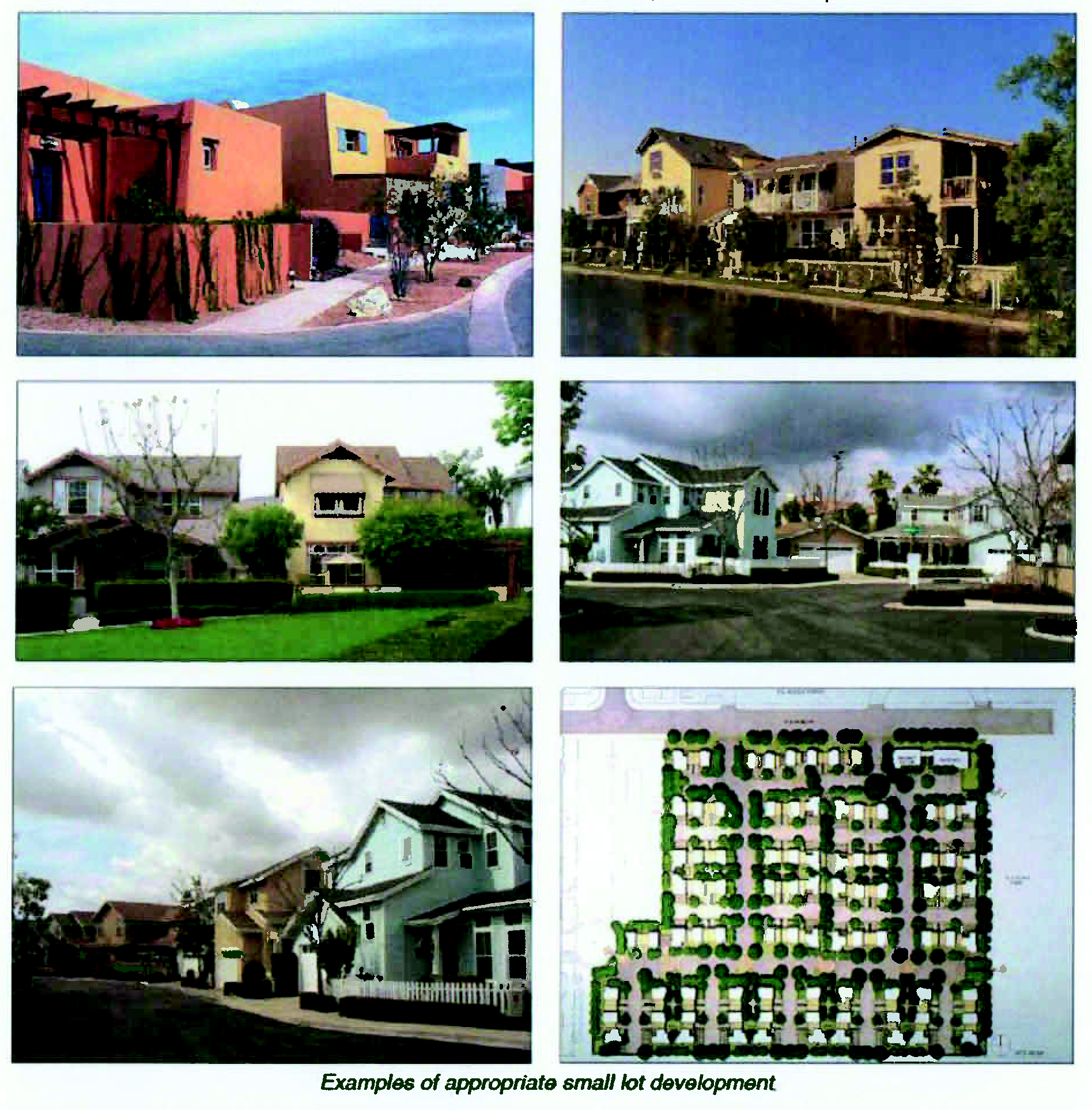
C.
Usable Private Yard Space.
1.
A minimum of two hundred (200) square feet per dwelling unit with no dimension less than ten feet shall be provided.
2.
Ten percent of the lineal length of the total perimeter wall area of dwelling units accessible to a side and rear yard shall contain penetrable openings such as sliding glass doors that open into usable, private open space.
D.
Common Usable Open Space.
1.
A minimum of five hundred (500) square feet per residential unit within the small lot subdivision shall be designated and permanently reserved as usable common open space for use by residents of the small lot development. This required open space shall be suitably improved for its intended purposes and all landscaped areas shall be provided with a permanent irrigation system to maintain such areas.
2.
Common usable open space area amenities include, but are not limited to the following: swimming pool, spa, community recreation room, sports courts for tennis, basketball, racquetball, volleyball, barbecue areas, community gardens or play areas with a slope of less than five percent. Areas used for providing site drainage and water retention cannot be used as part of the common usable open space area requirements described herein.
E.
Driveways and Garages. In addition to the off-street parking requirements and standards set forth in Chapter 16.20, Article IV (Parking and Loading Standards), the following shall apply:
1.
Garages shall be located to prevent vehicles from projecting into the street/sidewalk right-of-way. In order to prevent vehicles from blocking sidewalk areas, the driveway shall have a depth minimum of twenty (20) feet and width minimum of sixteen (16) feet.
2.
The following exception to the above-mentioned standards shall apply: No overnight parking (during the hours of ten p.m. and seven a.m.) is allowed within the street yard setback(s), except on the approved driveway.
F.
Streets.
1.
All streets within a small lot subdivision shall be fifty-four-foot right-of-way and thirty-foot curb-to-curb.
2.
A four-foot sidewalk between back of curb and utility easement shall be provided.
3.
A three-foot utility easement between the sidewalk and property line shall be provided.
4.
No signs, vaults, utilities, hydrants, etc. may be located on the sidewalk.
5.
All streets within small lot subdivisions shall be public.
G.
Walls, Fences and Hedges. Decorative walls and fences are permitted in the setbacks as follows:
1.
In no event shall any fence, wall or hedge obscure any clear sight triangle.
2.
In the street yard setback, a wall, fence or hedge shall not exceed thirty-six (36) inches in height above grade when view-obscuring. However, non-view-obscuring estate-type decorative fences may be constructed in the street yard setback up to a maximum height of seventy-two (72) inches. A non-view-obscuring estate-type fence is defined as a fence with solid masonry pillars with ornamental metal fencing between. The masonry pillars shall not be more than thirty (30) inches in width and shall not be placed less than eight feet apart.
3.
The wall or fence height shall not exceed six feet in the rear and interior side yard setbacks.
4.
Both sides of all perimeter walls should be architecturally treated. Appropriate materials include ornamental metal grillwork, decorative masonry, stone and brick. Chain link is not considered a decorative material and shall not be used.
H.
Homeowner Associations. Homeowner associations shall maintain small lot subdivisions that provide common amenities.
I.
Miscellaneous.
1.
Connection to sewer is required;
2.
No undeveloped residential lot sales will be allowed, developer shall construct all homes within small lot subdivisions;
3.
Small lot subdivisions are subject to Article VI in this chapter.
(Ord. No. 2011-10, § 3(Exh. A), 8-16-11)
16.16.130 - Additional development standards for the multiple-family residence (R3) designation.
A.
Multiple-family Residence (R3) Designation. The multiple-family residence designation is established to provide areas for multi-family housing in a garden setting such as courtyard apartments, condominiums and walk-up townhomes.
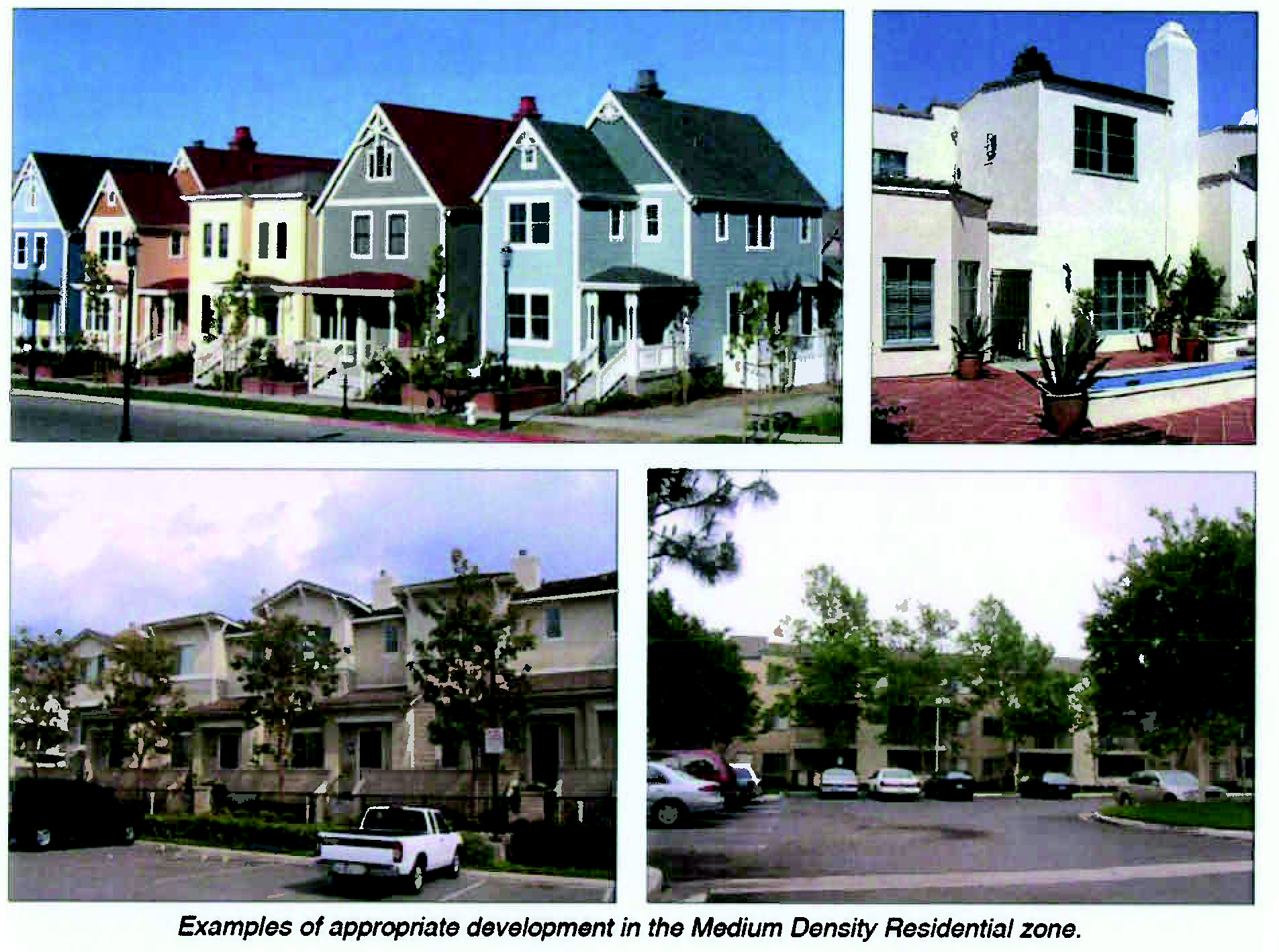
B.
Development Standards. All property in the R3 designation shall be developed according to the following standards:
1.
Residential Density. The gross residential density permitted in this zone is 15—30 units/acre.
2.
Minimum Living Area. The minimum living area for residential units shall be as follows:
3.
If the development contains multiple buildings, the minimum distance between buildings shall be as follows:
Notes:
1.
The sides of buildings that face each other shall not include openings. Openings in this case shall mean windows and doors.
2.
Windows, doors, as well as patios/balconies or similar features shall be oriented so as not to have a direct line-of-sight into adjacent units.
3.
No minimum distance shall be required for accessory structures, such as carports.
4.
Usable Open Space. The required amount of private and common open space is as follows:
a.
Private Usable Open Space: Each dwelling unit shall have a minimum private usable open space of one hundred (100) square feet, accessible directly from the living area of the unit. A rectangle inscribed within each private usable open space shall have no dimension less than eight feet. Private usable open space for ground floor units shall be in the form of a fenced yard or patio, or an uncovered deck, with no more than fifty (50) percent of ground level space covered by an overhang balcony or patio roof. Private usable open space for above ground level units shall have at least one exterior side open above the level of railing or fencing. All balconies and patios that front a public street shall have opaque balcony/railing enclosures to screen items being stored on the balcony or patio.
b.
Common Usable Open Space: At least two hundred (200) square feet of common usable open space shall be provided per dwelling unit. Common usable open space may be divided into more than one area, however, each area shall be a minimum of one thousand (1,000) square feet and a rectangle inscribed within each shall have no dimension less than twenty-five (25) feet. All required common open space shall be suitably improved for its intended purposes and all lawn and landscaped areas shall be provided with a permanent irrigation system to maintain such areas. Each multi-family development shall include, but not be limited to, two of the following recreational amenities, or equivalent, as approved by the reviewing authority:
i.
Tot lot with multiple play equipment.
ii.
Pool and spa.
iii.
Barbecue facility equipped with grill, picnic benches, etc.
iv.
Exercise room.
v.
Court facilities (e.g., tennis, volleyball, basketball, etc.).
vi.
Clubhouse.
vii.
Common gardening area.
viii.
Other recreational amenities not listed above, may be considered in lieu of those listed subject to reviewing authority review and approval.
c.
All recreation areas or facilities required by this section shall be maintained by private homeowners' associations, property owners, or private assessment districts subject to the reviewing authority's approval.
C.
Parking. In addition to the off-street parking requirements and standards set forth in Chapter 16.20, Article IV (Parking and Loading Standards), the following apply:
1.
Except for required landscaped areas, parking and loading is permitted in the interior side yard and rear yard setbacks.
2.
Driveways, drive aisles and interior streets shall not be used for any purpose that would prevent vehicle access to parking spaces, inhibit vehicular circulation, or emergency response.
3.
Parking areas should be designed in a way to allow room for turnarounds and prevent backing onto public streets.
D.
Trash Collection Areas.
1.
Centralized trash/recyclable materials collection areas shall be provided for all multi-family residential development projects. All such required areas shall be enclosed and screened pursuant to the requirements of this section and in accordance with city standards.
2.
All trash/recyclable materials collection enclosure areas shall be easily accessible to residents and tenants, including easy pedestrian access for the disposal of materials and collection by refuse vehicles.
3.
The collection area(s) shall be enclosed on three sides by a minimum six-foot tall decorative masonry wall. The wall materials used shall be complementary in color and style to architectural components of the development they serve. The fourth side of the enclosure shall be enclosed with an opaque, self-latching gate.
E.
Miscellaneous.
1.
All new construction shall be subject to the general and specific standards contained in Chapter 16.20, Article V (General Performance Standards).
2.
Connection to sewer is required.
3.
Decorative walls and fences shall be subject to Section 16.16.125(G).
4.
Refer to Article VII of this chapter for site and architectural design standards and guidelines for residential uses.
(Ord. No. 2011-10, § 3(Exh. A), 8-16-11; Ord. No. 2016-06, § 4(Exh. A), 10-4-16; Ord. No. 2017-11, § 3(Exh. A), 6-20-17; Ord. No. 2019-08, § 3(Exh. B), 6-4-19; Ord. No. 2025-06, § 3(Exh. A), 11-4-25)
16.16.135 - General provisions and administration.
All projects that require approval of a new or revised tentative tract map or extension of time for a tentative tract map after the effective date of this ordinance [Ordinance No. 2011-10] shall provide and maintain design standards and guidelines in compliance with the provisions of this article.
It is the duty of the development services department to enforce all permitting and entitlement provisions of this article. The director or his/her designee may impose such conditions deemed necessary to achieve the purpose of this article.
(Ord. No. 2011-10, § 3(Exh. A), 8-16-11)
16.16.140 - Architectural design standards and guidelines.
While there is no specific architectural style required for residential buildings and structures in the city, high quality, innovative architecture is strongly encouraged. The primary focus is to develop a high quality residential environment. The architectural style and design of building elements should be consistent within itself and complementary with the neighborhood. The building design should take advantage of the site's unique natural amenities and surroundings, and consider compatibility with adjacent houses and the overall streetscape appearance. Human scale form and proportions are encouraged.
All projects that require approval of a new or revised tentative tract map or extension of time for a tentative tract map, including small lot subdivisions, should meet or exceed the standards of quality that have been set by surrounding development. New design, additions, and alterations to existing homes in tracts that were subject to this article should complement the surroundings and also contribute to the improvement of the area.
A.
Facades and Architectural Detailing.
1.
Residential facades should be articulated to add visual interest and minimize the mass of a building by breaking up the appearance of the facade. Facades should help to provide a sense of human scale. Elements of articulation include change of wall plane, door and window placement, facade details (moldings, material changes, etc.), and other appropriate architectural treatment.
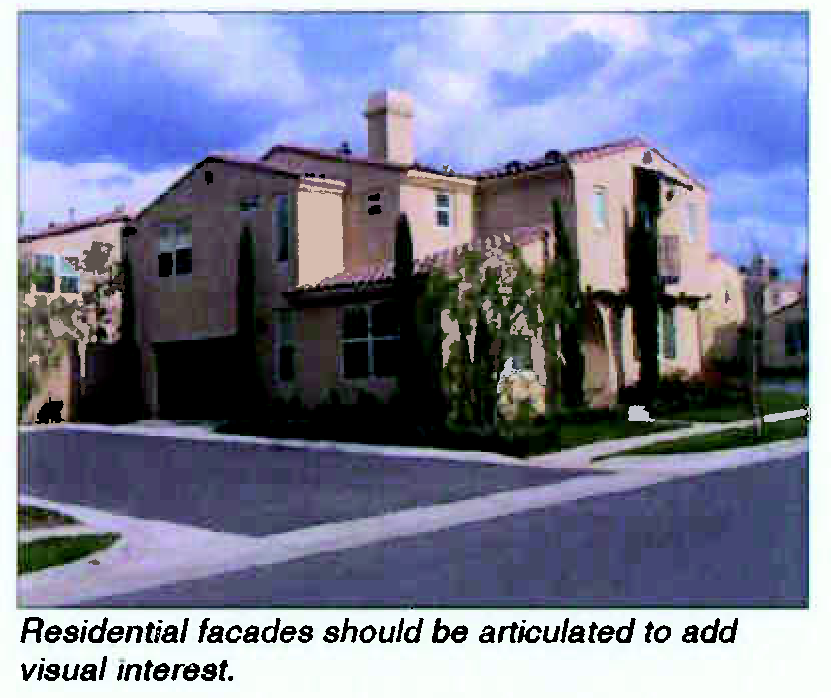
2.
Architectural details such as decorative moldings, windows, dormers, chimneys, balconies and railings, and landscaped elements such as lattices, can also add detail to a facade and are strongly encouraged.
3.
Facade treatment and architectural detailing should be relevant to the home's architectural style and should be carried throughout the entire house with each facade and any accessory building/structure.
4.
Flat, blank walls, particularly along the front and side elevations, which are viewed from the street, are strongly discouraged and should be avoided. Also, excessive facade treatment and architectural detailing should be avoided as it can create a chaotic appearance.
B.
Height and Roof Lines.
1.
The roof is one of the most important elements contributing to the sense of scale and proportion of the building. Depending on the height and roof line, it could be the most visible architectural feature as viewed from the street. Height and roof lines should be consistent with the style of architecture of the house, and complement qualities of neighboring residential buildings such as type, slope, size, material and color.
2.
The use of expansive, predominantly flat roofs (with a slope of less than two in twelve) is discouraged. On the other hand, the use of too many different roof angles or roof types on a building should also be avoided as this can create a disjointed, chaotic appearance.
3.
Additions should maintain the same floor-to-floor height of the original building. Roof lines for additions should match the original slopes and ridgelines of the roof of the primary building.
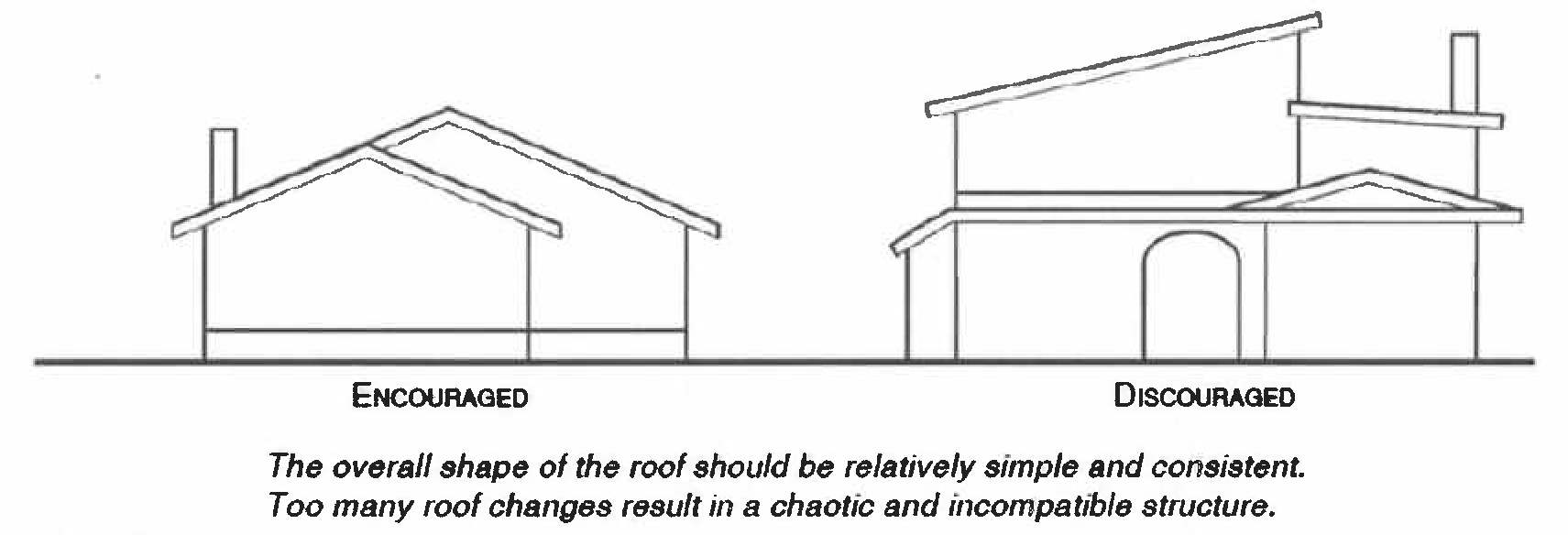
C.
Front Entries.
1.
A front entry consists of the front door and its surrounding architectural elements. Front entries are important as they serve as the primary focal point of a residence. Front entries shall be visible from the street and well illuminated.
2.
Smaller, understated entries are strongly encouraged because they help create a more human scale to a home. Large, massive entries that are double height and appear two-story are strongly discouraged. Recessed entries can also add a human scale to a home and create an intimate feel and are encouraged.
3.
Front entry doors and decorative elements such as moldings, columns, posts, lighting, and built-in benches and planters should be architecturally consistent with the style of the house.
4.
Front porches are strongly encouraged as they provide a clear sense of entry, design interest, shade, weather protection for the front door, and help foster community interface. To ensure usability, a minimum porch depth of eight feet is required.
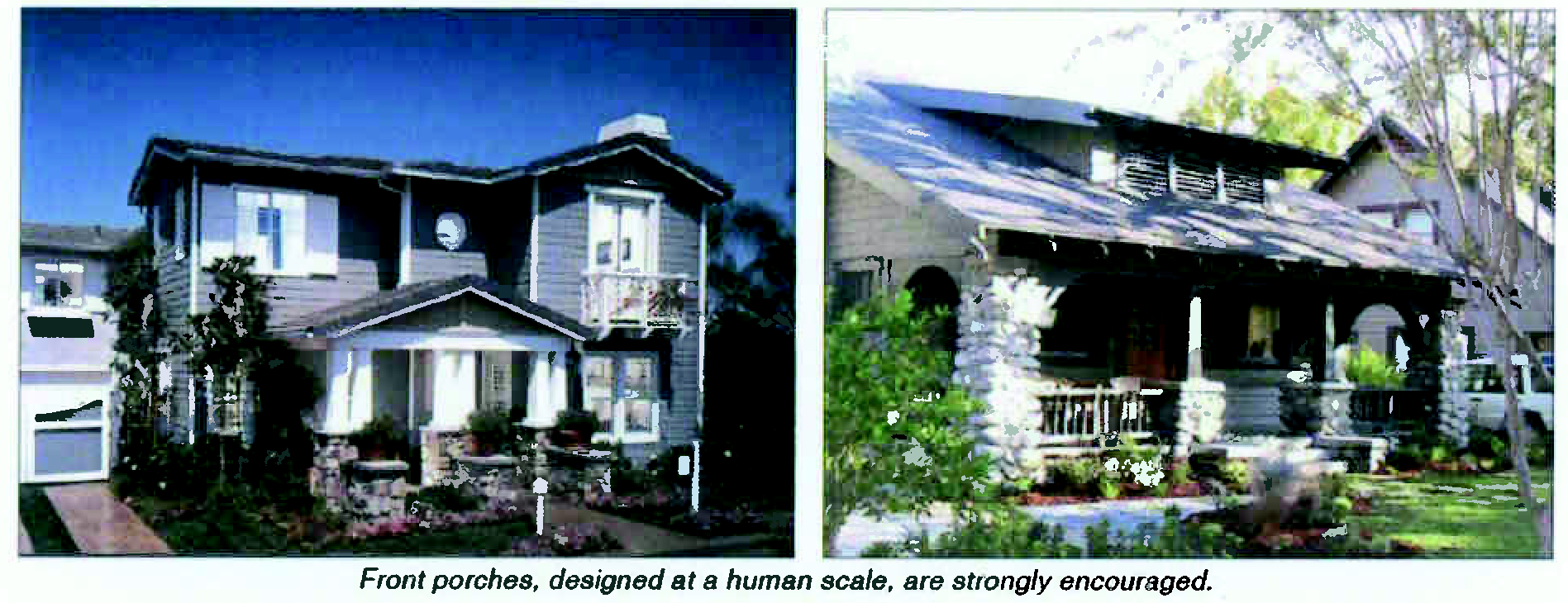
D.
Doors and Windows.
1.
The placement and relationship of doors and windows is important in creating a unified building composition. Wherever possible, window sizes should be coordinated vertically and horizontally and window design should be consistent in terms of style and general arrangement on all building sides.
2.
All doors and windows should be related with the chosen architectural style. Windows with widely varying styles are strongly discouraged. For additions, all new doors and windows should match those that are on the existing building/structure. All doors and window frames should be composed of the same material as those found on the existing building.
3.
For additions and remodels, match the existing windows of the house. Double glazing is encouraged, if not required by Title 24 standards.
4.
Knockers or door bells should be provided on doors. Entrance doors should provide viewers for safety and security.
5.
Shutters, trim and moldings on windows are encouraged. Proposed window mullion widths, window trim or surrounds, material, and type should complement all existing windows. Mullion widths should be in scale with the windows and the building. Wider trim, such as 1 × 4 and 1 × 6, is preferred to narrower trim, such as 1 × 2.
6.
Raw or clear anodized aluminum window frames are strongly discouraged.
7.
Operable windows should have screens so they can be used for ventilation.
E.
Garage Doors. Garage doors should not dominate the streetscape. Multiple paneled doors, windows, or other architectural detailing should be used on garage doors to reduce their visual impact from the street and better fit the scale of the house. Any architectural detailing should be compatible with the architectural style of the house.
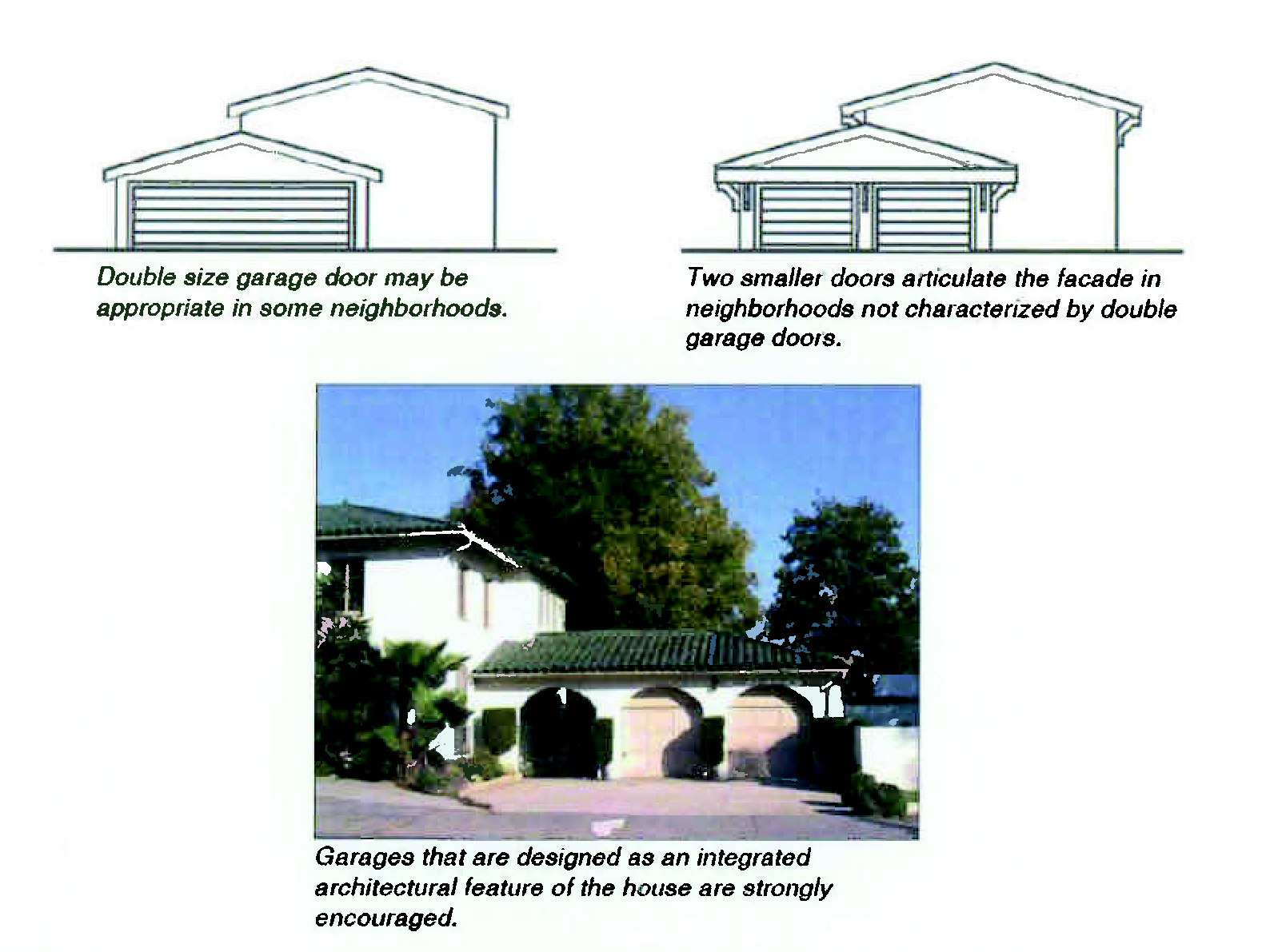
F.
Awnings.
1.
Awnings should be used only when compatible with the existing architectural style of the house. The same type and color awnings shall be used for the entire building. Awning color should accent the colors on the building.
2.
Awning frames shall be designed to withstand the minimum wind speed as required in the adopted building code.
3.
Canvas, vinyl or polyester awnings are preferred. Awnings shall be regularly maintained and deteriorating awnings shall be replaced promptly.
G.
Dormers.
1.
Dormers provide light and ventilation to the top floor of a building and can provide a means to increase livable area. They are highly visible elements of a roof. The dormer style should be consistent with the overall architectural style of the building. New dormers should be designed to match those already existing on the building.
2.
Dormers should align with, or be centered between, the windows found on the main body of the building.
3.
Dormer trim work should be painted to match the main body trim. Dormer sidewalls should be made with the same wall materials, finish, and color found on the main building.
H.
Chimneys.
1.
If chimneys are provided, they should be designed to reflect the architectural style of the building and be appropriate in scale with the building. Chimneys should use materials and detailing compatible with those found on the building. For remodels and additions, new chimneys should match the scale, design, and materials of any existing chimneys.
2.
Spark arresters shall be provided with all chimneys and be architecturally compatible with the building.
I.
Materials and Finishes.
1.
The choice and mix of materials on residential facades and garage doors has a significant visual impact. Materials and finishes should be of high quality, appropriate for the style and scale of the house, and consistently applied. Piecemeal embellishment with frequent changes in materials should be avoided.
2.
The use of at least one strong accent material is encouraged. The number of materials and finishes should be limited to those appropriate for the style of the house. Each style of house calls for a different mixture of finishes. For some architectural styles, only one or two finishes are appropriate, while others can support more. Too many materials are discouraged and can result in a chaotic, unpleasant facade.
3.
For new buildings, the repetition of textures and color found in the neighborhood can help tie the new building to its surroundings. In remodels and additions, new materials should match those of the existing buildings. Accessory buildings/structures should match materials, finishes, and colors, found on the primary building.
4.
Architectural design and exterior materials should be applied consistently on all sides of the building to provide continuity. Materials tend to appear substantial and integral to the building when material changes occur at changes in plane. Material changes not accompanied by changes in plane appear "tacked-on" and are strongly discouraged. When using wood siding or masonry as a primary or accent material in the front, extend it along the sides, or at least to an inside corner. Do not stop at an outside corner.
5.
Exposed gutters and downspouts should be colored to match fascia or wall materials, unless designed as an outstanding architectural feature of the overall theme.
6.
Materials that are responsive to climate, adjacent context and site orientation are encouraged. Natural materials suitable to the High Desert environment include stone, brick, and metals such as copper and are encouraged. Synthetic materials made to simulate natural wood and masonry are discouraged.
7.
Stucco and plaster finishes should be consistent with the architectural style of the building. The use of very rough, "knock-down" stucco finishes is discouraged.
8.
The use of sustainable building materials is strongly encouraged. This includes using quality materials with a long lifespan, selecting materials that are not energy-intensive to manufacture, using building products made from recycled materials, and repairing and maintaining well-built existing buildings to the fullest extent possible.
J.
Color and Texture.
1.
For most architectural styles, the number of colors on the exterior should be limited to a maximum of three, with an additional contrasting color for accent. In general, the lighter colors should be used for the main body, with darker shades for trim and accent. The larger and simpler the house design, the more subtle the color should be to reduce the massiveness of large wall planes.
2.
Earth tones are best suited and are appropriate for most of the architectural designs found in the city. The use of strong or bright, unnatural colors, including the bright "white-on-white" color schemes for exterior stucco, wood siding, trim doors and shutters, should be avoided. However, the use of strongly contrasting, natural colors can be appropriate for accent use, such as for shutters and doors.
3.
Details such as trim, shutters, posts, etc. should be articulated by the use of color, texture or both.
4.
Color palettes and texture palettes should be kept relatively simple so that clashes and very dramatic contrasts are avoided.
K.
Roofing Materials.
1.
Roofing materials should be compatible with the architectural style and design of the building. Permanent roof materials, such as concrete and clay tile, are encouraged because of their low maintenance and consistent appearance over time. Metal roofing, wood shake or shingle roof is acceptable.
2.
Natural barrel clay tile roofs should be replaced with the same material. For repairs, remodels, and additions, care should be taken in the selection of material and installation to match as closely as possible the color of the "aged" tiles, so that the finished roof does not have a patched look.
3.
The use of composition shingles shall be prohibited.
4.
The colors of natural roofing materials, such as barrel tiles and slate should be left natural and not be altered by staining or painting. Colors of synthetic roofing materials should simulate natural materials and should be consistent with the architectural style of the house.
5.
Roofing materials with glossy surfaces appear unnatural and are strongly discouraged.
(Ord. No. 2011-10, § 3(Exh. A), 8-16-11)
16.16.145 - Site design standards and guidelines.
The appearance of a residential property as it is viewed from the street or sidewalk is important to the overall appearance of a neighborhood. How well a house fits with its site and its surrounding environment contributes to the public view of the streetscape and to the success of the project. All forms of residential development including additions, new accessory buildings and new homes should first take into account the site on which the building will be built and the streetscape pattern of the neighborhood. In well-established neighborhoods, it is especially important to maintain the character of the neighborhood by respecting the pattern of the streetscape.
New homes should be compatible with the setback, proportion, and sale of the houses in the neighborhood. They should also be compatible with the existing on-site relationships of the surrounding neighborhood such as front facade orientation, scale of front entries, front porches, and front yard landscaping. Effective site planning should reflect the natural attributes of the site, while maintaining compatibility with the neighborhood.
A.
Setbacks.
1.
While respecting the minimum front and side yard setback as established in this code, a new dwelling's front and side yard setbacks should generally approximate that of adjacent residences. The front and side yard setback pattern on the block should be identified and respected to help unify the neighborhood.
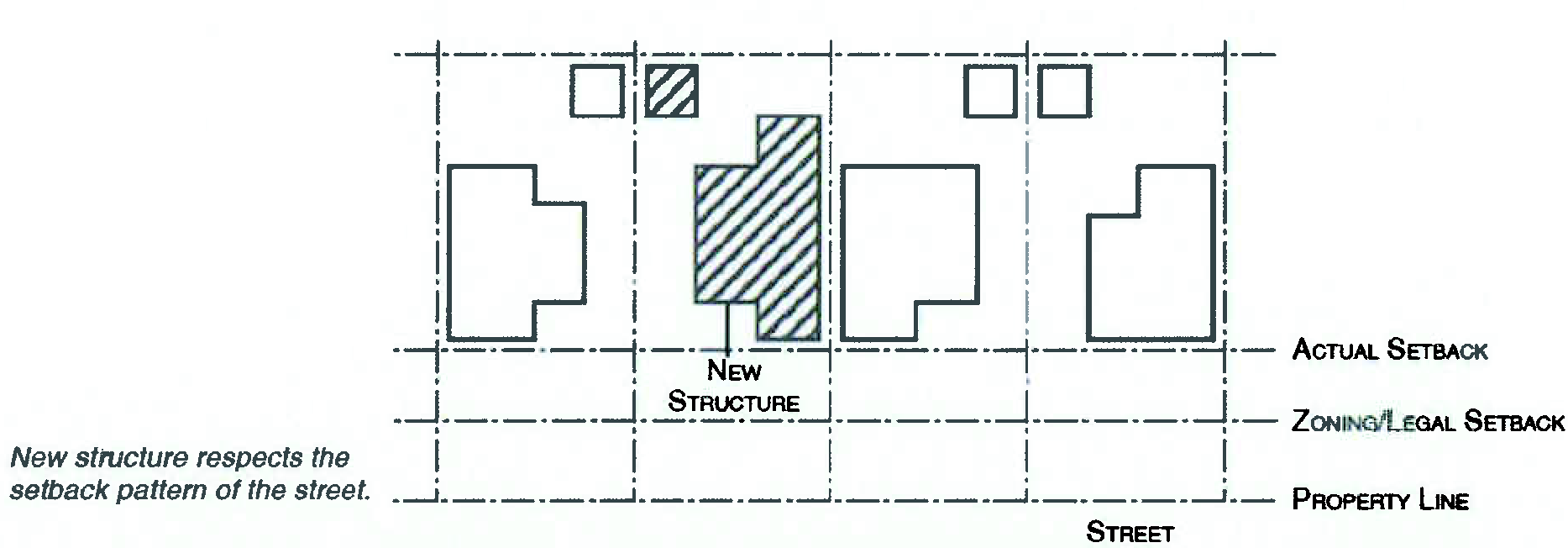
2.
While some variation in setbacks can add interest and diversity to the street view, particularly in subdivisions, a setback that significantly differs from an established pattern may be disruptive to the character of the neighborhood.
B.
Orientation. Dwellings should orient themselves to the street with a clearly identifiable front door and windows that face the street. Front windows and the front door contribute to "eyes on the street" which helps neighborhood security.
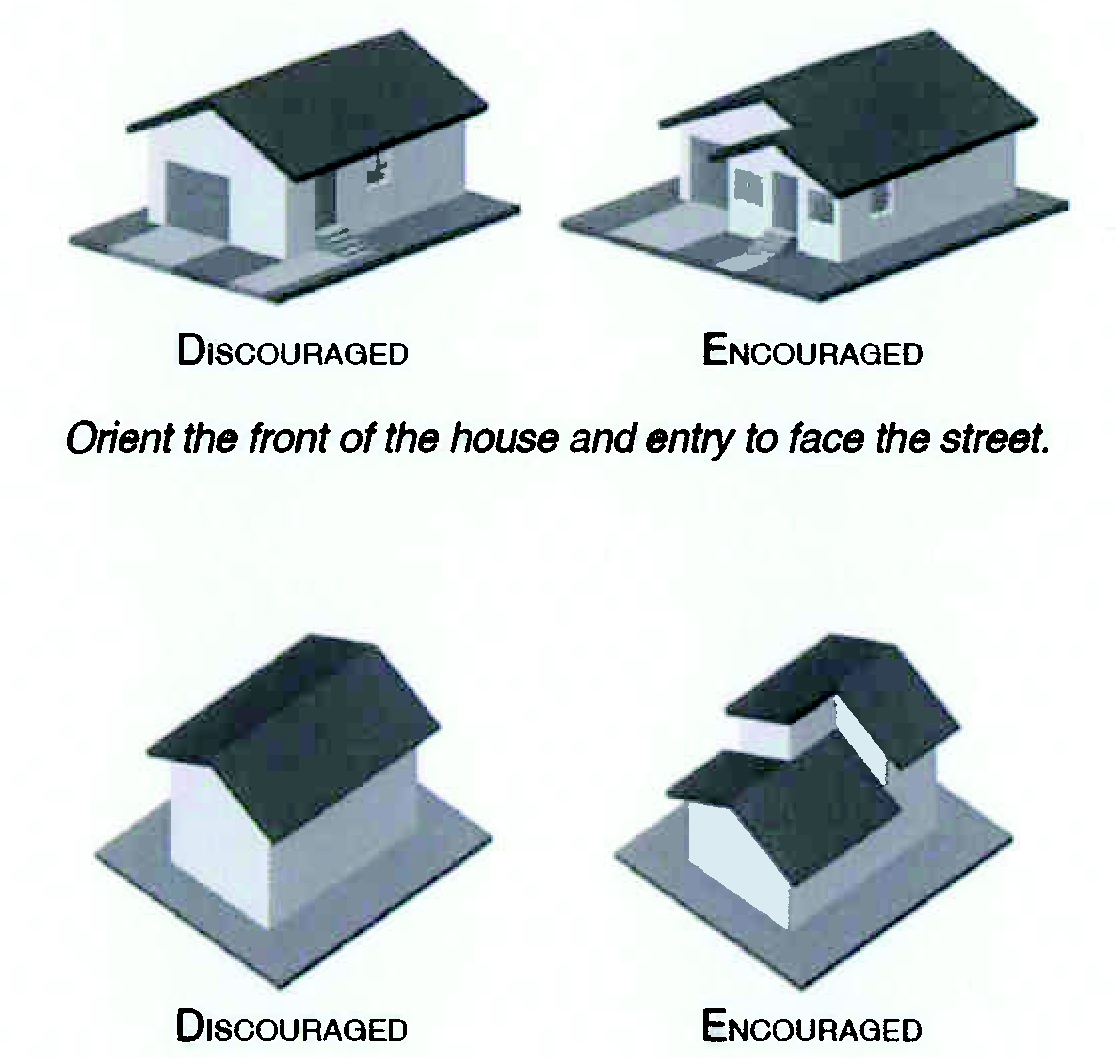
C.
Scale, Mass and Form.
1.
The scale and mass of a new dwelling should blend well with neighboring houses and not overwhelm them with disproportionate size or a design that is out of character. Buildings that are out of scale with the neighborhood, with large, blank, flat surfaces, and insufficient open space and mature landscaping can appear out of place and incompatible with their surroundings.
2.
A two-story building should not be constructed in a one-story neighborhood unless it is carefully designed to be similar in scale and mass with surrounding buildings. In such instances, the second story should be setback from the front of house to make the second story less visible from the street. Second floor balconies and small decks accented with landscaping can also reduce the visual impact of two-story buildings.
3.
The size, mass, and height of a building should also be in proportion with the size of the property. It is not necessarily desirable to maximize the allowable lot coverage, but to provide ample open space and setbacks and preserve the character of the neighborhood.
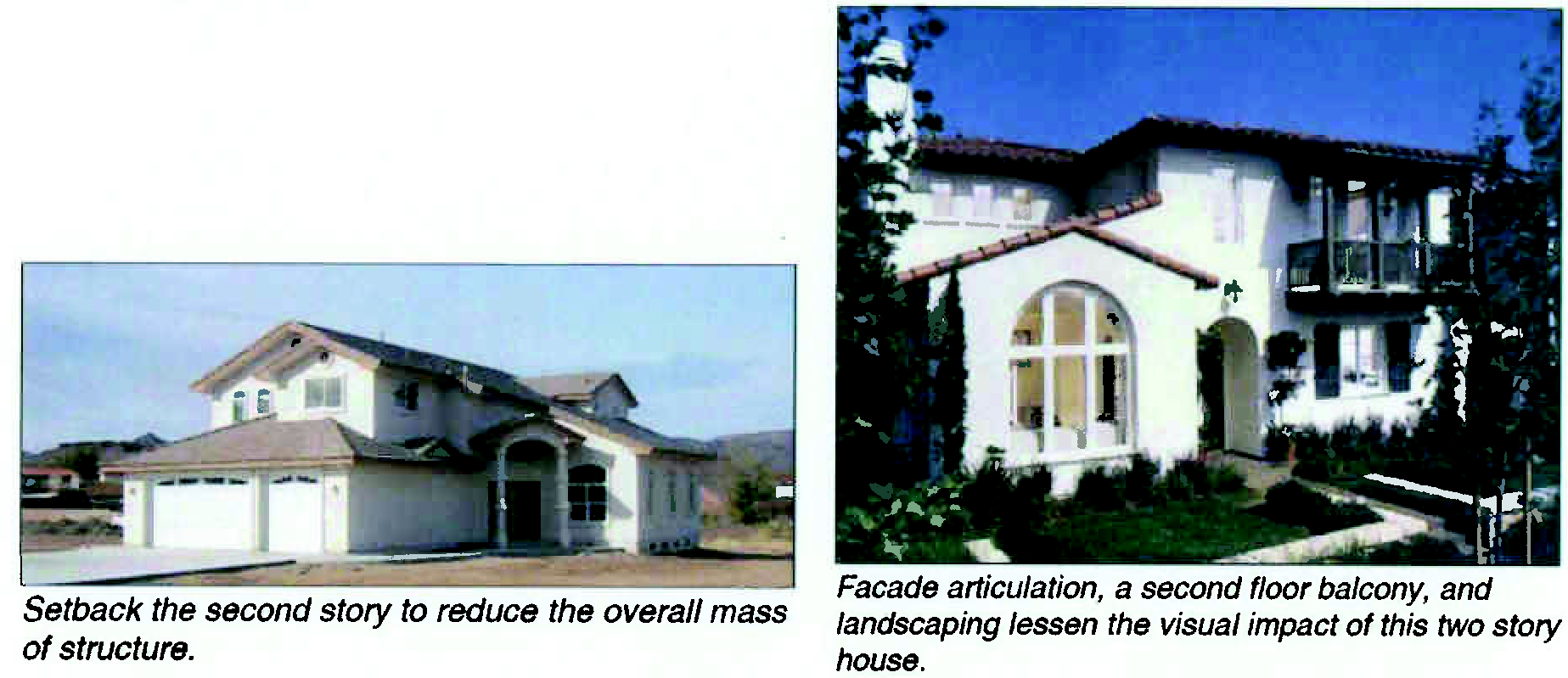
4.
Architectural elements, such as simple roof forms, facade articulation, roof breaks, walls with texture materials and ornamental details, and incorporation of landscaping, are encouraged because they add visual interest and reduce the appearance of mass and scale.
5.
If allowed, accessory buildings/structures and accessory dwellings should have comparable massing and form as the primary residence.
D.
Environmental Considerations.
1.
A house should be designed to be sensitive to its natural surroundings and compatible with the natural slope of the land, reflecting its contours. Grading should be minimized to follow the natural contours to the greatest extent possible. A house should be sited to maximize views of the High Desert environment and surrounding mountains.
2.
Significant existing trees, vegetation and any other natural site attributes should be preserved to the greatest extent possible in the design and development of the house. Site design that requires altering landforms and removing trees is strongly discouraged.
3.
A new house or addition should be designed to make best use of available sun, light and shade. This can be accomplished in the following ways:
a.
Use windows for natural light as much as possible. Design windows for through airflow to promote natural cooling.
b.
Use trees or roof with large overhangs to shade the house, particularly over south facing windows.
c.
Use patios and porches to buffer the building from heat gain.
d.
Incorporate attic turbines for ventilation and energy-efficient heating and air conditioning systems.
e.
Locate open space in a manner to maximize use of sun and shade patterns, natural drainage and existing trees and vegetation.
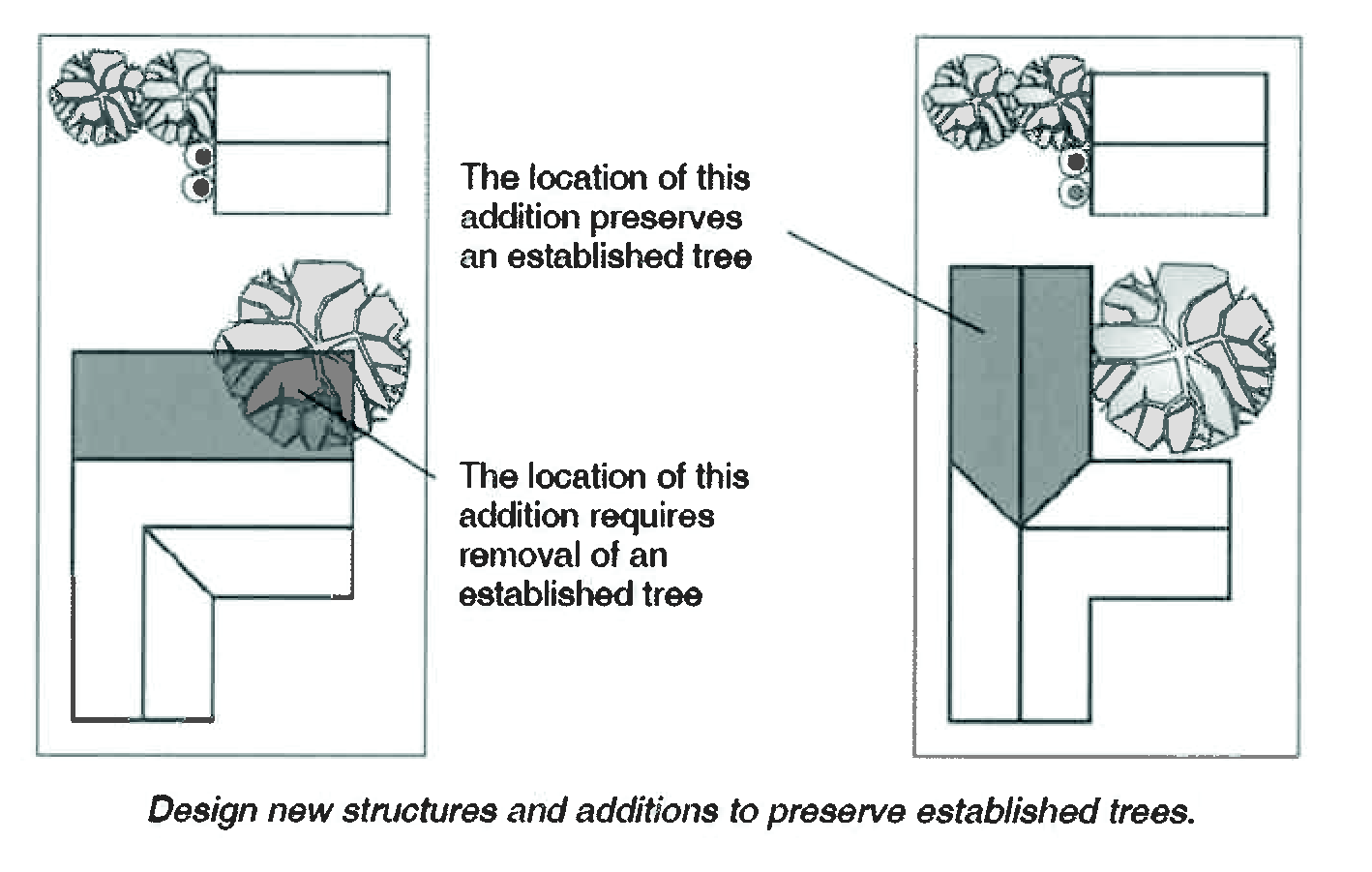
4.
Maximize vegetative ground cover on the lot to absorb rainwater, provide drainage to large trees on the site, and reduce runoff. Extensive paving in the front, side and rear yards is strongly discouraged. Consideration should be given to the reduction of landscape maintenance and water consumption when selecting landscape materials.
E.
Relationship to Adjacent Properties.
1.
The visual impact of a new house and/or accessory buildings on adjacent properties should be minimized. Taller sections of buildings should be located where they will not obstruct sunlight to adjacent gardens, patios, pools, or rooms. Carefully positioning or limiting the width, depth, or height of proposed building elements is encouraged to preserve a neighbor's privacy and view. Privacy issues are extremely important on flag lots, where neighboring houses could abut a flag lot on four or five sides.
2.
New windows should be placed where they promote privacy between properties. Windows should be offset or staggered from neighboring windows to maintain privacy between houses. Clerestory windows can be placed high on a wall to allow natural light and air, but no view to the adjacent property. Where a second story addition is planned, the new windows and walls should be positioned to promote visual and sound privacy between houses.
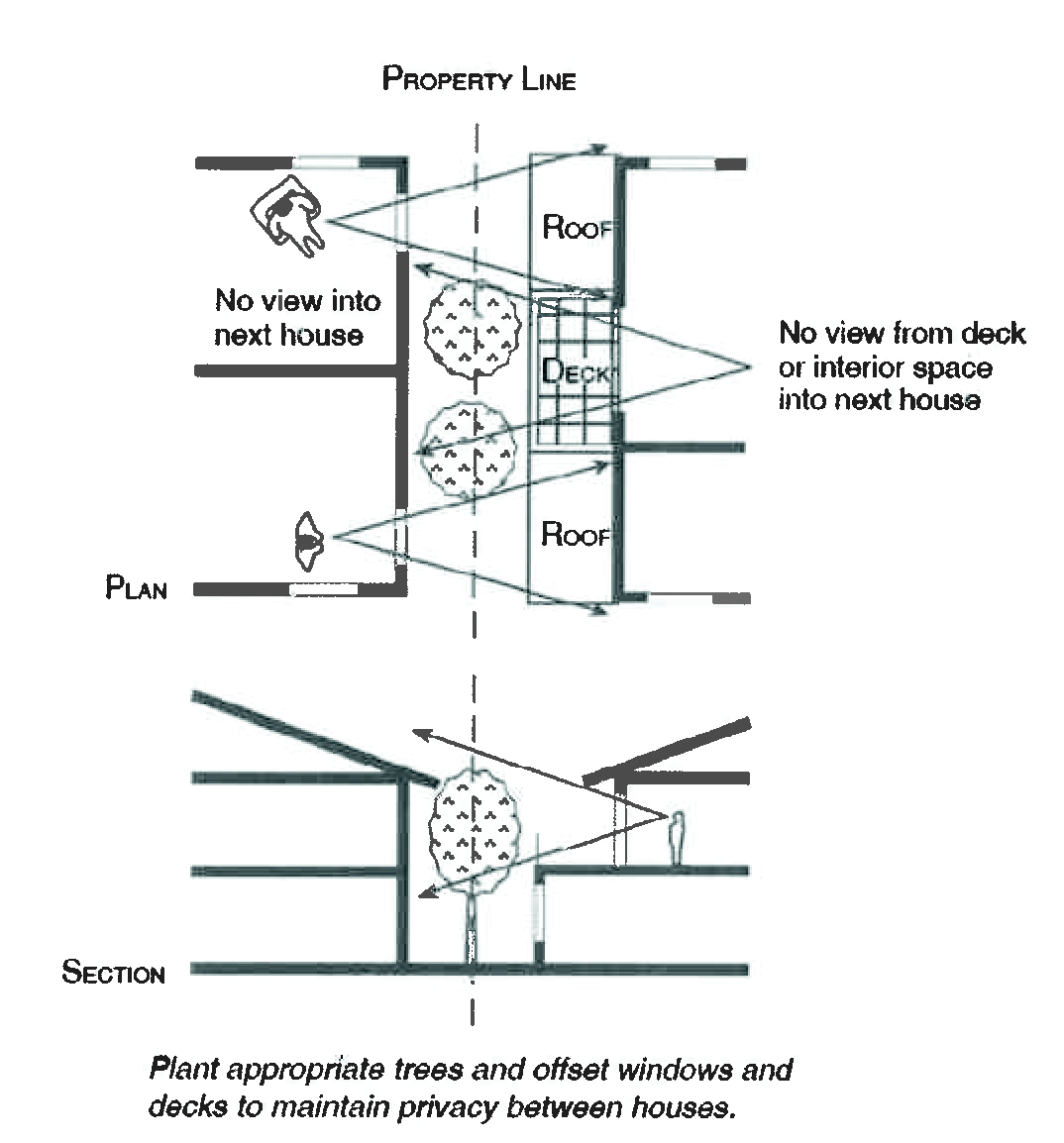
3.
Second floor balconies should be located to minimize the loss of privacy for neighboring properties. Avoid locating balconies so that they directly overlook a neighboring patio or yard.
4.
Appropriate landscaping should be provided for privacy between neighboring properties in the rear and side yards. The use trees and shrubbery is encouraged to provide screens and buffers between neighbors and to shape spaces. Protect and care for any existing trees in the rear or side yards.
5.
Outdoor lighting should be positioned so that no direct light extends onto neighboring properties. Take care in choosing and locating outdoor lighting fixtures so that privacy is maintained between properties.
F.
Additions, New Accessory Buildings and Accessory Dwelling Units.
1.
Additions and new accessory buildings/structures, and accessory dwelling units should maintain the look and appearance of the existing primary buildings so that they do not appear as an addition or new building. They should respect the architectural style, scale, and rhythm of the existing primary building. Building elements, such as roof pitch and style, building proportions, exterior siding and roofing materials, door and window style and materials, color, and texture, should match the existing primary building.
2.
An addition should complement and balance the overall form, mass, and composition of the existing primary building on the property.
3.
Additions are strongly encouraged to be located behind the house away from public view. Additions in the front yard are strongly discouraged.
4.
When building an addition, efficient use of floor area is encouraged. Maximize floor area by combining uses of space, eliminating unnecessary rooms, and organizing rooms to eliminate hallways.
G.
Garages.
1.
Garages should not dominate the front elevation. The visual impact of garage doors along street frontages can diminish the character of the neighborhood. Garages should be located and designed in one of the following ways:
a.
Access the garage from the side or rear of the lot. Where there is a rear alley and auto access is feasible, rear detached garages with alley access should be used.
b.
Offset the garage behind the front facade of the house. The frontage of any garage should be setback a minimum of three feet from the dwelling's first story frontage.
c.
If a garage must be located closer to the street than the front facade of the house, provide usable open space, such as a balcony or deck, above the garage with a trellis or roof along the frontage of the garage to reduce the visual impact. Also, designing an entry porch or trellis located in front of the living area to meet the setback of the garage can improve the visual appearance from the street.
d.
Provide a side entry garage: locate the garage so that it faces the side of the lot, rather than the fronting the street.
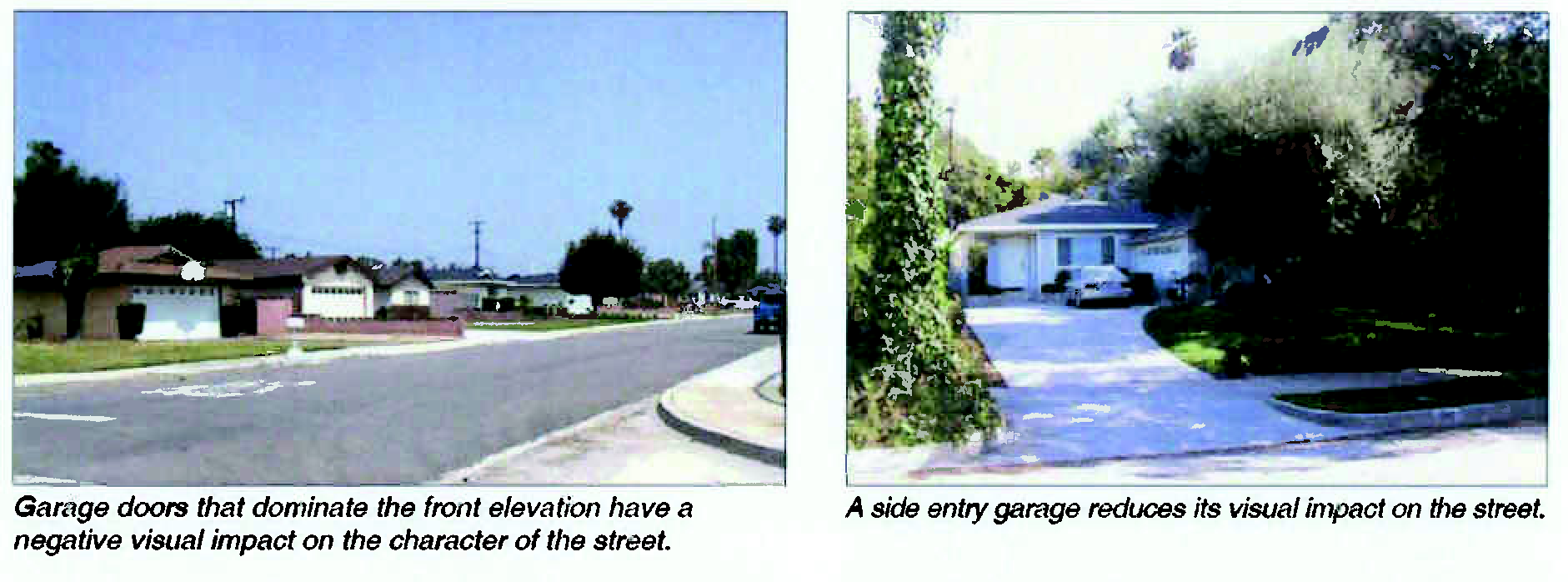
2.
Recreational vehicles, boats, trailers, etc. shall not be located in view from the public right-of-way. They add visual clutter and detract from the appearance of the neighborhood. They shall be stored inside or rear yards, screened from street by fences or landscaping.
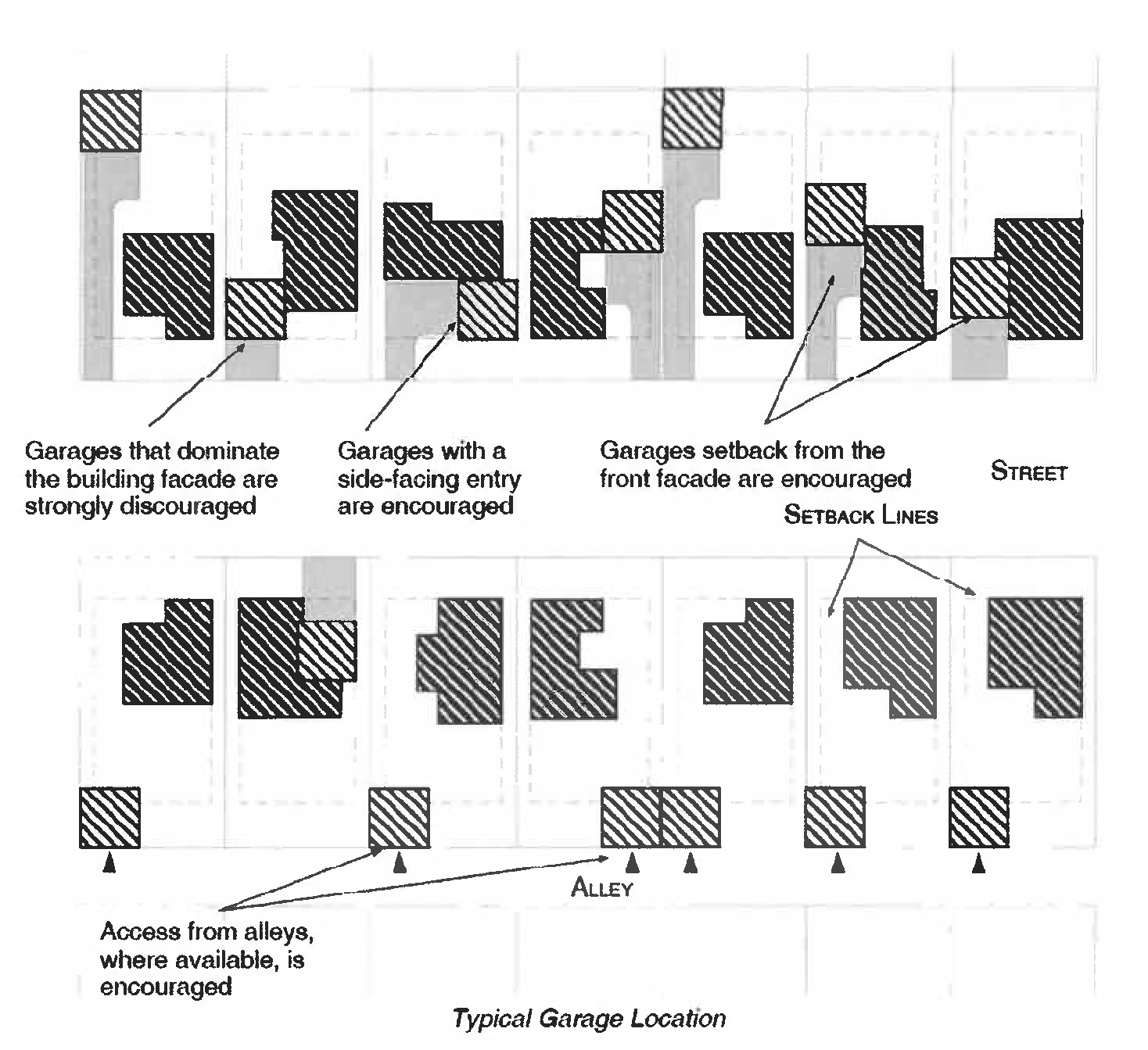
H.
Driveways and Walkways.
1.
Large expanses of paving for driveways and walkways should be avoided to reduce visual impact and impervious coverage in the front yard. Minimizing the width of driveways where feasible is encouraged.
2.
Driveways are encouraged to incorporate natural materials into their design with the use of stone or colored concrete. The use of decomposed granite is limited to small expanses such as the center portion of a driveway.
3.
The walkway to the front entry should be designed at a human scale — between three to five feet in width - and not be excessively wide. Natural materials such as brick pavers or stone, tiles, and textured or stamped concrete for walkways are strongly encouraged.
4.
The use of asphalt for driveways and walkways is prohibited.
I.
Fences, Walls, Gates and Hedges.
1.
Front yard fences and walls are strongly discouraged, particularly in neighborhoods where the predominant streetscape pattern has no existing fences in the front yard. This provides a quality of openness that contributes to an attractive overall streetscape in residential neighborhoods. Where permitted, front yard fences and walls shall not dominate the streetscape or reduce compatibility of the home with adjacent residences.
2.
Fences, walls, gates and hedges for privacy may be used in side and rear yards.
3.
The materials, design, height, and length of the fence or wall should be compatible with the architectural style, materials and overall size of the primary building. Landscaping should be provided adjacent to fences along street frontages to soften their appearance.
4.
Fences and gates should be designed with simplicity to complement the house. Avoid ornate fences and gates, which draw attention, and detract from the main building.
5.
Front yard fences and walls should provide a decreasing level of opaqueness as the height of the fence or wall increases to the maximum permitted.
6.
Columns and other architectural features such as posts should be architecturally compatible with the primary building.
7.
Gates should be designed to reflect the architecture of the primary building and the style and design of the fence or wall.
8.
Hedges that are intended to provide screening and privacy should be planted so as not to encroach over the sidewalk or front property line if no sidewalk exists.
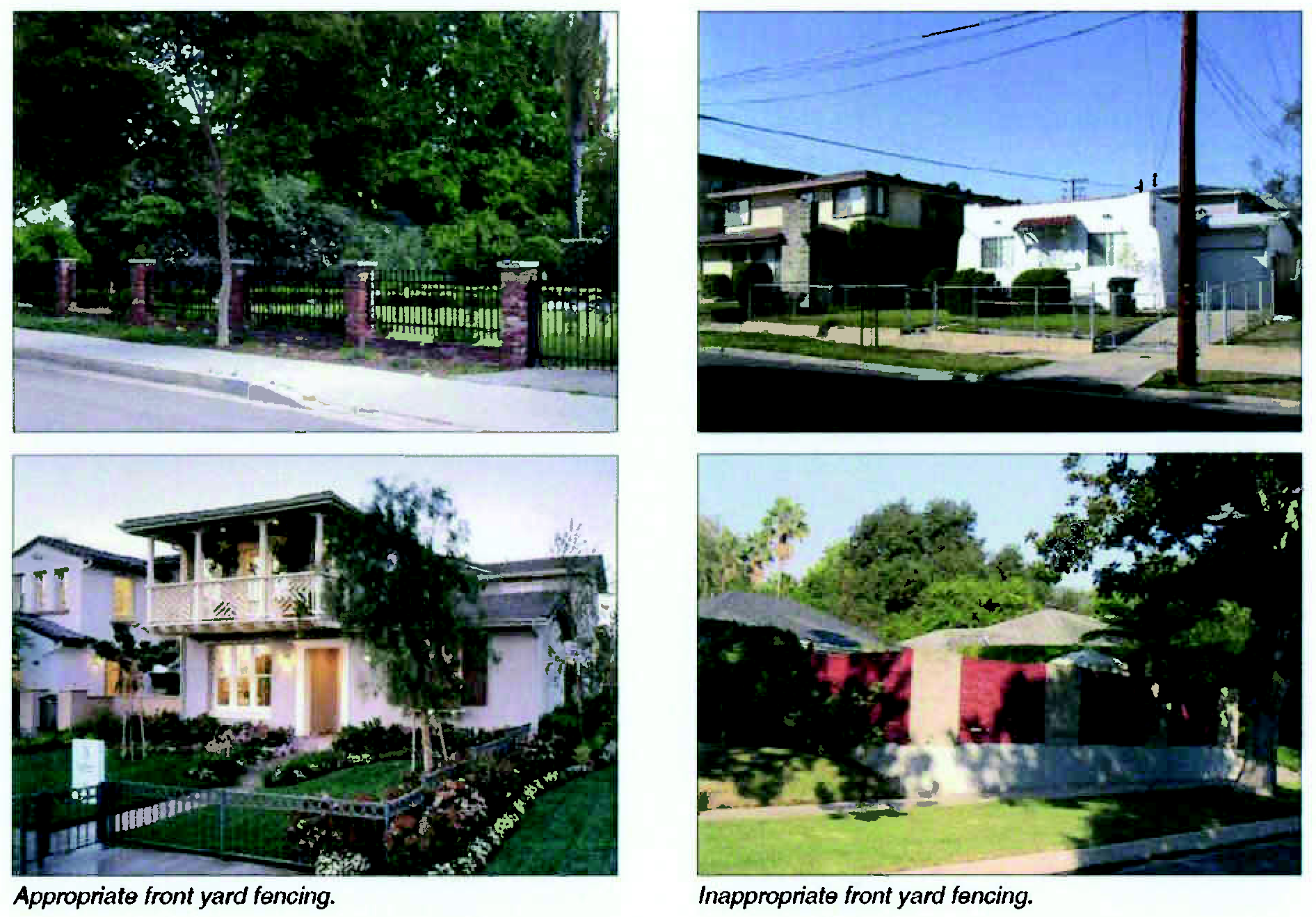
9.
Fences and walls should be constructed with materials such as masonry, metal, wood, or a combination thereof. The use of true wrought iron is preferred to hollow metal tubing. Barbed wire and chain link fencing are prohibited.
10.
"Good neighbor" fences (fences that look equally good from both sides) are encouraged in side and rear yards.
J.
Exterior Lighting.
1.
Exterior lighting includes all lighting fixtures on front facades, security lighting, and landscape lighting. Adequate exterior lighting shall be provided on the front of the house to ensure neighborhood safety and security. Exterior lighting that accentuates architectural and landscape elements of the property is encouraged.
2.
Recessed porches must be lit.
3.
Light fixtures should complement the design of the house.
4.
Photo-sensitive off/on switches are strongly encouraged for energy conservation and safety.
5.
Exterior lighting should be positioned so that no direct light extends into neighboring properties or public rights-of-way. Illumination should be screened from adjacent properties. Cut-off luminaries should be used to prevent nighttime light pollution.
K.
House Address Numbers.
1.
Address numbers should be located near the front entry door or front entry porch in a location that is visible from the street.
2.
Address numbers shall be a minimum of four inches in height or as required by the building code. The design of the numbers should be simple in shape so that they can be read easily from a distance.
3.
Number colors should provide a strong contrast with background color. Address number illumination is required.
L.
Utility and Mechanical Equipment.
1.
All mechanical equipment shall be screened from view. Utility meters, transformers, backflow devices and equipment should be placed in locations that are not exposed to view from the street or they should be suitably screened. All screening devices should be compatible with the architecture and color of the house and should not look like a "tacked on" addition.
2.
Roof mounted equipment should be avoided.
3.
All antennas should be placed in building attics or interiors. All new units should be prewired to accommodate cable reception. Satellite dishes shall be located away from public view and should be considered early in the design process in terms of location and screening from view from the street and from common recreation areas.
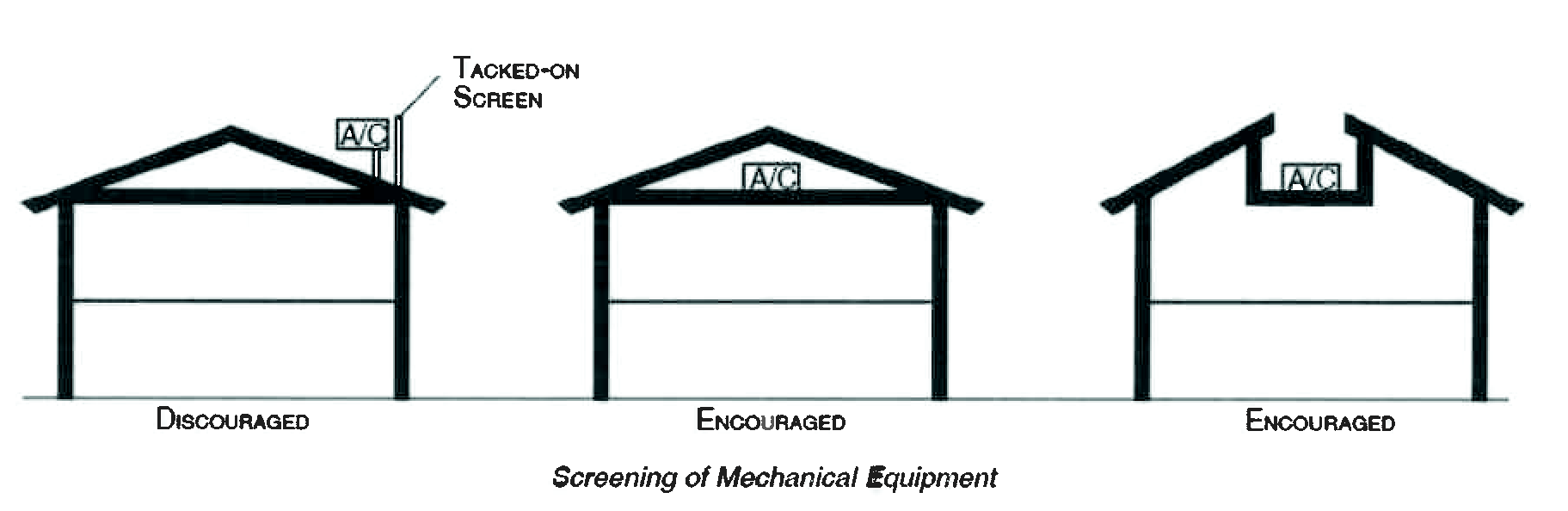
(Ord. No. 2011-10, § 3(Exh. A), 8-16-11; Ord. No. 2021-01, 3(Exh. A), 6-1-21)
16.16.150 - Additional design standards and guidelines for small lot single-family developments.
Small lot single-family developments shall be developed according to the provisions and standards of this code. In addition to the aforementioned design standards and guidelines in this article, the following additional standards and guidelines should be incorporated into the design of projects for small lot, detached single-family development to create functionality and visual variety along local residential streets:
1.
The architectural design, scale and mass of the development should blend well with the surrounding neighborhood and complement the character of the neighborhood.
2.
Variation should be provided in unit types, architectural design and building massing to provide visual interest within the development.
3.
Where possible, there should be some variation in setbacks, unit placement, and orientation to achieve efficient and unique site design and avoid a monotonous street scene.
4.
Both active and passive open space and recreational amenities for private and common use by the residents shall be provided.
5.
Decorative elements, such as architectural details, intensified landscaping, pedestrian paths, decorative lighting, etc. are encouraged to complement and enhance the development and create variety and interest.
6.
Gated entries into small lot single-family developments are prohibited.
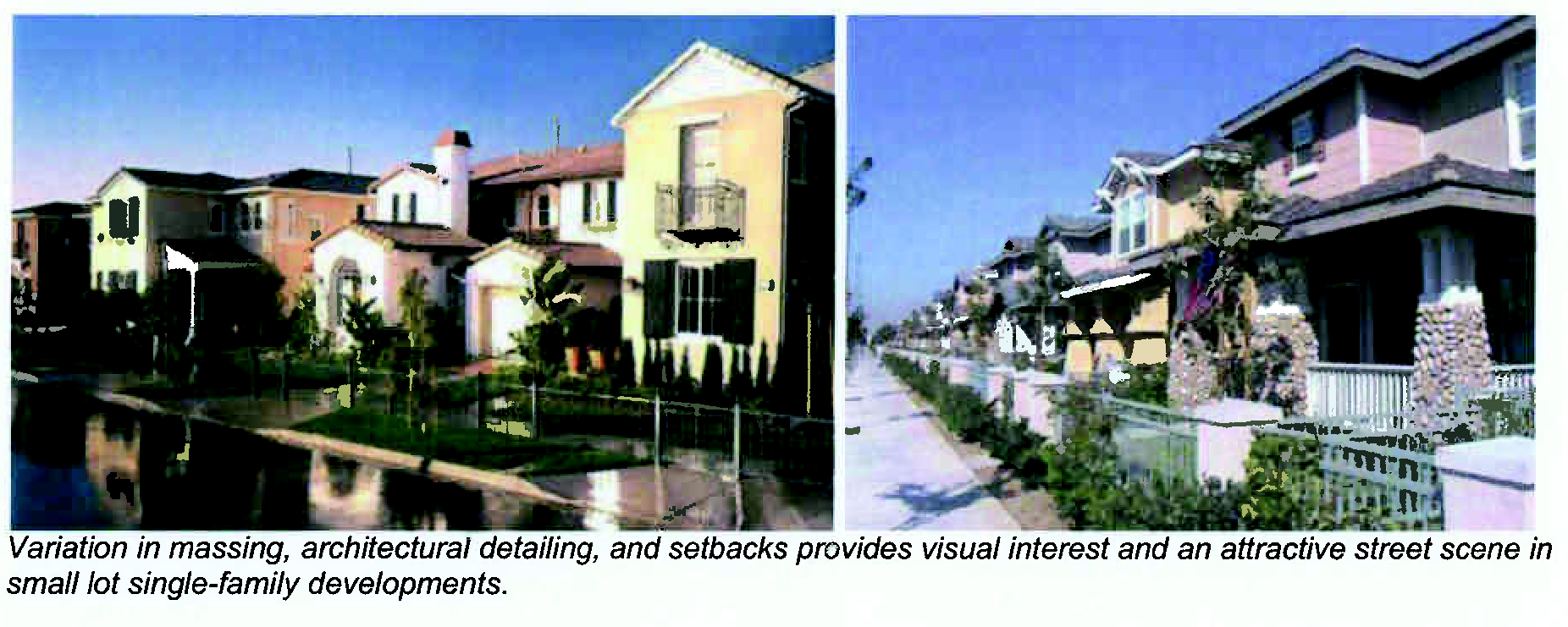
(Ord. No. 2011-10, § 3(Exh. A), 8-16-11)
16.16.155 - General provisions and administration.
All new multiple-family or multi-family developments constructed in the R3 designation shall provide and maintain design standards and guidelines in compliance with the provisions of this article. It is the duty of the development services department to enforce all permitting and entitlement provisions of this article. The director or his/her designee may impose such conditions deemed necessary to achieve the purpose of this article.
The City of Hesperia's Multifamily and Mixed-Use Objective Design Standards is incorporated by reference into this chapter. The Multifamily and Mixed-Use Objective Design Standards shall be treated as if contained within the City's Zoning Ordinance.
All new multi-family developments and mixed-use developments shall provide and maintain design standards and guidelines in compliance with the provisions of this article. The Objective Design Standards apply to all new construction projects that meet the following criteria:
1.
Multi-family residential projects consisting of three or more dwelling units. including detached and attached condominiums.
2.
Mixed-use projects. A project featuring a combination of multi-family units and compatible commercial uses. either arranged vertically within the same building or horizontally in separate buildings on the same site. Mixed-use projects may also consist of separate buildings or structures on the same parcel, provided that there are clearly defined pedestrian connections that integrate and unify the overall development.
If an applicant so chooses. they may request in writing to opt out of the City's Multi-family and Mixed-Use Objective Design Standards in lieu of their project being reviewed against the design standards and guidelines listed below.
(Ord. No. 2011-10, § 3(Exh. A), 8-16-11; Ord. No. 2025-06, § 3(Exh. A), 11-4-25)
16.16.160 - Architectural design standards and guidelines.
While there is no specific architectural style required for buildings in the multiple-family residence (R3) designation, high quality, innovative architecture is strongly encouraged. The primary focus is to develop a high quality residential environment. The architectural style and design of building elements should be consistent within the development and complementary with the neighborhood in terms of scale, materials, and color, but it does not need to copy or duplicate existing buildings. Variation of building styles produces healthy design diversity and is encouraged. New projects should meet or exceed the standards of quality that have been set by surrounding development and contribute to the improvement of the area. Refer to the Citywide Objective Design Standards for specific multiple-family residential design standards.
A.
Building Articulation and Detailing.
1.
Individual units should be articulated to diminish the massing of large buildings and be compatible with the scale of surrounding development. Building design shall avoid large monotonous facades, long straight line building fronts, plain box shapes, and barren exterior treatment.
2.
Avoid designing buildings that are longer than one hundred twenty-five (125) feet. Facades of multi-family buildings should be divided into shorter modules a maximum of thirty (30) feet in width to give the appearance of an assemblage of smaller buildings, with each of the units individually recognizable. This can be accomplished through the use of porches, balconies and architectural projections; varied unit setbacks within the same building; staggered or jogged building planes; and a mix of different unit types within the same unit cluster. Units can be further articulated by the rhythm and pattern of windows and doors. The use of mansard roofs or segments of pitched roof applied at building's edge is not an acceptable method to provide articulation.
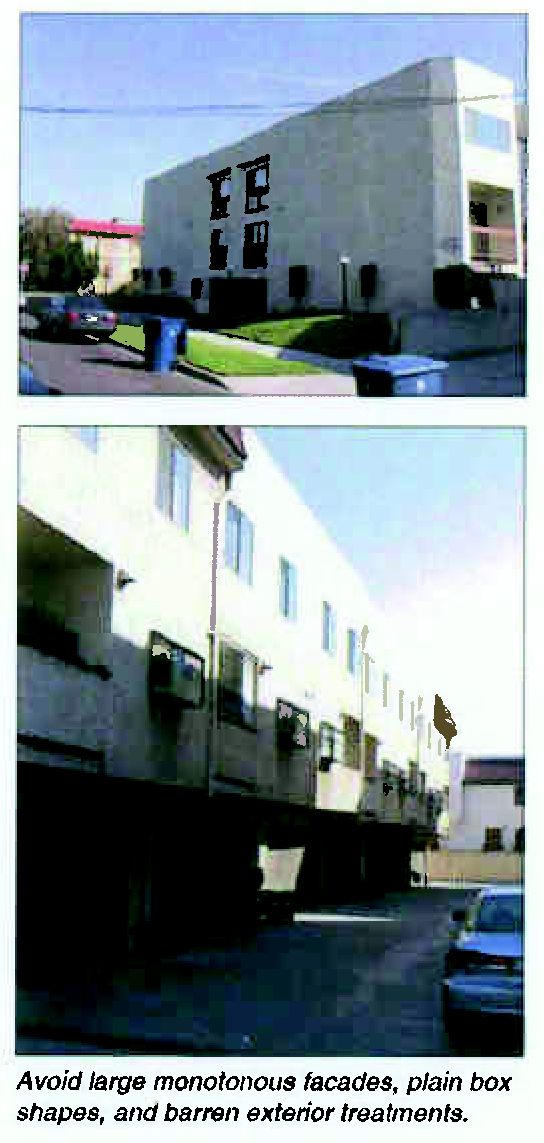
3.
When located adjacent to lower-density residential zones, the bulk of multi-family developments can be imposing on adjacent residential uses. This necessitates that the scale of projects be considered within the context of their surroundings. Buildings of greater height may require additional setbacks so as not to dominate the character of the neighborhood. Buildings of greater mass should be separated into smaller, units that better resemble single-family homes.
4.
For projects that front arterial streets, the street floor building level should be raised between two and four feet to protect the privacy of ground floor units.
5.
Distinctive architectural elements, materials and colors should be used to denote primary building entries or individual unit entries.
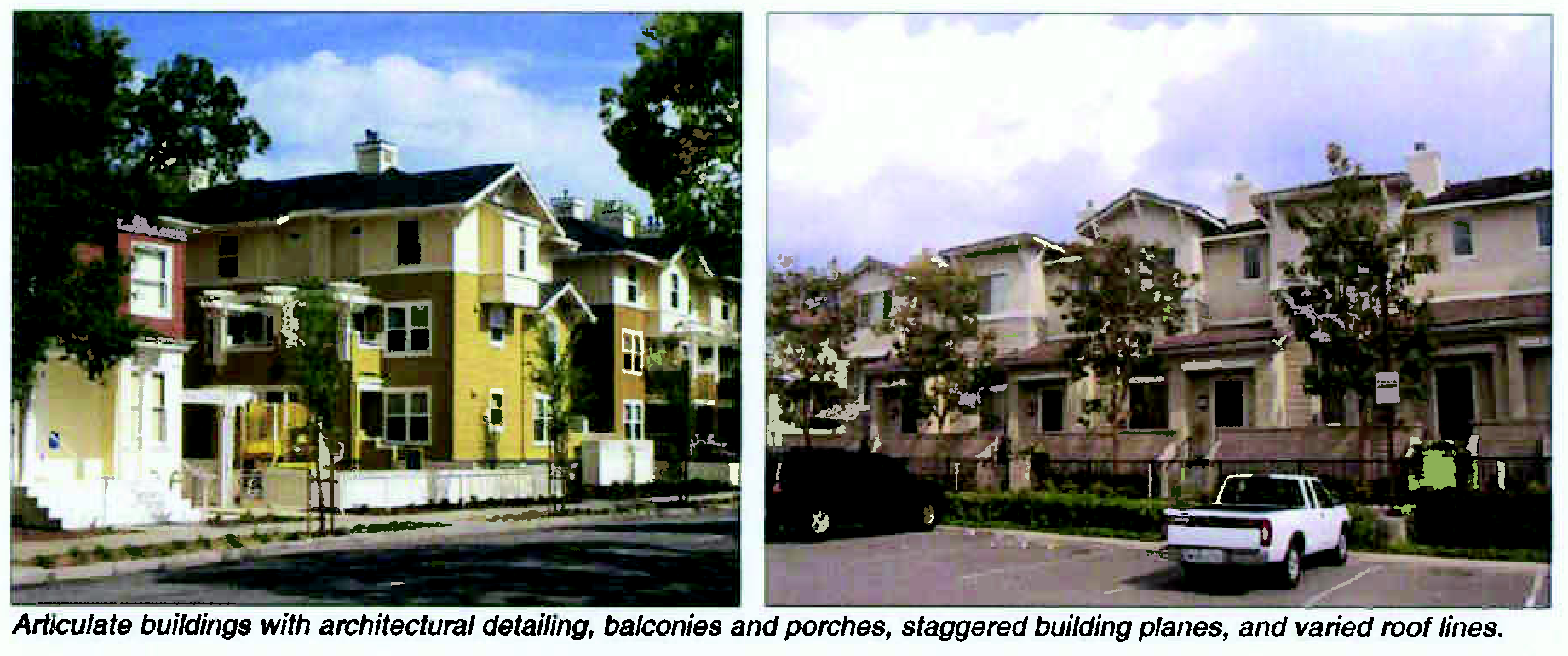
6.
Awnings, moldings, pilasters and comparable architectural embellishments are encouraged.
7.
The incorporation of balconies, porches and patios within multi-family buildings is encouraged to break up large wall masses, provide offsets between floors on multi-level buildings, and add human scale to buildings.
8.
Exterior stairways should be designed as an integral part of the architecture of a project and should incorporate solid wall portions, columns, and/or a decorative balustrade. They should be of the same materials, color and detail of the building. Thin-looking, open metal, prefabricated stairs shall not be used. Design of railings and steps should be varied from unit to unit if possible, but must maintain continuity.
B.
Height and Roof Lines.
1.
Roof lines should be segmented and varied within an overall horizontal context. Varying heights are encouraged. Combinations of one, one and a half, and two-story units create variation and visual interest, and are encouraged. Flat roof design should be avoided.
2.
In some cases, it may be desirable to "step back" the upper stories of new multi-family buildings to "scale down" facades that face the street, common space, and adjacent residential buildings.
3.
Hipped or gabled roofs covering the entire building are preferable to mansard roofs and segments of pitched roofs applied at the building's edge.
4.
The roof pitch for a porch may be slightly lower than that of the main building.
5.
Carport roofs visible from buildings or streets should incorporate roof slope and materials to match adjacent buildings. Flat carport roofs are discouraged.
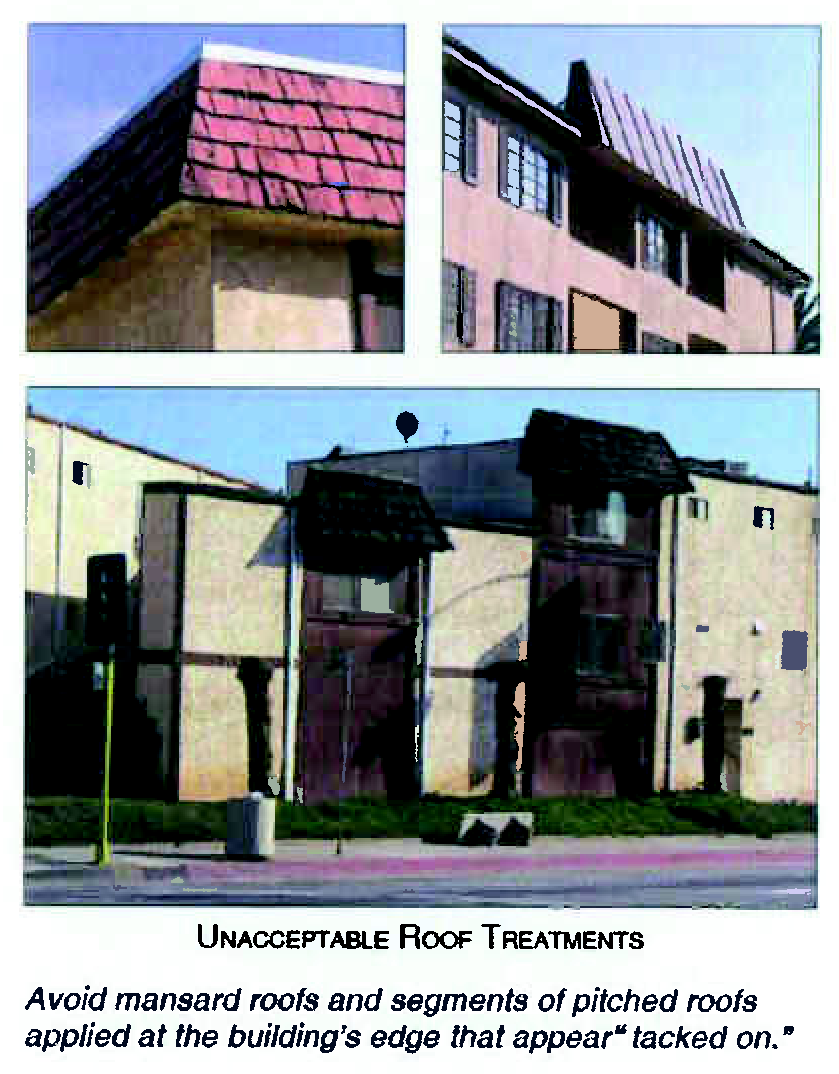
C.
Doors and Windows.
1.
The placement and relationship of doors and windows is important in creating a unified building composition. Wherever possible, window sizes should be coordinated vertically and horizontally and window design should be consistent in terms of style and general arrangement on all building sides.
2.
All doors and windows should be related with the chosen architectural style. Windows with widely varying styles are strongly discouraged. All doors and window frames should be composed of consistent material.
3.
For new multi-family developments, double glazing should be used consistent with energy code requirements.
4.
Knockers or door bells should be provided on doors. Entrance doors should provide viewers for safety and security.
5.
Shutters, trim and moldings on windows are encouraged. Proposed window mullion widths, window trim or surrounds, material, and type should complement all existing windows. Mullion widths should be in scale with the windows and the building. Wider trim sizes, such as 1 × 4's and 1 × 6's, is preferred to narrower trim sizes, such as 1 × 2's.
6.
Raw or clear anodized aluminum window frames are strongly discouraged.
7.
Operable windows should have screens so they can be used for ventilation.
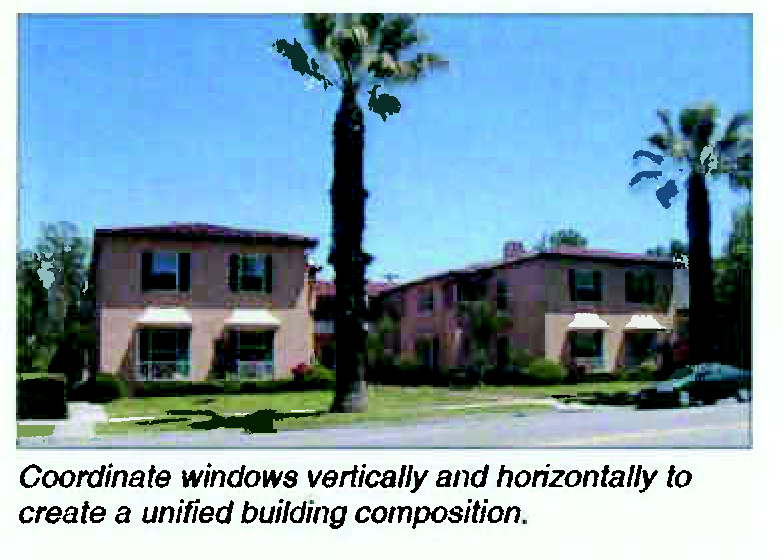
D.
Materials and Finishes.
1.
The building and its elements should be unified by textures, colors and materials. Materials should be consistently applied and should be chosen to work harmoniously with adjacent materials. Piecemeal embellishment and frequent changes in materials should be avoided.
2.
Building should be treated as a whole and finished appropriately on all sides to provide continuity. Materials tend to appear substantial and integral to the building when material changes occur at changes in plane. Material changes not accompanied by changes in plane appear "tacked-on" and are strongly discouraged.
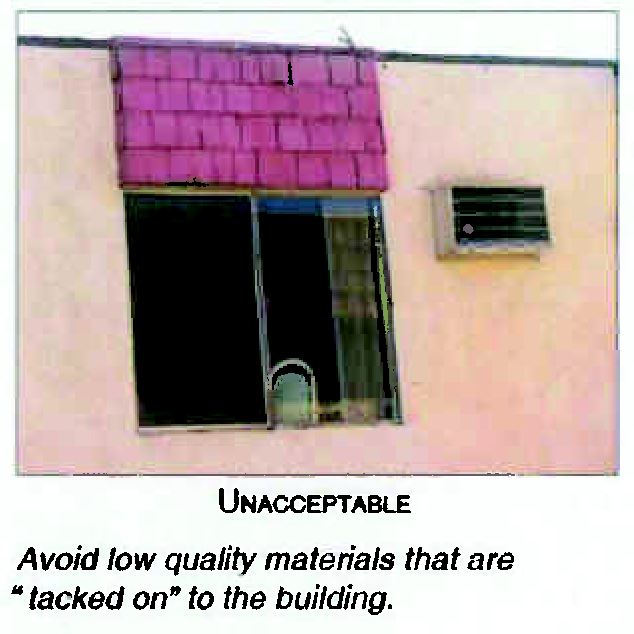
3.
Exterior columns for trellises, porches or colonnades should utilize materials and colors that are compatible with the adjacent building.
4.
Exposed gutters and downspouts should be colored to match fascia or wall materials, unless designed as an outstanding architectural feature of the overall theme.
5.
Accessory and service buildings/structures, such as carports, detached garages, recreational buildings, laundry facilities, and storage buildings/structures, should be designed as an integral part of the project architecture and should be similar in material, color, and detail to the primary buildings.
6.
Building materials should be high quality, durable, and require low maintenance.
7.
Materials that are responsive to climate, i.e. those suitable to the High Desert environment, adjacent context and site orientation are encouraged. Natural materials are encouraged. Materials such as brick, stone, copper, etc. should be left in their natural colors. Synthetic materials made to simulate natural wood and masonry are discouraged. Other suitable materials include textured concrete, trowel-finish concrete, metal cladding, and glass curtain or glass block walls.
8.
Stucco and plaster finishes should be consistent with the architectural style of the building. A smooth trowel or fine sand float finish is desirable while the use of rough, "knock-down" stucco finishes is discouraged.
9.
The use of sustainable building materials is strongly encouraged. This includes using quality materials with a long lifespan, selecting materials that are not energy-intensive to manufacture, using building products made from recycled materials, and repairing and maintaining well-built existing buildings/structures to the fullest extent possible.
E.
Color and Texture.
1.
For most architectural styles, the number of colors on the exterior should be limited to a maximum of three, with an additional contrasting color for accent. In general, the lighter colors should be used for the main body, with darker shades for trim and accent. The larger and simpler the building design, the more subtle the color should be to reduce the massiveness of large wall planes.
2.
Earth tones are best suited and are appropriate for most of the architectural designs found in the city. The use of strong or bright, unnatural colors, including the bright "white-on-white" color schemes for exterior stucco, wood siding, trim doors and shutters, should be avoided. However, the use of strongly contrasting, natural colors can be appropriate for accent use, such as for shutters and doors.
3.
Color and finishes on exterior of all elevations of a building should be coordinated to provide a total continuity of design. Unusual patterns and color schemes should be avoided. Garish, non-harmonious, or out-of-character colors should not be used.
4.
The blending of compatible colors in a single facade or composition is a good way to add character and variety, while reducing, or breaking up the mass of a building. Lower wall wainscots and built-up or recessed reveals may be employed to add interest and break up vertical monotony.
5.
Details such as trim, shutters, posts, etc. should be articulated by the use of color, texture or both.
F.
Roofing Materials.
1.
Roofing materials should be compatible with the architectural style and design of the building. Permanent roof materials, such as concrete and clay tile, are encouraged because of their low maintenance and consistent appearance over time. Asphalt shingle roof is not allowed.
2.
Natural barrel clay tile roofs should be replaced with the same material. For repairs, remodels, and additions, care should be taken in the selection of material and installation to match as closely as possible the color of the "aged" tiles, so that the finished roof does not have a patched look.
3.
The colors of natural roofing materials, such as barrel tile and slate should be left natural and not be altered by staining or painting. Colors of synthetic roofing materials should simulate natural materials and should be consistent with the architectural style of the project.
4.
Roofing materials with glossy surfaces appear unnatural and are strongly discouraged.
G.
Noise Impacts.
1.
Units within the project should be adequately insulated to protect residents from noise intrusion from adjoining units. In addition to insulation between common walls, vertical insulation on exterior walls and from floor-to-floor should be provided.
2.
Loading docks, service entries, mechanical equipment and recreational play areas should be sited as far away from adjoining single-family properties as reasonably possible.
3.
Projects adjacent to major arterials or railroad tracks should incorporate additional noise mitigation measures to protect residents. Mitigation measures include, but are not limited to, double-glazed windows, sound walls, and earth berms.
(Ord. No. 2011-10, § 3(Exh. A), 8-16-11; Ord. No. 2025-06, § 3(Exh. A), 11-4-25)
16.16.165 - Site design standards and guidelines.
Multiple-family or multi-family developments are characterized by higher density residential buildings comprised of attached units and common facilities such as parking, open space and recreation areas. If not properly designed, multi-family development can result in projects surrounded by high walls, projects with monotonous blank facades, or projects dominated by large parking areas with minimal landscaping and open space areas. The primary goal of these guidelines is to help mitigate the effects of these situations and to provide a pleasant residential environment within multi-family developments. New projects should meet or exceed the standards of quality set by surrounding development and contribute to improvement of the area. Refer to the Citywide Objective Design standards for specific multi-family site design standards.
A.
Setbacks.
1.
While respecting the minimum front and side yard setbacks as established in Article V (Residential Development Standards) of this development code, the front and side yard setbacks of a new multi-family residential development should generally approximate that of adjacent development, with some variation in setbacks to provide visual interest and varying shadow patterns.
2.
The setback area should be used for planting landscape screens to protect the privacy of the ground floor units.
B.
Building Orientation, Siting and Entrances.
1.
Multi-family developments should have a strong street presence with public entrances oriented towards the street. The majority of unit entrances must be accessed from the street or from the main open space. Where there is a common building entrance for all units, it should be accessed from the street or main open space.
2.
Multi-family units in large projects should be clustered, or broken up into groups of buildings. The use of long access balconies and corridors should be avoided. Access points to individual units in large projects should be clustered in groups of four or less.
3.
The use of distinctive architectural elements and materials to denote entrances is encouraged. Weather protection, such as a porch covering or canopy, should be provided for individual entry doors.
4.
New projects shall have transitional spaces in the form of stoops, overhangs and porches between public areas and entrances to the units. Front porches are encouraged on all street front units.
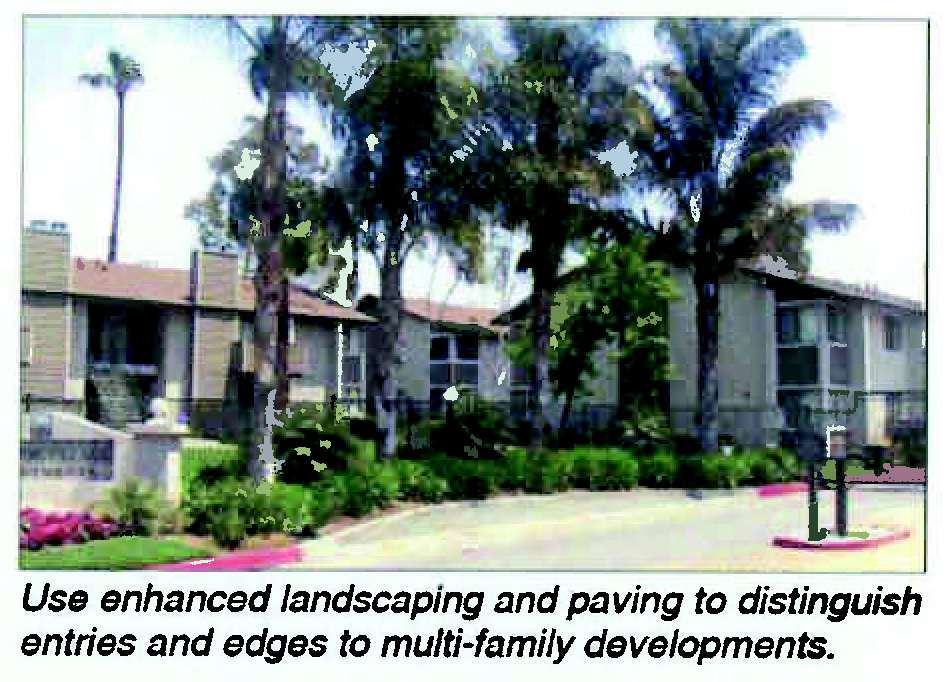
5.
Multi-family developments should be distinguished by entry and edge design features such as ornamental landscaping, open space areas, natural features, architectural monumentation and enhanced paving.
6.
Multi-family residential uses should be buffered from incompatible development. Intensified landscaping, increased setbacks and appropriate building orientation should be utilized as a means of providing adequate separation between such land uses. In addition, where possible, residential projects should utilize parking areas, in addition to landscaping, as a buffer along edges common with commercial or industrial uses.
C.
Buildings Fronting Arterial Streets.
1.
Some multi-family developments within the city will be located on shallow lots along major arterial streets. These streets will need to be taken into account in the project design. The perceived front yard will be created by parkways and street trees, together with landscaped setbacks, and should be considered in providing appropriate buffer for the street facing units from traffic.
2.
Raising the ground floor level by up to three feet can provide additional privacy and noise buffer for street-facing ground floor units. Another means is to provide transitional spaces in the form of raised stoops and entry porches.
3.
Additional landscaping with taller shrubs and groundcover in the front setbacks will also contribute to the privacy and sound-buffering objective for these units.
D.
Scale and Mass.
1.
The scale and mass of a new multi-family residential development should be consistent with neighboring developments and not overwhelm them with disproportionate size or a design that is out of character.
2.
Larger multi-family projects should avoid massive apartment-type buildings. Windows shall be provided facing the street for all units adjacent to the street to break up massing and to contribute to "eyes on the street" which helps neighborhood security.
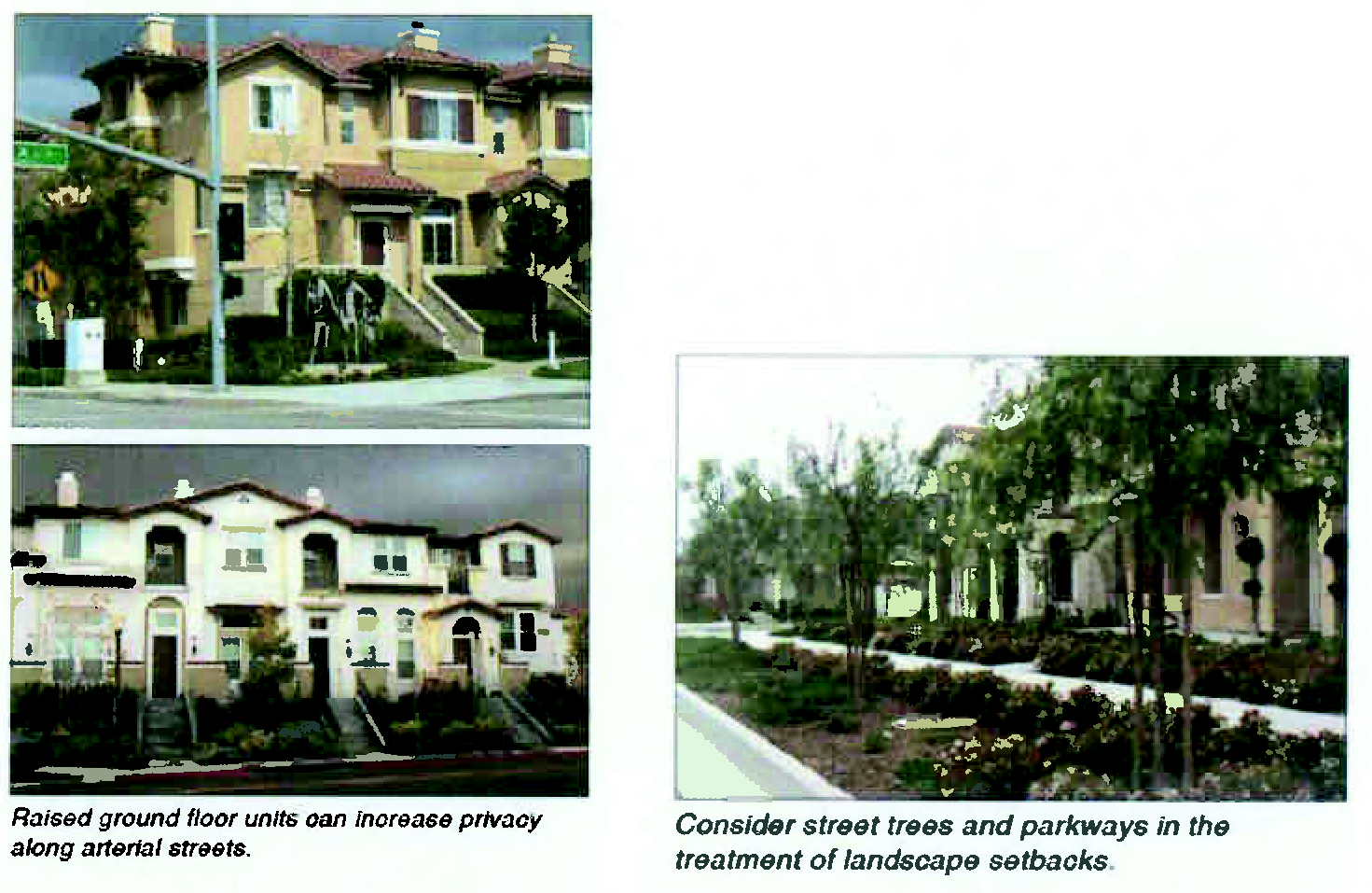
3.
Heights of individual buildings should be varied to reduce building mass by using a combination of single-level and two-story units, as well as varying the roof pitch within a project.
4.
As the vertical height of a building increase, it should increasingly step back from the street (i.e. when possible, the second story of a building should be set back further than the first floor).
5.
Buildings located on properties directly adjacent to a residential and agricultural designated properties shall be designed to provide a transition between the two designations; i.e. the units directly adjacent to the street should be of a single story design if the adjacent residential neighborhood is developed primarily with single-story homes.
E.
Environmental Considerations.
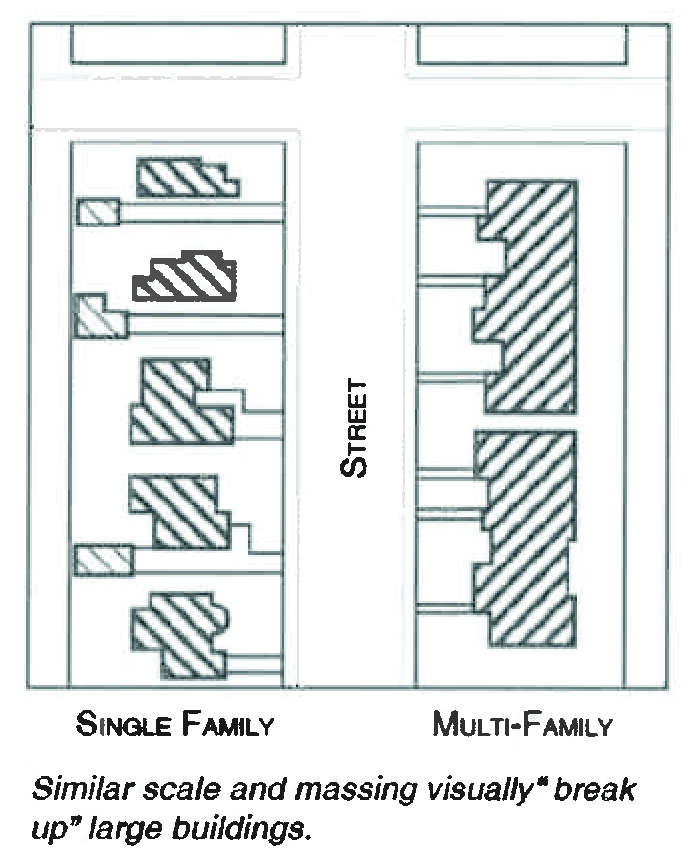
1.
To the extent possible, site grading should relate to the natural surroundings and be designed to minimize grading by following the natural ground contours and recognizing existing drainage patterns. Graded slopes should be rounded to blend with existing terrain.
2.
Multi-family developments should be designed to be sensitive to their natural surroundings and should be sited to maximize views of the High Desert and surrounding mountains, particularly from common and private open space areas.
3.
Significant existing trees, vegetation and any other natural site attributes should be preserved to the greatest extent possible in the project's design and development. Site design that requires altering land forms and removing trees is strongly discouraged.
4.
A new multi-family development should be designed to make best use of available sun, light and shade. This can be accomplished in the following ways:
a.
Use windows for natural light as much as possible. Design windows for through airflow to promote natural cooling.
b.
Use trees or roofs with large overhangs to shade the units, particularly over south facing windows.
c.
Use patios and porches to buffer the units from heat gain.
d.
Locate private and common open space in a manner to maximize use of sun and shade patterns, natural drainage and existing trees and vegetation.
5.
Maximize vegetative ground cover on the lot to absorb rainwater, provide drainage to large trees on the site, and reduce runoff. Extensive paving is strongly discouraged. Consideration should be given to the reduction of landscape maintenance and water consumption when selecting landscape materials.
F.
Privacy Between Buildings.
1.
Buildings should be oriented to promote privacy to the greatest extent possible.
2.
Windows, balconies or similar openings above the first story should be oriented so as not to have a direct line-of-sight into adjacent units within the development. In addition, units above the first story should be designed so that they do not look directly onto private patios or backyards of adjoining residential property or units.
3.
Landscaping should be used to aid in privacy screening.
4.
Outdoor lighting should be positioned so that no direct light extends onto neighboring properties.
G.
Vehicle Circulation and Access.
1.
Site access and internal circulation in multi-family developments should promote safety, efficiency, and convenience. Vehicular traffic should be adequately separated from pedestrian circulation. Vehicular entrances should be clearly identified and easily accessible to minimize pedestrian/vehicle conflict.
2.
Principal vehicular access into multi-family developments should be through an entry drive rather than a parking aisle.
3.
The number of site access points or driveway aprons shall be minimized for aesthetic purposes, to achieve efficient and productive use of paved accessways, and to eliminate traffic hazards. They should be located as far as possible from street intersections (a minimum distance of one hundred (100) feet is recommended) and should be coordinated with existing or planned median openings and driveways on the opposite side of the roadway. Common driveways that provide vehicular access to more than one site are encouraged.
4.
When possible, and especially for properties containing more than one hundred fifty (150) feet of street frontage, landscaped islands shall be incorporated into the driveway entry area to separate driveway lanes for ingress and egress. Continuous driveways, uninterrupted by landscaping are not permitted.
5.
Continuous circulation should be provided throughout the site to the greatest extent possible. Dead-end driveways should be minimized. Adequate areas for maneuvering, stacking, and emergency vehicle access should be provided.
6.
Project entries and driveway areas should contain design features, including landscaping and textured paving, to break up the expanse of paving in a project. Paving materials should complement the architectural design. The use of stamped concrete, stone, brick, pavers, exposed aggregate or color concrete is encouraged. Long, uninterrupted broom finished concrete should be avoided. The use of asphalt for driveways and walkways is prohibited.
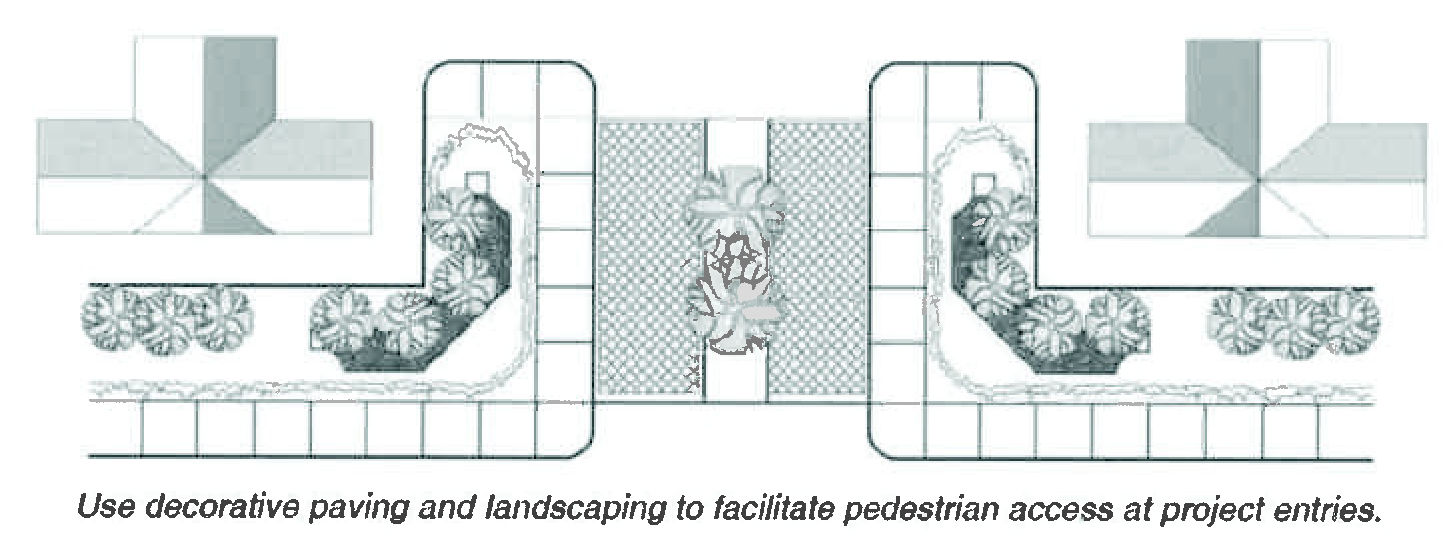
7.
Alley improvements should coincide with site planning to minimize alleyway deterioration and address problems such as debris, safety, and any nuisance odors or hazards.
H.
Pedestrian Circulation.
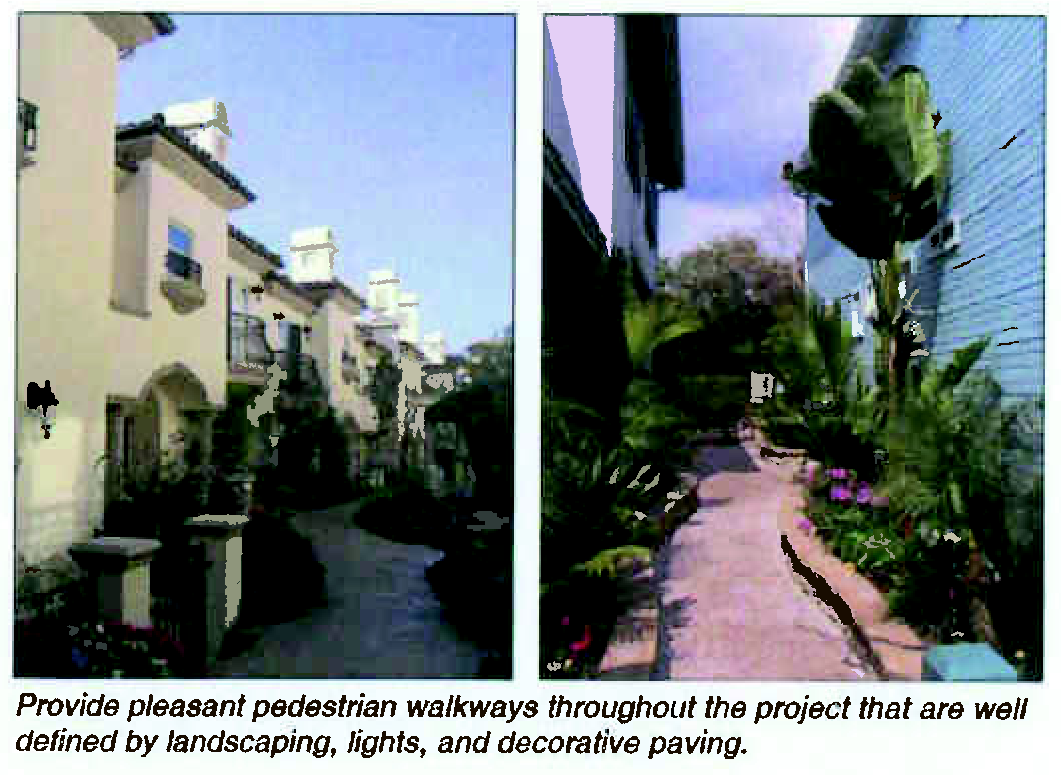
1.
Multiple-family developments shall include pedestrian walkways. Pedestrian circulation should be adequately separated from vehicular traffic. Pedestrian entrances and walkways should be clearly identified and easily accessible to minimize pedestrian/vehicle conflict.
2.
Pedestrian walkways should link dwelling units with common open space and recreation areas, parking areas, and the street at the project entries. Where possible, multi-family developments should incorporate pedestrian connections to adjoining residential and commercial projects, and other compatible land use facilities.
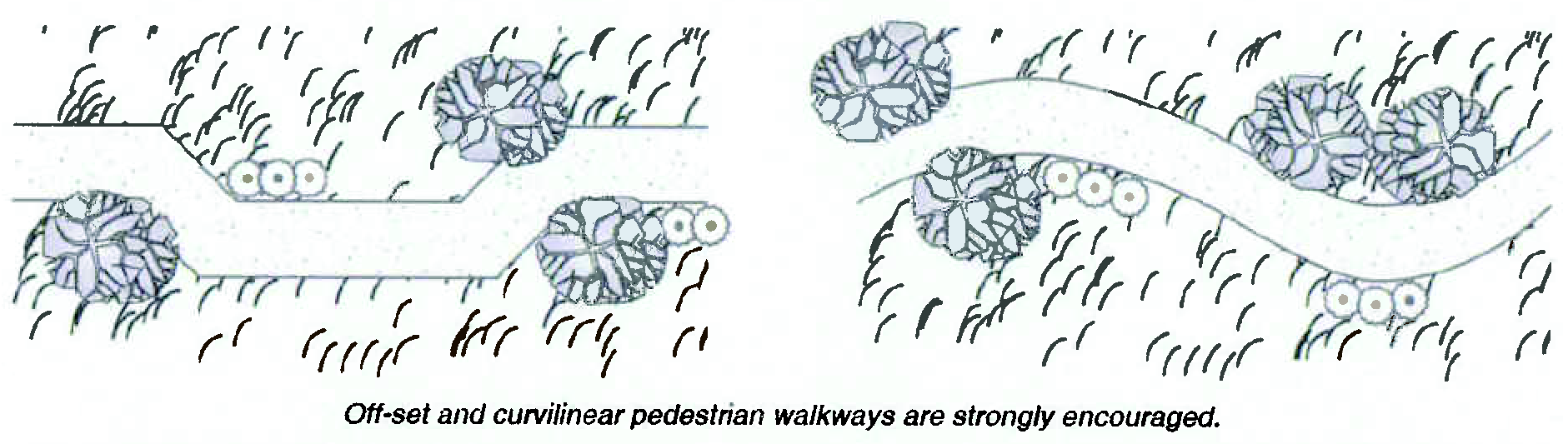
3.
Pedestrian walkways should be safe, visually attractive, and well defined by landscaping and lights. Use of varied surfaces and decorative pavement is encouraged. At a minimum, decorative paving should be used to delineate crossings at circulation drives and parking aisles.
4.
Curvilinear and off-set paths provide a more inviting and interesting experience and are generally preferred over long, straight alignments. Paths that traverse open space areas are encouraged.
5.
Pedestrian walkways should be a minimum of four feet in width. If combined with a bicycle path, as a part of a dedicated public path/paseo, the minimum total walkway width shall be fourteen (14) feet.
6.
Pedestrian access to the first floor units should be via traditional residential front doors. Entry walks from the sidewalk to the front door should reflect the residential character of the project. The width of entry walks should not exceed five feet.
7.
Transit shelters should be provided near major concentrations of residents. As far as feasible, where a transit stop is planned adjacent to a project of at least five acres in size, the developer should coordinate with the transit district to determine a suitable location for a transit shelter onsite. Freestanding shelters should be integrated architecturally with the project with respect to color, materials and architectural style to the extent allowed by the transit provider.
I.
Parking.
1.
Parking for multi-family developments shall be provided on site in on-grade or underground structures, parking courts, carports, or attached garages. Adverse visual impacts from parking areas, carports, structures, and garage doors on the residential character of the street or project site should be minimized through proper siting and design.
2.
Parking shall be located within close proximity to the building and located to the rear of the parcel wherever possible. Parking shall be designed to avoid awkward turning maneuvers and the backing of vehicles into public streets.
3.
Pedestrian walkways should be safe, visually attractive, and well defined by landscaping and lights. Use of varied surfaces and decorative pavement is encouraged. At a minimum, decorative paving should be used to delineate crossings at circulation drives and parking aisles.
4.
Curvilinear and off-set paths provide a more inviting and interesting experience and are generally preferred over long, straight alignments. Paths that traverse open space areas are encouraged.
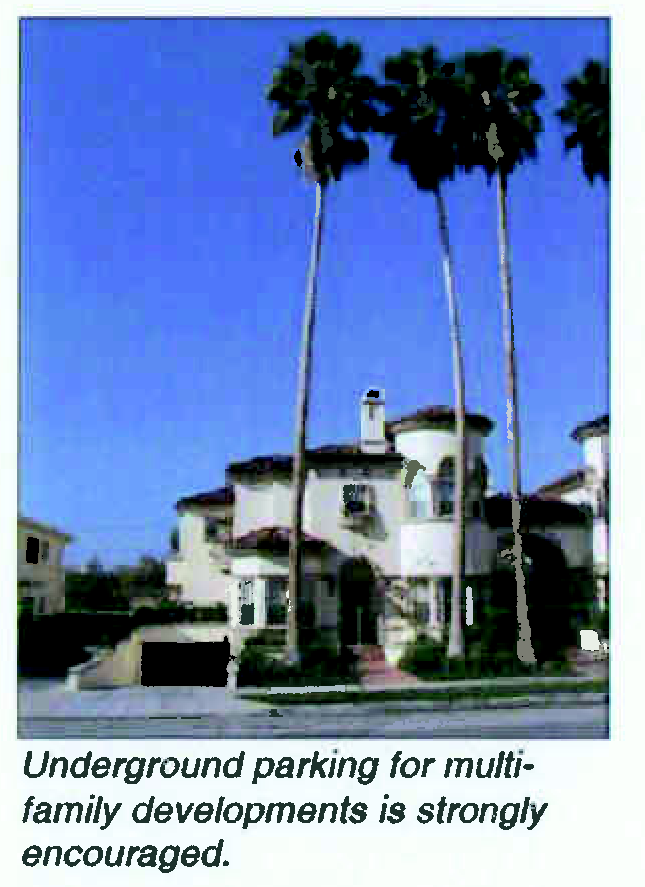
5.
Parking should not occupy more than thirty (30) percent of any linear street frontage and parking in the front setback areas is discouraged.
6.
Except for townhome projects with attached garages, all multi-family parking should be in efficient, multiple stall configurations. Large multi-family parking areas should be divided into a series of connected smaller parking courts. Long runs of parking spaces are discouraged.
7.
Parking courts should be treated as important spaces whose character is clearly defined by landscaping, lighting, building massing, and pedestrian/vehicular circulation areas. Parking courts should be separated from buildings by a walkway (minimum four feet wide) and landscape strip (minimum seven feet wide).
8.
Carport structures should be architecturally compatible with the design of the main building in the project. Pitched roofs for carports are strongly encouraged. Flat aluminum carport structures are prohibited, particularly in long interrupted runs. Carports shall meet setback and building separation requirements.
9.
If tuck-under parking is provided, the first floor of the residential units shall not occur more than four feet above the finished street/sidewalk grade level. Parking may need to be below grade or occur behind the living spaces. These parking areas shall not be visible from the street.
10.
The visual impact of parking courts, carports, and parking structures shall be mitigated with landscaping. Landscaping materials should have adequate room to grow and be protected from abuse by cars. Continuous six-inch concrete curbs shall be provided as wheel stops where parking adjoins landscaping.
11.
Parking areas, driveways and pedestrian areas shall contain automatically controlled lighting.
12.
Bicycle parking shall be provided for multi-family developments.
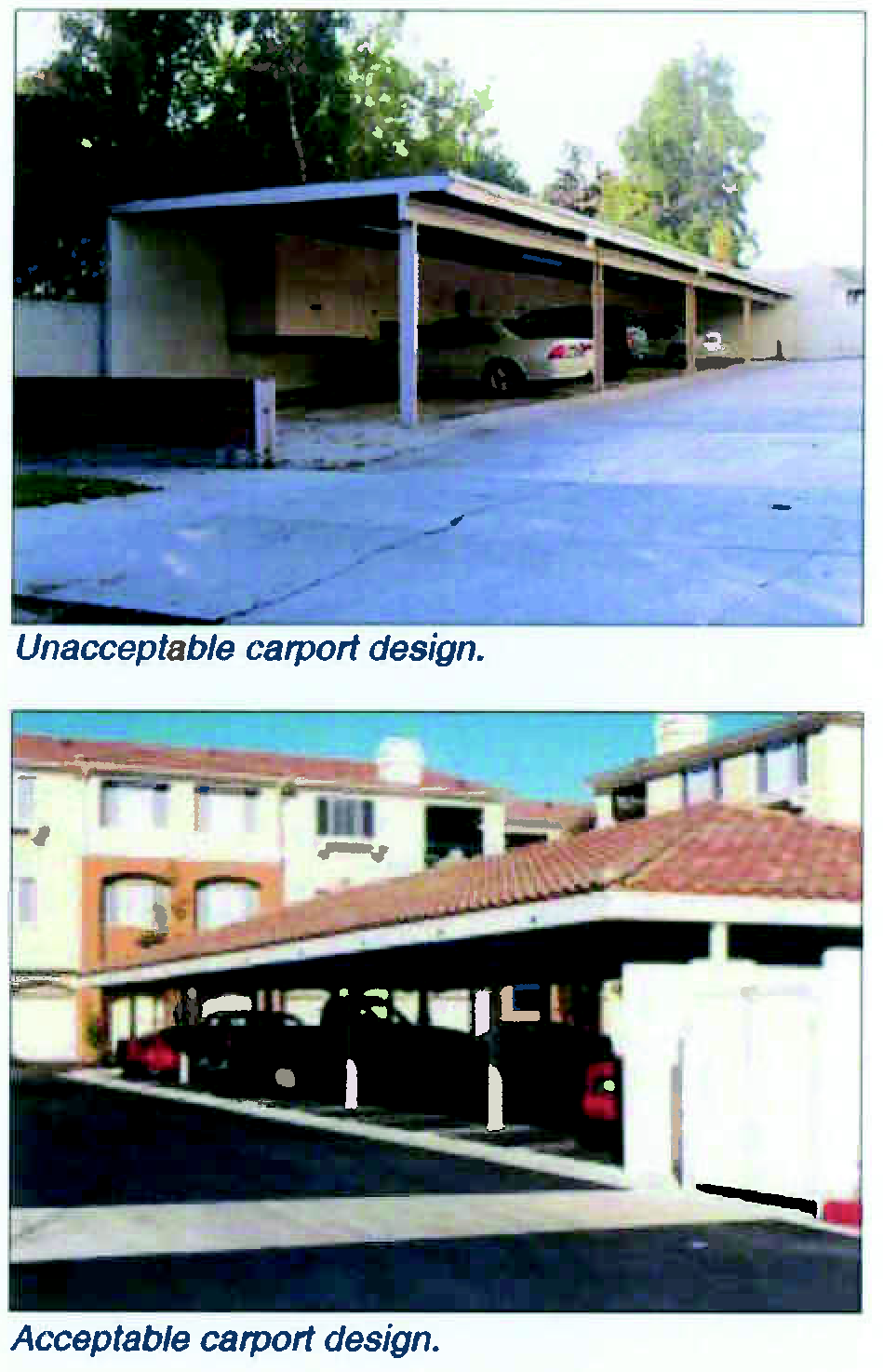
J.
Open Space.
1.
Residents of multi-family developments should have safe and efficient access to usable open space for recreation and social activities. The design and orientation of these areas should take advantage of available sunlight and should be sheltered from the noise and traffic of adjacent streets or other incompatible uses.
2.
Open space areas should be provided in large meaningful and usable areas, pursuant to the requirements of Article V of this development code.
3.
Common open space areas should be convenient to the majority of dwellings and should be secure and visible from dwellings to ensure safe use. Common open space areas should contain amenities appropriate to the project's size; i.e. pools, spas, recreation buildings are encouraged for large projects, while barbecue areas and gazebos, may be more appropriate for smaller projects. Children's play areas shall be sited to be visible from residential units.
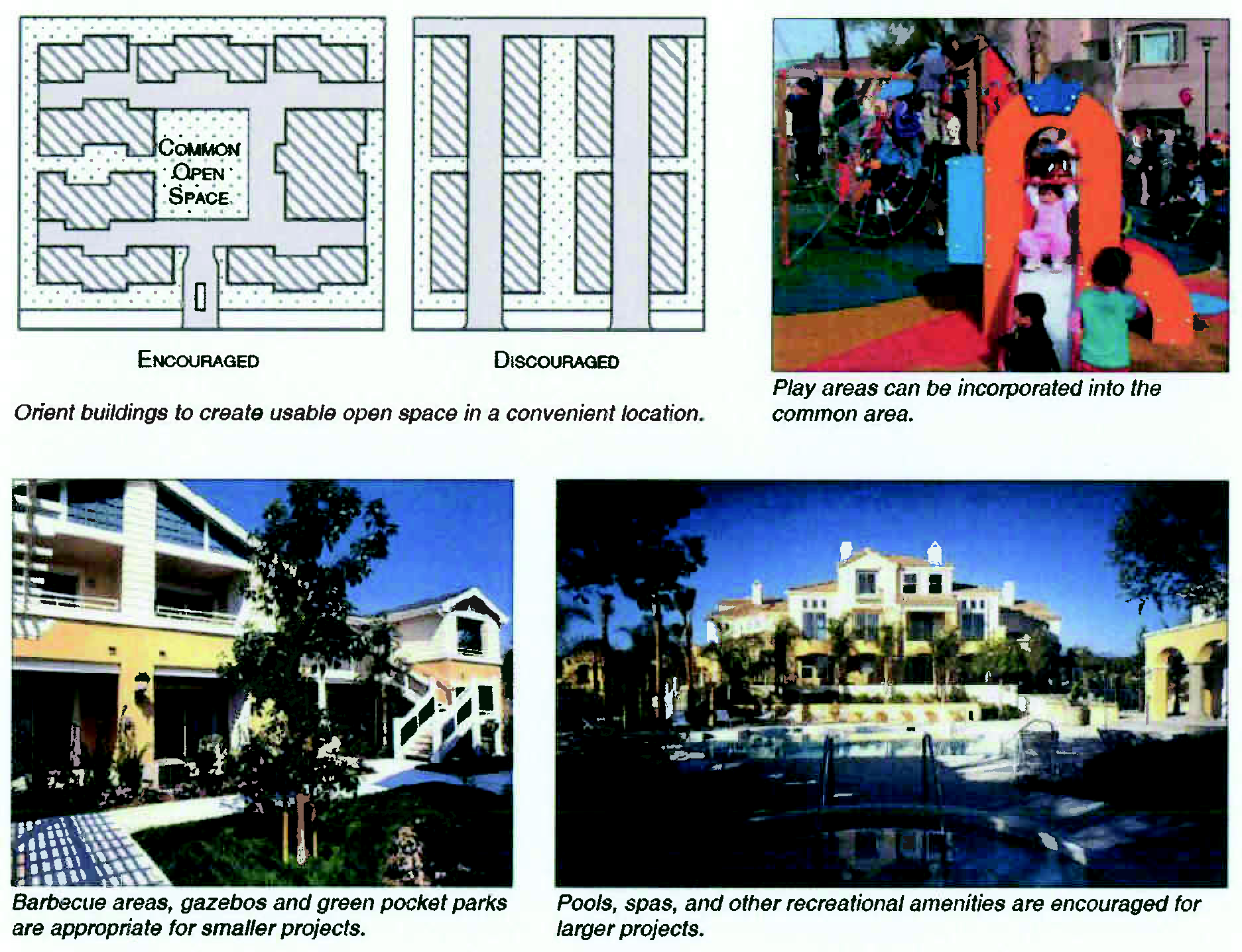
4.
Private open space should be contiguous to the unit they serve and should be screened from public view for privacy. All balconies and patios that front a public street should be substantially enclosed to screen items being stored on the balcony or patio.
K.
Fences, Walls, Gates and Hedges.
1.
Walls and fences should be planned and designed as an integral part of multi-family development, and should be consistent with the landscaping and building design.
2.
If street fencing is required for security reasons, decorative types of view fencing, such as wrought iron, are encouraged. Solid fencing, such as stucco or masonry, is strongly discouraged when they will block the view of the buildings or provide hiding places.
3.
Perimeter walls or fencing that do not front a public street should be of decorative masonry (split-face block, plaster/stucco finish), decorative metal (wrought iron), wood, hedges, or a combination of materials. They should be designed in a style, material and color to complement the development. Both sides of walls should be architecturally treated.
4.
Tiered planting should be provided adjacent to project perimeter walls along street frontages to soften their appearance.
5.
Walls should be eliminated or sited to provide additional setback areas at project entries to accommodate landscaping, ornamental gateways, signage and street furniture.
6.
Wall sections greater than fifty (50) feet in length fronting a street shall incorporate at least two of the following design features, in proportion to the length of the wall:
a.
A minimum two-foot change in horizontal plane for at least ten feet.
b.
A minimum eighteen-inch change in height for at least ten feet.
c.
A minimum eighteen-inch high raised planter for at least half the length of the wall.
d.
Use of pilasters at twenty-five-foot maximum intervals and at changes in wall planes.
7.
Gates or comparable design solutions should be provided in perimeter walls or fences to allow emergency access and facilitate convenient pedestrian access to activity areas and adjacent uses.
8.
Walls should be curved or angled at corner locations along street frontages to allow sight line views around the corner.
9.
Barbed wire and chain link fencing are prohibited.
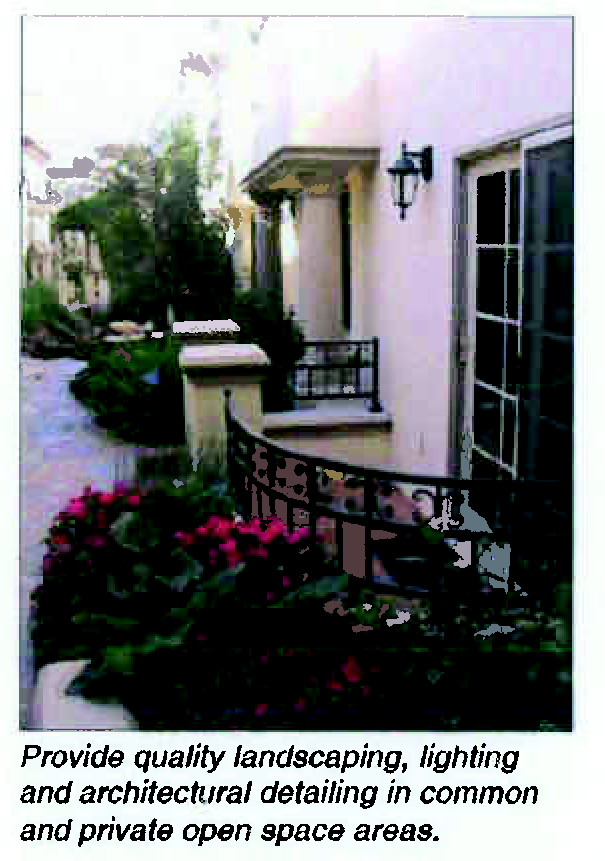
L.
Exterior Lighting.
1.
Every multi-family project shall have adequate lighting to provide for security and visibility. Site lighting should not be pervasive or impact surrounding or neighboring properties. The type and location of site and building lighting should preclude direct glare onto adjoining property, public rights-of-way, or skyward. All lighting fixtures must be shielded to confine light spread on-site and to prevent nighttime light pollution.
2.
The design of all exterior light fixtures shall be compatible with the building's architecture.
3.
Pedestrian scale/decorative lighting along walkways and driveways is strongly encouraged. "High mast" poles are discouraged. The maximum height of walkway lighting shall be fifteen (15) feet.
4.
Main entrances to parking areas or buildings should have strong architectural lighting, particularly for project name or addresses.
5.
Open spaces should be adequately lighted with durable low maintenance fixtures.
6.
The location of light fixtures should correspond to anticipated use. Lighting of pedestrian movement paths should illuminate changes in grade, path intersections, seating areas and any other uses along the movement path that, if left unlighted, would create an unsafe situation.
7.
Night lighting of buildings is encouraged, but should be accomplished in a selective manner, avoiding overall building illumination that produces an undesirable look. Night lighting of buildings may be used to highlight special building features, emphasize repeated or decorative features, and use the juxtaposition of light and shadow to articulate the building facade.
M.
Utility and Mechanical Equipment Screening.
1.
All exterior mechanical equipment, except solar collectors, whether on a roof, side of a building, or on the ground, shall be appropriately screened from public view. The method of screening shall be architecturally integrated with the primary building in terms of materials, color, shape and size. Where individual equipment is provided, a continuous screen is desirable.
2.
Roof mounted equipment should be avoided or appropriately concealed. For rooftop equipment, the screening materials shall be at least as high as the equipment being screened. Equipment requiring screening includes, but is not limited to, heating, air conditioning, refrigeration equipment, plumbing lines, ductwork, and transformers. Mechanical equipment shall not be permitted on any exposed portion of a pitched roof, except as may be approved through the site plan review process.
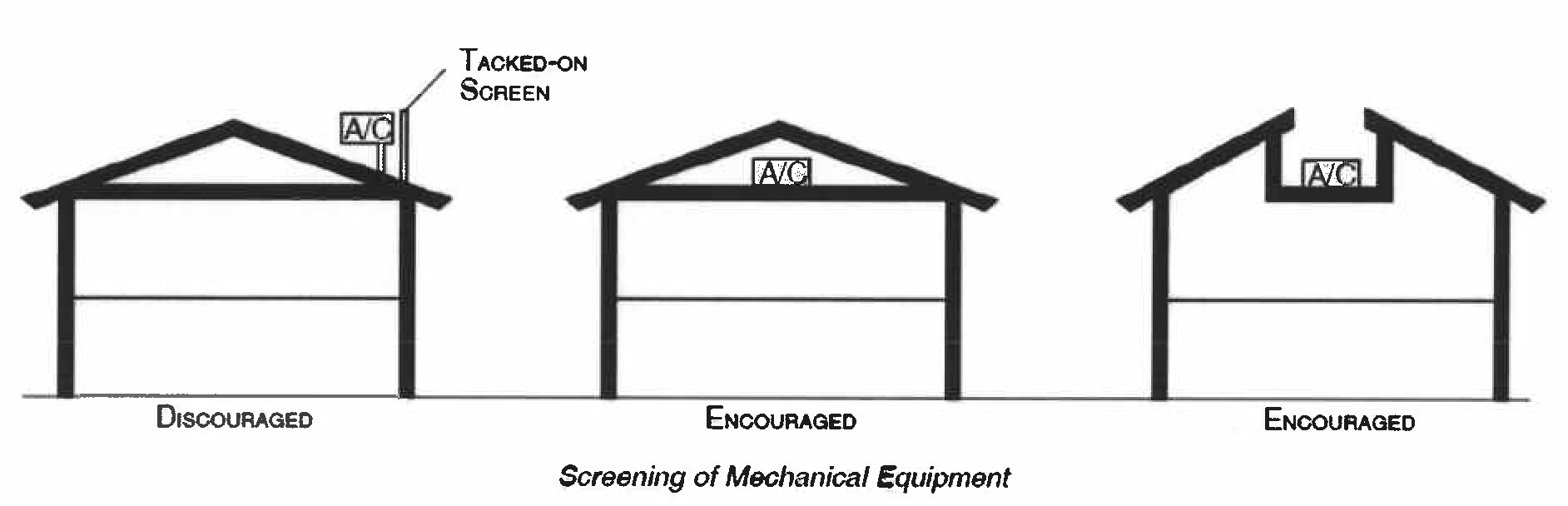
3.
Equipment should be placed in locations that are not exposed to view from the street or they should be suitably screened. Ground-mounted utility equipment such as, but not limited to, transformers, backflow devices, cable television boxes, electric power transformers and distribution facilities, water pumps, and telecommunications facilities (not including pole-mounted equipment) shall be screened from view on all sides with solid masonry walls or similar permanent buildings. Such masonry wall or building shall be of a neutral color. Screening with wood, chain-link, or similar fencing materials shall not be permitted. Electric and other metering equipment and panels shall be painted to match adjacent building and wall surfaces.
4.
All screening devices should be compatible with the architecture and color of the main building(s) and should not look like a "tacked on" addition.
5.
All antennas should be placed in building attics or interiors. All new units should be prewired to accommodate cable reception. Satellite dishes shall be located away from public view and should be considered early in the design process in terms of location and screening from view from the street and from common recreation areas.
N.
Refuse and Storage Areas.
1.
Decorative treatment of trash and storage enclosures shall be used to minimize the adverse visual impact of these areas. Trash disposal areas, including dumpsters, shall be screened from view by a six-foot high enclosure with gates. Trash and storage enclosures shall be architecturally compatible with theproject design, and landscaping shall be incorporated into their design to screen them and deter graffiti. Screening materials shall consist of fences, landscaping, and/or berming, and the use of natural terrain where possible.
2.
Trash enclosures should be located for the convenience of the residents and should be easily accessible for trash and recyclables collection, but should not impede circulation during loading operations. They should be designed to avoid areas that are dark or hidden from view of residents or neighbors.
(Ord. No. 2011-10, § 3(Exh. A), 8-16-11; Ord. No. 2025-06, § 3(Exh. A), 11-4-25)
16.16.170 - General provisions and administration.
Vertical and horizontal mixed-use projects are permitted in the General Commercial C2 zone.
Mixed-use projects. A project featuring a combination of multi-family units and compatible commercial uses, either arranged vertically within the same building or horizontally in separate buildings on the same site. Mixed-use projects may also consist of separate buildings or structures on the same parcel, provided that there are clearly defined pedestrian connections that integrate and unify the overall development.
(Ord. No. 2025-06, § 3(Exh. A), 11-4-25)
16.16.175 - Design guidelines for mixed-use projects.
The City of Hesperia's Multifamily and Mixed-Use Objective Design Standards is incorporated by reference into this chapter. The Multifamily and Mixed-Use Objective Design Standards shall be treated as if contained within the City's Zoning Ordinance. All new mixed-use developments shall provide and maintain design standards and guidelines in compliance with the provisions of this article.
(Ord. No. 2025-06, § 3(Exh. A), 11-4-25)
16.16.180 - Development standards for mixed-use projects.
Vertical mixed-use development (e.g., commercial and residential uses in a single structure) shall follow the development standards found in Section 16.16.350.
Horizontal mixed-use development (e.g., separate commercial and residential buildings on the same site) shall follow the commercial development standards found in Section 16.16.350 for commercial buildings, and the residential development standards in Section 16.16.120 for residential buildings, and consistent with R3 regulations.
In addition, the following development standards shall apply to vertical and horizontal mixed-use buildings in the General Commercial (C2) zone:
1.
The minimum living area for residential units in a mixed-use project shall be six hundred (600) square feet for a studio unit, with two-hundred (200) square feet for each additional bedroom.
2.
A maximum of thirty (30) percent of the residential units may be one bedroom or smaller.
3.
The entrances to residential uses shall be separate and distinct from commercial uses. These entrances shall be secured.
4.
Residential parking shall be secured and separated from public parking.
5.
Residential units shall have adequate sound insulation to protect occupants.
6.
Mixed-use developments shall be designed so that odors emanating from businesses on the ground floor do not impact the uses above.
7.
Refuse facilities shall be located and screened to minimize impacts from related odor and noise.
8.
Commercial loading facilities shall be located to minimize noise impacts and maintain access to residential areas.
Design standards and guidelines for vertically and horizontal mixed-use projects are provided in the The City of Hesperia's Multifamily and Mixed-Use Objective Design Standards.
(Ord. No. 2025-06, § 3(Exh. A), 11-4-25)
16.16.310 - Commercial and industrial land use designations.
A.
Purpose. This article lists the land uses that may be allowed within the commercial and industrial land use designations established by the general plan and determines the permit process required for each use. All commercial and industrial land use designation regulations in this article are intended to be used concurrently with the general plan and other chapters in this development code, including Articles X and XI, or XII in this chapter. The commercial and industrial land use designations are as follows:
1.
Convenience Commercial (C1). The convenience commercial (C1) designation is intended to meet the needs of local neighborhood residents. Businesses within the C1 designation should be smaller in floor area than the other commercial designations and should be less-intense in impacts such as traffic and noise due to the proximity of residentially designated properties. Uses within convenience commercial areas should include convenience-type goods and services intended to provide for the daily (short-term) needs of surrounding residential neighborhoods.
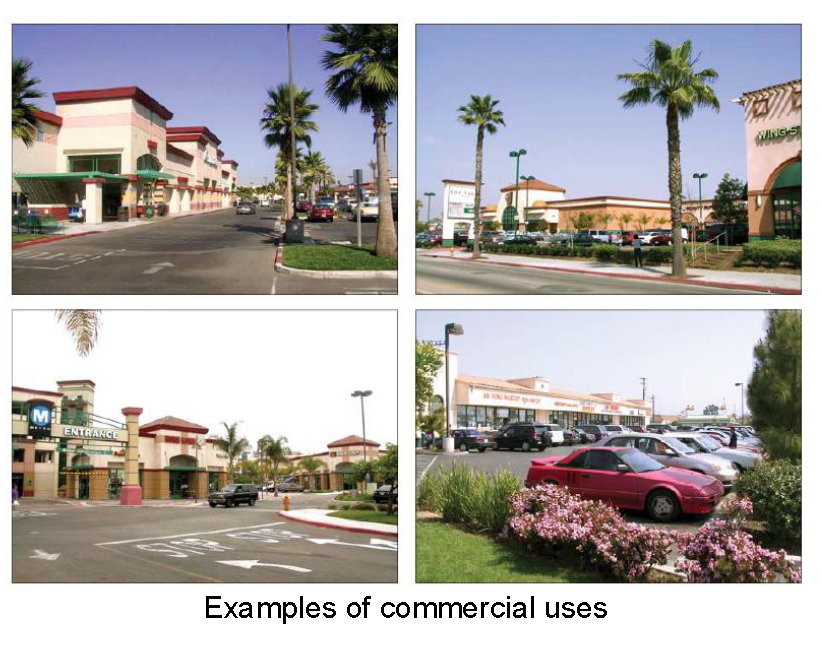
2.
General Commercial (C2). The general commercial (C2) designation is intended for goods and services of a general nature as well as professional offices that will meet both the short and long-term needs of the city's population. Multi-family residential uses are also allowed in the C2 designation as either a standalone development or as part of a mixed-use project. Housing types may include townhouses, condominiums, duplexes, triplexes, and apartments.
3.
Service Commercial (C3). The service commercial (C3) designation is intended for utilization as a buffer between residential or commercial uses and industrial uses. Service commercial uses include business-to-business retail and wholesale sales and services. All business operations shall be conducted within an enclosed building, and no outdoor storage shall be permitted.
4.
Limited Industrial (I1). The limited industrial (I1) designation is intended to include lighter industrial uses and supportive service commercial uses. Wholesale or retail sale of industrial supplies, transportation equipment, building equipment and materials, indoor manufacturing uses, and similar uses may be permitted in this designation. In addition, supportive commercial uses such as restaurants or convenience markets that serve consumers within the industrial area may be allowed.
5.
General Industrial (I2). The general industrial (I2) designation is intended to permit the establishment of manufacturing and related uses within the city in areas which are protected from encroachment by incompatible residential uses. This designation permits the heaviest types of manufacturing and industrial uses with approval of a site plan or conditional use permit. Manufacturing, warehousing, and fabrication uses are all appropriate for this designation.
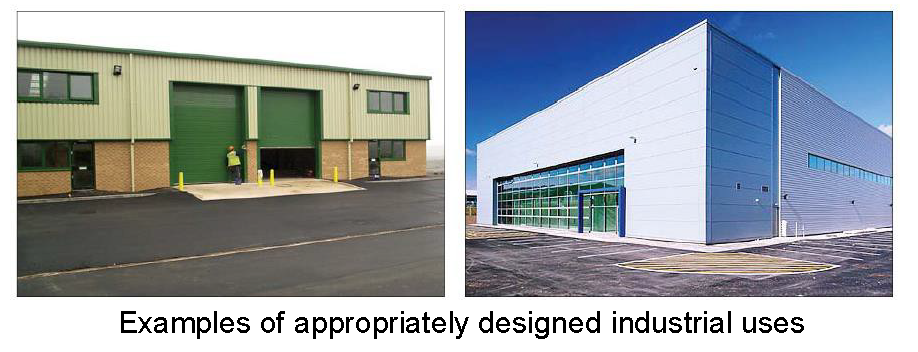
(Ord. No. 2012-02, § 3(Exh. A), 2-7-12; Ord. No. 2025-06, § 3(Exh. A), 11-4-25)
16.16.315 - Permitted uses and permit requirements.
The permitted uses and permit requirements in this article are provided in a table format. Land uses are provided in the first (vertical) column of the table and commercial/industrial land use designation in the top (horizontal) row. In order to determine which permit process is applicable or if the land use is allowed, the use must be matched up with the corresponding land use designation. Once the land use and land use designation are matched, the symbol in the box represents the applicable process. The following key legend demonstrates which symbol corresponds with the applicable permit process. Footnotes are also provided and considered part of this development code.
Key to Permit Requirements
(Ord. No. 2012-02, § 3(Exh. A), 2-7-12; Ord. No. 2017-08, § 5(Exh. A), 10-3-17)
16.16.320 - Commercial and industrial uses.
Notes:
1.
Shall not include a motion picture theater. Establishments serving alcohol shall require a CUP.
2.
Shall correspond with standards in Section 16.16.365 (Specific land use standards).
3.
Shall be subject to Section 16.16.360(A)(4).
4.
Shall be subject to Section 16.16.070 (Recycling facilities).
5.
Shall be supportive to a manufacturing/industrial use.
6.
May sell products manufactured or distributed on-site pursuant to Section 16.16.360(A)(3).
7.
Applications for off-sale alcohol (type 20 and 21 ABC licenses) below 12,000 SF in floor area shall be forwarded to the city council for final action. Such establishments shall be located within five hundred (500) feet of the intersection of two arterial or major arterial streets identified on the City's adopted circulation plan.
8.
Massage facilities shall correspond with standards in Chapter 5.20.
9.
Permitted residential uses shall consist only of mixed-use development and multi-family development with a density of 20 to 30 units per acre. Single family residential units are not allowed.
10.
Shall be subject to Article VIII Mixed-Use Design Guidelines.
(Ord. No. 2012-02, § 3(Exh. A), 2-7-12; ; Ord. No. 2017-08, § 5(Exh. A), 10-3-17; Ord. No. 2019-03, § 3(Exh. A), 2-5-19; Ord. No. 2021-01, 3(Exh. A), 6-1-21; Ord. No. 2022-10, § 3(Exh. A)(1), 7-19-22; Ord. No. 2024-09, § 4(Exh. A § 2), 9-17-24; Ord. No. 2025-03, § 4(Exh. A), 8-19-25; Ord. No. 2025-06, § 3(Exh. A), 11-4-25)
16.16.325 - Interpretation of land uses.
A.
Land Use Not Listed or No Key Provided. All uses not specifically listed or where there is no key provided for a particular use in Section 16.16.320 are prohibited. However, the development services director or his/her designee may determine that:
1.
Any use not listed is comparable to a listed use; or
2.
A listed use without a key is comparable to a listed use with a key, in which the applicable permit process may be used for the listed use without a key; and
3.
Meets the intent of the land use designation as described in Section 16.16.310; and
4.
Such use shall be reviewed and conditioned in a similar manner to a permitted or conditionally permitted use.
Such determination is appealable to the planning commission. A list of comparable use determinations shall be kept on file in the development services department.
B.
Other Similar Uses. The development services director or his/her designee shall permit other similar uses or uses customarily incidental to land uses outlined in Section 16.16.320. In interpreting and applying the provisions of this article, such provisions shall be held to be the minimum requirements for the promotion of the public health, safety, comfort, convenience and general welfare. Whenever there is any question regarding the interpretation of the provisions of this article or their application to any specific case or situation, the development services director or his/her designee shall interpret the intent of this article.
(Ord. No. 2012-02, § 3(Exh. A), 2-7-12)
16.16.350 - Commercial and industrial development standards.
A.
New and existing developments in commercial and industrial land use designations shall be subject to the development standards in this article, unless otherwise specified.
B.
The development standards in this table shall be required within each land use designation:
Notes:
1.
Proposals for development exceeding this height shall be subject to Chapter 16.16, Article VI (Variances and Minor Exceptions) of this development code.
2.
The minimum site size and dimensions for new lots in this designation are as listed here, except in the case when a site plan review, conditional use permit or planned development is submitted, in which case, no minimum is established. This exception is only applicable when the site is being developed as one integrated development and appropriate measures are taken to ensure reciprocal access, parking and maintenance.
3.
Minimum landscaping of eight feet is required adjacent to the property lines, pursuant to Chapter 16.20, Article XII (landscaping regulations) of this development code.
4.
Minimum landscaping of five feet is required adjacent to the property lines, pursuant to Chapter 16.20, Article XII (landscaping regulations) of this development code.
5.
Minimum landscaping of ten feet is required adjacent to the property lines, pursuant to Chapter 16.20, Article XII (landscaping regulations) of this development code.
6.
For Multi-family residential projects, R3 development standards shall be used, pursuant to Chapter 16.16 Article V (Residential Development Standards).
(Ord. No. 2012-02, § 3(Exh. A), 2-7-12; Ord. No. 2025-06, § 3(Exh. A), 11-4-25)
16.16.355 - Reserved.
Editor's note— Ord. No. 2021-01, 3(Exh. A), adopted June 1, 2021, repealed § 16.16.355, which pertained to street setback reduction and derived from Ord. No. 2012-02, § 3(Exh. A), 2-7-12.
16.16.360 - Additional development standards.
A.
The following standards shall apply to development in all commercial and industrial designations, except as otherwise specified:
1.
All uses shall be subject to the approval of a site plan review or a conditional use permit, pursuant to Chapter 16.12.
2.
The following standards shall apply to development in all industrial designations, except as otherwise specified:
a.
Any I1 sites which after lot consolidation have a gross area of ten acres or more may be permitted to establish a general manufacturing use permitted in the I2 designation, subject to the conditional use permit processes;
b.
Retail sales and service incidental to a principally permitted use are allowable provided that the following standards are met:
i.
The operations are contained within the main structure which houses the primary use,
ii.
Retail sales occupy no more than twenty-five (25) percent of the total building square footage,
iii.
No retail sales or display of merchandise occur(s) outside the structure(s), and
iv.
All products offered for retail sales on the site are manufactured, warehoused or assembled on the premises;
c.
Whenever possible, uses should incorporate air quality mitigation measures, including employee rideshare and transit programs, alternate schedules, delivery management programs, telecommunication programs and other modes of transportation.
3.
Outdoor Displays, Storage, Equipment, and Work Areas.
a.
No retail sales, merchandise displays or work areas shall occur outside building(s), except as approved by a site plan review, conditional use permit, or special event permit.
b.
There shall be no visible storage of motor vehicles (except display areas for sale or rent of motor vehicles), trailers, airplanes, boats, recreational vehicles, or their composite parts; loose rubbish, garbage, junk, or their receptacles; tents, equipment or building materials in any portion of a lot. No storage shall occur on any vacant parcel. Building materials for use on the same premises may be stored on the parcel during the time that a valid building permit is in effect for construction;
c.
In the I1 and I2 designations, outside storage and equipment shall be confined to the rear half of the property or the rear of the principal structure on site, whichever is more restrictive, and screened from public view from any adjoining properties and public rights-of-way by appropriate walls, fencing and landscaping.
4.
Parking and Loading. In addition to the off-street parking requirements and standards set forth in Chapter 16.20, Article IV (Parking and Loading Standards) of this development code, the following shall apply:
a.
Parking areas shall be landscaped along the perimeter as well as in the interior of the parking lot, pursuant to the requirements set forth in Chapter 16.20, Article XII (Landscape Regulations) of this Development Code.
b.
Shared parking between adjacent businesses and/or developments is highly encouraged where feasible.
c.
Loading facilities shall not be located at the front of buildings or in public areas of the development. Such facilities are more suitably located at the rear of the site where they can be screened appropriately.
d.
When it is not possible to locate loading facilities at the rear of the building, loading docks and doors may be located along the sides of the buildings, but should not dominate the facades and must be screened from the public areas of the development. e) Loading facilities should be offset from driveway openings.
e.
Backing from the public street onto the site for loading into front-end docks causes unsafe truck maneuvering and should not be utilized except at the ends of cul-de-sacs where each circumstance will be studied individually at the time of design review.
5.
Open Space and Landscaping.
a.
The design standards and guidelines included in the provisions of Chapter 16.20, Article XII (landscape regulations) and Chapter 16.24 (Protected Plants) of this development code shall apply.
b.
Open space areas shall be clustered into larger landscape areas rather than equally distributing them into areas of low impact such as at site and building peripheries, behind a structure or areas of little impact to public view, or where they are not required as a land use buffer or required yard setback.
6.
Walls and Fences.
a.
A commercial or industrial development adjacent to any residential designation shall have a six-foot high decorative masonry wall along property lines adjacent to such designations. In the I1 and I2 designations, the wall height shall not exceed twelve feet, depending on the height of the material being screened.
b.
In commercial designations, the maximum permitted height of any perimeter walls fronting a street shall be three feet.
c.
Both sides of all perimeter walls shall be architecturally treated. In commercial designations, appropriate materials include decorative masonry, concrete, stone and brick.
7.
Trash Collection Areas.
a.
At least one trash enclosure area shall be provided for commercial and industrial developments. The reviewing authority may require additional enclosures as deemed necessary. All such required areas shall be enclosed and screened pursuant to the requirements of this section and in accordance with city standards.
b.
All trash/recyclable materials collection enclosure areas shall be easily accessible to retail and office tenants, including easy pedestrian access for the disposal of materials and collection by refuse vehicles.
c.
The collection area(s) shall be enclosed on three sides by a minimum six-foot tall decorative masonry wall. The wall materials used shall be complementary in color and style to architectural components of the development they serve. The fourth side of the enclosure shall be enclosed with an opaque, self-latching gate.
8.
Mechanical Equipment Screening.
a.
All exterior mechanical equipment, except solar collectors, whether on a roof, side of a structure, or on the ground, shall be appropriately screened from public view. The method of screening shall be architecturally integrated with the primary structure in terms of materials, color, shape and size. Where individual equipment is provided, a continuous screen is desirable.
b.
For rooftop equipment, the screening materials shall be at least as high as the equipment being screened. Equipment requiring screening includes, but is not limited to, heating, air conditioning, refrigeration equipment, plumbing lines, ductwork, and transformers. Mechanical equipment shall not be permitted on any exposed portion of a pitched roof, except as may be approved through the site plan review process.
c.
Ground-mounted utility equipment such as, but not limited to, cable television boxes, electric power transformers and distribution facilities, water pumps, and telecommunications facilities (not including pole-mounted equipment) shall be screened from view on all sides with solid masonry walls or similar permanent structures. Such masonry wall or structure shall be of a neutral color. Screening with wood, chain-link, or similar fencing materials shall not be permitted. Electric and other metering equipment and panels shall be painted to match adjacent building and wall surfaces.
d.
Ladders for roof access shall be hidden and integrated into the building design.
9.
Standards for Outdoor Dining. Outdoor dining may be provided either in private patios or within the public sidewalk right-of-way. The following standards and guidelines shall be followed relative to outdoor (sidewalk and patio) dining spaces:
a.
These two kinds of outdoor dining areas including "patio dining space" and "sidewalk dining space."
i.
"Patio dining space" is an area adjacent to a street (or alley) level eating or drinking establishment, located within private property line and is used exclusively for dining, drinking and circulation therein. This space may be open or covered with temporary structures such as trellises, umbrellas or permanent structures such as overhangs and upper floors of the building.
ii.
"Sidewalk dining space" is an area adjacent to a street level eating or drinking establishment located within the sidewalk area of the public right-of-way and is used exclusively for dining, drinking and circulation therein. A barrier that separates the dining area from the remainder of the sidewalk and is in place during hours of operation defines the area. Sidewalk dining may be provided with either self-service or waiter/waitress service.
b.
Sidewalk Dining Locations. Sidewalk dining shall be permitted within the public sidewalk right-of-way only when the clear widths are available. (See 2(f) below)
c.
Patio Dining Locations. Patio dining shall be permitted within private property adjacent to the streets or public alley walkways. Outdoor patio dining is allowed within the street yard setback.
d.
Adjacency to Buildings. Sidewalk dining within the public sidewalk right-of-way shall be located immediately adjacent to the buildings with the pedestrian path immediately along the curb.
e.
Maintenance of Clear Passage.
i.
Sidewalk dining within the public sidewalk right-of-way shall maintain a clear pathway, free from all obstructions, for pedestrians not less than seven feet depending on the exact sidewalk width and extent of pedestrian activity in the streetscape segment. A clear passage of ten feet in width is preferred.
ii.
For purposes of calculating the clear pathway dimension, trees, traffic signs, meters, and all similar obstacles shall count as obstructions. The reviewing authority shall define exact clear pathway requirement within this range, on a case-by-case basis. The reviewing authority, based on the particular site conditions, may grant exemption to the minimum requirements.
f.
Demarcation of Sidewalk Dining Areas.
i.
The sidewalk dining area adjacent to the building shall be demarcated by barriers such as railings, fencing, or a combination of railings or fencing, and landscaping in planter boxes, or movable bollards. No solid walls shall be allowed.
ii.
All the outdoor barriers shall be movable and removed from the sidewalk at the close of the business establishment daily. Some discretion in terms of pots and planters placed directly adjacent to the building facade shall be allowed.
g.
Demarcation of Patio Dining Spaces. The patio dining spaces adjacent to streets or alley walkways shall be demarcated by either temporary or permanent boundary definers such as railings, fencing, or a combination of railings or fencing, and landscaping in planter boxes, or movable bollards.
h.
Outdoor dining within arcades along sidewalk rights-of-way or alley walkways. The provision of a dining space in a covered arcade that is open to the sidewalk is permitted as long as the architectural integrity of the facade is maintained in conformance with the requirements in Chapter 16.16, Article XI (Commercial Design Guidelines) of this development code.
i.
Windows or doors to outdoor dining along sidewalk rights-of-way or alley walkways. The provision of windows and doors from indoor dining areas that open to the sidewalk or alley walkway is permitted and encouraged as long as the architectural integrity of the facade is maintained in conformance with the other sections of this chapter and the requirements in Chapter 16.16, Article XI (Commercial Design Guidelines) of this development code, and the open doors and windows do not obstruct the pedestrian right-of-way.
j.
Parking Requirements. The area used for sidewalk dining shall not be included in the eating or drinking establishment's area for the purposes of calculating the establishment's parking requirement. The area used for patio dining shall be included in the eating or drinking establishment's area for the purposes of calculating the establishment's parking requirement.
k.
Materials. The style and materials of the barriers that demarcate the outdoor dining space should be compatible in color and finish with the adjacent structure and approved by the reviewing authority.
l.
Hours of Operation. The outdoor dining space hours of operation shall be limited to the hours of operation of the associated dining establishment.
m.
Display of Outdoor Menu Display. A single-sided framed menu attached to a moveable barrier that defines the sidewalk or patio dining space is permitted within the sidewalk and patio dining spaces. The size of the frame shall not exceed three square feet. Freestanding pedestal menus or A-frame displays are prohibited.
n.
Maintenance of Outdoor Dining Furniture. Outdoor dining furniture shall be maintained to be safe, sanitary and attractive at all times.
o.
Conformance to Title 24 Requirements. All outdoor dining areas shall conform to accessibility requirements as per the California Title 24 Accessibility Guidelines. All other requirements per the city engineering and building departments shall also be addressed.
p.
Permit Requirements. An encroachment permit is required for all sidewalk dining areas. The city may also require additional liability insurance.
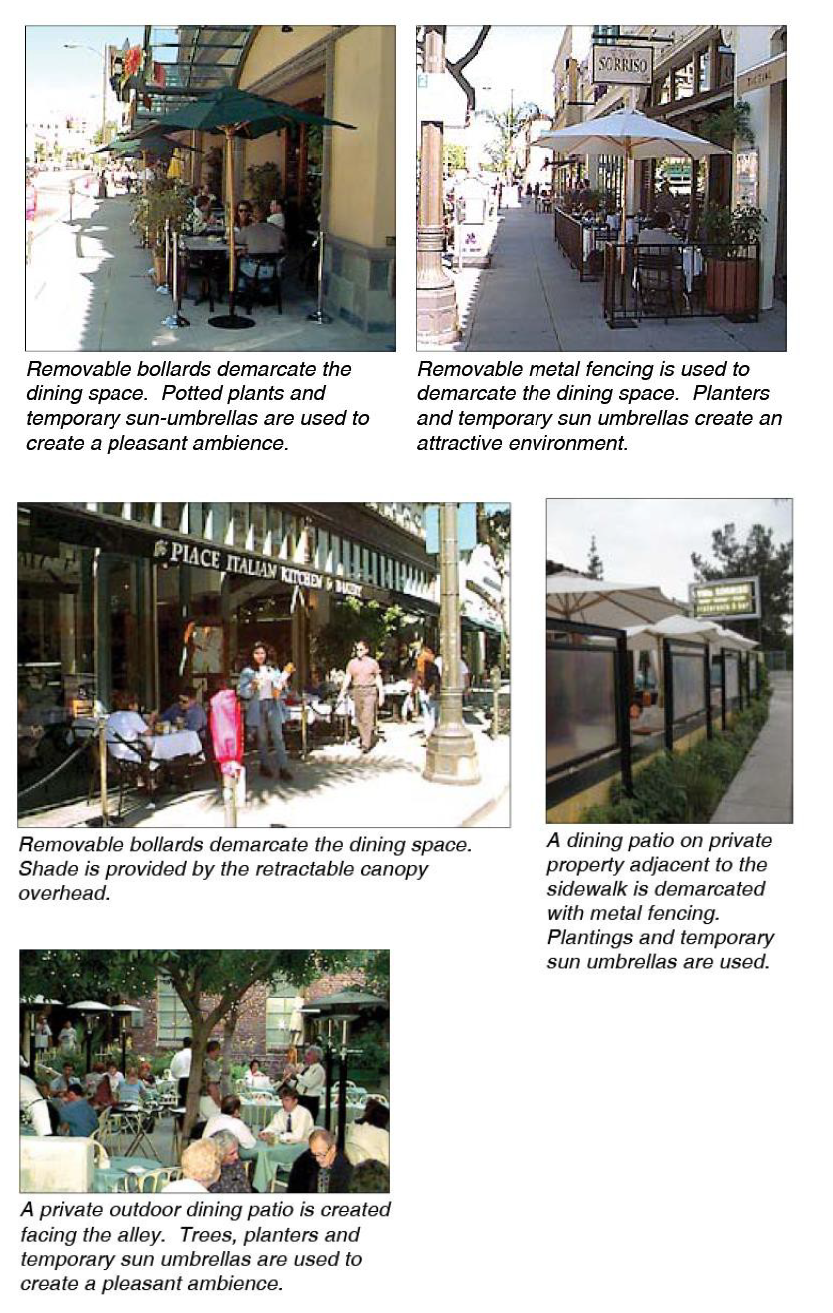
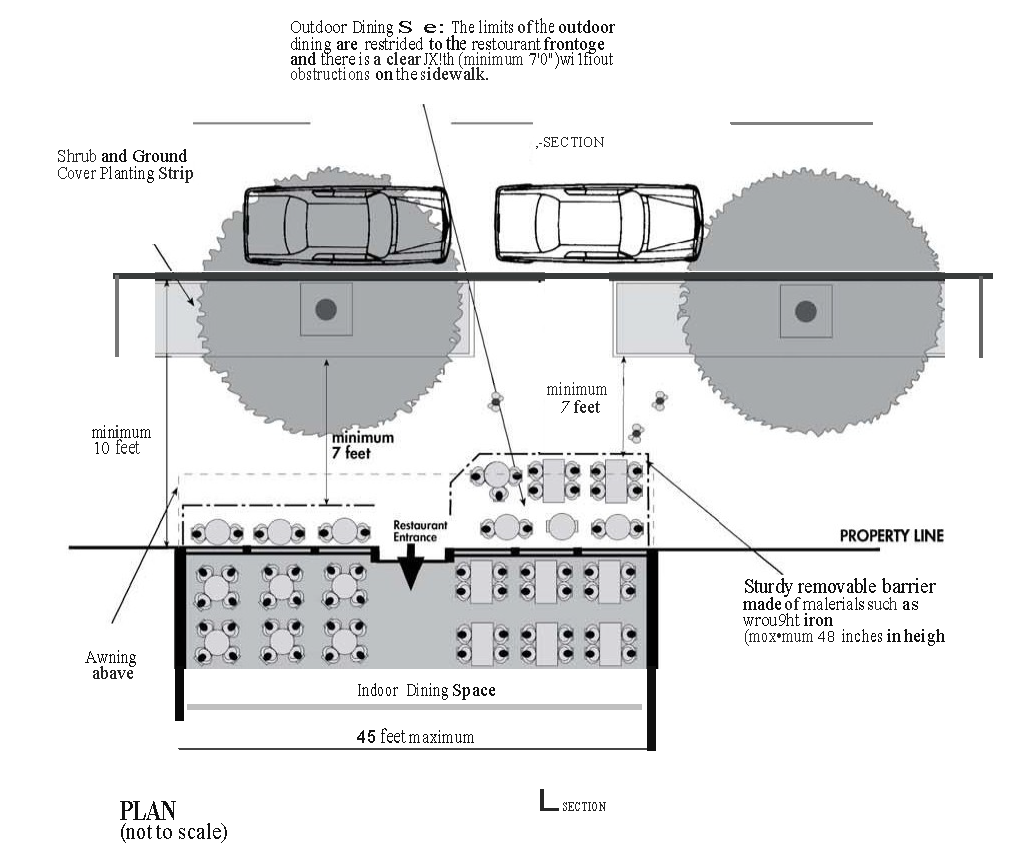
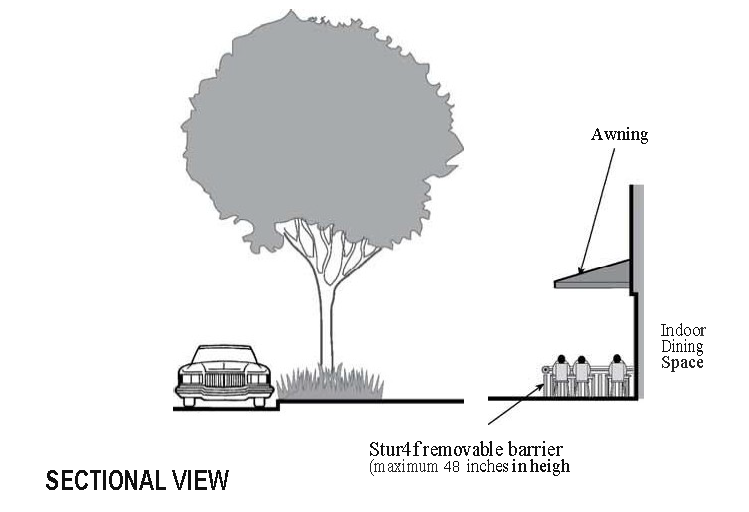
B.
Additional Standards and Guidelines. Refer to Chapter 16.16, Articles X and XI in this development code for site and architectural design standards and guidelines.
(Ord. No. 2012-02, § 3(Exh. A), 2-7-12; Ord. No. 2021-01, 3(Exh. A), 6-1-21)
16.16.365 - Specific land use standards.
In addition to the general development requirements contained in Chapter 16.20 (General Regulations), the following standards shall apply to specific commercial land uses.
A.
Vehicle Sales, Leasing or Rental. Automobile, truck, motor home, motorcycle, and recreation vehicle, sales, leasing, or rental, new or used, shall be developed in compliance with the following additional standards:
1.
No vehicles shall be parked, displayed or stored in the first fifteen (15) feet of the street side setbacks. All parts, accessories, etc., shall be stored within a fully enclosed structure; service and associated car storage areas shall be completely screened from public view. All vehicles offered for sale shall be kept clean, on a daily basis.
2.
All loading and unloading of vehicles shall occur on-site and not in adjoining streets or alleys;
3.
All vehicles associated with the business shall be parked or stored on-site and not in adjoining streets and alleys;
4.
An adequate on-site queuing area for service customers shall be provided. Required parking spaces may not be counted as queuing spaces;
5.
Service, repair or maintenance facilities shall be operated only as an incidental use in conjunction with the primary use. Such areas shall be visually screened from the street by walls of a building, or a variation as approved by the reviewing authority. Service bays from the exterior of the structure shall not directly face or front on a public right-of-way;
6.
If the use involves automotive repair, installation of parts or service, a designated area must be provided in addition to the parking requirements for the temporary storage of vehicles or equipment awaiting repair, installation or service;
7.
All lights shall be reflected away from adjacent uses;
8.
The decor, treatment and architectural style of the improvements, including sales office, repair and maintenance facilities, landscaping, fencing and signing shall be reviewed for aesthetic qualities, and shall also be subject to the design standards and guidelines established in Section 16.16, Article XI (Commercial Design Guidelines).
9.
Recreational vehicle camper sales, leasing or rental are permitted to have outdoor hoists subject to the conditions and standards listed in Section 16.16.365(B)(8).
B.
Vehicle Service and Repairs (Major or Minor). Automotive service stations, parts and accessories installation and major or minor service shall be developed in compliance with the following additional standards:
1.
All installation and service activities shall be performed within an approved structure or adjacent to and no more than twenty (20) feet from the service bay.
2.
All installation and service facilities shall be visually screened from the street by walls of a building or a variation as approved by the reviewing authority.
3.
All lights shall be reflected away from adjacent uses.
4.
No used or discarded parts or equipment shall be located outside of the installation and service facilities.
5.
In addition to the parking requirements of Chapter 16.20, Article IV (Parking and Loading Standards) of this development code, a designated area, screened from view, must be provided for the temporary storage of vehicles or equipment awaiting installation or service.
6.
No vehicles, equipment, boats, trucks or motorcycles shall be stored for impound or for any other purpose other than installation or service under a work order.
7.
Premises shall be maintained in a neat, orderly and environmentally safe manner, and all improvements shall be continuously maintained.
8.
Limited Exception for Outdoor Hoists. Facilities that are intended for the repair or sale of recreational vehicles (RVs) (i.e. motorhomes) shall be permitted to have outdoor hoists as an ancillary use in areas designated general commercial (C2) and service commercial (C3) with approval of a site plan review. Under limited circumstances as outlined herein, the reviewing authority may permit outdoor hoists if proposed on an existing facility with at least one building from which RVs repairs and sales exist or are proposed; and the site is limited by building space and existing improvements. Facilities that satisfy such conditions shall be subject to the following standards:
a.
Hoists shall not be placed within any setback, required parking, drive aisle, landscaping or accessible path of travel.
b.
Outdoor hoists and associated repair activities shall not be visible from any right-of-way (i.e. street or highway) and shall be adequately screened.
c.
The area on which hoists are stationed should be completely paved.
d.
The outdoor hoists shall be operated with a limited accumulation of parts, equipment, and debris in and around the hoist.
e.
Outdoor hoists shall be installed a minimum distance of three hundred (300) feet from any residence or residential zone. An acoustical study shall be required if outdoor hoists are requested to be placed less than three hundred (300) feet from any residence or residential zone.
f.
Activities associated with outdoor hoists shall be operated between the hours of seven a.m. to seven p.m. if hoists are located within five hundred (500) feet from any residence or residential zone.
g.
Outdoor hoists shall be an accessory use to a RV repair business. Outdoor hoists themselves shall not be the sole form of repairing RVs.
h.
Newly developed RV repair businesses are required to keep all hoists indoors. Hoists may be permitted outdoors subject to these regulations, if the proposal demonstrates that the site is constrained by size or any other physical constraint on the property.
C.
Vehicle Wash Facilities.
1.
Vehicle wash facilities shall be developed in compliance with the following additional standards:
a.
Full service and express vehicle wash facilities (i.e. standalone facilitates) shall be separated by a minimum of two thousand (2,000) feet, as measured from property lines.
b.
Vehicle wash facilities that are ancillary to a primary use (i.e. a gas station) shall be separated by a minimum of one thousand (1,000) feet, as measured from the property line. from the nearest full service or express vehicle wash facility (i.e. standalone facility).
c.
All gas station and car wash conditional use permit applications shall include a market research study that analyses the feasibility of the project at the subject location.
d.
All lights shall be reflected away from adjacent uses.
e.
Premises shall be maintained in a neat, orderly and environmentally safe manner, and all improvements shall be continuously maintained.
f.
Noise from vehicle wash activities shall not exceed levels established in Chapter 16.20, Article V (General Performance Standards).
D.
Salvage and Wrecking Yards. Automobile salvage and wrecking yards establishments are subject to conditional use permit review and shall be constructed in the following manner:
1.
The site shall be entirely paved, except for structures and landscaping, so that vehicles are not parked in a dirt or otherwise not fully improved area;
2.
Service access shall be located at the rear or side of structure(s) and as far as possible from adjoining residential uses;
3.
Repair activities and vehicle loading and unloading shall be prohibited on adjoining public rights-of-way;
4.
Service bays with individual access from the exterior of the structure shall not face adjacent public rights-of-way;
5.
All repair activities shall be conducted entirely within an enclosed structure. Outdoor hoists shall be prohibited;
6.
Exterior noise shall not exceed sixty-five (65) dBA at the property line;
7.
The premises shall be kept in a neat and orderly condition at all times;
8.
All used or discarded automotive parts or equipment or permanently disabled, junked or dismantled vehicles shall be permanently screened from public view; and
9.
All hazardous materials resulting from the repair or dismantling operation shall be properly stored and removed from the premises in a timely manner. Storage, use and removal of toxic substances, solid waste pollution, and flammable liquids, particularly gasoline, paints, solvents and thinners, shall conform to all applicable federal, state and local regulations.
E.
Convenience Stores. The retail sale of groceries, staples, sundry items and/or alcoholic beverages where the gross floor area is less than five thousand (5,000) square feet is subject to site plan review, and shall be constructed and operated in the following manner:
1.
One access drive may be permitted for each street frontage with approval of city engineer. The design and location of the access drive(s) shall be subject to the approval of the reviewing authority;
2.
The premises shall be kept in a neat and orderly condition at all times;
3.
If on-site dispensing of automotive fuels is provided, the design, location and operation of these facilities shall be consistent with the provisions of Section 16.16.480(G) (Service Station Standards). Additionally, the cashier location shall provide direct visual access to the pump islands and the vehicles parked adjacent to the islands;
4.
A bicycle rack shall be installed in a convenient location visible from the inside of the store;
5.
Each convenience store shall provide a public restroom located within the store;
6.
Public pay telephones provided on-site shall not be set up for incoming calls. Public telephones shall be featured with call out service only.
F.
Drive-thru Restaurants. This section contains standards for drive-thru restaurants. Drive-thru restaurants are subject to site plan review.
1.
Pedestrian walkways should not intersect the drive-thru drive aisles, but where they do, they shall have clear visibility, and they must be emphasized by enriched paving or striping;
2.
Drive-thru aisles shall have a minimum thirteen (13) foot width on curves and a minimum twelve (12) foot width on straight sections;
3.
Drive-thru aisles shall provide sufficient stacking area behind menu board and pick-up window to accommodate a minimum of four cars each;
4.
All service areas, restrooms and ground mounted and roof mounted mechanical equipment shall be screened from view;
5.
Landscaping shall screen drive-thru or drive-in aisles from the public right-of-way and shall be used to minimize the visual impact of reader board signs and directional signs;
6.
Drive-thru aisles and structures shall be setback from the ultimate curb face a minimum of ten feet;
7.
Menu boards shall be a maximum of thirty (30) square feet, with a maximum height of seven feet, and shall not face the street;
8.
Drive-thru restaurants within an integrated shopping center shall have an architectural style consistent with the theme established in the center. The architecture of any drive-thru restaurant must provide compatibility with surrounding uses in form, materials, colors, scale, etc. Structure plans shall have variation in depth and angle to create variety and interest in its basic form and silhouette. Articulation of structure surface shall be encouraged through the use of openings and recesses which create texture and shadow patterns. Structure entrances shall be well articulated and project a formal entrance through variation of architectural plane, pavement surface treatment, and landscape plaza; and
9.
Drive-thru aisles should not exit directly onto a public right-of-way.
10.
A minimum of one trash receptacle shall be installed at the end of the drive-thru aisle and shall be accessible to the drivers of the vehicles. The trash receptacle shall be maintained at all times and emptied on a regular basis so as to not prevent overflow.
G.
Mini-malls. Mini-malls (small scale, up to fifty thousand (50,000) square feet, multi-tenant shopping centers) are subject to a site plan review and shall comply with the following standards.
1.
All development and operational standards outlined in Section 16.16.480(C) (Convenience Stores), shall apply;
2.
The development shall provide internal continuity, uniformity and compatibility relating to architectural design, vehicular and pedestrian access, and on-site provisions for landscaping, loading, parking and signage;
3.
To the extent feasible, the on-site vehicular circulation system shall provide continuity with adjacent commercial developments; and
4.
No outdoor displays or sale of merchandise shall be permitted. However, limited outdoor sales may be allowed subject to the issuance of a special event permit.
H.
Self-storage facilities. Self-storage facilities, also known as mini-storage facilities, shall mean any real property designed and used for the purpose of renting or leasing individual storage space to occupants who are to have access to the space for the purpose of storing and removing personal property. Self-storage facilities are subject to a conditional use permit and shall be constructed in the following manner:
1.
The site shall be entirely paved, except for structures, drainage facilities and landscaping;
2.
The site shall be completely enclosed with a six foot high solid decorative masonry wall, except for points of ingress and egress (including emergency fire access) which shall be properly gated. The gate(s) shall be maintained in good working order and shall remain closed except when in use;
3.
No business activity shall be conducted other than the rental of storage spaces for inactive storage use or the sale of unclaimed articles by the landlord;
4.
All storage shall be located within a fully enclosed structure(s);
5.
No flammable or otherwise hazardous materials shall be stored on-site;
6.
Residential quarters for a manager or caretaker may be provided in the development;
7.
The development shall provide for two parking spaces for the manager or caretaker, and a minimum of five spaces located adjacent or in a close proximity to the manager's quarters for customer parking;
8.
Boats, recreational vehicles, campers, trailers, etc., may be stored on-site if located behind buildings and not visible from the public right-of-way;
9.
Storage facilities located within or adjacent to residentially or agriculturally zoned properties shall have their hours of operation restricted to seven a.m. to nine p.m., Monday through Saturday, and nine a.m. to nine p.m. on Sundays;
10.
Self-storage facilities shall not be permitted within six hundred sixty (660) feet of Interstate-15, Highway-395, Bear Valley Road, Main Street or a railway; and
11.
For residentially or agriculturally zoned properties, the minimum lot size to have a self-storage facility shall be two and half acres, unless designed as part of a subdivision. Self-storage shall not be allowed in the MDR zone of the Main Street and Freeway Corridor Specific Plan, unless designed as a collateral component of a multi-family residential project.
I.
Service Station (Gasoline) Standards. Service stations are subject to a site plan review and shall comply with the following standards:
1.
All activities and operations shall be conducted entirely within an enclosed structure, except as follows:
a.
The dispensing of petroleum products, water and air from pump islands,
b.
The provision of emergency service of a minor nature, and
c.
The sale of items via vending machines, including ice machines, shall be placed next to the main structure as approved by the reviewing authority;
d.
Above ground tanks shall be horizontal, except that the reviewing authority may consider vertical tanks if the tanks are located away and/or adequately buffered and/or screened, from the street. The location and color shall be approved by the reviewing authority.
2.
Pump islands shall be located a minimum of twenty (20) feet from a street property line; however, a canopy or roof structure over a pump island may encroach up to ten feet within this distance. Additionally, the cashier location shall provide direct visual access to the pump islands and the vehicles parked adjacent to the islands;
3.
The maximum number of points of ingress/egress to any one street shall be two;
4.
The width of a driveway may not exceed forty (40) feet at the sidewalk;
5.
Outside storage of motor vehicles is prohibited. Temporary storage, up to seventy-two (72) hours, is permitted if adequately screened from the public right-of-way;
6.
No vehicles may be parked on sidewalks, parkways, driveways or alleys;
7.
No vehicle may be parked on the premises for the purpose of offering same for sale;
8.
Openings of service bays shall not face public rights-of-way and shall be designed to minimize the visual intrusion onto adjoining properties;
9.
No used or discarded automotive parts or equipment, or disabled, junked or wrecked vehicles may be located in any open area outside the main structure;
10.
All light sources, including canopy, perimeter, and flood shall be energy efficient, stationary and shielded or recessed within the roof canopy so that the service station shall be indirectly visible and light is deflected away from adjacent properties and public rights-of-way. Lighting shall not be of such a high intensity as to cause a traffic hazard or adversely affect adjoining properties;
11.
Where an existing service station adjoins property in a residential land use designation, a six-foot high decorative masonry wall shall be constructed at the time the station requires a permit for the on-site improvement/modification. Materials, textures, colors and design of the wall shall be compatible with on-site development and adjoining properties. When the wall reaches the established front-yard setback line of a residentially designated lot abutting or directly across an alley from the service station, it shall decrease to a height of thirty (30) inches;
12.
Restroom entrances viewable from adjacent properties or public rights-of-way shall be concealed from view by planters or decorative screening;
13.
Delivery areas for fuel or merchandise shall be located in a fashion so as not to significantly interfere with normal business operations.
J.
Service Station Conversions. A structure originally constructed as a service station and which is proposed for conversion to another allowable use shall require upgrading and remodeling for such items as, but not limited to, removal of all gasoline appurtenances, removal of canopies, removal of pump islands, removal of gas tanks, removal of overhead doors, additional street improvements or modification of existing improvements to conform to access regulations, exterior remodeling and any additional standards as required by this code.
K.
Commercial trucking facilities including truck terminals, bus terminals, truck storage yards, and the outdoor storage of shipping containers and semi-truck trailers as a primary use are subject to a conditional use permit and shall be constructed in the following manner:
1.
The site shall be fully developed with a permanent building that complies with all applicable provisions of Article XII-Industrial Design Guidelines. All buildings and structures that are visible from the right-of-way shall be articulated.
2.
The site shall be entirely paved, except for structures and landscaping, so that vehicles, vehicle trailers, and metal containers are not parked or stored in the dirt or otherwise not fully improved area.
3.
All trucks, trailers and containers within outdoor storage areas shall be completely screened from public view by a combination of buildings and/or solid screen walls of either decorative concrete masonry block or decorative concrete tilt-up walls. Screen walls shall be a minimum of 8-feet in height.
4.
Anti-graffiti coating or equivalent measure to prevent graffiti shall be provided for all screen walls.
5.
An operations and truck route plan shall be submitted for review and approval as part of the CUP application. The plan shall describe the operational characteristics of the proposed use, including but not limited to, hours of operation, number of employees, number of trucks to be stored on the site, and the proposed truck routing to and from the facility to designated truck routes. The operator of the truck yard shall be responsible for implementing and monitoring an operations and truck route plan during all operations.
6.
Truck yard facilities shall not store any products, goods, materials, or storage containers outside of any building, unless such storage is permitted through a conditional use permit.
7.
Truck drivers shall not sleep or reside within any truck cab on-site overnight or for any extended duration of time.
8.
Vertical stacking of storage containers and stacking of other materials on top of any portable storage container shall only be allowed when approved though a CUP. However, in no instance shall storage containers be stacked more than two containers high.
9.
Only those business that have a valid business license to sell portable storage containers may be conditionally approved to stack storage containers.
10.
The stacking of storage containers shall be prohibited within 10 feet of any screen wall.
(Ord. 2004-05 § 4 (part), 2004; Ord. 193 Exh. A (§ 85.01.030(C)), 1994)
(Ord. No. 2012-02, § 3(Exh. A), 2-7-12; Ord. No. 2014-05, § 3(Exh. A), 4-1-14; Ord. No. 2016-09, § 3(Exh. A), 2-7-17; Ord. No. 2019-03, § 3(Exh. A), 2-5-19; Ord. No. 2021-01, 3(Exh. A), 6-1-21; Ord. No. 2022-10, § 3(Exh. A)(2), 7-19-22; Ord. No. 2023-09, § 4(Exh. A), 6-20-23)
Editor's note— Ord. No. 2012-02, § 3(Exh. A), 2-7-12 renumbered § 16.16.480 as § 16.16.365.
Sec. 16.16.370. - Alcohol sales and deemed approved alcohol sales regulations.
A.
Purpose. This section requires land use permits for newly established off-sale alcohol establishments that are in addition to the requirements elsewhere in this code and in the Hesperia Main Street and Freeway Corridor Specific Plan, confers deemed approved status for all existing permitted, conditionally permitted and legal nonconforming off-sale alcohol establishments, provides standards for the continued operation of alcohol establishments, and sets forth grounds for the modification, revocation and termination of conditional use permits and deemed approved status for establishments violating this section, in order to protect the general health, safety, and welfare of the residents of the City of Hesperia and to prevent nuisance activities where alcoholic beverage sales occur.
Specific purposes for enacting this section are as follows:
1.
To protect residential, commercial, industrial and civic areas from the harmful effects attributable to the sale of alcoholic beverages and minimize the adverse impacts of nonconforming and incompatible uses;
2.
To provide opportunities for alcohol establishments to operate in a mutually beneficial relationship to each other and to other commercial and civic services;
3.
To provide mechanisms to address problems associated with the public consumption of alcoholic beverages such as litter, loitering, graffiti, unruly behavior, violence, vandalism, and escalated noise levels;
4.
To provide that alcohol establishments are not to become the source of undue public nuisances in the community;
5.
To provide for properly maintained alcohol establishments so that the secondary effects of negative impacts generated by these activities on the surrounding environment are mitigated;
6.
To monitor deemed approved establishments to ensure they do not substantially change in mode or character of operation; and
7.
To promote a healthy and safe business environment in the City of Hesperia through appropriate and consistent land use regulations and to encourage the establishment of businesses that will benefit both the local economy and residents while not placing an undue strain on city resources or surrounding businesses.
This section does not itself authorize or permit alcohol establishments, but only applies to these establishments where otherwise allowed or permitted within an applicable zoning district. The provisions of this ordinance are intended to complement the state of California alcohol-related laws. The city does not intend to replace or usurp any powers vested in the California Department of Alcoholic Beverage Control.
B.
Applicability.
1.
The provisions of this section shall apply to the extent permissible under other laws to all alcoholic beverage sales establishments, as defined in Section 16.16.370(C), located in the City of Hesperia.
2.
Whenever any provision in this section, in an existing conditional use permit, or in any other law, ordinance, or regulation of any kind, imposes overlapping or contradictory regulations, or contains restrictions covering any of the same subject matter, that provision which is more restrictive or imposes higher standards shall control, except as otherwise expressly provided in this section.
3.
The requirements provided herein are in addition to the requirements found under Chapter 16.20 (General Regulations), Chapter 16.16 (Land Use Designations), the Main Street and Freeway Corridor Specific Plan, any other applicable chapter of the Code, and any other applicable law.
C.
Definitions. The meaning and construction of these words and phrases, as set forth below, shall apply throughout, except where the context clearly indicates a different meaning or construction.
1.
"Alcoholic beverage" means alcohol, spirits, liquor, wine, beer, and any liquid or solid containing alcohol, spirits, wine, or beer, that contains one-half of one percent or more of alcohol by volume and that is fit for beverage purposes either alone or when diluted, mixed or combined with other substances, the sale of which requires an ABC license.
2.
"Alcoholic beverage sales activity" means the retail sale of alcoholic beverages for off-site consumption.
3.
"Alcoholic beverage sales establishment" or "alcohol establishment" means an establishment that conducts alcoholic beverage sales activity. Alcohol establishments include but are not limited to: liquor stores, beer and wine stores, convenience markets, markets, neighborhood specialty food markets, retail sales establishments, wine shops, and service stations. For purposes of this section, an alcohol establishment also includes a general retail store, a grocery store and a retail pharmacy that devotes any percentage of its gross floor area to the sale and display of alcoholic beverages. As of the effective date, an alcohol establishment is an establishment holding (or eligible to hold) an off-sale ABC License Type 20 or 21. For purposes of this section, an alcohol establishment does not include a lawfully established alcohol beverage production manufacturer such as a winery, brewery or micro-brewery that sells alcohol for off-site consumption.
4.
"California Department of Alcoholic Beverage Control" or "ABC" refers to the department of the state of California empowered to act pursuant to Article 20, section 22, of the California Constitution and authorized to administer the provisions of the Alcoholic Beverage Control Act.
5.
"Deemed approved establishment" means any permitted or conditionally permitted alcoholic sales establishment, whether or not constructed or operational, or any legal nonconforming alcoholic beverage sales establishment. Such establishment shall be considered a deemed approved establishment effective on the effective date, as long as it complies with the deemed approved operational standards set forth in Section 16.16.370(J).
6.
"Deemed approved status" means the permitted use of land for a deemed approved establishment. Deemed approved status replaces permitted and conditionally permitted status and legal non-conforming status for alcohol establishments with respect to alcoholic beverage sales activity. Deemed approved status remains in effect as long as an alcohol establishment complies with the deemed approved operational standards provided in Section 16.16.370(J).
7.
"Effective date" means the effective date of the Ordinance adopting this Section 16.16.370.
8.
"Enforcement officer" means the city manager or designee, and chief of police or designee.
9.
"Illegal establishment" means an alcohol establishment which has been finally determined to be in noncompliance with local, state or federal laws, the conditions of any applicable permits, or the deemed approved operational standards in this section. Such an establishment may lose its deemed approved status, and if it does it shall no longer be considered a deemed approved establishment.
10.
"Legal nonconforming alcoholic beverage sales establishment" or "legal nonconforming establishment" means an off-sale alcoholic beverage sales establishment which was a nonconforming use pursuant to Article IX of Title 16 of this code, and for which a valid ABC license had been issued and used in the exercise of the rights and privileges conferred by the license at a time immediately prior to the effective date. A legal nonconforming establishment also includes existing alcohol establishments that are not in conformance with the regulations applicable to new alcohol establishments contained in this section, regardless of whether such activities were allowed as part of a conditional use permit granted prior to the effective date. Such an establishment shall be considered a deemed approved establishment and shall no longer be considered a legal nonconforming establishment.
11.
"Modify" or "modified" as used in Sections 16.16.370(E), (F) and (G) means the expansion or increase in intensity or substantial change of a use, as these terms are used in Article IX of Title 16 of this code.
12.
"Operational standards" means regulations for the business practice activities and land use for alcohol establishments with: (i) a conditional use permit issued in conformance with this section on or after the effective date, or (ii) deemed approved status. Operational standards constitute requirements which must be complied with by an alcohol establishment in order to maintain its conditional use permit or deemed approved status.
13.
"Permitted or conditionally permitted alcohol beverage sales establishment" or "permitted or conditionally permitted alcohol establishment" means an alcohol establishment which is a permitted or conditionally permitted use pursuant to the applicable provisions of the Hesperia Municipal Code or Main Street and Freeway Corridor Specific Plan prior to the effective date.
14.
"Premises" means the actual space in a building devoted to alcoholic beverage sales.
15.
"Redeveloped" means the demolition of an existing alcohol establishment followed by the immediate reconstruction and operation of a replacement alcohol establishment.
D.
Public hearing by planning commission. The planning commission may conduct public hearings and make determinations on whether alcohol establishments are in compliance with conditions of approval or operational standards prescribed in these regulations, and may modify, suspend or revoke an establishment's conditional use permit or deemed approved status in order to obtain compliance with the provisions of this section. This section is not intended to restrict the powers and duties otherwise pertaining to other city officers or bodies in the field of monitoring and ensuring the harmony of alcoholic beverage sale activities in the city. The planning commission shall have the powers and duties assigned to them by the Hesperia Municipal Code and by this section.
E.
Conditional use permit required for alcoholic beverage sales establishments that are new, modified, or redeveloped, or have deemed approved status revoked. Notwithstanding the provisions of Section 16.12.315, no person shall establish a new alcohol establishment, nor shall any person modify or redevelop an existing alcohol establishment, without first obtaining a conditional use permit pursuant to Article III of Chapter 16.12 of Title 16. The requirements of this section shall be in addition to any other requirements found in this code and the Main Street and Freeway Corridor Specific Plan. A conditional use permit shall also be required for any deemed approved establishment when the deemed approved status is revoked in accordance with this section.
F.
Operational standards for alcohol establishments with conditional use permits. Notwithstanding the provisions of Section 16.12.315, all new, modified, or redeveloped off-sale alcohol establishments, and deemed approved establishments when deemed approved status is revoked and a new conditional use permit is obtained, shall be designed, constructed, and operated to conform to all of the following operational standards:
1.
That it does not result in adverse effects to the health, peace or safety of persons residing or working in the surrounding area, and will not aggravate existing problems in the neighborhood created by the sale of alcohol such as loitering, public drunkenness, alcoholic beverage sales to minors, noise and littering.
2.
That it does not jeopardize or endanger the public health or safety of persons residing or working in the surrounding area and will not detrimentally affect nearby neighborhoods considering the distance of the alcohol establishment to residential buildings, schools, parks, playgrounds or recreational areas, nonprofit youth facilities, places of worship, hospitals, alcohol or other drug abuse recovery or treatment facilities, county social service offices, or other alcoholic beverages sales activity establishments.
3.
That it does not result in repeated nuisance activities within the premises or associated with the establishment or activity, including but not limited to disturbance of the peace, illegal drug activity, public drunkenness, drinking in public, harassment of passersby, gambling, prostitution, sale of stolen goods, public urination, theft, assaults, batteries, acts of vandalism, littering, loitering, graffiti, illegal parking, excessive loud noises, especially in the late night or early morning hours, traffic violations, curfew violations, or lewd conduct. The establishment shall take all reasonable steps to include (1) immediately calling the police upon observation of the activity, and (2) requesting that those engaging in activities that constitute a nuisance or are otherwise illegal to cease those activities unless personal safety would be threatened in making the request.
4.
That it complies with all provisions of local, state or federal laws, regulations or orders, including but not limited to those of the ABC, California Business and Professions Code sections 24200,24200.6, and 25612.5, as well as any condition imposed on any permits issued pursuant to applicable laws, regulations or orders. This includes compliance with annual city business license fees.
5.
That its upkeep and operating characteristics are compatible with, and will not adversely affect the livability or appropriate development of abutting properties and the surrounding neighborhood.
6.
That it complies with the following alcohol sale limitations:
a.
No sale of single-serve alcoholic beverages, including, but not limited to beer, malt liquor and alcoholic energy drinks of any size; wine of less than seven hundred fifty milliliters (750 ml) in size; distilled spirits of less than three hundred seventy five milliliters (375 ml) in size; or any other individual alcoholic beverage for single-serve consumption.
b.
No sale or distribution of alcoholic beverages shall be made from a drive-up or walk-up window.
c.
No display of alcoholic beverages closer than five feet from the store entrance.
d.
No beer, ale or malt liquor shall be offered for sale in a container with a volume greater than thirty-two (32) ounces. This restriction is not intended to prohibit the sale of such beverages in kegs or other types of containers, with a volume of two or more gallons, which are clearly designed to dispense multiple servings.
7.
That it complies with the following public nuisance prevention measures:
a.
Lighting: Exterior areas of the premises and adjacent parking lots shall be provided with sufficient lighting in a manner that provides adequate illumination for alcohol establishment patrons while not spilling onto surrounding residential and commercial properties. A photometric study may be required to demonstrate compliance.
b.
Litter: Adequate litter receptacles shall be provided in and around the premises. The premises shall be kept free of the accumulation of litter and shall be removed no less frequently than once each day the business is open.
c.
Loitering: The following measures may be required:
No fixtures or furnishings that encourage loitering and nuisance behavior are permitted on the premises controlled by the establishment. This includes, but is not limited to chairs, seats, stools, benches, tables, crates, ashtrays, pay phones, etc.
d.
Signage: There shall be no exterior advertising of paraphernalia or similarly controlled products.
e.
Signs: The following signs shall be required to be prominently posted in a readily visible manner on an interior wall or fixture, and not on windows, in English, Spanish, and the predominant language of the patrons:
i.
"California State Law prohibits the sale of alcoholic beverages to persons younger than twenty-one (21) years of age."
ii.
"No Loitering or Public Drinking."
iii.
"It is illegal to possess an open container of alcohol in the vicinity of this establishment."
f.
Presentation of Documents: A copy of the conditions of approval and the California Department of Alcoholic Beverage Control license shall be required to be kept on the premises and presented to any enforcement officer or authorized state or county official upon request. A copy of these operational standards (including any conditions of approval), any applicable ABC or city operating conditions, and any training requirements shall also be posted in at least one prominent place within the interior of the establishment where it will be readily visible and legible to the employees and patrons of the establishment.
g.
Mitigating Alcohol Related Problems: The establishment shall be required to operate in a manner appropriate with mitigating alcohol related problems that negatively impact those individuals living or working in the neighborhood including but not limited to sales to minors, the congregation of individuals, violence on or near the premises, drunkenness, public urination, solicitation, drug-dealing, drug use, loud noise and litter.
h.
Drug Paraphernalia: An off-sale alcohol establishment shall be prohibited from selling drug/tobacco paraphernalia products as defined in Health and Safety Code sections 11014.5 and 11364.5. "Drug paraphernalia" means all equipment products and materials of any kind that are used intended for use or designed for use in planting, propagating, cultivating, growing, harvesting, manufacturing, compounding, converting, producing, processing, preparing, testing, analyzing, packaging, repackaging, storing, containing, concealing, injecting, ingesting, inhaling, or otherwise introducing into the human body a controlled substance in violation of the California Uniform Controlled Substances Act commencing with California Health and Safety Code section 11000.
i.
Window Obstructions: To ensure a clear and unobstructed view of the interior of the premises, including the area in which the cash registers are maintained, from the exterior public sidewalk or entrance, no more than thirty-three (33) percent of windows and entry doors shall be blocked by signs, vending machines, shelves, racks, storage, etc., notwithstanding the provisions of Section 16.36.040.
8.
Failure to comply with these requirements shall constitute grounds for revocation of a conditional use permit.
Additional Conditions of Approval. Additional conditions of approval that may be imposed as necessary on new, modified, or redeveloped alcohol establishments, and to deemed approved establishments when deemed approved status is revoked and a new conditional use permit is obtained include but are not limited to the following:
1.
Program: A "complaint response community relations" program adopted and maintained by the establishment conducting the alcoholic beverage sales activity may be required. The program may include the following:
a.
Posting at the entry of the establishment providing the telephone number for the watch commander of the police department to any requesting individual.
b.
Coordinating efforts with the police department to monitor community complaints about the establishment activities.
c.
Having a representative of the establishment meet with neighbors or the applicable neighborhood association on a regular basis and at their request attempt to resolve any neighborhood complaints regarding the establishment.
2.
Hours of Operation: the sale of alcoholic beverages may be restricted to certain hours of each day of the week unless limited further by the State of California Department of Alcoholic Beverage Control.
3.
Security Cameras: At least two high definition 24-hour time lapse security cameras may be required to be installed and properly maintained on the exterior of the building at locations recommended by the police department capable of color recording and storing a minimum of thirty (30) days of continuous video. All criminal and suspicious activities recorded on this surveillance equipment must be reported to local law enforcement. To the extent allowed by law, the establishment operators may be required to provide any tapes or other recording media from the security cameras to the police department.
G.
Grounds for conditional use permit suspension, revocation or termination.
1.
In addition to the grounds for revocation or modification of a conditional use permit contained in Section 16.12.130, an alcohol establishment's conditional use permit may be suspended for up to one year, modified or revoked by the planning commission after holding a public hearing in the manner prescribed in this title, for failure to comply with operational standards, training requirements or conditions of approval imposed through their conditional use permit. Notice of such hearing by the planning commission at which it will consider the modification, suspension or revocation of an establishment's conditional use permit shall be in the manner prescribed by this title.
2.
In addition to any and all other provisions of this section, any conditional use permit shall terminate and cease to apply to any establishment when either of the following has occurred:
a.
The alcohol establishment has ceased its operation for a period of twelve (12) or more calendar months, and when either one of the following events occur:
i.
If, after the twelve (12) calendar months, any application or requested transaction with the California Department of Alcoholic Beverage Control, whereby the laws of the state of California require notice thereof to be filed with the city, and allow the filing of a protest thereon by the city (including person-to- person transfer of existing licenses), and the city has filed such protest; or
ii.
If after such 12-calendar-month period, the existing license shall have ceased to apply to such establishment.
b.
Surrendered its license to the California Department of Alcoholic Beverage Control for a period exceeding twelve (12) calendar months.
H.
Automatic deemed approved status for existing alcohol establishments.
1.
As of the effective date, all existing or conditionally permitted alcohol establishments, whether or not constructed or operational, and all existing legal nonconforming alcohol beverage sales establishments, shall automatically become deemed approved establishments, and shall no longer be considered permitted, conditionally permitted or legal nonconforming establishments. Each deemed approved establishment shall retain its deemed approved status as long as it complies with the deemed approved operational standards set forth in Section 16.16.370(J).
2.
The city shall notify the owner and/or operator of an alcohol establishment of its deemed approved status at the address as shown on their city business license, and also, if not the same, any property owner at the address shown on the county assessor's property tax assessment records, of the establishment's deemed approved status. The notice shall be sent by first-class mail and certified mail return receipt requested and shall include a copy of the operational standards in this section with the requirement that they be posted in a conspicuous and unobstructed place visible from the entrance of the alcohol establishment for public review. Should the notice be returned, then the notice shall be sent via regular mail. Failure of any person to receive notice given pursuant to this section shall not affect the deemed approved status of the establishment.
Operational standards for alcohol establishments with deemed approved status. After the effective date, a deemed approved establishment shall retain its deemed approved status only if it conforms to all of the following deemed approved operational standards:
1.
The deemed approved establishment shall not cause adverse effects to the health, peace or safety of persons residing or working in the surrounding area.
2.
The deemed approved establishment shall not jeopardize or endanger the public health or safety of persons residing or working in the surrounding area.
3.
The deemed approved establishment shall not allow repeated nuisance activities within the premises or associated with the establishment or activity, including but not limited to disturbance of the peace, illegal drug activity, public drunkenness, drinking in public, harassment of passersby, gambling, prostitution, sale of stolen goods, public urination, theft, assaults, batteries, acts of vandalism, excessive littering, loitering, graffiti, illegal parking, excessive loud noises, especially in the late night or early morning hours, traffic violations, curfew violations, or lewd conduct. The establishment shall call the police upon observation of the activity.
4.
The deemed approved establishment shall comply with all provisions of local, state or federal laws, regulations or orders, including but not limited to those of the ABC, California Business and Professions Code sections 24200, 24200.6, and 25612.5, as well as any condition imposed on any permits issued pursuant to applicable laws, regulations or orders. This includes compliance with annual city business license fees.
5.
The deemed approved establishment's upkeep and operating characteristics shall be compatible with and not adversely affect the livability or appropriate development of abutting properties and the surrounding neighborhood.
6.
A copy of these deemed approved operational standards, any applicable ABC or city operating conditions, and any training requirements shall be posted in at least one prominent place within the interior of the establishment where it will be readily visible and legible to the employees and patrons of the establishment.
Grounds for deemed approved status suspension, revocation or termination.
1.
An alcohol establishment's deemed approved status may be suspended for up to one year, modified or revoked by the planning commission after holding a public hearing, for failure to comply with the deemed approved operational standards set forth in Section 16.16.370(J). Notice of such hearing by the planning commission at which it will consider the modification, suspension or revocation of an establishment's deemed approved status shall be in writing and shall state the grounds therefore. Notice shall be mailed by first-class mail and certified mail return receipt requested at least ten days before the date of the hearing.
2.
The occurrence of any of the following shall terminate the deemed approved status of the alcohol establishment after notice and a hearing in front of the planning commission, and require the application for and issuance of a conditional use permit in order to continue the alcoholic beverage sales activity:
a.
An existing alcohol establishment changes its activity so that ABC requires a different type of license.
b.
There is a substantial modification to the mode or character of operation, including but not limited to the following:
i.
The deemed approved establishment extends the hours of operation.
ii.
The deemed approved establishment proposes to reinstate alcohol sales after the ABC license has been either revoked or suspended for a period 12 months or greater by ABC.
iii.
The deemed approved establishment voluntarily discontinues active operation for more than twelve (12) consecutive months or ceases to be licensed by the ABC.
c.
A "substantial change in the mode of character of operation" shall not include:
i.
Re-establishment, restoration or repair of an existing deemed approved establishment on the same premises after the premises have been rendered totally or partially inaccessible by a riot, insurrection, toxic accident or act of God, provided that the re-establishment, restoration or repair does not extend the hours of operation of any establishment or add to the capacity, floor or land area or shelf space devoted to alcoholic beverages of any establishment.
ii.
Temporary closure for not more than twelve (12) months in cases of vacation or illness or for purposes of repair, renovation, or remodeling if that repair, renovation, or remodeling does not change the nature of the premises and does not extend the hours of operation of any establishment, or add to the capacity, floor or land area, or shelf space devoted to alcoholic beverages of any establishment, provided notice is provided to the city. The development services director may, upon request of an owner of a deemed approved establishment made prior to the expiration of twelve (12) months, grant one or more extensions to the period of temporary closure, in accordance with Section 16.12.315(F).
d.
There has been a discontinuance of active operation for twelve (12) consecutive months or a cessation of ABC licensing, which shall be presumed to be abandonment of the use by the property owner. At any time after any active operation is discontinued for a period of twelve (12) consecutive months or more, the city manager's designee shall notify the property owner in writing of the determination of presumed abandonment of the active operation. Pursuant to Chapter 16.12 of this title, the property owner may appeal the determination to the planning commission, which may overturn the determination only upon making a finding that the evidence supports the property owner's position that the use was not discontinued for a period of twelve (12) consecutive months or more.
I.
Violations; Enforcement.
1.
In addition to the penalties provided in this section, this section shall be enforced pursuant to Chapter 1.12 of the Hesperia Municipal Code.
2.
It is not the intent of this section to discourage owners and employees of alcohol establishments to report nuisance or criminal activity. Nuisance or criminal activity that is reported by owners and employees shall not be considered for the purposes of revoking a conditional use permit or deemed approved status.
J.
Annual alcohol sales regulatory fee.
1.
The intent and purpose of this section is to impose a regulatory fee upon all off-sale alcohol establishments that either hold deemed approved status pursuant to this section or obtained a conditional use permit after the effective date. This fee shall provide for the enforcement and administration of the conditions of approval, operational standards, and other applicable regulations set forth in this section with regard to off-sale alcohol establishments.
2.
The regulatory fee shall be established by resolution of the city council, and may include an annual component and a compliance component. The fee shall be calculated so as to recover the total cost of both administration and enforcement of the operational standards and other applicable regulations set forth under this section upon all off-sale alcohol establishments that either hold deemed approved status pursuant to this section or obtained a conditional use permit after the effective date, including, for example, notifying establishments of their deemed approved status, administering the program, establishment inspection and compliance checks, documentation of violations, conducting hearings and prosecution of violators, but shall not exceed the cost of the total program. All fees shall be used to fund the program. Fees are nonrefundable except as may be required by law.
(Ord. No. 2017-03, § 1, 5-2-17; Ord. No. 2021-01, 3(Exh. A), 6-1-21)
16.16.400 - Commercial design standards and guidelines.
A.
General.
1.
Purpose. This article provides standards and guidelines for designing new commercial projects in the city, as well as exterior alterations and additions to existing commercial developments. Commercial developments are often located at prominent locations in a city and convey a strong visual image. The attention paid to their design reflects a city's economic vitality as well as its pride in itself. These standards and guidelines encourage the highest level of design quality and creativity and recognize the importance of quality design to the success or failure of commercial enterprises.
Property owners, developers, architects, building designers, and contractors seeking to construct new commercial developments, or alterations or additions to existing developments, should use these standards and guidelines in the early design stages of their projects. These standards and guidelines are not intended to limit creative site planning and architecture that are consistent with the stated goals and within the context of surrounding neighborhood patterns. Innovative design solutions are strongly encouraged.
2.
Applicability. These standards and guidelines apply to all new commercial development, including exterior alterations and additions to existing developments. They apply to smaller infill projects as well as larger master planned sites.
3.
Design Goals. The design standards and guidelines have been established in order to accomplish the following goals:
a.
Promote design creativity and variation while ensuring consistency in building scale, proportion and pedestrian orientation.
b.
Improve the quality of design for commercial developments, thereby improving the image, character, and appearance of the commercial areas.
c.
Contribute to the character of neighborhoods by respecting the scale, proportion and architectural style of the surrounding area.
d.
Create visual interest in commercial buildings, while maintaining a sense of harmony within the project.
e.
Eliminate random development patterns and establish site planning and design relationships between new development and neighboring properties.
f.
Encourage environmental sensitivity in development.
g.
Create attractive and functional site arrangements of buildings, service and loading areas, open spaces, and parking areas; and develop a high quality architectural and landscape design.
h.
Improve pedestrian circulation and connections on commercial sites and within commercial areas.
i.
Minimize incompatible impacts of noise, light, traffic and visual character.
B.
Architectural Design Standards and Guidelines. Commercial buildings should display unique, visually attractive qualities while having a unified composition. New buildings or building additions and renovations should not only harmonize with the prevailing characteristics of the surrounding area, but should be designed in response to individual site conditions, and to enhance the overall image of the city by virtue of the quality of design and construction.
Additions and renovation should be compatible with the existing building in scale, materials, and design. New projects should meet or exceed the standards of quality that have been set by surrounding development and contribute to the improvement of the area. All new construction should be designed to improve the reality and perception of pedestrian safety and security with elements such as easily identifiable entrances, retail windows, pedestrian-scaled building massing and unique architectural features.
Pedestrian-oriented development is generally low- to medium-scale, low-intensity, neighborhood serving commercial (retail and office) uses, within or adjacent to residential neighborhoods. It is strongly pedestrian-oriented with a storefront emphasis on the street, but also is geared towards accommodating the automobile. At the other end of the spectrum are "big box" retail and larger-scale commercial (retail and office) centers. These are much larger in scale and intensity, and typically geared towards the automobile, both in location (often near a freeway), and in site layout (large surface or structured parking). These larger "big box" retail centers and office complexes should also provide for the pedestrian.
Both of these types of commercial development can be found in the city. Therefore, while the following guidelines are applicable to all commercial developments, in some instances, additional standards and guidelines are provided for:
•
Pedestrian-oriented commercial development, and
•
"Big box" retail and larger scale commercial development.
1.
Architectural Style.
a.
There is no mandated architectural style required for commercial structures in the city, however, each project should possess an identifiable architectural theme and be of high quality design and materials. Innovative and imaginative architecture is encouraged. New buildings or building complexes should be stylistically consistent. Architectural style, materials, colors and forms should all work together to express a single theme. For remodels or additions, the theme should be true to the original intent and style of the building.
b.
Each new building, addition or remodel should be stylistically consistent. For example, "Spanish" details are consistent with stucco buildings and mission tile roofs and should not be used on a contemporary building. Historic detailing on otherwise contemporary style buildings is strongly discouraged, such as using oversized (too large or out of scale) crown moldings or cornices to make a 1950's building appear "mission" style.
2.
Scale, Mass and Form.
a.
The size and mass of new structures, including additions, should be in relation to surrounding structures. Special care should be taken to achieve compatibility next to small-scale buildings; techniques should include limited size, building articulation and shadow patterns.
b.
Building design should employ clean simple geometric forms and coordinated massing that produce an overall sense of unity, scale, and interest. Use simple, strong massing with broken and varied elements.
c.
To create visual interest, where appropriate, varied roof or parapet heights and/or recessed or extended building walls should be used.
d.
Building corners may be emphasized by use of elements such as towers, domes, or entries.
e.
Where new buildings or additions are built immediately between existing buildings, the design of the new construction should acknowledge the existing buildings through the use of architectural elements such as matching cornice lines, continuation of a colonnade, use of similar materials, and similar building proportions.
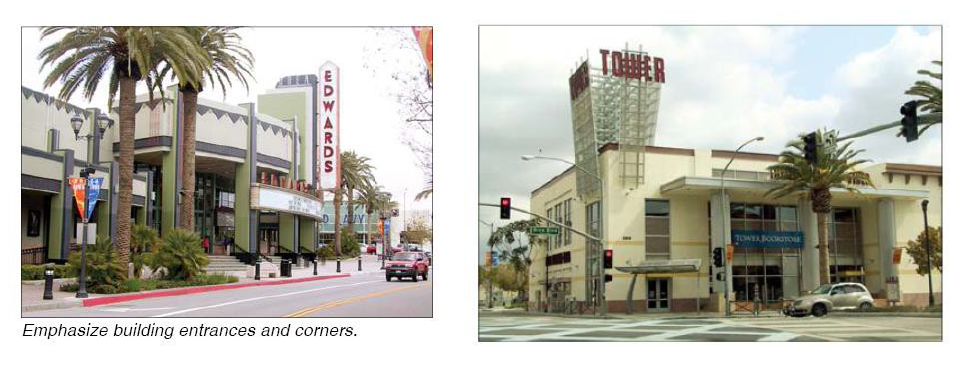
f.
Variable building facades along linear street frontages are encouraged. Variable facades create an interesting street scene. Nearly vertical or mansard roofs should be avoided.
g.
The appearance of building mass may be reduced through the use of arcades, courtyards, pergolas, and stepping stories back above the ground level.
h.
Color and material changes should be used to add interest and reduce a building's apparent scale.
Pedestrian-Oriented Commercial Development.
i.
Buildings should have a "human scale" (i.e. relate to the pedestrian user).
"Big Box" and Large-Scale Commercial Development.
j.
The scale and mass of a new "big box" and large scale commercial development should be consistent with neighboring developments and not overwhelm them with disproportionate size or a design that is out of character.
k.
A single, dominant building mass should be avoided by clustering several smaller structures and using variations in building form.
l.
As appropriate to the function of a building, a combination of major and minor changes in building form should be incorporated to create visual interest and establish a transition to neighboring developments.
m.
Primary building entries should be highlighted through the massing of the building. Greater height can be used to highlight and accentuate entries in the form of corner tower elements, tall voids, or a central mass sited within an entry plaza. Conversely, smaller building masses can also communicate the location of entries.
3.
Building Modulation, Articulation and Detailing.
a.
Building design shall avoid large monotonous facades, long straight-line building fronts, plain box shapes, and barren exterior treatment. Where consistent with the design theme and function of the building, incorporate a variety of massing elements and a combination of major and minor changes in building form to establish visual transition and unity among neighboring developments and create visual interest.
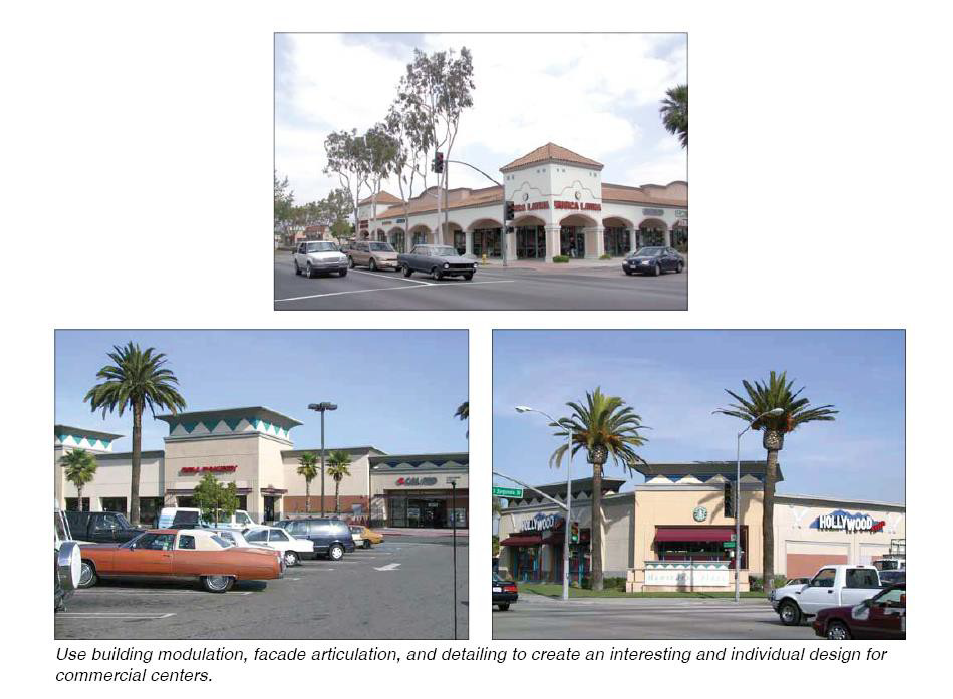
b.
Use building modulation, facade articulation, and detailing to create an interesting and individual design for commercial centers.
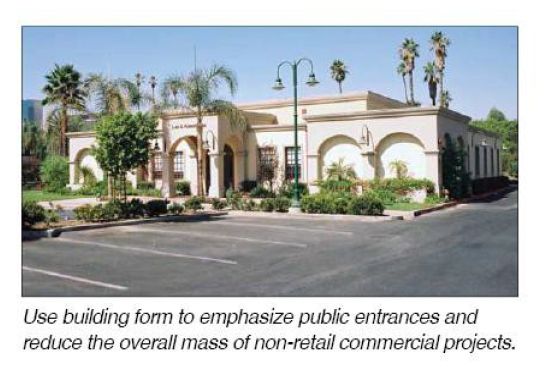
c.
Use building form to emphasize individual units within a building, larger units and/or anchor stores within retail projects, and foyers, lobbies, and reception areas within non-retail commercial projects. Use building form and articulation to emphasize public entrances and de-emphasize service areas, and to define and shelter (i.e. give a sense of invitation and enclosure) pedestrian walks and exterior spaces.
d.
Building articulation and detailing should be used to create an interesting and individual design, diminish the massing of large structures, and be compatible with the scale of surrounding development. Building design shall avoid large monotonous facades, long straight-line building fronts, plain box shapes, and barren exterior treatment. All building elevations visible from a public way including freeways shall be fully articulated, and incorporate the chosen design theme in a consistent manner.
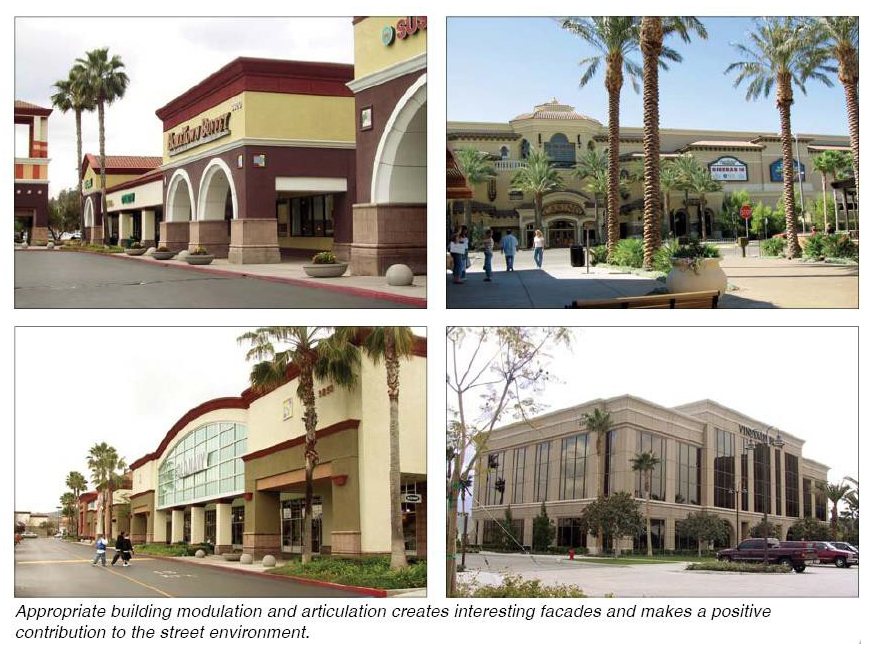
e.
Building articulation can also be accomplished with the placement of windows and entries, volume changes, variable roof forms and height, significant color and material changes, variable transparency, and the creation of shadow textures with trellises and overhangs.
f.
Appropriate building modulation and articulation creates interesting facades and makes a positive contribution to the street environment.
g.
Use building form to emphasize public entrances and reduce the overall mass of non-retail commercial projects.
h.
The staggering of planes along an exterior wall elevation creates pockets of light and shadow, providing relief from monotonous, uninterrupted expanses of wall. Wall planes should not run in one continuous direction for more than fifty (50) feet without an offset.
i.
Facades should reflect the quality and integrity of the underlying structure in a clear and consistent manner. Architectural elements that define scale and organize space are encouraged; facades should display a sense of order.
j.
Buildings should incorporate architectural details and elements, which will reduce building scale at the street level, especially along pedestrian walkways. Awnings, canopies, arbors, trellises, etc. are effective in this regard. The appropriate use of other architectural details, including reveals, course lines, decorative cornice, columns, etc., is also encouraged as a means of creating interest, variety, and distinctive design. Details should reflect the structural and material integrity of the building; overly gratuitous ornamentation is discouraged.
k.
Vertical architectural elements such as towers should be used as focal points. Gutters and downspouts should be concealed, unless designed as a decorative architectural feature.
Pedestrian-Oriented Commercial Development.
l.
Retail buildings should incorporate "human scale" design elements that generate interest and diversity, and relate the building to the everyday user. The design of individual storefronts, and their entrances should be emphasized.
m.
A pedestrian-oriented commercial building module shall range from thirty (30) to forty-five (45) feet and have a typical three-bay modulation. Buildings wider than two modules (60—90 feet) shall have a different modulation. These buildings shall either repeat the basic three-bay module of thirty (30) to forty-five (45) feet or increase the number of bays while keeping the individual bay width from ten to fifteen (15) feet. Buildings wider than ninety (90) feet shall be visually broken into two or more buildings (each with a maximum width of ninety (90) feet) in terms of the facade treatments. The modules should be articulated in a manner consistent with the building style. The use of pilasters is one element commonly used to achieve this articulation.
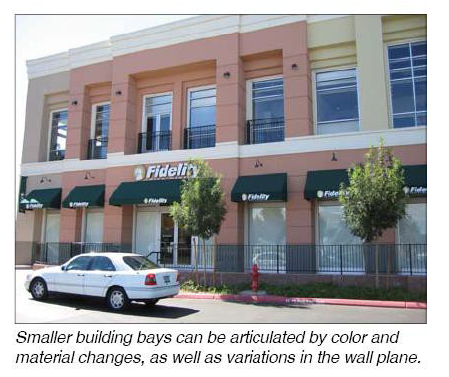
n.
The horizontal should be emphasized to create a low profile and human scale. Vertical elements such as towers are just one of the design tools available to accentuate the predominantly horizontal massing.
o.
Smaller building bays can be articulated by color and material changes, as well as variations in the wall plane.
"Big Box" and Large-Scale Commercial Development.
p.
In large-scale commercial development, while the modulation of a typical storefront may be larger than that in the pedestrian-oriented area, design elements that generate interest and diversity, and relate the building to the everyday user should still be incorporated. The design of individual storefronts and their entrances should be emphasized.
q.
A typical large-scale commercial building module should range from forty-five (45) to eighty (80) feet with the articulation of the building structure at fifteen (15) to twenty (20) feet. Buildings wider than two modules (90—160 feet) shall have a different modulation. These buildings shall repeat the basic module of forty-five (45) to eighty (80) feet. Buildings wider that one hundred sixty (160) feet should be visually broken into two or more buildings (each with a maximum width of one hundred sixty (160) feet) in terms of the facade treatments to stay in scale with the rest of the block.
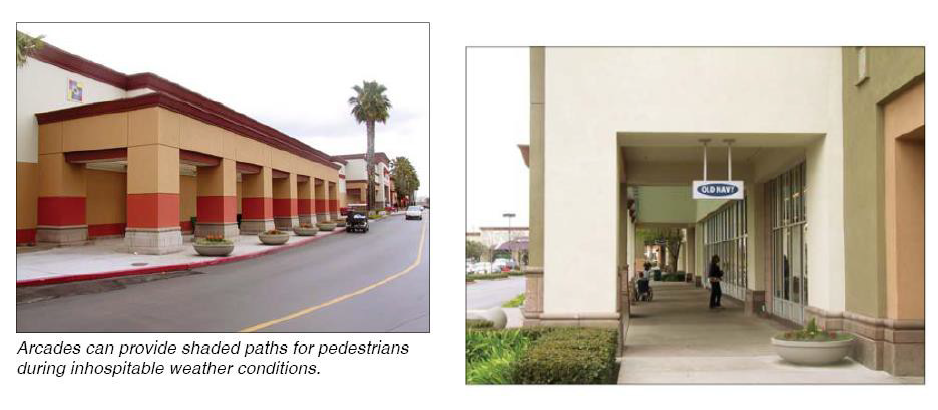
r.
Anchor buildings for major tenants, generally "big boxes," should be sited and designed in such a way that the buildings that accommodate the smaller tenants are not overwhelmed or crowded.
s.
Arcades, trellises and other open structures should be utilized to visually and physically link buildings and provide connections to adjacent sidewalks. Stairways should be designed as an integral part of the building architecture. Boldly projecting stairways that complement the architectural massing and form of commercial buildings are encouraged.
4.
Site and Building Entrances.
a.
Main entries to buildings should be clearly demarcated, visible and accessible from the street and/or pedestrian walkways. Secondary entries may be from parking areas.
b.
Building entries should read as such, and be integrated with the overall building form. Variation in building height, wall plane, roof treatment, window placement, architectural detailing, etc. should define and emphasize public entries. Variation in material, texture, and/or color is also recommended as a means of identifying building entries.
c.
Arcades can provide shaded paths for pedestrians during inhospitable weather conditions.
d.
Entries should be open, inviting, and highly visible so as not create a sense of fear in someone entering the space. Recessed or deeply shadowed entrances that allow hiding place opportunities should be avoided. Entry doors should be designed to create a sense of welcome, while clearly demarcating the private space.
"Pedestrian-Oriented" Commercial Development.
e.
All entrances should be clearly visible from the street. Secondary entries may be from parking areas. If parking is located behind the stores, provide additional well-lit and signed rear entrances to allow easy access.
f.
Retail entrances should be centrally located within the building facade, not be recessed more than three feet in depth and be located no more than fifty (50) feet apart.
g.
Entrances should comprise no more than a third of the ground floor facade or fifteen feet, whichever is less.
h.
Entrances for second floor uses are encouraged from the rear, adjacent to the parking. If separate entrances for the upper floor(s) are provided from the front, the entrance width should be limited to fifteen (15) feet to maintain retail continuity.
"Big Box" and Large-Scale Commercial Development.
i.
Entrances should be located prominently within the building facade and be clearly visible from the street. Locate entrances along the street side of the building. If the parking is located to the side or rear of the building, a secondary entrance may be located on the side of the building adjacent to the parking. This entrance should be visible and obvious from the street. Entrances should be located no more than sixty (60) feet apart. If only one entrance is provided, it should be located along the street side of the building.
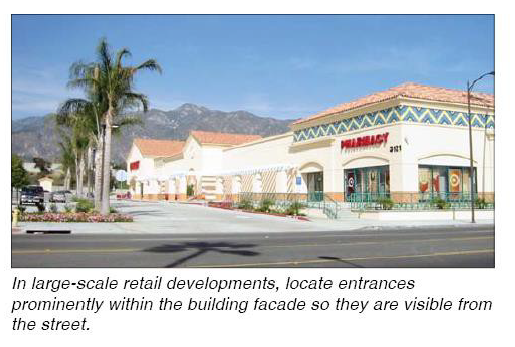
j.
If the parking is located to the rear of the building and hence not visible from the street, provide a secondary entrance on the street side of the building. If the building frontage is greater than seventy-five (75) feet, provide additional pedestrian entrances. Avoid long balconies and corridors for access to upper level units.
k.
Entrances should comprise no more than a third of the ground floor facade or twenty (20) feet, whichever is less.
l.
In large-scale retail developments, locate entrances prominently within the building facade so they are visible from the street.
5.
Building Facade and Elevation Design.
a.
The elements of a building should relate logically to each other, as well as to surrounding buildings to enhance the characteristics of a particular building or area. The buildings should present an "active" building elevation including entrances and windows to the street, not blank walls or parking.
b.
Buildings should contain the traditional three parts of a building: a base, mid-section, and a top. On low-rise buildings, the different parts may be expressed through detailing at the building base or eave or cornice line. On taller structures, different treatment of the first, middle, and top stories should be used to define the three parts.
c.
The base should visually relate to the proportion and scale of the building. Techniques for establishing a base may include richly textured materials (e.g. tile or masonry treatments), darker colored materials, mullion, panels, reveals and/or enriched landscaping. Tops take advantage of the visual prominence of a building's silhouette. Techniques for clearly expressing a top may include cornice treatments, roof overhangs with brackets, richly textured materials (e.g. tile, masonry or fluted concrete), and/or differently colored materials. Colored "stripes" are not acceptable as the only treatment.
d.
When buildings have a direct relationship to both the street and a major pedestrian corridor or parking lot, all facing facades should be designed to assure an attractive appearance. Building walls that are visible from a freeway, street, major pedestrian corridor, or public open space, should include architectural features such as windows, arcades, canopies, pop-outs, and trim to create visual interest, provide "eyes on the street," and avoid a blank wall appearance.
e.
The fenestration (design and pattern of doors, windows, awnings, canopies, etc.) should be proportioned to and integrated with the facade modulation of columns and beams and other similar elements. Clear vertical and/or horizontal hierarchy and patterns in the placement of openings (doors, windows, awnings, canopies, etc.) on the facade should be established.
f.
Details or elements should be integral to the design, not appear added on and reflect the structural or material integrity of the building.
6.
Building Elements for Retail Storefronts. A typical retail storefront has the following characteristic elements:
a.
Bulkhead;
b.
Entrance door;
c.
Display windows;
d.
Canopies or awnings;
e.
Cornices/parapets;
f.
Security grilles.
Design guidelines for these elements are described below. Appropriate scaled and proportioned elements should be provided in both the rehabilitation of existing storefronts and the construction of new buildings.
a.
Bulkhead. A bulkhead, between fifteen (15) and twenty-four (24) inches in height, should be provided at the base of the storefront display window. However, new storefront buildings may use floor to ceiling display windows if the design is compatible with surrounding architecture.
b.
Entrance Door. Every building entry should be well lit. The entrance door should be kept simple and located centrally in the building facade. The door should be made of materials compatible with the building architecture and style. All entrances shall meet handicapped accessibility requirements.
c.
Display Windows. Retail storefronts should have large display windows oriented toward the street or major pedestrian corridors to establish a visual connection between the interior and exterior of retail building. Display windows shall provide a clear view of store merchandise or a view into the business interior to add to the vitality of a retail environment as well as provide "eyes on the street." To achieve this, at least fifty (50) percent of available window area shall remain clear and free from obstructions. This zone should be between four and eight feet from the base of the facade. Ground floor wall sections without windows shall not be more than five feet in width.
Display windows should consist of a single pane of glass. When required to be divided into smaller sections, clear silicone vertical joints, glazing bars, or muntins should be used. Glazing bars and mullions should be of a minimal size and utilized to enhance the architectural style. The glass should be clear with an exterior daylight reflectance of not more than eight percent. The use of opaque glass is prohibited.
d.
Canopies or Awnings. The size, scale and color of awning(s) should be compatible with the rest of the building; the awning(s) should not be the predominant element of the facade. Awnings should not cover the storefront piers or pilasters and should be divided into sections to reflect the major vertical divisions of the facade.
The awning should be mounted such that its valance is between eight and nine feet above the sidewalk with a projection of between four and eight feet from the building face, but no closer than five feet to the street curb. An encroachment permit is required for all awnings that encroach or overhang on the sidewalk.
The use of awnings along a row of contiguous structures should be restricted to awnings of the same form, location on the building facade, and material and color.
Awnings shall not start at the parapet edge of the facade. The step (the highest line of contact where the awning touches the facade) of the awning shall be at least twenty-four (24) inches below the parapet line. Retractable awnings are encouraged, but barrel shaped awnings are discouraged. Where architecturally appropriate, cantilevered or suspended integral horizontal canopy slabs may be used instead of awnings. Internally lit awnings should not be used. Awnings shall be well maintained, cleaned on a regular basis, and replaced when faded or torn.
e.
Reserved.
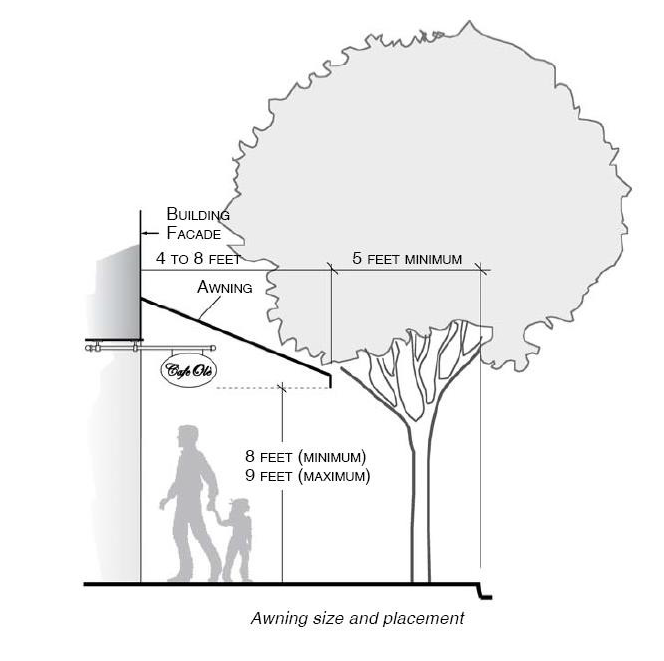
f.
Cornices or Parapets. Each building should have a simple cornice. If a parapet is provided, it may be stepped vertically to provide modulation and emphasis on the central module. The cornice should enhance the architectural style of the building. The use of elements such as oversized crown moldings is not permitted. A plaster front building may have a stone sill at the parapet line. A brick-front building may have a corbelled cornice.
g.
Security Grilles. Visible security grilles are prohibited on the building facade exterior. Security grilles installed on the interior of the storefront are permitted. This installation must be done in a manner such that the grille is concealed from public view when not in use by retracting into casings that are in proportion and scale with the building's architecture. The color of the interior grilles should blend in with the background color so as to reduce their visibility when used. Exterior grilles on existing structures should be removed and placed on the interior of the storefront per these guidelines. Permanent security bars (defined as those clearly visible and fixed to windows on the facade) and roll-up metal security doors (including opaque shutters) are also strongly discouraged.
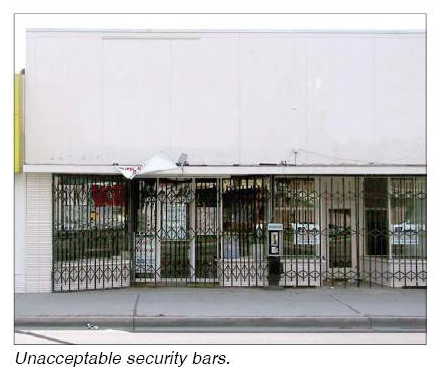
h.
Security Bollards. Decorative bollards for security are permitted. Bollard design should be consistent with the overall project theme and should coordinate with other site furnishings. In locations where emergency access may be necessary, removable bollards should be considered.
7.
Building Elements for Non-Retail Buildings. The elements of a building should relate logically to each other as well as to surrounding structures. A typical non-retail building has the following characteristic elements:
a.
Entrance door;
b.
Windows;
c.
Canopy or awnings;
d.
Parapets.
Design guidelines for these elements are described below. Appropriate scaled and proportioned elements should be provided in both the rehabilitation of existing storefronts and the construction of new buildings.
a.
Entrance Door. Entrance doors should be simple and located prominently in the building facade. The door should be made of materials compatible with the building architecture and style.
b.
Windows. Use interior and/or external shading devices to reduce solar heat gain and reduce energy consumption. Windows should be set from the exterior face of wall to create a shadow line. The glazing used for the windows may be clear or partly tinted glass. Highly reflective or dark tinted glass is not permitted.
c.
Canopies or awnings. In non-retail buildings, the use of awnings is generally not encouraged. Instead, if architecturally appropriate, cantilevered or suspended integral horizontal canopy slabs may be used instead of awnings. A canopy should be located such that its valance is between eight and nine feet above the sidewalk with a projection of between four and eight feet from the building face, but no closer than five feet from the street curb.
d.
Parapets. Parapets should have sufficient articulation of detail such as corner treatments, continuous banding, details, or varying pitch. Parapets should always include a cap and corner detail to enhance the building. Parapets should look integrated with the building.
8.
Roof Design.
a.
The roof design should be considered as a component of the overall architectural design theme. Roof forms should be simple, avoid a massive appearance, and reflect the internal organization of buildings.
b.
New buildings may have flat or sloping roofs, depending on what is most compatible with the architectural style of the building and others in the area. Parapets should appear integrated with the building and should include a cap and corner detail to create a shadow line to enhance the building. Mansard roofs are discouraged.
c.
As a building feature, sloped roofs help make a visual transition from commercial uses to the surrounding residential neighborhoods. When gabled or pitched roofs are used, careful integration with the primary building and adjacent buildings should be considered in design. Roof slopes should be between 3:12 and 6:12.
d.
Varied roof forms such as tower elements, extended eaves with rafters and corbels may be used to add interest and to create a consistent style. Roof planes may be extended beyond the building volume to create covered walkways and verandas.
e.
Roof form and height should be varied to complement building mass and articulation. Vertical variations to the roof line should incorporate roof projections to avoid a false front/unfinished appearance.
f.
The roof line at the top of the structure should not run in a continuous plane for more than sixty (60) feet without offsetting or jogging the roof plane. This dimension should correspond with the modulation of the building's wall planes.
9.
Doors and Windows.
a.
Doors and windows are key elements of any structure's form, and should relate to the scale and proportions of the elevation on which they are located. Windows and doors can establish character by their rhythm and variety and help to provide depth and contrast on elevation planes. Windows and doors should be used to help mitigate building mass, establish scale, give expression to otherwise blank walls, and create a distinctive building design.
b.
All doors and windows should be related with the chosen architectural style. Windows with widely varying styles are strongly discouraged. All doors and window frames should be made of consistent material. Wherever possible, window sizes should be coordinated vertically and horizontally and window design should be consistent in terms of style and general arrangement on all building sides.
c.
Window exposure should be maximized along pedestrian walkways. The use of opaque glass adjacent to pedestrian walkways is discouraged.
d.
Window frames should appear substantial and should not be flush with the exterior finish. Windows should be designed to enhance building interest and articulation. Recessed windows or inset glazing are possible design considerations.
e.
Windows located on the sides and rear of the project should also be consistent with the look and style on the front of the project.
f.
Use interior and/or external shading devices to reduce solar heat gain and reduce energy consumption. Windows should be set from the exterior face of wall to create a shadow line. The glazing used for the windows may be clear or partly tinted glass. Highly reflective or dark tinted glass is not permitted.
10.
Architectural Lighting.
a.
Architectural lighting can be used to enhance the perception of a commercial building(s) at night. A facade light style that is sympathetic to the building's architecture should be used. Architectural lighting should "wash" upon the street faces of a building. Facade lighting should vary so that the important elements such as entries, architectural details and public art, are lit more dramatically than the intervening walls and voids.
b.
Visible direct lamp glare from unshielded floodlight fixtures is not allowed. In addition, retailers and other building users are discouraged from allowing a direct view to any bare light source from normal pedestrian or vehicular sight lines. This includes both facade lighting as well as interior lighting within ten feet of the structures' windows.
11.
Materials and Finishes.
a.
Materials and finishes should be suitable to the scale, character and design theme of the building and further lend variety and interest to the project.
b.
Textures, colors and materials should unify the building and its elements. Materials should be consistently applied and should be chosen to work harmoniously with adjacent materials. Piecemeal embellishment and frequent changes in materials should be avoided.
c.
Buildings should be treated as a whole and finished appropriately on all sides to provide continuity. Backs of buildings should use similar materials; however, less expensive and more utilitarian substituted materials are acceptable, provided they are compatible with the overall design.
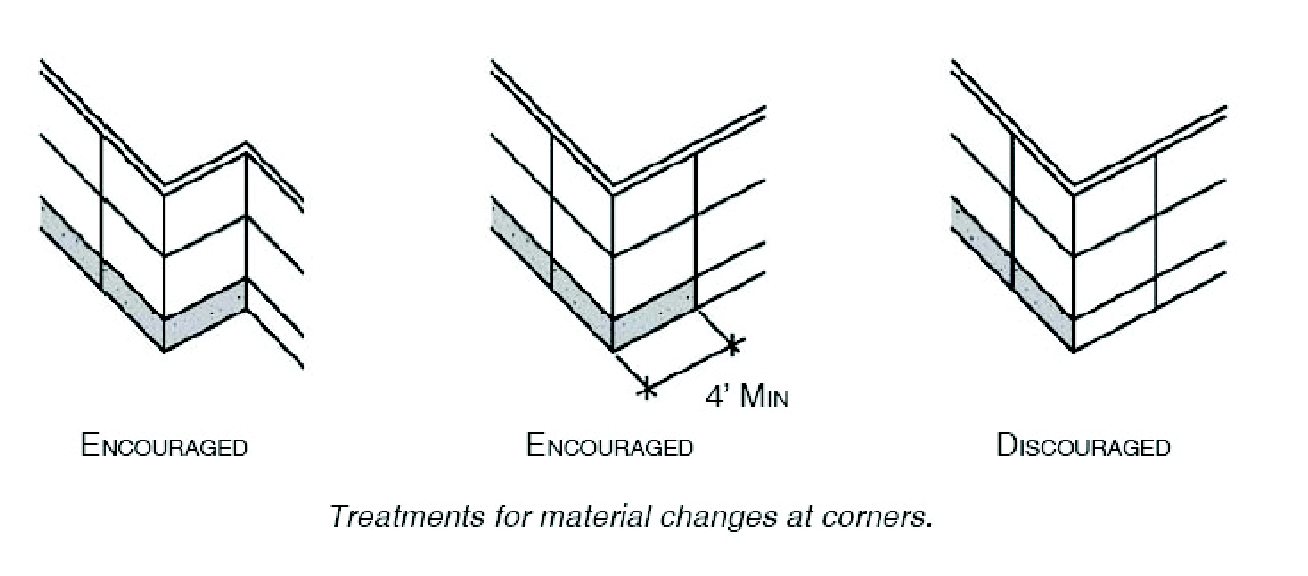
d.
Materials tend to appear substantial and integral to the structure when material changes occur at changes in plane. Material changes not accompanied by changes in plane appear "tacked-on" and are strongly discouraged. Material changes should not occur at external corners. Material changes may occur at "reverse" or interior corners or as a "return" at least four feet from external corners, with extended returns provided for large buildings.
e.
Exterior materials for all commercial developments should be of high quality, durable and low maintenance. Materials that will withstand abuse by vandals or accidental damage from machinery are strongly encouraged.
f.
Accessory structures should be designed as an integral part of the project architecture and should be similar in material, color, and detail to the primary buildings.
g.
The use of sustainable building materials is strongly encouraged. This includes using quality materials with a long life span, selecting materials that are not energy-intensive to manufacture, using building products made from recycled materials, and repairing and maintaining well-built existing structures to the fullest extent possible. No large expanses of wood features should be used due to maintenance issues in high desert climate.
h.
Materials that have no relationship to the architectural style shall not be permitted. These include mirrored glass, antiqued or imitation old brick, fake or cultured river rock, exposed concrete block, etc. Translucent plastic is strongly discouraged for use in awnings.
12.
Color and Texture.
a.
Color and finishes on exteriors of all elevations of a building should be coordinated to provide a total continuity of design. Materials provide texture and color and should influence the choice of other colors on the facade.
b.
The blending of compatible colors in a single facade or composition is a good way to add character and variety, while reducing, or breaking up the mass of a building. Lower wall wainscots and built-up or recessed reveals may be employed to add interest and break up vertical monotony.
c.
The colors chosen should accentuate the architectural details of the building and be consistent with its architectural style. A minimum of three and a maximum of five exterior building colors shall be used. These colors should be used on the base (main body), trim and accent. The base colors should be the lightest and the accents used sparingly. The two additional colors may be used on the base (main body) to distinguish between upper and lower floors or as an additional trim color.
d.
Sign colors and finishes shall relate to those of the building. Signs may use any of the building colors plus up to three additional colors for a maximum of eight colors. Signs must use at least one of the building exterior colors.
e.
Unusual patterns and color schemes should be avoided. Garish, non-harmonious, or out-of character colors should not be used.
13.
Corporate Identity Issues. The use of standardized "corporate" architectural styles associated with franchises is discouraged. Make corporate identity secondary in the design of projects, and consistent with the architecture of the surrounding community. Site-specific design solutions are encouraged. The design character should not be a standard franchise prototype and should incorporate dominant characteristics of the neighborhood in which it is located.
(Ord. No. 2012-02, § 3(Exh. A), 2-7-12)
16.16.405 - Site design standards and guidelines.
A.
The scale and site layout of commercial development can vary greatly from project to project.
1.
Building Siting, Orientation and Setbacks.
a.
Building siting should take into consideration the context of the commercial area, the location of nearby uses, and the location of major traffic generators as well as the site's characteristics.
b.
The arrangement of structures, parking and circulation areas and open spaces should relate to the surrounding built environment in pattern, function, scale, character and materials. In developed areas, new projects should meet or exceed the standards of quality that have been set by surrounding development.
c.
Uniform building setbacks and orientation represent an effective means of establishing compatible development patterns among neighboring properties. Contribute to an attractive street scene, and consistently orient buildings and building entrances along the public right-of-way.
d.
As far as is feasible, buildings should be sited to screen parking and unsightly scenes and activities from public view, and from residentially designated properties.
e.
Buildings should not turn a blank wall to neighboring properties; site buildings to avoid visible blank walls along interior side property lines.
f.
Buildings with angled corners or plazas are encouraged at corner locations.
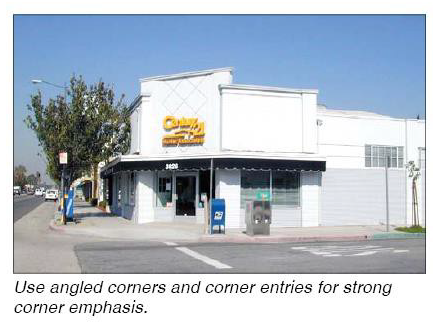
g.
One of the critical elements of a successful pedestrian-oriented retail area is continuous street frontage. The street side setbacks should be minimized and new structures built at the street side setback line. For the rehabilitation of existing buildings, the existing setback may be maintained.
h.
The placement and design of buildings should facilitate and encourage pedestrian activity and convey a visual link to the street and sidewalks. The building(s) and main entrance(s) should be oriented toward the primary street frontage.
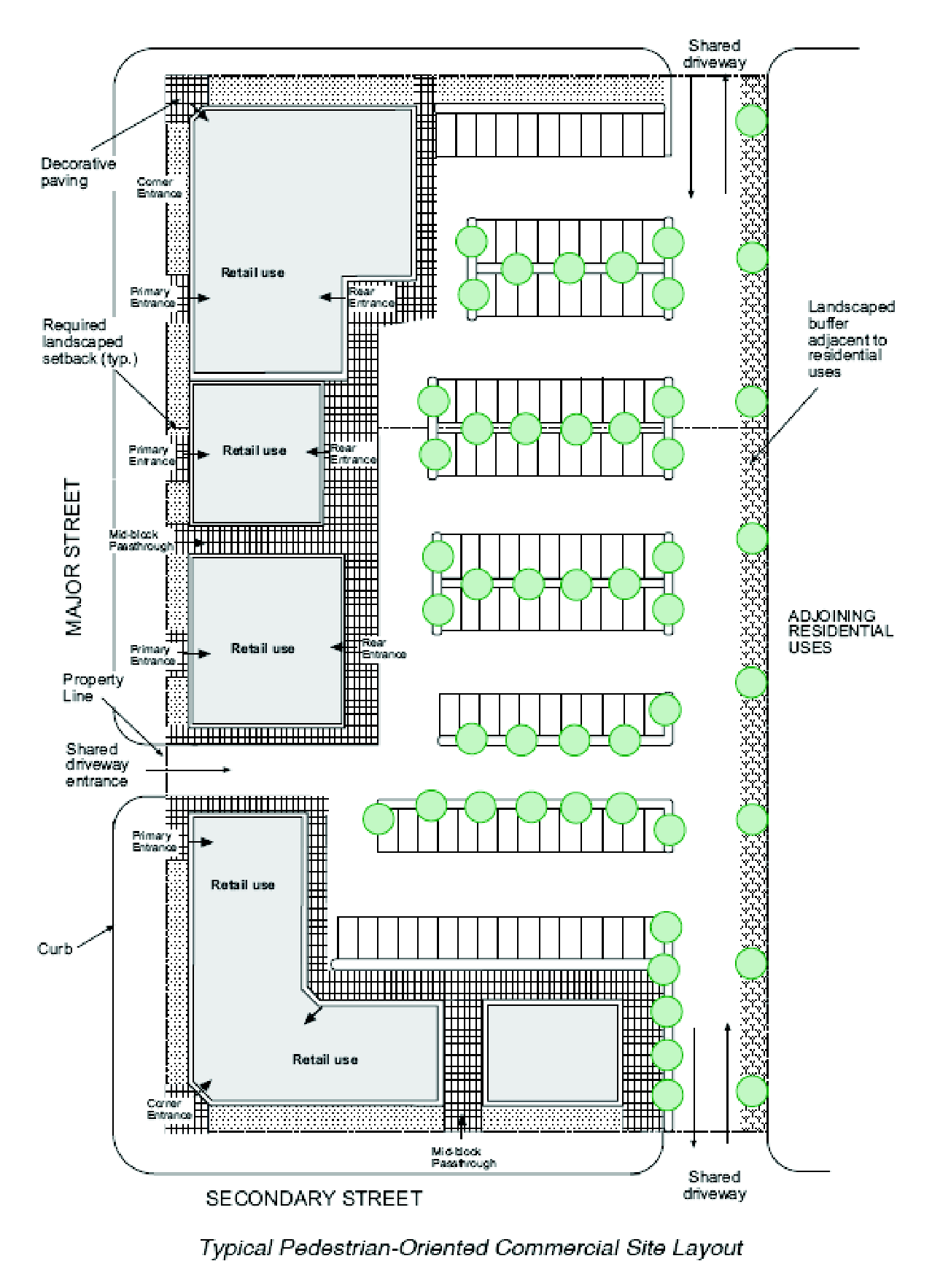
"Big Box" Retail and Large-Scale Commercial Development.
i.
Buildings shall be sited to avoid random and irregular building relationships; arrange buildings to create a sense of unity and overall harmony. Whenever possible, new structures should be clustered to create plazas and pedestrian malls and avoid the creation of "barrack-like" rows of structures. When clustering is impractical, a visual link between separate structures should be established. This link can be accomplished through the use of an arcade system, trellis, or other open structure. Orient the main entrance or entrances to the street or major plazas or open space.
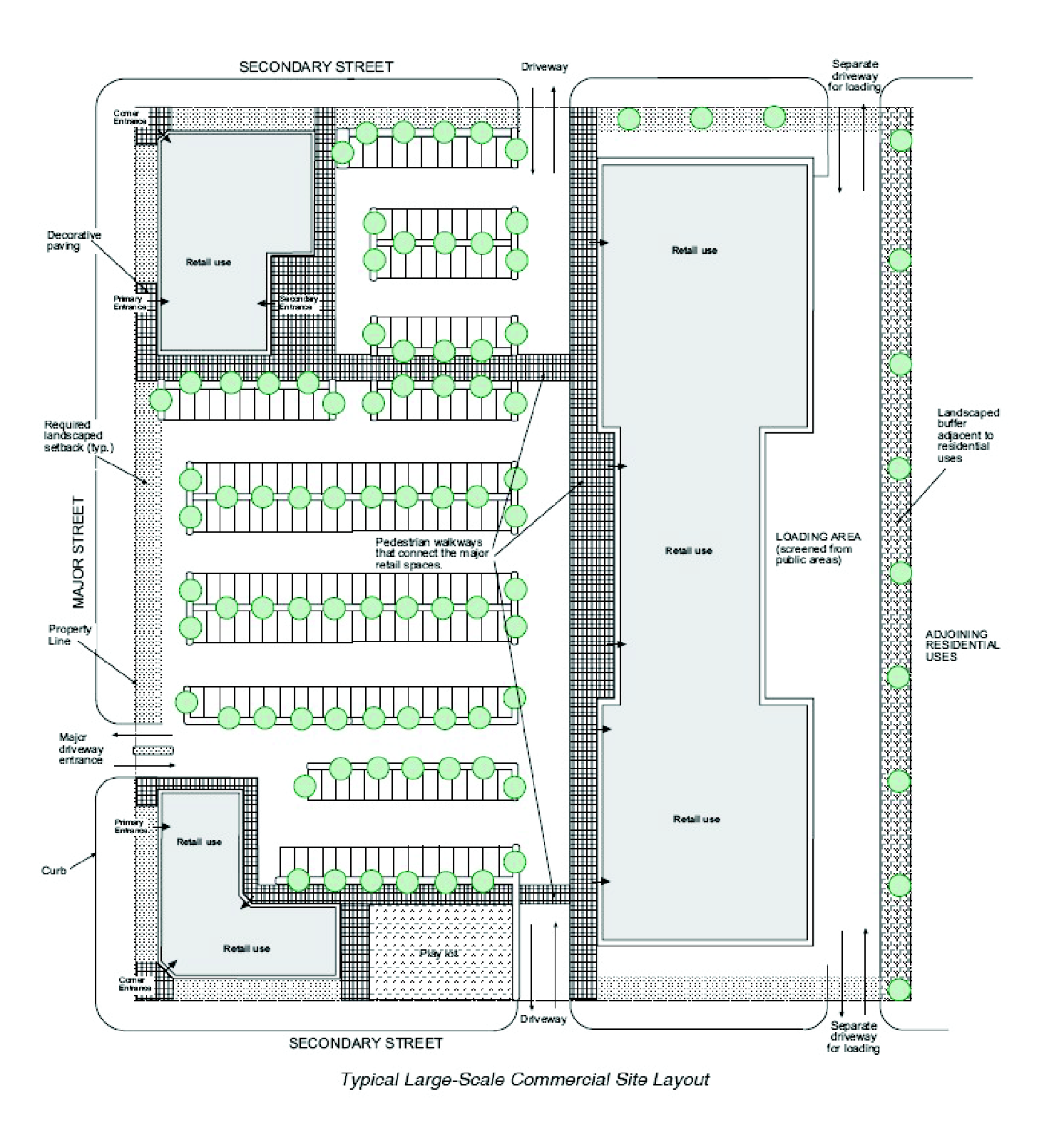
j.
Typical Large-Scale Commercial Site Layout. Where the parking area of a commercial project abuts another commercially or industrially designated property, a minimum five-foot wide perimeter landscape buffer (exclusive of the planter area curb) is required. Where feasible to do so, integrate the landscape buffer with that of the adjacent property. An exception is permitted for areas where shared parking and access has been designed with an adjacent project.
2.
Interface Between Non-residential and Residential Uses. In several portions of the city, non-residential uses abut residential uses. Residential uses should be buffered from incompatible commercial development to mitigate negative impacts due to noise, vibration, shading, light and glare, and aesthetics. Intensified landscaping, increased setbacks and appropriate building orientation should be utilized as a means of providing adequate separation between such land uses. However, linkages (e.g. walkways, common landscape areas, and building orientation) between compatible commercial and residential uses are encouraged where appropriate. Issues of privacy, safety and noise are addressed in these following standards:
a.
To provide privacy for adjacent residential properties, taller elements of the building shall be set at the front end of the parcels instead of the rear. Building heights should be stepped down to the height of adjacent residential uses, utilizing architectural elements such as gables and hipped roofs to reduce building mass. No portion of the building, including parapets, shall be above an imaginary plane drawn at the rear property line (where no alley is present) and extended at an angle of forty-five (45) degrees towards the center of the property. When an alley is present, the plane shall begin at the centerline of the alley.
b.
In addition, appropriate landscape screening shall be provided at the shared property line to mitigate the negative visual and environmental impacts that are associated with commercial land uses. Excepting trees, this screening shall be eight feet in height.
c.
Eighty percent of the vertical plane at the property line to a height of eight feet shall be opaque.
d.
Screening may consist of one (or more) of the following:
i.
"Vertical" trees closely spaced;
ii.
"Green" (vine-covered) solid or fenced walls;
iii.
Hedges (minimum height of eight feet).
e.
Non-residential buildings should be sited to avoid significant shading of adjacent residences and compromising residents' privacy.
f.
Windows of non-residential buildings should be oriented to avoid a direct line of site into adjacent residential buildings or property.
g.
Noise or odor generating activities in general, and loading areas, trash and storage areas, and rooftop equipment in particular, should be located as far as possible from adjacent residential uses and shall not be located next to residential properties without fully mitigating their negative effects.
h.
Whenever adjacent residential and commercial uses can mutually benefit from connection rather than separation, appropriate connective elements such as walkways, common landscaped areas, building orientation, gates and/or unfenced property lines should be employed.
i.
Additional noise standards pursuant to Section 16.20.125 of this development code shall also apply.
Pedestrian-Oriented Commercial Development.
j.
Where a project abuts a residentially designated property, a minimum of three feet of the required setbacks adjacent to the residential use shall be devoted entirely to shrubs (at least six feet in height) and trees (exclusive of any planter area curb).
"Big Box" Retail and Large-Scale Commercial Development.
k.
To provide privacy for adjacent residential properties, taller elements of the building should be set away from the residential uses. No portion of the building, including parapets, should be above an imaginary plane drawn at the rear property line (where no alley is present) and extended at an angle of forty-five (45) degrees towards the center of the property. When an alley is present, the plane shall begin at the centerline of the alley.
l.
Where a project abuts a residentially designated property, a minimum of six feet of the required setbacks adjacent to the residential use shall be devoted entirely to shrubs (at least six feet in height) and trees (exclusive of any planter area curb). Shrubs shall be planted at a minimum size of five gallons and trees at twenty-four (24) inches box.
3.
Plazas and Courtyards.
a.
Commercial developments should incorporate plazas and courtyards into their design. Buildings should be clustered to create usable pedestrian areas.
b.
Primary access to public plazas and courtyards should be provided from the street. Secondary access may be provided from retail shops, restaurants, offices and other uses within the development. Entries to the plazas and courtyards should be inviting and well lit.
c.
Landscaping, water features, and public art should be incorporated into plaza and courtyard design. Shade trees or architectural elements that provide shelter and relief from direct sunlight should be provided.
d.
Plazas and courtyards should be buffered from the street, parking areas or drive aisles.
e.
Auxiliary structures and areas such as play areas and outdoor dining areas should be integrated within the overall site design. Play structures associated with commercial uses should be enclosed and integrated within the building design.
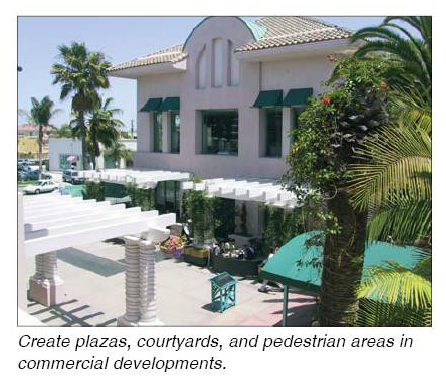
4.
Environmental Considerations.
a.
Buildings should be designed and sited to maximize the use of sunlight and shade for energy savings, and respect the solar access of adjacent buildings.
b.
Grading shall be designed to limit the height of retaining walls and perimeter walls to that permitted by the city's requirements. To the extent possible, site grading should relate to the natural surroundings and be designed to minimize grading by following the natural ground contours and recognizing existing drainage patterns. Graded slopes should be rounded to blend with existing terrain. Grading should emphasize and accentuate scenic vistas and natural landforms.
c.
Large manufactured slopes should be avoided in favor of several smaller slopes integrated throughout the project. Smaller slopes are less obtrusive, more easily vegetated and can be used to add visual interest, preserve views and provide visual buffers where necessary.
d.
Significant existing trees, vegetation and any other natural site attributes should be preserved to the greatest extent possible in the design and development of the commercial project. Site design that requires altering landforms and removing trees is discouraged.
e.
Consideration should be given to the reduction of landscape maintenance and water consumption when selecting landscape materials.
5.
Vehicle Circulation and Access.
a.
Site access and internal circulation in commercial developments should promote safety, efficiency, and convenience. Vehicular traffic should be adequately separated from pedestrian circulation. Vehicular entrances should be clearly identified and be easily accessible to minimize pedestrian/vehicle conflict.
b.
Adequate areas for maneuvering, stacking and emergency vehicle access should be provided. Internal circulation routes and parking areas should be separated. Continuous circulation should be provided throughout the site to the greatest extent possible to prevent awkward vehicular maneuvers. Dead-end driveways should be minimized. Vehicles should not be required to re-enter the street in order to move from one area to another on the same site.
c.
The number of site access points or driveway aprons shall be minimized, to achieve efficient and productive use of paved access ways, and to eliminate traffic hazards. They should be located as far as possible from street intersections. A minimum distance for driveway aprons shall be required as outlined in Table 1 of Section 12.08.020 of the Hesperia Municipal Code and may be increased based upon safety considerations.
d.
The site access points should be coordinated with existing or planned median openings and driveways on the opposite side of the roadway. Entrances and exits to and from parking and loading facilities should be clearly marked with appropriate directional signage where multiple access points are provided. Shared site access is encouraged and in some cases may be required.
e.
Where possible, driveways should be minimized along arterial streets and access instead provided from side/secondary streets.
f.
Design that allows for present or future reciprocal access with adjacent properties is encouraged. Driveway entry locations should be coordinated with existing or planned median openings and driveways on the opposite side of the roadway.
g.
The main entry driveway should be easily identifiable, incorporating landscaping and possibly accent paving that is related to the building hierarchy and color.
h.
Vehicular access, drives and circulation routes shall be designed so that all movements involved in loading, parking, or turning shall occur on-site and not within the public right-of-way. Exceptions will be considered where a property abuts an alleyway.
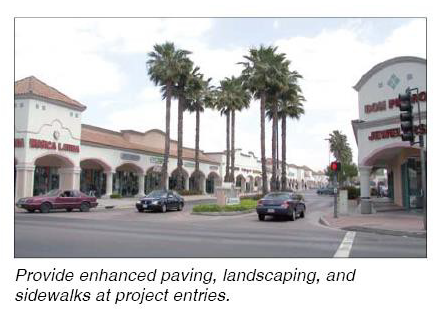
6.
Pedestrian Circulation.
a.
Commercial developments shall incorporate pedestrian walkways into site design to provide pedestrian connections from building entries to public sidewalks, plazas, and parking areas, and to buffer pedestrians from vehicular movement. Project entries and driveway areas should contain design features, including landscaping and textured paving, to break up the expanse of paving in a project. Paving materials should complement the architectural design. The use of stamped concrete, stone, brick, pavers; exposed aggregate or color concrete is encouraged.
b.
Pedestrian walkways should be a minimum of four feet in width. Pedestrian walkways should be safe and clearly identifiable using varied surfaces, decorative paving, and landscaping. At a minimum, varied surfaces should be used to delineate crossings at circulation drives and parking aisles.
c.
Design parking areas so that pedestrians walk parallel to moving cars. Minimize the need for pedestrians to cross parking aisles and landscape islands to reach building entries.
d.
New structures and parking areas should enhance existing pedestrian connections to existing outdoor pedestrian spaces such as courtyards, plazas and porticos and create new connections where none exist.
e.
Raised pathways, decorative paving, landscaping and bollards should be used to separate pedestrian paths from vehicular circulation areas to the maximum extent possible.
f.
Identify and accentuate pedestrian areas; use special paving, painting, landscaping, etc.
7.
Parking.
a.
Parking lots should be designed with a clear hierarchy of circulation: major access drives with no direct access to parking spaces; major circulation drives with little or no parking; and parking aisles for direct access to parking spaces. Loading and service areas should be provided with separate access and circulation whenever possible.
b.
On-site parking (lots and structures) shall be located to the rear of the building for parcel widths less than two hundred (200) feet and accessed by alleyways wherever they exist.
c.
For parcel widths greater than two hundred (200) feet, parking lots may occupy up to forty (40) percent of the parcel's street frontage. Such siting in conjunction with substantial landscape treatment, enhances the streetscape, and contributes in the screening of parking areas.
d.
Parking areas shall be designed so that no vehicle has to back into the public street. Provide end-stall turnarounds or a continuous circulation pattern.
e.
Parking lots should be separated from buildings by a raised walkway (minimum four feet wide) and landscape strip (minimum seven feet wide).
f.
Parking areas should be screened by buildings and landscaping.
Pedestrian-Oriented Commercial Development.
g.
In pedestrian-oriented retail areas, vehicular entrances to off-street parking lots should be minimized in order to maintain retail facade and pedestrian continuity. No existing storefronts may be removed to provide vehicular access to parking. Encourage alley access to parking, where present, by implementing area-wide parking information and signage systems.
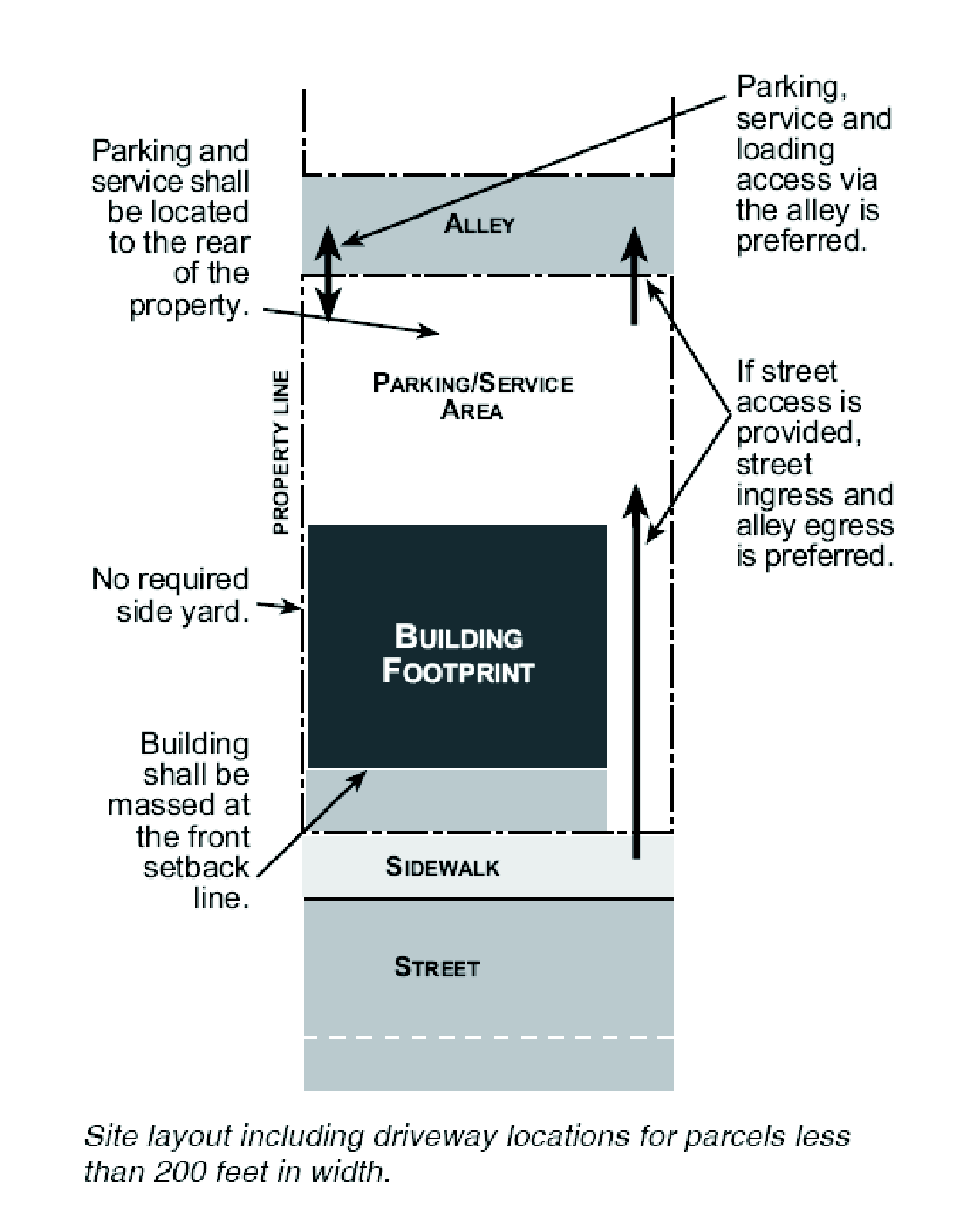
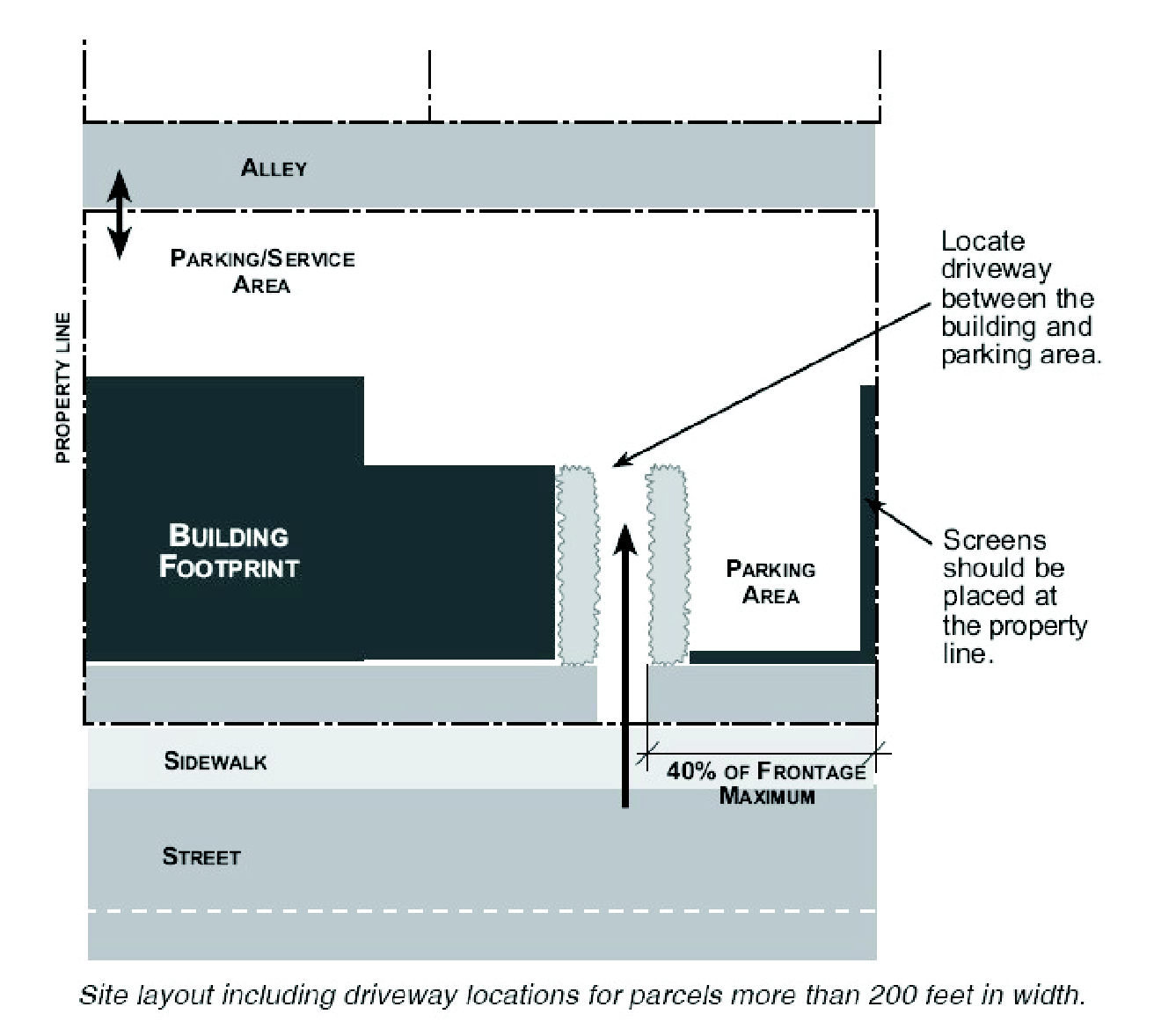
h.
Shared driveways and parking arrangements between adjacent businesses/developments are strongly encouraged.
i.
In commercial centers, on-site parking should be consolidated in one area rather than wrapping around the entire building.
"Big Box" Retail and Large-Scale Commercial Development.
j.
The visual dominance of parking facilities should be reduced such that parking is visually subordinate to the building it serves. The desirable solution is to provide a majority of the parking at the rear of the site, where it is largely hidden from view by a building that fronts the street. In addition, on-site parking should be consolidated in one area rather than wrapping around the building.
k.
Where feasible and compatible with the design of the building, use subterranean, semi-subterranean, or parking, which is tucked under the building. Parking designed in this manner must effectively reduce the visual impact of parking, and not detract from the building architecture or site views.
l.
Entry areas to commercial development should be enhanced by ornamental landscaping, decorative paving, raised medians, gateway structures, and monument signage.
m.
Main entry drives should extend from the street to the front cross aisle and should include:
i.
A median with a minimum ten-foot wide clear landscaped area between the street and the first bisecting parking aisle.
ii.
A minimum five-foot wide sidewalk on each side of the driveway.
iii.
A minimum ten-foot wide landscaped parkway on each side of the driveway.
iv.
A minimum twenty (20) foot wide decorative paving band.
v.
Use decorative paving and landscaping to facilitate vehicular and pedestrian access at project entries.
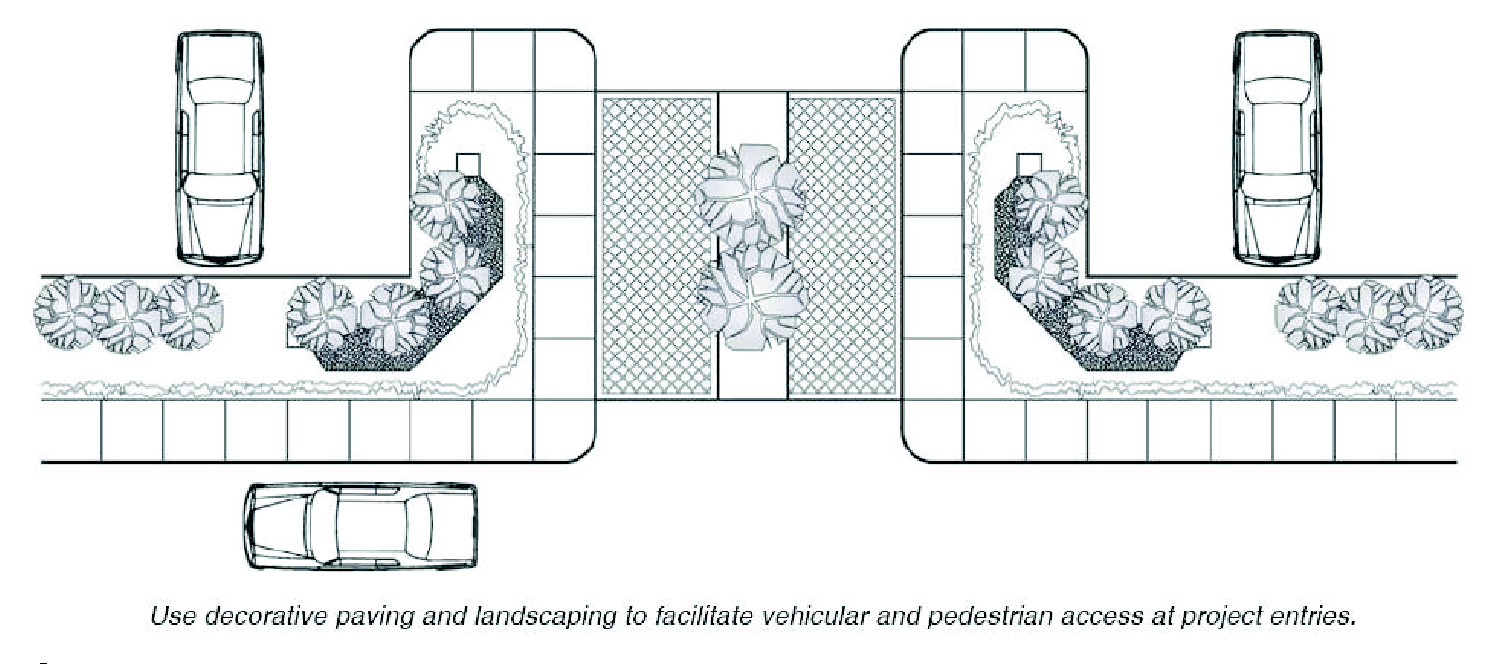
8.
Loading Areas.
a.
Loading areas shall be designed to prevent interference with vehicular circulation and parking, and to provide an unobstructed area for trucks to maneuver when accessing loading spaces.
b.
Loading areas shall be located away from main customer entrances and the street, preferably toward the rear of the property.
c.
Overhead (roll-up) doors shall not be directly open to public view, and shall be substantially screened from the street, the freeway, and residential designated properties. Screening may be accomplished in a variety of ways, including the use of wing walls, the recessing of overhead doors (building articulation), landscaping, or a combination of these techniques. Fixed hardware for roll up doors shall be located on the inside of buildings to minimize visual clutter.
d.
If located adjacent to residential areas, the design of overhead doors should minimize noise through devices such as rubber seals and/or other dampening features.
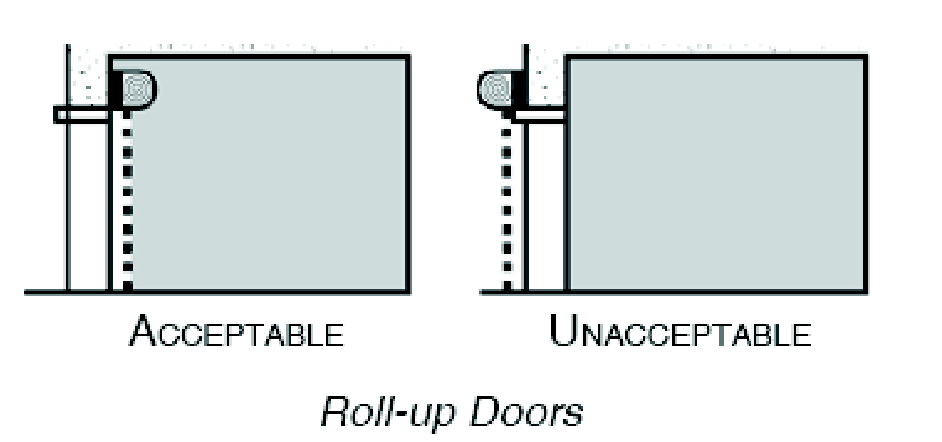
e.
The grade of loading docks should be as low as feasible to minimize views from the street and the need for tall walls or fencing. Building segments above loading doors visible from the street and surrounding properties should conform with other guidelines pertaining to building features, materials and finishes.
f.
Service areas should be screened from streets, freeways and adjacent properties. Lowering loading docks reduces the wall height needed to block views (offers one possible solution, subject to reasonable grading costs and site constraints). Screen walls should be setback from the street curb to minimize the visual impact and scale of the wall along the street. Varies based upon site conditions. Landscaped berms should be provided to minimize the visual impact of screen walls.
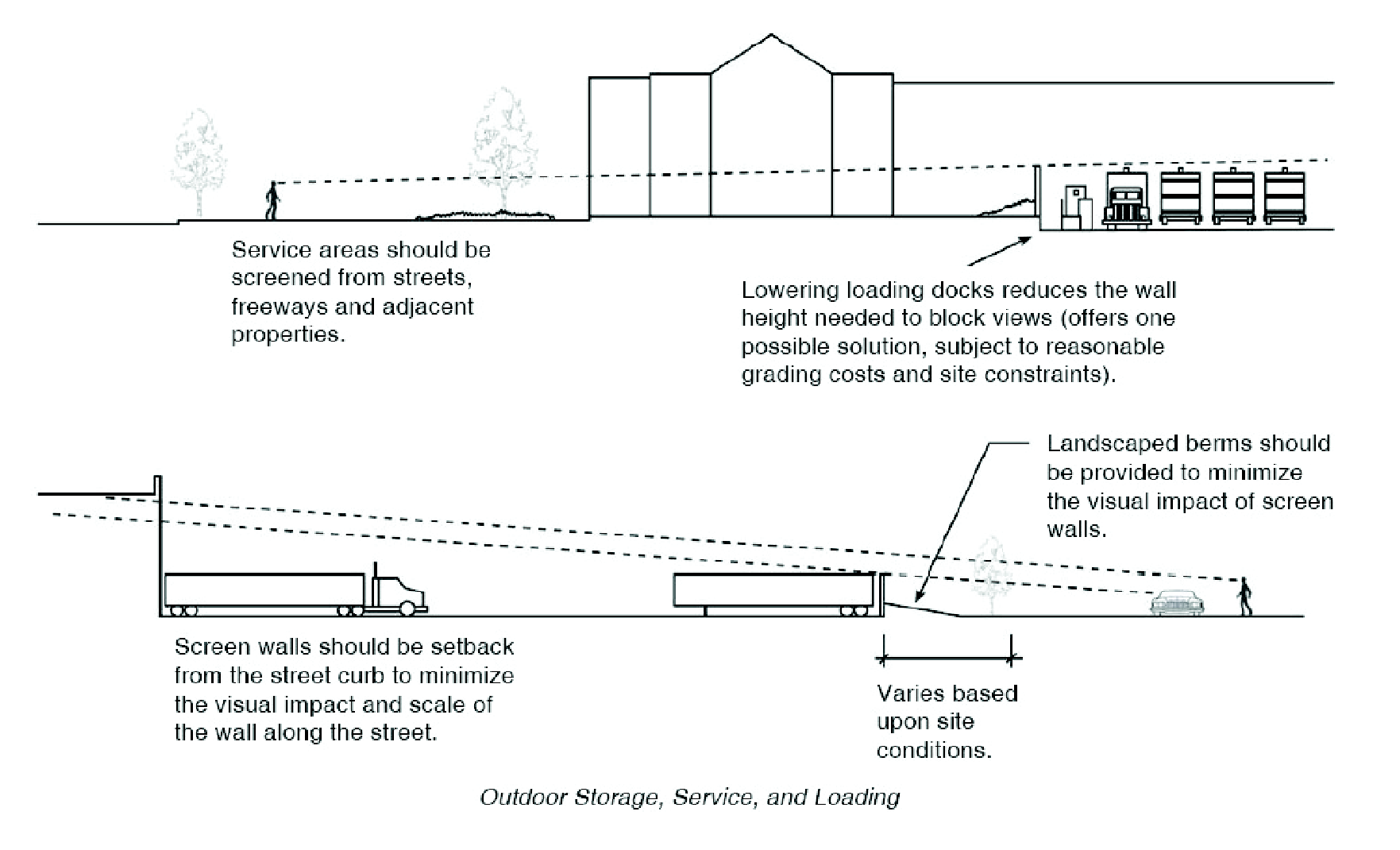
9.
Outdoor Storage and Service Areas.
a.
Outdoor storage and service areas (including, but not limited to, service entrances, loading docks and bays, outdoor storage of commercial vehicles) should be clearly defined and designated for convenient access. They shall not conflict with vehicular access, on-site parking facilities, pedestrian walkways, and customer entrances.
b.
Outdoor storage and service areas should be located to the rear of a property so as not to face a public street. They shall not be open to view from the street or freeway. In addition, outdoor storage and service areas shall be located so as to minimize negative impacts (visual, noise, dust, vibration, etc.) upon any neighboring residential properties.
c.
Service access should be located in a manner such that an unsightly condition is not created and the flow of pedestrians or user circulation when in use is not obstructed.
d.
Outdoor storage and service areas shall be screened from on-site and off-site public view with a combination of building features, decorative walls, and landscaping consistent with the architectural style and design of the building.
10.
Refuse Collection Facilities.
a.
Trash storage must be enclosed within or adjacent to the main structure or located within separate freestanding enclosures.
b.
The location of refuse collection facilities should be coordinated with the location of loading/service areas, and not readily visible to public view.
c.
Refuse collection facilities should be unobtrusive and conveniently accessible for trash collection but should not impede circulation during loading operations. Where multiple trash bins are provided for a given project, disperse the location of trash facilities for more convenient waste disposal by individual trash generators.
d.
Refuse collection facilities should be located to the rear of site and, where possible, screened from view from public streets and walkways and removed from pedestrian oriented areas. These areas should be screened with portions of the building, architectural wing walls, freestanding walls and landscape planting. Other acceptable screening materials include fences, landscaping, and/or berming, and the use of natural terrain where possible. Decorative treatment shall be used to minimize the adverse visual impact of these areas.
e.
Refuse collection facilities shall be located so that there will be minimal intrusion (i.e. impacts associated with site views and odors) upon neighboring residentially designated properties.
f.
Refuse collection facilities should be architecturally compatible with the project design. Colors and materials used to enclose these elements should be compatible with all other buildings on site. Landscaping shall be incorporated into the design of trash enclosures to screen them and deter graffiti.
11.
Utility and Mechanical Equipment.
a.
All utility and mechanical equipment (wall-mounted meters, air conditioners, transformers, etc.) shall be screened from public view. This includes all ground, wall, and roof mounted equipment. Screening elements shall be an integral part of the building; no screening method shall give the appearance of being "tacked on."
b.
Where possible, integrate rooftop equipment into the overall mass of a building. At a minimum, roof mounted equipment shall be screened through the use of parapets, screening walls, equipment wells, mechanical room enclosures and similar design features. Screening devices other than parapet walls shall be designed as an integral element of the building massing. Picket fencing, chain-link fencing and metal boxes are not permitted. The top of screens should be at least as high as the top of the equipment, with additional height provided where larger equipment units could be used in the future.
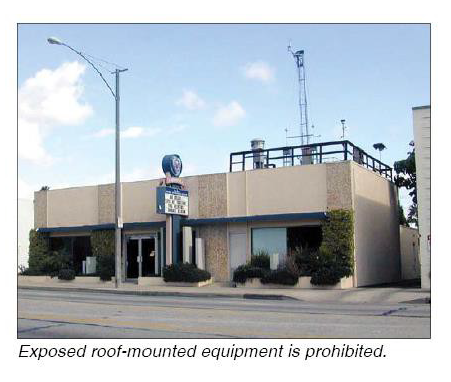
c.
Ladders for roof access shall be hidden and integrated into the building design.
d.
Typical ground-mounted equipment (such as transformers and heating units) shall be adequately screened with walls and/or landscaping. The building from view of adjacent streets and properties should screen large structures and/or equipment.
e.
Utility equipment such as electric and gas meters, electrical panels, and junction boxes shall be located in a utility room within the building.
f.
All utility lines from the service drop to the site should be underground.
g.
Transformers should not be located in the front landscaped setback area. Where transformers are unavoidable in the front setback, they shall be completely screened and camouflaged by landscaping, and should not obstruct views of tenant spaces, monument signs, and/or driveways.
h.
All vents, gutters and downspouts, louvers, exposed flashing, etc. should be treated as design elements and be compatible with the rest of the building, or hidden from public view.
i.
Exposed roof-mounted equipment is prohibited.
12.
Fences, Walls and Hedges.
a.
Walls and fences serve a major function in the streetscape and are used to screen vehicles, loading and storage areas, and utility structures. However, if not required for a specific screening or security purpose, they should not be utilized. The intent is to keep the walls as low as possible while performing their screening and security functions. The height of walls and fences on commercial properties is set forth in Section 16.20.070.
b.
Walls and fences should be planned and designed as integral parts of the development, and should be consistent with the landscaping and building design.
c.
If street fencing is necessary, decorative types of view fencing, such as wrought iron, are encouraged. Solid fencing, such as stucco or masonry, is strongly discouraged when they will block the view of the buildings or provide hiding places. The use of chain-link, barbed wire or razor wire for fencing is prohibited.
d.
Perimeter walls or fencing that do not front a public street should be of decorative masonry (split-face block, plaster/stucco finish), decorative metal (wrought iron), hedges, or a combination of materials. They should be designed in a style, material and color to complement the development. Both sides of walls should be architecturally treated.
e.
Tiered planting should be provided adjacent to project perimeter walls along street frontages to soften their appearance.
f.
Walls should be eliminated or sited to provide additional setback areas at project entries accommodate landscaping, signage, or street furniture.
g.
Wall sections greater than fifty (50) feet in length fronting a street shall incorporate at least two of the following design features, in proportion to the length of the wall:
i.
A minimum two-foot change in horizontal plane for at least ten feet.
ii.
A minimum eighteen (18) inch change in height for at least ten feet.
iii.
A minimum eighteen (18) inch high raised planter for at least half the length of the wall.
iv.
Use of pilasters at twenty-five (25) foot maximum intervals and at changes in wall planes.
h.
Gates or comparable design solutions should be provided in perimeter walls or fences to allow emergency access and facilitate convenient pedestrian access.
i.
Walls should be curved or angled at corner locations along street frontages to allow sight line views around the corner.
j.
Hedges and other landscape screening materials should consist of evergreen plant materials.
Pedestrian-Oriented Commercial Development.
k.
Freestanding walls, fences or hedges between any street frontage and retail building on site are not permitted.
13.
Site Amenities.
a.
Site amenities within a commercial setting should be coordinated in terms of color, materials and design in order to convey a cohesive project appearance and distinctive character.
b.
Seating should be included in plaza and courtyard design. Where possible, seating should be provided in active and passive areas.
c.
Tree grates should be provided along street edges and plazas where a continuous walking surface is needed. Grates should be a minimum of four feet in diameter. Knockouts must be provided to enlarge the inside diameter to support a larger tree trunk as the tree grows.
d.
Tree guards should be provided to protect trees in high activity areas. Tree guard design should be compatible with other site furnishings. Tree guards should be attached to the tree grate; welds should not be visible.
e.
Planters and pots should not obstruct pedestrian traffic flow. Consider placing pots in building recesses, at locations where access is discouraged and adjacent to blank walls to provide visual interest and color accents. Group similar sized planters in clusters to enrich streetscapes and plazas. Planter materials should complement the project architecture. Use of cast stone and masonry is encouraged.
f.
Bollard design should be consistent with the overall project theme and should coordinate with other site furnishings. In locations where emergency access may be necessary, removable bollards should be considered.
g.
Trash receptacle design should coordinate with other streetscape furnishings.
h.
Bicycle rack design should be consistent with other streetscape furnishings. Use of "loop racks" and "ribbon bars" are encouraged.
i.
Newspaper racks should be consolidated. Newspaper rack locations should not inhibit pedestrian flow. Newspaper rack design should incorporate masonry and/or metal elements that compliment other streetscape furnishings.
j.
Site directories should be provided near vehicular and pedestrian entrances to multi-tenant commercial developments. Directory siting should maximize their visibility while minimizing the potential for creating a traffic hazard.
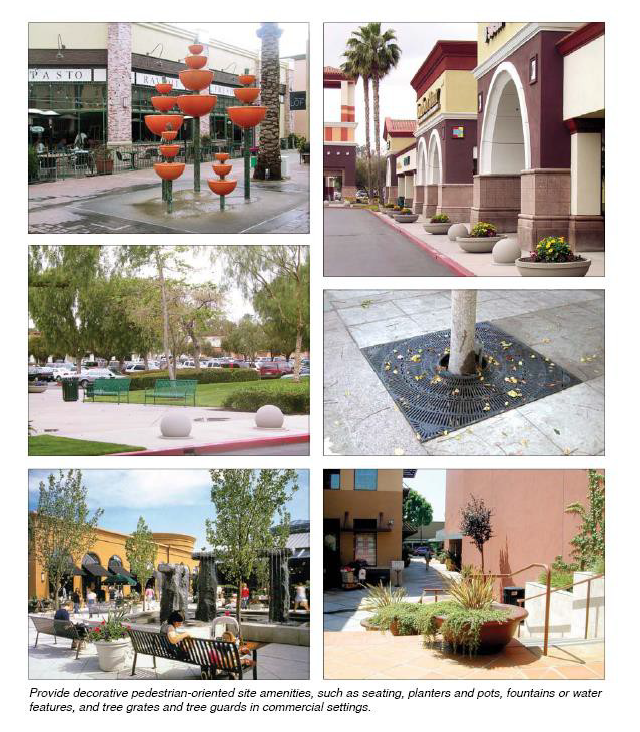
14.
Exterior Lighting.
a.
Exterior lighting shall be used to provide illumination for the security and safety of on-site areas such as building entrances, parking, loading, shipping and receiving, walkways, and working areas. The design of light fixtures and their structural support shall be architecturally compatible with main buildings on-site.
b.
Provide decorative pedestrian-oriented site amenities, such as seating, planters and pots, fountains or water features, and tree grates and tree guards in commercial settings.
c.
Exterior lighting should be adequate, but not overly bright. It shall be located and designed to avoid direct glare onto adjacent properties and public rights-of-way. All lighting fixtures must be hooded and directed downward to minimize light and glare impacts on neighboring properties and public rights-of-way. In addition, the lighting shall have cut-off luminaries that limit the amount of light pollution on nighttime skies.
d.
Buildings and landscaping can be illuminated indirectly to create a strong positive image. Concealing light features within buildings and landscaping can highlight attractive features and avoid intrusion into neighboring properties and public rights-of-way.
e.
Lighting should be designed to satisfy both functional and decorative needs. Storefront lighting should complement the architectural style of the building.
f.
Lighting designs for parking areas should take into account color rendition and glare minimization. Color rendition allows a person to distinguish between colors. In a parking area with appropriate color rendition, a person will be able to identify the color of their car. Color rendition will vary according to the lamp type selected and should be considered as a factor in lamp style selection. During the design process, glare levels should be considered and efforts should be made to minimize glare.
g.
All building entrances shall be well lit. If the entrance is recessed, a light from the ceiling of the entry vestibule is strongly encouraged to prevent any dark pockets or hiding places.
h.
Transit stops, ATMs, and convenience stores shall be illuminated to facilitate their safe use at nighttime. In addition, the areas around these uses shall be well lit so that any hiding places are eliminated.
i.
The height of light fixtures shall be reduced to a recommended height of eight feet, especially when adjacent to the residential areas. Floodlights are not permitted in areas adjacent to the residential areas.
j.
Lighting fixtures should be compatible with the architectural character of the project and surrounding area. While some nondescript fixtures may be appropriate, significant use should be made of fixtures that have architectural value and accent the building and site.
k.
Both building-mounted and freestanding fixtures may be used.
l.
All portions of parking areas shall be illuminated at minimum 0.1 foot-candle intensity. A maximum illumination of 0.5 foot-candles at the property lines abutting a street or residentially designated property is allowed.
(Ord. No. 2012-02, § 3(Exh. A), 2-7-12)
16.16.410 - Industrial design standards and guidelines.
A.
General.
1.
Purpose. This Article provides standards and guidelines for designing new industrial developments and for exterior alterations and additions to existing developments. Because of the size and scale of industrial buildings, it is especially important to consider design to ensure compatibility with other parts of the community.
As a category of structure types, industrial buildings often present unattractive and monotonous facades with large blank wall surfaces, untreated or false fronts, or highly reflective and glaring surfaces. In addition, the site development is often not pedestrian-friendly, not properly buffered from surrounding uses, insufficiently landscaped, and surrounded by unsightly fencing.
There is, however, a variety of design techniques that can be utilized to help overcome these situations and to direct development into a cohesive design statement that is both functional and aesthetically appealing. Property owners, developers, architects, building designers, and contractors seeking to construct new industrial developments, or alterations or additions to existing developments, should use these standards and guidelines in the early design stages of their projects. These standards and guidelines are not intended to limit creative site planning and architecture that are consistent with the stated goals and within the context of surrounding neighborhood patterns. Innovative design solutions are strongly encouraged. Refer to Chapter 16.16, Article X, of this development code for specific development standards pertaining to industrial uses.
2.
Applicability. These design standards and guidelines apply to all new industrial development and business parks, including exterior alterations and additions to existing developments within the city. The standards and guidelines apply to smaller infill projects as well as larger master planned sites, and are in addition to the development standards set forth in Chapter 16.16, Article X, of this development code.
3.
Design Goals. The design standards and guidelines have been established in order to accomplish the following goals:
a.
Improve the quality of design for industrial developments, thereby improving the image and appearance of the city's industrial areas.
b.
Create attractive and functional site arrangements of buildings, service and loading areas, open spaces, and parking areas; and develop a high quality architectural and landscape design.
c.
Contribute to the character of the neighborhood by respecting the scale, proportion and architectural style of the surrounding area.
d.
Create visual interest in industrial buildings, while maintaining a sense of harmony within the project.
e.
Mitigate the negative impacts and views associated with industrial uses through effective site placement, screening, and buffering techniques.
f.
Eliminate random development patterns and establish site planning and design relationships between new development and neighboring properties.
g.
Encourage environmental sensitivity in development.
h.
Improve pedestrian circulation and connections on industrial sites and within industrial areas.
i.
Improve the appearance and character of the city.
B.
Architectural Design Standards and Guidelines. While there is no mandated architectural style required for industrial structures in the city, each project should possess an identifiable architectural theme and be of high quality design and materials. Industrial buildings should display unique, visually attractive qualities while having a unified composition. Multi-building projects should also use a consistent architectural style.
Industrial projects should give neighboring development a sense of unity through consistent building scale and massing. Yet, visual interest should be created with the use of a variety of architectural styles and individual building details to avoid monotonous industrial neighborhoods and enliven the public's experience of the building. New projects should meet or exceed the standards of quality that have been set by surrounding development and contribute to the improvement of the area.
1.
Building Articulation and Detailing.
a.
Building articulation and detailing should be used to create an interesting and individual design, diminish the massing of large structures, and be compatible with the scale of surrounding development. Building design shall avoid large monotonous facades, long straight-line building fronts, plain box shapes, and barren exterior treatment.
b.
All elevations should be architecturally treated, however, facades visible from major street corridors should be especially attractive and shall be fully articulated, and incorporate the chosen architectural theme in a consistent manner.
c.
Articulation should include change of wall plane, door and window treatment, facade details, and other appropriate architectural treatment. A combination of compatible treatments should be used to create interest and variety, with attention given to treating particular architectural features in a balanced, yet uniquely detailed and decorative manner.
d.
The staggering of planes along an exterior wall elevation creates pockets of light and shadow, providing relief from monotonous, uninterrupted expanses of wall. Wall planes should not run in one continuous direction for more than sixty (60) feet without an offset.
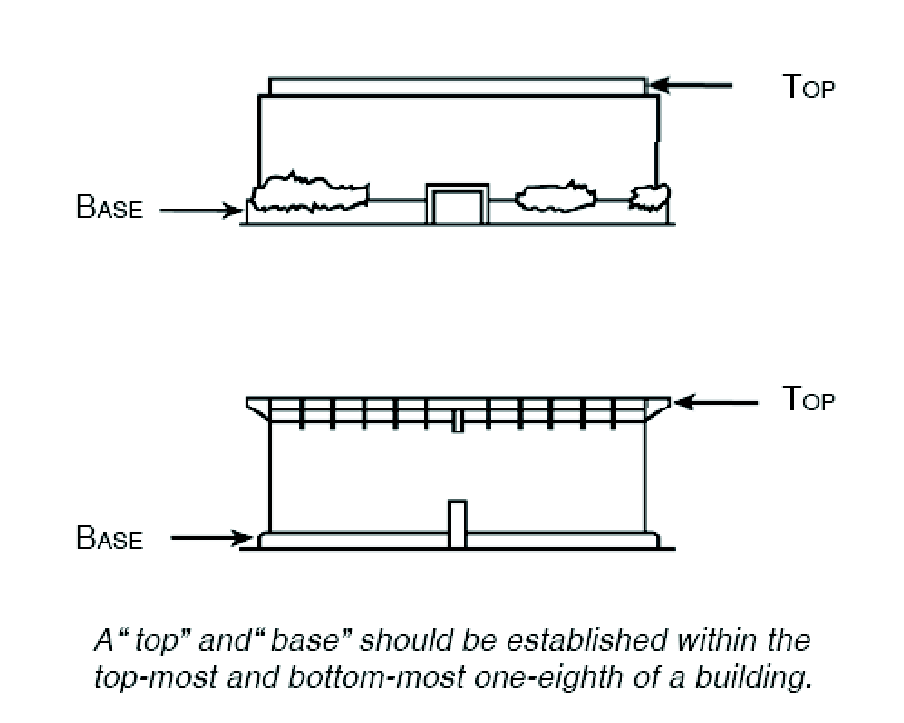
e.
Facades having a recognizable "base" and "top" are encouraged. The base should visually relate to the proportion and scale of the building. Techniques for establishing a base may include richly textured materials (e.g. tile or masonry treatments), darker colored materials, mullion, panels, reveals and/or enriched landscaping. Tops take advantage of the visual prominence of a building's silhouette. Techniques for clearly expressing a top may include cornice treatments, roof overhangs with brackets, richly textured materials (e.g. tile, masonry or fluted concrete), and/or differently colored materials. Colored "stripes" are not acceptable as the only treatment.
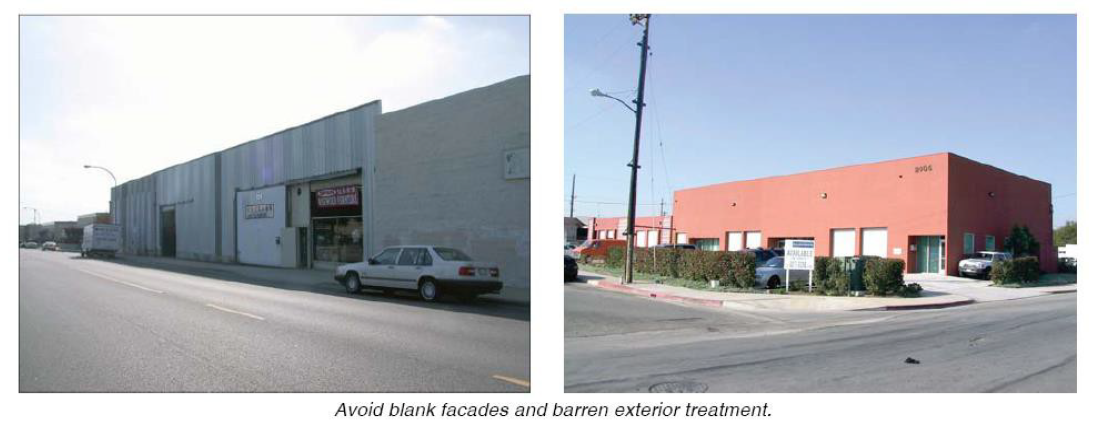
f.
Buildings should incorporate architectural details and elements, which will reduce building scale at the street level, especially along pedestrian walkways. Awnings, canopies, arbors, trellises, etc. are effective in this regard. The appropriate use of other architectural details, including reveals, course lines, decorative cornice, columns, etc., is also encouraged as a means of creating interest, variety, and distinctive design. Details should reflect the structural and material integrity of the building; overly gratuitous ornamentation is discouraged.
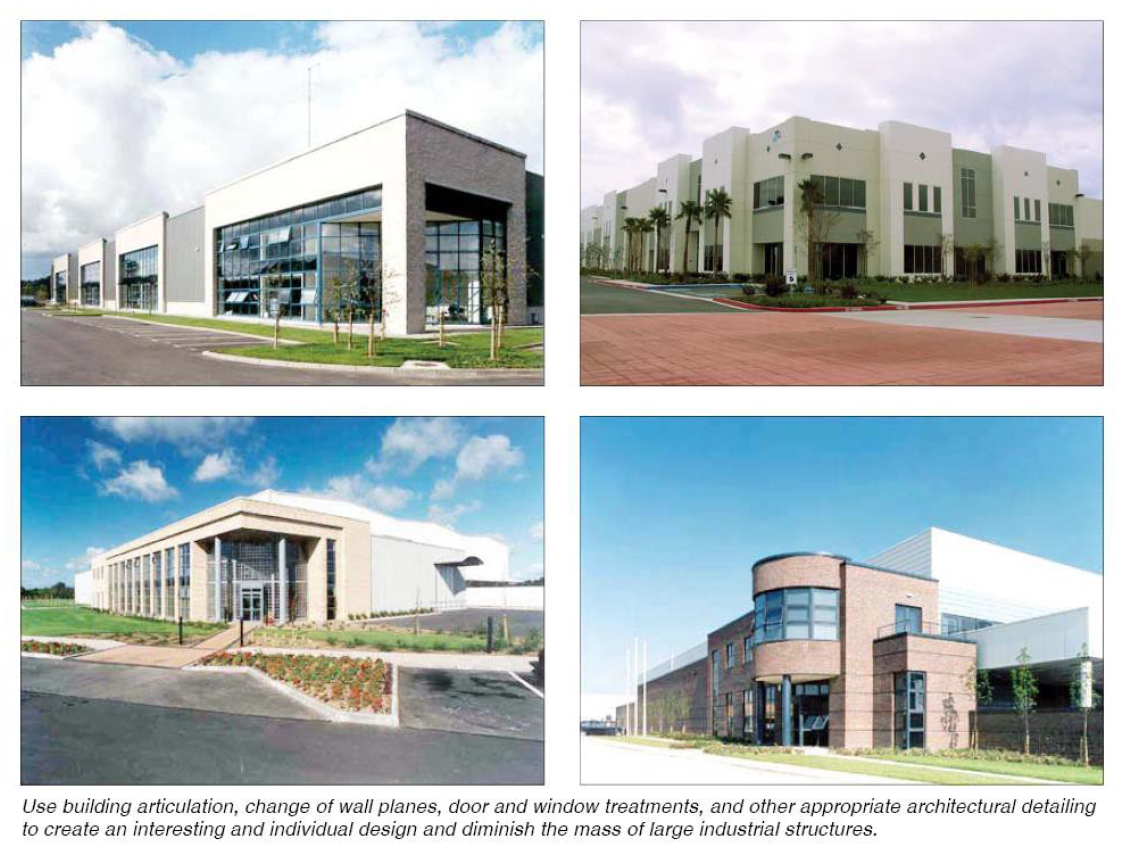
2.
Height and Roof Lines.
a.
The roof design should be considered as a component of the overall architectural design theme.
b.
Roof forms should be simple, avoid a massive appearance, and reflect the internal organization of buildings.
c.
Roof form and height should be varied to complement building mass and articulation. Vertical variations to the roof line should incorporate roof projections to avoid a false front/unfinished appearance.
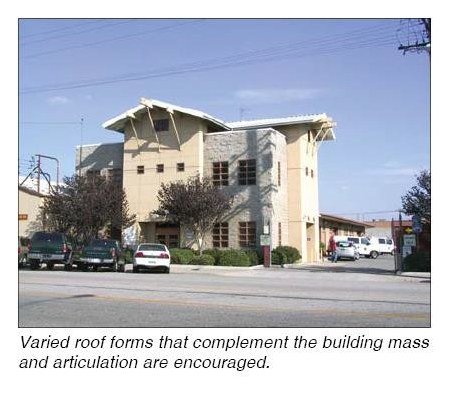
d.
The roof line at the top of the structure should not run in a continuous plane for more than sixty (60) feet without offsetting or jogging the roof plane.
3.
Doors and Windows.
a.
Doors and windows are key elements of any structure's form, and should relate to the scale of the elevation on which they appear. Windows and doors can establish character by their rhythm and variety and help to provide depth and contrast on elevation planes. Windows and doors should be used to help mitigate building mass, establish scale, give expression to otherwise blank walls, and create a distinctive building design.
b.
All doors and windows should be related with the chosen architectural style. Windows with widely varying styles are strongly discouraged. All doors and window frames should be composed of consistent material. Wherever possible, window sizes should be coordinated vertically and horizontally and window design should be consistent in terms of style and general arrangement on all building sides.
c.
Window exposure should be maximized along pedestrian walkways. The use of opaque glass adjacent to pedestrian walkways is discouraged.
d.
Window frames should appear substantial and should not be flush with the exterior finish. Windows should be designed to enhance building interest and articulation. Recessed windows or inset glazing are possible design considerations.
e.
Windows located on the sides and rear of the project should also be consistent with the look and style on the front of the project.
4.
Materials and Finishes.
a.
Materials and finishes should be suitable to the scale, character and design theme of the building and further lend variety and interest to the project.
b.
The building and its elements should be unified by textures, colors and materials. Materials should be consistently applied and should be chosen to work harmoniously with adjacent materials. Piecemeal embellishment and frequent changes in materials should be avoided.
c.
Buildings should be treated as a whole and finished appropriately on all sides to provide continuity. Materials tend to appear substantial and integral to the structure when material changes occur at changes in plane. Material changes not accompanied by changes in plane appear "tacked-on" and are strongly discouraged. Material changes should not occur at external corners. Material changes may occur at "reverse" or interior comers or as a "return" at least four feet from external corners, with extended returns provided for large buildings.
d.
Exterior materials for industrial developments should be of high quality and low maintenance. Recommended materials include masonry, concrete, sandblasted concrete, textured block, brick, granite, marble, glass, painted metal elements and similar materials. Materials and detailing should have a substantial and long-lasting appearance. Metal siding should be avoided as the primary material, but may be used as an accent material if it is high quality and properly applied. Concrete blocks should also be avoided unless mitigated through careful and decorative design, texture and reveals.
e.
Roofing materials should be durable. Where visible from the street, acceptable roofing materials include metal standing seam and concrete tile. Corrugated metal (standing rib metal roofs are permitted), highly reflective surfaces, and illuminated roofing are not permitted.
f.
Materials that will withstand abuse by vandals or accidental damage from machinery are strongly encouraged, while high maintenance materials such as stained wood or shingles are not encouraged.
g.
Accessory structures should be designed as an integral part of the project architecture and should be similar in material, color, and detail to the primary buildings.
h.
The use of sustainable building materials is strongly encouraged. This includes using quality materials with a long life span, selecting materials that are not energy-intensive to manufacture, using building products made from recycled materials, and repairing and maintaining well-built existing structures to the fullest extent possible.
5.
Color and Texture.
a.
For most architectural styles, the number of colors on the exterior should be limited to a maximum of three, with an additional contrasting color for accent. In general, the lighter colors should be used for the main body, with darker shades for trim and accent. The larger and simpler the building design, the subtler the color should be to reduce the massiveness of large wall planes.
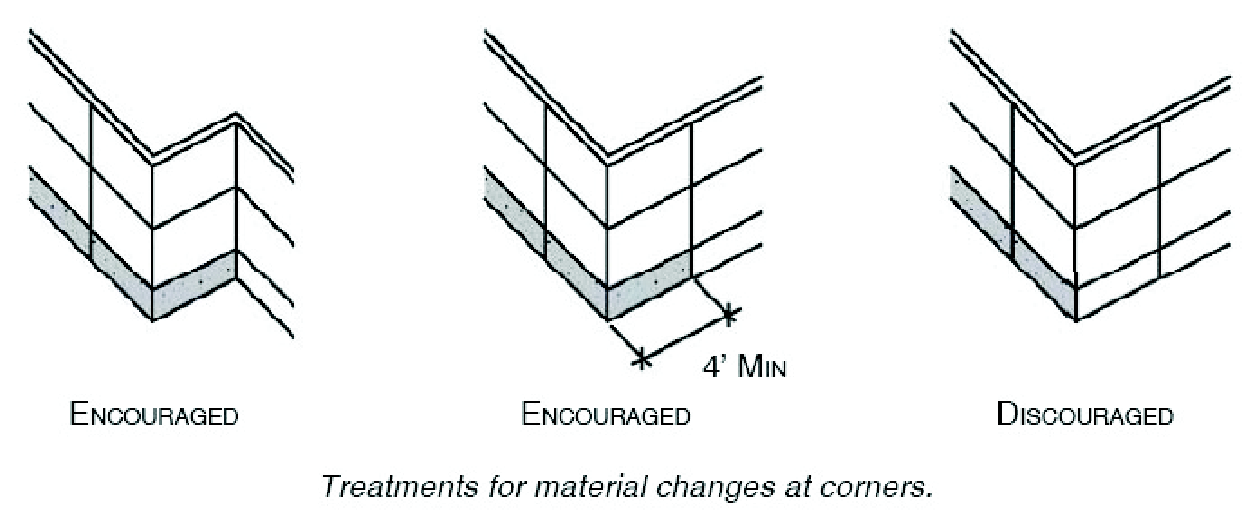
b.
Off-whites, light grays, and muted earth tones are best suited and are appropriate for industrial developments. The use of strong or bright, unnatural colors, including the bright "white-on-white" color schemes. However, a greater variety of brighter, more intense colors are permitted to highlight architectural features such as awnings, canopies, doorways, window framing and trim, reveals, etc.
c.
Color and finishes on exteriors of all elevations of a building should be coordinated to provide a total continuity of design. Unusual patterns and color schemes should be avoided. Garish, non-harmonious, or out-of-character colors should not be used.
d.
The blending of compatible colors in a single facade or composition is a good way to add character and variety, while reducing, or breaking up the mass of a building. Lower wall wainscots and built-up or recessed reveals may be employed to add interest and break up vertical monotony.
(Ord. No. 2012-02, § 3(Exh. A), 2-7-12)
16.16.415 - Site design standards and guidelines.
A.
Industrial site design must be functional and efficient, as well as compatible with adjacent land uses and aesthetically appealing. Elements of sound industrial site design include emphasis on the main building entry and landscaping; provision of pedestrian walkways and connections; plazas and landscaped open space areas for employees; convenient and controlled access, visitor parking and on-site circulation; screening of outdoor storage and loading areas; and appropriate buffering between incompatible land uses. It is also important to consider a project's relationship to adjacent industrial properties in creating a unified development pattern for the surrounding area.
1.
Setbacks.
a.
While respecting the minimum setbacks established in Chapter 16.16, Article X (Commercial and Industrial Development Standards) of this development code, the front and street side setbacks of new industrial development should generally approximate that of adjacent properties to establish a consistent image along the street. Some variation, however, should be provided in building and parking setbacks to avoid long monotonous building facades and provide visual interest.
b.
Building setbacks should be proportionate to the scale of the structure. Larger structures require more setback area for a balance of scale and so as not to impose on neighboring uses.
c.
Front and street side setback areas shall be landscaped.
d.
Building setbacks shall be increased when adjacent to residentially designated properties to mitigate negative impacts due to noise, vibration, light and glare, and aesthetics. Where an industrial project abuts a residentially designated property, a minimum of ten feet of the required setback shall be devoted entirely to shrubs and trees, at least six feet in height (exclusive of any planter area curb).
e.
Where the parking area of an industrial project abuts another industrially or commercially designated property, a minimum three-foot wide perimeter landscape buffer (exclusive of the planter area curb) is required. Where feasible to do so, integrate the landscape buffer with that of the adjacent property.
2.
Building Orientation, Siting and Entrances.
a.
Buildings in an industrial development should be arranged to create a sense of unity and overall harmony. Avoid random and irregular building relationships.
b.
Site development, including location of building, parking, and landscape areas, should consider compatible development patterns among neighboring properties. In addition, consideration should be given to how future neighboring developments, based on existing lot patterns, could relate to the project. As far as is feasible, a project should be designed to functionally integrate with adjacent properties by providing for reciprocal access easements, common drives, and common perimeter landscape planters.
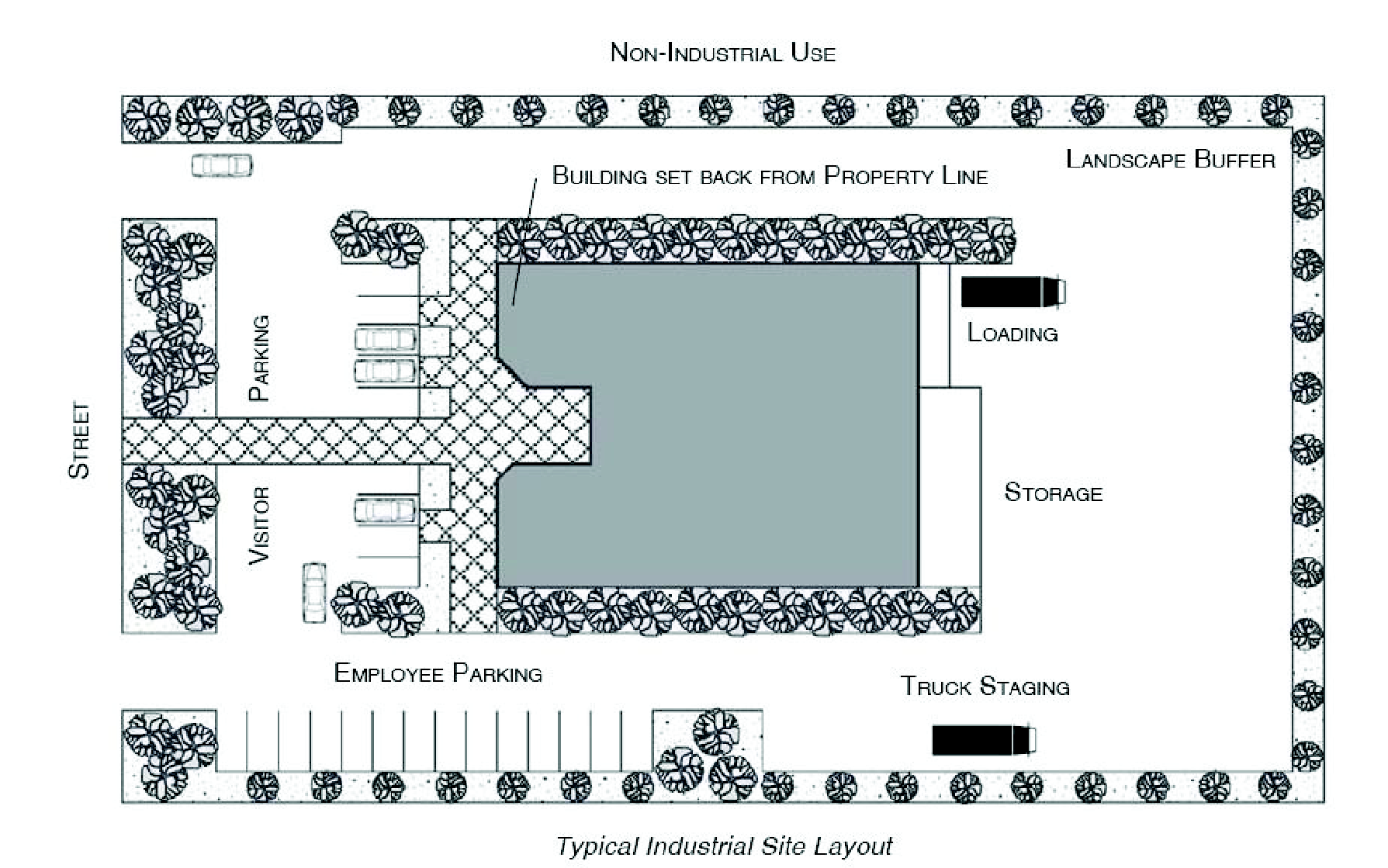
c.
Lot assembly is encouraged as it provides greater opportunity to create efficient master planned projects in conformance with the intent of the design guidelines.
d.
Industrial buildings should have a positive street presence and contribute to an attractive street scene by orienting buildings toward the primary street frontage. Public entrances and administrative/office areas should front the street. Primary entries should be clearly distinguished from secondary and service entries. Projects with few employees should attempt to place entries and the most active areas near the street to avoid long, "unguarded" walkways.
e.
Entry and edge design features such as landscaping, architectural signage and monumentation, and enhanced paving should be incorporated in the project. Special materials, color, detailing, or equivalent architectural treatment should be incorporated into the building design at major entries.
f.
Buildings shall be sited so as to screen loading and storage areas from public view. Where industrial uses are adjacent to non-industrial uses, appropriate buffering techniques such as increased setbacks, screening, and landscaping shall be provided to mitigate any negative effects of industrial operations.
g.
Building entries should read as such, and be integrated with the overall building form. Doors should be designed at human scale. Variation in building height, wall plane, roof treatment, window placement, architectural detailing, etc. will define and emphasize public entries. Variation in material, texture, and/or color is also recommended as a means of identifying, building entries.
3.
Scale and Mass.
a.
The scale and mass of a new industrial development should be consistent with neighboring developments and not overwhelm them with disproportionate size or a design that is out of character.
b.
A single, dominant building mass should be avoided by using variations in massing and building form.
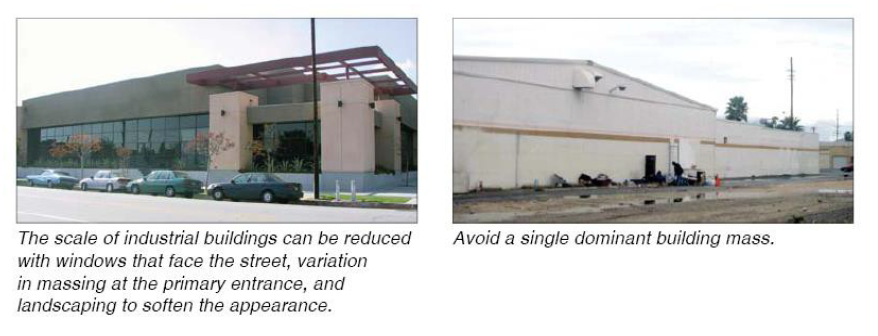
c.
As appropriate to the function of a building, a combination of major and minor changes in building form should be incorporated to create visual interest and establish a transition to neighboring developments. Changes in building form should be used to emphasize office space and reception areas within industrial projects, emphasize public entrances and deemphasize service areas, and define and shelter pedestrian walks and exterior spaces.
d.
Primary building entries should be highlighted through the massing of the building. Greater height can be used to highlight and accentuate entries in the form of corner tower elements, tall voids, or a central mass meeting an entry plaza. Conversely, smaller building masses can also communicate the location of entries.
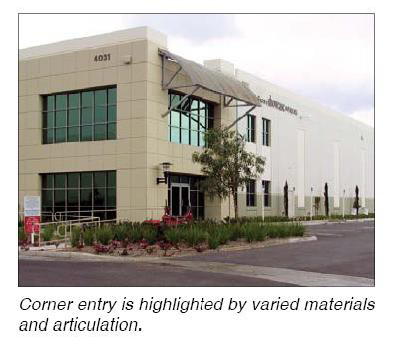
e.
Typically, horizontal masses for building elevations less than seven hundred (700) lineal feet shall not exceed a height to width ratio of 1:4 without a substantial architectural element that projects up or away from the building, such as towers, bays, lattices, or other architectural features. Buildings greater than seven hundred (700) lineal feet shall not exceed a height to width ratio of 1:5 without massing variations. The extent of massing breaks and building projections should relate visually to the overall scale of the building.
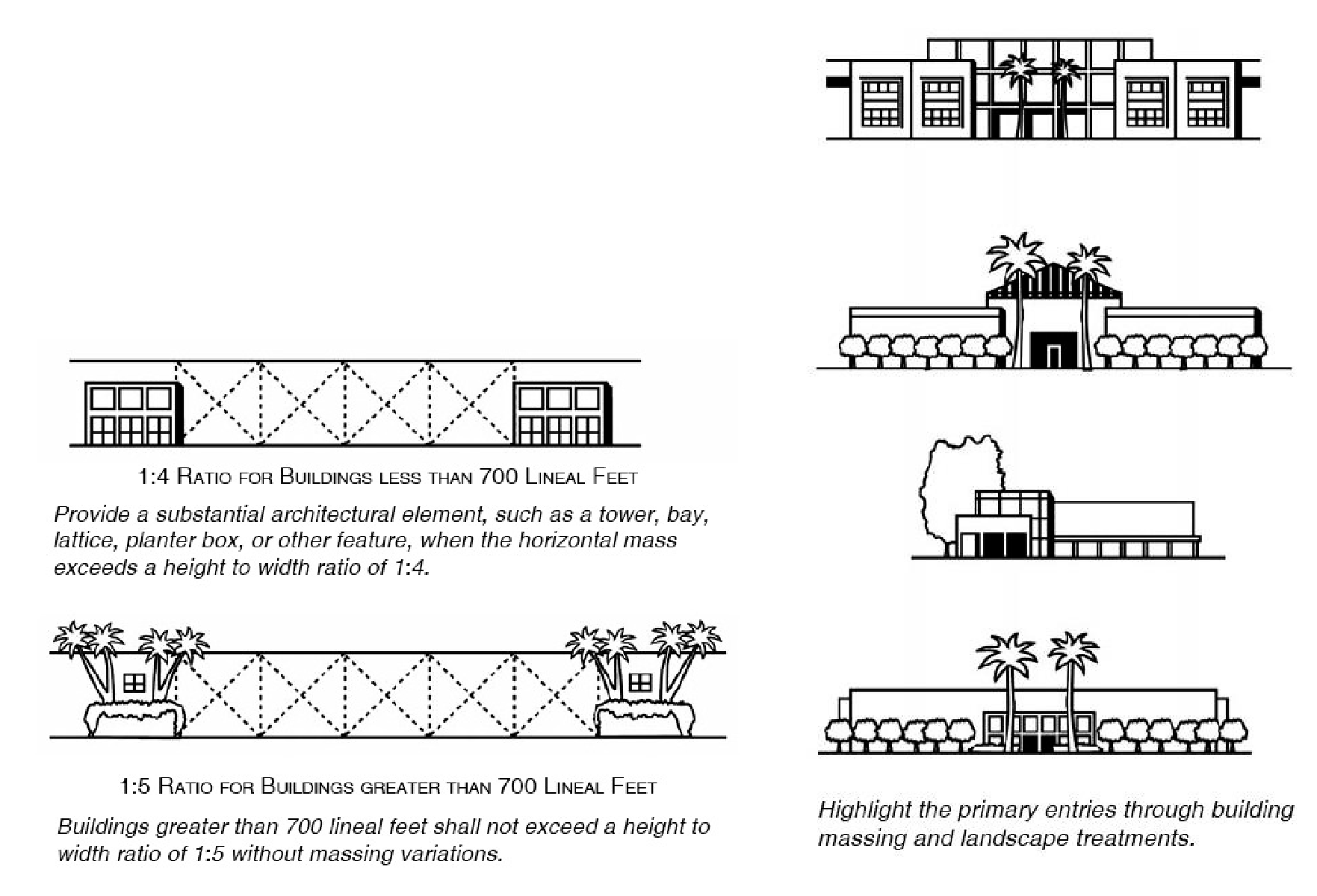
4.
Plazas and Open Space.
a.
Plazas and similar open space features are strongly encouraged as a site amenity and design detail. Buildings should be arranged to include opportunities for plazas, patios, open space areas, and employee gathering spaces with amenities such as outdoor seating, landscaping, water elements, pergolas, special lighting and other "place-making" features. These outdoor spaces should be functional and pleasant and should not appear as "left-over" spaces.
b.
Plazas are encouraged where high levels of pedestrian activity are expected, such as adjacent to major entrances and food services, or between building clusters in an industrial/business park development.
c.
Building entries and windows should look onto plazas and open space areas to enhance activity and security.
d.
Outdoor employee break areas and lunch areas should be located away from loading areas or other high-traffic areas.
5.
Environmental Considerations.
a.
To the extent possible, site grading should relate to the natural surroundings and be designed to minimize grading by following the natural ground contours and recognizing existing drainage patterns. Graded slopes should be rounded to blend with existing terrain.
b.
Significant existing trees, vegetation and any other natural site attributes should be preserved to the greatest extent possible in the design and development of the industrial project. Site design that requires altering landforms and removing trees is discouraged.
c.
Buildings should be designed and sited to maximize the use of sunlight and shade for energy savings, and respect the solar access of adjacent buildings.
d.
Consideration should be given to the reduction of landscape maintenance and water consumption when selecting landscape materials.
6.
Vehicle Circulation and Access.
a.
Site access and internal circulation in industrial developments should promote safety, efficiency, and convenience. Vehicular traffic should be adequately separated from pedestrian circulation. Vehicular entrances should be clearly identified and easily accessible to minimize pedestrian/vehicle conflict.
b.
Adequate areas for maneuvering, stacking and emergency vehicle access should be provided. Internal circulation routes and parking areas should be separated. Continuous circulation should be provided throughout the site to the greatest extent possible to prevent awkward vehicular maneuvers. Dead-end driveways should be minimized. Vehicles should not be required to enter the street in order to move from one area to another on the same site.
c.
The number of site access points or driveway aprons shall be minimized for aesthetic purposes, to achieve efficient and productive use of paved access ways, and to eliminate traffic hazards. A minimum distance for driveway aprons shall be required as outlined in Table 1 of Section 12.08.020 of the Hesperia Municipal Code and may be increased based upon safety considerations. They should be coordinated with existing or planned median openings and driveways on the opposite side of the roadway. Entrances and exits to and from parking and loading facilities should be clearly marked with appropriate directional signage where multiple access points are provided.
d.
Vehicular access, drives and circulation routes shall be designed so that all movements involved in loading, parking, or turning shall occur on-site, and not within the public right-of-way.
e.
Where a property abuts an alleyway, service and vehicular access should be taken off of the alleyway. This is most strongly encouraged for development on narrow lots (less than one hundred (100) feet in width). Where these properties exclusively use the alleyway for service and vehicular access, a consistent and uninterrupted building frontage can be established for the entire length of the street. Alley improvements should coincide with site planning to minimize alleyway deterioration and address problems such as debris, safety, and any nuisance odors or hazards.
f.
Design provisions, which allow for present or future reciprocal access with adjacent properties, are encouraged.
7.
Pedestrian Circulation.
a.
Industrial developments shall incorporate pedestrian walkways into site design to provide pedestrian connections from building entries to public sidewalks, plazas, parking areas, and adjacent developments, and to buffer pedestrians from vehicular movement. Project entries and driveway areas should contain design features, including landscaping and textured paving, to break up the expanse of paving in a project. Paving materials should complement the architectural design. The use of stamped concrete, stone, brick, pavers, exposed aggregate or color concrete is encouraged.
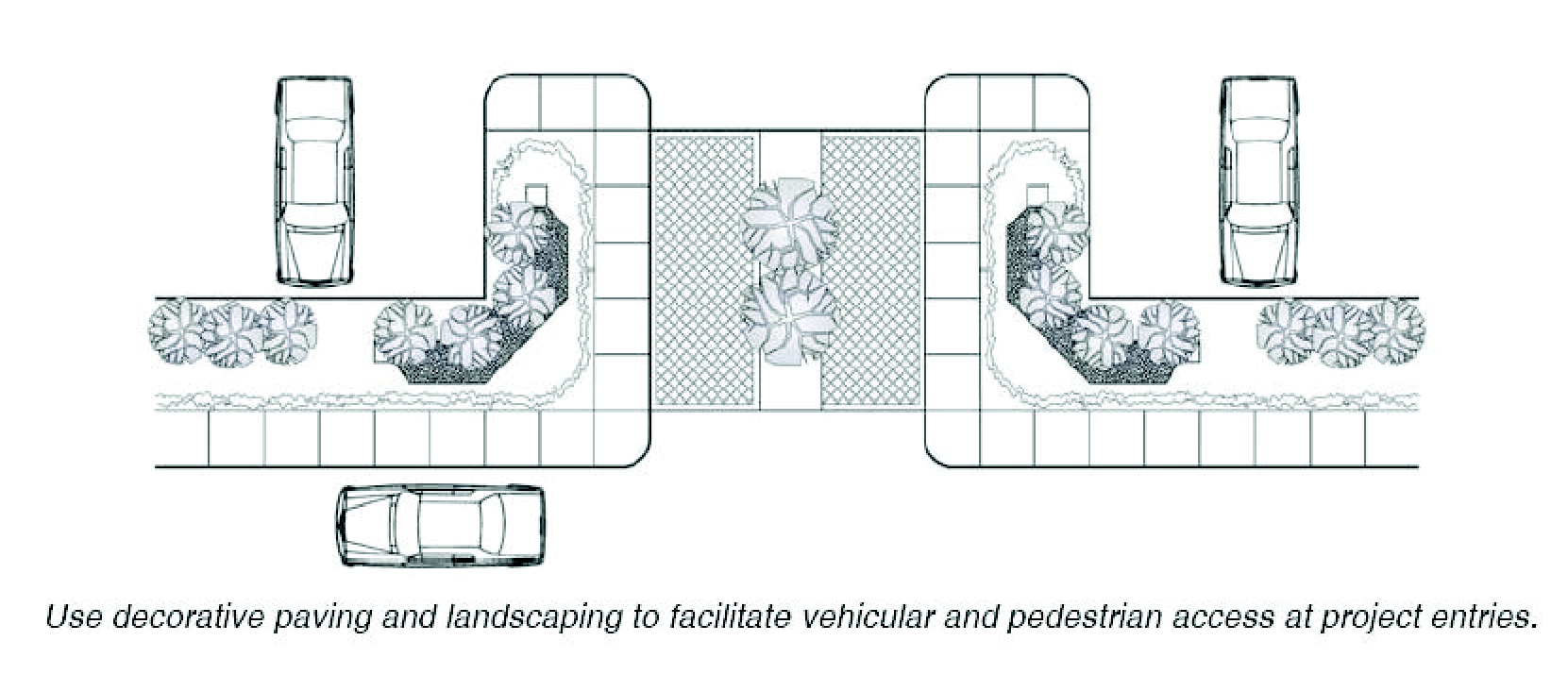
b.
Pedestrian walkways should be a minimum of four feet in width. Pedestrian walkways should be safe and clearly identifiable using varied surfaces, decorative paving, and landscaping to minimize pedestrian/vehicle conflict. At a minimum, varied surfaces should be used to delineate crossings at circulation drives and parking aisles.
8.
Parking.
a.
The industrial site should be a self-contained development capable of accommodating its own parking needs. The use of the public street for parking and staging of trucks is not allowed.
b.
Parking areas should be accessed from the street so that circulation to parking areas does not interfere with other site activities. Visitor parking should be located at the front and sides of buildings to be near primary building entrances.
c.
Parking areas shall be designed to avoid awkward turning maneuvers and the backing of vehicles into public streets.
d.
Parking areas should not visually dominate the site. Large expansive paved areas located between the street and the building should be avoided in favor of smaller multiple lots separated by landscaping and buildings.
e.
The visual impact of parking lots and structures shall be mitigated with landscaping. Parking lots adjacent to and visible from public streets must be adequately screened from view through the use of rolling earth berms, low screen walls, changes in elevation, landscaping or combinations thereof whenever possible. Landscaping materials should have adequate room to grow and be protected from abuse by cars. Continuous concrete curbs shall be provided as wheel stops where parking adjoins landscaping.
f.
Parking areas, driveways and pedestrian areas shall contain automatically controlled lighting.
9.
Loading Areas.
a.
Loading areas shall be designed to prevent interference with vehicular circulation and parking, and to provide an unobstructed area for trucks to maneuver when accessing loading spaces.
b.
Loading areas shall be located away from main customer entrances and the street, preferably toward the rear of the property, as per the development standards in Chapter 16.16, Article X (Commercial and Industrial Development Standards) of this development code.
c.
Overhead (roll-up) doors shall not be directly open to public view, and shall be substantially screened from the street, the freeway, and residentially designated properties. Screening may be accomplished in a variety of ways, including the use of wing walls, the recessing of overhead doors (building articulation), landscaping, or a combination of these techniques. Fixed hardware for roll up doors shall be located on the inside of buildings to minimize visual clutter.
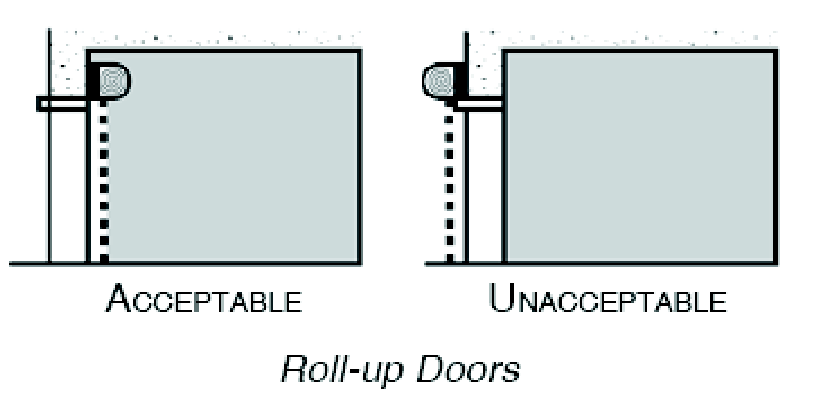
d.
If located adjacent to residential areas, the design of overhead doors should minimize noise through devices such as rubber seals and/or other dampening features.
e.
The grade of loading docks should be as low as feasible to minimize views from the street and the need for tall walls or fencing. Building segments above loading doors visible from the street and surrounding properties should conform with other guidelines pertaining to building features, materials and finishes.
10.
Outdoor Storage and Service Areas.
a.
Outdoor storage and service areas (including, but not limited to, service entrances, loading docks and bays, outdoor storage of commercial vehicles) should be clearly defined and designated for convenient access. They shall not conflict with vehicular access, on-site parking facilities, pedestrian walkways, and customer entrances.
b.
Outdoor storage and service areas should be located to the rear of a property so as not to face a public street. They shall not be open to view from the street, freeway, or residentially designated properties.
c.
Outdoor storage and service areas shall be screened from on-site and off-site public view with a combination of building features, decorative walls, and landscaping consistent with the architectural style and design of the building.
11.
Refuse Collection Facilities.
a.
Refuse collection facilities shall be located so that there will be minimal intrusion (i.e. impacts associated with site views and odors) upon neighboring residentially designated properties.
b.
Refuse collection facilities should be located for convenient access. Where the Hesperia Municipal Code requires a number of trash bins for a given project, disperse the location of trash facilities for more convenient waste disposal by individual trash generators.
c.
The location of refuse collection facilities should be coordinated with the location of loading/service areas, and not readily visible to public view.
d.
Decorative treatment of trash and storage enclosures shall be used to minimize the adverse visual impact of these areas. Trash disposal areas, including dumpsters, shall be screened from view by a six-foot high enclosure with gates. Trash and storage enclosures shall be architecturally compatible with the project design, and landscaping shall be incorporated into their design to screen them and deter graffiti. Screening materials shall consist of fences, landscaping, and/or berming, and the use of natural terrain where possible.
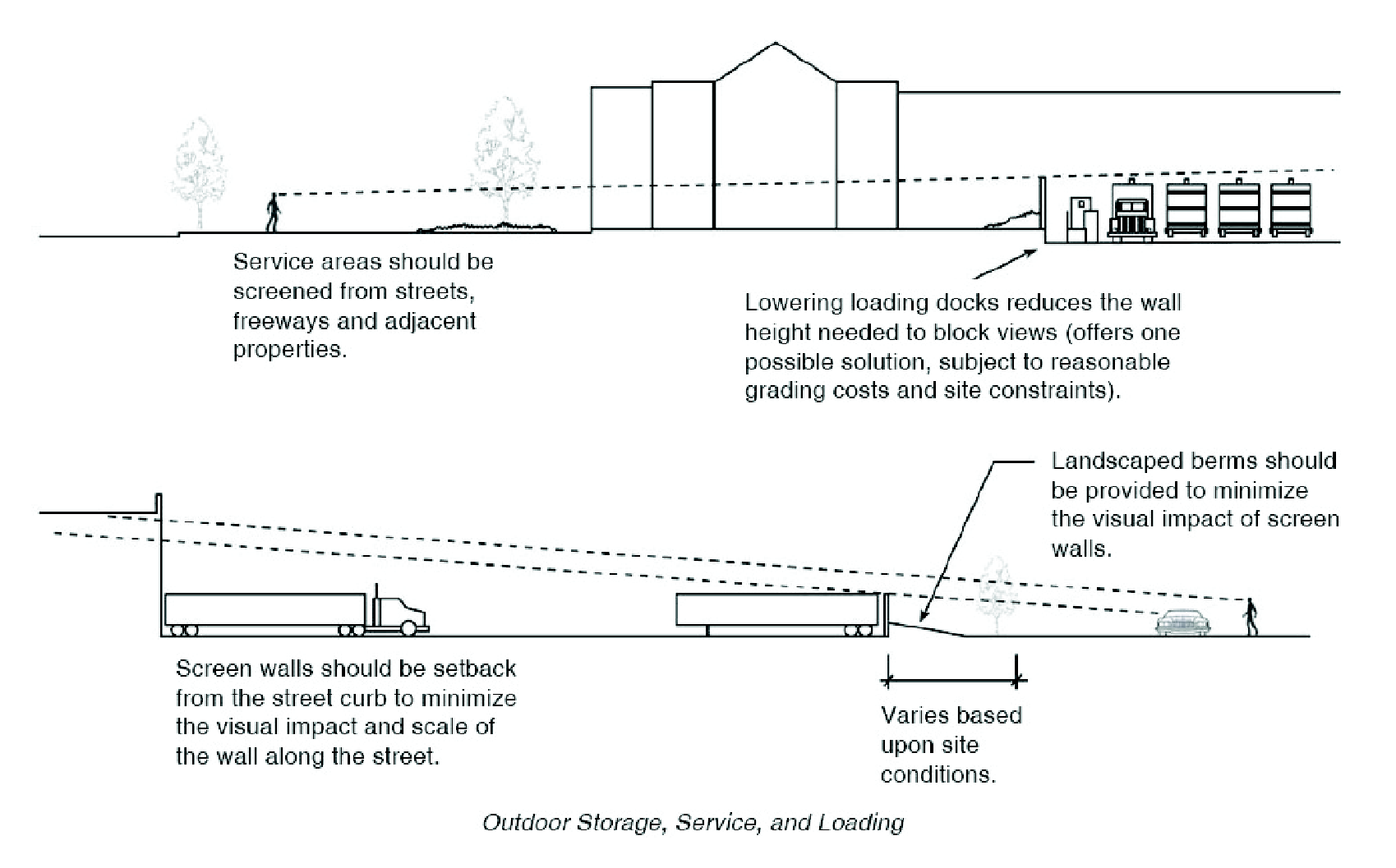
e.
Outdoor storage and service areas shall be located so as to minimize negative impacts (visual, noise, dust, vibration, etc.) upon any neighboring residentially designated properties.
12.
Utility and Mechanical Equipment.
a.
All utility and mechanical equipment (wall-mounted meters, air conditioners, etc.) shall be screened from public view. This includes all ground, wall, and roof mounted equipment. Screening elements shall be an integral part of the building; no screening method shall give the appearance of being "tacked on."
b.
Where possible, integrate rooftop equipment into the overall mass of a building. At a minimum, roof mounted equipment shall be screened through the use of parapets, screening walls, equipment wells, mechanical room enclosures and similar design features. Screening devices other than parapet walls shall be designed as an integral element of the building massing. Picket fencing, chain-link fencing and metal boxes shall be avoided. The top of screens should be at least as high as the top of the equipment, with additional height provided where larger equipment units could be used in the future.
c.
Typical ground-mounted equipment (such as transformers and heating units) shall be adequately screened with walls and/or landscaping. Large structures and/or equipment should be screened by the building from view of adjacent streets and properties.
d.
All vents, gutters and downspouts, louvers, exposed flashing, etc. should be treated as design elements and be compatible with the rest of the building, or hidden from public view.
13.
Fences and Walls.
a.
Walls and fences serve a major function in the industrial landscape and are used to screen vehicles, loading and storage areas, and utility structures. However, if not required for a specific screening or security purpose, they should not be utilized. The intent is to keep the walls as low as possible while performing their screening and security functions. The height of walls and fences on industrial properties is set forth in Section 16.20.070 of this development code.
b.
Walls and fences should be planned and designed as integral parts of industrial development, and should be consistent with the landscaping and building design.
c.
If street fencing is necessary, decorative types of view fencing, such as wrought iron, are encouraged. Solid fencing, such as stucco or masonry, is strongly discouraged when they will block the view of the buildings or provide hiding places. Chain link and barbed wire fencing is prohibited.
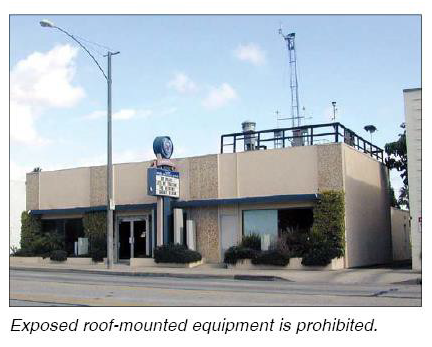
d.
Perimeter walls or fencing that do not front a public street should be of decorative masonry (split-face block, plaster/stucco finish), decorative metal (wrought iron), wood, hedges, or a combination of materials. They should be designed in a style, material and color to complement the development. Both sides of walls should be architecturally treated.
e.
Tiered planting should be provided adjacent to project perimeter walls along street frontages to soften their appearance.
f.
Walls should be eliminated or sited to provide additional setback areas at project entries to accommodate landscaping, signage, or street furniture.
g.
Wall sections greater than eighty (80) feet in length fronting a street shall incorporate at least two of the following design features, in proportion to the length of the wall.
h.
A minimum two-foot change in horizontal plane for at least ten feet.
i.
A minimum eighteen (18) inch change in height for at least ten feet.
j.
A minimum eighteen (18) inch high raised planter for at least half the length of the wall.
k.
Use of pilasters at twenty-five (25) foot maximum intervals and at changes in wall planes.
l.
Gates or comparable design solutions should be provided in perimeter walls or fences to allow emergency access and facilitate convenient pedestrian access.
m.
Walls should be curved or angled at corner locations along street frontages to allow sight line views around the corner.
14.
Exterior Lighting.
a.
Exterior lighting shall be used to provide illumination for the security and safety of on-site areas such as building entrances, parking, loading, shipping and receiving, walkways, and working areas. The design of light fixtures and their structural support shall be architecturally compatible with main buildings on-site.
b.
Exterior lighting should be adequate but not overly bright. It shall be located and designed to avoid direct glare onto adjacent properties and public rights-of-way. In addition, the lighting shall have cut-off luminaries that limit the amount of light pollution on nighttime skies.
c.
Buildings and landscaping can be illuminated indirectly to create a strong positive image. Concealing light features within buildings and landscaping can highlight attractive features and avoid intrusion into neighboring properties and public rights-of-way.
d.
All portions of parking areas shall be illuminated at minimum 0.1 foot-candle intensity. A maximum illumination of 0.5 foot-candles at the property lines abutting a street or residentially designated property is allowed.
(Ord. No. 2012-02, § 3(Exh. A), 2-7-12)
16.16.430 - Public (P) designation.
A.
Purpose and Intent. This designation is intended to preserve and protect public facilities and those privately owned facilities which provide a service to the general public, including schools, churches, post offices, fire stations, hospitals, civic centers, and publicly owned land. Due to the broad service function of this designation and the difficulty of planning all public uses in advance, the public institutional designation may be designated throughout the plan area, provided the uses do not conflict with other established uses. The P-GOVT, P-SCHOOL, and P-PARK/REC general plan designations shall be considered public in this development code, and are subject to this article.
B.
Locational Standards.
1.
The area is occupied or will be occupied by public or closely related private facilities providing services or functions for the general public.
2.
The uses are compatible with and not detrimental to adjacent land uses.
3.
The area has adequate public services and access to accommodate the needs of the proposed use on a given site.
4.
The location shall be consistent with the general plan text and maps.
C.
Review Procedures. In order to ensure compliance with the general plan, and development code, permitted uses within this designation may be subject to a conditional use permit, site approval or tenant improvement review, in accordance with Chapter 16.12.
D.
Permitted Uses.
1.
Electrical, gas, water and sewage transmission facilities.
2.
Radio and television stations and towers.
3.
Microwave communication towers and facilities.
4.
Government protective functions and postal services.
5.
Public works maintenance and storage yards.
6.
Vocational, trade and special training schools.
7.
Museums and art galleries.
8.
Planetariums, aquariums, botanical gardens and zoos.
9.
Historical and monument sites.
10.
Convention facilities.
11.
Parks, playgrounds and athletic fields.
12.
Recreation and community centers.
13.
Churches, synagogues, mosques or other houses of worship.
14.
Elementary, intermediate and senior high schools, public or private.
15.
Colleges and universities.
E.
Intensity. The maximum Floor Area Ratio for P-GOV shall be 2.0.
F.
After approval, the public designation is automatically applied to the general plan land use map, without the necessity of any additional land use or zone change applications.
(Ord. 126 § 6, 1991)
(Ord. No. 2012-02, § 3(Exh. A), 2-7-12)
Editor's note— Ord. No. 2012-02, § 3(Exh. A), adopted February 7, 2012, renumbered § 16.16.610 as § 16.16.330. For purposes of classification, and at the editor's discretion, these provisions have been included as § 16.16.430.
16.16.440 - Purpose and intent.
A.
In order to preserve public health, safety and welfare of the residents and businesses within the city, the declared purpose of this article is to prohibit all cannabis-related businesses, activities and uses (unless local control is otherwise preempted by state law), with a limited exception for medical cannabis deliveries and personal indoor cannabis cultivation, as provided for herein.
B.
This article is not intended to interfere with a patient's right to obtain medical cannabis, as provided for in California Health & Safety Code § 11362.5. This article is not intended to conflict with federal law as contained in the Controlled Substances Act, 21 USC 800 et seq., nor to otherwise permit any activity that is prohibited under that Act or any other local, state or federal law, statute, rule or regulation.
(Ord. No. 2017-15, § 4(Exh. A), 12-5-17)
16.16.445 - Definitions.
The definition of all terms used in this article shall be as defined below and as defined by Chapter 16.08 (with this section taking precedence over Chapter 16.08 in the event of conflict). Any ambiguity in the definitions used herein shall be resolved in favor of the city's understanding of the term.
"Accrediting body" means a nonprofit organization that requires conformance to ISO/IEC 17025 requirements and is a signatory to the International Laboratory Accreditation Cooperation Mutual Recognition Arrangement for Testing.
"Applicant," (consistent with exemptions provided by the Business and Professions Code § 19319, means the following:
(1)
Owner or owners of a proposed facility, including all persons or entities having ownership interest other than a security interest, lien, or encumbrance on property that will be used by the facility.
(2)
If the owner is an entity, "owner" includes within the entity each person participating in the direction, control, or management of, or having a financial interest in, the proposed facility.
(3)
If the applicant is a publicly traded company, "owner" means the chief executive officer or any person or entity with an aggregate ownership interest of five percent or more.
"Bureau" means the Bureau of Marijuana Control within the Department of Consumer Affairs.
"Cannabinoid" or "phytocannabinoid" means a chemical compound that is unique to and derived from cannabis.
"Cannabis" means all parts of the plant Cannabis sativa Linnaeus, Cannabis indica, or Cannabis ruderalis, whether growing or not; the seeds thereof; the resin, whether crude or purified, extracted from any part of the plant; and every compound, manufacture, salt, derivative, mixture, or preparation of the plant, its seeds, or resin. "Cannabis" also means the separated resin, whether crude or purified, obtained from marijuana. "Cannabis" also means marijuana as defined by Section 11018 of the Health and Safety Code as enacted by Chapter 1407 of the Statutes of 1972. "Cannabis" does not include the mature stalks of the plant, fiber produced from the stalks, oil or cake made from the seeds of the plant, any other compound, manufacture, salt, derivative, mixture, or preparation of the mature stalks (except the resin extracted therefrom), fiber, oil, or cake, or the sterilized seed of the plant which is incapable of germination. For the purpose of this chapter, "cannabis" does not mean "industrial hemp" as defined by the Food and Agricultural Code § 81000 or the Health and Safety Code § 11018.5.
"Cannabis accessories" means any equipment, products or materials of any kind which are used, intended for use, or designed for use in planting, propagating, cultivating, growing, harvesting, manufacturing, compounding, converting, producing, processing, preparing, testing, analyzing, packaging, repackaging, storing, smoking, vaporizing, or containing cannabis, or for ingesting, inhaling, or otherwise introducing cannabis or cannabis products into the human body.
"Cannabis concentrate" means manufactured cannabis that has undergone a process to concentrate the cannabinoid active ingredient, thereby increasing the product's potency. An edible cannabis product is not considered food, as defined by the Health and Safety Code § 109935, or a drug, as defined by the Health and Safety Code § 109925.
"Cannabis products" means cannabis that has undergone a process whereby the plant material has been transformed into a concentrate, including, but not limited to, concentrated cannabis, or an edible or topical product containing cannabis or concentrated cannabis and other ingredients.
"Certificate of accreditation" means a certificate issued by an accrediting body to a licensed testing laboratory, entity, or site to be registered in the state.
"Commercial cannabis activity" includes cultivation, possession, manufacture, processing, storing, laboratory testing, labeling, transporting, labeling, distribution, delivery or sale of cannabis or a cannabis product; except, as set forth in the Business and Professions Code § 19319, related to qualifying patients and primary caregivers; and, as applicable, except as set forth in Section 16.16.455 (Personal Cultivation of Cannabis) of this Article XIV.
"Cultivation" means any activity involving the planting, growing, harvesting, drying, curing, grading, or trimming of cannabis.
"Cultivation site" means a facility where cannabis is planted, grown, harvested, dried, cured, graded, or trimmed, or that does all or any combination of those activities.
"Delivery" means the commercial transfer of cannabis or cannabis products from a dispensary; in the case of delivery of medical cannabis or medical cannabis products, the commercial transfer of cannabis or cannabis products from a dispensary is up to an amount determined by the bureau to a primary caregiver or qualified patient as defined in the Health and Safety Code § 11362.7. "Delivery" also includes the use by a dispensary of any technology platform owned and controlled by the dispensary, or independently licensed under state law, that enables customers (or in the case of medical cannabis or medical cannabis products, qualified patients or primary caregivers) to arrange for or facilitate the commercial transfer by a licensed dispensary of cannabis or cannabis products.
"Delivery dispensary" means a dispensary, with a permanent fixed location within the city, limited to retail sales of medical cannabis, or medical cannabis products, occurring exclusively through delivery. All retail sales are prohibited at the physical location of the delivery dispensary.
"Director" means the city of Hesperia Director of Development Services, and includes his/her designee(s).
"Dispensary" means a facility where cannabis, cannabis products, or devices for the use of cannabis or cannabis products are offered, either individually or in any combination, for retail sale, including an establishment that delivers, pursuant to express authorization under the provisions of this article, cannabis and cannabis products as part of a retail sale.
"Dispensing" means any activity involving the retail sale of cannabis or cannabis products from a dispensary.
"Distribution" means the procurement, sale, and transport of cannabis and cannabis products between entities licensed for commercial cannabis activities.
"Distributor" means a person licensed to engage in the business of purchasing cannabis from a licensed cultivator, or cannabis products from a licensed manufacturer, for sale to a licensed dispensary.
"Dried flower" means all dead cannabis that has been harvested, dried, cured, or otherwise processed, excluding leaves and stems.
"Edible cannabis product" means manufactured cannabis that is intended to be used, in whole or in part, for human consumption, including, but not limited to, chewing gum, but excluding products set forth in Division 15 (commencing with Section 32501) of the Food and Agricultural Code. An edible cannabis product is not considered food as defined by the Health and Safety Code § 109935 or a drug as defined by the Health and Safety Code § 109925.
"Identification card" means a document issued by the State Department of Health Services that document identifies a person authorized to engage in the medical use of cannabis.
"Identification program" means the universal identification certificate program for commercial medical cannabis activity authorized by Chapter 3.5 (Medical Cannabis Regulation and Safety Act) of Division 8 of the Business and Professions Code.
"Industrial hemp" means a fiber or oilseed crop, or both, that is limited to types of the plant Cannabis sativa L. having no more than three-tenths of one percent tetrahydrocannabinol (THC) contained in the dried flowering tops, whether growing or not; the seeds of the plant; the resin extracted from any part of the plant; and every compound, manufacture, salt, derivative, mixture, or preparation of the plant, its seeds or resin produced therefrom.
"Licensee" means a person issued a state license under Chapter 3.5 (Medical Cannabis Regulation and Safety Act) of Division 8 (Special Business Regulations) of the Business and Professions Code, or Division 10 (Marijuana) of the Business and Profession Code, to engage in commercial cannabis activity.
"Licensing authority" means the state agency responsible for the issuance, renewal, or reinstatement of the license.
"Live plants" means living cannabis flowers and plants, including seeds, immature plants, and vegetative stage plants.
"Manufactured cannabis" means raw cannabis that has undergone a process whereby the raw agricultural product has been transformed into a concentrate, an edible product, or a topical product.
"Manufacturer" means a person that conducts the production, preparation, propagation, or compounding of manufactured cannabis, as described in the term "manufacturing site" as defined herein, or cannabis products either directly or indirectly or by extraction methods, or independently by means of chemical synthesis or by a combination of extraction and chemical synthesis at a fixed location that packages or repackages cannabis or cannabis products or labels or relabels its container.
"Manufacturing site" means a location that produces, prepares, propagates, or compounds manufactured cannabis or cannabis products, directly or indirectly, by extraction methods, independently by means of chemical synthesis, or by a combination of extraction and chemical synthesis, and is owned and operated by a licensee for these activities.
"Marijuana" has the same definition as "cannabis" provided in this Article.
"Medical cannabis" or "medical cannabis product" means a product containing cannabis, including, but not limited to, concentrates and extractions, used for medical purposes in accordance with the Compassionate Use Act (Health and Safety Code § 11362.5), the Medical Marijuana Program Act (Health and Safety Code §§ 11362.7 et seq.), and the Medical Marijuana Regulation and Safety Act of 2015. For the purposes of this article, "medical cannabis" does not include "industrial hemp" as defined by the Food and Agricultural Code § 81000 or the Health and Safety Code § 11018.5.
"Nursery" means a licensee that produces only clones, immature plants, seeds, and other agricultural products used specifically for the planting, propagation, and cultivation of cannabis.
"Permit," "local license," or "local permit" means an official document granted by the City of Hesperia that specifically authorizes a person to conduct commercial cannabis activity in the city.
"Person with an identification card" means an individual who is a qualified patient who has applied for and received a valid identification card pursuant to Article 2.5 (Medical Marijuana Program), Chapter 6, Division 10 of the Health and Safety Code, and as may be amended.
"Place of worship" means an establishment which has the principal purpose of religious worship (e.g., church, synagogue, mosque, temple)
"Primary Caregiver" has the same meaning as the term "primary caregiver" is defined in the Health and Safety Code § 11362.7, and as may be amended, and is subject to the limitations of the Health and Safety Code § 11362.7(e), as may be amended, which provides that a "primary caregiver shall be at least eighteen (18) years of age, unless the primary caregiver is the parent of a minor child who is a qualified patient or a person with an identification card or the primary caregiver is a person otherwise entitled to make medical decisions under state law pursuant to the Family Code §§ 6922, 7002, 7050, or 7120."
"Private residence" has the same meaning as the term is defined in the Health and Safety Code § 11362.2(b)(5), and as many be amended, which provides that private residence "means a house, an apartment unit, a mobile home, or other similar dwelling."
"Qualified patient" has the same meaning as that term is defined in Health and Safety Code § 11362.7, and as may be amended, and which "means a person who is entitled to the protections of the Health and Safety Code § 11362.5, but who does not necessarily have an identification card."
"State license," "license," or "registration" means a state license issued pursuant to Chapter 3.5 (Medical Cannabis Regulation and Safety Act) of Division 8 (Special Business Regulations) of the Business and Professions Code, or Division 10 (Marijuana) of the Business and Professions Code.
"Testing laboratory" means the premises where tests are performed on cannabis or cannabis products and that hold a valid certificate of accreditation.
"Topical cannabis" means a product intended for external use. A topical cannabis product is not considered a drug as defined by the Health and Safety Code § 109925.
"Transport" means the transfer of cannabis or cannabis products from the permitted business location of one licensee to the permitted business location of another licensee, for the purposes of conducting commercial cannabis activity authorized under state law.
"Transporter" means a permitted person issued a state license by the bureau to transport cannabis or cannabis products in an amount above a threshold determined by the bureau between permitted facilities that have been issued a state license pursuant to state law.
(Ord. No. 2017-15, § 4(Exh. A), 12-5-17)
16.16.450 - Prohibition of non-medical commercial cannabis activities.
A.
All non-medical commercial cannabis activities (including non-profit operations) within the city are prohibited, including but not limited to the state license classifications listed below as provided for in Business and Professions Code § 26050, as well as California Code of Regulation's Division 42 of Title 16, Division 8 of Title 3 and Chapter 13 of Division 1 of Title 17:
(1)
A-Type 1—Cultivation; Specialty outdoor; Small.
(2)
A-Type 1A—Cultivation; Specialty indoor; Small.
(3)
A-Type 1B—Cultivation; Specialty mixed-light; Small.
(4)
A-Type 1C—Cultivation; Specialty cottage; Small.
(5)
A-Type 2—Cultivation; Outdoor; Small.
(6)
A-Type 2A—Cultivation; Indoor; Small.
(7)
A-Type 2B—Cultivation; Mixed-light; Small.
(8)
A-Type 3—Cultivation; Outdoor; Medium.
(9)
A-Type 3A—Cultivation; Indoor; Medium.
(10)
A-Type 3B—Cultivation; Mixed-light; Medium.
(11)
A-Type 4—Cultivation; Nursery.
(12)
A-Type 5—Cultivation; Outdoor; Large.
(13)
A-Type 5A—Cultivation; Indoor; Large.
(14)
A-Type 5B—Cultivation; Mixed-light; Large.
(15)
A-Type 6—Manufacturer 1.
(16)
A-Type 7—Manufacturer 2.
(17)
A-Type 8—Testing laboratory.
(18)
A-Type 9—Non-Storefront Retailer.
(19)
A-Type 10—Retailer.
(20)
A-Type 11—Distributor.
(21)
A-Type 12—Microbusiness.
(22)
A-Type 13—Distributor, Transport Only.
(23)
A-Type 14—Cannabis Event Organizer.
(24)
A-Type—Processor Only Cultivation.
(25)
A-Type N—Manufacturer.
(26)
A-Type P—Manufacturer.
(27)
A-Type S—Manufacturer.
B.
The prohibition provided by this section includes any activities authorized under new or revised state licenses, or any other state authorization, to allow any type, category or classification of non-medical cannabis commercial activities, or similar operations (including non-profit, collective or cooperative operations).
(Ord. No. 2017-15, § 4(Exh. A), 12-5-17; Ord. of 2018-03, § 4(Exh. C), 3-20-18)
16.16.455 - Personal cultivation of cannabis.
Individuals twenty-one (21) years of age or older desiring to possess, plant, cultivate, harvest, dry, or process not more than six living cannabis plants and possess the cannabis produced by the plants (as authorized by the Health and Safety Code § 11362.2, and as may be amended from time to time) shall comply with the following reasonable regulations:
A.
Outdoor cultivation of cannabis is expressly prohibited in all zoning districts of the city.
B.
The six living plants and any cannabis produced by the plants shall be planted, cultivated, harvested, dried, and processed within a private residence.
C.
The six living plants and any cannabis produced by the plants in excess of twenty-eight and one-half (28.5) grams shall be kept within a locked room within the person's private residence, or be kept within an enclosed locked structure on, or within, the person's private residence. "Enclosed locked structure" means a structure that:
1.
Does not allow for the visibility of the interior from the outside;
2.
Is secured with locks;
3.
Is completely surrounded on all sides by a wall or other barrier; and
4.
Is roofed or otherwise secured from entry.
D.
Enclosed locked structures may include greenhouses and accessory buildings meeting the requirements contained in this section.
E.
Persons possessing, planting, cultivating, harvesting, drying, or processing not more than six living cannabis plants and possessing the cannabis produced by the plants pursuant to this section shall register with the director, provide information on forms provided by the director, and pay a fee as approved by city council resolution; said registration shall be renewed with the city annually. Consistent with the intent of this article, the director is authorized to clarify and/or supplement in writing these procedures.
F.
If the registrant is not the property owner, the registration required pursuant to subsection (E) shall include written and notarized permission from the owner of the private residence; said permission shall be notarized within thirty (30) days of the date the registration is submitted to the city.
(Ord. No. 2017-15, § 4(Exh. A), 12-5-17)
16.16.460 - Prohibition of medical commercial cannabis activities.
A.
All medical commercial cannabis activities (including non-profit operations) within the city are prohibited, including but not limited to the state license classifications listed below as provided for in Business and Professions Code § § 26050, as well as California Code of Regulation's Division 42 of Title 16, Division 8 of Title 3 and Chapter 13 of Division 1 of Title 17 (notwithstanding the limited exemption provided in Section 16.16.465 for a M-Type 9 (Non-Storefront Retailer) license in conjunction with a valid and current delivery dispensary permit):
(1)
M-Type 1—Cultivation; Specialty outdoor; Small.
(2)
M-Type 1A—Cultivation; Specialty indoor; Small.
(3)
M-Type 1B—Cultivation; Specialty mixed-light; Small.
(4)
M-Type 1C—Cultivation; Specialty cottage; Small.
(5)
M-Type 2—Cultivation; Outdoor; Small.
(6)
M-Type 2A—Cultivation; Indoor; Small.
(7)
M-Type 2B—Cultivation; Mixed-light; Small.
(8)
M-Type 3—Cultivation; Outdoor; Medium.
(9)
M-Type 3A—Cultivation; Indoor; Medium.
(10)
M-Type 3B—Cultivation; Mixed-light; Medium.
(11)
M-Type 4—Cultivation; Nursery.
(12)
M-Type 5—Cultivation; Outdoor; Large.
(13)
M-Type 5A—Cultivation; Indoor; Large.
(14)
M-Type 5B—Cultivation; Mixed-light; Large.
(15)
M-Type 6—Manufacturer 1.
(16)
M-Type 7—Manufacturer 2.
(17)
M-Type 8—Testing laboratory.
(18)
M-Type 10—Retailer.
(19)
M-Type 11—Distributor.
(20)
M-Type 12—Microbusiness.
(21)
M-Type 13—Distributor, Transport Only.
(22)
M-Type 14—Cannabis Event Organizer.
(23)
M-Type—Processor-Only Cultivation.
(24)
M-Type N—Manufacturer.
(25)
M-Type P—Manufacturer.
(26)
M-Type S—Manufacturer.
B.
This prohibition provided by this section includes any activities authorized under new or revised state licenses, or any other state authorization, to allow any type, category or classification of medical commercial cannabis activities, or similar operations (including non-profit, collective or cooperative operations).
C.
The prohibition provided by this section includes medical cannabis collectives and cooperatives that operate pursuant to Health and Safety Code § 11362.775, the Compassionate Use Act, the Medical Marijuana Program Act, or otherwise.
(Ord. No. 2017-15, § 4(Exh. A), 12-5-17; Ord. of 2018-03, § 4(Exh. C), 3-20-18)
16.16.465 - Delivery of medical cannabis.
A.
The delivery of medical cannabis within the city to qualified patients or persons with an identification card, in accordance with a doctor's recommendation, is prohibited except for as allowed by this section.
B.
The establishment and operation of a medical cannabis delivery service with a permanent fixed location within the city, under state license M-Type 9 (Non-Storefront Retailer), as provided for in Business and Professions Code § 19300.7(n), is permitted subject to issuance by the city of a regulatory permit authorizing a delivery dispensary, as provided for in Title 5 ("Business Licenses and Regulations"), and the continued maintenance in good standing of such regulatory permit.
(Ord. No. 2017-15, § 4(Exh. A), 12-5-17)
16.16.470 - Conditions for establishment and operation of a delivery dispensary.
The establishment and operation of a delivery dispensary is subject to the following conditions:
(1)
A delivery dispensary shall only be permitted within the General Industrial (G-I) zone district or the Limited Manufacturing (I-1) or General Manufacturing (1-2) General Plan designations.
(2)
A delivery dispensary shall be permitted within the Commercial Industrial Business Park (CIBP) zone district, and only within the area bounded by Smoke Tree Street, "I" Avenue, Juniper Street and Santa Fe Avenue East, and subject to the distance restrictions defined in this section.
(3)
The maximum floor area of any delivery dispensary shall be ten thousand (10,000) square feet.
(4)
A delivery dispensary shall be located at least six hundred (600) feet from any residential or agricultural zone, any place of worship, school, park, playground, day care center or other location where children regularly congregate.
(5)
A delivery dispensary must be located at least six hundred (600) feet from any adult business, liquor store, hookah lounge, massage facility, or residential care facility.
(6)
The distance between any delivery dispensary and any residential or agricultural zone, any place of worship, school, park, playground, day care center, or other location where children regularly congregate, shall be measured in a straight line, without regard to intervening structures, from the closest exterior structural wall of the delivery dispensary office to the closest property line of the residential or agricultural zone, any place of worship, school, park, playground, day care center or other location where children regularly congregate.
(7)
Where the six-hundred-foot (600) distance as measured from any of the uses listed above, except for a school, day care center or youth center, and the measurement crosses a property line, the entire property and any structures located therein, are deemed eligible for the location of a delivery service.
(8)
The delivery dispensary shall be operated in accordance with all city codes, as well as the Medical Cannabis Regulation and Safety Act (including but not limited to the Business and Professions Code § 19340), the Compassionate Use Act, and the Medical Marijuana Program Act.
(Ord. No. 2017-15, § 4(Exh. A), 12-5-17; Ord. No. 2018-02, § 2(Exh. B), 3-20-18)
Editor's note— Ord. No. 2017-15, § 5(Exh. B), adopted December 5, 2017, contains the map of Marijuana Shops—Restricted Areas for illustrative purposes only and is on file in the office of the city clerk (and may be amended from time to time); it can be found in this Code at the end of Article XIV.
16.16.475 - Industrial hemp.
The possession, use, purchase, sale, cultivation, processing, manufacture, packaging, labeling, transporting, storage, distribution, use and transfer of industrial hemp shall not be subject to the provisions of this Article or of Division 10 (commencing with the Business and Professions Code § 26000), but instead shall be regulated by the Department of Food and Agriculture in accordance with the provisions of Division 24 (commencing with Section 81000) of the Food and Agricultural Code, inclusive.
(Ord. No. 2017-15, § 4(Exh. A), 12-5-17)
(Ord. No. 2017-15, § 5(Exh. B), 12-5-17)

