
Highland City Zoning Code
ARTICLE I
- IN GENERAL
Sec. 90-1.- Purpose and objectives.
In accordance with Illinois State Statute (65 ILCS 5/11-13-1 et seq.), this chapter regulates structures and land uses in order to preserve, protect and promote the public health, safety and welfare through implementation of the city's comprehensive plan. More specifically, this chapter is intended to assist in achieving the following objectives:
(1)
Encourage the development of buildings and uses on appropriate sites in order to maximize community-wide social and economic benefits while accommodating the particular needs of all residents, and to discourage development on inappropriate sites;
(2)
Protect and enhance the character and stability of sound existing residential, commercial and industrial areas, and eliminate nonconforming uses and structures which are abandoned for one year;
(3)
Ensure the provision of adequate light, air and privacy for the occupants of all buildings;
(4)
Protect property from damage caused by fire, flooding, poorly controlled stormwater runoff, and adverse soil and topographical conditions;
(5)
Provide adequate and well-designed parking and loading space for all buildings and uses, and reduce vehicular congestion on the public streets and highways;
(6)
Guide the provision of water mains, sanitary sewers, electric lines, stormwater sewers and other utilities and services, and reduce the initial costs and future maintenance expenses thereof;
(7)
Provide for the efficient administration and fair enforcement of all the requirements set forth in this chapter; and
(8)
Clearly and concisely explain the procedures for obtaining variances, special use permits, amendments, and the like.
(Ord. No. 2195, § 2, 1-16-06)
Sec. 90-2. - Rules of construction.
In the construction of these regulations, the provisions and rules of this section shall be preserved and applied, except when the context clearly requires otherwise:
(1)
Words used in the present tense shall include the future.
(2)
Words in the singular number include the plural number, and words in the plural number include the singular number.
(3)
The phrase "used for" shall include the phrases "arranged for", "designed for", "intended for", "maintained for", and "occupied for".
(4)
The word "shall" is mandatory.
(5)
The word "may" is permissive.
(6)
The word "person" includes individuals, firms, corporations, associations, governmental bodies and agencies, and all other legal entities.
(7)
Unless otherwise specified, all distances shall be measured horizontally.
(8)
The word "city" means City of Highland, Illinois.
(9)
All distances shall be measured to the nearest integral foot; six inches or more shall be deemed one foot.
(10)
Reference to sections shall be deemed to include all subsections within that section; but a reference to a particular subsection designates only that subsection.
(11)
A general term that follows or is followed by enumerations of specific terms shall not be limited to the enumerated class unless expressly limited.
(12)
Any word or phrase which is defined in these regulations shall have the meaning as so defined whenever the word or phrase is used in these regulations, unless such definition is expressly limited in its meaning or scope.
(Ord. No. 2195, § 2, 1-16-06)
Sec. 90-3. - Overlapping or contradictory regulations.
Where the conditions imposed by any provision of these regulations upon the use of land or structures are either more restrictive or less restrictive than comparable conditions imposed by other provision of any other law, ordinance, resolution, rule or regulations of any kind, the regulations which are more restrictive shall govern.
(Ord. No. 2195, § 2, 1-16-06)
Sec. 90-4. - Unlawful uses.
No structure or use which was not lawfully existing at the time of the adoption of these regulations shall become or be made lawful solely by reason of the adoption of these regulations; and to the extent that, and in any respect that, said unlawful structure or use is in conflict with the requirements of these regulations, said structure or use remains unlawful hereunder.
(Ord. No. 2195, § 2, 1-16-06)
Sec. 90-5. - Conformity required.
No structure or part thereof shall be erected, used, occupied, enlarged, altered, relocated or reconstructed except in conformity with this chapter. Similarly, no lot or part thereof shall be used, occupied, or developed except in conformity with this chapter.
(Ord. No. 2195, § 2, 1-16-06)
Sec. 90-6. - Unlisted uses.
Whenever any use is not specifically listed as permitted or special within a particular zoning district, such use shall be deemed prohibited in that district. However, if the council, following consultation with the administrative official and the zoning board of appeals, finds that the unlisted use is similar to and compatible with the listed uses, they may allow such use by amending this chapter in accordance with zoning amendment procedures found in sections 90-82 through 90-89 and the conditions stated in subsection 90-201(6). The council's decision shall become a permanent public record, and any unlisted use that they approve shall thereafter have the same status as listed uses.
(Ord. No. 2195, § 2, 1-16-06)
Sec. 90-7. - Future lots.
Lots created after the effective date of the ordinance from which this chapter derives shall meet at least the minimum requirement established by this chapter.
(Ord. No. 2195, § 2, 1-16-06)
Sec. 90-8. - Access requirements.
No building shall be erected on any lot unless such lot abuts, or has permanent easement of access to, a public street that conforms to the standards set forth in the city's land development code.
(Ord. No. 2195, § 2, 1-16-06)
Sec. 90-9. - Front setbacks—For corner or through lots.
Every lot with multiple frontages, such as corner or through lots, shall meet the front setback requirements of the zoning district in which it is located on every side having frontage.
(Ord. No. 2195, § 2, 1-16-06)
Sec. 90-10. - Same—In certain built-up areas.
Except as specifically provided otherwise, in all residential zoning districts, and in the C-1 neighborhood business and C-2 central business districts, where lots having 50 percent or more of the frontage on one side of a street between intersections, that is, in one block, are developed with buildings, and the front setbacks of those lots do not differ by more than ten feet, the minimum required front setbacks on that block shall be the average of the existing front setbacks; provided, however, that in any built-up area, no front setbacks less than ten feet shall be permitted.
(Ord. No. 2195, § 2, 1-16-06)
Sec. 90-11. - Intrusions into yards.
The following may intrude into required yards without violating setback requirements:
(1)
Sills, beltcourses, window air conditioning units, window awnings, chimneys, cornices and ornamental features may project into a required yard a distance not to exceed two feet.
(2)
Filling station pumps and pump islands may occupy required yards; provided, however, that they are not less than 15 feet from all lot lines.
(3)
Signs erected in accordance with the sign ordinance of the city.
(4)
Open fire escapes, fireproof outside stairways and balconies opening upon fire towers, and the ordinary projections of chimneys and flues into a rear yard for a distance of not more than 4½ feet when so placed as not to obstruct light and ventilation.
(5)
Open, unenclosed porches, not glassed in, may extend ten feet into a front and rear yard.
(6)
Terraces which do not extend above the level of ground floors may project into a required yard, provided these projections be at least two feet from the adjacent side lot line or easement.
(7)
No side yards are required where dwellings are erected above C-2 commercial structures.
(Ord. No. 2195, § 2, 1-16-06)
Sec. 90-12. - Prohibitions concerning easements.
Notwithstanding any other section of this chapter, no building, accessory building, mobile home, garage, carport, kennel, sign, fence, or any other structure shall be built, constructed, erected, installed, kept, or used on, over, or under any express or implied utility easement or right-of-way that exists for public or utility purposes, including but not limited to electric easements, sewer easements, water easements, telephone easements, gas easements, drainage easements, streets, and rights-of-way, except:
(1)
That property owners may, at their own risk, plant shrubbery or hedges not reaching over four feet in height at maturity or install fences on utility easement areas the right being specifically reserved to the city to destroy such shrubbery, hedges or fences in the event that the city needs access to the said utility easement for the purpose of which it was granted unless the property owner provides an alternate method of access through the owner's property and if the alternate route of access is damaged or destroyed the obligation of restoration of such alternate access route shall be the property owner's responsibility, except that the city shall restore the same by grading, sodding, seeding or mulching said alternate access route at the city's expense.
(2)
In those instances where a surface driveway may be constructed across such utility easement in accord with any city ordinances governing construction of driveways, the lot owner assumes all responsibility to pay for repair and maintenance thereof, including but not limited to repair or replacement if the city undertakes any use of the utility easement allowed under the terms of the utility easement, and acknowledges the city's right to make any use of the utility easement allowed under the terms of the utility easement without any responsibility to or the consent from such lot owner other than as is required by the terms of the utility easement.
(Ord. No. 2195, § 2, 1-16-06)
Sec. 90-13. - Height limit exceptions.
The limits set forth in this division as to height of a building or structure shall not apply to a semiprivate or public service building, hospital, institution, agricultural building or a school all of which may be erected to a height not exceeding 110 feet, and churches may be erected to a height not exceeding 75 feet if the church is set back from each yard line at least one foot for each foot of additional building height not otherwise permitted in the district in which the building is built.
(Ord. No. 2195, § 2, 1-16-06)
Sec. 90-14. - Minimum requirements.
The sections of this chapter shall be held to be minimum requirements, adopted for the promotion of the public health, safety, morals or general welfare. Wherever the requirements of this chapter are at variance with the requirements of any other lawfully adopted rule, regulation or ordinance, the most restrictive or that imposing the higher standards shall govern, except that if a planned unit development is approved by the council pursuant to article iii division 10, the requirements and provisions of the approved planned unit development shall control.
(Ord. No. 2195, § 2, 1-16-06)
Sec. 90-15. - Definitions.
The following words and terms, whenever they occur in this chapter, shall be construed as defined in this section:
Abandonment: To discontinue one's use, rights, or interest in property. When the permitted or special use of a property has ceased and the property has been vacant for more than 12 months abandonment of use will be presumed.
Accent: An area covering no more than ten percent of a building's surface area visible to the public.
Accessory structure: A detached structure that is:
(1)
Subordinate in size or purpose of the principal structure or use which it serves;
(2)
Necessary or contributing to the comfort and convenience of the occupants or the principal structure or use served; and
(3)
Located on the same lot as the principal structure or use served.
By way of example, detached garages, carports, gazebos, storage sheds, and similar roofed structures are common accessory structures.
Accessory use: Any use that is:
(1)
Subordinate in size or purpose of the principal structure or use which it serves;
(2)
Necessary or contributing to the comfort and convenience of the occupants or the principal structure or use served; and
(3)
Located on the same lot as the principal structure or use served.
By way of example, uses without roofs such as patios, solar panels, and water fountains are common accessory uses.
Administrative official (zoning administrator): The individual designated to administer this chapter, and who is responsible for enforcement of the requirements imposed by the ordinance codified in this chapter.
Agricultural — farming operations: Farming and operations of a farm such as cultivation, conserving, and tillage of the soil, greenhouse operations, the production, cultivating, growing and harvesting of any agricultural, floricultural, viticultural, sod, or horticultural crops.
Agricultural operation: Use of land where such land is devoted to the production of plants, animals or horticultural products, including forests and forest products; harvest and management; dairy farming; grazing and pasturage; truck gardening; the raising of crops, fruit and nursery stock; fish farms; fur bearing animal farms; and the harvesting, processing, packaging, packing, shipping, marketing and selling of products produced on the premises; incidental farm occupations; and such uses as machinery, farm equipment, and domestic repair and construction, excluding stockyards, agricultural processing plants, commercial feed lots and slaughter houses. Agricultural activity shall not include the removal of trees for the purpose of development or redevelopment or the removal of trees without replanting.
Amortization: The elimination of nonconforming street graphics over time in accordance with the procedures set forth in article VIII.
Appeal: A procedure whereby any person aggrieved by any decision or order of the administrator in any matter related to the interpretation or enforcement of this article may seek relief from the city council.
Assisted living facility: Multifamily dwelling units used or designed to be used by older persons, persons with disabilities or other persons needing or desiring assistance with day-to-day living matters, but not including community residences, group community residences, hospitals or convalescent care facilities. Typical uses include retirement communities in which housekeeping services, common dining facilities and recreational and social activities are offered to residents.
Automotive service: An establishment or place of business primarily engaged in automotive related sales or services. The following automotive use types shall be defined as follows:
(1)
Automotive sales and lease: An establishment or place of business primarily engaged in the sale and leasing of automobiles, vans and/or trucks less than two tons, including incidental parking and servicing of vehicles available for sale or lease.
(2)
Automotive rental agency: An establishment or place of business primarily engaged in the rental of automobiles, vans and/or trucks less than two tons, including incidental parking and servicing of vehicles available for rent.
(3)
Automotive customizing shop: An establishment or place of business that primarily provides after-sales services for automobiles, including the attendant retail sales of accessories for such automobiles, such as installation, conversion and modifications to the interior or exterior of automobiles.
(4)
Automotive parts and supply store: An establishment or place of business primarily engaged in the sale of merchandise that is associated with the use, repair or upkeep of automobiles, including service and installation, but excluding automotive repair shops.
(5)
Automotive service station: An establishment or place of business primarily engaged in gasoline or diesel fuel sales at retail for automobiles, recreation vehicles and motorcycles, and where in addition at least one of the following services is rendered: Sale, replacement or servicing of spark plugs, oil, water hoses, brake fluids, batteries, distributors, tires, carburetors, brakes, fuel pumps, or other automotive parts or accessories. Such use shall include establishments that provide express oil changes, and sell at retail and install new automobile audio and/or video equipment.
(6)
Automotive repair shop: An establishment or place of business primarily engaged in the repair of automobiles or other motorized vehicles, or the installation or repair of equipment or parts on motorized vehicles such as mufflers, brakes, tires, transmissions, glass, and engines or engine parts, but excluding dismantling or salvage.
(7)
Automotive paint or body shop: The use of a building or premises for the repair of automotive bodies and/or major mechanical works, straightening of body parts, painting, welding or storage of automobiles not in operable condition.
(8)
Automotive tire store: An establishment or place of business primarily engaged in the sale of tires and services relating to the repair or purchase of tires for automobiles.
Awning: A sloped projection made of canvas or other nonrigid material, stretched over a frame and extended over a doorway or window. The awning is supported entirely from the exterior wall of the building and provides protection from the weather.
Bar or tavern: An establishment or place of business primarily engaged in the preparation and retail sale of alcoholic beverages for consumption on the premises with a city and state approved liquor license, including taverns, bars, cocktail lounges, and similar uses in which over 50 percent of the total revenue is generated from alcoholic beverages.
Bed and breakfast: An establishment or place of business that is a private, owner-occupied residence with one to three guest rooms in which lodging and meals are provided for time-limited durations to not more than three groups of patrons in a 24-hour period.
Billboard: Any single or double faced street graphic that is permanently fixed or placed on particular premises and that is used for the display of messages or advertising not associated with the establishment located on said premises. A billboard typically has provision for changing the message/advertising thereon.
Board: The zoning board of appeals established in article II, division 2.
Body art establishment: Any place or premises, whether public or private, permanent in nature and location, where the practices of body art, whether or not for profit, are performed.
Buildable area: The portion of a lot remaining after required yards have been provided.
Buildable width: The width of a lot left to be built on after the side yards are provided, and width of easements are deducted.
Building: Any permanent structure built for the shelter or enclosure of persons, animals, chattels or property of any kind, and not including advertising signs, boards, fences or mobile homes.
Building height: The vertical distance measured from the average grade at the front wall of a building to the highest point of the coping of a flat roof, or to the deck line of a mansard roof, or to the mean height level between eaves and ridges of gable, hip or gambrel roofs. Chimneys, towers, cooling towers and similar projections, other than signs, shall not be included in calculating building height.
Bulk sales: The sale of items that are unpackaged or loose not intended to be sold individually, such as rock, mulch and fertilizer.
Business or vocational school: A specialized instructional establishment that provides on-site training of business, commercial, and/or trade skills such as accounting, data processing and repair. This classification excludes establishments providing training in an activity that is not otherwise permitted in the zoning district. Incidental instructional services in conjunction with other primary use shall not be considered a business or vocational school.
Changeable copy sign: A sign which has provision for changing the message thereon either manually or electronically.
Co-branding (co-branded establishment): The pairing of two nationally branded businesses in a single establishment. The most common co-branded developments consist of a fast-food restaurant franchise and a major branded fuel station. Co-branded facilities may also contain as a planned use a convenience store, car wash, ATM machine or drive through service. Parking, signage, landscaping and design continuity shall be in accordance with the city's minimum requirements.
Community center: A public building to be used as a place of meeting, recreation, or social activity and not operated for profit and in which neither alcoholic beverages or meals are normally dispensed or consumed.
Community residence: A single dwelling unit occupied on a relatively permanent basis in a family-like environment by a group of no more than six unrelated persons with disabilities, illnesses or injuries plus paid professional support staff provided by a sponsoring agency, either living with the residents on a 24-hour basis, or present whenever residents with disabilities, illnesses or injuries are present at the dwelling; and complies with the zoning regulations for the district in which the site is located. (See also Group community residence.)
Construction sales and service: An establishment engaged in the retail or wholesale sale of materials used in the construction of buildings or other structures, and the outdoor storage of construction equipment or materials on lots other than construction sites. Typical uses include lumberyards, home improvement centers, lawn and garden supply stores, electrical, plumbing, air conditioning, and heating supply stores, swimming pool sales, construction contractors' storage yards and construction equipment rental establishments.
Convalescent care: An establishment providing bed care and inpatient services for persons needing regular medical attention, but excluding facilities for the care and treatment of mental illness, alcoholism, narcotics addiction, emergency medical services or communicable disease. Typical uses include nursing homes.
Convenience store: An establishment or place of business primarily engaged in the retail sale of gasoline or diesel fuel at fuel pumps and a limited number of products related to automobile maintenance, along with, packaged food, cold drinks, tobacco products and household convenience goods. This use shall not include liquor stores, automobile repair facilities or those uses allowed at an automotive repair shop.
Cornice: An ornamental topping that crowns the structure it is on.
Corrective action order: A legally binding order to effect compliance with this article, issued by the administrator in accordance with the procedures set forth herein.
Dance hall: A business or establishment that offers, for its patrons, dancing accommodations exceeding 20 percent of the total floor area of the establishment. Uses shall include nightclubs, private clubs or other uses offering dancing accommodations for patrons of any age.
Day care, home: A family home occupied by the day care provider in which family-like care is given to no more than eight persons not related to the day care provider, for any part of the 24-hour day, without overnight stays.
Day care, commercial: A building occupied by a day care provider that receives more than eight persons for care for any part of a 24-hour day, without overnight stays.
Drive-in and drive-through: An establishment where the product or service is delivered to customers in motor vehicles either parked nearby or directly through a window.
Dry cleaning and laundry pick-up: An establishment or business maintained for the pick-up and delivery of dry cleaning and/or laundry without the maintenance or operation of any laundry or dry cleaning equipment or machinery on the premises.
Dry cleaning plant: An establishment that is primarily engaged in the large-scale washing or cleaning of laundry, rugs and similar materials. This definition does not include laundromats or dry cleaning pick-up stations.
Dwelling: A building or portion thereof designed exclusively for year-round residential occupancy, including one-family and two-family, but not including, manufactured homes, mobile homes, automobile house trailers, hotels, motels, boarding houses, short-term rentals, resort cabins, clubs, hospitals or similar uses.
(1)
Multifamily (apartment): A building or portion of a building designed for or occupied by more than two families living independently of each other and being located on a single lot under common ownership.
(2)
Condominium: A single dwelling unit under individual ownership within a multifamily structure and located on a lot having common ownership. A structure containing two condominiums shall be considered a two-family dwelling and a structure with more than two condominiums shall be considered a multifamily dwelling.
(3)
Loft: A dwelling unit placed between the roof and the uppermost story of a nonresidential or mixed-use building.
(4)
Two-family (duplex): A building designed for or occupied exclusively by two families living independently of each other and being located on a single lot under single ownership. Each unit shall have direct access to the outside with no shared hallways or lobbies.
(5)
Single-family: A building designed for or occupied exclusively by one family.
(6)
Single-family attached dwelling (villa): Single-family dwellings sharing a common wall but situated on separate lots that are owned and occupied exclusively by separate parties.
a.
The term "villa" refers to one side of a single-family attached dwelling (villa) that contains only two single-family units; and,
b.
The term "two-villa building" refers to an entire single-family attached dwelling (villa) that contains only two single-family units with a common wall between them, which common wall is centered on the boundary line between the two lots on which the villas are respectively located.
Dwelling unit: One or more rooms constituting all or part of a dwelling which are used exclusively as living quarters for one family and contain a bathroom and kitchen facilities.
Easement: A right or privilege to use a portion of another's property for a particular purpose.
Engineer: A professional engineer registered in the State of Illinois.
Fascia. The exposed vertical edge of a roof.
Family: One person, two or more persons related by blood, marriage or legal adoption, or not more than three unrelated persons maintaining a common household in a dwelling which does not involve paid professional staff for the purposes of rehabilitation or convalescence.
Feather flags: Freestanding signs consisting of a plastic or metal shaft and an attached pennant typically in the shape of a feather or rectangle. Feather flags are commonly referred to as "wind banners."
Fence, sigh-proof: A fence with an opaque value of 70 percent or greater.
Fire service training center: A facility operated by the City of Highland Fire Department or the Highland-Pierron Fire Protection District which provides the components necessary to accomplish general fire fighter training within an accessory building or structure of up to 45 feet in height.
Financial services: An establishment that primarily performs central banking functions (such as issuing currency, managing national money supply and international reserves, and acting as fiscal agent for the central government) and accepts deposits (or share deposits) and lends funds from these deposits, and may include these services to patrons and customers through an accessory drive-through when permitted as a special or planned use. Financial services do not include pawn shops, businesses primarily engaged in check cashing or issuing money orders or title loan establishments or other businesses offering short-term consumer loans secured by personal property, certificates of title to such property estimated tax refunds or other such collateral. These uses are prohibited money changing/money brokering uses. (See also "payday loan establishments".)
Floor area, commercial, industrial: The total of all square feet of floor space per floor within the outside walls of a commercial or industrial building.
Floor area ratio: The square-foot floor area of the building divided by the square-foot area of the lot.
Floor area, residential: The total of all square feet of floor space per floor within the outside walls of a building. Residential floor area does not include porches, garages or basements, cellars or attics when such basements, cellars, or attics are used for storage or incidental uses.
Flush-mounted sign: Any sign attached to or erected against any wall, awning, canopy or marquee with the exposed face of said sign in a place approximately parallel to the plane of the wall, etc., and not projecting more than 18 inches. Such signs shall not be painted directly on any exterior wall or roof.
Food store (grocery store): An establishment where food and prepackaged beverages are sold on-site for consumption off-site. A limited amount of food preparation on-site may also be allowed, such as a delicatessen or bakery.
Freestanding sign: Any sign supported by one or more uprights, poles or braces in or upon the ground in a permanent manner.
Frieze: The plain or decorative band or board located just below the storefront cornice.
Frontage: All the property on the side of the street or highway which consists generally of the narrow dimensions of abutting lots and to which buildings are faced for principal entrance.
Garage or carport: A detached accessory building or portions of a main building housing the automobile owned by the occupant of the premises, but not commercial vehicles over the equivalent of a C class state license plate registration.
Garage sale: A sale or offering for sale to the public of new or used merchandise conducted on a lot containing a residential dwelling or within a residential zoned district.
Garden center: A retail establishment that sells gardening supplies, landscaping tools, plants, shrubs, trees and associated products. Uses shall include green houses, garden centers and plant nurseries.
Government/public buildings: Buildings or facilities owned or operated by a government entity and providing services for the public, excluding utilities and park and recreation services. Typical uses include administrative offices of government agencies, police, fire and utility billing offices.
Grid-tied solar energy system: A photovoltaic solar system that is connected to an electric circuit served by an electric utility company.
Ground mount: A solar energy system mounted on a rack or pole that rests on or is attached to the ground.
Group community residence: A single dwelling unit occupied on a relatively permanent basis in a family-like environment by a group of seven to 15 unrelated persons with disabilities, illnesses or injuries, plus paid professional support staff provided by a sponsoring agency, either living with the residents on a 24-hour basis, or present whenever residents with disabilities, illnesses or injuries are present at the dwelling and complies with the zoning regulations for the district in which the site is located.
Handicap parking space: A parking space reserved for a natural person who is unable to walk 200 feet or more unassisted by another person or without the aid of a walker, crutches, braces, prosthetic device, or a wheelchair or without great difficulty or discomfort due to the following impairments: neurologic, orthopedic, respiratory, cardiac, arthritic disorder, blindness or the loss of function or absence of a limb or limbs. All handicap parking spaces must meet the design and required number of space specifications as dictated by the state accessible handicap parking regulations.
Hardship: As applied in association with zoning area variances, a circumstance that, by reason of exceptional shape of a lot, topographic conditions, or other physical conditions of a parcel of land, strict conformity to the dimensional standards is unnecessarily burdensome or unreasonable in light of the purpose of this Code.
Home occupation: An accessory use conducted in a single-family dwelling which is: (a) clearly incidental and secondary to the use of the dwelling, and does not change the character of the dwelling; and (b) of which there is no indication from the exterior that the dwelling is being utilized in whole or in part for any purpose other than a dwelling. Home occupations shall require a special use permit.
Hotel or motel: A structure which contains rooms furnished for the purposes of providing lodging to the public as a place where sleeping accommodations are sought for pay or compensation by transient guests for periods of not more than 28 consecutive days; and having more than two bedrooms furnished for the accommodation of such guests.
Immobilize: To remove permanently the wheels, tongue, and hitch from a mobile home or to place any mobile home on a permanent foundation.
Industrial: The manufacture, fabrication, processing, reduction or destruction of any Article, substance or commodity, or any other treatment, in such a manner as to change the form, character or appearance or add value to the final product. This category shall include but is not limited to those businesses which produce noise, odors, or create a visual image that would be disruptive to the community if located in another district. These businesses shall not be detrimental to the public health, safety or general welfare and shall provide adequate safeguards to protect the general public.
Institution: A building occupied by a non-profit corporation or a non-profit establishment but not including places of public assembly.
Junkyard: a tract of land, including any accessory structures thereon, that is used for buying, selling, exchanging, storing, baling, packing, disassembling or handling waste or scrap materials. Such scrap materials include vehicles, machinery and equipment not in operable condition or parts thereof, and metals, glass, paper, plastics, rags and rubber tires. A lot on which three or more inoperable vehicles are stored shall be deemed a junkyard. A junkyard includes an automobile wrecking yard.
Kennel, commercial: An establishment where four or more small animals at least four months old are boarded for compensation, or where animals are bred or raised as a business.
Light means having relativity little weight, small in capacity, 10,000 pounds or less; not more than ten full-time employees (exclusive of managers, clerks, and drivers) engaged in the manufacture, processing or treatment of products.
Liquor store: An establishment or place of business primarily engaged in retail sale for consumption off the premises of alcoholic beverages. Uses include liquor stores, bottle shops, or any licensed sales of liquor, beer or wine for off-site consumption.
Loading space: As an off-street space or berth, located within a building or on the same lot as a building, for pickup and delivery vehicles.
Lot: A parcel of land lawfully platted in accordance with the City of Highland Land Development Code. Provided, however, that where there exists real property within the city which has not been subdivided, then lot (sometimes zoning lot) shall be defined as a parcel of land under common ownership occupied or intended for occupancy by a use permitted in this chapter, including one main building, together with its accessory buildings, the yards, parking and loading spaces required herein and having its principal frontage upon a street.
Lot area: The total horizontal area within the boundary lines of a lot.
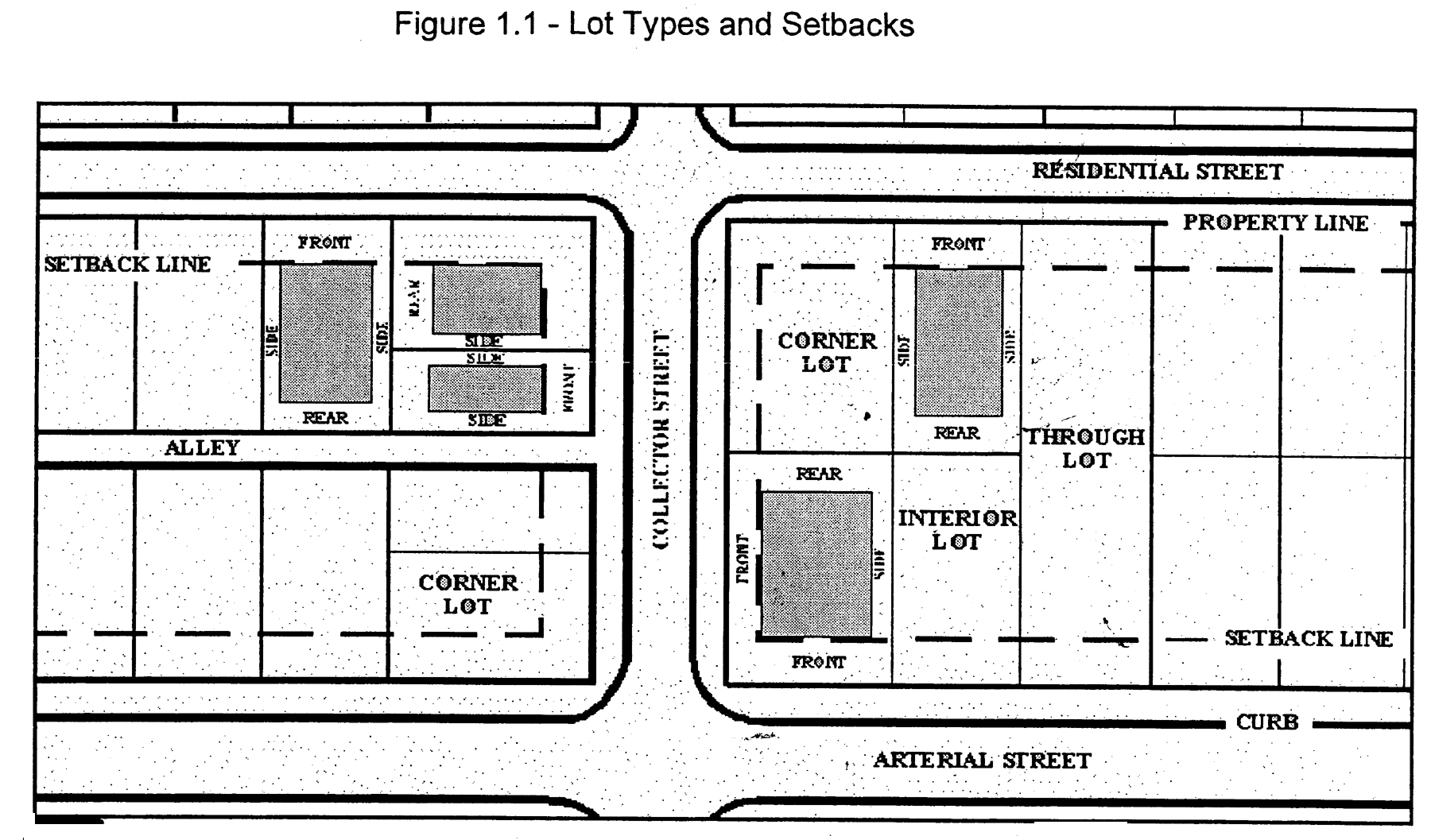
Lot, corner: A lot abutting upon two or more streets at their intersection.
Lot depth: The mean horizontal distance between the front and rear lot lines.
Lot, double frontage: A lot having frontage on two non-intersecting roads; as distinguished from a corner lot. This definition shall include through lots.
Lot frontage: The front of a lot that is the portion near the street. For the purpose of determining yard requirements on corner lots and through lots, all sides of the lot adjacent to a street shall be considered frontage, and yards shall be provided as indicated under "yard" in this chapter.
Lot, interior: A lot other than a corner lot whose sides do not abut upon any street.
Lot types: Corner lots, interior lots, through lots, and reversed frontage lots:
(1)
Corner lot means a lot located at the intersection of two or more streets. A lot abutting on a curved street shall be considered a corner lot if straight lines drawn from the farthest point of the side lot lines to the farthest point of the lot meet an interior angle of less than 135 degrees.
(2)
Interior lot means a lot other than a corner lot with frontage on only one street.
(3)
Through lot means a lot other than a corner lot with a frontage of more than one street.
(4)
Reversed frontage lot means a lot on which the frontage is at right angles or approximate right angles to the general pattern in the area. A reversed frontage lot may also be a corner lot, an interior lot or a through lot.
Lot coverage: The percentage of a lot or parcel which is, or will be, covered by the principal structure(s) and accessory structure(s). Lot coverage shall include all uses governed by a building permit, including but not limited to, above ground pools, in-ground pools, decks, covered patios, garages (detached and attached), sheds, car ports, porches and other similar items.
Lot of record: A lot which is part of a subdivision and having a plat that has been recorded in the office of the recorder of deeds or a parcel of land, the deed of which was recorded in the office of the recorder of deeds prior to the adoption of this chapter.
Luminaire: A complete lighting system, including a lamp or lamps and a fixture.
Manufacturing: An economic activity involving the mechanical or chemical transformation of materials or substances into new products including the assembly of component parts, the manufacturing of products and the blending of materials such as lubricating oils, plastics, resins, or liquors, at a scale and intensity that is compatible with the surrounding uses and the intent of the city's I district.
Manufactured home: A structure which bears a seal indicating compliance with the federal manufactured home construction and safety standards established pursuant to 42 U.S.C. § 5403, and constructed on or after June 15, 1976.
Marquee means any canopy made of durable materials that is a permanent fixture of the building to which it is attached.
Massage establishment (Therapeutic): An establishment licensed by the State of Illinois that offers therapeutic massage. The definition does not include establishments that offer illicit sexual services under the guise of therapeutic massage.
Manufactured home park: A parcel not less than five acres in area in single ownership/control, developed with facilities for accommodating occupied manufactured homes in accordance with the requirements of the mobile home park ordinance codified in article III, division 9 of this Code.
Mini-warehouse (self-storage): A building or group of buildings consisting of individual, self-contained units leased to individuals, organizations, or businesses for self-service storage of personal property.
Mobile home: A transportable structure larger than 320 square feet in floor area, designed to be used as a year-round residential dwelling, and built prior to the enactment of the Federal Mobile Home Construction and Safety Act of 1974, which became effective for all mobile home construction on June 15, 1976.
Mobile/portable marquee: A term commonly used to mean any street graphic not designed to be permanently attached to a building or part hereof or to be anchored to the ground. Such street graphics primarily include but are not limited to signs attached to wood or metal frames designed to be self-supporting poles; etc.
Modular home: A manufactured residential structure built to a nationally recognized and accepted construction standards published by the International Code Council (ICC) and is inspected and certified at the factory so that it meets said standard. A modular home shall have exterior structure materials and appearance similar to the customary single-family structures, as required of a manufactured home-residential design, and shall be permanently situated on a concrete foundation.
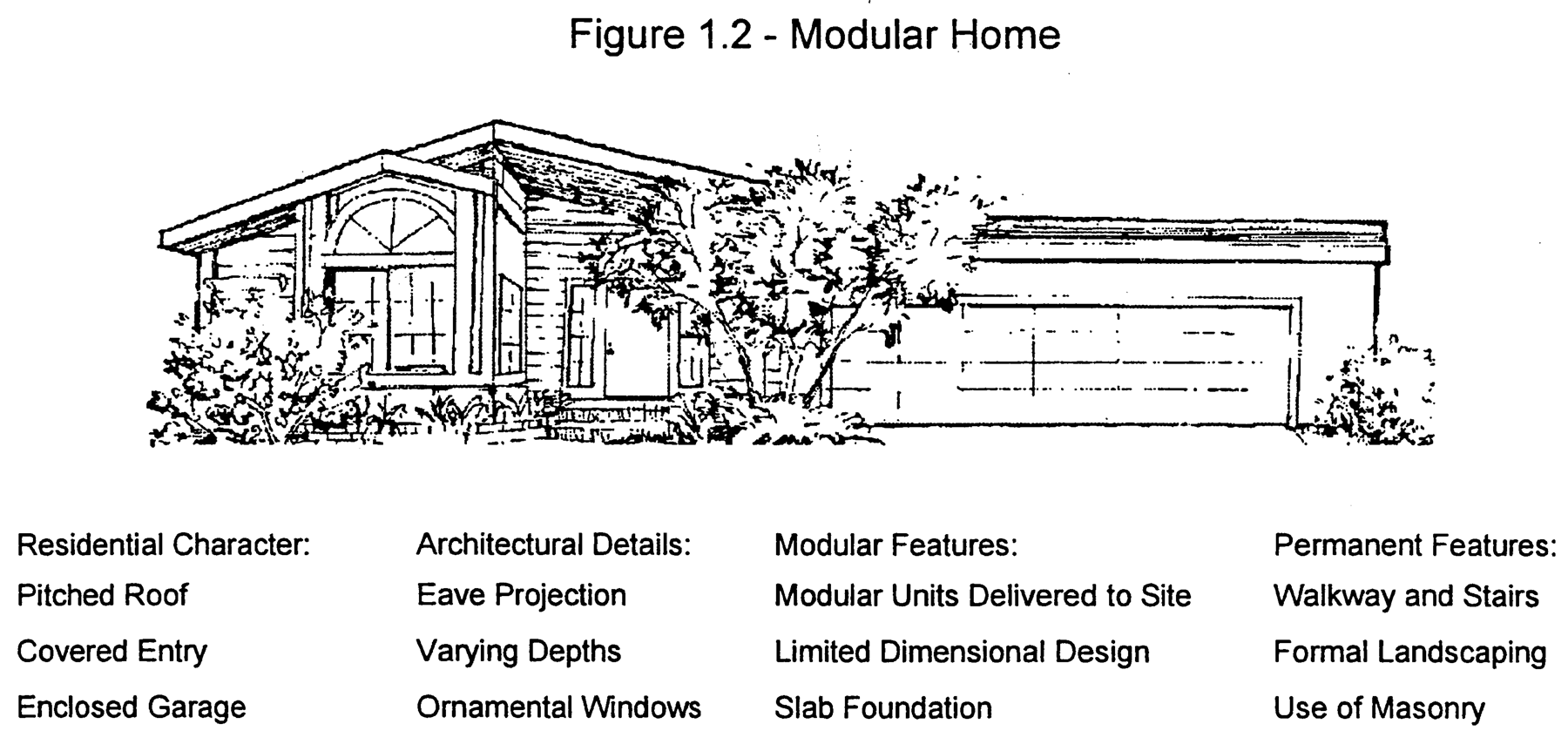
Modular structure: A factory-fabricated, transportable building unit designed to be incorporated at a building site on a permanent foundation into a structure to be used for non-residential purposes.
Molding: A decorative wood or stone contour or band, used in exterior and interior architectural elements.
Nonconforming, as applied to a lot, structure, or use, means:
(1)
Lawfully existing on the effective date of the ordinance from which this chapter derives; but
(2)
Not in compliance with the applicable sections thereof.
Nonconforming street graphic: Any street graphic which existed on the effective date of this article (or amendment thereto), but which code does not comply with the regulations set forth herein.
Office, general: An establishment providing executive, management, administrative or professional services, but not medical or dental services or the sale of merchandise, except as incidental to a permitted use. Typical uses include real estate, insurance, property management, investment, employment, travel, advertising, law, architecture, design, engineering, accounting and similar offices.
Open space: Any parcel of land or water essentially unimproved or otherwise devoid of structures and paved areas set aside, dedicated, designated or reserved for public or private use or enjoyment or for the use and enjoyment of owners and occupants of land adjoining or neighboring such open space.
Outdoor display area: A portion of a property outside of any building where merchandise, goods or other items are placed in public view for the purpose of direct sale or lease to customers.
Outdoor storage: The keeping in an unroofed, open area of any goods, material, merchandise or vehicles in the same place for more than 24 hours.
Parking lot, commercial: Area used or intended to be used for off-street parking of operable motor vehicles on a temporary basis, other than as accessory parking to a principal use.
Parcel: A lot or contiguous group of lots in single ownership or under single control, usually considered a unit for purposes of development.
Parking space: An area ten feet wide and 20 feet in length constructed of concrete or asphalt concrete used for the short-term storage of automobiles.
Pawnbroker or pawnshop: Any business that lends money on deposit of personal property or deals in the purchase of possessions of personal property on condition of selling the same back again to the pledger or depositor, or loans or advances money on personal property by taking chattel mortgage security thereon, and takes or receives such personal property.
Payday/title loan establishment: An establishment that engages in transactions in which a short-term cash advance is made to a consumer in exchange for a customer's post-dated check in the amount of the advance plus a fee, or in exchange for a consumer's authorization to debit a transaction account in the amount of the advance plus a fee at a designated future date. Uses include check-cashing stores. The classification does not include a state or federally chartered bank, savings association, credit union, or industrial land company. Further, this classification does not include establishments selling consumer goods where the cashing of checks or money orders is incidental to the main purpose of the business.
Pennant: A long tapering flag, usually triangular in shape.
Personal services: An establishment or place of business primarily engaged in the provision of frequent or recurrent needed services of a personal nature. Typical uses include, but are not limited to, beauty and barbershops, shoe repair shops, and tailor shops.
Photovoltaic system: An active solar energy system comprised of photovoltaic modules or panels that converts solar energy directly into electricity.
Pier: An upright structure of masonry to serve as a principal support, whether isolated or part of a wall.
Places of public assembly: A facility maintained by a not-for-profit community or neighborhood association, religious institution, or by a public agency or political subdivision primarily as a community gathering place for members or other people for the social, educational, spiritual or religious needs of the community or neighborhood. Such use may include community buildings, auditoriums and gymnasiums (including those accessory to schools or other primary uses), churches, temples, synagogues and other places of worship. However, a place of public assembly shall not include an undertaker's chapel, funeral building, a religious educational institution, parochial or other school, day care center, shelter for the homeless, or other similar social service use. Such uses shall be considered permitted accessory uses to the place of public assembly, and shall only be permitted within those districts where they are reflected in Table 3.1, as well as subject to those supplemental regulations set forth in this chapter applicable to such uses.
Planned unit development: A tract of land which is planned as a whole for development under single ownership for control in accordance with the planned unit development procedures herein, and which, by virtue of such unified planning and development, provides greater amenities, convenience, or other benefits, especially open space, than would normally be had through the development of diverse smaller tracts under multiple ownership. A planned unit development may contain one type of use or a variety of uses.
Premises: Any lot plus all the structures and uses thereon.
Private clubs and lodges: An organization and its premises catering exclusively to members and their guests for social, intellectual, recreational, or athletic purposes that are conducted for profit.
Professional services: A business that offers any type of personal service to the public which requires as a condition precedent to the rendering of such service the obtaining of a license or other legal authorization. By way of example, and without limiting the generality of this definition, professional services include services rendered by certified public accountants, public accountants, engineers, chiropractors, dentists, osteopaths, physicians, surgeons, podiatrists, chiropodists, architects, veterinarians, attorneys at law, physical therapists, personal trainers, and life insurance agents.
Projecting sign means any sign, which is supported by any exterior wall of a building or suspended beneath any awning, canopy, or marquee with the exposed face of said sign in a plane approximately perpendicular to the plane of the wall, etc., and projecting more than 18 inches.
Pole barn: A typically metal clad structure most often utilizing wooden poles and trusses for support with unfinished, insulated interiors. Such structures are normally used for agricultural operations, for construction trade storage, or for general storage and not intended for human inhabitation.
Portico: A roofed entrance porch, often supported by columns or pillars.
Public parks and recreation: A park, playground or community facility, owned by or under the control of a public agency or homeowners' association that provides opportunities for active or passive recreational activities.
Reception venue: Reception venue means a permanent facility which is rented by individuals or groups to accommodate private functions including, but not limited to, banquets, weddings, family reunions, anniversaries and other similar celebrations. Such a use may include the catering of food and service of alcoholic beverages for on-premises consumption only during scheduled events and not open to the general public.
Recreation vehicle: Any of the following vehicles which are licensed for travel on the highway:
(1)
Travel trailer: a vehicular, portable structure built on a chassis, designed to be used as a temporary dwelling for travel, recreation or vacation, or one permanently identified as a travel trailer by the manufacturer of the trailer;
(2)
Pick-up coach: a structure designed to be mounted on a truck chassis for use as a temporary dwelling for travel, recreation and vacation;
(3)
Motor-home: a portable, temporary dwelling to be used for travel, recreation and vacation, constructed as an integral part of a self-propelled vehicle; and
(4)
Camping trailer: a canvas, material or metal folding structure, mounted on wheels, and designed for travel, recreation and vacation use.
Recreational venue, general: An establishment that provides a recreational or entertainment service to the general public. Use shall include escape rooms, arcades, laser tag courses, axe throwing lanes, ropes courses, bowling alleys, mini golf and other similar uses. Use shall not include motion picture theaters, performing arts theaters, dance halls, night clubs, private clubs, or private lodges.
Repair service: An establishment primarily engaged in the provision of repair services to individuals and households, but excluding "vehicle repair" services. Typical uses include appliance repair shops.
Restaurant, fast food: A use primarily engaged in the sale of food and non-alcoholic beverages in a ready-to-consume state and where the design or principal method of operation is that of a fast-food or drive-in restaurant offering quick food service, where orders are generally not taken at the customer's table, where food is generally served in disposable wrapping or containers, and where food and beverages may be served directly to the customer in a motor vehicle.
Restaurant, general means a building wherein food is prepared and served in ready to eat form to the public for human consumption. The term restaurant shall include cafe, cafeteria, grill, pizza or chili parlor, diner, snack shop, hamburger shop and steak house.
Retail sales and service: An establishment engaged in the sale or rental of goods and services, including, but not limited to, antique shops, apparel and accessory stores, art and supply stores, bicycle shops, book and stationery stores, candy and ice cream stores, cigar and tobacco stores, dressmakers and tailors, flower and gift shops, hobby shops, interior decorators, jewelry stores, key shops, leather goods and luggage stores, music instrument sales and repair, photocopying services, shoe repair and shoe shine stores, sporting and athletic goods, toy stores and department stores; excluding uses more specifically defined.
Retail sales and service, retail refers to the sale of commodities and services directly to customers, when such commodities and services are used or consumed by the customer and not purchased primarily for the purpose of resale.
Roof line: The edge of the roof or the top of the parapet, whichever forms the top line of the building silhouette, on the side of the building where the street graphic is located.
Setback, principal building: The distance that is required by this zoning ordinance to be maintained in an unobstructed state between a structure and the property line of the lot on which the structure is located. (See Figure 1.1 Lot Types and Setbacks)
Shopping center identification sign: Any sign identifying a building or group of buildings that provides common off-street parking facilities, and that is occupied by two or more retail sales establishments.
Short-term rental: A dwelling unit or portion thereof located within the principal building and offered for rent for a period of 30 consecutive days or less to any person other than a member of the owner's immediate family.
Signs means any object, device, display, structure, or surface or part thereof that is used to advertise, identify, display, or attract attention to any object, person, institution, organization, business, project, service, or event related to the premises on which the sign is situated by any means including words, letters, figures, designs, symbols, fixtures, colors, or illumination.
Sign area means the area of the one imaginary square or rectangle that would completely enclose all parts of a sign including the background.
Sign area allowance means the total of the areas of all signs that a particular establishment is permitted to display under the terms of this article.
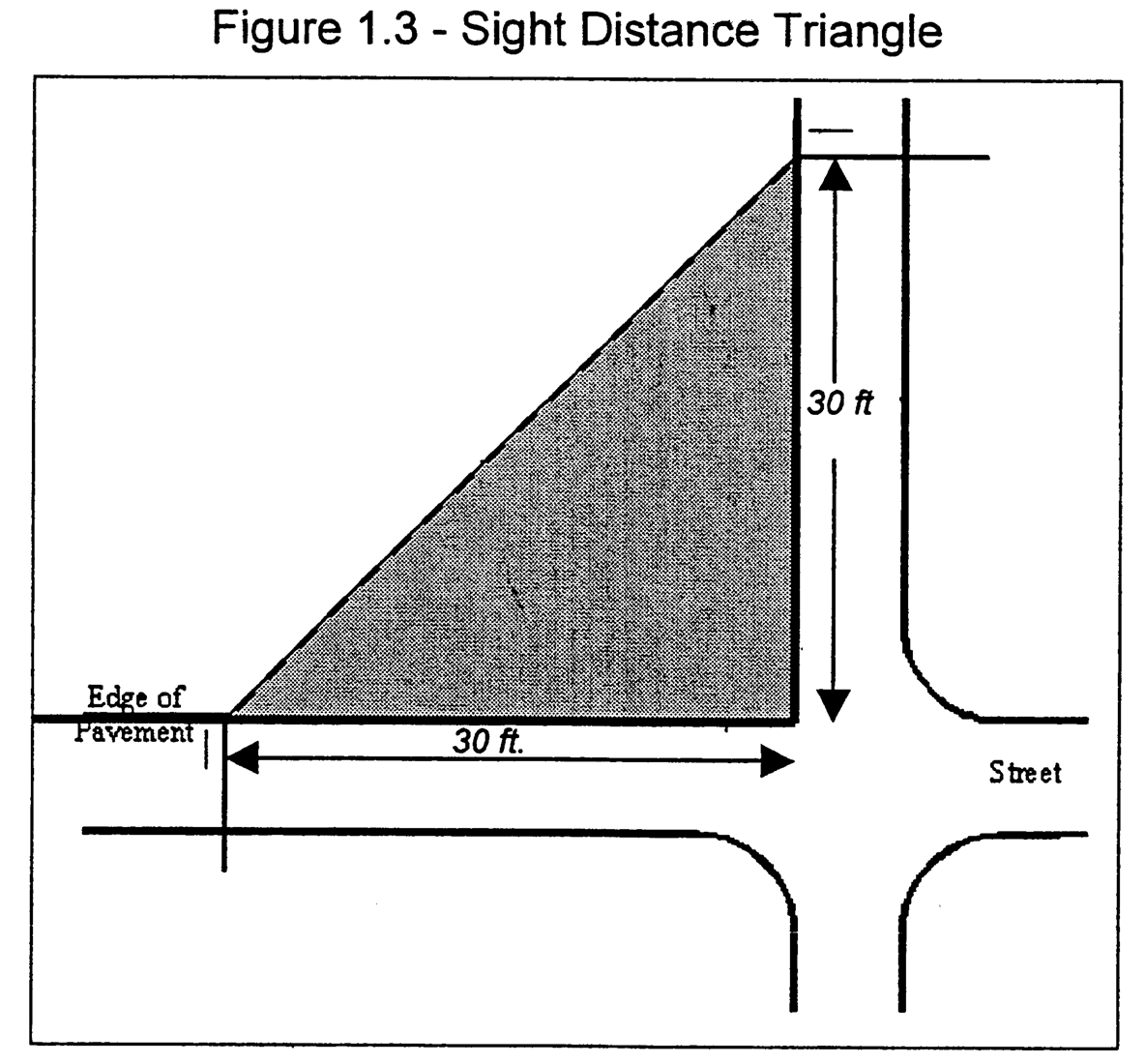
Sight distance triangle: The area bounded by the street right-of-way lines of corner lots and a line joining points along said street lines 30 feet from their points of intersection. Nothing shall be erected, placed, planted, or allowed to grow within this triangular area in a manner as to materially impede vision between a height of 2½ feet and eight feet above the grades of the outside edge of the street surface of the intersecting surfaces. These requirements shall also apply to driveways serving development off collector and arterial roadways The director of public works may establish different sight triangles based upon standards in the policy manual published by the American Association of State Highway and Transportation Officials (AASHTO).
Single-family attached dwelling (villa): Single-family dwellings sharing a common wall but situated on separate lots that are owned and occupied exclusively by separate parties.
(1)
The term "villa" refers to one side of a single-family attached dwelling (villa) that contains only two single-family units; and,
(2)
The term "two-villa building" refers to an entire single-family attached dwelling (villa) that contains only two single-family units with a common wall between them, which common wall is centered on the boundary line between the two lots on which the villas are respectively located.
Solar access: Unobstructed access to direct sunlight on a lot through the entire year, including access across adjacent parcel air rights, for the purpose of capturing direct sunlight to operate a solar energy farm.
Solar array: A number of photovoltaic modules or panels connected together to provide a single electrical output.
Solar collector: An assembly concentrating, structure, and associated equipment and housing, designed for gathering, concentrating, or absorbing direct and indirect solar energy for which the primary purpose is to convert or transform solar radiant energy into thermal, mechanical, chemical, or electrical energy.
Solar collector total height: The height of the solar collector system from grade to the highest point of the system that may be achieved when in operation.
Solar energy: Radiant energy received from the sun that can be collected in the form of heat or light by a solar collector.
Solar energy system (SES): All components required to become a complete assembly or structure that will convert solar energy into electricity for use.
Solar energy farm: A commercial facility comprised of at least 14 acres that converts sunlight into electricity, whether by photovoltaics (PV), concentrating solar thermal devices (CST), or other conversion technology, for the primary purpose of wholesale sales of generated electricity. A solar farm is the principal land use for the parcel on which it is located.
Special street graphic permit: A permit by the city council in accordance with the provisions of this article to regulate the design and placement of street graphics in areas of special controls.
Special use: A use that has unusual operational, physical or other characteristics which distinguish it from the permitted uses of a district, but which can be made compatible with the intended overall development within a district. Special uses commonly must meet special standards not necessarily applicable to permitted uses in the district, and are allowed only by a special use permit.
Special use permit: A permit issued in accordance with this chapter to regulate development of a special use.
Stable, commercial: Any building where horses, mules or ponies are sheltered, fed, and/or kept for hire.
Stable, private: A detached accessory building for the keeping of horses, mules, or ponies owned by the occupants of the premises and not kept for remuneration, hire, or sale.
Storefront: Street-facing facade area below the floor plane of the second floor.
Street hardware: Objects other than buildings, structures, and plantings, located in streets and public ways and outside of buildings. Examples are lampposts, utility poles, traffic lights, traffic signs, benches, litter containers, planting containers, letterboxes, and fire hydrants.
Streetscape: The scene as may be observed along a public street or way composed of natural and man-made components, including buildings, paving, planting, street hardware, and miscellaneous structures.
Street graphic: Any on-premises identification or advertising sign, or any billboard or off-premises advertising sign, visible from the public right-of-way or from any parking area used by the general public.
Street graphic permit: A permit issued by the administrator to regulate the erection, expansion, alteration, relocation, or reconstruction of street graphics in all parts of this municipality except in areas of special controls.
Street line: The right-of-way line of a street.
Street network:
(1)
Arterial street: A street which provides for through traffic movement between and around areas with direct access to abutting property, subject to necessary control of entrances, exits and curb uses.
(2)
Collector street: A street which provides for traffic movement between arterials and local streets, with direct access to abutting property.
(3)
Local street: A minor street, which provides direct access to abutting land and local traffic movement whether in business, industrial, or residential areas.
Strobe light means a device that utilizes a flash tube for high-speed illumination.
Structure means anything constructed or erected, which requires location on the ground or attached to something having a location on the ground, but not including fences, poles, lines, cables, or other transmission or distribution facilities of public facilities, or walls used as fences less than six feet high.
Temporary uses are uses which are only allowed for a specified period of time. Typical temporary uses include, but are not limited to, Christmas tree sales, garage sales, road stands, etc.
Tracking solar array: A solar array that follows the path of the sun to optimize the amount of solar radiation received by the device.
Transom: A window above an opening such as a door or window built on a horizontal crossbar; often hinged on the top to swing open for ventilation.
Travel trailer: See "Recreational Vehicle."
Truck stop: A facility that is at least a three acre facility with a convenience store, separate diesel islands for fueling commercial motor vehicles and parking spaces for commercial motor vehicles as defined in the Illinois Vehicle Code (625 ILCS 5/18b-101). Truck stops may also include uses such as a car wash, dog wash, restaurant facilities primarily for the use of customers, overnight accommodations, showers, and the sale of accessories and equipment for commercial motor vehicles.
Use: The purpose or activity for which land or a structure thereon is designated, arranged, intended, occupied or maintained.
Utility substation: A secondary utility facility, such as an electrical substation, gas regulator station, telephone exchange facility, sewage treatment plant, etc.
Variance: A relaxation of the strict application of the lot size, setbacks, or other bulk requirements applicable to a particular lot or structure.
Wall sign: A sign that is in any manner affixed to or painted onto any exterior wall of a building or structure or etched into exterior glass of a building or structure and that projects not more than 18 inches from the building or structure, including signs affixed to architectural projections from a building provided the copy area of such signs remains on a parallel plane to the face of the building facade or to the face or faces of the architectural projection to which it is affixed.
Warehousing and wholesale: An establishment primarily engaged in the storage or sale of materials, equipment, or products or sale to wholesalers or retailers. Typical uses include cold storage, warehousing and dead storage facilities, but exclude "residential storage warehouses," and sale of goods to the general public.
Window sign: Any sign visible from the exterior of the building which is painted on, affixed to, or suspended immediately behind a window. A permanent window sign is one that is intended to remain on display for 30 days or more; a temporary window sign is one that is intended to remain on display for a shorter time period.
Yard: An open space not occupied or obstructed by any structure or portion of a structure, except fences.
Zoning district: A section of the zoning area for which uniform regulations governing the use, height, area, size, and intensity of use of structures, land, and open space are herein established.
Zoning regulations: The requirements stipulated in the regulations herewith attached, and shall mean the lawfully adopted zoning ordinances of the City of Highland.
(Ord. No. 2195, § 2, 1-16-06; Ord. No. 2347, § 2, 4-20-09; Ord. No. 2429, § 3, 7-19-10; Ord. No. 2665, § 2, 12-15-14; Ord. No. 2692, § 2, 8-17-15; Ord. No. 2729, § 2, 5-16-16; Ord. No. 2821, § 2, 11-20-17; Ord. No. 2878, § 2, 9-17-18; Ord No. 2922, § 2, 3-18-19; Ord. No. 2941, § 5, 6-17-19; Ord. No. 2942, § 5, 6-17-19; Ord. No. 2943, § 5, 6-17-19; Ord. No. 3050, §§ 2—4(Exh. A), 10-19-20; Ord. No. 3107, § 2, 5-17-21; Ord. No. 3151, § 2, 12-6-21)

