
Highland City Zoning Code
ARTICLE III
DISTRICTS AND ZONING MAP
Sec. 90-111. - Districts established and designated.
The following zoning districts are hereby established in order to achieve the purposes enumerated in section 90-1, "purpose and objectives". The regulations herein shall apply to these districts. All principal structures hereafter erected, enlarged, or reconstructed shall adhere to the following applicable district regulations.
(Ord. No. 2195, § 2, 1-16-06)
Sec. 90-112. - District boundaries; zoning map adopted.
An official zoning map defining the zone or district boundaries is hereby adopted by reference, and declared to be part of this chapter.
(1)
The official zoning map shall be identified by the signature of the mayor and attested by the city clerk, and bearing the seal of the city under the following words, "This is to certify that this is the Official Zoning Map referred to in Section 3-2 of Ordinance No. 1139 of the City of Highland, State of Illinois," together with the date of the adoption of the ordinance from which this chapter derives.
(2)
If, in accordance with this chapter and state statutes, changes are made in zone or district boundaries or other matters on the official zoning map, such changes shall be attached to the amended zoning map as follows. After the amendment is approved, the ordinance authorizing said amendment shall be attached to the official zoning map and shall state the date of the change and a brief description of the change. Such amendment shall remain attached to the existing official zoning map until such time as the map can be updated, at which time all such amendments shall be incorporated into the official zoning map.
(3)
If the official zoning map is damaged, destroyed, lost or becomes difficult to interpret, the city council may, by resolution, adopt a new official zoning map, which shall supersede the prior map but shall not have the effect of amending the official zoning map. The resolution approving said official zoning map shall be attached to the official zoning map indicating the date of adoption of map being replaced.
(4)
Unless the official zoning map has been lost, or has been totally destroyed, any significant part thereof shall be preserved together with all available records pertaining to its adoption or amendment.
(Ord. No. 2195, § 2, 1-16-06)
Sec. 90-113. - Zoning map annual publication.
The city authorities shall cause to be published no later than March 31 of each year the official zoning map, clearly showing existing zoning uses, divisions, restrictions, regulations and classifications of the city for the preceding calendar year. If in any calendar year after the first official zoning map is published there are no changes in zoning uses, divisions, restrictions, regulations and classifications in the city, no map shall be published for such calendar year.
(Ord. No. 2195, § 2, 1-16-06)
Sec. 90-114. - Rules for interpreting district boundaries.
(a)
Where uncertainty exists as to the boundaries of zoning districts or zones shown on the official zoning map, the following rules shall apply:
(1)
Boundaries indicated as approximately following the centerlines of streets, highway or alleys shall be construed to follow such centerlines.
(2)
Boundaries indicated as approximately following platted lot lines shall be construed to follow such lot lines.
(3)
Boundaries indicated as approximately following city limits shall be construed as following such city limits.
(4)
Boundaries indicated as following railroad lines shall be construed to be midway between the tracks.
(5)
Boundaries indicated as parallel to or extensions of features indicated in subsections (a)(1) through (4) of this section shall be so construed. Distances not specifically indicated on the official zoning map shall be determined by the scale of the map.
(6)
Where physical or cultural features existing on the ground are at variance with those shown on the official zoning map, or in other circumstances not covered by subsections (a)(1) through (5) of this section, the combined planning and zoning board shall interpret the zone or district boundaries.
(7)
Where a district boundary line divides a lot which was in single ownership at the time of passage of the ordinance from which this section derives, the combined planning and zoning board may permit, as a special exception, the extension of the requirements for either portion of the lot not to exceed 50 feet beyond the district line into the remaining portion of the lot.
(8)
Where any land or territory within the city is not shown to be located in a district, the zoning regulations of the most restrictive adjoining district shall govern.
(b)
Whenever any street, alley or other public way is vacated by official action of the city council, the zoning district adjoining each side of such street, alley or public way shall be automatically extended to the center of such vacation, and all area included in the vacation shall then be subject to all requirements of the extended district.
(c)
In the event the exact location of a boundary cannot be determined by the foregoing methods, the combined planning and zoning board shall, upon application, determine the location of the boundary.
(Ord. No. 2195, § 2, 1-16-06; Ord. No. 2217, Exh. A, 9-18-06)
Sec. 90-115. - Annexed territory.
All property that is annexed to the city following the effective date of the ordinance from which this chapter derives, shall be annexed as R-1-C residential district. Nothing in this section should be construed to prevent the use of annexation agreements as set out in the state statutes.
(Ord. No. 2195, § 2, 1-16-06)
Sec. 90-116. - Minimum setback for property adjacent to municipal parks.
(a)
No structure shall be constructed within 50 feet of a municipal park boundary on any lot within the city corporate limits. Such building restriction applies to all zoning districts.
(b)
Existing structures not in accord with the foregoing restriction in subsection (a) shall not be enlarged or replaced and no additional structures may be built unless it can be enlarged, replaced or constructed no closer than the existing structure is to the park.
(Ord. No. 2195, § 2, 1-16-06)
Sec. 90-121. - Intent.
In the R-1-A, R-1-B, R-1-C and R-1-D single-family districts, land is principally used for, or is best suited for, detached single-family dwellings, and related educational, religious and recreational facilities. New development should be located in areas served by publicly-provided sanitary sewer and water. The requirements applicable to each single-family residence district are intended to stabilize and preserve sound existing neighborhoods developed at varying densities. The R-1-D district is designed to preserve the original city and is not intended for future subdivisions.
(Ord. No. 2195, § 2, 1-16-06)
Sec. 90-122. - Principal buildings.
In the R-1-A, R-1-B, R-1-C and R-1-D districts, only one principal building shall be erected on any lot.
(Ord. No. 2195, § 2, 1-16-06)
Sec. 90-123. - Permitted uses.
All permitted, planned, special and accessory uses are listed in Table 3.1.
(Ord. No. 2195, § 2, 1-16-06)
Sec. 90-124. - Supplemental use regulations.
Some uses permitted in this district are subject to supplemental regulations. Please refer to the supplemental use regulations referenced in Table 3.1 and provided in article IV.
(Ord. No. 2195, § 2, 1-16-06)
Sec. 90-125. - Lot and building requirements.
Every principal building erected in any R-1-A, R-1-B, R-1-C and R-1-D district shall conform to the applicable requirements of this chapter and the requirements indicated in tabular form as follows:
(Ord. No. 2195, § 2, 1-16-06)
Sec. 90-126. - Intent.
The R-2-A and R-2-B two-family attached residence districts are established to stabilize and conserve existing neighborhoods that predominately consist of two-family dwellings. These districts are also intended to promote the development of comparable new areas in order to accommodate all persons desiring this type of residential environment. New development should be located in areas served by publicly-provided sanitary sewer and water.
The "R-3" district is intended only for preexisting "R-3" zoning and shall permit as a lawful use only the specific zoning of property in effect on the effective date of this code. After the effective date of this code, no new zoning ordinances shall authorize the "R-3" district without approval of a planned unit development. The "R-3" district regulations are provided herein to encourage well planned high-density residential development and planned mixed-use developments consisting of a variety of housing types, densities and styles pursuant to the planned district procedures provided in this chapter and the city's comprehensive plan.
(Ord. No. 2195, § 2, 1-16-06)
Sec. 90-127. - Permitted uses.
The city's R-2-A and R-2-B residential districts permit one and two unit residential uses. Uses in the R-3 district are limited to the uses which were approved prior to the date of this Code provided they are located on lots of record that were established prior to the adoption of this code. All new uses or change in use in the R-3 district shall require review through the PUD process established in article III, division 10 (Section 90-196 to 90-200). A list of permitted, planned, special and accessory uses are listed in Table 3.1.
(Ord. No. 2195, § 2, 1-16-06; Ord. No. 3039, § 2, 9-8-20)
Sec. 90-128. - Supplemental use regulations.
Some uses permitted in this district are subject to supplemental regulations. Please refer to the Supplemental Use Regulations referenced in Table 3.1 and provided in article IV.
(Ord. No. 2195, § 2, 1-16-06)
Sec. 90-129. - Lot and building requirements.
Except as permitted as a planned use, only one principal building shall be erected on any lot in the R-2-A, R-2-B and R-3 districts. All detached single-family dwellings shall comply with the lot requirements of the R-1-C zone. All other principal buildings shall conform to the requirements of the chapter and the requirements indicated in tabular form as follows:
(Ord. No. 2195, § 2, 1-16-06; Ord. No. 2921, § 2, 3-18-19; Ord. No. 3040, § 2, 9-8-20)
Sec. 90-130. - Multi-family design guidelines.
All multifamily development including group community residences, nursing homes, assisted living facilities and duplexes are subject to site plan review procedures found in article II, division 3 and shall comply with the city's comprehensive plan design and development guidelines and the following design guidelines:
(1)
Architectural design. The architectural design of multifamily housing is a key element in determining the character of a neighborhood. The architectural design of each unit or building should impart a feeling of residential scale. Units should be designed with vertical and horizontal offsets to break up rooflines, define private outdoor areas, allow greater views, and admit light and air to unit interiors. Large, blank wall surfaces should be avoided. Windows and projecting wall surfaces should be used to break up larger wall surfaces and establish visual interest. The same level of architectural design and quality of materials should be applied to all sides of the building. The side and rear elevations, garages, carports, and all accessory structures should maintain the same level of design, aesthetic quality, and architectural compatibility.
(2)
Unified control. All multifamily developments shall be under single ownership and contain trust indentures or covenants establishing unified control of the installation and maintenance of any common facilities or areas.
(3)
Building separation. A minimum distance of 20 feet shall separate all buildings.
(4)
Access. All multifamily residential developments must have direct vehicular access to collector or arterial streets. Multifamily residential development shall not take access to local streets.
(5)
Pedestrian circulation systems. Sidewalks, walkways, and paths shall provide physical separation from vehicles along all public and private streets and within any parking area. Pedestrian systems should incorporate landscaping details to increase the visual interest and character of the neighborhood.
(Ord. No. 2195, § 2, 1-16-06)
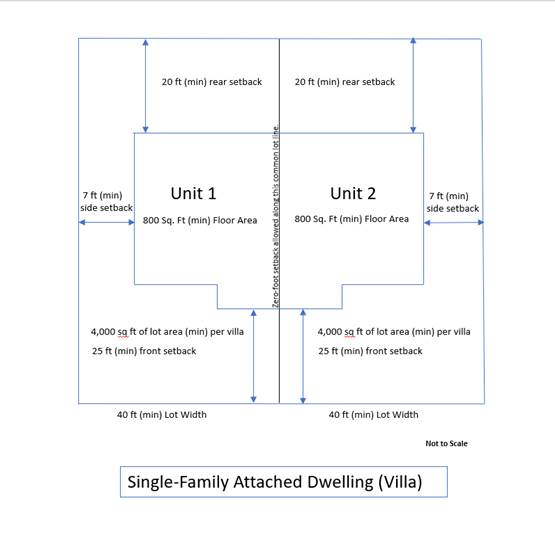
Sec. 90-131. - Lot and building requirements, single family attached dwelling (villa).
(a)
Except as permitted as a planned use, only one villa shall be erected on any lot in an R-2-A, R-2-B, R-3, or MX** district. All villas and the lots on which they are located shall conform to the requirements indicated in tabular form as follows:
* No side yard setback shall be required along any side lot line which is common to
two (2) attached villa dwellings constructed side-by-side. For interior lots, a side
yard, a minimum of seven feet (7') in width, shall be required along a side lot line
that is not common to that of any other attached villa dwelling. For corner lots,
see Section 90-9 (Front Setbacks for Corner or Through Lots) for the side lot line not common to that
of any other attached villa dwelling.
**Villas are allowed in the M-X zoning district and the lot and building setback regulations
are negotiable when in keeping with the overall site plan and the intent of this district
per Section 90-201.5.
(b)
A villa constructed (or converted from being a condominium unit in a two-unit condominium building) on a lot in an R-3 district zoned area must comply with the requirements for a planned unit development (PUD) set forth in chapter, 90, article III, division 10, "planned unit development."
(c)
The conversion of existing condominium units to villas will be allowed only for two-unit condominium buildings.
(d)
While a single family attached dwelling (villa) is allowed when in conformance with this section, individuals seeking to divide these dwelling structures to achieve separate ownership of the individual villas contained therein are referred to the provisions of the Illinois Plat Act (765 ILCS 205) or the Illinois Condominium Property Act (765 ILCS 605. Further assistance is available from the Madison County Chief County Assessment Office, Division of Maps and Plats.
(e)
The following supplemental requirements must be met for villas in a two-villa building:
(1)
If any utility service is not delivered by a separate line that lies entirely on the lot associated with the villa, then the line for that utility service shall be located and a state registered land surveyor shall determine and prepare the legal descriptions of any necessary cross-easement or cross-easements (between the owners of the villa units in the two-unit single-family attached building) so that the owner of the villa shall have, permanently associated with the lot on which the villa is located, the right to continue to receive the utility service in question over or through the existing line.
(Ord. No. 2665, § 3, 12-15-14; Ord. No. 2921, § 3, 3-18-19; Ord. No. 2949, § 5, 7-15-19)
Sec. 90-150. - Intent.
The C-1 neighborhood business district encompasses small commercial enclaves located within predominately residential areas. Only selected small-scale sales and service facilities that constitute a convenience to residents of the immediate neighborhood and limited residential uses may locate in this district. All new uses or changes in use in the "C-1" district shall comply with the site plan review procedures in article II, division 3.
(Ord. No. 2195, § 2, 1-16-06)
Sec. 90-151. - Lot and building requirements.
Every principal building erected in the C-1 district shall conform to the following requirements:
(1)
Minimum district area, one acre
(2)
Minimum lot area, 7,000 square feet
(3)
Minimum lot width, 50 feet
(4)
Minimum setbacks:
a.
From front lot line, ten feet or conform to the setback of existing structures, whichever being greater.
b.
From any side lot line, five feet
c.
From rear lot line, 20 feet
(5)
Maximum building height, 35 feet
(6)
Maximum building size: 2,000 square feet
(Ord. No. 2195, § 2, 1-16-06)
Sec. 90-152. - Permitted uses.
Generally, commercial, retail, service, and related commercial uses under 2,500 square feet, and existing residential dwellings are permitted. Buildings larger than 2,500 square feet may be permitted pursuant to the planned unit development (PUD) requirements in article III, division 10 and all other applicable requirements of this chapter. Residential dwelling units, located above street level, community residences, family care residences and group community centers are permitted as a special use. The permitted, planned, special and accessory uses are listed in Table 3.1.
(Ord. No. 2195, § 2, 1-16-06)
Sec. 90-153. - Limitations.
(a)
Outdoor storage is not permitted, unless authorized pursuant to an approved site plan or special use permit.
(b)
Exterior lighting fixtures shall be shaded so that no direct light is cast upon any residential property and so that no glare is visible to any traffic on any public street.
(c)
The conversion of existing residential dwellings into commercial uses shall be permitted by special use permit. All residential conversions shall meet the requirements of article IV, section 90-210.
(d)
Architectural elevations, landscape plans and parking layouts shall comply with all the applicable standards and requirements of this chapter and promote the following planning principles:
(1)
Preserve neighborhood character, protect property values of surrounding residential property and enhance community appearance;
(2)
Result in an attractive, safe, pedestrian-friendly living, shopping, and working environment;
(3)
Commercial establishments must be compatible in design and operation with an essentially residential environment.
(4)
Public improvements, open space, or other amenities shall be required as approved by the city council to mitigate authorization of non-residential uses when located near residential uses.
(Ord. No. 2195, § 2, 1-16-06)
Sec. 90-161. - Intent.
The intent of the C-2 district is to provide a zone which will accommodate high density, compact, pedestrian oriented, shopping, office, service, entertainment and limited residential uses within architecturally or historically significant areas of the city. The C-2 central business district shall be designed to be utilized by both pedestrians and motorists. Stores and other facilities providing a wide range of retail goods and services to the general public may be located within this district.
(Ord. No. 2195, § 2, 1-16-06)
Sec. 90-162. - Lot and building requirements.
Every commercial, principal building erected in the C-2 central business district shall conform to the following requirements:
(1)
Minimum district area, one acre
(2)
Minimum lot area, none
(3)
Minimum lot width, none
(4)
Minimum lot depth, none
(5)
Minimum setbacks:
a.
From front lot line, none
b.
From rear lot line, six feet, except for lots abutting any residential dwelling or lot zoned for residential purposes shall conform to the rear setback requirements for the residential building.
c.
From any side lot line, generally none required, except for any lot abutting a lot with a residential dwelling on it shall conform to the side setback requirements for the residential building.
(6)
Maximum building height, 45 feet
(Ord. No. 2195, § 2, 1-16-06)
Sec. 90-163. - Permitted uses.
Generally, the same uses permitted in the "C-1" business district are permitted in the C-2 central business except there is no maximum building floor area restriction in the C-2 district. The permitted, planned, special and accessory uses are listed in Table 3.1.
(Ord. No. 2195, § 2, 1-16-06)
Sec. 90-164. - Use limitations.
(a)
All development located within the central business district shall comply with article VII "Central Business District Standards".
(b)
The permitted display of merchandise for sale to the public shall be restricted to a maximum of 25 percent of the lot. In no case shall merchandise for sale be displayed in any required set back, or interfere with pedestrian or vehicular access or parking.
(c)
Merchandise that is not for sale to the public, including bulk sales and merchandise that requires assembly beyond that required of the consumer, shall not be stored outside.
(d)
All items stored on the premises shall be that which is associated with or derived from the principal use approved for the zoning lot.
(e)
Exterior lighting fixtures shall be shaded so that no direct light is cast upon any residential property and so that no glare is visible to any traffic on any public street.
(f)
Mixed use developments containing residential uses shall be subject to the following additional use limitations:
a.
Residential uses shall be complementary and secondary to the primary retail commercial and office uses.
b.
Residential uses shall be restricted from street-level building floors except as permitted through a special use permit. In no case shall a residential use occupy a street-level storefront.
c.
Residential uses shall not restrict or limit hours of operation, parking, loading, unloading, trash disposal or other activities associated with a permitted commercial or office uses.
d.
Parking for residential uses shall not be permitted on front- or side-streets, or in other established parking areas intended to service commercial or office uses during established business hours.
e.
New construction, renovation or other improvements required to accommodate residential uses shall be complementary to the established character of existing uses.
(Ord. No. 2195, § 2, 1-16-06)
Sec. 90-171. - Intent.
The C-3 highway business district is intended to establish and preserve general commercial areas consisting of shopping centers and commercial strips where customers reach individual business establishments primarily by automobile.
(Ord. No. 2195, § 2, 1-16-06)
Sec. 90-172. - Lot and building requirements.
Every principal building erected in the C-3 district shall conform to the following requirements:
(1)
Minimum district area, three acres
(2)
Minimum lot area, none
(3)
Minimum lot width, none
(4)
Minimum lot depth, none
(5)
Minimum setbacks:
a.
Front: None
b.
Side: None, except for any lot abutting a lot with a residential dwelling on it shall conform to the side setback requirements for the residential building.
c.
Rear: six feet, except for lots abutting any residential dwelling or lot zoned for residential purposes shall conform with the rear setback requirements for the residential district.
(6)
Maximum building height: 35 feet
(Ord. No. 2195, § 2, 1-16-06)
Sec. 90-173. - Permitted uses.
The "C-3" planned shopping district is intended for highway commercial and complementary general commercial or service oriented uses. Property and buildings in the "C-3" highway commercial district are subject to all the applicable requirements of this chapter and shall be used only for the uses enumerated in Table 3.1.
(Ord. No. 2195, § 2, 1-16-06)
Sec. 90-174. - Limitations.
(a)
The permitted display of merchandise for sale to the public shall be restricted to a maximum of 25 percent of the lot. In no case shall merchandise for sale be displayed in any required set back, or interfere with pedestrian or vehicular access or parking.
(b)
All items stored on the premises shall be that which is associated with or derived from the principal use approved for the zoning lot.
(c)
Any merchandise stored outside which is determined by the zoning administrator as material which is not for sale to the public shall be screened or enclosed to the extent that it cannot be seen from off the property.
(d)
All trailers and other mobile or temporary outdoor storage units shall be located in an approved loading stall and screened from view of any offsite non-commercial use or right-of-way.
(e)
Exterior lighting fixtures shall be shaded so that no direct light is cast upon any residential property and so that no glare is visible to any traffic on any public street.
(Ord. No. 2195, § 2, 1-16-06)
Sec. 90-181. - Intent.
The C-4 limited business district is the commercial area which is utilized by pedestrians and motorists. Stores and other facilities providing a wide range of retail goods and services to the general public may be located within this district.
(Ord. No. 2195, § 2, 1-16-06)
Sec. 90-182. - Lot and building requirements.
All principal buildings erected in the C-4 district shall conform to the following requirements:
(1)
Minimum district area, three acres
(2)
Minimum lot area, none
(3)
Minimum lot width, none
(4)
Minimum lot depth, none
(5)
Minimum setbacks:
a.
From front lot line, none
b.
From rear lot line, six feet
c.
From any side lot line, generally none required, except for any lot abutting a lot with a residential dwelling on it shall conform to the side setback requirements for the residential building.
(6)
Maximum building height: 45 feet
(Ord. No. 2195, § 2, 1-16-06)
Sec. 90-183. - Permitted uses.
For a listing of permitted, planned and special uses see Table 3.1. All uses shall be subject to the applicable requirements of this chapter.
(Ord. No. 2195, § 2, 1-16-06)
Sec. 90-184. - Use limitations.
(a)
All development located within the "C-4" limited business district shall comply with article VII "Central Business District Standards".
(b)
The permitted display of merchandise for sale to the public shall be restricted to a maximum of 25 percent of the lot. In no case shall merchandise for sale be displayed in any required set back, or interfere with pedestrian or vehicular access or parking.
(c)
Merchandise that is not for sale to the public, including merchandise that requires assembly beyond that required of the consumer, shall not be stored outside.
(d)
All items stored on the premises shall be that which is associated with or derived from the principal use approved for the zoning lot.
(e)
Exterior lighting fixtures shall be shaded so that no direct light is cast upon any residential property and so that no glare is visible to any traffic on any public street.
(Ord. No. 2195, § 2, 1-16-06)
Sec. 90-186. - Intent.
The "I" industrial district is intended to establish and preserve areas for industrial and related uses of such a nature that they do not create serious problems of compatibility with other kinds of land uses, and to make provisions for certain kinds of commercial uses which are most appropriately located as neighbors of industrial uses or which are necessary to service the immediate needs of people in these areas.
(Ord. No. 2195, § 2, 1-16-06)
Sec. 90-187. - Lot and building requirements.
Buildings in the "I" district shall conform to the following requirements:
(1)
Minimum district size, five acres
(2)
Minimum lot area, none
(3)
Minimum lot width, none
(4)
Minimum lot depth, none
(5)
Minimum setbacks:
a.
Front: 20 feet
b.
Side: None, except for lots abutting any residential dwelling or lot zoned for residential purposes shall conform with the side setback requirements for the residential building.
c.
Rear: ten feet, except for lots abutting any residential dwelling or lot zoned for residential purposes shall conform with the rear setback requirements for the residential building.
(6)
Maximum building height: 45 feet
(Ord. No. 2195, § 2, 1-16-06)
Sec. 90-188. - Permitted uses.
Generally, light manufacturing, wholesaling, trucking and warehousing uses are permitted and heavy industrial uses and other more intense uses are permitted as a special or planned use. The list of permitted uses is provided in Table 3.1. The permitted uses will be determined based on compliance with the requirements of this chapter and the compatibility with existing adjacent uses and other uses permitted in the district.
(Ord. No. 2195, § 2, 1-16-06)
Sec. 90-189. - Limitations.
(a)
Storage is permitted outside structures provided the view of said storage area is properly screened from adjacent residential areas and the public right-of-way.
(b)
All items stored on the premises shall be that which is associated with or derived from the principal use approved for the zoning lot.
(c)
No structure shall be used as a dwelling unit, as defined in section 90-15.
(d)
Exterior lighting fixtures shall be shaded so that no direct light is cast upon any residential property and so that no glare is visible to any traffic on any public street.
(Ord. No. 2195, § 2, 1-16-06)
Sec. 90-191. - Intent.
In the "M" district, land is principally used for, or is best suited for, detached single-family manufactured dwellings. The requirements applicable to the manufactured home district is intended to stabilize and preserve existing neighborhoods developed at varying densities. The "M" district is designed to regulate the placement of manufactured homes in the city.
(Ord. No. 2195, § 2, 1-16-06)
Sec. 90-192. - One principal building on one lot.
In the "M" district, only one principal building shall be erected on any lot.
(Ord. No. 2195, § 2, 1-16-06)
Sec. 90-193. - Lot and building requirements
Every manufactured home replaced on a lot that has an existing manufactured home on it shall conform to the applicable requirements of the district in which it is located.
(Ord. No. 2195, § 2, 1-16-06)
Sec. 90-194. - Permitted uses.
The permitted, planned, special and accessory uses are listed in Table 3.1, except existing mobile homes, not in a manufactured home park, can only be replaced if it meets the zoning requirements of the city, the current edition of the ICC Building Code as adopted by the city and the requirements of the state concerning mobile homes. All mobile homes replaced in the City of Highland cannot be replaced with any mobile home older than five years old and may be replaced only within six months of removal of the previous one.
(Ord. No. 2195, § 2, 1-16-06)
Sec. 90-195. - Limitations.
(a)
Minimum design standards. Each manufactured home park shall be designed in accordance with all city codes and to the following minimum design standards:
(1)
All roadways and sidewalks within the manufactured home park shall be hard surfaced and shall be adequately lighted at night.
(2)
The perimeter of all manufactured homes shall be fully skirted.
(3)
Sidewalks shall be required on one side of all streets.
(4)
All manufactured home lots shall front upon a private hard-surfaced/dust-free roadway of not less than 25 feet in width. If parallel parking is permitted on one side of the street, the width shall be increased to 30 feet, and if parallel parking is permitted on both sides of the street, the width shall be increased to 36 feet. All roadways shall have unobstructed access to a public street.
(5)
A community structure may be provided which may include recreation facilities, laundry facilities, and other similar uses.
(6)
A storm shelter shall be provided in accordance with state and federal law for any new manufactured home development or any manufactured home development which is expanded to include additional acreage.
(7)
Final approval for the development shall be obtained before any grading, clearing, installation of streets or moving a manufactured home into any "M" district.
(b)
Manufactured home required setbacks, buffer strips and screening.
(1)
All manufactured homes shall be located at least 50 feet from any exterior property line of a manufactured home subdivision or a public roadway right-of-way.
(2)
There shall be a minimum distance of 15 feet between manufactured homes, common parking area or other common areas located within a manufactured home subdivision.
(c)
Off-street parking.
(1)
Off-street parking areas shall be provided at the rate of at least two car spaces for each home lot.
(2)
Required car parking spaces shall be so located as to provide convenient access to the dwelling it serves and shall not exceed a distance of 200 feet.
(d)
Water supply.
(1)
Water shall be supplied to the manufactured subdivision by a public water system.
(2)
The size, location and installation of water lines shall be in accordance with the requirements of the codes of the city.
(3)
Individual water service connections shall be provided at each manufactured home space.
(e)
Required recreation areas.
(1)
In all manufactured home subdivisions accommodating or designed to accommodate 25 or more manufactured homes, there shall be one or more recreation areas which shall be easily accessible to all residents within the development.
(2)
The size of such recreation areas shall be based upon a minimum of 100 square feet for each lot within the subdivision. No outdoor recreation area shall contain less than 2,500 square feet.
(3)
Recreation areas shall be so located as to be free of traffic hazards and should be centrally located.
(4)
The required recreational area(s) within the manufactured home subdivision shall contain playground equipment or other recreational facilities as approved by the combined planning and zoning board. The cost of purchasing and installing said recreational equipment shall be paid for by the developer of the manufactured home subdivision.
(5)
The maintenance of recreation area(s) and equipment within each subdivision shall be paid for by the owner of the manufactured home subdivision and/or trustees.
(f)
Sewage disposal. Each manufactured home subdivision shall be connected to the city's sewer system and each manufactured home space within a manufactured home subdivision shall be connected to and served by the city's sewer system.
(g)
Tie-downs and ground anchors. All manufactured homes shall be secured to the ground by tie-downs and ground anchors in accordance with the Manufactured Home and Recreational Vehicle Code.
(h)
Electrical. Each manufactured home space shall be provided with an individual electrical supply which shall be installed in accordance with the building codes of the city and requirements of the electric supplier.
(i)
Gas. Natural gas hookups, when provided, shall be installed in accordance with the building codes of the city and the regulations of the gas supplier.
(j)
Refuse and garbage handling. Storage, collection and disposal of refuse in a park shall be in accordance with City Code.
(k)
Pad requirements. Pad surfaces shall consist of a flexible surface with a minimum of five-inch thick gravel, stone or compacted surface, treated to discourage plant growth, constructed to discharge water and edged to prohibit fraying or spreading of surfacing materials; or shall be of a hard surface of a minimum of two 18-inch wide concrete ribbons or slabs capable of carrying the weight and of sufficient length to support all blocking points of the manufactured home.
(Ord. No. 2195, § 2, 1-16-06; Ord. No. 2217, Exh. A, 9-18-06)
Sec. 90-196. - Purpose; intent.
The purpose of this section is to provide for permissive and/or alternative zoning procedures for the development of tracts of land under the continuing and uninterrupted ownership of an individual or of a legally existing entity, with such individual or entity having total control and dominion of all development and uses made of such tract. A planned unit development (PUD) allows mixed use development provided the total development density is not greater than the maximum density permitted under the existing zoning requirements. In addition, a planned unit development is encouraged to permit:
(1)
A maximum choice in the types of uses available to the public by allowing a development that would not be possible under the strict application of the other sections of this chapter.
(2)
Permanent preservation of common open space and recreation areas and facilities.
(3)
A pattern of development to preserve natural vegetation, topographic and geologic features.
(4)
A creative approach to the use of land and related physical facilities that results in better development and design and the construction of aesthetic amenities.
(5)
An efficient use of the land resulting in more economic networks of utilities, streets, schools, public grounds and buildings, and other facilities.
(6)
A land use which promotes the public health, safety, comfort, morals, and welfare.
(7)
Innovations in residential, commercial, and industrial development so that growing demands of the population may be met by greater variety in type, design, and layout of the buildings and by the conservation and more efficient use of open space ancillary to said buildings.
(Ord. No. 2195, § 2, 1-16-06)
Sec. 90-197. - Districts where allowed.
Planned unit developments may be built in any zoning district, but only upon the issuance of a special use permit which will require for the life of the special use the continuing and uninterrupted ownership and control of development and uses of the tract of land by one individual or single legally existing entity.
(Ord. No. 2195, § 2, 1-16-06)
Sec. 90-198. - Permissible deviations from ordinance requirements.
The planned unit development concept is intended to afford both the developer and the city considerable flexibility in formulating development proposals. Consequently, to the extent indicated in this subsection, PUDs may deviate from generally applicable ordinance requirements without a variance. Any proposed deviation not listed below, however, shall require a variance.
(1)
Mixed uses. PUD's may include all types of residential and commercial structures and other uses approved by the city council; provided, that in approving such mixed uses, the city council may attach any conditions necessary to protect the public welfare.
(2)
Lot and structure requirements. In PUDs the city council may approve any reasonable deviation from the lot and structure requirements of the particular zoning district so long as the different uses within the PUD are appropriately interrelated and property abutting the PUD is adequately protected from any potential adverse impacts of the development.
(3)
Accessory uses. In PUDs the city council may allow the developer to disregard the usual restrictions on accessory uses other than the prohibition against using an accessory structure as a dwelling.
(4)
Location of parking/loading spaces. By permission of the city council, off-street parking and loading spaces in PUDs need not be located in accordance with generally applicable requirements, except state handicap accessible parking requirements.
(5)
Conversion into condominiums. The individual or entity that develops a planned unit development, or the successor in interest of such individual or entity, may convert any one or more dwellings constructed substantially in accord with the approved development plan into one or more condominiums; and such conversion will be considered a permissible deviation under the planned unit development ordinance or resolution.
(Ord. No. 2195, § 2, 1-16-06; Ord. No. 2205, § 1, 5-15-06)
Sec. 90-199. - PUD procedures.
Every applicant for PUD approval shall comply with the procedural requirements of this section. The required procedures are as follows:
(1)
Filing a site development plan pursuant to the site plan submittal requirements in article II, division 3 with the building and zoning division.
(2)
Provision by the developer of adequate assurance for the completion of required improvements as per the approved site plan.
(3)
Public hearing by the combined planning and zoning board.
(4)
Action by city council on the development plan.
a.
Advisory report; criteria considered. The combined planning and zoning board shall submit to the city council a written advisory report concerning acceptance/rejection of the development plan. In deciding what their advice should be, the board shall consider the following criteria:
i.
The extent to which the proposed development is consistent with the city's comprehensive plan and with the purposes of this article and of all other applicable codes and ordinances.
ii.
The extent to which the proposed development deviates from the regulations that are generally applicable to the property (including, but not limited to, the use and lot and building regulations of the district), and the apparent merits (if any) of said deviations.
iii.
Whether the proposed design of the PUD makes adequate provisions for vehicular and pedestrian circulation, off-street parking and loading, separation of residential and commercial uses, open space, recreational facilities, preservation of natural features, and so forth.
iv.
The compatibility of the proposed PUD with adjacent properties and surrounding area.
v.
Any other reasonable criteria that the combined planning and zoning board may devise.
b.
Decision by city council. After the combined planning and zoning board have submitted their advisory report, the city council, by resolution, shall either approve or disapprove the PUD development plan. The city council shall not approve any PUD development plan unless:
i.
The developer has posted a performance bond or escrow deposit in the amount equal to 100 percent of the cost of constructing the required improvements as certified by a registered professional engineer of Illinois.
ii.
The proposed PUD, as evidenced by the development plan, complies with all applicable codes.
iii.
The proposed PUD public improvements meet the design requirements of the city's land development code.
(Ord. No. 2195, § 2, 1-16-06; Ord. No. 2217, Exh. A, 9-18-06; Ord. No. 2243, 4-16-07)
Sec. 90-200. - Changes in approved plans.
No changes shall be made to any approved PUD development plan except as follows:
(1)
Minor changes, which do not substantially affect the design or intent of the final development plan and are required by engineering or other circumstances not foreseen at the time the final development plan was approved, shall be submitted to the city upon written application to the administrative official.
(2)
All proposed changes will be reviewed by city staff and engineers and written recommendations forwarded to the administrative official.
(3)
Approval or denial of all minor changes shall be returned in writing to the applicant by the administrative official.
(4)
All other changes shall require a public hearing before the combined planning and zoning board and a resolution by the city council.
(5)
No approved change shall have any effect until it is recorded with the Madison County Recorder of Deeds as an amendment to the recorded copy of the development plan.
(Ord. No. 2195, § 2, 1-16-06; Ord. No. 2217, Exh. A, 9-18-06)
Sec. 90-201. - Permitted and accessory use table.
The use table of this section provides a tabular summary of the land use types allowed in each zoning district. The table is intended for reference and does not necessarily reflect all of the regulations that may apply to particular uses or districts. In the event of a conflict between the use regulations of this section and those found in the text of the zoning district regulations, the text of the zoning district regulations shall prevail.
(1)
Principal and accessory uses. Principal and accessory uses that are permitted as special uses, planned uses or uses permitted by right are shown in the land use table.
(2)
Permitted (by-right) uses. Uses identified in a zoning district column of the use table with a "*" are "permitted-by-right" and shall be permitted in such zoning district, subject to any additional regulations as may be indicated in the "supplemental regulations" column and all other requirements of this chapter.
(3)
Special uses. Uses identified in a zoning district column of the use table with a "S" as "special uses" and shall be permitted in such zoning district, subject to any additional regulations as may be indicated in the "supplemental regulations" column and all other requirements of this chapter. All special uses shall require the receipt of a special use permit prior to the issuance of a building permit. A special use permit may be obtained by following the procedures and complying with the performance standards set forth in article II, division 5.
(4)
Planned uses (PUDs). Uses identified in a zoning district column of the use table with a "P" are "planned uses" and shall be permitted in such zoning district, subject to any additional regulations that may be indicated in the "supplemental regulations" column and all other requirements of this chapter. All planned uses require the approval of a site plan prior to the issuance of a building permit. The submission requirements, procedures and approval standards shall comply with article III, division 10.
(5)
Accessory uses. All accessory uses are subject to the performance standards set forth in article II, division 4.
(6)
Unlisted uses. Uses not listed have been determined either not to be appropriate in any district, incompatible with certain existing uses, or sufficiently rare or unexpected as to be incapable of being listed at the time of adoption of this Code except pursuant to section 90-6. Any other uses not shown as a use permitted by right, a special use or a planned use in any zoning district, but constituting a use that is required to be permitted by law, shall be authorized only in the industrial district subject to the following conditions:
a.
The use shall be permitted only to the extent required by law to be permitted;
b.
The use shall be approved only as a planned use, except if by law it is required to be permitted by right;
c.
The use shall be located no closer than 1,000 feet from any residence, residential property, park, school, or church, except as may be modified by the city council through a planned use procedure;
d.
The use shall maintain a distance of at least 1,000 feet from any other such use;
e.
No use shall occupy a structure in excess of 5,000 square feet without an approved parking plan designed for that use and supported by a traffic study submitted to and approved by the city council.
(7)
Supplemental regulations. The last column of the use table entitled "supplemental regulations" references additional supplemental requirements categorized by land use. The numbers in this column refer to specific sections found in article IV. Additional requirements, beyond those listed in the supplemental regulations column, may be required at the discretion of the city.
(Ord. No. 2195, § 2, 1-16-06; Ord. No. 2223, § 1, 11-20-06; Ord. No. 2303, § 1, 6-2-08; Ord. No. 2335, §§ 2—4, 2-17-09; Ord. No. 2338, §§ 2—4, 3-16-09; Ord. No. 2347, §§ 3—5, 4-20-09; Ord. No. 2358, §§ 2—5, 5-18-09; Ord. No. 2429, § 4, 7-19-10; Ord. No. 2458, § 3, 3-21-11; Ord. No. 2526, § 3, 4-16-12; Ord. No. 2541, § 3, 7-16-12; Ord. No. 2283, § 1, 2-19-08; Ord. No. 2579, § 3, 7-15-13; Ord. No. 2622, § 3, 5-19-14; Ord. No. 2658, § 3, 11-20-14; Ord. No. 2693, § 4, 8-17-15; Ord. No. 2730, §§ 2, 3, 5-16-16; Ord. No. 2772, § 2, 3-20-17; Ord. No. 2821, § 3, 11-20-17; Ord. No. 2831, § 2, 2-20-18; Ord. No. 2878, §§ 3, 4, 9-17-18; Ord. No. 2949, § 6, 7-15-19; Ord. No. 3050, §§ 2—4(Exh. A), 10-19-20; Ord. No. 3097, § 3, 4-19-21; Ord. No. 3107, § 3, 5-17-21; Ord. No. 3150, § 2, 12-6-21; Ord. No. 3151, § 3, 12-6-21; Ord. No. 3197, § 2, 6-6-22; Ord. No. 3210, § 2, 7-18-22; Ord. No. 3264, § 2, 4-17-23; Ord. No. 3292, 9-18-23; Ord. No. 3365, § 2, 12-16-24)
Sec. 90-201.5. - [Mixed use zoning district.]
(a)
Intent. The purpose of this section accommodates mixed-use buildings with neighborhood-serving retail, service, and other uses on the ground floor and residential units above the nonresidential space. In addition, a planned unit development is encouraged to permit:
(1)
Development that exhibits the physical design characteristics of pedestrian oriented, storefront-style shopping streets;
(2)
Promote the health and well-being of residents by encouraging physical activity, alternative transportation, and greater social interaction;
(3)
Provide flexibility in the siting and design of new developments and redevelopment to anticipate changes in the marketplace;
(4)
Develop commercial and mixed-use areas that are safe, comfortable, and attractive to pedestrians;
(5)
Allow for urban oriented recreational activities consistent with the standards and intent of the district; and
(6)
To encourage and support the use of sustainable building practices.
(b)
Lot and building requirements.
(1)
Minimum district size, one acre;
(2)
Minimum lot area, none;
(3)
Minimum lot width, none;
(4)
Minimum lot depth, none;
(5)
Minimum setbacks. No minimum yards are required for the mixed-use district. Easements for utilities or other special standards may require buildings to be placed back from lot lines;
(6)
Maximum building height. Thirty-five feet;
(7)
Lot coverage and floor area. The footprint of individual buildings shall not exceed 45,000 square feet; and
(8)
Floor area ratio shall be 2.0 for mixed use buildings and 1.25 for all other buildings.
(c)
Permitted uses. For a listing of permitted, planned and special uses see Table 3.1. All uses shall be subject to the applicable requirements of this chapter.
(d)
Design criteria The "MX" districts shall observe the following design criteria:
(1)
The overall plan shall be comprehensive, embracing land, buildings, landscaping and their inter-relationships and shall conform in all respects to all adopted plans of all governmental agencies for the area in which the proposed development is located;
(2)
The plan shall provide for adequate open space, circulation, off-street parking, and pertinent amenities. Buildings, structures and facilities in the parcel shall be well integrated, oriented and related to the topographic and natural landscape features of the site;
(3)
The proposed development shall be compatible with existing and planned land use, and with circulation patterns on adjoining properties. It shall not constitute a disruptive element to the neighborhood and community;
(4)
The internal street system shall not be a dominant feature in the overall design, rather it shall be designed for the efficient and safe flow of vehicles without creating a disruptive influence on the activity and function of any common areas and facilities;
(5)
Common areas and recreational facilities shall be so located so as to be readily accessible to the occupants of the dwelling units and shall be well related to any common open spaces provided;
(6)
Architectural design within the development and within the neighborhood and community shall respect the scale and character of the adjacent development(s). Attention to views, building scale andorientation, proximity to adjacent uses, location of driveways, noise, lighting and landscape should be respected; and
(7)
The plan shall be in conformance with the city's resource plan.
(e)
"MX" district procedures. Every applicant for MX approval shall comply with the procedural requirements of this section. The required procedures are as follows:
(1)
Filing a site development plan pursuant to the site plan submittal requirements in article II, division 3 with the building and zoning division;
(2)
Provision by the developer of adequate assurance for the completion of required improvements as per the approved site plan;
(3)
Public hearing by the combined planning and zoning board;
(4)
Action by city council on the development plan;
a.
Advisory report; criteria considered. The combined planning and zoning board shall submit to the city council a written advisory report concerning acceptance/rejection of the development plan. In deciding what their advice should be, the board shall consider the following criteria:
1.
The extent to which the proposed development is consistent with the city's comprehensive plan and with the purposes of this article and of all other applicable codes and ordinances;
2.
The extent to which the proposed development deviates from the regulations that are generally applicable to the property (including, but not limited to, the use and lot and building regulations of the district), and the apparent merits (if any) of said deviations;
3.
Whether the proposed design of the MX makes adequate provisions for vehicular and pedestrian circulation, off-street parking and loading, separation of residential and commercial uses, open space, recreational facilities, preservation of natural features, and so forth;
4.
The compatibility of the proposed MX with adjacent properties and surrounding area; and
5.
Any other reasonable criteria that the combined planning and zoning board may determine.
b.
Decision by city council. After the combined planning and zoning board have submitted their advisory report, the city council, by resolution, shall either approve or disapprove the MX development plan. The city council shall not approve any MX development plan unless:
1.
The developer has posted a performance bond or escrow deposit in the amount equal to 100 percent of the cost of constructing the required improvements as certified by a registered professional engineer of Illinois;
2.
The proposed MX district, as evidenced by the development plan, complies with all applicable codes; and
3.
The proposed MX district's public improvements meet the design requirements of the city's land development code.
(f)
Changes in approved plans. No changes shall be made to any approved MX district development plan except as follows:
(1)
Minor changes, which do not substantially affect the design or intent of the final development plan and are required by engineering or other circumstances not foreseen at the time the final development plan was approved, shall be submitted to the city upon written application to the administrative official;
(2)
All proposed changes will be reviewed by city staff and engineers and written recommendations forwarded to the administrative official;
(3)
Approval or denial of all minor changes shall be returned in writing to the applicant by the administrative official;
(4)
All other changes shall require a public hearing before the combined planning and zoning board and a resolution by the city council; and
(5)
No approved change shall have any effect until it is recorded with the county recorder of deeds as an amendment to the recorded copy of the development plan.
(Ord. No. 2772, § 2, 3-20-17)

