
Highland City Zoning Code
ARTICLE IV
SUPPLEMENTAL REGULATIONS
Sec. 90-202.- Applicability.
This article establishes lot and structure requirements, design standards, and use limitations for specific, potentially troublesome, structures and uses. These requirements apply in every zoning district where the specific structure or use is permitted or allowed by special use permit; but if more stringent requirements are applicable in any particular district, such requirements shall prevail.
(Ord. No. 2195, § 2, 1-16-06)
Sec. 90-203. - Temporary structures.
Temporary structures, as set forth below, are to be used in connection with the development and sale of a tract of land and be erected or located on said tract prior to and may remain thereon during the construction or development period.
(1)
Temporary buildings or trailers may be used as construction offices, field offices or for storage of materials to be used in connection with the development of said tract, provided that said temporary structures are removed from said tract within 30 days after voluntary suspension of work on the project or development after revocation of building permits, or on order by the administrative official upon a finding by him that said temporary structure is deemed hazardous to the public health and welfare.
(2)
Temporary real estate offices or sales offices may be established in a display dwelling unit or temporary building. Said offices must be closed and the operation discontinued and all temporary structures and facilities must be removed from the tract within 30 days after all lots or dwelling units have been sold, rented or leased.
(3)
No temporary buildings or trailers shall at any time be located closer than 25 feet to a property line of any adjacent property, notwithstanding the required setbacks of the zoning district in which such temporary building or trailer is located.
(4)
Any other provisions of the law notwithstanding, a building permit or an occupancy permit shall be required for buildings or trailers permitted in subsection (1) of this section.
(Ord. No. 2195, § 2, 1-16-06)
Sec. 90-204. - Temporary uses.
(a)
Christmas tree sales. Christmas tree sales in any business or industrial district is hereby pursuant to all applicable city ordinances, for a period not to exceed 60 days. Display of Christmas trees need not comply with the yard and setback requirements of these regulations, provided that no trees shall be displayed within 30 feet of the intersection of the curb line of any two streets.
(b)
Contractor's office. Contractor's office and equipment sheds (containing no sleeping or cooking accommodations) accessory to a construction project and to continue only during the duration of such project.
(c)
Real estate office. Real estate office (containing no sleeping or cooking accommodations unless located in a model dwelling unit) incidental to a new housing development to continue only until the sale or lease of all dwelling units in the development.
(d)
Seasonal sales. Seasonal sales include retail sales of goods/merchandise for a period not to exceed eight months per calendar year. Seasonal sales (of merchandise other than farm produce grown on the premises) must be made from a structure, such as a small portable building or a trailer modified to contain one or more vending windows that will allow the sale, by a person inside the trailer, of merchandise to a person outside the trailer but present at the vending window. The structure (whether a small portable building or a trailer modified to contain vending windows) must be removed for a minimum of four consecutive months between seasonal uses. The city must approve a structure - as being one suitable for the making of seasonal sales - prior to the occupancy and use of that structure. Seasonal sales of farm produce grown on the premises, however, need not be made from a structure.
(e)
Carnivals and circuses. A carnival or circus, but only in the "C-1", "C-2", "C-3", "C-4", "I" or equivalent planned districts, and then only for a period that does not exceed three weeks. Such use need not comply with the front yard requirements, provided that structures or equipment which might block the view of operators of motor vehicles on the public streets shall conform to the requirements of the sight triangle as defined by these regulations.
(f)
Garage sales. It shall be unlawful to conduct a garage sale unless such sale is in compliance with the following requirements:
(1)
Sales shall last no longer than three consecutive days.
(2)
Sales are held no more than twice yearly at any one location.
(3)
Sales are conducted on a person's then owned or rented dwelling property provided that multiple-family sales are permitted if they are held on property then owned or rented for dwelling purposes by one of the participants.
(4)
No goods purchased for resale may be offered for sale.
(5)
No consignment goods may be offered for sale.
(6)
Directional signs may not be placed on the right-of-way or in a location that obstructs the view of vehicle drivers or pedestrians or other vehicles or users of the streets and sidewalks.
(7)
All directional advertising signs shall be freestanding and shall be removed after completion of the sale.
(8)
No directional or advertising signs shall be larger than four square feet.
(Ord. No. 2195, § 2, 1-16-06; Ord. No. 2430, § 2, 7-19-10)
Sec. 90-205. - Standards for buildings on major roadways.
(a)
Intent and purpose. The provisions of this section are intended to protect property values and enhance community appearance in keeping with the goals of the Comprehensive Plan of the City of Highland.
(b)
Application of regulations.
(1)
These regulations shall apply in addition to the other regulations of the underlying zoning districts.
(2)
These regulations shall not apply to single- or two-family residences or agricultural operations.
(3)
The building and construction standards of this section apply to all buildings which lie, in whole or in part, within 150 feet of a major road or highway, including, but not limited to, US Route 40, Highway 143, Highway 160 and Broadway.
(c)
Minimum exterior building material standards. A minimum of 75 percent of each exterior wall, excluding windows and doors, shall consist of the following materials:
(1)
Masonry, provided that no wall facing a public street be constructed with a plain-faced concrete block facade.
(2)
Concrete panels, provided they have an exposed aggregate, sandblasted or painted surface.
(3)
Stucco.
(4)
Glass walls.
(5)
Wood, aluminum or vinyl siding.
Buildings covered by this section on properties zoned "I" shall have a minimum of 25 percent (excluding windows and doors) of each exterior wall facing a public street with said exterior walls constructed of an approved material as set forth in subsections (1)—(5) above.
(d)
Prohibited materials on all exterior walls. The following materials are prohibited for use in construction of exterior walls:
(1)
Concrete finish or precast concrete panel (tilt wall) that is not exposed aggregate, sandblasted or covered with a cement-based acrylic coating.
(2)
Metal panels with a depth of less than one inch or a thickness less than U.S. Standard 26 gauge.
(3)
Composition board or plywood paneling.
(4)
Any other material not listed in subsection (c) above.
(Ord. No. 2195, § 2, 1-16-06)
Sec. 90-206. - Drive-in and drive-through regulations.
Any development containing drive through services shall be subject to the following conditions and restrictions:
(1)
The type, number and location of all entrances, exits, and circulation patterns on any development site containing a drive through shall be governed by the city's special use permit rules and regulations and as approved on the final site plan.
(2)
No order box or window shall be located within 75 feet of any residentially zoned property; provided, however, that the 75-foot distance may be decreased by 25 percent if the residentially zoned property is classified as any nonresidential category on the City of Highland's current future land use map.
(3)
A solid fence or wall will be required, along with appropriate landscaping, to be placed between any property used for a drive-through facility and any adjoining residentially zoned property in order to screen passenger car headlight glare from adjacent residential property. The extent and height of such fence or wall is to be determined at the time of the final site plan approval.
(4)
The number of queue spaces shall be provided in accordance with article V. No required queue space shall block any right-of-way or common driveway aisles. An escape lane shall be provided for each drive-through service aisle.
(5)
Each applicant requesting a drive-through facility shall be required to furnish the city with an assessment of traffic impacts, unless the study is waived by the administrative official. The agency to perform the study shall be obligated to the city with the cost for the assessment to be paid by the developer.
(Ord. No. 2195, § 2, 1-16-06)
Sec. 90-207. - Guesthouse.
A guesthouse as an accessory use in a residential district shall require a special use permit pursuant to article II, division 5 of this chapter and shall comply with the following supplemental conditions:
(1)
The guesthouse must be subordinate and incidental to a single-family detached dwelling.
(2)
The guesthouse must meet the electrical, plumbing and building codes for single-family housing.
(3)
A guesthouse shall be permitted only on a lot having at least 20,000 square feet of area.
(4)
The guesthouse must be placed to the rear of the main house and at least 20 feet away from the main house.
(5)
No more than one guesthouse may be located on any lot.
(6)
The building floor area of the guesthouse may not exceed 50 percent of the floor area of the main building or 1,000 square feet, whichever is less.
(7)
The same guest shall not occupy a guesthouse for more then 30 consecutive days, nor shall a guesthouse be used as a primary residency.
(Ord. No. 2195, § 2, 1-16-06)
Sec. 90-208. - Fences and walls.
This section contains the minimum regulations for the erection or alteration of fences and walls in the city.
(a)
Fences - General provisions.
(1)
All fences up to six feet in height erected or altered in the city shall require a site plan submittal to the zoning administrator (or designee) prior to installation. The site plan shall include fence location, height, general design, and material (wood, vinyl, metal) and other pertinent information upon request of the zoning administrator.
(2)
All fence support structures shall face the interior of builder's property, and the fence shall be attractive, sturdy, safe, uniform and of even dimension.
(3)
Routine maintenance of a fence such as general repair, painting or staining, weatherization, and foundation stabilization does not require a permit or site plan.
(4)
Fences exceeding six feet in height shall obtain a special use permit from the combined planning and zoning board per the provisions of chapter 90 division 5 Special Use Permits.
(5)
Fence replacement.
a.
When replacement or reconstruction of 50 percent or more of a fence occurs (as measured by the linear length of the entire existing fence), a site plan submittal to the zoning administrator (or designee) prior to installation is required. The site plan shall include the fence location, height, general design, and material (e.g. wood, vinyl, metal) and other pertinent information upon request of the zoning administrator.
b.
Fences over six feet in height which will be replaced or reconstructed per the criteria in this subsection shall obtain a special use permit per the provisions of chapter 90 division 5 special use permits if one has not been previously granted.
c.
If a special use permit has been granted for a fence exceeding six feet, a site plan submittal to the zoning administrator shall be sufficient if fence replacement or reconstruction will result in an identical fence location, height, general design and material as the existing fence. Changes to any of these criteria shall require a revised special use permit by the combined planning and zoning board.
(6)
No fence shall be located within the sight distance triangle as defined in section 90-15.
(7)
No fence, wall or other obstruction shall be erected within any public right-of-way, except by written permission of the city council.
(8)
Property owner(s) shall be responsible for ensuring the fence is properly located so as to not cross onto adjoining proper-ties without the express written permission from the owner(s) of the adjoining property. Proper identification by the property owner of the location of property lines by a licensed surveyor prior to installation is encouraged. The City of Highland shall not be responsible for improper placement of fences or walls.
(9)
No person shall erect, or cause to be erected, maintain, or cause to be maintained, any fence or enclosure of which any part is charged with or designed to be charged with electrical current.
(10)
The use of barbed wire or single strand wire fences shall not be permitted except in industrial districts by written permission of the city council.
(11)
No fence, wall or other obstruction shall be erected in violation of the Illinois Drainage Code (70 ILCS 605/1-1 et seq.) It shall be the responsibility of the property owners to ensure that a fence does not block or obstruct the flow of storm water.
(12)
The property owners shall be responsible for maintaining fences on their property, and to remove any fence if it becomes unsightly or a menace to public safety, health or welfare.
(13)
The city takes no responsibility for any damages to fences, structures or buildings constructed over an easement caused during maintenance, repair, replacement or any other activity that is derived from or associated with the intent and purpose of said easement.
(b)
Fence regulations for residential districts (R-1-A, R-1-B, R-1-C, R-1-D, R-2-A, R-2-B, and R-3).
(1)
Location.
a.
On an interior lot:
i.
A fence up to six feet in height shall be allowed to be placed on the property line within the side and rear yards.
ii.
A fence up to a maximum of 30 inches (2.5 feet) in height shall be allowed in the front yard. The fence may be placed on the property line.
b.
On a corner lot:
(i)
A fence up to six feet in height shall be allowed to be placed on the property line within the rear yard and within any side yard not adjacent to the public street.
(ii)
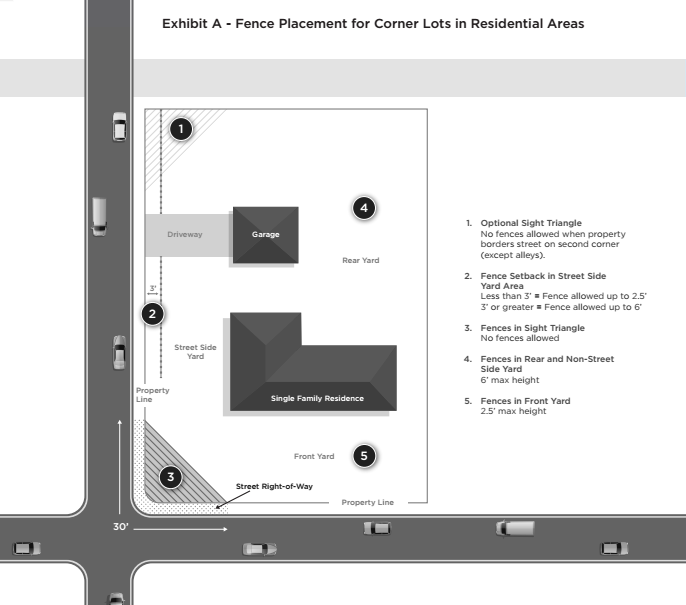
A fence up to a maximum of 30 inches (2.5 feet) shall be allowed in the front yard. The front yard shall be determined by the zoning administrator based upon the property address, the orientation of the dwelling, and/or the location of the primary entrance. A fence shall not be permitted within the sight distance triangle.
(iii)
For all other yards adjacent to public street right-of-way (excluding alleys), fence heights shall be 30 inches (2.5 feet) or less when located three feet or less from the property line. Fence heights up to six feet shall be allowed when located more than three feet from the property line. See Exhibit 1 - Corner Lot Fences.
(iv)
For double frontage and through lots, a sight distance triangle shall be required at all intersecting street corners (except alleys).
(v)
For the purposes of this section, fence heights along lot lines adjacent to alleys shall be allowed to be up to six feet in height and placed on the property line.
Exhibit 1 - Corner Lot Fences
(c)
Fence regulations for business, industrial, and mixed-use districts (C-1, C-2, C-3, C-4, I, and M-X)
(1)
Location. In all commercial and industrial districts, a fence or wall may be constructed on any side or rear property line but shall not be located in any required front yard setback or be closer to any public or private street than the required setback for a building.
The city takes no responsibility for any damages to fences, structures or buildings constructed over an easement caused during maintenance, repair, replacement or any other activity that is derived from or associated with the intent and purpose of said easement.
(d)
Retaining walls.
(1)
Location. A retaining wall may be permitted where it is reasonably necessary due to the changes in slope on the site, where the wall is located at least two feet from any street right-of-way, and where the wall does not extend more than six inches above the ground level of the land being retained.
(2)
Design. When retaining walls are tiered, the minimum horizontal distance between retaining walls (closest edge to closest edge) shall be four feet.
(3)
Right-of-way. No wall or other obstruction shall be erected within any public right-of-way, except by written permission of the city council.
(Ord. No. 2195, § 2, 1-16-06; Ord. No. 2991, § 5, 12-16-19)
Sec. 90-209. - Home occupations.
(a)
Intent. The intent of this section is to establish criteria for operating home occupations in dwelling units within residential districts while maintaining the peace, quiet and residential character of all residential neighborhoods within the city, and alleviating or limiting excessive noise, excessive traffic, nuisance, fire hazard, and other anticipated adverse effects of commercial uses being conducted in residential areas.
(b)
Standards. Home occupations shall conform to the following standards:
(1)
The home occupation shall be incidental and subordinate to the principal residential use of the premises.
(2)
A home occupation shall be entirely contained within the interior of an approved permanently enclosed structure on the site and no more than 25 percent of the floor area of any one floor of a dwelling unit shall be utilized for a home occupation.
(3)
No alteration of the exterior of the principal residential structure shall be made which changes the character thereof as a dwelling. (Exception: ADA compliance.)
(4)
Signage allowed for home occupations operating via permit must comply with the sign ordinance in effect at time of permit application.
(5)
Home occupations shall not utilize more than a total of two persons either as an employee, an independent contractor, a volunteer, or in any other capacity to render service in the performance of such occupation, and both of such persons shall reside in the residence wherein the home occupation is conducted.
(6)
No equipment shall be utilized that creates a nuisance due to noise, odor, emissions or electrical interference.
(7)
No parking in the public rights-of-way shall result from the home occupation.
(8)
No traffic shall be generated by the activity of the home occupation that is abnormal to a residential neighborhood.
(9)
Any home occupation permit applicant whose home occupation requires licensing, registration or permits, by state or federal statute/regulation, or by city ordinance must provide all licenses, registrations or permits at the time of application. Furthermore, the home occupation permittee must keep all licenses, registrations and permits current and at all times comply with the requirements of such licenses, registrations and permits.
(10)
While no permit is required to operate a home occupation that meets the "no permit required" conditions, operation of such business is subject to compliance with all applicable city, state and federal business rules, regulations and standards.
(11)
Hours of operation shall be within the hours of 7:00 a.m. and 9:00 p.m., (Exception: day care home facilities shall have no time restrictions) but are prohibited from offering overnight stay services.
(c)
Restrictions and limitations. Home occupations shall conform to all of the applicable requirements of this section.
(d)
Home occupation; Special use permit required. A business within a home that exceeds the conditions for a "no permit required" home business must obtain a special use permit from the City of Highland prior to starting the business. A business operating under a special use permit will generally meet one of the following conditions and must comply with all additional standards set forth below:
(1)
Work/services/sales are to be performed on the business owner's property will generate six or more vehicles per day to enter/exit the homeowner's property. At no time shall there be more than ten vehicles per day which enter/exit the homeowner's property.
(2)
The home occupation requires equipment, materials, tools or supplies in addition to those for normal home use.
(3)
No materials or products shall be delivered to the homeowner's property by semi-truck. Materials and products must be delivered by regular U.S. Postal Service Mail, UPS, FedEx, etc.
Examples of home businesses in this category include, but are not limited to:
a.
Gardening, lawn care, landscape business where the business requires equipment, materials, tools or supplies in addition to those normally used for personal home lawn care such as mowers, trailers, ladders, hoses, lawn supplements, seed;
b.
Transportation services utilizing no more than two vehicles (automobiles, personal vans or SUV's), and no buses, commercial vans, trucks or other motorized vehicles of any kind;
c.
Manufacturing, mass production, construction of products where the business requires equipment, materials, tools or supplies in addition to those for normal home use;
d.
Tutoring, music lessons, dance lessons or teaching of any kind where three or more students are on the homeowner's property at one time;
e.
Bed and breakfast, tourist home, guesthouse, overnight stay facility where no more than four persons will be housed for no more than two nights each for a maximum of 12 overnight stays per month;
f.
Art/crafts design and production where the business requires equipment, materials, tools or supplies in addition to those normally used for personal home operation such as kilns, furnaces, lathes, torches;
g.
Attorney, accountant, tax service, massage therapist, counselor, estate planner, financial planner, stock broker, interior designer, decorator, event planner, hair dresser, make-up artist, photographer, video producer, web designer, etc., where it is anticipated that more than six but less than ten vehicles per day are anticipated to enter/exit the property;
h.
Auctioneers, private detectives, exterminators, building contractor, general contractors, where all activities other than clerical and record keeping, are conducted off of homeowners premises, but the business will require special or large equipment, materials, tools, or supplies in addition to those for normal home use;
i.
Service or parts sales if business is conducted off the home premises from an appropriately marked company vehicle such as Snap-On TM , etc.
(e)
Home occupation; no special use permit required. A home occupation that meets the following conditions does not need to apply for, nor obtain a special use permit:
(1)
Work/services/sales are performed off of the homeowner's property; and/or
(2)
Work/services/sales are performed on the business owner's property but no more than five vehicles per day enter/exit the homeowner's property;
(3)
No special equipment, materials, tools or supplies in addition to those for normal home use are needed for the business;
(4)
No materials or products are delivered to the homeowner's property by semi-truck; materials and products are delivered by regular US Postal Service Mail, UPS, FedEx, etc.;
(5)
All materials or products are stored in an enclosed area of the homeowner's property;
(6)
No signage is displayed outside on the homeowner's property.
Examples of home businesses in this category include, but are not limited to:
a.
House cleaning, laundry, ironing services;
b.
Sewing, alterations;
c.
Computer repair, installation, maintenance, or programming if no part of the business equipment is installed outside of the residence other than telephone cables or wires;
d.
Tutoring, music lessons, dance lessons or teaching of any kind where no more than two students are on the homeowner's property at one time;
e.
Caregiver, visiting nurse, baby/adult sitting, personal care assistant services performed outside of the homeowner's property or limited to no more than two persons are on the homeowner's property at one time;
f.
Transportation services utilizing no more than two vehicles (automobiles, personal vans or SUV's), and no buses, commercial vans, trucks or other motorized vehicles of any kind;
g.
Internet, eBay, or Craig's List sales;
h.
Direct sale, product distribution such as Amway, Avon or Tupperware;
i.
Art/crafts design, production and sales in areas such as painting, sculpting, lapidary, woodworking, glass working, beading, art restoration, art studio or writing, where no special equipment other than that for normal home use is required;
j.
Graphic design, typesetting, layout, interior designer, decorator, event planner, photographer, video producer, web designer, if no more than five vehicles per day are anticipated to enter/exit the property and no equipment, materials, tools or supplies in addition to those for normal home use are needed for the business;
k.
Auctioneers, private detectives, building contractor, general contractors, where all activities other than clerical and record keeping, are conducted off of homeowner's premises and no equipment, materials, tools or supplies in addition to those for normal home use are needed for the business;
l.
Telephone answering or telephone soliciting if no part of the business equipment is installed outside of the residence other than telephone cables or wires;
m.
Home cooking or preserving if conducted solely within the residence;
n.
Secretarial service, accounting service, typing service, word processing services, mailing services, mail orders, not including retail sales from the site if no part of the business equipment is installed outside of the residence other than telephone cables or wires;
(f)
Home occupations prohibited. Permitted home occupations shall not in any event include the following:
(1)
Antiques, retail.
(2)
Funeral services.
(3)
Groceries, retail.
(4)
Second-hand merchandise, retail.
(5)
Equipment rental.
(6)
Automobile and other motor vehicle repair services.
(7)
Physicians.
(8)
Dentists.
(9)
Chiropractors.
(10)
Restaurants, food service facilities (Exception: Home cooking or preserving if conducted solely within the residence).
(11)
Stables or kennels.
(12)
Veterinarians.
(13)
Renting of trailers or equipment.
(g)
Inspections. All home occupations requiring a special use permit shall have an initial life safety inspection of the premises by the building and zoning division. In addition, the building and zoning division shall have the right at any time, upon reasonable request, to enter and inspect the premises covered by the permit for safety and compliance purposes.
(h)
The following checklist shall be completed by the applicant and submitted as part of the special use permit application.
I have been provided with a copy of the Home Occupation Ordinance and reviewed the contents.
By signing below I hereby affirm that the information I have provided on this application is true and upon approval of the home occupation requested in this application I agree to abide by the conditions and limitations specified for home occupations in the zoning regulation ordinance and any provisions specified by the Zoning Administrator as a condition to approval of the application.
*Incomplete application will be returned
(Ord. No. 2195, § 2, 1-16-06; Ord. No. 2217, Exh. A, 9-18-06; Ord. No. 2261, 11-5-07; Ord. No. 2961, § 5, 9-16-19)
Sec. 90-210. - Residential conversions.
(a)
In order to protect the integrity of existing housing stock and to protect the public from hazards inherent in overcrowding in residential property, it shall be unlawful for any person to alter, or cause to be altered, any existing structure or portion thereof to increase the number of dwelling units on any parcel of land.
(b)
Residential structures located in the "C-1" and "C-2" zoning districts may be converted to commercial use, subject to the special use permit procedures and requirements, and subject to the following additional regulations:
(1)
No alterations shall be made to the building exterior except for those required to bring the building into compliance with the accessibility standards;
(2)
Off-street parking shall be restricted to the rear of the building;
(3)
Only one accessory structure shall be permitted on the property and shall be used for storage purposes only;
(4)
No exterior storage, placement of materials or display of goods shall be permitted; and
(5)
Signage shall comply with the sign requirements in article VIII of this chapter.
(Ord. No. 2195, § 2, 1-16-06)
Sec. 90-211. - Junkyards.
(a)
No part of any junkyard, which includes any lot on which three or more inoperable vehicles are stored, shall be located closer than 500 feet to the boundary of any residential district.
(b)
All vehicles, parts and equipment shall be stored within a completely enclosed structure, or within an area screened by a wall or a solid fence at least ten feet high, designed and maintained of sufficient density to block the view from adjacent property.
(Ord. No. 2195, § 2, 1-16-06)
Sec. 90-212. - Major traffic generators.
In addition to the requirements contained herein, the following requirements shall apply to all uses permitted within the city that generate significant amounts of traffic:
(1)
Any use requiring more than 100 parking stalls shall provide more than one means of ingress and egress and provide a traffic study, performed by a registered transportation engineer, pursuant to the requirements of subsection (4) herein;
(2)
Any use requiring 200 or more stalls shall meet requirements of subsection (1) and provide direct access to an arterial road;
(3)
The developer of any use that requires improvements to the city's transportation system shall be responsible for the cost to design and construct all applicable public improvements such as traffic signals, sidewalks, turn lanes, street lights, medians, etc.;
(4)
Any use requiring a traffic study pursuant to this section or as required by the city shall submit the study prior to any approvals. The traffic study should address the following:
a.
Level of service for site ingress and egress.
b.
Demand for auxiliary turn lanes.
c.
Vehicle queue lengths.
d.
Access spacing and sight distance.
e.
Impact to adjacent major intersections.
f.
Onsite traffic circulation, including emergency vehicles, buses, delivery trucks, etc.
g.
Pedestrian circulation.
(5)
The methodology used to evaluate each of these pertinent factors should follow the practices recommended by the Institute of Transportation Engineers (ITE). The results of this analysis shall provide documentation for the city's consideration that the proposed development adequately addresses traffic impacts and does not present a clear and present, grave and immediate danger to public health, peace and welfare.
(Ord. No. 2195, § 2, 1-16-06)
Sec. 90-213. - Reception venues.
The purpose of this section is to provide supplemental regulations for reception venues in the city. A special use permit shall be required for all reception venues in city limits. All reception venues shall adhere to the following regulations:
(1)
Parking and loading standards.
a.
No off-site parking shall be permitted.
b.
A parking plan identifying the location of the dedicated parking spaces shall be submitted to the zoning administrator to review during the special use permit application. The parking plan shall be tied to the special use permit and the special use permit holder. The amount of parking and loading spaces provided shall adhere Table 5.1 Parking Requirements and Table 5.4 Loading Requirements.
(2)
Lighting standards.
a.
Exterior lighting fixtures shall be shaded so that no direct light is cast upon any residential property and so that no glare is visible to any traffic on any public street.
(3)
Noise.
a.
All noise shall be in accordance with section 25-3 "Specific Nuisances Enumerated," Item (R) of the Nuisance Code. Outdoor music shall be permitted in a manner which does not create a nuisance or negatively impact adjoining or nearby properties.
(4)
Screening and fencing.
a.
All parking and storage areas shall be screened from adjoining properties used or zoned for residential purposes. If existing topography and natural vegetation does not provide a visual barrier, selective screening may be required. Such screen, wall, or fence shall be maintained by the owner or lessee.
(5)
Additional requirements.
a.
Hours of operation. The hours of operation for a reception venue shall be 7:00 a.m. until 12:00 a.m.
b.
Alcohol may be served on-site only during hours of operation and in accordance with chapter 6 — Alcoholic beverages.
c.
Food. Food preparation or catering may occur at a reception venue in accordance with the county food sanitation program.
d.
Restrooms. Adequate ADA restroom facilities shall be provided as determined by the appropriate city adopted building codes.
e.
Revocation. The zoning administrator may revoke an approved special use permit if any condition or requirement of the supplementary requirements are not complied with.
(Ord. No. 2821, § 4, 11-20-17)
Sec. 90-214. - Solar energy farms.
Scope. This section applies to all solar energy farm installations in the City of Highland.
(a)
Purpose. The purpose of this section is to provide regulations for the permitting of solar farms as a special use within the zoning districts identified in section 90-201, Permitted and Accessory Uses and Table 3.1. This section provides for the preservation, protection of natural resources such as forests, tributaries, and habitat while also providing restrictions for the development to aid in the quality of life for the adjacent property owners and general aesthetic qualities for the city while preventing detriment to the public health, safety and welfare of the city as a whole. This ordinance shall not be deemed to nullify any provisions of local, state, or federal law.
(b)
Filing requirements for a special use of a solar energy farm. Submittal packets for a special use for the construction of a solar energy farm shall contain the following:
(1)
Application. The applicant for a solar farm shall adhere to the provisions of article II, division V, Special use permits, of this chapter.
In addition, every solar farm application shall include the following information and documentation:
a.
Host agreement. An executed host agreement must be appended to, and included as part of, any solar farm special use application filed with the city.
b.
Applicant information. The applicant shall describe itself, its legal standing as to whether it is a corporation, limited liability company, individual, or other legal entity and shall identify its officers and directors, shareholders, and members. It shall also identify its parent and subsidiary companies. The same information shall be provided for all owners and operators of the solar farm system. In addition, the applicant shall identify the property owners that have entered into leases or agreements with the applicant and proof must be included that the applicant has the legal authority to bring this application in the name of such property owners.
c.
Project description. The applicant shall provide a general description of the project, including its total generating capacity; the equipment manufacturer, the type and model of solar collectors proposed, the number of solar collectors, the nameplate generating capacity of each solar collector, the proposed height of each solar collector and overall dimensions thereof, a power transmission plan which details the point at where electricity generated on the site connects to electric utility lines/facilities (and any related easements), and a statement as to which utility company the electricity generated on the site will be supplied.
d.
Site plan.
1.
All proposed setback dimensions.
2.
All proposed structures on the property, including, but not limited to, solar collectors, substations, and service roads.
3.
Topographic site information for the subject property and the adjacent properties within a quarter mile of the property line of the subject property indicating contours in five foot intervals.
4.
Existing structures on subject property and properties within a quarter mile of the property.
5.
All existing and proposed underground and aboveground utilities.
6.
All rights-of-way, wetlands, wooded areas, and public conservation lands.
7.
Location of transitional buffer yard in conformance with section 90-214(c)(6) with statement on the site plan that all screening will be properly maintained, including a schedule indicating when and how diseased or dead trees/shrubs will be removed and replaced.
8.
Ingress and egress from the site as proposed during construction and thereafter, which indicates:
i.
Proposed road surface and cover.
ii.
Dust control.
iii.
Width and length of access route and location of ingress.
iv.
Road maintenance progress or schedule for proposed use of land.
v.
Certified easements, contracts, waivers, and option agreements for proposed use of the land.
vi.
Utility interconnection details and a copy of written notification to the utility company requesting the proposed interconnection.
vii.
Fire protection plan for the construction and the operation of the facility, and emergency access to the site.
viii.
Revegetation or reclamation plan of the areas that will be disturbed.
ix.
Drainage plan and erosion control plan.
x.
Description of hours of operation for construction and maintenance of the facility, numbers of employees and type of traffic expected to be generated from the site.
xi.
Public road routes.
(c)
Design and installation requirements.
(1)
Setbacks. The solar array and all components of the solar collector system in a solar energy farm shall be set back a minimum of the greater of the following:
a.
Seventy-five feet from all property lines;
b.
One hundred fifty feet from public parks, public conservation lands, and/or the high water mark of all navigable waterways.
(2)
Height. The total height of the solar collectors shall not exceed 20 feet in height when oriented at a maximum tilt position unless specifically allowed by the Highland Combined Planning and Zoning Board.
(3)
Electrical components. All electrical components of a solar energy farm shall conform to all applicable local utility standards and national electric codes. All electrical wires and lines that are used in conjunction with the solar energy farm, including all electrical control wiring and connections to power lines, shall be installed underground unless specifically allowed otherwise by the Highland Combined Planning and Zoning Board.
(4)
Environmental impact. In all undeveloped areas, the solar energy developer will be required to complete a consultation with both the Illinois Historic Preservation Agency (IHPA) and the Illinois Department of Natural Resources (IDNR) through the department's online EcoCat Program (or equivalent review process). The cost of this consultation shall be at the developer's expense. The final certificate from EcoCat (or equivalent process) shall be provided to the City of Highland building and development before a special use permit application will be considered by the combined planning and zoning board.
(5)
Warning signage. Signs warning of the high voltage associated with the solar farm shall be posted at every entrance to the facility, at the base of all pad mounted transformers, and all substations. A sign that provides emergency contact information, such as phone number, shall be posted near the tower and the operations and maintenance building.
(6)
A transitional buffer yard (TBY) shall be used to screen solar electricity farms from adjacent properties and adjacent public rights-of-way. The TBY shall be located within the required 75 foot setback area.
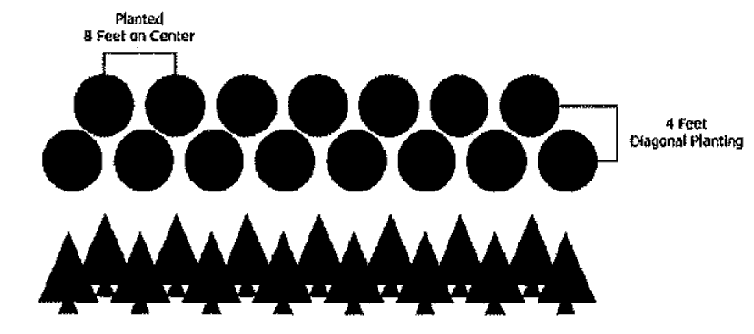
The TBY must achieve a 100 percent screen through the use of either landscape berms or trees to a minimum height of eight feet within two years of installation. To achieve this appearance with trees, a staggered spacing approach with trees on eight-foot centers, should be utilized as shown below. All TBY landscaping shall be evergreen trees. Trees and/or landscape berms may be placed on either the inside or outside of any required fencing. The TBY must be kept in excellent condition, with dead or diseased trees removed and replaced on an annual basis, or as otherwise required in writing by the building and zoning supervisor or his/her designee.
(7)
Federal and state requirement compliance. The solar collecting system shall meet or exceed any standards and regulations of any agency of the state or federal government with the authority to regulate solar energy farms.
(8)
Points of access and interior roadways. Points of access to solar energy farms and interior private access roads shall be of sufficient width to accommodate access by emergency response vehicles, including firefighting apparatus as deemed necessary. Access points and interior roads shall be shown on a general site layout that is approved by the Highland fire chief and the Highland emergency medical services chief or his/her designee at the time of Special Use Permit application. An "after-hours" access plan shall be included and approved by the fire chief or designee. Once approved, access points and roadways shall be appropriately maintained.
(9)
Exterior roads. All routes that will be used for the construction and maintenance purposes shall be identified on the site plan. All routes for either egress or ingress need to be shown.
(10)
Complaint resolution. The applicant shall develop a process to resolve any complaints that may arise from neighboring property owners during the construction and operation of the solar farm. The process may use an independent mediator or arbitrator and shall include a time limit for acting on a complaint that is received. The process shall not preclude the local government from acting on a complaint. The applicant shall provide to the nearby residents a phone number of the project manager during the construction of the facility if a problem should arise.
(11)
Waste disposal. All solid waste generated from supplies, equipment, parts, packaging or operation of the facility shall be removed from the site immediately and disposed of in an appropriate manner. Any hazardous waste that is generated by the facility, including, but not limited to, lubricating materials, shall be removed consistent with all local, state and federal rules and regulations.
(12)
Drainage. The plan shall state that any damage to waterways, drainage ditches, field tiles or any other infrastructures caused by the construction or maintenance of the solar farm shall be completely repaired to near original condition and so as not to impede the natural flow of water. All repairs shall be completed within a reasonable amount of time.
The solar farm owner is to notify the director of public works director that the construction of any part of the project encounters any underground field drainage tiles. A plan sufficient to provide remediation shall be submitted, reviewed and subject to the approval of the director of public works director. All existing drainage tiles that will be crossed by private access roads shall be removed and replaced with load resistant tiles as specified by the city engineer. This shall be done before the private access roads are used for construction purposes. The load resistant tiles shall extend a minimum of 30 feet across the private access roads and shall be of the same diameter of the existing tiles. To ensure that all drainage tiles are located, reasonable measures shall be made to locate all existing tiles in the vicinity of the private access roads by exploratory trench or other appropriate methods. All drainage tiles that are encountered during construction shall be noted on the site plan. Financial assurances in the form of cash or an escrow account, surety bond or a letter of credit in a form and amount acceptable to the director of public works shall be posted to assure compliance with this section.
(13)
Conformance to industry and code standards/engineer certification. The solar farm shall comply with all applicable codes for the electrical, mechanical and structural components of the facility. All documents provided for review shall be stamped and signed by a professional engineer. All solar collection system panels shall be certified by the Solar Collector and Certification Corporation (SRCC).
(14)
Fencing. Perimeter fencing having a minimum of eight feet in height shall be installed around the boundary of the solar farm. The fence shall contain appropriate warning signage that is posted such that it is clearly visible on the site.
(15)
Reflective coating. Solar energy system components shall be designed with an antireflective coating. Verification shall be provided that verifies that the components of the solar energy system have this quality.
(16)
Reflection angles. Reflection angles for solar collectors shall be oriented such that they do not direct glare toward residential users on adjacent properties. Verification shall be provided by the applicant that reflection angles have been taken into account for both fixed position and pivoting solar collectors as well as for all seasonal changes to sun angles.
(17)
Lot area. Solar farms and components thereof shall be located on a parcel that is a minimum of 14 acres in size.
(18)
Vegetation control. A vegetation and weed control plan, which includes details of how frequently the site will be mowed, shall be provided that protects against the creation of a prey habitat and/or aesthetic impacts to the surrounding area. As the site shall be screened with a transitional buffer yard (TBY), the combined planning and zoning board may allow grass/vegetation heights to exceed the city's established maximum growth heights as required elsewhere in the city.
(19)
Cleaning supplies and solvents. Cleaning chemicals and solvents used during the operation or maintenance of the solar energy farm facility shall consist of biodegradable products and shall be low in volatile organic compounds.
(20)
Equipment and capacity upgrades. Any change to equipment and/or increase in overall peak electrical capacity for solar energy farms shall require a revised special use permit which shall be reviewed and approved by the combined planning and zoning board. However, administrative review of an equipment change and/or capacity increase may occur by unanimous agreement of an administrative panel comprised of the building and zoning director, the fire chief, and the public works director if all of the following are met:
a.
The cumulative increase in overall peak electrical capacity as compared to the original amount approved in the special use permit is less than 20 percent;
b.
The cumulative increase in the overall number of solar collectors as compared to the original amount approved in the special use permit is less than 20 percent;
c.
At the time of application for an upgrade, there are no standing or unresolved complaints from surrounding property owners per the complaint resolution provision in section 90-214(c)(10).
d.
The city building and zoning division has verified that there are no standing or unresolved issues with regard to the design and installation requirements contained within this section (90-214(c)).
(21)
Applicant contact information. The applicant shall keep on file with the city building and zoning division current contact information, including mailing address(es), daytime telephone number(s), and emergency contact information of the property owner(s) and the solar collector operator(s). In addition, the applicant shall provide written information as to frequency of site and equipment inspections.
(d)
Decommissioning or abandonment of the solar farm. Prior to receiving a special use of the solar farm, the operator/owner shall provide for a decommissioning plan for the anticipated service life of the facility or in the event that the facility is abandoned or has reached its life expectancy. If the solar farm is out of service or not producing electrical energy for a period of 90 days, it will be deemed nonoperational and decommissioning and removal of that facility will need to commence according to the decommissioning plan provided and approved. The decommissioning plan shall be updated every ten years from the date of approval of the special use permit and provided to the combined planning and zoning board as an informational item. The decommissioning plan shall provide the following information:
(1)
Removal of the following within nine months:
a.
All solar collectors and components, aboveground improvements and outside storage.
b.
Foundations, pads and underground electrical wires and reclaim the site to a depth of four feet below the surface of the ground.
c.
Hazardous material from the property and dispose of in accordance with federal and state law.
d.
A cost estimate for the decommissioning of the facility shall be prepared by a professional engineer or contractor who has expertise in the removal of the solar farm. The decommissioning cost estimate shall explicitly detail the cost before considering any projected salvage value of the out of service solar farm. The decommissioning cost shall be made by cash, surety bond or irrevocable letter of credit before any construction commences.
e.
A restoration plan shall be provided for the site.
(e)
Liability insurance. The owner or operator of the solar farm shall maintain a current general liability policy covering bodily injury and property damage and name the City of Highland as an additional insured with limits of at least $3,000,000.00 per occurrence and $5,000,000.00 in the aggregate with a deductible of no more than $5,000.00.
Such insurance may be provided pursuant to a plan of self-insurance, by a party with a net worth of $20,000,000.00 or more. The city shall be named as an individual insured on the policy to the extent the city is entitled to indemnification.
(f)
Administration and enforcement. The zoning officer shall enforce the provisions of this section through an inspection of the solar farm every year. The zoning officer and/or a designated public safety representative are hereby granted the power and authority to enter upon the premises of the solar farm at any time by coordinating a reasonable time with the operator/owner of the facility. Any person, firm or corporation who violates, disobeys, omits, neglects, refuses to comply with, or resists enforcement of any of the provisions of this section shall, upon conviction, be fined not less than $75.00 nor more than $500.00 for each offense. Each tower, solar array, or any other component of the solar energy farm shall be the subject of a separate violation and further each week that a violation is permitted to exist shall constitute a separate offense. Other actions may be taken by law or in equity to prevent or to remedy any violation of this section and these remedies shall be in addition to any other remedies, damages or penalties.
(Ord. No. 2878, § 5, 9-17-18)
Sec. 90-215. - Fire service training center.
Scope. This section applies to all fire service training centers in the City of Highland.
(a)
Purpose. The purpose of this section is to provide regulations for the permitting of fire service training centers as a special use within the zoning districts identified in Section 90-201 Permitted and Accessory Uses and Table 3.1. This section allows for the protection of the general public and property through necessary fire training facilities designed to provide the components to accomplish general fire fighter training. Further, this section provides for the quality of life for adjacent property owners and general aesthetic qualities for the city. This ordinance shall not be deemed to nullify any provisions of local, state, or federal law.
(b)
Filing requirements for a special use of a fire service training center. Submittal packets for a special use for the construction of a fire service training center shall contain the following:
(1)
Application. The applicant for a fire service training center shall adhere to the provisions of article II, division V, Special use permits of this chapter.
In addition, every fire service training center application shall include the following information and documentation:
a.
Applicant information: The applicant shall identify itself as being either the City of Highland (in association with that municipality's fire department) or the Highland-Pierron Fire Protection District.
b.
Project description: The applicant shall provide a general description of the project, including maximum heights of any accessory buildings or structures and hours of operation.
c.
Site plan:
1.
All proposed setback dimensions from the fire service training center building foundation to all property lines;
2.
All existing structures on subject property and the distance from the fire service training center building foundation to existing structures on the property;
3.
Distance from the fire service training center building to any principal or accessory structure(s) which are less than 100 feet away on all immediately adjacent properties;
4.
Proposed height of the fire service training center;
5.
All existing and proposed underground and aboveground utilities and/or easements;
6.
Location of transitional buffer yard in conformance with section 90-215(c)(3) with statement on the site plan that all screening will be properly maintained, including a schedule indicating when and how diseased or dead trees/shrubs will be removed and replaced;
7.
Location and height of all proposed fencing;
8.
Statement on the site plan addressing the following:
i.
Only "Class-A" or clean fuel materials shall be used for live fire training;
ii.
Live fire training shall occur in burn rooms only;
iii.
No training that includes tear gas, explosives, or fire arms shall occur within or near the building;
iv.
Hours of operation.
(c)
Design and installation requirements.
(1)
Setbacks. The fire service training center shall be set back a minimum of the height of the building plus ten feet.
(2)
Height. The total height of the fire service training center shall not exceed forty-five feet as measured from the immediately surrounding grade to the building peak.
(3)
A transitional buffer yard (TBY) shall be used to screen the ground level of the fire service training center from adjacent properties and adjacent public rights-of-way. The TBY shall be located within the required setback area.
The TBY must achieve a 100 percent screen through the use of either landscape berms or trees to a minimum height of eight feet within two years of installation. To achieve this appearance with trees, a staggered spacing approach with trees on eight-foot centers, should be utilized as shown below. All TBY landscaping shall be evergreen trees. Trees and/or landscape berms may be placed on either the inside or outside of any required fencing. The TBY must be kept in excellent condition, with dead or diseased trees removed and replaced on an annual basis.
(4)
Fencing. Perimeter fencing having a minimum of eight feet in height shall be installed in a way that secures the fire service training center from unauthorized use.
(5)
Site maintenance. At the conclusion of each day in which the fire service training center is utilized, the interior and exterior of the facility will be inspected for any remaining fire or physical damage. All unusable burned materials will be extinguished and properly discarded in a designated area at the facility. All ash and debris will be disposed of and the building and grounds will be left in a safe and clean condition.
(6)
Adverse conditions. The fire service training center shall not be utilized during dry or windy conditions which may pose a risk to surrounding property.
(d)
Liability insurance. The owner or operator of the fire service training facility shall maintain a current general liability policy covering bodily injury and property damage and name the City of Highland as an additional insured with limits of at least $3,000,000.00 per occurrence and $5,000,000.00 in the aggregate with a deductible of no more than $5,000.00.
Such insurance may be provided pursuant to a plan of self-insurance, by a party with a net worth of $20,000,000.00 or more. The city shall be named as an individual insured on the policy to the extent the city is entitled to indemnification.
(Ord. No. 2878, § 6, 9-17-18)
Sec. 90-216. - Short-term rentals.
(a)
Intent.
(1)
The purpose of this section is to protect the public health, safety, sanitation, traffic control,or hazardous waste control, pollution control, and other specified circumstances in relation to short-term rentals.
(2)
Short-term rentals are distinct from bed and breakfast establishments in that prepared meals are not provided and only one group of patrons in a 24-hour period shall be allowed in a short rental.
(3)
Short-term rentals are distinct from hotel or motel establishments in that only one group of patrons in a 24-hour period shall be allowed in a short-term rental. Further, hotel or motel establishments are land uses allowed only in non-residential zoning districts.
(b)
Requirements.
(1)
It shall be unlawful to rent, offer for rent, or advertise for rent a short-term rental without first obtaining a special use permit (SUP) issued by the City of Highland for the specific location.
(2)
All short-term rentals shall meet the following:
a.
No rental or advertisement for rental for a period of time shorter than 20 hours.
b.
No short-term rental may provide for food or beverage to any guests with the exception of pre-packaged food and drink items.
c.
The SUP application shall identify what living space within the principal structure is available for short-term rental. If more than one living area is offered for short-term rental, those living areas shall be specifically identified and numbered on the SUP application. While a separate SUP application is not required for each living area, the applicant shall not be allowed to exceed the maximum number of short-term rentals identified in the SUP application.
d.
Any short-term rental shall be subject to the hotel and motel tax and associated requirements of Article II Hotel and Motel Tax (Sections 70-26 to 70-33).
e.
Short-term rentals shall be inspected annually for compliance with the requirements of Article VII Health Safety Inspection (Sections 33-211 to 33-260).
f.
Short-term rental owners/operators shall be required to register with the City of Highland as a landlord per the provisions of Article VI - Landlord Registration (Sections 33-195 to 33-201).
g.
The SUP application shall include owner and property identification information, including emergency contact and insurance information, to be provided to the City of Highland Police Department.
h.
The maximum number of overnight occupants shall not exceed that allowed per the Building Code.
i.
Off-street parking locations shall be identified on the SUP application.
j.
The applicant shall be responsible for confirming that the use of the property and structure as a short-term is allowed by any applicable covenants and restrictions. Approval of a SUP by the City of Highland shall not circumvent these covenants and restrictions.
k.
Short-term rentals must be owner-controlled, meaning that a property owner may not rent the property to an individual (renter) and allow the renter to utilize the unit as a short-term rental. The owner may manage the property outright or contract anentity for professional management services so long as the contracted entity is only contracted for said services and is not leasing the property from the owner.
(c)
SUP Criteria. In reviewing a special use permit application, the combined planning and zoning board shall consider and affirmatively ascertain the following have been met:
(1)
The proposed short-term rental has complied with all provisions of subsection (b) (Short-Term rental requirements).
(2)
The proposed short-term rental will not cause a negative cumulative effect when considered in conjunction with the effect of other short-term rentals in the immediate neighborhood.
(3)
The proposed short-term rental will not have a substantial adverse impact on the use, enjoyment, or property values of adjoining properties.
(4)
The proposed short-term rental will not have an adverse effect upon the public health, welfare, or safety of the community.
(Ord. No. 3050, §§ 2—4(Exh. A), 10-19-20; Ord. No. 3119, § 5, 7-19-21)
Sec. 90-217. - Ground mounted solar energy systems.
The purpose of this section is to provide supplemental regulations for ground mounted solar systems within City limits. A special use permit shall be required for all ground mounted solar energy systems within City limits. All ground mounted solar energy systems shall adhere to the following regulations:
(a)
Ground mounted solar energy systems shall be classified as accessory structures, and must comply with 90-71—90-74.
(b)
Ground mounted solar energy systems shall require the issuance of a special use permit in compliance with the following:
(1)
Height. Height shall not be greater than 15 feet at maximum tilt of the solar panel(s).
(2)
Screening. Ground mounted solar energy systems must be substantially screened from adjacent residential uses that are within 100 feet of said ground mounted solar array by fencing, walls, plantings, or other architectural feature, or any combination thereof; provided however, that the screening shall not be required to be so dense, so tall, or so located as to render the equipment essentially non-functional.
(3)
Standards for Interconnection, Safety, and Operating Reliability. The interconnection of a Customer's generating facility and associated interconnection equipment to the Utility's distribution System shall meet the applicable provisions of the following publications:
i.
ANSI/IEEE1547-2018 Standard for Interconnecting Distributed Resources with Electric Power Systems (including use of IEEE 1547.1-2020 testing protocols to establish conformity) as they may be amended from time to time. The following standards shall be used as guidance in applying IEEE 1547:
ii.
IEEE Std 519-2014, IEEE Recommended Practices and Requirements for Harmonic Control in Electrical Power Systems
iii.
IEEE1453, IEEE Recommended Practice for the Analysis of Fluctuating Installation on Power Systems
iv.
UL1741 requirement for inverter based generation
v.
NESC Electric Safety Code
vi.
ANSI/NFPA 70, National Electrical Code
vii.
OSHA (29 CFR § 1910.269)
(c)
Filing requirements for a special use of a ground mounted solar energy system. Submittal packets for a special use for the construction of a ground mounted solar energy system shall contain the following:
(1)
Application. The applicant for a ground mounted solar energy system shall adhere to the provisions of article II, division V, Special use permits, of this chapter. In addition, every ground mounted solar energy system application shall include a site plan showing the following:
i.
All proposed setback dimensions.
ii.
All proposed structures on the property and the dimensions of the structures.
iii.
Existing structures on subject property and the dimensions of the structures.
iv.
All existing and proposed underground and aboveground utilities.
v.
All rights-of-way, wetlands, wooded areas, and public conservation lands.
vi.
Any screening mechanisms.
(Ord. No. 3264, § 3, 4-17-23; Ord. No. 3292, 9-18-23)

