
Highland City Zoning Code
ARTICLE V
- OFF-STREET PARKING AND LOADING
Sec. 90-221.- Off-street parking spaces required for certain uses.
(a)
There shall be provided in all zoning districts, at the time of erection or enlargement of any principal building or structure, automobile off-street parking spaces with adequate access to all spaces in accordance with Table 5.1 and subject to the requirements herein.
(b)
No off-street parking need be provided for buildings and uses located within the boundaries of an area enclosed by 12th Street, Walnut Street, 9th Street, and Pine Street provided they are located within 500 feet of a public parking lot or an alternative parking plan is approved.
(c)
Parking may be provided both in an off-street parking lot and as parallel or other approved parking along streets that are internal to a development in accordance with an approved parking plan.
(d)
An area devoted to off-street parking shall be located (at its nearest point) within 100 feet of the principal building in any R district; and within 300 feet of the principal building in any C and I district.
(e)
No residential driveway, parking surface or detached garage shall cover more than ten percent of the parcel upon which it serves.
(f)
Any lights used to illuminate a parking area shall be arranged, located or screened to direct light away from any adjoining residential use.
(g)
Except as may be established by an approved alternate parking plan, the number of vehicle parking spaces to be provided for each type of land use shall be determined by the following, rounded to the nearest whole space. Developments containing two or more uses listed below shall provide the number of spaces required for each use. Any use not listed below shall provide four parking stalls per 1,000 square feet of gross floor area, unless otherwise provided by the city.
(Ord. No. 2195, § 2, 1-16-06)
Sec. 90-222. - Alternate parking plan.
The parking requirements established in this chapter may be modified by the combined planning and zoning board pursuant to an approved alternate parking plan. An alternate parking plan may be approved only upon evidence that the circumstances justify modification, satisfy the objectives of this article, and are in the public interest. An alternate parking plan shall be subject to any appropriate conditions determined by the board to be necessary to fully mitigate the impact of any modification.
(Ord. No. 2195, § 2, 1-16-06; Ord. No. 2217, Exh. A, 9-18-06)
Sec. 90-223. - Shared parking.
The parking spaces provided for separate uses may be combined in one lot but the required spaces assigned to each use may not be assigned to another use, except as follows:
(1)
Parking spaces that are proposed to be shared among two or more uses must be clearly available to the allowed users and not appear in any way to be serving a particular use. Directional signage shall be installed to clearly identify the location and means of access to the designated shared parking areas.
(2)
Shared parking arrangements must be evidenced by a written agreement acceptable to the board, and approved by the owners of each of the affected properties or uses. The approved agreement shall be recorded and a copy supplied to the administrative official.
(Ord. No. 2195, § 2, 1-16-06; Ord. No. 2821, § 5, 11-20-17; Ord. No. 3151, § 4, 12-6-21)
Sec. 90-224. - Design requirements.
The provisions of this section apply to all vehicle parking spaces and parking areas, whether the parking meets or exceeds the number of spaces established in this article to serve a particular use.
(1)
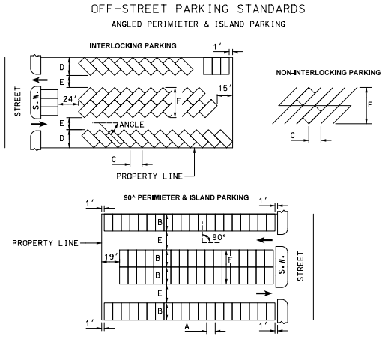
Minimum Stall Dimensions. Every 90° parking space shall provide a usable rectangular area at least ten feet wide by 20 feet in length. Access drives shall not encroach into this minimum rectangular area. Every parking space shall be clearly delineated by lines painted on or otherwise applied to the parking lot surface. The requirements for off-street parking shall be implemented according to the minimal dimensions depicted in Table 5.2 below.
(1) Using interlocking parking design
(2) Using non-interlocking parking design
_____
• The diagrams below illustrate the measurements (A), (B), (C), (D), (E), and (F).
• Additional width may be requried where the aisle serves as the principal means of access to on-site buildings
_____
(2)
Internal access and circulation. Access aisles in parking lots must be at least 22 feet wide for two-way traffic (24 feet radii), and 14 feet wide for one-way traffic. One-way traffic aisles must be clearly marked with directional arrows on the pavement at each intersection with another aisle. No parking space shall be accessible from an access driveway within the first 20 feet of the driveway measured from the street right-of-way line.
(3)
Improvement of parking areas. All vehicle parking areas and all access drives shall be improved with a permanent dust free surface consisting of a minimum pavement cross section of a compacted subgrade with a six-inch compacted aggregate base (IDOT CA-Gradation) overlaid with a three-inch asphaltic surface, or a six-inch asphalt base overlaid with a 1½-inch asphalt surface.
(4)
Curbs. All vehicle parking areas and all access drives in office, commercial and industrial zoning districts shall have a boundary constructed of straight-back concrete curbing (IDOT Type "B" PCC Curb) or an integral concrete sidewalk and curb with a vertical face.
(Ord. No. 2195, § 2, 1-16-06; Ord. No. 3008, § 2, 4-6-20)
Sec. 90-225. - Accessible parking requirements.
(a)
Method of computation. Handicap accessible parking spaces shall be provided and counted as part of the total number of parking spaced required below.
(b)
Required spaces. Handicap accessible spaces shall be provided in each parking lot according to Table 5.2.
(c)
All sidewalks, crosswalks, parking lots, or other areas of pedestrian circulation shall comply with the Federal ADA Accessibility Standards shown in Figure 5.1 and the following guidelines:
(1)
Handicap accessible parking spaces shall be located on a surface with a slope not exceeding one vertical foot raise for every 50 feet of linear horizontal run.
(2)
A parking sign, pursuant to ADA guidelines shall be provided. Generally said sign shall be 80 inches in height.
(3)
Handicap accessible parking spaces shall have an adjacent aisle five feet wide, and one in every eight handicapped spaces (but no less than one) shall be adjacent to an aisle eight feet wide and the space shall be clearly marked with a sign indicating that the space is "van accessible". Handicapped parking space aisles shall be clearly demarcated by lines painted on or otherwise applied to the parking lot surface.
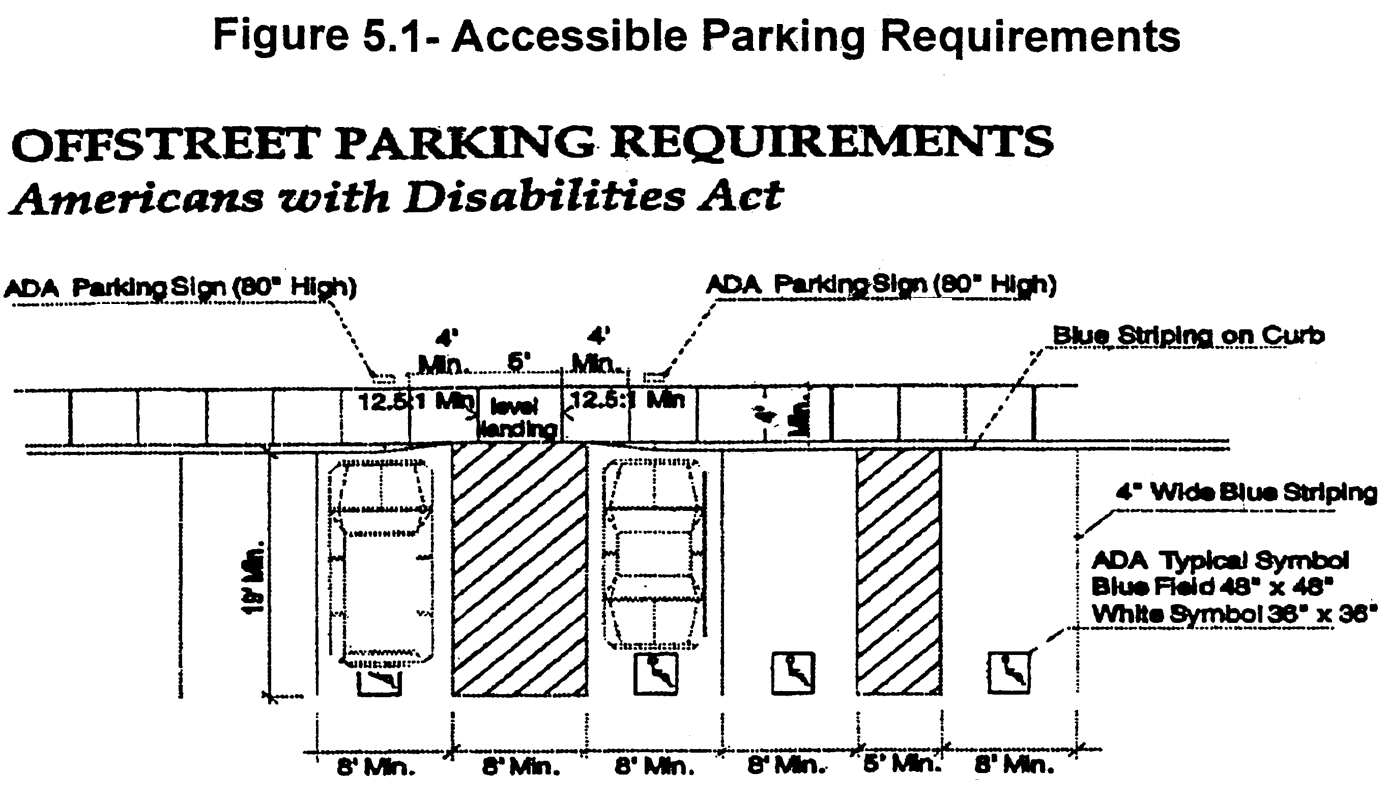
Figure 5.1
(Ord. No. 2195, § 2, 1-16-06)
Sec. 90-226. - Off-street loading space and access ways required.
(a)
Each required off-street loading space shall be designed with appropriate means of vehicular access to a street or alley in a manner which will least interfere with traffic movement. Each access way shall be at least 12 feet in width.
(b)
All loading spaces shall be located on the same lot as the use served; such loading spaces shall not be located within 50 feet of the intersection of any two streets, and shall not be located within required front or side yards.
(c)
Space allocated to any off-street loading space shall not, while so allocated, be used to satisfy the space requirements for any off-street parking facilities or portions thereof.
(d)
Unless otherwise specified, a loading space shall be at least ten feet in width, by at least 25 feet in length, and shall have a vertical clearance of at least 14 feet.
(e)
For the uses listed in the following table, off-street loading space shall be provided on the basis of gross floor area of buildings or portions thereof devoted to such uses in the amounts shown:
(Ord. No. 2195, § 2, 1-16-06)
Sec. 90-227. - Access management.
Ingress and egress to any parking area or use shall be by means of paved driveways from the adjoining street. The minimum width of driveways for ingress and egress shall be the same as those specified in Table 5.5 for aisles. Driveway width, for the purpose of this section, shall include only the pavement and not the curbs and gutters.
The distance of a parking area entrance drive from the intersection of two streets, and the distance between curb cuts, shall be based on the street design standards set forth below in Table 5.5, and measured from the edge of pavement. Whenever applicable, shared driveways are encouraged.
(Ord. No. 2195, § 2, 1-16-06)
Sec. 90-228. - Parking and storage of vehicles.
(a)
No motor vehicle designed or regularly used for carrying freight, merchandise, or other property or more than eight passengers and that is licensed in excess of 18,000 pounds gross vehicle weight, excluding any vehicle which is licensed as a recreational vehicle, shall be parked in a residential district, except for deliveries.
(b)
Outside storage of recreational vehicles, trailers, equipment, materials, boats or personal watercraft shall meet the following performance standards:
(1)
The outdoor storage is to be located on land owned by, leased by, or under the control of the users.
(2)
Outdoor storage shall be located behind the front building line and restricted to side or rear yards and shall be at least three feet from any lot line.
(3)
All storage areas and access drives shall be paved.
(4)
Outside storage of inoperative vehicles or equipment exceeding 30 days is prohibited unless otherwise specifically permitted by the City Code.
(5)
Recreational vehicles and travel trailers shall not be used as a dwelling when parked in the city.
(c)
With the exception of the industrial zoning districts, inoperative or unregistered vehicles may not be stored or repaired (other than in enclosed garages) on the premises.
(d)
In zoning districts other than the industrial zoning districts, construction equipment and construction vehicles may not be stored or repaired on the premises (other than in enclosed garages), except when being utilized for construction activities on the premises pursuant to a valid permit issued by the city for construction work necessitating use of such equipment, or when used for permitted work on the public right-of-way, or when associated with a special use permit as part of an allowable primary use, such as an equipment rental business.
(e)
For purposes of subsection (b), a "trailer" is every vehicle without motive power in operation, other than a pole trainer, designed for carrying persons or property and for being drawn by a motor vehicle and so constructed that no part of its weight rests upon the towing vehicle.
(Ord. No. 2195, § 2, 1-16-06; Ord. No. 2922, § 4, 3-18-19; Ord. No. 3337, § 2, 5-6-24)

