
Highland City Zoning Code
ARTICLE VII
CENTRAL BUSINESS DISTRICT DESIGN STANDARDS
Sec. 90-239.- Intent and purpose.
The provisions of this article are intended to protect property values and enhance community appearance in keeping with the goals of the Comprehensive Plan of the City of Highland. It is recognized that the appearance of property has a direct bearing on the economic value of such property and also the economic value of adjacent and surrounding property. The appearance of a single property affects not only surrounding property, but the cumulative affect is to enhance or diminish the beauty of the entire city and consequently the values of property within the city. It is further recognized that the appearance of property not only has economic effects, but also affects the general welfare, health and safety of city citizens. An aesthetically pleasing environment is a clean, healthy and safe environment.
The community recognizes the significance of the central business district as an important cultural and commercial resource. The central business district contains common building elements such as load-bearing brick walls, second story bay windows, decorative brickwork, and cast iron thresholds. This article provides a procedure by which development of property within the central business district may be reviewed and modified in order to enhance the aesthetic beauty of the central business district and maintain the desirable qualities of the district through clear architectural and appearance standards and consequently the economic value of property and the general welfare of the citizens.
(Ord. No. 2195, § 2, 1-16-06)
Sec. 90-240. - Specific purposes.
In addition to the general purposes and intent expressed above, this article is further intended to give effect to the following specific purposes:
(1)
To establish standards for the orderly development or redevelopment within the central business zoning district.
(2)
To permit public involvement in the planning of private land uses which have the potential for significant impact on the use and enjoyment of surrounding property or on the public resources and facilities of the community.
(3)
To conserve and protect the taxable value of land and buildings in the central business district.
(4)
To preserve and protect the visual diversity of buildings in the central business district and its pedestrian scale.
(5)
To preserve, protect and encourage the development of buildings, groups of buildings and development sites of distinguished architectural character and appearance.
(Ord. No. 2195, § 2, 1-16-06)
Sec. 90-241. - Application.
These standards shall apply to all exterior building renovation, new construction or other exterior alterations to property in the C-2 central business district that requires a permit. No permit shall be issued except upon approval of a site plan in conformance with the site plan review procedures and fees established in article II, division 3 and the additional standards set forth in this article.
(Ord. No. 2195, § 2, 1-16-06)
Sec. 90-242. - Standards for design.
The purpose of these standards is to establish a checklist of those items that affect the physical aspect of the central business district. These standards are not intended to restrict imagination, innovation or variety, but rather to assist in focusing on design principles that allow creativity with a satisfactory visual appearance while promoting the purpose and intent of this section.
(1)
New construction—building components and design.
a.
Architectural style. There are no restrictions on architectural style.
b.
Entryways. Entryways must be recessed to a depth that does not allow a door to swing onto the sidewalk and have a strong design consistent with the architecture of the rest of the building. Elements of strong entryway design include canopies, awnings, porticos, arcades, raised cornice parapets over the door, peaked roof forms, arches, large windows, or architectural details such as tile work and moldings that are integrated into the building structure and design.
c.
Windows.
1.
Coverage and operability. Windows must cover no less than 50 percent, nor more than 75 percent of the storefront area; windows must cover no less than 30 percent, nor more than 50 percent on the upper facade. At least 50 percent of all windows on the second and higher floors must be operable.
2.
Orientation and placement. Windows must be vertical, with no less than a 2:1 ratio of height to width. Storefront windows must start between two and three feet above the sidewalk.
3.
Window signs. No more than 30 percent of the storefront windows may be covered by signs. This restriction does not apply to signs permanently painted on or etched into the window to serve as the business' primary sign.
4.
Framing. All windows must include an architectural element that frames the window.
5.
Shutters. All window shutters must have the dimensions of operable shutters and hardware that makes the shutters appear to be operable even if the shutters are permanently fixed in an open position (see figure below).
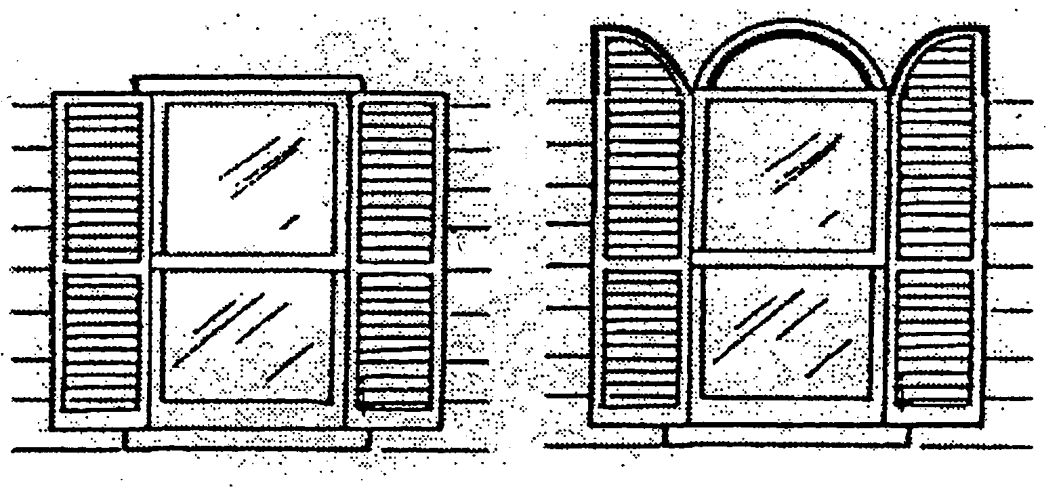
Shutters
d.
Cornice and fascia.
1.
At roofline. All buildings must have a well-defined cornice or fascia that creates a strong roofline and visually caps the building, giving the building a finished appearance and unifying the building with existing structures within and adjacent to the central business district.
2.
At storefront. All buildings must have a storefront cornice occurring between nine and 12 feet above the sidewalk in order to complement the average height of storefront cornices on existing buildings.
e.
Roof styles. The shape of the roof is not limited, however, all buildings must have a parapet that conceals the roof plane.
f.
Mechanical equipment or other utility hardware. On buildings not located on a corner, all mechanical equipment or other utility hardware must be located on the roof or in the rear yard and must be screened from view with materials harmonious with the building. Such equipment or hardware on a corner building must be located on the roof and screened from view with materials harmonious with the buildings. Such equipment or hardware shall not be located closer than 6 feet from any residential windows. No mechanical equipment or hardware or screening materials may be visible from the street level.
g.
Side and rear building faces. All exterior surfaces visible from the street must include architectural components found on the primary building facade in order to tie the building together. Rear entrances are encouraged.
h.
Anti-Monotony. New construction must avoid excessive monotony in design by having no more than 15 feet of blank wall length without an interruption by at least two of the following: change in plane, change in texture or masonry pattern, windows, trellises with vines, or an equivalent.
i.
Scale of design. All new construction fronting the square must be at least two stories in height, with the first floor between 12 and 15 feet in height and upper stories between nine and 12 feet in height, unless otherwise waived by the combined planning and zoning board. Buildings may be no more than two stories taller than adjacent buildings. No building in the central business district may be more than three stories in height or 45 feet.
j.
Corner buildings. Both street-facing sides of corner buildings will be treated like the storefront facade, therefore, all storefront facade requirements apply to both street-facing sides.
k.
Color. Exterior colors in the central business district are limited to natural non-primary or muted colors. Primary or highly saturated colors shall be limited to accent or trim only. All exterior building materials, finishes and colors shall be coordinated to achieve a continuity of design. All exterior doors, grills and building trim shall be painted consistent with the color scheme of the building.
l.
Permitted building materials. The following materials are permitted on the building exteriors visible from the street or alley: stone, marble, face brick, decorative wood trim and copper. The combined planning and zoning board may permit other non-listed materials of similar quality and appearance.
m.
Prohibited building materials. The following materials are generally prohibited on the building exterior visible from the street or alley: corrugated metal, corrugated fiberglass, aluminum siding, imitation rock work, mirror or metalized reflective glass, plywood, masonite, structure and chip board siding, exterior insulated finish system (EIFS), vinyl siding, metal siding other than copper, cinder block, split-face block or pre-cast panels. The combined planning and zoning board may permit the limited use of the above materials on a case by case basis and may also reject other exterior materials that do not complement the historic character of the central business district or that do not further the redevelopment plan for the square.
n.
Awnings and canopies. Awnings and canopies are permitted with the following restrictions:
1.
All awnings must be made of cloth fabric; vinyl awnings are prohibited. Canopies must be made of materials that complement the overall historic character of the central business district.
2.
No interior lighting is permitted within awnings or canopies except at the entryway, where light up to five foot-candles at grade is permitted.
3.
Awnings and canopies must be mounted no higher than 12 inches below the storefront cornice. All awnings and canopies must have a minimum vertical clearance of seven feet six inches above the sidewalk.
4.
Awnings and canopies must be attached directly to the building without requiring poles or sidewalk support.
5.
On buildings wider than 25 feet, awnings and canopies must be segmented to articulate each display window and to provide a better sense of proportion to the facade.
6.
Awnings and canopies may not cover more than 25 percent of storefront windows.
o.
Exterior lighting. In order to promote the goals of improved aesthetics, greater energy efficiency, and safety, the following lighting standards apply to all nonexempt outdoor lighting:
1.
All light fixtures must be harmonious with the overall building design.
2.
Mounting of light fixtures is limited to the first floor.
3.
Lights may not move or flash.
4.
Prohibited lighting includes fluorescent, high-pressure sodium, laser, floodlights, mercury vapor and searchlights. The prohibition against fluorescent does not apply when the fluorescent luminaire has a color rendition similar to tungsten.
5.
All bulbs and fixtures must be non-glare.
6.
Either exterior or interior lighting must illuminate the storefront display windows until 2:00 a.m.
7.
Recessed entryways must be illuminated but may not exceed an average of five foot-candles at grade.
The foregoing lighting standards shall not apply to any structure listed on the National Registry of Historic Buildings.
(2)
Building design for exterior renovation of existing structures. All of the aforementioned guidelines from subsection (1), "New Construction—Building Components and Design Requirements", apply to the exterior alterations made to existing structures unless waived by the city council. The City of Highland recommends that the renovation of existing structures recreate the original facade. Recommendations include the following:
a.
Windows. Restore and reglaze original window openings into original shapes and sizes. Windows may not be permanently filled or decreased in size.
b.
Surface materials. Remove non-original surface materials from the original wall surface, when the original wall surface still exists.
c.
Piers. Restore piers to original status when such piers have been eliminated or reduced in size.
(Ord. No. 2195, § 2, 1-16-06; Ord. No. 2217, Exh. A, 9-18-06)
Sec. 90-243. - Maintenance standards.
Maintenance standards in this division apply to all properties in the central business district. All exterior facade materials must be maintained in sound and attractive condition. Any rotten, broken, or otherwise deteriorated materials shall be repaired or replaced in kind. Peeling and/or chalking painted surfaces shall be repainted or otherwise refinished. Permanent boarding or filling in of windows on any side of the building is prohibited. All surfaces shall be kept free of debris, such as tape and staples. All other City Code maintenance provisions also apply.
(Ord. No. 2195, § 2, 1-16-06)
Sec. 90-244. - Streetscape provisions.
Business owners in the central business district may temporarily place items, including the establishment of outdoor eating areas, on the sidewalk in the public right-of-way, directly next to the building under the following conditions:
(1)
Such items may not unreasonably interfere with the flow of pedestrian traffic;
(2)
Items may not obstruct the entryway; and
(3)
Items must be stable and not prone to toppling or blowing away.
(Ord. No. 2195, § 2, 1-16-06)
Sec. 90-245. - Penalties.
Property owners who fail to comply with the procedures set forth in this division may be fined in an amount not to exceed $750.00 per each day of noncompliance. Failure to comply includes, among other actions, failing to obtain compliance approval from the combined planning and zoning board to the requirements herein or failing to comply with conditions set forth in a conditional approval of compliance. The city may file for injunctive relief where the city council determines it to be in the public interest.
(Ord. No. 2195, § 2, 1-16-06; Ord. No. 2217, Exh. A, 9-18-06)

