
Highland Park City Zoning Code
ARTICLE II
INTERPRETATION AND DEFINITIONS
Sec. 150.201.- Rules of Construction.
The language in the text of this Chapter shall be interpreted in accordance with the following rules of construction:
(A)
The singular number includes the plural number, and the plural the singular;
(B)
The word "shall" is mandatory; the word "may" is permissive; and
(C)
The masculine gender includes the feminine and neuter.
Sec. 150.202. - Definitions.
Whenever in this Chapter the following words and phrases are used, they shall, for the purposes of this Chapter, have the meanings respectively ascribed to them in this Section, except when the context otherwise clearly indicates. Whenever in this Chapter other words are used, those other words shall have the meanings normally ascribed to them.
Abandonment: The voluntary discontinuance of a non-conforming use or the occupancy of a non-conforming structure, when accompanied by an intent not to re-establish such use or occupancy. Any one of the following shall constitute prima facie evidence of intent to abandon:
1.
Any positive act indicating such intent; or
2.
Any conscious failure to take all necessary steps to resume the non-conforming use or occupancy with reasonable dispatch in the circumstances, including advertising of the property for sale or for lease; or
3.
In the case of a structure or structure and land in combination, discontinuance of the occupancy or non-conforming use for twelve (12) consecutive months; or
4.
In the case of land only, discontinuance of the occupancy or non-conforming use for ninety (90) consecutive days, or for a total of six (6) months during any one (1) year period; or
5.
In the case of a non-conforming structure which is damaged by means out of control of the owner to an extent of less than fifty percent (50%) of the estimated cost of reconstruction of the entire structure new, failure to commence restoration within six (6) months from the date of partial destruction, or conclude restoration within two (2) years from the time restoration construction is initiated.
6.
With respect to a WES, the failure to repair the WES to operable condition for a period exceeding 12 consecutive months.
Access: A way or means of approach to provide physical entrance to a property or capability for physical entrance to a property.
Accessory Building or Accessory Structure: A subordinate detached building or structure located on the same lot as a principal building, the use of which subordinate building or structure is incidental to that of the principal building or to the principal use of the lot.
Accessory Use: A use, which is ancillary or incidental to the principal use of the premises.
Adequate Downstream Stormwater Capacity: A stormwater management facility shall be considered to have adequate downstream stormwater capacity if the facility can be shown to store or convey up to and including the 100-year stormwater runoff without increasing damage to the adjoining properties or to a point downstream known to the Enforcement Officer to be a restriction causing significant backwater.
Addition: Any structural alteration that increases the floor area ratio of a building.
Adjacent: To touch, to abut, to lie immediately next to, and/or to share a common wall or lot line.
Adult Book or Adult Video Store: An establishment having as a substantial or significant portion of its sales and/or stock in trade, books, magazines, films and/or videos for sale or viewing on the premises by use of motion picture devices or any coin-operated means, and other periodicals — which are distinguished or characterized by their emphasis on material depicting, describing or relating to "specified anatomical areas" or "specified sexual activities", or an establishment with a segment or section devoted to the sale or display of such material, or an establishment that holds itself out to the public as a purveyor of such materials based upon its signage, advertising, displays, actual sales, presence of video preview or coin operated booths, the exclusion of minors from the establishment's premises, or any other factors showing that the establishment's primary purpose is to purvey such material.
Adult Day Care Service: A service provided or arranged by any person, group of persons, agency, association or organization, whether established for gain or otherwise, for the care of one or more adults, aged 60 or older with a physical, social and/or mental impairment, for less than 24 hours per day. Services offered in adult day care service centers may include, without limitation, meals, personal care and recreational and/or therapeutic activities.
Adult Entertainment Cabaret: A public or private establishment which, live or on motion pictures, features (i) topless dancers, strippers, and/or male or female impersonators; or (ii) entertainers who not infrequently display "specified anatomical areas"; or (iii) entertainers who by reason of their appearance or conduct perform in a manner which is designed primarily to appeal to the prurient interest of the patron or entertainers who engage in, or engage in explicit simulation of, "specified sexual activities".
Adult Mini Motion Picture and/or Video Theater: An enclosed building or an area within a building, having a capacity for less than fifty (50) persons, and used for presenting motion picture films, video cassettes, cable television, and/or any other such visual media — all of such materials so presented distinguished or characterized by an emphasis on matter depicting, describing or relating to "specified sexual activities" or "specified anatomical areas" for observation by patrons therein.
Adult Motion Picture Theater: An enclosed building or an area within a building, having a capacity of fifty (50) or more persons, and used regularly and routinely for presenting motion picture films, video cassettes, cable television, and/or any other such visual media — all of such materials so presented having as a dominant theme material distinguished or characterized by an emphasis on matter depicting, describing or relating to "specified sexual activities" or "specified anatomical areas" for observation by patrons therein.
Adult Use Cannabis Business Establishments means adult use cannabis businesses, including, but not limited to: adult use cannabis cultivation centers, adult use cannabis dispensaries, cannabis craft growers, cannabis infusers, and cannabis processors.
Adult Use Cannabis Cultivation Centers means a facility operated by an organization or business that is licensed by the Department of Agriculture to cultivate, process, transport, and perform other necessary activities to provide cannabis and cannabis-infused products to adult use cannabis business establishments.
Adult Use Cannabis Dispensary means a facility operated by an organization or business that is registered by the Illinois Department of Financial and Professional Regulation to acquire cannabis from a cannabis cultivation center, cannabis craft grower, cannabis processor, or another cannabis dispensary for the purpose of selling or dispensing cannabis, cannabis-infused products, cannabis seeds, paraphernalia, or related supplies for recreational, non-medicinal purposes to purchasers other than registered qualifying patients under the Illinois Compassionate Use of Medical Cannabis Program Act (410 ILCS 130/1 et seq.).
Affordable Housing Trust Fund: The fund created by the City pursuant to Subsection 33.1133(C) of this Code.
Affordable Housing Units: Residential dwelling units that are required under this Article to be "affordable housing," as that term is defined in Subsection 33.1133(A) of this Code.
Aggregate Diameter: The combined diameter of a multiple trunk Tree measured at Breast Height.
Agricultural Practices: Activities including, but not limited to, normal farming, silviculture and ranching activities such as gardening, plowing, seeding, cultivating, harvesting for the production of food, fiber, forest products, nursery stock and livestock; maintenance of agricultural drain tiles, irrigation and drainage ditches; and maintenance of farm roads and other access areas for farm vehicles and equipment use.
Alcoholic, Psychiatric, and Narcotic Treatment Facility: A non-residential, freestanding (not integral to a hospital) out-patient facility having no accommodations for overnight stay but having programs specifically designed to treat alcoholism, psychiatric disorders, and/or narcotic abuse.
Alley: A right-of-way not more than twenty-five (25) feet wide.
Allowable Use: A Permitted Use or Special Use, including any conditional use as set forth in the "Table of Allowable Uses" in this Chapter.
Alteration, Structural: Any change (other than incidental repairs) or replacement of the supporting members of a building, such as bearing walls or partitions, columns, beams or girders, or any substantial change in the roof or in the exterior walls.
Ambient Sound: The all-encompassing sound at a given location, usually a composite of sounds from many sources near and far. With respect to Wind Energy Systems, the "ambient sound level" shall mean the quietest of ten 10-second average sound levels measure when there are no nearby or distinctly audible sound sources (e.g., dogs, cars in line-of-sight, or jets). Daytime ambient measurements should be made during mid-morning weekday hours, while nighttime measurements should be made after 11:00 p.m.
Ammunition: (1) the material fired, scattered, dropped, or detonated from any weapon, such as bombs or rockets, and especially shot, shrapnel, bullets, or shells fired by guns; or (2) the means of igniting or exploding such material, as primers, fuses, and gunpowder.
Animal Hospital or Clinic: Any building or portion thereof designed or used for the care, observation or treatment of domestic animals which may include overnight boarding and/or veterinary care.
Animal Pound: A building, structure or facility operated, owned, maintained, or used to provide for and promote the welfare, protection and humane treatment of animals, including animals impounded for rabies observation.
Antenna, Including Directional Antenna (Such as Panels) Microwave Dish, Satellite Dish, and Omni-Directional Antenna (Such as a Whip Antenna): Any structure or device designed for the purpose of collecting or transmitting electromagnetic waves for telephonic, radio, data, Internet or other communications, including appurtenant equipment attached to a tower or building for the purpose of providing personal wireless services, including, for example, "cellular", "paging", "low power mobile radio", and "personal communications services" telecommunications services, and their attendant base stations.
Antenna Height: The vertical distance measured from the base of the antenna support structure at grade to the highest point of the antenna support structure, even if said highest point is an antenna. Measurement of tower height shall include antennas, base pad, and other appurtenances and shall be measured from the grade of the site. If the antenna support structure is on a sloped grade, then the average between the highest and lowest grades shall be used in calculating the antenna height.
Antenna Support Structure: Any building, pole, mast, tower, tripod, or other structure which supports or is a component part of the overall structure supporting an antenna.
Apartment: A room or suite of rooms in a multiple family residential structure which is arranged, designed, used or intended to be used as a single dwelling unit.
Appeal: A request for relief from a decision of the Zoning Administrator.
Applicant or Petitioner: Any person who files an application for zoning amendment, special use, special exception, variation, subdivision approval, appeal, or permit from SMC or the City to carry out development.
Appropriate Use: Only uses of the Regulatory Floodway that are permissible will be considered for permit issuance. The only uses that will be allowed are as specified in Article XVIII of this Chapter.
Area Median Income: The median income level for the Chicago area, as established and defined in the annual schedule published by the Secretary of the Department of Housing and Urban Development, and adjusted for household size.
Art Shop means a store principally used for the sale of artistic works, with or without an accessory gallery and studio.
Assisted Living Facility: A residential facility within which residents with or without minor physical disabilities live, cook, dine, and recreate, and may be provided with medical and other services.
Attic: That portion of the height and area of a building between the eave and the ridge lines of a sloping roof which has a ceiling height of seven (7) feet or more over a floor area which is more than one-third (⅓) of the floor area of the next lower and adjacent story but less than one-half (½) of the floor area of the said next lower and adjacent story.
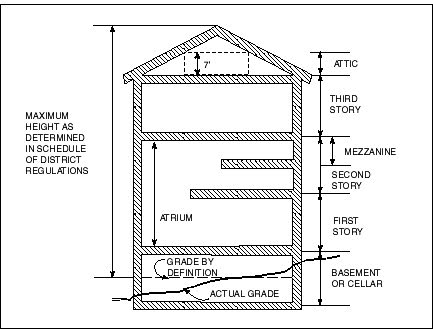
Atrium: An interior space, two (2) or more stories in height.
Auditorium: A room, hall or building which may be a part of a church, theater, school, recreation building or other building assigned to the gathering of people as an audience to hear lectures, plays and other presentations.
Auto-Oriented Use: Either (i) any Transportation or Related Use, as identified in the Table of Allowable Uses of Article IV, or (ii) any Drive-Through Facility, as defined in this Section 150.202.
Automatic Teller Machine: An automated device that performs banking or financial functions.
Average: The result obtained by dividing the sum of two (2) or more quantities by the number of such quantities.
Average Illumination: The overall average of all points on the surface of the illuminated area including the brightest and dimmest points.
Average Uniformity Ratio: A measurement of the average light level in relation to the lowest light level within a given area. Example: A ratio of 3:1 states that the average level is three times higher than the minimum level.
Awning: A temporary shelter supported entirely from the exterior wall of a building, composed of non-rigid materials, which is either stationary or can be retracted, folded or collapsed against the face of the supporting building.
B.U.G.: A luminaire classification system that classifies backlight (B), uplight (U) and glare (G), and quantifies brightness in each class by lumens.
Balcony: A platform projecting from the wall of a building supported by pillars, brackets or consoles or cantilevers from the main part of the building and enclosed by a rail or coping.
Banks and Financial Institutions: Commercial banks, savings and loan associations, brokerage offices, and other similar facilities, including loan offices.
Base Flood: The flood having a one percent probability of being equaled or exceeded in any given year. The base flood is also known as the 100-year frequency flood event. Application of the base flood elevation at any location is as defined in this Article.
Base Flood Elevation or BFE: The elevation delineating the level of flooding resulting from the 100-year flood frequency elevation.
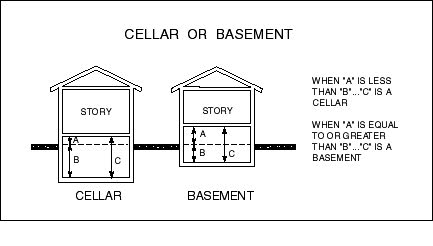
Basement: A story partly underground, having its floor below grade level on all sides, one-half (½) or more of the height of it is above grade. A basement shall be counted in calculating F.A.R. and as a story for the purposes of height measurement.
Basin: Sub-watershed areas within Lake County that include the Fox River mainstem (including the Chain O'Lakes), Flint Creek, Tower Lake Darin, Slocum Drain, Mutton Creek, Squaw Creek, Fish Lake Drain, Bull Creek, Indian Creek, Aptakisic Creek, Buffalo Creek, Skokie River, Middle Fork-North Branch Chicago River, West Fork-North Branch Chicago River, Kellogg Creek, Dead River, Waukegan River, Pettibone Creek, and Lake Michigan Bluff/Ravines.
Basin Plan: A study and evaluation of an individual drainage basin's stormwater management and flood control needs.
Berm: An earthen mound, used to divert storm water flows, provide a restriction to create storm water storage areas, protect lower lying areas, enhance landscaping, screen undesirable views, and/or decrease noise.
Billboard: A generally flat surface or board, usually outdoors, on which advertisements or notices are posted.
Block: A tract of land bounded by streets or cul-de-sacs, or in lieu of a street or streets, by public parks, cemeteries, railroad rights-of-way, ravines, corporate boundary lines of municipalities, or the shoreline of Lake Michigan.
Bluff: An elevated segment of the Lake Michigan shoreline above the beach which normally has a precipitous front inclining steeply on the lakeward side.
Board of Appeals: The Zoning Board of Appeals of the City of Highland Park.
Boarding House means a building or place other than a hotel, motel, short-term rental, or lodging house, where lodging and meals are provided for compensation by prearrangement for a definite period to five or more, but not exceeding 12, individuals.
Body Shop: See "Motor Vehicle Repair, Major".
Bonus Floor Area Ratio (BAR): A bonus that is granted in certain limited circumstances for floor area ratio as provided in Subsection 150.703.3(B).
Book Store: An establishment which is not an Adult Book Store and which deals in books and other printed materials.
Bottom, or Toe, Ravine Slope or Toe of Bluff Slope: The lowest elevation of soil grade adjacent to the base of a ravine or a bluff slope, as the case may be.
Briergate Commercial Zoning District (B4-BG). See "zoning districts."
Buffer: An area of predominantly vegetated land to be left open, adjacent to drainageways, wetland, lakes, ponds or other surface waters for the purpose of eliminating or minimizing adverse impacts to such areas.
Buffering: Any means of protecting a parcel from the visual or auditory effects of an adjacent use through the use of berms, fences, landscaping, setbacks, and/or open spaces.
Building: Any structure with substantial walls and roof which is securely affixed to the land, on a permanent frost-proof foundation, and entirely separated on all sides from any other structure by space or by walls in which there are no communicating doors, windows or openings, and which structure is designed, intended, or used for the shelter, enclosure, or protection of persons, animals, or chattels. The term also includes gas or liquid storage tanks.
Building Code:Chapter 170 of this Code, as the same has been, and may from time to time hereafter be, amended.
Building Envelope: The area depicted upon a master site plan within which the general location of existing structures and/or structures that may be developed in the future are shown.
Building-integrated Solar Energy System: An active solar energy system that is an integral part of a principal or accessory structure, rather than a separate mechanical device, replacing or substituting for an architectural or structural component of the building. Building-integrated systems include, but are not limited to, photovoltaic or hot water solar energy systems that are contained within roofing materials, windows, skylights, or awnings.
Building-Mounted Wind Energy Systems (BWES): A Wind Energy System that is structurally attached either onto the roof of or to the side of a building.
Building Permit: A permit issued by the City for the construction, alteration, removal or demolition of a building or structure within the corporate limits of the City.
Building Setback Line: A line established on a lot, by agreement or otherwise, designating the required distance of any structure or building from a lot line or right of way. See "Established Building Setback".
Building Site Plan: A document reviewed by the Director in conjunction with a building permit application for construction upon real estate located in the HC (Health Care) Zoning District and approved, if at all, in light of an existing Master Site Plan and in accord with the procedures established in this Code for building site plan review.
Building, Temporary: Any building not designed to be permanently located in the place where it is or where it is intended to be placed or affixed.
Bulk Regulations: The term used to indicate the size of the setbacks, the location of a building with respect to adjoining lots and street lines, and matters similar thereto including but not limited to the following:
1.
Floor area ratio and bonus floor area ratio;
2.
Front yard regulations;
3.
Side yard regulations;
4.
Rear yard regulations;
5.
Maximum height regulations:
6.
Lot size;
7.
Lot coverage;
8.
Lot area per dwelling unit; and
9.
Open space.
By-Pass: To route tributary drainage area runoff around and not through a stormwater control structure.
Caliper: The diameter of a Tree trunk six inches (6") above the existing grade or proposed planted grade. Caliper is usually used in reference to nursery stock for new plantings.
Cannabis has the meaning set forth in the Illinois Cannabis Regulation and Tax Act.
Cannabis Craft Grower means a facility operated by an organization or business that is licensed by the Department of Agriculture to cultivate, dry, cure, and package small quantities of cannabis and perform other necessary activities to make small quantities of cannabis available for sale at an adult use or medicinal cannabis dispensary or use at a cannabis processor or infuser.
Cannabis Infuser means a facility operated by an organization or business that is licensed by the Department of Agriculture to directly incorporate cannabis or cannabis concentrate into a product formulation to produce a cannabis-infused product.
Cannabis Processor means a facility operated by an organization or business that is licensed by the Department of Agriculture to either extract constituent chemicals or compounds to produce cannabis concentrate or incorporate cannabis or cannabis concentrate into a product formulation to produce a cannabis product.
Cannabis Transporter means an organization or business that is licensed by the Department of Agriculture to transport cannabis on behalf of a cannabis business establishment or a community college licensed under the Community College Cannabis Vocational Training Pilot Program.
Canopy: A roof-like structure with posts or other ground support, constructed to provide shelter to pedestrians or vehicles.
Car-Share Program: A program in which a fleet of cars or other motor vehicles is made available for use by members of the car-share program and that exhibits all of the following characteristics:
A.
Members are permitted to use vehicles from the car-share program fleet on an hourly or other short-term basis
B.
Car-share vehicles are generally available 24 hours a day and 7 days a week to members in parking spaces at dispersed locations; and
C.
No separate written agreement is required each time a member reserves and uses a car-share vehicle.
Car-Share Vehicle: a motor vehicle used as part of a car-share program fleet.
Caretaker's and Servant's Quarters: Living quarters containing no kitchen and existing as an accessory use in single family residential zoning districts within a principal building or located above a garage.
Carport: A canopy for vehicle storage, open on three (3) sides and attached to a principal building.
Car Wash: See "Motor Vehicle Laundry" or "Motor Vehicle Washing Facility".
Catering Service: The business of providing food or meals for compensation on premises not owned or controlled by the proprietor of the business.
Cellar: A story having more than one-half (½) of its height below grade. A cellar shall not be counted in calculating F.A.R. or as a story for the purpose of maximum height measurement.
Cell Site: A tract or parcel of land that contains personal wireless telecommunications facilities including any antenna, antenna support structure, accessory building, and off-street parking, and may include other uses associated with and ancillary to personal wireless services, excluding a single family residence.
Cellular Telephone Facility: A cell site housing computerized telephone transmission equipment together with the necessary antennas, which site is part of a distribution system for mobile telephones licensed by the Federal Communications Commission of the United States of America, controlled from a central mobile telephone switching office and which may include a support structure or tower upon which may be mounted necessary antennas and equipment and an unmanned telephone transmission equipment shelter in which necessary telephone equipment may be housed.
Cemetery: A burial ground including structures such as mausoleums, columbariums, incidental management offices, and maintenance facilities.
Central Business District, B5: See "Zoning Districts".
Certified Community: A community which has petitioned the Stormwater Management Commission to be capable of enforcing an ordinance (or ordinances) which contain stormwater and regulatory floodplain management rules and regulations which are consistent with or at least as stringent as those of the Lake County Watershed Development Ordinance.
Certified Wetland Specialist: Persons meeting the minimum requirements of a, b, c, and d below, as follows:
a.
Provide a one-page statement of qualifications in the areas noted below. The signed statement will be considered as evidence of qualifications.
b.
Pass the Certified Wetland Specialist Exam.
c.
Completion of a SMC-approved wetland delineation course and meet the requirements of one of the following:
1.
Registered Professional Wetland Scientist (PWS) from the Society of Wetland Scientists;
2.
Minimum of a Bachelor's Degree in an Earth Science or Biologic Science and at least one of the following: Three years (cumulative) full-time experience in the Upper Midwest Region on wetland related projects; or the completion of 100 wetland delineations in the Upper Midwest; or, a minimum of 300 hours spent in field review of wetlands in the Upper Midwest; or
3.
Six years (cumulative) full-time experience in the Upper Midwest Region on wetlands related projects.
d.
Recertification as a Certified Wetland Specialist shall be required every three years through SMC. A minimum of 24 work-related professional development hours, including SMC mandatory training for this type of certification, shall be obtained within the three-year period in order to qualify for recertification. Documentation shall be self-monitoring and shall be provided to SMC upon application for certification or recertification.
Channel: A natural or artificial depression of perceptible extent with a defined bed and banks that confine and conduct flowing water either continuously or periodically. Any river, stream, creek branch, natural or artificial depression, ponded area, lakes, flowage, slough, ditch, conduit, culvert, gully, ravine, swale, wash, or natural or man-made drainageway, in or into which surface or groundwater flows, either perennially or intermittently.
Channel Modification: Alteration of a channel by changing the physical dimensions or materials of its bed or banks. Channel modification includes damming, rip-rapping or other armoring, widening, deepening, straightening, relocating, lining and significant removal of bottom or woody vegetation of the channel. Channel modification does not include the clearing of dead or dying vegetation, debris, or trash from the channel.
Chapter: This Chapter, being Chapter 150 of the Code.
Child Care Facility: A building where any person, group of persons, agency, association or organization, whether established for gain or otherwise, who or which receives or arranges for care or placement of one or more children, unrelated to the operator of the facility, apart from the parents, with or without the transfer of the right of custody in any facility , established and maintained for the care of children.
City: The City of Highland Park, Lake County, Illinois.
City Council: The City Council of the City of Highland Park, Illinois.
City Facilities: Any building or structure owned or operated by the City including, without limitation, administrative offices, police and fire stations, public works garages, storage facilities, infrastructure, and recreational and social facilities.
City Manager: The City Manager of the City of Highland Park.
Clinic: A facility used for the diagnosis and treatment of physical and/or mental disorders on an outpatient basis.
Club or Lodge, Private: A non-profit association of persons who are bona fide members thereof who may pay annual dues, which association owns, hires or leases a building or portion thereof. "Private Club or Lodge" shall not include an Adult Entertainment Cabaret.
Code: The "Highland Park Code of 1968", as amended, of which this Chapter is a part.
Color Rendering Index (CRI): A measurement of the ability of a light source to reveal the colors of various objects faithfully in comparison with an ideal or natural light source, measured as a percentage. A CRI of 100% represents perfect standardized daylight.
Commercial Front Yard: That part of the front yard of a lot other than the 2 foot area adjacent to the front lot line thereof, located within the Commercial and Industrial zoning districts, maintained as open space except for paved off street parking and signs.
Commercial Service District, B4: See "Zoning Districts".
Commercial Vehicle: Any vehicle operated for the transportation of persons or property in the furtherance of any commercial or industrial enterprise, for-hire or not-for-hire, but not including a commuter van, a vehicle used in a ridesharing arrangement when being used for that purpose, or a recreational vehicle not being used commercially.
Commercial Wireless Telecommunication Services: Licensed commercial wireless telecommunication services including cellular, personal communication services, specialized mobilized radio, enhanced specialized mobilized radio, paging, and similar services that are marketed to the general public.
Common Open Space: Open space of a parcel or development that (i) is set aside for the use and enjoyment by all persons who occupy a principal use or who reside on that parcel or within that development, and (ii) is free of structures, except for historic structures and/or approved recreational facilities. Common open space shall not include: (a) areas reserved for the exclusive use or benefit of an individual unit or lot; (b) dedicated streets, alleys, or other public rights-of-way; (c) vehicular drives, private streets, or parking, loading and storage areas; or (d) strips of land that are less than 20 feet wide.
Community or Recreation Center: A building in which members of a community may gather for social, educational, recreational or cultural activities operated on a not-for-profit basis.
Community Living Facility: A residential setting at which guidance, supervision, training and other assistance is provided to disabled adults with the goal of eventually moving these persons to more independent living arrangements, and in which residents are required to participate in day activities, such as vocational training, sheltered workshops or regular employment. A Community Living Facility shall not be a medical or Nursing Home Care Facility.
Community Residential Alternative: A home for disabled adults who are unable to live independently but are capable of community living if provided with an appropriate level of supervision, assistance and support services. A Community Residential Alternative may provide training and guidance to residents in the skills of daily living and shall provide opportunities for participation in community activities. A Community Residential Alternative shall not be a medical or Nursing Home Care Facility.
Compassionate Use of Medical Cannabis Program Act means the Illinois Compassionate Use of Medical Cannabis Program Act, 410 ILCS 130/1 et seq.
Compatibility: The characteristics of different uses or activities that permit them to be located near each other in harmony and without conflict. In arriving at the determination of the compatibility of a particular use or activity the following shall be a minimum of the elements to be considered: density of occupancy as measured by dwelling units per acre; floor area ratio; pedestrian or vehicular traffic generated; volume of goods handled; and such environmental effects as noise, vibration, glare, air pollution, erosion, or radiation.
Compensatory Storage: An excavated, hydraulically equivalent volume of storage used to offset the loss of natural flood storage capacity when artificial fill or structures are placed within a regulatory floodplain.
Comprehensive Master Plan: The Official Highland Park Comprehensive Master Plan of 1976, as amended.
Concentrated Solar Thermal Technology: A solar energy technology that uses lenses or mirrors, and often tracking systems, to focus or reflect a large area of sunlight into a small area.
Conditional Approval Regulatory Floodway Map Change: Pre-construction approval by IDNR/OWR and the Federal Emergency Management Agency of a proposed change to the Regulatory Floodway map and/or BFE. This pre-construction approval, pursuant to Article XVIII of this Chapter, gives assurances to the property owner that once an Appropriate Use is constructed according to permitted plans, the Regulatory Floodway map and/or BFE can be changed, as previously agreed, upon review and acceptance of as-built plans.
Conditional Letter of Map Revision or CLOMR: A letter which indicates that the Federal Emergency Management Agency will revise base flood elevations, flood insurance rate zones, flood boundaries or Regulatory Floodway and/or BFE as shown on an effective Flood Hazard Boundary Map or Flood Insurance Rate Map, once the as-built plans are submitted and approved.
Conditional Use: See "Special Use".
Condominium: A building, or group of buildings, in which units are owned individually and the structures and common areas and facilities are owned by all the owners on a proportional, undivided basis.
Congregate Housing: Housing which provides a living arrangement of self-contained units (each containing a full kitchen and bath) that integrates shelter, food service, and other services for independent adults who do not require 24 hour oversight. Services may include meals, laundry, transportation and housekeeping. Congregate Housing does not require a state license.
Conservation: Planned management or enhancement of the natural environment with the minimum introduction of foreign materials and alteration of the natural setting.
Construction: Any activity which would cause structures of any kind to be installed, erected or removed.
Contiguous Ownership: Ownership of any parcel or tract of land by any person who simultaneously holds ownership to any adjacent parcel or tract of land.
Control Structure: A structure designed to control the rate of flow that passes through the structure, given a specific upstream and downstream water surface elevation.
Convenience Food Mart: A business, other than a restaurant or fast-food restaurant or carry-out restaurant or a drive-in restaurant, which sells food directly to the customer and occupies a floor area of less than 5,000 square feet.
Conversion: A change in a residential or mixed-use rental development to individual-owner residential condominium units.
Correlated Color Temperature (CCT): The color temperature of luminaires measured in Kelvin (K).
Country Club: A club which includes a golf course.
Country Estate Residential District (R1): See "Zoning Districts".
Country Home Residential District (R2): See "Zoning Districts".
Covenant: A private or public written agreement relating to the use of, restriction of, interest in, or right to, real property and recorded with the Lake County Recorder of Deeds against the title to the real property to which it applies.
Covered Development Project: Any development project in the City that is required to provide affordable housing units under the provisions of this Code. Projects at one location undertaken in phases, stages, or otherwise developed in distinct sections shall be considered a single covered development project.
Craft Brewery, Distillery, Winery, and Meadery means a commercial facility at which fermented beverages are produced on-site, with or without an accessory tasting shop. Craft breweries, distilleries, wineries, and meaderies do not include either brew pubs or restaurants with accessory alcoholic liquor production facilities.
Cul-De-Sac: A vehicular turnaround located at the termination of a dead end street.
Cultivation Center has the meaning set forth in the Compassionate Use of Medical Cannabis Program Act.
Cultural, Recreational, and Entertainment Uses means any other cultural, recreational, and entertainment use not otherwise identified in this Chapter, whether indoor or outdoor, except the following:
• Campgrounds and trailer parks;
• Facilities used for the performance of athletic or sporting training or events (other than facilities owned and operated by school districts for interscholastic athletic or sporting training or events);
• Drinking establishments;
• Adult book stores, adult entertainment cabarets, adult mini motion picture theaters, adult mini video theaters, adult motion picture theaters, or adult video stores;
• Smoking parlors or rooms, or cigar or smoking clubs;
• Tattoo parlors; and
• Gambling places, as defined in Section 133.005 of this Code.
Currency Exchange: Any establishment primarily engaged in the business or service of, and providing facilities for, cashing checks, drafts or money orders for a fee or service charge, or which is engaged in the business of selling or issuing money orders under its name, or any other money orders, or engaged in both such activities.
Cutting or Undercutting: Shaping of the land surface through the moving of soil, rock or other materials.
Dam: All obstructions, wall embankments or barriers, together with their abutments and appurtenant works, if any, constructed for the purpose of storing or diverting water or creating a pool. Underground water storage tanks are not included.
Damage: Any destruction of or loss to real property including but not limited to that caused by fire, windstorm, flooding, or act of God. With respect to stormwater management, wetland protection, and flood plain regulations, "Damage" means a measurable rise in flood heights on property currently subject to flooding, flooding of property currently not subject to flooding unless it is contained within the streambanks or a deed or plat restricted area or increases in velocity to the point where the rate of land lost to erosion and scour is significantly increased.
Day Care Home: A dwelling unit which receives children for care during the day and which is licensed as such by the State of Illinois.
Daytime Hours: The hours of the day from 7:30 .a.m. to 9:00 p.m.
Debilitating Medical Condition has the meaning set forth in the Compassionate Use of Medical Cannabis Program Act.
Decibel: A unit of measurement of the intensity (loudness) of sound. Sound level meters which are employed to measure the intensity of sound are calibrated in "decibels".
Deciduous: A plant with foliage that is shed annually.
Deck: A structure which is open to the sky (as opposed to a "Porch") and which provides a platform that is raised more than six (6) inches above the ground.
Deed or Plat Restriction: Permanent easements, covenants, deed restricted open spaces, outlots dedicated to a public entity, reserved plat areas and conservation easements dedicated to meet the requirements of Article XVIII of this Chapter, or public road rights-of-way that contain any part of the stormwater management system of a development.
Density: The number of dwelling units per unit of land measure.
Depressional Storage Areas: Non-riverine depressions where stormwater collects.
Design Storm: A selected storm event, described in terms of the probability of occurring once within a given number of years, for which stormwater or flood control improvements are designed and built.
Designated Erosion Control Inspector: A person responsible for, at minimum, verifying compliance and on-going maintenance of the approved soil erosion and sediment control plan measures of a development, and who is recommended to meet the minimum qualification requirements of a, b, c, and d below, as follows:
a.
Provide a one-page statement of qualifications in the areas noted below and a request to be included on the SMC Designated Erosion Control Inspector qualified listing, which signed statement will be considered as evidence of qualifications;
b.
Pass the Designated Erosion Control Inspector Exam that is administered by SMC;
c.
Completion of an SMC-approved soil erosion and sediment control course and meet the requirements of one of the following:
1.
Have an official designation as a Certified Professional n Erosion and Sediment Control (CPESC); or
2.
Two years cumulative experience in the Upper Midwest Region on soil erosion and sediment control inspections; and
d.
The listing of Designated Erosion Control Inspectors shall be officially updated every three years by the SMC. A minimum of 24 work-related professional development hours, including SMC mandatory training for this designation, shall be obtained within the three-year period in order to qualify for re-listing. Documentation shall be self-monitoring and shall be provided to SMC upon application for listing.
Designated Erosion Control Inspector Exam: An exam that is formally adopted and administered by the SMC to establish minimum qualifications for an individual to be listed as a Designated Erosion Control Inspector by the SMC. Formal adoption of this exam by the SMC shall include the determination of a starting date for the Designated Erosion Control Inspector Program requirements in this ordinance.
Detention Facility: A man-made structure for the temporary storage of stormwater runoff with controlled release during or immediately following a storm.
Detention Volume Safety Factor: A multiplication factor applied to a development's detention volume when the detention facility is constructed on-stream.
Development: The performance of any construction or earth moving activity, the making of a material change in the use or appearance of any structure or land, the division of land into two (2) or more lots, or the creation or termination of rights of access or littoral rights. With respect to stormwater management, wetland protection, and floodplain regulations, "Development" means any finalization of plat, replat, or man-made change to real estate by private or public agencies including:
a.
Construction, reconstruction, repair, or placement of a building or any addition to a building;
b.
Drilling, mining, installation of utilities, construction of roads, bridges, or similar projects;
c.
Clearing of land as an adjunct of construction;
d.
Construction or erection of levees, walls, fences, dams, or culverts; channel modification; filling, dredging, grading, excavating, paving, or other alterations of the ground surface; storage of materials; deposit of solid or liquid waste; or
e.
Any other activity that might change the direction, height, volume or velocity of flood or surface water, including the drainage of wetlands and removal of vegetation to the extent such that the wetland would no longer meet the criteria of supporting hydrophytic vegetation as defined in this Section except that which would be considered appropriate for management purposes.
Development does not include maintenance of existing buildings and facilities such as resurfacing of roadways when the road elevation is not increased, or gardening, plowing, and similar agricultural practices that do not involve filling, grading, or construction of levees. Nor does development include agricultural practices outside of the Regulatory Floodplain involving filling or grading as part of a Natural Resources Conservation Service designed and approved conservation project (i.e. terraces, grass waterways). Additionally, development does not include fence installation, pole placement, drilling or other minor auxiliary construction activity which does not affect stormwater runoff rates or volumes as long as the development activity is not located in a Regulatory Floodplain, wetland or channel.
Development Plan: A preliminary or final plan meeting the requirements of this Chapter for the construction of a Planned Unit Development.
Diameter Breast Height or DBH: The diameter of a Tree measured at four and one-half feet (4½') above the existing grade at the base of the Tree.
Director: The City Manager of the City or his duly authorized agents.
Discrete Pulses: In connection with sound and vibration, pulses which do not exceed one hundred (100) impulses per minute.
Dispensing Organization has the meaning set forth in the Compassionate Use of Medical Cannabis Program Act.
Dispensing Organization Agent has the meaning set forth in the Compassionate Use of Medical Cannabis Program Act.
District or Zoning District: A portion of the City for which the regulations governing the use, area, bulk, density, and setbacks of structures and property are uniform as established in this Chapter.
Dog Run: An area enclosed by a fence for the containment of dogs or other domestic animals. For purposes of this Chapter, a dog run is considered a structure. For purposes of this definition "fence" shall not include invisible electronic fences.
Domestic Pet Grooming Services: Any business where clipping, bathing, and related services are provided for dogs, cats, and other domestic pets but not including veterinary care and/or daytime and overnight boarding.
Dominant Plant Species: A plant species that comprises greater than 50 percent of the vegetative layer. The vegetative layer is defined as a subunit of a plant community in which all component species exhibit the same growth form (e.g., trees, saplings, shrubs, herbs).
Dormitory Building: Located on a privately owned and operated golf course, a building containing a number or private or semiprivate rooms for residents, usually along with common bathroom facilities and recreation areas.
Downtown Frontage Map: A map depicting downtown street frontage character.
(See Figure 150-23-1 in Section 150.2310 of this Chapter)
Drainage Area: The land area above a given point that contributes stormwater to that point.
Drinking Establishment means a bar, tavern, or other place in which alcoholic liquor is sold to be consumed on the premises, but not including restaurants or tasting shops.
Drive-Through Facility: An accessory use, other than a gasoline and/or diesel fuel station, which accommodates the patrons' motor vehicles and from which the occupants of the motor vehicles may make purchases, or transact business; provided, however, that an area used solely for the placement by occupants of a motor vehicle of mail or parcels into United States Postal Service mailboxes or similar structures shall not be considered a Drive-Through Facility.
Driveway: A private access way that provides direct access from a street to not more than one (1) lot or principal building or use, except as may otherwise be provided by this Code.
Drug Store: A place of business which includes a pharmacy and which also offers for retail sale cosmetics, stationery, and sundries.
Dry Detention Facility: A dry detention facility is a detention facility designed to drain completely after temporary storage of stormwater flows and to normally be dry over the majority of its bottom area.
Dwelling, Attached: A single-family dwelling unit that is attached to two or more one-family dwelling units by unpierced, common fire-resistant walls.
Dwelling, Two-Family: A multiple dwelling building which is designed to contain two (2) dwelling units and no more than two (2) dwelling units.
Dwelling Unit: One (1) or more rooms in a residential structure which are arranged, designed, used or intended to be used by one (1) family, and which includes complete kitchen and complete bath and toilet facilities permanently installed.
Earth Moving: Any excavating, cutting or filling, or any combination thereof.
Educational Institution: Public, parochial, charitable or nonprofit elementary and high school, junior college. college or university, other than trade or business schools, including instructional and recreational uses with or without living quarters, dining rooms, restaurants, heating plants, and other incidental facilities for students, teachers, and employees.
Electric Vehicle: An automobile that uses only electricity for propulsion.
Electric Vehicle Charging System: All equipment required for the supply and management of the flow of electricity into electric vehicles.
Electrical Code:Chapter 172 of this Code, as the same has been, and may from time to time hereafter be, amended.
Eligible Household: For purposes of Article XXI of this Code, a household of low- or moderate-income.
Elevation Certificates: A form published by the Federal Emergency Management Agency that is used to certify the elevation to which a building has been constructed.
Emergency Overflow: The structure in a stormwater management system designed to protect the system in event of a malfunction of the primary flow structure or a storm event greater than the system design. The emergency overflow capacity initiates at the facility design high water level or base flood elevations.
Enforcement Officer: The City Manager of the City or his duly authorized agent or representative.
Environmentally Sensitive Area: An area with one or more of the following characteristics: (1) surface waters, including lakes, ponds, and streams; (2) steep slopes; (3) regulatory floodplain; (4) regulatory floodway; (5) hydric soils; (6) soils classified as subject to erosion; (7) stream corridors; (8) mature stands of native vegetation; (9) high quality aquatic resources; (10) habitats of endangered species and (11) Medium and High Priority Open Space Parcels identified in the North Branch of the Chicago River Open Space Plan.
Erosion: The general process whereby soils are detached and moved by flowing water or wave action.
Established Building Setback: In a block containing three (3) or more single family residences, in the event fifty percent (50%) or more of the lots fronting on one side of such block are improved with principal buildings that have setbacks greater in depth than required for such given zoning district in this Chapter, upon each such improved lot (exclusive of the lot for which a building permit is sought) the distance to the front lot line thereof from the foundation of the principal or accessory building closest to the front lot line shall be the existing setback. In the R5, R5A, R6, and R7 zoning districts, the established building setback is the lesser of (i) the average of the existing setbacks of such foundations on such block, and (ii) 150 percent of the minimum front yard setback set forth in the bulk regulations of the applicable zoning district. In all other zoning districts, the established building setback is the average of the existing setbacks of such foundations on such block.
Evergreen: A plant with foliage that persists and remains green year-round.
Excavating: Removing of soil or other materials by digging or scooping out.
Exceptional Functional Value Wetland: Any Waters of the United States or isolated lake, pond or wetland identified as such in the USEPA Advanced Identification Study of Lake County (ADID) or any Waters of the United States that through a functional assessment meets the criteria defined in that study for determining exceptional functional value.
FAA: The Federal Aviation Administration of the United States of America.
Family: An individual, or two (2) or more persons related by blood or marriage or adoption, living together in a dwelling unit; or a group of not more than five (5) persons who need not be related by blood or marriage or adoption, living as a single housekeeping unit in a dwelling unit, and sharing common facilities as considered reasonably appropriate for a family related by blood, marriage or adoption; in either case exclusive of household employees.
Farmed Wetland: Wetlands that are farmed currently, or have been farmed within 5 years previous to the permit applications date, as defined in 7 CFR Part 12 (61 FR 47025).
FCC: The Federal Communications Commission of the United States of America.
Fee-in-Lieu of On-Site Stormwater Storage: A fee assessed to a permit applicant used to contribute to the cost of the capital improvement component of basin plans; such as, regional detention site(s) or improvements to downstream conveyances "in-lieu-of" constructing on-site detention or for compensatory storage requirements for streambreaks and shoreline restoration fills of less than 200 cubic yards.
FEMA: The Federal Emergency Management Agency and its regulations codified as 44 CFR 59-79 effective as of October 1, 1986. This incorporation does not include any later editions or amendments.
Fence has the meaning set forth in Section 173.001 of this Code.
Filling: Depositing of soil, rock or other materials by other than natural means.
Final Order: A conclusion or statement of decision rendered by the Board of Appeals in a particular case which affects the legal rights, duties, or privileges of persons and which terminates the proceedings in the case before the Board of Appeals.
Financial Interest in a Dispensing Organization: "Financial Interest in a Dispensing Organization" has the meaning set forth as the definition of "Financial Interest" in 68 Ill. Admin. Code 1290.10 as may be amended.
Finding: A determination of facts based on the evidence presented during a public hearing and prepared by a hearing officer or body in support of its decision.
Flood: A general and temporary condition of partial or complete inundation of normally dry land areas from overflow of inland or tidal waves, or the unusual and rapid accumulation of runoff of surface waters from any source.
Flood Frequency: A period of years, based on a statistical analysis, during which a flood of a stated magnitude may be expected to be equaled or exceeded.
Flood Insurance Rate Maps or FIRM: A map prepared by the Federal Emergency Management Agency or HUD that depicts the special flood hazard area (SFHA) within a community. This map includes insurance rate zones and Regulatory Floodplains and may or may not depict Regulatory Floodways.
Flood Light: A projector designed for lighting a scene or object to a brightness considerably greater than its surroundings.
Floodplain (Regulatory): See Regulatory Floodplain.
Floodplain Management: An overall program of corrective and preventive measures for avoiding or reducing future flood damage.
Floodplain Study: A study that has been formally adopted by the SMC, excluding base flood determinations performed for a specific development site, that examines, analyzes, evaluates or determines the hydraulic and hydrologic characteristics of flood hazards for a basin or partial basin area. To be used a s a regulatory instrument the study shall, at a minimum, meet the FEMA criteria specified in 'Guidelines and Specifications for Flood Hazard Mapping Partners', most current version.
Flood-Prone Area: Any area inundated by the base flood.
Flood Protection Elevation or FPE: The elevation of the base flood elevation plus two (2) feet of freeboard.
Floodproofing: Any combination of structural and non-structural additions, changes or adjustments to structures or property which reduce or eliminate flood damage to real estate or improved real property, water and sanitary facilities, structures and their contents.
Floodproofing Certificate: A form published by the Federal Emergency Management Agency that is used to certify that a building has been designed and constructed to be structurally dry floodproofed to the flood protection elevation.
Flood Table Land: The land area immediately adjacent to flood-prone areas with greater than 100 acres of tributary drainage area, the elevation of which is greater than the base flood elevation by two (2) feet or less.
Floodway (Regulatory): See Regulatory Floodway.
Floor Area or Gross Floor Area: The floor area, including the exterior building walls, of a building or structure, minus the following allowable deductions:
1.
Parking area supplied within structure;
2.
Storage or stock area accessory to the principal use of the structure;
3.
Restrooms and mechanical equipment rooms; and
4.
Kitchens and areas occupied by permitted specialized automatic mechanical or electrical equipment or apparatus.
Floor Area of a Building for Purposes of Calculating F.A.R.: The sum of the gross horizontal area of the several floors of a building measured from the exterior face of the exterior walls, without deduction for hallways, stairs, closets, thickness of walls, columns, interior balconies and mezzanines, atriums, or similar interior features. Such area shall exclude any cellar. Such area shall include parking decks, garages (attached or detached - either above, below, or partially below grade) and other below grade parking areas not open to the sky, attic areas, and any roofed structure (principal or accessory use). If an interior space has a ceiling height of 14 feet-0 inches or greater, the floor area of that space shall be counted twice for the purpose of F.A.R. calculation. If an interior space has a sloped ceiling, only that portion of the floor having a ceiling height of 14 feet-0 inches or greater shall be counted twice for the purpose of F.A.R. calculation and only that area having a ceiling height of less than 7 feet-0 inches shall not be counted for the purpose of F.A.R. calculation.
Floor Area Ratio (FAR): The floor area of a building divided by the area of the legal lot of record on which it is located.
Foot Candle (fc): The American unit used to measure the total amount of light cast on a surface (illuminance). One foot candle is equivalent to the illuminance produced by one candle at a distance of one foot. One foot candle is approximately equal to ten (10) Lux, the British unit used to measure illuminance.
Footprint: The specific area depicted upon a Development Plan or a Building Site Plan which demonstrates the exact perimeter boundaries of structures.
Forested Wetland: A wetland area with 30 percent greater areal coverage of trees. Trees refer to woody plants that are greater than 3 inches in diameter at breast height (DBH) and with a height of greater than 20 feet.
Fort Sheridan: The property that has heretofore been designated as a federal military reservation, which is legally described in the Fort Sheridan Retrocession Law of 1992, 5 ILCS 541/20 5.
Fort Sheridan Joint Plan Commission or JPC: A commission authorized pursuant to Section 11-12 13 of the Illinois Municipal Code, and the "Highwood/Highland Park Intergovernmental Planning Agreement of 1996", with the jurisdiction and powers set forth in said Agreement.
Framework Plan: The long range general plan undertaken as part of a master planning process to provide the foundation and goals from which a master site plan is derived for any given tract zoned to the HC (Health Care) Zoning District, which includes a system for organized growth and future development expansion of a health care campus, articulating the broad goals and more specific objectives for the facilities on the health care campus and which correlates future development of the site with the Comprehensive Master Plan of the City.
Freeboard: An increment of height added to the base flood elevation to provide a factor of safety for uncertainties in calculations, unknown local conditions, wave actions and unpredictable effects such as those caused by ice or debris jams.
Frequency: The number of oscillations per second in a sound wave, measuring the pitch of the resulting sound.
Frontage: All the real property adjacent to a street or alley on a given block.
Front Lot Line: With respect to any lot other than a lot-in-depth, the lot line thereof coextensive with the right-of-way line of any adjacent and abutting street. The front lot line of a lot-in-depth shall be the lot line adjacent to and most perpendicular to the stem.
Front Yard: Upon any lot, other than a lot-in-depth, that yard adjacent to any front lot line and maintained, except as otherwise set forth in this Code and except for ingress and egress drives and sidewalks traversing the same in a fashion other than parallel to the front lot line it abuts, as open space. Front yards are measured by a line at right angles to the front lot line, or by the radial line in the case of a curved front lot line. See also "Established Building Setbacks" and "Commercial Front Yard".
Full Cutoff Fixture: A fixture that when installed projects all light below a horizontal plane through the fixture's lowest light emitting portion, as determined by photometric test or certified by the fixture's manufacturer; and no more than ten percent (10%) of the fixture luminous output may be above eighty degrees (80°) relative to nadir. A fixture with a drop lens shall not be as a full cutoff fixture.
Fully Shielded Fixture: A fixture constructed in such a manner that the lamp is not visible and no light emitting portion of the fixture is visible when viewed from the property line.
Functional Assessment: An assessment of a wetland's flood storage, water quality and other beneficial functions.
Garage: A building designed for sheltering motor vehicles, including:
1.
Private Garage: Being a garage owned by a person for sheltering motor vehicles owned by such person; and
2.
Public Garage: A garage used in the business of sheltering motor vehicles owned by persons other than the garage owner.
Gasoline and/or Diesel Fuel Station: Buildings and premises where gasoline, oil, grease, batteries, tires and automobile accessories may be supplied and dispensed at retail, and where, in addition, the following services may be rendered and sales made: sales and servicing of spark plugs, batteries, and distribution of parts; tire service and repair, but not recapping or regrooving; replacement of mufflers and tailpipes, water hoses, fan belts, brake fluid, light bulbs, fuses, floor mats, seat covers, windshield wipers and wiper blades, grease retainers, wheel bearings, mirrors and the like; vehicle radiator cleaning and flushing; hand vehicle washing and polishing and the sale of automotive washing and polishing materials; greasing and lubrication; and other minor motor vehicle repair of vehicles. Services at a gasoline and/or diesel fuel station do not include major motor vehicle repair.
Gazebo: An accessory structure detached from any other building on the premises and unenclosed by solid walls, except that such structure may have a roof.
Generator: An electromechanical machine that converts mechanical energy into electrical energy and generates electrical power either as an alternating current, an alternator, or as a direct current, a dynamo.
Golf Course: A public, semi-public or private grounds over which the game of golf is played, including accessory buildings and land uses incidental thereto.
Grade or Grade Level: The average elevation at the corners of the smallest polygon formed by the intersecting lines of: the minimum required front yard, rear yard, side yard, subdivision setback lines, and steep slope setback lines (excluding established front yard setback lines) on a legal lot of record; and, which polygon is entirely outside of a steep slope zone. If the required yards and subdivision setback lines do not intersect to form "corners" (e.g., as in a circular shaped lot), then grade shall be the average elevation measured in five-foot intervals along the smallest continuous boundary of buildable area formed by required yards, subdivision setback, and steep slope, excluding established front yard setback lines. Grade shall be established prior to any development, demolition, or issuance of a drainage and grading permit or tree removal permit.

Gross Leasable Area: Within a multiple-family residential structure wherein dwelling units are leased, that area comprising the total square footage of all of such dwelling units exclusive of common areas including but not limited to common rooms available for use by tenants and their guests.
Ground-mounted Solar Energy System: A solar energy system mounted on a rack or pole that is attached to or ballasted on the ground. Ground-mounted systems can be either accessory or principal uses.
Group Child Care Home: A residential building or portion thereof designed as a child care facility operated by an institution accredited by the State of Illinois, which institution and facility provide supervised maintenance or personal care in a quasi-family setting for not more than ten (10) children, ages six (6) to under twenty-two (22) years, not of common parentage, for part or all of the day and/or night.
Guest Parking: Designated and unrestricted off-street parking space(s) available for guests who visit dwelling units.
Health Care Campus: A site which is developed pursuant to a master site plan as a unified setting containing primarily health care and related uses and structures designed for the providing, study, and administration of human health and medical services, accommodating a synthesis of health care related uses, which may include but are not limited to:
1.
Hospital and related uses, which may include alcoholic, psychiatric and narcotic treatment facilities; ambulatory surgical treatment facilities; emergency and trauma centers; hospices; medical clinics/surgical centers; medical diagnostic facilities, including magnetic resonance imaging equipment, miscellaneous medical facilities and services; and specialized hospital facilities;
2.
Medical offices and related uses such as chiropractors' offices; dental laboratories; dental offices; medical laboratories; offices for the fitting and repair of hearing aids, prosthetic appliances and the like; optometrists' and ophthalmologists offices; and psychiatrists' and psychologists' offices;
3.
Residential uses such as assisted living facilities; community residential alternative homes for the disabled/community living facilities; congregate housing; group child care homes; intermediate or long term care facilities; skilled nursing care facilities; nursing home care facilities; respite facilities; sheltered care facilities; single family dwellings; two (2) family dwellings; and multiple family dwellings; and
4.
Accessory uses as set forth elsewhere in this Chapter, but specifically excluding heliports and parking decks unless authorized as a conditional use.
Health Care District (HC): See "Zoning Districts".
Health Club: A facility designed for the major purpose of physical fitness or weight reduction, including, without limitation, activities such as indoor cycling, yoga, and pilates, and including, without limitation, the use of equipment and facilities such as weight resistance machines, stationary bicycles, whirlpools, saunas, showers, lockers, racquet courts, and swimming pools. "Health Club" shall not include a municipal or privately owned recreation building and/or adult entertainment cabaret.
Health Club (Minor): A Health Club, as herein defined, that is less than 3,000 square feet and contains no more than four showers for customer use.
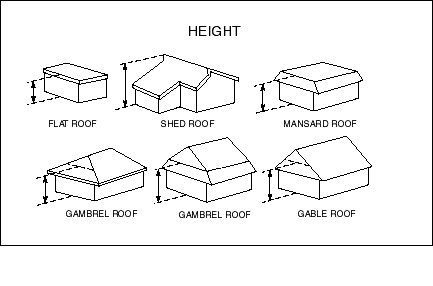
Height, Maximum: For structures located in the R1-R7 zoning districts, inclusive, the vertical distance measured from grade to the highest point of a roof; in the RO, B4-4, B4-5, B4-6 and B5 zoning districts, the vertical distance measured from grade to the top of the coping or parapet on buildings with a flat or nearly flat roof, to the eave of buildings with a peaked roof, or to the deck line of buildings with a mansard roof; and in all other zoning districts, the vertical distance of a building measured from grade to the highest point of the coping of a flat roof or the deck line of a mansard roof or to the mean level between the eaves of the ridge of a gable, hip or gambrel roof, or to the highest point of a shed roof; provided that antenna towers with a maximum height of 60 feet and antenna tower structures (including mast and antenna) having an overall height of not more than 70 feet; and aesthetic design features (including dormer windows), equipment penthouses, steeples, chimneys, or similar features, or other towers shall not be counted in measuring the height of buildings.
Heliport: "Heliport" shall include "Helipads" and "Helistops" and shall mean an area on land or upon a structure set aside and used for the landing and takeoff of rotary wing aircraft.
Hid Lamp: High Intensity Discharge Lamp. Included groups are High Pressure Sodium, Mercury Vapor, and Metal Halide.
High Density Residential District (RM2): See "Zoning Districts".
High Density Residential/Office District (RO): See "Zoning Districts".
Highway Commercial District (B3): See "Zoning Districts".
High-Quality Aquatic Resources (HQAR): Waters of the United States or Isolated Waters of Lake County that are determined to be critical due to their uniqueness, scarcity, function and/or value as defined in the Lake County Watershed Development Ordinance. The following are descriptions of high-quality aquatic resources:
1.
Advanced Identification (ADID) sites: Aquatic sites that have been identified by the U.S. Army Corps of Engineers, Chicago District and U.S. Environmental Protection Agency (U.S. Environmental Protection Agency, 1992, Advanced Identification (ADID) Study, Lake County, Illinois, Chicago, Illinois) or latest ADID study.
2.
Bog: A low nutrient peatland, usually in a glacial depression, that is acidic in the surface stratum and often dominated at least in part by the genus Sphagnum.
3.
Ephemeral Pool: A seasonally inundated depression, within a forested wetland or upland community, usually located on a moraine, glacial outwash plain, or in an area shallow to bedrock; also known locally as a "vernal pool." These areas may not be permanently vegetated.
4.
Fen: A peatland, herbaceous (including calcareous floating mats) or wooded, with calcareous groundwater flow.
5.
High Quality Forested Wetland: A forested wetland dominated by native woody vegetation by at least one of the following species or genera: Carya spp., Cephalanthus occidentalis, Cornus alternifolia, Fraxinus nigra, Juglans cinerea, and Quercus spp.
6.
Sedge Meadow: A wetland dominated by at least one of the following genera: Carex, Calamagrostis, Cladium, Deschampsia, Rhynchospora, Scleria, or Eriophorum.
7.
Seep: A wetland, herbaceous or wooded, with saturated soil or inundation resulting from the diffuse flow of groundwater to the surface stratum.
8.
Streams shown on the most recent USGS quadrangle map as a perennial (solid blue line) or intermittent (dashed blue line) that are not determined to be a Water of the U.S. If a site specific Index of Biological Integrity (IBI) assessment is lower than 35, this stream reach shall not be considered a HQAR.
9.
Streamside March: An Isolated Waters or Lake County wetland that is within a 10-year riverine floodplain and dominated by herbaceous species.
10.
Wet Prairie: A wetland dominated by native graminoid species with a diverse indigenous forb component that is seasonally saturated and/or temporarily inundated.
11.
Wetland supporting Federal or Illinois endangered or threatened species: For current state-listed species, reference Illinois Endangered Species Protection Board's "Checklist of Endangered and Threatened Animals and Plants of Illinois" and/or contact the Illinois Department of Natural Resources. For Federally-listed species, reference the U.S. Fish and Wildlife Service's "Endangered and Threatened Wildlife and Plants" list (latest edition) and/or contact the U.S. Fish and Wildlife Service.
12.
Wetlands with a Floristic Quality Index of 20 or greater or a mean C-value of 3.5 or greater: Reference Plants of the Chicago Region (F. Swink and G. Wilhelm, 4 th edition, Indianapolis: Indiana Academy of Science, 1994).
13.
Wetlands that are within a designated Illinois Natural Areas Inventory Site (INAI).
Highwood/Highland Park Intergovernmental Planning Agreement of 1996: The Intergovernmental Agreement dated the 27th day of September 1996 and adopted by the City of Highwood pursuant to Ordinance 96-0-24 and by the City of Highland Park pursuant to Ordinance No. 51-96, as same may be amended from time to time.
Historic Structure: A "Historic Structure" is any structure that is:
a.
Listed individually in the National Register of Historic Places or preliminarily determined by the Secretary of the Interior as meeting the requirements for individual listing on the National Register;
b.
Certified or preliminarily determined by the Secretary of the Interior as contributing to the historic district or a district preliminarily determined by the Secretary to qualify as a registered historic district;
c.
Individually listed on the State inventory of historic places by the Illinois Historic Preservation Agency; or
d.
Individually listed on a local inventory of historic places that has been certified by the Illinois Historic Preservation Agency.
Home Occupation: An accessory use of a service character customarily conducted within a dwelling by the residents thereof, which is clearly secondary to the residential use of the dwelling for living purposes, which does not change the character thereof; and which is conducted in compliance with the applicable regulations of this Code.
Hospice: A facility in which care for terminally ill patients is provided.
Hospital: Any institution, place, structure, or agency, public or private, whether organized for profit or not, licensed by the State of Illinois, devoted primarily to the maintenance and operation of facilities for the diagnosis and treatment and medical care of humans having illness, disease, injury, deformity, pregnancy, or abnormal human physical condition.
Hotel or Motel means a building in which lodging is provided and offered to the public for compensation, and which is open to transient guests. A "hotel" does not include a "boarding house," a "lodging house," or a "short-term rental," as such terms are defined in this Section.
House Trailers: See "Mobile Homes".
Housing Expenses: (1) For rental housing - rent and utilities; (2) for home ownership - principal, interest, property taxes, condominium or homeowners' association fees, if applicable, and insurance.
Hydraulically Equivalent Compensatory Storage: Compensatory storage placed between the proposed normal water elevation and the proposed 100-year flood elevation. All storage lost or displaced below the existing 10-year flood elevation is replaced below the proposed 10-year flood elevation. All storage lost or displaced above the existing 10-year flood elevation is replaced above the proposed 10-year flood elevation.
Hydric Soil: A soil that is saturated, flooded, or ponded long enough during the growing season to develop an anaerobic conditions in the upper part.
Hydrologic and Hydraulic Calculations: Engineering analyses which determine expected flood flows and flood elevations based on land characteristics and rainfall events.
Hydrologically Disturbed: An area where the land surface has been cleared, grubbed, compacted, or otherwise modified to alter stormwater runoff, volumes, rates, flow direction or inundation direction.
Hydrophytic Vegetation: Plant life growing in water, soil or on a substrate that is at least periodically deficient in oxygen as a result of excessive water content.
IDNR/OWR: Illinois Department of Water Resources, Office of Water Resources, previously known as IDOT/DWR.
I.E.S.: Illuminating Engineering Society of North America.
Illicit Discharge: Any discharge or dumping of material into the stormwater management system or a floodprone area that is not composed entirely of storm water, except for discharges allowed under NPDES Permit No. ILR40 Part I.B.2.
Illinois Urban Manual: The Natural Resources Conservation Service Illinois Urban Manual, a technical manual designed for urban ecosystem protection and enhancement. This manual contains design guidance for a development site to meet the Watershed Development Ordinance performance standards for soil erosion and sediment control.
Impact Vibration: Vibrations occurring in discrete pulses separated by an interval of at least one (1) minute and numbering no more than eight (8) per twenty-four (24) hour period.
Impervious Surface: Any hard-surfaced, man-made area that does not readily absorb or retain water, including but not limited to building roofs, parking and driveway areas, graveled areas, sidewalks and paved recreation areas.
Impervious Surface Ratio: That part of the surface of any lot occupied by buildings, structures, and/or other impervious surfaces, including but not limited to sidewalks, driveways, accessory buildings or other structures, divided by the area of the lot.
Industrial: See "Manufacturing".
Industrial District: See "Light Industrial District".
In-Kind Replacement (Culvert): An in-kind culvert replacement has an equivalent cross-sectional area, shape, roughness coefficient, and inlet and outlet elevations; or the replacement may be shown to have an equivalent hydraulic capacity using appropriate engineering calculations.
Inspect: To visit, or to review plans, or to oversee a site visit or plan review per generally accepted engineering practice.
Interested Party: See "Party of Record or Interested Party".
Intermediate or Long-Term Care Facility: A facility which is equipped to provide medical care and programs to meet the needs of persons who are disabled, infirm, or of advanced age, in a residential setting, for as long as necessary.
Isolated Waters of Lake County: All waters such as lakes, ponds, streams (including intermittent streams), farmed wetlands, and wetlands that are not under U.S. Army Corps of Engineers jurisdiction. The limits of the Isolated Waters of Lake County extend to the ordinary high water mark of the delineated wetland boundary.
A.
The following are excluded from Isolated Waters of Lake County:
1.
Excavations and impoundments that have received a permit from the appropriate jurisdictional authority;
2.
Excavations and impoundments permitted by right, prior to being a regulated activity, within 40 percent or more non-hydric soils. Areas designated as "water" as depicted on the Soil Survey of Lake County, SCS, 1970 are determined as either hydric or non-hydric soils by connecting adjoining soil boundaries to create complete polygons of the depicted soil type; and
3.
Roadside ditches.
B.
The following shall not be considered as meeting the exclusion criteria in A. above:
1.
All areas meeting the definition of High Quality Aquatic Resources;
2.
Wetland mitigation areas created to meet the requirements of Article XVIII of this Chapter or of Section 404 of the Clean Water Act; and
3.
Wetland areas created or restored using public funds.
Kennel: Any lot or premises or portion thereof on which more than four (4) dogs over four (4) months of age are kept, or where more than four (4) cats or other domestic animals are kept, or where any dog or other domestic animals are boarded for compensation.
Laboratory: A place devoted to experimental study such as testing and analysis. Manufacturing, assembly or packaging of products is not included within this definition.
Lake: A natural or artificial body of water encompassing an area of two (2) or more acres which retains water throughout the year.
Lake County Watershed Development Ordinance: The Watershed Development Ordinance of Lake County, originally effective on October 18, 1992, as amended from time to time.
Laundry or Dry-Cleaning Facility: A business equipped with machines for the washing, drying, and dry-cleaning of clothes.
Legal Description: The description of real property established by law and created in specific cases from real property surveys drawn by licensed land surveyors.
Legal Lot of Record: A lot or tract of land that meets each of the following requirements:
1.
The lot or tract of land is either (a) part of a subdivision, the plat of which has been recorded in the Office of the Lake County Recorder of Deeds, or (b) a parcel of land separately described in a recorded deed; and
2.
The lot or tract of land was created by either (a) a plat of subdivision, or (b) a deed recorded prior to May 8, 1960; and
3.
The lot or tract of land, at the time it was created, complied with all applicable ordinances and regulations; and
4.
The lot or tract of land was not created by the sale or transfer of property that resulted in either (a) the creation of a lot or tract of land that did not comply with the lot area, depth, and width regulations applicable at the time of such sale or transfer; or (b) the increase in the degree of nonconformity of any existing nonconforming lot or tract of land; and
5.
If the lot or tract of land does not comply with the requirements for lot area, then it must have remained in separate and individual ownership from adjoining lots or tracts of land continuously at all times since May 8, 1960. For purposes of this requirement, a lot or tract of land shall be deemed to have been owned separately and individually from adjoining lots and tracts of land since May 8, 1960, so long as the owner of such lot or tract of land did not, directly or indirectly, have legal title to or enjoy beneficial interest in the lots or tracts of land contiguous to such lot or tract of land at any time after that date.
Legal Non-Conforming: A use or structure which does not comply in some respect with the currently effective regulations in this Chapter but which was lawfully established and did so comply in all respects when established and with respect to which the amortization period has not expired or for which there is no amortization period. See also "Non-Conforming Structure".
Letter of Map Amendment or LOMA: The official determination by FEMA that a specific structure is not in a Special Flood Hazard Area; amends the effective Flood Hazard Boundary Map (FHBM) or Flood Insurance Rate Map (FIRM).
Letter of Map Revision or LOMR: The letter issued by FEMA or IDNR/OWR that revises base flood elevations, flood insurance rate zones, flood boundaries or Regulatory Floodways as shown on an effective FHBM or FIRM.
Licensed Intermediate Care Facility: An institution which (1) is licensed under Illinois State law to provide, on a regular basis, health-related care and services to individuals who do not require the degree of care and treatment which a Hospital or Skilled Nursing Facility is designed to provide, but who because of their mental or physical condition require care and services (above the level of room and board) which can be made available to them only through institutional facilities, (2) meets such standards prescribed by the Secretary of the United States Department of Health & Human Services as he finds appropriate for the proper provision of such care, (3) meets such standards of safety and sanitation as are established under regulation of the Secretary in addition to those applicable to nursing homes under Illinois State law, and (4) meets the requirement of Section 1395x(j)(14) of Title 42 of the United States Code with respect to protection of patients' personal funds.
Light Industrial District (I): See "Zoning Districts"
Light Pollution: Any adverse effect of artificial light including, but not limited to, glare, light trespass, sky glow, energy waste, compromised safety and security, and impacts on the nocturnal environment.
Light Trespass: Light that falls beyond the property it is intended to illuminate.
Limited Access Area: "Limited Access Area" has the meaning set forth in 68 Ill. Admin. Code 1290.10, as may be amended.
Loading and Unloading Space or Berth, Off-Street: An open, paved area of land other than a street or a public way, the principal use of which is for the standing, loading and unloading of motor vehicles, trucks, tractors and trailers.
Lodging House means a building or place other than a hotel, motel, short-term rental of a dwelling unit, or boarding house, where lodging (but not meals) is provided for compensation by prearrangement for a definite period to five or more, but not exceeding 12, individuals.
Lot-In-Depth: A lot of record, most of which is adjacent to and located behind another lot of record and which derives its only access to a public street by a stem. See Illustration.
Lot-In-Depth Yard: Any yard required and within a lot-in-depth and located adjacent to abutting lot lines.
Lot for Purpose of Planned Unit Development: A portion of platted land measured, set apart and subdivided as a distinct parcel, to be used in accordance with this Chapter, with such required open space and with its principal frontage upon a street or public place and created and delineated upon a plat of subdivision or resubdivision approved by the City Council and so recorded by the Recorder of Deeds of Lake County, Illinois.
Lot Area: The total land and water area of a lot, excluding any streets.
Lot Area per Dwelling Unit: That portion of a lot allocated for each dwelling unit located on such lot.
Lot, Corner: A lot situated at the junction of and abutting on two (2) or more intersecting streets; or a lot at the point of deflection in alignment of a single street, the interior angle of which is one hundred thirty five (135) degrees or less. On a corner lot all lot lines adjacent to a street shall be deemed front lot lines.
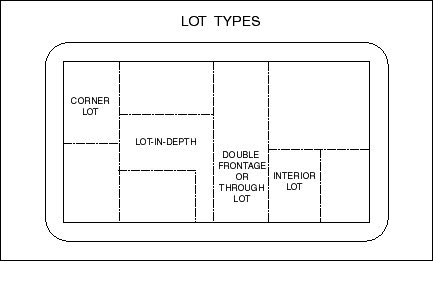
Lot Coverage: The area of a lot that is covered by principal and/or accessory buildings.
Lot Depth: The average distance between the front lot line and the rear lot line. In the case of a corner lot, the lot depth is the greater of the two distances between the front lot lines and the respective lot line opposite each. For a lot-in-depth, lot depth shall be the average distance between the front lot line and the lot line opposite and most parallel to the front lot line.
Lot, Double Frontage (Through Lot): A lot having frontage on two parallel or approximately parallel streets, and which is not a corner lot. On a through lot both street lines shall be deemed front lot lines.
Lot, Interior: A lot other than a corner lot.
Lot Line: A line on the perimeter of any lot. See "Front Lot Line", "Rear Lot Line" or Side Lot Line".
Lot, Through: See "Lot, Double Frontage (Through Lot)".
Lot Width: Measured parallel to the street adjacent to the front lot line, the distance between the side lot lines most perpendicular to the front lot line measured at the mid-point of the lot depth. When a lot has more than one front lot line, the required lot width shall be measured parallel to the shortest front lot line.
Low Density Residential District (R3): See "Zoning Districts."
Low-Frequency Sound: Sound with frequencies below 100 hertz (Hz), including audible sound and sound at a frequency below that of human hearing (i.e. infrasound).
Low Impact Development: Techniques that aim to mimic natural hydrology and processes by using small scale, decentralized practices that infiltrate, evaporate and transpire rainwater in order to help maintain, to the greatest extent possible, a natural landscape. Such techniques include, without limitation: low-impact roadways, permeable pavement, bio-retention, rain gardens, and vegetated swales.
Low Income Households: Households that have incomes that do not exceed 80 percent of the area median income.
Low Opening Elevation: The elevation at which water could enter a structure through any non-watertight opening such as a doorway threshold, a window sill, or a basement window well.
Lowest Adjacent Grade: The lowest finished grade adjacent to a structure, not including the bottom of window wells.
Lowest Floor: Lowest floor of the lowest enclosed area, including basement.
Low-to-Moderate Density Residential District (R4): See "Zoning Districts".
Lumen: The unit used to quantify the amount of light energy produced by a lamp. The lumen output of most lamps is provided on the packaging.
Luminaire: A complete lighting unit (fixture), consisting of a lamp, or lamps and ballast(s) (when applicable), together with the parts designed to distribute the light (reflector, lens, diffuser), to position and protect the lamps, and to connect the lamps to the power supply.
Manufacturing: The production, making, molding or processing of products or materials or commodities from raw and unfinished materials or from finished materials or products for general consumption of the public or for sale to specialized institutions or organizations.
Market Rate Units: Residential dwelling units that are not required to be affordable housing units under the requirements of this Code.
Marquee: A permanent shelter which projects from the wall of a building without ground support and which may be of a roof-like nature.
Massage Therapist: Any person certified by the National Certification Board for Therapeutic Massage and Bodywork (NCBTMB) to engage in the practice of massage therapy.
Massage Therapy: Any method of pressure on, friction against, or stroking, kneading, rubbing, tapping, pounding, bathing, touching, binding, painting, irritating, or stimulation of external soft parts of the body with hands or with the aid of any manual, mechanical, or electrical apparatus or appliance, with our without such supplementary aids as rubbing alcohol, liniments, antiseptic oils, power, creams, lotions, soaps, ointments, or other similar preparations commonly used in this practice, performed by a massage therapist.
Massage Therapy Clinic: Any establishment having its place of business where any person engages in or carries on, or permits to be engaged in or carried on, massage therapy.
Master Plan: The Official Highland Park Comprehensive Master Plan of 1976, as amended.
Master Site Plan: A document which is derived from a specific framework plan and reviewed in conjunction with any petition to rezone land to the HC (Health Care) Zoning District and approved by the Plan and Design Commission and City Council subsequent to a public hearing, which describes the future development or redevelopment of a site, using graphics to depict land use as well as text that is explanatory thereof and the locations of building envelopes on the site.
Maximum Uniformity Ratio: A measurement of the maximum light level in relation to the lowest light level within a given area.
Medical Laboratory: A facility which meets State of Illinois health and safety standards and is equipped and used for the observation, analysis, evaluation and documentation of conditions of organisms, cells, tissues, organs, specimens, diseases, etc.
Medical Cannabis Infused Product has the meaning set forth in the Compassionate Use of Medical Cannabis Program Act.
Medical Office: A facility used for offices of one or more physicians, dentists, clinical psychologists, nurse-practitioners, and similar medical or chiropractic professionals, for the examination and treatment of patients, in which one or more medical professionals may be associated together or practicing independently of each other. Medical offices may include apothecaries, dental and medical laboratories, naprapathy, X-ray and/or other facilities, but do not include inpatient facilities devoted primarily to major surgical procedures or accommodations for the overnight stay of patients.
Medium Density Residential District (R6): See "Zoning Districts"
Medium to High Density Multiple Family Residential Zoning District (RMLA): See "Zoning Districts"
Medium-to-High Density Residential District (RM1): See "Zoning Districts"
Meeting and Events Venue means a facility with space that is available for rent for use for specific banquets, exhibitions, events, and/or meetings, which may include the provision of food, drink, and/or entertainment.
Mezzanine: A low ceilinged area between two (2) main stories of a structure, containing no more than one-third (⅓) of the floor area of either the floor directly above or below.
Minimum Landscaped Open Space: The percentage of lot area which must be maintained in grass or other living vegetation.
Mini-Warehouse or Self-Storage Facility: Any real property designed and used for the purpose of renting or leasing individual storage space to occupants who are to have access to such for the purpose of storing and removing personal property. A mini-warehouse and/or self-service storage facility is not a warehouse for the purpose of Article 7 of the Uniform Commercial Code.
Mitigation: Measures taken to eliminate or minimize damage from development activities, such as construction in wetlands or Regulatory Floodplain filling, by replacement of the resource.
Mobile Home: A movable or portable unit which is eight body feet or more in width and 32 body feet or more in length, which is constructed to be towed on its own chassis (comprised of frame and wheels) from the place of construction to the location or subsequent locations, and designed to be used without a permanent foundation and connected to utilities for year-round occupancy with or without a permanent foundation. The term includes any trailer, as defined herein, used for residential purposes, but not including sports or camping trailers. The term also references manufactured homes constructed after June 30, 1976, in accordance with the National Manufactured Housing Construction and Safety Standards Act of 1974, 42 U.S.C. § 5401 et seq.
Moderate Density Residential District (R5): See "Zoning Districts"
Moderate Income Households: Households that have incomes that do not exceed 120 percent of the area median income, or such higher income limit as may be established for a local, county, state, or federal housing program.
Motion Picture: A sequence of photographs or drawings on photographic film or video tape projected on a screen in such rapid succession so that an optical illusion (because of the persistence of vision) of moving persons and objects is created.
Motor Freight Terminal: A building or area in which freight brought by motor truck is received, assembled or stored and dispatched for routing by motor truck. Motor freight terminals may also include motor truck storage.
Motor Vehicle: Every device in, upon or by which any person or property is or may be transported or drawn upon a highway, except devices moved by human power and devices used exclusively upon stationary rails or tracks, and snowmobiles as defined in the Illinois Vehicle Code. For the purposes of this Chapter, unless otherwise prescribed, a device shall be considered to be a vehicle until such time as it either comes within the definition of a "junk vehicle" under the Illinois Vehicle Code, or a junking certificate is issued for it. For the purposes of the Illinois Vehicle Code and this Code, vehicles are classified into two divisions:
1.
First Division: Those motor vehicles which are designed for the carrying of not more than ten (10) persons; and
2.
Second Division: Those vehicles which are designed for carrying more than ten (10) persons, those designed or used for living quarters and those vehicles which are designed for pulling or carrying property, freight or cargo, those motor vehicles of the First Division remodeled for use and used as motor vehicles of the Second Division, and those motor vehicles of the First Division used and registered as school buses.
Motor Vehicle Laundry: A use auxiliary to gasoline and diesel fuel stations, housed in a structure and capable of being utilized for the washing of motor vehicles whether by hand or by automation, where no motor vehicle conveyor or drive-through facility is incorporated into the process and where no more than two (2) vehicles are able to be washed on the premises at any given time.
Motor Vehicle and Trailer Sales Area: An open area, other than a street, used for the display or sale of new or used motor vehicles or trailers other than mobile homes and house trailers, and where no repair work is done except for minor motor vehicle repair and repair of trailers to be displayed and sold on the premises.
Motor Vehicle Repair, Major: Engine rebuilding or major reconditioning of worn or damaged motor vehicles or trailers; collision service, including body, frame or fender straightening or repair, and painting of vehicles.
Motor Vehicle Repair, Minor: Incidental repair and/or replacement of parts and motor service to motor vehicles, including motor vehicle detailing but not including any operation specified under "Motor Vehicle Repair, Major".
Motor Vehicle Sales Showroom, Indoor: A building used for the sale and purchase of new and used motor vehicles, on a lot that is not used in any way for: (i) the, display, or storage of motor vehicle inventory outside of any building; or (ii) motor vehicle repair.
Motor Vehicle Stacking Space: The space required for the number of motor vehicles that must be accommodated in an on-site holding or reservoir space of a business or service facility while the operators of such motor vehicles await ingress to the specified business or service provided by such facility.
Motor Vehicle Washing Facility/Automobile Washing Facility: A use housed in a building, other than a Motor Vehicle Laundry, comprising the washing of automobiles and/or other motor vehicles, which may utilize such mechanical devices as a vehicle conveyor, hot air blowers, steam cleaners, and wax applicators — all located upon a single lot of record.
Multiple Family Residential District: The RM1, RM1A RM2, and RO Districts.
Multiple-Family Residential Structure: A building or portion thereof, designed or altered for occupancy by more than one (1) family, each family living independently of the other in separate dwelling units.
Nameplate Wattage: The amount of energy produced from a Wind Energy System at maximum or optimum wind speeds within one hour, as indicated by the manufacturer.
Nano-Brewery: A commercial facility at which less than 155,000 gallons of beer are produced each calendar year, with or without an accessory Tasting Shop, and at which food items are available for purchase and consumption on the premises.
Nano-Distillery: A commercial facility at which less than 5,000 gallons of alcoholic spirits are distilled each calendar year, with or without an accessory Tasting Shop, and at which food items are available for purchase and consumption on the premises.
Nano-Meadery: A commercial facility at which less than 50,000 gallons of mead are produced each calendar year, with or without an accessory Tasting Shop, and at which food items are available for purchase and consumption on the premises.
Nano-Winery: A commercial facility at which less than 50,000 gallons of wine are produced each calendar year, with or without an accessory Tasting Shop, and at which food items are available for purchase and consumption on the premises.
Natural Drainageway: A channel formed by the existing surface topography of the earth prior to changes made by the intervention of man.
Natural Landscape: Landscape designed to evoke the character of nature with plants arranged similarly to their arrangement in nature.
Natural Vegetation: Plant materials which are indigenous to the area and exist on a site prior to any construction or earth moving activity.
Neighborhood Commercial District: See "Zoning Districts".
Natural: When used in reference to streams and channels means those streams and channels formed by the existing surface topography of the earth prior to changes made by man. A modified stream or channel which has regained natural characteristics over time as it meanders and reestablishes vegetation may be considered natural.
Negative Space: The open space surrounding the copy area of a sign.
60% Negative Space on a Sign
Neighborhood Frontage: See Sec. 150.2310.
New Motor Vehicle: A Motor Vehicle weighing less than three tons that has not been previously sold to any person except a Motor Vehicle distributor or dealer.
NGVD: National Geodetic Vertical Datum of 1929.
Nighttime Hours: The time between 9:00 p.m. on one calendar day and 7:30 a.m. on the next calendar day.
Non-Conforming Sign: A Sign governed by the provisions of this Chapter that, after September 12, 2005, the date of adoption of the comprehensive amendment of Chapter 150 of this Code, is in violation of any of the laws of the City governing the erection, construction, or maintenance of Signs.
Non-Conforming Structure: Any building or structure which existed lawfully at the time of the adoption of the "Highland Park Zoning Ordinance of 1978", or any subsequent amendment thereto:
a.
All or substantially all of which is designed or intended for a use not permitted in the zoning district in which it is located; or
b.
Which does not comply with the area, bulk, density, yard, or setback requirements for the zoning district in which it is located.
Non-Conforming Use: Any use of land or structures which existed lawfully at the time of the adoption of the Highland Park Zoning Ordinance of 1978, or amendment thereto, which does not comply with the use regulations of the district in which it is located.
Non-Conformity, Date of: The date at which a use or structure, which complied with the applicable zoning regulations at the time of its initiation, was subsequently made non-conforming by the passage of a new zoning ordinance or an amendment to an existing zoning ordinance.
Nonparticipating Property: A property that is not owned by the Owner of the property on which a WES is proposed or installed.
Non-Permit Sign: A Sign that does not require a permit or fee pursuant to this Chapter.
Non-Riverine Regulatory Floodplain: Regulatory floodplains not associated with streams, creeks or rivers, such as isolated depressional storage areas or lakes.
Non-Shielded Fixture: A fixture constructed in such a manner that either the lamp or more than 50 percent of the light emitting portion of the fixture is visible when viewed from the property line.
Noxious Matter: Material which is capable of causing injury to living organisms by chemical reaction or is capable of causing detrimental effect upon the psychological, social, or economic wellbeing of human beings.
Nursing Home Care Facility: An institution, including main and auxiliary buildings thereof, whether operated for profit or not, which provides, through its ownership or management, personal care or nursing for three (3) or more persons, not related to the applicant or owner by blood or marriage and includes any "Skilled Nursing Facility", any "Intermediate Care Facility" and any "Sheltered Care Facility" (any of which may provide for on-site room and board for staff of said facility) but does not include the following: (1) an institution, or other place operated by the federal government or agency thereof, or by the State of Illinois; (2) a hospital, sanitarium, or other institution whose principal activity or business is the diagnosis, care, and treatment of human illness through the maintenance and operation as organized facilities therefor; (3) any "Child Care Facility"; (4) any "Community Living Facility"; and/or (5) any "Community Residential Alternative."
Occupancy Certificate: A certificate issued by the Zoning Administrator stating that the occupancy and use of land or a building or structure referred to therein complies with the provisions of this Code.
Occupied: Used, inhabited or kept for use.
Odor Threshold: The concentration of odorous matter in the atmosphere necessary to be perceptible to the olfactory nerve of normal persons.
Off-Street Parking: Paved parking spaces located in an area other than a street or public right-of-way and limited in use to vehicles not exceeding a net weight of three (3) tons and parked for continuous periods of less than forty-eight (48) hours.
Off-Street Parking Space: An off-street parking area meeting the requirements of this Chapter for the temporary parking of a single vehicle.
On-Stream Detention: Any detention facility that has off-site tributary drainage area.
Open Space: Any real estate which is open to the sky and unobstructed except for natural features.
Open Space, Common: Part of a parcel which is open and unobstructed, including natural features and permitted accessory uses and structures, and which is accessible and usable by all persons who occupy a principal use on that parcel.
Open Space, Public: Any publicly-owned open space including but not limited to the following: parks, playgrounds, forest preserves, beaches, waterways, parkways, trails, paths, streets and alleys.
Open Space, Usable: Open space which has slopes of less than ten (10) percent, has all dimensions a minimum of twenty (20) feet, is located not less than twenty (20) feet from any residential wall containing a window, and is easily accessible by all residents occupying the same parcel or related parcels.
Open Storage Yard: An area of real estate whereon goods, materials, and other chattels are stored in the open as opposed to being stored in buildings or structures.
Open Waters: Permanently inundated Isolated Waters of Lake County that are greater than three feet in depth below the normal water level or normal pool elevation.
Operable Condition: For any WES or solar energy system, the condition of being capable of operating at full capacity while meeting all sound, shadow flicker and other applicable conditions set forth in this Chapter.
Order: See "Final Order".
Ordinary High Water Mark: The point on the bank or shore at which the presence and movement of surface waters are continuous so as to leave a distinctive mark, such as by erosion, destruction or prevention of terrestrial vegetation, predominance of aquatic vegetation, or other such recognized characteristics.
Ornamental Tree: A Tree that is Deciduous Tree, typically smaller at maturity than a Shade Tree, planted primarily for its beauty of its foliage or flowers, or for screening purposes.
Outdoor Recreation Facility: Includes all outdoor recreation uses listed in the Zoning Code except those located on a lot with or directly associated with a residential use.
Outpatient Treatment Center: A facility which provides medical treatment including surgery for patients who do not require overnight hospitalization.
Overland Flow Path: An area of land which conveys stormwater for all events up to and including the base flood event. The overland flow path can be estimated using readily available topographic information and shall take into account all on-site and off-site tributary areas in accordance with Article XVIII of this Chapter.
Overlay Zone: A mapped area within one or more zoning districts established by this Chapter which allows certain uses or imposes certain regulations different from those set forth for the underlying zoning district(s).
Owner: The holder of legal title as well as holders of any equitable interest, such as trust beneficiaries, contract purchasers, option holders, lessees under leases having an unexpired term of at least ten (10) years, and the like. Whenever a statement of ownership is required by this Code, full disclosure of all legal and equitable interests in the property is required.
Ownership Parcel: Any legally described parcel of land. This includes contiguous lots or parcels of land owned by the same property owner.
Parcel: Any quantity of land capable of being described with such definiteness that its location and boundaries may be established.
Parcel Identification Number (PIN): Permanent index number used to identify properties for tax assessment.
Parking Deck: Any structure containing automobile parking spaces, any portion of which is above grade, which structure is neither totally enveloped by nor directly below another structure.
Partially Shielded Fixture: A fixture constructed in such a manner that the lamp is not visible and no more than 50 percent of the fixture's light reflecting or transmitting portion(s) is visible when viewed from the property line.
Particulate Matter: Material which is suspended in or discharged into the atmosphere in finely divided form as a liquid or solid at atmospheric pressure and temperature.
Party of Record or Interested Party: Any person who either: (1) files an appearance or testifies during any public hearing held before the Plan and Design Commission or the Zoning Board of Appeals; or (2) owns the real property that is the subject of such hearing.
Patio: A surfaced area other than a deck which is used for sitting or passive recreation.
Pedestrian Frontage: See Sec. 150.2310.
Pedway: An enclosed or open pedestrian/wheelchair passageway connecting adjoining structures, but which for the purposes of this Chapter shall not be deemed to combine two or more structures into one structure.
Performance Entertainment Venue means a commercial land use in which the principal activity is the provision of performance entertainment in a nontheatrical setting without a theatrical stage other than a raised platform or without fixed seating. Performance entertainment venues include live music venues, venues for poetry or book club meetings, dance or disc jockey halls, comedy clubs, and other venues for non-live musical entertainment. Performance entertainment venues do not include: (i) restaurants at which entertainment is provided as an accessory or incidental use; (ii) a cultural facility in which performance entertainment is provided in a theatrical setting or with fixed seating; (iii) the use of the property of nonprofit institutions for theatrical or musical performances accessory to the nonprofit institution or by another nonprofit organization; or (iv) adult book stores, adult entertainment cabarets, adult mini motion picture theaters, adult mini video theaters, adult motion picture theaters, or adult video stores.
Performance Standard: A criterion to control noise, odor, smoke, toxic or noxious matter, vibration, fire and explosive hazards, or glare or heat generated by or inherent in uses of land or buildings.
Pergola: A structure consisting of an open roof framework that may be covered with trained climbing or trailing plants.
Permitted Use: Any use, other than a special use or conditional use as set forth in the "Table of Allowable Uses" in this Chapter.
Person: Any individual, copartnership, firm, association, joint stock company, corporation, or any combination of individuals of whatever form or character.
Personal Service Establishment: A business which provides personal services directly to customers at the site of the business, or which receives goods from or returns goods to the customer which have been treated or processed at another location. This includes, but is not limited to, travel agencies, dry-cleaning and laundry drop-off and pick-up stations, tailors, hair stylists, cosmeticians, toning or tanning salons, banks, currency exchanges, postal substations, package delivery and pick-up stations, shoe repair shops, interior design studios, dance and martial arts studios, and domestic pet services.
Personal Wireless Service and Personal Wireless Telecommunications Facility: As used in this Chapter, "Personal Wireless Service" and "Personal Wireless Telecommunications Facility" have the same definition as that contained in Title 47, United States Code, Section 332(c)(7)(C) and may include commercial wireless telecommunication services.
Petitioner: See "Applicant or Petitioner".
Pharmacy: The place of business of a State of Illinois licensed pharmacist which offers pharmaceutical services, including offering for sale or selling at retail, drugs, medicines or poisons, whether pursuant to prescriptions or orders of duly licensed physicians, dentists, veterinarians, or other persons authorized to prescribe drugs within the limits of their licenses.
Plan and Design Commission: The Plan and Design Commission of the City of Highland Park, except with respect to matters involving Fort Sheridan. In matters involving Fort Sheridan, references in this Chapter to the "Plan and Design Commission" shall be deemed to be references to the Joint Plan Commission.
Planned Development or Planned Unit Development: An area or tract of land under common ownership or control to be developed in accord with the procedures established in this Chapter as a single entity for a number of structures; the plan for which does not necessarily correspond in lot size, bulk, type of use, lot coverage, or required open space to the regulations established in the zoning district in which such land is located.
Pond: A natural or artificial body of water of less than two (2) acres which retains water year round.
Porch: A roofed-over structure, projecting out from the wall or walls of a main structure and commonly open to the weather in part.
Portico: A canopy or roof structure used as an entrance to a building.
Principal Frontage: That boundary of a lot adjacent to a street. In the case of a lot-in-depth "principal frontage" shall be the boundary of the stem parallel to and abutting a street.
Principal Structure or Use: The main or primary structure or use on a parcel of land as distinguished from a secondary or accessory use. The uses allowed in various districts in Article IV of this Chapter are principal uses.
Protected Tree: Any Tree having a diameter of eight inches (8") DBH or larger or having an Aggregate Diameter of fifteen inches (15") DBH or larger.
Public Bodies of Water: All open public rivers, streams, and lakes specifically designated as such by IDNR/OWR in Appendix F of Article XVIII of this Chapter that are capable of being navigated by water craft, in whole or in part, for commercial uses and purposes, or which in their natural condition were capable of being improved and made navigable, or that are connected with or discharged their waters into navigable lakes or rivers within, or upon, the borders of the State of Illinois, together with all bayous, sloughs, backwaters, and lakes that are open to the main channel or body of water and directly accessible thereto.
Public Flood Control Project: A flood control project within a deed or plat restricted area which will be operated and maintained by a public agency to reduce flood damages to existing buildings or structures. A land stewardship not-for-profit corporation, or similar entity, may also own, operate or maintain a public flood control project. In this circumstance, there shall also be an executed agreement with a public agency to take over ownership, operation or maintenance if the corporation dissolves or fails to meet the operation and maintenance requirements for the project area. The project shall include a hydrologic and hydraulic study of the existing and proposed conditions of the watershed area affected by the project. Nothing in this definition shall preclude the design, engineering, construction or financing, in whole or in part, of a flood control project by persons or parties who are not public agencies.
Public Utility Infrastructure Facilities: Any City-owned, -operated, or -approved ground-level or pole-mounted equipment that is specifically provided in connection with any public utility provided by or within the City, including, without limitation, public water or sewer service. Such facilities may, but are not required to, include fiber-optic and/or wireless telecommunications capabilities.
Public utility infrastructure facilities: any city-owned, -operated, or -approved ground-level or pole-mounted equipment that is specifically provided in connection with any public services provided by the city or another unit of state or local government, including, without limitation, public water or sewer service. Such facilities may, but are not required to, include fiber-optic and/or wireless telecommunications capabilities.
Public Meeting: A meeting conducted pursuant to the provisions of the Illinois Open Meetings Act.
Public Road Development: Any development activity which takes place in a public right-of-way or part thereof that is administered and funded, in whole or in part, by a public agency under its respective roadway jurisdiction. Rehabilitative maintenance and in-kind replacement are considered to be a public road development if located in a Regulatory Floodplain. A public road development located within a Regulatory Floodway and which has been approved by the IDOT, Division of Highways (IDOT/DOH), Bureau of Local Roads and Streets, is exempt from the hydraulic analysis requirements of Article XVIII of this Chapter. Individual recreational trail systems being constructed that are not part of another development project and railroad development projects shall be considered public road developments with respect to the requirements of this Chapter.
Public Safety Emergency Facilities: Any City owned, operated, or approved ground-level or pole-mounted equipment that is specifically provided for the purpose of notifying the general public or an emergency event or condition.
Public Safety Telecommunications Facilities: A personal wireless service or personal wireless telecommunications facility that is owned or operated by the City in connection with the provision of public safety or emergency response services. Public safety telecommunications facilities include, without limitation, antennas and dishes, with or without towers or poles.
Public Utility: Any person duly authorized to furnish to the public electricity, natural gas, steam, telephone, transportation, sewer and/or water services.
Qualifying Patient has the meaning set forth in the Compassionate Use of Medical Cannabis Program Act.
Railroad Right-of-Way: A strip of land with tracks and auxiliary facilities for track operation and a passenger station, but not including depot loading platforms, train sheds, warehouses, car shops, car yards, locomotive shops, water towers, etc.
Ravine: A deep gully or gorge worn by the flow of water to Lake Michigan and designated by the City's Ravine Topography Map, dated October 19, 2005, as may be amended.
Ravinia Commercial District (B2): See "Zoning Districts".
Rear Lot Line: The lot line of any lot opposite a front lot line thereof.
Rear Yard: Upon any lot other than a lot-in-depth, the yard adjacent to the rear lot line and maintained, except for ingress and egress drives and sidewalks traversing the same in a fashion other than parallel to the rear lot line it abuts, as open space except as otherwise provided by this Code. Rear yards are measured by a line at right angles to the rear lot line, or by the radial line in the case of a curved rear lot line. However, with respect to a corner lot, the rear yard shall be that yard, if any, which does not abut the side yard of an adjacent interior lot. Any yard so abutting the side yard of an adjacent interior lot shall be a side yard.
Reconstruction: The act of rebuilding a structure.
Record Drawings: Construction drawings revised to show significant changes made during the construction process, usually based on marked-up prints, drawings and other data furnished by the contractor to the Enforcement Officer.
Recovery Services: A transitional program and/or service which provides guidance, supervision, training, and other assistance to individuals of any age. The programs and services provided may or may not include treatment for alcoholism or substance abuse, but shall not be considered a Group Child Care Home, Community Residential Alternative, Community Living Facility, Nursing Home Care Facility, or State of Illinois Residential Extended Care Facility.
Recreation Vehicle: See "Trailer, Sports or Camping".
Registered Professional Engineer: An engineer in the State of Illinois, under the Professional Engineer Practice Act of 1989, 225 ILCS 325/1-49.
Registered Professional Land Surveyor: A land surveyor in the State of Illinois, registered and/or licensed under the Professional Land Surveyor Act of 1989, 225 ILCS 330/1-49.
Regulatory Floodplain: Regulatory Floodplains may be either riverine or non-riverine depressional areas. Floodplain boundaries shall be delineated by projecting the base flood elevation onto the best available topography. A flood prone area is a Regulatory Floodplain if it meets any on the following descriptions:
a.
Any riverine area inundated by the base flood where there is at least 640 acres of tributary drainage area;
b.
Any non-riverine area with a storage volume of 0.75 acre-foot or more when inundated by the base flood; or
c.
Any area indicated as a Special Flood Hazard Area on the FEMA Flood Insurance Rate Map and located with the best available topography to be inundated by the base flood.
Regulatory Floodway: The channel, including on-stream lakes, and that portion of the Regulatory Floodplain adjacent to a stream or channel as designated by the Illinois Department of Natural Resources, Office of Water Resources, which is needed to store and convey the existing and anticipated future 100-year frequency flood discharge with no more than a 0.1 foot increase in stage due to the loss of flood conveyance or storage, and no more than a 10 percent increase in velocities. The location of the Regulatory Floodway shall be delineated on the maps listed in Appendix B to Article XVIII of this Chapter. Where interpretation is needed to determine the exact location of the Regulatory Floodway boundary, the IDNR/OWR should be contacted for the interpretation.
Rehabilitative Maintenance (Roadway): Rehabilitative maintenance is repair and maintenance that does not increase the traffic lanes and does not involve changes to the roadway elevation.
Remove or Removal: The causing or accomplishing of the actual physical removal of a Tree, or the effective removal through damaging, poisoning, or other direct or indirect action resulting in, or likely to result in, the death of a Tree.
Renovation: Physical improvement that adds to the value of the real property. Painting, ordinary repairs, and other normal maintenance do not constitute a renovation.
Repair, Remodeling or Maintenance: Activities which do not result in any increases in the outside dimensions of a building or any changes to the dimensions of a structure.
Repetitive Loss: Flood-related damages sustained by a structure on two separate occasions during a 10-year period, for which the cost of repairs at the time of each such flood, on average, equals or exceeds 25 percent of the market value of the structure before the damage occurred.
Residential Districts: The R1, R2, R3, R4, R5, R5A, R6, R7, RM1, RM1A, RM2, and RO zoning districts as established in this Chapter.
Residential Structure: A building, not including house trailers or mobile homes, designed or used for residential occupancy, including single family residential structures and multifamily residential structures, but not including hotels, motels, boarding or lodging houses.
Respite Facility: A building or portion thereof for temporary occupancy by persons visiting or caring for persons in a hospice or hospital.
Restaurant: Any business, other than a boarding house, where food or meals are provided for compensation, for consumption on the premises, inside a building, including a cafe, cafeteria, coffee shop, dining room, lunchroom or tearoom, and including the serving of alcoholic beverages when served with and incidental to the serving of meals.
Restaurant, Brew Pub means a restaurant for which the State of Illinois has issued a "brew pub" liquor license pursuant to the Illinois Liquor Control Act of 1934, 235 ILCS 5/1-1 et seq., at which beer is brewed and served to patrons for consumption on the premises, with or without: (i) sales to patrons for consumption off the premises; or (ii) distribution of beer for retail sale at off-site locations.
Restaurant, Drive-In: A fast food or carry-out restaurant where food (including frozen desserts) may be ordered from a motor vehicle, or where a specific motor vehicle parking area is provided on the premises for the consumption of food.
Restaurant, Fast Food or Carry-Out: Any business where the principal part of the business is providing food or meals for compensation in disposable wrappers or containers for consumption within the principal building or off the premises where prepared.
Restaurant, Outdoor means a restaurant at which the majority of customer seating is located outside of the principal building.
Restoration: To re-establish the grade, slope, stability, vegetation, or drainage systems of a steep slope property by bringing the property back to its former condition prior to the adverse impact(s) caused.
Restricted Access Area: "Restricted Access Area" has the meaning set forth in 68 Ill. Admin. Code 1290.10, as may be amended.
Retail: Sale to the ultimate consumer for direct consumption and not for resale.
Retail Fulfillment Center (no motor vehicle pick-up window or pick-up queuing): A warehouse and customer pickup center used principally for the pickup by, or delivery to, consumers of retail goods purchased online or at a point of sale other than the retail fulfillment center.
Retail Fulfillment Center (with motor vehicle pick-up window or pick-up queuing): A warehouse and customer pickup center with a pick-up window or space used principally for the pickup by, or delivery to, consumers of retail goods purchased online or at a point of sale other than the retail fulfillment center, subject to the requirements set forth in 150.403(B) and 150.808(D) herein.
Retail Sales Uses Not Otherwise Regulated means any other retail sales use not otherwise identified in this Chapter, whether indoor or outdoor, except the following:
• Adult book stores, adult entertainment cabarets, adult mini motion picture theaters, adult mini video theaters, adult motion picture theaters, or adult video stores;
• Businesses at which e-cigarettes are the principal item sold at retail;
• Gambling places, as defined in Section 133.005 of this Code; and
• Pawnshops, short-term loan shops, check-cashing facilities, and payday loan facilities.
Retaining Wall: An artificial composition of wood, concrete, masonry or other material utilized in conjunction with a drainage and grading plan approved by the City Engineer of the City for the sole purpose of stabilizing soil and/or existing natural conditions.
Retention Facility: A facility designed to completely retain a specified amount of stormwater runoff without release except by means of evaporation, infiltration or pumping.
Right-of-Way: A strip of land designated for use for vehicular or pedestrian access or passage or for installation of railroad tracks, utility lines, or similar facilities.
Right-of-Way, Private: A right-of-way that has not been dedicated by prescription or otherwise to or accepted by a government agency.
Right-of-Way, Public: A right-of-way that has been dedicated by prescription or otherwise to and accepted by a government agency.
Riverine: Relating to, formed by, or resembling a stream (including creeks and rivers).
Roadside Ditches: Drainage ditches within 25-feet from the edge of the outside travel lane.
Roof-mounted Solar Energy System: A solar energy system that is fastened to or ballasted on a building roof. Roof-mounted systems are accessory to the principal use.
Run-Off: That part of precipitation which flows over the land without filtering into the soil.
Satellite Dish: Any disc which does not exceed thirty-nine (39) inches in diameter, whether flat, concave, or parabolic, which is designed to receive signals from satellites or other sources, or to transmit such signals to a receiving station. A satellite dish shall be considered an accessory structure and use for the purposes of this Chapter.
School: See "Educational Institution".
Screening: A structure erected or vegetation planted to conceal an area from view.
Sedimentation: The processes that deposit soils, debris, and other materials either on other ground surfaces or in bodies of water or watercourses.
Self-Service Storage Facility: See "Mini-Warehouse".
Service Station: See "Gasoline and/or Diesel Fuel Station".
Service Use: Use devoted to repair, maintenance, administration, teaching, or enhancement.
Setback: The minimum horizontal distance between the street line and the nearest wall of a building facing such street line, or edge of the area of operation of a principal use when no building or structure is involved.
Sexual or Genital Area: Such area of any person's body that includes the genitals, pubic area, anus, or perineum of any person, or the vulva or breasts of a female.
Shade Tree: A Tree, usually Deciduous, that normally grows with one main trunk and has a canopy that screens and filters the sun in the summer and winter, respectively.
Shadow Flicker: The on-and-off strobe light effect caused by the shadow of moving blades cast by the sun upon a turbine's blades.
Sheltered Care Facility: A facility which:
1.
Provides food, shelter and laundry services;
2.
Provides assistance with meals, dressing, movement, bathing, or other personal needs, or general supervision and oversight of the physical and mental well-being of an individual, exclusive of nursing, who because of age or physical disability is incapable of maintaining a private, independent residence, or who is incapable of managing his person, whether or not a guardian has been appointed;
3.
Is licensed pursuant to Illinois law;
4.
Files attested or audited financial statements, and a statement of ownership with the Illinois Department of Public Health;
5.
Maintains written policies for resident care, medical services, group and individual activities, maintenance and housekeeping; and
6.
Maintains a medical record and a personal property record for each resident.
Short-Term Rental means the accessory use of a dwelling unit for overnight accommodation that is available for rent by transient guests for a period shorter than 30 consecutive days. The term "short-term rental" does not include either: (i) "boarding houses," "hotels," "Timeshare-Related Uses," or "lodging houses," as defined in this Section; or (ii) the rental of a dwelling unit pursuant to a rental agreement executed in conjunction with a contract to sell the dwelling unit.
Shrub: A woody Deciduous or Evergreen plant, smaller than a Tree, consisting of several small stems from the ground or small branches near the ground.
Side Lot Line: The lot line of any lot between a front line and a rear line thereof unless such line lies opposite a front lot line, in which case such line shall be a rear lot line.
Sideyard: Upon any lot other than a lot-in-depth, that yard located adjacent to a side lot line and maintained, except for ingress and egress drives and sidewalks, as open space. Side yards are measured by a line at right angles to the side lot line, or by the radial line in the case of curved side lot line. In addition, a sideyard shall not include area located in a front and/or rear yard. However, with respect to a corner lot, any yard which abuts the side yard of an adjacent interior lot shall be a side yard and not a rear yard.
Sign: Any object, device, display, or structure, or any part thereof, including any Structural Elements, that is located outdoors or indoors, and that is used to advertise, identify, display, direct, or attract attention to an object, Person, institution, organization, business, product, service, event, or location by any means, including specifically, but without limitation, words, letters, figures, designs, symbols, fixtures, colors, illumination, or projected images.
For purposes of this Chapter, all Signs are classified according to both (i) functional type and (ii) structural type as set forth in Section 150.2005 of this Chapter.
Sign Area: The entire area within a single continuous square or rectangle enclosing the extreme limits of the Sign and in no case passing through or between any adjacent elements of the Sign. However, such perimeter shall not include any Structural Elements lying outside the limits of the Sign and not forming an integral part of the display.
Sign Face: The surface of a Sign upon, against, or through which the message is displayed or illustrated.
Silhouette: The area covered by the blades and supporting structure of a WES, as viewed from the front elevation, described in square feet.
Single Family Residential District: The R1, R2, R3, R4, R5, R5A, R6, and R7 Districts.
Single Family Residential Structure: A building designed exclusively for use and occupancy by one family.
Site: A delimited area considered for a specific use which may be part of a larger area and which may vary in size from a one acre parcel of land to a one thousand two hundred (1,200) acre watershed.
Site Plan: The plan depicting the exact location on the ground upon which any building, structure, landscaping or other facility is to be located in connection with the development of any parcel of land.
Site Plan Review Team: An inter-departmental team of professional City staff members who meet on a regular basis to review development proposals for compliance with City standards as established in the Code.
Skilled Nursing Facility: An institution (or a designated part of an institution) which provides licensed, skilled nursing care and related services for patients who require medical, nursing or rehabilitative services.
Sky Glow: The brightening of the nighttime sky that results from scattering and reflection of artificial light by moisture and dust particles in the atmosphere. Sky glow is caused by light directed or reflected upwards or sideways and reduces one's ability to view the night sky.
SMC: The Lake County Stormwater Management Commission.
SMC-Approved Wetland Bank: A wetland mitigation bank approved by SMC that conforms with Appendix M of the Lake County Watershed Development Ordinance.
SMC Chief Engineer: A Registered Professional Engineer representing the Lake County Stormwater Management Commission as the Enforcement Officer of the Lake County Watershed Development Ordinance.
SMC Wetland Restoration Fund: A fund that is administered and implemented for wetland impact mitigation and approved and adopted by the SMC.
Soil: All materials above bed rock, for example, rock debris of all kinds, glacial drift, alluvium, loess, Aeolian deposits, vegetal accumulations, and soil (agricultural).
Solar Array: A solar array is a group of solar panels wired together. An array consists of multiple solar modules (solar panels).
Solar Energy System: A device or structural design feature to provide for the collection, storage and distribution of solar energy for space heating or cooling, electricity generation, or water heating.
Solar Energy System, Large-Scale: A ground-mounted solar energy system that occupies more than 40,000 square feet of surface area.
Solar Energy System, Medium-Scale: A ground-mounted solar energy system that occupies more than 1,750 but less than 40,000 square feet of surface area.
Solar Energy System, Small-Scale: A ground-mounted solar energy system that occupies 1,750 square feet of surface area or less.
Solar Panel: A device that is used to convert radiant solar energy into electrical current.
Sound Level: The A-weighted sound pressure level in decibels (or the C-weighted level if specified).
Sound Level or Decibel Meter: An instrument standardized by the American Society for Testing and Materials (ASTM) for the measurement of intensity of sound.
Special Exception: A relief from the otherwise applicable zoning restrictions of the zoning district within which the use is located for which the special exception is sought.
Special Flood Hazard Area or SFHA: Any area subject to inundation by the base flood from a river, creek, stream, or any other identified channel or pond and shown on the Regulatory Floodplain Maps as listed in Appendices A and B of Article XVIII of this Chapter.
Specialized Hospital Facility: A structure or group of structures providing one or several isolated types of outpatient and/or inpatient medical treatment or care, but which does not provide the full range of types of medical treatment or care available to a patient through the profession of medicine. Specialized hospital facilities may be equipped for obstetric, surgical, orthopedic, psychiatric, or skilled nursing services, sub-acute care, or other types of medical treatment.
Special Setback: The minimum distance between swimming pools and the nearest line of the steep slope zone.
Special Use: A use which, because of its unique characteristics cannot be properly classified in any particular zoning district or districts without consideration in each individual case of the impact of such use upon neighboring land and of the public need for that particular special use at that particular location, and which falls into one of two broad categories:
1.
A use publicly operated or traditionally affiliated with the public interest identified as a conditional use in the Table of Allowable Uses; or
2.
A use entirely private in character, but of such an unusual nature that its operation may give rise to unique problems with respect to its impact upon neighboring property or public facilities; such use may include a Planned Unit Development meeting the standards and requirements of this Chapter.
Special Use Permit: The permit issued by ordinance in accord with this Chapter.
Specified Anatomical Areas:
1.
Less than completely and opaquely covered: (a) human genitals, pubic region; (b) buttocks; and (c) female breast below a point immediately above the top of the areola; and
2.
Human male genitals in a discernibly turgid state, even if completely and opaquely covered.
Specified Sexual Activities:
1.
Human genitals in a state of sexual stimulation and arousal; or
2.
Acts of human masturbation, sexual intercourse or sodomy; or
3.
Fondling or other erotic touching of human genitals, pubic region, buttock or female breast.
Sports Court: An area designated for active recreation, such as batting cages, basketball courts, tennis courts, and ice and hockey rinks, but excluding driveways.
Sports Training School: A facility designed principally for the commercial indoor instruction of athletic activities and skills involved in the performance of team and individual sports, including, without limitation, archery, boxing, cycling, golf, martial arts, running, swimming, and tennis. "Sports Training School" does not include facilities that provide instruction in, or that offer the opportunity to train in, engage in, or practice, in any manner and for any purpose, the firing or discharge of any firearm.
Stable: A structure designed, intended, or used for the keeping of one (1) or more horses.
Stationery Store: An establishment which is not an adult book store and which deals in paper and office supplies and may also deal in books and other printed material.
Steady State Vibration: A vibration which is continuous or in discrete pulses more frequent than one hundred (100) per minute.
Steep Slope: Land comprising or adjacent to a ravine or lake bluff where the slope in ascent or descent exceeds ten (10) percent from the horizontal.
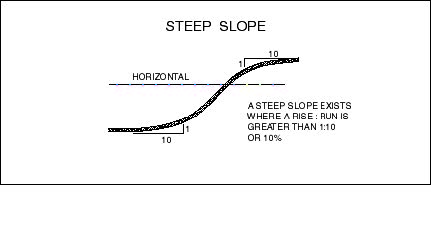
Steep Slope Zone: All land which lies between the bottom of a ravine steep slope and a line being farthest from the bottom of a ravine steep slope and ten (10) feet from the top edge of a ravine steep slope; and all land which lies between the bottom of a bluff steep slope and a line being farthest from the bottom of a bluff steep slope and forty (40) feet from the top edge of a bluff steep slope.
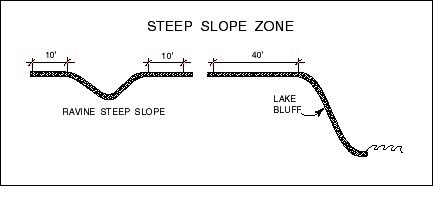
Stem: The extended portion of a lot-in-depth which provides access to a street and which is considered the principal frontage of the lot-in-depth. No portion of a stem shall be considered a yard. In the case of lots-in-depth created by subdivision approved prior to January 1, 1997, the extended portion of a lot-in-depth may consist of an easement providing access to a street.
Storage Container: Any metal structure generally used for intermodal storage and shipment.
Stormwater Management: A set of actions taken to control stormwater runoff with the objectives of providing controlled surface drainage, flood control and pollutant reduction in runoff.
Stormwater Management Commission or SMC: The Lake County Stormwater Management Commission established and existing under 55 ILCS 5/5-1062 for the purposes of developing, revising and implementing a county-wide stormwater management plan.
Stormwater Management System: The collection of natural features and man-made facilities which define the stormwater management for a development.
Story: That portion of a building included between the surface of any floor and the surface of the floor above it, or if there is no floor above then the space between the floor and the ceiling next above it.
Stream: A course of running water flowing in a channel (includes creeks and rivers).
Street: Any property dedicated or intended for public or private roadway, highway, or freeway purposes.
Street Line: A line separating a public street right-of-way from other land.
Street, Private: Any street other than a public street and other than a driveway.
Street, Public: A street that has been dedicated to and accepted by, under the jurisdiction of, or otherwise acquired by, a government agency.
Structural Alterations: See "Alterations, Structural".
Structural Engineer, Registered: A structural engineer in the State of Illinois, registered and/or licensed under the Structural Engineer Practice Act of 1989, 225 ILCS 340/1 et seq.
Structural Elements: The supports, uprights, bracing, and framework of a Sign.
Structure: Anything constructed, reconstructed, or erected or any production or piece of work man-made or composed of parts joined together in some definite manner, the use of which requires permanent or temporary location on or in the ground or requires attachment to something having a permanent location in or upon the ground, including, but not limited to: air conditioner compressor units, backstops for tennis courts, billboards, buildings, fences, parking facilities (surface and/or deck), pergolas, radio and television antennae including supporting towers, signs, stadia, and swimming pools. This definition does not include underground tanks for the storage of any type of storm water, utility lines or retaining walls.
Structure, Temporary: A structure without any foundation or footings and which is removed when the designated time period, activity or use for which the temporary structure was erected has ceased.
Studio for Art, Crafts, Ceramics, Drama, Speech and Similar Skills means facilities for the physical production and creation of various forms of art, including educational and training programs, but excluding adult book stores, adult entertainment cabarets, adult mini motion picture theaters, adult mini video theaters, adult motion picture theaters, and adult video stores.
Substantial Improvement: Any repair, reconstruction, addition or improvement of a structure, the cost of which equals or exceeds 50 percent of the market value of the pre-existing structure either a) before the improvements or repair is started, or b) if the structure has been damaged, and is being restored, before the damage occurred. This term includes structures which have incurred a repetitive loss for the purposes of this definition "substantial improvement" is considered to occur when the first alteration of any wall, ceiling, floor or other structural part of the building commences, whether or not that alteration affects the external dimensions of the structure. The term includes all cumulative improvements within the last ten years. The term does not, however, include either 1) any project for improvement of a structure to comply with existing state or local health, sanitary, or safety code specifications which are solely necessary to assure safe living conditions or 2) any alteration of a structure listed on the National Register of Historic Places or a State Inventory of Historic Places.
Sun Glint: The reflection of sunlight off of a surface of the blades, tower, or other component of the Wind Energy System.
Swale: A vegetated channel, ditch, or low-lying or depressional tract of land that is periodically inundated by conveying stormwater from one point to another.
Swimming Pool: Any temporary or permanent artificial pool or receptacle for water, the primary purpose for which is swimming and/or diving, including apparatus and equipment appurtenant thereto, installed, constructed or maintained in, on, or above ground (not including those enclosed and located entirely within a building), having a perimeter of more than twenty-five (25) feet and a depth of more than three (3) feet at any point.
Swimming Pool, Private: A swimming pool maintained by an individual in connection with a detached dwelling for the sole use of his household and guests, without charge for admission, and not for the purpose of profit or in connection with any business operated for profit, as an accessory use to a residence.
Subdivision Ordinance:Chapter 151 of the Code.
Subdivision Setback Line: A line of demarcation found on a plat of subdivision or plat of survey that establishes a minimum setback or required yard for a lot of record and, unlike a yard requirement imposed by a zoning district regulation, runs with that lot and is not subject to change by amendment to this code.
Subject Property: Real property for which rezoning, a variation, a special use, a special exception, or subdivision is sought or concerning which an appeal is taken.
Surplus Off-Street Parking Spaces: Parking spaces established on a lot that are either: (i) in excess of the number of the Off-Street Parking Spaces required pursuant to Article VIII of this Chapter for the principal and accessory uses on a lot; or (ii) otherwise required by Article VIII, but either the principal and accessory uses on the lot are seasonal in nature and are not in full operation.
Tableland: Land where the cross slope in any direction does not exceed ten (10) percent.
Tanning Facility: A room or a booth or group of rooms or booths that houses ultraviolet lamps or products containing lamps intended for the irradiation of any part of the living human body for cosmetic or nonmedical related purposes but does not include any hotel or motel guest rooms where sunlamps are installed in the restroom area.
Tasting Shops means a facility that primarily sells alcoholic liquor at retail for off-site consumption, with incidental sales for on-site consumption in an accessory tasting room.
Technical Reference Manual: The Lake County Stormwater Management Commission Technical Reference Manual, which contains guidance for a development site to meet the Lake County Watershed Development Ordinance performance standards.
Temporary Vehicle Storage: The Temporary storage of New Motor Vehicles in Surplus Off-Street Parking Spaces for more than 48 consecutive hours on lots featuring either: (i) a principal and/or accessory use that is seasonal in nature and is not in full operation at the time of storage; or (ii) Off-Street Parking areas that serve principal and accessory buildings or uses that are substantially vacant at the time of the storage.
Tennis Court: Any temporary or permanent arrangement, grading or surfacing, together with the ordinary appurtenances thereto, intended for or used for playing tennis. When constructed or maintained in connection with a detached dwelling, one such tennis court shall be considered an accessory use or a use customarily incidental to a detached single family dwelling.
Tent: A portable structure, the roof of which and one-half (½) or more of the sides are constructed of nylon, cotton, canvas or similar materials.
Terrace: A natural earthen embankment between a building and its street front.
Theater: An establishment other than an adult motion picture theater, an adult entertainment cabaret, or adult video store, or an adult mini picture theater used to observe films, live performers, plays, musicals, dancers, and other auditory and/or visual material.
Through Block Connection: An ample passageway, through or between any structures on a parcel, that allows the general public to walk from the street edge to the rear of the parcel.
Through Lot: See "Lot, Double Frontage (Through Lot)".
Timeshare-Related Use: the use of dwelling units for which several purchasers or owners have an exclusive right to use or own some or all of a property for a period of time less than a full year during any given year, but not necessarily for consecutive years, pursuant to the terms of an arrangement, plan, or agreement, and other similar uses, including, without limitation, the use of property for purposes of a timeshare plan, as defined in the "Timeshare Lien and Security Act," 770 ILCS 103 et seq.
Tobacco and Smoking Shop: A retail outlet that sells tobacco and smoking-related products as its principal use, including paraphernalia related to consumption of tobacco and legal recreational drugs, such as cannabis and herbs as well as selling smoking themed art, magazines, music, clothing, home décor, and accessories. "Tobacco and Smoking Shop" does not include Adult or Medical Use Cannabis Dispensary, or Vape or E-Cigarette Shops.
Top Edge (or Ridge) of Steep Slope: A line connecting the points at which tableland and a steep slope intersect.
Tower, Including Self-Supporting Lattice Towers, Guy Towers, or Monopole Towers: Any structure that is designed and constructed primarily for the purpose of supporting one or more antennas, turbines, and/or Wind Energy Systems. The term encompasses personal wireless service facilities, radio transmission towers, microwave towers, common-carrier towers, cellular telephone towers or personal communications services towers, alternative tower structures, and the like.
Tower-Mounted Wind Energy System (TWES): A freestanding Wind Energy System that is mounted to the ground and structurally attached to a tower, which Wind Energy System, TWES my include either horizontal or a vertical axis turbine system.
Trailer: A vehicle with or without motive power used or adaptable for living, sleeping, business or storage purposes, having no foundation other than wheels, blocks, skids, jacks, horses or skirting, which does not meet the building code requirements and which has been or reasonably may be equipped with wheels or other devices for transporting the structure from place to place. The term "trailer" includes "camp car", "house car", "house trailer", and "mobile home", and the presence of a permanent foundation under, and/or the erection of additions to, such vehicle shall not change its character unless the trailer itself and any additions thereto conform to all City ordinances.
Trailer, Sports or Camping: A trailer designed for camping or other recreational purposes and not including a house trailer or mobile home.
Transition Section: Reaches of the stream or Regulatory Floodway where water flows from a narrow cross-section to a wide cross-section or vice-versa.
Tree: A self-supporting, woody plant, together with its root system, having a well-defined stem or trunk or a multi-stemmed trunk system, a more or less well defined crown, and a mature height of at least eight feet. "Tree" shall not include trees in containers or nursery stock trees maintained for resale.
Tree Removal Permit: That permit required by this Chapter to be issued in order to Remove:
1.
Any Protected Tree within the corporate limits of the City; or
2.
Any Tree in the Steep Slope Zone within the corporate limits of the City.
Tree Stump: The part of a Tree remaining in the ground after the top has fallen or been cut down.
Truck Parking Area: Any land used or intended to be used for the storage or parking of trucks, trailers, tractors and/or commercial vehicles which exceed three (3) tons in capacity.
Truck Terminal: A gathering point of vehicles of the Second Division at which the contents thereof are distributed or combined, or stored for a short period of time until distributed or combined.
Turbine: The blades, nacelle and tail of a WES.
Tutoring Services means educational service for tutoring, music schools, drama schools, language schools, short-term examination preparatory schools, after school curriculum development, and vocational counseling.
Undesirable Species: Are those species which are invasive, nonnative, and/or shallow-rooted, including, but not limited to, buckthorn, Norway maple, mulberry, box elder, and willow.
Uplight: Flux radiated in the hemisphere at or above the horizontal plane.
Use: The purpose for which land or a structure is designed, arranged, or intended and for which it is occupied or maintained, let, or leased.
Use, Accessory: See "Accessory Use".
Use, Principal: See "Principal Use".
Variation orVariance: Limited relief from the requirements of this Chapter as granted by the Board of Appeals in those cases where strict application of those requirements will create a practical difficulty or unnecessary hardship prohibiting the use of land in a manner otherwise allowed under this Chapter.
Vehicular Frontage: See Sec. 150.2310.
Vehicular Use Areas: All areas of a lot dedicated to paved off-street parking and loading spaces, including vehicle service yards, driveways and drive aisles, that provide for vehicular maneuvering or other accessory or incidental vehicular movement purposes.
Video: A videotape or video disc copy of a motion picture film.
Video Store: An establishment which is not an adult video store and which deals in videos and/or other motion pictures.
Wall: Any of various permanent upright constructions having a length much greater that the thickness and presenting a continuous surface except where pierced by doors, windows, etc.; used for shelter, protection or privacy, or to subdivide interior space, to support floors, roofs, or the like.
Warehouse: A building designed for the storage of goods.
Warehouse and Distribution Facilities, Enclosed: An enclosed facility utilizing cargo vans, trucks, or tractor trailers and primarily used for the storage of inventory of goods and parts, and that has no more than two loading docks, plus one additional loading dock for every15,000 square feet of first floor gross floor area of the facility, rounded to the nearest whole. Warehouse and Distribution Facilities do not include (i) facilities used for the parking or storage of moving trucks or vans; (ii) motor freight terminals; (iii) logistic centers; (iv) fulfillment centers; (v) truck terminals; (vi) facilities used for the bulk storage of explosives, fats, oils, gas or other fuel, wood and other building materials, or any goods or products, or materials which have not been previously processed; or (vii) facilities that store fats, oils, gas or other fuel or wood and other building materials, unless such storage is incidental and accessory to the principal use of the property
Watchkeeper's Quarters: A single living accommodation existing as an accessory use within a principal building in the commercial or industrial zoning districts.
Water Dependent: Structures or facilities relating to the use of, or requiring access to, the water or shoreline. Examples of water dependent uses include but are not limited to pumping facilities, wastewater treatment facilities, facilities and improvements related to recreation, boating or commercial shipping.
Watershed: The land area above a given point on a channel that contributes stormwater to that point. In Lake County the four (4) major watersheds are officially defined as: The Lake Michigan Watershed, the North Branch of the Chicago River Watershed, the Des Plaines River Watershed, and the Fox River Watershed.
Watershed Development Permit: A permit established by this Article and issued, through the SMC or certified communities, prior to the approval of a building permit signifying conformance with provisions of this Article.
Waters of the United States: Those areas that are under the U.S. Army Corps of Engineers' jurisdiction.
Watershed Benefit: A decrease in flood damages to structures upstream or downstream of the development site created by installation of the stormwater management system. The benefit must be beyond the benefit provided by meeting the minimum Lake County Watershed Development Ordinance standards and TRM guidelines.
Watershed Development Permit: A permit established by Article XVIII of this Chapter and issued, through the SMC or the City, prior to the approval of a building permit signifying conformance with provisions of Article XVIII of this Chapter.
Waterways: Any natural or artificial above-ground stream, creek, river, ditch, channel, canal, conduit, culvert, drain, gully or wash in which water flows in a definite direction or course, either continuously or intermittently and has a definite channel, bed and banks, and includes any area adjacent thereto subject to inundation by reason of overflow or flood water.
Weapon: Any instrument or device intended or designed for use in attack or defense in hunting, combat, fighting, or war, including, without limitation, a sword, knife, firearm, cannon, chemical agent, or biological agent.
Wet Detention Facility: A detention facility designed to maintain a permanent pool of water after the temporary storage of stormwater runoff.
Wetland: Wetlands are land that is inundated or saturated by surface or ground water at a frequency and duration sufficient to support, under normal conditions, a prevalence of vegetation adapted for life in saturated soil conditions (known as hydrophytic vegetation). A wetland is identified based upon the three attributes: 1) hydrology, 2) soils and 3) vegetation as mandated by the current Federal wetland determination methodology.
Wetland Impact: Isolated Waters of Lake County or Waters of the United States that are hydrologically disturbed or otherwise adversely affected by flooding, filling, excavation, or drainage which results from implementation of a development activity.
Wind Energy System (WES): A wind energy production, conversion and distribution system consisting of a wind turbine, tower or other structure on which the turbine is mounted, and associated electronic, electric, or other mechanical equipment.
Wireless Telecommunication Service Tower: Any ground-mounted tower including a mast, intended primarily for the purpose of mounting an antenna.
Yard: The required space measured from the nearest property line to a line on a lot parallel to such property line which space must be open to the sky, unoccupied and unobstructed except for natural features and certain exceptions permitted by this Code. No portion of a stem shall be considered in the calculation of a required yard.
Youth Lounge, Subscription: A business used for a lounge and meeting rooms, and complementary uses such as tutoring services, and the sales of food and beverages and retail items, accessible primarily to patrons ages 11-18 by membership or upon payment of an entrance fee; provided, however, that a business used for tutoring services at which there are no sales of food, beverages, or retail items is not a "subscription youth lounge."
Zoning Administrator: The City Manager or his designee.
Zoning Board of Appeals: The Zoning Board of Appeals of the City.
Zoning Districts: A part of the corporate area of the City wherein regulations of this Zoning Code are uniform. See also Section 150.401 of this Zoning Code.
Zoning Lot: See "Lot" or "Lot of Record".
Zoning Ordinance:Chapter 150 of the Code.
Zoning Ordinance District Map orOfficial Zoning Map: The map incorporated herein as a part hereof, designating zoning districts.
(Ord. 11-98, passed 1/26/98; Ord. 80-98, passed 12/14/98; Ord. 80-99, adopted 9/27/99; Ord. 92-99, adopted 11/8/99; Ord. 11-2000, passed 2/28/00; Ord. 35-2000, adopted 5/8/00; Ord. 68-2000, adopted 10/23/00; Ord. 38-01, J. 27, p. 146-167, passed 6/25/01; Ord. 12-02, J. 28, p. 28-43, 2/25/02; Ord. 32-02, J. 28, p. 227-264, passed 5/13/02; Ord. 57-02, J. 28, p. 410-473, passed 9/9/02; Ord. 52-03, J. 29, p. 174-185, passed 8/25/03; Ord. 44-04, J. 30, p. 166-172, passed 6/28/04; Ord. 46-04, J. 30, p. 175-180, passed 6/28/04; Ord. 49-04, J. 30, p. 200-202, passed 7/12/04; Ord. 3-05, J. 31, p. 007-009, passed 1/10/05; Ord. 15-05, J. 31, p. 028-029, passed 02/28/05; Ord. 53-05, J. 31, p. 173-181, passed 8/22/05; Ord. 55-05, J. 31, p. 184-236, passed 9/12/05; Ord. 63-05, J. 31, p. 258-260, passed 10/24/05; Ord. 72-06, J. 32, p. 343-344, passed 11-13-06; Ord. 73-06, J. 32, p. 345-348, passed 11/13/06; Ord. 74-06, J. 32, p. 346-351, passed 11-13-06; Ord. 19-07, J. 33, p. 073-151, passed 2/12/07; Ord. 71-07, J. 33, p. 461-508, passed 9/24/07; Ord. 80-07, J. 33, p. 660-693, passed 11/13/07; Ord. 26-08, J. 34, p. 050-068, passed 4/14/08; Ord. 2-09, J. 35, p. 004-006, passed 1/23/09; ; Ord. 30-09, J. 35, p. 088-095, passed 4/27/09; Ord. 18-10, J. 36, p. 022-028, passed 2/8/10; Ord. 44-10, J. 36, p. 179-187, passed 5/10/10; Ord. 41-11, J. 37, p. 168-178, passed 05/23/11; Ord. 55-13, J. 39, p. 138-151, passed 05/13/13; Ord. 76-13, J. 39, p. 232-237, passed 07/22/13; Ord. 78-13, J. 30, p. 232-237, passed 07/22/13; Ord. 106-13, J. 39, p. 363-364, passed 10-28-13; Ord. 59-14, J. 40, p. 167-172, passed 06/09/14; Ord. 69-14, J. 40, p. 194-199, passed 07/14/14; Ord. 104-14, J. 40, p. 292-298, passed 12/01/14; Ord. 6-15, J. 41, p. 11-31, passed 1/12/15; Ord. 41-15, J. 41, p. 120-156, passed 4/13/15; Ord. 56-15, passed 5/26/15; Ord. 59-15, passed 6/8/15; Ord. 89-15, passed 11/30/15; Ord. 36-2016, § 2, passed 4/11/16; Ord. 40-2016, § 2, passed 4/25/16; Ord. O04-2018, § 2, passed 1/8/18; Ord. O61-2018, § 2, 6/25/18; Ord. O74-2019, § 7, passed 11/12/19; Ord. O76-2019, § 2, passed 11/12/19; Ord. O32-2020, § 2, passed 2/24/20; Ord. O73-2020, § 2, passed 11/9/20; Ord. O37-2021, § 2, passed 4/26/21; Ord. O51-2021, § 2, passed 7/12/21; Ord. O56-2021, § 2, passed 8/23/21; Ord. O21-2022, § 2, passed 2/14/22; Ord. O39-2023, § 2, passed 7-17-23; Ord. O71-2024, § 2, passed 10/15/24; Ord. O15-2025, § 2, passed 2/10/25; Ord. O27-2025, § 2, 4/14/2025; Ord. O49-2025, § 2, 9/8/2025)

