
Highland Park City Zoning Code
ARTICLE VIII
OFF-STREET PARKING AND LOADING
Sec. 150.801.- Scope of Requirements.
Except as provided elsewhere in this Chapter, every structure erected, structurally altered, enlarged, converted, or increased in capacity regardless of structural changes, and every land use initiated subsequent to the adoption of this Chapter, shall provide at least the minimum number of off-street parking and loading facilities in accordance with the provisions of this Article. All such parking and loading facilities shall be provided prior to the issuance of a Certificate of Occupancy pursuant to Article X of this Chapter.
(Ord. 88-11, J. 37, p. 349-352, passed 12/12/11)
Sec. 150.802. - Limitations on Existing Uses.
(A)
Conforming Uses. An absence or deficiency of required parking and loading facilities for any use that is otherwise in conformance with this Chapter on the effective date of its adoption shall not be construed to render that use a Non-Conforming Use; providing:
(1)
Any required off-street parking and loading facilities associated with that use must be maintained in conformance with the provisions of this Article; and
(2)
If this use is abandoned, as defined in Section 150.902, or is destroyed or damaged by any means out of the control of the owner to the extent that the cost of restoration to the condition to which it was before the occurrence shall exceed fifty (50 percent) per cent of the cost of restoration of the entire structure new, such use shall not be restored unless said structure and the use thereof shall conform to all the regulations of this Chapter.
(B)
Off-Street Parking for Redevelopment in the B5 District. Notwithstanding any provision in this Code that may provide or require anything to the contrary, for any new building or structure constructed in the B5 District, off-street parking and off-street loading shall be provided in accordance with the following:
(1)
If the new building or structure replaced one or more buildings or structures previously existing on the property ("Replace Structures"), then to the extent the new building or structure contains the same or less gross floor area as the Replace Structures, off-street parking and loading facilities shall be provided in a quantity not less than (a) the off-street parking and loading facilities required pursuant to Table of Parking and Loading Requirements set forth in this Article, and (b) the off-street parking and loading facilities that existed to serve the Replaced Structures, whichever is lesser,
(2)
To the extent that the new building or structure contains more gross floor area than the Replace Structures, or the new building or structure did not replace any buildings or structures, off-street parking and loading facilities shall be provided in accordance with Section 150.802(D) of this Chapter for the amount of gross floor area that is in excess of the gross floor area of the Replaced Structures.
(3)
This Section 150.802(B) shall not apply to:
(a)
Developments of 10,000 square feet or more of gross floor area; or
(b)
Existing or proposed Planned Developments.
(C)
Change in Use in the B1, B1A, B2, B2-RW, B3, B4-4, B4-5, B4-6, B4-BG, B5, and I Zoning Districts. Notwithstanding any provision in this Code that may provide or require anything to the contrary, no additional off-street parking or off-street loading is required in the event that an existing use in the B1, B1A, B2, B2-RW, B3, B4-4, B4-5, B4-6, B4-BG, B5, and I Zoning Districts is changed to another allowed, non-residential use , either as a permitted or a conditional use, within the applicable zoning district, even though such new use may require an increase in off-street parking or off-street loading facilities, as determined by the Table of Parking and Loading Requirements set forth in this Article, provided that:
(1)
The change in use does not constitute an expansion of use pursuant to Section 105.802(D) of this Article; and
(2)
For buildings in the B1, B1A, B3, B4-4, B4-5, B4-6, B4-BG, and I Zoning Districts, the building containing the existing conforming use was not initially constructed or expanded pursuant to a building permit issued after May 25, 1997.
(D)
Expansions of Use in the B1, B1A, B2, B2-RW, B3, B4-4, B4-5, B4-6, B4-BG, B5, and I Zoning Districts. Whenever (i) an existing use in the B1, B1A, B2, B2-RW, B3, B4-4, B4-5, B4-6, B4-BG, B5, and I Zoning Districts is expanded and (ii) such expansion increases the floor area of the building within which such existing use is located, and (iii) such expansion requires an increase in off-street parking or off-street loading facilities, as determined by the Table of Parking and Loading Requirements set forth in this Article, then the additional off-street parking and off-street loading facilities must be provided. In addition to all other methods of relief available pursuant to this Article, relief from the requirement in this subsection may be granted pursuant to Section 150.807 (D) of this Article.
(E)
Repair and Alterations. An off-street parking facility that does not conform to the provisions of this Chapter may be repaired and maintained as previously provided and/or may be altered as required by law. An off-street parking facility which is expanded or substantially altered must be brought into full conformance with this Article unless a Special Exception is granted by the City Council in accordance with Article XVI.
(F)
Buildings Destroyed or Damaged by Fire. For any conforming or nonconforming building or use which is in existence on the effective date of this Chapter, which subsequently is damaged or destroyed by fire, collapse, explosion or other cause and which is reconstructed, re-established or repaired of damage or destruction, the owner will be required to replace and restore all off-street parking which existed prior to the damage up to the number of spaces required by this Chapter. If there is no change in use or floor area, and the number of spaces provided is less than the number of spaces required herein, the difference between the spaces required and the spaces provided shall be credited to the property. If the restored floor area is larger than, or the use is changed from that of the prior existing building, the owner will be required to meet the requirements for off-street parking and loading for the incremental difference.
(G)
Parking Non-conforming Uses.
(1)
Continuation of Use. The legal use and occupancy of any Non-Conforming Use by reason of parking non-conformity only is permitted to continue without change, except as specifically provided in this Chapter.
(2)
Change in Use. In zoning districts other than the B1, B1A, B2, B2-RW, B3, B4-4, B4-5, B4-6, B4-BG, B5, and I zoning districts, when a change in intensity of use of any land, building, or structure would increase the off-street parking requirement through an addition or change in the number of dwelling units, gross floor area, gross leasable area, seating capacity, or other units of measurements specified herein, the increment of additional required parking must be provided in accordance with this Chapter unless a Special Exception is granted by the City Council in accordance with Article XVI.
(H)
Restricted Use. All off-street parking and loading areas required by this Article shall be used only for the temporary storage of motor vehicles related to the premises. The storage of merchandise, motor vehicles for sale, or the repair of vehicles shall be prohibited in such areas.
(Ord. 49-2000, adopted 8/14/00; Ord. 76-02, J. 28, 547-548, passed 11/25/02; Ord. 30-09, J. 35, p. 088-095, passed 4/27/09; Ord. 88-11, J. 37, p. 349-352, passed 12/12/11; Ord. 41-15, J. 41, p. 120-156, passed 4/13/15; Ord. O74-2019, § 10, passed 11/12/19; Ord. O66-2020, § 5, passed 10/26/20; Ord. O24-2024, § 2, passed 2/26/24)
Sec. 150.803. - Computation of Parking and Loading Requirements for New Development.
(A)
Computation Rules.
(1)
The capacity of the building expressed in number of persons shall be determined by the Fire Prevention Code of the City of Highland Park.
(2)
When the calculation of the number of required off-street parking and loading spaces results in a requirement of a fractional space, any fraction up to and including one-half (½) shall be disregarded, and fractions of over one-half (½) shall be interpreted as one (1) whole parking space, with a minimum of one space for any use which requires parking.
(3)
Electric vehicle charging stations may be located in required off-street parking spaces and may be counted toward satisfying minimum off-street parking space requirements.
(B)
Requirements by Use. The computation of the minimum off-street parking and loading requirements for each permitted use shall be based upon the following Table of Parking and Loading Requirements subject to the adjustments allowed and the absolute minimums required by this Article.
(See Table of Parking and Loading Requirements at end of Article)
(C)
Uses Not Listed. Whenever the City Council, upon recommendation of the Plan Commission, permits any use not listed in the Table of Allowable Uses without formal amendment in accord with Article IV of this Chapter, the City Council shall also determine the required off-street parking and loading facilities for such use.
(D)
Minimum Parking Requirements.
(1)
User Parking. Every use for which any requirement for user parking is listed in the Table of Parking and Loading Requirements must provide an absolute minimum of one (1) user off-street parking space.
(2)
Commercial Vehicles. In addition to the requirements in the Table of Parking and Loading Requirements, one (1) off-street parking space shall be required for each commercial vehicle directly associated with a permitted use, whether the vehicle is stored over-night on the premises or not.
(Ord. 41-15, J. 41, p. 120-156, passed 4/13/15)
Sec. 150.804. - Joint Parking Facilities.
(A)
Mixed Uses. In the case of mixed uses (not qualifying as accessory uses or complementary uses), or two or more buildings upon a single lot, the total requirements for off-street parking and loading facilities shall be the sum of the requirements of the various uses computed, separately except as otherwise permitted in this Chapter. For developments for which no off-street parking is required for the first 2,000 square feet of gross floor area, as set forth in the Table of Off-Street Parking and Loading Requirements, the allowance for such first 2,000 square feet:
(1)
May be applied only once per development; and (2) is not applied per building in a multi-building development, or per tenant in a multi-tenant building.
(B)
Common Facilities For Two or More Buildings. Nothing in this Article shall be construed to prevent collective or joint provision of off-street parking and loading facilities for two or more buildings, provided that the total of such common off-street parking and loading facilities shall not be less than the sum of the requirements for the various individual uses computed separately, and provided that the location of such facilities conforms to the location requirements found elsewhere in this Article.
(C)
Adjustments to Parking Requirements.
(1)
Procedure. In the specific instances set forth below, the City Council, upon a recommendation from the Plan and Design Commission, may approve a reduction in required parking spaces. The failure of the Plan and Design Commission to provide a recommendation within 45 days of the close of the public hearing for a reduction in parking spaces or such further time to which the applicant may, in writing, agree, shall be deemed a recommendation against the approval of a reduction in required parking spaces. A petitioner for a reduction of parking requirements for a specific building and use must agree to "Land Bank" (an area of land set aside for a surface parking lot or structure) so that if circumstances provide that more parking is required, it can be added. If a permanent reduction or waiver without Land Banking is desired, a Special Exception must be obtained in accordance with Article XVI of this Chapter. Applications for such a reduction must be submitted to the Zoning Administrator in writing accompanied by the following:
(a)
A parking demand analysis prepared by a qualified parking or traffic consultant, which substantiates the need for a reduced number of spaces.
(b)
A site plan showing how the additional number of spaces otherwise required could be provided on the site. The additional parking area shall maintain all required yards, setbacks and driveways for the subject property and shall meet all requirements of this Chapter. The additional parking areas may be provided in surface lot or structured facilities, as determined by the Zoning Administrator to be practical, feasible, and compatible with the site plan for the use.
(c)
A covenant must be executed guaranteeing that the owner will provide the additional spaces if the Zoning Administrator, upon thorough investigation of the actual utilization of parking spaces at the building or complex, recommends to the Plan and Design Commission and City Council that the approved reduction be modified or revoked. Said covenant shall meet the same requirements for covenants set forth in Section 150.806.
(d)
The Zoning Administrator will review the above completed application and make a recommendation to the Plan and Design Commission and City Council. The City Council may impose such additional conditions as are deemed necessary to protect the public health, safety, or welfare of the adjacent area and to assure compliance with the objectives of this Chapter.
(2)
Shared Parking. Cumulative parking requirements for mixed-use occupancies may be reduced where it can be determined that the peak requirement of the several occupancies occurs at different times (either daily or seasonally). The Shared Parking report published by the Urban Land Institute may be used as a guideline in the estimation of parking demand.
(3)
Captive Market. Parking requirements for retail and restaurant uses may be reduced where it can be determined that some portion of the patronage of these businesses comes from other uses (i.e. employees of area offices) located within a maximum walking distance of one thousand (1,000) feet. However, in lieu of an independent parking study, the following factors for captive market adjustments may be employed for uses in the B5, Central Business District.
(4)
Alternative Transportation Reductions.
(a)
A reduction of up to 15 percent of the required parking, based on substantiated projections of reduction in parking demand, may be granted for any use, building or complex located within 1,320 feet of any regularly scheduled bus route or commuter train station.
(b)
A reduction of up to ten percent of the required parking, based on substantiated projections of reduction in parking demand, may be granted for any building or complex exceeding 50,000 square feet of gross floor area or has a minimum of 100 employees on site at one time and that also institutes and maintains a carpooling/vanpooling program in association with a Chicago Metropolitan Agency for Planning (CMAP) approved program.
(c)
A reduction of up to 15 percent of required parking, based on substantiated projections of reduction in parking demand, may be granted for any building or complex that institutes and maintains a continuous, personalized shuttle service, or contracts with a local agency to provide said service.
(d)
A reduction of up to one space or ten percent of the overall number of required parking spaces, whichever is greater, may be granted for any development that provides reserved parking for use by car-share vehicles. Parking for car-share vehicles may be provided in any required or non-required off-street parking space.
(e)
A reduction of up to ten percent of the overall number of required parking spaces may be granted for any development that provides valet parking, but only when an attendant is provided to park vehicles during all business hours of the subject use.
(f)
A reduction of up to one nonresidential parking space may be granted for every 10 long-term bicycle parking spaces provided on-site. In order to qualify for this reduction, the long-term bicycle parking must:
(i)
Be protected from weather and from access by unauthorized persons;
(ii)
Consist of bike racks or lockers anchored so that they cannot be easily removed;
(iii)
Be of solid construction, resistant to rust, corrosion, hammers, and saws;
(iv)
Allow both the bicycle frame and the wheels to be locked with the bicycle in an upright position using a standard U-lock;
(v)
Be designed so as not to cause damage to the bicycle;
(vi)
Facilitate easy locking without interference from or to adjacent bicycles; and
(vii)
Have minimum dimensions of two feet in width by six feet in length, with a minimum overhead vertical clearance of seven feet. Bicycle lockers are exempt from overhead clearance requirements referenced herein.
(5)
Complementary Uses. Up to ten percent of the gross floor area (calculated as required by the standard for the principal use) in the same building or attached buildings may be occupied by other complementary uses without providing parking in addition to that imposed by the application of the ratio for the principal use. Examples of complementary uses include a pharmacy in a hospital or medical office building, food courts or restaurants within a principal shopping center building, and retail or restaurant tenants in an office building so long as the total space occupied by complementary tenancies does not exceed ten percent of the gross floor area.
(Ord. 18-04, J. 30, p. 49-54, passed 3/8/04; Ord. 41-15, J. 41, p. 120-156, passed 4/13/15; Ord. 59-15, passed 6/8/15)
Sec. 150.805. - General Location Requirements.
(A)
Distance From Main Building.
(1)
Parking Facilities. All off-street parking facilities shall be provided on the same lot or parcel of land being served, or on a separate lot or parcel of land within one thousand (1,000) feet of the premises, measured by sidewalk travel distance to the main entrance of the related building or use. The zoning classification of such separate lot or parcel of land where the off-street parking facility is located shall be the same as, or less restrictive than, the classification of the lot where the principal use is located. The relationship of a separate lot or parcel of land to the use being served must be formalized in a written manner as outlined in this Article.
(2)
Loading Spaces. All required loading spaces shall be located on the same lot or parcel as the uses being served.
(B)
Limitations on Parking in Required Yards in Residential Zoning Districts.
(1)
Except in the R6 (Medium Density Residential) and R7 (Single and Two-Family Residential) zoning districts, no part of a required side yard in a residential zoning district may be included in or developed as any part of the area required for off-street parking or loading facilities except for an access drive. Except for off-street parking located in the RM1A district, which is governed by Section 150.704 of this Chapter, parking and loading facilities in excess of those required by this Chapter may be located in front yards if they are located more than twenty-five (25) feet from any property line adjacent to a street. However, such parking facilities may be located in such front yards, but not closer than ten feet from any such lot line adjacent to a street, if a dense landscape buffer of either all evergreen or a combination of evergreen and deciduous trees and shrubs is installed between such parking facility and such front lot line.
(2)
In the R6 (Medium Density Residential) and R7 (Single and Two-Family Residential) zoning districts, off-street parking in excess of those required by this Chapter may be located in the front and side yards. However, if located in the front yard, a dense landscape buffer of either all evergreen or a combination of evergreen and deciduous trees and shrubs is installed between such parking facility and such front lot line.
(Ord. 57-02, J. 28, p. 410-473, passed 9/9/02)
Sec. 150.806. - Legal Requirements for Off-Site Facilities.
(A)
Deed or Long Term Lease Required. Whenever required off-street parking facilities are provided elsewhere than on the lot of record on which the principal use served is located, or when such facilities are collectively or jointly provided and used, and/or when the lots are owned by different persons, the facilities shall be in the same possession either by deed or long term lease as the property occupied by the principal use. Proof of deed or long term lease must be filed with the City. There shall further be a covenant placed on the separate lot of record guaranteeing the provision and maintenance of the required off-street parking facilities during the existence of said principal use in accordance with this Section 150.806.
(B)
Covenant Required. Whenever required off-street parking facilities are provided elsewhere than on the lot of record on which the principal use served is located, or when such facilities are collectively or jointly provided and used, and/or when the lots are owned by different persons, the owner of the lot of record containing the principal use shall be bound by covenant on that property guaranteeing the provision and maintenance of the required off-street parking facilities during the existence of said principal use. The covenant shall:
(1)
Be executed by the owner of said lot of record and the parties having beneficial use thereof;
(2)
Be enforceable by either the parties having beneficial use thereof or both;
(3)
Be enforceable against the owner, the parties having beneficial use, and their heirs, successors and assigns or both; and
(4)
Be first duly recorded in the Office of the Recorder of Deeds of Lake County, Illinois.
Sec. 150.807. - Relief from Off-Street Parking and Loading Requirements.
(A)
Variance from the Zoning Board of Appeals. The Zoning Board of Appeals may grant parking variances in the specific instances set forth in Article XII of this Chapter.
(B)
Variance by the City Council. A variation for the reduction in the off-street parking and loading facilities required for residential and non-residential uses in the RM1 Medium-to-High Density Residential District, RM2 High Density Residential District, B1 Neighborhood Commercial District, B1A Waukegan-Bloom Neighborhood Commercial District, B2 Ravinia Commercial District, B2-RW Roger Williams Commercial District Overlay Zone, B3 Highway Commercial District, B4-4, B4-5, and B4-6 Commercial Service Districts, B4-BG Briergate Commercial District, B5 Central Business District, and the RO High Density Residential/Office District may be granted by the City Council after review and recommendation by the Zoning Board of Appeals (and/or the Plan and Design Commission, in those instances specified in Article XVI). The failure of the Zoning Board of Appeals or the Plan and Design Commission to provide a recommendation within 45 days after the close of the public hearing for a reduction in off-street and loading facilities, or such further time to which the applicant may, in writing, agree, is deemed a recommendation against the approval of a reduction in off-street parking and loading facilities.
(C)
Special Exception by the Zoning Board of Appeals or Plan and Design Commission. The Zoning Board of Appeals or the Plan and Design Commission, as the case may be, may grant a special exception from the accessory off-street parking requirements as set forth in Article XVI of this Chapter.
(D)
Waiver by City Council of Requirements in the B2, B2-RW, B4-4, B4-5, B4-6, B4-BG, and B5 Districts. Upon receipt of a written application therefor, the City Council may, in its discretion by resolution duly adopted, waive the otherwise applicable requirements set forth in Section 150.802(D) of this Article for the provision of additional off-street parking and loading resulting from a change or expansion in an existing use in the B2, B2-RW, B4-4, B4-5, B4-6, B4-BG, and B5 Zoning Districts. Applications for such waiver must be submitted to the Zoning Administrator on such form, and with such documentation as the Zoning Administrator shall deem necessary.
(Ord. 49-2000, adopted 8/14/00; Ord. 57-02, J. 28, p. 410-473, passed 9/9/02; Ord. 18-04, J. 30, p. 49-54, passed 3/8/04, Ord. 88-11, J. 37, p. 349-352, passed 12/12/11; Ord. 41-15, J. 41, p. 120-156, passed 4/13/15; Ord. O74-2019, § 11, passed 11/12/19; Ord. O66-2020, § 6, passed 10/26/20; Ord. O75-2023, § 2, passed 12/11/23)
Sec. 150.808. - Design and Maintenance of Parking Facilities.
(A)
Plot Plan Required. No application for a building permit for a new, enlarged, or altered structure or improvement of use shall be approved unless there is included a plot plan drawn to scale, showing the topography at one foot contour intervals, all trees 8" diameter and larger, with drip line shown, as well as the location, layout and other necessary details of the off-street parking and loading facilities required by this Article.
(B)
Design Review. All new off-street parking and loading facilities, except those facilities that are constructed to serve lots improved exclusively with single-family residential structures, shall be reviewed pursuant to Chapter 176 of the Code for design layout and site conformance with the requirements of this Chapter and other City ordinances.
(C)
Access. All required off-street parking and loading facilities shall be designed with appropriate means of vehicular access to a street or public alley in a manner which will least interfere with traffic movement.
(1)
Backing Prohibited. Except for single-family residential dwellings, no design of required off-street parking and loading facilities which requires vehicles to drive in reverse direction directly onto a public street other than an alley shall be permitted unless first approved by the Transportation Commission of the City.
(2)
Driveways Over Public Property. All driveways and driveway approaches which open on to, or cross over, a public right-of-way shall be designed to the specifications found in the Street and Sidewalk Ordinance (Chapter 93 of the Code).
(3)
Separation from Residential District. Each entrance to and exit from off-street parking and loading facilities in commercial or industrial zoning districts shall be at least twenty-five (25) feet distant from adjacent property located in any Residential zoning district, except where ingress and egress to the parking lot is provided from a public alley or public way separating the Residential zoning districts from the proposed off-street parking lot or loading facilities.
(4)
Driveways for Commercial and Industrial Districts. As required by Section 150.106 of this Chapter, no parcel of land which is located in any residential zoning district shall be used for a driveway, walkway, or access to any parcel of land which is located in any B1, B1A, B2, B2-RW, B3, B4-4, B4-5, B4-6, B4-BG, B5, or I District.
(D)
Minimum Area and Spacing Requirements. The following are minimum requirements, and it shall be the responsibility of the property owner to maintain the facilities in such a condition as to be able to continue to meet these requirements.
(1)
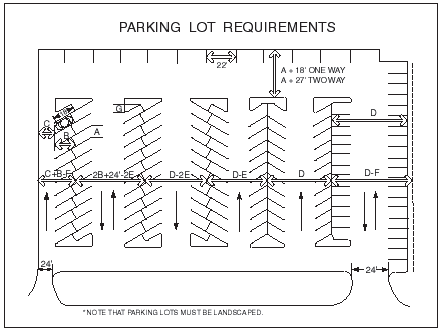
Geometrics. All parking stalls and aisle dimensions shall have minimum dimensions as set forth in Figure 1. The "module" at any angle is the required dimension of two parked vehicles and the aisle between. Modules may be adjusted for overhang and interlock effects as detailed herein. When automobile overhang beyond an installed curb is included in the stall depth calculation, such overhang shall be considered as part of the parking stall and not for landscaping or setback purposes.
(2)
Parking Table. The size and spacing specifications for required off-street parking facilities shall be taken from the diagram and table below:
Notes:
*
Handicapped Stalls
1.
Stall sizes are based on projections of parked vehicles.
2.
Parallel parking stall lengths shall be 22 feet.
3.
Other angles may not be used except by permission of Director of Planning.
4.
Offset (G) does not include curb or island width.
(a)
When curb dimensions exceed the overhang dimension (F), the module shall be increased accordingly. Off-sets at angled parking stalls shall be as per dimension (G). Interlock reductions (E) may only be taken where barriers and appurtenances extend into less than 10 percent of the parking stalls. Columns, pipes, light standards and other appurtenances may protrude into a non-interlocked module up to a maximum combined dimension of two feet (2').
(b)
In facilities where the predominant use is low turnover parking (defined as at least 75 percent of the daily users parking for more than three hours), the stall width may be reduced to eight feet three inches (8'3"), with all other dimensions as shown in Figure 1. In open or enclosed parking structures or in facilities where a wheel stop or vehicle restraint system is provided in all stalls, the aisle may be reduced by one foot (1'), reducing the total module by a like amount. A maximum of 10 percent of a parking facility may be provided as compact stalls with a minimum width of seven feet six inches (7'6") where dimensional constraints such as walls, columns, or turning aisles exist. Designs with more than 10 percent of the capacity provided as compact stalls may not be employed except by permission of the Zoning Administrator.
(3)
Turn Around Area. When only one (1) entry or exit is provided, all required off-street parking and loading facilities shall contain internal circulation or an adequate turn around area for the size of vehicles normally expected to use such facilities.
(4)
Sidewalks. In order to insure pedestrian safety, sidewalks of not less than three (3) feet in width, exclusive of vehicle overhang, are required to separate any driveway or parking area from a building.
(5)
Stacking Areas. When entry to a parking facility is controlled by gates, there shall be at least one entrance lane and gate for every 400 parking spaces provided. Adequate reservoir areas in addition to the service position shall be provided at all entrance lanes to eliminate queuing of vehicles on public property, including sidewalks. The space for each vehicle in the stacking area shall be a minimum of 9 feet by 20 feet.
(6)
Required Stacking Spaces.
(a)
A Motor Vehicle Washing Facility shall provide a paved off-street parking area sufficient in size to provide the number of off-street parking spaces required in this Chapter as well as a minimum number of off-street stacking spaces equal to the product obtained by multiplying by 10 the maximum number of automobiles capable of being washed at any one time.
(b)
Similar off-street stacking spaces shall be provided for other drive-in uses as follows:
(i)
Financial institutions—Five (5) spaces per drive-in window;
(ii)
Restaurants—Six (6) spaces per drive-in window; and
(iii)
Other drive-in facilities—Four (4) spaces per drive-in window.
(E)
Spaces for the Physically Handicapped. Off-street parking facilities required for multiple family residential, commercial, and industrial uses shall have the number of level parking spaces as set forth in the following table.
All handicapped parking facilities shall be designed with accessible spaces in accordance with the following standards.
(1)
Size. Handicapped parking spaces shall be at least 8 feet-0 inches wide and shall have an adjacent access aisle 8 feet-0 inches wide minimum. A single space 16 feet-0 inches wide may also be provided. Two adjacent accessible parking spaces may share a common access aisle only if a vehicle can reasonably back into a space to insure that the access aisle is on the preferred side or if the space may reasonably be used by handicapped vans. Parked vehicle overhangs shall not reduce the clear width of an accessible route.
(2)
Signage. A sign displaying the symbol of accessibility, the restriction to use by permit holders and the fine for violation shall be provided at each handicapped stall in accordance with State law.
(F)
Materials and Accessories. The following are minimum requirements, and it shall be the responsibility of the property owner to maintain the facilities in such a condition as to be able to continue to meet these requirements.
(1)
Surfacing. All open required off-street parking and loading facilities for multiple family, commercial, and industrial uses shall be paved with non-combustible materials to provide a smooth surface free of depressions, gaps, holes, or other surface aberrations, according to the following standards:
(a)
A two (2) inch thick bituminous concrete binder and surface Class I course on a six (6) inch thick compacted crushed stone base in accordance with Illinois State Department of Transportation specifications for road and bridge construction; or
(b)
Interlocking paving blocks with openings for sod inserts (Grasscrete, Turf Stone, Checker Block, Mono Slab Grass Paver, and other brand names) on a twelve (12) inch base; or
(c)
The equivalent to (a) or (b) above as judged by the City Engineer.
(2)
Striping. All required off-street parking and loading spaces shall be marked and maintained with durable paint in stripes a minimum of four (4) inches wide extending all but one (1) foot of the length of the parking space. Handicapped stalls may be striped as a standard stall with a dedicated crosshatched access aisle. Striping for each parking space shall be painted in yellow or white. Thermoplastic pavement markings are an acceptable alternative. All areas designated as fire lanes shall be marked by posting of signs and/or yellow markings, provided that signs shall be used wherever feasible.
(3)
Bumper Stops. Bumper stops, curbing, or wheel checks shall be provided to prevent any vehicle from damaging or encroaching upon any adjacent parking or loading space, sidewalk, landscaped area, fence, wall, or building.
(4)
Lighting. Any lighting used to illuminate off-street parking and loading facilities shall comply with the performance standard provisions set forth is Section 150.605 of this Chapter.
(5)
Signs.
(a)
Entrance, exit, and other traffic control signs shall comply with all provisions set forth in Article XX of this Chapter governing "On-Site Informational Signs," as that term is defined in Article XX of this Chapter.
(b)
The Zoning Administrator may require the posting of such traffic control signs as deemed necessary to promote vehicular and pedestrian safety. Such requirements by the Zoning Administrator may be appealed to the Transportation Commission of the City.
(6)
Drainage. All surfaces shall be sloped a minimum of one and one-half percent (1.5%) to provide positive surface drainage. Retention facilities shall be provided in accordance with City ordinances. Parking facilities may be utilized for temporary storm water retention to a maximum depth of 18 inches in accordance with City ordinances and Metropolitan Sanitary Sewer District regulations.
(G)
Screening and Landscaping. Any construction or enlargement of off-street parking and loading areas, except those areas that serve lots improved exclusively with single-family residential structures, shall comply with the requirements of Article XXII of this Chapter.
(H)
Visual Clearance.
(1)
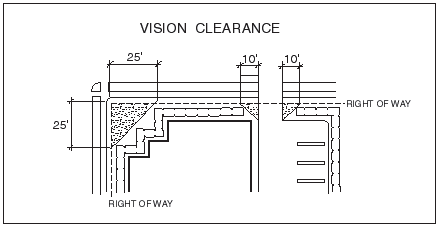
No fence with less than 65 percent of its superficial area consisting of regularly distributed apertures, wall, landscaping, sign, vehicle, or other visual obstruction located above a height of three feet, measured from the established street grade, is permitted within 10 feet on either side of an entrance or exit to off-street parking and loading facilities, measured at the property line.
(2)
No fence, wall, landscaping, sign, vehicle, or other visual obstruction located above a height of three feet, measured from the established street grade, is permitted within the triangular area formed by a straight line drawn between points on the property lines at a distance of 25 feet in each direction from the intersection of any street or alley.
(I)
Special Regulation for the Design of Parking Structures in the RO, B4-4, B4-5, B4-6, and B5 Zoning Districts.
(1)
Off-street parking spaces that are located within a building shall not occupy more than 40 percent of the front 40 feet of the ground floor frontage of the building.
(2)
No parking structure may have more than one access drive per street frontage of the lot on which the parking structure is located.
(3)
Access to any level of a parking structure reserved for private use shall be from an alley, if one is available.
(4)
Access to any level of a parking structure containing public parking spaces shall be directly from a public street.
(5)
The width of all access drives and ancillary equipment (including, without limitation, gates) for a parking structure shall be no greater than 30 feet.
(6)
All ground floor parking must be screened from view from the public street frontage, on all sides other than those sides that front along an alley, by glazing, metal grillwork, louvers, or other architectural treatments. Such screening elements must provide complete visual screening to at least four feet in height above the adjacent public sidewalk. Such screening can be used to meet the transparency requirements set forth in Article XXIII of this Chapter.
(Ord. 71-07, J. 33, p. 461-508, passed 9/24/07; Ord. 23-11, J. 37, p. 117-120, passed 2/28/11; Ord. 41-15, J. 41, p. 120-156, passed 4/13/15; Ord. O74-2019, § 12, passed 11/12/19; Ord. O31-2024, § 6, passed 4/10/24)
Sec. 150.809. - Design of Loading Spaces.
(A)
Trash Dumpster/Compactor. When loading spaces are required, at least one such space may include permanent accessibility to a trash dumpster and/or compactor. When only one loading space is required, the space may be designed for both dumpster and access thereto and a 50-foot semi-trailer. All trash dumpsters and compactors shall be screened in accordance with the refuse container screening provisions set forth in Article XXII of this Chapter.
(B)
Loading Space Size. A standard loading space shall have a length of at least 55 feet, a width of at least 11 feet and a clear height of at least 14 feet. Restricted spaces shall have a length of at least 35 feet, a width of at least 11 feet and a height of at least 12 feet. In no instances shall more than one-third (33%) of the required spaces be of restricted size.
(C)
Access to Loading Spaces. The path of travel between a public roadway or street and the loading spaces must provide for the same or greater vertical height as the loading space to be served. Turning movements into a standard loading space shall be adequate for a WB50 semi-trailer truck as defined by American Association of State Highway Transportation Officials (AASHTO). Turning movements into a restricted space shall be adequate for a AASHTO Single Unit Truck. If access to loading spaces is provided via designated parking areas, no interference of any type shall be permitted with the normal use of any parking space. Loading spaces shall not interfere with any fire exit or emergency access.
(D)
Multiple Uses. For certain multiple-building uses on the same lot of record, the supply of required loading spaces for each particular use or building complex may be grouped in one or more locations, provided that such loading space supply shall be fully adequate for all uses within said campus. Where multiple buildings or uses share a common loading space or terminal, the movement of goods or freight between such buildings shall not involve the use of public rights-of-way.
(E)
Special Requirements for Retail Fulfillment Centers. Loading spaces for retail fulfillment centers may not be designed for customers to que, stack, or use loading spaces. Customers must: (i) park and enter the facility, or exit their vehicles and pick up their items at a vestibule or doorway to receive merchandise; (ii) park in parking spaces and wait for merchandise to be brought out to customers' vehicles; or (iii) if there is a drive-through, pick up merchandise using the drive-through.
(Ord. 71-07, J. 33, p. 461-508, passed 9/24/07; Ord. O21-2022, § 3, passed 2/14/22)
Sec. 150.851. - Table of Parking and Loading Requirements.
In the following table, GFA is an abbreviation for Gross Floor Area and GLA is an abbreviation for Gross Leaseable Area. Loading spaces are calculated on the basis of gross floor area.
(Amended by Ord. 30-09, J. 35, p. 88-95, passed 4/27/09; Ord. 44-10, J. 36, p. 179-187, passed 5/10/10; Ord. 41-15, J. 41, p. 120-156, passed 4/13/15; Ord. O74-2019, § 13, passed 11/12/19)
(Ord. 41-15, passed 4/13/15; Ord. O74-2019, § 13, passed 11/12/19; Ord. O32-2020, § 6, passed 2/24/20; Ord. O64-2020, § 6, passed 10/13/20; Ord. O21-2022, § 5, passed 2/14/22; Ord. O39-2023, § 5, passed 7/17/23; Ord. 071-2024, § 4, passed 10/15/24)
(Ord. 41-15, Passed 4/13/15; Ord. 40-2016, § 4, passed 4/25/16; Ord. O74-2019, § 13, passed 11/12/19)
(Ord. 41-15, Passed 4/13/15; Ord. O74-2019, § 13, passed 11/12/19)
(Food and Beverage Service Uses within the Central Business District added by Ord. 55-01, adopted 9/24/01; Ord. 30-09, J. 35, p. 88-95, passed 4/27/09; Ord. 18-10, J. 36, p. 022-028, passed 2/8/10; Ord. 41-15, Passed 4/13/15; Ord. O74-2019, § 13, passed 11/12/19; Ord. O32-2020, § 6, passed 2/24/20; Ord. O51-2021, § 6, passed 7/12/21)
(Food and Beverage Service Uses outside the Central Business District added by Ord. 55-01, adopted 9/24/01; Ord. 30-09, J. 35, p. 88-95, passed 4/27/09; Ord. 18-10, J. 36, p. 022-028, passed 2/8/10; Ord. 41-15 passed 4/13/15; Ord. O51-2021, § 6, passed 7/12/21)
(Amended by Ord. 18-10, J. 36, p. 022-028, passed 2/8/10; Ord. 41-15, passed 4/13/15; Ord. O74-2019, § 13, passed 11/12/19)
(Amended by Ordinance No. 41-15, passed 4/13/15; Ord. O74-2019, § 13, passed 11/12/19)
(Amended by Ordinance No. 41-15, passed 4/13/15; Ord. O74-2019, § 13, passed 11/12/19)
(Amended by Ord. 55-01, passed 9/24/01; Ord. 41-15, passed 4/13/15)
(Ord. 071-2024, § 4, passed 10/15/24)
(Ord. 071-2024, § 4, passed 10/15/24)
(Ord. O32-2020, § 6, passed 2/24/20)
(Ord. O56-2021, § 5, passed 8/23/21)
(Health Clubs (Minor) Added by Ord. 49-04, J. 30, p. 200-202, passed 7/12/04; Ord. O61-2018, § 4, 6/25/18; Ord. O32-2020, § 6, passed 2/24/20)
(Ord. 44-10, J. 36, p. 179-187, passed 5/10/10; Ord. O32-2020, § 6, passed 2/24/20)
(Ord. O58-2020, § 4, passed 9/29/20)
(Amended by: Ord. 30-09, J. 35, p. 088-095, passed 4/27/09; Ord. 41-15, passed 4/13/15; Ord. O74-2019, § 13, passed 11/12/19)

