
Highland Park City Zoning Code
ARTICLE VII
AREA, BULK, AND DENSITY
Sec. 150.701.- Scope of Requirements.
Except as may be provided elsewhere in this Chapter, the provisions of this Article shall establish the necessary minimum and maximum requirements of area, bulk, density, and yards for every district established by this Chapter. No building or structure shall be erected, converted, enlarged, reconstructed, or structurally altered in violation of the requirements of this Article.
Sec. 150.702. - Bulk Conformance.
Any structure constructed in conformance with the bulk and setback regulations then in effect prior to the adoption of this Chapter shall not be deemed non-conforming with respect to the new bulk and yard regulations in this Article. However, any addition or enlargement to such structure must be made in conformance with the new regulations.
Sec. 150.703. - Low Density Residential District Regulations.
The table below specifies the general minimum and maximum requirements of area, bulk, yards, and density for the low density residential zoning districts. These requirements may be modified as permitted elsewhere in this Chapter.
LOW DENSITY RESIDENTIAL REGULATIONS
(a)
In addition to all other applicable regulations, the subdivision of any lot in the LFOZ Overlay Zone for which a complete application is filed with the City after December 11, 2000, being the effective date of the LFOZ Overlay Zone and regulations shall comply, where applicable, with the "minimum area for a single family residence," "average width," and "minimum lot area per single-family dwelling unit" requirements set forth in Section 150.703.1 of this Code.
(b)
In addition to all other applicable regulations, lots existing in the SLOZ Overlay Zone on January 8, 2001, being the effective date of the SLOZ Overlay Zone and regulations, shall, to the extent applicable, comply with the "minimum area for a single family residence," "average width," "minimum lot area per single-family dwelling unit," and "minimum side yard" requirements set forth in Section 150.703.2 of this Code.
(c)
No air conditioning systems or units (as defined in Section 50.900 of the Code) installed after June 29, 2004, being the effective date of this regulation, shall be installed in any required front yard or rear yard; provided, however, that air conditioning systems and units that were located in a required yard with or without authority prior to June 29, 2004, may be replaced in the same location without a variation.
(Ord. 32-01, passed 5/29/01; Ord. 33-01, passed 5/29/01; Ord. 45-04, J. 30, p. 173-174, passed 6/28/04; Ord. 46-04, J. 30, p. 175-180, passed 6/28/04; Ord. 74-06, J. 32. p. 346-351, passed 11/13/06; Ord. O37-2021, § 3, passed 4/26/21)
Sec. 150.703.1. - Special Regulations for the LFOZ Lakefront Density and Character Overlay Zone.
(A)
Purpose. The LFOZ Lakefront Density and Character Overlay Zone is intended to preserve the density and character of lots in the R4 Low-To-Moderate Density Residential District located along the lakefront. Lake Michigan and the parcels located along the lakefront are important elements in defining the City's character. Many of the parcels along the lakefront have lot areas that are substantially larger than the minimum lot area requirements of the R4 District. The LFOZ Overlay Zone is intended to preserve the spacious character and existing density of the area. The preservation and appropriate development of the lakefront area requires, with certain exceptions, the establishment of special lot width and lot area regulations for newly subdivided lots in the LFOZ Overlay Zone. These new restrictions recognize the existing conditions of many of the lakefront lots and require new development in the LFOZ Overlay Zone to be consistent with these existing conditions. The LFOZ Overlay Zone is intended to address, among other things, a recent development trend in the City to subdivide larger lots along the lakefront. These new lots are, in many cases, inconsistent with the existing conditions along the lakefront. In addition to protecting the character and density of the area, the LFOZ Overlay Zone is intended to protect and preserve the ravines, lake bluffs, and beaches in the area, as well as Lake Michigan itself, and to prevent unnecessary erosion of properties in the LFOZ Overlay Zone, that may be affected or caused by increased development, whether on lots in the LFOZ Overlay Zone or within the abutting portions of Lake Michigan. This Section is specifically intended to permit property owners within the LFOZ Overlay Zone to develop their properties and to construct structures on the beach and in Lake Michigan, as further set forth in this Section and in the most environmentally and ecologically sensitive manner possible. The LFOZ Overlay Zone is consistent with the goals of the Lakefront District Neighborhood Strategic Plan, an element of the Master Plan, which plan was adopted by the City Council after numerous neighborhood planning meetings at which lakefront property owners and other City residents participated. The LFOZ Overlay Zone has been created and shall be mapped on the Zoning Map in furtherance of these public purposes.
(B)
Overlay Zone. The LFOZ Overlay Zone appears on the Zoning Map as an "overlay zone" imposed on top of certain properties located along the lakefront in the R4 District. Development of property in the LFOZ Overlay Zone must comply with the regulations of the LFOZ Overlay Zone and with the R4 District regulations. Except as required by Subsection (C) of this Section, the R4 District regulations shall apply to all lots in the LFOZ Overlay Zone. Where there is any conflict between the LFOZ Overlay Zone and the R4 District, the provisions of the LFOZ Overlay Zone shall apply.
(C)
Zoning Relief. Nothing in this Section 150.703.1 shall be interpreted to deny the right of any property owner to seek a variation or other applicable zoning relief from the provisions of this Section, pursuant to the applicable procedures set forth in this Code.
(D)
Special Bulk Regulations.
(1)
Minimum Area for Single-Family Residence. Except only as provided in Paragraph (4) of this Subsection, no subdivision of any lot in the LFOZ Overlay Zone shall create any new lot that has a minimum area for a single-family residence of less than 40,000 square feet.
(2)
Average Width. Except only as provided in Paragraph (4) of this Subsection, no subdivision of any lot in the LFOZ Overlay Zone shall create any new lot that has an average width of less than 100 feet.
(3)
Minimum Lot Area Per Dwelling Unit, Single-Family. Except only as provided in Paragraph (4) of this Subsection, no subdivision of any lot in the LFOZ Overlay Zone shall create any new lot that has a minimum lot area per single-family dwelling unit of less than 40,000 square feet.
(4)
Effective Date. The special bulk regulations set forth in this Subsection (D) shall only apply to subdivisions for which a complete application is filed with the City after December 11, 2000, being the effective date of the LFOZ Overlay Zone and regulations (the "Effective Date")
(5)
Exceptions. The special bulk regulations set forth in this Subsection (D) shall not apply to any subdivision (i) that consists of a lot or lots the boundaries of which were described as property boundaries in a deed recorded prior to the Effective Date, or (ii) that results in the increase in size of any lot in the LFOZ Overlay Zone that, as of the Effective Date, was less than 40,000 square feet in size ("Existing Small Lot") and that does not result in the decrease in size of any other Existing Small Lot.
(E)
Lake Michigan Protection Regulations.
(1)
Definitions. Wherever the following words or phrases are used, they shall, for the purposes of this Subsection 170.703.1(E), have the meanings respectively ascribed to them in this Subsection 170.703.1(E), except when the context otherwise indicates:
Adjacent Properties shall mean and include, whether or not located within the corporate limits of the City, (a) the first three properties located upwater from the subject property, and (b) the first ten properties located downwater from the subject property.
Applicant shall mean the record owner of the Subject Property.
Commission shall mean the Natural Resources Commission.
Lake Michigan shall mean that portion of Lake Michigan that borders the City of Highland Park, to the extent of three miles beyond the corporate limits, but not beyond the limits of the State.
Lake Michigan Protection Zone shall mean (a) Lake Michigan, and (b) the private and other property located between Lake Michigan and the termination, on the Lake Michigan side, of the Steep Slope Zone, as depicted below.
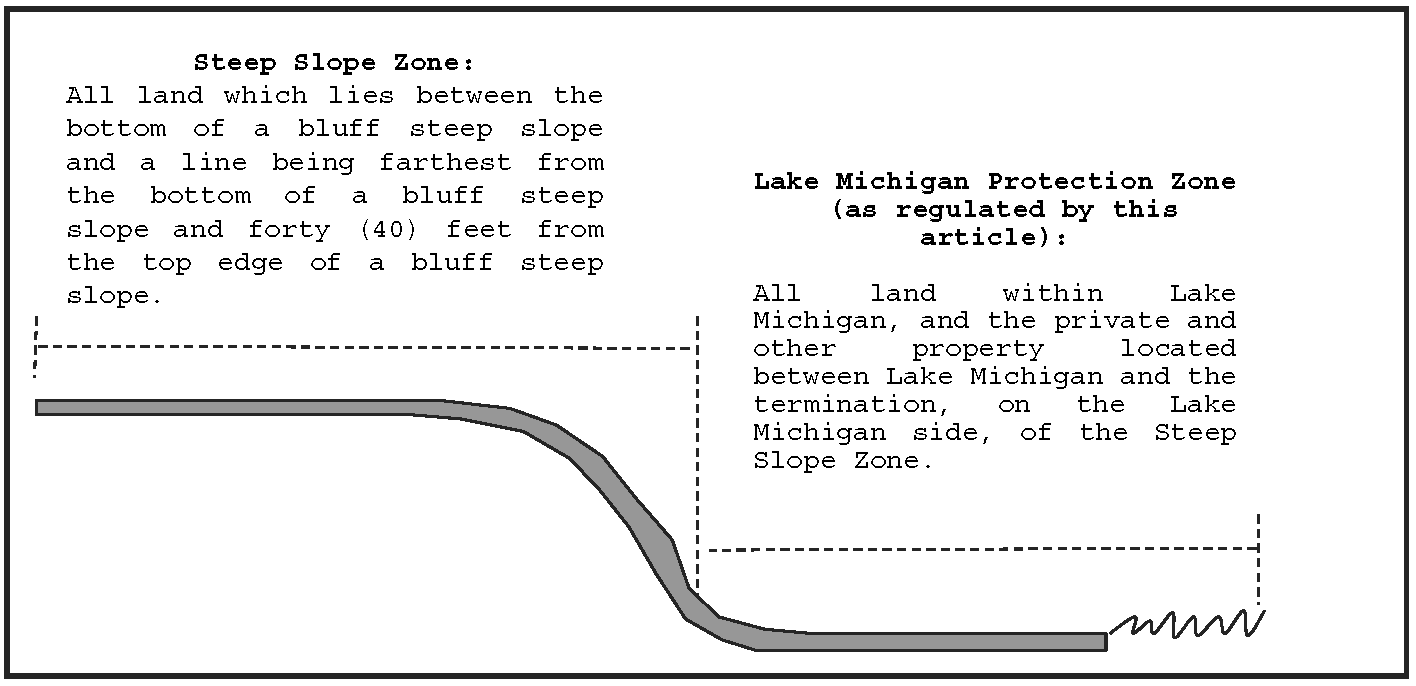
Permit Application shall mean the application for a building permit to conduct a regulated activity in the Lake Michigan Protection Zone, as required by Chapter 170 of this Code.
Regulated Activity shall mean any act or process within the Lake Michigan Protection Zone involving (1) the construction, alteration, modification, demolition, or removal of any new or existing Structure, or (2) the adding, dumping, dredging, or removing of sand, rocks, or any refuse, garbage, or other discarded materials.
Steep Slope Zone shall have the meaning ascribed to it by Section 150.202 of this Zoning Ordinance.
Structure shall mean any improvement or structure in the Lake Michigan Protection Zone, including, without limitation, any revetment or groin.
Subject Property shall mean the property within or abutting that portion of the Lake Michigan Protection Zone on which the proposed Regulated Activity is to take place.
(2)
Review Prior to Building Permit Issuance. Except as provided in subsections (E)(9) and (E)(11) of this Section, whenever an applicant submits a permit application to perform a regulated activity in the Lake Michigan Protection Zone, the procedures and requirements set forth in subsections (E)(4), (E)(5), (E)(6) and (E)(7) of this Section and the standards set forth in subsection (E)(3) of this Section apply in addition to the procedures and requirements of Chapter 170 of this Code.
(3)
Standards. In addition to the standards and requirements set forth in Chapter 170 of this Code, no building permit for a regulated activity in the Lake Michigan Protection Zone shall be approved unless all of the following standards have been met or satisfied, to the satisfaction of both the city's Building Official and the applicant's duly registered professional geologist, structural engineer or professional engineer, who must certify that the standards have been satisfied with his or her signature, date, and seal:
(a)
The proposed regulated activity and/or structure shall not unreasonably impede access to or pedestrian movement along the beach or to Lake Michigan;
(b)
The proposed regulated activity and/or structure shall not create new nor amplify existing erosion problems on the subject property and on adjacent properties;
(c)
The proposed regulated activity and/or structure shall be for the purposes of erosion control, water gathering, and/or public access only;
(d)
There will not be an unnecessary adverse environmental or ecological impact on the subject property or on any of the adjacent properties as a result of the proposed structure and/or the regulated activity; and
(e)
The applicant has properly obtained any and all permits required by the federal, state, and county governments for the regulated activity and/or the structure.
(4)
Additional Permit. Application requirements for regulated activities.
(a)
As part of a permit application for a regulated activity in the Lake Michigan Protection Zone, and in addition to any documents and information required by Chapter 170 of this Code, the applicant shall file the following documents and information with the Department of Community Development:
(i)
A statement of the purpose and planning objectives to be achieved by the proposed Regulated Activity;
(ii)
A plat of survey of the Subject Property;
(iii)
A conceptual plan showing the Subject Property and the Adjacent Properties, including any and all existing Structures in the portion of the Lake Michigan Protection Zone abutting those properties;
(iv)
Development and site plans showing the proposed Structure, if applicable;
(v)
A demolition plan, if applicable;
(vi)
An elevation plan, which shall include sectional views of the proposed Structure, if applicable;
(vii)
Copies of any and all permits required by the federal, state, and county governments for the Regulated Activity and/or the Structure;
(viii)
Engineering details of the proposed Structure and/or the Regulated Activity, which shall include, if applicable:
(A)
The height, length, and width of the proposed Structure;
(B)
The spacing between the proposed Structure and other Structures in the Lake Michigan Protection Zone abutting any of the Adjacent Properties; and
(C)
The materials of which the proposed Structure will be composed;
(ix)
A geo-technical investigation report of the site;
(x)
A statement outlining structure success in various water levels;
(xi)
A statement describing the long-term maintenance requirements and plan for the proposed Structure;
(xii)
A written description of the proposed means and methods of undertaking the Regulated Activity;
(xiii)
An explanation, in narrative form, of the following:
(A)
Any and all erosion problems on the Subject Property for which the Structure and/or Regulated Activity is designed to correct or remedy;
(B)
The environmental and ecological impact on the Property and the Adjacent Properties that are expected to result from the Structure and/or Regulated Activity;
(C)
How the proposed Structure and/or Regulated Activity is the least environmentally and ecologically intrusive means of achieving the stated purpose; and
(D)
The nature and composition of existing protections, including existing Structures, of the shoreline in that portion of the Lake Michigan Protection Zone abutting either the Subject Property or the Adjacent Properties, and the impact and effectiveness of those protections on the shoreline, the lakebed, and on erosion of the Subject Property and Adjacent Properties; and
(xiv)
A non-refundable application fee, in the amount set forth in the City's Annual Fee Resolution.
(b)
All plans, specifications, and design analyses or calculations must be signed and sealed by a duly registered Professional Geologist, Structural Engineer or Professional Engineer experienced in the design and construction of shore and/or coastal facilities.
(5)
Notice.
(a)
Prior to the commencement of any regulated activity in the Lake Michigan Protection Zone:
(i)
The applicant shall provide written notice of his or her filing of an application for a building permit to the owners of: (a) all lots or parcels of land within 100 feet of the subject property; (b) all adjacent properties; (c) all additional properties for which notice must be sent in connection with the issuance of a shore protection project permit by the Illinois Department of Natural Resources; and (d) all homeowners associations of which at least one owner of an adjacent property is a member and which have registered with the City as desiring notice pursuant to this subparagraph 150.703.1(5)(a)(i). The notice shall be in a form approved by the City and shall be given by regular first class U.S. Mail. For purposes of this subsection, a notice addressed to the name and address on the most recent Lake County tax record shall be deemed sufficient. Further, for purposes of this subsection, a lot or parcel of land shall be deemed to "abut" the subject property if the lot or parcel of land shares a common boundary or point with the subject property, or is separated from the subject property by only a public or private right-of-way.
(ii)
The applicant shall file with the City, within 14 days after the filing of the permit application, written certification that the notice required by subsection 150.703.1(E)(5)(a)(i) has been properly mailed, in a form provided by the City. The City shall not process, and shall return to the applicant, any permit application for which such notice was not given or for which such certification was not filed as provided in this subparagraph 150.703.1(E)(5)(a). Nothing in this subparagraph shall be deemed as prohibiting the Director of Community Development from providing notice of a contemplated regulated activity that is not specifically covered or required by this subparagraph.
(b)
If, after a building permit is issued for a regulated activity, the applicant desires to make any significant changes to the permitted regulated activity, which changes are necessitated by on-site conditions not reasonably anticipated when the final engineering plan was submitted for review and approval by the Director of Community Development, the applicant must provide written notice in the same manner as, and in accordance with all requirements of, subparagraph 150.703.1(E)(5)(a).
(6)
Public Safety Emergency Permits. A permit for the removal or demolition of an existing Structure may be granted by the City Director of Public Works upon his or her determination that the structure poses an immediate threat to the public health, safety, or welfare. If the Director of Public Works makes such a determination, the provisions of subsections (E)(4), (E)(5), (E)(6), and (E)(7) of this Section shall not apply.
(7)
Recordation. The applicant shall cause to be recorded against the subject property, in the office of the Lake County Recorder, a restrictive covenant, requiring the applicant, and all of the applicant's transferees, heirs, assigns, and successors in interest to the subject property, to perform, at the applicant's sole cost and expense, all regular maintenance and upkeep of the structure.
(8)
Partial Exemption for Structures Also Regulated Within The Steep Slope Zone. The review and permitting processes set forth in Section 150.703.1(E) of these Lake Michigan Protection Zone regulations shall not be necessary if the proposed structure meets all of the following criteria:
(a)
The proposed structure is of a type, other than fences, to which Section 150.1906(C) of the Steep Slope Zone regulations of this Zoning Code applies;
(b)
The proposed structure is located in part in the Lake Michigan Protection Zone and in part in the Steep Slope Zone;
(c)
The portion of the proposed structure that is located within the Lake Michigan Protection Zone is necessary to the structural or functional integrity of the structure as a whole;
(d)
The proposed structure protrudes no further than 15 feet into the Lake Michigan Protection Zone; and
(e)
The portion of the proposed structure that is located within the Lake Michigan Protection Zone is no larger than 75 square feet.
(Ord. 33-01, passed 5/29/01; Ord. 21-06, J. 32, p. 57-68, passed 3/13/06; Ord. 28-10, J. 36, p. 105-109, passed 3/22/10; Ord. 23-11, J. 37, p. 117-120, passed 2/28/11; Ord. O30-2020, § 2, passed 2/24/20)
Sec. 150.703.2. - Special Regulations for the SLOZ South Green Bay Road Small Lot Overlay Zone.
(A)
Purpose. The SLOZ South Green Bay Road Small Lot Overlay Zone includes those lots in the R6 Medium Density Residential District generally bounded on the west by Green Bay Road, on the north by Ravinia Road and Ridgewood Road, on the east by the railroad tracks, and on the south by Blackstone Place and existing on January 8, 2001, being the effective date of the Overlay Zone and regulations. Many of the lots in the SLOZ Overlay Zone have lot areas, lot widths, and side yards that are substantially smaller than the minimum requirements under the R6 District. The special lot area, lot width, and side yard regulations for the SLOZ Overlay Zone are intended to make these smaller lots conforming under the provisions of the SLOZ Overlay Zone. The SLOZ Overlay Zone is consistent with the goals of the South Green Bay Road District Plan, an element of the Master Plan, which plan was adopted by the City Council after neighborhood planning meetings at which owners of property within the SLOZ Overlay Zone and other City residents participated. The SLOZ Overlay Zone has been created and shall be mapped on the Zoning Map in furtherance of these public purposes.
(B)
Overlay Zone. The SLOZ Overlay Zone appears on the Zoning Map as an "overlay zone" imposed on top of certain properties within the R6 District. Properties in the SLOZ Overlay Zone must comply with the regulations of the SLOZ Overlay Zone and with the R6 District regulations. Except as otherwise permitted by Subsection (D) of this Section, the R6 District regulations shall apply to all lots in the SLOZ Overlay Zone. Where there is any conflict between the SLOZ Overlay Zone and the R6 District, the provisions of the SLOZ Overlay Zone shall apply.
(C)
Zoning Relief. Nothing in this Section 150.703.2 shall be interpreted to deny the right of any property owner to seek a variation or other applicable zoning relief from the provisions of this Section, pursuant to the applicable procedures set forth in this Code.
(D)
Special Bulk Regulations.
(1)
Minimum Area for Single-Family Residence.
(a)
For any single-family residence on a lot existing in the SLOZ Overlay Zone that does not comply with the minimum lot area regulations of the R6 District as of January 8, 2001, being the effective date of the SLOZ Overlay Zone and regulations ("the "Effective Date"), the minimum area for any such lot shall be no less than 5,200 square feet.
(b)
The special regulation set forth in Paragraph 1(a) of this Section shall not apply to any lot in the SLOZ Overlay Zone meeting the minimum lot area regulations of the R6 District or to any new lot created by a subdivision of any lot in the SLOZ Overlay Zone after the Effective Date.
(2)
Average Width.
(a)
For any single-family residence on a lot existing in the SLOZ Overlay Zone that does not comply with the minimum lot width regulations of the R6 District as of the Effective Date, the average width for any such lot shall be no less than 40 feet.
(b)
The special regulation set forth in Paragraph 2(a) of this Section shall not apply to any lot in the SLOZ Overlay Zone meeting the minimum lot width regulations of the R6 District or to any new lot created by a subdivision of any lot in the SLOZ Overlay Zone after the Effective Date.
(3)
Minimum Lot Area Per Dwelling Unit, Single-Family.
(a)
For any single-family residence on a lot existing in the SLOZ Overlay Zone that does not comply with the minimum lot area per single-family dwelling unit regulations of the R6 District as of the Effective Date, the minimum lot area per single-family dwelling unit for any such lot shall be no less than 5,200 square feet.
(b)
The special regulation set forth in Paragraph 3(a) shall not apply to any lot in the SLOZ Overlay Zone meeting the minimum lot area per single-family dwelling unit regulations of the R6 District or to any new lot created by a subdivision of any lot in the SLOZ Overlay Zone after the Effective Date.
(4)
Minimum Side Yard.
(a)
For any single-family residence on a lot existing in the SLOZ Overlay Zone that does not comply with the minimum area for single family residence regulations, average width regulations, or minimum lot area per single family dwelling unit regulations of the R6 District as of the Effective Date, the total depth of all side yards for any such lot shall be a minimum of 25 percent of the lot width and in no event shall any side yard be less than five feet.
(b)
The special regulation set forth in Paragraph 4(a) shall not apply to any new lot created by a subdivision of any lot in the SLOZ Overlay Zone after the Effective Date.
(Ord. 32-01, passed 5/29/01)
Sec. 150.703.3. - Regulations for Low Density Residential FAR.
(A)
FAR Formula. The maximum FAR allowed on a legal lot of record in the R1 through R7 zoning districts shall be determined based on the formula set forth in the following table:
(Ord. 74-06, J. 32, p. 346-351, passed 11/13/06)
(B)
Bonus FAR.
(1)
Applicability. Bonus FAR shall be allowed on a legal lot of record that is not a lot or parcel in a Planned Unit Development in the R1 through R7 zoning districts on which an addition to an existing building (referred to herein as "addition") is proposed to be constructed, subject to the rules and conditions set forth in Section 150.703.3(B)(3).
(2)
Bonus FAR Formula. The maximum Bonus FAR allowed on a legal lot of record in the R1 through R7 zoning districts shall be determined based on the formula set forth in the table in Section 150.703.3.(A).
(3)
Rules and Conditions. The following rules and conditions shall be used in determining the applicability of Bonus FAR for building additions on legal lots of record in the R1 through R7 zoning districts:
(a)
The proposed addition shall be attached to an existing building, and:
(i)
Such existing building shall have been constructed prior to January 1, 1990 and no addition requiring a building permit was attached to such building after June 28, 2004; or
(ii)
If such building was constructed after January 1, 1990, or an addition requiring a building permit was attached to such building after June 28, 2004, no addition requiring a building permit has been attached to the building in the seven years preceding the date on which a building permit application is submitted for the proposed addition; and
(b)
No demolition activity, as defined in Section 170.122 of the Code, is proposed to occur during the construction of the proposed addition; and
(c)
With the exception of maximum FAR, the building and the proposed addition will be in compliance with all applicable bulk regulations; provided, however, that for purposes of this Section 150.703.3(B)(3) only, the term "bulk regulations" shall mean only those types of regulations that are specifically set forth in Article II, and shall not include private restrictions or covenants, and
(d)
No part of the proposed addition shall be located within a steep slope zone; and
(e)
No part of the proposed addition shall be attached to a building that was issued its initial certificate of occupancy within seven years preceding the date of the submittal of the building permit application for the proposed addition; and
(f)
The existing building to which the proposed addition is to be attached shall not have:
(i)
Utilized the maximum Bonus FAR calculation for any addition prior to the proposed addition; and
(ii)
Had a portion of the building that was, prior to the submission of the building permit application for the proposed addition, partially removed or destroyed by any act or process within the control of a person that was the owner of the building at the time of such removal or destruction; and
(iii)
Any portion of the existing building that was not removed or destroyed, as set forth in Section 150.703.3(B)(3)(f)(ii) above, removed or destroyed by the applicant prior to the construction of the new addition. An applicant shall record a restrictive covenant, in a form acceptable to the Zoning Administrator, that prohibits, for a period of at least 20 years after the issuance of a certificate of occupancy for the addition, the removal or destruction of any portion of the building that was not removed or destroyed, as set forth in Subparagraph 150.703.3(B)(3)(f)(ii).
(Ord. 46-04, J. 30, p. 175-180, passed 6/28/04; Ord. 74-06, J. 32, p. 346-351, passed 11/13/06; Ord. O58-2020, § 3, passed 9/29/20)
Sec. 150.704. - Multiple Family Residential and Health Care District Regulations.
(A)
The following table specifies the general maximum and minimum requirements of area, bulk, yards, and density for the Multiple Family Residential and Health Care zoning districts. These requirements may be modified as permitted elsewhere in this Chapter.
MULTIPLE FAMILY RESIDENTIAL AND HEALTH CARE DISTRICT REGULATIONS
(Amended by: Ord. 41-02, J. 28, p. 309-312, passed 7/8/02; Ord. 57-02, J. 28, p. 410-473, passed 9/9/02; Ord. 40-04, J. 30, p. 155-158, passed 6/28/04; Ord. 81-07, J. 33, p. 694-703, passed 11/13/07; Ord. 41-15, J. 41, p. 120-156, passed 4/13/15)
(a), (b), (c), (d), (e), (f)—See explanation of footnotes following.
Footnotes for Multiple Family Residential and Health Care District Regulations:
(a)
Including Parking Decks, with the understanding that any portion of off-street parking facilities located below-grade shall not be included in the calculations for F.A.R.
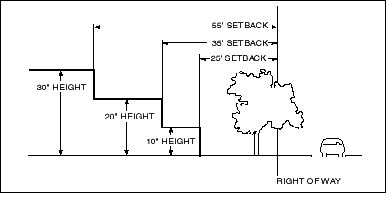
(b)
Where the minimum setback requirement is a function of the height of a structure, the setback is measured to each point of a building which may have multiple heights and result in multiple setbacks. (See following illustration.)
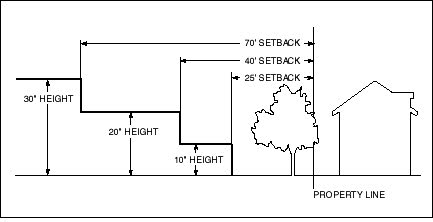
(c)
Where the minimum setback requirement is a function of the height of a structure, the setback is measured to each point of a building which may have multiple heights and result in multiple setback distances. (See illustration below.)
(d)
In the RM1A District not more than 22 dwelling units per acre shall be allowed on a lot.
(e)
Off-street parking for buildings located in the RM1A District shall only be permitted in the rear yard of the principal building.
(f)
Lots that are located in a Multiple Family Residential District and smaller than the Minimum Lot Area for Multiple-Family Use may not be used for multiple-family residential uses except upon the granting of a variation by the Zoning Board of Appeals pursuant to Section 150.1204(A)(2) of this Chapter.
(B)
Given that Master Site Plan approval is required for tracts zoned HC (Health Care), off-street parking, yard, setback, F.A.R., maximum lot coverage, and other bulk regulations of the HC (Health Care) zoning district governing the site may be modified in conjunction with the approval of such Master Site Plan, provided the Plan and Design Commission determines that such modification complies with the spirit and intent of the applicable provisions of this Chapter.
(C)
Minimum Required Side Yard Setback.
(1)
Except as provided in Section 150.704(C)(2) of this Chapter, the minimum side yard distance between a wall and a side lot line for multiple-family residential structures that are greater than 15 feet in height and located in a Multiple Family Residential District shall be 10 feet for that portion of the structure at or below a height of 15 feet above the grade, and an additional three feet for each subsequent ten feet of height of the structure.
(2)
Upon approval by the Plan and Design Commission, the footprint of each story located more than 15 feet above grade may be reconfigured on the lot in any manner by which the square footage of the reconfigure story does not exceed the maximum square footage that would be permitted in accordance with Section 150.704(C)(1) of this Chapter.
(D)
The top of the second story of a multiple-family residential structure located in a Multiple Family Residential District shall not be located at a point higher than 25 feet above grade.
(Ord. 57-02, J. 28, p. 410-473, passed 9/9/02, Footnote (d)(iii) and RM1A Density Chart 31-40 United Per Acre Deleted by Ord. 28-03, J. 29, 112-114, passed 3/24/03, Footnote (d)(i) & (ii) & RM1A Density Chart deleted by Ord. 40-04, J. 30, p. 155-158, passed 6/28/04; Ord. 81-07, J. 33, p. 694-703, passed 11/13/07; Ord. 59-15, passed 6/8/15)
Sec. 150.705. - Commercial and Light Industrial District Regulations.
(A)
The following table specifies the general requirements of area, bulk, yards, and density for the commercial and light industrial zoning districts. These requirements may be modified as permitted elsewhere in this Chapter.
* In the B2-RW zoning district, the number of allowable efficiency dwelling units shall be limited to no more than thirty (30%) percent of the total number of units allowed on the lot.
* In the B2-RW zoning district, the number of allowable efficiency dwelling units shall be limited to no more than thirty (30%) percent of the total number of units allowed on the lot.
Footnotes for Commercial and Light Industrial District Regulations:
(a)
In the B2-RW zoning district, the number of allowable efficiency dwelling units shall be limited to no more than thirty (30%) percent of the total number of units allowed on the lot.
(b)
For residential structures over fifteen (15) feet high in the B1 and B2 zoning districts, the minimum side and rear yard distance between a wall containing openings for light and air and a lot line shall be ten (10) feet plus one (1) foot for every three (3) feet of height above twenty (20) feet. For these purposes, the "height of the building wall" shall be measured from the floor level of the lowest story containing a dwelling unit.
(c)
Lots in the B4-5 and B4-5 zoning districts that do not meet the minimum lot area requirement set forth in this Section 150.705 shall be governed by, and subject to, the restrictions set forth in this Section 150.705 for the B4-4 zoning district.
(d)
Lower minimum building heights may be approved through the Planned Development process, provided that the subject building is at least two stories in height. A one-story building may be constructed only upon approval of a modification through the Planned Development process.
(e)
For any property in the B3 or I Zoning Districts that is located to the west of the Union Pacific Rail Road right-of-way or to the east of U.S. Route 41, that abuts or is across a right-of-way from any single-family use, no off-street parking, accessory structure, exterior lighting, refuse container, other storage or enclosures, or uses may be located upon a lot within a required setback that is adjacent or across a right-of-way from a residential use or district; provided, however, that this Section 150.705(A)(e) does not apply to berms, landscaping, buffering, ornamental or decorative accessory structures, gates, fences, and access drives as necessary to provide adequate access to a street or alley.
(B)
For residential structures over fifteen (15) feet high in the B1, B2, and B5 zoning districts, the minimum side and rear yard distance between a wall containing openings for light and air and a lot line shall be ten (10) feet plus one (1) foot for every three (3) feet of height above twenty (20) feet. For these purposes, the "height of the building wall" shall be measured from the floor level of the lowest story containing a dwelling unit.
(Amended by Ord. 93-99, adopted 11/8/99; Ord. 41-02, J. 28, p. 309-312, passed 7/8/02; Ord. 41-15, J. 41, p. 120-156, passed 4/13/15; Ord. O74-2019, § 4, passed 11/12/19; Ord. O72-2024, § 2, passed 10/28/24)
Sec. 150.705.1. - Public Activity District Regulations.
(A)
General Requirements. The following table specifies the general requirements of area, bulk, yards, and density for the PA (Public Activity) District. These requirements may be varied or otherwise modified as permitted elsewhere in this Chapter.
(B)
Special Minimum Requirements. Notwithstanding the otherwise applicable front yard requirements set forth in Subsection (A) of this Section, the front yard requirements shall, in no event, be less than the front yard requirements of the zoning district for the properties abutting or located across a right of way from the property in the PA (Public Activity) District. If a property in the PA (Public Activity) District abuts or is across a right of way from two distinct zoning districts with different front yard requirements, then the front yard requirements for the property in the PA (Public Activity) District shall not be less than the front yard requirements of the zoning district with the greater front yard requirement.
(C)
Special Standards for Telecommunication Facilities. The regulations and restrictions contained in this Section 150.705.1 shall not replace or supersede any of the regulations and restrictions for telecommunication facilities set forth in Section 150.414 of this Zoning Code.
(Ord. 42-02, J. 28, p. 313-337, passed 7/8/02)
Sec. 150.706. - Special Area Considerations.
The area requirements below further qualify the requirements in the preceding tables.
(A)
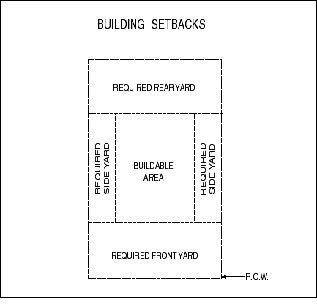
The requirements found in this Article are mutually exclusive and the minimum yards and other open spaces, including lot area per dwelling unit, required for any structure or use shall not be encroached upon or considered as any part of similar requirements for any other structure or use.
(B)
No part of any street shall be included in determining the area of any lot.
(C)
No part of any lot which lies below an elevation of four (4) feet above the official city datum (Chapter 12 of the Code) shall be included in determining the area of any lot.
(D)
Exclusive of the entire area of the stem, the entire remaining area included within any permitted lot-in-depth shall contain 115 percent of the required minimum lot area for conventional lots in any such zoning district and at least 115 percent of the lot width required by the applicable zoning district regulations.
Sec. 150.707. - Special Yard Considerations.
The following yard requirements further qualify the preceding tables.
(A)
Every part of a required yard shall be open to the sky, unobstructed, except for the following:
(1)
Ordinary projections of sills, belt courses, cornices, roof eaves, gutters, and ornamental features projecting not to exceed 24 inches;
(2)
Open or lattice enclosed fire escapes, fireproof outside stairways, and balconies opening upon fire towers projecting not more than five (5) feet into a rear yard;
(3)
Steps and ramps; stoops extending not more than three feet above grade and having an area of no more than 16 square feet; terraces; and patios projecting into a required rear or side yard, but not closer than two feet to the adjacent property line;
(4)
Ordinary projections of chimneys and flues into the rear yard, and up to two feet into any required side yard;
(5)
Accessory buildings and uses as restricted elsewhere in this Chapter;
(6)
Driveways and parking spaces as restricted in this Chapter;
(7)
Freestanding yard lights in front yards, provided that in residential districts and the PA (Public Activity) District such lights do not exceed seven feet, six inches in height and comply with the performance standards contained in this Chapter;
(8)
Fences erected on lot lines and in required yards; providing such fences comply with Chapter 173 of this Code;
(9)
Any stone, paved or other surfaced patio or wooden deck constructed at or below a level which is 12 inches above grade and not closer than two feet to the adjacent property line, except for property lying within an area for which a Planned Unit Development permit has been issued pursuant to this Code;
(10)
The following Signs:
(a)
Signs that require a Sign Permit and all permanent Signs that do not require a Sign Permit pursuant to Article 20 of this Chapter; provided, however, that no such Sign shall be located within two feet of the front Lot line. Notwithstanding this special yard regulations, if any other provision in this Chapter provides a more restrictive yard regulation, the more regulation shall control.
(b)
All Temporary Signs that do not require a Sign Permit pursuant to Article 20 of this Chapter;
(11)
Commercial front yards;
(12)
Fountains that are not more than nine feet in height in single-family residential districts, nor more than 18 feet in height in other districts, may encroach up to 50% of the depth of a required front yard, provided that the walls of any encroaching fountain may not exceed three feet in height, and no portion of the fountain may be located closer to a side lot line than permitted by the minimum required single side yard setback;
(13)
Window wells for the principal structure on a lot may encroach into any required yard;
(14)
Sidewalks or other walking paths that are not more than 12 inches in height may encroach in any front or side yard;
(15)
Flagpoles may encroach into required front yards, but must be located at least three feet from the front property line;
(16)
The following additional encroachments are permitted in Single-Family Residential Districts only. For purposes of this Section 150.707(A)(16) only: (i) on corner lots for which the two street frontages are of equal length, the encroachments permitted by this Section 150.707(A)(16) apply only to the street frontage that has the fewest other zoning lots along the same side of the block; and (ii) a "double corner lot" is a corner lot having frontage on three streets, one of which is approximately perpendicular, and forms a corner with, each of the other two streets.
(a)
Porticos and entrance canopies may encroach into a required front yard, no further than the lesser of six feet or 20% of the required yard, provided that: (i) the height of the encroachment does not exceed 18 feet; (ii) the roof or top of the portico or canopy is not used as any type of deck or balcony; and (iii) no portion of the portico or canopy may be located closer to a side lot line than permitted by the minimum required single side yard setback;
(b)
Pergolas may encroach into a required side yard, but must comply with the required minimum single side yard setback, and provided that: (i) the height of the encroachment may not exceed 18 feet; and (ii) the top of the pergola is not used as any type of deck or balcony;
(c)
Porches may encroach into a required front yard up to six feet in the R5, R5A, R6, and R7 Districts, and up to eight feet in the R1, R2, R3, and R4 Districts, provided that: (i) the height of the encroachment does not exceed 18 feet; (ii) the roof or top of the porch is not used as any type of deck or balcony; and (iii) no portion of the porch may be located closer to a side lot line than permitted by the minimum required single side yard setback;
(d)
Up to four address columns and ornamental pillars or piers on a lot (but not more than two per driveway) may encroach into a required front yard, but only if the column, pillar, or pier: (i) has a footprint of no more than four square feet; (ii) has an overhang no greater than four inches; (iii) does not exceed 30 inches in any horizontal dimension; (iv) complies with all traffic visibility regulations of this Chapter 150; and (v) does not exceed six feet in height (except that a light may be installed on top of the column, pillar, or pier to a maximum height of 7.5 feet above grade);
(e)
Decks that are higher than 12 inches above grade and attached to a principal structure may encroach into required rear yards, but only in compliance with all other rear yard and accessory structure height regulations set forth in this Chapter;
(f)
Not more than one miniature or "Little Free" Library structure that is not more than 66 inches in height and used exclusively for the storage of books may encroach into the required front yard of a lot, but: (i) the structure must be located at least two feet from the front lot line; and (ii) the book compartment may not exceed 30 inches in width or height, nor 18 inches in depth;
(g)
Sports courts may encroach into yards as follows:
(i)
On any lot, any portion of a sports court that does not exceed 18 feet in height may encroach into any required total depth side yard, but must comply with the required minimum side yard setback;
(ii)
On corner lots, sports courts may encroach into the front yard with the longest lot line, but no closer than ten feet from any lot line, and only if the total area of all encroaching structures (excluding driveways and off-street parking facilities) into that yard does not exceed 30 percent coverage of the required yard; and
(iii)
On through lots that are adjacent on two sides to other through lots, and on double corner lots, into the front yard that functions as a rear yard, in the determination of the Zoning Administrator, but no closer than 10 feet to any property line, and only if the total area of all encroaching structures (excluding driveways and off-street parking facilities) into that yard does not exceed 30 percent coverage of the required yard;
(h)
Play sets or other play equipment or play structures, including, without limitation, swing sets, slides, trampolines, and treehouses, but excluding temporary seasonal structures, may encroach: (i) on corner lots into the front yard with the longest lot line, but no closer than three feet from any lot line, and only if the total area of all encroachments (excluding driveways and off-street parking facilities) into that yard does not exceed 30 percent coverage of the required yard; and (ii) on through lots that are adjacent on two sides to other through lots, and on double corner lots, into the front yard that functions as a rear yard, in the determination of the Zoning Administrator, up to three feet from any lot line, but in either case only if the total area of all encroaching structures (excluding driveways and off-street parking facilities) into that yard does not exceed 30 percent coverage of the required yard;
(i)
Detached garages and sheds may encroach: (i) on corner lots into the front yard with the longest lot line; and (ii) on through lots that are adjacent on two sides to other through lots, and on double corner lots, into the front yard that functions as a rear yard, in the determination of the Zoning Administrator; and provided in either case that: garages must be located at least 22 feet from the front lot line of the longest front yard and may not be located closer to a side lot line than permitted by the minimum required single side yard setback; sheds located within a required front yard must be located at least 10 feet from all lot lines; and the total area of all encroaching structures (excluding driveways and off-street parking facilities) into that yard may not exceed 30 percent coverage of the required yard; and
(j)
Swimming pools and cabanas may encroach: (i) on corner lots into the front yard with the longest lot line; and (ii) on through lots that are adjacent on two sides to other through lots, and on double corner lots, into the front yard that functions as a rear yard, in the determination of the Zoning Administrator; and provided in either case cabanas and swimming pools must be located at least 10 feet from all lot lines, and the total area of all encroaching structures (excluding driveways and off-street parking facilities) into that yard does not exceed 30 percent coverage of the required yard.
(k)
Air conditioning systems or units may encroach within the total depth side yard requirement but must in all instances meet the minimum side yard requirement of the underlying zoning district.
(B)
Front Yards.
(1)
Whenever any ordinance or covenant entered into by the City stipulates a front yard or setback requirement along any street in any district which is greater than the front yard requirement of this Chapter, then the greater requirement shall apply.
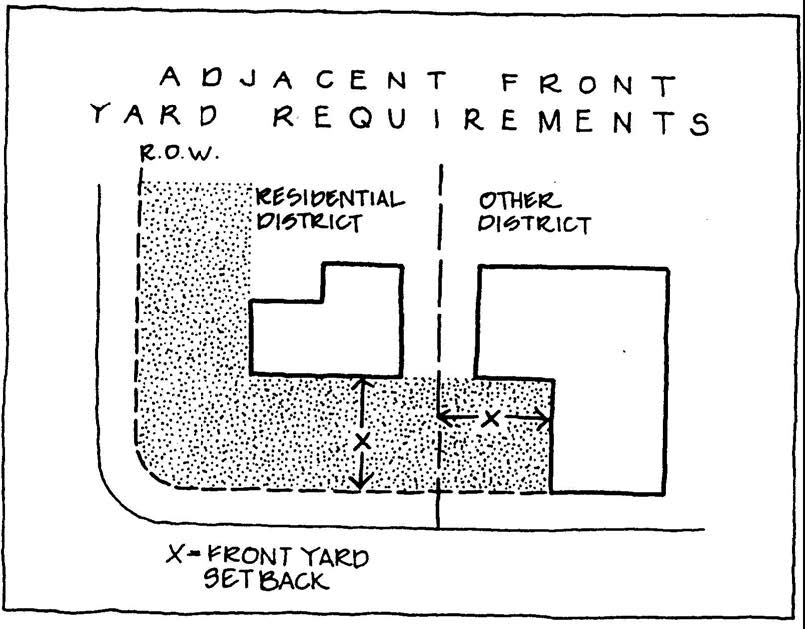
(2)
Where two districts with different front yard requirements are located adjacent to each other without a street or alley between them, the greater front yard requirement shall extend into and be effective in the district having the lesser front yard requirement for a distance equal to the greater front yard requirements. (See illustration)
(3)
Where lots have street frontage on more than one side, a front yard shall be provided on each side adjacent to a street.
(4)
On double frontage lots that do not abut other double frontage lots, the minimum required front yard for the yard that functions as a rear yard (as determined by the Zoning Administrator) is 90% of the minimum required front yard otherwise required pursuant to this Article VII.
(C)
Rear Yards.
(1)
Whenever a lot abuts a public alley, one-half (½) of the width of that alley may be considered as a portion of the required rear yard.
(2)
The building setback lines for all accessory uses and structures in the required rear yard of the frontmost lot adjacent to a lot-in-depth shall be ten (10) feet.
(D)
Accessory Buildings and Uses.
(1)
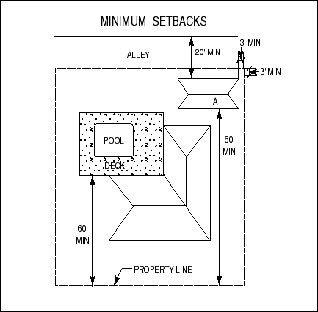
Except as provided by Subparagraph (2) of this Section 150.707(D), no accessory use or building shall be located within a required front yard or required side yard. Detached accessory buildings or uses may be built or located in the required rear yard of any zoning district, provided: (a) the total floor area of all such accessory buildings or uses on a lot do not occupy more than 30 percent of the required rear yard of the lot, plus up to an additional 200 square feet for detached accessory garages in the R6 and R7 zoning districts; (b) any structure in the required rear yard must be constructed at least three feet from the side and rear property lines of the lot upon which it would be located, provided that in the event the rear yard abuts a public alley, no building or structure shall be constructed within 20 feet of the side of the alley opposite the rear yard the alley abuts; and (c) swimming pools (including decks and mechanical systems) and tennis courts must be at least 10 feet from the side and rear lot lines in the required rear yards. (See illustration).
(2)
An accessory use consisting of a basketball backboard mounted upon a single stanchion, post or pole, either permanently installed or portable or mounted upon the principal or accessory structure, may be permitted in a single family residential zoning district, provided:
(a)
The height of the structure is no greater than thirteen (13) feet above the level of the ground upon which such accessory is located;
(b)
The structure is located on the lot so as to meet or exceed the required side yard setback for the principal structure in the zoning district in which it is located minus one foot and provided that the structure is located no less than ten (10) feet from the front or rear property line; and
(c)
The area on the ground occupied by a stanchion, post or pole (if used) supporting the structure is no greater than one square foot.
(3)
In any zoning district in which a side yard is required, no detached accessory building or use other than a garage shall be constructed closer than sixty (60) feet from the front lot line or closer to the front lot line than the foundation of the existing principal structure, whichever is lesser; nor shall any detached accessory building or use be located closer than three (3) feet to the principal building or any projection thereof.
(E)
No building or structure of any kind, except paved off-street parking, utility poles, power lines, public lighting, and signs authorized by the Sign Code (Chapter 110 of the Municipal Code) shall be erected or constructed within a distance of fifty (50) feet or twenty percent (20 percent) of the average depth of the property upon which the building or structure is to be erected, whichever is lesser, from:
(1)
The right-of-way of U.S. Route 41; or
(2)
The right-of-way of Skokie Valley Road from the intersection of U.S. Route 41 (at Clavey Road) south to the south line of Lake Cook Road.
(F)
Whenever a lot of record established prior to the adoption of this Chapter does not meet the minimum width requirements of the zoning district in which it is located, the criteria in the following two paragraphs shall be applied.
(1)
The required side yard may be reduced to a width no less than the percentage of the width of the lot indicated for the appropriate zoning district in the table below, except that in no instance shall the width of the side yard be less than the minimum width in feet indicated for the appropriate district in the same table.
(2)
Any single lot or parcel of land not held in contiguous ownership that does not meet the requirements for minimum lot area may be utilized for a single family dwelling use, provided there is compliance with all of the bulk requirements of this Chapter except that yards may be ninety (90) percent of the minimum required dimensions of the district within which the lot or parcel lies.
(G)
In all zoning districts no building or structure hereafter erected and no planting or other obstruction to the vision of drivers of motor vehicles may be located:
(1)
In any residential district or PA (Public Activity) District exceeding a height of three (3) feet above the street grade within twenty-five (25) feet of the intersecting street lines bordering corner lots; and
(2)
In any industrial or commercial or health care district exceeding a height of three feet above the street grade within 25 feet of the intersecting street lines bordering a corner lot, provided that this regulation shall not apply to that part of a building above the first floor.
(H)
In all districts a triangular space determined by a diagonal line connecting two points measured fifty (50) feet equidistant from the intersection of the closest street or alley right-of-way lines must be maintained at an intersection of a street or alley right-of-way over which trains are operated, free from any kind of obstruction to vision; provided, however, that this paragraph shall not prevent the use, maintenance, repair or restoration of any building in existence on April 27, 1964.
(I)
Reserved.
(J)
The preceding requirements notwithstanding, the following requirements shall regulate the yards required on all lots-in-depth:
(1)
The minimum required building setback lines of a lot-in-depth shall be dependent upon the required zoning yards of any other lots adjacent to such lot-in-depth. Where a lot-in-depth abuts a front or rear yard, the required setback lines shall be equal to 120 percent of the front or rear yard setback required in that zoning district. Where a lot-in-depth abuts a side yard, the required setback lines shall be 200 percent of the side yard setback required in that zoning district.
(2)
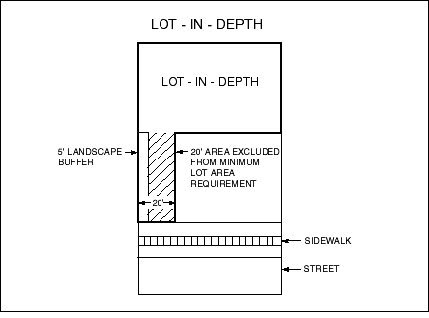
No building or other structure shall be placed or constructed upon any part of the stem.
(3)
The lot-in-depth shall have frontage upon an existing public street by means of its stem, which shall be at least 20 feet wide.
(4)
Five foot wide landscape buffers shall be provided:
(i)
Adjacent to adjoining properties not in the proposed subdivision; and
(ii)
within the stem of the lot-in-depth. Prior to the issuance of an occupancy certificate by the City for structures on the lot-in-depth, within each five foot landscape buffer the owner of the lot-in-depth shall provide a shrub screen and groundcover plantings meeting the visual clearance requirements of this Chapter.
(K)
In the B1A Waukegan/Bloom Neighborhood Commercial District, the following additional conditions shall apply:
(1)
Commercial parking between buildings and the street shall be prohibited;
(2)
Commercial parking lots shall be located at the rear of buildings;
(3)
Alleys shall be constructed and utilized for automobile access to the rear of buildings;
(4)
The primary ground floor entrances to commercial buildings shall be oriented to the street, parks, or plazas; and
(5)
Notwithstanding the maximum front yard setback established in Subsection (A) of Section 150.705 hereinabove, a front yard setback of up to twenty feet (20') may be permitted if such setback is utilized for outdoor cafes, small plazas, arcades, patios, sidewalks, and/or walkways.
(Ord. 80-98, adopted 12/14/98; Subsection (K) added by Ord. 93-99, adopted 11/8/99; Ord. 32-02, J. 28, p. 227-264, passed 5/13/02; Ord. 42-02, J. 28, p. 313-337, passed 7/8/02; Ord. 77-02, J. 28, p. 549-552, passed 11/25/02; Ord. O37-2021, § 4, passed 4/26/21; Ord. O73-2023, § 2, passed 12/11/23; Ord. O31-2024, § 4, passed 4/10/24)
Sec. 150.708. - Special Height Considerations.
The height requirements below further qualify the requirements in the preceding tables.
(A)
Chimneys, cooling towers, elevator bulkheads, fire towers, ornamental towers and spires, church steeples, flagpoles, or necessary mechanical appurtenances are all exempt from the height requirements established previously in this Chapter. However, they may be subject to other ordinances of the City.
(B)
Radio, radar, citizens band, and television receiving or transmitting antennae, other than Public Safety Telecommunications Facilities or Public Utility Infrastructure Facilities, may be erected on the roof of a principal structure to a height not exceeding 12 feet above the highest point on the roof of said principal structure, but not closer to any property line than two feet.
(C)
Public Safety Telecommunications Facilities and Public Utility Infrastructure Facilities may be erected on the roof of a principal structure, or on a pole or tower, to a height as necessary to meet the transmitting and receiving distances required for the proper operation of such Facilities; provided, however, that no Public Safety Telecommunication Facility or Public Utility Infrastructure Facilities erected to a height greater than the generally-applicable maximum height for accessory structures in the underlying district may be located closer than 10 feet to any property line.
(D)
Semi-public or public service buildings, hospitals, institutions or schools, when permitted in a zoning district, may be erected to a height not exceeding 60 feet, and churches and temples may be erected to a height not exceeding 75 feet, if such buildings are set back beyond the normal required yards at least one foot for each one foot of additional building height above the height limit otherwise required in the district in which the building or structure is located.
(E)
No building or structure may be erected within the proximity of any airport, heliport, landing field, or landing strip which violates the regulations of the Federal Aviation Administration.
(F)
The maximum story-based height limitations set forth in this Article VII do not apply to uninhabited structures, such as parking garages, Uninhabited structures are regulated exclusively by the applicable maximum foot-based height limitation.
(Ord. 69-14, J. 40, p. 194-199, passed 07/14/14; Ord. 104-14, J. 40, p. 292-298 passed 12/01/14; Ord. 41-15, J. 41, p. 120-156, passed 4/13/15)
Sec. 150.709. - Special Density Considerations.
In the RM1, RM1A, RM2, or RO zoning districts or in a Planned Unit Development, when the calculation of the number of dwelling units permitted on a lot results in a fraction, the following rules shall apply:
(A)
The lot area required for the first dwelling unit on a lot must be the complete and literal square footage required by this Chapter. No fractional percentage may satisfy the requirement.
(B)
If, after the complete area required for the first dwelling unit on a lot is subtracted, the remaining density calculation results in a fraction, then any fraction up to and including one-half (½) shall be disregarded, and fractions of over one-half (½) shall be interpreted as permitting the next highest whole number of dwelling units.
(Ord. 57-02, J. 28, p. 410-473, passed 9/9/02)
Sec. 150.710. - Lots or Parcels of Land of Record.
(A)
Contiguous Ownership in the R1, R2, R3, R4, R5, R6, R7, RM1, RM1A, RM2, and RO zoning districts. When two or more parcels of land (which may contain a lot or lots of record), are adjacent and one or more of such parcels lack adequate area or width to qualify for a permitted use under the requirements of the zoning district in which such parcels are located, such parcels shall be maintained and used as one zoning lot for such use if such parcels have been held in contiguous ownership at any time after May 8, 1960, or the date when such parcel ceased to comply with lot area and width requirements.
(B)
Division of Lots. No improved lot or parcel of land shall be divided into two (2) or more lots unless all improved zoning lots resulting from such division conform with all applicable regulations of the zoning district in which the lot or parcel is located.
(C)
Location of Open Space. All yards and other open spaces allocated to a building or Planned Unit Development shall be located on the same lot as such building. Furthermore, no legally required yards or other open space or minimum lot area allocated to any building shall by virtue of change of ownership or for any other reason be used to satisfy yard or other open space or minimum lot area requirements for any other building or Planned Unit Development on a contiguous lot or parcel. (See also Sec. 150.104)
(Ord. 57-02, J. 28, p. 410-473, passed 9/9/02)
Sec. 150.711. - Established Setbacks — Single Family Districts.
In any single family residential zoning district, if the Established Building Setback is greater in depth than required for front yards for such zoning district, no new structure or addition to an existing structure shall be erected closer to the street than the Established Building Setback; provided, however, that: (i) when a lot has more than one front lot line, the Established Building Setback regulations shall not apply on the side of the lot with the longest front lot line, unless either (1) the lot depth of the lot, measured on that side, is greater than 125 feet, or (2) the lot is a through lot. In no event shall the Established Building Setback be less than the required front yard for the zoning district; and (ii) the Established Building Setback does not apply to the encroachments permitted pursuant to Section 150.707(A)(12) through 150.707(A)(16) of this Chapter. (See also 150.105)
(Ord. 42-02, J. 28, p. 313-337, passed 7/8/02; Ord. 71-06, J. 32, p. 340-342, passed 11/13/06; Ord. O37-2021, § 4, passed 4/26/21; Ord. O31-2024, § 5, passed 4/10/24)
Sec. 150.712. - Garage Door Openings.
In any single family district, there shall be constructed upon any given lot no more than thirty-six (36) lineal feet of exterior wall openings for vehicular entry to or exit from all such buildings constructed upon such lot.
Sec. 150.713. - Special Regulations in the B4-BG District.
(A)
In addition to the applicable required setbacks, as set forth in Section 150.705(A) of this Code, a landscaped setback of not less than 25 feet in width must be maintained on each lot within the B4-BG District along Deerfield Road.
(B)
On all mixed-use lots in the B4-BG District, the first floor of all buildings must contain only commercial uses with pedestrian-oriented and public access, except as may be approved as part of a Planned Development.
(Ord. O74-2019, § 5, passed 11/12/19)

