
Highland Park City Zoning Code
ARTICLE V
- PLANNED DEVELOPMENTS1
Editor's note— Article V amended in toto by Ord. 30-97, J. 24, p. 103-105, passed 5/12/97; revised in toto by Ord. 80-07, J. 33. p. 660-693, passed 11/13/07; revised in toto by Ord. 59-15, passed 6/8/15.
Sec. 150.501.- Intent and Purpose.
To promote ingenuity, imagination, and excellence in project design on the part of owners, builders, architects, and developers and to produce developments which are in keeping with overall land use, open space and other objectives of the Master Plan, this Article makes available a special use procedure which allows for departures from the strict application of the specific zoning requirements of the Zoning District in which the proposed development is located. The intent of this Article is to permit site planning and project design flexibility from the requirements of this Chapter and of the Subdivision Ordinance, and to provide performance criteria for Planned Developments that:
(A)
Encourage a creative and sustainable approach to the development of land and buildings, in order to protect, preserve, and enhance the natural and built environment.
(B)
Accomplish a more desirable built environment than would be possible through the strict application of the requirements of this Chapter and of the Subdivision Ordinance;
(C)
Provide for an efficient use of land that facilitates a more economic arrangement of circulation systems, land uses, buildings, and public and private utilities;
(D)
Enhance neighborhoods through the preservation and protection of Environmentally Sensitive Areas, the preservation of structures and areas with architectural or historical significance, the provision of recreational and open space areas, and the provision of underground utilities;
(E)
Minimize the consumption of natural resources by reducing the waste of water, energy, or materials;
(F)
Encourage site planning and site designs that emphasize accessibility, open views, and connections to the larger community; and
(G)
Provide an environment of stable character compatible with surrounding areas.
Sec. 150.505. - Applicability.
The requirements of this Article shall apply to the following types of developments in the City:
(A)
Residential Developments.
(1)
Residential developments on a tract or tracts of land at least three acres in size and located in a Single Family Residential District, except for developments consisting solely of one single-family detached residence;
(2)
Residential developments consisting of 10 or more dwelling units and located in a Single Family Residential District;
(3)
Multiple-family residential developments consisting of more than one principal building on a Legal Lot of Record, except for townhouse and other attached single-family developments;
(4)
Townhouse developments consisting of three or more dwelling units in any Single Family Residential District; and
(5)
Townhouse developments consisting of 10 or more dwelling units in any Zoning District.
(6)
Any new principal building in the RO zoning district that exceeds the maximum height limitation set forth in Section 150.704(A) of this Chapter.
(B)
Downtown Developments.
(1)
New developments with a gross floor area of 50,000 square feet or more in B4-4, B4-5, B4-6, B5, or RO Zoning Districts;
(2)
Any development in the B5 Zoning District that includes any Auto-Oriented Use;
(3)
Any Auto-Oriented Use with driveway access onto a pedestrian frontage or neighborhood frontage (See Figure 150-23-1 in Section 150.2310 of this chapter);
(4)
New nonresidential development, or additions to an existing development, in the B4-4, B4-5, B4-6, B5 or RO zoning districts that provide more than an average of 3.33 parking spaces per 1,000 square feet of gross floor area, except that parking required for restaurant use should not be counted in the average calculation;
(5)
Any new principal building that does not comply with the applicable minimum height requirements in the B4-4, B4-5, B4-6 or B5 zoning districts; and
(6)
Any new principal building in the B4-4, B4-5, B4-6 or B5 zoning districts that exceeds the maximum as-of-right height limits established in Sec. 150.705(A) of this Chapter.
(C)
Mixed Use Developments. Developments in the B1, B1A, B2 and B2RW zoning districts that contain both (1) commercial, institutional, or office uses, and (2) residential uses.
(D)
Skokie Highway Business District Developments.
(1)
New developments within the B3 or I Zoning Districts that include either (1) multiple principal buildings, or (2) a single building consisting of 25,000 square feet or more of new floor area.
(2)
Expansions of or modifications to any pre-existing building consisting of less than 25,000 square feet in gross floor area, and located within the B3 or I Zoning Districts, which expansion or modification causes the building to exceed 25,000 square feet of gross floor area, unless the expansion or modification is permitted as of right pursuant to Section 150.402(A)(2) of this Chapter.
(3)
Expansions or modifications to any pre-existing building consisting of 25,000 square feet or more in gross floor area, and located within the B3 or I Zoning Districts, unless the expansion or modification is permitted as of right pursuant to Section 150.402(A)(2) of this Chapter.
(4)
For any property located in the B3 or I Zoning Districts that is to the west of the Union Pacific Rail Road right-of-way or to east of U.S. Route 41, that abuts or is across a right-of-way from any single-family land use, the following:
(a)
New developments that include any principal use or structure, excluding Solar Energy Systems uses; and
(b)
Any new development or change to existing developments, except for minor maintenance or repair of existing structures, where any use or structure, excluding fencing, landscape screening, related earth berms, and buffers, is physically located within 100 feet of the property line of a property located within a residential zoning district.
(E)
Voluntary Participation. Developments for which the applicant chooses to utilize the Planned Development process set forth in this Article, in order to achieve a superior design and site planning flexibility.
(Ord. 41-15, J. 41, p. 120-156, passed 4/13/15; Ord. O77-2023, § 3, passed 12-11-23)
Sec. 150.510. - Modifications to Zoning District Regulations.
Subject to the standards and limitations set forth in this Section 150.510, the Plan and Design Commission may recommend, and the City Council may approve, modifications to the provisions of this Chapter, of the Subdivision Ordinance, and of Chapter 93 of the Code, as they apply to, and in conjunction with the approval of, the proposed Planned Development.
(A)
Prohibited Modifications. The Plan and Design Commission shall not recommend, and the City Council shall not approve, any of the following modifications:
(1)
Modifications to the Table of Allowable Uses set forth in Article IV of this Chapter;
(2)
Modifications that result in the increase of any density standard set forth in this Chapter, except as set forth in Section 150.510(D) of this Article; or
(3)
Modifications that permit a Land Bank (as that term is defined in Section 150.804(C)(1) of this Chapter) within any part of the common open space required pursuant to this Article or within any Environmentally Sensitive Area.
(B)
Construction in Environmentally Sensitive Areas. The Plan and Design Commission shall not recommend, and the City Council shall not approve, a Planned Development that is proposed to be constructed in an Environmentally Sensitive Area except upon making all findings required pursuant to Section 150.530(H)(3) of this Chapter and the following additional findings:
(1)
That there are no available and feasible alternatives to the proposed Planned Development with less adverse impact to the Environmentally Sensitive Areas that will accomplish the project's purpose, taking into account costs, logistics, the proposed use, and the most current technology;
(2)
That the Planned Development minimizes construction in Environmentally Sensitive Areas to the greatest extent possible; and
(3)
That the proposed construction is consistent with (i) the regulations set forth in Articles XVIII and XIX of this Chapter, and (ii) other applicable provisions of the Code, as determined by the Director of Community Development.
(C)
Modifications to Minimum Standards for Public Streets, Alleys, or Other Public Ways. All standards applicable to public streets, alleys, and other public ways, as set forth in the Subdivision Ordinance and in Chapter 93 of the Code, may be modified only upon (a) the recommendation of the City Director of Public Works, and (b) the finding by the Plan and Design Commission, and the determination by the City Council, that the proposed modifications will not impede safe and effective traffic flow or pedestrian use of the public streets, alleys, or other public ways.
(D)
By-Right Density Bonuses.
(1)
Bonus for Buildings with Architectural or Historic Significance. The applicant for a Planned Development that includes residential uses shall have the right, but not the obligation, to incorporate within the Planned Development one additional dwelling unit if the Planned Development includes one or more buildings, structures, areas, objects, or landscapes of significance that (a) have been determined to be historically significant by the Historic Preservation Commission of the City, pursuant to Chapters 24 or 170 of the Code, and (b) will be preserved or restored in conjunction with the proposed Planned Development.
(2)
Affordable Housing Bonus. Upon satisfaction of the standards set forth in Section 150.2106 of this Chapter, the applicant for a Planned Development that includes residential uses shall have the right, but not the obligation, to incorporate within the Planned Development additional market rate dwelling units as permitted pursuant to Section 150.2106 of this Chapter.
(3)
Standards for Bonuses. The density bonuses authorized by this Section 150.510(D) shall be applicable only upon approval of the proposed Planned Development in accordance with the otherwise applicable provisions of this Article. Nothing in this Section 150.510(D) shall be deemed or interpreted as requiring the approval of a proposed Planned Development.
(Ord. 41-02, J. 28, p. 309-312, 07/08/02; Ord. 57-02, J. 28, p. 410-473, passed 9/9/02; Ord. 22-03, J. 29, p. 91-95, passed 2/24/03; Ord. 32-06, J. 32, p. 114-116, passed 4/24/06; Ord. 80-07, J. 33, p. 660-693, passed 11/13/07; Ord. 30-09, J. 35, p. 088-095, passed 4/27/09; Ord. 59-15, passed 6/8/15)
Sec. 150.515. - Public Benefit.
(A)
Public Benefit Defined. For purposes of this Article only, "public benefit" means an amenity provided in the form of an improvement, donation or dedication that is not otherwise required as part of the development process and that serves the residents of the Planned Development and the community at large.
(B)
Public Benefit Required. A public benefit shall be required for the following types of Planned Developments:
(1)
Planned Developments for which the applicant has requested, in accordance with and pursuant to Section 150.510 of this Article, a modification of the periphery yard, floor area ratio, open space, parking, building height, or lot coverage requirements otherwise applicable to the Planned Development; and
(2)
All Planned Developments in the B4-4, B4-5, B4-6, B4-BG, or B5 Zoning Districts.
(C)
Standards for Public Benefits.
(1)
General Standards. All proposed public benefits shall be (a) commensurate with all zoning relief requested by the applicant, and (b) proportional to the anticipated impact of the proposed Planned Development on adjacent properties and land uses and on the community at large.
(2)
Standards for Downtown Planned Developments. All proposed public benefits for Planned Developments in the RO, B4-4, B4-5, B4-6, B4-BG, and B5 Zoning Districts shall (a) enhance and support the character and vitality of the downtown area, (b) foster economic investment in the downtown area, and/or (c) improve pedestrian and/or bicyclist amenities.
(3)
Public Benefits Provided by Sustainable Building and Site Design. Upon submission by the applicant of sufficient information and evidence that a proposed Planned Development will seek certification based upon the Leadership in Energy and Environmental Design (LEED) rating system or similar design or building certification system, architectural and landscape architectural elements and site plan features that are incorporated into the design of the Planned Development and commonly considered to be of "sustainable" design may satisfy all or part of the public benefit requirement set forth in this Section 150.515. Nothing in this Section 150.515(C)(3) shall be deemed or interpreted as obligating the Plan and Design Commission or the City Council to accept the sustainable building and site design aspects of the development as a public benefit, nor to accept the proposed public benefit in its entirety.
(4)
Public Benefits Provided by Streetscape Improvements. Provision of, or payment of at least one-half of the costs of, streetscape improvements on rights-of-way adjacent to a Planned Development may satisfy all or part of the public benefit requirement set forth in this Section 150.515. Nothing in this Section 150.515(C)(4) shall be deemed or interpreted as obligating the Plan Commission or the City Council to accept the streetscape improvement aspects of the development as a public benefit, nor to accept the proposed public benefit in its entirety.
(D)
Review of Proposed Public Benefits.
(1)
The Plan and Design Commission and City Council shall review all proposed public benefits in conjunction with their review of the proposed Planned Development pursuant to this Article.
(2)
The Plan and Design Commission shall not recommend, and the City Council shall not approve, any proposed public benefit except upon making a finding that the proposed benefit satisfies the standards set forth in Section 150.515(C) of this Article.
(3)
The Plan and Design Commission and the City Council may consult, and request reports from, any other City agency, board, or commission regarding the merit and appropriateness of a proposed public benefit.
(4)
The Plan and Design Commission and the City Council shall have the right to require an alternate public benefit or combination of public benefits in lieu of, or in addition to, any public benefit proposed by the applicant.
(5)
A determination that a proposed public benefit satisfies the standards set forth in this Section 150.515 shall not be deemed or interpreted as obligating the Plan and Design Commission or the City Council to recommend or approve the associated Planned Development.
(E)
Public Benefit List. The City may, from time to time, prepare a list of projects or other community needs that may serve as appropriate public benefits for Planned Developments.
(F)
Waiver. The requirements of this Section 150.515 may be waived by the City Council in its sole and absolute discretion.
(Ord. 22-03, J. 29, p. 91-95, passed 2/24/03; Ord. 80-07, J. 33, p. 660-693, 11/13/07, Ord. 41-15, J. 41, p. 120-156, passed 4/13/15; Ord. 59-15, passed 6/8/15; Ord. O74-2019, § 8, passed 11/12/19)
Sec. 150.520. - Site Planning Constraints and Design Standards.
The applicant for a Planned Development must demonstrate that the proposed Planned Development satisfies and incorporates, to the greatest extent practicable, the following site design standards:
(A)
Protection of the Public Health, Safety, and Welfare. The uses and structures within the Planned Development shall be compatible with one another, in that they are designed, located, and proposed to be operated so that the public health, safety and welfare will be protected.
(B)
Preservation of Environmentally Sensitive Areas.
(1)
No development shall occur in any Environmentally Sensitive Area located on the subject property, except upon approval of a modification therefor, in accordance with Section 150.510(B) of this Article.
(2)
Environmentally Sensitive Areas located on the subject property may be included as common open space within a Planned Development, upon either (a) identification of such areas on the plat of subdivision as a separate lot or lots, or (b) recordation by the applicant of a conservation easement or similar restriction that ensures the preservation of such areas, in perpetuity, from future development.
(C)
Historic Resources. The Planned Development shall preserve all (1) locally designated landmarks, and (2) properties, structures, areas, objects, and landscapes determined to be historically significant by the Historic Preservation Commission in accordance with Chapters 24 or 170 of the Code.
(D)
Clustering New Development. The Planned Development shall preserve the structures, landscapes, scenic view sheds, and other natural and historic features of the subject property, through (i) clustering of lots or building pads, (ii) adaptive reuse of existing structures, and (iii) the protection of designated open space from development; provided, however, that clustering of development shall not be required upon a demonstration by the applicant, to the satisfaction of the Plan and Design Commission and the City Council, that there are no features on the subject property worthy of preservation, or that those features worthy of preservation will be more effectively preserved by not clustering development. All clustering shall be designed in accordance with the following standards:
(1)
Lots shall be configured to minimize the length of roadways required for the proposed Planned Development.
(2)
Building envelopes shall be configured to minimize the loss of, and damage to, Environmentally Sensitive Areas located on the subject property.
(3)
All residential units shall be grouped into clusters, in accordance with the following:
(a)
Each cluster shall contain not less than three dwelling units, and not more than 10 single-family detached dwelling units nor more than 20 of all other types of dwelling units.
(b)
To the extent practicable, residential clusters shall be located so as to (i) minimize negative impacts on the natural and cultural resources on the site, (ii) minimize conflicts between incompatible uses, (iii) minimize disturbance to Environmentally Sensitive Areas, and (iv) protect existing historic buildings and landscapes.
(E)
Location of Structures. All structures to be located within the Planned Development shall (1) be related harmoniously to the terrain and to existing structures in the vicinity of the subject property, and (2) have a visual relationship to existing nearby structures;
(F)
Environmental Quality and Responsible Design. The Planned Development shall be consistent with the City of Highland Park Environmental Policy and with the City of Highland Park Checklist for Environmentally Responsible Design and Construction. The applicant may demonstrate consistency with standards established for site design and building construction practices by referencing known sustainable development and green architecture rating systems.
(G)
Preservation of Landscapes. The landscapes within the Planned Development shall be preserved in their natural states, insofar as practicable, by minimizing tree and soil removal. All proposed grade changes shall be consistent with the general appearance of neighboring developed areas.
(H)
Schools, Parks, and Public Facilities. The Planned Development shall not impose an undue burden on parks, recreational areas, schools, or other public facilities that serve or are proposed to serve the Planned Development.
(I)
Relationship and Connection to Adjoining Land. The Planned Development shall not be designed as an enclave separate from adjacent properties, unless existing development patterns, natural features, and/or topographic conditions prevent vehicular or pedestrian access connections to adjacent properties. In order to achieve connectivity to adjoining land, all lots, streets, sidewalks and/or paths within a Planned Development shall be designed, to the extent practicable, to allow for the continuation of such existing or proposed features to adjoining areas. New streets, sidewalks, and/or paths located within a proposed Planned Development shall be constructed and installed to the boundaries of the proposed Planned Development if the City Council determines, in its sole discretion, that the proposed Planned Development adjoins land with the potential of being subdivided or resubdivided.
(J)
Setbacks from the Periphery of the Planned Development. The required front, rear, and side yards along the periphery of the Planned Development shall be of a size not less than the greater of (1) the minimum front, rear, and side yard requirements of the underlying Zoning District in which the Planned Development is located, and (2) the minimum front, rear, and side yard requirements of the adjacent Zoning District.
(K)
Upper-store Building Design. Stories of new building and additions to existing buildings that exceed the maximum non-planned development height for the RO, B4-4, B4-5, B4-6, B4-BG, or B5 Zoning Districts, as established in Sections 150.704(A) and 150.705(A) of this Chapter, must be designed to reduce the apparent overall bulk of the building by providing or incorporating all of the following features and considerations:
(1)
An upper-story step-back of 15 feet shall be provided along the front property line for each additional story of building height.
(2)
To avoid overly regimented building, the forms of the façade of the building adjacent to a front lot line should be designed to provide variation in modulation, finish materials, and fenestration in order to create attractive buildings.
(3)
Upper-story step-backs should incorporate decks and/or balconies.
(4)
Landscaping should be incorporated within the upper-story step-backs to help soften building forms, either in planters, outdoor plazas, balconies, or other similar features.
(5)
Upper-story step-backs may be reduced, but not eliminated, if an equal amount of public open space is provided at ground level of the Planned Development.
(6)
Building design shall incorporate integrating usable floor space within architectural roof forms and using other design techniques, as depicted in Figure 150-5-1 of this Article.
Figure 150-5-1 Techniques for Reducing Apparent Overall Building Height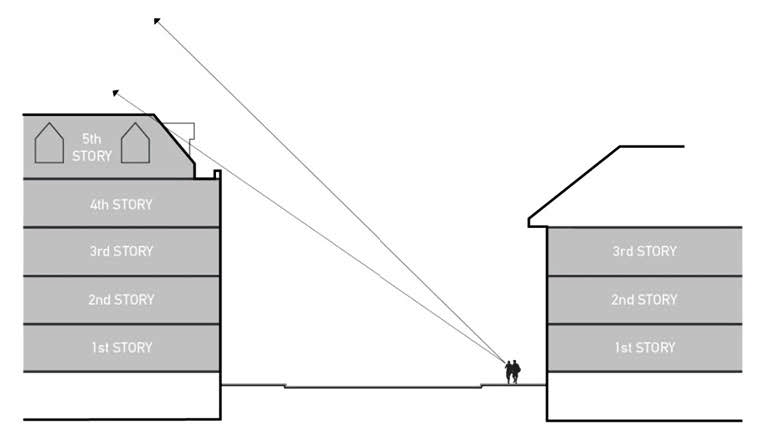
Integrating Useable Floor Space within Architectural Roof Forms
(L)
Functional and Mechanical Features. Exposed storage areas, trash containers, recycling container space, exposed machinery installations, service areas, truck loading areas, utility buildings and structures, and similar accessory areas and structures shall be (1) identified on the site plan required pursuant to Section 150.525(A)(9) of this Chapter, (2) incorporated into common areas of the development, (3) made as unobtrusive as possible, and (4) designed, landscaped, and screened in accordance with the requirements set forth in Article XXII of this Chapter and of Chapter 176 of the Code.
(M)
Distance Between Buildings. The minimum horizontal distance between any two new buildings to be located on the subject property, or between any new building and an existing building (including building appurtenances), shall be not less than 15 feet; provided, however, that this Section 150.520(M) shall not apply to buildings that (1) share a common wall, and (2) have individual entrances and exits.
(N)
Surface Water Drainage. In accordance with the stormwater management regulations set forth in Article XVIII of this Chapter, surface drainage systems serving the subject property shall be designed to prevent surface waters from adversely affecting neighboring properties or the public stormwater drainage system. Surface water in all paved areas shall be collected at intervals so as to prevent obstruction of the flow of vehicular or pedestrian traffic. The design of the stormwater management system shall enhance natural stormwater storage areas such as high-quality aquatic resources and regulatory floodplains, and may incorporate natural stormwater management techniques commonly referred to as low impact development techniques or best management practices.
(O)
Ingress to and egress from the Planned Development shall be designed to (1) promote safe vehicular movements, (2) minimize traffic congestion in the public streets outside the Planned Development, and (3) facilitate the free flow of vehicular and pedestrian traffic within the Planned Development.
(P)
Streets, Alleys, and Public Ways. The streets, alleys, and other public and private traffic thoroughfares located within the Planned Development shall conform to the applicable requirements set forth in Section 151.004 of the Subdivision Ordinance, as may be modified upon the recommendation of the Director of Public Works and the approval by the City Council. The City Council may, in its sole discretion, require that streets located within the Planned Development be stubbed in order to provide for future connections to adjacent developments.
(Q)
Common Ownership or Control.
(1)
During Development. During the development process and until such time that the development is turned over to an owners' association or equivalent entity, all common areas within buildings, common open space, landscaping, exterior maintenance areas, and all other exterior aspects of the development located within the proposed Planned Development shall be on a tract or tracts of land under common ownership or control.
(2)
Upon Completion of Development. The owners' association or equivalent entity, upon its establishment, shall be responsible for all obligations set forth in (a) the ordinance approving the Planned Development, adopted pursuant to Section 150.540(B) of this Article, (b) any associated development agreement pertinent to the Planned Development, and (c) the declaration of covenants, or similar recorded document, establishing the owners' association or equivalent entity.
(R)
Additional Standards for Planned Developments That Include Residential Uses.
(1)
Residential Density.
(a)
Except as provided pursuant to Section 150.510(D) and Article 21 of this Chapter, the residential density of the Planned Development shall not exceed in number the maximum number of dwelling units that could be achieved through a conventional subdivision of the site, as demonstrated by the subdivision sketch plan described in, and required pursuant to, Section 150.525(A)(8) of this Article.
(b)
Whenever a proposed Planned Development is located in more than one zoning district, the number of allowable dwelling units must be separately calculated for each portion of the proposed Planned Development that is in a separate zoning district. The combined total of all dwelling units calculated as allowable pursuant to this Section 150.520(Q)(1)(b) may be constructed and distributed within the entire Planned Development without concern for the respective zoning districts within which the Planned Development is located.
(c)
Nothing in this Section 150.520(Q)(1) shall be deemed or interpreted as requiring the Plan and Design Commission to recommend, or the City Council to approve, a Planned Development that has equal to or less than the maximum number of dwelling units that could be achieved through a conventional subdivision as demonstrated by the subdivision sketch plan.
(2)
Common Open Space. Planned Developments located in any Residential District shall comply with the following additional standards:
(a)
At least 20 percent of the subject property shall be maintained as common open space, except as may be modified by the Plan and Design Commission and City Council in accordance with this Article. Required yards in a Multiple Family Residential District may account for a maximum of 50 percent of the required common open space.
(b)
In a Multiple Family Residential District, a minimum of 100 square feet of open space per dwelling unit shall be provided within one or more sitting areas, plazas, recreational spaces or other areas for gathering by residents of the Planned Development. The open space provided pursuant to this Section 150.520(Q)(2)(b) shall be in addition to, and not in lieu of, the required yards within the applicable Zoning District.
(c)
The common open space must be accessible from every dwelling unit located within the Planned Development, either via (i) direct access, or (ii) the granting of a permanent easement for convenient access to the common open space.
(d)
No recreational facilities shall be permitted within any area designated as common open space, except those that are graphically depicted in the Final Development Plan approved by the City Council in accordance with Section 150.540(B) of this Article.
(e)
No proposed area on a site plan may be accepted as common open space unless its character and quality have been approved by the Plan and Design Commission. When making its determination, the Plan and Design Commission shall give consideration to the following standards:
(i)
The size and character of the structures to be constructed within the proposed Planned Development;
(ii)
The character of surrounding developments;
(iii)
The topography and existing amenities of the proposed open space area, including trees, ground cover and other natural features, and particularly as set forth in Article XXII of this Chapter and Chapter 176 of the Code;
(iv)
The manner in which the proposed open space area is to be improved and maintained for recreational purposes; and
(v)
The existence of public parks or other public recreational facilities in the vicinity of and the relationship to, the proposed open space.
(f)
All portions of the subject property to be preserved as common open space must be conveyed, in a manner acceptable to the City Council and the Corporation Counsel, to a park district, school district, or other public agency, or to a private association or similar organization formed by a condominium agreement, townhouse declaration, indenture, restrictive covenant or other binding agreement.
(g)
The applicant shall submit a management plan for restoration and long-term management of the common open space.
(S)
Additional Standards for Certain Planned Developments in the B3 and I Zoning Districts.
(1)
The property must include sufficient buffering from all properties that are located in a residential zoning district.
(2)
Within Planned Developments required pursuant to Section 150.505(D)(4) of this Code, the property must be improved with the following:
(a)
One or more berms in the form of a small hill a minimum of one foot in height, plus one additional foot in height per 15,000 square feet of lot area of the property, to a maximum required height of eight feet, within the required setback that is adjacent to or across a street from a residential use or zoning district. Height is measured from the peak of the berm to the abutting property line grade. Berm height must be roughly consistent for its entire length.
(b)
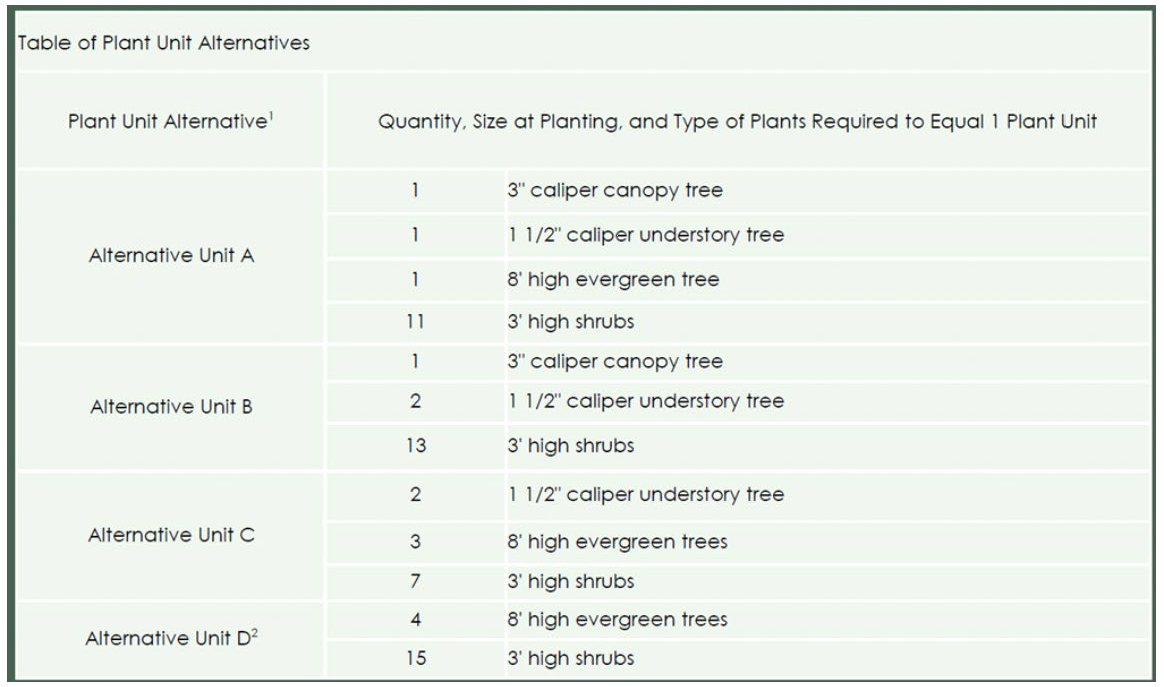
On the berm at least two plant unit alternatives per 100 linear feet, as specified in the following table.
(3)
Notwithstanding any provisions of this Chapter imposing a setback requirement, all structures and uses on the property must be set back a sufficient distance from all residential uses.
(Ord. 41-15, J. 41, p. 120-156, passed 4/13/15; Ord. 59-15, passed 6/8/15; Ord. O74-2019, § 9, passed 11/12/19; Ord. O77-2023, § 4, passed 12/11/23; Ord. O72-2024, § 3, passed 10/28/24)
Sec. 150.525. - Preliminary Development Plan Filing Requirements.
(A)
Application. An applicant for a Planned Development shall file an application therefor on a form provided by the City, which application shall include, without limitation, the following:
(1)
Plat of Survey. A plat of survey, prepared by a registered land surveyor, depicting, without limitation, all existing improvements and easements on the subject property.
(2)
General Location Map. An illustration of the land uses of the surrounding neighborhood within a 500-foot radius around the subject property, with particular identification of all nearby streets and the lot lines, structures, setbacks, and driveways of all adjacent lots.
(3)
Inventory Map. A map or series of maps illustrating the existing site conditions on the subject property, at a scale of no less than 1 inch = 50 feet, and including, without limitation:
(a)
The current land uses, including all existing buildings and structures;
(b)
The square footage and percentage coverage of all existing pervious and impervious surfaces;
(c)
All existing encumbrances, including, without limitation, all applicable easements and covenants;
(d)
The existing topography, illustrated at one-foot intervals;
(e)
All water-related features;
(f)
All existing vegetation, including, without limitation, threatened or endangered species,
(g)
All existing high-quality aquatic resources, ravines, regulatory floodplains, and trees and woodlands;
(h)
All unique soil conditions;
(i)
All unique geological resources, such as rock outcrops and glacial features;
(j)
All known critical habitat areas for rare, threatened or endangered species;
(k)
All existing historic resources, identified by a resources survey prepared by a qualified architectural or landscape professional according to the standards established by the Illinois Historic Preservation Agency, which survey shall include a description of the historic character of any buildings and structures, historically important landscapes, archeological features, and a review of existing inventories, including without limitation those kept by the City and by the State of Illinois; and
(l)
Other data as may be required by the Director of Community Development.
(4)
Surrounding Conditions Report. A written description of the land uses and existing zoning of all properties abutting, and within the general vicinity of, the subject property.
(5)
Inventory of Facilities and Public Transportation Opportunities. An inventory of all public schools, public parks, playlots and other public recreation facilities, private- and City-owned parking lots, and public transportation routes located within one quarter-mile of the subject property.
(6)
Statements of Ownership and Proposed Use.
(a)
Documentation verifying that the applicant has or will have, on or prior to the effective date of the ordinance approving the Planned Development, ownership or control over all land included within the proposed Planned Development; and
(b)
A statement of the applicant's intent regarding the future sale or lease of any portion of the land, or of the structures located or to be constructed thereon, and the proposed use of the subject property.
(7)
Statement of Objectives. A statement of the planning objectives to be achieved by the particular design approach proposed by the applicant, including (i) a description of the character of the proposed Planned Development and the rationale behind the assumptions and choices made by the applicant, and (ii) the extent to which the proposed Planned Development preserves natural and cultural resources, utilizes residential clustering, and is a creative and sustainable approach to land development.
(8)
Subdivision Sketch Plan. A sketch plan, demonstrating the maximum number of lots and/or dwelling units that could be achieved through a conventional subdivision of the site, in accordance with the following:
(a)
The subdivision sketch plan shall include the location of all streets that would be required to provide access to the lots or dwelling units.
(b)
The design and layout of all lots and streets in the subdivision sketch plan shall comply with all standards and requirements set forth in this Chapter and in the Subdivision Ordinance, without exception or variation.
(c)
The subdivision sketch plan shall not designate for development any areas of the subject property that are identified as regulatory floodway and/or high-quality aquatic resources that cannot be mitigated in accordance with applicable City ordinances and the Lake County Watershed Development Ordinance.
(d)
The subdivision sketch plan shall indicate those areas of the subject property that will be used to satisfy all applicable stormwater management requirements set forth in the Code.
(e)
In the event that the applicant files an application for an amendment of the Official Zoning Map in conjunction with the application for a Planned Development, subdivision sketch plans shall be prepared in conformance with the requirements of both the existing zoning and the proposed zoning designations of the subject property.
(9)
Site Plan. A site plan, based in part upon the inventory and general location maps, that:
(a)
Indicates the preservation of the historic structures, landscapes, Environmentally Sensitive Areas and scenic viewsheds located on the subject property through clustering of lots, adaptive reuse of existing structures, and the use of designated open space; and
(b)
Illustrates all proposed lot lines, structures, building pads, street configurations, and other elements required pursuant to this Article.
(10)
Statement of Modifications from Zoning District Standards. A statement setting forth the specific modifications requested from the requirements of the underlying Zoning District.
(11)
Statement of Public Benefits. A statement of the specific proposed public benefit or benefits, as defined in Section 150.515 of this Article, to be provided by, or associated with, the proposed Planned Development.
(12)
Quantitative Summary. A quantitative summary, categorized according to proposed phases of development, if any, and including, without limitation, the following:
(a)
The acreage and square footage of the subject property;
(b)
The total and footprint square footage of all proposed principal and accessory buildings;
(c)
The square footage of all proposed exterior parking areas, roads and other rights-of-way;
(d)
The number of all proposed parking spaces and required parking ratios;
(e)
The individual and collective percentages of the proposed impervious surfaces for principal buildings, accessory buildings, parking areas, roads, and recreational facilities;
(f)
The total square footage of all proposed pervious surfaces;
(g)
For Planned Developments that require the demolition of existing residential structures, the number of bedrooms located within each dwelling unit proposed to be demolished;
(h)
The number of dwelling units proposed to be located within the Planned Development, identified by structure type (e.g. attached or detached single family, townhouses);
(i)
For Planned Developments in Single Family Residential Districts, the base residential density for the subject property, excluding the application of the density bonuses described in Section 150.510(D) of this Article; and
(j)
The square footage of all proposed commonly-owned and -maintained open space.
(13)
Preliminary Plat of Subdivision. If applicable, a preliminary plat of subdivision that meets the requirements of this Chapter and of the Subdivision Ordinance.
(14)
Preliminary Engineering Plans. A plan or plans illustrating (a) all existing and proposed public and private utilities (including but not limited to electrical, gas, water, sewer, storm, cable and communications utilities), (b) drainage facilities, (c) stormwater detention and flood plain compensatory storage facilities, to the extent required by the Code, and (d) a grading plan, showing the topography of the subject property before and after all proposed construction.
(15)
Landscape Plan. A landscape plan consistent with the requirements set forth in Article XXII of this Chapter.
(16)
Elevations. Elevation drawings of all proposed structures.
(17)
Tree Preservation Plan. A tree preservation plan consistent with the requirements set forth in Chapter 94 of the Code.
(18)
Cross Sections. A minimum of two cross sections through the entire site, illustrating the bulk and heights of proposed structures in relation to the topography and vegetation of the subject property, and in relation to surrounding structures.
(19)
Phasing Plan. A document describing the proposed phasing of the development, if any, for all structures, improvements, and areas and facilities to be held in common ownership, including the estimated commencement and completion dates of construction of each phase. If the applicant proposes a phased development, a pro rata portion of the common open space required pursuant to this Article shall be completed within each phase of development.
(20)
Circulation Plan. A plan illustrating the proposed circulation of all vehicles, including emergency vehicles, within the subject property, which plan must (a) be consistent with approved engineering and design standards, (b) meet the City's minimum design standards, as may be modified by the Director of Public Works, (c) illustrate the relationship of the development's internal streets and driveways to the street system in the general area of the subject property, and (d) illustrate all vehicle stacking and turning templates, as may be required by the Director in his or her sole discretion.
(21)
Traffic Study. A complete traffic impact study or a trip generation analysis, prepared by a qualified traffic expert, if required by the Director of Community Development or the Director of Public Works in their discretion, and in the following forms:
(a)
A traffic impact study shall set forth and analyze the effect of the proposed Planned Development upon traffic on adjacent streets and on all affected surrounding areas, and shall indicate the anticipated points of origin and the direction, amount and density of traffic flow to and from the proposed Planned Development. The traffic impact study shall also address potential traffic and roadway improvements as may be necessary to accommodate the proposed Planned Development.
(b)
A trip generation analysis shall include, without limitation, an assessment of current background trip information on nearby streets, an assessment of the traffic generated by the proposed land uses and an analysis of vehicular safety as it relates to the proposed Planned Development.
(22)
High-Quality Aquatic Resources Delineation Report. If the subject property, in the sole determination of the Director of Public Works, contains high-quality aquatic resources or other significant natural resources, either (a) a high-quality aquatic resources delineation report, prepared by a Certified Wetland Specialist, or (b) a natural resources survey.
(23)
Additional Filing Requirements for Large Residential and Commercial Developments. The following additional items shall be filed as part of any application for a Planned Development that includes either (i) 10 or more dwelling units, and/or (ii) 20,000 square feet or more of commercial floor area:
(a)
Fiscal Impact Study. As assessment of the projected costs to be incurred by the City in providing municipal services to, and the revenues that will accrue the City and other taxing entities from, the proposed Planned Development.
(b)
Market Study. An assessment of the economic viability of the proposed Planned Development, based in part upon (i) projected residential ownership price points and/or rents, and (ii) an evaluation of the demand for the proposed Planned Development.
(24)
Additional Filing Requirements for Residential and Mixed Use Planned Developments. The following additional items shall be filed as part of any application for a Planned Development that includes residential uses:
(a)
A statement describing the nature of the proposed open space on the subject property, and the extent to which the proposed open space may be utilized, actively or passively, by residents of the proposed Planned Development; and
(b)
An open space management plan, if natural resources or Environmentally Sensitive Areas are located within, and preserved by, the proposed Planned Development.
(25)
Other Information. Depending on the scale and unique characteristics of the subject property, other materials as may be required by the Director or by the Plan and Design Commission, including, without limitation, market studies, soil borings, and approvals from other agencies.
(B)
Applicability of Special Use Permit Requirements. All filing and application requirements set forth in this Section 150.525 are in addition to all filing and application requirements set forth in Article XIV of this Chapter for Special Use Permits.
(C)
Contents of Required Submittals. All plats, maps, plans, and illustrations required pursuant to this Section 150.525 shall indicate the date of preparation, the appropriate graphic scale, a north arrow, and a title block containing the name and contact information of the preparer.
(D)
Payment of Fees. The application shall be submitted along with full payment of all fees required pursuant to this Chapter, in the amounts set forth in the Annual Fee Resolution, including, without limitation, (a) all cost recovery fees required pursuant to Section 150.306 of this Chapter, and (b) all fees required pursuant to the Subdivision Ordinance, if applicable.
(E)
Waiver of Required Submittals. Upon written request of the applicant, and at the sole and absolute discretion of the Director, the submission of any plans or documents required pursuant to this Section 150.525 may be waived.
(Ord. 22-03, J. 29, p. 91-95, 2/24/03; Ord. 80-07, J. 33, p. 660-693, passed 11/13/07; Ord. 59-15, passed 6/8/15)
Sec. 150.530. - Preliminary Development Plan Review Procedure.
(A)
Preliminary Development Plan. For purposes of this Article, the term "Preliminary Development Plan" means the set of the following documents:
(1)
The Site Plan submitted pursuant to Section 150.525(A)(9) of this Article;
(2)
The Quantitative Summary submitted pursuant to Section 150.525(A)(12) of this Article;
(3)
The Preliminary Plat of Subdivision submitted pursuant to Section 150.525(A)(13) of this Article;
(4)
The Preliminary Engineering Plans submitted pursuant to Section 150.525(A)(14) of this Article;
(5)
The Tree Preservation Plan submitted pursuant to Section 150.525(A)(17) of this Article;
(6)
The Phasing Plan, if any, submitted pursuant to Section 150.525(A)(19) of this Article; and
(7)
Such other materials as may be required by the Director of Community Development or by the Plan and Design Commission.
(B)
Planned Development Processed as a Special Use. An application for a Planned Development shall be processed in the same manner, and shall require the same approval, as an application for a special use, as set forth in Article XIV of this Chapter, except as varied by the provisions of this Article.
(C)
Rezoning Requests. If an applicant files an application for an amendment of the Official Zoning Map in conjunction with the application for a Planned Development, the provisions of Article XV of this Chapter, including all posting and notice requirements and the required public hearing, shall also apply to the proposed Planned Development. The applications shall be processed concurrently; however, the Plan and Design Commission shall consider the proposed amendment of the Official Zoning Map prior to consideration of the Planned Development application.
(D)
Subdivision Review. Applicable subdivision review under the Subdivision Ordinance shall be carried out as an integral part of the review of a Planned Development application pursuant to this Article, in accordance with the following:
(1)
The applicant may submit subdivision applications for all or part of the subject property, corresponding to the phases of development identified in the Preliminary Development Plan.
(2)
In the event of a conflict between the provisions of this Chapter and of the Subdivision Ordinance, the more restrictive or detailed requirements control, unless specifically waived or altered by the City Council upon recommendation of the Plan and Design Commission.
(3)
The internal roadway system located within the subject property, and the construction of bonded public or private improvements thereon, must comply with the requirements and standards set forth in the Subdivision Ordinance and in Chapter 93 of the Code. The City Council may permit such changes or alterations of such standards as are consistent with the spirit and intent of this Article, upon approval of a variation in accordance with the applicable provisions set forth in the Subdivision Ordinance and in Chapter 93 of the Code.
(E)
Historic Preservation Commission Review.
(1)
Demolitions. Prior to the opening of the public hearing on the proposed planned development, the applicant shall file all demolition applications for, and the Historic Preservation Commission shall review, all proposed demolitions of existing structures to which Section 170.122 of the Code applies. The Historic Preservation Commission shall transmit its findings and determinations regarding the proposed demolitions to the Plan and Design Commission and the City Council.
(2)
Significant Areas. If, in the determination of the Director, the proposed Planned Development might affect historically significant properties, structures, areas, objects, or landscapes, as defined in Chapter 24 of the Code, the Historic Preservation Commission shall (a) review the potential impact of the proposal on the historically significant properties, structures, areas, objects, and landscapes, and (b) submit a written report of its findings to the Plan and Design Commission and the City Council.
(F)
Reserved.
(G)
Input of Other City Commissions. The Plan and Design Commission, may, in its sole discretion, request input regarding the proposed Planned Development from any City agency, board, or commission.
(H)
Plan and Design Commission Procedure.
(1)
The Plan and Design Commission shall not conduct a public hearing regarding any proposed Planned Development except upon submission of a complete application therefor, in accordance with and pursuant to Section 150.525 of this Article.
(2)
As part of its review of the Preliminary Development Plan, the Plan and Design Commission shall, pursuant to the authority set forth in Chapter 176 of the Code:
(a)
Review the exterior design features of the proposed Planned Development, as set forth in the Preliminary Development Plan, and (2) transmit to the City Council its preliminary comments regarding the extent to which all exterior design features of the proposed Planned Development satisfy the design review standards set forth in Chapter 176 of the Code.
(3)
The Plan and Design Commission shall not recommend approval of a proposed Planned Development and Preliminary Development Plan except upon making all findings of fact required pursuant to Section 150.1404 of this Chapter, and as follows:
(a)
That the Planned Development conforms to the goals and objectives of the Master Plan, and to the standards and requirements of this Article, including, without limitation, Section 150.520 of this Article;
(b)
That the proposed Planned Development contains no more residential dwelling units than permitted pursuant to the subdivision sketch plan submitted in accordance with Section 150.525(A)(8) of this Article, as may be adjusted pursuant to Section 150.510(D) of this Article; and
(c)
That the Planned Development provides a public benefit, if required pursuant to Section 150.515 of this Article.
(4)
For Planned Developments that contemplate the approval of conditional uses, as determined in accordance with the Table of Allowable Uses set forth in Article IV of this Chapter, the Plan and Design Commission shall not approve the proposed Planned Development except upon a determination that each proposed conditional use also meets the findings for a special use as set forth in Article XIV of this Chapter.
(5)
In conjunction with its approval of a Preliminary Development Plan for a proposed Planned Development, the Plan and Design Commission may recommend development restrictions and conditions for consideration by the City Council.
(6)
The failure of the Plan and Design Commission to provide a recommendation for or against the proposed Planned Development and Preliminary Development Plan within 45 days of the close of the public hearing, or such further time to which the applicant may, in writing, agree, shall be deemed a recommendation against the approval of the proposed Planned Development and Preliminary Development Plan.
(I)
City Council Consideration.
(1)
Upon receipt of the Plan and Design Commission recommendation pursuant to Section 150.530(H) of this Article and the Historic Preservation Commission findings pursuant to Section 150.530(E) of this Article, the City Council shall consider the Preliminary Development Plan, and shall either approve or reject the Preliminary Development Plan by resolution duly adopted. Resolutions approving the Preliminary Development Plan shall include, without limitation, the following:
(a)
Approval of the preliminary plat of subdivision for the subject property, if any; and
(b)
Identification of all variations and modifications from the City Code that have been requested in conjunction with the proposed Planned Development.
(2)
Approval of the Preliminary Development Plan by the City Council shall neither (a) be deemed or interpreted as obligating the City Council to approve a final development plan for the proposed Planned Development, nor (b) vest any rights to the applicant other than the right to submit a final development plan for the proposed Planned Development.
(Ord. 18-04, J. 30, p. 49-54, passed 3/8/04; Ord. 80-07, J. 33, p. 660-693, 11/13/07; Ord. 59-15, passed 6/8/15; Ord. O58-2020, § 2, passed 9/29/20)
Sec. 150.535. - Final Development Plan Filing Requirements.
(A)
Final Development Plan Application. Within six months of approval by the City Council of the preliminary development plan, pursuant to Section 150.530(I) of this Chapter, the applicant shall initiate the second stage of the application process by submitting the following documents and information to the Plan and Design Commission:
(1)
A "Final Development Plan," containing in final form (a) all of the information required in the Preliminary Development Plan, as may be revised, and (b) such other documents as may be necessary to implement the Planned Development or to comply with all applicable requirements of this Chapter;
(2)
A final plat of subdivision, if applicable;
(3)
All plats of dedication and plats of vacation, if applicable;
(4)
A final engineering, drainage and grading plan that is in compliance with the requirements set forth in Section 151.006(F)(2) of the Subdivision Ordinance.
(5)
For Planned Developments that include residential uses, a copy of any formal agreements with any third party for the ownership and maintenance of any common open space located within the proposed Planned Development, which agreement shall include, without limitation, a provision requiring the third party to maintain the common open space in accordance with the Code and the development agreement required pursuant to Section 150.540(B)(2) of this Article.
(6)
A declaration of covenants that establishes an owners' association or equivalent entity, for review and approval by the Corporation Counsel and the City Council. For all Planned Developments to which Article XXI of this Chapter applies, no provision of the declaration of covenants shall conflict with the requirements set forth in Sections 150.2104 and 150.2112 of this Chapter. The declaration of covenants shall include, without limitation, the following provisions:
(a)
A requirement that the developer of the Planned Development convey the private streets and roads, the detention and retention facilities, and the common areas to the owners' association or equivalent entity;
(b)
A requirement that the owners' association or equivalent entity provide for the maintenance and repair of all private streets and roads, detention and retention ponds, and common areas, and any and all appurtenances thereto, all in accordance with (i) the Code, and (ii) the development agreement required pursuant to Section 150.540(B)(2) of this Article;
(c)
If the owners' association or equivalent entity fails to maintain and repair all private streets or roads, detention or retention ponds and common areas, the City, or its designated agent, shall have the right, but not the obligation, to (i) enter upon the property to maintain and repair such items, and (ii) place a lien upon the property until the owners' association or equivalent entity has paid the cost thereof;
(d)
A statement of understanding that the City is under no obligation to, and will not be expected to, assume ownership or maintenance of private streets, utilities or other improvements; and
(e)
A statement that the declaration of covenants shall run with the subject property and is binding upon all owners of any lot, dwelling unit, or any other portion of the subject property.
(B)
Permitted Minor Changes from a Preliminary Development Plan. The Final Development Plan shall be in substantial conformance with the approved Preliminary Development Plan. Minor changes in the location, siting, and height of structures, streets, driveways, and open spaces may be included in the Final Development Plan and approved by the Plan and Design Commission and City Council without additional public hearings, if such changes are required either (i) to satisfy the City's engineering standards, or (ii) by other circumstances not foreseen at the time of approval of the Preliminary Development Plan; except that the following changes shall not be authorized without an additional public hearing:
(1)
A change in the land uses on the subject property;
(2)
An increase by more than one percent in the overall lot coverage of all structures;
(3)
An increase in the number of dwelling units;
(4)
An increase by more than one percent in Floor Area or building square footage;
(5)
A substantial increase in the traffic volume generated by, or traffic circulation of, the proposed Planned Development;
(6)
A reduction of more than one percent in approved common open space;
(7)
A reduction in the number of off-street parking or loading spaces required pursuant to Article VIII of this Chapter; or
(8)
An increase or reduction in required pavement widths; or
(9)
Any change for which a variation or modification from the provisions of this Chapter would otherwise be required.
(C)
Time Extensions. Upon written request by the applicant, the Plan and Design Commission, for good cause, may extend the period for filing the final development plan for a period not to exceed an additional six months.
(D)
Failure to File. Upon the failure of the applicant to file a complete Final Development Plan, in accordance with this Section 150.535, within six months of approval by the City Council of the Preliminary Development Plan, or within the extended period approved by the Plan and Design Commission pursuant to Section 150.535(C) of this Article, the Preliminary Development Plan approval by the City Council shall be considered null and void and of no force or effect.
(Ord. 59-15, passed 6/8/15)
Sec. 150.540. - Final Development Plan Review Procedure.
(A)
Plan and Design Commission Review.
(1)
Within 60 days after the filing of a complete Final Development Plan, with all necessary documents, subdivision plats, and exhibits, the Plan and Design Commission shall review the Final Development Plan. If the proposed Final Development Plan does not include any changes from the approved Preliminary Development Plan that is listed in Sections 150.535(B)(1) through 150.535(B)(9) of this Article, the Plan and Design Commission shall review the proposed Final Development Plan without conducting a new public hearing. If the proposed Final Development Plan includes any change from the approved Preliminary Development Plan that is listed in Sections 150.535(B)(1) through 150.535(B)(9) of this Article, the Plan and Design Commission shall conduct a new public hearing in order to review the proposed Final Development Plan, in accordance with the procedures and standards set forth in Section 150.530 and Article XIV of this Chapter.
(2)
As part of its review of the Final Development Plan, the Plan and Design Commission shall, pursuant to the authority set forth in Chapter 176 of the Code, review the exterior design features of the proposed Planned Development, as set forth in the Final Development Plan. Upon a showing by the applicant that the exterior design features satisfy the design review standards set forth in Chapter 176 of the Code, the Plan and Design Commission shall approve the exterior design features and transmit to the City Council its final approval thereof.
(3)
Within 60 days after the filing of a complete Final Development Plan, the Plan and Design Commission shall recommend either the approval (with or without modifications) or the rejection of the Final Development Plan. The Plan and Design Commission shall transmit its findings of fact and recommendations to the City Council. The failure of the Plan and Design Commission to provide a recommendation within such 60-day period, or such further time to which the applicant may, in writing, agree, shall be deemed a recommendation against the approval of the Final Development Plan.
(B)
City Council Consideration. Upon receipt of the Plan and Design Commission recommendation pursuant to Section 150.540(A) of this Article, the City Council may, by ordinance duly adopted, grant the applicant a special use permit for a Planned Development, which special use permit shall authorize the applicant to develop the subject property in accordance with the Final Development Plan. The ordinance shall include, without limitation, the following:
(1)
All standards, conditions, or restrictions deemed necessary or applicable by the City Council to effectuate the proposed Planned Development and protect the public interest, health, safety, and welfare;
(2)
A provision requiring the execution and recordation by the applicant of a development agreement, which development agreement shall (a) govern the use and development of the subject property, (b) incorporate the standards, conditions, and restrictions set forth in the ordinance, and (c) provide for the maintenance and continued protection of all public open space and all common open space.
(3)
Provisions requiring the execution of such agreements as necessary to guarantee the maintenance of public and private open space located on the subject property; and
(4)
A legal description of the property subject to the Planned Development.
(Ord. 18-04, J. 30, p. 49-54, passed 3/8/04; Ord. 80-07, J. 33, p. 660-693, passed 11/13/07; Ord. 59-15, passed 6/8/15)
Sec. 150.545. - Amendments to Approved Planned Developments.
(A)
Substantial Change.
(1)
For purposes of this Section 150.545, the following changes in character of any approved Planned Development shall be "substantial changes":
(a)
A change in the land uses on the subject property;
(b)
An increase in the number of dwelling units;
(c)
An increase by more than one percent in Floor Area or building square footage;
(d)
An increase in the size of approved building pads;
(e)
A substantial increase in the traffic volume generated by, or traffic circulation of, the proposed Planned Development;
(f)
A reduction of more than one percent in approved common open space;
(g)
A reduction in the number of off-street parking or loading spaces required pursuant to Article VIII of this Chapter;
(h)
Any change that, in the opinion of the Director of Public Works, would constitute a significant modification to the provision of public utilities to the subject property; or
(i)
Any change for which a variation or modification from the provisions of this Chapter would otherwise be required.
(2)
No substantial change to an approved Planned Development may be implemented except upon the adoption of an amendatory ordinance by the City Council, which amendatory ordinance may be adopted only after a public hearing by, and recommendation of, the Plan and Design Commission, in the manner set forth in Section 150.530 and Article XIV of this Chapter.
(B)
Minor Changes. The City may approve changes to the Planned Development and Final Development Plan that do not, in the sole and absolute discretion of the City Manager, constitute a substantial change, as defined in Section 150.545(A)(1) of this Article, to the Planned Development, in accordance with the following procedure:
(1)
The City Manager may approve the proposed minor change upon making a finding that the change is consistent with the intent and purpose of the Planned Development and the Final Development Plan.
(2)
The City Manager shall notify the City Council of the approval of a minor change within seven days thereof.
(3)
Within 60 days of its receipt of the notice submitted by the City Manager pursuant to Section 150.545(B)(2) of this Article, the City Council shall either (i) ratify the City Manager's approval of the minor change, by resolution duly adopted, or (ii) deny the minor change. Any minor change denied by the City Council pursuant to this Section 150.545(B)(3) may be reclassified as a "substantial change" and approved in accordance with Section 150.545(A)(2) of this Article.
(4)
The failure of the City Council to ratify or deny a minor change within 60 days of the date of receipt of notice thereof shall be deemed a ratification of the minor change.
(C)
Recreational Facilities. Notwithstanding anything in this Section 150.545 to the contrary, the approval by the City Manager of the erection and maintenance of recreational facilities within the required common open space of an approved planned development, pursuant to Section 150.545(B)(1) of this Article, shall not require ratification by the City Council.
(D)
Discretionary Review. Nothing in this Section 150.545 shall be deemed or interpreted as obligating the City to grant any requested changes or amendments.
(Ord. 59-15, passed 6/8/15)
Sec. 150.550. - Concurrent Review of Preliminary and Final Development Plans.
An applicant for approval of a Planned Development may request concurrent review of the preliminary and final development plans. Nothing in this Section 150.550 shall be deemed or interpreted as obligating the City to approve a request for concurrent review. Either the Plan and Design Commission or the City Council may, in their discretion and at any time, reject the request for concurrent review, and require separate review of the preliminary and final development plans. If concurrent review is authorized, the applicant shall submit for Plan and Design Commission and City Council consideration all of the required documentation for a preliminary and final development plan and a preliminary and final plat of subdivision.
(Ord. 59-15, passed 6/8/15)
Sec. 150.555. - Enforcement and Recording.
(A)
Recordation of Ordinance. The City Clerk shall record the ordinance granting a special use permit for a Planned Development with the Lake County Recorder of Deeds, upon payment by the applicant of all fees and costs, and submission by the applicant of all documents, required pursuant to this Chapter.
(B)
Covenants to be Recorded. All restrictive covenants required by the City Council as a condition of its approval of the Planned Development must be recorded with the Lake County Recorder of Deeds.
(C)
Acceptance of Improvements. Neither the execution of the development agreement required pursuant to Section 150.540(B)(2) of this Article, nor the approval or recordation of any plat or plan associated with the subject property, shall constitute acceptance by the City of improvements that are depicted in, or described on, the development agreement or any plat or plan. The acceptance of any improvement shall be made only in compliance with the requirements of the Subdivision Ordinance.
(Ord. 59-15, passed 6/8/15)
Sec. 150.560. - Construction Timing.
(A)
Construction of an approved Planned Development shall commence within 12 months of the date of adoption of the ordinance approving the Planned Development and Final Development Plan, and shall proceed to completion in accordance with the phasing program, if any, set forth in the Final Development Plan. Upon written request by the applicant, the City Council may extend the time for the commencement of construction, as follows:
(1)
If a delay, or anticipated delay, is caused by governmental action without fault of the applicant, an extension may be granted for a period not longer than the period of the governmental delay.
(2)
For good cause shown, an extension may be granted for such periods of time as the City Council deems appropriate, but not exceeding 12 months exclusive of extensions authorized pursuant to Section 150.560(A)(1) of this Article.
(B)
Issuance of Permits.
(1)
No building permit or certificate of occupancy related to the Planned Development shall be issued, and no utility serving the Planned Development shall be connected to a City utility, except in accordance with Chapter 93 of the Code and the ordinance approving the Planned Development.
(2)
No building permit related to the Planned Development shall be issued until the ordinance approving the Planned Development is recorded with the Office of the Lake County Recorder of Deeds.
(C)
Phasing of Bonded Improvements. All bonded improvements and facilities to be constructed and installed in conjunction with the Planned Development shall be completed for each phase of development in accordance with the development agreement required pursuant to Section 150.540(B)(2) of this Article and with the phasing plan submitted pursuant to Section 150.525(A)(19) of this Article. The installation and completion of all improvements shall be performed in accordance with, and shall be guaranteed by the deposit of all financial sureties required pursuant to, the Subdivision Ordinance and Chapter 93 of the Code.
(D)
Common Open Space and Facilities.
(1)
No certificate of occupancy for any structure located in the Planned Development shall be issued unless a proportional share of the common open space and facilities required in compliance with the phasing plan provided pursuant to Section 150.525(A)(19) of this Article are suitable for use or occupancy, as determined by the Director of Community Development in his sole discretion.
(2)
All common open space and facilities shall be controlled and maintained during construction of the Planned Development in accordance with the requirements set forth in Section 150.520(P)(1) of this Article.
(E)
Revocation of Permits. The City Council may, at any time, request written reports from the applicant regarding the progress and development of an approved Planned Development. In the event that the City Council determines that the applicant has abandoned the development of the Planned Development, or has failed to comply with the approved Final Development Plan, it shall hold a public hearing for the purpose of considering the revocation of all approvals and permits associated with the Planned Development. Written notice of the hearing shall be sent by certified mail (return receipt) to the applicant at the business address stated in the application for the Planned Development. Publication of the hearing shall also be given in accordance with the provisions set forth in Article XIV of this Chapter. If the City Council finds that the applicant has abandoned the development of the Planned Development, or has failed to follow the final development plan, it may then revoke all approvals and permits issued for and to the Planned Development.
(Ord. 59-15, passed 6/8/15)
Sec. 150.565. - Completion of Planned Development.
A Planned Development shall be deemed complete upon issuance of all required certificates of occupancy by the Zoning Administrator, in accordance with all applicable provisions of this Code.

