
Hillsborough County Unincorporated
City Zoning Code
City Zoning Code
ARTICLE XII
DEFINITIONS
PART 12.00.00 - GENERALLY
This Article contains most of the definitions for use with this Code. Other definitions, however, may be located elsewhere in this Code and should be used as indicated.
PART 12.01.00 - DEFINITIONS
Abandoned Sign: A sign which, for a period of 180 consecutive calendar days, is no longer being used, and which is not being maintained shall be considered an abandoned or discontinued sign.
Aboveground Storage Tank System: An aboveground storage tank system includes any enclosed structure, container, tank or other enclosed devices together with any onsite integral piping or dispensing system associated therewith, which is used, or intended to be used, for the storage or supply of Regulated Substances as defined in this Article, or pollutants as defined in Section 376.301(34) F.S., or any product as defined in Section 377.19(11), F.S, or any petroleum product or other substance as defined in Sections 376.301(30) and (31), F.S.
Abutting: See Contiguous.
Access: A way or means of vehicular or pedestrian approach to provide physical entrance to a property.
Access Classification: A classification assigned to each roadway segment reflecting the existing and/or preferred degree of access management. Among the factors considered in determining the access classification of a roadway are functional classification, existing medians and access control, subdivision of adjacent properties and existence of frontage or access roads.
Access, Direct/Collectors and Arterials: Having frontage on a collector or arterial street and the opportunity for direct vehicular access onto the collector or arterial street is present. If traffic concerns, safety, or other items of public interest exist, the final design of the project may not require direct vehicular access onto the collector or arterial street if approved by county traffic engineers and the Administrator.
Access Direct/Local: Having frontage on a local street. The parcel or lot shall be configured such that vehicular access may be obtained from said property directly onto the street.
Accessory: Having a subordinate function. See also Building, Accessory; Structure, Accessory; and Use, Accessory.
Accessory, Agricultural Structure: A structure containing materials and uses which are accessory to an agricultural activity. Examples of such a structure would be a pen to contain livestock and farming equipment, but not a structure used primarily to contain hand tools and domestic vehicles.
Accessory Dwelling: A second dwelling unit that may be attached to owner-occupied single-family detached home, or may be a separate detached structure on the same lot as an owner-occupied single-family detached home. An accessory dwelling unit shall contain its own sleeping, individual kitchen, as defined herein, bathing and toilet facilities. The facilities may be of efficient design but shall be adequate for independent residential use. Occupancy of the accessory dwelling and principal dwelling by members of the same family or other related persons shall have no bearing on the applicability of this definition. Any detached structure, or any portion of a structure or dwelling that cannot be accessed internally from within the structure or dwelling, which does not meet the facilities requirements for an accessory dwelling unit as described herein shall not be utilized for independent living quarters or for sleeping purposes, including guest visits, at any time.
Acquisition: As used in Section 4.01.00 of this Code, the action of transferring fee simple interest in a parcel of land to a governmental or non-profit land conservation agency for the preservation in perpetuity of the land for the protection of a particular species, natural area or other environmental resource.
Act of God: An overwhelming, unpreventable event caused exclusively by forces of nature, such as an earthquake, flood, or tornado, and including all natural phenomena that are exceptional, inevitable, and irresistible, the effects of which could not be prevented or avoided by the exercise of due care or foresight.
Active Open Space (RP-2): Open space areas within an RP-2 Planned Village which are not located within a Neighborhood Center that may include a community farm use, community garden, community gathering place, active recreation or passive recreation.
Active Recreation (RP-2/WVR-2): A type of Open Space within an RP-2 Planned Village not restricted to residents-only which provides for structured recreational activities for teams or individuals, or which provide active facility sites for non-organized play, requiring specialized development and management which may restrict general use of the park or facility. Examples include, but are not limited to, soccer fields, softball/baseball fields, basketball courts, tennis/pickleball courts, skate parks and swimming pools.
Addition to an Existing Building: Any walled and roofed expansion to the perimeter of a building in which the addition is connected by a common load-bearing wall other than a fire wall or is separated by independent perimeter load-bearing walls is new construction.
Adjacent: For purposes of determining notice requirements for certain Limited Use, adjacent properties shall be those directly abutting the subject property, or those which would abut by excluding (1) public right-of-way; or (2) publicly owned property 50 feet or less in width.
Adjoining: See Contiguous.
Administrator: The official designated as such by the Board of County Commissioners, or such person as the Administrator may designate.
Adult Bookstore or Adult Video Store: means a commercial establishment which, as one of its principal business activities, offers for sale, rental, or viewing for any form of consideration any one or more of the following: books, magazines, periodicals, or other printed matter, or photographs, films, motion pictures, video cassettes, compact discs, digital video discs, slides, or other visual representations, which are characterized by their emphasis upon the display of "specified sexual activities" or "specified anatomical areas."
A "principal business activity" means that the commercial establishment:
(1)
Has a substantial portion of its displayed merchandise which consists of said items; or
(2)
Has a substantial portion of the wholesale value of its displayed merchandise which consists of said items; or
(3)
Has a substantial portion of the retail value of its displayed merchandise which consists of said items; or
(4)
Derives a substantial portion of its revenues from the sale or rental; for any form of consideration, of said items; or
(5)
Maintains a substantial section of its interior business space for the sale or rental or said items; or
(6)
Maintains an "adult arcade," which means any place to which the public is permitted or invited wherein coin-operated or slug-operated or electronically, electrically, or mechanically controlled still or motion picture machines, projectors, or other image-producing devices are regularly maintained to show images to five or fewer persons per machine at any one time, and where the images so displayed are characterized by their emphasis upon matter exhibiting "specified sexual activities" or specified anatomical areas."
Adult Cabaret: means a nightclub, bar, juice bar, restaurant, bottle club, or similar commercial establishment, regardless of whether alcoholic beverages are served, which regularly features persons who appear semi-nude.
Adult Care Facility: Establishment that provides, on a regular basis, assistance or care for five or more unrelated adults for a period of less than 24 hours a day and which receives a payment, fee or grant for the adults attending the facility, whether or not operated at a profit.
Adult Photographic or Modeling Studio: Establishment which offers or advertises the use of its premises for the purpose of photographing or exhibiting specified sexual activities or specified anatomical areas or the modeling of apparel that exhibits "specified anatomical areas."
Adult Motel: means a motel, hotel, or similar commercial establishment which:
(1)
Offers accommodations to the public for any form of consideration; provides patrons with closed-circuit television transmissions, films, motion pictures, video cassettes, other photographic reproductions, or live performances which are characterized by the display of "specified sexual activities" or "specified anatomical areas"; and which advertises the availability of such material by means of a sign visible from the public right-of-way, or by means of any on or off-premises advertising, including but not limited to, newspapers, magazines, pamphlets or leaflets, radio or television; and
(2)
Offers a sleeping room for rent for a period of time that is less than ten hours; or
(3)
Allows a tenant or occupant of a sleeping room to subrent the room for a period of time that is less than ten hours.
Adult Motion Picture Theater: means a commercial establishment where films, motion pictures, videocassettes, slides, photographic reproductions, or electronic reproductions, which are characterized by their emphasis upon the display of "specified sexual activities" or "specified anatomical areas" are regularly shown to more than five persons for any form of consideration.
Adverse Effect (on Historic and Archaeological Resources): An effect which may reduce or impair any of the elements of integrity or other criteria for significance of an historic or archaeological resource, including, but not limited to: physical destruction, damage, or alteration of the significant or contributing features of the property; isolation of the resource from or alteration of the character of the resource's setting when that setting contributes to the resource's significance; or introduction of visual, audible, or atmospheric elements that are out of character with the property or alter its setting.
Adversely Impact: To destroy or damage or to contribute to the destruction or damage of something. Adverse impact upon a natural resource means direct contamination, alteration or destruction of a natural resource, including development activity and the secondary impacts of development, to the degree that the natural resource would be eliminated, reduced or impaired.
Advertiser: A person who is a lessee or owner of a sign, an agent of same or any one who has beneficial use of a sign.
Affordable Housing: Housing which is available at a price or rent not exceeding 30 percent of a low income household's gross income. Owner occupied housing costs include principal, interest, insurance, and property taxes. Rental housing costs include the contract rent. Low income household is defined as a household with gross income which is at or below 80 percent of median income adjusted for family size, consistent with annually adjusted Department of Housing and Urban Development income guidelines.
Affordable Housing Development: A development where 20 percent or more of the housing is available to these groups, and where documentation of continued availability has been certified by site review conducted by the Planning and Growth Management Department.
Aggregate Sign Area: The total available sign area of all sides or portions of a sign.
Agricultural Structure: For the purposes of Section 9.03.03 Flood Control Board, a walled and roofed structure used exclusively for agricultural purposes or uses in connection with the production, harvesting, storage, raising, or drying of agricultural commodities and livestock, including aquatic organisms. Structures that house tools or equipment used in connection with these purposes or uses are also considered to have agricultural purposes or uses.
Agriculture: The use of land for one or more of the following:
1.
Production of strawberries, tomatoes, and other vegetables; production shall include, as permitted accessory uses, the sorting, grading, cooling, washing or initial packing of the agricultural output from the zoning lot;
2.
Production of nut trees, citrus and other fruit trees, vines, and bushes; production shall include, as permitted accessory uses, the sorting, grading, cooling, washing or initial packing of the agricultural output from the zoning lot;
3.
Pasture for cattle, horse, sheep or goats and other farm animals;
4.
Forestry and other forms of food and fiber production for human and animal consumption;
5.
Greenhouses, plant farms and ornamental horticulture;
6.
Raising, breeding, working and use of animals, in accordance with Section 6.11.13 and 6.11.15;
7.
Aquaculture; production shall include, as permitted accessory uses, the sorting, grading, cooling, washing or initial packing of the agricultural output from the zoning lot; and
8.
Bee keeping;
9.
See also Animal Production Unit (Feed Lot, Hog Farm, Poultry Production Farm, and Egg Production Farm), Animals, Farm Labor Camp, and Agricultural Stand.
Agricultural District: Any parcel zoned AM, A, AR, ASO.4, AS-1, ASC-1, AI, PD-A or any portion of a PD-MU District zoned for agricultural land uses by this Code, or any parcel zoned A, A-A, A-AR and any portion of a CU District zoned for agricultural uses by the Hillsborough County Zoning Regulations (adopted December 6, 1976) as amended.
Agriculture, Intensive: Housing of more than one animal unit per acre either on open land or pasture or in enclosed buildings. Farm units that contain an intensive agricultural operation on a portion of the land and grow crops on the remainder shall be classified as intensive agriculture in their entirety.
Agriculture, Passive: Use of the property for pasture lands, row crops, orchards, wood lots, bee hives, fish ponds and similar agricultural activities. Passive agricultural uses do not include animal production units, packing houses, agricultural stands, plant farms and greenhouses, poultry and egg farms, dairies, public and private stables, farm worker housing and labor camps, agricultural manufacturing, and any agricultural activity with significant structural coverage or off-site impacts as determined by the Administrator.
Agricultural Stand: Permanent or temporary structures for the sale of legumes in the shell, fresh fruits and vegetables, ornamental plants and other agricultural products, and natural plants, flowers and trees.
Agriculture and Related Uses: Use of land, buildings or structures for uses such as but not limited to agriculture, animal production units, farm labor camps, agricultural stands, stables, private and stables, public.
Aircraft: A motor vehicle or contrivance now known or hereafter invented, used or designed for navigation of or flight in the air, except a parachute or other contrivance designed for such navigation but used primarily as safety equipment.
Aircraft Landing Field: An area of land or water which is used or intended to be used for the landing and taking off of aircraft, which provides limited size runways and may or may not provide facilities such as aircraft parking areas, hangars, repair facilities, control towers, shelters and vehicle parking. Aircraft Landing Fields are classed according to their capacities and intended uses. See also Ultralight Flight Park.
Aircraft Landing Field/Class I: Privately owned landing fields which meet minimum physical standards for use by small aircraft, are used primarily by the owner or licensee and are not open to the public.
Aircraft Landing Field/Class II: Privately or publicly owned landing fields which meet minimum standards for use by small aircraft and which are open for use by the public.
Aircraft Landing Field/Class III: Privately or publicly owned landing fields which have runways in excess of 3,200 feet in length, which have no published instrument approach procedure and which are open for use by the public.
Airport: A Use directly involving the movement of aircraft and the processing of passengers in the terminal building, including but not limited to runways, taxiways, ramps, aprons, and aircraft parking areas; helicopter landing areas; air carrier terminal buildings; terminals; air traffic control towers and associated facilities; navigational, communications, and meteorological equipment; fuel storage and transmission facilities; aircraft hangars and repair facilities; fixed base operators facilities; air cargo facilities; aircraft service, repair, and maintenance facilities; clear zones and other buffer areas; airport administrative offices; and other airport facilities essential to the operation of airports for private and public use. Facility for handling aircraft which does not have a public use landing field and a published instrument approach procedure shall be classified aircraft landing field, heliport, helistop, or ultralight flight park as defined herein.
Airport Related Activity: A use which is dependent upon proximity to the airport for effective performance, or which provides services to the airport which improve the effectiveness of the airport, including but not limited to airport maintenance facilities and associated administrative offices; sales of new and used aircraft and aircraft parts; sales of aircraft fuels, lubricants, and other aircraft supplies; airline administrative offices; in-terminal eating places, retail convenience goods and hotels/motels; automobile parking and storage; rental car parking, storage, and maintenance; bus, taxi, and limousine parking; inflight kitchen and catering services; aerial photography and air survey services; air freight and air cargo services; air taxi, ambulance, and sightseeing services; U.S. Postal Service facilities; flight training schools; flight trades schools; temporary contractors, offices and storage areas; and other airport-related uses compatible with the operation of airports for public and private use.
Aisle, Parking: Travelway by which cars enter and depart parking spaces.
Alcoholic Beverage: Distilled spirit and any beverage containing one-half of one percent or more alcohol by volume. The percentage of alcohol by volume shall be determined in accordance with the provisions of section 561.01(4)(b), Florida Statutes.
Alcove: An arched opening on a structure.
Alley: A dedicated and publicly maintained right-of-way, 20 feet or less in width that provides a secondary means of access to abutting property and not intended for general vehicular traffic circulation.
Alteration of a Watercourse: A dam, impoundment, channel relocation, change in channel alignment, channelization, or change in cross-sectional area of the channel or the channel capacity, or any other form of modification which may alter, impede, retard or change the direction and/or velocity of the riverine flow of water during conditions of the base flood.
Amusement Park: A permanent facility with rides and other devices for entertainment.
Amusement Service: See Recreation Service.
Anchor Retail: A retail building type that is 45,000 square feet in size or less that creates a retail destination which supports other adjacent smaller retail uses, such as a grocery store.
Animal: A living organism other than plants, bacterium or humans. As used in this Code, animals are further defined/classified as follows:
Exotic Animal: All animals which are not farm animals or household animals as defined by this Code.
Farm Animal: Animals commonly associated with farm use including but not limited to domestic hoofed mammals and domestic fowl.
Domestic Fowl: Birds commonly raised for consumption, egg production or personal enjoyment which include but are not limited to chickens, ducks, turkeys and geese. Domestic fowl shall not include ostriches, emus and similar birds.
Domestic Hoofed Mammal: Cattle, sheep, goats, horses, pigs, etc.
Household Animal: Animals which are customarily kept for personal use or enjoyment that are not exhibited to the public nor raised for commercial purposes. Household animals shall include domestic dogs, domestic cats, white mice, domestic rabbits, birds, fish, and other similar pets. However, in no case shall household animals include farm animals or exotic animals as defined by this Code.
Animal Feeding Operation: See Animal Production Unit.
Animal Hospital/General: A structure and land used for the medical and surgical care of ill, injured, or disabled animals other than humans. Animals may be boarded at an animal hospital provided that no more than 50 percent of the animals which are boarded are not ill, injured, or disabled.
Animal Hospital/Small Animal: A structure and land used for the medical and surgical care of ill, injured, or disabled animals (other than humans) of no greater size than a dog. Animals may be boarded at an animal hospital provided that no more than 50 percent of the animals which are boarded are not ill, injured, or disabled.
Animal Production Unit: Confinement of farm animals and pets other than dogs or cats for the purpose of production of products for consumption or other uses. Animal Production Units shall be grouped into two types (Type 1 and Type 2). (See also Kennel).
Animal Production Unit/Type 1: Intense animal production units. They are normally conducted outdoors or in partially enclosed buildings and can be expected to generate odors and/or noise detectable from outside the boundaries of the zoning lot containing the use. (See also Kennel)
Animal Production Unit/Type 2: Less intensive animal production units. They are normally conducted indoors in completely or predominantly enclosed buildings and shall not generate odors and/or noise detectable from outside the boundaries of the zoning lot containing the use. (See also Kennel).
Animal Unit: A measure which represents a common animal denominator for the purposes of establishing an equivalency for various species of livestock . The animal unit is related to the size of the animal species, the amount of feed various species consume, and the amount of waste produced. The following table indicates the number of common farm species which comprise a single animal unit.
Animated Sign: A sign which includes action or motion or the optical illusion of action or motion, or color changes of all or any part of the sign facing.
Annual Beds: Any landscape where the majority of plants are replaced yearly or more frequently.
Antenna Support Structure: Any structure, or tower utilized exclusively to support an antenna or antennas for the purpose of transmission or reception of electromagnetic waves by federally licensed amateur radio operators.
Apartment/Commercial: Generally, a dwelling unit that is located within the same commercial retail structure, service or office structure and meets the specified use provisions of the Code.
Apothecary: An establishment offering prescription and nonprescription drugs and medicines, prosthetic devices and medical and dental supplies at retail.
Appeal: A request for a review of Hillsborough County's interpretation of any provision of this Code or a request for a variance thereof.
Appliance: A machine or device used in performing household tasks.
Appliance/Large: Large appliance including but are not limited to refrigerators, stoves, ovens, dish or clothes washers, and clothes dryers.
Appliance/Small: A small appliance including but are not limited to mixers, toasters, vacuum cleaners, blenders, and can openers.
Applicant: A person, partnership or corporation, or duly authorized representative who applies for review and/or approval of a development activity.
Aquaculture: Land devoted to the hatching, raising and breeding of fish or other aquatic plants or animals for personal use or wholesale sale.
Aquifer: A geologic sub-surface formation, group of formations, or part of a formation that contains sufficient saturated, permeable material to yield useful quantities of ground water to wells and springs.
Aquifer Storage Recovery Well: The storage of water in a well during times when water is available, and recovery of the water from the same well during times when it is needed. Abbreviation ASR.
Aquarium: Tank, bowl, or other water-filled enclosure in which fish or other aquatic animals are kept.
Aquatic Preserves: State-owned or leased submerged lands which are recognized by Chapter 258, Florida Statutes, as having exceptionally high biological, aesthetic, educational or scientific value and which have been set aside in an essentially natural or existing condition for the benefit of the public.
Arcade: A frontage wherein the facade is above a colonnade that overlaps the sidewalk while the sidewalk level remains at the frontage line.
Archaeological Resource: An area which contains significant material remains of past human life or activities and which meets one or more of the criteria for Landmark designation.
Architectural Finish: Material applied to the exterior of a building, excluding paint.
Architectural Relief: Decorative finish that will provide a visual break in building facade. See Articulated.
Architectural Review Board: See Historic Resources Review Board.
Art Gallery: Use of a structure or building for the display of sculptures, painting, photographs, or other artistic works for public viewing with only incidental sales.
Arterial: Unless otherwise specified, a roadway so designated under the Hillsborough County Functional Classification System. As Built: Plans or drawings, certified by the Engineer-of-Record depicting facilities improvements as they were actually constructed and installed.
Articulated: Refers to the architectural facade or massing design intended to create visual interest along facade walls or overall building massing. Example articulation may include cornice treatments, roof overhangs, textured materials, or projections/recesses in building massing.
ASCE 24: A standard titled Flood Resistant Design and Construction that is referenced by the Florida Building Code. ASCE 24 is developed and published by the American Society of Civil Engineers, Reston, VA.
Automatic Irrigation Controller: A device, capable of operating solenoid valves, to set days and lengths of time for proper application of water, in each irrigation zone.
Automatic Teller: An automated facility through which certain banking functions such as deposits and withdrawals can be completed. For the purposes of this Code, when "automatic teller" is listed as a separate use, it refers to a freestanding facility not a part of a bank or branch bank building or structure.
Automotive Repair: See Motor Vehicle Repair.
Automobile: See Domestic Vehicles.
Avenue: See TND Typical Sections in Transportation Technical Manual.
Awning: A non-structural architectural element made of fabric, metal, fiberglass or plastic that projects from the wall of a building over a window, door, sidewalk or other area to provide protection against the sun, rain and wind.
Bakery: Use of a structure or building for the production of bakery products including but not limited to breads, cakes, pastries, and doughnuts. When identified in Code as a use under "Retail," the bakery products produced must be for the direct sale to the consumer with no wholesale production or sales. Wholesale bakeries, for the purpose of this Code, shall be considered manufacturing.
Balloon Sign: An inflatable sign which may be tethered.
Bank: A financial institution engaged in deposit banking and closely related functions, such as the extension of credit by means of loans and investments, and fiduciary activities.
Banner: A square or rectangular sign intended to be hung by being tethered by lines at each of the four corners, made of paper, plastic, or fabric of any kind.
Base Flood: Flood having a one percent chance of being equaled or exceeded in any given year.
Base Flood Elevation: The elevation of the base flood, including wave height, relative to the National Geodetic Vertical Datum (NGVD), North American Vertical Datum (NAVD) or other datum specified on the Flood Insurance Rate Map (FIRM).
Basement: For floodplain management purposes, any area of a building having its floor subgrade (below ground level) on all sides.
Beacon Light: A light with one or more beams having a wattage which exceeds 75 watts capable of being directed at any direction or directions, or capable of being revolved automatically or capable of having any part thereof revolve automatically. Excluded from this definition are the lights used to illuminate either directly or indirectly, any lawful sign.
Beer and Malt Beverage: All brewed beverages containing malt.
Bed and Breakfast Establishment: A building often of historical significance containing a number of lodging units intended primarily for rental to provide overnight accommodations with board. No personal care services shall be provided at this facility.
Bench Sign: A sign indelibly drawn, painted or printed upon a bench.
Beneficiation Plant: A facility that separates clay and sand from phosphate ore.
Beneficial Use: An economically viable use. Following are the factors to be considered in determining whether the use is economically viable:
Whether the restriction on use diminishes the value of the parcel as a whole. The "parcel" is defined as that portion of the property for which a detailed site plan approval is being applied. The "value of the parcel as a whole" is based on the property's development potential.
Whether the restriction on use materially interferes with the property owner's reasonable investment-backed expectations.
Berm: Earthen structure used as a screening device. Generally a berm is three feet in height and is in conjunction with the planting of grass and shrubbery.
Best Available Technology: The best technology treatment techniques or other means promulgated by EPA and adopted by FDEP that is available and provides the maximum protection possible for the public health, safety, and welfare, and which minimizes to the greatest degree possible any adverse impacts to the quality of groundwater and surface water. In promulgating BAT the EPA examines the efficiency under field conditions and not solely under laboratory conditions, and takes cost into consideration in determining what technology or treatment is available.
Best Management Practices: Practices that are technologically and economically practicable and most beneficial in preventing or reducing adverse impacts to the quality of groundwater in Wellhead Resource Protection Areas, Surface Water Resource Protection Areas and Potable Water Wellfield Protection Areas. This includes acceptable methods for handling, use, transportation, and storage of a Regulated Substance. This includes identification of proper methods for handling, use, transportation, and storage, safety and accident prevention measures, data and records for Regulated Substances, and disposal in a proper manner required by law.
Best Possible Technology: The most advanced technology which provides the maximum protection possible for the public health, safety, and welfare, and which minimizes to the greatest degree possible any adverse impacts to the quality of groundwater in Wellhead Protection Areas.
Bicycle: Includes two, three or four wheeled non-motorized vehicles propelled by human power upon which a person may ride and shall exclude motorcycles, mopeds or similar two wheeled motorized vehicles.
Biochemical Oxygen Demand (BOD): Quantity of oxygen utilized in the biochemical oxidation of organic matter under standard laboratory procedure, five days at 20 centigrade expressed in terms of weight and concentration (milligrams per liter—mg/l).
Biosolid: The solid, semisolid, or liquid residue generated during the treatment of domestic wastewater or septage by a domestic wastewater treatment facility or a biosolids treatment facility regulated by the Department of Environmental Protection.
Birds: Animals of the Class Aves. See Farm Animal.
Block Face: The building facades on one side of a block's street frontage.
Board: The Board of County Commissioners of Hillsborough County.
Boarding House: Building or group of buildings containing in combination three or more lodging units intended primarily for rental or lease for periods of longer than one week, with or without board. No personal care services shall be provided at this facility.
Board of Adjustment: Special regulatory body constituted and empowered pursuant to the terms of Chapter 82-302, Laws of Florida (1982).
Bona Fide Agricultural Operations: Bona fide agricultural operations means activities normal and necessary for good faith commercial agricultural use of the land. Such agricultural uses include horticulture, floriculture, viticulture, forestry, dairy, livestock, poultry, bee, aquaculture, piscaculture and all forms of farm products and farm production. Bona fide agricultural activities might include but are not limited to the following activities: transplanting, tilling; plowing; planting; harvesting; contouring to prevent erosion; fencing; construction of internal roads, bridges or culverts to facilitate these operations; construction or maintenance of irrigation and drainage ditches; control structures or dikes; and construction, operation or maintenance of agricultural use ponds. In determining whether the activity is normal and necessary for good faith commercial agricultural use of the land, the following factors may be considered:
1.
Specific agricultural use of the property
2.
Size of the property as it relates to specific agricultural use
3.
Land designated agricultural by the Hillsborough County Tax Assessor
4.
Pending applications for land use or zoning changes
Bond: Form of surety or guaranty agreement which contains the promise of a third party to complete or pay for the cost of completion of a construction contract, a subdivider's agreement or developer's agreement, if the construction contractor, subdivider or Applicant defaults, given to insure the Board of County Commissioners of Hillsborough County that the promised improvements and construction will be completed as agreed to within a fixed period of time. The word "Bond" also includes letters of credit, escrow agreements and cashier's checks and may also function as a surety or guaranty of a warranty of required improvements for a fixed period of time.
Borrow Pit: See Land Excavation.
Bottle Club: Place of business where no alcoholic beverages are sold, but where patrons may keep or bring their alcoholic beverage for consumption on the premises. Non-alcoholic mixers or so-called "set-ups" may be provided by the club.
Boulevard: See TND Typical Sections in Transportation Technical Manual.
Breakaway Wall: A wall that is not required to provide structural support to a building and is designed and constructed such that, under base flood or lesser flood conditions, it will collapse under specific lateral loads such that it will allow free passage of floodwater and it does not damage the structure or supporting foundation system.
Brew Pub: An establishment in which the principal purpose is the production of malt liquors or beer, including the fermentation, bottling and distribution of beer and is permitted only in connection with the on-premises consumption of the beer produced at the location. A brew pub produces only enough beer for consumption on the premises. Retail carryout sale of on-site produced beer is prohibited.
Buffer: Horizontal distance from the property line which may only be occupied by screening, underground utilities, storm water ponds with slopes no steeper than 4:1 and landscaping materials, or by undisturbed or appropriately managed vegetation. (See Sec. 6.06.00.) Buffers and screening are used to reduce the impact of a use of land or adjacent uses which are of significantly different character, density, or intensity. As the term is used in Section 4.01.00, buffer means an area of undisturbed or appropriately managed vegetation surrounding a natural resource that is utilized to minimize man-induced disturbances, including the secondary impacts of development.
Buildable Area: Portion of a lot remaining after required yards have been provided and any conservation or preservation areas, submerged lands, easements or rights-of-way have been subtracted from the lot area. Structures may be placed in any part of the buildable area, but limitations on the amount of the lot which may be covered by structures may require open space within the buildable area.
Building: Any structure, having a roof and at least three walls, designed or intended for the support, shelter, or enclosure or protection of persons, animals, or property.
Building/Accessory: A subordinate building detached from, but located on the same lot as the principal building, the use of which is incidental and accessory to that of the principal building.
Building Massing: The three-dimensional bulk of a structure: height, width, and depth.
Building Orientation: The position in which the primary facade of a building is located on a block.
Building/Principal: A building or, where the context so indicates, a group of buildings in which is conducted the principal use of the lot on which such building is located.
Building Envelope: Area of a zoning lot which may be used for the placement of primary structures. The building envelope is a function of lot size and required yards.
Building Frontage: The linear length of a building facing a public street right-of-way, exclusive of alleys; or the linear length of the street right-of-way which faces the building, whichever is smaller.
Building Permit: Any permit for the erection, placement, or construction of any building, structure, or related building system or building system component, or mobile home, or portion thereof, required by the Hillsborough County Building Code (County Ordinance No. 88-50) that would require the continuing use of public facilities mandated to be concurrent with development by this Code.
Building Sewer: The connecting pipe from a building to the connection with the County's service lateral located at the property line.
Building Sign: A sign displayed upon or attached to any part of the exterior of a building.
Build-To Line: A building line within a development parcel, usually parallel to the property line, on which the facade must be placed.
Bungalow: A generic name for a number of dwelling unit types including cottages and small atrium houses that are intended to meet affordable housing needs. All such dwelling units are one bedroom dwelling units.
Business School: An establishment offering to the public, for a consideration, instruction in administration, accounting, bookkeeping, computer use, typewriting and other skills for use in commercial or service activities.
Business Service: An establishment offering primarily service to the business community and to individuals. Such services include but are not limited to advertising agencies, blueprinting and photocopying services, interior cleaning services, computer and data processing services, detective agencies and security services, insurance agencies, management consulting and public relations services, news syndicates, personnel services, photofinishing laboratories, photography, art and graphics services, financial services (other than banks), and real estate services.
Bus Shelter: Within Traditional Neighborhood Developments, a bus shelter is a roofed structure located on or adjacent to the right-of-way of a street, and which is designed and used primarily for the protection and convenience of bus passengers.
Bus Stop: A designated area where local buses stop to load and unload passengers along local routes.
Bus Terminal: An area and building where buses stop to load and unload passengers and luggage or packages and the sale of bus tickets may occur. A bus terminal is not a bus stop.
Caliper: The measure of the trunk diameter of a tree at six inches above the soil line.
Camouflaged Wireless Communication Support Structure: Any wireless communication support structure designed to hide, obscure or conceal the presence of antennas and the tower. Such structures include but are not limited to tree towers, clock towers, bell towers, church steeples, water towers, ball field and stadium lights, flag poles, silos, flush mounts, candelabras and close mounts.
Camp: Land containing two or more campsites which are located, established or maintained for occupancy by people in temporary lodging units, such as camp tents, or cabins, for recreation, education or vacation purposes.
Camper: A person occupying a camp.
Camper, Auto or Truck: See Recreational Vehicle.
Camping Trailer: See Recreational Vehicle.
Campsite: Any plot of ground within a camp on which only cabins and camp tents are permitted.
Campus: The grounds and buildings of a public or private college, university, school or institution.
Canopy: A structural architectural element that is self-supporting or projects from the wall of a building over a window, door, sidewalk or other area to provide protection against the sun, rain and wind.
Canopy Sign: A sign displayed upon or attached to the face of a canopy.
Canopy Tree: See Shade Tree.
Capacity Fee: Non-refundable water and wastewater capital expansion fee or impact fee designed to assess new development generating the demand for service with the anticipated cost of expanding and improving the water and wastewater facilities necessary to provide such service.
Car Wash: An establishment engaged in the business of washing domestic vehicles with self serve, automated or staffed facilities. An automated facility is limited to an automatic computerized cashier and in-bay rolling washing machine and dryer. Car washes also include hand washing and/or detailing operations, whether such operations are the primary use of a parcel or incidental to a primary use.
Carnival/Circus: The temporary use of land offering entertainment such as thrill rides, games of chance and skill, accessory musical entertainment, educational exhibits, display of oddities and the like.
Carrying Capacity: The maximum number of individuals that a given area can satisfactorily support based on the availability of food, shelter, breeding sites, and other factors related to the life history requirements of a species.
Categorical Standards: National Categorical Pretreatment Standards or Pretreatment Standard.
Cemetery/Human: Land used or intended to be used for the burial of the human dead and dedicated for cemetery purposes, including crematories, mausoleums, and mortuaries, if operated in connection with and within the boundaries of such cemetery.
Cemetery/Pet: Land used or intended to be used for the burial of animals in individual burial plots or a mausoleum and dedicated for cemetery purposes.
Certificate of Appropriateness (COA): The document issued by the Historic Resources Review Board, which gives its approval for work to be done on a designated Landmarked Historic or Archaeological Resource, a Landmark Site, or a site within an Historic District and which allows the applicant to apply for construction permits. The COA may contain conditions relating to the proposed work.
Certificate of Capacity: A certification of a Determination of Capacity issued upon approval of subdivision construction plan, site development plan, DRI Development Order, Building Permit, or Development Agreement and payment of the reservation fee.
Certificate of Occupancy: A document issued by an authorized official setting forth that land, a building or structure legally complies with the Hillsborough County Building Code, this Code and other pertinent local and state requirements and that the same may be used for the purpose stated therein.
Certificate of Zoning Compliance: A document issued by the Administrator certifying compliance with all terms of an approved Zoning Compliance Permit, and authorizing occupancy of a building, structure, or land. It may either be a separate document or part of the normal documents associated with a Certificate of Occupancy, Occupational License, Building Permits, or the like.
Certified Parcel: A parcel of land with a single folio number created by administrative action under the operation of the Subdivision Regulations as per Section 5.01.02.
Certified Recovery Residence: A dwelling unit that serves as a recovery residence, as defined in Section 397.311, Florida Statues, holding a valid certificate of compliance pursuant to Section 397.487, Florida Statutes, and actively managed by a certified recovery residence administrator as such term may be defined in Chapter 397, Florida Statutes, as amended.
Changeable Copy Sign: A sign with a fixed or changing display composed of a series of lights that may be changed through electronic means not more than once every six seconds.
Characterized By: Means to describe the essential character or quality of an item. As applied in this ordinance, no business shall be classified as a sexually oriented business by virtue of showing, selling, or renting materials rated NC-17 or R by the Motion Picture Association of America.
Chartered Club: A social organization based on a written charter which demonstrates the organization`s basic laws or principles and composition. The club facilities are made available to members with their guests only.
Chemical Process: All procedures required in the derivation of chemicals from phosphate including the manufacture, storage and transportation of those chemicals. This ordinance addresses the handling of phosphate prior to chemical processing.
Chickee Hut (a.k.a. Chiki Hut or Tiki Hut): A type of accessory structure that is specifically described as an open-sided wooden hut with a thatched roof of palm or palmetto or other traditional materials, constructed by the Miccosukee Tribe of Indians of Florida or by the Seminole Tribe of Florida, and does not incorporate any electrical, mechanical, plumbing, or other non-wood features into its construction. This type of structure is specifically defined pursuant to the review and approval consistent with Florida Law.
Chiki Hut: See Chickee Hut.
Child Care Center: Any establishment other than a Family Child Care Home as defined herein that provides, on a regular basis, supervision and care for children unrelated to the operator for a period of less than 24 hours a day and which receives a payment, fee, grant or bartering arrangement for any of the children receiving care, wherever operated, and whether or not operated for profit, except that the following are not included: public schools and non-public schools which are in compliance with the compulsory school attendance law, Chapter 232, Florida Statutes; summer camps having children in full-time residence; summer day camps; and Bible schools normally conducted during vacation periods. The term includes kindergartens, nurseries, nursery schools, day care centers and day nurseries.
Church/Synagogue: Tax exempt buildings used for non-profit purposes by a recognized and legally established sect for purpose of worship, including buildings utilized for religious education, such as Bible study classes, when operated by such church/synagogue. Educational buildings which are utilized to provide a curriculum of elementary and secondary academic instruction, including kindergartens, elementary schools, junior high schools, and high schools, in compliance with the compulsory school attendance law, Chapter 232, Florida Statutes, constitute a "school" as regulated by this Code and separate permitting must be secured as prescribed for the use to be allowed.
Civic Building/Public Use: A civic building/public use is any public school, library, church, meeting hall, community center, or government office.
Civic Space: Within a Traditional Neighborhood Development, a civic space is an Open Space that conforms with Table 5.08-8 of this Code.
Class I Waters: Surface waters that are used as a source for public potable water supplies.
Class II Waters: Coastal waters which actually or can potentially support recreational or commercial shellfish propagation and harvesting.
Class III Waters: All waters that are suitable for recreational body contact and for the propagation of fish and wildlife, but are not classified as Class I or II Waters.
Clean Fill: Soil, sand, dirt, shell, stone, mulch, concrete and/or reinforced concrete rubble or any combination thereof without inclusion of other materials, however, minimal.
Clean Material Landfill: See Landfill.
Clean Wood: Wood, including lumber, tree and shrub trunks, branches, and limbs which is free of paint, glue, filler, pentachlorophenol, creosote, tar, asphalt, or other wood preservatives or treatments. (Rule 62-701.200 (16), Florida Administrative Code; Rule 62-709.320 (2) (a), Florida Administrative Code).
Clearing: The removal of trees, shrubs and other vegetation from the existing ground surface. Clearing is usually undertaken where subsequent land alteration, construction or agricultural activities are to occur.
Clinics: An establishment where patients primarily on a walk-in basis, who are not lodged overnight, are admitted for examination and treatment by a physician or a group of physicians practicing medicine, and in not otherwise defined as a Freestanding Emergency Room.
Close: A lot or parcel reserved for open space uses, surrounded on all sides by local Streets and front elevations of dwelling units.
Closure Permit: Permit required pursuant to Section 3.05.08 for the cessation of operation of an activity or facility in order to provide reasonable assurance that the activity or facility will cause no significant threat to human health or to the environment.
Club: See Bottle Club, Chartered Club, Country Club, Golf Club, Racquetball Club, Recreation Club, Social Club, Swimming Club, and Tennis Club.
Clump of Trees: A group of trees, whose trunks are spaced five feet or closer from trunk to trunk, and whose combined Diameter at Breast Height (DBH) is 36 inches or greater.
Cluster Lots: A lot located within a Conservation Subdivision (see Part 5.09.00 of this Code), and which is designated for residential uses. A Cluster Lot is characterized by flexible lotting patterns in order to respect unusual or environmentally restrictive site conditions. Any lot in a Conservation Subdivision that is not a Buffer Lot or included in the designated Parks and Open Space shall be considered a Cluster Lot.
Coastal A Zone: Flood hazard areas that have been delineated as subject to wave heights between 1 ½ feet (457 mm) and 3 feet (914 mm). Such areas are seaward of the Limit of Moderate Wave Action shown on the Flood Insurance Rate Map.
Coastal Barrier Resource System (CBRS): Areas identified by the United States Department of the Interior in which new development or substantially improved structures are not eligible for Federal flood insurance pursuant to the Coastal Barrier Improvement Act of 1990 (Public Law 101-591).
Coastal High Hazard Area (CHHA): For the purposes of Part 3.06.00 Flood Damage Control Regulations, the special flood hazard area extending from offshore to the inland limit of a primary frontal dune along an open coast and any other area subject to high velocity wave action from storms or seismic sources. Coastal high hazard areas are also referred to as "high hazard areas subject to high velocity wave action" or "V Zones" and are designated on Flood Insurance Rate Maps (FIRM) as Zone V1—V30, VE, or V. For comprehensive planning purposes and Part 3.04.00, the area identified in the most recent regional hurricane evacuation study as requiring evacuation during a Category One hurricane event. The area subject to high velocity waters, caused by and including but not limited to, hurricane wave wash, or tidal surge.
Coastal Marsh: Herbaceous plant community occurring on low wave-energy shorelines of tidal rivers, bays and intercostal areas. Coastal marshes are typically dominated by one plant, such as smooth cordgrass, black needle rush or salt grass, depending on the degree of tidal inundation. Areas vegetated by salt grass usually have a greater number of plant species and may include such succulents as saltwort, glasswort and sea purslane, as well as silt grass, beach carpet, spike rush, marsh hay cordgrass and marsh elder. Also known as salt marshes.
Code Inspector: Any County employee designated as a Code Inspector or Code Enforcement Officer pursuant to the Board of County Commissioners' Policies.
Collocation (Wireless Communications Facility): A situation when a second or subsequent wireless provider uses an existing structure to locate a second or subsequent antennae. The term includes the ground, platform, or roof installation of equipment enclosures, cabinets, or buildings, and cables, brackets, and other equipment associated with the locations and operation of the antennae.
Collector: Unless otherwise specified, a roadway designated under the Hillsborough County Functional Classification System.
College: A degree-granting establishment, accredited or qualified for accreditation by an accrediting organization recognized by the Council for Higher Education Accreditation or the United States Department of Education, providing formal academic education and generally requiring for admission at least a high school diploma or equivalent academic training. These institutions may include colleges, community colleges, universities, technical institutes, seminaries, and professional schools (architectural, dental, engineering, law, medical, etc.) Accessory uses under this definition include but are not limited to dormitories, subject to the requirements of Section 6.11.120 of this Code, cafeterias, bookstores, libraries, classrooms, administrative offices, research facilities, sports arenas, and auditoriums.
Color Rendering Index (CRI): The scale used to compare the effect of the light source on the color appearance of its surroundings.
Commercial District: A commercial district is any parcel zoned BPO, PD-O, C-N, C-G, C-I, PD-C, PD-RP, PD-A(C), PD-A(R), IPD-1, IPD-2, IPD-3, PD-MU and designated for office or commercial land uses, and any parcel zoned SPI-H-C or SPI-UC and used for office or commercial uses pursuant to this Code or any parcel zoned I-P, H-C, C-P, C-C, C-1, C-2, F-C, C-CU, U-C and any portion of a C-U district zoned for commercial uses by the County.
Commercial Vehicle: Any vehicle, whether motorized or not, utilized for commercial purposes, or designed by the manufacturer to be used primarily for commercial purposes, or altered or converted for the purpose of being so used, but not including vehicles having a capacity of one ton or less or meeting the definition of a domestic vehicle.
Common Water Facility: See Water Facility.
Communication Facility: The use of land, buildings or structures for uses such as but not limited to motion picture studios; radio and television receiving antenna and dishes; accessory, radio and television studios; radio and television transmitting and receiving facilities, and radiotelephone communication facilities.
Communication Facility, Wireless: See also Radio/Television Transmitting or Receiving Facility.
Wireless Communication Antenna (WCA): Any antenna used for the transmission or reception of wireless communication signals for radiotelephones or other similar personal or wireless communication devises, excluding those used for ham radio antennas, radio or television receiving antennas and dishes, and radio/television transmitting or receiving facilities.
Wireless Communication Support Structure (WCSS): A camouflaged, monopole or a lattice type tower greater than 15 feet, but 200 feet or less, in height designed for the attachment of or as support for wireless communication antennas.
Community Entry Sign: Community Entry Sign shall mean a non-commercial free standing sign which is displayed at the entrance to a Community.
Community Farm (RP-2/WVR-2): A passive, bona fide agricultural use located within the Open Space of an RP-2 Planned Village or WVR-2 Neighborhood that shall be integrated and compatible with the proposed development. A community farm may be publicly or privately owned and operated.
Community Garden (RP-2/WVR-2): A community garden is an unenclosed use located within a Neighborhood Center or elsewhere of an RP-2 Planned Village or WVR-2 Neighborhood, which is dedicated to small scale urban agriculture and gardened by residents or the general public. It may be publicly or privately owned and managed.
Community Gateway Sign: Community Gateway Sign shall mean a non-commercial monument sign, which is displayed at the entrance to a Community and is visible from road rights-of-way.
Community Gathering Place: Land within a residential development intended for the common use of residents within a particular development and their guests for leisure or recreational activity. Community gathering places shall include, but not be limited to, civic spaces, greens, parks, tot lots, gardens, public squares, urban plazas, clubhouses, swimming pools, and courts or fields for sports.
Community Open Space: An area reserved for common open space. Such areas shall include those left in a natural state, passive or active recreation activities, and/or stormwater/retention areas that are not vaulted or fenced. Retention areas are considered community open space if they serve as a water feature and are used as a design element within the overall site design. Water features should enhance the overall aesthetic experiences of the people on the site and encourage other pedestrian uses (i.e., walks, decks, plazas and piers). Open space located within private residential lots (yard areas and/or required setback areas) shall not be included when calculating minimum required community open space. Lots under common ownership with wetland setback areas may include the wetland setback areas as common open space.
Community Residential Home: Any building, buildings, section of a building, or distinct part of a building, residence, private home, boarding-house, home for the aged or other place, whether operated for profit or not, which undertakes through its ownership or management to provide, for a period exceeding 24 hours, housing, food services, and one or more personal care services (as defined by this Code) to persons not related to the owner or operator by blood, marriage, or adoption and licensed, certified or approved by the State Department of Health and Rehabilitative Services. Such facilities shall contain congregate kitchen, dining and living areas, with separate sleeping rooms and may contain independent kitchens as long as three full meals are provided by the required congregate kitchen. Further, such facilities shall not be used for those persons in need of a structured environment, as it is defined herein. For purposes of this Code, Community Residential Homes shall not be deemed to include boarding houses; fraternities/sororities; monasteries; convents; hotels/motels; professional residential facilities; certified recovery residences; or nursing, convalescent and extended care facilities. "Placed", as used in reference to Community Residential Homes in this Code, shall mean the persons placed, supported or sponsored by, or the residents of a facility licensed by the State of Florida Health and Rehabilitative Services.
Community Residential Home A: A residence, dwelling or other place approved as a Community Residential Home which is limited to a maximum of six "placed" residents.
Community Residential Home B: A residence, dwelling or other place approved as a Community residential home which is limited to a maximum of 14 "placed" residents.
Community Residential Home C: Any premise, approved as a Community Residential Home, for more than 14 "placed" residents.
Community Wastewater Treatment Plant: A wastewater treatment plant located outside the County's 5-year Capital Improvement Program.
Community Water System: A public water system which serves at least 15 service connections used by year-round residents or regularly serves at least 25 year-round residents.
Compatibility: The characteristics of different uses or activities or design which allow them to be located near or adjacent to each other in harmony. Some elements affecting compatibility include the following: height, scale, mass and bulk of structures, pedestrian or vehicular traffic, circulation, access and parking impacts, landscaping, lighting, noise, odor and architecture. Compatibility does not mean "the same as". Rather, it refers to the sensitivity of development proposals in maintaining the character of existing development.
Comprehensive Plan: An official document in ordinance form adopted by the local government setting forth its goals, objectives, and policies regarding the long-term development of the area within its jurisdiction. In unincorporated Hillsborough County, this refers to the text and maps adopted and amended by the Board of County Commissioners pursuant to Chapter 163.3161, et seq. Florida Statutes, as amended, and it is called the Future of Hillsborough A Comprehensive Plan for Unincorporated Hillsborough County.
Concentrated Animal Feeding Operation: means a feeding operation where more animals are confined than are specified in the categories listed below.
(a)
1,000 slaughter and feeder cattle,
(b)
700 mature dairy cattle (whether milked or dry cows),
(c)
2,500 swine weighing over 55 pounds each,
(d)
500 horses,
(e)
10,000 sheep or lambs,
(f)
55,000 turkeys,
(g)
100,000 laying hens or broilers (if the facility has continuous overflow watering),
(h)
30,000 laying hens or broilers (if the facility has a liquid manure handling system),
(i)
5,000 ducks, or
(j)
1,000 animals units.
Conceptual Drainage Plan: That part of a Master Plan or Preliminary Plat for a proposed subdivision that shows existing and proposed low water and high water elevations, together with adequate justification that the proposed low water elevations will be attained, locations of proposed channels and basins and delineation of offsite areas draining to the proposed subdivision.
Conceptual Drainage Plan, Master: That part of a subdivision Master Plan for a proposed subdivision that shows existing and proposed low water and high water elevations, together with adequate justification that the proposed low water elevations will be attained, locations of proposed channels and basins and delineation of offsite areas draining to the proposed subdivision.
Concurrency: A regulation specifying that before a development order can be issued, which public facilities must be provided to a proposed development or redevelopment commensurate with adopted levels of service, when these facilities will be provided, and who will pay for these public facilities in such manner that is consistent with the intent of the state's land use legislation, Part II, Chapter 163, Florida Statutes, Chapter 75-390, Laws of Florida, as amended and implementing regulations.
Conditioned Space: An enclosed area which is served by heating and/or air-conditioning.
Connection: For purposes of access management, any driveway, street, turnout, sidewalk or other means of providing for the movement of vehicles, pedestrians or bicycles to or from the public roadway system.
Connection Permit: A written authorization given by the permitting authority for a specifically designed connection to the County Roadway System at a specific location for a specific type and intensity of property use and specific volume of traffic.
Connectivity Ratio: The number of street links divided by the number of nodes. A link is each portion of a street defined by a node at both ends or at one end. A node is the intersection of two or more streets, a cul-de-sac head or a dead-end. Notwithstanding, connections with existing streets and stubouts to adjacent properties to accommodate future street connections shall not be considered nodes.
Conservation Areas: See "Environmentally Sensitive Areas."
Construction: The act or process of fitting elements or parts together systematically.
Construction and Demolition Debris: Discarded materials generally considered to be not water soluble and non-hazardous in nature, including but not limited to steel, glass, brick, concrete, asphalt material, pipe, gypsum wallboard, and lumber from the construction or demolition project or from the renovation of a structure, including such debris from construction of structures at a site remote from the construction or demolition project site. The term includes rocks, soils, tree remains, trees, and other vegetative matter which normally results from land clearing or land development operations for a construction project; unpainted, non-treated wood scraps from facilities manufacturing materials used for construction of structures or their components and unpainted, non-treated wood pallets provided the wood scraps and pallets are separated from other solid waste where generated and the generator of such wood scraps or pallets implements reasonable practices of the generating industry to minimize the commingling of wood scraps or pallets with other solid waste, except as provided in Section 403.707(13)(j) Florida Statutes; and de minimis amounts of other nonhazardous wastes that are generated at construction or demolition projects, provided such amounts are consistent with best management practices of construction and demolition industries. Mixing of construction and demolition debris with other types of solid waste will cause it to be classified as other than construction and demolition debris. The term Construction and Demolition Debris shall specifically exclude: tires, batteries, appliances, furniture, bedding, asbestos and asbestos containing materials, vehicles or parts thereof, liquid paint, animal remains, motor fuel, oil, hazardous waste or materials, medical waste, sewage/septage, liquid wastes and explosives.
Construction of Show Business Sets, Signs, Equipment and Vehicles: See Repair and Construction of Show Business Sets, Signs, Equipment and Vehicles.
Construction Plan Approval: Approval of construction drawings granted by the Planning and Development Management Department with or without comments and conditions. Such approval constitutes final authorization for the construction of subdivision road, drainage, water and wastewater infrastructure.
Construction Sign: A sign erected on premises under construction.
Contiguous: Having a common edge or boundary; adjoining.
Continuing Care: See Life Care Treatment Facility.
Continuous Sidewalk System: A continuous system of sidewalks uninterrupted by natural or man-made barriers to pedestrian movement, by an arterial street or by any street consisting of more than two lanes of traffic including turn lanes.
Contractor's Office: An establishment engaged in the provision of construction activities including but not limited to plumbing, electrical work, building, paving, carpentry and other such contracting activities. This facility shall serve as the office and dispatch area only. All materials kept on site must be stored in completely enclosed buildings and no commercial vehicles may be parked on the site overnight unless specifically authorized in Article 2.
Convalescent Facility: See Nursing, Convalescent and Extended Care Facility.
Convenience Goods Retail: See Retail, Convenience Goods.
Convenience Store: A small retail store, 20,000 square feet or less, which sells convenience items as its primary sales. A convenience store may include the sale of gasoline and diesel fuel but such sales shall be accessory to the primary sale of convenience goods.
Conventional Dwelling: See Dwelling, Conventional.
Copy: The letters, text or other graphics which compose the message displayed upon the sign surface area.
Core Subarea: Within a Traditional Neighborhood Development, a Core Subarea is the most dense business, service, and institutional center.
Corner Clearance: The distance from an intersection of a public or private road to the nearest connection along a controlled access facility. This distance is measured from the closest edge of pavement of the intersecting road to the closest edge of pavement of the connection measured along the traveled way (through lanes). The projected future edge of pavement of the intersecting road should be used when that roadway is scheduled for improvement in the latest adopted five year transportation plan and preliminary engineering has progressed to the point that the approximate future edge of pavement can be identified. The future edge of the through lane can be used for this measurement when an auxiliary lane will be built. However, unless otherwise approved by Hillsborough County, the radius of the drive shall not extend beyond the frontage of the property.
Corner Lot: See Lot, Corner.
Cornice: An exterior architectural feature on a structure crowning the walls at the roof line.
Corporate Picnic: Land which is rented or leased by businesses or organizations by the day to be used for picnics, barbecues, or other social functions.
Correctional Facility: A facility for the housing of persons convicted of or being held for a crime.
1.
Major Facility: A prison facility regulated by the State of Florida Department of Corrections designed for maximum security to house persons convicted of a crime.
2.
Community Facility: A facility designed to house persons convicted of a crime, or for the custody of persons arrested for a crime and awaiting adjudication. Such facilities shall include community correctional centers, probation and restitution center, vocational training centers and forestry camps (all as defined by the State of Florida Department of Corrections), or local government jails or detention centers.
County Administrator: Chief Executive Officer and Administrator of Hillsborough County, or his designee.
County Geographical Location: Unincorporated Hillsborough County.
County, Jurisdiction: Shall mean Hillsborough County, Florida, the governing body of the unincorporated areas of Hillsborough County, Florida or the County Administrator of Hillsborough County or the County Administrator's designee.
County Roadway System: Roadways under the jurisdiction of the County.
Courtyard: A public or private open space that is defined by building frontage on at least three sides.
Covered Patio: A solid roofed structure attached to the primary structure which does not contain conditioned space, and which all sides not formed by the walls of the primary structure are at least 50 percent opened or composed of screening or vinyl panel windows.
Crematorium: An establishment for the burning of human remains or animal remains. For purposes of zoning regulation, this definition does not include publicly operated crematoriums which are classified as Public Service facilities.
Crime Prevention Through Environmental Design (CPTED): Specialized site design accomplished through the creation, re-creation and effective use of the physical environment leading to the reduction in the incidence and fear of crime.
Critical Facilities: For the purposes of Part 3.06.00 Flood Damage Control Regulations, a facility for which even a slight chance of flooding might be too great. Critical facilities include, but are not limited to, schools, nursing homes, evacuation shelters, hospitals, police, fire and other emergency response installations, water and wastewater facilities, government offices, and facilities that manufacture or store hazardous materials and hazardous waste. The term includes facilities that are assigned Flood Design Category 4 (Risk Category IV) pursuant to the Florida Building Code, Building.
Cross-Access: A vehicular and/or pedestrian connection between abutting properties which permits the exchange of trips between the two adjacent sites without the need to use the "public street system."
Cul-de-Sac: A turnaround at the end of a dead end street.
Cultural Facility: Use of land, buildings, or structures to provide educational and informational services to the general public, including but not limited to art galleries, museums, and libraries.
Customer: Actual user of a County-provided service for which fees may or may not be charged and collected.
Cypress Swamp: Forested plant community dominated by cypress trees, with water at or above the ground level during the rainy season or for a considerable portion of the year. Associated trees and shrubs include swamp black gum, red maple, sweet bay, buttonbush, fetterbush and dahoon holly.
DBH (Diameter at Breast Height): The standard measure of a single stemmed tree at four and one-half feet above grade. When a tree has grown with one or more than one stem at four and one-half feet above grade, DBH shall be equal to the sum of the diameters of the individual stems measured at four and one-half feet above grade.
Dam or Dike: Barrier created to impound or restrain the flow of water or fluid materials.
Day, Calendar: Calendar day, as distinguished from working day which is Monday through Friday, except County-designated holidays.
Day, Working: Monday through Friday, except County-designated holidays.
Debris Mining: Recovery of phosphate ore from debris tailings or clay settling areas left by mining operations.
Decibel Weighted Sound Level (DBA): Unit for describing the amplitude of sound as measured in decibels on a sound level meter using the A-weighting network.
Declared Natural Disaster: Any natural catastrophe in which the Hillsborough County Emergency Policy Group has made a determination that the community has sustained an impact. Natural disasters include, but not limited to: hurricane, tornado, storm, high water, wind-driven water, tidal wave, tsunami, earthquake, or drought, or, regardless of cause, any fire, flood, or explosion, in any part of the county, which in the determination of the Policy Group causes damage of sufficient severity and magnitude to warrant a Disaster Declaration.
Deed: Legal document conveying ownership of real property.
Deficient Road Segment: Road segment that is operating below the adopted level of service standard set forth in the Hillsborough Comprehensive Plan on the date of the application for a Determination of Capacity.
Delicatessen: Establishment engaged in the sale of prepared cooked meats, fish, cheeses, salads and other such food products for consumption off-premises.
Demolition: Any act that destroys, in whole or part, a landmark or potential landmark.
Density: Number of dwelling units per square measure of land, usually in acreage or in number of feet, excluding temporary dwellings, accessory dwellings and in some cases commercial apartments as permitted by this Code.
Dental Laboratory: See Medical Laboratory.
Departments: For Adult Use purposes means the Sheriff's Office and County Administrator, including the respective directors, employees, officers and agents thereof.
Depth to Height Ratio (D/H Ratio): Measure of the quality of urban spatial enclosure. The D/H ratio measures the largest distance across a space (its length) and divides the length by the average height of the surrounding buildings. In general, urban spaces should have values that are between 0.5 and 5.0.
Design Flood: The flood associated with the greater of the following two areas: Area with a floodplain subject to a 1-percent or greater chance of flooding in any year; or area designated as a flood hazard area on the Hillsborough County flood hazard map, or otherwise legally designated in the Hillsborough County Stormwater Technical Manual.
Design Flood Elevation: The elevation of the "design flood," including wave height, relative to the datum specified on the Hillsborough County flood hazard map or otherwise legally designated in the Hillsborough County Stormwater Technical Manual. In areas designated as Zone AO, the design flood elevation shall be the elevation of the highest existing grade of the building's perimeter plus the depth number (in feet) specified on the flood hazard map. In areas designated as Zone AO where the depth number is not specified on the map, the depth number shall be taken as being equal to 2 feet.
Designated Rivers and Creeks in the RCO District: The following rivers and creeks designated in the RCO district as shown on the Comprehensive Plan Land Use Map:
1.
Cypress Creek (tributary of the Hillsborough River)
2.
Trout Creek (tributary of the Hillsborough River)
3.
Cowhouse Creek (tributary of the Hillsborough River)
4.
Hillsborough River
5.
Alafia River
6.
Bullfrog Creek (that portion north of Big Bend Road)
Detention: See Stormwater Retention.
Determination of Capacity: A finding by the County, in accordance with the standards and procedures of this Ordinance, that the required public facilities and services will be available consistent with the requirements of the Hillsborough Comprehensive Plan.
Developer: Owner or agent of the owner of land on which land alteration or development activities are proposed, and who shall have the legal right to bind the owner to all legal obligations. This includes the person or persons, corporation, or other entity applying for a permit.
Development: The act of building, engineering, mining, or other operations in, on, over, or under land or the making of any material change in the use of any building or other land or the subdivision of land into two or more lots or tracts. For the purposes of Part 3.06.00 Flood Damage Control Regulations, any man-made change to improved or unimproved real estate, including but not limited to, buildings or other structures, tanks, temporary structures, temporary or permanent storage of equipment or materials, mining, dredging, filling, grading, paving, excavations, drilling operations or any other land disturbing activities.
Development Order: Any order granting, denying or granting with conditions, an application for a Building Permit, zoning permit, subdivision approval, rezoning, certification, special exception, variance, or any other official action of the County having the effect of permitting the development of land. It shall also refer to the final action of a land use hearing officer pursuant to Section 10.02.00.
Development Permit: Any permit issued by the Administrator after a finding by the Administrator that the proposed development activity complies with all applicable provisions of the Code and other County regulations.
Direct Access: See Access, Direct.
Direct Egress: An exit by which a pedestrian, motorist, or cyclist leaves a development and immediately accesses a public roadway.
Directional Sign: A sign located at the exit or entrance of a premises that has two or more driveways.
Disaster Declaration: A declaration made by the Hillsborough County Emergency Policy Group (Policy Group) that the community has sustained impacts from a natural catastrophe, which in the determination of the Policy Group that damages are of a sufficient severity and magnitude to warrant major disaster assistance to supplement efforts and available resources of Hillsborough County in saving lives and to protect property and public health and safety, and in alleviating the damage, loss, and hardship, or suffering caused thereby.
Discharge: Any spilling, leaking, pumping, pouring emitting, emptying, discharging, injecting, escaping, leaching, dumping, or disposing into the environment.
Discharge Into Groundwater: Treated or untreated wastewater, stormwater leachate, leachate from a solid waste facility, or leaked product generated by the construction or operation of an installation and discharging directly or indirectly to groundwater.
Distribution Main: A Reclaimed Water Main installed within individual streets, developments, or subdivisions which deliver Reclaimed Water from the transmission main to the Customer's Service Connection.
District: Areas of land or water, whose boundaries are indicated on the Official Zoning Atlas, within which all properties are regulated by the general regulations of this Code and the specific regulations of the individual district and the provisions of this Code.
District (Agricultural): Where the phrases "all agricultural districts", "agriculturally", "agriculturally zoned", or phraseology of similar intent are used in this Code, the phrases shall be construed to include the following districts: AM, A, AR, AS-0.4, AS-1, ASC-1, AI, and PD-A.
District (Residential): Where the phrases "all residential districts," "residential districts," "zoned residence or residentially," "residentially zoned," or phraseology of similar intent are used in this Code, the phrases shall be construed to include the following districts: RSC-2, RSC-3, RSC-4, RSC-6, RSC-9, SB, MH, RDC-6, RDC-12, RMC-6, RMC-9, RMC-12, RMC-16, RMC-20, and PD-H.
District (Office): Where the phrases "all office districts," "office districts," "zoned office" or phraseology of similar intent are used in this Code, the phrases shall be constructed to include the following districts: BPO, O-R, and PD-O.
District (Commercial): Where the phrases "commercial districts," "zoned commercial or commercially," "commercially zoned," or phraseology of similar intent are used in this Code, the phrases shall be construed to include the following districts: C-N,C-G, C-I, and PD-C.
District (Industrial): Where the phrases "industrial districts," "industrially zoned," "zoned industrial," "zoned industrial," "industrial zoning," or phrases of similar intent are used in this Code, the phrases shall be construed to include the following districts: PD, M, PD-RP, and PD-I.
District (Other): District which is not included in the listings of agricultural, residential, office, commercial, and industrial districts above, shall not be construed to fall within any of the five classifications. Where regulations apply to properties zoned in one of the five classifications and it is desired to include an unlisted district for regulatory purposes, such district shall be specifically stated in the regulation applicable thereto.
Disturbed Land: As this term is used in Section 8.02.00, the surface area of the land that is mined and all other land area in which the natural land surface has been disturbed as a result of or incidental to phosphate mining or phosphate processing.
Documented Onsite: The providing of a creditable occurrence record for a species at a location within a development project's boundaries, based upon the provision of such evidence from the developer, local, regional, state or federal agencies, or other reliable sources, including, but not limited to, scientific publications and surveys.
Domestic Septage: Liquid and solid material pumped from a septic tank, holding tank, or similar domestic wastewater treatment or holding system when the system is cleaned and maintained.
Domestic Vehicle: Any vehicle, other than commercial vehicles, recreational vehicles and utility trailers as defined by this Code, licensed by any state of the United States or Mexico or Province or Territory of Canada, as a private vehicle for operation on streets and may include but not be limited to automobiles, private pickup trucks, and vans.
Dormitory: A building used as group living quarters for a student body, religious order or other group as an associated use to a college, university, boarding school, orphanage, convent, monastery, farm labor camp, or other similar use. Dormitories also include accessory quarters for the temporary sequestering of human study subjects by pharmaceutical research facilities and other similar operations. Dormitories do not include kitchen or dining facilities except that a group kitchen, common dining facility or food service to serve all residents may be provided.
Double-Faced Sign: A sign having two display surfaces which are parallel and back-to-back and not more than 48 inches apart. "Double-Faced Signs" include "v-shaped" signs which are not more than 180 inches apart when measured at the widest point.
Drainage: Surface water runoff; the removal of surface water or groundwater from land by drains, grading or other means which include runoff controls.
DRI Application: Application for Development Approval of a Development of Regional Impact submitted pursuant to chapter 380, Florida Statutes.
Drinking Establishment: An establishment where alcoholic beverages are obtainable within or thereon and where such beverages are consumed on the premises. If the facility also sells food, and the sale of food products represents more than 50 percent of the facility`s total sales, the facility shall be considered an Eating Establishment.
Drip-Line: An imaginary, vertical line that extends downward from the outermost tips of the tree branches to the ground.
Drive-In Theater: A facility designed for the outdoor projection of motion pictures onto a permanent screen to be viewed from the patron's automobile.
Drive-In Window: A window or other opening in the wall of a principal or accessory building through which goods or services are provided directly to customers in motor vehicles by means that eliminate the need for such customers to exit their motor vehicles.
Driveway: As defined by the American Association of State Highways and Transportation Officials (AASHTO), a driveway is an access constructed partly within the public right-of-way, connecting the public roadway with adjacent property.
Drought Tolerant Plants: Plants, once established, that survive on natural rainfall with occasional irrigation during dry periods.
Drug Store: See Apothecary.
Dry Cleaner: An establishment engaged in providing laundry, dyeing, and dry cleaning services to individual customers.
Dry Cleaner/General: An establishment engaged on a scale larger than a small dry cleaners and serving customers other than those served by a dry cleaning plant; or an establishment employing more than five persons.
Dry Cleaner/Small: An establishment engaged on a small scale in providing laundry, dyeing and dry cleaning services to individual customers which employs not more than five persons.
Dry Cleaning Plant: An establishment engaged in providing laundry, dyeing and dry cleaning services on a large scale for institutions, businesses or other such establishments.
Dry Land Excavation: A land excavation, other than a stockpile removal, that does not extend below the water table.
Dry Prairie: Dry prairies are plains with few or no trees. Scattered bayheads, cypress ponds, freshwater marshes and wet prairies often occur in dry prairie areas. Dry prairies appear to be flatwoods minus the overstory trees, containing similar vegetative ground cover. The dry prairie community is dominated by many species of grasses such as wiregrass, broomsedges and several types of carpet grasses. Palmettos are the most common shrubby plant over large areas, with fetterbush, staggerbush, and blueberry common in places. Also, like pine flatwoods, water is at or near the surface during the wet season and slowly drains to lower lying areas by sheet flow. Representative soils: Eaton, Immokalee, Myakka, Smyrna, and Ona.
Dwelling/Conventional: A dwelling unit built in compliance with the Hillsborough County Building Code shall be considered conventional for the purposes of these regulations. See also Modular.
Dwelling/Multiple Family: A structure containing three or more dwelling units attached to each other by walls, garages, carports, utility rooms, breezeways, etc. or conventional dwelling units, whether attached or detached from each other, which share a single deeded lot. Each dwelling unit of the multiple family structures may be located on one deeded lot or may be on separately deeded lots. Multi-family includes such structures as triplexes, quadraplexes, townhouses and apartments, as well as dormitories, congregate living facilities, life care treatment facilities and professional residential facilities.
Dwelling/Single Family: A structure containing a single dwelling unit, detached from other dwelling units by horizontal or vertical space with no connection provided by walls, garages, carports, utility rooms, breezeways, etc., and located on a deeded lot with no other non-temporary dwelling units occupying the same lot.
Dwelling/Two-Family (Duplex): A structure containing two single-family dwelling units attached to each other by walls, garages, carports, utility rooms, breezeways, etc., whether or not separated by firewalls, but not attached to any other dwelling units. Two-family dwellings may be located on one deeded lot or on two separately deeded lots, but no other non-temporary dwelling unit may occupy the same deeded lot or lots. Occupancy of the two dwellings by members of the same family or other related persons shall have no bearing on the applicability of this definition.
Dwelling Unit: A room or groups of rooms forming a single independent habitable unit that is used for, intended to be used for, or may be used for, living, sleeping, sanitation, cooking, and eating purposes by one family only; for owner occupancy or for rental, lease, or other occupancy on a weekly or longer basis. A dwelling unit shall contain an individual kitchen, as defined herein, sanitary and sleeping facilities. Access from the sleeping areas in the dwelling unit to the living, sanitation, cooking, and eating areas must be internal to the dwelling unit. Any detached structure, or any portions of a structure that cannot be accessed internally from within the structure, which does not meet the facilities requirements for a dwelling unit as described herein may not be utilized for living or sleeping purposes, including guest visits, at any time.
Easement: A grant of one or more of the property rights by the property owner to the public, a corporation, or another person or entity.
Easement/Drainage: An easement required for the installation of storm water sewers or drainage ditches, or required for the preservation or maintenance of a natural stream or water course or other drainage facility.
Eating Establishment/Walk-in/Drive-in: Eating establishment at which the customers receive the food and/or beverages at a counter, bar or drive-in window, but do not consume the products on the premises.
Eating Establishment/Fast-Food: Establishment at which customers receive the food and/or beverages at a counter, bar, or from a drive-in window. The customer may or may not consume the food or beverage on site.
Eating Establishment/Sit-down: Eating establishments at which food and/or beverages are served 1) by waitresses or waiters to patrons seated at booths or tables; or 2) cafeteria style.
Egg Production Farm: See Animal Production Unit.
Egress: An exit by which a pedestrian, motorist, or cyclist leaves a development.
Elderly Housing: See Housing for Older Persons.
Electric Substation: A facility in an electric power system comprised of transformers, circuit breakers, buses and related equipment through which electric energy is passed for transformation, switching and/or metering.
Electrical and Electronic Repair/Large Item: An establishment engaged in the repair of electrically powered equipment or electronic equipment such as but not limited to large appliances, large computers, radio and television broadcasting equipment, and similar items.
Electrical and Electronic Repair/Small Item: An establishment engaged in the repair of electrically powered equipment of electronic equipment such as but not limited to small appliances, televisions, radios, non-commercial stereo equipment, personal or mini computers, and similar equipment. As a general rule, if the item is too large to be hand carried by one or two people, it is not considered small equipment.
Electrical Power Generating Facility: For purposes of these regulations, means any steam or solar electrical generating facility using any process or fuel and includes associated facilities and those directly associated transmission lines required to connect the electrical power plant to an existing transmission network or rights-of-way to which the applicant intends to connect, except that this term does not include any steam or solar electrical generating facility of less than 75 megawatts in capacity.
Electric Utility Transmission Easement: An easement pursuant to which the grantee has the right to maintain, construct, repair, operate, remove and replace electric utility transmission facilities, including but not limited to, lines of wires, cables, and any and all attendant structures on, over and through real property.
Electric Utility Transmission Easement Letter of Acknowledgement: A letter executed by the electric utility transmission easement record owner or its agent, indicating its consent to the proposed use and/or construction of improvements within the electric utility transmission easement as more particularly depicted in the Final Plat submitted for approval to the County; provided, however, such a letter shall not be required if the real property is not encumbered by an electric utility transmission easement.
Emergency Cottage: A small temporary dwelling that may be utilized for emergency housing for a limited period following a Disaster Declaration, subject to the requirements of Section 6.11.112 of this Code.
Emitter: A device that applies irrigation water. This term is primarily used to refer to the low flow rate devices used in micro-irrigation systems.
Encroachment: For the purposes of Part 3.06.00 Flood Damage Control Regulations, the placement of fill, excavation, buildings, permanent structures or other development into a flood hazard area which may impede or alter the flow capacity of riverine flood hazard areas.
Endangered and Threatened Species: Faunal species identified by the Florida Game and Freshwater Fish Commission in Chapter 39, Florida Administrative Code; and floral species identified by the Department of Agriculture and Consumer Services "Preservation of Native Flora Act," Chapter 581, Florida Statutes. Endangered species are so designated due to man-made or natural factors which have placed them in imminent danger of extinction, while threatened species are so designated due to rapid decline in number or habitat such that they are likely to become endangered without corrective action.
Entertainment/Sporting Facilities: An indoor or outdoor facility designed to accommodate the assembly of persons attending athletic events, musical performances, dramatic or dance performances, speeches or ceremonies, and other such entertainment events, and including but not limited to coliseums, amphitheatres, athletic centers, concert halls, and auditoriums.
Environmentally Sensitive Areas: Environmentally sensitive areas are Conservation Areas and Preservation Areas, as defined in the Comprehensive Plan. Conservation Areas include the following types of wetlands(w), natural water bodies(nwb), and uplands(u): freshwater marshes(w), wet prairies(w), hardwood swamps(w), cypress swamps(w), natural shorelines other than natural beaches and dunes(w), Class III Waters(w, nwb), and significant wildlife habitat (w, nwb, u). Preservation Areas include the following types of wetlands, natural water bodies and uplands: coastal marshes(w), mangrove swamps(w), marine grassbeds (w, nwb), natural beaches and dunes(w, u), Class I and II Waters(w, nwb), aquatic preserves(w, nwb), essential wildlife habitat (w, nwb, u), and natural preserves (w, nwb, u).
Equivalent Dwelling Unit: An Equivalent Dwelling Unit as defined by the Hillsborough County Department of Water and Wastewater Utilities is equal to 225 gallons per day of wastewater.
Equivalent Residential Connection (ERC): One ERC is equal to the quantity of wastewater generated by a single family residence on an average daily basis as established by the County Administrator.
Essential Wildlife Habitat: Land or water bodies which, through the provision of habitat, are necessary to maintain populations of endangered or threatened species or species of special concern.
Establish or Establishment (only applicable to Section 2.02.06): shall mean and include any of the following:
(1)
The opening or commencement of any sexually oriented business as a new business;
(2)
The conversion of an existing business, whether or not a sexually oriented business, to any sexually oriented business; or
(3)
The addition of any sexually oriented business to any other existing sexually oriented business.
Evergreen: Trees and shrubs which remain green year round. Evergreen trees include semi-deciduous trees and most conifers. Unlike deciduous trees, semi-deciduous trees retain some leaves throughout the year.
Excavation: Lowering the elevation of any site below the existing site elevation, whether natural or man-made, by the use of any type of mechanical equipment, by any person, persons, or entity, whether acting collectively or independently.
Exceptional Importance: An historic or prehistoric cultural or archaeological event of extraordinary importance or an entire category of historic or archaeological resources so fragile that survivors of any age are unusual.
Excessive Traffic Congestion, Noise, and Odor: The following shall be considered excessive traffic congestion, noise and odor if adjacent to proposed residential development for the purposes of buffering and screening requirements:
1.
Traffic Congestion below Level of Service E.
2.
Noise Disturbance Sound which:
1.
is or may be harmful or injurious to the health and welfare of any person, or
2.
unreasonably interferes with the enjoyment of life, property or outdoor recreation of a reasonable person with normal sensitivities, or
3.
is of such character and in such quantity or level as to be detectable by a number of persons so as to interfere with their health, or safety or to cause sever annoyance or discomfort.
3.
Air Contaminants—All particulate matter as defined herein, gas, or odor, including, but not limited to, smoke, charred paper, dust, soot, grime, carbon, or any particulate matter, or irritating, malodorous, or noxious acids, fumes, or gases, or any combination thereof, in such quantities as to be injurious to human, plant, or animal life or property, or which unreasonably interfere with the comfortable enjoyment of life or property, or the conduct of business.
Exempted Trees: Trees which have undesirable growth characteristics, are highly susceptible to freeze damage, or are detrimental to the survival of native plants or animals. Following is the list of trees that shall be exempted:
Exercise Area: An area associated with a kennel or animal hospital which is enclosed by a masonry wall on at least three sides which may have an open roof and is designed to permit the supervised walking and exercise of up to five animals.
Existing Line Connection: A water or wastewater connection for a property adjacent to a County road right-of-way or easement in which a utility line exists and requires no extension of such line or other improvements to the existing County infrastructure beyond what is necessary for such connection to be made.
Existing Manufactured Home Park or Subdivision: For the purposes of Part 3.06.00 Flood Damage Control Regulations, a manufactured home park or subdivision for which the construction of facilities for servicing the lots on which the manufactured homes are to be affixed (including, at a minimum, the installation of utilities, the construction of streets, and either final site grading or the pouring of concrete pads) is completed before June 18, 1980.
Existing Structure (Wireless Communications Facility): A structure that exits at the time an application for permission to place antennae on a structure is filed with a local government. The term includes any structure that can structurally support the attachment of antennae in compliance with applicable codes.
Expansion of an Existing Manufactured Home Park or Manufactured Home Subdivision: For the purposes of Part 3.06.00 Flood Damage Control Regulations, the preparation of additional sites by the construction of facilities for servicing the lots on which the mobile homes or manufactured homes are to be affixed, including the installation of utilities, either final site grading or pouring of concrete pads, or the construction of streets.
Expression Line: An exterior architectural feature on a structure defining the transition between the first floor and upper facade.
Expressway: A divided arterial highway for through traffic with full or partial control of access and generally with grade separations at major intersections. A street functionally classified as an expressway or limited access facility under the Hillsborough County Functional Classification system.
Extended Care Facility: See Nursing, Convalescent and Extended Care Facility.
Exterminator: An establishment engaged in the service of killing insects, mice, rats or other nuisance animals.
Facade: That portion of any exterior elevation of a building extending from finished grade to the top of the parapet, wall or eaves and the entire width of the building elevation.
Family: Any number of people related by blood, marriage or adoption or not more than five unrelated persons living together as a single housekeeping unit, using a single facility in a dwelling unit for culinary purposes. The term "family" shall not be construed to include a fraternity or sorority, club, rooming house, institutional group or the like.
Family, Immediate: Immediate family is defined as persons related by blood or marriage such as parents, spouses, siblings, and children.
Family Child Care Home: A family child care provider occupied home which regularly provides care for children not related to the caregiver in exchange for a payment, fee or grant, whether operated for a profit or not. The home shall provide care for one of the following groups of children: 1) a maximum of eight children from birth to 24 months of age; or 2) a maximum of 12 children under 13 years of age, provided no more than four are under 24 months of age. These groups shall include all children under 13 years of age who are related to the caregiver and provided care in the home. Family child care homes are permitted without special zoning approval or review, subject to child care licensing requirements.
Family Farm: The designation of land, within the Agricultural, Agricultural/ Mining, and Agricultural/Rural categories of the Comprehensive Plan, for the use of family members of the property owner as their permanent residence at densities higher than .2 dwelling units per acre, but not to exceed one unit per acre. This provision is intended to promote the perpetuation of the family farm by making it possible for family members to both work and reside on the property devoted to agricultural uses.
Family Homestead: A parcel of property in a Rural land use category created solely as a homestead for an individual who is the grandparent, parent, stepparent, adopted parent, sibling, child, stepchild, adopted child, or grandchild of the person who conveyed the parcel to the individual.
Family Lot: The designation of land within the Residential Planned-2 land use category for the use of family members for their residences. For the purpose of this category, property developed and/or subdivided for use of immediate family members for their primary residence shall not be limited in density to one dwelling unit per five acres (0.2 du/a), but may develop for the family residences up to the maximum gross density permitted in each district, respectively.
Family Support Services: Non-profit establishments engaged in providing one or more of a variety of individual and family social, counseling, welfare or referral services, including refugee, disaster and temporary relief services. Such establishments may also provide respite care for adoptive/foster children as well as training, tutoring, mentoring, resource information, administrative aid, fund raising and clothing assistance services. Family support services do not include community residential homes or professional residential treatment facilities as defined in this Code. Government offices engaged in the delivery of social services are classified as Public Use Facilities.
Farm, Plant: Land devoted to the reproduction, growth and/or significant increase in value of plants, sod, trees, and shrubs for personal use, wholesale use, wholesale sale, or sale to individuals. Plant farms shall operate in accordance with the requirements of Section 6.11.108 of this Code.
Farm Supplies: An establishment engaged in the retail sale of animal feeds, fertilizers, agricultural chemicals, pesticides, seeds and other such farm supplies.
Farm Worker: Any person who is or has been employed in the planting, cultivation, harvest, or tending of agricultural crops or products within the last 12 months.
Farm Worker Housing: Living accommodations for farm workers or for families in which the head of household is a farm worker, including residential migrant housing and migrant labor camps as defined in Chapter 10D-25, F.A.C.
Farmers Market (RP-2/WVR-2): A temporary, outdoor vendor use occurring only in the Flexible Market Space within the Neighborhood Center of an RP-2 Planned Village or WVR-2 Neighborhood and regulated as a type of Temporary Vendor in accordance with Land Development Code 6.11.101.02 (Temporary Vendors).
Federal Emergency Management Agency (FEMA): The federal agency that, in addition to carrying out other functions, administers the National Flood Insurance Program.
Feed Lot: See Animal Production Unit.
Figure: A drawing provided in this Code to give an example of a description in the text of the Code or to clarify the meaning of the text. In case of any difference of meaning or implication between the text and any figure, the text shall prevail. The figures used in this Code are for illustration purposes only and are not to be considered construction drawings.
Filling: Raising the elevation of land by depositing clean fill, as defined by this Code, over the existing land surface.
Final Development Order: Building Permit or any other Development Order which results in an immediate and continuing increased impact upon public facilities.
Financial Institutions (Other Than a Bank): Establishments engaging in extending credit in the form of loans; in underwriting, purchase sale or brokerage of securities and other financial contracts; in exchanges, exchange clearinghouses, and other services allied with the exchange of securities and commodities; but not engaged in deposit banking.
Firing Range, Outdoor: An outdoor facility designed for the firing of arms at targets.
Firing Range, Small Arms: A facility designed to permit the firing of small arms at stationery targets.
Fitness Center: Spas or centers in which people stay for short periods which offer recreational activities which might include gymnasiums, tennis courts, golf courses, lodging units, and cafeterias.
Flag Lot: A single parcel serving a single dwelling unit, which does not have the required frontage on a County owned and maintained street, but which does have access to a County owned and maintained street by means of ownership. Said ownership access shall be a minimum of 20 feet in width and shall only provide access to a single parcel.
Flag: A square or rectangular sign made of paper, plastic or fabric of any kind and intended to be hung from a flagpole by being tethered along one side.
Flagpole: A pole that is utilized for the sole purpose of displaying flags.
Flea Market/Enclosed: The use of one or more completely enclosed building(s) for the sale of goods, usually secondhand or cut-rate, or produce, by individuals or groups which lease the portion of the building from which they sell by the hour, day, week or portion of the month.
Flea Market/Open: The use of land, structures or buildings for the sale of produce or goods, usually secondhand or cut-rate, or produce by individuals or groups which lease the portion of the building from which they sell by the hour, day, week, or portion of the month.
Flexible Market Space (RP-2/WVR-2): An improved privately owned property located within the Neighborhood Center of an RP-2 Planned Village or WVR-2 Neighborhood for the purpose of staging temporary uses. Uses may include Farmer's Market, Food truck(s), neighborhood fairs, circus/carnivals, and other uses identified as Temporary.
Flood or Flooding: General and temporary condition of partial or complete inundation of normally dry land areas from the overflow of inland or tidal waters; and the unusual and rapid accumulation or runoff of surface waters from any source.
Flood Control Board: The board established in LDC Section 9.03.03 to hear and decide appeals and requests for variances from requirements of Part 3.06.00 of this Code and appeals it when it is alleged there is an error in any requirement, decision or determination made by the Floodplain Administrator in the enforcement or administration of Part 3.06.00 of this Code.
Flood Damage-Resistant Materials: Any construction material capable of withstanding direct and prolonged contact with floodwaters without sustaining any damage that requires more than cosmetic repair.
Flood Hazard Area: The greater of the following two areas: The area within a floodplain subject to a 1-percent or greater chance of flooding in any year or the area designated as a flood hazard area on the community's flood hazard map, or otherwise legally designated.
Flood Insurance Rate Map (FIRM): Official map of community, on which the Federal Emergency Management Agency has delineated both the special hazard areas and the risk premium zone applicable to the community and which is subordinate to the Hillsborough County Flood Insurance Study where the County studies show more expansive flood hazard areas or higher base flood elevations.
Flood Insurance Study (FIS): The official report provided by the Federal Emergency Management Agency that contains the Flood Insurance Rate Map, the Flood Boundary and Floodway Map (if applicable), the water surface elevations of the base flood, and supporting technical data.
Floodplain Administrator: The administrative officer of Hillsborough County responsible for coordinating with pertinent offices of the County for administration of Part 3.06.00 Flood Damage Control Regulations and the flood resistant provisions of the Florida Building Code.
Floodplain Development Permit or Approval: An official document or certificate issued by the community, or other evidence of approval or concurrence, which authorizes performance of specific development activities that are located in flood hazard areas and that are determined to be compliant.
Floodway: The channel of a river, watercourse or intermittent watercourse and the adjacent land areas that must be reserved in order to discharge the base flood without increasing the water surface elevation more than a designated height not to exceed one foot. Floodways may be designated on FIRMs or in studies and on maps prepared by the County.
Floodway Encroachment Analysis ("No Rise Impact Analysis"): An engineering analysis of the impact that development activity proposed to encroach into a floodway is expected to have on the floodway boundaries and base flood elevations, including upstream and downstream of the site; the evaluation shall be prepared by a qualified Florida licensed engineer using standard engineering methods and models.
Floor Area: The sum of enclosed areas on all floors of a building or buildings measured from the outside faces of the exterior walls, including halls, lobbies, arcades, stairways, elevator shafts, and balconies, and any below-grade floor area used for access and storage. Not countable as floor area are covered parking structures, open terraces, patios, atriums, balconies, covered patios, entry ways, and breezeways.
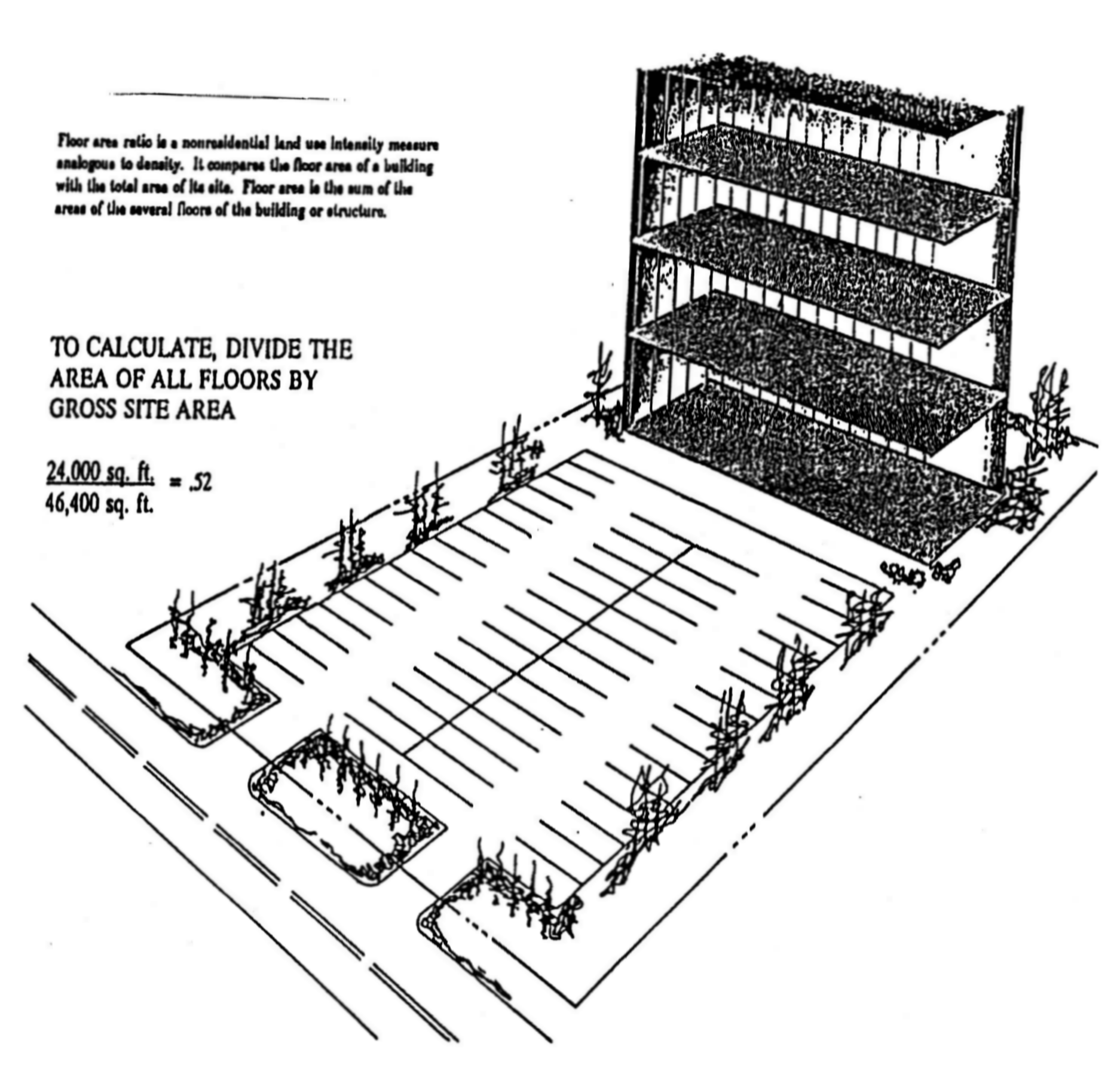
Figure 12.1, Floor Area Ratio
Florida Building Code: The family of codes adopted by the Florida Building Commission, including: Florida Building Code, Building; Florida Building Code, Residential; Florida Building Code, Existing Building; Florida Building Code, Mechanical; Florida Building Code, Plumbing; Florida Building Code, Fuel Gas.
Food Catering Service: An establishment primarily engaged in the provision and sale of prepared food and drinks to be served and consumed off the premises. Food catering services shall not be interpreted to include a permitted home occupation where the food product is sold and delivered exclusively by mail order.
Food Service Sludge: Oils, greases, and grease trap pumpings generated by restaurants, retail food service operations, institutional food service operations, or other similar sources.
Food Truck (RP-2/WVR-2): A large, motorized vehicle or trailer, equipped to cook, prepare, serve, and/or sell food within Flexible Market Space within the Neighborhood Center of an RP-2 Planned Village or WVR-2 Neighborhood and regulated as a type of Temporary Vendor in accordance with Land Development Code Section 6.11.101.02 (Temporary Vendors).
Foot-candle: A quantitative unit measuring the amount of light (illumination) falling onto a given point. One foot-candle equals one lumen per square foot.
Franchise Service: Water and/or wastewater service provided by a private entity within a prescribed area, under County supervision.
Fragmentation: As this term is used in Section 4.01.00, fragmentation means the breaking up, or apart, of a wildlife corridor into fragments. Fragmentation is not deemed to include, or be caused by, the construction, operation, or maintenance of a utility corridor within a wildlife corridor, provided such activities are designed and conducted in a manner to minimize their adverse impacts to the wildlife corridor.
Fraternity or Sorority House: A dwelling or combination of dwellings on a single lot occupied by and maintained exclusively for college students who are affiliated with a social, honorary, or professional organization recognized by the college or university.
Freeboard: The additional height that adds a factor of safety above the base flood elevation (or flood level) for purposes of floodplain management. "Freeboard" tends to compensate for the many unknown factors that could contribute to flood heights greater than the height calculated for a selected size flood and floodway conditions, such as wave action, bridge openings, and the hydrological effect of urbanization of the watershed.
Freestanding Emergency Rooms (FER): An establishment with physicians and other medical staff primarily engaged in (1) providing surgical services (e.g., orthoscopic and cataract surgery) on an outpatient basis or (2) providing emergency care services (e.g., setting broken bones, treating lacerations, or tending to patients suffering injuries as a result of accidents, trauma, or medical conditions necessitating immediate medical care) on an outpatient basis. Outpatient surgical establishments have specialized facilities, such as operating and recovery rooms, and specialized equipment, such as anesthetic or X-ray equipment. Additionally, the use of Helistops and Heliports for emergency services subject to the standards of Section 6.11.46 Heliport in conjunction with FER are permissible in certain zoning districts.
Freshwater Marsh: Herbaceous plant community occurring on lands where the soil is saturated or submerged during part of the year. Freshwater marshes include a number of vegetative types such as flag marshes (dominated by pickerelweed, arrowhead and other non-grass herbs), sawgrass marshes, bulrush marshes and shrub marshes.
Front Yard: See Yard, Front.
Frontage: The length of the property line for a single parcel which runs parallel to and along each public right-of-way (exclusive of alleys) it borders.
Full Course Meal: Items on a menu at a restaurant which include soups and salads, main dishes with side orders, and desserts.
Full-Cutoff Light Fixture: A light fixture designed such that no light is projected at or above a 90-degree plane running through the lowest point on the fixture where the light is emitted and less than ten percent of the rated lumens are projected between 90-degrees and 80-degrees.
Fully Shielded: Outdoor light fixtures shielded or constructed such that light rays emitted by the fixtures are projected only below a horizontal plane passing through the lowest point of the fixture.
Functional Recreation/Civic Space: An area reserved for common recreation space. Such areas shall include parks, pedestrian trails, bikeways, tot lots, playfields/outdoor recreation areas, community gardens, green/vegetated roofs, urban plazas, and/or public squares. Only the portion of the roof that is comprised of a green/vegetated roof may contribute to the provision of this requirement provided that the area is accessible and contains useable recreation space for all residents of the subdivision. Wetland areas, preservation areas, significant wildlife habitat, and stormwater ponds shall not be included when calculating minimum required functional recreation/civic space. When a walking/biking/equestrian trail is located around a stormwater pond, the area of the trail can be considered as functional recreation space.
Functionally Dependent Use: A use which cannot perform its intended purpose unless it is located or carried out in close proximity to water, including only docking facilities, port facilities that are necessary for the loading and unloading of cargo or passengers, and ship building and ship repair facilities; the term does not include long-term storage or related manufacturing facilities.
Funeral Parlor: An establishment engaged in preparing human remains for burial and conducting funerals.
Furniture Refinishing and Repair: An establishment engaged in the stripping, cleaning, painting, staining, sealing, varnishing, or other like refinishing of the wood or metal components of furniture or the replacement or repair of broker or missing portions of a piece of furniture.
Garbage: Solid wastes from the domestic and commercial preparation, cooking, and dispensing of food, and from the handling, storage, and sale of produce.
Gas Station: An establishment where gasoline and/or diesel fuel is supplied and dispensed at retail and where no servicing or repair of vehicles is permitted. Convenience goods may be sold at such facilities but the sales shall be accessory to the sale of gasoline or diesel fuel.
General Development Plan: A map or plan of proposal development activities approved as a result of the zoning process described in Section 10.03.00, or other zoning procedures specified in Article 6 of this Land Development Code or similar provisions in previous zoning regulations. The term includes the General Development Plan initially approved by the Board of County Commissioners and certified by the County Administrator, and any subsequent, duly certified General Development Plans.
Girdling: Interrupting the circulation of a tree's water and nutrients by cutting away the bark and cambium in a ring around the trunk of a tree.
Golf Club/Country Club: A recreational facility containing a golf course and may contain accessory uses such as offices, a pro shop, locker rooms and golf cart rental. Accessory uses such as tennis courts and swimming pools may also be permitted.
Golf Course: A tract of land for playing golf, improved with tees, greens, fairways, hazards with a minimum of nine golf holes.
Grading: Leveling or planing land to a smooth horizontal or sloping land surface by the use of mechanical leveling or grading equipment or, in the case of stockpiled soil, other mechanical equipment.
Grand Oak: A Grand Oak is a tree of the genus Quercus with a trunk measuring 34 inches DBH and greater, a condition rating of good or better in accordance to the Tree Condition Evaluation Form referenced as Section 4.1.6.1.9 of the Development Review Procedures Manual, and whose trunk circumference, height and crown measurements are of the size and character to total a minimum 175 points in accordance to the Tree Point System methodology defined by this Code.
Grand Opening Sign: A sign located on premises upon which a grand opening is taking place.
Green: Within a Traditional Neighborhood Development and the Brandon Main Street (BMS) zoning districts, a Green is a civic open space that conforms with the requirements of Table 5.08-8.
Green Development: Those sustainable developments that have received third party certification as green developments by the Florida Green Building Coalition (FGBC) under the Green Development Standard, by a National Association of Home Builders (NAHB) Green Development Standard, or by the United States Green Building Council (USGBC) under the Leadership in Energy and Environmental Design Neighborhood Development (LEED ND) certification program.
Greenfield TND: A TND that includes at least two subareas in accordance with Section 5.08.04 of this Code.
Green Roof: A contained green space (also known as an eco-roof, living or vegetated roof) planted over a synthetic waterproofed membrane created by adding layers of growing medium and plants on top of a traditional roofing system which also includes a layer for drainage. The green space on the roof may partially or completely cover the traditional roofing system. There are two types of green roofs: extensive and intensive. Extensive green roofs generally have a soil depth of less than 6 inches, require little maintenance, and are lightweight. Intensive green roofs typically have a soil depth of more than 6 inches, require more frequent maintenance, and are heavier than extensive green roofs. In order to be classified as an intensive green roof for open space credit, the green roof must have a minimum soil depth of 6 inches.
Greenway: A linear park or open space which connects natural, cultural, recreational, or historic resources. A greenway may include a hard surfaced trail that permits various recreational uses such as walking, jogging, or biking or a natural corridor with a trail along a stream or riverbank. A Greenway may lie within utility rights-of-way, so long as they are usable for the functions described herein. A Greenway typically includes environmentally sensitive areas such as rivers, wetlands, wildlife habitat, or floodplains.
Greenways Master Plan: The Hillsborough Greenways Master Plan (May 9, 1995), as may be amended from time to time.
Gross Density: For affordable housing, the quotient of the total number of dwelling units on a site divided by the base site area.
Gross Floor Area: See Floor Area.
Ground Level: Ground level shall mean street grade.
Ground Sign: A sign that is supported by one or more columns, upright poles, or braces extended from the ground or from an object on the ground, or that is erected on the ground, where no part of the sign is attached to any part of a building.
Ground Water: Water that fills all the unblocked voids of underlying material below the ground surface which is the upper limit of saturation, or water which is held in the unsaturaged zone by capillarity.
Group Living Facility: The provision of two or more spaces for recreational vehicles on a single lot, used as dwellings by people associated with Show Business activities.
Grubbing: The removal of understory vegetation including the removal of any tree with a DBH less than five inches by the use of mechanical equipment, provided no understory vegetation is removed within the dripline of any tree with a DBH of five inches or greater or within an environmentally sensitive area. In the case of natural plant community vegetation outside of environmentally sensitive areas, grubbing is the removal of understory vegetation necessary to provide limited access to the parcel.
Gunsmith: An establishment engaged in the custom assembly and repair of small firearms.
Habitat: As this term is used with the words "xeric" and "mesic" (as in xeric habitat and mesic habitat), habitat means the particular natural plant communities that typically support xeric or mesic plant and animal associations.
Hardwood Swamp: Deciduous and evergreen hardwood forest community occurring on lands where the soil is saturated or submerged during part of the year. This major habitat category includes riverine swamps, and usually but not always includes floodplain forests, bay forests and red maple forests.
Haul Route: Those roads upon which vehicles transporting excavation materials shall travel.
Hazardous Waste: A material identified by the Florida Department of Environmental Protection as a hazardous waste. This may include but is not limited to a substance defined by the Environmental Protection Agency based on the 1976 Resource Conservation and Recovery Act, as amended, as:
1.
Being ignitable, corrosive, toxic, or reactive
2.
Fatal to humans in low doses or dangerous to animals based on studies in the absence of human data;
3.
Listed in Appendix 8 of the Resource Conservation and Recovery Act as being toxic and potentially hazardous to the environment.
Hazardous Waste Transfer Facility: An establishment engaged in the short-term storage, less than 90 days, of hazardous waste.
Health Practitioner's Office: An establishment offering diagnostic and routine health care on an outpatient basis by licensed practitioners such as but not limited to physicians, dentists and chiropractors.
Health Services: The use of land, buildings and structures for uses such as but not limited to health practitioners, animal hospital or veterinarian clinic, hospitals, medical and dental laboratories, nursing, convalescent and extended care facilities, rehabilitation centers and sanitarium/mental institutions.
Height: The vertical distance from grade plane to the average height of the highest roof surface. Elevated structures within the designated Special Flood Hazard Area will have the vertical elevation measured from the Base Flood Elevation, in addition to any freeboard height requirement, to the highest point of the structure. Finished grade shall be determined using all applicable regulations of the County, State and Federal governments. See Section 6.08.00. Grade Plane is the reference plane representing the average of finished ground level adjoining the building at exterior walls. Where the finished ground level slopes away from the exterior walls, there reference plane shall be established by the lowest points within the area between the building and the lot line or, where the lot line is more than 6 feet from the building, between the building and a point 6 feet from the building.
Heliport: An area, either at ground level or elevated on a structure, licensed or approved for the landing and take off of helicopters, and including auxiliary facilities such as parking, waiting room, fueling and maintenance equipment.
Helistop: A heliport, but without auxiliary facilities such as parking, waiting room, fueling and maintenance equipment.
High Quality Natural Plant Community: A plant community that generally possesses the following characteristics:
1.
The community is not substantially disturbed by recent human activities, except for such disturbances as low intensity forestry or cattle grazing activities that allow the natural plant community to recover to previous conditions;
2.
The ground layer is not substantially disturbed by agriculture or silviculture site-preparation activities;
3.
The plant species composition includes most of the more common species typical of the natural plant community type, and possibly contains some of the rarer species; and
4.
The community contains relatively small numbers of exotic plants, or includes exotic plants that could be easily controlled by prescribed burning or other forms of management.
Highest Adjacent Grade: The highest natural ground surface elevation next to the proposed foundation of a building as of June 18, 1980, or the ground surface elevation unaffected by prior construction such as fill, grading, landscaping or berming.
Historic District: An area of architectural, historical, cultural or archaeological significance to Hillsborough County, the State of Florida or the nation which meets the criteria for Landmark designation.
Historic Resource: Any prehistoric or historic district, site, building, object, or other real or personal property of historical, architectural, or archaeological value. These properties or resources may include, but are not limited to, monuments, memorials, Indian habitations, ceremonial sites, abandoned settlements, engineering works, architectural interiors, artifacts, or other objects with intrinsic historical or archaeological value, or any part thereof, relating to the history, government, and culture of the County.
Historic Resources Inventory: A listing of Landmarks and Historic and Archaeological Resources within unincorporated Hillsborough County identified through a Historic Resources Survey, Cultural Resources Assessment Survey, or a similar survey following the guidelines established by the Florida Division of Historical Resources.
Historic Resources Review Board (HRRB): As set forth in the Laws of Florida Chapter 91-120, the Architectural Review Board of Hillsborough County, is an appointed Board, created by the Board of County Commissioners, for the purpose of protecting the historic and pre-historic resources of Unincorporated Hillsborough County. The Architectural Review Board shall be known as the Historic Resources Review Board, or HRRB.
Historic Structure: For the purposes of Part 3.06.00 Flood Damage Control Regulations, any structure that is determined eligible for the exception to the flood hazard area requirements of the Florida Building Code, Existing Building, Chapter 12 Historic Buildings.
Historical Site: Any place, building, or district of historical, architectural or archaeological significance or value which has been officially listed in the National Register of Historic Places (NRHP); determined eligible or potentially eligible for listing in the NRHP by the Florida Division of Historical Resources; designated as a Landmark or listed in the Historic Resources Inventory by the County; or recommended for preservation or more work needed before a determination of significance can be made as per the Florida Division of Historical Resources.
Hobby Vehicle: Any vehicle, other than utility trailers and commercial, domestic and recreational vehicles as defined by this Code, which has been designed for, or modified for, personal hobbies such as track racing, mud bogging, off-road driving or other similar activities and which cannot be licensed for street operation.
Hog Farm: See Animal Production Units.
Holidays Recognized by Hillsborough County: General holidays shown on the published schedule of annual holidays for five-day work week employees of the Hillsborough County Board of County Commissioners.
Home-Based Business: Any activity conducted by a resident within a dwelling unit which results in a product or service for financial gain. A home-based business is an accessory use to the primary residential use of the parcel.
Hospital: An establishment that offers medical care more intensive than personal care services and offers facilities and beds for use beyond 24 hours for individuals requiring diagnosis, treatment or cure for mental and physical illness, injury, deformity, infirmity, abnormality, disease, or pregnancy and which regularly makes available at least clinical laboratory services, diagnostic x-ray services, and treatment facilities for surgery or obstetrical care, or other definitive medical treatment of similar extent. The term hospital shall include the buildings themselves and any accessory uses such as hospital maintenance and storage facilities, helistops for hospital emergency services, parking and emergency facilities, related teaching and training activities, accessory indoor auditoriums/conference rooms, accessory indoor minor retail, miscellaneous service, and personal service uses, and incidental publishing and printing of hospital related information. Hospitals do not include Congregate Living Facilities; Nursing, Convalescent, and Extended Care Facilities; or Professional Residential Facilities.
Hotel/Motel: A building or group of buildings containing lodging units intended primarily for rental or lease to transients by the day or week, and providing additional services such as restaurants, meeting rooms and recreation facilities.
Housing for Older Persons: Housing provided under any State or Federal program that is determined by the Zoning Administrator to be specifically designed and operated to assist elderly persons (as defined in the State or Federal program); or is intended for, and solely occupied by, persons 62 years of age or older; or is intended and operated for occupancy by at least one person 55 years of age or older per unit.
Hurricane Evacuation Clearance: The amount of time specified in the Hillsborough County Hurricane Evacuation Plan Implementation Guide produced by the Tampa Bay Regional Planning Council for the safe evacuation of hurricane vulnerable areas.
Hurricane Shelter Space: At a minimum, an area of 20 square feet per person located within a hurricane shelter.
Illegal Sign: A sign not lawfully erected in violation of Hillsborough County ordinances or regulations.
Impervious Surface: A surface which has been compacted or covered with a layer of material so that it is highly resistant to infiltration by water.
Improvement Facilities: The on and off-site construction to be completed per:
1.
The Road/Transportation, Bridge and Drainage Plans
2.
The Water and Wastewater Plans and Specifications
3.
The Parks and Recreation Plans and Specifications
Increased Cost of Compliance (ICC): Coverage included in National Flood Insurance Program standard flood insurance policies on buildings in special flood hazard areas. Increased cost of compliance coverage provides a claim payment in addition to a claim payment for flood damage; the ICC claim payment is used toward the cost of bringing buildings determined to have been substantially damaged by flooding into compliance.
Independent Certified Audit: A formal analysis of the financial records of a business establishment by an individual such as an accountant who is not directly associated with the business establishment.
Individual Private Well: See Water Facility.
Individual Sewage Disposal: The treatment of sewage in septic tanks and the disposal of the effluent by absorption fields.
Individual Water Supply: A potable water supply which is furnished by a well on an individual lot.
Industrial District: An industrial district is any parcel zoned PD-RP, M, M-L, M-H, PD-A(I), PD-I, SPI-AP, or any portion of a PD, PD-MU, IPD-1, IPD-2, IPD-3 districts zoned for industrial land uses pursuant to this Code or any parcel zoned C-3A, C-3, M-1A, M-1, M-AP or any portion of a C-U district zoned for industrial uses by the County.
Industrial, Heavy: Heavy industrial uses shall be defined as any facility which emits at least one of the following: 1) 600 pounds or more per year of lead or lead compounds, or; 2) 100 tons or more per year of any other air pollutant subject to regulation under Chapter 403 F.S. as amended, or; 3) 10 tons or more per year of any one hazardous air pollutant as defined by the Hillsborough County Environmental Protection Commission, or; 4) 25 tons or more per year of any combination of hazardous air pollutants emitted by uses on the Hillsborough County Environmental Protection Commission Industrial uses listing that may be considered Heavy Industrial based upon the above criteria. Uses that may be considered Heavy Industrial include, but are not limited to, air curtain incinerators, asphalt plants, concrete batch plants, fabrication facilities (involving open air grit blasting or open air painting), phosphate/nitrate fertilizer manufacturing (except phosphogypsum stack systems); fiberglass products manufacturing facility, explosive storage and or manufacturing facility, biohazardous waste incinerator, pesticide formulation facility, scrap yard/shredding facility, soil remediation facility, bulk solvent chemical storage and or processing facility, major coating facility (over 50,000 gallons of coating in a year on any substrate), paint/ink manufacturing facility, secondary metals recovery or manufacturing facility, chrome plating facility asbestos products fabricators or manufacturer, livestock importing/exporting facilities.
Industrial Reuse Water: Process water which has made contact with an industrial or manufacturing process, not to include closed loop, non-contact cooling water.
Industrial Septic Tank Disposal System: An on-site wastewater disposal system for industrial and non-domestic wastewater.
Industrial Stormwater: Discharge of rainfall runoff and wash down run off from on-site surface/subsurface drainage system which is directly related to manufacturing, handling, processing, or raw material storage facilities.
Industrial User: Any user of a publicly owned treatment works identified in the Standard Industrial Classification Manual of the U.S. Office of Management and Budget, as amended and supplemented, including, but not limited to the following divisions: (a) Division A—Agriculture, Forestry. and Fishing; (b) Division B—Mining; (c) Division D—Manufacturing; (d) Division E—Transportation, Communications, Electric, Gas and Sanitary Service; (e) Division I—Services. A user in the divisions listed may be excluded if it is determined that it will introduce primarily segregated domestic waste or wastes from sanitary conveniences or discharges less than the equivalent of 25,000 gallons per day of wastewater.
Industrial Wastewater: means wastewater not otherwise defined as domestic wastewater, including the runoff and leachate from areas that receive pollutants associated with industrial or commercial storage, handling or processing facilities.
Ingress: An entrance by which a pedestrian, motorist, or cyclist enters a development.
Infill Development, Commercial: The development of a commercial use in an area of similar commercial uses, usually along the same street and between two parcels of similar commercial uses.
Infill TND: A TND located in an existing neighborhood or proximate to transit facilities that conforms to the criteria for a Pedestrian Oriented Development (POD) or a Transit Oriented Development (TOD) as established in Part 5.08.00 of this Code.
Inspection Chamber: An accessible structure through which wastewater from a building sewer flows and from which samples of said wastewater may be collected for the purpose of being tested.
Intensity: A measure of the degree to which land is developed based on density, use, mass, size, impact and traffic generation often expressed in terms of floor area ratio.
Interference: The inhibition or disruption of the POTW treatment processes or operations which contributes to a violation of any requirement of the County's NPDES Permit. The term includes prevention of sewage sludge use or disposal by the POTW in accordance with 405 of the Act, (33 U.S.C. 1345) or any criteria, guidelines, or regulations developed pursuant to the Solid Waste Disposal Act (SWDA), the Clean Air Act, the Toxic Substances Control Act, or more stringent state criteria (including those contained in any State sludge management plant prepared pursuant to Title IV of SWDA) applicable to the method of disposal or use employed by the POTW.
Interim Wastewater Treatment Plant: A wastewater treatment plant that is under an Interim Wastewater Treatment Agreement with Hillsborough County and/or is scheduled to be discontinued by a project in the Hillsborough County Capital Improvements Program Plan. See also Wastewater Treatment Facility.
Interior Cleaning Service: An establishment engaged in the provision of maid or janitorial services.
Interior Lot: See Lot, Interior.
International Society of Arboriculture (ISA) Shade Tree Formula: A method accepted by the Council of Tree and Landscape Appraisers for establishing a monetary value of trees. This formula factors a basic dollar value with the components of trunk diameter, tree species, tree condition, and tree location to establish a monetary value.
Intersection: A place of joining or crossing of streets.
Intersection, Access Management: An at-grade connection or crossing of two or more public or private roadways.
Irrigation System: A permanent watering system designed to transport and distribute water to plants as a supplement to natural rainfall.
Irrigation Zone: A control valve circuit containing emitters and/or sprinklers with consistent application rates.
Isolated Corner Property: A parcel of land which due to size, cannot meet the corner clearance standards of this regulation, and where joint access which meets the corner clearance standards of this regulation cannot be obtained with a neighboring property, or if in the opinion of the issuing authority, joint access is not feasible based on conflicting land uses or conflicting traffic volumes/characteristics.
Issuing Authority: For the purposes of Access Management, it is the department or agency which is responsible for the review and approval of access permits. For Types I—V access permits the responsible agency is the Planning and Development Management Department.
Junk: Old, dilapidated, scrap or abandoned materials that would not be considered to be economical to recycle, such as building materials, equipment, glass, appliances, furniture, parts of motor vehicles, etc.
Junkyard: Land used for the storage, keeping, handling, or display of junk.
Kennel: A commercial establishment for the boarding, holding, care or breeding of dogs and/or cats for compensation. Also, a non-profit establishment for the rescue, rehabilitation and adoption of dogs and/or cats.
Kitchen/Accessory: A secondary facility for the preparation of meals which includes a sink, stove and refrigerator that is located inside a dwelling unit to supplement a primary individual kitchen for the convenience of the residents of the dwelling. The design of an accessory kitchen shall not accommodate establishment of a second dwelling unit within the structure. Accessory kitchens shall require special use approval in all cases. Accessory kitchens do not include cooking facilities located on screened porches or other exterior areas which are not used to serve a separate family or to function independently from the primary kitchen.
Kitchen/Commercial: A facility used for the preparation of food which is sold to the public and that is subject to State and Local Health Department inspections.
Kitchen/Individual: Facilities for preparation of meals which includes a sink, stove and refrigerator. A dwelling unit shall have only one kitchen with the exception of: 1) an accessory kitchen approved in accordance with the Special Use requirements of Section 6.11.107 of this Code; or, 2) cooking facilities located on screened porches or other exterior areas which are not used to serve a separate family or to function independently from the primary kitchen. In no case shall these restrictions be waived by administrative staff action.
Lake: A surface water body contained within a natural depression or excavation in a historic wetland area, which has a permanent open water component, and is not a river or creek or created for the primary purpose of stormwater attenuation or treatment.
Lake Cleaning: Land excavation to restore a lake, as defined in this Code, to:
1.
Its natural or artificially constructed depth; and/or
2.
Its natural or artificially constructed shape by the removal of land excavation materials.
Lake Creation: The land excavation which will result in the creation or enlargement of a lake as defined.
Land Alteration: Land alteration is any activity which removes vegetation from or changes the topography of the land by grubbing, tree removal, clearing, grading, filling, or excavating, except for activities undertaken to maintain existing grounds.
Land Application Boundary: The outermost perimeter of the land application area as it will exist at the completion of the disposal activity.
Land Application Disposal: The disposal of biosolids by applying them into or on land. This definition shall not include the land application of biosolids in a manner that is not regulated by the Department of Environmental Protection.
Land-Based Classification Standards: Standards published by the American Planning Association to classify land uses.
Land Excavation: The excavation and subsequent removal from any site, at any time, by any person, persons, or entity whatsoever, whether acting collectively or independently, of any material in a total quantity of more than 10,000 cubic yards, or in a total quantity of more than 30,000 cubic yards for projects with approved Site Development or Subdivision Construction Plans.
Landfill.
1.
Class I: A disposal facility where solid waste is disposed of in accordance with 62-701 Florida Administrative Code, and is receiving an average of 20 tons or more of solid waste per day.
2.
Class II: A disposal facility where solid waste is disposed of in accordance with 62-701 Florida Administrative Code, and is receiving an average of less than 20 tons of solid waste per day.
3.
Class III: A disposal facility where solid waste is disposed of in accordance with 62-701 Florida Administrative Code, receives only yard trash and construction and demolition debris.
Landmark: A resource of architectural, archaeological or historic significance to Hillsborough County which meets one or more of the criteria for Landmark designation. Landmarks may include, but are not limited to, an historical site which was the location of a significant historical event, monuments, memorials, Indian habitations, ceremonial sites, abandoned settlements, sunken or abandoned ships, engineering works, treasure trove, artifacts, or other objects with intrinsic historical or archaeological value, or any part thereof, relating to history, government, and culture. References to Landmarks shall include any or all designated Landmarked Historic or Archaeological Resources, Landmark Sites, and Historic Districts.
Landmark Site: The land on which a Landmark and its associated structures, grounds, premises and setting are located. A Landmark Site shall only be designated in conjunction with the designation of a Landmark and shall be identified through its legal description. A Landmark Site may include part of one or more parcels.
Landscape Plant Zone: A grouping of plants with similar water and cultural (sunlight, soil, etc.) needs. Plant groupings based on water use are as follows: natural plants, drought tolerant plants, and oasis plants.
Landscaping: The use of any portion of existing vegetation, the planting of vegetation or the placement of other landscaping material in conjunction with new development and as required by Section 6.06.00 of this Code.
Landscaping Contractor's Nursery: Land predominately devoted to the reproduction, growth and/or significant increase in value of plants, sod, trees and shrubs by a landscaping contractor, but also utilized for the storing and maintenance of vehicles, equipment and materials employed by the contractor in the off-site installation of the vegetation and maintenance.
Lane: See TND Typical Sections in the Transportation Technical Manual.
Large Scale (Big Box) Retailer: Single-use tenants having 75,000 square feet or more of gross floor area. However, this shall not preclude accessory tenants within the same floor area not having individual public access outside the building.
Lawn Care and Landscaping Service: Establishments engaged in performing a variety of lawn and landscaping services such as but not limited to lawn fertilizing, mowing, spraying and planting, and the planting and maintenance of landscaping.
LBCS: See Land-Based Classification Standards.
Leasing, Light Equipment: See Rental and Leasing of Light Equipment.
Leasing, Commercial Vehicles and Heavy Equipment: See Rental and Leasing of Commercial Vehicles and Heavy Equipment.
Letter of Map Change (LOMC): An official determination issued by FEMA that amends or revises an effective Flood Insurance Rate Map or Flood Insurance Study. Letters of Map Change include:
Letter of Map Amendment (LOMA): An amendment based on technical data showing that a property was incorrectly included in a designated special flood hazard area. A LOMA amends the current effective Flood Insurance Rate Map and establishes that a specific property, portion of a property, or structure is not located in a special flood hazard area.
Letter of Map Revision (LOMR): A revision based on technical data that may show changes to flood zones, flood elevations, special flood hazard area boundaries and floodway delineations, and other planimetric features.
Letter of Map Revision Based on Fill (LOMR-F): A determination that a structure or parcel of land has been elevated by fill above the base flood elevation and is, therefore, no longer located within the special flood hazard area. In order to qualify for this determination, the fill must have been permitted and placed in accordance with the community's floodplain management regulations.
Conditional Letter of Map Revision (CLOMR): A formal review and comment as to whether a proposed flood protection project or other project complies with the minimum NFIP requirements for such projects with respect to delineation of special flood hazard areas. A CLOMR does not revise the effective Flood Insurance Rate Map or Flood Insurance Study; upon submission and approval of certified as-built documentation, a Letter of Map Revision may be issued by FEMA to revise the effective FIRM.
Levee: Means a man-made structure, usually an earthen embankment, designed and constructed in accordance with sound engineering practices to contain, control, or divert the flow of water so as to provide protection from temporary flooding.
Levee System: Means a flood protection system which consists of a levee, or levees, and associated structures, such as closure and drainage devices, which are constructed and operated in accordance with sound engineering practices.
Library: A building in which literary, musical, artistic or reference materials are kept for use but not generally for sale.
Life Care Treatment Facility: A facility which provides one or more levels of personal care services to residents but which provides an independent or semi-independent lifestyle to its residents and which is not licensed as an Adult Congregate Living Facility or Community Residential Home by the Florida Department of Health and Rehabilitative Services. A life care treatment facility may be built in combination with a congregate living facility or a nursing convalescent and extended care facility.
Light-Duty Truck: As defined in 40 C.F.R. 86.082-2 and for the purposes of Part 3.06.00 Flood Damage Control Regulations, any motor vehicle rated at 8,500 pounds Gross Vehicular Weight Rating or less which has a vehicular curb weight of 6,000 pounds or less and which has a basic vehicle frontal area of 45 square feet or less, which is:
1.
Designed primarily for purposes of transportation of property or is a derivation of such a vehicle, or
2.
Designed primarily for transportation of persons and has a capacity of more than 12 persons; or
3.
Available with special features enabling off-street or off-highway operation and use.
Line Extension: A continuation of an existing water or wastewater line within a road right-of-way or an easement to serve property(s) not adjacent to such lines. A single service connection as defined by this Code shall not be considered a line extension.
Liner Retail: A retail and/or office building type designed to mask a parking garage, surface parking lot or anchor retail uses in order to provide building frontage along "A" Streets.
Liquid Waste: Garbage, refuse and other discarded materials in a liquid form, including liquid waste materials resulting from industrial, commercial, agricultural or governmental operations and from community activities.
Liquor: All spirituous beverages created by distillation and by mixture of distilled beverages by what is commonly termed "blending".
Liquor Store: An establishment engaged in the retail sale of packaged alcoholic beverages for consumption off-premises.
Listed Animal Species: Animal species which are identified as endangered, threatened, or species of special concern in Chapter 39, Florida Administrative Code, and occur in Hillsborough County.
Listed Plant Species: Plant species which are identified as endangered or threatened in Chapter 581, Florida Statutes, and occur in Hillsborough County.
Listed Species: All species of plants and animals which are listed as threatened, endangered, or species of special concern in Chapter 39, Florida Administrative Code, or Chapter 581, Florida Statutes, and occur in Hillsborough County.
Live-Work Unit (RP-2/WVR-2): A single building located in an RP-2 Planned Village, Wimauma Village Neighborhood or the Wimauma Village Downtown which integrates one residence and a non-residential use, as permitted in Section 6.11.48, which is primarily operated by the live/work occupant.
Loading, Off-Street: Space location outside of any street right-of-way or easement and designed to accommodate the temporary parking of vehicles used for bulk pickups and deliveries.
Local Road/Street: Unless otherwise specified, a roadway so designated under the Hillsborough County Functional Classification System. See also "Major Local."
Locksmith: An establishment engaged in the repair of locks, the making of keys, and the provision of the service of opening damaged or jammed locks upon request by the lock's owner.
Lodging Places: The use of land, structure, or buildings for the provision of lodging such as but not limited to Boarding, Camps, Dormitories, and Hotels/Motels.
Lodging Unit: A room or group of rooms forming a separate habitable unit used or intended to be used for living and sleeping purposes by one family only, without independent kitchen facilities; or a separate habitable unit, with or without independent kitchen facilities, occupied or intended to be occupied by transients on a rental or lease basis.
Lot: A designated parcel or tract of land, identified by a legal description or single folio number, established by plat, subdivision, or as otherwise permitted by law, to be used, developed or built upon as a unit, or used for the purpose of property division.
Lot/Corner: A lot located at the intersection of two or more streets. A lot abutting a curved street or streets shall be considered a corner lot if straight lines drawn from the foremost points of the side lot lines to the foremost point of the lot (projected if rounded) meet at an interior angle of less than a 135 degrees (See Figure 6.1).
Lot/Interior: A lot other than a corner lot, and abutting one street. Alleys shall not be considered as streets (See Fig 6.1).
Lot/Through: A lot other than a corner lot and with frontage on more than one street (See Fig. 6.1).
Lot Coverage: That portion of the area of a lot, expressed as a percentage, occupied by all buildings or structures which include but are not limited to arcades, stairways, elevator shafts, and balconies that are roofed and that extend more than three feet above ground level. Terraces, patios, atriums, balconies, breezeways, covered patios, entryways, and any accessory structure are not included in the lot coverage.
Lot Line: A line that marks the boundary of a lot.
Lot Line/Interior: Any lot line that is not a street lot line; a lot line separating a lot from another lot.
Lot Line/Street: Any lot line separating a lot from a street right-of-way or general access easement. Where a lot line is located within such street right-of-way or easement, the right-of-way or easement boundary adjacent to the lot shall be considered the street lot line.
Lot of Record: A lot which is part of a subdivision, the plat of which has been recorded in the office of the Clerk of the Circuit Court of Hillsborough County, or any parcel of land, whether or not part of a subdivision, that has been officially recorded by a deed in the office of the Clerk, provided such lot was of a size which met the minimum dimensions for lots in the district in which it was located at the time of recording or was recorded prior to the effective date of zoning in the area where the lot is located and met the requirements of the subdivision regulations in effect at the time of the recording.
Lot Width: The horizontal distance measured along a straight line connecting the points where the rear of the required yard line meets the interior lot lines or, if on a corner, the other rear of the required front yard.
Low Volume Private Road: A private road to serve ten (10) or fewer lots in a Minor Subdivision, which is in conformance with the standards for Low Volume Private Roads as set forth in the Transportation Technical Manual.
Lowest Floor: The lowest floor of the lowest enclosed area of a building or structure, including basement, but excluding any unfinished or flood-resistant enclosure, other than a basement, usable solely for vehicle parking, building access or limited storage provided that such enclosure is not built so as to render the structure in violation of the non-elevation requirements of the Florida Building Code or ASCE 24.
Lumber and Other Building Materials Sales: An establishment engaged in the retail sale of finished lumber, packaged roofing materials, doors, and other materials used by individuals or builders. All materials shall be stored and sold from a completely enclosed building with the exception of the lumber which may be stored in buildings, as defined by this Code. Additionally, the open storage of lumber shall be permitted in the C-I, M, SPI-AP-3 and SPI-AP-4 districts.
Lumberyard: An establishment engaged in the cutting, dressing, finishing and wholesale sale of lumber.
Lumen: A quantitative unit used to identify the amount of light emitted by a light source.
Luminaries: Complete lighting units consisting of the lamp, the fixture and other components and less the support assembly designed to distribute light.
Mail Order Office: An establishment which engages in the taking of requests for mail order or catalog merchandise by telephone. The establishment where orders are picked up or taken in person are not considered mail order offices.
Mail Order Pickup Facility: An establishment which engages in the taking of requests in person or the on-premises delivery of mail order or catalog merchandise.
Main Street Retail: A mixed-use building type that may be single story or multi-story, providing retail and/or office uses on the street level and office or residential uses above.
Maintain: Maintain shall include general servicing and upkeep in a safe, operable, and attractive condition.
Maintenance Factor: A unit of measure accounting for dirt build-up and lamp output depreciation.
Maintenance of Show Business Vehicles: See Storage and Maintenance of Show Business Vehicles.
Major Connection: High volume traffic generator. Provides access to facilities which generate high traffic volumes such as shopping centers, industrial parks, office parks, colleges, apartment or condominium complexes, etc. (Average Weekday Traffic generation greater than 1,500 vehicles per day).
Major Local (a/k/a Subdivision Collector Road): Generally a local street not shown on the 2020 Functional Classification Map in the Transportation Element of the Hillsborough County Comprehensive Plan, that a) connects two or more existing roads which are shown on the 2020 Functional Classification, or b) is the primary connector road between at least 500 dwelling units and an existing roadway shown on the 2020 Functional Classification Map.
Major Node: A definitive cluster of interrelated uses, usually with direct access to an arterial street or expressway interchange.
Major Public Water Supply Well or Wellfield: One well, or two or more wells located in proximity to each other, permitted to provide an average daily supply of at least 100,000 gallons a day of potable water to the public.
Major Water Body: For the purpose of determining the applicability of a site planned district of industrial zonings, these shall be defined to include all major lakes, springs, rivers, and streams as identified in Figures 11 and 12 of the Conservation and Aquifer Recharge Element of the Comprehensive Plan.
Malt Beverages: See Beer and Malt Beverages.
Management Plan: A plan prepared to address preservation/restoration and management of significant or essential wildlife habitat, and which is approved by the County in accordance with Section 4.01.00. The management plan describes and depicts the location of areas to be preserved, including any protective buffers. The plan indicates the location of individuals of listed species, their nest sites, dens, burrows, feeding locations, roosting and perching areas, and trails, as appropriate. The plan identifies habitat management activities and contains an action plan with specific implementation activities, schedules, and assignments of responsibilities.
Mangrove Swamp: Woody plant community occurring along low wave-energy coastal shorelines. Mangrove swamps are dominated by three species: black, red and white mangroves. Red mangroves typically occupy the waterward fringe with black mangroves further inland but usually covered by water at high tide, and white mangroves landward of the black mangroves. Buttonwood trees are often found in this community just above the reach of salt water. Herbaceous plants commonly found among the mangroves include a number of coastal marsh species.
Manufactured/Modular Building: A structure manufactured in manufacturing facilities for installation or erection as a finished building or as part of a finished building on the building site. This shall include, but not be limited to, residential, commercial, institutional, storage and industrial structures. The building must bear an insignia of approval from the Florida Department of Community Affairs.
Manufactured Home/Mobile Home: A structure, excluding Park Model/park Trailer as defined by this Code, designed for and limited to single family and duplex usage meeting the Federal Mobile Home Construction and Safety Standards, promulgated by the Department of Housing and Urban Development. Such a structure is complete and ready for occupancy, except for minor and incidental unpacking and assembly operations, location on piers or a foundations, connections to utilities and the like. Alteration of a manufactured home in any way that changes its intended original usage shall negate its approval for any use. Manufactured homes/mobile homes shall not be allowed to be connected/married unless specifically designed and approved for that purpose as a part of the manufacturing process.
Manufactured Home, Flood Damage Control: For floodplain management purposes the term refers to a structure, transportable in one or more sections, that is eight (8) feet or more in width and greater than four hundred (400) square feet, and which is built on a permanent, integral chassis and is designed for use with or without a permanent foundation when attached to the required utilities. The term "manufactured home" does not include a "recreational vehicle" or "park trailer."
Manufactured Home Park or Subdivision: For the purposes of Part 3.06.00 Flood Damage Control Regulations, a parcel (or contiguous parcels) of land divided into two or more manufactured home lots for rent or sale.
Manufacturing, Agricultural: This use involves establishments primarily engaged in the grading, sorting, packing, refining and processing of raw agricultural projects. The processed material is typically grown, cultivated or produced onsite and is an integral part of the agricultural enterprise. Typical uses include the processing of fruits and vegetables into jams, jellies, marmalades, juices, or syrups; the mixing of products into feeds for livestock; or any other finished product whose major components are agricultural products. The slaughtering of animals is specifically excluded.
The manufacturing, processing or assembling of products relating to agricultural activities shall be permitted where the product produced or activity involved serves the west central Florida area and where a minimum of 50% of the product or service supports the local agricultural market. Typical uses would include maintenance, repair or fabrication of machinery, structures or accessory products related to agricultural activities including machine shops, and dye, and metal, plastic or wood fabrication and similar uses.
Manufacturing, Heavy: All manufacturing, processing, and assembly uses which correspond with the definition of Industrial, Heavy in this Code.
Manufacturing, Processing and Assembling: The mechanical or chemical transformation of materials or substances into new products. The land uses engaged in these activities are usually described as plants, factories, or mills and characteristically use power driven machines and materials handling equipment. Establishments engaged in assembling component parts of manufactured products are also considered under this definition if the new product is neither a fixed structure nor other fixed improvement. Also included is the blending of materials such as lubricating oils, plastics resins or liquors.
Marina: A facility for storing, servicing, fueling, berthing and securing and launching of private pleasure craft which may include the sale of fuel and incidental supplies for the boat owners, crews and guests.
Marine Grassbed: Herbaceous plant community found on shallow submerged lands which are covered with salt or brackish water. Species include submerged grass-like plants such as turtle grass, shoal grass, manatee grass and wigeon grass.
Marquee: A permanent roof-like shelter extending from part or all of the building face usually over a public right-of-way and constructed of some durable material such as metal, glass or plastic.
Masonry: Composed of stone, brick, concrete, gypsum, hollow clay tile, concrete block, interlocking steel and styrofoam panels encapsulated in stucco, or other similar building materials.
Mass: See Building Massing
Master Pump/Lift Station: See Pump/Lift Station.
May: A permissive condition; where the word "may" is used, the requirement, standard or condition is optional.
Mean High Water (MHW) Line: The boundary between privately owned lands and sovereignty lands in tidal waters, where these land have not been conveyed into private ownership. The MHW line is a statistical average of the high tides over a period of many years. The methods applied by the Florida Department of Natural Resources shall be used to determine the MHW line.
Meat Market: An establishment where meats including but not limited to beef, fish, poultry, and veal are sold and packaged. Meat markets do not include the killing, butchering, and processing of the animals.
Median Crossover: A "cut" or area where traffic may pass through a "median", where median is defined as that portion of a highway separating the opposing traffic flows.
Medical Hardship: See Temporary Mobile Home Facility.
Medical Laboratory: An establishment engaged in the testing and analysis of material for medical or dental services or for the patient on prescription of a health practitioner.
Medical Offices: See Clinics.
Membership Organization: A membership establishment operated by a corporation or association of persons for activities which include but are not limited to business, professional, social, literary, political, educational, fraternal, charitable or labor activities, but which are not operated for profit or to render a service which is customarily conducted as a business.
Mental Health Care Facility: See Hospital.
Mesic Habitats: Mesic habitats are moderately moist habitats. Mesic habitats occur as dry to moist, level to hilly uplands on poorly to somewhat poorly drained soils containing variable amounts of clay or organic material, and support a diverse array of mesic-adapted plants and animals. Mesic habitats occurring in Hillsborough County include pine flatwoods, dry prairies and mesic hammocks.
Mesic Hammocks: Mesic hammocks, also known as upland hardwood forest, constitute the climax community of the area. There is no single dominant stress factor in most mesic hammocks. The result is a high plant diversity, particularly in the mature successional stages. Fire does not normally play a major role in this community. A variety of hardwood trees are found in this community and occur on fairly rich, sandy soils. Southern magnolia, laurel oak, American holly, dogwood, pignut hickory and live oak are characteristic species of this association. Variations in the species composition of mesic hammocks are partially due to differences in soil moisture. A major variation of this vegetation association is the live oak-cabbage palm hammock. Live oak-cabbage palm hammocks often border large lakes and rivers. Because this variant community type often functions as an ecotonal area adjacent to wetlands, it affords suitable habitat for a wide variety of plants and animals. Representative soils: Fort Meade, Gainesville, Millhopper, Kendrick, Lochloosa, Zolfo, Winder and Pinellas.
Meter Installation Charge: The cost of materials, labor and equipment to tap the meter line to install the service line and to install the water meter and meter box.
Meter Measurement: The act of or result of determining the quantity of water supplied or being discharged by a user and determined by an instrument or device used for such measurements and approved by the Director.
Micro-Irrigation: An irrigation system with a maximum flow rate per emitter of 30 gallons per hour or less.
Microbrewery: An establishment in which the principal purpose is the production of malt liquors or beer, including the fermentation, bottling and distribution of beer. In commercial zoning districts, this use shall be permitted only in connection with the on-premises consumption of the beer produced at the location. Microbreweries sell to the general public by one or more of the following methods: The traditional three-tier system (brewer to wholesaler to retailer to consumer); the two-tier system (brewer acting as wholesaler to retailer to consumer); and, directly to the consumer for consumption on the premises or for retail carryout sale. For the purposes of this Code, microwineries shall constitute a microbrewery.
Mined-Out Land: Land or area from which the ore has been removed.
Minimum Connection: A sidewalk or low traffic generator. Provides access to a single family dwelling, a duplex or a multifamily dwelling of five units or less. The term shall also apply to driveways used as access to agricultural land including field entrances and to all sidewalk and bikeway connections.
Minimum Connection Spacing: The minimum allowable distance between conforming connections, measured from the closest edge of pavement of the first connection to the closest edge of pavement of the second connection along the edge of the traveled way.
Minimum Dimension: Of a lot shall be defined as the shortest line from side lot line to side lot line in the area of the lot occupied by an individual sewage disposal system or a septic tank.
Minimum Lot Size: In subdivisions shall consist of the total lot area exclusive of roadways, rights-of-way, submerged lands, and surface water drainage easements.
Minimum Median Opening Space: The minimum allowable spacing between openings in a restrictive median to allow for crossing the opposing traffic lanes to access property or for crossing the median to travel in the opposite direction (U-turn). The minimum spacing or distance is measured from centerline to centerline of the openings along the traveled way.
Mining: The extraction of earth products for sale or transport off-site including the removal of associated material such as overburden.
Mining and Reclamation Plan: A plan of operations by which mining and reclamation will be accomplished for the entire area under the permit.
Mining Unit: A specified area of land, not to exceed 2,500 acres, from which minerals are extracted within a specific period of time.
Mini-Warehouse: See Warehouse, Mini.
Minor Connection: Medium volume traffic generator. Provides access to property being used for other than nominal residential and agricultural uses. (Average Weekday Traffic generation less than or equal to 1500 vehicles per day).
Minor Industry: A non-intensive, relatively small-scale, light manufacturing operation in which the final product is crafted predominately from previously prepared materials. The operation may involve minor processing, assembly, treatment, packaging, incidental storage, sales and distribution of products, but excludes basic industrial processing. Examples are cigar-making; small unit products such as electronic equipment and fishing tackle and smoking pipe manufacture; and forms of craftsmanship, such as cabinet-making which does not include milling.
Minor Pruning: The pruning of a tree by removing branches measured no greater than three inches in diameter at the point of connection to a supporting branch and in accordance to the American National Standards Institute (ANSI) A 300 Pruning Standards.
Minor Work: Alterations, removals and modifications to Landmarks or structures in Historic Districts which will 1) have no significant effect on the structure's cultural, historical or architectural importance, 2) tend to enhance its cultural or architectural significance.
Examples of such activities include removal of intrusive elements or out buildings, removal of vinyl, aluminum or other artificial siding, construction or installation of appropriate fences, street furniture and landscape materials.
Mixed Use: In the I-75 Corridor, a development that contains two or more of the following major use types: residential, office, research park, retail, or industrial. If there are only two types of uses, the dominant use shall occupy no more than 60 percent of the total floor area in the development. If there are three different types of uses, at least 20 percent of the total floor area shall be residential, and no use shall occupy less than ten percent of the total floor area in the development.
Mobile Home: See Manufactured Home.
Mobile Home Park: A single zoning lot occupied by five or more mobile homes for which a Health Department permit for a mobile home park has been issued.
Modular Structures: See Manufactured Building and Home.
Monument Sign: Any sign, other than a Pole sign, which is placed upon or supported by structures or supports in or upon the ground and independent of support from any building and which does not exceed four feet in height, 20 feet in length and 15 inches in width, except as otherwise provided by these regulations.
Motel: See Hotel/Motel.
Motion Picture Studio: An establishment engaged in the production of motion pictures for commercial release and exhibition.
Motor Home: See Recreational Vehicle.
Motor Vehicle Repair:
1.
Neighborhood Serving
1.
Replacement of fan belts, brake fluids, light bulbs, fuses, floor mats, windshield wipers and blades, and mirrors.
2.
Fluid replacement.
3.
Greasing and lubrication.
4.
Emergency repair of wiring.
5.
Minor adjustment not involving removal of the head of crankcase and grinding valves.
6.
Battery recharging.
7.
Safety inspections.
8.
Sale and service of sparkplugs and batteries
2.
Minor: Minor vehicle repair shall include all neighborhood serving repair and the following:
1.
Sale and service of distributor and ignition system parts.
2.
Sales, service and repair or tires, but not recapping or regrooving.
3.
Replacement of mufflers, tail pipes, water hoses, seat covers, grease retainers, wheel bearings, and the like.
4.
Radiator cleaning and flushing.
5.
Providing and repairing fuel pumps, oil pumps, and the like.
6.
Minor adjustment and repair of carburetors.
7.
Adjusting brakes and installing exchange brake shoes.
8.
Wheel balancing.
9.
Warranty maintenance.
10.
Other minor servicing of a similar intensity to those listed above.
3.
Major: Any automotive repairs or servicing not listed under Minor, above, excluding body work and/or painting.
Multiple Occupancy Parcel: Any parcel which is occupied by more than one establishment.
Mulch: Yard trash and/or clean wood that has been mechanically processed so that it will pass through a six-inch sieve and which is used as a soil surface cover to retain soil moisture by retarding evaporation, discourage weed growth, stabilize soil temperatures, amend the soil, and deter soil erosion from wind and rainfall.
Municipal Solid Waste Community Disposal Center: A facility where residential solid waste is dropped off by residents into County supplied containers. Recyclable materials and yard waste may be accepted.
Municipal Solid Waste Composting Facility: A facility where the organic fraction of solid waste is processed by natural or mechanical means to aid the microbial decomposition of the organic material.
Municipal Solid Waste Household Chemical Collection Center: A facility where household chemicals are received for proper handling, reuse or disposal offsite.
Municipal Solid Waste Material Recovery Facility: A facility where solid waste is processed to remove one or more of the various components in solid waste for further processing and shipment to recyclable material markets.
Municipal Solid Waste Transfer Facility: A facility where solid waste from several relatively small vehicles is placed into a large vehicle before being transferred to a solid waste processing or disposal facility.
Municipal Solid Waste—Waste to Energy Facility: A facility where solid waste is incinerated or processed to produce energy or other similar products.
Municipal Water Facility: See Water Facility.
Museum: An establishment engaged in the procurement, care, study, and display of objects of historical, educational and cultural value and interest.
National Register of Historic Places: The official listing of culturally significant buildings, structures, objects, sites, districts, and other historic properties significant in American history, architecture, archaeology, engineering and culture maintained by the Secretary of the Interior, as established by the National Historic Preservation Act of 1966 (16 USC 470 et seq.), as amended.
Native: An adjective used to describe species of flora and fauna which naturally occur in Hillsborough County; not to mean naturalized or indigenous species which originate from outside the County.
Natural or Existing Ground: As this term is used in Section 3.8, the surface of the earth as it exists prior to the beginning of mining activities.
Natural Beaches and Dunes (including coastal strand): Areas commonly associated with shorelines subjected to high wave-energy but which may also be found bordering calmer bays and sounds. The vegetation of beaches and foredunes is characterized by pioneer plants which are adapted to the severe stresses of shifting sands, salt spray and high winds. Typical species include beach morning glory, railroad vine and sea oats. Inland from the foredune is an area known as coastal strand where saw palmetto, wax myrtle, nickerbean, dwarf scrub oaks and sea grape are found.
Natural Land Surface: Land surface as it exists or existed prior to any alteration or disturbance.
Natural Plant Communities: Naturally occurring stands of native plant associations exhibiting minimal signs of anthropogenic disturbance. Specific community types can be identified by characteristic dominant plant species composition. Community types found in Hillsborough County include pine flatwoods, dry prairie, sand pine scrub, sandhill, xeric hammock, mesic hammock, hardwood swamps, cypress swamp, freshwater marsh, wet prairies, coastal marsh, mangrove swamp, coastal strand (see natural beaches and dunes) and marine grassbeds.
Natural Plants: Plants, once established, that survive on rainfall without irrigation.
Natural Preserves: Publicly or privately owned lands or waters set aside for preservation in their natural state.
Natural Shorelines (other than natural beaches and dunes): All emergent and submergent lands which are not classified as Preservation Areas, which border Class I, II or III Waters, which are within the mean annual floodplain of said waters and whose topography has not been significantly altered by human activity.
Neighborhood or Neighborhood Organization: A group of citizens representing not less than 50 percent of the residents within a defined geographic area, a duly incorporated citizen or homeowner's group, or an unincorporated association approved by the Board of County Commissioners, which is organized for the purpose of considering and acting upon any of a broad range of issues affecting the livability and quality of their neighborhood.
Neighborhood Fair: The temporary outdoor use of land by nonprofit organizations offering entertainment in form of games of chance and skill, educational exhibits, rides, accessory musical entertainment, and the like. Outdoor refers to the use outside of existing permanent structures. Activities listed for neighborhood fair, but located entirely inside an existing building, such as in a school or church, are permitted uses and require no additional zoning approval.
Neighborhood Center (RP-2/WVR-2): The acreage of an RP-2 Planned Village or Wimauma Village Neighborhood developed as a block, compilation of blocks or part of a larger block allowing specified Neighborhood Center uses which are primarily non-residential.
Neighborhood Green (WVR-2): A type of passive open space within the Wimauma Village Residential neighborhood, located at the intersection of streets and bounded by streets on all sides. Such areas to be provided with walks, lawns, trees, benches and ornamental structures such as fountains.
Neighborhood Pump/Lift Station: See Pump/Lift Station.
Net Density: For affordable housing, the intensity measure expressed as the number of units per net buildable area of the site.
New Manufactured Home Park or Manufactured Home Subdivision: A parcel (or contiguous parcels) of land divided into two or more manufactured home lots for rent or sale for which the construction of facilities for servicing the lot on which the manufactured home is to be affixed, including, at a minimum, the installation of utilities, either final site grading or the pouring of concrete pads, and the construction of streets is completed on or after June 18, 1980.
New Source: For an industrial pollutant, any source, the construction of which is commenced after the publication of proposed regulations prescribing a section 307 (c) (33 U.S.C. 1317) categorical pretreatment standard which will be applicable to such source, if such standard is thereafter promulgated within 120 days of proposal in the Federal Register. Where the standard is promulgated later than 120 days after proposal, a new source means any source, the construction of which is commenced after the date of promulgation of the standard.
911: 911 Emergency Telephone Operations.
Node: A cluster of similar or compatible uses; usually used in reference to non-residential uses:
Minor Node: A definitive cluster of interrelated uses usually with direct access to a collector.
Non-Conforming Sign: Sign lawfully in existence within Hillsborough County on July 1, 1985, or on any date thereafter, which does not conform to the requirements of this Code.
Nonconformity: Lots, uses of land, uses of structures, structures, or characteristics of uses, which were lawful before this Code was passed or amended, but which are prohibited, regulated or restricted under the terms of this Code. Nonconformity may also be created where lawful public takings have the same effect as violations of this Code, if undertaken privately.
Nonconformities are classified as follows:
1.
Lot;
2.
Use;
3.
Density;
4.
Structure; and
5.
Characteristic of use which were lawful but would be prohibited, regulated or restricted by the enactment of this Code or a subsequent amendment thereto.
Non-Motorized Circulation System: A designated pattern of pedestrian/bicycle trails, walks, and accessways which link structures and spaces together within developments as well as between developments.
Non-Profit Land Conservation Agency or Organization: An agency or organization whose purpose is the preservation of natural areas, and which is exempt from federal income tax under Section 501(c)(3) of the United States Internal Revenue Code.
Non-Profit Public Service Institution: Non-profit public service institutions include, but are not limited to, religious institutions, such as churches or synagogues; civic, fraternal or charitable organizations; or other similar non-profit or not-for profit organizations to which the general public may reasonably be expected to travel.
Non-Resident Employee: Employees who do not live on the parcel being used for a home-based business.
Non-Restrictive Median: A median or painted centerline which does not provide a physical barrier between center traffic turning lanes or traffic lanes traveling in opposite directions. This includes highways with continuous center turn lanes and undivided highways.
Non-Transient Non-Community Water Systems: A public water system that is not a community water system and that regularly serves at least 25 of the same persons over six months per year.
Nude, Nudity or State of Nudity: means the showing of the human male or female genitals, public area, vulva, or anus with less than a fully opaque covering, or the showing of the female breast with less than a fully opaque covering of any part of the nipple.
Nursing, Convalescent and Extended Care Facility: Any facility which provides nursing services as defined in Chapter 464 of the Florida Statutes. Facility means any institution, building, residence, private home, or other place, whether operated for profit or not, including those places operated by a county or municipality, which undertakes through its ownership or management to provide nursing care, personal care, or custodial care for persons not related to the owner or manager by blood or marriage, who for reason of illness, physical infirmity, or advanced age require such services, but shall not include any place providing care and treatment primarily for the acutely ill.
Oasis Plants: Plants, once established, requiring frequent irrigation.
Official Federal Holiday Seasons: Those periods just before and after the following holidays: New Year's Day, Valentines' Day, Easter, Mothers' Day, Memorial Day, Fathers' Day, Independence Day, Labor Day, Halloween, Veterans' Day, Thanksgiving Day, and Christmas Day.
Off Premises: Not located on the zoning lot with the principal use or structure.
Off-Premises Sign: A sign relating in its subject matter to other than the premises on which it is located or to products, accommodations or activities available on premises other than the site on which the sign is located. A sign bearing a non-commercial message shall be deemed to describe activities on the premises where the sign is located. This definition includes Off-Site Signs.
Off-Site Hauling: The hauling of materials to property in ownership other than the ownership of the property where the land excavation is located or the hauling of materials on a public road, except the hauling of materials on a public road within a subdivision or commercial project while the project is under construction.
Off-Site Preservation Land Bank: An area of land approved by the County that is appropriate for off-site preservation of upland habitats as provided in Section 4.01.00 and which is in either public or private ownership or has been acquired by a nonprofit conservation organization for the purpose of being used as a land bank for the preservation or restoration of land.
Off-Site Sign: See Off-Premises Sign.
Off-Street:
1.
Loading: See Loading, Off-Street.
2.
Parking: See Parking, Off-Street.
Off-Street Vehicular Use Area: Any area located outside of road right-of-way or easement and designed for parking, service, loading, circulation, storage or display of any type of vehicle, excluding parking garages.
On-Premises Sign: Any sign (1) that identifies an activity conducted or products or services available on the premises where the sign is located, or (2) displaying a non-commercial message, or (3) any combination of the first two. This definition includes On-Site Signs.
On-Site Sign: See On-Premises Sign.
Open Space: An area reserved for landscaping and permeable open area which shall be improved and maintained accordingly. Such areas may include landscaped buffers, vegetated yards, retention areas (if permeable) and associated landscaping, xeriscape preserved upland vegetation, environmentally sensitive areas, improved recreational facilities, parking area screening, landscaped islands, mulched and vegetative play areas, and areas paved with permeable blocks. Retention areas are considered open space if they serve as a water feature and are used as a design element within the overall site design. Water features should enhance the overall aesthetic experiences of the people on the site and encourage other pedestrian uses (i.e., walks, decks, plazas and piers). Street furniture is also a component of open space. See Street Furniture. An exception to this general definition is open space in the IPD-3 District where open space may be 100% paved.
Open Storage: The storage outside of a building of materials, supplies, merchandise, equipment, truck trailers and metal containers including those utilized for storage of other items, commercial vehicles except as follows, and like items, but excluding junk and principal-use retail displays of operable commercial vehicles, non-commercial vehicles, recreational vehicles, private pleasure craft and mobile homes. Also excluded are portable temporary storage units as defined by this Code, displays of merchandise by retail stores which are moved indoors during non-business hours, and the display of children's outdoor play structures, such as swing sets, slides and jungle gyms, which cannot practically be moved indoors due to their size. The latter displays shall comply with the requirements of Section 6.11.04.C.8 of this Code and shall be limited to structures which serve only as the models for the placement of orders for new units and are not sold as inventory themselves. Additionally, the outdoor display of ornamental garden and landscape products, such as concrete statutes, fountains and planters, shall be classified as principal-use retail display and shall not constitute open storage. Additionally, to recognize the unique characteristics of the storage of Recreational Vehicles, private pleasure craft and utility trailers as a neighborhood serving commercial uses that supports residential development, the storage of operable Recreational Vehicles, operable private pleasure crafts and operable utility trailers, when permitted in a PD district that includes measures that addresses compatibility with the surrounding area, shall not constitute open storage.
Operate or Cause to Operate: shall mean to cause to function or to put or keep in a state of doing business.
Operating Permit: The Operating Permit, pursuant to Section 3.05.08, shall mean the permit which constitutes written authorization to commence operation of or continue an activity or facility for a specified time, after a showing of compliance with prescribed criteria, and containing such terms and conditions as the County Administrator may determine to be necessary to protect against adverse impacts associated with a prohibited or restricted activity or facility.
Operator: means any person on the premises of a sexually oriented business who puts or keeps the business in operation or who is authorized to manage the business or exercise overall operational control of the business premises. A person may be found to be an operator of a sexually oriented business regardless of whether that person is an owner, part owner, or licensee of the business.
Ordinary High Water (OHW) Line: The boundary between privately owned lands and sovereignty lands in navigable non-tidal waters, where these lands have not been conveyed into private ownership.
Ore: Minable unprocessed phosphate minerals.
Overburden: All earth materials overlying a commercial phosphate deposit.
Overriding Public Interest: Actions required by local, state or federal government, necessary for the promotion of public safety, health or general welfare.
Overspray: Water that is delivered beyond the landscape area wetting pavements, walks, structures, or other non-landscaped areas.
Ph: The logarithm (base 10) of the reciprocal of the concentration of hydrogen ions expressed in grams per liter of solution.
Parapet: That portion of a wall which extends above the roof line.
Parcel: See Lot.
Package Sales: Alcoholic beverages that are sold only in containers sealed by the manufacturer for consumption off the licensed premises of the business establishment.
Parent Parcel: A parcel of land with a single folio number. Parent Parcels may be tracts created by plat or by the operation of the Subdivision Regulations as per Section 5.01.02.
Park Model/Park Trailer: A transportable unit which has a body width not exceeding 14 feet and which is built on a single chassis and is designed to provide seasonal or temporary living quarters when connected to utilities necessary for operation of installed fixtures and appliances. The total area of the unit in a setup mode, when measured from the exterior surface of the exterior walls at the level of maximum dimensions and including any bay window that extends to the floor line, does not exceed 400 square feet when constructed to ANSI A-119.5 standards, and 500 square feet when constructed to United States Department of Housing and Urban Development Standards. The length of a park trailer means the distance from the exterior of the front of the body (nearest to the drawbar and coupling mechanism) to the exterior of the rear of the body (at the opposite end of the body), including any protrusions.
Parking Aisle: See Aisle, Parking.
Parking, Off-Street: Space located outside of any street right-of-way or easement and designed to accommodate the parking of domestic vehicles.
Parking, On-Street: Space located inside of any street right-of-way designed to accommodate the parking of domestic vehicles.
Parking Structure: Within a Traditional Neighborhood Development, a parking structure is a building containing two or more stories of parking.
Park-N-Ride: A facility where transit patrons drive their automobiles to and park for the day, continuing their trip to work by transit.
Parks Security Mobile Home: A mobile home which is placed in a county park to provide on-site security and maintenance and that is used by a Parks Department employee or Law Enforcement Officer (Sheriff's Deputy, Highway Patrol, etc.) as a residence.
Partially Treated Sewage: Wastewater that has received less than secondary treatment as defined in Rule 17-6.030, Florida Administrative Code.
Patio: Recreation area that adjoins a dwelling is often paved and adapted especially for outdoor dining or entertaining.
Pedestrian-Oriented Design Option ("POD Option") or Pedestrian Oriented Development ("POD"): A TND located in an existing neighborhood which conforms to the criteria for a "Pedestrian-Oriented Design Option ("POD Option") pursuant to Part 5.08.00 of this Code.
Pennant: A triangular shaped sign or series of signs made of paper, plastic or fabric of any kind intended to be hung by being tethered along its base.
Permanent Sign: A sign which is affixed to a building or the ground in compliance with the requirements of the Hillsborough County Building Code and any other applicable Federal, State or local laws and in such a manner as to be immobile without the use of extraordinary means, such as disassembly.
Permanently Protected: Ownership of the fee simple title of land by, or the establishment of a permanent conservation easement containing restrictions substantially similar to those in Section 704.06, Florida Statutes (1993), in favor of Hillsborough County or other land conservation governmental agency, or a private, non-profit land conservation organization.
Permittee: An individual or business entity holding a valid permit. This also includes the term "operator."
Person: Any individual, partnership, copartnership, firm, company, corporation, association, joint stock company, trust, estate, governmental entity or any other legal entity, or their legal representatives, agents or assigns. The masculine gender shall include the feminine, the singular shall include the plural where indicated by the context.
Personal Care Service: The furnishing of service to residents including but not limited to individual assistance with, or supervision of, essential activities of daily living, such as eating, bathing, grooming, dressing and ambulation; the supervision of the administration of medication, counseling, training and other similar service. Personal care service shall not be construed to mean the provision of medical, dental, structured nursing, or mental health service.
Personal Service: An establishment that primarily provides service generally involving the care of a person or a person`s apparel, including but not limited to barber shop, beauty salon, seamstress shop, shoe repair and shining shop, dry cleaning and laundry pickup facility, coin-operated laundry and dry cleaning facility and small dry cleaners.
Pervious Open Space: The area on a lot or parcel not covered by a building or an impervious surface.
Pharmacy: See Apothecary.
Phosphate Mining: The extraction of phosphate ore from the earth by whatever process including the removal of overburden for the purpose of reaching underlying ore, the reclamation of previously mined land, the transporting, washing, sizing, flotation, storage, drying, grinding and shipping of the phosphate, and all activities reasonably related thereto, except chemical processing.
Phosphate Processing: The transporting, washing, sizing, flotation, storage, drying, grinding, and shipping and all activities reasonably related thereto except chemical processing.
Phosphatic Clay: A material from the processing operation that consists of a mixture of water and fine solid particles, the latter generally less than one-tenth millimeter in average diameter.
Photography Studio: An establishment engaged in photography for the general public including but not limited to portrait, passport, wedding and other special occasion photographs.
Pine Flatwoods: Pine flatwoods occur on level areas and are characterized by one or more species of pine as the dominant tree species. The soils of flatwoods are sandy with a moderate amount of organic matter in the top few centimeters, and an acid, organic hardpan one to three feet beneath the surface. This hardpan reduces rainfall percolation, reduces the upward movement of water, and impedes root penetration during droughts. Two major types of flatwoods occur in Hillsborough County. Long-leaf pine flatwoods are found on well-drained sites and are characterized by having long-leaf pine as the dominant overstory tree. Slash pine flatwoods, with slash pine as the dominant overstory species, usually occur in areas of intermediate wetness. Considerable overlap in understory plants exists between the two major types of flatwoods, with many species found in both communities. Generally however, gallberry and saw palmetto dominate the understory in slash pine flatwoods, and wiregrass and runner oaks are especially prevalent in longleaf pine flatwoods. Flatwoods also often contain cypress domes, bay heads, freshwater marshes and wet prairies. Two variants of this plant community are cabbage palm flatwoods and scrubby flatwoods. Cabbage palm flatwoods typically occur in low, flat coastal areas. Here the dominant overstory trees are cabbage palm and slash pine and the understory is sparse. Ground cover consists of more water tolerant, herbaceous species. Scrubby flatwoods often occur on drier ridges in flatwoods. The overstory tree of this vegetation type may be either slash pine, longleaf pine or sand pine scrub. In some cases, pines may be absent. Fire and water are the two main determinants of flatwoods ecology. Slash pine flatwoods are subject to less moisture stress and have the highest species diversity. Fire is instrumental in reducing competition from hardwoods, but does not occur often enough to kill the young, fire-sensitive slash pines. Long-leaf pine flatwoods are stressed by a relative lack of water, which reduces plant diversity. Fire is important in hardwood suppression and in making an area suitable for longleaf pine germination. The longleaf pine is particularly well adapted to fire and is immune to ground fires at almost all stages of growth. A mixed hardwood and pine forest is a successional stage of pine flatwoods where fire is no longer a controlling factor in suppressing hardwoods. Representative soils: Eaton, Immokalee, Myakka, Smyrna, Ona, St. Johns and Wabasso.
Placement of Fill: The depositing of any earth material, by any means.
Planned Development: Land under unified control to be planned and developed as a whole in a single development operation or a definitely programmed series of development operations or phases. A planned development includes principal and accessory structures and uses substantially related to the character and purposes of the planned development. A planned development is built according to general and detailed plans which include not only streets, utilities, lots and building location, and the like, but also site plans for all buildings as are intended to be located, constructed, used, and related to each other, and plans for other uses and improvements on the land as related to the buildings. A planned development includes a program for the provisions, operations, and maintenance of such areas, facilities, and improvements as will be for common use by some or all of the occupants of the planned development district, but which will not be provided, operated, or maintained at general public expense.
Plant Nursery: See Farm, Plant.
Plant Unit: A standardized landscaping unit used to determine the intensity of plant material in buffers. The following three alternative plant units are available to provide the landscape designer with flexibility:
Plat, Final: A map or delineated representation of the subdivision of lands, being a complete and exact representation of the subdivision and other conformation in compliance with the requirement of all applicable sections of Chapter 177 and the requirements of this ordinance, and may include the terms "Replat," "Amended Plat," or "Revised Plat" as well as "Final Plat."
Plat, Preliminary: A map or delineated representation of the subdivision of land, being a complete, but conceptual representation of the subdivision and containing certain other data as required by the ordinance.
Plaza: Within a Traditional Neighborhood Development and Brandon Main Street (BMS) zoning districts, a Plaza is a public space that conforms with the requirements of Table 5.08-8 of this Code.
Point of Connection: A point of entry given by the County to a customer/ developer for the customer's/developer's point of utility connection into the County's transmission system, the point from which the customer/developer receives service.
Pole Banner: A non-rigid sign made of plastic, fabric, or other flexible material commonly used in the industry, which is located adjacent to the travel lanes of a roadway and which is attached by brackets at the top and bottom to a light pole.
Pole Sign: A ground sign, that is mounted on free- standing poles or other supports so that the bottom edge of the sign face is eight feet or more above grade. If the diameter or horizontal dimension of the poles or supports, that are located between four and eight feet above grade, is individually or collectively greater than 24 inches, then no more than 50 percent of the horizontal dimension that is located between four and eight feet above grade shall be rendered opaque by the use of such poles or supports.
Porch: A roofed, open area that is permanently affixed to the principal structure with direct access to and from said structure.
Portable Sign: Any sign which is not permanently affixed to a building, structure or the ground in accordance with the requirements of the Hillsborough County Building Code and which may be moved readily from place to place; except that this definitions shall not apply to signs painted directly on vehicles or signs displayed through, but not on, windows.
Portable Temporary Storage Units (PTSU): Storage units which are delivered to a site for temporary use of limited duration, then returned to a central keeping/facility.
Portico: An open sided structure attached to a building sheltering an entrance or serving as a semi-enclosed space.
Post I-75 Corridor Residential Development: Any residential development in the I-75 Corridor which was platted or divided after January 7, 1988.
Potable Water Well: Any water well which supplies water for human consumption to a community water system or to a non-transient non-community water.
Potable Water Wellfield: The site of one or more potable water wells.
Potable Water Wellfield Protection Area: An area designated by the State consisting of a 500 foot radial setback distance around a potable water wellfield where ground water is provided the most stringent protection measures to protect the ground water source for a potable water wellfield and includes the surface and subsurface area surrounding the wellfield. Abbreviation, PWWPA.
Potable Water Supply System: A system that withdraws water from either a surface water source or from an aquifer that is intended for drinking, culinary or domestic purposes, subject to compliance with county, state or federal drinking water standards.
Potentially Deficient Road Segment: A road that is operating at or above 95 percent of the maximum service volume flow rate at the applicable level of service standard set forth in the Hillsborough Comprehensive Plan.
Poultry or Egg Production Farm: See Animal Production Unit.
Power Generation Facility: A facility that generates electricity by means of geothermal power, burning of coal, oil, or gas, or by hydropower. Accessory generators for hospitals, schools, and other similar uses shall not be considered a power generation facility, nor does the use include Solar Energy Production Facilities as defined by this Code.
Pre-I-75 Corridor Residential Development: A grouping of not less than ten lots, whether platted or divided by metes and bounds descriptions, which are located in the I-75 Corridor, were platted or, if not platted, divided prior to the adoption of the I-75 Corridor portion of the Comprehensive Plan (January 7, 1988), are residentially zoned, are 80 percent developed residentially and form a subdivision or neighborhood, and are occupied without significant intrusion of non-residential uses or zoning.
Preliminary Development Order: A zoning approval, Development of Regional Impact approval, subdivision approval, commercial site plan approval, land use hearing officer approval, borrow pit approval, lake creation approval, land alteration approval, landscaping approval, mining permit, and any Development Order other than a Final Development Order.
Premises: The lot or lots, plots, portions or parcels of land considered as a single development or activity.
Preservation: As this term is used in Section 4.01.00, preservation means the protection and maintenance of the integrity of a species and its habitat, or a natural plant community, from the direct and secondary impacts of development.
Preservation Areas: See Environmentally Sensitive Areas.
Primary Tributaries: A primary tributary is a creek, stream or river branch which is the first order of a dendritic pattern to the main reach of a River. These are water bodies shown on the most recent U.S. Geological Survey quadrangle sheets as having perennial flow which eventually drain into any permanent open water body or River. Primary tributaries are designated on the official maps showing rivers and primary tributaries which is a part of the map series of the Comprehensive Plan. The official source for tributaries is the USGS quadrangle base maps for Hillsborough County as published by the United States Geological Service (USGS).
Printing: See Publishing.
Private Road: Any roadway that is neither owned nor maintained by the State, County or City.
Private Pleasure Craft: A vessel which is privately owned or leased primarily for aquatic recreational purposes. Private pleasure craft do not include commercial, official, or scientific vessels. Private pleasure craft may or may not contain facilities qualifying them as dwelling or lodging units. Where they do contain such facilities, such use within the unincorporated portion of the County shall be permitted only within approved marinas and shall be governed by other applicable regulations.
Professional Residential Facility: Any residential establishment, other than a hospital or nursing home, providing board, lodging, supervision, medication, counseling, or other diagnostic or therapeutic services to persons, not related to the owner or operator by blood, marriage, or adoption, in need of a structured environment, and licensed by the State Department of Health and Rehabilitative Services.
For purposes of this Code, Professional Residential Facilities shall not be deemed to include boarding houses; fraternities/sororities; monasteries; convents; hotel/motels; congregate living facilities; or nursing, convalescent and extended care facilities.
"Placed", as used in reference to Professional Residential Facilities in this Code, shall mean the persons placed, supported or sponsored by, or the residents of a facility licensed by the State of Florida Health and Rehabilitative Services.
1.
Recovery Home A: A group residential facility providing room, board, and medical services to no more than eight "placed" persons in need of a structured environment.
2.
Recovery Home B: A group residential facility providing room, board, and medical services to not more than 16 "placed" persons in need of a structured environment.
3.
Recovery Home C: A group residential facility providing room, board and medical services to more than 16 "placed" persons in need of a structured environment.
Professional Service: An establishment containing practitioners of a calling or vocation in which a knowledge of some department of science or learning is used in its application to the affairs of others. Such activities would include but not be limited to accounting, auditing and bookkeeping services, architectural services, engineering and surveying services, interior design services, and legal services. Physicians and dentists are classified as Health Practitioners (See Health Services and Health Practitioners).
Prohibited Use Operating Permit: The Prohibited Use Operating Permit, pursuant to Section 3.05.07, shall mean the permit which constitutes written authorization to commence operation of an activity or facility for a specified time, after a showing of compliance with prescribed criteria, and containing such terms and conditions as the County may determine to be necessary to protect against adverse impacts associated with a prohibited activity or facility. The Board of County Commissioners must make a determination that there is an overriding public interest or a compelling public purpose being served by allowing a prohibited use to locate or expand in a WRPA or SWRPA.
Proof of Mailing: A certificate of mailing from the U.S. Postal Service that provides evidence that mailing has occurred to specific parties. It does not indicate proof of delivery. Alternate documentation that mailing has occurred as of a specified date may be considered by the County Administrator.
Prominent Site: Within a Traditional Neighborhood Development, a Prominent Site is a location along a Main Street which terminates a vista, or the termination of a vista running from a Main Street, Boulevard, or Avenue and its intersection with an equal or lower order street.
Protective Barrier: A physical structure not less than three feet in height, limiting access to a protected area, composed of wood, or other suitable materials which assures compliance with the intent of this Code. When required by this Code, a protective barrier is placed around a tree to be retained, at the dripline of the tree, except where land alteration and construction activities are approved within the dripline. Larger natural areas to be preserved, such as Conservation Areas, Preservation Areas, areas where the vegetation of natural plant communities is retained and other areas where land alteration is not authorized, can be protected during land alteration and construction activities by placing stakes a maximum of 25 feet apart and tying twine flagged with plastic surveying tape, or other suitable material, from stake to stake along the perimeter of such areas to be preserved.
Prototype: A generalized development diagram that illustrates the basic design principles to be applied to actual development conditions.
Pruning: The removal of dead, dying, diseased, live interfering, objectionable and weak branches in a scientific manner as identified by the American National Standards Institute (ANSI) a 300 Pruning Standards.
Public Entrance: Entrances that are available for access by the general public.
Public Facility: The use of land, buildings or structures for uses such as but not limited to public service facility and public use facilities.
Public Parks and Recreation Facilities: Publicly-owned land which may be utilized for any type of recreational use. This includes General Recreational Use (Indoor and/or Outdoor), Passive Recreation, and/or Regional Recreation Use as defined by this Code provided the property is publically owned.
Public Potable Water Supply Well: Potable water wells connected to a public water system that are permitted by consumptive use permit to withdraw an average daily amount of 100,000 gallons per day or greater of groundwater and are classified as a public supply well. Aquifer Storage and Recovery (ASR) wells are included when they function to store public potable water supplies.
Public Road: Any roadway owned and/or maintained by the State, County or City.
Public Street System: The network of roadways owned and/or maintained by the State, County, or City.
Public Service Facility: The use of land, buildings, or structures by a public utility, railroad, or governmental agency, including water treatment plants or pumping stations, electrical substations, telephone exchanges, and other similar public service structures, but not including land, buildings, or structures devoted solely to the storage and maintenance of equipment and materials. See also Wastewater Treatment Facility.
Public Use Facility: The use of land, buildings, or structures by a municipal or other governmental agency to provide protective, administrative, social, and recreational services directly to the general public, including police and fire stations, municipal buildings, public health clinics and any other public facility providing the above services, but not including public land or buildings devoted solely to the storage and maintenance of equipment and materials and not including cultural facilities or public service facilities.
Public Water Facilities: See Water Facilities.
Publishing: An establishment primarily engaged in preparing, publishing, and printing newspapers, periodicals, books and pamphlets.
Pug Mill: A temporary unit located on an approved land excavation site which is capable of, and intended to be relocated around the excavation site. Material from the excavation site is delivered by a front end loader to the "Pug Mill", is screened and mixed under computer controlled environment with cement to form "soil cement" which is then delivered by truck to off-site construction sites.
Pump/Lift Station: An above or below ground structure containing pumps and which pumps untreated wastewater through a force main to a gravity sewer system or directly to a wastewater treatment plant.
1.
Master: A pump/lift station which serves more than 3000 equivalent dwelling units as defined by the Hillsborough County Public Utilities Department.
2.
Neighborhood: A pump/lift station which serves less than 3000 equivalent dwelling units (e.d.u.) as defined by the Hillsborough County Utilities Department.
Punch List: A list of subdivision construction items compiled on site during the final inspection, which require completion or correction as per the approved Improvement Facilities design drawings prior to County acceptance of the Improvement Facilities.
Racquetball Club: A recreational facility containing two or more racquetball courts and may contain accessory uses such as administrative offices, locker rooms, and proshop. (For Racquetball Clubs seeking an alcoholic beverage permit, see Section 2.03.01).
Radio/Television Studio: A facility for the production and broadcast of radio and television shows including such things as offices, dressing rooms, broadcast and taping studios, file rooms, set storage and related installations, but not including radio and television transmitting and receiving facilities, as defined in this Code.
Radio/Television Transmitting or Receiving Facility: The use of land, buildings, or structures for the above-ground transmission or reception of airborne radio, telephone, microwave or television, signals, including all transmitting and receiving towers, dishes and antennas except accessory radio or television receiving antennas and dishes, and those facilities classified as wireless communications facilities. See Communications Facility, Wireless.
Radio/Television Receiving Antenna and Dish Accessory: An antenna or dish designed for the above-ground reception of airborne radio or television signals and serving only the needs of the occupants of a single building or of a single residential development.
Railroad Switching and Classification Yard: A facility engaged in the furnishing of terminal facilities for rail traffic for linehaul service and in the movement of railroad cars between terminal yards, industrial sidings and other such facilities.
Rain Sensor Device: A calibrated device that is designed to measure rainfall and override the irrigation cycle of the irrigation system when a pre-determined amount of rainfall has occurred. The suggested setting of the rain sensor device for shutoff, as per the University of Florida's Institute of Food and Agricultural Sciences (IFAS), is ½ to ¾ inch.
Real Estate Sign: A sign erected on premises for sale, lease or exchange.
Rear Yard: See Yard, Rear.
Reasonable Access: The minimum number of connections, direct or indirect, necessary to provide safe ingress and egress to the Public Roadway System based on the Access Management Classification, projected connection and roadway traffic volumes, and the type and intensity of the land use. In determining "reasonable access," the impact of the design, number and location of access points on the traffic operating characteristics of the Public Street System will be considered.
Reclaimed Land: Land that meets the requirements as set forth in the reclamation section of the permit for the site specific location.
Reclaimed Water: Domestic Wastewater that has received at least secondary treatment, as defined by the Florida Department of Environmental Regulation (DER), and treatment as required by policy of the Sanitary Sewerage Element of the Hillsborough County Comprehensive Plan, and is reused after flowing out of a wastewater treatment facility.
Reclaimed Water Distribution System: Facilities consisting of, but not limited to, distribution mains, valves, and appurtenances used to distribute Reclaimed Water to Customers.
Reclaimed Water Facilities: All facilities required for the production, storage, transmission, distribution, and use of Reclaimed Water.
Reclaimed Water Facilities Reimbursement Account: An account funded by wastewater capacity fees established solely for the purpose of reimbursing construction costs of Developer-constructed Reclaimed Water distribution systems and transmission mains.
Reclaimed Water Master Plan: A plan adopted and revised as necessary by the Board of County Commissioners showing the following:
A general description of the storage, pumping, and transmission facilities planned for supply of Reclaimed Water to Reclaimed Water distribution systems and to users of Reclaimed Water.
Designated areas of the County within which construction of Reclaimed Water distribution systems may be required in new developments.
Reclamation: The filling, backfilling, restructuring, reshaping, and/or revegetation within and around a land excavation to a safe and aesthetic condition. This also includes the process of restoration.
Reclamation Plan: The plan which is submitted to the County describing the filling, backfilling, restructuring, reshaping and/or revegetation of a land excavation site. This plan shall set forth the process of restoration to be followed and shall provide the required details of how and when reclamation will be accomplished.
Reclamation and Restoration Plan: A detailed plan submitted by a permittee, which sets out how and when reclamation and restoration will be accomplished within the specified reclamation unit.
Reclamation Unit: A specified area of land no more than 1,000 acres, which will be reclaimed within a specific period of time.
Recovered Water: Reclaimed Water.
Recreational Uses, General Indoor/Outdoor: For profit or non-profit recreational uses and facilities providing sports or recreation opportunities within an enclosed building and/or an outdoor area. Such uses shall include but not be limited to bowling alleys, skating rinks, movie theatres, gymnasiums, fitness centers, dance schools, miniature golf, baseball hitting cages, and playfields. This use shall not include recreational uses specifically listed in Section 2.02.02, Table of Allowable Uses in Zoning Districts, nor Private Community Recreational Uses, Regional Recreational Uses, or Public Parks and Recreation Facilities as defined in this Code.
Recreational Use, Passive: Recreational areas that are left in a predominately natural state with minimal site improvements. Typical on-site uses include walking, hiking, or bike trails, fishing areas, picnicking, bridle paths, and bird watching. Passive Recreational Facilities are generally not lighted. This use shall not include recreational uses specifically listed in Section 2.02.02, Table of Allowable Uses in Zoning Districts, nor Private Community Recreational Uses, General Recreational Uses, Regional Recreational Uses, or Public Park and Recreation Facilities as defined by this Code.
Recreational Uses, Private Community: The use of a structure, building, or parcel of land by members of a residential community, as opposed to the general public, for social, cultural or any General or Passive recreational use. Private Community Recreational Uses shall be owned and operated by a homeowners association or similar entity.
Recreational Uses, Regional: For-profit or non-profit recreational uses and facilities which typically serve several communities or an entire region. Regional Recreational Uses include, but are not limited to, aquariums, amusement parks, mud bogging, rodeos, entertainment/sporting facilities, racetracks (auto, dog, go-kart, horse, motorcycles, and motor cross) and zoos. This use shall not include recreational uses specifically listed in Section 2.02.02, Table of Allowable Uses in Zoning Districts, nor General Recreational Uses, Private Community Recreational Uses, Passive Recreation Uses, or Public Parks and Recreational Facilities as defined by this Code.
Recreational Van: See Recreational Vehicle.
Recreational Vehicle: A vehicular type portable structure which can be towed, hauled or driven and is primarily designed as temporary living accommodations for recreational, camping and travel use which either has its own motive power or is mounted on or drawn by another vehicle and includes but is not limited to travel trailers, motor homes, camping trailers, campers, auto truck, and recreational vans. For the purposes of Part 3.06.00 Flood Damage Control Regulations, a vehicle, including a park trailer, that has been built on a single chassis and is 400 square feet or less when measured at the largest horizontal projection; designed to be self-propelled or permanently towable by a light-duty truck; and designed primarily not for use as a permanent dwelling but as temporary living quarters for recreational, camping, travel, or seasonal use. It is ready for highway use if it is on its wheels, or if on a jacking system it is attached to the site only by quick disconnect type utilities and security devices, and has no permanently attached additions.
Recreational Vehicle Park: The provision of two or more recreational vehicles spaces on a single zoning lot. See Section 5.03.00.
Recreational Vehicle Space: A area of land designated for the location of a recreational vehicle while said recreational vehicle is in used as a dwelling unit.
Recyclable Household Goods: Small household goods which are utilized in residential units and can be recycled and reused. Such items include but are not limited to aluminum cans, glass bottles, old newspapers, and used clothing. Not included are items defined as junk or large items not normally produced in residential dwelling units.
Recyclable Household Goods Collection Facilities: A facility where recyclable household goods are collected for recycling. Such facilities do not recycle the goods or distribute them as new products; they are just points of collection.
Recyclable Material Recovery Facilities: A facility where recovered materials (generally newspapers, plastics, metals, glass and paper) are delivered for further processing (sorting, baling, condensing, etc.) for shipment to recovered material markets.
Recyclable Material Drop-Off Centers: A facility where recovered materials are dropped off into County or private sector supplied containers.
Recyclable Metal Recovery Facilities: A facility for the recovery of various metal material or parts of items whose value is in the salvage of scrap metals for future reduction to its raw state. Such items include but are not limited to inoperable machinery, appliances, automotive vehicles, etc., excluding small household items such as aluminum cans and similar items. (Also see Vehicle Recycling).
Recycling Metal Recovery Facility—Open: Land used for the recycling of various metals where storage is not within a completely enclosed building.
Recycling Metal Recovery Facility—Enclosed: A building or buildings used for the recycling of various metals where the storage is completely within an enclosed building.
Regional Activity Center (RAC): A designated area established for the purpose of encouraging growth in areas suited for, or capable of, supporting the impacts attributed to the added infrastructure and population concomitant with growth.
The designation will encourage development to locate in suitable areas where significant development or redevelopment would not likely occur without the designation by offering incentives exclusive to RAC designation.
Regularly: means the consistent and repeated doing of the act so described.
Regulated Roadway: A road segment that has an adopted level of service standard.
Regulated Substances: The elements and compounds and hazardous waste appearing in 40 Code of Federal Regulations chapter 1, table 302.4, including Appendices A and B §302.4, but excluding any elements, or compounds that are naturally occurring in the soils, and are present in only de minimis or de micromis amounts.
Rehabilitation Center: An establishment engaged exclusively in the provision of outpatient services to correct, cure or assist an individual in adjusting to a physical disability. Such services include but are not limited to physical therapy, occupational therapy, speech therapy, audiology, radiology and respiratory therapy, but excluding therapy for mental illness, drug or alcohol dependency, or rehabilitation of criminals.
Release: The discharge, deposit, injection, dumping, spilling, leaking or placing of any regulated substance into or upon any land or water so that the regulated substance or any constituent thereof may enter other lands or be emitted into the air or discharged into groundwater, or otherwise enter the environment.
Rental and Leasing of Light Equipment: An establishment engaged in the renting or leasing of equipment including but not limited to wedding supplies, party supplies, small appliances, hand tools, furniture, and like items.
Rental and Leasing of Commercial Vehicles and Heavy Equipment: An establishment engaged in the renting or leasing of commercial vehicles and heavy equipment including but not limited to concrete mixers, construction equipment, and like items.
Repair and Construction of Show Business Sets, Signs, Equipment and Vehicles: The use of land, structures or buildings to repair or construct the sets, signs, equipment or vehicles used by operators in the course of activities such as carnivals, circuses and fairs.
Repair Bay: An area in an establishment which repairs motor vehicles in which one vehicle may be repaired.
Repair Service: The use of land, structures or buildings for the purposes of mending, or restoring items after decay, damage, dilapidation or partial destruction. Such services include but are not limited to motor vehicle repairs, bicycle repair, electrical and electronic repairs, gunsmiths, locksmiths, reupholstery services, furniture refinishing and repair, small motor repair, and watch, clock and jewelry repair. Construction activities shall not be included in repair services.
Replacement Tree: A tree providing at maturity shade equal to or greater than the tree removed, a minimum DBH of one inch, a minimum height of six feet and, unless determined otherwise by the Administrator, Florida Grade #1 or better in quality as stipulated in the latest "Grades and Standards for Nursery Plants, Florida Department of Agriculture and Consumer Services. Tree replacement for a grand oak, however, shall be a minimum DBH of two inches in addition to meeting the other specifications identified above.
Reprocessed Area: An area where debris mining has occurred.
Research Activity: Research, development, and prototype testing related to such fields as chemical, pharmaceutical, medical, electrical, transportation, and engineering, provided such activities are conducted within entirely enclosed buildings and produce no noise, smoke, glare, vibration, or odor detectable outside the buildings.
Residential District: A residential district is any property which is zoned SB, RSC-2, MH, RSC-3, RSC-4, RSC-6, RSC-9, RSC-10, RDC-6,RDC-12, RMC-6, RMC-9, RMC-12, RMC-16, RMC-20, IPD-1, IPD-2, IPD-3, PD-H; additionally, property designated for residential land uses on property zoned PD-MU, TND, R-BPO, BMS or CPV; or any parcel zoned SPI-HC or SPI-UC and used for residential uses pursuant to this Code, or any parcel zoned R-1, R-2, R-3, R-E, R-MH, R-1MH, R-2MH, MHP/RVP, R-3MH, R-3MH(T), R-4MH, R-SB, RSFD and any portion of a C-U district zoned for residential uses by the County.
Residential Support Uses: The use of land, buildings or structures for uses which include but are not limited to child care centers, home-based businesses, and places of worship.
Residential Use: The use of land, buildings or structures for uses which include but are not limited to community residential facilities, dwelling units, fraternity and sorority houses, life care treatment facilities, private pleasure craft used as a residence, professional residential facilities and temporary living facilities.
Resource Recovery Facility: A facility in which garbage, minerals, glass, tin cans, paper, rags, and other materials are reclaimed or converted into energy.
Resort Dwelling: A resort dwelling is an individually or collectively owned single-family, two-family, or multi-family dwelling unit which is rented or leased to transients on a daily or longer basis and is licensed in accordance with Florida Department of Business and Professional Regulation per Chapter 509, Florida Statutes.
Restaurant: See Eating Establishments.
Restaurant Serving Alcoholic Beverages: Businesses that serve both full course meals and alcoholic beverages as defined under the "R" restaurant classification in Section 2.03.01. The sale of alcoholic beverages must be incidental to the sale of food from a full course menu.
Restoration: The process of reestablishing natural plant communities and moisture conditions which are at least the ecologically functional equivalent of the pre-disturbed land.
Restoration Tree: A nursery grown containerized tree providing equivalent growth potential as the tree removed, a minimum DBH of one inch, a minimum height of eight feet and Florida Grade #1 or better quality as stipulated in the latest "Grades and Standards for Nursery Plants", Florida Department of Agriculture and Consumer Services.
Restrictive Median: The portion of a divided highway physically separating vehicular traffic traveling in opposite directions. Restrictive medians include physical barriers that prohibit movement of traffic across the median such as a concrete barrier, a raised concrete curb and/or island, and a grassed or a swaled median.
Retail: The use of land, buildings or structures for the sale of merchandise to the consumer of the merchandise which may include but not be limited to convenience goods, shopper's goods, bicycle sales, gas stations, liquor stores, lumber and other building material sales, mail order pickup facilities, mobile home sales, motor vehicle sales, service stations, and sales of used merchandise.
1.
Convenience Goods: Commercial establishments that generally serve day-to-day commercial needs of a residential neighborhood, including but not limited to, convenience stores; tobacco shops; newsstands; bakeries; candy, nut and confectionery stores; delicatessens; dairy products; meat and seafood markets; produce markets; and eating establishments.
2.
Shoppers' Goods: Commercial establishments that, in addition to serving day-to-day commercial needs of a community, also supply the more durable and permanent needs of a community, including but not limited to: apparel and footwear stores; appliance stores; art supplies stores; automotive supply stores; book and stationery stores; camera and photography supplies stores; department stores; discount stores; drug stores; drinking establishments; farm supplies stores; florists; furniture and home furnishing stores; gift shops; gun and ammunition sales; hardware stores; hobby, toy, and crafts stores; jewelry stores; lawn and garden supply stores; musical instruments and supply stores; novelty and souvenir shops; office equipment stores; optician and optical supplies stores; paint and wall paper stores; pet shop; radio and television sales stores; sporting goods stores; supermarkets; trading stamps redemption stores; and variety stores.
Retaining Wall: As the term is used in Section 4.01.00, a retaining wall is a structure used to hold land in place where an abrupt change in elevation of the land is to be maintained, outside areas within the jurisdiction of regulatory agencies responsible for permitting seawall construction. A retaining wall is not a seawall and does not require a permit from the regulatory agencies responsible for permitting seawall construction.
Retention: See Stormwater Retention.
Reupholstery: An establishment engaged in the recovering or repair of the upholstery of furniture or vehicles.
Reuse: For the purpose of land excavation regulations, it is defined as the planned use intended for the land excavation site and/or abutting land after excavation ceases and reclamation is completed. For the purpose of utility regulations, it is defined as the deliberate application of Reclaimed Water for a beneficial purpose which reduces the use of water of a higher quality.
Reuse System: For the purpose of utility regulations, it is defined as those facilities located downstream of the Service Connection for the purpose of practicing Reuse.
Right-of-Way: Land dedicated, deeded, used or to be used, for a street, alley, walkway, boulevard, drainage facility, access for ingress, egress or other purpose by the public, certain designated individuals or governing bodies.
River: A River in Hillsborough County is the Alafia River, Little Manatee River, Hillsborough River, and Palm River as designated on the official map showing rivers and primary tributaries which is a part of the map series of the Comprehensive Plan.
Riverbank: The rising ground bordering a river which functions as a natural barrier that restricts water flow to a generally established course, under conditions of ordinary water.
Riverine Corridor Overlay (RCO) District: This district is comprised of the 25-year floodplain for designated riverine corridors within Urban Level land use categories. RCO Districts are established pursuant to the Future Land Use Element of the Comprehensive Plan. Industrial land uses are prohibited. Refer to the land use map to locate RCO districts. The provisions of this district do not apply to parcels of land for single family dwellings where the parcel is exempt from the provisions of the Hillsborough County Subdivision Regulations or where the parcel is part of a recorded plat on January 28, 1988.
Roadway Connection: Any driveway, street, turnout, sidewalk or other means of providing for the movement of vehicles, pedestrians or bicycles to or from the public roadway system.
Roof: The stationary, solid top covering of a building or structure.
Roof Line: The top edge of the roof or parapet, whichever forms the top line of the building silhouette when viewed from the ground level.
Roof Sign: Sign erected, constructed or maintained on the roof of any building.
Rooming House: See Boarding House.
Runoff: Water, not absorbed by the soil, that flows from the area.
Rural: Generally refers to areas removed from urbanization, largely undeveloped, often agricultural, and generally lacking most urban services. For purposes of notification distances, rural refers to areas designated by the Comprehensive Plan as being in the Agricultural or Residential-1 categories.
Sale (or Sell) of Alcoholic Beverages: Any transfer of an alcoholic beverage for a consideration, any gift of an alcoholic beverage in connection with, or as part of, a transfer of property other than an alcoholic beverage for a consideration, or the serving of an alcoholic beverage by a club licensed under the beverage law.
Sand Dunes: Naturally occurring accumulations of sand in ridges or mounds landward of the beach.
Sand Pine Scrub: A plant community found almost exclusively on relict dunes or other marine features created along present and former shorelines. The soil is composed of well-washed and sterile sands. This community is typically two-layered, with sand pine occupying the top layer and various scrubby oaks and other shrub species making up a thick, often clumped understory. Where sand pines are not present, the community is known as xeric oak scrub. Little herbaceous ground cover exists, and large areas of bare sand occur frequently. Typical understory plants include myrtle oak, sand live oak, Florida rosemary, Chapman's oak, scrub holly, and silkbay. Florida bluestem grass also is good indicator species of scrub communities. Sand pine scrub is essentially a fire-based community. Ground vegetation is extremely sparse and leaf fall is minimal, thus reducing the chance of frequent ground fires so important in the sandhill community. As the sand pines mature, however, they retain most of their branches and build up large fuel supplies in the crowns. When a fire does occur, this fuel supply, in combination with the resinous needles and high stand density, ensures a hot, fast burning fire. The pine seeds are released by the heat of the fire. Thus, fires allow for regeneration of the sand pine community, which would otherwise become a xeric oak scrub hardwood community. This type of fire regeneration usually results in even-aged stands of trees. Representative soils: Archbold, Pomello and Orsino.
Sand Tailings Pile: Temporary, above grade deposit of sand obtained from the beneficiation process, excluding sand deposited for reclamation and dam construction.
Sandhill: Sandhill communities occur on well-drained, white to yellowish sands. The sands are usually deep and relatively sterile, but contain more organic matter than the soils of the sand pine scrub community. Long-leaf pines form a scattered overstory in mature natural sands. In many areas of this community, xeric oaks, such as turkey oak and bluejack oak, which were originally small understory trees, now form the overstory as a result of logging of the pines and prevention of fire. Where the pines are not present, the community is known as xeric hammock. Although tree species diversity is low, there is a wide variety of herbaceous plants, such as wiregrass, beggar's tick, partridge pea, queen's delight, tread softly and other plants, which provide fairly complete ground cover. Fire is also a dominant factor in the ecology of this community. The interrelationships of the sandhill vegetation types, particularly the longleaf pine/wiregrass relationship, are dependent on frequent ground fires. The longleaf pine is sensitive to hardwood competition, and wiregrass plays a major role in preventing the germination of hardwood seeds while ensuring that there is sufficient fuel build-up on the floor of the community to carry a fire over large areas. The burrowing habits of many of the animals of this association play a significant role in recycling the easily leached nutrients to the surface. Representative soils: Candler, Lake, Orlando, and Tavares.
Sandwich Sign: Unsecured sign, double or single faced, which is portable and may readily be moved from place to place.
School: A facility which is in compliance with the compulsory school attendance law, Chapter 232, Florida Statutes, and provides a curriculum of elementary and secondary academic instruction, including kindergartens, elementary schools, junior high schools, and high schools. See also Trade School, Technical School, Business School, Vocational School, and College.
Screening: A method of visually shielding or obscuring an abutting or nearby structure or use from another by fencing, walls, berms, or densely planted vegetation.
Scrubby Flatwoods: Scrubby flatwoods are a xeric variant of pine flatwoods. Representative soils: Pomello, Archbold and Orsino. See Pine Flatwoods.
Seasonal Sales Lot: A temporary location from which holiday-oriented products are sold, such as Christmas trees and fireworks.
Seawall: Any artificial shoreline protection device for which a permit is required by applicable regulatory agencies (i.e., Tampa Port Authority, Florida Department of Environmental Protection, or U.S. Army Corps of Engineers).
Secondary Impacts of Development: The indirect developmental impacts to a species or its habitat, or to a natural plant community, from activities including, but not limited to, those related to the introduction of domestic animals or motorized vehicles, noise, man-induced hydrological changes, suppression of fire in areas naturally adapted to fire, and pesticide and fertilizer applications, that adversely impact the individuals of a species, its habitat, or a natural plant community.
Security Residence: See Temporary Living Facilities.
Semi-Nude or State of Semi-Nudity: means the showing of a majority of a female breast below a horizontal line across the top of the areola and extending across the width of the breast at that point, or the showing of a majority of a male or female buttock.
Semi-Nude Model Studio: means a place where persons regularly appear in a state of semi-nudity for money or any form of consideration in order to be observed, sketched, drawn, painted, sculptured, photographed, or similarly depicted by other persons.
This definition does not apply to any place where persons appearing in a state of semi-nudity do so in a modeling class operated:
(1)
By a college, junior college, or university supported entirely or partly by taxation;
(2)
By a private college or university which maintains and operates educational programs in which credits are transferable to college, junior college, or university supported entirely or partly by taxation; or
(3)
In a structure:
a.
Which has no sign visible from the exterior of the structure and no other advertising that indicates a semi-nude person is available for viewing; and
b.
Where, in order to participate in a class a student must enroll at least three days in advance of the class.
Septage: For purposes of this Code, "septage" shall mean food service sludge; wastes removed from portable toilets; wastes removed from holding tanks associated with vehicles, boats, and marinas; and wastes removed from onsite sewage treatment and disposal systems, whether or not treated in a septage management facility regulated by the Department of Environmental Protection.
Service Connection: The Reclaimed Water connection from the County system to the point of delivery to the Customer. For a residential Customer, this is the downstream side of the curb stop at the Customer's property line. For a non-residential Customer, the actual point of delivery may be at a location other than the property line, to be determined by the County Administrator in coordination with the applicant.
Service Lateral: See Lateral Sewer Line definition.
Service Station: An establishment where gasoline and/or diesel fuel is supplied and dispensed at retail and where, in addition, the following services only may be rendered and sales made accessory to the sale of gasoline and/or diesel fuel:
1.
Minor motor vehicle repair;
2.
Sale of beverages, packaged food, tobacco products, and similar convenience goods for customers, as accessory and incidental to principal uses;
3.
Provision of road maps and other travel information to customers;
4.
Provision of restroom facilities; and
5.
Warranty maintenance and safety inspections.
Uses permissible at a service station do not include major mechanical and body work, straightening of body parts; painting, welding, storage of automobiles not in operating condition, or other work involving noise, glare, fumes, smoke, or other characteristics to an extent greater than normally found in service stations.
Service: The use of land, structures or buildings for the provision of facilities or work done for others and excluding all but incidental sales of merchandise. For the purpose of this Code, services shall include but not be limited to banking services; business services; health services; lodging places; professional services; recreation and amusement services; repair services and other such services.
Setback: The physical distance which serves to minimize the effects of development activity or the secondary impacts of development on an adjacent property, structure or natural resource, and within which it may be necessary to restrict activities.
Settling Pond: An area surrounded by dams or dikes, into which liquids or semi-liquids are introduced for the purpose of separating suspended clay solids from the water.
Sewage: A combination of the liquid and water-carried wastes from dwellings, commercial buildings, industries, institutions, and the like together with any groundwater, surface water, and storm water from inflow and/or infiltration; originating as wastes from kitchens, water closets, lavatories, bathrooms, and showers; the strength of which normally fall below the following parameters: biochemical oxygen demand (BOD) 5 (300 mg/l); total suspended solids (TSS) (300 mg/l); total nitrogen (TN) (40 mg/l), and total phosphates (TP) (12 mg/l). Also defined as Wastewater.
Sewer Collection System: Shall mean wastewater collection systems (and it shall include manholes, lateral lines plugged for future connections, force mains, and dry wells for sewer collection system) in applicable size designed to carry applicable capacity in accordance with design standards approved by Hillsborough County.
Sexual Device: means any three dimensional object designed and marketed for stimulation of the male or female human genital organ or anus or for sadomasochistic use or abuse of oneself or others and shall include devices such as dildos, vibrators, penis pumps, and physical representations of the human genital organs. Nothing in this definition shall be construed to include devices primarily intended for protection against sexually transmitted diseases or for preventing pregnancy.
Sexual Device Shop: means a commercial establishment that regularly features sexual devices. Nothing in this definition shall be construed to include any pharmacy, drug store, medical clinic, or any establishment primarily dedicated to providing medical or healthcare products or services, nor shall this definition be construed to include commercial establishments which do not restrict access to their premises by reason of age.
Sexual Encounter Center: shall mean a business or commercial enterprise that, as one of its principal business purposes, purports to offer for any form of consideration, physical contact in the form of touching, wrestling or tumbling between persons when one or more of the persons is semi-nude.
Sexually Oriented Business: means an "adult bookstore," an "adult video store," an "adult cabaret," an "adult motel," an "adult motion picture theater," a "semi-nude model studio," a "sexual device shop," or a "sexual encounter center."
Shade Tree: A tree producing an average mature canopy spread of at least 25 feet and an overall mature height of at least forty 40 feet. A shade tree shall also be referenced as a canopy tree.
Shall: A mandatory condition—Where the word "shall" is used, the requirement is considered to be mandatory.
Shared Access Facility: A driveway connecting two or more contiguous sites to the Public Street System.
Shipping Port: A facility engaged in activities directly related to marine cargo loading and unloading, including ship docking and related facilities.
Shopping Center: For the purpose of parking regulation, a group of commercial establishments planned, constructed and managed as a total entity with customer and employee parking provided on site. Free-standing outparcels are not included in parking calculations for a shopping center under Section 6.05.02.E, and must be accounted for separately.
Shoreline: Interface of land and water in oceanic and estuarine conditions which follows the general configuration of the mean high water line (tidal water) and the ordinary high water mark (fresh water).
Should: An advisory condition—Where the word "should" is used, the requirement is advisable, recommended, but not mandatory.
Show Business Uses: The use of land, buildings or structures for uses related to carnivals, circuses, fairs or like commercial activities. Such uses shall include group living facilities, repair and construction of show business sets, signs, equipment and vehicles, and storage and maintenance of show business vehicles.
Side Yard: See Yard, Side.
Sidewalk or Bikeway Connection: Low volume traffic generator. A connection to the Public Street System providing access to pedestrian and bicyclists. See "Minimum Connection."
Sight Distance: The length of road visible to a driver from a side street or driveway.
Sign: Any writing, graphic or pictorial presentation, number, illustration, or decoration, flag, banner or pennant, or other device, including the sign structure and sign face area, which is used to announce, direct attention to, or otherwise make anything known, and which is visible from any street, right-of-way, sidewalk, alley, or other public property. The term shall not be construed to include "building" or "landscaping," or any architectural embellishment of a building not intended to communicate information.
Sign Area: The entire area within the periphery of a regular geometric form, or combination of regular geometric forms, comprising all of the display area of the sign and including all of the elements of the matter displayed, but not including a sign structure that does not bear copy. The surface area of the sign shall be measured from the outside edges of the sign or the sign frame, whichever is greater.
Sign Number: In cases where individual sign faces are displayed in a random or unconnected manner, or where there is reasonable doubt as to the intended relationship of such components, each component or element shall be considered to be a single sign. A projecting sign or ground sign or roof sign with sign faces on both sides of such sign shall be construed as a single sign, and the total area of such sign shall be the area computed on both sides of the sign.
Sign Structure: Structure which is designed specifically for the purpose of supporting a sign, has supported, or is capable of supporting a sign. This definition shall include any decorative coves, braces, wires, support or components attached to or placed around the sign structure.
Significant Change: A change in the use of the property, including land, structures or facilities, or an expansion of the size of the structures or facilities causing an increase in the trip generation of the property, based on the Institute of Transportation Engineers "Trip Generation Manual" (latest edition), or other rates accepted by Hillsborough County, exceeding 300 vehicles per day more than the existing use. Where such additional traffic is projected, the property owner is required to contact the County to determine if a new permit application and modifications to existing connections will be required. If the permitting authority determines that the increased traffic generated by the property does not require modifications to the existing permitted connections, a new permit application shall not be required.
Significant Wildlife Habitat: Contiguous stands of natural plant communities which have the potential to support healthy and diverse populations of wildlife and which have been identified in the Florida Game and Freshwater Fish Commission Natural Systems and Land Use Cover Inventory for Hillsborough County.
Single Occupancy Parcel: Any parcel which is occupied by a single establishment.
Sinkhole: A depression in karst terrain caused by the collapse of the underlying rock and soil or the migration of the underlying soil into an underground cavern. May be dry or wet, depending on the characteristics of the soil/sediments at the bottom of the sink, and the potentiometric surface elevations of the underlying and surrounding aquifers in relation to the bottom of the sink. A common feature of closed drainage basins.
Site Approval: Site Approval shall mean authorization of the Board to locate a Management Facility at a particular site.
Site Development Plan: A map or plan upon which is delineated development activities and other such information as may be required, depicting all such activities and showing how it will impact the site and how such development is in compliance with all pertinent County ordinances, resolutions and policies. Specifically, that plan approved by the Site Plan Approval process. See Section 5.02.00.
Site Development Plan Approval: Approval granted by the Planning & Growth Management Department authorizing site development in accordance with a map or plan upon which are delineated development activities in sufficient detail to indicate the impacts of the proposed development and whether the proposed development is in accordance with pertinent laws, ordinances, resolutions and policies of Hillsborough County. Site Development Plans shall meet the requirements set forth in the Site Development Regulations as amended at the time of application. The requirements are currently set forth in Section 5.02.00, Site Development Regulations, and include, but are not limited to, building locations and heights, parking, landscaping, drainage systems, off site improvements, wetlands delineation, and water and wastewater plans.
Site Preparation: Clearing land, removing vegetation, or providing drainage through surface water courses in preparation for mining or construction of processing facilities.
Slope: The angle at which any part of the surface of the earth deviates from the horizontal.
Sign Painting Service: An establishment engaged in furnishing sign painting and lettering services to individual customers. Said service does not include the making or manufacturing of sign faces, supports or other sign parts.
Skateboard Ramp: A permanent structure with an incline which is used to propel a skateboard rider.
Slaughterhouse: An establishment where animals are killed, butchered and prepared for further processing. Also referred to as abattoir.
Sludge: A solid waste pollution control residual which is generated by any industrial or domestic wastewater treatment plant, waste supply treatment plant, air pollution control facility, septic tank, grease trap, portable toilet or related operation, or any other such waste having similar characteristic. Sludge may be a solid, liquid, or semisolid waste but does not include the treated effluent from a wastewater treatment plant.
Sludge Land Application Area: The area of land used for sludge application.
Sludge Land Application Boundary: The outermost perimeter of the sludge land application area as it would exist at completion of the application activity.
Small Motor Repair: An establishment engaged in the repair of small motors including but not limited to lawn mowers, go-carts, pump motors, and like motors.
Snipe Sign: Any sign which is attached in any way to a utility pole, tree, fence post, or any other object located on public or private property. Any sign designed to provide warning to the public shall not be construed to be a snipe sign.
Social Club: A chartered membership organization.
Solar Energy Production Facility: A power generation facility which utilizes ground-mounted or building-mounted photovoltaic devices to convert sunlight into electricity primarily for use by off-site consumers. Such facilities do not include solar energy devices or systems that primarily serve a principal use on the site.
Solid Waste: See Chapter 83-415, Laws of Florida, as amended.
Sorority House: See Fraternity or Sorority house.
Special Corridor: Access to public roadways designated as Special Corridors by the Board of County Commissioners.
Special District Sign: Special District Sign shall mean a non-commercial monument sign, which is displayed at the entrance to a Community's Downtown Activity Center, Town Center, Main Street or a Central Business District as identified in a community plan.
Special Flood Hazard Area (SFHA): An area in the floodplain subject to a 1 percent or greater chance of flooding in any given year. Special flood hazard areas are shown on FIRMs as Zone A, AO, A1—A30, AE, A99, AH, V1—V30, VE or V.
Special Public Interest Historic and Cultural Conservation District (SPI-HC): An area having structures of substantial historic, architectural, cultural, or archaeological significance, or having individual structures and premises designated as having such significance.
Special Use: A use which would not be appropriate generally or without special study throughout the zoning district but which, if controlled as to number, size, location or relation to the neighborhood, would promote the public health, safety and general welfare.
Special Wells: Public potable water supply wells, identified on the Resource Protection Area Map, with a Wellhead Resource Protection Area of 200 feet from the center of the wellhead.
Species of Special Concern: Faunal species identified in Section 39-27.03-05 FAC which warrant special protection, recognition or consideration because it has an inherent significant vulnerability to habitat modification, environmental alteration, human disturbance, or substantial human exploitation which, in the foreseeable future, may result in its becoming a threatened species; may already meet certain criteria for designation as a threatened species but for which conclusive data are limited or lacking; may occupy such an unusually vital and essential ecological niche that should it decline significantly in numbers or distribution other species would be adversely affected to a significant degree; or has not sufficiently recovered from past population depletion.
Specified Anatomical Areas: means and includes:
(1)
Human genitals; pubic region; buttocks; and female breast below a point immediately above the top of the areola; and
(2)
Human male genitals in a discernibly turgid state, even if completely and opaquely covered.
Specified Sexual Activity: means any of the following:
(1)
Sexual intercourse, oral copulation, masturbation, or sodomy; or
(2)
Excretory functions as a part of or in connection with any of the activities described in (1) above.
Square: Within a Traditional Neighborhood Development and Brandon Main Street (BMS) zoning districts, a Square is a public space that conforms with the requirements of Table 5.08-8 of this Code.
Stable/Private: A building, structure or area for the housing of farm animals including accessory facilities, but not including rental or commercial boarding.
Stable/Public: A building, structure or area for the housing of farm animals including accessory facilities, other than a private stable, including riding academies and private riding clubs.
Stadium: A large outdoor facility designed for the performance of athletic activities with seating for the viewers of such activities.
Start of Construction: For the purposes of Part 3.06.00 Flood Damage Control Regulations, the date of issuance of permits for new construction and substantial improvements to existing structures, provided the actual start of construction, repair, reconstruction, rehabilitation, addition, placement, or other improvement is within 180 days of the date of the issuance. The actual start of construction means either the first placement of permanent construction of a building (including a manufactured home) on a site, such as the pouring of slab or footings, the installation of piles, the construction of columns. Permanent construction does not include land preparation (such as clearing, grading, or filling), the installation of streets or walkways, excavation for a basement, footings, piers, or foundations, the erection of temporary forms or the installation of accessory buildings such as garages or sheds not occupied as dwelling units or not part of the main buildings. For a substantial improvement, the actual "start of construction" means the first alteration of any wall, ceiling, floor or other structural part of a building, whether or not that alteration affects the external dimensions of the building.
State: State of Florida.
State Highway System: Those roadways under jurisdiction of the State as per FDOT Functional Classification Maps.
Stockpile Removal: Land excavation of stockpiled sand, clay and similar materials which does not lower the pre-existing natural grade of the site.
Storage and Maintenance of Show Business Vehicle: The use of land for the storage and repair of vehicles used for show business activities. Such vehicles may include but are not limited to concession wagons, trailers, trucks, cages and recreational vehicles not being used as dwelling units.
Stormwater: Flow of surface runoff water which results from and which occurs during and immediately after a rainfall event.
Stormwater Management Plan: That part of a Site Development Plan that shows existing and proposed low water and high water elevations, together with adequate justification that the proposed low water elevations will be attained, locations of proposed channels and ponds and delineation of offsite areas draining to the proposed development along with the drainage calculations and other information as specified in the Stormwater Management Technical Manual.
Stormwater Detention: Generally refers to the provision of surge volume to attenuate the run-off peak prior to discharge to some off-site point.
Stormwater Retention: Generally refers to the collection of stormwater, with no discharge point. Water is collected and then is allowed to percolate into the ground or evaporate.
Story: The portion of a building including between the upper surface of a floor and the upper surface of the floor or roof next above.
Straddle Dance: For Adult Use purposes means the use by an employee of a Sexually Oriented Business of any part of his or her body to touch the genital or pubic area of a person while at the establishment, and while the employee is exposing a specified anatomical area, or the touching of the genital or pubic area of any such employee by a person while at the establishment. It shall be a "Straddle Dance" regardless of whether the "touch" or "touching" is direct or through a medium.
Street: Any access way such as a street, road, lane, highway, avenue, boulevard, parkway, viaduct, circle, court, terrace, place or cul-de-sac and also includes all of the land lying between the right-of-way lines as delineated on a plat showing such street, whether improved or unimproved, but shall not include those access ways such as easements and rights-of-way intended solely for limited utility purposes, such as for electric power lines, gas lines, telephone lines, water lines, drainage and sanitary sewers, and easements or rights-of-way of ingress and egress.
Street/Arterial: See Arterial.
Street/Collector: See Collector.
Street Frontage: The length of the property line for a single parcel which runs parallel to and along each public right-of-way (exclusive of alleys) it borders.
Street/Local: See Local.
Street/Marginal Access: A street that is parallel and adjacent to an arterial or expressway and which provides access to abutting property.
Street/Private: A roadway, not dedicated to the public, providing primary access to adjacent properties and meeting the regulations of Hillsborough County for private street development. See also Arterial, Collector, and Local.
Street/Public: A dedicated and accepted right-of-way maintained by Hillsborough County or the State of Florida and providing access to adjacent property. See also Arterial, Collector, and Local.
Street Furniture: Street furniture includes benches (which do not display advertising) and other forms of seating, plant containers, sculptures, fountains, street lights, pedestrian area lighting, drinking fountains, and waste containers.
Strip Commercial Development: Commercial development which is not located at an intersection of major streets (collectors or arterials), or within a mixed use development.
Structural Alteration: Any change, except for repair or replacement, in the supporting members of a structure, such as, but not limited to, bearing walls, columns, beams, or girders.
Structure: Anything constructed or erected which requires location on the ground or attachment to something having a fixed location on the ground, including but not limited to principal or accessory buildings, signs, fences, walls, ridges, monuments, flagpoles, antennas, transmission poles, towers, and cables. For signs, a combination of materials to form a construction for use, occupancy, or ornamentation whether installed on, above, or below the surface of land or water.
Structure/Accessory (see also Chickee Hut): A subordinate structure detached from, but located on the same lot as the principal structure, the use of which is incidental and accessory to that of the principal structure, such as dumpsters, storage sheds, gazebos, chickee/chiki or tiki hut, and other similar structures. Accessory structures do not include accessory dwellings as regulated by this Code. Accessory structures shall not be utilized for living or sleeping purposes, including guest visits, at any time. For the purposes of Part 3.06.00 Flood Damage Control Regulations, a structure that is located on the same parcel of property as the principal structure, the use of which is incidental to the use of the principal structure and used only for storage or parking. A nonconversion attestation may be required for accessory structures larger than 200 square feet.
Structure/Principal: A structure or, where the context so indicates, a group of structures in or on which is conducted the principal use of the lot on which such structure is located.
Structured Environment: A residential setting within which persons, progressing from relatively intensive treatment for crime, delinquency, mental or emotional illness, alcoholism, drug addiction or similar conditions to full participation in community life, are provided professional staff services, as well as board, lodging, supervision, medication and other treatment.
Subdivision: As used within these regulations the term "subdivision" shall mean the division of a parent parcel into two or more lots, blocks, parcels, tracts, or other portions, however designated. The reference point for the division of these lots shall be a parent parcel. When appropriate to the context, "subdivision" relates to the process of subdividing or to the lands or areas subdivided. However, condominium projects may be developed in accordance with Chapter 718, Florida Statutes, as amended.
Subdivision Construction Plan Approval: Approval of construction drawings granted by the Planning and Development Management Department, with or without comments and conditions. Such approval constitutes final authorization for the construction of subdivision road, drainage, water and wastewater infrastructure.
Subdivision Master Plan: A tentative plan showing the proposed development of a tract of land for which platting and development is to be carried out in two or more units. A unit is the area within the boundaries of a Final Plat.
Subdivision Regulations: Set of rules governing the development of subdivisions per this Code.
Subdivision Sign: A sign erected at the entrance of a platted subdivision.
Substantial: means at least 35 percent of the item(s) so modified.
Substantial Damage: Damage of any origin sustained by a building or structure (including a manufactured home) whereby the cost of restoring the building or structure (or manufactured home) to its before-damaged condition would equal or exceed 50 percent of the market value of the building or structure (or manufactured home) before the damage occurred.
Substantial Improvement: Any combination of repair, reconstruction, rehabilitation, alteration, addition or other improvement of a building or structure taking place during a twelve (12) month period, the cumulative construction cost of which equals or exceeds 50 percent of the market value of the structure before the improvement or repair is started. The period of accumulation begins when the permit for the first improvement or repair of each building is issued through the 12 month period following the issuance of the Certificate of Occupancy or final inspection (whichever date provides the longest period). If the structure has sustained substantial damage, any repairs are considered substantial improvement regardless of the actual repair work performed. The term does not, however, include either:
1.
Any project for improvement of a building required to correct existing health, sanitary or safety code violations identified by the building official and that is the minimum necessary to assure safe living conditions.
2.
Any alteration of a historic structure provided that the alteration will not preclude the structure's continued designation as a historic structure.
Sufficient Management Capability: Sufficient management capability means it is possible to adequately manage and maintain an onsite preservation site for the long-term continuance of the species or natural plant communities proposed for preservation considering the size and shape of the site, its location, its adjacent and proximate land uses, and the current condition and life history requirements of the species on the site.
Surface Water: Water upon the surface of the earth whether contained in bounds created naturally or artificially or diffused. Water from natural springs shall be classified as surface water when it exits from the spring onto the earth's surface.
Surface Water Resource Protection Area: Zones around lands located adjacent to or near surface water bodies that are upstream of potable water supply systems. The protection zone on the primary reach of the Hillsborough River and Alafia River shall have a zone based on the 100-year floodplain plus a 200-foot buffer. Tributaries to the Alafia and Hillsborough Rivers shall have a zone based on the 100-year floodplain. The protection zone along the Tampa Bypass Canal from Fowler Avenue south to State Road 60 and along the Harney Canal from the Hillsborough River to the Tampa Bypass Canal shall extend 1,000 feet from the outside edge of the top of the bank on both sides of the canal. Abbreviation, SWRPA
Surface Water Resource Protection Area Map: A map adopted by the Board of County commissioners delineating zones that could potentially affect a surface water supply resource.
Survey: The orderly process of determining data relating to the natural, physical or chemical characteristics of the earth and may be further defined according to the type of data obtained, the methods and instruments used, and the purpose to be served. All surveys showing land boundary information must be in accordance with Rule 21HH-6 of the Minimum Technical Standard for Land Surveys in the State of Florida.
Surveyor of Record: An individual registered under Chapter 472 Florida Statutes. Further, the individual must be in good standing with the Florida Board of Professional Land Surveyors.
Survival Games: Wilderness survival or paintball games that are held in the wilderness.
Swimming Club: A recreational facility containing one or more swimming pools and may contain accessory uses such as diving facilities, administrative offices, or locker rooms.
Synagogue: See Church/Synagogue.
Tailings: Materials from the processing operation that consist of solid particles larger than one-tenth millimeter in average diameter, occurring from phosphate mining or phosphate processing operations.
Taxi Stand: An establishment engaged in furnishing passenger transportation by automobile or van, not operating on regular schedules or between fixed terminals and containing space for taxi cab fleets and related office facilities.
Technical Schools: The use of land, structures or buildings for the provision of training in various skills and may include but not be limited to business schools, trade schools and vocational schools.
Television: See Radio/Television.
Temporary Access: A Permitted Connection for a specific property use, conditioned to be open for a specific purpose and traffic volume for a specific period of time with the right-of-way to be restored by the permittee to its original condition upon connection closure.
Temporary Driveway: A Permitted Connection property use conditioned to be open for a specific purpose and traffic volume for a specific period of time with the right-of-way to be restored by the permittee to its original condition upon connection closure.
Temporary Labor Pool: An establishment which secures primarily temporary employment for persons in fields such as the construction trades, property maintenance or unskilled labor who typically assemble at, and are transported from, the establishment to work locations.
Temporary Mobile Home as an Agricultural Office: See Temporary Mobile Home Facility
Temporary Mobile Home Facility: A mobile home used as a temporary facility under specific circumstances. The types of temporary mobile home facilities permissible under this Code include:
1.
Temporary Mobile Home While Constructing: A mobile home to be used as the principal residence of the property owner who is constructing, or having constructed, a conventional single-family dwelling on the same property.
2.
Security Residence: A mobile home used as the principal residence of a property owner or someone retained by the property owner to patrol the grounds or provide security.
3.
Medical Hardship: A mobile home, located on the same zoning lot as an existing principal residence, which is used as a principal residence in cases of medical hardship in which the infirm resident requires continuous supervision. The mobile home may be the principal residence of the infirm person, or persons, or for the person providing the supervision.
4.
Temporary Mobile Home as an Agricultural Office: A mobile home to be used on a temporary basis as the agricultural office of an on-site bona fide agricultural activity.
Temporary Parking Area: An area or portion of a lot located outside of any public right-of-way or easements used during the construction or reconstruction of a building project to a park motor vehicles of employees, tenants, guests, patrons, construction workers, or other like visitors whenever the off-street parking required by this Code is displaced for a temporary period of time due to the construction or reconstruction.
Temporary Sign: A sign intended to be displayed for a limited period of time.
Tennis Club: A recreational facility containing one or more tennis courts and may contain accessory uses such as administrative offices, or locker rooms (For Tennis Clubs seeking an alcoholic beverage permit, see Section 6.11.11).
Tent Camp: A collapsible portable temporary dwelling unit, generally made of flexible materials, used for travel, recreation and vacation housing.
Tent/Display/Meeting: A collapsible portable unit, generally made of flexible materials, which may or may not have sides, used for protection from the elements for temporary outdoor sales, exhibits, or displays, or for short term meeting places or social gatherings.
Terminal: See Train Terminal, Bus Terminal, and Truck Terminal.
Terminated Vista: Within a Traditional Neighborhood Development, a Terminated Vista is a location at the axial termination of a thoroughfare. A building located at a terminated vista may be required by the Regulating Plan to receive the axis with an articulation of the facade.
Thickening Pond: An area surrounded by dams or dikes into which fluids are introduced for the purpose of reducing the water content of ore-bearing materials during the phosphate processing operations.
Threatened Species: See Endangered and Threatened Species.
Tiki Hut: See Chickee Hut.
Title Certification: Either (1) an opinion of a Florida licensed attorney at law based upon an examination of an abstract of title, showing that the person or persons, or corporation or corporations submitting a plat for approval is the owner or are the owners of the real estate included in said proposed plat or (2) the certificate of an abstract company or title insurance company licensed to do business in Florida, certifying that the person or persons, or corporation or corporations submitting a plat for approval, is the owner or are the owners of the real estate included in said proposed plat. Such opinion of attorney or certificate of an abstract or title insurance company shall also show the names of all persons or corporations holding recorded liens on said real estate.
Toe (of a dam): The junction between the exterior face of a dam and the adjacent terrain.
Topsoil: The organic and inorganic matter, naturally present on the surface of the earth, which has been subject to environmental factors, climate, macro-organisms, and topography, which influence growth and regeneration of vegetation on the surface.
Topsoiling: Placement of clean soil only up to a thickness of 12 inches to establish vegetative cover.
Tourist Destination: A location with recreational or entertainment attractions and facilities commonly associated with, and catering to, vacationists, including but not limited to extended stay lodging facilities and camps.
Tower Elements: A building massing designed as part of the overall building to terminate a vista or create an architectural focal point on civic buildings.
Townhouse: A single-family dwelling constructed in a series or group of attached units with property lines separating each unit shall be allowed in two-family and multi-family pods or districts. Each townhouse shall be considered a separate building and shall be separated from adjoining townhouses by the use of separate exterior walls meeting the requirements of the Standard Building Code.
Tract: See Lot.
Trade School: An establishment in which is offered, for compensation, instruction in a trade or craft, including but not limited to, carpentry, masonry, metal working, machinery repair and operation, welding, fabrication and the like.
Traditional Neighborhood Development or "TND": A development approved pursuant to Part 5,08.00 of this Code.
Traffic Signal Warrant Analysis: A study to determine the necessity of signalization, as outlined in the FHWA, Manual on Uniform Traffic Control Devices.
Train Terminal: An area and building where trains stop to load and unload passengers and cargo on a regular basis.
Transfer of Development Rights (TDR) Receiving Area: An area intended for higher density development, typically at transportation nodes, that may be made denser by the purchase of development rights from a sending area.
Transfer of Development Rights (TDR) Sending Area: The development rights assigned to this land may be transferred to TDR Receiving Areas.
Transfer of Ownership or Control: of a sexually oriented business shall mean any of the following:
(1)
The sale, lease, rental, or sublease of the business;
(2)
The establishment of a trust, gift, or other similar legal device which transfers the ownership or control of the business, except for transfer by bequest or other operation of law upon the death of the person possessing the ownership or control.
Transit Node: A focal point of human activity centered on a transit station location within the context of a larger, contiguous area surrounding it. It is an area of concentrated activity that attracts people from outside its boundaries for purposes of travel and interaction within that area.
Transit Oriented Development or "TOD": A TND located near a transit station, consistent with Part 5.08.00 of this Code.
Transit Station: A designated area where passengers may embark or disembark from rail public transportation. Designated locations will become the basis for transit nodes.
Transit Stop: A designated area where passengers may embark or disembark from bus or rail public transportation.
Transmission Main: A main used to supply Reclaimed Water from the wastewater treatment plant or pumping station to the Reclaimed Water distribution main.
Transportation Facility: The use of land, buildings or structure for uses such as but not limited to aircraft landing fields, airports and related uses, heliports, helistops, railroad switching and classification yards, train terminals, bus terminals, hazardous waste transfer facilities, taxistands, truck terminals, shipping ports and ultralight flightparks.
Travel Trailer: See Recreational Vehicle.
Tree: Any self-supporting woody perennial with one more well-defined main stems or trunks which at maturity normally attains a height of at least 15 feet. For the purpose of this Code, all trees growing within environmentally sensitive areas regardless of size and palms meeting the size criteria are also considered trees with the following exception: When palms are used to comply with the minimum landscaping requirements of Section 6.06.00, Section 6.06.02.D applies.
Tree Location Survey: A drawing to scale or a current aerial photograph not more than three years old and having a minimum scale of 1" = 200' which provides the following information: the trunk location of all trees having a DBH of five inches or greater, plotted by accurate techniques, and the common or scientific name and DBH of these trees.
Tree Point System: The tree point system classifies the significance of a tree species through three measurements of a tree's anatomy and asserts a point value for each measurement. One point per inch is allotted for the tree trunk circumference to the nearest inch measured at four and one-half feet above grade, one point per foot is allotted for the tree's overall height to the nearest foot measured vertically from a point level with the base of the highest twig and one point per four feet is allotted for the crown spread to the nearest foot averaging a measurement of the longest and shortest diameters of the tree canopy.
Tree Removal: The actual removal of a tree five inches or greater in DBH by digging up or cutting down, or the effective removal through damage which causes or may reasonably be expected to cause a tree to die, including but not limited to damage inflicted upon the root system by machinery, storage of materials, and soil compaction; changing the natural grade above the root system or around the trunk; damage inflicted on the tree allowing infection or infestation; pruning in a manner which does not comply with the American National Standards Institute (ANSI) a 300 Pruning Standards; girdling; paving with asphalt, impervious concrete or other impervious material.
Tri-vision Sign: A sign made with a series of triangular vertical sections that turn and stop to show three pictures or messages of copy area.
Truck Terminal: An area and building where cargo is stored and where trucks load and unload cargo on a regular basis.
Turf and/or Turfgrass: A surface layer of earth containing a dense growth of grass and its roots and suitable to Florida.
Ultralight Flightpark: Land designed and used or intended to be used as a take off and landing area exclusively by ultralight vehicles involved in sport and recreational activities, including related support activities such as sales or rental of ultralight vehicles, fuels and other support materials and equipment, training, including the use of ultralight vehicles necessary thereto, and maintenance, but excluding commercial flight activities except those associated with training and also excluding any other commercial activities.
Ultralight Vehicle: A vehicle that:
1.
Is used or intended to be used for manned operation in the air by a single occupant,
2.
Is used or intended to be used for recreation or sport purposes only,
3.
Does not have any United States or foreign air worthiness certificate, and
4.
If unpowered, weighs less than 155 pounds, or
5.
If powered:
a.
Weighs less than 254 pounds empty weight, excluding floats and safety devices which are intended for deployment in a potentially catastrophic situation,
b.
Has a fuel capacity not exceeding five U.S. gallons,
c.
Is not capable of more than 55 knots calibrated airspeed at full power in level flight, and
d.
Has a power-off stall speed which does not exceed 24 knots calibrated airspeed.
Underground Storage Tank System: An underground storage tank system includes any enclosed structure, container, tank or other enclosed stationary devices together with any onsite integral piping or dispensing system associated therewith, which is used, or intended to be used, for the storage or supply of Regulated Substances as defined in this Article, or pollutants as defined in Section 376.301(34) F.S., or any product as defined in Section 377.19(11), F.S., or any petroleum product or other substance as defined in Sections 376.301(30) and (31), F.S. Nothing in this paragraph is intended to include septic tanks, enclosed transformers, or other similar enclosed facilities.
Understory Vegetation: Native plants typical of natural plant communities consisting of the ground vegetation excluding trees five inches DBH and larger.
Unit: That part of a multi occupancy complex housing one occupant.
University: See College.
Upland: Upland is terrestrial land. Upland does not include wetlands or natural or manmade bodies of water such as lakes, streams, rivers, bays, borrow pits which contain water, canals, and channels.
Urban: Generally refers to an area having the characteristics of a city, with intense development and a wide range of public facilities and services. For purposes of notification distances, urban refers to areas designated by the Comprehensive Plan as being in the Residential-4 category or above.
Urban Development: Development containing mixed uses, areas for the gathering of people with attractors, activities, items of visual interest, and seating areas, and other urban elements, such as pedestrian amenities, works of art and increased landscaping.
Urban Facility: See Urban Service.
Urban Open Space: The required form of open space within developments seeking approval in the IPD-3 districts. Urban open space may be at different grade levels, can be up to 100 percent paved, shall include planters and street furniture and may include art and water features to create a pleasant urban experience for users and employees of urban developments.
Urban Service: Services provided through public or private facilities including but not limited to common sewage disposal systems (not septic tanks) and water supplies, and urban level fire and police protection.
Use: The specific purpose, activity, or function for which land, a building, a lot, a sign, or a structure is intended, designated, arranged, occupied, or maintained.
Use, Accessory: A use on the same lot or in the same structure with, and of a nature and extent customarily incidental and subordinate to, the principal use of the lot or structure.
Use, Principal: The primary use and chief purpose of a lot or structure.
Used Merchandise: An establishment engaged in the sale of previously owned goods, except the sale of used motor vehicles.
Utility: A community service available to the general public, including but not limited to electricity, telephone, cable television, water supply, gas and sanitary sewers.
Utility Trailer: Any trailer, other than a recreational vehicle or commercial vehicle as defined by this Code, which has an axle and frame and can be used for hauling material or goods, excluding any trailer when loaded with a private pleasure craft.
Vapor-Generating Electronic Device: Any product that employs an electronic, a chemical, or a mechanical means capable of producing vapor or aerosol from a vapor product containing nicotine or any other substance, including, but not limited to, an electronic cigarette, electronic cigar, electronic cigarillo, electronic pipe, or other similar device or product, any replacement cartridge for such device, and any other container of a solution or other substance intended to be used with or within an electronic cigarette, electronic cigar, electronic cigarillo, electronic pipe, or other similar device or product. This term shall be inclusive of the term "nicotine dispensing device" as used in F.S. § 569.31(3), as it may be amended. This term specifically does not apply to any vapor producing device manufactured and intended for use as a medical device for the treatment of pulmonary or respiratory conditions or ailments.
Vaping Product: A vapor-generating electronic device or any product used, or intended to be used, in a vapor-generating electronic device capable of producing vapor or aerosol containing nicotine or any other substance. This term shall also include components, parts, and accessories for a vapor-generating electronic device. This term shall be inclusive of the term "nicotine product" as used in F.S. § 569.31(4), as it may be amended.
Vaping Retail Shop: Any retail establishment which conducts sales of vaping products. This term shall exclude medical marijuana dispensing facilities as defined in Section 6.11.127 of the Land Development Code.
Variance: Authorization for the construction or maintenance of a building or structure, or for the establishment, maintenance or operation of a use of land, which is prohibited by the Code without such authorization, except as otherwise provided. Variances cannot be requested for land use, floor area ratio (FAR) or required review process. For floodplain management purposes, a grant of relief from the requirements of Part 3.06.00 or the flood resistant construction requirements of the Florida Building Code, which permits construction in a manner that would not otherwise be permitted by Part 3.06.00 or the Florida Building Code.
Vehicle: Every device, whether motorized or nonmotorized, upon, or by which any person or property is or may be transported or drawn, excepting devices used exclusively upon stationary rails or tracks.
Vehicle Auction: The sale of vehicles where the method of sale is through competitive bidding and the price is determined by the highest bid offered.
Vehicle Auction, Retail: The sale of vehicles to the general public where the method of sale is through competitive bidding.
Vehicle Auction, Wholesale: The sale of vehicles other than retail where the method of sale is through private sector competitive bidding.
Vehicle Parts Sales, New: The sale of vehicle parts that have not been used previously or have been remanufactured.
Vehicle Parts Sales, Used: The sale of vehicle parts that have been used previously.
Vehicle Recycling: Land used for the recycling of ten or more inoperable vehicles for parts such as engines, transmissions, body parts, etc., including the storage, stripping, compacting rebuilding, sales and shipping of vehicles or parts thereof.
Vehicle Recycling, Enclosed: A building or buildings used for the recycling of inoperable vehicles for parts where the storage of parts and vehicles are completely within an enclosed building.
Vehicle Recycling, Open: Land used for the recycling of inoperable vehicles for parts where storage of parts or vehicles is not within a completely enclosed building.
Vehicle Sign: Any sign displayed upon a vehicle where the principal purpose of the vehicle is not general transportation, but the display of the sign itself.
Vehicle Turning Movement Data: Information regarding the volume of through and turning traffic at an intersection or access connection for a given time period.
Vendor (Mobile): An individual selling immediately consumable food products to pedestrians, such as ice cream or non-alcoholic beverages, from a mobile vehicle operating on public or private streets, and stopping only for purposes of making sales and normal traffic regulatory reasons.
Vendor (Temporary): An individual or group selling general merchandise, rugs, prepared foods, crafts, fresh fruits and vegetables, seasonal items, pumpkins, Christmas trees, etc., from a temporary location.
Vending Machine: An automated machine which dispenses drinks, snacks, videos, DVDs and other merchandise to consumers upon payment transacted without assistance of a cashier. Vending machines are a permitted accessory use when located inside a principal establishment or on the sidewalk(s) adjacent to the exterior wall(s) of the establishment. Vending machines in other locations are regulated as accessory structures.
Vested Rights: Vested rights shall be established pursuant to the procedures and criteria set forth in Section 11.02.00 of this Code.
Veterinary Clinic: See Animal Hospital.
Viable Population: The smallest number of individuals of a species needed to offset the genetic problems of inbreeding and to provide the minimum level of protection against extirpation.
Viewing Room: shall mean the room, booth, or area where a patron of a sexually oriented business would ordinarily be positioned while watching a film, videocassette, or other visual reproduction.
Village: This is a planned development in the form of a traditional community with very sharp borders with surrounding agricultural land or conservation or preservation areas. The village is a mixed use development that shall contain residential, local service commercial, and businesses. The mix of land use and design shall meet the standards of Section 5.04.00.
Vocational School: An establishment in which is offered, for compensation, instruction in a vocation such as but not limited to barbering, cosmetology, hair styling, bartending and interior decorating.
Walkway: An area in front of a conventional commercial center structure which includes a paved sidewalk and landscaping.
Warehouse: A building or group of buildings for the storage of goods or wares belonging either to the owner of the facility or to one or more lessees of space in the facility or both, with access to contents only through management personnel.
Warehouse, Mini: A building or group of buildings in a controlled access and fenced compound that contains varying sizes of individual, compartmentalized and controlled access stalls or lockers for the storage of goods belonging to the individual lessees of the stalls and accessible to the lessees through individual doors.
Wastewater: A combination of the liquid and water-carried wastes from dwellings, commercial buildings, industries, institutions, and the like together with any groundwater, surface water, and storm water from inflow and/or infiltration; originating as wastes from kitchens, water closets, lavatories, bathrooms, and showers; the strength of which normally fall below the following parameters: biochemical oxygen demand (BOD) 5 (300 mg/l); total suspended solids (TSS) (300 mg/l); total nitrogen (TN) (40 mg/l), and total phosphates (TP) (12 mg/l). Also defined as Sewage.
Wastewater Treatment Facility: Facilities such as percolation and/or holding ponds and pump/lift stations which support the functioning of a wastewater treatment system. See also Wastewater Treatment Plant and Pump/Lift Station.
Wastewater Treatment Plant: An arrangement of devices and structures for the treating of wastewater, industrial waste, and sludge.
1.
Type 1: An interim wastewater treatment plant with a capacity of under 500,000 gallons per day.
2.
Type 2: A permanent wastewater treatment plant with a capacity under 500,000 gallons per day.
3.
Type 3: A wastewater treatment plant with a capacity of over 500,000 gallons per day.
Water Distribution Line: Line for water distribution including fire hydrants, valves, fittings, etc. in applicable size designed to carry applicable capacity in accordance with design standards approved by Hillsborough County.
Water Facility: The provision of water facilities is based on the criteria of Section 6.01.06. The types of water facilities are described below.
1.
Individual Private Well: A potable water supply form a well with one connection serving a single unit. Individual private wells shall meet the Health Department requirements of a Private Water Supply.
2.
Common Water Facility: A potable water supply serving more than one dwelling unit. A common water supply shall meet the Health Department requirements of a Private Water Supply.
3.
Public Water Facility: A potable water supply that shall meet the Health Department requirements of a Public Water Supply.
4.
Municipal Water Facility: Water service which is provided by the City or County and shall meet the requirements of a Public Water Supply.
Water Features: Features of a site that hold water temporarily or permanently. These may include both natural features (lakes, wetlands, rivers, creeks, etc.), or artificial features (retention and detention ponds, fountains, ditches and canals.)
Water-Saving Fixture: Any fixture that meets federal and/or state requirements for water conservation.
Water Surface Elevation: The height, in relation to the National Geodetic Vertical Datum (NGVD) of 1929 or the North Atlantic Vertical Datum of 1988, of floods of various magnitudes and frequencies in the floodplains of coastal, inland, or riverine areas.
Water Transport: An area of land or water which is used or intended to be used, owned, controlled or leased by the Tampa Port Authority in accordance with its powers under Chapter 84-447, Laws of Florida, as it may be amended from time to time, or by private or public users for freight and passenger transportation on the open seas, inland waters or waterways; marine cargo handling operations; cargo loading and unloading; ship docking; the use, operation and maintenance of piers, channels, anchorage areas, jettys, breakwaters, harbors, canals, locks, waterways, tidal and turning basins; wharves, berths, docks, piers, quays, slips, bulkheads, public landings, terminal storage and shedding facilities; warehouses, refrigeration, cold storage and quick freezing plants; stockyards; elevators; shipyards; marine railways; dry docks; marine service, maintenance, and repair facilities; fuel storage and transmission facilities; pipelines; terminal railway facilities, including rolling stock, belt-line railroad ferries and car ferries; police boats; bridges; causeways; terminals; facilities for the loading and handling of passengers, mail, express freight and other cargo; administrative offices; and other uses compatible with water transportation as described in the latest edition of the Standard Industrial Classification Manual published by the federal Office of Management and Budget.
Waterbody: Any natural or artificial pond, lake, reservoir, or other area which ordinarily or intermittently contains water or which has a discernible shoreline. For purposes of calculating density, see the Comprehensive Plan.
Watercourse: A river, creek, stream, channel or other topographic feature in, on, through, or over which water flows at least periodically.
Well: The physical structure, facility or device at the land surface from or through which ground water flows or is pumped from subsurface, water-bearing formations.
Wellfield: An area containing one or more wells contributing water to a public water system as defined in Rule 17-550.200, F.A.C.
Wellhead Resource Protection Area: Zones around public potable water supply wells or ASR wells that meet the criteria of public potable water supply wells. The areas around public potable water supply wells are based on ten year travel times which were determined to give some degree of protection from identified sources of potential ground water contamination. Abbreviation, WRPA.
Wellhead Resource Protection Area Map: Official Map of Wellhead Resource Protection Areas which is adopted by the Board of County Commissioners, showing boundaries of Wellhead Resource Protection Areas based on modeled contaminant time of travel and drawdown methodologies and other available technical information for public potable water supply wells in conformance with Comprehensive Planning Act requirements.
Wetland: Land which is regularly or seasonally saturated or inundated by surface or groundwater in years of normal water conditions with a frequency or duration sufficient to support, and which under normal circumstances does or could support, a dominance of wetland vegetation or aquatic life. Wetlands also include non-vegetated mudflats and salt barrens.
Wet Prairie: Herbaceous plant communities characterized by shallower water and more abundant grasses with fewer tall emergents than freshwater marshes. Wet prairies include maidencane prairies, grass-rush-sedge prairies and switch grass prairies. Shallow grassy ponds are also included in this category.
Wholesale Distribution: Establishments engaged in selling merchandise to retailers, to industrial, commercial, institutional or professional business users or to other wholesalers.
Wildlife: Any member of the animal kingdom, with the exception of man and domestic animals, including but not limited to any mammal, fish, bird, amphibian, reptile, mollusk, crustacean, arthropod, or other invertebrate.
Wildlife Corridor: Contiguous stands of significant wildlife habitat which facilitate the natural migratory patterns, as well as other habitat requirements (e.g., breeding, feeding), of wildlife.
Wind Energy Conversion Systems (WECS): An aggregation of parts including the base, tower, generator, rotor, blades, supports, guy wires and accessory equipment such as utility interconnect and battery banks, etc., in such configuration as necessary to convert the power of wind into mechanical or electrical energy, i.e., wind charger, windmill or wind turbine. For the purposes of this Code, Small Scale WECS shall be defined as those WECS rated 60 kW or less. Medium Scale WECS shall be defined as those WECS rated 61 kW to 100 kW.
Window Muntins: A secondary framing member holding panes within a window.
Window Sign: A sign which is painted on, attached to or visible through a window. The display of merchandise is not a window sign.
Wine: All beverages made from fresh fruits, berries, or grapes, either by natural fermentation or by natural fermentation with brandy added.
Xeric Habitats: Xeric habitats are those in which there is a deficiency in available moisture for the support of life. Xeric habitats occur as very dry, nearly level to hilly uplands on deep, moderately well to excessively drained sandy soils, and support a diverse assemblage of xeric-adapted plants and animals. Xeric habitats occurring in Hillsborough County include sand pine scrub, xeric oak scrub, sandhills, xeric hammocks and scrubby flatwoods.
Xeric Hammock: Xeric hammocks are characterized by live oaks occurring on a well-drained, deep sand substrata. The soils are similar to those of the sand pine scrub and sandhills, except that a small amount of humus is found in the upper layer of the xeric hammock community due to the thicker vegetation and the absence of fire. Other trees often present include turkey oak, bluejack oak, Chapman's oak, myrtle oak, black cherry and cabbage palm. The shrub layer includes sparkleberry, American beautyberry, yaupon and saw palmetto. Herbaceous ground cover is sparse, but numerous species of climbing vines are present, including greenbriar, grape and Virginia creeper. Representative soils: Pomelo, Archbold, Lake, Candler and Orsino.
Xeric Oak Scrub: (See Sand Pine Scrub).
Xeriscapetmor Florida Friendly Landscape: (As provided for in § 373.185 Florida Statutes) quality landscapes that conserve water and protect the environment and are adaptable to local conditions and which are drought tolerant. The principles of Xeriscape tm include planning and design, appropriate choice of plants, soil analysis which may include the use of solid waste compost, efficient irrigation, practical use of turf, appropriate use of mulches, and proper maintenance.
Yard: A open space unoccupied and unobstructed by any structure or portion of a structure from 36 inches above the general ground level of the graded lot upward (except as otherwise provided by these regulations), provided, however, that fences and walls may be permitted in any yard subject to height limitations established herein, and further provided that poles, posts, and other customary yard accessories, ornaments, and furniture shall be permitted in any required yard, if they do not constitute substantial impediments to free flow of light and air across the yard to adjoining properties. For purposes of this Code, required yard is synonymous with yard.
Yard, Front: An area from the primary structure and extending between the side lot lines across the portion of a lot adjacent to a street. See Section 6.01.03.
Yard, Rear: A minimum required yard, as provided in this Code, extending across the rear of a lot between the side lot lines. The rear yard shall be at the opposite end of the lot from the front yard, excepting in the case of through lots, corner lots and waterfront lots. See Section 6.01.03.
Yard, Side: A minimum required yard, as provided in this Code extending along the side of a lot between the front yard and the rear yard except on corner lots where the side yard is the yard along any interior lot line which intersects with a street lot line. See Section 6.01.03.
Yard Trash: Vegetative matter resulting from landscaping maintenance or land clearing operations and includes materials such as tree and shrub trimmings, grass clippings, palm fronds, trees and tree stumps. (Rule 62-701.200 (143), Florida Administrative Code).
Yard, Waterfront: A waterfront yard is the yard adjacent to waterways 50 feet or more in average width adjoining the yard, with width measured from the mean high-water line. As used in this Code, waterfront property is hereby defined as property abutting open water, bays, bayous, wetlands, lakes, canals, aquatic conservation areas, aquatic preservation areas and similar waterways. See Section 6.01.03.
Yard Waste Composting Facility: A facility where the yard trash and wood fraction of solid waste is processed by natural or mechanical means to aid the microbial decomposition of the organic material.
Yard Waste Air Curtain Incinerator: A low technology facility for the burning of yard trash and wood waste.
Yard Waste Transfer Facility: A facility where yard trash and wood waste from several relatively small vehicles is placed into a large vehicle before being transferred to a yard waste composting or disposal facility.
Zones of Contribution: As used in the context of this Code, that portion of the Floridan Aquifer which is located within 200 feet of a major public potable water supply well.
Zoning Compliance Permit: A permit issued by the Administrator authorizing the recipient to make use of property in accord with the requirements of this Code. This permit may either be a separate document or part of the normal permits associated with Certificates of Occupancy, Occupational License applications, requests for Building Permits, or the like.
Zoning District: Areas of land or water, whose boundaries are indicated on the Official Zoning Atlas, within which all properties are regulated by the general regulations of this Code and the specific regulations of the individual district.
Zoning Lot: A lot or combination of lots shown on an application for a Zoning Compliance Permit.
Zoo: A park or institution in which animals are enclosed and exhibited to the public. See Recreation Services.
(Ord. No. 97-18, § 2, 12-18-97; Ord. No. 98-43, § 2, 7-17-98; Ord. No. 99-25, § 2, 11-18-99; Ord. No. 00-21, § 2, 5-18-00; Ord. No. 00-38, § 2, 11-2-00; Ord. No. 01-30, § 2, 11-15-01; Ord. No. 02-13, § 2, 8-1-02; Ord. No. 03-9, § 2, 6-5-03; Ord. No. 03-36, § 2, 11-12-03; Ord. No. 04-27, § 2, 6-10-04; Ord. No. 04-30, § 2, 6-10-04; Ord. No. 04-46, § 2, 11-4-04; Ord. No. 04-47, § 2, 11-9-04; Ord. No. 05-10, § 2, 6-16-05, eff. 10-1-05; Ord. No. 05-22, § 2, 11-17-05; Ord. No. 06-18, § 2, 8-1-06; Ord. No. 06-24, § 2, 6-24-06; Ord. No. 06-34, § 2(Exh. A), 11-2-06; Ord. No. 07-18, § 2, 7-19-07, eff. 10-1-07; Ord. No. 07-24, § 2, 11-1-07; Ord. No. 07-25, § 2, 11-1-07, eff. 2-1-08; Ord. No. 08-15, § 2, 6-12-08, eff. 10-1-08; Ord. No. 08-29, § 2, eff. 2-1-09; Ord. No. 09-53, Items C, D, I, K—O, R, U, V, 6-11-09, eff. 10-1-09; Ord. No. 09-62, Items C—G, I, L, N, 10-26-09, eff. 2-1-2010; Ord. No. 10-02, § 2(Exh. A), 2-12-10; Ord. No. 10-9, § 2, Item B(10-0171), Item C(10-0172), Item G(10-0176), Item J(10-0177), 5-27-10, eff. 10-1-10; Ord. No. 10-26, § 2, Exh. A(10-0725), (10-0743), eff. 2-11-11; Ord. No. 12-9, § 2(Exh. A), 5-24-12, eff. 10-1-12; Ord. No. 12-24, § 2(Exh. A), Item IV.C(12-0681), 10-25-12, eff. 11-1-12; Ord. No. 12-25, § 2(Exh. A), Item IV.B(12-0680), 10-25-12, eff. 2-1-13; Ord. No. 14-3, § 2(Exh. A), Item IV-B(13-0720), 1-30-14, eff. 2-6-14; Ord. No. 14-7, § 2(Exh. A), (14-0062), 2-20-14, eff. 2-27-14; Ord. No. 14-34, § 2(Exh. A), Item A-1(14-0856), 10-23-14, eff. 10-29-14; Ord. No. 15-15, § 2(Exh. A), Item A.5(15-0498), Item A.7(15-0502), 6-18-15, eff. 6-25-15; Ord. No. 17-28, § 2(Exh. A), 10-19-17, eff. 10-26-17; Ord. No. 19-23, § 2(Exh. A), Item A.2(19-1054), 10-24-19, eff. 10-30-19; Ord. No. 19-30, § 2(Exh. A), 12-19-19, eff. 12-20-19; Ord. No. 20-17, § 2(Exh. A), 9-24-20, eff. 10-2-20; Ord. No. 21-24, § 2(Exh. A), 6-16-21, eff. 6-22-21; Ord. No. 21-39, § 2(Exh. A), 10-14-21, eff. 10-22-21; Ord. No. 21-40, § 2(Exh. A), 10-14-21, eff. 10-22-21; Ord. No. 22-12, § 2(Exh. A), 5-19-22, eff. 5-25-22; Ord. No. 24-16, § 2(Exh. A), 6-6-24, eff. 6-13-24; Ord. No. 24-17, § 2(Exh. A), 8-8-24, eff. 8-13-24; Ord. No. 25-17, § 2(Exh. A), 3-12-25, eff. 3-12-25; Ord. No. 25-33, § 2(Exh. A), 5-8-25, eff. 5-13-25; Ord. No. 25-58, § 2(Exh. A), 12-9-25, eff. 12-11-25)

