
Hillsborough County Unincorporated
City Zoning Code
City Zoning Code
ARTICLE VI
DESIGN STANDARDS AND IMPROVEMENT REQUIREMENTS
PART 6.00.00 - GENERALLY
This Article contains the general design standards and improvement requirements that apply to all development in Hillsborough County. In some instances, however, the standards or requirements in this Article may be superseded by more specific standards or requirements associated with specific development scenarios addressed in other Articles of this Code.
PART 6.06.00.- LANDSCAPING, IRRIGATION AND BUFFERING REQUIREMENTS[1]
Editor's note— Ord. No. 02-13, § 2, adopted Aug. 1, 2002, amended Part 6.06.00, in its entirety, to read as herein set out. See the Table of Amendments for a detailed analysis of inclusion.
PART 6.07.00 - FENCES AND WALLS[2]
Editor's note— Ord. No. 00-21, § 2, adopted May 18, 2000, amended the title of Part 6.07.00 to read as herein set out. See the Table of Amendments.
Sec. 6.01.01.- Schedule of District Area, Height, Bulk, and Placement Regulations
Except as specifically provided in this Code, regulations governing the minimum zoning lot size, width and area per dwelling unit, required front, side and rear yards, maximum permitted floor area ratio (FAR), maximum permitted height of structures, maximum permitted lot coverage, maximum permitted impervious surface and related matters shall be for the districts as shown in the following table:
SCHEDULE OF AREA, HEIGHT, BULK, AND PLACEMENT REGULATIONS
The standards described in this table shall be used for the purpose of establishing individual lot standards pursuant to a property's zoning. Individual lots may only be developed using these standards as a minimum to the extent it can be demonstrated in a plat or site development plan that the project as a whole does not exceed gross density as defined and regulated by the Comprehensive Plan.
ENDNOTES
1.
See 6.01.03, Lots; Dimensional, Access and Related.
2.
Up to one-fifth of the required lot area may consist of conservation or preservation areas or other wet areas which receive density credits under the Comprehensive Plan.
3.
See 6.01.06, Minimum Lot Size by Available Utility.
4.
For duplexes owned fee-simple. For two units on one lot, minimum zoning lot size shall be 14,520 square feet, with a minimum width of 75 feet.
5.
In multiple-family developments, required distances between buildings shall be determined based on 6.01.03 E and K.
6.
For two units on one lot, minimum zoning lot size shall be 7,000 square feet, with a minimum width of 60 feet.
7.
In multiple-family developments, a lot size less than the required lot size per dwelling unit shall be permitted, provided that the results of dividing the number of dwelling units within the zoning lot into the square footage of the zoning lot, at least equals the required minimum square footage per dwelling unit for the district in which the zoning lot is located. The Hillsborough County Subdivision Regulations, 6.02.00, must be met.
8.
Structures with a permitted height greater than 20 feet shall be set back an additional two feet for every one foot of structure height over 20 feet. In SPI-AP-1, AP5, and AP-V this requirement applies only to in-terminal hotels/motels. The additional setback shall be added to setbacks or buffers which function as a required rear and side yard as established in the Schedule of Area, Height, Bulk and Placement Regulations. Where no buffer is required between industrial uses or districts no additional building setback shall be required.
9.
Required front yards along designated transportation corridors shall be measured from the corridor reservation line as established under Section 5.11.00 of this Code.
10.
Yards shall be as required in 6.01.03, 6.06.06, and 6.11.00 by use.
11.
For non-residential districts abutting residential districts, buffers shall be increased over the required buffer area one foot for very ten feet of building length over 100 feet which is adjacent to those buffers. Parking, drives and retention areas are permitted in these increased buffer areas. In lieu of this requirement, buildings with a length over 100 feet which abut residential or agricultural districts, may provide a 30-foot buffer and screening with a resulting opacity of 75 percent at least eight feet in height within two years of planting, shall consist of the following:
1.
A masonry wall eight feet in height and finished on all sides with brick, stone or painted/pigmented stucco; and
2.
Lawn. Low growing evergreen plants, evergreen ground cover, or rock mulch covering the balance of the buffer; and
3.
A row of evergreen shade trees which are not less than ten feet high at the time of planting, a minimum of two-inch caliper, and are spaced not more than 20 feet apart. The trees are to be planted within ten feet of the property line; or
1.
A masonry wall six feet in height and finished on all sides with brick, stone or painted/pigmented stucco; and
2.
A row of evergreen ornamental trees which are not less than eight feet high at the time of planting, a minimum of two-inch caliper, and are spaced not more than 20 feet apart; and
3.
A row of evergreen shade trees which are not less than ten feet high at the time of planting, a minimum of two-inch caliper, and are spaced not more than 20 feet apart. The trees are to be planted within ten feet of the property line.
12.
A site plan controlled zoning district shall be required for all new and expanded industrial uses located on major water bodies.
13.
Required front yards shall be 50 feet across when across from residentially zoned property or areas with residential land use designations based on the Comprehensive Plan.
14.
See 3.01.04, SPI-UC Standards.
15.
For all structures with a height greater than 30 feet, setbacks shall be one additional foot for each foot of structure height over 30 feet. The additional setback shall be added to setbacks or buffers which function as a required rear and side yard as established in the Schedule of Area, Height, Bulk and Placement Regulations.
16.
An area equal to at least 0.20 times the land area of the parcel shall be reserved for landscaping and permeable open areas, and shall be improved and maintained accordingly. Such areas may include landscaping buffers, open vegetated yards, permeable retention areas, parking area screening, landscaped islands, mulched or vegetated play or seating areas, and areas paved with permeable paving blocks. No more than 25 percent of the required landscaped and pervious area shall be composed of permeable paving block.
17.
Unless the parcel fronts on a collector or arterial street, as shown on the Hillsborough County Functional Classification Map, which has a right-of-way less than 175 feet, in which case the minimum required yard shall be 50 feet.
18.
Unless abutting a residential district, in which case the minimum required yard shall be 75 feet.
19.
See 3.01.06, SPI North Dale Mabry Standards.
20.
See 3.02.00, Interstate 75 Planned Development District Categories and Boundaries.
21.
Eight (8) dwelling units per gross acre is the maximum permitted density in the region located between the Tampa City limits and the Pasco/Hillsborough County boundary.
22.
See 3.02.04.
23.
See also 3.02.00 relative to development proposed to abut residential developments for specific height restrictions in IPD districts.
24.
Open space areas not required for parking lots or buffering shall be landscaped. Open space shall contain no more than 20 percent impervious surfaces in the form of recreational facilities, pedestrian walks, bicycle trails, or paved plazas.
25.
See also 3.02.00 relative to the protection of pre I75 corridor residential development that basically is suburban and the intensity "rings". Intensities for all proposed uses within a ring shall be limited to a maximum FAR of 0.30.
26.
Where the building exceeds 65 feet in height, the setbacks from the street shall be one additional foot for each foot of building height above 65 feet.
27.
The averaging of maximum permitted lot coverage may be authorized by the county Administrator. The maximum gross area for which averaging may be applied shall be a plat, or portion thereof, that is recorded in the Clerk of the Circuit Court's Office. Compliance with all administrative criteria approved by the Administrator shall be required.
28.
If located entirely within the P (Public) land use category of the Comprehensive Plan, a maximum FAR of 1.5 shall be permitted.
29.
In the AM, A, AR, AE, RES-1, Res. Planned-2, RES-2, RES-4, RES-6, RES-9, and RES-12 land use categories, the maximum F.A.R. shall be .25.
30.
The Administrator may approve a reduction in the required zoning setback of up to ten percent in situations where the setback is not also a buffer between incompatible uses and the trees meeting the criteria listed below can be retained by reducing the setback and adjusting the location of the principal or accessory structure(s) to be built on the site. The Administrator shall consider any adverse impacts of the setback reduction on affected properties, based on the type of development and location of existing structures.
31.
See Section 6.11.119 for Supplemental Standards to the RSC-10 Zoning District.
32.
Minimum interior lot width shall be 40 feet; Corner lots shall have a minimum lot width of 50 feet as measured along the functional front yard.
33.
The front yard setback may be reduced to 5 feet if the lot has a garage accessed by either a paved alley or paved private access easement in the rear of the lot. For corner lots, a maximum of one of the front yard setbacks may be reduced to 5 feet.
34.
To calculate density for Multi Family and F.A.R for non residential or vertically integrated mixed use development on sites that contain over 25% of the site in Areas Wetlands, the upland portion of the lot shall be multiplied by 1.25 to get the available acres for calculating project density or F.A.R, and then multiply that result by the density or F.A.R. of the Future Land Use Classification of the property {(upland acres × 1.25) × maximum density or F.A.R. of Future Land Use Classification}.
Trees to be retained shall meet the following criteria:
1.
The tree(s) is of an outstanding character, size or quality for the particular species; or the tree represents one of the minimum number of trees required based on development type and area; and
2.
The normal canopy of the tree(s) to be retained will not be significantly altered by construction activity if the setback reduction is approved; and
3.
The tree(s) to be retained is of good, viable condition demonstrating a desirable canopy formation for the species.
(Ord. No. 92-23, 10-29-92; Ord. No. 94-4, § 2, 3-10-94; Ord. No. 98-43, § 2, 7-17-98; Ord. No. 99-25, § 2, 11-18-99; Ord. No. 00-21, § 2, 5-18-00; Ord. No. 02-13, § 2, 8-1-02; Ord. No. 04-27, § 2, 6-10-04; Ord. No. 05-22, § 2, 11-17-05; Ord. No. 09-53, Item L, 6-11-09, eff. 10-1-09; Ord. No. 09-62, Item G, 10-26-09, eff. 2-1-2010; Ord. No. 14-18, § 2(Exh. A)(Item IV-A)(1409471), 6-12-14, eff. 6-19-14; Ord. No. 18-3, § 2(Exh. A), 1-23-18, eff. 1-24-18)
Sec. 6.01.02. - Schedule of Residential Density and Open Space Regulations for Affordable Housing and Developments
1 The type of wastewater treatment facility used shall be required pursuant to 6.01.06 of the Land Development Code.
The Table in this Section is established to allow smaller lot sizes and, thus, a potentially greater number of residential units for developments which seek to promote affordable housing. The following is an example of how the Table works.
For a ten-acre tract zoned RSC-6, the maximum density permitted is six dwelling units per acre. The maximum number of 7,000 square foot lots for the ten-acre parcel would realistically be approximately 50 units, given internal streets, drainage facilities and other required site improvements. If a developer desired to maximize the development of the site while providing affordable housing units, then by using the Table above, 2,400 square foot lots would be permitted in the RSC-6 district allowing for the maximum 60 lots on the ten-acre parcel to be accomplished. This example assumes the necessary site specific infrastructure improvements are in place.
These developments are exempt from the minimum standards in 6.01.01, Schedule of Residential Area, Height, Bulk and Placement Regulations. The developer may use any dwelling unit type in accordance with the criteria established in Section 6.11.06 (Affordable Housing Development).
(Ord. No. 02-13, § 2, 8-1-02; Ord. No. 09-53, Item L, 6-11-09, eff. 10-1-09)
Sec. 6.01.03. - Lots; Dimensional, Access and Related
A.
Lots, Measurement of Width
The width of a lot shall be measured across the rear of the required front yard. The width of lots fronting on curves or culs-de-sac shall be measured as a straight line tangent to the midpoint of the arc of the curve formed by the building line. This building line may be equal to or greater than the required front yard of the zoning district. The building envelope for the smallest irregular shaped lot shall be shown on the preliminary plat as specified in 10.01.05 and shall be shown on the preliminary plat. In addition, when a lot fronts on a cul-de-sac or curve, the lot width along the street frontage shall be measured as a straight line tangent of the midpoint of the arc of the curve along the street frontage and shall be a minimum of 20 feet.
B.
Lots, Types
Figure 6.1 illustrates terminology used herein with reference to corner, interior,
and through lots.
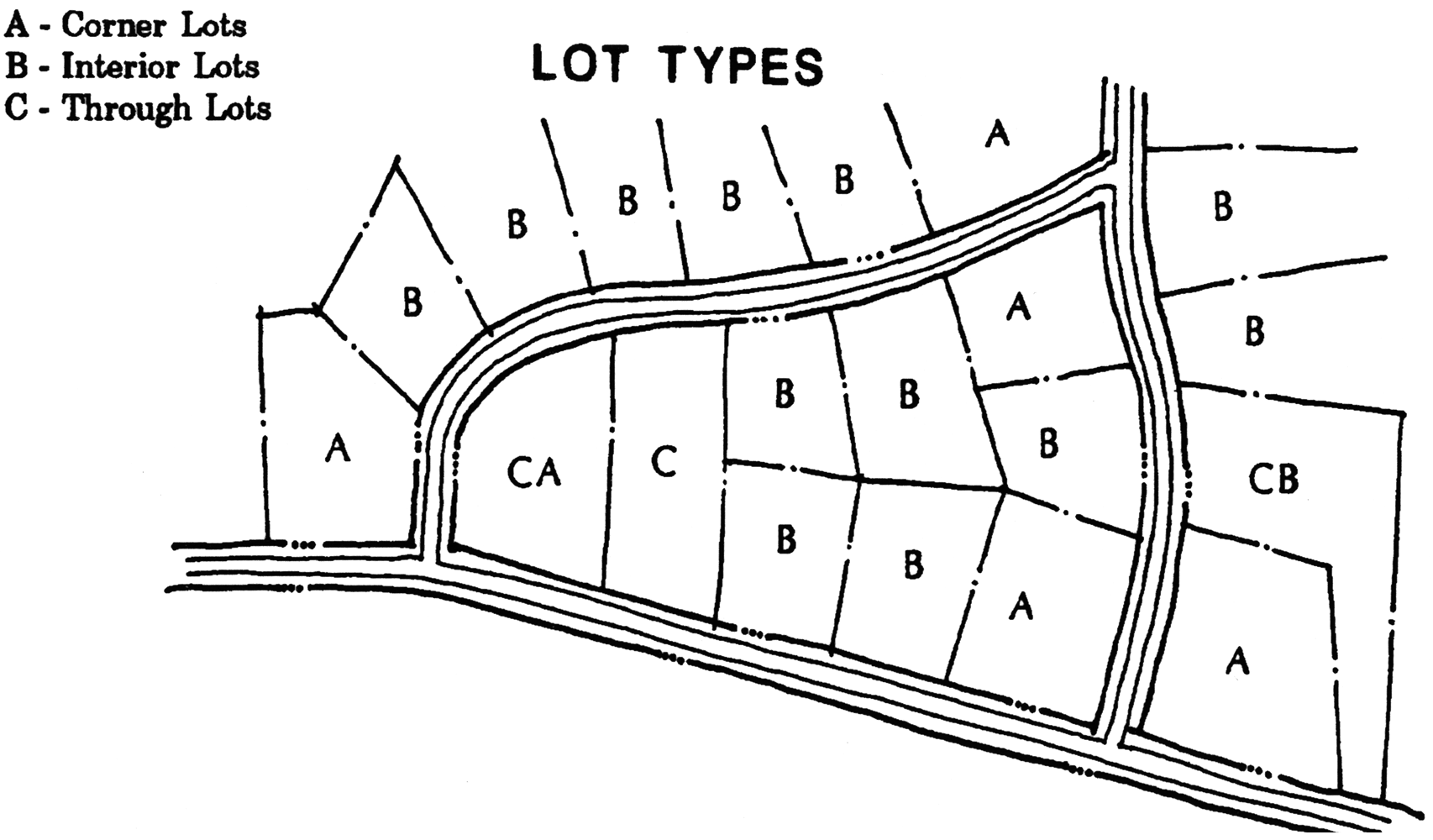
Figure 6.1, Lot Types
A - Corner lots
B - Interior Lots
C - Through Lots
C.
Lot Frontage
1.
On interior lots, the front of a lot shall be construed as the portion nearest the street.
2.
On corner lots, the frontage of a lot shall be construed as the shortest boundary to a street. If the lot has equal frontage on two or more streets, frontage shall be determined by the Administrator in accordance with the prevailing building pattern, or the prevailing lotting pattern, if a building pattern has not been established.
3.
On through lots, all portions adjacent to streets shall be considered as frontage for regulatory purposes. If the Administrator finds that the pattern of lots or the pattern of required yards, on lots adjacent to portions of the through lot, is such as to justify the elimination of the requirement that more than one frontage be provided on the lot, such additional frontage shall not be required.
D.
One Dwelling Unit Per Lot
For any district in which single family residential uses are allowed, only one single family dwelling unit shall be permitted per lot unless otherwise permitted.
E.
Development Requirements For Multiple Family Developments In The RMC-6, RMC-9, RMC-12, RMC-16, AND RMC-20 Districts With Each Unit On Separately Deeded Lots
1.
Multiple family developments in which the land underneath or around the unit are to be sold as separately deeded lots shall meet the following requirements. It is recognized that the area under or around the units would not meet the minimum requirements for the multi-family district in which they are located. Therefore the review will be based on the parts of the project which will be built concurrently. Each part of the project, or the entire project if it is to be built in one phase, requesting Development Review (the review process by the Administrator prior to the issuance of Building Permits) shall meet the minimum lot size, and minimum lot width for the district in which it is located, each structure proposed to be built on the parcel shall meet the minimum yard requirements, and that portion of the project requesting review shall meet the density and lot coverage requirements of the district in which it is located. Spacing between buildings and from the project phase's external boundaries shall meet the requirements of 6.01.03 K.
2.
No sale of lots within the project may occur except those lots which have been reviewed for development (including subdivision review) or which meet all the requirements of the district in which they are located.
F.
Lot Yards; Methods or Measurement; Special Requirements
The following rules shall apply with regard to determinations on yards on lots:
1.
Yards adjacent to Streets or Designated Transportation Corridors - Required yards adjacent to streets or designated transportation corridors shall be of a depth as prescribed in district regulations with the depth measured as perpendicular to the street line or corridor reservation line, and the rear line of the required yard parallel to the street line or corridor reservation line.
2.
Front Yards on Interior Lots - Front yards on interior lots shall be construed as extending between side lot lines across the frontage of the lot.
3.
Front Yards on Corner Lots - Front yards on corner lots shall be construed as extending across the lot from each interior side lot line to the opposite street line. Corner lots are considered to have two front yards.
4.
Interior Side Yards - Interior side yards shall be construed as running from the rear line of the required front yard to the front line of the rear yard, if required or, if no rear yard is required, to the opposite lot line. The width of a required side yard shall be measured perpendicular to the side lot line and the inner line of the required yard shall be parallel to such outer line, at the minimum distance therefrom prescribed in district regulations.
5.
Interior Side Yards on Through Lots With More Than One Front Yard - Interior side yards on through lots with more than one front yard shall be construed as running to the rear lines of the front yards involved, and measurements and requirements shall be as for paragraph 4 above.
6.
Interior Side Yards on Corner Lots - On corner lots, the side yard is the yard along any interior lot line which intersects with a street lot line. When a corner lot has four sides, the two sides not adjacent to the streets are both side yards and the lot has no rear yard. If the corner lot has more than four sides, the yards along interior lot lines which do not intersect with a street lot line shall be considered rear yards and must meet the district regulations for such yards. In all cases the restrictions on maximum lot coverage and maximum impervious area must be met.
7.
Rear Yards - Rear yards shall be construed as extending across the full width of the lot at its rear, except as stated in paragraph 6 above. Required depth of rear yards shall be determined in the same manner as required width of interior side yards.
8.
No Rear Yard Required on Corner Lots or Lots Providing Two Front Yards - On through lots providing two front yards, and on corner lots (except as stated in paragraph 6 above), there will be no required rear yard, and yards other than those adjacent to streets shall be construed as side yards, as provided in paragraph 6 above.
9.
Yard Orientation for Flag Lots and Lots Accessed by Easements - Required yards on flag lots and lots accessed by easements shall be orientated with respect to the roadway to which the private driveway extension or easement connects, as if the lot abutted the roadway. The portion of the lot parallel to and nearest the roadway shall constitute the required front yard and the remaining yards shall be oriented accordingly. Notwithstanding, on lots where the required yard orientation described above does not reflect the existing development pattern on neighboring lots, the County Administrator may approve alternative yard orientations to conform with the established pattern.
10.
Waivers for Errors in Yard Measurements or Unusual Lot Configurations - If an error is discovered in the location of a building or structure relative to the minimum yard requirements, or the lot is of a configuration atypical to the lots in the project as a whole, or the proposed building activity is to replace or repair structures destroyed or damaged during a Declared Natural Disaster, as defined in this Code, the property owner, or their authorized representative, may file a request for an administrative review. The review of the request and the final decision shall be made by the Administrator, and shall be made in conformance with the following criteria:
a.
The waiver shall not exceed more than ten percent of the required yard.
b.
In the case of an error in yard measurements, the corresponding opposite yard must be larger than requested by the same distance as the waiver request (to insure that the waiver is not just an attempt to place a larger building on the lot) or the waiver request is an intrusion of only a small corner of the building (such as a house too close to the front of a cul-de-sac lot such that it violates the side yard requirements at the front corner but nowhere else).
c.
In the case of an atypical lot configuration, the lot shall be a corner lot, cul-de-sac lot, lot with an unusual number of sides or some other configuration which makes it impossible to place a house or structure on the site which would be typically found in the development or the area.
d.
In the case of replacement or repair of structures destroyed or damaged during a declared natural disaster, there shall be a physical impediment on the property, such as existing trees, which precludes compliance with the yard requirements. Additionally, the building activity shall commence within one year of the date of the Disaster Declaration.
e.
Any waiver request which does not meet paragraphs a and b, c or d above will be denied an administrative waiver and must comply with the yard requirements or seek a variance pursuant to 11.04.00.
G.
Special Yards
A special yard, for purposes of these regulations, shall be construed as a yard other than adjacent to a street, required to perform the same functions as a side or rear yard, but adjacent to a lot line so placed or oriented that neither the term "side yard" nor the term "rear yard," as generally determined, defined, or applied with respect to regular lots, fits the circumstances of the case. In such instances, the special yard shall be considered a rear yard unless the Administrator determines that side yard requirements for the district shall apply because of the relationship of the portion of the lot or lots, with due regard to the orientation of structures and buildable areas thereon.
H.
Waterfront Yards
1.
Waterfront yards are defined for purposes of this Code as yards adjacent to waterways 50 feet or more in average width adjoining the yard. Lots having one or more such waterfront yards shall be considered waterfront lots (See Figure 6.4).
2.
Where a waterfront yard exists, the requirement shall be construed as replacing yard requirements otherwise applicable to the portion of the lot involved. Depth of required waterfront yards shall be measured perpendicular to the mean waterfront line, provided, however, that in the case of irregularities in such line, such as projections, curves or chords may be used as are reasonably necessary to achieve a regular outer boundary for the yard, reasonable in relation to the general pattern of waterfront yards on adjoining lots. Waterfront lots bordering Conservation or Preservation Areas shall provide yards as described in 4.01.00 (Natural Resources) and 6.06.00 (Landscaping). Waterfront lots bordering water bodies other than Conservation or Preservation Areas shall provide a waterfront yard that is greater or equal to the rear yard requirements for the zoning district in which the parcel is located.
I.
Permitted Projections Into Required Yards
1.
Certain architectural features, such as cornices, eaves and gutters, may project no more than three feet into the required front yard, five feet into the required rear yard, and three feet or no more than 50 percent of the required side yard, whichever is the most restrictive.
2.
Other architectural features, such as bay windows, fire places and stairways, except as provided below in Subsection 12, which may occupy a portion of a building footprint or extend from the building below the roof eaves, may project not more than three feet into required front and rear yards, three feet into side yards which measure a minimum of eight feet in width, and two and one-half feet into side yards measuring seven and one-half feet in width. No such intrusion is permitted into side yards less than seven and one-half feet in width.
3.
Mechanical equipment, such as air conditioning units, pumps, heating equipment, propane tanks, electrical generators and similar installations, may not project into the required front yard(s), but may project five feet into the required rear yard(s), and three feet or no more than 50 percent of the required side yard(s), whichever is more restrictive.
4.
Covered patios, as defined in Article XII, may intrude no more than 13 feet into the required rear yard and shall not intrude into the required side or front yards except as listed below. In no case shall the permitted intrusion of the covered patio reduce the yard provided to less than ten feet.
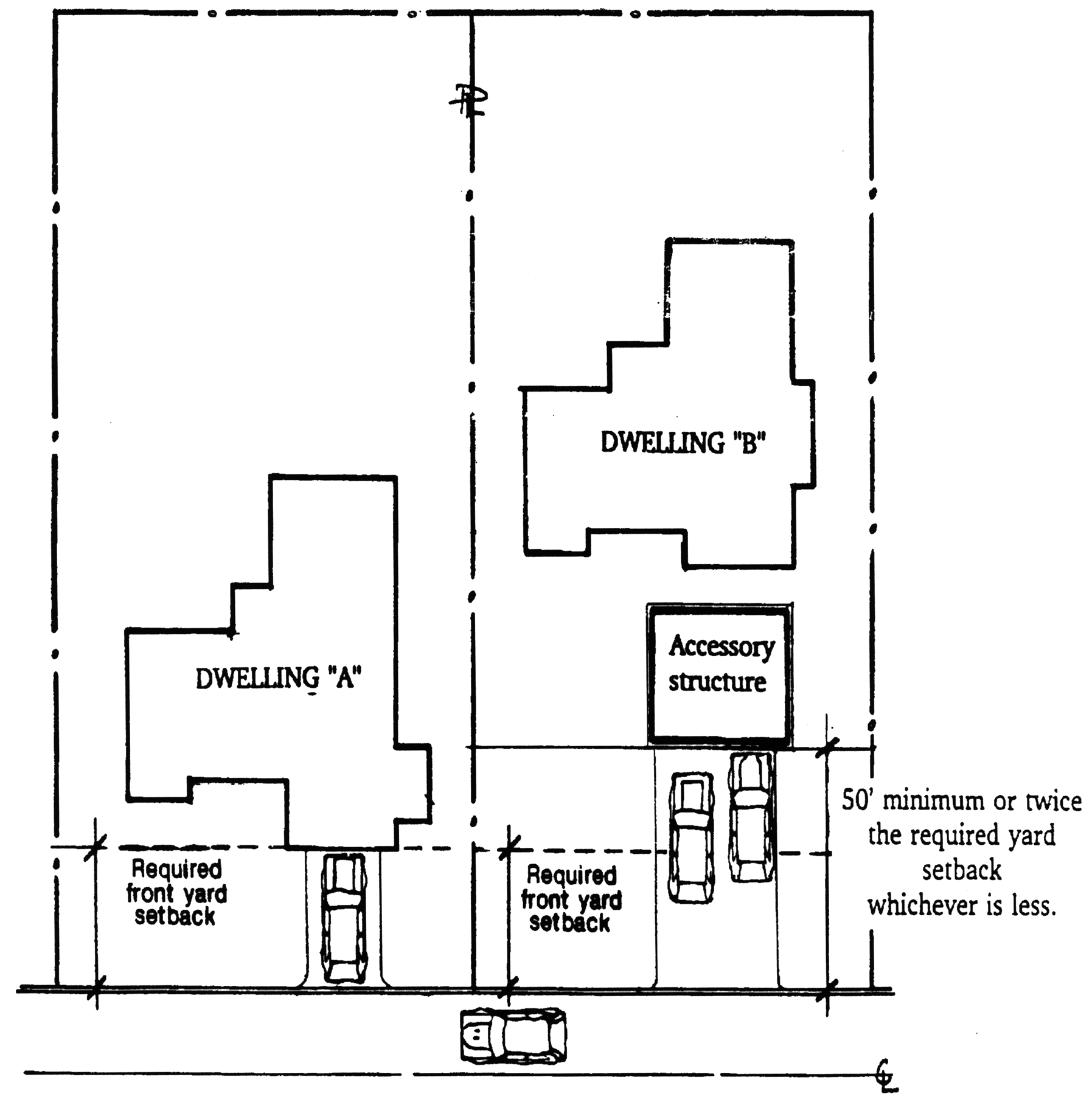
Figure 6.2, Location of Accessory Structures in Front Yards
5.
For through lots, a covered patio may intrude 13 feet into the required front yard which functions as a rear yard and has no access to a street. In no case shall the permitted intrusion of the covered patio reduce the yard provided to less than ten feet.
6.
Patios enclosed by a screen-meshed structure without a solid roof that is attached to the primary building may intrude into required rear and side yards provided a minimum setback of three feet is provided. Such patios shall not intrude into required front yards except where a front yard functions as a rear yard and has no access to a street. In such cases, a minimum setback of three feet shall be required.
7.
With the exception of parcels zoned RSC-10, parcels located within a Special District as referenced within Part 3.00.00 of this Code, or a Cottage Housing development as defined by this Code, front porches, inclusive of architectural features such as cornices, eaves, and gutters, may project into the required front yard no more than ten feet or 50 percent of the required front yard setback whichever is less provided the following conditions are met:
a.
The porch is open on all sides except where it is attached to the principal structure. The porch shall not be screened or otherwise enclosed. Railings if provided shall be consistent with the architectural style of the structure.
b.
Any porch projecting into a required front yard shall have a minimum depth, as measured from the face of the building to the porch edge, of six feet and a minimum width of eight feet.
c.
Second Story Porches may project into the required front yard consistent with the requirements above provided there is a first story porch located directly below the second story porch.
8.
With the exception of parcels zoned RSC-10, parcels located within a Special District as referenced within Part 3.00.00 of this Code, the façade of the primary residential structure may project five feet into the required front yard consistent with the following:
a.
A garage area is recessed a minimum of five feet from the façade of the primary residential structure.
9.
Flagpoles may occupy any required yard provided the pole does not exceed 28 inches in diameter and, on single-family lots, is placed a minimum of five feet from all lot lines. Flagpoles erected prior to February 1, 2011 that do not conform to these requirements shall be deemed legally nonconforming. Flagpole height is regulated by Section 6.08.05 of this Code.
10.
Notwithstanding these provisions, the Administrator may permit certain other waivers as described in Section 6.01.03.F.10 of this Code.
11.
Ground mounted solar panels may not project into the required front yard(s), except on a residential lot with two front yards. In this instance, ground mounted solar panels may project five feet into the front yard which functions as a side or rear yard. Ground mounted solar panels in residential zoning districts and residential portions of Planned Developments (PD's) and Special Public Interest (SPI) zoning districts are limited to a maximum height of 14 feet and must maintain minimum rear and side yard principal structure setbacks, with the exception being those zoning districts where the principal structure side and/or rear yard setbacks exceed 15 feet. In these instances, ground mounted solar panels are permitted a minimum rear and/or side yard setback of 15 feet. Ground mounted solar panels which are not a part of an Electrical Power Generating Facility in non-residential zoning districts and non-residential portions of Planned Developments (PD's) and Special Public Interest (SPI) zoning districts are limited to a maximum height of 25 feet and must maintain a minimum setback consistent with the principal structure setback/buffering requirements.
12.
Existing structures located in the Special Flood Hazard Area that are elevated or reconstructed up to 110% of the existing building footprint, may have stairways necessary to provide access to the elevated structure in the required front yard.
J.
Open Space and Building Spacing in Residential Districts and Other Districts in Which Similar Two Family and Multiple-Family Residential Uses Are Permitted
1.
Yards, courts, and other open space required herein in relation to structures or portions of structures containing dwelling or lodging units are intended to perform a variety of functions. Among these (as appropriate to and required by the uses involved and their location) are assuring adequate privacy, outlook, natural light and ventilation; access to and around service areas; space for landscaping; spacing between buildings and portions of buildings for reducing potential adverse effects of noise, odor, glare, or hazards from fire; and recreation space near buildings.
2.
Spacing requirements for buildings or portions of buildings containing dwelling or lodging units shall be determined as follows:
a.
A minimum of 20 feet between principal buildings, rear yards at zoning lot boundaries of 15 feet (unless a greater setback is otherwise required), and side yards at district boundaries of ten feet shall be provided. Structures greater than 20 feet in height shall be set back an additional two feet at all district boundaries (added to buffer areas required elsewhere in this Code which apply) for every one foot of structure height over 20 feet.
b.
Height in stories shall be computed as the actual number of stories in the wall above ground level, with the following exceptions. Where the wall is along a slope, the number of stories shall be construed as the arithmetic mean number, with half a story or more considered as a full story, and less than half a story ignored in computations. When height per story exceeds an average of 11 feet, calculations involved in yard or spacing determination shall be based on an assumed number of stories served by dividing building height by ten feet. If there is a conflict between these requirements and the Building Code, the more restrictive shall apply.
c.
Penthouses, roof shelters, and housing for mechanical equipment shall be ignored in computations, except where they are visible from the ground level within the lot or the building site, are ten feet or more in height, or occupy 50 percent or more of the length of the wall at their bases, in which case an additional story shall be included in the computation.
3.
Yard or other open space depth between exterior building walls and adjacent lot or building site lines shall be measured horizontally in relation to the ground, and perpendicularly to straight walls or radially to curved walls. Distance at all points shall be at least equal to minimum requirements set forth herein, except yard space for two walls may overlap where it does not affect the distance between two buildings.
4.
Where portions of buildings contain different numbers of stories, and different offsets, the required yard shall be as established for the portion of the proposed building nearest to the lot or adjacent building except where a portion of the proposed building requires a greater yard because of its greater number of stories or size. Lower portions of buildings may extend into yards required for upper portions, but shall provide the yards required by their size and height.
5.
Figure 6.3 illustrates these relationships for an allowable building.
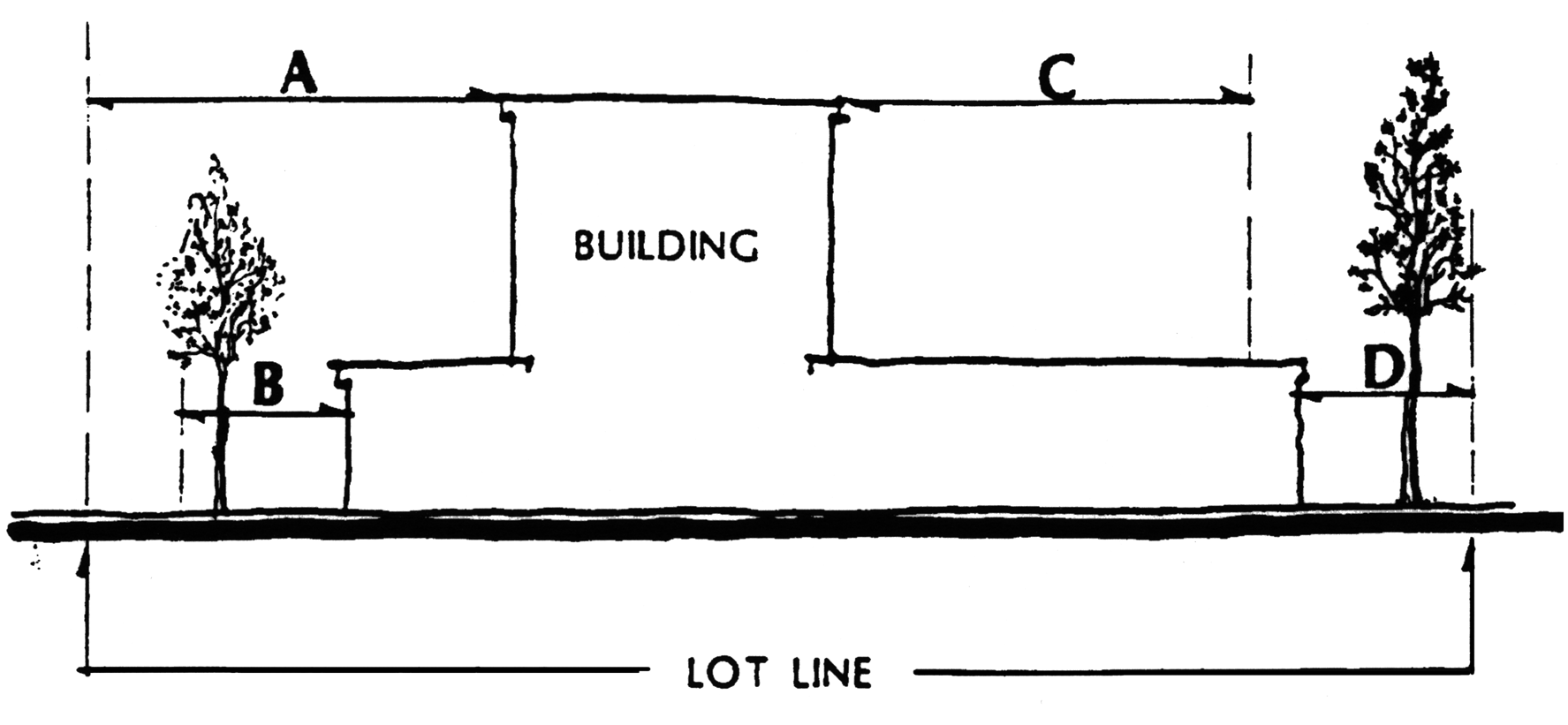
Figure 6.3, Yard or Open Space Depth Measurement
Yards A and C represent required setbacks for the left and right sides (respectively) of the tallest portion of the depicted building. Yard A provides the minimum required setback.
Yards B and D represent required setbacks for the building's lower portion. Such yards may protrude into the setbacks required for the taller portion, but require their own setbacks as dictated by height, district standards, or other requirements of this Section, as applicable.
K.
Building Orientation
Effective February 2, 2009, single family residential structures which are designed with features clearly distinguishing a front entry shall not orient the front entry features toward the rear yard. However, this regulation shall not apply to said structures located within zoning districts with a minimum lot size of five acres or more, or within Planned Development zoning districts.
L.
Figure: Yards
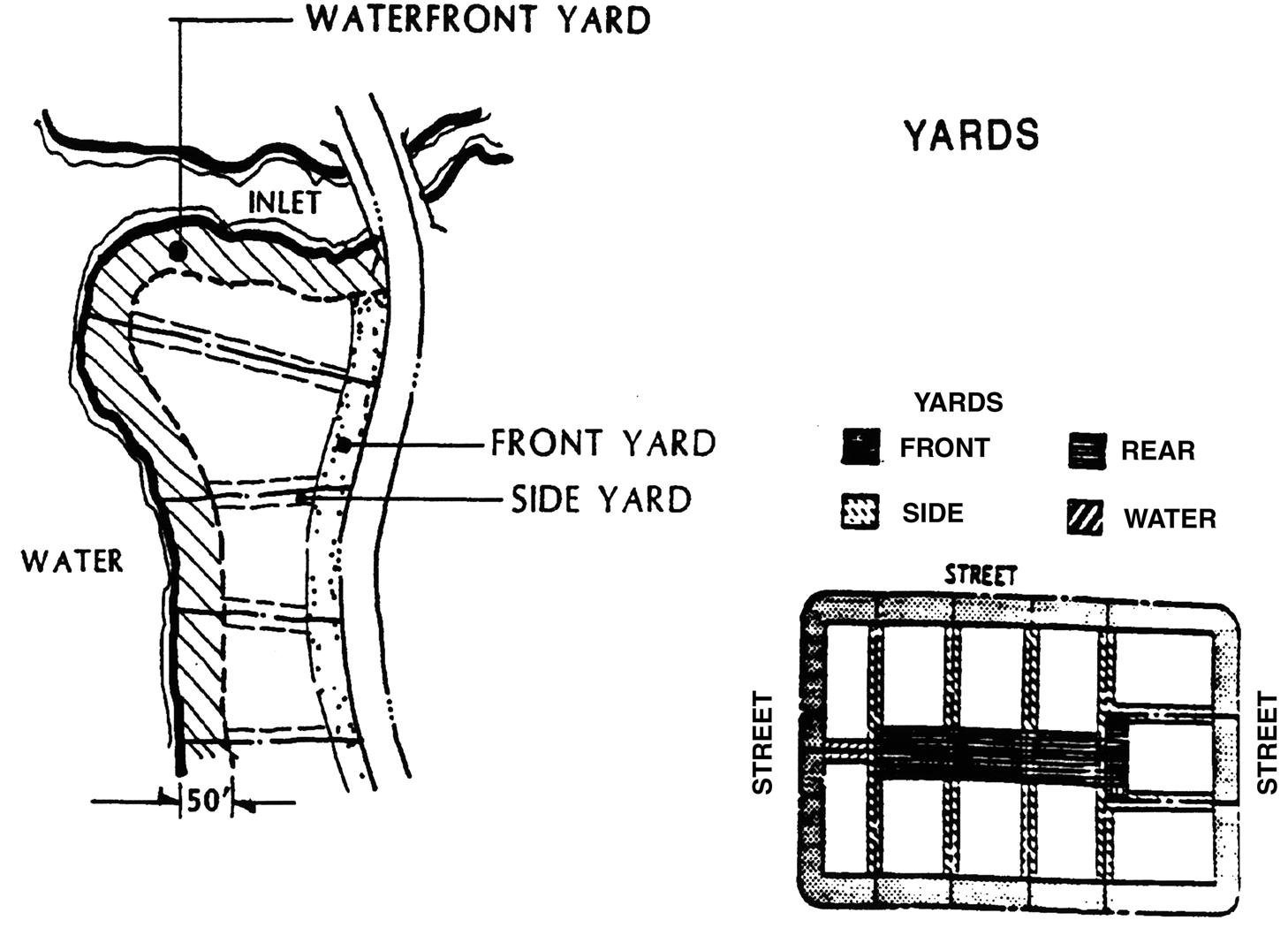
Figure 6.4, Nomenclature and Location of Yards
M.
Minimum Average Dimension
The minimum average dimension of the buildable lot shall not be less than the required minimum lot width.
N.
Minimum Lot Area
Minimum lot area is the minimum square footage required for a lot by this Code. Except where permitted in certain agricultural districts by Section 6.01.01, the minimum area shall not include submerged lands, conservation areas or preservation areas. Roadways or rights-of-way provided by the owner or developer of the lot may be included with the zoning lot for the purposes of calculating density or floor area ratio, but may not be included in calculating compliance with the minimum lot area for individual lots. Privately owned access easements may be included in lot width calculations, but shall not be included in calculating compliance with the minimum lot area for individual lots. If a zoning lot includes different zoning districts, the minimum lot area requirements for each district shall be met.
Notwithstanding the above, the minimum lot size required by a parcel's zoning may be reduced by a maximum of two percent, irrespective of density restrictions of the Comprehensive Plan, where a proposed subdivision meets all of the following requirements:
1)
The parent parcel shall be a lawful lot created prior to July 26, 1989, and shall not have been subdivided or otherwise reduced in size since that date; and,
2)
The parcel shall be located in the Rural Service Area; and,
3)
The parcel shall be agriculturally zoned or have a required minimum lot size of one acre or greater; and,
4)
The parcel shall be divided into a maximum of two lots; and,
5)
The lot size reduction shall be limited to one lot in the subdivision and shall apply only to the minimum area required by the parcel's zoning. No reduction shall be permitted under this provision to other lot size requirements of this Code, including but not limited to minimum lot sizes by available utilities.
These requirements shall not be waived or varied.
O.
Area per Dwelling Unit
Area per dwelling unit is the minimum square footage required within a zoning lot for each dwelling unit on the lot. For single-family dwelling units the area required is the same as the minimum area, for two family and multiple family dwellings, the area per dwelling unit is equal to the minimum area divided by the maximum number of dwelling units permitted on the lot or in the project. See 6.01.01. The same requirements for calculating the area listed for Minimum Area, above, apply when calculating Area per Dwelling Unit.
(Ord. No. 00-21, § 2, 5-18-00; Ord. No. 01-30, § 2, 11-15-01; Ord. No. 05-22, § 2, 11-17-05; Ord. No. 06-34, § 2, 11-2-06; Ord. No. 07-18, § 2, 7-19-07, eff. 10-1-07; Ord. No. 08-29, § 2, eff. 2-1-09; Ord. No. 09-53, Item G, 6-11-09, eff. 10-1-09; Ord. No. 09-62, Item I, 10-26-09, eff. 2-1-2010; Ord. No. 10-9, § 2, Item E(10-0174), 5-27-10, eff. 10-1-10; Ord. No. 10-26, § 2, Exh. A(10-0742), (10-0743), eff. 2-11-11; Ord. No. 11-5, § 2(Exh. A)(11-0237), 5-26-11, eff. 10-1-11; Ord. No. 25-17, § 2(Exh. A), 3-12-25, eff. 3-12-25)
Sec. 6.01.04. - Zero Lot Line Residential
A.
Generally. This is a residential lot type that is permitted in environmentally sensitive developments, affordable housing developments, and planned districts. No minimum yards in the conventional sense are required, but the homes are to remain detached housing. Some rules are thus required. There is a minimum building spacing of ten feet that must always be maintained. Other rules vary with lot size. Figure 6.5 below illustrates all the standards and how they work. Lots need not be rectangular; developers may use fixed lot patterns such as Z lots to best fit their product to the development.
B.
Design Standards.
1.
Where the lot is 5,600 square feet or more in size, there shall be a minimum front yard of ten feet, and a street facing garage or carport shall have a 20-foot yard from the sidewalk to the structure. Such units shall have a total building coverage of no more than 55 percent.
2.
For lots less than 5,600 square feet there need be no front yard setback. However the front entrance shall be in a courtyard that has a minimum dimension of eight feet. The garage shall be at least 20 feet from the sidewalk line. Such units shall have a total building coverage of no more than 70 percent.
3.
Roofs shall not overhang property lines without the recording of maintenance easements of the a minimum of five feet. Drainage from the roof overhang shall be directed onto the zoning lot and not discharged into the easement.
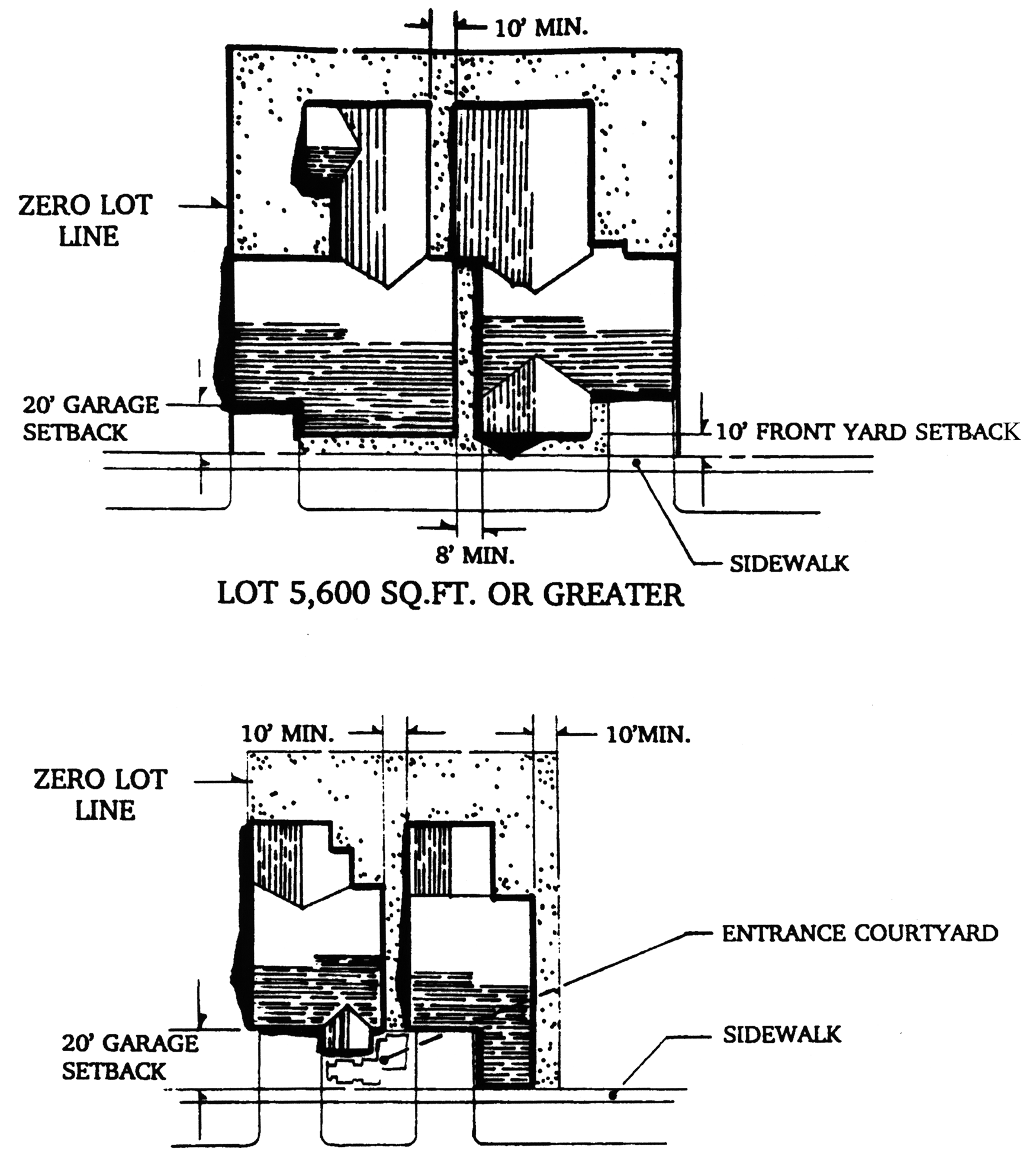
Figure 6.5, Zero Lot Line Development
Sec. 6.01.05. - Reserved
Editor's note— Ord. No. 01-30, § 2, adopted Nov. 15, 2001, repealed § 6.01.05, which pertained to Pad Development Option. See the Table of Amendments.
Sec. 6.01.06. - Minimum Lot Sizes By Available Utilities
In addition to the Minimum Zoning Lot Sizes specified in 6.01.01, the following regulations shall apply for all residential uses:
1.
No multiple family unit shall use septic tanks.
2.
Farm worker housing is not subject to the provisions of this Section.
3.
A minimum lot size of one-half acre of upland is required for the use of a septic system.
4.
A minimum lot size of one acre of upland is required for the use of a septic system within Water Resource Protection Areas as shown on the Hillsborough County Resource Protection Map.
5.
Within the Urban Service Area, water wells and septic tanks are permitted only in compliance with the Adequate Public Facilities provisions of the code specifically Section 4.02.04.
6.
Septic tanks and drainfield installation shall be prohibited within 200 feet of the shoreline of the rivers and their primary tributaries, except in such cases where the 200-foot criterion cannot be met because of lot size. In such cases, placement and construction of such facilities shall be in accordance with State law and shall prevent adverse impact to water quality. (Cross referenced with Section 4.01.16.F.2.) This applies to the Hillsborough, Alafia and Little Manatee Rivers.
(Ord. No. 99-25, § 2, 11-18-99; Ord. No. 05-22, § 2, 11-17-05)
Sec. 6.02.01.- Access
A.
Access to Public Road Required; Platting Required for Easement Access.
1.
All lots within a subdivision shall have access to a street dedicated to public use which has been accepted for maintenance by Hillsborough County, a municipality, or the Florida Department of Transportation. Where a proposed subdivision lot does not abut such a street, the Applicant shall provide access in accordance with the requirements set forth within these regulations.
2.
In the event that any lot in a proposed subdivision does not have access to a publicly owned and maintained road via public or private street, private drive, Low Volume Private Road or flag lot, then access by means of a legally established easement or common use area shall be required for the lot(s).
3.
Any subdivision proposing access to a publicly owned and maintained road via an easement or common area shall be platted.
4.
Adequate vehicular and pedestrian access should be provided to each parcel. The primary function of local streets is service to abutting properties. Street widths, placement of sidewalks, pattern of streets and number of intersections are related to safety and efficiency of access to abutting lands.
5.
The local street system should be designed to minimize through traffic movements. Through-traffic on local and collector streets increase the average speed and volume and, thus increasing the accident potential reducing residential amenities. Through-traffic should be discouraged by creating discontinuities in the local street pattern, by offsetting local street intersections and by channelizing or controlling median crossings along peripheral major streets.
6.
Local street systems should be logical and comprehensible, and systems of street names and house numbers should be simple, consistent, and understandable. The pattern of local streets, their names, and the house-numbering system should be designed to satisfy the needs of visitors, delivery trucks, and emergency vehicles as well as local residents. A reasonable repetition in street pattern, or conformance to topography can help in achieving an understandable street system. Streets which wander directionally or which turn back on themselves tend to be confusing and should be avoided.
7.
Local circulation systems and land-development patterns should not detract from the efficiency of bordering major streets. This principal may involve control of driveway, intersection placement, and full or partial control of access. Land development should occur so that no parcels require direct access to major streets (collector roads).
8.
Design of residential streets should clearly reflect their local function. These streets should have an appearance commensurate with their function as local streets. They should not be over-designed or over-built, i.e. high speed, excessive width, etc. Appurtenances should be in keeping with the residential character.
9.
The local street system should be designed for a relatively uniform low volume of traffic. To the extent possible, the design of the local and collector street system should recognize the need for residential amenities along all streets in the neighborhood. This suggests that the street system should be designed for uniformly low volumes on all streets after contiguous land development is complete. Where traffic volumes tend naturally to be higher, as along collectors, then variations in the land development pattern (e.g., permissible land uses, building setbacks, etc.) might be considered to compensate for the reduction in amenities.
10.
Local streets should be designed to discourage excessive speeds. Residential streets should be designed to discourage fast movement (more than 30 MPH), through the use of curvilinear alignment and by offsetting local street intersections.
11.
There should be a minimum number of intersections. Within the subdivision and especially along abutting major streets, intersections pose an accident potential. The fewer intersections there are, consistent with other requirements, the fewer accidents there will be. From the standpoint of hazard, the use of two T-type intersections with property offset is preferable to using one cross-type within the subdivision.
12.
Subdivisions should be designed so as to conform to and take advantage of the topographic and other natural features of the land. Local, state, or federal laws, rules, or ordinances may require the preservation of existing trees, wetlands, water bodies, wildlife habitat, and other environmentally sensitive areas.
13.
A proposed development shall provide multiple direct connections in its local street system to and between local destinations, such as parks, schools, and shopping, without requiring the use of arterial streets.
14.
Unless restricted by conditions of an approved Planned Development or existing development, each development shall incorporate and continue all collector or local streets stubbed to the boundary of the development plan by previously approved but unbuilt development.
15.
To ensure future street connections where a proposed development abuts unplatted land or a future development phase of the same development, street stubs shall be provided to provide access to all abutting properties or to logically extend the street system into the surrounding area.
16.
Streets within and contiguous to the subdivision shall be coordinated with other existing or planned streets within the general area as to location, widths, grades, and drainage. Such streets shall be aligned and coordinated with existing or planned streets in existing or future adjacent or contiguous to adjacent subdivisions. All streets, alleys, and pedestrian pathways in any subdivision or site plan shall connect to other streets and to existing and projected streets outside the proposed subdivision or other development.
17a.
Prior to acceptance of roadway(s) by the County, all subdivision collector roadway connections or stub outs shall be constructed; or
17b.
Prior to issuance of building permits, all subdivision collector roadway connections or stub outs shall be constructed; or
17c.
For developments constructing in multiple phases, building permits shall not be issued for the final phase of the development until all collector roadway connections have been constructed.
B.
Types of Lot Access to a Public Road; Standards. Listed below are the types of lot accessways allowed to a publicly-owned and maintained road and the standards that apply:
1.
Public Street: All lots within subdivisions shall abut a street dedicated to public use and accepted for maintenance by Hillsborough County or shall meet the requirements for private street, Low Volume Private Road, flag lot or private drive, or easement access.
2.
Private Street: To gain access to a public roadway, lots within subdivisions may abut a street privately owned and maintained, except if otherwise provided for by prior agreement between the Board of County Commissioners and the Applicant, and provided other requirements of the Subdivision Regulation are met. When privately owned and maintained rights-of-way are proposed, the plat shall show the rights-of-way for the use of lot owners and to be maintained by the lot owners. The plat shall state " Tract A is dedicated to the lot owners. Each lot owner has an undivided interest in Tract A."
3.
Low Volume Private Road: To gain access to a public roadway, lots within a Minor Subdivision may abut a Low Volume Private Road which shall be privately owned and maintained by a property maintenance entity. The plat shall show the rights of way for the use of the lot owners and to be privately maintained.
4.
Flag Lot:
a.
Except as otherwise required by Community Plans and other Articles in this Code, a single parcel to serve a single dwelling unit (Flag Lot) may be created in a Certified Parcel Subdivision as long as the subdivision is located within the rural service area and an agricultural zoning district. The parcel does not have to have the required frontage on a County road, but does have to have access to a County owned and maintained road by means of ownership, provided that the following requirements are met:
(1)
The parcel shall meet the minimum lot size requirements of the zoning district and shall meet the lot width requirements measured at a point equivalent to the front yard setback if measured from the boundary of the buildable lot parallel to the County owned and maintained street to which the accessway is connected. The area for calculating the minimum lot area shall not include any portion of the accessway which does not meet the minimum lot width requirements.
(2)
The private drive shall be a minimum of 20 feet in width and shall only provide access for the single parcel.
(3)
No pole portion of a flag lot shall exceed 1,000 feet in length.
5.
Easement.
a.
In the Rural Service Area. Easement access to public roads shall only be permitted in Minor Subdivisions located in the Rural Service Area, except as otherwise required by Community Plans and other Articles in this Code. Joinder and consent of all fee owners under easements to the use of the easement by the subdivided parcel is required. Lots within a Minor Subdivision which do not abut the easement shall abut a Low Volume Private Road. In addition, no easement shall provide access to more than three lots and only one easement may be used for access per Minor Subdivision. This requirement regarding the number of easements and the maximum number of lots to use an easement for access shall not be varied.
b.
In the Urban Service Area. For residential subdivisions in the Urban Service Area created July 1, 2010 or later, easement access to public roads shall be permitted only in Platted Subdivisions with No Improvements. Only one easement shall be allowed per parent parcel. Joinder and consent of all fee owners under easements to the use of the easement by the subdivided parcel is required. In addition, no easement shall provide access to more than three lots and only one easement may be used for access per Sec. 10.01.05.B.2.c of this Code. This requirement regarding the number of easements and the maximum number of lots to use an easement for access shall not be varied.
c.
Width Requirements.
(1)
If the easement serves one dwelling unit, a minimum width of 20 feet shall be required.
(2)
If the easement serves two or three dwelling units, a minimum width of 30 feet shall be required.
d.
Other Standards.
(1)
The easement shall provide for sufficient ingress and egress for fire trucks, ambulances, police cars and emergency vehicles.
(2)
The easement shall be legally sufficient to prevent the lot or parcel from being land locked.
C., D.
[Reserved.]
E.
Prohibition of Use of the Residentially Zoned Private Property for Access to Uses Not Permitted in Residential Districts; Exceptions. No land which is agriculturally or residentially zoned shall be used for vehicular or pedestrian access or land or structures in other districts used for any purpose not permitted in agricultural or residential districts, except as provided below or otherwise authorized by this Code or other lawful regulations:
1.
Where provision does not exist for safe access for emergency and public service vehicles, and such access is not reasonably feasible except through residentially or agriculturally zoned land, access reserved for and limited to such vehicles may be authorized by the Administrator, subject to conditions and safeguards designed to protect the tranquility and character of the residential land so traversed.
2.
Where convenience and safety would be promoted, walkways and bicycle paths to non-residentially zoned land shall be permitted by the Administrator across privately owned residentially zoned land, subject to conditions and safeguards to protect the tranquility and character of the residential land so traversed.
F.
Access to Beachfront or Coastal Lands. Whenever a subdivision is developed on beachfront or coastal land, such development shall be carried out so as to provide public access to said beach in accordance with Section 161.55(6), Florida Statutes (1986), if applicable.
G.
Access to Existing or Proposed Adjoining Street System.
1.
Arrangement of Streets. The arrangement of streets in new subdivisions shall make provisions for the continuation of existing arterial and collector streets from adjoining areas, or for their projection where adjoining land is not subdivided. Where the subdivision is adjacent to another subdivision, property owned by the Board of Education (currently, or planned as, a school site), or commercial areas, direct access shall be provided for non-motorized traffic where feasible. Residential neighborhoods shall be designed to include an efficient system of internal circulation and street stub-outs to connect into adjacent developments to link neighborhoods together.
2.
Access to Arterial or Collector Roads. Direct access to arterial roads shall be restricted when access can be provided via a collector facility. Unless otherwise approved by the Administrator, residential lots in subdivisions shall not have direct access to a collector or arterial road. Residential lots in subdivisions that abut a collector or arterial road shall not front on said road and access shall be blocked by a vegetative buffer, wall, or other suitable buffer.
3.
Access to Local Streets. Unless otherwise approved by the Administrator, residential lots in subdivisions shall front on and have direct access to local, interior streets only. Local streets shall be arranged and designed so as to restrict their use by through and high speed traffic.
H.
Emergency Access
1.
All single-family subdivisions of 10 lots or more, including those zoned Planned Development, submitted for preliminary plat review after October 1, 2007 shall be designed with alternative access ways from adjacent properties for emergency response vehicles in accordance with the requirements herein, except that:
a.
These requirements shall not apply to single-phase subdivisions where all lots are within 1,000 feet of existing improved roads, not including interstate highways; and,
b.
These requirements shall not apply to Planned Development-Specific districts approved on or before October 1, 2007.
2.
Except where precluded by natural features or existing development on adjacent property, subdivisions with 100 lots or more shall have at least one alternative access way on each principal side of the subdivision where there is no street access or street stubout. Except where precluded by natural features or existing development on adjacent property, subdivisions with less than 100 lots shall have at least one alternative access way on at least one side of the subdivision where there is no street access or street stubout.
3.
Each alternative access way shall have a minimum width of 15 feet and connect with an internal street in the subdivision. Each access way shall be kept free of vegetation, other than grass, and obstructions except as permitted below for security, to provide a minimum horizontal clearance of 15 feet and minimum vertical clearance of 13.6 feet. Each access way shall be sufficiently stabilized to support a 32-ton vehicle. Final design and location of the access ways shall be subject to approval of Hillsborough County. The access ways shall be commonly owned and maintained by the developer, community homeowners association or similar entity, or shall be set aside through an exclusive easement under the control of Hillsborough County. In no case shall the access ways comprise any part of a single-family lot.
4.
If the alternative access way is gated for security, access by emergency response vehicles shall be accommodated in a manner acceptable to the Hillsborough County Fire Marshal.
5.
Joint use of the alternative access ways for other purposes, such as underground utilities or drainage easements, may be allowed subject to approval of the affected parties and Hillsborough County.
6.
These requirements may be waived at the discretion of the Hillsborough County Fire Marshal, either in whole or in part, for subdivisions where substitute measures are proposed to adequately accommodate emergency response services. In such cases, the decision of the Fire Marshal may not be appealed and relief shall require application for a variance in accordance with Part 11.04.00 of this Code.
7.
Notwithstanding Section 5.03.07.B.2.d of this Code, provision of alternative access ways in subdivisions zoned Planned Development shall not constitute a change in vehicular access and shall require no modification of approved general site plans.
(Ord. No. 98-43, § 2, 7-17-98; Ord. No. 07-18, § 2, 7-19-07, eff. 10-1-07; Ord. No. 09-62, Items B, C, 10-26-09, eff. 2-1-2010; Ord. No. 10-10, § 2 Item K(10-0525), 5-27-10, eff. 6-4-10; Ord. No. 15-15, § 2(Exh. A), Item A.2(15-0491), 6-18-15, eff. 6-25-15)
Sec. 6.02.02. - Half-Streets
Whenever a street is planned adjacent to the proposed subdivision boundary, the entire street right-of-way shall be platted within the subdivision, unless a halfstreet will provide continuity of the existing street system. Where a half-street would provide continuity of the existing street system and there is adequate existing half-street right-of-way abutting the proposed subdivision, the Applicant shall provide half-street right-of-way in the proposed subdivision and construct the entire street. Where a half-street would provide continuity of the existing street system and there is inadequate existing half-street right-of-way abutting the proposed subdivision, the Applicant shall provide sufficient additional right-of-way in the proposed subdivision and construct the entire street.
Sec. 6.02.03. - Medians, Islands, and Guard Houses
A.
Allowed. Medians and islands within the road rights-of-way are allowed when warranted by traffic conditions or are in conformance with the Entrance Median and Guardhouse Detail in the Transportation Technical Manual.
B.
Designation as Park or Recreation Area Prohibited. Medians, islands, and islands in cul-de-sacs shall not be designated as park or recreation areas.
C.
Landscaping. Landscaping of medians, islands, and islands in culs-de-sac shall be in compliance with the Manual on Landscaping within Hillsborough County Right-of-Way.
D.
Maintenance. Medians and islands shall be shown as separate parcels on the plat and annotated as follows:
"Parcel ________ is private property and is to be maintained by the lot owners. Parcel ________ is dedicated to the lot owners and each lot owner has an undivided interest in Parcel ________."
"Homeowners Association" may be substituted for "lot owner" in the above annotation.
Sec. 6.02.04. - Right-of-Way Improvements
No walls, fences, gates, signs or other obstructions shall be constructed or placed within the right-of-way. Some existing trees may be allowed to remain and others planted, if approved by the Administrator and are in accordance with all Hillsborough County plans, programs, and regulations. Additionally, existing right-of-way is not subject to zoning until or unless vacated.
(Ord. No. 00-21, § 2, 5-18-00)
Sec. 6.02.05. - Street Names
New streets which are extensions of existing streets shall bear the name of the existing street. All others shall be named in the following manner:
In no case shall a name for a proposed street duplicate an existing street name, even if the street is further described as an avenue, place, court, etc.
Sec. 6.02.06. - Natural Resources and Landscaping
The subdivision shall be designed in compliance with the applicable standards of the Natural Resources Regulations (4.01.00) and the Landscaping Regulations (6.06.00).
Sec. 6.02.07. - Roadways
A.
Local Roads. Design construction of local roads shall comply with the current Transportation Technical Manual.
B.
Collector Roads.
1.
Adjacent dwellings shall face away from the Collector (i.e. Collector adjacent to the side or back yard) and not have direct access to a Subdivision Collector without first accessing a local road.
C.
Pedestrian and Bicycle Facilities. The developer shall provide pedestrian and bicycle facilities on any roadway identified on the Comprehensive Bicycle Plan.
D.
Right-of-way. Minimum standards for rights-of-way shall comply with the current Transportation Technical Manual.
*See Hillsborough County Transportation Technical Manual for Subdivisions and Site Development Projects for the appropriate typical section and right-of-way requirement. Collector Streets can be further classified depending on speed and whether they are divided or un-divided.
**Refer to the Hillsborough County Transportation Technical Manuel for Subdivisions and Site Development Projects to determine the minimum right-of-way requirements for Traditional Neighborhood Developments (TND).
(Ord. No. 00-21, § 2, 5-18-00; Ord. No. 01-30, § 2, 11-15-01; Ord. No. 04-27, § 2, 6-10-04)
Sec. 6.02.08. - Sidewalks
A.
General. Sidewalks shall be required in all land use categories, where necessary to provide for safe pedestrian circulation.
Public sidewalks and public sidewalk curb ramps shall conform to the current Transportation Technical Manual.
B.
Types.
1.
External. External sidewalks shall be located on streets adjacent to a subdivision. Sidewalks shall be constructed on the subdivision side of an existing street or streets from boundary to boundary of the subdivision and shall extend to the edge of the adjacent roadways. In the event that the County has roadway improvements scheduled within two years adjacent to the proposed subdivision, the County shall not require construction of sidewalks within its right-of-way. However, the developer shall be required to provide funds for the cost of sidewalk construction to the Capital Improvement Project Pseudo Code. The sidewalks shall be constructed prior to final acceptance of the Improvement Facilities. The subdivider shall be responsible for the construction of sidewalks.
2.
Internal (Buildable Lots). Prior to release of Certificates of Occupancy, sidewalks along buildable lots shall be constructed in the right-of-way along the entire width of the lot. The developer/builder shall be responsible for the construction of sidewalks for each individual lot(s).
3.
Internal (Other). Sidewalks along unbuildable lots, common areas, and stormwater ponds shall be constructed prior to final acceptance of the Improvement Facilities. The subdivider shall be responsible for the construction of sidewalks.
C.
Location.
Sidewalks shall be constructed on each side of internal subdivision streets, except as follows:
1.
Where a proposed street forms an exterior boundary to the subdivision.
2.
Where the proposed subdivision is to be an Office Park, Research Corporate Park, or Industrial Park, as defined in the Land Development Code.
3.
In Affordable Housing developments where sidewalks are required on only one side of internal subdivision streets.
4.
In rural subdivisions with lots of a minimum of one acre in size, sidewalks are required on only one side of the internal subdivision streets.
(Ord. No. 97-18, § 2, 12-18-97; Ord. No. 04-27, § 2, 6-10-04)
Sec. 6.02.09. - Saltwater Canals with Seawalls
A.
Stormwater Easement or Right-of-Way.
Storm sewer drainage easement or right-of-way from the street to the seawall shall continue to the canal centerline.
B.
Canal Width.
Canals shall be no less than 100 feet wide from seawall to seawall.
C.
Circulation.
Canals shall be designed to provide for water circulation.
D.
Permits.
The Applicant shall obtain necessary, local, state and federal permits for the construction of the canals and seawalls.
Sec. 6.02.10. - Lots
A.
Minimum Dimensions.
Lots shall conform to the standards set forth in this Code and Chapter 177, Florida Statutes.
B.
Municipal Limits and Lot Lines.
Lots shall be designed so that municipal boundary lines do not divide them, except where unavoidable and upon approval of the Administrator.
Sec. 6.02.11. - Stormwater Management
A.
Compliance with Technical Requirements of the Southwest Florida Water Management District (SWFWMD) and Hillsborough County.
The Stormwater Management System shall be designed to comply with the water quality requirements of SWFWMD and with the Hillsborough County Stormwater Management Technical Manual.
B.
Drainage Easements; Use Restrictions and County Maintenance.
1.
Drainage improvements shall be allowed in drainage easements. When public drainage easements are shown on the plat, the plat and affected deeds shall state, "Drainage easements shall not contain permanent improvements, including but not limited to sidewalks, driveways, impervious surfaces, patios, decks, pools, air conditioners, structures, utility sheds, poles, fences, sprinkler systems, trees, shrubs, hedges, and landscaping plants other than grass, except as approved by the County Administrator."
2.
Drainage easements shall be granted to Hillsborough County for all stormwater management facilities to be maintained by Hillsborough County. Off-site drainage easements may be required in cases where the minimum maintenance activities associated with roads and stormwater management facilities to be dedicated to Hillsborough County would not be practical without such easements. For subdivisions which are to be privately maintained, the design and maintenance requirements are the same as those for stormwater management facilities that are to be dedicated to Hillsborough County.
C.
Permanent Improvements in Road Rights-of-Way.
Permanent improvements in road rights-of-way, including but not limited to curb inlets (unless designed for heavy wheel loads), poles, fire hydrants, and trees shall not be located in such a manner as to block access to drainage easements or drainage rights-of-way.
D.
Inverted Crowns.
Streets to be dedicated to Hillsborough County shall not have inverted crowns, unless otherwise authorized by the Administrator.
E.
Developments in Floodplains.
1.
Criteria. The criteria for development in floodplains shall pertain to all floodplains and not be limited to those floodplains identified on FEMA maps. The EOR shall be responsible for determining the on-site 100-year flood elevations if not determined by a FEMA study. The EOR is required to submit a Letter of Map Amendment or Map Revision to FEMA for any changes in flood zone designations as determined by a detailed study of the area.
2.
100-Year Frequency Floodplain. No development (structures or fill) shall be allowed in the conveyance portion of any 100-year frequency floodplain associated with a freshwater stream, channel, lake, or waterway, unless provisions are made to compensate for any reduction in conveyance caused by the development.
3.
100-Year Frequency Floodplain Non-Tidal. No development (structures or fill) shall be allowed in any 100-year frequency non-tidal floodplain, unless provisions are made to compensate for the reduction in storage volume due to the proposed development.
4.
Compensation Storage Volumes. Any compensation storage volumes shall be provided in addition to stormwater detention or retention volumes otherwise required to reduce peak runoff rates from the development.
5.
Earthen Fill. No earthen fill shall be placed within a 100-year floodplain area unless an equal amount of flood storage volume is created by excavation below the 100-year flood elevation and above the seasonal high ground water table elevations, whichever is appropriate.
6.
Exceptions. Exceptions shall be allowed if the floodplain is associated with a landlocked waterbody and is under one ownership.
7.
Encroachment. No encroachment shall be allowed in a regulatory floodway, as designated on the FEMA Floodway Maps, unless approved by FEMA and subsequently accepted by Hillsborough County.
8.
All new development or substantially improved structures within a designated Coastal Barrier Resource System area will not be eligible for Federal flood insurance pursuant to the Coastal Barrier Improvement Act of 1990 (Public Law 101-591).
F.
Enclosed Stormwater Conveyance Systems.
1.
Enclosed stormwater conveyance systems shall be located in drainage easements or road rights-of-way dedicated to Hillsborough County.
2.
For enclosed stormwater conveyance systems not within road rights-of-way, the drainage easement width shall be sufficient to encompass a work trench having 1:1 side slopes (measured from the proposed ground surface to the proposed invert of the enclosed stormwater conveyance system) and a bottom width two feet wider than the total width of the installed conveyance system.
3.
The drainage easement width shall not be less than 20 feet unless otherwise approved by the Administrator.
G.
Canals and Ditches.
Canals and ditches shall have sufficient drainage easement dedicated to Hillsborough County to allow for installation of the canal or ditch including an unobstructed 20-foot wide maintenance area on both sides, measured from the top of the bank, unless otherwise approved by the Administrator.
H.
Stormwater Detention and Retention Ponds.
If the pond is to be maintained by Hillsborough County, sufficient drainage easements shall be dedicated to Hillsborough County to include the area of the pond within the perimeter of the inside top of bank and an unobstructed 20-foot wide maintenance area around the entire perimeter of the inside top of bank. If the maintenance area is on an embankment, the drainage easement shall extend to the external toe of slope of the embankment. Alternatives to the width or extent of the maintenance area shall be approved by the Administrator if it can be demonstrated that proper maintenance practices would not be impaired.
I.
Ingress and Egress.
Sufficient perpetual, legal access shall be conveyed to Hillsborough County to provide ingress to and egress from a drainage easement. This access shall be unobstructed and at least 20 feet in width.
J.
Finished Foundation Elevation.
A Certification of the Finished Foundation Elevation (FFE) shall be provided to the Building Services Division certifying that the FFE conforms to the approved subdivision Lot Grading Plan. This Certification shall be required prior to requesting a framing inspection. requesting a framing inspection.
(Ord. No. 00-21, § 2, 5-18-00; Ord. No. 04-27, § 2, 6-10-04; Ord. No. 06-18, § 2, 8-1-06)
Sec. 6.02.12. - Water System
A.
General.
The minimum design for water distribution systems shall comply with the current Hillsborough County Water, Wastewater and Reclaimed Water Technical Manual System Design and Flow criteria.
(Ord. No. 04-27, § 2, 6-10-04)
Sec. 6.02.13. - Wastewater System
A.
General.
The wastewater system shall comply with the current Hillsborough County Water, Wastewater, and Reclaimed Water Technical Manual specification for wastewater collection/transmission systems design standards.
B.
Septic Tanks.
The use of septic tanks for new development shall be prohibited in the Coastal High Hazard Area. Exceptions to this requirement shall be granted to relieve or prevent excessive hardship in cases where all of the following criteria are met:
1.
No reasonable alternative exists for the treatment of sewage; and
2.
Discharge from the septic tank will not adversely affect public health and will not degrade surface or ground water; and
3.
Where the Health Department determines that soil conditions, water table elevation, and setback provisions are adequate to meet State requirements.
Exceptions shall be determined by the Administrator for new development which meets the definition of a minor subdivision as defined in this Code or for new development which is less intensive than a minor subdivision. For all other new development, exceptions shall be determined by the Board of County Commissioners.
4.
The use of individual water wells and septic tanks for new development shall be prohibited in the Urban Service Area except as may be permitted under the adequate facilities provisions (Section 4.02.04) of this Code.
(Ord. No. 99-25, § 2, 11-18-99; Ord. No. 04-27, § 2, 6-10-04)
Sec. 6.02.14. - Fire Protection
Fire protection shall be provided in accordance with Florida Fire Prevention Code, latest edition.
(Ord. No. 04-27, § 2, 6-10-04)
Sec. 6.02.15. - Underground Utility Service
When underground electric service is proposed, the pad mounted transformers shall not be located within the street right-of-way, unless authorized by the Administrator. New utility lines in the Coastal High Hazard Area shall be located underground. The placement of these utility lines shall be subject to all other restrictions of the Coastal Management Element of the Future of Hillsborough Comprehensive Plan.
Sec. 6.02.16. - Construction Standards
Construction standards shall be per the Hillsborough County Transportation, Stormwater Management, Water, Wastewater, and Reclaimed Water Technical Manuals, latest editions.
(Ord. No. 04-27, § 2, 6-10-04)
Sec. 6.02.17. - Public Transit Facilities
A.
General.
Public transit facilities including pedestrian circulation systems and pathways to public transit facilities shall be provided as established with each threshold listed below. Such facilities shall be constructed in accordance with criteria established by HARTLine and Hillsborough County and Transportation Technical Manual.
B.
Location.
Public transit facilities shall be provided on sites meeting the threshold requirements and located on public transit corridors or planned corridors as listed in the Long Range Transportation Plan, and based on the frequency and location criteria in established by HARTLine and referenced in the Hillsborough County Transportation Technical Manual for Subdivisions and Site Development Projects.
C.
Development thresholds and required facilities.
1.
Developments greater than 1,000 residential units square feet shall be required to provide the following shelter protected space that is suitable for waiting out of inclement weather throughout the transit service period as approved by the County and HART.
a.
Park-and-Ride facility. The location and timing and construction shall be coordinated by HART.
b.
Provide separate bus loading/unloading areas segregated from automobile traffic with the number to be decided by the developer and HART based upon the adopted MPO Long-Range Transportation Plan.
c.
Bus staging area for a passenger loading and unloading location agreed upon by the developer and HART.
2.
Developments of 500 to 1,000 residential units and non-residential and mixed use developments of 200,000 square feet to 500,000 square feet shall provide the following:
a.
Bus bay.
b.
Transit accessory pad including the following: shelter, seating, trash receptacles, and bicycle rack.
3.
Non-residential developments of 100,000 to 200,000 square feet shall provide the following:
a.
A transit accessory pad including: shelter, seating, trash receptacle, and bicycle rack.
4.
Non-residential developments of 50,000 to 100,000 square feet shall provide the following:
a.
A transit accessory pad including: seating, trash receptacle, and bicycle rack.
5.
Non-residential development or single- or multi-tenant office buildings of less than 50,000 square feet shall provide the following:
a.
Pedestrian and bicycle connections.
D.
If determined by the Administrator and Hartline that the public transit facilities are not needed for a project, either in whole or in part, the Administrator may waive the public transit facilities requirement.
(Ord. No. 04-27, § 2, 6-10-04)
Sec. 6.02.18. - Community Gathering Places
A.
Purpose
Community gathering places are intended to improve neighborhood design by providing conveniently accessible areas for leisure and or recreation within walking distance of all lots.
B.
Applicability
Community gathering places as defined in this Code shall be provided in all subdivisions with 50 or more single-family detached, two-family attached, and/or townhouse dwellings when such lots are less than 14,520 square feet in size.
C.
Exemptions
The following shall be exempt from the requirements of this Section:
1.
Unexpired preliminary plats approved prior to January 30, 2014.
2.
Conservation Subdivisions and Planned Villages developed in accordance with this Code.
3.
Planned Development zonings approved prior to January 30, 2014. However, all PD districts for which a minor or major modification is granted to allow single-family residential development in lieu of approved non-residential entitlements shall be subject to these requirements. In such case, these requirements shall apply only to the area of the PD for which such modification or change is granted.
D.
Requirements for Minimum Area
A minimum of 50 square feet of upland area for each single-family lot or a total of 5,000 square feet, whichever is greater, shall be provided for community gathering places. The required area shall not include trails, off-street vehicular use areas, Conservation and Preservation Areas protected by this Code or other ordinances, storm water retention/detention areas and golf courses and related clubhouse facilities.
E.
Placement and Distribution of Minimum Area
Gathering places shall be connected to all dwelling units by a system of sidewalks and crosswalks and shall be plainly visible from subdivision streets to promote user safety. They shall be distributed throughout the subdivision so the single-family lots within the subdivision are located within 1,320 feet of a gathering place as measured in a straight line, and pedestrian access from those lots to the gathering place is not precluded by natural or man-made barriers. The total amount may be distributed into a single area or multiple areas as necessary to provide the required placement; however, at least one space shall be a minimum of 3,000 square feet.
F.
Improvements
Required community gathering places shall be improved and maintained by the developer and successors in a manner which makes such areas distinguishable and suitable for recreational, social or leisure purposes. Such improvements may include, but are not limited to, sod, pavers, flower beds, shade trees, playground equipment, pergolas, gazebos, benches, fountains, and/or public art.
G.
Parking
Required community gathering places shall be exempt from the parking standards found in Section 6.05.00 of the Land Development Code.
H.
Maintenance
Required community gathering places shall be owned and maintained by the developer, homeowners association, community development district or similar entity. The County shall not accept ownership or maintenance of community gathering spaces.
(Ord. No. 14-3, § 2(Item IV-C), (13-0720), 1-30-14, eff. 2-6-14)
Sec. 6.02.19. - Lake Access/Recreational Use
For a unified subdivision plat containing existing lakes and/or abutting existing lakes and which contain multiple zoning districts, if the subdivision plat includes parcels zoned Planned Development in which access and/or recreational use of the lake is restricted by the conditions of zoning of the Planned Development, all parcels within the subdivision plat shall be subject to the lake access/recreational use restriction(s) of the Planned Development. The design of the unified subdivision shall not include provisions that are inconsistent with the lake access/recreational use conditions of the Planned Development, as determined by the Administrator.
(Ord. No. 15-15, § 2(Exh. A), Item A.1(15-0461), 6-18-15, eff. 6-25-15)
Sec. 6.02.20. - Subdivisions that Include Existing Non-Conforming Lots
A.
Subdivisions in accordance with this Part may include existing non-conforming lots under separate ownership that do not qualify under the provision found in Section 11.03.03 of this Code, and provided that such non-conformity is not the result of any action taken by the current lot owner.
B.
The total number of lots shall not exceed the number of lots permitted by the underlying zoning district and/or the Future Land Use Category.
C.
All lots within the subdivision shall be subject to all applicable zoning district standards with the exception of minimum lot size.
D.
This provision shall apply to lots in existence as of February 1, 2025.
(Ord. No. 25-33, § 2(Exh. A), 5-8-25, eff. 5-13-25)
Sec. 6.03.01.- Access
A.
Every site developed under the site development regulations shall have access to a publicly owned and maintained street or roadway. Access may be by a privately owned and maintained street or roadway, easement or commonly owned parcel. When the site does not abut a publicly owned street or roadway, the applicant must provide proof of easement or common ownership parcel.
B.
When access can be provided to a development by a collector facility, direct access to arterial roadways shall be restricted.
C.
When an easement is used for access, a minimum easement width of 50 feet for a roadway access or, for driveways, the minimum width of a two-way driveway is required.
D.
Notwithstanding Section 5.03.07.B.2.d of this Code, provision of emergency access ways in site development zoned Planned Development shall not constitute a change in vehicular access and shall require no modification of approved general site plans when such modification is required by the Fire Marshall. Furthermore, where emergency access ways are provided:
1.
Each emergency access way shall have a minimum width of 15 feet.
2.
Each emergency access way shall be kept free of vegetation, other than grass, and obstructions except as permitted below for security, to provide a minimum horizontal clearance of 15 feet and minimum vertical clearance of 13.6 feet.
3.
Each emergency access way shall be sufficiently stabilized to support a 32-ton vehicle. Final design and location of the access ways shall be subject to approval of Hillsborough County.
4.
The emergency access ways shall be commonly owned and maintained by the developer, community homeowners association or similar entity, or shall be set aside through an exclusive easement under the control of Hillsborough County.
5.
If the emergency access way is gated for security, access by emergency response vehicles shall be accommodated in a manner acceptable to the Hillsborough County Fire Marshall.
6.
Joint use of the emergency alternative access ways for other purposes, such as underground utilities or drainage easements, may be allowed subject to approval of the affected parties and Hillsborough County.
(Ord. No. 20-17, § 2(Exh. A), 9-24-20, eff. 10-2-20)
Sec. 6.03.02. - Sidewalks
A.
Sidewalks shall be required in all Land Use categories where necessary to provide for safe pedestrian circulation and shall be constructed within rights-of-way, adjacent to or internal to the site, regardless of whether the site is adjacent to an existing or new road being constructed for dedication to Hillsborough County or the State of Florida.
Public sidewalks and public sidewalk curb ramps shall conform to the latest requirements of Americans with Disabilities Act (ADA) Accessibility Guidelines for Buildings and Facilities.
B.
Internal sidewalks shall meet the accessibility requirements of the Florida Accessibility Code, specifically the following:
1.
Accessible routes within the boundary of the site shall be provided from public transportation stops, parking and passenger loading zones, and public streets or sidewalks to the building entrance they serve.
2.
Accessible routes shall connect buildings, facilities, elements and spaces that are on the same site.
C.
Sidewalk construction on external roads shall be on the same side as the development and shall be continuous from boundary to boundary of the development.
D.
In the event that a right-of-way is determined by Administrator to be too small for the construction of a safe sidewalk, developer shall construct the sidewalk within an easement approved by and dedicated to the County.
E.
Sidewalks shall be constructed along the entire length of streets which are temporarily dead-ended but which will be expanded in the future.
F.
Sidewalks shall be constructed within the right-of-way and along the entire width of a site developed under the site development regulations except as provided below:
1.
Where planned right-of-way improvements scheduled in the Capital Improvement Program within two years would require the destruction of the sidewalks. In this case, the developer shall be required to provide funds for the cost of sidewalk construction to the Capital Improvements Project Pseudo Code, or
2.
Where an approved Subdivision or Site Development Master Sidewalk Plan provides otherwise.
G.
Sidewalk connections shall be designed to meet the requirements of the Florida Accessibility Code.
H.
Certificates of Occupancy may not be issued until sidewalks are constructed.
(Ord. No. 97-18, § 2, 12-18-97; Ord. No. 04-27, § 2, 6-10-04)
Sec. 6.03.03. - Guardhouses and Gates
Guardhouses and gates, if proposed, shall meet the distancing requirements as shown in the Entrance Median and Guardhouse Detail in the Standard Indexes of the Transportation Technical Manual, latest edition.
Sec. 6.03.04. - Improvement Facilities Within Right-of-Way
All improvements within County right-of-way shall be made to County standards unless otherwise approved by the County Administrator. Improvement Facilities within County rights-of-way required by a zoning condition or Administrator review under this Code may be accepted for maintenance by the County upon inspection and written approval by the Administrator. Major new Improvement Facilities such as additional streets, lanes and drainage facilities may be accepted for maintenance and shall be added to County maintenance rolls only upon approval by the Board. Such approval shall necessitate the provision of a warranty bond/letter of credit and warranty agreement. However, timing of said acceptance shall have no bearing on other approvals such as issuance of Certificates of Occupancy. As-Built review of said facilities shall be required in accordance with these regulations.
Sec. 6.03.05. - Stormwater Management
The stormwater management system shall be designed to comply with the Stormwater Technical Manual, latest edition, and the water quality requirements of the Southwest Florida Water Management District (SWFWMD).
Sec. 6.03.06. - Water, Wastewater, Reclaimed Water Utilities
All water, wastewater, and reclaimed water utility improvements to be dedicated to the County for maintenance shall meet the requirements of the Water and Wastewater Technical Manual, latest edition.
Sec. 6.03.07. - Sequence of Construction
Construction shall be sequenced in such a manner to prevent off-site flooding due to the construction activities.
Sec. 6.03.08. - Other Improvements
A.
In cases where other Improvement Facilities, on-site, are to be maintained by the County, appropriate easements shall be provided to the County.
B.
All utility lines constructed in the Coastal High Hazard Area, as defined in the Coastal Management Element of the Comprehensive Plan, shall be placed underground. This requirement is subject to all other restrictions in that element.
C.
Required and permitted walls, fences, buffers and hedges must conform with the intended goals of the Hillsborough County Buffer Wall Study and the regulations established in this Code.
Sec. 6.03.09. - Public Transit Facilities
A.
General.
Public transit facilities including pedestrian circulation systems and pathways to public transit facilities shall be provided as established with each threshold listed below. Such facilities shall be constructed in accordance with Section 9, Transit Friendly Planning and Transportation Technical Manual for Subdivisions and Site Development Projects and Americans with Disabilities Act Standards.
B.
Location.
Public transit facilities shall be provided on sites meeting the threshold requirements and located on public transit corridors or planned corridors as listed in the Long Range Transportation Plan, and based on the frequency and location criteria in Section 9, Transit Friendly Planning and Design Standards of the Hillsborough County TRANSPORTATION TECHNICAL MANUAL for Subdivisions and Site Development Projects.
C.
Development thresholds and required facilities.
1.
Developments greater than 500,000 square feet or 1,000 living units shall provide the following shelter protected space that is suitable for waiting out of inclement weather throughout the transit service period as approved by the County and HART.
a.
A major transit stop shall be provided adjacent to a main entrance in the case of a retail mall or near an anchor tenant in other cases.
b.
Provide separate bus loading/unloading areas segregated from automobile traffic with the number to be decided by the developer and HART based upon the adopted MPO Long-Range Transportation Plan.
c.
A bus staging area where buses stop to load and unload passengers shall be provided onsite, the location of which shall be agreed upon by the developer and HART prior to the time of preliminary site plan approval or construction plan approval if the preliminary site process is waived.
2.
Developments of 500 to 1,000 residential units and non-residential and mixed use developments of 200,000 square feet to 500,000 square feet shall provide the following:
a.
Bus bay.
b.
Transit accessory pad including the following: shelter, seating, trash receptacles, and bicycle rack.
3.
Non-residential developments of 50,000 to 100,000 square feet shall provide the following:
a.
A transit accessory pad including: shelter, seating, trash receptacle, and bicycle rack.
4.
Non-residential developments of 50,000 to 100,000 square feet shall provide the following:
a.
Transit accessory pad including: seating, trash receptacle, and bicycle rack.
5.
Non-residential development or single- or multi-tenant office buildings of less than 50,000 square feet shall provide the following:
a.
Pedestrian and bicycle connections.
D.
If determined by the Administrator and Hartline that the public transit facilities are not needed for a project, either in whole or in part, the Administrator may waive the public transit facilities requirement.
(Ord. No. 14-3, § 2(Exh. A), (Item IV-A), (13-0719), 1-30-14, eff. 2-6-14)
Sec. 6.03.10. - Public schools
Public schools will be exempt from the following provisions of the LDC, excluding conditions of approval of a Planned Development District:
1.
Fence requirements with the exception offence height (Part 6.07.00),
2.
On-site walks, roads, drives, to the extent they create no off-site impacts and parking areas with the exception of stall size (Sec. 6.06.04),
3.
On-site lighting (Part 6.10.00),
4.
On-site location and design of playfields and playgrounds associated with schools (Sec. 6.11.80),
5.
On-site sign regulations (Article VII),
6.
On-site landscaping regulations (Part 6.06.00), and
7.
Height, bulk, and floor area ratio regulations including setback requirements, unless a setback of less than 25 feet is specified (Sec. 6.01.01).
(Ord. No. 08-29, § 2, eff. 2-1-09)
Sec. 6.03.11. - Crime Prevention Through Environmental Design (CPTED)
A.
Intent.
The intent of Crime Prevention Through Environmental Design (CPTED) is to achieve the creation and re-creation of a safe, attractive and economically viable physical environment, and that the proper design and effective use of the physical environment would lead to a reduction in the incidence and fear of crime and an improvement in the quality of life.
B.
Applicability.
The provisions of Section 6.03.11 shall be incorporated into the site design of all newly developed and redeveloped properties with non-residential or multi-family uses. For expansions to existing developments meeting the above criteria, these regulations shall apply only to the area of expansion. If the application of CPTED principles conflict with other sections of this Code, the most restrictive shall apply.
C.
Requirements.
A minimum of one CPTED strategy from each of the principles of Natural Surveillance, Natural Access Control and Territorial Reinforcement shall be incorporated into the site design phase for all applicable development.
1.
Natural Surveillance (Reduce Opportunities)
Criminal opportunities can be reduced by creating an atmosphere that does not encourage or invite unlawful activity. Strategies include;
a.
well lit public outdoor areas and pedestrian walkways;
b.
well lit parking areas;
c.
direction to general public access from all parking areas;
d.
signs directing general public to entrances for general public;
e.
easily identifiable store entrances;
f.
restrict the access to roofs or upper levels;
g.
elevators and stairs in parking garages located on the perimeter to permit natural surveillance from exterior public areas via glass-back elevators and glass at stairs and elevator lobbies; and
h.
Parking areas designed in a way to accommodate the immediate or future installation of emergency communications.
2.
Natural Access Control (Increase Visibility)
Visibility in and around the business and residential areas will help to reduce crime. strategies include:
a.
store windows facing all parking areas;
b.
interior shelves and displays not exceeding five feet in height;
c.
well lit interior/exterior spaces;
d.
building-mounted lighting installed on all exterior walls, especially at delivery/service and entrances for general public;
e.
clear visibility maintained from the store to the street, parking areas, pedestrian walkways, and passing vehicles;
f.
all entrances and exits under visual or electronic surveillance; and
g.
landscaping, buildings, walls and fences which do not create hiding places or hinder visibility.
3.
Territorial Reinforcement
Physical features can be used to distinguish private areas from public spaces. Residential areas should be designed to mark territory, sending a message that the property belongs to someone. Strategies to differentiate private areas from public spaces include:
a.
landscaping, special pavement, and low fences;
b.
security system signage displayed at access points;
c.
public spaces identified by welcome, directional, marquee, or similar signs; and
d.
wrought iron, aluminum picket or similar non-opaque decorative gates used to identify entrances or direct pedestrian traffic.
4.
Maintenance and Management
Maintenance and management shall be considered at the site design phase, as the selection of materials and finishes impact the types of maintenance methods that can be sustained over time. Proper maintenance prevents reduced visibility due to, for example, plant overgrowth, and obstructed or inoperative lighting. Strategies include:
a.
low-maintenance landscaping and lighting treatments;
b.
location of light fixtures at suitable heights for easy maintenance and replacement; and
c.
posting current information indicating who to call when maintenance is required, such as light bulb burnout, plant overgrowth, etc.
(Ord. No. 08-29, § 2, eff. 2-1-09; Ord. No. 09-62, Item Q, 10-26-09, eff. 2-1-2010)
Editor's note— Ord. No. 08-29, § 2, effective February 1, 2009, amended the Code by adding two separate sections both numbered 6.03.10. The second was renumbered as 6.03.11 at the discretion of the editor.
Sec. 6.03.12. - Reserved
Editor's note— Ord. No. 14-3, § 2(Item IV-C), (1-0720), adopted January 30, 2014, effective February 6, 2014, repealed § 6.03.12, which pertained to community open space. See also the Table of Amendments.
Sec. 6.03.13. - Private and Charter Schools Vehicle Circulation, Queuing and Parking
A.
Private and charter schools shall provide paved onsite vehicle circulation facilities in order to accommodate vehicle queuing associated with student drop-off and pick-up.
B.
The minimum required length for onsite vehicle circulation facilities shall be based on the maximum permitted student enrollment of the school and shall be calculated in accordance with the following formula:
Minimum length = maximum permitted student enrollment multiplied by 0.196 multiplied by an average vehicle length of 25 feet multiplied by 1.25.
C.
In addition to providing the parking facilities required by Part 6.05.00 of this Code, private and charter schools shall provide an extracurricular event parking plan associated with extracurricular events that may occur periodically at the school site. The parking plan shall indicate the maximum anticipated parking necessary to accommodate parking demand for extracurricular events and demonstrate how such parking demand will be accommodated.
(Ord. No. 14-7, § 2(Exh. A)(Item V-A)(14-0063), 2-20-14, eff. 2-27-14)
Sec. 6.03.14. - Lake Access/Recreational Use
For a unified site development plan containing existing lakes and/or abutting existing lakes and which contain multiple zoning districts, if the site development plan includes parcels zoned Planned Development in which access to the lake and/or recreational use of the lake is restricted by the conditions of zoning of the Planned Development, all parcels within the site development plan shall be subject to the lake access/recreational use restriction(s) of the Planned Development. The design of the unified site development plan shall not include provisions that are inconsistent with the lake access/recreational use conditions of the Planned Development, as determined by the Administrator.
(Ord. No. 15-15, § 2(Exh. A), Item A.1(15-0461), 6-18-15, eff. 6-25-15)
Sec. 6.03.15. - Dumpster and Recycling Collection Space
All new construction of commercial or industrial uses, and multifamily residential developments that do not receive curbside service, shall provide sufficient, on-site space for the placement and servicing of solid waste containers required for trash disposal and at least one container for recyclable materials collection.
A.
Location of the required collection space shall be such that safe access to collection vehicles and users is assured. Placement of containers and their enclosures shall be subject to the Accessory Structure standards found in Section 6.11.04.
B.
Except as provided in E below, enclosures for each solid waste or recycling dumpster container shall have minimum internal dimensions of 12 by 12 feet. An alternative is an enclosure with minimum internal dimensions of 12 by 24 feet for no less than two standard receptacles dumpsters contained inside (one for garbage and one for recycling). All enclosures shall be subject to the screening requirements of Section 6.06.06.C.8. of this Code. Installation of protective bollards at the back of enclosures is permitted to help prevent accidental damage to the enclosure from collection service.
C.
The required collection space shall be designated on any proposed site development plan or building permit application.
D.
Underground solid waste and recycling collection and storage systems may be permitted and approved during Site Development Review, subject to approval by the Solid Waste Management Department.
E.
Non-residential uses or multifamily development using a compactor for solid waste collection shall conform to the specifications of the solid waste collection service provider and provide sufficient space for the compactor, including receiver and required space and receptacle for recyclable material collection.
(Ord. No. 21-41, § 2(Exh. A), 10-21-21, eff. 10-28-21)
Sec. 6.03.16. - Live Local Act (LLA) Requirements and Standards
A.
Intent.
The Live Local Act (LLA) created Subsection (7) in Section 125.01055, Florida Statutes (LLA Statute) which requires authorization of certain multifamily and mixed-use projects that meet the criteria of the LLA Statute. The purpose of this Section is to establish land development regulations for LLA projects consistent with Florida law.
B.
Applicability.
The provisions of this Section shall be applicable in the unincorporated areas of Hillsborough County to projects seeking to develop pursuant to the LLA. This Section shall only be construed to allow LLA projects that meet the criteria set forth in this Section and the LLA Statute, as may be amended, subject to the execution by the property owner of a Land Use Restriction Agreement (LURA). Projects must comply with this Code and the Comprehensive Plan with the exception of provisions establishing allowable densities, floor area ratios, height, and land uses.
C.
Zoning districts where LLA projects are allowed.
1.
Land currently zoned BPO, OR, CN, CG, CI, M or any other zoning district deemed eligible by the LLA Statute.
D.
Zoning Requirements.
1.
Projects shall be subject to the Land Development Code regulations for multifamily developments in areas zoned for such use.
2.
Off-street parking requirements shall be pursuant to the Land Development Code Part 6.05.00. Projects may seek approvals for a determination for alternative parking standards in accordance with Part 6.05.00, unless otherwise provided in the LLA Statute, as may be amended.
E.
Occupancy.
Unless otherwise provided by the LLA Statute, at least 40 percent of the Residential units shall be designated as affordable housing, as defined in Florida Statutes, for a period of at least 30 years subject to a Land Use Restriction Agreement (LURA) with the County.
F.
Procedure.
All LLA project applications must follow the submittal and review procedure set forth in LDC Section 10.01.07 of this Code.
(Ord. No. 24-16, § 2(Exh. A), 6-6-24, eff. 6-13-24; Ord. No. 24-24, § 2(Exh. A), 9-10-24, eff. 9-12-24; Ord. No. 25-55, § 2(Exh. A), 11-15-25, eff. 11-18-25)
Sec. 6.04.01.- Generally
A.
Purpose
The following design and construction standards have been adopted by Hillsborough County to protect the public health, safety and welfare; maintain smooth and efficient traffic flow; maintain proper roadway drainage; and to protect the functional level of the public roadway system. The standards that apply to a particular access are based upon the "Access Classification" of the main roadway and the connection "Type".
B.
General Requirement
No person shall construct or modify any connection providing vehicular or pedestrian access to or from any County roadway from or to adjacent property without a connection permit issued pursuant to this Division. Unless an unusual risk to the public health safety or welfare is identified, the portion of these access management standards dealing with number, size, and location of access points and the requirements for cross-access or joint access are not mandatory on previously approved and unexpired General Site Plans and Site Plan District Zoning where specific access points have been approved.
C.
Permit Classifications
Roadway connections will be classified in accordance with the proposed land use and anticipated traffic generation. Traffic generation estimates shall be based on the Institute of Transportation Engineer's Trip Generation or other rates accepted by Hillsborough County. The standards governing design and construction of the connection will be based on the connection type and the public roadways access classification. The County shall determine the type and classification of all connections.
D.
Type I—MINIMUM CONNECTION or SIDEWALK
Low volume traffic generator. Provides access to a single family dwelling, a duplex or multi family dwelling units. The term shall also apply to driveways used as access to agricultural land including field entrances and to all sidewalk and bikeway connections. Land uses served by Type I connections are expected to generate fewer than 50 daily vehicle trip ends. The estimates of daily trips shall be based on the Institute of Transportation Engineer's Trip Generation, latest edition or other rates accepted by the County.
E.
Type II—MINOR CONNECTION
Medium volume traffic generator. Provides access to property being used for other than nominal residential and agricultural uses. Land uses served by Type II connections are expected to generate 50 or more daily vehicle trip ends, but fewer than 1,500 daily vehicle trip ends per average weekday. The estimates of daily trips shall be based on the Institute of Transportation Engineer's Trip Generation, latest edition or other rates accepted by the County.
F.
Type III—MAJOR CONNECTION
Highway volume traffic generator. Provides access to facilities which generate high traffic volumes such as shopping centers, industrial parks, office parks, colleges, apartment or condominium complexes, etc. Land uses served by Type III connections are expected to generate 1,500 or more daily vehicle trip ends. The estimates of daily trips shall be based on the Institute of Transportation Engineer's Trip Generation, latest edition or other rates accepted by the County.
G.
Type IV—PUBLIC/PRIVATE ROADS
All new public or private streets or roads.
H.
Type V—SPECIAL CORRIDORS
Access to public roadways designated as Special Corridors by the Board of County Commissioners.
1.
Daily trip ends, as used in this section, shall be based on the peak traffic generating day of the proposed land use(s).
2.
Access "Type" for new or substantially changed land uses shall be based on the projected trip generation for the entire site. Access "Type" for additional access to existing land uses which are not being significantly changed may be based upon the anticipated daily traffic volumes which are expected to be generated at the requested additional access. The applicant shall provide, to the County for its review and concurrence, an estimate of traffic distribution at the existing access point(s) and at the requested additional access(s).
I.
Permit Required
1.
Before any connection to the public street system of unincorporated Hillsborough County is constructed or modified in any way, Hillsborough County shall either issue a permit for the work or make a determination that no permit is required. If a connection permit is required, the application should be submitted at the same time as the construction plans for the applicable type of development. More than one new or modified driveway at the same site may be included on a single permit. A connection permit shall generally be required for the following:
a.
All new driveways onto the public street system, regardless of whether the development served by the driveway is new or existed previously.
b.
All modifications to existing driveways that will result in a significant change in the driveway's traffic volumes and/or dimensions, location, profile, or in the manner in which stormwater is handled.
c.
Any modification to the driveway(s) required by the County due to changes made by the property owner that affect the safe and efficient operation of the driveway(s) or public street system.
d.
All new public or private roads, or modifications to private roads desired by the County or the property owner. For new development under the subdivision regulations of the County, approval of the final construction plans by the Administrator shall serve as approval of the new connection(s) and no separate permit will be required.
e.
All sidewalk or bikeway connections to the public street system.
f.
Temporary driveways which would accommodate access to parcels of land that are vacant or on which a building is under construction and that are not served by a permanent driveway.
2.
If a connection permit is required due to construction (for or by the County) on the public street or due to other conditions beyond the control of the property owner, all action required will be taken by the County, or other responsible agency and no fees will be assessed against the property owner.
3.
For any new connections or substantial modifications to existing connections within unincorporated Hillsborough County that are related to construction off the right-of-way, requiring a Building Permit, a Hillsborough County Connections Permit is also required. In this case, an application for connection permit must be filed with, or prior to, the application for the Building Permit, or site construction plans.
4.
An access connection permit from the Florida Department of Transportation must be obtained prior to the beginning of any construction on the State's right-of-way. The Florida Department of Transportation has original jurisdiction over the State Highway System within Hillsborough County.
5.
A connection permit is required for new connections or substantial modifications to existing connections to County right-of-way which is unimproved and/or unmaintained by the County. Connection permits to unimproved and/or unmaintained right-of-way may only be issued where the right-of-way provides sufficient ingress and egress for fire trucks, ambulances, police cars and emergency vehicles. Permits for connections to unimproved and/or unmaintained right-of-way shall not be issued until the owner of the property served by the connection signs and provides proof of recording with the Clerk of the Circuit Court in the public records of Hillsborough County a notice, in a format approved by the County Attorney's Office, providing that:
a.
The property does not have access from a Hillsborough County maintained road, and the route of access to and from the property is not maintained with public funds; and
b.
Maintenance of the access route and/or drainage facilities as may be needed is the sole responsibility of the property owner; and
c.
The property owner is responsible for maintaining the access route to the property so as to provide sufficient ingress and egress for fire trucks, ambulances, police cars and emergency vehicles.
(Ord. No. 08029, § 2, eff. 2-1-09)
Sec. 6.04.02. - Access Management Review Procedures And Submission Requirements
A.
General Procedure
Except as modified below, an application for a connection permit shall be submitted and reviewed in accord with the Procedures for Issuance of Development Permits at 10.01.00 of this Code. Information shall be submitted in accord with the requirements in the Development Review Procedures Manual, Section 4.1.7.
B.
Variance Procedure and Criteria
1.
A request for variance from the standards or requirements of this Division shall be submitted to the issuing authority with the permit application and shall be considered an attachment to the permit application form. The request for variance shall include specific and documented reasons for the request.
2.
The issuing authority shall consider the variance request along with the permit application. If, in the opinion of the issuing authority, the variance request is consistent with the requirements of this Section, the variance may be accepted. If the remainder of the permit application is in order, the permit may be approved and the accepted variance attached.
3.
In the consideration of the variance request, the issuing authority shall determine to the best of its ability if the following circumstances are met: (a) there is an unreasonable burden on the applicant, (b) the variance would not be detrimental to the public health, safety, and welfare, (c) without the variance, reasonable access cannot be provided. In the evaluation of the variance request, the issuing authority shall give valid consideration to the land use plans, policies, and local traffic circulation/operation of the site and adjacent areas.
4.
The issuing authority shall review all the materials submitted with the variance request and, if necessary, request additional information or justification from the applicant.
5.
When, in the opinion of the issuing authority, all of the criteria listed in subsection 3 above are met, than the issuing agency may authorize a variance from the standards and requirements of this document.
6.
The conclusion of the issuing authority regarding the variance shall be in writing and signed by the Administrator. A copy of the variance conclusion, along with all pertinent information shall be included as part of the permit application record. The issuing authority may include in its action, any special terms or conditions that shall be imposed on the permit, if approved.
7.
The conclusion of the issuing authority with respect to approval or denial of a variance request may be appealed to the Administrator.
8.
The conclusion of the Administrator with respect to approval or denial of a variance request may be appealed to the Land Use Hearing Officer.
C.
Final Inspection
1.
All approved connection permits shall remain valid for 180 days or until the work covered by the permit is properly completed, whichever occurs first, except in those instances when a connection permit is issued with a Building Permit, Site Development or Subdivision Construction Plan Approval. In this case, the connection permit will remain valid as long as the construction approvals listed above, remain valid.
2.
The Permittee shall notify the Planning and Growth Management Department's Construction Services Section when the connection or other work on the site is ready for final inspection. In order to assure timely inspection, the permittee shall give two (2) working days notice of the desire for a final inspection.
3.
As-built plans are required if the following construction is accomplished in County right-of-way:
a.
Main-line roadway improvements including, but not limited to, additions of through or auxiliary lanes, acceleration/deceleration lanes or tapers.
b.
Stormwater, water, wastewater and reclaimed water, improvements exceeding 100' in length, and associated inlets and man holes.
4.
As-built plan packages shall be supplied in accordance with the requirements of the Development Review Procedures Manual Section 4.1.5 for the applicable development type.
5.
If the work covered by the connection permit is not substantially complete within the time frames listed above, the Permittee may request, in writing, from the issuing authority, one additional 180-day time extension, or an extension equal to the time frame for a site development or subdivision construction plan approval extension. If construction is substantially complete upon the expiration of the original permit (if no time extension is requested) or upon expiration of the time extension, if granted, the permit shall be invalid.
6.
A permit which becomes invalid as a result of the expiration of the time limits and extension, if any, before construction has begun, shall require a new application which will be reviewed as per the requirements of this document and which may result in the issuance of a new permit which may contain new or modified conditions of approval.
7.
A permit which becomes invalid as a result of the expiration of the time limits and extensions, if any, after construction has, in the opinion of the issuing authority substantially begun, may be required to submit a new application which will be reviewed as per the requirements of this document and which may result in the issuance of a new permit which may contain new or modified conditions of approval.
(Ord. No. 01-26, § 2, 9-12-01)
Sec. 6.04.03. - General Access Standards
A.
Applicability
The following standards apply to all Connection Types.
B.
Access to Residential Property
Direct access from residential property adjacent to arterial streets shall be prohibited when access can be provided via a collector roadway, unless it can be demonstrated by the applicant that access to the arterial roadway will provide a greater public benefit.
C.
Primary Access to Non-Residential Property
If non-residential property is located such that access can be provided to either an arterial or collector facility, primary access shall be via the collector facility, unless it can be demonstrated by the applicant that primary access to the arterial roadway will provide a greater public benefit.
D.
Shared Access
Shared access facilities onto arterial and collector streets are encouraged when two or more contiguous sites are planned for compatible uses. Shared access is desirable where the trip generation from the anticipated land uses will not be large enough to warrant a traffic signal.
E.
Off-site Street Parking
Except for Single Family Residential Units or other types of residential units approved by the County, off-site street parking shall be designed to insure that all vehicles leaving or entering the public street right-of-way shall be traveling in a forward motion.
F.
Sight Distance; Visibility At Intersections
1.
Sight Distance Access points shall be located along the property frontage in such a manner as to provide adequate sight distance per the requirements of the Hillsborough County Transportation Technical Manual latest edition and Florida Department of Transportation Standard(s).
2.
No structure or portion of any structure shall be placed or erected, no motor vehicle, trailer or equipment shall be allowed to park, stand, stop or be stored, and no vegetation shall be maintained, planted or allowed to grow in a manner which materially impedes the visibility from a street, alley or driveway of lawfully oncoming traffic from any direction in the intersecting public street, between heights of two and one-half feet and eight feet, as measured from the pavement edge, of the adjacent roadway across sight distances complying with the Hillsborough County Transportation Technical Manual. Alternatively, the comparable design standards of the Florida Department of Transportation may be utilized.
G.
Operational Characteristics of Access
The driveway should be constructed so that all entering and exiting movements can be accomplished with minimum disruption to traffic flow on the intersecting roadway. For developments having drive-in services, the service area should be far enough from the roadway to ensure adequate vehicle storage space within the property limits, i.e., avoid vehicle backups blocking the service operation and interfering with the safe movement of highway traffic. Where possible, a minimum of 50' (for Type II) or 100' (for Type III or higher) of the driveway throat shall remain free of internal connections or parking spaces which might interfere with the movement of vehicles into or out of the access. The applicant may submit an analysis showing that for his particular site, a throat of less than 100' is appropriate and will result in no adverse impact to the public roadway system.
H.
Access Along Acceleration/Deceleration Lanes
A driveway shall not be constructed along acceleration or deceleration tapers connecting to interchange ramp terminals, intersecting roadways, bus bays or other driveways unless access would be unreasonably denied and the driveway can be made to function properly, i.e., safe and efficient traffic operation.
I.
Number of Access Points
1.
The minimum number of driveways should be allowed that will adequately serve the need for the abutting property, and yet not seriously impact the function and capacity of the highway to which access is desired.
2.
The number of entrances shall be determined based on the maximum desirable vehicle flow rate at entrances for residential and non-residential land uses based on the street characteristics.
3.
All access drives shall be required to comply with access spacing criteria and cross access connections are considered as a driveway connection for the purpose of complying with this section of the LDC. Cross access connections shall be consistent with Section 6.04.03 (Q) of the Land Development Code.
4.
Properties that are bordered by physical impediments such as railroad tracks, limited access highways, existing navigable river or government owned property with restrictions may request an Administrative Variance pursuant to Section 6.04.02(B) of the Land Development Code.
5.
The applicant may be permitted fewer driveway connections than required by the threshold matrix if through an approved traffic engineering study it is demonstrated that the proposed driveway connections will provide adequate capacity for the project to operate in a safe and efficient manner without causing delays or backups on the impacted roadways.
6.
Where Non-Residential development abuts Collector/Arterial and Local roads primary driveway connections shall be at Collector/Arterial roads and Local roads shall be use for secondary access.
Table 1: Function and Driveway Guidelines
Residential Uses
Table 2: Function and Driveway Guidelines
Non-Residential Uses
Calculation Formula
Number of Driveways = Peak Hour Total Project Traffic/Maximum Vehicle Flow. Fractional results shall be rounded up to the next highest whole number.
Sample Calculation:
Example: A developer plans to construct a shopping center at a site near the intersection of two arterial roadways, which will house 250,000 square feet leasable area. The developer proposes three arterial connections.
Are three arterial connections adequate for this site? As with the above sample, we start by calculating the number of peak hour trips generated by the site. In this case the ITE trip generation indicates a total of 1,146 peak hour vehicle trips. We reference Table 2 and find the non-residential collector maximum vehicle flow figure. Dividing the peak hour total by 300 results in the need for 3.82 or four driveways. Therefore, the number of collector connections should be four.
J.
Spacing of Accesses and Median Openings
The minimum spacing between adjacent access points and between adjacent median openings are a function of the Access Class assigned to the main roadway. The distances shown in 6.04.07 are minimums and may not be sufficient if extensive right or left turn storage is required. Greater distances may be required to provide sufficient site-specific storage. Right turn in/right turn out movement and accesses which do not meet the minimum spacing may be permitted where, due to size, configuration, or location of the parcel, there is no feasible alternative access meeting the desired standard.
K.
Drainage Considerations
Access shall be constructed in accordance with the requirements of Hillsborough County Stormwater Management Technical Manual.
L.
Existing Facilities
1.
Improvements and upgrading of existing roadways are to conform with standards for new roadways of the same access class. Exception to these standards shall be allowed only where physically impossible for the permittee to comply or otherwise upgrade existing site conditions. All such exceptions shall be approved by the Director of Public Works.
2.
Where driveways are constructed within the limits of existing curb and gutter construction, the existing curb and gutter shall be removed either to the nearest joints or to the extent that no remaining section is less than five feet long. If the curb is not removed to the nearest joint, the curb will be cleanly cut with a concrete saw. Driveways materials type should conform to the original construction on a section unless otherwise specifically provided on the permit.
M.
Intersections
At an intersection, no driveway shall be allowed within the radius return of the intersecting roadways. An exception for existing developments may be considered when driveways are reconstructed as part of a roadway reconstruction project.
N.
Emergency Access
In addition to minimum yard and building spacing requirements specified in this Code, all buildings and other structures, land preparation, and landscaping shall be so located and arranged on lots as to provide safe and convenient access for emergency purposes, fire protection, servicing, and off-street parking and loading located on the premises.
O.
Prohibition of Use of Residentially Zoned Private Property for Access to Uses Not Permitted in Residential Districts; Exceptions
No private land which is agriculturally or residentially zoned shall be used for vehicular or pedestrian access to land or structures in other districts used for any purpose not permitted in agricultural or residential districts, except as provided below or otherwise authorized by this Code or other lawful regulations:
1.
Where provision does not exist for safe access for emergency and public service vehicles and such access is not reasonably feasible except through privately owned residential or agricultural land, access reserved for and limited to such vehicles may be authorized by the Land Use Hearing Officer, subject to conditions and safeguards designed to protect the tranquility and character of the residential land so traversed.
2.
Where convenience and safety would be promoted, walkways and bicycle paths to non-residentially zoned land may be authorized by the Land Use Hearing Officer across privately owned residentially zoned land, subject to conditions and safeguards to protect the tranquility and character of the residential land so traversed.
P.
Right-of-Way Protection and Acquisition
1.
No development activity (buildings, parking areas, water retention, etc.) shall be permitted within existing right-of-way corridors, as established and recorded through the Hillsborough County Thoroughfare Plan Regulations.
2.
Prior to the development of land contiguous to public transportation corridors, right-of-way shall be reserved or dedicated to the appropriate governmental jurisdiction in accordance with an adopted Hillsborough County Transportation Corridor Map. In the absence of an adopted Corridor Map, right of way shall be reserved or dedicated to the appropriate governmental jurisdiction in accordance with the current MPO Long Range Transportation Needs Assessment Map in effect at the time of the request for reservation or conveyance. No development activity shall be permitted within the designated transportation corridors.
Q.
Cross-Access Criteria and Requirements
1.
The purpose of requiring cross-access in certain situations is to reduce the necessity to use the public street system in order to move between adjacent and complementary land uses where such interchange of vehicular or pedestrian trips are likely to occur.
2.
When each of the following conditions exist, provisions for vehicular and pedestrian cross-access must be provided:
a.
The site is on at least one roadway with an Access Management Classification of 1 through 6.
b.
The site has a commercial or office land use or zoning designation, and is adjacent to a parcel which also has a commercial or office land use designation or zoning and which has access on the same roadway.
3.
When each of the following conditions exists, provisions for pedestrian cross-access must be provided.
a.
The site has frontage on at least one roadway with an Access Management Classification of 1 through 6.
b.
The site has a commercial or office land use or zoning designation and is adjacent to a parcel having frontage on the same roadway which has a land use or zoning designation allowing 12 dwelling units per acre or more, or
c.
The site has a residential land use or zoning designation allowing 12 dwelling units or more per acre and is adjacent to a parcel having a land use or zoning designation of 12 dwelling units or more per acre or a commercial or office land use or zoning designation and which has access on the same roadway.
4.
As used herein, "provisions for cross-access" shall mean that the developer of the property shall design his site in such a manner as to make cross-access possible as provided in this division.
5.
When the criteria in 2 or 3 above are met, provisions for cross-access must be provided as established below:
a.
If the adjacent site is developed and, in the opinion of Hillsborough County, cross-access is feasible, the developer shall design and build the appropriate cross-access to the property line of the adjacent parcel.
b.
If the adjacent site is developed but, in the opinion of Hillsborough County, cross-access is not feasible at this time, the developer shall design and designate on the site plan the location of future cross access, but will not be required to construct the cross-access at the time of initial site development. The owner shall commit, in writing, to construct and allow cross-access at such time as Hillsborough County determines that cross-access is feasible and desirable.
c.
If the adjacent site is undeveloped, the developer shall design and build the cross-access to the property line of the adjacent parcel in anticipation of future connection when that site is developed.
d.
The minimum width of a vehicular cross-access shall be 24 feet. The minimum width of a pedestrian cross-access shall be five feet.
R.
Corner Clearance
Corner clearances for all connections shall meet or exceed the minimum connection spacing requirements of 6.04.07 of this division except as provided below:
1.
Type I. The minimum corner clearance for a Type I connection shall be ten feet.
2.
All Other Types. Isolated Corner Property—A single connection (on each frontage) may be placed closer to the intersection if, due to property size, the applicable minimum spacing standards in Table I cannot be met, and where joint access which meets or exceeds the applicable connection spacing cannot be obtained with a neighboring property or, it is determined by the County that joint access is not feasible based on conflicting land uses or conflicting traffic volumes/characteristics, then the minimum corner clearance given in 6.04.08 can be used. Such properties, for the purpose of this document will be called "isolated corner properties".
3.
In cases where connections are permitted under this criteria, the permit will contain the following conditions:
a.
There will be no more than one connection per frontage.
b.
When joint or alternative access which meets or exceeds the applicable minimum connection spacing becomes available, the permittee will close the permitted connection, unless the permittee shows that such closure is not feasible because of conflicting land use or conflicting traffic volumes/characteristics or existing structures which preclude a change in the existing connection.
S.
Rail Line Crossings on Private Roads
All new development or redevelopment, including agritourism activities, accessed by a privately owned and maintained street or roadway, easement, or commonly owned parcel that crosses a rail line to reach a public Right of Way, shall obtain a written authorization and approval from the rail line owner. The rail line owner shall consider whether such crossing of the rail line would be appropriate from a safety standpoint and identify what type of crossing controls are appropriate if they were to approve the crossing. The type of use, intensity or crossing frequency and hours shall be considered as part of the authorization review and approval.
a.
The applicant or property owner shall provide the written authorization by the rail line owner to the County prior to the approval of site development plans, building permits or change of use applications for the project or site.
b.
Any operator of an agritourism activity, as defined in Section 570.86, Florida Statues, on land classified as agricultural land under Section 193.461, Florida Statues, that is accessed by a privately owned and maintained street or roadway, easement, or commonly owned parcel that crosses a rail line to reach a public Right-of-Way, shall provide the written authorization by the rail line owner to the County's Development Services Department prior to commencement of any event or activity on site.
(Ord. No. 00-21, § 2, 5-18-00; Ord. No. 01-30, § 2, 11-15-01; Ord. No. 02-13, § 2, 8-1-02; Ord. No. 09-62, Item B, 10-26-09, eff. 2-1-2010; Ord. No. 20-17, § 2(Exh. A), 9-24-20, eff. 10-2-20; Ord. No. 24-16, § 2(Exh. A), 6-6-24, eff. 6-13-24)
Sec. 6.04.04. - Design Standards
A.
Driveway Width/Length
Driveways provide the physical transition between a site and the abutting roadway. Driveways should be located and designed to minimize impacts on traffic while providing safe entry and exit from the development served. The location and design of the connection must take into account characteristics of the roadway, the site, and the potential users.
The actual width and length of driveways shall be subject to internal and external traffic flow considerations. The driveway width considerations include, but are not limited to the number of lanes, the driveway geometrics, internal obstructions, traffic safety, etc. The length of driveways shall be designed to provide for an uninterrupted traffic flow on the public street. This will require that the entering vehicles not be confronted with maneuvering vehicles at the immediate point of entry, thus requiring other entering vehicle(s) to stop in the through traffic flow. The driveway length therefore, will be subject to the anticipated required stacking length of entering and exiting vehicle during the peak period.
1.
For driveways that will be signalized, driveway length should be determined by a traffic study of expected traffic and queues. An important measurement in determining the driveway length is the outbound queue.
2.
For unsignalized driveways, the following minimum lengths will be used:
3.
For residential developments, the maximum length shall be:
B.
Driveway Grades
1.
Driveway grades shall conform to the requirements of FDOT Roadway and Traffic Design Standard Indices, latest edition.
2.
For driveways with high volumes and where curve radii turnouts would be a prime benefit to traffic movements, the following factors should be considered:
a.
It is desirable to have driveway slope upward from gutter line without any vertical curve. The upward slope with curbs will allow better control of drainage.
b.
It is desirable to have a relatively flat area adjacent to the roadway, where vehicles may turn off without an immediate climbing or descending need. Then exiting vehicles may wait to enter traffic flow at approximately roadway level.
c.
Within the limits of curve radii, no drop curb shall be allowed except as required for curb cut ramps.
C.
Traffic Control Devices
1.
The installation of signs and pavement markings at private roadways and residential or commercial driveways, and the installation of traffic signals at high-volume commercial Type III driveways may be required in order to provide for safe and efficient movement of traffic. All traffic control devices shall be installed in accordance with the Manual on Uniform Traffic Control Devices (MUTCD) and the current County standards and specifications and shall be approved by the County Public Works Department, Traffic Section.
2.
The approval to install traffic signals shall be based on a traffic engineering study which addresses the warrants, the design, and the operation of the signals. The study and design shall be approved by the County Public Works Department, Traffic Section and FDOT, if on the State Highway System. The responsibility for the engineering study shall rest with the permittee. If a traffic signal is installed, all signal elements and appropriate portions of the access approach to assure efficient signal operation, shall be on public right-of-way or on easements granted to the public.
3.
Any required traffic control devices, including signs, signals or pavement markings shall be installed by the permittee. The permittee shall be responsible for all purchase and installation costs involved.
D.
Auxiliary Lanes
Auxiliary Lanes refer to left-turn, right-turn, acceleration, deceleration, and storage lanes. Developments which generate AM or PM Peak Hour Traffic which exceeds the following thresholds shall provide the following site related acceleration, deceleration, and storage lanes:
1.
If more than 20 left turning vehicles per hour on a two-lane arterial or collector roadway, then left turn lanes are warranted,
2.
If more than 50 right turning vehicles per hour on a two-lane arterial or collector roadway, then right turn lanes are warranted,
3.
If more than 40 right turning vehicles per hour, on a four-lane rural roadway, then a right turn lane is warranted,
4.
If more than 80 right turning vehicles per hour, on a four-lane urban roadway, then a right turn lane is warranted,
5.
If more than 60 right turning vehicles per hour, on a six-lane rural roadway, then a right turn lane is warranted,
6.
If more than 100 right turning vehicles per hour, on a six-lane urban roadway, then a right turn lane is warranted,
7.
On multi-lane roadways, left turn lanes shall be constructed when there are more than 20 left turning vehicles.
(Ord. No. 00-38, § 2, 11-2-00; Ord. No. 05-22, § 2, 11-17-05; Ord. No. 07-18, § 2, 7-19-07, eff. 10-1-07)
Sec. 6.04.05. - Access Pavement Requirements
A.
Type I
1.
Rural Section—Driveway does not need to be paved except for a four-foot paved transition extending from the edge of the roadway towards the site. The purpose of the paved transition is to protect the edge of pavement of the public roadway from damage and deterioration. This requirement does not apply when the public roadway has a four-foot (or wider) paved shoulder.
2.
Urban Section—Driveway shall be paved to the right-of-way line or to the back of sidewalk, whichever is less.
B.
Type II
1.
Urban Section. These accesses shall be paved to the right-of-way line or to the back of sidewalk, whichever is distance is less.
2.
Rural Section. These accesses shall be paved to the right-of-way line.
C.
Type III
Rural and Urban Sections. These accesses shall be paved to the right-of-way line.
D.
Surfacing Requirements
The pavement should be structurally adequate to meet the expected traffic loads an shall not be less than the requirements contained in the Hillsborough County Transportation Technical Manual, latest edition.
Sec. 6.04.06. - Maintenance Responsibilities
A.
Introduction
The purpose of this section is to identify the various responsibilities relative to maintenance of access points. The occupant and the owner of the property services by the access shall be responsible for meeting the terms and conditions of the permit, if any.
B.
Maintenance Responsibility by Jurisdiction
1.
State Highway System. For those connections onto the State Highway System, the Florida Department of Transportation will normally maintain the connection surface, sidewalks, and all drainage facilities within the right-of-way.
2.
County Roadway System. For the connections onto the County Roadway System, within the unincorporated portion of the County, the County Public Works Department will maintain the first four feet, nearest the edge of pavement, of the connection. In addition, the Department will maintain drainage structures within the right-of-way which accommodates roadway drainage.
3.
Traffic Control Devices. All traffic control devices, including signs, signals and pavement markings, installed and properly permitted on the public right-of-way or public easements to control traffic utilizing the connection, shall be maintained by the County. Any devices required by the permit but installed off the public right-of-way shall be maintained by the permittee in a condition satisfactory to the County's Director of Public Works. The permittee shall be responsible for correcting any on-site deficiencies in an appropriate an timely manner.
Sec. 6.04.07. - Table: Minimum Spacing
NOTES AND SPECIAL REQUIREMENTS
1.
Access road systems in Access Class 2 assumes the provision of an access road system or adequate internal property circulation through existing or new public and private roads in transportation and comprehensive plans and through local land development regulations.
2.
Minimum connection and directional median spacing openings specified here may not be adequate if extensive right or left-turn storage is required. Greater distances may be required to provide sufficient site-specific storage.
3.
Connections and median openings on the public roadway system located up to ¼ mile from an interchange area or up to the first intersection with an arterial roadway, whichever distance is less, shall be regulated to protect the safety and operational efficiency of the limited access facility and the interchange area. The ¼ mile distance shall be measured from the end of the taper of the ramp furthest from the interchange.
a.
The distance to the first connection shall be at least 660 feet where the posted speed limit is greater than 45 mph or 440 feet where the posted speed limit is 45 mph or less. The distance will be measured from the end of the taper for the particular quadrant of the interchange. If the above connection spacing cannot be provided, a single connection per property will be provided if no other reasonable access to the property exists and the issuing authority determines that the connection does not create a safety, operational or weaving hazard.
b.
The minimum distance to the first median opening shall be at least 1,320 feet as measured from the end of the taper of the egress ramp.
c.
Connections and median openings meeting the above spacing standards still may not be permitted in the location requested in the permit application, when the issuing authority determines, based on traffic engineering principles, that the safety or operation of the interchange or the limited access highway would be adversely affected.
(Ord. No. 00-21, § 2, 5-18-00; Ord. No. 08-15, § 2, 6-12-08, eff. 10-1-08)
Sec. 6.04.08. - Table: Corner Clearance at Intersections
Isolated corner properties that, because of size or configuration cannot meet the above spacing requirements may apply for a variance as provided in 6.04.02 C.
* Access Class 7 may use the measurements in parenthesis if the posted speed limit is 35 MPH or less.
** Right In/Out Right in Only and Right Out Only connections on roadways without restrictive medians shall, by design of the connection, effectively eliminate unpermitted movements.
Sec. 6.05.01.- Parking and Loading Review Procedures and Submission Requirements
A.
Generally
1.
All off-street parking and loading and related facilities shall be provided in accordance with the requirements and standards of this Part.
2.
No off-street parking or off-street loading space, affected by these regulations, which meets all or part of the requirements of this Code for such space, shall be reduced or eliminated by private action, except where approved alternative off-street parking or off-street loading space, meeting such requirements, is provided, unless no longer required by this Code.
B.
Parking and Loading Submission Requirements
The applicant shall submit written information and documentation as set forth in the Development Review Manual.
Sec. 6.05.02. - Parking and Loading Standards
A.
Off-Street Parking Required
In all districts, in connection with every industrial, commercial, institutional, residential or any other use, there shall be provided, at the time any new structure is erected, any use of a structure or land is enlarged or increased in density or intensity or any other use or change of use established, off-street parking spaces for automobiles in accordance with requirements contained in this Part. Conformance with the parking requirements herein shall be for the new use or portion of enlarged use or structures only and not the existing use or structure. If fewer parking spaces are required due to a change in use, conformance with 6.05.02.K.3 is not required.
B.
Joint Use Facilities and Shared Parking
Nothing in this Section shall be construed to prevent the joint use of off-street parking or off-street loading space for two or more structures or uses, if the total of such spaces, when used together, will not be less than the sum of the requirements of the various individual uses computed separately in accordance with the requirements of this Code.
1.
An agreement for such joint use, in the form of a reciprocal easement acceptable to the office of the County Attorney shall be filed with the Administrator and recorded with the Clerk of the Circuit Court for Hillsborough County, Florida.
2.
No part of an off-street parking area or off-street loading area required for any structure or use for the purpose of complying with the provisions of this Code, shall be included as a part of an off-street parking area or off-street loading area similarly required for another building or use, unless the Administrator determines that the periods of peak usage of such buildings or uses will not be simultaneous with each other.
3.
All development orders or permits covering such approval shall include the requirements that the order or permit is valid only so long as the conditions described in the application for order or the permit exist.
C.
Compliance With Regulations
The requirements for off-street parking space and off-street loading space applicable to newly erected or substantially altered structures shall be a continuing obligation of the owner of the real estate upon which any such structure is located, so long as the structure is in existence and its use requiring parking or loading, or both, continues. It shall be unlawful for an owner of any structures affected by this Code to discontinue, change or dispense with, or cause the discontinuance or change of the required vehicle parking or loading space apart from the discontinuance of such structure, without establishing alternative parking and loading space which meets the requirements of and is in compliance with this Code.
D.
Methods of Providing Required Parking and Loading
1.
All required parking shall be located on the same zoning lot as the principal use(s) it serves, except as provided below.
2.
In lieu of actual construction of required on-site parking spaces, all or any portion of the off-street parking required for a use on a zoning lot may be located on another zoning lot, either by itself or combined as joint use or shared parking for other uses, subject to certification by the Administrator that the following requirements have been met:
a.
The use being served by the off-site parking shall be a permitted principal use as established in Article 2, in the zoning districts within which the zoning lot containing such parking is located.
b.
The off-site parking spaces shall be located within 300 feet walking distance of a public entrance to the structure or land area containing the use for which such spaces are required. A safe, direct, attractive, lighted and convenient pedestrian route shall exist or be provided between the off-site parking and the use being served;
c.
The continued availability of off-site parking spaces, necessary to meet the requirements of this Section, shall be ensured by an appropriate reciprocal easement, satisfactory to the Office of the County Attorney and recorded with the Clerk of the Circuit Court of Hillsborough County, Florida; and
d.
For purposes of determining applicable minimum and maximum land use intensities, the land area devoted to off-site parking shall be added to the land area of the zoning lot containing the use being served by such parking and shall be subtracted from the area of the zoning lot containing the off-site parking.
e.
The provision of off-site required off-street parking shall only occur in industrial, commercial and office districts.
f.
Off-site required off-street parking shall not be separated from the use it serves by arterial or collector streets, as shown on the Major Street Map, or other similar physical barriers to convenient access between the parking and the use.
E.
Number of Required Off-Street Parking Spaces
The number of required off-street parking spaces is set forth in the table below.
F.
Calculation of Certain Parking Requirements
Where parking requirements relate to number of seats, and seating is in the form of undivided pews, benches, or the like, 20 lineal inches shall be construed to be equal to one seat. Where parking requirements relate to movable seating in auditoriums and other assembly rooms, ten square feet of net floor area shall be construed to be equal to one seat, except where otherwise specified. Net floor area shall be the actual area occupied by seating and related aisles, and shall not include accessory unoccupied areas or the thickness of walls.
G.
Determination for Unlisted Uses or Alternative Parking
1.
The Administrator, after consultation with the Department of Engineering Services, shall make a determination, in the cases of uses not listed in Table at E above of the minimum required off-street parking spaces.
2.
In reaching the determination, the Administrator and the Department of Engineering Services, shall be guided by the requirements for similar uses, the number and kind of vehicles likely to be attracted to the proposed use and studies of the parking requirements of such uses in other jurisdictions.
3.
The Administrator may approve alternative parking standards in situations where an applicant can sufficiently demonstrate that a particular situation is unusual, unique, or poses practical difficulty, and upon submission of adequate technical justification such as independent parking analyses, ULI or ITE parking standards, or similar justification.
H.
Dimensions: Regular Off-Street Parking
1.
The minimum dimensions for required off-street spaces shall be as shown in Index 5 of the Transportation Technical Manual, latest edition.
I.
Compact Car Parking
Parking for compact cars may be provided for up to 20 percent of the required parking and shall be located only at the outer perimeter of the parking area(s).
1.
Compact car parking may be provided for only non-residential land uses.
2.
Compact car parking may be provided only for parking areas that have ten or more spaces.
3.
Compact parking spaces must be designated as being for the exclusive use of compact cars through the use of signs or pavement marking.
4.
The overall design must be reviewed and approved by the Planning and Growth Management Department.
J.
Disabled Parking
1.
Parking for the disabled shall be provided in the following quantities:
2.
At units or facilities providing medical care and other services for persons with mobility impairments, accessible parking shall be provided in accordance with 1 above except as follows:
a.
Out patient units and facilities shall provide ten percent of the total parking spaces as accessible.
b.
Units and facilities specializing in treatment or services for persons with mobility impairments shall provide 20 percent of the total parking spaces as accessible.
3.
Such parking spaces for the disabled shall be designed, located and maintained as follows:
a.
All spaces shall be accessible to a curb ramp or curb cut, when necessary to allow access to building, structure, or use served, and shall be so located that users are not compelled to wheel behind parked vehicles.
b.
Diagonal or perpendicular parking spaces shall be a minimum of 12 feet wide with an adjacent five feet access aisle as prescribed in the Transportation Technical Manual.
c.
Parallel parking spaces shall be located either at the beginning or end of a block or adjacent to an alley entrance. Curbs adjacent to such spaces shall be of a height which will not interfere with the opening and closing of motor vehicle doors.
d.
Each such parking space shall be prominently outlined with paint and posted with a nonmovable, fixed sign of a color and design approved by the Florida Department of Transportation, bearing the internationally accepted wheelchair symbol and the caption "PARKING BY DISABLED PERMIT ONLY."
4.
Ramps and/or curb-cuts from parking areas to walkways shall be provided for the disabled as follows:
a.
Ramps and curb-cuts shall have a slip-resistant surface.
b.
Ramps and curb-cuts shall be at least 44 inches wide, exclusive of flared sides.
c.
Maximum slope of ramps and curb-cuts, including flared sides, is one inch vertically for each 12 inches horizontally.
d.
Ramps or curb-cuts shall be placed along walkways at intervals not to exceed 100 feet and shall be located as close as practical to main entrances and exits to buildings.
e.
When a curb-cut is located where pedestrians must walk across it, it shall have flared sides.
f.
All curb-cuts shall have a level platform at the top of at least 36 inches by 36 inches.
K.
Required Paving
1.
Except for single and two family dwellings and Agricultural and Related Uses, all driveways, drive aisles, and the minimum number of required parking spaces shall be constructed with a durable and dustless surface, including but not limited to asphalt, cement, or equivalent improvement. No slag, rock, pea gravel or other loose type of material shall be used. In making a determination as to the suitability of an equivalent improvement, the Administrator shall find that such improvement:
a.
Provides a safe and permanent surface, suitable for the quantity and quality of traffic expected to use it:
b.
Provides a surface which will accept permanent delineation of parking spaces, aisles, accessways and maneuvering areas;
c.
Provides a surface that will not contribute to erosion or sedimentation, either on-site or off-site; and
d.
Provides a surface that meets the design standards of the Hillsborough County Administrator.
2.
Parking for seasonal uses or uses not active on a daily basis may be exempted from the paving requirements above. Determination of the granting of said exemptions shall be made by the Administrator.
3.
Except when fewer parking spaces are required due to a change in use, parking provided in excess of the minimum spaces required by this code shall be constructed of pervious materials such as, but not limited to, porous pavement, pavers, turf block, or sod in lieu of the durable and dustless surfaces referenced in K.1. above.
L.
Off-Street Parking Requirement Reduction
Where trees, as defined in Article 12, exist within a proposed parking facility, the Administrator shall allow a reduction up to five percent of the number of required parking spaces, an increase of compact parking to 25 percent of the required parking spaces, or a combination thereof to preserve existing trees. In cases where less than ten parking spaces are required, the Administrator shall allow the number of required parking spaces to be reduced by one if trees are preserved.
M.
Off-Street Perimeter/Distant Parking Standards for large scale commercial centers over 100,000 square feet.
1.
Notwithstanding the requirements in K. above, developers of commercial centers of 100,000 square feet or larger shall provide pervious parking spaces along the perimeter parking area or the area most distant from the entrance(s) to the building of their off-street parking.
a.
The pervious perimeter/distant parking spaces shall include parking wheel stops and landscape barriers to protect landscaping within terminal/internal islands and landscaping within perimeter buffer areas.
b.
The pervious perimeter/distant parking area shall be delineated on the commercial center's Preliminary Site Plan and shall meet the Stormwater Technical Manual requirements.
N.
Off-Street Loading Space, Required
1.
Every use requiring the receipt or distribution, by vehicles, of materials and merchandise shall have one or more loading berths or other space for standing, loading and unloading on the same or adjoining premises in accordance with the requirements of the table below. Loading space shall be sufficient to allow normal loading and unloading operations of a kind and magnitude appropriate to the property served. Loading spaces shall not be used for the storage of vehicles or materials, or to meet off-street parking requirements, or in conducting the use.
2.
The requirements in the table below shall apply to new structures or additions to structures, and shall not be considered to make any existing structure non-conforming for lack of such off-street loading.
3.
Fire lanes may be required pursuant to the current edition of the Florida Fire Prevention Code.
4.
For any land use which is not listed in the table below, the Administrator, upon review of the proposed use, shall specify the required number of loading spaces to be provided, using generally accepted traffic engineering practices and standards.
O.
Off-Street Loading Space Standards
All off-street loading spaces shall meet the following standards:
1.
Off-street loading spaces shall meet, be located and arranged so that a semi-trailer truck (WB 50 class) shall be able to gain access to and use such spaces by means of one continuous parking maneuver.
2.
Loading space shall observe the minimum street and interior setback established for structures.
3.
All loading space and maneuvering space shall be surfaced with an all-weather material which shall be maintained in a safe, sanitary, and neat condition.
4.
No loading space shall be located so that a vehicle using such space intrudes on or hinders the use of travel lanes, walkways, public or private streets, or adjacent properties.
5.
Each required off-street loading space shall have a minimum width of 12 feet and a minimum vertical clearance of 16 feet above finished grade of the space. The length shall be a minimum 30 feet for local delivery and 60 feet for semitrailers. A maximum of two-thirds of the required loading spaces can be used for local delivery vehicles.
P.
Bicycle Parking
1.
If bicycle parking facilities are provided that meet the bike parking locational requirements and design standards as outlined below, the Administrator may approve up to five percent reduction of all required vehicle parking spaces, or one vehicle parking space, whichever is greater.
2.
All bicycle parking facilities shall be located on the same building site as the use for which such facilities serve and as close to the building entrance as possible without interfering with the flow of pedestrian or motor vehicle traffic. This could be in a designated bicycle parking area removed from the motor vehicle parking area, or conforming to the following conditions:
a.
Within the Parking Lot
1.
Standard Vehicle Space
The minimum standard motor vehicle footprint is nine feet zero inches wide by 18 feet zero inches long. The maximum number of bicycle parking spaces allowed in a standard motor vehicle parking space shall be six. The bicycle spaces shall be in pairs of two with one foot zero inches access aisle between each pair. A four feet zero inches access aisle shall be provided parallel to the length of the vehicle space plus one foot zero inches clearance at the ends of each space to provide protection from motor vehicle intrusion.
2.
Compact Vehicle Space
The minimum compact motor vehicle footprint is eight feet zero inches wide by 16 feet zero inches long. The maximum number of bicycle parking spaces allowed in a compact motor vehicle parking space shall be four. The bicycle spaces shall be in pairs of two with one foot zero inches access aisle between each pair. A four foot zero inches access aisle shall be provided parallel to the length of the vehicle space plus one foot zero inches clearance at the ends of each space to provide protection from motor vehicle intrusion.
b.
On the Roadway
Any on-road motor vehicle parking space to be utilized as bicycle parking, shall be the last space prior to reaching the intersection and/or crosswalk. There shall be a minimum four feet zero inches buffer between the last space and the intersection and/or crosswalk.
1.
Perpendicular
A vehicle parking lateral to the curb line with a minimum width of nine feet zero inches and a minimum length of 19 feet zero inches. A one foot zero inches access path shall be provided on each side and parallel to the space length. Where multiple vehicle spaces are adjacent to each other, a one foot zero inches access space shall be provided between them. The number of bicycle parking spaces are specified for compact or standard spaces above.
2.
Diagonal
In parking spaces at an angle to the curb line maintain the nine feet zero inches width throughout the length shall have a one foot zero inches access path provided on each side and parallel to the space length. Where multiple vehicle spaces are adjacent to each other, a one foot zero inches access space shall be provided between them. The number of bicycle parking spaces are specified for compact or standard spaces above.
3.
Parallel
Parking spaces with a length parallel to the curb line with a minimum length of 24 feet zero inches and a width of nine feet zero inches. The number of bicycle parking spaces are specified for compact or standard spaces above.
c.
Within the Structure
Interior motor vehicle parking space shall not be less than one standard motor vehicle space for bicycle parking using approved racks or storage lockers. Bicycle parking should be located on the ground floor where possible.
d.
Bicycle Security Needs
1.
On-site exterior bicycle parking spaces shall not be more than 100 feet from the site building main entrance without interfering with the flow of pedestrian and motor vehicle traffic. The bicycle parking shall be readily observed from within the building.
3.
All bicycle parking facilities shall be clearly identified as bicycle parking. Where bicycle parking areas are not clearly visible to approaching cyclists, signs shall clearly indicate the location of the facilities. When possible, this facility should protect the bike from inclement weather including wind-driven rain. Bike parking shall be located in an area of high visibility and shall be well lighted.
4.
Design Standards.
a.
Bicycle parking facilities shall include provisions for the secure storage and locking of bicycles in a stable position without damage to wheels, frames, or components. All required bicycle parking facilities shall be from a Bicycle Advisory Committee approved list of bicycle parking devices maintained by the Administrator. Other devices May be used if it can be established by the Administrator that they are equivalent to any device on the approved list in function, quality, and construction. This list will be updated periodically.
b.
All designated spaces shall be provided with markings and symbols, clearly visible to the public, that indicate the location of the bicycle parking facilities.
c.
The Administrator shall be authorized to modify these standards and the conversion percentage where the facilities are shown to have a greater need for a bicycle parking, will be used predominately by bicycles having different space needs such as adult tricycles, or when another design (such as the provision of bike lockers) could serve the needs to an equal or greater degree.
Q.
Parking of Domestic and Commercial Vehicles, Private Pleasure Crafts, Recreational Vehicles, Utility Trailers and Hobby Vehicles on Residential Property
1.
Any owner of domestic, recreational or hobby vehicles, utility trailers or private pleasure crafts may park or store such vehicles on their own private residential property subject to the following conditions:
a.
The vehicle located in the yard of the residential lot shall be kept in a clean and neat appearance and in usable condition at all times.
b.
On lots of one acre or more, only requirements a., d., f., l., and m. of this section apply.
c.
On lots of less than one acre, only one utility trailer and one recreational vehicle, hobby vehicle or private pleasure craft which are not in an enclosed structure such as a garage, shall be allowed. Canoes, john boats less than 12 feet in length and similar boats shall be exempt from this restriction.
d.
No vehicle or pleasure craft shall be lived in, have housekeeping maintained, or have hook-up to utilities while parked or stored on, or otherwise attached or moored to a residential lot.
e.
The vehicle may be parked or stored inside an enclosed structure, such as a garage, which conforms to the zoning requirements of the particular district where located.
f.
Vehicles without current vehicle registration plates, excluding hobby vehicles in operating condition, shall not be allowed at any time.
g.
A recreational vehicle, utility trailer or private pleasure craft may be parked anywhere on the residential lots for up to 24 hours for the purposes of loading or unloading the vehicle.
h.
Recreational vehicles, hobby vehicles, utility trailers and private pleasure crafts 20 feet or less in length and recreational vehicles of any length which are used and licensed as the primary means of transportation for the physically disabled, may be parked or stored in any yard of a residential lot as long as it is not nearer than five feet to any side or rear lot line.
i.
If a recreational vehicle, hobby vehicle, utility trailer or private pleasure craft is greater than 20 feet in length and cannot be parked in an enclosed structure, the vehicle shall be parked or stored in the rear if feasible or in the side yard if rear yard is not feasible, and shall not be nearer than five feet to any side or rear lot line unless a greater setback is required as in requirement k. below. For this purposes of these provisions:
(1)
"Front yard" shall refer to any area between the street right-of-way line and a line extended across the front face(s) of the house or the required front yard, whichever is more restrictive.
(2)
"Rear yard" shall refer to any area between the rear property line and a line extended across the front face(s) of the house or the required rear yard, whichever is more restrictive.
(3)
"Side yard" shall refer to any area between the side property line and the side face(s) of the house not included in the front or rear yards.
Any question of which yard a portion of a lot falls into will be resolved by the Administrator.
j.
Parking or storage of a recreational vehicle, hobby vehicle, utility trailer or private pleasure craft over 20 feet in length is permitted in the front driveway provided that:
(1)
Enclosed parking is not possible.
(2)
Space is not available in the side yard, or there is no reasonable access to either the side or rear yard. (A lot shall be deemed to have reasonable access to the rear yard if terrain permits and access can be had without substantial damage to existing large trees or landscaping or to existing structures. A corner lot shall normally be deemed to have reasonable access to the rear yard.)
(3)
It shall be parked or stored 20 feet from the front property line and five feet from the side property line unless a greater setback is required as in requirement k. below.
k.
All recreational vehicles, hobby vehicles, utility trailers and private pleasure crafts greater than ten feet in height shall be setback seven and one-half feet from the side and rear property lines.
l.
To protect against fire hazards, the recreational vehicle, hobby vehicle, utility trailer or private pleasure craft should be set back at least five feet from the primary dwelling unit and any accessory structures on the residential lot wherever possible.
m.
No recreational vehicles, hobby vehicles, utility trailers or private pleasure crafts shall be parked or stored in the public rights-of-way.
n.
The recreational vehicle, hobby vehicle, utility trailer or private pleasure craft together with any accessory structures shall not occupy more than 50 percent of the rear yard.
o.
A Special Overlay Zoning District may be approved by the Board which would either more stringently restrict or allow more flexibility to the location of recreational vehicles, hobby vehicles, utility trailers and private pleasure crafts on a residential lot for the neighborhood or subdivision that petitions for the special regulations. The petition shall be regarded as a Specific Public Interest (SPI-RVR) district. For details see 3.01.03.
2.
Commercial Vehicles. The parking of commercial vehicles in any residential district is prohibited. This requirement shall not be interpreted to prohibit vehicles from loading and unloading in any residential district. However, on residentially developed parcels in the AM, A, AR, AS-0.4, AS-1 and ASC-1 zoning districts, the parking of one commercial vehicle per deeded lot shall be permitted provided the lot is at least one acre in size and legally recognized under the provisions of this Code. In such cases, the commercial vehicle shall be exclusively operated by a resident of the deeded lot. These requirements, except for minimum lot size, shall not be varied. However, these requirements do not apply to the parking of commercial vehicles on agriculturally zoned parcels when such vehicles are utilized for permitted non-residential activities on the parcel.
(Ord. No. 98-43, § 2, 7-17-98; Ord. No. 00-21, § 2, 5-18-00; Ord. No. 01-30, § 2, 11-15-01; Ord. No. 04-46, § 2, 11-4-04; Ord. No. 05-10, § 2, 6-16-05, eff. 10-1-05; Ord. No. 05-22, § 2, 11-17-05; Ord. No. 06-34, § 2(Exh. A), 11-2-06; Ord. No. 07-18, § 2, 7-19-07, eff. 10-1-07; Ord. No. 07-25, § 2, 11-1-07, eff. 2-1-08; Ord. No. 08-15, § 2, 6-12-08, eff. 10-1-08; Ord. No. 08029, § 2, eff. 2-1-09; Ord. No. 09-53, Item N, 6-11-09, eff. 10-1-09; Ord. No. 10-9, § 2, Item J(10-0177), 5-27-10, eff. 10-1-10; Ord. No. 14-34, § 2(Exh. A), Item A-2(14-0863), 10-23-14, eff. 10-29-14; Ord. No. 15-15, § 2(Exh. A), Item A.2(15-0491), Item A.3(15-0492), 6-18-15, eff. 6-25-15; Ord. No. 17-7, § 2(Exh. A), 3-7-17, eff. 3-13-17; Ord. No. 17-28, § 2(Exh. A), 10-19-17, eff. 10-26-17)
Sec. 6.06.01.- Purpose
The purpose of the landscaping, irrigation and buffering requirements is to set forth requirements regarding the installation and maintenance of landscaping in order to maintain the quality of life in Hillsborough County and protect the health, safety, welfare and general well being of the citizens of Hillsborough County.
It is intended that the implementation of this part accomplish the following objectives:
1.
Promote energy conservation by maximizing the cooling and shading effects of trees.
2.
Aid in water conservation and water quality protection by requiring the application of Xeriscape tm principles, requiring the use of appropriate landscaping material and requiring the retention of existing natural vegetation, thereby reducing the need for irrigation, pesticides, herbicides and fertilizers.
3.
Promote the vehicular and pedestrian safety by clearly delineating and buffering off-street vehicular use areas.
4.
Create an aesthetically pleasing and functional living environment to protect and enhance property values by requiring the planting of trees and other vegetation.
5.
Create a transitional interface between uncomplimentary and incompatible land uses by providing buffer and screening.
6.
Ensure compliance with Chapter 163 and Sections 125.568 and 373.62, Florida Statutes, and the Future of Hillsborough Comprehensive Plan.
(Ord. No. 02-13, § 2, 8-1-02)
Sec. 6.06.02. - Applicability and Exemptions
A.
Unless specifically exempted herein, it shall be unlawful for any person, firm, or corporation either individually or through agents, employees or independent contractors, to construct any building, off-street vehicular use area, or install an irrigation system on land within the unincorporated areas of Hillsborough County without first having obtained a Landscaping and/or Irrigation Permit from Hillsborough County. The terms and provisions of this Part shall apply to all properties within the unincorporated areas of Hillsborough County except for the following exceptions:
1.
Land which is used for bona fide agricultural operations.
2.
Land regulated by the phosphate mining regulations.
3.
Land within the boundaries of an airport, heliport, helistop or ultralight flight park, determined by the Federal Aviation Administration or the Florida Department of Transportation to be required for the ground or aerial maneuvering of aircraft, or land owned or operated by a public aviation authority in connection with the development, operation or maintenance of airports and aviation areas or facilities used for runways, taxiways, aprons, runway protection zones and approaches, air traffic control towers, and aircraft navigational aids.
4.
Construction of an addition to an existing building or construction of a minor or ancillary building or off-street vehicular use area with less than five parking spaces.
5.
Sports fields, golf courses, cemeteries, turf parking areas, and stormwater management systems are exempt from micro-irrigation requirements.
6.
Modification to an existing irrigation system.
B.
Hillsborough County landscaping activities within public rights-of-way, easements, or parcels necessary to construct public works facilities are required to comply with the intent of this part; and the Administrator shall review these activities to ensure such compliance. However, Hillsborough County shall not be required to submit an application, pay a review fee, or obtain a Landscaping or Irrigation Permit. Any request for variance or waiver regarding such activities shall be heard directly by the Land Use Hearing Officer.
C.
When site design incorporates landscaping and buffering requirements under the provisions of Section 6.03.11 pertaining to Crime Prevention Through Environmental Design, the provisions of this Part shall apply.
(Ord. No. 02-13, § 2, 8-1-02; Ord. No. 05-10, § 2, 6-16-05, eff. 10-1-05; Ord. No. 08029, § 2, eff. 2-1-09; Ord. No. 09-62, Items P, Q, 10-26-09, eff. 2-1-2010)
Sec. 6.06.03. - General Standards and Guidelines
A.
Plant Species
1.
Plant species shall be appropriate for their designated use and environment.
2.
Using the concept of a "Florida Friendly Landscape" or Xeriscape®, a landscape plan shall be submitted identifying all existing vegetation to be preserved, proposed turf areas and other landscape areas. Installed trees and plants should be grouped together into landscape plant zones according to water and cultural (soil, climate and light) requirements. Plant groupings based on water requirements are as follows: natural, drought tolerant and oasis. Information about xeriscape landscaping and the selection of appropriate plant species can be obtained from the Hillsborough County Cooperative Extension Service.
3.
A minimum of 50 percent of the required trees shall be native species, or hybrids or cultivars of native species.
4.
A minimum variety of tree species shall be provided as indicated below. Each species shall comprise a minimum of ten percent of the total number of trees required.
5.
To avoid a power line conflict, vegetation that exceeds 25 feet in height at maturity shall not be planted closer than 30 feet of the vertical plane of an existing power line, excluding service wires. The Administrator may grant an exemption to this requirement upon the applicant's ability to demonstrate the canopy growth structure of a proposed species will not create conflict with an existing power line. Consultation with the local utility representative should occur for assistance on selecting suitable vegetative species.
6.
Non-living ground cover, such as rocks, gravel, and mulch, may be used in combination with living plant material. The use of artificial plants shall not be permitted to meet any of the landscaping requirements.
B.
Minimum Number of Trees
A minimum number of trees shall be required based on development type and area. Credit shall be given for existing trees as specified in 6.06.03 C. The minimum number of trees shall be as shown below, unless a greater number of trees is required to meet the screening requirements of 6.06.06 C or the off-street vehicular use area landscaping requirements of 6.06.04. On a single-family or two-family residential lot, a minimum of 50 percent of the required trees shall be shade trees. The Administrator shall provide a list of suggested shade trees.
* This requirement applies only to subdivision lots which also have a street tree planting requirement
** u/a = units per acre
*** ga = gross acre
C.
Credit
1.
Trees.
a.
When trees are required to meet the landscaping requirements, credit for the use of existing trees shall be given according to tree size as provided in the following table:
b.
To receive credit for the preservation of an existing tree, the following requirements must be met:
(1)
The developer shall comply with the requirements of the Natural Resources Regulations pertaining to tree protection;
(2)
The tree shall not be irreparably damaged from skinning, debarking, or the like;
(3)
The tree shall be free of active disease or insect infestation potentially lethal to the tree;
(4)
The tree shall meet the landscaping requirements for location and the minimum quality; and
(5)
No credit shall be given for trees within natural areas to be preserved.
(6)
No credit shall be given for exempted trees, as defined in this Code.
c.
If, any time within one year after all associated land alteration and construction activities are completed, a tree for which credit was given is dead or irreparably damaged or unhealthy as a result of these activities, then it shall be removed and replaced by the current property owner.
2.
Other Vegetation. Instances where existing vegetation other than trees is retained as part of a site's development, credit shall be allowed for this plant material when such an adjustment is in keeping with the intent of these regulations.
D.
Landscaping Material
The following plant material standards shall be considered the minimum requirements for complying with the Landscaping Regulations, unless specified differently elsewhere in these regulations.
1.
Quality. Plant material shall conform to the standards for Grade #1 or better as given in the latest "Grades and Standards for Nursery Plants, Parts I and II," Florida Department of Agriculture and Consumer Services or to the standards as given in the latest "American Standard for Nursery Stock," American National Standards Institute.
2.
Installation. All landscaping shall be installed according to sound nursery practices. Plants grown in containers prior to installation shall be removed from their containers before they are planted in the ground. A layer of mulch to a minimum depth of three inches shall be specified in plant beds and around individual trees in turf areas. Organic mulches are preferred. Mulch shall not be required in annual beds.
3.
Trees. At the time of planting, a tree shall have a minimum height of six feet. The use of exempted tree species to meet the requirements of the landscaping regulations shall be prohibited.
4.
Palms. Where palms are used, three palms shall constitute one tree, except multi-stem palms and species in the genus Phoenix (excluding roebelenii). Single specimens of these exceptions shall each constitute one tree. At the time of planting, a palm shall have a minimum of six feet of clear trunk.
5.
Shrubs. When used for screening purposes, shrubs shall be cold tolerant and non-deciduous and have a minimum height of 24 inches at the time of planting and shall be spaced a maximum of three feet on center.
6.
Vines. At the time of planting, vines shall have a minimum of three runners, each with a minimum length of approximately one foot.
7.
Ground Cover Plants. Ground cover plants shall be spaced so as to present a finished appearance and have reasonably complete coverage within one year after planting. The use of any non-living ground cover such as mulch, gravel, rocks, etc. shall be in conjunction with living plants so as to cover exposed soil.
8.
Grassed Areas. Site Development Projects. No more than 50 percent of the landscaped area may be planted with shallow-rooted turfgrass varieties. These turfgrass varieties shall be consolidated in and limited to areas that are provided with central automatic irrigation systems. The balance of the landscaped area shall be vegetated with water conserving varieties of trees, shrubs, ground covers, turfgrass, and/or mulches. Stormwater ponds, parks, recreational facilities, and steepsloped areas are excluded from this requirement.
E.
Maintenance and Protection of Landscaping
1.
The property owner shall be responsible for the maintenance of all landscaped areas which shall be maintained in good condition so as to present a healthy, neat and orderly appearance, free of refuse, debris and weeds.
2.
To maintain the landscaping in a healthy condition, all landscaped areas shall be provided with an irrigation system that supplies 100 percent coverage to all required landscaping plant material. The irrigation system may consist of an automatic or manual underground system, drip system, quick coupling valves, or hose bibs located within 50 feet of all landscaping plant material.
3.
The landscape and irrigation system shall be maintained and managed to ensure water efficiency and prevent wasteful practices. This should include, but not be limited to, resetting the automatic controller according to the season, flushing the filters, testing the rain sensor device, monitoring, adjusting and repairing irrigation equipment such that the efficiency of the system is maintained; replenishing mulch, utilizing turf and landscape best management practices.
4.
Where necessary to prevent encroachment by parked or moving vehicles into landscaped areas, wheel stops or curbs shall be used and shall measure a minimum of six inches in height and six inches in width.
5.
Paving, treating or covering a required landscaped area in a way that renders it impervious is prohibited.
F.
Irrigation
1.
An irrigation plan shall be prepared that identifies the proposed irrigation zones, delineate micro-irrigation and areas utilizing irrigation techniques other than micro-irrigation. The irrigation system shall be designed to Standards and Specifications for Turf and Landscape Irrigation Systems, Florida Irrigation Society and as may be amended from time to time.
2.
Turf areas shall be on separate irrigation zones from other landscape plant zones. The irrigation system shall be designed to accommodate separate landscape plant zones based on differing water requirements.
3.
Sprinkler spacing shall not exceed 55 percent of the sprinkler's diameter of coverage.
4.
Sprays and rotors shall not be combined on the same control valve circuit. Sprays and rotors shall have matching application rates within each irrigation zone.
5.
All irrigation systems shall be designed to avoid overspray, runoff, low head drainage or other similar conditions where water flows onto or over adjacent property, non-irrigated areas, walkways, roadways, structures or water features. Narrow areas (four feet wide or less) shall not be irrigated unless micro-irrigation is utilized.
6.
Irrigation control equipment shall include an automatic irrigation controller having program flexibility such as repeat cycles and multiple program capabilities. Automatic irrigation controller(s), other than mechanical, shall have battery back-up to retain the irrigation program(s). Automatic Control systems shall be equipped with an operable rain sensor device or other technology acceptable to Hillsborough County to override the irrigation cycle during periods of adequate rainfall or soil moisture levels to support the vegetation served by the system.
7.
A low volume irrigation system shall be used wherever possible to minimize evaporation.
8.
An irrigation system shall use the lowest quality water available.
9.
An irrigation system shall be designed to minimize adverse impacts to existing trees and other vegetation to be preserved on the site. No irrigation shall be required within areas where existing vegetation is preserved.
G.
Stormwater Detention Ponds
1.
The following design guidelines are recommended for landscaping the littoral zone of man-made stormwater detention basins that function as wet ponds. (Figure 6.8):
a.
A landscaped littoral shelf should be incorporated along a minimum of 30 percent of the pond bank. To create this landscaped littoral shelf, the slope between the normal water level elevation and three feet below the normal water level elevation should be no greater than 6:1.
b.
The littoral shelf should be landscaped with native wetland plants. This landscaping material should consist of a diversity of herbaceous species, such as cordgrass, soft rush, arrowhead, pickerelweed and water lilies. (If trees are used, they shall be planted only on islands so as not to interfere with the maintenance of the drainage facility). All wetland species used for landscaping should be planted at elevations appropriate for their type.
c.
To prevent erosion deltas from forming along the landscaped littoral shelf, bank slopes landward of the shelf should be no greater than 4:1 and should be stabilized with sod.
d.
To prevent the littoral shelf from sloughing, the slope below the shelf should be no greater than 2:1.
2.
These guidelines do not supersede or waive any County regulations regarding the design or landscaping of stormwater detention ponds.
3.
If the proposed landscaping of a stormwater detention pond complies with the recommended guidelines, the Administrator shall give credit toward meeting the development project's minimum landscaping requirements in cases where a reduction of the minimum requirements does not subvert the intent of the Landscaping Regulations.
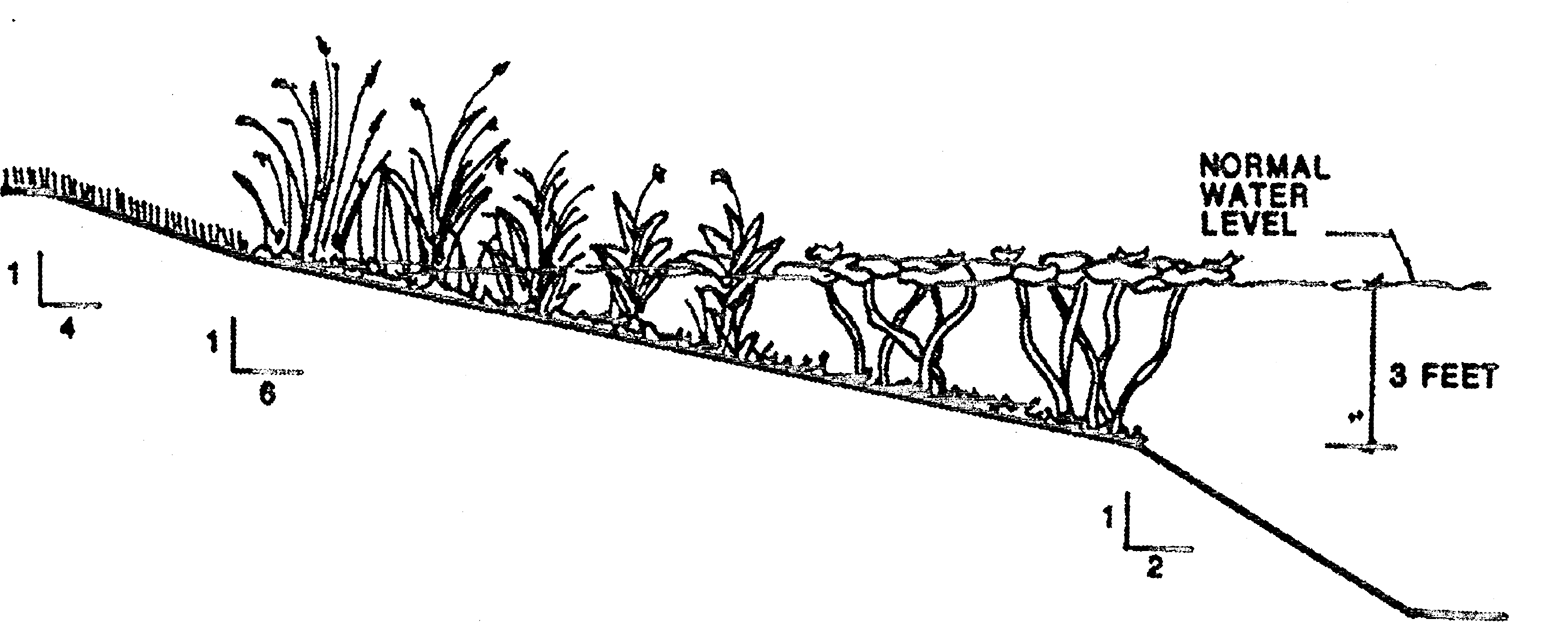
Figure 6.8, Stormwater Detention Basin
H.
Road Right-of-Way
1.
Public and private road right-of-way may contain trees and other landscaping material provided their location does not present a traffic hazard, impede drainage, or adversely interfere with the use of the right-of-way by utilities.
2.
Written approval from the Florida Department of Transportation shall be required for all landscaping materials proposed for placement on State Highway System rights-of-way.
I.
Scenic Roadways
1.
Notwithstanding the provisions of the Landscaping Regulations, other landscaping standards shall apply to any roadway that the Board by ordinance designates a Scenic Roadway to protect its special visual character. Scenic roadways designated by ordinance are those Scenic Roadway Corridors identified on the Future Land Use Map of the Comprehensive Plan.
2.
Upon designation of any scenic roadway, all site plans, permits, improvements, including maintenance thereon, shall be in accordance with the following standards and any other roadway-specific, Board-approved plan for the designated scenic roadway.
a.
Rural Scenic Roadways. In rural areas, in the AM, A, AR, AE, PEC 1/2, and RES-1 Comprehensive Land Use Plan classifications there shall be a 30-foot scenic easement provided, which shall be left in a natural state, unless actively used for agricultural purposes. Land in agricultural use may continue in agricultural use.
b.
Suburban Scenic Roadways. In suburban zones, including RES-2, RP-2, and RES-4 Comprehensive Land Use Plan classifications, a 15-foot bufferyard with four canopy trees and four understory trees per 100 linear feet shall be provided. In addition, if street trees do not exist, the developer shall provide one street tree for every 50 feet.
c.
Urban Scenic Roadways. All other Comprehensive Plan Classifications shall be considered urban. These districts shall require the planting of one street tree per 40 feet of frontage. The planting of one canopy tree for every 50 feet of yard frontage shall also be required.
3.
Compliance with the scenic roadway requirements shall in no case result in a non-conforming use. If the property has sufficient area for the scenic easement or bufferyard, no building permits shall be issued that would result in encroachment. If the property does not have sufficient area for the scenic easement or bufferyard, any use permitted in the zoning district shall be allowed to encroach into this area the minimum amount necessary to meet other setback requirements.
(Ord. No. 01-30, § 2, 11-15-01; Ord. No. 02-13, § 2, 8-1-02; Ord. No. 08-15, § 2, 6-12-08, eff. 10-1-08; Ord. No. 16-21, (Exh. A)(Item I-03)(16-1071), 10-11-16, eff. 10-18-16; Ord. No. 24-16, § 2(Exh. A), 6-6-24, eff. 6-13-24)
Sec. 6.06.04. - Off-Street Vehicular Use Areas
A.
Shade Trees
Seventy-five percent of the required trees shall be shade trees. This provision does not exclude the use of existing tree species for which credit is received in accordance with 6.06.02 C.
B.
Existing Trees
Existing trees shall be credited toward the number of required trees in accordance with 6.06.03 C, if the reduction does not subvert the intent of 6.06.04 to provide shaded areas throughout a parking lot.
C.
Perimeter Buffer Adjacent to Road Right-of-Way
On any parcel of land providing an off-street vehicular use area, where such area
is not entirely screened from an abutting right-of-way by an intervening building
or other structure, a landscaped buffer a minimum of eight feet in width shall be
provided between the off-street vehicular use area and the right-of-way, unless the
buffer or screening requirements of 6.06.06 and 6.06.06 C are more stringent, in which case the more stringent requirements shall apply.
(Figure 6.9)
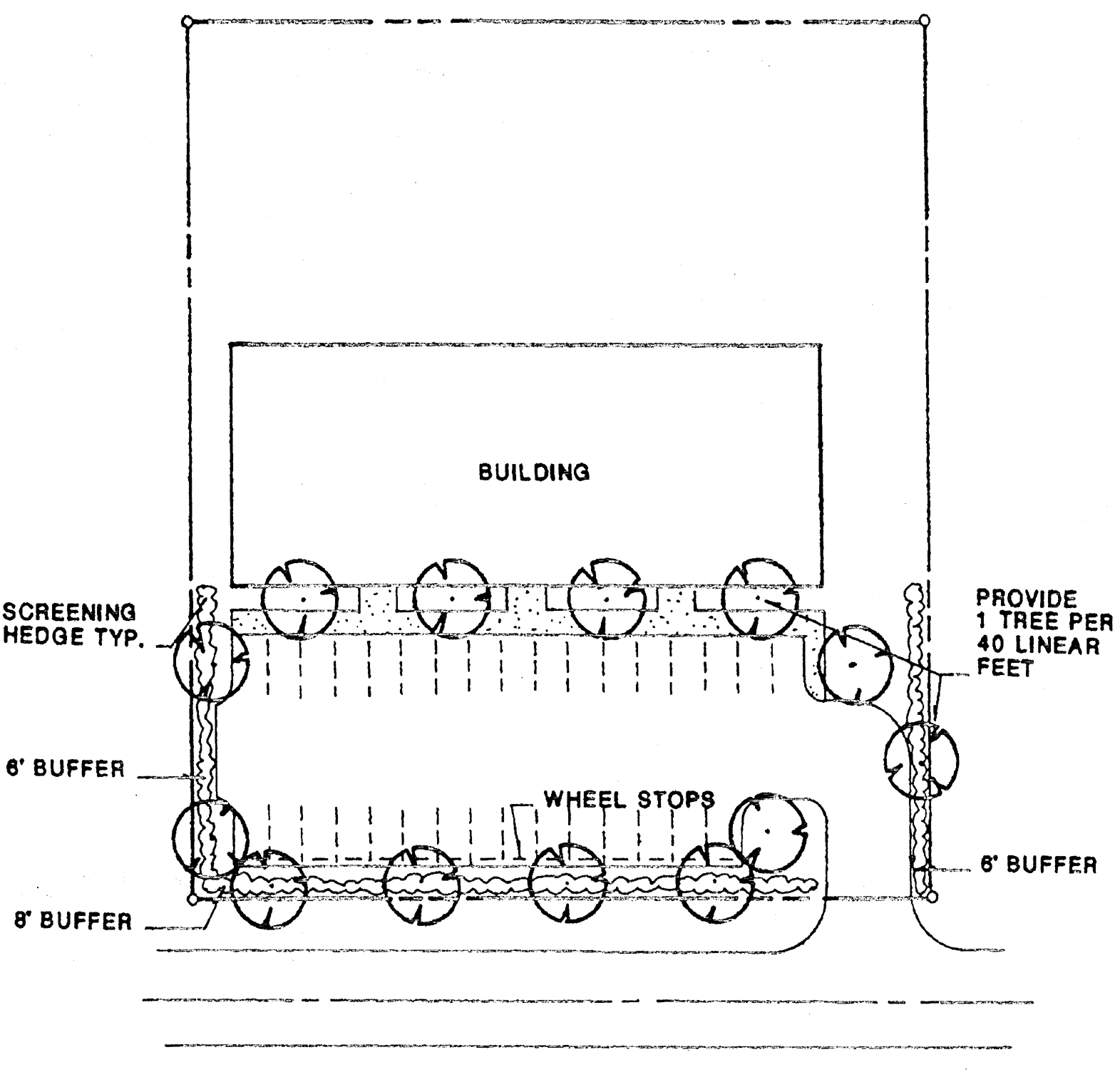
Figure 6.9, Perimeter Buffer Adjacent to R-O-W
D.
Perimeter Buffer Adjacent to Parking Area Driveway
A driveway into a parking area shall be bordered by a landscaped buffer a minimum
of eight feet in width. (Figure 6.10)
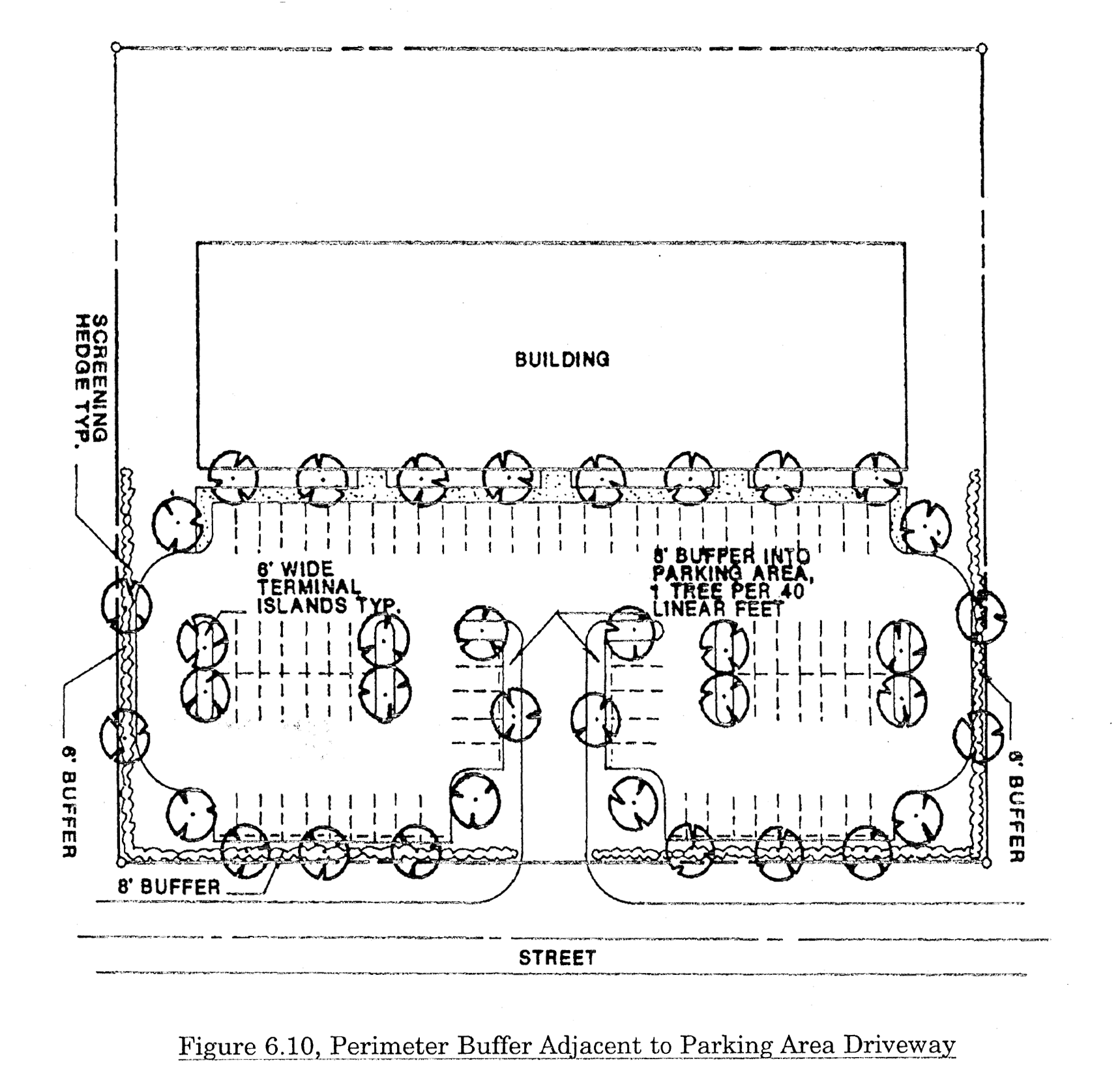
Figure 6.10, Perimeter Buffer Adjacent to Parking Area Driveway
E.
Other Perimeter Buffer
1.
A landscaped buffer a minimum of six feet in width shall be required between the off-street vehicular use area and any property boundary not fronted by a road right-of-way, unless the buffer or screening requirements of 6.06.06 and 6.06.06 C are more stringent, in which case the more stringent requirements shall apply. (Figure 6.9). The landscaped buffer shall not be required if such a buffer and required screening are provided on the adjacent property along said boundary.
2.
A landscaped buffer a minimum of six feet in width shall be provided between the offstreet vehicular use area and another use on the property, e.g., building, stormwater retention or detention pond, open space. (Figure 6.10). As an alternative to providing this perimeter buffer adjacent to a building, landscaped islands may be provided in accordance with 6.06.04 I.
3.
A perimeter buffer is optional along the phase boundary of phased construction where the off-street vehicular use area does not front on road right-of-way.
F.
Terminal Islands
A row of parking spaces abutting a perimeter landscaped buffer shall be terminated
at an access point by a landscaped island. (Figure 6.11). The island shall measure
not less than six feet in width from inside of curb to inside of curb and shall extend
the required length of the parking space. At least one tree shall be planted in the
island. The remainder of the island shall be landscaped; and the landscaping material
may include grass, ground cover, mulch, shrubs, trees or other landscaping treatment,
excluding sand or pavement.
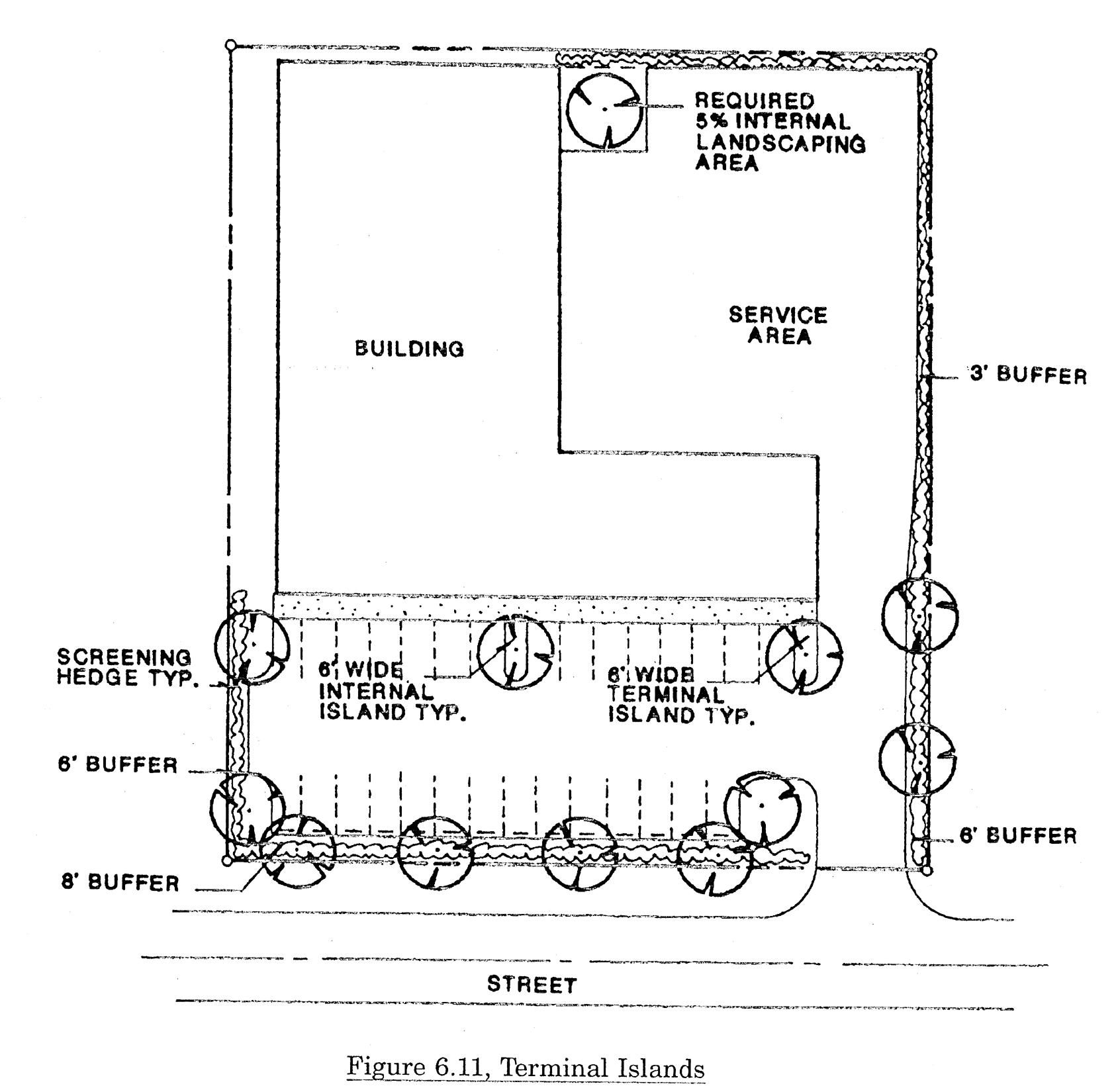
Figure 6.11, Terminal Islands
G.
Perimeter Landscaping
1.
Where the perimeter buffer minimum width requirement is six or eight feet, at least one tree for each 40 linear feet (or part thereof) of required buffer, shall be planted in the buffer with trees located to maximize shading of the off-street vehicular use area. (Figure 6.9).
2.
Where an off-street vehicular use area abuts a property boundary, screening shall be provided along the length of the perimeter buffer. (Figure 6.9). Screening shall be optional within phased construction projects or multi-building projects where the off-street vehicular use area does not front on road right-of-way. Screening shall also be optional along an access drive adjacent to the property boundary where the access drive is not contiguous with other off-street vehicular use areas or with buildings. Appropriate screening may include existing vegetation, berms in combination with plant material, masonry walls, wood fences, evergreen plants, or any combination of the above which shall within two years of installation reach a minimum of three feet in height and be 75 percent opaque.
3.
The remainder of a perimeter buffer shall be landscaped; and the landscaping material may include grass, ground cover, mulch, shrubs, trees or other landscaping treatment, excluding sand or pavement.
H.
Variations
Alternative perimeter landscaping designs in lieu of G 1 and G 2 above may be considered provided (1) trees are located within the landscape buffer to maximize shading of the off-street vehicular use area and (2) the buffer provides screening material which shall within two years of installation reach a minimum of three feet in height and be 75 percent opaque. As determined by the Administrator, minimum height requirements of screening material may be varied to encourage a wider selection of screening material provided that within four years the above height and opacity requirements are met.
I.
Interior Requirements.
1.
Terminal Islands. A row of parking spaces not abutting perimeter landscaped areas shall be terminated on each end by a terminal island. (Figure 6.12). When a shade tree island is not required as a terminal island in accordance with the subsection below, an island no less than six feet in width, measured inside of curb, and extending the required length of the parking space shall be provided. At least one tree shall be planted in the island. When a shade tree island is required as a terminal island in abutting rows of parking spaces, the island abutting the terminal shade tree island shall be no less than three feet in width, measured inside of curb, and shall extend the required length of the parking space. No tree is required within this island. Terminal islands shall be landscaped and the landscaping material may include grass, other vegetative ground cover, mulch, shrubs, or other landscaping treatment, excluding sand or pavement.
2.
Shade Tree Islands. Shade tree islands shall be provided as indicated below:
a.
For parking spaces that are not abutting perimeter landscaped areas, there shall be a minimum of one shade tree island per ten parking spaces, unless fewer than ten spaces are proposed. When fewer than ten parking spaces in a row are proposed, one shade tree island shall be required. (Figure 6.12). In abutting rows of parking spaces, the placement of shade tree islands shall alternate between the rows, with no more than ten consecutive abutting spaces without a shade tree island. (Figure 6.13). The shade tree island shall be no less than 17 feet in width, measured inside of curb, and shall extend the required length of the parking space. At least one two-inch caliper shade tree shall be planted in the island. The remainder of the island shall be landscaped, and the landscaping material may include grass, other vegetative ground cover, mulch shrubs, trees or other landscaping treatment, excluding sand or pavement.
b.
If a reduction in the required number of parking spaces is necessary to meet the requirements for shade tree islands, see 6.05.03 L, Offstreet Parking Requirement Reduction, which allows the Administrator to approve up to a five percent reduction in required parking spaces to meet the parking lot island requirements.
3.
Divider Medians. As an alternative to providing shade tree islands within abutting rows of parking spaces, a landscaped divider median between abutting rows of parking spaces shall be provided. (Figure 6.14). The minimum width of a divider median shall be six feet measured from inside of curb to inside of curb. At least one tree for each 40 linear feet (or part thereof) of required divider median shall be planted in the median with trees located along the median to maximize shading of the parking area. The remainder of the divider median shall be landscaped; and the landscaping material may include grass, ground cover, mulch, shrubs, trees or other landscaping treatment, excluding sand or pavement. When this alternative is chosen, the minimum width of the terminal islands shall be six feet, measured inside of curb.
4.
Variations. Alternative interior parking lot landscaping designs in lieu of Interior Requirements above may be considered for irregularly shaped parking lots, and parking lots utilizing existing trees or other vegetation, provided shaded areas are distributed throughout the parking lot and provided the area of interior landscaping is comparable to that furnished by the above requirements. For example, where credit is received for the retention of existing trees in accordance with 6.06.03 C, approval shall be given for reducing the number or width of shade tree islands or relocating the shade tree islands, provided the alternative does not subvert the intent to provide shaded areas throughout the parking lot.
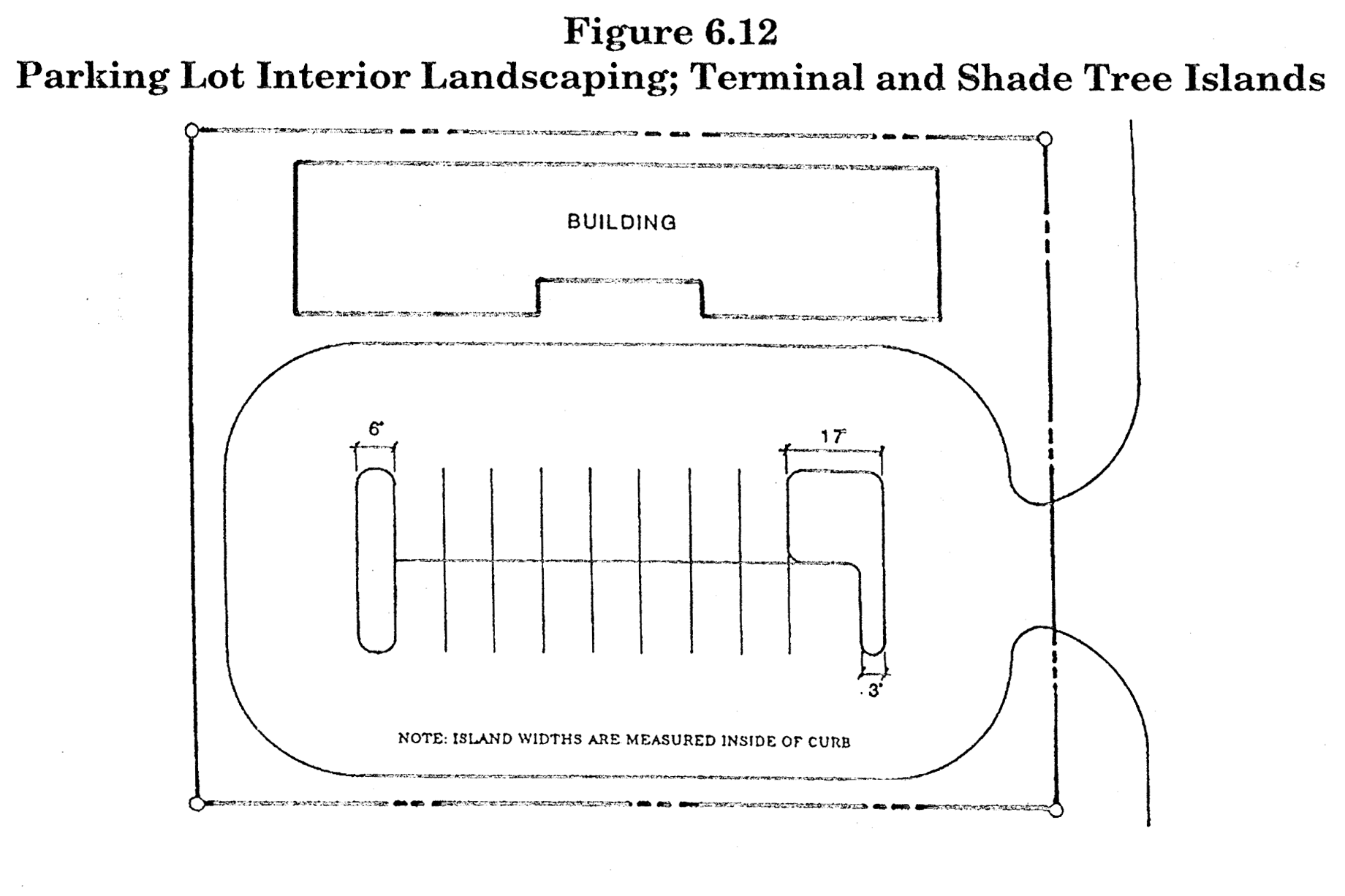
Figure 6.12, Parking Lot Interior Landscaping, Terminal and Shade Tree Islands
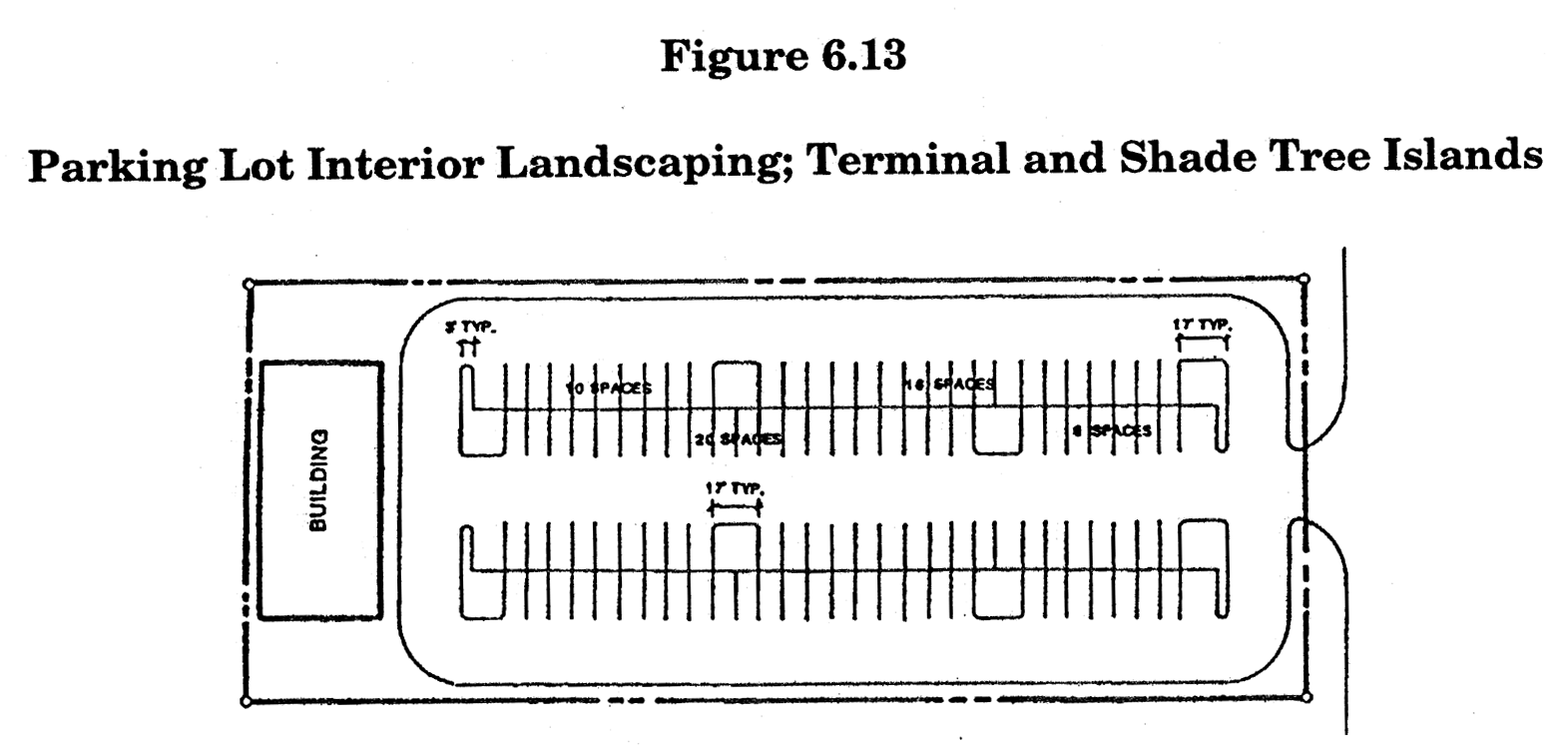
Figure 6.13, Parking Lot Interior Landscaping, Terminal and Shade Tree Islands
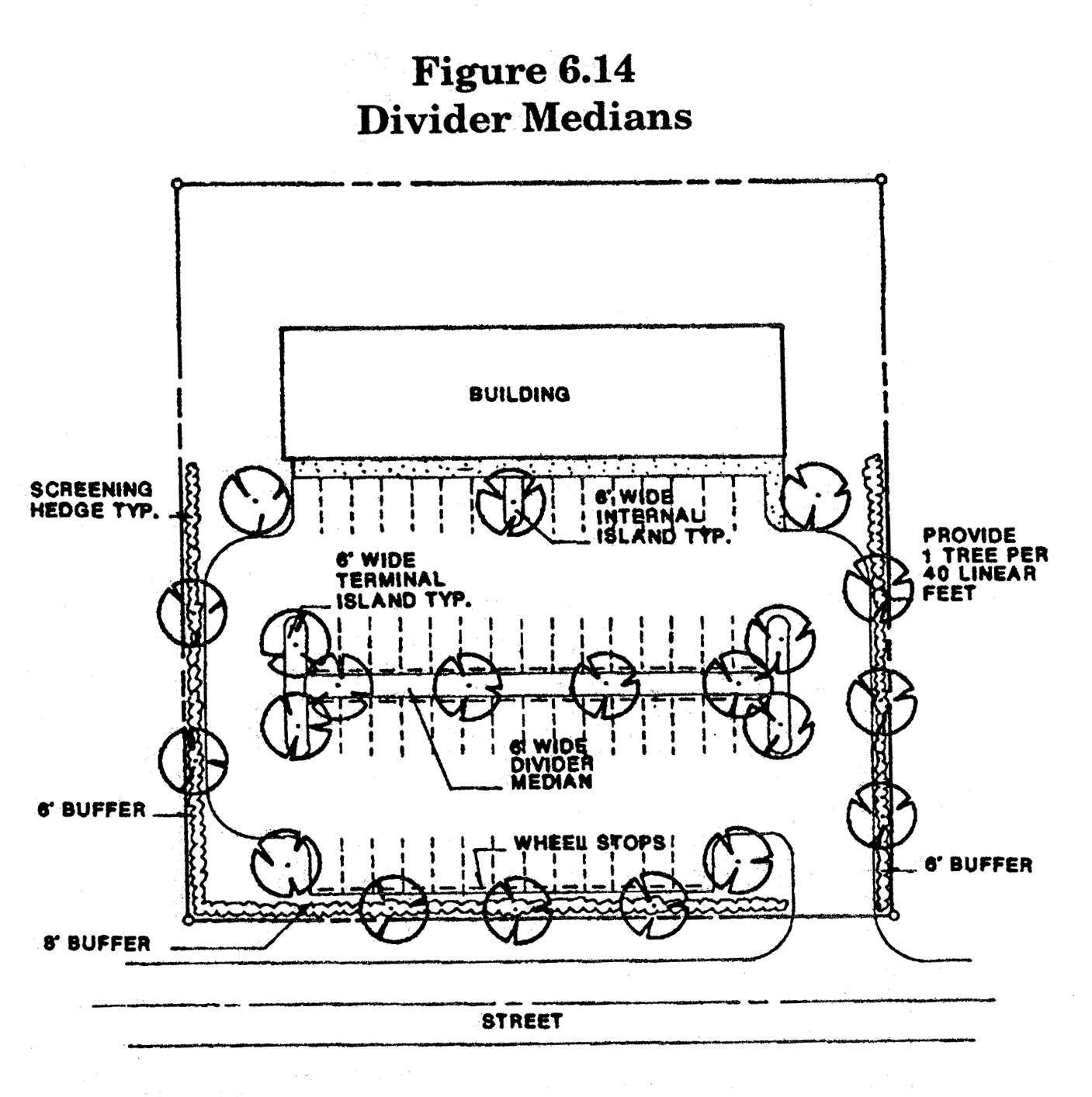
Figure 6.14, Divider Medians
J.
Public Takings.
1.
Where a lawful public taking or an action pursuant to court order results in a reduction of the required perimeter buffer and associated landscaping, this reduction shall not result in a violation of the landscaping requirements of this Code, provided the property owner clearly demonstrates that reasonable alternatives are not available to retain or provide the buffer and landscaping material in a manner consistent with County regulations and zoning conditions if applicable.
2.
In the event improvements are made to the property subsequent to a lawful public taking or an action pursuant to court order, only those areas within the limits of the improved area shall be required to meet the current perimeter buffer and landscaping requirements.
(Ord. No. 98-43, § 2, 7-17-98; Ord. No. 02-13, § 2, 8-1-02)
Sec. 6.06.05. - Street Trees
A.
Street Trees Required
The planting of street trees along local and collector roadways of subdivisions shall be required. One street tree for each lot shall be required. In addition, one street tree for every additional 50 linear feet, or portion thereof, of yard frontage shall be required for subdivision lots with yard frontages greater than 100 feet. In residential subdivisions where the majority of the lots are 7,000 square feet or less in size, one street tree shall be planted per lot within the road right-of-way. For lots on culs-de-sac, one street tree shall be planted on every other lot beginning with the lot at the cul-de-sac entry. Along collector and local streets not fronted by lots, one street tree shall be required per 50 linear feet of roadway on both sides of the road right-of-way. If palms are used, they shall be planted at half the average spacing.
B.
Tree Specifications
All street trees shall be shade trees unless otherwise approved. Street trees shall have a minimum height of six feet and be Florida Grade #1 or better in quality. Palms may be substituted for shade trees at a 2:1 ratio. However, no more than 20 percent of the total number of street trees shall be palms. When palms are approved for use as street trees, they shall be a single trunk species having a minimum clear trunk of eight feet and a minimum DBH of eight inches. In subdivisions requiring the planting of more than 100 street trees, a minimum of two species shall be required. Each species shall minimally represent 25 percent of the total number of street trees; and individuals of each species shall be planted in a manner to achieve a uniformed appearance along the roadway.
C.
Location and Placement
1.
Street trees shall be planted within the road right-of-way a minimum of five feet from the back of curb and a minimum of three feet from the inside edge of a proposed or established sidewalk. When possible, street trees should be centered and evenly spaced in front of the lot and evenly spaced on roadways not fronted by lots.
2.
When not feasible to plant trees in the road right-of-way, as determined by the Administrator, plantings shall be permitted on the lot, provided the trees are installed within five feet of the right-of-way.
3.
Street trees shall be planted a minimum of ten feet from any above ground utility, such as transformer pads and fire hydrants.
4.
Maximum flexibility shall be given to the placement of street trees to accommodate improvements such as driveways, utilities, lighting, etc. The Utility Notification Center should be notified to verify the location of utility lines prior to planting.
5.
Street tree plantings shall be in compliance with the planting standards and roadway landscaping guidelines described in Guidelines for Landscaping Hillsborough County Roadways.
D.
Credit
1.
If tree replacement is required, street trees larger than one inch DBH can be credited inch-for-inch toward the tree replacement inches for each inch above one inch. Street trees required in residential subdivisions shall be credited inch for inch for replaceable trees located within the design road right-of-way. See Section 4.01.07 for replaceable tree requirements.
2.
Where an existing tree is preserved and meets the minimum size and quality criteria and generally meets the street tree locational criteria, it shall be credited toward the street tree planting requirement.
E.
Timing
Street trees to be planted adjacent to common areas, parks, ponds, etc. shall be planted prior to acceptance/final approval of the improvements facilities for a platted unit. Street trees adjacent to lots may be planted concurrent with lot development and shall be planted prior to the issuance of the Certificate of Occupancy for each residence.
(Ord. No. 02-13, § 2, 8-1-02; Ord. No. 08029, § 2, eff. 2-1-09)
Sec. 6.06.06. - Buffering And Screening Requirements
A.
Buffers Between Incompatible Land Uses
The required buffer distance between proposed land uses and the zoning lot line is set forth in the tables below. If the land next to the proposed development is vacant, the buffer requirement shall be determined based on the existing zoning on the adjacent vacant parcel as shown in the tables below. If the adjacent parcel is vacant but is zoned for a more intensive zoning district, no buffer area shall be required of the less intensive use. Notwithstanding, Multi-family developments adjacent to parcels with HI (Heavy Industrial) Future Land Use designation, shall provide a 30-foot-wide buffer with Type C screening in accordance with LDC Section 6.06.06.C.5. and the parcel with the HI designation shall provide buffering and screening when developed in accordance the regulations herein. If the adjacent parcel is developed, the buffer requirement shall be determined based on the existing use of the adjacent property as shown in the tables below, unless that use is nonconforming, in which case the property shall be deemed vacant and buffered accordingly. Notwithstanding, for preliminary site development and/or construction plan applications submitted after October 1, 2007, if the adjacent property is developed solely with a nonconforming residential use, the buffer requirement shall be determined based on the residential use. However, in such cases the buffering requirement may be administratively waived upon written consent of the owner of the property occupied by the nonconforming residential use. For purposes of this regulation, "adjacent parcel" shall include parcels separated from the proposed development by a public or private right-of-way less than 50 feet in width. The relative degree of intensity shall be determined as follows:
*If multiple uses are permitted on a vacant parcel zoned PD, IPD, CPV, BMS or TND, the Intensity Group shall be determined by the least intensive use
B.
Buffering of Certain Mobile Home Parks
For mobile home parks which received a final development order between December 21, 1966 and July 1, 1985, the following buffering and screening requirements shall apply:
1.
Wherever said parks abut residentially zoned single-family development, a five-foot buffer shall be required along side and rear lot lines.
2.
Within said buffer areas, screening shall be required as per 6.06.06 C 3.
3.
This requirement shall apply wherever said single-family development was in place as of March 9, 1993.
C.
Screening
1.
Screening shall be installed within the buffers required above. Screening shall not be over four feet tall in front yards, except as described in 6.06.00. In meeting the screening standards, it is recommended that staggered hedge row plantings be installed on three-foot centers to achieve the opacity indicated.
2.
The required height of screening material is an effective height as measured from the property line.
3.
Screening Standard "A".
Required screening shall consist of the following:
a.
Evergreen plants, at the time of planting, shall be six feet in height and provide an overall screening opacity of 75 percent; or
b.
A masonry wall six feet in height and finished on all sides with brick, stone or painted/pigmented stucco; or
c.
A solid wooden or PVC fence six feet in height (finished side out); or
d.
A berm in combination with 1, 2, or 3 above, to achieve a minimum height of six feet and 75 percent opacity at the time of installation; and
e.
Lawn, low growing evergreen plants, evergreen ground cover, or rock mulch covering the balance of the buffer.
4.
Screening Standard "B".
Required screening shall consist of the following:
a.
The requirements of Screening Standard "A"; and
b.
A row of evergreen shade trees which are not less than ten feet high at the time of planting, a minimum of two-inch caliper, and are spaced not more than 20 feet apart. The trees are to be planted within ten feet of the property line.
5.
Screening Standard "C".
Required screening shall consist of the following:
a.
A row of evergreen shade trees which are not less than ten feet high at the time of planting, a minimum of two-inch caliper, and are spaced not more than 20 feet apart. The trees are to be planted within ten feet of the property line; and
b.
A masonry wall six feet in height and finished on all sides with brick, stone or painted/pigmented stucco; and
c.
Lawn, low growing evergreen plants, evergreen ground cover, or rock mulch covering the balance of the buffer.
6.
Areas of Excessive Traffic or Noise. If proposed residential development is adjacent to an area of excessive traffic or noise, including a limited access highway, screening shall consist of the landscaping required per Screening Standard "B" above or a berm/planting combination, with the berm an average height of four feet and dense plantings which will, when combined with the berm, achieve a minimum height of eight feet and 75 percent opacity within two years of planting. If demonstrated that screening has been or will be provided by another entity to an equivalent or higher degree, the Administrator may waive any portion or all of these requirements. Furthermore, because of the extensive landscaping provided on the public right-of-way, properties abutting the Veterans Expressway are exempt from the provision of this Section.
7.
Open Storage.
a.
Open storage which constitutes the principal use of a site shall be considered a Group 6 use and the entire site shall be buffered in accordance with 6.06.06.A and 6.06.06.C of the Land Development Code.
b.
Open storage areas which are accessory to a principal use shall be screened from view of any street and from residentially zoned land as follows:
(1)
Where an open storage area is in view from a street, the method of screening shall consist of solid masonry walls, solid PVC fences or solid wooden fences at least six feet in height, or evergreen shrubs which at the time of installation shall be six feet in height and 75 percent opaque and shall grow to form a continuous hedge, with access from the street only through solid gates which shall be closed except when in use. Said screening shall extend interior to the site a minimum of 100 feet from the street property line or the entire depth of the open storage area, whichever is less, unless an existing permanent structure shields the storage area from public view.
(2)
Where an open storage area is in view from a residentially zoned district within 200 feet, the method of screening shall consist of solid PVC fences, solid wooden fences or solid masonry walls at least six feet in height, or evergreen shrubs which at the time of installation shall be six feet in height and 75 percent opaque and shall grow to form a continuous hedge. Said screening shall be installed along all boundaries of the storage area including internal boundaries, that are in view from the residential districts.
8.
Solid Waste and Recyclable Materials Storage. All new buildings and uses, except for single-family and two-family dwellings, shall provide facilities for the central storage of solid waste and recyclable materials within the lot in accordance with Section 6.03.15 of the Land Development Code. Where such facilities are provided outside of a building, they shall be screened from public rights-of-way and adjacent property by an enclosure constructed of materials compatible with the materials on the front building wall of the main building. All enclosures shall have a gate with a latching mechanism to allow the enclosure to remain closed except when being used/serviced.
9.
Mechanical Equipment. All non-residential and non-agricultural uses shall screen all mechanical equipment, including rooftop equipment, such as but not limited to air conditioners, or pumps, from view from public places and neighboring properties. Ground level equipment shall be screened through the use of features such as berms, fences, false façades or dense landscaping. Rooftop equipment shall be screened through the use of a parapet wall or false façade that is an integral part of the structure.
10.
Screening above-ground utility appurtenances. All newly developed and redeveloped above ground utility appurtenances visible from the public right-of-way, including pedestals, utility meters, transformers, back-flow prevention devices, etc., shall be screened. Materials and earth tone colors for screening shall be compatible with the natural setting and surrounding structures. Chain link fencing alone shall not be considered as a screening mechanism.
a.
Screening mechanisms shall be reviewed during the following instances.
(1)
The consideration of such projects in the Capital Improvement Program (CIP) during project design;
(2)
The review of private development during construction site plan review; and
(3)
The review of right-of-way use permits.
b.
Screening plan requirements. The developer, permit applicant, etc., either public agency or private group, shall be required to submit, at the time of review, a screening plan to aesthetically disguise such devices from public view in the right-of-way or on private property visible from the right-of-way. The placement and screening of such devices shall take into account clear zones for vehicle recovery and sight distance.
(1)
When landscape screening is proposed, the screening plan shall be included in the landscape plan or include the same plan components.
(2)
When architectural screening is proposed, construction details must be submitted.
c.
Approval. Approval of a screening plan shall occur within the process of construction site plan approval or issuance of a right-of-way use permit. In case of disapproval of a permit for reasons of an unacceptable screening plan, the applicant may appeal the decision as provided by the review process to which the screening plan is submitted.
11.
Storm water ponds. Where fencing of a storm water pond is required by this Code and/or Storm Water Technical Manual and a chain link fence is utilized, the fence shall be clad in green or black vinyl and shall be a minimum of six feet in height. Additionally, the fence shall be landscaped with evergreen vines, such as Confederate Jasmine, Coral Honeysuckle or Beach Elder. The vines shall be planted along the entire length of the fence, excluding gates, no more than six feet apart on centers. The vines shall be in three gallon containers, at a minimum, at the time of planting and shall vegetate the fence to provide a minimum opacity of 75 percent of total fence area within two years of planting. These requirements shall also apply where a chain link fence is provided at the discretion of the developer around any storm water pond, except that fence height shall be regulated by Part 6.07.00 of this Code.
12.
Alternative Screening. In lieu of the above screening requirements, an applicant may submit an alternative screening plan that will protect adjacent properties and uses from undesirable views, lighting, noise, or other external impacts through techniques such as additional landscaping, berming, building relocations, modifications to mechanical equipment, changes in the circulation pattern, provision of open space, or modification of operational characteristics. The alternative plan shall afford screening, in terms of height, opacity and separation, equivalent to or exceeding that provided by the above requirements. Additionally, alternative screening proposed for storm water ponds shall provide equal or greater security and maintenance access as required fencing.
(Ord. No. 97-18, § 2, 12-18-97; Ord. No. 00-21, § 2, 5-18-00; Ord. No. 01-30, § 2, 11-15-01; Ord. No. 02-13, § 2, 8-1-02; Ord. No. 03-9, § 2, 6-5-03; Ord. No. 04-46, § 2, 11-4-04; Ord. No. 05-10, § 2, 6-16-05, eff. 10-1-05; Ord. No. 05-22, § 2, 11-17-05; Ord. No. 07-18, § 2, 7-19-07, eff. 10-1-07; Ord. No. 09-53, Item L, 6-11-09, eff. 10-1-09; Ord. No. 14-3, § 2(Exh. A), (Item IV-A), (13-0719), 1-30-14, eff. 2-6-14; Ord. No. 21-41, § 2(Exh. A), 10-21-21, eff. 10-28-21; Ord. No. 24-16, § 2(Exh. A), 6-6-24, eff. 6-13-24)
Sec. 6.06.07. - Review, Permitting, and Compliance Procedures
A.
Landscape Plan
1.
A Landscaping Plan prepared by Certified Landscape Designer, a Landscape Architect registered to practice in the State of Florida, or other authorized individuals as set forth in Chapter 481, Part II, Florida Statutes (1989), shall be submitted to the Administrator for review upon application for a Landscaping Permit. An application for an Irrigation Permit shall certify that an irrigation plan has been prepared in accordance with the requirements of Section 6.06.03 F. by a Landscape Architect, Licensed Irrigation Contractor or other individuals authorized by the Administrator.
2.
The Landscaping Plan shall include information as set forth in the Development Review Manual.
B.
Master Subdivision Landscaping Plan
At the option of the subdivision developer, a Master Subdivision Landscaping Plan may be submitted for a residential subdivision project, in lieu of the Landscaping Plan described above. The Master Subdivision Landscaping Plan shall depict the pertinent information as required in to be included in a Landscaping Plan, and such additional information as may be required by the Development Review Manual.
C.
General Procedure
Except as modified below, a Landscaping Plan or Master Subdivision Landscaping Plan shall be submitted and reviewed in accord with the Procedures for Issuance of Development Permits 10.01.00.
D.
Modifications to General Procedure
1.
Upon approval of a Master Subdivision Landscaping Plan, a Master Subdivision Landscaping Permit shall be issued. The permit shall refer to the Master Subdivision Landscaping Plan and identify for each lot, as applicable, information regarding existing trees and other vegetation, tree replacement, tree credit, required lot trees, and required street trees. The permit shall be issued to the developer and shall be in lieu of individual Landscaping Permit for each lot, unless upon submittal of a residential lot building permit application, additional trees need to be removed. In these instances, a Natural Resources Permit application to remove the tree(s) must be submitted. A copy of the Natural Resources Permit, if issued, shall be appended to the Master Subdivision Landscaping Permit and shall reflect any revisions to that permit.
2.
If both a Natural Resources Permit and a Landscaping Permit are required, the Administrator shall perform the review concurrently and shall issue the permits as a combined permit.
3.
A copy of the Landscaping Permit shall be available onsite during installation of the landscaping.
4.
No Certificate of Occupancy shall be issued until the Administrator has performed a final inspection and determined compliance with the minimum landscaping requirements according to the approved plan and the Landscaping Permit, if required and the applicant has certified that an irrigation system has been installed in accordance with the requirements of Section 6.06.03 F. The Administrator's final inspection may be replaced by the self certification process set forth in the Development Review Procedures Manual Section 4.1.6.
The Administrator will conduct periodic audits of self certification documents and inspections. Any contractor or engineer found certifying a residential lot not worthy of certification will have his privilege to self certify revoked for one year. It is the responsibility of the contractor or engineer providing the certification to correct any deficiencies.
5.
A Landscaping Certificate of Compliance for a site development project shall be issued once the Administrator has determined the project is in compliance with the minimum landscaping requirements.
6.
Periodic reinspections shall be performed by the Administrator to ensure the healthy survival of required landscaping material according to the approved plan. Landscaping material identified as deficient shall be replaced by the owner of the property within 45 days of written notification by the Administrator.
(Ord. No. 02-13, § 2, 8-1-02; Ord. No. 14-34, § 2(Exh. A), Item B-2a(14-0864), 10-23-14, eff. 10-29-14; Ord. No. 24-16, § 2(Exh. A), 6-6-24, eff. 6-13-24)
Sec. 6.07.01.- Generally
A.
Purpose
The purpose of these provisions is to prescribe standards for fences and walls for the conservation and protection of property, the assurance of safety and security, the enhancement of privacy and the improvement of the visual environment including the provision of a neat appearance in keeping with neighborhood character. Hedges are regulated in Part 6.06.00 of this Code.
B.
Definition
As used in this Section, unless otherwise specified, the term "fence" shall be used to include fences and walls.
C.
Wall Permit Required
Fences do not require zoning permits or a building permit. The property owner is responsible for the location of the fence wholly on their property and for compliance with the provisions of this Section. Walls require a building permit and are subject to the provisions of the Florida Building Code.
(Ord. No. 00-21, § 2, 5-18-00; Ord. No. 03-9, § 2, 6-5-03)
Sec. 6.07.02. - Regulations
A.
General Regulations for Fences
1.
Height shall be determined from the lowest point of average grade of the lots on either side of and immediately contiguous to the fence, to the average top elevation of said fence. Berms, when used in conjunction with fences, shall be included in height determinations.
2.
No fence exceeding two and one-half feet shall be constructed within the visibility triangle at roadway intersections as described in 6.04.03 F.
3.
No fence shall impede or divert the flow of water through any drainage way unless by adequate investigation and written approval from the Hillsborough County Public Works, it is shown that the fence will not adversely impact any surrounding property owner and will contribute to an improvement in the overall drainage pattern.
4.
Fences shall be constructed in a workmanlike manner and shall be of sound and sturdy construction. The finished side of the fence shall face outwards where visible from road rights-of-way, not including any such portion of the fence located in a required side yard or required rear yard.
a.
All posts and support beams shall be placed on the unfinished side of the fence. This does not preclude the installation of post columns with spanning members of metal, wood, or other materials; in which case, the posts are equal in presentation to both sides of the fence.
5.
All fencing erected prior to April 15, 1987, shall be granted non-conforming status.
B.
Regulations for Required Fences
Required fences shall be provided for buffering and screening purposes as provided elsewhere in this Code. Required walls may be permitted up to six feet in height (or eight feet as permitted in C.1.f., g., and h below) in front yards at the outer boundaries of the development or at the boundaries of distinct portions of the project (such as where multiple family adjoins single family or commercial adjoins residential development) provided that:
1.
No drive or street pierces the wall except at development entrance/exit streets; and
2.
The wall is shown on an approval PD general site plan or approval subdivision final plat.
C.
Regulations for Fences.
1.
Residential Districts and SB Districts.
a.
Fences over four feet in height shall not be allowed within the required front yards, except as indicated in f, g, and h below.
b.
For corner lots, fences up to six feet in height shall be allowed within one front yard, which functions as a side yard, provided the fence is located no more than ten feet into the required front yard, as measured from the rear line of the front yard. However, in districts requiring side yards greater than ten feet, this intrusion shall be increased up to a distance equal to said required side yard. This is illustrated in Figure 6.15 by Lot A. Lot A(1) abuts a curved street corner lot as defined by Article 7. Lot B(1) is an interior lot and no fence more than four feet in height shall be allowed in the front yard.
c.
For through lots, fences up to six feet in height shall be allowed within one front yard which functions as the rear yard of the lot. (Lot C in Figure 6.15.)
d.
In general, the design of fences shall be in keeping with neighborhood appearance. Fences may be constructed of commonly used materials such as chain link, masonry, wood or PVC.
e.
The following materials shall be prohibited in the construction of fences: house siding, scrap metal, second-hand materials not typically utilized for fences and other offensive materials. In addition, fences in any residential district shall not contain any substance such as broken glass, spikes, barbs, nails, electronically charged wiring or similar materials designed to inflict pain or injury to any person or animal. These restrictions shall not be varied.
f.
The maximum average height of any fence or wall shall be six feet, except as described in g, h and i below.
g.
Fences surrounding public utility structures within residential districts shall be exempt from the setback requirements and height requirements (up to a maximum of eight feet) and may use up to three strands of barded wire on security chain link fences provided that such barbed wire is a minimum of six feet above average grade.
h.
Walls, and combination walls and berms, up to eight feet in height, may be erected in yards which abut arterial streets or collector streets, as defined under the Hillsborough County Functional Classification System, provided that no access is provided to said arterial or collector and the fence is two and one half feet or less in height within the sight triangle described in 6.04.03 F. Column height shall be allowed as in j below.
i.
When a six-foot fence height is required for the purpose of screening, height shall be measured from the finished grade at the minimum required setback or buffer line (whichever is greater) of the property which is required to provide the fence. Notwithstanding, in no instance shall fence height exceed eight feet nor be less than six fee measured from the finished grade immediately contiguous to the fence.
j.
Columns and posts, including decorative caps and finials, may exceed permitted fence height by a maximum of one foot. Columns and posts which exceed permitted fence height shall be not more than three feet in width and shall be spaced at least six feet apart. Additionally, averaging of fence height may be allowed under special circumstances, such as with a fence located on a slope, at the discretion of Hillsborough County.
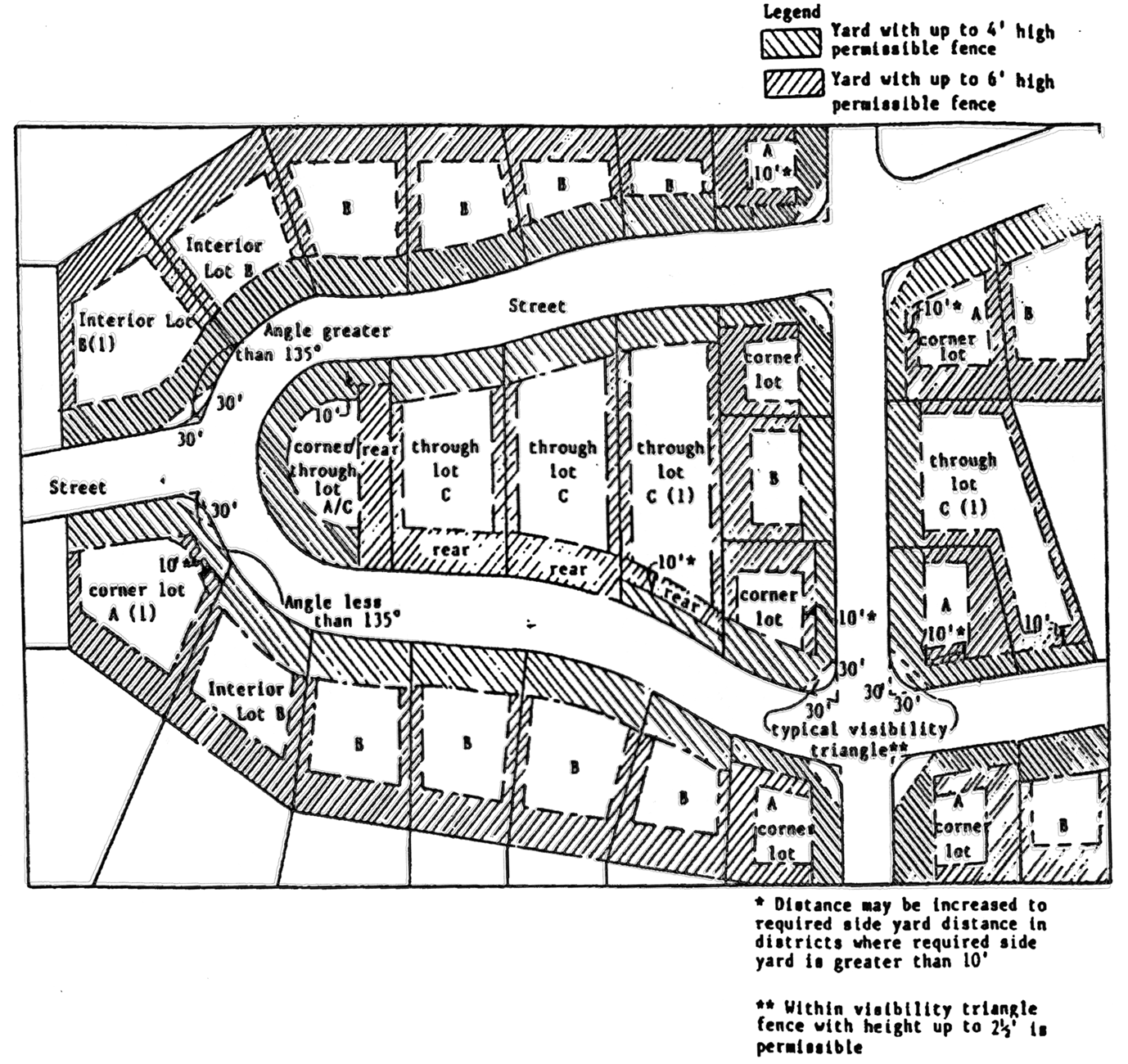
Figure 6.15, Permitted Fences in Residential Districts
2.
Agricultural Districts
a.
Fence regulations shall be the same as for residential districts except as provided in Paragraph 2, below. Additionally, on parcels with stables, bona fide agricultural operations as defined by this Code or phosphate mining, fences up to eight feet in height shall be allowed in any yard, although fences in required front yards shall not be more than 60 percent opaque above the height of four feet.
b.
Barbed wire fences and electrically charged fences may be allowed in Agricultural Districts subject to the requirements of applicable local, State and Federal laws and regulations.
3.
Commercial and Office Districts
In commercial and office districts, fence regulations for fences shall be the same as for residential districts except fences in the C-G or C-I districts. In these districts, fences shall conform to the requirements for fences in residential districts except that six-foot chain link security fences (with 30 percent or less opacity) shall be allowed within any yard.
4.
Industrial Districts.
a.
The maximum height of fences shall be eight feet.
b.
Within front yards, solid fences (i.e., fences with greater than 30 percent opacity) shall be restricted to a height of four feet.
c.
Barbed wire and electrically charged fences may be used if all requirements of all applicable local, Federal and State laws and regulations are met.
5.
Special Public Interest Districts and Planned Districts.
Fences within these districts shall conform to fence requirements for similar uses as provided above.
6.
Community Plan Districts and Scenic Roadways.
Fences within a community plan area with development standards shall comply with any specified fence requirements found in Article III for that community plan area. In addition, fences located along Scenic Roadways must also comply with the provisions of Section 6.06.03.I.
(Ord. No. 00-21, § 2, 5-18-00; Ord. No. 01-30, § 2, 11-15-01; Ord. No. 03-9, § 2, 6-5-03; Ord. No. 03-36, § 2, 11-12-03; Ord. No. 05-22, § 2, 11-17-05; Ord. No. 07-25, § 2, 11-1-07, eff. 2-1-08; Ord. No. 09-53, Items D, H, 6-11-09, eff. 10-1-09)
Sec. 6.08.01.- Excluded Portions of Buildings
Except as specifically provided herein, the height limitations of this Code shall not apply to the following portions of buildings:
A.
Roof structures for housing elevators, stairways, tanks, ventilating fans, solar energy collectors and similar equipment to operate and maintain the building, provided such structures cover no more than 20 percent of the roof area and extend no more than ten feet above the roof.
B.
Fire or parapet walls, provided such walls extend no more than five feet above the roof.
C.
Architectural features of buildings such as spires, steeples, belfries, cupolas, domes, monuments, skylights and flagpoles.
D.
Cranes temporarily mounted on buildings during construction.
(Ord. No. 10-26, § 2, Exh. A(10-0743), eff. 2-11-11)
Sec. 6.08.02. - Aviation Hazards
No building or other structure, regardless of exclusions set forth at Section 6.08.01 above, shall be located in a manner or built to a height which constitutes a hazard to aviation or creates hazards to persons or property by reason of unusual exposure to aviation hazards. In any area within the unincorporated portion of Hillsborough County, in addition to height limitations established by this Code, limitations established by lawful Federal, State, Hillsborough County Aviation Authority and Hillsborough County ordinances, rules, and regulations, shall apply to heights of buildings, structures, and natural vegetation.
(Ord. No. 98-43, § 2, 7-17-98; Ord. No. 10-26, § 2, Exh. A(10-0743), eff. 2-11-11)
Sec. 6.08.03. - Amateur Radio Antenna Support Structures
Section 125.0185, Florida Statutes (1991), and Federal Communications Commission "Amateur Radio Preemption", 101 FCC 2d 952 (1985) require County regulations to reasonably accommodate amateur communication, and to represent the minimum practicable regulation to accomplish the local authority's legitimate purpose. Under these federal and state preemption provisions, Amateur Radio Antenna Support Structures are excluded from regulation under the provisions of this Code.
Sec. 6.08.04. - Unusually Tall Structures
Unless specifically stated otherwise elsewhere in this Code concerning height, unusually tall structures that are principal structures in themselves, such as high voltage transmission line towers, telephone or electronic relay or transmission towers; grain elevators, silos and other such agricultural uses; and similar principal structures, may only exceed the height limitations established for the district wherein they are proposed for relocation following review by the Administrator who may only grant the Permit where he finds:
A.
That the proposed structure is not located on property zoned SPI-AP, nor would it result in restriction or interference with air traffic or air travel to or from any existing or proposed airport;
B.
That the proposed structure is consistent with the existing surrounding uses, and is compatible with the existing neighborhood development;
C.
That the proposed structure is consistent with any adopted or projected development plan for the area;
D.
That the proposed structure is not detrimental to the existing or proposed use of any neighboring property, and does not unreasonably restrict the free flow of light, sunlight and air to those properties.
(Ord. No. 10-26, § 2, Exh. A(10-0743), eff. 2-11-11)
Sec. 6.08.05. - Freestanding Flagpoles
Freestanding flagpoles may exceed the maximum structure height permitted by this Code provided the pole is not located in a single-family or two-family residential district or on property zoned SPI-AP, poses no restriction or interference with air traffic associated with any existing or proposed airport, and does not exceed 50 feet in height in multi-family residential districts and 150 feet in height in other districts. Flagpoles erected prior to February 1, 2011 that do not conform to these district height limits shall be deemed legally nonconforming to this Code, provided they do not pose a hazard to aviation. However, this nonconformity status shall have no bearing on the applicability of Hillsborough County Aviation Authority Airport Zoning Regulations. Flagpole location is regulated by Section 6.01.03.I.9 of this Code.
(Ord. No. 10-26, § 2, Exh. A(10-0743), eff. 2-11-11)
Sec. 6.09.01.- Generally
Manufacturing, processing and assembly operations shall observe the following performance standards. Proof shall be provided that all required permits for particular discharges can be met. Since zoning compliance does not substitute for requirements of other agencies, all necessary environmental permits shall be obtained.
Sec. 6.09.02. - Lighting
Lighting shall be in accordance with Part 6.10.00 of this Code.
(Ord. No. 04-27, § 2, 6-10-04)
Sec. 6.09.03. - Sound
A.
Receiving Use: Residential
Sound levels shall not exceed the following standards if the receiving use is residential:
Between 7:00 A.M. and 10:00 P.M. .....60 dBA
Between 10:00 P.M. and 7:00 A.M. .....55 dBA
B.
Receiving Use: Commercial .....
Sound levels shall not exceed the following standards if the receiving use is commercial:
Between 7:00 A.M. and 10:00 P.M. .....65 dBA
Between 10:00 P.M. and 7:00 A.M. .....60 dBA
C.
Receiving Use: Industrial .....
Sound levels shall not exceed the following standards if the receiving use is industrial:
Anytime .....75 dBA
Sec. 6.09.04. - Vibration
Vibration levels shall not exceed the following standards:
Maximum Peak Particle Velocity
steady state .....0.02 inches/second
impact .....0.04 inches/second
Note: The maximum particle velocity shall be the maximum displacement vector sums of three mutually perpendicular components, recorded simultaneously, multiplied by the frequency in cycles per second. For purposes of this Code, steady-state vibrations are vibrations which are continuous, or vibrating in discrete impulses more frequent than 60 per minute. Discrete impulses which do not exceed 60 per minute, shall be considered impact vibrations.
Sec. 6.09.05. - Airborne Discharges
Airborne discharges shall be minimized so as to not cause or contribute to an objectionable odor off the operator's property. For the purpose of this Code, objectionable odor shall be defined as the property of a substance which materially offends the sense of smell of a considerable number of persons of the public.
Sec. 6.09.06. - Dust
Dust discharges from the operator's property shall be minimized by taking reasonable precautions to include but not limited to: paving and maintenance of roads, parking areas and yards; periodic application of water or chemicals to unpaved roadways and open stock piles; landscaping of yards; use of hoods, fans, filters, and other similar equipment to capture the dust; and use of wet abrasive blasting equipment (when possible) where abrasive blasting is necessary.
Sec. 6.09.07. - Special Measurement Provisions
A.
PD-RP District
In the case of uses in the PD-RP district, all measurements to determine compliance shall be made outside and immediately adjacent to the walls of the building housing the use.
B.
C-I and SPI-AP Districts
In the case of uses in the C-I and SPI-AP districts, all measurements to determine compliance shall be made at the boundaries of the zoning lot containing a limited manufacturing, processing and assembly operation.
C.
PD-I and M Districts
In the case of uses in the PD-I and M districts, all measurements to determine compliance shall be made at the nearest boundary of the zoning district to the use being evaluated.
Sec. 6.10.01.- Generally
A.
Purpose
The purpose of this Part is to provide standards for exterior lighting where such lighting is proposed.
B.
Applicability
Except as provided below, the provisions of this Part shall apply to non-residential or multi-family uses or for common improvements of single-family developments, such as recreational facilities, club houses, and entrance features, where new exterior lighting is proposed or existing exterior lighting is relocated or replaced.
1.
Regular maintenance to existing exterior lighting shall not require compliance with the requirements of this Part. For the purposes of this Part, regular maintenance shall be considered to include cleaning and changing lamps, ballasts, starters, housing, lenses, replacing damaged poles, and other similar components provided such changes do not result in higher lumen output of the fixture than when it was newly installed.
2.
When 50 percent or more of the existing lighting fixtures of an exterior lighting system are upgraded, changed, or replaced, as measured cumulatively from the effective date of this Part, the entire exterior lighting system shall be brought into compliance with the requirements of this Part. This requirement shall not apply to regular maintenance of an existing lighting system.
3.
Outdoor recreational facilities (public or private), such as, but not limited to stadiums, football fields, soccer fields, baseball fields, softball fields, tennis courts, auto race-tracks, horse race-tracks or show arenas shall be subject only to the provisions of Section 6.10.03.I. below.
4.
Lighting within a community plan area or overlay district with development standards shall comply with any specified requirements found in Article III for that community plan area or overlay district in addition to the requirements of this Part. Where there is a conflict in any provision of this Part with the regulations of a community plan area or overlay district, the more restrictive shall prevail.
5.
When site design incorporates lighting strategies under the provisions of Section 6.03.11 pertaining to Crime Prevention Through Environmental Design, the provisions of this Part shall apply.
C.
Exemptions
Exterior lighting meeting the Applicability criteria of 6.10.01.B. is exempt from the requirements of this Part in the following instances:
1.
Projects with unexpired construction plan approval at the time of the effective date of this Part.
2.
Correctional facilities with lock down capability.
3.
Temporary lighting needed for the performance of emergency safety repairs or natural disaster recovery.
4.
Lighting for building construction provided that the fixtures used are directionally shielded and aimed so that the light is confined to the area to be illuminated.
5.
Lighting used for illumination of construction, renovation, or repair of roads and utilities.
6.
Underwater lamps in swimming pools installed for safety in accordance with state or local regulations.
7.
Exit signs or lighting for doorways, stairs or ramps as required by the Florida Building Code.
8.
All lighting required by Federal, State or local regulatory agencies.
9.
Lights, including laser lights, that are part of the sensing system for gate operations at gated residential communities and non-residential facilities.
D.
Definitions
The terms used in this Part shall have the following meaning:
1.
Average Maintained Illuminance shall mean the sum of the calculated illuminance points on the photometric plan divided by the number of calculated illuminance points within the area to be illuminated. Sub-area averages, such as canopies, ATM, parking lots, boundary lines, and pedestrian areas shall only include points within that sub-area. Illuminance values shall be maintained horizontal values.
2.
Bulb means the same as Lamp.
3.
Cutoff means a light distribution which is not more than 2.5% of the luminaire's lumen output at or above 90 degrees vertical from nadir and not more than 10% of a luminaire's lumen output at or above 80 degrees vertical from nadir.
4.
Exterior Lighting means any outdoor lighting such as that used for parking lots, walkways and other outdoor areas.
5.
Fixture means the same as Luminaire.
6.
Flood or Spot Light means any fixture or lamp that incorporates a reflector or refractor to concentrate the light output into a directed beam in a particular direction.
7.
Foot-candle (f.c.) means a measure of light falling on a surface. A foot-candle is equal to the lumens of light incident on an area divided by the total area (i.e., lumens per square foot).
8.
Height of a Fixture shall mean the vertical distance from the normal finished grade directly below the centerline of the luminaire to the lowest direct-light-emitting part of the fixture.
9.
Height of Pole shall mean the vertical distance from finished grade to the highest point inclusive of the pole, finial, fixture, and mounting arm.
10.
IESNA means the Illuminating Engineering Society of North America.
11.
Illuminance means the areal density of the luminous flux incident at a point on a surface.
12.
Illumination means illuminance.
13.
Lamp shall mean the generic term for a source of electric light, and is to be distinguished from the whole assembly (see Luminaire).
14.
Light Loss Factor (formerly maintenance factor) The ratio of illuminance for a given area to the value that would occur if lamps operated at their initial rated lumens and if no system variation or depreciation had occurred.
15.
Lumen means the unit of measurement of the total visible light produced by a light source. For the purposes of this Part, the lumen output shall be the initial lumen output ratings of a lamp where "initial" refers to the manufacturer's stated rating for a new lamp.
16.
Luminaire means the complete lighting assembly that houses the lamp or lamps and can include all or some of the following parts: housing, a mounting bracket or pole socket, a lamp holder, a ballast, a reflector or mirror, and/or a refractor or lens and parts to connect the assembly to the power source.
17.
Luminance means the quotient of the luminous flux at an element of the surface surrounding the point, and propagated in directions defined by an elementary cone containing the given direction, by the product of the solid angle of the cone and the area of the orthogonal projection of the element of the surface on a plane perpendicular to the given direction.
18.
Maintained Illuminance means a level of illumination that results when the initial output of the lamp is reduced by certain light loss factors. Such light loss factors typically include lamp depreciation and dirt accumulation on lenses and other light fixture components.
19.
Max to Min Uniformity Ratio shall mean the ratio of maximum to minimum foot-candles applied to the maintained horizontal values calculated at ground level. The uniformity ratio must be provided for each defined sub-area of the site except when the minimum value is zero. For the purposes of this Part, the ratio must be presented with a denominator of one (1).
20.
Photometric Plan means a diagram drawn to scale depicting the location of all light poles and building mounted light fixtures in a specific area and a numerical grid of the maintained lighting levels that the fixtures will produce. All values shall be at grade unless otherwise stipulated.
21.
Shielded means a fixture constructed in such a way as to have internal and/or external shields, top and side visors, hoods, and/or internal louvers to limit glare and light trespass caused by emission from the luminaire.
E.
Prohibitions
The following are specifically prohibited and no variance may be granted which would authorize any of the following exterior lighting:
1.
The nighttime use of white lighting or white strobe lighting on wireless communication facilities unless the applicant can show proof of a Federal Aviation Administration requirement for such lights.
2.
The use of permanent or temporary strobe lights unless otherwise provided for herein.
3.
The use of search lights, except in conjunction with fire fighting or law enforcement activity.
F.
Procedures
At the time of construction plan submittal, or at the time of application for electrical permit where no construction plans are submitted, an exterior lighting plan prepared by a qualified professional engineer or a full time employee of an electric utility shall be provided for all developments meeting the applicability criteria established under Section 6.10.01.B. above.
The following shall be included as part of the site lighting plan:
1.
A photometric plan(s) using an engineering scale that is easily legible and includes:
a.
Proposed and existing buildings, pedestrian and vehicular areas, other above-ground improvements, the horizontal location of all proposed and existing outdoor lighting fixtures including pole and wall mounted fixtures, mounting heights of each fixture, overall height of each pole above grade, location of externally illuminated sign(s) and associated fixtures, location of all architectural and landscape lighting fixtures.
b.
Maintained horizontal illuminance values in foot-candles for the area to be illuminated calculated at grade including contributions from all fixtures covered by this Part. The Light Loss Factor must not be less than 0.72.
c.
Manufacturer's cut sheets for each proposed fixture. Each cut sheet shall be legible and shall clearly identify the manufacturer's catalog number utilized unless a fixture schedule is provided with this information and the plan cross-reference identification.
d.
A lighting fixture summary table that presents the following information:
i.
Plan identification symbol or abbreviation; and
ii.
Fixture type (include the manufacturer's product identification catalog number); and
iii.
Lamp type and wattage; and
iv.
Initial lamp lumens; and
vi.
Mounting height; and
vii.
Total light loss factor utilized.
2.
Data tables that include the statistics for the site and each sub-area. Sub-area averages, such as canopies, ATM, parking lots and pedestrian areas shall only include points within that sub-area. Illuminance values shall be computed over the area to be developed of each site only as well as along the property boundaries, and shall not include building pad areas. The information that must be provided for each area includes the maximum, minimum and average maintained foot candle value and max to min uniformity ratio. Illuminance values for parking areas shall include only the parking surface and drive aisles. Areas not intended to be illuminated, such as the building footprint, setbacks and planting areas, shall be masked out of the analysis.
G.
Certification
Prior to the issuance of a Certificate of Occupancy for a project where lighting is provided or prior to final electrical approval where no Certificate of Occupancy is required, a professional engineer shall provide certification to the Building Services Division stating that the lighting system as installed complies with the provisions of this Part. Lighting systems designed and installed by an electric utility company can be certified by a full-time employee of that utility company.
(Ord. No. 04-27, § 2, 6-10-04; Ord. No. 06-18, § 2, 8-1-06; Ord. No. 08-15, § 2, 6-12-08, eff. 10-1-08; Ord. No. 08-28, § 2, eff. 2-1-09; Ord. No. 08-29, § 2, eff. 2-1-09; Ord. No. 09-53, Item X, 6-11-09, eff. 10-1-09; Ord. No. 09-62, Item Q, 10-26-09, eff. 2-1-2010)
Sec. 6.10.02. - General Standards
A.
Illumination values at the property line of a project shall not be more than 1.0 f.c. at any point when the project is located next to any residential use or residentially zoned property. The illumination values at the property line of a project adjacent to any other use shall not be more than 2.0 f.c. Compliance with this criteria shall not be required between two adjacent non-residential properties of like zoning or use classification provided that the properties are under the same ownership, or have common parking areas and/or driveways, or the impacted adjacent property owners provide written consent in a format acceptable to the County Attorney's Office expressly allowing the illumination values at their respective property lines to exceed the maximum allowable limit established herein.
B.
Fixture Types:
1.
All light fixtures shall be cutoff type unless specific authorization for use of another type of fixture is provided in this Part. Fixtures shall be equipped with shields if required in order to meet the requirements of 6.10.02.A.
2.
Floodlights may be permitted in accordance with Sections 6.10.03.F. and 6.10.03.G. provided that all floodlights shall be fitted with internal or external shielding and/or louvers. Floodlights shall be aimed so that the area illuminated is confined within the project boundaries in accordance with Section 6.10.02.A.
C.
Luminaires shall be installed in the position recommended by the manufacturer for the intended use provided that the fixture as installed maintains cutoff characteristics.
D.
The lamp source shall be compact fluorescent, high pressure sodium, LED, or metal halide with a color rendering index that it is appropriate for the application.
(Ord. No. 04-27, § 2, 6-10-04; Ord. No. 06-18, § 2, 8-1-06; Ord. No. 08-28, § 2, eff. 2-1-09; Ord. No. 09-53, Item X, 6-11-09, eff. 10-1-09)
Sec. 6.10.03. - Specific Standards
The following specific standards shall apply in addition to requirements of Section 6.10.02, except where expressly exempted:
A.
The height of an outdoor lighting fixture shall be such that the illumination levels at the property lines meet the requirements of Section 6.10.02.A.
B.
Lighting for off-street surface parking lots shall comply with IESNA RP-20. Off-street parking lots may be illuminated by pole mounted fixtures, building mounted fixtures, or a combination of both. Only the foot-candle values located within the boundary of the parking lot as designated by the location of wheel stops and/or pavement markings may be used to calculate the illuminance and the uniformity ratio.
C.
At canopied areas, such as those found at drive-through facilities at banks, service stations, convenience centers, and car-washes, lighting under the canopy, awning, porte-cochere, or similar structure shall be either recessed or cut-off fixtures. Additionally, the maintained maximum foot-candle value shall be 20 f.c., with a maximum to minimum ratio of 2:1.
D.
Display areas at outdoor dealerships for new and used products, including but not limited to automobiles, trucks, recreational vehicles, motorcycles, and boats are exempt from the limitations of Section 6.10.02.A. as follows:
1.
Illumination of any row or tier of display that is adjacent to an external road or street (public or private) shall have a maximum foot-candle level of 20 f.c. Illumination of all other rows or tiers of display shall have a maximum level of 10 f.c., except as needed to transition from a maximum of 20 f.c. to a maximum of 10 f.c.
2.
Illumination at entrances and exits to and from the outdoor display area/dealership site to an external road or street (public or private) shall not exceed 10 f.c.
E.
Lighting intensities at Automated Teller Machines (ATMs) shall be governed by applicable Florida Statutes and shall also comply with the requirements of Section 6.10.02.A.
F.
The use of floodlighting is allowed for illuminating equipment and material storage areas, truck loading bays (docks) and outdoor work, manufacturing, or assembly areas associated with industrial facilities, non-electric utility facilities, municipal material yards, areas used for parking or loading large trucks or buses, and other areas where luminaire supports inside the area would restrict the function or compromise safety.
G.
Floodlights may be used to externally illuminate a sign provided they are aimed to illuminate only the face of the sign.
H.
Lighting intended to enhance or accent architectural features, fascia, landscaping or art may utilize non-cutoff fixtures in the following instances:
1.
Where lights terminate on opaque surfaces and do not directly illuminate other areas of the site; or
2.
Up-lighting may be used to illuminate landscaping or foliage provided that only the intended landscape feature or foliage is illuminated; or
3.
Up-lighting may be used to illuminate architectural features or fascia provided that the light is effectively contained by the structure. Shielding shall be used as necessary to prevent illumination from projecting beyond the highest point of the structure or beyond the structure's edge to the extent physically possible; or
4.
Up-lighting may be used to illuminate statues, art, or other objects that cannot be illuminated from above provided that the up-light is confined to the object of interest to the extent physically possible.
I.
Recreational Facilities
Lighting of outdoor recreational facilities (public or private), such as, but not limited to stadiums, football fields, soccer fields, baseball fields, softball fields, tennis courts, auto race-tracks, horse race tracks or show arenas shall conform to the requirements of IESNA RP-6-01 and the following requirements:
1.
The use of lighting systems, including but not limited to sports lighting systems, shall be limited to the time from sunrise to 11:00 p.m, unless otherwise allowed through an approved PD zoning plan, variance or special use permit. Illumination levels of an outdoor recreational facility shall not be regulated prior to 11:00 p.m. except as provided in this Section 6.10.03. I. Illumination levels from outdoor recreational facility lighting systems that remain in use after 11:00 p.m. (or as otherwise allowed through an approved PD zoning plan, variance or special use permit) shall not exceed 1.0 f.c. at property lines next to any residential use or residentially zoned property or 2.0 f.c. at property lines next to any other property use.
2.
Illumination of outdoor swimming pool decks and water surface area(s) shall conform to the applicable Florida Administrative Code requirements.
3.
Lighting of an outdoor recreational facility for purposes of ingress/egress (not including parking lot lighting) shall be allowed provided that such lighting meets the requirements in Section 6.10.02. If parking lot lighting is provided it shall meet the requirements of 6.10.03.B. For any proposed ingress/egress or parking lot lighting, or for any lighting of an outdoor recreational facility to be provided after 11:00 p.m. (or as otherwise allowed through an approved PD zoning plan, variance or special use permit), a photometric plan meeting the requirements of 6.10.01. F. shall be submitted at the time of construction plan submittal.
(Ord. No. 04-27, § 2, 6-10-04; Ord. No. 07-24, § 2, 11-1-07, eff. 11-7-07; Ord. No. 08-28, § 2, eff. 2-1-09; Ord. No. 09-53, Item X, 6-11-09, eff. 10-1-09)
Sec. 6.11.01.- Generally
A.
Conditional uses contained in this Part have been determined to require additional design standards to ensure compatibility with adjacent uses and the surrounding neighborhood. The standards described for each use below shall supplement and be in addition to the standards and criteria otherwise required within this Code. Unless otherwise required herein, compliance with these supplemental standards shall be determined during development review and shall not require any additional procedural steps or review processes.
B.
Special uses contained in this Part shall be considered and approved, approved with conditions, or denied in accordance with the requirements of 10.02.00 for the issuance of development orders. Changes to previously approved Special Uses contained in this part shall be considered and approved, approved with conditions or denied in accordance with the requirements of 10.02.00. The special uses contained in this Part may only be permitted upon demonstration of compliance with all of the requirements of this Part and the requirements of Section 5.0 or, when applicable, Section 4.0 of the Development Review Procedures Manual.
C.
To determine if a use contained in this Part is a conditional or special use, refer to Table 2.02.02. Notwithstanding the provisions of Section 6.11.01.A. above, certain uses identified as conditional uses in Table 2.02.02 require, due to location circumstances, review in accordance with Section 6.11.01.B. above. The regulations provided in this Part identify those conditional uses and the circumstances resulting in the requirement for review in accordance with 6.11.01.B.
(Ord. No. 01-26, § 2, 9-12-01; Ord. No. 02-13, § 2, 8-1-02; Ord. No. 09-62, Item J, 10-26-09, eff. 2-1-2010)
Sec. 6.11.02.- Accessory Dwelling Standards
A.
The accessory dwelling shall be located on a conforming or legal non-conforming residential lot developed with a detached single-family home. Unless otherwise expressly permitted in a Planned Development, a minimum lot area of 7,000 square feet shall be required.
B.
The residential lot shall be occupied by a principal detached single-family dwelling that is owner occupied. These requirements shall not be varied.
C.
Living space in the accessory dwelling shall be limited to a maximum of 900 square feet. A variance to increase this amount may be requested provided the residential lot is at least 14,520 square feet in size and the living space proposed for the accessory dwelling does not exceed 1,200 square feet or 25 percent of the living space in the principal dwelling on the lot, whichever is less. For purposes of this regulation, living space shall include all areas within the dwellings utilized for living, sleeping, eating, cooking, bathing, washing, sanitation, laundry and storage purposes. Notwithstanding, living space shall not include motor vehicle garages and attics, provided such areas are not conditioned and are utilized solely for parking and storage purposes, and covered patios as defined by this Code. Living space shall be measured from the outside faces of the exterior walls.
D.
The accessory dwelling may be a detached structure or attached to the principal single-family dwelling on the lot.
E.
Except as required below, the accessory dwelling shall meet principal building setbacks and shall contribute to lot building coverage. Total building coverage on the lot shall not exceed district standards.
F.
Detached accessory dwellings for which development applications are submitted on or after January 1, 2021 shall be permitted in front yards that function as front yards at twice the depth of the required front yard, or 50 feet, whichever is less. This requirement shall not be varied. Notwithstanding, existing accessory dwellings lawfully permitted, shall be exempt. On lots where the principal dwelling has a legal non-conforming functional front setback, the accessory dwelling shall be located no nearer to the front lot line than the principal dwelling.
1.
Attached accessory dwellings for which development applications are submitted on or after January 1, 2021 shall be subject to the minimum front yard setbacks of the district. This requirement shall not be varied for front yards which function as front yards. Notwithstanding, existing attached accessory dwellings lawfully permitted shall be exempt. On lots where the principal dwelling has a legal non-conforming functional front setbacks, the accessory dwelling shall be located no nearer to the front lot line than the principal dwelling.
2.
Variance applications to vary sections E and F must be filed prior to January 1, 2021.
G.
The accessory dwelling may be located above a detached garage or other accessory structure only where the principal dwelling on the lot has two or more stories. In such case, the accessory dwelling may meet accessory structure side and rear setbacks rather than principal structure setbacks. The accessory dwelling shall be subject to the front yard setback and variance requirements found in subjections E and F above.
H.
The accessory dwelling shall be located on the same lot as the principal dwelling. No more than one accessory dwelling unit shall be permitted on the lot. These requirements shall not be varied.
I.
Any detached structure, or any portion of a structure or dwelling that cannot be accessed internally from within the structure or dwelling, which does not meet the requirements for an accessory dwelling as described in this Code shall not be utilized for independent living quarters or for sleeping purposes, including guest visits, at any time. This restriction shall not be varied.
(Ord. No. 06-18, § 2, 8-1-06; Ord. No. 06-34, § 2(Exh. A), 11-2-06; Ord. No. 07-18, § 2, 7-19-07, eff. 10-1-07; Ord. No. 08-29, § 2, eff. 2-1-09; Ord. No. 20-17, § 2(Exh. A), 9-24-20, eff. 10-2-20)
Sec. 6.11.03.- Accessory Retail
A.
All accessory uses shall be located wholly within a structure containing a permitted use.
B.
Not more than one exterior entrance shall be permitted to serve the accessory use.
C.
Signage shall be limited to a single three-foot sign on or adjacent to the entrance of the accessory use. The limitations and provisions of Article VII shall also apply to this section.
D.
Accessory uses shall not individually occupy more than 20 percent of the floor area of the total permitted use and all accessory uses in the structure shall not collectively account for more than 20 percent of the total floor area.
E.
Parking shall be calculated as if the entire site were developed for the principal office use.
(Ord. No. 04-47, § 2, 11-9-04; Ord. No. 05-10, § 2, 6-16-05, eff. 10-1-05)
Sec. 6.11.04.- Accessory Structures
A.
Generally
Accessory structures shall conform to the following regulations, except as may otherwise be provided in this Code. Accessory structures do not include accessory dwellings as regulated by this Code. Accessory structures shall not be utilized for living or sleeping purposes, including guest visits, at any time.
B.
Height
Accessory structures shall not exceed 15 feet in height, except 1) where the accessory structure meets the primary structure setback of the district, in which case the maximum height of the accessory structure may be that of the district, or 2) accessory agricultural structures such as barns and silos (See subsection D below).
C.
Location
1.
Accessory structures shall not be erected in any required front yard except as outlined in 4., 6., 7. and 8. below. Accessory structures shall be permitted in front yards at twice the depth of the required front yard, or 50 feet, whichever is less. (See Figure 6.2.). Such structures shall not occupy required side yards.
2.
Accessory structures may occupy required side yards provided that such structures are more distant from the street than any part of the principal building on the same lot and any lot abutting said required side yard; provided, however, that such accessory structures are not closer than three feet from any side lot line, including architectural features such as cornices, eaves and gutters.
3.
Accessory structures may occupy required rear yards provided that such structures do not occupy more than 20 percent of the required rear yard, excepting swimming pools and swimming pool screened structures (See 6.11.94), and are not closer than three feet to any rear lot line.
4.
On any corner lot no part of any accessory structure shall be located in the required front yards except where one front yard functions as a side yard. On these lots, accessory structures shall be permitted to intrude up to ten feet into the required front yard functioning as a side yard. In zoning districts which require side yards greater than ten feet, the permitted intrusion shall be increased up to a distance equal to said required side yard. The intrusion is measured from the required yard line, toward the street.
5.
Additionally, on corner lots which do not have a required rear yard, accessory structures may be located in the functional rear yard (the area behind what is designed to be the rear of the house) provided the accessory structures meets all other requirements.
6.
Through lots may have accessory structures located in the front yard that functions as a rear yard provided that any accessory use or structure of a height greater than two feet shall be screened from the rear street by:
a.
A solid six-foot fence or wall or;
b.
A four-foot hedge which will achieve a height of six feet within two years of planting with 75 percent opacity or;
c.
Shall be set back a minimum of ten feet from the front yard which functions as a rear yard.
7.
On commercial sites that have a required buffer wall along a collector or arterial roadway, accessory structures or uses may be permitted in the required front yard behind the buffer wall. Said structure or use shall be located a minimum of three feet from the affected front lot line.
8.
The retail display of children's outdoor play structures, such as swing sets, slides and jungle gyms, which are too large to move indoors during non-business hours shall be permitted in the required front yard of property zoned for retail commercial uses, provided the structures are a maximum of 15 feet in height and the display area is buffered from road rights-of-way in accordance with Article VI, as if it were an off-street vehicular use area. In such cases, the displays shall be limited to structures which serve only as models for the placement of orders for new units and are not sold as inventory themselves.
D.
Agricultural Structures
Accessory agricultural structures shall not be limited to a maximum height, but shall be set back from the zoning lot line as follows:
1.
An agricultural accessory structure 15 feet or less in height shall be located a minimum of three feet away from the side and rear zoning lot line and shall not be located in a required front yard.
2.
An agricultural accessory structure over 15 feet up to 51 feet in height shall be set back a minimum of one additional foot from the side and rear zoning lot line (in addition to the requirements of paragraph 1 immediately above) for every three feet of increased height up to 51 feet. Therefore an agricultural accessory structure 45 feet in height shall be located a minimum of 13 feet from the zoning lot line. Said agricultural accessory structure shall not be located in a required front yard.
3.
An agricultural accessory structure over 51 feet in height shall be set back from the side and rear yard an additional (in addition to the requirements of paragraphs 1 and 2 immediately above) one foot for every foot of increased height over 51 feet. Therefore an agricultural accessory structure 80 feet in height shall be located a minimum of 44 feet from the zoning lot line. Said agricultural accessory structure shall not be located in a required front yard.
E.
Chickee Hut (a.k.a. Chiki Hut or Tiki Hut)
Chickee Huts may be erected in accordance with the following regulations and provisions:
1.
Qualified chickee or chiki huts are not exempt from site development regulations and review.
2.
An accessory structure intended to qualify as a chickee or chiki hut must be reviewed for consistency with the regulations of this section and Florida Statutes. The following information must be submitted for review:
a.
A site plan or survey that includes scaled dimensions of the proposed structure including setbacks;
b.
Proof that the builder is a member of either the Miccosukee or Seminole Indian Tribes of Florida. This shall be a copy of the tribal member's identification card.
c.
Drawings or images of the proposed structure indicating the open design, roof materials, and height.
3.
Chickee or chiki huts in single-family and single-family/ two-family dwelling residential and agricultural zoning districts shall meet the location requirements for accessory structures within Section 6.11.04.C and D above.
4.
Although accessory structures, the location of chickee huts in multi-family residential, mixed use, commercial, and industrial zoning districts shall shall be in accordance with all principal building setback regulations for the zoning district in which it is located. In addition, the proposed structure must be located a minimum of 25 feet from the principal building(s) on the property and from another such structure.
5.
Reserved.
6.
The square foot area of the chickee or chiki hut shall be determined from the dimensions taken from inside the support posts, provided the roof overhang does not exceed three feet. For those structures that are supported by a single pole (i.e. umbrella shape), the area measurements shall be taken from the drip line of the roof materials.
(Ord. No. 00-21, § 2, 5-18-00; Ord. No. 01-30, § 2, 11-15-01; Ord. No. 03-9, § 2, 6-5-03; Ord. No. 08-29, § 2, eff. 2-1-09; Ord. No. 09-62, Item F, 10-26-09, eff. 2-1-2010)
Sec. 6.11.05.- Adult Care Facility
A.
Adult care facilities shall be permitted without regard to subsequent standards set forth in this Section if such uses are accessory to the following permitted uses: churches, social service agencies, health care facilities, community centers, or elderly housing developments. Said adult care facility uses may be on a lot with the aforementioned permitted uses, or on an adjoining lot, may be a part of the principal structure, or may be housed in a second structure on such lots.
B.
When located in residential zonings districts, the location and extent of the facility shall not adversely affect the character of the existing neighborhood. The adult care facilities not governed by section 6.11.05.A above shall be in scale with the residential buildings located within 200 feet. The adult care facility shall not deviate in floor space by more than 30 percent from the median floor space of neighboring residential buildings within said distance, as measured from the facility footprint to the residential buildings.
C.
No overnight lodging shall be permitted for any type of adult care facility.
D.
Adult care facilities not governed by section 6.11.05.A above shall be subject to the following requirements. Those facilities with a capacity of ten or less individuals may be requested in any zoning district, excluding the AI district and all SPI-AP districts. Those facilities with a capacity of 11 to 25 individuals may be requested in any zoning district, excluding the AI district and all SPI-AP districts; however, those located in residential districts shall be no more than two lots distant from the boundary of a nonresidential zoning district. Those facilities with a capacity of more than 25 individuals may be requested only in non-residential districts, excluding the AI and all SPI-AP districts, and shall be adjacent to a collector or arterial roadway as defined under the Hillsborough County Functional Classification System.
E.
Parking spaces that are adjacent to the facility shall be fronted with wheel stops set two feet from a continuous five-foot-wide sidewalk leading to the building entrance, or for spaces without wheel stops, a raised curb and a continuous seven-foot-wide sidewalk leading to the building entrance shall be constructed.
F.
If a circular driveway is provided for pick-up/drop-off of individuals, the following shall be required in addition to paragraph E above: a paved circular driveway, 12 feet in width with a minimum inside turning radius of 20 feet, and an area a minimum of 15 feet from the designated discharge point where the individuals are picked up or dropped off, into which cars shall not park or back. If fire regulations require the designation of a fire lane, then the width of the circular driveway shall be at least 20 feet. A sidewalk shall be provided between the pick-up/drop-off area and the building entrance.
G.
Subsections E and F above shall only apply to Adult Care Facilities established after May 25, 2022.
(Ord. No. 22-12, § 2(Exh. A), 5-19-22, eff. 5-25-22)
Sec. 6.11.06.- Reserved.
Editor's note— Ord. No. 06-24, § 2, adopted June 24, 2006, repealed § 6.11.06, which pertained adult uses. See also the Code Comparative Table.
Sec. 6.11.07.- Affordable Housing Development
A.
General Standards
1.
Affordable housing shall be reviewed by the Administrator to determine if it is affordable. That review shall require the following affirmative findings by staff.
2.
The development shall have 20 percent or more of the dwelling units available to households with gross incomes at or below 80 percent of the median income adjusted for family size, consistent with annually adjusted Department of Housing and Urban Development income guidelines.
3.
Affordability shall be based on gross family income being below 80 percent of median income adjusted for family size.
4.
There shall be adequate assurances (e.g., deed restrictions or restrictive covenants) that the housing will remain affordable housing over a period of 15 years.
B.
Affordable Housing Development Standards
To take advantage of the increased flexibility provided affordable housing projects the following development standards shall apply:
1.
The development shall use single family detached dwelling units where the minimum lot size is 7,000 square feet or more. Where the minimum lot size is less than 7,000 square feet, then single family detached, single family zero lot line, duplex, triplex, quadraplex, townhouse or multi-family units shall be permitted.
2.
For developments on lots of 5,000 square feet or more the standard district setbacks shall apply.
3.
For development on lots of less than 5,000 square feet a minimum ten-foot front yard setback shall be maintained except that garages shall be set back a minimum of 20 feet. There shall be a minimum building spacing of ten feet. There shall be a minimum 20-foot rear yard setback.
4.
The minimum building setback from adjoining residential parcels shall be equal to the largest yard setback (front, rear, or side) required by the zoning of the adjoining property.
5.
The minimum lot size or area per dwelling unit shall meet the requirements of 6.01.02, Schedule of Residential Density and Open Space Regulations for Affordable Housing Development except as otherwise provided in this Code.
6.
The development may use single family detached, single family zero lot line, duplex, triplex, quadraplex, atrium, townhouse or multi-family units.
7.
In no case shall the administrative review involve the appropriateness of the affordable housing unit to the neighborhood's character.
C.
Density Bonus
1.
If an affordable housing project is proposed as a site planned controlled zoning and meets the affordable housing qualifying criteria listed above and as established in the Comprehensive Plan, and as further qualified below (project plan), the project may receive affordable housing density and/or FAR bonuses. The increases in density and/or intensity which may be achieved are established in the Comprehensive Plan under Affordable Housing Bonuses. Such site planned controlled projects shall establish specific lot sizes, setbacks and dwelling unit types and shall be exempt from meeting the standard district setback requirements. However, the minimum setback standards established above for development on less than 5,000 square foot lots shall apply.
2.
To further clarify the qualifying criteria established within the Comprehensive Plan for the Project Plan option, the specific Comprehensive Plan criteria is first listed and then the terminology is defined as follows:
a.
The surrounding area must be fully or partially developed and contain inplace infrastructure and public facilities which will meet the public facilities and service needs of existing and proposed residential development. A distance of three miles shall be used to define the surrounding area.
b.
The surrounding area must contain two or more of the following conditions warranting the repair or rehabilitation of existing housing, and/or development of additional affordable housing units. A distance of one mile shall be used to define the surrounding area.
c.
Evidence that existing resident households of very low, low, and/or moderate income comprise a reasonable percentage of the total existing neighborhood population, along with evidence of need, on the part of some of these households, for affordable housing assistance. A 20 percent minimum shall be used to define a reasonable percentage. A 20 percent minimum shall be used to define the term some.
d.
The subject area is close to a significant economic development project which will provide employment opportunities for proposed project residents. A distance of three miles shall be used to define the term close. A significant economic development project shall represent a compact employment center which may contain any grouping of nonresidential uses which provides a minimum of 200 jobs.
e.
Mass transit services must be available within a reasonable distance of the project site. A distance of one mile shall be used to define a reasonable distance.
D.
Redevelopment of Mobile Home Parks
1.
Where mobile home parks in the Urban Service Area have lawfully permitted densities that exceed the density permitted by the Comprehensive Plan Future Land Use Element, such parks may be redeveloped with affordable housing at the same density with any housing type pursuant to the requirements of this Section and connection to public water and wastewater services. Such projects shall be exempt from the Density Bonus qualifying criteria stated above.
(Ord. No. 00-21, § 2, 5-18-00; Ord. No. 02-13, § 2, 8-1-02; Ord. No. 18-30, § 2(Exh. A), 10-11-18, eff. 10-18-18)
Sec. 6.11.08.- Agricultural Equipment Storage
A.
This use shall be allowable in A and AM zoning districts.
B.
Agricultural equipment storage is an accessory use and shall be located only on a lot with a permitted principal use.
C.
Equipment storage shall be located a minimum of 200 feet from the zoning lot boundaries.
D.
Agricultural equipment shall not include junk or inoperable equipment.
E.
Agricultural equipment storage shall not include equipment sales.
(Ord. No. 02-13, § 2, 8-1-02)
Sec. 6.11.09.- Agricultural Stands
A.
Agricultural stands shall be permitted on agriculturally zoned parcels, commercially zoned parcels, and on all parcels with a current Agricultural Classification for property tax purposes as determined by the Hillsborough County Property Appraiser, irrespective of zoning category and planning area, subject to the following requirements.
B.
Permit Review Standards
1.
When applicable, proof of current Agricultural Classification for property tax purposes as determined by the Hillsborough County Property Appraiser shall be submitted for the subject parcel prior to approval of the agricultural stand permit.
2.
Only one agricultural stand shall be permitted on a parcel at any time. Agricultural stands on parcels that are 2.5 acres or less in size and developed with an existing residential use or structure shall be limited to a maximum of 150 square feet of total ground coverage for all tents, structures, trailers and open areas utilized for the display, sale or storage of merchandise by the stand; however, this ground coverage restriction shall not apply to such parcels with a current Agricultural Classification for property tax purposes as determined by the Hillsborough County Property Appraiser. Additionally, this ground coverage restriction shall not apply to stands permitted prior to February 1, 2011 through the site development review process as described in B.5 below, provided there have been no expansions or other modifications of the use.
3.
The agricultural stand permit shall be valid for a maximum of one year from date of issue. Renewal of the permit shall require submission of a complete application. Notwithstanding, agricultural stands permitted through the site development review process as described in B.5 below shall not be subject to renewal requirements provided there are no expansions or other modifications of the use.
4.
Agricultural stands shall not utilize any portion of a dwelling unit, including garages, carports and other similar attached structures. Building permits shall be obtained for all structures utilized by agricultural stands in accordance with the requirements of the Florida Building Code, unless otherwise exempted by state statute. If a tent or canopy is utilized, a tent permit shall be obtained from the Hillsborough County Fire Marshal.
5.
Agricultural stands utilizing structures which have, either alone or collectively, more than 150 square feet of total ground coverage shall be subject to site development review and shall comply with stormwater drainage, public utilities, accessibility and parking requirements, although surfacing of the parking areas with gravel, shell or other similar material shall be permitted in lieu of paving. The site shall be exempt from buffering, screening and landscaping requirements, except where it abuts residentially developed properties in which case it will be considered a Group 5 use. All structures, tents and displays shall conform with minimum building setbacks required by the zoning of the parcel.
6.
Agricultural stands utilizing structures which have, either alone or collectively, 150 square feet or less of total ground coverage, shall be exempt from site development requirements except as noted in these rules. All elements of the use, including structures, tents, displays and parking areas, shall maintain a ten-foot setback from all property lines.
7.
A site plan shall be submitted with the agricultural stand permit application clearly showing the location of existing buildings and other uses on the parcel; proposed location of the agricultural stand and setbacks from parcel boundaries; proposed and/or existing access points; and proposed parking areas. Final location of the agricultural stand on the parcel shall be subject to approval of Hillsborough County to ensure public safety and welfare.
8.
Restroom facilities shall be available for use by employees and patrons.
9.
A current Hillsborough County occupational license for retail sales valid at the proposed location of the agricultural stand shall be required if produce not grown on the parcel is to be sold. A copy of the license shall be provided prior to approval of the agricultural stand permit.
10.
If the agricultural stand will sell food other than legumes in the shell (parched, roasted or boiled) and fresh fruits and vegetables, a current food permit from the Florida Department of Agriculture authorizing the sale of such foods shall be required. A copy of the permit shall be provided prior to approval of the agricultural stand permit.
C.
Operational Requirements
1.
Principal sales shall be restricted to legumes in the shell (parched, roasted or boiled), fresh fruits and vegetables, honey, cider, jams, jellies, relishes, pickles, syrups and any processed food product primarily derived from an agricultural crop on the parcel where the stand is located, hay, unprocessed agricultural products, plants, flowers and trees. Additionally, the accessory sale of other processed or prepared foods for human consumption and bagged feed for farm animals shall be allowed provided such sales comprise no more than 49 percent of gross sales revenue per calendar year .
2.
All employees and patron vehicles shall be parked on the permitted parcel. Parking in road rights-of-way shall be prohibited and there shall be no interference with safe traffic movement on adjacent streets.
3.
Sales shall be limited to the hours between 7:00 a.m. and 10:00 p.m. except on parcels that are 2.5 acres or less in size and developed with an existing residential use or structure, where sales shall be limited to the hours between 8:00 a.m. and 6:00 p.m. However, this latter restriction shall not apply when such parcels have a current Agricultural Classification for property tax purposes as determined by the Hillsborough County Property Appraiser, nor shall it apply to stands permitted prior to February 1, 2011 through the site development review process as described in B.5 above, provided there have been no expansions or other modifications of the use.
4.
Permits shall be obtained by a licensed contractor for all electric connections.
5.
A copy of the approved agricultural stand permit and site plan shall be kept at the agricultural stand location at all times and shall be made available upon demand for inspection by Hillsborough County.
6.
All signs utilized by the agricultural stand shall comply with Hillsborough County sign regulations and permitted requirements.
D.
Failure to comply with any of the above standards or requirements shall result in revocation of the agricultural stand permit. Additionally, should it be determined by Hillsborough County the activity or associated traffic is adversely affecting public safety and welfare, or constitutes a public nuisance, the permit shall be revoked.
(Ord. No. 00-38, § 2, 11-2-00; Ord. No. 04-46, § 2, 11-4-04; Ord. No. 05-10, § 2, 6-16-05, eff. 10-1-05; Ord. No. 10-26, § 2, Exh. A(10-0723), eff. 2-11-11)
Sec. 6.11.10.- Aircraft Landing Field
A.
Aircraft Landing Fields and aircraft operations shall meet all relevant Federal and State regulations.
B.
Aircraft Landing Fields shall be classed according to Landing Field capabilities and intended uses as follows:
1.
Class I: Privately-owned landing field which meets minimum physical standards for use by small aircraft, and used primarily by licensee for personal use, and not open to public.
a.
Runway dimensions shall be no greater than 1,800 feet in length.
b.
A maximum of five aircraft shall be based at the landing field at any one time. This number includes those to be stored at the facility.
c.
Primary surface of runway, hangars and repair buildings shall be set back at least 150 feet from property boundaries. All other structures shall be set back at least 50 feet from property boundaries.
d.
Flight operations shall be restricted to V.F.R. (Visual Flight Rules) weather conditions.
2.
Class II Privately or Publicly-owned landing which meets minimum standards for use by small aircraft and which is open for use by the public.
a.
Runway dimensions shall be no greater than 3,200 feet in length.
b.
Primary surface of runway, hangars and repair buildings shall be set back at least 200 feet from property boundaries. All other structures shall be set back at least 75 feet from property boundaries.
c.
Flight operations shall be restricted to V.F.R. weather conditions.
3.
Class III Privately or Publicly-owned landing field which has runway in excess of 3,200 feet in length, which has no published instrument approach procedure and which is open for use by the public.
a.
Primary surface of runway, hangars and repair buildings shall be set back at least 250 feet from property boundaries. All other structures shall be set back at least 75 feet from property boundaries.
b.
Operations shall be restricted to V.F.R. weather conditions unless specific variance is otherwise granted.
4.
Class IV Landing Fields Public use landing field which has a published instrument approach procedure. See SPIAP zoning district.
C.
Operation from the landing field may not create a noise level greater than 60 dBA in any residence existing at the time the landing field is approved.
(Ord. No. 02-13, § 2, 8-1-02)
Sec. 6.11.11.- Alcoholic Beverage Use
A.
General Objectives
1.
It is the intent of this Section to provide uniform regulations pursuant to the authority granted by Section 562.45(2), Fla. Stat., for all establishments in unincorporated Hillsborough County in which the sale of alcoholic beverages or the public consumption of alcoholic beverages is to occur. Except for the temporary sale or public consumption of alcoholic beverages as provided herein, the granting of an Alcoholic Beverage Development Permit (as defined below) is a prerequisite for allowing alcoholic beverage uses to be established in Hillsborough County. It is the intent of this Code to generally permit such uses only in certain commercial, industrial, and mixed use districts with the exception of the 11-C, 11-CX, 4-COP-SGX and GC Alcoholic Beverage Development Permit Use classifications (see Section 6.11.11.C for descriptions) which will be allowed in all zoning districts. Notwithstanding, in office, residential and agricultural zoning districts where an 11-C or 4-COP-SGX permit is inapplicable, other Alcoholic Beverage Development Permit classifications may be approved for restrictive uses such as a private dining hall in a community residential home. In such cases the permit shall be subject to approval of the Land Use Hearing Officer in accordance with Part 10.02.00 of this Code, irrespective of whether the proposed use meets proximity requirements. In granting approval, the LUHO shall be required to make a finding of general compatibility with existing zonings and uses in the area, and the permit shall be conditioned to limit the sales and/or consumption of alcoholic beverages to the specifically proposed use. It is further the intent of this Section to regulate the hours of sale of alcoholic beverages in Hillsborough County.
2.
The regulations presented herein are to protect the health, safety, and welfare of the residents of Hillsborough County as stated in the purpose and intent provisions of Article 1 of this Code. It is intended that the County requirements herein be no less restrictive than those permitted by the State alcoholic beverage licenses.
3.
The procedures for applicants who desire to receive an Alcoholic Beverage Development Permit for the establishment and maintenance of a specific alcoholic beverage land use designation are described herein. However, an Alcoholic Beverage Development Permit shall not be required for the temporary sale or public consumption of alcoholic beverages, provided such sales or consumption are licensed by the State and occur no more than six times within a 12-month period at the same location. This shall not obviate the need to obtain permits that may be required by this Code or other ordinances for the host events, such as carnivals, fairs and festivals, where the temporary sale or public consumption of alcoholic beverages will occur.
B.
Application for an Alcoholic Beverage Development Permit
Any owner, lessee, or tenant who desires to have any lot, plot, or tract of land permitted for the sale or public consumption of alcoholic beverages in unincorporated Hillsborough County shall meet the application requirements for a Development Permit as specified in Part 10.01.00 of this Code (an "Alcoholic Beverage Development Permit"). Alcoholic beverage wholesale distributors that do not directly sell to the general public and only store sealed alcoholic beverage containers shall not be required to obtain an Alcoholic Beverage Development Permit.
1.
No more than one (1) Alcoholic Beverage Development Permit shall be issued to any owner, lessee, or tenant for an establishment in which the sale of alcoholic beverages or the public consumption of alcoholic beverages is to occur.
a.
Any owner, lessee, or tenant may voluntarily rescind an existing Alcoholic Beverage Development Permit when the owner, lessee, or tenant seeks to obtain a new Alcoholic Beverage Development Permit.
C.
Alcoholic Beverage Special Use Permit Classifications
1.
The Alcoholic Beverage Special Use Classification desired for the lot, plot, or tract of land on which the sale or public consumption of alcoholic beverages is to be permitted shall be one of the following:
a.
1-APS
Beer to be sold in sealed containers only for consumption off the licensed premises (package sales). Notwithstanding the provisions of general law, vendors holding malt beverage off-premises sales licenses under State beverage laws shall be subject to alcoholic beverage regulations of Hillsborough County, Florida (Ch. 81-385, Section 1, Laws of Florida).
(1)
1-APS-IS (Incidental Sales)
The incidental sale of beer in sealed containers only for consumption off the permitted premises (package sales) in connection with a convenience store, drug store, grocery store, supermarket or similar establishment. In such case the retail display of beer, including refrigerated displays, shall occupy no more than 25 percent of the establishment's gross floor space. Additionally, the outside display of beer shall be prohibited. Notwithstanding the provisions of general law, vendors holding malt beverage off-premises sales licenses under State beverage laws shall be subject to alcoholic beverage regulations of Hillsborough County, Florida (Ch. 81-385, Section 1, Laws of Florida).
b.
2-APS
Beer and wine to be sold in sealed containers only for consumption off the licensed premises (package sales).
(1)
2-APS-IS (Incidental Sales)
The incidental sale of beer and wine in sealed containers only for consumption off the permitted premises (package sales) in connection with a convenience store, drug store, grocery store, supermarket or similar establishment. In such case the retail display of beer and wine, including refrigerated displays, shall occupy no more than 25 percent of the establishment's gross floor space. Additionally, the outside display of beer and wine shall be prohibited.
c.
3-PS
Beer, wine, and liquor to be sold in sealed containers only for consumption off the permitted premises (package sales).
d.
2-COP
Beer and wine for sale and consumption on and off the permitted premises.
e.
2-COP-X
Beer and wine for sale and consumption on the permitted premises only. Notwithstanding, an eating establishment which has 2,500 square feet of service area, is equipped to serve meals to 150 persons at one time and derives at least 51 percent of its gross food and beverage revenue from the sale of food and non-alcoholic beverage may sell or deliver alcoholic beverages in a sealed container for off-premises consumption in accordance with the requirements of F.S. Sections 561.20 and 564.09 and if authorized under its state alcoholic beverage license.
f.
2-COP-R
Beer and wine for sale and consumption on and off the permitted premises (package sales) in connection with a restaurant. At least 51 percent of the restaurant's total biannual sales shall be derived from the sale of food and non-alcoholic beverages. This requirement shall not be waived or varied.
g.
2-COP-RX
Beer and wine for sale and consumption on the permitted premises only in connection with a restaurant, as described in paragraph f. above. Notwithstanding, an eating establishment which has 2,500 square feet of service area, is equipped to serve meals to 150 persons at one time and derives at least 51 percent of its gross food and beverage revenue from the sale of food and non-alcoholic beverage may sell or deliver alcoholic beverages in a sealed container for off-premises consumption in accordance with the requirements of F.S. Sections 561.20 and 564.09 and if authorized under its state alcoholic beverage license.
h.
4-COP
Beer, wine, and liquor for sale and consumption on and off the permitted premises (package sales).
i.
4-COP-X
Beer, wine, and liquor for sale and consumption on the permitted premises. Notwithstanding, an eating establishment which has 2,500 square feet of service area, is equipped to serve meals to 150 persons at one time and derives at least 51 percent of its gross food and beverage revenue from the sale of food and non-alcoholic beverage may sell or deliver alcoholic beverages in a sealed container for off-premises consumption in accordance with the requirements of F.S. Sections 561.20 and 564.09 and if authorized under its state alcoholic beverage license.
j.
4-COP-RX
Beer, wine, and liquor for sale and consumption on the permitted premises only in connection with a restaurant. The restaurant shall have a patron seating capacity of at least 100 seats and a gross floor capacity (gross floor area plus covered patio area) of at least 2,500 square feet. Additionally, at least 51 percent of the restaurant's total biannual sales shall be derived from the sale of food and non-alcoholic beverages. These requirements shall not be waived or varied. Notwithstanding, an eating establishment which has 2,500 square feet of service area, is equipped to serve meals to 150 persons at one time and derives at least 51 percent of its gross food and beverage revenue from the sale of food and non-alcoholic beverage may sell or deliver alcoholic beverages in a sealed container for off-premises consumption in accordance with the requirements of F.S. Sections 561.20 and 564.09 and if authorized under its state alcoholic beverage license.
k.
4-COP-SX
Beer, wine, and liquor for sale and consumption on the permitted premises only when in connection with a hotel/motel. The sale and/or consumption of alcoholic beverages are limited to the main building structure and specific outdoor areas.
l.
4-COP-SBX
Beer, wine, and liquor for sale and consumption on the permitted premises only when in connection with a bowling establishment with 12 or more lanes.
m.
11-C
(1)
Social Club.
Beer, wine, and liquor for sale and consumption on the permitted premises only to members and their guests. The establishment shall be a chartered club.
(2)
Golf Club.
Beer, wine, and liquor for sale and consumption on the permitted premises to club members and their guests only. The club shall be chartered and located on a bona fide golf course owned or leased by the club consisting of at least nine holes, clubhouse, locker rooms, and attendant golf facilities comprising at least 35 acres of land. Under the 11-C classification, alcoholic beverages are to be sold only in alcoholic beverage use permitted areas at the golf club. Consumption may occur on the remainder of the golf club property. For the sale of alcoholic beverages on the golf course see paragraph n. below (11-CX).
(3)
Tennis and/or Racquetball Club.
Beer, wine, and liquor for sale and consumption on the permitted premises for club members and their guests only. The club shall be chartered and have bona fide tennis and/or racquetball facilities owned or leased by the club consisting of either:
(a)
ten regulation size tennis courts, or
(b)
ten regulation sized four-walled indoor racquetball courts, or
(c)
a combination of courts totaling at least ten regulation size courts.
The club shall include clubhouse facilities, pro shop, locker rooms, and attendant tennis or racquetball facilities.
(4)
Wedding and Special Occasion Reception Halls.
Beer, wine, and liquor for sale and consumption on premises only when the premises are leased for special events which serve alcoholic beverages and which occur more than six times per year at that specific location. Notwithstanding, an eating establishment which has 2,500 square feet of service area, is equipped to serve meals to 150 persons at one time and derives at least 51 percent of its gross food and beverage revenue from the sale of food and non-alcoholic beverage may sell or deliver alcoholic beverages in a sealed container for off-premises consumption in accordance with the requirements of F.S. Sections 561.20 and 564.09 and if authorized under its state alcoholic beverage license.
n.
11-CX
Portable Temporary Bar for Permitted Golf Clubs only.
Beer, wine, and liquor for sale and consumption from portable or temporary bars on a golf course which is part of a golf club which has an 11-C Alcoholic Beverage Development Permit.
o.
Bottle Clubs
A business establishment where no alcoholic beverages are sold but where patrons may keep or bring their alcoholic beverages for consumption on the premises. Non-alcoholic mixers or so-called "set-ups" may be provided by the club. Bottle club permits may not be requested after February 1, 2006. Notwithstanding Section 11.03.02.D of this Code, bottle clubs permitted on or before February 1, 2006 are deemed legal nonconforming uses as of October 1, 2006 and shall be regulated in accordance with Part 11.03.00 of this Code.
p.
4-COP-SGX
Beer, wine and liquor for sale or consumption on the permitted premises for patrons of a public (non-chartered) golf club. The club shall be located on a bona fide golf course owned or leased by the club that has at least nine holes and comprises a minimum of 35 acres of land. Alcoholic beverages shall be sold only within the permitted areas of the club, although consumption may occur on the remainder of the club property. For the sale of alcoholic beverages from mobile carts and temporary bars on the golf course, see paragraph q. below.
q.
GC
Beer, wine and liquor for sale or consumption from mobile carts and temporary bars on a golf course, as defined in Section 12.01.00, that is part of a public golf club which has a 4-COP-SGX Alcoholic Beverage Development Permit.
D.
Standard Distance Requirements for the Alcoholic Beverage Development Permit
No Alcoholic Beverage Development Permit shall be approved for the sale or consumption of alcoholic beverages unless the minimum distance separation requirements set forth below for the requested permit classification are exceeded or met. However, Alcoholic Beverage Development Permit requests for lots, plots, or tracts of land that are zoned residential or defined as a community use do not require waivers from themselves.
1.
Definitions.
a.
"Proposed structure" shall be defined as the specific structure(s) and/or areas (e.g., a pool) identified in an Alcoholic Beverage Development Permit.
b.
"Certain community uses" shall include churches/synagogues, schools, child care centers, public libraries, community recreational facilities and parks.
c.
For purposes of this regulation, "residentially zoned" shall include districts expressly defined as residential in Part 12.01.00 of this Code and all mixed-use districts permitting residential uses. However, any portion of a mixed-use district developed with non-residential uses only or with mixed-use buildings containing residential and non-residential uses, or if undeveloped, which requires residential uses to be located in mixed-use buildings with non-residential uses, shall not be deemed residentially zoned.
2.
1-APS and 2-APS
a.
The distance from the proposed structure to certain community uses shall be 500 feet.
b.
The distance from the proposed structure to residentially zoned property shall be 50 feet from the side yard(s) and 20 feet from the functional rear yard.
3.
1-APS-IS and 2-APS-IS
a.
The distance from the proposed structure to schools shall be 500 feet.
4.
2-COP-R, 2-COP-RX, 4-COP-RX, 4-COP-SGX and 11C (Golf Clubs, Tennis and Racquetball Clubs, Wedding and Special Occasion Reception Halls).
a.
The distance from the proposed structure to certain community uses shall be 500 feet.
b.
The distance from the proposed structure to residentially zoned property shall be 150 feet.
5.
3-PS, 2-COP, 2-COP-X, 4-COP, 4-COP-X, 4-COP-SX, 4-COP-SBX, 11-C (Social Clubs) and Bottle Clubs.
a.
The distance from the proposed structure to certain community uses shall be 500 feet.
b.
The distance from the proposed structure to residentially zoned property shall be 250 feet.
c.
There shall be no more than three approved 3-PS, 2-COP, 2-COP-X, 4-COP, 4-COP-X, 4-COP-SX, 4-COP-SBX, 11-C (Social Club) or bottle club alcoholic beverage uses within 1,000 feet of the proposed alcoholic beverage use as measured from the proposed structure to the existing alcoholic beverage use. An Alcoholic Beverage Development Permit application shall reference all alcoholic beverage conditional uses or wet zonings that were approved under previous zoning regulations as well as nonconforming wet zoned establishments.
E.
Waiver Provision.
1.
Generally.
In the event that the Alcoholic Beverage Development Permit application meets all of the requirements for an Alcoholic Beverage Development Permit with the exception of (a) the distance requirements from certain community uses, (b) the distance requirements from residentially zoned property and/or (c) the maximum number of alcoholic beverage establishments within 1,000 feet, the applicant shall have the right to apply for a waiver of the outstanding proximity requirement(s).
2.
Special Use.
A waiver shall be a special use as prescribed by 6.11.01.B. Waiver applications shall be considered by the Land Use Hearing Officer pursuant to 10.02.00.
3.
Criteria.
The Land Use Hearing Officer shall consider the following criteria in connection with each waiver application:
a.
Whether special or unique circumstances exist such that the proposed use does not have significant negative impacts on surrounding land uses; and,
b.
Whether certain circumstances exist such that the necessity for the specified distance requirements is negated.
In approving a waiver application, the Hearing Officer may impose reasonable conditions on the Alcoholic Beverage Development Permit. However, in no case shall the conditions for non-restaurant category permits govern the percentage of gross sales which must be derived from food and non-alcoholic beverages.
4.
Examples.
Examples of circumstances that may be considered in support of a waiver request include, but are not limited to, the following. However, the presence of any such circumstances shall not guarantee approval of the requested wavier.
a.
The alcoholic beverage use applied for is of a lesser intensity than the existing alcoholic beverage use (e.g. from a 4-COP classification to a 2-COP-X classification).
b.
The commercial activity associated with the alcoholic beverage use is of a lesser intensity than the use that currently exists or that previously existed (e.g. the site was an auto body repair shop with noise impacts).
c.
The alcoholic beverage use is designed to be an integral part of a mixed use planned development project.
d.
The proposed structure is located in a shopping center or other non-residential development which has a wall, natural feature or other travel barrier separating it from the residentially zoned property and/or the community use, resulting in a normal route of travel between the proposed alcoholic beverage use and residentially zoned property and/or community use which meets or exceeds the required separation distance.
e.
A building containing non-residential use(s) is located between the proposed structure and the residentially zoned property.
5.
Procedures.
If a waiver is sought, the following procedures must be followed:
a.
The Administrator must determine that the Alcoholic Beverage Development Permit application meets all of the requirements for the Alcoholic Beverage Development Permit applied for with the exception of one or more of the proximity requirements.
b.
The applicant must provide, in writing, the justification for the granting of the waiver which shall consist of an explanation of how the two criteria are met as to each requested waiver; and
c.
The applicant shall notify all of the affected owners of certain community uses or residentially zoned property within the established distance requirements for the particular Alcoholic Beverage Development Permit requested of the date and time of the hearing at which the waiver is being sought and the type of Alcoholic Beverage Development Permit requested. Said notice shall be sent by proof of mailing no later than 30 calendar days prior to the hearing date.
F.
Restaurant Classification Guidelines
The owner or operator of a restaurant from which alcoholic beverages sales and/or consumption are made pursuant to an "R" category Alcoholic Beverage Development Permit (2-COP-R, 2-COP-RX, 4-COP-R, and 4-COP-RX) shall maintain records to verify that total biannual sales at the restaurant are derived primarily from the sale of food and nonalcoholic beverages, as required by the permit category. The records shall distinguish the gross sales of alcoholic beverages and the gross sales of food and nonalcoholic beverages for each half of a calendar year, or portion thereof, the restaurant is in operation. The records shall be preserved for a minimum of three years, beginning February 1, 2009. Within 14 days of a request by Hillsborough County, the restaurant owner or operator shall provide a summary sales report for review verifying the restaurant's sales for the period of time requested by Hillsborough County. The report shall separately identify the gross sales of alcoholic beverages and the gross sales of food and nonalcoholic beverages during that period, or portion thereof, the restaurant has been in operation. The report shall include a signed affidavit from the restaurant owner or operator, or the accountant or bookkeeper who prepared the report, attesting to its accuracy. If Hillsborough County determines the report needs further verification, an Independent Certified Audit shall be provided by the owner or operator of the restaurant at his expense in a timely manner. Failure to provide the sales report and/or Independent Certified Audit when requested, or failure of the owner or operator to adequately demonstrate the restaurant has had at least 51 percent of total sales derived from the sales of food and nonalcoholic beverages on a biannual basis, shall constitute grounds for the Board of County Commissioners to revoke the "R" category Alcoholic Beverage Development Permit of the property on which the restaurant operates.
G.
Expansion of Alcoholic Beverage Development Permits
Except for bottle club permits, the expansion of an Alcoholic Beverage Development Permit shall require a new application in accordance with this Section. Expansion of a bottle club permit shall require application for a nonconformity special use permit in accordance with Section 11.03.06.J of this Code.
H.
Revocation of Alcoholic Beverage Development Permits
Any Alcoholic Beverage Development Permit may be reviewed for revocation by the Board of County Commissioners. The violation of any of the provisions stated in subsection 1, below, shall be grounds for the revocation of an Alcoholic Beverage Development Permit. At least sixty (60) days prior to the setting of a date for a revocation hearing, notice of the alleged violation(s) shall be sent to the property owner at the property owner's address and the address of the alleged violations via certified mail (return receipt requested) by the party petitioning the Board of County Commissioners to revoke the Alcoholic Beverage Development Permit. The Board of County Commissioners shall hold a public hearing, pursuant to subsection 2, below, before any Alcoholic Beverage Development Permit may be revoked.
1.
The Board of County Commissioners shall hold a public hearing to consider the revocation of any Alcoholic Beverage Development Permit if it is alleged that the owner of the property, his or her agents, lessees, or employees, while on the subject property, has violated any of the conditions listed below. For the purposes of this provision, "employees" means any person who performs a service on the premises of an establishment dealing in alcoholic beverages on a full time, part time, or contract basis, regardless of whether the person is denominated as an employee, independent contractor, agent, or otherwise. Employee does not include a person exclusively on the premises for repair or maintenance of the premises or for the delivery of goods to the premises.
a.
Conviction of any felony under Florida law or the laws of the United States; or
b.
Conviction of any misdemeanor relating to prostitution, obscenity, nuisance, indecent exposure, disorderly conduct, or gambling; or
c.
Failure to comply with Hillsborough County Ordinance 06-26, prohibiting paid physical contact between patrons and employees of establishments serving alcoholic beverages; or
d.
Operating the subject establishment in a manner other than that expressly permitted by § 6.11.11 of the Land Development Code, under which the Alcoholic Beverage Development Permit was granted or any other manner prohibited by law; or
e.
Failing to comply with any Florida law, Hillsborough County Ordinance, or Hillsborough County Land Development Code provision, which relates to alcoholic beverages, including selling, giving, serving, or permitting alcoholic beverages to be served to persons under twenty-one (21) years of age, or permitting a person under twenty-one (21) years of age to consume alcoholic beverages on the subject property; or
f.
Revocation of a license for sale of alcoholic beverages by Florida's Department of Business & Professional Regulation, Division of Alcoholic Beverages and Tobacco; or
g.
Allowing the sale of alcoholic beverages at or from the subject establishment while the license for the sale or alcoholic beverages is suspended by Florida's Department of Business & Professional Regulation, Division of Alcoholic Beverages and Tobacco; or
h.
The inclusion of material, false information in any application or petition filed under any section of this Land Development Code relating to an Alcoholic Beverage Development Permit.
2.
Any hearing wherein the Board of County Commissioners is to consider the revocation of an Alcoholic Beverage Development Permit shall be held under the following criteria:
a.
Notice - Notice of the hearing shall be sent by the petitioner to the property owner at the property owner's address and the address of the alleged violations via certified mail (return receipt requested). Notice shall be sent at least thirty (30) days prior to the date of the hearing. The notice provided shall specifically state:
(i)
The date, time, and place of the hearing
(ii)
The purpose of the hearing
(iii)
The alleged violations for which the Alcoholic Beverage Development Permit's revocation is sought
(iv)
That the property owner will be afforded the opportunity to present evidence as to why the Alcoholic Beverage Development Permit should not be revoked, to introduce supporting testimony, and to cross-examine opposing witnesses.
Additionally, upon establishment of a hearing date, notice of the hearing shall be given by the Administrator, causing the publication of a notice one time at least 15 calendar days prior to the public hearing date in a newspaper of general circulation in Hillsborough County.
b.
Continuances - The public hearing may be continued by the petitioner or the respondent to a date certain if the continuance request is filed with the Administrator no less than 14 calendar days before the public hearing date. The party requesting the continuance shall send notice of said continuance to all previously noticed parties via certified mail (return receipt requested) no less than 11 calendar days before the public hearing.
c.
Participants - The participants in the Alcoholic Beverage Development Permit revocation hearing shall be the petitioner, the respondent property owner, County staff, County agencies, and witnesses with relevant testimony.
d.
Order of Presentation - The order of and total time allotments shall be as follows, although the Board may grant additional time for good cause shown:
(i)
Petitioner and witnesses: 15 minutes
(ii)
Respondent property owner and witnesses: 15 minutes
(iii)
Public testimony: 15 minutes
(iv)
Petitioner's rebuttal and summation: 5 minutes
(v)
Respondent's rebuttal and summation: 5 minutes
e.
Nature of Hearing - The hearing shall be informal to the maximum extent practicable. Commissioners may ask questions during the presentations of the petitioner and the respondent, respectively. Following direct testimony, the petitioner and respondent may cross-examine each other's witnesses.
f.
Evidence - Irrelevant, immaterial, or unduly repetitious evidence shall be excluded. Any part of the evidence may be received in written form, and all testimony shall be under oath.
g.
Record of Hearing - The hearing shall be recorded by the Clerk, and shall consist of the application and accompanying documents, all exhibits and documentary evidence, and the recording of testimony at the hearing. Any person who decides to appeal the decision of the Board of County Commissioners will need a record of the proceedings, and for such purposes may need to insure that a verbatim record of the proceedings is made, including the testimony and evidence upon which the appeal is based.
h.
Board Decision - The Board of County Commissioners shall take one of the following actions upon the conclusion of the hearing:
(i)
Maintain the Alcoholic Beverage Development Permit.
(ii)
Maintain the Alcoholic Beverage Development Permit, subject to additional conditions that are deemed reasonable and necessary by the Board in order to ensure compliance with Florida law, Hillsborough County ordinance, and the Hillsborough County Land Development Code.
(iii)
Revoke the Alcoholic Beverage Development Permit.
i.
Appeals - The final decision of the Board of County Commissions may be appealed in any manner provided by law.
3.
In those instances where an Alcoholic Beverage Development Permit is revoked pursuant to the terms of this Section, no petition requesting an Alcoholic Beverage Development Permit shall be considered by the Administrator for said property for a period of 12 months from the date of final action on the revocation.
4.
The Board of County Commissioners may revoke an Alcoholic Beverage Development Permit if the sale of alcoholic beverages has been discontinued for a continuous period of at least six months. Said review of revocation shall occur in the same manner as referenced above.
I.
Hours of Sale
All places with the exception of bottle clubs within the unincorporated area of the County permitted to sell alcoholic beverages may be open for business and sell and serve such alcoholic beverages, during the following hours:
1.
From Monday through Saturday of each week: between 7:00 a.m. and 3:00 a.m. of the following day.
2.
On Sundays: between 11:00 a.m. and 3:00 a.m. of the following day.
With the exception of bottle clubs, no alcoholic beverages may be sold, served or consumed at alcoholic beverage permitted establishments at any other times than those specified above.
(Ord. No. 97-18, § 2, 12-18-97; Ord. No. 99-26, § 2, 11-18-99; Ord. No. 00-21, § 2, 5-18-00; Ord. No. 02-13, § 2, 8-1-02; Ord. No. 04-31, § 2, 6-10-04; Ord. No. 04-46, § 2, 11-4-04; Ord. No. 05-22, § 2, 11-17-05; Ord. No. 06-18, § 2, 8-1-06; Ord. No. 07-2, 1-23-07, eff. 1-29-07; Ord. No. 08-29, § 2, eff. 2-1-09; Ord. No. 09-51, 5-21-09, eff. 5-26-09; Ord. No. 10-26, § 2, Exh. A(10-0744), eff. 2-11-11; Ord. No. 11-5, § 2(Exh. A)(10-0722), 5-26-11, eff. 10-1-11; Ord. No. 13-1, § 2(Exh. A), 1-15-13, eff. 1-24-13; Ord. No. 16-21, (Exh. A)(Item I-01)(16-1069), 10-11-16, eff. 10-18-16; Ord. No. 21-41, § 2(Exh. A), 10-21-21, eff. 10-28-21)
Sec. 6.11.12.- Reserved
Editor's note— Ord. No. 09-62, Item E, adopted October 26, 2009, effective February 1, 2010, repealed § 6.11.12, which pertained to amusement parks. See also the Table of Amendments.
Sec. 6.11.13.- Animals
A.
In Agricultural Districts
1.
Animal sales in the Agricultural zoning districts shall be limited to the sale of the animals themselves and a container to hold them.
2.
No sales of cages, feed in bags or animal accessories shall be transacted in any Agricultural zoning district except as provided elsewhere in this Code.
3.
Farm animals shall be limited to a maximum of three Animal Units, as defined in this Code, per acre of land to which they are confined, except that grazing in environmentally sensitive areas shall be limited to a maximum of one Animal Unit per 10 acres of land to which they are confined. For purposes of this regulation, confined shall mean any limitation on the movements of the animals to a specific area of land. Except for pigs, offspring borne by animals on the farm shall be excluded from Animal Unit calculations until they reach six months of age. On farms with more than one animal species, the number of animals that are permitted shall be calculated in aggregate Animal Units. For example, seven lambs and two calves equal one Animal Unit. The keeping of Farm Animals in greater numbers than permitted above, or as further limited below, shall constitute an Animal Production Unit as regulated by this Code.
a.
Domestic Fowl: In addition to the requirements above, domestic fowl shall be further limited as follows:
(1)
Not more than 50 adult birds per acre if uncaged, up to a maximum total of 200 adult birds; or
(2)
Not more than 100 adult birds per acre if confined at all times in a coop, pen or cage, up to a maximum total of 200 adult birds.
(3)
The keeping of domestic adult fowl in numbers greater than the limits above shall be considered an Animal Production Unit.
b.
Pigs: In addition to the requirements above, pigs shall be further limited as follows:
(1)
Pigs shall be limited to a maximum of four animals regardless of whether the size of the confined area is sufficient, per Animal Unit calculations, to hold additional pigs. A single litter produced by these animals may also be kept until reaching ten weeks of age.
(2)
The keeping of more than four pigs shall be considered an Animal Production Unit.
c.
Rabbits: In addition to the requirements above, rabbits shall be further limited as follows:
(1)
A maximum of 80 adult female rabbits shall be allowed per acre, if caged, up to a maximum of 160 rabbits on two acres or more.
(2)
A maximum of 20 adult male rabbits shall be allowed per acre, if caged, up to a maximum of 40 on two acres or more.
(3)
For purposes of this regulation, an adult rabbit is one that has attained eight months of age.
(4)
Uncaged rabbits shall not be permitted.
(5)
The keeping of rabbits in numbers greater than the limits above shall be considered an Animal Production Unit.
d.
Aquaculture:
(1)
Notwithstanding these regulations, the number of fish and other aquatic animals permitted in aquaculture farms shall be regulated in accordance with the rules of the Florida Department of Agriculture and Consumer Services, Division of Aquaculture, and shall not be subject to Animal Unit calculations as defined by this Code.
e.
Beekeeping:
(1)
Apiaries are governed by the Florida Department of Agriculture and Consumer Services, Division of Plant Industry, Bureau of Plant and Apiary Inspection and shall not be subject to these regulations.
4.
Waste disposal methods and permitting shall comply with the requirements of the Hillsborough County Health Department.
5.
The operator shall be responsible for utilizing generally accepted agricultural practices or, when applicable, rules of the Florida Department of Agricultural and Consumer Services, to discourage undesirable odors, insects and excessive noise.
B.
In Residential Districts
1.
No animal, other than household animals as defined in this Code, shall be kept in any residential zoning district, except that:
a.
Honey bees may be kept in accordance with the requirements of the Florida Department of Agriculture and Consumer Services, Division of Plant Industry, Bureau of Plant and Apiary Inspection. Unless otherwise regulated by FDACS, hive structures shall comply with the setback requirements of this Code for principal or accessory structures, as applicable.
b.
Exotic animals may be kept for personal enjoyment with appropriate license/permit from the State of Florida.
c.
Chickens may be kept in accordance with the requirements of Section 6.11.129 of this Code.
2.
No animals shall be raised or kept in any residential zoning district for the purpose of sale to another party.
3.
No sales of cages, feed in bags, or animal accessories shall be transacted in any residential zoning.
(Ord. No. 02-13, § 2, 8-1-02; Ord. No. 07-18, § 2, 7-19-07, eff. 10-1-07; Ord. No. 08-15, § 2, 6-12-08, eff. 10-1-08; Ord. No. 10-26, § 2, Exh. A(10-0757), eff. 2-11-11; Ord. No. 11-19, § 2(Item V-B)(11-0236), 11-3-11, eff. 2-1-12; Ord. No. 12-25, § 2(Exh. A)(Item IV.D)(12-0682), 10-25-12, eff. 2-1-13; Ord. No. 20-17, § 2(Exh. A), 9-24-20, eff. 10-2-20)
Sec. 6.11.14.- Animal Hospital, Veterinary Clinic, General and Small
A.
All activities, with the exception of animal exercise yards, shall be conducted within an enclosed building.
B.
If completely enclosed with four solid walls, buildings housing animal hospitals or veterinary clinics shall be located no closer than 50 feet from any adjacent residentially zoned property. Buildings housing animal hospitals or veterinary clinics, which are not fully enclosed, shall be located no closer than 150 feet from any adjacent residentially zoned district.
C.
Exercise areas shall be not less than 100 feet from any dwelling unit on adjacent property and 75 feet from any residentially zoned property with the exception of farm animal grazing areas containing a density of less than three farm animals per acre. Such grazing areas may be located anywhere on the lot. If the exercise area does not meet the requirements of Article 7, the confinement yard shall not be less than 200 feet from any dwelling unit on adjacent property and 150 feet from any residentially zoned property with the above exception for farm animals. The operator of the animal hospital/veterinary clinic shall be responsible for using good management practices to discourage undesirable odors, insects, and excessive noise.
(Ord. No. 02-13, § 2, 8-1-02)
Sec. 6.11.15.- Animal Production Unit, Type 1 and Type 2
A.
Animal Production Unit, Type 1
1.
Permit Review Requirements: Compliance with the following setback requirements shall be demonstrated at the time of Conditional Use application:
a.
Confinement areas shall be located a minimum of 1,200 feet from any residential development or zoning district developed or permitting a density of two units per acres or greater; a minimum of 500 feet from any dwelling unit existing on adjacent property at a density of less than two units per acre at the time of the development or expansion of the use; and a minimum of 200 feet from any zoning lot boundary.
2.
Operational Requirements: The permitted use shall operate in conformance with the following requirements. Compliance with these requirements is not reviewed at time of Conditional Use application and issuance of said permit shall not constitute or imply approval of any operating procedures.
a.
The Animal Production Unit shall comply with all federal, state and local requirements.
b.
The operator shall be responsible for utilizing generally accepted agricultural and management practices to discourage undesirable odors, insects and excessive noise and prevent the escape of confined animals.
c.
The training of animals shall not include the use of loud noises or produce smoke or odor.
B.
Animal Production Unit, Type 2
1.
Permit Review Requirements: Compliance with the following setback requirements shall be demonstrated at the time of Conditional Use application:
a.
All animals shall be kept in fully enclosed buildings. Additionally, all activities, with the exception of animal exercise pens, shall be conducted within a fully enclosed buildings. The keeping of animals in outside containers or partially enclosed buildings shall require approval of a variance in accordance with Part 11.04.00 of this Code.
b.
The minimum yard for all structures shall be 50 feet from any zoning lot boundary line.
c.
Exercise pens shall be located no closer than 200 feet from any existing dwelling unit on adjacent property.
2.
Operational Requirements: The permitted use shall operate in conformance with the following requirements. Compliance with these requirements is not reviewed at time of Conditional Use application and issuance of said permit shall not constitute or imply approval of any operating procedures.
a.
Waste disposal methods and permitting shall comply with the requirements of the Hillsborough County Health Department.
b.
The operator shall be responsible for utilizing generally accepted agricultural and management practices to discourage undesirable odors, insects and excessive noise and prevent the escape of confined animals.
(Ord. No. 02-13, § 2, 8-1-02; Ord. No. 04-27, § 2, 6-10-04; Ord. No. 07-18, § 2, 7-19-07, eff. 10-1-07)
Sec. 6.11.16.- Apartment, Commercial
To further the provision of affordable housing and promote vertically mixed-use development in certain commercial and office zoning districts, commercial apartments shall be allowed in the BPO, CN, CG, SPI-UC-1 and SPI-UC-2 zoning districts, as well as in PD (Planned Development) zoning districts which generally permit such district uses. Commercial apartments shall meet the following criteria:
A.
Commercial apartments shall be located within a building containing a nonresidential use. The entire first story of the building shall be devoted to nonresidential use only, apart from entrances, stairways, elevators and mechanical equipment serving the commercial apartments. Commercial apartments shall be regulated on the basis of floor space rather than units per acre. Floor space devoted to commercial apartments shall contribute to site FAR (floor area ratio) calculations as follows. In cases where the commercial apartment space does not exceed 6,000 square feet or the amount of nonresidential floor space within the building, whichever is less, the commercial apartment space shall be excluded from site FAR calculations. In cases where the floor space devoted to commercial apartments exceeds 6,000 square feet or the amount of nonresidential floor space within the building, whichever is less, the amount of commercial apartment space in excess of the lesser figure shall be included in site FAR calculations. In all cases the nonresidential floor space in the building shall fully contribute to site FAR calculations.
B.
Off-street parking requirements shall be separately calculated for the non-residential component and the residential component of the building, and the greater number of required parking spaces shall be provided.
C.
A ten percent increase in parking lot landscaping and one additional canopy type tree for every two apartments shall be required.
D.
Buffering and screening for the parcel on which the commercial apartments are located, as well as for development on adjacent parcels, shall be provided as if no commercial apartments exist.
(Ord. No. 00-21, § 2, 5-18-00; Ord. No. 02-13, § 2, 8-1-02; Ord. No. 08-29, § 2, eff. 2-1-09; Ord. No. 09-62, Item M, 10-26-09, eff. 2-1-2010)
Sec. 6.11.17.- Bed and Breakfast Establishments
A bed and breakfast establishment shall comply with the regulations of this Code for a single-family dwelling unit in the zoning district in which it is located.
A.
The bed and breakfast establishment, for the purposes of calculating density, shall constitute one dwelling unit.
B.
Parking in excess of that required for a single-family dwelling shall be located along the side or rear yard, behind the primary structure and shall not be required to be paved.
C.
Bed and breakfast establishments in residential zoning districts shall be allowed no more than five lodging units.
D.
Signage shall be limited to a maximum of four square feet, and non-illuminated.
E.
Incidental services may be permitted provided they are limited to the establishment's overnight guests. The activities shall be limited to the following:
1.
The preparation and serving of meals and/or refreshments;
2.
Recreational activities to include swimming, tennis, picnicking, and passive recreation as defined within the Land Development Code;
3.
Training in the following activities may be offered provided they are conducted within the principal residential structure:
a.
Scrapbooking;
b.
Photography;
c.
Art to include drawing, painting, or pottery;
d.
Cooking or meal preparation;
e.
Arts and crafts including but not limited to knitting, sewing, and drawing; and
f.
Physical fitness including but not limited to yoga, meditation, and aerobics.
4.
Dissemination of information regarding local amenities, assistance in scheduling visits, obtaining tickets, and/or transportation to/from said amenities.
F.
Bed and breakfast establishments must be owner occupied and operated and maintain an affiliation with a Bed and Breakfast Industry registry.
(Ord. No. 02-13, § 2, 8-1-02; Ord. No. 09-53, Item A, 6-11-09, eff. 10-1-09)
Sec. 6.11.18.- Boarding House
A.
In each boarding house, for the purposes of calculating density, every 2.5 residents shall constitute one dwelling unit. Therefore the facility must be located on a lot large enough to meet the density requirements of the Comprehensive Plan for the equivalent number of dwelling units or the minimum requirements of the Zoning District in which it is located, whichever is more restrictive.
B.
All boarding houses containing more than 15 residents shall have direct access to a collector or arterial street, as defined under the Hillsborough County Functional Classification System.
C.
Where boarding houses shall be located within two lots, or 100 feet, from the boundary of a single family residential zoning district of lesser density than permitted in the zoning district in which said boarding house is located, then said boarding house shall be in scale with the building located within 200 feet of said boarding house. Said boarding house shall not deviate by more than 30 percent from the median scale of such neighboring buildings as determined by site volume ratio and total building volume.
(Ord. No. 02-13, § 2, 8-1-02)
Sec. 6.11.19.- Bus Terminal
A.
Such use shall not adjoin a residential zoning district of less than six dwelling units per acre.
B.
Such uses shall be separated from any residentially zoned property by a minimum 30-foot buffer.
(Ord. No. 02-13, § 2, 8-1-02)
Sec. 6.11.20.- Camps
A.
In camps, for purposes of calculating density, every ten campers shall constitute one dwelling unit, based on maximum camp capacity. Therefore, the facility must be located on a lot large enough to meet the density requirements of the Comprehensive Plan for the equivalent number of dwelling units or the minimum requirements of the Zoning District in which it is located, whichever is more restrictive.
B.
The length of stay for campers is limited to a maximum of 90 days.
(Ord. No. 02-13, § 2, 8-1-02)
Sec. 6.11.21.- Canopies and Gasoline Pump Islands as Accessory Uses
The canopies provided over the pump islands at gas stations, service stations and convenience stores, and the pump islands themselves shall meet the yard requirements of a principal structure. However, if the following requirements can be met, the canopy and pump islands may intrude a limited amount into a front yard:
A.
The outside edge of the canopy may intrude up to ten feet into the required front yard as measured from the rear of the required front yard.
B.
Pump islands, their surrounding structures and the canopy support structures may encroach up to ten feet into the required front yard provided that traffic movements between the pump island and the street right-of-way are restricted to one-way.
C.
Neither the canopy nor the pump islands shall block visibility at intersections of rights-of-way or drives.
(Ord. No. 02-13, § 2, 8-1-02)
Sec. 6.11.22.- Cemeteries, Human
A.
A minimum lot size for the entire cemetery site shall be 85,000 square feet.
B.
There shall be adequate space within the site for the parking and maneuvering of funeral corteges.
C.
No interment shall take place within 30 feet of any adjoining lot line.
D.
All structures shall be set back a minimum of 25 feet from any boundary line of the cemetery property.
E.
All structures over 25 feet in height must be set back from any boundary line of the cemetery a minimum of 25 feet plus two feet for each one foot of height over 25 feet to the maximum height permitted by the zoning district in which it is located or 50 feet, whichever is more restrictive.
(Ord. No. 02-13, § 2, 8-1-02)
Sec. 6.11.23.- Cemeteries, Pet
A.
A minimum lot size of one acre is provided for the entire cemetery property.
B.
No interment shall take place within 30 feet of any adjoining lot line.
C.
All structures shall be set back a minimum of 25 feet from any boundary line of the cemetery property.
D.
All structures over 25 feet in height must be set back a minimum of 25 feet plus two feet for each one foot of height over 25 feet to the maximum height permitted by the zoning district in which it is located or 50 feet whichever is more restrictive.
(Ord. No. 02-13, § 2, 8-1-02)
Sec. 6.11.24.- Child Care Center
A.
Parking spaces that are adjacent to the facility shall be fronted with wheel stops set two feet from a continuous five-foot-wide sidewalk leading to the building entrance, or for spaces without wheel stops, a raised curb and a continuous seven-foot-wide sidewalk leading to the building entrance shall be constructed.
B.
If a circular driveway is provided for pick-up/drop-off of children, the following shall be required in addition to Paragraph A above; a paved circular driveway, 12 feet in width with a minimum inside turning radius of 20 feet, and an area a minimum of 15 feet from the designated discharge point where the children are picked up or dropped off, into which cars shall not park or back. If fire regulations require the designation of a fire lane, then the width of the circular driveway shall be at least 20 feet. A sidewalk meeting the requirements of paragraph A above shall be provided between the pick-up/drop-off area and the building entrance.
C.
If an outdoor play area is provided and located within 100 feet of a residential zoning district, the use of the outdoor play area shall be limited to the hours between 8:00 a.m. and 7:00 p.m. The play area shall be secured with a fence, wall, and/or gate in accordance with the Hillsborough County Child Care Facilities Ordinance.
Sections E. and F. of this section shall only apply to Special Use applications.
D.
The location and extent of the facility shall not adversely affect the character of the existing neighborhood.
E.
The Child Care Center shall be of a design, intensity and scale to serve the surrounding neighborhood and to be compatible with the surrounding land uses and zoning.
F.
These regulations shall not apply to Family Child Care Homes as defined in Part 12.00 of this Code. Family Child Care Homes are permitted as an accessory residential use without special zoning approval or review, subject to child care licensing requirements.
(Ord. No. 97-18, § 2, 12-18-97; Ord. No. 02-13, § 2, 8-1-02; Ord. No. 10-02, § 2(Exh. A), 2-12-10; Ord. No. 22-12, § 2(Exh. A), 5-19-22, eff. 5-25-22)
Sec. 6.11.25.- Churches/Synagogues
A.
In the RSC-2, RSC-3, RSC-4, RSC-6, RSC-9, MH, RDC-6, RDC-12, and RMC-6 zoning districts, the sanctuary or main place of worship (excluding all classrooms, administrative offices, and fellowship halls) may exceed 30 feet in height provided that the structure is set back an additional two feet for every one foot of structure height over 30 feet at all boundaries (added to yards or buffer areas required elsewhere.)
B.
Minimum lot size of 20,000 square feet shall be provided.
C.
If the church or synagogue has a seating capacity of more than 300 persons, the site shall have direct access to an arterial or collector street, as shown on the Major Street map.
D.
Family Support Services, as defined by this Code, shall be permitted accessory uses, regardless of the property's zoning and provided said services are offered by a non-profit organization.
(Ord. No. 02-13, § 2, 8-1-02; Ord. No. 03-9, § 2, 6-5-03)
Sec. 6.11.26.- Carnivals/Circuses
A.
The duration of the use shall not exceed ten calendar days.
B.
Where said carnival/circus use is adjoining a residential district, there shall be a minimum setback of 100 feet from parking areas and 300 feet from the carnival/circus itself.
(Ord. No. 02-13, § 2, 8-1-02; Ord. No. 09-62, Item E, 10-26-09, eff. 2-1-2010)
Sec. 6.11.27.- Colleges/Community Colleges/Universities
A.
The site shall have a minimum area of ten acres.
B.
The use shall qualify for accreditation by the Southern Associates of Colleges and Schools.
(Ord. No. 02-13, § 2, 8-1-02)
Sec. 6.11.28.- Community Residential Home
The following specific standards shall be used in deciding an application for approval of these uses:
A.
Community Residential Homes housing six or fewer residents shall be deemed a single-family unit and non-commercial residential use for the purposes of this land Development Code. Such homes shall not be located within a radius of 1,000 feet of another such existing home with six or fewer residents. The measurement of the 1,000-foot separation shall be from the boundary of the zoning lot containing the Facility to the boundary of the zoning lot containing the other Facility measured in a straight line. Community Residential Homes Type "B" and "C" shall not be located so as to result in a concentration of such community residential homes in an area. No community residential home type "B" or "C" shall be located within a radius of 1,200 feet of another existing Type B or C community residential home in a multi-family zone, nor within a radius of 500 feet of an area of non-agricultural (RSC) single-family zoning. These 1,200- and 500-foot distances shall be measured from the nearest point of the existing home or area of single-family zoning to the nearest point of the proposed home. Required separations may be varied in accordance with Part 11.04.00 of this Code or, in cases which require Special Use approval, waived by the Land Use Hearing Officer reviewing the case.
B.
The requirements and standards of the Florida Department of Health and Rehabilitative Services shall be met.
C.
In all Community Residential Homes Type A, each home shall be considered a dwelling unit for the purposes of calculating density. In all other Community Residential Homes, for the purposes of calculating density, each "placed" resident in the facility shall equal one-fifth of a dwelling unit except in the AM, A, AR, and AS-0.4 district. The facility may have up to five "placed" residents and any caregivers, caregiver's relatives or facility worker occupying the facility on a lot which meets the minimum requirements of the district. However each additional "placed" resident would result in the requirement that additional lot square footage equal to the one-fifth of the district's required lot size be provided with the exception of the AM, A, AR, and AS-0.4 district. In the AM, A, AR, and AS-0.4 district, the density calculations for Congregate Living Facilities shall be made as if the minimum lot size was one acre.
D.
Each facility shall provide adequate parking spaces are required in 6.05.00 of this Code.
E.
The specific requirements for the type of Congregate Living Facility proposed shall be as follows:
1.
Community Residential Home B
Each facility shall be designed and built to appear as similar to a residential structure as possible.
2.
Community Residential Home C
a.
Each facility shall provide a buffer and screening area as required by 6.06.00 of this Code. However, the Zoning Administrator may approve alternative buffering and screening as provided in 6.06.05.
b.
Each facility shall be designed and built to appear as similar to a residential structure as possible.
c.
Each facility shall be located with direct access to a roadway.
(Ord. No. 02-13, § 2, 8-1-02; Ord. No. 09-53, Item F, 6-11-09, eff. 10-1-09)
Sec. 6.11.29.- Communication Facilities, Wireless
A.
Wireless Communication Antennas. To encourage collocation and to minimize the number of Wireless Communication Support Structure(s) (WCSS), Wireless Communication Antenna(s) (WCA) shall be evaluated as an accessory use on or attached to any structure, including existing WCSSs, without additional zoning review.
B.
Wireless facilities that are concealed within a legally permitted structure and are not visible or discernable as a wireless communication facility shall be exempt from the requirements of this Section.
C.
Except as provided above, wireless communication facilities shall be permitted in Planned Development (PD) districts approved after October 1, 2005 only if expressly allowed as a specifically identified use by the conditions of approval. In such cases, the location of the facility, height of the antenna support structure and design and/or camouflage requirements shall be addressed by the PD site plan and conditions.
D.
Wireless Communication Support Structures (WCSS) General Criteria.
1.
The WCSS may be located on a zoning lot containing other principal uses. The facility may be located within an area smaller than the minimum lot size of the applicable zoning district provided the zoning lot on which it is located complies with the applicable minimum lot size or, in non-residential and non-agricultural districts, is a legal nonconforming lot. Required yards and setbacks shall be measured from the boundary of the zoning lot. The area within which the WCSS is located (WCSS Area) shall be the area subject to all other the requirements of this section, unless otherwise provided herein.
2.
WCSS facilities shall at a minimum, meet the same required yards as those for principal structures in the various districts as set forth in 6.01.01. However, if a greater separation is achieved through a setback, where the zoning lot on which the WCCS is:
a.
Adjacent to residentially developed property or residentially zoned property that is developable for residential use, the minimum setback from the property line abutting said residential property shall be 100 percent of structure height.
Notwithstanding these requirements, where the applicant can demonstrate, to the satisfaction of the reviewing entity, that one or more of the following mitigating factors justifies a reduction in the setback, a lesser setback may be approved but in no case shall the setback be less than the required yards for principal structures in the applicable zoning district.
a.
The locating of the WCSS area in compliance with the setbacks would result in the removal of significant trees which could be saved by reducing the setback;
b.
The WCSS is substantially obscured from view on affected adjacent properties by intervening buildings, trees, landscaping, or other such screen;
c.
An intervening use or activity, such as a wetland, retention area, etc., exists on the adjacent property;
d.
Compliance with the additional setback would prevent the collocation of additional WCA on the WCSS; or,
e.
Other such mitigating factor.
3.
WCSS Design Requirements and Permitting Procedures
The following design criteria and permitting procedures shall apply to all WCSS as defined by this Code.
a.
Design Criteria
All new WCSS, with the exception of those proposed to be located in the AM, AI, CI and M zoning districts, and PD and IPD districts which generally permit the AM, AI, CI or M use categories, shall be camouflaged as defined by this Code. WCSS located in the AM, AI, CI and M zoning districts, or PD and IPD districts which generally permit the AM, AI, CI or M use categories, may be of a monopole, lattice or camouflage design.
Examples of camouflaged towers are contained in the Wireless Communication Support Structure Technical Manual. Except as provided in 3.b.2 below, the applicant shall select the proposed structure type and shall demonstrate how the selection is of a nature or structure type that would be expected or anticipated to occur or be constructed in the general area of the proposed tower location.
b.
Review Process
1.
Completeness Review
All applications for WCSS are deemed submitted or resubmitted on the date the application is received by the Administrator. If the application is not completed in compliance with the submittal requirements of this Code, the Administrator shall so notify the applicant in writing, indicating, with specificity, any deficiencies in the required documents or deficiencies in the content of the required documents which, if cured, would make the application properly completed. If the Administrator fails to notify the applicant in writing that the application is not completed in compliance with the submittal requirements of this Code within 20 business days after the date the application is initially submitted or additional information resubmitted, the application is deemed complete, properly submitted and review shall move forward.
• Once an application is corrected either by submission of the additional information, or it is considered complete by the lack of comments from local government agencies that it is incomplete within the 20 business day time frame, then the review moves forward and a decision must be rendered within the normal timeframes of review, as outlined in Sec. 10.02.02.C of this Code.
• Failure to grant or deny a properly completed application within the timeframes designated for review renders the application automatically approved and the applicant may proceed with placement of the new tower without interference or penalty.
2.
New WCSS shall be reviewed as a Special Use pursuant to Section 10.02.00:
• Any WCSS proposed to be located on property owned by any municipality, county, school or state entity;
• All WCSS proposed to be located in RSC, RDC, RMC and residential PD and IPD zoning districts; and,
• All WCSS proposed to be located in CPV, BMS, UAC and TND districts permitting residential uses, excluding parcels developed with office or commercial uses; and,
• WCSS 100 to 200 feet in height proposed to be located in the ASC-1 and AS-1 districts; and,
• WCSS 100 to 200 feet in height proposed to be located within 250 feet of the ASC-1, AS-1, RSC, RMC, RDC and residential PD and IPD zoning districts; and,
• WCSS 100 to 200 feet in height proposed to be located within 250 feet of CPV, BMS, UAC and TND districts permitting residential uses, excluding parcels developed with office or commercial uses.
3.
All other proposed WCSS shall be reviewed pursuant to Section 10.01.00.
4.
The table below identifies the zoning districts in which specific camouflage structure types are presumed compatible. If an alternative design to those identified below is desired, the request shall be reviewed pursuant to Section 10.02.00 as a Special Use.
*Only those PD and IPD districts approved before October 1, 2005
5.
Failure to grant or deny a properly completed application for a WCSS within 90 business days renders an application automatically approved and the applicant may proceed with the next level of review without interference or penalty.
E.
A new WCSS shall not be approved unless it can be documented by the applicant, to the satisfaction of the Administrator, that the proposed WCA cannot be placed on an existing or approved WCSS, on a public structure, or on some other appropriate structure. Factors that must be considered in this determination will include one or more of the following:
1.
New WCA(s) would exceed the structural capacity of existing and approved WCSS/ other appropriate structures, considering existing and planned use of those WCSS/ structures, and existing and approved towers/structures cannot be reinforced to accommodate new WCA(s) at a reasonable cost.
2.
New WCA(s) would cause Radio Frequency (RF) interference which cannot be prevented at a reasonable cost.
3.
Existing or approved WCSS's do not have sufficient space on which new WCA's can be placed or are not located so as to allow new WCA's to function effectively and reasonably in parity with other similar equipment in place or approved.
4.
There are no existing structures of sufficient height in the area on which to locate a WCA.
5.
Other reasons that make it impracticable to place the equipment planned by the applicant on existing and approved towers or other appropriate structures or the leased property.
Reasonable cost shall be defined as the point up to which the cost, including any leasing agreement, of collocation exceeds what would be the cost for the applicant to construct a new WCSS. Construction costs shall not only include costs associated with the actual construction of a new WCSS (including building permits), but also those costs that would be incurred by the applicant in order to secure either a permit, if required for the construction of a new WCSS.
Documentation shall be submitted to the Administrator at the time of the permit application and shall contain, at a minimum, a signed statement from appropriate accredited engineer, which may include, but is not limited to a radio frequency engineer and/or a structural engineer, outlining the reasons as to why the proposed WCA cannot be located on an existing or approved structure. Appropriate support material for verification shall be included. Hillsborough County shall obtain the services of an outside expert to review the submitted support material for compliance with paragraphs 1-5 above and other reviews as necessary to verify compliance with this Code. The costs for this review shall be borne by the application.
F.
The applicant for a new WCSS shall submit a letter of intent committing the WCSS owner and its successors to allow shared use of the WCSS as per the criteria established above or to allow a replacement tower to be erected within the WCSS Area provided that the replacement is physically and contractually feasible and that the cost of modifying or replacing the WCSS to accommodate the collocated WCA is borne by the collocating company. Said letter of intent shall be filed in the Office of the County Clerk and the Administrator prior to any building permit being issued. Reasonable charges (costs) shall be as outlined in E. above.
G.
In order to provide the opportunity for other telecommunication users to collocate on the WCSS, the applicant shall notice other potential users of the new WCSS offering an opportunity for collocation. If during the permit review period, another potential user requests collocation in writing to the Administrator, the request shall be accommodated, unless it can be documented as outlined in E. above, that collocation is not possible.
H.
The Administrator shall approve requests for collocation of a WCA on an existing and/or permitted facility without additional zoning action if the height of the WCSS will not increase. If the height of the WCSS will increase as a result of collocation, the Administrator shall increase the currently permitted height of the facility as necessary, up to a maximum of 25 feet, and waive any additional setback that would be required per subsection D.2. above. This authority shall apply to all facilities, including those approved by the Land Use Hearing Officer. In no case, however, shall the Administrator approve a final height of more than 200 feet.
I.
An existing WCSS may be replaced for purposes of accommodating collocation of other WCAs or otherwise, without additional zoning action, provided that:
1.
The replacement WCSS does not exceed 200 feet.
2.
The replacement WCSS is located within the same zoning lot as the existing WCSS and meets or exceeds the existing setbacks. Additionally, if the height of the replacement WCSS exceeds the height of the existing WCSS by more than 25 feet, the new facility shall comply with the setback requirements from residentially developed property and residentially zoned property that is developable for residential use, per subsection D.2 above, to the greatest extent possible.
3.
The existing WCSS is removed within 90 days of the completion of the replacement WCSS and the relocation of the WCA(s).
4.
If the location of the replacement WCSS is such that the existing WCSS must be removed before the replacement WCSS is constructed, a temporary portable antennae support facilities may be used, but must be removed within 30 days of the completion of the replacement WCSS and the relocation of the WCA(s).
J.
All applications for a new or replacement WCSS. or requesting an increase in the height of an existing WCSS to accommodate collocation of antennas (WCA) or other purposes shall include documentation showing the Hillsborough County Aviation Authority has reviewed the proposal as required by Airport Zoning Regulations (HCAA Resolution 2010-54, April 1, 2010, as revised) to determine if there is any potential impact on public airports in Hillsborough County. No WCSS shall be located in a manner or built to a height which constitutes a hazard to aviation or creates hazards to persons or property by reason of unusual exposure to aviation hazards.
K.
Any WCSS which is abandoned shall be removed or demolished either by the owner of the tower, or by the property owner, but not at Hillsborough County's expense. For the purposes of this section, abandoned shall mean that no commercial operation of any WCA or other commercial antenna on the WCSS has occurred for a one-year period.
(Ord. No. 98-43, § 2, 7-17-98; Ord. No. 01-30, § 2, 11-15-01; Ord. No. 02-13, § 2, 8-1-02; Ord. No. 02-22, § 2, 11-13-02; Ord. No. 03-9, § 2, 6-5-03; Ord. No. 05-10, § 2, 6-16-05, eff. 10-1-05; Ord. No. 05-22, § 2, 11-17-05; Ord. No. 06-18, § 2, 8-1-06; Ord. No. 08-29, § 2, eff. 2-1-09; Ord. No. 09-52, 6-11-09, eff. 6-18-09; Ord. No. 12-29, § 2(Exh. A), 12-11-12, eff. 2-1-13)
Sec. 6.11.30.- Convenience Store
A.
The use shall have direct access to an existing roadway shown on the current MPO Long Range Transportation Cost Affordable Plan Map in effect at the time of the application, except where it is part of a nonresidential development where access is provided by a parallel access road or reverse frontage road where nonresidential uses will be on both sides of the street.
B.
Where the use abuts residentially zoned property, a minimum 20-foot buffer shall be provided. Said buffer shall include a masonry wall, six feet in height and architecturally finished on both sides, and a row of evergreen trees, excluding exempted trees, which are not less than six feet high at the time of planting and are spaced not more than 20 feet apart. No more than ten feet of the width of said 20-foot buffer shall be utilized as a retention area.
C.
All convenience stores abutting residentially zoned property shall use the same architectural materials (excluding windows) on all sides of the building.
D.
All outdoor lighting shall be directional and shall not shine directly onto adjacent properties.
E.
Location of Canopies and Gasoline Pump Islands: The canopies provided over the pump islands at convenience stores which dispense gasoline shall meet the yard requirements of a principal structure. However, if the following requirements can be met, the canopy may intrude a limited amount into a front yard.
1.
The outside edge of the canopy may intrude up to ten feet into the required front yard as measured from the rear of the required front yard.
2.
Pump islands, their surrounding structures and the canopy support structures may encroach up to ten feet into the required front yard provided that traffic movements between the pump island and the street right-of-way are restricted to one-way.
3.
Neither the canopy nor the pump islands shall block visibility at intersections of rights-of-way or drives.
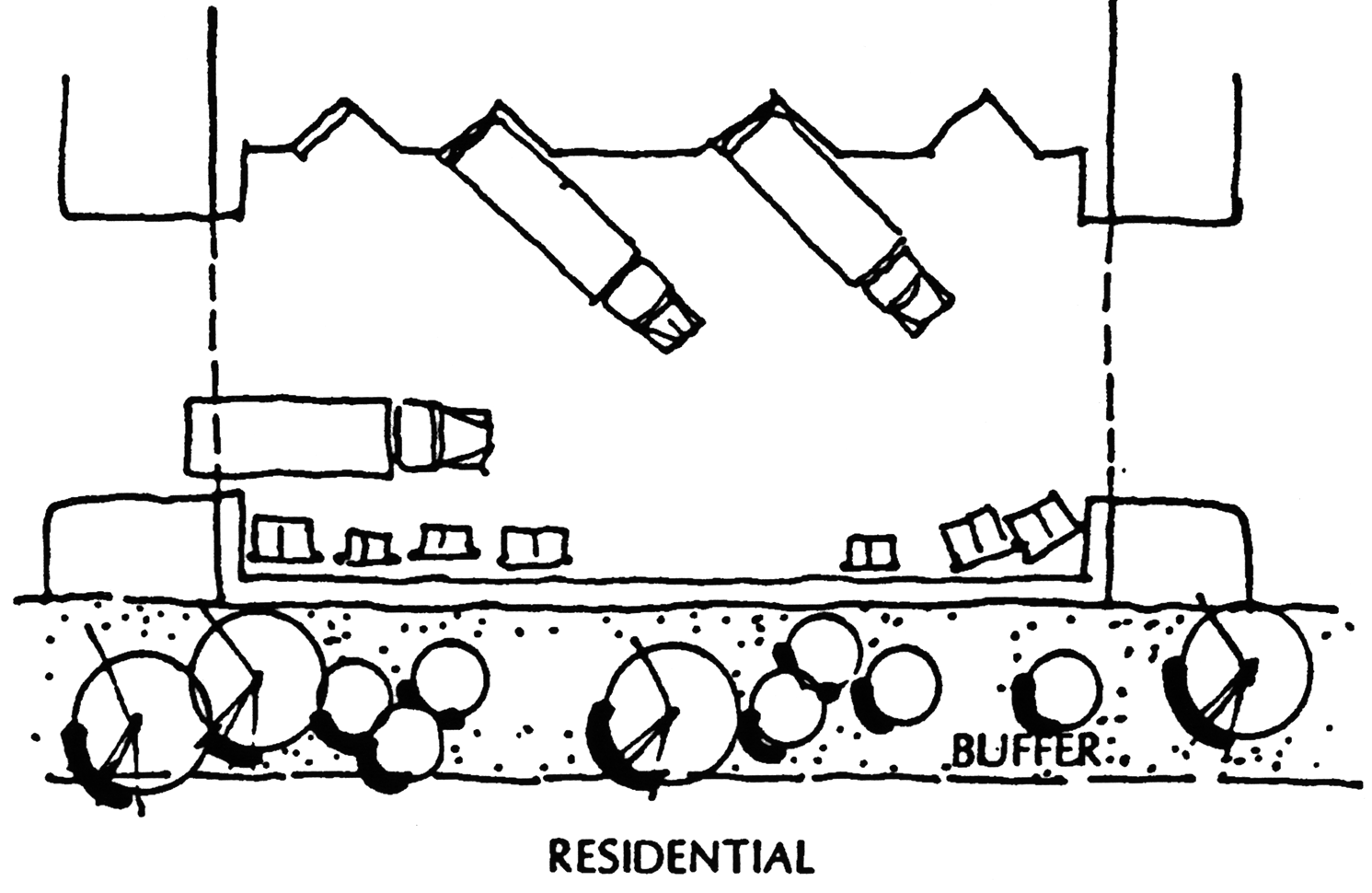
Figure 6.16, Buffering and Screening for Convenience Store
(Ord. No. 01-30, § 2, 11-15-01; Ord. No. 02-13, § 2, 8-1-02)
Sec. 6.11.31.- Correctional Facility
A.
General Standards
1.
All correctional facilities shall have direct frontage onto a roadway shown on the current MPO Long Range Transportation Cost Affordable Plan in effect at the time of Special Use Permit application.
2.
At the time of the request for approval, the operator of the correctional facility shall provide information on, and if approved, shall utilize adequate measures to prevent the unauthorized exit of the inmates. The more dangerous the inmates are to the public, the more elaborate and secure the security measures shall be.
3.
Buffers and screening shall be as required by 6.06.06.
4.
The facility shall comply with all applicable Federal, State and local requirements.
B.
Major Correctional Facilities
1.
The minimum lot size shall be five acres with minimum frontage of 200 feet.
2.
The structures occupied by the facility residents shall be located a minimum of 2,640 feet from any residential development or zoning district developed to or permitting a density of two units per acre or greater; 500 feet from any existing dwelling unit developed at a density of less than two units per acre and a minimum of 200 feet from any zoning lot boundary.
C.
Community Correctional Facilities
1.
The minimum lot size shall be one acre with a minimum frontage on a public street of 150 feet.
2.
All structures occupied by the facility residents shall be located a minimum of 200 feet from any existing adjacent dwelling unit or residential or agricultural zoning districts. All such structures shall be located a minimum of 30 feet from any zoning lot boundary if adjacent to zoning district other than residential or agricultural zoning districts.
(Ord. No. 02-13, § 2, 8-1-02; Ord. No. 03-9, § 2, 6-5-03)
Sec. 6.11.32.- Reserved
Editor's note— Ord. No. 09-62, Item E, adopted October 26, 2009, effective February 1, 2010, repealed § 6.11.32, which pertained to country club. See also the Table of Amendments.
Sec. 6.11.33.- Drive-In Theaters
A.
No part of any theater screen, projection booth, or other building shall be located closer than 500 feet from any residential district nor closer than 50 feet from any property line.
B.
The image on the theater screen shall not be visible from any arterial or collector street as defined under the Hillsborough County Functional Classification System.
C.
Queuing space within the lot shall be provided for patrons awaiting admission in an amount equal to 30 percent of the vehicular capacity of the theater.
D.
The following accessory uses may be permitted as incidental to, and limited to patrons of the principal use:
1.
Children's playground; and/or
2.
Refreshment stands or booths.
E.
The viewing area (parking area) shall be screened in such a manner that it cannot be observed from outside the property.
F.
All entrances and exits shall be separated, and internal circulation shall be laid out to provide one-way traffic flow.
G.
The minimum site area shall be five acres.
(Ord. No. 02-13, § 2, 8-1-02)
Sec. 6.11.34.- Dwelling Unit, Single Family Conventional and Mobile/Manufactured Home Next to Mining Operation
The use must be removed, and not replaced, at the time the site or the area within 250 feet of the residence is utilized for an active permitted mining operation.
(Ord. No. 02-13, § 2, 8-1-02)
Sec. 6.11.35.- Eating Establishment
A.
M District
Within the M District, the following standards shall be met:
1.
If the use is to be located within a building housing other uses, this use, plus any other use allowed in the district pursuant to 6.11.65, except Child Care Facilities, shall not occupy more than 25 percent of the building square footage. The remainder of the building shall be used for uses permitted in the district or a Child Care Facility.
2.
If the use is to be freestanding or within a building with less than 75 percent of the square footage occupied by permitted uses, the following locational requirements shall be met:
a.
The use shall be located either within a commercial node at the intersection of existing streets shown on the current MPO Long Range Transportation Cost Affordable Plan in effect at the time of the application or internally within the project.
b.
The nodes shall be separated from other nodes of similar convenience retail activity by no less than 2,500 feet, as measured along the shortest distance between property lines without regard to route of normal travel.
c.
The maximum gross building square footage of the eating establishment portion of each project shall be limited to 30,000 square feet.
d.
If located internally, the uses shall have limited visibility from adjacent streets or surrounding properties and shall have limited access to adjacent streets outside of the district.
B.
Drive-Through Service
Eating establishments providing drive-through service wherein a patron is served through a window or other device while remaining in a motor vehicle shall meet the following criteria:
1.
No order box used in the ordering of food or beverages from a drive-through window shall be located within 200 feet of any property zoned residential.
2.
A solid screening fence or wall, a minimum of six feet in height, shall be required to be placed between any property used for a drive-through facility and any abutting property zoned residential. The intent of this solid screening is to screen vehicular headlight glare from adjacent residential property.
3.
Adequate automobile stacking space will be provided from the order box to ensure that any public right-of-way or common vehicular use area will not be blocked by or utilized for vehicular stacking.
C.
Dog-Friendly Restaurants
Section 509.233, Florida Statutes, grants local governments the authority to establish a local exemption procedure to certain provisions of the Food and Drug Administration Food Code, as currently adopted by the Florida Division of Hotels and Restaurants of the Department of Business and Professional Regulation, in order to allow patrons' dogs within certain designated outdoor portions of public food service establishments. The procedure contained in this subsection provides permitting criteria to allow public food service establishments that meet the definitions of "Eating Establishment" in Chapter 12.01.00 of this Code to receive such an exemption. This section provides an exemption only from those portions of the currently adopted Food and Drug Administration Food Code in order to allow patrons' dogs within certain designated outdoor portions of Eating Establishments. No dog shall be in an Eating Establishment unless allowed by state law and the Eating Establishment has been issued and maintains an unexpired permit pursuant to this section allowing dogs in designated outdoor areas of the establishment. It shall be a violation of state law for Eating Establishments to allow dogs on their premises without first obtaining a permit pursuant to this section.
1.
Supplemental Requirements: Applicants may request a permit for a Dog Friendly Restaurant in accordance with Section 10.01.00 of this Code. In addition to the required information for conditional uses listed in the Development Review Procedures Manual, applications shall include the following information:
a.
Name, location, mailing address, and Division of Hotels and Restaurants-issued license number of the Eating Establishment.
b.
Name, mailing address, and telephone contact information of the permit applicant. The name, mailing address, and telephone contact information of the owner of the Eating Establishment shall be provided if the owner is not the permit applicant.
c.
A diagram and description of the outdoor area to be designated as available to patrons' dogs, including dimensions of the designated area; a depiction of the number and placement of tables, chairs and restaurant equipment, if any; the entryways and exits to the designated outdoor area; the boundaries of the designated area and of the other outdoor dining areas not available for patrons' dogs; any fences or other barriers; surrounding property lines and public rights-of-way, including sidewalks and common pathways; and such other information as is reasonably deemed necessary by the Administrator. The diagram shall be accurate and to scale but need not be prepared by a licensed design professional. A copy of the approved diagram shall be attached to the permit.
d.
A description of the days of the week and hours of operation that patrons' dogs will be permitted in the designated outdoor area.
2.
Eating Establishments that receive a permit for a designated outdoor area pursuant to this section shall require that:
a.
Employees shall wash their hands promptly after touching, petting, or otherwise handling any dog, and shall wash their hands before entering other parts of the Eating Establishment from the designated outdoor area.
b.
Employees are prohibited from touching, petting, or otherwise handling any dog while serving or carrying food or beverages or while handling or carrying tableware.
c.
Patrons in a designated outdoor area shall be advised by appropriate signage, at conspicuous locations, that they should wash their hands before eating. Waterless hand sanitizer shall be provided at all tables in the designated outdoor area.
d.
Patrons shall not leave their dogs unattended for any period of time. Patrons shall keep their dogs on a leash at all times and shall keep their dogs under reasonable control.
e.
Employees and patrons shall not allow dogs to come into contact with serving dishes, utensils, tableware, linens, paper products, or any other items involved with food service operations. Patrons shall be advised of this requirement by appropriate signage at conspicuous locations.
f.
Employees and patrons shall not allow any part of a dog to be on chairs, tables, or other furnishings.
g.
Between the seating of patrons, employees shall clean and sanitize all table and chair surfaces with a product registered and approved by the Environmental Protection Agency for use on food-contact surfaces.
h.
Employees shall remove all dropped food and spilled drink from the floor or ground as soon as possible, but in no event less frequently than between seating of patrons at the nearest table.
i.
Employees and patrons shall remove all dog waste immediately and the floor or ground shall be immediately cleaned and sanitized with a product registered approved by the Environmental Protection Agency for use on food-contact surfaces. The Eating Establishment shall keep a kit with the appropriate materials for this purpose near the designated outdoor area. Dog waste shall not be carried in or through indoor portions of the Eating Establishment.
j.
Ingress and egress to the designated outdoor area shall not require entrance into or passage through any indoor area or nondesignated outdoor portions of the Eating Establishment. Employees and patrons shall not permit dogs to be in, or to travel through, indoor or nondesignated outdoor portions of the Eating Establishment.
k.
A sign or signs notifying the public that the designated outdoor area is available for the use of patrons and patrons' dogs shall be posted in a conspicuous manner and place.
l.
A sign or signs informing patrons and employees of these laws shall be posted on premises in a conspicuous manner and place.
m.
The Eating Establishment and designated outdoor area shall comply with all permit conditions and the approved diagram.
n.
Employees and patrons shall not allow any dog to be in the designated outdoor areas of the Eating Establishment if the Eating Establishment is in violation of any of the requirements of this section.
o.
Permits shall be conspicuously displayed in the designated outdoor area.
3.
Violations: It shall be unlawful to fail to comply with any of the requirements of this section. Each failure to comply with the requirements of this section shall constitute a separate violation.
4.
Expiration and Revocation: A permit issued pursuant to this section shall expire automatically upon the sale of the Eating Establishment and cannot be transferred to a subsequent owner. The subsequent owner may apply for a permit pursuant to this section if the subsequent owner wishes to continue to allow patrons' dogs in a designated outdoor area of the Eating Establishment.
a.
A permit may be revoked by the Administrator if, after notice, the Eating Establishment fails to comply with any condition of approval, fails to comply with the approved diagram, fails to maintain any required state or local license, or is found to be in violation of any provision of this section. If the reason for revocation is a failure to maintain any required state or local license, the revocation may take effect immediately upon giving notice of revocation to the permit holder.
b.
If an Eating Establishment's permit is revoked, no new permit may be approved for the establishment until the expiration of 180 days following the date of revocation.
5.
Complaints and Reporting: Complaints may be made in writing to the Administrator. The Administrator shall timely accept, document, and respond to all complaints. The Administrator shall timely report to the Division of Hotels and Restaurants all complaints and the response to such complaints. Any dog bites that occur must be reported to Florida Department of Health - Hillsborough County.
The Administrator shall provide the Division of Hotels and Restaurants with a copy of all approved applications and permits issued.
All permits shall contain the Division of Hotels and Restaurants-issued license number for the Eating Establishment.
(Ord. No. 01-30, § 2, 11-15-01; Ord. No. 02-13, § 2, 8-1-02; Ord. No. 03-9, § 2, 6-5-03; Ord. No. 15-15, § 2(Exh. A), Item A.4(15-0497), 6-18-15, eff. 6-25-15)
Sec. 6.11.36.- Family Homestead
A.
The Family Homestead provision shall only be used to create a homestead once for any individual.
B.
A Family Homestead shall be allowed in the Rural land use categories of the Comprehensive Plan; that is, the A, AM, AR, and AE Comprehensive Plan categories.
C.
A Family Homestead shall be used only for an individual who is the grandparent, parent, stepchild, adopted parent, sibling, child, stepchild, adopted child or grandchild of the person who conveyed the parcel to the individual.
D.
The minimum size of the parent parcel to be homesteaded shall be that permitted by the Comprehensive Plan land use designation.
E.
A Family Homestead parcel shall be created by subdividing the parent parcel into a maximum three lots including the parent lot notwithstanding the density or intensity of use assigned to the parcel in the Comprehensive Plan. Lots shall be a minimum one acre and be developed in accordance with the schedule of area, height, bulk, and placement regulations for the parcel's zoning district. The subdivision of land shall be subject to the Subdivision Regulations of the Land Development Code. Approval of the subdivision shall be contingent upon the property owners of the lots created from the parent parcel filing, with the Administrator, within one year from the approval of the subdivision, proof that the property has been conveyed to them by the owner of the parent parcel.
(Ord. No. 02-13, § 2, 8-1-02)
Sec. 6.11.37.- Family Farm
A.
A Family Farm use as described in this section shall be allowed only in the A, A/R and A/M Comprehensive Plan categories and shall only be used for family members.
B.
The minimum lot size shall be five acres with a minimum width of 150 feet.
C.
A bona fide agricultural use shall exist on site, as defined by uses listed under "Agricultural and Related Uses".
D.
Dwelling units on site shall be the permanent residences of those persons in residence on the Family Farm.
E.
Densities may exceed those allowed by the Comprehensive Plan but shall not exceed one dwelling unit per acre.
F.
Properties used as Family Farms shall not be subdivided.
(Ord. No. 02-13, § 2, 8-1-02)
Sec. 6.11.38.- Family Lot
A.
This use shall be allowed in the Residential Planned-2 Comprehensive Plan category.
B.
The minimum lot size shall be one acre in Residential Planned-2 shall meet the required lot width of the corresponding zoning district in which it is located.
C.
The lot(s) shall be for the use of immediate family members of the owner of the original tract only. Immediate family shall mean siblings, parents, grandparents, and children. The lot(s) shall be their primary residence.
D.
Subdivision of the land is not required. However, the division of the lots shall be recorded by separate deeds and, if more than one lot is divided from the parent lot, the subdivision requirements of the Land Development Code, as amended, shall be met as set forth in 5.01.00.
E.
Each lot shall have direct access to a public street, an approved private street or access to said streets by an access easement. See also 6.01.03.
F.
Densities shall be limited to the maximum gross density permitted in each respective plan category.
G.
The Family Lot provision shall only be used by a property owner once for each relative. If a lot is provided under this provision to, for example, the eldest son, the eldest son may not receive another lot under this provision from the property owner anywhere in Hillsborough County.
(Ord. No. 00-21, § 2, 5-18-00; Ord. No. 02-13, § 2, 8-1-02)
Sec. 6.11.39.- Farm Worker Housing
A.
Location
1.
Farm worker housing may be provided on-site or off-site from a commercially productive farm, however, off-site housing not located in the AM, A, AR, AE, Res-1, RP-2 Land Use Plan categories shall be located within one mile of the site of a commercially productive farm.
2.
Farm worker housing proposed in suburban or urban plan categories allowing four units per acre or less, shall be permitted a density bonus of two units per acre. Otherwise, overall project density in suburban or urban plan categories shall not exceed that of the underlying plan category.
B.
Farm worker housing in rural and agricultural plan categories shall be limited to eight units per acre. Density shall be calculated based upon the acreage of the area described by the legal description submitted with the farm worker housing application. The subdivision of land into individual parcels shall be prohibited.
C.
Single-family conventional, manufactured home, duplex, or multi-family dwelling units or dormitories may be used. Dormitories, for purposes of density calculations, shall be calculated at 7 residents equaling one unit.
D.
Site Requirements
1.
Farm worker housing sites, which includes, but is not limited to, housing, parking areas, athletic fields, and/or storage structures shall provide required front, side, and rear yards of 50 feet. Notwithstanding, internal project driveways may be located in required yards in any of the following scenarios:
a.
When adjacent to a public roadway;
b.
When adjacent to property that is under common ownership with the farmworker housing site;
c.
If no other reasonable means of access exists to the farmworker housing site;
d.
To avoid impacts to environmentally sensitive areas.
2.
When farm worker housing structures or improvements are located less than 200 feet from the zoning lot line and, residential structures on properties under different ownership are present within 300 feet of the farm worker housing structures or improvements, screening equal to that specified under Section 6.06.06 shall be provided. However, screening shall not be required in such cases for storm water facilities serving the farm worker housing.
3.
All structures containing dwelling units shall be located a minimum of ten feet apart.
4.
All access drives serving the farm worker housing site shall be packed shell, gravel, or a similar material which will provide a relatively dust free surface.
5.
All farm worker housing shall provide adequate sewage disposal and water supply systems which meet all Federal, State, and local requirements.
6.
All farm worker housing shall be maintained in a neat, orderly and safe manner.
7.
External sidewalks shall not be required when the farm worker housing is located in the Rural Area. Internal sidewalks may be adjacent to parking areas or along internal driveway/access. Sidewalks may consist of packed shell, gravel, or similar material that allows for accessibility in accordance with the Americans with Disability Act (ADA). A clear visual or physical delineation shall be provided between the internal driveways and sidewalks.
8.
All farm worker housing shall provide 1 parking space per unit. Spaces shall be permitted to be located individually or aggregated in a consolidated area. Surface material may be packed shell, gravel, or similar material. One accessible space shall be provided for the project that complies with the requirements of the Americans with Disabilities Act (ADA). If dormitories are utilized, parking requirements shall be 1 space per 7 farm workers.
9.
If the farm worker housing project is located within a farm, all of the farm area or acreage shall be allowed to be utilized for drainage/stormwater calculations requirements.
10.
Landscaping and parking lot lighting shall not be required.
11.
County rights-of-way or access improvements shall not be required for farm worker housing projects. Notwithstanding, applicable access improvements required for emergency response access shall be required.
E.
Occupancy
1.
Beginning May 25, 2022, property owners or housing providers shall maintain records of approved Health Department Migrant Labor Camp or Residential Migrant Housing permits, or successor permits, to demonstrate that the project is limited to housing for farm workers or their dependents only. The records shall be kept for a minimum of three years and shall be made available upon request for inspection by Hillsborough County with[in] 14 days of such request.
2.
Notwithstanding any other provision of this Code, occupancy limits for the farm worker housing shall be regulated by the Health Department Migrant Labor Camp or Residential Migrant Housing permits standards in accordance with FL Chapter 64E.14 as amended.
3.
If for any reason the housing is no longer intended to serve farm workers or their dependents only, the dwelling units which exceed the density of the Comprehensive Plan must be removed within 90 days of written notification from the County, or certain units may remain if converted for sale or rent as Affordable Housing in accordance with all applicable Land Development Code regulations.
4.
Prior approval of a farm worker housing permit through a conditional use, variance, or special use process shall not be used as a precedent for an increase in density on either all or a portion of the property as part of any future rezoning petition.
F.
Conditional Use Permit (Administrative Review)
1.
All farm worker housing projects located in the agricultural and rural land use categories shall be administratively reviewed in accordance with the procedures found in Part 10.01.00 of this Code. Approval shall be subject to compliance with all requirements of this Section and other applicable regulations of this Code.
2.
Site Development plan reviews shall be permitted to be filed and processed concurrently with the Conditional Use permit review.
3.
If a project does not conform with the requirements of this Section, the project shall be reviewed as a Special Use in accordance with the procedures and requirements described in Section G.
G.
Special Use Permit
1.
All farm worker housing in the suburban and urban future land use plan categories shall be reviewed in accordance with the procedures for a Special Use Permit in Part 10.02.00 of this Code.
2.
Factors to be Considered
The project shall comply with requirements A through E of this section and with other applicable regulations of this Code. Additionally, if the project is located in suburban or urban future land use categories, the Land Use Hearing Officer shall be required to make a finding of compatibility of the proposed farm worker housing with existing and planned land uses as stipulated in the Future of Hillsborough Comprehensive Plan. In making a determination of compatibility, the Land Use Hearing Officer shall consider the following:
a.
The nature of existing and planned land uses.
b.
Compatibility with the development and character of the existing neighborhood.
c.
The number of acres, the number of units, and the overall density of the proposed farm worker housing development.
d.
The effect of increased traffic generation on existing and planned land uses.
e.
The availability of and proximity to schools, hospitals and other health care facilities, transportation to and from employment, social services, retail activities, and recreational uses such as parks and playgrounds to the residents of a farm worker housing project and their family members.
3.
Imposition of Reasonable Conditions
If necessary to mitigate the impact of the farm worker housing on residential land uses in the area, reasonable conditions upon the farm worker housing project designed to mitigate the impact of the farm worker housing on residential land uses in the area may be imposed by the Land Use Hearing Officer.
(Ord. No. 97-18, § 2, 12-18-97; Ord. No. 00-21, § 2, 5-18-00; Ord. No. 02-13, § 2, 8-1-02; Ord. No. 03-9, § 2, 6-5-03; Ord. No. 05-10, § 2, 6-16-05, eff. 10-1-05; Ord. No. 10-9, § 2, Item H(10-0177), 5-27-10, eff. 10-1-10; Ord. No. 22-12, § 2(Exh. A), 5-19-22, eff. 5-25-22; Ord. No. 23-21, § 1(Exh. A), 11-2-23, eff. 11-7-23)
Sec. 6.11.40.- Firing Range, Small Arms, Indoor
A.
The use shall not constitute a nuisance or be a hazard to life or property as determined by Hillsborough County.
B.
The noise level shall not exceed 55 dBA at the property boundary.
C.
The hours of operation shall be between 9:00 a.m. and 7:00 p.m.
D.
The design and safety standards of the National Rifle Association shall be met.
(Ord. No. 02-13, § 2, 8-1-02)
Sec. 6.11.41.- Firing Range, Small Arms, Outdoor
A.
The minimum size of the site shall be 20 acres.
B.
The maximum caliber for rifled barrels used on the range shall be .45 and for non-rifled barrel shall be 12 gauge.
C.
A projectile-proof backstop, consisting of concrete, steel, earth or a combination thereof, at least 15 feet high shall be erected and maintained behind all target areas.
D.
The use shall not constitute a nuisance or be a hazard to life or property as determined by Hillsborough County.
E.
The noise level shall not exceed 55 dBA at the property boundary.
F.
The hours of operation shall be between 9:00 a.m. and 7:00 p.m.
G.
The design and safety standards of the National Rifle Association, The National Skeet Shooting Association, and the Amateur Trap Shooting Association shall be met.
H.
This use shall be permitted only where no more than 15 percent of the adjoining residentially zoned land located within 1,000 feet is developed into lots.
(Ord. No. 02-13, § 2, 8-1-02)
Sec. 6.11.42.- Flea Markets
This use shall not be permitted abutting a residential zoning district.
(Ord. No. 02-13, § 2, 8-1-02)
Sec. 6.11.43.- Garage, Yard, Etc. Sales
Garage, yard, tag, patio and apartment sales are specifically permitted, as an accessory use, in all residential districts. Such sales shall be limited to one during each six-month period, for a duration not to exceed three days.
(Ord. No. 02-13, § 2, 8-1-02)
Sec. 6.11.44.- Gas Station
A.
The use shall have direct access to an existing arterial or collector roadway shown on the current MPO Long Range Transportation Cost Affordable Plan Map in effect at the time of the application, except where it is part of a nonresidential development where access is provided by a parallel access road or reverse frontage road where nonresidential uses will be on both sides of the street.
B.
Where the use abuts residentially zoned property, a minimum 20 foot buffer shall be provided. Said buffer shall include a masonry wall, six feet in height and architecturally finished on both sides, and a row of evergreen trees, excluding exempted trees, which are not less than six feet high at the time of planting and are spaced not more than 20 feet apart. No more than ten feet of the width of said 20 foot buffer shall be utilized as a retention area.
C.
All gasoline stations abutting residentially zoned property shall use the same architectural materials (excluding windows) on all sides of the building.
D.
All outdoor lighting shall be directional and shall not shine directly onto adjacent properties.
E.
The canopies provided over the pump islands at gas stations and service stations shall meet the yard requirements of a principal structure. However, if the following requirements can be met, the canopy may intrude a limited amount into a front yard:
1.
The outside edge of the canopy may intrude up to ten feet into the required front yard as measured from the rear of the required front yard.
2.
Pump islands, their surrounding structures and the canopy support structures may encroach up to ten feet into the required front yard provided that traffic movements between the pump island and the street right-of-way are restricted to one-way.
3.
Neither the canopy nor the pump islands shall block visibility at intersections of rights-of-way or drives.
F.
All repair services shall be performed within a completely enclosed building.
G.
No more than three vehicle parking spaces per service bay plus one space per employee shall be permitted.
H.
All storage of vehicles awaiting needed parts shall be within the building or completely screened from off-site view in a yard.
I.
All damaged or nonoperable parts shall be stored indoors until removed from the premises.
J.
A gas station shall store all vehicle parts within a completely enclosed building.
(Ord. No. 01-30, § 2, 11-15-01; Ord. No. 02-13, § 2, 8-1-02)
Sec. 6.11.45.- Golf Driving Ranges
A.
The site shall be of such configuration so as to permit a minimum driving distance of 300 yards from each proposed tee.
B.
A site plan of the facility shall be submitted showing the layout of the property with all fairways, roughs, greens, structures, off-street parking areas, fencing and proposed plant materials and location.
C.
Lighting used at the site shall be designed, located and constructed so as to prevent glare and minimize reflection onto neighboring property.
D.
Minimum required yards on all sides of a golf driving range shall be 50 feet.
E.
Dimensional requirements of a golf driving range shall be as generally illustrated in Figure 2.1.
F.
Baseball hitting cages, miniature golf and putting greens shall be permitted accessory uses.
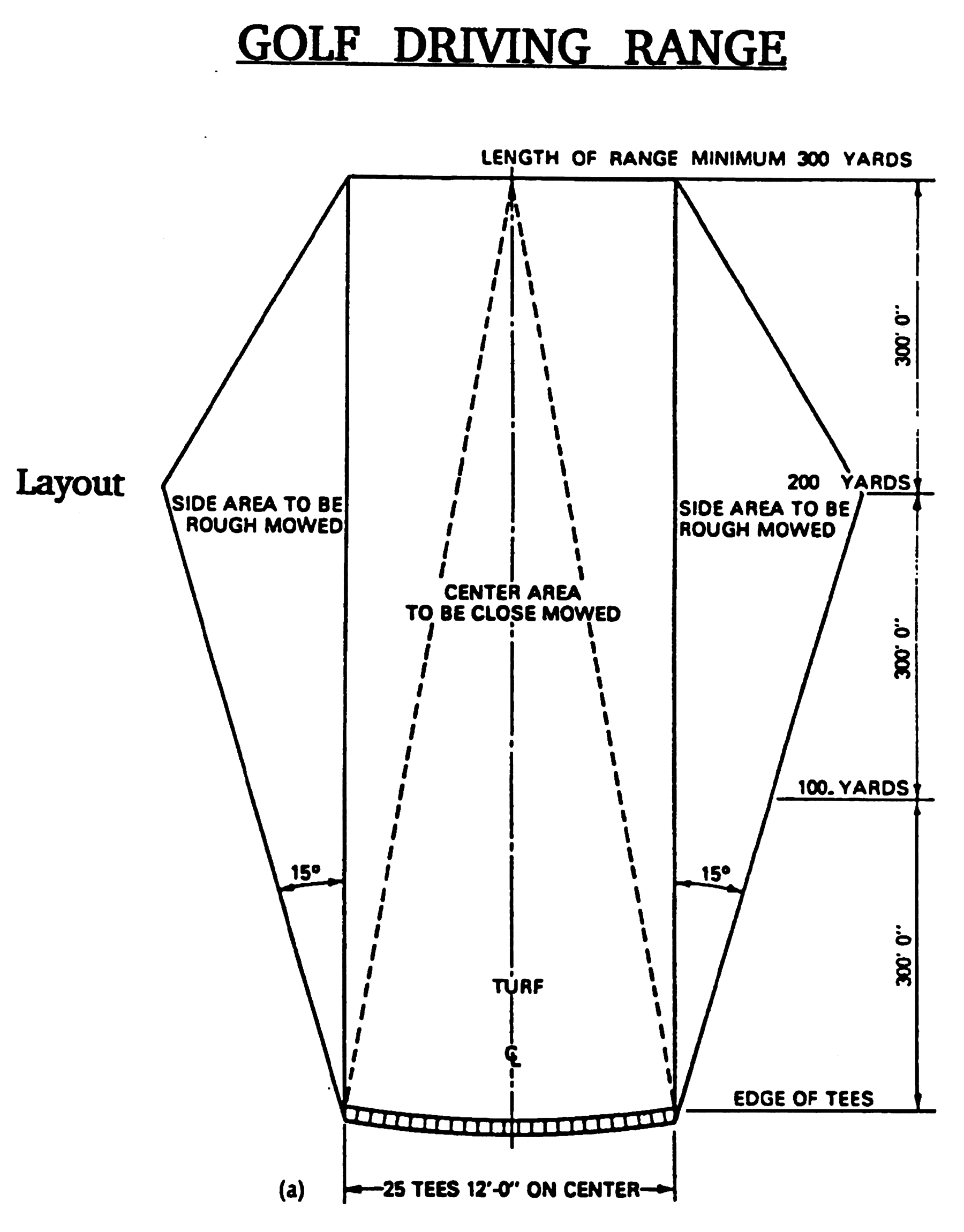
Figure 2.1, Golf Driving Range
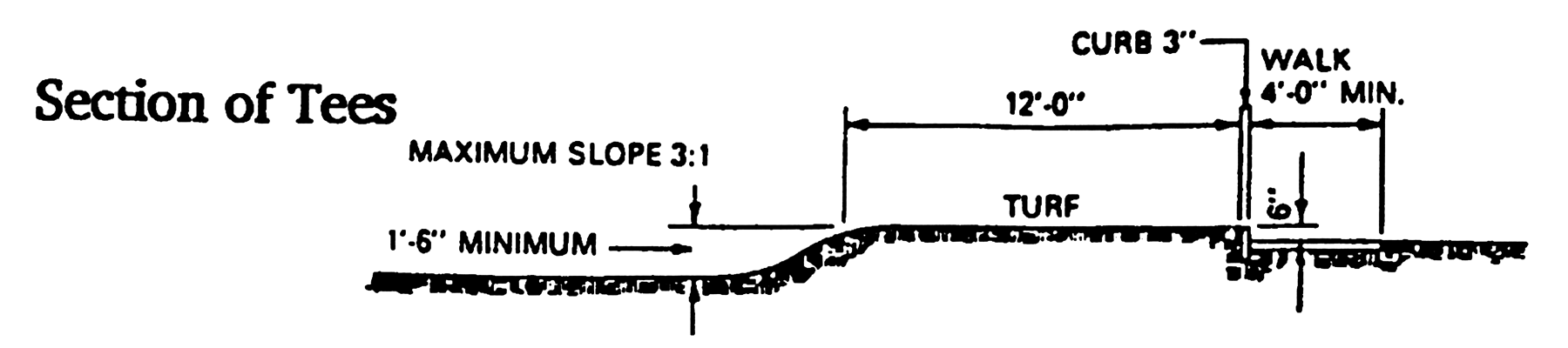
Figure 2.2, Section of Tees
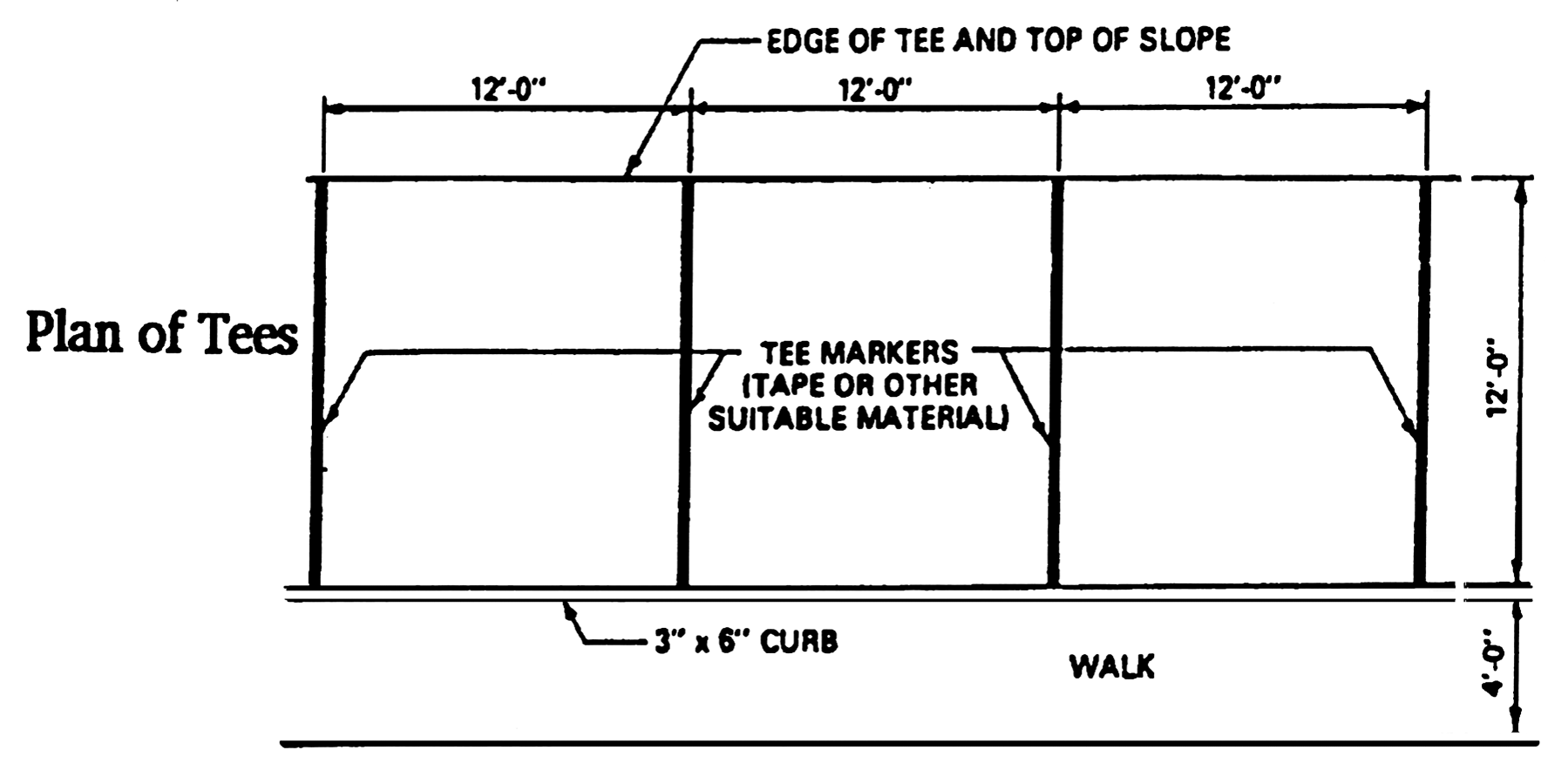
Figure 2.3, Plan of Tees
(Ord. No. 02-13, § 2, 8-1-02)
Sec. 6.11.46.- Heliport
A.
Landing and take-off areas shall be located a minimum of 150 feet from any zoning lot boundary and a minimum of 500 feet from any dwelling unit or residentially zoned property.
B.
All storage and repair shall be conducted in enclosed buildings.
C.
Hangars and repair facilities shall be set back at least 150 feet from any zoning lot boundary and all other buildings shall be set back at least 50 feet from any zoning lot boundary.
(Ord. No. 02-13, § 2, 8-1-02)
Sec. 6.11.47.- Helistop, Private Use
A private use helistop exists exclusively for the use of the owner and persons authorized by the owner. No refueling or repair is permitted at such helistops. Only helicopter storage, take-off, and landing are allowed. The helistop's landing and take-off area shall be centered a minimum of 500 feet from any dwelling unit or residentially zoned property; however, this distance separation requirement does not apply to dwellings or other structures that are located on the applicant's property. Further, the 500-foot setback from any dwelling unit or residentially zoned property shall not apply to owners within the Planned Development (PD) who have joined in the application.
If the applicant cannot satisfy the 500-foot distance separation, it may also seek approval for a helistop in one of three ways: (a) in conjunction with rezoning to a PD or other zoning district in which helistops are permitted; (b) as a Major Modification to an existing PD; or (c) through application for a Special Use, if the proposed helistop is located in a zoning district that allows helistops as a conditional use and is located on a parcel three acres or more in size.
In considering a helistop as a Special Use, a Major Modification to a PD, or in conjunction with a rezoning before the Land Use Hearing Officer and/or the Board of County Commissioners, the applicant shall demonstrate compatibility and consistency with the Comprehensive Plan through the following mitigating factors:
1.
Natural or constructed buffers on, or near, the applicant's property, including but not limited to a river, lake, bay, floodplain, railroad, highway, farm or grove;
2.
The size of the parcel on which the helistop is located;
3.
The relationship of a proposed helistop to a neighboring dwelling or a residentially zoned property and the general compatibility with the existing neighborhood;
4.
The nature and type of surrounding uses;
5.
The imposition of conditions on the applicant's helistop, including but not limited to, a limitation on the hours of operation, enhanced buffering for sight and noise, or a required flight path or direction for helicopter take-off and landing; and
6.
Other additional factors the applicant may present.
(Ord. No. 02-13, § 2, 8-1-02; Ord. No. 05-10, § 2, 6-16-05, eff. 10-1-05)
Sec. 6.11.48.- Home-Based Businesses
Home-based businesses shall comply with the following requirements. Approval of a zoning permit is not required for a home-based business that operates in compliance with these requirements, except that if approval of a Conditional Use permit or Special Use permit is required by this Code in any zoning district for a business of similar nature as the proposed home-based business, like-kind approval of the most stringent applicable permit shall be required for the home-based business. In cases where a Conditional Use permit is required in some zoning districts for the similar type of business and Special Use permit is required in other districts for that type of business, approval of a Special Use permit shall be required for the home-based business. Additionally, the provisions of this section do not obviate the need for the home-based business to comply with all other applicable rules and regulations, including, but not limited to, the Wellhead and Surface Water Resource Protection Requirements of Part 3.05.00 of this Code, the Florida Building Code, Florida Accessibility Code and Florida Fire Protection Code.
A.
The home-based business shall be located on property that is zoned for residential use and developed with a residential dwelling.
B.
The business activities shall be secondary to the property's use for a residential dwelling.
C.
All employees of the home based-business who work in the residential dwelling shall reside in that dwelling, except that a maximum of two employees or two independent contractors who do not reside in the dwelling may work at the home-based business. The business may have additional off-site employees who do not work at the location of the residential dwelling. Off-site employees may not visit the home-based business for any reason connected with the business.
D.
Parking related to the home-based business activities shall comply with the parking requirements of Part 6.05.00 of this Code; however, the business shall not generate a need for parking, per the requirements of this Code, that exceeds the volume expected at a similar residence where no business is conducted Additionally, vehicles and trailers used in connection with the business must be parked in legal parking spaces that are not located within street rights-of-way, on or over sidewalks, or on any unimproved surfaces on the residential parcel.
E.
The parking and/or storage of commercial, industrial and agricultural vehicles, equipment and machinery at the home-based business which is visible from the street or neighboring properties shall be allowed where permitted by the requirements of this Code.
F.
As viewed from the street, the use of the residential property for the home-based business shall be consistent with the uses of the residential areas that surround the property. External modifications made to a residential dwelling to accommodate a home-based business must conform to the residential character and architectural aesthetics of the neighborhood and the requirements of this Code.
G.
Walk-up retail transactions at the home-based business shall occur only in the residential dwelling. Incidental business uses and activities may occur elsewhere on the residential property.
H.
Signs for the home-based business shall comply with the requirements of this Code.
I.
Nothing shall be allowed in connection with the home-based business which is offensive or obnoxious by reason of the emission of odors, liquids, gases, dust, smoke, vibration or noise.
J.
These regulations shall not supersede the requirements of this Code related to the rental or occupancy of dwelling units or portions thereof.
(Ord. No. 21-41, § 2(Exh. A), 10-21-21, eff. 10-28-21)
Secs. 6.11.48.01.—6.11.48.05.- Reserved
Editor's note— Ord. No. 21-41, § 2(Exh. A), adopted Oct. 21, 2021, effective Oct. 28. 2021, repealed §§ 6.11.48.01.—6.11.48.05., which pertained to intent, purpose and applicability; review procedures; standards for all home-based businesses; residential home-based business standards; and agricultural home-based business standards; and derived from Ord. No. 09-53, Item M, adopted June 11, 2009, effective Oct. 1, 2009; and Ord. No. 11-19, § 2(Item V-C)(11-0712), adopted Nov. 3, 2011, effective Feb. 1, 2012.
Sec. 6.11.49.- Reserved
Editor's note— Ord. No. 21-41, § 2(Exh. A), adopted Oct. 21, 2021, effective Oct. 28. 2021, repealed § 6.11.49, which pertained to home swimming instructions, and derived from Ord. No. 02-13, § 2, adopted Aug. 1, 2002.
Sec. 6.11.50.- Hotel/Motel
A.
Within the M and SPI-AP districts, the use shall be located within 660 feet of an intersection of collector or arterial streets as shown on the Major Street Map. The measurements shall be taken from the nearest edge of right-of-way at the nearest point of intersection.
B.
Within the M and SPI-AP districts, the use shall not exceed 50 percent of the acreage or square feet of the total industrial project.
C.
In the PD-RP district, hotel/motel buildings' square footage shall not exceed 25 percent of the total gross building square footage. If a proposed PD-RP district is within one-half mile of an expressway interchange, the hotel/motel square footage may be increased to 50 percent of the total gross building square footage.
(Ord. No. 00-21, § 2, 5-18-00; Ord. No. 02-13, § 2, 8-1-02)
Sec. 6.11.51.- Housing for Older Persons
In determining whether housing may be considered for special consideration under the terms of this Land Development Code as Housing for Older Persons (also known as Elderly Housing), the Administrator may consult with the Community Improvement Department or the County Attorney, as appropriate. The Administrator shall consider, at minimum, the following criteria:
A.
Significant facilities and services specifically designed to meet the physical or social needs of older persons exist or, if the provision of such facilities and services is not practicable, such housing is found to be necessary to provide important housing opportunities for older persons; and
B.
At least 80 percent of the units are occupied by at least one person 55 years of age or older per unit; and
C.
Policies and procedures are published and adhered to which demonstrate an intent by the owner or manager to provide housing for persons 55 years of age or older; and
D.
Unoccupied units are reserved for occupancy by persons who meet the age requirements set forth in the definition of Housing for Older Persons.
(Ord. No. 02-13, § 2, 8-1-02; Ord. No. 03-9, § 2, 6-5-03)
Sec. 6.11.52.- Kennel
A.
The disposal of all feces and other solid waste generated by the kennel operation shall be reviewed and approved by the Health Department.
B.
All runs and kennel areas shall be fenced with chain link, solid wood fencing or a masonry wall. The fence or wall shall be of quality material and be neat in appearance.
C.
Any training of animals shall not include the use of loud noises or produce smoke or odor.
D.
Humane Society of the United States (HSUS) Guidelines shall be used, at a minimum, for the flooring, walls between kennels, drainage, heating and cooling, cage sizes and runs.
E.
The kennel facility shall not generate adverse off-site noise or odor impacts.
F.
All outdoor runs shall be a minimum of 150 feet from any residential zoning district and all exercise areas shall be 50 feet from any residential zoning district.
G.
The grooming of animals in the kennel and, on a limited basis, the grooming of pets not kept at the kennel shall be considered a permitted accessory use. The sale of accessories and equipment for pets such as pet food, collars, toys, carriers and other such items shall not be permitted, except when the kennel is located in a commercial zoning district and such sales are incidental to the primary kennel activity.
H.
Minimum required parking shall be 2.0 spaces per 1,000 gross square feet.
(Ord. No. 02-13, § 2, 8-1-02; Ord. No. 08-15, § 2, 6-12-08, eff. 10-1-08; Ord. No. 22-12, § 2(Exh. A), 5-19-22, eff. 5-25-22)
Sec. 6.11.53.- Land Application Disposal
A.
Generally
The application for and approval of a Land Application Disposal Use pursuant to the Procedure for Issuance of a Development Order at Section 10.01.00, 10.02.00 or 10.03.00 shall be subject to the following standards. This section shall not apply to the land application of agricultural animal wastes or biosolids in a manner that is not regulated by the Department of Environmental Protection.
B.
Standards
1.
Federal and State Regulations
Land application disposal shall meet all relevant Federal and State regulations. The minimum standards for the land application disposal of biosolids shall be pursuant to Chapter 62-640, FAC, as amended, and as authorized and monitored by the EPC of Hillsborough County.
2.
Operation Standards
The operator of the land application disposal activity shall be responsible for using site management practices pursuant to Chapter 62-640, FAC, as amended. Land application of septage, either alone or in combination with other material, is prohibited. Septage management facilities as defined in Chapter 62-640.200, FAC, as amended, which hold current permits or authorizations issued as of October 19, 2017 by the Florida Department of Health or Florida Department of Environmental Protection (or by the Environmental Protection Commission of Hillsborough County through its authority delegated by the Florida Department of Environmental Protection), shall be deemed legal nonconforming uses and may continue operations pursuant to the requirements of Section 11.03.06 of the Land Development Code.
3.
Locational Criteria
a.
Where Allowed
Land Application Disposal shall be permitted in AM, A, AR, AS-0.4, AS-1, ASC-1, Al and M zoning districts and Planned Developments expressly permitting biosolids application. No new sites shall be permitted in Wellhead Resource Protection Areas. A minimum unsaturated soil depth of three feet is required between the land surface and the water table level as determined by the seasonal high ground water level.
b.
Minimum Size
Minimum lot size for application sites shall be 15 acres.
c.
Buffer/Setback Standards
Land application disposal sites shall not be located closer than 3000 feet to any Class I water body, Outstanding Florida Water or 1000 feet to any Outstanding National Resource Water, or 200 feet from any other surface water of the state as defined in Section 403.031, F.S. This setback does not apply to waters owned entirely by one person other than the state, nor to canals or bodies of water used for irrigation or drainage, which are located completely within the application site and will not discharge from the application site. The setback area shall be vegetated. The 200 foot setback distance from surface waters shall be reduced to 100 feet if the biosolids are injected or incorporated into the soil. The biosolids land application zone shall not be located closer than 300 feet from any private drinking water supply well or 500 feet from any public drinking water supply well. Additionally, the land application boundary shall be located not less than 200 feet from the land application area property line.
d.
Access Standards
The Administrator or Land Use Hearing Officer may, at his or her discretion and upon a finding of fact, impose conditions regulating access to land application disposal sites. Such conditions, if any, shall consider traffic volume and type, access road condition and configuration, traffic operations, safety and surrounding development.
C.
Procedures for Consideration of Land Application Disposal Permit
1.
Land Application Disposal sites permitted by the State prior to January 31, 1990 may be treated as legal non-conforming uses in accordance with Part 11.03.01 of this Code.
2.
Applications for Land Application Disposal sites permitted by the State between February 1, 1990 and September 8, 1998 and located in AM, A, AR, AS-0.4, AS-1, ASC-1, Al and M zoning districts shall be filed and reviewed in accordance with part 10.01.00 of this Code.
3.
Applications for Land Application Disposal sites permitted by the State after January 31, 1990 and located in Planned Development districts not expressly permitting the application of biosolids shall be filed and reviewed in accordance with Part 10.03.00 of this Code.
4.
Applications for Land Application Disposal Permits to be established after September 8, 1998 shall be filed and reviewed in accordance with Part 10.01.00 of this Code provided:
a.
Sites located in AM, A, AR, AS-0.4, AS-1, ASC-1, Al and M zoning districts or Planned Development districts expressly permitting the application of biosolids have a minimum of 100 acres or
b.
Sites located in the districts identified in Subsection 4.a. have a minimum of 40 acres and can provide a biosolids application area no less than 500 feet from residentially zoned districts and existing residences.
5.
Applications for Land Application Disposal sites to be established after September 8, 1998 located in AM, A, AR, AS-0.4, AS-1, ASC-1, Al and M zoning districts that do not meet the requirements stated in Subsection C.4, above shall be filed and reviewed in accordance with Part 10.02.00 of this Code as a Special Use.
6.
On-site wastewater treatment plants shall be considered a separate use and shall be permitted separately.
D.
Submittals
All applications for Land Application Disposal Permits shall include a site plan as described in the Development Review Manual.
E.
Length of Permit
Any initial permit shall be granted for a period not to exceed two years. Subsequent renewal permits shall be granted for a period not to exceed three years. Applications for renewal shall be processed in the same manner as the application for initial permit.
(Ord. No. 98-46, § 2, 9-8-98; Ord. No. 02-13, § 2, 8-1-02; Ord. No. 04-27, § 2, 6-10-04; Ord. No. 17-28, § 2(Exh. A), 10-19-17, eff. 10-26-17)
Sec. 6.11.54.- Land Excavation
The purpose of these regulations is to protect the public health, safety and welfare and community character from the adverse impacts generated by land excavations, such as but not limited to noise, dust, vibrations, water table drawdown and truck traffic, through the establishment of regulations for the location and operation of land excavations. It is intended these regulations be utilized in concert with the land excavation operating standards found in Part 8.01.00 of this Code. However, approval of a Special Use Land Excavation Permit shall not guarantee that an Operating Permit will be approved.
It is further intended that where these regulations make special provisions for land excavations for the purpose of agricultural irrigation that are authorized by the Southwest Florida Water Management District (SWFWMD) or Florida Department of Environmental Protection (FDEP), those provisions shall cease to be in effect in the event that SWFWMD or FDEP no longer issues such authorizations and the excavations shall comply with all standard requirements of this Section and Section 6.11.117.
A.
Locational Criteria
1.
Where Allowed for Consideration
a.
Lake creations, lake cleaning and stockpile removal may be considered in all zoning districts.
b.
"Dry" land excavations may be considered only in the following districts:
(1)
AM, A, AR, A-I, BPO, CN, CG, CI, M, SPI-UC-2, SPI-AP-1, SPI-AP-2, SPI-AP-3, SPI-AP-4, SPI-AP-5 and SPI-AP-V.
c.
Agricultural reservoirs permitted in accordance with Section 6.11.117 of this Code may be considered in all agricultural zoning districts.
2.
Required Separations
All excavated areas, with the exception of perimeter ditches and recharge ditches, shall meet the following separation requirements. All separations shall be measured in a straight line along the shortest distance from the edge of the excavated areas to the applicable right-of-way lines, boundary lines, property lines and conservation/preservation area lines, irrespective of any intervening properties and natural or man-made features.
a.
Twenty-five feet from any right-of-way line of a publicly owned road or street, except for "dry" land excavations which shall be 150 feet from any publicly-owned local road or street and 200 feet from any right-of-way line of a publicly-owned arterial or collector.
b.
Twenty-five feet from the boundary line of any publicly owned drainage or utility easement.
c.
Twenty-five feet from any non-residential property line, including agricultural use.
d.
Five hundred feet from any residentially developed or residentially zoned property line.
e.
One thousand feet from any school, hospital or church property line.
f.
Thirty feet from any wetland/waterbody Conservation Area line and 50 feet from any wetland/waterbody Preservation Area line, whether off site or on site (see definition of Environmentally Sensitive Area). Greater separations may be required by the Environmental Protection Commission of Hillsborough County depending on the environmental sensitivity of the area.
3.
Access
a.
Land excavations shall be located on sites which:
(1)
Have direct access to the receiving site of the excavated materials; or,
(2)
Have direct access to a road shown on the current Truck Route Plan; or,
(3)
Have direct access to a collector or arterial roadway, as shown on the current Roadway Functional Classification Map in the Hillsborough County Comprehensive Plan, within one mile of a road shown on the current Truck Route Plan as measured from the project driveway; or,
(4)
Have direct access to a collector or arterial roadway, as shown on the current Roadway Functional Classification Map in the Hillsborough County Comprehensive Plan, meeting Current Hillsborough County or FDOT Roadway Technical Manual standards for that portion of the haul route from the project driveway to the first road shown on the current Truck Route Plan; or,
(5)
Are within an approved subdivision or site development project under construction; or
(6)
Are adjacent to a public project such as a new road corridor or storm water utility improvement; or,
(7)
Are zoned A or AM.
Additionally, site specific analysis must be performed to determine if a proposed land excavation meets all other locational, environmental and compatibility requirements.
4.
Mitigation of Impacts
a.
Conditions pertaining to techniques to mitigate the impacts of offsite hauling on approved haul routes may include, but are not limited to, the following:
(1)
Restrictions on the route(s) utilized for off-site hauling and the days and/or hours hauling is permitted.
(2)
A method approved by Hillsborough County to document and/or monitor existing physical conditions of the approved haul route, including but not limited to, video recording or pavement structure testing which conform with County specifications. Alternatively, the applicant may post a form of financial security as determined by Hillsborough County.
(3)
Contribution by the applicant to Hillsborough County for up to the full cost of road improvements on the haul route where improvements are needed prior to hauling to accommodate the activity, as determined by the County.
(4)
Contribution by the applicant to Hillsborough County for up to the full cost of road repairs on portions of the haul route damaged during excavation operations, as determined by the County.
b.
Land excavation operations shall be limited to the hours from 7:00 a.m. to 6:00 p.m. Monday through Saturday, excluding holidays recognized by Hillsborough County. No operations shall be permitted on Sunday. Further restrictions may be imposed on the hours and/or days of operation of any land excavation when necessary to protect the public health, safety and welfare, promote community compatibility or lessen cumulative impacts. Requests to allow operations on days and/or times other than those described above shall be approved only if the applicant can demonstrate the proposed operations schedule is necessary to relieve a unique hardship or practical difficulty, is not for mere convenience or to gain a competitive advantage, and will not adversely affect any adjoining property or the health, safety and welfare of the general public.
5.
Where Prohibited
Land Excavations shall be prohibited within the following locations:
a.
Within 200 feet of abandoned dumpsites or landfills as identified on the Environmental Protection Commission list of closed landfills in Hillsborough County.
b.
Within 1,000 feet of a wellhead of a public supply production well of 100,000 gallons per day or greater.
c.
Within environmentally sensitive areas as defined in Article IV, except as permitted in 4.01.03.D.1.
d.
Within a Wellhead Resource Protection Area, Zone 2, as shown on the Hillsborough County Wellhead Resource Protection Area Map.
e.
Within a Surface Water Resource Protection Area as shown on the Hillsborough County Surface Water Resource Protection Area Map. Notwithstanding, land excavations for the purpose of agriculture irrigation that receive authorization, including permits and exemptions, through the Southwest Florida Water Management District (SWFWMD) or Florida Department of Environmental Protection (FDEP) under Environmental Resource Permit or Water Use Permit rules, may be considered subject to the review provisions of this Section or Section 6.11.117. In such cases, however, deliberations by the County Administrator and/or Board of County Commissioners shall not include potential impacts on surface water resources.
6.
Where Restricted
Land Excavations shall be restricted within the following locations:
a.
Areas susceptible to groundwater contamination with a drastic index of greater than 179 as shown in the Conservation and Aquifer Recharge Element, Future of Hillsborough Comprehensive Plan or within a quarter of a mile from a Class I or Class II landfill.
When a land excavation is proposed in such an area, a detailed site specific hydrogeologic study shall be submitted by the applicant showing any potential impact of the excavation on groundwater resources. A proposal for the study shall be submitted to the County for approval prior to conducting the actual study. When the excavation is for an agriculture irrigation reservoir, the applicant shall submit an authorization issued through the Southwest Florida Water Management District (SWFWMD) or Florida Department of Environmental Protection (FDEP) under Environmental Resource Permit or Water Use Permit rules, including permits and exemptions, to fulfill this requirement.
b.
Within a Wellhead Resource Protection Area, Zone 1, as shown on the Hillsborough County Wellhead Resource Protection Area Map, excluding areas near public supply production wells as prohibited by Section 6.11.54.5.b above.
When a land excavation is proposed in such a restricted area, a detailed site specific hydrogeologic study shall be submitted by the applicant showing any potential impact of the excavation on groundwater resources. A proposal for the study shall be submitted to the County for approval prior to conducting the actual study.
B.
Special Use Permit
1.
When Required
Land Excavation Special Use and Operating Permits shall be required for all land excavation activities except for the following:
a.
Land excavation activities regulated by the Hillsborough County Phosphate Mining Regulations.
b.
Land excavation activities pursuant to an Order of the Board of County Commissioners which Order shall state the reasons why the Land Excavation Regulations will not apply or pursuant to an Order of the Environmental Protection Commission of Hillsborough County.
c.
Land excavation activities pursuant to a Board Order which may be requested by a governmental agency, an applicant under the Order of another governmental agency, or under the Order of a court having jurisdiction in Hillsborough County. The information required for a Special Use Permit and an Operating Permit shall be submitted and the required public notice requirements shall be met unless one or both are waived by the County Administrator when the applicant shows that such waiver will not adversely impact the public health, safety and welfare. A public hearing shall be held to request a Board Order and to request the Board's permission to proceed with such action. The Board may impose conditions upon the activity in order to effectuate the intent of this division.
d.
Land excavation activities within utility rights-of-way, public rights-of-way or easements necessary to supply electric, gas, water, sanitary or storm sewer, telephone, or cable television service, provided these activities do not adversely impact an environmentally sensitive area. Land excavation activities exempted under this section shall be regulated under the Natural Resources Regulations. This exemption does not include excavation for the construction of detention basins and/or retention basins which otherwise meet the definition of land excavation.
e.
Land excavation activities permitted as a Conditional Use in accordance with Section 6.11.117, Agricultural Reservoirs, of this Code. However, such excavations shall require an Operating Permit.
2.
Procedure
An application for a Land Excavation Special Use Permit shall be reviewed pursuant to the Personal Appearance procedures at 10.06.00.
3.
Factors to be Considered
In addition to all standards found in this section, the following factors shall be considered in the review of a Land Excavation Special Use Permit application:
a.
The compatibility of the proposed land excavation with existing and planned land uses as stipulated in the Future of Hillsborough Comprehensive Plan. In making a determination of compatibility, the following shall be considered:
(1)
The nature of existing and planned land uses.
(2)
The size of the proposed land excavation.
(3)
The effect of increased truck traffic generation on existing and planned land uses.
(4)
The proximity to residences, schools, hospitals, or churches.
(5)
The proximity to recreational uses such as parks and playgrounds.
b.
Impact on the roads and bridges located along the proposed haul route.
c.
Adequacy and compatibility of the reclamation plan relative to environmental resources as well as existing and planned uses.
d.
Cumulative impact of all permitted land excavations within one mile of the proposed land excavation, whether such permits are active, inactive, expired or released. The consideration of cumulative impact shall include, but is not limited to, the total duration of the excavations, total number of truck trips associated with the excavations, concentration of truck trips on roadways and adverse affect on community character.
e.
Whether the haul routes for the removal of land excavation material pass schools, hospitals or houses of worship and whether the increased truck traffic incidental to the land excavation activity will adversely effect the conduct of the institution's activities. In evaluating the effect of the truck traffic, the following shall be considered: the capacity and existing service level of the road(s) designated as the haul route within 500 feet of the boundaries of the institution's property, the hours of operation of the land excavation and of the institution; the estimated volume of truck traffic; and the location of access to the school, hospital or house of worship.
f.
A study evaluating the site specific sinkhole potential and groundwater contamination assessment of the proposed land excavation shall be submitted by the applicant for all proposed Land Excavations. The proposal for the study shall be submitted to the County for approval prior to conducting the actual study. When the excavation is for an agriculture irrigation reservoir, the applicant shall submit an authorization issued through the Southwest Florida Water Management District (SWFWMD) or Florida Department of Environmental Protection (FDEP) under Environmental Resource Permit or Water Use Permit rules, including permits and exemptions, to fulfill this requirement.
4.
Imposition of Reasonable Conditions
Reasonable conditions upon the land excavation operation designed to mitigate the impact of the excavation upon those items listed in Subsection B.3 above may be imposed.
5.
Duration of Permit
The land excavation Special Use Permit shall be issued for a period based upon the estimated length of excavation but shall not exceed 10 years from the time of Operating Permit approval.
6.
Buffering and Screening Determinations
a.
A condition may be imposed on the Permit whereby a buffer area and/or screening shall be provided in those situations where the proposed land excavation is to be located on property contiguous to a boundary of property developed with or zoned for residential uses, or proposed for rezoning for residential use. For purposes of this subsection, "contiguous" shall include parcels that are separated from the excavation site by a road, street, or right-of-way.
If required, the buffer area and/or screening shall be provided in the area lying between the edge of the land excavation facing the described property and the boundary line of the described property. As a prerequisite to imposing such an additional condition, a finding must be made that buffer area and/or screening is required to ensure the compatibility of the land excavation operation with a contiguous property. No activities associated with the land excavation operation shall be allowed in the buffer area unless specifically approved in the Special Use Permit.
b.
The following factors shall be considered in determining the need for a buffer area and/or screening:
(1)
Buffering and screening requirements for the existing, permitted or proposed residential development of the contiguous property.
(2)
Density of the existing, permitted or proposed residential uses of the contiguous property.
(3)
Size of the proposed land excavation and land excavation site in total.
(4)
Location of the proposed land excavation on the property relative to the existing, permitted or proposed residential development of the contiguous property.
(5)
Natural and man-made areas such as trees, lakes, ponds, streams, wells, drainageways, wetland areas, roads and other rights-of-way located between the proposed excavation and the existing, permitted or proposed residential development of the contiguous property.
7.
Fencing
a.
Unless otherwise authorized by the Board of County Commissioners, all land excavations shall be secured with a fence and gate to prevent unauthorized access to the land excavation. All points of access shall be secured when no activity is occurring in the land excavation. In determining whether a fence is required for a land excavation and the type of fence to be required, the Board of County Commissioners shall consider the following factors.
(1)
The location, size, depth and side slope of the land excavation.
(2)
The nature of the surrounding uses and the Future of Hillsborough Comprehensive Plan for the area.
(3)
The depth of water, if any, in the land excavation during the period of excavation activity.
(4)
Natural or man-made features existing on the site.
b.
The fence and gate shall be maintained throughout the duration of land excavation activities and may be removed after reclamation is completed.
8.
Other Excavation, Land Alteration Prohibited
Upon approval of the Special Use Permit, no other permits for excavation or land alteration activities shall be approved for the site until the release of financial security for the Operating Permit.
9.
Expiration of Special Use Permit
If an Operating Permit has not been issued for any portion of a land excavation within two years of Special Use Permit approval, the Special Use Permit shall expire.
C.
Waivers
1.
Generally
The requirements of this Part may be waived where literal or strict enforcement of the terms or provisions of this Part would (1) impose upon the applicant an unreasonable, unnecessary or exceptional burden due to irregular shaped parcel of property, unusual topography, or other pertinent conditions, or (2) where the applicant can show that literal or strict enforcement would impose upon the applicant an unusual or practical difficulty and granting the request will not serve as a mere convenience to the applicant, or (3) where the applicant provides affidavits of no objection from adjacent property owners peculiarly affected by a proposed waiver, such as reduced separation between an excavation and neighboring residential properties. However, in no case shall waivers be granted which seriously or adversely affects any adjoining property or the health, safety and welfare of the general public.
2.
Decision by Board of County Commissioners
The Board of County Commissioners, in their review of the Special Use Permit shall make a decision on any waiver request which pertains to the locational criteria or any other requirement of this Section.
3.
Factors to be Considered
The following factors shall be considered, as applicable to the particular waiver request:
a.
The location of the land excavation
b.
The size of the land excavation
c.
The depth of the land excavation
d.
The cubic yards of material to be excavated and removed
e.
The side slope requested, if applicable
f.
The nature of the land excavation material to be removed
g.
The nature of existing or developing uses in the surrounding area
h.
The projected depth of water, if any, in the land excavation at the time of completion of the land excavation activity
i.
Proximity of the land excavation to environmentally sensitive areas
j.
The existing location, configuration, setbacks and slopes of a previously permitted land excavation.
(Ord. No. 02-13, § 2, 8-1-02; Ord. No. 08-29, § 2, eff. 2-1-09; Ord. No. 11-19, § 2(Item V-B)(11-0604), 11-3-11, eff. 2-1-12; Ord. No. 21-18, § 2(Exh. A), 5-20-21, eff. 5-27-21)
Sec. 6.11.55.- Landfills, Class I, II and III
A.
Location Criteria
In order to protect the public health, safety and welfare from the possible adverse impacts of landfills and their associated operations, the following locational criteria are established:
1.
Where Allowed
Class I, II, and III landfills shall only be allowed within the following zoning districts:
AM, A, AR, AI, and M
2.
Setbacks
a.
Front, rear, and side yards shall be a minimum of 200 feet.
b.
When adjacent to a property with a dwelling unit, there shall be no land filling (i.e. disposal of wastes) within 1,000 feet of the closest portion of the dwelling unit or a private potable water well, whichever provides the greater setback distance.
c.
The use shall not be within 1,000 feet of a school, house of worship, or hospital, measured on a straight line along the shortest distance between the perimeter of the landfill and the boundary of the property upon which the school, house of worship, or hospital is located.
d.
Class I and II landfills only shall be located at least 10,000 feet from any licensed and operating airport runway used by turbine powered aircraft, and 5,000 feet from any licensed and operating airport runway used only by piston engine aircraft, unless the applicant demonstrates that the facility is designed and will be operated so that it does not pose a bird hazard to aircraft.
3.
Access
The facility shall have direct access to a collector or arterial roadway shown on the 2020 Functional Classification Map in the Transportation Element of the Hillsborough County Comprehensive Plan, or a road designed for commercial vehicles which accesses direct to such street. No access shall be through residential local streets.
4.
Where Prohibited
Landfills shall be prohibited within the following locations:
a.
Wellhead Resource Protection Areas as shown on the Hillsborough County Well head Resource Protection Map.
b.
Within 1,000 feet of the center of a wellhead of a public potable water supply well.
c.
Within environmentally sensitive areas as defined in Article IV.
d.
Within areas where potential sinkhole development is very likely as shown on Figure 5 in the Conservation and Aquifer Recharge Element, Future of Hillsborough Comprehensive Plan.
e.
Within areas susceptible to groundwater contamination with a DRASTIC index of greater than 179 as shown on Figure 12 in the Conservation and Aquifer Recharge Element, Future of Hillsborough Comprehensive Plan.
f.
With the coastal high hazard area.
g.
Within the 100-year floodplain.
h.
Within open water bodies, whether natural or man-made.
i.
Within a five mile radius from the perimeter of the Hillsborough Heights Landfill.
B.
Special Use Permit
1.
Procedure
An application for a Landfill Special Use Permit shall be reviewed pursuant to the Procedures for Issuance of a Development Order at 10.02.00.
2.
Factors to be Considered
The following factors shall be considered in the review of a Landfill Special Use Permit application.
a.
The compatibility of the proposed landfill with existing and planned land uses. In making a determination of compatibility, the following shall be considered:
1)
The nature of existing and planned land use.
2)
The size of the proposed land fill.
3)
The type and volume of waste to the received.
4)
The effect of increased truck traffic generation on existing and planned land uses.
5)
The proximity to residences, schools, hospitals, or houses of worship.
6)
The proximity to recreational uses such as parks and playgrounds.
7)
The proximity to potable water supply wells.
8)
The proximity to surface water bodies and environmentally sensitive areas.
9)
Impact on roads and bridges to be used that are not designated as truck routes by the Hillsborough County Truck Route Plan.
3.
Imposition of Reasonable Conditions
Reasonable conditions designed to mitigate the impact of the landfill upon those items listed in B.2 above, may be imposed upon the landfill operation.
4.
Duration of Permit
The Landfill Special Use Permit shall be issued for a period based upon the estimated duration of landfill operations. Closure of the landfill shall be complete upon expiration of the Landfill Special Use Permit.
5.
Expiration of Permit
If a Landfill Construction Permit for the proposed facility has not been issued by the Florida Department of Environmental Protection (FDEP) within two years after approval of a Special Use Permit, the Special Use Permit shall expire. Proof of issuance of FDEP Landfill Construction Permit shall be provided to the County.
C.
Special Use Standards
1.
The site shall be fenced by a six-foot high fence with a locking gate at all access points. All gates shall be secured and locked when there is no activity on site. The performance standards of 6.09.00 shall be observed with the point of measurement being the boundaries of the zoning lot.
2.
Buffering and screening shall be provided in accordance with the standards in Section 6.06.00.
3.
If construction of the landfill requires land excavation and off-site hauling of 10,000 cubic yards or more of material from the site, approval of a Special Use Permit for land excavation shall be required pursuant to Section 6.11.54, as well as the issuance of an Operating Permit for land excavation pursuant to Section 8.01.00.
(Ord. No. 97-18, § 2, 12-18-97; Ord. No. 02-13, § 2, 8-1-02; Ord. No. 03-9, § 2, 6-5-03)
Sec. 6.11.56.- Life Care Treatment Facilities
A.
In a life care treatment facility, for the purposes of calculating density, every two and one-half residents shall be considered to equate to one dwelling unit. Number of residents shall be based on the maximum capacity of the facility. Each room or group of rooms containing a separate and individual kitchen shall equal one unit. If an accessory nursing home is provided on the same lot, the density conversion rate for a nursing, convalescent and extended care facility must be met for that portion of the development. (See Section 6.11.68, Nursing, Convalescent and Extended Care Facility). Therefore, the facility must be located on a lot large enough to meet the density requirements of the Comprehensive Plan for the number of dwelling units proposed.
B.
Front, rear and side setbacks shall be a minimum of 50 feet.
C.
Each life care treatment facility shall not exceed a floor area ratio of .25 unless located within a Comprehensive Plan district which allows for a greater floor area ratio then the higher floor area ratio permitted shall be applicable.
(Ord. No. 02-13, § 2, 8-1-02; Ord. No. 03-9, § 2, 6-5-03)
Sec. 6.11.57.- Manufacturing, Agricultural
All activity shall be agriculturally related. Where 50 percent or more of the agricultural product or service is used or produced on the site of a commercially active farm where the product or service is associated with that particular farm or immediately adjacent farms, the use shall be permitted to have open storage equal to the size of the structure(s) used in the manufacturing, processing or assembly operation. For those operations which are not on the site of a commercial productive farm where the product or service originates, the use of open storage shall be prohibited and all activity shall be required to be in a completely enclosed structure.
(Ord. No. 02-13, § 2, 8-1-02)
Sec. 6.11.58.- Manufacturing, Processing and Assembly
To determine if a specific land use is a light or heavy industrial land use the following criteria shall be used:
A.
The definition of Industrial, Heavy in Section 12.01.00 establishes specific criteria for uses which shall be considered heavy industrial and which shall locate in Heavy Industrial Plan category areas of the County.
B.
All other manufacturing, processing and assembly activities not identified in the definition of Industrial, Heavy in Section 12.01.00 as Heavy Manufacturing shall be presumed to be Light Manufacturing provided, however, that documentation of compliance, or the likelihood of compliance, with the performance standards in 6.09.00 is provided.
C.
Approvals, permits or other forms of written assurances from appropriate local, state or federal agencies that the use is likely to meet or exceed the specified standards for light, noise, vibration, odor and dust emissions set forth in 6.09.00 shall be considered sufficient evidence that the use complies with these zoning performance standards for permitting.
(Ord. No. 01-30, § 2, 11-15-01; Ord. No. 02-13, § 2, 8-1-02)
Sec. 6.11.59.- Membership Organizations
A.
The use shall be located so as to discourage traffic through residential areas.
B.
Required yards adjacent to residential uses or zoning shall be a minimum of 30 feet.
(Ord. No. 02-13, § 2, 8-1-02)
Sec. 6.11.60.- Mini Warehouse Locational and Design Requirements
A.
Such facilities shall be used only for dead storage of materials or articles and shall not be used for assembly, fabrication, processing, or repair.
B.
No services or sales shall be conducted from any storage unit. Garage sales and/or flea market type activities are prohibited.
C.
Facilities shall not be used for practice rooms, meeting rooms, or residence.
D.
No exterior storage of material or articles shall be permitted.
E.
Facilities may provide for the outdoor storage of recreational vehicles and boats and the leasing of moving trucks provided:
1.
All recreational vehicles, boats and moving trucks stored on the property shall be in operable condition.
2.
All recreational vehicles, boats and moving trucks shall be stored in a designated outdoor storage area which does not interfere with traffic circulation.
3.
The total square footage of the designated outdoor storage area shall not exceed 20 percent of the developed square footage for the enclosed portions of the mini-warehouse facility.
4.
The designated outdoor storage area shall be internal to the project itself and screened by buildings, so that no portion of any recreational vehicle, boat or moving truck is visible from off-site.
5.
The maintenance, washing or repair of recreational vehicles, boats and moving trucks shall not be permitted in the mini-warehouse facility.
F.
Storage of explosive or highly flammable material shall be prohibited.
(Ord. No. 00-21, § 2, 5-18-00; Ord. No. 02-13, § 2, 8-1-02)
Sec. 6.11.61.- Minor Industries
A.
All activity except storage as provided in C below shall be conducted in a building. Overhead doors are permitted.
B.
The activity shall meet the performance standards in 6.09.00. The performance standards indicate the restrictions which shall be met for noise, odor, fumes, dust, smoke and vibration.
C.
Accessory open storage shall be permitted provided that it meets the screening requirements of 6.06.06.C.7, Screening of Open Storage.
D.
In C-I and SPI-AP districts, the building involved in the minor industry shall be a maximum of 30,000 square feet.
E.
In C-I and SPI-AP districts, the minor industry operation shall employ not more than 100 employees.
(Ord. No. 02-13, § 2, 8-1-02; Ord. No. 03-9, § 2, 6-5-03)
Sec. 6.11.62.- Model Dwelling Units and Pre-construction Sales Offices
A.
In any residential district, the developers, builders or their agents may operate one model dwelling unit as a sales office for the specific project under construction, subject to the following restrictions: (Refer to 10.01.05 C 7 for the Model Dwelling Unit Review Process).
B.
The model dwelling unit shall meet all district requirements for lot and yard dimensions.
C.
Signs shall not be illuminated after 9:00 p.m.
D.
The model dwelling unit shall not be used for any business activity later than 9:00 p.m.
E.
One off-street parking space shall be provided for each employee plus one per model dwelling unit. In addition, one space shall be provided for handicapped parking. These spaces shall be provided on the same lot as the model dwelling unit or on a contiguous lot within the specific project.
F.
The model dwelling unit shall be discontinued when the specific residential project is sold out and shall comply with regulations generally applicable within the district.
G.
Model dwelling units may be erected or displayed in districts which exclude residential uses, provided that such models shall not be used for residential purposes, but only for display as a means to sell homes in districts in which they are permitted and provided that all other requirements of the district in which the model dwelling unit is erected shall be met.
H.
In those zoning districts where multi-family dwelling uses are permitted, a temporary structure may be used as a preconstruction sale office for the purpose of displaying a typical dwelling unit arrangement, subject to the following restrictions:
I.
The structure shall be limited to two stories in height.
J.
Adequate off-street parking facilities (a minimum of five spaces) and access driveways shall be developed within those locations approved for such facilities in conjunction with the permanent apartment structure, and no additional parking areas or access driveways shall be permitted.
K.
The structure shall be completely and totally removed within six months from the date of the issuance of a Building Permit for or upon the completion of the permanent residential dwelling structure whichever date is later.
L.
In the event that the structure should not be removed or demolished by the owner or other parties in interest within the terms of this section, the County, to the extent permitted by law, acting through its Chief Building Inspector, is authorized to vacate, demolish or remove, either with forces or by independent contractor submitting the lowest and best bid, any such building or structure. The County shall assess the entire costs of such vacation, demolition or removal against the owner or other parties in interest.
(Ord. No. 02-13, § 2, 8-1-02)
Sec. 6.11.63.- Municipal Solid Waste Facilities
Municipal Solid Waste Facilities includes the following facilities: composting, material recovery, transfer, community disposal, and waste to energy.
A.
Front, rear and side yards shall be a minimum of 50 feet.
1.
Composting facilities adjacent to residentially zoned property shall have minimum yards of 500 feet for non-office type buildings and uses.
2.
Material recovery facilities adjacent to residentially zoned property shall have minimum yards of 500 feet for non-office type buildings and uses.
3.
A transfer facility, when adjacent to residentially zoned property, shall have yards of a minimum of 200 feet for non-office type buildings and uses.
4.
A waste to energy facility, when adjacent to residentially zoned property, shall have yards of a minimum of 750 feet for non-office type buildings and uses.
B.
The performance standards of 6.09.00 shall be observed with the point of measurement being the boundaries of the zoning lot.
C.
Proof the ability to meet all applicable local, state and federal environmental standards shall be provided.
D.
The facility shall have direct access to a collector or arterial as shown on the Hillsborough County Functional Classification Map.
E.
The site shall be fenced by a six foot high fence.
(Ord. No. 02-13, § 2, 8-1-02; Ord. No. 03-9, § 2, 6-5-03)
Sec. 6.11.64.- Neighborhood Fair
A.
All necessary state and local permits shall be met.
B.
The duration of the use shall not exceed five calendar days, except as specified in paragraph e below.
C.
There shall be a minimum of 30 feet from the parking area to the lot line and a minimum of 30 feet from the fair itself to the lot line, except as specified in paragraph e below.
D.
Parking areas shall be designed to prohibit vehicles from backing onto collector or arterial roadways.
E.
If the applicant wishes to extend the duration of the Neighborhood Fair to a total of ten calendar days, or to reduce the setbacks specified in paragraph c above, the noticed appearance before the Land Use Hearing Officer option associated with the Special Use procedure shall be mandatory and the procedures of Sec. 10.02.00 shall be followed. The Hearing Officer's decision to extend the duration of the fair or to reduce the setbacks shall be based on a finding of no significant adverse effect on adjoining properties.
F.
Outdoor lighting shall not shine directly onto adjacent properties.
G.
Permits for neighborhood fairs shall be valid for five separate fairs, provided no changes to site conditions are proposed. No less than seven days prior to each fair, notification shall be provided to the County with certification that there are no changes to site conditions.
(Ord. No. 02-13, § 2, 8-1-02; Ord. No. 03-9, § 2, 6-5-03)
Sec. 6.11.65.- Non-Industrial Uses in Industrially Designated Areas
A.
Generally
Expansion or new development of a non-industrial use not already considered as permitted or permissible in industrially designated areas shall be allowed only if it is determined to be accessory and complementary to the industrial area. Such determination shall be made according to the criteria set forth below.
B.
Procedure
An application for a permit under this Part shall be reviewed pursuant to the Procedure for Issuance of Development Permits at 10.01.00.
C.
Criteria
1.
New Buildings, Structures and Uses
All new buildings, structures and uses shall be considered to be Special Uses. In addition to the Standards and criteria for review and approval of Special Uses, such new development shall meet the following criteria:
a.
They shall provide a service or product of direct benefit to the permitted and permissible uses in the industrially designated area, and
b.
If they are located within a planned unit development, they shall be located so as to clearly and directly serve the approved and conforming uses within the planned unit development; or
c.
If they are not located within a planned unit development, they shall be located so as to clearly and directly serve the approved and conforming uses within the same block and the blocks contiguous or across the street.
d.
The intensity of such new buildings, structures and uses to existing permissible uses shall not exceed a ratio of one to twelve (1:12) within the areas described in either criterion 2 or 3 above, as applicable. For example, a maximum of 5,000 square feet of convenience commercial shall be permitted to serve 60,000 square feet of existing industrial/office development. For purposes of this criterion, "existing" shall mean that a building permit or a Certificate of Occupancy has been lawfully issued by the Building Department. The intensity of existing non-conforming uses shall not be considered.
2.
Expansion of Existing Buildings, Structures and Uses
Existing buildings, structures and uses which are not permitted or permissible in industrially designated areas are, by definition, nonconformities. The expansion of such nonconformities shall be considered according to the procedures and standards contained in 11.02.00 (Vested Rights), the provisions of 11.03.00 (Nonconformities), and the criteria set forth in this Part. If there is any conflict between the provisions of 11.03.00 (Nonconformities) and any other standard or criterion, the more restrictive shall apply. Such expansions shall continue to be considered as nonconformities.
3.
Exception
Permitted and permissible industrial uses may contain a limited amount of accessory retail or wholesale use without going through the Special Use designation process if the following conditions are met:
a.
The accessory retail or wholesale use clearly is accessory to the industrial use on the same zoning lot.
b.
Those products which may be offered for sale shall be limited to those produced or assembled on site; manufactured by the same company, or its subsidiary, elsewhere; or manufactured by another company but warehoused on site for distribution.
c.
The accessory use is contained in the same building as the principal use.
d.
The amount of floor area devoted to sales and display of the accessory use product does not exceed 15 percent of the floor area devoted to the principal use, or the amount permitted by C.1.d. above, whichever is greater.
(Ord. No. 02-13, § 2, 8-1-02; Ord. No. 15-15, § 2(Exh. A), Item A.7(15-0502), 6-18-15, eff. 6-25-15)
Sec. 6.11.66.- Non-Residential Uses in Office-Residential District
A.
Non-residential uses may utilize all or part of the building/dwelling unit on site. Mixed uses (residential and non-residential) shall not be freestanding (the residential and non-residential uses shall be contained within the same building/dwelling unit).
B.
No residential or non-residential uses shall be conducted in any accessory building.
C.
A maximum lot size of one acre shall apply.
D.
The maximum square feet of non-residential uses permitted on site shall be linked to the existing footprint of the residence.
E.
The appearance of the building/dwelling unit shall be clearly residential in nature. No commercial display windows or storefront type of building shall be permitted. No outside displays, vending machines, storage, or use of land is permitted.
F.
An unlighted sign not more than six square feet in area shall be permitted. The provisions of Article VII shall also apply to this section.
G.
No mechanical equipment used on the premises, shall create levels of noise, vibration, glare, fumes, odors or electrical interference detectable to the normal senses outside the building/dwelling unit in excess of that normally associated with household use. In the case of electrical interference, no equipment or process shall be used which creates visual or audible interferences in any radio or television sets off the premises, or causes fluctuations in line voltage in excess of that normally associated with household uses.
H.
Parking for a maximum of two vehicles may be provided in the front yard. All remaining parking shall be provided in the side or rear yard.
(Ord. No. 97-18, § 2, 12-18-97; Ord. No. 02-13, § 2, 8-1-02; Ord. No. 04-47, § 2, 11-9-04; Ord. No. 10-9, § 2, Item B(10-0171), 5-27-10, eff. 10-1-10)
Sec. 6.11.67.- Non-Residential Uses in Residentially Zoned Areas
A.
Generally. Certain non-residential uses may be allowed in residentially zoned areas by Special Use Permit.
B.
Procedure. An application for a permit under this part shall be review pursuant to the Procedures for issuance of a Development Order at Part 10.02.00, unless otherwise noted herein.
C.
Criteria.
1.
Uses
The following uses may be considered within residentially zoned areas.
a.
Churches/synagogues (Those with 300 or less seats shall be reviewed in accordance with the procedures of 10.01.00)
b.
Child care facilities
c.
Schools
d.
Radiotelephone communication facilities in single-family residentially zoned areas, and AS-1 and ASC-1 zoning districts.
2.
Site Design Standards. The standards for design described in Article VI shall apply.
(Ord. No. 97-18, § 2, 12-18-97; Ord. No. 98-43, § 2, 7-17-98)
Sec. 6.11.68.- Nursing, Convalescent and Extended Care Facilities
A.
Minimum lot size shall be one acre with a minimum frontage on a public street of 150 feet.
B.
Front, rear and side setbacks shall be a minimum of 50 feet.
C.
Each nursing, convalescent, or extended care facility shall not exceed a floor area ratio of .25.
(Ord. No. 02-13, § 2, 8-1-02)
Sec. 6.11.69.- Parks Security Mobile Home
A.
If the park is less than five acres in area, the mobile home shall be set back 75 feet from all property boundaries.
B.
All Parks Security Mobile Homes shall be skirted and tied down in accordance with State standards within 30 days of approval.
C.
Parks security mobile homes shall be screened or separated from public view or view from adjacent properties through use of:
1.
Existing natural vegetation which is completely opaque or;
2.
A six-foot wall or fence, with a minimum of 75 percent opacity, or a hedge, a minimum of four feet tall at planting and a minimum of six feet tall and 75 percent opacity within two years; or
3.
Open space of a distance equal to one-half of the lot width requirements.
(Ord. No. 02-13, § 2, 8-1-02)
Sec. 6.11.70.- Reserved
Editor's note— Ord. No. 09-62, Item E, adopted October 26, 2009, effective February 1, 2010, repealed § 6.11.70, which pertained to places of assembly. See also the Table of Amendments.
Sec. 6.11.71.- Portable Temporary Storage Units On Single-Family Lots
A.
Portable temporary storage units shall be allowed on single-family lots without prior county review or permit, subject to the following requirements:
1.
Each portable temporary storage unit (PTSU) shall not exceed nine feet in width, 16 feet in length and ten feet in height.
2.
The PTSU shall remain on the lot no longer than seven days per stay, including the days of delivery and removal. Multiple units may be utilized per stay, provided all of the units are delivered and removed simultaneously. No more than six PTSU stays shall occur on a lot per calendar year, and a minimum of 15 days shall elapse between stays.
3.
The PTSU shall be placed in an existing driveway serving the house, a side yard or rear yard. The PTSU shall not occupy a front yard, or a front yard functioning as a side yard, unless placed on an existing driveway. No minimum setbacks are required, but in no case shall the PTSU block or encroach upon sidewalks, public or private rights-of-way or other properties, or obstruct motorist visibility.
B.
Portable temporary storage units shall be allowed an extended stay of more than seven days on single-family lots in connection with permitted construction activity. In such cases the PTSU may be placed anywhere on the lot, subject to prior approval by Hillsborough County to minimize impacts on neighboring homes. In no case shall the PTSU block or encroach upon sidewalks, public or private rights-of-way or other properties, or obstruct motorist visibility. The PTSU may remain on the lot for the duration of the permitted construction activity, but shall be removed prior to the issuance of Certificate of Occupancy or if the construction activity ceases. The placement of the PTSU shall be determined during single-family construction permit review.
(Ord. No. 00-38, § 2, 11-2-00; Ord. No. 02-13, § 2, 8-1-02)
Sec. 6.11.72.- Power Generation Facilities
A.
Front, rear, and side yards shall be a minimum of 50 feet. When adjacent to residentially zoned property, yards shall be a minimum of 1,000 feet.
B.
The Performance Standards of 6.09.00 shall be observed with the point of measurement being the boundaries of the Zoning Lot.
C.
Proof of the ability to meet all applicable local, state, and federal environmental standards shall be provided.
(Ord. No. 02-13, § 2, 8-1-02)
Sec. 6.11.73.- Private Pleasure Craft Used for Residential Purposes
A.
Occupancy of private pleasure craft as living quarters shall be permissible only in an approved marina.
B.
For such occupancy for living quarters, required off-street parking shall be provided on the zoning lot within the marina at a rate of two parking spaces per private pleasure craft used as living quarters.
(Ord. No. 02-13, § 2, 8-1-02)
Sec. 6.11.74.- Private Skateboard Ramps in Residential Districts
A skateboard ramp which is used by the residents of the primary structure and nonpaying guests shall be permitted in the residential and agricultural zoning districts subject to the following restrictions:
A.
A private skateboard ramp may occupy required interior side and rear yards, but shall not occupy required front yards, except as described below.
1.
For corner lots, private skateboard ramps shall be permitted within one front yard, which functions as a side yard, provided the skateboard ramp is located no more than ten feet into the required front yard, as measured from the rear line of the front yard. However, in districts requiring side yards greater than ten feet, this permitted intrusion shall be increased up to a distance equal to said required side yard.
2.
For through lots, skateboard ramps shall be permitted within the front yard which functions as a rear yard, provided that the ramp is screened from the rear street by a fence, wall, or hedge.
B.
Private skateboard ramps shall be enclosed with a fence not less than four and not more than six feet in height. Such fencing shall be equipped with self-closing and self-latching gates so that the skateboard ramp is inaccessible to children.
C.
Private skateboard ramps shall only be used between the hours of 9:00 a.m. and 9:00 p.m.
(Ord. No. 02-13, § 2, 8-1-02)
Sec. 6.11.75.- Professional Residential Facility
A.
No such use shall be established within 1,200 feet of another such use or a Community Residential Home type B or C.
B.
No signage identifying the facility shall be permitted beyond the name of the facility on the mailbox.
C.
In all Professional Residential Facilities, for the purposes of calculating density, each "placed" resident in the facility shall equal one-fifth of a dwelling unit except in the AM, A, AR, and AS-0.4 district. The facility may have up to five "placed" residents and any care givers, caregiver's relatives or facility worker occupying the facility on a lot which meets the minimum requirements of the district. However each additional "placed" resident would result in the requirement that additional lot square footage equal to the one-fifth of the district's required lot size be provided with the exception of the AM, A, AR, and AS-0.4 districts. In the AM, A, AR, and AS-0.4 districts, the density calculations for Professional Residential Facilities shall be made as if the minimum lot size was one acre.
D.
Each facility shall provide a buffer and screening area as required by 6.06.06. However, if the applicant can provide alternatives providing equivalent protection of adjacent properties from undesirable views, lighting, noise or other external impacts through such techniques as alternative forms of landscaping, berming, building relocations, modifications of mechanical equipment, changes in circulation patterns, provision of open space or modifications of operational characteristics, the required screening may be reduced or eliminated.
E.
A Recovery Home A or B shall be designed and built to appear similar to a residential structure as is possible.
(Ord. No. 02-13, § 2, 8-1-02; Ord. No. 03-9, § 2, 6-5-03)
Sec. 6.11.76.- Public Service Facility
A.
The uses shall be restricted to water pumping stations, water treatment plants, telephone exchanges, electric substations, and similar uses required to serve the needs of the surrounding residential, office and commercial districts.
B.
Noise abatement measures or increased setbacks shall be used to insure that noise levels produced by the facility do not exceed ambient noise levels of the surrounding area as measured at the zoning lot boundary.
C.
The facility shall be adequately screened and buffered from adjoining land uses which may be of a lower intensity. Buffers and screening shall be as required by Section 6.06.06 of this Code for new facilities. Expansions to existing facilities shall be screened and/or buffered so that the expanded facility does not have any greater impact on the adjacent properties than prior to the expansion.
D.
In addition to the requirements above, new electric substations and existing electric substations which are expanded beyond their present design capacity in all zoning districts other than industrial districts shall be screened in their entirety from rights-of-way and, where screening is not otherwise required by Section 6.06.06 of this Code, from all adjacent properties by an eight-foot-high chain link fence, solid PVC fence or solid masonry wall. If a chain link fence is utilized, the fence shall be clad in green, brown or black vinyl and evergreen vines, such as Confederate Jasmine, Coral Honeysuckle or Beach Elder, shall be planted along the entire length of the fence, excluding gates, no more than six feet apart on centers. The vines shall be in three-gallon containers, at a minimum, at the time of planting and shall vegetate the fence to provide a minimum opacity of 75 percent of total fence area within two years of planting. If a masonry wall is utilized, the wall shall be architecturally finished and painted on all exterior sides. If permitted by the parcel's zoning, the uppermost one foot of the fence or wall height may be comprised of barbed wire. In all cases the screening shall remain clear of required motorist visibility zones.
1.
Where the above provisions conflict with the screening, buffering and/or landscaping provisions of zoning overlay districts, community design regulations, scenic corridor rules or other standards of this Code, the provision imposing the greater requirement shall prevail.
(Ord. No. 03-9, § 2, 6-5-03; Ord. No. 05-10, § 2, 6-16-05, eff. 10-1-05)
Sec. 6.11.77.- Public Use Facility
A.
The facility shall be reviewed by the Administrator to insure that the facility will not adversely increase traffic or negatively impact existing residential development.
B.
Buffers and screening shall be as required by 6.06.06 for new facilities. Expansions to existing facilities shall be screened and/or buffered so that the expanded facility does not have any greater impact on the adjacent properties than prior to the expansion. The proposed screening and/or buffering shall be approved by the Administrator.
C.
Whenever possible, such facilities shall be designed and constructed as to have the same height and bulk as adjacent structures.
(Ord. No. 02-13, § 2, 8-1-02; Ord. No. 03-9, § 2, 6-5-03)
Sec. 6.11.78.- Pug Mills in Agricultural Zoning District as Part of an Approved Land Excavation Site
Pug Mills may be permitted in the AM, A, AR, and AI zoning districts if approved as part of the Land Excavation Site (see 6.11.54) if the following criteria are met:
A.
The pug mill shall be located a minimum of 200 feet from the property line of the land excavation site.
B.
The pug mill shall be located a minimum of 500 feet from any residential dwelling unit and 1,000 feet from any school, church, or hospital.
C.
The pug mill may relocate on the land excavation site but shall always maintain the distance requirements from paragraph A and B above.
D.
The performance standards of 6.09.00 shall be met. All measurements to determine compliance shall be made at the property boundaries.
E.
The pug mill operation shall be permitted for the same length of time as the land excavation operation. When the land excavation operation ceases, the pug mill operation shall be discontinued.
(Ord. No. 02-13, § 2, 8-1-02; Ord. No. 03-9, § 2, 6-5-03)
Sec. 6.11.79.- Radio and Television Transmitting and Receiving Facility
The following specific standards shall be used in deciding applications for approval of such uses (see also 6.11.29):
A.
Radio and Television Transmitting facilities that are concealed within a legally permitted structure and are not visible or discernable as a Radio and Television Transmitting facility shall be exempt from the requirements of this Section.
B.
With the exception of Radio and Television Transmitting structures proposed to be located in the AM, AI, CI and M zoning districts, all Radio and Television Transmitting structures shall be camouflaged as defined by this Code. Examples of camouflaged towers are contained in the Wireless Communication Support Structure Technical Manual. The applicant shall select the proposed structure type and shall demonstrate how the selection is of a nature or structure type that would be expected or anticipated to occur or be constructed in the general area of the proposed tower location. The Land Use Hearing Officer, in accordance with subsection 11.04.02.D, shall have the option waive or modify the camouflage requirements if the applicant demonstrates that all the approved camouflage designs would be more visually obtrusive (present a wider profile, attract attention more through color, pattern, movement or other characteristics, or would be more out of character with the area in which the structure is to be located) than the proposed design.
C.
The proposed structure shall not be located on property zoned SPI- AP, nor result in restriction or interference with air traffic or air travel to or form any existing or proposed airport. Applications shall include documentation showing the Hillsborough County Aviation Authority has reviewed the proposal as required by Airport Zoning Regulations (HCAA Resolution 2010-54, April 1, 2010, as revised) to determine if there is any potential impact on public airports in Hillsborough County. No structure shall be located in a manner or built to a height which constitutes a hazard to aviation or creates hazards to persons or property by reason of unusual exposure to aviation hazards.
D.
The proposed structure is shall be consistent with the existing surrounding uses and compatible with the existing neighborhood development.
E.
The proposed structure shall be consistent with any adopted or projected development plan for the area.
F.
The proposed structure shall not be detrimental to the existing or proposed use of any neighboring property and shall not unreasonably restrict the free flow of light, sunlight and air to those properties.
G.
The proposed tower shall be setback from the zoning lot line one foot for every three feet of height of the tower, except that where adjacent to residentially developed property or residentially zoned property that is developable for residential use, the minimum setback from the property line abutting said residential property shall be 100 percent of structure height.
H.
With the exception of facilities for the transmission of radio and/or television signals, proposed facilities shall not be approved unless it can be documented by the applicant, to the satisfaction of the Administrator, the proposed wireless communications antennas (WCA) cannot be placed on an existing or approved wireless communications support structure (WCSS), on a public structure, or on some other appropriate structure. The documentation shall be submitted and reviewed in accordance with Section 6.11.29.E of this Code.
I.
Locational Requirements for Radio and Television Receiving Dishes.
1.
A radio or television receiving dish shall be located within the rear of the zoning lot (the portion of the zoning lot which is more distant from the street than the portion of the principal use most distant from the street) except for corner lots. On corner lots, the dish may be located in the portion of the lot which functions as a rear yard, but shall not be located closer to the street than front edge of the principal use (the portion of the principal use closest to the street). Any dish located within a required side yard shall be located behind (further from the street than) the principal structure on any lot abutting the side yard.
2.
On zoning lots of a minimum size of five acres, radio and television receiving dishes shall not be located within required front and side yards.
3.
All dishes shall be screened from view from any street by a fence, wall, or hedge a minimum of six feet in height and 75 percent opaque.
(Ord. No. 02-13, § 2, 8-1-02; Ord. No. 03-9, § 2, 6-5-03; Ord. No. 12-29, § 2(Exh. A), 12-11-12, eff. 2-1-13)
Sec. 6.11.80.- Recreational Uses, Regional
A.
The provisions of this Section 6.11.80 do not apply to Planned Development Zoning Districts approved prior to October 1, 2009 which were approved specifically for uses currently defined as Recreational Use, Regional.
B.
In the CI, M and SPI-UC-1 Zoning Districts:
1.
Minimum setbacks shall conform with district requirements, except that a minimum setback of 100 feet shall be required adjacent to residential zoning districts. Additionally, the setback from residential districts shall be increased for entertainment/sporting facilities based upon the capacity of the facility as follows:
2.
Facility operations shall comply with the noise level limits in Chapter 1-10, Rules of the Environmental Protection Commission.
3.
The use shall have direct access to an arterial or collector roadway.
C.
In the AM, A, and AR Zoning Districts:
1.
A scaled site plan of the project shall be submitted with the Special Use application showing the dimensions of the site, proposed patron capacity of the facility, and location of all play fields, spectator seating, buildings, off-street parking areas, outdoor lights, fencing, landscaping and all other information necessary to evaluate compliance with the requirements of this Section.
2.
The applicant shall identify the total number of vehicle trips that are anticipated to be generated by the project and the distribution of the trips onto adjacent streets. Trip generation rates from the Institute of Traffic Engineers (ITE) or other methodology acceptable to Hillsborough County shall be used as the basis for the trip generation calculations.
3.
The project site shall front and directly access an arterial or collector road. The project shall not be located on a flag lot or lot accessed by an easement.
4.
Facility operations shall comply with the noise level limits in Section 1-10.03, Rules of the Environmental Protection Commission. Approval of the Special Use permit shall not infer compliance with the noise level limits nor obviate the need to comply with said limits.
5.
Notwithstanding the property's zoning, minimum required yards on all sides of the project shall be 100 feet. Additionally, the setback shall be increased for entertainment/sporting facilities based upon the capacity of the facility as follows:
6.
In addition to the requirements of this Section, the Land Use Hearing Officer shall consider the general compatibility of the proposed project with existing and planned uses in the surrounding area as provided by Section 10.02.03.E of this Code and shall impose conditions as deemed necessary to mitigate project impacts, including, but not limited to, increased buffering, screening and/or landscaping, further restrictions on the hours and/or days of operation, and noise reduction and light shielding measures.
(Ord. No. 09-62, Item E, 10-26-09, eff. 2-1-2010; Ord. No. 10-9, § 2, Item J(10-0177), 5-27-10, eff. 10-1-10)
Editor's note— Ord. No. 09-62, Item E, adopted October 26, 2009, effective February 1, 2010, repealed § 6.11.80, which pertained to recreation services neighborhood level and enacted provisions designated as a new § 6.11.80 to read as herein set out. See also the Table of Amendments.
Sec. 6.11.81.- Recyclable Household Goods Collection Facilities
A.
The truck trailer shall not be permanently anchored, but shall be removable to transport the recyclable goods to the recycling center.
B.
The truck trailer shall be located behind the yard requirements for a principal structure in the district.
C.
The truck trailer shall meet the required front yard requirements.
D.
The truck trailer shall not interfere with traffic circulation, both on and off-site, shall not be located in any right-of-way or access easement, and shall not occupy any parking spaces required to serve any surrounding development.
E.
The signage, including signage on the truck trailer, shall be limited to signage allowed for a commercial structure of the same size by the sign provisions of this Land Development Code (See Article VII).
F.
The truck trailer shall be screened from adjacent residential or agricultural properties and public rights-of-way as is required for commercial structures in these Regulations and the landscape and land alteration provisions of this Land Development Code.
Additionally, the base of the truck trailer shall be screened on all sides except points of entry into the trailer by a three foot fence, hedge or wall with a minimum of 75 percent opacity.
(Ord. No. 02-13, § 2, 8-1-02)
Sec. 6.11.82.- Recyclable Metal Recovery Facilities
A.
Operations which have open storage of recyclable materials with cutting, compacting, etc. shall be permitted when in the (HI) Heavy Industrial Land Use classification of the plan.
B.
Operation with cutting, compacting, etc. which are not less than two acres nor more than ten acres shall permit open storage of recyclable materials in an area not to exceed twice the square footage of the enclosed building on the site used for material recycling when in a (LI) Light Industrial Land Use Classification of the plan.
C.
Operations which are completely enclosed with sites that do not exceed two acres shall be permitted in the (CI) Commercial Intensive Zoning District with direct access to an arterial or collector street, as defined under the Hillsborough County Functional Classification System.
D.
Operations shall meet the requirements of 6.09.00 measured at the boundaries of the zoning lot.
(Ord. No. 02-13, § 2, 8-1-02)
Sec. 6.11.83.- Repairs, Vehicle, on Residential Properties
A.
The repair and/or maintenance of domestic vehicles, private pleasure craft, recreational vehicles and hobby vehicles shall be a permitted accessory use of residentially developed properties subject to the following restrictions:
1.
Repairs and maintenance performed outdoors or in partially enclosed structures shall be limited to the changing and replenishment of fluid levels, such as hydraulic fluid, windshield washer fluid, and lubricating oil; the replacement of sparkplugs; repairs to minor electrical components; the rotation of tires and checking of adequate pressure; and the replacement of accessory external drive belts and hydraulic lines.
2.
All other types of repairs and maintenance, excluding body work and the painting of vehicles, shall be permitted only within totally enclosed structures.
3.
Body work and/or the painting of vehicles shall be prohibited.
4.
All repairs and maintenance shall be limited to vehicles and craft registered to or owned by the resident of the property on which the services are performed. Repair and/or maintenance of other vehicles shall be prohibited.
B.
The repair and/or maintenance of commercial vehicles shall be a permitted accessory use of residentially developed properties only in those zoning districts which allow the parking of a commercial vehicle, per Section 6.05.02 of this Code, subject to the following restrictions:
1.
The activity shall conform with Subsection A. above.
2.
All repairs and maintenance shall be limited to the commercial vehicle that is owned, operated or leased by the resident of the property on which the services are performed. Repair and/or maintenance of other commercial vehicles shall be prohibited.
(Ord. No. 02-13, § 2, 8-1-02; Ord. No. 05-22, § 2, 11-17-05; Ord. No. 09-62, Item L, 10-26-09, eff. 2-1-2010)
Sec. 6.11.84.- Resource Recovery Facility
A.
Front, rear, and side yards shall be a minimum of 50 feet. When adjacent to residentially zoned property, yards shall be a minimum of 1,000 feet.
B.
The Performance Standards of 6.09.00 shall be observed with the point of measurement being the boundaries of the Zoning Lot.
C.
Proof of the ability to meet all applicable local, state, and federal environmental standards shall be provided.
D.
Buffers and screening shall be as required by 6.06.06 and 6.06.00 for new facilities. Expansions to existing facilities shall be screened and/or buffered so that the expanded facility does not have any greater impact on the adjacent properties than prior to the expansion.
(Ord. No. 02-13, § 2, 8-1-02; Ord. No. 03-9, § 2, 6-5-03)
Sec. 6.11.85.- Reserved
Editor's note— Ord. No. 02-13, § 2, adopted Aug. 1, 2002, renumbered former § 6.11.67 as § 6.11.85 and subsequently repealed same. Former § 6.11.67 pertained to resource-sensitive development. See the Table of Amendments for a detailed analysis.
Sec. 6.11.86.- Reserved.
Editor's note— Ord. No. 09-53, Item M, adopted June 11, 2009, effective October 1, 2009, repealed § 6.11.86, which pertained to Rural Home Industry. See also the Table of Amendments.
Sec. 6.11.87.- Mental Health Care Facility
A.
The minimum lot size shall be five acres with a minimum frontage on a public street of 200 feet.
B.
The structures shall be located a minimum of 1,200 feet from any residential development or zoning district developed to or permitting a density of two units per acre or greater; 500 feet from any existing dwelling unit developed at a density of less than two units per acre and a minimum of 200 feet from any zoning lot boundary.
C.
At the time of development review, the operator of a mental institution shall provide information on, and if approved, shall utilize adequate measures to prevent the unauthorized exit of the patients. The more dangerous the patients are to the public, the more elaborate and secure the security measures shall be.
(Ord. No. 02-13, § 2, 8-1-02; Ord. No. 04-46, § 2, 11-4-04; Ord. No. 05-10, § 2, 6-16-05, eff. 10-1-05)
Sec. 6.11.88.- Schools
A.
With the exception of elementary schools, the site shall have direct access to a roadway shown on the current MPO Long Range Transportation Cost Affordable Plan at the time of Special Use Permit application.
B.
The location, arrangement and lighting of play fields and playgrounds will be such as to avoid interference with the use of adjacent residential property.
(Ord. No. 01-30, § 2, 11-15-01; Ord. No. 02-13, § 2, 8-1-02)
Sec. 6.11.89.- Service Stations
A.
Location of Canopies and Gasoline Pump Islands.
The canopies provided over the pump islands at gas stations and service stations shall meet the yard requirements of a principal structure. However, if the following requirements can be met, the canopy may intrude a limited amount into a front yard:
1.
The outside edge of the canopy may intrude up to ten feet into the required front yard as measured from the rear of the required front yard.
2.
Pump islands, their surrounding structures and the canopy support structures may encroach up to ten feet into the required front yard provided that traffic movements between the pump island and the street right-of-way are restricted to one-way.
3.
Neither the canopy nor the pump islands shall block visibility at intersections of rights-of-way or drives.
B.
All repair services shall be performed within a completely enclosed building.
C.
No more than three vehicle parking spaces per service bay plus one space per employee shall be permitted.
D.
All storage of vehicles awaiting needed parts shall be within the building or completely screened from off-site view in a yard.
E.
All damaged or nonoperable parts shall be stored indoors until removed from the premises.
F.
A service station shall store all vehicle parts within a completely enclosed building.
G.
Where the use abuts residentially zoned property, a minimum 20 foot buffer shall be provided. Said buffer shall include a masonry wall, six feet in height and architecturally finished on both sides, and a row of evergreen trees, excluding exempted trees, which are not less than six feet high at the time of planting and are spaced not more than 20 feet apart. No more than ten feet of the width of said 20-foot buffer shall be utilized as a retention area.
H.
All service stations abutting residentially zoned property shall use the same architectural materials (excluding windows) on all sides of the building.
I.
All outdoor lighting shall be directional and shall not shine directly onto adjacent properties.
(Ord. No. 02-13, § 2, 8-1-02)
Sec. 6.11.90.- Single-Family Efficiency
A.
This dwelling type can come in three forms: bungalow, small atrium house, and two-story cottage. While each type has separate design-related features, all must meet the following requirements:
B.
In residential districts such dwelling units shall be located on a residential lot or lots, provided it is adjacent to a church or other non-profit institutional facility property; or adjoining a retail area, shopping center, or other cultural facilities.
C.
In residential districts, such dwelling units shall occupy no more than one acre, nor shall more than 40 such dwelling units be located on separate parcels within a 400-foot radius from that property.
D.
All three unit types shall provide off-street parking for one and a half cars per dwelling unit, except where such dwelling unit types are housing for the elderly only then said off-street parking requirements may be reduced to one space per dwelling unit.
E.
The bungalow type shall be a one-story fully detached housing unit that shall not exceed 640 square feet in floor area. Buildings shall be spaced a minimum of 12 feet apart. The side yard shall be identical to that of the adjoining residential property; all front and rear yards shall be a minimum of 15 feet. The net density shall not exceed 16 housing units per acre, or the permitted comprehensive plan density, whichever is less. A dwelling unit shall be equal to two bungalow housing units.
F.
The small atrium house-type shall be a one-story attached housing unit that shall not exceed 640 square feet in area and shall have a private exterior walled yard of 144 square feet, or 20 percent of the floor area, whichever is greater.
G.
The yards abutting a residential dwelling shall be identical to those yards. The front and rear yards shall be a minimum of six feet. The small atrium house shall not exceed a net density of 26 housing units per acre, or the permitted plan density, whichever is less. A dwelling unit shall be equal to two atrium housing units.
H.
The cottage-type shall be a two-story fully detached housing unit that shall not exceed 850 square feet in floor area. The building spacing shall be a minimum of 15 feet between principal structures. The side yard shall be identical to that of the adjoining residential property, all front and rear yards shall be a minimum of 15 feet. The cottage shall not exceed a net density of 12 housing units per acre, or the permitted comprehensive plan density, whichever is less. A dwelling unit shall be equal to two cottage housing units.
(Ord. No. 02-13, § 2, 8-1-02)
Sec. 6.11.91.- Slaughterhouse
A.
All slaughtering, butchering and related operations shall be conducted within enclosed buildings.
B.
All offal shall be stored in water tight and odor tight containers.
C.
The operation shall meet all Federal and State of Florida requirements and qualify for all Federal, State and local health permits.
D.
All animal holding areas shall be located a minimum of 1,320 feet from any residential development or zoning district developed to or permitting a density of two units per acre or greater; a minimum of 500 feet from any dwelling unit existing on adjacent property developed at less than two units per acre at the time of the development or expansion of the use; and a minimum of 200 feet from any property line.
E.
Any slaughtering or butchering of horses for human consumption shall be inspected in accordance with applicable Federal regulations.
(Ord. No. 02-13, § 2, 8-1-02; Ord. No. 13-11, § 2(Exh. A)(Item C)(13-0323), 4-17-13)
Sec. 6.11.92.- Stables, Public
The following regulations apply to public stables as defined by this Code only. Private stables as defined by this Code shall be subject to the Animal Regulations and Accessory Structures standards contained in Article VI.
A.
The minimum lot area shall be two and one-half acres in area. This minimum lot area shall be increased by 40,000 square feet for each equine in addition to two.
B.
The following minimum setbacks shall also be provided:
1.
On parcels of land less than 200,000 square feet, all feed and bedding shall be stored indoors.
2.
On parcels of land 200,000 square feet or more, piles of feed or bedding shall be located 75 feet from any street or common lot line of an adjacent nonresidential use and 100 feet from any common lot line of an adjacent residential or vacant parcel, in order to minimize odor and nuisance problems.
3.
Pasture may extend to the lot line.
4.
Manure piles shall be stored, removed, and/or applied in accordance with County health regulations.
C.
All points on the perimeter of any stable building or coral shall be at least 30 feet from the nearest boundary line of the parcel on which it is located.
D.
Front yards shall be a minimum of 50 feet.
E.
Parking shall be provided at a ratio of one parking space for every five stalls.
F.
The operator or owner of the stable shall be responsible for using good management practices to discourage undesirable odors and insects.
G.
Incidental sales of supplies and equipment to patrons of the facility which are directly related to the stable operation shall be permitted. No signage or other exterior identification of the retail sales shall be permitted.
(Ord. No. 01-26, § 2, 9-12-01; Ord. No. 02-13, § 2, 8-1-02; Ord. No. 05-22, § 2, 11-17-05)
Sec. 6.11.93.- Reserved
Editor's note— Ord. No. 09-62, Item E, adopted October 26, 2009, effective February 1, 2010, repealed § 6.11.93, which pertained to swimming club. See also the Table of Amendments.
Sec. 6.11.94.- Swimming Pools
A.
Fencing
1.
Private nonresidential swimming pools shall be enclosed with a fence not less than four feet in height and may be of approved chain metal fencing which shall include equipping the fence with slats. Such fencing shall be equipped with self-closing and self-latching gate(s) and shall be designed so as to make the swimming pool inaccessible to children. Private residential swimming pool enclosures and barriers are governed by Section 424 of the Florida Building Code.
2.
Public swimming pools shall be enclosed with a fence not less than six (6) feet in height and shall be of approved chain metal fencing.
3.
The previous regulations shall apply to both in-ground and above-ground pools. Above-ground pools can exercise the option of not being fenced if they are four or more feet above ground, any stairs into the pool are retractable, and pool-operational apparatus such as pool pumps or heaters, cannot be conveniently used as makeshift stairs into the pool.
4.
Fencing shall not be required for waterfront yards.
B.
Required Placement for Pools With Screen Enclosures
1.
Swimming pools enclosed by a screen-meshed structure without a solid roof that is detached from the primary building shall be regulated as an accessory structure. Swimming pools enclosed by a screen-meshed structure without a solid roof that is attached to the primary building may intrude into required rear and side yards provided a minimum setback of three feet is provided. Such pools shall not intrude into required front yards except where a front yard functions as a rear yard and has no access to a street. In such cases, a minimum setback of three feet shall be required.
2.
Swimming pools enclosed by a screen mesh with a solid roof shall be considered a building. These can be either detached or attached to the main building. If attached, they may intrude a maximum of 13 feet into the required rear yard, provided a minimum setback of 10 feet is maintained in all cases, and they shall not intrude into the required side or front yards except as permitted below. If unattached, they must meet accessory structure requirements.
3.
On through lots, swimming pools enclosed by a screen mesh with a solid roof that is attached to the main building may intrude a maximum of 13 feet into the required front yard which functions as a rear yard, provided it has no direct access to a street and a minimum setback of 10 feet is maintained in all cases.
C.
Required Placement for Pools With No Enclosures
1.
A private pool may occupy required interior side and rear yards, but shall not occupy required front yards, except as described in (2) below, and are exempt from the provisions of 6.11.04.
2.
For corner lots, pools, surrounding decking and below-ground mechanical equipment shall be permitted within one front yard, which functions as a side yard, provided they are located no more than ten feet into the required front yard, as measured from the rear line of the front yard. In districts requiring side yards greater than ten feet, this permitted intrusion shall be increased up to a distance equal to said required side yard. In all cases, however, a minimum setback of ten feet shall be required. Above-ground mechanical equipment shall be located in accordance with Section 6.01.03.1.3 of this Code.
3.
For through lots, pools and their surrounding decking shall be permitted within the front yard which functions as a rear yard, provided that the pool is screened from the rear street by a fence, wall or hedge.
D.
Residential Swimming Pool Barrier Requirements
1.
The owner must ensure compliance with the Florida Building Code, Section 424.2.17. This provision regulates direct access from the residence to the pool.
(Ord. No. 02-13, § 2, 8-1-02; Ord. No. 06-34, § 2(Exh. A), 11-2-06; Ord. No. 07-18, § 2, 7-19-07, eff. 10-1-07; Ord. No. 09-53, Item G, 6-11-09, eff. 10-1-09)
Sec. 6.11.95.- Temporary Manufactured Home Facilities
A.
Temporary Manufactured Home Facilities shall be located behind the principal building on the same lot, and behind the front of the principal building on any lot abutting the subject lot except as listed below. For Temporary Manufactured Home While Constructing, the Manufactured Home shall be behind the proposed location of the permanent residence to be constructed. For Temporary Agricultural Manufactured Homes, the Manufactured Home shall meet principal building setbacks if there is no primary structure on site.
B.
Temporary Manufactured Home Facilities shall be located a minimum of 15 feet from the principal structure.
C.
Temporary Manufactured Home Facilities shall be screened or separated from public view or view from adjacent properties through use of open space of a distance equal to one-half of the lot width requirement.
D.
All Temporary Manufactured Home Facilities shall be skirted and tied down in accordance with State standards within 30 days from approval.
E.
Additional Requirements by Type.
1.
Temporary Manufactured Home While Constructing.
a.
If approved, the applicant shall apply for and receive a building permit and began the construction of the single family conventional dwelling unit within three months of the date of the approval of this request.
b.
Shall be approved for one year, with the potential for one extension.
2.
Security Residence
a.
The applicant shall provide proof that a security residence, as opposed to use of periodic security patrols, is necessary to protect the property.
b.
The applicant shall present adequate proof that the use is temporary and shall be for a limited period.
c.
A security residence shall not be transferred to another owner or lease of the property unless the identical conditions exist and all site conditions remain the same.
d.
Shall be approved for one year and may be renewed pursuant to the Procedure for Issuance of Development Permits at 10.01.00.
3.
Medical Hardship Temporary Manufactured Home Facility
a.
The applicant shall provide proof, in the form of a letter from an attending physician, that a medical hardship exists which requires that the infirm resident have continuous supervision.
b.
One year after the approval or renewal of the Medical Hardship Temporary Manufactured Home Facility, the applicant shall provide to the Zoning Administrator adequate proof, in the form of a letter from an attending physician, that the hardship still exists.
c.
If for any reason the infirm resident ceases to reside in the principal dwelling or the Manufactured Home, the Manufactured Home must be removed from the property within 30 days.
d.
The applicant shall present adequate proof that the use is temporary and shall be for a limited period.
e.
Shall be approved for two years and may be renewed as outlined in Procedure for Issuance of Development Permits at 10.01.00. The applicant shall provide a doctor's certificate indicating that the hardship continues.
4.
Temporary Agricultural Manufactured Home Office
a.
The temporary agricultural Manufactured Home office shall be utilized only as the business office of a bona fide agricultural activity (as assessed by the Hillsborough County Property Appraiser's Office) and shall be located on the same lot as the agricultural activity.
b.
Any temporary Agricultural Manufactured Home Office shall maintain the external appearances of a residence. Only one nonilluminated sign not more than one square foot shall be allowed, attached flush with the Manufactured Home. The limitations and provisions of Article VII shall also apply to this section.
c.
The temporary agricultural Manufactured Home shall not be utilized as a residence. If the owner wishes to convert the structure to a residence and an office, a Home Occupation must be approved. If the owner wishes to convert the structure to a residence only, the Manufactured Home must meet all the requirements of a dwelling unit including only one single family dwelling unit per lot and be in the proper zoning district.
(Ord. No. 02-13, § 2, 8-1-02; Ord. No. 04-47, § 2, 11-9-04; Ord. No. 05-10, § 2, 6-16-05, eff. 10-1-05)
Sec. 6.11.96.- Reserved
Editor's note— Ord. No. 09-62, Item E, adopted October 26, 2009, effective February 1, 2010, repealed § 6.11.96, which pertained to tennis club. See also the Table of Amendments.
Sec. 6.11.97.- Ultralight Flight Park
A.
Approval of said Ultralight Flight Park shall not significantly limit or prohibit operation of existing or approved airports, aircraft landing fields or ultralight flight parks.
B.
All ultralight vehicles and operators operating from the flight park should be registered with and/or licensed by the United States Ultralight Foundation.
C.
Ultralight vehicles may not be operated from locations other than flight parks specifically designated for that purpose.
D.
Location of ultralight flight parks shall be such that density of development in surrounding area within a radius of one-half mile from the centerline of flight park runway shall be no greater than five hundredths of the existing dwellings per acre.
E.
Ultralight flight parks shall be classed according to flight park capabilities and intended uses as follows:
1.
Class I Limited use. Not suitable for training. Limited to personal use and not open to the public.
a.
Runway area shall be at least 250 feet in length and 75 feet in width.
b.
A maximum number of five ultralights shall be permitted to utilize the facility at any one time.
2.
Class II Suitable for most training activities.
a.
Runway area shall be at least 500 feet in length and 150 feet in width.
b.
A maximum number of 50 ultralights shall be permitted to utilize the facility at any one time.
c.
This number includes those to be stored at the facility.
3.
Class III Unlimited class. Suitable for all training activities and competition.
a.
Runway area shall be at least 1,000 feet in length and 300 feet in width.
b.
Nearest airport shall be a radius of five miles away from the center of the flight park runway.
c.
A maximum of 100 ultralights shall be permitted to utilize the airfield and accessory facilities at any one time. This number includes those to be stored at the facility.
F.
Runways of all classes shall be a minimum of 150 feet from the boundary of the flight park property.
G.
Hangars and repair buildings shall be at least 150 feet away from all property boundaries and all other structures shall be at least 50 feet away from property boundaries.
H.
All repairs shall be conducted within an enclosed building.
I.
Parking shall be provided at the rate of at least one parking space for every two ultralight vehicles permitted to operate from the flight park.
J.
Take off and landing patterns shall be such as to avoid overflight of all occupied buildings not on flight park property and ultralights operating from the flight park shall not be operated closer than 500 feet from buildings not on flight park property.
K.
Operations from the flight park may not create a noise level greater than 60 Dba in any residence existing at the time the flight park is approved.
L.
The hours of operation at the flight park shall be from official sunrise to official sunset.
(Ord. No. 02-13, § 2, 8-1-02)
Sec. 6.11.98.- Vehicle Auction
Wholesale operations shall not exceed two acres in size.
(Ord. No. 02-13, § 2, 8-1-02)
Sec. 6.11.99.- Vehicle Parts Sales
A.
Except where a part of a vehicle recycling operation, used vehicle parts shall be sold from a completely enclosed building.
B.
The site shall not exceed two acres.
(Ord. No. 02-13, § 2, 8-1-02)
Sec. 6.11.100.- Vehicle Recycling
A.
For operations which have open storage and are over ten acres in size or have permanent on-site open recycling of salvage metal, a (HI) Heavy Industrial Land Use classification shall be required.
B.
Operations which have open storage and are less than ten acres and do not have permanent on-site open recycling of salvage metal, shall be permitted in the (LI) Light Industrial classification.
C.
For those operations which are not less than two acres nor more than ten acres no on-site recycling of salvage metal shall occur and open storage of vehicles shall be permitted in an area not to exceed twice the square footage of the enclosed buildings on the site used for vehicle recycling when in a (CI) Commercial Intensive Zoning District.
D.
Open storage of stacked vehicles shall not exceed 20 feet in height in the (LI) classification and eight feet in height in the (OC) Office Commercial classification.
(Ord. No. 02-13, § 2, 8-1-02; Ord. No. 03-9, § 2, 6-5-03)
Sec. 6.11.101.01.- Mobile Vendors
The only commercial activity permitted in a public right-of-way is the sale of immediately consumable prepared food products, such as ice cream and non-alcoholic beverages, from a mobile vendor vehicle. Sales are to be oriented to pedestrians, not motorists, and the vehicle is to keep moving except for the purpose of making a sale and normal traffic operation considerations. Such vendors are not subject to regulation under this Land Development Code.
(Ord. No. 00-38, § 2, 11-2-00; Ord. No. 02-13, § 2, 8-1-02)
Sec. 6.11.101.02.- Temporary Vendors
Temporary vendors located on private property shall conform with the following requirements. Approval of a Conditional Use zoning permit is not required.
A.
Site Requirements
1.
Except as noted below, temporary vendors shall be permitted only on parcels zoned for commercial or office uses, excluding parcels zoned O-R:
a.
Temporary vendors sponsored by non-profit organizations shall also be permitted on parcels owned by the organization in residential or agricultural zoning districts.
b.
Farmer's Markets and, Food Truck(s), as defined by the Land Development Code, shall be permitted in accordance with these requirements as a Temporary Vendor when located in the Flexible Market Space of a Neighborhood Center located within a RP-2 Planned Village or WVR-2 Neighborhood.
2.
Multiple vendors shall be allowed to occupy a parcel concurrently.
3.
If located on a developed parcel, the vendor shall not obstruct vehicle driveways.
4.
Restroom facilities shall be available for use by vendor employees and patrons. Alternatively, portable toilets may be utilized on the host parcel.
5.
All elements of the temporary vendor use, including but not limited to merchandise, vehicles and structures, shall maintain a ten-foot setback from all property lines.
6.
Building permits shall be obtained for all structures in accordance with the requirements of the Florida Building Code.
B.
Operational Requirements
1.
All employee and patron vehicles shall be parked on the host parcel, unless otherwise stated in the RP-2 Planned Village or Wimauma Village Neighborhood regulations. Parking in road rights-of-way shall be prohibited. The vendor activity shall not interfere with safe traffic movement on adjacent streets.
2.
One recreational vehicle shall be permitted on the parcel for sales and security purposes.
3.
Sales shall be limited to the hours between 7:00 a.m. and 10:00 p.m., unless otherwise stated in the RP-2 Planned Village or Wimauma Village Neighborhood.
4.
All trash and debris shall be removed nightly.
5.
Permits shall be obtained by a licensed contractor for all electric connections.
6.
Signage for temporary vendors is allowed upon compliance with the following; (i) pennant/banners may be displayed at a height of no more than 18 feet; (ii) temporary banners shall not exceed one square foot per ten square feet of a vehicle/cart or temporary tent footprint; (iii) shall be on parcels non-residentially zoned; (iv) shall be attached to poles designed expressly for that purpose or attached to a vehicle/cart or temporary tent; (v) pennants/banners that are frayed, torn or otherwise in disrepair are prohibited; (vi) a sign permit is not required; and (vii) external illumination is authorized.
7.
Except for a pennant/banner sign as described above, no other freestanding signs of any kind are permitted.
8.
If a tent or canopy is utilized, a tent permit shall be obtained from the Hillsborough County Fire Marshal.
9.
The vendor shall possess a current Hillsborough County occupational license for a "retail sales peddler" valid at the proposed vendor location. The license shall be kept on site during business hours and shall be made available for review by Hillsborough County upon request.
10.
The vendor shall possess a food permit from the Florida Department of Agriculture if selling any food other than legumes in the shell (parched, roasted or boiled) and fresh fruits and vegetables. The permit shall be kept on site during business hours and shall be made available for review by Hillsborough County upon request.
11.
The vendor shall posses a valid lease from the property owner. The lease shall be kept on site during business hours and shall be made available for review by Hillsborough County upon request.
C.
Failure to comply with any of the above standards or requirements may result in Code Enforcement action, including fines, against the property owner.
(Ord. No. 00-38, § 2, 11-2-00; Ord. No. 01-30, § 2, 11-15-01; Ord. No. 02-13, § 2, 8-1-02; Ord. No. 05-10, § 2, 6-16-05, eff. 10-1-05; Ord. No. 08-15, § 2, 6-12-08, eff. 10-1-08; Ord. No. 08-30, § 2, eff. 2-1-09; Ord. No. 21-39, § 2(Exh. A), 10-14-21, eff. 10-22-21; Ord. No. 21-40, § 2(Exh. A), 10-14-21, eff. 10-22-21)
Sec. 6.11.102.- Wastewater Treatment Plants and Facilities
A.
Wastewater Treatment Plants and Facilities that receive and treat septage and do not discharge the effluent from the treatment process to a public wastewater system shall be prohibited, unless said site was recognized as a legal nonconforming use pursuant to Ordinance 17-28.
B.
The Wastewater Treatment Plant and Facilities shall be secured from public access. A solid fence, a minimum of six feet in height, and berms and/or landscaping shall be required around the Wastewater Treatment Plant. A fence, a minimum of six feet in height, shall be required around ponds. Pump/Lift Stations shall be secured either by a fence six feet in height, by enclosing equipment in lockable buildings or enclosures, or by the use of other vandal proof construction measures which will provide protection against entry or damages. These requirements may be waived by the Administrator upon demonstration that protection to an equal or greater extent is provided.
C.
For all Wastewater Treatment Plants and Facilities, the Engineer of Record shall certify that the design plans for the Plant and Pump/Lift Stations include nuisance control (odor and noise control) mitigation measures approved by the Hillsborough County Departments of Engineering and Water and Wastewater Utilities and shall ensure that such measures are installed. The mitigation measures shall be designed relative to the facility's size, design, and intensity and may include, in part, landscaping measures. The mitigation measures shall also meet the performance standards set forth in section 6.09.00.
D.
The operation of a public or privately operated interim wastewater facility shall be discontinued and public wastewater service shall be utilized within six months of the availability of public wastewater service with adequate capacity at any project boundary unless otherwise provided for in an Interim Wastewater Treatment Agreement.
E.
Prior to placement of any Wastewater Plant and Facility on-site, the developer shall provide evidence of approval from the applicable permitting agencies.
F.
Distance requirements for Wastewater Treatment Plants shall be as follows:
1.
Wastewater Treatment Plant Type 1
a.
Interim Wastewater Treatment Plants under 500,000 gallons per day (g.p.d.)
b.
For Type 1 Plants there shall be a distance requirement of 150 feet from the plant to any off-site agriculturally or residentially zoned or used land or to any onsite platted lot or dwelling unit.
2.
Wastewater Treatment Plant Type 2
a.
Permanent Wastewater Treatment Plants under 500,000 g.p.d.
b.
For Type 2 Plants there shall be a distance of 250 feet from the plant to any off-site agriculturally or residentially zoned or used land or to any on-site platted lot or dwelling unit.
3.
Wastewater Treatment Plant Type 3
a.
Wastewater Treatment Plants of 500,000 g.p.d. or greater.
b.
For Type 3 Plants there shall be a distance requirement of 500 feet from the Plant to the project boundary. There shall be no platted lots or dwelling units within this distance requirement. If the plant is located in the Industrial Category of the Comprehensive Plan, the distance requirement shall be 250 feet.
4.
Neighborhood Pump/Lift Stations serving less than 3,000 equivalent dwelling units (e.d.u.). There shall be no minimum distance requirement for Neighborhood Pump/Lift Stations.
5.
Master Pump/Lift Stations serving 3,000 e.d.u.s or greater. There shall be a distance requirement of 20 feet from the Master Pump/Lift Station to the edge of the lot. Only nonresidential or agricultural structures and parking may be located within the specified distance. There shall be a distance requirement of 50 feet from the Pump/Lift Station to any surrounding residential structures or building envelopes.
6.
A waiver of distance requirements for Wastewater Treatment Plants and Facilities may be approved by the Board of County Commissioners in cases involving practical difficulties, unnecessary hardship, or superior alternatives. These difficulties, hardships, and alternatives, may include but not be limited to adjacency to environmentally sensitive land, major rights-of-way or retention areas. The waiver request shall be heard using the procedure for a Special Use.
7.
In instances where the distance requirements are modified, additional conditions of approval may be required.
(Ord. No. 02-13, § 2, 8-1-02; Ord. No. 18-4, § 2(Exh. A), 1-25-18, eff. 1-29-18)
Sec. 6.11.103.- Yard Waste Air Curtain Incinerator
A.
Commercial Facilities
Approval of a Conditional Use zoning permit shall be required for this use pursuant to Part 10.01.00 of this Code.
1.
Facilities that accept yard trash generated off site for incineration shall be permissible only in the CI and M zoning districts. The facility shall be limited to the incineration of yard trash and untreated wood only. Open pile burning shall be prohibited. The facility shall meet all Federal, State, and Local environmental requirements and permitting.
2.
If the facility emits at least one of the following air pollutants as regulated by Title 62, F.A.C., it shall be considered a Heavy Industrial use and the host site shall have a Comprehensive Plan Future Land Use Element classification of HI:
a.
100 tons or more per year of any regulated air pollutant, or;
b.
10 tons or more per year of any one hazardous air pollutant, or;
c.
25 tons or more per year of any combination of hazardous air pollutants.
3.
All elements of the incinerator operation, including, but limited to, vehicle parking areas, yard waste piles and office structures, shall be set back 100 feet from roadways, 50 feet from all other property lines and 500 feet from any lot that is residentially zoned or residentially developed.
4.
The operation shall be enclosed by a solid six-foot-high fence. The fence shall be located along the interior edge of the required setbacks.
B.
Temporary Air Curtain Incinerator Uses
1.
Temporary ACI operation that is an accessory to land clearing for site development shall be permitted in all zoning districts. The ACI operation shall be limited to the incineration of vegetative land clearing debris generated on site only. No land clearing debris generated off-site shall be brought to the facility. The operation shall be subject to all Local and State environmental requirements including setback requirements, and acquire appropriate authorization(s).
2.
The operation of the accessory use shall not exceed 30 days. Any additional permit extension or authorization shall be subject to approval by the Environmental Protection Commission of Hillsborough County (EPC) and any other affected agency or municipality.
(Ord. No. 02-13, § 2, 8-1-02; Ord. No. 24-16, § 2(Exh. A), 6-6-24, eff. 6-13-24)
Sec. 6.11.104.- Yard Waste Composting Facility
A.
Front, rear and side yards shall be a minimum of 50 feet. When adjacent to residentially zoned property, yards shall be a minimum of 100 feet for non-office type buildings and uses.
B.
The site shall be fenced by a six foot high fence.
(Ord. No. 02-13, § 2, 8-1-02)
Sec. 6.11.105.- Yard Waste Transfer Facility
A.
Front, rear and side yards shall be a minimum of 50 feet.
B.
The site shall be fenced by a six foot high fence.
(Ord. No. 02-13, § 2, 8-1-02)
Sec. 6.11.106.- Large Scale Retail Development (Single Tenant Big Box)
A.
Generally
Large Scale Retail Development uses as defined by this Code shall be subject to the requirements contained herein.
B.
Procedure
An application for a permit under this part shall be reviewed pursuant to the Procedures for Issuance of Development Permits at 10.01.00.
C.
Criteria
1.
Façades
No uninterrupted and/or unadorned length of any portion of the façade shall exceed 100 linear feet. Interruptions of such continuous lengths of the façade shall include wall plane projections and/or recesses of not less than five feet in off-set, and 20 feet in length, and two or more of the following: architectural features such as pilasters, columns, canopies/porticos, arcades, colonnades, and/or parapets. These requirements shall not apply to sides that incorporate loading and/or service areas unless said side(s) face an adjoining public right-of-way or residentially zoned property.
2.
Foundation Landscaping
Foundation landscaping shall be required along at least 50 percent of each façade length and located between the drive aisle and the first vertical wall of the building façade. A minimum of 25 percent of the required foundation landscaping shall be placed between the required sidewalk and the first vertical wall of the building façade. The foundation landscaping shall be in planters or planting beds that extend a minimum of 18 inches from the building. These requirements shall not apply to façades that do not contain customer entrances. Façades that do not contain customer entrances shall be subject to the requirements of C.4 below. Additionally, these requirements shall not apply to sides that incorporate loading and/or service areas unless said side(s) face an adjoining a public right-of-way. These requirements shall also not be applicable to façades interior to outdoor display areas.
3.
Detail Features
All façades, with the exception of those façades incorporating service and/or loading dock areas that do not face an abutting a public right-of-way or residentially zoned property, shall include patterns at intervals of no more than 50 feet along the horizontal length of the façade and the patterns shall be either horizontal or vertical. Patterns shall include features such as windows, color changes, texture changes, and/or surface modeling changes such as offsets, reveals, or ribs of no less than 12 inches in width.
4.
Entryways
All façades, with the exception of those façades incorporating service and/or loading dock areas, shall either include at least one customer entrance, or be screened from public view with no less than a ten-foot wide buffer with foundation landscaping. The buffer area shall be landscaped with plant clusters of varied species and heights with a combined linear coverage of 30 percent of the buffer length. Each cluster shall contain at least one evergreen shade or three palm trees a minimum of ten feet in height at the time of planting. Customer entrances shall be clearly defined and include at least two of the following features: canopies/porticos, overhangs, recesses/projections, arcades, raised above-the-door cornice parapets, peaked roof forms, arches, outdoor patios, display windows, integrated architectural details such as tile work, moldings, planters or wing walls, and/or landscaped seating areas.
5.
Materials
Predominant exterior building material shall include architectural or split face block, brick, glass (with the use of reflective glass limited to a maximum of 50 percent of the area of any façade wall on which it is used), wood, stucco, artificial stucco, stone or concrete with architectural finish.
6.
Roofs
Flat roof lengths, longer than 100 feet in length shall be concealed or addressed utilizing at least one of the following options:
a.
Effective concealment of flat roof lines, rooftop equipment and heating, ventilating, and air conditioning (HVAC) units from any façade facing an adjoining public right-of-way or residential zoning district by constructing a parapet. The parapet design shall be a minimum of three feet in height and shall incorporate a three-dimensional cornice treatment. Alternative designs such as varying the parapet height for a minimum linear distance of 100 feet, and a minimum vertical height of two feet shall be permitted.
b.
Two or more sloping roof planes that extend a minimum of three feet above the eave.
7.
Parking Lot Design
In addition to the requirements for parking lot design required elsewhere in this Code, the following requirements shall apply:
a.
A maximum of four-fifths of the minimum parking spaces required by this Code shall be located in the functional front yard. All parking spaces in excess of the above shall be located in the functional side and/or rear yards.
b.
Parking lot design shall incorporate a delineated pedestrian pathway network no less than six feet wide. All internal pedestrian walkways shall be distinguished from driving surfaces through the use of landscaped barriers, or durable, low maintenance surface materials, such as pavers, bricks, or scored concrete to enhance pedestrian safety and comfort, as well as the attractiveness of the walkways. At a minimum, pedestrian pathways shall connect public sidewalks or right-of-way to the principal customer entrances.
c.
A landscaped buffer of at least 20 feet in width shall be required along arterials, collector streets and freeways. This buffer shall contain a berm of three feet in height crowned at minimum with an evergreen hedge at least two feet in height and spaced not more than three feet apart. Evergreen shade trees spaced not more than 40 feet apart and a minimum of ten feet in height at the time of planting shall be included in the buffer area. Project signage shall be permitted within the required buffer areas and shall be provided in accordance with Article VII. Section 6.06.03.A.5 shall apply when overhead power lines exist within the required vegetative planting areas.
8.
Outdoor Display and Sales
Any permanent display areas not within the building which face an adjoining public right-of-way, parking area or residential zoning district shall be shielded from view by a wall made from architectural or split face block, brick, glass block, wood, stucco, artificial stucco, stone, concrete with an architectural finish or a combination of the foregoing materials. The wall shall be incorporated into the overall design of the building and extend a minimum of four feet in height and may contain openings up to six feet in width at intervals of no less than 30 feet. As an alternative, a landscaped buffer area six feet in width containing evergreen plants a minimum of six feet in height and spaced no more than six feet apart may be provided along the exterior of the wall.
9.
Service and Loading Areas
Service and loading dock areas shall be screened by a masonry wall, PVC fence or combination masonry wall/PVC fence eight feet in height and extending the entire length of the service and loading dock areas. A buffer area six feet in width containing evergreen plants a minimum of six feet in height and spaced no more than six feet apart shall be provided along the exterior of the wall. These provisions shall not apply to façades that face adjoining property zoned for an equal or greater intensity and incorporate service and loading dock areas, provided that the adjoining property's building façade(s) facing the proposed development incorporate service and loading dock areas.
10.
Lighting
Lighting shall be in accordance with Part 6.10.00 of this Code.
(Ord. No. 03-9, § 2, 6-5-03; Ord. No. 04-27, § 2, 6-10-04; Ord. No. 08-29, § 2, eff. 2-1-09)
Sec. 6.11.107.- Accessory Kitchens
A.
No more than one accessory kitchen shall be permitted within any dwelling unit.
B.
The accessory kitchen shall not accommodate establishment of a second dwelling unit within the structure.
C.
The Special Use application shall include construction plans for review by the Building Official who shall render a finding for consideration by the Land Use Hearing Officer on whether design of the structure and proposed kitchens would accommodate establishment of a second dwelling unit.
(Ord. No. 03-9, § 2, 6-5-03)
Sec. 6.11.108 - Farm, Plant
A.
Plant farms in agricultural zoning districts shall conform with the following requirements:
1.
The use shall be a bona fide agricultural operation devoted to the reproduction, growth and/or significant increase in value of plants, sod, trees and shrubs for personal use, wholesale use, wholesale sale or sale to individuals.
2.
Incidental brokering of plants and the accessory sale of mulch, fertilizer and pesticides shall be permitted. The land area devoted to said accessory sales shall not exceed 5 percent of the land area utilized for the growing of plants.
3.
The off-site delivery of plants raised by the farm, and on-site storage of equipment and vehicles used for such purposes, shall be permitted as an accessory use. However, such service shall be limited to delivery of the plants only. Installation of the plants and other site preparation services shall be prohibited. This prohibition shall not be varied.
4.
The sale of tools, pots, sprinklers and other such items is prohibited. Additionally, the off-site installation of plants or sod not raised by the farm, general site preparation, landscaping, lawn maintenance and/or irrigation services, and the on-site storage of equipment and vehicles used for such purposes to any degree, are prohibited.
B.
Plant farms in non-agricultural zoning districts shall conform with the requirements of the district in which the plant farm is located with regard to permitted accessory uses, joint principal uses and operational characteristics.
(Ord. No. 03-9, § 2, 6-5-03)
Sec. 6.11.109.- Landscaping Contractor's Nursery
A.
Landscaping contractor's nurseries in the AM, A, AR, A-0.4, and AS-1 zoning districts shall conform with the following requirements:
1.
A minimum site size of two and one-half contiguous acres shall be required.
2.
A minimum of 51 percent of the land area of the site shall be devoted to the reproduction, growth and/or significant increase in value of plants. All plants, grown on the site shall be utilized by the landscaping contractor or sold to wholesale buyers. The retail sale of plants shall be prohibited. The sale of mulch incidental with the wholesale of plants shall be permitted.
3.
The off-site delivery and/or installation of plants grown or brokered by the landscaping contractor, and on-site storage of vehicles, equipment and material used for such purposes, shall be permitted. Additionally, the fitting of irrigation systems in concert with, and in support of, the installation of the plants shall be allowed.
4.
Services with pieces of equipment weighing more than 25,000 pounds gross vehicle weight that are utilized off-site shall have direct frontage access or easement access to a collector or arterial road.
5.
All trucks and equipment shall be shielded from public view with a hedge or trees. However, screening shall not be required for open storage and/or maintenance areas that are located at least 200 feet from all site boundaries.
6.
Trucks, vehicles and equipment will not emanate noise exceeding 45 decibels at the property line before 7:00 AM or after 6:00 PM Eastern Standard Time and/or before 6:00 AM or after 8:00 pm Daylight Saving Time.
7.
No more that 20 percent of the site shall be utilized for storage and/or maintenance of vehicles, equipment and materials such as mulch, fertilizers, pesticides and irrigation hardware. On-site storage and maintenance shall be limited to the vehicles, equipment and materials utilized by landscaping contractor. The storage or maintenance of vehicles, equipment or materials not utilized by the contractor shall be prohibited.
8.
The burning or disposal of plant or grass trimmings, limbs or other materials collected off site shall be prohibited. The burning or disposal of waste materials generated on the property shall comply with all requirements of the Hillsborough County Environmental Protection Commission and /or Florida Division of Forestry.
9.
A single family home for the owner of the landscaping contractor's nursery may be allowed on the same site only if the site contains the minimum acreage required by the zoning district, or two and one-half acres, whichever is greater. The area unitized by the residence shall be included in the calculation of required site area percentages above.
10.
Operations shall not include land alteration or land excavation activities as defined by this Code. However, general irrigation services, lawn or plant maintenance services incidental to landscaping services are permitted.
(Ord. No. 04-30, § 2, 6-10-04)
Sec. 6.11.110 - Mobile Home Parks and Recreational Vehicle Parks
In addition to the requirements for mobile home parks and recreational vehicle parks found elsewhere in this Code, the following requirements shall apply:
A.
Access Requirements
1.
In addition to the access requirements described, all Recreational Vehicle Parks shall have immediate access to a collector or arterial street, as defined by the Hillsborough County Functional Classification System, with no entrance or exits onto local roads. Exceptions may be made for parks with an orientation to a unique natural feature such as rivers, springs, or naturally formed lakes, if no local residential streets are used as access to the site and the Level of Service on all streets used for access will remain at Level of Service C or above after the addition of the traffic generated by the park.
B.
Internal roadways
1.
Internal roadways shall be a minimum of 30 feet in width with a minimum of 20 feet of pavement for mobile home parks and a minimum of 25-foot roadways with 20 feet of pavement for recreational vehicles. Cul-de-sacs shall have a minimum radius of 35 feet. All roadways shall consist of a permanent paved material such as asphalt, concrete, or a permeable paving block.
C.
Densities for recreational vehicle parks
1.
Densities for recreational vehicle parks shall be limited as follows based on the Future of Hillsborough Comprehensive Plan Land Use Categories:
Notes:
1 For parks inside the Urban Service Area, and where Urban Services are available, density may be increased to 6 units per acre for parks in the A/M, A, A/R, A/E, RES-1, and RES-2P and to 12 units per acre for parks in RES-2, NMU-4(3) and RES-4 if the park has direct frontage and access onto an arterial street as defined under the Hillsborough County Functional Classification System. For parks inside the Urban Service Area, and where Urban Services are available, if the park has direct frontage onto a collector or arterial street, as defined under the Hillsborough County Functional Classification System, and is within one-half mile of an interstate or expressway interchange, the park density may be increased to 12 units per acre.
2 Recreational Vehicle Parks in Villages (see Part 5.04.00) may use the conversion factor for increased density shown above for the RES 2-P l Land Use Category.
D.
Loudspeakers
1.
No loudspeakers shall be used.
E.
Storm Shelters
1.
Each new mobile home and recreational vehicle park containing a minimum of 25 lots or spaces and not located in the hurricane vulnerability zone, as defined in the Coastal Management Element of the Comprehensive Plan, shall include a building or buildings for use as a shelter or shelters for tenants during severe storms and storm warnings. Mobile home parks shall be exempt from this requirement if adequate legal assurances are provided at the time of zoning approval to require that all units meet the Housing and Urban Development (HUD) "Hurricane Resistive" (Zone 2) standards. Additionally, units seeking permits from the Planning and Growth Management Building Department shall provide certification that they meet the HUD standards. The following standards shall be used in conjunction with any applicable Florida Building Code standards regarding hurricane shelters.
a.
No required shelter shall be located in the 100-year floodplain.
b.
The minimum net floor area of the shelter shall be the equivalent to 20 square feet per resident.
c.
All exterior glass surfaces shall be protected by approved hurricane storm shutters pursuant to the Florida Building Code.
d.
Kitchen facilities with an independent fuel source for cooking shall be provided.
e.
Emergency lighting provided by an independent and separate source shall be required.
f.
Potable water storage shall be provided at a rate of ten gallons per lot or space.
g.
Toilets and showers shall be provided at the rate of one each for every 40 lots or spaces.
h.
A telephone shall be provided within the shelter.
i.
First aid equipment shall be provided in the shelter.
F.
Coastal High Hazard Area
1.
The development of manufactured home communities shall not be permitted in the Coastal High Hazard Area unless they meet the standards of the Florida Building Code, as revised.
G.
Addition or Attachment of Accessory Structures
1.
The addition or attachment of any accessory structures such as metal awnings, porches, carports, or individual storage facilities, not specifically designed and included as a standard part of the original recreational vehicle, shall be expressly prohibited.
H.
Duration of Stay for Recreational Vehicle Parks
1.
Vehicle sites for Recreational Vehicles Parks shall be rented by the day or week only, and the occupant of the vehicle site shall remain at that site and within the recreational vehicle park for a limited period of time consistent with the recreational vehicle uses, but in no case exceeding 120 calendar days within any 360-day period, whether accumulated consecutively or intermittently.
I.
Development Standards
1.
The minimum unit area of a premises used or occupied as a single-family mobile home space, which includes the space for placement of one mobile home, parking and outdoor space for that mobile home, shall be a minimum of 2,800 square feet, with the average for all mobile homes in a mobile home park or area to be at least 3,200 square feet.
2.
The minimum unit area of premises used or occupied as a single-family living space for use of a recreational vehicle shall be 2,000 square feet.
3.
Minimum setbacks for each mobile home or recreational vehicle shall be as follows:
Front yard: five feet
Side yard: five feet on each side
Rear yard: five feet; including three-foot easements for utilities
4.
Maximum building height shall be 35 feet.
5.
There shall be a setback of 50 feet in depth along major streets abutting a mobile home or recreational vehicle park, and a setback of not less than 25 feet in depth between the mobile homes and the park boundaries, except a common property line shared with other such parks where the setback requirements will be ten feet on each side of the property to the units.
(Ord. No. 04-46, § 2, 11-4-04; Ord. No. 05-10, § 2, 6-16-05, eff. 10-1-05; Ord. No. 19-23, § 2(Exh. A), Item A.3(19-1218), 12-19-19, eff. 12-20-19)
Sec. 6.11.111.- Outdoor Paintball Fields
A.
The following requirements shall apply to outdoor paintball fields which require Conditional Use approval.
1.
A minimum setback of 300 feet shall be required for play fields unless adequate containment measures are provided, such as netting, to prevent the egress of paintballs from the site. Where containment measures are provided, play fields shall meet the minimum principal building setbacks required by the property's zoning.
2.
All paintballs shall be biodegradable and non-toxic and shall be propelled at a velocity no greater than 300 feet per second.
3.
Off-street parking shall be provided at the following minimum rate: five spaces per 1,000 square feet of building floor space, plus .30 spaces per patron based on the maximum patron capacity of the facility. Patron capacity shall be calculated as a minimum of 1.25 patrons per 1,000 square feet of play field area.
4.
The facility shall comply with all other development requirements of this Code.
B.
The following requirements shall apply to outdoor paintball fields which require Special Use approval.
1.
A scaled site plan of the project shall be submitted with the Special Use application showing the dimensions of the site, proposed patron capacity of the facility and location of all play fields, spectator seating, buildings, off-street parking areas, outdoor lights, fencing, landscaping and all other information necessary to evaluate compliance with the requirements of this Section. Additionally, the applicant shall identify the total number of vehicle trips that are anticipated to be generated by the project and the distribution of the trips onto adjacent streets. Trip generation rates from the Institute of Traffic Engineers (ITE) or other methodology acceptable to Hillsborough County shall be used as the basis for the trip generation calculations.
2.
The project site shall front and directly access an arterial or collector road. The project shall not be located on a flag lot or lot accessed by an easement.
3.
Notwithstanding the property's zoning, minimum required yards on all sides of the project shall be 50 feet unless a greater setback is required by a Planned Development district. Additionally, a minimum setback of 300 feet shall be provided for all play fields, except that a minimum setback of 500 feet shall be provided from adjacent properties that are residentially zoned or developed at the time of Special Use application. The boundaries of all play fields shall be demarcated with fences, nets or other suitable measures to deter inadvertent passage into setback areas by game participants. If reduced setbacks are proposed for play fields, the applicant shall submit written justification for the reduction and containment measures shall be imposed by the Land Use Hearing Officer to prevent the egress of paintballs from the site and to mitigate noise and/or light impacts on adjacent properties.
4.
Project lighting shall comply with the requirements of Part 6.10.00 of this Code, except that light fixtures illuminating play fields shall have a maximum height of 30 feet.
5.
The project shall be considered a Group 1 use for buffering and screening purposes and shall comply with the requirements of this Code, except that a minimum buffer width of 50 feet shall be required where adjacent properties are residentially zoned or developed at the time of Special Use application.
6.
No more than 100,000 square feet or 10 percent of the site area, whichever is less, shall be utilized for "speedball" play fields. For purposes of this regulation, speedball play fields shall include all play fields where tactical cover for participants is largely provided by man-made barriers, including but not limited to inflatable barriers, rather than natural features. All speedball play fields shall be designated as such on the site plan. Man-made barriers, spectator seating, lighting and perimeter nets greater than four feet in height shall be restricted to speedball play fields and shall be prohibited in other play field areas which shall remain in a predominately natural state.
7.
Except for man-made barriers, speedball play fields shall remain pervious.
8.
Baseball hitting cages, miniature golf courses, putting greens, golf driving ranges and other incidental recreational uses shall be prohibited as part of the Special Use permit. The applicant may request such uses as part of another permit subject to meeting all requirements of the LDC and subject to having a parcel of adequate size to support all requested uses that does not include any area within the legal description of the Special Use permit for the paintball facility.
9.
Accessory uses shall be limited to locker rooms, restrooms, concession stands and the sale, rental, and service of paintball equipment.
10.
Buildings shall be limited to a combined total of 2,000 square feet of floor space.
11.
Facility operations shall comply with the noise level limits in Section 1-10.03, Rules of the Environmental Protection Commission, notwithstanding any noise level exemptions. Approval of the Special Use permit shall not infer compliance with the noise level limits nor obviate the need to comply with said limits.
12.
Operations shall be limited to the hours from 9:00 a.m. to 8:00 p.m.
13.
The maximum patron capacity of the facility shall be identified in the conditions of approval for the Special Use permit. However, in no event shall the capacity be less than a minimum of 1.25 patrons per 1,000 square feet of speedball play field area and a minimum of one patron per acre of other play field areas.
a.
Special events which exceed, or are expected to exceed, the permitted maximum patron capacity of the facility shall be prohibited unless specifically requested by the applicant and approved by the Land Use Hearing Officer. In such cases, the application shall include a transportation analysis, acceptable to Hillsborough County, addressing the roadway impacts posed by the special events. In approving a request for special events, the hearing officer shall impose conditions regulating the number and calendar dates of the special events and addressing matters such as, but not limited to, the maximum number of participants, overflow parking, temporary restrooms and traffic control measures.
14.
The use of loudspeakers, bullhorns, airhorns, pyrotechnics, searchlights and other similar devices shall be prohibited. Notwithstanding, the use of a siren or emergency address system to alert players of approaching storms or other potentially dangerous situations shall be permitted.
15.
All paintballs shall be biodegradable and non-toxic and shall be propelled at a velocity no greater than 300 feet per second.
16.
All signs shall comply with the limitations and provisions of Article VII of this Code and, where applicable, community plan regulations. Additionally, the following limitations and provisions shall apply:
a.
The project shall be limited to one ground sign. The sign shall be a monument sign with a maximum of 50 square feet of display area per face. Unless otherwise permitted by community plan regulations, illumination shall be provided by external lights only, although neon lights shall not be utilized.
b.
Building signs shall be prohibited.
17.
Prior to opening for business, the project shall be brought into conformance with the requirements of this Section and all site development requirements of this Code. Off-street parking shall be provided at the following minimum rate: five spaces per 1,000 square feet of floor space, plus .30 spaces per patron based on the permitted maximum patron capacity of the facility.
18.
In addition to the requirements of this Section, the Land Use Hearing Officer shall consider the general compatibility of the proposed project with existing and planned uses in the surrounding area as provided by Section 10.02.03.E of this Code and shall impose conditions as deemed necessary to mitigate project impacts, including, but not limited to, increased buffering, screening and/or landscaping, further restrictions on the hours and/or days of operation, and noise reduction and light shielding measures.
(Ord. No. 07-20, § 2, 8-7-07, eff. 10-1-07; Ord. No. 08-29, § 2, eff. 2-1-09)
Sec. 6.11.112.- Disaster Relief Dwellings
A.
Subject to Hillsborough County building permit requirements, manufactured homes, emergency cottages and recreational vehicles may be utilized for temporary dwellings following a Disaster Declaration, as defined in this Code, in any zoning district which permits residential use for a maximum of one year from the date of the Disaster Declaration or issuance of Certificates of Occupancy for permanent dwellings on the parcel, whichever occurs first.
B.
Subject to Hillsborough County building permit requirements, manufactured homes and recreational vehicles may be utilized for temporary dwellings following an emergency declaration by the Board of County Commissioners that recognized an occurrence that physically impacts the ability of persons to occupy their dwelling units. The temporary dwelling may be utilized by any person whose dwelling unit is covered by the emergency declaration on any parcel that is subject to the same site development or subdivision development permit as the parcel on which the dwelling unit covered by the emergency declaration is located, provided that the zoning district applicable to the property on which the temporary dwelling is to be located permits residential use. Each temporary dwelling may be utilized for a maximum of one year from the emergency declaration or issuance of a Certificate of Occupancy or certificate of completion for the dwelling unit covered by the emergency declaration, whichever occurs first.
C.
The number of temporary dwellings permitted on a parcel shall conform with the regulations of this Code for permanent dwellings.
D.
The temporary dwelling(s) shall meet required setbacks of the district unless such placement precludes construction/repair of the permanent dwelling(s) on the parcel, in which case reduced setbacks may be approved by the Building Official. In such cases, the temporary dwelling(s) shall be placed in such a manner to minimize impacts on neighboring residential uses.
E.
Temporary dwelling permits may be renewed for an additional year, subject to approval of the Building Official.
(Ord. No. 07-18, § 2, 7-19-07, eff. 10-1-07; Ord. No. 10-02, § 2(Exh. A), 2-12-10)
Sec. 6.11.113.- Temporary Labor Pools
To promote the health, safety and welfare of the residents of Hillsborough County and to establish standards of practice for temporary labor pools in accordance with the Florida Labor Pool Act, FS Chapter 448.20-448.26, temporary labor pools and day laborers utilizing such services shall comply with the following requirements:
A.
The temporary labor pool shall be located a minimum of 1,000 feet from all parcels zoned for, or developed with, residential uses. The distance shall be measured in a straight line from the proposed premises of the temporary labor pool to the property line(s) of the residential parcel(s). The proposed premises shall be defined by the legal description in the permit application and shall include all building space utilized for any purpose by the temporary labor pool and, if provided, outdoor waiting area.
B.
All activities associated with the temporary labor pool, other than vehicle parking, loading and unloading, trash disposal and, if provided, outdoor waiting area, shall occur within a fully enclosed building. A designated waiting room shall be provided within the interior of the building for all day laborers at the establishment. The waiting room shall be sufficient to accommodate the maximum number of day laborers that may be present at the establishment at any time as shown on the zoning permit and shall have at least one seat or chair and seven square feet of floor space per day laborer. Benches, if utilized, shall be construed to provide one seat per 20 lineal inches of seating area. Additionally, the building shall have a restroom and water fountain with direct interior access from the waiting room for use of the day laborers. Provision of an outdoor waiting area shall not affect the need to comply with these requirements.
1.
The temporary labor pool operator may provide, at his discretion, an outdoor waiting area. If provided, the waiting area shall be screened from view of all rights-of-way and adjacent properties by a solid wood fence or masonry wall with a height of six feet. The waiting area shall not obstruct rights-of-way or sidewalks. Additionally, exterior access to the waiting are shall be prohibited.
C.
The maximum number of day laborers that may be present at the establishment at any time shall not exceed the number which may be accommodated within the interior waiting room in accordance with the seating and floor space requirements described above. This number shall be identified on the zoning permit for the temporary labor pool. A copy of the zoning permit and floor plan shall be kept on the premises at all times and shall be made available for inspection upon request of Hillsborough County or law enforcement officials. If the temporary labor pool operator wishes to increase the maximum number of day laborers that may be present at the establishment, or make physical changes to the premises affecting the interior waiting room, outdoor waiting area or day laborer access to the restroom(s) or water fountain(s), approval of a new zoning permit for the establishment shall be required.
D.
The operator of the temporary labor pool shall post conspicuous signs outside the main entrance to the establishment stating "No Loitering Permitted" and "Consumption of Alcoholic Beverages Prohibited." Each letter on the signs shall have a minimum height of two inches.
E.
On-site management with authority to control operations shall be present during all business hours to prevent littering and on-site consumption of alcoholic beverages and to require all day laborers to remain indoors, or within an outdoor waiting area if provided, at all times while awaiting employment or otherwise utilizing the establishment.
F.
Temporary labor pools shall comply with all requirements of this Section and all site development requirements of this Code prior to the start of operations.
G.
Applications for temporary labor pools which meet all requirements of this Section shall be reviewed in accordance with the procedures found in Part 10.01.00. Applications which require a waiver to any requirement of this Section shall be reviewed in accordance with the procedures found in Part 10.02.00.
H.
Temporary labor pools in lawful operation prior to February 1, 2008 in compliance with site development requirements shall be deemed legally nonconforming to the requirements of this Section, except as stated below, provided any such establishment has remained in continuous operation since that date at the same location. For the purposes of this regulation, continuous operation shall mean the use has not ceased for more than 90 consecutive calendar days or more than a total of 180 calendar days in a one-year period.
1.
Notwithstanding their status, legally nonconforming temporary labor pools shall comply with the requirements of Paragraph D of this Section beginning February 1, 2008.
(Ord. No. 07-25, § 2, 11-1-07, eff. 2-1-08)
Sec. 6.11.114.- Green Roof
The following requirements shall apply to green roofs which are seeking open space credit.
A.
The green roof may not utilize potable water for irrigation; if irrigated, the water source shall be reclaimed water or captured rain water.
B.
Prior to construction site plan approval, the applicant shall demonstrate that an adequate soil depth will be provided for plants.
C.
Prior to building permit issuance, the applicant shall demonstrate that the roof can support the additional load of plants, soil, and retained water.
D.
The roof area must contain sufficient space for future installations (e.g. mechanical equipment) that will prevent adverse impacts (e.g. removal or damage to plants or reduction in area) to the green roof.
E.
Vegetation on the green roof must be maintained for the life of the building.
F.
The area taken up by the portion of a roof which is comprised of a green roof shall constitute open space for a maximum credit of 50% for extensive green roofs and a maximum credit of 75% for intensive green roofs towards the open space required on site.
(Ord. No. 08-29, § 2, eff. 2-1-09)
Sec. 6.11.115.- Disaster Relief Communities
A.
Upon request of the Hillsborough County Administrator, any parcel within the Urban Service Area may be utilized for temporary residential use as a Disaster Relief Community, irrespective of the property's zoning and/or Comprehensive Plan designation, following a Disaster Declaration as defined in this Code.
B.
Subject to Hillsborough County building permit requirements, manufactured homes, emergency cottages and recreational vehicles may be utilized within the Disaster Relief Community. A maximum density of 20 dwelling units per acre shall be allowed, irrespective of the host parcel's zoning and/or Comprehensive Plan designation, but in no case shall a Disaster Relief Community have more than 200 units.
C.
Public water and wastewater services shall be utilized if feasible. However, if connection to public services is not feasible, other water and wastewater services, including community wells and septic tanks, may be utilized subject to Health Department approval.
D.
Minimum setbacks shall be provided in accordance with the host parcel's zoning for all above-ground elements of the Disaster Relief Community, including but not limited to dwelling units, parking areas, interior drives, storage structures and recreation areas, except that a minimum setback of 50 feet shall be provided from all boundaries of the parcel which abut residentially zoned or developed properties. Additionally, driveway connections to public roadways shall be located a minimum of 50 feet from adjacent properties that are residentially zoned or developed.
E.
Screening comprised of a six-foot-high solid wood or PVC fence or masonry wall shall be provided along all boundaries of the host parcel which abut residentially developed properties. No other screening shall be required.
F.
All vehicular drives and parking areas shall be surfaced with shell, gravel or similar material to control dust emissions. Notwithstanding, any portion of a driveway within the public right-of-way shall be paved.
G.
The Disaster Relief Community shall be permitted for a maximum of one year from the date of the Disaster Declaration, unless an extension is approved by the County Administrator.
(Ord. No. 08-15, § 2, 6-12-08, eff. 10-1-08)
Sec. 6.11.116.- Disaster Relief Structures for Non-Residential Uses
A.
Following a Disaster Declaration as defined in this Code, temporary structures may be utilized, subject to Hillsborough County building permit requirements, to assist recovery on any parcel that was lawfully developed for non-residential use and suffered structural damage to existing structures which precludes or limits their use. Building permits for the temporary structures may be expedited at the discretion of the Hillsborough County Building Official.
B.
The temporary structures may be utilized for a maximum of one year from the date of the Disaster Declaration or issuance of Certificates of Occupancy for permanent structures on the parcel, whichever occurs first.
C.
The temporary structures shall meet required setbacks of the parcel's zoning unless such placement precludes construction/repair of the permanent structures on the parcel, in which case reduced setbacks may be approved by the Building Official. In such cases, the temporary structures shall be placed in a manner to minimize impacts on neighboring residential uses and preserve on-site parking spaces to the greatest extent possible.
D.
The temporary structures shall not be subject to architectural design requirements of any Community Plan, overlay district and/or the parcel's zoning.
E.
The total floor space of the temporary structures and any permanent structures on the parcel which remain in use during the recovery period shall not exceed the floor space which was lawfully developed on the parcel prior to the Disaster Declaration.
F.
The temporary structures shall be removed within 30 days of the issuance of Certificates of Occupancy for permanent structures on the parcel, or no more than one year from the date of the Disaster Declaration, whichever occurs first. Temporary structure permits may be renewed for an additional year, subject to approval of the Board of County Commissioners. Extension requests shall be made through a Personal Appearance (PRS) before the Board by the property owner.
(Ord. No. 08-15, § 2, 6-12-08, eff. 10-1-08)
Sec. 6.11.117.- Agricultural Reservoirs
Except in areas where prohibited under Section 6.11.54.A.5 of this Code, land excavations for the purpose of creating a reservoir for agricultural irrigation shall be permitted in all agricultural zoning districts, subject to the following requirements. Land excavations for the purpose of agricultural irrigation that do not meet these requirements shall require approval in accordance with Section 6.11.54 of this Code.
A.
The reservoir shall be developed and managed in contractual partnership with the Southwest Florida Water Management District (SWFWMD) Facilitating Agricultural Resource Management Systems (FARMS) Program and/or the United States Department of Agricultural Natural Resources Conservation Service (USDA NRCS) cost share assistance programs, including but not limited to the Agricultural Water Enhancement Program (AWEP) and the Environmental Quality Incentive Program (EQIP). Proof of said contractual partnership shall be submitted at time of Conditional Use application.
B.
No more than 100,000 cubic yards of excavated material shall be removed from the site. This restriction shall not be varied.
C.
To demonstrate protection of groundwater resources, an agriculture irrigation reservoir authorization issued through the Southwest Florida Water Management District (SWFWMD) or Florida Department of Environmental Protection (FDEP) under Environmental Resource Permit or Water Use Permit rules, including permits and exemptions, shall be submitted at time of Conditional Use application. The authorization shall not obviate the need for the excavation to meet all setback requirements of this Section. In the event said authorization is not submitted, the permitted excavation depth shall be subject to approval of Hillsborough County to avoid impacts to groundwater resources. Upon request of Hillsborough County during Conditional Use review, the applicant shall submit a detailed site-specific hydrogeologic survey assessing potential groundwater impacts.
D.
The excavation shall have a minimum setback of 25 feet from all boundaries of the site, except that a minimum setback of 100 feet shall be provided where the site abuts residentially developed or zoned property. Additionally, the excavation shall have a minimum setback of 30 feet from environmental Conservation Areas and a minimum setback of 50 feet from environmental Preservation Areas.
E.
Excavation activities shall be limited to the hours from 7:00 a.m. to 6:00 p.m. Monday through Friday, excluding holidays recognized by Hillsborough County. No activities shall be permitted on Saturday and Sunday.
F.
The applicant shall identify the haul route for the excavated material. Prior to Conditional Use approval, the applicant shall enter into an agreement with Hillsborough County Public Works to monitor and mitigate impacts to the portion of the haul route from the excavation site driveway to the first road shown on the current Truck Route Plan.
G.
Prior to the start of excavation activities, including site preparation, the applicant shall obtain a Land Excavation Operating Permit in accordance with the requirements of Part 8.01.00 of this Code. The permitted operating period shall not exceed five years.
(Ord. No. 08-29, § 2, eff. 2-1-09; Ord. No. 10-26, § 2, Exh. A(10-0745), eff. 2-11-11; Ord. No. 11-19, § 2(Item V-B)(11-0604), 11-3-11, eff. 2-1-12)
Sec. 6.11.118.- Wind Energy Conversion Systems (WECS)
A.
New WECS shall be permissible as Conditional or Special Uses in certain zoning districts as specified in the Table of Allowable Uses in Zoning Districts in Section 2.02.02 of this Code. The review procedure for new WECS proposed for inclusion in Planned Development zoning districts shall be based on the review procedure for the equivalent standard zoning district for the permitted use(s) in the portion of the PD where the WECS is proposed to be located. The maximum structure height in Residential Districts shall be 45 feet as measured from the height above grade of the fixed portion of the tower, excluding the wind turbine. The maximum structure height in all remaining zoning districts shall be 120 feet as measured from the height above grade of the fixed portion of the tower, excluding the wind turbine.
B.
WECS shall not be located in or near any documented locations of listed species, specifically nesting pairs of bald eagles or wading bird colonies. Acceptable distances from such natural resources shall be determined by either the Florida Fish and Wildlife Conservation Commission or the United States Fish and Wildlife Service.
C.
WECS shall be designed to utilize tubular supports with pointed tops rather than lattice supports to minimize bird perching and nesting opportunities. The placement of external ladders and platforms on tubular towers should be avoided in an effort to minimize perching and nesting by birds.
D.
Noise produced by WECS operations are subject to the standards established in the Environmental Protection Commission's Noise Rule, Section 1-10.03(2) and (3), as measured at an Leq (abbreviation for the equivalent sound pressure level which means the constant level that, in a given situation and time period, conveys the same sound energy as the actual time-varying sound) for a 10 minute period of time at or within the receiving property line.
E.
WECS shall either be supported by a tower that lacks useable hand or foot holds below sixteen feet in height, or if supported by a tower that could be climbed, shall be fenced with six-foot security fence around the base.
F.
A setback equal to the height of the WECS or greater shall be provided from adjacent property boundaries. Notwithstanding, Small Scale WECS mounted on the rooftops of dwellings shall not be required to meet additional setbacks beyond the required principal building setbacks, provided in such cases the support tower, excluding the wind turbine, is not more than 10 feet in height as measured from the point on the roof where mounted and does not exceed the maximum height above grade permitted in Subsection A above.
G.
In Residential Zoning Districts, there shall be no co-location of any other facility on the WECS, including but not limited to cellular communications antennas, signage (except for manufacturer identification and/or appropriate warning signs), television or radio antennas or similar facilities, unless specifically permitted by the conditions of a Special Use permit. In all other zoning districts, there shall be no co-location of the following facilities on the WECS: signage (except for manufacturer identification and/or appropriate warning signs), television antennas, and radio antennas.
H.
All WECS with the exception of rooftop systems, which are abandoned, shall be removed or demolished either by the owner of the turbine, or by the property owner, but not at Hillsborough County's expense. For the purposes of this section, abandoned shall mean that no operation of the turbine has occurred for a one-year period.
I.
During the building permit application process, the applicant shall submit the manufacturer's electrical drawings in sufficient detail to allow for a determination that the manner of installation conforms to the currently adopted edition of the National Electrical Code. The applicant shall also submit verification that the system is equipped with manual braking.
J.
Building permit applications for WECS shall be accompanied by standard drawings of the wind turbine structure, including the tower, base, and footings. An engineering analysis of the tower showing compliance with the currently adopted edition of the Florida Building Code and certified by a licensed professional engineer shall also be submitted. A site plan shall be submitted clearly denoting the proposed WECS location on the property including the distances to property boundaries, existing structures on the property, and location of any areas specified in "B" above.
K.
There shall be no restriction on or interference with air safety and air operation, as per FAA, Hillsborough County Aviation Authority, or MacDill AFB requirements. Additionally, WECS shall comply with all Land Development requirements regarding Historic Resources.
(Ord. No. 09-53, Item K, 6-11-09, eff. 10-1-09; Ord. No. 10-26, § 2, Exh. A(10-0721), eff. 2-11-11)
Sec. 6.11.119.- Residential Single-Family Conventional (RSC-10) Supplemental Standards
A.
Generally
Due to the smaller minimum lot size permitted in the RSC-10 district, the lots may not provide the typical off-street parking area to accommodate multiple vehicles. Automobile parking is a significant concern. Accordingly, developments must be designed subject to supplemental requirements to include a garage for every dwelling and increased right-of-way width to accommodate sufficient on-street parking capacity. Regulated roadways as defined in the Hillsborough County Comprehensive Plan are excluded from the increased right-of-way width requirement referenced above. If a variance is sought from these requirements the applicant must provide sufficient evidence to corroborate that said variance will not undermine the public purpose of these specific supplemental regulations.
B.
Standards
1.
A garage is required for each dwelling unit. Garages designed to hold three or more cars shall have at least two separate doors. The entry face of a garage accessed through a front yard, including a front yard functioning as a side yard, shall be set back a minimum of 20 feet from the property line from which it is accessed. Additionally, garages shall be placed at least five feet further from the street than the front plane of the principal building, excluding covered porch if present. The length of the garage wall facing the street may be up to 50 percent of the length of the street-facing building façade. Except as otherwise regulated by this Part, setbacks for detached garages shall comply with the accessory structure requirements of this Code. For the purposes of this regulation, a garage is defined as a building or building appendage that is accessory to a main building, providing for the storage of automobiles which is enclosed on all four sides and pierced only by windows and customary doors.
2.
Carports, other than drive-through porte cocheres, shall be prohibited. Drive-through porte cocheres shall meet principal structure setbacks and shall extend no closer to the street than the front plane of the principal building, excluding covered porches if present. For the purposes of this regulation, a carport is defined as the space for the housing or storage of automobiles and enclosed on not more than three sides by walls.
C.
Transportation
New streets and reconstruction of existing streets, excluding regulated roadways as defined in the Hillsborough County Comprehensive Plan, shall conform to the design standards established in Section 3.17.09, Ruskin Town Center Streets Typical Section or other approved and appropriate typical section that includes on-street parking from the Hillsborough County Transportation Technical Manual.
(Ord. No. 09-53, Item L, 6-11-09, eff. 10-1-09; Ord. No. 09-62, Item Q, 10-26-09, eff. 2-1-2010)
Editor's note— Ord. No. 09-53, Item L, adopted June 11, 2009, effective October 1, 2009, amended the Code by adding provision designated as § 6.11.118. Inasmuch as Item K previously added provisions designated as § 6.11.118, the provisions of Item L have been codified herein as § 6.11.119 at the discretion of the editor. See also the Table of Amendments.
Sec. 6.11.120.- Dormitories
A.
For the purpose of density calculations, 10 residents shall equal one dwelling unit.
B.
Dormitory rooms shall not include kitchen facilities. However, a group kitchen, common dining facility or food service to serve all residents of the dormitory may be provided. This restriction shall not be varied.
C.
Notwithstanding Section 6.01.01, Schedule of Area, Height, Bulk and Placement Regulations, in this Code, a maximum building height of 55 feet shall be permitted for dormitories in the RMC-9 and RMC-12 districts and a maximum height of 65 feet shall be permitted in the RMC-16 and RMC-20 districts. Increased building setbacks shall be provided in accordance with the Schedule. A maximum building height of 55 feet shall be permitted in the SPI-UC-1 and SPI-UC-2 districts in cases where a maximum height of 35 feet would otherwise be imposed by the Schedule. Dormitories in all other districts shall conform with the maximum building height permitted by the Schedule.
D.
A dormitory shall be accessory to, and located on the same parcel as, the principal use it serves, except that dormitories which primarily serve students of the University of South Florida shall be permitted as the principal use of parcels zoned SPI-UC-1 or SPI-UC-2.
E.
Dormitories shall not utilize septic tanks.
(Ord. No. 09-53, Item N, 6-11-09, eff. 10-1-09; Ord. No. 09-62, Item Q, 10-26-09, eff. 2-1-2010; Ord. No. 10-9, § 2, Item C(10-0172), 5-27-10, eff. 10-1-10)
Editor's note— Ord. No. 09-53, Item N, adopted June 11, 2009, effective October 1, 2009, amended the Code by adding provision designated as § 6.11.118. Inasmuch as Item K previously added provisions designated as § 6.11.118, the provisions of Item N have been codified herein as § 6.11.120 at the discretion of the editor. See also the Table of Amendments.
Sec. 6.11.121.- Car Wash Facilities
A.
In the CN district, car wash facilities shall be self-service/automated only and shall be contained within a structure with a roof and at least two sides.
(Ord. No. 09-62, Item L, 10-26-09, eff. 2-1-2010; Ord. No. 19-23, § 2(Exh. A), Item A.2(19-1054), 12-19-19, eff. 12-20-19)
Sec. 6.11.122.- Motor Vehicle Repair, Neighborhood Serving
A.
In the CN district, motor vehicle repairs shall be limited to those defined as Neighborhood Serving by this Code. Repairs shall be conducted within fully enclosed buildings only.
(Ord. No. 09-62, Item L, 10-26-09, eff. 2-1-2010)
Sec. 6.11.123.- Open Storage in Agricultural Districts
Open storage in agricultural districts shall be subject to the following requirements:
A.
Open storage shall be allowed as an accessory use in agricultural districts where it serves a bona fide agricultural operation, as defined by this Code, on the parcel where the open storage occurs. However, this allowance shall not apply where open storage is expressly prohibited for certain uses by other provisions of this Code.
B.
The open storage shall be limited to materials, agricultural products, supplies, storage containers and equipment in working order utilized by the bona fide agricultural operation and shall be appropriately scaled for that operation.
C.
The screening requirements for open storage found in Section 6.06.06 of this Code shall not apply. Notwithstanding, screening shall be provided when expressly required for certain uses by other provisions of this Code.
D.
Except as provided herein or elsewhere in this Code, open storage shall be prohibited in agricultural districts.
(Ord. No. 10-9, § 2, Item F(10-0175), 5-27-10, eff. 10-1-10)
Sec. 6.11.124.- Reserved
Editor's note— Ord. No. 12-25, § 2(Exh. A)(Item IV.D)(12-0682), adopted October 25, 2012, effective February 1, 2013, repealed § 6.11.124, which pertained to beekeeping in residential districts. See also the Tables of Amendments.
Sec. 6.11.125.- Solar Energy Production Facility
A.
In agricultural zoning districts, the host parcel shall be a minimum of five acres in size.
B.
In agricultural zoning districts, a minimum setback of 50 feet shall be required from all boundaries of the site. This setback shall apply to all solar panels and other above-ground structures excluding transmission line poles.
1.
In the M (Manufacturing) district, solar panels and other above-ground structures excluding transmission line poles shall conform with principal structure setback requirements.
C.
In agricultural zoning districts, the solar panels shall be ground mounted and have a maximum height of 15 feet as measured when the panels are tilted to the design degree that creates the greatest overall height. All other structures shall conform with principal structure height requirements of this Code.
1.
In the M district, all structures including solar panels shall conform with principal structure height requirements of this Code.
D.
Ground-mounted facilities shall be enclosed with a security fence with a minimum height of six feet to discourage unauthorized entry. The fence location and maximum height shall comply with the requirements of this Code. Clearly visible warning signs shall be placed on the fence and/or site perimeter advising of potential high voltage hazards.
E.
In agricultural zoning districts, the facility shall be classified a Group 1 use for buffering and screening purposes under this Code. In the M district, ground-mounted facilities shall be classified a Group 6 use; however, buffering and screening shall be required only where abutting parcels have a Group 3 or lower intensity classification. Building-mounted facilities shall have the same intensity classification as the host use.
F.
Where ground-mounted solar panels face abutting residentially developed or zoned parcels or public roadways and screening is not otherwise required under the provisions of this Code, the panels shall be made of glare reducing materials or shall be visually screened from said abutting parcels and roadways as follows:
1.
In agricultural districts, the screening shall be comprised of evergreen plants with a minimum opacity of 75 percent at the time of planting. The plants shall be six feet in height or the height of the solar panels, whichever is less. Alternatively, an increased setback of 100 feet may be provided in lieu of screening.
2.
In the M district, the screening shall be comprised of a solid fence or wall, chain link fence with opaque slates, or evergreen plants with a minimum opacity of 75 percent at the time of planting. The screening shall be six feet in height or the height of the solar panels, whichever is less.
The Administrator may waive these screening requirements in cases where equivalent or greater screening is provided by existing vegetation, fences or non-residential structures on the host parcel and/or abutting residential parcels or roadways.
G.
On-site power lines and interconnections shall be placed underground to the greatest extent possible.
H.
Prior to preliminary site plan approval or construction plan where the preliminary process is waived, the applicant shall submit proof of notice to the utility company that operates the power grid where the solar energy production facility will be located of the intent to develop an interconnected power generation facility. Prior to site construction plan approval, the applicant shall submit proof of an executed interconnection agreement with the utility or other written proof of an agreement with the utility that construction can proceed.
I.
A solar energy production facility shall be considered abandoned after a one-year period without energy production. The property owner shall be responsible for removing all energy production and transmission equipment and appurtenances within 120 days of abandonment.
J.
Solar power generation facilities which require certification under the Florida Electrical Power Plant Siting Act shall be allowed only in Planned Development districts which specifically permit the use.
(Ord. No. 12-9, § 2(Exh. A), 5-24-12, eff. 10-1-12; Ord. No. 14-3, § 2(Exh. A), Item IV-A(13-0719), 1-30-14, eff. 2-6-14)
Sec. 6.11.126 - Freestanding Emergency Rooms
A.
The site shall have direct access onto an arterial or collector street, as shown on the Major Street map.
B.
Helistops and Heliports are prohibited.
(Ord. No. 14-7, § 2(Exh. A), Item IV-A(14-0062), 2-27-14; Ord. No. 14-34, § 2(Exh. A), Item A-1(14-0856), 10-23-14, eff. 10-29-14)
Sec. 6.11.127 - Medical Marijuana Dispensing Facilities
A.
Intent. Florida law, including Section 381.986, Florida Statutes, provides for a comprehensive state licensing and regulatory framework for the cultivation, processing and dispensing of marijuana for medical uses. The purpose of this section is to establish land development regulations for Medical Marijuana Dispensing Facilities consistent with Florida law.
B.
Applicability. The provisions of this section shall be applicable in the unincorporated areas of Hillsborough County. This section shall only be construed to allow the dispensing of low-THC cannabis and Medical Marijuana for medical use. The sale of cannabis or marijuana is prohibited in Hillsborough County except in accordance with this section and the Hillsborough County Code of Ordinances.
C.
Definitions.
Except as provided herein, all terms shall be defined in accordance with this chapter, as may be amended from time to time:
1.
"Medical Marijuana Dispensing Facility" means any establishment where low-THC or Medical Marijuana is permitted to be dispensed at retail pursuant to any applicable state law.
2.
"Low-tetrahydrocannabinol cannabis" or "low-THC cannabis" means a plant of the genus Cannabis, the dried flowers of which contain 0.8 percent or less of tetrahydrocannabinol and more than 10 percent of cannabidiol weight for weight; the seeds thereof; the resin extracted from any part of such plant; or any compound, manufacture, salt, derivative, mixture, or preparation of such plant or its seeds or resin that is dispensed only from a dispensing organization.
3.
"Medical Marijuana" means all parts of any plant of the genus Cannabis, whether growing or not; the seeds thereof; the resin extracted from any part of the plant; and every compound, manufacture, sale, derivative, mixture, or preparation of the plant or its seeds or resin that is dispensed only for medical use by an eligible patient in accordance with any applicable state law.
4.
"Medical use" means administration of a physician-ordered amount of low-THC cannabis or Medical Marijuana.
D.
Zoning districts where Medical Marijuana Dispensing Facilities allowed by conditional use.
Dispensing of Medical Marijuana shall be permitted as a conditional use in the CN, CG, CI and M zoning districts, only in accordance with the requirements of this article and the applicable zoning district. Dispensing of Medical Marijuana shall be permitted as an Accessory Use in the BPO, UC-1 and UC-2 zoning districts, subject to conditional use approval pursuant to the requirements of this section, and subject to compliance with Sec. 6.11.03. An application fee shall not be required for a conditional use application for a medical marijuana dispensing facility.
E.
Zoning requirements for dispensing facilities.
A medical marijuana dispensing facility may not be located within 500 feet of the real property that comprises a public or private elementary school, middle school, or secondary school unless a waiver has been granted pursuant to subsection (F) of this section.
Distances required under this subsection shall be measured from property line to property line, along the shortest distance between property lines, without regard to the route of normal travel.
The applicant shall furnish a certified survey from a Florida registered engineer or surveyor, performed within 30 days prior to application submittal, indicating the distance between the proposed dispensing facility and any existing public or private elementary school, middle school, or secondary school within the applicable radius. In case of dispute, the measurement scaled by the Administrator shall govern.
F.
Waiver of Required Distance.
1.
Generally.
In the event that the Medical Marijuana Dispensing Facility Conditional Use Permit application does not meet the distance requirements of subsection (F), the applicant shall have the right to apply for a waiver of the proximity requirement(s).
2.
Special Use.
A waiver shall be a special use as prescribed by Section 6.11.01.B. Waiver applications shall be considered by the Land Use Hearing Officer pursuant to Section 10.02.00.
3.
Criteria.
The Land Use Hearing Officer shall consider whether the applicant has satisfied each of the following criteria in connection with each waiver application:
a.
The location promotes the public health, safety, and general welfare of the community;
b.
Special or unique circumstances exist such that the proposed use does not have significant negative impacts on surrounding land uses; and,
c.
Certain circumstances exist such that the necessity for the specified distance requirement is negated.
4.
Examples.
Examples of circumstances that may be considered in support of a waiver request include, but are not limited to, the following. However, the presence of any such circumstances shall not guarantee approval of the requested waiver.
a.
The proposed Medical Marijuana Dispensing Facility is located in a shopping center or other non-residential development which has a wall, natural feature or other travel barrier separating it from the public or private elementary school, middle school or secondary school, resulting in a normal route of travel between the proposed Medical Marijuana Dispensing Facility use and public or private elementary school, middle school or secondary school which meets or exceeds the required separation distance.
b.
A building containing non-residential use(s) is located between the proposed Medical Marijuana Dispensing Facility and the public or private elementary school, middle school or secondary school.
G.
Procedures.
If a waiver is sought, the following procedures must be followed:
a.
The applicant must provide, in writing, the justification for the granting of the waiver which shall consist of an explanation of how the criteria provided in subsection (F)(3) are met as to each requested waiver; and
b.
The applicant shall notify each of the administrators or owners of each public or private elementary school, middle school or secondary school within the established distance requirements for the requested Medical Marijuana Dispensing Facility Conditional Use Permit of the date and time of the hearing at which the waiver request will be heard, and that a Medical Marijuana Dispensing Facility Waiver of Required Distance is requested. Said notice shall be sent by proof of mailing no later than 20 days after the cut-off date for filing a special use application pursuant to section 10.02.00.
H.
Administrative Revocation of Medical Marijuana Dispensing Facility Conditional Use Permit based on material false statements or misrepresentations. Pursuant to Section 11.06.04(B) of this Code, the Administrator may revoke any Medical Marijuana Dispensing Facility Conditional Use Permit upon his or her determination that the application for the permit included false statements or misrepresentations of material facts upon which the approval of the permit was based.
(Ord. No. 17-7, § 2(Exh. A), 3-7-17, eff. 3-13-17; Ord. No. 17-28, § 2(Exh. A), 10-19-17, eff. 10-26-17)
Sec. 6.11.128.- Microbreweries
A.
In non-industrial zoning districts, the use shall be permitted only in connection with the on-premises consumption of the beer or wine produced at the location. Additionally, the retail sale and consumption of other alcoholic beverages not produced on site shall be allowed.
1.
Such production, sale and consumption shall be subject to applicable local zoning, state and federal regulations.
B.
The facility shall produce no more than 15,000 barrels (465,000 U.S. gallons) of beer and/or cider per year (microbrewery/cidery), and 100,000 U.S. gallons of wine and/or mead per year (microwinery/meadery). For purposes of this regulation, a barrel shall equal 31 gallons.
C.
Wholesale distribution is permitted in the Commercial General (CG), Commercial Intensive (CI) and Manufacturing (M) Districts. Wholesale distribution shall not be allowed in the Commercial Neighborhood (CN) District.
D.
In the CN or CG Districts, no outdoor storage shall be allowed, including the use of portable storage units, cargo containers and tractor trailers, except as follows: Spent or used grain, which is a natural byproduct of the brewing process, may be stored outdoors for a period of time not to exceed 24 hours. The temporary storage area of spent or used grain shall be:
1.
Designated on the approved site plan;
2.
Permitted within the interior side or rear yard or within the minimum building setbacks;
3.
Prohibited within any yard abutting a residential use or residential zoning district;
4.
Fully enclosed within a suitable container, secured and screened behind a solid, opaque fence or wall measuring a minimum six feet in height.
E.
The owner or operator of a microbrewery or microwinery from which alcoholic beverages are produced, shall maintain records to verify that total yearly production at the establishment are as required by the permit category. Within 14 days of a request by Hillsborough County, the owner or operator shall provide the summary production report generated for the State for review to verify the establishment's sales for the period of time requested. Failure to provide the production report when requested, or failure of the owner or operator to adequately demonstrate the facility has produced less than the required amount of alcoholic beverage on a yearly basis, shall constitute grounds for the Board of County Commissioners to revoke the Conditional Use Permit of the property on which the microbrewery operates.
(Ord. No. 19-30, § 2(Exh. A), 12-19-19, eff. 12-20-19)
Sec. 6.11.129.- Backyard Chickens
The keeping of chickens shall be allowed in certain residential zoning districts as provided by Section 2.02.02, Table of Allowable Uses in Zoning Districts, subject to the following requirements. Approval of a Conditional Use zoning permit shall not be required.
1.
The activity shall be accessory to a detached single-family use or two-family attached (duplex) use of the parcel.
2.
No more than five hens and pullets in total shall be kept on the parcel at any time. The keeping of roosters, capons or cockerels shall be prohibited.
3.
The chickens shall be confined to a fully enclosed coop at all times. For purposes of this regulation, a coop shall be defined as a structure, enclosure or cage for housing the chickens.
4.
The coop shall be located in the functional rear yard of the lot. The coop shall have a maximum height of six feet and maximum ground coverage of 150 square feet.
5.
The coop shall be set back a minimum of 10 feet from side and rear lot lines and shall comply with the required front yard setback of the property's zoning, except that on a through lot with a required front yard that functions as a rear yard, a minimum rear setback of 10 feet shall be permitted.
6.
No chickens shall be slaughtered on the parcel.
7.
The on-site sale of eggs shall be prohibited.
8.
These requirements shall not be waived or varied.
9.
These regulations do not affect deed restrictions or covenants concerning chickens.
(Ord. No. 20-17, § 2(Exh. A), 9-24-20, eff. 10-2-20)
Sec. 6.11.130.- Flexible Market Space
1.
This use shall be located only within an RP-2 or Wimauma Village Neighborhood Planned Development.
a.
This use shall be located within a Neighborhood Center.
2.
The maximum size shall be one acre, which shall include the sales areas and any on-site parking.
3.
One Flexible Market Space shall be permitted per Planned Development.
4.
Uses permitted include temporary vendors (including Farmers Markets and Food Trucks), Neighborhood Fairs and Circus/Carnivals.
a.
A Conditional Use Permit for a Neighborhood Fair and Circus/Carnival shall be required.
b.
When operating a Neighborhood Fair, per Land Development Code Section 6.11.11, the temporary sale and consumption of alcoholic beverages is licensed by the State and shall occur no more than six times within a 12-month period. A Temporary Alcoholic Beverage Sales Sign-off/Verification application will be needed. No "wetzoning" of the subject property is required.
c.
If the site will provide more than six events with a Temporary Alcoholic Beverage permit within a 12-month period, a permanent "wetzoning" of the property will be required.
5.
The Flexible Market Space shall provide permanent public restroom facilities.
6.
The use of temporary vendors in the Flexible Market Space shall comply with the following:
a.
The temporary vendors shall utilize the Flexible Market Space a minimum of 4 times but no more than 12 times per year. It shall be the responsibility of the Flexible Market Space property owner to ensure compliance with this regulation.
b.
Temporary vendor signage for the Flexible Market Space shall be in accordance with Land Development Code Section 6.11.101.02.
c.
Notwithstanding LDC Section 6.11.101.02, Temporary Vendors shall operate only on Fridays, Saturdays and/or Sundays, from 7:00 AM to 10:00 PM.
d.
Unless otherwise stated, Temporary Vendors shall operate with the setbacks and requirements provided in Land Development Code 6.11.101.02.
7.
Neighborhood Fairs shall operate in compliance with the setback and other requirements provided in Land Development Code Section 6.11.64.
8.
Circus/Carnivals shall operate in compliance with the setback and other requirements provided in Land Development Code Section 6.11.26.
9.
To ensure stormwater drainage, public utilities, accessibility and parking requirements in accordance with Land Development Code Part 6.05.00 are met, a flexible Market Space shall be reviewed through the Site Development process.
10.
The surface of the Flexible Market Space and its on-site parking shall be constructed with a durable and dustless surface, including, but not limited to, asphalt, cement or equivalent improvement. No slag, rock, pea gravel or other loose type of material shall be used. In making a determination as to the suitability of an equivalent improvement, the Administrator shall find that such improvement: (a) provides a safe and permanent surface, suitable for the quantity and quality of the use; (b) provides a surface which will accept permanent delineation of parking spaces, aisles, accessways and maneuvering areas; (c) provides surface that will not contribute to erosion or sedimentation, either on-site or off-site; and, (d) provides a surface that meets the design standards of Hillsborough County.
11.
Should the site provide electrical service, permits shall be obtained by a licensed contractor for all electrical connections.
12.
Building permits shall be obtained for any structures to be utilized.
13.
If a tent or canopy is used, a tent permit shall be obtained from the Hillsborough County Fire Marshal.
14.
For the purposes of buffering and screening, a Flexible Market Space use shall be considered a "Group 5" use.
(Ord. No. 21-39, § 2(Exh. A), 10-14-21, eff. 10-22-21; Ord. No. 21-40, § 2(Exh. A), 10-14-21, eff. 10-22-21)
Sec. 6.11.131.- Farmer's Market (temporary vendor)
1.
This use shall be located only within an RP-2 Planned Village or Wimauma Village Neighborhood Planned Development.
2.
This use shall be located within a Neighborhood Center's Flexible Market Space.
3.
Sales shall be limited to fresh fruit and vegetables, foods processed from fruit and vegetables (such as but not limited to cider, jams, jellies, relishes, pickles, syrups), honey, plants, flowers and trees.
4.
The sales of general merchandise or crafts shall not be permitted.
5.
A current Hillsborough County occupational license for retail sales at the proposed location shall be required when produce not grown on the parcel is sold.
6.
If food other than fresh fruits and vegetables will be sold, a current food permit from the Florida Department of Agriculture shall be required.
7.
Notwithstanding Land Development Code Section 6.11.101.02, Farmers Markets (when not operated as part of a Neighborhood Fair) shall operate in accordance with the Flexible Market Space's frequency, day and time requirements for temporary vendors.
8.
The use of a Farmer's Market in connection with a Neighborhood Fair shall comply with the setback and other requirements provided in Land Development Code Section 6.11.64.
(Ord. No. 21-39, § 2(Exh. A), 10-14-21, eff. 10-22-21; Ord. No. 21-40, § 2(Exh. A), 10-14-21, eff. 10-22-21)
Sec. 6.11.132.- Food Truck (temporary vendor)
1.
This use shall be located only within an RP-2 Planned Village or Wimauma Village Neighborhood Planned Development.
2.
This use shall be located within a Neighborhood Center's Flexible Market Space.
3.
Notwithstanding Land Development Code Section 6.11.101.02, Food Trucks (when not operated as part of a Neighborhood Fair) shall operate in accordance with the Flexible Market Space's frequency, day and time requirements for temporary vendors.
4.
The use of Food Trucks in connection with a Neighborhood Fair shall comply with the setback and other requirements provided in Land Development Code Section 6.11.64.
(Ord. No. 21-39, § 2(Exh. A), 10-14-21, eff. 10-22-21; Ord. No. 21-40, § 2(Exh. A), 10-14-21, eff. 10-22-21)
Sec. 6.11.133.- Community Garden
1.
This use shall be located only within an RP-2 Planned Village or Wimauma Village Neighborhood Planned Development.
2.
When located within an RP-2 Planned Village or Wimauma Village Neighborhood's Neighborhood Center, the Community Garden shall be a maximum 1 acre in size. This size shall include the garden area, buffer area if required and any on-site parking if required.
3.
When located outside of an RP-2 Planned Village or Wimauma Village Neighborhood's Neighborhood Center, the Community Garden shall not exceed 3 acres in size. This size shall include the garden area, buffer area if required and any on-site parking if required.
4.
Community Gardens may be improved with the following, but not be limited to, signage, benches, tool sheds, garden plots, and educational materials and exhibits. Any structures shall follow the Land Development Code's Accessory Structure setbacks.
5.
The open storage of any materials, soil, mulch, compost or the like shall not be permitted.
6.
A community garden may not be utilized in lieu of the Community Gathering Place requirement per Policy 16.15 of the Unincorporated Hillsborough County Comprehensive Plan Future Land Use Element.
7.
On-site sales of produce is not permitted.
8.
Community Gardens depicted on a site plan not located within a Neighborhood Center may be up to 3 acres in size and shall at a minimum utilize a 10-foot buffer and type A screening when located adjacent to a residentially zoned lot or residential use.
9.
For the purposes of buffering and screening, a Community Garden use shall be considered a "Group 6" use.
(Ord. No. 21-39, § 2(Exh. A), 10-14-21, eff. 10-22-21; Ord. No. 21-40, § 2(Exh. A), 10-14-21, eff. 10-22-21)
Sec. 6.11.134.- Live-Work Units (within an RP-2 Planned Village or Wimauma Village Neighborhood)
1.
These requirements shall apply to Live/Work units within RP-2 Planned Village.
2.
Permitted non-residential uses within a Live/Work unit include: PC: Uses permitted include art gallery or studio, home-based business, personal service (no laundry or dry cleaning), photography studio, or professional service use. The storage of any materials related to the non-residential use outside (enclosed or open) shall not be permitted.
3.
Live/Work units shall contribute to density.
4.
A two- or three-story structure shall be utilized. One-story structures are not permitted for the Live/Work unit use.
5.
Live/Work units shall be occupied by the primary operator of the Live/Work unit's non-residential use.
6.
The Live/Work unit shall allow for a maximum of two employees or two independent contractor's who do not reside in the Live/Work unit. The Live/Work unit may have additional off-site employees who do not work in or live in the Live/Work unit.
7.
If a two-story unit is used, permitted non-residential uses shall occur within the entirety of the first floor of the unit and account for a maximum of 50% of the overall structure's square footage. The residential use shall occur within the entirety of the second floor of the unit.
8.
If a three-story unit is used, permitted non-residential uses shall occur within the entirety of the first floor only. The second floor may be utilized for permitted non-residential uses or the residential use. The third floor shall be utilized the residential use only. Non-residential uses shall account for no more than 50% of the overall structure's square footage. No more than one residential unit shall be permitted within a three-story live/work unit.
9.
In the Wimauma Village Neighborhood, the Live/Work Lot Type per Table 3.24.01 shall be utilized, unless otherwise stated. When located in a Wimauma Village Neighborhood's Neighborhood Center, no additional setback due to height is required.
10.
For the purposes of buffering and screening, the live/work unit shall be considered a multi-family use.
11.
Resident parking shall be provided.
12.
Notwithstanding Land Development Code Section 6.05.02.E., customer/employee parking shall be provided at a parking standard of 1.5 spaces per each Live/Work unit. For the purposes of this regulation, employee parking is to accommodate employees of the Live/Work unit's non-residential use who are not the primary operators and who do not live within the Live/Work unit.
a.
The use of compact parking shall be limited to a maximum of 20% of the total required customer/employee parking.
b.
Customer/Employee disabled parking shall be provided in accordance with Land Development Code Section 6.05.02.J. (Disabled Parking).
13.
Should surface parking be utilized for some or all resident parking and for some or all customer/employee parking, each space shall be delineated with markings to designated individual parking spaces for residents and for customers/employees. All surface parking shall be located to the rear or side of the Live/Work units.
14.
Alternatively, on-street parking to accommodate some or all customer/employee parking may be provided and shall be located directly in front of the live/work units. Such spaces shall be designated for Live/Work customer parking only.
(Ord. No. 21-39, § 2(Exh. A), 10-14-21, eff. 10-22-21; Ord. No. 21-40, § 2(Exh. A), 10-14-21, eff. 10-22-21)
Sec. 6.11.135.- Community Farm
1.
This use shall be located only within the Open Space of an RP-2 Planned Village or Wimauma Village Neighborhood Planned Development.
2.
The size of the farm may be no more than 50 percent of the open space of the RP-2 Planned Village or WVR-2 Neighborhood and this calculation shall be all encompassing of farming use.
3.
The Community Farm shall permit a maximum of one single-family residential use in connection with the care, operation and maintenance of the community farm. This residential use shall be included in the project's maximum density.
4.
A community farm may be publicly or privately owned.
5.
Prohibited uses include the following: packing houses, labor camps and agricultural manufacturing.
6.
Open storage shall be permitted in accordance with Land Development Code Section 6.11.123 (Open Storage in Agricultural Districts).
7.
Agricultural Stands shall be allowed when in accordance with Land Development Code Section 6.11.09 (Agricultural Stands).
8.
No sales, with the exception of an Agricultural Stand, shall be permitted on the community farm.
(Ord. No. 21-39, § 2(Exh. A), 10-14-21, eff. 10-22-21; Ord. No. 21-40, § 2(Exh. A), 10-14-21, eff. 10-22-21)
Sec. 6.11.136.- Vaping Retail Shops Locational Standards
A.
Intent
Florida law provides for a comprehensive state licensing and regulatory framework for the sale of nicotine and tobacco products, including vaping devices. The purpose of this section is to establish land development regulations for the permitting requirements and locational restrictions for vaping retail shops consistent with Florida law.
B.
Applicability
The provisions of this section shall be applicable in the unincorporated areas of Hillsborough County. All vaping retail shops within 500 feet of the real property that comprises a public or private elementary school, middle school, or secondary school are subject to the regulations of this Section except as otherwise provided herein. Existing establishments in operation and legally established by the effective date of these regulations, June 13, 2024 that are not in conformance with the requirements of Subsection D. may be deemed a Legal Nonconforming Use. This determination shall be made through submittal of a Determination of Nonconformity application by the property owner of the site of the vaping retail shop.
C.
Zoning Districts were Allowed as Conditional Use
1.
Vaping retail shops within 500 feet of the real property that comprises a public or private elementary school, middle school, or secondary school shall be a permissible Conditional Use in the CN, CG, CI, M zoning districts and Planned Developments districts which permits uses allowed in the zoning districts above; subject to the requirements of this Section and approval of a Conditional Use zoning permit in accordance with Part 10.01.00 of this Code. The Conditional Use permit shall identify the maximum percentage of total monthly retail sales that may be derived from the sale of vaping products.
2.
Vaping retail shops within 500 feet of the real property that comprises a public or private elementary school, middle school, or secondary school shall be a permissible Conditional Use in the BPO, UC-1 and UC-2 zoning districts subject to the requirements of this Section, the accessory retail requirements in Section 6.11.03 and approval of a Conditional Use zoning permit in accordance with Part 10.01.00 of this Code.
3.
An application fee shall not be required for a conditional use application for a vaping retail shop in operation and legally established by the effective date of these regulations, June 13, 2024.
D.
Locational Requirements
Vaping retail shops with sales of more than 20% of its total monthly sales dedicated to vaping products shall be prohibited within 500 feet of the real property that comprises a public or private elementary school, middle school, or secondary school. This requirement shall not be varied or waived.
The required separation shall be measured from the property line of the parcel where the vaping retail shop is located to the property line of the parcel where the school is location, along the shortest straight-line distance between the property lines, without regard to the route of normal travel.
The applicant shall furnish a certified survey from a Florida registered engineer or surveyor, performed within 30 days prior to application submittal, indicating the distance between the proposed establishment and any existing public or private elementary school, middle school, or secondary school within the applicable radius. In case of dispute, the measurement scaled by the Administrator shall govern.
E.
Sales Record Requirements
The owner or operator of a vaping retail shop within 500 feet of the real property that comprises a public or private elementary school, middle school, or secondary school shall maintain records verifying the total monthly retail sales for the previous six months and the percentage the of total sales for each month that represent sales of vaping products. Within 14 days of a request by Hillsborough County, the owner or operator shall provide the summary sale report to verify the establishment's sales for the period of time requested. Failure to provide the sale report when requested, or failure of the owner or operator to adequately demonstrate the establishment has sold less than the required percentage of vaping devices/products in biannual basis, shall constitute be a violation of this Code.
F.
Establishment of New Schools Within 500 feet of Permitted Establishment
Withing ninety (90) days of the opening of a public or private elementary school, middle school, or secondary school within 500 feet of an existing Vaping Retail Shop, as measured in accordance with Paragraph D above, the operator of the establishment shall submit an application for Conditional Use or Legal Nonconforming Use pursuant to Part 11.03.00 of this Code. An application fee shall not be required for a conditional use application for a vaping retail shop in operation and legally established as of the date of opening of such school.
(Ord. No. 24-16, § 2(Exh. A), 6-6-24, eff. 6-13-24)

