
Holly Township City Zoning Code
ARTICLE X
- SIGNS9
State Law reference— Highway advertising act, MCL 252.301 et seq.
Sec. 32-381.- Intent and purpose.
The sign regulations in this article are intended to balance the public and private interests. The purpose of this article is to promote a safe, well-maintained, vibrant, and attractive community while accommodating the need for signs to inform, direct, identify, advertise, advocate, promote, endorse, and otherwise communicate information. To that end, the regulations of this article allow for a variety of sign types and sizes. The objectives of this article are:
(1)
Public safety. To promote the free flow of motorized and non-motorized traffic and protect motorists, passengers, and pedestrians from injury and property damage caused by, or which may be fully or partially attributable to, cluttered, distracting, or illegible signage that results in confusion and hindrance of vision. Also, to protect public safety by prohibiting or removing signs that are structurally unsafe or poorly maintained.
(2)
Community aesthetic quality and character. To protect and enhance the physical appearance of the community (including the preservation of its historic and cultural resources, scenic areas and viewsheds, and the dark night sky) and property values by preventing blight, visual clutter, excessive lighting, and out-of-scale signage that degrade the aesthetic views and/or property values of the community. Also, to promote signage that contributes to the streetscape element and aids in creating a "sense of place," and to limit commercial signage in residential districts as a means of preserving the residential and aesthetic character of the district.
(3)
Free speech. To ensure that the constitutionally guaranteed right of free speech is protected and to allow signs as a means of communication.
(4)
Effective communication. To encourage the appropriate design, scale, and placement of signs in a manner that communicates effectively to the intended reader.
(5)
Economic development. To allow for adequate and effective signage for businesses to inform, identify, and communicate effectively.
(6)
Ease of administration. To have standards and administrative review procedures that are simple for property owners, tenants, and sign installers to understand and follow. Signs that are lawfully erected and maintained under the provisions of this article are consistent with customary usage.
(Ord. No. 50, § 9.1, 11-17-1992; Ord. of 7-27-2004, § II; Ord. of 9-19-2018(1), § 1)
Sec. 32-382. - General conditions.
(a)
Location.
(1)
Right-of-way prohibited. No sign, except those established and maintained by the township, county, state or federal governments pursuant to section 11.106, shall be located in, project into, or overhang a public right-of-way or dedicated public easement.
(2)
Clear vision triangle area prohibited. No sign shall be located in the clear vision triangle area described in [Error! Reference source not found.]
(3)
Projections. No sign shall project beyond or overhang the wall or any permanent architectural feature (e.g., awning, canopy, or marquee) by more than 18 inches and shall not project above or beyond the highest point in the roof or parapet.
(4)
Safety. No sign shall be permitted at any location that, in the discretion of the zoning administrator, creates any type of safety hazard or visual impediment to pedestrian or vehicular traffic. In making this determination, the zoning administrator shall cite any relevant building or electrical codes, provisions of this article or other township ordinances, and/or findings or studies of the public safety department and/or a traffic engineer. An applicant shall have the right to appeal this decision to the zoning board of appeals.
(b)
Illumination.
(1)
No sign shall be illuminated by other than electrical means. Generators shall not be permitted except for emergency situations.
(2)
The light from illuminated signs shall be directed in a manner that will not interfere with vehicular traffic or interfere with the enjoyment or use of adjacent properties.
(3)
Illumination for the sign shall not exceed one-half footcandles at the property line or 15 footcandles in any given area. The township planner shall review the photometric plan for compliance.
(4)
All illumination shall be downward shielded.
(5)
When a sign is internally illuminated such illumination shall avoid the use of glaring undiffused light which could cause a distraction to motorists.
(6)
If illumination is used for any residential sign, it shall be what is known as white and not colored light.
(c)
Construction standards.
(1)
All signs shall be erected and maintained in compliance with all applicable building code, and other applicable ordinances governing construction within the township. In the event of conflict between this article and other laws, the most restrictive shall govern.
(2)
All signs shall be so placed as to not interfere with the visibility or effectiveness of any official traffic sign or signal; driver vision at any access point or intersection; or, pedestrian movement on any public sidewalk.
(3)
No sign shall be erected, relocated or maintained so as to obstruct firefighting or prevent free access to any door, window or fire escape.
(4)
Signs are required to use attractive colors and materials, and are encouraged to use brick or stone. If a uniform sign design has been developed in adjoining sites, the applicant is encouraged to be consistent with this design scheme. At minimum, the sign is required to be designed and constructed to be consistent with the architectural design, color and material of the building they identify, as determined by the zoning administrator or planning commission.
(d)
Landscape quality and preservation. In the application of this article, it is the intent to protect the public welfare and to enhance the appearance and economic value of the landscape by providing that signs:
(1)
Do not interfere with scenic views.
(2)
Do not create a nuisance to persons using the public right-of-way.
(3)
Do not constitute a nuisance to occupancy of adjacent and continuous property by their brightness, size, height, or movement.
(4)
Are not detrimental to land or property values.
(5)
Contribute to the special character of particular areas or districts in the township.
(e)
Signs prohibited in all districts.
(1)
Signs containing flashing, intermittent or moving lights, moving or revolving parts, or reflecting parts which may distract drivers. This provision is not intended to exclude those signs which give the time or temperature, provided no other animated messages are displayed.
(2)
Signs affixed to trees, rocks, shrubs or similar natural features, except, signs denoting a site of historic significance.
(3)
Signs which imitate traffic signals, traffic direction signs, or similar traffic control devices, and signs which make use of words such as "Stop," "Look," "Danger," or any other words, phrases, symbols or characters, in such a manner as to interfere with, mislead or confuse traffic.
(4)
Temporary signs mounted on trucks, vans, or other wheeled devices. Signs permanently painted on, or, otherwise permanently displayed upon a vehicle, licensed and operating on the public streets and highways, identifying the owner's livelihood, shall be permitted.
(5)
Signs other than those erected by a public agency which are located within or overhang the public right-of-way or on public property.
(6)
Any sign or sign structure which constitutes a hazard to public health and safety due to inadequate maintenance.
(7)
Any sign unlawfully installed, erected or maintained.
(8)
A rotating search light or similar device which emits beams of light.
(9)
Off-premises signs are not permitted, except as specifically permitted elsewhere herein.
(f)
Signs permitted in all districts. The sign types identified in this sub section shall not require a sign permit application.
* The purpose of the window sign regulation is to protect the health, safety, and welfare of the citizens of Holly Township by assisting law enforcement's efforts to prevent crime and apprehend criminals, reducing neighborhood blight, and increasing economic vitality through improved aesthetic appeal.
(1)
Nameplates and address signs not exceeding two square feet in size.
(2)
Directional signs which indicate the direction of traffic flow on private property. Directional signs shall not exceed two square feet in size, shall contain no advertising, and may be illuminated.
(3)
Historical markers, plaques or signs describing state or national designation as an historic site or structure and/or containing narrative, not exceeding 12 square feet in area.
(4)
Memorial signs or tables, especially those containing the names of buildings and dates of construction.
(5)
Institutional bulletin board located on the premises to which the sign pertains and not exceeding 50 square feet in surface display area.
(6)
Seasonal or holiday signs or decorations.
(7)
Signs being limited to the word "Open" or "Closed," subject to a maximum size of two square feet.
(8)
Interpretive or recreational signs describing natural resources, land markers or safety hazards as erected by a land conservancy, preservation organization or similar agency, as determined by the zoning administrator.
(9)
Window signs, provided that the signs do not exceed more than ten percent of the window area in which they are displayed.
(g)
Miscellaneous.
(1)
If a property line, easement or right-of-way line is altered in a manner that affects the setbacks required by this article, a new sign permit or variance must be obtained.
(Ord. No. 50, § 9.2, 11-17-1992; Ord. of 7-27-2004, § II; Ord. of 4-19-2005, § 1; Ord. of 7-22-2008(2), § 1; Ord. of 9-19-2018(1), § 1)
Sec. 32-383. - Permitted freestanding signs.
(a)
General requirements.
(1)
One freestanding sign shall be permitted per premises which has frontage on only one public road.
(2)
Two freestanding signs shall be permitted per premises which has frontage on two public roads. One sign shall not exceed the area requirements set forth herein. The second sign shall not exceed 50 percent of the area requirements set forth herein.
(3)
A freestanding sign shall not be located in a public road right-of-way and shall be setback a distance equal to the height of the sign from all other property boundaries.
(4)
Center-pole sign and pylon freestanding signs greater than six feet in height shall be prohibited. In instances where the applicant demonstrates to the satisfaction of the planning commission, or zoning administrator, as applicable, that visibility would be seriously impacted by a ground or monument sign, a pylon sign may be permitted. Visibility is related only to ingress/egress of pedestrians and vehicles, not visibility of buildings or advertisements.
(5)
The height of a freestanding sign includes any portion of a berm above grade on which the sign is placed.
(6)
Freestanding signs must contain the street number of the property. The street number may be in the copy area of the sign, on the base, or on the framing of the sign.
(7)
The length of the base of the freestanding sign shall be not less than 50 percent nor more than 150 percent of the length of the copy area.
(8)
For properties zoned C-1 local commercial or C-2 general commercial and located directly adjacent to the Michigan Department of Transportation Right-of-Way for Interstate 75, see section 32-384.
(b)
Specific requirements. Freestanding signs shall be permitted by district in accordance with the following requirements:
(Ord. No. 50, § 9.3, 11-17-1992; Ord. of 7-27-2004, § II; Ord. of 9-18-2007(2), § 1; Ord. of 9-19-2018(1), § 1)
Sec. 32-384. - Highway commercial freestanding signs.
(a)
General requirements.
(1)
All of the provisions in section 32-382. General conditions shall apply except where specifically addressed herein.
(2)
The property must be zoned C-1 local commercial or C-2 general commercial and located directly adjacent to the Michigan Department of Transportation Right-of-Way for Interstate 75.
(3)
One freestanding sign shall be permitted per premises.
(4)
A freestanding sign shall have a setback of 15 feet from a public right-of-way and a setback distance equal to the height of the sign from all other property boundaries subject to any applicable requirements of the Road Commission for Oakland County (RCOC) and/or Michigan Department of Transportation (MDOT).
(5)
Pylon and pole mounted signs are permitted.
(6)
The height of a freestanding sign includes any portion of a berm above grade on which the sign is placed.
(7)
The sign must be illuminated by electrical means. Light-Emitting Diodes (LED) lights are permitted. However, scrolling, flashing or other movement is prohibited. Intermittent static messages are permitted with a minimum interval between messages of ten seconds.
(8)
The sign shall not exceed 50 feet in height and not to exceed 672 square feet per side in area.
(Ord. of 9-18-2007(2), § 1; Ord. of 7-22-2008(2), § 1; Ord. of 5-188-2016(1), § 1; Ord. of 9-19-2018(1), § 1)
Sec. 32-385. - Permitted wall signs.
The following wall signs shall be permitted in the following districts in accordance with the regulations herein.
(1)
General requirements.
a.
No wall sign shall be erected to extend above the top of the wall to which it is attached, nor extend beyond the ends of the wall to which it is attached.
b.
Wall signs shall be flush mounted, shall not be mounted on the roof of any building and shall not project above the roofline.
c.
All wall signs shall be safely and securely attached to the building by means of metal anchors, bolts, or expansion screws. In no case shall any wall sign be secured with wire, straps of wood or nails.
d.
In most cases, there shall be no more than one wall sign permitted for each building. Buildings which have frontages on two public rights-of-way are permitted a wall sign on both building frontages, provided total square foot area requirements set forth in subsection (2) are not exceeded. In the case of buildings with multiple tenants, the number of signs permitted may be increased for a total of one sign for each business tenant, provided that the sign area shall be computed as one square foot for each one foot of building frontage occupied by the tenant is allowed, not to exceed the total square foot area requirements set forth in subsection (2) are not exceeded.
e.
Wall signs shall not protrude more than 12 inches measured from the wall to which it is attached.
f.
Wall signs shall face the public street or parking lot side of the building.
(2)
Specific requirements. Wall signs shall be permitted by the district in accordance with the following requirements:
(Ord. No. 50, § 9.4, 11-17-1992; Ord. of 7-27-2004, § II; Ord. of 3-21-2006, § 1; Ord. of 9-19-2018(1), § 1)
Sec. 32-386. - Permitted temporary signs.
The following temporary signs shall be permitted in accordance with the regulations herein:
(1)
Temporary event signs are permitted in all districts in accordance with the following provisions:
a.
A sign permit shall be obtained prior to the installation of a sign. No more than four permits for temporary event signs shall be issued to the same premises in any calendar year.
b.
The area, height, location, illumination and construction of the signs shall be in accordance with this chapter.
c.
The signs shall not exceed two in number and may be erected and maintained for a period not to exceed 15 days prior to the date on which the special campaign, drive, activity or event is scheduled to begin. The signs shall be removed within three days of the termination of the special exception permit, not to exceed thirty days total.
d.
Any temporary event sign which is permitted to extend over a public right-of-way shall be erected and maintained in such a manner that it does not interfere with or obstruct vehicular and pedestrian traffic, including the access, activity or vision along the public right-of-way.
(2)
Permitted portable temporary signs.
a.
A portable temporary sign shall be permitted in all districts.
b.
Only one portable temporary sign shall be permitted per tenant/owner.
c.
A portable temporary sign shall not exceed four feet in height.
d.
A portable temporary sign shall not exceed 32 square feet per side in area.
e.
A portable temporary sign may be permitted for up to a 30-day period, not to exceed 90 days per year.
f.
The placement of a portable temporary sign shall be approved by the zoning administrator in order to ensure safe and efficient pedestrian and vehicular traffic movement.
g.
A sign permit shall be required prior to the installation of a portable temporary sign.
(Ord. No. 50, § 9.5, 11-17-1992; Ord. of 7-27-2004, § II; Ord. of 7-22-2008(1), § 1; Ord. of 9-19-2018(1), § 1)
Sec. 32-387. - Permitted billboards.
The following regulations shall apply to billboards:
(1)
Where permitted. Billboards shall be permitted only in the L-I limited industrial and G-I general industrial districts, subject to the standards contained herein, and the Highway Advertising Act of 1972, as amended.
(2)
Spacing.
a.
Not more than three billboards may be located per linear mile of street or highway regardless of the fact that such billboards may be located on different sides of the street or highway. The linear mile measurement shall not be limited to the boundaries of the township where the particular street or highway extends beyond such boundaries. Double-faced billboard structures (i.e., structures having back-to-back billboard faces) and V-type billboard structures having only one face visible to traffic proceeding from any given direction on a street or highway shall be considered as one billboard. Additionally, billboard structures having tandem billboard faces (i.e., two parallel billboard faces facing the same direction and side by side to one another) or stacked billboard faces (i.e., two billboard faces facing the same direction with one face being directly above the other) shall be considered as one billboard. Otherwise, billboard structures having more than one billboard face shall be considered as two billboards and shall be prohibited in accordance with the minimum spacing requirement set forth in subsection (2)b. of this section.
b.
No billboard shall be located within 1,000 feet of another billboard abutting either side of the same street or highway.
c.
No billboard shall be located within 200 feet of a residential zone and/or existing residence. If the billboard is illuminated, this required distance shall instead be 300 feet.
d.
No billboard shall be located closer than 75 feet from a property line adjoining a public right-of-way or ten feet from any interior boundary lines of the premises on which the billboard is located.
(3)
Height. The height of a billboard shall not exceed 30 feet above the level of the street or road upon which the billboard faces or to which the message upon the billboard is directed. In the event that the billboard is situated upon two streets or roads having different levels, the height of the billboard shall be measured from the higher street or road.
(4)
Surface area. The surface display area of any side of a billboard may not exceed 300 square feet. In the case of billboard structures with tandem or stacked billboard faces, the combined surface display area of both faces may not exceed 300 square feet.
(5)
Illumination. A billboard may be illuminated, provided such illumination is concentrated on the surface of the sign and is located so as to avoid glare or reflection onto any portion of an adjacent street or highway, the path of on-coming vehicles or any adjacent premises. In no event shall any billboard have flashing or intermittent lights, nor shall the lights be permitted to rotate or oscillate.
(6)
Construction and maintenance.
a.
No billboard shall be on top of, cantilevered or otherwise suspended above the roof of any building.
b.
A billboard must be constructed in such a fashion that it will withstand all wind and vibration forces that can normally be expected to occur in the vicinity. A billboard must be maintained so as to assure proper alignment of structure, continued structural soundness and continued readability of message.
(Ord. No. 50, § 9.6, 11-17-1992; Ord. of 7-27-2004, § II; Ord. of 9-19-2018(1), § 1)
Sec. 32-388. - Miscellaneous permitted signs.
(a)
Directory signs. For office park and industrial park development, directory signs which identify only the names and locations of occupants or uses within a building on a lot shall be permitted in addition to other signs permitted under these regulations.
(1)
No more than one directory sign per lot is permitted.
(2)
No directory sign shall exceed 24 square feet in area or six feet in height from finished grade.
(3)
No directory sign shall be located closer than 50 feet to any property line.
(b)
Menu board. Two menu board for a drive-in or drive-through uses per lane shall be permitted in addition to other signs permitted under these regulations, provided such sign does not exceed 16 square feet in area or six feet in height from finished grade.
(c)
Changeable copy signs. Manual changeable copy signs shall be permitted when incorporated into a permitted wall or ground sign provided that the area devoted to changeable copy does not exceed 80 percent of the permissible sign area.
(1)
Lettering used on manual changeable copy signs directed to local or collector streets shall be at least three inches in height.
(2)
Lettering used on manual changeable copy signs directed to secondary or major arterial streets shall be at least six inches in height.
(3)
Lettering used on manual changeable copy signs directed to pedestrians shall be at least two inches in height.
(d)
Electronic message signs. Electronic changeable copy signs shall be permitted when incorporated into a permitted wall or ground sign provided that the area devoted to changeable copy does not exceed 20 percent of the permissible sign area when located closer than 15 feet from the road right-of-way. An electronic message sign setback fifteen feet or greater from the road right-of-way may have a 100 percent of the permissible sign area as changeable copy.
(1)
Frequency of copy change. The message change cycle of a changeable-copy sign shall be not less than one minute per sign. Animated signs are prohibited unless explicitly permitted by this article.
(2)
Electronic message center copy change. The copy of an electronic message center sign must change instantaneously. Flashing, scrolling, fading, dissolving, osculating, spinning, twirling, video display, or other type of motion are prohibited.
(3)
Internal illumination. The maximum luminance level of an electronic message center sign or other internally illuminated sign shall exceed the ambient light at all times, except that the luminance level shall be 700 nits from 30 minutes before dusk until dawn, as determined by the National Oceanic and Atmospheric Association (NOAA). All electronic message center signs and other internally illuminated signs shall be equipped with a photocell and automatic dimmer, and a cut sheet for the sign must be submitted to the township at the time of permit application showing compliance with these requirements.
(e)
Off-premises directional signs. Off-premises directional signs directing vehicular traffic may be permitted in all districts subject to the review of the zoning administrator and the following standards:
(1)
No more than two signs per use shall be permitted.
(2)
The size of an off-premises directional sign shall not exceed eight square feet in size.
(3)
The height of an off-premises directional sign shall be no less than three feet nor exceed six feet. However, a greater height may be permitted at the discretion of the zoning administrator to accommodate vehicular visibility to avoid obstruction to visibility.
(4)
Illumination shall not be permitted.
(5)
Proof shall be supplied by the applicant that all appropriate standards of the Road Commission for Oakland County are met. Permission of the property owner where the proposed sign is to be located must be provided.
(f)
Mural sign. When a mural or graphic includes identification of an establishment or specific services, goods or products, or a representation of the types of services, goods or products provided on the site, the mural area will count towards the total permitted wall sign area. Murals are subject to special land use approval based upon a recommendation from the planning commission and the following standards:
(1)
No mural may be placed on any building or structure that includes nonconforming signs.
(2)
Only one wall, facade, or surface of a building or structure may be used for a mural.
(3)
A wall, facade, or surface that is used for a mural pertaining to the business on which it is located shall be counted as one sign. A mural will count towards the total wall signage allowed for the business; however, the planning commission in its sole discretion may permit murals of larger size. Larger murals shall be permitted when determined to demonstrate at least one of the following:
a.
Accentuates the historic features of the building.
b.
Masks an unattractive building facade.
c.
Creates an aesthetically pleasing amenity.
d.
Superior in aesthetics to an attached wall sign.
(4)
The owner of record of the building or structure on which the proposed mural is to be placed shall, in writing, consent to the placement of said mural on the property, and shall agree to restore the wall, facade or surface upon which the mural is placed to its prior existing condition if and at such time the mural is not maintained by the applicant. The permit application shall include a statement detailing the applicant's plans for the maintenance of the mural.
(5)
In the review of a special land use the planning commission shall grant approval only if the following criteria are met:
a.
The placing of the proposed mural at the location selected by the applicant would not constitute a significant traffic safety hazard.
b.
Neither the mural, nor the placement of the mural, would endanger the public health, safety, or general welfare.
c.
Neither the mural, nor the placement of the mural, would be injurious to the use and enjoyment of other property in the immediate vicinity of the proposed location.
(Ord. No. 50, § 9.7, 11-17-1992; Ord. of 7-27-2004, § II; Ord. of 1-16-2007(4), § 1; Ord. of 7-22-2008(2), § 1; Ord. of 9-19-2018(1), § 1)
Sec. 32-389. - Permits required.
(a)
It shall be unlawful to display, erect, relocate, or alter any sign without obtaining a sign permit, except as specifically excluded by this ordinance.
(b)
A permit shall be issued by the zoning administrator only if the proposed sign meets all requirements of this article, provided if an alteration of an existing sign is limited to the information communicated on the sign without increasing its size, structural modification of the sign shall not be required.
(c)
When a sign permit has been issued by the township, it shall be unlawful to change, modify, alter, or otherwise deviate from the terms or conditions of such permit without prior approval of the zoning administrator. A written record of such approval shall be entered upon the original permit application and maintained in the files of the township.
(d)
The application for a sign shall be made by the owner or the tenant of the property on which the sign is located, or his authorized agent, or a sign contractor. Such applications shall be made in writing on the forms furnished by the township and shall be signed by the applicant. A processing fee as determined by resolution of the township board of trustees, as amended from time to time, shall be submitted with the application.
(e)
The application for a sign permit shall be accompanied by the following plans and other information:
(1)
The name, address, and telephone number of the owner or persons entitled to possession of the sign and of the sign contractor or erector.
(2)
The location by street address of the proposed sign structure.
(3)
Complete information as required on application forms including a site plan and elevation drawings of the proposed sign, caption of the proposed sign, and such other data as are pertinent to the application.
(4)
Plans indicating the scope and structural detail of the work to be done, including details of all connections, guy lines, supports and footings, and materials to be use.
(5)
Application for, and required information for such application, an electrical permit for all electrical signs if the person building the sign to make the electrical connection.
(6)
A statement of valuation.
(Ord. No. 50, § 9.8, 11-17-1992; Ord. of 7-27-2004, § II; Ord. of 7-22-2008(2), § 1; Ord. of 9-19-2018(1), § 1)
Sec. 32-390. - Inspections, maintenance and removal.
(a)
Inspections. Signs for which a permit is required may be inspected periodically by the zoning administrator for compliance with this section and with other ordinances of the township.
(b)
Maintenance. All signs and components thereof shall be kept in good repair and in safe, neat, clean and attractive condition.
(c)
Removal. The zoning administrator may order the removal of any sign and its supporting structure erected or maintained in violation of this section. Thirty days' notice shall be provided in writing to the owner of such sign, or of the building, structure or premises on which such sign is located, to remove the sign and its supporting structure or bring it into compliance. The township may remove a sign and its supporting structure immediately and without notice if the condition of the sign and its supporting structure is such as to present an immediate threat to the safety of the public. The cost of such removal shall be assessed against the owner of such sign or the owner of the building, structure or premises.
(d)
Abandoned signs. An abandoned sign and its supporting structure shall be removed by the property owner or lessee of the premises upon which the sign is located when the business which it advertises is no longer conducted on the premises. If the property owner or lessee fails to remove it within 60 days of the date the business becomes inactive, the zoning administrator may give the property owner 30 days' written notice to remove it. Upon failure to comply with this notice, the township may remove the sign and its supporting structure at cost to the property owner. In case of a violation of this section, the sign owner, owner of the property, and any other party having control over such sign may be prosecuted. Where a successor to an inactive business agrees, within 30 days of the date of written notice by the zoning administrator to maintain the sign as provided by this section, this removal requirement shall not apply, provided that the existing sign and structure meets all current sign requirements.
(Ord. of 7-27-2004, § II; Ord. of 7-22-2008(2), § 1; Ord. of 9-19-2018(1), § 1)
Sec. 32-391. - Nonconforming signs.
Any sign which was of record on the effective date of the ordinance from which this article derives that could not be established under the terms of this article may be continued so long as it remains otherwise lawful. Nonconforming signs, however, shall not:
(1)
Be reestablished after the activity, business or use to which it relates has been discontinued for 90 days or longer.
(2)
Be structurally altered so as to prolong the life of the sign or so as to change the shape, size, type or design of the sign. This shall not preclude the general maintenance and repair of nonconforming signs to keep them in a safe condition and in good repair.
(3)
Be reestablished after damage or destruction, if the estimated expense of reconstruction exceeds 50 percent of the replacement cost as determined by the zoning administrator.
(4)
Include signs prohibited in all districts. All of such signs shall be removed within one year of the effective date of this chapter by the owner or lessee, or the township shall cause the removal of such signs and assess the owners and/or lessees of such signs and/or the owners of the property on which such signs are located, the costs of removal.
(Ord. of 7-27-2004, § II; Ord. of 9-19-2018(1), § 1)
Sec. 32-392. - Costs of enforcement.
Any costs or expenses incurred by the township in enforcing this article shall be paid by the owner of the sign found to be in violation of this article, or upon default thereof, by the owner of the property upon which the sign is located, if different from the owner of the sign. Upon failure of the owner of the sign or the owner to reimburse the township for costs and expenses incurred in such enforcement, the owner of the property shall be billed for such cost and expenses in the same manner as other taxes.
(Ord. of 7-27-2004, § II; Ord. of 9-19-2018(1), § 1)
Sec. 32-393. - Waivers.
(a)
Waivers. The planning commission shall have the authority to waive or modify any provision of this article, provided that the requested waiver or modification meets the following criteria.
(1)
The proposed sign is reviewed in conjunction with the site plan review process.
(2)
The proposed sign does not endanger the public health, safety, and welfare by virtue of being distracting to drivers, obscuring vision, being unnecessarily bright, being designed or constructed poorly, or in any other way.
(3)
A sign designed to meet the standards of the ordinance would not adequately serve the purpose desired by the applicant.
(b)
Application of waiver. A waiver granted by the planning commission under this section shall apply only to the sign in question and only for the life of the sign. This waiver shall not run with the land, and shall not constitute a variance as understood within the Michigan Zoning Enabling Act of 2008.
(Ord. of 9-19-2018(1), § 1)
Sec. 32-394. - Definitions.
The following words and phrases shall have the meanings set forth in this section when they are used in this article:
(1)
Sign definitions, general.
Abandoned sign means a sign that no longer identifies or advertises an ongoing business, product, location, service, or activity conducted. Whether a sign has been abandoned shall be determined by the intent of the owner of the sign and shall be governed by applicable case law and statutory law on abandoned structures.
Alteration means any change in copy, color, size, or shape, which changes appearance of a sign, or a change in position, location, construction, or supporting structure of a sign, except that a non-structural copy change on a sign is not an alteration.
Awning means a fireproof space frame structure with translucent flexible reinforced vinyl or canvas covering designed in awning form, and extending outward from the building wall.
Building frontage means the length of the front (entry) portion of a building occupied by a single tenant, often facing a street fronting to the premises on which the tenants is located.
Canopy, attached means a multi-sided overhead structure or architectural projection supported by attachment to a building on one or more sides and either cantilevered from such building or also supported by columns at additional points.
Canopy, freestanding means a multi-sided overhead structure supported by columns, but not enclosed by a wall.
Grade, sign means the average elevation of an area within a radius (of the sign base) equal to two times the height of the sign, based on the highest and lowest measurements.
Height, maximum shall be measured from grade to the highest edge of the sign surface or its projecting structure.
Height, minimum shall be measured from grade to the lowest edge of the sign surface or its projecting structure.
Marquee. See definition of "Canopy, attached."
Owner means a person, firm, partnership, association, company, or corporation and/or its legal successors, heirs, and assigns.
Premises means a "lot" in the same ownership or control which is not divided by a street.
Sign means a name, message, identification, image, description, display, or illusion which is affixed to, painted, or otherwise located, set upon, or in, a building, bench, structure or land and which directs attention to an object, product, place, activity, person, institution, idea, message, or business and which is visible outdoors. The definition does not include goods orderly displayed in a window.
Sign area means the entire area within a circle, triangle, rectangle, oval, or other geometric shape enclosing the extreme limits of writing, representation, emblem or any figure of similar character, together with any frame or other material or element forming an integral part of the display or used to differentiate the sign form the background against which it is placed, excluding the necessary supports or uprights on which such sign is placed. An awning shall not be deemed to be a sign frame. The area of signage on an awning shall be calculated as provided under section 11.104.
Sign erector means any person engaged in the business of erecting, altering or removing signs on a contractual or hourly basis.
Sign, non-commercial means any sign consisting only of non-commercial content.
Sign, on-premise commercial means a sign that contains a message related to a business or profession conducted or to a commodity, service, or activity sold or offered for sale upon the premises where the sign is located. Examples of on-premise commercial signs include, but are by no means limited to, real estate signs, garage sale and yard sale signs, signs advertising a permitted on-site commercial use, and signs of a contractor or other commercial entity affiliated with an on-site project under development.
Sign, off-premise commercial means a sign that contains a message related to a business or profession conducted or to a commodity, service, or activity sold or offered for sale off the premises of where the sign is located.
Sign, temporary means a sign, with or without a structural frame, intended for a limited period of display.
(2)
Sign definitions, sign types. The following definitions apply to types of signs based on the characteristics of the sign without respect to the content of the message:
Air-activated signs means a temporary sign that is an air inflated object, which may be of various shapes, is made of flexible fabric, rests on the ground or structure and is equipped with a portable blower motor that provides a constant flow of air into the device. Air-activated signs are restrained, attached, or held in place by a cord, rope, cable, or similar method.
Animated sign means a sign that has any visible moving part either constantly or at intervals; flashing, scintillating, intermittent, or osculating lights; visible mechanical movement of any description; or other apparent visible movement achieved by any means that move, change, flash, osculate or visibly alters in appearance to depict action, create an image of a living creature or person, or create a special effect or scene. This definition does not include changeable-copy signs and Electronic Message Center (EMC) signs that are in compliance with this article.
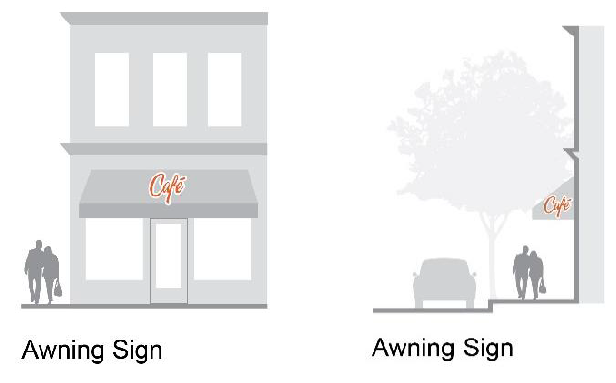
Awning sign means a permanent projecting sign painted or screen printed on the exterior surface of an awning. Such signs may be internally illuminated pursuant to the requirements of this article. See definition of "Awning" in ["Sign definitions, general" in this section].
Balloon sign means a temporary sign that is an air inflated object, which, unlike air-activated signs, retains its shape. A balloon sign is made of flexible fabric, rests on the ground or structure, and may be equipped with a portable blower motor that provides a constant flow of air into the device. Balloon signs are restrained, attached, or held in place by a cord, rope, cable, or similar method.
Banner sign means a sign on paper, cloth, fabric or other flexible or combustible material of any kind that is attached flat either to a wall or temporarily to a permanent sign face.

Banner Sign
Bench sign means a sign applied to or affixed to the seat or back of a bench.
Billboard sign (outdoor advertising sign) means a permanent freestanding pole sign erected, maintained, and used in the outdoor environment for the primary purpose of the display of commercial or noncommercial messages unrelated to the business or profession conducted or to a commodity, service, or activity sold or offered upon the premises where such sign is located.
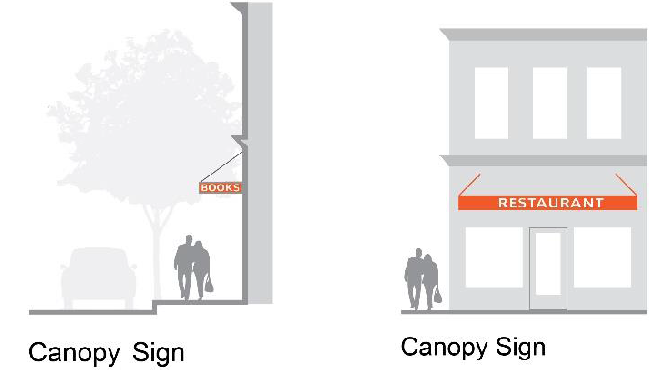
Canopy sign means a permanent projecting sign affixed to the side or bottom surface(s) of an attached or freestanding canopy. Such signs may be internally illuminated pursuant to the requirements of this article. See definitions of "Canopy" in ["Sign definitions, general" in this section].
Changeable-copy sign means a permanent sign or portion thereof on which the copy or symbols change either automatically through electrical or electronic means (e.g., time and temperature units), or manually through placement of copy and symbols on a panel mounted in or on a track system.
Electronic Message Center (EMC) sign means an electrically activated changeable-copy sign whose variable message and/or graphic presentation capability can be electronically programmed. EMCs typically use light emitting diodes (LEDs) as lighting sources.
Fascia sign. See definition of "Wall sign."
Festoons means a string of ribbons, pennants, spinners, streamers, tinsel, small flags, pinwheels, or lights, typically strung overhead and/or in loops.
Flag means a sign on paper, cloth, fabric or other flexible or combustible material of any kind that is attached to a permanent conforming pole or attached flat to a wall.
Freestanding sign means a sign supported by one or more uprights, poles, pylons, monuments, or braces placed in the ground and not attached to any building or other structure. Freestanding signs include, but are not limited to, pole signs and monument signs.
Incidental sign means a small sign, usually two square feet or less, designed and located to be read only by people within the site and generally not visible or legible from the right-of-way or adjacent properties. Examples of incidental signs include, but are not limited to, credit card signs, signs indicating hours of business, no smoking signs, signs used to designate bathrooms, handicapped signs, traffic control signs that conform to the requirements of the Michigan Manual of Uniform Traffic Control Devices, and other signs providing information to be read at close proximity. The planning director shall determine whether a sign is an incidental sign, based on the visibility of the sign from the lot line and right-of-way and/or the number of signs in close proximity of each other, and the planning director may deny a incidental sign if it is a sign that is regulated by another standard in this article.
Interior sign means a sign placed within a building, but not including a window sign as defined by this article, that is not visible from any public street, sidewalk, alley, park or public property.
Marquee sign. See definition of "Projecting sign" and "Canopy sign."
Monument sign means a base-mounted, freestanding sign placed in the ground and not attached to any building or other structure. A monument sign shall have a solid supporting base equal to or greater than the width of the sign face constructed of a decorative and durable material (e.g., masonry), and shall have no separations between the sign face and the base. The supporting base shall have a minimum 24-inch vertical height.

Monument Sign
Mural means a wall sign that is painted or drawn on the exterior surface of a structure.
People sign means a portable sign held by a person and displayed for the purposes of expressing a message.
Pole sign means a type of freestanding sign that is elevated above the ground on poles or braces.

Pole Sign
Portable message sign means a sign attached to or pulled by a vehicle that includes a manual and/or electronic changeable copy sign, an electronic graphic display sign, a video display sign, or multi-vision/tri-vision sign that may be displayed or affixed to a movable object such as but not limited to a car, truck, trailer, or similar transportation device. A "portable message sign" shall not include a "vehicle sign."
Projector-image sign means a sign that is displayed through light by a projector.
Projecting sign means a sign attached to a building or other structure, and extending beyond the attachment surface by more than 18 inches. A "projecting sign" is differentiated from a "wall sign" based on the distance the sign projects from the surface of the building. Projecting signs consist of "awning signs," "canopy signs," and "marquee signs."
Revolving sign means an animated sign that revolves around an external axis driven by wind, or electromechanical devices.
Roof sign means a sign that is erected, constructed, and maintained upon, against, or above the roof or parapet of a building or any portion thereof. A sign mounted upon a mansard fascia that does not project above the highest point of the roof or parapet shall be a "wall sign."
Rotating sign means an animated sign that rotates around an internal axis driven by wind, or electromechanical devices.
Sandwich board sign means a portable temporary sign or sign board that is freestanding and not permanently anchored or secured to either a building, structure, or the ground. Often referred to as "sidewalk signs," sandwich board signs include, but are not limited to, so called "A" frame, "T" shaped, or inverted "T" shaped stands. See also "yard sign."
Support pole sign means a temporary sign that is attached as an appendage to a sign, sign support, light pole, utility pole, or any part of a pole or support.
Vehicle sign means a sign painted or otherwise attached to a vehicle, including signs on a truck trailer. A "vehicle sign" shall not include a "portable message sign."
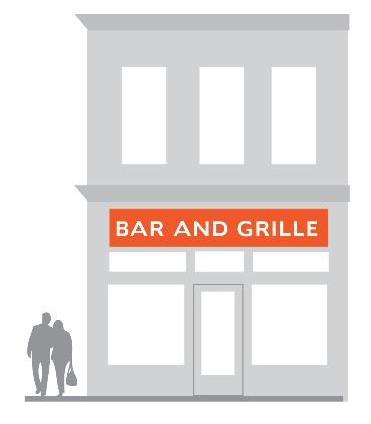
Wall sign means a sign attached to, painted on, inscribed, or otherwise set upon the exterior wall or surface of any building, no portion of which projects more than 18 inches from the wall and which may not project above the roof or parapet line. A "wall sign" shall also include a sign mounted upon a mansard fascia that does not project above the highest point of the roof or parapet. Any other sign upon, against, or above the roof or parapet of a building or any portion thereof is defined as a "roof sign."
Wall Sign
Window sign means a sign that is painted on or attached to a window or glass door that is intended to be viewed from the exterior, including signs located inside a building but visible primarily from the outside of the building.

Window Sign
Yard sign means a portable temporary sign or sign board that is freestanding and temporarily anchored or secured to the ground. See also "sandwich board sign."
(Ord. of 9-19-2018(1), § 1)

